Ukraine
Col. Gen. Sergei Beseda was known to some in Russia House as “the Baron” for his tailored suits and a cigar habit hinting at a youth as a KGB officer in Havana. He was wanted in Ukraine for allegedly encouraging former President Viktor Yanukovych to mow down demonstrators before he was toppled. WSJ
Debate Tactics
- Interruptions
- Calls arguments “idiotic” etc…
- Makes faces
- Commonly misattributes motivations to comply with his worldview (America foreign policy bad) — ignores the larger context
Predicted Russia wouldn’t invade Ukraine
Warnings of Russia invading Ukraine - here’s my discussion with Scott Horton about what’s at stake - YouTube
Expert reveals what Putin’s intention is - YouTube
Ep. 5661 - Clint Ehrlich on Russia, Ukraine and Kazakhstan - 1/20/22 - YouTube
Philosophical Roots and Lens
Bottom Line
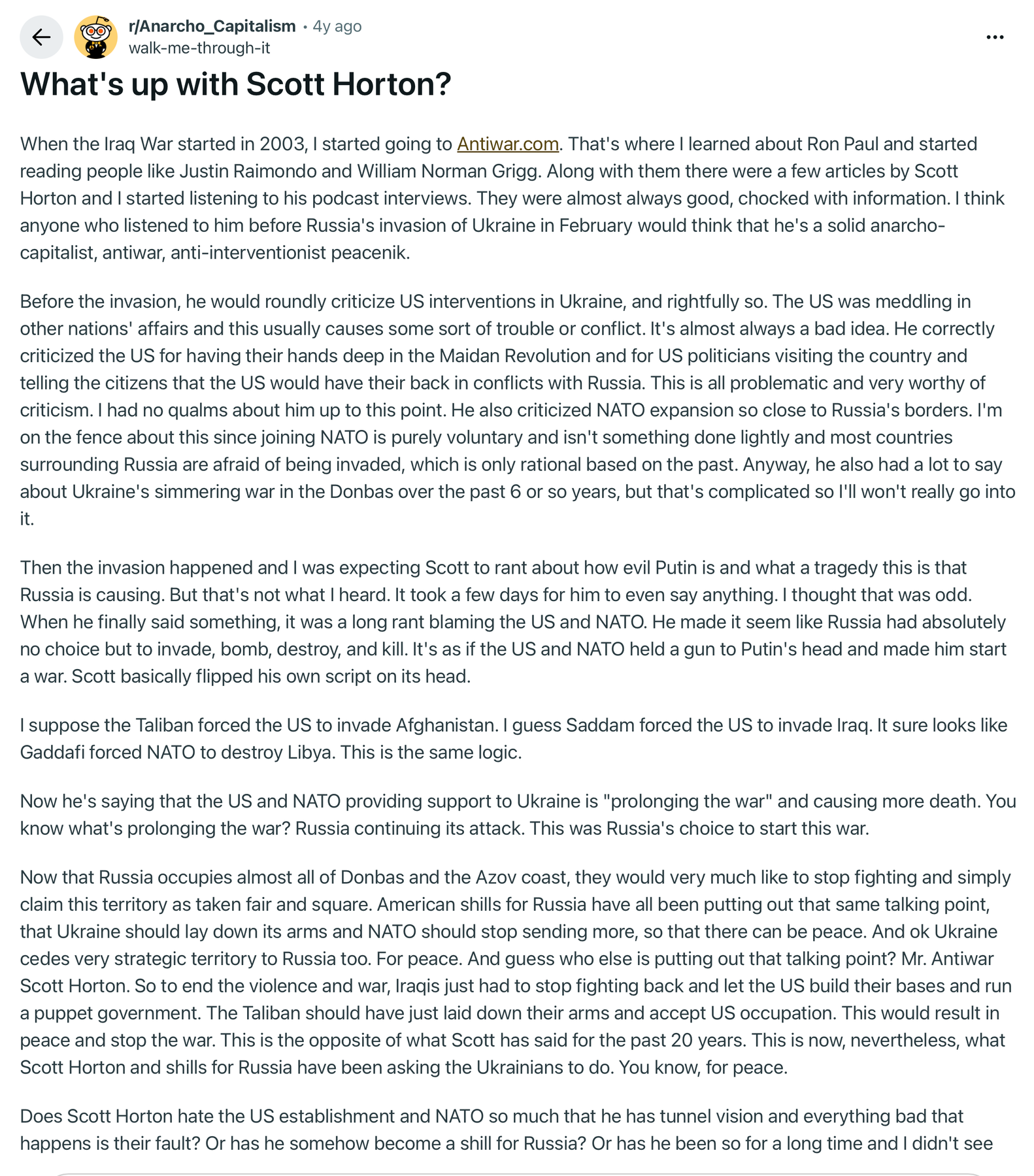
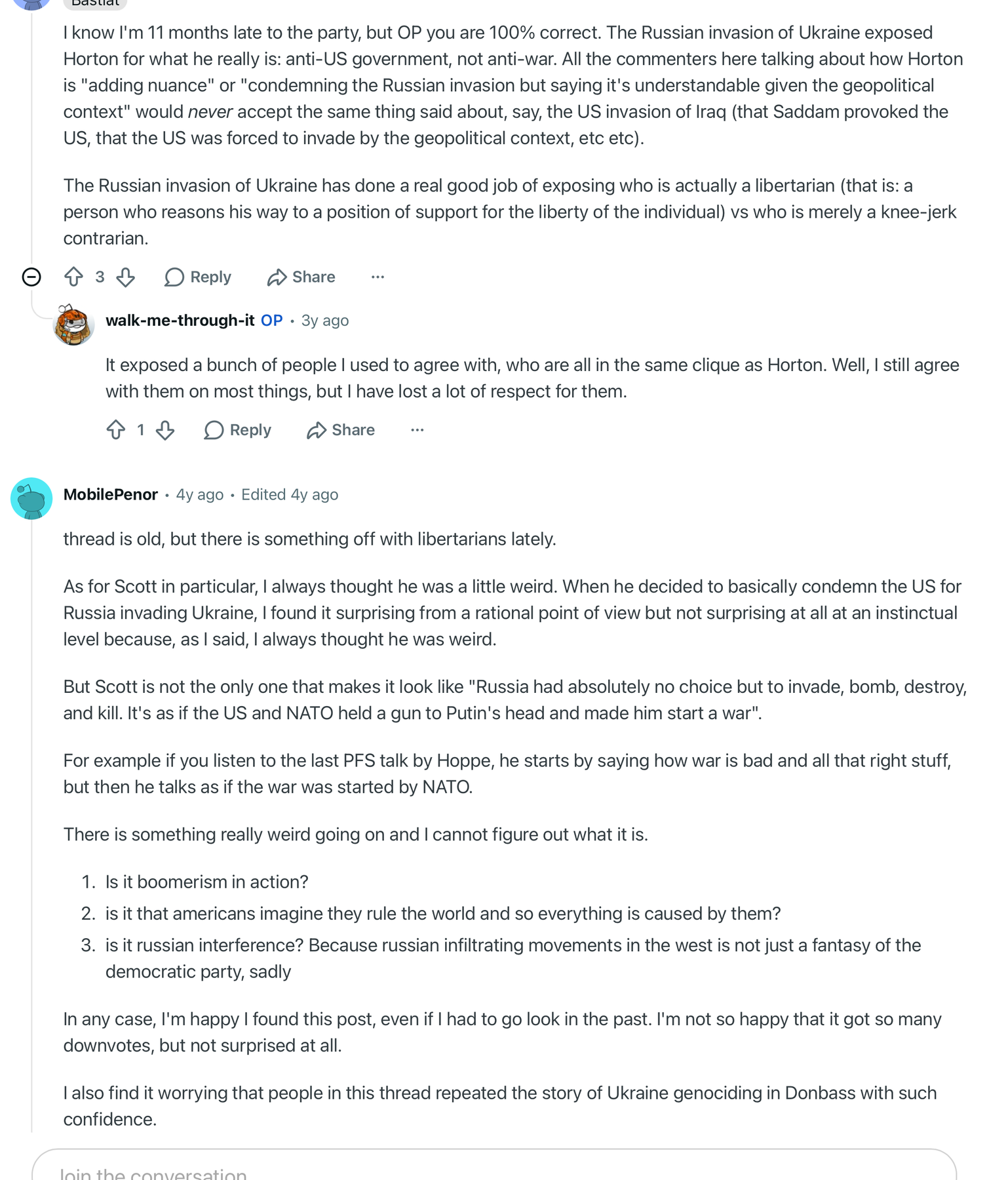
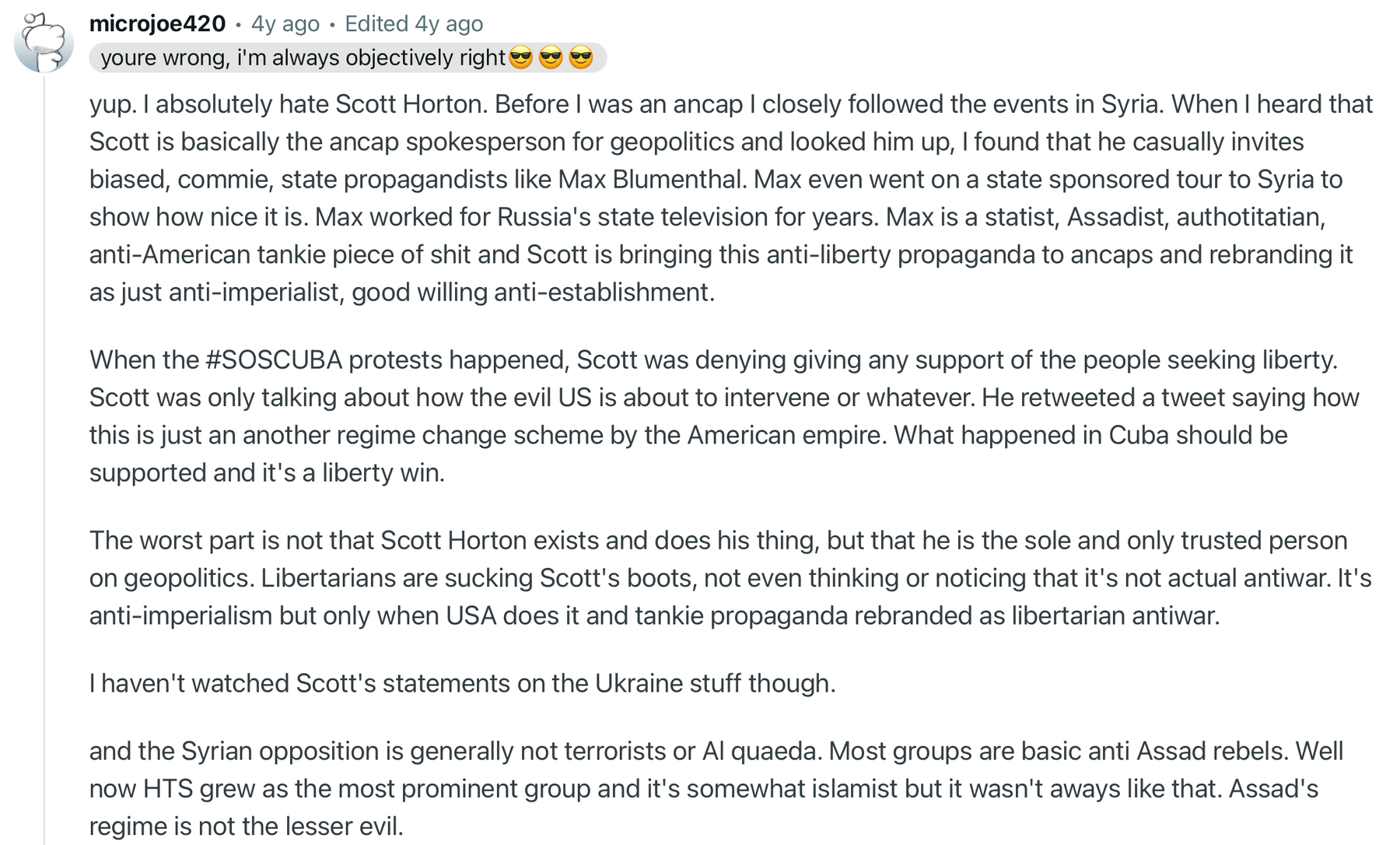
Scott Horton’s foreign-policy worldview is best understood as Rothbardian libertarian anti-imperialism combined with an Old Right / Ron Paul antiwar tradition, a deep suspicion of state power, and a non-cosmopolitan theory of political obligation: universal rights are real, but they should be defended locally, not by an American empire.
He is not simply saying, “war is bad.” He is saying something deeper:
The American state is the world’s primary interventionist empire; therefore, American libertarians must treat foreign-policy activism, democracy-promotion, NATO expansion, foreign aid, and even some human-rights rhetoric as possible instruments of imperial power.
That framework explains why he sees Ukraine, Georgia, Iran, Israel, NATO, NGOs, USAID, the National Endowment for Democracy, and “democracy promotion” through the same basic lens.
Horton is the editorial director of Antiwar.com, director of the Libertarian Institute, host of the Scott Horton Show, and author of Fool’s Errand, Enough Already, and Provoked. His public work centers on a libertarian critique of U.S. military intervention, the War on Terror, NATO expansion, and the U.S. foreign-policy establishment. (Antiwar.com)
Scott Horton’s Deep Philosophical Frameworks
1. Rothbardian Libertarianism: The State as the Primary Aggressor
The deepest foundation of Horton’s politics is libertarian anti-statism. He treats the state not as a neutral public-service institution, but as a coercive apparatus with a built-in tendency toward taxation, surveillance, militarization, propaganda, and war.
In domestic policy, this produces standard libertarian suspicion of taxation, regulation, central banking, bureaucracy, and police power. But Horton’s distinctive contribution is that he applies this suspicion most intensely to foreign policy.
For him, the warfare state is the state at its most dangerous because it combines:
- taxation
- secrecy
- propaganda
- executive power
- mass surveillance
- militarized nationalism
- emergency powers
- debt
- alliances with defense contractors
- moral panic
- legal exceptionalism
So his foreign-policy views are not detachable from his libertarian philosophy. He sees war as the highest expression of state coercion.
This explains why he frequently connects antiwar politics with anti-Fed, anti-tax, anti-surveillance, and anti-deep-state arguments. In the transcript, even the opening crowd-pleasing line invokes “the Fed,” then immediately pivots to foreign policy. That is not accidental. For Horton, central banking, empire, and war belong to the same architecture of centralized power.
How this colors his foreign policy
When a liberal internationalist sees U.S. power, they may see imperfect but necessary leadership.
When a neoconservative sees U.S. power, they may see moral force used to defend civilization.
When Horton sees U.S. power, he sees the most dangerous state machinery on earth.
That makes him instinctively opposed to:
- regime change
- preventive war
- humanitarian intervention
- foreign aid used for political influence
- NATO expansion
- covert action
- proxy wars
- democracy promotion
- sanctions
- military occupations
- permanent alliances
- “rules-based order” rhetoric
His first question is rarely: “Is the foreign government bad?”
His first question is: “What is Washington trying to do with that fact?”
2. “Libertarianism in One Country”: Anti-Cosmopolitan Political Obligation
The most important phrase in the transcript is Horton’s line that “our fight is for libertarianism in one country.” He later reinforces this with the Justin Raimondo quotation: “No, my country isn’t the world. It’s the United States of America,” and says the American libertarian revolution is the primary, perhaps sole, obligation to defend.
This is philosophically significant.
Horton is rejecting libertarian cosmopolitanism: the idea that libertarians should form international alliances, support liberty movements abroad, and help spread free markets and individual rights globally.
Instead, he defends a more particularist theory of political obligation:
American libertarians have a primary duty to restrain the American state, not to manage or judge the political struggles of every foreign society.
This is not exactly nationalism in the normal conservative sense. He is not saying America is morally superior and should dominate. He is saying almost the opposite: because America is the empire, Americans have a special duty to stop their own empire.
How this colors his foreign policy
This framework makes Horton suspicious of international libertarian organizing, especially when foreign libertarian groups advocate U.S. intervention, NATO membership, anti-Russian policies, or alignment with American-backed political projects.
In the transcript, he argues that no government in the world is libertarian enough for American libertarians, but if they criticize all foreign governments equally, they will sometimes end up “lining up with” the State Department against governments Washington dislikes. That, for him, is unacceptable because American libertarians would become “pressure from below” for intervention from above.
So even when Horton agrees that a foreign state is corrupt, authoritarian, or anti-liberty, he still resists making that the central issue. His priority is not “Which foreign faction is better?” but “How do we keep the U.S. from exploiting this conflict?”
3. Universal Human Rights, Locally Enforced
Horton does not deny universal rights. In the speech, he explicitly invokes what he calls the “Murray Rothbard rule”: “We support, of course, the principle of universal human rights — locally enforced.”
This is one of the clearest statements of his philosophical position.
He accepts the moral universalism of libertarianism: people everywhere have rights. But he rejects political universalism: the idea that a global hegemon should enforce those rights.
That distinction matters.
For Horton, the problem with human-rights interventionism is not that human rights are fake. The problem is that the enforcement mechanism becomes imperial. Once the U.S. government claims authority to enforce liberty everywhere, it must create the military, intelligence, fiscal, and bureaucratic machinery necessary to do so. That machinery then becomes a standing threat to liberty at home.
He says this directly: any American government big enough to be interested in former Soviet Georgia is too big to be anything but a threat to liberty in America.
How this colors his foreign policy
This gives Horton a clean distinction:
- Rights as moral principle: yes.
- Rights as justification for U.S. intervention: no.
- Humanitarian concern: yes.
- Humanitarian war: no.
- Solidarity with victims: yes.
- American enforcement of justice abroad: no.
This is why he can condemn Israeli crimes against Palestinians in the transcript while still saying the issue is not America’s to manage, except insofar as the U.S. is already materially implicated.
His view is not “ignore suffering.” It is closer to:Do not let suffering become the moral pretext by which the empire expands.
4. Anti-Wilsonianism: Liberty Cannot Be Exported by Empire
Horton’s speech is also a direct attack on Wilsonian liberal internationalism, neoconservatism, and what he calls neoliberal internationalism.
He rejects the idea that America can or should spread liberty abroad through:
- democracy promotion
- civil-society funding
- election monitoring
- NGO networks
- constitutional consulting
- NATO integration
- regime-change pressure
- “free markets and democracy” projects
He specifically contrasts libertarianism with Clinton-style “free markets and democracy” interventionism and George W. Bush’s “global democratic revolution.” In Horton’s telling, even when the target regime is more statist, corrupt, or authoritarian than the U.S.-backed alternative, the American intervention is still not libertarian.
This is important because Horton is attacking a temptation inside libertarianism itself.
Some libertarians are tempted to think:If a foreign movement supports lower taxes, markets, private property, anti-communism, or Western integration, then maybe U.S. support for that movement is good.
Horton says no.
For him, once liberty is delivered by the American state, it has already been corrupted. The mechanism contradicts the goal.
How this colors his foreign policy
This is why Horton is especially hostile toward “libertarian” foreign-policy hawks.
He sees them as making the same mistake as neoconservatives: they identify some genuinely illiberal foreign regime, then conclude that American power should help replace it.
To Horton, that is not libertarianism. It is empire wearing libertarian language.
That also explains why he opposes the Libertarian Party associating with international libertarian groups if those groups are entangled with NATO, USAID, NED, color revolutions, or U.S.-aligned democracy-promotion networks. His fear is not merely ideological impurity. His fear is institutional capture.
5. The Empire Lens: America as the Central Causal Actor
The strongest interpretive framework in Horton’s foreign policy is what could be called the empire lens.
He repeatedly describes America as “the world empire.” In the transcript, this becomes the premise from which everything else follows: because America intervenes everywhere, no foreign-political judgment is neutral. Even criticism of a bad regime can serve U.S. imperial aims if Washington is already targeting that regime.
This is also the central thesis of Provoked, where Horton argues that post-Cold War U.S. policy toward Russia — including NATO expansion, color revolutions, missile defense, and other forms of pressure — helped produce the Russia-Ukraine catastrophe. The official book description says Horton argues that successive U.S. administrations pressed their advantage against post-Soviet Russia until the conflict “finally blew up” into full-scale war. (The Libertarian Institute)
This does not mean Horton thinks foreign actors have no agency. But his causal emphasis is asymmetric:
Since he is an American addressing American politics, he focuses overwhelmingly on what the American empire did to create, provoke, escalate, subsidize, or exploit conflicts.
How this colors his foreign policy
This makes Horton highly sensitive to American provocation and much less interested in explanations that center only on foreign evil.
For example:
- On Ukraine, he emphasizes NATO expansion, U.S. involvement in Ukrainian politics, and post-Cold War pressure on Russia.
- On Afghanistan, he emphasizes the folly and blowback of U.S. occupation.
- On the War on Terror, he emphasizes how U.S. intervention creates enemies faster than it destroys them.
- On Iran, he tends to emphasize U.S. and Israeli threats, sanctions, coups, and encirclement rather than simply Iranian regime ideology.
- On Israel-Palestine, he emphasizes U.S. material support and diplomatic protection for Israel.
This can produce powerful critique because it forces attention onto American responsibility. But it can also create a bias: Horton’s framework can underweight the independent agency, ideology, brutality, or ambition of non-American actors. His critics would say he sometimes moves too quickly from “America contributed causally” to “America is the decisive cause.”
6. Blowback Theory: Intervention Creates the Threats It Claims to Fight
For a source-based reconstruction of Horton’s actual claim and its limits, see Blowback analysis. It distinguishes his criticism of the overall war strategy from a claim that every individual use of force fails, and compares causes, recruitment, responsibility, and feasible alternatives.
Another core framework is blowback.
Blowback theory says that foreign intervention produces unintended consequences: terrorism, civil war, refugee crises, hostile alliances, coups, radicalization, arms proliferation, and future wars.
For Horton, blowback is not a side effect. It is the normal pattern of U.S. foreign policy.
This is the structure of many of his arguments:
- The U.S. intervenes to solve a problem.
- The intervention empowers bad actors or creates instability.
- The instability creates new threats.
- The new threats are used to justify further intervention.
- The state grows stronger.
- Liberty at home shrinks.
This is why his book titles are not merely descriptive but argumentative: Fool’s Errand says Afghanistan was structurally unwinnable; Enough Already says the War on Terror became self-perpetuating; Provoked says U.S. policy helped create the conditions for the Ukraine disaster. (Antiwar.com)
How this colors his foreign policy
Horton therefore interprets American foreign-policy promises pessimistically.
When officials say:
- “This will stabilize the region,” he expects destabilization.
- “This will deter aggression,” he expects escalation.
- “This will spread democracy,” he expects client regimes.
- “This will fight terrorism,” he expects more terrorism.
- “This will protect civilians,” he expects civilian deaths.
- “This is limited,” he expects mission creep.
His default assumption is not that policymakers are solving problems badly. It is that the interventionist state creates the problems it uses to justify itself.
7. Public Choice Theory: Foreign Policy as an Interest-Group Industry
Horton also thinks like a public choice theorist.
Public choice theory applies economic self-interest to politics. It asks: who benefits institutionally, financially, professionally, or bureaucratically from a policy?
In the transcript, Horton describes a “giant industry” of NGOs associated with USAID, NED, NDI, IRI, and related institutions. In his account, these groups function as auxiliaries of American foreign policy, creating a public-facing civil-society layer for regime-change politics.
He applies this same logic to Georgia, saying NGO work can become an economic class interest and that protests against foreign-agent registration were partly a “jobs protest” by an NGO sector dependent on foreign funding.
Whether one agrees with his specific claims or not, the framework is clear:
Foreign policy is not just made by presidents and generals. It is sustained by careers, grants, think tanks, NGOs, media narratives, donor networks, defense contractors, and ideological institutions.
How this colors his foreign policy
This makes Horton suspicious of respectable institutional language.
Terms like these trigger suspicion in his framework:
- civil society
- democracy promotion
- election monitoring
- anti-corruption reform
- humanitarian assistance
- European integration
- rules-based order
- NATO partnership
- capacity building
- foreign aid
- liberty awards
- international institutes
He does not automatically hear these as neutral phrases. He hears them as possible components of a regime-change ecosystem.
That is why he sees the International Association of Libertarian Parties as dangerous in the transcript. Not because “international libertarian friendship” is inherently evil, but because it could become a reputational asset for U.S.-aligned foreign-political operations.
8. Epistemic Humility and Anti-Planner Thinking
There is also a Hayekian element in Horton’s worldview, even though he is more Rothbardian in tone.
Hayek’s knowledge problem says central planners lack the dispersed, local, tacit knowledge necessary to manage complex societies. Horton applies this to foreign policy:
If central planners cannot rationally manage the American economy, why would they be able to redesign Iraq, Afghanistan, Libya, Syria, Ukraine, Georgia, or Russia’s security environment?
This is why he mocks attempts by American libertarians or free-market consultants to advise foreign governments or help write constitutions after U.S.-backed interventions. In the transcript, he mentions libertarian figures going to Iraq to help with the new constitution, then notes that the resulting political order empowered Iran’s allies.
How this colors his foreign policy
Horton assumes policymakers do not understand foreign societies well enough to remake them.
So he tends to reject:
- nation-building
- constitutional engineering
- military occupation
- externally funded party-building
- technocratic anti-corruption campaigns
- forced democratization
- economic shock therapy
- NGO-led political transformation
The deeper principle is:Political order must emerge locally. It cannot be manufactured by foreign experts, soldiers, NGOs, or ideological missionaries.
9. Anti-Clientelism: Do Not Adopt Foreign Factions as Moral Projects
Another major framework is anti-clientelism.
Horton believes Americans are constantly pressured to adopt foreign factions as if they were domestic moral causes:
- Ukrainian liberals
- Georgian pro-EU activists
- Iranian dissidents
- Israeli hawks
- Syrian rebels
- Afghan reformers
- anti-Russian NGOs
- anti-Chinese separatists
- opposition parties in targeted states
He thinks this is how empire recruits idealists.
In the transcript, he says he does not care whether Georgian Dream or its opponents win because “it’s none of our business” and he has no favor for either side.
This is not neutrality in the sense of moral indifference. It is neutrality in the sense of non-ownership:Their political conflict is not our political project.
How this colors his foreign policy
This makes Horton resistant to emotionally compelling stories about brave dissidents, democratic protesters, freedom fighters, or Western-oriented reformers.
His response is usually:
- Are they asking for U.S. money?
- Are they asking for U.S. weapons?
- Are they connected to U.S.-funded NGOs?
- Are they pushing NATO expansion?
- Are they trying to pull the U.S. into a conflict?
- Are they being used to justify sanctions, coups, or war?
That framework can protect against manipulation. But it can also make him sound dismissive toward people living under genuinely oppressive regimes. His answer is not that they deserve oppression; his answer is that American intervention will probably make things worse and corrupt the cause.
10. Republican Anti-Empire Thought: Empire Abroad Destroys Liberty at Home
Horton’s libertarianism overlaps with an older republican warning: a republic cannot remain free while maintaining an empire.
The argument goes back through the Anti-Federalists, classical republicanism, the Old Right, and anti-imperialists like Randolph Bourne, Garet Garrett, Murray Rothbard, Ron Paul, and Justin Raimondo.
The logic is:
- Empire requires permanent military power.
- Permanent military power requires taxation, debt, secrecy, and executive discretion.
- Those tools weaken constitutional limits.
- Citizens become subjects of a national-security state.
- Foreign enemies become domestic justifications for censorship, surveillance, and repression.
Horton makes this explicit when he says the fight is to preserve liberty in America, but America happens to be the world empire intervening everywhere.
How this colors his foreign policy
For Horton, foreign policy is not a separate issue from domestic liberty. It is the central issue.
He sees interventionism as the engine behind:
- debt
- inflation
- surveillance
- executive overreach
- intelligence abuses
- militarized policing
- censorship
- propaganda
- secrecy
- emergency powers
- attacks on dissent
That is why antiwar politics is not secondary for him. It is the heart of libertarian politics.
How These Frameworks Shape His Specific Foreign-Policy Views
Ukraine and Russia
Horton’s Ukraine view flows directly from the empire lens, blowback theory, and anti-NATO framework.
He does not primarily interpret the war as:
Russia invaded because Putin is evil and expansionist.
He interprets it more as:
The U.S. and NATO spent decades expanding influence into Russia’s security perimeter, supporting political change in Ukraine, dismissing Russian red lines, and creating conditions for catastrophic war.
His book Provoked is organized around this claim: NATO expansion, color revolutions, missile defense, post-Cold War triumphalism, and U.S. pressure helped generate the Russia-Ukraine catastrophe. (The Libertarian Institute)
This does not require him to see Russia as innocent. It requires him to see Washington as the actor Americans are responsible for restraining.
Georgia
Georgia is important in the transcript because it lets Horton connect several ideas:
- color revolutions
- U.S.-funded NGOs
- Soros-linked institutions
- NATO expansion
- client states
- small countries pulling the U.S. toward war with Russia
- libertarians being tempted by pro-market foreign reformers
His conclusion is not “Georgia’s pro-Western faction is bad and the other faction is good.”
His conclusion is:We do not have a dog in this fight, and the U.S. Libertarian Party should not become reputational cover for one faction in another country’s geopolitical struggle.
Israel-Palestine
Horton’s Israel view is shaped by anti-clientelism and anti-subsidy logic.
He is especially critical of Israel because he sees the U.S. as materially implicated in Israeli policy through military aid, diplomatic protection, weapons transfers, and regional strategy.
In the transcript, he rejects a form of Israeli “libertarianism” that imagines property rights and low taxes after Palestinians are killed or expelled, saying that is not any libertarianism he recognizes.
His underlying point is that property rights cannot be built on conquest, expulsion, and state violence.
Iran
Horton generally reads Iran through the history of U.S. intervention, sanctions, Israeli pressure, regime-change politics, and nuclear-threat inflation.
His framework leads him to ask:
- Is Iran really an imminent threat?
- Who benefits from portraying it as one?
- What role did U.S. policy play in creating Iranian hostility?
- Are sanctions acts of war?
- Is Israel trying to pull America into conflict?
- Would war strengthen or weaken liberty?
Again, his primary focus is not defending the Iranian regime. It is restraining the American war machine.
The War on Terror
Horton’s War on Terror view is probably the clearest application of blowback theory.
He sees the War on Terror as a self-justifying system:
- intervention creates enemies
- enemies justify intervention
- intervention radicalizes more people
- radicalization justifies surveillance and war
- the cycle repeats
His book Enough Already is explicitly framed as a call to end the War on Terror, and his broader work has documented U.S. wars, interventions, and counterterrorism policy through that anti-interventionist lens. (Antiwar.com)
Strengths of Horton’s Framework
1. It forces moral attention back onto American responsibility
Horton’s most valuable intellectual move is that he refuses to let Americans treat their own government as a background actor.
He asks:
What did we do? What did our money fund? What did our alliances incentivize? What did our officials promise? What did our weapons enable?
That is a serious corrective to mainstream foreign-policy discourse, which often treats U.S. action as benevolent by default.
2. It understands war as institutional, not merely accidental
Horton does not treat bad foreign policy as a series of isolated mistakes. He sees an institutional pattern: the national-security state has incentives to exaggerate threats, expand missions, and preserve itself.
That gives his analysis explanatory power.
3. It resists moral manipulation
His framework is designed to resist the standard emotional sequence:
- A foreign government does something bad.
- Media highlights victims.
- Politicians demand action.
- Think tanks produce policy options.
- NGOs validate intervention.
- Dissenters are accused of indifference.
- The U.S. escalates.
Horton’s entire worldview is built to interrupt that sequence.
4. It connects foreign policy to domestic liberty
Many conservatives and liberals treat foreign policy as separate from domestic politics. Horton does not. He sees empire abroad and state power at home as structurally connected.
That is one of his deepest philosophical contributions.
Weaknesses or Risks in Horton’s Framework
1. U.S.-causal primacy can become overcorrection
Because Horton is so focused on restraining the American empire, he can appear to treat other powers as mostly reactive.
This is often analytically useful, because Americans do need to understand what their own government did. But it can become a distortion if it minimizes the independent agency of Russia, Iran, China, Hamas, Hezbollah, the Taliban, or other actors.
2. Suspicion of NGOs can flatten civil society
Horton’s critique of NGO networks is not baseless in principle: foreign funding can shape politics. But the framework can become too totalizing if it treats civil-society activism as mainly an imperial instrument.
Some activists abroad are sincerely pursuing liberty, anti-corruption, democracy, or national independence. Horton’s framework may not always give that sincerity enough weight.
3. “Never criticize a country the CIA is criticizing” is strategically clear but morally awkward
The Daniel McAdams rule quoted in the transcript is politically understandable: do not help manufacture consent for regime change. But as a general rule, it creates a moral communication problem.
If the CIA is criticizing a genuinely brutal regime, should libertarians really avoid criticizing it?
Horton’s answer seems to be: yes, because Americans should mind their own business and avoid becoming propaganda assets.
That is coherent, but it can sound like selective moral silence.
4. Anti-interventionism can become rhetorically indistinguishable from apologetics
Horton’s actual position is usually: “The foreign regime may be bad, but U.S. intervention is worse and often helped create the crisis.”
However, because he spends most of his energy attacking U.S. narratives, critics can hear him as excusing foreign aggression.
This is the central communication problem for his worldview.
Best One-Sentence Interpretation
Scott Horton’s foreign policy is a Rothbardian anti-imperial libertarianism that treats the U.S. national-security state as the chief threat Americans are responsible for restraining, accepts universal human rights in principle, rejects American enforcement of them in practice, and interprets democracy promotion, NATO expansion, foreign aid, NGO networks, and humanitarian intervention as recurring mechanisms by which empire disguises itself as liberty.
Obsidian Note Title Ideas
Scott Horton: Rothbardian Anti-Imperial LibertarianismScott Horton’s Foreign Policy Framework: Empire, Blowback, and Local LibertyUniversal Rights, Locally Enforced: Scott Horton’s Antiwar PhilosophyLibertarianism in One Country: Scott Horton Against Liberal EmpireScott Horton and the Anti-Imperial Theory of Foreign Policy
Source Links for Obsidian
- [Antiwar.com — An Important Message From Scott Horton](https://www.antiwar.com/blog/2023/05/02/an-important-message-from-scott-horton/)
- [Libertarian Institute — Provoked: How Washington Started the New Cold War with Russia and the Catastrophe in Ukraine](https://libertarianinstitute.org/books/provoked-how-washington-started-the-new-cold-war-with-russia-and-the-catastrophe-in-ukraine/)
- [Reason Foundation — Soho Forum Debate: Scott Horton vs. Eli Lake](https://reason.org/event/the-soho-forum-debate-horton-lake/)
- [Antiwar.com — A Conversation with Scott Horton](https://www.antiwar.com/blog/2025/03/24/a-conversation-with-scott-horton/)
Does there seem to be a contradiction on how Scott Horton dismisses Russia’s invasions and wanting to build an empire compared to the U.S. and its foreign policy?
Links
Provoked: How Washington Started the New Cold War with Russia and the Catastrophe in Ukraine: Horton, Scott: 9781733647373: Amazon.com: BooksAntiwar.com
BS Meter - Fact Check Podcasts & Videos
Libertarian anarchist partners with Hamas activist to teach foreign policy
(1) Jack V Lloyd on X: “I agree. And here’s a story contextualizing why. I was at Tom Woods’ house for a meetup and Scott Horton was giving a short talk. During the talk, Horton claimed that the Pulse Nightclub shooting in Orland where 49 people were murdered by Omar Mateen was a consequence of https://t.co/ahE4Z5NUHh” / X
Niall Ferguson on Scott Horton Debate
2026 Libertarian National Convention