⬅️ Hub: 30 Rhetoric · Method: Adversarial Debate Prep - A Learning Method · Audit: Citation Audit
Merge note — 2026-08-02
Canonical note. Five parallel versions merged here; the four superseded copies are in the vault
.trash(recoverable, not deleted), and their names are kept as aliases so old links still resolve.
Source Contribution Footnote range American ExceptionalismDeepest evidence body — 4 points incl. Agriculture, HIV/AIDS 1–24 (Numbers)Newest (2026-01-31), best speaking layer: Quick Ammo, conversation stack, timed versions 101+ v2Alternate phrasings, one-liners, Appendix on why people resist 201+ Merged Rhetoric Master NoteAlternate Point 2 framing — collapsed callout 301+ oldFully superseded — collapsed callout 401+ Footnotes were renumbered into separate ranges. All five notes used 1–24 for different sources; left alone, every citation in the speaking layer would have silently resolved to the wrong reference.
✅ Citations repaired 2026-08-02. The fabricated WHO URL is fixed (and its figure corrected to 154M), the dead Computer History link is replaced, and all 12 previously undefined footnotes (25–37) now have sources — see Set D. Three claims remain marked ⚠️ needs source.
⚠️ Four Reuters URLs cannot be verified from here. Reuters returns HTTP 401 for every request including its own homepage, so its 401s carry no information about whether an article exists. Open them in a browser before reuse. Two British Sociological Association links and one podcast link are genuinely 404/unreachable and are marked in place.
CORE CLAIM
The United States is historically exceptional not because it is flawless, but because its institutions, innovations, and global leadership have—on balance—saved lives at scale, expanded human freedom and prosperity, and accelerated scientific advances that lifted billions.
Demoralization isn’t simply “being critical.” It’s when critique hardens into a single story: our civilization is uniquely corrupt, our history is mainly a criminal record, and our inheritance is something to apologize for rather than improve. That story has a predictable structure. First, it turns guilt into a kind of status—what Pascal Bruckner calls a penitential posture where the West becomes the cause of everything, and moral authority flows from whoever can claim the most victimhood. Then it reshapes education and culture around an “evil triumvirate” of isms and a hierarchy of oppressed identities—so instead of transmitting the true, the good, and the beautiful, institutions train students to see their inheritance primarily as a perpetrator. And it doesn’t stop at ideas; it captures language. Flood the discourse with loaded terms—so the conclusion is baked in before the argument even starts. Herbert Marcuse called this kind of reframing “linguistic therapy”: you don’t persuade people step by step, you precondition them to feel guilt and shame, then you offer political “therapy” as the cure. The result isn’t humility. It’s civic corrosion: a population trained to distrust its own history, resent its own symbols, and treat love of home as suspect. And a society that can’t name what is good about itself eventually loses the will to defend its institutions—or the confidence to reform them without self-hatred.
CORE CLAIM — alternate phrasing (from the Numbers version)
The United States is historically exceptional not because it is flawless, but because its institutions, innovations, and global leadership have—on balance—kept more people alive and moved more people from desperation to dignity, at civilizational scale.
Reframe (use early)
“Exceptionalism” is not a victory lap. It’s a responsibility claim: when the U.S. and the broader liberal West are strong and sane, more people live, eat, trade, and build; when they fracture, progress slows.
Notebook page (B5)
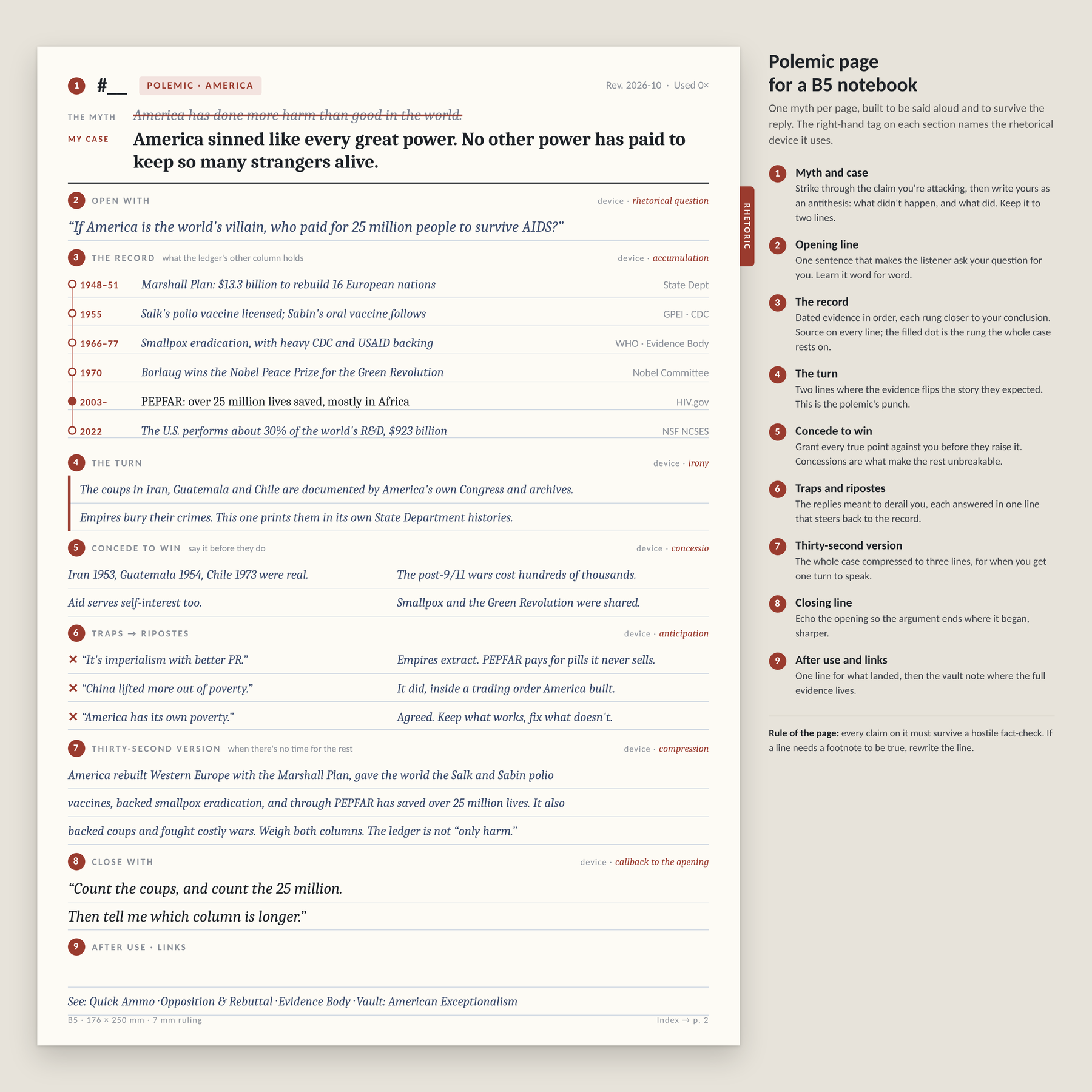
Polemic page against “America has done more harm than good”: record from the Marshall Plan through polio, smallpox, Borlaug’s Green Revolution, the internet and GPS, to PEPFAR, the declassification turn, concessions on coups and wars, traps and ripostes, a thirty-second version and the closing line. Source: HTML (file not included in this release).
In a conversation — start here
- American Exceptionalism - Quick Ammo — the six numbers that land, plus the five-step conversation stack. If you open only one note mid-argument, open this.
- American Exceptionalism - Speaking Layers — 10s / 30s / 90s versions of each point, with the evidence sitting right behind them.
- American Exceptionalism - Rhetorical Toolbox — hooks · key phrases · pivot lines when the conversation gets moralized · timed micro-practice.
When you’re being pushed on it
- American Exceptionalism - Opposition & Rebuttal — the opposing case and the answers. Read this before the evidence body — half of prep belongs to the other side.
- American Exceptionalism - Alternate Phrasings — same three points in different words, the biting one-liners, and the pre-scripted “that was China” rebuttal.
- American Exceptionalism - Why People Resist — demoralization and oikophobia: why this argument meets resistance before it meets counter-evidence.
When you need the receipts
- American Exceptionalism - Evidence Body — the deep case across four supporting points: survival & poverty · innovation & public science · agriculture · crisis capacity.
- American Exceptionalism - Sources — all four footnote sets with verification status. Set D supplies the 12 references that were cited for years but never defined.
- American Exceptionalism - Implications — why it matters beyond itself: stakes, values, consequences.
Reference only
- American Exceptionalism - Archive — two superseded versions preserved verbatim. Nothing here is current; consult only to recover a phrasing.
Cross-vault
- Method: Adversarial Debate Prep - A Learning Method — the loop this note feeds.
- Related positions: Christian Nationalism · Crime · Loss of Connection
- Counter-frame: American Demoralization · oikophobia - declining national pride
- Historical scope check: The Thirteen Colonies Framework Distorts Early American History · My Assessment of American Colonies — preserve genuine institutional achievement while testing its continental conditions and exclusions.
- Citation status: Citation Audit
Before you quote anything from here
Four Reuters links and two BritSoc links remain unverified or dead, and three claims are still marked
⚠️ needs source. Every note above carries its own footnotes so it can be read standalone — check the marker before you say a number out loud.