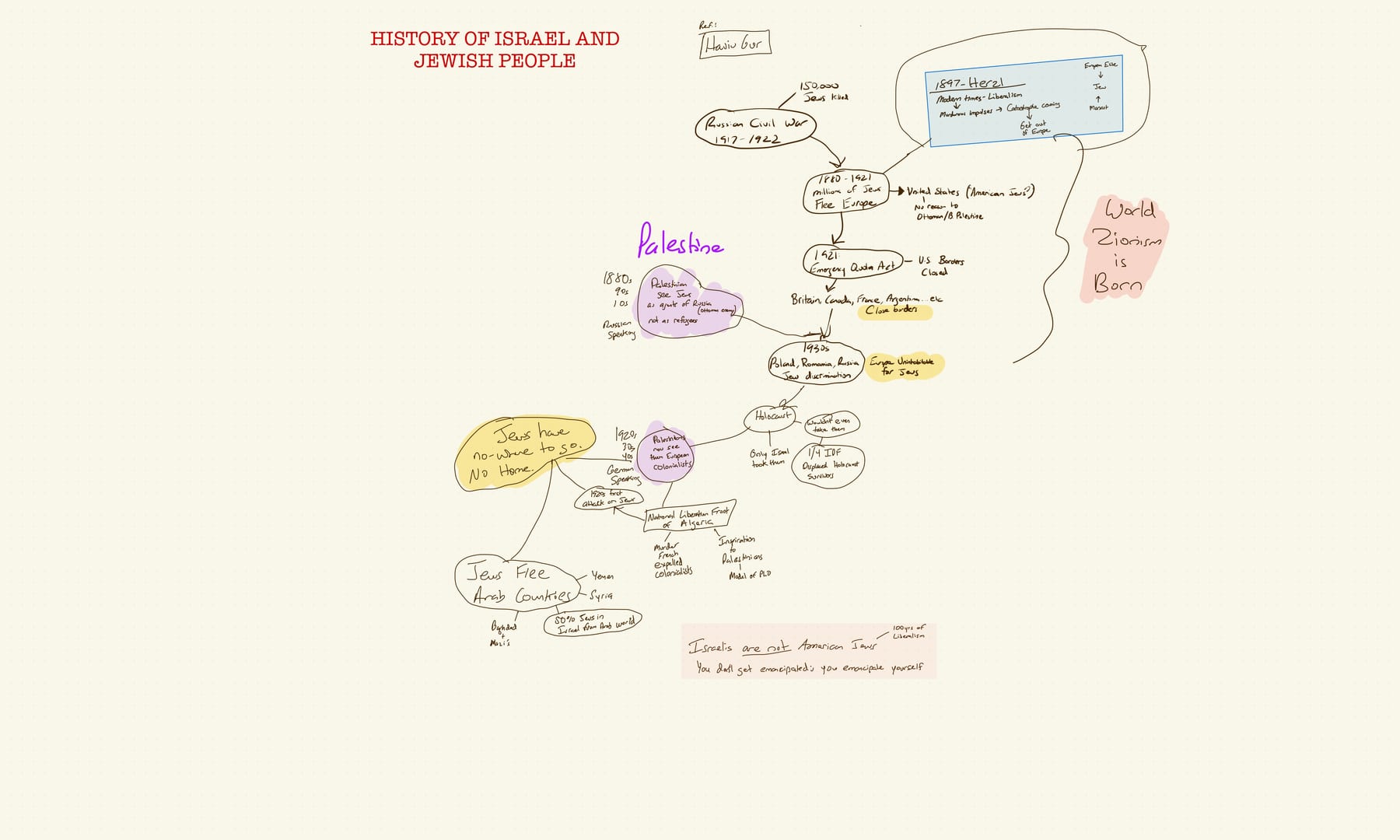
From Russian Jewish exclusion to Zionism as rescue
Source: Gur’s Breakfast Club interview, 20 October 2026, especially 41:30–59:55. Full dialogue, rhetorical analysis, and claim checks: Haviv Rettig Gur on The Breakfast Club - Zionism, Rescue and the Collapse of Trust. Earlier American background: History of American Jews.
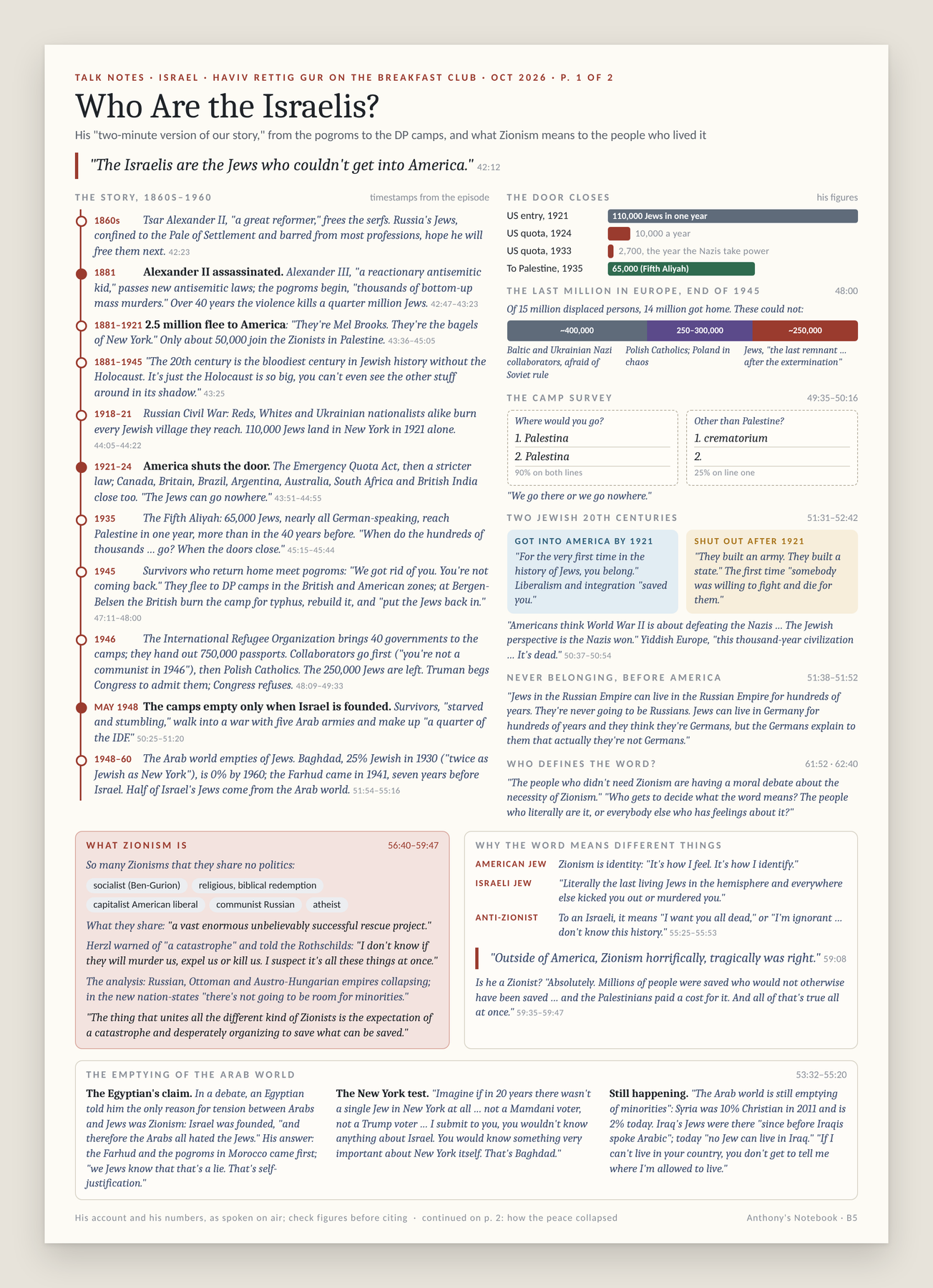
Notebook page (B5): this history as Gur tells it on The Breakfast Club, with his figures charted. Page 2, on the collapse of the peace process, is in 1968-2023.
What I should retain
Gur explains Zionism through the shrinking places in which Jews could live safely and permanently. Many Eastern European Jews initially sought America. Persecution, restrictive immigration laws, the Holocaust, and the insecurity of survivors made a Jewish state attractive as an institution able to admit and protect people whom other states could exclude. Different experiences of rescue help explain American Jewish confidence in liberal citizenship and Israeli Jewish confidence in collective self-defense. This is Gur’s interpretive framework; Palestinian dispossession remains part of the same history.
1. How a large Jewish population came under Russian rule
The background already developed in History of American Jews matters: the partitions of Poland in 1772, 1793, and 1795 brought established Jewish communities under the Russian Empire. These Jews had not collectively chosen to immigrate into Russia. Borders and rulers changed around them. The Pale of Settlement, established in 1791, subsequently restricted where most Jews could reside.
This makes “Russian Jews” a political-geographical category as well as a cultural one. The empire encompassed communities in territories now belonging to several states. Gur’s later contrast between American and Israeli Jews concerns divergent routes out of that imperial world, rather than two populations with unrelated origins.
2. Emancipation hoped for, then reaction and flight: 1861–1921
Gur begins his spoken account with Alexander II, the tsar who abolished serfdom in 1861. Reform encouraged hopes of a wider opening for Jews. His assassination in 1881, the accession of Alexander III, anti-Jewish violence, and renewed restrictions shattered those hopes. Pogroms, exclusion, and poverty made emigration an increasingly urgent practical decision. Interview, 42:00–44:30.
Keep the dates distinct: the pogrom wave began in 1881; the May Laws were issued in 1882. The latter restricted Jewish residence and economic activity in the Pale. Gur compresses this trajectory orally, while the existing American history note supplies the longer sequence. Jewish Encyclopedia, “May-Laws”.
Gur extends the story through the upheavals and anti-Jewish violence of the Russian Civil War, 1918–1921. His purpose is cumulative: reform had failed to secure permanent membership, and revolutionary upheaval brought further catastrophe. His large casualty and migration totals should be quoted as his estimates unless separately checked. The explanatory point survives without treating every round number as a census.
3. America as a destination, and the effect of closing that exit
Gur contrasts roughly 2.5 million arrivals in America with roughly 50,000 in Palestine across the earlier migration period he discusses. These are his rounded figures and compressed cohorts, not a harmonized statistical series. The argument is that many migrants first pursued safety and opportunity through immigration to an existing country. Zionism’s later mass appeal must be understood alongside the loss of alternatives. 43:00–45:45.
The Emergency Quota Act of 1921 and the Immigration Act of 1924 sharply narrowed that American route. Their national-origins system particularly disadvantaged migration from Southern and Eastern Europe. Gur’s spoken formulation that Congress effectively said “no more Jews” conveys the exclusion experienced by Jewish migrants, but the laws were national-origins restrictions, not a categorical statutory ban on all Jewish immigration. Antisemitism formed part of the political context; the legal mechanism matters. USHMM, US immigration and refugee law.
His memorable sentence, “The Israelis are the Jews who couldn’t get into America,” turns this structural argument into a family-history contrast. Read it as a compressed account of blocked refuge. It does not describe every Israeli’s biography or exhaust the religious, cultural, national, and political motives behind Zionism. 41:30–42:15.
4. Nazi persecution and Palestine: retain the mechanism, correct the example
In Gur’s account, Nazi persecution made the mismatch between urgent danger and available exits catastrophic. Zionist institutions offered a developing route of immigration and collective organization while other routes were constrained.
His 1935 illustration needs correction. He describes about 65,000 arrivals in Palestine as overwhelmingly German-speaking refugees. Official figures report 61,854 registered Jewish immigrants, including 27,843 whose previous abode was Poland and 8,630 whose previous abode was Germany. Previous abode is neither language nor nationality. The figures contradict the near-exclusive German origin he suggests, while leaving the broader rescue question open. House of Commons, 2 July 1936.
5. Liberation without a home: Jewish displaced persons after 1945
The emotional center of Gur’s narrative comes after the Holocaust. A survivor’s liberation did not restore murdered relatives, a destroyed community, a confiscated home, or confidence in returning to neighbors among whom persecution had occurred. Military victory over Nazism and a surviving Jew’s recovery of a viable future were different events. 45:45–51:30.
His phrase “the Nazis won” is a deliberately shocking reversal of the familiar Allied victory narrative. He means the destruction of a European Jewish civilization, especially the Yiddish-speaking world, persisted after Germany’s military defeat. Preserve the phrase with this explanation: it is a claim about irreversible cultural and human loss.
Gur tells a survey story in which Jewish displaced persons repeatedly choose Palestine; when asked for an alternative, a quarter supposedly write “crematorium.” It dramatizes the felt absence of a livable fallback. He supplies no named survey, camp, date, or archival reference in this interview. Retain it as his unverified anecdote, not as an established survey result. His accompanying story of international selection of non-Jewish DPs while Jews remained stranded likewise needs documentary verification before reuse as detailed history.
The independently documented background is strong enough without those details: more than 250,000 Jewish DPs lived in camps and urban centers in Germany, Austria, and Italy between 1945 and 1952. Israel became a major destination, while revised US admission arrangements also enabled substantial resettlement. USHMM records approximately 136,000 going to Israel and more than 80,000 to the United States by 1952. This was a changing population over several years, rather than one fixed group with only one eventual destination. USHMM, “Displaced Persons”.
6. Two experiences of rescue, two political instincts
Gur’s comparison is about what history taught different communities to trust. American citizenship and liberal institutions could be experienced as the solution to exclusion. Sovereignty, immigration capacity, armed self-defense, and communal solidarity could be experienced as the solution by Jews who reached Israel after other societies failed them. The same broad commitment to Jewish survival can therefore produce different intuitions about the institution that best protects it. 51:10–52:45.
This is an interpretation of political memory, not a rule that all American Jews are liberal universalists or all Israelis think alike. It explains why an American listener’s moral language may fail to persuade an Israeli listener who hears a proposal through a history of repeated exclusion.
7. Jews from Arab countries widen the story
Gur next brings in Jewish communities from Arab countries, including the Farhud in Baghdad in 1941. Their history prevents the rescue account from becoming exclusively European. His New York–Baghdad analogy asks listeners to imagine every Jewish political tendency disappearing from New York within a generation: one would investigate the society’s treatment of Jews, rather than explain the entire departure through Israeli policy alone. 52:40–55:25.
The analogy challenges collective blame and the erasure of local agency. Actual departures differed by country and combined different forms of violence, discrimination, expulsion, insecurity, Zionist mobilization, and migration choice. The Farhud predates Israel’s establishment in 1948, but occurred well after modern political Zionism emerged. Keep those chronological claims separate.
8. What this history establishes in his definition of Zionism
Gur asks what socialist and capitalist, secular and religious Zionists shared. His answer is a “vast enormous unbelievably successful rescue project”: collective institutions and sovereignty able to provide refuge and self-defense. At approximately 59:34, he explicitly affirms that he is a Zionist, then acknowledges that “the Palestinians paid a cost for it.” Definition, 56:20–59:55.
His strongest claim is that a political judgment about Israel must account for the people whom it saved and the permanence of their society. Recognizing that history supplies an explanation of Jewish national attachment; responsibility for Palestinian displacement, occupation, equality, borders, and wartime conduct still requires its own assessment. See the definition and its limits and his argument about “removability”.
Selective timeline — reconstruct the sequence
- 1772 / 1793 / 1795: partitions of Poland bring large Jewish communities under Russian rule.
- 1791: Pale of Settlement established.
- 1861: Alexander II emancipates the serfs; a period of reform shapes Jewish hopes.
- 1881: Alexander II assassinated; reaction and pogroms intensify insecurity.
- 1882: May Laws restrict residence and economic activity.
- 1918–1921: civil-war violence adds to the catastrophe for Jewish communities.
- 1921 / 1924: US national-origins quotas narrow a major migration route.
- 1933 onward: Nazi persecution makes available exits increasingly urgent.
- 1935: major immigration to Palestine; the official origin figures correct Gur’s German-refugee example.
- 1941: Farhud in Baghdad.
- 1945–1952: Jewish displaced-persons crisis and resettlement.
- 1948: Israel established; sovereign Jewish admission becomes a major route of rescue.
Recall check — answer before opening
Which tsar’s assassination is the turning point? Alexander II, in 1881. The May Laws followed under Alexander III in 1882.
What changes in 1921 and 1924? US immigration quotas narrow an important alternative route out of Eastern Europe.
Why does 1945 fail to end the story? Survival and liberation leave questions of home, citizenship, safety, and belonging unresolved.
What is Gur’s shared denominator across competing Zionisms? Rescue through collective capacity and self-government.
What further question remains? How to secure that population’s future alongside Palestinian freedom and national rights.
Optional next learning step
In Goodnotes, draw the sequence Russian exclusion → migration → quotas → Holocaust/DP crisis → sovereign refuge from memory. Add dates, then explain which link depends on documented evidence and which expresses Gur’s interpretation. Use the timeline above to check your reconstruction.
Earlier handwritten note (preserved)