Chronology
[line-3, body-2, active-color-interactive-accent]
date: 1968
title: War of Attrition along the canal
content: Clashes in the canal zone through the year. On 21 March Israel attacked Karameh in Jordan, site of a major PLO camp, in response to persistent raids on Israeli civilian targets.

[[1968-2023#1968|→ full entry]]
date: 1969
title: Bar Lev Line under fire
content: On 8 March Egypt struck the Bar Lev Line with artillery and airstrikes, causing heavy casualties; Israel retaliated with raids deep into Egyptian territory.

[[1968-2023#1969|→ full entry]]
date: 1969
title: Rogers Plan
content: US peace initiative.

[[1968-2023#1969: Rogers Plan|→ full entry]]
date: 1970
title: Operation Priha and escalation
content: Israel launched air raids against military targets in the Egyptian heartland, as far as 100 miles from the canal — 118 sorties from 7 January.

[[1968-2023#1970|→ full entry]]
date: 1970 Sep
title: Dawson's Field hijackings
content: Multiple airliners hijacked by George Habash's PFLP.

[[1968-2023#1970 September: Dawson's Field hijackings|→ full entry]]
date: 1970 Sep
title: Black September
content: Jordan declares war on the PLO; the PLO and PFLP called on Syria for help.

[[1968-2023#1970 September: Jordan declares war on PLO (Black September)|→ full entry]]
date: 1971
title: PLO moves to Lebanon
content: The PLO relocates after its expulsion from Jordan.

[[1968-2023#1971: PLO Moved to Lebanon|→ full entry]]
date: 1971 – 1973
title: Israel–Egypt negotiations break down
content: Golda Meir wanted direct talks; Cairo rebuffed them and Sadat was saying war was inevitable.

[[1968-2023#1971-1973 Israel-Egypt Negotiations & Relations|→ full entry]]
date: 1972
title: Munich Olympics massacre
content: Israeli athletes murdered at the Munich Olympics.

[[1968-2023#1972: Munich Olympics Terror Attack|→ full entry]]
date: 1973 Oct 6
title: Yom Kippur War
content: Egypt and Syria attack on Yom Kippur. Nixon's decision to resupply Israel became a turning point of the war.

[[1968-2023#1973 October 6: Yom Kippur War|→ full entry]]
date: 1974
title: Gush Emunim founded
content: The group set out to settle the West Bank, Gaza and the Golan. After six removals by the IDF, 25 families were allowed into the Kadum army camp southwest of Nablus — which became Kedumim, a major West Bank settlement.

[[1968-2023#1974: Gush Emunim was formally established|→ full entry]]
date: 1974 Apr
title: Kiryat Shmona massacre
content: 18 Israelis killed, including 8 children.

[[1968-2023#1974 April: Kiryat Shmona massacre|→ full entry]]
date: 1974 May
title: Ma'alot massacre
content: School attack in Ma'alot.

[[1968-2023#1974 May: Ma'alot massacre (School attack)|→ full entry]]
date: 1975
title: Lebanese Civil War begins
content: Arafat aligned with the Muslim factions; the Christians aligned with Israel.

[[1968-2023#1975: Lebanese Civil War|→ full entry]]
date: 1976 Mar 30
title: Land Day
content: Arab citizens protested the expropriation of thousands of dunams through strikes and marches. Israeli forces killed six unarmed Arab citizens, with hundreds wounded and arrested.

[[1968-2023#1976: Land Day|→ full entry]]
date: 1976 Jul
title: Entebbe Raid
content: Rescue of passengers from an Air France flight hijacked by PFLP militants and German revolutionaries and flown to Uganda.

[[1968-2023#1976 July: Entebbe Raid|→ full entry]]
date: 1977
title: Begin elected in Israel
content: Determined to keep the West Bank and Gaza, with settlement building his first priority. "What occupied territories? … Those are liberated territories. They are integral parts of Israel."

[[1968-2023#^begin77|→ full entry]]
date: 1977
title: Sadat signals he will come
content: Begin was highly suspicious; Sadat said he was ready to go to the Knesset and negotiate.

[[1968-2023#1977: Sadat Pre-Israel Visit|→ full entry]]
date: 1977 Nov
title: Sadat addresses the Knesset
content: Sadat offered peace while taking care not to abandon the other Arab states. At the dinner afterwards Begin and Sadat would not speak, though seated next to each other.

[[1968-2023#1977: Sadat addresses the Knesset|→ full entry]]
date: 1978 – 1981
title: Merkava, Iranian Jews, Osirak
content: The Merkava entered IDF service in 1978. In 1979 over 40,000 Iranian Jews fled the Islamic Revolution for Israel. On 30 June 1981 Israel destroyed the Osirak reactor in Operation Opera.

[[1968-2023#1978-1981|→ full entry]]
date: 1978 Mar 11
title: Coastal Road massacre
content: Attack on the Tel Aviv–Haifa coastal road.

[[1968-2023#1978 March 11: Coastal Road massacre|→ full entry]]
date: 1978 Sep
title: Camp David Accords
content: Framework negotiated between Begin and Sadat under Carter.

[[1968-2023#1978 September: Camp David Accords|→ full entry]]
date: 1979 Mar
title: Egypt–Israel Peace Treaty
content: Egypt becomes the first Arab state to officially recognise Israel, in what has been described as a "cold peace." Condemned across the Arab world as a stab in the back. Sadat and Begin shared the 1978 Nobel Peace Prize.

[[1968-2023#1979 March: Egypt-Israel Peace Treaty|→ full entry]]
date: 1981
title: Sharon becomes Defense Minister
content: Meets Christian Lebanese leaders and tells them Israel has a plan to invade Lebanon.

[[1968-2023#^sharon81|→ full entry]]
date: 1982
title: PLO flees to Tunis
content: The PLO leadership relocates to Tunisia.

[[1968-2023#1982: PLO flees to Tunis|→ full entry]]
date: 1982 Jun
title: Attempted assassination of Shlomo Argov
content: Ordered from Baghdad and carried out in London by a Palestinian splinter group hostile to the PLO — the pretext for the Lebanon War.

[[1968-2023#1982 June: Attempted Assassination of Shlomo Argov|→ full entry]]
date: 1982 Jun
title: Lebanon War
content: Israel laid siege to Beirut for nine weeks. Arafat called it the first Arab capital besieged by Israel.

[[1968-2023#1982 June: Lebanon War|→ full entry]]
date: 1982 Sep
title: Sabra and Shatila massacre
content: 400,000 people protested in Israel over Israel's role in the massacre.

[[1968-2023#1982 September: Sabra and Shatila massacre|→ full entry]]
date: 1984
title: Dreyfus affair
content: Listed in the note with a link to the Dreyfus affair.

[[1968-2023#1984: Dreyfus affair|→ full entry]]
date: 1985 Feb
title: South Lebanon conflict
content: Ongoing conflict in the south Lebanon security zone.

[[1968-2023#1985 February: South Lebanon conflict|→ full entry]]
date: 1987 Dec – 1993 Sep
title: First Intifada
content: Over 822 Palestinians were killed by other Palestinians as suspected collaborators. The IDF response was widely criticised as disproportionate.

[[1968-2023#1987 December - 1993 September: First Intifada|→ full entry]]
date: 1988 Dec
title: Arafat "renounces" terrorism
content: At a UN special session in Geneva, Arafat announced he would accept the existence of Israel, renounce terrorism and accept resolutions 242 and 338. Other leaders were unconvinced.

[[1968-2023#1998: Arafat "renounces" terrorism|→ full entry]]
date: 1991
title: Iraqi Scud attacks on Israel
content: Palestinians celebrated as the missiles headed toward Israel.

[[1968-2023#1991: Iraqi scud missile attacks against Israel|→ full entry]]
date: 1991 Oct
title: Madrid Conference
content: Hosted by Spain, co-sponsored by the United States and the Soviet Union.

[[1968-2023#1991 October: Madrid Conference|→ full entry]]
date: 1992 – 1996
title: Operation Accountability and Hebron
content: Israel struck Hezbollah positions in Lebanon in July 1993. In February 1994 Baruch Goldstein killed 29 Palestinians at the Cave of the Patriarchs; the first suicide bombing in Israel followed in retaliation, by Hamas.

[[1968-2023#1992-1996|→ full entry]]
date: 1992
title: Rabin elected Prime Minister
content: Rabin returns to office.

[[1968-2023#^rabin92|→ full entry]]
date: 1993
title: Oslo I Accord
content: Secret meetings in Oslo between Israel and the PLO produce the first accord.

[[1968-2023#1993: Oslo I Accord|→ full entry]]
date: 1994
title: Israel–Jordan peace treaty
content: Jordan becomes the second Arab state to make peace with Israel.

[[1968-2023#1994: Israel-Jordan peace treaty|→ full entry]]
date: 1995
title: Israel–Syria peace talks
content: Syria wanted the June 4th borders; Assad sent his Chief of Staff.

[[1968-2023#1995: Israel - Syria Peace Talks|→ full entry]]
date: 1995 Nov
title: Rabin assassinated
content: Killed the night Syria and Israel agreed to start peace talks.

[[1968-2023#^rabin95|→ full entry]]
date: 1995
title: Oslo II Accord
content: Arafat says he will not go back to confrontation and violence.

[[1968-2023#1995: Oslo II Accord|→ full entry]]
date: 1996 – 2001
title: Netanyahu and the slowdown
content: Netanyahu continued implementing Oslo but the peace process slowed markedly. Hamas suicide bombings continued through 1996, and the Western Wall Tunnel riots followed on 24 September.

[[1968-2023#1996-2001|→ full entry]]
date: 1996 Feb 25
title: No. 18 bus bombing
content: Hamas kills 26 in Jerusalem, aiming to kill the Oslo process. "The peace is killing us" became a chant of the time; Netanyahu had been 31 points down until this bombing.

[[1968-2023#1996 February 25: No. 18 bus bombing by Hamas in Jerusalem. 26 killed.|→ full entry]]
date: 1998 Oct 15 – 23
title: Wye River Memorandum
content: Signed by Netanyahu and Arafat.

[[1968-2023#1998 October 15-23: Wyn River Memorandum - Netanyahu & Arafat signed|→ full entry]]
date: 2000 Jul 11 – 25
title: Camp David Summit
content: Barak went further than he even wanted to. Arafat walked out and is blamed — this failure cannot be pinned on Netanyahu.

[[1968-2023#2000 July 11-25: 2000 Camp David Summit|→ full entry]]
date: 2000 Sep – 2005 Feb
title: Second Intifada
content: Follows the collapse of the Camp David summit.

[[1968-2023#2000 September - 2005 February: Second Intifada|→ full entry]]
date: 2001 Aug 9
title: Sbarro suicide bombing
content: Suicide bombing of the Sbarro restaurant in Jerusalem.

[[1968-2023#2001 August 9: Sbarro Suicide Bombing Massacre|→ full entry]]
date: 2002
title: Arab Peace Initiative
content: Arab League proposal.

[[1968-2023#2002: Arab Peace Initiative|→ full entry]]
date: 2003
title: Road Map for Peace
content: Eventually reached deadlock.

[[1968-2023#2003: Road Map for Peace|→ full entry]]
date: 2007
title: Annapolis Conference
content: Renewed negotiations under US sponsorship.

[[1968-2023#2007: Annapolis Conference|→ full entry]]
date: 2008 – 2009
title: Gaza War
content: Israel refused to lift the blockade; rocket fire continued from elements Hamas did not control during the ceasefire, and Hamas refused to return Gilad Shalit.

[[1968-2023#2008 - 2009: Gaza War|→ full entry]]
date: 2010 – 2011
title: Direct talks under Obama
content: Renewed Israeli–Palestinian peace talks.

[[1968-2023#2010-2011: Direct Talks with Obama|→ full entry]]
date: 2013 – 2014
title: Peace talks
content: Further rounds of Israeli–Palestinian talks.

[[1968-2023#2013-2014: Peace Talks|→ full entry]]
date: 2014
title: Gaza War — Protective Edge
content: Casualty counts differ sharply by source: Gaza Health Ministry 2,310 killed (70% civilians); UN HRC 2,251 (65% civilians); Israel MFA 2,125 (36% civilians, 44% combatants, 20% uncategorised males aged 16–50).

[[1968-2023#2014: Gaza War "Protective Edge"|→ full entry]]
date: 2014
title: Abbas peace plan
content: Abbas puts forward his own framework.

[[1968-2023#2014: Abbas Peace Plan|→ full entry]]
date: 2017
title: Trump plan
content: US proposal for the conflict.

[[1968-2023#2017: Trump Plan|→ full entry]]
date: 2018 – 2019
title: Great March of Return
content: Gaza border protests and the response to them.

[[1968-2023#2018 - 2019: Gaza border protests 'Great March of Return'|→ full entry]]
1968

Israeli paratroopers in action during the Battle of Karameh in 1968
- January 31, 1968: Five Israeli soldiers were wounded and one Israeli and two Egyptian tanks were destroyed in a clash in the canal zone. Israeli and Jordanian forces also exchanged fire without known casualties.38(https://en.wikipedia.org/wiki/War_of_Attrition#cite_note-38)
- March 21, 1968: In response to persistent PLO raids against Israeli civilian targets, Israel attacks the town of Karameh, Jordan, the site of a major PLO camp. The goal of the invasion was to destroy Karameh camp and capture Yasser Arafat in reprisal for the attacks by the PLO against Israeli civilians, which culminated in an Israeli school bus hitting a mine in the Negev.39(https://en.wikipedia.org/wiki/War_of_Attrition#cite_note-39) However, plans for the two operations were prepared in 1967, one year before the bus incident.40(https://en.wikipedia.org/wiki/War_of_Attrition#cite_note-Debacle_in_the_desert-40) When Jordan saw the size of the raiding forces entering the battle it was led to the assumption that Israel had another goal of capturing Balqa Governorate to create a situation similar to the Golan Heights.41(https://en.wikipedia.org/wiki/War_of_Attrition#cite_note-41)[[42]](https://en.wikipedia.org/wiki/War_of_Attrition#cite_note-42) Israel assumed that the Jordanian Army would ignore the invasion, but the latter fought alongside the Palestinians and opened heavy fire that inflicted losses upon the Israeli forces.43(https://en.wikipedia.org/wiki/War_of_Attrition#cite_note-telegraph-43) This engagement marked the first known deployment of suicide bombers by Palestinian forces.44(https://en.wikipedia.org/wiki/War_of_Attrition#cite_note-44) The Israelis were repelled at the end of a day’s battle, having destroyed most of the Karameh camp and taken around 141 PLO prisoners.45(https://en.wikipedia.org/wiki/War_of_Attrition#cite_note-GUERRILLAS-45) Both sides declared victory. On a tactical level, the battle went in Israel’s favor,46(https://en.wikipedia.org/wiki/War_of_Attrition#cite_note-Zeev_Maoz_page_246-46) and the destruction of the Karameh camp was achieved.47(https://en.wikipedia.org/wiki/War_of_Attrition#cite_note-Herzog,_The_Arab-Israeli_Wars_page_205-47) However, the relatively high casualties were a considerable surprise for the IDF and was stunning to the Israelis.48(https://en.wikipedia.org/wiki/War_of_Attrition#cite_note-tuckerS-48) Although the Palestinians were not victorious on their own, King Hussein let the Palestinians take credit.48(https://en.wikipedia.org/wiki/War_of_Attrition#cite_note-tuckerS-48)[[49]](https://en.wikipedia.org/wiki/War_of_Attrition#cite_note-49)[[50]](https://en.wikipedia.org/wiki/War_of_Attrition#cite_note-assessment-50)

President Nasser of Egypt (with binoculars) surveys positions at the Suez Canal in November 1968
- June 1968: The war “officially” begins, with sparse Egyptian artillery bombardment of the Israeli front line on the east bank of the Suez Canal. More artillery bombardments in the following months cause Israeli casualties.24(https://en.wikipedia.org/wiki/War_of_Attrition#cite_note-Britannica-24)
- August 20, 1968: Israeli and Jordanian forces engaged in a battle along the Sea of Galilee involving artillery, mortars, and machine guns.51(https://en.wikipedia.org/wiki/War_of_Attrition#cite_note-51)
- September 8, 1968: An Egyptian artillery barrage kills 10 Israeli soldiers and injures 18. Israel responds by shelling Suez and Ismailia.33(https://en.wikipedia.org/wiki/War_of_Attrition#cite_note-acig-33)
- October 30, 1968: Israeli helicopter-borne Sayeret Matkal commandos carry out Operation Shock, destroying an Egyptian electric transformator station, two dams along the Nile River and a bridge.33(https://en.wikipedia.org/wiki/War_of_Attrition#cite_note-acig-33) The blackout causes Nasser to cease hostilities for a few months while fortifications around hundreds of important targets are built. Simultaneously, Israel reinforces its position on the east bank of the Suez Canal by construction of the Bar Lev Line.52(https://en.wikipedia.org/wiki/War_of_Attrition#cite_note-SIS:_Book_Review:_At_Noon_The_Myth_Was_Shattered-52)
- November 3, 1968: Egyptian MiG-17s attack Israeli positions, and are met by Israeli interceptors. One Israeli plane is damaged.33(https://en.wikipedia.org/wiki/War_of_Attrition#cite_note-acig-33)
- December 1, 1968: Israeli helicopter-borne commandos destroy four bridges near Amman, Jordan.33(https://en.wikipedia.org/wiki/War_of_Attrition#cite_note-acig-33)
- December 3, 1968: The Israeli Air Force bombs PLO camps in Jordan. The Israeli jets are intercepted by Hawker Hunters of the Royal Jordanian Air Force, and an Israeli fighter jet is damaged during the brief air battle.33(https://en.wikipedia.org/wiki/War_of_Attrition#cite_note-acig-33)
1969

A F-4E Phantom of the Israeli Air Force. The aircraft was used to good effect as “flying artillery” during the war. Roundel markings on nose credit this aircraft with three aerial kills.

Israeli troops at the Firdan Bridge by the Suez Canal, 1969
- March 8, 1969: Egypt strikes the Bar Lev Line with artillery fire and airstrikes, causing heavy casualties. Israel retaliates with raids deep into Egyptian territory, causing severe damage.24(https://en.wikipedia.org/wiki/War_of_Attrition#cite_note-Britannica-24)
- March 9, 1969: The Egyptian Chief of Staff, General Abdul Munim Riad, is killed in an Israeli mortar attack while visiting the front lines along the Suez Canal.
- May–July 1969: Heavy fighting takes place between Israeli and Egyptian forces. Israel loses 47 dead and 157 wounded, while Egyptian casualties are far heavier.
- July 18, 1969: Egyptian commandos raid Israeli military installations in Sinai.33(https://en.wikipedia.org/wiki/War_of_Attrition#cite_note-acig-33)
- July 19–20, 1969: Operation Bulmus 6 – Israeli Shayetet 13 and Sayeret Matkal commandos raid Green Island, resulting in the total destruction of the Egyptian facility. Six Israeli soldiers and 80 Egyptian soldiers are killed. Some Egyptian casualties are caused by their own artillery.
- July 20–28, 1969: Operation Boxer – Nearly the entire Israeli Air Force attacks the northern sector of the Canal, destroying anti-aircraft positions, tanks and artillery, and shooting down eight Egyptian aircraft. An estimated 300 Egyptian soldiers are killed, and Egyptian positions are seriously damaged. Israeli losses amount to two aircraft. Egyptian artillery fire is reduced somewhat. However, shelling with lighter weapons, particularly mortars, continues.
- July–December 1969: Israel carries out its “flying artillery” campaign, employing widespread air raids against Egyptian positions in the Suez Canal. In August alone, the Israeli Air Force flew about 1,000 combat sorties against Egypt, destroying dozens of SAM sites and shooting down 21 aircraft for the loss of three aircraft. Israeli jets flew low to avoid Egypt’s SAM-2 missile defenses. Soviet advisers sometimes counted up to eighty Israeli sorties per day in a single sector. Egypt’s SAM-2 batteries were severely mauled, causing Egyptian artillery crews to become more reluctant to engage and reveal their positions, enabling Israeli tanks to emerge from cover and take direct aim at Egyptian positions. Several Soviet advisors to Egyptian forces were killed in the bombing campaign. The Soviets subsequently introduced the Strela-2 missile to target high-flying aircraft, shooting down an Israeli A-4 Skyhawk on August 19.33(https://en.wikipedia.org/wiki/War_of_Attrition#cite_note-acig-33)[[53]](https://en.wikipedia.org/wiki/War_of_Attrition#cite_note-53)
- September 9, 1969: Operation Raviv – Israeli forces raided Egypt’s Red Sea coast. The raid was preceded by Operation Escort, with Shayetet 13 naval commandos infiltrating the Egyptian Navy anchorage at Ras Sadat with Maiale manned torpedoes and sinking a pair of Egyptian torpedo boats with limpet mines to prevent them from interfering with the operation. As they made their getaway, the self-destruct mechanism on one of the Maiales accidentally detonated. Three Israeli Navy landing craft then landed the raiding force on the coast, with the Israelis wearing Egyptian uniforms and using captured Arab T-55 tanks and BTR-50 armored personnel carriers painted in Egyptian colors. The Israeli force, backed by air support, destroyed 12 Egyptian military outposts. Israeli A-4 Skyhawks backing up the operation attacked an Egyptian radar site, during which one of the Skyhawks was shot down. After nine hours of operating unhindered in enemy territory, the raiding force withdrew and rendezvoused with the landing craft and returned to Israeli-held territory in the Sinai, having suffered only one light injury during the mission.54(https://en.wikipedia.org/wiki/War_of_Attrition#cite_note-54) The Egyptians suffered 100–200 casualties. Two Soviet military advisors including a colonel were killed.
- September 11, 1969: Sixteen Egyptian aircraft carry out a strike mission. Eight MiGs are shot down by Israeli Mirages and a further three Su-7s are lost to Israeli anti-aircraft artillery and HAWK surface-to-air missiles.27(https://en.wikipedia.org/wiki/War_of_Attrition#cite_note-FOOTNOTEPollack200295-27)
- October 17, 1969: The United States and Soviet Union begin diplomatic talks to end the conflict.

Israeli artillery in action in 1969
- October 27, 1969: Over the previous days, air and artillery duels took place in the canal zone. One Israeli soldier was killed and ten wounded in a surprise Egyptian air attack. One Egyptian MiG-17 was shot down by an Israeli Hawk missile. Israeli aircraft also raided Egyptian positions along the canal. On the Jordanian front, one Israeli soldier was killed and two wounded in the Beisan valley in mortar attacks from Jordan. Four Arab guerrillas were killed in a clash with an Israeli patrol along the Jordan River and Israeli jets attacked Arab guerrilla positions in Jordan, striking targets in the suburbs of Amman.55(https://en.wikipedia.org/wiki/War_of_Attrition#cite_note-55)
- December 9, 1969: Egyptian aircraft, with the assistance of newly delivered P-15 radars, defeat the Israelis in an aerial engagement, shooting down two Israeli Mirages. Later in the evening, an Egyptian fighter flown by Lt. Ahmed Atef shot down an Israeli F-4 Phantom II, making him the first Egyptian pilot to shoot down an F-4 in combat.56(https://en.wikipedia.org/wiki/War_of_Attrition#cite_note-56) The same day, the Rogers Plan is publicized. It calls for Egyptian “commitment to peace” in exchange for the Israeli withdrawal from Sinai. Both parties strongly reject the plan. Nasser forestalled any movement toward direct negotiations with Israel. In dozens of speeches and statements, Nasser posited the equation that any direct peace talks with Israel were tantamount to surrender.57(https://en.wikipedia.org/wiki/War_of_Attrition#cite_note-RabinovichShakedp192-57) President Nasser instead opts to plead for more sophisticated weaponry from the Soviet Union to withstand the Israeli bombings. The Soviets initially refuse to deliver the requested weapons.58(https://en.wikipedia.org/wiki/War_of_Attrition#cite_note-MFA:_9_Statement_by_Secretary_of_State_Rogers-_December_9,_1969-58)
- December 26–27, 1969: Israel launches Operation Rooster 53. As Israeli aircraft attack Egyptian positions along the canal, Israeli paratroopers ferried by Super Frelon helicopters, which use the noise of the air attacks as cover, land at Ras Ghareb and capture an Egyptian P-12 radar facility, overwhelming its light security contingent. Two Egyptian personnel are killed and four captured. The paratroopers then take apart the radar, with the radar’s pieces being ferried away by two Israeli Sikorsky CH-53 Sea Stallion helicopters. The operation enabled Israeli and American learning of the latest Soiviet radar technology, and caused a huge morale impact on the Egyptians.
1969: Rogers Plan
1970

Israeli paratroopers in action during Operation Rhodes, 1970
- January 7, 1970: Israel launched Operation Priha, a series of air raids against military targets in the Egyptian heartland, as far as 100 miles from the canal. A total of 118 sorties were ultimately undertaken between January 7 and April 13. Also on January 7, a Soviet adviser to an Egyptian infantry brigade was killed in an Israeli attack.59(https://en.wikipedia.org/wiki/War_of_Attrition#cite_note-Remez-Ginor-59)
- January 12, 1970: Two Egyptian Sukhoi Su-7 fighters were shot down by Israeli Hawk missiles while attacking an Israeli base near Ras Sudar. Israel also reported that in the past days, Israeli forces killed 12 Arab guerrillas and captured four in a series of clashes in the Arabah region and Jordan Valley.60(https://en.wikipedia.org/wiki/War_of_Attrition#cite_note-60)
- January 22, 1970: With Egypt’s air defense system having largely been devastated and the deep-penetration bombing raids hitting further into Egypt, President Nasser secretly flew to Moscow to discuss the situation. His request for new SAM batteries (including the 2K12 Kub and Strela-2) was approved. Their deployment requires qualified personnel along with squadrons of aircraft to protect them. Thus, he needed Soviet military personnel in large numbers, something the Kremlin did not want to provide. Nasser then threatens to resign, implying that Egypt might turn to the United States for help in the future. The Soviets had invested heavily in President Nasser’s regime, and so, the Soviet leader, General-Secretary Leonid Brezhnev, finally obliged. The Soviet Union, which had already been increasing its military presence in Egypt from the summer of 1969 and deployed its first fighter jets in December of thar year, decided to greatly increase its military presence, deploying additional air defense units alongside fighter aircraft. The Soviet military intervention was codenamed Operation Kavkaz.61(https://en.wikipedia.org/wiki/War_of_Attrition#cite_note-61) The Soviet presence increased from 2,500 to 4,000 in January to 10,600–12,150 ground personnel plus 100–150 pilots by June 30.

Soviet/Egyptian S-125 anti-aircraft type missiles in the Suez Canal vicinity
- January 22, 1970: Operation Rhodes. Israeli paratroopers and naval commandos are transported by IAF Super Frelon helicopters to Shadwan Island where they capture the island and dismantle a British-made Egyptian Decca radar and other military equipment for transport back to Israel before withdrawing. Meanwhile, Israeli fighter jets provide close air support and sink two Egyptian P-183 torpedo boats approaching the island. An estimated 70 Egyptian soldiers were killed and 62 more were taken prisoner while the Israelis lost 3 killed and 7 wounded.62(https://en.wikipedia.org/wiki/War_of_Attrition#cite_note-62)
- January 26, 1970: Israeli aircraft attacked an Egyptian auxiliary ship in the Gulf of Suez, damaging it and causing it to ground on a reef.63(https://en.wikipedia.org/wiki/War_of_Attrition#cite_note-63)
- January 28, 1970: Israeli bombing was reported to have killed six Soviet personnel, three in an attack on a building in a suburb of Cairo that housed Soviet advisors and three in a SAM complex at Dashur.64(https://en.wikipedia.org/wiki/War_of_Attrition#cite_note-64) Two months later, US National Security Advisor Henry Kissinger told Israeli ambassador to the US Yitzhak Rabin that 40 Soviet personnel had been killed in the bombing at Dashur.65(https://en.wikipedia.org/wiki/War_of_Attrition#cite_note-fear-65)
- February 1970: Two Israeli auxiliary vessels were sabotaged by Egyptian frogmen in Eilat harbor. A supply ship sank while a coastal landing craft sustained damage but was beached by its crew before sinking. There were no casualties. In response, Israeli warplanes sank an Egyptian minelayer in the Gulf of Suez, carried out raids against Egyptian military positions in the canal zone, and struck two military targets deeper into Egyptian territory. Egyptian aircraft also raided Israeli positions along the Suez Canal, injuring three Israeli soldiers. Four days of fighting took place between Israeli and Syrian forces as well.66(https://en.wikipedia.org/wiki/War_of_Attrition#cite_note-66)[[67]](https://en.wikipedia.org/wiki/War_of_Attrition#cite_note-Naor-67) Israeli fighter jets accidentally struck an industrial plant at Abu Zaabal, killing 80 workers.68(https://en.wikipedia.org/wiki/War_of_Attrition#cite_note-68)
- February 1970: An Egyptian commando platoon attempts to set up an ambush in the vicinity of the Mitla Pass but is discovered. The entire unit is either killed or captured.27(https://en.wikipedia.org/wiki/War_of_Attrition#cite_note-FOOTNOTEPollack200295-27)
- February 9, 1970: An air battle between Israeli and Egyptian warplanes takes place, with each side losing one plane.33(https://en.wikipedia.org/wiki/War_of_Attrition#cite_note-acig-33)
- March 15, 1970: The first fully operational Soviet SAM site in Egypt was completed. It is part of three brigades which the Soviet Union sends to Egypt.69(https://en.wikipedia.org/wiki/War_of_Attrition#cite_note-ACIG-69) Israeli F-4 Phantom II jets repeatedly bomb Egyptian positions.
- April 8, 1970: The Israeli Air Force carried out bombing raids against targets identified as Egyptian military installations. A group of military bases about 30 kilometers from the Suez Canal was bombed. However, in what becomes known as the Bahr el-Baqar incident, Israeli F4 Phantom II fighter jets attack a single-floor school in the Egyptian town of Bahr el-Baqar, after it was mistaken for a military installation. The school is hit by five bombs and two air-to-ground missiles, killing 46 schoolchildren and injuring over 50.70(https://en.wikipedia.org/wiki/War_of_Attrition#cite_note-70)[[71]](https://en.wikipedia.org/wiki/War_of_Attrition#cite_note-71) This incident put a definite end to Operation Priha, and the Israelis instead then concentrated on attacking Canal-side installations. The respite gave the Egyptians time to reconstruct their SAM batteries closer to the canal. Soviet MiG fighters provided the necessary air cover. Soviet pilots also began approaching IAF aircraft during April 1970, but Israeli pilots were given orders not to engage these aircraft and break off whenever Soviet-piloted MiGs appeared.
- April 1970: the Kuwaiti Armed Forces suffered their first Kuwaiti fatality on the Egyptian front.72(https://en.wikipedia.org/wiki/War_of_Attrition#cite_note-kuwait-history.net-72)
- May 1970: An Israeli fishing boat was sunk by the Egyptian Navy, killing two of its crew. The Israeli Air Force launched a heavy series of bombing raids against Egyptian targets throughout the canal zone and shot down five Egyptian warplanes. Israeli aircraft sank an Egyptian destroyer and minelayer. Two Israeli soldiers were killed by Egyptian shelling and a civilian Israeli frogman was also killed by explosives planted by Egyptian frogmen while removing underwater wreckage at the port of Eilat.73(https://en.wikipedia.org/wiki/War_of_Attrition#cite_note-73) During the final days of the month, the IAF launched major air raids against Port Said, believing a large amphibious force is assembling in the town. On the 16th an Israeli aircraft was shot down in air combat, probably by a MiG-21.74(https://en.wikipedia.org/wiki/War_of_Attrition#cite_note-74)
- May 3, 1970: Twenty-one Palestinian guerrillas were killed by Israeli troops in the Jordan Valley.67(https://en.wikipedia.org/wiki/War_of_Attrition#cite_note-Naor-67)
- May 20, 1970: Israeli troops repulsed an Egyptian commando raid in the canal zone. The Egyptian raiding party retreated under cover of Egyptian artillery fire and Israeli forces responded with artillery fire and airstrikes. Seven of the Egyptian commandos were killed and the Israeli account claimed that the Egyptians also suffered casualties from Israeli retaliatory shelling and airstrikes. Israeli losses were two killed and one injured. Israeli and Jordanian forces also exchanged mortar fire in the northern Beisan Valley.75(https://en.wikipedia.org/wiki/War_of_Attrition#cite_note-75)
- May 30, 1970: 15 Israeli soldiers were killed, 8 were wounded, and 2 were presumed captured on the same day in three separate ambushes. Israeli armored patrols were ambushed twice on the Suez Canal by Egyptian troops, resulting in 13 Israeli soldiers dead, 4 wounded, and 2 missing and presumed taken prisoner. In the Jordan Valley, north of Jericho, an army patrol was ambushed by Arab guerillas, resulting in 2 dead and 4 wounded. It was not known whether the clashes resulted in any Arab casualties.76(https://en.wikipedia.org/wiki/War_of_Attrition#cite_note-76) In response, Israeli warplanes launched a massive bombing campaign against the Port Said area. Soviet warships were present and some fired on the Israeli planes. Several Soviet naval personnel were killed when shrapnel from the bombing hit a Soviet warship.77(https://en.wikipedia.org/wiki/War_of_Attrition#cite_note-77)
- June 1970: An Israeli armored raid on Syrian military positions resulted in “hundreds of Syrian casualties.”2(https://en.wikipedia.org/wiki/War_of_Attrition#cite_note-autogenerated1-2)
- June 25, 1970: An Israeli A-4 Skyhawk, in an attack sortie against Egyptian forces on the Canal, was attacked and pursued by a pair of Soviet MiG-21s into Sinai. According to the Soviets, the plane was shot down, while the Israelis said it was damaged and forced to land at a nearby airbase.69(https://en.wikipedia.org/wiki/War_of_Attrition#cite_note-ACIG-69)
- June 27, 1970: The EAF continued to launch air raids across the canal. On June 27 around eight Egyptian Su-7s and MiG-21s attacked Israeli rear areas in Sinai. According to Israel, two Egyptian aircraft were shot down. An Israeli Mirage was shot down, and the pilot was captured.78(https://en.wikipedia.org/wiki/War_of_Attrition#cite_note-78)
- June 1970: The Kuwaiti Armed Forces suffered sixteen fatalities on the Egyptian front.72(https://en.wikipedia.org/wiki/War_of_Attrition#cite_note-kuwait-history.net-72)
- June 30, 1970: Soviet air defenses shot down two Israeli F-4 Phantoms. Two pilots and a navigator are captured, while a second navigator is rescued by helicopter the following night.33(https://en.wikipedia.org/wiki/War_of_Attrition#cite_note-acig-33)
- July 18, 1970: A force of 24 Israeli F-4 Phantom fighter jets attacked SAM batteries in Egypt, destroying all the targeted batteries and killing eight Soviet personnel. One Israeli F-4 Phantom was shot down and another was severely damaged but managed to return to base.79(https://en.wikipedia.org/wiki/War_of_Attrition#cite_note-79)[[80]](https://en.wikipedia.org/wiki/War_of_Attrition#cite_note-80)[[81]](https://en.wikipedia.org/wiki/War_of_Attrition#cite_note-81)
- July 30, 1970: A large-scale dogfight occurred between Israeli and Soviet aircraft, codenamed Rimon 20, involving 12 to 24 Soviet MiG-21s (besides the initial 12, other MiGs were “scrambled”, but it is unclear if they reached the battle in time), and 12 Israeli Dassault Mirage IIIs and four F-4 Phantom II jets. The engagement took place west of the Suez Canal. After luring their opponents into an ambush, the Israelis shot down five of the Soviet MiGs. Four Soviet pilots were killed, while the IAF suffered no losses except a damaged Mirage.69(https://en.wikipedia.org/wiki/War_of_Attrition#cite_note-ACIG-69)[[82]](https://en.wikipedia.org/wiki/War_of_Attrition#cite_note-shalom-82)
- August 3, 1970: The Soviets responded by luring Israeli fighter jets into a counter-ambush.83(https://en.wikipedia.org/wiki/War_of_Attrition#cite_note-83) Dummy missile batteries had been set up to lure Israeli fighter jets in while the real missiles were concealed. When the Israeli attack came, one Israeli F-4 Phantom was shot down and another was hit but managed to return to base.84(https://en.wikipedia.org/wiki/War_of_Attrition#cite_note-84)[[85]](https://en.wikipedia.org/wiki/War_of_Attrition#cite_note-85)
- Early August, 1970: Despite their losses, the Soviets and Egyptians managed to press the air defenses closer to the canal. The batteries allowed the Egyptians to move in artillery which in turn threatened the Bar Lev Line. Following the Soviets’ direct intervention, known as “Operation Kavkaz”,69(https://en.wikipedia.org/wiki/War_of_Attrition#cite_note-ACIG-69) Washington feared an escalation and redoubled efforts toward a peaceful resolution to the conflict.
- August 7, 1970: A cease-fire agreement was reached, forbidding either side from changing “the military status quo within zones extending 50 kilometers to the east and west of the cease-fire line.” Minutes after the cease-fire, Egypt began moving SAM batteries into the zone even though the agreement explicitly forbade new military installations.20(https://en.wikipedia.org/wiki/War_of_Attrition#cite_note-dunstan-20) By October there were approximately one hundred SAM sites in the zone.
- September 28, 1970: President Nasser died of a heart attack, and was succeeded by Vice President Anwar Sadat.
1970 September: Dawson’s Field hijackings
- Dawson’s Field hijackings - Wikipedia
- Hijackers: George Habash and the PFLP
- Blew up the planes
1970 September: Jordan declares war on PLO (Black September)
- Black September - Wikipedia
- Palestinian Exiles (1970-82) | The 50 Years War: Israel and the Arabs (4 of 6) - YouTube
- Surround capital
- Bombed bases
- PLO, PFLP called Syrians for help
- Jordan was arguing about Syrian invasion with the Soviets
- Syrians wanted to help and protect the P. fighters
- Nixon called in advisors to get reports
- Syrians were advancing to Aman, Hussein starts to panic
- Jordan needed help; Americans and Israel (secretly)
- Nixon was bowling alone when Kissinger talked to him and he wanted an American intervention, Kissinger didn’t want to do that
- Nixon sent 6th fleet
- Yitzhak Rabin authorized to send planes to fly over Syrian tanks, mock attacks
- Tanks turned around and went back
- Assad didn’t want to commit the air force
- Jordan focused on sending out PLO now war is over
- Arafat hiding in capital of Jordan, sent out an SOS to Arab World
- Leaders gathered in Cairo chaired by Nasser
- Delegation to Jordan to talk to King Hussein
- Sudan person sent to talk to King
- Talked to day break
- Failed to convince King Hussein
- Provided Arafat with new identity and gave him a child to pass as his own, and change dress
- Got through airport and got to Cairo
- Nasser imposed a deal and Arafat agreed all his P. fighters would leave Jordan capital and would take King Hussein another year to get rid of them
- PLO failed at taking over Jordan
-
- Background
- Jordan’s population right now consisted 2/3rds of Palestinians, and only 1/3rd of Jordanians. Nasser’s political support also strengthened the Palestinians position.
- Palestinian fedayeen enclaves in Jordan began to set up “independent republics” where they attempted to set up checkpoints and tax citizens.
- In September of 1970, members of the Popular Front for the Liberation of Palestine hijacked four airliners bound for New York City and one for London. Explosives were used to destroy the empty planes for the press.
- King Hussein saw this as the last straw, and threat to his rule, and decided to take action against the PLO presence in Jordan.
- Jordan allowed the fedayeen to relocate to Lebanon via Syria, where four years later they would become involved in the Lebanese Civil War.
- The Palestinian Black September Organization was founded afterwards to punish Jordan for its expulsion, resulting in the assassination of Jordanian prime minister Wasfi Tal in 1971 due to his command of the military during operations against the fedayeen.
- This organization also carried out a terrorist attack during the 1972 Summer Olympics in Munich, West Germany, with 8 members killing 11 Israeli coaches and athletes, as well as 1 West German police officer.- By 1970, different factions within the PLO called for the overthrow of Jordan’s king, Hussein.
- Hussein attempted to appease the fedayeen with an edict, and with the support of Nasser, though this failed and the fedayeen continued to grow in opposition. Libya, Saudi Arabia and Kuwait openly supported the fedayeen.
- Israel guaranteed Jordan that they would not push territorial boundaries if Jordan withdraw troops from the border for a PLO confrontation.
- On the 7th of June, Hussein’s motorcade came under heavy fire by fedayeen soldiers while attempting to visit the mukhabarat headquarters.
- A ceasefire was attempted to be called after retaliation, though the PFLP did not abide by it and instead held 68 foreign nationals hostage in two Amman hotels, threatening to blow them up if Jordan did not dismiss their Special Forces and some military leaders.
- By August, Arafat seemed to have wanted to stage a revolution in Jordan.
- The PFLP began hijacking planes to bring attention to the Palestinian problem.
- In September, Hussein begins to capture his capital and attempts to push the fedayeen out of Jordanian cities and refugee camps.
- Syrian forces, 10,000 strong, with PLA markings marched towards Irbid to support the fedayeen.
- 17,000 Iraqi troops remained in Jordan after the 6-day war, causing concern that they may intervene.
- The US stationed a navy fleet to be positioned off the coast of Israel, near Jordan.
- Israel mobilized troops to begin to support Jordan, readying its air force to discourage Syrian troops with sonic booms.
- Arafat and Hussein signed a peace deal on the 27th of September, brokered by Nasser.
- Iranian leftist guerilla organizations sided with the PLO during the conflict, bombing the Jordanian embassy in Tehran during King Hussein’s state visit in revenge of the events of Black September.
- Casualties: Palestinians between 2,000-3,4000, Syrians with 600 casualties, and Jordanian Armed Forces with 537 dead.
- In 1972, the 3 surviving PLO terrorists from the Munich massacre were traded in exchange of the hostages taken on the hijacking of Lufthansa Flight 615.
- Background
1971: PLO Moved to Lebanon
1971-1973 Israel-Egypt Negotiations & Relations
- Golda Meir wanted direct talks with Anwar Sadat
- Cairo rebuffed direct talks
- Sadat was saying war was inevitable
- Kissinger didn’t take Sadat serious, as he’d make pronouncements and do nothing
- US, Kissinger preoccupied by Vietnam
- Sadat offer: 1967 borders for peace with Egypt
- Golda Meir offered Egypt most of Sinai for peace before 1973 war | The Times of Israel
- Sadat Ignores Meir Peace Bid, Says Egypt Won’t Admit Defeat - The New York Times
1972: Munich Olympics Terror Attack
1973 October 6: Yom Kippur War
-
October 1973: Nixon’s decision to resupply Israel - Not Even Past
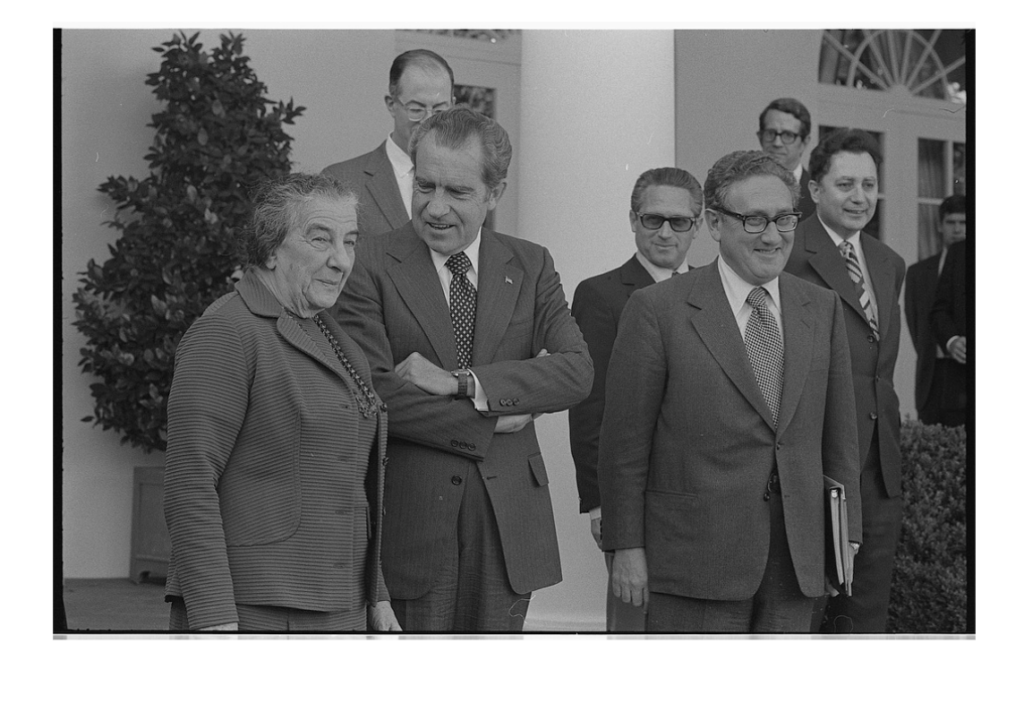
- Israeli Prime Minister Golda Meir standing with President Richard Nixon and Henry Kissinger outside the White House. The photo was taken about ten months before the Yom Kippur War. Source: Library of Congress_
- The whole of the U.S. government was caught unawares by the outbreak of the Yom Kippur War, also termed the October War. As has been the case many times in American history, the intelligence was wrong. “Israelis do not perceive a threat at this time from either Syria or Egypt,” the U.S. embassy in Tel Aviv reported to Washington on October 1. Yet the threat was all too real. The two Arab states, which Israel had trounced six years earlier in the Six-Day War, resolved to smash Israel and recover the territory they had lost: Egypt, the Sinai Peninsula(and Gaza), and Syria, the Golan Heights.
- Egypt and Syria attacked at 2:00 p.m. on October 6, which that year fell on Yom Kippur, the holiest day on the Jewish calendar. The IDF scurried to beat back the onslaught. At first, its defenses were to little avail. Arab tanks, infantry, and planes ravaged the Israelis’ lines. They lost men and military assets left, right, and center.
- To the northeast, Syria took the southern Golan and threatened to roll on into the Sea of Galilee and the rest of northern Israel. To the southwest, the Egyptians crossed the Suez Canal and penetrated Israeli positions. Things took a grisly turn on October 8. Israeli losses kept on mounting while the country neared its breaking point. Celebrated general and future Prime Minister Ariel Sharon later called it “the black day” of the IDF.
- Over the ensuing month, C-5 and C-141 transport jets from the Air Force delivered 22,395 tons of supplies to Israel, stopping to refuel at Lajes Air Base in the Azores on the way. Thanks to indefatigable airmen, the planes would fly more than 500 missions over the course of the airlift. Navy ships and their sailors ferried more supplies by sea. The American resupply matched and surpassed its Soviet counterpart. One of the greatest operations of its kind in history, it was a herculean effort by the U.S. military to provide Israel with the tools to win the war.
- Nixon’s resupply was perhaps the greatest contribution any American president has ever made to Israel. His decision, which scholars and journalists to this day have not fully appreciated, was enormously consequential. To it, Israel likely owes its existence. Consider what has become of the Jewish state in the years since. Israel has come a long, long way since the Yom Kippur War. Today, it is among the wealthiest countries on earth and a global leader in advanced technology. It boasts a formidable conventional military and a nuclear deterrent to boot. It has full relations with six Arab countries, and that list may soon get longer. It is home to vibrant institutions that, whatever their faults, are the most democratic of any in the Middle East. Nixon’s resupply made all that possible.
-
- Pre-War Planning
- Sadat proposed a secret alliance with Assad in Syria
- Secret Meeting in Alexandria
- Plans for Joint Attack
- Military exercises to deceive Israel
- Egypt and Syria wanted to deceive King Hussein
- King smelled a rat
- King Hussein went to meet Golda Meir
- Warn to expect attack from Egypt and Syria
- Golda Mier not 100% convinced
- Israel didn’t mobilize reserves
- Sadat proposed a secret alliance with Assad in Syria
- War
- Egypt opened fire first
- Crossed over canal screaming “Allah Akbar”
- Drove Israeli’s from Suez Canal
- Egyptians advanced 8 miles as planned into Sinai
- 600 Syrians tanks rolled into Golem Heights
- 4th day Syrians ran into large Israeli force
- Assad wanted to know why Egyptians weren’t advancing more into Sinai
- Soviet Prime Minister game to sort it out
- Infuriated by Sadat’s answers
- Sadat yielded to Soviet pressure
- Doomed to fail said Sadat’s Chief of Staff
- War swings Israel’s way
- 3 hours 250 Egyptians tanks destroyed
- Isolated Egyptian 3rd Army
- Israeli troops only hours from Cairo
- Sadat begged Soviets for ceasefire
- Soviets contact Kissinger
- Tried to stall
- Agreed to terms to ceasefire
- War lasted 5 more days
- Egyptian and Israeli officers meet to disentangle their forces
- Week before Egyptian general relaxed
- Israel allowed supplies through to trapped Egyptian 3rd Army
- Sadat wanted to make peace
- Assad didn’t want to go to peace conference
- Egypt opened fire first
- Pre-War Planning
-
Lead-up
- After the 1967 6-day war, the Israeli government voted to return captured territory to Syria and Egypt in exchange for peace and demilitarization, but these proposals were never proven to have been transmitted to either Arab state.
- In the Khartoum Arab Summit, Egypt, Syria, Jordan, Lebanon, Iraq, Algeria, Kuwait and Sudan all agreed to the “three no’s,” no peace, no recognition and no negotiation with Israel.
- The War of Attrition takes place from 1967-1970, across the Egyptian and Jordanian borders, including both their militaries and the PLO, with Arafat coming to the head of the PLO in 1969.
- in December of 1970 in an article to the New York Times, Anwar Sadat agreed to recognize Israel as an independent state in exchange for a full withdrawal from the Sinai Peninsula along with other occupied Arab territories.
- Golda Meir put together a committee to examine the Egyptian peace proposal, but rejected said proposal feeling as though it would not ensure Israel’s security, despite the committee unanimously concluding that Israel’s interests would be served.
- US was supplying Israel with military force since the 1960’s and considered it an ally during the Cold War.
- Resolution 242 called for Israel to abandon all of its 6-day war territorial gains and for every state in the region to have an official recognition of their boundaries and right to exist.
- In October of 1972, facing mounting domestic pressure, Sadat declared his intention to go to war against Israel, even absent Soviet support.
- In February of 1973, Sadat made a final peace overture towards Israel via Kissinger, which Meir rejected, most likely with the understanding that war was invetiable.
- Israel did not think war was coming, despite multiple repeated credible warnings, including a warning from King Hussein himself.
-
Israeli Preparation
- Meir, the Chief of General Staff, opted not to attack Syria hours before the war began because he recognized the importance for not being blamed as starting any conflict in order to recruit American or other international assistance.
- Kissinger and Nixon warned Meir not to begin a pre-emptive war.
-
Battle in the Sinai
- October 6th was the initial attacks from Egyptian aircraft.
- The US held back on supplies for Israel in order to encourage them to accept a ceasefire once hostilities began, but Sadat refused. The Soviets began supplying arms to Egypt and Syria while the US then resumed supplying arms to Israel.
- Israel refrained from attacking economic and strategic infrastructure in response to Egyptian threats to fire Scud missiles onto Israeli cities.
- Israel managed to set up bridges and break through to the other end of the Suez canal, pushing into Egypt.
-
Ceasefire
- On October 22nd, 1973, the UNSC passed a 14-0 resolution calling for a ceasefire, negotiated mainly between the US and the USSR.
- For the first time, three Scud Missiles were fired at Israeli targets by either Egyptian forces or Soviet personnel in Egypt, which was the first combat use of Scud Missiles. All three targets were in the Sinai.
- Ceasefire claims to have been broken by both sides during the night, and Israel capitalized on the ceasefire break to advance beyond the UNSC ceasefire lines.
-
Egypt’s Third Army
- The US, seeing an opportunity to bring Egypt closer to its sphere of influence, exerted heavy pressure on Israel to refrain from destroying the trapped Third Army.
- Kissinger told the Israeli ambassador, Simcha Dinitz, that the destroying of the Egyptian Third Army “is an option that does not exist.”
- The US, seeing an opportunity to bring Egypt closer to its sphere of influence, exerted heavy pressure on Israel to refrain from destroying the trapped Third Army.
-
Post-war Battles
- The ceasefire wasn’t followed closely by either side, with the fighting not stopping until January 18th, 1974.
- The Israeli Army was 100 km from Cairo after their advancement from the west bank.
-
Initial Syrian Attacks
- The Syrians began their attacks with an airstrike against Israeli positions in the Golan Heights.
- Syrians pushed Israeli military lines back to the Southern Golan Heights.
- Dayan discussed the possible arming of nuclear weapons in response to Syrian military gains. Meir rejected this option. Syrian mechanized brigades did not advance into Israel as they had feared an Israel nuclear response.
- Missiles from Syrian offensive lines struck civilian settlements in Israel, and in retaliation, seven Israeli F-4 Phantoms flew into Syria and attacked the Syrian General Staff Headquarters in Damascus.
-
Israeli Advance towards Damascus
- Israeli troops advanced towards Damascus and began shelling the outskirts of the city from 30km away.
-
Arab Military Intervention
- Syria and Iraq sent expeditionary forces into Syria to defend from further Israeli military advancement.
- Israel was able to launch strikes all across Syria, attacking power plants, petrol supplies, bridges and main roads.
-
Ceasefire
- On the 22nd of October, UNSC Resolution 338 called for a ceasefire. The war would finally come to a close on the 26th of October.
- Israel and Egypt signed a formal ceasefire on 11th of November, and the disengagement agreement happened on the 18th of January, 1974.
- There was a secret agreement that Jordan and Israel would not heavily engage with each other. Hussein was pressured to enter the war to maintain his position of leadership and respect in the Arab world.
-
Naval Operations
- Egyptian missile boats bombarded Israeli positions on the Sinai coast on the first day of the war. Israeli missile boats decisively won these battles at sea.
- Two Egyptian destroyers enforced a blockade, preventing oil from Iran being shipped to Israel through the straights of Bab-el-Mandeb.
-
Participation by other states
- The US intelligence community, including the CIA, failed to predict the Egyptian-Syrian attack on Israel.
- Most officials in the Defense and Statement Departments opposed financing Israel, but Kissinger argued heavily in favor of supporting Israel so they would confirm to American views in postwar diplomacy.
- Meir authorized the assembly of thirteen 20-kiloton-TNT tactical nuclear weapons for Jericho missiles, done in an easily detectable way to signal to the United States. This was done on the 8-9th of October after previously rejecting this idea on the 7th.
- On the 9th of October, after Kissinger learned of the nuclear alert, Nixon ordered the beginning of Operation Nickel Grass.
- The US, over 32 days, airlifted 22,325 tons of tanks, artillery and ammunition to Israel.
- In later interviews, Kissinger, Schlesinger and William Quandt suggested that the nuclear aspect was not a major factor influencing re-supply. They cite Soviet re-supply efforts and Sadat’s rejection of early ceasefires as being the primary motivators.
- The Soviet Union supplied around 80,000 tons of supplies, mainly to Syria, and also to Egypt.
- Soviet advisors were reportedly involved in all areas of the war. 2,000 personnel in Syria, with 1,000 serving in Syrian air defense units. They also repaired damaged tanks, SAMs and radar equipment and assembled fighter jets.
- Soviet in advisors were reportedly present in all areas of Syrian command posts.
- Israel may have captured and traded Soviet officers who were captured from the Syrian front, though Israel and the USSR denies this.
- In Syria, a Soviet cultural center in Damascus and a merchant ship, Ilya Mechnikov, was sunk by the Israeli Navy.
- This all occurred during the apex of the Watergate Scandal. Nixon was so agitated and discomposed that there were times with Kissinger and Haif didn’t bother to wake him for consultation.
- Arab countries added up to 100,000 troops to Egypt and Syria’s frontline ranks.
- Algeria, East Germany, North Korean, Pakistan, Libya, Saudi Arabia, Kuwait, Morocco, Tunisia, Lebanon and Sudan all sent forces, ammo, tanks, pilots, etc…
-
Response in Israel
- Israel was shaken due to initial military difficulties and how unprepared they were in the beginning of the conflict.
- Golda Meir resign along with her entire cabinet, including Dayan.
-
Response in Egypt
- General Shazly angered Sadat for advocating the withdrawal of Egyptian forces from Sinai and was kicked out of the army, would go into political exile and then was placed under house arrest upon his return.
- The commanders of the Second and Third Armies, Khalil and Wasel, were also dismissed from the army.
-
Response in Syria
- In Syria, Colonel Rafik Halawi, the Druze commander of an infantry brigade, was executed for his military performance.
-
Response from Soviet Union
- They mad, gave lots of stuff to the Arabs and were upset that they still lost.
-
Arab Oil Embargo
- Saudi Arabia declared an embargo against the US, later joined by other oil exporters and extended against the Netherlands and other countries, causing the 1973 energy crisis.
-
Casualties
- Israel - 2,521-2,800 KIA, 7,250-8,800 wounded, 293 captured
- Arab casualties - 8,000-18,500 killed, ~35,000 wounded? Official numbers never released.
-
Syrian atrocities
- Many Israeli POWs were tortured or killed.
- Syrian Defense Minster Mustafa Tlass addressed the National Assembly in 1973 stating that he had awarded one solder the Medal of the Republic for killing 28 Israeli prisoners with an axe, decapitating three of them and eating the flesh of one of his victims. (Did this actually happen???)
- The original Jewish Telegraphic Agency article quotes and says the soldier from Aleppo killed 28 Israeli soldiers, 3 with an axe and devoured the flesh of one of them in hand to hand combat.
- Syrian Defense Minster Mustafa Tlass addressed the National Assembly in 1973 stating that he had awarded one solder the Medal of the Republic for killing 28 Israeli prisoners with an axe, decapitating three of them and eating the flesh of one of his victims. (Did this actually happen???)
- A soldier from the Moroccan contingent fighting with Syrian forces was found to be carrying a sack filled with the body parts of Israeli soldiers which he intended to take home as souvenirs.
- Syrian soldiers removed dog tags from bodies.
- Syria did not even officially acknowledge holding any prisoners to the International Committee of the Red Cross.
- Many Israeli POWs were tortured or killed.
-
Egyptian atrocities
- Multiple Israeli claims of prisoners being shot and killed.
- Photographic evidence of the torture/killings of Israeli POWs also exists.
- The order to kill Israeli prisoners came from General Shazly, who, in a pamphlet distributed to Egyptian soldiers immediately before the war, advised his troops to kill Israeli soldiers even if they surrendered.
The 1973 Egypt–Syria invasion timing story (“J factor”)
Core anecdote: Wurmser, talking to John Bolton about Iraq war planning, uses an example from the 1973 Yom Kippur War to describe how bad compromise can ruin strategy.
The 1973 story
- In 1973, Egypt and Syria coordinated to attack Israel.
- Each wanted a different start time:
- Egypt wanted to start at 6:00 p.m.
- Reason: the sun would be in the Israelis’ eyes as they tried to see across the Suez Canal.
- Advantage: blinds Israeli forces defending the canal as Egyptians cross.
- Syria wanted to start at 6:00 a.m.
- Reason: the sun would blind Israeli forces on the Golan Heights as they moved over the ridges.
- They couldn’t agree on either optimal time.
- Compromise: they started the war at 2:00 p.m.
- Result: nobody got the sun advantage.
- Both sides lost the tactical edge their preferred timing would have provided.
How Wurmser uses this story (“the J factor”)
- Wurmser tells Bolton before the Iraq war:
- “It’s like the Israelis in 1973 with the Syrians and Egyptians.”
- Each side had its best-case plan, but compromise produced a worst-of-both-worlds solution.
- He dubs this dynamic the “J factor”:
- Multiple powerful actors each insist on their own approach.
- Instead of choosing a clear strategy A or B, the system mashes them together.
- You end up with a logically incoherent hybrid that doesn’t exploit the advantages of either plan.
- Applied to Iraq:
- U.S. war planning took bits and pieces from different factions:
- Those who wanted a light footprint relying on Iraqis.
- Those who wanted a larger American presence and administration.
- The final plan was neither a clean, Iraqi-led liberation nor a fully resourced, coherent occupation strategy.
- Like the 2 p.m. start time in 1973, it was a compromise that maximized problems and minimized advantages.
Takeaway for notes
- The Egypt–Syria timing dispute is Wurmser’s metaphor for bad strategic compromise:
- Strategic decisions made by committee often satisfy everyone politically but serve no one operationally.
- The Iraq war’s execution, in his telling, is an example of that same “2 p.m. attack” logic.
1974: Gush Emunim was formally established
- This group attempted to begin settling the West Bank, the Gaza Strip and the Golan Heights.
- After six removals from the IDF, an agreement was reached for the Israeli government to allow 25 families to settle in the Kadum army camp southwest of Nablus/Shechem.
- This would go on to become the municipality of Kedumim, one of the major settlements of the West Bank.
- This model was copied for future settlements.
- Gush Emunim radicalized and formed the Jewish Underground, a terrorist organization conducting terror attacks and plotted to blow up the Dome of the Rock. Once this was uncovered, the Yesha Council took over the settler movement.
1974 April: Kiryat Shmona massacre
- Kiryat Shmona massacre - Wikipedia
- Deaths: 18 Israelis, including 8 children (+ 3 attackers)
1974 May: Ma’alot massacre (School attack)
- Ma’alot massacre - Wikipedia
- Deaths: 31 (22 children)
1975: Lebanese Civil War
- Lebanese Civil War - Wikipedia
- Arafat aligned with Muslims
- Christians aligned with Israel
- Israel at that time needed allies
- Secret mission to Beirut
- Gave weapons
- Christians wanted to stop the PLO from launching terror attacks from the country
- Christians weren’t fairing well against the P.
- 40,000 would die on both sides
1976: Land Day
- On March 30th, Arab citizens of Israel and Palestine protested to object to the Israeli government expropriating thousands of dunams (acres) of land for state purposes. This was done through general strikes and marches.
- The Israeli army and police would kill 6 unarmed Arab citizens, with hundred being wounded and hundreds of others being arrested.
- The protests leading up to this would lead to more Arabs in Israel protesting for rights and engaging in civic action with future Israeli governments.
- The protests did little to stop the 1975 land expropriation plan.
1976 July: Entebbe Raid
Entebbe raid - Wikipedia
An operation that resulted in rescuing Israeli passengers kidnapped on an Air France flight hijacked by PFLP militants and Germany revolutionaries flown to Uganda.
1977: Menahem Begin Elected in Israel
- Determined to keep the West Bank and Gaza
- Likud Party
- “What occupied territories? If you mean Judea and Somaria and Gaza Strip. Those are liberated territories. They are integral parts of Israel.” -Menahem Begin
- Building of settlements Begin’s first priority
- Yamit in Sinai
1977: Sadat Pre-Israel Visit
- Begin was highly suspicious of Sadat
- “Enemy of Israel”
- Sadat keynote speech to Parliament
- Arafat in the audience
- Sadat says he is ready to go to Knesset and negotiate with Israel
- Unthinkable and shocking for all
- Sadat meet with Assad to tell him it won’t be betrayal to the Arab cause
- Talked for 7 hours
- Assad generals, but not Assad, wanted to arrest Sadat
1977: Sadat addresses the Knesset
- Fetching Title#9nhr
- https://www.npr.org/templates/story/story.php?storyId=6861044
- Sadat offered peace but careful to not abandoned other Arab states
- Israel was worried after hearing the speech
- Dinner after, Begin and Sadat wouldn’t speak even though they were sitting next to each other
- Continued to talk for 7 months
- Menahem Begin would not give an inch
- Sadat confided with President Jimmy Carter that peace wasn’t going to happen
1978-1981
1978 the Merkava battle tank entered use with the IDF.
In 1979, over 40,000 Iranian Jews migrated to Israel escaping the Islamic Revolution there.
On June 30th, 1981, Israeli air force destroyed the Osirak nuclear reactor in Operation Opera that France was building for Iraq. Israel stated it would pre-emptively attack all attempts to work towards perceived nuclear weapons.
In 1981, after Begin wins again, the new government annexed the Golan Heights.
1978 March 11: Coastal Road massacre
1978 September: Camp David Accords
- Peacemaking (1970-79) [Sadats Rise & Fall] | The 50 Years War: Israel and the Arabs (3 of 6) - YouTube
- Funny story about Begin playing chess, lied about never playing
- Sadat listed demands:
- Return of Sinai
- P. state, capital in Jerusalem
- Israeli’s hit the roof and wanted to terminate the talks
- Carter physically stopped them from leaving
- 10 days; the sides never saw each other
- Carter carried the same text back and forth to negotiate
- Give away Gaza and West Bank
- Begin thought it was Greater Israel
- Egypt didn’t want a bilateral agreement without considering the P. state
- Sadat wanted to leave if he even couldn’t get Sinai back
- Bags on the porch wanted a plane
- Begin said his eye and hand will fall off before he signs to dismantle a single settlement
- Way around is make the Knesset decide
- Knesset voted to dismantle the Sinai settlements
- Egypt first Arab state to recognize Israel right to exist
- Nobel Peace Prize for both
- P. protesters at White House were shouting and enraged
1979 March: Egypt-Israel Peace Treaty
- The agreement notably made Egypt the first Arab state to officially recognize Israel,2(https://en.wikipedia.org/wiki/Egypt%E2%80%93Israel_peace_treaty#cite_note-AccTxt-2) although it has been described as a “cold peace”.
- This treaty was received with enormous controversy across the Arab world, where it was condemned and considered a stab in the back. The sense of outrage was particularly strong amongst Palestinians, with the leader of the Palestine Liberation Organization, Yasser Arafat, stating: “Let them sign what they like. False peace will not last”.12(https://en.wikipedia.org/wiki/Egypt%E2%80%93Israel_peace_treaty#cite_note-12)
- Egyptian president Anwar Sadat and Israeli prime minister Menachem Begin to share the 1978 Nobel Peace Prize for bringing peace between the two states.
- as a result of the treaty, Egypt was suspended from the Arab League in 1979–1989,14(https://en.wikipedia.org/wiki/Egypt%E2%80%93Israel_peace_treaty#cite_note-14) and Sadat was assassinated on 6 October 1981 by members of the Egyptian Islamic Jihad.15(https://en.wikipedia.org/wiki/Egypt%E2%80%93Israel_peace_treaty#cite_note-15)
- As part of the agreement, the U.S. began economic and military aid to Egypt, and political backing for its subsequent governments. From the Camp David peace accords in 1978 until 2000, the United States has subsidized Egypt’s armed forces with over $38 billion worth of aid. Egypt receives about $1.3 billion annually.17(https://en.wikipedia.org/wiki/Egypt%E2%80%93Israel_peace_treaty#cite_note-17)
1968-2023 > 1979 March: Egypt-Israel Peace Treaty
- Israel agreed to withdraw both its armed forces and 4,500 civilian inhabitants from the Sinai, including the return of Egypt’s Abu-Rudeis oil fields in western Sinai.
- Egypt agreed to normal diplomatic relations with Israel.
- Egypt guarantees freedom of passage through the Suez Canal and other nearby waterways, such as the Straits of Tiran, and a restriction on forces Egypt would place on the Sinai.
- Israel would also agree to limit its forces from the Egyptian border.
- Egypt guarantees free passage between Egypt and Jordan.
- Consequences
- Egypt suspended from the Arab League from 1979-1989.
- Hussein was upset that Sadat volunteered his perspective concerning the Palestinians as it continued to weaken his support in the Arab world.
- Sadam Hussein in Iraq looked to fill the Arab vacuum left by Egypt.
- Syria informed Egypt it would not reconcile with the nation unless it abandoned the peace agreement with Israel.
- Israeli settlers were upset, and though they attempted to prevent the government from dismantling their settlements, they failed.
- Anwar Sadat was assassinated on October 6th, 1981, by members of the Egyptian Islamic Jihad for his participation in the Camp David Accords.
- Following the agreement, Israel and Egypt became the two largest recipients of US military and financial aid
Between 1967 and the early 1980s, annual per capita income in the Gaza Strip rose from $80 to $1,700; in the West Bank, the gross domestic product more than tripled in that period.17 The number of cars in the territories increased tenfold, the number of telephones sixfold, the number of tractors ninefold.18 The rise in personal income and expenditure fueled a general growth in the economy, with the West Bank enjoying an average annual GNP increase, between 1968 and 1978, of 12.9 percent; in the Gaza Strip, it was 12.1 percent, while in Israel itself it was 5.5 percent.19 Roads were vastly improved (though this had more to do with Israeli security considerations and servicing the new Jewish settlements than with care for the welfare of the Arab inhabitants). Most homes were linked up to Israel’s electricity grid—in 1967 only 18 percent of Gaza households had electricity; in 1981, 89 percent.20 Health care, too, got much better, with many of the sick enjoying the services of Israel’s hospitals, which led to a dramatic expansion of the population and overcrowding, especially in Gaza.
Righteous Victims - Benny Morris, page 785 (file not included in this release)
1981: Ariel Sharon becomes Defense Minister
- Meets with Christian Lebanese Leaders
- Ariel told them they have a plan to invade Lebanon
1982: PLO flees to Tunis
1982 June: Attempted Assassination of Shlomo Argov
There is an attempted assassination of Shlomo Argov, ordered by Baghdad and carried out by a Palestinian splinter group (that was hostile to the PLO) in London. This was the pretext by which Israel began the Lebanon War.
1982 June: Lebanon War
- 1982 Lebanon War - Wikipedia
- 9 weeks Israel laid siege to Beirut
- Yasser Arafat calls Beirut the first Arab capital to be sieged by Israel
- Lebanese muslims demanded Arafat and his fighters to leave Beirut
- He was shocked
- Israel army was close on the P. leader trails
- PLO leaders had a stark choice
- Arafat wanted to evacuate; wanted a collective decision
- All leaders said yes
- 15,000+ of P. fighters evacuated
- Bachir Gemayel assassinated
1982 September: Sabra and Shatila massacre
- Sabra and Shatila massacre - Wikipedia
- 400,000 people protested in Israel for their role in the massacre
1984: Dreyfus affair
1985 February: South Lebanon conflict
South_Lebanon_conflict.pdf (file not included in this release)
1987 December - 1993 September: First Intifada
- 822+ Palestinian were killed by their own for maybe being coloborators with Israel’s
- Human Rights Watch, Israel, the Occupied West Bank and Gaza Strip, and the Palestinian Authority Territories, November, 2001. Vol. 13, No. 4(E), p. 49
isrpa1101.pdf
- Human Rights Watch, Israel, the Occupied West Bank and Gaza Strip, and the Palestinian Authority Territories, November, 2001. Vol. 13, No. 4(E), p. 49
First_Intifada (file not included in this release)
-
Claims that IDF response was too disproportionate
-
IDF killed an estimated 1162-1204 Palestinians First_Intifada (file not included in this release)
-
Iron Fist Policy
-
https://www.hrw.org/legacy/campaigns/israel/intifada-intro.htm
-
Israeli casualties: 100 Civilians - 60 IDF
-
By the time of the First Intifada, 40% of the Palestinian work force worked in Israel daily.
The Intifada - It’s Impact on Israel Arab World and Superpowers.pdf (file not included in this release) -
Benny Morris on the causes Acrobat_jpxnYqmWt4.png Morris, Benny Righteous Victims pg. 799
-
Accident of an Israeli tank transporter crashing killing four Palestinians were killed—rumors circulated that it was an intentional act of retaliation for the stabbing death of an Israeli businessman two days earlier.
-
Claims that it was “peaceful”
-
Petrol bombs
-
Mass arrests, collective punishments, closing down West Bank universities, round-the-clock curfews imposed 1600 times in the first year
-
Cut off water, electricity and fuel
-
1,000 homes demolished or blocked up
-
McDowall, David (1989). Palestine and Israel: The Uprising and Beyond
-
On 8 October 1990, 22 Palestinians were killed by Israeli police during the 1990 Temple Mount killings at Al-Aqsa. This led the Palestinians to adopt more lethal tactics, with three Israeli civilians and one IDF soldier stabbed in Jerusalem and Gaza two weeks later. Incidents of stabbing persisted.
-

-
Pages_from_Israel_Notes-5.pdf (file not included in this release) The 1st Intifada: When Non-Violent Protests Turned Violent | History of Israel Explained | Unpacked
-
General Causes
- Israel opened up low and semi-skilled labor markets to Palestinians in occupied territory. By the time of the Intifada, over 40% of Palestinian workers were working in Israel daily.
- Palestinian populations were growing, but work and other opportunities were heavily restricted in the occupied territories.
- The Jewish settler population in the West Bank grew from 35,000 in 1984 to 130,000 by the mid 1990’s.
- The occupied Palestinians likely felt themselves humiliated in a variety of ways as indefinite occupation by Israel continued.
-
Background
- Two potential causes that sparked the Intifada
- The army tank transporter truck incident in which 4 Palestinians were killed by an Israel truck crashing into them.
- The IDF failure in late November 1987 to stop a Palestinian guerrilla operation, the Night of the Gliders, in which six Israeli soldiers were killed.
- Mass demonstrations occurred a year earlier after 2 Gaza students were shot by Israeli soldiers on campus on December 4th, 1986.
- The Arab summit in Amman in November of 1987 focuses heavily on the Iran-Iraq war, sidelining the Palestinian issue for the first time in years.
- Two potential causes that sparked the Intifada
-
Leadership and Aims
- The Intifada was mainly lead by independent community councils and advocated for a non-violent approach so that the Palestinians would not lose support from liberal Israelis.
- For the first time Palestinians are calling for the establishment of a Palestinian state on the West Bank and the Gaza Strip, notably departing from the standard rhetorical calls for the “liberation” of all of Palestine.
-
The Intifada
- Israel had assumed that its oppressive actions against the Palestinians would cause their resistance to collapse early, though this was a mistaken assumption.
- On December 8th, 1987, an Israeli army tank transporter crashed into a row of cars, killing four Palestinians. They were residents of the Jabalya refugee camp, the largest of the eight refugee camps in the Gaza Strip. 7 others were seriously injured.
- Assumptions about the crash lead to demonstrations, which caused back and forth violence between Israelis and Palestinians.
- In the beginning of the Intifada, no Israeli settlements were attacked nor were there any Israeli fatalities.
- The IDF used every crowd control measure available, though disturbances continued to gain momentum.
- Israel engaged in mass arrests and the closure of Palestinian schools and businesses, utilities and confinement to homes, as well as damage to farms and blockage from selling agricultural produce. Settlers also engaged in private violence against Palestinians.
-
Casualties~1,200 Palestinians killed, 57k-120k arrested, 481 deported, 2,532 houses destroyed.179-200 Israelis killed, 3,100 Israelis (1,700 soldiers vs 1,400 civilians) suffered injuries.Between 1988 and 1992, intra-Palestinian violence claimed the lives of nearly 1,000, mainly due to the PLO killings of suspected collaborators.
-
Foreign reaction
- The UN (including the US) drafted a resolution condemning alleged Israeli violations of human rights. Israel declared it would not abide by SCR672 because it did not pay attention to attacks on Jewish worshippers. Israel also blocked a delegation of the Secretary-General for investigating Israeli violence.
-
Outcomes
- The Intifada broke the image of Jerusalem as a united city, and the increase in international coverage was heavily critical of Israel.
- Arafat and his followers moderated their political programme; at the meeting of the Palestine National Council in Algiers in November of 1988, Arafat won a majority for the historic decision to recognize Israel’s legitimacy, to accept all relevant UN resolutions going back November 29th, 1947, and to adopt the principle of a two-state solution.
- Arafat’s support for Sadam Hussein’s invasion into Kuwait essentially lead to a mass exodus of 300,000+ Palestinians fleeing Kuwait, mostly to return to Jordan. It also lead to Kuwait and Saudi Arabia cutting off financial support to the PLO.
-
Banging Heads (1987-91) | The 50 Years War: Israel and the Arabs (5 of 6) - YouTube
- Rock throwing, Israeli solder shoots kid
- Arafat learned about the Intifada from a news report
- PLO didn’t know who issued the leaflets about doing the Intifada
- Yitzhak Rabin wanted soldiers to club protestors; not shoot them
- Scenes of clubbing was posted internationally
- PLO’s Abu Jihad, who was the PLO military leader in Tunis, played victim about protestors getting clubbed
- PLO’s Abu Jihad ordered an attack on Israeli bus; 3 killed 6 wounded
- PLO Abu Jihad Assassination
- Jericho bus firebombing - Wikipedia
- Young people’s power in throwing rocks, can’t do anything
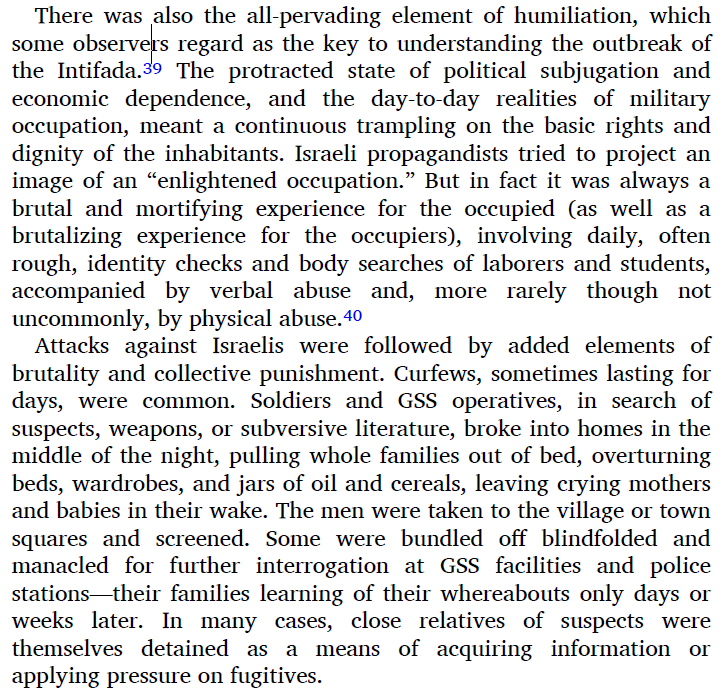
1998: Arafat “renounces” terrorism
- Arafat was convinced it was necessary to negotiate, other leaders weren’t convinced
- US demanded Yasser Arafat renounce terrorism
- Dec 1988: UN Special Session with ArafatIn 1988 in Geneva, Arafat announced that he would accept the existence of the State of Israel, renounce terrorism, and accept U.N. resolutions 242 and 338. Despite this declaration, the PLO continued terrorist attacks against Israelis.
- Popular Front for the Liberation of Palestine didn’t accept decision to recognize Israel
- Arafat condemns terrorism; then says he salutes “salute those who in the days to fight in the days to free their countries from the yoke of colonialism were accused of terrorism”
- Arafat would say one thing and another thing next
- George Shultz, US Security of State, meeting with Raegan
- “One part of his statement he said unc unc unc, another part of his statement he said le le le, but no part did he say uncle. So no its not satisfactory.”
- US rejected the balancing act.
- Arafat had a dilemma whether to say it or not.
- Arafat repeats it at a press conference
- Israel Prime Minister Ben Aharon wasn’t impressed
Palestine Liberation Organization (PLO)
1991: Iraqi scud missile attacks against Israel
- 1991 Iraqi missile attacks against Israel - Wikipedia
- Palestinians celebrated as missiles were heading towards Israel
- Israel didn’t retaliate
1991 October: Madrid Conference
1968-2023 > 1991 October: Madrid Conference
-
Hosted by Spain and co-sponsored by the United States and the Soviet Union
- Involved Israel and the Palestinians, as well as Arab countries, including Jordan, Lebanon, and Syria.
-
US Secretary of State James Baker told an AIPAC audience that Israel needs to abandon its expansionist policies.
-
Bush and Baker attempted to pressure Israel off of using any loan guarantees for settlement expansion, pushing heavily against them.
-
Shamir believed he could simply influence via the Israeli lobby politicians and the US public against Bush’s wishes, but Bush’s approval rating was too high, and eventually all parties agreed to convene in Madrid.
-
Feelings internationally were hopeful from this, with two successful bilateral agreements following this, namely the Oslo I accords, and the Israeli-Jordanian negotiations after.
-
Banging Heads (1987-91) | The 50 Years War: Israel and the Arabs (5 of 6) - YouTube
- If Syria joined the negotiations Israel might give back Golem Heights
- Yitzhak Shamir, Israel Prime Minister, refused to go if PLO terrorist were there
- PLO Leadership opposed meeting James Baker, pointless
- Arafat decided he had nothing to lose
- PLO in meeting with Baker, insisted each Palestinian be approved in writing by Arafat
- Baker reminded PLO they made a major mistake supporting Saddam during Gulf War
- Palestinians refused to repudiate the PLO; unacceptable to Yitzhak Shamir
- Baker says he in this situation only has one leverage is the ability to blame one part of the other for the collapse of the peace process
- Assad of Syria, decided to go along with proposals for peace conference
- Shamir put more obstacles in Baker’s path, more settlements in Golem Heights
- Baker furious, went public against Israeli settlements
- Baker told P. that they had no other option to stop settlements unless its negotiations
- George Habash, PLO Leadership, says, No No No
- Yitzhak Shamir asked US for 10 billion to help settle Russian immigrants
- To save the conference, US delayed the loan
- Bush wouldn’t give in to AIPAC pressure
- Bush has faced down Shamir
- Madrid Conference
- Arabs and Israeli’s together to negotiate
- Shamir went to conference himself
- Accused Syria of being tyrannical and terrorists
- Syria foreign minister rewrites his speech
- Shows Shamir photo and says he was a terrorist, killed peace meditators
- Shamir was really negotiating with the PLO
- Face to face: Syrians and Israelis
- Syrians wanted a withdraw
- Israel wanted to know the character of peace, the end of terrorism, HQ of terrorist organizations in Damascus, Hezbollah, Lebanon Syrian occupation
- Failure
- Israeli with Jordanian negotiations went well
1992-1996
- July 25th, 1993, Israel carried out a week-long military operation in Lebanon to attack Hezbollah positions, dubbed Operation Accountability.
- In February of 1994, Baruch Goldstein killed 29 Palestinians and wounded 125 at the Cave of the Patriarchs in Hebron. The Kach party has been barred from participation in the 1992 elections, and then subsequently made illegal and designated a terrorist organization. https://www.jpost.com/israel-news/article-733523
- The first suicide bombing in Israel would happen in retaliation for this by Hamas.
- On May of 1994 the Agreement on Preparatory Transfer of Powers and Responsibilities is signed, beginning the transferring of authority to Palestinians.
- On the 26th of October, 1994 the Israel-Jordan Treaty of Peace is signed.
- The Israeli-Palestinian Interim Agreement is signed on the 28th of September, 1995 in DC between Arafat and Rabin.
- Palestinians were on the precipice of obtaining statehood, and the Palestinian National Covenant language was changed from calling for the expulsion of Jews who migrated after 1917.
- In July of 1995, opposition leader Benjamin Netanyahu took part in two demonstrations where Netanyahu walked at the head of a mock funeral procession featuring a fake black coffin.
- On November 4th, 1995, a far-right religious Zionist opponent of the Oslo Accords assassinates Rabin.
- In April of 1996, Israel launches Operation Grapes of Wrath in southern Lebanon in response to Hezbollah’s Katyusha rocket attacks.
- Arafat was more willing to negotiate due to being cut off from his homeland in Tunis and exiled.
1992: Yitzhak Rabin elected Prime Minister of Israel
1993: Oslo I Accord
- Land Still Divided (1992-98) | The 50 Years War: Israel and the Arabs (6 of 6) - YouTube
- Secret meetings in Oslo between Israel and PLO
- PLO didn’t represent all of the P. people
- Hamas kills Israeli police officer
- Yitzhak Rabin ordered rounding up 400+ Hamas and deport
- Created a crisis in Washington
- P. walks out of peace negotiations
- Arafat contacts Oslo back channel; provides deniability
- Profession Yair Hirchfeld, Israeli negotiator with Abu Allah
- Major dispute was Jerusalem, P. wanted complete control of entire city
- Israeli’s wanted to get rid of Gaza; factory of problems
- Arafat said he wants Jericho as well, to get a foothold in the West Bank, Gaza is a deadend but Jericho leads somewhere
- PLO wisdom of deferring of their demands
- Rabin said he didn’t want to negotiate with PLO as he didn’t know about the secret talks
- Secret talks wouldn’t continue unless Washington talks continued
- Arafat: “Cant afford to pay the price of walking out”
- Tough battle to get them back, couldn’t tell them why
- Israel Oslo team created a draft of principles
- Beginning drafts bad for Isreal
- Rabin ordered secret talks suspended due to Washington talks starting again
- Secret Oslo talks resumed
- Settlements wouldn’t be under P. authority in West Bank
- PLO said how everything talked about was ‘security’
- PLO said they learned a lot from Israeli’s questions
- PLO accused Singer for wanting to destroy the peace process
- Arafat meeting with Holst
- Kissing points: Where Gaza and West Bank meet, road
- Reopened old issues that were already resolved
- Would cut Israel in two
- Wanted Jericho and surrounding area as well
- And put Jerusalem back on table as well
- “Arafat always thought if he was getting something he might as well as for more” -Abu Mazen PLO leadership
- PLO negotiator told Arafat Israel wouldn’t accept it, but Arafat insisted
- New demands strains talks, Israel stunned
- Abu Allah resigns at the negotiation table and walked out
- Moment of crisis
- Israeli alternative idea to reignite talks
- PLO does a number of things and Israel recognizes the PLO
- Recognition was the key, would put PLO on the map
- Abu Allah wasn’t acting, he was angry. Arafat’s new ideas ruined the 7 months of negotiation.
- Mutual Recognition:
- PLO will:
- Recognize Israel’s right to exist
- Renounce terrorism and violence
- Change PLO charter to reflect new reality
- Israel will recognize the PLO
- Breakthrough
- PLO will:
- Ehud Barak, Chief of Staff, wanted peace with Syria first
- If Syria signed peace treaty, its client state Lebanon would follow. P. and Jordan would have little but fall in line.
- Reduce the P. scope for negotiating
- Yitzhak Rabin “agreement with Syria would make a strategic difference, a P. agreement would be just public relations”
- If Rabin withdrew from Golem Heights, would Syria agree with full peace. Stop support of terrorism and trade relations?
- Assad mistrust; Israel disappointed
- Rabin couldn’t wait for Assad; settled with PLO agreement
- Rabin had to act fast before the election to get peace with PLO
- Holst, Norwegian Foreign Minster, talks with Arafat and team to go over final points
- Issues
- Withdraw of Israeli’s military government
- And how and when they’d deal with difficult issues like Jeruselum
- Who would control the bridges between West Bank and Jordan
- Jointly controlled
- 7 hour phone call
- Finally an agreement
- Issues
- Clinton agreed to a signing ceremony
- Arafat noticed PLO wasn’t on the document and said he couldn’t sign
- An hour before the signing
- “PLO Team” be added according to Israel
- Arafat agrees
- Rabin didn’t want to look at Arafat
- Arafat didn’t want to let go of the handshake
- Agreement did not bring peace
1994: Israel-Jordan peace treaty
1995: Israel - Syria Peace Talks
- Syria wanted June 4th borders
- ISRAEL AND SYRIA SET PEACE TALKS FOR WASHINGTON - The New York Times
- Assad sent Chief of Staff
- Fits and starts
1995: Yitzhak Rabin Assassination
- Assassination of Yitzhak Rabin - Wikipedia
- Night Syria and Israel agreed to start peace talks
- Words of the peace talks on a peace of paper after signing and put it into his pocket
- Shot dead by Israeli extremist
- Three bullets went through his heart and through the peace song paper
- https://upload.wikimedia.org/wikipedia/commons/5/5d/Assassination_of_Prime_Minister_Yitzhak_Rabin%2C_1995_XI_Dan_Hadani_Archive_%281%29.jpg

1995: Oslo II Accord
- Arafat says he will not go back to confrontation and violence
1996-2001
- Netanyahu continued the implementation of the Oslo Accords, though his prime ministership saw a marked slow-down in the Peace Process.
- Hamas continues suicide bombing throughout this time period in 1996.
- September 24th, 1996 were the Western Wall Tunnel riots
- First conflict between the IDF and the newly created Palestinian National Security Forces.
- The protests overall resulted in the deaths of 59 Palestinians and 16 Israelis, along with hundreds more being wounded.
- On January 17th of 1997, Netanyahu and Yasser Arafat signed the Hebron protocol.
- Partial redeployment of Israeli military forces from Hebron in accordance with the 1995 Interim Agreement on the West Bank and Gaza Strip (“Oslo II”), while Area H-1 (80%) would come under Palestinian control.
- On May 25th, 2000, Israel unilaterally withdrew its remaining forces from southern Lebanon.
- Hezbollah retained control of the Sheba’a Farms in southern Lebanon
1996 February 25: No. 18 bus bombing by Hamas in Jerusalem. 26 killed.
- “The peace is killing us.” Famous chant at the time
- Hama’s idea was to kill the peace Oslo process
- Netanyahu was -31 points until this bombing.
Jaffa Road bus bombings - Wikipedia
1998 October 15-23: Wyn River Memorandum - Netanyahu & Arafat signed
2000 July 11-25: 2000 Camp David Summit
- Ehud Barak went further than he even wanted to do.
- Arafat walked out and is blamed.
- Can’t blame Netanyahu for this peace failing.
- Arafat launches the Second Intifada
2000 Camp David Summit - Wikipedia
2000 September - 2005 February: Second Intifada
Gur on the Second Intifada and the collapse of trust
In his 20 October 2026 Breakfast Club interview, Haviv Rettig Gur describes growing up in a peace-left family, voting for the peace process, and then experiencing its failure personally: “my own support for the peace process shattered.” He describes “140 suicide bombings”, targeting buses, pizzerias, and other civilian settings. His morning-bus example makes the threat concrete: at 7:30 a.m., a city bus in Jerusalem also carries children to school. The number is his tally, not independently verified here; his roughly three-year bombing narrative is not the duration of the entire Second Intifada. 36:10–39:45.
His claimed change is loss of confidence in the peace process. He remains explicitly Zionist and supports Palestinian statehood. Knowing Palestinians who want peace does not, in his argument, answer whether they can constrain armed organizations capable of attacking civilians after concessions.
To make this political effect imaginable, he invents an American case: an undocumented immigrant bombs teenagers while invoking a genuine immigration injustice. A progressive can initially acknowledge the grievance and condemn the killing. Then come one attack → two more → thirteen → 140. His question is how long a movement can retain public support for reform under sustained attacks associated with that opening. The hypothetical concerns cumulative political psychology; it is not an allegation about real immigrants. 37:42.
The hosts reply that Israeli violence can produce the same hardening among Palestinians and outside observers. Gur accepts legitimate criticism of war conduct while distinguishing it from denial of Israel’s existence. Preserve their objection: his mechanism is reciprocal, and explaining a public’s fear does not settle the allocation of responsibility or the rights of those living under occupation.
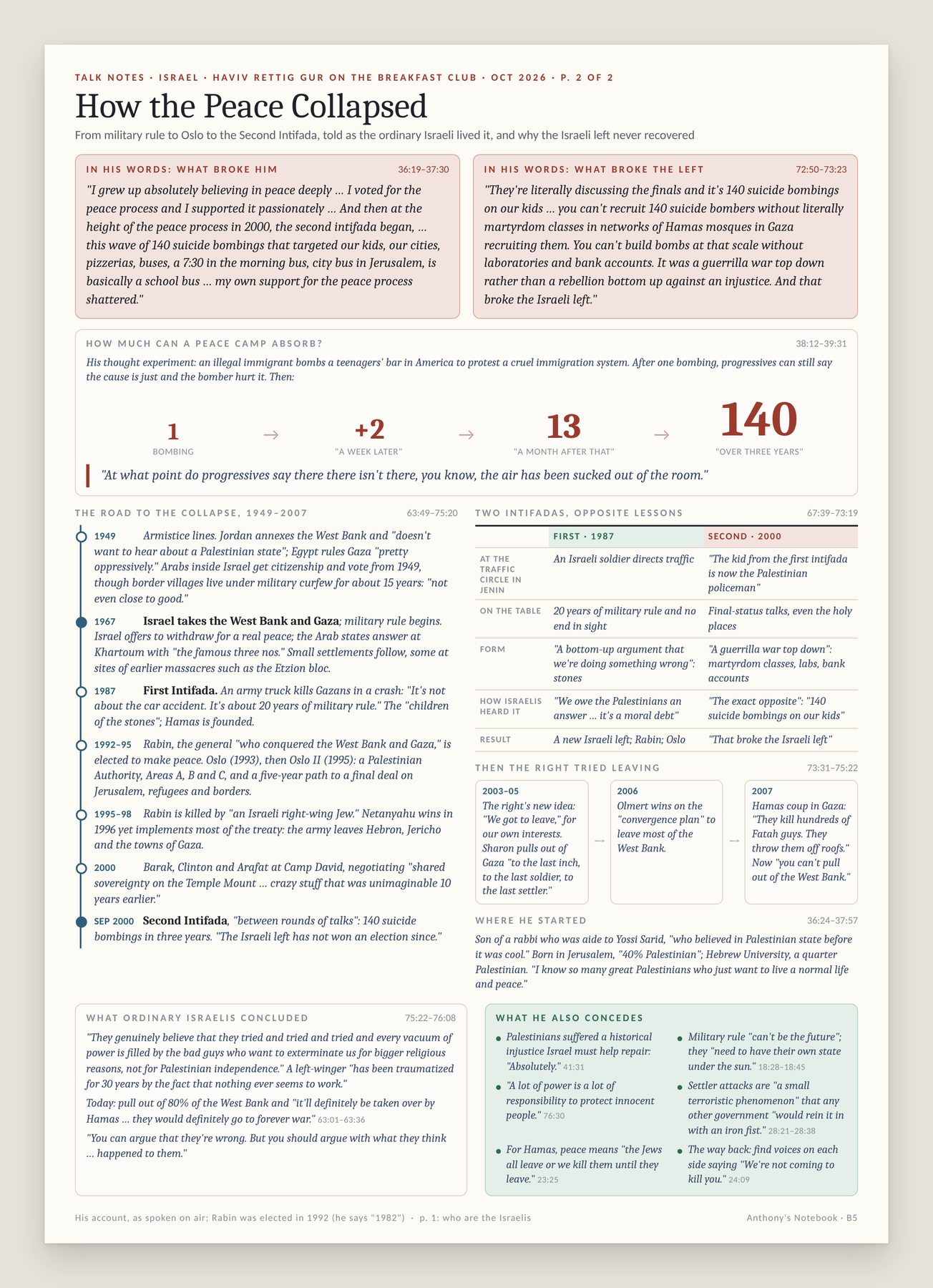
Notebook page (B5): Gur’s account of the collapse, from 1949 to the Second Intifada, the Gaza withdrawal and the Hamas coup, with his own words on the 140 bombings. Page 1, on Jewish history and Zionism, is in History of Israel and Jewish People by Haviv Gur.
Routes: Haviv Rettig Gur on The Breakfast Club - Zionism, Rescue and the Collapse of Trust preserves the full exchange and language analysis; Peace Offers connects the testimony to independent attitude data and competing causes of Oslo’s failure.
TheSecond_Intifada-Background_and_Causes_of_the_Israeli-Palestinian_Conflict-_Jeremy_Pressman.pdf (file not included in this release)
-
After the 2000 Camp David Accords
-
Ariel Sharon visiting Al-Aqsa compound
-
3000 Palestinians and 1000 Israelis, as well as 64 foreigners killed.
-
Operation Field of Thorns
- At the practical level, the Israeli military planned for the most far-reaching operation short of expulsion, the re-taking of Palestinian cities. The plan was known as OPERATION FIELD OF THORNS.60 Israel acknowledged the existence of a plan as early as June 1997.61 Sometime between May and September 2000, Barak “approved the operational and tactical plans of the IDF to halt the intifada.”62 One alternate possibility is that Barak favored a more gradual response, but the IDF planned for a harsh response: “Instead of taking pinpointed moves, moving gradually, collecting a price systematically, and letting the Palestinians understand that they would pay more every time violence escalates, the army slammed all across the sector.”
-
Kahan Commission concluded that Ariel Sharon bared personal responsibility chrome_efo9cksvYV.png
-
Temple Mount religious ridiculous about who can visit, be there at the same time, or step foot.
-
Background
- Violence continued on both sides after the Oslo accords were signed in 1993.
- Israel engaged in regimental level exercises that were in preparation for peace talks to fail, so it could conquer towns in Area C.
- The failure of the Camp David Summit lead to a significant fracturing of the PLO as many Fatah factions abandoned it to join Hamas and Islamic Jihad.
- Netanyahu’s government pushed for the construction of a new neighborhood, Har Homa, in East Jerusalem, and continued construction within existing Israeli settlements. Construction in the years following the Oslo Accords was still significantly less than prior, however.
- Barak secured an agreement for the dismantling of 12 new outposts in 1998, but continued expansion was occurring in existing settlements in the West Bank. This continued to hurt the Palestinian peace process.
-
Sharon visits the Temple Mount on September 28th, 2000.
- Sharon visits the Temple Mount, without stepping inside, but this still angers local Palestinians living in Jerusalem. Violence breaks out.
- Multiple senior Palestinian officials encouraged Sharon not to visit. Sharon was determined to make a show of Israeli sovereignty over the Temple Mount.
-
In 1982, the Kahan Commission found that Ariel Sharon was found to bear personal responsibility for the Sabra and Shatila massacre that occurred against Palestinians in the Lebanese Civil War.
- Sharon’s visit to the Temple Mount 10 days after the annual memorial day for said massacre is said to have been the inciting moment for the beginning of the Second Intifada.
-
First days of the intifada
- Violence broke out heavily in the days following, with losses on the Palestinian side far outweighing Israeli losses.
- The broadcasted killing of Muhammad al-Durrah, caught by a French news crew, was initially assumed to be the responsibility of the IDF, which they promptly apologized for, though much controversy remains over who actually shot and killed the boy. https://www.youtube.com/watch?v=fUz55tLLXUg&t=1019s
-
The October 2000 events
- Several clashes occurred within Israel and the Gaza Strip, followed by a general strike, more escalations with police, thousands of Jews participating in violent acts in Tel Aviv, and a recommendation from the Or Commission to dismiss Shlomo Ben-Ami from Minister of Public Security.
-
The Ramallah lynching
- The PA police arrested two Israeli reservists who had accidentally entered Ramallah, where a hundred Palestinians had been killed in the preceding weeks.
- An Italian television crew captured and broadcasted the killings, where both soldiers were beaten, stabbed and disembowelled, with one body being set on fire.
-
November and December
- Clashes continue. Israel settlements in Gilo come under Palestinian heavy machine gun fire from Beit Jala.
- Palestinian deaths continue to outnumber Israeli deaths.
-
2001
- The Taba Summit failed to produce results by the end of January.
- On January 17th, an Israeli teenager, Ofir Rahum, was murdered after being lured into Ramallah by a 24-year-old Palestinian, a member of Fatah’s Tanzim, after an online relationship had sparked.
- After Sharon’s election in 2001 over Barak, he refuses to meet with Yasser Arafat.
- More violence occurs through March, with 8 Israelis and 26 Palestinians dying. In Hebron, a Palestinian sniper is reported by the IDF to have intentionally targeted and shot/killed a 10 month old Israeli baby.
- In May of 2001, the IDF captured a vessel carrying $10m of weapons from the Popular Front for the Liberation of Palestine, which was destined for the Gaza coast.
- On June 1st a suicide bombing killing 21 Israeli civilians, most high schoolers, by the Islamic Jihad, hampered the American attempts to negotiate a cease-fire.
-
2002
- The IDF captured Karine A, a freighter carrying weapons from Iran, believed to be intended for Palestinian militant use against Israel. It was claimed that top officials in the PA were involved in the smuggling.
- On the 28th of March the Arab Peace Initiative, endorsed by Arafat, encourages a two state solution, with Israel withdrawing all troops to the pre 1967 borders, with a full Right of Return for every Arab Palestinian.
- On the 29th of March, Operation Defensive Shield has the IDF making incursions throughout the West Bank. The UN estimates 497 Palestinians killed and 1,447 wounded, with 4,258 arrested.
- In April, the Battle of Jenin takes place. This was a huge battle seeing fierce urban combat by the IDF to clear out the refugee camp of the city of Jenin.
-
2003
- Israeli intelligence report claimed Arafat had paid $20,000 to the al-Aqsa Martyrs’ Brigades.
- US pressure caused the PA to appoint Mahmoud Abbas as the Palestinian prime minister.
- Mahmoud Abbas has a thesis that the early Zionist leaders and Nazi leaders collaborated to encourage Jewish migration to Mandatory Palestine.
- US pressure caused the PA to appoint Mahmoud Abbas as the Palestinian prime minister.
- On June of 2003, a temporary armistice was unilaterally declared by Fatah, Hamas and Islamic Jihad. Fighting continues.
- After an August 19th Hamas suicide bus attack, the IDF were ordered to kill or capture all Hamas leadership in Hebron and the Gaza Strip, with at least all of the bus suicide bombing plotters being captured or killed, and Hamas leadership in Hebron being badly damaged.
- In later 2003, the Israeli West Bank barrier is constructed. Israel claims its necessary to prevent terrorists from entering Israeli cities, while Palestinians claim it separates their communities and acts as a de facto annexation of their territory.
- Israeli intelligence report claimed Arafat had paid $20,000 to the al-Aqsa Martyrs’ Brigades.
-
2004
- The IDF operates heavily in Rafah, to search and destroy smuggling tunnels used by militants to obtain a variety of weapons and supplies. Between 2000-2004, 90 tunnels connecting Egypt and the Gaza Strip were found and destroyed.
- 16,000 Palestinians are displaced as the IDF demolishes what they are claim are empty or militant homes.
- In February, Ariel Sharon announced a plan to withdraw all Jewish settlers from the Gaza Strip.
- Yossi Beilin, a peace advocate and the architect of the Oslo Accords and the Geneva Accord, rejected the proposed withdrawal plan and claimed that without a peace agreement in place, it would reward terror.
- After announcing the declaration plan, two subsequent Hamas leaders, Sheikh Ahmed Yassin, and his successor, Abdel Aziz al-Rantissi were killed.
- The IDF operates heavily in Rafah, to search and destroy smuggling tunnels used by militants to obtain a variety of weapons and supplies. Between 2000-2004, 90 tunnels connecting Egypt and the Gaza Strip were found and destroyed.
-
2005
- Palestinian presidential elections were held on the 9th of January, with Mahmoud Abbas winning the election.
- Abbas was a platform of peaceful negotiation with Israel and non-violence to achieve Palestinian objectives.
- Sharon froze all diplomatic and security contacts with the PNA until Abbas shows a real effort to stop the terror.
- Abbas ordered Palestinian police to deploy in northern Gaza to prevent Qassam rocket and mortar shelling over Israeli settlements. Attacks would decrease sharply soon after.
- On February 8th, Sharon and Abbas declared a mutual truce.
- Hamas and Islamic Jihad said the truce doesn’t affect them.
- 25-50 Qassam rockets and mortar shells were fired into an Israeli Gaza settlement, Neve Dekalim. Abbas ordered the PA security forces to stop such attacks in the future, and fired senior commanders in the PA security apparatus.
- IDF forces arrested Maharan Omar Shucat Abu Hamis, a Palestinian resident of Nablus, who was about to launch a suicide bus attack in the French Hill in Jerusalem.
- On February 13th, Abbas engages Islamic Jihad and Hamas in talks to respect the truce.
- Ismail Haniyah, a senior leader of the group Hamas, said its position will remain unchanged and Israel will bear responsibility for any new violation of aggression.
- Palestinian factions continued to attack settlements in Gaza and cities in Israel, until July 15th, when Israel resumed its targeted killing policy.
- Hamas militants are battling PA policemen in the streets.
- Palestinian presidential elections were held on the 9th of January, with Mahmoud Abbas winning the election.
-
Aftermath
- On February 8th, 2005, Sharon and Abbas reach a truce, with Sharon releasing 900 Palestinian prisoners, withdrawing from West Bank towns, and finishing the Gaza withdrawal.
- Abbas reached an agreement 5 days later with Hamas and the PIJ to ensure the truce remains as long as Israeli violations did not happen.
- A number of people from Hamas leadership and a former military commander of the Democratic Front for the Liberation of Palestine all claim that Arafat had pre-planned the Second Intifada after realizing he would not get the concessions he wanted in the Camp David Accords. His widowed wife, Suha Arafat also claimed the same.
- Israeli’s unilateral pullout from Lebanon was seen by the PLO as “optimistic”, and an “example for other Arabs seeking to regain their rights.”
- Israeli’s military response in 2001 destroyed much infrastructure that was involved in the arming of Palestinian forces; some 90 paramilitary camps had been set up to train Palestinian youths in armed conflict. Some 40,000 armed and trained Palestinians existed in the occupied territories.
- Marwan Barghouti, the leader of the Fatah Tanzim, claimed he was attempting to instigate a second intifada leading up to the al-Aqsa visit by Sharon, contacting all Palestinian factions throughout Palestine. He also claimed that Israel’s withdrawal from Lebanon was a factor which contributed to the Intifada.
- On February 8th, 2005, Sharon and Abbas reach a truce, with Sharon releasing 900 Palestinian prisoners, withdrawing from West Bank towns, and finishing the Gaza withdrawal.
-
Casualties
- 1,053 Israelis were killed, 4,745 Palestinians were killed by the IDF, and 44 by Israeli civilians, and 577 by Palestinians.
- 69% of Israeli fatalities were male, while over 95% of Palestinian fatalities were male.
-
More Aftermath
- On January 25th, 2006, Hamas won the Palestinian elections with an unexpected majority of 74 seats, compared to 45 for Fatah.
-
In the 2001 and 2002 Arab League Summits, the Arab states pledged support for the Second Intifada just as they had pledged support for the First Intifada in two consecutive summits in the late 1980s.
-
Noteworthy things for modern conflict
- History of huge employment of suicide bombers explicitly targeting civilians.
- History of shipments of weapons via ocean into Gaza Strip.
- History of hiding militants inside “refugee” camps/cities.
- History of one-sided military capability of Israel vs the Palestinians.
- History of Israel denying UN or Human Rights groups to investigate after battles.
- Israeli government explicit support for settler camps and refusal to remove them (Netenyahu and Sharon).
-
2005 Gaza-Israel Conflict
- Disengagement from the Gaza Strip
-
2006 - Second Lebanon War
-
2007 - The Battle of Gaza
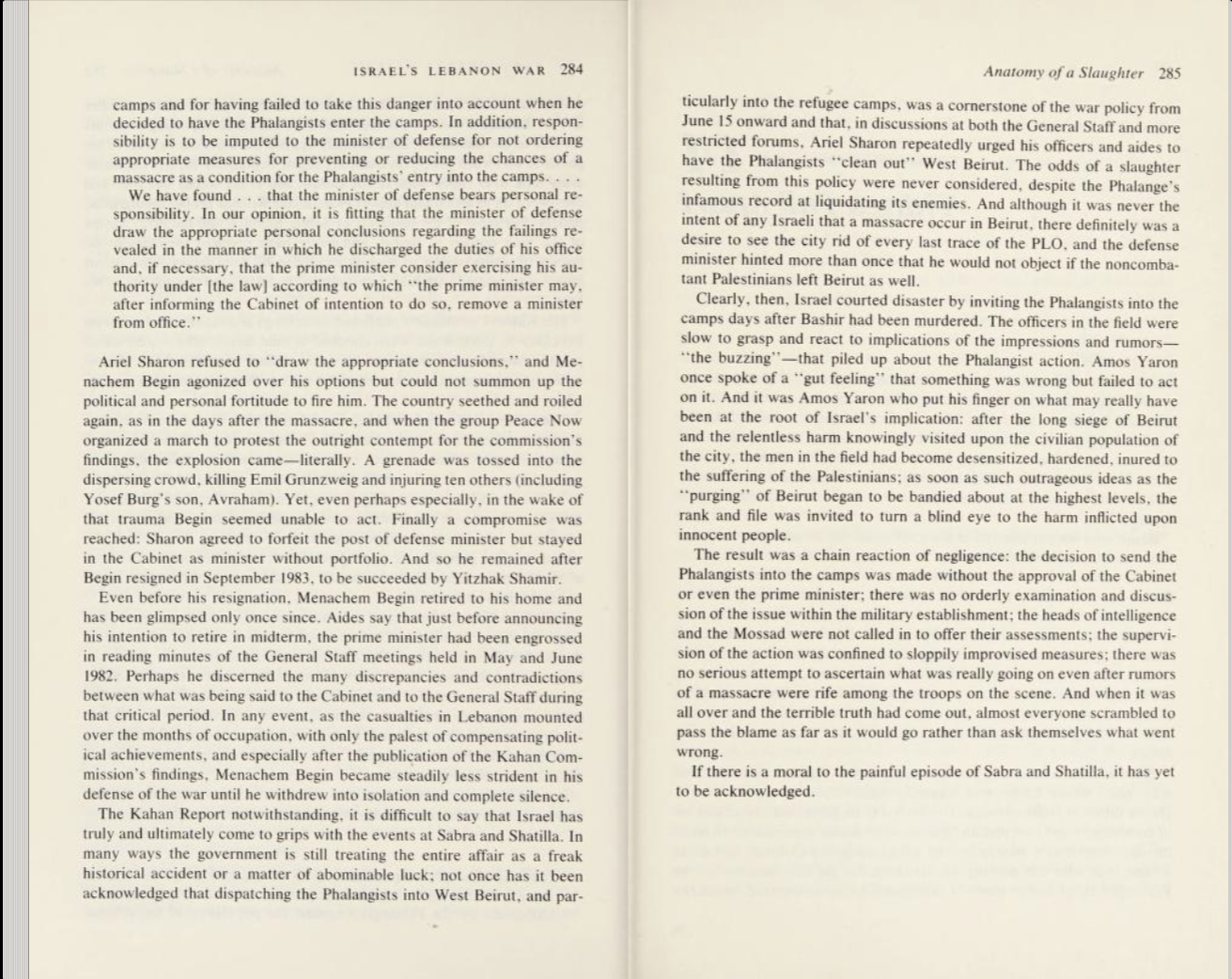
Most prominent were a succession of suicide bombings by Muslim fundamental- ists in Israeli towns, principally against civilian passenger buses and restaurants (suicide bombings, introduced into the region by Hezbollah in the 1980s, were inaugurated by the Palestinian fundamentalists after the Goldstein massacre at the Tomb of the Patriarchs). The Israelis initially responded with air attacks on empty PNA office buildings and police stations, in an effort to prod the PNA into curbing the terrorists, and initiated pinpoint “targeted assassinations,” in which individual terrorists and their controllers were killed, usually from the air. The Israeli strategy failed. Arafat and his aides continued to incite their people to violence. Indeed, the Hamas suicide bombers were soon aped by a growing number of Fatah suicide bombers. The Fatah members were as religious as their Hamas counter- parts, and the Fatah leadership feared that the Palestinian masses, enamored with the fundamentalists’ “successes,” would cross into the Hamas camp. An atmosphere of terror engulfed Israel. One State, Two States Resolving the Israel Palestine — Prof Benny Morris — 2009 flattened, page 168 (file not included in this release)
2001 August 9: Sbarro Suicide Bombing Massacre
Sbarro restaurant suicide bombing
2002: Arab Peace Initiative
2003: Road Map for Peace
https://en.wikipedia.org/wiki/Road_map_for_peace#Start_and_deadlock:~:text=By the end,eventually reached deadlock.
The Day That Bush Took Gaza | Brookings
2007: Annapolis Conference
2008 - 2009: Gaza War
1968-2023 > 2008 - 2009: Gaza War
Congressional Research Service - Israel and Hamas Conflict in Gaza 2008-2009
- Israel refused to lift the blockade, rouge elements unmanaged by Hamas in Gaza still fired rockets into Israel during this cease fire and Hamas refuses to return the captured soldier Gilad Shali.
- Gaza_War_2008-2009.pdf (file not included in this release)
- GoldstoneReport-_A-HRC-12-48.pdf (file not included in this release)
- 2008_Israel–Hamas_ceasefire.pdf (file not included in this release)
- WikiLeaks: Israel Aimed to Keep Gaza Economy on Brink of Collapse - Haaretz Com - Haaretz.com
- Foreigners asked to leave Gaza after AFP journalist abducted - World - News Brief - Newsgd
- A six month long ceasefire between Israel and Hamas ended on Nov 4, when the IDF made a raid into Deir al-Balah, central Gaza to destroy a tunnel, killing several Hamas militants. Israel said the raid was a preemptive strike and Hamas intended to abduct Israeli soldiers, while Hamas characterized it as a ceasefire violation, and responded with rocket fire into Israel
- Gilad Shalit, two years before in 2006, was captured by Palestinian militants in a cross-border raid via tunnels near the Israeli border.
2010-2011: Direct Talks with Obama
2010–2011 Israeli–Palestinian peace talks
2013-2014: Peace Talks
2013–2014 Israeli–Palestinian peace talks
2014: Gaza War “Protective Edge”
2014_Gaza_War (file not included in this release)
2014 Gaza War - Wikipedia
Casualties
Gaza Health Ministry: 2,310 killed (70% civilians), 10,626 wounded
UN HRC: 2,251 killed (65% civilians)
Israel MFA: 2,125 killed (36% civilians, 44% combatants, 20% uncategorized males aged 16–50
2014_Gaza_War (file not included in this release)
2014 Gaza War - Wikipedia
2014: Abbas Peace Plan
Israeli–Palestinian peace process
2017: Trump Plan
2018 - 2019: Gaza border protests ‘Great March of Return’
2018-2019_Gaza_border_protests.pdf (file not included in this release)
Israeli Military Kills 15 Palestinians in Confrontations on Gaza Border - The New York Times
Israel: Gaza Killings Unlawful, Calculated | Human Rights Watch
Though Deadly, Gaza Protests Draw Attention and Enthusiasm - The New York Times
-
Palestinians had prepared hundreds of firebomb kites, intending to fly them as swarms into Israel exploiting the heavy heat wave to ignite fires, however since the wind was blowing in the wrong direction to the west. The wind also blew tear gas and smoke from burning tires westwards into the Palestinian crowd chasing many away.
-
On 5 May, six Hamas operatives were killed in an explosion in Deir al-Balah. A statement by Hamas’ military wing blamed Israel – stating that it was a “heinous crime that has been committed against [its] fighters”. The IDF spokesperson stated that “the IDF is not involved in this incident in any way”. A Palestinian, a source for Haaretz, said that it was “an explosion resulting from the handling of explosives inside a building”.
-
Israeli defense sources claimed that a large fraction of those killed were members or otherwise affiliated with Palestinian militant organizations. According to Israel, the demonstrations provided cover for attacks by militants.
-
On 11 April, the military-affiliated Israeli Intelligence and Terrorism Information Center (ITIC) published a report in which it stated that 26 of the 32 persons killed belonged to or were affiliated with Palestinian militant groups. The report identified thirteen of these as belonging to the military wings of these organizations, and six as members of the Gaza security forces.
-
On 14 May, when 59 to 62 Palestinians were killed, Hamas claimed 50 of them and Palestinian Islamic Jihad claimed three as members of its military wing.
-
On 8 June, ITIC stated that it had identified 124 of the 127 Gazans reportedly killed in demonstrations since March. It reported that 102 of the killed were affiliated with either the militant or civilian wings of Fatah, Hamas, PIJ, the DFLP, or the PFLP.
A_HRC_40_74_CRP2.pdf (file not included in this release) -
The Gaza March of Return: What You Need to Know - ADL
- Hamas heavily mobilized the Gaza population, shutting down schools and workplaces and bussing people to the demonstration points. Hamas’s leader in Gaza Yahya Sinwar had urged demonstrators in recent weeks to “tear down the wall and tear out their [Israeli’s] hearts.” Sever days before May 14, he suggested that hundreds of thousands of Palestinians could breach Israel’s security barrier.