⬅️ Key Arguments (MOC) · Related: Hamas · Radicalization · Children indoctrination to Hate and Kill Jews
Long view — Palestinian opinion on peace and the end-state, 2000–2026
Across twenty-five years of polling, one pattern holds: the answer depends on which options are on the menu. When pollsters offer only negotiated frameworks (two states, one equal state, confederation), a two-state solution on the 1967 lines usually wins a plurality or majority: 59% in Arab Barometer’s October 2025 survey and 56% in PCPSR’s August 2026 poll. When a maximalist option is also offered, such as “liberation of the entire historic Palestine” or “a Palestinian state from the river to the sea,” that option has repeatedly won large majorities: 60% (Washington Institute, June 2014), 64% (PCPSR, December 2023), and 74.7% (AWRAD, November 2023). That is not universal: in PCPSR’s October 2003 poll the all-Palestine option drew 23%, and in AWRAD’s late-2024 polls 20–22%. Support for the bare label “two-state solution” fell from 71% in 2006 (PCPSR’s own estimate) and 51–55% in 2012–2014 to a low of 27–34% in 2022–2024, then recovered to 44–45% in 2025–2026. JMCC’s parallel series, which reads only two options (two states or one bi-national state), had two states at 42–58% in every poll from 2001 to 2016, still in first place, at 29–39%, through 2021. Over the same years, an answer nobody was offered, a Palestinian state on all of Palestine, grew from 6–11% (2004–2012) to 17–25% (2018–2023). In September 2026 two states returned to 48%. PCPSR tracked support for armed attacks on Israeli civilians inside Israel until September 2023; it ranged from 38% to 67% and ran far higher in Gaza than in the West Bank. Few polls ask directly whether Jews should leave. The closest measures found here are the Palestinian-Israeli Pulse “expulsion” option (15% in 2017, 17% in 2018) and INSS’s West Bank option of a Palestinian state without a permanent Jewish presence (28% in 2025, 26% in 2026). Across the wider Arab world, opposition to recognizing Israel runs at 84–89% (Arab Opinion Index, 2022–2025).
Jump to: Trend tracker — what Palestinians think over time · Palestinian views on peace and the end-state, 2000–2026 · Arab public opinion in the region · Palestinian Polling After October 7 · Israeli public opinion · Other Palestinian social and political attitudes · How pollsters change or remove questions · Pollsters to watch · Reliability and methodological caveats · Poll PDF library · Sources — peace, solutions, and regional polling
Related: Solutions (Two-State, One-State & Beyond) · Right of Return · 2000 Camp David, Clinton's Parameters and Taba Talks · Israel-Palestine Poll Numbers
Related research: Palestinian attitudes toward the West and the United States — public polling, cultural attitudes, and dated Hamas, PA/Fatah/PLO, PIJ, and Hezbollah rhetoric; researched November 1, 2026.
Current read — August 2026
Palestinian opinion cannot be summarized as uniformly moderate or uniformly pro-Hamas. In PCPSR’s latest survey, 24% identified with Hamas, 27% chose armed struggle as the most effective route to statehood, 44% chose negotiations, and 56% preferred a two-state solution based on the 1967 borders when it was offered alongside confederation and a single equal-rights state. Hardline views remain substantial and are often stronger in the West Bank, but the latest evidence does not support treating them as a timeless consensus.
Debate use
Cite the pollster, fieldwork date, population, exact wording, and response options. Approval of the October 7 decision, party identification with Hamas, satisfaction with Hamas, preference for armed struggle, and approval of attacks on civilians are different measures. Do not substitute one for another.
Pinker’s historical Gallup baseline—not a current Palestinian estimate
Pinker uses 2001–2007 cross-national Gallup data to show that Muslim attitudes toward “Western values” were multidimensional: distrust of U.S. policy coexisted with support for speech, democratic participation, and women’s rights, while support for 9/11 was a small minority in that survey. He also reports later declines in support for jihadist violence. Use that evidence to reject timeless civilizational claims, but use the dated, population-specific PCPSR results below for current Palestinian arguments. → Gallup evidence and change over time
Trend tracker — what Palestinians think over time
This section pulls every comparable series in the note into one place, so change over time can be read at a glance. Each row follows one question family asked repeatedly, usually by one pollster. The detailed tables, exact wording, and page-linked sources are in the thematic sections below; the two series that appear only here are tabled at the end of this section.
Majority tracker
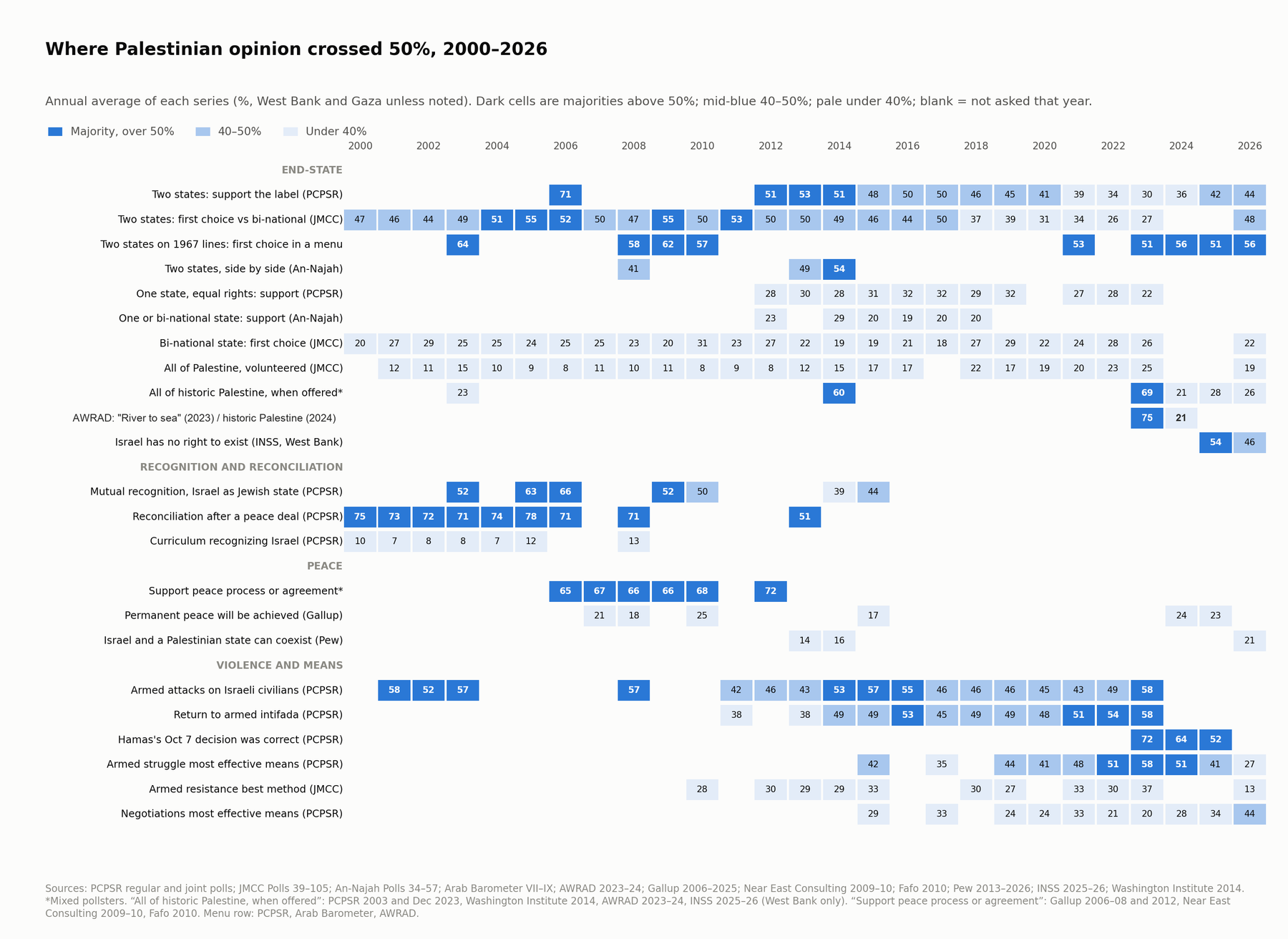
Each cell is the average of the polls in that series for that year, rounded. A dark cell means the average was above 50%. Annual averaging can hide single polls on either side of 50%: JMCC’s two-state preference, for example, topped 50% in 16 individual polls, but only five yearly averages clear the line. The scorecard below counts individual polls.
What has been over 50%, and when
Counts are individual polls. “Majority” means more than 50% of all respondents; 50% exactly is not counted.
| Question family (pollster) | Polls above 50% | When it was a majority | Range | Latest reading | Details |
|---|---|---|---|---|---|
| End-state | |||||
| Support “the two-state solution” as a label (PCPSR) | 13 of 47 | 2006 (PCPSR’s own 71% estimate); most polls from Sep 2012 to Sep 2014; Jun 2015; Mar 2016; Sep 2017. None since. | 27–71% | 44%, Aug 2026 | PCPSR series (West Bank, East Jerusalem, Gaza) |
| Two states over a bi-national state, two options read (JMCC) | 16 of 46 | Apr 2003; Dec 2004–Jun 2006; Nov 2007; 2009; Sep 2010–Nov 2011; Nov 2012; Mar 2013. Plurality in every poll through 2021. | 26–58% | 47.9%, Sep 2026 | JMCC series: two states, a bi-national state, or all of Palestine (2000–2026) |
| Two states on the 1967 lines, chosen from a menu of negotiated options (PCPSR, Arab Barometer, AWRAD) | 12 of 14 | 2003–2010; 2021; 2023–2026. Below 50% only in PCPSR’s May and Oct 2025 polls (47%). | 47–64% | 56%, Aug 2026 | Two states versus the alternatives |
| Support two states side by side with Israel (An-Najah) | 3 of 6 | Nov 2013 (51.8%), Apr 2014 (50.7%), Sep 2014 (56.4%). The 2008 wording differed (39.5–42.5%). | 39.5–56.4% | 56.4%, Sep 2014 (series ended) | An-Najah National University series, 2008–2018 |
| One state with equal rights (PCPSR) | 0 of 27 | Never | 20–36% | 22%, Mar 2023 | One state with equal rights (PCPSR), 2012–2023 |
| One state or a bi-national state (An-Najah) | 0 of 9 | Never; rejected by 62.8–78.6% | 18.0–31.3% | 21.0%, Oct 2018 | An-Najah National University series, 2008–2018 |
| Bi-national state as first choice (JMCC) | 0 of 46 | Never | 16–34% | 21.7%, Sep 2026 | JMCC series: two states, a bi-national state, or all of Palestine (2000–2026) |
| A Palestinian state on all of Palestine, volunteered without prompting (JMCC) | 0 of 43 | Never; rose from 6–11% to 17–25% | 6–25% | 18.6%, Sep 2026 | same |
| All of historic Palestine, when offered as an option (various) | 3 of 8 | Washington Institute Jun 2014 (60%); AWRAD Nov 2023 (74.7%); PCPSR Dec 2023 (64%). The Washington Institute’s 2015–2020 West Bank and Gaza splits also exceeded 50% in most readings. | 20–75% | 26%, INSS West Bank, Jun–Jul 2026 | Maximalist goals: all of historic Palestine and Israel's existence |
| A Palestinian state “from the river to the sea” / state on the basis of historic Palestine (AWRAD) | 1 of 3 | Nov 2023 (74.7%). The two late-2024 readings were 22% and 20%. | 20–74.7% | 20%, Nov–Dec 2024 (recorded as a spontaneous response) | Two states versus the alternatives |
| Israel has no right to exist (INSS, West Bank only) | 1 of 2 | Sep 2025 (54%) | 46–54% | 46%, Jun–Jul 2026 | same |
| Recognition and reconciliation | |||||
| Mutual recognition of Israel as the state of the Jewish people after a Palestinian state (PCPSR joint polls) | 4 of 8 | 2003, 2005, 2006 (66% peak), Dec 2009. None since. | 39–66% | 44%, Jun 2015 | Recognition and peace packages over time |
| Reconciliation between the two peoples after a peace agreement (PCPSR) | 15 of 15 | Every reading, 2000–2013 | 51–81% | 51%, Dec 2013 | 2000s baseline |
| School curriculum that recognizes Israel and drops the claim to all of Palestine (PCPSR) | 0 of 10 | Never | 7–13% | 13%, Aug 2008 | 2000s baseline |
| Peace | |||||
| Support the peace process or a peace agreement (Gallup, Near East Consulting, Fafo) | 12 of 12 | Every reading, 2006–2012 | 59–73% | 72%, Gallup, 2012 | Support for a peace agreement and the peace process, 2004–2025 |
| Permanent peace will be achieved (Gallup) | 0 of 6 | Never | 17–25% | 23%, 2025 | same |
| A way can be found for Israel and a Palestinian state to coexist (Pew) | 0 of 3 | Never | 14–21% | 21%, 2026 | Coexistence and whether peace is possible |
| Violence and means | |||||
| Armed attacks on Israeli civilians inside Israel (PCPSR) | 22 of 52 | 2001–2003; Mar and Jun 2008; Dec 2012; Aug 2014–Dec 2016 (most polls); Dec 2018; Jun 2021; Jun 2022; Mar and Sep 2023 | 38–67% | 54%, Sep 2023 (question dropped after Oct 7) | Attacks on Israeli civilians: PCPSR's long series |
| Return to an armed intifada (PCPSR) | 12 of 30 | Dec 2014; 2016–Mar 2017; Dec 2018; Dec 2019; Jun 2021; Mar 2022–Mar 2023 | 35–60% | 58%, Mar 2023 | Return to an armed intifada (PCPSR), 2011–2023 |
| Hamas’s decision to launch the October 7 attack was correct (PCPSR) | 5 of 6 | Every reading except May 2025 (exactly 50%) | 50–72% | 53%, Oct 2025 | Palestinian Polling After October 7 |
| Armed struggle is the most effective means (PCPSR) | 4 of 13 | Dec 2022; Sep 2023; Dec 2023 (63%); Jun 2024 | 27–63% | 27%, Aug 2026 | Means: negotiations versus armed struggle |
| Armed resistance is the best method (JMCC) | 0 of 15 | Never | 13–37% | 13.3%, Sep 2026 | JMCC series on means, 2000–2026 |
| Negotiations are the most effective means (PCPSR) | 0 of 13 | Never; highest reading is the latest | 20–44% | 44%, Aug 2026 | Means: negotiations versus armed struggle |
What the majorities add up to
- Consistent majorities: reconciliation after a peace deal (every poll, 2000–2013); support for a peace process or agreement (every poll, 2006–2012); two states on the 1967 lines when the only rivals are other negotiated outcomes (12 of 14 polls); and, after the war began, calling Hamas’s October 7 decision correct (5 of 6 polls).
- Never a majority: one equal state or a bi-national state (0 of 82 readings across PCPSR, JMCC, and An-Najah); teaching children to give up the claim to all of Palestine; expecting permanent peace; believing coexistence with a Palestinian state is possible; and negotiations as the most effective means.
- Swings across 50%: support for attacks on Israeli civilians (22 of 52 polls), a return to armed intifada (12 of 30), armed struggle as the best means (4 of 13), and the bare two-state label (13 of 47, none since 2017). An all-of-historic-Palestine option won majorities when it was offered alongside two states in 2014 and late 2023, but drew 20–28% in 2003 and 2024–2026.
- Direction since 2023: negotiations (44%) now lead armed struggle (27%) in PCPSR’s forced choice, two-state preference is back to 47.9% (JMCC) and 56% (PCPSR menu), and the October 7 “correct” figure fell from 72% to about 50%.
Themes over time
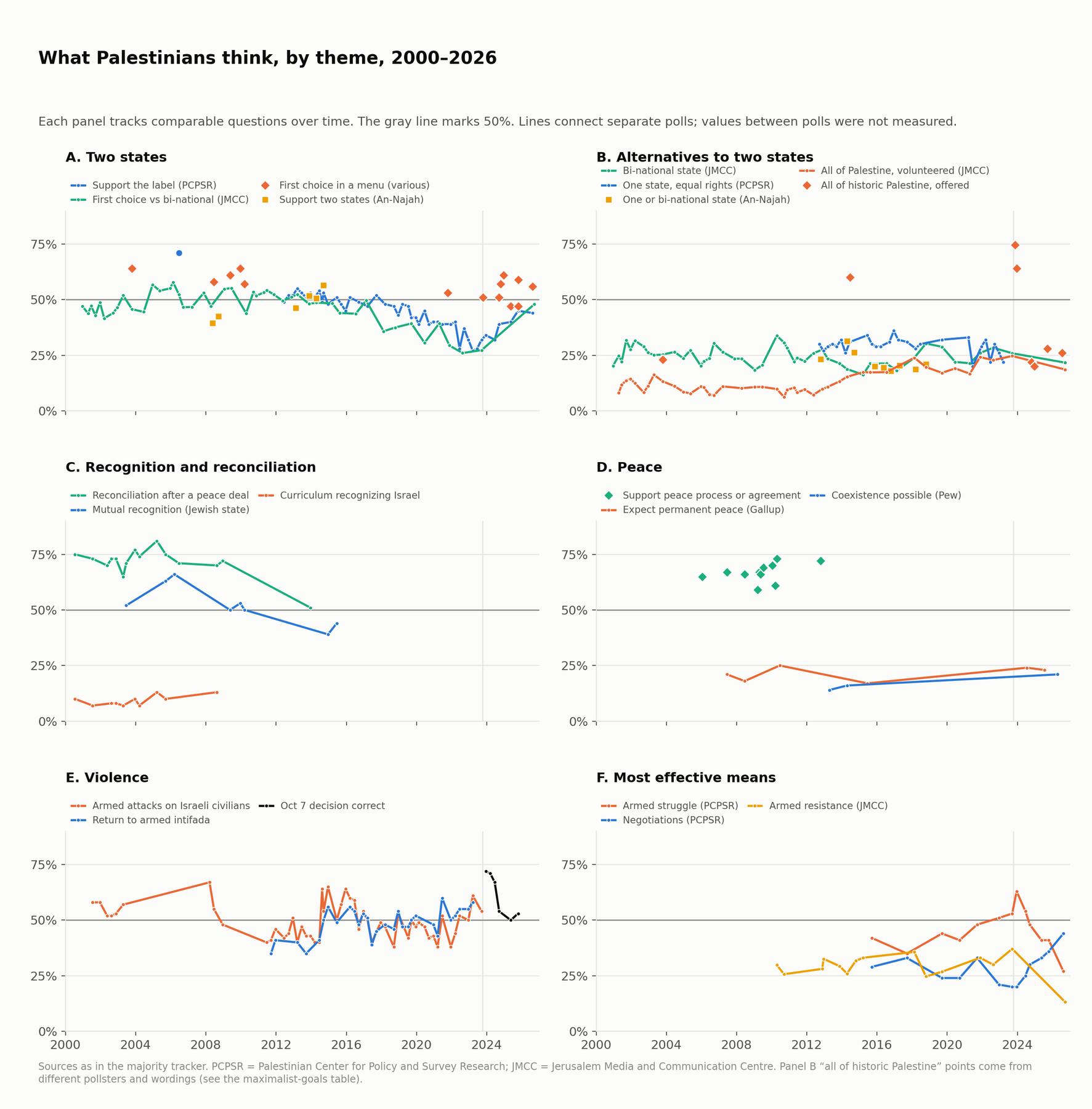
Panel A shows two-state support by question type; B the alternatives, including the all-Palestine answers; C recognition and reconciliation; D peace; E violence; F means. The detail for each line is in the section linked from the scorecard above.
Series that appear only in this tracker
Return to an armed intifada (PCPSR), 2011–2023
PCPSR asks which options respondents support “in the absence of negotiations.” From 2011 to 2019 the option read “a return to an armed intifada”; from 2020 it became “a return to armed confrontations and intifada.”
| Fieldwork | Poll | Support | Source |
|---|---|---|---|
| Sep 2011 | Poll 41 | 35% | Poll 41, p. 2 (file not included in this release) |
| Dec 2011 | Poll 42 | 41% | Poll 42, p. 7 (file not included in this release) |
| Mar 2013 | Poll 47 | 40% | Poll 47, p. 5 (file not included in this release) |
| Sep 2013 | Poll 49 | 35% | Poll 49, p. 5 (file not included in this release) |
| Jun 2014 | Poll 52 | 41% | Poll 52, p. 5 (file not included in this release) |
| Sep 2014 | Poll 53 | 50% | reported in Poll 54, p. 2 (file not included in this release) |
| Dec 2014 | Poll 54 | 56% | Poll 54, p. 6 (file not included in this release) |
| Jun 2015 | Poll 56 | 49% | Poll 56, p. 5 (file not included in this release) |
| Mar 2016 | Poll 59 | 56% | Poll 59, p. 2 (file not included in this release) |
| Jun 2016 | Poll 60 | 54% | Poll 60, p. 3 (file not included in this release) |
| Sep 2016 | Poll 61 | 48% | Poll 61, p. 5 (file not included in this release) |
| Dec 2016 | Poll 62 | 53% | Poll 62, p. 5 (file not included in this release) |
| Mar 2017 | Poll 63 | 51% | Poll 63, p. 6 (file not included in this release) |
| Jun 2017 | Poll 64 | 39% | Poll 64, p. 5 (file not included in this release) |
| Sep 2017 | Poll 65 | 45% | Poll 65, p. 5 (file not included in this release) |
| Mar 2018 | Poll 67 | 48% | Poll 67, p. 5 (file not included in this release) |
| Sep 2018 | Poll 69 | 46% | Poll 69, p. 8 (file not included in this release) |
| Dec 2018 | Poll 70 | 54% | Poll 70, p. 8 (file not included in this release) |
| Mar 2019 | Poll 71 | 47% | Poll 71, p. 7 (file not included in this release) |
| Jul 2019 | Poll 72 | 47% | Poll 72, p. 6 (file not included in this release) |
| Sep 2019 | Poll 73 | 50% | Poll 73, p. 9 (file not included in this release) |
| Dec 2019 | Poll 74 | 52% | Poll 74, p. 10 (file not included in this release) |
| Dec 2020 | Poll 78 | 48% | Poll 78, p. 4 (file not included in this release) |
| Mar 2021 | Poll 79 | 43% | Poll 79, p. 8 (file not included in this release) |
| Jun 2021 | Poll 80 | 60% | Poll 80, p. 2 (file not included in this release) |
| Dec 2021 | Poll 82 | 50% | Poll 82, p. 5 (file not included in this release) |
| Mar 2022 | Poll 83 | 52% | Poll 83, p. 7 (file not included in this release) |
| Jun 2022 | Poll 84 | 55% | Poll 84, p. 5 (file not included in this release) |
| Dec 2022 | Poll 86 | 55% | Poll 86, p. 6 (file not included in this release) |
| Mar 2023 | Poll 87 | 58% | Poll 87, p. 8 (file not included in this release) |
One state with equal rights (PCPSR), 2012–2023
PCPSR asked whether respondents support “a one-state solution in which Arabs and Jews enjoy equality” (2012–2019). From 2021 it asked about “the position articulated by Abbas” in favor of equal rights in one state for two peoples. The March 2021 and June 2021 figures come from the summary line on the one-state solution. Support never exceeded 36%.
| Fieldwork | Poll | Support | Source |
|---|---|---|---|
| Sep 2012 | Poll 45 | 30% | Poll 45, p. 7 (file not included in this release) |
| Dec 2012 | Poll 46 | 27% | Poll 46, p. 6 (file not included in this release) |
| Mar 2013 | Poll 47 | 29% | Poll 47, p. 5 (file not included in this release) |
| Jun 2013 | Poll 48 | 30% | Poll 48, p. 6 (file not included in this release) |
| Sep 2013 | Poll 49 | 29% | Poll 49, p. 4 (file not included in this release) |
| Dec 2013 | Poll 50 | 32% | Poll 50, p. 2 (file not included in this release) |
| Mar 2014 | Poll 51 | 26% | Poll 51, p. 3 (file not included in this release) |
| Jun 2014 | Poll 52 | 31% | Poll 52, p. 5 (file not included in this release) |
| Jun 2015 | Poll 56 | 34% | Poll 56, p. 5 (file not included in this release) |
| Sep 2015 | Poll 57 | 30% | Poll 57, p. 9 (file not included in this release) |
| Dec 2015 | Poll 58 | 29% | Poll 58, p. 7 (file not included in this release) |
| Mar 2016 | Poll 59 | 29% | Poll 59, p. 6 (file not included in this release) |
| Sep 2016 | Poll 61 | 31% | Poll 61, p. 5 (file not included in this release) |
| Dec 2016 | Poll 62 | 36% | reported in Poll 63, p. 5 (file not included in this release) |
| Mar 2017 | Poll 63 | 32% | Poll 63, p. 5 (file not included in this release) |
| Sep 2017 | Poll 65 | 31% | Poll 65, p. 5 (file not included in this release) |
| Mar 2018 | Poll 67 | 28% | Poll 67, p. 5 (file not included in this release) |
| Jun 2018 | Poll 68 | 30% | Poll 68, p. 7 (file not included in this release) |
| Sep 2019 | Poll 73 | 32% | Poll 73, p. 8 (file not included in this release) |
| Mar 2021 | Poll 79 | 33% | Poll 79, p. 8 (file not included in this release) |
| Jun 2021 | Poll 80 | 20% | Poll 80, p. 7 (file not included in this release) |
| Dec 2021 | Poll 82 | 29% | Poll 82, p. 5 (file not included in this release) |
| Mar 2022 | Poll 83 | 32% | Poll 83, p. 7 (file not included in this release) |
| Jun 2022 | Poll 84 | 22% | Poll 84, p. 6 (file not included in this release) |
| Sep 2022 | Poll 85 | 30% | reported in Poll 86, p. 7 (file not included in this release) |
| Dec 2022 | Poll 86 | 26% | Poll 86, p. 6 (file not included in this release) |
| Mar 2023 | Poll 87 | 22% | Poll 87, p. 9 (file not included in this release) |
Reading the tracker
- Rows marked * in the heatmap combine pollsters. Their cells are comparable in direction, not to the point.
- The PCPSR label row includes one pre-2012 value: 71% in 2006, from PCPSR’s own 2019 policy report. The 2003–2010 two-state preferences sit in the menu row.
- “All of historic Palestine, when offered” mixes PCPSR, the Washington Institute, AWRAD, and INSS. INSS 2025–26 is West Bank only.
- The dedicated AWRAD row makes the wording change visible: 74.7% chose “A Palestinian state from the river to the sea” in November 2023; the annual 2024 cell is 21%, averaging 22% in October and 20% in November–December for “State on the basis of historic Palestine.” AWRAD recorded the December answer as spontaneous.
- Gaps are real gaps: a blank cell means the question was not asked or not published that year. Do not read a trend across them.
Palestinian views on peace and the end-state, 2000–2026
This section collects polls of Palestinians in the West Bank, East Jerusalem, and Gaza since 2000 that measured five things: support for peace with Israel, the preferred framework for a solution, one state versus two states, the departure or expulsion of Jews and Israelis, and the goal of replacing Israel with a Palestinian state on all of historic Palestine. Figures are reported as the pollster published them. Linked PDFs open to the cited page through PDF++. Earlier PCPSR, AWRAD, and Washington Institute files already in the vault are linked where they are the source.
Headline finding — the menu decides the answer
Two-state support is not a single fixed number. In PCPSR’s December 2023 poll, “an independent Palestinian state alongside the state of Israel based on the 1967 borders” drew 28% when respondents could also choose “continued struggle until the liberation of the entire historic Palestine” (64%). In the same pollster’s August 2026 poll, the 1967-borders option drew 56% when the only alternatives were confederation and one equal state. Before comparing numbers across polls, check whether a maximalist option was offered. → Poll 90, Q44, p. 27 (file not included in this release) · Poll 97, p. 13 (file not included in this release)
Question types and how they differ
| Question family | Typical wording | What it does and does not measure | Main series |
|---|---|---|---|
| Bare-label two-state support | Support or oppose “the two-state solution,” with no details | Reaction to the label. Does not say which borders or what alternative the respondent prefers. | PCPSR regular polls; Palestinian-Israeli Pulse; Gallup |
| Menu of frameworks | Choose among two states on 1967 lines, one state, confederation, or other | Preference ranking, but only among the options offered. | JMCC; Arab Barometer; PCPSR since 2024 |
| Menu that includes a maximalist option | Adds “liberation of the entire historic Palestine” or “a Palestinian state from the river to the sea” | Whether a negotiated outcome beats the maximal goal. | PCPSR Dec 2023; AWRAD Nov 2023; Washington Institute; INSS |
| Permanent-status package | Detailed Clinton/Geneva-type agreement (borders, refugees, Jerusalem, security) | Willingness to accept concrete trade-offs. Usually lower than bare-label support. | PCPSR-Truman joint polls 2003–2006; Pulse 2016–2024 |
| Recognition and legitimacy | Mutual recognition of Israel as “the state of the Jewish people”; Israel’s “right to exist”; who the land “belongs to” | Normative acceptance of Israel, not policy choice. | PCPSR-Truman joint polls; Pulse; INSS |
| Coexistence and peace possible | ”A way can be found for Israel and an independent Palestinian state to coexist peacefully” | Expectation, not preference. People can want peace and think it impossible. | Pew; Gallup; AWRAD |
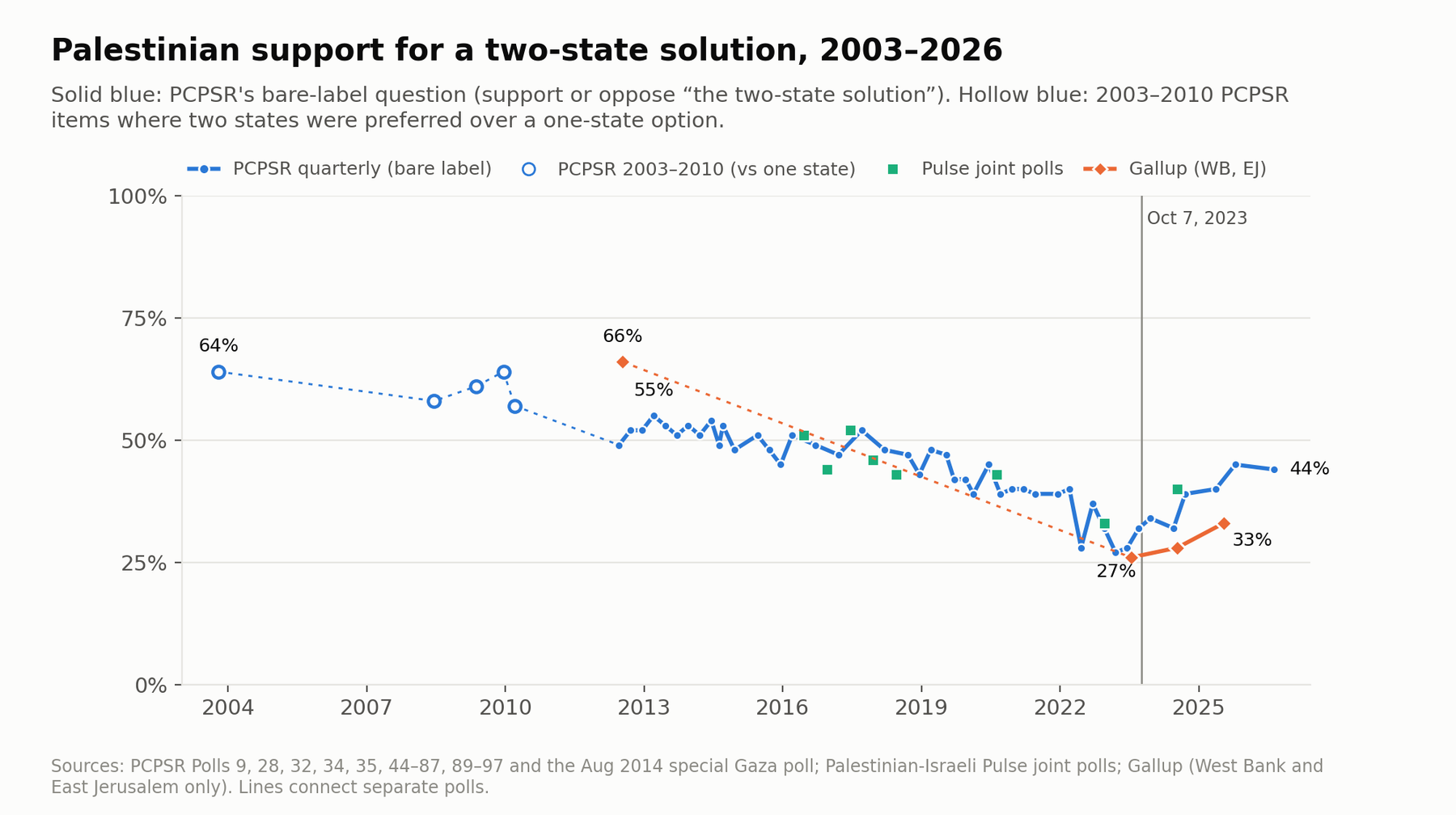
Two-state support over time
PCPSR series (West Bank, East Jerusalem, Gaza)
PCPSR (Khalil Shikaki’s Palestinian Center for Policy and Survey Research) interviews about 1,200–1,270 adults face to face each quarter. Two kinds of item run through its archive. From 2003 to 2010 the full-text reports mostly measured two states against named alternatives such as one state or all of Palestine. From 2011 onward the regular polls ask whether respondents support or oppose “the two-state solution” as a bare label. The joint Palestinian-Israeli polls (with the Truman Institute through 2015, then the Palestinian-Israeli Pulse) use the same bare-label wording. PCPSR’s 2019 policy report put Palestinian support for the concept at 71% in 2006, falling to 43% by June 2018. → PCPSR policy report, Jan 2019, p. 4 (file not included in this release)
2003–2010: two states compared with alternatives
| Fieldwork | Poll | Two states | Alternatives in the same item | Source |
|---|---|---|---|---|
| Oct 2003 | Poll 9 | 64% “a two-state solution (Israel and a Palestinian state in the West Bank and the Gaza Strip)“ | 12% one state for Palestinians and Israelis; 23% “want all Palestine back to the Palestinians” | Poll 9, p. 3 (file not included in this release) |
| Jun 2008 | Poll 28 | 58% prefer the two-state solution | 27% prefer a one-state solution | Poll 28, p. 3 (file not included in this release) |
| May 2009 | Poll 32 | 61% support the two-state solution | 23% support the one-state solution | Poll 32, p. 4 (file not included in this release) |
| Dec 2009 | Poll 34 | 64% prefer the two-state solution “over any other solution” | 20% prefer one state shared by Palestinians and Israelis west of the Jordan | Poll 34, p. 4 (file not included in this release) |
| Mar 2010 | Poll 35 | 57% support the two-state solution | 29% support one state; 26% support a Palestinian-Israeli confederation (each asked separately) | Poll 35, p. 5 (file not included in this release) |
2012–2026: bare-label support for “the two-state solution”
| Fieldwork | Poll | Support | Oppose | Source |
|---|---|---|---|---|
| Jun 2012 | Poll 44 | 49% | 49% | Poll 44, p. 5 (file not included in this release) |
| Sep 2012 | Poll 45 | 52% | 46% | Poll 45, p. 7 (file not included in this release) |
| Dec 2012 | Poll 46 | 52% | 48% | Poll 46, p. 8 (file not included in this release) |
| Mar 2013 | Poll 47 | 55% | 44% | Poll 47, p. 5 (file not included in this release) |
| Jun 2013 | Poll 48 | 53% | — | Poll 48, p. 6 (file not included in this release) |
| Sep 2013 | Poll 49 | 51% | 48% | Poll 49, p. 4 (file not included in this release) |
| Dec 2013 | Poll 50 | 53% | 46% | Poll 50, p. 2 (file not included in this release) |
| Mar 2014 | Poll 51 | 51% | — | Poll 51, p. 2 (file not included in this release) |
| Jun 2014 | Poll 52 | 54% | — | Poll 52, p. 4 (file not included in this release) |
| Aug 2014 | Special Gaza war poll | 49% | 50% | Gaza war poll, p. 5 (file not included in this release) |
| Sep 2014 | Poll 53 | 53% | 46% | Poll 53, p. 5 (file not included in this release) |
| Dec 2014 | Poll 54 | 48% | 51% | Poll 54, p. 5 (file not included in this release) |
| Jun 2015 | Poll 56 | 51% | 48% | Poll 56, p. 5 (file not included in this release) |
| Sep 2015 | Poll 57 | 48% | 51% | Poll 57, p. 7 (file not included in this release) |
| Dec 2015 | Poll 58 | 45% | 54% | Poll 58, p. 6 (file not included in this release) |
| Mar 2016 | Poll 59 | 51% | 48% | Poll 59, p. 6 (file not included in this release) |
| Jun 2016 | Pulse | 51% | — | Pulse Jan 2023, p. 3 (file not included in this release) |
| Dec 2016 | Pulse | 44% | — | Pulse Dec 2016 summary, p. 1 (file not included in this release) |
| Sep 2016 | Poll 61 | 49% | 50% | Poll 61, p. 5 (file not included in this release) |
| Mar 2017 | Poll 63 | 47% | 51% | Poll 63, p. 5 (file not included in this release) |
| Jun 2017 | Pulse | 52% | — | Pulse Aug 2017, p. 3 (file not included in this release) |
| Sep 2017 | Poll 65 | 52% | 47% | Poll 65, p. 5 (file not included in this release) |
| Dec 2017 | Pulse | 46% | — | Pulse Jan 2018 summary, p. 1 (file not included in this release) |
| Mar 2018 | Poll 67 | 48% | 50% | Poll 67, p. 5 (file not included in this release) |
| Jun 2018 | Pulse | 43% | 54% | Pulse Jun 2018, p. 3 (file not included in this release) |
| Sep 2018 | Poll 69 | 47% | 50% | Poll 69, p. 7 (file not included in this release) |
| Dec 2018 | Poll 70 | 43% | 55% | Poll 70, p. 7 (file not included in this release) |
| Mar 2019 | Poll 71 | 48% | 50% | Poll 71, p. 7 (file not included in this release) |
| Jul 2019 | Poll 72 | 47% | 50% | Poll 72, p. 6 (file not included in this release) |
| Sep 2019 | Poll 73 | 42% | 56% | Poll 73, p. 8 (file not included in this release) |
| Dec 2019 | Poll 74 | 42% | 55% | Poll 74, p. 10 (file not included in this release) |
| Feb 2020 | Poll 75 | 39% | — | Poll 75, p. 1 (file not included in this release) (“less than 40%”); exact figure in Poll 76, p. 6 (file not included in this release) |
| Jun 2020 | Poll 76 | 45% | 50% | Poll 76, p. 6 (file not included in this release) |
| Aug 2020 | Pulse | 43% | 56% | Pulse Oct 2020, p. 3 (file not included in this release) |
| Sep 2020 | Poll 77 | 39% | 58% | Poll 77, p. 4 (file not included in this release) |
| Dec 2020 | Poll 78 | 40% | 59% | Poll 78, p. 4 (file not included in this release) |
| Mar 2021 | Poll 79 | 40% | 57% | Poll 79, p. 8 (file not included in this release) |
| Jun 2021 | Poll 80 | 39% | 58% | Poll 80, p. 7 (file not included in this release) |
| Dec 2021 | Poll 82 | 39% | 59% | Poll 82, p. 5 (file not included in this release) |
| Mar 2022 | Poll 83 | 40% | 58% | Poll 83, p. 7 (file not included in this release) |
| Jun 2022 | Poll 84 | 28% | 69% | Poll 84, p. 5 (file not included in this release) |
| Sep 2022 | Poll 85 | 37% | — | reported in Poll 86, p. 6 (file not included in this release) |
| Dec 2022 | Poll 86 | 32% | — | Poll 86, p. 6 (file not included in this release) |
| Dec 2022 | Pulse | 33% | 66% | Pulse Jan 2023, p. 3 (file not included in this release) |
| Mar 2023 | Poll 87 | 27% | — | Poll 87, p. 8 (file not included in this release) |
| Jun 2023 | Poll 88 | 28% | — | Poll 89, p. 9 (file not included in this release) |
| Sep 2023 | Poll 89 | 32% | 67% | Poll 89, p. 9 (file not included in this release) |
| Nov–Dec 2023 | Poll 90 | 34% | 64% | Poll 90, p. 16 (file not included in this release) |
| May–Jun 2024 | Poll 92 | 32% | 65% | Poll 92, p. 25 (file not included in this release) |
| Jul 2024 | Pulse | 40% | 59% | Pulse Sep 2024, p. 10 (file not included in this release) |
| Sep 2024 | Poll 93 | 39% | 58% | Poll 93, p. 20 (file not included in this release) |
| May 2025 | Poll 95 | 40% | 57% | Poll 95, p. 19 (file not included in this release) |
| Oct 2025 | Poll 96 | 45% | 53% | Poll 96, p. 18 (file not included in this release) |
| Aug 2026 | Poll 97 | 44% | 50% | Poll 97, p. 12 (file not included in this release) |
Poll 84 (June 2022) is an outlier within the run: support fell from 40% to 28% in one quarter and recovered to 37% in September 2022 (Poll 85, not in the archive; figure reported in Poll 86). PCPSR attributed the fall to a rise in the belief that settlement expansion had made the solution impractical, to 70%. Early-2020 support below 40% was, in PCPSR’s words, “the lowest reported by PSR since the signing of the Oslo agreement” at that point. → Poll 84, p. 5 (file not included in this release) · Poll 75, p. 1 (file not included in this release)
PCPSR’s own long-run note on a related item: support for mutual recognition “peaked at 66% in early 2006, and has since been declining steadily” (joint poll 32).
Gallup series (West Bank and East Jerusalem only)
Gallup asks about an independent Palestinian state alongside Israel. Since 2023 it has not surveyed Gaza.
| Year | Support | Oppose | Source |
|---|---|---|---|
| 2012 | 66% | 32% | Gallup, Sept. 30, 2024 |
| 2023 | 26% | — | Gallup, Sept. 29, 2025 |
| Jul–Aug 2024 | 28% | 64% | Gallup, Sept. 30, 2024 |
| Jun–Aug 2025 | 33% | 55% | Gallup, Sept. 29, 2025 |
Two states versus the alternatives
These polls asked respondents to choose among frameworks. Percentages are of all respondents unless noted. “Maximalist” means an option for a Palestinian state on all of historic Palestine, or liberation of all of it.
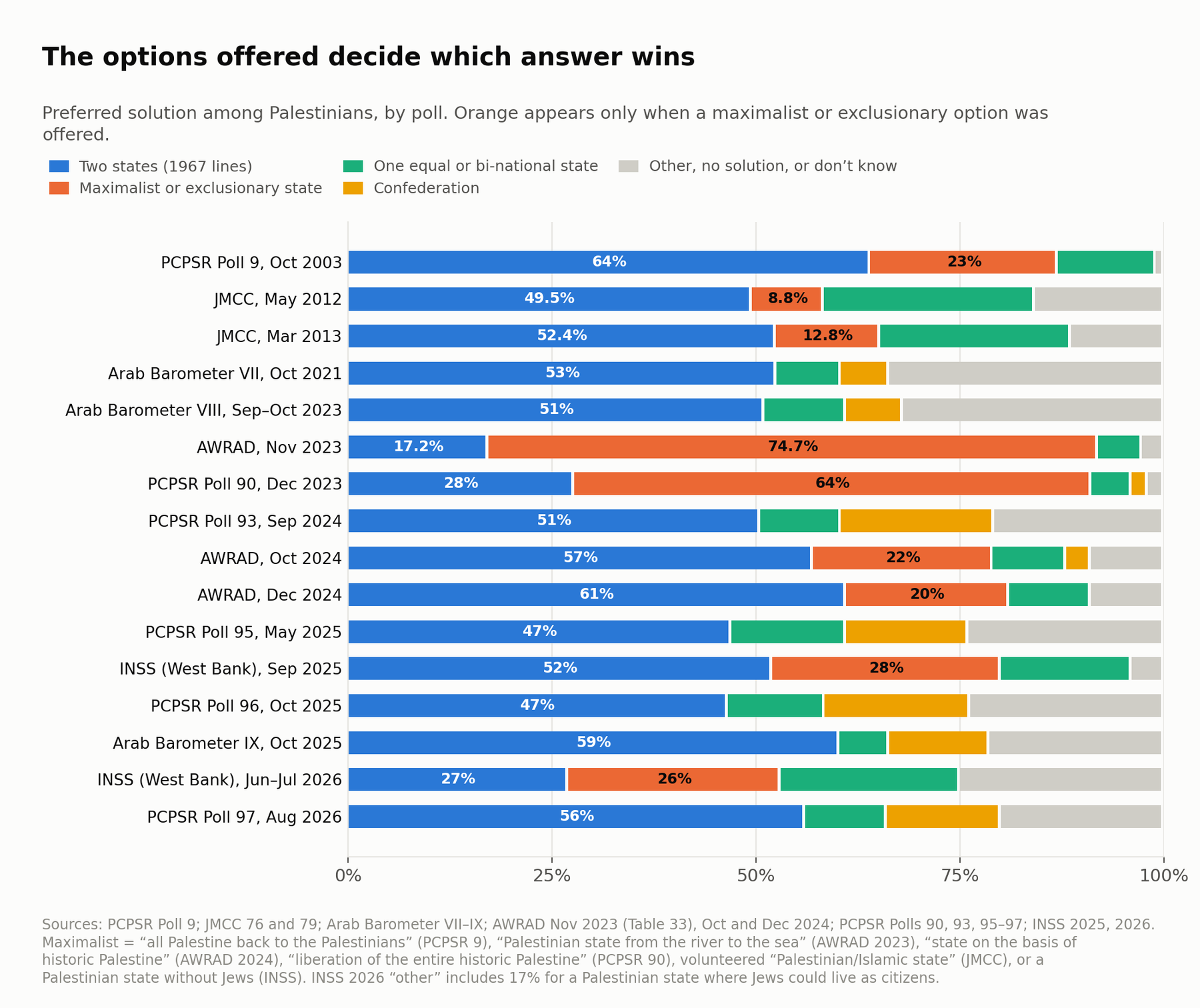
| Poll / fieldwork / sample | Two states (1967) | One equal or bi-national state | Confederation | Maximalist or exclusionary option | Other / DK | Source |
|---|---|---|---|---|---|---|
| PCPSR Poll 9, Oct 7–14, 2003 | 64% | 12% one state for Palestinians and Israelis | — | 23% “want all Palestine back to the Palestinians” | — | Poll 9, p. 3 (file not included in this release) |
| JMCC, May 20–26, 2012; n=1,188 | 49.5% (WB 48.1, Gaza 51.9) | 25.9% “bi-national state on all of historic Palestine” | — | 7.2% “Palestinian state” and 1.6% “Islamic state,” both volunteered | 13.5% no solution | JMCC 76, Q2, p. 5 (file not included in this release) |
| JMCC, Mar 27–31, 2013; n=1,179 | 52.4% (WB 53.7, Gaza 50.2) | 23.4% | — | 10.8% “Palestinian state” (Gaza 17.2%) and 2.0% “Islamic state,” volunteered | 9.2% no solution | JMCC 79, Q2, p. 5 (file not included in this release) |
| Pulse, Jun 29–Jul 1, 2017; n=1,200 (elimination analysis) | 53% | 11% | — | 10% apartheid; 15% expulsion | 11% | Pulse Aug 2017, p. 6 (file not included in this release) |
| Pulse, Jun 25–Jul 1, 2018; n=2,150 (elimination analysis) | 43% | 9% | — | about 9% apartheid; 17% expulsion | 22% | Pulse Jun 2018, p. 6 (file not included in this release) |
| Pulse, Dec 1–4, 2022; n=1,270 (each option asked separately) | 33% | 23% | 22% | 30% one state where “one side or the other dominates the entire region and the other side is denied equal rights” | — | Pulse Jan 2023, p. 7 (file not included in this release) |
| Arab Barometer VII, Oct 2021 | 53% | 8% (one state, equal rights not specified) | 6% | — | 28% other; 6% DK | AB9 Report 2, Figure 2, p. 6 (file not included in this release) |
| Arab Barometer VIII, Sep 28–Oct 8, 2023 (Gaza done Oct 6); n=1,189 | 51% (WB 49, Gaza 54) | 10% (one state, equal rights not specified) | 7% | — | 25% other; 7% DK | AB VIII, p. 14 (file not included in this release) |
| AWRAD, Oct 31–Nov 7, 2023; n=668 | 17.2% (WB 13.3, Gaza 22.7) | 5.4% “one-state solution for two peoples” | — | 74.7% “A Palestinian state from the river to the sea” (WB 77.7, Gaza 70.4) | 2.7% | AWRAD, Table 33, p. 23 (file not included in this release) |
| PCPSR Poll 90, Nov 22–Dec 2, 2023; n=1,231 | 28% (WB 26, Gaza 31) | 5% | 2% | 64% “Continued struggle until the liberation of the entire historic Palestine” (WB 69, Gaza 57) | 2% | Poll 90, Q44, p. 27 (file not included in this release) |
| Pulse, Jul 17–20, 2024; n=1,270 (each asked separately) | 40% | 25% | 35% | 33% one state in which one side dominates | — | Pulse Sep 2024, p. 13 (file not included in this release) |
| PCPSR Poll 93, Sep 3–7, 2024; n=1,200 | 51% (WB 49, Gaza 54) | 10% | 19% | — | 21% | Poll 93, p. 21 (file not included in this release) |
| AWRAD, Oct 6–17, 2024; WB 611, Gaza 391 | 57% (WB 47, Gaza 74) | 9% | 3% federation with Jordan or Egypt | 22% “State on the basis of historic Palestine” (WB 29, Gaza 11) | 1% other; 8% DK | AWRAD Oct 2024, p. 27 (file not included in this release) |
| AWRAD, Nov 27–Dec 2, 2024; n=704 | 61% (WB 52, Gaza 74) | 10% | — | 20% “State on the basis of historic Palestine” (WB 29, Gaza 7), a spontaneous answer | 6% DK | AWRAD Dec 2024, p. 25 (file not included in this release) |
| PCPSR Poll 95, May 1–4, 2025; n=1,270 | 47% (WB 46, Gaza 48) | 14% | 15% | — | 24% | Poll 95, p. 20 (file not included in this release) |
| Zogby Research Services for the Tony Blair Institute, Apr 9–May 12, 2025; Gaza 426, WB 759, EJ 250 | Gaza 63%, WB 42%, EJ 12% | Gaza 13%, WB 14%, EJ 10% | Gaza 3%, WB 3%, EJ 2% | — | “None of the above”: Gaza 21%, WB 41%, EJ 76% | Zogby 2025, p. 21 (file not included in this release) |
| INSS, Sep 1–7, 2025; West Bank only, phone, n=300 | 52% | 16% bi-national democratic state | — | 28% single Palestinian state from the river to the sea, excluding Jews | — | INSS 2025 |
| PCPSR Poll 96, Oct 22–25, 2025; n=1,200 | 47% (WB 47, Gaza 47) | 12% | 18% | — | 24% | Poll 96, p. 19 (file not included in this release) |
| Arab Barometer IX, Oct 8–26, 2025; n=1,655 | 59% (WB 56, Gaza 64) | 6% | 12% | — | 16% other; 5% DK | AB9 Report 2, p. 6 (file not included in this release) |
| INSS, Jun 27–Jul 2, 2026; West Bank only, phone, n=400 | 27% | 22% bi-national state with equal rights | — | 26% Palestinian state without a permanent Jewish presence; 17% Palestinian state where Jews could live as citizens or residents | — | INSS 2026 |
| PCPSR Poll 97, Aug 5–8, 2026; n=1,270 | 56% (WB 52, Gaza 61) | 10% | 14% (WB 9, Gaza 22) | — | — | Poll 97, p. 13 (file not included in this release) |
Reading the Pulse “elimination” tables
In 2017 and 2018 the Pulse removed two-state supporters first, then assigned the remaining respondents to one democratic state, then apartheid, then expulsion. In 2018 the expulsion option “was offered to those who have rejected all three above.” The 15% and 17% figures are therefore the respondents whose most moderate acceptable option was expulsion. They are not the total share who would accept expulsion if asked directly. In 2022 and 2024, each option was asked separately, so the figures overlap and can sum to more than 100%. → Pulse Jun 2018, p. 5 (file not included in this release)
Two other 2024 surveys asked about two states without a full menu. AWRAD’s May 2024 poll (n=1,500) found 54% support for a two-state solution, 39% in the West Bank and 77% in Gaza. → AWRAD May 2024, p. 1 (file not included in this release) Zogby’s September 2024 poll (n=1,243) asked respondents to rate each outcome. A “two-state solution in which Israel withdraws to the 1967 borders, evacuates settlements, with international guarantees for Palestinian sovereignty” was at least somewhat desirable to 78% in Gaza, 54% in the West Bank, and 81% in East Jerusalem. A single state with “full equality and share in governance” was at least somewhat undesirable to 58% in Gaza and 79% in the West Bank, but desirable to 78% in East Jerusalem. → Zogby Sep 2024, p. 10 (file not included in this release)
JMCC series: two states, a bi-national state, or all of Palestine (2000–2026)
The Jerusalem Media and Communication Centre has asked nearly the same question since 2000: “Some believe that a two-state formula is the favored solution for the Arab-Israeli conflict, while others believe that historic Palestine cannot be divided and thus the favored solution is a bi-national state on all of Palestine where Palestinians and Israelis enjoy equal representation and rights. Which of these solutions do you prefer?” (wording from Poll 72, p. 10 (file not included in this release)). Only those two options are read. JMCC then records answers the respondent volunteers, marked with an asterisk: “These answers were not included as part of the options read to the interviewee.” The volunteered answers are a Palestinian state (in 2016–2019 labeled “Historic Palestine”) and an Islamic state. Because nobody is prompted with them, those shares are floors, not full measures of support.
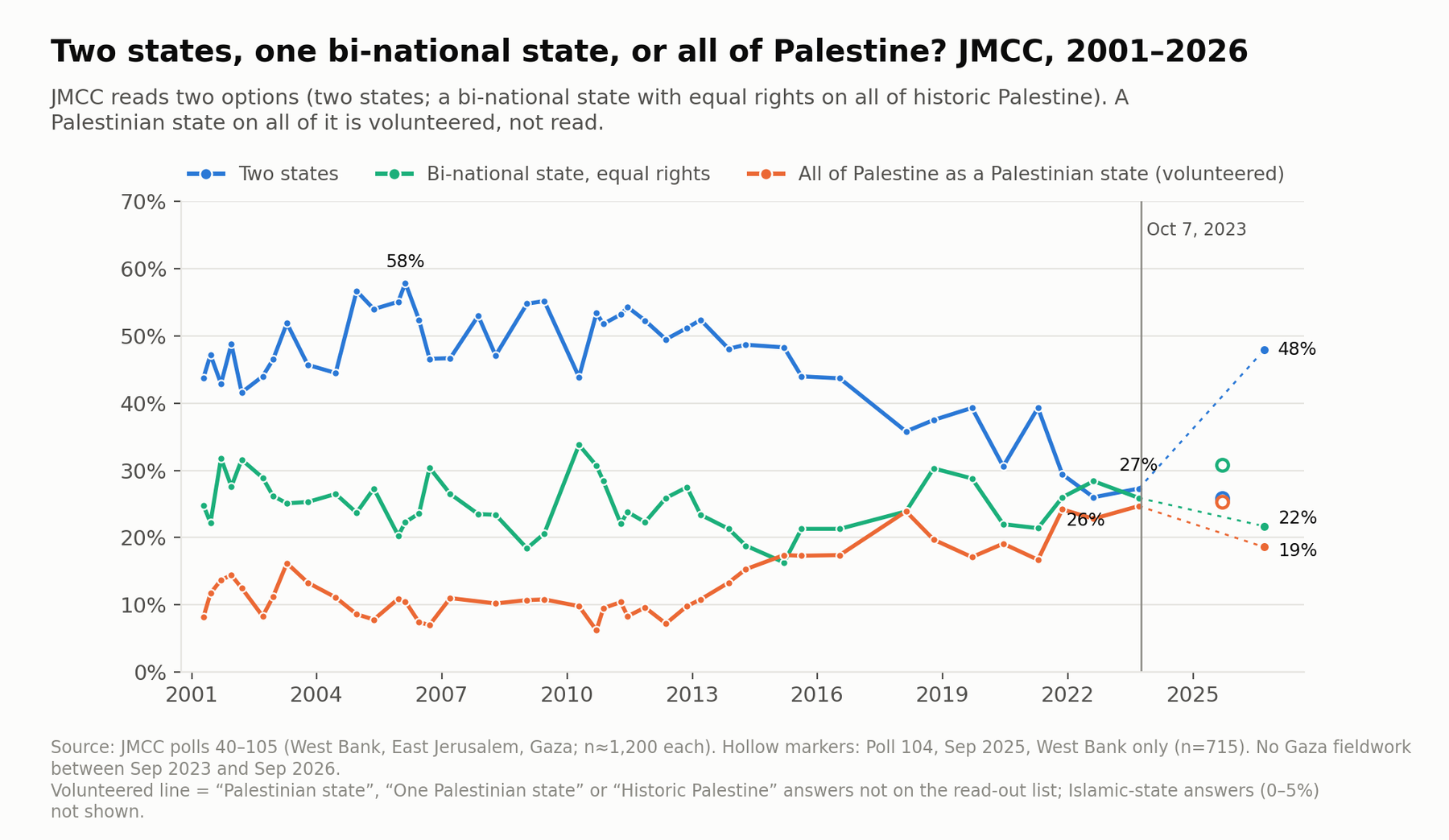
Three patterns stand out. Two states led every JMCC poll from 2000 to 2021 and peaked at 57.9% in February 2006. The volunteered all-Palestine answer roughly doubled, from 6–11% in 2004–2012 to 17–25% in 2018–2023, even though it was never offered. In September 2026, the first JMCC poll with a Gaza sample since the war, two-state preference returned to 47.9%, with Gaza (59.6%) well above the West Bank (40.0%).
| Fieldwork | Two states | Bi-national, equal rights | Palestinian state on all of Palestine (volunteered) | Islamic state (volunteered) | No solution | Note | Source |
|---|---|---|---|---|---|---|---|
| Dec 2000 | 47.0% | 20.3% | 15.7% (any other solution) | — | 10.9% | Joint poll with Israeli sample: Israelis 69.0% two states, 18.3% bi-national | Poll 39 Part II, p. 4 (file not included in this release) |
| Apr 2001 | 43.8% | 24.8% | 8.2% | 2.8% | 14.7% | Poll 40, p. 6 (file not included in this release) | |
| Jun 2001 | 47.2% | 22.2% | 11.7% | 1.4% | 11.5% | Poll 41, p. 9 (file not included in this release) | |
| Sep 2001 | 42.9% | 31.8% | 13.7% | 2.9% | — | Poll 42, p. 12 (file not included in this release) | |
| Dec 2001 | 48.8% | 27.6% | 14.4% | 3.2% | — | Poll 43, p. 7 (file not included in this release) | |
| Mar 2002 | 41.6% | 31.6% | 12.5% (“Palestinian state on all of historic Palestine and return of refugees”) | 3.4% | — | Poll 44, p. 1 (file not included in this release) | |
| Sep 2002 | 44.0% | 28.9% | 8.3% | 2.1% | 12.6% | Poll 46, p. 7 (file not included in this release) | |
| Dec 2002 | 46.5% | 26.2% | 11.2% | 5.4% | — | Poll 47, p. 2 (file not included in this release) | |
| Apr 2003 | 51.9% | 25.1% | 16.2% (“One Palestinian State with one nationality”) | 3.1% | — | Poll 48, p. 7 (file not included in this release) | |
| Oct 2003 | 45.7% | 25.3% | 13.3% | 3.4% | 9.4% | Poll 49, p. 2 (file not included in this release) | |
| Jun 2004 | 44.5% | 26.5% | 11.1% | 2.3% | 13.6% | Reported in Poll 52 | Poll 52, pp. 1–2 (file not included in this release) |
| Dec 2004 | 56.7% | 23.7% | 8.6% | 3.2% | 4.8% | Poll 52, p. 1 (file not included in this release) | |
| May 2005 | 54.0% | 27.3% | 7.8% | 3.1% | 5.1% | Poll 54, p. 6 (file not included in this release) | |
| Dec 2005 | 55.1% | 20.3% | 10.9% | 2.8% | 6.9% | Poll 55, p. 3 (file not included in this release) | |
| Feb 2006 | 57.9% | 22.3% | 10.5% | 2.7% | 3.9% | Weeks after Hamas won the PLC elections | Poll 57, p. 4 (file not included in this release) |
| Jun 2006 | 52.4% | 23.6% | 7.4% | 2.9% | 9.4% | Poll 58, p. 5 (file not included in this release) | |
| Sep 2006 | 46.6% | 30.4% | 7.0% | 3.7% | 9.8% | Poll 60, p. 5 (file not included in this release) | |
| Mar 2007 | 46.7% | 26.5% | 11.0% | 2.0% | — | Poll 61 Part I, p. 4 (file not included in this release) | |
| Nov 2007 | 53.0% | 23.5% | — | — | — | Poll 63, p. 6 (file not included in this release) | |
| Apr 2008 | 47.1% | 23.4% | 10.2% | 2.1% | 13.4% | Poll 64, p. 4 (file not included in this release) | |
| Jan 2009 | 54.8% | 18.4% | 10.7% (Gaza 20.9) | 1.6% | 10.0% | Right after the 2008–09 Gaza war | Poll 67, p. 9 (file not included in this release) |
| Jun 2009 | 55.2% | 20.6% | 10.8% | 1.0% | 9.3% | Poll 68, p. 7 (file not included in this release) | |
| Apr 2010 | 43.9% | 33.8% | 9.8% | 0.8% | 8.2% | Poll 70, p. 4 (file not included in this release) | |
| Sep 2010 | 53.4% | 30.7% | 6.2% | 1.8% | 4.9% | Poll 71, p. 7 (file not included in this release) | |
| Nov 2010 | 51.8% | 28.4% | 9.5% | 1.7% | 5.4% | Poll 72, p. 10 (file not included in this release) | |
| Apr 2011 | 53.2% | 22.1% | 10.4% (Gaza 17.0) | 1.2% | 9.5% | Poll 73, p. 5 (file not included in this release) | |
| Jun 2011 | 54.3% | 23.8% | 8.3% | 1.9% | 8.7% | Poll 74, p. 4 (file not included in this release) | |
| Nov 2011 | 52.3% | 22.3% | 9.6% | 1.3% | 10.9% | Poll 75, p. 5 (file not included in this release) | |
| May 2012 | 49.5% | 25.9% | 7.2% | 1.6% | 13.5% | Vault copy: JMCC 76 | JMCC 76, p. 5 (file not included in this release) |
| Nov 2012 | 51.2% | 27.5% | 9.8% | 2.3% | 6.4% | Poll 77, p. 7 (file not included in this release) | |
| Mar 2013 | 52.4% | 23.4% | 10.8% | 2.0% | 9.2% | Vault copy: JMCC 79 | JMCC 79, p. 5 (file not included in this release) |
| Nov 2013 | 48.1% | 21.3% | 13.3% | 0.8% | 11.3% | Poll 80, p. 8 (file not included in this release) | |
| Apr 2014 | 48.7% | 18.8% | 15.3% | 1.0% | 11.8% | Poll 81, p. 6 (file not included in this release) | |
| Mar 2015 | 48.3% | 16.3% | 17.4% | 0.9% | 14.3% | Poll 83, p. 6 (file not included in this release) | |
| Aug 2015 | 44.0% | 21.3% | 17.3% | 1.1% | 14.4% | Poll 84, p. 7 (file not included in this release) | |
| Jul 2016 | 43.7% | 21.3% | 17.4% (“Historic Palestine”) | 0.7% | 14.3% | Poll 87, p. 6 (file not included in this release) | |
| Feb 2017 | 49.6% | 18.1% | — | — | — | Reported in Poll 91 | Poll 91, p. 1 (file not included in this release) |
| Feb 2018 | 35.8% (WB 30.7, Gaza 44.2) | 23.9% | 23.9% | 0.3% | 9.8% | After the U.S. Jerusalem decision | Poll 91, p. 1 (file not included in this release) |
| Oct 2018 | 37.5% (WB 30.9, Gaza 47.2) | 30.3% | 19.7% | 0.4% | 8.3% | Poll 93, p. 4 (file not included in this release) | |
| Sep 2019 | 39.3% (WB 34.5, Gaza 46.4) | 28.8% | 17.1% | 0.2% | 8.8% | Poll 95, p. 14 (file not included in this release) | |
| Jun 2020 | 30.6% (WB 38.7, Gaza 18.6) | 22.0% | 19.1% | — | 18.0% | Poll 96, p. 12 (file not included in this release) | |
| Apr 2021 | 39.3% (WB 31.5, Gaza 50.9) | 21.4% | 16.7% | 0.2% | 16.8% | Poll 97, p. 10 (file not included in this release) | |
| Nov 2021 | 29.4% (WB 23.6, Gaza 37.9) | 26.0% | 24.2% | 0.5% | 15.3% | Poll 98, p. 9 (file not included in this release) | |
| Aug 2022 | 26.0% (WB 20.8, Gaza 33.6) | 28.4% | 22.8% | — | 19.3% | Poll 99, p. 15 (file not included in this release) | |
| Sep 2023 | 27.3% (WB 22.0, Gaza 35.3) | 25.9% | 24.7% | — | 18.8% | Three weeks before October 7 | Poll 100, p. 9 (file not included in this release) |
| Sep 2025 | 25.9% | 30.8% | 25.3% | — | 12.3% | West Bank only, n=715 | Poll 104, p. 6 (file not included in this release) |
| Sep 2026 | 47.9% (WB 40.0, Gaza 59.6) | 21.7% (WB 26.2, Gaza 15.1) | 18.6% (WB 23.9, Gaza 10.7) | — | 6.4% | First JMCC poll with Gaza since 2023 | Poll 105, p. 9 (file not included in this release) |
An-Najah National University series, 2008–2018
An-Najah’s Center for Opinion Polls and Survey Studies (Nablus) ran numbered West Bank–Gaza polls from at least 2004 (No. 6, May 2004) until No. 57 (October 2018), usually with about 1,360 face-to-face respondents (for example 860 West Bank and 500 Gaza in Poll 49; margin of error about ±3%). Releases were published as web pages; Polls 52–57 also attach full tables. No numbered poll after No. 57 was located on the university site. Copies of the 39 web releases and five table files are in Polls/Archive/An-Najah/.
Two states
| Fieldwork | Poll | Support | Reject | Source |
|---|---|---|---|---|
| May 15–17, 2008 | 34 | 39.5% “the creation of two states on the land of historic Palestine (a Palestinian state and Israel)“ | — | An-Najah 34 |
| Sep 18–20, 2008 | 35 | 42.5% (same wording) | — | An-Najah 35 |
| Released Mar 5, 2013 | 46 | 46.2% support “the two-state solution provided that there will be a Palestinian state living side by side with Israel” | 49.9% | An-Najah 46 |
| Nov 1–3, 2013 | 47 | 51.8% (same wording) | 46.2% | An-Najah 47 |
| Apr 18–20, 2014 | 48 | 50.7% | 45.2% | An-Najah 48 |
| Sep 11–13, 2014 | 49 | 56.4%, after the Gaza war | 38.8% | An-Najah 49 |
| Mar 22–24, 2018 | 56 | Two-state solution “still viable” after the U.S. embassy move: 20.4% | 71.3% not viable | An-Najah 56 · tables (file not included in this release) |
| Oct 25–27, 2018 | 57 | ”Still viable”: 23.8% | 70.0% not viable | An-Najah 57 · tables (file not included in this release) |
The 2008 item described two states “on the land of historic Palestine,” and the 2018 items asked about viability rather than support, so they are not the same measure as the 2013–2014 support question.
One state or a bi-national state
| Fieldwork | Poll | Support | Reject | Source |
|---|---|---|---|---|
| Oct 7–9, 2012 | 45 | 23.2% “one state on historic Palestine for both Palestinians and Israelis” | 72.1% | An-Najah 45 |
| Apr 18–20, 2014 | 48 | 31.3% “one-state solution in which both Palestinians and Israelis enjoy equal rights” | 62.8% | An-Najah 48 |
| Sep 11–13, 2014 | 49 | 26.3% (same wording) | 68.3% | An-Najah 49 |
| Nov 20–22, 2015 | 51 | 20.0% “a binational state for Arabs and Jews on historic Palestine as a final solution” | 74.2% | An-Najah 51 |
| May 3–5, 2016 | 52 | 19.5% (binational) | 76.2% | An-Najah 52 · tables (file not included in this release) |
| Oct 13–15, 2016 | 53 | 18.0% (binational) | 78.6% | An-Najah 53 · tables (file not included in this release) |
| Apr 28–30, 2017 | 54 | 20.5% (binational) | 73.9% | An-Najah 54 · tables (file not included in this release) |
| Mar 22–24, 2018 | 56 | 18.7% (binational) | 76.7% | An-Najah 56 · tables (file not included in this release) |
| Oct 25–27, 2018 | 57 | 21.0% (binational); 25.4% “one state that includes both Palestinians and Israelis in historical Palestine” | 74.5%; 70.1% | An-Najah 57 · tables (file not included in this release) |
Negotiations
| Fieldwork | Poll | Result | Source |
|---|---|---|---|
| May 2008 | 34 | Continue negotiations between the PA and Israel: 56.5% support, 40.1% reject | An-Najah 34 |
| Sep 2008 | 35 | Continue negotiations “under their present conditions”: 50.7% | An-Najah 35 |
| Nov 2008 | 36 | Same: 45.1% | An-Najah 36 |
| Apr 2010 | 40 | Direct negotiations: 48.7% support, 47.3% reject; 83% reject negotiating while settlement building continues | An-Najah 40 |
| Mar 2013 | 46 | Return to talks “without any preconditions”: 22.8% (73.1% reject); if settlement building stops: 63.9% | An-Najah 46 |
| Nov 2013 | 47 | Return to talks under U.S. auspices: 44.2% (53.8% reject) | An-Najah 47 |
| Apr 2014 | 48 | Return to negotiations: 54.7% (42.1% reject) | An-Najah 48 |
| Sep 2014 | 49 | Return to negotiations after the Gaza war: 57.5% (37.6% reject) | An-Najah 49 |
| Mar 2015 | 50 | Return to the table after Netanyahu rejected a Palestinian state: 36.8% | An-Najah 50 |
| May 2016 | 52 | Return under sole U.S. sponsorship: 21.1%; 7.4% call the U.S. an honest broker | An-Najah 52 · tables (file not included in this release) |
Armed action
| Fieldwork | Poll | Result | Source |
|---|---|---|---|
| Jan 26–28, 2008 | 32 | Firing rockets from Gaza at Israel: 43.7% support, 54.8% reject | An-Najah 32 |
| Mar 2008 | 33 | Firing rockets by Palestinian factions: 55.1% support, 41.8% reject | An-Najah 33 |
| Feb 1–2, 2009 | 37 | Military operations by resistance factions even after a truce: 39.9% support | An-Najah 37 |
| Sep 2014 | 49 | Firing rockets if Israel does not meet the Cairo ceasefire obligations: 76.3% support | An-Najah 49 |
| Nov 2015 | 51 | ”The rise of an armed intifada”: 43.7% support, 51.4% reject; a “peaceful, unarmed intifada”: 52.1% support. Best form if an intifada happens: 32.4% peaceful, 21.4% armed, 26.4% both | An-Najah 51 |
Two dating problems in the releases: Poll 33 (published March 24, 2008) gives its fieldwork as “20–22 January,” the same week as Poll 32, so March is more likely; Poll 54 (published May 2, 2017) gives “28–30 April 2016,” which is almost certainly 2017. Poll 46’s release (March 5, 2013) does not state fieldwork dates.
Maximalist goals: all of historic Palestine and Israel’s existence
Overview chart — acceptance, rejection, and conditional arrangements
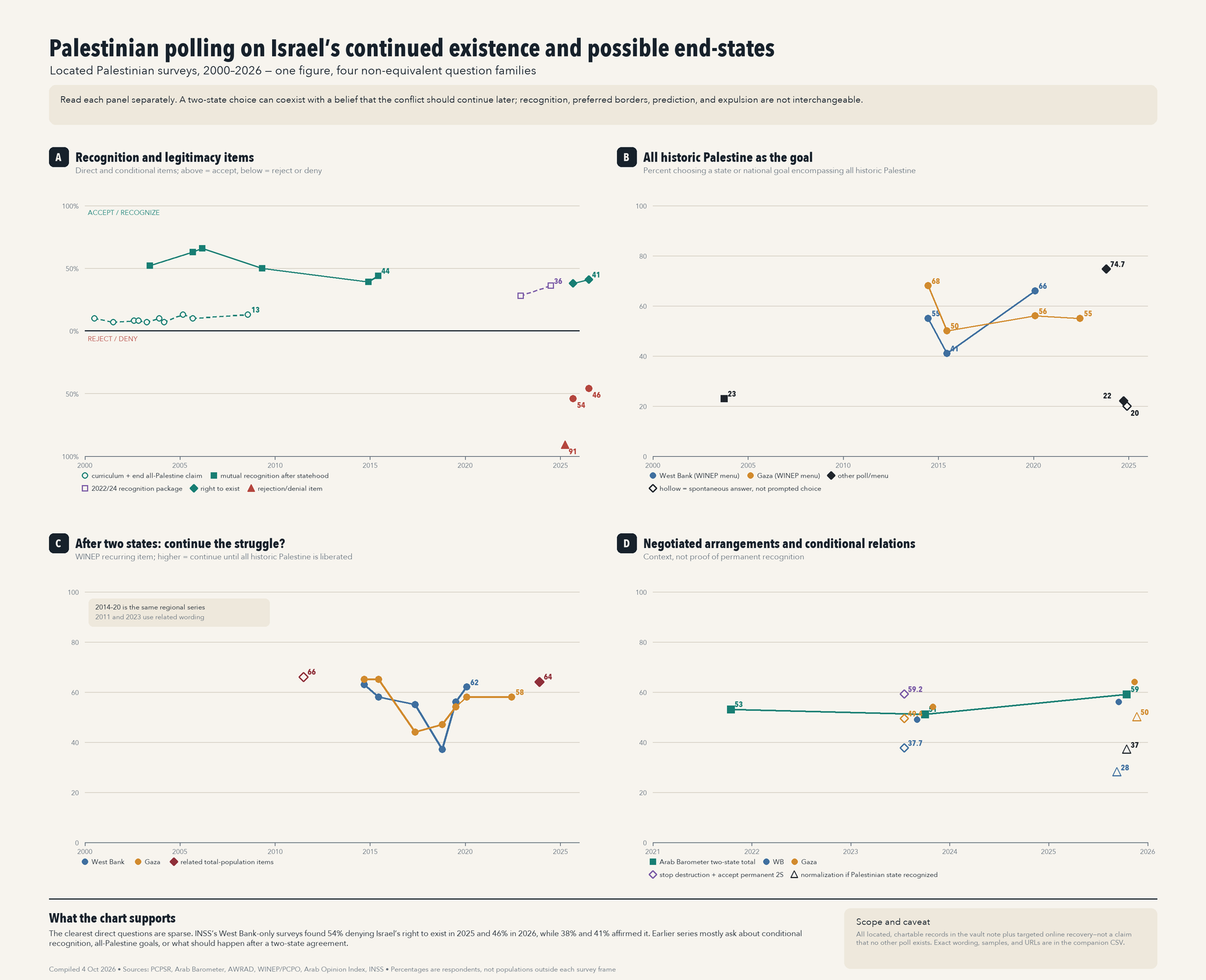
Read the four panels separately
This is not one continuous time series. Direct recognition or legitimacy, an all-historic-Palestine outcome, continuing struggle after a negotiated two-state outcome, and conditional negotiated arrangements are related but non-equivalent measures. “Oppose recognition,” “deny a right to exist,” “prefer all historic Palestine,” and “continue resistance after two states” must not be merged into one percentage. None of those answers, by itself, measures support for expelling Jews.
What the combined record supports
The clearest direct questions are sparse. INSS’s West Bank-only surveys found 54% denying Israel’s right to exist in 2025 and 46% in 2026, while 38% and 41% respectively said Israel does have that right. Those answers coexist with Arab Barometer’s national 59% preference for a negotiated two-state outcome in 2025; the questions measure different things, and neither result can substitute for the other. Earlier series more often asked about conditional recognition, an all-Palestine goal, or what should happen after a two-state agreement. The chart maps those related measures without treating unlike questions as an interchangeable trend.
Open the one-page chart PDF (file not included in this release) · Open the audited chart data (file not included in this release)
Source prompt: Michael Robbins, Amaney Jamal, and Mark Tessler, “Palestinians Want a Two-State Solution,” Foreign Affairs, October 2, 2026 · underlying Arab Barometer report, pp. 6–8 (file not included in this release)
New observations added to this synthesis
- AWRAD, August 2010 — retained as context, not plotted: 78.2% rated historic Palestine from the Jordan River to the sea as an “essential” Palestinian national homeland in a final-status agreement. This was a five-category rating item; it did not specify exclusive sovereignty or ask respondents to choose that outcome over two states. → AWRAD tables
- Palestinian-Israeli Pulse: 28% (December 2022) and 36% (July 2024) supported a compound package component combining mutual recognition of Palestine and Israel as their peoples’ homelands with an end to the conflict, reciprocal action against terrorism, and no further claims. This is not identical to the older PCPSR mutual-recognition item. → Pulse 2022, p. 18 (file not included in this release) · Pulse 2024, p. 22 (file not included in this release)
- Washington Institute’s recurring post-two-state item: “Continue resistance until all historic Palestine is liberated” measured 63% West Bank/65% Gaza (2014), 58%/65% (2015), 55%/44% (2017), 37%/47% (2018), 56%/54% (2019), 62%/58% (2020), and 58% in Gaza-only 2022. Ten of thirteen observed region-wave values exceeded 50%; at least one region exceeded 50% in six of seven waves. “Resistance” was not defined as necessarily violent. → Washington Institute, A Nation Divided · Gaza 2022
- Excluded from the chart: a Washington Institute synthesis reports 25% agreement that Israel has a permanent right to exist as a homeland for the Jewish people, but it discusses November 2015 and July 2016 polls together without identifying the underlying wave or publishing its response table. The figure is therefore retained as partial-access evidence rather than plotted at a falsely precise date; its arithmetic 75% complement is not treated as a separately observed rejection response.
Maximalist-goal records by pollster and territory
| Poll / fieldwork | Finding | Source |
|---|---|---|
| PCPSR Poll 9, Oct 2003 | Offered two states, one state, or “a solution that would restore all of historic Palestine to the Palestinians”: 64% two states, 12% one state, 23% all of historic Palestine. | Poll 9, p. 3 (file not included in this release) |
| Greenberg Quinlan Rosner for The Israel Project, Jun 22–Jul 8, 2011; n=1,010 | 66% said the real goal should be to start with two states and then move to one Palestinian state; 61% rejected a permanent two-state solution with Israel as the Jewish homeland (34% accepted); 73% agreed with the Hamas charter’s hadith about killing Jews hiding behind stones and trees; 92% said Jerusalem should be the capital of Palestine. | Jerusalem Post |
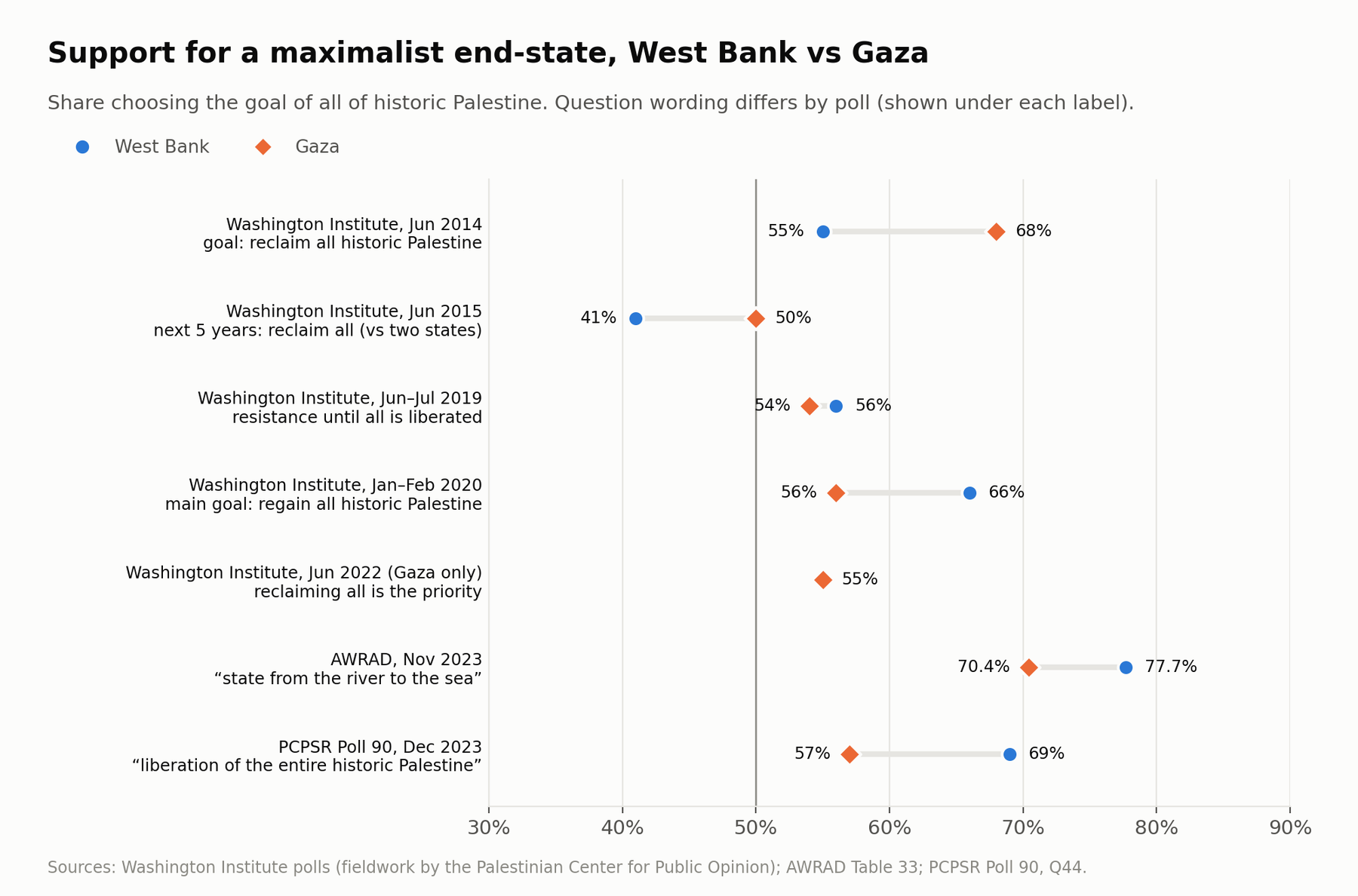
| Washington Institute (Pollock), Jun 15–17, 2014; n=1,200 | 60% (WB 55, Gaza 68) said the goal “should be to work toward reclaiming all of historic Palestine, from the river to the sea”; only 31% (WB) and 22% (Gaza) chose ending the occupation to achieve two states. 66% said resistance should continue until all historic Palestine is liberated. | Washington Institute, Jun 25, 2014 |
| Washington Institute, Jun 7–19, 2015; WB 504, Gaza 413 | Over the next five years, reclaiming all historic Palestine beat two states in the West Bank (41% vs 29%) and Gaza (50% vs 44%). 81% (WB) and 88% (Gaza) agreed all of historic Palestine “is Palestinian land and Jews have no rights to the land.” 38% (WB) and 53% (Gaza) predicted Israel would not exist in 30–40 years. | Washington Institute, Sep 3, 2015 |
| Washington Institute, 2015 poll, second release (Jul 23, 2015) | “Fifty-eight percent of West Bankers and 65 percent of Gazans say that even if a ‘two-state solution’ is negotiated, ‘the struggle is not over and resistance should continue until all of historic Palestine is liberated.’” Yet 56% of West Bankers would agree to “the principle of two states for two peoples, the Palestinian people and the Jewish people,” if that “might help to end the occupation”; in Gaza, 43–44% would “probably” accept it. | Washington Institute, Jul 23, 2015 |
| Washington Institute, 2017 polls (released June 2017) | A majority said Hamas should “stop calling for Israel’s destruction, and instead accept a two-state solution based on the 1967 borders,” but recognizing Israel as a “Jewish state” drew 11% in the West Bank and 7% in Gaza. The share saying “Jews have some rights to this land” was “only in the single digits.” | Washington Institute, Jun 27, 2017 · Jun 7, 2017 |
| Washington Institute, Jun 27–Jul 15, 2019; WB 500, Gaza 500, EJ 200 | 56% (WB) and 54% (Gaza) said the conflict should not end and resistance should continue until all historic Palestine is liberated. Two-state support: 30% WB, 42% Gaza. | Washington Institute, Aug 13, 2019 |
| Washington Institute, Jan 23–Feb 11, 2020; WB 500, Gaza 500 | Main goal “regaining all of historical Palestine”: 66% WB, 56% Gaza. Two-state goal: 14% WB, 31% Gaza. About 60% in both areas said resistance should continue until all historic Palestine is liberated. Two-thirds also said Israel will never accept one state. | Washington Institute, Feb 25, 2020 |
| Washington Institute, Jun 6–21, 2022; Gaza only, n=513 | 37% accepted “two states for two peoples”; 55% still rated reclaiming all of historic Palestine as the priority; 58% said the conflict should not end even with two states; 73% said any compromise should be temporary. | Washington Institute, Jul 15, 2022 |
| Washington Institute, Jul 8–27, 2023; n=1,572 | ”Hamas should stop calling for Israel’s destruction, and instead accept a permanent two-state solution based on the 1967 borders”: agree 37.7% WB, 49.4% Gaza, 59.2% East Jerusalem. | WINEP crosstabs, p. 6 (file not included in this release) |
| AWRAD, Oct 31–Nov 7, 2023 | 71.1% said their commitment to “a solution based on the restoration of historical Palestine” had increased since October 7; 74.7% chose “A Palestinian state from the river to the sea.” | AWRAD, Table 15, p. 9 (file not included in this release) |
| PCPSR Poll 90, Nov–Dec 2023 | 64% chose “Continued struggle until the liberation of the entire historic Palestine.” | Poll 90, p. 27 (file not included in this release) |
| Pulse, Dec 2022 and Jul 2024 | 93% of Palestinians said the land between the river and the sea belongs to Palestinians “very much”; in 2024, 89% saw Palestinians as its “rightful owners.” | Pulse Jan 2023, p. 35 (file not included in this release) · Pulse Sep 2024, p. 3 (file not included in this release) |
| INSS, Sep 2025; West Bank, n=300 | 54% said Israel has no right to exist (38% said it does; 75% of ages 18–34 said no). 50% said Israel can be destroyed; 69% said it will not exist forever. | INSS 2025 |
| INSS, Jun–Jul 2026; West Bank, n=400 | 46% said Israel has no right to exist; 41% said it does. 42% said ending Israel’s existence is possible. | INSS 2026 · Jerusalem Post |
Jews and Israelis leaving: the direct measures
What was and was not found
No located poll asked Palestinians a stand-alone yes/no question such as “Should all Jews leave?” The closest direct measures are the Pulse “expulsion” option and INSS’s option of a Palestinian state without Jews. “From the river to the sea” and “liberation of the entire historic Palestine” do not state what happens to Jewish residents, so they should not be quoted as support for expulsion.
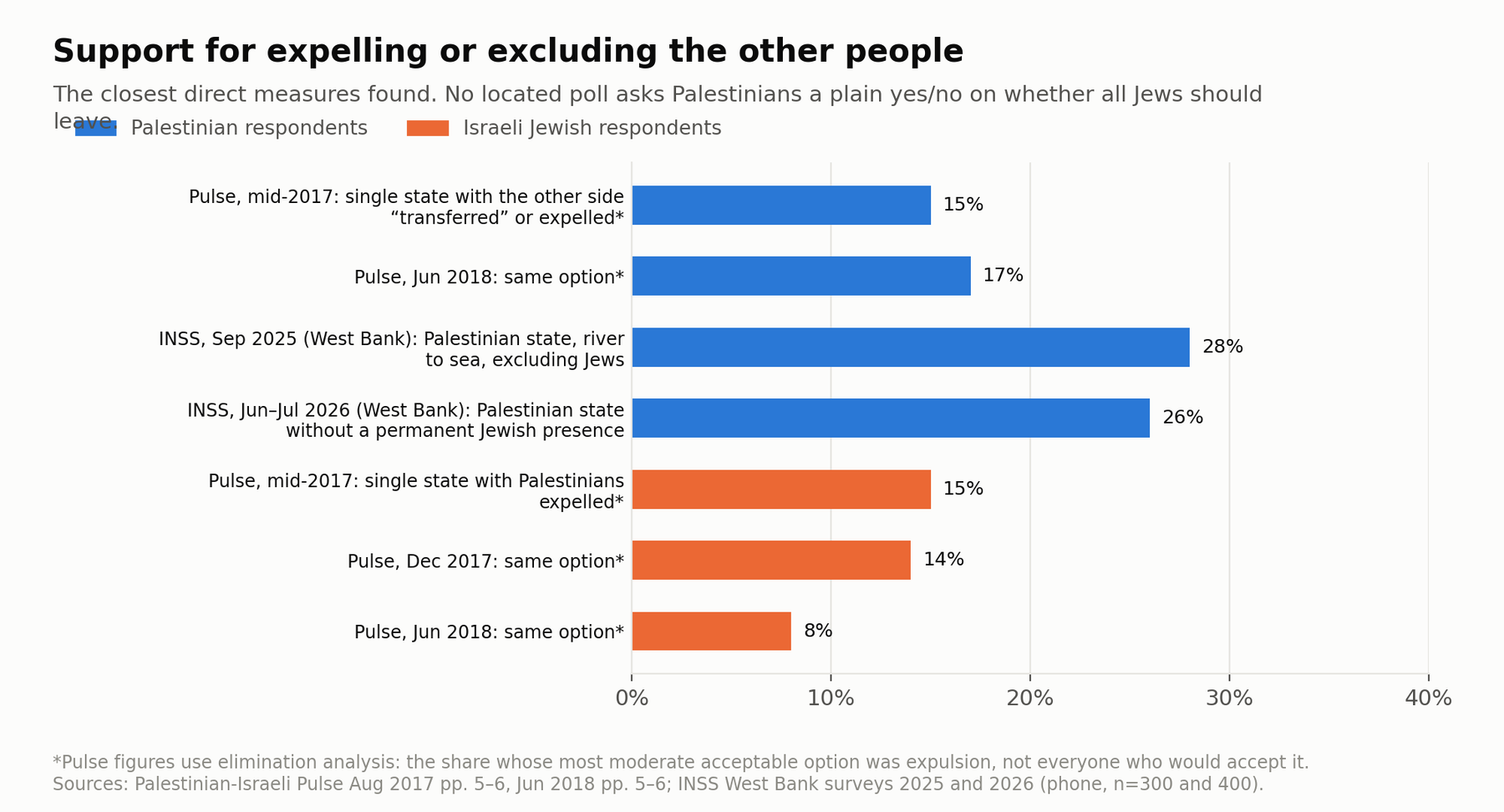
| Poll | Exact option or item | Palestinian result | Notes | Source |
|---|---|---|---|---|
| Pulse, Jun–Jul 2017 | ”a single state in which the other side is ‘transferred’ or expelled from the entire territory of historic or Mandatory Palestine (expulsion)“ | 15% (WB 16, Gaza 14) | Elimination analysis. The Israeli Jewish mirror result was 15% for expelling Palestinians. | Pulse Aug 2017, pp. 5–6 (file not included in this release) |
| Pulse, Jun–Jul 2018 | Same option, offered only to those who rejected two states, one democratic state, and apartheid | 17% (WB 13, Gaza 24; 23% among religious respondents) | Israeli Jews choosing expulsion fell from 14% (Dec 2017) to 8%. | Pulse Jun 2018, p. 6 (file not included in this release) |
| Pulse, Aug 2020 onward | Expulsion option dropped | — | “The previous study in 2018 included a third alternative … expulsion or transfer. This was not included in the current study.” | Pulse Oct 2020, p. 6 (file not included in this release) |
| Washington Institute, Jun 2015 | Historic Palestine “is Palestinian land and Jews have no rights to the land” | 81% WB, 88% Gaza agree | A claim about rights to the land, not a policy of removal. | Washington Institute 2015 |
| INSS, Sep 2025 | Single Palestinian state from the river to the sea, excluding Jews | 28% (West Bank only) | Phone survey, n=300. | INSS 2025 |
| INSS, Jun–Jul 2026 | Palestinian state without a permanent Jewish presence | 26%, versus 17% for a Palestinian state where Jews could live as citizens or residents | Phone survey, n=400, West Bank only. | INSS 2026 |
| Greenberg, 2011 | Agreement with the Hamas charter’s hadith about killing Jews | 73% | Endorsement of a religious text quoted in the charter, not a policy question. | Jerusalem Post |
Peace, coexistence, recognition, and reconciliation
2000s baseline
PCPSR’s Poll No. 3 (December 19–24, 2001; n=1,357), taken during the Second Intifada, found broad support for reconciliation after an agreement alongside high support for armed attacks:
- 71% supported an immediate return to negotiations.
- 73% “would support reconciliation between the two peoples after reaching a peace agreement leading to the establishment of a Palestinian state recognized by Israel.” 85% would then support open borders. → Poll 3, p. 3 (file not included in this release)
- “But only 6% would support adopting school curriculum that recognizes Israel and teaches children not to demand return of all Palestine to Palestinians.” → Poll 3, p. 3 (file not included in this release)
- 41.1% said reconciliation is “not possible ever,” even after a peace agreement. → Poll 3, p. 10 (file not included in this release)
- Support for attacks: 92% against soldiers, 92% against settlers, and 58% against “civilians inside Israel.” → Poll 3, p. 1 (file not included in this release)
Jacob Shamir’s 2007 USIP study of the joint PCPSR-Truman polls found Palestinian support for a Clinton/Geneva permanent-status package of 39% (Dec 2003), 54% (Dec 2004), 46% (Dec 2005), and 44% (Jun 2006). “Among Palestinians, December 2004 was the only point in time where a majority of the public (54 percent) supported this permanent-status framework package.” Support for the “end of conflict” component ran 42%, 69%, 64%, and 58%. In June 2006, 51% of Palestinians believed a political settlement “could never be achieved.” On changing school curricula to teach against irredentist aspirations, “no more than 13 percent of Palestinians” agreed. → Shamir, Table 1, p. 41 (file not included in this release) · p. 42 (file not included in this release) · p. 46 (file not included in this release)
Reconciliation and school curricula, 2000–2013 (PCPSR)
Two items recur in PCPSR’s early polls: support for “reconciliation between the two peoples” after a peace agreement and a Palestinian state, and support for a school curriculum “that recognizes Israel and teaches children not to demand return of all Palestine to the Palestinians.”
| Fieldwork | Reconciliation after a peace agreement | Curriculum recognizing Israel | Source |
|---|---|---|---|
| Jul 2000 | 75% (reported in Poll 2) | 10% | Poll 1, p. 3 (file not included in this release) · Poll 2, p. 4 (file not included in this release) |
| Jul 2001 | 73% | 7% | Poll 2, p. 3 (file not included in this release) |
| May 2002 | 70% | — | Poll 4, p. 2 (file not included in this release) |
| Aug 2002 | 73% | 8% | Poll 5, p. 2 (file not included in this release) |
| Nov 2002 | 73% | 8% | Poll 6, p. 3 (file not included in this release) |
| Apr 2003 | 65% | 7% | Poll 7, p. 4 (file not included in this release) |
| Jun 2003 | 71% | — | Poll 8, p. 3 (file not included in this release) |
| Dec 2003 | 77% | 10% | Poll 10, p. 4 (file not included in this release) |
| Mar 2004 | 74% | 7% | Poll 11, p. 4 (file not included in this release) |
| Mar 2005 | 81% | 13% | Poll 15, p. 3 (file not included in this release) |
| Sep 2005 | 75% (if a two-state solution is reached) | 10% (textbooks) | Poll 17, p. 3 (file not included in this release) |
| Jun 2006 | 71% | — | Poll 20, p. 3 (file not included in this release) |
| Aug 2008 | 70% | 13% | Poll 29, p. 4 (file not included in this release) · Poll 29, p. 5 (file not included in this release) |
| Dec 2008 | 72% | — | Poll 30, p. 4 (file not included in this release) |
| Dec 2013 | 51% (47% oppose) | — | Poll 50, p. 4 (file not included in this release) |
The gap between the two columns is the recurring finding: large majorities endorsed reconciliation after a state, while no more than 13% accepted teaching children to give up the claim to all of Palestine.
Recognition and peace packages over time
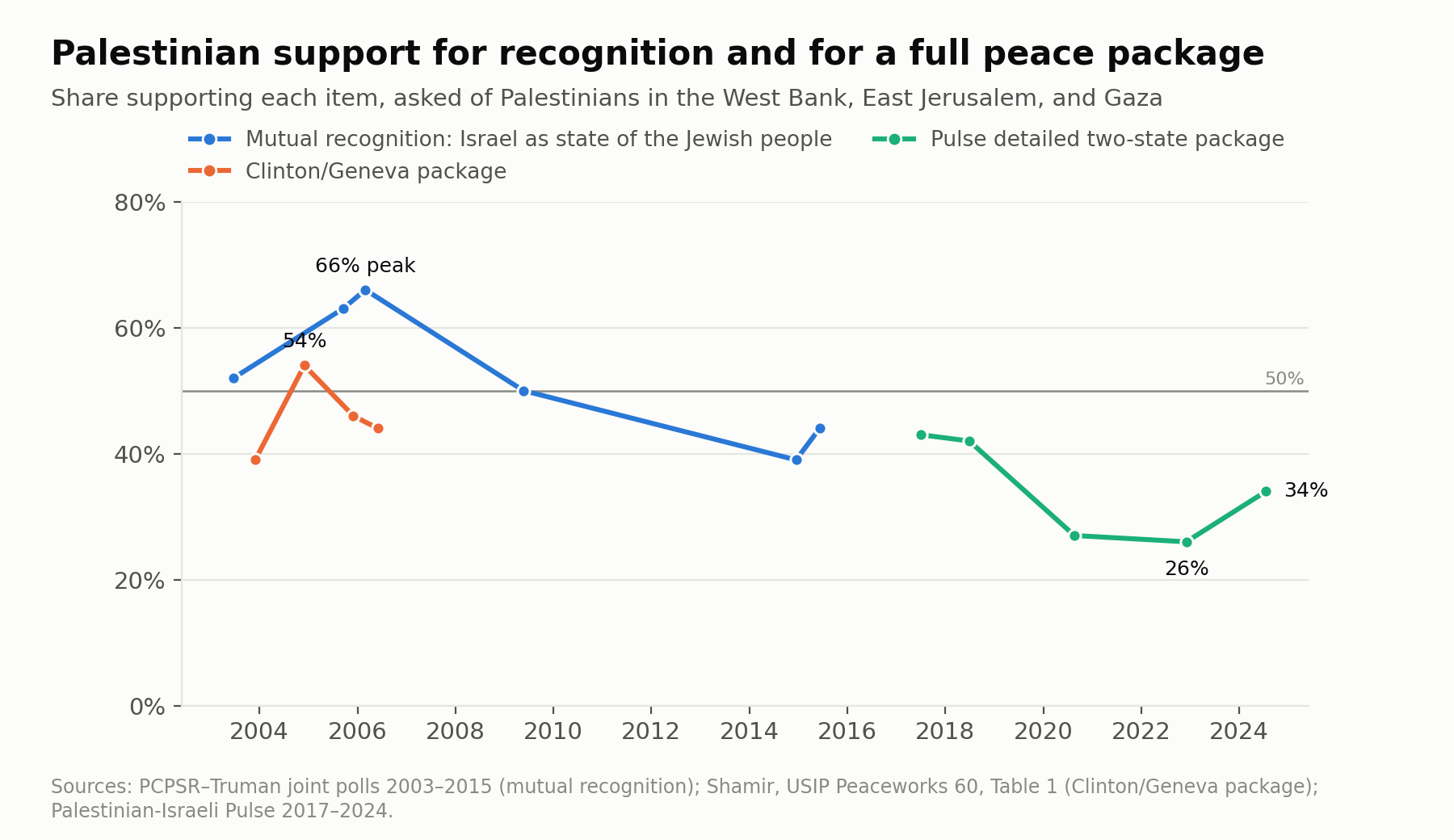
| Measure | Palestinian support by date | Source |
|---|---|---|
| Mutual recognition of “Israel as the state of the Jewish people and Palestine as the state of the Palestinian people,” after a Palestinian state is established | 52% (Jun 2003) · 63% (Sep 2005) · 66% peak (early 2006) · 50% (May 2009) · 39% (Dec 2014) · 44% (Jun 2015) | 2003 · 2005 · 2009 · 2014–2015, p. 3 (file not included in this release) |
| Clinton/Geneva permanent-status package | 39% (2003) · 54% (2004) · 46% (2005) · 44% (2006) | Shamir, p. 41 (file not included in this release) |
| Pulse detailed two-state package | 43% (2017) · 42% (2018) · 27% (2020) · 26% (2022) · 34% (2024) | 2017, p. 9 (file not included in this release) · 2018–2022, p. 17 (file not included in this release) · Pulse 2024 |
| Arab-Israeli normalization | 88% oppose in principle (unchanged since 2021). If Israel recognized a Palestinian state on the 1967 lines with East Jerusalem as capital: 37% support, 61% oppose (Gaza split 50–50; West Bank more opposed) | AB9 Report 2, pp. 7–8 (file not included in this release) |
| Recognition of Israel (Arab Opinion Index, Palestinian sample) | 91% oppose (2024–2025) | Arab Opinion Index 2025 |
Coexistence and whether peace is possible
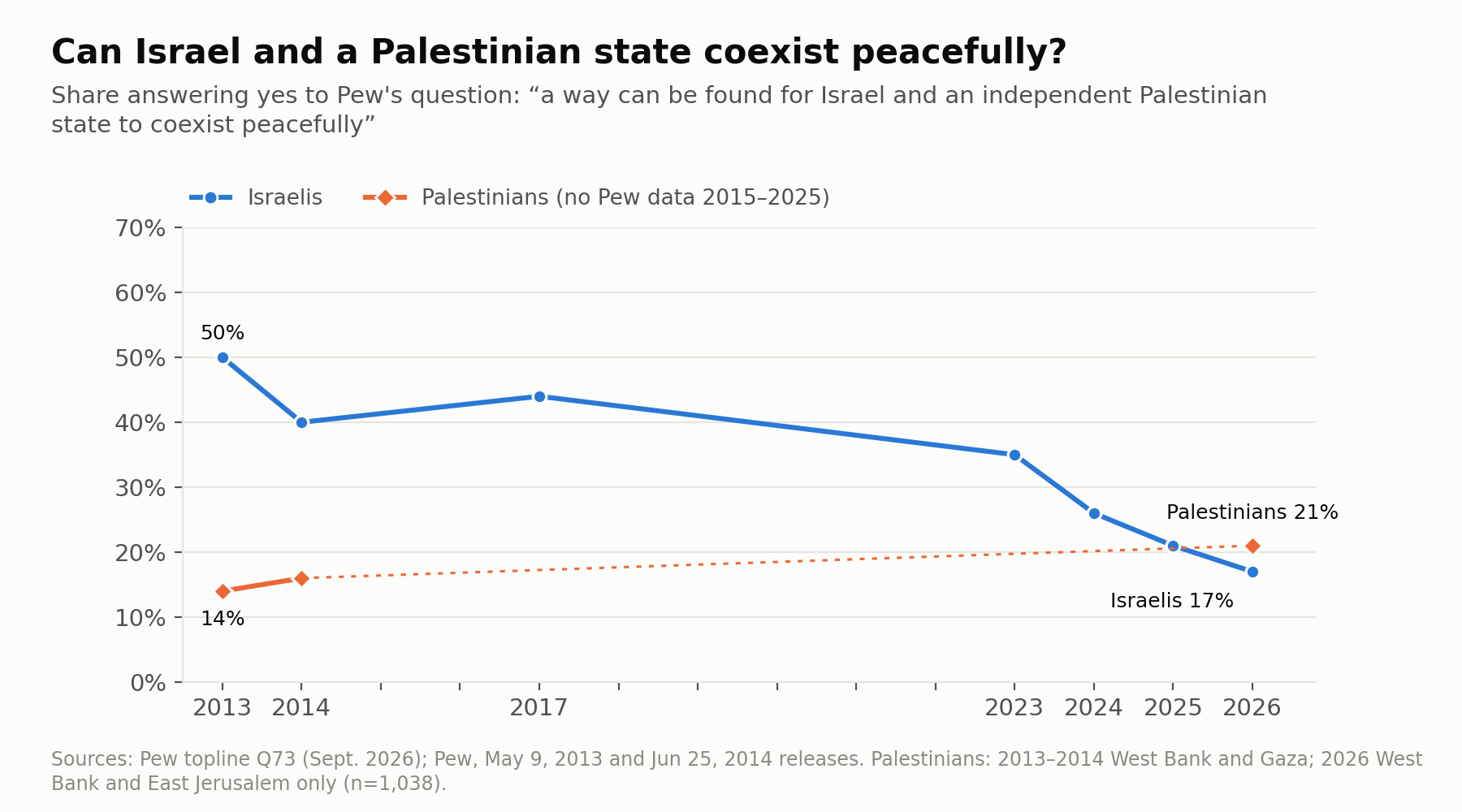
| Poll | Question | Result | Source |
|---|---|---|---|
| Pew, 2003 | Can a way be found for Israel to exist so that the rights and needs of the Palestinian people are met? | 80% of Palestinian Authority residents said no. | Pew, Views of a Changing World 2003 |
| Pew, spring 2013 and 2014 (West Bank and Gaza) | “Do you think a way can be found for Israel and an independent Palestinian state to coexist peacefully with each other, or not?“ | 2013: 14% yes, 61% no, 22% “it depends.” 2014: 16% yes; 60% (West Bank) and 68% (Gaza) said peaceful accommodation is impossible. | Pew, May 9, 2013 · Pew, Jun 25, 2014 |
| AWRAD, Nov 2023 | Has your conviction in the possibility of a peaceful solution with Israel increased or decreased? | Decreased 86.7%; increased 9.1%. Belief in coexistence between the two peoples decreased for 89.5%. Support for the two-state solution as a final solution decreased for 68.0%. | AWRAD, Tables 11 and 13, p. 8 (file not included in this release) · Table 17, p. 9 (file not included in this release) |
| Gallup, 2024 and 2025 (WB/EJ) | Will permanent peace between Israel and a State of Palestine ever be achieved? | 24% yes, 68% no (2024); 23% yes (2025). | Gallup 2024 · Gallup 2025 |
| Pulse, 2022 and 2024 | Can Israeli Jews be trusted? | 86% (2022) and 94% (2024) said Israeli Jews are not trustworthy. | Pulse Sep 2024, p. 3 (file not included in this release) |
| Pew, Mar 30–Apr 28, 2026 (WB/EJ, n=1,038) | “Do you think a way can be found for Israel and an independent Palestinian state to coexist peacefully with each other, or not?“ | 21% yes, 68% no, 10% DK. (Israel: 17% yes, 56% no, down from 50% yes in 2013.) | Pew topline, Q73, p. 2 (file not included in this release) · Pew report, p. 4 (file not included in this release) |
| INSS, Jun–Jul 2026 (WB) | Can Israelis and Palestinians live together with equality? | 46% yes, 50% no. | INSS 2026 |
Support for a peace agreement and the peace process, 2004–2025
| Poll | Question | Result | Source |
|---|---|---|---|
| Birzeit, Jun 2004 | Is peace possible if Israel does not recognize the refugees’ right of return? | 84% said peace is impossible without it; 13% said peace is still possible | Birzeit Poll 16, p. 9 (file not included in this release) |
| Gallup, Jan 2006 | Support the peace process with the Israelis | 65% (26% strongly, 39% moderately); 30% oppose. Separately, 54% “believe mostly in nonviolent forms of resistance and negotiation,” 28% “mostly in armed struggle” | Gallup 21163 · Gallup 21202 |
| Birzeit, Mar and Sep 2006 | Support a two-state solution based on international resolutions | 58% support, 39% oppose (Mar); 57.8% support, 39.0% oppose (Sep). In September, 23.5% supported “a bi-national state over historic Palestine” and 72.9% opposed | Birzeit Poll 25, p. 15 (file not included in this release) · Poll 28, p. 8 (file not included in this release) · Poll 28 tables (file not included in this release) |
| Gallup, 2007–2008 | Support the peace process; will permanent peace ever be achieved? | Support 67% (2007, 39% strongly) and 66% (2008). Only 21% (2007) and 18% (2008) expected permanent peace | Gallup 103426 · Gallup 102895 · Gallup 112408 |
| Near East Consulting, 2009–2010 (monthly) | Support reaching a peace agreement with Israel | 59% (Mar 2009) · 67% (Apr) · 66% (May; 71% of Hamas supporters opposed) · 69% (Jul–Aug) · 70% (Dec; Gaza 74%) · about 70% (Jan 2010) · 61% (Feb–Mar 2010) | Apr 2009 (file not included in this release) · May 2009 (file not included in this release) · Jul 2009 (file not included in this release) · Dec 2009 (file not included in this release) · Jan 2010 (file not included in this release) · Feb 2010 (file not included in this release) |
| Fafo, Feb and May 2010; n=1,770 | ”Palestinians should return to peace negotiations with Israel” | 73% agree (24% strongly); 26% disagree. Among Hamas supporters, 48% agree and 52% disagree | Fafo Table 1.21, p. 4 (file not included in this release) |
| Gallup, 2010 | Will permanent peace ever be achieved? | 75% of Palestinians said no; 35% strongly supported the peace process | Gallup 2010 report, p. 16 (file not included in this release) |
| Gallup, fall 2012 | Support the peace process | 72% of Palestinians; opposition highest in Gaza (38%). Only 18% (Gaza) and 22% (West Bank) expected peace | Gallup 161456 |
| PCPO, Oct 15–28, 2014 | ”In principle, do you support or oppose the two-state solution?“ | 54.3% support, 31.3% oppose, 14.4% don’t know | PCPO Poll 194 (file not included in this release) |
| Gallup, 2015 | Will permanent peace ever be achieved? | 17% yes, 73% no (Gaza 81% no) | Gallup 186536 |
| PCPO, Oct 18–Nov 12, 2015 | Resumption of peace talks with Israel | 62.3% opposed | PCPO Poll 200 (file not included in this release) |
| PCPO, Mar 2025; n=1,500 | Two-state solution | 36.8% said it is “still possible” (Gaza 40.0%); 43.7% “oppose the two-state solution”; 19.5% undecided. PCPO’s text mixes feasibility and support in one item | PCPO Poll 209, p. 7 (file not included in this release) |
| Geneva Initiative (Palestinian Peace Coalition), Apr 1–6, 2026; West Bank and East Jerusalem, n=600 | Accept a negotiated Palestinian state on the 1967 borders | 65.6% would accept; 56.7% call two states “a suitable solution”; 83.6% think it unlikely soon; 64.7% do not believe Israelis have genuine intentions for peace | Geneva Apr 2026, p. 1 (file not included in this release) |
Means: negotiations versus armed struggle
PCPSR asks: “In your view, what is the best means of achieving Palestinian goals in ending the occupation and building an independent state?” (wording from Poll 90, Q48, p. 29 (file not included in this release)).
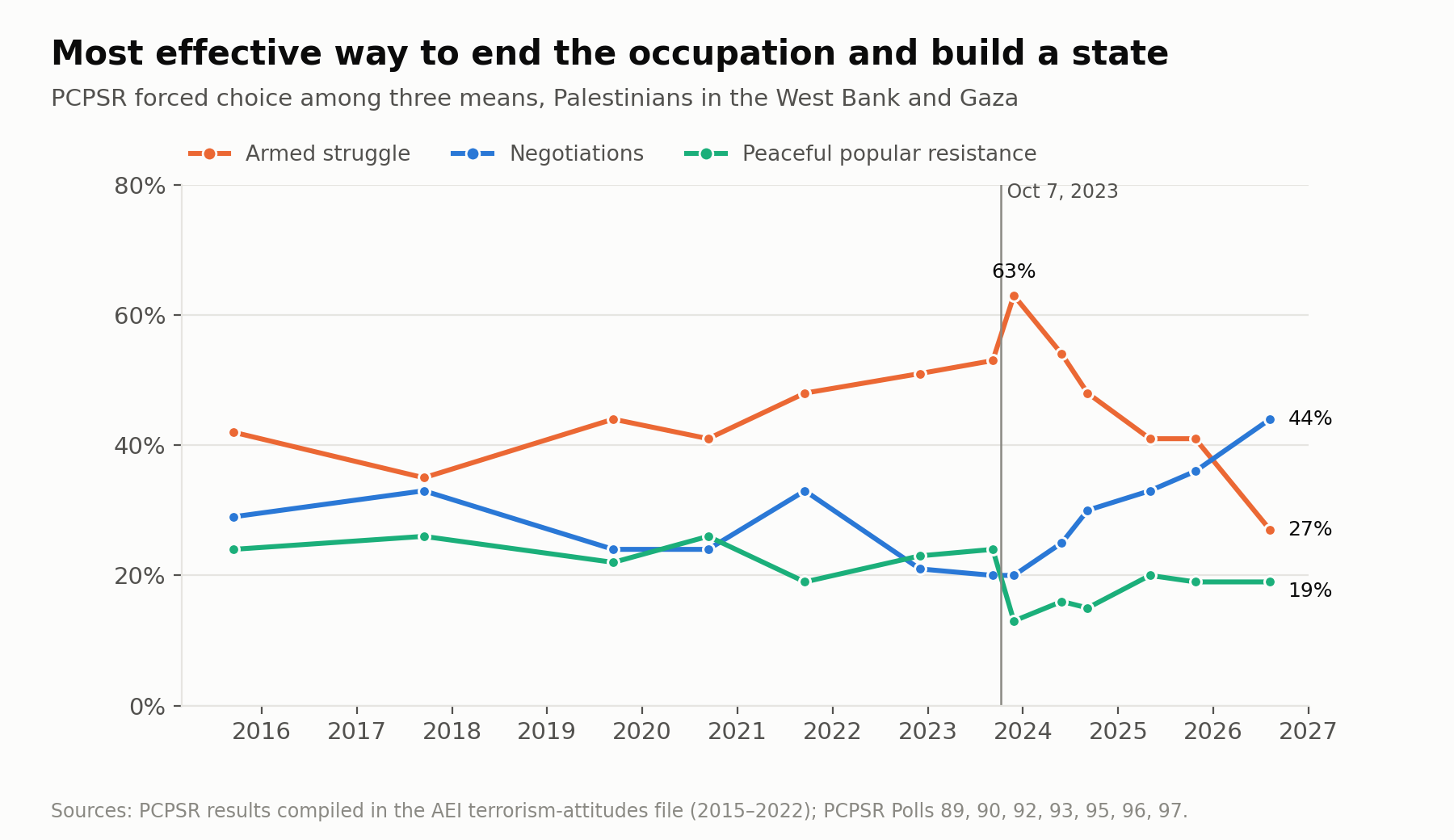
| Fieldwork | Negotiations | Peaceful popular resistance | Armed struggle | Source |
|---|---|---|---|---|
| Sep 2015 | 29% | 24% | 42% | AEI compilation, p. 1 (file not included in this release) |
| Sep 2017 | 33% | 26% | 35% | same |
| Sep 2019 | 24% | 22% | 44% | same |
| Sep 2020 | 24% | 26% | 41% | same |
| Sep 2021 | 33% | 19% | 48% | same |
| Dec 2022 | 21% | 23% | 51% | same |
| Sep 2023 | 20% | 24% | 53% | Poll 89, p. 10 (file not included in this release) |
| Nov–Dec 2023 | 20% | 13% | 63% (WB 68, Gaza 56) | Poll 90, p. 29 (file not included in this release) |
| May–Jun 2024 | 25% | 16% | 54% | Poll 92, p. 25 (file not included in this release) |
| Sep 2024 | 30% | 15% | 48% | PCPSR Poll 93 |
| May 2025 | 33% | 20% | 41% | Poll 95, p. 20 (file not included in this release) |
| Oct 2025 | 36% | 19% | 41% | Poll 96, p. 20 (file not included in this release) |
| Aug 2026 | 44% | 19% | 27% | Poll 97, p. 13 (file not included in this release) |
INSS’s West Bank phone surveys found negotiations preferred by 43% (September 2025) and 52% (June–July 2026), with armed struggle at 17% and 12%. Those are smaller samples, from a different mode and population, and should not be spliced into the PCPSR series.
JMCC series on means, 2000–2026
JMCC’s wording changed. From 2000 to 2003 the options were the Intifada, negotiations, or both; from 2010 the question became “In general, what is the best method to achieve the Palestinian people’s goals of ending the occupation and establishing a state?” with peaceful negotiations, armed resistance (armed intifada), and non-violent resistance. Figures are percentages of all respondents.
| Fieldwork | Result | Source |
|---|---|---|
| Dec 2000 | Only the Intifada 28.4 · only negotiations 12.1 · both together 52.0 | Poll 39 Part I, p. 4 (file not included in this release) |
| Jun 2001 | Intifada 28.8 · negotiations 11.5 · both 55.6 | Poll 41, p. 6 (file not included in this release) |
| Sep 2001 | Intifada 34.9 · negotiations 9.7 · both 51.2 | Poll 42, p. 6 (file not included in this release) |
| Dec 2001 | Armed struggle 37.8 · negotiations 22.8 · both 36.6 | Poll 43, p. 4 (file not included in this release) |
| Mar 2002 | Intifada 32.3 · negotiations 10.9 · both 54.5 | Poll 44, p. 5 (file not included in this release) |
| Sep 2002 | Intifada 31.9 · negotiations 11.3 · both 52.0 | Poll 46, p. 6 (file not included in this release) |
| Oct 2003 | Intifada 32.6 · negotiations 13.0 · both 51.2 | Poll 49, p. 7 (file not included in this release) |
| Apr 2010 | Negotiations 43.7 · armed resistance 29.8 · non-violent 21.9 | Poll 70, p. 4 (file not included in this release) |
| Sep 2010 | Negotiations 52.9 · violent resistance 25.7 · non-violent 15.7 | Poll 71, p. 2 (file not included in this release) |
| Nov 2012 | Negotiations 39.4 · armed 28.1 · non-violent 25.2 | Poll 77, p. 7 (file not included in this release) |
| Dec 2012 | Negotiations 40.4 · armed 32.6 · non-violent 21.9 | Poll 78, p. 6 (file not included in this release) |
| Nov 2013 | Negotiations 32.3 · armed 29.3 · non-violent 27.1 | Poll 80, p. 8 (file not included in this release) |
| Apr 2014 | Negotiations 39.1 · armed 26.0 · non-violent 26.3 | Poll 81, p. 20 (file not included in this release) |
| Oct 2014 | Negotiations 35.9 · armed 31.7 · non-violent 25.2 | Poll 82, p. 5 (file not included in this release) |
| Mar 2015 | Negotiations 33.6 · armed 33.1 · non-violent 27.0 | Poll 83, p. 16 (file not included in this release) |
| Feb 2018 | Negotiations 25.2 · armed 35.7 (Gaza 50.2) · non-violent 30.8 | Poll 91, p. 10 (file not included in this release) |
| Oct 2018 | Negotiations 46.9 · armed 24.7 · non-violent 20.3 | Poll 93, p. 5 (file not included in this release) |
| Sep 2019 | Negotiations 40.6 · armed 26.8 · non-violent 21.3 | Poll 95, p. 14 (file not included in this release) |
| Nov 2021 | Negotiations 33.7 · armed 33.1 · non-violent 20.8 | Poll 98, p. 9 (file not included in this release) |
| Aug 2022 | Negotiations 37.5 · armed 30.0 · non-violent 21.0 | Poll 99, p. 16 (file not included in this release) |
| Sep 2023 | Negotiations 28.0 · armed 37.1 · non-violent 23.8 | Poll 100, p. 9 (file not included in this release) |
| Sep 2025 | West Bank only: negotiations 44.8 · armed 27.8 · non-violent 17.6 | Poll 104, p. 7 (file not included in this release) |
| Sep 2026 | Negotiations 55.8 (WB 49.7, Gaza 64.7) · armed 13.3 · non-violent 17.8 | Poll 105, p. 10 (file not included in this release) |
JMCC’s September 2026 figure for armed struggle (13.3%) is less than half PCPSR’s August 2026 figure (27%). The two use different option lists, so the gap is a measurement difference as much as a difference in opinion.
Attacks on Israeli civilians: PCPSR’s long series
PCPSR asked about “armed attacks against Israeli civilians inside Israel” from the Second Intifada until September 2023. From 2011 the item was a four-point scale (“Concerning armed attacks against Israeli civilians inside Israel, I…”); the figures below add “strongly support” and “support,” and “oppose” and “strongly oppose,” from the published tables, so sums can differ from PCPSR’s rounded text by a point. PCPSR dropped the item from Poll 90 onward (see PCPSR five-year question-retention audit — 2021–2026).
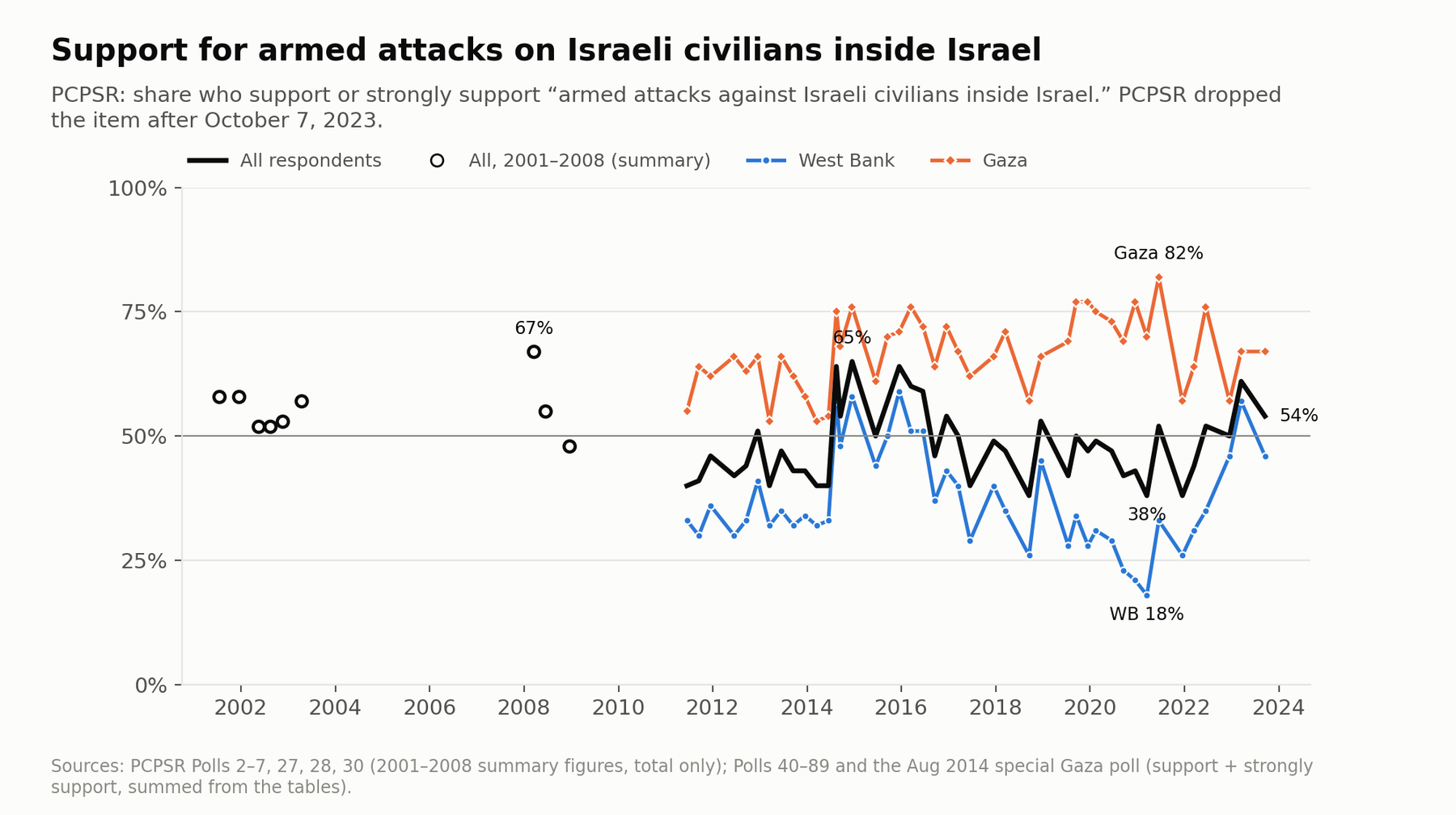
2001–2008 (summary figures, all respondents)
- July 2001: 58% support, 39% oppose. → Poll 2, p. 2 (file not included in this release)
- December 2001: 58% (see 2000s baseline). May 2002: 52% (“from 58% last December to 52% in this poll”). → Poll 4, p. 3 (file not included in this release)
- August 2002: 52% support, 46% oppose “bombing attacks against civilians inside Israel,” while “more that 90% support armed attacks against soldiers and settlers.” → Poll 5, p. 1 (file not included in this release)
- November 2002: 53% support, 43% oppose. April 2003: 57% support, 40% oppose. → Poll 6, p. 2 (file not included in this release) · Poll 7, p. 4 (file not included in this release)
- March 2008: 67% support, 31% oppose. June 2008: 55%. December 2008: 48%. → Poll 27, p. 5 (file not included in this release) · Poll 28, p. 4 (file not included in this release) · Poll 30, p. 5 (file not included in this release)
2011–2023 (four-point scale)
| Fieldwork | Poll | Support | West Bank | Gaza | Oppose | Source |
|---|---|---|---|---|---|---|
| Jun 2011 | Poll 40 | 40% | 33% | 55% | 58% | Poll 40, p. 21 (file not included in this release) |
| Sep 2011 | Poll 41 | 41% | 30% | 64% | 56% | Poll 41, p. 16 (file not included in this release) |
| Dec 2011 | Poll 42 | 46% | 36% | 62% | 52% | Poll 42, p. 24 (file not included in this release) |
| Jun 2012 | Poll 44 | 42% | 30% | 66% | 56% | Poll 44, p. 19 (file not included in this release) |
| Sep 2012 | Poll 45 | 44% | 33% | 63% | 53% | Poll 45, p. 23 (file not included in this release) |
| Dec 2012 | Poll 46 | 51% | 41% | 66% | 47% | Poll 46, p. 21 (file not included in this release) |
| Mar 2013 | Poll 47 | 40% | 32% | 53% | 57% | Poll 47, p. 19 (file not included in this release) |
| Jun 2013 | Poll 48 | 47% | 35% | 66% | 51% | Poll 48, p. 19 (file not included in this release) |
| Sep 2013 | Poll 49 | 43% | 32% | 62% | 54% | Poll 49, p. 19 (file not included in this release) |
| Dec 2013 | Poll 50 | 43% | 34% | 58% | 55% | Poll 50, p. 19 (file not included in this release) |
| Mar 2014 | Poll 51 | 40% | 32% | 53% | 58% | Poll 51, p. 18 (file not included in this release) |
| Jun 2014 | Poll 52 | 40% | 33% | 54% | 57% | Poll 52, p. 19 (file not included in this release) |
| Aug 2014 | Special Gaza war poll | 64% | 57% | 75% | 34% | Gaza war poll, p. 19 (file not included in this release) |
| Sep 2014 | Poll 53 | 54% | 48% | 68% | 44% | Poll 53, p. 19 (file not included in this release) |
| Dec 2014 | Poll 54 | 65% | 58% | 76% | 32% | Poll 54, p. 25 (file not included in this release) |
| Jun 2015 | Poll 56 | 50% | 44% | 61% | 48% | Poll 56, p. 19 (file not included in this release) |
| Sep 2015 | Poll 57 | 57% | 50% | 70% | 40% | Poll 57, p. 27 (file not included in this release) |
| Dec 2015 | Poll 58 | 64% | 59% | 71% | 35% | Poll 58, p. 20 (file not included in this release) |
| Mar 2016 | Poll 59 | 60% | 51% | 76% | 38% | Poll 59, p. 19 (file not included in this release) |
| Jun 2016 | Poll 60 | 59% | 51% | 72% | 39% | Poll 60, p. 23 (file not included in this release) |
| Sep 2016 | Poll 61 | 46% | 37% | 64% | 48% | Poll 61, p. 21 (file not included in this release) |
| Dec 2016 | Poll 62 | 54% | 43% | 72% | 43% | Poll 62, p. 17 (file not included in this release) |
| Mar 2017 | Poll 63 | 50% | 40% | 67% | 45% | Poll 63, p. 16 (file not included in this release) |
| Jun 2017 | Poll 64 | 40% | 29% | 62% | 55% | Poll 64, p. 15 (file not included in this release) |
| Dec 2017 | Poll 66 | 49% | 40% | 66% | 46% | Poll 66, p. 17 (file not included in this release) |
| Mar 2018 | Poll 67 | 47% | 35% | 71% | 47% | Poll 67, p. 20 (file not included in this release) |
| Sep 2018 | Poll 69 | 38% | 26% | 57% | 58% | Poll 69, p. 28 (file not included in this release) |
| Dec 2018 | Poll 70 | 53% | 45% | 66% | 43% | Poll 70, p. 26 (file not included in this release) |
| Jul 2019 | Poll 72 | 42% | 28% | 69% | 52% | Poll 72, p. 24 (file not included in this release) |
| Sep 2019 | Poll 73 | 50% | 34% | 77% | 45% | Poll 73, p. 28 (file not included in this release) |
| Dec 2019 | Poll 74 | 47% | 28% | 77% | 50% | Poll 74, p. 28 (file not included in this release) |
| Feb 2020 | Poll 75 | 49% | 31% | 75% | 48% | Poll 75, p. 27 (file not included in this release) |
| Jun 2020 | Poll 76 | 47% | 29% | 73% | 49% | Poll 76, p. 25 (file not included in this release) |
| Sep 2020 | Poll 77 | 42% | 23% | 69% | 52% | Poll 77, p. 20 (file not included in this release) |
| Dec 2020 | Poll 78 | 43% | 21% | 77% | 54% | Poll 78, p. 26 (file not included in this release) |
| Mar 2021 | Poll 79 | 38% | 18% | 70% | 57% | Poll 79, p. 25 (file not included in this release) |
| Jun 2021 | Poll 80 | 52% | 33% | 82% | 44% | Poll 80, p. 25 (file not included in this release) |
| Dec 2021 | Poll 82 | 38% | 26% | 57% | 58% | Poll 82, p. 19 (file not included in this release) |
| Mar 2022 | Poll 83 | 44% | 31% | 64% | 52% | Poll 83, p. 23 (file not included in this release) |
| Jun 2022 | Poll 84 | 52% | 35% | 76% | 44% | Poll 84, p. 21 (file not included in this release) |
| Dec 2022 | Poll 86 | 50% | 46% | 57% | 46% | Poll 86, p. 20 (file not included in this release) |
| Mar 2023 | Poll 87 | 61% | 57% | 67% | 32% | Poll 87, p. 23 (file not included in this release) |
| Sep 2023 | Poll 89 | 54% | 46% | 67% | 41% | Poll 89, Q70, p. 23 (file not included in this release) |
Across 2011–2023, Gaza support ran 10–56 points above the West Bank. Total support reached 60% or more after the 2014 Gaza war (64–65%), in late 2015 and early 2016 during the wave of stabbing attacks (60–64%), and in March 2023 (61%).
Birzeit University (Center for Development Studies)
- February 2001: “53% of respondents support suicide or other attacks against civilians inside Israeli cities, while 40% oppose such attacks.” Birzeit noted that in 1994, at the start of Oslo, “only 18% of the public supported suicide attacks.” → Birzeit Poll 3, p. 4 (file not included in this release)
- February 2004: “A majority (67%) supports stopping operations against Israeli civilians; the approval of 51% of them was conditioned on Israeli approval to end violence against Palestinian civilians.” → Birzeit Poll 15, p. 3 (file not included in this release)
- March 2006, after Hamas’s election win: 35% supported Hamas “carrying out suicide attacks in Israeli cities compared with 75% in June 2001”; 60% opposed. → Birzeit Poll 25 (file not included in this release)
Arab public opinion in the region
These polls cover publics in Arab states and, where available, Turkey and Israel’s Arab citizens. Several include a Palestinian sample, which makes a like-for-like comparison possible: same question, same pollster, same survey round. Four pollsters carry most of the weight here:
- Arab Opinion Index (AOI), Arab Center for Research and Policy Studies, Doha. About 11–16 Arab publics per round, face to face, 2011–2025, Palestine included in every round. The nine English “in brief” reports are archived in
Polls/Archive/Arab Opinion Index/. - Arab Barometer, Princeton and regional partners (PCPSR in Palestine). Waves VII (2021–22), VIII (2023–24) and IX (2025–26).
- Pew Global Attitudes, 2003, 2007, 2013 and 2014. Its 2013–2014 surveys add Turkey and Israel.
- Washington Institute for Near East Policy, Gulf, Egypt, Jordan and Lebanon surveys, 2014–2023.
Bottom line: how Palestinians compare
- Recognition of Israel: Palestinians sit inside a near-unanimous regional consensus, not above it. In AOI 2024/25, 91% of Palestinians opposed recognition, against an 87% average. Libya, Jordan, Mauritania and Kuwait were higher. The regional average has stayed between 84% and 89% in every round since 2011.
- “An Arab cause”: Palestinians are among the least likely Arabs to call the Palestinian cause a collective Arab cause. They were lowest of the countries surveyed in 2017/18 (64%) and 2019/20 (66%), and 69% in 2024/25 against an 80% average. About a quarter say it is the Palestinians’ cause alone.
- Two states: Palestinians fall in the middle of the regional range. Arab Barometer found 51% before the war (October 2023), against 38% (Lebanon) to 71% (Mauritania) elsewhere in 2023–24.
- Coexistence: in 2014, 63% of Palestinians said Israel and a Palestinian state cannot coexist. That was less pessimistic than Lebanon (79%) or Tunisia (71%) and more pessimistic than Egypt (48%) or Jordan (39%).
- Where Palestinians stand out: on violence against civilians. In Pew’s 2014 survey, 46% of Palestinian Muslims said suicide bombing of civilians can often or sometimes be justified. No other Arab public in that survey was above 29% (Lebanese Muslims).
- Wars move regional opinion quickly:
- Saudi views of Hamas went from 10% positive (August 2023) to 40% (Nov–Dec 2023).
- Moroccan support for normalization fell from 31% to 13%.
- Kuwaiti two-state support rose from 32% to 54%.
How Palestinians compare on shared questions
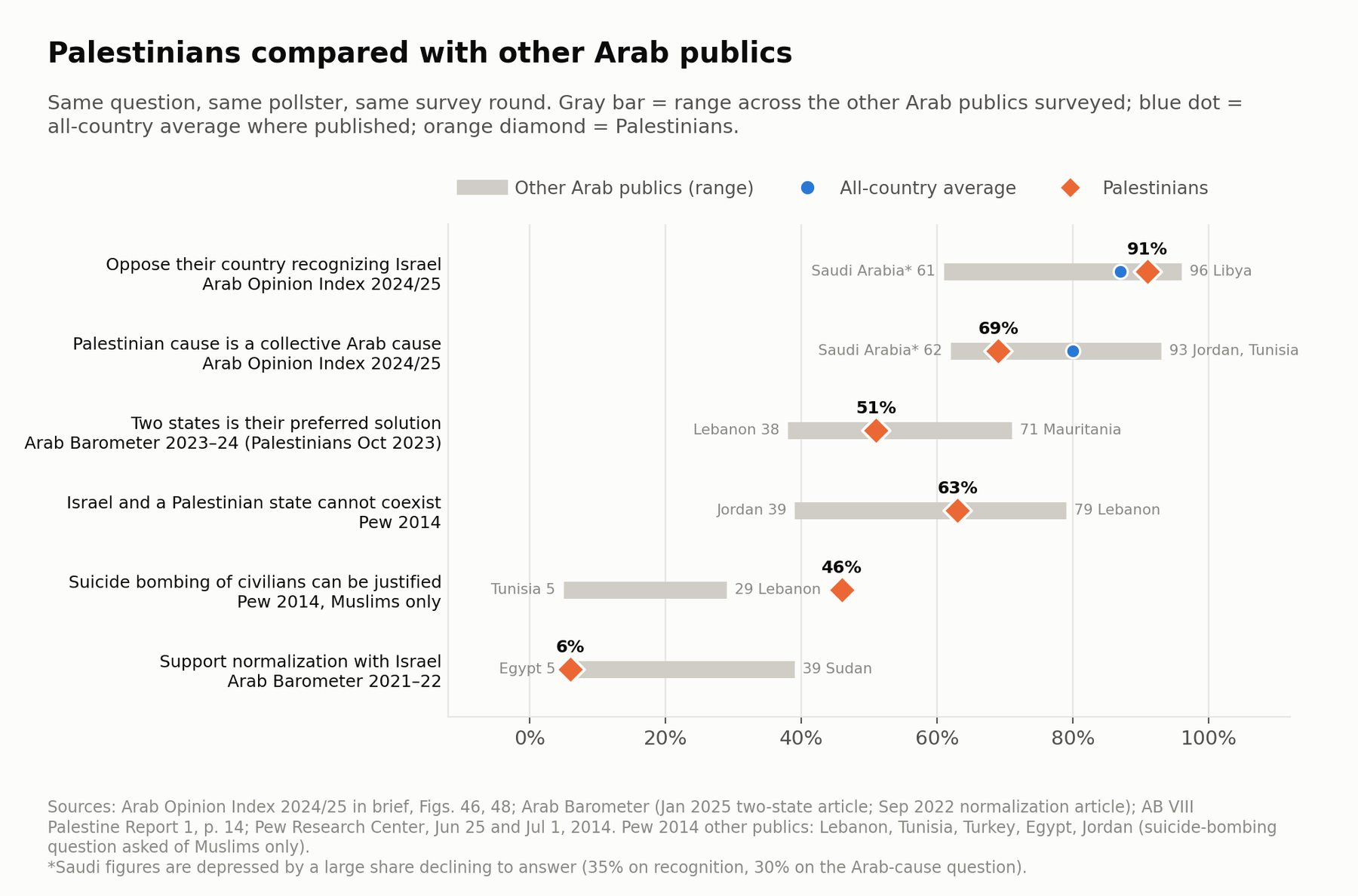
| Question | Palestinians | Other Arab publics | Source |
|---|---|---|---|
| Oppose their country recognizing Israel (AOI 2024/25) | 91% | 61% (Saudi Arabia, with 35% declining to answer) to 96% (Libya); average 87% | AOI 2024/25, Fig. 48, p. 38 (file not included in this release) |
| The Palestinian cause is a collective Arab cause (AOI 2024/25) | 69% (24% say it is solely Palestinian) | 62% (Saudi Arabia, 30% declining) to 93% (Jordan, Tunisia); average 80% | AOI 2024/25, Figs. 45–46, p. 36 (file not included in this release) |
| Two states is the preferred solution (Arab Barometer) | 51% (Sep 28–Oct 8, 2023) | 38% (Lebanon) to 71% (Mauritania), 2023–24 | AB VIII, p. 14 (file not included in this release) · Arab Barometer, Jan 2025 |
| Israel and a Palestinian state cannot coexist peacefully (Pew 2014) | 63% (Gaza 68%, West Bank 60%) | Lebanon 79%, Tunisia 71%, Turkey 62%, Egypt 48%, Jordan 39% | Pew, Jun 25, 2014 |
| Suicide bombing of civilians can often or sometimes be justified to defend Islam (Muslims only, Pew 2014) | 46% (Gaza 62%, West Bank 36%; 62% overall in 2013) | Lebanon 29%, Egypt 24%, Turkey 18%, Jordan 15%, Tunisia 5% | Pew, Jul 1, 2014 |
| Support normalization with Israel (Arab Barometer 2021–22) | 6% | Egypt 5%, Jordan 5%, Libya 7%, Mauritania 8%, Iraq 14%, Lebanon 17%, Morocco 31%, Sudan 39% | Arab Barometer, Sep 2022 |
Recognition of Israel and the Palestinian cause
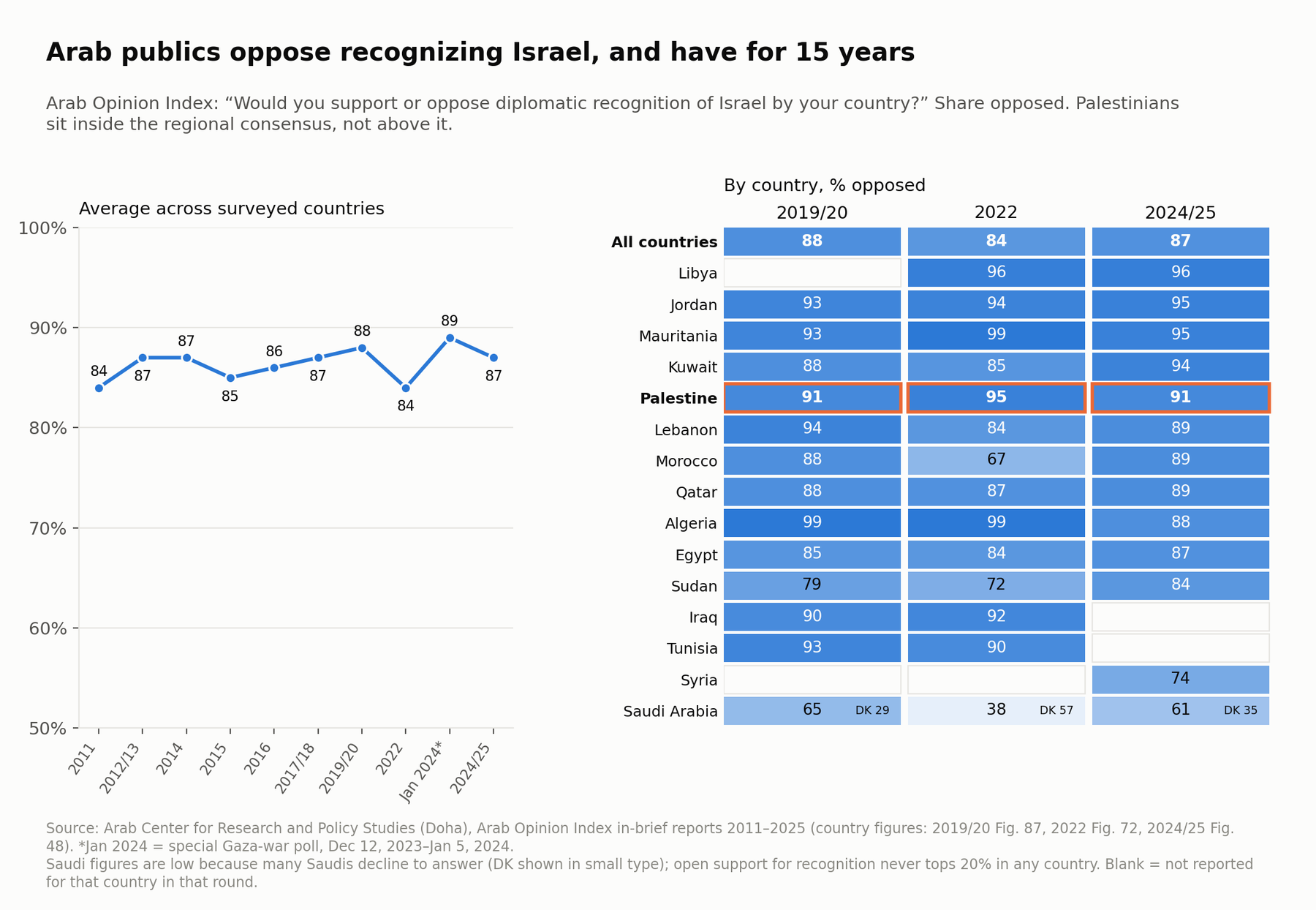
The AOI asks: “Would you support or oppose diplomatic recognition of Israel by your country?” The overall share opposed has barely moved in fifteen years, through the Arab Spring, the Abraham Accords, and the Gaza war.
| Round | Oppose | Support | Source |
|---|---|---|---|
| 2011 | 84% | 9% (10% in the 2011 report text) | AOI 2011, p. 83 (file not included in this release) · AOI 2019/20, Fig. 88, p. 57 (file not included in this release) |
| 2012/13 | 87% | 6% | AOI 2012/13, p. 23 (file not included in this release) |
| 2014 | 87% | 6% | AOI 2014, p. 24 (file not included in this release) |
| 2015 | 85% | 9% | AOI 2019/20, Fig. 88, p. 57 (file not included in this release) |
| 2016 | 86% | 9% | AOI 2016, p. 25 (file not included in this release) |
| 2017/18 | 87% | 8% | AOI 2017/18, p. 30 (file not included in this release) |
| 2019/20 | 88% | 6% | AOI 2019/20, Fig. 88, p. 57 (file not included in this release) |
| 2022 | 84% | 8% | AOI 2022, Fig. 73, p. 47 (file not included in this release) |
| Special Gaza-war poll, Dec 12, 2023–Jan 5, 2024 (16 publics incl. West Bank, n=8,000) | 89% | 4% | Arab Center Washington DC |
| 2024/25 (Nov 2024–Aug 2025, 15 countries, n=40,130) | 87% | 6% | AOI 2024/25, p. 37 (file not included in this release) |
By country, % opposed (support in brackets; blank = not reported for that country in that round). Sources: AOI 2019/20, Fig. 87, p. 56 (file not included in this release) · AOI 2022, Fig. 72, p. 47 (file not included in this release) · AOI 2024/25, Fig. 48, p. 38 (file not included in this release)
| Country | 2019/20 | 2022 | 2024/25 |
|---|---|---|---|
| Palestine | 91 (7) | 95 (3) | 91 (5) |
| Jordan | 93 (6) | 94 (4) | 95 (4) |
| Lebanon | 94 (5) | 84 (11) | 89 (9) |
| Egypt | 85 (13) | 84 (13) | 87 (12) |
| Kuwait | 88 (10) | 85 (13) | 94 (4) |
| Qatar | 88 (3) | 87 (5) | 89 (3) |
| Saudi Arabia | 65 (6), 29 DK | 38 (5), 57 DK | 61 (4), 35 DK |
| Morocco | 88 (4) | 67 (20) | 89 (6) |
| Sudan | 79 (13) | 72 (18) | 84 (7) |
| Algeria | 99 (0) | 99 (0) | 88 (2) |
| Mauritania | 93 (3) | 99 (1) | 95 (4) |
| Libya | 96 (2) | 96 (1) | |
| Iraq | 90 (7) | 92 (7) | |
| Tunisia | 93 (3) | 90 (4) | |
| Syria | 74 (17) | ||
| All countries | 88 (6) | 84 (8) | 87 (6) |
Reading notes:
- The two Abraham Accords signatories in the AOI moved in opposite directions. Morocco’s opposition fell to 67% in 2022 (20% supportive, the highest of any country in any round), then went back to 89% after the Gaza war. Sudan’s went 79%, 72%, 84%.
- Saudi Arabia always looks lowest, but mostly because a third to a half of Saudi respondents decline to answer. Open Saudi support for recognition has never exceeded 6%.
- Syria (74% opposed, 17% support in 2024/25) was surveyed for the first time after the fall of the Assad government. In the same round, 70% of Syrians opposed an agreement with Israel that did not return the Golan Heights. → AOI 2024/25, Fig. 44, p. 35 (file not included in this release)
- Most people who opposed recognition gave political reasons rather than religious ones. In 2024/25, the most common reason was that Israel is “a settler-colonial state occupying Palestine” (31.5%). → AOI 2024/25, Table 5, p. 38 (file not included in this release)
Is the Palestinian cause an Arab cause? Share agreeing that it “concerns all Arabs and not the Palestinian people alone”:
| Round | All countries | Palestine | Palestine’s rank | Source |
|---|---|---|---|---|
| 2011 | 84% | — | — | AOI 2024/25, Fig. 45, p. 36 (file not included in this release) |
| 2012/13 | 84% | — | — | same |
| 2014 | 77% | — | — | same |
| 2015 | 75% | — | — | same |
| 2016 | 75% | — | — | same |
| 2017/18 | 77% | 64% (26% “Palestinians solely”) | Lowest of 11 | AOI 2017/18, Fig. 45, p. 30 (file not included in this release) |
| 2019/20 | 79% | 66% (29% “Palestinians solely”) | Lowest of 13 | AOI 2019/20, Fig. 85, p. 55 (file not included in this release) |
| 2022/23 | 76% | — | — | AOI 2024/25, Fig. 45, p. 36 (file not included in this release) |
| 2024/25 | 80% | 69% (24% “solely Palestinian”) | 11th–12th of 15, level with Syria. Only Lebanon (67%), Morocco (64%) and Saudi Arabia (62%) were lower. | AOI 2024/25, Fig. 46, p. 36 (file not included in this release) |
The AOI reports do not explain the Palestinian figure. One plausible reading, offered here as an interpretation rather than a finding, is disillusionment with Arab governments: in the same polls Palestinians are among the most opposed to Arab normalization with Israel.
Earlier cross-national readings
| Poll / fieldwork | Finding | Source |
|---|---|---|
| Pew Global Attitudes, 2003 | 80% of Palestinian Authority residents doubted that a way can be found for Israel to exist while Palestinian rights and needs are met. Pew reported similar majorities across the Muslim publics it surveyed (Jordan, Morocco, Lebanon, Kuwait, Indonesia, Pakistan, Turkey). Arabs in Israel were the exception: 62% believed a way could be found (68% of Israeli Jews). | Pew 2003 |
| Pew Global Attitudes, Apr–May 2007 | Pew reported that more than seven in ten Egyptians, Jordanians, Palestinians, and Kuwaitis said Palestinian rights and needs cannot be taken care of as long as Israel exists. Lebanon was divided by sect. | Pew 2007, ch. 5 |
| Arab Center special Gaza-war poll, Dec 12, 2023–Jan 5, 2024 | 89% opposed recognition of Israel; 4% supported. Saudi opposition rose from 38% (2022) to 68%. 59% were certain there could be no peace; 13% still believed in peace. | Arab Center Washington DC |
Two-state support across Arab publics
Arab Barometer asks respondents to choose among a two-state solution on the 1967 borders, one state for Jews and Arabs, a Palestinian-Israeli confederation, or “other.” The 2023–24 wave (fieldwork through about April 2024) found:
| Country | 2021–22 | 2023–24 | Source |
|---|---|---|---|
| Palestinians | 53% (Oct 2021) | 51% (Sep 28–Oct 8, 2023, before the war); 59% in Oct 2025 | AB9 Report 2, p. 6 (file not included in this release) · AB VIII, p. 14 (file not included in this release) |
| Mauritania | — | 71% | Arab Barometer, Jan 2025 |
| Tunisia | — | 63% | same |
| Jordan | 51% | 61% | same |
| Iraq | 63% | 59% | same |
| Kuwait | 32% | 54% | same |
| Morocco | 41% | 48% (one state 21%) | same |
| Lebanon | 42% | 38% | same |
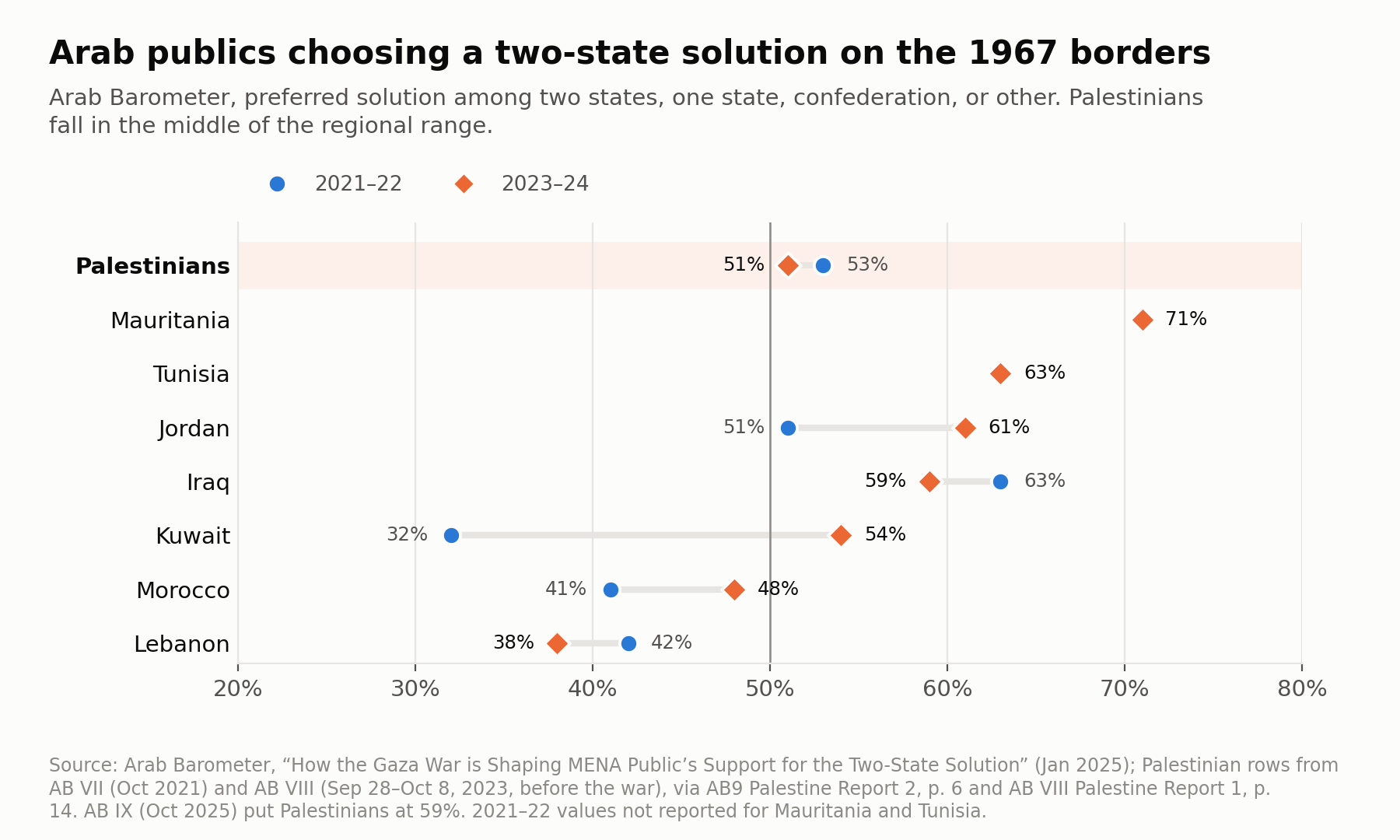
In every country, two states outpolled one state and confederation; the largest “other” answers (which include a military solution or a Palestinian state over all the land) were Kuwait 23%, Jordan 22% and Lebanon 17%. Arab Barometer’s Wave IX data, presented in the Munich Security Conference’s 2026 Middle East report, put two-state support at up to two-thirds across the Arab publics surveyed. → Arab Barometer on MSC 2026
The Washington Institute’s Saudi poll of Nov 14–Dec 6, 2023 put a different question: just 16% of Saudis agreed that “Hamas should stop calling for the destruction of Israel, and instead accept a permanent two-state solution” on the 1967 borders. Yet 86% agreed there “will have to be political negotiations for a Palestinian-Israeli agreement some day.” In Gaza, the same Hamas two-state proposal drew 50% agreement in July 2023. → Washington Institute, Oct 10, 2023 · Washington Institute, Dec 21, 2023
Coexistence: can Israel and a Palestinian state live side by side?
Pew asked the same question in seven publics in 2013 and 2014: can “a way be found for Israel and an independent Palestinian state to coexist peacefully”?
| Public | 2014: cannot coexist | 2014: can coexist | Source |
|---|---|---|---|
| Lebanon | 79% | 11% | Pew, Jun 25, 2014 |
| Tunisia | 71% | — | same |
| Palestinians | 63% (Gaza 68%, West Bank 60%) | 16% | same |
| Turkey | 62% | — | same |
| Egypt | 48% | about a quarter | same |
| Jordan | 39% | about a quarter (about three in ten said “depends”) | same |
| Israel | 45% | 40% (Israeli Arabs 64%, Jews 37%) | same |
Pessimism rose between 2013 and 2014 by 15 points in Turkey, 14 in Tunisia and 8 in Egypt. The question returned in Pew’s 2026 Israeli-Palestinian survey (Palestinians 21% yes, 68% no; see Palestinian views on peace and the end-state, 2000–2026), but Pew did not re-ask it in other Arab countries.
Normalization with Israel
- Arab Barometer 2021–22: in nine of the eleven countries surveyed, fewer than one in five supported normalization agreements. Palestine 6%, Egypt 5%, Jordan 5%, Libya 7%, Mauritania 8%, Iraq 14%, Lebanon 17%; the exceptions were Sudan (39%) and Morocco (31%), both Abraham Accords signatories. → Arab Barometer, Sep 12, 2022
- Arab Barometer 2023–24: in none of seven surveyed countries did more than 13% favor normalization with Israel. Morocco fell from 31% to 13%. Among Moroccans who called Israel’s campaign in Gaza a “genocide,” support was 9%. → Arab Barometer, Jan 2025
- Palestinians, Arab Barometer IX (Oct 2025): 88% oppose Arab-Israeli normalization in principle. → AB9 Report 2, pp. 7–8 (file not included in this release)
- Washington Institute, 2020–2022: Gulf opinion on the Abraham Accords was roughly split in late 2020 in the UAE and Bahrain, then turned negative. By March 2022 only about 19–25% in Saudi Arabia, Bahrain, and the UAE viewed the accords favorably. → Washington Institute, Jul 15, 2022
- Washington Institute, Saudi Arabia, Nov–Dec 2023:
- 96% agreed that “Arab countries should immediately break all diplomatic, political, economic, and any other contacts with Israel.”
- Support for allowing business contacts with Israelis fell from 43% (November 2022) to 17%.
- → Washington Institute, Dec 21, 2023
- Washington Institute, August 2023 (Saudi Arabia and UAE, n=1,000 each): 70% of Saudis and about 71% of Emiratis agreed at least somewhat that Israel’s mass protests show it is “a weak and deeply divided country that can be defeated someday.” → WINEP crosstabs, pp. 12–13 (file not included in this release)
Hamas and October 7 across the region
| Poll / fieldwork | Palestinians | Other publics | Source |
|---|---|---|---|
| Pew, spring 2007 | 62% favorable toward Hamas, about a third unfavorable | — | Pew, Jul 1, 2014 |
| Pew, Apr–May 2014 | 35% favorable, 53% unfavorable (Gaza 63% unfavorable, up from 54% in 2013; West Bank 47%) | About six in ten unfavorable in Jordan and Egypt; Tunisia 42% unfavorable; Turkey 80%. Lebanon split by sect (unfavorable: Christians 79%, Sunnis 65%, Shia 44%) | same |
| Washington Institute, 2014–2023 (Gaza and West Bank July 2023; Arab states as noted) | Positive views of Hamas, July 2023: Gaza 57%, West Bank 52%, East Jerusalem 64% | Jordan 72% positive (2014) → 44% (Nov 2020). UAE 44% (2014) and 48% (2017) → 17% (Aug 2023). Saudi Arabia 10% (Aug 2023) | Washington Institute, Oct 10, 2023 |
| Washington Institute, Saudi Arabia, Nov 14–Dec 6, 2023 (n=1,000) | — | Saudi positive views of Hamas: 10% (Aug 2023) → 40%, still a minority; 23% after the 2021 war. Asked whether Hamas’s killing of civilians was against Islam, 95% said Hamas did not kill civilians; the authors say the view was widespread across the eight countries they polled. | Washington Institute, Dec 21, 2023 |
| Arab Center special poll, Dec 12, 2023–Jan 5, 2024 (16 publics incl. West Bank) | West Bank included in the regional figures | 67% called October 7 a “legitimate resistance operation”; 19% “flawed but legitimate”; 3% “legitimate, but with heinous acts”; 5% “illegitimate.” 69% expressed solidarity with Palestinians and support for Hamas; 23% solidarity despite opposing Hamas. 92% said the cause concerns all Arabs. | Arab Center Washington DC |
| PCPSR, Dec 2023 (for comparison) | 72% said Hamas’s decision to launch the October 7 attack was “correct” (West Bank 82%, Gaza 57%) | — | Palestinian Polling After October 7 |
The Washington Institute noted that, unlike in Saudi Arabia, Hamas had majority approval in Lebanon, Jordan, and Egypt in late 2023, “in several cases unprecedented” since 2014. The Saudi series shows the pattern the authors describe: Hamas gains during or after each war with Israel, and the gain fades over time.
Violence against civilians
Pew asked Muslims whether “suicide bombing or other forms of violence against civilian targets” can be justified “to defend Islam from its enemies.” Its July 2014 report:
- Palestinian territories: 46% of Muslims said often or sometimes justified (Gaza 62%, West Bank 36%). The figure was 62% in 2013.
- Other Arab publics: Lebanese Muslims 29% (Shia 37%, Sunni 21%; 74% in 2002). Egypt 24%. Jordan 15%. Tunisia 5%.
- Turkey and Israel: Turkey 18%. Israeli Muslims 16%.
This is the one shared question on which Palestinians sit well outside the regional range. It is also the question most tied to the conflict itself, so it fits the pattern in PCPSR’s own series (see Palestinian views on peace and the end-state, 2000–2026), where support for attacks on Israeli civilians tracks the level of violence.
Threats and outside powers (AOI 2024/25)
- Asked which state poses the greatest threat to the Arab nation, 44% named Israel, 21% the United States and 6% Iran. → AOI 2024/25, p. 45 (file not included in this release)
- 84% agreed that Israeli policies threaten the region’s security and stability; 77% said the same of U.S. policies. → AOI 2024/25, p. 46 (file not included in this release)
- Rating policies toward Palestine, 62% called South Africa’s good or very good, Turkey 49% and Iran 45%. Only 11% said the same of the United States (76% bad). → AOI 2024/25, p. 41 (file not included in this release)
Arab citizens of Israel
- Pew 2003: 62% of Arabs in Israel said a way can be found for Israel to exist while Palestinian rights and needs are met. → Pew 2003
- Pew 2014: 64% of Israeli Arabs said Israel and a Palestinian state can coexist peacefully, the most optimistic group in the region; 13% said they cannot. → Pew, Jun 25, 2014
- Pulse, July 2024: 72% of Israeli Arabs supported the two-state concept (up from 60% in 2022). Asked about one Palestinian state in which Jews lack full citizen rights, 17% supported it and 55% opposed. → Pulse Sep 2024, p. 2 (file not included in this release) · p. 13 (file not included in this release)
Gaps in regional coverage
- Iran and Turkey. None of the regular pollsters in this note asks Iranians these questions, so there is no comparable Iranian series. Turkey appears only in Pew’s 2013–2014 surveys and in AOI ratings of Turkish policy.
- Gulf states. Gulf publics other than Saudi Arabia, Qatar and Kuwait are mostly covered by the Washington Institute’s commissioned surveys, which ask different questions from AOI and Arab Barometer.
- Stale comparisons. Pew has not re-asked its coexistence and suicide-bombing questions in Arab countries since 2014.
Palestinian Polling After October 7
No major poll below asked, “Do you support Hamas’s military wing, the al-Qassam Brigades?” The main questions instead asked whether respondents supported or believed Hamas was correct to launch the October 7 operation. Those are related, but not identical.
Transcript claim corrected
The claim that 89% supported Hamas’s military wing is not supported by the located instruments. The closest early-war figure in the Matau–LightBulb debate audit is AWRAD’s approximately 76% support for the Hamas-led October 7 “military operation.” That was not a question about institutional support for the al-Qassam Brigades, and it cannot be substituted for approval of deliberately attacking civilians.
Latest comparable result
PCPSR’s August 2026 Poll No. 97 did not repeat the question asking whether Hamas’s October 7 decision was correct. The latest result for that specific item is therefore October 2025, not August 2026. The August 2026 party, strategy, and peace-process results are summarized separately below.
| Pollster / fieldwork | Question | Overall | West Bank | Gaza |
|---|---|---|---|---|
| AWRAD, Oct. 31–Nov. 7, 2023 | Support for “the military operation carried out by the Palestinian resistance led by Hamas on October 7” | ~76% supported | Higher than Gaza | Lower than West Bank |
| PCPSR, Dec. 2023 | Was Hamas’s decision to launch the October 7 attack “correct”? | 72% yes | 82% | 57% |
| PCPSR, Mar. 2024 | Was Hamas’s October 7 decision “correct”? | 71% yes | 71% | 71% |
| PCPSR, June 2024 | Was Hamas’s October 7 decision “correct”? | 67% yes | 73% | 57% |
| PCPSR, Sept. 2024 | Was Hamas’s October 7 decision “correct”? | 54% yes | 64% | 39% |
| PCPSR, May 2025 | Was Hamas’s October 7 decision “correct”? | 50% yes | 59% | 38% |
| PCPSR, Oct. 2025 | Was Hamas’s October 7 decision “correct”? | 53% yes | 59% | 44% |
xychart-beta
    title "PCPSR: Hamas's October 7 Decision Was Correct"
    x-axis ["Dec 2023","Mar 2024","Jun 2024","Sep 2024","May 2025","Oct 2025"]
    y-axis "Percent saying correct" 0 --> 100
    bar [72,71,67,54,50,53]
Latest PCPSR snapshot — August 2026
PCPSR Poll No. 97 was conducted face-to-face on August 5–8, 2026, with 1,270 adults: 830 in the West Bank across 83 residential localities and 440 in Gaza across 44 localities. PCPSR reported a ±3.5 percentage-point margin of error. Residents of militarily occupied or otherwise inaccessible Gaza areas were interviewed in shelters; the wartime sampling caveats below therefore remain important.
| Indicator | Overall | West Bank | Gaza | Interpretation limit |
|---|---|---|---|---|
| Identifies with Hamas | 24% | 18% | 33% | Party identification is not approval of October 7 or of attacks on civilians. |
| Would vote Hamas among likely legislative voters | 29% | 25% | 34% | Conditional on participating; Fatah drew 32% overall, 34% in the West Bank, and 30% in Gaza. |
| Satisfied with Hamas’s wartime performance | 42% | 45% | 38% | Satisfaction is broader than party support and does not specify which acts are approved. |
| Most effective route to statehood: negotiations | 44% | 36% | 55% | Forced choice against armed struggle and peaceful popular resistance. |
| Most effective route to statehood: armed struggle | 27% | 32% | 21% | Down from 41% overall in October 2025; not a question about attacks on civilians. |
| Most effective route to statehood: peaceful popular resistance | 19% | 17% | 23% | Same forced-choice question. |
| Preferred a two-state solution based on the 1967 borders | 56% | 52% | 61% | Asked as one of three specified models; a separate bare-label question found 44% support for “the two-state solution.” |
| Opposed Hamas disarming before a full Israeli withdrawal from Gaza | 72% | 79% | 62% | A sequencing question, not opposition to disarmament under every possible agreement. |
| Agreed armed resistance had failed to protect Palestinians or end the occupation and instead brought destruction | 50% | 35% | 65% | Measures perceived effectiveness and consequences, not the morality of armed resistance. |
Updated finding
The newest survey shows a mixed and regionally divided public. West Bank respondents were more likely than Gazans to identify armed struggle as the most effective route and to oppose pre-withdrawal Hamas disarmament. Gazans were more likely to choose negotiations, prefer the specified 1967-borders two-state option, and say armed resistance had failed. Meanwhile, Hamas party identification fell to a minority in both territories, although it remained higher in Gaza than in the West Bank.
PCPSR five-year question-retention audit — 2021–2026
Scope and standard
This audit compares PCPSR’s regular West Bank–Gaza polls from Poll No. 81 (September 15–18, 2021) through Poll No. 97 (August 5–8, 2026): Nos. 81–93 and 95–97, sixteen releases in total. The official archive does not list a regular Poll No. 94, so no questionnaire is inferred for that number.
“Removed” below means that an exact or substantively equivalent item no longer appears in PCPSR’s publicly released questionnaire or results report after the stated poll. That is not proof that PCPSR never asked the question internally. This distinction matters because Polls 81–92 were released as fuller question-and-answer documents, whereas several later releases are labeled press releases and may publish less of the underlying instrument.
One-off questions tied to a particular news event—COVID restrictions, the Gilboa prison escape, the Ukraine war, Israeli elections, the Oslo anniversary, or a specific ceasefire proposal—are not counted as “taken out.” The table focuses on questions repeated enough to form a series.
Long-running questions that disappeared from the published series
| Question family | Appeared in | Last public appearance | Later status | Why the loss matters |
|---|---|---|---|---|
| Separate evaluations of general conditions in Gaza and the West Bank | Polls 81–89 | September 2023, Poll 89 | Absent from Polls 90–97; replaced by wartime humanitarian and safety indicators | The replacements do not preserve the earlier general-conditions trend. |
| Respondent’s degree of religiosity | Polls 81–89 | September 2023, Poll 89 | Absent from Polls 90–97 | Removes a recurring descriptive variable that PCPSR had used to compare political attitudes. |
| Perceived corruption in Hamas-controlled Gaza institutions | Polls 81–89 | September 2023, Poll 89 | Absent from Polls 90–97 | Polls 96–97 restored a PA-corruption item, but not the parallel Hamas-institutions item. Current comparisons of perceived Fatah/PA and Hamas corruption therefore cannot be made from the regular series. |
| Ability to criticize the governing authority without fear | Polls 81–89 | September 2023, Poll 89 | Absent from Polls 90–97 | Removes the direct recurring measure of perceived freedom to criticize both the PA in the West Bank and Hamas in Gaza. |
| Expectation that West Bank–Gaza reconciliation will succeed or fail | Polls 81–89 | September 2023, Poll 89 | Absent from Polls 90–97 | Later polls ask narrower questions about postwar administration, unity governments, or specific reconciliation steps; these are not the same trend. |
| Expected economic conditions in the respondent’s area three to five years ahead | Polls 81–89 | September 2023, Poll 89 | Absent from Polls 90–97 | Later questions about immediate hardship or the possible effect of elections are not a direct substitute. |
| Support or opposition to armed attacks against Israeli civilians inside Israel | Polls 81–89 | September 2023, Poll 89 | Absent from every regular poll beginning with the first post-October 7 wave, Poll 90 | This is the most consequential break for interpreting violence. The later “October 7 was correct,” “armed struggle,” and Hamas-support items cannot validly substitute for a direct question about attacks on civilians. |
| Frequency of using the internet, social media, groups, or email | Polls 81–89 | September 2023, Poll 89 | Absent from Polls 90–97; television-source questions still appear in some waves | Makes it harder to test whether media exposure helps explain changing answers. |
Selected last observations — not current estimates
In Poll 89, the final wave before this block disappeared, 54% overall supported or strongly supported armed attacks against Israeli civilians inside Israel (46% West Bank; 67% Gaza), while 41% overall opposed or strongly opposed them. In the same poll, 72% perceived corruption in Hamas-controlled institutions; 57% said people could not criticize their governing authority without fear; 73% expected reconciliation to fail; and 58% expected local economic conditions to worsen over the next three to five years. These figures describe September 2023 only and must not be presented as post-October 7 or current opinion.
Questions removed earlier or later in the five-year window
| Question family | Last public appearance | Later status | Classification |
|---|---|---|---|
| Whether political, security, and economic conditions lead the respondent to seek emigration | June 2023, Poll 88 | Gone from the national recurring battery. Poll 95 later asked a different Gaza-only wartime question about leaving if given the opportunity. | Series discontinued, then partly reworked; the Gaza-only result is not a continuation of the national item. |
| Whether respondents want general legislative and presidential elections held soon | June 2023, Poll 88 | Absent from Polls 89–96. Poll 97 instead asks whether already announced elections will occur, be free and fair, and proceed without East Jerusalem voting. | Original item discontinued; topic returned with different questions. |
| Support for returning to negotiations with Israel without prior conditions | September 2022, Poll 85 | Later polls ask whether negotiations are the most effective strategy, or about negotiations under a named plan or sponsor. | Direct unconditional-negotiations item discontinued. Strategy-preference results are not equivalent. |
| Whether Israel and Hamas committed war crimes | May 26–June 1, 2024, Poll 92 | The paired Israel/Hamas war-crimes questions do not appear in Poll 93 or the later public reports. | Short wartime series discontinued after three waves: Polls 90–92. |
| Whether respondents had seen international-media videos of October 7 atrocities | May 26–June 1, 2024, Poll 92 | Later reports continue asking whether Hamas committed the depicted atrocities, but stop reporting the separate video-exposure item. | Exposure question discontinued; belief question retained temporarily. |
| Whether Hamas committed the atrocities against Israeli civilians depicted in videos | October 2025, Poll 96 | Not reported in Poll 97. | Latest-wave omission after six post-October 7 waves. |
| Whether Hamas’s decision to launch the October 7 attack was correct | October 2025, Poll 96 | Not reported in Poll 97. | Latest-wave omission after six repetitions. October 2025 remains the last comparable result. |
Last published values in the discontinued wartime items
Poll 92, the final wave with the paired war-crimes and video-exposure questions, found 97% saying Israel had committed war crimes, 9% saying Hamas had committed war crimes, and 9% saying they had seen the specified October 7 videos (6% West Bank; 13% Gaza). Poll 96, the final wave asking whether Hamas committed the depicted atrocities, found 10% saying yes and 86% saying no. Poll 96 also produced the final “correct decision” result: 53% overall, 59% West Bank, and 44% Gaza.
Major questions PCPSR retained
The post-October 7 redesign did not remove the entire political trend battery. The following question families continued into the later polls, though wording, candidates, or response options sometimes changed:
- Basic support for a two-state solution.
- Whether settlement expansion has made two states impractical.
- Chances of establishing a Palestinian state within five years.
- Preferred or most effective means of ending the occupation and achieving statehood.
- Support for nonviolent resistance, armed intifada, joining international organizations, dissolving the PA, and pursuing one state.
- Satisfaction with President Abbas and demand for his resignation.
- Hypothetical presidential and legislative voting.
- Party identification and whether Hamas or Fatah is more deserving of leadership.
- Whether the PA is a national achievement or a burden.
- Highest Palestinian national goal.
Two recurring items were paused or narrowed rather than permanently removed. Perceived corruption in PA institutions disappeared from the immediate post-October 7 reports but returned by Poll 96 and continued in Poll 97. Personal and family safety was asked nationally before and during the first war wave, became West Bank-only in several wartime polls, and returned as a West Bank–Gaza comparison in Poll 97.
Debate rule — absence is not a result
Do not carry the last observed percentage forward after PCPSR stops publishing a question. In particular, the September 2023 answer about attacks on Israeli civilians is not a measurement of current opinion, and the October 2025 answer about the October 7 decision is not an August 2026 result. A discontinued question creates an evidence gap; it does not show that opinion stayed constant or that it reversed.
What can and cannot be inferred
The public record shows questionnaire redesign and changing publication coverage, especially after October 7. It does not, by itself, establish why PCPSR removed an item. Plausible explanations include limited questionnaire space, wartime access and safety constraints, shifting policy relevance, changed officeholders or candidates, and a move toward war-specific questions. A claim that PCPSR deliberately hid an unfavorable result would require evidence beyond the disappearance of the question.
Audit sources
- PCPSR regular-poll archive
- Poll 81 — September 2021
- Poll 85 — September 2022
- Poll 88 — June 2023
- Poll 89 — September 2023, last prewar regular poll
- Poll 90 — November–December 2023, first post-October 7 wave
- Poll 92 — May–June 2024
- Poll 93 — September 2024
- Poll 95 — May 2025
- Poll 96 — October 2025
- Poll 97 — August 2026
What The Results Show
- Support or retrospective approval of the October 7 attack was very high immediately after the attack, around three quarters of respondents in the major polls.
- In the PCPSR polling, approval was consistently higher in the West Bank than in Gaza.
- That difference matters. Gazans endured the immediate consequences of Hamas’s attack and Israel’s military campaign: deaths, displacement, destroyed homes, shortages, and governance under Hamas.
- Approval declined over time, reaching 50% overall by May 2025, then rose slightly to 53% in October 2025. PCPSR did not ask that question in August 2026, so no later comparable value should be inferred.
- The August 2026 results point in more than one direction: Hamas identification and preference for armed struggle were minority positions, negotiations led the forced-choice strategy question, and a specified 1967-borders two-state option won majority support. At the same time, large majorities opposed Hamas disarming before a full Israeli withdrawal and doubted the practicality of a two-state solution.
- These results do not establish approval of every specific October 7 atrocity. They do show that large portions of the Palestinian public regarded the decision to launch the attack as justified or correct.
Important Polling Limits
- Polling during war is difficult: people may be displaced, inaccessible, fearful, grieving, or reluctant to speak openly.
- The Gaza sample was necessarily smaller and harder to reach than a normal peacetime sample.
- The wording matters greatly: “the operation was correct,” “support Hamas,” “support armed resistance,” “support the al-Qassam Brigades,” and “support killing civilians” are different questions and should not be treated as interchangeable.
Sources
- Arab World for Research and Development (AWRAD), AWRAD’s 2023 Public Opinion Poll of the Palestinians in the West Bank and Gaza Strip
https://www.awrad.org/en - Palestinian Center for Policy and Survey Research, polling archive
https://pcpsr.org/en/node/154 - PCPSR, December 2023 poll, including the 72% overall / 82% West Bank / 57% Gaza result
https://pcpsr.org/en/node/961 - PCPSR, October 2025 Poll No. 96, including the latest repeat of the October 7 “correct decision” question
https://www.pcpsr.org/en/node/1000 - PCPSR, August 2026 Poll No. 97, latest West Bank–Gaza survey
https://www.pcpsr.org/en/node/1014 - PCPSR, August 2026 Poll No. 97 full report
https://www.pcpsr.org/sites/default/files/Poll%2097%20English%20press%20release%2012Aug2026%20rev%20%28002%29.pdf - Washington Institute analysis comparing post-October 7 Palestinian polling
https://www.washingtoninstitute.org/policy-analysis/palestinian-public-opinion-after-october-7
Israeli public opinion
Israeli polling is kept here for comparison with the Palestinian results above.
Palestinians and Israelis on the same questions, 2000–2026
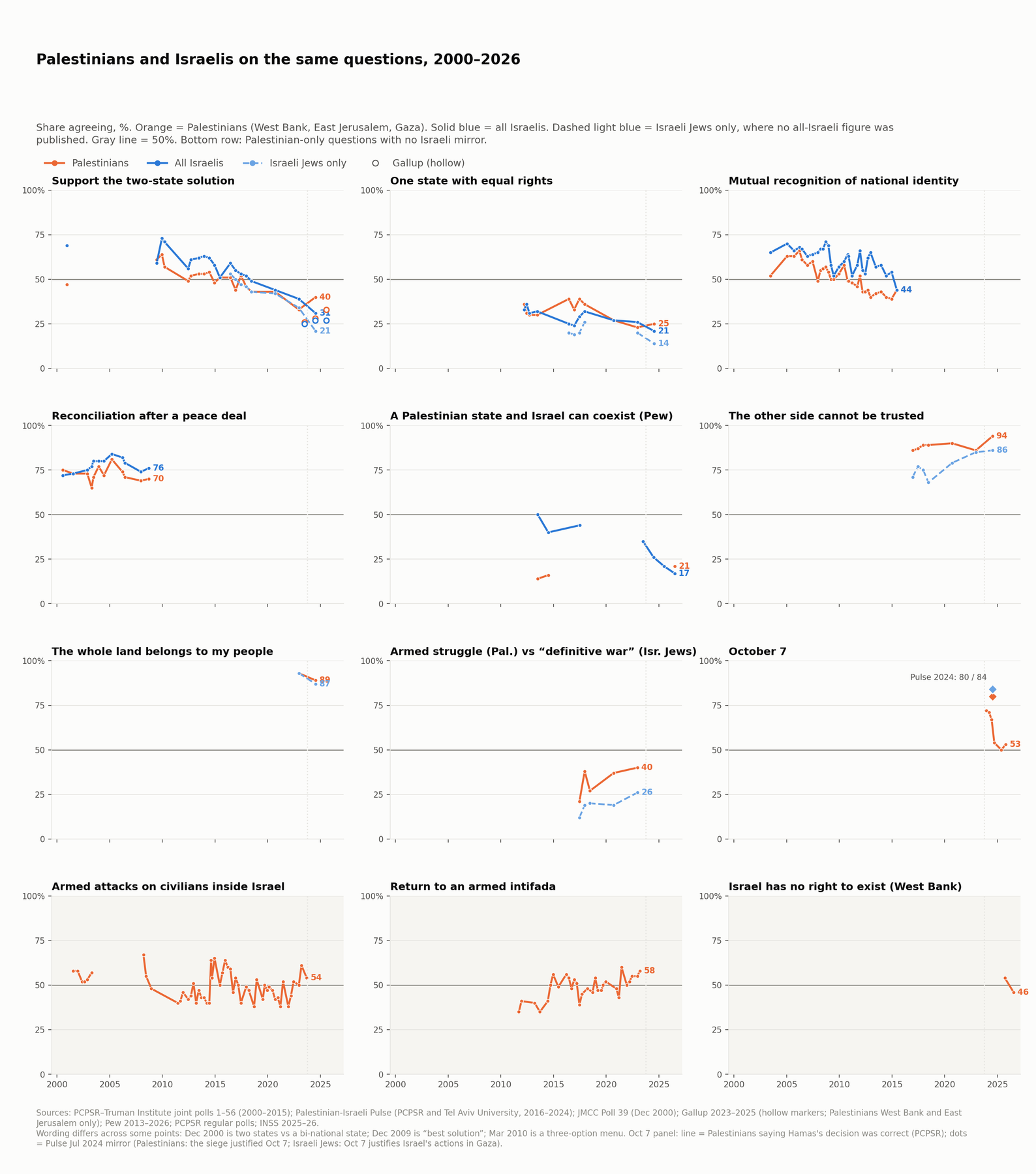
Every point in the top three rows comes from a poll that asked Palestinians and Israelis the same question at the same time: the PCPSR–Truman Institute joint polls (2000–2015), the Palestinian-Israeli Pulse (2016–2024), Gallup and Pew. “All Israelis” includes Arab citizens (about a fifth of adults). Where the pollster published only the Israeli Jewish figure, the chart shows it as a dashed line. The bottom row has no Israeli mirror question. All values are in Palestinian-Israeli matched series 2000-2026.csv (file not included in this release), with a source URL for each joint-poll point; the joint-poll press releases are archived as text in Polls/Archive/PCPSR Joint/.
What the matched series show
- Two states: Israelis were more supportive than Palestinians in almost every joint poll from late 2009 to 2022 (for example 63% vs 53% in Dec 2013). Both fell together. In July 2024, Palestinian support (40%) was higher than all-Israeli support (31%; Israeli Jews 21%), which last happened in June 2009 (61% vs 59%). Gallup 2025: Palestinians 33%, Israelis 27%.
- One equal state: never a majority on either side. Both publics sat around 30% in 2012–2013; by 2024 it was 25% of Palestinians and 21% of Israelis.
- Mutual recognition of Israel as the state of the Jewish people and Palestine as the state of the Palestinian people: majorities on both sides in 2003–2008. Palestinian support fell below half from 2009 (39–44% in 2012–2015); Israeli support fell to 44% by June 2015.
- Reconciliation after a peace deal: 65–84% on both sides in every joint poll from 2000 to 2008, the most consistent shared majority in the data.
- Distrust and claims to the land are mirror images: 94% of Palestinians and 86% of Israeli Jews said the other side cannot be trusted (2024); 89% and 87% saw their own people as the rightful owners of the whole land.
- Force: when offered four options, Palestinians choosing armed struggle rose from 21% (2017) to 40% (2022); Israeli Jews choosing “a definitive war” rose from 12% to 26%.
| Series | Pollster and years | Wording notes |
|---|---|---|
| Support the two-state solution | JMCC Dec 2000; PCPSR–Truman joint polls 2009–2015; Pulse 2016–2024; Gallup 2023–2025 | Dec 2000: two states vs a bi-national state. Dec 2009: “best solution.” Mar 2010: chosen from a three-option menu. From 2012: support or oppose “a Palestinian state alongside Israel, known as the two-state solution.” |
| One state with equal rights | Joint polls 2012–2013; Pulse 2016–2024 | Pulse Jun 2018 omitted: that round used an elimination sequence. |
| Mutual recognition of national identity | Joint polls 2003–2015 | After a Palestinian state is established and all issues are settled. |
| Reconciliation after a peace deal | Joint polls 2000–2008 | After an agreement and a recognized Palestinian state. |
| Coexistence possible | Pew 2013–2026 | Palestinians 2026: West Bank and East Jerusalem only. |
| Other side cannot be trusted | Pulse 2016–2024 | Israeli Jews only; Israeli Arabs were asked about Israeli Jews. |
| Land belongs to my people | Pulse 2022, 2024 | 2022: top two scores on a 1–6 scale; 2024: “rightful owners” (the report body gives 91% and 92% top-two scores). |
| Armed struggle vs “definitive war” | Pulse 2017–2022 | Four options each; Israeli Jews were offered war and annexation instead of armed and unarmed resistance. Not asked in 2024. |
| October 7 | PCPSR 2023–2025; Pulse 2024 | Line: Hamas’s decision was “correct” (Palestinians only). Dots: Palestinians saying the siege justified October 7 (80%) and Israeli Jews saying October 7 justifies Israel’s actions in Gaza (84%). |
| Attacks on civilians, armed intifada, Israel’s right to exist | PCPSR 2001–2023; PCPSR 2011–2023; INSS 2025–26 (West Bank) | No Israeli question asks the same thing. |
Israeli opinion on Gaza control, resettlement, and West Bank annexation
The panel’s claim that fewer than 20% of Israelis support Gaza annexation and fewer than 35% support West Bank annexation does not survive as a timeless statistic. Current results depend heavily on wording, population sampled, and whether the question asks about military control, annexation, Jewish settlement, transfer of Palestinians, or a negotiated partition.
| Poll / population | Question or closest policy option | Result | Interpretation limit |
|---|---|---|---|
| Israel Democracy Institute, August 2025; 750 Israeli adults | Reestablish Jewish settlements in Gaza | 34.8% support, 58.6% oppose overall; among Jews, 40.2% support and 52.8% oppose | This is resettlement, not a direct legal-annexation question. |
| Israel Democracy Institute, August 2025 | Israel should control Gaza after the war | 29.0% overall, 33.7% of Jews | “Control” can mean security or governance, not necessarily formal annexation. |
| Israel Democracy Institute, 2026 | Preferred West Bank approach | 35% annexation, 33% diplomatic agreement, 18% status quo | A forced-choice policy question; the annexation share is around, not below, the panel’s claimed ceiling. |
| JPPI, August 2026; Jewish Israelis | Full West Bank annexation | 38%, versus 35% choosing partition | Excludes Arab citizens; not directly comparable to an all-Israel sample. |
| JPPI, August 2026; Jewish Israelis | Full annexation plus relocation of Arab residents | 22% | This is a more extreme combined option, not the same as annexation alone. |
Sources: IDI, August 2025 Israeli Voice Index data · IDI 2026 West Bank policy survey · JPPI, August 2026 Israeli Society Index.
Pew’s February–March 2025 survey separately found that about one-third of Israelis wanted Israel to govern Gaza after the war and that 44% said West Bank settlements help Israeli security while 35% said they hurt it. Pew Research Center.
Finding
A majority of Israelis in the IDI 2025 survey opposed reestablishing Gaza settlements, and a 2026 all-Israel sample did not show majority support for West Bank annexation. But support was substantial—roughly one-third overall and higher among Jewish respondents. The panel’s “under 20%” Gaza number is not supported by the current polling located here.
Debate rule for annexation polls
Before quoting a percentage, record:
- Population: all Israeli adults, Jewish Israelis only, or voters in a party bloc?
- Object: Gaza, all of the West Bank, Area C, settlement blocs, or a named territory?
- Policy: military control, civilian governance, settlements, sovereignty/annexation, or population transfer?
- Alternatives: binary support/oppose or forced choice among several plans?
- Date and wartime context: opinion moved as hostage negotiations, fighting, and government proposals changed.
Related: Israel - United States Relations · Solutions (Two-State, One-State & Beyond) · LonerBox - Antisemitism, Hamas, US Leverage and Gaza Debate Panel
Israeli mirror measures — coexistence, one-state, and expulsion
| Poll | Finding among Israelis | Source |
|---|---|---|
| Pew, 2013–2026 | Share of Israelis saying a way can be found for Israel and an independent Palestinian state to coexist peacefully: 50% (2013), 40% (2014), 44% (2017), 35% (2023), 26% (2024), 21% (2025), 17% (2026); 56% said no in 2026. | Pew topline, Q73, p. 2 (file not included in this release) |
| Pulse, 2017–2018 | Israeli Jews whose most moderate acceptable option was a single state with Palestinians “transferred” or expelled: 15% (mid-2017), 14% (Dec 2017), 8% (Jun 2018). | Pulse Aug 2017, p. 6 (file not included in this release) · Pulse Jun 2018, p. 5 (file not included in this release) |
| Pulse, Jul 2024 | Israeli Jewish support for the two-state concept fell to 21%; 42% supported West Bank annexation without full rights for Palestinians, double the two-state share. | Pulse Sep 2024, p. 2 (file not included in this release) · p. 13 (file not included in this release) |
| Gallup, 2025 | 27% of Israelis supported a two-state solution; 63% opposed. | Gallup 2025 |
| Penn State study (Tamir Sorek and colleagues), fieldwork March 2025, reported by Haaretz in May 2025 | As reported: 82% of Jewish Israelis supported expelling Gaza’s residents; 56% supported expelling Arab citizens of Israel; 47% agreed the army should kill all inhabitants of a conquered enemy city, in a question modeled on the biblical conquest of Jericho. Sample and exact wording were not verified here; the Haaretz article is paywalled. | Haaretz, Jun 3, 2025 · Middle East Eye summary |
| aChord Center, Hebrew University (Boaz Cherki and Lee Aldar), last week of May 2025; n=1,112, all Israelis | 64% agreed that “there are no innocent people in Gaza” (4–6 on a 1–6 scale; Haaretz calls this agreeing “to a large extent”). Coalition voters 87%, non-coalition right including Yisrael Beiteinu 73%, centre 67%, left 30%; 92% of Arab citizens disagreed (1–3). Also 64% said Israeli media coverage of Gaza was balanced and no broader picture of Gazan civilians was needed (coalition 89%, opposition 44%). No toplines published; the Jewish-only share was not reported (Mondoweiss’s ~75% is its own estimate after removing Arab respondents). | Haaretz, Jun 10, 2025 · archive.today · saved copy (file not included in this release) |
| Pew, fieldwork Mar 3–Apr 4, 2024; n=1,001 Israeli adults, face to face in Hebrew and Arabic | Israel’s military response against Hamas in Gaza: 19% gone too far, 34% not gone far enough, 39% about right (Arabs 74% too far, Jews 4%). Israel will succeed in its war goals: 68% (Jews 76%, Arabs 38%). Who should govern Gaza after the war: 40% Israel (“half of Israeli Jews,” Arabs 3%), 14% the people who live there, 12% a PA unity government without Abbas, 6% with him, 4% the UN, 2% Hamas. A way can be found for Israel and an independent Palestinian state to coexist peacefully: 26% yes, 50% no (Jews 19%, down from 32% in 2023; Arabs 49%). | report, p. 10 (file not included in this release) · p. 8 (file not included in this release) · p. 22 (file not included in this release) · p. 24 (file not included in this release) · p. 27 (file not included in this release) · topline, pp. 3–4 (file not included in this release) · Pew, May 30, 2024 |
Other Palestinian social and political attitudes
These tables predate the build-out above. Footnote [1] is Pew’s The World’s Muslims (fieldwork 2011–2012); the others are the Washington Institute (July 2023), PCPSR (September and December 2023, March 2024), and AWRAD (November 2023). Headings were demoted one level; the content is unchanged.
POLITICS
| QUESTION | ANSWER |
|---|---|
| Corrupt political leaders a ‘very big problem’ | 69% [1] |
| Islamic political parties compared to other political parties | 29% ‘worse’ and 44% ‘about the same’ [1] |
| Want a Democratic form of government | 55% [1] |
| Support for Sharia | 89% [1] |
| Favor making sharia law the official law | 89% [1] |
| Favor sharia law for both muslims and non-muslims | 39% [1] |
| How do you see Hamas: (Gaza) | ‘very positive’ 19.5% ‘somewhat positive’ 37.9% [2] |
| Believe corruption exist in the institutions controlled by Hamas | 72% [3] |
| Most pressing problem confronting the Palestinians today | 37% Israeli occupation; 22% corruption; 15% unemployment; 14% split between the West Bank and the Gaza Strip; 7% internal violence; 1% inadequate infrastructure [3] |
RELIGION
| QUESTION | ANSWER |
|---|---|
| Religious judges should have power to decide family law and property disputes | 75% [1] |
| Religious freedom in Gaza and West Bank | 47% ‘very free - good thing’ [1] |
| Belief that it is necessary to believe in God in order to be moral and have good values | 86% [1] |
| Duty to try and convert others to your religious faith | 48% ‘completely agree’; 34% ‘mostly agree’ [1] |
| Death penalty for people who leave the Muslim religion | 62% [1] |
SOCIETY
| QUESTION | ANSWER |
|---|---|
| Western music, movies and television have hurt morality in our country | 81% [1] |
| Women should have the right to decide whether to wear a veil | 53% [1] |
| Suicide is ‘morally wrong’ | 90% [1] |
| Abortion is ‘morally wrong’ | 77% [1] |
| Prostitution is ‘morally wrong’ | 94% [1] |
| Homosexual behavior ‘morally wrong’ | 89% [1] |
| Whipping and cutting off hands for theft and robbery | 72% ‘favor’ [1] |
ECONOMY
| QUESTION | ANSWER |
|---|---|
| Unemployment a ‘very big problem’ | 90% [1] |
| Focus on jobs, health care, education instead of big political plans or resistance options | West Bank 52.3% ‘strongly’ to ‘somewhat agree’, Gaza 66.6% ‘strongly’ to ‘somewhat agree’ [2] |
MARRIAGE
| QUESTION | ANSWER |
|---|---|
| A wife should not have the right to divorce her husband | 57% [1] |
| Comfort if son marries a Christian | 63% ‘not at all comfortable’ [1] |
| Comfort if daughter marries a Christian | 81% ‘not at all comfortable’ [1] |
| Justified for family members to end the life of man/woman if they have premarital sex or adultery to protect family honor | 20% for men and 27% for women its ‘often justified’ [1] |
| A wife must always obey her husband | 46% ‘completely agree’ and 41% ‘mostly agree’ [1] |
| Polygamy is morally acceptable for men | 48% [1] |
| Sex between people who are not married ‘morally wrong’ | 93% [1] |
| Stoning for people who commit adultery | 81% ‘favor’ [1] |
ISRAEL & PEACE
| QUESTION | ANSWER |
|---|---|
| Violence against civilian targets justified in order to defend Islam from its enemies | 34% ‘never justified’ [1] |
| Hamas should preserve a cease-fire with Israel | Gaza 61.7% ‘strongly’ to ‘somewhat agree’ [2] |
| Expectation for a large military conflict between Israel and Hamas in 2023 (Gaza) | 65.2% ‘very’ to ‘fairly likely’ [2] |
| Hamas stop calling for Israel’s destruction and accept permanent two-state solution based on 1967 borders (Gaza) | 15.3% ‘strongly agree’; 34.1% ‘somewhat agree’ [2] |
| Believes that reaching an agreement between Saudi Arabia and Israel to normalize relations constitutes a harmful development that would negatively affect the chances of reaching a Palestinian-Israeli peace | 56% (this percentage reaches 69% in the West Bank and drops to 38% in the Gaza Strip) [3] |
| Belief the two-state solution is no longer practical due to settlement expansion | 71%; 27% still practical [3] |
POST OCTOBER 7TH
| QUESTION | ANSWER |
|---|---|
| Israel has committed war crimes during the current war | 95% [4] |
| Hamas did not committed war crimes | 89% [4] |
| Oct 7th was a “response to settler attacks on Al-Aqsa Mosque and on Palestinian citizens and for the release of prisoners from Israeli prisons” | 81%; 89% in the West Bank and 69% in the Gaza Strip [4] |
| Preference for control of Gaza Strip after the war | 38% for Hamas; 23% for PA unity government without Abbas [4] |
| Satisfied with performance of Hamas during current war | 85% in West Bank; 52% of Gaza [4] |
| From September 2023 to December 2023, political party support for Hamas in the West Bank | Jumped from 12% to 44% [4] |
| From September 2022 to December 2023, the ‘best means of achieving Palestinian goals…is armed struggle’ | Jumped from 35% to 68% [4] |
| Dream of achieving the Palestinian state increased | 79.5% [5] |
| Achieving peaceful solution with Israel decreased | 86.7% [5] |
| Support for two-state solution decreased | 68% [5] |
| Support for military operation carried out by Palestinian resistance led by Hamas on Oct 7th | 59.3% ‘extremely support’; 15.7% ‘somewhat support’ [5] |
| Opinion of Hamas | 48.2% ‘very positive’; 27.8% ‘somewhat positive’ [5] |
| Solution of establishing one state or two states | 74.7% ‘A Palestinian state from the river to the sea’ [5] |
| Preferred government after the war is finished in Gaza Strip: | 72.2% ‘A national unity government’ [5] |
| Trust the instructions provided by Israel during war | 71.8% ‘No trust at all’ [5] |

[6]

[6]
[1] Pew Research (2011-2012) The World’s Muslims: Religion, Politics and Society | Pew Research Center
[2] Washington Institute for Near East Policy (2023) (https://www.washingtoninstitute.org/media/6866)
[3] Palestinian Center for Policy and Survey Research (September 2023)(https://www.pcpsr.org/sites/default/files/Poll%2089%20English%20Full%20Text%20September%202023.pdf)
[4] Palestinian Center for Policy and Survey Research (Nov-Dec 2023) (https://www.pcpsr.org/sites/default/files/Poll%2090%20English%20Full%20text%20Dec%202023.pdf)
[5] Arab World for Research & Development (Nov 2023)(https://www.awrad.org/files/server/polls/polls2023/Public%20Opinion%20Poll%20-%20Gaza%20War%202023%20-%20Tables%20of%20Results.pdf)
[6] Palestinian Center for Policy and Survey Research (March 2024)(https://www.pcpsr.org/sites/default/files/Poll%2091%20English%20press%20release%2020%20March%202024.pdf)
How pollsters change or remove questions
Long series only mean something if the question stays the same. This section logs every documented change to the question families tracked in this note: wording changes, dropped items, new event-driven items, and cuts to who gets surveyed. For each change it records when it happened, any reason the pollster gave, the surrounding context, and whether there is evidence of political pressure. The PCPSR 2021–2026 detail is in PCPSR five-year question-retention audit — 2021–2026; this section covers all pollsters from 2000.
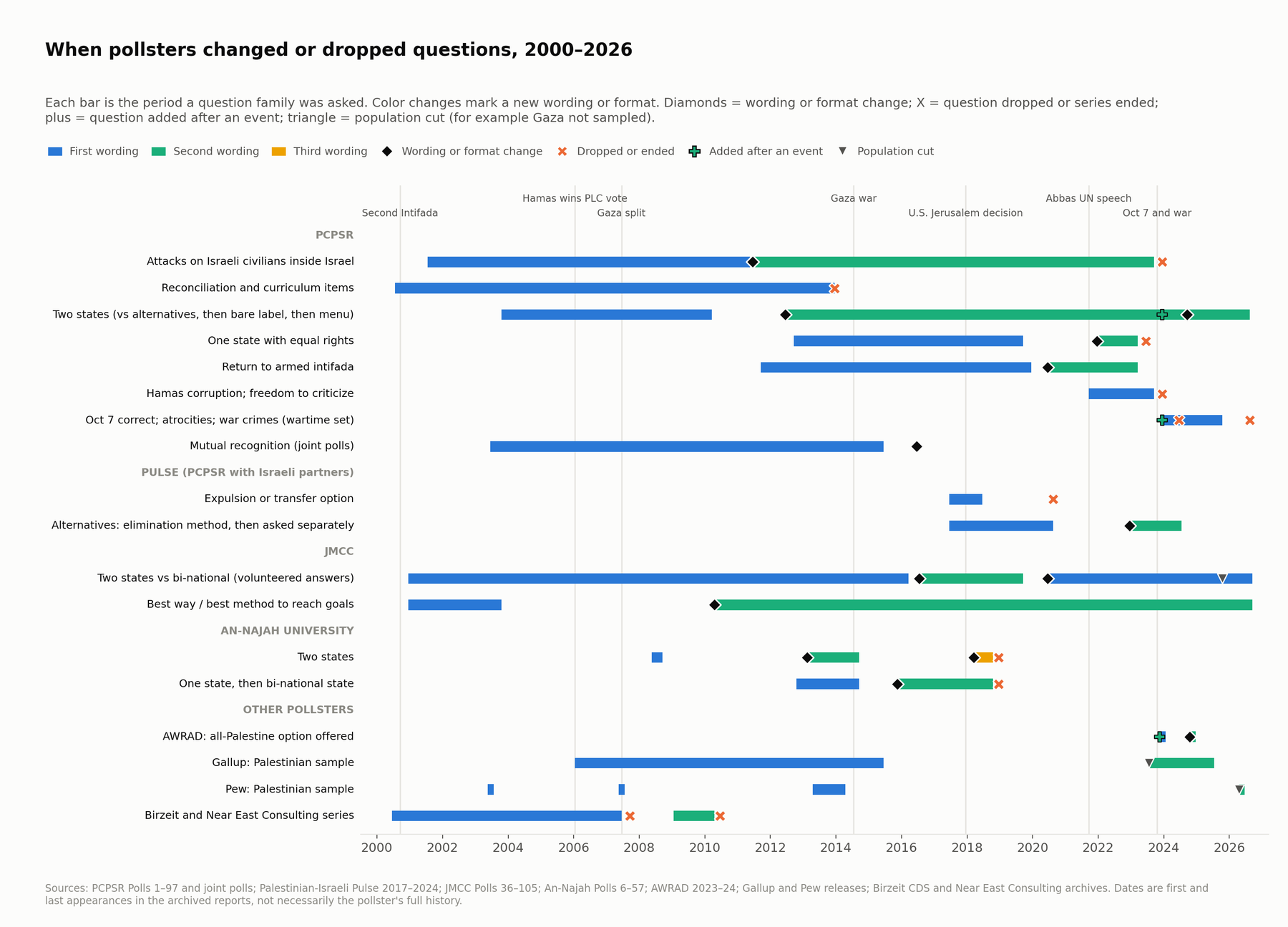
Bottom line
Pollsters rarely explain why a question disappears. In this archive, the only stated reasons are practical: safety and access in Gaza (PCPSR, JMCC, Gallup, Pew). No located document shows a question being dropped because of political pressure. There is, however, a documented record of pressure on pollsters: a mob ransacked PCPSR’s office over a 2003 refugee poll, the PA imposed reporting rules on NGOs in 2015, and in 2024 the Israeli army accused Hamas of falsifying a PCPSR poll. Timing also lines up with politics: new questions follow leaders’ statements and wars, and several sensitive items vanished at the October 2023 redesign. Timing is not proof of motive, so the log below separates stated reasons from context.
When questions change: six patterns
- After a shock, the questionnaire is rebuilt. The first post-October 7 PCPSR poll (No. 90, Nov–Dec 2023) dropped a whole block of items, including attacks on Israeli civilians, and added a wartime set (the October 7 decision, atrocities, war crimes). The 2014 Gaza war produced a special PCPSR poll; the 2017 U.S. Jerusalem decision produced new items at JMCC and An-Najah.
- Leaders’ statements become questions. After Mahmoud Abbas told the UN General Assembly on September 24, 2021 that “circumstances on the ground will inevitably impose equal and full political rights for all on the land of historical Palestine, within one state,” PCPSR began asking about it directly (from Poll 82, Dec 2021), “reflecting on the latest UN speech of president Abbas in which he described the situation on the ground in the West Bank as ‘apartheid’ and that the Palestinian people will demand equal rights in one state for two peoples.” → Jerusalem Post, Sep 24, 2021 · Poll 82, p. 5 (file not included in this release)
- Access and safety cut the population, not just the question. Gallup: “Gallup was not able to survey Gaza in 2024 because of ongoing security issues.” Pew (2026): “We are still unable to survey in Gaza,” and it “could not conduct fieldwork in the West Bank or Gaza in recent years due to security concerns.” JMCC’s September 2025 poll “did not include the Gaza Strip given the inability to provide a random sample due to the current circumstances in the Strip.” PCPSR kept Gaza but, “to ensure the safety of our data collectors,” sampled only areas without daily fighting and shelters. → Gallup, Sep 30, 2024 · Pew, Sep 15, 2026 · JMCC 104, p. 2 (file not included in this release) · PCPSR Poll 91, p. 2 (file not included in this release)
- Design changes to improve measurement. PCPSR moved from two states versus named alternatives (2003–2010) to a bare-label support question (from 2012), then added a three-option menu (from Sep 2024). The Pulse replaced its 2017–2018 “elimination” design with separate questions for each option (Dec 2022). JMCC replaced “only the Intifada / only negotiations / both” (2000–2003) with “negotiations / armed resistance / non-violent resistance” (from Apr 2010).
- Partners and funders change. PCPSR’s joint polls with Hebrew University’s Truman Institute ended with Joint Poll 56 (June 2015, supported by the Konrad Adenauer Stiftung). The Palestinian-Israeli Pulse (from 2016) was funded by the EU and the Netherlands (2017), the EU and Japan (2018), and the Netherlands and Japan through UNDP (2020–2024). PCPSR’s regular polls were done “in cooperation with the Konrad-Adenauer-Stiftung” through Poll 92 (June 2024) and “the Netherland Representative Office in Ramallah” in Polls 95 and 97. JMCC’s recent polls (2017–2026) name the Friedrich-Ebert-Stiftung as partner. No document links a funder to a specific question change.
- Whole series stop. Birzeit’s Center for Development Studies polls end in 2007, Near East Consulting’s monthly series in 2010, and An-Najah’s numbered polls in October 2018. None of the three archives gives a reason.
Change log, 2000–2026
| When | Pollster | Question family | What changed | Reason stated by the pollster | Context | Source |
|---|---|---|---|---|---|---|
| 2003 | PCPSR | Refugee survey (right of return) | No question change; the office was ransacked after PCPSR reported that about 10% of refugees would choose to live in Israel | — | Protesters said the right of return was non-negotiable. See the pressure section below. | Wikipedia: PCPSR · PCPSR refugee polls |
| 2007 | Birzeit CDS | Whole series | Last archived poll (No. 30) | None found | Hamas–Fatah split, June 2007 | Birzeit opinion polls |
| Apr 2010 | JMCC | Best way to reach national goals | Options changed from Intifada / negotiations / both to negotiations / armed resistance / non-violent resistance | None | End of the Second Intifada | JMCC 70, p. 4 (file not included in this release) |
| 2010 | Near East Consulting | Whole series | Monthly Palestinian Perception Polls end in the archive (Apr 2010) | None found | — | NEC Apr 2010 (file not included in this release) |
| Jun 2011 | PCPSR | Attacks on Israeli civilians | Reported as a four-point scale (“Concerning armed attacks against Israeli civilians inside Israel, I…”) instead of support/oppose summaries | None | — | Poll 40, p. 21 (file not included in this release) |
| 2012 | PCPSR | Two states | Bare-label “support or oppose the two-state solution” becomes the regular item | None | Stalled talks; the item later becomes PCPSR’s headline trend | Poll 44, p. 5 (file not included in this release) |
| Mar 2013 | An-Najah | Two states | ”Two states on the land of historic Palestine” (2008) becomes “the two-state solution provided that there will be a Palestinian state living side by side with Israel” | None | — | An-Najah Poll 46 |
| After Dec 2013 | PCPSR | Reconciliation after a peace deal; curriculum | Last appearance in the archived reports | None | — | Poll 50, p. 4 (file not included in this release) |
| Jun 2015 → 2016 | PCPSR joint polls | Mutual recognition; permanent-status package | Truman Institute joint series ends; the Pulse starts with new Israeli partners, a detailed package, and different items | None | New partners and funders | Joint Poll 56 (file not included in this release) · Pulse 2016–2018 final report |
| 2015 | PA | All NGOs | PA required NGOs, including PCPSR, to submit activities and funding to the cabinet for review | — | Oversight of civil society | Wikipedia: PCPSR |
| Nov 2015 | An-Najah | One state | ”One state on historic Palestine” / “one-state solution with equal rights” becomes “a binational state for Arabs and Jews … as a final solution” | None | Knife-attack wave; An-Najah adds armed and unarmed intifada items | An-Najah Poll 51 |
| Jul 2016 – Sep 2019 | JMCC | Volunteered answer | The unprompted all-Palestine answer is labeled “Historic Palestine”; “Palestinian State” returns in 2020 | None | — | JMCC 87, p. 6 (file not included in this release) · JMCC 96, p. 12 (file not included in this release) |
| 2018 | An-Najah; JMCC | Two states | After the U.S. Jerusalem decision, An-Najah asks whether two states are “still viable” instead of support; JMCC adds Jerusalem-decision items | None | U.S. recognition of Jerusalem, Dec 2017; embassy move, May 2018 | An-Najah Poll 56 · JMCC 91 (file not included in this release) |
| Oct 2018 | An-Najah | Whole series | Last numbered poll (No. 57) | None found | — | An-Najah Poll 57 |
| Aug 2020 | Pulse | Expulsion option | Dropped. The report says only that it “was not included in the current study and in all likelihood explains the rise of respondents who fall into the ‘other’ group” | None | Trump plan and annexation debate | Pulse Oct 2020, p. 6 (file not included in this release) |
| 2020 | PCPSR | Armed intifada | ”A return to an armed intifada” becomes “a return to armed confrontations and intifada” | None | — | Poll 78, p. 5 (file not included in this release) |
| Dec 2021 | PCPSR | One state | Reframed as support for Abbas’s position on one state with equal rights | Stated in the question: “reflecting on the latest UN speech of president Abbas” | Abbas’s UN speech, Sep 24, 2021 | Poll 82, p. 5 (file not included in this release) |
| Dec 2022 | Pulse | Alternatives to two states | Each option asked separately instead of by elimination | None | — | Pulse Jan 2023, p. 7 (file not included in this release) |
| Nov–Dec 2023 | PCPSR | Wartime redesign (Poll 90) | Dropped: attacks on Israeli civilians, Hamas corruption, freedom to criticize, reconciliation expectations, and others. Added: October 7 decision, atrocities, war crimes. One-off menu with “liberation of the entire historic Palestine” | Gaza sampling: safety of data collectors. No reason given for dropped items | October 7 attack and war | Poll 90 (file not included in this release) · PCPSR five-year question-retention audit — 2021–2026 |
| Nov 2023 → 2024 | AWRAD | All-Palestine option | ”A Palestinian state from the river to the sea” offered (74.7%); in late 2024 “State on the basis of historic Palestine” appears, recorded in December as “a spontaneous response” (20–22%) | None | War | AWRAD 2023, p. 23 (file not included in this release) · AWRAD Dec 2024, p. 25 (file not included in this release) |
| 2023 onward | Gallup | Population | Gaza not surveyed | ”Ongoing security issues” | War | Gallup, Sep 30, 2024 |
| After Jun 2024 | PCPSR | War crimes; video exposure | Paired war-crimes items and “saw the videos” item stop | None | — | PCPSR five-year question-retention audit — 2021–2026 |
| Aug–Sep 2024 | PCPSR | Data collection | IDF alleges Hamas falsified March 2024 results; PCPSR investigates and describes its tablet-based collection | ”There is absolutely no way for anyone to intercept the data or manipulate it” | Contested allegation (see below) | Poll 93, p. 2 (file not included in this release) |
| Sep 2025 | JMCC | Population | West Bank only (n=715) | “The inability to provide a random sample due to the current circumstances in the Strip” | War; Gaza returns in Sep 2026 (Poll 105) | JMCC 104, p. 2 (file not included in this release) |
| Aug 2026 | PCPSR | October 7 decision; atrocities | Not reported in Poll 97 after six repetitions | None | Ceasefire and postwar phase | Poll 97 (file not included in this release) |
| 2026 | Pew | Population | First Palestinian survey in years; West Bank and East Jerusalem only | ”Unable to survey in Gaza”; earlier gap “due to security concerns” | — | Pew, Sep 15, 2026 |
Political pressure on pollsters: what the record shows
- Palestinian Authority and street pressure (2003). PCPSR’s Ramallah office was ransacked after it reported that only about 10% of refugees would choose to live in Israel if offered the right of return, with alternatives such as compensation or settlement in a Palestinian state. Protesters said the right of return was non-negotiable. PCPSR kept publishing refugee research; no question was withdrawn as a result. → Wikipedia: PCPSR · Kent Kroeger, “Palestinian survey research group breaks through the noise and propaganda”
- PA oversight of NGOs (2015). The PA required all Palestinian NGOs, including PCPSR, to submit their activities and funding to the cabinet. No question change is tied to it in the record. → Wikipedia: PCPSR
- Hamas, per the Israeli army (2024). On August 29, 2024, the IDF published a document it said showed a Hamas official falsifying Gaza results in PCPSR’s March 2024 poll. Khalil Shikaki called it “highly unlikely,” possibly “a forgery or an attempt by someone to lie to get money,” and “part of the political and psychological warfare.” PCPSR’s own investigation found the document copied figures from PCPSR’s press release, and in “two out of nine questions” it gave totals rather than Gaza figures. Misbar also found translation gaps and arithmetic errors in the IDF material. The allegation is unproven either way. → Jewish Insider, Sep 2024 · PCPSR Poll 93, p. 2 (file not included in this release) · Misbar, Sep 4, 2024 · Jerusalem Post, Aug 29, 2024
- Wording as politics. Sponsors choose frames. The Washington Institute and INSS, a U.S. and an Israeli institute, ask about “all of historic Palestine,” Israel’s “right to exist,” and a state “without Jews”; Palestinian pollsters more often ask about negotiated options and read out two states and a bi-national state. Both kinds of question are legitimate, but they measure different things (see Two states versus the alternatives). Critics have also faulted some surveys in the region for undisclosed methods and sampling; Justin Gengler, for example, faulted Washington Institute Gulf samples in 2017. → Good Authority, Oct 27, 2017
- Timing that invites suspicion. The attacks-on-civilians item disappeared in the first post-October 7 poll, and the October 7 “correct” item disappeared once the war wound down. Both fit a practical explanation (limited questionnaire space, a move to war-specific items) and a political one (avoiding politically costly results). No public evidence settles which. PCPSR’s switch of partner from the Konrad Adenauer Stiftung to the Netherlands office falls between these changes but is not tied to either in any document.
How to use this log
Cite a series only across periods where the wording in this log is unchanged. When a question stops, report the last value with its date and say the question was dropped; do not carry it forward. When someone argues a pollster dropped a question for political reasons, ask for evidence beyond the timing.
Pollsters to watch
Organizations that poll Palestinians, Arab publics, or Israelis on the conflict often enough to track. Check these first for new releases. “Archived” means past reports are in Polls/Archive/.
Palestinian pollsters (West Bank and Gaza)
| Organization | How often | What to look for | Where to find new polls |
|---|---|---|---|
| Palestinian Center for Policy and Survey Research (PCPSR), Ramallah; director Khalil Shikaki | Quarterly regular polls since 2000 (No. 97 in Aug 2026); joint polls with Israeli partners | Two states, one state, means, armed attacks, Hamas and Fatah, October 7 items. The longest single series. Archived. | Regular-poll archive · site |
| Palestinian-Israeli Pulse (PCPSR with Israeli partners) | Roughly every one to two years, 2016–2024 | The same questions asked of Palestinians and Israelis; detailed peace package; the 2017–18 expulsion option | Released on the PCPSR site, e.g. Pulse 2024 |
| Jerusalem Media and Communication Centre (JMCC) | One to three polls a year in 2000–2016; about one a year since (No. 105 in Sep 2026) | Two states vs. a bi-national state; best method (negotiations, armed, non-violent) | Poll archive |
| Arab World for Research and Development (AWRAD), Ramallah | Several waves in 2023–2024 (Nov 2023; May, Aug, Oct, Dec 2024) | Final-status menus including “historic Palestine”; wartime Gaza conditions | Public opinion polls |
| Palestinian Center for Public Opinion (PCPO), Beit Sahour; Nabil Kukali | Several topical polls a year (Nos. 184–220 span 2014–2026); also fieldwork for the Washington Institute | Two-state items, peace talks, wartime topics | Polls |
| Institute for Social and Economic Progress (ISEP) | Several “Street Pulse” waves a year since 2024 | West Bank and Gaza wartime attitudes and governance. Reports sit behind a sign-up form, so none are archived. | Polls |
| An-Najah National University, Center for Opinion Polls and Survey Studies, Nablus | Numbered polls about twice a year from at least 2004 to 2018 (No. 57, Oct 2018); no later numbered release located | Two states side by side, one or bi-national state, negotiations, rockets and armed intifada. Archived (web releases and Polls 52–57 tables). | Unit page · search results |
| Birzeit University Center for Development Studies | About 30 polls, 2000–2007 | Intifada-era attitudes, suicide attacks, two states. Historical. Archived. | Opinion polls |
| Near East Consulting, Ramallah | Monthly Palestinian Perception Polls in the late 2000s | Support for a peace agreement. The archived run covers 2009–2010. | PPP surveys |
| Palestinian Peace Coalition / Geneva Initiative | Occasional | Two-state acceptance, often fieldwork by PCPSR | Geneva Initiative polls |
International and regional pollsters
| Organization | How often | What to look for | Where to find new polls |
|---|---|---|---|
| Arab Barometer (Princeton, with PCPSR as Palestinian partner) | A wave every two to three years; Palestine in most waves | Preferred solution; normalization; comparable data for other Arab publics. Data downloads require registration. | Palestine page · publications · data |
| Arab Opinion Index (Arab Center for Research and Policy Studies, Doha; English releases by Arab Center Washington DC) | Roughly every one to two years since 2011, plus special polls | Recognition of Israel and the Palestinian cause across about 15 Arab publics, including Palestine | Arab Opinion Index 2025 · AOI site, data and reports · Arab Center public-opinion surveys |
| Gallup World Poll | Most years (2006–2015, 2023–2025 for Palestinians) | Two-state support, whether peace will be achieved. West Bank and East Jerusalem only since 2023. | Palestinian Territory topic · Israel topic |
| Pew Research Center | Occasional Israeli and Palestinian surveys (2003, 2007, 2013–2014, 2026) | Whether Israel and a Palestinian state can coexist | Coexistence report, Sep 2026 · Global attitudes |
| Washington Institute for Near East Policy (David Pollock and colleagues; fieldwork by PCPO) | About annual since 2014 | Long-term goals (all of historic Palestine), Hamas, normalization, Gulf publics | 2023 polling data and analysis · What Do Palestinians Want? · Fikra Forum |
| Zogby Research Services (for the Tony Blair Institute and others) | Annual Palestine surveys 2023–2025 | Solution preferences and strategies by Gaza, West Bank, and East Jerusalem. Archived. | Zogby Research Services |
| Fafo (Norway) | Occasional, 2000s–2010s | Services, governance, negotiations | Fafo publication |
Israeli pollsters (for the mirror questions)
| Organization | How often | What to look for | Where to find new polls |
|---|---|---|---|
| Institute for National Security Studies (INSS), Tel Aviv | Monthly Israeli National Security Survey; annual West Bank Palestinian phone survey (2025, 2026) | Israeli views on Gaza, annexation, two states; Palestinian items on Israel’s right to exist | Latest findings · Palestinian survey 2026 |
| Israel Democracy Institute (IDI) | Monthly Israeli Voice Index | Israeli opinion on the war, a Palestinian state, and security | Israeli Voice Index · surveys and polls |
| Peace Index (IDI and Tel Aviv University) | Monthly, 1994–2018; archive only | Long Israeli series on negotiations and two states | Peace Index archive |
Not representative, use with care
-
Media website polls (for example Al Jazeera Arabic’s online votes): self-selected clicks, open to anyone and easy to flood. A 2015 Al Jazeera Arabic web poll reported 81% of more than 36,000 votes backing ISIS “victories”; it measures who clicked, not public opinion. Arabic outlets mostly republish PCPSR, JMCC, AWRAD, and Israeli polls, which are better read at the source. → Lowy Institute, 2015 · Jerusalem Post on a doctored poll shared by Al Jazeera Arabic, Aug 2024
-
MIFTAH (Palestinian Initiative for the Promotion of Global Dialogue and Democracy) hosts older copies of An-Najah and other Palestinian polls, for example An-Najah Poll 45. The site could not be reached for this note, so its copies were not archived.
-
IACA (International Academic Campaign against Israeli Occupation and Apartheid): electronic polls of a hand-picked sample of activists and academics, some outside Palestine. Archived, not cited as public opinion.
-
Advocacy-sponsored one-offs (for example, the 2011 Greenberg Quinlan Rosner poll for The Israel Project): check sponsor, fieldwork firm, sample, and full questionnaire before citing.
Reliability and methodological caveats
- Wording and options. See Two states versus the alternatives. The same pollster can get 28% or 56% for a 1967-borders state depending on whether a maximalist option is offered.
- Population. PCPSR, AWRAD, JMCC, and Arab Barometer sample the West Bank (usually including East Jerusalem) and Gaza. Pew and Gallup have surveyed only the West Bank and East Jerusalem since the war, and INSS only the West Bank. Gaza results often differ sharply from West Bank results. Since October 2023, Gazans have usually been less supportive of armed struggle and more supportive of negotiations.
- Mode and size. PCPSR, AWRAD, and Arab Barometer interview face to face. INSS 2025 (n=300) and INSS 2026 (n=400) used telephone interviews, with margins of error of about ±5.7 and ±4.9 points. AWRAD’s November 2023 wartime sample was 668.
- Sponsor and framing. The Washington Institute and INSS are U.S. and Israeli policy institutes; PCPSR, AWRAD, JMCC, and PCPO are Palestinian; the Arab Opinion Index is produced by the Doha-based Arab Center for Research and Policy Studies. Fieldwork for Washington Institute polls was done by the Palestinian Center for Public Opinion (Beit Sahour). Question framing differs across these sponsors, so compare within a series before comparing across series.
- Wartime fieldwork. Displacement, fear, and access limits affect every poll since October 2023. Arab Barometer VIII completed its Gaza interviews on October 6, 2023, the day before the attack, so it is the last clean pre-war baseline.
- Allegation about PCPSR data. On August 29, 2024, the IDF said documents from Hamas’s General Security Apparatus showed Hamas had manipulated results of PCPSR’s March 2024 poll “through on-the-ground influence.” The IDF stated there was no evidence of direct collaboration between Hamas and PCPSR. This is an allegation, not an established finding. No PCPSR response was located for this note. → Jerusalem Post, Aug 29, 2024
- Discontinued questions. See How pollsters change or remove questions and PCPSR five-year question-retention audit — 2021–2026: a question that stops being asked is an evidence gap, not a stable result.
- Volunteered answers. JMCC’s all-Palestine and Islamic-state answers were never read to respondents, so they understate how many would choose those outcomes if offered. Compare PCPSR’s October 2003 poll, which did offer all of historic Palestine (23%), with JMCC’s unprompted 13.3% the same month.
- Series breaks inside one pollster. PCPSR’s 2003–2010 items set two states against named alternatives, while its 2011–2026 item asks about the bare label. The two are charted differently for that reason. JMCC’s means question changed options in 2010, and its September 2025 poll covered the West Bank only.
- Non-probability samples. The IACA’s Poll 27 (May–June 2025) used a “purposive sample” of 559 mostly male, highly educated activists and academics, including respondents outside Palestine. It is archived but not cited as a measure of Palestinian opinion.
Poll PDF library
Primary reports downloaded September 27, 2026, stored in 60.1.7 Books & Documents/Polls/, plus earlier files already in the vault.
PCPSR regular polls (West Bank and Gaza)
- PCPSR Poll 3 - Dec 2001.pdf (file not included in this release) — reconciliation, curricula, armed attacks during the Second Intifada
- PCPSR Poll 89 - Sep 2023.pdf (file not included in this release) — last prewar poll; attacks on civilians inside Israel (Q70)
- PCPSR Poll 90 - Dec 2023.pdf (file not included in this release) — first post-October 7 poll; “liberation of the entire historic Palestine” (Q44, p. 27)
- PCPSR Poll 91 - Mar 2024.pdf (file not included in this release) — the poll named in the IDF allegation
- PCPSR Poll 92 - Jun 2024.pdf (file not included in this release) · PCPSR Poll 93 - Sep 2024.pdf (file not included in this release) · PCPSR Poll 95 - May 2025.pdf (file not included in this release) · PCPSR Poll 96 - Oct 2025.pdf (file not included in this release) · PCPSR Poll 97 - Aug 2026.pdf (file not included in this release)
- Poll_88_English_full_text_June_2023.pdf (file not included in this release) (earlier vault copy)
Joint Palestinian-Israeli polls
- PCPSR Joint Poll 56 - Jun 2015.pdf (file not included in this release) — two-state and mutual recognition trend, 2014–2015
- Palestinian-Israeli Pulse - Aug 2017.pdf (file not included in this release) · Palestinian-Israeli Pulse - Jun 2018.pdf (file not included in this release) — include the expulsion option
- Palestinian-Israeli Pulse - Oct 2020.pdf (file not included in this release) · Palestinian-Israeli Pulse - Jan 2023.pdf (file not included in this release) · Palestinian-Israeli Pulse - Sep 2024.pdf (file not included in this release)
Other Palestinian polls
- Arab Barometer 8 Palestine Report 1 - Oct 2023.pdf (file not included in this release) — pre-war baseline
- Arab Barometer 9 Palestine Report 1 - Jan 2026.pdf (file not included in this release) · Arab Barometer 9 Palestine Report 2 - Apr 2026.pdf (file not included in this release) — solutions and normalization
- JMCC Poll 76 - May 2012.pdf (file not included in this release) · JMCC Poll 79 - Mar 2013.pdf (file not included in this release)
- Poll_by_Arab_World_for_Research_2023.pdf (file not included in this release) — AWRAD, November 2023
- Polling_-_Washington_Institute_for_Near_East_Policy.pdf (file not included in this release) — July 2023 crosstabs, plus August 2023 Saudi and UAE results
- Polling_-_Plaestinian_Public_Onion_about_Terorrism.pdf (file not included in this release) — PCPSR results compiled 2002–2023
- Pew - Israelis and Palestinians Coexistence Report - Sep 2026.pdf (file not included in this release) · Pew - Israelis and Palestinians Coexistence Topline - Sep 2026.pdf (file not included in this release)
- PublicOpinion_in_the_Israeli-Palestinian_Conflict-_Public_Works.pdf (file not included in this release) — Jacob Shamir, USIP Peaceworks 60 (2007), joint polls 2000–2007
Not downloadable as PDFs: Gallup and INSS results are published as web pages. (The Arab Opinion Index’s English “in brief” reports are PDFs and are now archived; its fuller Arabic reports were not downloaded.) The Washington Institute’s June 2014 poll slideshow (/uploads/Documents/other/PalestinianPollingReport_June2014.pdf) now returns a 404 error.
Archive — second round (September 28, 2026)
Downloaded from the links in Palestinian poll URLs since 2000.csv (file not included in this release) and stored in 60.1.7 Books & Documents/Polls/Archive/, one subfolder per pollster. Files are renamed “Pollster Poll N - Mon YYYY” where the fieldwork date could be read from the report.
| Folder | Files | Coverage | Used in this note for |
|---|---|---|---|
JMCC | 63 | Polls 36–105, Mar 2000–Sep 2026 (English releases) | Preferred-solution series; means series |
PCPSR | 95 | Polls 1–87 with gaps (2000–2023), exit and special polls, joint Pulse summaries, elite polls, Pulse data tables (.xlsx), 2019 policy report | Two-state series; attacks on civilians; reconciliation and curricula |
An-Najah | 44 | Web releases of Polls 6–57 (2004–2018, with gaps) saved as text, plus full tables for Polls 52–57 (.doc) | Two states side by side; one or bi-national state; negotiations; armed action |
Birzeit CDS | 90 | Birzeit University opinion polls, 2000–2007 (reports, highlights, detailed tables) | Suicide attacks; 2006 two-state and bi-national items; right of return |
Near East Consulting | 10 | Palestinian Perception Polls, Jan 2009–Apr 2010 | Support for a peace agreement |
PCPO | 35 | Palestinian Center for Public Opinion Polls 184–220, 2014–2026 | Two-state items 2014 and 2025; peace talks 2015 |
AWRAD | 3 | May, Oct, and Dec 2024 | Solution menus with a historic-Palestine option |
Zogby | 4 | Zogby Research Services for the Tony Blair Institute, 2023–2025; Sep 2024 | Solution preferences by region |
Geneva | 5 | Palestinian Peace Coalition polls, 2022–2026 | West Bank two-state acceptance, Apr 2026 |
Arab Barometer | 3 | Palestine reports 2019, VII (2021–22), VIII Part II | Background; normalization |
Arab Opinion Index | 9 | Arab Opinion Index “in brief” reports, 2011 to 2024/25 (Arab Center for Research and Policy Studies, Doha) | Regional comparison: recognition of Israel by country; whether the Palestinian cause is an Arab cause |
Gallup · Fafo · Pew · IACA | 5 | Gallup 2009–2010 reports; Fafo 2010; Pew 2003; IACA Poll 27 | Peace process 2010; negotiations 2010 |
Not archived: 62 SPSS (.sav) data files; 72 Arabic duplicates of JMCC releases; the ISEP “Perceptions in Palestine” reports, whose download requires submitting a personal-data form; and six PCPO files that return 404 (Polls 212–215, a Gaza war field study, one full report). The Geneva Initiative’s March 2024 poll is archived but is an image-only PDF with no extractable text, so it is not cited. Copies of every downloaded file also remain in Downloads.
Sources — peace, solutions, and regional polling
Palestinian polls
- PCPSR, Public Opinion Poll No. 3, Dec 19–24, 2001 — https://www.pcpsr.org/en/node/252
- PCPSR–Truman Institute, Joint Poll 8, June 2003 — https://www.pcpsr.org/en/node/453
- PCPSR–Truman Institute, Joint Poll 17, September 2005 — https://www.pcpsr.org/en/node/438
- PCPSR–Truman Institute, Joint Poll 32, June 2009 — https://www.pcpsr.org/en/node/412
- PCPSR–Truman Institute, Joint Poll 50, December 2013 — https://www.pcpsr.org/en/node/378
- PCPSR–Truman Institute, Joint Poll 56, June 2015 — https://www.pcpsr.org/en/node/611
- Palestinian-Israeli Pulse, 2017 — https://www.pcpsr.org/en/node/696
- Palestinian-Israeli Pulse, 2018 — https://www.pcpsr.org/en/node/731
- Palestinian-Israeli Pulse, 2020 — https://www.pcpsr.org/en/node/823
- Palestinian-Israeli Pulse, 2022 — https://www.pcpsr.org/en/node/928
- Palestinian-Israeli Pulse, 2024 — https://pcpsr.org/en/node/989
- PCPSR Poll 96, October 2025 — https://www.pcpsr.org/en/node/1000
- PCPSR Poll 97, August 2026 — https://www.pcpsr.org/en/node/1014
- Arab Barometer IX in Palestine, Report 1 — https://pcpsr.org/en/node/1006
- Arab Barometer IX in Palestine, Report 2 — https://pcpsr.org/en/node/1010
- Arab Barometer VIII Palestine Report, Part I — https://www.arabbarometer.org/wp-content/uploads/Arab-Barometer-PSR-Palestine-Report-Part-I-EN-.pdf
- JMCC Poll 76, May 2012 — https://www.jmcc.org/en/File/6f72y28530Y6f72/Poll-No-76-May-2012---Political-Leadership,-Corruption-and-Freedom-of-Speech
- JMCC Poll 79, March 2013 — https://www.jmcc.org/en/File/644dy25677Y644d/Poll-No-79,-March-2013---Reconciliation,-Obama-Visit-and-Security-Coordination
- AWRAD, Gaza war poll tables, November 2023 — https://www.awrad.org/files/server/polls/polls2023/Public%20Opinion%20Poll%20-%20Gaza%20War%202023%20-%20Tables%20of%20Results.pdf
- INSS, Palestinian Public Opinion in the West Bank, September 2025 — https://www.inss.org.il/publication/survey-palestinians/
- INSS, Palestinian Public Opinion Survey, 2026 — https://www.inss.org.il/publication/survey-palestinians-2026/
- Pew Research Center, “Many Israelis and Palestinians Say They Cannot Coexist Peacefully – and Explain Why,” Sep 15, 2026 — https://www.pewresearch.org/global/2026/09/15/many-israelis-and-palestinians-say-they-cannot-coexist-peacefully-and-explain-why/
- Pew Research Center, Views of a Changing World 2003 — https://www.pewresearch.org/global/2003/06/03/views-of-a-changing-world-2003/
- Pew Research Center, 2007 Global Attitudes, ch. 5 — https://www.pewresearch.org/global/2007/06/27/chapter-5-views-of-the-middle-east-conflict/
- Gallup, “Dim Outlook for Peace in the Middle East,” Sep 30, 2024 — https://news.gallup.com/poll/650636/dim-outlook-peace-middle-east.aspx
- Gallup, “Peace Still a Distant Prospect for Israelis, Palestinians,” Sep 29, 2025 — https://news.gallup.com/poll/695582/peace-distant-prospect-israelis-palestinians.aspx
- Washington Institute, June 2014 poll — https://www.washingtoninstitute.org/policy-analysis/new-palestinian-poll-shows-hardline-views-some-pragmatism-too
- Washington Institute, June 2015 poll — https://www.washingtoninstitute.org/policy-analysis/long-term-palestinian-views-israel-two-states-now-one-state-later
- Washington Institute, June–July 2019 poll — https://www.washingtoninstitute.org/policy-analysis/half-palestinians-still-want-all-palestine-most-would-compromise-less
- Washington Institute, January–February 2020 poll — https://www.washingtoninstitute.org/policy-analysis/palestinian-majority-rejects-two-state-solution-backs-tactical-compromises
- Washington Institute, June 2022 Gaza poll — https://www.washingtoninstitute.org/policy-analysis/new-poll-shows-gazans-pragmatic-now-not-long-term
- Washington Institute, “What Do Palestinians Want?” (2014–2020 overview), Jul 23, 2021 — https://www.washingtoninstitute.org/policy-analysis/what-do-palestinians-want
- Jerusalem Post, “6 in 10 Palestinians reject 2-state solution, survey finds” (Greenberg poll, 2011) — https://www.jpost.com/diplomacy-and-politics/6-in-10-palestinians-reject-2-state-solution-survey-finds
- Jacob Shamir, Public Opinion in the Israeli-Palestinian Conflict, USIP Peaceworks 60 (2007) — vault PDF above
Second-round sources (archived PDFs in Polls/Archive/)
- An-Najah National University, Center for Opinion Polls and Survey Studies, Polls 32–57 (2008–2018) — https://www.najah.edu/en/search/?q=Public+Opinion+Poll (individual releases linked in the An-Najah tables)
- JMCC poll archive, English, 2000–2026 — https://www.jmcc.org/en/Category/4/polls
- JMCC Poll 105, September 2026 — https://www.jmcc.org/en/File/29187y168327Y29187/Poll-NO105-Marking-Three-years-since-the-events-of-October-7-2023
- PCPSR full-text polls (file store) — https://www.pcpsr.org/sites/default/files/ (for example, Poll 9: https://www.pcpsr.org/sites/default/files/p9epdf.pdf)
- PCPSR, final policy report on two-state support 2006–2018, January 2019 — https://www.pcpsr.org/sites/default/files/Final%20policy%20report%20English%20Jan2019.pdf
- Birzeit University Center for Development Studies, opinion polls 2000–2007 — https://cds.birzeit.edu/opinion-polls/
- Near East Consulting, Palestinian Perception Polls 2009–2010 — https://www.neareastconsulting.com/surveys/all/files/2009/pppdec2009fin.pdf (December 2009 example)
- Palestinian Center for Public Opinion, poll archive — https://pcpo.org/polls/
- AWRAD, October 2024 poll — https://www.awrad.org/files/server/polls/October%202024%20Poll/AWRAD%20Public%20Opinion%20Poll%20-%20English%20-%20Main%20Results%20-%20October%202024.pdf
- AWRAD, December 2024 poll — https://www.awrad.org/files/server/polls/December%202024/AWRAD%20Public%20Opinion%20Poll%20-%20English%20-%20Main%20Results%20-%20December%202024.pdf
- AWRAD, May 2024 press release — https://www.awrad.org/files/server/polls/Poll%202024/AWRAD%20-%20Press%20Release%20-%20Palestinian%20Public%20Opinion%20Poll%20-%20May%202024.pdf
- Geneva Initiative, Palestinian polls — https://geneva-accord.org/polls/ ; April 2026 West Bank poll — https://geneva-accord.org/wp-content/uploads/2026/05/Perceptions-and-Attitudes-towards-the-Two-State-Solution-in.pdf
- Fafo, Surveying Palestinian Opinion, February and May 2010 — https://fafo.no/images/pub/2010/10111.pdf
- Gallup, Measuring the State of Muslim-West Relations (2010) — https://news.gallup.com/file/poll/144959/MWRelations_2010_report.pdf
- Gallup Palestinian results, 2006–2015 — https://news.gallup.com/poll/21163/gallup-palestinian-survey-reveals-broad-discontent-status-quo.aspx · https://news.gallup.com/poll/103426/palestinians-broadly-support-peace-process.aspx · https://news.gallup.com/poll/161456/israelis-palestinians-pro-peace-process-not-hopeful.aspx · https://news.gallup.com/poll/186536/palestinians-poor-prospects-peace-security.aspx
- Pew Research Center, May 9, 2013 — https://www.pewresearch.org/global/2013/05/09/despite-their-wide-differences-many-israelis-and-palestinians-want-bigger-role-for-obama-in-resolving-conflict/ ; Jun 25, 2014 — https://www.pewresearch.org/global/2014/06/25/mounting-pessimism-about-two-state-israeli-palestinian-solution/
- Washington Institute, Jul 23, 2015 — https://www.washingtoninstitute.org/policy-analysis/new-poll-shows-most-palestinians-practical-progress-tactical-compromises-israel ; Jun 27, 2017 — https://www.washingtoninstitute.org/policy-analysis/palestinian-publics-tough-choices-violence-instability-hamas-jewish-state ; Jun 7, 2017 — https://www.washingtoninstitute.org/policy-analysis/surprising-opinions-palestinians
- Zogby Research Services for the Tony Blair Institute, Palestine 2023, 2024, 2025; Zogby, Palestinian poll September 2024 — archived PDFs
Regional polls
- Arab Center Washington DC, Arab Opinion Index 2025 — https://arabcenterdc.org/resource/arab-opinion-index-2025/
- Arab Center Washington DC, Arab Opinion Index 2022 executive summary — https://arabcenterdc.org/resource/arab-opinion-index-2022-executive-summary/
- Arab Center Washington DC, Arab Public Opinion about Israel’s War on Gaza (Jan 2024) — https://arabcenterdc.org/resource/arab-public-opinion-about-israels-war-on-gaza/
- Arab Center for Research and Policy Studies (Doha), Arab Opinion Index “in brief” reports 2011, 2012/13, 2014, 2015, 2016, 2017/18, 2019/20, 2022, 2024/25 — archived PDFs; index at https://arabindex.dohainstitute.org/EN/Pages/About.aspx; 2024/25 report at https://www.dohainstitute.org/en/Lists/ACRPS-PDFDocumentLibrary/arab-index-2025-in-brief-en.pdf
- Arab Barometer, “How Do MENA Citizens View Normalization With Israel?” (Sep 12, 2022) — https://www.arabbarometer.org/2022/09/how-do-mena-citizens-view-normalization-with-israel/
- Pew Research Center, “Mounting Pessimism about Two-State Israeli-Palestinian Solution” (Jun 25, 2014) — https://www.pewresearch.org/global/2014/06/25/mounting-pessimism-about-two-state-israeli-palestinian-solution/
- Pew Research Center, “Concerns about Islamic Extremism on the Rise in Middle East” (Jul 1, 2014) — https://www.pewresearch.org/global/2014/07/01/concerns-about-islamic-extremism-on-the-rise-in-middle-east/
- Washington Institute, “Polls Show Majority of Gazans Were Against Breaking Ceasefire; Hamas and Hezbollah Unpopular Among Key Arab Publics” (Oct 10, 2023) — https://www.washingtoninstitute.org/policy-analysis/polls-show-majority-gazans-were-against-breaking-ceasefire-hamas-and-hezbollah
- Washington Institute, “New Poll Sheds Light on Saudi Views of Israel-Hamas War” (Dec 21, 2023) — https://www.washingtoninstitute.org/policy-analysis/new-poll-sheds-light-saudi-views-israel-hamas-war
- Arab Barometer, “How the Gaza War is Shaping MENA Public’s Support for the Two-State Solution” (Jan 2025) — https://www.arabbarometer.org/2025/01/support-for-the-two-state-solution-is-shifting-unexpectedly/
- Arab Barometer, “MENA Publics and the Future of Normalization with Israel” (Jan 2025) — https://www.arabbarometer.org/2025/01/14619/
- Arab Barometer, Wave IX data in the Munich Security Conference 2026 report — https://www.arabbarometer.org/media-news/arab-barometer-wave-ix-data-featured-in-munich-security-2026-report/
- Washington Institute, “Arab Public Opinion on Arab-Israeli Normalization and Abraham Accords,” Jul 15, 2022 — https://www.washingtoninstitute.org/policy-analysis/arab-public-opinion-arab-israeli-normalization-and-abraham-accords
News coverage and commentary (secondary)
- Times of Israel, “Pew poll finds majority of Israelis and Palestinians say two-state coexistence impossible,” Sep 20, 2026 — https://www.timesofisrael.com/pew-poll-finds-majority-of-israelis-and-palestinian-say-two-state-coexistence-impossible/
- Jerusalem Post, INSS 2026 survey coverage, Sep 16, 2026 — https://www.jpost.com/middle-east/article-908818
- Center for Security Policy, commentary on the AWRAD November 2023 poll — https://centerforsecuritypolicy.org/palestinian-poll-shows-overwhelming-support-for-terrorism-and-suggests-that-international-attention-is-misplaced/
- Jerusalem Post, “Hamas falsifies Palestinian Survey Research Institute polls, IDF finds,” Aug 29, 2024 — https://www.jpost.com/israel-hamas-war/article-817000
- Haaretz, “A Grim Poll Shows Most Jewish Israelis Support Expelling Gazans,” Jun 3, 2025 — https://www.haaretz.com/israel-news/2025-06-03/ty-article/.premium/a-grim-poll-shows-most-jewish-israelis-support-expelling-gazans-its-brutal-and-true/00000197-3640-d9f1-abb7-7e742b300000
- Haaretz, “64% of Israelis See No Need for More Reporting on Gazans’ Sufferings,” Ido David Cohen, Jun 10, 2025 (aChord Center poll) — https://www.haaretz.com/israel-news/2025-06-10/ty-article/.premium/64-of-israelis-see-no-need-for-more-reporting-on-gazans-sufferings/00000197-59e8-deed-a9bf-5def9d770000 · archive: http://archive.today/LlGFE
- Pew Research Center, “Israeli Views of the Israel-Hamas War,” May 30, 2024 — https://www.pewresearch.org/global/2024/05/30/israeli-views-of-the-israel-hamas-war/ · report PDF: https://www.pewresearch.org/wp-content/uploads/sites/20/2024/05/pg_2024.05.30_israeli-views-war_report.pdf · topline PDF: https://www.pewresearch.org/wp-content/uploads/sites/20/2024/05/pg_2024.05.30_israeli-views-war_topline.pdf
Clippings and earlier links
PewForum-The_Worlds_Muslims.pdf (file not included in this release)
Polling-Washington_Institute_for_Near_East_Policy.pdf (file not included in this release)
Polling-Plaestinian_Public_Onion_about_Terorrism.pdf (file not included in this release)
Public_Opinion_in_the_Israeli-Palestinian_Conflict-_Public_Works.pdf (file not included in this release)
Poll_88_English_full_text_June_2023.pdf (file not included in this release)
Poll_by_Arab_World_for_Research_2023.pdf (file not included in this release)
twitter.com/EFischberger/status/1734953024630526327?t=l0Ixslg9rx3LzqTESE5dWw&s=19
A New Poll of Palestinians: Supporting Terror and Rejecting Peace
8dgwuowqq15c1.jpg (image unavailable)
Public Opinion Poll No (88) | PCPSR
Over 70 Percent of Palestinians Support Hamas’s October 7 Terror Attack | National Review
Press Release: Public Opinion Poll No (92) | PCPSR
- 73% of respondents answered that Hamas made the right decision by going to war on October 7 - the highest figure for this question since the war began.
- 96% of Palestinians who did not watch the videos from October 7 do not believe that Hamas committed atrocities against Israeli civilians.
- 54% of Palestinians who saw the videos from October 7 do not believe that Hamas committed atrocities against Israeli civilians.
- 79% of respondents believe that Hamas will win the war - the highest rate since the war began.
- 61% of respondents prefer that Hamas continues to control the Strip after the war (71% of West Bank residents and 46% of Gaza residents prefer this).
- In a hypothetical presidential election between Mahmoud Abbas and Ismail Haniyeh, Mahmoud Abbas would receive 5% of the votes and Ismail Haniyeh 46% of the votes. 46% announced they would not vote in the election.
- Support rates for Hamas and Fatah in general elections:
- 17% would support Fatah
- 41% would support Hamas
- Only 32% of respondents support a two-state solution.
- 52% support armed struggle as a way to end the occupation and establish an independent Palestinian state.Open: GZ8w44KXcAAFmSc.jpeg