⬅️ Key Arguments (MOC) · Timeline: 1800-1899 · 1900-1948 · Debate card: Arguments notes · Related: Israel · Palestine
Bottom line
The narrow claim is true; the sweeping version is misleading. Chattel slavery existed in Ottoman Palestine, and local Arab notables and Bedouin shaykhs participated in slaveholding and trafficking within an Ottoman imperial system. By 1905 it had become a small, declining institution, but British Mandate investigations in 1931–1933 documented slavery-like hereditary servitude and long-term domestic-service contracts involving Black girls from communities descended from enslaved Africans. There was no sovereign Palestinian government before 1948 that “ran” this system. Nor was it exclusively Arab: Ottoman officials and at least one documented Jewish household also held enslaved people. After the 1948 war, the remaining master–servant relationship among Black and white Bedouin in the Israeli Negev collapsed. That supports saying that Israel’s creation ended the surviving local servile order, but not that Israel passed a single, identifiable emancipation law in 1948.
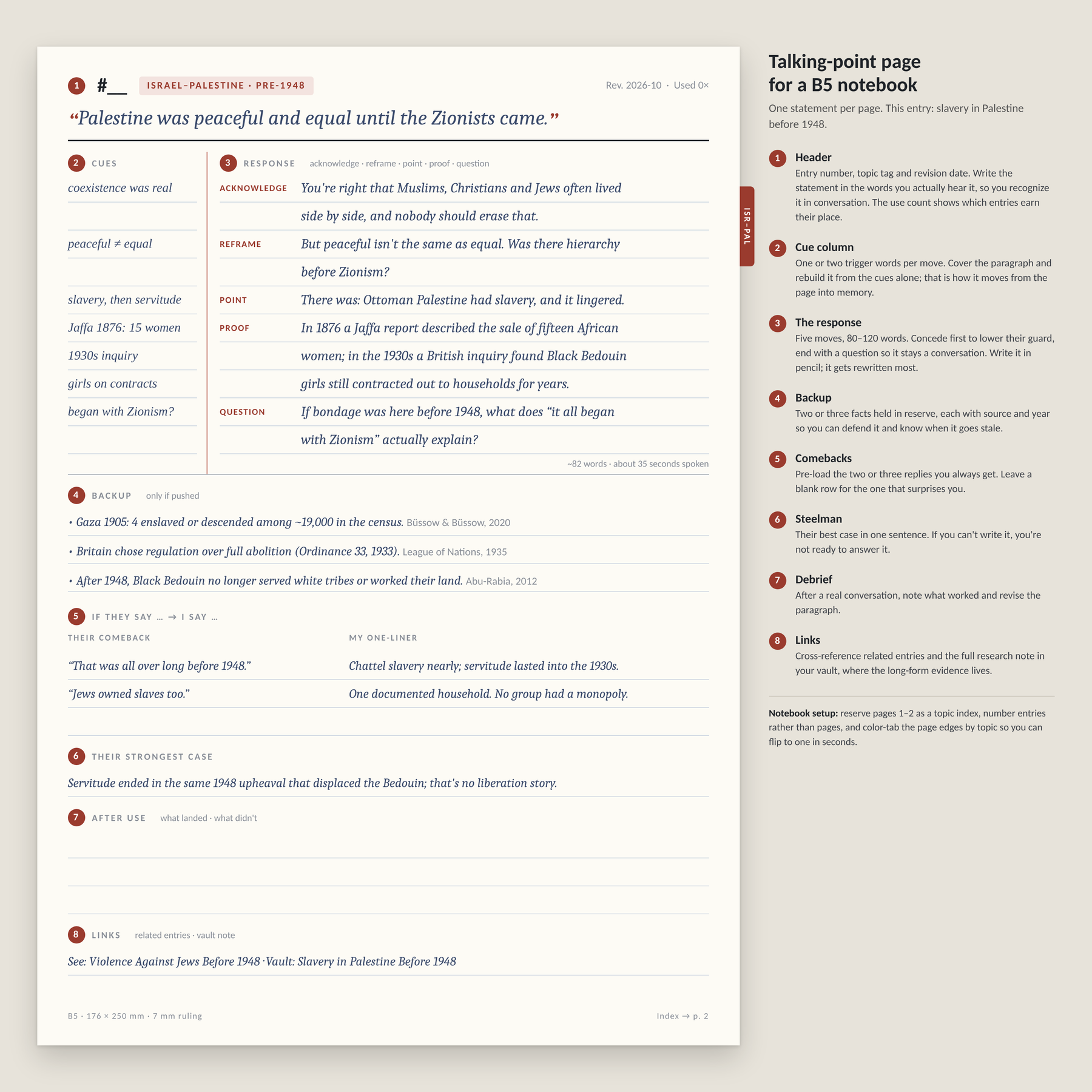
Notebook page (B5)
Polemic page against the myth of a pre-1948 “land of equals”: dated evidence ladder from 1876 to after 1948, the turn, concessions, traps and ripostes, a thirty-second version and the closing line. Source: HTML (file not included in this release) · Earlier version: talking-point page.

Polemical version that survives fact-checking
“Before Israel existed, slavery was not a Zionist invention or a metaphor: Ottoman records and local testimony document Africans held in Palestinian households, an 1876 report described a public slave trade in Jaffa, an 1880 Egyptian police record described Bedouin smuggling Sudanese women and children for sale in Gaza, and a British inquiry in the 1930s found Black Bedouin families still bound by hereditary servitude while girls were contracted to urban households for years at a time. British officials regulated the practice but explicitly declined to abolish it completely. The 1948 rupture destroyed the remaining master–servant order in the Negev; scholarship reports that Black Bedouin thereafter no longer served the white landowning tribes or worked their land. So the defensible historical irony is this: the Jewish state did not introduce bondage into Palestine—it inherited the remnants of a servile order and, through the new post-1948 order, brought the institution to an end. That is not proof of a single Israeli abolition decree, and it does not excuse displacement or discrimination, but it is fatal to romantic stories of an egalitarian pre-Israel Palestine.”
Claim audit
| Claim | Verdict | Why |
|---|---|---|
| “There was slavery in Palestine before 1948.” | True. | Ottoman censuses, local memoirs, travel accounts, police reporting, and British/League of Nations records document chattel slavery and later servile dependencies. |
| “Palestinians ran slavery.” | Needs qualification. | Local Arab households and Bedouin tribes participated, but Palestine was under Ottoman and then British rule; there was no sovereign Palestinian state. The practice was not universal and was concentrated among officials, wealthy households, and some tribal elites. |
| “Slavery was still widespread in 1948.” | Not established. | A census-based study concludes that formal slavery had “almost disappeared” by 1905. The strongest later evidence concerns residual hereditary servitude and long domestic contracts, not a mass slave economy. |
| “The British abolished it before Israel.” | Only partly. | The Mandate denied legal recognition to slavery and restricted abusive contracts, but its own 1935 report says officials declined to abolish the girls’ system completely. |
| “Israel abolished slavery in 1948.” | Too strong as a legal claim. | No specific 1948 Israeli emancipation statute has been identified in the sources reviewed. |
| “Israel’s creation ended the surviving servile institution.” | Substantially supported, with a causal caveat. | Post-1948 scholarship says Black Bedouin no longer served white Bedouin or worked their lands. War, expulsion, land loss, resettlement, urbanization, citizenship, and the new legal order jointly broke the old relationship. |
What the historical record shows
Late Ottoman Palestine: real slavery, already declining
Sarah and Johann Büssow’s census-based study is the most useful corrective to both denial and exaggeration. They note that the Ottoman state restricted the slave trade without immediately abolishing ownership; possession and use therefore continued into the early twentieth century, although on a smaller scale in Palestine than in Egypt.
The study documents several concrete cases:
- Jaffa, 1876: a German Templer periodical reported that the slave trade was conducted openly and that status-conscious families sought Black slaves; another report described the sale of fifteen enslaved African women.
- Gaza, circa 1880: an Egyptian police document described Bedouin smugglers bringing Sudanese women and children from Egypt and selling them in Gaza.
- Dayr Ghassana, 1887: the household of a leading local Arab family included Shamsiyya, a Sudanese woman registered as a cariye—a term commonly used for a female slave or concubine. She was the only enslaved person or servant recorded in that village sample, underscoring both the reality and the limited scale.
- Gaza, 1905: among about 19,000 people covered by the surviving census registers, the researchers identified thirty domestic workers, including four people who had been enslaved or descended from enslaved people. One Ethiopian-born woman, Qalbi, worked in the household of Husayn al-Husayni, a member of a prominent Gaza family.
The authors’ conclusion matters: by 1905 slavery had become a niche phenomenon; only a few enslaved people appeared in Palestinian Muslim households; and the institution had “almost disappeared.” Their sample indicates that slaveholding or dependent domestic service was concentrated among high-ranking Ottoman officials and a small number of very wealthy local Arab Muslim households—not Palestinian society as a whole.
Sources: Büssow and Büssow, “Domestic Workers and Slaves in Late Ottoman Palestine,” draft pp. 1–2, 5–7, 27–29, 38–40; published chapter, pp. 373–433, DOI.
Cross-communal evidence: do not turn history into collective blame
The institution was neither created nor practiced by one modern nationality. Glass and Kark reconstruct the case of Sarah La Preta, an Ethiopian girl enslaved in nineteenth-century Jerusalem who entered the Jewish Valero household and was later manumitted, although she remained a domestic servant. The authors treat the case as unusually well documented, not as proof that Jewish households generally held slaves.
That evidence improves the argument rather than weakening it: the defensible target is an Ottoman-era institution and the elites who participated in it, not “the Palestinians” or “the Arabs” as a timeless collective. Likewise, one Jewish household does not make slavery a “Jewish practice.”
Source: Glass and Kark, “Sarah La Preta: A Slave in Jerusalem,” Jerusalem Quarterly 34.
The Mandate: legal denial, partial regulation, surviving servitude
British officials repeatedly said that slavery lacked legal recognition in Palestine and initially treated that as a reason not to enact a general abolition measure. The more difficult reality appeared in a 1931 inquiry into Black Bedouin communities and girls working in Nablus, Jenin, and other towns.
The League of Nations’ 1935 report records that:
- an “ancient practice” survived in Nablus and Jenin, under which parents hired young girls to urban households for long periods in exchange for money paid in advance;
- the girls came mainly from Jordan Valley Bedouin communities and were usually children of Black retainers attached to tribal shaykhs;
- the government decided not to abolish the system completely, citing fear that the girls would otherwise become destitute;
- the Employment of Females Ordinance No. 33 of 1933 instead made unenforceable contracts involving girls under seventeen when the term exceeded one year or payment went to someone other than the girl.
Margaret Nixon’s appended welfare report is even more revealing. It described the Abeed communities as formerly enslaved Africans who were “slaves no longer” yet remained under “a certain amount of servitude.” A person leaving one tribe for another could be returned; tents, camels, and weapons had to be left behind as tribal property; intermarriage with white Bedouin was barred; and some girls began domestic service at eight or nine. Nixon also reported that many girls were fed and clothed and did not ask to leave. That paternalistic observation does not erase the coercive structure: childhood contracting, advance payment to parents, restricted exit, hereditary status, and unpaid labor are precisely why officials treated the practice as analogous to slavery.
Sources: League of Nations, Slavery: Report of the Advisory Committee of Experts, Second Session (1935), paras. 36–41 and appendices 13–14; Assaf Likhovski, Law and Identity in Mandate Palestine, pp. 87–93 (publisher page).
Did Israel stop it?
What is directly supported
Safa Abu-Rabia’s oral-history study of Black and white Bedouin women in the Naqab describes the pre-1948 Black population as people bought or kidnapped from Africa and attached to landowning tribes as servants. She states that the racial hierarchy persists, despite the fact that Black Bedouin no longer serve white Bedouin or work on their lands. Her interviews link the white tribes’ loss of land and post-1948 resettlement to the loss of mastery over servants. In the same chapter, former masters remember their prewar status while formerly enslaved families reconstruct identities of their own.
This establishes a before-and-after discontinuity: the surviving labor relationship existed before 1948 and had ended afterward. It also shows that emancipation was incomplete in a wider social sense. Racial language, marriage barriers, segregation, and lower status survived the end of coerced service.
Source: Safa Abu-Rabia, “Is Slavery Over? Black and White Arab Bedouin Women in the Naqab (Negev),” in Struggle and Survival in Palestine/Israel, pp. 271–288 (DOI; accessible book PDF, chapter at PDF pp. 210–221).
The causal limit
The sources do not identify an Israeli army order or 1948 statute announcing emancipation. The old relationship was broken by a violent transformation: war, expulsion and flight, the destruction of the land base on which tribal mastery rested, military rule, resettlement, urbanization, and incorporation into a modern state and labor market. It is therefore safer to say:
Best historical formulation
“Israel’s establishment and the post-1948 transformation ended the surviving institution of hereditary servitude inside Israel; the evidence reviewed does not establish that this happened through a single purpose-built abolition law.”
Israel later joined the formal international anti-slavery regime: the United Nations records its participation in the amended 1926 Slavery Convention in 1955, and an Israeli report to the UN records ratification of the 1956 Supplementary Convention in 1957. Modern Israeli law criminalizes holding a person under conditions of slavery, but that later law should not be projected backward as the cause of the 1948 transition.
Sources: UN Treaty Collection — Israel and the amended Slavery Convention, 12 September 1955; Israel’s 1998 report to the Human Rights Committee, treaty status and domestic-law discussion.
The argument, built correctly
- Reject the false idyll. Pre-1948 Palestine was not a timeless society of equality and coexistence. It contained ordinary hierarchies of empire, class, sex, race, and bondage.
- Name the institution precisely. Nineteenth-century evidence concerns actual slave ownership and trafficking. By the 1930s, the strongest evidence concerns residual hereditary servitude and long-term domestic contracts rather than a large open slave market.
- Name the actors precisely. Ottoman officials, wealthy local households, Bedouin tribal elites, traffickers, and at least one Jewish household appear in the record. A whole people did not act as a single slaveholder.
- Contrast British caution with the post-1948 result. The Mandate regulated one practice and explicitly declined full abolition; after 1948, the master–servant relationship itself disappeared inside Israel.
- Do not sanitize the mechanism. The same upheaval involved Palestinian dispossession and long military rule over Arab citizens. Ending one oppressive institution does not morally settle the war or every policy that followed.
- State the conclusion at the right level. Israel’s establishment marked the end of the surviving servile order, even though the sources do not show a clean 1948 emancipation statute or a single benevolent causal mechanism.
Objections and replies
| Objection | Best reply |
|---|---|
| “Slavery had already disappeared before 1948.” | Formal chattel slavery was nearly gone by 1905, but the 1931–1935 official record documents hereditary servitude and long contracts affecting Black girls. The accurate claim concerns a residual institution, not a large slave economy. |
| “The British abolished it.” | British rule denied slavery legal recognition and restricted contracts. Its own report says the government declined to abolish the girls’ system completely, and Nixon still found hereditary constraints among the Abeed. |
| “Israel did not pass an abolition act.” | Correct. Do not claim one. The evidence supports institutional collapse after Israel’s creation, not a single statutory emancipation moment. |
| “The 1948 war displaced Bedouin; calling that liberation is grotesque.” | The objection identifies a real moral cost. The correct argument is descriptive, not celebratory: the upheaval broke the master–servant order while also inflicting displacement, land loss, and military rule. Both facts can be true. |
| “Palestinians did not exist, so this cannot be Palestinian slavery.” | A sovereign Palestinian state did not exist, but Arabic-speaking local communities did. Use “slavery in Ottoman and Mandate Palestine” for the institution and name the households or tribes when attributing conduct. |
| “Jews also owned slaves.” | At least one documented nineteenth-century Jewish household did. That defeats an ethnic monopoly claim, not the historical record of local Arab and Bedouin participation. |
| “ʿAbid just meant Black people, not slaves.” | The sources warn that the term could become an ethnic or racial label. That is why the conclusion relies on contracts, ownership, restricted exit, confiscation of property, unpaid service, census context, and testimony—not the label alone. |
One-minute debate version
Debate card
“The clean claim is not that a Palestinian government operated a national slave system—there was no sovereign Palestinian state. The claim is that slavery existed in the society that preceded Israel. In 1876 a Jaffa report described public slave trading and the sale of fifteen African women. An 1880 Egyptian police record said Bedouin traffickers smuggled Sudanese women and children for sale in Gaza. Ottoman census research found enslaved Africans in official and elite households, although by 1905 the institution was small and nearly extinct. It did not vanish completely: a British inquiry in the 1930s found Black Bedouin communities under hereditary servitude and girls contracted to urban households for years. The British explicitly chose partial regulation over complete abolition. After 1948, scholarship says Black Bedouin no longer served white landowners or worked their land; the old master–servant order collapsed. So yes, in the defensible sense, Israel’s creation ended the surviving institution. No, that does not prove a special 1948 abolition law, justify displacement, or assign collective guilt to every Palestinian. It does destroy the myth that the pre-Israel order was egalitarian and that every hierarchy in the land began with Zionism.”
Debate discipline
Do not overclaim
- Say “slavery in Ottoman and Mandate Palestine,” not “the Palestinian state ran slavery.”
- Say “some local Arab elites and Bedouin tribes participated,” not “the Palestinians were slaveholders.”
- Distinguish nineteenth-century chattel slavery from twentieth-century hereditary servitude and coercive domestic contracts.
- Do not claim that Israel passed a 1948 abolition law unless a primary statute is located.
- Do not turn the end of servitude into a blanket moral defense of the 1948 war, Bedouin dispossession, military rule, or later discrimination.
- Do not omit the documented Jewish household; the argument is strongest when it refuses selective history.
Evidence ledger
| Evidence | Source status | Supports | Does not by itself prove |
|---|---|---|---|
| Ottoman census samples from Jerusalem, Dayr Ghassana, and Gaza | Academic archival study | Enslaved Africans and descendants were present; scale was small by 1905 | Total number across all Palestine |
| 1876 Jaffa and 1880 Gaza reports | Contemporary reports cited in academic work | Late slave trading and Bedouin trafficking routes | Exact annual volume or universal local participation |
| 1931–1935 Mandate/League inquiry | Official colonial record | Long contracts, advance payments, hereditary servitude, and partial regulation | That every girl was abused or unable to leave in practice |
| Abu-Rabia’s Bedouin oral histories | Academic qualitative study | Pre-1948 master–servant order and post-1948 end of service | A single legal or military cause of emancipation |
| Israeli participation in UN slavery conventions | Primary treaty record | Formal post-state anti-slavery commitment | That treaty adherence caused the 1948 collapse |
Core sources
- Sarah Büssow and Johann Büssow, “Domestic Workers and Slaves in Late Ottoman Palestine at the Moment of the Abolition of Slavery”, draft chapter, 2019; published in Slaves and Slave Agency in the Ottoman Empire (2020), pp. 373–433, DOI.
- League of Nations, Slavery: Report of the Advisory Committee of Experts, Second Session, C.159.M.113.1935.VI, paras. 36–41, appendices 13–14.
- Assaf Likhovski, Law and Identity in Mandate Palestine, University of North Carolina Press, 2006, pp. 87–93.
- Joseph B. Glass and Ruth Kark, “Sarah La Preta: A Slave in Jerusalem”, Jerusalem Quarterly 34 (2008).
- Safa Abu-Rabia, “Is Slavery Over? Black and White Arab Bedouin Women in the Naqab (Negev)”, in Mark LeVine and Gershon Shafir, eds., Struggle and Survival in Palestine/Israel (2012), pp. 271–288.
- Susan Beckerleg, “African Bedouin in Palestine”, African and Asian Studies 6, no. 3 (2007): 289–303.
- United Nations Treaty Collection, Israel’s participation in the amended 1926 Slavery Convention.