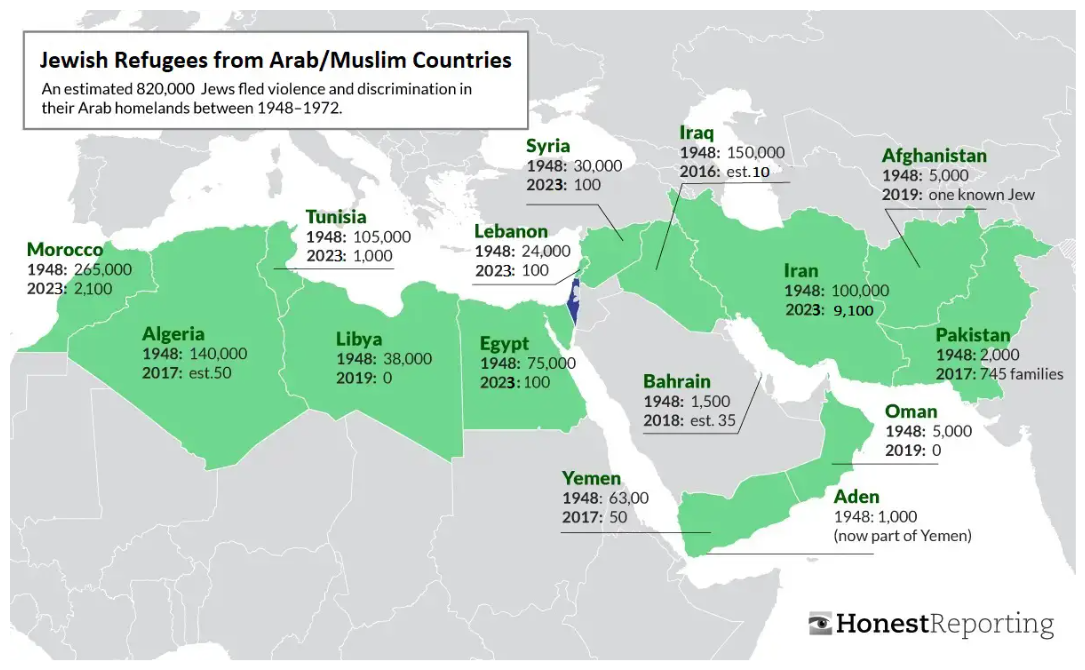
Rebuttal note: Violence Against Jews Before 1948 consolidates the 1920/1921/1929/1936–39 events below to counter “it all started in 1948.”
Chronology
[line-3, body-2, active-color-interactive-accent]
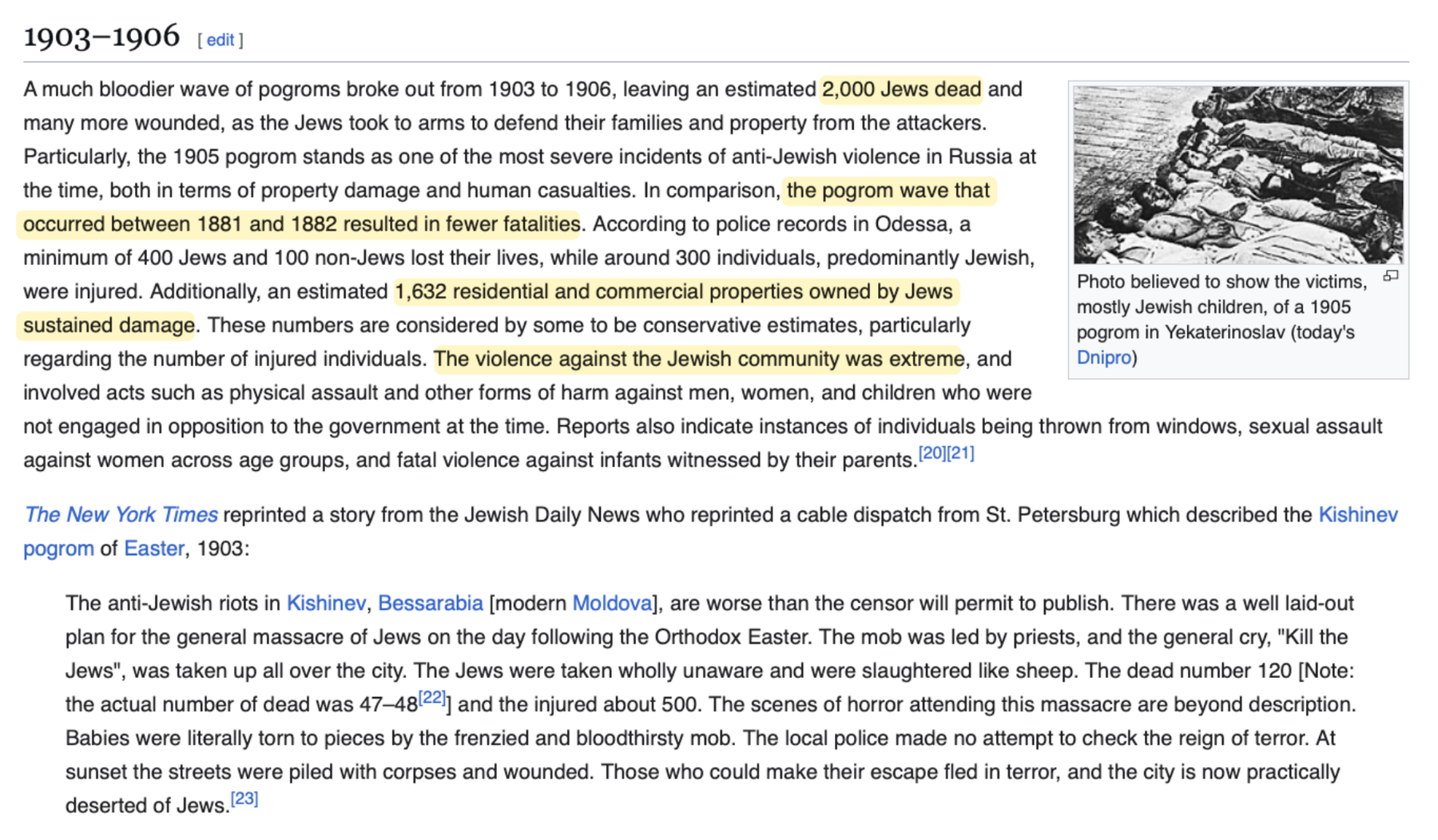
date: 1903 – 1906
title: Pogroms in the Russian Empire
content: Renewed waves of anti-Jewish violence across the empire.

[[1900-1948#1903-1906: Pogroms in the Russian Empire|→ full entry]]
date: 1904 – 1914
title: The Second Aliyah
content: Second major wave of Jewish immigration to Palestine.

[[1900-1948#1904-1914: The “Second Aliyah”|→ full entry]]
date: 1913
title: Anti-Jewish violence becomes endemic
content: Sheikh Sulayman al-Taji published his anti-Jewish poem in the Jaffa daily *Filastin*. Jewish settlement guards were dying regularly at the hands of Arab ambushers between 1911 and 1913 — well before Balfour and the British conquest.

[[1900-1948#^efab3d|→ full entry]]
date: 1916 Jan 3
title: Sykes–Picot Agreement
content: Secret Anglo-French treaty, with Russian and Italian assent, dividing the Ottoman Empire into spheres of influence. Reneged on British promises to the Arabs and was exposed by the Bolsheviks in November 1917.

[[1900-1948#1916 January 3: Sykes-Picot Agreement|→ full entry]]
date: 1917 Oct 23
title: Occupied Enemy Territory Administration
content: British military administration established over territory captured from the Ottomans.

[[1900-1948#1917 October 23: Occupied Enemy Territory Administration|→ full entry]]
date: 1917 Nov 2
title: Balfour Declaration
content: Britain declares support for a Jewish national home in Palestine.

[[1900-1948#1917 November 2: Balfour Declaration|→ full entry]]
date: 1917 Dec 9
title: British capture Jerusalem
content: Ottoman rule over Jerusalem ends.

[[1900-1948#1917 December 9: British captures Jerusalem|→ full entry]]
date: 1919
title: Haj Amin organises fedayeen
content: Haj Amin al-Husseini began organising small groups of *fedayeen* to terrorise Jews, hoping to drive them out of Palestine as Kemal had driven the Greeks from Turkey.

[[1900-1948#^7882dd|→ full entry]]
date: 1919 – 1927
title: The Third Aliyah
content: Tens of thousands of Jews arrived after the First World War — primarily as refugees from the Russian Civil War and its aftermath, not as ideological Zionists, with the US closed to them by restrictive immigration laws.

[[1900-1948#1919-1927: The Third Aliyah:  Immigration to 'Israel' after WWI|→ full entry]]
date: 1920 – 1948
title: British Mandate for Palestine
content: Britain administers Palestine on behalf of the League of Nations. Civil administration began July 1920; the mandate ran from 29 September 1923 to 15 May 1948.

[[1900-1948#1920-1948: British Mandate for Palestine: Great Britain administered Palestine on behalf of League of Nations|→ full entry]]
date: 1920
title: Battle of Tel Hai
content: The subsequent inquiry confirmed the participation of Arab policemen in the riots and found the underlying cause was Arab hostility to the Jews connected with Jewish immigration.

[[1900-1948#^d04e9f|→ full entry]]
date: 1920 Apr 4
title: Nebi Musa riots
content: Riots in Jerusalem incited by al-Husseini's inflammatory speech — the pattern of pogrom-by-incitement is established.

[[1900-1948#^19f9a8|→ full entry]]
date: 1920
title: Palestine riots
content: A violent four-day riot against Jews in Jerusalem's Old City, 4–7 April. Al-Husseini was sentenced in absentia to ten years for incitement; Jabotinsky got 15 years for possession of weapons.

[[1900-1948#^fb22ea|→ full entry]]
date: 1921 May 1–7
title: Jaffa riots
content: 47 Jews and 48 Arabs killed, 146 Jews and 73 Arabs wounded. Thousands of Jewish residents fled Jaffa for Tel Aviv and were housed in tent camps on the beach.

[[1900-1948#^3ffcd6|→ full entry]]
date: 1921 Nov 2
title: Riots in the Jewish Quarter of Jerusalem
content: Five Jewish residents and three of their Arab attackers killed, prompting calls for the resignation of commissioner Sir Ronald Storrs.

[[1900-1948#^cb88cf|→ full entry]]
date: 1924 Jun
title: Assassination of Jacob Israël de Haan
content: De Haan is assassinated in Jerusalem.

[[1900-1948#1924 June: Assassination of Jacob Israel de Haan|→ full entry]]
date: 1929 Aug 19
title: Stabbing of Abraham Mizrachi
content: The killing of the 17-year-old that fed into the escalation of August 1929.

[[1900-1948#1929 August 19: Stabbing of Jew 17-year-old Abraham Mizrachi|→ full entry]]
date: 1929 Aug 23
title: Palestine riots
content: Riots erupt over a dispute about access to the Western Wall. 133 Jews killed and 339 wounded; 116 Arabs killed and 232 wounded.

[[1900-1948#1929 August 23: Palestine Riots|→ full entry]]
date: 1929 Aug 24
title: Hebron massacre
content: Sixty-seven to sixty-nine Jews killed by Arabs incited by rumours that Jews planned to seize the Temple Mount. Many incidents of rape, torture and mutilation reported; Hebron's ancient Jewish community ended.

[[1900-1948#^1e47bc|→ full entry]]
date: 1932 – 1980s
title: Pan-Arabism
content: The Istiqlal (Independence) Party is founded in August 1932, espousing pan-Arabism, independence with Palestine as part of a Greater Syria, and abrogation of the Balfour Declaration.

[[1900-1948#1932-1980s: Pan-Arabism|→ full entry]]
date: 1936 – 1939
title: Arab Revolt
content: Popular uprising against British rule and Jewish immigration, widely framed at the time as a jihad. Several hundred Jews killed. The Yishuv's official response was *Havlagah* — self-restraint — adopted by the Haganah.

[[1900-1948#^1718e8|→ full entry]]
date: 1937
title: Peel Commission
content: First international proposal for a two-state settlement, recommending partition. The Palestinian Arabs and surrounding Arab states rejected it and renewed the rebellion in October.

[[1900-1948#1937: Peel Commission|→ full entry]]
date: 1938 Feb
title: Woodhead Commission
content: Appointed to examine the practicality of the Peel partition proposal.

[[1900-1948#1938 February: Woodhead Commission|→ full entry]]
date: 1938
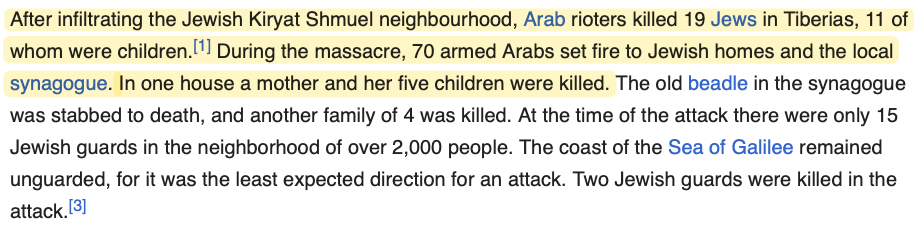
title: Tiberias massacre
content: Massacre of Jews at Tiberias during the Arab Revolt.

[[1900-1948#1938: Tiberias massacre of Jews|→ full entry]]
date: 1939
title: St. James Conference
content: London conference on the future of Palestine, held ahead of the White Paper.

[[1900-1948#1939: St. James Conference|→ full entry]]
date: 1939 May
title: White Paper of 1939
content: Britain accepts the core Arab demands: Jewish immigration capped at 75,000 over five years with any further immigration subject to Arab agreement, and land purchase severely curbed. The gates closed as the Holocaust began.

[[1900-1948#1939 May: White Paper of 1939|→ full entry]]
date: 1941
title: Farhud — pogrom in Baghdad
content: Pogrom against the Jews of Baghdad.

[[1900-1948#1941: Pogrom in Baghdad|→ full entry]]
date: 1942
title: Biltmore Conference
content: Zionist conference in New York calling for Palestine to be established as a Jewish commonwealth.

[[1900-1948#1942: Biltmore Conference|→ full entry]]
date: 1944
title: Operation Atlas
content: German-Arab parachute operation infiltrating Mandatory Palestine.

[[1900-1948#1944: Operation Atlas (Nazi Infiltration)|→ full entry]]
date: 1944 – 1948
title: Jewish insurgency in Mandatory Palestine
content: The Haganah, Irgun and Lehi form the Jewish Resistance Movement in response to the 1939 White Paper.

[[1900-1948#1944-1948 - Jewish insurgency in Mandatory Palestine|→ full entry]]
date: 1945 – 1946
title: Anglo-American Committee of Inquiry
content: Set up after Truman backed admitting 100,000 Holocaust survivors. It endorsed the immigration proposal but rejected Jewish statehood, suggesting a binational one-state formula instead.

[[1900-1948#Anglo-American Committee of Inquiry|→ full entry]]
date: 1946 Jul 22
title: King David Hotel bombing
content: The Irgun bombed the Mandate headquarters in Jerusalem, killing 91 people of various nationalities — the deadliest attack against the British of the entire Mandate era.

[[1900-1948#1946 July: Irgun Bomb King David Hospital|→ full entry]]
date: 1947 Aug
title: UNSCOP
content: The UN Special Committee on Palestine submits recommendations that become the basis of the November partition resolution.

[[1900-1948#1947 August: United Nations Special Committee on Palestine|→ full entry]]
date: 1947 Oct 11
title: Azzam Pasha’s prewar interview
content: Akhbar al-Yom publishes the Arab League secretary-general’s conditional warning of catastrophic war, religiously motivated volunteers, and plunder. Reported rhetoric, not a May 1948 army order.

[[60 Knowledge/60.1 Israel-Palestine/60.1.4 Main/1900-1948#1947 October 11: Azzam Pasha interview|→ full entry]]

date: 1947 Nov 29
title: UN Partition Plan
content: The General Assembly votes 33–13 with 10 abstentions for partition. The Jewish Agency and most Zionist factions accepted; the Arab Higher Committee and Arab League rejected it.

[[1900-1948#1947 November 29: United Nations Partition Plan for Palestine|→ full entry]]
date: 1947 – 1948
title: Civil war
content: Violence broke out almost immediately after the partition vote. By the end of March around 100,000 Arabs, mostly urban middle and upper class, had left — the first wave of refugees.

[[1900-1948#1947-1948: Civil War|→ full entry]]
date: 1948 Apr 9
title: Deir Yassin massacre
content: Irgun and Lehi forces attacked the village. Al-Khalidi instructed Arab editors to give it "the utmost propaganda possible," explaining they had to "exaggerate a little bit" to draw in the Arab states.

[[1900-1948#1948 April 9: Deir Yassin massacre|→ full entry]]
date: 1948 May 13
title: Kfar Etzion massacre
content: The defenders of Kfar Etzion are killed on the eve of Israeli independence.

[[1900-1948#1948 May 13: Kfar Etzion massacre|→ full entry]]
date: 1948 May 14
title: Israeli Declaration of Independence
content: Ben-Gurion declares the State of Israel. US and Soviet recognition followed within hours.

[[1900-1948#1948 May 14: Israeli Declaration of Independence|→ full entry]]
date: 1948 May 15
title: Arab–Israeli War
content: Five Arab states invade. Ismail Safwat described the objective as to "eliminate the Jews of Palestine, and to completely cleanse the country of them." All twelve Jewish towns captured by Arab armies were levelled.

[[1900-1948#1948 May 15: Arab–Israeli War|→ full entry]]
date: 1948 Jun
title: Oujda and Jerada pogroms, Morocco
content: Anti-Jewish riots in Morocco.

[[1900-1948#1948 June: Morocco riots in Oujda and Jerada pogrom|→ full entry]]
1903-1906: Pogroms in the Russian Empire
1904-1914: The “Second Aliyah”
1913: Anti-Jewish Violence
In November 1913, an Arab notable, Sheikh Sulayman al-Taji (al-Faruqi), published the following poem in the Jaffa Arab daily Filastin, against the backdrop of continuing Arab land sales to Jews:
Jews, sons of clinking gold, stop your deceit;
We shall not be cheated into bartering away our country!
…
The Jews, the weakest of all peoples and the least of them,
Are haggling us for our land;
how can we slumber on?
Anti-Jewish violence became endemic, with Jewish settlement guards—who were seen as symbols of the Zionist enterprise—regularly dying at the hands of Arab ambushers between 1911 and 1913. In April 1914, the British consul in Jerusalem reported, “The assaults upon Jews in the outlying districts are increasingly frequent.” So, the conflict began well before the Balfour Declaration and before the British conquered Palestine in 1917–1918 and briefly endorsed Zionism.
-Benny Morris
- Moshe Barsky falls victim to Arab Bedouin raiders, becoming the first Kibbutz movement member to be killed by Arab violence.
1916 January 3: Sykes-Picot Agreement
1900-1948 > 1916 January 3: Sykes-Picot Agreement
- 1916 secret treaty between the United Kingdom and France, with assent from the Russian Empire and the Kingdom of Italy, to define their mutually agreed spheres of influence and control in an eventual partition of the Ottoman Empire.
- UK control of what is today southern Israel and Palestine, Jordan and southern Iraq, and an additional small area that included the ports of HaifaAcre to allow access to the Mediterranean.
- France was to control southeastern Turkey, the Kurdistan Region, Syria and Lebanon.
- The agreement is seen by many as a turning point in Western and Arab relations. It reneged upon the UK’s promises to Arabs regarding a national Arab homeland in the area of Greater Syria in exchange for supporting the British against the Ottoman Empire. The agreement, along with others, was made public by the Bolsheviks in Moscow on 23 November 1917 and repeated in The Manchester Guardian on 26 November 1917, such that “the British were embarrassed, the Arabs dismayed and the Turks delighted”. The agreement’s legacy has led to much resentment in the region, among Arabs in particular but also among Kurds who were denied an independent state.
- sykes-picot-and-artificial-states.pdf (file not included in this release)
The war within
Sykes–Picot Agreement - Wikipedia
1917 October 23: Occupied Enemy Territory Administration
Occupied Enemy Territory Administration
1917 November 2: Balfour Declaration
Balfour Declaration
Mandate & Legal Basis (Balfour, San Remo, League of Nations)
Balfour Declaration - Wikipedia
The_Forgotten_Truth_about_Balfour_Delcaration.pdf (file not included in this release)
Uganda Scheme - Wikipedia
The_Balfour_Declarations_Deep_anti-Semitism.pdf (file not included in this release)
How_Anti-Semitism_Helped_Create_Israel.pdf (file not included in this release)
1929_Palestine_riots
Balfour himself explained several times after 1917: that he had been motivated by a desire to do something for the Jews, because they had suffered greatly at the hands of the Christian world during the previous 1,900 years and because of the values and norms, including monotheism and the notions of social justice, that they had bestowed on humankind through the Old Testament. Benny Morris
He mehdirhasan really read this and summarized that Balfour viewed the Jews as “alien and hostile”.
1917 December 9: British captures Jerusalem
1919: Haj Amin suicide groups to terrorize Jews
- One of the el-Husseinis, Haj Amin, who emerged as the leading figure in Palestinian politics during the mandate period, first began to organize small groups of suicide groups, fedayeen (“one who sacrifices himself”), to terrorize Jews in 1919 in the hope of duplicating the success of Kemal in Turkey and drive the Jews out of Palestine, just as the Turkish nationalists were driving the Greeks from Turkey.
1919-1927: The Third Aliyah: Immigration to ‘Israel’ after WWI
- Land of Refuge: Immigration to Palestine, 1919–1927 (Perspectives on Israel Studies) (Hebrew Edition): Alroey, Gur, Stern, Deborah: 9780253070074: Amazon.com: Books
- After the First World War, tens of thousands of Jews immigrated to Palestine. They went there not to found a Zionist state but primarily to seek refuge from the violence and persecution of the Russian Civil War and its aftermath. Fleeing to the United States was not an option due to heavily restrictive immigration laws enacted there in the early 1920s.
- Story not told; they weren’t Zionist or ideological, but refugees
- The Third Aliyah
1920-1948: British Mandate for Palestine: Great Britain administered Palestine on behalf of League of Nations
From the beginning of the Mandate, they had tried to prevent Jewish immigration to the Land of Israel through violence, consistently rejecting any possibility of compromise (including the Peel Commission proposal of 1937, the first partition plan) In their minds, the Jews had no political or collective rights in the land, because they were not a nation At most, they were eligible for the status Islam accords non-Muslims of monotheistic religions: the status of protected persons (dhimmis), who may live and retain their property and faith, but must be reconciled to their social and political inferiority to Muslims. (Page 17)
Link to original
- Civil administration began in Palestine and Transjordan in July 1920 and April 1921, respectively, and the mandate was in force from 29 September 1923 to 15 May 1948 and to 25 May 1946 respectively.
- Map of Mandatory Palestine
- The White Paper of 1939 enacted until the end of British Mandated rule
- Called for the establishment of a Jewish National Home in an independent Palestinian state within 10 years.
- Limited Jewish immigration to 75,000 for five years, and allowed Arab majority to determine future Jewish immigration.
- Jews were restricted from buying Arab land in all but 5% of the Mandate.
- The Palestinian Arab parties, acting under Haj Amin Effendi al-Husseini, rejected this proposal, but probably should have accepted.
- The Arab counter offer wanted independence, no Jewish national home in Palestine, replacement of the Mandate by a treaty, and the end of Jewish immigration.
Situation in the Beginning of British Mandate 19th-Early 20th Century
1920: Battle of Tel Hai
- Its report confirmed the participation of Arab policemen in the riots and found the actions taken by the authorities adequate. The report angered both Jews and Arabs: it placed the blame on the Arabs, but said that, “Zionists were not doing enough to mitigate the Arabs’ apprehensions.”4(https://en.wikipedia.org/wiki/Jaffa_riots#cite_note-segev-4) The report concluded that, “the fundamental cause of the violence and the subsequent acts of violence was a feeling among the Arabs of discontent with, and hostility to, the Jews, due to political and economic causes, and connected with Jewish immigration.” .12(https://en.wikipedia.org/wiki/Jaffa_riots#cite_note-12)
- deaths of 47 Jews and 48 Arabs, 146 Jews and 73 Arabs were wounded, and hundreds more were made homeless.3(https://en.wikipedia.org/wiki/Jaffa_riots#cite_note-:1-3)
- The fundamental cause of the Jaffa riots and the subsequent acts of violence was a feeling among the Arabs of discontent with, and hostility to, the Jews, due to political and economic causes, and connected with Jewish immigration, and with their conception of Zionist policy as derived from Jewish exponents.
1920: April 4: Nebi Musa riots
1920 Nebi Musa riots
The 1920 Jerusalem riots – Arab fears, Zionist pressures, faulty security cited in British Palin inquiry - Peace with justice, security and equal rights for Israelis and PalestiniansPeace with justice, security and equal rights for Israelis and Palestinians
1920: Palestine Riots
- April 4–7 - The 1920 Palestine riots – violent 4-day riot against the Jews in Jerusalem’s Old City. al-Husseini was charged with inciting the Arab crowds with an inflammatory speech and sentenced by military court held in camera (private)18(https://en.wikipedia.org/wiki/Timeline_of_intercommunal_conflict_in_Mandatory_Palestine#cite_note-18) to ten years imprisonment in absentia, since he had already violated his bail by fleeing to Transjordan to avoid arrest. Zionist leader Ze’ev Jabotinsky was sentenced to 15 years in prison for the possession of weapons.
1921 May 1-7: Jaffa Riots
resulted in the deaths of 47 Jews and 48 Arabs, with 146 Jews and 73 Arabs being wounded. Most Arab casualties resulted from clashes with British forces attempting to restore order.29(https://en.wikipedia.org/wiki/Timeline_of_intercommunal_conflict_in_Mandatory_Palestine#cite_note-29) Thousands of Jewish residents of Jaffa fled for Tel Aviv and were temporarily housed in tent camps on the beach.
1921 November 2: Riots in Jewish Quarter of Jerusalem
- New bloody riots broke out in Jewish Quarter of Jerusalem on November 2, 1921, when five Jewish residents and three of their Arab attackers were killed, which led to calls for the resignation of the city’s commissioner, Sir Ronald Storrs.4(https://en.wikipedia.org/wiki/Jaffa_riots#cite_note-segev-4)
1924 June: Assassination of Jacob Israel de Haan
1929 August 19: Stabbing of Jew 17-year-old Abraham Mizrachi
1929 August 23: Palestine Riots
The 1929 Palestine riots erupt due to a dispute between Muslims and Jews over access to the Western Wall. 133 Jews killed and 339 wounded ; 116 Arabs killed and 232 wounded.
1929 August 24: Hebron Massacre
- The Hebron massacre was the killing of sixty-seven or sixty-nine Jews on 24 August 1929 in Hebron, then part of Mandatory Palestine, by Arabs incited to violence by rumors that Jews were planning to seize control of the Temple Mount in Jerusalem. 1929 Hebron massacre
1929_Hebron_massacre (file not included in this release)
- 1929 Hebron massacre: 67 Jews are massacred by Arabs. Many incidents of rape, torture, and mutilation are reported.40(https://en.wikipedia.org/wiki/Timeline_of_intercommunal_conflict_in_Mandatory_Palestine#cite_note-segev-40)
1932-1980s: Pan-Arabism
1900-1948 > 1932-1980s: Pan-Arabism
Pan-Arabism - Wikipedia](https://en.wikipedia.org/wiki/Pan-Arabism)
The major political expression of this trend had been the establishment in August 1932 of the Istiqlal (Independence) Party, which espoused pan-Arabism, independence (with Palestine as part > of a Greater Syria), and the abrogation of the Balfour Declaration.31 The Istiqlal was the preeminent expression of the politics of the young rebels, at least for a year, after which its inuence plummeted. The rst National Congress of Arab Youth, in Jaa in January 1932, had adopted an “Istiqlalist” platform. Party members patrolled the beaches to prevent illegal immigration, and forced shopkeepers to comply with political strikes
Righteous Victims - Benny Morris, page 182 (file not included in this release)
The major political expression of this trend had been the establishment in August 1932 of the Istiqlal (Independence) Party, which espoused pan-Arabism, independence (with Palestine as part of a Greater Syria), and the abrogation of the Balfour Declaration.31 The Istiqlal was the preeminent expression of the politics of the young rebels, at least for a year, after which its inuence plummeted. The rst National Congress of Arab Youth, in Jaa in January 1932, had adopted an “Istiqlalist” platform. Party members patrolled the beaches to prevent illegal immigration, and forced shopkeepers to comply with political strikes.32 In 1930–31 the two Husseinis, Amin and Musa Kazim, established a “National Fund,” modeled on the Jewish National Fund, to raise money for nationalist activities; but most Palestinians declined to contribute.33 Its failure stemmed partly from the animosity of landowners associated with the Opposition and possibly from the nature and mentality of Palestinian Arabs: They looked rst to the family, the clan, and the village as domains of responsibility. A “national” fund to forestall Jewish purchases in a remote corner of the country proved beyond their ken.
Righteous Victims - Benny Morris, page 183 (file not included in this release)
Righteous Victims - Benny Morris, page 182 (file not included in this release)
1936-1939: Arab Revolt
- First victim: April 15th - Arabs at checkpoint used to get money to sponsor their uprising, killed 1 Jew
1936–1939 Arab revolt in Palestine
-
- strategic policy of the Yishuv during the 1936–1939 Arab revolt in Palestine. It called for Zionist militants to abstain from engaging in acts of retaliatory violence against Palestinian Arabs in the face of Arab attacks against Palestinian Jews, and instead encouraged the Jewish community to respond to the attacks through non-violent means, such as by fortifying their settlements. The policy was supported by the Yishuv’s political leadership and many left-wing Zionists. It was adopted by Haganah, the main Zionist paramilitary in Mandate Palestine, as an official operational strategy. On the other hand, Irgun, Lehi, and other like-minded Zionist paramilitaries rejected the policy and engaged in indiscriminate violence against the Arab community.
-
Popular uprising by Palestinian Arabs in Mandatory Palestine against British mandate due to increasing flow of Jewish immigrants.
-
Sparked by back and forth killings of two Jews by a Qassamite band, followed by the retaliatory killing of two Arab workers.
-
First part of movement was seized upon by the urban and elitist Arab Higher Committee, which made the revolt focus on strikes and other political forms of protest.
-
Second phase in 1937 lead to violent conflict between British Army and Palestine Police Force against the peasant-led resistance movement.
-
Walid Khalidi estimates 19,792 casualties for the Arabs, with 5,032 dead, 3,832 killed by the British and 1,200 dead due to intracommunal terrorism, and 14,760 wounded. Several hundred Palestinian Jews were killed.
“Islam seemed to be a religion of the sword,” a momentarily despondent Magnes concluded.44 (Indeed, many observers defined the Arab Revolt as a jihad. After reviewing the testimony of Bishop Hajjat, the metropolitan of the Greek Catholic Church in Acre, Galilee, and Samaria, and other Christians before the Peel Commission, one of the commissioners concluded: “We were informed that though they [that is, the Christians] are not afraid of the educated Moslem or the Effendi class who live in the towns, they have come to realize that the zeal shown by the fellaheen in the late disturbances [that is, in 1936] was religious and fundamentally in the nature of a Holy War against a Christian Mandate and against Christian people as well as against the Jews.” One State, Two States Resolving the Israel Palestine — Prof Benny Morris — 2009 flattened, page 69 (file not included in this release)
At the start of the revolt, the Palestinian Arab political parties established a supreme cabinet like body, the Arab Higher Committee. Its founding declaration stated: “Because of the general feeling of danger that envelops this noble nation, there is need for solidarity and unity and a focus on strengthening the holy national jihad movement.” As the revolt unfolded, the mufti and kadi of Nablus toured the surrounding villages “preaching that anyone who killed a land seller would reside in paradise in the company of the righteous.” The language of the rebellious nationalists was commonly the language of jihad. One State, Two States Resolving the Israe l Palestine — Prof Benny Morris — 2009 flattened, page 70 (file not included in this release)
Arab Revolt, propelled the British to curtail Zionist immigration and to appease the rebels, in light of the British Empire’s need for safe lines of communication, running through the Arab lands, which spanned the Suez Canal and the string of airfields running eastward from Palestine through Transjordan and Iraq. The British needed to pacify the Arab Middle East, which also harbored large reserves of oil, as they faced the prospect of a three-front global war against Japan, Italy, and Germany One State, Two States Resolving the Israel Palestine — Prof Benny Morris — 2009 flattened, page 78 (file not included in this release)
Transfer thinking crested, if one is to judge by the protocols of internal Zionist leadership deliberations, during the years of the revolt and in the years immediately following under the impress of the Nazi persecution and then slaughter of Europe’s Jews. With the Arabs threatening to slaughter Palestine’s Jews and, through pressure on Britain, bringing about the closure of Palestine’s gates to Jewish immigration, and with Hitler killing Europe’s Jews and preventing them from escaping, the Zionists quite understandably sought the eviction of that Arab population which, by its actions, was indirectly contributing to the murder of their European kinfolk by helping to deny them a safe haven in Palestine and by threatening the lives of the Jews who already lived in the country. Hence, it is not surprising that Weizmann in 1941 spoke to the Soviet ambassador in London of the need to transfer half a million Arabs out of Palestine, as “a first instalment,” to make room for two million Jews fleeing from Hitler’s clutches in Europe. One State, Two States Resolving the Israel Palestine — Prof Benny Morris — 2009 flattened, page 85 (file not included in this release)
The Great Misinterpretation How Palestinians View Israel - Haviv Rettig Gur > ^0dee70
1937: Peel Commission
- Arab’s rejected
1900-1948 > 1937: Peel Commission
Peel Commission - Wikipedia](https://en.wikipedia.org/wiki/Peel_Commission)
The solution proposed by the Peel Commission was partition. The Jews were to gain statehood in 20 percent of the territory of Palestine, including most of the coastline and some of the country’s most fertile agricultural land, in the Jezreel Valley and the Galilee. The Arabs were allotted the poorest lands of Palestine, including the Negev Desert and the Arava Valley, as well as the hill country of the West Bank and the Gaza Strip. — Eugene Rogan, The Arabs: A History
Population exchange between Greece and Turkey - Wikipedia
-
Published on July 7th, 1937
-
First time declaration that Mandatory Palestine was becoming unworkable and needed to be partitioned.
-
- In spring 1936, the Arabs rebelled against British rule. Six months later, they suspended the rebellion, and the British set up a commission of inquiry, the Peel Commission, to look at their grievances. In July 1937, the commission proposed a “solution” based on ending the mandate and partitioning the country into two independent states. This was the first international proposal for a two-state settlement. The Jews were to be given 17 percent of Palestine, the Arabs about 75 percent. Khalidi tells us that “under this scheme,” the 75 percent “was to remain under British control or be handed over to … Abdullah.” Khalidi’s phraseology is crucially misleading. The commission also, somewhat obliquely, recommended that the Palestine Arab area be united with the neighboring Emirate of Transjordan, which was then ruled by Prince Abdullah, a British ward. (In the Peel scheme, the British, in a new mandate, were to retain some 8 percent of the country, consisting of Jerusalem and Bethlehem, with their holy sites, and a corridor from these towns to the Mediterranean.)
- The Palestine Arabs and the surrounding Arab states—though not Abdullah—flatly rejected the Peel proposals and, in October, renewed the rebellion, which was to last until spring 1939, when it was finally crushed by the British, with a little help from the Zionists. The Arabs had managed to kill some 500 Jews and about 150 British soldiers; they had suffered 2,000–5,000 dead. Khalidi tells us that the rebellion was so fierce and widespread that the British deployed “100,000” troops to suppress it. This is a vast exaggeration. British forces in Palestine in 1936–1939 never numbered more than 40,000, if that.
- After the rebellion, the British government, in May 1939, issued a new policy statement. The new British rules severely curtailed Jewish immigration, limiting it to 75,000 over a five-year period, with any further immigration contingent on Arab agreement (which everyone knew would not be forthcoming). The White Paper also promised the country’s Arab majority population (the majority assured by the limitations on Jewish immigration) independence within 10 years and radically curbed future Jewish land purchases.
The transfer idea also impinged on, and was used to justify, the partition of Palestine and the two-state solution recommended by the Peel Commission and accepted by the Zionist movement. The commission had argued that for the two-state settlement to be viable, it had to be accompanied by a transfer of Arabs, or of “the Arabs”—“voluntary” if possible, “compulsory” if necessary— out of the territory earmarked for Jewish statehood. Otherwise, the emergent settlement would be plagued by irredentist up- heavals and the Jewish state by a potential (Arab) fifth column, which would destabilize the settlement itself One State, Two States Resolving the Israel Palestine — Prof Benny Morris — 2009 flattened, page 83 (file not included in this release)
The commissioners recommended that the Mandate be dissolved and that something less than 20 percent of the country—the Galilee and the northern and central sectors of the Coastal Plain—be awarded for Jewish statehood, with the bulk of the rest (some 70– 75 percent of the country) earmarked for Arab rule. The com- mission further recommended that the Arab area eventually be joined to Transjordan, to create a “Greater Transjordan,” under the rule of the Hashemite prince Abdullah. (The remaining 5– 10 percent of the country—Jerusalem and Bethlehem, with religious cachet, and a strip of land from these towns, through Ramla, leading to the Mediterranean coast—was set aside by the commission for continued British rule.) One State, Two States Resolving the Israel Palestine — Prof Benny Morris — 2009 flattened, page 79 (file not included in this release)
But nothing came of the Peel proposals. They were rejected not only by the Palestinian Arab leadership and the Arabs out- side Palestine but by the British government, which, after initially endorsing the recommendations, quickly about-faced. By May 1939, in the MacDonald white paper on Palestine, White- hall completely disavowed the idea of partition and Jewish state- hood and charted a future that, within ten years, would see the emergence of an independent Palestinian state governed by its majority Arab population. One State, Two States Resolving the Israel Palestine — Prof Benny Morris — 2009 flattened, page 80 (file not included in this release)
compared the recommendation to the Greek-Turkish exchange of population in the 1920s: “Fortunately there is the encouraging precedent of the compulsory shifting … of 1,300,000 Greeks from Asia Minor to Thessaly and Macedonia and 400,000 Turks the other way round. The whole thing was done in 18 months, and since then the relations of Greece and Turkey have become friendlier than ever before One State, Two States Resolving the Israel Palestine — Prof Benny Morris — 2009 flattened, page 80 (file not included in this release)
Without doubt, the surge in Zionist leadership discourse dur- ing 1937–1941 about transfer was precipitated by the Peel rec- ommendations. But even more important in its precipitation was what had engendered the Peel Commission in the first place— the Arab Revolt, which aimed at evicting the British from Pales- tine and rolling back, if not destroying, the Zionist enterprise. It was Arab attack, and the threat to Jewish existence in Palestine, that triggered Zionist transfer thinking, which aimed, in effect, to assure the Yishuv’s continued existence and to reinforce it. One State, Two States Resolving the Israel Palestine — Prof Benny Morris — 2009 flattened, page 84 (file not included in this release)
1938 February: Woodhead Commission
1938: Tiberias massacre of Jews

1939: St. James Conference
Appeasing the Arabs to Prepare for Hitler | Palestine Mandate Part 4
1939 May: White Paper of 1939
- Condemned Terrorism
- Accepted Arab Demands
- Jewish Veto Removed
Appeasing the Arabs to Prepare for Hitler | Palestine Mandate Part 4
- The Arabs, led by Husseini, rejected the White Paper, and Khalidi more or less endorses that rejection, saying that the British could not be trusted to implement the announced policy and that the Jews had been given veto power over the promised independence with Arab majority rule. Khalidi adds: “In any case, it was already too late. The Chamberlain government had only a few months left in office when it issued the White Paper, Britain was at war very soon afterward, and Winston Churchill, who succeeded Chamberlain … was perhaps the most ardent Zionist in British public life.” But this is nonsense. In May 1939, there was no reason to believe that Chamberlain would not continue to rule for years, and in any case, he remained prime minister for another year, until May 1940, not just for “a few months.” And Churchill, though a pro-Zionist, stuck for reasons of state to his predecessor’s anti-Zionist policy through World War II, including the drastic curb on Jewish immigration, even as European Jews were being butchered by the Nazis.
- Most historians of the British Mandate believe that the Palestinian Arabs, in rejecting the 1939 anti-Zionist White Paper, shot themselves in the foot (or perhaps higher), but not Khalidi. He sympathetically cites points made in the memoirs of Dr. Husayn al-Khalidi, his uncle, the sometime mayor of Jerusalem and a member of the Arab Higher Committee, the governing body of the Palestine Arab national movement. “It was their [i.e., the British] consistent support for the Zionists that most angered Dr. Husayn,” Khalidi tells us. He fails to fully acknowledge that in 1938–1939 the British, under the impact of the Arab Revolt, fearful of the impending world war against the German-Italian-Japanese coalition, and wanting to keep the Arab world onside or at least neutral, about-faced and turned anti-Zionist (and were to remain so, in effect, down to the mid-1950s).
- Benny Morris
1941: Pogrom in Baghdad
Palestinian Arabs during WWII
- Khalidi’s treatment of the Arab-Zionist conflict during World War II and its aftermath is equally misguided and suffers from a string of assertions and omissions that distort the reality of what happened. Khalidi stresses that “over twelve thousand” Palestine Arabs served in the British army in World War II—a figure that is probably double the true figure, with most serving as service personnel, not combatants, in bases inside Palestine. Khalidi produces this number to obfuscate the much larger truth—that, to judge by impressionistic evidence (in the absence of opinion polls), most Arabs, including most of Palestine’s Arabs, supported Germany and an Axis victory in World War II, if only because they hated the British, who had just crushed their revolt, and hated the Jews, who were their antagonists in Palestine. Representative is the diary of the prominent (Christian) Palestinian educator, Khalil Sakakini, who wrote on July 27, 1942, that Palestine’s Arabs had “rejoiced when the British bastion at Tobruk fell to the Germans… . Not only the Palestinians rejoiced … but the whole Arab world … not because they love the Germans, but because they dislike the English.” Benny Morris
- a survey conducted in 1941 shows that 88% of Palestinian Arabs supported Nazi Germany, while only 9% backed the British mandate.
- Hillel Cohen’s “Army of Shadows” on page 175
1942: Biltmore Conference
Biltmore Conference - Wikipedia
1944: Operation Atlas (Nazi Infiltration)
1944-1948 - Jewish insurgency in Mandatory Palestine
The Haganah, Irgun, Lehi all joined together to form the Jewish Resistance Movement.
- Insurgent activities in the area were in response to the proposed 1939 White Paper.
- On the 22nd of July, 1946, the Irgun bombed the King David Hotel in Jerusalem, leading to the deaths of 91 people of various nationalities. This hotel was the headquarters for Mandatory Palestine.
- Was the deadliest attack against the British during the entire Mandate era (1920-1948)
Anglo-American Committee of Inquiry
- Anglo-American Committee of Inquiry - Wikipedia
- Following the Holocaust, the Zionist movement was energized to establish a Jewish state immediately, and much of the world—especially the United States—became sympathetic to the Jews’ aspirations. But Britain, now with a post-Churchill Labour government, remained opposed, and the Zionist underground groups launched a minirebellion against Palestine’s occupiers, ultimately claiming dozens of British lives. At the end of 1945, after President Harry Truman came out in support of the Zionists’ demand to allow 100,000 Holocaust survivors into Palestine, the two Anglo-Saxon powers set up the 12-man Anglo-American Committee of Inquiry to find a solution. Six months later, the committee issued its proposals: It endorsed Truman’s proposal on immigration but rejected the demand for a Jewish state. Instead, it avoided a clear verdict on the political solution and suggested a binational, one-state formula, while rebuffing the Zionist desire for Jewish statehood. Astonishingly, Khalidi summarizes the upshot this way: “The committee came to conclusions that mirrored precisely the desires of the Zionists.” The purpose of Khalidi’s distortion of the committee’s proposals is clear: yet another “proof” that the Anglo-Saxon powers remained subservient to Zionist aspirations. Benny Morris
1946 July: Irgun Bomb King David Hospital
1900-1948 > 1944-1948 - Jewish insurgency in Mandatory Palestine
A War of Return Timeline: The War of Return > TIMELINE OF KEY EVENTS (1947–1949)
1947 August: United Nations Special Committee on Palestine
- United Nations Special Committee on Palestine - Wikipedia
- UNSCOP, created by the UN General Assembly and made up of representatives of states uninvolved in the conflict. At the end of August 1947, it submitted its recommendations, which were to serve as the basis of the historic UN General Assembly Partition Resolution of November 29, 1947.
The Jewish state was supposed to contain a large Arab minority of 450,000 people, which constituted some 47 percent of the population at that given moment. This minority would become a much smaller proportion of the total population as soon as a newly established sovereign state of Israel would finally be able to open the doors to hundreds of thousands of Holocaust survivors: some were waiting in displaced persons camps across Europe, and others were waiting in British internment camps in Cyprus, after the British yielded to Arab pressure and denied entry of the survivors into the land. (Page 16)
Link to original
1947 October 11: Azzam Pasha interview
A senior Arab official anticipates catastrophic war before partition
Abdul Rahman Azzam Pasha, Arab League secretary-general, was reported by Mustafa Amin in Akhbar al-Yom on 11 October 1947 anticipating massacre, plunder, volunteers, and eventual Arab victory. He opened by expressing a wish to avoid war and closed by claiming self-defense. This publication predates the November partition vote and the May interstate invasion. Corrected quotation · Arabic facsimile, contemporary February 1948 citation, and translation limits
Use precisely: a public statement attributed to Azzam, not representative evidence of all Arab opinion or an operational order. → argument use
1947 November 29: United Nations Partition Plan for Palestine
- Arabs rejected
to consistently express openness to territorial compromise and partition, because its objective was sovereignty. As such, Jewish leaders saw the partition plan as a tremendous achievement that fulfilled the foremost purpose of Zionism: political independence, even if only in part of the Land of Israel. “Our aspirations have been reduced, our territory has been shrunk, and the borders are politically and militarily bad,” said Ben-Gurion on December 3, 1947, “but there has never been a greater achievement than this. We have received most of the coastal plain, most of the valleys, most of the water sources in the north, most of the empty spaces, two seas, and recognition of our independence from most of the world.”11 (Page 17)
Link to original
By contrast, the Arab world completely rejected partition. (Page 17)
Link to original
partition would have meant that out of the 11.5 million square kilometers encompassed by Arab states at the time, many of which were also set in the territory of the Ottoman Empire, some fifteen thousand square kilometers (one one-thousandth) would be allocated to the Jewish people, who were also an indigenous people. (Page 17)
Link to original
The Arab Higher Committee, which led the Palestinians before and during the 1948 war, informed the UN Special Committee on Palestine on its 1947 visit that “all of Palestine must be Arab.” Arab Higher Committee member Hussein al-Khalidi told the delegation that the Jews had always enjoyed comfortable lives in Arab countries until they began demanding their own sovereign state. He rejected the possibility of territorial partition and called for a single state with an Arab majority (Page 18)
Link to original
Jamal al-Husseini, vowed that “the blood will flow like rivers in the Middle East.” (Page 18)
Link to original
United Nations Partition Plan for Palestine
1900-1948 > 1947 November 29: United Nations Partition Plan for Palestine
- The UN Partition Plan
- A four-part document, the Partition Plan, was attached, that provided for the termination of the Mandate, the withdrawal of British armed forces, and the delineation of boundaries between the two States and Jerusalem.
- The Arab Higher Committee and the Arab League rejected this proposal due to the fact that 56% of the land would be allocated to the Jewish state, despite the Palestinian Arab population numbering twice that of the Jewish population. The Jewish Agency for Palestine and most Zionist factions accepted.
- Vote list for the plan

United_Nations_Partition_Plan_for_Palestine
- Like the Peel Commission before it, the UNGA proposed a two-state solution, but this time with 42 percent of the territory for a Palestinian Arab state and 55 percent for a Jewish state (most of it desert). Khalidi attributes the General Assembly’s pro-Zionist tilt to “the postwar realignment of international power”—meaning realpolitik and the emergence and influence of the two superpowers, the US and the Soviet Union—instead of to the various states’ sympathy for the Jews under the impact of the Holocaust. This is important for Khalidi, because if you concede that the member states were moved in large part by humanitarian concerns (and the Holocaust seemed to prove that the Zionists were right, that the Jews could not live in safety in the diaspora and needed a state of their own), then you are conceding the moral high ground to the Jews.
- The UN vote—33 for, 13 against, and 10 abstentions—represented the overwhelming will of the international community, with all the world’s democracies except Greece and India (which had a large Muslim minority) supporting Jewish statehood within a two-state solution, and a cluster of dictatorships, most of them Arab and Muslim, voting against. But Khalidi doesn’t tell the readers any of this or, explicitly, of the Arab world’s reaction to the vote, which was a thunderous rejection. The Palestinians, for their part, immediately began shooting at Jewish pedestrians and traffic, marking the start of the 1948 war. Khalidi simply says, “The resolution was another declaration of war … a blatant violation of the principle of self-determination.” It was the Palestinians, backed by the Arab states, who unleashed the hostilities—but it was the Jews and their international supporters, by voting aye, who had “declared war” in Khalidi’s Orwellian formulation. The UN had issued “the international birth certificate for a Jewish state,” but it had also issued a birth certificate for a Palestinian Arab state, and the Arab world, along with the Palestinians, had rejected it. Ironically or not, today’s PLO leaders, 70 years on, refer to the 1947 resolution positively, as legitimation and a basis for their claim to statehood.
- Benny Morris
1947-1948: Civil War
1900-1948 > 1947-1948: Civil War
The war of return - Adi Schwartz, Einat Wilf (Annotated), p.19 (file not included in this release)
Arab League secretarygeneral Azzam Pasha after Eban offered to try to reach an understanding on the eve of the partition resolution. In their meeting at London’s Savoy Hotel, Azzam told Eban: If you win the war, you will get your state. If you do not win the war, then you will not get it … If you establish your state the Arabs might one day have to accept it, although even that is not certain. But do you really think that we have the option of not trying to prevent you from achieving something that violates our emotion and our interest? It is a question of historic pride. There is no shame in being compelled by force to accept an unjust and unwanted situation. What would be shameful would be to accept this without attempting to prevent it. No, there will have to be a decision, and the decision will have to be by force.
The war of return - Adi Schwartz, Einat Wilf (Annotated), p.20 (file not included in this release)
Violence broke out almost immediately following the passage of the partition resolution. The Arab Higher Committee called for a general strike across the land. The following day, a bus carrying Jewish passengers was attacked near Kfar Sirkin. Two days later, a Palestinian mob stormed the Jewish commercial center near Jerusalem’s Jaffa Gate. The war had started. In the end, the young Jewish state was left standing, but at a heavy price: six thousand Jews (1 percent of the Jewish population) were killed, and thousands more were injured and left permanently disabled.
belief that Zionism was an outrageous injustice predated the war and caused the Arabs to violently oppose the Jewish national liberation movement many decades earlier. Before even a single Palestinian had fled his home in the Mandate territory, there prevailed the notion in the Arab world that Jewish sovereignty in the region was a crime against justice. It was this Arab view of Zionism as an inherent injustice that led to the war of 1947–49 and to the creation of the Palestinian refugee problem in the first place. (Page 14)
Link to original
1947-1948_civil_war_in_mandatory_palestine.pdf]]
-
While the Jewish population had received strict orders requiring them to hold their ground everywhere at all costs, the Arab population was more affected by the general conditions of insecurity to which the country was exposed. Up to 100,000 Arabs, from the urban upper and middle classes in Haifa, Jaffa and Jerusalem, or Jewish-dominated areas, evacuated abroad or to Arab centres eastwards.
-
The high morale of the Arab fighters and politicians was not shared by the Palestinian Arab civilian population. The UN Palestine Commission reported ‘Panic continues to increase, however, throughout the Arab middle classes, and there is a steady exodus of those who can afford to leave the country. ‘From December 1947 to January 1948, around 70,000 Arabs fled, and, by the end of March, that number had grown to around 100,000.
- These people were part of the first wave of Palestinian refugees of the conflict. Mostly the middle and upper classes fled, including the majority of the families of local governors and representatives of the Arab Higher Committee. Non-Palestinian Arabs also fled in large numbers. Most of them did not abandon the hope of returning to Palestine once the hostilities had ended.
Palestinian.IDPs.pdf (file not included in this release)
Irgun - Wikipedia
1948_Myths_and_Facts.pdf (file not included in this release)
Yosef_Weitz_and_the_Transfer_Committees.pdf (file not included in this release)
Benny_Morris_and_the_Reign_of_Terror.pdf (file not included in this release)
- These people were part of the first wave of Palestinian refugees of the conflict. Mostly the middle and upper classes fled, including the majority of the families of local governors and representatives of the Arab Higher Committee. Non-Palestinian Arabs also fled in large numbers. Most of them did not abandon the hope of returning to Palestine once the hostilities had ended.
-
As with the first stage of the 1948 war, launched by Palestinian gunmen on November 30, 1947, Khalidi fails to tell his readers that the second stage of the war, from mid-May 1948 to 1949, was launched by the Arab states, whose armies in unison invaded Palestine on May 15
-
The US provided Israel with no weaponry (or money) during the 1948 war and did its best, in fact, to prevent clandestine arms from reaching the new state, even arresting American Zionist operatives.
At the same time, the war witnessed a large-scale transfer of Arab inhabitants, with some 700,000 being displaced from their homes, about two- thirds of them coming to rest in other parts of Palestine (the West Bank and Gaza Strip) and one-third in neighboring Arab countries (primarily Lebanon, Transjordan, and Syria) One State, Two States Resolving the Israel Palestine — Prof Benny Morris — 2009 flattened, page 86 (file not included in this release)
Ben Yehuda Street bombings - Wikipedia
- Land Divided (1947-56) | The 50 Years War: Israel and the Arabs (1 of 6) - YouTube
- Jewish Side
- Hard to protect convoys
- Road between Jerusalem and Tel Aviv need to be safe
- Capture cities on the road to protect it
- P. Side
- Deir Yassin ^853f98
- Not on Haganah list of hostile villages
- Irgun and Lehi forces attacked
- Heavy resistance, many wounded so they decided to throw in grenades in before going into homes
- Jews from neighboring village came and stopped the massacre, chastising the Irgun and Lehi forces
- “I asked Husayn Fakhri al-Khalidi how I should cover the story. He said we should make the most of this. He wrote a press release and saying pregnant women were raped and children killed.” -Hazem Husseibeh (Palestine Broadcasting Service)
- P. didn’t anticipate that the Arabs would flee and leave
- Deir Yassin ^853f98
- Truman strong support for Israel
- General George Marshall (Secretary of State) accused Truman of wanting to get the Jewish vote. Jews don’t deserve a state, stole the land.
- Marshall’s prediction of war came true
- Jewish Side
1948 April 9: Deir Yassin massacre
Deir Yassin massacre
1900-1948 > ^853f98
- Remember Deir Yassin! - Tablet Magazine
- He quotes the Arab Higher Committee’s Husayn Fakhri al-Khalidi instructing Arab newspaper editors to give the battle “the utmost propaganda possible,” explaining: “We are forced to give a picture—not what is actually happening—but we had to exaggerate a little bit so that maybe the Arab countries would become enthusiastic to come and join us.” In that spirit, when the Arab Higher Committee published photos of mutilated bodies, Tauber reports, a “Haganah intelligence man identified the bodies as actually being Jewish victims of mutilation by Arabs.”
1948 May 13: Kfar Etzion massacre
1948 May 14: Israeli Declaration of Independence
- Ben-Gurion didn’t wait and declared the State of Israel
- UN recognizes Israel
- Soviet Union recognizes Israel
- Solved miraculously in hours after independence declaration
1948 May 15: Arab–Israeli War
Central Committee of National Jihad in Palestine
The war of return - Adi Schwartz, Einat Wilf (Annotated), p.22 (file not included in this release)
Understanding the dramatic implications, in April 1948 the Jews in the Yishuv decided to move from defense to offense.
The war of return - Adi Schwartz, Einat Wilf (Annotated), p.32 (file not included in this release)
In a telegram to the Arab League at the start of the hostilities, Ismail Safwat, who was in charge of coordination between the different Arab forces, described the war’s objectives, starting with “to eliminate the Jews of Palestine, and to completely cleanse the country of them.”
The war of return - Adi Schwartz, Einat Wilf (Annotated), p.32 (file not included in this release)
In March 1948, Hajj Amin al-Husseini, the leader of the Palestinians, declared that the Arabs would “continue to fight until the Zionists are eliminated, and the whole of Palestine is a purely Arab state.”
The war of return - Adi Schwartz, Einat Wilf (Annotated), p.32 (file not included in this release)
Indeed, not a single Jew remained in the areas conquered by Arab forces. The Palestinian fighters sought to expel the Jews and destroy their communities, as in Gush Etzion, on the southern outskirts of Jerusalem, and in the Jewish Quarter of the Old City of Jerusalem, where Jews had lived for millennia. All twelve Jewish towns and villages captured by the Arab armies were completely leveled, and their inhabitants had either fled, were murdered, or fell into captivity.
- 5 Arab states invade
- Arab Invasion:
- Egyptians had no war experience
- Thought Jews would run away
- Egypt went to Tel Aviv
- Jordan went to West Bank and Jerusalem
- Syria went towards Nazareth
- Lebanon attacked from north
- Superior in numbers and experience
- Number of victories in beginning
- Any villages they encountered inhabitants were expelled or killed
- Egyptians were halted only 20 miles from Tel Aviv
- After 3 weeks, Israel brought the invasion to a stand still
- Israel had no aircraft or tanks, hardly had guns
- When Israel got weapons, the tide changed
- Egypt shaken by the defeat, plotted coup, Army took power
Iraq
In 1948, the year of Israel’s independence, there were about 150,000 Jews in Iraq.[53] Persecution of Jews greatly increased that year:
- In July 1948, the government passed a law making Zionism a capital offense, with a minimum sentence of seven years imprisonment. Any Jew could be convicted of Zionism based only on the sworn testimony of two Muslim witnesses, with virtually no avenue of appeal available.
- On August 28, 1948, Jews were forbidden to engage in banking or foreign currency transactions.
- In September 1948, Jews were dismissed from the railways, the post office, the telegraph department, and the Finance Ministry on the ground that they were suspected of “sabotage and treason”.
- On October 8, 1948, the issuance of export and import licenses to Jewish merchants was forbidden.
- On October 19, 1948, the discharge of all Jewish officials and workers from all governmental departments was ordered.
- In October, the Egyptian paper El-Ahram estimated that as a result of arrests, trials, and sequestration of property, the Iraqi treasury collected some 20 million dinars or the equivalent of 80 million U.S. dollars.
- On December 2, 1948, the Iraq government suggested to oil companies operating in Iraq that no Jewish employees be accepted.
- Additionally, like most Arab League states, Iraq forbade any legal emigration of its Jews on the grounds that they might go to Israel and could strengthen that state. At the same time, increasing government oppression of the Jews fueled by anti-Israeli sentiment together with public expressions of antisemitism created an atmosphere of fear and uncertainty.
[[History_of_the_Jews_in_Iraq.pdf|History_of_the_Jews_in_Iraq
1948 June: Morocco riots in Oujda and Jerada pogrom
1948 Anti-Jewish riots in Oujda and Jerada
- 110,000 jews
British were Pro-Israel and trained Jews
Due to 1929 riots of Arabs against the British, previously were Pro-Arab to get then to support against others (Germany)
- British trained both
- British trained the Jews in WWII because Arabs allied with Hitler
British encouraged the Arabs to attack the Jews. According to Meinertzhagen, Col. Waters Taylor, financial adviser to the Military Administration in Palestine 1919-23, met with Haj Amin a few days before Easter, in 1920, and told him “he had a great opportunity at Easter to show the world…that Zionism was unpopular not only with the Palestine Administration but in Whitehall and if disturbances of sufficient violence occurred in Jerusalem at Easter, both General Bols [Chief Administrator in Palestine, 1919-20] and General Allenby [Commander of Egyptian Force, 1917-19, then High Commissioner of Egypt] would advocate the abandonment of the Jewish Home. Waters-Taylor explained that freedom could only be attained through violence.”
- The Arabs found rioting to be a very effective political tool because the British attitude toward violence against Jews, and their response to the riots, encouraged more outbreaks of violence. In each riot, the British would make little or no effort to prevent the Arabs from attacking the Jews. After each incident, a commission of inquiry would try to establish the cause of the riot. The conclusions were always the same: the Arabs were afraid of being displaced by Jewish immigrants. To stop the disturbances, the commissions routinely recommended that restrictions be made on Jewish immigration.
Immigration
Arab Immigration
Were the Arabs Indigenous to Mandatory Palestine? Middle East Quarterly
This sounds like arguments by Joan Peters which have been discredited.
This is what Benny Morris has to say about it:
She wrote a book, From Time Immemorial, but it was actually panned by most critics, most historians thought it wasn’t solid history. It was written with a political bent. It’s not based on good archival work, good analysis. It’s not taken seriously by most historians.
Look, there were Arabs who migrated into Palestine (this is part of her argument). Palestine became more habitable, and Arabs immigrated in certain numbers. But I think the numbers are negligible. I don’t think any serious demographer thinks most of the Palestinians were recent comers.
Quantifying the exact number of Arabs who migrated to what is now Israel and the West Bank between 1880 and 1940 is subject to varying estimates and academic debate among historians. Here’s a breakdown based on the provided sources:
Pre-British Mandate (1880s - 1917)
- Ottoman Policy: While the Ottoman Empire had historically served as a haven for Jewish refugees, by the 1880s, its policy shifted to generally forbid Jewish immigration to Palestine, though it permitted Jews to settle in other parts of the Ottoman Empire if they became citizens. The Ottoman government actively tried to curtail Jewish movement to Palestine, including closing borders to Jewish immigrants, preventing them from acquiring foreign protection, and thwarting land purchases.
- Resettlement of Muslim Refugees: In response to the growth of Jewish and other non-Muslim communities, the Ottoman government did resettle Muslim refugees in Palestine from areas like Bosnia, Circassia, and North Africa. Sultan Abdul Hamid II explicitly stated that he could only open borders to those who shared his religion. Specific numbers for this resettlement are not provided in the sources for this period.
- Perception of Influx: By 1908, Arab attention was drawn to “Jewish newcomers,” with the issue perceived in terms of immigration rather than Zionism. However, this refers to Jewish immigration, and the sources do not provide specific numbers for non-Jewish migration during this early 20th-century Ottoman period.
British Mandate Period (1918 - 1940) - Overall Trend and Economic Drivers: At least some of the Arab population growth in Palestine during the British Mandate was a result of immigration from neighboring Arab countries, including Sinai, Lebanon, Syria, and Transjordan. This migration was often “stimulated by the relatively favorable economic conditions of Palestine,” affecting both the Jewish and Arab economic sectors. For example, during the 1930s, Arab men from surrounding villages and as far as Syria’s Hauran region were observed “streaming into Haifa” due to work opportunities.
- Scholarly Estimates and Debate (1922-1931):
- Lower Estimate: According to one scholarly estimate based on an analysis of census data from 1922 and 1931, Arab immigration represented only 7% of the Arab population growth during this period. This analysis also suggested that only about 4% of the settled Arab population in 1931 had been born outside Palestine.
- Higher Estimate: In contrast, another analyst, Fred Gottheil, using the same census data, asserted that Arab immigration constituted as much as 38.7% of the 1922-1931 Arab population growth. This implied that approximately 11.8% of the 1931 Arab population was foreign-born.
- Benny Morris’s View: However, Benny Morris, along with other Israeli and Palestinian scholars, largely disputes the assertion of “heavy Arab immigration” for this period. They conclude that this assertion is “at best a theory and in all probability a myth,” and that “most of the growth of the Palestinian Arab community resulted from a process of natural increase”.
- Post-1931 Estimates (up to 1940): Benny Morris, referencing demographer Justin McCarthy, estimated that a “small number of Arab immigrants” arrived at a rate of approximately 900 per year after 1931. He also suggested that there was “probably a smaller annual average during the preceding decade” (referring to the 1920s).
- British-Imported Workers: The sources also note that the British imported “thousands of unskilled workers from neighboring Arab countries” during an unspecified war period to address growing manpower needs and to keep wages down. This form of labor migration would also contribute to non-Jewish presence during parts of the Mandate period up to 1940.
- Arab Population Growth: The total number of Arabs in Palestine increased from 668,000 in 1922 to slightly over 1,000,000 in 1937. By 1939, there were 1,070,000 Arabs (950,000 of whom were Muslims). The number of new arrivals (Jewish immigrants) declined sharply after 1939, which might suggest higher non-Jewish immigration activity before this point, though direct figures are not provided for the late 1930s beyond McCarthy’s general estimate.
Short answer (order-of-magnitude)
| Period | Best-supported estimate of net Arab in-migration* | Main documentation |
|---|---|---|
| Late Ottoman, c. 1880-1914 | Probably < 10–15 thousand (well under 2 % of the resident Arab population) | Ottoman registers show only 1–2 % of Muslims born outside Palestine; Schmelz’s micro-study of Jerusalem–Hebron lists 1.6 % foreign-born Muslims ([en.wikipedia.org][1]). Small refugee groups were settled by the Porte – c. 4 000 Algerians, a few hundred Bosniaks, several thousand Circassians – but the aggregate is in the low-thousands ([palquest.org][2], [palquest.org][3]). Demographer Justin McCarthy finds “no significant Arab immigration” after the 1870s ([en.wikipedia.org][1]). |
| British Mandate, 1919-1940 | ≈ 25–27 thousand recorded (plus perhaps 5–10 thousand undetected) = ≈ 30–36 thousand | Annual Immigration Returns compiled by the High Commissioner list 25 435 non-Jewish (overwhelmingly Arab) immigrants 1920-1939 and another 1 064 in 1940 ([assets.nationbuilder.com][4]). Roberto Bachi’s reconstruction gives net Arab migration 1922-1945 of 40–42 k; stripping out 1941-45 leaves ~26 k to 1940 ([en.wikipedia.org][1]). Hope-Simpson (1930), Peel (1937) and the 1945 Survey of Palestine all concluded that Arab population growth was “primarily natural” and immigration “minor” ([en.wikipedia.org][1]). |
*“Net” = arrivals minus departures; figures exclude the Arab Bedouin already resident in the Beersheba/Negev district.
Putting the numbers in context
- Starting base: c. 453 000 Arabs (Muslim + Christian) in 1882 ([en.wikipedia.org][1]).
- Resident Arab population on the eve of WWII: ≈ 1 050 000 (Muslims) + ≈ 135 000 (Christians) in 1945 ([en.wikipedia.org][1]).
- Population increase 1880-1940: roughly 750 000 people – of which > 90 % is attributed by all major demographic studies to natural increase (high birth-rates and falling infant mortality).
- Share attributable to immigration: even on the high end (≈ 50 k), migrants account for < 6 % of the Arab population living west of the Jordan River in 1940.
Why the numbers are hazy
- Ottoman sources are fragmentary. “Palestine” was not a single province; census takers often missed Bedouin and under-enumerated migrants.
- Mandate statistics separate “Jewish” and “non-Jewish,” not “Arab.” Most non-Jews were Arabs, but the category also included small numbers of Greeks, Armenians, Druze, etc., so recorded Arab arrivals are a slight over-count.
- Illegal or seasonal traffic existed in both directions. Bachi estimated c. 900 detected but not expelled Muslim illegals per year in the 1930s, but emphasised that the true figure is unknowable ([en.wikipedia.org][1]).
Take-away
Between 1880 and 1940 the land that is now Israel and the West Bank saw on the order of 30 000 – 50 000 net Arab immigrants, the bulk of them during the economic boom of the British Mandate. Relative to the indigenous Arab population—already well over 400 000 in 1880—this was a modest trickle. Demographers on all sides therefore agree that the dramatic growth of the Arab population before 1948 was driven overwhelmingly by natural increase, not by large-scale inward migration.
[1]: https://en.wikipedia.org/wiki/Demographic_history_of_Palestine_%28region%29 “Demographic history of Palestine (region) - Wikipedia”
[2]: https://www.palquest.org/en/highlight/38738/algerians-palestine “The Algerians of Palestine”
[3]: https://www.palquest.org/en/highlight/36221/bosnians-palestine “The Bosnians of Palestine”
[4]: https://assets.nationbuilder.com/cjpme/pages/2116/attachments/original/1655220704/07-En-Demographics-Factsheet_v02.pdf?1655220704= “FACTSHEET: ISRAELI “DEMOCRACY”“
Jewish Immigration
The Jewish population increased by 470,000 between World War I and World War II while the non-Jewish population rose by 588,000. In fact, the permanent Arab population increased 120 percent between 1922 and 1947 to more than 1.3 million.
- This rapid growth was a result of several factors. One was immigration from neighboring states – constituting 37 percent of the total immigration to pre-state Israel – by Arabs who wanted to take advantage of the higher standard of living the Jews had made possible. The Arab population also grew because of the improved living conditions created by the Jews as they drained malarial swamps and brought improved sanitation and health care to the region. Thus, for example, the Muslim infant mortality rate fell from 201 per thousand in 1925 to 94 per thousand in 1945 and life expectancy rose from 37 years in 1926 to 49 in 1943.
- The Arab population increased the most in cities with large Jewish populations that had created new economic opportunities. From 1922-1947, the non-Jewish population increased 290 percent in Haifa, 131 percent in Jerusalem, and 158 percent in Jaffa. The growth in Arab towns was more modest: 42 percent in Nablus, 78 percent in Jenin and 37 percent in Bethlehem.
Misc
IsraelNotes_6.pdf (file not included in this release) Appeasing the Arabs to Prepare for Hitler | Palestine Mandate Part 4 - Casual Historian
Pages_from_Israel_Notes-2.pdf (file not included in this release) The Origins of the Israeli-Palestinian Conflict | Palestine Mandate Part 1 - Casual Historian
1929_Hebron_massacre (file not included in this release)
Haj_Amin_al-Husseini_the_Nazis_and_the_Holocaust-_The_Origins_Nature_and_Aftereffects_of_Collaboration.pdf (file not included in this release)
1936-1939_Arab_Revolt_in_Palestine.pdf (file not included in this release)
On_the_Origin_Meaning_Use_and_Abuse_of_a_Phrase.pdf (file not included in this release)
Pages_from_Israel_Notes-19.pdf (file not included in this release) Israel and Palestine Origins with Dr. Benny Morris - Coleman Hughes
Pages_from_Israel_Notes-14.pdf (file not included in this release) Free Palestine? No thanks! (The Israeli perspective) - travelingisrael.com
Pages_from_Israel_Notes-16.pdf (file not included in this release) Why did the Palestinians Revolt? - Casual Historian
Israel Notes pages 39, 40 1.pdf (file not included in this release)
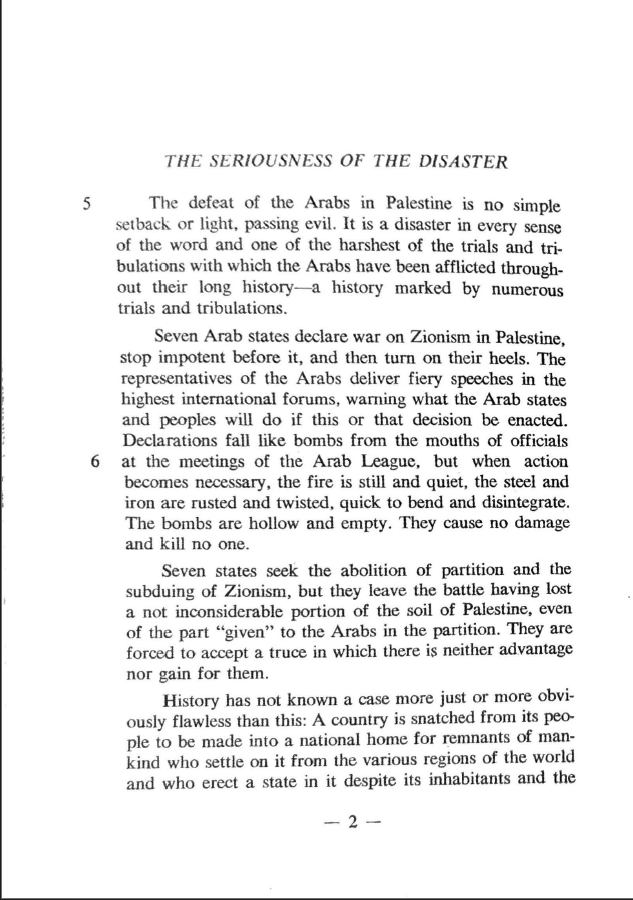
- History of the word “Nakba”
- haaretz.com-The_1948_War_Through_Arab_Eyes.pdf (file not included in this release)
- “The defeat of the Arabs in Palestine is not a small downfall – naksa. … It is a catastrophe – nakba – in every sense of the word,” he wrote in his 1948 book “The Meaning of the Disaster.”
- The 1948 War Through Arab Eyes - Opinion - Haaretz.com
- Zurayk-Nakba_cropped.pdf (file not included in this release)
- Pg. 2 — Doesn’t say “Nakba” as its translated into English. The context is clear though.
- Acrobat_TMxdCQwZ6O.png
Arab nationalism, of which there had been some early but slight intimations in the decades preceding World War I, got into its stride only during the latter half of the war and in its immediate wake. A thin layer of the Palestine Arab elite began to consider “Palestine” as a separate geopolitical entity with a pos- sibly distinct trajectory leading to self-determination and state- hood during the 1920s, following the severance of Palestine from Syria through the French takeover of Lebanon (1918) and Syria (1920) and the British conquest of Palestine and Transjordan (1917–1918) and the subsequent institution during 1920–1922 of separate French and British mandates over these territories. From that point on, the Palestinian Arab elite struggled tooth and nail to deny the “Jewishness” of Palestine. One State, Two States Resolving the Israel Palestine — Prof Benny Morris — 2009 flattened, page 50 (file not included in this release)
by 1918–1919, the Zionist leaders were claiming a “Greater Palestine,” encom- passing both all the territory west of the River Jordan and a twenty-mile-deep strip of land to the east of Wadi ‘Araba and the Jordan River, as well as the land around and south of the Litani River to the north (in present-day Lebanon), as the patrimony of the Jewish people, to be transformed, over time, into a Jewish state. One State, Two States Resolving the Israel Palestine — Prof Benny Morris — 2009 flattened, page 51 (file not included in this release)
The problem with binationalism, however—apart from main- stream Zionist opposition—was that Brit Shalom and Magnes could find no Arab partners, or even interlocutors, who shared the binational vision or hope. As Magnes succinctly put it as early as 1932: “Arabs will not sit on any committee with Jews … [Arab] teachers … teach children more and more Jew-hatred.”43 In this sense, things only got worse with the passage of time, the deepening of the Arabs’ political consciousness, and the increase in Jewish immigration. One State, Two States Resolving the Israel Palestine — Prof Benny Morris — 2009 flattened, page 69 (file not included in this release)
But although the transfer idea periodically gripped the imagination of this or that Zionist stalwart during 1882–1936, it was never adopted as a goal or policy platform by the Zionist movement or any of the main Zionist political parties, not then and not later. One State, Two States Resolving the Israel Palestine — Prof Benny Morris — 2009 flattened, page 82 (file not included in this release)