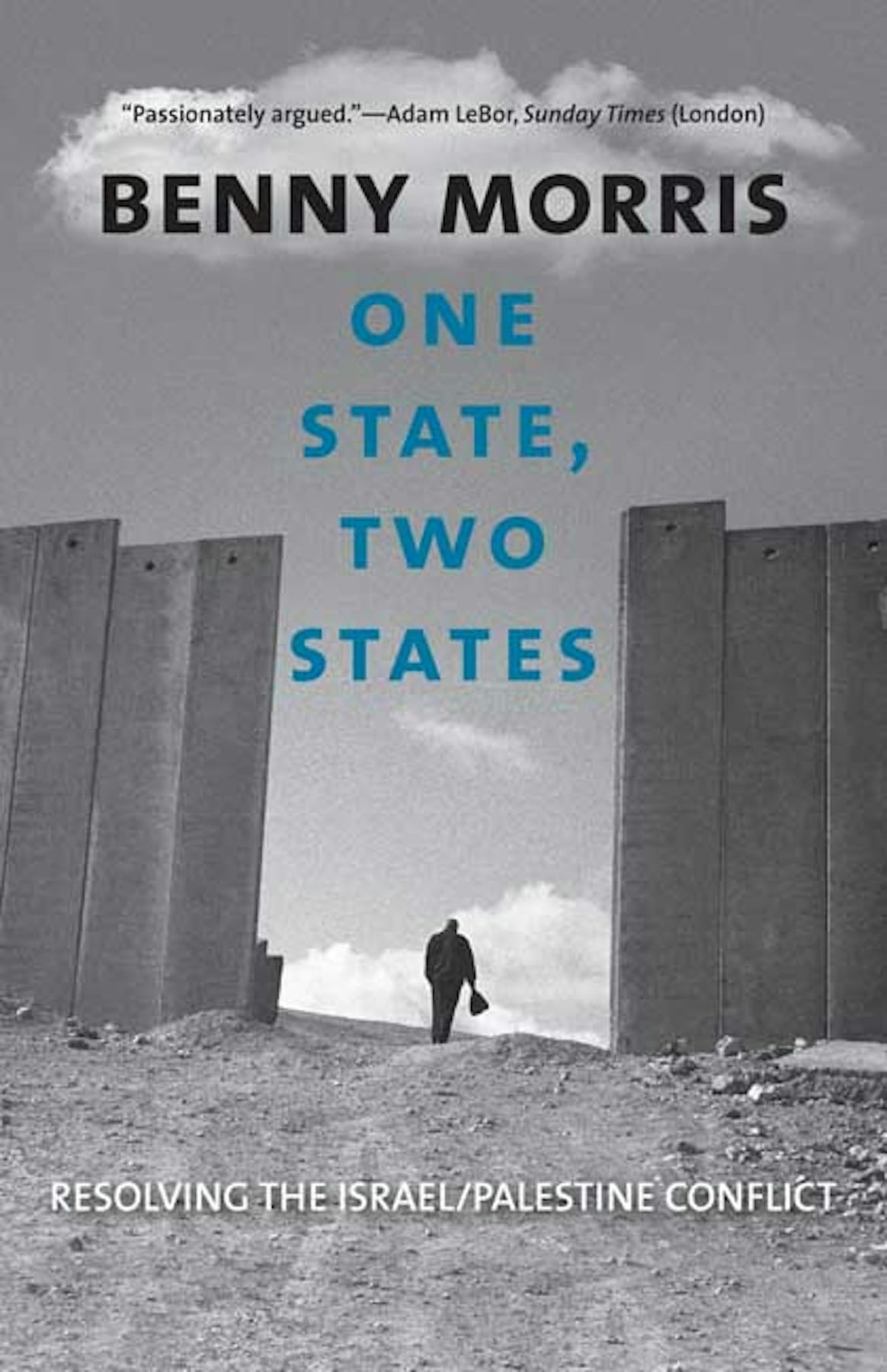
Distilled Knowledge
Source contribution
Morris traces one-state and two-state currents in both national movements and argues that end-state preferences cannot be inferred only from later diplomatic slogans. The book’s durable question is whether each movement accepts the other’s continuing collective existence or treats compromise as a stage toward exclusive sovereignty.
- A constitutional label such as “one state” hides decisive questions about majority, immigration, security, equality, and enforcement.
- A two-state formula likewise hides borders, settlements, Jerusalem, refugees, demilitarization, recognition, and implementation.
- Historical movement goals inform trust but do not prove that every faction or generation holds one unchanged intention.
Routes: Narrative Recognition and Material Compromise · Peace Offers · Writing brief
Evidence boundary
Morris’s selection and interpretation are contested. Separate archival fact, movement rhetoric, inferred intent, and present feasibility; update contemporary political claims before reuse.
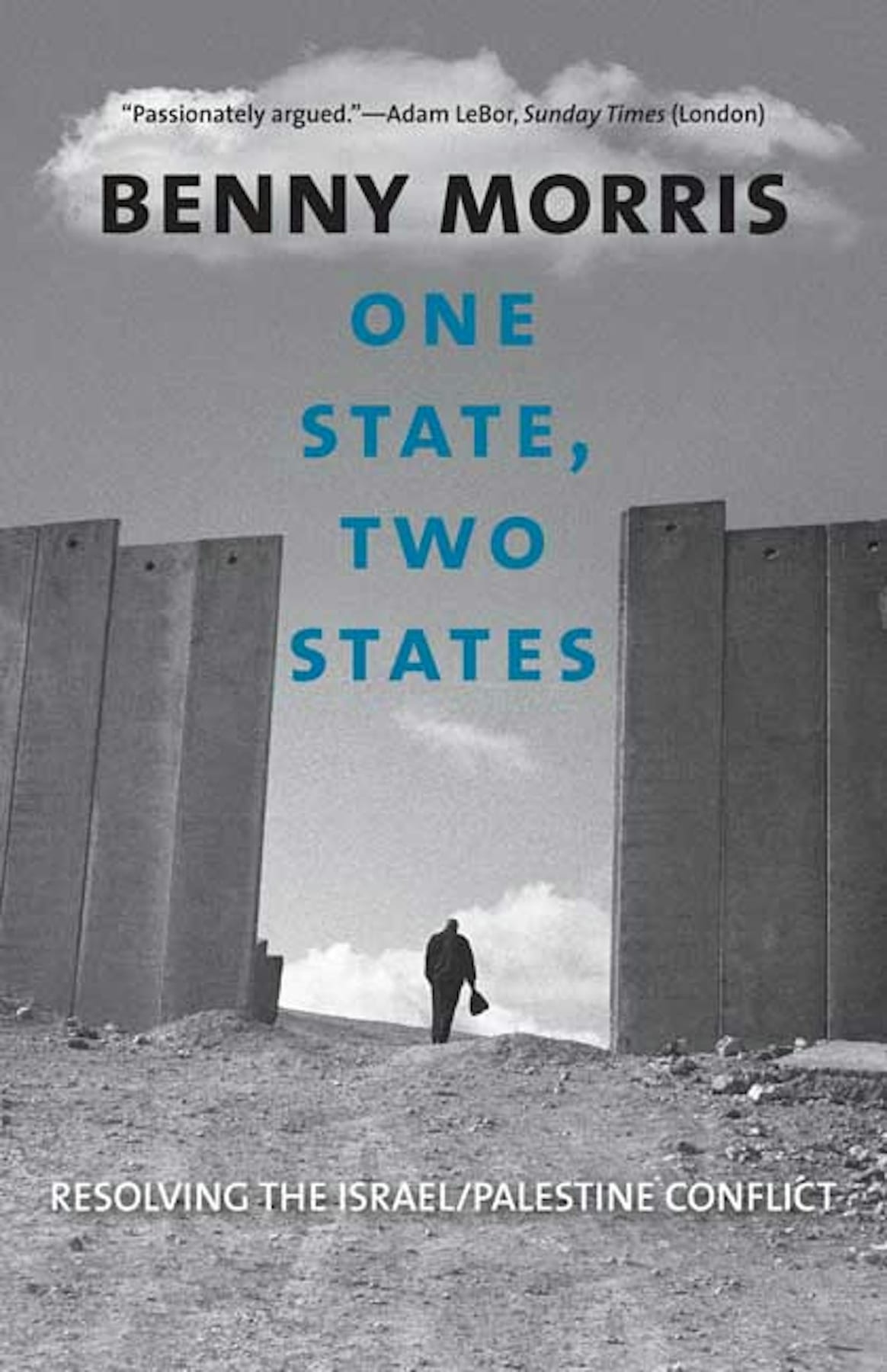
DESCRIPTION
“What is so striking about Morris’s work as a historian is that it does not flatter anyone’s prejudices, least of all his own,” David Remnick remarked in a New Yorker article that coincided with the publication of Benny Morris’s 1948: A History of the First Arab-Israeli War. With the same commitment to objectivity that has consistently characterized his approach, Morris now turns his attention to the present-day legacy of the events of 1948 and the concrete options for the future of Palestine and Israel. The book scrutinizes the history of the goals of the Palestinian national movement and the Zionist movement, then considers the various one- and two-state proposals made by different streams within the two movements. It also looks at the willingness or unwillingness of each movement to find an accommodation based on compromise. Morris assesses the viability and practicality of proposed solutions in the light of complicated and acrimonious realities. Throughout his groundbreaking career, Morris has reshaped understanding of the Israeli-Arab conflict. Here, once again, he arrives at a new way of thinking about the discord, injecting a ray of hope in a region where it is most sorely needed.
One State, Two States Resolving the Israel Palestine — Prof Benny Morris — 2009 flattened.pdf (file not included in this release)
Readwise Information
Author:: Morris, Benny.
Title:: One State, Two States
Type:: readwise/category/books
Last-Highlighted-Date:: 2024-06-10
Link:: https://readwise.io/bookreview/41354871
Readwise-Source:: readwise/source/pdf
Related-To::
Tags::
Review-for-Repurpose::
Summary
Main Ideas Summary of One State, Two States by Benny Morris:
1. The Debate: One-State vs Two-State Solutions
- Morris explores the historical and ideological roots of the one-state and two-state solutions to the Israeli-Palestinian conflict.
- He emphasizes how the idea of a two-state solution (a Jewish and a Palestinian Arab state side by side) was once the dominant approach but has increasingly been challenged by growing support for a one-state solution, especially among Palestinian intellectuals and Western academics like Tony Judt and Rashid Khalidi.
2. Rise of One-State Advocacy
- The return to one-statism stems from:
- Arafat’s rejection of the 2000 Camp David proposal.
- The electoral victory of Hamas and its 2007 Gaza takeover.
- Advocacy from Western leftist intellectuals after events like 9/11.
- Advocates often frame one-statism as “inevitable,” though Morris argues this is often a mask for a deeper desire to eliminate Israel.
3. Demographic Concerns and Jewish Democracy
- Morris notes demographic trends (higher Arab birth rates) threaten Israel’s Jewish and democratic character if it maintains control over the West Bank and Gaza.
- Thus, withdrawal and partition remain vital for preserving Israel’s identity.
4. Historical Roots and Narratives
- Morris outlines how Zionism developed in the late 19th century, motivated by anti-Semitic pogroms in Eastern Europe and the ideal of Jewish nationhood.
- Palestinian nationalism arose later, primarily in response to Zionism and British colonial rule.
- Both sides possess conflicting historical claims and myths, especially around land ownership, immigration, and legitimacy.
5. Rejection of Binationalism
- Zionist attempts at binationalism (e.g., Brit Shalom, Judah Magnes) had negligible support from either Jews or Arabs.
- Palestinian Arabs consistently rejected binationalism and partition alike, often due to religious and nationalist reasons that framed Jews as interlopers.
6. Arab Rejectionism and Violence
- Morris details a long history of Arab violence against Jews, dating back to the 1920s, framing it as ethnonationalist or religiously motivated.
- Arab leadership, especially Haj Amin al-Husseini, espoused anti-Semitic rhetoric and sought the elimination of the Jewish community.
7. The PLO and the One-State Goal
- The 1968 Palestinian National Charter and PLO discourse made clear that the goal was the destruction of Israel and its replacement with a Palestinian Arab state.
- While some in the 1970s and 1980s began to talk of a two-state solution publicly, Morris argues this was often a tactical shift, not a true ideological change.
8. Israeli Pragmatism and Two-State Support
- Mainstream Zionist leaders like Ben-Gurion eventually accepted partition as a practical necessity.
- The Israeli leadership repeatedly demonstrated willingness to divide the land, especially after WWII and the Holocaust.
- Post-1967, some Israeli factions became more expansionist, but the two-state vision remained dominant for decades.
9. Failed Compromises and Missed Opportunities
- Several partition plans, including the Peel Commission (1937) and the UN Partition Plan (1947), were rejected by the Arab side.
- Arab states and Palestinian leaders viewed partition as unacceptable, often equating any Jewish state with colonialism or religious blasphemy.
10. Conclusion: Intractable Conflict
- Morris presents a sobering view: both national movements are deeply rooted in incompatible narratives and objectives.
- He is skeptical that true compromise can be reached under current ideological frameworks and political realities.
Let me know if you want this turned into a blog post, annotated summary, or timeline.
Highlights
Chapter 1: The Reemergence of One-Statism
- This marks a break from their at least superficial espousal during the 1990s of a two-state solution and a reversion to the openly enunciated policy of the Fatah and Palestinian Liberation Organization in the 1960s and 1970s, as embodied in the Palestinian National Covenant, which posited the elimination of the Jewish state and the establishment in its stead (Page 18)
- More significant still is Palestinian American historian Rashid Khalidi’s admittedly cagey though ultimately unambiguous exposition of the one-state position in The Iron Cage (2006). He maintains in this book that his exposition does not “involve advocacy.” But even a minimally perceptive reader will not miss where his heart and mind lie (Page 20)
- The precipitants to this newfound candor about the desirability, or at least the inevitability, of a single state between the Mediterranean Sea and the Jordan River (and often the assertion of “inevitability” is mere camouflage for the propagation of its “desirability”) are three: PLO chairman Yasser Arafat’s rejection of the two-state solution proposed in July and again in December 2000 by Israeli prime minister Ehud Barak and US president Bill Clinton, his rejection providing political impetus and cover for the in-principle subversion of two-statism; the rise of the openly rejectionist, one-statist Hamas to primacy in Palestinian Arab politics,… as epitomized in the movement’s general election victory of January 2006 and its violent takeover of the Gaza Strip in (Page 22)
- June 2007; and, last, the recent advocacy of a one-state solution by a coterie of non-Arab Western intellectuals, spearheaded by Tony Judt, a distinguished professor of modern European history at New York University, against the backdrop of the Second Intifada and, more pertinently, the Islamic world’s assault on the West, epitomized by 9/11 (and stretching, geographically, from the southern Philippines and southern Thailand through India, Afghanistan, and the Middle East to Madrid and London). I would like to focus for the moment on this third precipitant. (Page 23)
- Demographic facts on the ground, given the Arabs’ far greater birth rate, as well as the current demographic reality of Israel’s Jewish population of 5.4 million and 1.3 million Arabs and the West Bank–Gaza Strip’s combined population of 3–3.8 million Arabs— the exact number is in dispute—mean that Israel cannot long remain both Jewish and democratic. (Page 24)
- Palestinian Arab birthrate is the highest in the world (Page 25)
- The only other alternative was for Israel to withdraw from the territories and facilitate the emergence in the West Bank and Gaza Strip of a Palestinian Arab state, which would allow Israel to remain both (largely) Jewish and democratic. But this could not and would not happen, said Judt; it is “too late for that.” There were “too many settlements [and] too many Jewish settlers.” The 400,000 Israeli settlers implanted in the territories since 1967 will not agree to live in a Palestinian Arab state, and no Israeli leader will have the guts, or political power, to forcibly (Page 25)
- Uproot, abandon, or crush them, as David Ben-Gurion back in 1948 had crushed the dissident right-wing Jewish militias, the IZL (Irgun Zvai Leumi, or National Military Organization, which the British Mandate authorities called the “Irgun”) and LHI (Lohamei Herut Yisrael, or Freedom Fighters of Israel, which the British Mandate authorities called the “Stern Gang”). The political,… ideological, and economic trauma of such an uprooting, which could result in a Jewish civil war, would be too great for Israel to bear. Hence, it will not happen (Page 26)
- Michael Walzer, a political thinker at the Institute for Advanced Study in Princeton, took the ideological bull by the horns when he wrote: “Ridding the world of the nation-state is an interesting, if not a new, idea. But why start with Israel? Why not with France? … The French led the way into this parochial political structure that, in violation of all the tenets of advanced opinion, privileged a particular people, history, and language … Or [with] the Germans, or the Swedes, or the Bulgarians … all of whom have enjoyed these ‘privileges’ much longer than the Jews.” But “the real problem” with Judt’s proposal, wrote Walzer, was that he was not really pointing the way to a binational state at all but “would simply replace one nation-state with another,” for in “a decade or so” there would be more Arabs than Jews between (Page 28)
- The Jordan and Mediterranean, so what would emerge from Judt’s “binational” polity would be another Arab nation-state. “This is the explicit goal of Palestinian nationalists, and the recent history of the movement hardly suggests that they have given it up.” (Page 29)
- American [and European] aid cut-offs during the past two years have left no impression at all on the policy of the Islamic fundamentalists, and Israel’s withdrawal from the Gaza Strip in summer 2005 had almost nothing to do with American pressure and almost everything to do with Ariel Sharon’s character and calculations and Israeli self-interest (Page 30)
- Since the fin de siècle, Palestine Arabs had been murdering Jews on a regular basis for ethnic or quasi-nationalist reasons. In 1920, 1921, 1929, and 1936–1939, Arab mobs had assaulted Jewish settlements and neighborhoods in a succession of ever-larger pogroms. Had the presence and actions of the occupying British army not contained them,… such bouts of violence would no doubt have been more frequent, widespread, and lethal. (Page 36)
- Unprovoked murder by an “Arab mob” of sixty-seven defenseless Orthodox Jews in Hebron in 1929. But he then dismissed the implications by arguing that, ever since, Israelis have made too much of the matter and would do better to focus on the fact that “most of the city’s [seven-hundred-strong] Jewish community were saved because Muslim neighbors protected them.” In fact, most were rescued by British police intervention and by the fact that many Jews successfully fended off their assailants for long hours—though, to be sure, Arab neighbors did save several families (Page 36)
- Palestine was not ruled as one political or administrative entity but as a collection of subdistricts, governed from the provincial capitals of Damascus or Beirut, or in the case of the Jerusalem subdistrict, directly from Istanbul. (Page 40)
- Proportion of Christians among Palestine’s Arabs has been declining steadily since 1947, when they were close to 10 percent of the population. Today less than 5 percent of Palestinian Arabs are Christians, and their numbers continue to diminish through emigration to the West (mainly from the West Bank—Bethlehem is now a Muslim-majority town). (Page 41)
- The proportion of Christians among Israel’s Arab citizens is higher, but given far higher Muslim birthrates and a measure of Christian emigration, the proportion of Christians in Israel’s Arab minority is also declining. So the Christian element in Israel/Palestine is negligible and politically irrelevant. (Page 41)
- Main reason Christian Arabs have been leaving the Holy Land has been fear of the Muslims and of future Muslim excesses, which is also the cause of the emigration of Iraq’s Christians). Many Christian Arabs from the 1920s through the 1940s would have been happy had British rule continued indefinitely, and some may have preferred Jewish to Muslim rule following the Mandate. (Page 42)
- The idea of an ethnically cleansed Palestine was raised consistently by the Palestinian Arab national movement from the 1920s through the 1940s, and there are good grounds to believe that that was the aim of the Arab onslaught on the Yishuv—the Jewish community in Palestine—in 1947–1948 (or, at least, that that would have been its outcome had the onslaught been successful). From the other side, the idea of a partial or full expulsion of Palestine’s Arabs by the Jews was discussed and supported by much of the Zionist leadership in the late 1930s and the 1940s, against the backdrop of the Arab Revolt of 1936–1939 and the Holocaust, and in some way this thinking contributed to the creation of the Arab refugee problem in 1948. (Page 42)
Chapter 2: The History of One-State and Two-State Solutions
- The Land (Page 45)
- Political Zionism emerged in eastern Europe in the early 1880s, under the impact of the wave of pogroms unleashed by the assassination of Russian tsar Alexander II. (Page 45)
- Relatively small, Zionist Organization. (Page 46)
- During the following decades the movement grew, and its message was adopted, or supported, by growing numbers until, by the end of World War II, most of world Jewry—that which remained after the Holocaust—much of Western public opinion, and most Western governments came to support the establishment of a Jewish state. (Page 46)
- Only gradually thereafter did a national consciousness pervade Palestine Arab society and give rise to a mass movement. A Palestinian Arab national movement, with a popular base, can be said to have arisen only in British-ruled Palestine in the mid-1930s, against the backdrop of the Arab Revolt; and some would say, with considerable logic, that this occurred only a decade or more later. (Page 46)
- The two movements emerged in completely different political environments and among radically dissimilar societies. Zionism emerged amid a social and intellectual climate of both burgeoning nationalisms and, in some ways, a countervailing ethos characterized by the rise of liberalism, democracy, socialism, and modernization… The Arab nationalist movements that arose on either side of World War I, including the distinct Palestinian Arab national movement, were born in largely agrarian societies dominated by Islam, with its exclusionist attitude to all religious “others” and resistance to change, by the narrow rule of political despotism, and by the tribal mores of autocratic clans and families. (Page 47)
- Palestine at the time was not ruled as a united, single, separate administrative entity. It was subdivided into districts, each ruled from a distant capital. (Page 48)
- Under the Ottomans the area traditionally known as “Palestine” (eretz yisrael in Hebrew or falastin in Arabic) was undefined administratively or politically, and its inhabitants, Muslim, Christian, and Jewish, rarely defined themselves as “Palestinians.” (Arabs living in the pre-Crusader district encompassing southern and central Palestine, jund falastin, already from the eighth century sometimes referred to themselves, in a geographical sense, as filastini, or Palestinian. But they never used the term filastini as a political designation.) (Page 49)
- Muslims subsequently adopted the term, although one thirteenth-century Arab text refers only to “the land around Jerusalem” (as far north as Nablus) as al-ard al-muqaddasa (the holy land) and the term al-quds (the holy) was used only for Jerusalem itself. As for Palestine, to many Muslims it was no more sacred than, say, Syria or Iraq or Egypt. (Page 49)
- Arab nationalism, of which there had been some early but slight intimations in the decades preceding World War I, got into its stride only during the latter half of the war and in its immediate wake. A thin layer of the Palestine Arab elite began to consider “Palestine” as a separate geopolitical entity with a possibly distinct trajectory leading to self-determination and statehood during the 1920s,… following the severance of Palestine from Syria through the French takeover of Lebanon (1918) and Syria (1920) and the British conquest of Palestine and Transjordan (1917–1918) and the subsequent institution during 1920–1922 of separate French and British mandates over these territories. From that point on, the Palestinian Arab elite struggled tooth and nail to deny the “Jewishness” of Palestine. (Page 50)
- The complete deletion of the Jewish presence in and history of the country is epitomized in the textbooks published by the Palestine National Authority since the 1990s, in the destruction by Palestinians of Jewish sites in the PNA-controlled territories during the Second Intifada (for example, the torching of “Joseph’s Tomb” in Nablus), and in the repeated “historical” pronouncements on this matter by the leader of the Palestinian national movement between 1969 and 2004, PLO chairman Yasser Arafat. (Page 51)
- The Jews (Page 51)
- By 1918–1919, the Zionist leaders were claiming a “Greater Palestine,” encompassing both all the territory west of the River Jordan and a twenty-mile-deep strip of land to the east of Wadi ‘Araba and the Jordan River, as well as the land around and south of the Litani River to the north (in present-day Lebanon), as the patrimony of the Jewish people, to be transformed, over time, into a Jewish state. (Page 51)
- Talking bluntly about both all of Palestine and a sovereign state, it was felt, would antagonize the Turks and perhaps needlessly alienate Gentile supporters of Zionism. (Page 52)
- But, to be sure, the movement’s aim, from the start, was the conversion of the whole country into a Jewish state. That is how both Zionism’s leaders and foot soldiers saw it. (Page 52)
- The early Zionists had been aware of the Arab presence in the country—there were just under half a million around 1882, the year the first Zionists came ashore in Jaffa. And there were, at the time, some twenty-five thousand Jews in the country. But the Zionists anticipated that with gradual or, perhaps, abrupt mass immigration, the Jews would eventually become the majority. As Ben-Yehuda put it in another letter, from 1882: “The goal is to revive our nation on its land … if only we succeed in increasing our numbers here until we are the majority.” (Page 53)
- The Zionists saw the Arabs as interlopers whose ancestors in the seventh century had conquered—or stolen (albeit from the Christian Byzantine Empire, not the Jews)—and then Islamized and Arabized Palestine, a land that belonged to someone else. And, in the nineteenth century, the vast majority of the Ottoman Empire’s Arabs, though they shared a common language, historical consciousness, and culture, had no national ambitions or emotions; they were satisfied to live as subjects of the Muslim empire of the day. (Page 53)
- Zionist settlers began trickling into and settling Palestine in 1882. There may not yet have been Arab “nationalism,” but the Arab inhabitants of Palestine quickly resented and feared the burgeoning Zionist influx as a threat to the “Arab-ness” of their country and, perhaps, down the road, to their very presence in the land. Starting in 1891 they began to petition Constantinople to halt the Zionist influx, land purchases, and settlement and, at first hesitantly and infrequently, began to attack Jewish settlers. (Page 54)
- The passing of the Ottoman Empire, the two-stage British conquest of Palestine in 1917–1918, and the promulgation, by (Page 54)
- Whitehall, of the Balfour Declaration all reinforced Zionist ambitions to convert Palestine into a Jewish state. (Page 55)
- The Zionist movement, while itself refraining from openly espousing the aim of “statehood”—indeed, officially the movement avoided using the “s” word down to the mid-1940s—continued, through the 1920s and the first half of the 1930s, wholeheartedly to cleave to the idea that all of Palestine would eventually come under Jewish rule. (Page 55)
- Repeated British and Transjordanian rebuffs during the 1920s and 1930s eventually persuaded Ben-Gurion and his colleagues that looking east of the river for settlement venues was unrealistic, and they continued to focus their gaze and pin their hopes for the growth of the Zionist enterprise on the land lying west of the river and on the Negev Desert, down to the Gulf of ‘Aqaba. (Page 60)
- Jabotinsky’s vision included a large Arab minority in the Jewish state,… with full individual civil rights but without collective “national” rights. That year, at the Seventeenth Zionist Congress, Jabotinsky spoke of resurrecting what he called the historic borders of the Land of Israel, on both banks of the Jordan. He left vague his hopes and ambitions regarding the fate of the bulk of Transjordan, the area east of the Gilead-Moab-Edom line. But the Zionist majority rejected Jabotinsky’s call—to which he responded by denouncing the congress and tearing up his delegate’s card (Page 61)
- Binationalism (Page 61)
- Brit Shalom (Page 62)
- The initial spark for the founding of Brit Shalom seems to have been the realization, after a visit to Egypt, by Professor Joseph Horowitz, who founded the university’s Middle East Institute, that Islam was on the rise and that Muslim scholars were deeply hostile to Zionism. (Page 62)
- Buber believed that the establishment of a Jewish state would lead to war for generations and would require the Jewish state to behave like a militarist nation, “and he does not want to be a citizen of such a state.” To say that Agudat Ihud—like Brit Shalom before it—had few supporters in the Yishuv would be a perverse understatement: ten months after its establishment, Agudat Ihud—which, unlike Brit Shalom, actively sought new members—had on its rolls only ninety-seven members (though its monthly, Be‘ayot Hayom [Problems of the day], had three hundred subscribers and sold another three hundred copies in shops). (Page 66)
- Magnes (Page 67)
- The Balfour Declaration “contains the seed of resentment and future conflict. The Jewish people cannot suffer injustice to be done to others even as a compensation for injustice [over the centuries] done to them,” he wrote in 1920. The Jewish “National Home” should not be established “upon the bayonets of some Empire.” (Page 68)
- The problem with binationalism, however—apart from main stream Zionist opposition—was that Brit Shalom and Magnes could find no Arab partners, or even interlocutors, who shared (Page 68)
- the binational vision or hope. As Magnes succinctly put it as early as 1932: “Arabs will not sit on any committee with Jews … [Arab] teachers … teach children more and more Jew-hatred.”43 In this sense, things only got worse with the passage of time, the deepening of the Arabs’ political consciousness, and the increase in Jewish immigration. (Page 69)
- Islam seemed to be a religion of the sword,” a momentarily despondent Magnes concluded (Page 69)
- Indeed, many observers defined the Arab Revolt as a jihad. After reviewing the testimony of Bishop Hajjat, the metropoli tan of the Greek Catholic Church in Acre, Galilee, and Samaria, and other Christians before the Peel Commission, one of the commissioners concluded: “We were informed that though they [that is, the Christians] are not afraid of the educated Moslem or the Effendi class who live in the towns, they have come to realize that the zeal shown by the fellaheen in the late disturbances [that is, in 1936] was religious and fundamentally in the nature of a Holy War against a Christian Mandate and against Christian people as well as against the Jews.” (Page 69)
- At the start of the revolt, the Palestinian Arab political parties established a supreme cabinetlike body, the Arab Higher Committee. Its founding dec laration stated: “Because of the general feeling of danger that en velops this noble nation, there is need for solidarity and unity and a focus on strengthening the holy national jihad move ment.” (Page 70)
- By mid-World War II Magnes realized that an open-ended in ternational mandate was no longer feasible. He had despaired of ever reaching substantive Jewish-Arab negotiations or agree ment and decided that the only solution would be an externally imposed “union between the Jews and the Arabs within a bina tional Palestine.” (Page 72)
- Hashomer Hatza‘ir (Page 73)
- Between the two world wars, for a time, binationalism also held attractions for mainstream Zionist leaders like Weizmann and Ben-Gurion. But their ap proach was always tactical. Given the reality of overwhelming Arab numbers, a binational model that gave Jews political parity, while allowing for continued Jewish immigration that they hoped would one day result in a Jewish majority, was ephemer ally attractive, even though it ran contrary to the deepest Zionist endgame aspirations. (Page 75)
- Other Advocacies of Binationalism (Page 75)
- not a single Arab leader has been found to agree to the principle of parity” (Page 76)
- two-statism (Page 77)
- Peel Proposes Partition (Page 77)
- The mainstream leaders, after thorough and painful deliberations, concluded that to save European Jewry it was necessary to agree to partition and to accept a Jewish state in part of Palestine, and to push the possibility of a state on the whole Land of Israel out of their minds or at least to a distant, ill-defined point in the fu ture. Only the immediate establishment of a Palestinian haven could save Europe’s Jews. (Page 78)
- Arab Revolt, propelled the British to curtail Zionist immigration and to appease the rebels, in light of the British Empire’s need for safe lines of communication, running through the Arab lands, which spanned the Suez Canal and the string of airfields running eastward from Palestine through Transjordan and Iraq. The British needed to pacify the Arab Middle East, which also harbored large reserves of oil, as they faced the prospect of a three-front global war against Japan, Italy, and Germany. (Page 78)
- commission published its report in early July 1937. (Page 79)
- The commissioners recommended that the Mandate be dissolved and that something less than 20 percent of the country—the Galilee and the northern and central sectors of the Coastal Plain—be awarded for Jewish statehood, with the bulk of the rest (some 70– 75 percent of the country) earmarked for Arab rule. The com mission further recommended that the Arab area eventually be joined to Transjordan, to create a “Greater Transjordan,” under the rule of the Hashemite prince Abdullah. (The remaining 5– 10 percent of the country—Jerusalem and Bethlehem, with reli gious cachet, and a strip of land from these towns, through Ramla, leading to the Mediterranean coast—was set aside by the commission for continued British rule.)68 (Page 79)
- But nothing came of the Peel proposals. They were rejected not only by the Palestinian Arab leadership and the Arabs out side Palestine but by the British government, which, after ini tially endorsing the recommendations, quickly about-faced. By May 1939, in the MacDonald white paper on Palestine, White hall completely disavowed the idea of partition and Jewish state hood and charted a future that, within ten years, would see the emergence of an independent Palestinian state governed by its majority Arab population. (Page 80)
- compared the recommendation to the Greek-Turkish exchange of population in the 1920s: “Fortunately there is the encouraging precedent of the compulsory shifting … of 1,300,000 Greeks from Asia Minor to Thessaly and Macedonia and 400,000 Turks the other way round. The whole thing was done in 18 months, and since then the relations of Greece and Turkey have become friendlier than ever before. (Page 80)
- Zionist Transfer Thinking and the One-State and Two-State Solutions (Page 81)
- Not that Zionist thinkers and political leaders hadn’t given the matter thought before. Indeed, while throughout the Zionist en terprise, since 1881, its leaders had looked to enhanced Jewish immigration as the primary means of achieving a Jewish major ity in a land that, in the beginning, was 95 percent Arab, from the start some of them had toyed with the idea of speeding up the process through a transfer of Palestine Arabs to neighboring countries. (Page 81)
- But although the transfer idea periodically gripped the imagination of this or that Zionist stalwart during 1882–1936, it was never adopted as a goal or policy platform by the Zionist movement or any of the main Zionist political parties, not then and not later. (Page 82)
- The transfer idea also impinged on, and was used to justify, the partition of Palestine and the two-state solution recommended by the Peel Commission and accepted by the Zionist movement. The commission had argued that for the two-state settlement to be viable, it had to be accompanied by a transfer of Arabs, or of “the Arabs”—“voluntary” if possible, “compulsory” if necessary— out of the territory earmarked for Jewish statehood. Otherwise, the emergent settlement would be plagued by irredentist up heavals and the Jewish state by a potential (Arab) fifth column, which would destabilize the settlement itself. (Page 83)
- Without doubt, the surge in Zionist leadership discourse dur ing 1937–1941 about transfer was precipitated by the Peel rec ommendations. But even more important in its precipitation was what had engendered the Peel Commission in the first place— the Arab Revolt, which aimed at evicting the British from Pales tine and rolling back, if not destroying, the Zionist enterprise. It was Arab attack, and the threat to Jewish existence in Palestine, that triggered Zionist transfer thinking, which aimed, in effect, to assure the Yishuv’s continued existence and to reinforce it. (Page 84)
- Transfer thinking crested, if one is to judge by the protocols of internal Zionist leadership deliberations, during the years of the revolt and in the years immediately following under the impress of the Nazi persecution and then slaughter of Europe’s Jews. With the Arabs threatening to slaughter Palestine’s Jews and, through pressure on Britain, bringing about the closure of Pal estine’s gates to Jewish immigration, and with Hitler killing Europe’s Jews and preventing them from escaping, the Zionists quite understandably sought the eviction of that Arab population which, by its actions, was indirectly contributing to the murder of their European kinfolk by helping to deny them a safe haven in Palestine and by threatening the lives of the Jews who already lived in the country. Hence, it is not surprising that Weizmann in 1941 spoke to the Soviet ambassador in London of the need to transfer half a million Arabs out of Palestine, as “a first instal ment,” to make room for two million Jews fleeing from Hitler’s clutches in Europe. (Page 85)
- At the same time, the war witnessed a large-scale transfer of Arab inhabitants, with some 700,000 being displaced from their homes, about two thirds of them coming to rest in other parts of Palestine (the West Bank and Gaza Strip) and one-third in neighboring Arab countries (primarily Lebanon, Transjordan, and Syria). (Page 86)
- And it is important to add that at various times over the past sixty years, especially during Arab assaults on Israel, particularly terrorist assault, many Israelis polled have supported the idea of transfer, their number ranging from 10 to 30 percent of the Jewish population. (Page 88)
- Two-Statism after Peel (Page 89)
- On the right, Ze’ev Jabotinsky, the Revisionist leader, was consistently forthright. He rejected partition and spoke of a state encompassing the whole Land of Israel, which ultimately would have, he believed, a Jewish majority and a large Arab minority. It would be Jewish-ruled. He denounced the Zionist mainstream’s acceptance of partition. “No Jew,” he argued, could accept a Jew ish state without “Jerusalem, Hebron, and the Land of Gilead [east of the Jordan].” It was a recipe for Arab irredentism that would continue to “covet” the Jewish area. (Page 90)
- But Greenberg and Eldad represented only the wild fringe of the Israeli right—as Magnes, with his denunciation in July 1937 of the Peel recommendations, that even the establishment of a mi nuscule Jewish state “will lead to war with the Arabs,” repre sented the fringe left.89 In the solid center was the coalition of socialist and liberal parties led by Ben-Gurion. And whether or not Ben-Gurion in 1937 really resigned himself to partition and Jewish sovereignty over only part—a small part—of Palestine, during the following decade the Zionist mainstream, including Ben-Gurion, internalized and came to accept the principle of (Page 91)
- partition. The mainstream abandoned the goal of a Jewish one state solution encompassing all of Palestine. To be sure, in no small measure it was the Holocaust that persuaded the Zionist leaders to make do with what history had to offer, while it was still on offer. (Page 92)
- In 1946–1947 the Zionist leadership negotiated and con cluded a somewhat hesitant, vague agreement on the partition of Palestine—a two-state solution—with Hashemite king Abdul lah of Transjordan. In July 1946 Ben-Gurion drew up a partition scheme in which the Jews would create their state—“Judea”— in parts of Palestine and Transjordan and Abdullah’s state— “Abdulliya”—would encompass most of Transjordan and the heavily Arab-populated part of Palestine (roughly the West Bank).90 (Page 92)
- the Yishuv’s political mainstream full-throatedly hailed the UN partition resolution as a laudable turning point in Jewish history and endorsed a two state solution. Ben-Gurion pronounced: “The UN decision to reestablish the sovereign state of the Jewish people in part of its future [sic] homeland is an endeavor of historical justice that at least partially atones for … what has been done to the Jewish people in our generation and previous generations.”96 This time, unlike in 1937, Ben-Gurion’s declarations had the ring of sin cerity, and he was to remain fixed in his advocacy of partition throughout the 1948 War while supporting the limited expan sion of Israel at the expense of parts of the areas allotted to the Palestinian Arabs, on the peripheries of the core Arab area (Lydda, Ramla, and the Jerusalem Corridor) and in the northwestern Negev and southern Coastal Plain (Isdud/Ashdod and Majdal/ Ashqelon) (Page 95)
- And later, in March 1949, just before the signing of the Israel-Jordan armistice agreement, when IDF general Yigal Allon proposed conquering the West Bank, Ben-Gurion turned him down flat.98 Like most Israelis, Ben-Gurion had given up the dream of the whole land and had internalized the necessity, indeed inevitability, of partition and a two-state solution, be it because the Great Powers would not allow Israel to have it all or because of the unattractive prospect of coopting the more than half a million additional Arab inhabi tants of the West Bank in the Jewish state. (Page 96)
- partition and two-statism governed Israeli political thinking and reality in those two decades before the Six-Day War in June 1967. The official policy of the successive Labor-led Israeli gov ernments, under Ben-Gurion (1949–1953), Moshe Sharett (1953– 1955), again Ben-Gurion (1955–1963), and then Levi Eshkol (from 1963), was to allow the territorial partition that resulted from the clash of arms in 1948 to stay. Indeed, no effort was made by Israel to exploit this or that local bout of hostilities to annex the West Bank or even the Gaza Strip (even though, in the wake of the 1956 Sinai-Suez War, when Israel conquered the Sina (Page 97)
- Peninsula and the Gaza Strip, Jerusalem made an unsuccessful diplomatic effort to block the Egyptian army’s return to Gaza). (Page 98)
- The Six-Day War—during 5–10 June 1967—temporarily un dermined the Israeli majority’s two-state outlook. In its brief war with Egypt, Jordan, and Syria, the IDF overran the West Bank, East Jerusalem, and the Gaza Strip (in addition to the Sinai Peninsula and the Golan Heights)—triggering powerful expansionist and messianic urges in the Israeli public, especially on the right and among religious nationalists. (Page 98)
- Even level-headed, moderate politicians, such as Prime Min ister Eshkol, in those post–June 1967 days toyed at least briefly with the idea of permanently retaining the Arab-populated hills of “Judea and Samaria” (Page 99)
- But the retired elder statesman, Ben-Gurion, immediately— and iconoclastically—called for Israel to withdraw from the West Bank, though not from East Jerusalem.) And although on 19 June the Israeli cabinet secretly resolved to offer to hand back Sinai and the Golan Heights, respectively, to Egypt and Syria, in exchange for peace, it failed to agree on the future of the West Bank and Gaza. (Page 100)
- The deadlock between “hawks” (who included Begin and, in this respect, Dayan), who for strategic or ideological-historical or religious reasons sought to retain these territories, and “doves” (including the powerful finance minister, Pinhas Sapir), who were willing to exchange them for peace, left the Israeli govern ment paralyzed and in open-ended retention of these areas. And, to be sure, the Arab states did nothing to help. Indeed, having been humiliated in the war, the Arab League, at the Khartoum Summit in September, responded to the secret Israeli overture regarding Sinai and the Golan Heights—conveyed to Cairo and Damascus through the United States—with a resounding triple “no”: “no” to recognition of Israel, “no” to negotiations, and “no” to peace.102 (Page 100)
- The Allon Plan harked back to the Peel Commission recom mendations and the secret 1946–1947 understanding between the Jewish Agency and King Abdullah. It reendorsed a two-state solution—but with the Arabs receiving less of Palestine (only 70–90 percent of the West Bank) and with Jordan rather than the Palestinian Arabs as the political beneficiary. But there were two problems. First, no Arab ever accepted it as a basis for agreement, not King Hussein of Jordan (who wanted back all the West Bank, including East Jerusalem) or the Palestinians (the PLO wanted all of Palestine, and for the Palestinians, not Jordan); and second, it was unacceptable to the Israeli cabinet and, hence, never be came official Israeli policy. (Page 102)
- So the Allon Plan had a twilight life. It was the only game in town—and it wasn’t; it was both on and off the table. Labor min isters repeatedly discussed it with Jordan’s King Hussein, Abdul lah’s grandson. It appears that the Israelis initially offered Hus sein some 70 percent of the West Bank—the hilly spine from Hebron through Ramallah to Jenin and the territory to the west, to the Qalqilya-Tulkarm line. Then, in the succession of secret meetings—with Eshkol’s successor, Golda Meir, Allon himself, Defense Minister Moshe Dayan, Defense Minister Shimon Peres, and Prime Minister Yitzhak Rabin—they gradually upped the ante, according to Hussein, “to something like 90 per cent of the territory, 98 per cent even, excluding Jerusalem.” But the king continued to demand all 100 percent, including East Jerusalem— “I could not compromise,” Hussein recalled—and it was never completely clear whether he was offering full peace in exchange for the 100 percent (after all, he had signed on at the Khartoum Summit in September 1967 to the rejectionist “three nos”).107 So nothing was ever resolved or agreed. (Page 103)
- The Arabs (Page 104)
- No clearly defined “falastin” having existed before, administratively or politically, they had no other defini tion to go by. (The pre-Crusader Arab province, jund filastin, with Ramla as its capital, had encompassed only part of the coun try. The north of Mandatory Palestine—the Galilee and the Jezreel, Beit Shean, and northern Jordan valleys—had been part of a separate province, jund urdunn, Jordan, whose capital was Tiberias. (Page 104)
- Under the Ottomans, as mentioned, Palestine had been only a small part of a province, ruled from either Damascus or Beirut, and had been divided into a number of subdistricts, or sanjaks. (Page 104)
- The so-called Third Palestine Arab Congress, which can be seen as the conceptive venue of the Palestine Arab national move ment, meeting in Haifa in mid-December 1920, called on the new British rulers to establish a government “to be chosen by the Arabic-speaking people who had lived in Palestine before the beginning of the [world] war.” It completely, flatly rejected Jew ish claims to Palestine: “Palestine is the holy land of the two Christian and Muslim worlds and … its destiny may not pass into other than Muslim and Christian hands.” The Congress de nounced the Balfour Declaration as contrary to “the laws of God and man.”108 (At the time, there were some eighty thousand Jews and seven hundred thousand Arabs in Palestine. About 10 per cent of the Arab population was Christian. The Muslims were highly suspicious of their Christian neighbors. Many believed that the Christians were happy with British rule and favored its perpetuation. The reference in the congress’s resolution to “Christian” rule is an obvious sop to the British—not an indica tion of a desire by the Muslims for power sharing with their Christian compatriots or of a concern for Christian interests.) (Page 105)
- demand that Britain halt the “immigration of alien Jews, many of them of a Bolshevik revolutionary type.” (Page 106)
- The Arabs wanted all of Palestine and refused to share power with the Jews or to divide the country with them. (Page 106)
- the arabs and binationalism (Page 106)
- Even the most moderate-sounding Palestinian Arabs rejected binationalism. Sharing sovereignty with a people who were tra ditionally a subject minority, seen as alien upstarts and usurpers, and newly come, was unthinkable and contrary to every fiber of their Islamic, exclusivist being. But, given the reality of Manda tory rule and the necessity of attuning their arguments to Western mores, Palestine’s Arab elite often, at least in public, brandished Western principles as the core of their argumentation. Hence, Palestinian spokesmen regularly invoked slogans like democ racy, majority will, and one man, one vote—catchphrases and norms that, in fact, were completely alien to their history and so cial and political ethos and mindset. Thus the Jaffa-based Arab newspaper Falastin argued, in December 1929: “[We] support and will always support [anyone] … who is out for an honorable understanding and an equitable solution … which would in evitably lead to the establishment of the rights of the majority and the recognition of the rights and securities of the minori ties.”112 But, following as they did the anti-Jewish pogroms of four months earlier, few Jews took such asseverations seriously. (Page 107)
- In the end, Khalidi’s plan envisaged a unitary state consisting of Transjordan and Palestine under Prince Abdullah’s rule, with an autonomous Jewish canton in the Palestine lowlands and with a limitation on Jewish immigration, assuring a permanent Arab majority—not exactly the polity envisaged by the Jewish binationalists. (Page 109)
- He sought “equality in everything … and the membership of a bi-national Palestine in a League of Arab States.” On 11 November 1946 al-Husseini, in the name of Falastin al-Jadida, signed a vaguely worded agreement with the league. The agreement spoke of Arab-Jewish “cooperation,” political equality, Jewish immigra tion limited only by the country’s economic absorptive capacity, and the inclusion of Palestine in a league of neighboring Arab states. But twelve days later he was murdered by Arab gunmen. (Page 112)
- There may still have been a few Palestinian Arabs, perhaps in Zionist pay, perhaps infused with vengeful anti-al-Husseini feelings (al-Husseini gunmen in the late 1930s and the 1940s killed a great many moderate Palestini ans who had unforgiving fathers, children, and brothers), willing to join Magnes in his advocacy of binationalism. But they were largely silent and probably could have been counted on the fingers of two hands. (Page 113)
- The thrust of Palestinian Arab nationalist feeling in the mat ter was officially laid out by al-Husseini’s Arab Office—which represented the movement in Britain—in August 1947. Its mem orandum (probably penned by Hourani), “The Future of Pales tine,” which was submitted to UNSCOP (Page 113)
- stated: All responsible Arab organisations oppose binationalism uncompromisingly. The reason for this is clear. All these plans [that is, “political parity,” “federation,” and so on] 96 (Page 113)
- The History of One-State and Two-State Solutions contravene the right of the majority to live under a govern ment of their own choosing … Such plans are impractica ble because a bi-national state of this sort cannot exist unless underlying the national differences there is a deep sense of common interest and common loyalty, which will determine the political action of both national groups in moments of crisis and in matters of importance … [Otherwise] each will watch the other with suspicion and growing hatred to see that it does not usurp more than its due; every question, however small, will be decided by communal considerations, and the gap between the two groups will grow ever wider. In these circumstances … either … life might degenerate from constant tension to civil war and its structure would dissolve into anarchy … [Or] foreign intervention might be sought and a foreign hand would always be required to hold the balance … The majority of the Zionists, there can be no question, desire the establishment of a Jewish state … The creation of a bi-national state would not satisfy them … [If there was a bi-national state, the Zionists would use it as a basis for efforts to dominate the Arabs] The fundamental Arab ob jection to the bi-national state is … one of principle: that to give a minority a political status equal to that of the ma jority is essentially undemocratic, the more so as it is cer tain that the minority will use its power to override the will of the majority … Furthermore, the condition put 97 (Page 114)
- The History of One-State and Two-State Solutions forward by the advocates of the bi-national state, that im migration should continue at least until the Jews reach numerical equality with the Arabs and possibly become a majority eventually, is again a denial of democracy, and if adopted would in fact turn the Arabs into a minority immediately. It is thus clear that the proposals for a bi national state put forward by Dr. Magnes and his group are nothing but another way of reaching the objective of Zionism, that is, the creation of a Jewish state. For this reason, the Arabs regard the views of Dr. Magnes as no less extreme and perhaps more dangerous than those of the official Zionists, because they are cloaked in an aspect of moderation and reasonableness.121 (Page 115)
- the arabs and partition (Page 115)
- If power sharing with the Jews within the framework of one state was out, there remained the possibility of coexistence, of two states, in a partitioned Palestine. But this, too, was anathema to the bulk of the Palestinian Arab leadership and, insofar as can be judged, to that of the Palestinian people, tutored by that leader ship. Jamal Husseini’s cousin, the mufti, Haj Amin al-Husseini, had bluntly told the Peel Commission that there could and would be no Jewish state in any part of Palestine. (Page 115)
- there were few surprises in the Arab reactions, inside and outside Palestine, to the publication of the Peel Commission report in July 1937. Husseini and the AHC flatly rejected the (Page 115)
- Peel recommendations, though, curiously, they did so in an ini tially hesitant fashion and only after eliciting the opinions of the neighboring Arab leaders. Most of these leaders were unequivo cal. Saudi Arabia’s king, Ibn Sa‘ud, said that establishing a Jewish state was unthinkable in Islamic terms.122 Iraq’s prime minister, Hikmat Sulaiman, acting as the Arab states’ point man, denounced the partition proposal and declared: “Any person venturing to agree to act as Head of such a [truncated Palestinian Arab] State would be regarded as an outcast throughout the Arab world, and would incur the wrath of Moslems all over the East. I declare both as head of an Arab Government and as a private citizen, that I should always oppose any individual ready to stab the Arab race in the heart.”123 Sulaiman’s pronouncement was apparently backed by a fatwa by the Shi‘ite ulema of Karbala and Najaf, who forbade acceptance of the “throne of Palestine” on pain of being declared apostate; “his evidence as a witness would be held inad missible, he would be refused burial in a Muslim cemetery, and he would be held accursed until the day of Resurrection.”124 The potency of these Iraqi statements gained added weight from the fact that their barely veiled intended target, Emir Abdullah, a fel low Hashemite ruler, was Iraq’s chief ally in inter-Arab politics. (Page 116)
- September 1937, a gathering of politicians and other dignitaries from around the Arab world, meeting in Bludan, Syria, denounced the Peel proposals in unison. (Page 117)
- The Husseini position appears to have enjoyed widespread backing inside Palestine. A special correspondent of the London Times, after touring the country immediately after the publication of the Peel recommendations, reported: “Any Arab who makes a conciliatory move or does anything short of rejecting the partition scheme as impossible may expect to find himself denounced as a traitor or exposed to terrorism.”126 (Page 117)
- Through the 1920s and 1930s, the Opposition, led by the Nashashibi clan, headed by Ragheb Nashashibi, the mayor of Jerusalem (1920–1934), had challenged the dominance of the Palestine Arab national movement by the Husseinis and their allied clans. The Nashashibis had been spo radically supported by Emir Abdullah and the British, and, occa sionally, Zionist officials were wont to call the Nashashibis, who in the mid-1930s launched the National Defense Party, “moder ates” in counterpoint to the “extremist” Husseinis. But the fact is that, although there was a difference in the tone of the two parties’ pronouncements, in their methods (the Hus (Page 117)
- seinis blithely used terrorism against both their enemies, the Jews and the British, and against their Arab rivals, primarily the Nashashibis) and in their seeming readiness to fall in with British plans, the two parties were at one in their objectives—a Palestine ruled solely by the Arabs, perhaps with a Jewish minority. Ragheb Nashashibi put it well in an interview with A. J. Brooks of the Manchester Guardian: “In fact, there is not among them [that is, the Palestine Arabs] any one Arab who can be described as ‘ex tremist’ and another as ‘moderate,’ for our cause is that of a whole nation, and our entire nation is in agreement … If those who use the words ‘extremist’ and ‘moderate’ believe that there are Arabs who could accept what the whole nation refuses [that is, partition], the only thing one can say about them is that their belief is without foundation.” (Page 118)
- The decades-long battle between the Nasha shibis and Husseinis was over power and its benefits, not about a possible compromise with the Jews. (Page 118)
- But on 11 July 1937, Ragheb Na shashibi declared flatly: “Palestine should be an independent Arab state without any Jewish or foreign rule,”131 and on 21 July the National Defense Party sent a strongly worded rejection of partition to the high commissioner. (Page 119)
- Thereafter, the Husseinis spared no effort to kill off the “traitors” and “heretics” (the Husseini discourse throughout was as much reli gious as political; the revolt itself was dubbed a jihad). Fakhri al-Nashashibi, Ragheb’s cousin, who had been instrumental in stirring up rural Palestinian disaffection with the rebels, was murdered in Baghdad by Husseini agents two years after the re volt. But the Nashashibis, while periodically supporting a Trans jordanian takeover of Palestine, at no point, except for the momentary blip on the screen in July 1937, endorsed the estab lishment of a Jewish state. (Page 120)
- Hence, for Antonius, the Arab fight from 1937 on, in the second stage of the revolt, was “essentially one of self preservation … It is not possible to establish a Jewish state in Palestine without the dislodgement of a peasantry who seem readier to face death than give up their land.”138 Antonius added, titillating the conscience of Western liberals, that Jewish “dis tress” in Europe should not be solved at the expense of Palestine’s Arabs—an argument that has been a refrain of Palestinian Arab nationalists ever since. (Page 121)
- The discourse of the Palestinian national movement’s leader during the 1920s, 1930s, and 1940s was starkly expulsionist. Under his aegis, the Arab leadership sought and fought not only to halt Jewish immigration but also to roll back and destroy the Yishuv. Its mindset and ideology were ex pulsionist and, in great measure, anti-Semitic, though, given prevailing Western norms, they often obscured this in conversa tion with Europeans. But when speaking and writing in Arabic, they were nothing if not forthright. (Page 122)
- Husseini was later to write of the Jews: “One of the most prominent facets of the Jewish character is their exaggerated conceit and selfishness, rooted in their belief that they are the chosen people of God. There is no (Page 122)
- limit to their covetousness and they prevent others from enjoy ing the Good … They have no pity and are known for their ha tred, rivalry and hardness, as Allah described them in the Koran.”141 Hence, it is unsurprising that the Arab mobs that pe riodically ran amok in Palestine’s streets during the Mandate—in 1920, 1921, 1929, and 1936–1939—screamed “idhbah al yahud” (slaughter the Jews). (Page 123)
- Occasionally, the leaders of the national movement, when pressed, let down their guard also with Western interlocutors. As early as 1919, spokesmen for the Jaffa Muslim-Christian Associ ation, representing the Arab notability in Palestine’s main town, told the King-Crane Commission, sent by the Allied powers to investigate the Palestine problem: “We will push the Zionists into the sea—or they will send us back into the desert.”142 In deed, throughout the Mandate years the Palestinian Arabs viewed the conflict as a zero-sum game that allowed of no com promise and would necessarily end in one side’s destruction or removal. (Page 123)
- Through the Mandate years, al-Husseini espoused a one-state solution in which only Jews who had been permanently resident in Palestine before 1917 (or, in some versions, 1914) would be al lowed to stay (or, in another version, be granted citizenship). In 1938, one of al-Husseini’s representatives, Musa Husseini, a rel ative, told Ben-Gurion that Haj Amin “insists on seven per cent [as the maximal percentage of Jews in the total population of Palestine], as it was at the end of the [First] World War.” (Page 124)
- Husseini was to repeat a similar formula in 1974, shortly before his death in exile: “There is no room for peaceful coexistence with our enemies. The only solution is the liquidation of the for eign conquest in Palestine … and the establishment of a national Palestinian state on the basis of its Muslim and Christian inhab itants and its Jewish [inhabitants] who lived here before the British conquest and their descendants.”1 (Page 125)
- The fact that Haj Amin al-Husseini sat out most of World War II in Berlin, was employed by the German Foreign Ministry as a broadcaster of anti-Allied jihadist propaganda to the Arab world, and helped recruit Muslim soldiers in the Balkans to fight the Russians on the Eastern Front is clearly salient to under standing the thinking of the Yishuv during 1945–1948: Pales tine’s Jews believed that the Palestinians intended to slaughter them in a second Holocaust. And at least some Arabs, too, believed that such a denouement was imminent. (Page 125)
- At the end of 1947 King Ibn Sa‘ud wrote to US president Harry Truman: “The Arabs have definitely decided to oppose [the] establishment of a Jewish state … Even if it is supposed that the Jews will succeed in gain ing support … by their oppressive and tyrannous means and their money, such a state must perish in a short time. The Arab will isolate such a state from the world and will lay siege until it dies by famine … Its end will be the same as that of [the] Cru sader states.”148 (Page 126)
- the 1960s (Page 126)
- About 60 percent of Palestinians had been displaced from their homes and were living in orchards, empty buildings, and newly established refugee camps, largely in the West Bank and Gaza, with the remainder in Lebanon, Syria, and Transjor dan. (Page 126)
- During the 1950s, there was a measure of organized cross border guerrilla and terrorist raiding by Palestinians against Israel, some of it orchestrated by Egyptian military intelligence. But it didn’t amount to much, and Palestinian politics were dead. (Page 127)
- Things began to change in the early 1960s, when a handful of nationalist and pan-Arab Palestinians began to organize in the lands of their dispersion the rudiments of a resistance movement. (Page 127)
- PNC set out its political goals in a docu ment entitled “The Palestinian National Charter (or Covenant),” henceforward the PLO’s constitution. In it, the “forces of inter national Zionism” are defined as “evil” and the Palestinian people are enjoined “to move forward on the path of holy war [jihad] until complete and final victory.” Zionism is defined as “a colonialist movement, aggressive and expansionist in its goal, racist in its configuration, and fascist in its means and aims … Zionism [is] an illegal movement and [the nations should] outlaw its presence and activities.” (Page 127)
- During the following three years the PLO’s constituent or ganizations, led by Fatah (see below), with Syrian assistance, oc (Page 128)
- casionally raided Israel, to no great effect. But the Middle East ern strategic picture changed dramatically with Israel’s victory in the Six-Day War in June 1967. The Palestinian organizations were both thrown into disarray and revitalized; the Arab states’ defeat—with their armies hors de combat—seemingly thrust the organizations into the forefront of the struggle against Israel. (Page 129)
- There was also a substantive emendation of the Palestinian National Charter. At its meeting of 1–17 July 1968, the PNC removed a number of loopholes in the original docu ment and clarified various clauses. Article 15 now stated: “The liberation of Palestine … is a national duty … and aims at the elimination of Zionism in Palestine.” (Page 129)
- only Jews who had lived in the country permanently before 1917 (or 1882) would be considered citizens of post-Zionist Palestine (Page 130)
- It is worth noting that the charter, in both its original 1964 and its amended 1968 versions, failed to define the nature of the state the PLO intended to establish, beyond the provision for freedom of worship. Only during the 1970s did some Palestini ans hesitantly begin to refer, especially when talking to Western ers, to a “democratic Palestine” or a “secular, democratic Pales tine” as their objective (of this, more later)—but this goal was never introduced at any time into the charter, perhaps to avoid alienating Muslim believers, to whom both democracy and secu larism were anathema. (Page 130)
- In recent years, Palestinian advocates in the West began to be little the charter, because its insistence on destroying Israel and supplanting it with a Palestine Arab state was impolitic and did their cause little good in Western public opinion. Hence, Palestinian-American historian and activist Rashid Khalidi, in The Iron Cage, wrote: “The fact is that it [that is, the charter] was (Page 130)
- amended at different times [Khalidi’s mendacious implication here being that it was amended in a positive, two-state direc tion], that as time went on most Palestinians paid it less and less heed, and that the political programs adopted by successive PNCs progressively contradicted it, was rarely considered by those who had an interest in showing that there had never been any evolution in the Palestinian position.”149 But the fact is that the PNC was and remains the Palestinian national movement’s supreme, sovereign body and its resolutions, including the char ter, with its various emendations, were, during the subsequent decades, certainly down to the end of the twentieth century, rep resentative of the Palestinian people’s sovereign will. (Page 131)
- Fatah, a reverse acronym for the Arabic harakat al-tahrir al-watani-al-filastini (meaning the Palestinian National Liberation Movement), is also an Arabic word meaning “opening” or “conquest,” a term that, for Arabs, connotes the sweeping Muslim Arab conquests (“openings”) of the seventh century. (Page 131)
- In January 1965 it launched its first cross-border raids, from Lebanon and Syria, into Israel, (Page 131)
- and by 1967–1968, it had emerged as the largest and strongest of the Palestinian resistance (or, in Israeli parlance, terrorist) move ments. (Page 132)
- Fatah’s ideology was always straightforward and clear. As Anglo-Palestinian historian Yezid Sayigh has put it, Fatah’s “ulti mate goal,” from inception, “was … to destroy … Israel as an economic, political, and military entity and restore Palestine as it still existed in the minds of most Palestinians, the [Arab] homeland that was before 1948 … There was little difference between Fatah and any other Palestinian group in this respect (with the solitary exception of the communists [who, directed from Moscow, supported a two-state solution]). There was little room for the Jews in this outlook.”150 A Fatah tract from 1967 that Sayigh quotes stated: “[The] military defeat [of Israel] is not the only aim of the Palestinian liberation war, but also elim ination of the Zionist character of the occupied homeland, both human and social.” (Page 132)
- Article 4 that “the Palestinian struggle is part … of the world-wide struggle against Zionism, colonialism and interna tional imperialism” (Page 133)
- The constitution defines Fatah’s goals (Article 12) as the “complete liberation of Pales tine, and [the] eradication of Zionist economic, political, mili tary and cultural existence” (Page 133)
- Following the October 1973 War, the PLO began to moderate its position tacti cally, if not strategically. The Palestinians were under pressure from the moderate Arab states, led by Anwar Sadat’s Egypt, who was headed for peace with Israel, and the West. (Page 134)
- The idea of a phased struggle to achieve the gradual elimination of Israel and a one (Arab)-state solution was enshrined in the Palestine National Council resolutions of 8 June 1974. (Page 135)
- Fatah-linked Palestinian historians and spokesmen in the West have generally described the 1974 resolutions as a “shift in objectives”—from one-statism to two-statism—“[that] was en tirely genuine for most Palestinians … [or such as] appeared to satisfy most Palestinians.”160 And Western commentators sym pathetic to the Palestinians have over the years latched onto the resolutions as signaling the beginning of—or even the complete (Page 136)
- and final—acceptance by the PLO of a two-state solution, lead ing to the establishment of a small Palestinian Arab state along side, and coexisting peacefully with, Israel. (Page 137)
- they adopted a conciliatory face to ap pease the West, but in effect, Arafat and company saw 1974 merely as the acceptance of the need for the elimination of Israel in stages rather than in one fell swoop, given the diplomatic and military realities. (Page 137)
- Arafat thus appeared to have dropped the National Charter’s stipulation about Jews resident in Palestine after 1917. But, while Palestinian propagandists at the time were busy telling the world that the PLO was beginning to accept the notion of a two state compromise, Arafat was reiterating the PLO’s traditional one-state goal, albeit dicing it up as a “democratic” polity. (Page 138)
- In Beirut in December 1980 he told a meeting: “When we speak of the Pales tinians’ return, we want to say: Acre before Gaza, Beersheba be fore Hebron. We recognize one thing, namely that the Palestinian flag will fly over Jaffa.”166 Acre, Beersheba, and Jaffa—unlike (Page 139)
- Gaza and Hebron—are parts of Israel proper, indeed deep in Is rael, in its pre-1967 configuration. (Page 140)
- did the plo subsequently accept a two-state solution? (Page 140)
- In 1982 Israeli troops invaded Southern Lebanon and besieged West Beirut, shattering the PLO as a military force. Arafat and his remaining cadres and troops were forced to leave Beirut and reestablish themselves far from Palestine, in Tunis, Yemen, and other sites in the Arab world. Five years later, the inhabitants of the occupied West Bank and Gaza Strip rose in semiarmed revolt against Israel, a revolt or intifada (in Arabic, a shaking-off, as a dog shakes off a flea) that ended only four to five years later. The two events, the first by weakening the PLO and weakening in (Page 140)
- ternational support for it, and the second by unleashing popular Palestinian pressure from the West Bank and Gaza Strip on the exiled PLO leadership to moderate its positions, resulted in the 15 November 1988 “Palestinian Declaration of Independence,” formulated by the PNC. It was preceded by a “trial balloon,” launched by Arafat’s aide Bassam Abu Sharif, who in June that year publicly called for a “two-state” solution and “lasting peace” based on mutual recognition. (Page 141)
- During the PNC deliberations in Algiers before the publica tion of the declaration, in the keynote address on 14 November, Arafat’s deputy, Salah Khalaf, reiterated the PLO’s policy of a phased takeover of all of Palestine: “This is a state for the coming generations. At first, [the Palestinian state] would be small … [But] God willing, it would expand eastward, westward, north ward, and southward … [True,] I [once] wanted all of Palestine all at once. But I was a fool. Yes, I am interested in the liberation of Palestine, but the question is how. And the answer is: Step by step.” (Page 141)
- Two days later, at a press conference, Arafat declared that the PNC had accepted Resolutions 242 and 338 as a basis for negotiations—in truth, it had not—and he renounced “all types of terrorism.” During the following months, Arafat—located between a rock (PLO rejec tionist-eliminationist ideology vis-à-vis Israel) and a hard place (American and West Bank–Gaza Palestinian demands for a (Page 143)
- moderation of the PLO’s position)—continued to play duplici tous word games. For example, in May 1989 Arafat told a French interviewer, “C’est caduc” (It is null and void), speaking of the Palestinian National Charter, which called for Israel’s destruc tion. The Israelis and the Americans were unpersuaded, if only because the PNC alone had the authority to change or revoke the charter, and it had not done so. (Page 144)
- The secret negotiations and the exchange of letters in which they culminated marked the start of the Israeli-Palestinian Oslo peace process, which was to dominate Middle Eastern politics until 2000. On 13 September 1993 Rabin and Arafat, on the White House lawn, with US president Bill Clinton as witness, signed the Declaration of Principles. (Page 145)
- But Arafat kept dropping hints, in speeches in Arabic to Mus lim audiences, that he was still wedded to the phased policy of liberating all of Palestine and had no intention of honoring a two-state settlement. He turned a blind eye to continued Pales tinian terrorism and occasionally encouraged it. On 10 May 1994 he delivered a sermon (in broken English) in a mosque in Johannesburg, South Africa, in which he promised that “the jihad will continue.” Not “the permanent State of Israel” but “the per manent State of Palestine” is what is under discussion with the Israelis, he assured his listeners. In any event, he added, for him the Oslo Accord was no more binding than the accord signed by Muhammad with the Quraish tribe in 628 in Hijaz, “Hudnat Hudeibiya (the Hudeibiya truce),” which provided for a ten-year ceasefire between the faithful and the infidel tribe, which Mu hammad proceeded to violate less than two years later, once his forces were ready. (Page 146)
- After 1993, once the PLO was firmly ensconced in the territo ries, Israel was subjected to continuous terrorist attack by Islamic (Page 146)
- fundamentalists and PLO-linked forces—in violation of the agreements signed by Arafat and his aides. These resulted in Is raeli foot-dragging in implementing its side of the Oslo commit ments. Ultimately, Palestinian terrorism strengthened Israel’s right and assured the election of Benjamin Netanyahu, the Likud leader, rather than Labor’s Shimon Peres, as prime minis ter in the 1996 general elections, which followed the November 1995 assassination of Yitzhak Rabin by a right-wing Israeli law student. (Page 147)
- On 24 April 1996 the PNC met in Gaza and, by a vote of 504 to 54, with 14 abstentions, decided to amend the charter in line with Arafat’s commitments to excise the articles calling for Israel’s destruction. (Page 147)
- But two problems have obtruded. The first is simple: the PNA/PLO failed during the following thirteen years to “redraft” (Page 147)
- and ratify an amended charter or adopt a new, alternative char ter, which omits the articles endorsing Israel’s destruction. (Page 148)
- So, quite naturally, the Netanyahu government continued to complain and press Arafat, directly and via Washington, regard ing the necessary emendation of the charter. (Page 148)
- The matter was (apparently) resolved during Clinton’s brief visit to Gaza on 14 December 1998, when by a show of hands the gathered members of the PNC, the PLO Central Council, PNA ministers, and Arafat voted overwhelmingly to endorse the PNC resolution of 1996, after which Clinton declared: “I thank you for your rejection—fully, finally and forever—of the passages in the Palestinian Charter calling for the destruction of Israel. For they were the ideological underpinning of a struggle renounced at Oslo.” (Page 149)
- six years of Palestinian foot-dragging and squiggling over the charter—important both as symbol and as substance— had left many Israelis skeptical. (Page 149)
- 2000 and after (Page 150)
- As with 1937 and 1947, the year 2000 represented a milestone in the Palestinian approach to a solution to the conflict. But, in a sense, it was a more defining milestone than its predecessors. For in 1937 and 1947, in rejecting the two-state solutions proposed, respectively, by the Peel Commission and the UN General As sembly, the Palestinian Arabs had merely been expressing their consistently held and publicized attitude toward a resolution of the conflict; only a one-state solution, a Palestinian Arab state with a minuscule, disempowered Jewish minority, was accept able. In rejecting the two-state solution offered, in two versions, in 2000, they were also—so it seemed—reneging on a process and on a commitment they had made, and repeated, in the course of the 1990s. And whereas in 1937 and 1947 they had rejected merely a two-state vision, a possibility, as it were, in 2000 they were also rejecting a reality, denying the legitimacy and right to (Page 150)
- life of an existing state, subverting a principle on which the inter national order rests. Hence the surprise and shock of peace mongering Israelis and well-meaning Westerners—a surprise and shock that had been completely absent in 1937 and 1947 among Arab, Zionist, and British observers. (Page 151)
- factual bare bones of what happened in July, September–October, and December 2000 are simple. (Page 151)
- Camp David (Page 151)
- The Palestinians were somewhat wary, saying that they were “unprepared”; and they feared that the Israelis and Americans, who were allies, would “gang up” on them. And Barak was hob bled by a disintegrating government: three of his right-wing and religious coalition partners (Shas, the National Religious Party, and Yisrael Ba‘aliya), opposed to his expected concessions on ter ritory and Jerusalem, bolted the government in the days before he departed for the United States. (This fact would later enable Palestinians and their supporters to argue that whatever Barak had offered had been meaningless because he would never have (Page 151)
- been able to deliver on it. But the Israelis countered with a prece dent: had Barak and Arafat reached a deal, the Israeli public would have given Barak a wholesome mandate, overruling the recalcitrant political party leaderships—much as had occurred in 1978–1979, when the public, and in its wake, the great majority of its parliamentary representatives, had supported Begin after he had concluded the deal with Sadat, in which Israel gave up the Sinai Peninsula in exchange for peace with Egypt.) (Page 152)
- At base, Barak put on the table an offer of a Palestinian state in exchange for peace. Israel made a series of proposals, each better than the last, on territory, Jerusalem, the nature of the Palestinian state. Arafat consistently said “no” and demanded more. He made no proposals or offers of his own and, after occa sionally hinting (through aides) at a willingness to concede a point on this or that issue, quickly withdrew the concession, say ing he had been misunderstood. (Arafat’s English was poor—and he exploited this to parry, obfuscate, and bamboozle.) Barak, for (Page 152)
- his part, offered nothing in writing and presented no maps, later arguing that he had not wanted to leave the Palestinians with a series of concrete Israeli concessions in hand—which would then have served as the starting point in a future round of negotiations—if the Palestinians offered no concessions of their own and Camp David collapsed. But, as a result, the Palestinians could—and would—later argue that Barak had not really offered them anything, or anything concrete. (Page 153)
- But recollections of the discussions, based on real-time notes and diary entries, by Clinton and Dennis Ross, the chief American Middle East negotiator, and by Gilead Sher and Shlomo Ben-‘Ami, Barak’s aides, were published in short order, as were a variety of interviews and arti cles. (Page 153)
- Hence, a reasonably accurate idea of what was discussed and what was offered by Israel, under constant American prodding, and what was rejected or what was not offered by Arafat, despite American prodding, has emerged (Page 153)
- Barak offered Arafat the establishment of an independent, but essentially demilitarized, Palestinian Arab state in the Gaza Strip and the bulk of the West Bank, with its capital in East Jerusalem. Barak said that Israel would withdraw its troops and settlers from the whole of the Gaza Strip. At the start of the summit, he said that about 80 percent of the West Bank would revert to Palestin ian sovereignty; by its end, 90–91 percent was offered (and the (Page 153)
- equivalent of 1 percent compensation to the Palestinians from Israeli territory proper). Barak said that Israel would retain the remaining 9–10 percent of the territory along the Green Line, with the thick clusters of Jewish settlements (the ‘Etzion Bloc, Ariel, and so on), and the settlers inhabiting the core areas of the West Bank and the Gaza Strip would be pulled back and resettled in these blocs. Israel would retain, at least temporarily, a thin strip of the southern Jordan Valley along the river as a security zone. It is not clear whether, at the end of the summit, Israel still insisted on retaining another thin strip of territory running from Jerusalem through Ma‘ale Adumim to the Jordan River, which, Barak at one point explained, the Palestinians could traverse with tunnels or bridges to maintain contiguity between the northern (Ramallah-Nablus-Jenin) and southern (Bethlehem Hebron-Dhahiriya) sections of the West Bank.177 As to Jerusalem, Barak—breaking a long-held Israeli taboo re garding the redivision of the (“unified”) city—offered the Pales tinians sovereignty over the outlying Arab neighborhoods and some form of functional control in the core Arab neighborhoods. The Palestinians were also to get control of part of the Old City, with some characteristics of sovereignty, and control though not sovereignty over the Temple Mount (al-haram al-sharif, the noble sanctuary), containing al-Aksa Mosque and the Dome of the Rock. There was to be a Palestinian “right of return” to the territory of the future Palestinian state but not to Israel (though (Page 154)
- Barak agreed to full compensation of the refugees for their lost property and hinted at a readiness to absorb in Israel a token number of elderly refugees within a “family reunion” scheme). Arafat rejected the offered two-state solution. Ross recorded that Clinton blew up and yelled at the PLO leader that he had “been here fourteen days and said no to everything.”178 Or as Clinton put it in his memoirs: on Day 8 of the summit Arafat “turned the offer down”; on Day 9, “I gave Arafat my best shot again” and “again he said no”; on Day 13, “Again Arafat said no. I shut down the talks. It was frustrating and profoundly sad.”179 Arafat had demanded all 100 percent of the Gaza Strip and West Bank (though at one point one of his aides spoke of a readiness to cede 2–3 percent of the West Bank, with equivalent Israeli cession of territory to the Palestinians elsewhere); sov ereignty over all of East Jerusalem and its Old City, except the Wailing Wall (or, in a variant, the Wailing Wall and the Jewish Quarter), and full, sole Palestinian Arab sovereignty over the Temple Mount. Indeed, at one point Arafat denied that there had ever been a Temple Mount in Jerusalem. He rejected Clin ton’s last-minute proposal that sovereignty in the Old City be divided, with the Arabs sovereign over the Muslim and Chris tian quarters and the Jews sovereign in the rest (the Jewish and Armenian quarters), and that the Palestinians receive “custo dianship” over the Temple Mount, but without full, formal sovereignty.180 Arafat also demanded Israeli acceptance of the principle of the “right of return” and agreement to the return (Page 155)
- of the refugees to their pre-1948 homes and lands in Israel proper. The summit broke up in failure on 26 July. Recriminations followed. Clinton, contrary to his presummit assurances, and Barak both blamed Arafat and his inflexibility for the failure and expressed astonishment that the Arabs had rejected the most far reaching Israeli concessions ever made. For years, the Palestini ans had been demanding a two-state solution; for years, Israel had stalled—even Rabin had not formally endorsed two “states.” (Page 156)
- Now, at last, when Israel (and the United States) offered it, the Palestinians turned it down. Arafat and his aides lambasted Israel for making inadequate proposals, which amounted to giving the Palestinians a cluster of “bantustans” rather than a full-fledged independent state—and this on less than 20 percent of the terri tory of Mandate Palestine (the Palestinians argued that, in effect, they had already made a major “concession” in accepting the loss of the 78–79 percent of Palestine on which Israel was established in 1948–1949). There were frustration and disappointment in the Palestinian public—which was misinformed by its leaders and media about what exactly the Israelis had offered—and among left-wing Israelis, most of whom felt that they had reached the limit of concession and had been rebuffed. (Page 156)
- 28 September the Likud’s new leader, Ariel Sharon, guarded by dozens of policemen, visited the Temple Mount for twenty-four minutes in what many Arabs regarded as (Page 156)
- a provocation (though he made no statement and did not enter the mosques). Muslim crowds gathered in Jerusalem and began pelting the police with stones. (Page 157)
- Palestinian broadcasters and leaders invoked jihad. The Second Intifada had begun. (Page 157)
- What is clear is that Arafat and his aides did nothing to douse the flames while occasionally pre tending, vis-à-vis Washington, that they were trying to. (Page 157)
- Some critics then and later were to argue that Clinton should have formulated and presented his proposals at the start or in the course of Camp David, and not waited until December. (Page 157)
- 23 December Clinton met Palestinian (Page 157)
- and Israeli representatives and handed them and published his “Parameters” or proposals for an Israeli-Palestinian peace. (Page 158)
- parameters were nonnegotiable. (Page 158)
- The Clinton proposals, offering a two-state settlement, stipu lated that Israel must withdraw from between 94 and 96 percent of the West Bank and, implicitly, 100 percent of the Gaza Strip, in which the Palestinian Arab state would then be established. Is rael would compensate the Palestinians for the loss of the 4–6 percent of the West Bank that they would be “ceding” with a patch of Israeli territory amounting to “1 to 3 percent” of the West Bank as well as allowing the Palestinians a “safe passage” corridor between Gaza and the West Bank through Israeli terri tory. The 4–6 percent of the West Bank retained by Israel would include the large settlement concentrations, such as the ‘Etzion Bloc, which held some 80 percent of the territory’s settlers. (Page 158)
- On the night of 27–28 December 2000 the Israeli cabinet voted to accept the Clinton parameters. The statement issued after the meeting and transmitted to Washington on 28 Decem ber said: “Israel sees these ideas as a basis for discussion provided that they remain unchanged as a basis for discussion also by the Palestinian side.”182 (Page 161)
- In Clinton’s (and Ross’s) view, the Israelis, whatever their mis givings, had said “yes.” In his memoirs, Clinton explicitly defined “all [the Israeli] reservations [as falling] within the parameters. (Page 163)
- But the Palestinians again said “no.” After delaying their re sponse to the proposals beyond the four days allotted by Clinton, the Palestinians presented a set of reservations that together amounted to a flat rejection of the package. The PNA response, dated 1 January 2001, entitled “Remarks and Questions,” was accompanied by a letter by Yasser Abed Rabbo, “head of the Palestinian negotiating team,” effectively saying “no” to almost each and every parameter. In some instances, the “no” was ex plicit; in others, it was framed as a “question” or misgivings. But taken in toto, the Palestinian document amounted to a resound ing “no.” (Page 163)
- Abed Rabbo’s letter defined itself as “remarks and requests for clarification.”186 Ross described them as “deal-killers.”187 In fact, they were a comprehensive rejection of the Clinton parame ters.188 Abed Rabbo was quoted at the time as saying that “Clin (Page 165)
- ton’s proposals are one of the biggest frauds in history, like the Sykes-Picot Agreement.” (Page 166)
- a close examination of the substance of the “nos” allows for a darker interpretation. The Palestinian insistence on Israel’s ac ceptance of the “right of return” and its implementation, given the demographic realities, would seem to mean that the PNA PLO strove and is striving for the conversion of Israel from a Jewish to an Arab-majority state as well as a West Bank–Gaza state that is Arab. (Page 166)
- Arafat’s nonacceptance of shared sovereignty over the Temple Mount implied a basic dismissal of the Jewish claim and right to the mount and, by extension, to Palestine as a whole: the Jews have no recognized historical connection to the Land of Israel and their territorial-political demands are illegiti mate. This was Arafat’s message at Camp David and has been a constant refrain of Palestinian leaders, from Husseini through Abbas, throughout the history of the Palestinian Arab national movement. (Page 167)
- Three weeks later, Israeli and Palestinian teams met for one fur ther bout of negotiation, in Taba, on the Sinai Gulf of ‘Aqaba coast. But the talks, held over 21–27 January 2001, were mean ingless. Clinton was no longer president, his successor, George W. Bush, had withdrawn support for the parameters, and Barak was facing general elections, on 6 February, that all knew he would lose by a landslide to Ariel Sharon, as in fact occurred. Barak’s aides were, politically, in no position to negotiate any thing and nothing, in fact, was concluded. Taba was an abortive academic exercise by despondent Israeli doves and powerless Palestinians (Arafat did not attend), no more. (Page 167)
- the second intifada and the rise of the hamas (Page 167)
- Most prominent were a succession of suicide bombings by Muslim fundamental ists in Israeli towns, principally against civilian passenger buses and restaurants (suicide bombings, introduced into the region by Hezbollah in the 1980s, were inaugurated by the Palestinian fun damentalists after the Goldstein massacre at the Tomb of the Pa triarchs). (Page 168)
- Arafat and his aides continued to incite their people to violence. (Page 168)
- The Israelis, contrary to Arab and Western press reports, took care, often great care, not to kill civilians. (Page 168)
- On 4 May 2003, the committee issued the so-called 3rd Draft Constitution of the emergent Palestinian state. (Page 169)
- The territorial definition of the Palestinian state is convoluted to the point of obscurity, and it is contradictory. It seems to be saying that the state will be restricted to the West Bank, East Jerusalem, and the Gaza Strip—but it avoids saying so clearly and explicitly. (Page 169)
- Taken together, these articles to my mind explicitly, and at very least implicitly, provide a firm anchor for anyone asserting that the constitution does not renege on the Palestinians’ tradi tional claim to the whole of Palestine and, in fact, posits a one-state solution. And when capped by Article 7—which states: “The principles of the Islamic Shari‘a are the main sources for legislation”—there can be little doubt what sort of state the drafters were envisaging: certainly not a “secular, democratic Palestine.” (Page 170)
- “The Covenant of the Islamic Resistance Movement (Hamas),” dated 18 August 1988. (Page 171)
- Though Hamas’s operations over the years have focused on Is rael and the occupied territories, the movement’s ideology has potential universal reach or, as the covenant puts it, “its extent in place is anywhere that there are Muslims who embrace Islam as (Page 172)
- their way of life everywhere in the globe. This being so, it ex tends to the depth of the earth and reaches out to the heaven … the movement is a universal one”—so Americans and Europeans should not be overly surprised if, at some point, Hamas suicide bombers arrive on their doorstep. (Page 173)
- The covenant defines the ongoing struggle as directed against “the Jews,” “they who have received the scriptures,” and de fines them, in the Qur’an’s terminology, as “smitten with vile ness wheresoever they are found … because they … slew the prophets,” a reference to the killing of Jesus Christ. The Hamas is deeply, essentially anti-Semitic. “Our struggle against the Jews,” states the covenant, “is very great and very serious … The Prophet … has said: ‘The Day of Judgment will not come about until Moslems fight the Jews (killing the Jews), when the Jew will hide behind stones and trees. The stones and trees will say O Moslems, O Abdulla, there is a Jew behind me, come and kill him.’” Citing at one point “The Protocols of the Elders of Zion,” the covenant charges that the Jews, “with their money … took control of the world media, news agencies, the press, publishing houses, broadcasting stations … With their money they stirred revolutions in various parts of the world … They were behind (Page 173)
- the French Revolution, the Communist Revolution and most of the revolutions we heard and hear about … With their money they formed secret societies, such as Freemasons, Rotary Clubs, the Lions … for the purpose of sabotaging societies and achiev ing Zionist interests … They were behind World War I … They were behind World War II, through which they made huge financial gains … [It was] they who instigated the replacement of the League of Nations with the United Nations and the Secu rity Council to enable them to rule the world … The Zionists aspire to expand from the Nile to the Euphrates … [Later] they will aspire to further expansion.” (Page 174)
- the destruction of the Jewish state is Allah’s command. And “there is no solution for the Palestinian question except through jihad. Initiatives, proposals and international confer ences are all a waste of time.” (Page 175)
- In the twenty-five-page covenant, the Cru sades and Crusaders are mentioned explicitly nine times; the word “jihad” appears eleven times. Saladin, the Kurdish warrior who led the Muslim armies in the destruction of the Kingdom of Jerusalem, is mentioned four times. (Page 175)
Chapter 3: Where To?
- mainstream of the Zionist movement, led by prag matic politicians and parties and beset by the Nazi onslaught on European Jewry as well as Arab assault in Palestine, over 1937– 1947 gradually pared their goal and acquiesced in the idea of sharing or partitioning the country with the Arabs—not out of altruism or a sense of fairness but because of an appreciation that (Page 178)
- this was what history was able to offer the Jews, and no more, and because there was an immediate need for Europe’s Jews of a safe haven, however small. (Page 179)
- During 1949–1967 the majority of Israelis and their succes sive, Labor-led governments accepted this de facto partition. But the victory in the 1967 Six-Day War and the occupation of the territories awakened among many the desire to constitute a “Greater Israel,” encompassing the territory of pre-1967 Israel as well as the newly occupied West Bank, East Jerusalem, and the Gaza Strip (and, perhaps, the Golan Heights and parts of the Sinai Peninsula as well). The incumbent Labor-led government of Levi Eshkol began to establish settlements in the territories, and his successors, Golda Meir and Yitzhak Rabin (and his de fense minister, Shimon Peres), modestly continued the policy. The enterprise was then vastly invigorated after the Likud came to power in 1977. Without doubt the establishment, existence, and expansion of the settlements, especially in the hilly heartland of the West Bank, complicated the task of leaders bent on mak ing peace with the Palestinians and reaching a two-state settle (Page 179)
- ment. The Palestinian Arabs did not want Jewish settlements in their “state” after the prospective Israeli withdrawal (though, of course, they saw nothing wrong with the existence of dozens of Arab villages and towns in Israel proper), and the Israeli govern ments were loath to uproot the settlements or, indeed, curb the settlement enterprise, both because some ministers supported the expansion and out of a reluctance to clash with the settlers and their right-wing supporters. This curtailed the government’s ability to advance toward an agreement with the Palestinians. (Page 180)
- Israel began to build a barrier— mostly fence, in small parts wall—separating Israel proper from about 93 percent of the West Bank in order to lay the ground work for a two-state denouement, either through an agreement or, in its absence, unilaterally. This, the demographic imperative, as well as the desire to keep out Arab suicide bombers, was the logic behind the barrier, not discrimination or the desire to steal Arab land (though in delineating the barrier, the planners incor porated in Israel slightly more territory than the Clinton pro posals had earmarked for Israel as a cession from the West Bank). (Page 181)
- possibility of a unilateral Israeli withdrawal from the West Bank was subsequently complicated by the fact that, fol lowing the withdrawal from Gaza, the Muslim fundamentalists who dominated the area went on to use it as a launching pad for constant, terroristic rocketing of Israel’s border settlements (Page 181)
- It is today clear that no Israeli leader will initiate a pullout from the West Bank—unilaterally or in agreement with the Palestinians—before the IDF acquires the technological capability to protect its population centers from short-range missile attacks. (Page 182)
- The evolution of the Palestinian Arab national movement has been radically dif ferent. In effect, there has been no evolution in terms of attitudes toward Zionism and Israel. (Page 183)
- The Palestinian vision was never, as described by various Pales tinian spokesmen in the 1960s, 1970s, and 1980s to Western jour nalists, of a “secular, democratic Palestine” (it certainly sounded more palatable than, say, the “destruction of Israel,” which was the goal it was meant to paper over or camouflage). Indeed, “a secular democratic Palestine” had never been the goal of Fatah or the so called moderate groups that dominated the PLO between the 1960s and the 2006 elections that brought Hamas to power. (Page 184)
- The Palestine National Council never amended the Palestine National Charter to the effect that the goal of the PLO was “a secular democratic state in Palestine.” The words and notion never figured in the charter or in any PNC or PLO Central Committee or Fatah Executive Commit tee resolutions, at any time. It is a spin invented for gullible Westerners and was never part of Palestinian mainstream ideol ogy. The Palestinian leadership has never, at any time, endorsed a “secular, democratic Palestine.” (Page 185)
- Why, for example, have black Africans, who over the centuries have suffered infinitely more at Western—and, indeed, Muslim Arab— hands than the Arabs ever did, never resort to international ter rorism and suicide bombings against Western—or Arab—targets (Page 186)
- So where did the slogan of “a secular, democratic Palestine” originate? That goal was first explicitly proposed in 1969 by the small Marxist splinter group the Democratic Front for the Lib eration of Palestine.3 According to Khalidi, “It was [then] dis creetly but effectively backed by the leaders of the mainstream, dominant Fatah movement … The democratic secular state model eventually became the official position of the PLO.”4 As I have said, this is pure invention. The PNC, PLO, and Fatah turned down the DFLP proposal, and it was never adopted or enunciated by any important Palestinian leader or body—though the Western media during the 1970s were forever attributing it to the Palestinians. (Page 186)
- In all, as many Israelis saw it, the Palestinians’ prevarication, stonewalling and se mantic manipulations in the course of the Oslo process were not so much tactical means to garner the support of a radical public as candid expressions of a will to avoid abandoning the tradi tional, one-state ideology. Arafat’s Johannesburg sermon was both symbol and reality. (Page 189)
- At Camp David Arafat balked and turned down each successive offer. He refused to (Page 189)
- compromise on each major core issue—refugees, Jerusalem, Temple Mount, Israeli security, borders—and in December 2000–January 2001 said “no” to Clinton’s greatly improved pro posals, which offered the Palestinians statehood in 100 percent of the Gaza Strip, 94–96 percent of the West Bank (with some compensation from Israeli territory for the “ceded” areas), and half of Jerusalem. (Page 190)
- His responses on the Temple Mount issue—“no” to every proposed compromise and his denial of Jewish history and rights—was indicative of his wider mindset: there was no legiti macy to Zionism and Israel or their claims. Arafat rejected the terms offered in July and December 2000 not because of their detail but because of their underlying principle: two states for two peoples. (Page 190)
- Arafat and his aides consistently declined to recognize Israel as a “Jewish State,” a refusal still characteristic of the PNA lead ership. In November 2007, Sa‘ib Erikat, the chief Palestinian peace negotiator (and a Palestinian “moderate”), said: “The Pales tinians won’t accept Israel as a Jewish state.”6 Mahmoud Abbas, the PNA president, put the same idea succinctly a few days later, in Cairo, on his way home from the Annapolis peace sum mit: “The Palestinians do not accept the formula that the State of Israel is a Jewish State … We say that Israel exists and in Israel there are Jews and there are those who are not Jews.”7 So much for two states for two peoples. (Page 191)
- Although Abbas, who succeeded Arafat as PNA president in 2005, dresses appropriately and makes many of the right noises vis-à-vis the West (the source of most of the funding that props up the PNA), the sincerity of his two-state avowals remains in doubt, in view of his consistent support for “the right of return” and his refusal to recognize Israel as a “Jewish State.” But, in re ality, Abbas’s true colors are barely relevant. He represents only a (Page 192)
- small proportion of the Palestinian people. And the absence of popular support and the feebleness of his security forces, as demonstrated during the Hamas takeover of Gaza in June 2007, highlight this irrelevance (Page 193)
- As Ismail Haniyeh, the Hamas “prime minister,” put it at the Gaza rally (attended by 250,000) in December 2007 commemorating the twentieth anniversary of the Hamas’s founding, “We will never recognize Israel”—to which the head of Hamas outside Palestine, Khalid Mashal, added, in a video broadcast: “We will never give up one inch of Palestine.”9 Hamas has the virtue of speaking clearly and consistently. (Page 193)
- The division of Palestine into three parts—Israel, the West Bank, and the Gaza Strip—also makes little sense in terms of a variety of resources and services: (Page 194)
- the very shape and smallness of the Land of Israel/Palestine—about fifty miles from east (the Jor dan) to west (the Mediterranean)—makes its division into two states a practical nightmare and well nigh unthinkable. (Page 194)
- Moussa Kazim al-Husseini, head of the Palestine Arab Execu tive, the first leadership body of the Palestine Arab national movement, put it pithily back in 1922: “Nature does not allow the creation of a spirit of cooperation between two peoples so different.”11 And, of course, it was not just a matter of “differ ence”: Arab hatred of the Jews was so profound as to make a com mon polity an impossibility. As Lord Peel wrote to Colonial Sec retary William Ormsby-Gore as he was preparing the royal commission report, “Though I knew there was ill-feeling be tween Jews and Arabs, I had not realized the depth and intensity of the hatred with which the Jews are held by the Arabs. [And] I did not realize how deep-seated was the Arab fear of Jewish over lordship and domination.”12 (Page 195)
- if Jewish fears in the 1930s of Arab intentions to push them “into the sea”—to destroy the Zionist enterprise and perhaps slaughter the Yishuv—were, if heartfelt, unrealistic (as it turned out), today they are very real, as are Jewish fears of a nuclear Holocaust at Islamic hands. (Page 196)
- Tilley ignores the broad popularity that these suicide bombings en joyed—and still enjoy—in the Palestinian cities, ignores the crowds that swamped the streets of Ramallah and Gaza and Nablus when news arrived of a “success” in Tel Aviv or Haifa; ignores the Fatah/Hamas custom of handing out sweets to passersby with each “successful” bombing; and ignores the ven (Page 197)
- eration the bombers are accorded in all West Bank and Gaza schools, their postered faces looking down from the walls in every classroom. Second, the relatively small number of success ful suicide bombings during the years 1993–2008 was a function more of Shin Bet and IDF prevention and interdiction (and the security fence) than of Palestinian inhibitions or restraint. The suicide bombings, as every poll among Palestinians has shown, were, and remain, immensely popular. (Page 198)
- al-Husseini was the head of Palestine’s Supreme Muslim Council between 1922 and 1948 and the head of the Arab Higher Committee during 1936–1939 and again in 1946–1948, and, during the 1930s and 1940s, he was recognized by both the Arab masses of Palestine and the neighboring Arab governments, as well as by the British Mandate government and by the Jewish authorities in Palestine, as the leader of the Pales tinian national movement. No Palestinian historian or commen tator disputes this. To claim now that he represented merely “a few reactionary Palestinian factions” is plain mendacity. Second, there were no “Arab factions” “that sought coexistence with the Jewish-Zionist movement.” No Arab party during the 1930s and 1940s sought coexistence; all sought to crush the Yishuv and rule all of Palestine themselves, though a minority may occasionally have temporized or sought tactical, short-term accommoda (Page 199)
- tions. Last, the Haganah, to the best of my knowledge, never sought “to collaborate” with the Nazis in the 1930s. There was one extremist Zionist paramilitary or terrorist group, the LHI, or “Stern Gang,” with some three hundred to five hundred members (the Haganah at this time had twenty thousand to thirty thousand members) and no popular backing—in the 1949 Knesset elections the LHI veterans party won no seats—which sought an alliance with the Germans, during 1939–1940, before the Holocaust got under way, in order to jointly fight against and throw out of Palestine what they regarded as the British “imperi alists.” The Nazis, of course, refused to have anything to do with them. (Page 200)
- Now although it is true that the PLO leadership since the 1960s has learned the arts of verbal restraint and ambiguity, Tilley ap parently has never heard of Hamas, which continues to exercise far fewer inhibitions of this sort (though, it is true, its leadership does refrain from using explicit phrases like “throwing the Jews into the sea”). (Page 200)
- As the Muslim proportion of the Palestine Arab population has grown, and grown more devout, so the pro portion of Christians—the more Westernized and “liberal” sec tor among the Arabs—has steadily diminished (it now stands at less than 5 percent); Christian Arab families have tended to have fewer children and, proportionately, have emigrated in far greater numbers to the West and out of the conflict. (Page 201)
- massive immigration of Jews from Is lamic lands to Israel in the late 1940s, 1950s and 1960s has in creased the Sephardi proportion of the Jewish population (Page 201)
- Today, most Israeli Jews, both Ashkenazi and Sephardi, look to the West for their values, ideas, markets, holidays, books, movies, music, and television shows (Page 202)
- A second demographic change on the Jewish side, speeded up by the events of 1967, was the vast increase in the proportion of ultra-Orthodox and Orthodox Jews in the overall population and the decline in the proportion of secular Jews, who are generally more liberal and open-minded than their religious compatriots. (Page 202)
- This change has been reflected in the steady growth of ultra Orthodox and Orthodox political representation and power in both Labor- and Likud-led coalition governments. (Page 202)
- The large, one-million-strong wave of immigrants who ar rived in Israel from the Soviet Union and its former component republics in the late 1980s and 1990s, with the collapse of com munism, injected a large, secular population into the Jewish de (Page 202)
- mographic tableau. But this has not appreciably aided the cause of binationalism. The Soviet olim tended to bring with them hard-line, right-wing political instincts. (Page 204)
- Despite some of the foregoing, Israeli Jewish society remains largely secular, with Western, democratic values predominating. These can hardly dovetail with the authoritarian and religious values of Palestine Arab society, which is moving steadily toward greater religiosity. Forty years ago few Arab women in the terri tories and inside Israel wore scarves or veils; today they are the norm. Decades ago, there were functioning cinema houses in the Gaza Strip and the West Bank (and East Jerusalem); to day there are none. The second-class status of women and the ostracism, indeed vilification, of homosexuals are norms in West Bank and Gaza society (as in most of the Arab world), and honor killings, both in Israeli Arab society and in the Palestinian territories—of wives, sisters, daughters—for infringing tradi tional behavioral or dress codes or for flirting with the wrong males, let alone for sleeping with them, are common. These are not the norms of Israeli Jewish society. And Hamas, an anti democratic organization, demonstrated in the June 2007 take over of the Gaza Strip that it has no respect for what are accepted (Page 204)
- in the West as civilized values—they shot captured Fatah men in the knees and then threw them off of tall buildings—and will dis card even their semblance, as a snake sheds its skin, the moment they prove inconvenient. (Page 205)
- The mindset and basic values of Israeli Jewish society and Palestinian Muslim society are so different and mutually exclu sive as to render a vision of binational statehood tenable only in the most disconnected and unrealistic of minds. (Page 205)
- Arabs, to put it simply, proportionally commit far more crimes (and not only ones connected to property) and commit far more lethal traffic violations than do Jews. In large measure, this is a function of different value systems (such as the respect accorded to human life and the rule of law). And to these contrasting value systems must be added the different, often conflictual, collective memories and histories of the two societies, their different languages and cultures, and the large economic and educational gap that separates them. Each of these alone would probably constitute an insuperable barrier to suc cessful binationalism. (Page 205)
- On the Jewish side, there is an insurmountable basic problem: Zionism set out to solve the Jewish problem by establishing a (Page 205)
- Jewish polity, inhabited and governed largely if not solely by Jews, a place where Jews could, at long last, not live as a minority in someone else’s house, by his leave. (Page 206)
- But from the Arab side, the rejectionism is at least equally comprehensive and deeply felt. The idea of sharing Palestine (as indeed, the sharing of any Muslim Arab land with non Muslims and non-Arabs)—either through a division of the coun try into two states, one Jewish, the other Arab, or through a uni tary binational entity, based on political parity between the two communities—is alien to the Muslim Arab mindset. Since the seventh and eighth centuries, when the Hijazi tribes swept out of Arabia and conquered the (largely Christian) Middle East and North Africa as far west as southern France, Muslim Arabs have been dominant, by law and by force, in their social and political environment, even when, as in the early years of the Islamic surge, the Muslim Arabs were in a minority. And, following the conquest of non-Arab areas, the Muslim Arabs have, in the long run, sought to attain a majority, through forced conversion, (Page 206)
- slaughter, and/or expulsion. From the eighth or ninth centuries, Muslim Arabs have been politically dominant in the Islamic world and have grown accustomed to that position; the notion of sharing power or being a minority in a non-Muslim Arab polity is alien to the Muslim Arab mentality. In the Muslim Arab world there have never been binational or bireligious political struc tures. There are only polities where Muslim Arabs are masters or, when in a minority, where they aspire to attain majority and mastery. (Page 207)
- Given Arab actions, and inaction, regarding recent events in Darfur or, during earlier decades, regarding similar events in southern Sudan, Yemen, and Syria, among other places, it is doubtful whether Palestinian Arab society or Arab societies around Palestine would have inhibitions about destroying Israel’s Jews or at least standing aside and allowing others to carry out such destruction. (Page 208)
- Islamic history was replete with empires and states controlled by Arab Muslim majori ties with Jewish (and other) minorities—and the minorities had always been discriminated against, often oppressed and perse cuted, expelled and repeatedly slaughtered, or subjected to forced conversions (contrary to what Arab propagandists, eager for a one-state, Muslim majority–Jewish minority solution in Pales (Page 209)
- tine, are wont to tell gullible audiences in the West). That is why the Arab Middle East and North Africa, which were Christian majority areas before the Islamic conquests, now have almost no Christian or Jewish populations (the sole exceptions being Egypt, with its cowed Coptic Christian minority, and Sudan, with its em battled Christian communities in the south, which over the de cades have suffered more than a million deaths at Muslim hands). (Page 210)
- Although in most places at most times Jews were pro tected by the Muslim ruler of the day, they were recurrently per secuted and subjected to pogroms, especially in the peripheries of Muslim empires and in times of internal crisis or turmoil. Even in areas, such as Spain, where Jews attained prominence in society, the arts, and even politics, pogroms occurred (for ex ample, nearly three thousand were slaughtered in Granada in 1066; and in the twelfth century, under the Almohads, almost all the Jews in Andalusia were forcibly converted to Islam or ex pelled). Elsewhere, pogroms were more frequent and deadly. In Fez, Morocco, some six thousand were slaughtered in 1033, and many others died in the city in pogroms in 1276, 1465, and 1912. In Baghdad there were periodic pogroms; in the most recent, in June 1941, Muslim mobs murdered between one hundred and three hundred Jews, and hundreds of Jewish-owned shops and houses were torched. (Page 210)
- rise of Zionism and events in Palestine in the first half of the twentieth century reinforced the traditional Arab animosity toward the Jews and, in 1947–1948, resulted in a series of pogroms against assorted Jewish communities (in Aden, Syria, Bahrain, and Morocco) as well as state-organized extortion of “fines” and mass incarcerations (in Iraq and Egypt).21 The Peel Commission was aware of the earlier historical record and op posed consigning the Jews in Palestine to Muslim-majority rule. (Page 211)
- So, if a one-state solution is a nonstarter, what are the prospects for a two-state solution? Put simply, they appear very bleak. Bleak primarily because the Palestinian Arabs, in the deepest (Page 211)
- fibers of their being, oppose such an outcome, demanding, as they did since the dawn of their national movement, all of Pales tine as their patrimony. And I would hazard that, in the highly unlikely event that Israel and the PNA were in the coming years to sign a two-state agreement, it would in short order unravel. (Page 212)
- The division of historic Mandatory Palestine as proposed, of 79 percent for the Jews and 21 percent for the Palestinian Arabs, cannot fail to leave the Arabs, all Arabs, with a deep sense of injustice, af front, and humiliation and a legitimate perception that a state consisting of the Gaza Strip and the West Bank (and perhaps large parts of East Jerusalem)—altogether some two thousand square miles—is simply not viable, politically and economically. It cannot begin to stand on its own two feet economically and certainly cannot solve the problem posed by millions of Palestin ian refugees bent on repatriation. (Page 213)
- So a two-state settlement along the lines proposed by Barak and Clinton in 2000 is unlikely to come about or, if reached, to last long. It will not bring tranquility to the Middle East. And yet the two-state idea—the idea of a state for the Jews and a state for the Palestinian Arabs—remains the only sound moral and politi cal basis for a solution offering a modicum of justice and, hence, a chance for peace, for both peoples. (Page 214)
- One possible avenue for a two-state solution that might con ceivably mobilize wide Arab public support lies by way of a large Middle Eastern federation or confederation of states in which a small Jewish state would be but a part. (Page 214)
- The federal or confederal idea, of a vast Arab polity with a small Jewish political component, was in fact a nonstarter for one simple reason: the Arabs abhorred the idea of a Jewish political entity in the Middle East, however camouflaged or softened by an Arab regional framework. (Page 216)