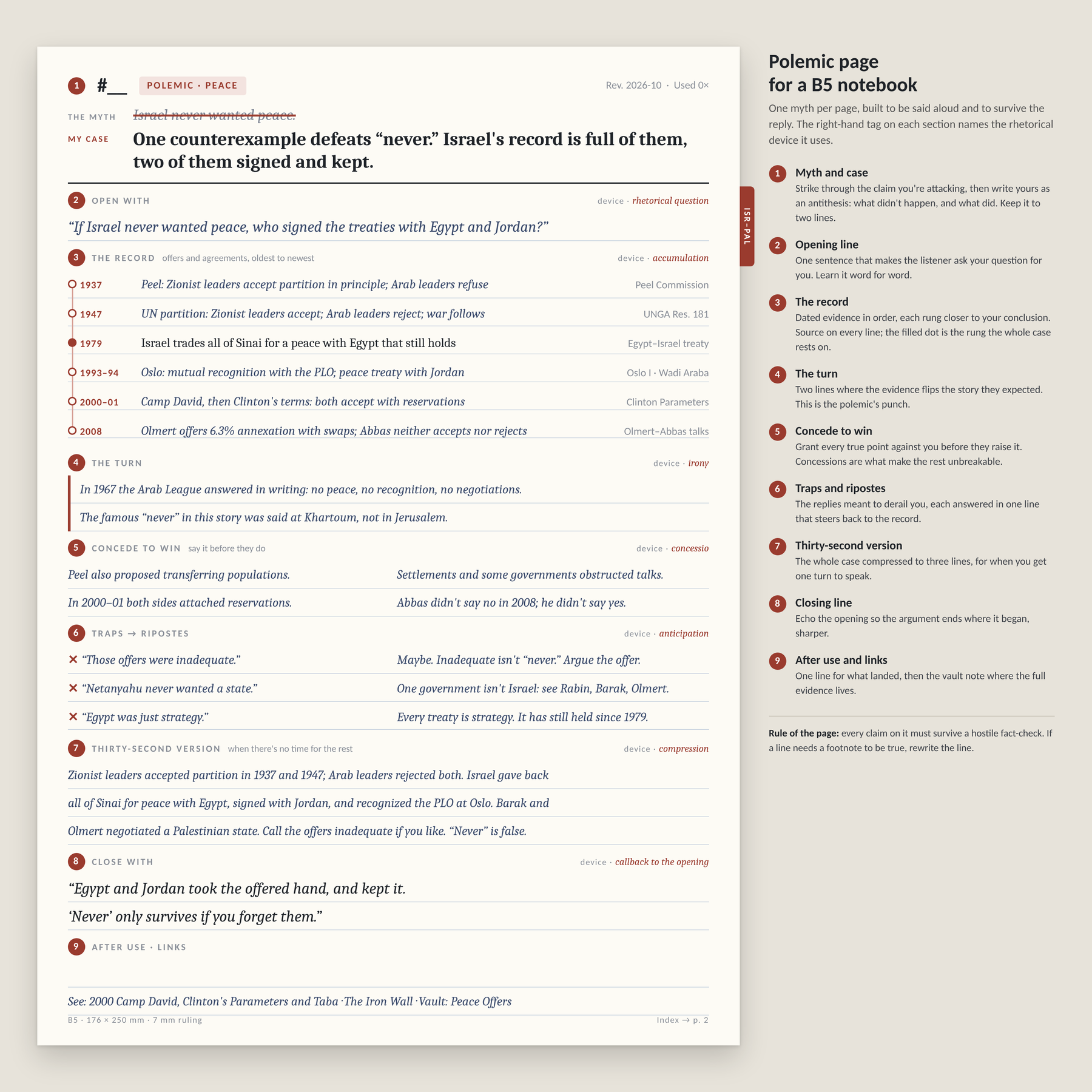
Polemic page against “Israel never wanted peace”: record from Peel 1937 to Olmert 2008, the Khartoum turn, concessions, traps and ripostes, a thirty-second version and the closing line. Source: HTML (file not included in this release).
One-line rebuttal
The claim that Israel never wanted peace is defeated by real counterexamples: Zionist acceptance of partition, the Egypt and Jordan treaties, Oslo recognition, territorial withdrawals, and Israeli leaders who negotiated Palestinian statehood. That does not prove that every Israeli proposal was adequate or that Palestinians alone caused failure; it proves the absolute word “never” is historically indefensible.
The record—described precisely
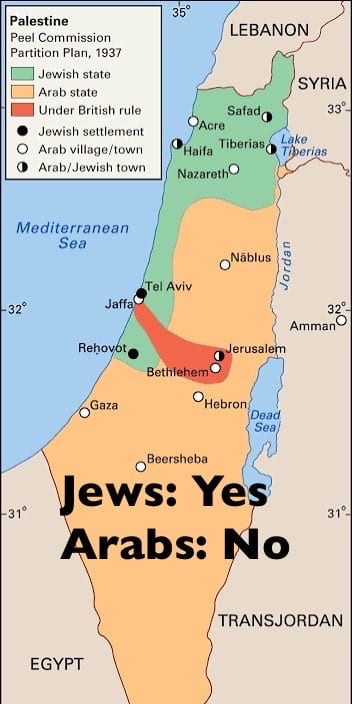
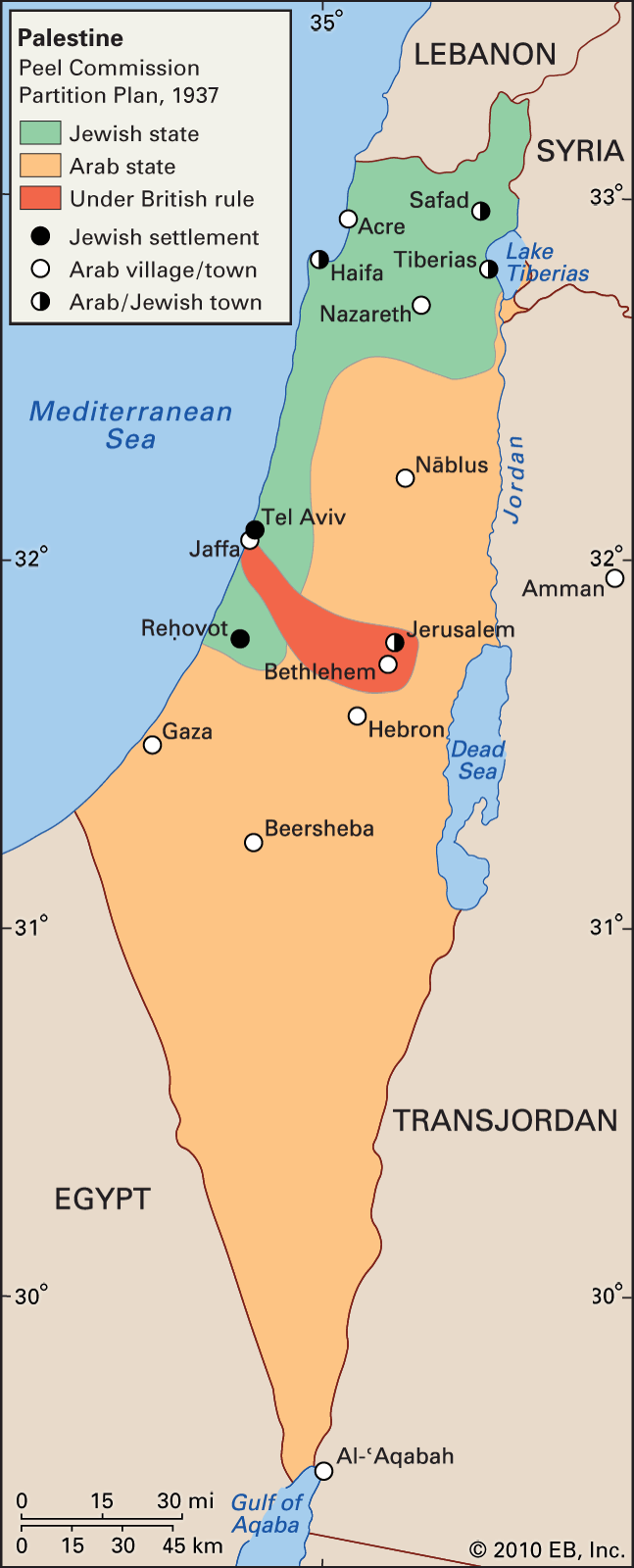
1937 Peel — Zionist leaders accepted partition in principle as a basis for negotiation; Palestinian Arab leadership rejected it. The plan also contemplated compulsory transfer, so “accepted a fair peace deal” is too simple.
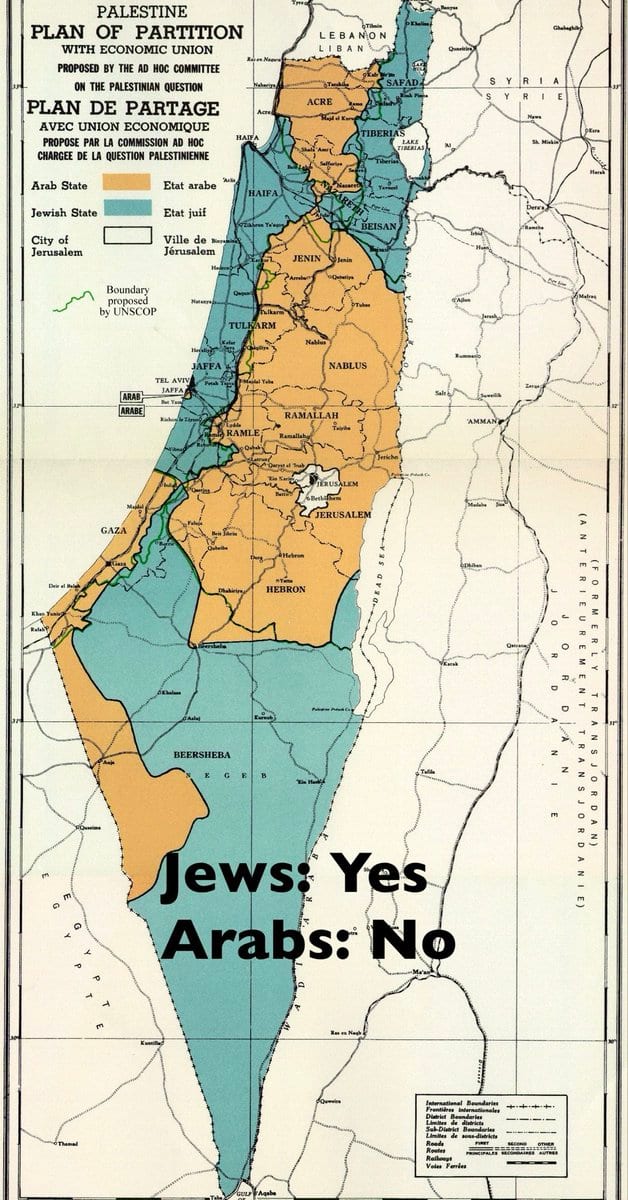
1947 UN Partition — mainstream Zionist leadership accepted; Palestinian Arab and neighboring Arab leadership rejected, and civil war followed. The allocation’s justice remains disputed even though the acceptance/rejection split is clear.
1967 Khartoum — the Arab League resolution expressly stated no peace, recognition, or negotiations with Israel. That wording is direct evidence, while later Arab diplomacy must be periodized separately.
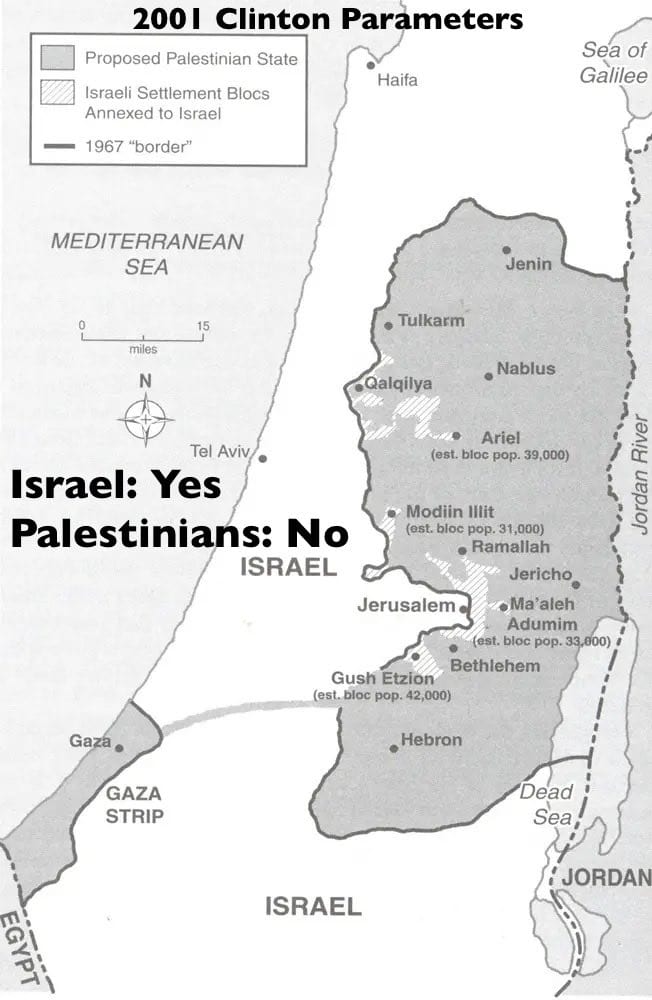
2000–01 Camp David, Clinton Parameters, and Taba — no agreement at Camp David; both sides later accepted Clinton’s parameters with reservations; the critical question is whether Palestinian reservations fell outside and effectively nullified the package. Taba followed. Do not compress the three stages into “Israel said yes, Arafat walked away.” → details
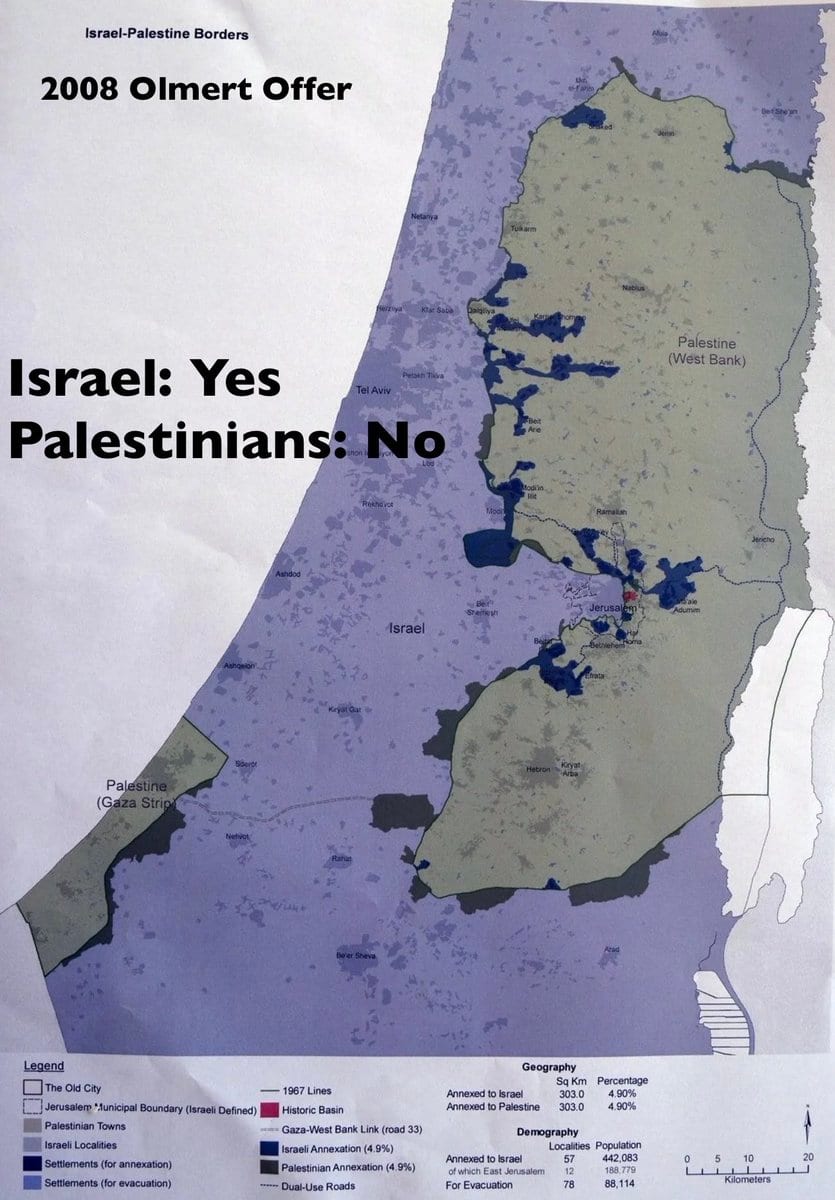
2008 Olmert–Abbas talks — Olmert presented a far-reaching package; Abbas did not accept it and the process ended without an agreed map or counterproposal. Olmert later said Abbas “didn’t say no, but he didn’t say yes,” so non-acceptance/missed opportunity is safer than a clean formal rejection.
Rejection of finality and of a Jewish state is a central explanatory hypothesis—especially where return would continue after Palestinian statehood—but it must be tested against each proposal, Palestinian counterpositions, Israeli settlement and security policy, and the authority of each leader to implement a deal.
Category discipline
A partition recommendation, an interim accord, an oral negotiating package, presidential parameters, a unilateral withdrawal, and a signed peace treaty are not interchangeable. For each episode record: who proposed it, whether it was written, whether the leader could implement it, what each side accepted or reserved, whether there was a counteroffer, and what happened next.
The Iron Wall test
Jabotinsky’s declared theory was strength first, negotiated accommodation second. Egypt, Jordan, Oslo, territorial withdrawals, and Israeli acceptance of partition defeat the absolute claim that Israel pursued only permanent force. They do not prove that every government entered “stage two,” or that every proposal met Palestinian national rights. See The Iron Wall (Jabotinsky, 1923) for Avi Shlaim’s stronger continuity thesis and the episode-specific counter-case.
Wilf’s Oxford Union case against “Israel never wanted peace”
Einat Wilf's 18 June 2026 opposition speech supplies a compact chronological argument: 1947 acceptance versus rejection; the absence of Palestinian statehood under Jordanian and Egyptian rule; Khartoum’s “three noes”; Israeli investment in Oslo; the Clinton and Olmert proposals; Gaza disengagement; and the refusal to define peace as the abolition of Jewish self-determination.
Her most defensible move is logical rather than totalizing: a universal “never” claim falls if even one Israeli government or mass political constituency genuinely pursued peace. Her speech is much weaker when it turns that counterexample into exclusive Palestinian blame.
Use Wilf this way
“You can argue that particular Israeli governments obstructed a viable Palestinian state, that settlements undermined negotiations, or that specific offers were inadequate. But you cannot move from those claims to Israel never wanted peace without erasing Rabin, Peres, Barak, Olmert, treaty-making with Egypt and Jordan, Oslo recognition, withdrawals, and Israeli voters who backed territorial compromise.”
Do not repeat these lines as settled fact
The 1948 war was the only cause of Palestinian refugeehood. → Nakba
Camp David, the Clinton Parameters, and Taba were one offer that Israel simply accepted and Arafat simply rejected.
Abbas gave an explicit formal “no” to a completed 2008 treaty.
Gazan work-permit holders supplied “much” of Hamas’s October 7 intelligence; a reported Shin Bet inquiry found no concerted effort among those investigated.
The statehood debate is strongest when it treats Peel, 1947, 2000–01, 2008, and Gaza as evidence that Israeli compromise and Palestinian rejection/non-acceptance are real parts of the record. It is weakest when it says Israel repeatedly offered “everything” or that Gazans destroyed all the greenhouses left in 2005. Both parties accepted the Clinton Parameters with reservations; Taba followed; Olmert proposed roughly 6.3% annexation and 5.8% swaps plus a passage, but Abbas did not accept and no map was agreed. In Gaza, initial looting occurred, yet the Quartet envoy reported that most greenhouse assets were secured; their survival depended heavily on export access. Use 2005 as a warning about unilateral withdrawal without an agreed security, access, and successor-governance framework, not as a clean experiment in Palestinian sovereignty.
📖 Even a dovish Israeli negotiator confirms it — Prophets without Honor (Shlomo Ben-Ami)
Ben-Ami — Israel’s foreign minister at Camp David and a critic of his own side — calls the 2000 summit “the obituary of the two-state paradigm.” He argues that Arafat’s reservations to the Clinton Parameters were largely outside the package and functioned as deal-breakers, while Israel’s were mostly within it. This is powerful participant testimony, but still testimony from an Israeli negotiator; compare the Palestinian reservations and the joint Camp David statement. → Prophets without Honor · 2000 Camp David, Clinton's Parameters and Taba Talks
📖 The rejection is ideological, not tactical — One State, Two States (Benny Morris)
The 1968 Palestinian National Charter rejected Israel’s legitimacy and envisioned a Palestinian Arab state over the land. Morris argues later two-state language was often “a tactical shift, not a true ideological change.” Use the charter as evidence about the PLO’s stated program in that period, then test later changes—mutual recognition, institutional practice, public messaging, and the return demand—rather than assuming permanent continuity. → One State, Two States
Armed spoilers and the erosion of Israeli confidence in negotiated peace
Modern Israeli adaptation — not a historical quotation
“Today Israel comes bearing an olive branch and a defender’s weapon. Do not let the olive branch fall from its hand.”
This is a modern rhetorical adaptation of Arafat’s imagery, not words spoken by Arafat or by an Israeli leader. Use it to frame a documented loss of confidence after repeated violence—not to claim that all Israelis abandoned peace, that violence mechanically compelled every later policy, or that Israeli choices ceased to matter.
Haddad and the PFLP-External Operations network
Warrick argues that Wadie Haddad shifted from limiting casualties for propaganda reasons to treating mass casualties as useful for wrecking diplomacy. The planned January 1975 Orly attack on an El Al airliner and Haddad’s rejection of two states are supported within Warrick’s account, but the strategy-change and peace-sabotage intent are the author’s synthesis rather than a documented Haddad order. Haddad’s role in the lethal 1972 Lod Airport attack also rules out a simple pre-1974 nonlethal phase. → full source audit
Arafat’s olive branch—and the later diplomatic transition
Arafat’s exact 13 November 1974 UN wording was: “Today I have come bearing an olive branch and a freedom-fighter’s gun. Do not let the olive branch fall from my hand.” The speech marked a diplomatic opening but did not explicitly recognize Israel. The “one hand … the other” version is not his verbatim sentence, although PLO representative Farouk al-Kaddoumi used essentially that construction at the UN nine days later. The PLO’s 1988 decisions and Arafat’s Geneva statements explicitly accepted Israel’s existence in a negotiated framework and renounced terrorism; the 1993 exchange then created formal Israel–PLO mutual recognition. → Yasser Arafat > The 1974 “olive branch” speech
Hamas as an Oslo spoiler
Hamas was institutionally anti-Oslo, rejected recognition of Israel, and deliberately attacked civilians during the process. The 1994–97 attacks had overlapping motives—opposition to Oslo, retaliation for the Hebron massacre and the killing of Yahya Ayyash, coercion, prisoners, settlements, and competition with Fatah. Leadership authorization must therefore be established attack by attack. Even with those limits, scholarship and the attacks’ political effects support describing Hamas as a consequential spoiler: the 1996 bombing wave weakened Peres and the peace constituency and plausibly contributed materially to Netanyahu’s narrow victory. → evidence and attack chronology
What violence did to Israeli confidence
Second Intifada: Peace Index period averages show opposition to Oslo rising from 30.4% before the Second Intifada to 49.7% during it and remaining at 44.5% after; disbelief that Oslo would bring peace rose from 40.2% to 69.9% and remained at 67.7%. These are repeated cross-sectional period averages, not a panel following the same people. Yakter and Harsgor, British Journal of Political Science
October 7 and opening weeks of war: repeated cross-sectional TAU Peace Index surveys using the same question found Jewish support for an independent Palestinian state falling 8.9 percentage points, from 37.5% in late August/early September 2023 to 28.6% on 23–28 October. This is strong descriptive evidence of short-term hardening after October 7 and during the opening weeks of war, but it cannot isolate the attack from the war, hostage crisis, elite cues, or other shocks, and it does not track individual conversions. September survey · October survey
Gur: why the peace constituency collapsed
Gur’s Breakfast Club account gives an individual interpretation of the attitude shift documented above. Raised in the Israeli peace left, he says the Second Intifada shattered his confidence in the peace process. Repeated civilian attacks made promises of security through concessions politically unpersuasive, even to people who continued to recognize Palestinian rights. He remains Zionist and supports Palestinian statehood. 36:10–40:40.
His American hypothetical escalates from one bombing to two more, thirteen, and 140: a movement can condemn violence and understand the underlying grievance, yet lose its constituency when repeated attacks make its program appear dangerous. “140 suicide bombings” is his count; the example explains a mechanism, not the sole cause of Oslo’s failure. The hosts apply the same psychology to Palestinian responses to Israeli violence. → full testimony and the reciprocal challenge.
He then distinguishes two lost expectations: negotiated withdrawal would produce peace, and unilateral separation would produce safety. In his narrative, the Second Intifada discredited the first; Gaza withdrawal in 2005 followed by Hamas’s takeover in 2007 discredited the second. His qualifiers matter: this describes what many Israelis learned as they understood events, and those conclusions can be wrong or incomplete. 63:49–76:00.
The polling above is broader evidence of hardening, but neither those period averages nor one interview isolates the causal weight of each factor. Preserve Israeli policy, settlements, rejectionist violence, leadership choices, and Palestinian organizational differences in the explanation. Negotiating lesson: a credible partner must be able to implement an agreement and resist spoilers, while Israeli policy must also enable rather than undermine such a partner. Full source:Haviv Rettig Gur on The Breakfast Club - Zionism, Rescue and the Collapse of Trust.
Debate-safe conclusion
Named Palestinian rejectionist organizations—most clearly Hamas during Oslo—were consequential spoilers. Their agency and measurable political effects are inconsistent with a literally Israel-only causal explanation of Oslo’s failure. That does not make them the sole or primary cause in every phase, imply symmetry among actors, or transfer organizational responsibility to Palestinians collectively. Settlement expansion, closures, delayed or incomplete implementation, Israeli rejectionist politics and violence, Rabin’s assassination, and later Israeli governmental obstruction remain independent parts of the causal record.
To us and to many Israelis, especially of the political left, the 1990s were years marked by great hope. These were the Oslo years and the beginning of the peace process. In 1992, in the first election in which we were eligible to vote, we welcomed the Labor-led the establishment of government under Yitzhak Rabin. This was the government that entered into the Oslo Accords in 1993 with the Palestine Liberation Organization (PLO) and signed a peace agreement with Jordan in 1994. Despite the horrific suicide attacks perpetrated by Palestinians on Israeli civilians following the signing of Oslo, and the assassination of Rabin, Israelis kept hoping for peace. Those were the Israelis who gave Ehud Barak a landslide victory over Benjamin Netanyahu in 1999. Like them, we followed Prime Minister Barak with anticipation as he went to Camp David in the summer of 2000 to carry out his election promise to sign a final peace agreement with the Palestinians. (Page 7)
David Ben-Gurion attempts to make peace with Egypt’s Gamal Abdel Nasser
- Nasser said if he was even seen with Israel’s he’d be killed
- Moshe Sharett, foreign minister setup secret contacts, believed the best way to insure Israeli security is to understand Arabs and make peace
- Talks in Paris with diplomats
- Nasser ok’d the talks through his diplomat
- wanted to avoid bloodshed
- Radical escalations of Egyptian anti-Israel propaganda
- Egyptian raids into Israel continued
- Nasser wouldn’t terminate the war, establish diplomatic relations or let ships through Suez Canal
- Egypt would continue anti-Israel policy and turned down peace attempts
- “I had realized the Israel’s continuously say they want peace. And I realized the Arabs refused to talk.” -Abdel Rahman Sadek (Egyptian diplomat)
Israel and the PLO reached a mutual peaceful agreement
This called for the withdrawal of the IDF from parts of the Gaza Strip and the West Bank
Remaining issues needed to be settled, including Jerusalem, Palestinian refugees, Israeli settlements, security and borders.
Letters of Mutual Recognition between the Israeli Government and the PLO were signed.
Israel recognized the PLO as the governing body of the Palestinians, the PLO renounced terrorism and other violence and its desire for the destruction of the state of Israel.
Reactions
In the Knesset a strong debate emerged between the left and right wing over support for the Oslo accords.
Fatah, the Palestinians present at the negotiations, accepted the accords, but Hamas, Palestinian Islamic Jihad, and the Popular Front for the Liberation of Palestine (PFLP), all objected to the accords.
Israelis were nervous that this peace process would simply be a part of the PLO’s Ten Point Program, which essentially calls for escalating steps until all of historic Palestine is liberated from Israel.
Palestinians feared that Israel was not serious about dismantling their settlements in the West Bank, especially around Jerusalem.
The Nobel Peace Prize was awarded to Israeli Prime Minister Yitzhak Rabin, Israeli Foreign Minister Shimon Peres, and PLO Chairman Yasser Arafat.
Netanyahu, in a secret recording, claims that his plan was to define “specified military locations” in the broadest possible sense according to the Oslo Accords, which could theoretically encompass the entirety of the Jordan Valley.
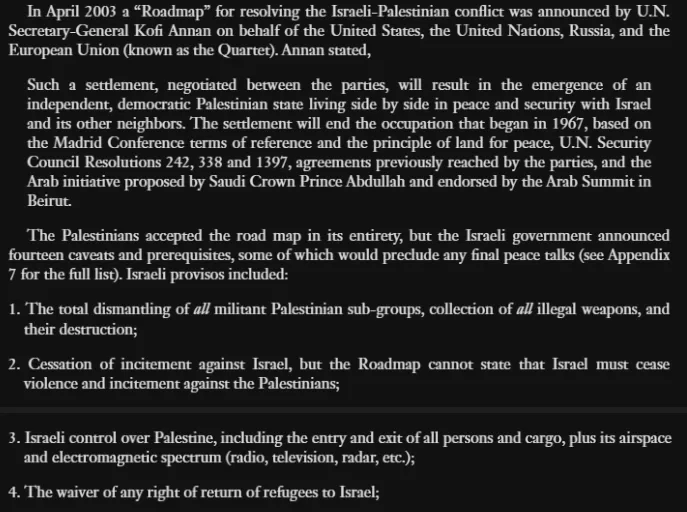
At no point was Israel in any way bound to the 2003 “Road Map” proposed by the Quartet. They did not agree to it, they made (rather absurd) demands before they could agree to it.
Israeli Prime Minister Ehud Olmert and Palestinian President Mahmoud Abbas met several times, proposing plans for peace, but talks ended without an agreement【19†source】.
Initiated by U.S. President Barack Obama, the talks aimed at a two-state solution, but were hindered by disagreements and threats of violence from Hamas and Hezbollah【20†source】.
Talked down and alienated the Sunni coalition that U.S. had worked for a long time to build
Tried to warm up to Arabs and Iran
One of first calls was the to Abbas — Palestinian president
Alienated Netanyahu and Israel
Didn’t make a stop in Israel after giving a speech in Egypt saying they should go back to 1967 lines. Visited other Arab countries on the trip as well.
Despite what its publicists claimed, the purpose of the deal, officially known as the Joint Comprehensive Plan of Action (JCPOA), was never to stop Iran from getting the bomb. Rather, the tens of billions of dollars that Obama paid the clerical regime, which included planeloads of cash, was to facilitate construction of the nuclear weapons program under the protective umbrella of an international agreement backed by the United States. [Why the Iran Deal Matters - Tablet Magazine]
Discussions by the Munich Group (Egypt, France, Germany, Jordan) on peace efforts and statements on the two-state solution. The Quartet reported on the challenges posed by settlement construction and other issues
Peaceno_chance.pdf (file not included in this release) Peace? No Chance - Benny Morris One State, Two States Resolving the Israel Palestine — Prof_ Benny Morris — 2009 flattened.pdf (file not included in this release)
In the wake of the intifada, new parameters for a final settlement were proposed numerous times in numerous settings—by a consortium of non-governmental actors from both sides in Geneva in 2003, by an Israeli prime minister in direct negotiations in 2008, by an American administration seeking to wrap up protracted peace talks in both 2001 and 2014, by a UN Security Council resolution pushed in 2016 by an outgoing administration that then abstained on the very proposal it had advanced. Each of these parameters offered better terms for the Palestinians and worse terms for the Israelis than what had been rejected at Camp David.
It’s crucial to understand that there was no conceivable prospect of success by using such a mad method. As I’ve written for Mosaic before, if there is a bedrock principle of conflict mediation it is that mediation seeks to arrive at a solution that is better for both sides than what either side could hope to get from open confrontation. This is true for warring states, for a divorcing couple, for labor and management, and for any other situation with competing claims and a possibility of forceful arbitration.
Why? If one side of a conflict rejects a compromise solution, initiates a violent confrontation, and is defeated in that confrontation, no mediator of sound mind offers that side better terms the next time around. The reasons are obvious. It creates a new incentive for the losing side to keep rejecting compromise while removing the biggest disincentive from the table, namely that the move from mediation to arbitration or open confrontation carries the strong risk that the rejecting side will lose. It also, for that matter, further disincentivizes the stronger side from seriously engaging in any kind of mediation to begin with, because mere entry into negotiations could lead to a diminishment in what it gets out of a deal.
And yet, by almost universal consensus among those involved in the Israeli-Palestinian peace-making industry, this is what happened for two decades following the collapse of the Oslo process.
Ask Haviv Anything - Episode 10 - Thirty years of traumatic peacemaking - what do Israelis really think?
Should Jews Abandon Israel? An Uncomfortable Conversation with Josh Szeps
Expanded Theme 4 – Settlements and the Occupied Territories
Dimension
Zeps’ Case
Dworman’s Counter-Case
Key Facts & Timeline
Foundational event (1967)
Israel’s decision to hold and build in the West Bank and East Jerusalem launched an “elaborate militarised thicket of ethnic discrimination.”
Israel captured the territory in a defensive war; UN 242 called only for withdrawal “to secure and recognised boundaries,” not necessarily to the 1949 armistice line.
• First civilian enclave (Kfar Etzion) re-established Sept 1967. • Allon Plan (1968) envisaged permanent Israeli belt along Jordan Valley.
Scale & growth
Continuous expansion shows the policy is structural, not a bargaining chip.
Raw numbers alone do not prove an obstacle if blocks are traded for land elsewhere.
• 144 officially recognised settlements in the West Bank plus >100 “outposts.” • ~450,000 settlers in the West Bank + ~220,000 in East Jerusalem (Jan 2023). (en.wikipedia.org)
Recent acceleration
The current far-right cabinet approved a record 12,855 housing units in 2023 and began legalising wildcat outposts, confirming the enterprise is still expanding.
Expansion spikes correlate with domestic coalition politics; they can also be frozen or dismantled (e.g., Gaza 2005), showing reversibility.
Fourth Geneva Convention (Art. 49) bars an occupying power from transferring its civilians. UNSC 2334 (2016) calls settlements a “flagrant violation.”
Israel disputes de-jure applicability, citing absence of prior sovereign and arguing that Geneva bans forcible transfer, not voluntary movement.
Consensus of ICRC, UN, EU: settlements violate int’l law. (amnesty.org, un.org)
Peace-process relevance
Building during negotiations (“facts on the ground”) convinces Palestinians that a viable state is impossible; hence no partner feels empowered to compromise.
History of offers contradicts “impossibility.” Clinton Parameters (2000) and Olmert Map (2008) envisaged annexing ~4–6 % (large blocs) in return for equal land swaps; Abbas still walked away.
• Clinton Parameters: Israel keeps Ariel, Ma’ale Adumim, Gush Etzion; swaps 1–3 %. (usip.org) • 2008 Olmert offer evacuated dozens of settlements; Abbas never replied. (reddit.com)
Freezes & pauses
Short moratoria (e.g., 10-month 2009 freeze) were cosmetic; construction surged the moment they lapsed.
The 2009 freeze and Rabin’s 1992–94 halt show Israel can stop if it believes it will unlock negotiations; absence of talks since 2014 makes further freezes politically costly.
Netanyahu’s 10-month moratorium, Nov 2009–Sept 2010. (abcnews.go.com)
Security arguments
Settlers’ exclusive road grid and IDF presence entrench a two-tier regime akin to apartheid—morality overrides security.
Israel is nine miles wide at its pre-67 waist; retaining high-ground blocs (Ariel ridge, Etzion hills) is prudent. Depth can be traded only if Palestinians accept Israel’s permanence.
Strategic depth argument first codified in Allon Plan; echoed in every Israeli security doctrine since.
Impact on Palestinian daily life
Checkpoints, permit regime, land expropriation, and settler violence fuel despair and radicalisation.
Checkpoints grew after the 2nd Intifada suicide-bombings; if security improves, restrictions are eased (e.g., 2013-14). Problem is terror, not ethnicity.
UN reports a tripling of settler attacks on Palestinians between 2019 and 2023.
International backlash
Corporate boycotts, ICC probe, sanctions on Israeli ministers (May 2025) now target settlement nexus, isolating Israel diplomatically.
Economic and diplomatic pressure rarely sways Israeli voters under fire; it hardens right-wing majorities convinced the world applies a double standard.
Example: 2025 complaints against Airbnb/Booking over West Bank listings; UK-Canada sanctions on Smotrich/Ben-Gvir. (ft.com)
Synthesis of the Dispute
Structural vs. negotiable: Zeps treats ever-expanding settlements as proof the occupation is meant to be permanent; therefore the moral onus is on Jews to disassociate. Dworman treats settlements as bargaining chips: large blocs will be annexed with swaps, small ones dismantled—as past Israeli offers demonstrate.
Sequence vs. reciprocity: Zeps insists Israel must first stop building and show a credible horizon; otherwise Palestinian moderates cannot emerge. Dworman replies that Israel already tested that logic (2000, 2008, 2010 freeze) and was met with violence or diplomatic walk-offs; reciprocity, not unilateralism, is the lesson.
Ethics vs. Security: Zeps frames settlement growth as a betrayal of Jewish justice and a magnet for antisemitism. Dworman frames dismantling blocs without guarantees as a gamble with Israeli lives—especially after 7 Oct—so security ethics may require holding strategic land until genuine peace is on offer.
This fuller picture shows why “settlements” sit at the heart of the Zeps–Dworman clash: one sees them as the root moral rot, the other as a reversible symptom of deeper Palestinian rejection. Any durable resolution has to reckon with both narratives and the facts that sustain them.
Original location: 90 Notes/Timeline of Peace Offers.md. Filed on 2026-10-06. The material below is preserved from the capture; relocation does not independently verify its claims or attributions.
Original properties:
up: - "[[60.1 Israel-Palestine]]"date created: Monday, May 13th 2024, 5:20:30 pmdate modified: Monday, May 13th 2024, 5:24:53 pmrelated: Genre: URL:
1987-1993: First Intifada, a Palestinian uprising against Israeli occupation.
1988: PLO’s implicit recognition of Israel’s right to exist.
1991: Madrid Conference, a peace conference involving Israel, Palestinians, and Arab nations.
1993: Oslo Accords, establishing Palestinian self-rule in parts of the West Bank and Gaza.
2000: Camp David Summit, an unsuccessful attempt to solve core issues.
2000-2005: Second Intifada, a period of intensified Israeli-Palestinian violence.
2000-2001: The Clinton Parameters
2002: Arab Peace Process
Arab_Peace_Initiative.pdf (file not included in this release)
2003: The Road Map for Peace, proposed by the United States, Russia, the European Union, and the United Nations.
2005: Israel’s unilateral disengagement from Gaza.
2006: Ehud Olmert’s Peace Offer
2013-2014: U.S.-led negotiations under Secretary of State John Kerry.
Key Figures: Israeli Prime Minister Benjamin Netanyahu, Palestinian President Mahmoud Abbas.
2020: Normalization agreements between Israel and several Arab countries (Abraham Accords), not directly involving Palestinians but impacting the regional dynamics.