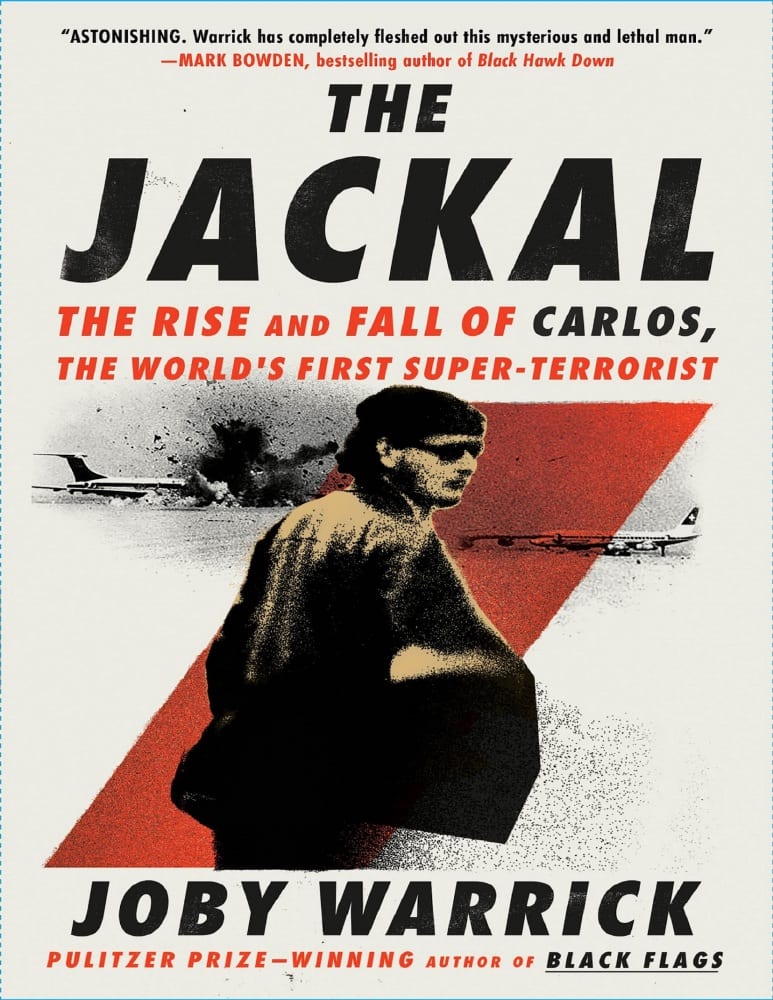
Source: book PDF (file not included in this release) · Argument: armed spoilers and peace · People: Yasser Arafat · Debate: retrieval card
Source contribution
Joby Warrick uses Wadie Haddad’s January 1975 attempt to shoot down an El Al airliner near Paris-Orly as a case study in violent rejectionism. His account is valuable for the proposed target, Haddad’s PFLP and transnational connections, and the chronology linking the plot to post-1973 diplomacy. Its central psychological claim—that Haddad newly made casualties instrumental because his objective had become sabotaging peace—is Warrick’s narrative synthesis, not a quotation from Haddad or a conclusion supported by a discrete endnote on the page.
Key passage — Warrick’s narration, not a Haddad quotation
“Haddad had tried in the past to minimize deaths and injuries, because he wanted to win sympathy for the Palestinian cause. No longer. Casualties were now essential, because Haddad’s goals had changed: His new objective was sabotaging prospects for Middle East peace.”
— Joby Warrick, PDF p. 113 / book p. 96 (file not included in this release)
What Warrick argues changed
Warrick says the aftermath of the 1973 war created new diplomatic possibilities, including what he calls Arafat’s 1974 hint at coexistence. He then presents Haddad and other hardliners as enraged by this movement and describes the Orly plan as having two targets: an Israeli airliner carrying civilians and the prospects for diplomacy.
The immediate operational facts in Warrick’s narrative are strong: Carlos and Johannes Weinrich tried to hit an El Al Boeing 707 carrying 142 passengers with Soviet-made rocket-propelled grenades; the attack failed. The broader intent attribution is less direct. Warrick does not quote an order in which Haddad states that the purpose was to wreck negotiations.
Chronology limit
Do not turn Warrick’s argument into “Haddad avoided civilian deaths until 1975.” Warrick’s own book attributes the lethal 30 May 1972 Lod Airport attack to a Haddad plan; 26 people were killed. The defensible claim is about Warrick’s proposed change in strategic value and political objective, not the beginning of civilian killing.
Haddad’s own position—through retrospective testimony
Warrick quotes PFLP hijacker Leila Khaled’s recollection of a Moscow meeting at which Haddad rejected a two-state outcome: “We have never thought about the rise of two states!” and, even if nearly all Palestine were offered, “we would turn it down.” Warrick’s endnote points to Khaled’s February 2023 interview with Ghassan Charbel in Asharq Al-Awsat. This is participant testimony given roughly five decades later, not a contemporaneous transcript. English interview
Institutional position and movement connections
Haddad was a founder and senior PFLP leader and the architect of its external-operations apparatus. His authority, infrastructure, and operatives were built inside the PFLP, itself a PLO faction. He later operated through an increasingly autonomous PFLP-External Operations network and, by 1978, effectively commanded a separate organization.
Both facts matter. He was not an irrelevant outsider to the Palestinian armed movement, but his operations cannot be attributed to Palestinians collectively, the PLO as a whole, or Arafat personally without operation-specific evidence. Warrick also records that the PLO denounced the Orly attack as a “provocation and a crime.”
Related vault sources: The KGB’s Middle East Files Palestinians in the service of Mother Russia · Rise and Kill First - The Secret History of Israel's Targeted Assassinations · Rise and Kill First - Targeted Assassination (2018)
Arafat’s intervention for the dying Haddad
Ronen Bergman reports that, when Haddad became gravely ill in Baghdad in 1978, Arafat instructed an aide to ask East Germany’s Stasi for medical help. Haddad was flown to East Berlin’s Regierungskrankenhaus on 19 March. Bergman’s note says the account rests on information about internal East German correspondence supplied by journalist Gunther Latsch; the underlying correspondence was not independently inspected for this note. → Bergman, PDF p. 144 (file not included in this release)
The episode shows that Arafat retained access and was willing to intercede for Haddad. It may reflect personal, factional, humanitarian, or broader national-movement solidarity. It does not establish that Arafat approved, financed, controlled, or knew in advance about Haddad’s attacks.
Arafat’s 1974 opening in its proper chronology
Arafat’s 13 November 1974 UN speech marked a diplomatic opening but did not explicitly recognize Israel. The official record says: “Today I have come bearing an olive branch and a freedom-fighter’s gun. Do not let the olive branch fall from my hand. I repeat: do not let the olive branch fall from my hand.” UN A/PV.2282, para. 82
The common “in one hand … in the other” wording is not Arafat’s verbatim sentence in that record. It does have contemporary PLO provenance: representative Farouk al-Kaddoumi used essentially that construction at the UN nine days later. UN A/PV.2296, para. 264
The PLO’s 1988 decisions and Arafat’s Geneva address and press conference explicitly accepted Israel’s existence within a negotiated framework and renounced terrorism; the September 1993 letters then created formal bilateral recognition between Israel and the PLO. This staged chronology is more precise than reading either full recognition or pure deception back into the 1974 imagery.
What the episode proves—and what it does not
Strongest defensible use
Warrick’s account identifies a prominent PFLP operational leader who rejected a two-state compromise and pursued an indiscriminate attack while diplomacy was emerging. That is evidence of Palestinian organizational spoiler agency and against a literally Israel-only account of every peace-process failure. It is not evidence that Palestinians collectively preferred civilian deaths, that Arafat directed the attack, or that rejectionists were the sole or predominant cause of later diplomatic failure.
Remaining source gaps
- No discrete endnote supports Warrick’s casualty-minimization/strategy-change sentence.
- No contemporaneous Haddad order located here states that Orly’s purpose was to sabotage diplomacy.
- Khaled’s two-state recollection is retrospective and the original Arabic/translation was not independently audited here.
- Bergman’s Arafat–Stasi report has one identified archival lineage; the underlying correspondence remains unchecked.