Distilled Knowledge
Source contribution
Wilf presents Zionism as the Jewish people’s movement for sovereign self-determination and rescue, and argues that peace requires abandoning political programs intended to reverse that sovereignty. Her essays are especially useful for understanding one coherent Israeli narrative and its strategic interpretation of “return,” anti-Zionism, and recognition.
- The account separates criticism of Israeli policy from denial of Jewish collective legitimacy.
- It interprets recurring diplomatic failure through the persistence of anti-sovereignty goals.
- Its strongest challenge is to show, claim by claim, when rhetoric denotes literal end-state intent rather than bargaining, symbolism, factional politics, or despair.
Routes: Narrative Recognition and Material Compromise · Colonizers · Peace Offers
Evidence boundary
Preserve Wilf’s authorship. Test historical, legal, polling, and intention claims independently and against Palestinian and critical Israeli accounts.

Extracted text
DESCRIPTION
We Should All Be Zionists- Essays on the Jewish State and — Dr_ Einat Wilf.pdf (file not included in this release)
Extracted text
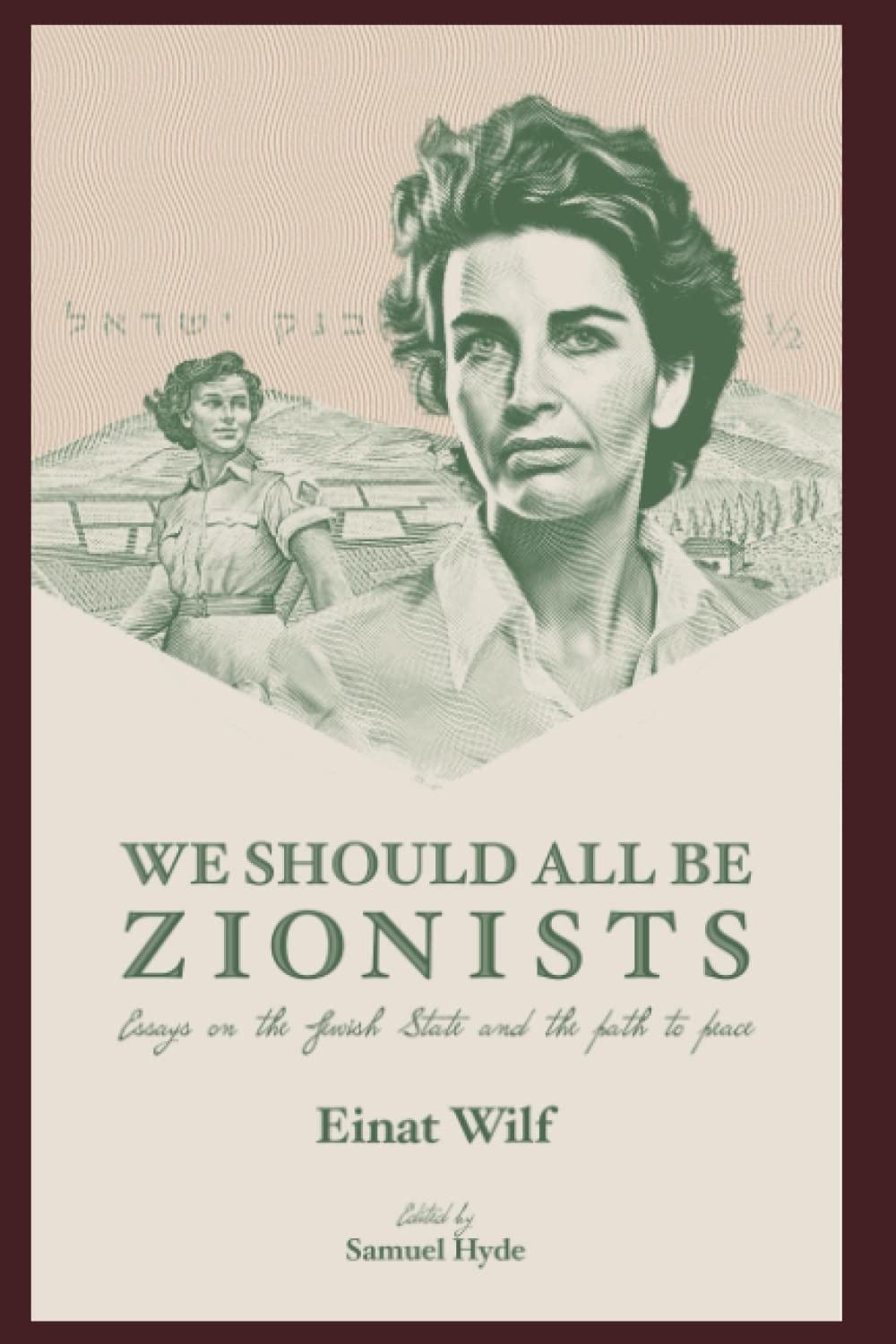
W E S H O U L D A L L B E
Z I O N I S T S
Essays on the Jewish State and the Path to
Peace
Dr. Einat Wilf
Editor: Samuel Hyde
Copyright © 2022 Dr. Einat Wilf
All rights reserved
The characters and events portrayed in this book are fictitious. Any similarity to real
persons, living or dead, is coincidental and not intended by the author.
No part of this book may be reproduced, or stored in a retrieval system, or transmitted in
any form or by any means, electronic, mechanical, photocopying, recording, or otherwise,
without express written permission of the publisher.
ISBN-13: 9781234567890
ISBN-10: 1477123456
Cover design by: Art Painter
Library of Congress Control Number: 2018675309
Printed in the United States of America
INTRODUCTION
This is a transcript of a speech given on April 10, 2022
Transcribed by Jaime Kardontchik
I want to share with you how I began to think about the conflict, my journey,
and how I came to the conclusions that I am going to present here. I grew up
in Jerusalem. I was part of the Israeli Left - Israel’s Peace Camp, and a
member of the Israeli Labor Party. As a young adult, I voted for Prime
Minister Itzhak Rabin, and later for Prime Minister Ehud Barak. I very much
supported the main idea associated with the Israeli Peace Camp; a
straightforward idea known as “Land for Peace.” This simple equation was
that Israel has a path to peace, and the path to peace is based on “Land for
Peace” as a formula.
But which land? The land that Israel captured as a result of the 1967 Six-Day
war: the Sinai Peninsula in the South, the Golan Heights in the North, and the
West Bank and the Gaza Strip in the center. Why was it necessary to come up
with this formula? As I am sure you know, after Israel was established, none
of Israel’s neighbors were willing to make peace with it. All that Israel’s
neighbors were willing to do was sign ceasefire agreements. So, when people
speak of the pre-1967 borders, those were actually ceasefire lines, not
borders. The Arab countries surrounding Israel – Lebanon, Syria, Jordan, and
Egypt – made it clear that these were ceasefire lines in an ongoing war. The
message was that the battle of 1948-1949 was only temporarily over.
After the impressive victory in 1967 and the capture of all these lands, the
“land for peace” idea seemed to be a very successful formula. This was the
basis for the peace agreement with Egypt, Israel’s most prominent foe. Israel
signed a peace agreement with Egypt and, in exchange, gave Egypt the Sinai
Peninsula, which was more than twice the size of Israel. We can have a
fascinating discussion about whether what we have had with Egypt is peace.
Still, we officially signed a peace agreement with Egypt and handed over the
entirety of the territory of the Sinai Peninsula.
The 1990’s were the decade of the “land for peace” formula. This was also
the decade of the Rabin and Barak governments. We negotiated with Syria
over the Golan Heights, we signed a peace agreement with Jordan, once
Jordan gave up its territorial claims to the West Bank, and, of course, the
highlight of the 1990’s was the Oslo Accords, when Israel negotiated directly
with the Palestinian Liberation Organization, with Yasser Arafat, over the
future of the West Bank and Gaza.
The 1990’s came to a pinnacle in 2000 when Ehud Barak – the head of the
Labor party, the head of the Israeli Peace Camp – went to Camp David.
Camp David is symbolic: this is where Israel negotiated the peace agreement
with Egypt. He goes to Camp David to meet with Arafat and negotiate a final
peace agreement over the future of the West Bank and Gaza. When Ehud
Barak – who was elected on a platform of making peace based on the “land
for peace” formula – went to Camp David, he put forward a far-reaching
proposal, something that was not on the table before, certainly not directly
with the Palestinians. His proposal addressed everything that Israelis were
told are the obstacles to peace and the things the Palestinians wanted.
Israelis were told that the obstacle to peace was the occupation: Palestinians
wanted to end the military presence of Israel in the West Bank and Gaza. The
proposal was that the Palestinians would have a fully sovereign independent
state in the West Bank and Gaza, thereby ending the occupation. Israel was
going to retreat; there would not be a military presence. So, ending the
occupation was part of the proposal.
What was the other obstacle to peace we were told? Settlements. So, the State
of Palestine, the sovereign independent State of Palestine, would have no
settlements. Settlements were either to be dismantled or exchanged for
equivalent land. The independent sovereign State of Palestine would end the
occupation and have no settlements. So, two obstacles were removed.
Then, what were we told? Jerusalem. Jerusalem was going to be divided: the
Jewish neighborhoods for Israel, the Arab, secular neighbors for Palestine,
and, then, the question of the Old City: the one square kilometer, which I
fondly refer to as “insanity central”. That one square kilometer was also
going to be divided. We sometimes forget how far-reaching the proposal was:
the Holy sites within the Old City were going to be divided between Israel
and Palestine. We were told Jerusalem is the problem, an obstacle to peace,
but that was also taken care of in the proposal. So, check, check, check. All
the Palestinians had to do was say “yes”, and they would have had an end to
the occupation, a sovereign state, no settlements, a capital in East Jerusalem,
including Holy sites. What do they do?
They walk away.
OK. You might say walking away is a negotiating tactic. You know, that
happens. Fair enough. But Arafat walks away, and eight years later, in 2008,
Abu Mazen [Mahmoud Abbas], the heir of Arafat, steps away from a similar
proposal by Prime Minister Ehud Olmert. Arafat walks away, and Abu
Mazen later walks away to no criticism from their people. If this is the
Palestinian aspiration, you would expect, at least, someone to write an op-ed,
a small NGO to be established, something saying: “Are you crazy? We could
have had everything we wanted. Go back there into the negotiating room and
get us our state”.
But there were no such voices. I know that sometimes people say: “It’s
because you cannot criticize in this society, Palestinian society is not
democratic.” Look at Russia today. People are holding signs and protesting,
and the stakes there are much higher. Palestinian society has never been as
oppressive as Russia, yet you see protests in Russia. You did not see protests
against Arafat walking away among the Palestinians. Arafat and Abu-Mazen
walk away with no criticism from their people, meaning they fulfill what
their people want by walking away.
What follows is bloody murder. What follows, especially after Arafat walks
away, is a three-year campaign named “the second Intifada,” a movement of
butchery, massacre, and terrorism. Some of you might remember the
incinerated buses, entire families blown to bits for having a Seder in a hotel,
or from getting pizza in Haifa. And this butchery is taking place in Israel’s
cities: Tel-Aviv, Haifa, in Be’er Sheva. Not in the settlements. They say: “the
problem is the settlements and the occupation in the West Bank.” That is not
where this campaign of butchery was taking place.
And many Israelis going through that – myself included – are asking a
straightforward question. What do the Palestinians want? Because a
Palestinian State that ends the occupation, with no settlements and a capital in
East Jerusalem, is not what they want. Or, you could say that they want that,
but there is something that they want much, much more. There is something
they want so much more than they are willing to walk away from that – for
that other thing. What is that other thing?
It turns out that the answer was staring us in the face. Palestinians told us all
along what they wanted. We did not listen. Or when we did listen, we
explained it away. We did not take it seriously. What did the Palestinians
want more than a state, more than ending the occupation, more than no
settlements, more than Jerusalem? They told us: “From the river to the sea,
that is from the Jordan River to the Mediterranean Sea, Palestine will be
free.”.
The absolute Palestinian top priority, as they themselves claimed, was the
establishment of an Arab Palestinian State with no state for the Jewish people
within any borders whatsoever. The goal, which to the credit of the
Palestinians, they have been pursuing consistently for a century, has not
changed. Unfortunately, there has not been a moment when that goal has
changed. The means of pursuing that goal have been different.
In our book “The war of return,” my co-writer Adi Schwartz and myself
focus on one of these means, the so-called “Right of Return,” which, if you
read the book, is neither a “right” nor by now “return”. It is a mechanism
established by the Palestinians, following the war of 1948, to ensure that the
war never ends and that the concept of a sovereign Jewish state in even part
of the land remains unacceptable and, hopefully in their view, something that
can be undone. This has been the goal.
When Adi and I were doing our research for the book, we came across a
remarkable analysis of the conflict by the British Foreign Minister after
World War II, Ernest Bevin. If you know anything about Ernest Bevin, he
was no friend to the Jewish people and Zionism. But Ernest Bevin, in
explaining to the British Parliament in 1947 why Britain was reneging on the
mandate that they received from the League of Nations to establish a Jewish
State, basically giving back the mandate to the heir of the League of Nations,
the United Nations, he said the following: “His Majesty’s government has
concluded that the conflict in the land is irreconcilable”. He calls it
irreconcilable. He goes on to detail, saying that there were two people on the
ground, Jews and Arabs. There was no question that two peoples, two nations
exist in the land, and they are not religions. Jews and Arabs are two distinct
collectives. And he goes on to detail what the top priority is for each of these
collectives, for the Jews and the Arabs. He calls this top priority “a point of
principle”. He says, for the Jews, the point of principle, the top priority, is to
establish a State. The Jews want a State. He says, for the Arabs, the top
priority, the point of principle, is to prevent the Jews from establishing a state
in any part of the land.
Notice how he defines the conflict. This is the best definition of the conflict
to the present day and remains the best predictor for the behavior of the two
sides from 1947 to the present. He says: ‘Look: the Jews want a State. Period.
The Arabs want the Jews not to have a State’. Notice that he is not saying that
the conflict is ‘the Jews want a State, the Arabs want a State, and they cannot
agree on the borders, and it is difficult to figure out how to divide the land’.
No. He zeroes in on why the conflict is irreconcilable: the Jews want a State,
and the Arabs want the Jews not to have a State. This, by definition, is
irreconcilable. Everything else you can divide. You can divide the land,
divide the resources, and have all kinds of economic and security
arrangements. But the one thing that you cannot divide, the one difference
that you cannot split, is between the idea that the Jews want a State and the
Arabs want the Jews not to have a State. It is as simple as that.
Now, how do we move from here? If this is the essence of the conflict, how
does it end?
It ends in one of two ways. Quite simple. Either those who want a Jewish
State will forgo that top priority, or those who believe that there should not be
a Jewish state within any borders will forgo their top priority. That’s it. That
is how we get to lasting peace. Either the Jews forgo their desire for a
sovereign State, in essence, they say, ‘you know, it is not worth it, there are
other places to live, we are
outta here,” or the Arabs decide that they are willing to let a Jewish State
exist, in some borders. Only in one of those two ways does the conflict end.
Truly resolved.
Sometimes I say that the conflict is between Jewish Zionism and Arab anti-
Zionism. For the conflict to end, either Jews forgo their Zionism, forgo their
desire for a sovereign State, or Arabs forgo their anti-Zionism, forgo their
belief that a Jewish State should not exist within any borders whatsoever.
That’s it. In the absence of one of these two outcomes, the conflict continues.
One could argue that the conflict has been a century-long battle of mutual
exhaustion, where the Arabs are trying to exhaust the Jews into giving up on
their aspirations for a State and for maintaining that State and the Jews are
trying to get the Arabs to forgo their aspiration for them not to be a Jewish
State. That’s it. And we have been engaged for more than a century in this
battle of mutual exhaustion.
The reason that this has been going on for a century is that both sides see
indications they are winning: Jews look at their achievements, the
establishment of their State, their various military victories, the prosperity of
the State, the peace agreements, the Abraham Accords (and we will talk
about them in a few minutes), and they say: The Arab world is finally coming
to terms with the existence of the Jewish State. Hence, we can see the end of
the conflict. But the Arabs on the other side see it differently: No, the Jewish
State is weak, Jews are arguing, young Jews abroad are renouncing Zionism,
more and more Jews are forgoing their aspirations for a Jewish State. The
world is calling the Jewish State apartheid. The world is mobilizing to end
the Jewish State. We are winning. We only have to exhaust the other side.
This is where we are. This is what brings the conflict to an end. As I said,
both sides believe time is on their side. Someone tweeted recently “The
Zionist experiment will not last for more than twenty years; it shows its
weaknesses and contradictions. It is not going to last.” From their
perspective, it is an entirely rational worldview. After we published the book,
initially in Hebrew, Adi and I had many meetings with Western journalists
and diplomats, especially those from countries funding UNRWA. This
agency constantly fuels the Palestinian worldview that Israel is temporary.
We keep on telling them: “Look, you think that you are funding social
services, but from the Palestinian perspective, every dollar you are giving to
UNWRA is a dollar Palestinians believe is a vote of support on behalf of the
West, to their belief that Israel is a temporary experiment destined to end in
the near future.” The Westerners say: “Oh, that can’t be. The Palestinians
know this is a delusion; they understand that there will not be a return inside
the sovereign State of Israel – which is what the Palestinians demand – so,
you know, it is not going to happen. It is a delusion”.
We always tell them: Give the Palestinians the respect of taking them at their
word. From their perspective and understanding of history, they are not
delusional. They open a map. They see seven million Jews existing among
half a billion Arabs, near one and a half billion Muslims, most of them still
hostile to a Jewish State within any borders. They, not irrationally, conclude
that time is on their side. This is why the traditional comparison Palestinians
make is of Israelis to “colonizers”. Israel is like the French in Algeria, like the
Crusaders, a state that lasted eighty-eight years, or more if you do not include
Jerusalem. Recently they compared us to the Americans in Afghanistan.
From their perspective, we are a foreign people, colonizers who came to land
to which we had no connection, no historical affinity or cultural reference. To
them, we stole the land, took it from people to whom it belonged, and
therefore, like all foreigners, we, the Jews in Israel, are destined to leave if we
meet enough resistance and violence. This is the dominant narrative, not just
among the Palestinians but in the Arab world.
What do we have on our side? Why, by and large, am I more optimistic these
days than I have been for quite some time? Because I do see, for the first time
ever, the emergence of an alternative worldview regarding Israel’s presence in
the region.
The peace agreements that Israel made with Egypt and Jordan did not
fundamentally alter the Arab narrative regarding Israel by which Israel is a
foreign, colonial, Western outpost in the region which will one day disappear.
The so-called peace agreements with Egypt and Jordan were better
understood as non-aggression pacts: there were barely any diplomatic
relations, no tourism, no economic relations, and no warmth. Egypt and
Jordan continued to promote anti-Israel resolutions in international bodies.
Egypt remained the number one producer and promoter of Antisemitic
content in Arabic. For decades, Israelis were told this is what peace looks like
in the Arab world. As long as the conflict with the Palestinians continues, this
is the best that Israelis could hope for.
And then came the Abraham Accords with the Gulf states and later with
Morocco: the UAE, Bahrain, and Morocco. And those countries went all in.
Immediate warm diplomatic relations, tourism, and economic relations. My
Twitter feed is full of daily news about new agreements signed between Gulf
countries, Morocco and Israel in education, space, and agriculture. They went
all in. Within days of signing the Abraham Accords, they also changed their
books, which tells you that you change your books after you sign the peace
agreement, not before.
And really, everything is in one word: Abraham.
You could not think of a better word to flip the narrative. The current
dominant narrative in the Arab world remains still that Israel is a foreign,
colonial implant in the region to which it has no connection and, therefore, is
a temporary presence that will be ousted with enough resistance, patience,
and violence. In that case, there is no better single word to flip this narrative
than saying “Abraham”. When you say “Abraham,” you acknowledge the
Jews as kin, you accept the Jews as people with a history in the region, not as
foreigners, but as a people who belong, who have deep-seated historical and
cultural roots in the region. Their very identity as a people is wrapped up in
the Land of Israel. You can convey all of this by saying, “Abraham.”
I am under no illusion that this has not become the dominant narrative in the
Arab world. But when this becomes the dominant narrative in the Arab
world, it does not have to be exclusive, this will be the day that we will have
peace. Because that is what the fundamental conflict is about. The actual
conflict is not about, and has never been, about occupation or settlements and
not even Jerusalem. It has always been about the Arab, and even broadly the
Islamic world view that a Jewish State in any borders in the region is an
abomination, gross injustice, and something that, therefore, needs to be made
to disappear by any means: wars, terrorism, international condemnations,
violence, “return.”
This is what the conflict is about. And for the first time in the history of the
conflict, we finally have a confident Arab and Muslim narrative that says the
opposite. After the Abraham Accords were signed, I became part of the
Abraham Accords group, and I ended up talking about Zionism to young
Emiratis, Bahrainis and Moroccans. In an almost mirror image of what you
hear among some young Jews in the West, they said: “We feel we have been
lied to about Israel and Zionism, and we want to understand.” Following that,
I published an op-ed with two young Emiratis, a man, and a woman, that
opens with the following line: “We are a proud Muslim, a proud Arab, and
we see no contradiction between that and also being Zionist.” They said: “We
are Zionists,” they did not try to avoid that word. They said: “We see no
contradiction between the proud Muslim and Arab identity and support for
the Jewish people’s right to a sovereign state in at least part of their ancient
homeland.” For the first time, we have a pro-Zionist, pro-Israel, Arab
position that recognizes Israel as a country that reflects an indigenous people,
a people with a deep historical and cultural connection to the land.
One of the most impressive developments, which helps me make a powerful
point, is that as soon as the Gulf countries and Morocco became favorable
towards Israel, they also became favorable toward Jews. You know that as a
result of the ethnic cleansing of Jews from the Arab world, there are not
many Jews in Arab countries, but the UAE, Bahrain, and Morocco are now
going out of their way to show how much they want to celebrate Jewish life
in their country. And they are not celebrating dead Jews. They are celebrating
living Jews. My twitter feed is full of Bahrainis and Emiratis and Moroccans
holding celebrations of Jewish holidays with local Jews or Jewish expats. It
helps me make the following point:
In the West today, quite a few are trying to claim that anti-Zionism is not
against the Jews. As long as the Jews are against Zionism, we love Jews.
Anti-Zionism is just an ideology about Israel. Now, I can split those hairs:
anti-Zionism does not necessarily have to be anti-Jewish. This is true in
theory. Except that in practice, it always is. In short order, every country,
society, party, and campus that turned virulently anti-Zionist became hostile
to Jewish life. When the Arab world made anti-Zionism a central tenet, it had
no Jews within short order. And those are Jews that pre-existed the Arab and
Islamic conquest of the 7th century. The Soviet Union, as soon as it became
anti-Zionist and made anti-Zionism a central tenet, became a place that was
hostile to Jews, and where Jews left as soon as they could. I could go on:
Corbyn’s Labor Party [in the UK], certainly American campuses.
When you make anti-Zionism a central tenet of who you are as a country, a
society, whatever the theory is, you are not a welcoming place for Jews. And
now, we are seeing the opposite: we are seeing that when Arab countries are
embracing Israel, are embracing Zionism, understanding the historical
connections between the Jewish people, the people of Israel, and the Land of
Israel, they also become welcoming and warm places for Jewish life. This is a
very instructive example of the profound connection between being warm
towards Israel and Zionism and welcoming and being warm towards a
prosperous Jewish life.
We are still stuck in the middle of this conflict. Fundamentally, it is a
straightforward conflict between Jewish Zionism and Arab anti-Zionism. I
want this conflict to end not by Jews forgoing their State but by the Arabs
forgoing their mobilization against the Jewish State. When that happens, I
believe it will be the most straightforward negotiation. We will have a Jewish
State living next to an Arab Palestinian State, but not before much of the
Arab world, certainly the Palestinians, forgo the notion that having a Jewish
State within any borders is some abomination to which they must dedicate
their lives to erase. To bring about that eventuality, sooner rather than later,
we must make it clear to Palestinians and the Arab world at large that if their
goal is “from the River to the Sea,” if their goal is no Jewish State in any
borders whatsoever, they will not have our sympathy and support. Not that of
the West. But, if they finally adopt a path of having an Arab Palestinian State
next to Israel rather than instead of Israel, they will find everyone rushing to
support them in that constructive cause.
TABLE OF CONTENTS
We Should All Be Zionists
The BDS Pound of Flesh and Anti-Zionism
Arguing Israel Contra BDS
The Antisemitism Mechanism
Durban: A Legacy of Destruction
Anti-Zionism: The New Innocent Sounding Antisemitism
How Not to Think About The Conflict
Jewish Power and Powerlessness
Zionism and Feminism
Confident Zionism
Introducing Muslim Zionism
What is A Jewish State?
What Is The Jewish State?
Democracy Against All Odds
A Day For Atheist Rebels Taking Charge
Israel Doesn’t Need Liberal Judaism - It Needs Liberalism
Israel Doesn’t Need Conservative or Reform Judaism
Here Is Why So Many Are Outraged By Israel’s Nation State Law
We Are Still A Minority In The Region
Israeli Arab MK Mansour Abbas Is What Zionism Intended
What Do Palestinians Really Want?
The Fatal Flaw That Doomed The Oslo Accords
The Gaza Protests Are About Ending Israel
How UNRWA Prevents Gaza From Thriving
Let’s Lay The Myth To Rest: Rabin Would Not Have Brought Peace
The Real Killer Of The Two State Solution
There Is No Silence To Be Broken On The Occupation
Palestinian Refugee ‘Return’: A Critique
There Is A Path To Peace, It Is Not Short
Constructive Ambiguity Has Not Worked - Peace Needs Constructive Specificity
Western States Fail To Understand Palestinian ‘Right of Return’
Trump’s Peace Plan Could Strengthen Arab-Israeli Relations
Why Even The Israeli Left Embraced Trump’s Peace Plan
Biden Just Threw Israeli-Palestinian Peace Under The Bus
An American Consulate In East Jerusalem Could Preserve A Two-State Solution
Israel’s Final Border
UAE’s Olive Branch
Arab Success And Normalization
We Should All Be
Zionists
THE BDS POUND OF FLESH AND ANTI-ZIONISM
An edited version was published in Tablet Magazine on May 2022
Several years ago, as I was speaking at an AIPAC conference about Israel,
Zionism, and the slow rise (at the time) of Anti-Zionism in the West, a couple
of concerned parents approached me. They said, “look Einat, we’re here,
inside the conference, we get what you’re talking about, but our kids, who are
the ones who should be hearing you, are outside, protesting with ‘If Not
Now’”. This was the first that I heard of the organization, self-described as “a
movement of Jews to end Israel’s occupation”. I saw nothing special about its
appeal to young people. I assumed it was merely the way of the world for
young people to rebel against their parents, reflecting changing values and
circumstances.
These youngsters grew up into a world where the idea that Jewish life is
threatened appeared distant, even ridiculous. They only ever knew Jews
with real power, such as political power, state power, and military power.
They could therefore see no reason why Israel was necessary or relevant to
their lives. They could comfortably believe that Jews could thrive by trusting
in the kindness of others. It seemed reasonable to them to believe that Jewish
priorities should be to care for others and that concern for Jews by Jews as
Jews is a cringe inducing sentiment.
Yet, over the years I found that attributing this anti-Israel activism to the
vastly different conditions under which the younger generation of Jews,
certainly in the US, has come of age, failed to account for the growing
virulence of this activism and the ever-growing demands that were made on
Jews to join its ranks. Parents were no longer complaining as much that their
kids are active in anti-Israel organizations. Perhaps they have come to accept
that as a generational reality. Rather they were expressing growing alarm that
their kids were being pressured into such positions. They mentioned even that
their kids were beginning to select colleges based on whether they would
likely be subject to this kind of pressure.
With the signs of distress multiplying, I realized that something far more
sinister was at work. Young Jews were once again subjected to the most
recent guise of the ancient bullying of Jews to be “less Jewish” - less visibly
Jewish, less confidently Jewish - so that they could be accepted, or at least
tolerated, by their host society. It is a phenomenon that I have come to name
“The Pound of Flesh”. Shakespeare had it backwards. Throughout history, it
is not the Jews who have demanded to be handed over a gentile pound of
flesh. Rather it has been the Jews who were bullied to hand over a pound of
flesh, most times metaphorically, but all too often, literally.
When the demand made to Jews to hand over a Pound of Flesh is
metaphorical it constitutes a demand to mutilate Jewish identity so that it
becomes somewhat more acceptable to those making the demand.
Sometimes the mutilation is visual, demanding that Jews be less visibly
Jewish in the public sphere from removing Kippas to pendants to IDF t-shirts.
Sometimes it involves severing elements of Jewish identity such as denying
Jewish solidarity or the interconnection between Judaism and the Land of
Israel. Sometimes nothing less than a public ceremony of exorcism and
renunciation, where Jews mutilate their identity vocally and in public, is
sufficient so that those around them could be assured that the pound of flesh
has indeed been paid.
Tom Holland, in his excellent book “Dominion” on how Christianity had
made the West, described the ancient underlying vector of this dynamic as
the “program for civic self-improvement that aimed at transforming the very
essence of Judaism”. Holland describes how the Western ideas of
enlightenment and human rights still had at their core the now secularized
and universalized ancient Christian “dream that Jewish distinctiveness might
be subsumed into an identity that the whole world could share – one in which
the laws given by God to mark the Jews out from other peoples would cease
to matter”. This is a dream, that despite it becoming “garlanded with the
high-flown rhetoric of the Enlightenment” Holland explains, “reached all the
way back to Paul.”
According to Holland, in introducing the idea of the Enlightenment and
universal human rights the West “claimed an authority for itself more
universal than that of Christianity”, but in doing so “only emphasized the
degree to which, in the scale of its ambitions and the scope of its pretensions,
it was profoundly Christian”. Faced with this all-encompassing new-old
vision of universal human rights “Jews could either sign up to this radiant
vision, or else be banished into storm-swept darkness”. Holland adds that “if
this seemed to some Jews a very familiar kind of ultimatum, then that was
because it was”.
The ancient roots of the Pound of Flesh dynamic mean that it is relentless.
It always wants more, and more, and more, until there are no more pounds
of flesh remaining to hand over. Either Jews are no longer Jews, or they
are no longer alive. Throughout history, and especially since the
Enlightenment had secularized and universalized the Christian impulse, what
Jews have discovered again and again that there was no number of pounds of
flesh that is ever sufficient, that would just let them be, other than perhaps the
number of pounds that would spell their annihilation. Almost all Jews have
been subjected to this relentless “Pound of Flesh” dynamic and will recognize
it viscerally. Those who recognize it most, are those who at one point, facing
a T intersection, decided to stand firm and reject handing over that one
additional pound of flesh.
I experienced that dynamic myself. 25 years ago, as a young adult, I had the
confidence that my opinions granted me access to what David Hirsh, in his
important book “Contemporary Left Antisemitism”, calls “The Community
of the Good”. I was an Israeli of the political left. I was a member of the
Israeli Labor Party. I worked with left’s leaders such as Yossi Beilin, the
architect of the Oslo Accords, and Nobel Peace Prize Recipient Shimon
Peres. I supported a Palestinian state, vehemently opposed the settlements,
sought a rapid end to Israel’s military occupation of the West Bank and Gaza,
and was thrilled when Israel disengaged from the Gaza strip taking out all
settlers and soldiers for good.
But… I was still very much a Zionist. My support for a two-state solution
and a Palestinian state emanated from my desire that the other state in the
“two-state solution” be the Jewish state of Israel. Yet, several encounters
led me to realize that despite my left-wing badges of distinction, the fact
that I was an unapologetic Zionist banished me in the eyes of the so called
“Community of the Good” to the “storm-swept darkness” known as the
fringes of the lunatic right. I faced a T intersection. I could either hand over
another pound of flesh and engage in an exorcism ceremony of renouncing
Zionism, or I could step back and refuse to participate. I realized that the
demands to comply with the right thinking of the “Community of the Good”
would never end, that whatever I gave, there would always be a demand for
more.
And so, I stepped back.
In stepping back, I did not change my opinions about the conflict. I continued
to support the equal right of the Jewish and Arab collectives to self-
determination each in part of the land. Yet, I accepted that these opinions
were no longer sufficient to grant me access to the “Community of the
Good”. So long as I was determined to remain a Zionist (and I was) I would
never be considered a “good enough Jew”. I would remain on the outside. In
the T intersection between renouncing my Zionism or my “good Jew” status,
I renounced my status as a “good Jew”. I figured, better to be a confident Jew
than a good one.
Based on my own experience, I was able to recognize the Pound of Flesh
dynamic as it was playing itself out for Jews in American colleges. When I
attended college in the US in the mid 1990’s, liberal left-wing Jews could
comfortably be pro-Israel and even active in AIPAC. With the emergence of
J-Street such Jews found it necessary to move there and then to J-Street U.
Then I learnt that many of these young Jews found their new home in the
newly established “If Not Now” and then in “Jewish Voices for Peace”.
Finally, I learnt that if a Jewish student did now show herself to be the
militant co-chair of “Students for Justice in Palestine” or wrote an op-ed in
the Harvard Crimson proudly supporting the Crimson’s editorial endorsing
the boycott movement against Israel, she was simply not a good enough Jew.
The “Pound of Flesh” dynamic is also expressed in the demand to repeat with
enthusiastic Amens any claims made about Israel, regardless of how
outlandish. This was the Placard Strategy at work, equating Israel, Zionism
and sometimes just the Star of David drawn on placards, with the greatest
evil du jure. Zionism equals Racism. Amen. Zionism equals Apartheid.
Amen. Zionism equals Nazism. Of-course. Zionism equals genocide. What
else? Oh, Zionism now equals White Supremacism. That’s a new one, but
sure. This progression of anti-Israel activism by young Jews no longer felt
like a natural and understandable choice shaped by different generational
circumstances, but the outcome of a relentless dynamic of bullying at work.
These past few months as a Visiting Professor at Georgetown University I
taught a course titled “Zionism and Anti-Zionism”. In the many office-hours
spent discussing student life it became apparent that the “Pound of Flesh”
dynamic of anti-Zionist activism operated very much like bullying. Like
bullying, it preys on weakness and shame – shame in one’s full Jewish
identity with its calls to Jewish solidarity and connections to a faraway Land
of Israel and the state of Israel. The more one feels shame, the more the anti-
Zionist bully can extract more pounds of flesh.
The BDS movement has been one of the most effective users of this “Pound
of Flesh” dynamic, inviting young Jews to the cause of “Justice” only to
ultimately demand the mutilation of their Jewish identity. BDS has
demanded that Jews not only criticize Israeli actions but sever their
relations with Israel completely. Not only students on campus, but Jewish
organizations have begun to feel this dynamic at work. Just these past few
months, the DC chapter of Sunrise, an organization “mobilizing young
people to make climate change an urgent priority across America” pulled out
of a DC rally to support voting rights because Jewish organizations which
were also participating also dared to incidentally support Israel. The
organizations they mentioned, the National Council of Jewish Women, the
Reform movement’s Religious Action Center, and the Jewish Council for
Public Affairs, are some of the most progressive organizations of the Jewish
community, devoted to numerous causes of justice and equality. That was
still not enough. These organizations, by their mere presence were “sullying”
a noble cause. Jews were expected to hand over more pounds of flesh as the
price of participation.
More recently, Big Duck, a company that helps non-profits with their
communications, declined to work with the Hartman Institute over its
connection to Israel. This led the Hartman Institute to issue a statement that
identified the precise nature and goal of the “Pound of Flesh” dynamic as “a
moving of the goalposts on BDS from Israel to North American Jewish
organizations”. Hartman correctly noted that this “applies a standard on
North American Jewish commitments that would exclude the vast majority of
the members of our community”. A moving of the goalposts is literally how
the “Pound of Flesh” dynamic works. Creating standards that make it nearly
impossible for Jews to be fully Jewish is the ancient goal.
My choice to step back from the “Pound of Flesh” dynamic of bullying was a
personal one. But I have since met many Jews, older and younger, who
shared with me their “Pound of Flesh” moments. They told me of their T-
intersection moments when they realized that it would never be enough, that
the one additional pound of flesh they were demanded to hand over is not
going to be the last. They would never be left alone. They told me how they
decided to take a step back, realizing they were turning their backs on the
“Community of the Good”. But they were clear that the price of their release
from their bullies was worth it.
Extracting oneself from the “Pound of Flesh” dynamic is not only the right
thing to do, but also the key to mental health. One of the best responses from
a student to my “Zionism and Anti-Zionism” course was that it was “better
than dozens of hours of therapy”. Anti-Zionist bullying takes an emotional
toll. It is not a matter of intellectual discourse. It operates at the deepest levels
of our Jewish being. The only effective response then is to resist it with
confidence and pride and thus rob it of its power to prey. It is difficult to
bully confident and proud people. If Anti-Zionists are met with Jews who are
proud Zionists, who embrace their Jewish identity fully, it is nearly
impossible to shame them into handing over another pound of flesh. Faced
with pride and confidence, bullies seek other easier targets.
Indeed, as the “Pound of Flesh” dynamic revealed itself to more Jews as
the ancient bullying that it was, some Jews responded by openly and
proudly declaring themselves Zionist, especially on campus, and especially
in progressive spaces. Whether it is Club Z, World Zionist Congress, or
Zioness, Zionism has re-emerged in the West, not as a movement to build a
state - happily that has already been accomplished - but as a form of
confident Judaism. And so today my response to concerned parents and
exhausted students is short and simple. The most effective response to bullies
is resistance. The best way to extract oneself from “Pound of Flesh” predators
is confidence and pride. The best response to Anti-Zionism, in other words, is
Zionism.
ARGUING ISRAEL CONTRA BDS
Transcript of a Lecture given to the Academic Engagement Network on May
2017
I want to share with you my reflections on the larger issues of the BDS
movement and Israel, and then move to some of the more specific
conceptions of how I believe it is best to tell Israel’s story, to analyze the
conflict, and to argue our case.
For quite some time now, I’ve asked myself: what is going on? And the
question of what is going on has to do with the fact that, as an Israeli who
considers herself very much a liberal and comes from the Israeli left, I was
trying to understand how it is that those who are supposedly my colleagues,
those with whom I supposedly share values, seem to be turning more and
more against an idea that I hold dear, which is Zionism. Why is this
becoming so much more virulent? In that question also lies the possibility of
beginning to ask whether I or anyone else is right in thinking of themselves
as a Zionist. If so many people who supposedly think like us on other issues
that we care about turn against this issue, then we might begin to wonder, “
So, maybe we should turn against this issue as well.” We are also used to
thinking that Jews in general are aligned with liberalism, that a liberal
order is the best protector of Jewish existence, both individually and
collectively. So when those who are considered liberal turn against
something that is very Jewish, such as Zionism, questions arise, and we
begin to wonder what is going on.
This also has to do with a bigger kind of observation that I’ve made for some
time: is hatred of the Jews ever about Jews and what they do? When greater
and greater segments of society turn against Jews, does this mean that Jews
are doing something wrong? There are times we’d like to believe that this is
the case, so we say that it is because of the occupation or because we said this
or because we did that, because there is a very comforting underlying premise
about it. It means that if we change what we do – we end the occupation, we
do not enact these laws – then all of this will go away. But I think the answer
to whether or not hatred of the Jews has ever been about the Jews is a simple
“no.”
If we look to history, if we look to the ebb and the fall of hatred of Jews, the
hatred has always been there, but sometimes it peaks and sometimes less so.
When does it rise? It rises when there is a crisis in the society that is engaged
in hating, not when something has changed with those that are being hated.
When I began to see this rising tide of hatred, of virulence, especially the
emotion and the violence that came with it, I did not turn my questions to the
problem with Israel’s policies; we can discuss that, but this is not the issue.
Then what is the crisis that is taking place in the larger society and causing it
to engage in this obsessive hatred? What is becoming clear is that there is a
long-term crisis of liberal or left-wing thought, and maybe also in academia.
And when there is a crisis of certainty, a crisis of identity, when societies
don’t know who they are, what they stand for, or why they exist, there is no
greater comforting certainty than that the Jews are responsible. When
people began to discuss the rise of intolerant liberalism recently, suddenly I
said, “Bingo!” because we began to feel, even though, at first, we didn’t
understand what was going on. Now it’s becoming more evident, and more
and more people are discussing the larger trends. The battle that we are
waging is not specifically on the issue of the legitimacy of Zionism and
Israel; it is a far bigger battle.
As much as we as we might all be interested in correcting the world and
changing the situation, it is my belief that we should be interested first and
foremost in making sure that, as this battle rages on, we are safe. If there is
anything that has changed for Jews in the last few decades since the
establishment of the State of Israel – which prompted the growing comfort
of Jews in the United States and around the world with the idea of Jewish
power – it is that, even though we recognize that growing hatred means that
societies are in crisis, we are now less inclined to allow these societies to
resolve their issues on our backs
And we plan either not to be around when they do that or to fight back, and to
make sure that, as they resolve their issues, we do not get hurt in the process,
first and foremost, physically, but also in all other ways: intellectually, of
course, but also in our ability to thrive, to have the jobs we want, to say the
things we want, and to prosper. We will defend that as societies are in crisis
and we see the corresponding rise in hatred against Jews and Israel.
We need to acknowledge that this crisis is placing tremendous societal
pressure, first and foremost, on young people, on students on American
campuses, and it is societal pressure to hand over more and more pounds of
flesh, to more and more renounce their association with Zionism and with
Israel and with almost any notion of proud, powerful Jewish existence. But
what these young people are going to discover one day, as all Jews always
have, is that it does not matter how many pounds of flesh you give over, or
how powerfully you renounce your Zionism by saying, “Look, I’m a good
Jew, I’m not like these other Zionists, I hate Israel, I’m fighting against it,
Israel is awful.” No matter how much you hand over, you will one day
discover that it’s not enough.
What we need to be fighting for is to change the environment that creates that
pressure. What we have heard about [at this conference] are the first battles,
and the victories that represent the initial repelling of the attack are critical.
We’re getting better and better at saying “Stop! No longer, you don’t get to
invade.” But ultimately, that will not be enough.
The oppositional tactics that were described [at this conference] are good,
such as going to the academic associations and asking them, “What does this
have to do with anthropology or history or languages?” But over time, what
we need to do is change the story, change the narrative, because, while those
are specific tactics that are very good for winning specific battles, we need
something greater.
Here, I will transition to what I think we need to discuss and to argue. We
have two key elements. The first, the one that is on the attack or on the
offensive, is the one that has to expose the other side, their motivations, their
story. And the other element, which I don’t want to call defense because it’s
much more than that, it’s a different line of offense, is to tell Israel’s story.
First, on the issue of the attack, of exposing the motivations of those who
seek to distinguish Israel’s Zionism as a unique form of current evil, I want to
offer a new idea, a new definition of what it means to be progressive in this
context. I propose that being progressive means actually treating Arabs as
equals. That means respecting what they say and taking them at their word. I
know that there are neologisms now, like “mansplaining,” so maybe I’ll coin
one called “Westsplaining,” when the West seeks to explain what Muslims or
Arabs are saying to explain it away. If someone Arab or Muslim will say “I
want to kill Jews,” their interlocutors will say that they are merely expressing
pent up rage for years of colonialism. But they’re saying “I want to kill you,”
so let’s start by taking them at their word.
I want to offer the idea that being progressive, first and foremost, means
looking at individuals, civilizations, and cultures as equals by giving them
the respect of actually taking them at their word and not “Westsplaining”
away their motivations. What does that mean? It means that when we see
across the Arab and Islamic world that fighting words against Zionism –
placing blame on all-powerful Jews, or promoting the idea that the Jews do
not have equal rights of self-determination – are all acceptable in that society,
we need to conclude that this is what those individuals or governments mean.
And we must accept that it doesn’t mean that doing so somehow paints them
as evil or immoral. I genuinely believe that in this conflict there are no good
guys and bad guys, moral guys and immoral guys. There are just small guys
and big guys, and I’ll explain.
Let’s imagine for a moment what the conflict looks like from the perspective
of the Arab world. The first part of it is that the Arab world is being asked to
accept that the Jewish people have come home after 2000 years. Now who
does that? Who comes home after 2000 years, rings the doorbell, knocks at
the door and says, “Honey, I’m home after 2000 years?” Can we genuinely
agree that this would have been a conflict-making situation anywhere in the
world? That’s the first thing we’re asking them to accept.
Now, I certainly believe that Zionism is one of the world’s most inspiring
stories of a people who rose up to change their destiny of being victims, to
change their future, to pick themselves up and do something different, truly
inspiring. But I’ve also learned that in this life there is a very fine line
between inspiring and insane. Truly, this is an insane story. Theodore Herzl
[the father of modern Zionism] could have told you that this is how Zionism
in his time was received. One of my favorite refrains is from when he
published his first book, Der Judenstaat [The Jewish State]. It was the talk of
Vienna, which was a very Jewish city at the time, kind of like New York
today. In all the cafes of Vienna they talked about this crazy new book, and
the common refrain was: for 2000 years the Jews waited to have their state
and it had to happen to me?
So let’s start by accepting that it was an insane idea and we’re asking the
Arab and Muslim world to accept it. By the way it’s not just any people who
are saying that they are coming home after 2000 years: it’s the Jews, and that
matters because this is where we need the new kind of progressivism I’m
talking about.
Why does it matter that it’s the Jews that have come back? We forget that
now, in the 21st century, we live in an era when all ideas, ways of living,
forms of faith, and lifestyles are equally respected. But if we are to
understand what drives this conflict – and this is what I’ve learned to say to
students, this is how I manage to get through to them – I tell them to please
leave the 21st century for a moment and put yourself in the mindset of Game
of Thrones, as the seventh season is about to begin. What is the mantra of
Game of Thrones? When it’s not “Winter is coming,” it’s “You win or die.”
It’s brutal, but in such a landscape you either win or you don’t. Put yourself
in that mindset, that there is a new truth, that Christ is the Messiah, or
Mohammed is the Final Prophet. And with that truth, which you and your
followers claim to be the final, the only truth, you are out there conquering
the world.
Now, how tolerant are you going to be of the tiny pesky little people who say,
“No, Christ is not the Messiah, he might be a lovely Rabbi, he’s not the
Messiah. And Mohammed, he’s not a prophet, prophecy has been gone from
the earth for centuries.” If you think that you win or you die and that you
have the final truth, how tolerant are you going to be of that kind of attitude?
Obviously not a lot. Thus, in both Christian and Islamic civilizations, as you
know very well, Jews were accorded, at best, an inferior status. And the
inferior status evolved over time to be part of the culture and theology of
these civilizations, so that the Jews could only be tolerated as a miserable
marginalized minority. Their misery, in fact, became testimony to what
happens to people who fight, who don’t accept the final truth.
This is, in my belief, a short primer for all of human history. I know it’s very
non-academic what I’m saying, but these problems began when those who
you were used to thinking of as your inferiors suddenly come and have the
gall, or the chutzpah, to say they are equal. How well does that go over? In
contrast, today, we are somehow conditioned to believe that, yes, when
people claim their equality it’s just “Come on in!”
I had a short political career, not a very long one, but it was long enough for
me to learn one lesson, the only important lesson of politics, I think: it is in
the very nature of power that no one, and that means no one, ever gives it up
willingly. If you want power, you claim equality, or you want a different
sharing of power structures, then you have to grab it, you have to fight for
it, and you will face backlash. That is in the nature of power. And this is
what Zionism did to the Arab and Islamic world: it challenged a power
structure that had existed for centuries, where Jews had a place, an inferior
place. They were headed to the dustbin of history. Then, suddenly, not only
were they appearing with this crazy story that they were coming home after
2000 years, they were also saying they were equal, they were a nation no less
proud, no less important, than the great Arab nation, and they were laying
claim to land in the midst of the Arab and Muslim world. And they were
taking these two things, the crazy story of coming home after 2000 years, a
people who were considered inferior, and the claim of equality, and they were
doing all of that when they didn’t have high population numbers.
When Israel was born, the ratio of Arabs to Jews in the region was 50- to-1.
Now it is 60-to-1, so all of Israel’s investments in aliyah [Jewish emigration
to Israel] and fertility and having lots of babies has really not made much of a
dent. We would probably have done much better to invest in female
education in the Arab world; that would have improved the ratio much more
than all our investments in aliyah and making babies. There was never a way
that Jews could reproduce themselves out of those proportions; they don’t
have the numbers and they have this crazy story. In that context, of course
the Arab world is going to say no to Israel. It is entirely rational, it’s not
about Arabs being evil and Israel being good, it’s about Israel being small
and the Arab world being big.
This is the context we need to bring back. The Palestinians are part of the
Arab world; they are also part, broadly speaking, of Islamic civilization.
Their engagement in the conflict is not that of some helpless victims who are
just at the mercy of outside forces. Can we bring back the progressive idea
that they are agents that are making conscious decisions with consequences?
That they are informed by their understanding of history and power from the
Arab and Palestinian telling of the conflict: that the Jewish power and the
sovereign equal Jews in their midst are a temporary aberration? If so, then,
the occupation is not the cause of what we are witnessing; it is the outcome.
Because at any given moment the Arab Palestinians had a chance to have the
dignity of liberty, of sovereignty in a state of their own. But the price of that
liberty, the price of that sovereignty would have been to say “yes” to the
Jewish presence, to accept it as permanent and legitimate.
At least to date, the choice has been not to say yes, and this is a conscious
choice. If people can make a conscious choice to say, “Better to suffer the
daily humiliations of a military occupation than to suffer the far greater
humiliation of accepting that aberration, that presence, as legitimate and
final,” that is a conscious choice of a people who are masters of their
narrative, who in their mind are resisting and suffering for something that
is honorable.
Have you ever wondered why the emphasis in the Palestinian narrative is on
the word “justice”? Never on the word “peace,” never on the word
“sovereignty,” never on the word “self-determination.” It is justice that they
seek because, in their minds, the greatest injustice that has been committed is
this undoing of an order where the Jews knew their place. That is the
injustice; that is what needs to be corrected.
So, when many people hear “justice for Palestine,” what does it sound like? It
sounds like we want justice for the downtrodden, right? Who doesn’t want
justice for the downtrodden? But no: justice for Palestine is a very clear
Arab conception that literally means injustice for the Jewish people, and
that needs to be exposed. I believe that it could be easily exposed by using
the tools and the language of equality and of equal rights that are supposedly
tools only to be used by the other side.
In my engagement with Arabs, with Palestinians, with progressive crowds, I
always ask a simple question: do you accept that the Jewish people, as a
people, as a nation, have the equal right, no more or no less, to sovereignty
in their land? I have yet to find large numbers of people who will respond
with a resounding “yes.” I have found one such person, a Palestinian who
literally paid a very high price for his positions. But in Israel, if I argue for
the idea that Arab Palestinians have an equal right to sovereignty and self-
determination in part of the land, I don’t need courage to hold these views;
they are shared by many in Israel.
Again, this is not because Israelis are good or moral people, I want to erase
that from the record; we’re a small country, so we take what we can get, and
that’s why we say “yes.” But from the Palestinian perspective they don’t see
why they need to say “yes.” For someone actually and clearly to say, “yes, I
accept that the Jewish people have come home, that they are not foreigners,
that they are not colonialists, that they are not the second Crusader states,”
(which are all various synonyms for saying they are temporary) is a brave act.
To say that “the Jews have a right to this land, just as we have a right to this
land and therefore, we each need to have less than what we believe is our full
right,” takes fortitude. A Palestinian who says such things needs to have so
much courage he literally risks his life. Nevertheless, I believe this is the
most effective way for us to argue: the idea of the equal right of both
collectives as indigenous people to the land. I am even willing to say, “let’s
acknowledge the equal right of both peoples to claim all of the land,” but then
contend that if both sides insist that all of it is theirs, we will be at war
forever.
My Palestinian friend once said, “I don’t get it, I don’t get it, what do you
want?” And I remember telling him, “What do you mean, it’s very simple:
we want you to disappear, and you want us to disappear. Now, instead of
discussing what we want, let’s discuss what we can have.” So this is what we
need to ultimately acknowledge: yes, there are big dreams here on both sides,
but there has to be an acknowledgment of the equal right of both indigenous
collectives to the land and then an agreement about how to share and divide
it.
They want you to think of Martin Luther King, Jr. or Mahatma Gandhi, and
they want you to put their movement in that box. But there is no necessary
connection between whether a cause is honorable and how it is waged. You
can have an honorable cause for which a lot of blood is shed and that is
fought for violently; many honorable causes have used violence. And you can
have a dishonorable cause that is fought for non-violently. Indeed, the choice
to engage in nonviolent battle is not because BDS supporters found religion,
and not because they converted en masse to pacifism. The movement made
this choice merely because all violent ways have failed. Wars failed and
terrorism failed and the Arab boycott failed, so now we have come to a kind
of intellectual warfare. The fact that it is waged by non-violent means
should not blind anyone for a moment, because the end goal – the
eradication of Israel – is very violent.
How could a goal be violent, but waged by non-violent means? This means
that words have consequences. When Israel and Zionism are repeatedly
described as all that is evil in our world, I call this the “placard strategy,”
because you see it in anti-Israel placards in those demonstrations. You’ve
seen those placards, right? What do they say Israel, Zionism, and the Star of
David, equal?
On the other side of the equation, it never says Zionism equals the political
movement for the liberation of the Jewish people in their ancient homeland.
You have yet to see such a placard. Even though the people at this conference
are here to fight for Israel, Zionism, and the right of Jews to support Israel,
the placard strategy has been so effective that you all know the litany of
charges that have been placed against Israel and Zionism: apartheid and
racism and colonialism and imperialism and Nazism and genocide. And these
words are chosen not because they reflect reality, but because they all share
the fact that they are synonyms for evil.
When you create a global intellectual mindset that says there is a specific
evil out there, this is an invitation to violence. Because what we know about
human beings is that, unless they are psychopaths, and that’s happily the
minority, human beings do not engage in violence unless they believe it’s for
the good. And there is no greater good on this earth than the eradication of
evil. So, in order to prepare the most extreme form of violence, you need to
get people to believe that what they are about to accomplish is the most
noble cause of all: the eradication of evil. And this is how a non-violent
struggle can have a very violent goal. In this way, the story of Zionism has
been hijacked, disfigured, trampled upon, and made into something that no
serious Zionist would recognize.
Now, I want to argue why that happened from the intersectional perspective.
I want to argue that Zionism is and has the most powerful intersectional
message, which is this: Zionism is not just about the Jews and not only for
Jews. What, then, does Zionism really say?
First, we must acknowledge that its message is influenced because it is a
daughter of the enlightenment, a daughter of modernity. If, in a non-
academic sense, you want to divide all of the premodern era from the modern
era, it boils down to this element: in pre-modernity, how you were born
determined how you would die, and you could not challenge that because it
was preordained. This was how society functioned.
But what is modernity? Modernity means that we can challenge that premise,
that how we are born is not how we necessarily die. We can change anything,
including gender or our financial position, because our destinies are not
preordained. This is a modern idea, and Zionism is a daughter of modernity.
Zionism is about people, the Jews, acknowledging that they might have been
dealt some of the worst cards in history, but that didn’t have to be who they
were. That didn’t have to be the end of the story. Victimhood does not need
to be the Jewish destiny, and Jews do not need to passively wait for God or
the Messiah to fix things for them. This is why Zionism was a very secular,
even militantly atheist, movement at birth. What did it say to the Jewish
people? It said: don’t wait for the Messiah, don’t wait for God, you be your
own Messiah, you be the vehicle of your own redemption.
The story of Zionism is about people being the vehicles of their own
redemption. It’s a remarkably inspiring idea. It’s about the fact that Jews
could be oppressed, persecuted, marginalized, even much worse, and then
could change that destiny.
This is an intersectional story that Jews must share with all marginalized,
oppressed people everywhere - that it can be done. But can it be done by
relying on the American individualist model, which says, “Stop whining, go
and succeed in life because you’re facing no barriers”? No, success is about
acknowledging the barriers, the biases, the problems, and then taking
collective action. Zionism is about saying that it is collective action that
changes history. If you want to break down those barriers, you will not do it
alone; instead, you can do it as a group.
That is powerful and that is inspiring, so why is Zionism so defamed?
Precisely because of that. If people get the idea that they can succeed in
changing long established power structures, what will happen in this world?
People might get ideas, and that is dangerous.
It is better for powerful people to make sure that Zionism is separated from
blacks and feminists and gays because they don’t need to see that it’s
possible, that they can challenge those power structures and change them.
And Zionism even has a sequel to share, an intersectional sequel, because
what we have to show is that even once we begin to change our destiny, it’s
not the end of the story. We are constantly facing backlash, because, when
you challenge long established power structures, you will have to defend
your gains every day. You will never be able to take them for granted. The
Herzlian idea that the Jews will have a state and this will cure the world of its
anti- Semitism – well, that didn’t work out so well. But that is part of the
lesson, that, yes, you can change your fate, you can change history, but you
will need to defend your gains, and you will face backlash, and the backlash
will have many forms, some of them trying to defame the ideology, the
revolution, to the point that maybe no one will want to identify with it and
thereby it will be rolled back.
That’s the story that we need to bring back. And it’s a story that allows us to
create amazing coalitions and hopefully to break through to those who are
saying that we cannot enter the room and, in many ways, perhaps
unbeknownst to them, are playing into that backlash.
And I think those are the key elements. They might sound fanciful at this
moment, but I believe that, as we move from making small, effective,
reactive victories, we need to move to change the story. Because our ability
and especially the ability of our young people to thrive, to feel confident, to
know that they can live comfortably in an era of Jewish power and not be
challenged, depends on the fact that they will understand that we have a
different story to tell and that they, even though they live in the 21st century,
are subject still to very powerful forces who want the Jews to know what
their place in the world should be.
THE ANTISEMITISM MECHANISM
Opening Statement for the Motion Anti-Zionism is Antisemitism at the
Intelligence Squared Debate, London July 2019
Reasonable people would probably all agree that antisemitism is bad. They
are unlikely to be seduced by it because they know all too well where it can
lead: to Auschwitz, the gas chambers and the descent of entire societies into
barbaric violence and madness. But this simple observation about reasonable
people is true only with respect to antisemitism in its past forms, which are
now easily recognizable as such. The problem is that antisemitism morphs
and changes the way it presents itself so that when new forms appear, at the
outset, they look nothing like where they ultimately lead. As a result, most
people are capable of acknowledging these new forms as bad only in
retrospect and when it is too late to act. But it is possible to recognize new
forms of antisemitism in advance, if the mechanism by which antisemitism
implants itself into a society is better known.
This is how the mechanism of antisemitism works: it begins by creating a
new collective designation for the Jewish people, which distinguishes them
from the general population and sets them apart as different in a way
which is relevant to each age in which the mechanism occurs. In Christian
Europe this group was simply known as Jews. In secular 19th and 20th century
Europe, when religious doctrine was mostly left behind, the same group of
people became known as Semites (and that designation was never intended
for anyone but Jews). In the Soviet Union, which claimed to not notice
differences between peoples and religions, and, having just defeated the
Nazis, could not afford to be associated with the Nazi version of
antisemitism, the same group became designated at once as Zionists and
“Rootless Cosmopolitans”. And today, in the West, the same group is
designated by reference to the Jewish state – as pro-Israel Jews and Zionists.
But regardless of how the labels change with the era, the designated group is
always the Jews.
The mechanism then operates by projecting onto this designated group the
qualities that society finds most loathsome at the specific age and time.
These loathsome qualities are described as immutable characteristics essential
to the group. Thus, each member of the group is guilty by its very
membership in the group and has no way of escaping its collective iniquity –
as long as it is in the group. In Christian Europe Jews were all Christ killers
and collectively bore that sin. To the Nazis in secular 20th century Europe, the
Semites were an impure race. To the Soviets, Zionists were inherent
capitalists and imperialists. And today? Israel is described as “born in sin”
and Zionists and the State of Israel are the ultimate violators of human rights.
The vilification and resulting subsequent persecution of the designated
group is then justified by appealing to the most highly regarded and
respected source of authority of the given era. In Christian Europe it was the
authority of the religious doctrine of the Church. For secular 19th and 20th
century Europe, and ultimately the Nazis, the claimed authority switched to
science as the focus on Jews morphed from their religion to their race. Yet
continuity with previous Jew hatred was maintained as German theologians
claimed that Jesus was an Aryan descended from Galilean gentiles. For the
Soviets, the authority was the Communist Party and its doctrine. In our own
era, it is international law and human rights. And again, preserving continuity
with previous forms of antisemitism, the fact that Jesus was a Jew is again
denied and replaced with the a-historical idea of Jesus as a retroactive
Palestinian.
The appeal to the power of the highest authority of the era is necessary for the
mechanism to work. It bestows the aura of rationality and respectability on
the presentation of the Jews or Semites or Zionists as uniquely evil. Without
this appeal to authority, which enables the distortion and perversion of
observable reality, the vilification of Jews is far harder to justify, and cannot
gain broad support, certainly not among the elite of society whose
endorsement is necessary.
Thus, it was only by appealing to the authority of Christian religious doctrine
that people could be convinced that Jews living in the 12th century were all
somehow collectively responsible for the crucifixion of the son of God over a
thousand years earlier and were inherently all guilty of that sin. It was only
by appealing to the authority of a warped science that the very Jews who had
successfully contributed to European society could suddenly be deemed an
inherent threat to it due to racial impurity. It was only by appealing to the
high authority of Communist doctrine, that the Soviets could convince people
that Jews, many of whom were actually the first to support socialism and
Communism, could be capitalists set on destroying the system.
And today, nearly eight decades after the Holocaust, when it is socially
unacceptable to be overtly or obviously antisemitic, it is by appealing to the
authority of human rights that so many in the West have become deeply
convinced that Israel, pro-Israel Jews, and Zionists are the greatest violators
of the sacred values of human rights. To that end, the context of the Jewish
people’s existence as a tiny ethnic minority in a region beset by violent inter-
religious, ethnic and tribal conflicts is entirely ignored. Israel is placed under
an unparalleled microscope, with its every move, especially moves taken for
the purpose of self-defense, obsessively analyzed and held to a standard
designed to be impossible to attain. In this manner, the Jews again are cast as
uniquely evil and a threat to the well-being of humankind.
But why go to all that effort, age after age, society after society, to single out
one group of people and project upon it the greatest sin of the day?
The reason is that human beings have a primal need for scapegoats.
According to French anthropologist Rene Girard, when societies are in crisis,
a psychosocial mechanism of directing communal anger at a single individual
or group is activated. This enables the society undergoing the crisis to unite
its efforts as people communally project their anger onto a specified enemy,
thus avoiding conflict with one another. Girard called this process
‘scapegoating’, referring to the ancient ritual where communal sins were
metaphorically imposed upon a sacrificial goat.
For whatever reason, throughout history and across nations, religions and
cultures, the Jewish people have repeatedly been designated scapegoats.
While the process of scapegoating might initially help a society maintain its
cohesion through crisis, it becomes dangerous and deadly when the
scapegoat is identified as the sole obstacle to society’s ability to emerge
from the crisis – an obstacle which therefore must be removed by whatever
means necessary. This is what justifies the persecution, and ultimately even
the annihilation, of the Jews – because the process of scapegoating of the
Jews creates the false hope that by removing them the crisis would end and a
better, safer, more perfect world would be realized.
In this manner, for medieval Christianity, the very continued existence of
Jews stood as the obstacle to personal and collective salvation through Christ.
For Germans and other Europeans, those of the Semitic race stood between
them and the true glory which belonged to the Aryan Race by right. For
Stalin, Zionists stood in the way of a Communist utopia. And today, Israel
and Zionists somehow stand as the obstacle to justice and peaceful
coexistence in the Middle East and even as the sole obstacle to a better world
anchored in full respect for human rights.
But unlike ancient animal scapegoats, human scapegoats vigorously resist
their sacrifice, and try to organize their fellow humans in that resistance. So
the society in need of the human scapegoat must take action to reduce the
capacity of their designated human scapegoats to resist. This is accomplished
insidiously, as society slowly strips Jews of their defenses. This is most
effectively done gradually – nearly imperceptibly, so as to mask the coming
danger and prevent Jews from organizing effectively against it.
Antisemitism in Nazi Germany did not start by taking citizenship away from
Jews or confiscating their assets and forcing them into ghettos and
concentration camps. It started slowly by easing Jews out of the coveted
professional positions they had worked so hard to attain, and which gave
them a sense of security achieved through several decades of European
emancipation. The persecution and oppression of the Jews in the Soviet
Union began by removing Jewish scholars from the sciences and other
positions of influence. These small, initial steps are easy to downplay, if not
ignore entirely, with the assumption that they are temporary, coincidental,
and unlikely to have any significant impact on the future of Jews in the
society.
Today, American and other Western Jews, now designated as pro-Israel or
Zionists, are similarly increasingly finding themselves unwelcome and
pushed out of the very spaces they value most in society, the spaces which for
decades have given them the greatest sense of security and belonging. For
example, Jewish students in the US are beginning to feel unwelcome in elite
colleges and universities, which are increasingly known for their virulent
anti-Zionism. Liberal and progressive Jews are finding they are not welcome
in the progressive circles which have long been their political and social
homes. Jews in Britain are finding they can no longer be in the Labor Party,
also their traditional political home.
But even when Jews begin to sense the looming danger, the antisemitic
mechanism lures them into dropping their own defenses by convincing them
that by “opting out” of the collective group designation they will, as
individuals, be spared. In Nazi Germany Jews were told initially that if they
were the “good kind” of Jew – for example, those who fought for Germany in
WWI – they would be spared.
They were not.
Today, in the United States and the West, Jews are being convinced and are
convincing themselves that they would be spared if they join in the anti-Israel
and anti-Zionist accusations. Even in Israel itself, the mechanism is finding
more than a few Jewish adherents advocating that Israeli Jews give up their
own defenses, which is the state of Israel itself, in favor of a binational state,
which in short order would become an Arab state where Jews are the
minority. So called human rights advocates demand to know why Jews
cannot simply “co-exist” with the Arabs in a single state where both will
supposedly be guaranteed full human rights. They insist on that even in the
face of the simple fact that binational states, everywhere and certainly in the
Middle East, ultimately inevitably descend into bloody mayhem. They insist
on that even though the historic reality is that nowhere in the Arab world
have Jews ever been given equal rights as a minority and were in fact
violently ethnically cleansed from the entire Arab world when they dared
express their expectation of political and collective equality with Arabs. Yet
those human rights advocates assure Jews in Israel and pro-Israel Jews in the
diaspora that somehow, magically, of all places, this one-state will somehow
work in the Middle East. All that is needed for this beautiful utopia to be
realized is for the Jews to forgo their bizarre insistence on having their own
state where they control their destiny and defenses.
It is therefore no accident that two of the primary targets of the campaign
to scapegoat Jews are the two places where Jews have organized most
effectively for their defense: The State of Israel, and the pro-Israel lobby in
the US.
Those who engage in the scapegoating of Israel and Zionists claim this is
all a coincidence. They try to convince the world that the fact that the
targets of this latest form of virulent hatred – Jews - bear a striking
resemblance to those who were targets in previous times – also Jews - is
sheer coincidence. They will insist that their only complaint against Jews is
Israel’s alleged human rights violations. They will claim that the fact that the
charges against Zionist Jews appear strikingly like variations on the ancient
themes of antisemitism – cosmic evil, bloodthirst, conspiracies of money
operating behind the scenes - is sheer coincidence. Even as they actively and
relentlessly campaign against Israel, many of these scapegoaters will actually
claim that they themselves are fighting antisemitism, but it will always be the
old, easy to identify kind, that comes from neo-Nazis and right-wing
nationalists, which is already commonly acknowledged as bad.
But the truth is that Anti-Zionism is no different than any of the previous
iterations of Jew hatred and antisemitism. It is merely the new, shiny,
innocent-looking, incarnation.
But if so, why is this scapegoating mechanism activated now?
Historically, rising tides of antisemitism were triggered not by any marked
change in the actions of those who were targeted and hated – the Jews, but
rather by crises in the societies doing the targeting and hating. It is always in
times of crisis that the scapegoating mechanism is activated, and with it the
rise of antisemitism.
Thus, it was the threat to the Church hierarchy from the split between Roman
Catholicism and Greek Orthodoxy in the 11th century and the successive
waves of Muslim conquest which triggered the rise of the virulent
antisemitism of medieval Christianity. Another peak was triggered by the
Black Death plague which swept across Europe in the mid-14th century
annihilating more than third of the population, and for which the Jews were
blamed. The depth and extent of the economic, financial and social crises of
1920’s Germany facilitated the rise of Nazism, and the post war Soviet Union
had to contend with the devastation of the Second World War and the stalling
of Soviet industrialization.
And humanity today, especially in the West, is yet again in a time of crisis.
There is a profound crisis of identity and control, as people are gripped by an
anxiety of no longer knowing who they are or what they stand for.
Technology questions the very notion of human intelligence and the very idea
of humanity. Extreme and changing climate undermines confidence in the
future of our species on the planet. Immigration questions group belonging
and identity. The persistence of racial and gender inequality undermines
notions of progress and our most fundamental values. Politics are polarized,
debate has become unhinged and the center can no longer hold. The leaders,
or lack thereof leave many feeling there is no steady hand at the helm. Few
still look to the future with a sense of hope or security. Old certainties are
failing, and none have emerged yet to replace them. And there are few greater
certainties in this world than that the Jews are to blame. To alleviate the crisis
then, Jews are expected to assume, once again, their role as scapegoats.
And so, the antisemitic mechanism is activated. The Jews are given a
collective designation onto which the most loathsome and immutable
characteristics, as deemed by the highest and most respected authority, are
imputed, and the effort to marginalize them and strip them of their defenses is
set in motion. This is done so that when the process is complete, and the
scapegoat sacrificed, a better, more humane, more perfect world will emerge.
It never does. Instead, if the antisemitic mechanism is allowed to reach its
full scope, what will happen is that which has happened repeatedly in the
past. If Israel is somehow eliminated, and Jews rendered defenseless, the
world will look back once more on its actions in horror, hang its head and
wring its hands and ask itself how this could have happened, and will vow
Never Again. Again.
DURBAN: A LEGACY OF DESTRUCTION
Essay for The International Legal Forum on the 20th Anniversary of Durban
IV, September 2021
In 1991 UN General Assembly Resolution 3379, famously, or infamously,
known as Zionism is Racism resolution, was revoked by the United Nations.
Whereas the initial resolution was passed by a vote of 72 to 35 with 32
abstentions, the resolution revoking the determination clause that “Zionism is
a form of racism and racial discrimination” was passed by a vote of 111
nations, of which 90 sponsored the resolution, to 25 against with 13
abstentions. This overwhelming revocation was considered a long-overdue
correction for a resolution that marked a low point in the UN’s history and
“mocked the pledge and principles upon which the UN was founded”, as
stated by then US President. But this moment proved fleeting.
When the World Conference Against Racism convened in 2001 under the UN
auspices in Durban, South Africa, it found it expedient to revive this equation
of Zionism to Racism. Convening in a South Africa where the effects of
Apartheid were still very much prevalent and where the system of racist
inequality continued to persist in all but name, the members of the conference
found it more urgent to fight a non-existent form of racism, rather than the
ones that were evident all around them. In doing so, the Durban conference
was at once operating against the very principle on which the entire global
political system, including the UN, was based, running away from its
mandate to fight racism, and making a major contribution to preventing
peace.
To equate the movement for the liberation and self-determination of the
Jewish people in their homeland to racism and racial discrimination was to
undermine the very principle upon which the entire global political system
rested since the fall of empires. Throughout the 20th century as nation after
nation, peoples after peoples, released themselves from the yoke of empire,
establishing their own nation-states, they did so in the name of self-
determination of peoples. This became the organizing principle of the global
political system, including the UN itself, a body that brings together the
sovereign nation-states of self-determining peoples.
To argue that for the Jewish people to pursue self-determination, a respected
principle that underpinned the other nation-state members of the UN, is
racism, was at best to question the entire principle of self-determination for
peoples, or at the very worst, to single out the Jewish people, and only the
Jewish people, from ever pursuing this right. In doing so, those who
participated in reviving this equation of Zionism to Racism betrayed the very
mandate they were given to fight racism by perverting the very notion of
racism and engaging in the age-old practice of finding a Jewish scapegoat to
avoid dealing with deep and abiding problems at home.
Not content with undermining UN principles and betraying its mandate to
fight racism, the Durban conference also made a major contribution to
preventing peace. The decade between revoking and reviving “Zionism is
Racism” demonstrated the role of vilification of Israel and Zionism in
preventing peace. The revocation was part of the Madrid Conference,
emphasizing the link between making peace and accepting Israel as a
legitimate and even indigenous presence in the region, rather than a foreign
implant that must be ousted with violence. This message was heard in Israel
and brought about the revival of the Israeli peace camp, the election of a
Labor government led by Prime Minister Rabin, the launching of the Oslo
Accords, and a series of Israeli retreats from Gaza and the West Bank.
In stark contrast, the revival of the equation at Durban came only a few short
months after Yasser Arafat and the Palestinian people violently rejected the
boldest and most far-reaching proposal for ending the conflict by establishing
a Palestinian state in the West Bank and Gaza, free of settlements, with
Jerusalem as its capital, put forth by Ehud Barak, a successor to Rabin.
Rather than sending a message to Palestinians that Jews are a people with a
deep connection to the land and that competing claims for the same piece of
land are best settled by agreeing that while each side could have some of the
land, neither will have it all, in vilifying Zionism the Durban conference
turned the conflict into one between good and evil.
Evil must be defeated and eradicated. One does negotiate border and security
arrangements with evil. This message was heard in Israel loud and clear.
Rather than encouraging Israeli peace-making, many in the international
community preferred to sustain Palestinian violence and rejectionism.
Twenty years after convening, the Durban conference could look back on
two decades of a successful policy of utter destruction. By vilifying Zionism
as racism, the conference succeeded in undermining UN foundational
principles, betraying its mandate to fight real racism by engaging in the
ancient practice of scapegoating Jews and ensuring that peace is all but
impossible. Quite a legacy.
ANTIZIONISM THE INNOCENT SOUNDING
ANTISEMITISM
Op-Ed for the British Telegraph, May 2021
All reasonable people agree that anti-Semitism is bad, but when they say this
they usually refer to anti-Semitism in its past forms, particularly of the 1930s.
Anti-Semitism, however, is always evolving: it adopts new language and
imagery, often to disguise its real meaning. If one understands the mechanism
by which it subtly implants itself into a society, we can identify and expose
anti-Semitic meaning even where it has been expertly disguised.
It begins, always, by creating a collective designation for the Jewish people,
which distinguishes them from the general population. In Christian Europe,
the group was simply known as Jews. In secular 19th and 20th century
Europe, the same group became known as Semites (and that designation was
never intended for anyone but Jews). In the Soviet Union, which could not
afford to be associated with the Nazi version of anti-Semitism, the group
became designated at once as Zionists and “rootless cosmopolitans”. Today,
in the West, the same group is designated as pro-Israel Jews and Zionists.
The mechanism then projects onto this designated group the qualities that
society finds most loathsome at the specific time. In Christian Europe, Jews
collectively bore the sin of killing Christ. For Nazis, the Semites were an
impure race. For Soviets, Zionists were capitalists and imperialists. And
today, Israel is described as “born in sin” and Zionists and the State of Israel
as the ultimate violators of human rights.
The vilification and subsequent persecution is justified by appealing to the
respected authority of the given era. In Christian Europe it was the Church.
For secular Europe it was “science”. For the Soviets it was the Communist
Party, and in our own era it is human rights.
The appeal to the power of the highest authority bestows an aura of
rationality and respectability on the presentation of Jews or Semites or
Zionists as uniquely evil. Today, while it is socially unacceptable to be
overtly or obviously anti-Semitic, many in the West are deeply convinced
that Israel, pro-Israel Jews, and Zionists are the greatest violators of the
sacred values of human rights. Jews again are cast as uniquely evil and a
threat to the well-being of humankind.
Yet, when Jews sense the looming danger, the anti-Semitic mechanism lures
them into dropping their own defences by convincing them that, by “opting
out” of the collective, they will be spared. In Nazi Germany, Jews were told
initially that if they were the “good kind” of Jew – for example, those who
fought for Germany in World War One – they would be spared. They were
not.
Today, in the West, Jews are being told that they will be spared if they join
the anti-Zionist accusations. Jews are lured into giving up their own defences,
which includes the state of Israel itself, in favour of a binational state, which
in short order would become a Palestine “From the River to the Sea” where
Jews are the minority.
So-called human rights advocates demand to know why Jews cannot simply
“co-exist” with the Arabs even in the face of the simple fact that binational
states, everywhere and certainly in the Middle East, ultimately and inevitably
descend into bloody mayhem. All that is needed for this beautiful utopia to be
realised is for the Jews to forgo their bizarre insistence on having their own
state where they control their destiny and defences.
Anti-Zionists try to convince the world that the fact that the targets of this
latest form of virulent hatred – Jews – bear a striking resemblance to those
who were targets in previous times – also Jews – is sheer coincidence. Also
sheer coincidence is that the charges against Zionist Jews appear strikingly
like variations on the ancient themes of anti-Semitism – cosmic evil,
bloodthirst, conspiracies of money operating behind the scenes.
Even as anti-Zionists relentlessly campaign against Israel, they will claim
to fight anti-Semitism. But it will be the old, easy to identify kind, that
comes from neo-Nazis and Right-wing nationalists, which is already
commonly acknowledged as bad. Anti-Zionism is merely the new, shiny,
innocent-looking, incarnation of the ancient Jew hatred, anti-Semitism.
And if the anti-Semitic mechanism is allowed to reach its full scope, what
will happen is that which has happened repeatedly in the past.
If Israel is somehow eliminated in favour of a “Palestine from the River to the
Sea”, and Jews rendered defenceless, the world will look back once more on
its actions in horror, hang its head and wring its hands and ask itself how this
could have happened, and will vow Never Again. Again.
HOW NOT TO THINK ABOUT THE CONFLICT
Essay for Sapir Journal, April 2021
Over a year ago, pre-COVID, when delegations of students were still coming
to Israel on planes, I met with a group to discuss Israel, Zionism, and the
conflict. During the Q&A session, I was asked by one student to comment on
how “colorism” affects the conflict between Jews and Arabs, Israelis and
Palestinians. While I had often heard this question framed in the context of
racism, it was the first time I was asked about the conflict as one of
“colorism.” Reflecting on this question, I thought that perhaps it had finally
dawned on those studying the conflict that, to the extent race means anything,
Jews and Arabs definitely do not constitute two separate “races,” so perhaps
someone thought variations of skin tone — “color” — would make sense of
the conflict in a way that Americans could understand.
Since analyzing the conflict in terms of skin tones made about as much sense
as race, and since the talk took place in a hotel meeting room in Jaffa, I
simply challenged the young student to go out into the city, where the
population is a mix of Arabs and Jews, and, upon her return, tell me whether
she could tell Jews apart from Arabs based only on their “color.” Even
without going outside, she admitted she was not likely to be able to do so.
Marshaling all my patience gained from years of having to address false
parallels and analogies, I explained that Jews and Arabs, Israelis and
Palestinians are engaged in a century-old conflict that rests on issues of
nation, religion, theology, tribes, receding empires, carved-out states, history,
and geography — all great and relevant lenses from which to analyze it. Race
and color are not.
Normally, we expect people to try to understand things that are foreign to
them by placing them in familiar frameworks and by drawing parallels with
their own situations. Having discussed the conflict over the years with groups
from India, China, Japan, Europe, Africa, and Latin America, I was always
struck by the parallels they found between, on one hand, the history of the
Jews, Zionism, and the conflict and, on the other, their own countries and
peoples’ histories. Those were always interesting for me to hear, and I
considered them an honest effort by people to grapple with a place and a
people that were not their own. But unlike these earnest attempts to
understand a foreign place and people, some parallels are more ill-
intentioned, drawn for the express purpose of intervening in the conflict on
behalf of one side, or for reasons that are more about the domestic issues of
the people drawing the comparisons than about the conflict itself.
Drawing parallels to cast one side in the conflict as evil and the other as
good might have the effect of marshaling support and resources for the side
that one favors, but such a strategy is counter-productive, and even just
plain stupid, if the goal is actually to engage with the real issues at hand, to
solve the conflict and attain peace. “Evil” must always be fought and
defeated — so to cast the conflict as a fight between good and evil is
effectively to argue that no compromise can be made until the other side
disappears or signs an unconditional surrender.
For decades, critics have cast Jews, Israel, and Zionism as the evil side in the
conflict through their consistent and persistent employment of the “Placard
Strategy”: utilizing simple equations such as those that might appear on a
placard in an anti-Israel demonstration. On one side of the equation are Israel,
Zionism, and images such as the Star of David. The evil du jour is the other
side, whether it is Imperialism, Colonialism, Racism, Apartheid or — for the
truly determined — Genocide and Nazism. Most recently, White Supremacy
was added to the list.
The Placard Strategy is so effective that it is employed everywhere and
anywhere, from the UN (Zionism = Racism), to the International Criminal
Court (Israel = Crimes Against Humanity), to various media and social
media, where anti-Israel speakers invariably manage to respond to any
question regarding Israel with the words “Apartheid,” “Racist,” and
“Colonialist,” regardless of the question or topic discussed. These words are
considered a standard reply to Israelis posting photos of themselves eating ice
cream in Tel Aviv.
The Placard Strategy has never been about actual facts and policies. If there
was ever a time when it was at least used for purposes that had to do with the
conflict itself, that time has passed. Nowadays, the equations and parallels
reflect more on the domestic concerns of the protesters than they illuminate
any real issues in Israel and the Middle East.
I first saw this phenomenon when visiting Ireland and Northern Ireland
several years ago. As I traveled around and met with officials, the analogy
emerged: Israel = Protestants / Northern Irish / Britain, and the Palestinians =
Irish Catholics. As I visited sites throughout Belfast, the Protestant areas were
flying Israeli flags, and the Catholic areas had Palestinian flags, creating an
eerie feeling that the Northern Irish conflict, supposedly ended by the Good
Friday Agreement of 1998, was still simmering.
It wasn’t just the flags: Catholics and Protestants alike described the Israeli–
Palestinian conflict with intense emotion, usually coupled with remarkable
ignorance. One Sinn Féin member of Parliament even went so far as to
accuse Israel of committing genocide — which is when I realized that these
emotions had nothing to do with our conflict and everything to do with their
own. It was as if, with their struggle officially resolved, the Catholics and
Protestants couldn’t let go — they needed a new way to channel, experience,
and display the full range of intense emotions that had fueled them during
their own struggle. But this time, of course, they bore none of the
consequences of these feelings and opinions. My colleague Igal Ram once
termed this a “Disneyland of Hate”: For those outside the actual Israeli–
Palestinian conflict, it was a safe — Disneyland — way of experiencing a
roller coaster of intense emotions missing from their dull post-peace lives.
In a world that is actually more peaceful than ever, and where negative,
violence-related emotions, such as hatred — and especially hatred of groups
and collectives — are less legitimate than ever, the continuing acceptance of
hatred for Israel endures. Couching it in terms of the Israeli–Palestinian
conflict enabled some Irish Catholics a rare and safe outlet for the open
expression of the least legitimate emotion of all, hate, in a world where their
own official peace agreement had failed to eliminate intense negative
emotions built over decades of conflict.
A visit to South Africa provided me with a similar experience. Especially
after the 2010 World Cup, South Africa had successfully rebranded itself as
the post-apartheid Rainbow Nation. But the situation on the ground was one
where apartheid and its effects continued to exist in practice, if not in name.
Challenges of rampant poverty, inequality, illiteracy, and corruption plagued
the country. Yet, many of the young people I met seemed possessed by what
they viewed as the urgent need to fight “Apartheid Israel.”
Noticing once again the intensity of their emotions, I realized that they, too,
had bought a ticket to this “Disneyland of Hate.” Their parents and
grandparents had actually fought apartheid in South Africa, paying a hard
price but also experiencing the glory not only of common struggle, but of
victory. Life for their children was not so dramatic — their job, instead, was
the dull and exhausting work of solving the deep-seated problems that
apartheid had created. Continuing the glorious battle — just transposing it
onto a faraway land with no regard for the actual situation there — meant
they could tap into the glory without experiencing any of the pain.
In the United States, the discussion of the Israeli–Palestinian conflict
increasingly resembles this “Disneyland of Hate.” If American discussions of
the conflict were once focused on the conflict itself and on specific policy
proposals designed to advance its resolution, this is clearly no longer the
case. Like in Ireland and South Africa, the conflict has become a stand-in for
American positions, where self-styled social justice warriors substitute the
hard and tedious work of addressing domestic challenges with the vicarious
heroism of fighting for the grand ideal of “Palestinian Rights.”
America is increasingly removed from its years of glorious global victories
and celebrated domestic battles. The last war it won was Cold, and its recent
“hot” wars have been a string of sorry messes; even the military-industrial
complex has realized that it can sell more weapons by promoting peace. The
grand battles for civil rights and liberation have attained so much that the
current battles for equity and equality now require a consistent focus on far
more tedious issues like infrastructure, health, and education. In the absence
of these exciting opportunities to defeat real Nazis in actual wars, or to attain
decisive gains for civil rights, those who claim to promote social justice have
latched on to the conflict in Israel in a desperate effort to appear, if only to
their own in-group, as heroic warriors for “justice.” It is as if the conflict
serves as a hallucinatory drug for those seeking to escape a dull reality and
tedious long-term challenges, allowing them to imagine themselves engaged
in a heroic struggle between good and evil, where victories are swift and
definitive — to be Captain America and save the day.
And so, in an act of blatant neocolonialism, the American story is viewed as
the universal prism through which all societies should be understood and
analyzed. Blithely ignorant of the specificity of their own experience, the
neocolonialists fit the square peg of the conflict into the round hole of
American history. Jews are bizarrely cast as “white,” and Zionism as a
movement of “white supremacy,” while Arabs, who look exactly like Jews
(Fauda, anyone?), are cast as “people of color.” The Israeli–Palestinian
conflict is cast as a mirror of race relations in America, but without the
relevant local context of slavery, Jim Crow, or any of the specificities of
Jewish, Arab, or Middle Eastern history.
Since these analogies have nothing to do with Israel and everything to do
with projections of domestic issues and animosities, the best response is
simply to refuse to give them the respect of treating them as honest
arguments and dismiss the pretension that these issues have anything to do
with Israel or Zionism. At most, the response should acknowledge and
address the underlying domestic issues rather than their anti-Zionist mask.
The irony is that the Israeli–Palestinian conflict doesn’t provide much in the
way of heroism anymore either. It is one of the least violent conflicts in the
world, leading to far fewer violent deaths than most American cities
experience each year. The contours of the slow separation between the State
of Israel and an emerging Palestinian state are becoming more defined, and
Israelis and Palestinians continue their close security cooperation. The
growing normalization between Israel and many Arab states points to a
regional exhaustion with “the conflict,” and a sense that Israel is part and
parcel of the Middle East. A dull gray envelops a region that once seemed to
promise grand battles between good and evil, black and white, Armageddon
and salvation. Yet, in a world where so much is colored in dull gray, the
market for black and white is as strong as ever. If actual, real-life Israelis,
Arabs, and Palestinians are not going to supply the grand battle for right and
wrong, then those who are addicted to this hallucinatory drug will have to
invent it.
Yes, there are serious, complicated, and appropriate ways to understand the
conflict between Israel, its Arab neighbors, and the Palestinians. None of
them includes a grand battle between good and evil. But I can testify that
when I sit with audiences and talk about the history of Ottoman decline, or
the rise of nation-states to replace receding empires, or the interplay of
various imperial and Cold War interests with those of various ethnic and
religious groups, the eyes of most people glaze over. They want to know:
Who are the good guys? Who are the bad? Which side should I root for —
who is my team?
But Israelis and Palestinians, Jews and Arabs, are not sports teams. They
are not stand-ins for good and evil, symbols for the struggles in one’s own
group much closer to home — they are not a drug for generating intense
feelings in a dull reality. Israelis and Palestinians, Jews and Arabs, are real
people. They are struggling to resolve centuries-long conflicts, which they
are slowly doing. That is a far better use of their time than serving as props
and collateral damage in the domestic morality tales of other countries, giving
an outlet for people to channel negative emotions with which they should be
dealing on their own. Which is why, increasingly, Israelis and even
Palestinians watch the intense debates taking place halfway across the world
in their name and are left wondering: What does all of this have to do with
us?
JEWISH POWER AND POWERLESSNESS
Essay for Jewish Insider, October 2018
Power corrupts. That is an ancient insight. Shared by biblical writers, no less
than Greek, Roman, Hindu and Chinese ones. But the insight of Zionism,
which perhaps only the Jews, as a literate and continuously powerless
people, could contribute, was that powerlessness corrupts no less. Zionism
emerged, in no small measure, due to the observation that a people, whose
very survival depended on the good will of others (which was generally
lacking), is corrupted by the need to ingratiate itself with those in power.
Zionist thinkers observed that the constant need to appease those in power in
an effort to prevent them unleashing their wrath against the Jews, has taken a
heavy toll on the Jewish soul. Zionism sought to correct this corruption of
Jewish existence by making Jews masters of their fate, powerful once again,
normalized political actors among the nations.
It has taken several generations, but in that sense, Zionism has been a
complete triumph. The current generation growing up in Israel appears
entirely disconnected from the experience of powerlessness. It conducts itself
with the kind of confidence that would have probably made early Zionist
leaders kvetch with pride.
Yet, herein lies the problem. After centuries and nearly millennia of being
isolated from the corrupting effects of power, by their forced powerlessness,
Jews are now experiencing it in full force. In that sense, Jews have indeed
become politically normalized.
For Jews living outside of Israel, and even for many in Israel, this might be
too much too soon. Many experience and express deep unease with the speed
with which Jews have become normalized. In many ways, this is one of the
greatest challenges that present-day Zionism and Israel to Jews. One could
even describe it as the theological challenge of Zionism to Judaism: it
demonstrates that when possessing power, Jews are no better (and no
worse, it should be emphasized) than all other people with power.
The idea that Jews are somehow a uniquely moral people, capable of
managing power differently that all other members of the human species,
should have been summarily dismissed by even a cursory reading of the
Hebrew bible. After all, if there is one overarching theme of the Hebrew
bible it is that of a people constantly corrupted, despite repeated exhortations
by a series of prophets.
Yet, for Jews living outside of Israel, it has been a comforting thought to
consider themselves heirs to a uniquely moral tradition. Many have
conflated powerlessness with morality, forgetting that the supposed moral
behavior of Jews over the centuries was the simple outcome of facing none
of the moral dilemmas faced by those exercising power.
This has led some to mistakenly believe that it is Israel that is “ruining” the
moral standing of the Jews. Worse, this has led some Jews, still at the
margins, to promote Jewish powerlessness once again, in an effort to restore
the apparent moral purity of a Jewish powerless existence. A generation that
has never known what it is to be truly powerless, a generation that has come
to believe that the last, truly unprecedented, five decades of Jewish existence
in the US and Canada, during which there was always a sovereign state of
Israel, seems to believe it has reached a Jewish “end of history.” Some Jews,
especially younger ones, have come to take it so much for granted, that they
consider the tradeoff of power for moral purity a worthwhile one.
But neither the confidence of Israeli Jews that they have reached an “end of
history” of Jewish power nor the American Jewish notion that Jews in
American have reached an “end of history” of Jewish integration, equality
and comfort don’t stand up to scrutiny.
The one incontrovertible fact of Jewish existence, one that has remained
unchanged, is size. Jews are, and always have been, a miniscule people. This
has remained unchanged despite substantial procreation efforts. The relative
size of the Jewish people is such, that even in the absence of a premediated
industrial genocide, we cannot procreate our way out of it.
As a result, the Jewish doctrine, certainly in the modern era, whether in Israel
or outside it, has been essentially the same, that of a blowfish. Whether
through Nobel prizes, Hollywood movies, technology start-ups and a nuclear
arsenal, the Jewish people have been engaged in a sustained effort to make
sure that no-one in the world be clued in to the fact that the actual number of
Jews in the world is a meager 15 million, give or take. It is the reason that we
speak of a Judeo-Christian civilization when we are among Christians, or of a
fellow proud ancient civilization when we meet with Hindu and Chinese
leaders. We cannot afford to be alone. We must, as a matter of survival,
punch way, way above our weight.
The unfortunate reality, as we repeatedly experience in the United Nations,
where the nations seem to only be united when it is against Israel, is that our
size makes us all too easy to gang up on. Despite decades of Jewish
achievement and relative power, our miniscule size means that always
lurking underneath is the very distinct possibility that the current realities of
relative Jewish power and equality would be reversed.
The current leadership of the Jewish people whether in Israel or in the United
States, having still experienced the price of Jewish powerlessness and
inequality, while effectively engaging in the blowfish strategy, and enjoying
the fruits of the current era of Jewish power, is still very much keenly aware
of the actual size of the Jewish people and of how reversible the current
reality is.
Unfortunately, this awareness is becoming less typical of the confident
generation of young Jews in Israel or of the comfortable generation of young
Jews in America. Young Jews in Israel and young Jews in America are both
under the illusion that they have been luckily disconnected from Jewish
history. This is at the source of their so-called distancing. Young Jews in
Israel increasingly seem oblivious to the limits of their power, and young
Jews in America seem to question the need for power at all. Both are wrong.
No matter how much actual power Jews in Israel amass, their miniscule
size, in the region and otherwise, means that they would be wise to
recognize its limits and refrain from pursuing the corrupting territorial and
other ambitions that ignore that basic insight. For Jews in America, no
matter how comfortable the current reality appears, it would be wise to
resist the temptations of moral purity that comes from powerlessness. Power
corrupts, but powerlessness corrupts no less. Our survival as a minuscule
Jewish people depends on Jews, both in Israel and outside it, heeding both
insights of Jewish history, which has very much not come to an end.
ZIONISM AND FEMINISM
Essay for The Journal of Contemporary Antisemitism co-authored with Shany
Mor, January 2018
Feminism and Zionism are cut from the same cloth. Both movements
emerged from the same intellectual and political origins, they both exhibited
similar growth trajectories, becoming two of the most successful revolutions
to sweep and survive through the twentieth century, both continue to face
ferocious backlash, and both remain vibrant and necessary in the twenty-
first century. Feminism and Zionism are daughters of the Enlightenment.
They were born of that intellectual revolution against the inevitability of the
human condition as one subject to a hierarchical, divinely ordained
order, underpinned by a religious system and elaborate theology.
Feminism and Zionism are rebellions against that order. They are both part
of the modern overthrowing of a premodern order in which each living
creature, born into a station and role in the superstructure of society,
remains in that role, carries it out dutifully, and does not challenge it.
Feminism and Zionism are infused with resistance against the pre-
Enlightenment idea that how you are born should determine how you
die.
Feminism and Zionism are ongoing rebellions against millennia-
long power structures that assigned women and Jews a “proper place”
in society.
For women, it was an order dating back to the beginnings of the
agricultural era, that simultaneously enabled and necessitated their control as child-
bearing properties. For Jews, it was a theological, and by extension
social, assignation of their inferior role by the two civilizations that emerged fro
and Islam. Having made the claim to be the bearer of a new truth in the form
of a new testament or a new uncorrupted prophecy,
the two civilizations could not but develop an adverse attitude toward
those Jews who refused conversion and rejected the claims of both these
civilizations to be the better and truer
interpretations of the original scriptures. Naturally, Christianity—
the more direct descendant of Judaism—was more ferocious in its
theological and social loathing to those remaining Jews who
still would not accept Christ. But Islam, too, was clear in its theology—
as well as legal, social, and symbolic structures—that Jews, even when
tolerated, were certainly not, and could not be, the equals of Muslims.
Entire cultural structures—civilizations—
were built on the edifice of female and Jewish inferiority—so much
so that these themes in their multitude of expressions were transparent
to those who were raised into those structures.
Themes that emphasized female submission and exalted the limited role
assigned to women
were reinforced in a myriad of ways from the most minute social norms, to legal
of cultural output from poetry to painting to children’s stories. It was this
near endless replication of only one
possible model of female human life that created a sense of inevitability. If one is
to do one thing—bear children to her
master, then one inevitably lives her life and dies a woman having done
only this one thing (if she is lucky), and it is by this thing alone that her entire
value is judged.
Themes that emphasized the moral failure of the Jew were the staple of
Christian and some Muslim cultural creations—from Scriptures to paintings
to children’s tales to linguistic idioms. Since the continued existence of the
Jews implied a rejection of Christianity and Islam, the Jew could not be
conceived of as a moral being choosing wisely between good and evil. At
best, Jews could be tolerated as relics, headed for the dustbin of history,
against the inevitable progress of Christianity and Islam. At worst, their
continued existence was an intolerable offense, necessitating the exaction of a
price. Most commonly, their inferior status, vulnerability, and persecution
served as evidence to the fate that awaits those who persist in their rejection
of the true path.
Feminism and Zionism challenged all that. They were both forms of refusal
to accept the role that others have assigned to women and Jews. They were
forms of self-assertion that cried out: I refuse to be seen how you wish to see
me, I refuse to be that which you want me to be, I am not your inferior, I
can be so much more than I am allowed to be, and I insist on being free to
explore and make the most of my humanity.
In that, feminism and Zionism were built on self-definition and human
agency. Both these movements could emerge only once the secular and
radical idea that human beings, individually and collectively, are masters of
their fate was introduced. Once human beings could be conceived of as active
agents of historical change rather than passive receivers of divine fate,
women and Jews could begin to formulate the notion that even if one might
be dealt some of the worst cards in history, and by a whole lot of dealers, it
does not mean that there is nothing to be done.
Something could be done, but for feminism and Zionism to challenge power
structures that have existed for millennia and have been predicated on women
and Jews “knowing their place,” they could only do so on the footsteps of the
modern political revolutions embodying the ideals of liberty, equality, and
group solidarity. True, neither women nor Jews were to be included initially
in the ideals of equality, but once the ideal of liberating human beings from
submission, the essential equality of human life, and the necessity of group
solidarity and mobilization for achieving these goals were introduced, it was
impossible to prevent these ideas from being adopted, even by those whom
the revolution did not initially expect to include.
Feminism and Zionism arose from anger at this kind of hypocrisy. Feminism
and Zionism developed as those claiming to espouse the ideals of equality
and liberty and solidarity twisted themselves into ideological and religious
knots to justify keeping women and Jews out of this new world. Feminism
and Zionism came into their own as the logical trajectory of equality among
human beings could not but be extended to those who could also lay
legitimate claim to being human beings, even if somewhat different from the
mold.
It was the growing ability of women and Jews to lay claim to being human
beings worthy of equality and liberty, as well as their ability to mobilize their
respective groups to make that claim, that made the success of their
revolutions possible. As women became more literate and educated, with
direct access to knowledge, it became harder to justify their exclusion from
that which was considered worthy only of the formerly exclusively literate—
such as the right to vote or to attain higher education. Once women had the
right to vote and they became highly educated, it became increasingly harder
to exclude them from other areas of life.
For Jews, as the promise of integration and emancipation into European
society led them to greater achievements from science to art to literature,
their continued exclusion under the guise of the new “scientific” ideology of
antisemitism, rather than plain old Christian or Islamic the- ology, became
ever less tolerable. As Theodor Herzl and other Jews who initially believed
that they were lucky enough to live in an age of progress, equality, and
tolerance—a time in which they would no longer be excluded from full
participation in the dominant society by virtue of being Jews—came to
realize that while Europe spoke of equality it failed to practice it, they
realized that their true emancipation and liberation from dependency on
others would only be possible when they are truly masters of their fate,
collectively governing themselves in a state of their own.
Alas, feminist women and Zionist Jews proved themselves ingrates. The
more they attained, the more they wanted. Unable to celebrate what they were
given, they exhibited an annoying tendency to not just care about being
somewhat better off than before but to actually want true equality. It was a
tendency that was often resisted by women and Jews themselves, who feared
that the fragile achievements they already had would be endangered by
movements that insisted on pressing ever forward. The “problem” with
feminism and Zionism was that no matter how successful they were, what
achievements they brought about for women and Jews, it never seemed to be
enough.
This was especially exasperating to some, given that feminism and Zionism
were two of the most successful revolutions to emerge from Enlightenment
thinking. What began as insane ideas of a mad few became, over a
breathtakingly short time, more broadly accepted. The achievements of both
movements in each turn were remarkable and of a nature that only a short
while earlier would have been considered unthinkable and impossible.
Wherever and whenever feminism and Zionism swept through societies, they
turned them upside down and inside out. By changing the very image of what
it means to be a woman or what it means to be a Jew, it forced change on
societies and civilizations that were predicated on a very specific and limited
image of what it meant to be either of those things.
That change was not always welcome. In fact, it was resisted at every turn,
often violently, even ferociously. The more power— of various kinds—that
was amassed by women and Jews, the more their rise felt like an offense to
the “proper order of things.” The challenge of feminism and Zionism to
millennia-long power structures was never going to go over unchallenged.
It is in the very nature of power that no one, ever, gives it up willingly and
easily. If women and Jews seemed unable to know “their proper place” and
intent on demanding more, then they must be placed back in “their proper
place”—if needed, by force. Indeed, any Jewish or female aspiration to
power was conceived as a “provocation.” Those supposed “provocations”
became legitimate explanations and exculpations for resisting the liberation
of both groups. It has been taken as a given that women and Jews who insist
on their equality need to make more allowances for the ability of their
opponents to restrain themselves, and if they fail to do so, they are berated.
It is, therefore, no coincidence that wher-ever and whenever women and Jews
grew in prominence, their rise was met with increasing violence. The so-
called Icelandic paradox of a country where women have the most rights and
face the greatest incidents of domestic violence is no paradox at all. The fact
that the greatest forms of violence against Jews came against the backdrop of
their growing success and prominence is no accident either. Even in the lands
of Islam, where Jews historically were better treated than in Christian lands
(not a particularly high bar…), “trouble [to the Jews] arose when Jews were
seen to be get- ting too much power,” writes Bernard Lewis in The Jews of
Islam.1 Lewis explains that “when a persecution occurred … the usual
argument was that the Jews had violated the pact by overstepping their proper
place.” Therefore, it is no accident, he argues, that “it is during the 19th and
20th centuries, when the dhimmis [protected Jews] were no longer prepared
to accept or respect the rules, that the most violent and bloody clashes have
occurred.”2
Direct violence has not been the only method by which the backlash against
the aspirations of women and Jews for equality has been implemented.
Various insidious ways, mostly transparent to those who grew up under
cultural expressions designed to signal the proper place for women and Jews,
were employed. Despite the secularization of the Christian world, the moral
failure of the Jew remained a central theme of discourse, with only the moral
failures themselves changing. It could be capitalism or communism or
socialism, colonialism, racism or fascism, but the Jewish challenge to the
order of things was presented as something that is deeply immoral. For
women, the old ideas about their proper place found new vehicles, whether in
the form of “The Beauty Myth” or religious “modesty.” And so, entire
cultures and civilizations were mobilized to drive a wedge between the
“Good Woman” and the “Bad Feminist,” between the “Good Jew” and the
“Bad Zionist.”
The difference between the Good and the Bad? Power. A “Good Woman”
does not aspire to power; in fact, she feels uncomfortable with it and would
be more than happy to forgo it. A “Good Jew” feels queasy with
manifestations of Jewish power, and in the face of raw expressions of it
rushes to declare his or her renunciation of Zionism. It is no accident that
the forms of female and Jewish expressions that are most mocked,
criticized, and denigrated are those that involve the expression of power.
Indeed, women and Jews are also denied the right to define the terms of their
liberation. Feminists constantly are required to bear the burden of proof that
feminism is not a term for subjugating men, and Zionists struggle to reclaim
the word Zionism from those who have tirelessly worked to equate it with all
of the world’s evils. These means have been employed because if the
revolutions of feminism and Zionism are ever to be stalled, and even rolled
back, women and Jews must come to feel uneasy with power.
It might be baffling to a twenty-first-century reader as to why movements that
sought nothing more than equality should continue to face such ferocious
backlash. Equality has come to sound so benign, obvious, a taken- for-
granted marker of modern society. But when one understands that true
equality leads inexorably to a redistribution of power and resources, then it
becomes quite understandable why it is that to “those accustomed to
privilege, equality feels a whole lot like discrimination.” To those young
enough to never have known a world where and when equality was not the
norm, it is even more difficult to appreciate the hangover effect of historical
power structures. Young men in the West might no longer individually think
that women are their inferiors, but they would need to exhibit remarkable
blindness to argue that they do not inhabit a world in which the social
structures, norms, and cultural output were shaped by this assumption. Young
people who have always known only a powerful state of Israel might fail to
comprehend how the obsession of large parts of Western and Islamic
civilization with Israel is an expression of their inability, still, to come to
terms with Jewish power and are therefore prone to confusing cause and
effect—thinking that the Western and Islamic obsession with Israel is about
what Israel does rather than about what Israel is: an expression of Jewish self-
mastery and power.
It is in the nature of feminism and Zionism that their proponents cannot
rest until they have reached true equality: until the resources of power are
redistributed so that women and Jews are no longer ever in danger of being
put “back in their place.” This can only be achieved with the transformation
of the civil national systems that have determined what that “proper place” is.
This is why feminism does not stop with education, voting, reproductive
rights, equal pay at work, and safety at work. The more it gains, the more it
exposes how entrenched the assumption of female inferiority is in the
structures of society and the more it presses onward to dismantle them. This
is why Zionism has not ended with the establishment of a state for the Jewish
people, because the idea of equal sovereign Jews, governing a share of the
Earth’s land on their own, continues to be ferociously resisted by the large
swaths of the two civilizations that were built on the assumption of Jewish
disappearance, often with the declared intention of rolling back that Jewish
“transgression” in the form of the State of Israel.
These revolutions cannot stop because it quickly becomes apparent that the
rewards for playing by the rules of the established power system, for
succumbing to the pressure to be a “good Jew” or a “good woman” are
fleeting at best. “Good Jews” and “good women” who publicly renounced
their fellow “bad Zionists” and “bad feminists” ultimately never found
protection in that position from the violence and backlash inflicted on their
group. Women who have abjured liberation or certain aspects of it found
themselves no more immune to violence against women than the ones who
stood at the forefront of the liberation movement. “Good Jews” who have
publicly renounced any group affinity with “bad Zionists” or any of the “bad
Jews” of the moment ultimately found that they were no more protected from
violence and hatred towards Jews than their fellow Jews. In the lands of
Islam, the Jews who suffered most and were the immediate target of violence
and persecution were precisely those “good Jews,” who should have been
protected. Those who were not involved in Zionist undertakings were no
more protected from violence, persecution, and expulsion than those who
were.
Feminism and Zionism started out as revolutions for changing the fate of
women and Jews, but as they grew in power and faced growing backlash,
they became revolutions for civilizational transformation. Neither feminism
nor Zionism will rest until new civilizations—entire cultural systems—
emerge to replace those that were predicated on the assumption of female
and Jewish otherness and inferiority. Not until almost all men feel
completely at ease with the idea of powerful women and most Westerners
and Muslims feel at ease with the idea of powerful Jews could these
revolutions call it a day, and neither should they.
CONFIDENT ZIONISM
Short Essay for The New Zionist Congress Journal, September 2021
One of the most encouraging developments of recent years has been the
rise of a few distinct and courageous voices of Jews on American campuses
openly reclaiming Zionism as their own personal identity. They proudly
speak of themselves as Zionists and they use Zion in the names of their
organizations. In doing so, they are resisting the pressures placed on many
young Jews to make rejection of Zionism a key part of their Jewish identity.
In reclaiming Zionism, these young Jews are doing so not as a political
movement for the establishment of a state for the Jews – happily that is
already taken care of - and not even as a label indicating support for Israel
and for the idea of Zionism, even though they do. Their manner of
reclaiming Zionism serves to project a confident and full Jewish identity
within the US itself.
This form of Zionism as confident Judaism reflects a growing understanding
among these young Jews that the demand made of so many Jews to prove
their bona fides as “good Jews” by demanding that they openly reject
Zionism has not been earnest and has not been accompanied by any goodwill.
What these young Jews have witnessed is that even when fellow Jews
engaged in what are essentially public exorcism ceremonies to discard
Zionism - proclaiming their hatred of Israel in anything from op-eds to
speeches to ongoing activism – they remained essentially suspect. Something
more was always demanded.
Moreover, as new peace agreements between Israel and Arab countries were
not celebrated by those claiming to speak in the name of advancing peace in
the Middle East, it has also become increasingly evident that the demand to
reject Zionism was divorced from any real concern for forging a path to
peace between Arabs and Jews in the Middle East, Palestinians and Israelis,
if it ever was. This demand was exposed as but a new manifestation of the
old demand, made perennially of Jews, to prove themselves to the outside
world by engaging in some form of mutilation of their full Jewish identity.
Observing this, a few young Jews realized that true courage lay in resisting
this demand for endless self-denial, rather than succumbing to it. Realizing
that no amount of ingratiation would ever suffice to the outside world, these
young Jews have realized that the most powerful path to saying no is by
openly declaring themselves as Zionists. They stand proudly as every
possible contemporary synonym for evil is lobbed at them, mostly on social
media, but also in person, and they know it for what it is – an ancient
pathology incarnated into modern form.
The Jewish people have survived and thrived through individual Jews who
knew that the future lay in standing up for their people, rather than selling
them out. The new Zionists are the confident Jews we need right now.
INTRODUCING MUSLIM ZIONISM
Op-Ed for the Forward, co-authored with Maryam AlZaabi and Ibrahim Al
Rashidi, November 2020
(At the time of publication Emirati Maryam AlZaabi was 19-year-old, a
student at Sorbonne University in Abu Dhabi, majoring in History and
International relations. Ibrahim Al Rashidi, of Emirati and Lebanese origins,
was 20-year-old, living in Brazil and studying geography.)
We are a Jewish Zionist, an Arab Zionist and a Muslim Zionist. It is time to
dispense with the idea that to be a proud Arab and Muslim one must be an
anti-Zionist. For too long, anti-Zionism was pursued as an essential
element of the correct Arab and Muslim identity. This has not brought the
Arab and Islamic world greatness. Quite the contrary: The inculcation and
dissemination of anti-Zionism in the Arab and Islamic world has resulted
in a massive waste of valuable resources.
Whether it was in the waging of useless wars against Israel which have
resulted in death, suffering and displacement, or in the expulsion of almost all
of the nearly million Jews who have lived for over a millennium throughout
the Arab and Islamic world, or in the economic boycotts of Israel, nothing
good came to the Arab and Islamic world from turning anti-Zionism into a
central tenet of the identity of hundreds of millions of people.
Even more than all the wasted human and financial resources and
unnecessary suffering, it wasted time. We have all, as peoples and nations,
been deprived of so much valuable time that could have otherwise been spent
building our countries and societies through mutual respect and cooperation.
After all, what is Zionism? It is the political movement for the liberation and
self-determination of the Jewish people in their ancient homeland. It is a
movement that asks nothing more and nothing less than that the Jews, as a
people, should be able to govern themselves as an equal nation in the only
land which ever formed the consistent and core part of their identity as a
people and a nation.
There is nothing in Arab history and in Islam that necessitates fierce
opposition to this idea.
Arab history and culture have a strong and broad basis. Arab civilization at
its height contributed to humanity in math, science, astronomy, philosophy,
architecture, art, poetry and literature. Arab identity can and should stand on
its own merits and has no real need to resort to the negation of Jews, their
peoplehood and their history, to assert itself. There is simply no negative
correlation between being a proud Arab and being a Zionist, believing in
the Jewish state’s right to exist, thrive and be able to defend itself.
In fact, it was the choice of Arab leaders, most pronounced under Pan-
Arabism, to demonize Zionism as a colonialist movement of foreigners who
have come to land which belonged exclusively to Arabs, that led them to
expend the valuable resources of their proud nations on trying to oust a
people who were not at all foreigners and very much belonged in the region
where they were forged as a people and a nation.
Long after the Ottomans, the British and the French Empires left the region,
Arab leaders presented themselves as still fighting colonialism in the form of
anti-Zionism, desperately denying the age-old connection between the people
of Israel and the land of Israel, refusing to realize that Zionism was itself an
anti-colonial movement that finally gave a long-suffering indigenous people
their place in their ancient home. It only takes a person who studies and
acknowledges the Middle East’s history to rationally come to the conclusion
that Jews, Arabs and other ethnic groups are part of this region and should be
living and thriving together. Zionism was never about replacing Arabs but
about living with them and next to them as an equal nation and people.
Islam, too, is a broad and varied civilization, that, like Judaism, has many
schools and interpretations. Those who claim that Islam mandates the
negation of Jews and their hatred as evil do not speak for Islam. There are
other strong interpretations of Islam that lead in a different direction.
Historically, the golden age of Islamic rule is also the one in which Jews
residing in the lands of Islam enjoyed a level of acceptance and tolerance that
far surpassed that of Europe’s at the time. As some spaces in the West today
are being beset by virulent anti-Zionism, it is time again for the Arab and
Islamic world to demonstrate that its path to greatness does not entail the
negation of the Jews nor their equal right to govern themselves, by
themselves as sovereigns in their own state.
The United Arab Emirates, with its high rises, vibrant technological
economy, global university campuses, and space programs, symbolizes an
Arab future powered by a moderate, tolerant Islam. Good relations with
Israel, full normalization, and even open Arab and Islamic support for
Zionism is part of that future.
Those who cling to the belief that to be a proud Arab and a proud Muslim
one must be an anti-Zionist are depriving themselves of a future that could be
bright for all. We have wasted too much time. No more.
What Is A Jewish State?
WHAT IS THE JEWISH STATE AFTER 70 YEARS?
Short Essay for Jewish News UK, April 2018
Today we celebrate Israel’s 70th birthday. Among all that has been written
and said about Israel’s myriad successes and future challenges, what has been
forgotten is what exactly we should be celebrating and why? In other words,
what is the Jewish state after 70 years?
There is no single, official all-encompassing definition of the ‘right’ way to
be Jewish and the ‘wrong’ way to be Jewish. Herein lies the essence of the
Jewish state: the ongoing debate about its very nature.
And this has been the case ever since the days of the First Zionist Congress.
Zionism and the state of Israel have always been sites of an ongoing and
fierce debate about the very fundamental question of what it means to be the
Jewish state.
What makes Israel a democracy is necessity. Israel is a democracy not
because it has a beautifully-written constitution that guarantees it. It doesn’t.
Israel is a democracy not because its founding parents read John Locke or
John Stuart Mill. They may have, but they also read Karl Marx and Leon
Trotsky.
Israel is a democracy because democracy was the only mechanism that was
available to mediate and settle the fierce debates about what it meant to be the
Jewish state. Having spent more than 50 years fiercely debating the Zionist
project, it was logical, if not very natural, to extend the debate to those groups
who became citizens of the state of Israel, regardless of their views.
The state of Israel became a fierce debate over what it means to be the Jewish
state, with the debate conducted now not only among Zionist Jews, but
expanded to include the views of anti-Zionist Arabs and anti-Zionist Charedi
Jews.
The elected parliament of Israel became a place where those who argued
against the very existence of the state, or at the very least made it clear that
they could very well do without it, were represented: something which does
not exist in any other parliament in the world.
Seventy years after declaring independence, Israel is (by one reckoning) the
world’s tenth oldest continuous democracy. It had universal suffrage from its
first day – yes, Arab citizens too, and it has continued to operate without
military coups, civil wars, or suspension of elections to this day, surviving
even the assassination of a prime minister.
Its first Parliament sat in 1949 and was empowered by an electorate of all its
adult citizens, counted equally. Israel is one of only 20 or so countries (out of
200) that has been rated free by Freedom House in each of its annual reports
since the organization started keeping track of democracy around the world
nearly half a century ago.
It is precisely this stunning achievement in such difficult conditions that
makes Israel’s quite imperfect – necessarily imperfect – democracy such a
fascinating topic. Anyone interested in democracy as such should be very
interested in studying Israel, even if they have no interest in the specific
Israeli story, Judaism, Zionism, or the conflict.
Israel is a democracy, but not everyone who participates in the democratic
system is a democrat. In fact, many have decidedly undemocratic and
certainly illiberal visions for the state and the society.
But since none of the non-democratic and illiberal forces within Israel are
capable of imposing their will – as much as they may be very loud – Israel’s
democracy remains vibrant.
Israel can boast of numerous other achievements in high-tech, agriculture and
medicine, but perhaps none compares to sustaining 70 years of fierce
debate.And as we look to the future, the fact each of us has the feeling that
there are still ‘not enough of me and way too much of them’, means that we
can all agree on one thing – given how each one of us fears that ‘the others’
might take over, it’s far better the debate continues, rather than it be settled.
DEMOCRACY AGAINST ALL ODDS
Essay co-authored with Shany Mor for Horizons, The Center For
International Relations and Sustainable Development, June 2018
Seventy years after declaring independence, Israel is (by one reckoning) the
world’s tenth oldest continuous democracy. It had universal suffrage from its
first day – yes, Arab citizens too, and it has continued to operate without
military coups, civil wars, or suspension of elections to this day, surviving
even the assassination of a prime minister.
Its first Parliament sat in 1949 and was empowered by an electorate of all its
adult citizens, counted equally. Israel is one of only 20 or so countries (out of
200) that has been rated free by Freedom House in each of its annual reports
since the organization started keeping track of democracy around the world
nearly half a century ago.
It is precisely this stunning achievement in such difficult conditions that
makes Israel’s quite imperfect – necessarily imperfect – democracy such a
fascinating topic. Anyone interested in democracy as such should be very
interested in studying Israel, even if they have no interest in the specific
Israeli story, Judaism, Zionism, or the conflict.
Israel is a democracy, but not everyone who participates in the democratic
system is a democrat. In fact, many have decidedly undemocratic and
certainly illiberal visions for the state and the society. But since none of the
non-democratic and illiberal forces within Israel are capable of imposing their
will – as much as they may be very loud – Israel’s democracy remains
vibrant.
Israel can boast of numerous other achievements in high-tech, agriculture and
medicine, but perhaps none compares to sustaining 70 years of fierce debate.
And as we look to the future, the fact each of us has the feeling that there are
still ‘not enough of me and way too much of them’, means that we can all
agree on one thing – given how each one of us fears that ‘the others’ might
take over, it’s far better the debate continues, rather than it be settled.
The intense debate that was the Zionist Congress became the Parliament of
the State of Israel—the Knesset. But the Knesset had a unique mark, which
the Zionist Congress did not possess, being a voluntary association: it
brought into the debate two groups that became part of the State of Israel
very much involuntarily: Arabs and Haredi Jews.
Arabs citizens of the State of Israel were understandably less than excited that
they had lost the war against partition and had become citizens of a state they
never wanted. Haredi Jews viewed the entire Zionist enterprise as a rebellion
against God and Messiah—as indeed it was—and were, at best, deeply
ambivalent that it was the godless communists of early Zionism who had
brought about the establishment of the third sovereign state of the Jewish
people. In fact, had it not been for the Holocaust, the vast majority of them
would not have immigrated to the newly established state for the purpose of
rebuilding their world of Eastern European Yeshivas, which had been
annihilated by Nazi Germany.
Having spent more than 50 years fiercely debating the Zionist project, it was
logical, if not very natural, to extend the debate to those groups who became
citizens of the State of Israel, regardless of their views. From its onset, the
State of Israel became a fierce debate over what it means to be the Jewish
state, with the debate conducted now not only among Zionist Jews, but
expanded to include the views of anti-Zionist Arabs and anti-Zionist Haredi
Jews. The elected parliament of the State of Israel became a place where
those who argued against the very existence of the State of Israel, or at the
very least made it clear that they could very well do without it, were
represented: something which does not exist in any other parliament in the
world.
Democracy as Necessity
What makes Israel a democracy is necessity. Israel is a democracy not
because it has a beautifully written constitution that guarantees democracy. It
doesn’t. Israel is a democracy not because its founding parents read John
Locke or John Stuart Mill. They may have, but they also read Karl Marx and
Leon Trotsky. Israel is a democracy because democracy was the only
available mechanism to mediate and settle the fierce debates about what it
meant to be the Jewish state.
Perhaps the notion that Israel became a democracy out of necessity sounds
less inspiring, as if somehow such a democracy is ‘less noble’ and ‘less
worthy,’ but over time, just as having no choice in war has meant that
Israel had to win, having no choice but to be a democracy has meant that,
over time, Israel has become one of the world’s most successful and
effective democracies.
Seventy years after declaring independence, Israel is the world’s tenth oldest
continuous democracy. It had universal suffrage from its first day—yes, Arab
citizens too, and it has continued to operate without military coups, civil
wars, emergency governments, suspensions of basic political or civil liberties
(no opposition leaders in jail), or cancelling of elections to this day, surviving
even the assassination of a prime minister.
Israel was not the only newly independent state to emerge in the aftermath of
World War II and to begin its days as a democracy, but it has been the only
one to never fall, even temporarily, into some kind of authoritarianism.
Even compared to more established and wealthier democracies, Israel can be
proud of the stability and longevity of its democracy. Its first parliament sat
in 1949 and was empowered by an electorate of all its adult citizens counted
equally. The first Belgian Parliament to count women’s votes equally was
only convened later that same year; the first British Parliament to be elected
without the practice of ‘plural voting’ was elected the following year, in
1950. The final restrictions on women’s voting in Switzerland were revoked
only in 1990. The vote was only guaranteed for African Americans in the
United States in 1965; restrictions on the voting rights of aboriginals in
Australia were lifted in 1962; restrictions on the voting rights of first peoples
in Canada were definitively lifted in 1960.
Israel is one of only 20 or so countries (out of 200) that has been rated free by
Freedom House in each of its annual reports since the organization started
keeping track of democracy around the world nearly half a century ago. Of
the very few countries that have been practicing democracy uninterrupted
longer than Israel, most have only done so for slightly longer than Israel
(Denmark, Netherlands, Norway, Sweden), and none have done so in
conditions of ongoing conflict, repeated wars on multiple fronts, terrorism,
waves of immigration in unparalleled proportions, and a population of vast
linguistic, national, religious, and ethnic diversity.
It is precisely this stunning achievement under such difficult conditions that
makes Israel’s quite imperfect—necessarily imperfect—democracy such a
fascinating topic of study. In fact, anyone interested in democracy per se
should be very interested in studying Israel, even if they have no interest in
the specific Israeli story, Judaism, Zionism, or the conflict.
So, Israel is very much a democracy. But that does not mean that everyone
who participates in the democratic system is a democrat. In fact, many have
decidedly undemocratic and certainly illiberal visions for the state and
society. But since none of the non-democratic and illiberal forces within
Israel are capable of imposing their will—as loud as they may be—Israel’s
democracy remains vibrant. This is why the system should not be changed.
In Israel, the greater the debate, the stronger the democracy. As much as
Israelis might crave consensus, it is in periods of greater consensus that
Israeli democracy has been weakened, and in periods of great strife that
Israeli democracy has shown itself to be vibrant. This is the paradox of
Israeli democracy; it is more democratic, more open, more inclusive, and
more liberal than at any point in its history, but there is greater voice and
representation for illiberal, religious, and supremacist worldviews that were
once suppressed in the debate.
Democracy and the Territories
All of this is true for the sovereign State of Israel, within what is known as
the pre-1967 lines, or, more accurately, as the 1949 armistice lines. Those are
the lines that separate the State of Israel from the territories acquired in the
1967 Six-Day War. Initially, all of these territories, tripling Israel’s pre-1967
size, came under military occupation.
There is a common mistake and misperception that occupation of territory is
illegal. One is often likely to hear that “the Israeli occupation is illegal.”
Military occupation of territory acquired in war is actually legal, sanctioned
by international law in both The Hague Convention of 1907 and the Fourth
Geneva Convention of 1949. Both these documents specify the responsibility
of occupying powers, but the occupation itself is legal.
The underlying assumption of the legality of occupations, and the reason that,
as such, they do not challenge the democratic nature of the occupying power
—such that it is—is that they are temporary. That is, the occupying power
holds on to the territory until conditions enable the attainment of peace or an
end to hostility. For example, the American occupation of parts of Germany
ended officially in 1990, and no one has ever challenged America’s
democracy on those grounds.
Ever since 1967, Israel has indeed demonstrated that it views the occupation
of the various post-1967 territories as temporary, and when it did have claims
on the territory, it annexed in a way commensurate with its democracy as
demonstrated in the following instances:
One, the Sinai Peninsula was handed over to Egypt as part of the 1979 peace
agreement. Two, the sparsely populated Golan Heights has been annexed to
Israel, with all residents wishing to do so becoming citizens of the State of
Israel. With regard to the few who have chosen not to attain citizenship, the
reason comes down to the fear that, should the Golan Heights be handed over
to Syria, the fact that they have assumed Israeli citizenship will be viewed as
a dangerous form of collaboration with the enemy. The possibility of trading
the Golan Heights for peace with Syria has been repeatedly pursued by
successive Israeli governments, but with the situation in Syria as it is, it is
highly likely that the Golan Heights will remain part of Israel and its
democracy for the foreseeable future.
Three, the Gaza Strip, under Egyptian military occupation until 1967, was
under Israeli occupation between 1967 and 1994, when 80 percent of the
Strip was handed over to Palestinian control, as part of an international
agreement. In 2005, Israel disengaged from the remainder of the territory and
made a full military and civilian retreat from every square kilometer of the
area. Israel makes no territorial claims on Gaza, and, despite ongoing military
hostilities, Gaza is not part of Israel. Israel is a democracy in an ongoing state
of war with Gaza, but the war itself does not challenge Israel’s status as a
democracy beyond the line that separates Gaza from Israel.
Four, within the West Bank, Israel has annexed some of the territory to form
the greater city of Jerusalem. The residents in the annexed territories have the
option of becoming citizens of Israel’s democracy—an option that the vast
majority have rejected, with the view that it is a form of collaboration with
the enemy.
Five, the remaining territory of the West Bank was not annexed to Israel.
While Israel does argue that it has legitimate claims to at least part of the
territory, and while there are those in Israel who demand that Israel annex
large parts of it, the State of Israel has not annexed the West Bank. Moreover,
Israel has, under successive governments, signalled its willingness to end the
military occupation in a peace agreement with the Palestinians. This led to
the Oslo Accords (1993), which today governs the lives of the vast majority
of Palestinians, as a form of basic self-governance.
Getting to Finality?
In one form or another, Israel has divested itself from most of the territories it
acquired by way of its stunning victory over three Arab armies in the Six-Day
War. Israel has repeatedly demonstrated that it views the occupation of those
territories as temporary and has acted in accordance with that assumption.
When it did not, it annexed certain territories and brought their citizens into
Israel’s democracy. As a result, the status of most of the territories has been
settled in a way that does not challenge Israeli democracy, and as a result
Israel is in a gradual process of settling its final borders, as more and more of
its Arab enemies are coming to terms with its existence.
The last remaining debate rages over Israel’s eastern border and the status of
the West Bank. The reason this debate still rages is that, despite bold attempts
by Israel in 2000 and 2008 to end the occupation of the West Bank in a full
peace agreement with the Palestinians that would have settled all claims, a
Palestinian ‘yes’ has not been forthcoming.
As a result, there are illiberal, messianic, and supremacist voices, represented
in Israel’s parliament, that propose a vision of Israeli permanent control over
the territory, and one that would deny its Palestinian residents full rights.
Should they succeed—which, contrary to the sharp debate, they are a long
way from achieving—it would indeed mean that Israel is no longer a full
democracy of all of its citizens.
The Israeli parliament is the most diverse workplace in Israel. Every one of
the 120 members of the Knesset must contend daily with acknowledging that
those whom he or she believes are leading the country on the road to hell
have an equal vote and an equal say in shaping the future of the country.
Israel’s democracy forces us all to realize that the right of all participants to
shape the future is equal to one’s own—even though what we would really
like is for them to disappear.
Israel can boast of numerous achievements, but perhaps none compares to
sustaining 70 years of fierce debate. And, as we look to the future, the fact
that each of us has the feeling that there are still “not enough of me and way
too much of them” means that we can all agree on one thing—given how
each one of us fears that ‘the others’ might take over, it is far better for the
debate to continue than for it to be settled.
A DAY FOR ATHEIST REBELS TAKING CHARGE
OF THEIR OWN DESTINY
Short Essay for Forward ahead of Israel’s Independence Day, April 2018
Israel’s Independence Day is the one day in the Hebrew calendar which
truly belongs to the atheist rebels who founded Zionism and brought about
the establishment of the State of Israel.
When the modern state of Israel was established, it set the Hebrew calendar
as its official state calendar. Given that the Hebrew calendar was mostly the
agricultural calendar of the Israelites, it made much more sense in the
geographical climate of modern Israel than it ever did in Poland, where Jews
kept it religiously as the calendar of a people in exile.
So, when that calendar was reinstated as the official calendar of the modern
state of Israel, the ancient, religious holidays were given a new, secular
interpretation. Either the national aspect was emphasized, as in the case of
Hanukkah, Purim and Passover, or the holidays were reframed as agricultural
celebrations of a people in their land, as in the case of Rosh Hashanah and
Shavuot.
But one day needed no such reframing and reinterpretation, as it was the one
day of celebration added to the calendar (the other two were of mourning):
the modern Israel’s Day of Independence, the day that it declared itself a state
and the Jewish people became masters of their fate.
ISRAEL DOESN’T NEED LIBERAL JUDAISM - IT
NEEDS LIBERALISM
Op-Ed Co-Authored with Ram Vromen for Forward, October 2018
Several years ago, I (Einat) had the honor of speaking at a Conservative
Synagogue in NYC. I was asked why, as a proud Israeli feminist, I am not
mobilized for the cause of the Women of the Wall. I admitted that while I am
a feminist I am also a devout Atheist, and the importance of praying to a god
who does not exist next to the ruins of an outer support wall was entirely
alien to me.
The members of the congregation were visibly shocked by my response. And
I was shocked that they were shocked. But our mutual astonishment actually
clarified something for me: Liberal seemed to have no idea that the people in
Israel push for religious pluralism in Israel by focusing on religion — rather
than on pluralism — they are actually shooting themselves in the foot. For in
so doing, they are seeking a coalition with the very people — religious
Israelis — who will never accept them.
In fact, these accusations are nothing new; for years, American Jews have
argued that the “State of the Jews” is not truly a home to all Jews, lacking the
religious pluralism they find in the Diaspora. And yet, most Israeli Jews have
no idea what they’re talking about.
As far as Israelis are concerned, they have an incredibly pluralistic society
reflecting multiple religious practices, sects, sub-sects and ethnicities. Israeli
Jews are remarkably tolerant of a host of different modes of practical
ritualistic expression. One can be a devout atheist-shrimp-eating-Shabbat-
driving Jew or a fanatical, carry-out-all-the-Mitzvahs one, and all are citizens
of the Jewish state.
As a society, Israelis really could care less how citizens express their
religious identity, Jewish or otherwise. Of course, this is not what liberal
American Jews want when they ask for more “pluralism.” What they mean
is having equal standing in the public and political sphere for Conservative
and Reform Judaism, which are all but foreign concepts to Israelis.
This distinction is based on a rather fundamental difference in the historical
development of Judaism in the US and Israel. It was a colleague at the Jewish
People Policy Institute, Prof. Shlomo Fisher, who elucidated this
phenomenon for us in his superb essay “American Jews are Protestants,
Israeli Jews are Catholics.”
There Fisher explains that the liberal Jewish American conception of religion
developed in a uniquely American context, where religion is viewed as a
personal choice and a form of individual self-expression, officially separate
from the political sphere. For American Jews as for Americans more
generally, religion is compatible with “pluralism, civil rights and
democracy.”
Meanwhile, Israelis, following the European model, came to view
democracy, civil liberties or pluralism as requiring the overthrow of religion.
As opposed to American Jews, for Israelis “religious identity is not really a
matter of individual choice or conviction, rather, it goes along with one’s
national, ethnic or political identity,” writes Fisher. In Israel, Jewishness is
not an individual choice but part and parcel of the public, political sphere.
It wasn’t always so. In the early years of the state of Israel, the cultural elite
was secular, even militantly atheist. Under the mistaken assumption that
Zionism had completed the reform of Judaism, the question of religion in the
public sphere was viewed as the purview of small marginal groups, which
would quickly be swept by the forward march of history into secularism.
Unfortunately, Ben Gurion was wrong to think that religion would evaporate.
These days, the secular Zionist labor party has ceded power to a coalition of
religious nationalists, ultra-religious Haredim, and religious traditionalists.
As a result, Judaism itself moved from the margin to the center, becoming a
key factor, perhaps the key factor, in Israeli politics.
This was a key insight employed by Netanyahu in the 1996 elections — that
attitudes towards Jewish religious practice were the single greatest
determinant of one’s political leaning. He has ridden that insight to the polls
again and again, allowing Jewish religion to become the means through
which retrograde ideas, illiberal values and increasingly supremacist
ideologies promote and cement inequality between Jews and non-Jews, and
between men and women. The universal idea that religious “sensitivities” are
somehow sacrosanct has lead them to be used to impose increasingly
stringent forms of segregation against women.
The Jewish religious male is posited as the superior being for whom all
allowances must be made. Under the guise that religious men somehow are
deeply offended by the presence of women in the public sphere, women have
been pushed to the back of some buses that go through religious
neighborhoods, prevented from serving in several roles in the military, and
increasingly forced to follow “modesty codes” so as not to “offend” religious
male soldiers. Religious arguments also underpin opposition to full LGBTQ
equality, and in general oppose any kind of family form that is not Jewish
male, Jewish female, Jewish children.
Liberal American Jews, accustomed to the American tradition of religion in
the service of liberal values and progress, have observed these developments
with dismay and incomprehension and perhaps even denial. They believe that
the Jewish religion could play a different role in Israel. They are wrong.
An American philanthropist recently shared with Ram his frustration at the
fact that whenever and wherever he sees something wrong in Israel — in the
treatment of women, of non-Jews, and expressions of racism and hatred — he
also sees a Rabbi. This is not a coincidence. This is not an aberration. This is
the role of Jewish religion in Israel.
If American Jews are ever to find a home for their brand of Judaism in
Israel, their goal cannot be support for a “kinder, gentler” type of Jewish
religion in the public and political sphere, commensurate with their liberal
values. Their goal should be no religion at all.
What American Jews Get Wrong About Israeli Liberalism
Liberal American Jews will only be effective in securing a home in Israel for
their brand of Jewish practice if their goal is to secure the Zionist project of a
national secular Jewish existence.
Unlike in America, in Israel, liberal values can only be promoted in the
context of secularism. As a broad rule (there are individual exceptions of
course), the more secular Israelis will uphold liberal values, and vice versa.
Therefore, as secularism becomes politically stronger in Israel, so will liberal
values. A more secular Israel is a more liberal Israel. A more religious Israel
is a more illiberal one. It is as simple as that. This is the choice.
Having badly defined the goal towards a “kinder, gentler” Jewish religion in
the public sphere in Israel, American Jews have also chosen the least
effective strategy possible. They have sought recognition for their brand of
Judaism whether in matters of conversion, marriage, or prayer at the Kotel,
from the very same authorities that have been given monopoly power over
these matters by the State, principally, the Chief Rabbinate.
The Rabbinate will never, ever cede its power. No monopoly in the history of
monopolies has ever given up or shared power voluntarily. Just ask AT&T.
American Jews have been behaving like the frustrated customers of a corrupt
monopoly. You do not ask a monopoly to treat you nicely. You break up a
monopoly, with force.
Above all, if American Jews are to effect change in Israel to make room for
their brand of pluralism, they need numbers. No political change is ever
possible without numbers. And there are no numbers in Israel for the kind of
Judaism that Americans have in America.
To get the big numbers, liberal American Jews have to decide who their
actual potential allies are. If they seek Israeli Jews who will have a positive
attitude towards religion, then they are likely to be non-liberal Orthodox Jews
who reject their form of practice completely. If they seek Israeli Jews who
will share their values of pluralism, equality, tolerance, feminism and
liberalism, they are, by and large, likely to be the shrimp-eating-Shabbat-
driving Jews, whose attitudes to religion range from revulsion to apathy.
If Conservative, Reform and generally liberal American Jews seek partners in
Israel who share both their liberal values and positive attitude towards
religion, they will limit themselves to a pool of citizens that is barely likely to
get one seat in the Knesset.
Liberal American Jews have wasted hundreds of millions of dollars trying to
shore up Reform and Conservative Judaism in Israel, to no avail. They
celebrate the increase in numbers from next to nothing to a little more than
nothing. But fundamentally Israel is not the soil for that kind of Judaism,
which appeals almost exclusively to Olim from the West, who over time,
revert to the dominant Zionist ethos.
As a result, American Jews have been financing micro-operations that will
never be able to make a real impact on Israeli society. It is understandable
that donors appreciate promoting the values they care for in the specific form
they are accustomed to. But it has zero impact on Israeli society.
Worse, having long ago understood that they have no chance to convert
religious Orthodox Israeli Jews to their kind of pluralistic Judaism, American
Jews have instead pivoted to trying to convert Israeli secular Jews to their
brand of religion. The tragedy is that in doing so, they have unwittingly
contributed to strengthening their religious Orthodox illiberal enemies.
Consider a parallel in the Second Amendment in America. Imagine an
international organization seeking to convince NRA members to limit the
exercise of the Second Amendment to pistols. Now imagine that once it
becomes clear that America’s gun-owning community would never warm up
to limiting their love of guns to pistols, the organization instead redirects its
energy towards convincing the Americans who loathe and fear guns to warm
up to the idea of carrying pistols.
American Jews might recoil at the parallel between Jewish religion and guns.
But in the Israeli context, that is the proper parallel. In Israel, the Jewish
religion has been weaponized in the service of illiberalism and supremacism.
Any support for religion of any kind only provides fuel for such values. This
is what American Jews have been unwittingly supporting in the past several
decades.
Illiberal Religion vs. Liberal Secularism
A prime example of this dangerous process has been the American Jewish
support for the introduction of “additional” Jewish studies into secular
schools. The Israeli school system is divided into several systems, determined
by the level of religiosity of their communities. The religious schools
promote strict, Orthodox practices and place a strong emphasis on Jewish
religious studies. American Jews have no chance of penetrating this system to
promote liberal values.
But the secular system is naturally open and liberal. So it has been the long-
standing desire of the right wing religious coalition in Israel to eliminate this
open and liberal character — since they consider it a threat to their illiberal
and supremacist politics. Their most effective weapon, to that end, is to
reduce as much as possible the study of general and universal humanities, in
favor of an increased amount of Jewish studies.
In one of the greatest acts of self-defeating philanthropy, American Jews have
underwritten numerous programs, both in schools and in informal education
systems, intended to introduce “nice religious Judaism” into the curricula.
But there is no such thing in the Israeli context. Introducing religious studies
to secular schools — even of the “nice” kind — contributes to a more
religious Israel, and in Israel, Jewish religion cannot be dismantled from the
Orthodox and illiberal manner in which it is practiced. This is the choice. If
liberal American Jews want to be effective they need to understand the
simple fact that in the Israeli Zionist context, the choice is between illiberal
religion and liberal secularism. None other.
Instead of these self-defeating measures, liberal American Jews should
support all of the various battles actual Israelis, living in Israel, wage on
behalf of greater secularization and less religion in public sphere. This
means resisting all efforts to introduce religion, of any kind, into Israel’s
public secular schools. This means fighting for the teaching of evolution. It
means supporting the numerous grassroots efforts of Israeli parents to keep
religion out of their children’s schoolbooks, and to keep religious
“volunteers” out of provision of extracurricular activities in school.
It also means supporting public transportation on Shabbat for those
municipalities that seek it (imagine if in addition to having the names of
donors on ambulances, they would be on buses providing services on
Shabbat). It means supporting the promotion of full equality for LGBTQ
citizens, especially on matters of family life. It means supporting the current
legal battle against the prohibition on individuals bringing flour products into
hospitals during Passover. It means especially standing firmly behind those
who fight for the equality of women and men in the military and against any
notion that “consideration for feelings” of religious soldiers should somehow
come to mean discrimination against female soldiers.
American Jews need to also stop trying to get crumbs of recognition from
the Chief Rabbinate. They should seek to sideline it completely. The goal
should not be to get the state to allow Reform and Conservative Rabbis to
perform marriages in Israel. The goal should not be an additional prayer
area next to the Kotel. The goal should be breaking up the Rabbinate’s
monopoly altogether, on matters of conversion, marriage, Kashrut, and yes
— the Kotel.
Secular Israelis are never going to politically mobilize, in great numbers, for
the specific goal of the state of Israel funding Conservative and Reformed
rabbis, or Conservative and Reformed Mikvahs. Secular Israelis want the
state to not fund rabbis and Mikvahs at all.
In a secular Israel, liberal American Jews will have no problem finding a
home for their brand of Jewish practice. In an Israel of civil unions, their
rabbis, just like anyone else, will be able to perform ceremonies for those
who want them. In a national, secular Kotel, American Jews will be able to
pray how they want and see fit, because there will be no Rabbi to regulate
them. In an Israel that doesn’t fund rabbis and Mikvahs, any community that
wants to fund their kind of religious services and practice would be able to do
so.
This is the only kind of Israel that would be a home to all Jews, from all
around the world. It is high time that American liberal Jews join forces with
secular Israelis for a secular Zionist Israel. The future of the relationship
between liberal American Jews and Israeli Jews depends on American Jews
understanding the toxic role of religion in Israel, and redefining the goal —
ruthlessly — towards a secular Israel.
ISRAEL DOESN’T NEED CONSERVATIVE OR
REFORM JUDAISM
Response Op-Ed Co-Authored with Ram Vromen for Forward, August 2018
This summer, we wrote an article in these pages in which we argued that
Reform and Conservative American Jews should stop importing their brand
of Judaism to Israel on the grounds that we already have too much religion.
What Israelis need is not softer versions of Judaism, but rather help
strengthen our liberalism, which is under threat from the ultra-Orthodox
Rabbinate and its enablers. There is no greater proof of the main thesis of our
essay than the four essays written in response.
The responses focused on the importance of the liberal streams of Judaism.
And yet, contrary to what the response essays argue, we are not seeking to
erase or eliminate Reform and Conservative Jewish life in Israel. Our claim is
merely that the political and public impact of these movements is minimal,
and that the only way all forms of Jewish religious practice, including
Reform and Conservative Judaism, can thrive in the Israeli public sphere is
through a more secular Israel. Essential to the core of our argument is the
fundamental difference between how Americans view religion and how
Israelis do.
Religion in America has historically developed as a matter of personal choice
subject to the same kinds of competitive dynamics you find at work in a
capitalist society. Think about a Jew in America who’s not pleased with their
Rabbi’s High Holidays sermon. They have numerous other synagogues to go
to, or they can start a new one, or not go at all. Most importantly, once they
step out of the synagogue or community center, they live in a country that at
least makes an ongoing effort to separate religion and state.
Israelis have no such choice. We have one Jewish state, which means that
Judaism in Israel is not a matter of personal expression. As much as some
Israelis would like to, the option of seceding or creating other Jewish states
that are more specifically catered to their worldview of how Judaism should
be interpreted is not really an option. If we are to secure our freedom to
practice Judaism however we want, we need to act politically and in the
public sphere to do so. It is not a matter of individual choice. In the Jewish
state, Judaism is a public and political matter.
This is hardly an argument for or against liberal Judaism, as some of the
responses seemed to take it. We are sufficiently aware that Judaism, like all
religious and ideological systems, is in the hands of its interpreters, and that
its interpretation changes over times and geographies. As a millennia-old
civilization, Judaism has produced enough texts, sayings, events and
traditions to underpin a near infinite range of possibilities of personal
expression, opinions and worldviews.
What we did argue was that American Jews, thinking in American terms are
pursuing the wrong strategy in seeking to make Israel more “pluralistic” in
the very narrow sense of attaining official recognition for Reform and
Conservative Judaism in Israeli political public sphere. It would be far
more effective, we argued, to join hands with secular Israelis to secure an
Israeli Zionist secular public sphere. In such an Israel, we wrote, liberal
American Jews will have no problem finding a home for their brand of
Jewish practice:
“In an Israel of civil unions, their rabbis, just like anyone else, will be able to
perform ceremonies for those who want them. In a national, secular Kotel,
American Jews will be able to pray how they want and see fit, because there
will be no Rabbi to regulate them. In an Israel that doesn’t fund rabbis and
Mikvehs, any community that wants to fund their kind of religious services
and practice would be able to do so. This is the only kind of Israel that would
be a home to all Jews, from all around the world.”
Perhaps American Jews balk at the idea of going all in and backing secular
Israeli struggles. Maybe they’re afraid to take on the Rabbinate directly and
to call for its downfall, or feel uneasy supporting public transportation on
Shabbat in Israel or fighting against religious edicts in the Israeli military.
Maybe they don’t understand why it matters whether flour products may be
brought into hospitals during Passover by individual patients.
And yet, even if our American Jewish brothers and sisters don’t understand
the importance of these secular measures, at the minimum, we ask that
American Jews refrain from trying to import more religion — of whatever
kind — into Israel.
There is no greater disservice that American liberal Jews can do for Israeli
liberal Jews than import their brand of religion into Israel. This is a clear case
of good intentions leading to bad outcomes, and this is what we seek to point
out. For the truth of the matter is, in the Israeli context, more religion — of
whatever kind — translates into greater illiberalism. Perhaps it is necessary to
point out that Israeli Jews, even the most secular and militantly atheist among
them, are not in need of more Judaism of any kind. And yet, it’s hard not to
notice the missionary tone of some of the essays responding to ours, which
lamented that we are “cultivating ignorance and disconnect as an answer to
religious fanaticism.” Indeed, this is an argument that is no different than the
one made by the most fanatic ultra-Orthodox about Zionist secularism. And
the truth is, this is again to use an American paradigm to willfully
misunderstand the Israeli context.
Ignorance and disconnect from Judaism is indeed possible and extant in the
vast geographical and social planes of America. But it is a literal
impossibility in Israel. It is practically impossible for any Jewish person (and
most non-Jews too) to be ignorant of Judaism and disconnected from it in
Israel.
Both of us wake up every morning, living our daily lives by the ancient
Hebrew calendar. Shabbat is our day of rest. It is a day of national rest.
Sunday is a day of work. Friday nights our respective families get together
for dinner. Our holidays are the Jewish and Zionist holidays, and our
families’ arguments are about who will host which Jewish holiday, or
whether it is better to flee abroad to avoid the arguments.
Our children go to public state kindergartens and schools, where Jewish
holidays are a major part of their curriculum. With every approaching Jewish
holiday (and there are many more than American Jews suspect), our children
learn songs, write essays, discuss meanings, go on excursions, and make
papier-mâché structures related to that holiday. In fact, we have to wonder
what kindergarten teachers teach children in other parts of the world without
Jewish holidays.
Throughout their school years, our children learn the Hebrew Bible, medieval
Hebrew poetry, ancient and modern history of the Jewish people (they always
tried to kill us, even when they didn’t…), modern Zionist thought and history
and Hebrew literature. When our children attend their after-school activities,
their soccer team is called Maccabbi, and their youth movement discussions
are about the essence and dilemmas of living in the Jewish state. Even if
Israelis wanted to, and they indeed don’t, they could not send “their kids to
schools devoid of Jewish culture and spirit”, as one response essay argues.
Indeed, while our children go to their public schools and kindergartens and
after school activities, we browse the news, read our Twitter and Facebook
feeds and engage in daily heated debates about the current iteration of what it
means to be the Jewish state.
We debate the Nation State Bill, the boycott, divestment and sanctions
movement against Israel, the closure of public construction on Shabbat. We
ask whether the ultra-Orthodox should serve in the army, whether Israeli
soldiers be allowed to use their cell phones on Shabbat, whether the
occupation is justified if it’s in defense of Jewish life, or whether it’s an
occupation at all, or the end of the Jewish state. We debate whether the new
natural history museum in Israel should have exhibits about evolution.
And when we take a break from the news to entertain ourselves, we watch
Fauda, a TV show about Israeli soldiers undercover as Arabs, or Autonomia,
a series about a future where Israel splits into a Haredi autonomy and a
Zionist state, or Shababnikim, a show about young Haredi Jews. Or we go
out to see the film “Unorthodox”, about the rise of the Mizrahi Haredi
movement Shas.
And, miracles of miracles, we do all that in Hebrew – reading, writing and
speaking the modern iteration of the ancient language of our people. All this
is even without mentioning that in our professional lives we both spend all
our time on Zionist and Jewish issues. In truth, even if we wanted to have
“more Judaism” in our lives, as all of the response writers seem to imply we
are lacking, we would hardly know when and where to insert it.
This is the essential difference between Jewish life in America and in Israel.
In America, Jewish life has to be actively pursued, if it is to exist at all. If it is
not actively pursued, the baseline is indeed one of “ignorance and
disconnect.”
For Jews in Israel, Judaism is woven into the very fabric of our lives, in
every second and every act. The fact that it may not resemble what
Americans call Judaism doesn’t make it any less so; it just makes it
different. As a colleague in Israel who made Aliyah from Canada likes to
say, the day that he moved to Israel, he stopped keeping kosher. In the Israeli
context, it became superfluous.
Liberal American Jews need exhibit no concern whatsoever for Judaism in
Israel. What they need to do is exhibit substantial concern for liberalism in
Israel Israelis don’t need more Judaism, cultural, religious, historical, lingual,
ritual or otherwise. What many Israelis need and want is more liberalism, and
in the Israeli context more liberalism can only come with greater secularism.
And in the Israeli Zionist context greater liberalism will be secured only
through greater secularism. Greater secularism doesn’t mean less Judaism,
but rather, pushing back on the expansionist policies of illiberal Jewish
Orthodoxy. It is a matter of power – not a matter of ritual or culture.
Once American Jews accept that the Israeli Zionist operating system is
fundamentally different than the American one, and that they should
abandon their proselytizing project of injecting more religion, in any form,
into the Israeli public space, they will finally be able to tap into the most
important resource of power that exists in Israel to oppose Orthodox
illiberalism: Zionist secularism.
Despite the efforts of the response writers to depict a rise in Reform and
Conservative Judaism in Israel, absent an Aliyah of millions of American
Jews, those are and will remain marginal phenomena. It’s true that there’s a
growing number of Israelis who support these movements. But it is mostly
because secular Israelis view Reform and Conservative Judaism as doing
battle against a shared enemy: illiberal Orthodoxy and the Chief Rabbinate.
Indeed, this affection for the liberal streams of Judaism should not be
mistaken for adherence. For this sympathy and affection end when the
religious aspects of these movements come into play. Take, for example, a
school in Tel Aviv which was always on the secular forefront, and threw out
the Orthodox organization that used to teach Judaism in the school back in
2016, a full year before all the other schools in Tel Aviv did so. The school
replaced the Orthodox teachers with an organization belonging to the Reform
movement. But rather than solving the problem, this resulted in complaints
by parents that the new solution was all too similar to the old one. It, too,
highlighted religious, and even missionary, content. After another year, the
Reform organization was shown the door.
Only Zionist secularism can muster the numbers, intensity, and local
historical resonance needed for a successful political struggle for liberal
values. In independent polls, secular Israelis still represent over 40% of
Israeli society. The fact that this plurality has been silent is the outcome of
the fact that for many decades, secular Zionism was indeed the politically
hegemonic force in Israel. With the growing realization that this is no longer
the case, and that secular Zionists need to actively fight again for their way of
life and values, secular Zionists are speaking up and acting.
Finally, the writers of the response essays suggest that we are ignoring the
vast middle of Mizrahi Jews and Israeli Jews of Russian background, as if
those groups could somehow be a resource of support for the Conservative
and Reform brand of Judaism. One should not make the mistake of taking the
tolerance of Mizrahi Jews towards mild levels of Jewish ritual practice as any
form of sympathy for Reform and Conservative Judaism. Quite the opposite:
Traditional Mizrahi Jews, as a rule, are sometimes more vigorous than the
strictly religious in sanctifying Orthodox Judaism and opposing pluralist
movements, which they see as “left wing.” And Israeli Jews of Russian
background are first and foremost Israeli. They do not identify with forms of
Judaism that are not identifiably Israeli and will therefore operate within the
Israeli Jewish Orthodox/secular dichotomy. They tend to be either firm
atheists or worshippers of Orthodox Judaism, due to political reasons. Neither
group is interested in the American import of liberal Judaism, which is as
distant from them as Christianity.
In America, American Jews can be whatever kind of Jews they want. But
when American Jews seek to have an impact in Israel, in a direction of
greater liberal values, and especially greater acceptance and recognition of
their own form of Jewish life and practice, their best political allies are
secular Israelis.
HERE IS WHY SO MANY ARE OUTRAGED BY
ISRAEL’S NATION-STATE LAW
Essay co-authored with Shany Mor for Mosaic Magazine, October 2018
Why all the outrage over Israel’s nation-state law?,” ask, innocently, Moshe
Koppel and Eugene Kontorovich in Mosaic. The answer is: context. Just as
Koppel and Kontorovich don’t trust Israel’s “activist and politically-biased
[Supreme] Court” to interpret properly any law that would enshrine the broad
concept of “equality”—thereby admitting that context matters immensely to
them, too—we don’t trust this Israeli government and this law’s political
promoters to interpret Zionism properly.
Only one article in the nation-state law truly matters and entails clear political
consequences. It is article 1(c): “The exercise of the right to national self-
determination in the state of Israel is unique[our emphasis] to the Jewish
people.” All other articles flow from this one.
In one context, this statement embodies the essence of Zionism and the state
of Israel. As a proposal for enshrining the Jewishness of the state in part of
the historic Land of Israel, with an overwhelming Jewish majority and an
unimpeachably democratic regime, the text of the Basic Law: Nation-State is
generally acceptable and reflects the broad consensus of Israel’s Jewish
Zionist majority. Indeed, nothing about Jewish self-determination is
especially unique or uniquely bad. In another context, however—the one
envisioned by the law’s recent promoters—the law becomes a proposal for
entrenching, against any possible democratic challenge, Jewish supremacy in
a regime covering the entire Land of Israel with a bare 50-percent Jewish
majority, if that. In this context, the law is entirely unacceptable.
The text may be the same text, but the context is radically different, and so
would be its application. In effect, the declarative import of the law will have
moved from affirming one people’s liberation to endeavoring to preserve
another’s subjugation. Hence the outrage.
Between the Jordan River and the Mediterranean Sea live millions of people
who belong, broadly, to two collectives. Whatever either one thinks about the
other, and however “invented” either one deems the other’s nature, they
rather violently agree that one is not the other. We ourselves believe, and it is
the general global spirit of the last century, that these millions of people have
the universal right to be sovereign masters of their fate. They can do so in one
polity or more.
We, proud members of the Jewish collective, who believe that the purpose
of Zionism was not to create a concentrated Jewish minority in a majority-
Arab Muslim state, prefer that the Jewish people be sovereign in a state of
their own, and that the Arab Palestinians exercise sovereignty in a state of
their own as well. As the numbers stand, this means partition: dividing the
land between the two collectives so that each enjoys a solid and
overwhelming majority in a state of its own. This is the only path that enables
all the millions of people living between the River and the Sea to exercise
sovereignty.
In this context, the context of partition, article 1(c) is perfectly fine. It is even
necessary. It makes it clear that the very purpose of the painful act of
partition is indeed to secure, for generations to come, the one state in the
world where “the right to self-determination is unique to the Jewish people”
while also adhering to the founding vision of a state based, in the words of its
Declaration of Independence, “on freedom, justice, and peace as envisaged
by the prophets of Israel.”
But if in the state of Israel the Jewish collective is uniquely entitled to
exercise its right to self-determination, as is proper, it follows that the only
way the Arab Palestinians, the members of the other collective, can exercise
their own universal right to be sovereign in some polity is to have self-
determination in a state of their own.
This is why one of us, Einat Wilf, while a member of the Knesset, and in the
wake of Prime Minister Benjamin Netanyahu’s 2009 speech at Bar Ilan
University in support of the two-state solution, signed and defended the then-
proposed bill in its early round; indeed, as much as Netanyahu now denies it,
his government was at that time actively negotiating partition. And this is
also why Wilf continues to defend the same text in the now-passed law—on
the condition, however, that Israel simultaneously and publicly delineate its
final eastern border along a mildly altered 1967 line—and why Shany Mor
has likewise defended the text against its more hysterical critics. But this is
emphatically not the vision of the law’s promoters. They—most notably,
Justice Minister Ayelet Shaked, Tourism Minister Yariv Levin, and
Environment Minister Zeev Elkin—are vocal opponents of Arab-Palestinian
self-determination. They are on record, frequently and repeatedly, rejecting
any division of sovereignty in the land between the River and the Sea. Worse,
they are known promoters of plans to annex the entire West Bank while
permanently denying any path by which the Arab Palestinians living there
could ever gain sovereignty and become masters of their fate. (Yes, the
rejectionists’ plans do speak of annexing “only” 60 percent of the West Bank,
known in the Oslo Agreements as Area C. But that is a fraud. There is no
such thing as a single “Area C.” Instead, there are numerous small areas
bearing the designation “C”; in practice, annexing them would mean
annexing the entire West Bank while excluding the Arab Palestinians living
in dozens of enclaves there from participation in the rights of the annexing
power. Calling this “autonomy on steroids,” as some have done, is no help;
unlike the situation in autonomous regions elsewhere, the inhabitants would
still be denied participation in the sovereign polity that determines their fate.)
In this context,it becomes clear why annexationists like Shaked, Levin, and
Elkin cannot abide a guarantee of “equality” in any basic law: given the
numbers, equal citizenship for all Arab Palestinians living between the River
and the Sea would spell the end of sovereignty for the Jewish people. For our
part, we, too, like most Israeli Jews, fear equality under conditions of
annexation—again, however, not because we distrust Israel’s “activist and
politically-biased [Supreme] Court” but because it would spell the literal end
of Zionism.
The reason that Israeli Jewish annexationists must oppose equality is that
their plan can be carried out only through the denial of Arab Palestinian
rights, either to self-determination in a state of their own or as equal citizens
in the state of Israel. From this perspective, the constitutional victory
heralded by the law’s promoters has little to do with the Supreme Court itself;
after all, none other than Ayelet Shaked recently told the Atlantic that Israel’s
“conservative camp can no longer whine about being underrepresented” in
the courts. Instead, it has almost everything to do with the West Bank settler
movement, which has gradually redefined Zionism from a movement for the
self-determination of the Jewish people in its historic homeland to an
affirmation of a theocratically based regime lording it over a non-Jewish
majority. There is a name for this, and the name is supremacism: specifically,
Jewish supremacism.
Koppel and Kontorovich might seek to allay our fears and mitigate our
resistance by saying, as they have done in conversation, that the issue of
annexation is a separate matter and we should fight for partition regardless of
the nation-state law. But we have no intention of legitimizing the explosive
legal foundation that the law provides for promoting the annexationist
position. The supremacists’ Zionism is not ours, and the Israel they are busy
preparing is so distant from the ideals of Israel’s founders that we vow to
fight it every step of the way. Hence the outrage.
THE FIGHTING BETWEEN ARABS AND JEWS
REMINDS US WE ARE STILL A MINORITY IN THE
REGION
Op-Ed for Newsweek, May 2021
Israel and Hamas have agreed to a cease-fire. As of Friday morning, Israelis
can now emerge from safe rooms and communal shelters across the country.
But while this round of fighting was short by some standards, lasting just 11
days, its impact could last much longer. For the barrage of attacks from Gaza
was accompanied by intense Arab violence within Israel, for the first time in
decades.
Throughout this latest round of fighting, Arab Israelis pillaged and
vandalized Jewish property in what are known as “mixed” Arab and Jewish
towns such as Akko, Haifa, Lod, and Ramle. In some cases, they engaged in
brutal and deadly lynching. While there were also attacks by Jewish Israeli
mobs, the overwhelming number of attacks were carried out by Arab youths.
Far more than the attacks from Gaza, these attacks within Israel’s borders
touched the deepest historical fears of Israel’s Jews and enforced our sense
of being under siege. And they reminded us of something that few outside
of Israel seem to understand: Despite representing the majority of the
citizens living within the sovereign territory of Israel Jews, many Jewish
Israelis view themselves as a minority amidst an Arab majority.
These mental frames are the result of both history and geography.
Historically, Jews have been shaped as a people by the experience of being a
minority—a persecuted one—while Arabs have been shaped by the
experience of being a dominant majority across the Middle East.
It’s hard to overestimate the depth of the impact this has had. Much of what is
considered typical of Jewish life, from holiday rituals to culture to humor, has
been shaped by the persistent historical experience of being a minority in
danger. Jews are deeply cognizant of their numerical vulnerability, which is
no theoretical matter. Precisely because Jews are so few, they have
historically existed at the mercy of the majority peoples among whom they’ve
resided. When that numerical majority was kind to the Jews, Jews prospered,
and when the numerical majority no longer has an interest in having Jews in
its midst, expulsions, pogroms and genocide followed.
The Nazi Final Solution to the Jewish Question put this numerical
vulnerability of the Jewish people in its most stark—and literal—form: When
Nazi leaders gathered in the serene Villa Wannsee to develop the Final
Solution, they methodically listed the number of Jews living in each of the
territories controlled by the Nazis across Europe and in the recently invaded
Soviet Union. Even territories that were still unconquered by Nazis like
England were listed. 48,000 Jews in Bulgaria were listed with the 1,300 Jews
of Norway and the 2,994,684 Jews of The Ukraine. And in a neat column, the
numbers of all the Jews were added up to yield 11,000,000. It was a number
that clearly appeared doable to the Nazis. They were able to conceive of a
Final Solution to the Jewish Question in the form of industrial mass
extermination precisely because to them, the total number of Jews was such
that the operation could be carried out. And indeed, within three short years,
the Nazis had efficiently completed more than half their goal.
This sense of historical vulnerability is enhanced by geography. While Jews
are the numerical majority within the State of Israel, zooming out into the
region reveals they are a tiny minority in a predominantly Arab and Islamic
region, in which generally unarmed minorities are doomed to expulsion or
massacres.
Again, this has not been a theoretical concept for Jews. Despite taking no part
in war, Jews were completely expelled from across the Arab and Islamic
Middle East and North Africa when the Arab failure to strangle a nascent
Israel in 1948 created the risk that Jews might become uppity and no longer
”know their place” as the Dhimmi subservient peoples as they were for
centuries under Islam. Within a decade, Jewish communities, which predated
the conquests of Islam, were gone.
And this experience is something Arabs just do not have, at least not in the
Middle East. Ever since the Arab conquests turned the region and North
Africa into Muslim and Arab, Arabs and Muslims have been the dominant
and even exclusive majority across the region. And while there have been
conflicts between the Sunni and Shiite sects, these are a far cry from a tiny
minority living amongst another alien religion.
This makes Israel unique, in that it’s a country where Arabs live as a
minority. It thus represents the “natural” order of things upended, and so it
does not matter that Arabs are full citizens of Israel in a country that meets
the European Union standards for the equal treatment of national minorities
(language, education, holidays); the natural order must be restored. But Israel
is unique in another way: It remains one of the few countries in the world that
is home to a national minority that belongs to a regional majority at war with
the country in which they live.
Just consider how Western countries treated their citizens of Japanese and
German descent during WWII, or how they treated Communists during the
Cold War, to get a sense of what it means for Israel’s Jews to live with a
substantial Arab minority over decades of never-ending war and conflict with
the Arab world.
Understanding this minority-majority inversion is critical to grasping the
paradox that stumps many observers of Israel, even the sympathetic ones,
of what appears like a massive gap between Israel’s military and economic
power and the overwhelming sense of vulnerability that pervades Israeli
Jewish thinking. Zooming out resolves this tension: It is our numerical
vulnerability in the region that we feel so deeply, that demands we build our
military and economic might to prevent the overwhelming majority in the
region from successfully acting on its numerical dominance, as it has on
multiple occasions.
In recent months, The Trump-brokered Abraham Accords, the quiet on all
fronts and the prospect of Arab-Jewish political cooperation created a
palpable sense that Israel’s Jews might finally be emerging from decades of
siege and could finally live in the region while maintaining sovereignty,
rather than as a minority at the mercy of others. But the events of the past few
weeks have pierced that sense that Israeli Jews could leave behind their
existence as a besieged minority in a hostile region. Israeli Jews were forced
to confront the reality that it is still possible to unite large parts of the Arab
and Islamic world (and their allies) against the fundamental grievance of
Jewish power and self-determination, of which all other stated grievances are
but symptoms.
Perhaps with time and with exhaustion, Arab acceptance of Jewish self-
determination in the region will finally enable Jews in Israel to exhibit the
confidence and openness of a comfortable majority in their own state and free
Arabs to become a truly integrated minority in a Jewish state. Until that time,
we may ponder the particular majority-minority aspects of Jewish-Arab
relations in Israel and the region and marvel that the situation is not far far
worse.
ISRAELI-ARAB MK MANSOUR ABBAS IS WHAT
ZIONISM INTENDED
Essay for The State of Tel Aviv with research by Samuel Hyde, June 2022
In June 2021 for the first time ever, an Arab political party, Ra’am, joined a
governing coalition in Israel. Equally extraordinary is the fact that Ra’am, led
by Mansour Abbas, is a conservative, Islamic party aligned with the Muslim
Brotherhood. Supporters of the coalition, mainly from the Center and Left,
praised what they saw as the fuller realization of a liberal Jewish state. Yesh
Atid leader and newly minted Foreign Minister Yair Lapid spoke of a
“change to the history books.” “The Arab public,” affirmed Labor party
leader Merav Michaeli, “is part of Israeli society.” And Naftali Bennett, the
new prime minister and head of the right-wing Yamina party, called Abbas a
“unifier.”
In stark contrast, the right-wing opposition issued warnings of impending
doom for the Jewish state. They assailed Abbas as a sly politician working to
destroy the Jewish state from within. Benjamin Netanyahu (who had also
courted Abbas when trying to cobble together a government) declared that
the new coalition “will be celebrated in Tehran, Ramallah, and in Gaza, just
as they celebrate every terror attack. But,” he warned, “this will be a national
historic terror attack on the State of Israel from within.”
According to Netanyahu and his supporters, Ra’am and Abbas had not
“accepted” the Jewish state, but merely changed tactics. Having failed to
defeat Israel through decades of wars, terrorism, violence and global
propaganda campaigns, Netanyahu asserted, Ra’am was spearheading an
effort on behalf of Arabs and Muslims to subvert the Jewish state.
So – which is it? Real change as heralded by the Left? Or a sinister
masquerade as characterized by the Right? This question, clearly, is acutely
important.
Abbas represents a radical break with decades of Israeli-Arab refusal to
join an Israeli government coalition. Yet, his party is also loyal to the
Muslim Brotherhood, which is the parent movement of Hamas and other
sworn enemies of Israel.
Either way, the stakes could hardly be higher. The dilemma puts in sharp
relief the two dichotomous possibilities: that Abbas’s politics represent the
realization of the vision of pre-state Zionist thinkers or that the survival of the
Jewish state is gravely threatened.
I. MANSOUR ABBAS: “ISRAEL
IS A JEWISH STATE”
Unlike his predecessors, Mansour Abbas skillfully and genuinely dealt with
challenges that made it otherwise impossible for Arab politicians to
participate in governing coalitions. He openly acknowledged and accepted
Israel as a Jewish state.
Faced with a wave of terror attacks this past spring, some of which were
carried out by Arab citizens of Israel, Abbas’ repeated condemnations of
these attacks contrasted starkly with signs carried by protesters at a Likud
rally reading: “Abbas is a terrorist and supports terrorism against the Jewish
state.”
In the immediate aftermath of a terror attack on civilians in Hadera, Abbas
said it was “a despicable display of ISIS terrorism that does not represent
Arab society within Israel.” Israeli-Arabs, he said, “seek a dignified life
within the rule of law and a value system that sanctifies human life. Arab and
Jewish co-existence, and the values of peace and tolerance.”
As tensions and violence between Israeli soldiers and Palestinians escalated
on the highly sensitive location of the Temple Mount and Al-Aqsa Mosque,
Abbas very soberly addressed the situation, saying that while “the scenes at
Al-Aqsa were very difficult, it doesn’t matter how it started or how it ended.”
He added that he “put out a call for calm and to give [the mosque] its respect,
to allow people to pray in peace.” Again, he wasted no time in making his
statement.
Abbas was bold enough to raise the ante yet again when he stated clearly in
December 2021 that: “Israel was born as a Jewish state. It was born that way
and that’s how it will remain… the question is how we integrate Arab society
into it.” Such unqualified acceptance of Israel by an Arab political leader is
unprecedented.
Nor was this statement a “one-off.” Again and again, Abbas made it clear that
his goal was to deliver tangible results for his voters. “I want to maintain the
hope for Arab society,” he said, “[that] we’ll achieve our goals of full social
equality and a society that is prosperous and a partner in decision making.”
Indeed, during the one year of this government’s existence, substantial funds
were allocated to many issues of particular concern to Israel’s Arab citizens,
including infrastructure, education, and a significant reduction in violent
crime.
II. ZE’EV JABOTINSKY
PREDICTED MANSOUR ABBAS
AND THE IRON WALL
The Zionist leader who most directly considered the issue as to whether Jews
and Arabs could be true partners in a liberal democracy was Ze’ev Jabotinsky
in his 1923 essay, “The Iron Wall.”
Jabotinsky was one of the foremost thinkers and leaders of early Zionism. He
is perhaps best known for having founded the right-wing Revisionist
movement which considered the exercise of Jewish power – militarily and
politically – to be imperative if a nation was to be built. Jabotinsky was
revered both by his political opponents, such as Israel’s first prime minister,
David Ben-Gurion, and by fiercely loyal followers, including his protégé and
future prime minister, Menachem Begin.
Contrary to the caricature of early Zionist thought by its detractors, their
vision for a Jewish state was never one of Jewish exclusivity. Whether it was
Theodor Herzl, Jabotinsky, or the leaders of Labor Zionism, they all
understood that ever since the Arab and Islamic conquests of the land in the
seventh century, a large cohort of the local population was Muslim or
Christian by religion and Arab by language and culture. All visions of the
Jewish state included the Arabs of the land as equal citizens and governors of
the Jewish state.
To the extent they differed, it was on how this vision would be realized.
Herzl assumed, given that the Zionists’ intentions were to work and develop
the land rather than exploit it, that the Arabs who lived in the sparsely
populated and underdeveloped region would enthusiastically welcome the
Jews.
Jabotinsky, however, recognized that regardless of the good intentions of the
Zionists, the local population would resist a growing Jewish presence.
Countering Arab resistance necessitated Jewish power. He questioned
whether “peaceful aims could be achieved by peaceful means.” Only if the
Zionists had the capability to repel such resistance – erecting an “Iron Wall”
– would the Arabs of the land finally come to accept them.
While Herzl’s naïve assessment of “no resistance” was probably essential to
mobilize the youthful optimism of the early Zionists, Jabotinsky articulated
the practical imperatives for the movement to succeed. The establishment of a
Jewish state, he maintained, necessitated the exercise of Jewish power.
Israel’s commitment to military, economic and diplomatic power derived
from the Iron Wall theory. Herzl envisioned the path to a Jewish state.
Jabotinsky envisioned the path to Arab acceptance of that state.
But even the more hard-headed Jabotinsky did not believe that the Zionists
were destined to always live by the sword. Once the Arabs truly accepted the
existence of the Jewish state, Jews and Arabs would govern together. On
the other side of the Iron Wall, he believed in a highly liberal vision for the
emergent state where “in every Cabinet where the prime minister is a Jew,
the vice-premiership shall be offered to an Arab, and vice-versa.”
But Jabotinsky underestimated the magnitude, ferocity, and persistence of the
Arabs’ violent rejection of Zionism. When he first called for the mounting of
an Iron Wall, there were about 10 million Jews in Europe and Asia and
several hundred thousand Arabs in the land itself. Through immigration, he
believed, the Jews would ultimately constitute the overwhelming majority in
the fledgling state. (For this reason, Jabotinsky’s liberal vision of an
alternating Jewish and Arab Prime Minister was not a vision of bi-
nationalism based on numerical parity. It was still a vision of a Jewish state,
just a liberal one.)
Jabotinsky could not have foreseen that the devastating convergence of the
rise of Nazism, World War II and Arab violence in Mandatory Palestine
would cause the British to choke off Jewish migration, at the most desperate
time. This meant that millions of Jews, who could have otherwise immigrated
to the embryonic Jewish state, were left to perish in Europe. The possibility
of a Jewish majority in the entire territory allocated to the future Jewish state
by the League of Nations Mandate, as envisioned by Jabotinsky and other
Zionists, would be deferred, perhaps indefinitely. As a result, the Iron Wall
would have to persist much longer than he had hoped.
Nearly a century after Jabotinsky wrote “The Iron Wall,” does Mansour
Abbas herald its success? Has Israel’s continuous display of power finally
caused its Arab population to accept its core identity as a Jewish state?
There is a parallel development in Israel’s relations with neighboring Arab
states. The 2020 Abraham Accords certainly suggest that Jabotinsky’s model
worked. This was the view set out by the Israeli Ambassador to the United
States, Mike Herzog, speaking at a JINSA event (Jewish Institute for
National Security of America) in January 2021, stating:
It was only due to the uncompromising willpower behind the Iron Wall and
Israel’s refusal to bend the knee to its neighboring enemies that it later
became an appealing partner for others in the Arab world against the mutual
threat of Iran.
But does the same rationale also guide Israel’s Arab citizens and their
political representatives?
III. THE CURIOUS POLITICAL
PARALLELS OF ISRAELI-
ARABS AND THE ULTRA-
ORTHODOX
Upon Israel’s founding, two groups which did not share its Zionist vision
became part of the state of Israel: the Haredi Ultra-Orthodox Jews and the
Arabs living in Mandatory Palestine. Arab and Haredi political parties,
nevertheless, were quick to grasp the importance of ensuring that they had
political representation in Israel’s Parliament, the Knesset, and became active
participants in the democratic life of the Zionist Jewish state.
But while both Haredim and Arabs opposed Zionism, the relationship
between Israel’s Jewish majority and its Arab minority was even more
fraught. Following their defeat in the 1948 war against the establishment of
Israel, Arabs were suddenly citizens of the new state they had just fought
violently to destroy. Moreover, while Jews established themselves as a
majority within Israel’s sovereign territory, they remained a miniscule ethnic,
national, religious and linguistic minority in a region overwhelmingly
dominated by Arab culture and Islam. Israeli-Arabs shared a sense of
identity, belonging and cultural affiliation with the dominant Arab and
Muslim nations of the region – which collectively remained sworn enemies
of the Jewish state.
And so, while Israel’s Arab citizens had the right to vote and be elected to the
Knesset from the outset, the continued ideological opposition of the Israeli-
Arab population to the existence and legitimacy of a Jewish state and their
identification with Israel’s mortal enemies, meant that for more than seven
decades Arab political parties were not part of any governing coalition.
Haredi parties, like Israeli-Arabs, were ideologically opposed to Zionism, but
because their opposition was never violent they were able to chart a different
course to political participation, joining governing coalitions, serving as
deputy ministers with ministerial authority (but not serving officially as
ministers in the government until a recent legal ruling compelled one of them
to do so). They were thus able to leverage their political representation in the
Knesset to secure policies and legislation beneficial to their voters, without
officially compromising their ideological opposition to Zionism.
It would take Israel’s Arab citizens more than seven decades to produce a
political party that would follow the Haredi path of balancing politics and
ideology. That party is Ra’am.
IV. A NEW TYPE OF ISRAELI
ARAB LEADER
In March 2021, Mansour Abbas broke with more than 70 years of Israeli-
Arab political parties’ rejection of open political cooperation with Zionism.
Instead, he ran on a platform echoing the traditional Haredi formula of
seeking participation in Israel’s ruling coalition, if not its government. Abbas
declared that he is “a man of the Islamic Movement, a proud Arab and
Muslim, a citizen of the State of Israel who heads the leading, biggest
political movement in Arab society. What we have in common is greater than
what divides us.”
Abbas’ unprecedented political gamble paid off. He was able to clear the
parliamentary threshold to command four seats in Israel’s 120-member
Knesset. While that may not sound like much, Abbas had already announced
before the final election results were in that he was willing to join any
governing coalition – Left or Right. His party, he said, “was not obligated to
any bloc or any candidate. We are not in anyone’s pocket, not on the Right
and not on the Left.”
Abbas repeatedly made it clear that his goal – like that of the Haredi parties –
was to deliver tangible achievements to his constituency. “I want to maintain
the hope for Arab society,” he said, “[that] we’ll achieve our goals of full
social equality and a society that is prosperous and a partner in decision
making.”
Abbas cemented his kingmaker position when he was seriously courted by
Benjamin Netanyahu in the latter’s fourth, failed effort in two years to
establish a governing coalition. This may have seemed counterintuitive – it
was traditionally the position of the Left to support inclusion for Arab
representatives. But Netanyahu’s signal that Likud also endorsed this
approach was a game changer, opening the way to an unprecedented Right-
Center-Left coalition that included Ra’am – and not Netanyahu.
Ironically, Abbas indicated that his party and constituents felt more
comfortable with the conservative and religious coalition of Netanyahu than
with the secular, LGBTQ+ supporters of the Left. “What have I to do with the
Left?” he asked, pointedly. “In foreign policy we support the two-state
solution, but in religious matters, I’m right-wing.”
Abbas further facilitated the process of Ra’am’s entry into the coalition by
abandoning the traditional militant anti-Zionist stance of Israel’s Arab
parties. Immediately after being elected to parliament, he quoted verses
from the Quran in Hebrew, calling for the creation of “an opportunity for a
shared life, in the holy and blessed land for the followers of the three
religions and both peoples. Now is the time for change.” He adopted the
Haredi message of caring for his constituents, leaving aside the conflict with
the Palestinians.
All of which begs the question: Does Mansour Abbas’ personal conduct and
the partial acceptance of Ra’am’s message among Israel’s Arab citizens
confirm the success of Jabotinsky’s Iron Wall?
V. IS THE IRON WALL NEEDED
FOREVER?
Israel is closer today than it has ever been in its history to realizing the goal
of full acceptance in a predominantly Arab and Islamic region. The Abraham
Accords present a compelling alternative Arab-Muslim narrative, one that
embraces the Jewish state as an integral part of the region rather than a
foreign implant.
Similarly, Mansour Abbas has given political voice to the Arab citizens of
Israel who seek true integration into the Jewish state. Those are the Arab
citizens who are volunteering in increasing numbers to serve in Israel’s
Defense Forces. Those are the Arab citizens who defend Israel in diplomatic
forums and on social media against its detractors.
These developments reflect very real achievements of Jabotinsky’s Iron Wall.
Many Arab Israelis do not seek the country’s destruction. They support and
participate in its success.
But these achievements remain fragile. Abbas’ political rival among Israel’s
Arab political leaders, Ayman Odeh, leader of the Joint List (an alignment of
Arab parties), recently told young Israeli-Arabs not to join the “occupation
forces.” Odeh described Abbas’ conduct as being “insulting and humiliating”
and called on those who already serve in the security forces to “throw the
weapons in their (the Israelis’) face and tell them that our place is not with
you.”
Odeh represents a substantial number of Israel’s Arab citizens, if not its
majority. This complex situation is best summed up by Abbas himself who,
criticizing his colleagues, called on them “to not look at the half-empty cup
but at what we have achieved so far.”
The Iron Wall, as applied through a century of the Zionist movement, has led
to great achievements, but the process continues. The IDF will be needed for
the foreseeable future, and the Jewish state must continue to be vigilant
regarding those who would celebrate its demise, from without and within.
Israel must insist that it be embraced as the Jewish state, rather than allow for
the negation of this core principle of its nationhood. While positive signs of
acceptance need to be celebrated, it would be unwise to ignore or explain
away indications to the contrary.
Ultimately, Jabotinsky best combined the realism of necessary strength with a
hopeful vision of peace based on Arab acceptance of the Jewish state. Those
two goals – strength and peace – remain the twin pillars grounding the reality
and vision of the Jewish state.
What do the Palestinians Really
Want?
THE FATAL FLAW THAT DOOMED THE OSLO
ACCORDS
Op-Ed for The Atlantic, September 2018
The very feature of the agreement that was supposed to ensure its success
was its undoing.
It hardly seems possible that it’s been 25 years since the signing of the Oslo
Accords, that hopeful moment when peace between Palestinians and Israelis
seemed at hand. In retrospect, the Accords seem less a triumph than an abject
failure. Most observers, trying to understand what went wrong, fight over
who to blame. The more constructive question is not who, but rather what, to
blame. What doomed the Oslo Accords is also what made them possible in
the first place: constructive ambiguity.
Given decades of war and bloodshed, the theory went, the two sides could not
be expected to immediately settle their core disputes; an interim period of
trust-building was required. It was better to remain ambiguous about the core
issues which needed to be resolved, the negotiators assumed, rather than
force the sides to adopt positions and make concessions which they might not
be ready to make.
This constructive ambiguity, imbued in each element of the Accords, proved
to be utterly destructive. Instead of building trust and allowing the parties to
adjust to the reality of the inevitable compromises which were necessary for
peace, it merely allowed each side to persist in its own self-serving
interpretation of what the Accords implied and to continue the very behavior
which destroyed trust on the other side. And so, when the time came, a few
short years later, to settle the core issues, the ensuing failure was all but
inevitable. Throughout the interim years of the Oslo Accords, Israeli
settlement activity was allowed to continue unhampered, with the number of
settlers increasing from 110,000 on the eve of the Accords in 1993 to 185,000
in 2000, during the negotiations over a final status, to 430,000 today. That
increase seriously undermined the notion that Israel was sincere about
making way for a Palestinian state in the West Bank and Gaza.
Palestinian leaders, meanwhile, continued pursuing what they referred to as
the “Right of Return,” their demand that ever-growing numbers of
Palestinians be allowed to settle within the territory of pre-1967 Israel, which
would render Jews a minority in an Arab state. There were nearly 3 million
Palestinians registered with UNRWA as refugees in 1993, a number that
increased to 3.8 million in 2000, and which stands at 5.3 million today.
Palestinian leaders never dared face their people to tell them that as part of a
final peace agreement, just as Jews would be expected to vacate their
settlements east of the pre-1967 lines, Arab Palestinians be expected to
renounce their claim to settle west of those lines. Like settlement building,
this undermined the notion that Arab Palestinians had finally made their
peace with the presence of a sovereign Jewish people in any part of the land.
These two grand obstacles to peace—Israeli settlements and the Right of
Return—each representing a form of territorial maximalism and the
ideological negation of the other people’s right to self-determination in the
land, grew ever larger under the umbrella of constructive ambiguity.
Jerusalem, too, fell prey to destructive ambiguity. Israeli leaders continued to
peddle the lie of a “united Jerusalem,” failing to prepare Israelis for the
necessary partition of Jerusalem into an Israeli capital and a Palestinian one,
and Palestinian leaders extended their decades-long rejection of the idea that
Jews have any historical, cultural, national, or religious connection to
Jerusalem. Twenty-five years after that hopeful Oslo moment, there is no
need to rethink the end goal—but we need a new path to get there. The two-
state solution remains the only option that recognizes the national rights of
both peoples and provides a measure of justice to each. Whatever each side
thinks about the invented nature of the other, both sides can agree that they
each are equally deserving of living in a state where they can be masters of
their own fate.
To get there, the parties need to approach the negotiations not as a marriage,
but as a divorce. Serious peacemakers need to let go of vague and nebulous
concepts such as “trust” and “confidence building,” and behave more like
harsh divorce attorneys who spell out every detail. In place of destructive
ambiguity, we need constructive specificity. President Trump, for example,
would have done Israelis, Palestinians, and the cause of peace a greater favor
if, rather than using the ambiguous term “Jerusalem,” he had recognized only
west Jerusalem as the capital of Israel, while making it clear that he is open to
recognizing Arab east Jerusalem as the capital of Palestine. President Obama
would actually have served the cause of peace if he had coupled his
promotion of the UN Security Council Resolution 2334, which made it clear
that Jews should not settle east of the pre-1967 line, with an equally stringent
resolution that made it clear that Palestinians could not settle west of the pre-
1967 line through the demand of return, condemning both forms of
maximalism as illegitimate and harmful to a negotiated and just peace.
Repeated rounds of negotiations for a final-status agreement, especially in
2000, with the Clinton parameters, and in 2008, under Israeli Prime Minister
Ehud Olmert, have served to specify parameters of a peace agreement
between Israel and the Palestinians. It would require both parties to make
considerable compromises, but offer both of them a viable sovereign state
and the right of self-determination: a Palestinian state in the West Bank and
Gaza, Jewish Jerusalem as the capital of Israel, Arab Jerusalem as the capital
of Palestine, and a special arrangement in the Holy Basin to secure freedom
of worship for all; annexation of major Jewish settlement blocs adjacent to
the Green Line in exchange for swaps of equivalent land; removal of all other
settlements from the West Bank; and enabling Palestinians living in Jordan,
Syria, and Lebanon, to settle into a new State of Palestine—not into Israel.
Had the Palestinians not walked away from those offers in 2000 and in 2008,
there would today be two peoples settled in their homelands behind secure
borders.
Ultimately, sooner or later, all wars and all conflicts end, with a bang or with
a whimper. There is no reason to assume that the Israeli-Palestinian conflict
is more intractable than others. But if we have learnt anything over the past
25 years, it is that being ambiguous about the simple fact that neither side
is going to have the entirety of the land does no one any favors. Israelis will
have to accept the fact that they cannot build settlements all over the West
Bank, and Palestinians will have to accept the fact that they cannot settle
inside Israel in the name of return. The sooner both sides hear and
internalize these simple, cold, hard truths, the sooner we will be able to speak
of hope again
THE GAZA PROTESTS ARE ABOUT ENDING
ISRAEL
Op-Ed for Forward, May 2018
In the past few days, we have come closer than we have in some time to
touching the core issues that drive the conflict between Israelis, Palestinians,
and the wider Arab and Islamic world.
After decades of discussing “territories,” “borders,” “settlements,” “two
states” and “occupation,” and lamenting the lack of trust between the sides
and the absence of leadership, we are finally discussing the key question,
which is: Is the Arab and Islamic world, and the Palestinians among them,
ready to acknowledge that the Jewish people, as a people, have the equal
right to self-determination and sovereignty in their ancestral homeland?
Put another way, is Israel a temporary aberration in what should be properly
an Arab and Islamic region?
The twin images of the clashes on the 1967 border of Palestinian Gaza with
Israel, and the inauguration of the American Embassy in Jerusalem, both
serve to highlight the two dominant issues in the conflict that directly touch
upon the question of the right of the Jewish people to the land: Jerusalem, and
the Palestinian demand for “return” into the state of Israel within its pre 1967
lines.
No other two issues expose so clearly the extent to which the dominant
Islamic, Arab and Palestinian narrative remains still one in which Israel is a
colonial enterprise of a foreign, invented people who came out of nowhere to
a place to which they have no connection.
Jerusalem, or as it is also known, Zion, is the city that gave birth to the
modern movement for national liberation of the Jewish people: Zionism. It is
the continuous cultural and historical connection of the Jewish people to Zion
over millennia, and the history of the Judean sovereign presence there that
underpins the claim of the Jewish people to be an indigenous people with a
legitimate right to the land.
The denial of that connection of the Jewish people to Zion therefore stands at
the heart of the Palestinian, Arab and Islamic denial of the right of the Jewish
people to the city, and by extension, to the entirety of the land. It forms the
basis for repeated efforts in UNESCO, international bodies, and repeated
Palestinians declarations and speeches that refuse to acknowledge the
longstanding Jewish connection to the city, and by extension, the Jewish
rights to at least some of it.
In parallel, for several weeks, people in Gaza have been marching on its
borders with Israel, a march that included armed attacks on the border, with
the declared intent of marching into Israel and exercising what the
Palestinians consider their absolute and superior “Right of Return.”
While many of the west, in a manner typical of a phenomenon I have come to
term Westplaining, have explained away the Palestinian statement about
“return” and “taking back” Israel as expressions of anger at the deteriorating
conditions in Gaza and the maritime blockade, the Palestinians have not
marched for any of these issues. If they had, they would have stormed the
Gaza border with Egypt.
The Palestinians were very clear: What they demand is “return.”
The Palestinian demand for “return” has been shaped in the wake of the 1949
failure to prevent the establishment of the state of Israel. Having failed to
prevent the UN partition vote diplomatically, and having failed to prevent
Israel’s emergence militarily, the demand for “return” was shaped as a
continuation of the war against Israel by other means, a war that continues to
this day.
It is precisely the reason why despite Israel retreating fully to the 1967 lines
between Gaza and Israel, the people of Gaza are demanding to take what is
beyond those lines, which they still believe is very much theirs.
If the war is ever to end with true peace, the Palestinians as well as the Arab
and Islamic world at large have to come to accept the Jewish people as an
indigenous people who have come home and who have an equal and
legitimate right to their ancestral land.
As much as it seems counterintuitive, peace becomes more possible to
achieve the more it becomes clear that the “hope” of Israel’s temporariness is
a costly delusion. This is the core issue, and the closer we come to touching
it, with all the pain it entails, the closer we will come to peace.
HOW UNRWA PREVENTS GAZA FROM
THRIVING
Op-Ed Co-Authored with Adi Schwartz for Haaretz, June 2018
It’s the same old tune – renewed discussion about “reconstructing and
redeveloping” the Gaza Strip. Again people are talking about some kind of
“arrangement” for managing Gaza’s reconstruction, whether under Egyptian,
Qatari or American auspices. There’s more talk of huge investments in a port
and in water and power infrastructures, and about creating jobs.
Wasted efforts, all. They’re doomed to fail, the same as all the other
reconstruction attempts in recent years. As long as the political landmine at
the heart of the matter – the perpetuation of the status of Gaza’s residents as
refugees from “Palestine” – is not defused, there’s no real possibility for
rebuilding and developing the Gaza Strip.
The problem is that Gaza’s inhabitants do not view that piece of land as
their home, but rather as a transit camp they will inhabit until the day they
can return to what they believe is their home. Because of this, they will far
prefer to invest their efforts and resources in returning to their “true”
home – by force if necessary – than in cultivating the temporary one where
they currently reside.
Of the 1.8 million people living in Gaza, 1.3 million are registered as
refugees with the United Nations Relief and Works Agency for Palestine
Refugees (UNRWA). In other words, three-quarters of the people in the Strip
possess a status that is by definition temporary in character – one granted to
someone who is between permanent residence in one locale and permanent
habitation in a second place.
When UNRWA was established, in the wake of the 1947-1949 war, it spent
its first few years in an earnest effort to assist the Arab refugees from the war
(the Jewish ones were taken care of by the newly established State of Israel)
in rebuilding their lives in their new locations, whether in the West Bank and
Gaza, Jordan, Lebanon or Syria. But within a few short years, it became
painfully clear that neither the Palestinians themselves, nor the Arab host
countries were willing to let this process take place, as it would legitimize the
outcome of the war in the form of the establishment of the State of Israel.
Having failed to prevent the vote on partition in the UN General Assembly,
or prevent partition itself and the birth of Israel through war and military
invasions, the Palestinians and the Arab host states mobilized to turn the
demand for “return” to Israel into one of the central means by which the
outcome of the war, in the form of a sovereign state for the Jewish people,
could be undone. To that end, UNRWA then was taken over by the
Palestinians, becoming an organization that would grant them the official
status of “refugees” until that day of “return.”
These 1.3 million refugees, some of whom are the fifth generation of
Palestinian families who arrived in the Strip in 1948, long for the moment
when they will be able to return to their ancestral homes (most of which do
not exist anymore) in Ashdod, Ashkelon and Be’er Sheva, and believe that
this moment is possible and close at hand. Their dream – and that of their
brethren in the West Bank, Jordan, Lebanon and Syria – has coalesced into a
collective demand whose import was and continues to be a continuing war on
Israel by other means. Clinging to the dream of return makes it possible for
the Palestinians not to accept the consequences of their defeat, and to believe
that even if they lost a few battles, the overall war against Zionism still isn’t
over.
Still, there’s a tangible difference between dreams and the demands that are
nurtured by international support under UN sanction. The State of Israel
cannot exert a direct influence on the Palestinian dream of return, but it can
definitely act to deny the dream the fuel that sustains it, and that fuel comes
from the West.
Under the influence of various interests in the Arab world, the international
community became complicit in the process of leaving so many Palestinians
in a legal, social and economic limbo, awaiting “return.” The West in
particular, providing the bulk of the funds for UNRWA’s operations,
unwittingly became the central source of sustenance for the Palestinian idea
that it is better to continue to struggle for “return” rather than come to terms
with the legitimacy of Israel and build a new life of prosperity in the West
Bank and Gaza.
This has to change. Israel can and should intervene with UNRWA’s donor
countries – the United States, Australia, Britain and the European Union –
and insist that they cease and desist from supporting the Palestinian demand
to annihilate Israel, by way of their support for UNRWA. Countries that
officially support the two-state solution cannot underwrite an organization
whose aim is to ensure that the Jewish people, as a people, will not have a
sovereign state.
UNRWA’s essence involves making it clear to the more than 70 percent of
Gaza inhabitants registered as refugees, that Gaza is not their true home. It
does so by providing the political infrastructure that grants Palestinians the
status of “refugees,” which they would not otherwise merit if international
standards were applied to them; by passing this status on to their
descendants automatically and in perpetuity, while opposing any effort to
find solutions for those registered as “refugees,” other than in the context of
the collective demand for “return.” It is this that UNRWA often refers to by
the code words “just solution” and “legitimate rights,” of which it calls itself
the protector. UNRWA makes it clear to the “refugees” in Gaza (and in all of
its other areas of operations) that their “true home,” wrested from them by
force, lies across the border. People who grow up with that belief will
assuredly use cement, when given it, not to build permanent homes, but to
dig tunnels to the place which, as far as they are concerned, is their real
home.
It is not only parents and grandparents who cultivate this dream. Every day,
residents go into the streets of Gaza and see UNRWA signs on the schools
and clinics that the organization operates. They read those signs to mean that
the UN – that is, the world community – recognizes them as refugees and
encourages their “return” to Israel.
The chances of reconstructing and developing the Gaza Strip will be greater
without UNRWA, and even if some benefit accrues to cooperation with the
UN organization in Gaza, it is far outweighed by the damage the agency has
wrought. Ever since 1967, when Israel’s security establishment chose to
cooperate with UNRWA and enable its ongoing operations in the West Bank
and Gaza, it has argued that UNRWA is a moderating force, without whose
education and healthcare services greater violence would prevail. But given
that in Gaza and Lebanon, where UNRWA’s operations are most extensive,
and the ratio of Palestinians served by UNRWA who still live in refugee
camps is the greatest (50 percent as compared to 25 percent in the West
Bank, and 18 percent in Jordan) – the time has come to ask how many Israeli
soldiers and civilians have been killed in the rounds of fighting in Gaza and
Lebanon because of the extreme terrorist elements that the refugee-camp
culture there has spawned.
Israel has declared preventing aggravation of the situation in Gaza as a
security interest, and it still operates on the assumption that it is not possible
to aid the Strip without UNRWA, which is helping to prevent a humanitarian
disaster there. Indeed, because UNRWA has succeeded in concealing its
political raison d’etre of sustaining the Palestinian demand for “return”
designed to undo Israel, and it has done so under a humanitarian guise – it
enjoys cooperation from Israel as well as international funding. In Gaza the
organization has also become, in good part thanks to Israel, the principal
conduit for the international aid that is supposed to be used to rebuild the
Gaza Strip.
That is a mistake: UNRWA cannot be a true and sincere partner in Gaza’s
reconstruction. On the contrary: The fact that UNRWA is a major actor in the
attempts to rebuild Gaza plays a decisive part in the repeated failure of those
efforts.
Perhaps Israel cannot take away the Palestinians’ dream to return to
Ashkelon, Ashdod and Be’er Sheva, but at the very least it can and should
take action to terminate international support for the agency that stokes that
dream. As such, it is necessary first and foremost to recognize the fact that
the damage caused to Israel by UNRWA’s continued existence dwarfs any
tactical advantage it may offer.
No place for cooperation
It is possible, however, to preserve Israel’s security interests while aiding in
the development of Gaza and preventing further deterioration of living
conditions and growing extremism.
First, Israel must demand that every international move to rebuild and
develop the Gaza Strip be accompanied by clear declarations on the part of
the donor countries, certainly the Western ones, that they do not recognize
the claim that the residents of Gaza are refugees from Palestine. On the
contrary, Israel must demand that the donor countries assert that, because
Gaza is part of Palestine, and because Israel has no territorial claims on it
– all residents of Gaza are Palestinian Gazans and they have no right to
make claims to the sovereign territory of the State of Israel, or demand
“return” by virtue of their being registered as “refugees” from Palestine.
They already live in Palestine.
It is time to tell the Palestinians loud and clear: There is no “right” of “return”
and there never will be. The future of the Gazans is in Gaza. There will be no
Arab Palestine from the sea to the river. There can be an Arab Palestine in
Gaza and the West Bank, but certainly not one that supersedes Israel. In fact,
the price of a Palestinian state in the West Bank and Gaza is forgoing any
claims to an Arab Palestine in the rest of the territory where Israel exists.
Second, Israel itself must announce the termination of its voluntary
cooperation with UNRWA in the Gaza Strip. The fact that Israel did
cooperate for so long stems from decades of short-sightedness, during which
such cooperation seemed to be providing quiet. But that “quiet” was
ultimately bought at a bloody cost, due to the conflict’s prolongation and
exacerbation.
If an arrangement becomes possible in which the Palestinian Authority is
once more the main administrative factor in Gaza, it can become the principal
channel for aid. The countries that donate to UNRWA will be able to transfer
the hundreds of millions of dollars they now give to UNRWA annually
directly to the PA to benefit UNRWA hospitals and schools. Nothing will
change in terms of the actual provision of services – only the sign outside the
buildings. The UNRWA school will become the school of the PA, but
students, teachers and curriculum will remain the same. Likewise for the
hospitals. The Palestinians are likely to continue teaching in those schools
that all of Palestine is exclusively theirs, but they would no longer do so
under the aegis of the UN.
Such steps will show that Israel does not object to the services being provided
in a manner that helps build an infrastructure for a functioning Palestinian
state, but does object to their provision through an organization that is
actively preserving the dream of Israel’s destruction.
If the PA is unable to operate in Gaza, aid should be transferred through a
new and apolitical umbrella organization whose only purpose would be the
reconstruction and development of the Strip. Israel would declare its
willingness to take far-reaching actions on behalf of this effort, but make
them conditional on the establishment of the new organization and transfer of
all of UNRWA’s activity to this organization, whose operations would not
involve granting refugee status to its clients.
If the United Nations is capable of acting instantaneously to dispatch rescue
operations to disaster areas around the world, and to assist earthquake victims
in Haiti or tsunami victims in Southeast Asia without necessarily classifying
them as refugees, it is also capable of doing so in Gaza.
Another possibility is for the Western donor countries to act in conjunction
with other humanitarian organizations already operating in Gaza, such as
USAID, UNICEF and others. Every one of these groups is preferable to
UNRWA, because UNRWA links the humanitarian aid that Gaza needs to its
own political support for the idea of “return,” and this only precludes the
possibility of any future conciliation between the peoples.
The rebuilding process must be based on the simple insight that those who
live in the Gaza Strip will themselves invest their efforts and resources in the
Strip only if they believe that their future lies there. Therefore, it is out of the
question to entrust rebuilding efforts to those who are subverting that
message. It’s not by chance that over time, significantly larger sums per
capita have been funneled into the efforts to develop Gaza and into UNRWA
than went into the Marshall Plan. As long as the ostensible reconstruction
efforts are implemented by those who do not truly wish to build a new
future for the residents in question, this will be a bottomless pit.
Only a decision to stop fuelling the idea of return completely will create a
true chance to rehabilitate Gaza so that its inhabitants will transform it into a
worthy place, and in the long run perhaps achieve something else: coming to
terms with the legitimacy of the State of Israel as the sovereign state of the
Jewish people, on the path to peace.
LET’S LAY THE MYTH TO REST: RABIN WOULD
HAVE NOT BROUGHT PEACE
Op-Ed for Forward, November 2020
There is a reigning myth that when Yigal Amir assassinated Israeli Prime
Minister Yitzhak Rabin on November 4, 1995, he also assassinated peace. It
is, like many myths, at once comforting and entirely wrong.
This myth is comforting because it reinforces the kind of foundational story
that Western civilization is based on, from Christ to the modern superhero. In
these stories, a savior figure or leader shapes history through sheer force of
will and against all odds. Transplanted to the Middle East, this foundational
myth sets the stage by casting peace between Israelis and Palestinians as
requiring an end-of-times salvation. And Yitzhak Rabin is the savior who
could have brought about salvation and peace on earth had he not been
martyred.
But this myth also reinforces another foundational Western trope, in which
Jews are always cast as having an outsized role in shaping human affairs.
This is why Jewish agency is always elevated over Palestinian agency in the
context of the Middle East. Had Rabin been alive there would have been
peace, the myth goes, and since Rabin was assassinated by a Jew, there is no
peace. Thanks to the addition of the Jewish trope, the actions, goals and
world view of Palestinians have no bearing on the possibility or impossibility
of the attainment of peace.
But the reason to be suspicious of the myth of the Rabin assassination killing
peace is not just because of how neatly it fits into the wishful thinking of
Western storytelling. The myth has persisted for another reason, too: because
it rests on the belief that we cannot know what would have happened had he
lived.
But we actually do: When he died, Rabin was already on his way to being
trounced in direct elections by the up and coming Benjamin Netanyahu.
Rabin was going to lose because there was a cavernous gulf between the
handshakes on manicured lawns following elevated speeches about peace on
the one hand, and the bloody massacres carried out by Palestinian suicide
bombers against Israeli civilians on the other. And this gulf did not endear
Israelis to the cause of peace. In the highly unlikely case that Rabin would
have won the elections, the Israeli public would have pressured him to put the
brakes on the so-called peace process, and there is evidence that he was
already planning to do so.
Moreover, the shock of the assassination actually swung Israelis to the left,
nearly preventing what was a secure Netanyahu victory. Israelis swung so
much to the left that a few short years later, Ehud Barak was elected on a
platform for peace more far reaching than anything imagined by Rabin. Ehud
Barak said yes to the Clinton Parameters that would have created an
independent Palestinian state in the West Bank and Gaza, with its capital in
east Jerusalem, including the Old City. It was Arafat who walked away from
this opportunity with no criticism from his people.
If Arafat walked away from a proposal that was far more ambitious than
anything Rabin would have put on the table, what reason is there to believe
that Rabin would have brought peace?
It brings us back to that phantom, Palestinian agency. Palestinians are agents
of history no more and no less than all other human beings. As such, they
have made it clear in the past century that if the price of Palestinian
independence is the establishment of a Jewish state in the other part of the
land, they are not interested. It is a goal that the Palestinian leadership has
pursued consistently, as agents of history do.
Twenty-five years after Rabin’s assassination, it’s time to part with
comforting but erroneous myths. Rabin was a human, Israeli leader who tried
to make peace and would have failed, as did Barak and Olmert after him. He
ultimately represented the Zionist idea, with which Palestinians are still at
war.
Leaders, elected or not, cannot stray much from the foundational ethos of
their people and survive. Israelis and Palestinians will only make peace
when one of two things happen: Either Jews, as a people, will forgo their
commitment to Zionism, or Palestinians, as a people, will forgo their war
against Zionism.
When one of these two things happen, hopefully the second, the leaders who
reflect this change will make themselves known.
THE REAL KILLER OF THE TWO STATE
SOLUTION
Op-Ed for Forward, July 2020
Twenty years ago, in July 2000, we were filled with hope as Ehud Barak,
Israel’s Prime Minister and leader of the Labor Party, left for Camp David to
negotiate a final peace agreement with the Palestinians. After more than a
decade of previously unimaginable historical breakthroughs – the collapse of
the Soviet Union, the fall of the Berlin Wall, the end of Apartheid in South
Africa and the Good Friday Agreement in Northern Ireland – we believed we
had arrived at the historical moment when peace with the Palestinians might
finally be at hand.
Barak placed a bold proposal on the negotiating table that would have
provided the Palestinians with an independent sovereign state in almost all of
the West Bank and Gaza, without a single settlement in sight, and a capital in
east Jerusalem, including holy sites. And we were certain the Palestinians
would say yes. After all, for decades we had been told that the key to peace in
the Middle East was for Israel to hand over land – “land for peace” – and
Barak had just agreed to hand over the land to the Palestinians.
Moreover, we made the straightforward assumption that when a people who
seek to govern themselves in their own state are presented with the
opportunity to do so, they say yes. We were wrong.
There was no yes. Yasser Arafat, the leader of the Palestine Liberation
Organization, walked away. He walked away from Barak’s proposal at Camp
David, and he walked away from President Clinton’s proposal which set the
parameters for peace. Had he not walked away, the state of Palestine would
have celebrated twenty years of independence this year, in its capital in
Jerusalem.
So why did he walk away? Why did Arafat not say a resounding yes when
presented with the opportunity to give his people the liberty and dignity of
political independence? And why did he face no criticism whatsoever from
his people for doing so? What did the Palestinians actually want if not an
independent state in the West Bank and Gaza with its capital in east
Jerusalem?
The answer was hiding in plain sight: the right of return.
The overriding Palestinian demand, more important than the explicit demand
of statehood, has always been the innocuous sounding right of return — the
demand for millions of Palestinians, descendants of those who fled or were
expelled in the 1948 war, to be recognized as possessing each a “right” to
settle inside the state of Israel. This right, not sanctioned by international law,
crucially overrules Israeli sovereignty; since the number of these Palestinians
is between five and nine million, and since Israel’s Jewish population is about
seven million, the meaning of such a demand is the transformation of Israel
into an Arab state.
And this demand for a massive collective right to enter Israel has been
inseparable from the larger negotiations from the Palestinian side. What this
means is that when Arafat and Mahmoud Abbas, the head of the Palestinian
Authority, spoke of their support for a two-state solution, they actually
envisioned two Arab states: one in the West Bank and Gaza, and another one
to replace Israel.
This is the only two-state solution Palestinians have ever agreed to. There
has never been a Palestinian vision of peace where the sovereign state of
the Jewish people is allowed to remain as is, because there has never been a
Palestinian vision that didn’t include the right of return for millions of
Palestinians.
This is why Arafat walked away in 2000. “Recognition of the right of return,”
said an internal PLO memo written a short time after the Camp David
summit, “is a prerequisite for the closure of the conflict.” The same week, an
official magazine of Arafat’s faction within the PLO wrote that the mass
return of Palestinian refugees to Israel would “help Jews get rid of racist
Zionism.”
Eight years later, When Secretary of State Condoleezza Rice sketched out the
details of Israeli Prime Minister Ehud Olmert’s peace proposal to Abbas in
May 2008, his telling response, quoted in her memoir “No Higher Honor,”
was, “I can’t tell four million Palestinian [refugees] that only five thousand of
them can go home.”
And as in 2000, there was no criticism of Abbas for depriving Palestinians of
a state, no Op-Eds saying that this was a great opportunity that should have
been grabbed with both hands, and no NGOs calling on Palestinians to move
on from the fixation on return.
One thing Abbas might have told these Palestinian refugees was that the
twentieth century saw many empires collapsing and nation-states established,
often in a bloody and painful process of land division and border drawings
that caused the death and displacement of tens of millions of human beings.
Many of them, just like the Palestinians, wanted to return to the places where
they had lived before. But it was only the Palestinian demand to resettle
inside the State of Israel that was indulged and sustained in such a way by the
international community. The fact is, no other refugee population exists from
the 1940s. They have all moved on to build their lives in the places to which
they fled or in other countries.
The refusal on the part of the international community to engage these simple
truths is telling. In 1947, British Foreign Minister Ernst Bevin summarized
the essence of the conflict in the British Mandate territory as boiling down
to the fact that the Jews want a state in the land, and the Arabs want the
Jews not to have a state in the land. He has only been proven right ever
since. More than the Palestinians wanted a state for themselves, they still
want the Jewish people not to have their own state in the land, in any borders.
And as long as the price of having a Palestinian Arab state in the land was
going to be that the Jewish people would have their own state in the land as
well, the answer was going to be no, no and — to quote Abu Mazen — “a
thousand times no.”
The Palestine Liberation Organization did undergo a shift at the end of the
1980s. The collapse of the Soviet Union, the PLO’s military, diplomatic and
economic patron for decades, forced the Palestinian organization to look for
support in the West. That in turn forced the PLO to change its tone, while not
its core position: the total rejection of the State of Israel. Gone were the days
of the revolutionary violent rhetoric; the need to solve the conflict in peaceful
means came to the front.
But this was only tactical, and has not as yet done anything to put a dent in
the maximalist vision of Arab rule over the entire land manifested in the
demand for a “right of return,” which has never been taken off the table, and
to which the goal of two-states was always subordinate.
Further evidence for how much the Palestinian leadership was willing to
sacrifice the two-state solution to the right of return came in 2011, when
some 1,700 original documents were leaked from the office of chief
Palestinian negotiator Saeb Erekat and published online by Al Jazeera. The
documents, known as the Palestine Papers, were internal PA memos and
other papers, which document a decade of peace negotiations with Israel.
The papers reveal that the Palestinian leadership was so serious about the
“right of return” that they were unwilling to countenance phrases and
formulations that might jeopardize it – including “two states for two
peoples,” which was viewed as a threat to the realization of the demand to
return. In a memorandum for Saeb Erekat on May 3, 2009, for example, the
negotiating team writes, “Reference to the right of the two peoples to self-
determination in two states may have an adverse impact on refugee rights,
namely the right of return… Further, a recognition of the principle of two
states for two peoples as a solution to the Israeli-Palestinian conflict confirms
that the PLO no longer envisages Palestinian self-determination within the
territory of the state of Israel.”
In another memorandum dated November 2007, the Palestinian negotiating
team explained that recognizing Israel as a Jewish state “would likely be
treated as … an implicit waiver of the right of return” and “would undermine
the legal rights of the refugees.”
Another document from June 2008, which makes recommendations on the
refugee issue, notes that the formulation “‘two states for two peoples’ implies
no return… to Israel.” And a document from May 2009 states that as far as
refugee rights and Israel’s responsibility for the creation of the Palestinian
refugee problem, “referring to ‘two states for two peoples’ embodies similar
risks to those associated with the recognition of Israel as the state of the
Jewish people.”
These documents reveal not just efforts to undermine the two-state solution;
they reveal that it was never an option in the first place. One hears a lot these
days about the death of the two-state solution. Israel, we are told, killed it off
with settlement expansion. Or it was the U.S. who killed it by moving the
embassy to Jerusalem.
The truth is, the two-state solution was never killed — not by Israel or the
U.S. — because in the Palestinian vision, it was never conceived. Jews and
Arabs have the right to live in freedom and dignity, and to possess the
political power to secure both their individual and collective rights. But for
that to happen, the biggest obstacle must be recognized right now and
addressed upfront.
The demand of massive Palestinian entry into Israel, uniquely indulged by
the west for generations, should be rejected. As long as Palestinians reject the
equal right of the Jewish people to political power and self-governance in any
part of the land and seek to undo it through “return,” no political solution will
bring peace.
THERE IS NO SILENCE TO BE BROKEN ON THE
OCCUPATION
Book Review for the Tel Aviv Review of Books, Spring 2022
The publication of the book Who Do You Think You Are? by Yuli Novak is
evidence, once more, that the artistic bar for anti-Zionist creation is low. The
book is badly written. The metaphors worn out. Descriptions of nature as
stand-ins for emotional turmoil (comparing volcanic eruptions to her turmoil,
geological changes to social ones, comparing getting lost and found while
traveling to getting lost and found emotionally), present throughout, would
barely cut it as a high school writing exercise. But because the book tells the
story of how Zionism is so irredeemable that it must be scrapped altogether,
the low literary value of the book is ignored. Given that the book peddles a
recent incarnation of the ancient idea that no amount of reform could make
the collective Jew palatable, there is a thriving and stable market for material
that caters to it.
Who Do You Think You Are? is part biography, part political reflection, part
coming-of-age story. Unfortunately, though, there is no coming of age. The
protagonist begins and ends the story as the same petulant child whose so-
called reflections lead her to realize that the world is to blame, and everyone
but her is “blind, numb, fearful and angry.” A vein of irresponsibility runs
through the book. The protagonist just happens to do things. By her own
description, Novak became director of Breaking the Silence, an organization
devoted to ending Israel’s military occupation of the West Bank, on a lark.
She was studying to be a lawyer but didn’t want to be one and hadn’t yet
figured out what she wanted to do. She came across a job ad for director of
Breaking the Silence and thought it was “something worth trying.” Why? Not
clear.
Once at the job she doesn’t understand why people get angry. Israeli Jews
who respond to Palestinian attacks with “hysteria” and are manipulated by
politicians into “fear and hatred” are at fault. She and her colleagues merely
want to highlight the “inherent immorality” of the Occupation. The fury
against her is because she “stood up against the regime.” The forces that
oppose her are nefarious and anti-democratic. They target Breaking the
Silence to promote an “illiberal order” and “concentration of powers by the
government.”
Her intentions have always been nothing but good. Oh, and the media is at
fault.
Theoretically, bad writing and childish protagonists could still make smart
arguments. Alas, not in this book. Even if judging only on substance, each of
the author’s premises is wrong. The first is that Jewish citizens of Israel do
not know what is involved in exercising military control over Palestinians in
the West Bank, the Occupation. If they knew, they would end it. Therefore,
there is a need to “break the silence” surrounding the Occupation. This is a
tantalizing idea. It appeals to the human desire to uncover dark secrets
lurking beneath the surface. It lures people with the promise that they will
hear something they have not heard before. It also confers a halo of
martyrdom on those willing to break the so-called silence.
If only. The last thing surrounding Israel’s military control of the West
Bank since 1967 is silence. From the moment Israel’s military has come to
control the West Bank area captured from the Kingdom of Jordan,
following King Hussein’s ill-fated decision to follow the charismatic Nasser
into that disastrous war, there has been nothing but noise about it. Articles,
interviews, reports, commentaries, documentaries, photos, video footage,
movies, political debates, UN resolutions, international pronouncements,
NGOs, movements, posts, tweets, memes. Jews, Arabs, Muslim, Israelis,
Palestinians, Westerners, non-Westerners, academics, celebrities. All
weighed in. Perhaps in a small village in China there is a person who has
not had something to say about Israel’s Occupation of the West Bank.
There is no silence to be broken.
The Occupation does not take place in a distant location. Israelis encounter it
in numerous ways, not least of which is service in the military. Almost all of
Israel’s non-Haredi Jewish citizens serve in the military. Almost all of those
who serve or have served in Israel’s military had to contribute to maintaining
that military control, from intelligence gathering to incarceration to boots on
the ground. Israelis who serve in the military talk. Israeli Jews, (and Arabs),
are not known for their reticence in use of words. Israelis know what is
involved in maintaining the Occupation. Israeli ignorance is not the problem.
The first and major premise of Who Do You Think You Are? and of the entire
efforts of Breaking the Silence’s effort is that “what allows the Occupation to
persist is the public silence around how it’s carried out and its ethical and
moral implications.” This, by virtue of simple observation, is wrong.
Well then, if Israelis know about the Occupation and what is involved in its
maintenance, and there is no need to break a non-existing silence around it,
why do don’t they just end it? And “if not now,” when are they going to end
it? According to the “political rationale” of Breaking the Silence, as
explained by Novak, a straight line goes from Israelis hearing the stories of
soldiers serving in the West Bank to realizing the “inherent immorality” of
the Occupation and wanting to end it. There are two binary alternatives: the
immoral choice of continuing the Occupation or the moral choice of ending
it.
Like her colleagues across the Atlantic at If Not Now, an American
organization nominally calling for ending Israel’s military occupation, Novak
wants Israel to “just end the occupation.” Sure, how? Unfortunately, missing
from the entire book is any serious consideration of policy alternatives and
their attendant risks. Could it just be that, given all the bad choices, Israeli
Jews understand that maintaining the Occupation is a dirty business, but
rationally consider it (oh, the horror) the least bad of their real-world
alternatives? But no, not for Novak this worldly business of choosing among
several bad real-world alternatives. Presenting choices that are not black and
white, good and evil, moral and immoral seems to be outside Novak’s
interests. Whether ideas like Goodman’s “reduction of conflict” or
decoupling the necessity of the military occupation as long as the Palestinian
war with the state of Israel continues, from the question of unnecessary
settlements, which this author champions, is not even discussed. Most
problematic, the possibility that, despite multiple efforts, Israel has not been
able to end its military control of the West Bank through an agreement is
because Palestinians refuse to sign any agreement that is not effectively
“From the River to the Sea” is never even considered.
Novak continues a long tradition of viewing the conflict through the prism of
Jewish agency and Palestinian passivity. Jews are perpetrators. Palestinians
are victims. Jews act. Palestinians respond. Jews provoke. Palestinians are
provoked. The notion that Palestinians carry out deliberate acts against Jews
in Israel to realize a clearly articulated vision of “From the River to the Sea”
is nowhere to be found, except, ironically, in Palestinian expressions,
available everywhere, except in Novak’s book. Who Do You Think You
Are? partakes in this neo-colonial vision that deprives Palestinians of agency.
The entire conversation takes place in the author’s head between different
Israeli points of view. Worse, the entire book centers around the author’s
feelings about morality. She felt “Breaking the Silence” was the moral thing
to do. And then “it didn’t’ work out anymore,” “it was too difficult,” “it was
in my head,” “something was broken inside me and I didn’t know what,” “I
couldn’t anymore,” “It was too much responsibility,” “too much fear,” “too
much loneliness.” It just didn’t “feel” right.
To Novak, everything is binary. She believed lies. Now she knows the truth.
Zionists favor the state. She favors the individual. There is nothing in
between. No nuance. No sophistication of thought. She was part of a matrix
of Zionism that could only be sustained by “denial and avoidance.” Now she
clearly sees that it is a “lie” that a sovereign Jewish state could exist without
the Occupation. Why? She just feels it. When Novak fought “only” against
the Occupation and not against Jewish self-determination altogether she was
part of the system, and she bears responsibility for its “inherent immorality.”
Novak mindlessly adopts fashionable ideas about whiteness and colonialism
that could only take place when one is deprived of any historical
understanding of the Jewish people. She claims Israel is not like South Africa
only to immediately make that comparison. Novak’s ahistorical attitude is
obvious throughout as she speaks of fighting the occupation because it’s
happening “now” and who cares how we got here.
The desire for moral purity and resolution of the “inherent contradictions of
Zionism” is another aspect of the petulance of the protagonist. It is a desire,
present as much among Western Jews as among some Israeli Jews of the left,
to achieve moral purity through powerlessness. It is the Jewish idea that my
colleague Shany Mor calls “the last time Jews behaved morally was at the
lines to the gas showers at Auschwitz.” It is a desire to free the Jewish soul
from the Jewish body. To forgo the messy moral earthy life of Zionism for
the moral purity of Jewish powerlessness. For some Jews, like Novak, the
“inherent contradiction” they cannot sustain is not left-wing Zionism or even
Zionism itself, but the very idea of Jewish power. What Novak seeks is
“rebirth on a different soil.”
Novak travels around the world, clearly running away from something.
Towards the end of the book her answer is that she ran away from coming to
terms with the fact that she could no longer be a Zionist. She struggled
because she couldn’t know who she is without Zionism. It is a supremely
self-centered position. The most important thing for Novak is to feel good
about who she is, everyone else be damned. In Novak’s world there is no
history and there are no others. It is all about her, how she feels, and what is
happening now.
By the end of the book Novak has left behind her earthy Zionism with all its
contradictions. Like a spiritual born-again she is ready to embrace some
vague utopia of individual equality and democracy unmoored from any sense
of history and people. Like many utopians before her Novak is very good at
the noble task of destroying what exists and clueless at building something
new. There is probably no more anti-Zionist mindset, not in the sense of
being opposed to Zionism, but in negating its very spirit. The genius of
Zionism was that it had a vision for building something and went about
realizing it. Zionism didn’t just tear down, although its thinkers had plenty of
harsh criticism, not least of which about Jewish life in the diaspora. Zionism
was very specific about what it sought to build and how it planned to go
about building it and had the ruthless determination that came with it.
From inception, Zionism had thoughtful and fierce detractors who mounted
thoughtful critiques. With Novak, we now have soft naval gazers whose only
concern is how anything makes them feel. One could only be nostalgic for
the days when Zionism had more formidable foes…
PALESTINIAN REFUGEE ‘RETURN’: A CRITIQUE
Essay Co-Authored with Adi Schwartz for Fathom Journal, June 2021
Peter Beinart is close. He is slowly inching towards understanding the core of
the conflict. He finally realises that the conflict is clearly not about all those
things that we were told for decades. It is not about the military occupation of
lands controlled as a result of the 1967 war. It is not about the settlements
built in those lands. It is not even about Israeli control of East Jerusalem.
While obviously Palestinian Arabs want all of these to end, Beinart
understands that ending those would not bring an end to the conflict. Perhaps
having read our book The War of Return, as he describes (The Guardian,
May 18), Beinart finally understands that Palestinians have always wanted
something more. He understands that the Palestinian demand to settle
inside the sovereign territory of the state of Israel in the name of ‘return’
— known as ‘The Right of Return’ — is far more important to Palestinians
than those issues related to the ‘occupation’, ‘settlements’, and even
Jerusalem.
So Beinart proposes that Israel accept
that demand to settle millions of
Palestinians inside Israel, arguing that
it is both doable, desirable, and above
all — a deep realisation of Jewish
values. Doing so, he believes, would
redress decades-old Palestinian
grievances, which would in turn allow
peace and prosperity to prevail.
But Beinart’s proposal misses entirely what the ‘Right of Return’ was
designed to achieve. As we discuss in depth in our book, this idea of a
‘Right’ of all Palestinians to settle en masse in Israel, in breach of its
sovereignty, which was never recognised as a right under international law,
was developed by the Arabs after their defeat in the war of 1948,
purposefully as a means of continuing that war by other means. Demanding
‘return’ was never meant to achieve peace, but to obtain the same goal that
escaped the Arabs in the war of 1948 — the prevention of Jewish self-
determination.
Settling the original refugees and their millions of descendants in the State of
Israel was not, and is still not, a humanitarian gesture, as Beinart seems to
believe, but a political action, aimed at restoring Arab and Muslim
dominance to a land that the Palestinians view as exclusively theirs. In that,
the ‘Right of Return’’ was never an innocent idea, divorced from the broader
Arab political rejection of Jewish self-determination. It was never about
simply returning Arabs to the entirety of the land — but about returning the
entirety of the land to the Arabs.
This is the reason why, despite many Palestinian refugees wanting to return
to their homes in the course of the war or immediately thereafter, the
Palestinian leadership opposed it, arguing that doing so at that particular
moment would mean effective recognition of Israel’s existence. It was clear
that the issue of the return of the refugees was subsidiary to the greater
question of denying Israel’s legitimacy. As long as the refugees’ return was
considered to reflect favorably on Israel’s legitimacy, it was rejected. In the
summer of 1948, the Jerusalem Mufti Haj Amin al-Husseini, the leader of the
Palestinian Arabs, signed a decree in the name of the Arab Higher
Committee, assailing the willingness of Arab states to return the refugees to
Israel on the grounds that this would require negotiations with the newborn
state and would thus grant it effective recognition and legitimacy.
In the same spirit, another Arab Higher Committee official, Emil Ghury,
rejected any possibility of returning the refugees home, since this would
‘serve as the first step towards Arab recognition of the State of Israel and of
partition.’ The solution, in his words, ‘was only possible through the renewed
conquest of the territory that was captured by the Jews and the return of its
inhabitants.’ The return was part and parcel of the reconquest of the territory.
He explicitly warned against seeing the problem through too small a lens, as
if it were a purely humanitarian question. He lamented that ‘they have turned
a matter of jihad into a problem of refugees. Looking to the future, Ghury
was clear, resolving: ‘We are concerned to return and turn the question into a
question of jihad. We are concerned to harvest hatred of the Jews in the heart
of every Arab.’
This was the beginning of a linkage that exists to this day between the
refugee problem and the broader aims of the Arab world in the conflict.
Palestinian leaders demonstrated that they considered the plight of the
refugees secondary to the main political question—the elimination of Israel,
the reversal of the outcome of the war, and the prevention of territorial
partition. Return, therefore, was not and is still not, merely a matter of
geography, but also of time. It is not merely about moving ten or twenty
miles to homes left behind, but primarily about returning to a time before the
establishment of Israel and The Disaster, The Nakba. At the time, the disaster
was meant to refer not just to the displacement Palestinian Arabs, but to
humiliating experience of defeat to the Jews. In the Arab conception, then,
‘Return’ is not only about physically moving from one place to another but
about reversing all prior events.
The Palestinian historian Walid Khalidi elaborated in the 1950s that return
was not an end in itself. In words that sound like a direct response to
Beinart’s misguided aspirations, he wrote: ‘It is sometimes suggested that the
way to solve the Palestine problem is to approach it in a piecemeal fashion . .
. Settle the refugees and the biggest obstacle to the solution will be removed.
But the Palestine problem will remain as acute as ever with every Palestine
refugee settled. The refugees may be the outward evidence of the crime
which must be tidied out of sight but nothing will remove the scar of
Palestine from Arab hearts … The solution to the Palestine problem cannot
be found in the settlement of the refugees. This admission is the heart of the
matter: instead of being a legal or humanitarian issue, then and now, the
refugee problem is first and foremost a political problem, reflecting the Arab
desire to dominate the entire land and to deny Jews sovereignty in any part of
it whatsoever.
Shortly after the war, as the consequences of it became more evident and
Israel’s establishment more difficult to ignore, the Palestinian leadership
radically changed its position. Palestinian leaders realised that demanding
refugee return could actually upset the new status quo and undermine the
existence of the state of Israel. The demand for return, wrote Palestinian
historian Rashid Khalidi in analysing the Arab mood of the time, ‘was clearly
premised on the liberation of Palestine, i.e., the dissolution of Israel.’
Some Arab politicians and media explicitly linked the demand for return to
the elimination of the state of Israel. In October 1949 Egyptian foreign
minister Muhammad Salah al-Din said, ‘It is well known and understood that
the Arabs, in demanding the return of the refugees to Palestine, mean their
return as masters of the Homeland and not as its slaves. With greater clarity,
they mean the liquidation of the State of Israel’. The Palestinian journalist
and historian Nasir al-Din Nashashibi also explained, ‘We do not want to
return with the flag of Israel flying on a single square metre of our country,
and if indeed we wish to return, this is an honoured and honourable return
and not a degrading return, not a return that will make us citizens in the State
of Israel’.
An article in the Lebanese weekly newspaper Al-Sayyad declared in February
1949, as the war ended: ‘We are unable to return [the refugees] honorably.
Let us therefore try to make them a fifth column in the struggle yet before us.
One year later, an article in the same newspaper claimed that the Palestinians’
return would ‘create a large Arab majority that would serve as the most
effective means of reviving the Arab character to Palestine while forming a
powerful fifth column for the day of revenge and reckoning’.
‘Having lost the war,’ wrote historian Avi Shlaim, ‘Arab governments used
whatever weapons they could find to continue the struggle against Israel, and
the refugee problem was a particularly effective weapon for putting Israel on
the defensive in the court of international public opinion’. As Benny Morris
wrote, ‘the refugees had been, and remained, a political problem,’ and Arab
states reasoned that their return to Israel ‘could help undermine the Jewish
State, to whose continued existence they objected’.
This is how the Palestinian demand to return was born, and this is the
reason for its perpetuation for more than 70 years. Its purpose is to serve
the goal of undoing Israel. Therefore, whenever an opportunity arose to
solve the humanitarian aspect of the problem, without fulfilling the
political goal of Arab dominance in the land, it was rejected. For example,
Palestinians rejected Israeli offers to resettle some of the refugees in Israel
right after the war as Israeli citizens. They also rejected compensation offers
by Israel for the loss of property in the war, if it meant having to sign a
comprehensive peace agreement that would legitimise Israel’s existence.
Even when a Palestinian notable tried to build new houses and livelihoods for
the Palestinian refugees in an experimental village in the beginning of the
1950s, thus improving their conditions of life and restoring their human
dignity, the Palestinian reaction was to burn down the village. The purpose
was not, and still is not, to rectify a moral or humanitarian injustice, as
Beinart believes, but to undo Jewish independence. That, in Palestinian and
Arab eyes, is the gravest injustice of all — that Jews are sovereign and
masters of their fate in an area that Arabs believe should be exclusively
theirs.
In January 2001, Fatah’s official magazine reiterated this idea arguing that
the mass return of refugees would ‘help Jews get rid of the racist Zionism
that wants to impose their permanent isolation from the rest of the world’.
The exercise of the right of return was clearly not about humanitarian issues,
but was designed to serve the political purpose of changing Israel’s character,
terminating its nature as the nation-state of the Jewish people, transforming it
into one more Arab-dominated state. In that, the Palestinians were presenting
themselves as the kind doctors offering euthanasia for a patient who still very
much wishes to live.
This underlying worldview explains why the Nakba is commemorated to this
day on May 15th, the day after the establishment of the State of Israel. If the
Nakba had meant the memory of Arab Palestinian dispossession or suffering,
it could have been marked on the day that Haifa or Jaffa, two of the most
important Arab cities prior to the war, fell to Jewish hands. It could have also
been observed on the day the village of Deir Yessin was lost — a significant
milestone that led to greater Arab flight in the war. But the Nakba does not
represent the humanitarian loss of lives, or the fact that some Palestinians
became refugees, but the political loss of dominance in any part of the land to
the Jews and the humiliating defeat to their forces. The Nakba therefore
continues to this day in Palestinian eyes, not because of possible evictions
in Sheikh Jarrah, but because the Nakba is synonymous with the very
existence of Israel: it will go on as long as Israel exists, and only Israel’s
disappearance would put an end to it. To Palestinians, marking the Nakba is
not about memories of the past, but about imagining a future when that past is
reversed, Israel is gone and the land in its entirety is Arab.
There is no escaping the simple fact that the conflict persists because the
goals of both sides are irreconcilable. Jews want to have a sovereign state in
at least part of the land and Palestinian Arabs want for the Jews to not have a
sovereign state in any part of the land. As pithily articulated by British
Foreign Minister Ernest Bevin on the eve of partition: ‘His Majesty’s
Government have thus been faced with an irreconcilable conflict of principles
… For the Jews the essential point of principle is the creation of a sovereign
Jewish State. For the Arabs, the essential point of principle is to resist to the
last the establishment of Jewish sovereignty in any part of Palestine’ (our
emphasis). Bevin understood quite well that this was not a conflict between
two national movements, each seeking first and foremost its own
independence, but rather about one group (the Arabs) seeking first and
foremost to foil the independence of another (the Jews). Only a clear choice
between these irreconcilable goals could therefore solve the conflict once and
for all.
Beinart’s answer to this question seems clear: the Jews are the ones who
should forfeit their state. This is the long-term project Beinart has been
engaging in and to do so he seeks to convince Jews that forfeiting their state
and their sovereignty and their self-defense is in fact the true realisation of
Jewish values. It is an echo of an ancient dark desire lurking always in Jewish
life — to escape the historical weight of being Jewish by disappearing
completely, by ceasing to be Jewish, and at the very least by no longer being
so visibly and obviously Jewish — as Israel and Zionism so clearly are. At
the very least it preserves Jewish morality as a powerless people with no
choices, known also as the view that the last time the Jews were truly moral
was as they waited to enter the showers at Auschwitz.
In this attempt to portray the dissolution of Jewish sovereignty as a Jewish
value Beinart posits an equivalence between Jewish and Palestinian
‘return’. But the conceptions of ‘return” of each side are merely the
reflections of their mutually exclusive goals — of Jewish self-determination
versus its denial.
Given that at the birth of Zionism, the vast majority of Jews, having been
dispersed for millennia, lived outside the Land of Israel, self-determination in
the land could only be fully realised through Jewish immigration –
‘returning’ — to the land. Jewish return to the land in of itself was never a
goal of Zionism — self-determination was. Jews could return to the Land of
Israel, study Torah, live there and be buried for much of their time in exile.
That in itself was not a goal of Zionism. The issue was that the land was ruled
by others and Jews could not rule themselves. Zionism introduced the
possibility that Jews could rule themselves in the land, and to that end called
upon them to return to the land and help build their third sovereignty.
Since the premier goal of Zionism was sovereignty in the land rather than
return to each and every square metre where their Hebrew, Israelite and
Judean ancestors ever stepped, Zionist leaders agreed to various partition
plans at every historical juncture. It is not that Jews didn’t dream initially of
being sovereign in the entire land. The map that Chaim Weizmann presented
to the 1919 Paris peace conference included not only the current state of
Israel, Judea, Samaria and Gaza, but also parts of today’s southern Lebanon
and the eastern bank of the River Jordan, today in the Kingdom of Jordan.
However, when this plan met with reality, and first and foremost the presence
of a large Arab population that resisted Zionist ambitions, Zionism was
pragmatic enough to adjust its romantic and spiritual desires to that reality.
Since the goal was self-determination, borders were negotiable.
Comparing Weizmann’s map with David Ben Gurion’s proposal for the
partition of the British Mandate in 1946, one can clearly see how pragmatic
Zionism was. In this map, submitted by the Jewish Agency to the Anglo-
American Committee of Inquiry, one can clearly see the concessions that
Zionism made, proposing that an Arab state would be established in the most
historic areas of the Holy Land. In some 25 years, Zionism moved from
demanding a large piece of the land, to partitioning and settling for what they
could reasonably get.
When the United Nations voted in favor of partition in November 1947, it left
Jerusalem – Zion in Hebrew, the origin of the word Zionism – in
international hands as a corpus separatum. It also left the area known as
Judea, just south of Jerusalem – from which the word Jew is derived – in
Arab hands. Still, when news broke out that the UN voted in favor of a
Jewish state on about half of the territory of the Mandate, thousands of Jews
took to the streets and celebrated the coming attainment of sovereignty in
even a small part of the land. Even though the Jewish state was to have a
substantial Arab population, it was clear that once the state could finally open
its doors to Jews from all over the world, the Jewish state would have a solid
Jewish majority with all existing inhabitants remaining in place. That, and not
the expulsion of Palestinian Arabs, as Beinart falsely claims, was how the
Jewish state was to be established.
Contrary to this Jewish goal of self-determination, even in much reduced
territory, the overarching Arab goal was to prevent Jewish sovereignty in any
part of the land. This was the goal that animated multiple outbursts of
violence against early Jewish Zionist presence in the land, under the
Ottomans, and later under the British, as well as the blanket rejection of
various partition plans, culminating in the war waged from 1947-1949 by
Arabs from all across the region to prevent partition and the establishment of
a Jewish state in any borders. It cannot not be emphasised enough that had
Arabs accepted any of the partition plans, there would have been two states
— one Jewish, one Arab — living side by side in peace and no-one would
have been displaced.
If Jews had mimicked the Palestinian version of ‘return’, which insists on
settling in all specific sites where their ancestors had lived, then Jews would
have resisted partition again and again, insisting that only the full return to
the Temple Mount, Shiloh and Beit El, Hebron and Jericho, and all biblical
historical sites where Israel was shaped as a nation, is acceptable and
anything less than that is cause for total war. But Zionist Jews were
pragmatic enough and realistic enough to understand that to insist on return
to the specific places of their ancestors’ disregarding changes that occurred
on the ground, and ignoring the rights of their neighbors, would mean
perpetual war.
In fact, Palestinian refugees and their descendants had multiple
opportunities to mimic the Jewish Zionist version of return into a sovereign
state of their own. Palestinians could have returned to a Palestinian state,
that, like the Jewish state, would not encompass each and every place to
which they have a historical and emotional connection. This was offered to
them by Bill Clinton in 2000 and by Ehud Olmert in 2008. But Palestinians
repeatedly rejected these offers, making it clear that return to an
independent sovereign Palestinian state in part of the land was simply not
what they wanted.
Beinart and many others want us to believe that there was once a time when
Palestinians supported a two-state solution, but since Israel took steps to
prevent it, the only remaining moral choice currently is to settle the
Palestinian refugees and their descendants inside Israel. But the two-state
solution was never alive, not because of Israeli actions, but due to the
Palestinian insistence on settling inside Israel in the name of ‘return”. This
was the reason for the repeated breakdown of multiple rounds of
negotiations.
In this effort to paint the dissolution of Jewish sovereignty as a supreme
Jewish value, Beinart hopes to shame Jews into becoming willing participants
in stripping themselves of their sovereignty by overwhelming them with
gruesome details of Israeli actions in the 1948 war. In doing so, he seems to
suggest, as many Palestinians do, that supporting their ‘return’ would be the
minimum expected of Jews to atone for their actions in the past. But the
horrors of the war itself could not possibly be the reason that Palestinians
demand ‘return’. If anything, it is the exact reverse. Arab grievance against
Zionist Jews predated the war. The war itself was the outcome of the
culmination of Arab violent rejection of Zionism that started as soon as the
Jews had started building their national home in their ancestral land at the end
of the 19th century. The war, the casualties, and the atrocities committed are
not the real source of Palestinian grievances: rather, it is losing some of the
land — any part of it — to Jewish sovereign control. Palestinian Arabs and
Arab armies committed gruesome atrocities throughout the war, which was
not necessarily had they only accepted partition. Other conflicts in the world,
which took place at the same time, were much bloodier and resulted in many,
many more deaths and refugees. Still, no one even imagines Germans
returning to the Czech Republic from where they were brutally expelled in
1946, with some hurled into cattle cars with their eyes gouged out as they
were sent over the border. Also, no one suggests Pakistanis and Indians
returning to their previous homes after the bloody population transfer that
took place during the Indian subcontinent’s division, when packed train
wagons carrying only dead corpses of fleeing refugees crossed the new
border.
There is no averting one’s eyes from the simple realisation that the conflict
between Jews and Arabs ends and is fully resolved under one of only two
stark outcomes: either anti-Zionism renders the Jews no longer in
possession of self-determination in the land, as Beinart seems to suggest, or
Zionism is finally accepted by the Arab world, and Jewish self-
determination is allowed to stand. Short of these two outcomes, the conflict
continues, with violence ebbing and flowing and changing forms and
means.
The land between the Jordan River and the Mediterranean Sea can be
divided, and so can the water, air, and the natural resources. Security
arrangements could be made. Settlements could and have been uprooted. But
the thing that could not be reconciled is Zionism with anti-Zionism.
Resolution of the conflict, in the sense of it being fully and completely over,
means that either Zionism stands, or anti-Zionism stands. Both cannot. There
is no ‘middle of the road’ between Zionism and anti-Zionism. The middle of
the road is the conflict we’ve had for the past 150 years.
Peacemakers must choose which path to peace they favor to resolve the
conflict. There are those who seek to end the conflict by ending Zionism, as
Beinart does, and so they advocate a wide variety of means for stripping Jews
of their sovereignty. Whether they call for ‘one state’ or ‘two states and
“return”’ or ‘justice and rights for Palestinians’, these are all formulations
that unfortunately still mean that nowhere and in no borders will the Jews
govern themselves and exercise power. But we firmly believe that there is yet
to appear a viable alternative to Jewish self-determination as a means of
securing the safety, dignity and thriving of the Jewish people, and we refuse
to be placated by empty promises that Jews would be just fine as a minority
living among others, even when there is no more Israel. We do wonder where
the people who wave aside concerns about the fate of Jews without
sovereignty will be once they are proven wrong. Our path to peace then is
that of Arab acceptance of Zionism. Arab acceptance of Zionism is an
achievable goal, and the Abraham Accords pointed to what such a future
might look like. Yet, it is not likely to become the prevalent position across
the Arab world before most Arabs and Palestinians have exhausted all means
of ridding the region of the Jewish sovereignty – from wars to terrorism to
international condemnation – and found them wanting. This will not happen
as long as Palestinian idea of ‘return’ is indulged by the West.
The West once used to understand a basic truth: that for there to be peace,
the war must end. When Palestinians finally come to terms with the fact
that their long war against Jewish sovereignty is over and that they can
build a future for themselves next to Israel, but not instead of it, there will
be peace.
There Is A Path To
Peace, It Is Just Not
Short
THERE IS A PATH TO PEACE, IT IS NOT SHORT
CONSTRUCTIVE AMBIGUITY HAS NOT WORKED
- PEACE NEEDS CONSTRUCTIVE SPECIFICITY
Essay for Fathom Journal, June 2017
FROM AMBIGUITY TO
SPECIFICITY
I am going to reflect on something central to the thinking of many policy-
makers working to achieve peace. It is the notion that given the animosity,
the distrust and the competing understandings of history, the way to make
peace is through ‘constructive ambiguity’. Shimon Peres, with whom I had a
chance to work for a few years, used to say that ‘in love-making, as in with
peace-making, you need to close your eyes’. I’m not going to discuss
people’s preferences in the bedroom, but with respect to peace-making, I
think that this perspective is not very helpful. The idea that we can close our
eyes a little bit, that we can fudge the issues, that we can use words knowing
that we understand those words one way and that the other side understands
those same words in a completely different way – I think by now we have
enough experience to know that this method is anything but constructive.
We now have two decades of experience with constructive ambiguity and it’s
clear that we should really call it destructive ambiguity. If we are to move
forward what we need is constructive specificity. We need to be very clear
about what we mean on the key components, on what makes peace possible
and what it means to divide the land between the Jordan River and
Mediterranean sea into (to use the words of the UN) ‘a Jewish state and an
Arab state’. If we are to finally complete the partition, I believe that what is
needed is for us to be very specific.
CONSTRUCTIVE SPECIFICITY ABOUT THE BORDER
What does constructive specificity
mean? The first issue is the line of
partition. Here we have a lot of words
that are being used, such as ‘the 1967
lines’, ‘pre-1967 lines’, and in Israel
talk of ‘settlement blocs’ and ‘the
barrier’. These kinds of words are, in
the context of an agreement, used to
describe where the border would be.
But the time has come to be very
specific about what we mean about the
line of partition. When we say
something like ‘the 1967 lines with
swaps’, it is a good headline but it
encourages both sides to continue to
be unclear about where that line is.
Everyone knows where the pre-1967
lines are, but once we introduce the
idea of blocs and swaps it gets
muddied.
The one thing that needs to happen, both in Israel and abroad – and this is
something I am campaigning for, writing about and proposing that politicians
take it as their agenda – is to actually put on the table a very clear delineation
of Israel’s final eastern border. I have published articles which list the
settlements that Israel needs to include within its final eastern border and the
ones it needs to exclude. The foreign ministries of Western countries
interested in the conflict should do the same thing. Put a map on the table and
begin to base a policy on this map. Say ‘this is our working map of what we
find acceptable’. We know what has undermined both American and EU
foreign policy in the eyes of Israelis is that by failing to make a distinction
between settlements that will be part of the state of Israel in a future
agreement and those which will likely not be, the US and EU have not helped
anyone’s ability to fully understand what is needed to reach a final
agreement.
I propose that the main blocs, except Ariel, should be part of Israel. Ariel
goes too deep into the West Bank to be included. I propose that Ma’ale
Adumim and Givat Zeev be connected to Israel only with a road. I propose
four per cent of the territory of the West Bank, home to about 75 per cent of
Israeli settlers, be annexed, with compensating swaps when a peace deal is
agreed. Drawing a map would finally end the ambiguity. Once foreign offices
in the West have a working map, they can begin to have a policy that is based
on this map: much stricter on everything east of this line, but accepting of
what is within the line, where building can continue. Policy would become
wiser and more credible.
CONSTRUCTIVE SPECIFICITY
ABOUT JERUSALEM
The second issue is Jerusalem. People mean different things when they speak
of Jerusalem so, again, we need to be very clear. Jerusalem includes:
(a) The Jewish neighbourhoods west of the 1967 lines. Having grown up
there I can assure you there is nothing holy or anything to get excited about in
that part of Jerusalem. It is time for the world to be very clear that there is no
question about the status of this part of Jerusalem. Moving western embassies
to this part of Jerusalem should not be a big deal. It is time for the world to
end the fiction that Jerusalem is an international protectorate to be governed
by the world. It was an idea at the time of partition that, because of the war
that followed, was never implemented. The time has come to stop toying with
that fiction and to say instead ‘we recognise that the Jerusalem West of the
1967 line is Israel’.
(b) The Jewish neighbourhoods built east of the 1967-line surrounding
Jerusalem should be part of the map that would be put forward. For me, the
Jewish neighbourhoods are part of the four per cent of territory, and 75 per
cent of the population, that should be annexed to Israel, done in a way that
would be minimalistic.
(c) The Arab villages which were not part of Jordanian East Jerusalem but
were annexed to Jerusalem or included into the municipal boundaries after
1968. There is no question in my mind that these areas belong to the future
Arab state. Again, the world should be very clear that they do not recognise
those areas as part of Israel, or Jerusalem, and that they should not be part of
united Jerusalem.
(d) Finally, there is the Old City. When people speak of Jerusalem they
immediately think of the Western Wall, Temple Mount and al-Aqsa Mosque.
However, that amounts to about 1 sq km; everything I have just discussed is
nearly 100 sq km. So, we have to be specific. About the Old City, we need to
say that this is the only place where the controversy persists, so the status quo
will continue, with an emphasis on ensuring access to the religious places
until a decision is made on the final status of that square kilometre. The status
of everything else can already be specified, and we would be in a much better
position to agree on the status of the Old City if we do not let the ambiguity
of that part spill over into the whole.
CONSTRUCTIVE SPECIFICITY
ABOUT REFUGEES
And finally, I want to talk about the issue where I think there is the greatest
need to be specific, and that is the refugees and the Right of Return.
Amazingly, this is the core issue of the conflict from the Arab perspective,
and they are still wedded to the maximalist vision that from the
Mediterranean Sea to the Jordan River the state of Palestine will be free. Yet
this is the area where the West is most blind. There is a term called
‘mansplaining’ – where men explain away what women have said because
women are incapable of explaining something themselves – so I thought of
introducing the idea of ‘Westplaining’ – the idea that Western countries
explain away what Palestinians say. So, when Palestinians say ‘we will return
to Jaffa’ or that they will ‘never give up the Right of Return’, that it is ‘a
personal right no leader can ever negotiate’, and I have met with numerous
Western diplomats whose countries donate to the authority that upholds those
ideas, UNRWA, and they say to me ‘but the Palestinians know they are not
coming back, it’s just a negotiating card for future talks’. This is not
explaining but Westplaining.
And this is why we need to be very specific. The Palestinians and the Arab
world in general, as seen in the Saudi initiative, have come to use terms such
as ‘just’ and ‘agreed’ to explain the solution to ‘the refugee problem’.
However, these words are interpreted very differently by Arabs, by the West
and by Israel. Regarding the term ‘refugee’ itself, by no other standard apart
from UNRWA’s would the five million Palestinians registered as refugees
today be considered refugees. 80 per cent live west of the Jordan River and
have never been displaced, or they are citizens of Jordan. We have an image
of refugees as people who have just escaped from war, or who have lost their
homes; we don’t think of them as middle-class lawyers living in Ramallah.
But this is what many Palestinian refugees are. So the term itself is deeply
misleading and needs to be replaced.
The expression ‘just and agreed’ solution to the refugee problem is
understood by many in the West and in Israel to mean that the Arab
Palestinians will agree to compromise. But anyone who understands the
details knows that if a Palestinian leader accepts the two-state solution and
recognises Israel, whilst simultaneously insisting on the demand of return,
then the only two-state solution they really support is an Arab state east of the
Green Line now, and another Arab state west of the Green Line in the future.
It means they have yet to accept the UN Partition Plan of an Arab state and a
Jewish state. It is important to be specific: when the Arabs say a ‘just’
solution, they mean return. For them, justice is return. By contrast, the West
and Israel think that ‘just’ means several possible solutions such as
citizenship in Jordan, or a home in Canada.
Again, take the notion of ‘agreed’. Many people think it means that what
Israel does not agree to doesn’t happen. But the Palestinian think of ‘agreed’
completely differently. It means agreeing now to what can be got – for
example Israel accepting 5,000 Palestinian refugees a year – while not
dropping the demand for return. Palestinians emphasise that return is a
personal right and that no leader can negotiate it away. What does this mean?
It means that even if something is co-signed in an agreement, the demand
will always exist. They can agree on a number today, but no agreement can
end the demand for return due to the way that they have construed return.
Here, more than with any other issue, we need to be very specific. Israel and
the West need to stop using terms like ‘just’ and ‘agreed’. We have even
heard officials like former US Secretary of State John Kerry use the words
‘reasonable’ and ‘realistic’. The West and Israel think of a few thousand
Palestinians returning as realistic; the Palestine papers demonstrated that the
Arabs think Israel can absorb 2-3 million. The time has come to say: first,
there has to be complete renunciation of the collective and individual
Palestinian demand of a return west of the 1967 line, just as Israel needs to
renounce Jewish return east of that border. It could be said that Israel, as a
gesture, might allow 5,000 Palestinians to enter, but the numbers should be
clear, and it will not be a right. Second, it needs to be clear that there is no
legitimate claim to return. I understand that Palestinians will continue to
dream of Palestine from the river to the sea – as some Jews may continue to
dream of Judea – but there is a difference between people dreaming and the
world supporting those dreams. Today, Jews who dream of Judea find
themselves isolated in the world while Palestinians who demand Israel west
of the 1967 lines do not. Because of the fudging of the words ‘just,’ ‘agreed,’
‘realistic,’ and because of the continued financial support of the West to
UNRWA, the Palestinians still think that they are supported in their
maximalist claims rather than isolated.
CONCLUSION
Peace will be based on the
understanding that both the Jews and
the Palestinians are peoples
indigenous to the land. Both have a
serious claim to all of it, but if both
insist on the exclusive and superior
claim to it, it will be war forever.
Peace depends on a clear
renunciation by both sides of their
exclusive claims, and a new
understanding – that the other side’s
existence means they will only have
some of the land. And the ‘some’
needs to be better defined. Even if
both sides continue to have dreams,
they need a far better understanding
of how isolated they will become
when those dreams make peace
impossible.
WESTERN STATES FAIL TO UNDERSTAND
PALESTINIAN ‘RIGHT OF RETURN’
Essay for The Spectator World, May 2020
The issue of Palestinian refugees, and the Arab and Palestinian demand that
those refugees be allowed to exercise what they call a ‘right of return’,
attracts scant attention. Neither Israel’s leaders nor its public, and certainly
not the international community, spend very much time discussing it. This is
in stark contrast to other core issues. For example, there is endless discussion
of the settlements and the military occupation of the territories, which are
indeed important; but the Palestinian refugee issue has barely been subjected
to any real strategic discussion. There have been no serious attempts at a
resolution, or even efforts to place it on the agenda. The problem, in spite of
always being cited as one of the core issues of the conflict, has been
essentially hidden from view, relegated to the sidelines, left for some vague
future date when all other core issues are resolved.
Yet we discovered that perhaps of all the core issues it is the refugee issue
that actually deserves to be front and center. Our research revealed that the
Palestinian refugee issue is not just one more issue in the conflict; it is
probably the issue. The Palestinian conception of themselves as ‘refugees
from Palestine’, and their demand to exercise a so-called right of return,
reflect the Palestinians’ most profound beliefs about their relationship with
the land and their willingness or lack thereof to share any part of it with Jews.
And the UN structural support and Western financial support for these
Palestinian beliefs has led to the creation of a permanent and ever-growing
population of Palestinian refugees, and what is by now a nearly
insurmountable obstacle to peace.
The Palestinian demand to ‘return’ to what became the sovereign state of
Israel in 1948 stands as a testament to the Palestinian rejection of the
legitimacy of a state for the Jews in any part of their ancestral homeland.
Our research led us to conclude that practically nothing could be understood
about the Palestinian position in the peace process and the conflict itself —
and no effective steps could be taken toward its resolution — without delving
deeply into this issue.
Realizing this, we resolved to research, analyze, and describe this issue from
its very beginning in the war of 1948 to the present day. By following key
historical figures, unearthing new documents, examining key decision points,
and providing analyses, our book raises, and answers, the key questions about
this overlooked, yet fundamental, issue. Why are there still Palestinian
‘refugees’ from a war that ended 70 years ago? Why do the Palestinians insist
that each and every Palestinian refugee, for generations into perpetuity, has
an individual and in fact ‘sacred’ right to return to the sovereign state of
Israel, de- spite there being no actual legal basis for it? Who and what
prevented the Palestinian refugees from being rehabilitated as the Jewish
refugees from 1948 were? Was it a lack of interest or money, or were there
other, ideological, motives? Is the ‘right of return’ a real demand or just a
Palestinian bargaining chip, which can be bargained away when other
demands are met? When Palestinians march for ‘return’ from Gaza in the
direction of Israel, what is it they are actually marching for? What does a
‘right of return’ mean in the context of a comprehensive peace accord? And if
this demand is real, can we move forward and, if so, how?
In answering these questions, we tell a tragic story of Western policy
repeatedly shooting itself in the foot and working at cross- purposes. The
United Nations Relief and Works Agency (UNRWA), the very agency
charged with caring for the original Palestinian refugees in the immediate
aftermath of the war, and that has been sustained for decades by Western
funding with billions of dollars, has instead become a major obstacle to peace
and a vehicle for perpetuating the conflict.
Reaching the conclusion, step by historical step, that UNRWA is part of the
problem, and not part of the solution, we call on the international
community to dismantle and replace the agency. To that end, we offer
specific policy proposals on how to accomplish this without depriving
Palestinians of the social services currently provided by UNRWA.
The policy of Western donor countries should therefore be to secure
alternative providers of services so that UNRWA would be fully phased out.
The obvious place to begin is the territory governed by the Palestinian
Authority. Currently, the Palestinian Authority provides the same educational
and social services as UNRWA and in the same territory. This means that in
the same cities in the West Bank, PA and UNRWA schools and hospitals
work side by side. The PA’s services are presented as a crucial part of a state-
building effort, in preparation for peace based on a two-state vision, whereas
at the same time and in the same territory UNRWA operates a parallel system
that preserves the dream of a ‘Palestine from the River to the Sea’. If donor
countries are serious about the promotion of peace, it makes no sense to
preserve a parallel UNRWA system in the Palestinian Authority.
UNRWA’s operations should be merged into those of the Palestinian
Authority. Donor states could divert all financial support earmarked for
running UNRWA schools and hospitals toward the Palestinian Authority.
From a practical perspective and from the perspective of the aid dispensed,
nothing would change but the sign on the door. UNRWA schools would
become PA schools, but the pupils, teachers, and curricula would remain the
same. The same goes for hospitals. The same quantity and quality of aid
currently provided by UNRWA would continue, but it would come through
the Palestinian Authority. The donor states could continue supporting these
services as much as they want, but the funding would go through the
Palestinian Authority.
If tensions between Hamas and the PA mean that the Palestinian Authority
cannot assume responsibility for the provision of services, donor countries
could push for the establishment of a new umbrella organization, or one
based on existing organizations, whose only purpose is the rehabilitation of
Gaza. All international donations for rehabilitation and local needs could be
funneled through this new organization, which would be charged with
dealing with the entire population of Gaza and would operate schools and
hospitals and dispense other forms of aid without reference to refugees and
without refugee status being a determining factor in the provision of its aid.
In Jordan, the path to dismantling UNRWA is the most straight-forward.
There are 2.2 million registered refugees in Jordan, nearly all of whom are
also Jordanian citizens — so not actual refugees, under internationally
accepted definitions. Most of them do not even use UNRWA services, and
UNRWA’s budget for its operations in Jordan is relatively low, compared to
the number of refugees it registers there. There is therefore no actual reason
for UNRWA to operate in Jordan at all.
In Jordan, however, the path to dismantling UNRWA is also the most
sensitive politically, given that the issue of the Palestinian refugees is
considered directly related to the stability of the Hashemite regime, a
valuable Western ally. On July 21, 1951, King Abdullah of Jordan was
assassinated by a Palestinian nationalist from the Husseini clan while visiting
the Al-Aqsa mosque in Jerusalem because, among other things, he was
willing to make peace with the young state of Israel without demanding
return, and even naturalized all the refugees in the West Bank and Jordan
toward that end. Given that 70 percent of Jordan’s citizens are Palestinians
(rather than members of the Bedouin tribes), the Hashemite kingdom has
become deeply wary of addressing the Palestinian refugee issue ever since
the king’s assassination.
It is precisely because of the Jordanian monarchy’s desire to preserve its own
stability and support, certainly among the kingdom’s Palestinian majority,
that it sees a need to keep the status of the registered refugees on its soil
ambiguous. It is difficult, bordering on impossible, to get a consistent answer
from Jordanian officials to the question of how the Jordanian state sees its
own citizens. Some say that they are unambiguously Jordanians while others
say that they are unambiguously Palestinians, who will one day return west of
the Jordan River.
The Jordanian regime sees its ability to entertain both these claims
simultaneously as a condition for its own survival. For donor countries,
therefore, there is a genuine fear that drawing attention to the status of the
Palestinian refugees in Jordan and dismantling UNRWA’s operations there
would have major consequences for the stability of its regime. But the fact
that some political considerations dictate the need to register Palestinians as
refugees cannot conceal the basic reality that they are simply not refugees.
Moreover, the long-term stability of the region would be served much better
by solving the conflict and removing the greatest obstacle to its solution by
ending the fiction that there are millions of Palestinian refugees with a right
of return to the state of Israel.
As for registered refugees in Syria and Lebanon, a different policy is
required. Whereas it is clear that Jordan’s citizens are not refugees, and those
living in Gaza and the West Bank are living already in the Palestine for which
they seek recognition, the refugees registered in Syria and Lebanon are in a
different situation.
Syria’s approach to the Palestinian refugees has enabled them and their
descendants to be integrated with great success over the years into the local
economy and to enjoy effective residency status, albeit without official
citizenship. Between 1949 and 1956, the Syrian government passed laws
specific to Palestinian refugees, granting them civil rights on par with those
of Syrian citizens, with the exclusion of the right to vote and the right to
citizenship. This process culminated in a 1956 law that stated that
Palestinians living in the Syrian Arab Republic are on equal footing with
Syrian citizens ‘in all the laws and valid regulations regarding the rights of
employment, commerce and military service while retaining their original
nationality’.
It is worth noting that the civil war in Syria highlighted even further the
paradoxes inherent in the unique manner in which Palestinian refugees are
classified and treated differently from every other group of refugees in the
world. The civil war has forced millions of Syrians, including Palestinian
refugees living in Syria, to flee to neighboring countries, including Lebanon
and Jordan, where UNRWA has official operations. In those countries, the
Syrian citizens are cared for by the UNHCR, which is making efforts to find
solutions to end their refugee status, whether by integration in their host
countries, resettlement in third countries, or repatriation when the conflict
ends and if it becomes possible.
The Palestinian refugees from Syria, however, continue to be registered as
refugees from Palestine rather than Syria and cared for by UNRWA rather
than UNHCR. This, despite the fact that they were habitually residents in
Syria, where they had legal status and had fled their homes due to the Syrian
civil war. Whereas UNHCR would happily consider Syrians who fled from
Syria and gained citizenship in Germany as no longer refugees, UNRWA
would still register them as Palestine refugees.
Lebanon is also a unique situation. Out of all the Arab countries to which the
Palestinian refugees fled during the 1948 war, the country in which they were
treated the worst is Lebanon. It neither naturalized them like Jordan, nor
integrated them economically like Syria.
In reality, Lebanon created a system of extreme state-sanctioned
discrimination against the Palestinian refugees. The Palestinian refugees and
their descendants in Lebanon have been prohibited from employment in over
20 professions and their ability to enter and exit the country is highly limited.
Around half live in refugee camps (a similar rate to Gaza) and many live in
dire poverty. It is no coincidence that Lebanon hosts far worse forms of
Palestinian extremism than either Syria or Jordan. This is a strong indication
that the true moderating force with respect to Palestinian refugees is not
UNRWA but naturalization or economic integration.
The policy with respect to the Palestinian refugees in Lebanon should be, as
with the refugees from Syria, to transfer responsibility for Palestinian
registered refugees from UNRWA in Lebanon to UNHCR, with a view to
ending their refugee status by means other than return. Donor countries
would transfer the funding that currently goes to UNRWA in Lebanon to
UNHCR.
We must also challenge traditional thinking about the role of diplomats and
negotiators in extended conflicts. Whereas the traditional view looks at
diplomats and negotiators who do the work of peacemaking by shuttling
between capitals, and forcing reluctant sides into one room where they are
strong-armed into making concessions, The War of Return argues that in
order to be effective, these diplomats and negotiators must first and foremost
correctly analyze the root causes of the conflict, and then work continuously
over time to remove the real obstacles that stand in the way of making peace.
Our book demonstrates that in the case of Israel and the Palestinians, decades
of shuttling, strong-arming the sides, and endless hours of negotiations came
to naught because none of the diplomats or negotiators truly understood and
dealt with the root causes of the conflict, choosing instead to turn away and
focus on that which appeared easier. If, as the Jewish sages say, we are not
expected to complete the task, but neither are we free to avoid it, then
diplomats and negotiators must move away from fruitless pursuits of sham
peacemaking in favor of the hard work actually required to attain true peace.
Our interest in Israeli-Palestinian and Israeli-Arab peace is not theoretical.
We both live and raise families in Israel. Being in a perpetual state of war
with the Palestinians and the Arab world means that every day bears the
prospect of a loved one being wounded or killed because of the conflict. It
means that we raise children knowing that each one will have to join the
army and certainly face war and possibly death. Peace for us is not a dinner-
table discussion subject but an existential necessity. It is our fervent hope that
in writing this book we contribute in a meaningful way to real and lasting
peace.
TRUMP’S PEACE PLAN COULD STRENGTHEN
ARAB-ISRAELI RELATIONS
Op-Ed for the Jewish Telegraphic Agency, February 2020 (prior to the
Abraham Accords)
President Donald Trump’s Middle East peace plan will probably not
achieve its stated goal of bringing peace between Israel and the
Palestinians, but it might just bring about peace between Israel and more of
its Arab neighbors. Here’s why.
Over the past several years, Israel has become an appealing partner to Arab
states for two main reasons. Ever since the revolutions known as the Arab
Spring toppled several regimes and undermined and threatened the stability
of others, Israel’s stability in the region has become ever more apparent.
Moreover, as Arab countries in the Gulf increasingly came to perceive Iran as
a threat, Israel’s stability, military power and political will to limit Iran’s
power became ever more attractive to those states.
So behind the scenes, Israel, Saudi Arabia and the Gulf states grew closer,
sharing intelligence and cooperating on security to confront Iran. Precarious
ties with Jordan and Egypt were further cemented by the joint battle against
ISIS and, more long-term, by the discovery and mining of substantial gas
reserves on Israel’s Mediterranean coast. As all of this cooperation became
more visible, these Arab countries had to find a way to do so without
appearing to abandon the Palestinian cause altogether.
It is easy to dismiss the concerns of non-democratic regimes and argue that
they can pursue their economic and security interests with utter disregard for
how the public views them. But this opinion betrays a misunderstanding of
the extent to which even non-democratic regimes have to navigate public
opinion to ensure their continued survival. In fact, for many decades, the
positive sentiment in the Arab world towards the Palestinians and the
negative one towards Israel was actually used by many regimes to deflect
anger away from their own shortcomings.
The dramatic events of the Arab Spring made it ever more necessary for Arab
regimes to remain attuned to public sentiment for their survival, but it also
began to change that sentiment, as publics increasingly focused on domestic
demands. This means that while empathy for the Palestinian cause remains
strong across the Arab world, it is no longer uniform, and in some places it is
fraying.
There is growing evidence of decreased willingness to place the Palestinian
cause above domestic Arab interests. Voices that in the past would have
never been heard in the Arab world now appear on local Arab television and
social media, questioning why their countries continue to hitch their wagons
to the Palestinians, who are prone to rejecting compromise. In some cases,
these voices even express open support for Israel.
In the past, Palestinians could generally count on the Arab countries — not
just to openly fight wars for their cause, as they did in 1948 and 1967, but
to stand firmly behind them, accepting what the Palestinians accept and
rejecting what the Palestinians reject. This is no longer the case.
So although the Palestinians were still able to rally the Arab League — a
group of Arab countries, which is already a shadow of its former powerful
self — to join in their rejection of Trump’s plan, their isolation in the Arab
world is growing more apparent.
This is the most important aspect, and the greatest news, to come out of the
plan’s introduction. Not only does the plan reflect the political preferences of
the vast majority of Israel’s Jews — with the Likud, Blue and White and
Israel Beiteinu parties endorsing the plan — but it has been cautiously
welcomed by Saudi Arabia, Egypt, Oman, the United Arab Emirates and
Qatar as at least a legitimate basis for negotiations. It also makes vital
regional cooperation more likely to continue and strengthen over time.
Israel, for its part, must endorse and adopt the plan in its entirety if it is to
serve as a framework that enables the Gulf countries to pursue ever closer
cooperation with Israel. It is crucial that even if Israel ultimately annexes the
territory designated for Israel in the plan, it does so while making it clear that
the remaining territory, assigned in the plan to a Palestinian state, would not
be annexed and will be kept for a future Palestinian state.
It is tempting to ridicule the American president’s vision, but the plan does
offer the prospect of greater peace and prosperity for those countries in the
Arab world who accept that Israel and the sovereign Jews have come back to
their ancient homeland to stay.
WHY EVEN THE ISRAELI LEFT EMBRACED
TRUMP’S PEACE PLAN
Op-Ed for the British Telegraph, February 2020
Much of the genuine criticism of Donald Trump’s “Peace to Prosperity” plan
for the Middle East emerges from the assumption that there is another plan to
be found; a better, more just and fairer one, to which the Palestinians would
say yes, and which would then truly bring about peace. I wish it were so, but
sadly there is no evidence for such an assumption.
Like many on the Israeli Left, I would have preferred the US President’s
plan to provide the Palestinians with more land, greater presence in east
Jerusalem (almost all of the city’s Arab neighbourhoods, rather than just
three of them), more of a say in the holy sites, and greater control over their
future borders. However, decades of determined words and actions have
made it very clear that the Palestinian leadership will say yes only to plans
that bring about the end of Israel as the sovereign state of the Jewish
people.
To the Palestinians’ credit they have never lied nor wavered about their goal
of an Arab Palestine stretching “From the River to the Sea”. They have been
consistent and persistent in its pursuit, whether by wars and terrorism or by
seeking to isolate Israel on the international stage. To that end, they have
never backed down from their claim that they possess a “right of return” into
the sovereign state of Israel.
Exercising this “right of return” would effectively transform Israel into an
Arab Islamic state with a Jewish minority, thereby ending Jewish self-rule.
Even when negotiating with Israel over two states, Palestinians have
remained adamant that this “right of return” (which is neither a right nor a
return) is non-negotiable.
When some Palestinians claim to support two states, while rejecting any
formulation that would deny them the “right of return”, the two states which
would actually result are a Palestinian state in the West Bank and Gaza and
another Palestinian state to replace Israel.
Westerners who genuinely want to believe that there is a peace plan that
allows both a Jewish Israel and an Arab Palestine to live side by side in
peace, have sought to square the Palestinians’ decades of consistent
rejectionism by engaging in a practice I have come to term “westplaining”.
Westplaining means that when Palestinians say “no”, westerners explain it
means “maybe”, and that while Palestinians may insist that the “right of
return” is holy and non-negotiable, in reality they “know” deep down it won’t
really happen.
What Westplaining has sought to mask is the Palestinian view that if the price
of an Arab state of Palestine is that the Jewish people will be allowed to
retain their sovereign state and self-rule in another part of the land, whichever
part that is, then that is too high a price to pay.
Faced with such choices, whether early in 1937 and 1947 or later in 2000 and
2008, the Palestinians have, to date, considered it far better to keep fighting.
President Trump’s plan is by no means perfect, but its key virtue has emerged
from the simple understanding that there is no plan, short of the end of
Zionism, to which the Palestinians would say yes.
This is a painful realisation which for many Left-wing Israelis, like myself,
was purchased in decades of dashed hopes watching Palestinian leaders walk
away from opportunity after opportunity, and in the blood of families blown
to bits by suicide bombers days after Palestinians could have had a state. Yet
it is the reason the Trump plan has been embraced by the vast majority of
Israel’s Jews, Left and Right.
Around the world, including in Britain where it was hailed by Boris Johnson
in the House of Commons, it has been welcomed, too. Even a number of
Arab countries have voiced their support for the plan, at the very least as a
legitimate basis for renewed negotiations. The UAE, Oman and Bahrain all
sent ambassadors to its unveiling. Egypt, Saudi Arabia and others have also
backed it. Ever since the Arab Spring and the rise of Iran, these Arab
countries have been slowly moving away from decades of virulent anti-
Zionism, increasingly assessing Israel as a stable and reliable ally.
The plan of the current administration will bring neither peace nor
prosperity for the Palestinians, as they will continue consistently and
predictably to say no – but it could just bring greater peace between Israel
and the Arab world, who hopefully will come one day to recognise Israel
and the sovereign Jews as a legitimate presence in the region.
BIDEN JUST THREW ISRAELI-PALESTINIAN
PEACE UNDER THE BUS
Op-Ed for Newsweek, April 2021
The Biden Administration announced last week that it is resuming funding
for UNRWA, the UN Relief and Works Agency for Palestine Refugees,
allocating $150 Million a year as “a means to advance a negotiated two-state
solution.” Whatever the Administration’s true intentions are, advancing a
two-state solution cannot seriously be the goal. The Administration is
consciously choosing to fund an agency that is institutionally committed to
ensuring that peace will never be possible.
UNRWA, under the cover of providing social services to Palestinians, is in
effect giving political cover to the dream of undoing Israel by nurturing and
legitimizing the demand to settle millions of Palestinians inside Israel, within
its pre-1967 lines, in the name of “return.”
Unless the Administration is keen to extend the Palestinian conflict with
Israel, in the hope that one day Israel shall cease to exist as the sovereign
state of the Jewish People, it is unclear why it has made such a disastrous
policy choice.
UNRWA is one of the greatest, if not the greatest obstacle to peace between
Israelis and Palestinians. In contrast with normal international standards,
UNRWA has its’ own distinct definition for Palestinian refugees, which
automatically includes all the descendants of the original refugees from the
1948 and 1967 wars.
Today, the majority of UNRWA refugees worldwide are grandchildren and
great-grandchildren of the original refugees. Moreover, the vast majority of
them are also citizens of other countries or living within territories governed
by Palestinians in Palestine, and so are not actually refugees and in no need
of resettlement.
UNRWA’s definition inflates the number of those who should properly be
considered refugees, 20-100 fold. Only a small share of those registered on
UNRWA’s rosters—those who still live stateless and discriminated against in
Syria and Lebanon—are in need of resettlement. But rather than working to
resettle them, UNRWA sustains many of them in perpetual limbo, together
with their millions of long-settled brethren, in the elusive promise that they
will one day be able to settle within Israel and claim Israel itself, rather than
the West Bank and Gaza, as Palestine.
The Trump Administration had it right when it decided to defund UNRWA.
And the Biden Administration is making a huge mistake upending that
decision. To understand the magnitude of this error, imagine if the U.S. took
the position that the entire West Bank is disputed, and then allocated funds
towards building West Bank settlements and encouraging settlers to live
there, while constantly reminding settlers that by legal “right” the entire West
Bank is theirs and only theirs. Imagine if the U.S. refrained from ever saying
anything that might be construed as implying that the settlers do not have the
full right to settle all across the West Bank, and that someday they might be
expected to forgo territory, so as not to anger them or hurt their feelings.
Finally, after all that, imagine if the U.S. expressed confidence that when the
time comes to settle the territorial dispute with the Palestinians, the settlers
would somehow accept and support the need for such compromise.
This would be non-sensical to anyone supporting peace by means of two
states. And yet, this is exactly how UNRWA operates, maintaining the fiction
that one day, the descendants of refugees will be able to “return” to Israel.
Any U.S. intention to refund UNRWA without demanding deep structural
changes is equally nonsensical to the hypothetical we laid out. There are
perfectly rational, humane and effective ways to provide public healthcare
and education services to Palestinians without fueling the conflict with Israel
—in other words, without UNRWA.
For there to be peace, the war must end. This might sound banal, but it is the
most important step on the path to making peace between Palestinians and
Israel.
As long as Palestinians are indulged by the West in their belief that the war
of 1948 remains an open case and that they can undo their failure in that
war to prevent Israel’s establishment as a sovereign state for the Jewish
people by means of mass “refugee return,” there is zero possibility that
peace will be achieved. Unless the war is clearly understood to have ended,
that Israel is here to stay as the sovereign state of the Jewish people, and that
millions of Palestinians are not “refugees” from that war and do not possess a
”right” to continue the war through “return,” peace will remain elusive, and
the conflict will continue.
At a time when the Abraham Accords finally mark acceptance by some Arabs
of Israel’s belonging and permanence in the region, the Biden administration
is refinancing an agency that provides international legitimacy to the
Palestinian view that Israel is a temporary and illegitimate creation.
It is hard to imagine a more anti-peace U.S. policy choice.
AN AMERICAN CONSULATE IN EAST
JERUSALEM COULD PRESERVE A TWO-STATE
SOLUTION
Op-Ed for The Hill, November 2021
As tensions grow over the Biden administration’s decision to reopen the U.S.
Consulate in Jerusalem, there is a simple solution that, unusual for this
conflict, could be a win-win all around. That solution is to reopen an
American consulate located deep in East Jerusalem. This would satisfy the
goal of reopening the consulate as a means of re-engaging with the
Palestinians. It also sends an important message about America’s
commitment to preserving a two-state solution, including in Jerusalem. And,
if done well, it might be a solution that the Israeli government could swallow
— and even embrace.
Carving out a solution to the consulate issue — and for the conflict, in
general — requires abandoning decades of constructive ambiguity that has
proved to be destructive. It is time to inject some constructive specificity into
policymaking, such as acknowledging that the American consulate and the
consulates of other countries represent de facto embassies to the Palestinians.
The problem is that all these countries maintain these consulates in direct
contradiction to their professed policy of supporting a two-state solution to
the conflict.
The U.S. is the only country that could point to consistent policymaking in
reopening its consulate in East Jerusalem. The reason is that the other
countries with consulates in Jerusalem continue to place their embassies to
the State of Israel in Tel Aviv — a wonderful city but decidedly not Israel’s
capital. By maintaining their embassies in Tel Aviv, these countries refuse to
recognize Jerusalem as Israel’s capital. They maintain the fiction that
Jerusalem forms a separate body — a Corpus Separatum — under no one’s
sovereignty, as proposed by the United Nations General Assembly in its 1947
partition proposal.
Yet these countries pursue an entirely incoherent foreign policy. They profess
to support a two-state solution. They call East Jerusalem “Occupied
Palestinian Territory.” Some of them, such as Sweden, even bilaterally
recognize Palestine as an already existing state. But if the eastern part of
Jerusalem is Palestinian, then surely the western part — which no one
contests and is home to no holy sites — is Israeli.
To have any coherence in pursuit of a two-state solution, the policy of foreign
countries toward Jerusalem should be determined either by the 1947
proposal or by 1967, the “Green Line.” If it is 1947, neither Israelis nor
Palestinians have any claim to Jerusalem. Jerusalem is then not Israel’s
capital to these countries, but also no part of it is “Occupied Palestinian
Territory.” It means no country should have consulates, representations or de
facto embassies anywhere in Jerusalem. If the 1949 ceasefire guides policy,
then the western part is recognized as Israel’s capital and all embassies
should be moved there, and the eastern part as Occupied Palestinian Territory
and de facto embassies to Palestine could be stationed there.
What makes no sense is the policy pursued by most countries, whereby Israel
is judged by 1947 and Palestinians by 1967. Most countries deny recognition
of Israel’s capital in any part of Jerusalem — but they effectively recognize
Palestinian claims to the eastern part by positioning de facto embassies to
Palestine in Jerusalem.
Only the U.S. could claim to pursue a coherent policy in Jerusalem if it re-
opens the consulate, given that it has recognized Jerusalem as Israel’s capital
and placed its embassy there. The only caveat — and it is a big one — is that
the U.S. should absolutely not reopen the consulate in its old Agron Road
location, well within west Jerusalem. Reopening a de facto American
embassy to Palestine in western Jerusalem would send a terrible message that
this part of Jerusalem is somehow contested. That is a view held only by
those who want the State of Israel to disappear. No Israeli government, on the
left or the right, could consent to such an act. No one truly seeking peace
would knowingly pursue it.
In recognizing Jerusalem as Israel’s capital, the Trump administration made it
clear that this does not mean recognizing the municipal boundaries of
Jerusalem and that the final borders of Jerusalem are to be negotiated in a
conflict-ending agreement. All genuine supporters of two states understand
that a large part of the territory that is East Jerusalem today would be part of
the State of Palestine and would form its capital. East Jerusalem is a vast
territory that consists of approximately 70 square miles of Arab villages
annexed to the city in 1968 to surround and buffer the emotionally,
historically and religiously significant 1 square mile of the Old City of
Jerusalem and its immediate environs. The Jewish people, whether in Israel
or around the world, have no emotional connection to the Arab villages that
have become East Jerusalem through this massive annexation.
By opening a consulate deep in East Jerusalem in one of the Arab villages
that are now city neighborhoods, the U.S. could make a serious, thoughtful
contribution to delineating the contours of a two-state solution. It would
make it clear that specific borders should be negotiated, and that Palestine
should have a capital in the Arab neighborhoods that are within
Jerusalem’s municipal borders. Of course, the deeper in East Jerusalem the
location, the more palatable it would be to the Israeli government. And the
U.S. could make this even more agreeable to the Israeli government by
calling on other countries to move their embassies from Tel Aviv to
Jerusalem.
Reopening the consulate at Agron would undermine these goals. It would
bring into question the U.S. recognition of Jerusalem as Israel’s capital,
because what kind of country opens a de facto embassy to another country in
the middle of one country’s capital? It would undermine any notion that
future borders should be negotiated, because if even non-holy, pre-1967 West
Jerusalem is contested, then the issue is not borders but Israel’s very
existence.
It is a rare thing that, in matters involving Jerusalem and the Israeli-
Palestinian conflict, there is a solution that could work for all. Reopening the
U.S. Consulate deep in East Jerusalem meets the American goal of re-
engaging with the Palestinians and reinforces the contours of the two-state
solution. It affords the Israeli government a win by moving the American
consulate from its previous location in West Jerusalem to the east and calling
on other countries to follow suit by moving their embassies to Jerusalem.
Most importantly, it allows the U.S. to demonstrate policy leadership by
highlighting a consistent, logical foreign policy in Jerusalem that truly
promotes a two-state solution. Such opportunities for foreign policymaking in
the pursuit of peace do not come along often.
ISRAEL’S FINAL BORDER
Essay for Mosaic, June 2020
Israel is near the end of a long journey to set its permanent borders. That’s
what the annexation debate is really about.
Israel is near the end of a long-term journey to set its final borders. The
current discussion about a possible Israeli decision to extend its sovereignty
over some territories west of the Jordan River—also known as annexation of
parts of the West Bank—should be understood in this context. What’s going
on now is less about the grand reckoning between competing visions of the
Jewish state that some portray it as; it’s really more about the setting of
Israel’s last frontier.
At its birth in 1948, Israel did not have a single settled border, except
perhaps with the non-belligerent Mediterranean Sea. Having failed in war
to prevent the Jews of the land from attaining independence in the land,
Israel’s Arab neighbors refused to accept their failure. Rather than peace, the
most they were willing to concede was a cease-fire in an ongoing war.
Thus the agreements negotiated to end the Arab-Israeli war of 1948 were
specifically designated cease-fire agreements, meant to provide the Arab
side with an opportunity to regroup in order to resume the war against the
young state at a later stage (which they attempted and failed to do several
times in subsequent years, failing most spectacularly in 1967). After 1949,
Israelis proceeded to build their country within those cease-fire lines, but
acting as if they were borders did not make them so. Neither does the act of
referring to the 1948 cease-fire lines as “pre-1967 borders”; Israel’s Arab
neighbors did not recognize them as borders.
Israel did not have an internationally recognized border for three decades
until, at last, the southern border was finalized in the 1979 peace treaty with
Egypt. Attaining its next internationally recognized border, to its east, with
Jordan, took another fifteen years. It was in 1988 that Jordan renounced its
claims to the territory on the West Bank of the Jordan River; in the context of
the Oslo process, Jordan signed a peace agreement with Israel in 1994.
Israel’s borders with Egypt and Jordan remain to date its only
internationally recognized, bilaterally agreed-upon borders. But it does
have some other borders that enjoy some, if lesser legitimacy and
recognition. To the north, Israel’s border with Lebanon reflects the old line
between the British and French Mandates, as well as the 1949 cease-fire line.
This ostensible border gained greater international legitimacy in 2000 when
Israel ended its eighteen-year war in Lebanon by retreating to this line, and
when both sides agreed that the United Nations “Blue Line” as delineated by
UN cartographers, would be respected by both sides.
Another retreat, from Gaza in 2005, further contributed to setting Israel’s
border to the south. Although the Gaza disengagement was conducted
unilaterally, Israel did take pains to fully retreat to the lines of the 1949
cease-fire, known as the Green Line. The agreement signed in November
2005 between Israel and the Palestinian Authority (which then ruled Gaza)
served to place some additional international legitimacy on this line.
The last border to gain some measure of legitimacy is in the Golan Heights,
where, 38 years after Israel’s official annexation of the territory in 1981, it
was officially recognized as Israeli territory by the U.S. in 2019.
These processes have also ended, for all intents and purposes, the domestic
debate within Israel about its borders. The borders with Egypt, Jordan, and
Lebanon are settled and are no longer disputed. The Gaza border has nearly
the same status; however much some people still resent Israel’s removal of
the Jewish settlements there, or consider disengagement from Gaza a mistake,
there is no constituency for re-occupying it. Likewise, Syria’s descent into
civil war, the Iranian presence there, and the American recognition of Israel
sovereignty have all but ended the Israeli domestic debate about whether to
keep the Golan Heights.
All that remains is to finalize, in one way or another, the last unresolved
section of Israel’s eastern border, the part that was not determined in its
peace treaty with Jordan.
The Palestinians have for decades now made it clear that they will not sign a
bilateral agreement with Israel to set this border, as they remain committed to
an Arab Palestine “from the River to the Sea.” Meanwhile, Gaza has been
transformed into a Hamas-ruled rocket base. Because of these two factors,
certain parameters for setting this final section of the border now enjoy wide
agreement within Israel: The Israel Defense Forces will remain the only
military power west of the Jordan River; the Palestinians will have some
form of self-rule in some part of that territory; and Israel will do its utmost to
avoid removing settlers.
The reasons for each element of the consensus just articulated are also easy to
understand. For most Israelis, military withdrawal from the West Bank
altogether is too great a security risk; annexing the entire territory of the West
Bank would bring a mass Palestinian population into the state of Israel, which
would endanger Israel’s future; and removing settlers en masse would
provoke social and political turmoil that is simply not worth the exchange for
anything less than full and true peace.
The current American peace plan comprehends this Israeli consensus and
therefore appeals to the large Israeli center. It establishes the Israel Defense
Forces as the only military force west of the Jordan River, it provides a
pathway for Palestinians, with limited political self-rule, to establish a state of
their own on 70 percent of the territory of the West Bank, and it does not
entail the removal of settlements. For most Israelis, this is good enough,
especially if it is supported by the U.S. and even provides a basis for further
normalization with Arab states.
By effectively placing a ceiling on Israel’s settlement project, in the form of
an official map that sets aside more territory for the Palestinians than they
currently control, the American plan brings Israel one step closer in the long
and messy process of determining the last section of its eastern border. While
this ceiling is much higher and allows more settlement than some on the left
think is wise or desirable, it is much lower and allows much less than what is
envisioned by some on the right.
Indeed, there are settlers who believe that the ceiling envisioned in the
American plan will actually prove to be a floor, a point of departure for
further settlement activity in the future. Defenders of this view believe that
the current proposal to extend sovereignty to less than the totality of Area C
is wise, even though doing so could mean providing hitherto unheard-of
settler legitimacy to the idea a Palestinian state. Why? Because they think
Palestinian rejectionism is bound to yield ever more opportunities to extend
Israeli sovereignty over even more territory, while in the process ensuring
that a Palestinian state will never emerge.
Other settlers are, on the other hand, concerned that this ceiling will actually
prove less favorable to their cause, as the settler enclaves it creates inside the
Palestinian state will become even less practically tenable to defend than they
are today. Mainstream Israelis, this faction of settlers predicts, will therefore
increasingly wonder why such isolated enclaves are necessary, and why
Israel needs to extend its eastern border by hundreds of kilometers in a
winding mess just to include a small number of settlers within its sovereign
territory.
Though I suspect that the current range of plans will place a ceiling on
Israel’s settlement project, and that over time they will lead to an improved
and less winding border as the settlement enclaves become untenable, there is
no sure way of knowing right now which dynamic is more likely to play itself
out; that lack of clarity is the main reason most Israelis prefer the current
status quo and do not understand why they’re being troubled by the prospect
of annexation at this time.
As Israel moves a little bit closer to finalizing the last section of its eastern
border, the process is bound to prove messy. It will not have the neat
finality of a bilateral agreement with an established state as it did with
Egypt and Jordan. It will not provide the clarity of a strategic retreat to a
demarcated line as with Lebanon and Gaza. It will not offer the moral and
political simplicity of annexing territory that is of clear strategic value and
that lacks a civilian population as it did with the Golan Heights. But it will
be an answer to a decades-long question nonetheless.
We should therefore not mistake debates over how best to answer that
question for some great moral conflict over the future of Israel. What’s
happening is neither a descent into one-state apartheid, as some on the left
contend; nor is it the beginning of salvation as some of the right argue. We
are in the final stretches of a process that establishes the state of Israel as a
permanent state in the region with recognized borders. Nothing more, but
also nothing less.
UAE’S ISRAEL OLIVE BRANCH PUNCHES A
WALL THROUGH DECADES OF ARAB
INTRANSIGENCE
Op-Ed for the British Telegraph, August 2020 (on occasion of announcement
of Abraham Accords)
The soon-to-be-signed agreement between Israel and the United Arab
Emirates is an Arab first. It is not the first peace deal between Israel and an
Arab country. That honour belongs to Egypt. But it is the first that holds the
prospect of being and feeling like true peace. Israel has had peace agreements
with Egypt and Jordan for several decades now. Egypt since 1979, Jordan
since 1994. But it is now clear that these were little more than mutual non-
aggression pacts. This is not nothing. The Egyptian and Jordanian militaries
together account for the greatest death toll exacted from Israel in multiple
wars between 1948 and 1973. Egypt and Jordan have the two longest borders
with Israel. These deals are important, but they are a far cry from what one
imagines as “peace”.
Despite signing these agreements, Egypt and Jordan took every opportunity
to make it clear that they have no interest in friendly relations with Israel and
nothing beyond security co-operation. There has been no broad-based
economic cooperation, no open tourism or cultural exchange. Few Israelis
venture into those countries, certainly beyond the Sinai Peninsula, and no
Egyptians or Jordanians visit Israel. Worse, Egypt and Jordan, in their
desperate intent to signal that they are not Israel’s friends, have become their
sworn enemies in international forums, spearheading various anti-Israel
resolutions. Egypt has been for decades the number one producer and
purveyor of hard-core anti-Semitic content to the Arab world.
Israelis had resigned themselves to the fact that their accords with Egypt
and Jordan were the best that could be hoped for from an Arab country.
Then along comes the UAE, proposing a relationship with an Arab country
resembling what we have always imagined peace should be. Not only does it
speak of two-way tourism, direct flights, and broad-based open economic and
scientific co-operation, the entire tone is one of warmth and appreciation.
Since the announcement, my Twitter feed has filled with Emirati accounts
posting the UAE and Israeli flags with hearty wishes of peace and desire for
mutual visits. Yes, ongoing relations between the UAE and Israel have been
an open secret for some time, and the mutual interests are clear, but the
decision to “put a ring on it” matters greatly. The fact that the UAE is
punching a massive hole through the wall of decades of Arab “anti-
normalisation” matters, because it goes to the heart of the Arab-Israeli
conflict – the Arab and Islamic view that Israel is a foreign implant in the
region that must be ejected. Hence the characterisation of Israel as a
“European colonialist” and “Crusader” state established by “foreign
invaders”.
Normalising relations, rather than an icy peace, is an acknowledgement that
not only is Israel here to stay, but it belongs in the region. It might seem a bit
much to put all this on the UAE, which is a small country, but it punches well
above its weight in the Arab world and beyond. Its towering skyscrapers and
ambitious architectural projects, international university campuses, glitzy
shopping malls, high-class airlines and space programs, the mere names
Dubai and Abu Dhabi have become symbols of a future-facing Arab world.
When so many states in the region are disintegrating into bloody dysfunction,
the UAE shows what Arab functionality looks like.
The fact that the UAE has chosen open warm broad-based relations with
Israel thus places this choice clearly in the realm of the future, relegating
those still intent on turning a cold shoulder to Israel to an alliance with the
past. Those who continue to oppose “normalisation” with Israel, whether in
diplomatic relations or on university campuses, will appear increasingly as
curmudgeons attached to historical irrelevance.
ARAB SUCCESS AND NORMALIZATION
Essay for the Harvard Journal of Middle Eastern Politics and Policy, Spring
2022
A few months ago, the following headlines appeared within a short time of
each other: “UAE Welcomes Israeli Prime Minister on Official Visit,”
“Dubai Becomes World’s First Paperless Government, Saves Over 336
million Papers,” “UAE Named Top Country to Live in for Arab Youth for
10th year.” These three headlines are supposedly unrelated. Yet, they tell the
most hopeful story to come out of the Middle East in a generation. It is the
story of Arab success and the way in which normalization with Israel is now
associated with Arab success.
For decades, the story of the Arab Middle East, especially in the West, has
been one of failure. Notably, in the wake of 9/11, news stories, government
reports and UN papers repeatedly decried the systemic failure of the Arab
world. The West argued for the need to address the Arab world’s various
“deficits” such as a democratic deficit, a human rights deficit, and an
economic development deficit. The common thread of these stories was of
young people growing up in a hopeless society that offered them no future.
One implication was that terrorism was an understandable by-product of such
youth despair.
One decade after 9/11, the Arab Spring promised a New Hope. At a time
when Facebook was still considered a force for good, Westerners looked on
with hope as young people flocked to the main squares of Arab capitals
chanting “The People Want the Fall of the Regime.” They imagined how
these “Facebook Revolutions” would bring freedom, democracy, accountable
government, and prosperity to the Arab world. Alarmed warnings by Middle
East leaders, including Israeli leaders, that the democratic replacement for
secular autocratic leaders was going to be either Islamist fundamentalist rule
or chaotic breakdown, were considered the grumpy mumblings of a dying old
order.
Those warnings proved prescient. The magnitude of the folly of the US going
to wars in the Middle East to repair the region’s “democratic deficit” became
all too evident. The US then declared a “Pivot to Asia,” pursuing a policy of
disentangling itself from a region that seemed to offer no prospect of foreign
policy success.
Yet, as the US began to reduce its footprint in the region, the Gulf states,
which for decades were considered nothing more than Western client states,
began to create a homegrown model of Arab success. Realizing that they
would not be able to rely on oil and the West forever, local leaders began to
forge a vision for their societies that would allow them to thrive even in the
absence of direct Western support and unlimited oil. This model of Arab
success was marked by a fusion of cultural tradition with technological
modernity. It was unapologetically Arab and Muslim while fully pursuing all
that modernity had to offer, gleaming skyscrapers, ambitious space programs,
and branches of international universities and museums.
While the Gulf model of governance wasn’t even remotely democratic, it
enjoyed widespread legitimacy among the governed. This legitimacy
emerged from being rooted in tradition with effective policies in the service
of the people’s prosperity. This legitimacy was further cemented by policies
that combined traditional rewards for tribal loyalty with meritocracy,
expanding the number of women and highly educated people in governance.
Increasing numbers of young Arabs flocked to lucrative jobs in the Gulf and
soon noticed the success of this model. An Arab colleague recently told me
that for a very long time, even as they were flocking to the Gulf for financial
gain, Arabs of Egypt and the Levant snubbed their noses at the “Bedouins of
the Gulf.” But, he said, they suddenly realized that in the process of helping
build the shining cities of the Gulf their own cities have been sidelined. The
once great urban centers of Arab leadership and ideological ferment of Cairo,
Alexandria, Beirut, and Damascus, have given way to the rising cities of the
Gulf. He said that it is now clear that the center of the Arab world –
culturally, ideologically, and of course economically - has shifted to the Gulf.
In the process, the Gulf states emerged as models not just of economic
success, but of Arab and Islamic identity itself. Against the fundamentalist
Islamism of ISIS and the chaos of the once Arab secular states, the Gulf
monarchies offered a cultural model of a moderate and tolerant Islam.
Throughout the decade-long turmoil of the Arab Spring and its aftermath, the
Gulf monarchies, together with the monarchies of Jordan and Morocco,
realized that they possessed a unique form of Arab and Islamic legitimacy
that was grounded in the lineage of the monarchies themselves. They also
realized that their legitimacy, a key to their survival, depended on presenting
an alternative to ISIS that was unmistakably Islamic, rather than an imported
system, whether democracy or secular autocracy.
The leaders of the Gulf states then, each in their own way, embarked on a
process of representing a centrist Islam with special emphasis on tolerance.
This Islam was grounded in known moderate interpretations of Islam and was
therefore unmistakably Islamic. The tolerance expressed itself in a variety of
ways, national and religious, including towards Israel and the Jews.
Normalization with Israel thus became a form of “collateral benefit.” It is
not that the Gulf states chose to normalize relations with Israel without
context and against everything else they were doing. On the contrary,
normalization with Israel was part and parcel of this new Arab and Islamic
projection of success.
If the Arab world were divided between Failure and Success, Past and
Future, War and Peace, the Gulf states were firmly situating themselves on
the side of success, future, and peace. In the vision of Gulf leaders these
three ideas were intertwined. Gulf leaders were modeling Arab success.
Their model represented the Arab future and peace was part of how they
pursued this success and brought about this future.
In the wake of the Abraham Accords, I co-authored an op-ed with two young
Emiratis, a woman and a man.[i] They argued that “It is time to dispense with
the idea that to be a proud Arab and Muslim one must be anti-Zionist.” The
thing that was most important for my co-writers to include in the essay was
the notion of “waste.” They wanted to emphasize the extent to which “the
inculcation and dissemination of anti-Zionism in the Arab and Islamic world
has resulted in a massive waste of valuable resources”. They wanted to
underscore that it was not just “wasted human and financial resources and
unnecessary suffering”, but especially “wasted time.” As young Emiratis they
already had a sense of themselves belonging to a successful Arab future. It
was clear to them that Arab hostility to Israel belonged to a past of failure, of
which they were no longer part and for which they had no nostalgia.
These sentiments were echoed beyond the Gulf in a remarkable statement
issued by hundreds of Iraqi leaders and activists – Sunni and Shia - that
gathered in Erbil in the fall of 2021 to call for full normalization with Israel.
Echoing the Gulf vision of tying normalization with Israel with moderate
Islam, they emphasized in their declaration that “some of us have faced down
ISIS and al-Qaeda on the battlefield,” and that “we oppose all extremists.”[ii]
Harking to the Islamic division between the “House of Islam” and the “House
of War,” they described the Arab countries as divided between those of peace
and those of war. They described Syria, Libya, Lebanon and Yemen as
“mired in war” while pointing to the Abraham Accords as representing a
hopeful trend of “peace, economic development, and brotherhood”. These
local Iraqi leaders and activists made it clear that in this binary choice they
were very much hoping to situate Iraq in the camp of the future – that of
Islamic moderation, peace, normalization and Arab success.
The Erbil declaration also highlights the connection between Arab failure and
the rejection of Jews, not just in Israel, but those who once lived for millennia
across the Middle East. In the declaration, Iraqis called the mass expulsion of
Iraq’s Jews “the most infamous act” and have tied it to the country’s decline.
For Iraq to embark on a path to success, the declaration calls on Iraq to
“reconnect with the whole of our diaspora, including these Jews” while
rejecting “the hypocrisy in some quarters of Iraq that speaks kindly of Iraqi
Jews while denigrating their Israeli citizenship, and the Jewish state, which
granted them asylum”. The UAE, Bahrain, Morocco and even Egypt, have all
demonstrated an understanding of this connection, tying their embrace of
Israel with celebration of Jewish life in their midst, present and past.
It is unfortunate that some in the West still find it difficult to let go of their
notion of Arab failure, discounting the relevance of the UAE and the
Abraham Accords. Some in the West might find it difficult to realize that the
world is diversifying its models of successful development and governance.
Various countries are moving forward by themselves and for themselves.
This is excellent news that points to a possible future of locally grown peace
and prosperity. The poll that placed the UAE for ten consecutive years, as the
country “Young Arabs Would Most Like to Live in and Have Their Own
Country Emulate” did not only compare the UAE to other Arab countries.
While 47% of respondents, aged 18 to 24, said they would want to live in the
Emirates, only 19% chose the US, 15% Canada, 13% France and 11%
Germany, as the top five. This demonstrates that, given a successful local
model that is unmistakably Arab, young Arabs far prefer their own model to
that of the West.
This is cause for celebration, and for a change, it’s coming out of the heart of
the Arab and Islamic Middle East.
ZIONISM AND ANTI-ZIONISM
(Syllabus of course taught during the 2021 Fall Semester at Georgetown
University by Einat Wilf as Goldman Visiting Professor)
Zionism is one of history’s most successful revolutions.
Yet, since its inception, Zionism faced diplomatic and
physical obstacles to implementing its vision as well as
intellectual opposition to its very idea, which continued
even once the idea of Zionism materialized in the form of
the state of Israel.
The course will explore Zionist and anti-Zionist thought in
tandem by engaging with original texts and key figures
who have shaped the more than century-long debates over
Zionism and its opposition. The course will do so by
exploring how every type of Zionist thought (political,
social, religious) was opposed by a certain brand of anti-
Zionism, and reflect on how those various debates about
Zionism persist to this day.
Course Materials
The following anthology includes many of the readings for
this class and is available at the Georgetown University
bookstore:
Troy, Gil (2018). The Zionist Ideas: Visions for the Jewish
Homeland – Then, Now, Tomorrow. University of
Nebraska Press: Lincoln, NE. ISBN9780827612556.
In addition, for those wishing to read about Jewish history
prior to the modern era, the following book is
recommended, but not required:
Johnson, Paul (1987). A History of The Jews. Weidenfeld &
Nicolson: London, UK. ISBN 184212479X.
COURSE STRUCTURE
Welcome and Course Introduction: Ideas in History
PAIR I - Politics: Emancipation and Political Zionism
PAIR II - Labor: Communism/Socialism/Bundism and
Labor Zionism
PAIR III – Religion, Jewish: Jewish Anti-Zionism and
Religious Zionism
PAIR IV – Religion, Christianity: Christian Zionism
and Christian anti-Zionism
PAIR V – The Middle East: Islamic and Arab anti-
Zionism and the Birth of the State of Israel
Secularism: Soviet, Anti-Imperialist, Left Wing Anti-
Zionism
WEEKLY READINGS
(1) Welcome and Course Introduction: Ideas in History
Assigned Reading:
Harari, Yuval Noah. “Sapiens. A Brief History of
Humankind/Yuval Noah Harari.” (2014). Chapter 2: The
Tree of Knowledge.
Ferguson, Niall. Virtual history: Alternatives and
counterfactuals. Hachette UK, 2008. Introduction.
Extra Viewing/Listening:
Harari, Yuval Noah. What Explains the Rise of Humans?
TED Talk.
Guiding questions for the reading:
On Yuval Noah Harari: What is intersubjective reality?
Why are stories critical to human cooperation? How do
stories change over time?
On Niall Fergusson: How do we think about ideas history
from our vantage point when we already know that some
ideas have won and others have lost? Could we avoid
retrospective over-determinism?
Guiding questions for class discussion:
What does it mean to think of Zionism and anti-Zionism as
stories? Are we capable of assessing Zionism and anti-
Zionism in their historical contexts when we already know
about the establishment of the State of Israel? Or about the
Holocaust? Or about the end of empires and the birth of
nationalism? Or about the failure of Communism?
PAIR I - Politics: Emancipation and Political Zionism
(2) - Emancipation
Birnbaum, Pierre, and Ira Katznelson, eds. Paths of
emancipation: Jews, states, and citizenship. Vol. 293.
Princeton University Press, 2014. Chapters 1,3,4 –
Emancipation and the Liberal Offer (3-36), Emancipation
in Germany (59-93), Jews in France (94-127).
Mendelsohn, Moses. Jerusalem: Religious Power and
Judaism. Section 3 Fidelity to the Mosaic religion
Clermont–Tonnerre. Speech on Religious Minorities and
Questionable Professions (23 December 1789)
The Assembly of Jewish Notables, Answers to Napoleon
Yehuda Leib Gordon (1863). Poem: “Wake, My People!”
(Translated by Hillel Halkin) (PDF)
Extra Viewing/Listening:
Film: Fiddler on the Roof.
Professor Ruth Wisse online course on Sholem Aleichem’s
Tevye the Dairyman. (Tikvah Fund)
Guiding questions for the reading and for class
discussion:
What is the dramatic promise of Emancipation? How does
it change the condition of the Jews in Europe? What is the
price of Emancipation? What is demanded of the Jews?
What is the Jewish response to Emancipation?
(3) Political Zionism
Roshwald, Aviel. Ethnic Nationalism and the Fall of
Empires: Central Europe, the Middle East and Russia,
1914-23. Routledge, 2002. “Introduction.”
Aberbach, David (2012). The European Jews, Patriotism
and the Liberal State 1789-1939. Routledge. ISBN
9780203079201. Chapter 9, Love Unrequited: The Failure
of Jewish Emancipation 1789-1939.
In The Zionist Ideas the sections on Zionism: The
Prehistory and Origins of the Zionist Movement (xxxiii-
xliii), Leon Pinsker (8-11), Theodor Herzl (11-18), Max
Nordau (18-22) and Jacob Klatzin (22-24) and cultural
Zionism Ahad Ha’am (106-112), Martin Buber (119-123)
Extra Viewing/Listening:
(The Tikvah Fund Herzl Lecture Series by Daniel Polisar
https://tikvahfund.org/course/theodor-herzl-birth-political-
zionism/Herzl)
Guiding questions for the reading and for class discussion:
What is the broad historical background for the emergence
of Zionism? What is the ideological background for the
emergence of Zionism? What is the Zionist analysis of the
failure of emancipation? How is Zionism a response to that
perceived failure? How does political Zionism relate to
Judaism? How does Zionism relate to ideas about empire,
nationalism, freedom and self-determination? What does
cultural Zionism assume about elitism, the masses,
autonomy, sovereignty and politics? And what is the
relationship between Zionism as an intellectual endeavor
and antisemitism? Does Zionism need or rely on
antisemitism for some of its central ideas?
PAIR II - Labor: Communism/Socialism/Bundism and
Labor Zionism
(4) Communism/Socialism/Bundism
Luxemburg, Rosa. The National Question, Part I The Right
of Nations
to Self-Determination. (Marxist.org) Lenin, Vladimir.
Excerpts on the Jews. (Select paragraphs)
Section on Bund in the Jewish Virtual Library.
Guiding questions for the reading and for class
discussion:
What is the appeal of Communism to the Jews? How does
Communism relate to nationalism, peoples and self-
determination? How does Bundism negotiate the universal
promise of Communism with Jewish particularism? How
does Bundism relate to autonomy, elitism and sovereignty?
(5) Labor Zionism
In The Zionist Ideas the sections on Labor Zionism (37-61).
Shlonsky, Avraham. Toil. A Poem. Guiding questions for
the reading and for class discussion:
What is the appeal of Labor Zionism? How does Labor
Zionism bring together the particular and the universal?
What is the utopia of Labor Zionism as compared with
Communism? What is the role of the land and labor in
Labor Zionism? What is the relationship of Labor Zionism
to Judaism? Is Labor Zionism utopian or practical? How is
Labor Zionism an alternative to Communism and
Socialism?
Extra Viewing/Listening:
Inventing Our Life: The Kibbutz Experiment. Film
Preview.
PAIR III – Religion, Jewish: Jewish Anti-Zionism and
Religious Zionism (6) Jewish Religious Anti-Zionism
Reinharz, Jehuda. The Conflict between Zionism and
Traditionalism before World War I. Jewish History.
Grand Rabbi Yoel Teitelbaum, Satmar Rebbe, Introduction
to Sefer VaYoel Moshe
Magid, Shaul. The Satmar are Anti-Zionist. Should We
Care? (Tablet Magazine)
Section on Neturei Karta in the Jewish Virtual Library.
Guiding questions for the reading and for class discussion:
What is the basic conflict between secular Zionism and
religious anti-Zionism? What goals do secular Zionism and
religious anti-Zionism share? What is the Jewish
theological basis for religious anti-Zionism? What are the
theological challenges of Zionism to Judaism?
(7) Jewish Religious Zionism
In The Zionist Ideas the sections on Religious Zionism:
Pioneers (85-101), Ben Zion Meir Chai Uziel (234-236),
Zvi Yehuda Hekohen Kook (243-244), Eliezer Berkovits
(252-254), Gush Emunim (254-255).
Shemer, Naomi. Jerusalem of Gold. A Poem.
Extra Viewing/Listening:
End of the 1967 Six-Day War: (Brithpathe video)
Guiding questions for the reading and class discussion:
How was Jewish religion synthesized with Zionism before
1948, between 1948 and 1967, and after 1967? What role
did the Six-Day War play in religious Zionism?
PAIR IV – Religion, Christianity: Christian Zionism
and Christian anti-Zionism
(8) Christian Zionism
Byron, George Gordon. Oh! Weep for Those. A Poem.
https://www.poetryloverspage.com/poets/byron/oh_weep_for_those.h
British Christian Zionism and George Eliot’s Daniel
Deronda (In Fathom Journal)
British Christian Zionism: The Work of Laurence Oliphant
(In Fathom Journal)
Christian Zionism 101(ICEJ) Christian Zionism in Jewish
Virtual Library
Extra Viewing/Listening:
Professor Ruth Wisse course on Daniel Deronda (Tivah
Fund)
Guiding questions for the reading and class discussion:
What are the theological bases for Christian religious
support for Zionism? How does Christian Zionism relate to
the cultures in which it exists – especially the British and
American? What role if any does antisemitism (or
opposition to antisemitism) play in Christian Zionism?
(9) Christian Theological anti-Zionism
Holland, Tom (2019). Dominion. Chapter VII: Exodus and
XVII: Religion. Little Brown, London UK. ISBN
9781408706978.
Christian Persecution of Jews over the Centuries in US
Holocaust Museum (ushmm org)
Blood Libel in Jewish Virtual Library
On Little Saint Hugh of Lincoln: Jacob Rader Marcus, The
Jew in the Medieval World: A Source Book, 315-1791, Rev.
ed. (Cincinnati: Hebrew Union College Press, 1999). pp.
135-140.
Kairos Document: A Moment of Truth, A Word of Faith,
Hope and Love from Heart of Palestinian Suffering (2009).
(Kairo Palestine)
Sandford, Michael J. “Is Jesus Palestinian? Palestinian
Christian Perspectives on Judaism, Ethnicity and the New
Testament.” Holy Land Studies 13.2 (2014): 123-138.
Guiding questions for the reading and class discussion:
How does Christian theology lead to anti-Zionism? What
theological challenges does Zionism pose to Christian
theology? What ancient Christian anti-Jewish themes
appear in Western anti-Zionism? PAIR V – The Middle
East: Islamic and Arab anti-Zionism and the Birth of
the State of Israel
(10) Arab and Islamic anti-Zionism
Zureik, Constantin. The Meaning of the Disaster. Beirut:
Khayat’s College Book Cooperative, 1956.
The Palestinian Charter
The Charter of Allah: The Platform of the Islamic
Resistance Movement (Hamas).
Julius, Lyn (2018). Uprooted: How 3000 Years of Jewish
Civilisation in the Arab World Vanished Overnight.
The Myth of Peaceful Coexistence 35-44
The Perennial Dhimmi 61
The Legacy of the Nazi Era 79-96
What Came First: Anti-Semitism or Anti-Zionism 119-133
Schwartz, Adi. The Inconvenient Truth about Jews from
Arab Lands. In Haaretz, May 29, 2014.
In The Zionist Ideas the section on Albert Memmi (164-
167)
Linfield, Susie. Chapter on Albert Memmi: Zionism as
National Liberation from The Lion’s Den: Zionism and the
Left from Hannah Arendt to Noam Chomsky.
Herf, Jeffrey. “Hate Radio The Long, Toxic Afterlife of
Nazi Propaganda in the Arab World.”
Guiding questions for the reading and class discussion:
What is the status of Jews in Islamic and Arab lands? How
is Anti-Zionism related to the history and status of Jews in
Arab lands? Is Arab anti-Zionism home grown or imported
from the West?
(11) Birth of the State of Israel
In The Zionist Ideas the sections on: Israel’s Declaration of
Independence (145-147) Ze’ev Zabotinsky (67-74)
Oz, Amos. A Tale of Love and Darkness. Chapter 44.
Kramer, Martin. Three Weeks in May: How the Israeli
Declaration of Independence Came Together in Mosaic,
May 19, 2021.
Shavit, Ari. My Promised Land. Chapter on Housing
Estate, 1957. Basic Law: Israel as the Nation State of the
Jewish People.
Extra Viewing/Listening:
UN Partition Deliberation and Vote: YouTube
Declaration of Independence: YouTube
Guiding questions for the reading and class discussion:
What is the relationship between the dream of Zionism and
its practice? What does it mean for Israel to be the Jewish
state? What does it mean to be a Zionist after 1948? to be
an anti-Zionist?
(12) Secularism: Soviet, Anti-Imperialist, Left Wing
Anti-Zionism
UNGA Resolution 3379.
Tabarovsky, Isabella. How Soviet Propaganda informs
Contemporary Left Anti-Zionism. In Tablet June 6, 2019.
Schoenberg, Harris O. “Demonization in Durban: The
World Conference Against Racism.” The American Jewish
Year Book, vol. 102, 2002, pp. 85–111. JSTOR,
Anderson, Perry. “The House of Zion.” new Left review 96
(2015): 5-37.
Mor, Shany. “On Three Anti-Zionisms.” Israel Studies, vol.
24, no. 2, 2019, pp. 206–216. JSTOR,
Extra Viewing/Listening:
UNGA Debate on Resolution 3379 (including Chaim
Herzog’s speech):
Daniel Patrick Moynihan UNGA speech on Resolution
3379 (five-minute section)
Guiding questions for the reading and class discussion:
What is the relationship between anti-Zionism as an
ideology or philosophical worldview and the Palestinian
struggle or the larger Arab war against Israel? How are the
three separate concepts of anti-Zionism, criticism of Israel,
andantisemitism related? Where do Zionism and anti-
Zionism fit into a larger discussion of nationalism,
imperialism, liberation, and anti-racism?
The cover design, by Avraham Vofsi, is based on Einat Wilf’s first Labor
Party Primaries campaign photo with the Israeli Half Lira Bill from the
1950’s.
ABOUT THE AUTHOR
Dr Einat Wilf
Dr. Einat Wilf is a leading thinker on matters of foreign policy, economics,
education, Israel and Zionism. She was a member of the Israeli Parliament
from 2010-2013, where she served as Chair of the Education Committee and
Member of the influential Foreign Affairs and Defense Committee.
Born and raised in Israel, Dr. Wilf served as an Intelligence Officer in the
Israel Defense Forces, Foreign Policy Advisor to Vice Prime Minister
Shimon Peres and a strategic consultant with McKinsey & Company.
Dr. Wilf has a BA from Harvard, an MBA from INSEAD in France, and a
PhD in Political Science from the University of Cambridge. She has has
served as the Goldman Visiting Professor at Georgetown University.
BOOKS BY THIS AUTHOR
The War Of Return: How Western Indulgence Of The
Palestinian Dream Has Obstructed The Path To Peace
Telling Our Story: Essays On Zionism, The Middle
East, And The Path To Peace
Winning The War Of Words: Essays On Zionism And
Israel
It’s Not The Electoral System, Stupid (In Hebrew)
Back To Basics: How To Save Israeli Education At No
Additional Cost (In Hebrew)
My Israel, Our Generation
zionistnotes1.pdf (file not included in this release)
Extracted text
WE SHOULD ALL BE ZIONISTS
by: EINST WILF
①
- 2000 Camp David
- Ehud Barak (Labor Party) head of Israeli Peace Camp
- “Land for peace” formula
- Proposed far-reaching proposal: Everything Israeli were told are obstacles to peace.
- Occupation
- Fully sovereign independent state
- Settlements dismantled or exchanged
- Jerusalem divided, including Holy Sites
- P. walked away
- ↓
- 2008 Ehud Olmert
- Abu Mazen walks away
- Zero P. criticism from the people - Nothing.
- ↓
- What P. really wanted: Jews to not have a state.
- Jewish Zionism vs. Arab anti-Zionism
- Ernest Bevin: “Look: ‘The Jews want a state. Period the Arabs want the Jews not to have a State.’”
- Abraham: Single word to flip narrative. Jews as him, Jews have deep history in the region.
- Anti-Zionism ≠ anti-Jewish in theory. In practice, it always is.
- Anti-Zionism → hostile to Jewish life. (Everytime. (Arabs, Russia, UK, American campuses)
- “Pound of Flesh”
- Bullied to be “less Jewish”
- No amount of flesh will be enough
- Either Jews are no longer Jews, or they are no longer alive.
- Happens on American college campuses.
- Preys on weakness and shame
- BOS movement = “pound of flesh”
- Tactic: Move the goal posts. Creating standards that are impossible.
- Effective Response: Resist with confidence and pride, rob its power.
2
“When there is a crisis of certainty, a crisis of identity, when societies don’t know who they are, what they stand for, or why they exist, there is no greater comforting certainty than that the Jews are responsible.”
- Attacking Jews because some are “leftist” is just surface level
Israel creates a safe haven so Jews will be safe when blamed for other peoples problems.
Westsplaings: Explaining away what Muslims and Arabs say (reminds me of said’s orientation)
- Looking at them as equals and taking them at their world
Zionism: One of world’s most inspiring stories of a people who rose up to change their destiny of being victims, to change their future, to pick themselves up and do something different.
- Jews come home and demanded to be treated equal
Arabs 60-to-2 compared to Jews
Rational for Arabs to think Jews inferior
Arabs aren’t helpless victims at mercy to outside forcesPalestinian narrate is “Justice” - not peace, sovereignty, self-determination
Means ‘injustice for Jewish people’
Arabs don’t accept Jewish people have equal right to sovereignty of their landBest way to argue: Idea of the equal right of both collectives as indigenous people of the land
“Apartheid”, “racism”, “colonialism”, “imperialism”, “Nazism”, “genocide” = Zionism (books) → Synonyms for Evil
Mindset that says there is a specific evil out there, this is an invitation to violence.
- Unless psychopath, human beings do not engage in violence unless they believe it’s for good.
- Believe it’s the most noble cause of all: Eradication of evil. How non-violent can be very violent.
3
Zionism saying collective action that changes history
Changing long established power structures
Intersectionality
Frame as Leftist argument
Mechanism of Antisemitism:
Begins by creating a new collective designation for Jewish people
Distinguishes them from general population
Different
Projecting onto Jews qualities that society finds most loathsome
Human beings have primal need for scapegoats
Medical Christianity: Jews stood as obstacle to collective salvation through Christ
Germans: Semitic race stood in way of Aryan race
Stalin: Jews stood in way of Communist utopia.
Now: Jews standing in way of justice/peaceful coexistence in Middle East
Jews thinking they’ll be spared for being anti-Zionist will me
their maker as did Jews did in Nazi Germany.Casting one side as evil is counter-productive, if goal is actually
to engage with real issues at hand, to solve the conflict and
attain peace. “Evil” must be fought and defeated - no compromise
can be made until the other side disappears or sign an
unconstitutional surrender.“Disneyland of Hate”? For those outside of Israel, it’s a safe
way of experiencing a roller coaster of intense emotions missing
from their dull post-peace lives.An act of blatant neocolonialism, American story viewed as the
universal prism through which all societies should be understood
and analyzed.Minority - Majority inversion
④
Israel: settlements: 110,000 → 185,000 → 430,000
“Undermined notion Israel was sincere about making way for P. State
”Right of Return” - undermined P. position if they demand return to Israel proper.“People in Gaza believe it’s a transit camp until they can get back
to their historical home in Israel proper.
”Large majority registered as refugee in UNRWA“Myth: Yitzhak Rabin assassination by a Jew prevented peace
” Rabin was on way to defeat to Netanyahu
”Ehud Barak elected few short years later (due to sway left due to
assassination) - Barak elected on platform for peace more
far reaching than Rabin. Barak said yes to Clinton
Parameters - Arafat walked away → Why would have Arafat
said “yes” to less by Rabin?“Right of Return → Elimination of State of Israel
Q: If Zionism matters since it already succeeded
Wilf would probably say the statement is half right but dangerously incomplete.
She does agree that Zionism succeeded in one major historical sense: the Jewish people reestablished sovereign political power in their ancestral homeland. In the book, she explicitly says Zionism is no longer simply “a movement to build a state,” because “happily that has already been accomplished.” But she immediately says Zionism has now re-emerged as “a form of confident Judaism” and that the best answer to anti-Zionism is still Zionism.
Her answer would be something like this:
Zionism succeeded in creating Israel, but Zionism is still necessary because the conflict is not merely about whether Israel currently exists. It is about whether the Jewish state is regarded as legitimate, permanent, and morally equal to other nation-states.
For Wilf, the core of the conflict is not mainly the 1967 occupation, settlements, or borders. Her framing is that the Jewish side wanted a state, while the Arab/Palestinian anti-Zionist side has historically wanted the Jews not to have a state in any borders. She says the conflict ends only when one side gives up its fundamental goal: either Jews give up Zionism, or Arabs/Palestinians give up anti-Zionism. In her words, “either Jews forgo their Zionism” or Arabs “forgo their belief that a Jewish State should not exist within any borders whatsoever.”
So if someone says, “Israel exists now, so Zionism is obsolete,” Wilf would likely respond:
That assumes Israel’s existence is already accepted as permanent. But anti-Zionism is precisely the belief that Israel’s existence is not legitimate and should eventually be undone.
She argues that many Palestinians and much of the anti-Zionist world do not see Israel as a permanent national home of an indigenous people, but as a temporary colonial project like the Crusader states, French Algeria, or the Americans in Afghanistan. She says Palestinians often read the map — a small number of Jews among a much larger Arab and Muslim world — and conclude that time is on their side.
That is why, in her view, “Israel isn’t going anywhere” is not enough. The point is not only military survival. It is political, moral, and civilizational legitimacy. Zionism remains necessary as the defense of the Jewish people’s equal right to collective self-determination.
She would also reject the idea that anti-Zionism is just criticism of Israeli policy. She argues that anti-Zionist movements often demand that Jews sever part of their Jewish identity: connection to Israel, Jewish peoplehood, Jewish solidarity, or the land of Israel. She calls this the “Pound of Flesh” dynamic: Jews are pressured to become “acceptable” by renouncing Zionism.
So her fuller argument would be:
- Zionism as state-building succeeded.
Israel exists. The Jewish people regained sovereignty. - Zionism as defense of Jewish self-determination remains necessary.
The right of Jews to a state is still uniquely contested in a way most other national movements are not. - Zionism is still needed because anti-Zionism still exists.
If the goal of anti-Zionism is to delegitimize or eventually dismantle Israel, then Zionism remains the counter-principle. - Zionism is now also about confidence.
It means refusing to treat Jewish sovereignty as something shameful, provisional, or morally inferior. - Peace, for Wilf, requires Arabs and Palestinians to abandon anti-Zionism, not Jews to abandon Zionism.
She supports a two-state framework, but only if the Palestinian state is meant to exist next to Israel, not instead of Israel.
A condensed Wilf-style formulation would be:
Zionism succeeded in building the Jewish state, but it has not become obsolete because the legitimacy and permanence of the Jewish state are still denied. As long as anti-Zionism seeks to turn Israel from a permanent national home into a temporary experiment, Zionism remains necessary — not merely as a movement of state-building, but as the confident defense of Jewish peoplehood, sovereignty, and equality among nations.
Highlights
The 1990’s came to a pinnacle in 2000 when Ehud Barak – the head of the Labor party, the head of the Israeli Peace Camp – went to Camp David. Camp David is symbolic: this is where Israel negotiated the peace agreement with Egypt. He goes to Camp David to meet with Arafat and negotiate a final peace agreement over the future of the West Bank and Gaza. When Ehud Barak – who was elected on a platform of making peace based on the “land for peace” formula – went to Camp David, he put forward a far-reaching proposal, something that was not on the table before, certainly not directly with the Palestinians. His proposal addressed everything that Israelis were told are the obstacles to peace and the things the Palestinians wanted. (Page 5)
Israelis were told that the obstacle to peace was the occupation: Palestinians wanted to end the military presence of Israel in the West Bank and Gaza. The proposal was that the Palestinians would have a fully sovereign independent state in the West Bank and Gaza, thereby ending the occupation. Israel was going to retreat; there would not be a military presence. So, ending the occupation was part of the proposal. What was the other obstacle to peace we were told? Settlements. So, the State of Palestine, the sovereign independent State of Palestine, would have no settlements. Settlements were either to be dismantled or exchanged for equivalent land. The independent sovereign State of Palestine would end the occupation and have no settlements. So, two obstacles were removed. Then, what were we told? Jerusalem. Jerusalem was going to be divided: the Jewish neighborhoods for Israel, the Arab, secular neighbors for Palestine, and, then, the question of the Old City: the one square kilometer, which I (Page 5)
fondly refer to as “insanity central”. That one square kilometer was also going to be divided. We sometimes forget how far-reaching the proposal was: the Holy sites within the Old City were going to be divided between Israel and Palestine. We were told Jerusalem is the problem, an obstacle to peace, but that was also taken care of in the proposal. So, check, check, check. All the Palestinians had to do was say “yes”, and they would have had an end to the occupation, a sovereign state, no settlements, a capital in East Jerusalem, including Holy sites. What do they do? They walk away. (Page 6)
OK. You might say walking away is a negotiating tactic. You know, that happens. Fair enough. But Arafat walks away, and eight years later, in 2008, Abu Mazen [Mahmoud Abbas], the heir of Arafat, steps away from a similar proposal by Prime Minister Ehud Olmert. Arafat walks away, and Abu Mazen later walks away to no criticism from their people. If this is the Palestinian aspiration, you would expect, at least, someone to write an op-ed, a small NGO to be established, something saying: “Are you crazy? We could have had everything we wanted. Go back there into the negotiating room and get us our state”. But there were no such voices. I know that sometimes people say: “It’s because you cannot criticize in this society, Palestinian society is not democratic.” Look at Russia today. People are holding signs and protesting, and the stakes there are much higher. Palestinian society has never been as oppressive as Russia, yet you see protests in Russia. You did not see protests against Arafat walking away among the Palestinians. Arafat and Abu-Mazen walk away with no criticism from their people, meaning they fulfill what their people want by walking away. (Page 6)
It turns out that the answer was staring us in the face. Palestinians told us all along what they wanted. We did not listen. Or when we did listen, we explained it away. We did not take it seriously. What did the Palestinians want more than a state, more than ending the occupation, more than no settlements, more than Jerusalem? They told us: “From the river to the sea, that is from the Jordan River to the Mediterranean Sea, Palestine will be free.”. (Page 7)
In our book “The war of return,” my co-writer Adi Schwartz and myself focus on one of these means, the so-called “Right of Return,” which, if you read the book, is neither a “right” nor by now “return”. It is a mechanism established by the Palestinians, following the war of 1948, to ensure that the war never ends and that the concept of a sovereign Jewish state in even part of the land remains unacceptable and, hopefully in their view, something that can be undone. This has been the goal. (Page 7)
Sometimes I say that the conflict is between Jewish Zionism and Arab antiZionism. For the conflict to end, either Jews forgo their Zionism, forgo their desire for a sovereign State, or Arabs forgo their anti-Zionism, forgo their belief that a Jewish State should not exist within any borders whatsoever. That’s it. In the absence of one of these two outcomes, the conflict continues. One could argue that the conflict has been a century-long battle of mutual exhaustion, where the Arabs are trying to exhaust the Jews into giving up on their aspirations for a State and for maintaining that State and the Jews are trying to get the Arabs to forgo their aspiration for them not to be a Jewish State. That’s it. And we have been engaged for more than a century in this battle of mutual exhaustion. (Page 9)
And really, everything is in one word: Abraham. You could not think of a better word to flip the narrative. The current dominant narrative in the Arab world remains still that Israel is a foreign, colonial implant in the region to which it has no connection and, therefore, is a temporary presence that will be ousted with enough resistance, patience, and violence. In that case, there is no better single word to flip this narrative than saying “Abraham”. When you say “Abraham,” you acknowledge the Jews as kin, you accept the Jews as people with a history in the region, not as foreigners, but as a people who belong, who have deep-seated historical and cultural roots in the region. Their very identity as a people is wrapped up in the Land of Israel. You can convey all of this by saying, “Abraham.” (Page 11)
In the West today, quite a few are trying to claim that anti-Zionism is not against the Jews. As long as the Jews are against Zionism, we love Jews. Anti-Zionism is just an ideology about Israel. Now, I can split those hairs: anti-Zionism does not necessarily have to be anti-Jewish. This is true in theory. Except that in practice, it always is. In short order, every country, society, party, and campus that turned virulently anti-Zionist became hostile to Jewish life. When the Arab world made anti-Zionism a central tenet, it had no Jews within short order. And those are Jews that pre-existed the Arab and Islamic conquest of the 7th century. The Soviet Union, as soon as it became anti-Zionist and made anti-Zionism a central tenet, became a place that was hostile to Jews, and where Jews left as soon as they could. I could go on: Corbyn’s Labor Party [in the UK], certainly American campuses. (Page 12)
Young Jews were once again subjected to the most recent guise of the ancient bullying of Jews to be “less Jewish” - less visibly Jewish, less confidently Jewish - so that they could be accepted, or at least tolerated, by their host society. (Page 18)
When the demand made to Jews to hand over a Pound of Flesh is metaphorical it constitutes a demand to mutilate Jewish identity so that it becomes somewhat more acceptable to those making the demand. Sometimes the mutilation is visual, demanding that Jews be less visibly Jewish in the public sphere from removing Kippas to pendants to IDF t-shirts. Sometimes it involves severing elements of Jewish identity such as denying Jewish solidarity or the interconnection between Judaism and the Land of Israel. Sometimes nothing less than a public ceremony of exorcism and renunciation, where Jews mutilate their identity vocally and in public, is sufficient so that those around them could be assured that the pound of flesh has indeed been paid. (Page 18)
longer alive. The ancient roots of the Pound of Flesh dynamic mean that it is relentless. It always wants more, and more, and more, until there are no more pounds of flesh remaining to hand over. Either Jews are no longer Jews, or they are no (Page 19)
Based on my own experience, I was able to recognize the Pound of Flesh dynamic as it was playing itself out for Jews in American colleges. When I attended college in the US in the mid 1990’s, liberal left-wing Jews could comfortably be pro-Israel and even active in AIPAC. With the emergence of J-Street such Jews found it necessary to move there and then to J-Street U. Then I learnt that many of these young Jews found their new home in the newly established “If Not Now” and then in “Jewish Voices for Peace”. Finally, I learnt that if a Jewish student did now show herself to be the militant co-chair of “Students for Justice in Palestine” or wrote an op-ed in the Harvard Crimson proudly supporting the Crimson’s editorial endorsing the boycott movement against Israel, she was simply not a good enough Jew. (Page 20)
The more one feels shame, the more the antiZionist bully can extract more pounds of flesh. (Page 21)
The BDS movement has been one of the most effective users of this “Pound of Flesh” dynamic, inviting young Jews to the cause of “Justice” only to ultimately demand the mutilation of their Jewish identity. BDS has demanded that Jews not only criticize Israeli actions but sever their relations with Israel completely. (Page 21)
A moving of the goalposts is literally how the “Pound of Flesh” dynamic works. Creating standards that make it nearly impossible for Jews to be fully Jewish is the ancient goal. (Page 22)
The only effective response then is to resist it with confidence and pride and thus rob it of its power to prey. It is difficult to bully confident and proud people. If Anti-Zionists are met with Jews who are proud Zionists, who embrace their Jewish identity fully, it is nearly impossible to shame them into handing over another pound of flesh. Faced with pride and confidence, bullies seek other easier targets. (Page 22)
when there is a crisis of certainty, a crisis of identity, when societies don’t know who they are, what they stand for, or why they exist, there is no greater comforting certainty than that the Jews are responsible. (Page 25)
even though we recognize that growing hatred means that societies are in crisis, we are now less inclined to allow these societies to resolve their issues on our backs (Page 25)
I want to offer the idea that being progressive, first and foremost, means looking at individuals, civilizations, and cultures as equals by giving them the respect of actually taking them at their word and not “Westsplaining” away their motivations. (Page 27)
Now, I certainly believe that Zionism is one of the world’s most inspiring stories of a people who rose up to change their destiny of being victims, to (Page 27)
change their future, to pick themselves up and do something different, truly inspiring. But I’ve also learned that in this life there is a very fine line between inspiring and insane. Truly, this is an insane story. Theodore Herzl [the father of modern Zionism] could have told you that this is how Zionism in his time was received. One of my favorite refrains is from when he published his first book, Der Judenstaat [The Jewish State]. It was the talk of Vienna, which was a very Jewish city at the time, kind of like New York today. In all the cafes of Vienna they talked about this crazy new book, and the common refrain was: for 2000 years the Jews waited to have their state and it had to happen to me? (Page 28)
Then, suddenly, not only were they appearing with this crazy story that they were coming home after 2000 years, they were also saying they were equal, they were a nation no less proud, no less important, than the great Arab nation, and they were laying claim to land in the midst of the Arab and Muslim world. (Page 29)
of course the Arab world is going to say no to Israel. It is entirely rational, it’s not about Arabs being evil and Israel being good, it’s about Israel being small and the Arab world being big. (Page 30)
Their engagement in the conflict is not that of some helpless victims who are just at the mercy of outside forces. (Page 30)
If people can make a conscious choice to say, “Better to suffer the daily humiliations of a military occupation than to suffer the far greater humiliation of accepting that aberration, that presence, as legitimate and final,” that is a conscious choice of a people who are masters of their narrative, who in their mind are resisting and suffering for something that is honorable. (Page 30)
Have you ever wondered why the emphasis in the Palestinian narrative is on the word “justice”? Never on the word “peace,” never on the word “sovereignty,” never on the word “self-determination.” (Page 30)
justice for Palestine is a very clear Arab conception that literally means injustice for the Jewish people, and that needs to be exposed. (Page 31)
do you accept that the Jewish people, as a people, as a nation, have the equal right, no more or no less, to sovereignty in their land? I have yet to find large numbers of people who will respond with a resounding “yes.” (Page 31)
I believe this is the most effective way for us to argue: the idea of the equal right of both collectives as indigenous people to the land. (Page 31)
On the other side of the equation, it never says Zionism equals the political movement for the liberation of the Jewish people in their ancient homeland. You have yet to see such a placard. Even though the people at this conference (Page 32)
are here to fight for Israel, Zionism, and the right of Jews to support Israel, the placard strategy has been so effective that you all know the litany of charges that have been placed against Israel and Zionism: apartheid and racism and colonialism and imperialism and Nazism and genocide. And these words are chosen not because they reflect reality, but because they all share the fact that they are synonyms for evil. (Page 33)
When you create a global intellectual mindset that says there is a specific evil out there, this is an invitation to violence. Because what we know about human beings is that, unless they are psychopaths, and that’s happily the minority, human beings do not engage in violence unless they believe it’s for the good. And there is no greater good on this earth than the eradication of evil. So, in order to prepare the most extreme form of violence, you need to get people to believe that what they are about to accomplish is the most noble cause of all: the eradication of evil. And this is how a non-violent struggle can have a very violent goal. In this way, the story of Zionism has been hijacked, disfigured, trampled upon, and made into something that no serious Zionist would recognize. (Page 33)
This is an intersectional story that Jews must share with all marginalized, oppressed people everywhere - that it can be done. But can it be done by relying on the American individualist model, which says, “Stop whining, go and succeed in life because you’re facing no barriers”? No, success is about acknowledging the barriers, the biases, the problems, and then taking collective action. Zionism is about saying that it is collective action that changes history. If you want to break down those barriers, you will not do it alone; instead, you can do it as a group. (Page 34)
This is how the mechanism of antisemitism works: it begins by creating a new collective designation for the Jewish people, which distinguishes them from the general population and sets them apart as different in a way which is relevant to each age in which the mechanism occurs (Page 36)
The mechanism then operates by projecting onto this designated group the qualities that society finds most loathsome at the specific age and time. (Page 37)
In Christian Europe Jews were all Christ killers and collectively bore that sin. To the Nazis in secular 20th century Europe, the Semites were an impure race. To the Soviets, Zionists were inherent capitalists and imperialists. And today? Israel is described as “born in sin” and Zionists and the State of Israel are the ultimate violators of human rights. (Page 37)
The vilification and resulting subsequent persecution of the designated group is then justified by appealing to the most highly regarded and respected source of authority of the given era. In Christian Europe it was the authority of the religious doctrine of the Church. For secular 19th and 20th century Europe, and ultimately the Nazis, the claimed authority switched to science as the focus on Jews morphed from their religion to their race. Yet continuity with previous Jew hatred was maintained as German theologians claimed that Jesus was an Aryan descended from Galilean gentiles. For the Soviets, the authority was the Communist Party and its doctrine. In our own era, it is international law and human rights. And again, preserving continuity with previous forms of antisemitism, the fact that Jesus was a Jew is again denied and replaced with the a-historical idea of Jesus as a retroactive Palestinian. (Page 37)
The reason is that human beings have a primal need for scapegoats. According to French anthropologist Rene Girard, when societies are in crisis, a psychosocial mechanism of directing communal anger at a single individual or group is activated. This enables the society undergoing the crisis to unite its efforts as people communally project their anger onto a specified enemy, thus avoiding conflict with one another. Girard called this process ‘scapegoating’, referring to the ancient ritual where communal sins were metaphorically imposed upon a sacrificial goat. (Page 38)
For whatever reason, throughout history and across nations, religions and cultures, the Jewish people have repeatedly been designated scapegoats. (Page 38)
While the process of scapegoating might initially help a society maintain its cohesion through crisis, it becomes dangerous and deadly when the scapegoat is identified as the sole obstacle to society’s ability to emerge from the crisis – an obstacle which therefore must be removed by whatever means necessary. (Page 39)
In this manner, for medieval Christianity, the very continued existence of Jews stood as the obstacle to personal and collective salvation through Christ. For Germans and other Europeans, those of the Semitic race stood between them and the true glory which belonged to the Aryan Race by right. For Stalin, Zionists stood in the way of a Communist utopia. And today, Israel and Zionists somehow stand as the obstacle to justice and peaceful coexistence in the Middle East and even as the sole obstacle to a better world anchored in full respect for human rights. (Page 39)
But even when Jews begin to sense the looming danger, the antisemitic mechanism lures them into dropping their own defenses by convincing them that by “opting out” of the collective group designation they will, as individuals, be spared. In Nazi Germany Jews were told initially that if they were the “good kind” of Jew – for example, those who fought for Germany in WWI – they would be spared. (Page 40)
It is therefore no accident that two of the primary targets of the campaign to scapegoat Jews are the two places where Jews have organized most effectively for their defense: The State of Israel, and the pro-Israel lobby in the US. (Page 41)
Those who engage in the scapegoating of Israel and Zionists claim this is all a coincidence. They try to convince the world that the fact that the targets of this latest form of virulent hatred – Jews - bear a striking resemblance to those who were targets in previous times – also Jews - is sheer coincidence. (Page 41)
But the truth is that Anti-Zionism is no different than any of the previous iterations of Jew hatred and antisemitism. It is merely the new, shiny, innocent-looking, incarnation. (Page 41)
Thus, it was the threat to the Church hierarchy from the split between Roman Catholicism and Greek Orthodoxy in the 11th century and the successive waves of Muslim conquest which triggered the rise of the virulent antisemitism of medieval Christianity. Another peak was triggered by the Black Death plague which swept across Europe in the mid-14th century annihilating more than third of the population, and for which the Jews were blamed. The depth and extent of the economic, financial and social crises of 1920’s Germany facilitated the rise of Nazism, and the post war Soviet Union had to contend with the devastation of the Second World War and the stalling of Soviet industrialization. (Page 42)
Drawing parallels to cast one side in the conflict as evil and the other as good might have the effect of marshaling support and resources for the side that one favors, but such a strategy is counter-productive, and even just plain stupid, if the goal is actually to engage with the real issues at hand, to solve the conflict and attain peace. “Evil” must always be fought and defeated — so to cast the conflict as a fight between good and evil is effectively to argue that no compromise can be made until the other side disappears or signs an unconditional surrender. (Page 51)
a “Disneyland of Hate”: For those outside the actual Israeli– Palestinian conflict, it was a safe — Disneyland — way of experiencing a roller coaster of intense emotions missing from their dull post-peace lives. (Page 52)
No matter how much actual power Jews in Israel amass, their miniscule size, in the region and otherwise, means that they would be wise to recognize its limits and refrain from pursuing the corrupting territorial and (Page 58)
other ambitions that ignore that basic insight. For Jews in America, no matter how comfortable the current reality appears, it would be wise to resist the temptations of moral purity that comes from powerlessness. (Page 59)
Arab identity can and should stand on its own merits and has no real need to resort to the negation of Jews, their peoplehood and their history, to assert itself. There is simply no negative correlation between being a proud Arab and being a Zionist, believing in the Jewish state’s right to exist, thrive and be able to defend itself. (Page 71)
Seventy years after declaring independence, Israel is (by one reckoning) the world’s tenth oldest continuous democracy. It had universal suffrage from its first day – yes, Arab citizens too, and it has continued to operate without military coups, civil wars, or suspension of elections to this day, surviving even the assassination of a prime minister. (Page 76)
Perhaps the notion that Israel became a democracy out of necessity sounds less inspiring, as if somehow such a democracy is ‘less noble’ and ‘less worthy,’ but over time, just as having no choice in war has meant that Israel had to win, having no choice but to be a democracy has meant that, over time, Israel has become one of the world’s most successful and effective democracies. (Page 78)
In Israel, the greater the debate, the stronger the democracy. As much as Israelis might crave consensus, it is in periods of greater consensus that Israeli democracy has been weakened, and in periods of great strife that Israeli democracy has shown itself to be vibrant. This is the paradox of Israeli democracy; it is more democratic, more open, more inclusive, and more liberal than at any point in its history, but there is greater voice and representation for illiberal, religious, and supremacist worldviews that were once suppressed in the debate. (Page 79)
There is a common mistake and misperception that occupation of territory is illegal. One is often likely to hear that “the Israeli occupation is illegal.” Military occupation of territory acquired in war is actually legal, sanctioned by international law in both The Hague Convention of 1907 and the Fourth Geneva Convention of 1949. Both these documents specify the responsibility of occupying powers, but the occupation itself is legal. (Page 79)
Instead of these self-defeating measures, liberal American Jews should support all of the various battles actual Israelis, living in Israel, wage on behalf of greater secularization and less religion in public sphere. (Page 89)
American Jews need to also stop trying to get crumbs of recognition from the Chief Rabbinate. They should seek to sideline it completely. The goal should not be to get the state to allow Reform and Conservative Rabbis to perform marriages in Israel. The goal should not be an additional prayer (Page 89)
area next to the Kotel. The goal should be breaking up the Rabbinate’s monopoly altogether, on matters of conversion, marriage, Kashrut, and yes — the Kotel. (Page 90)
Once American Jews accept that the Israeli Zionist operating system is fundamentally different than the American one, and that they should abandon their proselytizing project of injecting more religion, in any form, into the Israeli public space, they will finally be able to tap into the most important resource of power that exists in Israel to oppose Orthodox illiberalism: Zionist secularism. (Page 95)
In America, American Jews can be whatever kind of Jews they want. But when American Jews seek to have an impact in Israel, in a direction of greater liberal values, and especially greater acceptance and recognition of their own form of Jewish life and practice, their best political allies are secular Israelis. (Page 96)
We, proud members of the Jewish collective, who believe that the purpose of Zionism was not to create a concentrated Jewish minority in a majorityArab Muslim state, prefer that the Jewish people be sovereign in a state of their own, and that the Arab Palestinians exercise sovereignty in a state of their own as well. As the numbers stand, this means partition: dividing the land between the two collectives so that each enjoys a solid and overwhelming majority in a state of its own. This is the only path that enables all the millions of people living between the River and the Sea to exercise sovereignty. (Page 98)
Far more than the attacks from Gaza, these attacks within Israel’s borders touched the deepest historical fears of Israel’s Jews and enforced our sense of being under siege. And they reminded us of something that few outside of Israel seem to understand: Despite representing the majority of the citizens living within the sovereign territory of Israel Jews, many Jewish Israelis view themselves as a minority amidst an Arab majority. (Page 101)
Understanding this minority-majority inversion is critical to grasping the paradox that stumps many observers of Israel, even the sympathetic ones, of what appears like a massive gap between Israel’s military and economic power and the overwhelming sense of vulnerability that pervades Israeli Jewish thinking. Zooming out resolves this tension: It is our numerical vulnerability in the region that we feel so deeply, that demands we build our military and economic might to prevent the overwhelming majority in the region from successfully acting on its numerical dominance, as it has on multiple occasions. (Page 103)
What doomed the Oslo Accords is also what made them possible in the first place: constructive ambiguity. (Page 115)
This constructive ambiguity, imbued in each element of the Accords, proved to be utterly destructive. Instead of building trust and allowing the parties to adjust to the reality of the inevitable compromises which were necessary for peace, it merely allowed each side to persist in its own self-serving interpretation of what the Accords implied and to continue the very behavior which destroyed trust on the other side. And so, when the time came, a few short years later, to settle the core issues, the ensuing failure was all but inevitable. Throughout the interim years of the Oslo Accords, Israeli settlement activity was allowed to continue unhampered, with the number of settlers increasing from 110,000 on the eve of the Accords in 1993 to 185,000 in 2000, during the negotiations over a final status, to 430,000 today. That increase seriously undermined the notion that Israel was sincere about (Page 115)
making way for a Palestinian state in the West Bank and Gaza. (Page 116)
if we have learnt anything over the past 25 years, it is that being ambiguous about the simple fact that neither side is going to have the entirety of the land does no one any favors. Israelis will have to accept the fact that they cannot build settlements all over the West Bank, and Palestinians will have to accept the fact that they cannot settle inside Israel in the name of return. (Page 117)
After decades of discussing “territories,” “borders,” “settlements,” “two states” and “occupation,” and lamenting the lack of trust between the sides and the absence of leadership, we are finally discussing the key question, which is: Is the Arab and Islamic world, and the Palestinians among them, ready to acknowledge that the Jewish people, as a people, have the equal right to self-determination and sovereignty in their ancestral homeland? (Page 118)
It is precisely the reason why despite Israel retreating fully to the 1967 lines between Gaza and Israel, the people of Gaza are demanding to take what is beyond those lines, which they still believe is very much theirs. (Page 119)
The problem is that Gaza’s inhabitants do not view that piece of land as their home, but rather as a transit camp they will inhabit until the day they can return to what they believe is their home. Because of this, they will far prefer to invest their efforts and resources in returning to their “true” home – by force if necessary – than in cultivating the temporary one where they currently reside. (Page 121)
Israel must demand that the donor countries assert that, because (Page 124)
Gaza is part of Palestine, and because Israel has no territorial claims on it – all residents of Gaza are Palestinian Gazans and they have no right to make claims to the sovereign territory of the State of Israel, or demand “return” by virtue of their being registered as “refugees” from Palestine. They already live in Palestine. (Page 125)
LET’S LAY THE MYTH TO REST: RABIN WOULD HAVE NOT BROUGHT PEACE (Page 127)
If Arafat walked away from a proposal that was far more ambitious than anything Rabin would have put on the table, what reason is there to believe that Rabin would have brought peace? (Page 128)
There has never been a Palestinian vision of peace where the sovereign state of the Jewish people is allowed to remain as is, because there has never been a Palestinian vision that didn’t include the right of return for millions of Palestinians. (Page 131)
He understands that the Palestinian demand to settle inside the sovereign territory of the state of Israel in the name of ‘return’ — known as ‘The Right of Return’ — is far more important to Palestinians than those issues related to the ‘occupation’, ‘settlements’, and even Jerusalem. (Page 140)
this idea of a ‘Right’ of all Palestinians to settle en masse in Israel, in breach of its sovereignty, which was never recognised as a right under international law, was developed by the Arabs after their defeat in the war of 1948, purposefully as a means of continuing that war by other means (Page 141)
This is how the Palestinian demand to return was born, and this is the reason for its perpetuation for more than 70 years. Its purpose is to serve the goal of undoing Israel. Therefore, whenever an opportunity arose to solve the humanitarian aspect of the problem, without fulfilling the political goal of Arab dominance in the land, it was rejected. (Page 144)
their descendants had multiple In fact, Palestinian refugees and opportunities to mimic the Jewish Zionist version of return into a sovereign state of their own. Palestinians could have returned to a Palestinian state, that, like the Jewish state, would not encompass each and every place to which they have a historical and emotional connection. This was offered to them by Bill Clinton in 2000 and by Ehud Olmert in 2008. But Palestinians repeatedly rejected these offers, making it clear that return to an independent sovereign Palestinian state in part of the land was simply not what they wanted. (Page 148)
There is no averting one’s eyes from the simple realisation that the conflict between Jews and Arabs ends and is fully resolved under one of only two stark outcomes: either anti-Zionism renders the Jews no longer in possession of self-determination in the land, as Beinart seems to suggest, or Zionism is finally accepted by the Arab world, and Jewish selfdetermination is allowed to stand. Short of these two outcomes, the conflict continues, with violence ebbing and flowing and changing forms and means. (Page 149)
Like many on the Israeli Left, I would have preferred the US President’s plan to provide the Palestinians with more land, greater presence in east Jerusalem (almost all of the city’s Arab neighbourhoods, rather than just three of them), more of a say in the holy sites, and greater control over their future borders. However, decades of determined words and actions have made it very clear that the Palestinian leadership will say yes only to plans that bring about the end of Israel as the sovereign state of the Jewish people. (Page 172)
The Biden Administration announced last week that it is resuming funding for UNRWA, the UN Relief and Works Agency for Palestine Refugees, allocating $150 Million a year as “a means to advance a negotiated two-state solution.” Whatever the Administration’s true intentions are, advancing a two-state solution cannot seriously be the goal. The Administration is consciously choosing to fund an agency that is institutionally committed to ensuring that peace will never be possible. (Page 175)