⬅️ Back to 60.11.1 Islam · Related: Sharia · Human Rights · Moral Issues
Notes on marriage, divorce, dress, domestic authority, legal standing, and gendered violence in Islamic texts and Muslim-majority societies.
Pinker — genital cutting, honor violence, and the countertrend
Pinker cites more than 100 million females subjected to genital cutting in the countries under discussion, alongside acid attacks and honor killings, as evidence of an uneven Rights/Humanitarian Revolution. Elsewhere he locates genital cutting across a wider African and Asian geography and frames prohibition as children’s bodily autonomy, so the practice should not be reduced to Islam alone. The same Gallup material reports substantial Muslim support for women’s voting, work, equal legal rights, and high office—evidence that practice, law, and public values can diverge and change. → harm and scope · attitudes
Pinker’s Chapter 10 synthesis — feminization, honor systems, and demographic channels
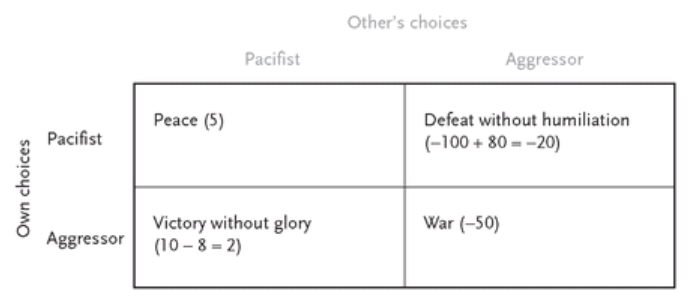
Figure 10-4 — How feminization can resolve the Pacifist’s Dilemma. Pinker begins from a population-level pattern: men commit most serious violence, while women historically appeared disproportionately in pacifist and humanitarian movements. “Feminization” therefore includes not only women holding office but the growing weight of women’s interests and a cultural move away from violent retaliation for insult, the hardening of boys, martial glory, and other forms of male honor competition.
He proposes several connected pathways: political power, marriage on women’s terms, balanced sex ratios, protection of girls from sex-selective killing, and reproductive autonomy that can reduce very large youth cohorts. These are source-dated aggregate arguments, not destinies. Women leaders can be hawkish; already-safe societies may be more able to empower women; and sex ratios or youth bulges operate through employment, status, policing, education, institutions, and elite strategy rather than turning individual men into inevitable aggressors.
Pinker also contrasts Western European democracies with selected Sharia-governed states in Islamic Africa and Asia. That rhetoric mixes religion, regime type, law, region, and gender practice and does not identify which factor causes violence or describe Muslims as a single population. It should be read beside his Chapter 6 evidence that Muslim attitudes toward democracy and women’s rights were internally diverse and changing, and beside Chapter 7’s wider geography of genital cutting and bodily control. Chapter 10 synthesis · Sex differences and political influence, PDF pp. 936–938 (file not included in this release) · Gender, honor, and the Islamic comparison, PDF p. 939 (file not included in this release) · Sex ratios, PDF pp. 940–941 (file not included in this release) · Youth bulges and reproductive autonomy, PDF pp. 941–942 (file not included in this release)
Marriage & Divorce
- Child Marriage · Polygamy · Divorce
- Aisha's Age at Marriage
- Divorce Difficulties for Women — comparative legal barriers