📓 In your handwritten notebooks
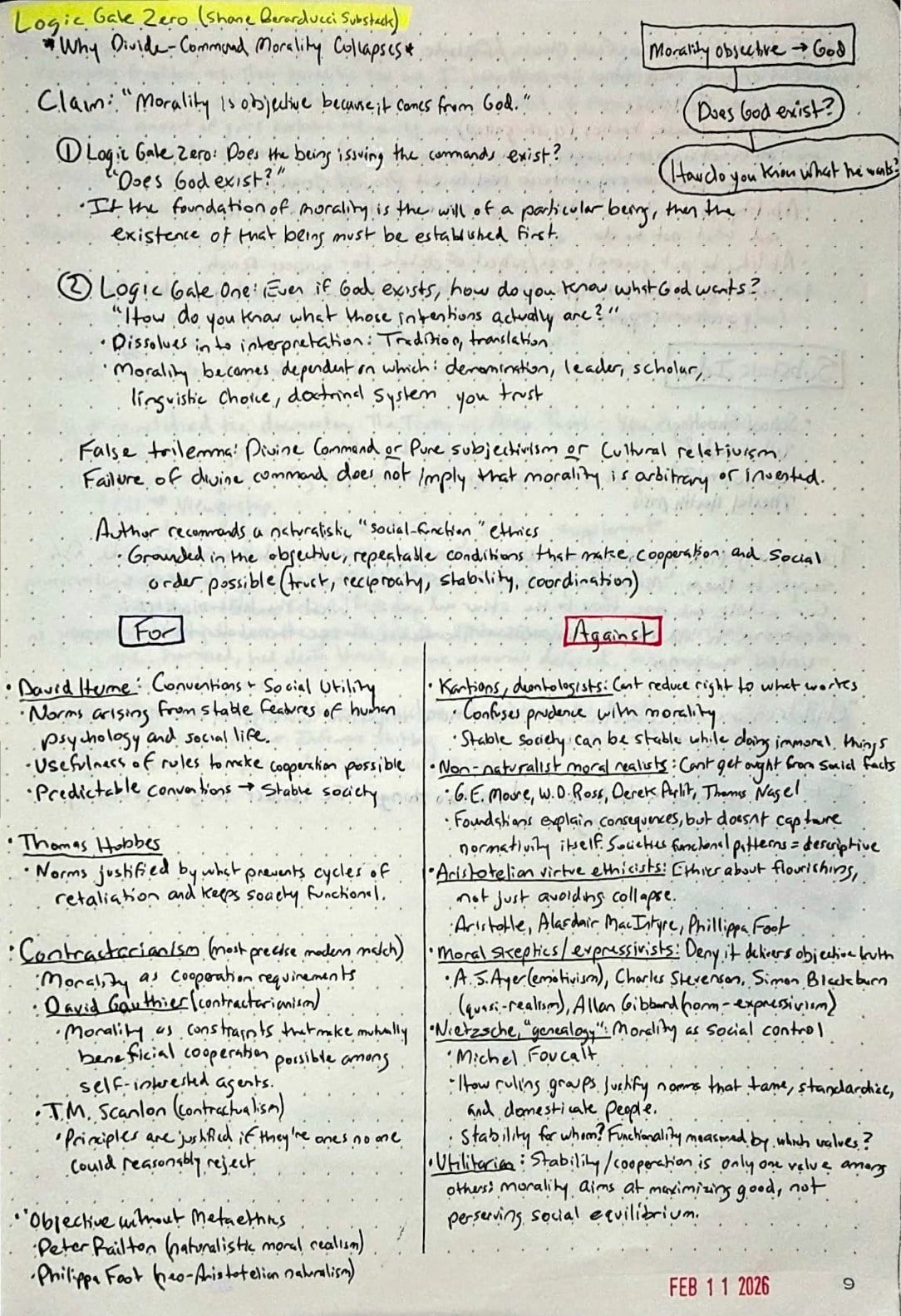
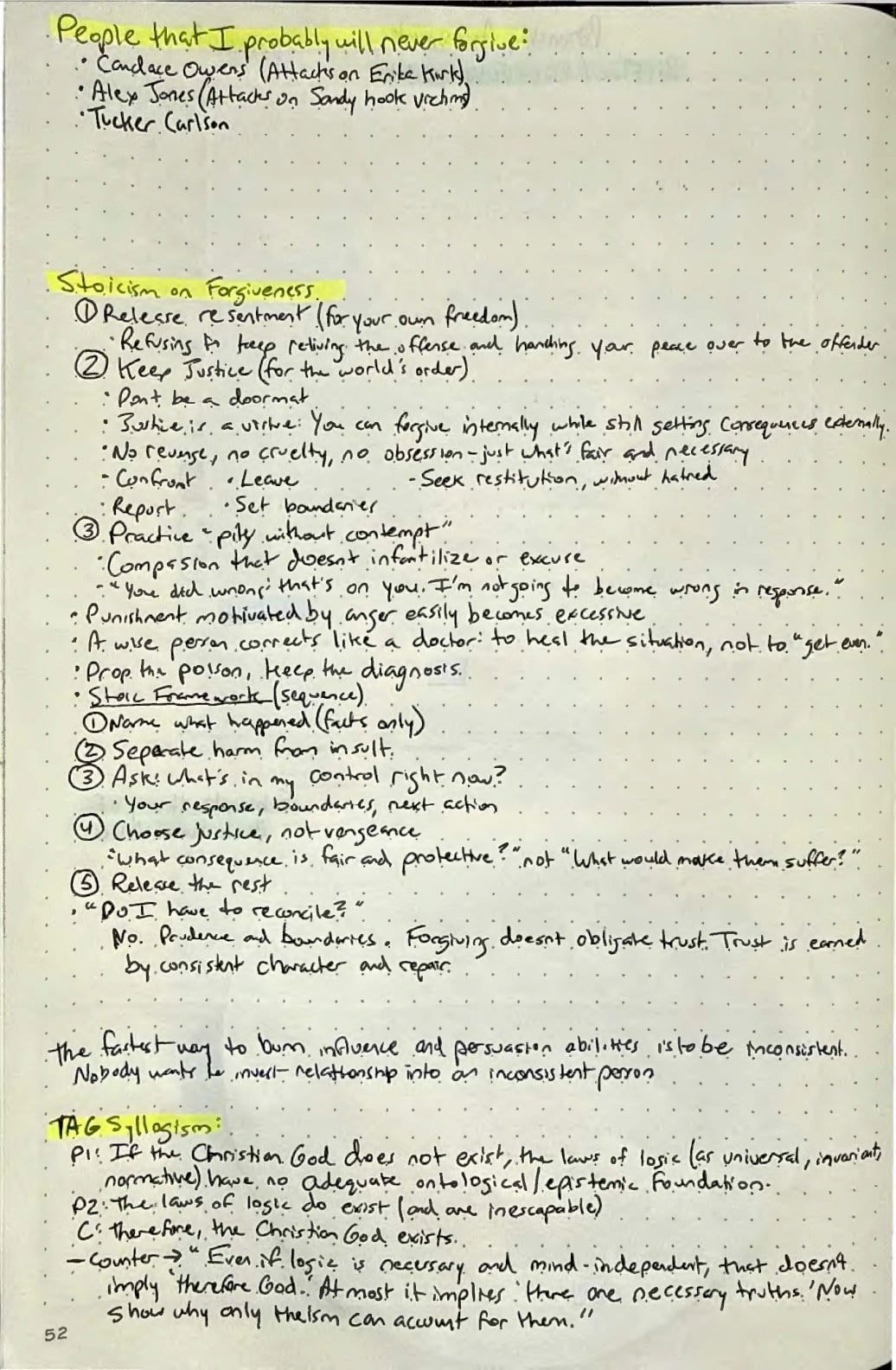
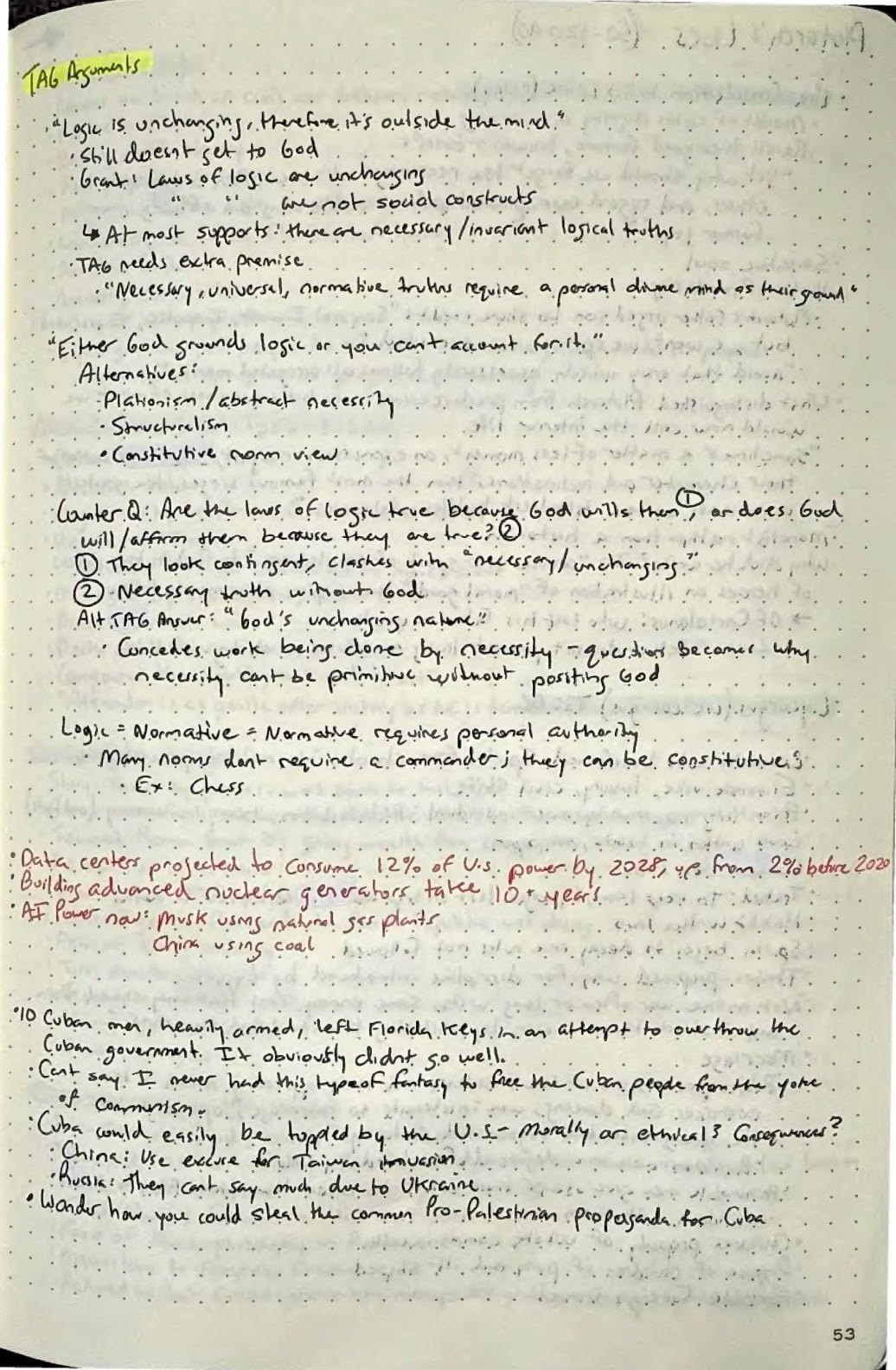
- Feb – March 21 2026, pp. 43 — Presupp argumentation → open PDF p49 (file not included in this release)
Index: Personal Journal
Presuppositionalism Destroyed Like You've Never Seen! Dr. Alex Malpass
Countering Presuppositional Apologetics
Transcendental Argument for God
What this objection is highlighting is that transcendental arguments, such as those employed by Kant, even if thought to be successful, do not establish the existence of something in reality. Rather, they establish synthetic a priori truths, which are about the forms our experience must take. They establish, at best, only conceptual necessities, not ontological necessities.
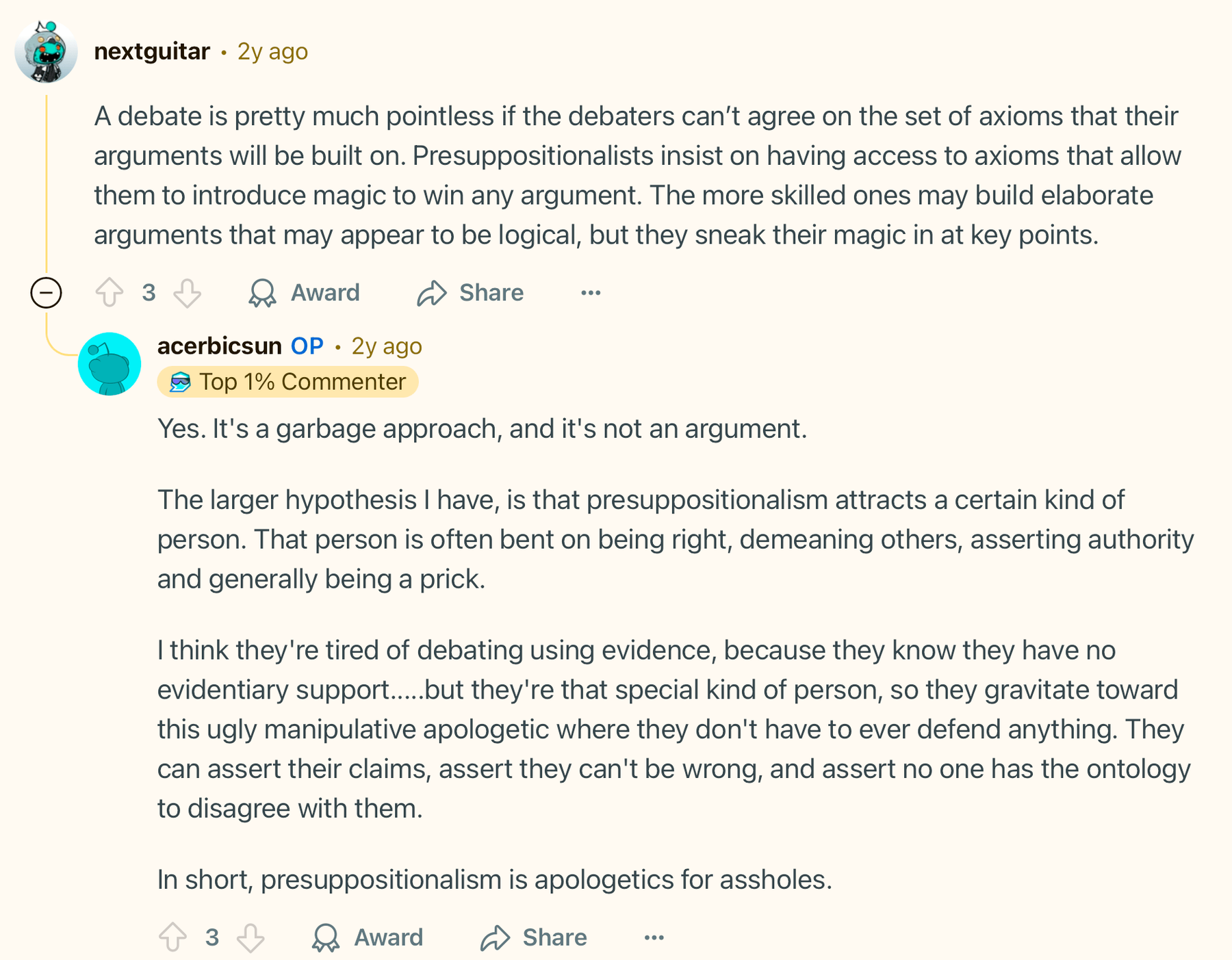
Reddit Explanations
Presuppositional apologetics - Wikipedia
Reddit - The heart of the internet
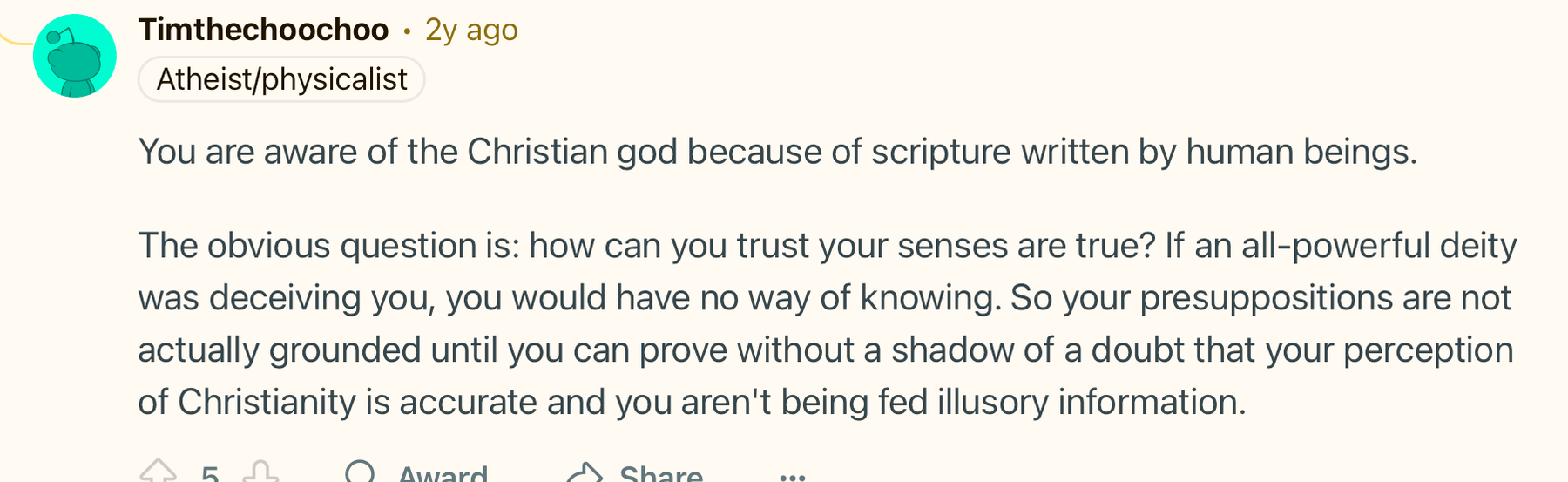
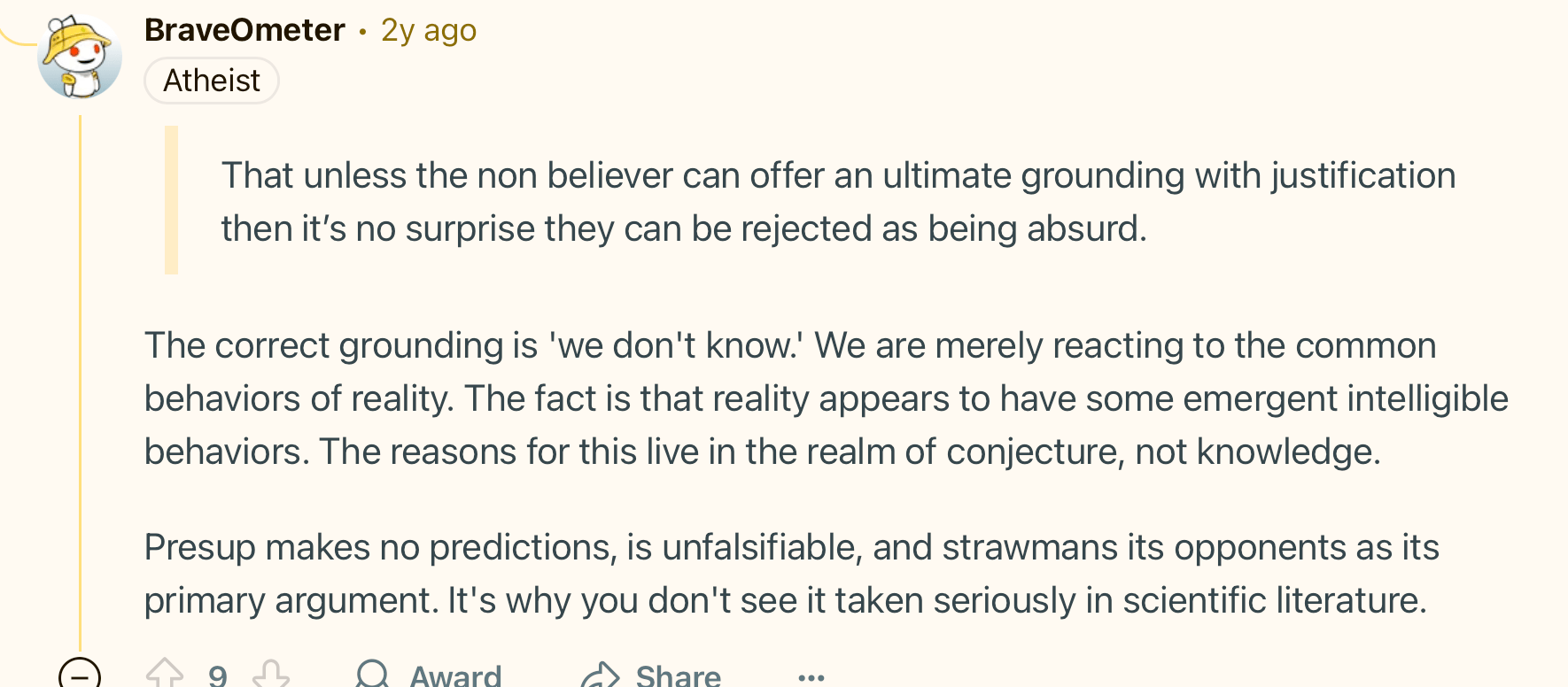
Grounding (metaphysics) - Wikipedia
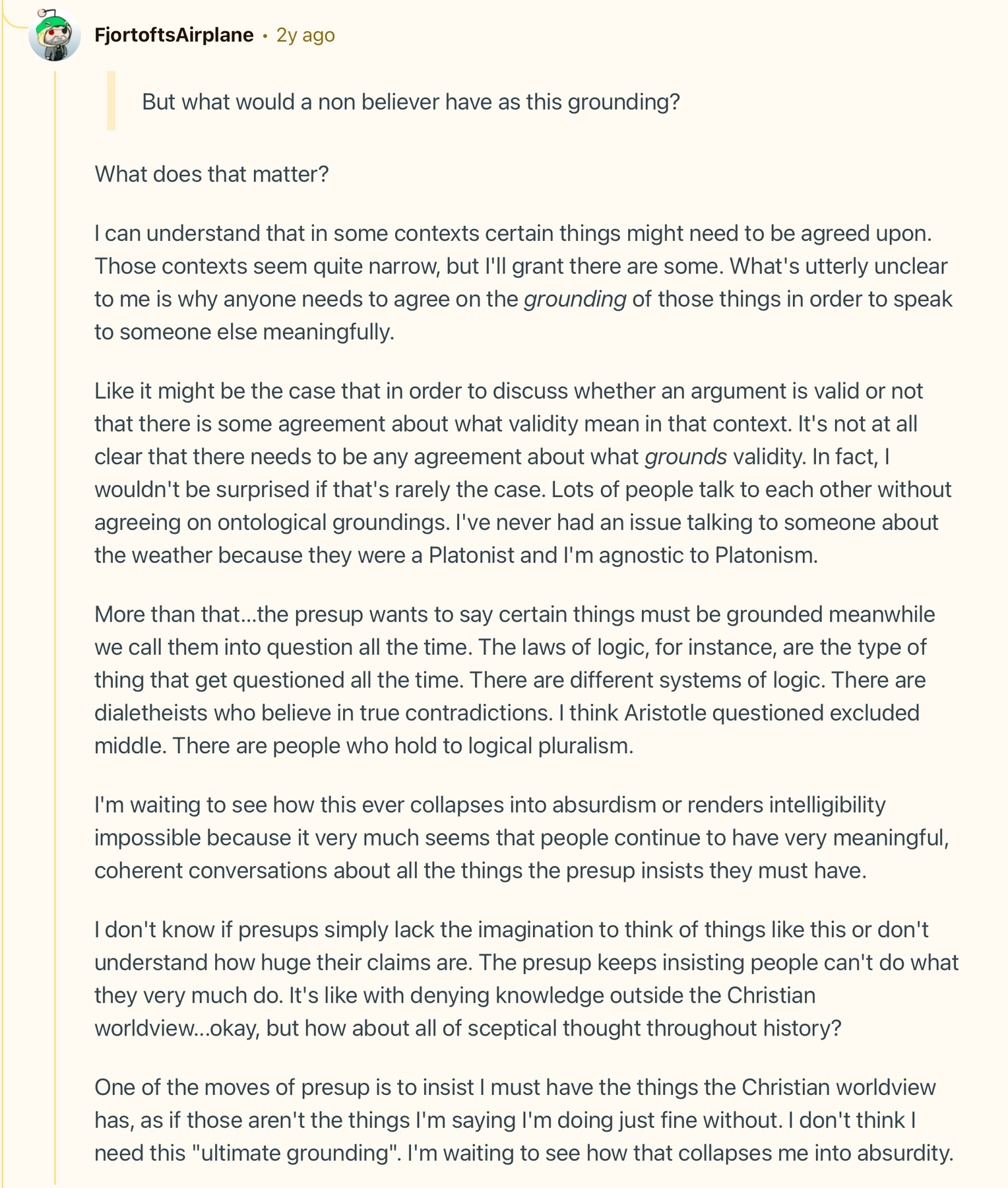
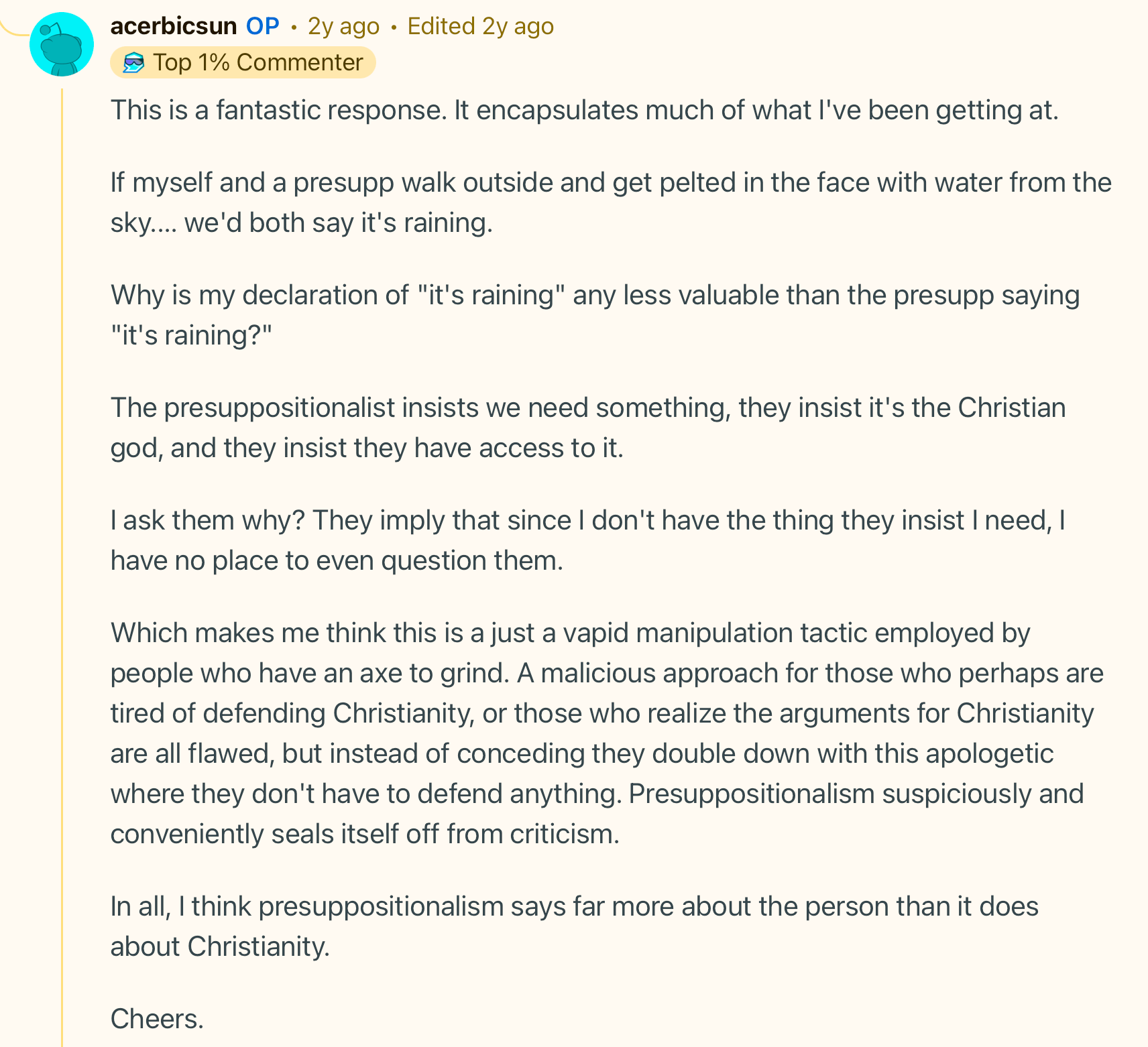
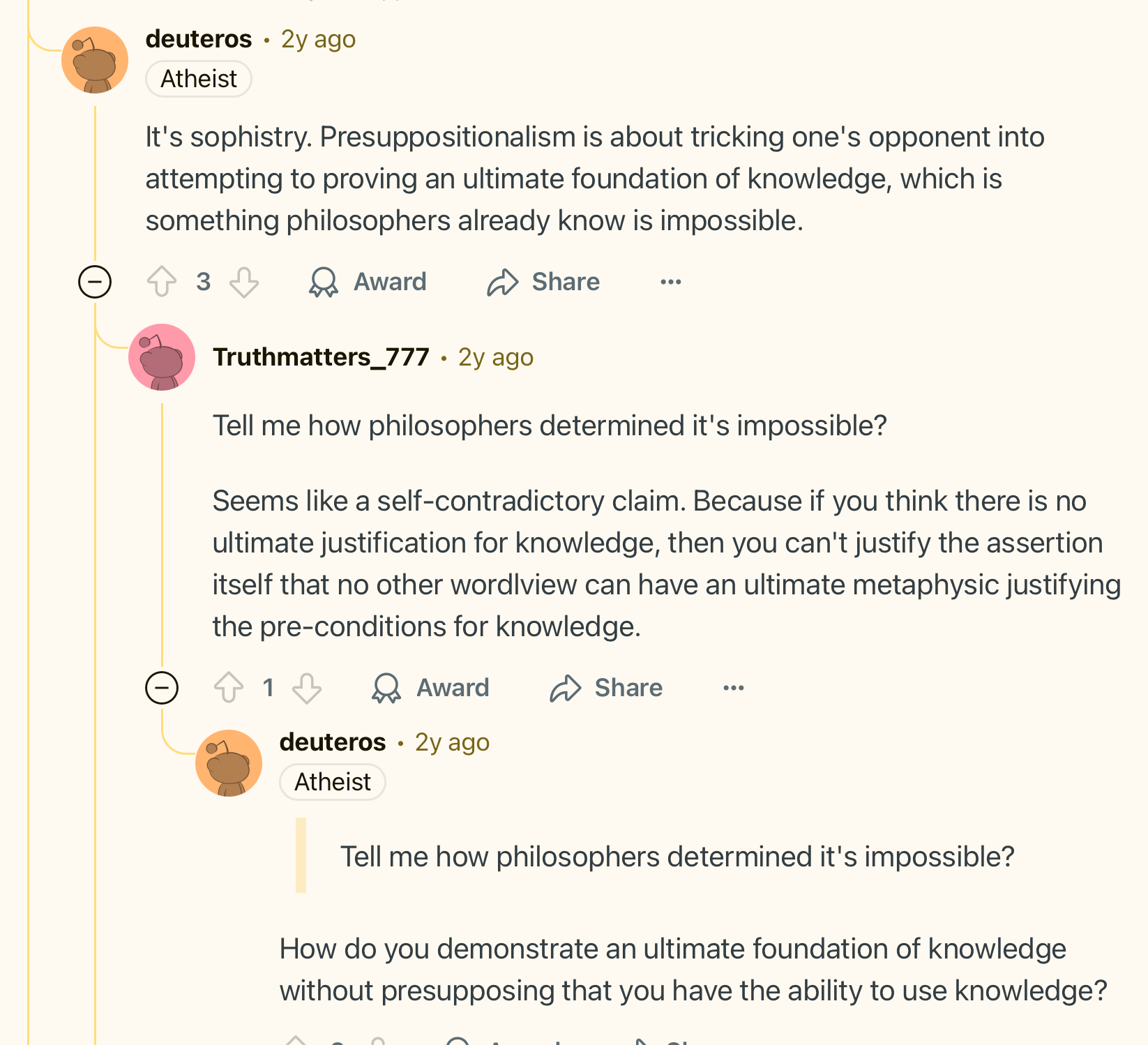
Reddit - The heart of the internet
Special pleading - Wikipedia
Münchhausen trilemma - Wikipedia
Euthyphro dilemma - Wikipedia
Counter
Atheists Can’t Justify Using Reason - YouTube
Here’s a structured breakdown of the philosophical discussion:
1. Core Question:
- How can we trust human intellect and rationality to reliably guide us to truth?
2. The Fundamental Problem:
- Materialist Perspective: If our brains are just atoms randomly interacting, and consciousness evolved purely for survival, there’s no inherent reason our rationality should reliably produce truth.
- Theist Perspective: Rationality can be trusted because it’s grounded in God, a reliable source of truth.
Detailed Explanation:
A. Materialist/Evolutionary View:
- Main Argument:
Human brains evolved primarily for survival, not for discovering objective truth. Our beliefs could be merely adaptive (helpful for survival), rather than accurate representations of reality. - Illustrative Example (2 + 2 = 4):
It could be argued that we believe “2 + 2 = 4” simply because believing otherwise (e.g., “2 + 2 = 5”) was disadvantageous and therefore selected against evolutionarily. - Resulting Problem (Epistemological Crisis):
If our minds evolved to survive rather than to find truth, we face skepticism about all our knowledge—including evolutionary theory itself.
Key Thinker Cited: Alvin Plantinga
- Plantinga’s Evolutionary Argument Against Naturalism:
- If naturalism and evolution are both true, our cognitive faculties evolved for survival, not necessarily for truth.
- Thus, belief in evolution undermines confidence in rational faculties themselves (self-undermining belief).
B. Theist View (Cartesian Example):
- Main Argument:
Rationality and intellect can be trusted because they originate from God, who ensures that rationality aligns with truth. - Cartesian Circle Problem:
- Descartes argued God justifies human rationality, but used rationality itself to prove God’s existence.
- Result: A circular argument (“I trust reason because of God, and I trust God because reason leads me to Him”).
Philosophical Terms Explained:
- Epistemology:
Study of how we know things (justification of knowledge). - Ontology:
Study of what exists (nature of being and reality).
Interaction of Epistemology and Ontology:
- Ontology (what exists) grounds Epistemology (how we know).
- But Epistemology is necessary to justify beliefs about Ontology.
- Circular Problem:
You need rationality to establish what exists (ontology), but ontology must guarantee the validity of rationality (epistemology).
Possible Solutions Discussed:
1. Theist Solution (Virtuous Circle):
- Accept some foundational “circular reasoning,” but a benign one:
- Rationality comes from God.
- God’s existence is known through rationality.
- It provides internal coherence and stability.
2. Atheist/Materialist Challenges:
- Without a metaphysical foundation (God), rationality potentially becomes self-undermining:
- If our cognitive faculties evolved merely for survival, trust in them to deliver objective truth is questionable.
- Self-undermining loop:
Belief in evolution by natural selection (materialist position) casts doubt on rationality, which in turn weakens justification for belief in evolution.
3. Pragmatist/Anti-Realist Solution:
- (Example: Hugh Price’s Global Pragmatism)
- Truth redefined pragmatically (what works best or is most useful).
- Truth might not reflect a metaphysical reality; it’s useful and internally consistent.
- This avoids the self-undermining issue but sacrifices traditional realism about truth.
4. Wittgenstein’s “Hinge Statements”:
- Ludwig Wittgenstein argued certain foundational beliefs (“hinge propositions”) cannot be proven or disproven.
- We must accept some fundamental beliefs without justification, as starting points.
Broader Philosophical Observations:
- The debate often boils down to different philosophical intuitions:
- Metaphysical/Realist Intuition (often Theist):
Truth and rationality must be anchored in objective metaphysical reality (e.g., God). - Anti-Realist/Pragmatist Intuition (often Atheist):
Truth can be grounded in human practices or utility, without metaphysical realism.
- Metaphysical/Realist Intuition (often Theist):
Conclusion and Implications:
- Both theism and materialism face significant philosophical challenges:
- Theism struggles with the Cartesian circularity issue.
- Materialism faces the evolutionary skepticism issue.
- The question of trust in human rationality leads to fundamental inquiries into what truth actually is, its grounding, and our justification for knowing anything at all.
This philosophical problem highlights fundamental tensions between realism and anti-realism, and between the metaphysical and pragmatic grounding of human knowledge.
🔹 The Claim:
Everyone starts with a metaphysical foundation:
Either:
- The universe is intentional (designed by a mind/God), or
- The universe is non-intentional (the product of blind, purposeless processes).
Then the argument continues:
If the universe is non-intentional, then there can be no objective purpose or meaning.
Therefore, a person who holds this view cannot make objective claims about purpose, value, or meaning (such as morality, truth, or logic).
🔍 Is this argument true?
1. It’s valid in structure, but not necessarily sound.
A valid argument means the conclusion follows logically from the premises — and it does if the premises are granted. But:
- The soundness of the argument depends on whether its premises are true or provable.
- The premise “if the universe is non-intentional, then there can be no objective meaning” is philosophically contested.
🔄 Counterarguments:
🧠 1. Secular Objectivism is possible
Atheists or naturalists can hold that objective truths and values exist, without requiring divine intention. Examples:
- Moral Realism: Some secular philosophers (e.g. Sam Harris, Derek Parfit, Erik Wielenberg) argue that morality can be objective based on well-being, reason, or intrinsic truths — not divine decree.
- Platonism: Abstract objects like numbers, logic, or moral truths can exist necessarily and independently of any mind — divine or human.
So the idea that “no God = no objective values” is not universally accepted.
🔧 2. Appealing to consequences doesn’t prove truth
Saying “if atheism is true, life has no objective meaning” may make people uncomfortable, but that doesn’t prove atheism false. This is known as the appeal to consequences fallacy.
Even if the conclusion is existentially bleak, that doesn’t make it logically false.
🌿 3. Purpose can arise from emergence
- In a non-intentional universe, conscious beings like humans can still create meaning and purpose.
- Just because something wasn’t designed with a purpose doesn’t mean it can’t develop one.
Example: A river wasn’t made to generate power — but humans can harness it for hydroelectricity. Same with life: no built-in purpose doesn’t mean no purpose at all.
🧱 4. The “starting point” is debatable
Presuppositionalists often assume that everyone must presuppose God to even make sense of logic, morality, etc.
But many reject this and argue:
- Logic arises from the structure of reality.
- Morality is emergent or built into the nature of social creatures.
- Meaning is subjective or intersubjectively agreed upon.
🔷 Logic arises from the structure of reality
Logic is not something humans invented arbitrarily, nor something that requires a divine mind to exist. Rather, it is descriptive of how reality behaves. For instance, the law of non-contradiction (that something cannot both be and not be in the same way at the same time) simply reflects how reality functions: a rock cannot both be a rock and not be a rock at once. Logical principles, then, are grounded in the structure of existence itself.
From this view, human beings discover logical rules through observation and reasoning, not because they are imposed by a deity, but because they mirror the order and regularity of the universe. Much like mathematics, logic is considered an abstract structure that describes what is necessarily true given certain conditions — independent of belief systems or divine authorship.
🔷 Morality is emergent or built into the nature of social creatures
Morality does not need to descend from a divine command to be real or binding. Instead, it can be understood as an emergent property of social life. As humans evolved to live in groups, certain behaviors (like cooperation, reciprocity, and fairness) increased chances of survival and flourishing. Over time, these behaviors became embedded in our psychology through natural selection and cultural reinforcement.
This view sees moral norms as deeply rooted in human nature and social necessity — not arbitrarily subjective, but grounded in shared human needs and tendencies. Philosophers like David Hume and modern moral naturalists argue that morality arises from empathy, reason, and the social emotions — the same faculties that underpin language and law.
In short, morality emerges from what it means to be a human in relation to others, not from supernatural decree.
🔷 Meaning is subjective or intersubjectively agreed upon
Rather than being fixed from outside reality by a transcendent mind, meaning can be generated by conscious beings. Subjectively, individuals can craft meaning based on their values, goals, and relationships. Intersubjectively, societies can agree on shared meanings through language, culture, and tradition — creating frameworks for identity, responsibility, and aspiration.
This doesn’t mean meaning is trivial or arbitrary. It means that meaning is constructed, not bestowed. A parent finds deep meaning in caring for their child, an artist in creating beauty, a citizen in defending justice — these meanings are powerful and motivating, even if not rooted in a divine plan.
Thinkers like Viktor Frankl, Albert Camus, and Jean-Paul Sartre emphasized that meaning is something each person must create — especially because the universe offers none by default. That challenge doesn’t invalidate meaning; it makes the quest more profound and personal.
🧠 Philosophers who reject the religious claim:
- Derek Parfit – argued for objective moral truths without religion.
- Bertrand Russell – acknowledged a meaningless universe but still affirmed the value of human compassion and truth.
- Immanuel Kant – tried to ground morality in reason, not divine will.
- Nietzsche – rejected objective morality from religion, but still sought to understand values through a human lens.
✅ Summary:
The religious debater is making a strong rhetorical point, but:
- Their claim is philosophically contested, not proven.
- There are credible non-theistic views that support objective meaning or morality.
- The conclusion (atheism = no objective values) is not a logical necessity — it depends on deeper metaphysical views that are open to debate.
Would you like this broken into debate-ready talking points or simplified into an analogy?
References
Transcendental Argument for God’s Existence Debunked | by Sheng-Ta Tsai | Deconstructing Christianity | Medium
Transcendental Arguments (Stanford Encyclopedia of Philosophy)
Reddit - The heart of the internet
Transcendental arguments and the logic of presupposition. – UseOfReason
Skepticism (Stanford Encyclopedia of Philosophy)
Ten Problems with Presuppositionalism Answered
[A Critique of Presuppositionalism with Dr. Nathan Greeley - YouTube](https://www.youtube.com/watch?v=LcZqhitfpxo
Presuppositional Spaghetti, the Lottery Paradox, and the Search for God
The Verdict Is In: Assessment of the 1985 Bahnsen-Stein Debate, “Does God Exist?” - YouTube
The limitations of Transcendental Arguments
The Transcendental Argument for God’s Existence
Presuppositionalism’s Fundamental Error w/ Dr. Richard Howe