Imagine worrying about an upcoming job interview, a sudden stock market dip, or what people think of you on social media. We spend so much energy stressing over things that might not even be up to us. The ancient Stoic philosophers had a name for this tendency and a remedy to go with it. Their idea of the Dichotomy of Control is both simple and life-changing: in life, some things are within your control, and others are not – and peace depends on knowing the difference. In this conversational guide, we’ll explore what the Stoics like Epictetus, Seneca, and Marcus Aurelius taught about this principle, how it leads to viewing externals with indifference, and how you can apply it today to reduce anxiety and live more freely.
[
Vault cross-reference
Four notes in this vault are the same idea at four different pressure levels, and they’re worth reading as a set:
- The doctrine — this note. Epictetus’ division of what is and isn’t “up to us.”
- The method — The Practicing Stoic. Where this note states the division, Farnsworth supplies the techniques for actually applying it, in two families: analytical (reasoning through a desire or fear until its irrationality is exposed) and intuitive (the view from above; imagining the event happened to someone else). The operational core is noticing the “judgment layer” between an event and your reaction, then stripping away the labels and narratives that inflate it — which is the dichotomy of control turned into a repeatable move rather than a principle you agree with.
- The stress test — Courage Under Fire - James Stockdale. Stockdale credited Epictetus with surviving seven years in Hoa Lo, four in leg irons. The relevant part isn’t the endurance; it’s his observation that the optimists died first — the men who fixed their hope on an external date (“home by Christmas”) broke when it passed. That is the dichotomy of control stated as a survival finding rather than a maxim.
- The generalization — Antifragile. Taleb’s category of things that gain from disorder is the systems-level version of the same insight: stop trying to control the external volatility, restructure so that volatility feeds you. Note the Stoic lineage is explicit in Taleb — he calls Seneca the first thinker to understand asymmetric downside.
The primer — Lessons in Stoicism - John Sellars. Its Ch. 2 is this note (“What Do You Control?”), and its Ch. 1 supplies the frame the others assume: philosophy as a “hospital for souls,” the philosopher as doctor treating mistaken beliefs. Its chapter headings already link to this note; this is the return link.
Together they answer the usual objection that Stoicism is passive resignation: the doctrine isn’t “accept everything,” it’s relocate your effort to where it has purchase. → Fear & Anxiety · Ego · Meditations - Marcus Aurelius
What Is Actually in Your Control?
Over 1,900 years ago, the Stoic teacher Epictetus opened his Handbook (Enchiridion) with a powerful lesson:
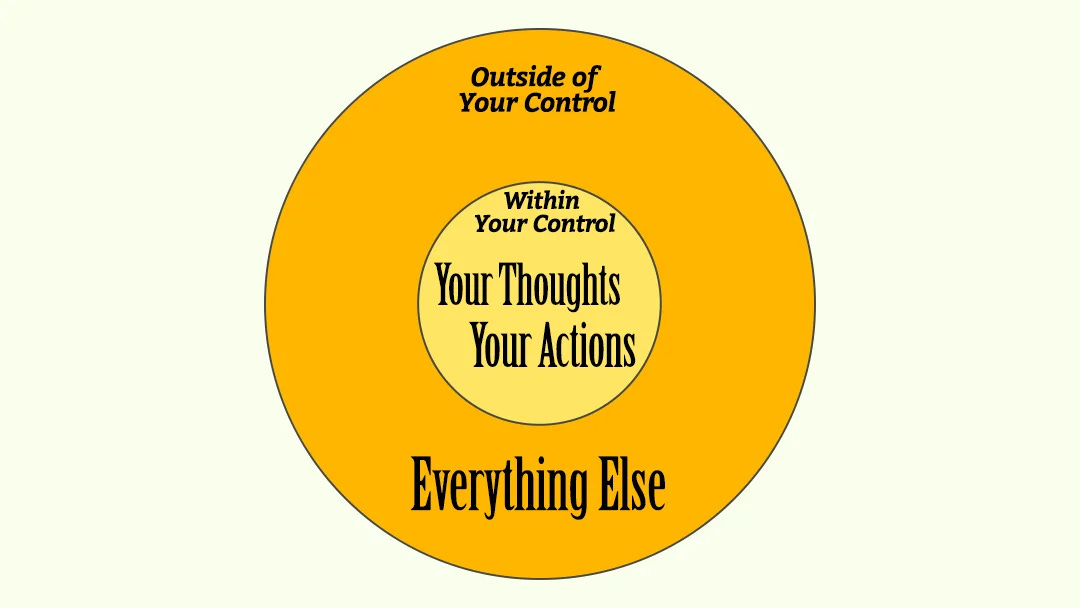
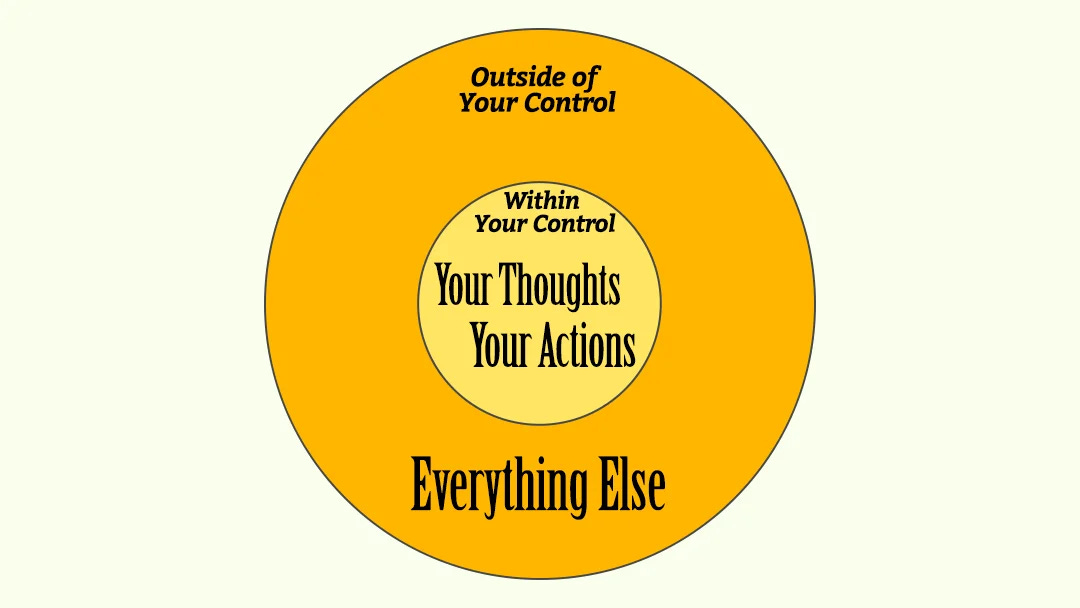
“Some things are in our control and others not. Things in our control are opinion, pursuit, desire, aversion, and, in a word, whatever are our own actions. Things not in our control are body, property, reputation, command, and, in one word, whatever are not our own actions.”
In plain terms, Epictetus is telling us that your own mind and will are up to you, while external circumstances are not. To break it down:
- Within our control: our opinions and judgments, our intentions and desires, our choices and actions – basically, everything that we ourselves think or do.
- Beyond our control: our body (health, appearance, aging), our possessions and wealth, our public image and how others treat us, outcomes of situations, and generally anything not purely our own doing.
This might seem like common sense, but how often do we forget it? We try to control other people’s opinions, or we agonize over events like the weather, traffic, or economic shifts. The Stoics noticed that when we confuse what’s ours to control with what isn’t, we torment ourselves. Epictetus warns that if you take externals as if they were up to you, “you will be hindered. You will lament, you will be disturbed, and you will find fault both with gods and men.” In other words, misplacing your focus leads to frustration, blame, and misery.
On the flip side, if you can accept that things like wealth or illness are not entirely in your hands, you free yourself from a huge burden. Epictetus boldly promises that if you stick to caring only about what is up to you (your own virtue and decisions), “no one will ever compel you or restrain you… No one will hurt you, you will have no enemies, and you will not be harmed.” That sounds almost superhuman, but it’s the kind of inner invincibility Stoics aimed for. The key is that life’s ups and downs can’t truly hurt your character – unless you let them.
Why the Stoics Call Externals ‘Indifferent’
Because external things (like wealth, status, or even our bodies) aren’t under our full control, the Stoics classed them as “indifferent”. Now, by indifferent they didn’t mean these things are totally meaningless or that you should feel nothing toward them. In Stoic philosophy, “indifferent” means that something does not affect your moral worth or virtue. Only our own choices and attitudes can be good or bad in a moral sense. Everything else – money, success, sickness, failure, etc. – is neutrally outside virtue’s domain.
To the Stoics, virtue (living with wisdom, justice, courage, and self-discipline) is the only true good, and vice the only true evil. Everything else lives in the in-between. As Epictetus put it succinctly, “Men are disturbed not by things, but by the views which they take of them.” It’s our judgment of an event that makes it a problem. A public speech isn’t inherently scary – it’s our view of it that terrifies us. A rude comment isn’t inherently hurtful until we interpret it as an insult. This is why two people can face the same hardship, say a job loss, and one is devastated while the other remains calm and resolves to move forward. The event is the same; it’s the mind’s assessment that differs.
The Stoic Roman emperor Marcus Aurelius echoes this idea in his personal diary, reminding himself of the power of perspective:
“External things are not the problem. It’s your assessment of them. Which you can erase right now.”
In other words, the situation isn’t what upsets us; it’s how we choose to look at it. And crucially, that choice is within our control. We can’t change the external facts after they happen – the stock market crashed, the rain spoiled the picnic – but we can change our opinion about them. Marcus is saying: if a particular thought about an external event is distressing you, you have the ability to change that thought (to “erase” the upsetting assessment) on the spot. This Stoic move of re-framing events is a direct application of the dichotomy of control. By focusing on your own mind’s response instead of fighting the external reality, you reclaim your tranquility.
So when Stoics speak of being “indifferent” to wealth, fame, or illness, they don’t mean pretending these things don’t matter at all on a practical level. It means recognizing that these externals do not determine your worth or happiness. They are “neutral” with respect to the good life. What matters is how you deal with them. As Epictetus advises, whenever something happens, first ask: Is this under my control or not? If not, he says, be prepared to tell yourself, “It is nothing to me.” This phrase – “it’s nothing to me” – is the Stoic way of refusing to give external events power over your inner self. It’s a reminder that this thing might affect your circumstances, but it doesn’t have to touch your character or disturb your peace.
Preferred vs. Dispreferred Indifferents
Now, if you’re thinking, “Surely health and sickness aren’t the same to a Stoic? They’d prefer health, right?” you’re absolutely correct. The Stoics made a further distinction between indifferents: some are “preferred” and others “dispreferred.” Since things like health, comfort, and financial stability naturally make life go smoother (and are in line with our nature as human beings), it’s normal and rational to prefer them when given the choice. These are preferred indifferents. Their opposites – disease, discomfort, poverty, etc. – are dispreferred indifferents, as any sane person would rather avoid them if possible.
Seneca, another great Stoic philosopher, explains this nuanced view beautifully. In a letter to his friend Lucilius, he writes:
“There is great difference between joy and pain; if I am asked to choose, I shall seek the former and avoid the latter. The former is according to nature, the latter contrary to it. So long as they are rated by this standard, there is a great gulf between them; but when it comes to a question of the virtue involved, the virtue in each case is the same, whether it comes through joy or through sorrow.”
Seneca is saying: Of course there’s a big practical difference between experiencing joy and experiencing pain – who wouldn’t pick happiness over suffering? It’s completely natural (“according to nature”) to seek the pleasant and shun the painful. In that sense, yes, being happy, comfortable, healthy, and secure are “preferred” states. Stoics are not denying our human preferences or telling us to be indifferent in the modern sense of apathetic. It’s perfectly fine to prefer a good meal to starvation, or a soft bed to sleeping on a rock.
The crucial point, however, is what Seneca adds: when it comes to virtue and character, joy and pain are equal opportunities. You can show the same courage, self-control, or justice whether you’re enjoying good times or enduring bad times. The virtue (your moral excellence) is what counts as truly good, and it does not depend on whether you’re currently in comfort or in pain. The pleasant or unpleasant conditions are, from the perspective of moral philosophy, indifferent. They don’t make you a better or worse person – only your actions and attitude do.
So Stoics do prefer health to sickness, wealth to poverty, success to failure – who wouldn’t? As Seneca quipped elsewhere, it’s obviously better to be rich than poor and comfortable than uncomfortable 8 9 . But (and this is a big but) a Stoic will not trade away virtue for the sake of those externals. If keeping integrity means losing some money, so be it – money was never true wealth to begin with. If facing illness is necessary in doing what’s right, the Stoic will face it, because health, while preferable, is not worth more than one’s character.
By labeling these externals “preferred indifferents,” the Stoics remind themselves that it’s natural to like or dislike certain outcomes, but our happiness doesn’t hinge on getting our preferences. You might think of it this way: Preferred indifferents are like nice-to-haves, not need-to-haves. They enrich life when present, but they are not the foundation of a good life. That foundation is virtue. Understanding this helps us remain steady when life doesn’t give us the preferred outcomes. We can say, “I’d rather have X, but I’ll be okay without it, because what truly matters (my own conduct) is still in my control.”
Using the Dichotomy of Control to Live with Freedom and Calm
Theory is nice, but how can this Stoic wisdom actually help you day-to-day? Let’s make it practical. The next time you find yourself anxious or upset, try this Stoic exercise:
- Pause and zoom out. Take a deep breath and ask: “What exactly is upsetting me, and is it something I can control?” Be brutally honest. If you’re anxious about an upcoming event (an exam, a job interview), recognize that you cannot directly control the outcome. What is in your control? Preparing as well as possible, showing up, and putting in your best effort. Worrying endlessly about results or other people’s opinions only drains your energy. As the Stoics would say, those results belong to the realm of Fortune, not you.
- Focus on your part. Once you identify the aspects under your control, pour your attention there. For an exam, that means studying diligently (which is up to you) rather than obsessing over what the questions will be (not up to you). If you’re giving a presentation, you control how practiced you are and the message you deliver – not the listeners’ reactions. By zeroing in on your role, you empower yourself to do the best that you can and let go of the rest. This shift is incredibly freeing: you realize you don’t have to carry the weight of the whole world, just your own choices.
- Let go of the attachment to outcomes. This is hard, but it’s the heart of Stoic practice. After you’ve done what you can, remind yourself, as Epictetus taught, to regard whatever happens next as “nothing to you” in terms of your worth 6 . This doesn’t mean you don’t care about success; it means that however it turns out, you will keep your equilibrium. You won’t let a bad outcome shatter you, nor a good outcome make you complacent or cocky. Your inner fortitude doesn’t ride on external results.
- Reframe the narrative. If something external goes wrong – you do fail the test, lose the job, or get sick catch the feelings of despair or anger as early as you can. Then, deliberately reframe the situation. Remind yourself, perhaps with Marcus Aurelius’s words, that the event itself isn’t the problem, but your view of it is 5 . Can you see this setback as a challenge to grow stronger, or as irrelevant to your true wellbeing? Maybe losing that job opens another path, or at least it’s an opportunity to practice resilience. Maybe illness is a chance to appreciate health and practice patience. This isn’t just Pollyanna positive-thinking; it’s choosing a perspective that serves you better and remains aligned with virtue (for instance, choosing gratitude over self-pity, action over complaint).
By consistently applying these steps, you’ll find that many worries simply fall away. There’s a profound quote attributed to Epictetus: “Who then is invincible? The one who cannot be upset by anything outside their reasoned choice.” This encapsulates the Stoic goal. If your peace depends only on yourself, then you are difficult to shake. External events, which are by nature unpredictable and often uncontrollable, lose their power to tyrannize your mind. You become, as the Stoics liked to say, free – not because you can do whatever you want in the external world, but because nothing in the external world can force you to react against your own will or principles.
Modern psychologists talk about the benefits of an “internal locus of control” – the sense that you are in charge of your life, rather than at the mercy of fate. The Stoics were teaching this mindset long ago. It doesn’t mean pretending you control everything; it means fully owning what you do control (your efforts, attitudes, values) and not stressing over what you don’t (basically everything else!). The result is a calmer, more centered approach to life. For example, if you’ve done everything you can to secure a job and still get a rejection, you won’t take it as a personal failure – you’ll understand it was never wholly in your hands. If someone mistreats you, you recognize that their actions are on them; what’s on you is how you respond.
When you internalize the dichotomy of control, you start to resemble the Stoic ideal that Epictetus described: a person who “will find fault with no one or accuse no one” for their misfortunes. Instead of cursing luck or other people, you focus on keeping your own intentions upright. This doesn’t make you passive; rather, it makes you proactive about the right things. You spend your energy where it can actually do some good (your choices), and you save yourself the heartache of fighting the inevitable or the uncontrollable.
Conclusion: A More Tranquil Life through Stoic Wisdom
The Stoic dichotomy of control is a concept you can start using immediately. It costs nothing and offers, as Marcus Aurelius and friends attest, a kind of unshakable peace. By remembering what is yours to manage and what is not, you release a huge amount of pointless anxiety. You stop trying to carry the whole world on your shoulders. As a result, you can approach challenges more calmly and freely, because your wellbeing no longer depends on every little thing going your way.
This doesn’t happen overnight – it’s a practice, a habit of mind cultivated over time. Marcus Aurelius wrote daily reminders to himself in his journal because even an emperor needed to constantly realign his perspective. So, be patient and keep at it. The next time you’re feeling overwhelmed, pause and draw that Stoic line: “Is this within my control or not?” If not, dare to drop the worry about it – drop it like a heavy bag you have no business carrying. If yes, then empower yourself to take the best action you can, and accept whatever outcome follows.
In the end, the Stoics teach us that while we cannot control everything that happens, we can control how we relate to what happens. And in that little space – our own thoughts and choices – lies all our freedom and all our power. When you live by this insight, life’s turbulences seem a bit more manageable. You find a steady footing no matter the storm, because you know exactly what’s up to you. As Epictetus would cheerfully say about all the rest, “It is nothing to me.”