Vault cross-reference
Taleb’s antifragility is the systems-level restatement of a Stoic doctrine you already hold in depth: Dichotomy of Control. Both say the error is trying to control external volatility rather than restructuring your exposure to it — Taleb explicitly claims Seneca as the first thinker to grasp asymmetric downside, and Courage Under Fire - James Stockdale is the human-scale proof (the POWs who broke were the ones betting on an external date). Read the three together and Stoicism stops reading as resignation and starts reading as risk management. → 60.12.1 Stoicism · The Stoic Challenge - William B Irvine
DESCRIPTION
Antifragile is a standalone book in Nassim Nicholas Taleb’s landmark Incerto series, an investigation of opacity, luck, uncertainty, probability, human error, risk, and decision-making in a world we don’t understand. The other books in the series are Fooled by Randomness, The Black Swan, Skin in the Game, and The Bed of Procrustes. Nassim Nicholas Taleb, the bestselling author of The Black Swan and one of the foremost thinkers of our time, reveals how to thrive in an uncertain world. Just as human bones get stronger when subjected to stress and tension, and rumors or riots intensify when someone tries to repress them, many things in life benefit from stress, disorder, volatility, and turmoil. What Taleb has identified and calls “antifragile” is that category of things that not only gain from chaos but need it in order to survive and flourish. In The Black Swan, Taleb showed us that highly improbable and unpredictable events underlie almost everything about our world. In Antifragile, Taleb stands uncertainty on its head, making it desirable, even necessary, and proposes that things be built in an antifragile manner. The antifragile is beyond the resilient or robust. The resilient resists shocks and stays the same; the antifragile gets better and better. Furthermore, the antifragile is immune to prediction errors and protected from adverse events. Why is the city-state better than the nation-state, why is debt bad for you, and why is what we call “efficient” not efficient at all? Why do government responses and social policies protect the strong and hurt the weak? Why should you write your resignation letter before even starting on the job? How did the sinking of the Titanic save lives? The book spans innovation by trial and error, life decisions, politics, urban planning, war, personal finance, economic systems, and medicine. And throughout, in addition to the street wisdom of Fat Tony of Brooklyn, the voices and recipes of ancient wisdom, from Roman, Greek, Semitic, and medieval sources, are loud and clear. Antifragile is a blueprint for living in a Black Swan world. Erudite, witty, and iconoclastic, Taleb’s message is revolutionary: The antifragile, and only the antifragile, will make it. Praise for Antifragile “Ambitious and thought-provoking … highly entertaining.”—The Economist “A bold book explaining how and why we should embrace uncertainty, randomness, and error … It may just change our lives.”—Newsweek
My Summary
Main Ideas, Takeaways & Similarities
Questions
I. What is the problem?
A. How is this problem formulated?
B. Why is this problem important?
C. What is the history of this problem?
D. Which prominent personalities have been interested in this problem?
II. What solutions to the problem are there?
A. What are the conclusions reached?
B. By what argument(s) is the conclusion reached?
C. What facts or assumptions serve as premises?
D. When a prominent personality offers a solution, does he also argue for or against other prominent personalities? Does he raise objections to alternative solutions? Does he consider objections to his own solutions?
III. Evaluation
A. What are the advantages and disadvantages of the alternative formulations to the problem?
B. Has the importance or history of the problem ever been misrepresented?
C. Are the solutions logically related to the premises?
D. Are the facts true? Are the assumptions acceptable? Are the objections answerable?
AI Summary
“Antifragile: Things That Gain from Disorder” by Nassim Nicholas Taleb presents a comprehensive exploration of the concept of antifragility, which goes beyond resilience or robustness. Here are the key points from the book:
- Definition of Antifragility: Antifragile is a term coined by Taleb to describe systems that benefit and grow from volatility, randomness, disorder, and stressors. Unlike things that are fragile (break under stress) or robust/resilient (resist stress), antifragile entities improve when exposed to these conditions.
- Natural vs. Artificial Systems: The book distinguishes between organic/natural systems (like biological entities, certain economic systems, and cultural practices) that tend to be antifragile, and artificial/man-made systems (like certain aspects of modern society and technology) that are often fragile.
- Small is Beautiful: Taleb argues that small, decentralized systems are often more antifragile than large, centralized ones. This is because smaller entities can adapt and respond to changes and stressors more quickly and effectively.
- Optionality as a Source of Antifragility: The concept of optionality is crucial in antifragility. Having options allows entities to benefit from uncertainty and variability, as they have the freedom to choose among multiple pathways and adapt to changing circumstances.
- Barbell Strategy: Taleb introduces the barbell strategy as a way to balance risk and safety. This strategy involves having a combination of extremely safe and extremely risky strategies, rather than a middle-of-the-road approach.
- Skin in the Game: The importance of having ‘skin in the game’ is emphasized. Decision-makers should bear some risk from the consequences of their decisions to ensure responsibility and accountability.
- Via Negativa: Taleb advocates for a ‘via negativa’ approach to problem-solving and decision-making. This involves focusing on what not to do, removing harmful elements rather than adding new ones.
- Limits of Predictive Models: The book critiques the overreliance on predictive models and planning in complex systems. Taleb argues that these models often fail to account for randomness and black swan events (highly improbable events with massive impacts).
- Role of Stress and Difficulty: Stressors and difficulties are seen as necessary for growth and improvement. Over-protection and avoidance of stress can lead to fragility.
- Ethical Implications: Antifragility has ethical implications in terms of how society, businesses, and governments operate and respond to uncertainty and stress.
- Practical Applications: Taleb discusses practical applications of antifragility in various fields, including economics, politics, medicine, and personal life.
“Antifragile” challenges conventional wisdom about risk, uncertainty, and the nature of progress, offering a novel perspective on how to thrive in an unpredictable world.
The Barbell Strategy, as described by Nassim Nicholas Taleb in his book “Antifragile,” is a risk management approach that involves splitting resources between two extremes, often seen as polar opposites, rather than opting for a middle-ground or “moderate” strategy. This strategy is named for its resemblance to a weightlifter’s barbell, which has weights concentrated at two ends and nothing in the middle. Here’s a breakdown of its key components:
- Safety and Risk Distribution: On one end of the barbell, you place a significant portion of your resources in extremely safe, secure, and low-risk investments or decisions. This part acts as a protective measure, ensuring stability and minimizing potential losses.
- High-Risk, High-Reward Opportunities: On the other end, you allocate a smaller, but not insignificant, portion of your resources to high-risk, high-reward opportunities. These could be speculative investments, innovative projects, or any ventures with uncertain outcomes but the potential for substantial returns.
- Avoiding the Middle: The middle of the barbell, which in investing would represent moderate-risk/moderate-return options, is intentionally left empty. Taleb argues that the middle ground often offers the worst of both worlds: insufficient safety and limited upside potential.
- Benefits of the Strategy: The safety end of the barbell protects against major losses, ensuring survival and stability. Meanwhile, the high-risk end offers the chance for significant gains. The idea is that losses on the risky end are capped (since only a limited portion of resources is placed there), while the potential for gains is not.
- Application Across Fields: While often discussed in the context of financial investment, the barbell strategy can be applied to various areas such as business strategy, personal life decisions, and even physical training. For instance, in personal lifestyle, it might mean combining a stable and routine day job with engaging in adventurous, unpredictable hobbies during leisure time.
- Adaptation to Volatility: This strategy is particularly suited to environments characterized by high uncertainty and volatility. It allows for taking advantage of positive unpredictable events (positive black swans) while limiting exposure to negative surprises.
In essence, the Barbell Strategy is about balancing the extremes – combining the security of stability with the potential of adventurous risk-taking, thereby creating a setup that is positioned to gain from disorder and uncertainty.
“Via Negativa,” a term popularized in Nassim Nicholas Taleb’s book “Antifragile,” refers to a philosophy or approach where improvement, understanding, or solutions are achieved by subtraction rather than addition. This concept is rooted in ancient wisdom, including theological and philosophical traditions. Here’s a more detailed explanation:
- Improvement Through Reduction: The basic premise of Via Negativa is that eliminating negative elements can be more effective and less risky than adding new elements. It’s often easier and more beneficial to remove what is harmful or non-essential than to add something new in the hope of achieving improvement.
- Application in Various Fields: This approach can be applied in numerous areas such as medicine, lifestyle, decision-making, business, and personal habits. For example, in medicine, it might mean focusing on removing unhealthy behaviors or substances rather than adding medications or supplements.
- Avoiding Unintended Consequences: Via Negativa acknowledges that additions often come with unforeseen side effects or complications. By focusing on removal, it reduces the risk of unintended negative consequences that can arise from trying to intervene or add something new.
- Simplicity and Minimalism: This approach aligns with principles of simplicity and minimalism, valuing the removal of the superfluous to reveal the essential. It’s about stripping away the non-essential to find clarity and effectiveness.
- Preferable to Action for Action’s Sake: Taleb argues that in many cases, doing less or even doing nothing can be a better course of action than doing something for the sake of being active. This is particularly true in complex systems where interventions can have unpredictable results.
- Risk Management: In a risk management context, Via Negativa prioritizes reducing downside over capturing upside. This can involve eliminating vulnerabilities and dependencies to make a system or individual less fragile.
- Holistic Benefits: The concept is not just about removing the negative but also about the holistic benefits that come from such removals, like increased clarity, focus, and efficiency.
Via Negativa suggests that instead of constantly seeking to add new things (be it possessions, experiences, features, or interventions), there can be great value and power in identifying and removing the negative, the unnecessary, or the harmful.
Highlights
anything that has more upside than downside from random events (or certain shocks) is antifragile; the reverse is fragile. (Location 361)
Crucially, if antifragility is the property of all those natural (and complex) systems that have survived, depriving these systems of volatility, randomness, and stressors will harm them. They will weaken, die, or blow up. We have been fragilizing the economy, our health, political life, education, almost everything … by suppressing randomness and volatility. (Location 363)
complex systems are weakened, even killed, when deprived of stressors. Much of our modern, structured, world has been harming us with top-down policies and contraptions (dubbed “Soviet-Harvard delusions” in the book) which do precisely this: an insult to the antifragility of systems. (Location 367)
Some become antifragile at the expense of others by getting the upside (or gains) from volatility, variations, and disorder and exposing others to the downside risks of losses or harm. (Location 374)
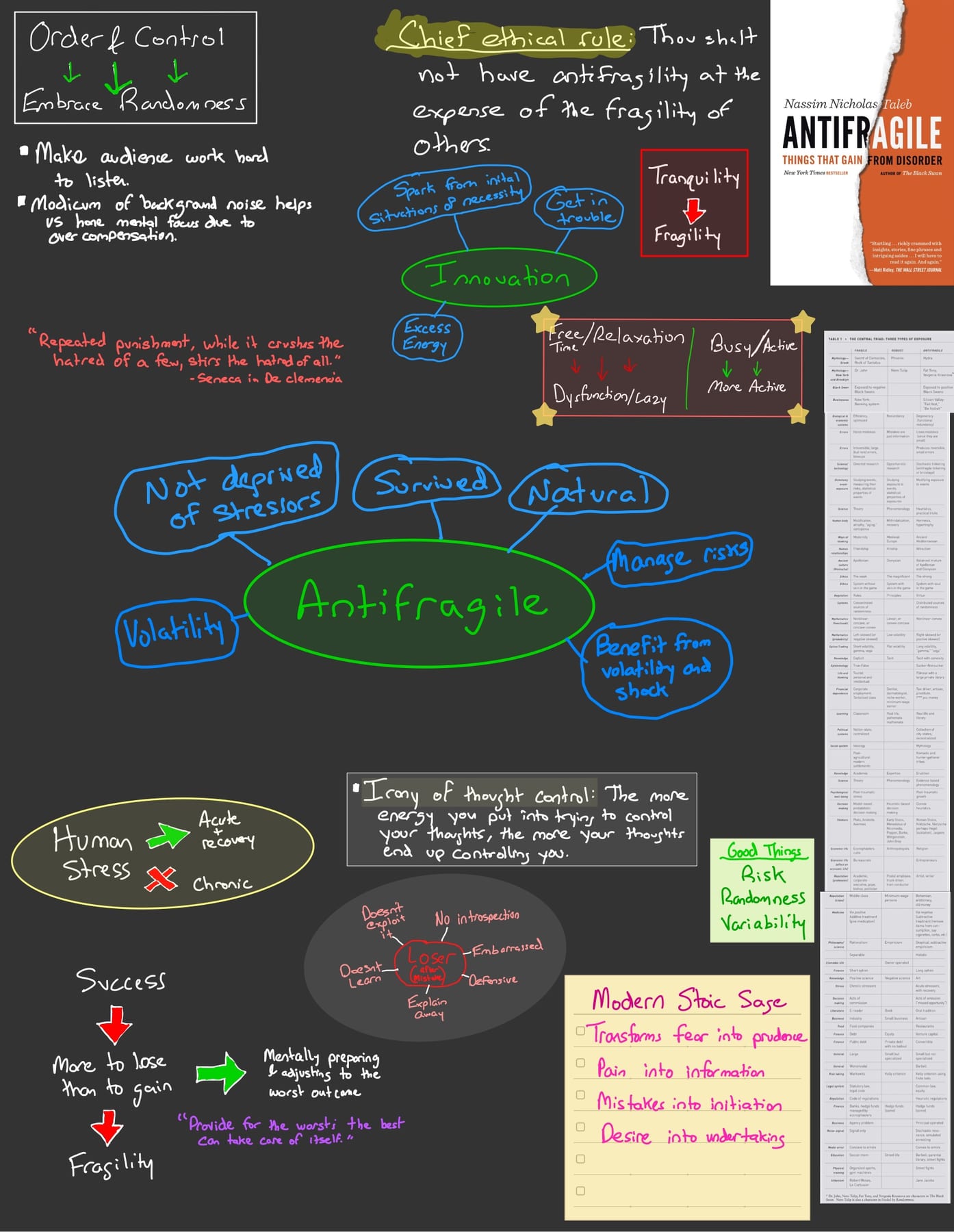
The chief ethical rule is the following: Thou shalt not have antifragility at the expense of the fragility of others. (Location 383)
You get pseudo-order when you seek order; you only get a measure of order and control when you embrace randomness. (Location 394)
Man-made complex systems tend to develop cascades and runaway chains of reactions that decrease, even eliminate, predictability and cause outsized events. So the modern world may be increasing in technological knowledge, but, paradoxically, it is making things a lot more unpredictable. (Location 400)
You cannot say with any reliability that a certain remote event or shock is more likely than another (unless you enjoy deceiving yourself), but you can state with a lot more confidence that an object or a structure is more fragile than another should a certain event happen. (Location 434)
But simplicity is not so simple to attain. Steve Jobs figured out that “you have to work hard to get your thinking clean to make it simple.” The Arabs have an expression for trenchant prose: no skill to understand it, mastery to write it. (Location 481)
fragility—which had been lacking a technical definition—could be expressed as what does not like volatility, and that what does not like volatility does not like randomness, uncertainty, disorder, errors, stressors, etc. (Location 487)
it is much easier to understand if something is harmed by volatility—hence fragile—than try to forecast harmful events, such as these oversized Black Swans. But only practitioners (or people who do things) tend to spontaneously get the point. (Location 505)
Compromising is condoning. The only modern dictum I follow is one by George Santayana: A man is morally free when … he judges the world, and judges other men, with uncompromising sincerity. (Location 568)
Antifragility is desirable in general, but not always, as there are cases in which antifragility will be costly, extremely so. Further, it is hard to consider robustness as always desirable—to quote Nietzsche, one can die from being immortal. (Location 690)
BOOK I The Antifragile: An Introduction (Location 724)
CHAPTER 1 (Location 731)
Between Damocles and Hydra (Location 732)
Sophistication, a certain brand of sophistication, also brings fragility to Black Swans: as societies gain in complexity, with more and more “cutting edge” sophistication in them, and more and more specialization, they become increasingly vulnerable to collapse. This idea has been brilliantly—and convincingly—adumbrated by the archeologist Joseph Tainter. But it does not have to be so: it is so only for those unwilling to go the extra step and understand the matrix of reality. To counter success, you need a high offsetting dose of (Location 787)
robustness, even high doses of antifragility. You want to be Phoenix, or possibly Hydra. Otherwise the sword of Damocles will get you. (Location 791)
DOMAIN INDEPENDENCE IS DOMAIN DEPENDENT This idea that systems may need some stress and agitation has been missed by those who grasp it in one area and not in another. So we can now also see the domain dependence of our minds, a “domain” being an area or category of activity. Some people can understand an idea in one domain, say, medicine, and fail to recognize it in another, say, socioeconomic life. Or they get it in the classroom, but not in the more complicated texture of the street. Humans somehow fail to recognize situations outside the contexts in which they usually learn about them. (Location 861)
This lack of translation is a mental handicap that comes with being a human; and we will only start to attain wisdom or rationality when we make an effort to overcome and break through it. (Location 889)
CHAPTER 2 (Location 896)
Overcompensation and Overreaction Everywhere (Location 897)
How do you innovate? First, try to get in trouble. I mean serious, but not terminal, trouble. I hold—it is beyond speculation, rather a conviction—that innovation and sophistication spark from initial situations of necessity, in ways that go far beyond the satisfaction of such necessity (from the unintended side effects of, say, an initial invention or attempt at invention). (Location 909)
The excess energy released from overreaction to setbacks is what innovates! (Location 914)
Most humans manage to squander their free time, as free time makes them dysfunctional, lazy, and unmotivated—the busier they get, the more active they are at other tasks. (Location 938)
auction), I learned that the noise produced by the person is inverse to the pecking order: as with mafia dons, the most powerful traders were the least audible. One should have enough self-control to make the audience work hard to listen, which causes them to switch into intellectual overdrive. (Location 943)
The same or a similar mechanism of overcompensation makes us concentrate better in the presence of a modicum of background random noise, as if the act of countering such noise helps us hone our mental focus. (Location 949)
Seneca in De clemencia about the inverse effect of punishments. He wrote: “Repeated punishment, while it crushes the hatred of a few, stirs the hatred of all … just as trees that have been trimmed throw out again countless branches.” (Location 1026)
Psychologists have shown the irony of the process of thought control: the more energy you put into trying to control your ideas and what you think about, the more your ideas end up controlling you. (Location 1050)
So here is a simple rule of thumb (a heuristic): to estimate the quality of research, take the caliber of the highest detractor, or the caliber of the lowest detractor whom the author answers in print—whichever is lower. (Location 1072)
So the same hidden antifragilities apply to attacks on our ideas and persons: we fear them and dislike negative publicity, but smear campaigns, if you can survive them, help enormously, conditional on the person appearing to be extremely motivated and adequately angry— (Location 1078)
CHAPTER 3 (Location 1134)
The Cat and the Washing Machine (Location 1135)
In the complex world, the notion of “cause” itself is suspect; it is either nearly impossible to detect or not really defined—another reason to ignore newspapers, with their constant supply of causes for things. (Location 1179)
Humans tend to do better with acute than with chronic stressors, particularly when the former are followed by ample time for recovery, which allows the stressors to do their jobs as (Location 1211)
messengers. (Location 1213)
There is another danger: in addition to harming children, we are harming society and our future. Measures that aim at reducing variability and swings in the lives of children are also reducing variability and differences within our said to be Great Culturally Globalized Society. (Location 1262)
Which brings us to the existential aspect of randomness. If you are not a washing machine or a cuckoo clock—in other words, if you are alive—something deep in your soul likes a certain measure of randomness and disorder. (Location 1293)
CHAPTER 4 (Location 1327)
What Kills Me Makes Others Stronger (Location 1328)
When you want deviations, and you don’t care about the possible dispersion of outcomes that the future can bring, since most will be helpful, you are antifragile. (Location 1443)
my characterization of a loser is someone who, after making a mistake, doesn’t introspect, doesn’t exploit it, feels embarrassed and defensive rather than enriched with a new piece of information, and tries to explain why he made the mistake rather than moving on. These types often consider themselves the “victims” of some large plot, a bad boss, or bad weather. (Location 1488)
What Erasmus called ingratitudo vulgi, the ingratitude of the masses, is increasing in the age of globalization and the Internet. My dream—the solution—is that we would have a National Entrepreneur Day, with the following message: Most of you will fail, disrespected, impoverished, but we are grateful for the risks you are taking and the sacrifices you are making for the sake of the economic growth of the planet and pulling others out of poverty. You are at the source of our antifragility. Our nation thanks you. (Location 1596)
BOOK II (Location 1620)
Modernity and the Denial of Antifragility (Location 1621)
CHAPTER 5 (Location 1638)
The Souk and the Office Building (Location 1639)
This is the central illusion in life: that randomness is risky, that it is a bad thing—and that eliminating randomness is done by (Location 1657)
eliminating randomness. (Location 1658)
The more variability you observe in a system, the less Black Swan–prone it is. (Location 1687)
We can also see from the turkey story the mother of all harmful mistakes: mistaking absence of evidence (of harm) for evidence of absence, a mistake that we will see tends to prevail in intellectual circles and one that is grounded in the social sciences. (Location 1824)
Some people have fallen for the naive turkey-style belief that the world is getting safer and safer, and of course they naively attribute it to the holy “state” (though bottom-up Switzerland has about the lowest rate of violence of any place on the planet). It is exactly like saying that nuclear bombs are safer because they explode less often. The world is subjected to fewer and fewer acts of violence, while wars have the potential to be more criminal. We were very close to the mother of all catastrophes in the 1960s when the United States was about to pull the nuclear trigger on the Soviet Union. Very close. When we look at risks in Extremistan, we don’t look at evidence (evidence comes too late), we look at potential damage: never has the world been more prone to more damage; never.6 (Location 1906)
CHAPTER 6 (Location 1943)
Tell Them I Love (Some) Randomness (Location 1944)
The point of the previous chapter was that the risk properties of the first brother (the fragile bank employee) are vastly different from those of the second one (the comparatively antifragile artisan taxi driver). Likewise, the risk characteristic of a centralized system is different from that of a messy municipally-led confederation. The second type is stable in the long run because of some dose of volatility. (Location 1947)
Unfortunately, you cannot randomize a political party out of existence. What is plaguing us in the United States is not the two-party system, but being stuck with the same two parties. Parties don’t have organic built-in expiration dates. (Location 2025)
To summarize, the problem with artificially suppressed volatility is not just that the system tends to become extremely fragile; it is that, at the same time, it exhibits no visible risks. Also remember that volatility is information. In fact, these systems tend to be too calm and exhibit minimal variability as silent risks accumulate beneath the surface. (Location 2051)
CHAPTER 7 (Location 2123)
Naive Intervention (Location 2124)
These attempts to eliminate the business cycle lead to the mother of all fragilities. Just as a little bit of fire here and there gets rid of the flammable material in a forest, a little bit of harm here and there in an economy weeds out the vulnerable firms early enough to allow them to “fail early” (so they can start again) and minimize the long-term damage to the system. (Location 2247)
CHAPTER 8 (Location 2533)
Prediction as a Child of Modernity (Location 2534)
You can control fragility a lot more than you think. So let us refine in three points: (i) Since detecting (anti)fragility—or, actually, smelling it, as Fat Tony will show us in the next few chapters—is easier, much easier, than prediction and understanding the dynamics of events, the entire mission reduces to the central principle of what to do to minimize harm (and maximize gain) from forecasting errors, that is, to have things that don’t fall apart, or even benefit, when we make a mistake. (ii) We do not want to change the world for now (leave that to the Soviet-Harvard utopists and other fragilistas); we should first make things more robust to defects and forecast errors, or even exploit these errors, making lemonade out of the lemons. (Location 2569)
(iii) As for the lemonade, it looks as if history is in the business of making it out of lemons; antifragility is necessarily how things move forward under the mother of all stressors, called time. (Location 2575)
BOOK III (Location 2629)
A Nonpredictive View of the World (Location 2629)
Curiosity is antifragile, like an addiction, and is magnified by attempts to satisfy it—books have a secret mission and ability to multiply, as everyone who has wall-to-wall bookshelves knows well. (Location 2693)
CHAPTER 10 (Location 2783)
Seneca’s Upside and Downside (Location 2784)
A rich person becomes trapped by belongings that take control of him, degrading his sleep at night, raising the serum concentration of his stress hormones, diminishing his sense of humor, perhaps even causing hair to grow on the tip of his nose and similar ailments. Seneca (Location 2848)
fathomed that possessions make us worry about downside, thus acting as a punishment as we depend on them. All downside, no upside. Even more: dependence on circumstances—rather, the emotions that arise from circumstances—induces a form of slavery. (Location 2850)
Let me rephrase it in modern terms. Take the situation in which you have a lot to lose and little to gain. If an additional quantity of wealth, say, a thousand Phoenician shekels, would not benefit you, but you would feel great harm from the loss of an equivalent amount, you have an asymmetry. And it is not a good asymmetry: you are fragile. (Location 2856)
He said that wealth is the slave of the wise man and master of the fool. (Location 2886)
Fragility implies more to lose than to gain, equals more downside than upside, equals (unfavorable) asymmetry (Location 2910)
Antifragility implies more to gain than to lose, equals more upside than downside, equals (favorable) asymmetry (Location 2912)
You are antifragile for a source of volatility if potential gains exceed potential losses (and vice versa). Further, if you have more upside than downside, then you may be harmed by lack of volatility and stressors. (Location 2913)
CHAPTER 11 (Location 2921)
Never Marry the Rock Star (Location 2922)
The first step toward antifragility consists in first decreasing downside, rather than increasing upside; that is, by lowering exposure to negative Black Swans and letting natural antifragility work by itself. (Location 2929)
In other words, if something is fragile, its risk of breaking makes anything you do to improve it or make it “efficient” inconsequential unless you first reduce that risk of breaking. (Location 2950)
That is extreme risk aversion on one side and extreme risk loving on the other, rather than just the “medium” or the beastly “moderate” risk attitude that in fact is a sucker game (because medium risks can be subjected to huge measurement errors). (Location 2965)
For antifragility is the combination aggressiveness plus paranoia—clip your downside, protect yourself from extreme harm, and let the upside, the positive Black Swans, take care of itself. We saw Seneca’s asymmetry: more upside than downside can come simply from the reduction of extreme downside (emotional harm) rather than improving things in the middle. (Location 2973)
Yiddish proverb that says “Provide for the worst; the best can take care of itself.” This may sound like a platitude, but it is not: just observe how people tend to provide for the best and hope that the worst will take care of itself. We have ample evidence that people are averse to small losses, but not so much toward very large Black Swan risks (which they underestimate), since they tend to insure for small probable losses, but not large infrequent ones. Exactly backwards. (Location 3000)
Many of the “doers” turned “thinkers” like Montaigne have done a serial barbell: pure action, then pure reflection. (Location 3028)
Georges Simenon, one of the most prolific writers of the twentieth century, only wrote sixty days a year, with three hundred days spent “doing nothing.” He published more than two hundred novels. (Location 3032)
I am personally completely paranoid about certain risks, then very aggressive with others. (Location 3038)
The reader may remember the exercise regimen of Chapter 2, which consists in going for the maximum weight one can lift, then nothing, compared to other alternatives that entail less intense but very long hours in the gym. This, supplemented with effortless long walks, constitutes an exercise barbell. (Location 3049)
More barbells. Do crazy things (break furniture once in a while), like the Greeks during the later stages of a drinking symposium, and stay “rational” in larger decisions. Trashy gossip magazines and classics or sophisticated works; never middlebrow stuff. Talk to either undergraduate students, cab drivers, and gardeners or the highest caliber scholars; never to middling-but-career-conscious academics. If you dislike someone, leave him alone or eliminate him; don’t attack him verbally. (Location 3051)
Ray Dalio has a rule for someone making speculative bets: “Make sure that the probability of the unacceptable (i.e., the risk of ruin) is nil.” (Location 3059)
BOOK IV (Location 3079)
Optionality, Technology, and the Intelligence of Antifragility (Location 3080)
Now a warning: the opportunism of the flâneur is great in life and business—but not in personal life and matters that involve others. The opposite of opportunism in human relations is loyalty, a noble sentiment—but one that needs to be invested in the right places, that is, in human relations and moral commitments. (Location 3105)
Never ask people what they want, or where they want to go, or where they think they should go, or, worse, what they think they will desire tomorrow. The strength of the computer entrepreneur Steve Jobs was precisely in distrusting market research and focus groups—those based on asking people what they want—and following his own imagination. His modus was that people don’t know what they want until you provide them with it. (Location 3110)
CHAPTER 12 (Location 3127)
Thales’ Sweet Grapes (Location 3128)
This kind of sum I’ve called in my vernacular “f*** you money”—a sum large enough to get most, if not all, of the advantages of wealth (the most important one being independence and the ability to only occupy your mind with matters that interest you) but not its side effects, such as having to attend a black-tie charity event and being forced to listen to a polite exposition of the details of a marble-rich house renovation. (Location 3144)
worst side effect of wealth is the social associations it forces on its victims, as people with big houses tend to end up socializing with other people with big houses. Beyond a certain level of opulence and independence, gents tend to be less and less personable and their conversation less and less interesting. (Location 3147)
Simply, he had a contract that is the archetype of what an asymmetry is, perhaps the only explicit asymmetry you can find in its purest form. It is an option, “the right but not the obligation” for the buyer and, of course, “the obligation but not the right” for the other party, called the seller. Thales had the right—but not the obligation—to use the olive presses in case there would be a surge in demand; the other party had the obligation, not the right. Thales paid a small price for that privilege, with a limited loss and large possible outcome. That was the very first option on record. The option is an agent of antifragility. (Location 3155)
was: antifragility equals more to gain than to lose equals more upside than downside equals asymmetry (favorable) equals likes volatility. (Location 3163)
we do not need to understand things when we have some edge. And the edge from optionality is in the larger payoff when you are right, which makes it unnecessary to be right too often. (Location 3170)
Sour grapes—as in Aesop’s fable—is when someone convinces himself that the grapes he cannot reach are sour. The essayist Michel de Montaigne sees the Thales episode as a story of immunity to sour grapes: you need to know whether you do not like the pursuit of money and wealth because you genuinely do not like it, or because you are rationalizing your inability to be successful at it with the argument that wealth is not a good thing because it is bad for one’s digestive system or disturbing for one’s sleep or other such arguments. So the episode enlightened Thales about his own choices in life—how genuine his pursuit of philosophy was. He had other options. And, it is worth repeating, options, any options, by allowing you more upside than downside, are vectors of antifragility. (Location 3180)
Authors, artists, and even philosophers are much better off having a very small number of fanatics behind them than a large number of people who appreciate their work. (Location 3224)
your work and ideas, whether in politics, the arts, or other domains, are antifragile if, (Location 3230)
instead of having one hundred percent of the people finding your mission acceptable or mildly commendable, you are better off having a high percentage of people disliking you and your message (even intensely), combined with a low percentage of extremely loyal and enthusiastic supporters. Options like dispersion of outcomes and don’t care about the average too much. (Location 3231)
CHAPTER 13 (Location 3362)
Lecturing Birds on How to Fly (Location 3363)
We humans lack imagination, to the point of not even knowing what tomorrow’s important things look like. We use randomness to spoon-feed us with discoveries—which is why antifragility is necessary. (Location 3386)
great geniuses invent their predecessors, practical innovations create their theoretical ancestry. (Location 3395)
Trial and error has one overriding value people fail to understand: it is not really random, rather, thanks to optionality, it requires some rationality. One needs to be intelligent in recognizing the favorable outcome and knowing what to discard. And one needs to be rational in not making trial and error completely random. If you are looking for your misplaced wallet in your living room, in a trial and error mode, you exercise rationality by not looking in the same place twice. In many pursuits, every trial, every failure provides additional information, each more valuable than the previous one—if you know what does not work, or where the wallet is not located. With every trial one gets closer to something, assuming an environment in which one knows exactly what one is looking for. We can, from the trial that fails to deliver, figure out progressively where to go. (Location 3452)
One rarely has the illusion that, given that so many boys have short hair, short hair determines gender, or that wearing a tie causes one to become a businessman. But it is easy to fall into other epiphenomena, particularly when one is immersed in a news-driven culture. (Location 3554)
CHAPTER 14 (Location 3622)
When Two Things Are Not the “Same Thing” (Location 3623)
Aside from the non-narrative view of things, another lesson. People with too much smoke and complicated tricks and methods in their brains start missing elementary, very elementary things. Persons in the real world can’t afford to miss these things; otherwise they crash the plane. Unlike researchers, they were selected for survival, not complications. So I saw the less is more in action: the more studies, the less obvious elementary but fundamental things become; activity, on the other hand, strips things to their simplest possible model. (Location 3776)
The difference between a narrative and practice—the important things that cannot be easily narrated—lies mainly in optionality, the missed optionality of things. The “right thing” here is typically an antifragile payoff. And my argument is that you don’t go to school to learn optionality, but the reverse: to become blind to it. (Location 3808)
CHAPTER 15 (Location 3872)
History Written by the Losers (Location 3873)
To repeat (it is necessary to repeat because intellectuals tend to forget it), absence of evidence is not evidence of absence, a simple point that has the following implications: for the antifragile, good news tends to be absent from past data, and for the fragile it is the bad news that doesn’t show easily. (Location 4202)
Everything gains or loses from volatility. Fragility is what loses from volatility and uncertainty. (Location 7444)