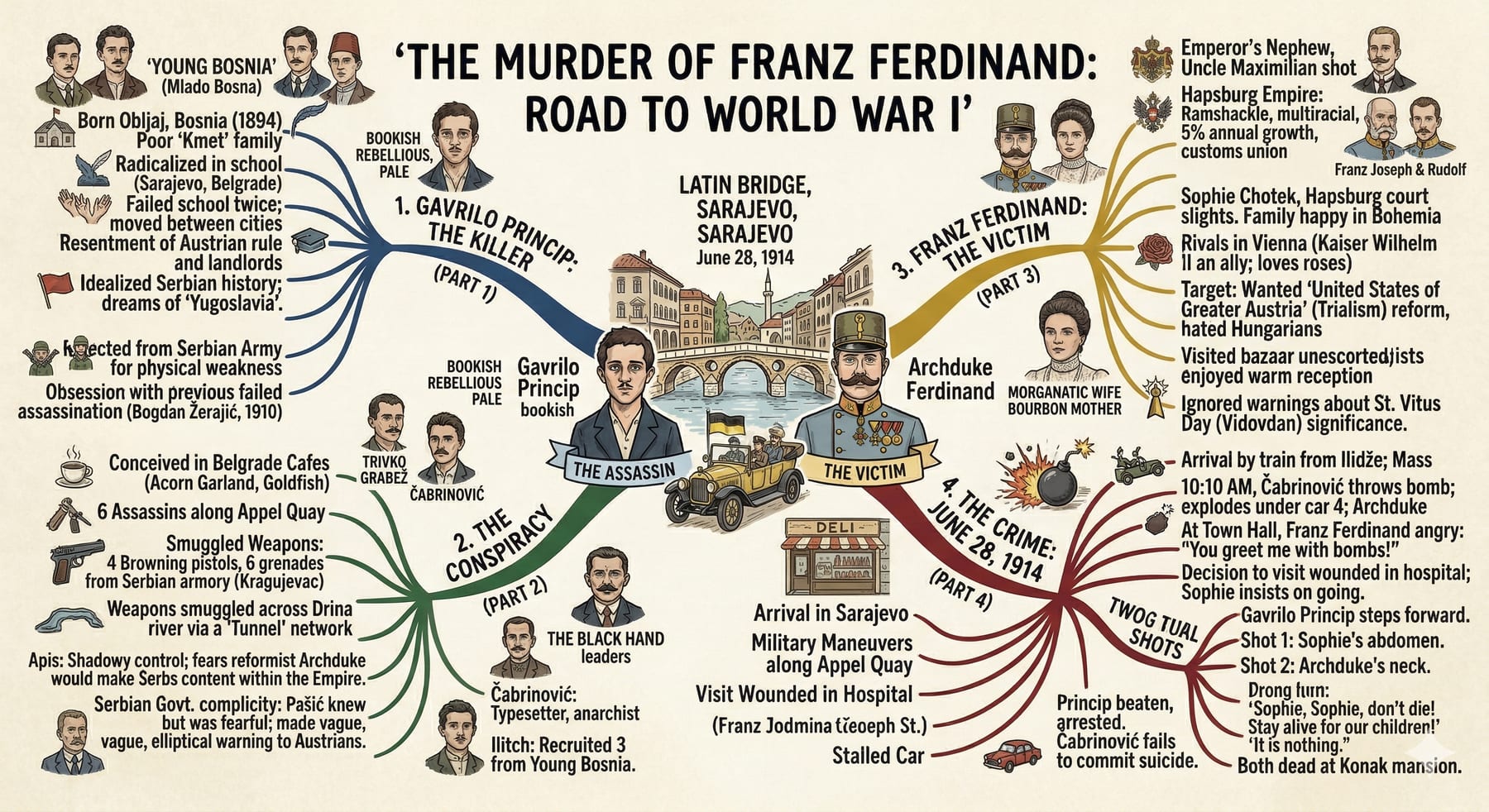
The Killer (Part 1)
Overview
- This episode is Part 1 of a series on the assassination of Archduke Franz Ferdinand, but its real focus is Gavrilo Princip before the killing: who he was, what social world produced him, and why the hosts think the assassin should not be treated as a mere footnote to larger geopolitical forces. (Podcasts - Your Podcast Transcripts)
- The hosts frame the First World War as the great catastrophe of modern history, opening with Philip Larkin’s poem on 1914 and then stressing how the war’s destruction of the Russian, German, Austro-Hungarian, and Ottoman empires still shapes present conflicts. They quote Chris Clark’s The Sleepwalkers and Fritz Stern’s description of WWI as “the calamity from which all other calamities sprang.” (Podcasts - Your Podcast Transcripts)
- A central question of the episode is whether WWI came from deep structural pressures or whether the Sarajevo assassination itself had a uniquely consequential character. The hosts argue that the answer is both: the age was already full of assassinations and instability, but Princip, Sarajevo, and Balkan politics still mattered enormously. (Podcasts - Your Podcast Transcripts)
Main ideas and key points
1) The episode rejects the myth of a peaceful, innocent Europe suddenly shattered by one random act
- The hosts push back against the idea that pre-1914 Europe was uniformly calm and stable. They note that many leaders had already been assassinated before 1914, and they mention internal crises such as prewar tensions in Britain over Ireland. Their point is that Sarajevo happened in a world already full of violence, nationalism, and fragility. (Podcasts - Your Podcast Transcripts)
- This matters because it changes the meaning of the assassination: Franz Ferdinand’s murder was not a bolt from the blue, but one event inside a broader culture of political violence. (Podcasts - Your Podcast Transcripts)
2) Princip is presented as a modern political type, not just an obscure peasant fanatic
- The hosts explicitly argue that Princip is often misunderstood as a cipher. They say he was actually a highly modern figure: alienated, bookish, politically radicalized, socially isolated, and shaped by urban ideological networks. (Podcasts - Your Podcast Transcripts)
- They repeatedly compare him, interpretively rather than evidentially, to figures like Lee Harvey Oswald, modern lone-wolf extremists, and even alienated school shooters. Their point is not identity but type: the resentful, isolated, self-dramatizing young man searching for meaning in political violence. (Podcasts - Your Podcast Transcripts)
- They also stress how difficult Princip is to reconstruct with confidence. Much of the original documentation was destroyed, surviving evidence is fragmentary, and later memory-making turned him into a political legend surrounded by distortions. (Podcasts - Your Podcast Transcripts)
3) Princip’s background matters: poverty, empire, and the uneven modernization of Bosnia
- Princip was born in July 1894 in Obli, Herzegovina, a poor rural Bosnian Serb community in a region legally Ottoman but administered by Austria-Hungary after 1878. The hosts emphasize how remote and impoverished this world was. (Podcasts - Your Podcast Transcripts)
- They describe Bosnia as a frontier zone between empires, religions, and identities: Ottoman, Habsburg, Orthodox, Muslim, Catholic, East, and West. That setting is important because Princip’s worldview is shaped by both rural backwardness and imperial domination. (Podcasts - Your Podcast Transcripts)
- A recurring theme is uneven modernization. Sarajevo modernized quickly under Habsburg rule, while the countryside remained poor and socially stagnant. Princip grew up at the point where an old peasant world collided with new schools, cities, bureaucracy, literacy, and nationalism. (Podcasts - Your Podcast Transcripts)
4) Sarajevo radicalized Princip by exposing him to a world he found humiliating and estranging
- When Princip arrived in Sarajevo as a boy, the city symbolized both Ottoman survivals and Austro-Hungarian modernity: mosques, veils, trams, government buildings, rerouted riverbanks, and Habsburg public architecture. The hosts stress the cultural shock this would have produced. (Podcasts - Your Podcast Transcripts)
- They argue that this experience had a class and colonial dimension. Princip came from poverty into a city where power, education, and urban culture were tied to empire and to social groups he experienced as ruling over him. (Podcasts - Your Podcast Transcripts)
- One of the strongest claims in the episode is that Austria-Hungary’s modernization project unintentionally helped create the very radical youth culture that threatened it. Schools, coffeehouses, reading circles, and urban associations became channels for nationalist and revolutionary agitation. (Podcasts - Your Podcast Transcripts)
5) The hosts interpret Princip psychologically as lonely, vain, literary, and self-dramatizing
- Princip is described as an introvert, a loner, proud of his intelligence, and dismissive of others. Former schoolmates remembered him as someone who acted as though he knew more literature than everyone else. (Podcasts - Your Podcast Transcripts)
- He was also a serious reader. The transcript mentions his reading of Oscar Wilde, Alexandre Dumas, Sherlock Holmes, Walter Scott, Kropotkin, and William Morris, and it quotes a florid surviving piece of his youthful writing to show his romantic and self-consciously literary temperament. (Podcasts - Your Podcast Transcripts)
- The hosts lean hard on a psychological reading: frustrated ambition, poverty, sexual and social isolation, and a craving for heroic significance. That is one of the episode’s main interpretive lenses. (Podcasts - Your Podcast Transcripts)
6) Princip was shaped by networks of radical youth culture, not just by lone anger
- A key influence was Danilo Ilyich, an older young radical in Sarajevo who exposed Princip to political literature and revolutionary culture. Ilyich is portrayed as exactly the sort of older intellectualized agitator a teenage boy might idolize. (Podcasts - Your Podcast Transcripts)
- Through Ilyich and similar circles, Princip encountered a mix of anarchist, socialist, literary, and nationalistinfluences: Bakunin, Maxim Gorky, Oscar Wilde, Nietzsche, and revolutionary pamphlets brought back from places like Switzerland. The hosts compare this environment to a pre-digital radical network or ideological chat room. (Podcasts - Your Podcast Transcripts)
- The larger point is that radicalization here is shown as social and cultural, not just personal. Princip is formed in cafes, schools, reading circles, and mythic conversations about sacrifice and liberation. (Podcasts - Your Podcast Transcripts)
7) The 1908 annexation crisis is treated as a major turning point
- The formal Austro-Hungarian annexation of Bosnia-Herzegovina in 1908 is presented as a decisive radicalizing moment for Princip’s generation. Bosnia had already been administered by Austria-Hungary, but annexation made imperial domination feel sharper and more final. (Podcasts - Your Podcast Transcripts)
- The hosts emphasize the visible consequences in Sarajevo: more newcomers tied to imperial power, a stronger official presence, and demographic change. They cite the growth of the city’s Catholic population as evidence of how imperial rule transformed the urban environment. (Podcasts - Your Podcast Transcripts)
- Their interpretive point is that nationalism was intensified not only by ideology but also by the everyday perception of being displaced, ruled, and culturally swamped. (Podcasts - Your Podcast Transcripts)
8) Princip is described as a Yugoslav nationalist more than a narrow Serb nationalist
- One of the episode’s strongest historical clarifications is that Princip should not be reduced to a simple Serb nationalist. The hosts argue that he was more accurately a Yugoslav or South Slav nationalist who wanted the South Slavs united in a single state, even if Serbia would lead it. (Podcasts - Your Podcast Transcripts)
- That ideological distinction matters because it places Princip inside a broader South Slav revolutionary current rather than a purely ethnic Serbian one. (Podcasts - Your Podcast Transcripts)
- The group most associated with this strand in the episode is Young Bosnia. The hosts describe it as a loose network of cafes, talking shops, and revolutionary cells made up largely of restless youth. (Podcasts - Your Podcast Transcripts)
9) Heroic models, martyrdom, and imitation were crucial
- The episode gives major weight to Bogdan Žerajić’s 1910 attempted assassination of the Austro-Hungarian governor of Bosnia. Though he failed to kill the governor and instead killed himself, the hosts treat this as a formative event for Princip. (Podcasts - Your Podcast Transcripts)
- They say Žerajić became a model of revolutionary martyrdom, celebrated in pamphlets and poems, and Princip later acknowledged him as a role model. This is one of the clearest examples of how political violence spreads by imitation and hero worship. (Podcasts - Your Podcast Transcripts)
- The hosts connect this culture of sacrifice to a wider Serbian and Balkan political tradition steeped in martyrdom, death, and heroic memory, especially the long afterlife of Kosovo mythology. (Podcasts - Your Podcast Transcripts)
10) Serbia is portrayed as politically unstable, violent, and heavily shaped by paramilitary nationalism
- The episode ends by moving from Princip’s Bosnian upbringing to the political culture of Serbia, which the hosts describe as economically backward, frustrated, and dominated by ethnic nationalist ambition. (Podcasts - Your Podcast Transcripts)
- The 1903 murder of the Serbian king and queen is treated as central background. The regicides became heroes, and figures from that milieu later exerted major influence in nationalist and paramilitary politics. (Podcasts - Your Podcast Transcripts)
- The most important of these is Dragutin Dimitrijević (“Apis”), whom the hosts present as emblematic of Serbia’s conspiratorial, militarized nationalist culture and as someone who will matter greatly in later episodes. (Podcasts - Your Podcast Transcripts)
- The episode closes with Princip in Belgrade in 1912, disappointed, politically absorbed, rejected as too weak for military service in the First Balkan War, and drifting among exiles and would-be plotters in cafes. That sets up his transition from alienated youth to assassin. (Podcasts - Your Podcast Transcripts)
Historical events and developments mentioned
- 1875 revolt in Bosnia-Herzegovina against Ottoman rule, linked in the episode to peasant discontent and the world into which Princip’s family was born. (Podcasts - Your Podcast Transcripts)
- 1878 Austro-Hungarian administration of Bosnia-Herzegovina, while the territory remained legally Ottoman for a time. (Podcasts - Your Podcast Transcripts)
- Wave of political assassinations before 1914, including rulers and prime ministers across Europe and the United States, used by the hosts to show that Sarajevo was part of a violent age. (Podcasts - Your Podcast Transcripts)
- 1903 Serbian regicide, the murder of King Alexander and Queen Draga, which the hosts treat as foundational for later conspiratorial nationalism. (Podcasts - Your Podcast Transcripts)
- 1908 annexation of Bosnia-Herzegovina by Austria-Hungary, described as a turning point in radicalizing anti-Austrian feeling. (Podcasts - Your Podcast Transcripts)
- 1910 attempted assassination of the governor of Bosnia by Bogdan Žerajić, presented as a major model for Princip. (Podcasts - Your Podcast Transcripts)
- 1912 First Balkan War, when Serbia, Bulgaria, Greece, and Montenegro attacked the Ottoman Empire; Princip wanted to join but was rejected as too weak. (Podcasts - Your Podcast Transcripts)
- The 1914 assassination of Franz Ferdinand, not yet narrated in full here, but established as the hinge event toward which all of this background is moving. (Podcasts - Your Podcast Transcripts)
Books, articles, poems, and sources mentioned in the transcript
- Philip Larkin, “1914” / MCMXIV — used to frame the sense of a lost prewar world. (Podcasts - Your Podcast Transcripts)
- Christopher Clark, The Sleepwalkers — cited for framing the scale and origins of WWI. (Podcasts - Your Podcast Transcripts)
- Tim Butcher, The Trigger — presented as a major source on Princip’s life and movements. (Podcasts - Your Podcast Transcripts)
- Arthur Evans’s travel writing on Bosnia — used to evoke how outsiders viewed Bosnia and Sarajevo. (Podcasts - Your Podcast Transcripts)
- Fritz Stern — quoted for the line about WWI as the source of later calamities. (Podcasts - Your Podcast Transcripts)
- Crime and Punishment / Raskolnikov — invoked as a literary parallel for the ambitious, estranged youth in the city. (Podcasts - Your Podcast Transcripts)
- Oscar Wilde, Alexandre Dumas, Sherlock Holmes, Walter Scott — cited as part of Princip’s reading world. (Podcasts - Your Podcast Transcripts)
- Kropotkin, William Morris, Bakunin, Maxim Gorky, Nietzsche — cited as part of the radical and literary-intellectual milieu around Princip and Ilyich. (Podcasts - Your Podcast Transcripts)
- Young Werther — invoked as a literary model for the romantic cult of suicidal youth. (Podcasts - Your Podcast Transcripts)
- Herodotus — mentioned in relation to Apis’s nickname. (Podcasts - Your Podcast Transcripts)
- A Yugoslav author rendered in the transcript as Vladimir Dedia — mentioned as someone who later tried to collect stories about Princip, though the hosts are skeptical about the reliability of some of that material. (Podcasts - Your Podcast Transcripts)
What this episode is really arguing
- The assassination of Franz Ferdinand cannot be understood just by looking upward at emperors and alliances; you also have to look downward at youth culture, class frustration, imperial modernization, ethnic politics, and the psychology of radicalization. (Podcasts - Your Podcast Transcripts)
- Princip mattered not simply because he fired the gun, but because he embodied a broader historical type produced by modern mass politics: the alienated, literate, ideologically charged young man who seeks transcendence in political violence. (Podcasts - Your Podcast Transcripts)
- The Balkans mattered because they concentrated multiple explosive forces at once: imperial decline, annexation, religious division, mythic nationalism, demographic change, secretive networks, and a culture that glorified martyrdom and revenge. (Podcasts - Your Podcast Transcripts)
Related topics for further exploration
- The July Crisis of 1914 and how the assassination became a continental war
- Archduke Franz Ferdinand himself and why the hosts hint that he may deserve more sympathy than he usually gets
- The Black Hand and Apis
- Young Bosnia as a revolutionary youth movement
- The 1908 Bosnian annexation crisis in wider European diplomacy
- The Balkan Wars of 1912–13
- Myth of Kosovo and martyrdom in Serbian political culture
- Political assassination as a modern phenomenon from the late 19th century to the 20th
- How post-Yugoslav memory politics reshaped interpretations of Gavrilo Princip
- How empire, modernization, and schooling can unintentionally produce anti-imperial radicalism
The Conspiracy (Part 2)
Episode focus
- This episode, “The Murder of Franz Ferdinand: The Conspiracy (Part 2),” picks up where Part 1 left off: Gavrilo Princip is now in Belgrade, surrounded by nationalist émigré and veteran circles, and the episode shifts from his psychology to the mechanics of the plot against Archduke Franz Ferdinand. The hosts treat it as both a suspense story and a historiographical problem: who really drove the conspiracy, how much the young assassins understood, and whether Serbian officialdom could have stopped it. (Podcasts - Your Podcast Transcripts)
Main ideas
1) The central issue is not whether there was a conspiracy, but who controlled it
- The hosts present three competing possibilities: Princip himself conceived the plan; one of his close associates did; or the young conspirators were being used by older nationalist-intelligence networks they only dimly understood. Their repeated point is that the sources are messy: much depends on contradictory trial testimony, self-serving recollections, and a near-total lack of paper trail. (Podcasts - Your Podcast Transcripts)
- The episode strongly leans toward the view that Princip was not a lone actor. Even if he helped originate the idea, the weapons, training, couriers, border-crossing help, and safe contacts all suggest a wider network behind him. (Podcasts - Your Podcast Transcripts)
2) The plot grows out of a wider Serbian nationalist underground, especially the Black Hand
- The hosts say most historians believe the conspiracy was ultimately directed by Unification or Death, better known as the Black Hand, founded in 1911 and led by figures tied to the 1903 Serbian regicide, especially Dragutin Dimitrijević (“Apis”). They emphasize that this was not merely a secret club but a serious nationalist organization with roots in military and intelligence circles. (Podcasts - Your Podcast Transcripts)
- A key claim is that the Black Hand combined public mystique and covert violence. It cultivated symbols, nicknames, rituals, and a fearsome reputation precisely because that glamour helped recruit impressionable young men. The hosts compare it to a theatrical mix of freemasonry, espionage fiction, and terrorism. (Podcasts - Your Podcast Transcripts)
- The episode also stresses the movement’s ideological edge: unlike Princip’s more South Slav or Yugoslav-inflected vision, the Black Hand is described as more explicitly Greater Serbian in outlook, with a program centered on “the unification of Serbdom.” (Podcasts - Your Podcast Transcripts)
3) A major theme is how romance, ritual, and adventure help radicalize young men
- One of the hosts’ sharpest arguments is psychological and cultural: young men like Princip, Čabrinović, and Grabež were vulnerable not just because of politics, but because they were lonely, unhealthy, poor, self-dramatizing, and eager for meaning. Older operatives could flatter them, recruit them, and turn assassination into a grand moral drama. (Podcasts - Your Podcast Transcripts)
- The hosts suggest the conspiracy may even have been staged to feel like a spy novel. They repeatedly note how much of the story sounds like Eric Ambler, The Scarlet Pimpernel, or even Umberto Eco’s Foucault’s Pendulum: envelopes, coded contacts, hooded oath rituals, cigarettes as recognition signals, couriers in cafés, and hidden weapons. Their broader point is that modern political violence often feeds on theater as much as doctrine. (Podcasts - Your Podcast Transcripts)
- The hosts do not say every ritual scene is certainly true. Instead, they repeatedly suggest some of it may be embellishment, performance, or later mythmaking designed either to steady nerves or to make the affair seem grander and more secret than it really was. (Podcasts - Your Podcast Transcripts)
4) The decision to target Franz Ferdinand is treated as strategic, not random
- The episode argues that the original target may have been General Oskar Potiorek, governor of Bosnia, which would have been a more local and more deniable attack. But in spring 1914 the focus appears to shift to the Archduke. (Podcasts - Your Podcast Transcripts)
- The hosts give three reasons for this shift. First, Emperor Franz Joseph was old and sick, so killing the heir would be a spectacular blow to Habsburg authority. Second, Serbian nationalist circles wrongly believed Franz Ferdinand was a hawk pushing Austria-Hungary toward war with Serbia. Third, and more importantly, they feared he might reform the empire in a way that gave the South Slavs more autonomy, thereby undercutting the appeal of Serbian-led unification. Princip’s own trial statement is cited to support this last point. (Podcasts - Your Podcast Transcripts)
- This is one of the episode’s most important interpretive claims: Franz Ferdinand was dangerous to Serbian ultra-nationalists not because he was too anti-Slav, but because successful Habsburg reform might make their nationalist project less attractive. (Podcasts - Your Podcast Transcripts)
How the conspiracy unfolds
5) Belgrade is shown as the operational center
- According to the narrative the hosts reconstruct, Princip meets Nedeljko Čabrinović in a Belgrade café after a newspaper clipping announces Franz Ferdinand’s coming visit to Sarajevo. From that point, the conspiracy solidifies around Princip, Čabrinović, and Trifko Grabež. (Podcasts - Your Podcast Transcripts)
- They then reach out through nationalist contacts to Milan Ciganović, a railway employee, veteran, and man with paramilitary links, who becomes a crucial fixer. Through him, or through the network around him, the plotters get introductions, weapons, and training. (Podcasts - Your Podcast Transcripts)
- The immediate military connection comes through Major Vojislav Tankosić, who supplies bombs and revolvers. This matters because it ties the plot not just to student idealists but to experienced militant circles that overlap with the Serbian army and nationalist underground. (Podcasts - Your Podcast Transcripts)
6) The episode highlights how much of the operation depended on networks rather than brilliance
- The young conspirators are trained in Topčider Park outside Belgrade to use bombs and Browning pistols. Princip is described as the best marksman of the group. They are also given cyanide, both to fulfill the martyr script and to prevent interrogation if captured. (Podcasts - Your Podcast Transcripts)
- Their movement from Serbia into Bosnia depends on a chain of couriers, smugglers, forged or privileged travel papers, hidden caches, coded recognition signals, and safe intermediaries. The hosts’ point is that the conspirators themselves were not especially competent; the network around them made the operation possible. (Podcasts - Your Podcast Transcripts)
- At the same time, the episode underlines how sloppy the operation often was. Čabrinović talks too much, the men send postcards to create alibis, farmers are threatened and enlisted for transport, and weapons are left with a cinema proprietor in Sarajevo. The impression is of a conspiracy that is simultaneously elaborate and amateurish. (Podcasts - Your Podcast Transcripts)
7) The plot broadens once the team reaches Sarajevo
- After arriving in Sarajevo on 4 June 1914, Princip reconnects with Danilo Ilić, who becomes essential on the Bosnia side of the operation. The hosts say this produces something like two linked cells: the Belgrade group and the Sarajevo group. (Podcasts - Your Podcast Transcripts)
- Ilić recruits additional conspirators, including Bosnian Serb students and Muhamed Mehmedbašić, a Bosnian Muslim. The hosts treat Mehmedbašić’s inclusion as significant because it complicates any overly narrow account of the conspiracy as purely ethnic in a simple sense, even though strong Serbian nationalist assumptions remain in the background. (Podcasts - Your Podcast Transcripts)
- The route of the Archduke’s motorcade is obtained from the German-language newspaper Die Bosnische Post, and the assassins place themselves along the river road where the motorcade will be exposed. (Podcasts - Your Podcast Transcripts)
What the hosts think the episode shows
8) The Serbian state is portrayed as weakly sovereign over its own nationalist networks
- One of the episode’s biggest ideas is that official Serbia and the underground nationalist world were not cleanly separate. The hosts describe Serbian politics after the 1903 regicide as existing in a gray zone between formal parliamentary authority and semi-autonomous paramilitary-nationalist organizations. (Podcasts - Your Podcast Transcripts)
- Prime Minister Nikola Pašić is portrayed as a cautious nationalist politician who was not Black Hand-aligned, but who probably knew enough to realize something dangerous was underway. The hosts cite Christopher Clark’s judgment that it is “virtually certain” Pašić knew students with guns had crossed into Bosnia and were planning some kind of action. (Podcasts - Your Podcast Transcripts)
- The cabinet supposedly ordered border officials to stop the plotters, but those same border structures had been compromised by Narodna Odbrana and related nationalist networks. So the state tries, weakly, to stop a conspiracy that parts of its own ecosystem are facilitating. (Podcasts - Your Podcast Transcripts)
9) The “warning” to Austria is one of the episode’s main historiographical puzzles
- The hosts identify a key controversy: if Serbian leaders had some warning, why did they not clearly tell Vienna? They recount how Serbian ambassador Jovan Jovanović met Austrian finance minister Count Bilinski on 5 June and gave a vague warning that a Bosnian Serb soldier might shoot Franz Ferdinand during the military exercises. (Podcasts - Your Podcast Transcripts)
- The episode’s explanation is political. A direct warning might expose Serbia’s inability to control its own nationalist networks, provoke Austria-Hungary, damage Pašić at home, and strengthen his rivals ahead of an election. So the warning is elliptical, cautious, and easy for Vienna to dismiss. (Podcasts - Your Podcast Transcripts)
- The Austrian side, in turn, is portrayed as reading the warning not as hard intelligence but as bluff, intimidation, or unsourced rumor. That mutual mistrust helps explain how the visit goes forward. (Podcasts - Your Podcast Transcripts)
10) The episode ends by emphasizing martyrdom and masculine self-creation
- On the eve of the assassination, the conspirators meet, drink, take up positions, and expect to die after the attack. The hosts stress that for Princip especially, the mission is not only political but personal: a way to prove he is not weak, sickly, or insignificant. (Podcasts - Your Podcast Transcripts)
- The final symbolic act is Princip’s visit to the grave of Bogdan Žerajić, the failed would-be assassin he idolized. This reinforces a major theme from both episodes: the plot is fueled not just by nationalism, but by a culture of self-sacrifice, imitation, and mythic heroism. (Podcasts - Your Podcast Transcripts)
Historical events and developments mentioned
- 1903 Serbian regicide: the murder of King Alexander and Queen Draga, presented as foundational to later paramilitary-nationalist politics. (Podcasts - Your Podcast Transcripts)
- 1908 annexation of Bosnia-Herzegovina by Austria-Hungary: the backdrop for Narodna Odbrana and for intensified Serbian nationalist mobilization. (Podcasts - Your Podcast Transcripts)
- Founding of the Black Hand in 1911: framed as a crucial moment in the institutionalization of militant Serbian nationalism. (Podcasts - Your Podcast Transcripts)
- Balkan Wars: referenced as the context that supplied veterans, arms, and nationalist prestige to the conspiratorial milieu. (Podcasts - Your Podcast Transcripts)
- June 1914 Sarajevo visit of Franz Ferdinand: the immediate catalyst around which the conspiracy crystallizes. (Podcasts - Your Podcast Transcripts)
- The looming July Crisis is foreshadowed through the hosts’ insistence that both Serbia’s half-measures and Austria’s dismissal of warning signs shaped what followed. (Podcasts - Your Podcast Transcripts)
People emphasized in the episode
- Gavrilo Princip: driven, unhealthy, self-dramatizing, politically committed, and eager for martyrdom. (Podcasts - Your Podcast Transcripts)
- Nedeljko Čabrinović: impulsive, unstable, and operationally unreliable. (Podcasts - Your Podcast Transcripts)
- Trifko Grabež: part of the original Belgrade trio around Princip. (Podcasts - Your Podcast Transcripts)
- Milan Ciganović: fixer, facilitator, and link to militant networks. (Podcasts - Your Podcast Transcripts)
- Major Vojislav Tankosić: supplier of weapons and symbol of the military-nationalist overlap. (Podcasts - Your Podcast Transcripts)
- Dragutin Dimitrijević (“Apis”): the spirit of the Black Hand and embodiment of conspiratorial nationalism. (Podcasts - Your Podcast Transcripts)
- Nikola Pašić: cautious Serbian prime minister caught between statecraft and nationalist pressure. (Podcasts - Your Podcast Transcripts)
- Danilo Ilić: Sarajevo-side organizer who expands the conspiratorial circle. (Podcasts - Your Podcast Transcripts)
- Muhamed Mehmedbašić: important because his presence complicates a purely narrow ethnic reading of the plot. (Podcasts - Your Podcast Transcripts)
- Jovan Jovanović and Count Bilinski: central to the failed-warning episode. (Podcasts - Your Podcast Transcripts)
Books, articles, and sources mentioned in the transcript
Historical works
- Tim Butcher, The Trigger — cited as advancing the case that Princip himself may have been the prime mover. (Podcasts - Your Podcast Transcripts)
- Christopher Clark, The Sleepwalkers — used for several major claims, including the arms background, the Black Hand framing, and the likelihood that Pašić knew about the plot. (Podcasts - Your Podcast Transcripts)
- Thomas Otte, July Crisis — cited for the formulation that the young conspirators were “useful idiots,” zealous but deniable. (Podcasts - Your Podcast Transcripts)
- Frederic Morton, Thunder at Twilight — used as an example of a more dramatic, novelistic reconstruction of the conspiracy. (Podcasts - Your Podcast Transcripts)
Newspapers and documentary sources
- A Serbian émigré newspaper published in Chicago from December 1913, quoted at the start to show the atmosphere of incitement around Franz Ferdinand’s planned visit. (Podcasts - Your Podcast Transcripts)
- Die Bosnische Post, the German-language paper used by the conspirators to learn the Archduke’s route. (Podcasts - Your Podcast Transcripts)
- A memoir fragment by Pašić’s education minister, invoked as evidence that Serbian ministers knew of a plot before the assassination. (Podcasts - Your Podcast Transcripts)
- Pašić’s 24 June secret letter to his war minister, cited by the hosts as proof that Serbian authorities knew nationalist-border elements were engaged in “treasonable work.” (Podcasts - Your Podcast Transcripts)
Literary and analogical references
- Eric Ambler, as the benchmark for the story’s spy-thriller tone. (Podcasts - Your Podcast Transcripts)
- The Scarlet Pimpernel, as a model for how secret-society glamour worked on young recruits. (Podcasts - Your Podcast Transcripts)
- Umberto Eco, Foucault’s Pendulum, used as an analogy for conspiratorial theater and ritual. (Podcasts - Your Podcast Transcripts)
- Comparisons to JFK, al-Qaeda, the IRA, and the 9/11 hijackers are used not as sources but as interpretive analogies for lone-assassin debates, public-facing terrorism, and martyr psychology. (Podcasts - Your Podcast Transcripts)
Related topics for further exploration
- Part 3 and Part 4 of the series, especially the minute-by-minute reconstruction of June 28
- Young Bosnia vs. the Black Hand: overlapping movements, different ideologies
- The 1903 Serbian regicide and its long political afterlife
- Nikola Pašić and Serbian state weakness
- Franz Ferdinand’s reform plans and why they threatened Serbian ultra-nationalists
- The July Crisis: how one assassination became a continental war
- Political terrorism before 1914 and the culture of assassination in late imperial Europe
- Masculinity, martyrdom, and radicalization among young revolutionaries
- How myth, literature, and secret-society aesthetics feed political violence
- The difference between Yugoslavism and Greater Serbian nationalism
The Victim (Part 3)
Overview
- This episode, “The Murder of Franz Ferdinand: The Victim (Part 3),” shifts the focus away from the assassins and onto Franz Ferdinand himself: his personality, marriage, politics, and why the hosts think he has been badly flattened by history into a mere victim or symbol. The core argument is that understanding Franz Ferdinand helps explain both the Austro-Hungarian Empire’s possibilities and the tragedy of Sarajevo. (Podcasts - Your Podcast Transcripts)
- The hosts’ main revisionist move is to argue that Franz Ferdinand was not just a reactionary cartoon, but a more complex figure: widely traveled, politically engaged, personally unhappy, often abrasive, but also serious about imperial reform and strongly resistant to war with Serbia. (Podcasts - Your Podcast Transcripts)
- A small caution: this is an automatic transcript, and a few proper names appear slightly garbled, but the episode’s overall argument is still clear. (Podcasts - Your Podcast Transcripts)
Main ideas and key points
1) The episode tries to recover Franz Ferdinand as a person, not a footnote
- The hosts open with Franz Ferdinand’s own travel writing from his 1892–93 world journey to show a side of him people usually miss: curious, observant, globally experienced, and not simply the stiff Habsburg caricature associated with Sarajevo. They say he may have traveled more widely than almost anyone on earth by the start of the 20th century. (Podcasts - Your Podcast Transcripts)
- They argue that Franz Ferdinand, like Gavrilo Princip in the earlier episodes, is often reduced to a cipher. Their point is that he is actually a key lens for understanding how the Habsburg monarchy worked, what kinds of reforms were imaginable, and why his death mattered beyond symbolism. (Podcasts - Your Podcast Transcripts)
2) The Austro-Hungarian Empire is presented as troubled, but not obviously doomed
- A major theme is that the empire should not be treated as a hopelessly collapsing basket case. The hosts acknowledge its enormous ethnic and political complexity, but they argue that it also had real strengths: integrated markets, transport links, economic growth, and less political violence than places like Russia. (Podcasts - Your Podcast Transcripts)
- They present Franz Joseph as the human glue holding the empire together after defeats at Solferino and Königgrätz and after the 1867 Compromise with Hungary. He is described as dutiful, rigid, frugal, and almost eerily stable, the embodiment of imperial continuity. (Podcasts - Your Podcast Transcripts)
- The hosts therefore resist a simple deterministic story. Their view is that the empire had serious structural problems, but fragmentation was not inevitable; under the right circumstances, some form of multinational Habsburg polity might have survived. (Podcasts - Your Podcast Transcripts)
3) Franz Ferdinand’s personality is shaped by isolation, humiliation, and resentment
- The episode paints his early life as emotionally constricting. He was overshadowed first by more charismatic family members and then treated coldly by Emperor Franz Joseph after Crown Prince Rudolf’s death. Franz Ferdinand admired the Emperor, but the Emperor seems to have regarded him with indifference or disdain. (Podcasts - Your Podcast Transcripts)
- The hosts describe him as shy, awkward, suspicious, hot-tempered, rude, and emotionally difficult. One quoted line captures the tone: he supposedly assumed everyone he met was a rogue until proven otherwise. (Podcasts - Your Podcast Transcripts)
- They do not sanitize him. A large part of the episode dwells on his obsessive hunting, including the astonishing claim that he killed 272,511 game animals, with 100,000 trophies exhibited at his castle. This is used both for comic effect and to underline how easy it is to dislike him on first inspection. (Podcasts - Your Podcast Transcripts)
4) Sophie is central to the episode’s emotional and moral structure
- One of the episode’s strongest themes is that Franz Ferdinand’s marriage to Sophie Chotek humanized him and also permanently wounded his place in the dynasty. She was aristocratic, but not aristocratic enough by Habsburg standards, so their marriage had to be morganatic. (Podcasts - Your Podcast Transcripts)
- The episode emphasizes how humiliating this arrangement was. Sophie would never share his rank fully, and their children were barred from inheriting. The hosts frame Franz Ferdinand’s acceptance of those terms as proof of how serious and devoted he was about her. (Podcasts - Your Podcast Transcripts)
- Sophie is presented as tactful, decent, calm, and exactly the stabilizing influence Franz Ferdinand needed. The contrast is almost the point: she is the person who makes the difficult archduke seem emotionally legible. (Podcasts - Your Podcast Transcripts)
- The episode also shows how court society’s treatment of Sophie deepened Franz Ferdinand’s bitterness. Their marriage becomes a recurring symbol of official cruelty, aristocratic absurdity, and emotional exile within the dynasty. (Podcasts - Your Podcast Transcripts)
5) Politically, the episode presents Franz Ferdinand as a serious reformer
- The hosts say that by the mid-1900s he was thinking seriously about how to remake the empire after Franz Joseph’s death. He opposed pan-Germanism and took a genuine interest in the empire’s minorities. (Podcasts - Your Podcast Transcripts)
- They emphasize his hostility to the political dominance of the Hungarian elite, which he saw as one of the main obstacles to imperial stability because of how badly they treated minorities. (Podcasts - Your Podcast Transcripts)
- Two reform paths are highlighted:
- a trialist-style restructuring in which the South Slav lands would gain their own kingdom within the monarchy, reducing both Austrian and Hungarian dominance; (Podcasts - Your Podcast Transcripts)
- or a broader federal solution resembling Aurel Popovici’s “United States of Greater Austria,” a many-state federation under the emperor. (Podcasts - Your Podcast Transcripts)
- The hosts also stress his willingness to expand suffrage in the Hungarian half of the empire, not from democratic idealism alone, but as a way to break the power of the Hungarian gentry and give minorities more leverage. (Podcasts - Your Podcast Transcripts)
6) One of the episode’s biggest claims: Franz Ferdinand was not the war hawk his killers imagined
- This is probably the episode’s most important interpretive argument. The hosts insist that Franz Ferdinand was not the leader of the Austrian war party and especially not the chief advocate of war against Serbia. (Podcasts - Your Podcast Transcripts)
- They contrast him with Franz Conrad von Hötzendorf, who repeatedly urged preventive wars against Serbia and other states. The hosts use Christopher Clark’s formulation that Conrad advocated preventive wars again and again between 1896 and 1914. (Podcasts - Your Podcast Transcripts)
- By contrast, Franz Ferdinand is shown as repeatedly resisting war with Serbia because he believed such a war would bring in Russia and destroy the empire. The hosts even present him as offering a kind of “toast to peace.” (Podcasts - Your Podcast Transcripts)
- This creates the episode’s deepest irony: Serbian nationalists killed one of the people most likely to restrain the Habsburg military establishment and most likely to seek internal reform instead of preventive war. (Podcasts - Your Podcast Transcripts)
7) The episode links his foreign policy views to the Balkan Wars
- In the wake of the First and Second Balkan Wars, Serbia grew much stronger territorially and militarily, which alarmed Vienna. The hosts say many Austrians increasingly viewed Serbia as a rogue or terrorist state. (Podcasts - Your Podcast Transcripts)
- They note reports reaching Vienna about massacres and ethnic cleansing by Serbian forces and paramilitaries in the Balkans, which intensified Austrian fear and loathing. Yet even with that background, Franz Ferdinand still argued that Austria-Hungary must avoid war. (Podcasts - Your Podcast Transcripts)
- His strategic logic, as presented here, was that a war with Serbia would quickly become a wider dynastic and geopolitical disaster. In that sense, the hosts portray him as grimly realistic rather than sentimental. (Podcasts - Your Podcast Transcripts)
8) The episode also emphasizes his loneliness and selective friendships
- Because he was isolated at the Viennese court and humiliated through Sophie, Franz Ferdinand appears in the episode as an emotionally lonely man. That is why the friendship of Kaiser Wilhelm II mattered so much to him. (Podcasts - Your Podcast Transcripts)
- The Kaiser is shown treating Sophie kindly, encouraging Franz Ferdinand, and offering informal support around Hungarian and diplomatic problems. The hosts suggest that this personal validation mattered more than it might seem. (Podcasts - Your Podcast Transcripts)
- The episode also uses Franz Ferdinand’s favorable reception in Britain, including kind treatment of Sophie and discussions with Sir Edward Grey, to show that by late 1913 he was capable of making a strong public impression in elite diplomatic settings. (Podcasts - Your Podcast Transcripts)
9) The Sarajevo trip is framed as tragic because Franz Ferdinand was not oblivious
- Another important correction the hosts make is that Franz Ferdinand did not go to Sarajevo in a state of happy ignorance. They say he knew perfectly well that this was an age of assassinations and that there was real danger in such visits. (Podcasts - Your Podcast Transcripts)
- He did not especially want to go. He disliked the heat, worried about his health, and understood the security risk. The governor had reason to downplay those risks, but Franz Ferdinand himself is portrayed as realistic about them. (Podcasts - Your Podcast Transcripts)
- Part of the emotional cruelty is that he accepted the trip partly because, for once, Sophie could accompany himpublicly. The emperor grudgingly allowed it, turning a dangerous political visit into one of the rare occasions the couple could appear together in an official setting. (Podcasts - Your Podcast Transcripts)
- The hosts heighten the fatalism by ending with Franz Ferdinand joking on the overheated train that first someone would try to shoot him in Sarajevo and then perhaps blow up the ship afterward. He says he does not want to live under a bell jar and that one must simply trust in God. (Podcasts - Your Podcast Transcripts)
10) The final emotional note is domestic, not geopolitical
- The episode closes by stressing that this trip to Bosnia was also a family departure. Franz Ferdinand and Sophie spend a last quiet weekend with their children, then leave them behind for what they expect to be a short official journey before returning to resume the summer. (Podcasts - Your Podcast Transcripts)
- This ending reinforces the title, “The Victim.” The episode is not claiming Franz Ferdinand was a saint. It is claiming he was a serious political actor, a husband and father, and a man whose death was tragic both personally and historically. (Podcasts - Your Podcast Transcripts)
Historical events and developments mentioned
- 1848: Franz Joseph comes to the throne. (Podcasts - Your Podcast Transcripts)
- 1859, Battle of Solferino: Austria loses northern Italy. (Podcasts - Your Podcast Transcripts)
- 1866, Königgrätz: Austria loses to Prussia and effectively loses leadership in Germany. (Podcasts - Your Podcast Transcripts)
- 1867, Austro-Hungarian Compromise (Ausgleich): the empire is reorganized into Austrian and Hungarian halves. (Podcasts - Your Podcast Transcripts)
- 1889, Mayerling: Crown Prince Rudolf dies in the suicide pact that reshapes the succession. (Podcasts - Your Podcast Transcripts)
- 1892–93: Franz Ferdinand’s world tour, later published in his travel account. (Podcasts - Your Podcast Transcripts)
- 1900: Franz Ferdinand publicly accepts the humiliating terms of his morganatic marriage to Sophie on June 28. The hosts clearly use this date as a tragic foreshadowing of June 28, 1914. (Podcasts - Your Podcast Transcripts)
- Balkan Wars, 1912–13: Serbia expands sharply, heightening Austrian anxiety and strengthening the case for or against preventive war. (Podcasts - Your Podcast Transcripts)
- June 1914: Franz Ferdinand reluctantly undertakes the Bosnia/Sarajevo visit that will end in assassination. (Podcasts - Your Podcast Transcripts)
Books, articles, and sources mentioned in the episode
- Franz Ferdinand’s own travel account of his world journey, introduced through the website “Franz Ferdinand’s World.” (Podcasts - Your Podcast Transcripts)
- Christopher Clark, The Sleepwalkers. (Podcasts - Your Podcast Transcripts)
- Tim Butcher, The Trigger. (Podcasts - Your Podcast Transcripts)
- Joseph Roth, The Radetzky March. The transcript renders this as “Rodecki March.” (Podcasts - Your Podcast Transcripts)
- Edward Crankshaw, The Fall of the House of Habsburg. (Podcasts - Your Podcast Transcripts)
- Aurel Popovici’s federal plan for a “United States of Greater Austria.” (Podcasts - Your Podcast Transcripts)
- Dominic Sandbrook, Adventures in Time: The First World War, referenced jokingly by the hosts. (Podcasts - Your Podcast Transcripts)
- James Joyce, quoted for his remark about the Habsburgs as a dynastic family. (Podcasts - Your Podcast Transcripts)
- References to George’s diary and Queen Mary’s remarks function as anecdotal court evidence about Franz Ferdinand’s favorable reception in Britain. (Podcasts - Your Podcast Transcripts)
Big takeaways
- The episode’s central historical claim is that Franz Ferdinand’s death removed a plausible anti-war, reformist alternative inside the Habsburg system. (Podcasts - Your Podcast Transcripts)
- Its central emotional claim is that he and Sophie were reduced by history to a single violent image, when their marriage, family life, and political role were all more consequential than the standard caricature allows. (Podcasts - Your Podcast Transcripts)
- Its central irony is brutal: the man many Serbian nationalists imagined as the face of oppressive Austrian militarism may actually have been one of the strongest barriers to a disastrous war with Serbia. (Podcasts - Your Podcast Transcripts)
Related topics for further exploration
- Franz Ferdinand’s actual reform plans and how realistic they were
- The Austro-Hungarian Empire as a multinational state: fragile failure or viable federation
- The role of Hungary in blocking imperial reform
- Franz Conrad von Hötzendorf and the Austrian war party
- The Balkan Wars as the immediate prehistory of 1914
- The politics of morganatic marriage in European dynasties
- How machine-aged political violence and dynastic politics intersected before WWI
- Counterfactual history: would Austria-Hungary have survived if Franz Ferdinand had lived
- How later historians have mythologized Franz Ferdinand as either martyr, fool, or lost reformer
The Crime (Part 4)
Overview
- This episode, “The Murder of Franz Ferdinand: The Crime (Part 4),” is the minute-by-minute reconstruction of June 28, 1914. The hosts frame it as a day of enormous historical consequence, opening with Stefan Zweig’s recollection of hearing the news in Baden and contrasting that with Kafka’s diary silence to emphasize how one event can divide history whether people register it or not. (Podcasts - Your Podcast Transcripts)
- The episode’s main argument is that Sarajevo was not just “one madman with a gun,” but a tragedy made possible by a stack of bad decisions, symbolic misjudgments, weak security, confused communications, and sheer contingency. The killing feels both planned and accidental at once. (Podcasts - Your Podcast Transcripts)
Main ideas and key points
1) The date itself was politically and emotionally charged
- June 28 mattered for several reasons at once. For many Serbs in Sarajevo it was Vidovdan / St. Vitus Day, the anniversary of the 1389 Battle of Kosovo, already loaded with martyrdom, anti-Ottoman memory, and Serbian national symbolism. For Franz Ferdinand and Sophie, it also marked the anniversary of the oath of renunciationconnected to their morganatic marriage. The hosts present the day as symbolically combustible even before the procession began. (Podcasts - Your Podcast Transcripts)
- The Austrians knew the date was sensitive, and the secret police had warned the visit was a bad idea, but the military exercises had already been scheduled and Franz Ferdinand insisted he would not live “under a glass jar.” The visit was meant to project stability, not fear. (Podcasts - Your Podcast Transcripts)
2) The bitter irony is that the visit initially seemed to be going well
- Before the assassination, the trip had gone better than expected. Franz Ferdinand had tried to use some Serbo-Croat phrases, the reception outside Sarajevo had been encouraging, the military maneuvers had impressed him, and he sent the emperor a positive report praising the troops and the welcome. The hosts stress that he arrived in Sarajevo in relatively good spirits, not in a mood of doom. (Podcasts - Your Podcast Transcripts)
- One of the episode’s recurring themes is that the couple were also having an unusually happy public moment together. At the barracks he held Sophie’s parasol, which the hosts treat as poignant because court protocol usually forced her into the background; here he openly honored her in public. (Podcasts - Your Podcast Transcripts)
- The night before, some people suggested canceling the Sarajevo part of the program, but the argument that withdrawing would insult loyalists and make the government look weak won out. The hosts quote a historian rendered in the transcript as Thomas Otti/Otte saying that with that decision “began the end of Austria-Hungary.” (Podcasts - Your Podcast Transcripts)
3) Security was visibly weak, and weak on purpose
- The motorcade arrangement itself reflected complacency. The hosts note a six-car procession, some confusion about who was in which car, plainclothes men already left behind, and an intentional attempt to keep security light so the visit would not look like rule by occupation. (Podcasts - Your Podcast Transcripts)
- General Potiorek had instructed that the army should not enter the city, and only about 120 police were available. This was not simply incompetence; it was a political choice to make the event appear calm, civilian, and legitimate. (Podcasts - Your Podcast Transcripts)
- The hosts repeatedly emphasize the contrast between the empire’s desire to display order and the actual shambolic reality of the arrangements. That mismatch is one of the episode’s biggest themes. (Podcasts - Your Podcast Transcripts)
4) The first attack failed, but the response to it set up the second
- Along the route, several conspirators lost their nerve. The transcript says the first two assigned attackers did nothing, while Nedeljko Čabrinović finally threw a bomb at the archduke’s car. The hosts reject the dramatic version where Franz Ferdinand caught and flung it away; they think it bounced off the car and exploded under the vehicle behind. (Podcasts - Your Podcast Transcripts)
- The explosion injured people in the following car, including Lieutenant Colonel von Merizzi/Merizzi. Sophie suffered only a small scratch at this stage. The striking point for the hosts is Franz Ferdinand’s reaction: instead of ending the visit, he supposedly said the attacker must have been mad and decided to carry on with the day. (Podcasts - Your Podcast Transcripts)
- Čabrinović then tried to kill himself with cyanide and a jump into the river, but both failed: the poison had degraded and the river was too shallow. The hosts underline how absurd and chaotic the scene was. (Podcasts - Your Podcast Transcripts)
- Princip, meanwhile, saw the bomb attack fail, saw the others disperse, and assumed the whole operation had collapsed. At that point, the assassination very nearly ended as a botched conspiracy. (Podcasts - Your Podcast Transcripts)
5) City Hall shows both Franz Ferdinand’s anger and his discipline
- After the bomb attack, the motorcade still went to City Hall. Franz Ferdinand was furious at first, essentially objecting to being welcomed ceremonially after someone had just thrown a bomb at him, but Sophie calmed him and he allowed the mayor to continue. (Podcasts - Your Podcast Transcripts)
- The episode makes much of the bloodstained speech text that had to be brought from the damaged car. Franz Ferdinand wiped off the blood and then improvised, turning the survival of the attack into part of the public script. The hosts present this as evidence of genuine composure under pressure. (Podcasts - Your Podcast Transcripts)
- He then delivered a short prepared Serbo-Croat peroration, promising imperial concern and personal friendship to the city’s Slav and Muslim inhabitants. The hosts argue that by this point many onlookers may have been impressed rather than alienated. (Podcasts - Your Podcast Transcripts)
- Yet the mood was unstable. Sophie, upstairs with dignitaries’ wives, kept speaking about the children and how eager she was to see them again, which the hosts treat as a subtle sign that the attack had deeply unsettled her. (Podcasts - Your Podcast Transcripts)
6) The crucial error was the route change after City Hall
- After the ceremony, the plan changed: instead of simply continuing the formal visit, Franz Ferdinand decided to visit the wounded from the bomb attack in the hospital, then go to the railway station and head home. (Podcasts - Your Podcast Transcripts)
- The fatal problem was a communication breakdown. The instruction not to turn off the main embankment road was apparently not conveyed properly to the driver of the lead car. As a result, the front car began turning right near the Moritz Schiller delicatessen, exactly where Princip happened to be standing. (Podcasts - Your Podcast Transcripts)
- Potiorek shouted that they were going the wrong way, and the cars had to stop, reverse, or be pushed back depending on which account one follows. The hosts openly admit they cannot fully resolve that detail, but they are certain about the important part: the archduke’s car halted almost directly in front of Princip. (Podcasts - Your Podcast Transcripts)
- Another grim contingency followed: Count Harrach, who had positioned himself on the running board to shield the archduke, was on the river side, not on Princip’s side once the car turned. That left the shooters’ side exposed at the worst possible second. (Podcasts - Your Podcast Transcripts)
7) Princip’s second chance is the decisive moment of the episode
- The hosts describe the key instant very starkly: Princip had a split second, decided not to throw the bomb, drew his Browning pistol, and fired two shots into the stopped car. Sophie was closest to him on the right; Franz Ferdinand sat to the left. (Podcasts - Your Podcast Transcripts)
- Princip immediately tried to kill himself too, but again the crowd and police prevented it. The hosts note that he may actually have thought he had failed, because as the car pulled away both Franz Ferdinand and Sophie were still upright. (Podcasts - Your Podcast Transcripts)
- The emotional center of the episode comes in the aftermath. Sophie, mortally wounded in the abdomen, first seemed concerned about Franz Ferdinand rather than herself. Franz Ferdinand, seeing her collapse, reportedly urged her not to die and to stay alive for their children. The hosts treat these exchanges as deeply moving and likely authentic in spirit even if some wording comes through eyewitness filters. (Podcasts - Your Podcast Transcripts)
- Franz Ferdinand himself had been hit in the neck; the hosts say the bullet severed his jugular vein. Harrach’s account has him repeating that it was “nothing” as he lost consciousness, which the hosts interpret as very Habsburg: deny weakness, even while dying. (Podcasts - Your Podcast Transcripts)
8) The whole drama was over in less than two hours
- The car carried the wounded couple to the Konak, the governor’s mansion. Their blood soaked the seat; Franz Ferdinand’s tight uniform had to be cut open; and by 11:00 a.m. he was dead. The hosts stress how astonishingly fast the entire sequence was: from boarding the train to death, less than two hours. (Podcasts - Your Podcast Transcripts)
- The bodies were laid out in the governor’s residence, flowers were gathered, and the hosts quote Frederic Morton describing them as having died “in unison.” They also point forward to the neglected story of their three children, whom they say historians often leave out. (Podcasts - Your Podcast Transcripts)
9) The episode treats myth-making as part of the story too
- The hosts are interested not only in the event but also in the legends that grew around it. They question embellished versions such as Franz Ferdinand catching the bomb and later heroic folklore about Princip’s prison graffiti. (Podcasts - Your Podcast Transcripts)
- Their larger point is that Sarajevo became instantly mythic. Even while reconstructing the day carefully, they keep reminding the listener how later regimes, especially Yugoslav nationalist memory, reshaped Princip into a heroic archetype. (Podcasts - Your Podcast Transcripts)
Historical events and developments mentioned
Immediate events of June 28, 1914
- Franz Ferdinand and Sophie traveled from the spa area outside Sarajevo into the city by special train, then by motorcade along the river road toward City Hall. (Podcasts - Your Podcast Transcripts)
- A bomb attack by Čabrinović failed to kill them but wounded members of the entourage in the following car. (Podcasts - Your Podcast Transcripts)
- The visit continued to City Hall, where Franz Ferdinand improvised a public response after the attack. (Podcasts - Your Podcast Transcripts)
- The plan then shifted to a hospital visit, but a mistaken turn near the Latin Bridge / Moritz Schiller delicatessen put the car directly before Princip. (Podcasts - Your Podcast Transcripts)
- Princip fired the fatal shots; Franz Ferdinand died around 11:00 a.m. at the Konak. (Podcasts - Your Podcast Transcripts)
Longer historical background invoked by the hosts
- 1389: Battle of Kosovo and the killing of Sultan Murad became the symbolic background to Vidovdan and Serbian martyr memory. (Podcasts - Your Podcast Transcripts)
- 1900: Franz Ferdinand’s oath of renunciation connected June 28 to his marriage and family humiliation. (Podcasts - Your Podcast Transcripts)
- October 12, 1914: Princip’s trial opened in Sarajevo after Europe had already gone to war. (Podcasts - Your Podcast Transcripts)
- 1918: Princip died in prison of tuberculosis before the war ended. (Podcasts - Your Podcast Transcripts)
Main interpretive takeaways
1) The assassination was contingent, not mechanically inevitable
- The hosts repeatedly underline how many things could have broken differently: the visit might have been canceled; the first bomb might have killed the target; the program might have ended after the bomb; the new route might have been clearly communicated; the car might not have stopped beside Princip; Harrach might have been standing on the other side. Their view is that Sarajevo mattered because history hinged on an accumulation of small failures. (Podcasts - Your Podcast Transcripts)
Pinker’s Chapter 5 supplement — statistical contingency strengthens the hinge interpretation
Pinker supplies a statistical reason not to turn the hosts’ “hinge” into a deterministic collision course. Richardson’s conflict data did not reveal a dependable cycle in war onsets; random timing can still contain local causes, changed background risks, and path dependence. It simply warns that a cluster seen afterward does not prove an irresistible buildup beforehand.
Pinker then relays Matthew White’s deliberately provocative choice of Gavrilo Princip as the twentieth century’s most consequential person: without the assassination, White argues, the Great War might have been avoided and the later sequence leading through Lenin and Hitler might not have occurred. Richard Ned Lebow is cited for similar counterfactual reasoning. This is a strong, contested counterfactual—not a consensus that Princip “single-handedly” caused both world wars—and it should not erase alliances, imperial rivalry, militarism, mobilization plans, or the July Crisis. Its value is narrower: structural vulnerability and event-level contingency can both be true. Chapter 5 synthesis · Richardson and the timing of wars, PDF pp. 289–299 (file not included in this release) · Princip and the counterfactual hinge, PDF pp. 299–301 (file not included in this release) · Structural currents and the contingent trigger, PDF pp. 347–348 (file not included in this release)
2) Franz Ferdinand is shown as courageous, stubborn, and tragically misjudged
- In this episode, the archduke comes across as brave to the point of recklessness. He had insisted on light security, kept the program after a bomb attack, and still chose to visit the wounded. The hosts clearly admire his composure while also implying that his sense of duty helped kill him. (Podcasts - Your Podcast Transcripts)
3) Sophie gives the story its deepest emotional charge
- The episode does not treat Sophie as incidental. Her presence matters at every stage: the symbolic meaning of the date, the unusual happiness of the trip, her calming effect at City Hall, her repeated concern for the children, and the final exchange in the car. The hosts use her to turn the assassination from geopolitical abstraction back into human tragedy. (Podcasts - Your Podcast Transcripts)
4) The hosts treat Sarajevo as the “hinge” between eras
- By opening with Zweig and returning to the notion of the “shot heard around the world,” the episode presents June 28 as the moment after which Central Europe’s old civilization could no longer be recovered. Even where they acknowledge that some historians think war might have come anyway, they still portray Sarajevo as a uniquely fateful turning point. (Podcasts - Your Podcast Transcripts)
Books, articles, and sources mentioned
- Stefan Zweig, The World of Yesterday — used to open the episode and frame the assassination as a civilizational rupture. (Podcasts - Your Podcast Transcripts)
- Franz Kafka’s diary — invoked as a contrasting example of someone who did not mark the event at the time. (Podcasts - Your Podcast Transcripts)
- Thomas Otte — cited for the line that the decision to proceed marked the beginning of the end of Austria-Hungary. The transcript renders the surname imperfectly. (Podcasts - Your Podcast Transcripts)
- Arthur Evans — mentioned when the hosts describe Sarajevo’s skyline and older travel impressions of the city. (Podcasts - Your Podcast Transcripts)
- Frederic Morton, Thunder at Twilight — quoted on Franz Ferdinand and Sophie dying “in unison.” (Podcasts - Your Podcast Transcripts)
- A Christopher Plummer film depiction is mentioned as an example of an inaccurate, dramatized version of the bomb scene. The hosts bring it up specifically to reject the idea that Franz Ferdinand caught and tossed the bomb away. (Podcasts - Your Podcast Transcripts)
Related topics for further exploration
- The July Crisis: how this assassination became a continental war
- Young Bosnia and the Black Hand: how much control the older network really exercised
- Vidovdan and Kosovo memory in Serbian nationalism
- Franz Ferdinand’s reform plans and whether his survival could have changed Habsburg policy
- The politics of imperial security theater: how regimes balance authority and openness
- Myth vs. evidence in Sarajevo historiography
- The neglected story of Franz Ferdinand and Sophie’s children
- Why this assassination had world-historical consequences when many other royal assassinations did not