DESCRIPTION
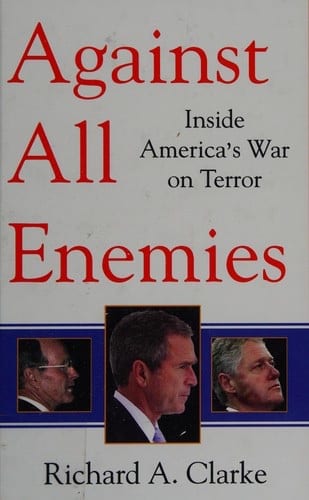
A #1 New York Times Bestseller”The Bush administration has squandered the opportunity to eliminate al Qaeda.” No one has more authority to make that claim than Richard Clarke, the former counterterrorism czar for both Bill Clinton and George W. Bush. He knows, better than anyone, why we failed to prevent 9/11 and how President Bush reacted to the attack. Against All Enemies is both a powerful history of our confrontation with terrorism and a searing indictment of the current administration.
My Summary
Put Clarke’s account in the larger record
September 11 Attacks - Origins, Plot, and Aftermath gives a chronological account of the organization, the four flights, and pre-attack warnings. Read Clarke’s account as an informed participant’s memoir and critique, and compare particular missed-opportunity claims with the 9/11 Commission’s chapter 8. The 2003 Iraq War is a distinct decision from al-Qaeda’s 2001 attack.
Main Ideas, Takeaways & Similarities
Questions
I. What is the problem?
A. How is this problem formulated?
B. Why is this problem important?
C. What is the history of this problem?
D. Which prominent personalities have been interested in this problem?
II. What solutions to the problem are there?
A. What are the conclusions reached?
B. By what argument(s) is the conclusion reached?
C. What facts or assumptions serve as premises?
D. When a prominent personality offers a solution, does he also argue for or against other prominent personalities? Does he raise objections to alternative solutions? Does he consider objections to his own solutions?
III. Evaluation
A. What are the advantages and disadvantages of the alternative formulations to the problem?
B. Has the importance or history of the problem ever been misrepresented?
C. Are the solutions logically related to the premises?
D. Are the facts true? Are the assumptions acceptable? Are the objections answerable?
AI Summary
Highlights
“Against All Enemies: Inside America’s War on Terror” is a book written by Richard A. Clarke, published in 2004. It provides an insider’s perspective on the U.S. government’s response to the terrorist threats leading up to and following the September 11, 2001 attacks. Here is a comprehensive summary of the book in bullet points:
- The book is a memoir and firsthand account by Richard A. Clarke, a former high-ranking counterterrorism official in the U.S. government.
- Clarke details his experiences and observations while serving in various roles within the U.S. government, spanning multiple administrations, including those of Presidents Ronald Reagan, George H.W. Bush, Bill Clinton, and George W. Bush.
- He provides insights into the evolution of counterterrorism efforts in the United States during his career, from the early days of combating international terrorism to the post-9/11 era.
- Clarke chronicles the rise of Osama bin Laden and Al-Qaeda, highlighting the intelligence community’s growing awareness of the terrorist organization’s capabilities and intentions.
- The book discusses the missed opportunities to prevent the 9/11 attacks and the government’s failure to fully appreciate the terrorist threat prior to the attacks.
- Clarke criticizes the Bush administration’s handling of the immediate aftermath of the 9/11 attacks, including their decision to prioritize Iraq over Al-Qaeda and Afghanistan.
- He provides behind-the-scenes accounts of key meetings, decisions, and policy debates within the U.S. government related to the War on Terror.
- Clarke emphasizes the importance of interagency coordination and communication in addressing terrorism and the challenges of overcoming bureaucratic obstacles.
- The book discusses the efforts to track down and eliminate Al-Qaeda operatives, including the hunt for Osama bin Laden and other key figures.
- Clarke addresses issues related to homeland security and the implementation of measures to protect the United States from further terrorist attacks.
- He explores the implications of the Iraq War and the diversion of resources away from the pursuit of Al-Qaeda.
- Clarke raises questions about the effectiveness of the U.S. response to terrorism and the long-term consequences of the decisions made during the Bush administration.
- The book also touches on the politicization of national security issues and the challenges of working within the complex world of Washington, D.C. politics.
- Clarke concludes by calling for a more comprehensive and forward-looking approach to counterterrorism and national security.
“Against All Enemies” provides an insider’s perspective on the U.S. government’s response to the evolving terrorist threat, with a particular focus on the post-9/11 era. Richard A. Clarke’s account sheds light on the challenges, successes, and failures in the fight against terrorism and raises important questions about the nation’s security posture.