⬅️ Back to 60.13 Wars · Consequence: Islamic State (ISIS) · In this folder: Exposing the “Clean Break” Myth Israel Was Not Behind the Iraq War - With Dr. David Wurmser · Books: Cobra II - The Inside Story of the Invasion and Occupation of Iraq · The Assassins' Gate - America in Iraq · Imperial Life in the Emerald City - Inside Iraq's Green Zone · Muqtada - Muqtada al-Sadr, the Shia Revival, and the Struggle for Iraq · Black Flags - Joby Warrick · Steelman: Alex — Capitalism, Imperialism, Palestine, Labor, and Fascism Argument Map (the Iraq-for-oil claim, assessed)
Israel told U.S. NOT to go to war in Iraq
60.1 Israel-Palestine Conspiracy Theories
Here’s a synthesis of credible information and sources on how Israel (and associated lobby) cautioned against a US invasion of Iraq, arguing it would destabilize the region and empower Iran:
🇮🇱 Israeli Caution Before the Iraq War
- Early Warnings from Israeli Officials
Former State Department official Lawrence Wilkerson (Colin Powell’s chief of staff) said that in early 2002, Israeli government figures—ranging from intelligence agencies to private envoys—sent a clear, consistent message to the Bush administration: “Iraq is not the enemy — Iran is”, and that invading Iraq would _“distract”_the US from addressing Iran and destabilize the region (miftah.org). - Pervasive Messaging
Wilkerson characterized these warnings as “pervasive,” conveyed across different levels of Israeli diplomacy and intelligence channels (miftah.org). - Academic/Investigative Consensus
Summarizing scholarly reviews and retrospectives, sources like Wikipedia’s coverage of international reaction confirm that Israeli officials advised the US not to invade Iraq, arguing it would “empower the much more dangerous regime in Iran” (Wikipedia).
📚 Broader Context & Lobby Discussion
- Contrast to Lobbying on Iraq
Analyses, including Brookings and Counterfire, note that although pro-Israel or Neoconservative advocacy groups supported the Iraq War, Israel itself did not champion it. In fact, while enthusiastic about regime change in Iraq, the country did not act as a driving force—particularly compared to its vocal stance on Iran (Ottomans and Zionists). - No Push from AIPAC
According to Douglas Feith (Bush Administration Under Secretary for Policy), Israel did not press for war in Iraq. His accounts indicate that Israeli focus was overwhelmingly on Iran, not Iraq (Wikipedia, Wikipedia). - Switching Focus to Iran
Reporting indicates transparent Israeli messaging from early 2002: “If you’re going to destabilize the balance of power, do it against the main enemy”—meaning Iran—not Saddam Hussein (miftah.org).
✅ Summary of Key Facts
| Fact | Source(s) |
|---|---|
| Israeli officials warned US not to invade Iraq, saying it would destabilize region and strengthen Iran | Lawrence Wilkerson, Miftah, Common Dreams (miftah.org) |
| These warnings were consistent and pervasive, communicated via multiple channels | Wilkerson |
| Israeli focus was on Iran as the primary regional threat | Wilkerson, Wikipedia |
| Israeli lobbying groups like AIPAC did not specifically push for the Iraq invasion | Feith, Brookings, Counterfire |
🔍 Final Takeaway
Israeli government voices, starting in early 2002, consistently warned U.S. policymakers that an invasion of Iraq would backfire—destabilizing the Middle East and indirectly benefiting Iran. These cautions were broad and diplomatic rather than partisan lobbying. While pro-Israel advocacy groups did support regime change, the official Israeli message prioritized focusing on Iran rather than Iraq.
Let me know if you’d like deeper dive into Wilkerson’s interviews, AIPAC’s stance at the time, or comparative analysis with lobbying efforts on Iran.
Countries who Supported or Encouraged U.S. Iraq Invasion
Several countries supported or encouraged the U.S.-led invasion of Iraq in 2003, both diplomatically and militarily. While the United States and the United Kingdom led the effort, they were joined by a coalition of nations that either explicitly supported the war or participated in military operations. Below is a breakdown by category:
1. Principal Supporters and Co-Initiators
These countries played the most prominent roles in planning, executing, and justifying the invasion:
United States
- Lead architect and initiator of the invasion under President George W. Bush.
- Justifications: Weapons of mass destruction (WMDs), alleged ties to terrorism (esp. Al-Qaeda), and the need to depose Saddam Hussein.
United Kingdom
- Most vocal and committed ally, led by Prime Minister Tony Blair.
- Deployed tens of thousands of troops.
- Blair defended the invasion vigorously in Parliament and to the public, arguing Iraq posed a grave and growing threat.
Australia
- Prime Minister John Howard supported the U.S. position early and sent special forces and later regular troops.
- Argued for disarming Saddam and supporting the U.S.-led international order.
Poland
- Provided troops and became a major part of post-invasion occupation.
- Saw participation as a way to deepen ties with the U.S. and raise its international profile.
2. Military Participants in the “Coalition of the Willing”
The Bush administration formed the so-called Coalition of the Willing, a group of 49 countries that supported the invasion (to varying degrees). Some key participants included:
- Spain (under PM José María Aznar): Supported diplomatically and sent troops post-invasion.
- Italy (under PM Silvio Berlusconi): Provided strong political backing and later troops.
- Denmark: Contributed a small number of troops and gave political support.
- Netherlands: Gave political support, though military involvement was limited.
- South Korea: Sent troops post-invasion to assist with reconstruction.
- Japan: Sent non-combat troops for reconstruction and support.
Note: Many of these countries joined after the initial invasion to support stabilization and reconstruction.
3. Diplomatic Support Without Troops
Some countries supported the U.S. effort politically or diplomatically but did not contribute troops:
- Israel: Though it supported regime change in Iraq, Israel remained officially uninvolved in the war to avoid regional complications.
- Czech Republic, Hungary, Georgia, and Ukraine provided political support and/or logistical assistance.
- Kuwait: Provided critical logistical support and staging grounds for U.S. forces.
4. Opposition and Non-Support
Notably, some major countries opposed the war or refused to endorse it:
- France, Germany, and Russia were vocal opponents at the United Nations, advocating continued weapons inspections.
- Canada and Mexico refused to join the invasion despite U.S. pressure.
- China remained neutral and skeptical, prioritizing diplomatic solutions.
Summary Table: Countries Encouraging or Supporting U.S. Invasion
| Category | Countries |
|---|---|
| Lead Partners | U.S., U.K., Australia, Poland |
| Coalition of the Willing (military) | Spain, Italy, Denmark, South Korea, Netherlands, Japan, others |
| Diplomatic/Logistical Support | Israel (non-military), Kuwait, Czech Republic, Georgia, Ukraine |
| Opposed the War | France, Germany, Russia, Canada, Mexico, China |
Let me know if you’d like a breakdown of troop contributions by country, UN debates and resolutions, or how domestic populations reacted within these supporting countries.
Foreign Intelligence supporting invasion
The Bush Administration cited intelligence from several foreign governments and intelligence agencies to support the claim that Saddam Hussein had weapons of mass destruction (WMDs) and posed a serious threat. Below is a breakdown of the key countries that provided or were cited as providing intelligence—some of which later turned out to be false, misleading, or misrepresented.
Countries Whose Intelligence Supported WMD Claims
1. United Kingdom
- Key Source: The September Dossier (2002), issued by the British government under PM Tony Blair.
- Claimed Iraq could deploy WMDs within 45 minutes—a dramatic claim cited by U.S. officials.
- British intelligence (MI6) supported the narrative that Saddam had retained chemical and biological weapons.
- Later investigations (e.g., the Chilcot Report, 2016) concluded that the intelligence was overstated and poorly vetted.
2. Germany
- Provided “Curveball”, an Iraqi defector whose claims were central to U.S. assessments.
- Curveball alleged that Iraq had mobile biological weapons labs.
- The BND (Bundesnachrichtendienst), Germany’s foreign intelligence agency, passed his reports to the CIA with caveats about his credibility, but these caveats were largely ignored by U.S. policymakers.
- His information was prominently featured in Colin Powell’s UN speech in 2003.
- Curveball later admitted he fabricated the story.
3. Italy
- Italian intelligence agency SISMI provided documents that supposedly showed Iraq had tried to purchase uranium from Niger.
- These documents were later revealed to be forgeries.
- Nonetheless, they made their way into U.S. talking points, including President Bush’s 2003 State of the Union address (“the 16 words”).
4. Israel
- Israeli intelligence supported U.S. suspicions about Saddam’s WMD programs.
- Officials from Mossad warned that Iraq likely retained biological and chemical weapons, though they were more focused on Iran.
- However, Israel did not press the U.S. to go to war in Iraq and reportedly warned it might empower Iran (see prior discussion).
5. France
- French intelligence believed Saddam retained WMDs—particularly chemical weapons.
- However, France opposed the 2003 invasion and called for continued weapons inspections.
- President Jacques Chirac made clear that belief in WMDs did not automatically justify war.
6. Russia
- Russian intelligence reportedly believed Saddam retained chemical weapons, although they too opposed the U.S. invasion.
- Russian officials expressed concerns about the reliability of U.S. interpretations of intelligence.
Key U.S. Intelligence Reliant on Foreign Sources
| Claim | Source Country | Outcome |
|---|---|---|
| Mobile biological labs | Germany (Curveball) | Fabricated |
| Uranium from Niger | Italy (SISMI) | Forged |
| 45-minute WMD deployment | UK (MI6) | Misleading |
| Iraqi ties to Al-Qaeda | Various, incl. Czech Republic | Largely unfounded |
| Retention of chemical weapons | France, Russia, Israel | No evidence found after invasion |
Post-War Assessments
- The 2004 Iraq Survey Group Report (Duelfer Report) found no active WMD programs in Iraq.
- Multiple official investigations (Senate Intelligence Committee Report, UK’s Chilcot Inquiry) found that intelligence had been cherry-picked, exaggerated, or misinterpreted to support a predetermined policy.
Conclusion
The Bush Administration relied heavily on foreign intelligence—particularly from the UK, Germany, and Italy—to build its case for war. Much of this intelligence was later found to be false, unverified, or presented without proper context. Though many governments believed Iraq may have had WMDs, only a few supported military action. The war revealed deep flaws in international intelligence sharing and interpretation.
Let me know if you’d like detailed sourcing from CIA declassified documents, the Chilcot Report, or Senate reports.e
Maps for occupation-era Baghdad
Compare these two dated reconstructions of metropolitan Baghdad. They show the author’s estimates of neighborhood composition, not a census or a determination of responsibility for every demographic change.
Baghdad in 2003
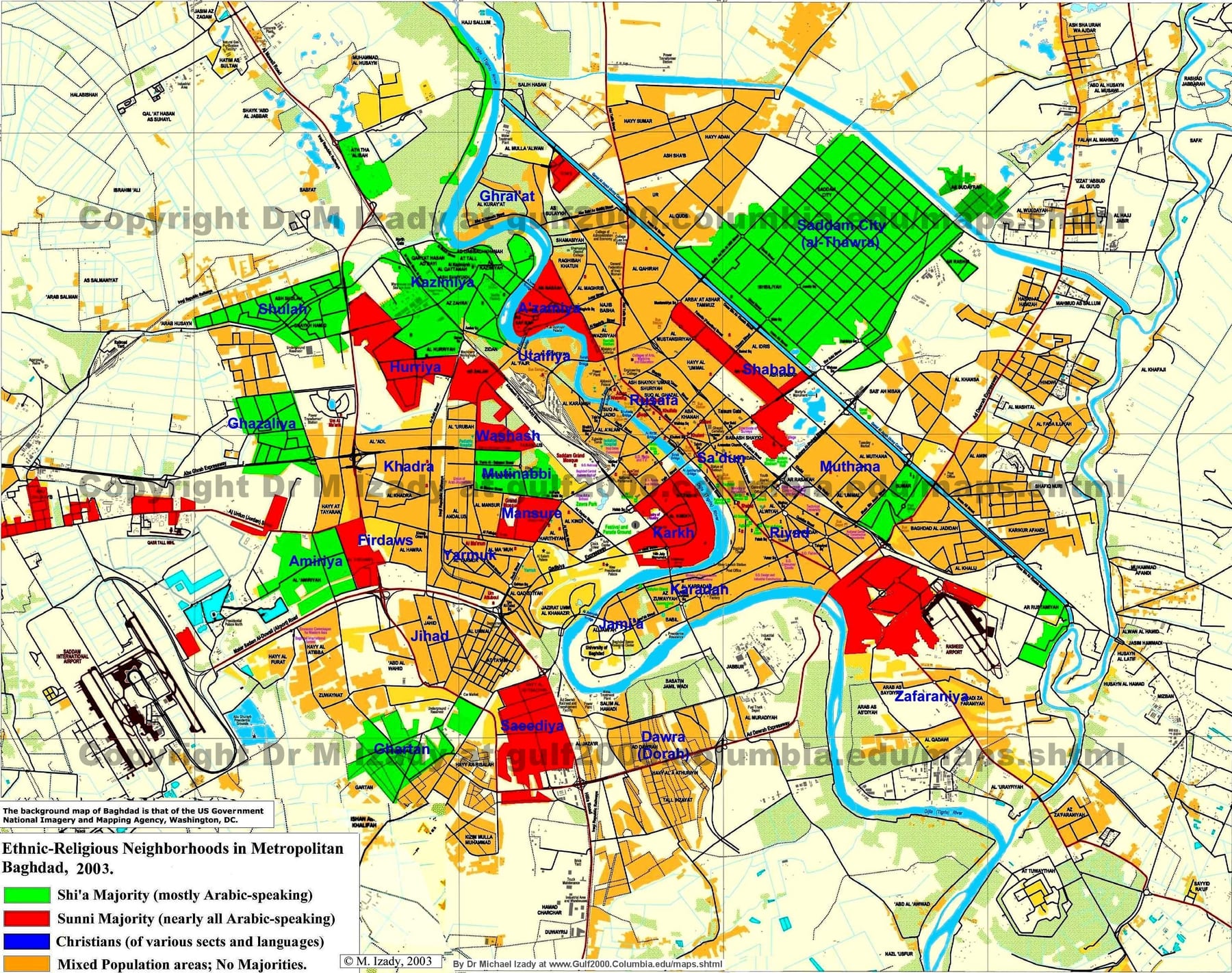
The 2003 baseline distinguishes predominantly Shiʿa, predominantly Sunni, Christian, and mixed neighborhoods.
Map source: Dr. Michael Izady, Gulf/2000, Columbia University. Original map · Collection. Personal reference use; copyright remains with the author.

Baghdad in late 2007
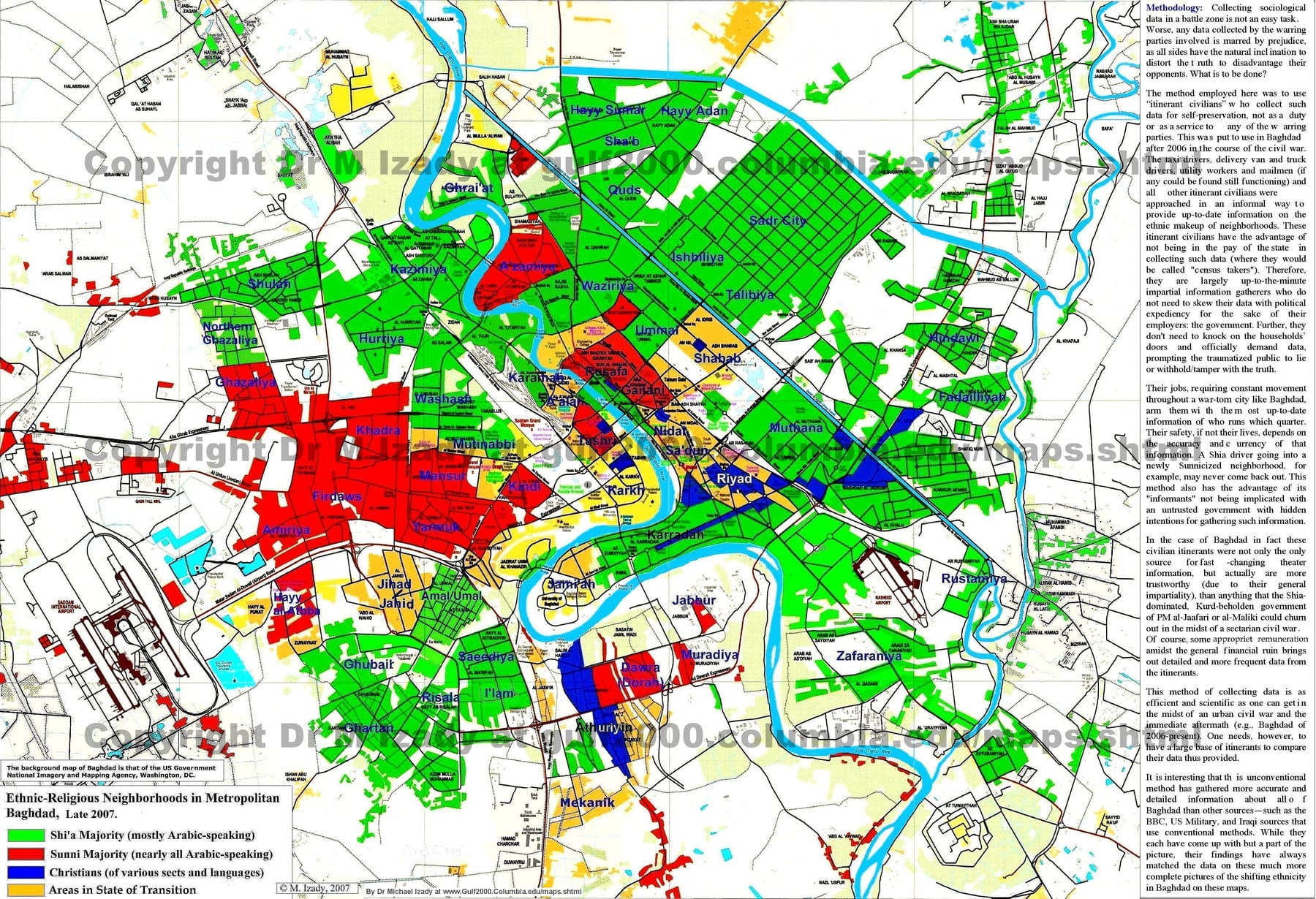
Compare the same geography in late 2007 to study the segregation and displacement associated with the sectarian-war period. The images alone cannot quantify deaths, identify perpetrators, or isolate causes.
Map source: Dr. Michael Izady, Gulf/2000, Columbia University. Original map · Collection. Personal reference use; copyright remains with the author.

Source and interpretation: Gulf2000 map collection.