Zibaldone 2024–2025 journal
Journal connection: Book-page material related to Black Flags and the rise of ISIS.
Source boundary: These are captured journal materials; the integration does not independently verify every clipped claim, quotation, or figure.
PDF++ pages: p. 298 (file not included in this release)
Embedded preview:
Zibaldone 2024-2025.pdf (file not included in this release)
Open the complete Zibaldone page index
Black Flags - Joby Warrick (Annotated).pdf (file not included in this release)
Black Flags - Joby Warrick PDF Extracted
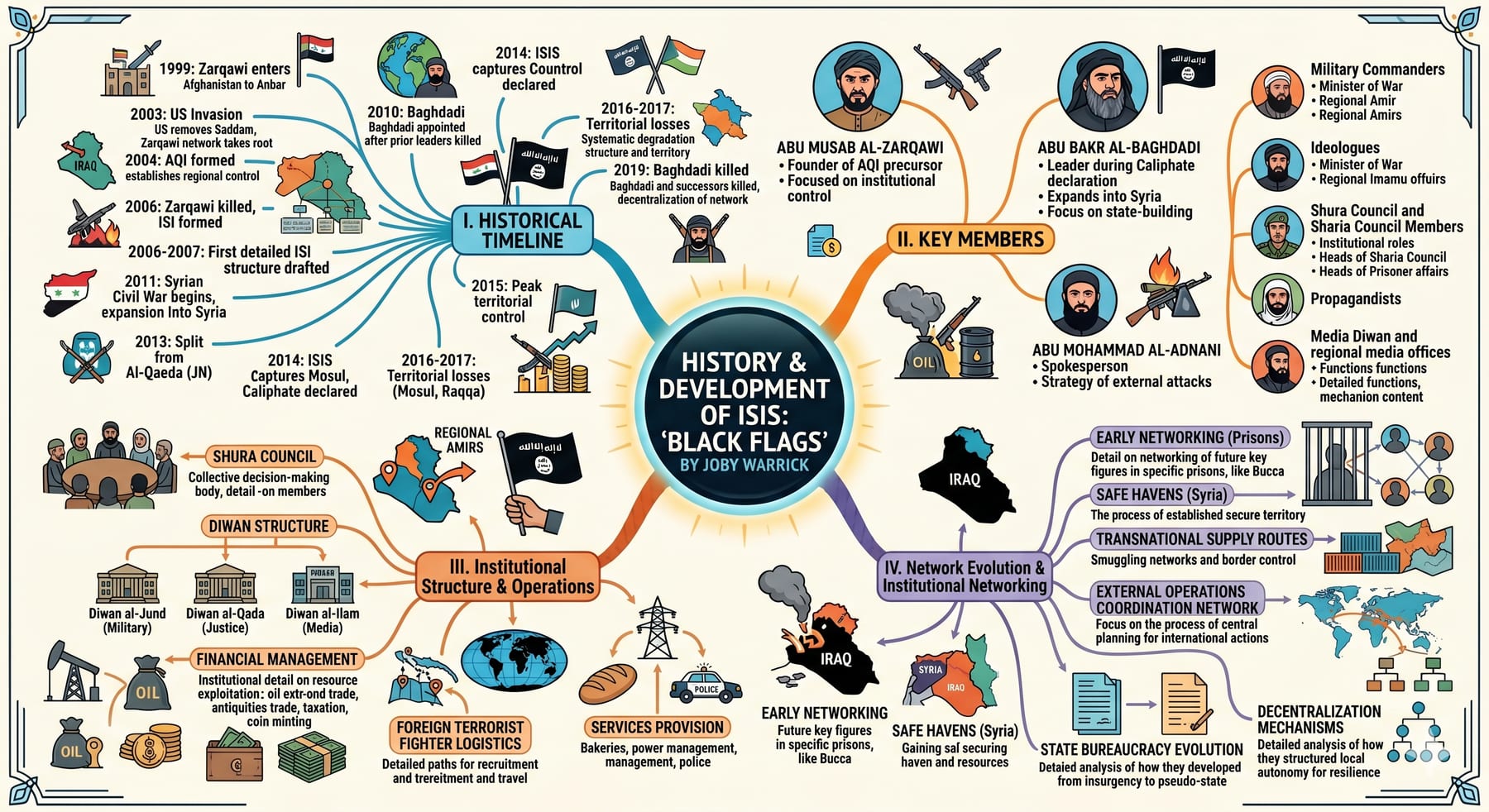
Synthesis: Islamic State (ISIS) · Primary-text companion: The ISIS Reader - Ingram, Whiteside and Winter · Parent: 60.13 Wars · Context: Iraq War
DESCRIPTION
WINNER of the PULITZER PRIZE for NON-FICTION 2016 In a thrilling dramatic narrative, Pulitzer Prize-winning reporter Joby Warrick traces how the strain of militant Islam behind ISIS first arose in a remote Jordanian prison and spread to become the world’s greatest threat. When the government of Jordan granted amnesty to a group of political prisoners in 1999, it little realized that among them was Abu Musab al-Zarqawi, a terrorist mastermind and soon the architect of an Islamist movement bent on dominating the Middle East. In Black Flags, an unprecedented character-driven account of the rise of ISIS, Joby Warrick shows how the zeal of this one man and the strategic mistakes of Western governments led to the banner of ISIS being raised over huge swathes of Syria and Iraq. Zarqawi began by directing terror attacks from a base in northern Iraq, but it was the allied invasion in 2003 that catapulted him to the head of a vast insurgency. By falsely identifying him as the link between Saddam Hussein and Osama bin Laden, Western officials inadvertently spurred like-minded radicals to rally to his cause. Their wave of brutal beheadings and suicide bombings persisted until American and Jordanian intelligence discovered clues that led to a lethal airstrike on Zarqawi’s hideout in 2006. His movement, however, endured. First calling themselves al-Qaeda in Iraq, then Islamic State of Iraq and Syria, or ISIS, his followers sought refuge in unstable, ungoverned pockets on the Iraq-Syria border. When the Syrian civil war broke out in 2011, and the rest of the world largely stood by, ISIS seized its chance to pursue Zarqawi’s dream of an ultra-conservative Islamic caliphate. Drawing on unique high-level access to global intelligence sources, Warrick weaves gripping, moment-by-moment operational details with the perspectives of diplomats and spies, generals and heads of state, many of whom foresaw a menace worse than al Qaeda and tried desperately to stop it. Black Flags is a brilliant and definitive history that reveals the long arc of today’s most dangerous extremist threat.

Key Ideological Roots
- The Ikhwan Movement (1920s): The ideological predecessor to ISIS, these were Bedouin raiders who adhered to a pitilessly violent form of Islam, viewing Western modernity as demonic and seeking to wipe out foreign-allied governments to form a unified caliphate.
- Abu Muhammad al-Maqdisi’s Teachings: A foundational thinker for the jihadist movement, Maqdisi concluded that secular Arab leaders were infidels and that it was a religious obligation for Muslims to slaughter them.
- “Takfiri” Excommunication: Zarqawi adopted the practice of declaring enemies, government workers, and even fellow prison inmates as kafirs (disbelievers). This label removed the protection of Islamic law, meaning the targeted individuals could be killed with impunity.
- The Immediate Caliphate & Extreme Savagery: Unlike Osama bin Laden, who wanted to gradually build toward a single Islamic theocracy over time, Zarqawi insisted on creating a caliphate immediately. His strategy was to use highly theatrical displays of extreme violence to frighten adversaries and attract hardened jihadists to his movement.
- Sectarian Warfare: A central tenet of the movement’s strategy was to intentionally provoke a civil war by relentlessly attacking Shiite civilians in their mosques and markets.
Key People
- Abu Musab al-Zarqawi (Ahmad Fadil al-Khalayleh): A high school dropout and former street thug from Jordan who radicalized in prison. He founded al-Qaeda in Iraq and gained international notoriety for introducing intimate, videotaped beheadings and mass sectarian slaughter.
- Abu Muhammad al-Maqdisi: A Jordanian-Palestinian cleric and Zarqawi’s early mentor in al-Jafr prison. He provided the theological foundation for the movement, although he later condemned ISIS for slaughtering innocent Muslims.
- Abu Bakr al-Baghdadi (Ibrahim Awad al-Badri): A scholar of Islamic law who took leadership of the Islamic State of Iraq in 2010. He masterminded the group’s expansion into Syria, formally established ISIS, and declared himself the head of the restored caliphate in 2014.
- Abu Haytham & Ali Bourzak: Leading officers in Jordan’s General Intelligence Directorate (the Mukhabarat). They spent years tracking, interrogating, and attempting to thwart Zarqawi and his offshoots.
- Sam Faddis & Nada Bakos: Key figures at the CIA. Faddis led the operative team that surveilled Zarqawi’s early camp in northern Iraq , while Bakos served as the chief “targeter” analyzing and tracking Zarqawi’s network.
Extensive Timeline of Development
- 1989: Zarqawi travels to Afghanistan to join the Islamist mujahideen against the pro-Moscow Afghan government.
- 1993 - 1994: Zarqawi returns to Jordan and partners with Maqdisi to build an underground militant network. The two are arrested for plotting an attack on an Israeli border post and sentenced to fifteen years in al-Jafr Prison.
- March 1999: A general royal amnesty issued by the newly crowned King Abdullah II leads to Zarqawi and Maqdisi being released from prison.
- Late 1999: Zarqawi travels to Afghanistan, where al-Qaeda’s leadership helps him set up an independent training camp in Herat to build a network of Levantine fighters.
- Late 2001 - 2002: Following the U.S. invasion of Afghanistan, Zarqawi flees to northeastern Iraq, joining the extremist group Ansar al-Islam in the village of Sargat. In October 2002, his operatives assassinate U.S. diplomat Laurence Foley in Amman.
- February 2003: U.S. Secretary of State Colin Powell features Zarqawi in a UN Security Council speech, unintentionally transforming the obscure militant into a global jihadist superstar.
- March 2003: The U.S. invades Iraq and destroys the Ansar al-Islam camp, but Zarqawi had already relocated to Baghdad.
- August 2003: Zarqawi’s network officially ignites its insurgency by launching massive, consecutive car bombings targeting the Jordanian Embassy, the UN headquarters in Baghdad, and a Shiite mosque in Najaf.
- May 2004: Zarqawi releases a video showing his personal beheading of American hostage Nick Berg, and formally announces the creation of his new terrorist umbrella group, “al-Tawhid wal-Jihad”.
- November 2005: Zarqawi orchestrates triple suicide bombings at hotels in Amman, Jordan, killing 60 civilians.
- June 2006: Abu Musab al-Zarqawi is killed in a targeted U.S. airstrike on his hideout.
- 2006 - 2010: The group reorganizes as the “Islamic State of Iraq” (ISI). Abu Bakr al-Baghdadi rises through the organization as a religious advisor, providing theological justification for the group’s continued extreme violence.
- April 2010: The top two commanders of the Islamic State of Iraq are killed in a joint U.S.-Iraqi raid, and Baghdadi is promoted to the supreme leadership of the organization.
- August 2011: Taking advantage of the Syrian civil war, Baghdadi dispatches a small group of operatives into Syria to establish the al-Nusra Front.
- April 2013: Baghdadi announces the hostile takeover and merger of the al-Nusra Front to create the Islamic State of Iraq and al-Sham (ISIS). Al-Qaeda’s central leadership strongly rejects the merger, eventually causing a permanent split between the two terror networks.
- Summer 2013: ISIS establishes its official headquarters in the Syrian city of Raqqa, enforcing brutal Sharia law, executing dissenters, and establishing training camps for child soldiers.
- January - June 2014: Leveraging deep-seated Sunni grievances, ISIS stages a blitzkrieg offensive across Iraq, capturing Fallujah in January and overrunning Mosul in June.
- July 2014: Abu Bakr al-Baghdadi makes a rare public appearance at the Great Mosque of al-Nuri in Mosul to formally declare the restoration of the Islamic caliphate.
- January 2015: ISIS releases a highly produced video showing captured Jordanian pilot Muath al-Kasasbeh being burned alive in a cage, an act that shatters Islamic taboos and sparks widespread military and ideological retaliation across the Arab world.
The Early Years and Formation (1989 - 1994)
- 1989: Abu Musab al-Zarqawi travels to Afghanistan to join the jihad against the Soviet-backed government, but arrives after the Soviets have largely withdrawn. He gains military training and adopts a strict, uncompromising view of Islam.
- 1993: Zarqawi returns to his hometown of Zarqa in Jordan. Disillusioned by Jordan’s secular society and peace negotiations with Israel, he seeks out Abu Muhammad al-Maqdisi, a radical Palestinian-Jordanian cleric he met in Afghanistan.
- Early 1994: Zarqawi and Maqdisi formally organize an underground radical cell named Bay’at al-Imam (Oath of Allegiance to the Prayer Leader). They acquire smuggled explosives and plot to attack an Israeli border outpost in retaliation for the massacre of Muslims in Hebron.
- March 1994: The Jordanian intelligence service (the Mukhabarat) uncovers the plot and arrests the cell members, including Zarqawi. Zarqawi and Maqdisi are sentenced to fifteen years in prison.
The Crucible of al-Jafr Prison (1994 - 1999)
Prison was intended to break the jihadists, but instead, it served as the incubator for ISIS. In 1998, Jordanian authorities transferred the radicals to a single communal cell in the isolated, harsh al-Jafr prison to quarantine their influence.
- The Division of Labor: Inside the prison, Maqdisi acted as the spiritual leader, providing the theological foundation for their movement. He wrote treatises like Democracy Is a Religion, declaring secular Arab governments apostate and calling for their violent destruction. Zarqawi, meanwhile, became the undisputed enforcer and operational commander.
- Military Discipline: Zarqawi organized the imprisoned jihadists like a strict military unit. He demanded absolute obedience and controlled every aspect of the men’s lives—dictating what they wore, what they read, what television they watched, and when they fought.
- Adoption of Takfiri Ideology: Under Maqdisi’s tutelage, Zarqawi’s rage found a razor-sharp focus. He adopted the practice of takfir—excommunication. He declared government workers, guards, secular leaders, and even fellow inmates who disagreed with him as kafirs (infidels). Under their twisted interpretation of Islamic law, this label stripped individuals of legal protection, meaning they could be killed with impunity. The guards began calling Zarqawi’s fiercely devoted followers “al-takfiris”.
- Cultivating Fanatical Loyalty: Zarqawi won the unyielding devotion of his men through a mix of ruthless brutality against his enemies and extreme tenderness toward his followers. He famously appointed himself the personal caregiver to a double-amputee inmate, carrying the man to the toilet daily to prevent him from suffering the humiliation of being seen naked by outsiders.
- A Shift in Leadership: By the winter of 1998, cracks emerged in the partnership. The mostly working-class, tough-guy inmates related more to Zarqawi’s uncompromising aggression than to Maqdisi’s professorial nuances. With Maqdisi’s blessing, Zarqawi took on the dominant leadership role, transforming a loose band of prisoners into a devoted, radicalized militia.
Release and the Prototype “Islamic State” (1999 - 2001)
- March 1999: A newly crowned King Abdullah II issues a general royal amnesty intended to release political prisoners and minor offenders. Due to bureaucratic oversight, the takfiri extremists, including Zarqawi and Maqdisi, are released. Demonstrating his total grip on his followers, Zarqawi travels back to al-Jafr the very next morning at 5:30 a.m. to minister to the inmates who were left behind, checking their morale like a field commander.
- Late 1999: Leaving Jordan, Zarqawi travels to Afghanistan. He meets al-Qaeda’s leadership but stubbornly refuses to swear loyalty to Osama bin Laden.
- 2000 - 2001: Recognizing his potential, al-Qaeda provides Zarqawi with seed money to start his own independent training camp in Herat, near the Iranian border. Here, Zarqawi builds a proto-state solely for Levantine fighters (from Jordan, Syria, Palestine). He instills the exact same strict codes he honed in al-Jafr prison, successfully establishing what an observing al-Qaeda deputy proudly called a “mini Islamic society”.
Highlights
PROLOGUE (Page 16)
In 2006, a judge sentenced Rishawi to hang for her part in Jordan’s worst-ever terrorist attack: three simultaneous hotel bombings that killed sixty people, most of them guests at a wedding party. She was the suicide bomber who lived, an odd, heavy-browed woman made to pose awkwardly before TV cameras showing off the vest that had failed to explode. At one time, everyone in Amman knew her story, how this thirty-five-year-old unmarried Iraqi had agreed to wed a stranger so they could become a man-and-wife suicide team; how she panicked and ran; how she had wandered around the city’s northern suburbs in a taxi, lost, stopping passersby for directions, still wearing streaks of blood on her clothes and shoes. (Page 17)
“Zarqawi’s woman,” (Page 17)
Arabic acronym Daesh—in English, ISIS. (Page 17)
Abu Haytham (Page 18)
Only one of the bombs had gone off, but it cut through the ballroom like a swarm of flying razors. Hundreds of steel ball bearings, carefully and densely packed around the bomb’s core, sliced through wedding decorations, food trays, and upholstery. They splintered wooden tables and shattered marble tiles. They tore through evening gowns and fancy clutches, through suit jackets and crisp shirts, and through white, frilly dresses of the kind young girls wear to formal parties. (Page 20)
Such hallmarks, the audio recording, unmistakably belonged to Zarqawi, a man the Mukhabarat knew exceptionally well. He was, at the time of the bombing, the head of a particularly vicious terrorist network called al-Qaeda in Iraq. But the Jordanians had known him back in the days when he was Ahmad the hoodlum, a high school dropout with a reputation as a heavy drinker and a brawler. They had watched him wander off to Afghanistan in the late 1980s to fight the communists, then return as a battlehardened religious fanatic. After a first try at terrorism, he had vanished into one of Jordan’s darkest prisons. This time he emerged as a battle-hardened religious fanatic who also happened to excel as a leader of men. the voice on like (Page 22)
Though some would cast his movement as an al-Qaeda offshoot, Zarqawi was no one’s acolyte. His brand of jihadism was utterly, brutally original. Osama bin Laden had sought to liberate Muslim nations gradually from corrupting Western influences so they could someday unify as a single Islamic theocracy, or caliphate. Zarqawi, by contrast, insisted that he would create his caliphate immediately—right now. He would seek to usher in God’s kingdom on Earth through acts of unthinkable savagery, believing, correctly, that theatrical displays of extreme violence would attract the most hardened jihadists to his cause and frighten everyone else into submission. His strategy shook the region as al-Qaeda never had. (Page 23)
But Zarqawi’s excesses also deepened his adversaries’ resolve. In the immediate aftermath of the hotel bombings, Abu Haytham and other Mukhabarat officers had a simple goal: to eliminate the man who had ordered them. And when they succeeded, in 2006, by providing the United States with intelligence that helped it track Zarqawi to his hideout, the terrorist and his organization appeared finished. Instead, his followers merely retreated, quietly gaining strength in Syria’s lawless provinces until they burst into view in 2013, not as a terrorist group, but as an army. (Page 23)
This time, war-weary America would refuse to help until it was too late. There would be no serious effort to arm the moderate rebels who sought to deny ISIS its safe haven, and no air strikes to harry (Page 23)
ISIS’s leadership and supply lines. Twice in a decade, a jihadist wave had threatened to engulf the region. Twice, it seemed to the Jordanians, the American response had been to cut a fresh hole in the lifeboat. (Page 24)
In the prophetic passages of the Muslim holy texts known as the Hadith, Zarqawi saw his fate foretold. He and his men were the black-clad soldiers of whom the ancient scholars had written: “The black flags will come from the East, led by mighty men, with long hair and beards, their surnames taken from their home towns.” These conquerors would not merely reclaim the ancient Muslim lands. They also would be the instigators of the final cataclysmic struggle ending in the destruction of the West’s great armies, in northern Syria. (Page 24)
“I’m not getting support from your side!” Abdullah finally said. “I’m still getting only gravity bombs, and we’re not even getting resupplied with those. Meanwhile, we’re flying two hundred percent more missions than all the other coalition members combined, apart from the United States.” (Page 25)
BOOK I THE RISE OF ZARQAWI (Page 28)
1 “What kind of person can command with only his eyes?” (Page 29)
Others were flogged with electric cables, burned with lit cigarettes, or hung upside down by means of a stick placed under the knees, a position the guards gleefully called “grilled chicken.” Over time, the monarchy grew weary of the costs of running a prison so isolated from the country’s population and so damaging to its reputation. In 1979, the last of its inmates were transferred to other jails, and al-Jafr was abandoned to the scorpions and its own ghosts. (Page 30)
The warden went on to describe the peculiarities of the new arrivals, from their strange dress—most insisted on wearing an Afghanstyle tunic over their jailhouse uniforms, because tight-fitting prison trousers were regarded as too revealing—to their ability to make converts out of hardened criminals and even prison employees. At Swaqa, so many guards had fallen under their spell that prison officials were forced to limit shifts to ninety minutes in any sector where the inmates might be encountered. (Page 31)
As the tour was ending, the warden repeated his warning about the prisoners. There was one inmate—the sect’s apparent leader—whose seductive powers were extraordinary, he said. He was the one called Maqdisi, a religious scholar and preacher of considerable gifts, capable of infecting and twisting minds like a Muslim Rasputin. (Page 31)
The group’s core, he learned, consisted of about two dozen men who had been members of radical Islamic sects that sprang up in Jordan in the early 1990s. With the exception of the leader, Abu Muhammad al-Maqdisi—a firebrand preacher known for penning screeds against Arab leaders—their individual histories were unimpressive. Some had been street thugs who had gotten religion and found acceptance and purpose among the zealots. Others had been part of the Arab volunteer army that had fought against the Soviets in Afghanistan in the 1980s. Back home in safe, stable Jordan, these men had been drawn to organizations that offered a way to relive the glories of the Afghan campaign through perpetual holy war against the enemies of Islam. (Page 33)
The leaders of Maqdisi’s small band had been arrested before they could carry out their first operation, a planned attack on an Israeli border post. (Page 33)
One of the early attempts at a bombing had been a spectacular failure: A member of the group had volunteered to plant explosives inside a local adult cinema called the Salwa. After a few minutes in the theater, the would-be assailant had become so engrossed in the film that he forgot about his bomb. As he sat, glued to the screen, the device detonated under his feet. (Page 33)
They also possessed an uncommon discipline. The group behaved as a military unit, with clear chains of authority and unquestioned obedience to Maqdisi’s handpicked enforcer, (Page 34)
Some, however, were already calling him “the one from Zarqa,” the tough industrial town in northern Jordan where he grew up. The phrase in Arabic is “alZarqawi.” (Page 34)
Maqdisi was fearless: he gained renown throughout the Muslim world for inflammatory books with titles such as Democracy Is a Religion, in which he denounced secular Arab regimes as anti-Islamic and called for their destruction (Page 34)
Previous Islamist ideologues also had criticized leaders of the Arab world as corrupt and unfaithful to the religion. The same themes appeared in the writings of Sayyid Qutb, the influential Egyptian author whose works inspired the founders of al-Qaeda. But in Maqdisi’s view, each Muslim bore a personal obligation to act when confronted with evidence of official heresy. It wasn’t enough for the faithful simply to denounce corrupt rulers. They were compelled by Allah to slaughter them. (Page 35)
“If someone is elected because he wants to serve the people, that’s being a good Muslim. But if he believes in democracy—if he believes in rules made by men—he is an infidel.” (Page 35)
But politeness and intellect are poor instruments for commanding men in such a hard place as al-Jafr. Maqdisi needed an enforcer. In Zarqawi, he had found the perfect helper: a man with the distinction of being at once slavishly devoted and utterly ruthless. “He is very tough,” Maqdisi would say admiringly (Page 36)
Zarqawi had no capacity for warmth or nuance. The man with the scar did not smile. He did not return greetings from prison employees, or engage in their small talk. When he spoke at all, it was with the street slang of a high-school dropout who had grown up as a brawler and petty criminal in one of Zarqa’s toughest neighborhoods. His gruffness and refusal to conform to convention had marked him as a troublemaker since boyhood. They also helped burnish the legend that was already beginning to cement around Zarqawi in his thirty-third year. (Page 36)
He habitually defied authorities in the first of the jails where he and the others were confined, and he brutalized and humiliated inmates who (Page 36)
crossed him, sometimes with fists or crude weapons and sometimes, it was widely said, sexually. (Page 37)
Under Maqdisi’s tutelage, Zarqawi’s attacks subsided, but the violent energy simply shifted form. Zarqawi began memorizing the Koran, spending hour after hour reading, or staring blankly with the open volume in his lap. His diffuse rage took on a focus: a fierce, single-minded hatred for perceived enemies of Allah. The list started with Jordan’s monarch, King Hussein, whom Zarqawi saw as the illegitimate leader of an artificial country, responsible for the unspeakable crime of making peace with Israel. It also included servants of the regime: the guards, the soldiers, the politicians, the bureaucrats, and countless others who profited from the current system. Even prison inmates he denounced as kafirs, or disbelievers. To Muslims the term is no mere epithet; if used in a fatwa, it implies that the person has lost the protection of Islamic law and can be killed with impunity. Within the prison, the guards began referring followers as al-takfiris—“the to Zarqawi and his closest excommunicators.” (Page 37)
Everyone at al-Jafr knew how Zarqawi worshipped his mother, how he became like a little boy whenever she visited. He would prepare for days, scrubbing his clothes in the sink and tidying up his corner of the cell. Some inmates knew about his love letters to her, and to his sisters. Scarcely a word was mentioned about Zarqawi’s wife, Intisar, or their two young children. But to his mother and sisters he wrote gushing notes adorned with poems and hand-drawn flowers in the margins. (Page 38)
Some of the jihadists were openly suggesting that Zarqawi leader, replacing Maqdisi, whose professorial should be the demeanor had begun to grate on some members of the group. (Page 40)
Maqdisi’s nuanced theological arguments were lost on the high-school dropouts and petty criminals who made up much of the group. These men preferred someone with tough-guy credentials, like Zarqawi, a brawler who talked plainly and refused to compromise. As he himself admitted, Maqdisi was no warrior. Even while living in Arab training camps in Afghanistan, he had given up on learning how to use a gun. (Page 40)
Seventy years earlier, an Islamic army had traversed the same road, riding north on horses and camels with the intention of wiping out the country known as Jordan in the name of Allah. These Bedouin raiders, who called themselves Ikhwan, or Brothers, had been armed and trained by Saudi Arabia’s first monarch, Ibn Saud, to help him defeat his political rivals. But the Ikhwan had ambitions beyond the Arabian Peninsula. Bloodthirsty fanatics who regarded all Western inventions and practices as works of the devil, they saw themselves as divinely appointed to purify the region by slaughtering all who allied with foreigners or deviated from their narrow vision of Islam. From the harsh wastelands of the interior, they thundered into the newly formed countries of Jordan and Iraq in the early 1920s with the intention of toppling governments and creating a unified Islamic theocracy, or caliphate, spanning all of the Middle East. They hacked and slashed their way through entire villages that stood in their path, slitting the throats of every male survivor, to ensure that all traces of Western modernity were wiped out. (Page 43)
2 “Here was a real leader” (Page 45)
After his death, he said, the crown would pass from father to son—in this case, to a son who, among the monarch’s brothers, nephews, and eleven children, was distinguished by his lack of ambition to be king. (Page 46)
Hussein survived at least eighteen assassination attempts in his lifetime. He was just fifteen on the summer day in 1951 when his grandfather—Jordan’s first king, Abdullah I—was shot to death by a Palestinian gunman as the two royals were visiting Jerusalem’s alAqsa Mosque. The young prince gave chase, narrowly escaping death himself when the assassin turned and fired a bullet that deflected off a medal on his uniform, according to the palace’s version of events. Later, his enemies would try ambushes, plane crashes, and even poisoned nasal drops, which Hussein discovered when he accidentally spilled the dispenser and watched in horror as the frothing liquid cut through the chrome on his bathroom fixtures. The king dodged death so many times that he took on an aura of invincibility. Jordanians would often say that Hussein possessed (Page 51)
baraka—Allah’s favor. The prospect that one of his sons could be equally blessed seemed unlikely. (Page 52)
the country’s Jordan’s kings have long sought to preserve stability in the country through an uneasy alliance with religious fundamentalists, allowing them a voice in Parliament and moving cautiously with reforms to avoid causing offense in what remained a deeply conservative tribal society. King Hussein relied on the Muslim imams in the 1960s and 1970s to help him beat back threats from Marxists and Pan-Arab nationalists. Many of these same clerics were furious when Hussein made peace with Israel in 1994, yet the king managed to maintain cordial ties with the country’s most prominent Islamist group, the Muslim Brotherhood, which he repeatedly praised as “the backbone of the country.” (Page 54)
Abdullah listened politely, and then, as the meeting wound down, he offered his visitors an unexpected gift: the government would immediately free sixteen Muslim Brotherhood activists who had been jailed following a street protest. The visitors seemed charmed, telling journalists afterward that the new king was a friend to the Islamists. “Your Majesty, we are with you, as one team, one body that trusts you,” the Brotherhood’s leader told Abdullah. (Page 55)
Abdullah was willing to yield, to a point. The young king had already spoken in interviews about his intention to see Jordan become a true constitutional monarchy, headed nominally by a king but governed by a prime minister chosen by the people’s representatives in Parliament. But Abdullah’s advisers insisted that reforms should come slowly. In a country with few democratic traditions, attempting too much change too quickly could backfire, they argued. The Islamists already commanded large numbers of supporters, and they were organized, motivated, and well funded. They could easily win a popular vote, putting the country’s future in the hands of a movement whose leaders included men with a radically different vision for Jordan from that professed by the Muslim brothers. (Page 55)
The turbaned men seated around Abdullah’s table could be reasoned with. But there were others in Jordan and the region who held no regard for reason, in the Western sense. They could only be fought. (Page 55)
Some saw the very existence of the state as anathema, an attempt by colonial powers to keep Muslims divided and weak. As they saw it, Jordan’s royal family, the Hashemites—rulers of the holy city of Mecca for nine hundred years—had played a role in the betrayal. (Page 56)
It is true that no country called Jordan existed—and, likewise, no group of people called Jordanians—until the early twentieth century. For a thousand years, the arid lands east of the Jordan River were part of Islamic empires, or caliphates, that at times extended from North Africa to the Balkans and encompassed all of the Arabian Peninsula and the Levant. The first caliphs, who were viewed as successors to the Prophet Muhammad, ruled from Damascus and Baghdad. They were supplanted in time by the Ottoman Turks, who expanded the Islamic Empire and established an Ottoman Caliphate under the supervision of powerful sultans in Istanbul. The Turkish conquerors permitted limited self-rule in Mecca, allowing the Hashemites to retain control of the city’s holy sites in a tradition dating back to the tenth century. Then, early in the twentieth century, came a Hashemite whose ambition and audacity would alter the family’s destiny and redraw the boundaries of the Middle East. (Page 56)
Sharif Hussein bin Ali, the seventy-eighth emir of Mecca and the great-grandfather of Jordan’s King Hussein, came to power as the Ottomans were lurching toward collapse. After the Turks sided with Germany at the outset of World War I, Sharif Hussein began secret negotiations with Britain with the aim of instigating a rebellion seeking Arab independence. In 1916, he agreed to help Britain and the Allied powers drive against the Turks in exchange for a promise of future British recognition of the new Arab-Islamic nation. Four of the sharif’s sons—Ali, Faisal, Abdullah, and Zeid—would lead Arab armies in what became known as the Great Arab Revolt, at times fighting at the side of the British Army officer T. E. Lawrence, later immortalized by historians and filmmakers as Lawrence of Arabia. (Page 56)
The Arabs were victorious, but Britain’s promises to Sharif Hussein expired even before the conflict ended. Britain and France (Page 56)
preemptively divvied up the captured Ottoman lands into British and French protectorates under the secret Sykes-Picot Agreement of 1916. After the war, the maps were redrawn to create entirely new states, including the kingdoms of Iraq and Syria and, on the narrow strip of land between the Jordan River and the Mediterranean Sea, a Jewish homeland that would later become Israel. (Page 57)
On the eastern side of the river, home to Bedouin tribes and vast deserts, the British carved out an enclave for Sharif Hussein’s third son, Abdullah I. The British had taken a small step toward honoring their promises to the ruler of Mecca, but their creation—initially called the Emirate of Transjordan, and later the Hashemite Kingdom of Jordan—seemed a few ingredients shy of a real country. No historical precedent existed for such a country, nor was there anything resembling a national identity among the scattering of tribes who lived in the region. The new state lacked significant reserves of oil or gas, or minerals for mining, or water for agriculture. Even its emir, Abdullah, had been imported from abroad. Many political observers at the time assumed that Transjordan would quickly collapse as an autonomous state, to be absorbed by one of its larger neighbors. (Page 57)
The first serious threat came from the Ikhwan hordes who invaded the country in the 1920s and were finally dispatched by Saudi intervention. Then, in the late 1960s, it was Palestinian guerrillas who threatened Jordan’s sovereignty. A patchwork of militant groups, drawn from the four hundred thousand Palestinian immigrants and refugees massed in Jordan after three decades of wars, staged attacks on Jordanian troops and tried repeatedly to assassinate King Hussein. The monarch launched an offensive that became known as Black September, killing thousands of Palestinian militants and driving many more into Syria or Lebanon. Heavy clashes spilled into the largely Palestinian town of Zarqa, where the man who would become known as Abu Musab al-Zarqawi was then a boy of four years. (Page 57)
Many months would pass before Abdullah learned that list had included certain Arab Afghans from the al-Jafr Prison whose Ikhwan-like zeal for purifying the Islamic faith should have disqualified them instantly. But by that time, the obscure jihadist named Ahmad Fadil al-Khalayleh had become the terrorist Abu Musab al-Zarqawi. And there was nothing a king of Jordan could do but berate his aides in an exasperated but utterly futile pique. “Why,” he demanded, “didn’t someone check?” (Page 59)
Maqdisi’s detachment from the other inmates had deepened during the months in al-Jafr. As the day of his release approached, he talked about returning to his family and his writing; about expanding his audience throughout the Muslim world while taking care to avoid the kind of offense that could land him back in prison. Zarqawi, on the other hand, was torn between two families: the one in Zarqa and the one he had gained in jail. His al-Jafr brothers were a cadre of men devoted to him personally and willing to follow him anywhere. With the amnesty, the survival of this family was suddenly in doubt. (Page 60)
Zarqawi had traveled all the way to Amman, visited his mother in Zarqa for a few hours, then turned around and driven through the night in a friend’s car to arrive at al-Jafr before daybreak. (Page 61)
“Here,” he said afterward, “was a real leader. “I knew at that moment that I would be hearing about him,” he said. “This man was going to end up either famous, or dead.” (Page 61)
3 “A problem like that always comes back” (Page 62)
Notably absent were his wife and his three children. Zarqawi’s true destination was no place for a young family; besides, he already had plans for picking up a second wife once he had settled. (Page 62)
Zarqawi had been right about one thing: he had committed no criminal offense, at least nothing of a magnitude that would warrant a dramatic scene in front of his mother and the scores of airport passengers. But the Mukhabarat wasn’t about to let him slink away easily. His prison stint had only hardened his views and expanded his network of possible co-conspirators. And now he had a plane ticket to Peshawar, Pakistan, gateway to the Hindu Kush Mountains and, just beyond them, Afghanistan. Osama bin Laden was in Afghanistan. The Saudi terrorist had blown up two U.S. embassies in Africa in 1998 and declared war on the United States. (Page 63)
“You can’t just push him off on others,” Abu Haytham would explain to colleagues. “Sooner or later, a problem like that always comes back.” (Page 63)
At first, he recalled, the Jordanians who volunteered for duty in Afghanistan “were the good guys, fighting the communists,” in ideological lockstep with the country’s most important allies, including the Americans, the British, and the Saudis. Now they were returning home as combat veterans with radically different views, and even different ways of speaking and dressing. (Page 65)
His idea of a sexual conquest—according to security officials and to acquaintances who knew him at the time—was to force himself on younger men as a way to humiliate and assert his own dominance. (Page 67)
He was twenty-one when he married his cousin, Intisar, who quickly bore him a daughter. But Zarqawi’s great love remained his mother. (Page 67)
It was his mother who nudged Zarqawi into joining the Islamists. She signed him up for religion classes at the local al-Husayn Ben Ali Mosque, hoping he would find better role models among the imams and pious youth, with their theological debates and fundraising drives to benefit Muslim holy warriors in Afghanistan. To everyone’s surprise, Zarqawi plunged into Islam with all the passion he had once reserved for his criminal pursuits. He swore off drinking and became a regular at Koran discussions and Friday prayers. He devoured propaganda videos and audiocassettes on the sectarian wars being fought in Afghanistan, Bosnia, and Chechnya. And when the prayer leader at the local mosque asked for volunteers to fight against the communist oppressors of Afghanistan’s Muslims, Zarqawi’s hand shot up. (Page 67)
Zarqawi spent long hours at the man’s bedside as he recovered, becoming so impressed with his devotion that he arranged to have one of his own sisters flown to Pakistan to marry the man. (Page 68)
Zarqawi’s first taste of actual combat came in 1991, when mujahideen rebels launched an offensive against government-held towns in Afghanistan’s eastern provinces of Paktia and Khost. Zarqawi fought with enthusiasm, and quickly gained a reputation for bravery bordering on foolhardiness, comrades remembered. Once, according to Azzam, he single-handedly held off a column of a dozen or more Afghan government troops during fighting in the eastern city of Gardez, allowing time for others in his unit to escape. “He was so brave, I used to say he had a dead heart,” Azzam said. As Azzam recalled it, Zarqawi’s heroics appeared to go beyond mere risk taking. He seemed at times to be trying to purge himself of something. “I was struck by the way his past seemed to affect him, as he always struggled with a sense of guilt,” Azzam said. “I think that is why he was so brave. He would say, ‘Because of the things I did in my past, nothing could bring Allah to forgive me unless I become a shahid’—a martyr.” (Page 69)
In 1993, Abu Musab al-Zarqawi and hundreds of other Jordanian veterans returned home to a country they barely recognized. But it wasn’t only Jordan that had changed. In four years, while Amman and the other big towns had grown larger and more modern, Zarqawi and his comrades had traveled backward in time by journeying to Taliban-controlled Afghanistan, a place that by almost every measure lagged centuries behind the rest of the world. (Page 70)
Even a trip to the local market was a reminder of the gulf between moderate, easygoing Jordan and the strict Islamic discipline Zarqawi had witnessed in Afghanistan. He complained to friends about immodestly dressed Jordanian women and the mixing of unmarried couples at cafés and cinemas. (Page 70)
his mother and sisters refused to wear the burka-style veil commonly worn by Afghan women, and his brothers allowed their families to watch un-Islamic movies and comedies on their TVs (Page 70)
Palestinians and the Jordanian monarchy in negotiating treaties with Israel. (Page 70)
The very idea of peace with the Jewish state was anathema to many Islamists. Some formerly steadfast supporters of King Hussein never forgave the monarch for this act. (Page 70)
Nur ad-Din Zengi, a (Page 70)
warrior-prince who ruled from Damascus in the twelfth century. Nur ad-Din had famously destroyed a European Crusader army and sought to unify a patchwork of Muslim kingdoms under a single sultanate extending from southern Turkey to the Nile River. After his soldiers killed the French-born prince of Antioch, Nur ad-Din arranged for the sovereign’s head to be placed in a silver box and sent to the caliph in Baghdad as a gift. (Page 71)
Years later, Zarqawi came to view himself as a modern incarnation of Nur ad-Din and would seek to emulate his military strategy. (Page 71)
He tracked down an old acquaintance from Afghanistan, the preacher and scholar named Abu Muhammad al-Maqdisi, showing up at his house in Amman to say he wanted to “work on behalf of religion in Jordan,” as Maqdisi later recalled. (Page 71)
By early 1994, the group had a name: Bay’at al-Imam, or literally, the Oath of Allegiance to the Prayer Leader. They also had a small stock of weapons from an unlikely source. Maqdisi, who had lived in Kuwait at the time of the 1990 invasion by Saddam Hussein’s army, had acquired a few mines, grenades, and artillery rockets left behind after the Iraqis’ retreat in 1991, and hid them in his household furniture when he moved to Jordan after the war. The spark that finally propelled the group into action came on February 25, 1994, when a Jewish extremist opened fire on praying Muslims in a religious shrine in the West Bank town of Hebron, killing twentynine men and boys and wounding scores of others. Incensed by the murders, the group decided, with Maqdisi’s reluctant support, to use their weapons in a coordinated attack on an Israeli outpost along the border. The plan called for striking the guard station with back-toback suicide bombs followed by small-arms fire. (Page 72)
Zarqawi’s discomfort was hardly surprising. For one thing, he missed prison. Harsh though it was, al-Jafr had given Zarqawi an identity and a community. Life on the outside just left him feeling anxious and disoriented, he told family members. (Page 73)
Abu Haytham and his colleagues were masters of the art. Indeed, getting into the heads of suspected terrorists and troublemakers was one of the many things Jordan’s intelligence agency did exceptionally (Page 73)
well. The service had always been relatively small, and it traditionally depended on the United States and other allies for surveillance technology and operating cash. But few in the world could rival its capabilities in developing informants, running spy operations, or penetrating hostile networks. In earlier times, its interrogation that some methods Jordanians referred to the Mukhabarat’s imposing prison as “the fingernail factory.” But in later years, the service’s directors adopted subtler techniques that achieved the same result. included physical cruelties so extreme (Page 74)
To keep Zarqawi off balance, the Mukhabarat employed a strategy of regular harassing visits its men called “annoyances.” A pair of officers would turn up at the Khalayleh house at odd hours, even late at night, and ask Zarqawi to take a ride with them. Invariably, they would end up at headquarters for “chats” that often went on for hours. A key part of the ritual would be a recitation of things the agency’s informants had overheard Zarqawi say or do, just to remind their guest of how closely he was being watched. (Page 74)
Ali Bourzak, the counterterrorism section and one of the most feared men in the Mukhabarat. Bourzak’s harsh manner and thin fringe of red hair earned him the nickname Red Devil among the spy agency’s frequent visitors. Zarqawi loathed him. Years later, long after leaving Jordan the head of (Page 74)
for good, he twice sent operatives to Amman with explicit instructions to assassinate the Red Devil. Both attempts failed. (Page 75)
Tribal identity is a matter of profound importance among Jordan’s East Bank communities, and Zarqawi’s Bani Hassan lineage tied him to one of the biggest and most important tribes in the region, dating back to the time of Muhammad and beyond. A person’s tribal affiliation defined his standing in society and incorporated elements of patriotism, filial duty, and family pride. (Page 75)
When the subject turned to religion, Zarqawi became animated. He seemed to enjoy showing off his knowledge of the Koran and the Hadith, the collection of apocryphal sayings of Muhammad and his companions, extensively mined by jihadists to justify their beliefs. Abu Mutaz, accustomed to parrying with Islamists, quizzed him on his views about violence. Didn’t Islam prohibit the taking of innocent life? (Page 76)
Apostates are not innocent, Zarqawi would argue. “It is not just halal”—permitted—Zarqawi said flatly. “We are commanded to kill the kafir.” (Page 76)
Though Zarqawi talked like a religious radical, the agency’s intensive surveillance showed that his behavior was filled with contradictions and carried echoes of his prereligious past. He would disappear for hours to the home of a Zarqa woman who was not his wife, and then he would head directly to an Islamist gathering or to the local mosque for evening prayers. (Page 76)
Zarqawi could suffer from a kind of multiple-personality disorder, one in which the subject’s deep insecurities and shattering guilt battled with an outsized ego convinced of its own greatness. (Page 77)
“He had a hero complex and a guilt complex,” Abu Mutaz said. “He wanted to be a hero and saw himself as a hero, even when he was a thug. But it was the guilt that made him so extreme.” (Page 77)
4 “The time for training is over” (Page 79)
Though the words were maddeningly vague, Mukhabarat leaders decided to move quickly to head off whatever it was the Islamists were planning. It was soon clear that they had stumbled upon something huge. Within a few days, the Jordanians had arrested sixteen people, including the recipient of the call, Khadar Abu Hoshar, a Palestinian and veteran of the Afghan war with ties to several extremist groups. They seized bomb-making manuals and hundreds of pounds of chemicals hidden in a secret underground passage. They picked up key details from one of the suspects, including the intended date of the attack—New Year’s Eve, 1999— and what the detainee said was the operation’s slogan: “The season is coming; bodies will pile up in sacks.” (Page 79)
Over the next two weeks, American counterterrorism teams would arrive to assist the Jordanians in reconstructing what became known to history as the Millennium Plot, following a trail of clues spread across at least six countries. Organized by an al-Qaeda associate in eastern Afghanistan, the Jordanian portion of the plan called for a wave of bombings and small-arms attacks targeting not only Amman’s Radisson, but also an Israeli border crossing and a pair of Christian shrines popular with Western tourists. A separate plot to attack the Los Angeles International Airport was foiled when U.S. customs agents arrested the would-be bomber as he attempted to cross the U.S.-Canadian border in a car packed with explosives. (Page 80)
Out of all the names on the list, one in particular evoked surprise: a Jordanian from Zarqa whose given name was listed as Ahmad Fadil al-Khalayleh. (Page 81)
Zarqawi appears to have played only a minor advisory role, but wiretaps that linked him to the plot were sufficient to earn him new criminal charges and a guilty verdict in absentia. He would also be featured in a report that landed on Robert Richer’s desk at the CIA’s Amman station. (Page 81)
“It was the first time,” the American intelligence officer recalled later, “that we had heard Zarqawi’s name.” (Page 81)
Zarqawi’s interest in his home country would never slacken, even as his focus shifted to bigger targets. “The way to Palestine is through Amman,” Zarqawi often told friends. (Page 82)
Zarqawi would at last have a chance to fight Russians, something he had never managed to do during the Afghan civil war. (Page 82)
Zarqawi chose Afghanistan. With a pair of friends, he made his way to Kandahar, eventually arriving at the headquarters of the one former Afghan Arab who might have been expected to welcome him: Osama bin Laden. But instead of getting a warm greeting from his old mujahideen comrade, Zarqawi was rudely snubbed. The alQaeda founder refused even to see Zarqawi, instead sending one of his aides to check out the Jordanians. Bin Laden’s caution with visitors of any stripe was likely well founded: the deadly attacks on two U.S. embassies in Africa the previous year had landed Bin Laden on the FBI’s most-wanted list. Bin Laden had good reason in particular to be wary of visitors who associated themselves with Muhammad al-Maqdisi, Zarqawi’s former cellmate and mentor. Maqdisi had infuriated the rulers of Bin Laden’s native Saudi Arabia with his essays calling for the violent overthrow of apostate Arab regimes. Bin Laden had his own problems with Saudi leaders, and publicly associating with Maqdisi would only make things worse. (Page 83)
Zarqawi’s one big idea, it seemed, was “the re-establishment of Islam in society,” and he had rigid views on what such a society should look like. But he had no handle on how to begin working toward that goal, al-Adel said. Moreover, in quizzing Zarqawi about events in his old neighborhood, the al-Qaeda deputy found the Jordanian curiously uninformed. (Page 84)
Despite Zarqawi’s many shortcomings, al-Adel gradually came to feel sympathy for his visitor, who, in his lumbering, inarticulate way, reminded al-Adel of a younger version of himself. Anyone as stubbornly opinionated as Zarqawi could never be part of al-Qaeda, and al-Adel never suggested that he should join. But the al-Qaeda deputy had an idea about a different way Zarqawi could be helpful to the organization. He raised it with Bin Laden the next morning. (Page 84)
Al-Qaeda’s great goal was the eventual destruction of Israel; yet it never managed to put its cadres in place in Jordan or the Palestinian territories to prepare the ground for such a blow, starting with the necessary step of overturning Jordan’s pro-Western government. Perhaps Zarqawi, with his Jordanian roots and deep ties to Palestinian Islamists from his prison days, could help fill a critical gap. (Page 84)
most reliable route for recruits headed for Afghanistan passed through Iran. Although Zarqawi disliked Shiite Muslims and viewed Iran’s leaders as heretics, he managed to link up with several helpful Iranians who ran safe houses and smuggled men and supplies to the Afghan border. (Page 85)
He had taken a second wife, Asra, the thirteenyear-old daughter of one of his Palestinian campmates, discomfiting some of his al-Qaeda sponsors, who viewed the marrying of children as unseemly. (Page 86)
According to al-Adel, Zarqawi was kept in the dark about al-Qaeda’s plans until after the strikes against New York and Washington were carried out. (Page 86)
But soon after the Herat group’s arrival in Kandahar, a U.S. bomber struck a house where senior al-Qaeda leaders were meeting, wounding several of them and burying others, including Zarqawi, under debris. The Jordanian was pulled from the rubble with serious wounds, including several broken ribs. He was still undergoing treatment when Bin Laden fled, deserting the Taliban and stealing away to his private sanctuary in the eastern mountains, the fortress known as Tora Bora. (Page 86)
In Iraq’s northeastern mountains, there was one such place. Just a few miles from the Iranian border, a handful of Kurdish villages and towns had attained a precarious autonomy outside the writ of the Iraqi dictatorship. These Kurdish provinces were protected under the U.S. no-fly zone established at the end of the first Persian Gulf War in 1991, and within their boundaries a number of wildly disparate political factions had taken root. One of the Kurdish groups was a Taliban-like movement that included scores of Afghan war veterans and called itself Ansar al-Islam, or “Helpers of Islam.” Its leaders were Sunni Muslim extremists who quickly imposed harsh Sharia law in the villages they controlled. They banned music in all forms, forced women to cover their faces in public, and outlawed schools for girls. They also developed a fondness for experimenting with poisons, building a crude lab in which they exposed stray dogs to cyanide and homemade ricin. (Page 87)
he set about re-creating the training camp he had established in Afghanistan. There would be important differences, starting with (Page 87)
the absence, this time, of any significant al-Qaeda influence now that Bin Laden was in hiding more than two thousand miles away (Page 88)
Until 2001, Zarqawi’s two great hatreds were Israel and the government of his own country, Jordan. Now the pain from his cracked ribs provided a constant reminder of his wish to inflict harm on the United States. He said as much to al-Adel one day shortly before leaving Iran to join Ansar al-Islam’s forces. It was the last time the two men would meet. (Page 88)
In the West, newspapers were beginning to speculate about whether America’s government, under the leadership of President George W. Bush, was preparing for a possible second war against Iraq’s Saddam Hussein. Zarqawi, for one, believed the stories. In conversations with disheartened Islamists in the bleak months of 2002, he talked of the epic conflict still to come, and how he had been steered by destiny to precisely the right place for engaging the great enemy of Allah (Page 88)
in a country that had had no history of serious religious militancy in at least a hundred years. (Page 89)
5 “I did it for al-Qaeda and for Zarqawi” (Page 90)
Laurence Foley (Page 90)
In the summer and fall of 2002, the northeastern corner of Iraq was one such place. Soon officials at the highest levels of the White House and Pentagon would be intently focused on a handful of mountain villages so remote they did not register on many maps of the region. (Page 92)
Nada Bakos sat silently in her chair against a far wall, listening but not entirely believing. There were plenty of good reasons for going after the man who had helped facilitate the Millennium Plot in 1999. But a cabal including the radical jihadist and the fiercely secular Iraqi leader—a man who routinely tortured and killed Islamists in his country? Was Cheney serious? (Page 96)
“They were asking us to prove a negative: to prove to them that Zarqawi wasn’t part of al-Qaeda, and wasn’t working with Saddam,” Bakos said. “And even when we tried to do that, the answer would be: ‘So what? All those people have the same agenda, so who cares?’ ” (Page 96)
And now the lesson was being learned again. The Cheney visit had ended with sour looks all around. The vice president and his team left for Washington without a single addition of consequence for their Iraq file. For some of the CIA analysts in the room, the visit was deeply dispiriting. The White House was clearly preparing for invasion, and Cheney and his team seemed unfazed that the available evidence undermined the administration’s case. (Page 98)
The Jordanian partner was a Palestinian named Yasser Ibrahim Freihat, a struggling businessman with jihadist sympathies but lacking any known connection to radical groups or crimes. The Libyan looked much more interesting. After tracking him for several days, the Mukhabarat became convinced of his identity: he was Salem Ben Suweid, a veteran of the Afghan civil war who had been arrested three years earlier, after entering Jordan under a forged passport. Police at that time suspected that he had al-Qaeda connections and kicked him out of the country. If this was truly Suweid, he had managed to sneak into Jordan a second time without being detected. (Page 100)
Suweid slowly recounted the story just as he had laid it out in his confession. He had slipped across the Jordanian border from Syria in September with orders to find American and official Jordanian targets to strike. After setting up the front company with Freihat, he sent his old friend back into Syria to retrieve a cache of weapons, including the Kalashnikovs and a handgun. Then, in October, he had begun cruising Amman’s diplomatic district and wealthier neighborhoods popular with Westerners. (Page 102)
Whether Foley was a spy, Suweid did not know. But he was looking to kill an American, and he now had his chance. (Page 102)
“I did it,” Suweid said, “for al-Qaeda and for Zarqawi.” (Page 103)
leaking details about Investigators would counter by the intercepted call between Suweid and his contact in Iraq, a man they identified as Muammar Yousef al-Jaghbeer, a known Zarqawi disciple. (Page 103)
Yet, oddly, Zarqawi never claimed responsibility for Foley’s murder, even as he took credit for hundreds of other killings, including those of numerous U.S. citizens. Islamists who knew Zarqawi during his time in northeastern Iraq have insisted that he was not involved. Nada Bakos, one of the CIA analysts who saw the intelligence in real time, said some key questions were never fully answered. “The evidence was ambiguous,” she would later say. “We were convinced of Zarqawi’s role, analytically. Whether you could put together a criminal case, that’s a different story.” (Page 104)
6 “This war is going to happen” (Page 105)
It was true, he learned, that the militants harbored a deadly secret: a stockpile of poisons they were testing for possible use in terrorist attacks abroad. Through the CIA’s interrogations, and with additional help from well-placed spies, the nature of Ansar’s poisons fixation became clear. The group had managed to acquire dozens of gallons of deadly chemicals, including cyanide, and a small supply of castor beans for making highly lethal ricin. Each of the ingredients could be purchased easily and legally—potassium cyanide is used in film developing—and there was no sign that Ansar’s militants possessed the equipment or know-how for making real chemical weapons. Still, the experiments seemed serious enough. Inside their makeshift lab, amateur technicians mixed cyanide with skin cream and other cosmetics. Their rumored experiments on stray dogs were later confirmed in videotapes that were discovered in the fort’s ruins. (Page 108)
Ansar al-Islam was a terrorist organization with an ambitious international agenda. It was harboring dozens of Arab militants with known links to al-Qaeda. it possessed chemical poisons that could More disturbingly, potentially be used with horrifying effect in the cities of Europe or the United States. But the threat in its entirety could be erased, Faddis wrote, with a single well-placed blow. (Page 109)
“It was like getting punched in the gut,” Faddis said later. “We were all putting ourselves at risk. When the mission was sidelined, you knew right then and there what it meant. We weren’t going to pull the trigger now. And when the time came when we did pull the trigger, the important targets will no longer be here.” (Page 110)
Faddis and his team remained in northern Iraq with orders to continue their surveillance. Zarqawi, meanwhile, was free to build his network without fear of attack or interference. CIA officials at the time understood that the Jordanian was becoming increasingly dangerous. As Tenet, director of the spy agency, later noted, Zarqawi was clearly on the move in those prewar days, training his recruits at the Ansar al-Islam camp while dispatching envoys to Middle Eastern and European capitals, seeking money, volunteers, and allies. “He was able to forge ties between Algerians, Moroccans, Pakistanis, Libyans and other Arab extremists located through Europe,” Tenet would write of Zarqawi in his memoirs. “Over several months of (Page 110)
tireless links we identified Zarqawi-connected terrorist cells in more than 30 countries.” (Page 111)
with a war against Iraq just weeks away, the United States was preparing to offer Jordan its advanced Patriot missile-defense system, in hopes of securing the Hashemite kingdom’s support when the shooting began. (Page 111)
Aides warned the monarch that the president was upset over comments he had made to a British newspaper, accusing the Bush team of being “fixated on Iraq” and determined to start a war that would “really open a Pandora’s box in the Middle East.” (Page 112)
The decision to accept the Patriot missile batteries was a lastminute concession. Publicly, the monarchy could claim that the missile-defense system would shield Jordanians from any errant Iraqi SCUDs that might threaten Jordanian territory. In reality, the Americans wanted an additional safeguard against a possible Iraqi attack on Israel in retaliation for the invasion. It was yet another sign that war was coming. (Page 113)
7 “Now his fame would extend throughout the Arab world” (Page 114)
The world’s introduction to Abu Musab al-Zarqawi came on February 5, 2003, in the sixty-first minute of Colin Powell’s speech to the UN Security Council making the case for war against Iraq. It began with a declarative sentence that, like many others in the seventy-five-minute presentation, was technically true but widely off the mark. (Page 114)
“Iraq today harbors a deadly terrorist network headed by Abu Musab al-Zarqawi, an associate and collaborator of Osama bin Laden and his al-Qaeda lieutenants,” Powell began, just before Zarqawi’s bearded image appeared on a large screen behind the council’s circular table. (Page 114)
To suggest that Saddam Hussein was providing sanctuary to him was contrary to everything that Bakos, the Zarqawi expert, knew to be true. (Page 114)
Still, there were lines in the speech that baffled Bakos and her CIA colleagues. Powell acknowledged at the beginning that Zarqawi and his Ansar al-Islam allies operated in an area outside Saddam Hussein’s control. But he then asserted that “Baghdad has an agent in the most senior levels of the radical organization,” suggesting that Iraq effectively controlled the group. Nothing in the CIA’s vetted reports confirmed that such a relationship existed. (Page 115)
Now Powell, like Cheney, was “asserting to the public as fact something that we found to be anything but,” she later said. (Page 116)
With one speech, the White House had transformed Zarqawi from an unknown jihadist to an international celebrity and the toast of the Islamist movement. (Page 116)
It was one of the great ironies of the age, Abu Hanieh said. In deciding to use the unsung Zarqawi as an excuse for launching a new front in the war against terrorism, the White House had managed to launch the career of one of the century’s great terrorists. (Page 117)
moved to Baghdad to await the arrival of the U.S. troops. (Page 118)
BOOK II IRAQ (Page 119)
8 “No longer a victory” (Page 120)
Saddam Hussein had openly backed violent groups such as the Abu Nidal Organization, in part to shore up his anti-Israel credentials with fellow Arabs. (Page 123)
bomb hidden inside the van’s cargo bay was detonated by remote control. (Page 125)
The severed head of a young girl, her long hair scorched and tangled, lay in the street, discovered by passersby who covered it with cardboard and then, amid the horror and confusion, began frantically digging in the hard dirt to try to bury it. (Page 126)
Never, since the start of the U.S. invasion, had anyone deliberately attacked such an overtly civilian target. (Page 126)
The most prescient observation came from L. Paul Bremer III, the Bushappointed head of the Coalition Provisional Authority, who thought the blame might lie with foreign fighters connected with Ansar alIslam, the Islamist extremist group that had operated in Iraq’s remote northeastern mountains before the invasion. (Page 126)
The target of the second blast was perhaps the only foreigner in the Iraqi capital whom everyone genuinely liked. Sergio Vieira de Mello, the dashing Brazilian who headed the United Nations mission in Iraq, was a diplomat’s diplomat, a savvy and experienced peacemaker who could be elegantly charming in five languages. Officially neutral on the war itself, he was the face of the international effort to put Iraq back together after the shooting ended. He was a tireless advocate for Iraqis, overseeing delivery of food and medicine while refereeing squabbles among Iraqi factions and between the Iraqis and the Americans. In the late summer of 2003, as temperatures and tensions soared, the man everyone knew as “Sergio” was the embodiment of dignified calm, as crisp as one of (Page 128)
his trademark silk ties that never seemed to wilt or sag even on the hottest days. (Page 129)
UN officials insisted that the Americans remove a military observation post that had been set up on the hotel’s roof, as well as the U.S. Army truck that barricaded the narrow street that ran along the rear of the compound. “The presence of coalition forces does intimidate some of the people we need to speak to and work with,” one of the mission’s senior managers explained to reporters. (Page 129)
Vieira de Mello sat at his desk on the hotel’s third floor, oblivious to the large flatbed truck racing its engine at the entrance to the same narrow alley that had until recently been blocked. (Page 129)
twenty-two people to die in the bombing. It was the deadliest attack ever on a United Nations facility. (Page 130)
Imam Ali Mosque (Page 131)
The blasts killed at least eighty-five people who had crowded the plaza for a glimpse of the cleric, and wounded more than five hundred. (Page 131)
Of Hakim, a man who had embodied the hopes of so many Iraqis as well as Americans, nothing identifiable was found except for a hand bearing the imam’s wedding ring. (Page 132)
The shock from the assassination quickly reverberated across the country, igniting protests in several cities and dampening hopes for uniting Iraqis behind an interim governing council. In Baghdad, tens of thousands of people from the city’s Shiite slums marched through Sunni neighborhoods, chanting “Death to Baathists!” and “No to America! No to Saddam! Yes, yes to Islam!” (Page 132)
Zarqawi had managed to move his network into a strange capital and build an operation with sufficient intelligence-gathering, firepower, and logistical support to carry out a chain of sophisticated, large-scale terrorist attacks in close succession. Zarqawi was not only part of the worsening violence in Iraq, he was helping direct it. (Page 133)
the Bush administration had cited as a reason for attacking Saddam Hussein had in fact become empowered by the Iraqi leader’s defeat. A minor worry before, when he was confined to a remote corner of Iraq’s northern mountains, now he had been set loose in the Iraqi heartland and was becoming more menacing by the day. The terrorist (Page 133)
Much later, intelligence officials and terrorism experts who studied the early war years marveled at Zarqawi’s strategic cunning. Whether deliberately or by coincidence, he picked targets that would confound U.S. ambitions for Iraq and ensure that the occupation of the country would be long and painful. The opening salvo against an Arab embassy would effectively discourage other Muslim nations from participating in Iraq’s rebuilding in a way that might give the Americans legitimacy. That blow was followed by two others that, in sequence, showed “brilliant strategy,” said Bruce Riedel, a senior CIA terrorism analyst who went on to advise two U.S. presidents. (Page 133)
“By attacking the UN, he drove out all the nongovernmental organizations and discouraged anyone from opening an embassy,” Riedel said. “Then he went after the Shia-Sunni fault line with attacks on the Shiite mosques. (Page 133)
“So first he isolated us in Iraq,” Riedel said, “then he put us in the midst of a civil war.” (Page 134)
9 “So you guys think this is an insurgency?” (Page 135)
The tension on the other end of the line was palpable, even from five hundred miles away. The White House did not like the use of the word “insurgency” in conjunction with a war that President George W. Bush had declared essentially won. (Page 135)
Foreign jihadists were beginning to pour into Iraq, drawn by the prospect of a fight against Americans, and aligning with shadowy groups intent on unleashing mayhem to destabilize the country and discredit the U.S. occupiers and their Iraqi supporters. (Page 136)
Countless articles and books have documented the Bush administration’s missteps, from the refusal to halt massive looting after the invasion to the wholesale dismantling of the Iraqi military and security structure by Bremer’s CPA. But no Americans appreciated the magnitude of the blunders more than the intelligence officers and U.S. diplomats in Iraq who were watching Zarqawi’s organization gain momentum. (Page 137)
The failure to provide security after the invasion had been a sin of omission: U.S. officials had not anticipated the breakdown in civil authority that would follow the invasion. By contrast, the decisions to dissolve the Iraqi army and ban Baath Party members from positions of authority were as deliberate as they were misguided. In (Page 138)
Saddam Hussein’s Iraq, anyone seeking a management job—from school principal or police captain to the head of the intelligence service—was obliged to join the Baath Party. So were applicants for Iraq’s universities. Overnight, tens of thousands of professional workers and experienced bureaucrats were out of work, and U.S. officials in Iraq found themselves confronting two mammoth problems. One was an absence of the kinds of local security agencies best equipped to preserve order and root out illicit networks. The other was a large contingent of embittered and well-connected Iraqi officials who now had to fend for themselves without salaries or pensions. (Page 139)
“We put these people out on the streets—people who had the tools and knew how to use them,” Richer said, recalling his exasperation over the de-Baathification decision—the CPA’s “Order No. 1” issued on May 16, 2003. “We put them out there without paychecks. Some of them had fifteen or twenty years in the military, and we didn’t even let them collect their pensions.” (Page 139)
It was in this reordered Iraq that Zarqawi would find both freedom to maneuver and powerful allies willing and able to support his cause. Captains and sergeants who once served Saddam Hussein now enlisted in Zarqawi’s army, and some rose to leadership positions. Others offered safe houses, intelligence, cash, and weapons, including, investigators later concluded, the aerial munitions and artillery shells that provided the explosive force for Zarqawi’s biggest car bombs. (Page 139)
Zarqawi, after months of fighting from the shadows, was gaining confidence as the de-facto leader of a full-blown insurgency in Iraq. His movement, now supported by thousands of embittered Iraqis and sympathetic Islamists from across the Muslim world, would soon pose the greatest single threat to American ambitions in Iraq. (Page 142)
“The fertile soil was Iraq after de-Baathification,” Richer said. “The rain and sunshine were the ineptitude of the provisional authority and U.S. misunderstanding of Iraqis and their culture. “All of that,” he said, “allowed Zarqawi to blossom and grow.” (Page 142)
Until that day, a Monday, Zaydan had seen little of the Americans invaders. The columns of tanks with their coffee-stain desert camouflage had deliberately avoided the provincial cities during the early phases of the campaign, but now they were backtracking, clearing out any lingering resistance and consolidating their lines. On April 23, soldiers from the Eighty-second Airborne Division and Third Armored Calvary Regiment had rolled into the nearby city of Fallujah and set up camp inside government buildings and a school. On the evening of April 28, a crowd of about two hundred protesters defied a citywide curfew and gathered outside the school building, chanting and yelling at U.S. paratroopers inside. The Americans would later say that some in the crowd had brandished weapons, and shots were fired. In any case, the GIs opened up with a volley that killed seventeen demonstrators and wounded seventy. Investigators from Human Rights Watch later found no evidence of bullet damage to the school where the troops were staying. Iraqis were outraged, but Zaydan was among the tribal officials who counseled restraint. “We tried with all our might not to create problems with the Americans,” he would say years later. After gathering informally to discuss a solution, the heads of the major clans from central Anbar Province picked emissaries to meet with the U.S. commanders in Fallujah. (Page 143)
For all their technology, the Americans were arrogant upstarts, with little appreciation for the cultural richness of a land that had given birth to written language, mathematics, astronomy, and the law. Iraq was not a mere product of lines drawn on a colonial map, whose value lay in the oil buried beneath its sands. It was a country of tribes that traced their lineage to the beginning of civilization itself. (Page 144)
“The Americans and their media made us imagine that Iraq would never be Iraq until Saddam Hussein went away,” Zaydan said. “Iraq is seven thousand years old. America is only two hundred years old. It’s like comparing a Mercedes to a Hyundai.” (Page 145)
Worse, they had stripped power from Iraq’s longdominant Sunni tribes and handed it over to Shiites, leaders Zaydan viewed as “thieves and bandits” whose true allegiance lay with Iran. (Page 145)
10 “Revolting is exactly what we want” (Page 147)
“The Iraqi brothers still prefer safety and returning to the arms of their wives, where nothing frightens them,” Zarqawi wrote. “Sometimes the groups have boasted among themselves that not one of them has been killed or captured. We have told them in our many sessions with them that safety and victory are incompatible, that the tree of triumph and empowerment cannot grow tall and lofty without blood and defiance of death.” (Page 148)
The insurmountable obstacle, the lurking snake, the crafty and malicious scorpion, the spying enemy, and the penetrating venom,” he wrote, straining with his metaphors. He dismissed Iraq’s majority religion as worse than paganism, having “nothing in common with Islam except in the way that Jews have something in common with Christians under the banner of the People of the Book.” Shiites had designs on destroying the Sunni faith, and they had craftily allied themselves with the U.S. occupiers. (Page 148)
But in the eyes of the women he saw something else—an intensity of emotion that would stick with him for years. “It was pure, unadulterated hatred,” McChrystal said. (Page 151)
“We’re still thinking of ourselves as liberators,” McChrystal said afterward. “But you’ve got these big guys—huge, in their body armor —carrying weapons, turning over mattresses. We weren’t trashing furniture. We weren’t tossing the place. But you can imagine someone coming into your house, with your wife and kids there, and going through your drawers. I remember thinking, ‘What if this was my house?’ It’s a memory you would keep with you forever.” The searchers finished their work, and the crashing and shouting moved farther down the block. (Page 152)
“With calculated barbarism, Zarqawi was already at work exploiting our failures, making us look powerless or sinister, or both,” McChrystal said. “His disappearance into the dark that night was troubling, but I was consumed with this Iraqi family. Watching them watch us, I realized this fight was going to be long and tough.” (Page 153)
Some of the lapses were jaw-dropping. One day, as McChrystal was visiting a holding facility for new detainees, he passed by a small office that had become the drop-off point for evidence collected during raids. In the room was a waist-high pile of documents, notebooks, computers, cell phones, and other detritus, much of it shoved into trash bags or empty sandbags and never examined. “What is that?” McChrystal asked an aide. “That stuff was sent down here with detainees,” came the reply. “Well, that’s raw intelligence,” the general said. “What are we doing with it?” “When the interpreters have free time, we have them come in here and look through it,” the aide said. McChrystal was furious. “It was unbelievable,” he said, recalling his reaction. “Of course, the interpreters didn’t have free time. And they wouldn’t know what they were looking for. So this stuff was just sitting there, literally like ripe fruit rotting.” (Page 155)
He issued reading assignments—including Modern Warfare, the 1961 French classic treatise on counterinsurgency—and arranged for a screening of The Battle of Algiers, a fictionalized but historically accurate 1966 portrayal of the French army’s bloody efforts to subdue Algeria’s National Liberation Front insurgency in the 1950s. After the film ended, he prompted a debate about two troubling themes. The first was the use of torture, and how it ultimately undermined France’s position, tactically and morally. The other was what McChrystal described as the French army’s cluelessness about Algerian culture, including why the insurgency’s message held such potency for so many of the country’s ordinary citizens. The similarities to the current conflict were strikingly obvious, but McChrystal gestured toward a wall to drive home the point. (Page 155)
Iraqis had come to share a common national identity and a uniquely Iraqi sense of patriotism, one that had been made stronger by an eight-year war against Iran’s Shiite-led theocracy. Before Saddam Hussein’s overthrow, Sunnis and Shiites mingled easily in Iraqi schools and universities and often lived side by side in mixed neighborhoods. Now, thanks in large measure to Zarqawi, the country was segregating itself into armed enclaves. Soon the nights belonged to Shiite and Sunni gangs who carried out reprisal killings and dumped mutilated bodies in alleyways and irrigation canals. (Page 156)
Zarqawi had essentially created a three-sided war, with U.S. forces drawing fire from the other two sides at once. His embrace of “revolting” violence, so passionately described in his letter to Bin Laden, had been distilled into a book, titled The Management of Savagery. The volume, which began circulating on jihadist Web sites in early 2004, urged unflinching cruelty in order to achieve the Islamists’ ultimate objectives. (Page 157)
“If we are not violent in our jihad and if softness seizes us, that will be a major factor in the loss of the element of strength,” writes the book’s author, an al-Qaeda theorist who called himself Abu Bakr Naji. “Dragging the masses into the battle requires more actions which will inflame opposition and which will make people enter into the battle, willing or unwilling. (Page 157)
By midmorning, huge crowds—unofficial estimates topped a million people, including tens of thousands of visiting Iranians— swarmed Shiite religious shrines in Baghdad and in Karbala, the city in central Iraq where Husayn Ibn Ali was said to have been killed. Among the pilgrims in both cities were several young men who quietly worked their way through the throng, wearing heavy vests concealed under their coats. At 10:00 a.m., near-simultaneous explosions ripped through the crowds, hurling shrapnel and body parts. As the panicked crowds began to flee, mortar shells fired from several blocks away fell into the courtyard, killing dozens more. Investigators later confirmed a dozen explosions and nearly seven hundred casualties, including nearly 180 dead. (Page 158)
11 “It would surpass anything al-Qaeda did” (Page 160)
Instead, he prepared a gift, a reminder to the monarchy’s leaders that he had not forgotten about them. It would be, in Zarqawi’s mind, a gesture on an epic scale, greater than anything he had accomplished so far in Iraq. With one awesome blow, he would seek to eviscerate Jordan’s security establishment, paralyze the monarchy, and eclipse Osama bin Laden as the most audacious Islamist warrior of his time. (Page 160)
Zarqawi sat down with him to sketch out a plan for a device that would draw on all of Jayousi’s talents: a massive bomb, powerful enough to level buildings, that would simultaneously release a large cloud of poison gas in the heart of the Jordanian capital. Similar to a radioactive “dirty bomb” that uses conventional explosives to spread radiation, this would be a true terror weapon, unleashing panic as invisible toxins wafted through the city. With a favorable wind, his “suicide chemical attack,” as his followers called it, could potentially kill thousands. (Page 161)
“For every person, there’s a key that will get you inside—you just have to find it,” he often said. (Page 165)
But cracking an Islamist almost always required a second key: a way to penetrate a religious code designed to keep outsiders away. (Page 165)
“By the time we found them they were nearly ready,” Abu Mutaz recalled afterward. “The plan was to start with an attack on the main gate, using RPGs and small arms to kill the guards. Then the main truck—the MAN—would destroy the fuel station, followed by the other trucks carrying explosives and poison chemicals in layers. After the explosion the place would become so toxic that not even the ambulances would be able to enter. It would surpass anything alQaeda did, anywhere in the world.” (Page 167)
They found Jayousi huddled in a bedroom with his wife and children. The man who specialized in designing bombs capable of killing large numbers of innocents made no move in his own defense, clinging instead to the wife he had brought along, at great risk. Even as the police moved in, he insisted on keeping his family close, bunking his kids amid boxes of C-4 military explosives and the fuses and detonators that were to have been the final ingredients in Zarqawi’s history-making bomb. (Page 168)
“If I die, I become a martyr,” he said, “and those I kill will go to hell.” (Page 169)
The monarch had also lodged compaints with U.S. officials about the aftermath of the invasion. In July 2003, before Iraq spiraled into chaos, Abdullah met with L. Paul Bremer, the White House– appointed head of Iraq’s provisional government, and urged him to reconsider decisions to disband the Iraqi army and blacklist members of Saddam Hussein’s Baath Party. Pulling Bremer aside during a meeting at an economic forum in Jordan, the king warned that the decisions “would blow up in all of our faces,” according to his account of the conversation. (Page 170)
12 “The sheikh of the slaughterers” (Page 174)
Nicholas Evan Berg (Page 174)
traveled alone to Iraq two months earlier with outsized notions about starting a business repairing communication equipment. (Page 175)
How a would-be entrepreneur from suburban Philadelphia came to play a starring role in Zarqawi’s grotesque coming-out video involved a journey as improbable as any that occurred during the war. (Page 175)
To ensure proper credit for the deed portrayed, the video helpfully included a title: “Abu Musab al-Zarqawi shown slaughtering an American.” The man who had longed to eclipse Osama bin Laden as the Islamist world’s daring man of action had done just that, at least for the time being. (Page 181)
“Zarqawi jumped the shark,” she mused afterward. “Even al-Qaeda tried to abide by principles, using its theologians to interpret Sharia law. But Zarqawi interprets the law however he wants. He creates his own rules, like a cult,” she said. “He is becoming the megachurch.” (Page 183)
There would be a backlash, surely. The high priests of al-Qaeda and the other established jihadist networks would not look favorably on such exuberantly heterodox behavior, especially when it offended the sensibilities of the wealthy and pious Arabs who supplied the organization with most of its cash. (Page 183)
13 “It’s hopeless there” (Page 185)
Robert S. Ford (Page 185)
In some neighborhoods, grocers were threatened with punishment if they displayed cucumbers and tomatoes in the same stall. The jihadists maintained that the vegetables resembled male and female body parts and should not be permitted to mingle. (Page 192)
In recruiting volunteers for suicide bombings, Zarqawi was knowingly defying a Koranic commandment that strictly forbids Muslims from taking their own lives. Some Islamic scholars have held that military suicide missions might be permitted under extreme circumstances, and jihadists have argued for decades over exactly where the lines fall. Zarqawi seized on a small loophole in Islamic law and stretched it to absurd proportions, using handpicked clerics to sanction the use of “martyrdom operations” for any purpose that suited him. The result was a torrent of suicide attacks unrivaled in the history of the jihadist movement, scholars later concluded. (Page 194)
As Zarqawi himself later wrote, such operations were the most “deadly weapons we have in our possession: weapons with which we can inflict the deepest wound upon our enemy.” He added, somewhat cynically: “All of this is notwithstanding the fact that these kinds of operations are of little effort for us; they are uncomplicated and are the least costly for us.” (Page 195)
In the videotape appealing for new recruits, Zarqawi offered the usual platitudes about heavenly rewards. More appealing, perhaps, was his invitation to be part of a movement that transcended history itself. The liberation of Muslim lands was a worthy goal, but it was only the start. Zarqawi promised nothing short of a reshaping of the global order. “You shall overcome America, by Allah. You shall overcome America, though it may be after a while,” he said. “It shall remain a mole of shame on the cheek of time.” (Page 195)
Among his harshest critics were a number of fellow jihadists, including some who knew Zarqawi well. One of the sharpest rebukes came from the terrorist leader’s old cellmate and mentor from Jordan, the man who was first to recognize Zarqawi’s leadership potential within al-Jafr Prison. Abu Muhammad al-Maqdisi had been in and out of detention during the years when Zarqawi was (Page 195)
away, and the differences that emerged between the friends during their last weeks in jail had widened in the years since. Now Maqdisi watched in disapproval as his former protégé killed Muslim men, women, and children who had nothing to do with overthrowing a corrupt leader. (Page 196)
“I hear and monitor the chaos that rages today in Iraq, by means of which they seek to blemish the Jihad and its honorable image by blowing up cars, planting bombs in the roads, and firing mortars in the streets, markets, and other places where Muslims congregate,” Maqdisi wrote in a letter he posted on his personal Web site, assuming—accurately—that Zarqawi would see it. “The hands of the Jihad fighters must remain clean, so as not to be sullied with the blood of those whom it is forbidden to harm, even if they are rebellious sinners.” (Page 196)
And there was another thing: suicide bombing. Islam forbids it, he declared, except in rare cases where there are no other means of waging the struggle. Zarqawi’s men had compounded the sin by using suicide bombers to kill the innocent, he said. That the intended victims were Shiites was no excuse. (Page 196)
A religious backlash to Zarqawism stirred among mainstream Muslims as well. The most significant repudiation of Zarqawi’s ideology came from his native country, organized by the man whose amnesty decree in 1999 had inadvertently given Zarqawi his chance. (Page 196)
It was no easy assignment. Unlike Shiites or Roman Catholics, Sunni Muslims lack a centralized religious hierarchy that settles theological debates. Muftis, Sunni clerics of a certain rank, can issue religious edicts called fatwas, but any two can disagree wildly on the same topic: what is a damnable sin to one scholar may be regarded as permissible or even obligatory behavior to another. Since his arrival in Iraq, Zarqawi had become a master at exploiting the contradictions in the system, surrounding himself with like-minded clerics who issued fatwas to condone suicide bombings and the killing of Muslim innocents, actions that would be regarded as antiIslamic under almost any reasonable interpretation of Koranic texts. (Page 197)
Still, Abdullah continued to lobby Muslim leaders to support his declaration. Months later, more than two hundred Islamic scholars— representing more than fifty countries, from Saudi Arabia and Egypt to Iran and Lebanon—gathered in the Jordanian capital to craft a more expansive statement that carried the same blanket rejection of religion-inspired violence. Over the following year, a total of five hundred Islamic scholars and seven international Islamic assemblies would formally endorse what came to be called “the Amman Message.” (Page 198)
It was the first time scholars and religious leaders from across the Islamic world had come together to denounce takfiri ideology collectively, in a consensus statement considered legally binding for observant Muslims. No one expected an immediate halt to the bloodshed in Iraq, and, indeed, the killings continued as before. Yet Abdullah, reflecting on the effort afterward, said there had been no choice but to speak out. Even though Zarqawi might be fighting Americans and Shiites, his chief targets were ultimately the minds of (Page 198)
young Muslims he hoped to win to his cause. Each bombing shown on the nightly news, each grotesque video uploaded to the Internet, brought Zarqawi closer to his goal. And until now, the rest of the Muslim world had offered nothing substantial in reply. (Page 199)
The partnership was officially confirmed by Bin Laden in an audiotape broadcast on Arab cable-news channels. In his usual lowkey manner, he announced a new branch of the al-Qaeda movement, and an impressive promotion for the man he designated as the leader. “It should be known that mujahed brother Abu Musab al-Zarqawi is the emir of the al-Qaeda for Jihad Organization in the Land of the Two Rivers,” Bin Laden said. “The brothers in the group there should heed his orders and obey him in all that which is good.” (Page 199)
The marching orders for al-Qaeda’s newest franchisee came courtesy of Osama bin Laden himself: Stop the Iraqi elections. (Page 200)
14 “Are you going to get him?” (Page 201)
In fact, Zarqawi was already hard at work to ensure that the elections failed. He didn’t have to stop all voting; he needed only to keep enough of Iraq’s Sunnis away from the polls to discredit the results. His campaign to make Iraq unsafe for democracy seemed designed to frustrate the efforts of the U. S. Embassy’s chief political officer, whose impossible mission that winter was persuading Sunni politicians to run for office. (Page 201)
Over the past year, Sunni government officials and candidates had been shot, stabbed, kidnapped, blown up at home, and blown up in their cars. (Page 201)
Hashimi had a long list of complaints that he recited for any American who would listen. It usually began with the grievance shared by most of Iraq’s Sunnis: Since the overthrow of Saddam Hussein, Sunnis had been politically marginalized—and in many of Iraq’s ethnically mixed neighborhoods, brutalized—by Shiites seeking revenge after decades of oppression. Sunnis had been evicted from Shiite neighborhoods in Baghdad and Basra, and some had been tortured and murdered by Shiite gangs and even Shiite police officers. The killings happened on both sides, of course, but many Sunnis, after decades of comparatively privileged status under Saddam, were incensed that U.S. forces were failing to stop the attacks. Rather than providing security, American troops raided Sunni houses at night to search for weapons and insurgents, destroying property and violating Arab cultural taboos against allowing strange men inside the private chambers where women and children slept. (Page 203)
On January 30, 2005, millions turned out to cast ballots in the country’s first democratic election. TV news programs showed smiling Iraqis holding up fingers dyed with purple ink to signify that they had cast their votes. True to Zarqawi’s warnings, insurgents carried out scores of attacks, mostly on polling stations in Sunni areas. At least forty-four people died. (Page 205)
In Anbar Province, the participation rate among Sunnis was a mere 2 percent. (Page 205)
Still, with Ford’s patient prodding, Hashimi eventually agreed to enter politics, rising to become Iraq’s vice president and one of the country’s most prominent advocates for Sunni concerns. But just a week after his swearing in, gunmen from Zarqawi’s network ambushed Hashimi’s brother and sister in separate, targeted attacks on Baghdad’s streets. A second brother, a senior military adviser to the Iraqi government, was shot and killed five months later inside his house. (Page 205)
As the body count grew, so did the ranks of Zarqawi’s enemies. Even in Anbar Province, where so many had welcomed the foreign fighters when they were killing U.S. soldiers and Shiites, some now would deliver the terrorist to the Americans if they could. Almost daily, tips came in: to police stations, to military patrols, to informants who spoke to other informants along a chain that terminated in the CIA’s ever-expanding operations center in Baghdad. (Page 206)
Zarqawi still might have been caught, but for a technical glitch that occurred at the worst possible moment for the Americans. The surveillance drone’s camera chose to reset itself just as Zarqawi was making his escape through the palms. When American soldiers arrived, they were forced to work slowly through the groves, moving carefully to avoid ambush or a booby trap. By then, the fugitives had long since disappeared, leaving the truck wedged against a date palm. Searching the truck, the soldiers made an extraordinary find. Resting on the seat was a laptop computer—Zarqawi’s computer— next to a sack containing a hundred thousand dollars in mixed currencies. The truck’s occupants had been in such a panic that they had not paused to grab even these treasures. (Page 207)
A classic narcissist, Zarqawi truly appeared to see himself as the incarnation of one of the ancient Islamic warriors he so admired. Now his belief in his own greatness was swelling like a tumor. Long-settled doctrinal issues, such as the prohibition against killing innocents, no longer mattered, because Zarqawi’s opinions trumped centuries of Islamic scholarship. (Page 209)
justified….However, despite all of this, I say to you: that we are in a battle, and that more than half of this battle is taking place in the battlefield of the media. And that we are in a media battle in a race for the hearts and minds of our [Muslim community]. And that however far our capabilities reach, they will never be equal to one thousandth of the capabilities of the kingdom of Satan that is waging war on us. (Page 211)
Here was evidence of a serious disagreement between the main branch of al-Qaeda and its Iraqi franchise. (Page 211)
Such open defiance of al-Qaeda’s leadership was mystifying, coming from a man who had worked so hard to obtain Bin Laden’s approval. Bakos and other counterterrorism officers picked apart the letters and transcripts from inside their classified “vault,” wondering whether Zarqawi was making a conscious play for global leadership of the jihadist movement, or just being boneheaded. (Page 212)
“We kept reading the letters over and over, just astonished at his tone,” Bakos recalled afterward. “He was not deferential. He was emboldened, arguing with Zawahiri on what he thought was the right strategy to wage jihad in Iraq.” (Page 212)
Bakos tried to imagine how it looked from Zarqawi’s perspective, at the head of an army of thousands of fighters, all devoted to him and willing, even eager, to sacrifice their lives. Zarqawi had achieved something no mujahideen force had accomplished since the Afghan war: humbling a global superpower by miring it in bloody guerrilla war. He had plenty of money, weapons, and volunteer fighters. Unlike al-Qaeda’s leaders in their self-imposed exile, he was fighting (Page 212)
Americans and their Iraqi allies on a daily basis. As measured by plummeting U.S. support for the war in opinion polls, he was succeeding. Why should he take advice from Zawahiri? (Page 213)
for recruiting, Records seized by McChrystal’s men also shed light on a remarkably sophisticated system transporting, training, and deploying suicide bombers from across the Middle East and beyond. Often the initial contact was one of Zarqawi’s propaganda videos, available to anyone with a computer and Internet connection, and handily supplying an e-mail address for communication. After the opening e-mail exchange, an army of handlers stood ready to guide the potential recruit through screening and indoctrination and then along a chain of safe houses and, finally, a perilous journey by foot across the Syria-Iraq border. Once inside (Page 215)
Iraq, the volunteer would be relieved of any cash he had brought along, and then shunted to a kind of holding cell for further indoctrination in near-complete isolation. (Page 216)
“By design, often the first time a suicide bomber saw Iraqis in the flesh was in the moments just before he killed them,” McChrystal said. (Page 216)
As McChrystal’s men discovered in interrogations, Zarqawi kept his whereabouts secret to all but a small handful of top aides. He never used a cell phone, and he remained constantly on the move. He had acquired a third wife—an Iraqi, believed to be in her midteens—and his entourage now included two children from his second marriage. But Zarqawi hid them so well that the American search teams never saw a trace of them. (Page 216)
McChrystal set out to neutralize what he perceived as Zarqawi’s greatest single advantage: an ability to control the tempo of the fight. Zarqawi’s nimble command structure allowed him to strike quickly and shift course to adjust to his enemy’s movements. To defeat Zarqawi, the Americans would have to be even quicker. (Page 216)
If we could apply relentless body blows against AQI [al-Qaeda in Iraq]—a network that preferred spasms of violence followed by periods of calm in which it could marshal resources—then we could stunt its growth and maturation,” he said afterward, summarizing what became his strategy for the group the Americans now called by its new name. “Under enough pressure, AQI’s members would be (Page 216)
consumed with trying to stay alive and thus have no ability to recruit, raise funds, or strategize.” (Page 217)
To keep the blows coming, the Americans needed to “operate at a rate that would exhaust our enemy but that we could maintain,” he said. For Task Force 6-26, that meant keeping up with McChrystal’s brutal personal regimen of sixteen-hour days with few diversions other than eating and fitness training. The general routinely worked through the night, catching a few hours’ sleep beginning around dawn, followed by a daily run in Balad’s 120-degree midday heat. (Page 217)
The night-owl schedule allowed the analysts to stay in sync with the commandos who conducted nightly raids on suspected insurgent hideouts. Captured fighters were immediately evaluated in an interrogation building next door to McChrystal’s operations center. Other specialists quickly sorted through the night’s “pocket litter”— cell phones, paper notes, maps—for scraps of information that might point the way to the next night’s raids. The NSA’s surveillance experts, arrayed around the same wooden tables as the commandos and CIA officers, added an additional layer of data from the day’s video footage and cell-phone intercepts. The numbers of airborne cameras steadily grew, until much of the country was under twentyfour-hour scrutiny—an “unblinking eye,” as McChrystal termed it— with the added advantage of being able to run the tape backward to retrace the movements of insurgents planting roadside bombs. (Page 217)
By the fall of 2005, the impact of the new strategy was unmistakable. McChrystal’s teams were slowly eviscerating Zarqawi’s command structure, removing scores of midlevel operatives responsible for everything from logistics and communications to recruitment and training. The list of Zarqawi lieutenants killed or captured grew to one hundred names, then two hundred. (Page 217)
15 “This is our 9/11” (Page 219)
Rishawi had not seen the vests until now; suddenly the time was nearly at hand. She picked up her vest, felt the surprising weight, touched the pouches bulging with steel bearings. It was important, she knew, to familiarize herself with the cables and detonating switch, and to make the little adjustments to ensure a proper fit around her shoulders and belly. Even a suicide vest should fit comfortably. (Page 219)
sister of two men who had joined Zarqawi’s insurgent movement in the early weeks of the American occupation. (Page 221)
The Americans had also killed a second brother and a brother-in-law. The woman had been distraught over their deaths, and she felt a tug of obligation: according to tribal custom, Sunni Iraqis are obliged to avenge the killings of family members. (Page 221)
In early November, the couple met with two other Iraqi volunteers and their AQI contact to finish preparations. Rishawi and her partner were handed fake passports identifying them as a married couple, and told, for the first time, that they were participating in a critical mission across the border in Jordan, one that would target U.S. and Israeli intelligence officials. They also were given a realisticsounding cover story: they were traveling to Amman for infertility treatments to help them conceive. As a final step, they were brought before one of Zarqawi’s hired clerics for a hasty and legally dubious marriage ceremony. It was done not for the couple’s sake— presumably, they would never live to consummate a marriage—but to avoid violating one of Zarqawi’s strict religious codes. To the Islamists, it is forbidden for a woman to travel unless accompanied by her husband or a close male relative. (Page 221)
“They told me I would be killing Americans,” she complained repeatedly to Abu Haytham. “All I wanted was to avenge the deaths of my brothers.” (Page 223)
She had been duped, and yet she clung, childlike, to the belief that something had gone wrong with the planning of the operation. Though she had never met Zarqawi, she could not grasp that the leader of AQI had really wanted her to sacrifice her own life to kill mothers and children at a wedding party. The fault was probably hers, she said, for, deep down, she had never been sure that she would be capable of pressing the detonator when the moment came, with her future and that of so many strangers balanced on a tiny metal pin. (Page 223)
Other Muslim voices echoed the refrain, from Internet chat rooms to newspaper op-eds to university campuses. In Iraq, Zarqawi had claimed that U.S. troops were his enemy, yet he killed innocent Iraqis. Now, in Amman, he railed against the monarchy and its servants, but he chose to slaughter women and children attending an ordinary Sunni wedding ceremony. Even the conservative Muslim Brotherhood denounced the bombings as “ugly and cowardly terrorist acts that cannot be justified under any logic or pretext.” (Page 225)
What Abdullah meant was not entirely clear at the time, perhaps even to him. But that day marked the beginning of a shift in Jordan’s security policies. The Mukhabarat prided itself on keeping Jordanians safe, and the monarchy was seen as a reliable partner in sharing information about suspected terrorists with other countries, including the United States. But now Jordan would take a much more aggressive posture against al-Qaeda. Breaking with a long reluctance to work directly with U.S. troops, the monarchy began to deploy specially trained Mukhabarat teams to help American specialforces operators break up terrorist cells inside Iraq. (Page 226)
So fierce was the outcry over the bombings that Zarqawi felt compelled to offer excuses. In the weeks that followed, he staged a remarkable retreat from the swaggering, supremely confident persona so familiar to millions of people around the globe. (Page 227)
Stung by the protests in his hometown, Zarqawi tried at first to claim a media distortion, as he did after the failed chemical plot. Just hours after acknowledging responsibility for the blasts, he issued a second audiotaped message, claiming that the dead wedding guests had been collateral damage from an attack on foreign intelligence operatives elsewhere in the hotel. Any Muslim deaths were due to an “unintended accident,” Zarqawi said, resulting perhaps from falling debris from the real attack elsewhere in the building, or even from a separate bomb planted by the Americans themselves. (Page 227)
“Our brothers knew their targets with great precision,” he said. “God knows we chose these hotels only after more than two months of close observation showed that these hotels had become headquarters for the Israeli and American intelligence.” (Page 227)
Now arrived a much sharper rebuke from one of Bin Laden’s closest advisers. (Page 227)
A veteran of Algeria’s grisly civil war between radical Islamists and the state, Atiyah cautioned Zarqawi against mistakes that had brought down other jihadist movements that alienated themselves from local populations. “They destroyed themselves with their own hands, with their lack of reason. Delusions. Their ignoring of people. Their alienation of them through oppression, deviance and severity, coupled with a lack of kindness, sympathy and friendliness,” he wrote. “Their enemy did not defeat them, but rather, they defeated themselves, and were consumed and fell.” (Page 228)
For once, Zarqawi made no efforts to defend his actions. In January, two months after the Amman bombings, Zarqawi announced that he was giving himself a kind of demotion. Al-Qaeda in Iraq would have new Iraqi leadership and broader Iraqi representation as part of a new organization that called itself the Mujahideen Shura Council. Zarqawi would take a less prominent role as a strategic adviser, a move intended “to dismiss all the differences and disagreements,” according to a statement issued by the new group in January 2006. Zarqawi appeared to experience a rare moment of self-doubt. In a memo written after the Amman attacks, he refers to the group’s predicament as “this current bleak situation” and acknowledges that things would likely worsen. (Page 228)
What if the United States could be somehow drawn into a war with Iran? he wondered. Well aware of the intelligence debacles behind the U.S. decision to invade Iraq, Zarqawi mused about his chances of planting false evidence that could provoke U.S. fury against Tehran. Perhaps he could launch a terrorist attack against the West and plant evidence that (Page 228)
would implicate Shiite agents backed by Iran. Or maybe he could disseminate “bogus messages about confessions showing that Iran is in possession of weapons of mass destruction,” he wrote. (Page 229)
Before dawn on February 22, 2006, five armed men in military uniforms walked into the courtyard of the thousand-year-old alAskari Mosque, a revered shrine in the heart of the ancient Iraqi city of Samarra. The morning was moderately cool, and a crescent moon, penetrating through thin clouds, reflected off the mosque’s iconic gold dome, one of the most celebrated structures in all of Shiite Islam. Moving quietly, the gunmen managed to subdue the mosque’s guards and proceeded to plant explosive charges along the mosque’s roofline. (Page 229)
The bombs themselves injured no one—there would be no accusations this time that Zarqawi had murdered innocent Muslims. But destruction of the shrine touched off waves of killings and reprisal killings as rival bands of Shiites and Sunnis shot and hacked their way through the town, sometimes wiping out entire blocks. Days later, the body count at the city morgue had surpassed thirteen hundred, and the entire country appeared to be teetering. (Page 230)
Some credited Zarqawi for having “lit the match” that set the nation’s sectarian tensions fully ablaze. (Page 230)
The Jordanian had made a number of resolutions during the weeks following the Amman debacle, and one of them was to improve his media game. Zarqawi had practically pioneered the use of Internet violence as a weapon and a recruiting tool, and he had personally starred in the Nicholas Berg execution video, though his face had been concealed by a mask. He now concluded that he, Zarqawi, should play the lead part in al-Qaeda in Iraq’s public rebranding. He would no longer be the masked “sheikh of the slaughterers,” nor would he consent to being filmed reading long sermons from behind a desk, in the fashion of Bin Laden and his deputy Ayman al-Zawahiri. Instead, Zarqawi would project himself as a kind of jihadist action figure. (Page 231)
16 “Your end is close” (Page 233)
Abu Haytham had spent time with dozens of men on the fringes of the Zarqawi network, and he recognized Karbouly’s type. A Sunni tribesman from the Iraqi border town of al-Qa’im, he was in his early forties, much older than the typical foreign radical who crossed into (Page 234)
Iraq to perform jihad. Though sympathetic to Zarqawi’s cause and adamantly opposed to the U.S. occupation, he was also a career bureaucrat who looked out for himself and knew how to adapt to changing currents. Yet, somehow, a flicker of conscience had survived under the tough exterior. Karbouly was congenitally corrupt and inured to the daily violence around him, but he found himself gagging on Zarqawi’s cruel excesses. The hotel bombings had been the worst, but there were other examples as well, including acts that Karbouly himself had witnessed. (Page 235)
As the Mukhabarat continued probing, a story emerged about the Jordanian truck driver Karbouly had killed. The trucker had been stopped just inside the Iraqi border with a trailer filled with goods that, according to the cargo manifest, were intended for one of the American bases farther south. Drivers who were caught carrying such supplies were often executed as a way to discourage others. From Zarqawi’s men came orders to kill this one. Karbouly still remembered the man’s name—Khalid—and the fear in his voice after he was handcuffed and blindfolded. “He said, ‘What will you do?’ I said, ‘I will kill you,’ ” Karbouly said in his confession. “He started to beg me: ‘Please, do not kill me,’ and so I said, ‘I must kill you.’ ” “He kept on begging me, and I pulled my personal pistol and said to him, ‘Say your prayers,’ ” Karbouly said. “He said them as he was begging.” Karbouly shot the driver twice in the head and left the body, along with the man’s passport and papers, next to the road. As an afterthought, he took his victim’s cell phone with him. When the trucker’s phone rang a short while afterward, Karbouly reflexively answered. It was the dead man’s brother. The customs (Page 235)
agent made up an awkward story and said Khalid was fine, then hung up. Moments later, looking at the phone still in his hand, he began scrolling through the personal files where the driver kept photos. He stopped on an image of four young girls, clearly Khalid’s daughters. “I had a kind of reaction,” he said. (Page 236)
By his own accounting, Karbouly was a peripheral player in the terrorist group: a sergeant, perhaps, not a general. But for the Jordanians, the arrest of a midlevel Zarqawi soldier—and a talkative one—was a breakthrough. Soon Karbouly was generating volumes of detailed reports about Zarqawi’s operations in the border towns through which the group’s supply lines passed. He knew dozens of other operatives like himself, and he knew the names of more senior commanders, including some who were high enough in the organization to take orders from Zarqawi’s carefully guarded inner circle. (Page 236)
A separate team tore through the physical evidence obtained in the Yusufiyah raid. Here they made a remarkable discovery: on one of the videotapes seized in the first house, investigators found extensive unedited footage of a man in a ninjalike black costume and white sneakers, firing a machine gun from the hip. The significance of the find was soon clear: the occupants of the Yusufiyah house, whoever they were, were senior enough to own the raw outtakes from Zarqawi’s propaganda reel. (Page 238)
Some of the scenes were inadvertently comical, showing Zarqawi struggling to figure out how to work the machine gun. After finally emptying his ammo clip, he handed the weapon to an aide, who grabbed it by the barrel and then dropped (Page 238)
the gun with a howl of pain. The man appeared to have had no idea that the metal would be scorching-hot. These “blooper” moments would later be publicly released by the Americans in an attempt to undercut Zarqawi’s propaganda image as a savvy street fighter. In a further slap, McChrystal also persuaded White House officials to reduce the reward for Zarqawi’s capture from twenty-five million to five million dollars. The symbolic demotion would do untold damage to Zarqawi’s towering ego, he reasoned. (Page 239)
The Jordanians were proving to be invaluable partners. Jordanian operatives now working with U.S. special-forces teams excelled at picking up clues that Americans often missed, such as subtle differences in accents that could distinguish local Iraqis from out-of-towners. (Page 239)
Mubassir’s new confession took up eight pages of typed notes. The highlight, by far, was a remarkable revelation about Zarqawi that had entirely eluded the Americans until now: the Jordanian had a spiritual adviser, an Iraqi imam called Sheikh Abd al-Rahman, who lived with his young family in Baghdad. And the two met regularly, about once every week to ten days. (Page 241)
known only by a fake name, a nom de guerre. (Page 242)
Now came the wait. For two weeks, airborne cameras watched the house and followed the silver sedan on its mundane trips to markets, schools, and social outings. Each morning, the chauffeur waited in front of the house, and each evening, the cleric and his family returned home. At the Balad Air Base, the analysts watched their video screens and wondered if something had gone wrong. Had Rahman been tipped off? Should they simply arrest the cleric and try to get him to talk? (Page 242)
It was 4:55 p.m., Baghdad time. Every eye in the operations center was now fixed on the grainy image of the small house under the palms. CIA analysts and military operators in the room had been waiting nearly three years for such a moment. Was this really the one? (Page 243)
Gravely wounded but alive, Zarqawi opened his eyes to see a ring of American faces looking down at him. Startled, he mumbled something unintelligible and tried to roll off the stretcher to get away, only to be stopped by American hands, some of them tattooed. (Page 245)
The first report of Zarqawi’s possible death came minutes later, at 3:45 p.m. EDT, but the confirmation was delayed for another five hours. Members of Bush’s national security team reacted ecstatically, but Bush could barely muster a smile. “I don’t know how to take good news anymore,” he said. (Page 247)
Zaydan al-Jabiri, the rancher and tribal sheikh from Ramadi, watched the news of Zarqawi’s death with indifference. The Jordanian might be gone, but the foul strain he had helped to unleash was stronger than ever, Zaydan told friends. Zarqawi’s foreign-led terrorist network had morphed into something more insidious and homegrown. There were scores of Iraqi jihadists standing ready to take up Zarqawi’s mantle. (Page 248)
BOOK III ISIS (Page 250)
17 “The people want to topple the regime!” (Page 251)
For a time, it seemed that the Arab Spring contagion might bypass Syria altogether. By mid-March 2011, tyrants and their security forces had been routed in Tunisia and Egypt, and others were falling in Libya and Yemen. But Syria was different. The country’s economic and political elite lined up solidly behind the ruling Assad family, and the government’s officially secularist policies and brutal secret police kept ethnic and sectarian tensions bottled up. As protests erupted in capitals from North Africa to the Persian Gulf, the tumult in Damascus’s ancient passageways was limited mostly to the honking taxis and the cries of street vendors in the souks downtown. (Page 253)
Syria under Bashar al-Assad remained a chief supplier of arms and cash to Lebanon’s Hezbollah militants, and a conduit for jihadists headed for Iraq. Damascus also possessed one of the world’s largest stockpiles of illegal chemical weapons, including deadly sarin gas. (Page 254)
The appointment had legions of doubters. So many senators opposed the notion of upgraded diplomatic relations with Syria that the White House dared not risk subjecting its candidate to the usual confirmation hearing. Instead, President Obama waited until Congress adjourned for the Christmas recess to name Ford as the fourteenth U.S. ambassador to Syria on December 29, 2010. (Page 255)
“The last country in the world that I’m going to take advice from is the United States,” he said in a low snarl. “Not on human rights. Not after what you’ve done in Guantánamo, Abu Ghraib, and Afghanistan.” (Page 256)
Syria’s president quickly made his choice clear. From the beginning, Assad signaled a resolve to avoid the concessions that, in the minds of many of Syria’s elite, had directly precipitated the fall of Mubarak in Egypt. There would be no serious effort to accommodate protesters’ demands for political and economic reforms. Instead, Assad would seek to bludgeon, gas, and shoot his way out of the crisis. In the first week alone, at least seventy protesters were killed, and hundreds of others were thrown into makeshift holding cells. The international watchdog Human Rights Watch later confirmed reports of twenty-seven interrogation centers set up by Syrian intelligence, where detainees were beaten with clubs, whips, and cables and given electric shocks. Yet the protests continued to grow. (Page 257)
“When you get back to America,” the officer said, “tell them we are not barbar”—barbarians. (Page 259)
During Egypt’s uprising, Arab leaders lambasted Obama for symbolically abandoning Mubarak, a longtime U.S. ally, while he remained the country’s legitimate head of state. On the opposite side were Egyptian protesters who accused the White House of acting cowardly, waiting until Mubarak was all but finished before publicly breaking with him. (Page 260)
But from the suburbs came ominous signs of preparations for battle. Intelligence reports suggested that Assad had decided to send his tanks into the city with the intention of smashing the opposition movement and turning Hama into an example for the rest of the country. Until now, Assad had simply ignored U.S. and European entreaties to exercise restraint. But as he watched the preparations, Ford wondered: would the Syrian leader risk an attack if he knew that a sitting U.S. ambassador was in the city to witness the outcome? Traveling uninvited to the uprising’s bloody epicenter would be seen as a provocation, so Ford resolved to keep the visit as stripped down as possible. There would be no events or speeches, just the silent witness of an American diplomat whose mere presence would attract attention far beyond the city’s borders. (Page 261)
“The presence of the U.S. ambassador in Hama without previous permission is obvious proof of the implication of the United States in the ongoing events, and of their attempts to increase tensions,” the regime said in a statement issued through the Foreign Ministry. (Page 263)
The Alawite toughs—the same kind that traveled by bus to beat up protesters in cities around the country—continued in their quest to find things to smash. They ripped down the American flag from its rooftop mast, set fire to it, and raised a Syrian flag in its place. From the French Embassy came alarming reports of shots being fired. The assailants there used a battering ram to break into a garage, then proceeded to demolish the ambassador’s car. Three embassy workers were hurt in skirmishes before French guards let loose with a warning volley that scattered the mob. (Page 264)
But the more serious scarring was harder to see. The government of Syria had allowed a mob to besiege the American (Page 264)
diplomatic mission. And then, whether through inaction or by design, it had let the intruders rampage through the embassy grounds—a violation, in essence, of sovereign U.S. territory. (Page 265)
“We have consistently said that President Assad must lead a democratic transition or get out of the way,” Obama said. “He has not led. For the sake of the Syrian people, the time has come for President Assad to step aside.” (Page 265)
Now the Syrian leader spoke of a struggle against “takfiris”—radical Islamists. (Page 266)
The notion that the protesters of Hama and Dara’a were religious extremists was patently absurd. Indeed, the early demonstrations were remarkable displays of unity, drawing Sunnis, Shiites, Christians, Kurds, and even some members of Assad’s Alawite sect. (Page 266)
Yet Assad would continue to insist that Syria was locked in mortal combat against jihadists who wanted to ignite sectarian warfare and transport the country back to the Middle Ages. (Page 267)
The lack of a visible Islamist presence in the uprising seemed at first to undercut the president’s claims. But over the months that followed, two different groups—one inside the regime, one based abroad—would take steps to introduce true takfiris to the conflict, turning Syria’s domestic crisis into an international disaster. (Page 267)
18 “Where is this Islamic State of Iraq that you’re talking about?” (Page 268)
Jordan’s opposition movement quickly lost steam in the face of a monarch who seemed as determined to change the system as they were. Abdullah later explained that he welcomed the Arab Spring, because it gave him an excuse to shake up a tradition-bound political system that protected the country’s elite: wealthy oligarchs and rich royals who had no interest in giving up their privileges. (Page 269)
“The king extended a hand to Bashar, thinking he could pull him in,” one of Abdullah’s senior aides recalled. “We thought, ‘Here’s a guy who could actually transform Syria and move it in a different direction.’ When then became increasingly violent—we were shocked.” repression began—and the (Page 270)
Now Syrians were learning just how cynical Assad’s goodwill gesture had been. Among the inmates discharged over the spring and summer were a number of radical Islamists who belonged to known terrorist organizations. Some were jihadists who had been picked up while attempting to cross into Iraq to join the insurgency there. Others were suspected al-Qaeda members who had been snatched by the CIA and secretly delivered to Syria under the spy agency’s “extraordinary rendition” program. The freed Islamists were too few in number to threaten the regime seriously, but their presence inside the country would help supply a veneer of truth for Assad’s extremist claims: now there were, in fact, a handful of authentic jihadists in the opposition camp. It was the same tactic used by the Libyan leader Muammar Qaddafi, who emptied his jails in an apparent attempt to sow strife among the regime’s opponents. (Page 272)
They had adopted a new name—the Islamic State of Iraq—and they maintained the pretense that the organization was a real country, with an administration and departments and even a flag. (Page 273)
Ibrahim Awad al-Badri, the son of a conservative Muslim preacher from the Iraqi city of Samarra. His self-chosen jihadist name was Abu Bakr al-Baghdadi. (Page 273)
The entreaties were ignored. To the dismay of Islamists around the world, the crowds besieging government ministries in Cairo and Benghazi showed little appetite for replacing a secular tyrant with a religious one. (Page 274)
Zarqawi’s diminished descendants would occasionally dispatch a suicide bomber into the Iraqi capital to kill and maim. In the months after Baghdadi assumed command, the group claimed responsibility for attacks on bank customers, on parishioners at a church service, and on a queue of young men outside an army recruiting office. But with American troops now out of the country, and with Iraqis focused mainly on the novel political theater of dueling partisans in the Iraqi Parliament, the attacks seemed increasingly pointless to everyone but the terrorists themselves. (Page 275)
Five years after Zarqawi’s death, the Islamic State of Iraq had become the thing that terrorist organizations fear even more than their own annihilation. It had become irrelevant. (Page 275)
Stripped suddenly of its charismatic leader and chief strategist, alQaeda in Iraq still managed at first to maintain and even surpass the scale of butchery achieved under the Jordanian. The twelve months following Zarqawi’s death were the deadliest of the war for U.S. troops, with 904 killed. The monthly Iraqi civilian death toll hit an all-time high of 3,266 in July 2006, the month after U.S. bombs demolished Zarqawi’s Baqubah hideout. (Page 275)
But the battlefield was changing. Violence-weary Sunni tribes, banding together into militias that called themselves “Sons of Iraq,” were beginning to drive foreign jihadists from their villages, sometimes killing them. President George W. Bush’s troop surge of 2007 had flooded the country with thousands of fresh combat soldiers. Most important, America’s highly successful “fusion cells”— the antiterrorism teams of U.S. intelligence and special-forces operatives—had taken the pursuit of Islamist militants to a lethal new level. The cities of the Sunni Triangle that had served as a sanctuary and operating base for Zarqawi were rapidly becoming hostile and even dangerous to his followers, day and night. (Page 276)
The daily search started with an astonishing array of electronic sleuthing tools, capable of sweeping up every mobile-phone call, email, and text message sent by anyone, anywhere in Iraq. When someone dialed a number that matched a phone in Balad’s growing terrorist database, technical teams went to work, tracking the caller’s location and movements. U.S. drones and airplanes served as mobile cell towers that could tap directly into calls made from suspicious phones. Airborne surveillance cameras gave U.S. spies enhanced capabilities to trail suspicious cars and trucks. (Page 276)
“In 2007, we took the gloves off,” said Joseph, who agreed to an interview on the condition that his real name not be revealed. “We were going out on missions and targeting al-Qaeda as hard as we could. Kill-capture missions, not capture-kill. We were handing them their ass, killing al-Qaeda every night.” (Page 277)
The tactics worked on multiple levels. The accelerated tempo of the nightly operations kept the terrorists off balance, unable to coordinate or plan sophisticated attacks. The raids also produced torrents of fresh intelligence, including insights into the recruitment and training of suicide bombers. The ones Joseph interrogated included teens who had been subjected to heavy indoctrination by imams, and others who just seemed mentally unstable or slow-witted and gullible—“just as dumb as the day is long,” he remembered. (Page 277)
The truth, as Joseph and his comrades discovered, was that the Islamic State’s fighters were skilled butchers, but lousy soldiers. (Page 277)
In Iraqi villages, the story spread of “ninjas with lions” who would burst into town and then vanish again. (Page 278)
“I’m here for you. I’m the devil.” (Page 278)
In a single year, from 2007 to 2008, the number of GI casualties dropped from 904 to 314, and then dropped by half again the following year. Iraqi civilian deaths from suicide bombs fell from nearly thirty-nine hundred in 2007 to fewer than seventeen hundred in 2008, the start of a steep decline that would continue through the end of the decade. (Page 278)
The combined effort—the surveillance, the troop surge, the Sunni revolt, and most especially the raids—so weakened Zarqawi’s organization that Michael V. Hayden, the CIA director, declared the organization in 2008 to be in “near-strategic defeat.” The jihadists who had held sway over Iraq for nearly four years were not completely eliminated, but at last the Americans had discovered a formula for keeping them bottled up. (Page 278)
The direct costs of invading, occupying, rebuilding, and stabilizing Iraq had drained more than a trillion dollars from the U.S. Treasury, with indirect costs adding another trillion to the taxpayers’ tab. (Page 278)
The U.S. troop withdrawal began in late 2007, and the last convoy of soldiers to exit the country would roll across the IraqKuwait border on December 18, 2011, ending a deployment that cost nearly forty-five hundred American lives and left more than thirtytwo thousand wounded. By the most conservative estimates, the Iraqi civilian death toll was twenty times higher. (Page 279)
Sunni distrust of Prime Minister Nouri al-Maliki exploded into open revolt in 2007, following the arrests of prominent Sunni politicians and the dismissals of Sunni commanders in the Iraqi army and security agencies. The following year, the Shiite-led government took steps to disband the Sons of Iraq militias that had helped drive out foreign Islamists, saying it would not tolerate the existence of private militias in the country. Shiite militias, meanwhile, were tolerated and—many Sunnis believed—officially encouraged. (Page 279)
leadership. The first, U.S. forces offered the government significant help on the way out. In 2008 and 2010, the Americans delivered a pair of powerful blows against the Islamic State of Iraq, both aimed directly at the group’s in October 2008, was a reconstituted commando strike on a terrorist base located inside Syrian territory, a few miles from the Iraqi border. In a covert operation approved by George W. Bush, special-forces teams in helicopters destroyed the base and killed a man U.S. officials identified as Abu al-Ghadiya, the Syrian dentist and early disciple of Zarqawi who ran the main supply lines for money and recruits. Then, eighteen months later, American and Iraqi forces jointly attacked a desert hideout near the Iraqi city of Tikrit, just as a meeting of the terrorist group’s senior leadership was under way. The Iraqi government jubilantly displayed photos of two corpses pulled from the building’s rubble, confirming the deaths of Abu Omar al-Baghdadi and Abu Ayyub al-Masri, the top two commanders of the Islamic State of Iraq since Zarqawi’s death. (Page 279)
The jihadists’ new chief, Abu Bakr al-Baghdadi, was a man of soaring ambitions, but in late 2011, well into his second year as leader, his boasts were as empty as the group’s coffers. The Islamic State of Iraq lacked resources, fighters, and sanctuary. And, perhaps most critically, it lacked a cause—a single big idea with which it could rally its depleted forces and draw other Muslims into the fold. Soon, within the chaos of revolutionary Syria, it would find all four. (Page 280)
19 “This is the state for which Zarqawi paved the way” (Page 281)
In the sixth month of Syria’s uprising, Abu Bakr al-Baghdadi was ready to make a move. (Page 281)
The country they encountered was much as Iraq had been nine years earlier: a violent, lawless place where men with weapons moved freely. Unlike in Iraq, there was no threat of Americans suddenly swooping in from above. (Page 281)
Under a plan approved by the Islamic State’s Iraqi leadership, the men would establish a Syrian-run Islamist militia to join the rebels already battling Bashar al-Assad’s government. They called themselves Jabhat al-Nusra, or the Support Front for the People of Greater Syria. (Page 282)
In reality, Baghdadi’s designs for the group had nothing to do with helping Syrians. The alNusra Front would eventually develop an independent streak, breaking with its parent over everything from ideology to tactics and style. But the original idea, Western intelligence agencies later concluded, was to create a Syrian incubator for the caliphate Baghdadi would some day lead. (Page 282)
Like his spiritual predecessor, Abu Musab al-Zarqawi, Baghdadi wasn’t chiefly concerned with installing an Islamist government in the Syrian or Iraqi capitals. The goal was to impose Islamic rule without borders, and the way to achieve this was to act boldly, trusting that Allah would bend history itself to suit his purposes. (Page 282)
Al-Qaeda’s more pragmatic thinkers spoke of the caliphate as a distant goal, one that would have to wait until the Middle East’s secular regimes could be toppled. But Baghdadi believed the opposite: raise the caliphate’s ancient banner, and righteous Muslims would fall into line. (Page 282)
Had it not been for the U.S. invasion of Iraq, the Islamic State’s greatest butcher would likely have lived out his years as a college professor. Until 2003, life was steering him toward a quiet career of teaching Islamic jurisprudence to twenty-year-olds, rather than strapping bombs to their chests. (Page 283)
Nothing in his formative years suggested that the man born as Ibrahim Awad al-Badri possessed unusual talents or proclivities, except for a fascination with fiqh, or the legal interpretation of the thousands of sayings and edicts contained in Islam’s holy texts. He was not a violent troublemaker like Zarqawi, or an adventurer like Osama bin Laden, who moved to Pakistan after college to join the cause of Afghanistan’s mujahideen. There were no early flashes of charisma or cruelty. Instead, acquaintances remember a shy, nearsighted youth who liked soccer and kept mostly to himself. Indeed, in his first thirty-two years, Baghdadi seems to have drawn little notice even in his own neighborhood. One family friend recalled a young man “so quiet you could barely hear his voice.” (Page 283)
His journey from devout youth to bloodthirsty extremist was about to begin. (Page 285)
By corralling Islamist radicals and ordinary Iraqis in a lawless desert pen, U.S. officials inadvertently created a “jihadi university” that helped inculcate Islamist ideas into a new generation of fighters, the officer said. (Page 286)
“Extremists mingled with moderates in every compound,” Lieutenant Commander Vasilios Tasikas, who ran legal operations at (Page 286)
the prison, wrote in a 2009 essay in the Military Review. “Unfortunately, U.S. forces had adopted a model of detention operations that assumed that those interned were ‘all bad guys’ to be ‘warehoused’ for an indeterminate amount of time and released randomly in arbitrary groups. This approach was not only naïve and myopic, it was also dangerous; predictably, it fueled the insurgency inside the wire.” (Page 287)
Abu Muhammad al-Adnani (Page 287)
Baghdadi, having lived his entire life among clerics, could even mimic the singsong delivery of the most learned imams of the great mosques of Baghdad and Mosul. As a vessel, his voice was pleasant yet authoritative, and the men liked to listen to it. (Page 287)
Baghdadi emerged from his ten-month exposure to U.S. forces with an even greater determination to fight them. Years later, his quest to defeat America became a prayerful refrain. “Deal with America and its allies, O Allah,” he would say in one of his public prayers. “Harshen your grip on them….Defeat them with the worst of defeats they will ever suffer. Divide their gatherings, split their body, dismember them completely, and make us raid them, and not them raid us.” (Page 288)
Once again, Baghdadi’s credentials made him uniquely valuable: Here was a bona fide Sharia expert with a solid Sunni-Iraqi pedigree who could ensure that the group’s scattered cells toed the line, ideologically. Baghdadi was quickly appointed chief of Sharia for a small farming town called al-Karma, just outside Fallujah. Soon afterward, he was placed in charge of religious affairs for all of Anbar Province. Then, in early 2010, he was appointed as the top Sharia official for the entire organization. (Page 289)
The promotion effectively made Baghdadi the third-ranking officer of the Islamic State, subordinate only to the senior leader and the minister of war. It’s the post he held on April 18, 2010, when U.S. missiles and Iraqi rockets flattened a safe house outside the city of Tikrit, eliminating the group’s number one and number two leaders in a single blow. At least for the moment, Baghdadi, the bookish academic dismissed by peers as “insignificant,” stood alone at the head of the Islamic State of Iraq. (Page 289)
Among those who approved of the promotion was a ruthless Iraqi army colonel named Samir al-Khlifawi, the leader of the group’s military council. A former Baathist who joined the insurgency after the U.S. invasion, Khlifawi urged Baghdadi to accept the top (Page 289)
leadership and promised to serve as his top deputy and mentor, according to documents discovered years later, after Khlifawi’s death in Syria. The white-bearded Khlifawi, more during commonly known by his jihadist name Haji Bakr, was regarded by intelligence analysts as a savvy strategist who was chiefly responsible for the Islamic State’s early military successes. fighting (Page 290)
One was the Sharia scholar’s willingness to provide religious cover for acts of brutality that clerics around the world had condemned as un-Islamic. Everything that made the group so widely reviled—the beheadings, the suicide bombings, the kidnappings, the extortion, the war against Shiites, the spilling of so much innocent Muslim blood—Baghdadi not only endorsed, but declared legally justified under Islamic law. (Page 290)
As the conflict edged closer to full-scale civil war, the Obama administration grasped for a lever with which to nudge the sides toward a settlement. There was none to be found. When protests erupted in Egypt and Yemen, the United States had been able to call in old chits, IOUs that had piled up over decades of heavy U.S. economic and military support for the countries’ governments and security establishments. In Libya, the Obama administration secured critical legal and moral backing in the form of United Nations resolutions authorizing collective military action to protect (Page 291)
civilians and support the rebels. But in the case of Syria, there was nothing like this: No military relationships, no economic aid, not even a significant trading partnership. At the United Nations, Syria’s longtime Russian ally blocked even the mildest resolutions criticizing Assad for killing his own people. When European countries voted to boycott the relatively meager imports of Syrian oil, Assad’s other major ally—Iran—more than offset the losses by supplying Syria with billions of dollars in bank loans and cash. (Page 292)
“Even if the regime killed us, we would die happy,” she said. “After all the repression we had lived through, it felt wonderful. And it was novel for us. It was almost a fantasy to think we would die for a cause we all believed in.” (Page 296)
Al-Ameer did not die, but something else did. Slowly, the symbols of unity disappeared, as stories circulated about sectarian killings and assaults. In her mostly Sunni neighborhood, flyers began appearing in doorways, warning of coming attacks from Alawite death squads. At the same time, al-Ameer’s Alawite friends were getting similar warnings about Sunnis. Meanwhile, the regime’s notorious goon squads—hired gangs called shabiha or “ghosts”— snatched women and children from the streets and then returned them, sometimes dead, other times beaten and tortured, with tales about being brutalized by Alawite thugs. By late 2011, a new chant (Page 296)
was added to the repertoire at the daily protests: “Christians to Beirut, Alawites to their coffins.” (Page 297)
20 “The mood music started to change” (Page 298)
A few weeks earlier, a pair of perfectly synchronized car bombs had exploded outside one of the Assad regime’s security offices in Damascus, killing forty-four people and serving notice that a new type of combatant had entered the fray. The al-Nusra Front later claimed responsibility; terrorism (Page 298)
experts had already concluded that the culprit was likely al-Qaeda or someone trained in the group’s methods. (Page 299)
The Free Syrian Army “does not use car bombs—it never did before and it never will,” declared its spokesman, Ammar al-Wawi. Yet, from that day forward, car bombs were a regular addition to Syria’s catalogue of horrors, along with truck bombs, suicide vests, and improvised explosive devices. (Page 299)
In the Sunni Arab countries of the Persian Gulf and North Africa, many thousands of religious Muslims began mobilizing in the early months of 2012 to support the jihadists who were at last inflicting real blows on the Syrian tyrant. Young men from Saudi Arabia, Libya, and Tunisia who had watched Assad’s massacres of fellow Muslims, shown nightly on Arabic-language cable news channels, began trekking to southern Turkey to join al-Nusra and other Islamist militias that were running recruitment networks in the border towns. In far greater numbers, sympathetic Arabs began (Page 299)
donating cash, gold jewelry, and supplies to the Syrian Islamists’ cause. Arab governments secretly sent aid as well, usually the lethal kind. (Page 300)
In Qatar and Kuwait—both wealthy Gulf kingdoms and allies of the United States—the Islamists’ backers included government ministers who believed the jihadists offered the best chance for defeating the Assad government. Officially, both governments denounced extremism, even as individual ministers privately defended rebel groups that Western governments labeled as terrorists—including the al-Nusra Front, according to U.S. and Middle Eastern officials who participated in such discussions. (Page 300)
In the summer of 2012, the Islamists drew closer still. Jordan’s intelligence service began picking up reports of fighters slipping into the country with weapons, apparently with the intention of spreading the revolution to the Hashemite kingdom. The Mukhabarat’s teams watched for weeks as the infiltration teams set up safe houses and began stockpiling supplies for what appeared to be an ambitious plan to strike targets all across Amman. (Page 301)
The king was furious. For months, he had been warning everyone —the Americans, the Europeans, Arab allies, even Assad himself—of the consequences if a full-blown civil war were to erupt in Syria. Inevitably, the sparks from a sectarian or ethnic conflict would drift beyond Syria’s borders. It had happened in Iraq, and now it was happening again. (Page 302)
He worked with U.S. and British generals to create special-forces teams that could quickly secure Assad’s depots of poison gas in the event of a sudden collapse of central power. (Page 302)
Abdullah was incredulous. Why, he would ask, would anyone supply arms to jihadists whose central aim is to create a seventhcentury theocracy in the heart of the Middle East? (Page 303)
Ford would play a key role in the UN-brokered negotiations that summer, and for nearly two years after that. Of the myriad obstacles to a solution, one indeed remained constant throughout: Syria’s steadfast refusal to consider any settlement in which Assad would lose the presidency. (Page 306)
Yet, already, a new problem was beginning to crowd out the many others facing the White House’s Syria team. The tiny bands of jihadists spotted earlier by intelligence agencies had grown into a small army. At National Security Council meetings, the maps displaying the shifting lines now showed pockets of territory under the control of jihadists, including the al-Nusra Front, a group with a clear al-Qaeda pedigree. (Page 306)
More disturbingly, young Muslim men from around the world were beginning to stream across the Syria-Turkey border to join the fight, evoking the great (Page 306)
migrations of volunteer fighters into Afghanistan and Iraq in decades past. To encourage them, al-Nusra’s leaders set up Twitter and Facebook accounts offering everything from theological pep talks to practical advice on what to wear and bring. (Page 307)
Suddenly the talk in the West Wing wasn’t just about the risk of a destabilizing civil war in the Middle East. It was about a destabilizing civil war with a potential for dispersing thousands of radicalized youths across the continents, more embers carried on the wind. This was enough to keep even the more seasoned national security hands awake at night, the senior adviser said. (Page 307)
“We weren’t convinced that al-Nusra was coming for us next week, but we were worried about all these trained jihadis coming back to Europe and having a passport,” the senior adviser said. “This is when the mood music in the Situation Room started to change.” (Page 307)
Though its leaders insisted on imposing strict Sharia law in villages they “liberated,” they largely avoided violence against Muslim civilians. Some al-Nusra units actually made a show of picking up trash and delivering food and water to battered neighborhoods, acts that won them respect and even admiration. (Page 308)
Kofi Annan, the former UN secretary-general in charge of peace negotiations, resigned in disgust over the summer after repeated setbacks, including Russia’s insistent blocking of any measure before the world body that might pressure Assad into stepping down. (Page 309)
The Syrian president replenished his weary forces with Hezbollah fighters from Lebanon and used his air force to bomb and strafe rebel positions. Turkey and the Persian Gulf countries sent fresh torrents of cash and weapons to back a rebel force increasingly (Page 309)
dominated by Islamists. For the Americans, as Hillary Clinton would later acknowledge, “every option appears worse than the next.” (Page 310)
“He was willing to consider options, but the question always was: ‘What happens next? What happens the day after you take out a series of runways in Syria?’ ” Rhodes remembered. “He did not see where a more interventionist military option led us, other than being deeper and deeper in a conflict that is extraordinary complex and shows no signs of having a military solution.” (Page 311)
“This is a very hard problem, rooted in a decade of war in Iraq and decades of sectarian tensions in that part of the world,” Rhodes said. “Sometimes we would like to think we have more agency than we do.” (Page 311)
21 “There was no more hope after that” (Page 313)
These were the men with whom Baghdadi now sought to build his Islamic caliphate. The first batch he had sent into Syria had disappointed him. They were too mild, certainly in comparison with their Iraqi counterparts. They were also too Syria-focused and, very possibly, too popular for Baghdadi’s liking. Now Baghdadi was ready to start again, with men like Abu Wahib in the vanguard, and with Baghdadi himself setting the tone. (Page 315)
Officially banished, Baghdadi said, was the group known as the al-Nusra Front. In its place was a newly merged organization that Baghdadi called the Islamic State of Iraq and alSham. The latter word, roughly synonymous with the English term “Levant,” referred to the lands of the eastern Mediterranean, from southern Turkey through present-day Syria, Lebanon, Jordan, and Israel. English-speakers would know the new organization as ISIL, or ISIS. (Page 315)
“Al-Nusra Front was only an expansion of the Islamic State of Iraq, and part of it,” Baghdadi said. “So we declare, keeping our trust in Allah, the abolishing of the name of the Islamic State of Iraq and the abolishing of the name of al-Nusra Front, and joining them under one name—the Islamic State in Iraq and al-Sham—and also uniting the banner, which is the banner of the Islamic State.” (Page 316)
Julani then appealed to the world’s preeminent jihadist, al-Qaeda’s leader, Ayman al-Zawahiri, to settle the dispute. The longtime deputy of Osama bin Laden had famously quarreled with Zarqawi over beheadings and other shock-theater tactics, and the old Egyptian had been equally unhappy with Zarqawi’s successors. On June 9, 2013, Zawahiri published an open letter, ordering a halt to the merger and scolding Baghdadi for attempting such a thing without consulting with him first. In an astonishing rebuke, he decreed that Baghdadi would be on probation for a year as leader of the Islamic State of Iraq. After twelve months, Zawahiri would decide to either allow him to stay on the job or “appoint a new emir,” the letter said. (Page 316)
The squabbling continued to play out for months, with Islamist scholars and pundits around the world taking sides in Internet forums and chat rooms, arguing over which leader best represented the movement’s future. (Page 317)
Baghdadi dealt with al-Qaeda’s advice just as Zarqawi did: he ignored it. He issued one additional statement, claiming that he was merely following orders from a higher authority. “I prefer the command of Allah over the command that contravenes it,” he said. And then he proceeded to launch his unified Islamic State of Iraq and al-Sham as though the al-Nusra Front did not exist. (Page 317)
The body count in Iraq’s morgues soon soared to levels not seen since the Zarqawi era, as ISIS dispatched suicide bombers into sports arenas and community soccer games as well as mosques, cafés, and markets. Even Iraqis inured to bloodshed expressed shock when an ISIS recruit drove an explosives-laden truck into an elementary-school playground in Nineveh Province in October 2013, killing thirteen children who were outside for recess. (Page 318)
No one took credit for the mission, but al-Qaeda refused to have anything to do with ISIS after that. It urged its followers for the first time not only to stay away, but to oppose Islamic State’s endeavors actively. By then it hardly mattered. Baghdadi now controlled the best-armed, most experienced fighters in the Syrian opposition. And they were about to become stronger still. (Page 319)
Syria’s eastern provincial capital, Raqqa, is a shabby river town with a long history of being overrun by foreign invaders. The Greeks were first, followed by Romans, Persians, Mongols, and Ottomans, among others. Then it was the jihadists’ turn. From midspring to the early summer of 2013, a succession of ISIS convoys rolled into the city in their white pickups, gradually kicking out the last of the Free Syrian Army defenders and setting up the terrorist group’s official Syrian headquarters. Raqqa’s 220,000 citizens would become the first urban population to experience life in a city fully under the control of the Islamic State. (Page 319)
Secretly snapping photos of ISIS’s edicts was a brave young man who called himself Abu Ibrahim. Together with a pair of accomplices, he faithfully documented Raqqa’s transformation over the next eighteen months, in photographs and video recordings he would take surreptitiously and post to the Web so all the world could see. (Page 319)
But then the executions started. (Page 320)
The city’s three churches were padlocked, and crosses and (Page 320)
other Christian symbols were hacked down or covered up. A Shiite mosque with an elegant turquoise dome was blown to pieces. Cigarettes and alcohol—symbols of Western corruption—were dumped into piles and burned. (Page 321)
“For ordinary people, there are fines and fees for everything: for running a business, for parking your car, for picking up your trash. They take your money and they use it to pay the salaries of the foreign fighters. And people are afraid to do anything because of the risk of execution.” (Page 321)
the city’s hundreds of orphaned children and teens were moved to military camps to learn to shoot rifles and drive suicide trucks. Abu Ibrahim would sometimes see the young ISIS recruits in military convoys, carrying guns and wearing oversized uniforms. (Page 322)
Indeed, ISIS would frequently boast about its youth camps, offering virtual tours on social media of facilities with names such as “al-Zarqawi Camp.” Photographs and videos posted to Twitter showed prepubescent boys in military garb, firing weapons and practicing maneuvers. Other images depicted young trainees being directed to execute prisoners with gunshots to the head. (Page 322)
Meanwhile, ISIS was doing fine with the army it already had. A few months after announcing its entry into Syria, the Islamic State’s ranks had swollen to nearly ten thousand fighters, including the bulk of the foreign volunteers streaming into Syria from fifty countries around the world. Rival rebel groups, from the al-Nusra Front to the secular Free Syrian Army, complained that ISIS was winning the competition for recruits—not just because it could afford to pay bigger salaries, but also because it claimed to be fighting for something bigger than Syria. (Page 322)
A British ISIS recruit told a British broadcaster, “It’s actually quite fun. “What’s that [video] game called—‘Call of Duty’?—It’s like that,” he said, “but really, you know, 3-D. You can see everything’s happening in front of you. It’s real. You know what I mean?” (Page 323)
The Islamic State’s men would turn aggressive whenever there were punishments to mete out, but between executions and floggings, Abu Ibrahim would see them relaxing in restaurants, gawking at Western Web sites in Internet cafés, or buying knockoff Viagra from the drugstores. (Page 323)
For everyone else in Raqqa, Abu Ibrahim wrote, all that was left was the “culture of backwardness and terror, after extinguishing the light of the mind.” (Page 323)
“We need to have a game-changing action,” McCain told a TV interviewer after returning home. “No American boots on the ground, [but] establish a safe zone, and protect it and supply weapons to the right people in Syria who are fighting for obviously the things we believe in.” But at the White House, the president stood firm, insisting that shoveling more weapons into Syria would only make matters worse. “I don’t think anybody in the region…would think that U.S. unilateral actions, in and of themselves, would bring about a better outcome,” Obama told a news conference. The only trigger for a U.S. military response, he said, would be if Assad used chemical weapons, “something that the civilized world has recognized should be out of bounds.” (Page 326)
In late summer, the Assad regime’s chemical-weapons attack on civilians in Ghouta, a Damascus suburb, briefly raised expectations of a Western military response. After U.S. intelligence agencies released evidence showing that Assad’s army had fired canisters of sarin gas into residential neighborhoods on August 21, Obama (Page 326)
signaled his intention to punish Assad for crossing America’s one clear “red line.” Yet, despite widespread outrage over the deaths, the White House could not muster the political support for a military strike. Congress blocked a vote on a resolution authorizing air strikes against Assad, and the Parliament in Britain—a country presumed to be a key ally in any military campaign—rejected a similar proposal by Prime Minister David Cameron’s Tory government. President Obama managed to secure a deal, with Russia’s help, to remove all chemical weapons from Syrian territory, and the prospect of military intervention was again pushed aside. (Page 327)
22 “This is a tribal revolution” (Page 330)
In the decade since the group’s founding, Abu Musab al-Zarqawi’s jihadist followers had been called terrorists, insurgents, and Islamist militants. Now they were a full-fledged army. In the late spring of 2014, the troops of the Islamic State surged across western Iraq and into the consciousness of millions of people around the world. Moving with remarkable speed, ISIS vanquished four Iraqi army divisions, overran at least a half-dozen military installations, including western Iraq’s largest, and seized control of nearly a third of Iraq’s territory. (Page 330)
“The ones who are leading now were thieves, bandits, and sectarian religious parties,” Zaydan said, referring to the cohort in power since Prime Minister Nouri al-Maliki’s narrow election in 2010. “Even with all the bad things the Americans did in Anbar, they didn’t kill people in mosques, and they respected our religion. Those who are with the Iranians do not. They want to get rid of everything called ‘Sunni.’ I’m not saying the Americans were great, but they were better than these.” (Page 331)
“They changed,” Zaydan said of the group. “Their leadership became Iraqi, and their program changed completely. The government claims that Baghdadi is a terrorist, but he’s not a terrorist. He’s defending fifteen million Sunnis. He’s leading the battle against the Persians.” (Page 333)
“They stole everything that was in my house before they blew it up,” said Suleiman, who moved to Jordan for safety. “It was my duty and honor to work with the Americans as a tribal leader fighting terrorism. But now it feels like we’ve been abandoned. We were left in the middle of the road.” (Page 334)
Then they seized control of Mosul’s main prison, releasing the Sunni inmates and summarily executing the others—about 670 Shiites, Kurds, and Christians (Page 338)
By late June, the terrorist group’s total land holdings, from western Syria to central Iraq, was greater than the areas of Israel and Lebanon combined. (Page 338)
Some Iraqis, particularly the descendants of the East Bank tribes, such as Zaydan al-Jabiri, had been willing to cut a deal with ISIS in order to free themselves from repressive Shiite rule. But the Islamists who seized control of Fallujah and Mosul turned out to be every bit as brutal as their Raqqa counterparts. Captured Iraqi soldiers were paraded before cameras and then gunned down in open pits. Suspected apostates were murdered in the streets, and priceless Babylonian artifacts—a source of cultural pride for generations of Iraqis—were smashed into powder. Such acts were welcomed by small numbers of religious conservatives whose views aligned with those of the Islamists. But among the Iraqis who had welcomed the Islamist guns, few were interested in Islamist rule. Now it was too late to rescind the invitation. (Page 341)
EPILOGUE (Page 343)
The spark that set Arab passions ablaze was lit not in Iraq, as Abu Musab al-Zarqawi had supposed, but in a rubble-strewn lot in eastern Syria. It happened on the cool, hazy morning of January 3, 2015, behind a bombed-out building in Raqqa, where the Islamic State’s media unit had set up video cameras and a small metal cage. (Page 343)
It was not the first time ISIS had attempted to shock the world with its savagery. Four months before al-Kasasbeh’s capture, the videotaped beheading of kidnapped photojournalist James Foley outraged Western governments and drove American support for a military response against the group. Foley’s murder was quickly followed by the killings of a Time magazine reporter, Steven Sotloff; a former U.S. Army Ranger, Peter Kassig; and the British aid workers David Haines and Alan Henning. Dozens of others would share their fate, including captured Syrian and Lebanese soldiers, Kurdish women, Iraqi videographers, and Japanese nationals. Libyan jihadists who claimed allegiance to ISIS recorded the executions of Christians in groups of twenty or more at a time. (Page 346)
Yet it was the death of the young pilot that sparked a change among ordinary Arabs. From Jordan’s cosmopolitan capital to the conservative Wahabi villages of Saudi Arabia came howls of condemnation and rage. The beheading of prisoners, brutal though it was, was specifically countenanced by the Koran and regularly practiced by the Saudi government as an official means of execution. But with the burning of a human being—and, in this case, a practicing Sunni Muslim—the Islamic State had broken an ancient taboo. (Page 346)
“Only God punishes by fire,” Salman al-Odah, the venerated Saudi scholar and curator of the popular Web site Islam Today, said in a Twitter posting. “Burning is an abominable crime rejected by Islamic law regardless of its causes.” (Page 346)
“They do not understand conquests and victories except with slaughtering and killing,” he said. “They slaughter many of their opponents and they display it in front of television screens, until the people are shocked and say, ‘Is this what Islam is?’ And we are forced to defend Islam and make clear that this is not from Islam.” (Page 348)
The problem, al-Sisi said, was not with Islam’s core beliefs but with the “ideology—the body of ideas and texts that we have sanctified over the course of centuries, to the point that challenging them has become very difficult.” The president drew applause from the room when he turned to address the university’s spiritual leader directly—al-Azhar’s grand imam, Ahmed el-Tayeb—calling on him to “revolutionize our religion.” (Page 349)
Weeks later, after ISIS released the video of the pilot’s execution, the grand imam delivered one of the harshest condemnations by a prominent cleric. ISIS was not merely un-Islamic, he said; they were “Satanic.” Al-Azhar would later carry out its own crackdown on extremist clerics, removing imams who condoned violence. (Page 349)
Rami Khouri, a Lebanese journalist and researcher who has chronicled the rise and fall of Islamist movements over four (Page 349)
decades, noted that Zarqawi’s intense hatreds were shaped more by prison than by any sermon or religious treatise. (Page 350)
“The radicalization of many of the actors who created al-Qaeda and then ISIS happened jails,” Khouri said. “The in Arab combination of American jets and Arab jails was the critical fulcrum around which al-Qaeda and ISIS could germinate.” (Page 350)