Filed with 60.13 Wars · Related: 60.23 History · 60.3.1 - Foreign Policy
Countries that Gave up their Programs
Below is a compact reference list of states that once possessed – or were clearly pursuing – nuclear weapons and then renounced them.
I group them by the degree of progress they had reached before they stepped back.
Pinker’s Chapter 5 supplement — deterrence, taboo, and the decision not to proliferate
Pinker argues that nuclear deterrence is only a partial explanation for the Long Peace. Great powers could already foresee catastrophic conventional war; nuclear states repeatedly fought nonnuclear opponents that correctly judged the nuclear threat to be incredible outside an existential crisis; and accidents, bluffing, and imperfect information make stable deterrence less automatic than its cleanest models imply. He therefore adds a nuclear taboo: the shared belief that even limited nuclear use would cross a categorical boundary and bring extraordinary stigma.
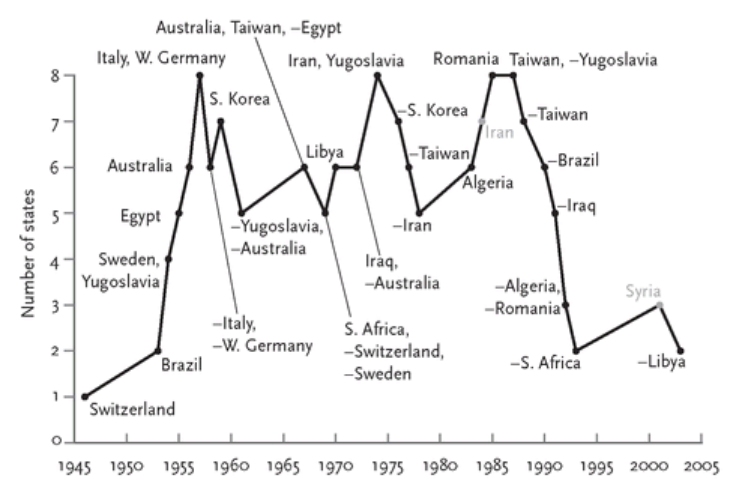
Figure 5-22 — Nonnuclear states that started and stopped exploring nuclear weapons, 1945–2010. Pinker uses the downslopes to challenge mid-century forecasts of runaway proliferation: several states explored weapons and later stopped, while South Africa dismantled its arsenal and Belarus, Kazakhstan, and Ukraine transferred inherited Soviet weapons. The figure is explicitly a 2010 snapshot based on Scott Sagan’s coding; it cannot substitute for a current program or arsenal inventory, and individual reversals involved different mixtures of choice, coercion, security guarantees, regime change, treaty commitments, and military action.
The Cuban Missile Crisis supplies the human mechanism. Kennedy and Khrushchev recognized that pride and “face” could tighten a reciprocal knot, then created mutual concessions that let both retreat. Pinker also compares nuclear stigma with the chemical-weapons taboo to show that a norm may constrain use without erasing stockpiles, contingency plans, violations, or risk. That analogy is historical evidence for possible restraint, not assurance that either taboo will hold. Chapter 5 synthesis · Face-saving in the Cuban Missile Crisis, PDF pp. 371–372 (file not included in this release) · Limits of the nuclear-peace explanation, PDF pp. 379–383 (file not included in this release) · The nuclear taboo, PDF pp. 383–386 (file not included in this release) · Proliferation restraint and Figure 5-22, PDF pp. 386–388 (file not included in this release) · Chemical-weapons comparison, PDF pp. 388–390 (file not included in this release)
| Category | Country | What they had or were building | How they gave it up | Key dates |
|---|---|---|---|---|
| Former nuclear-weapon possessor | South Africa | 6 completed bombs (plus a 7th partly built) | Secretly dismantled all devices, destroyed the test shaft, joined the NPT as a non-nuclear-weapon state | 1989-1991 (en.wikipedia.org, nti.org) |
| Belarus | 81 single-warhead missiles inherited from USSR | Returned every warhead to Russia; acceded to NPT (later allowed Russian warheads back on its soil in 2023, but still owns none) | 1992-1996 (en.wikipedia.org) | |
| Kazakhstan | ~1,400 strategic warheads, Semipalatinsk test site | Transferred stockpile to Russia, sealed the test site, joined NPT | 1992-1995 (en.wikipedia.org) | |
| Ukraine | ~1,700 strategic warheads (world’s 3rd largest arsenal) | Returned all warheads to Russia under the 1994 Budapest Memorandum, joined NPT | 1994-1996 (en.wikipedia.org) | |
| Advanced weapons programmes dismantled | Libya | Gas-centrifuge enrichment plant under construction, weapon-design papers from A.Q. Khan network | Announced and dismantled programme, shipped equipment to the U.S./UK | 2003-2004 (isis-online.org) |
| Iraq | Extensive weapon R&D; no bomb before 1991 Gulf War | Programme destroyed by war & UN inspections; Iraq accepted NPT safeguards | 1991-1998 (isis-online.org) | |
| Argentina | Secret “Condor” and PNE (peaceful-nuclear-explosion) work | Democratic government closed the test shaft and renounced bomb option; ratified NPT | 1990-1994 (media.nti.org) | |
| Brazil | Parallel military enrichment & test-site construction | President Collor de Mello buried the test shaft; Brazil halted the project and later joined NPT | 1990-1998 (carnegieendowment.org) | |
| South Korea | Covert plutonium and reprocessing effort under Park Chung-hee | US pressure ended the project; Seoul re-affirmed NNWS status | 1975-1976 (nti.org) | |
| Taiwan (ROC) | Weapon-design labs and uranium-processing pilot plant | Shut down after 1988 defection of programme deputy; IAEA sealed facilities | 1988-1990 (nti.org, media.nti.org) | |
| Sweden | Air-force-run bomb project (HEU route) at FOA | Parliament cancelled the bomb in 1968 and signed the NPT | 1968-1970 (nti.org) | |
| Earlier exploratory or dormant projects abandoned | Switzerland, Australia, Egypt, Romania, Yugoslavia/Serbia, Algeria, Turkey (among others) | Feasibility studies, small-scale enrichment or reactor routes | Abandoned under cost, security-guarantee, or treaty pressure; all remain NNWS | See NTI & IAEA surveys (nti.org) |
What Counts as “Giving Up”?
- Possessor states physically dismantled or transferred every warhead and accepted full IAEA safeguards.
- Programme states halted weapon R&D, scrapped dedicated facilities, and joined or re-committed to the NPT as non-nuclear-weapon states.
- Exploratory states never crossed the weaponisation threshold but formally foreswore it, often via regional nuclear-weapon-free-zone treaties (e.g., Treaty of Tlatelolco in Latin America, 1967).
These precedents show that geopolitical change, security assurances, and intrusive verification can persuade even advanced programmes to reverse course.