Pinker’s Chapter 4 supplement — moral revulsion needs a peace architecture
Pinker argues that the case against aggressive war can be morally obvious and still politically ineffective. A unilateral pacifist faces the other-guy problem: if neighboring states keep armies, disarmament can invite conquest. Domestic leaders can also recast dissenters as cowards or traitors. Antiwar norms therefore have to spread across constituencies and be anchored in arrangements that do not depend on every actor remaining virtuous.
Chapter 4 traces three complementary strategies. Satire strips war of glory by forcing readers to view “honor,” borders, and conquest from an outsider’s perspective; gentle commerce gives potential enemies a positive-sum interest in one another’s survival; and Kant’s republican government, federation of states, and cross-border hospitality turn restraint into institutional incentives. These pages are intellectual history, not a shortcut for judging whether a particular present war satisfies jus ad bellum or jus in bello. Chapter 4 synthesis · The historical prestige of conquest and early moral criticism, PDF pp. 238–239 (file not included in this release) · Coordination and repression problems for pacifism, PDF pp. 239–240 (file not included in this release) · Satire and deglorification, PDF pp. 240–242 (file not included in this release) · Commerce and Kant’s peace architecture, PDF pp. 242–246 (file not included in this release)
Libertarianism
Murray Rothbard
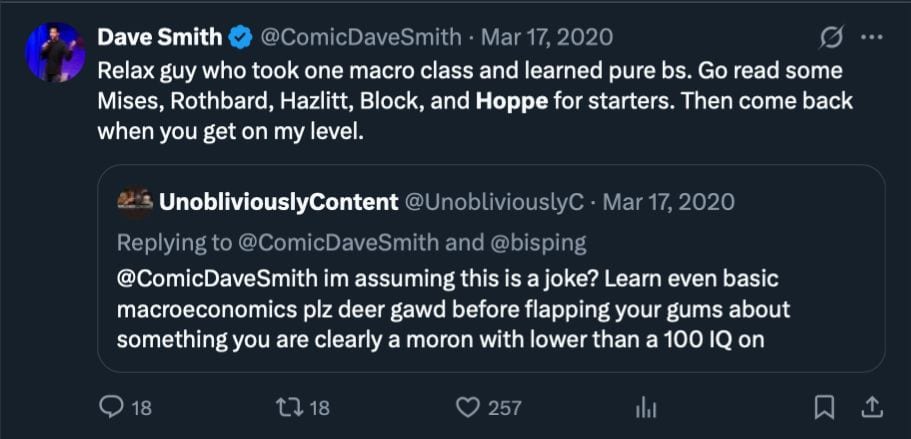
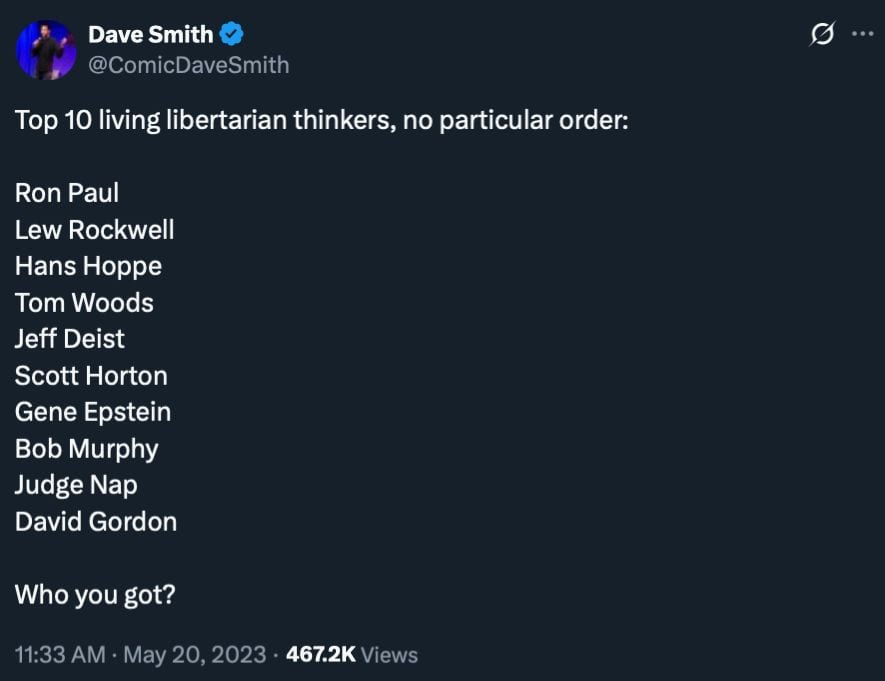
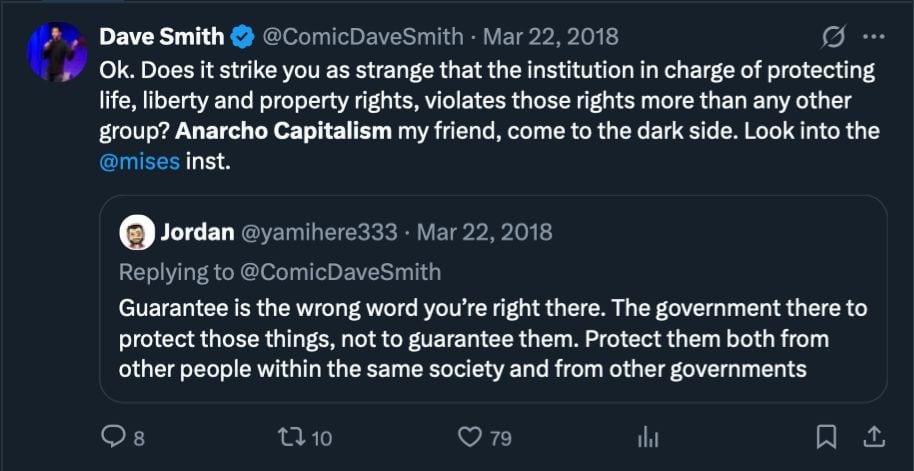
Murray Rothbard and Dave Smith advocate for a libertarian moral framework grounded in natural rights, self-ownership, and the non-aggression principle (NAP). Rothbard’s seminal work, The Ethics of Liberty, articulates these principles, arguing that any state intervention infringes upon individual liberty and is inherently immoral. Dave Smith, drawing from Rothbardian thought, emphasizes anti-war and anti-interventionist stances, asserting that state actions often violate the NAP.
Counterarguments and Critics:
-
David Friedman – In his book The Machinery of Freedom, Friedman critiques Rothbard’s natural rights approach, favoring a consequentialist perspective. He argues that ethical systems should be evaluated based on their outcomes rather than inherent rights.
-
Robert Nozick – While sharing some libertarian views, Nozick’s Anarchy, State, and Utopia defends a minimal state, challenging Rothbard’s anarcho-capitalism by suggesting that a state can emerge without violating individual rights.
-
Andrew Koppelman – In Burning Down the House, Koppelman critiques the absolutist nature of Rothbardian libertarianism, arguing that it neglects the complexities of societal needs and can lead to unjust outcomes.
Notable Debates:
- A recent debate between Dave Smith and Douglas Murray on the Joe Rogan Experience highlighted tensions within libertarian thought, especially concerning foreign policy and state intervention. Smith’s anti-war stance clashed with Murray’s defense of certain state actions, illustrating internal disagreements on applying libertarian principles to real-world scenarios.
Recommended Readings:
-
Murray Rothbard’s Works:
- The Ethics of Liberty – A foundational text outlining Rothbard’s moral philosophy.
- For a New Liberty – An introduction to libertarian principles and their application.
- Anatomy of the State – A critique of state power and its implications.
-
Critiques and Alternative Perspectives:
- The Machinery of Freedom by David Friedman – Presents a utilitarian approach to libertarianism.
- Anarchy, State, and Utopia by Robert Nozick – Defends a minimal state against anarcho-capitalist critiques.
- Burning Down the House by Andrew Koppelman – Analyzes the limitations of libertarian philosophy.
Murray Rothbard and Dave Smith advocate a libertarian stance on war, grounded in the Non-Aggression Principle (NAP). This principle asserts that initiating force is inherently immoral, regardless of scale or authority. They argue that governments, being social constructs, cannot possess moral exemptions that allow actions like killing civilians, which would be deemed immoral for individuals.
📚 Rothbard’s Writings on War and Morality
-
The Ethics of Liberty
Rothbard’s seminal work where he articulates a natural rights-based libertarian ethic. He contends that the state inherently violates individual rights and that war, as an extension of state power, is typically unjust. He emphasizes that moral principles do not change based on scale or government status. citeturn0search24 -
War Collectivism
In this book, Rothbard examines how World War I led to increased government control and central planning in the U.S., arguing that war serves as a catalyst for expanding state power at the expense of individual liberties. citeturn0search7 -
Rothbard on Self-Defense and War
Here, Rothbard explores the application of just war theory, asserting that wars are only justifiable in true self-defense and must avoid harming innocents. citeturn0search10
🔁 Counterarguments and Philosophical Critiques
-
Just War Theory (Michael Walzer)
Walzer’s Just and Unjust Wars provides a framework for evaluating the morality of warfare, introducing concepts like jus ad bellum (justice of war) and jus in bello (justice in war). He argues that while war is tragic, it can be morally justified under certain conditions, such as self-defense or protecting human rights. citeturn0search42 -
Robert L. Holmes – Pacifism and Moral Philosophy
Holmes critiques both aggressive war and certain libertarian perspectives, emphasizing the moral responsibility to prevent harm. In On War and Morality, he discusses the ethical complexities of war, suggesting that absolute principles like the NAP may not adequately address real-world dilemmas. citeturn0search44 -
Critiques of the Non-Aggression Principle
Some philosophers argue that the NAP is too rigid, failing to account for situations where initiating force might prevent greater harm. They suggest that moral decision-making should consider consequences, not just adherence to absolute principles. citeturn0search43
🎙️ Notable Debates and Discussions
-
Dave Smith vs. Walter Block on Israel’s War with Hamas In a debate moderated by Tom Woods, Smith argues against supporting Israel’s military actions, citing libertarian principles of non-aggressin Block counters by suggesting that, while imperfect, Israel’s actions may be more defensible than those of Hams. citeturn0search17
-
Rothbard’s Analysis of Public Debate on the Korean War Rothbard recounts a debate between Senator Robert Taft and McGeorge Bundy, highlighting how intellectual elites often dismiss public discourse on war, reinforcing state narrativs. citeturn0search2
📖 Recommended Readings
-
Just and Unjust Wars by Michael Walzer
A foundational text on just war theory, exploring the moral reasoning behind warfre. citeturn0search42 -
On War and Morality by Robert L. Holmes
An in-depth philosophical examination of the ethics surrounding war and pece. citeturn0search44 -
The Ethics of Liberty by Murray Rothbard
A comprehensive presentation of Rothbard’s libertarian philosophy, including his views on state power and ar. citeturn0search24 -
War Collectivism by Murray Rothbard
An analysis of how war efforts lead to increased government control and the erosion of individual freedms. citeturn0search7
Murray Rothbard, a foundational figure in libertarian philosophy, presents a radical critique of state authority and war in his seminal work, The Ethics of Liberty. He argues that the state’s existence inherently violates individual rights, particularly through its monopoly on violence and taxation. Rothbard posits that any initiation of force, including war, is unjust unless it is a direct act of self-defense. He emphasizes that moral principles are universal and do not change based on scale, government status, or geography.
Counterarguments to Rothbard’s Moral Framework:
-
Just War Theory: Philosophers like Michael Walzer have developed criteria under which war can be morally justified, such as having a just cause, being a last resort, and ensuring proportionality. This framework suggests that, in some cases, engaging in war may prevent greater harm. citeturn0search9
-
Macro vs. Micro Morality: The distinction between individual ethics (micro) and societal or governmental ethics (macro) is recognized in ethical discussions. Some argue that actions permissible for individuals may not be suitable for governments and vice versa, due to differing responsibilities and consequences. citeturn0search1
-
Social Contract Theory: Thinkers like Hobbes, Locke, and Rousseau have argued that individuals consent, either explicitly or implicitly, to surrender some freedoms to a governing body in exchange for protection of their remaining rights. This contract legitimizes certain actions by the state that would be impermissible for individuals. citeturn0search7
Debates and Discussions:
The moral permissibility of war and state authority has been extensively debated. For instance, David Rodin’s work, War and Self-Defense, challenges traditional just war theory by scrutinizing the moral grounds for self-defense in warfare. citeturn0news55 Additionally, discussions on platforms like Reddit’s r/changemyview have explored the complexities of justifying war, reflecting diverse perspectives on the issue. citeturn0search5
Recommended Readings:
-
By Murray Rothbard:
- The Ethics of Liberty – A comprehensive exposition of Rothbard’s libertarian ethics. citeturn0search8
-
Counterpoints:
- Just and Unjust Wars by Michael Walzer – Explores the moral aspects of warfare.
- The Ethics of War and Peace – Provides an introduction to ethical considerations in war. citeturn0search44
- Freedom and Virtue: The Conservative/Libertarian Debate – Examines the tensions between libertarian and conservative viewpoints. citeturn0search19
These resources offer a spectrum of perspectives on the morality of war and the role of the state, providing a comprehensive understanding of the debates surrounding libertarian philosophy.
Dave Smith
Dave Smith | It’s Mass Murder | Part Of The Problem 1253 - YouTube
🧠 Core Argument:
Dave Smith argues that Israel is morally culpable for intentionally murdering civilians in Gaza, and this cannot be excused by invoking war, legality, or government authority. His position is grounded in libertarian moral philosophy influenced by Murray Rothbard.
🔥 Thesis on Israel’s Intentions and Civilian Deaths:
- Smith asserts that Israel’s bombing campaigns are not accidental or merely tragic collateral damage. When Israel bombs buildings knowing civilians are inside, that is intentional killing—i.e., murder, even if the goal is to kill Hamas fighters.
- He rejects the official claim that civilian casualties are “unintentional,” arguing that knowledge of likely civilian deaths makes the act intentional, morally speaking.
- He applies the same moral logic as in a domestic case: If a criminal hides in a house and police blow up that house knowing innocents are inside, we would consider that murder, regardless of the target.
🧱 Moral Framework:
- Foundational Claim: There is no such thing as “macro morality” vs. “micro morality.” Right and wrong do not change based on scale, government status, or geography.
- What is immoral for individuals (e.g., murder, kidnapping) is also immoral for governments.
- Social Constructs ≠ Moral Justification: “Government,” “law,” and “authority” are social constructs and cannot redefine objective morality or logic.
- The state is “a fiction”—a group of people given titles. These titles do not grant moral exception to actions like killing civilians.
🧨 Critique of Counterarguments:
- Smith refutes a legalistic rebuttal (by a lawyer and pundit) claiming governments have legal “authority” and different intent (not revenge, but retrieval or prevention).
- He says: Legal authority doesn’t change moral reality.
- If the action (bombing a building and knowingly killing civilians) is immoral for a civilian or local police, it’s immoral for a government, even during war.
- He argues the legal justification of war dodges the real issue: the moral evaluation of killing innocents.
- The counterexample of hostage rescues fails because killing dozens to save a few is still immoral. Even in hostage standoffs, negotiation is the moral starting point, not mass killing.
💣 His View on the War in Gaza:
- Smith acknowledges Israel’s right to retrieve hostages and fight Hamas, but says its current actions (leveling buildings, mass bombing) go far beyond that and are morally indefensible.
- He claims Israel’s policy is mass murder by another name, and the justification that Hamas “hides among civilians” does not absolve responsibility.
- He criticizes the idea that because Hamas started the war, they alone are responsible for all deaths. Moral responsibility also falls on how you choose to respond.
⚖️ Broader Implications:
- War is only justifiable if absolutely necessary, and if not fighting would result in more death than fighting.
- Smith argues this standard is almost never met, and most modern wars (Iraq, Afghanistan, Gaza) fail this test.
- He critiques those who support war but never served (like Douglas Murray), contrasting them with veterans like Ron Paul who opposed unjust wars.
🪖 His Position Toward Soldiers and Veterans:
- While his moral argument condemns war as mass murder, he does not blame most soldiers individually, viewing them as victims of propaganda and economic coercion.
- He expresses admiration for their courage and sacrifice, but emphasizes that their suffering should be a reason to avoid unnecessary war, not justify it.
🔚 Final Thought:
If killing civilians is murder when done by an individual, it remains murder when done by a state—even in uniform, even with good intentions, even during war. Social constructs like “government” or “military” cannot change the moral nature of the act.
- If Dave Smith rejects the “state” (?) — why does he want Palestinians to have a state?

Reading
🔱 Foundational / Classical Texts
1. St. Augustine – City of God
- One of the earliest Christian thinkers to articulate the moral grounds for war.
- Frames war as a necessary evil in a fallen world.
- Introduces ideas about legitimate authority and right intention.
2. Thomas Aquinas – Summa Theologica
- Lays out the classical criteria for just war:
- Just cause
- Legitimate authority
- Right intention
- His formulation remains foundational to Christian just war thinking.
🕊️ Modern Theoretical Works
3. Michael Walzer – Just and Unjust Wars (1977)
- The most influential modern book on the topic.
- Argues for a “moral reality of war”—a middle ground between realism and pacifism.
- Introduces concepts like the “moral equality of soldiers” and “double effect.”
4. Jean Bethke Elshtain – Just War Against Terror (2003)
- Applies just war theory to post-9/11 geopolitics.
- Defends U.S. intervention in Afghanistan from a just war standpoint.
- Provocative, widely debated.
5. David Rodin – War and Self-Defense (2002)
- Challenges the traditional right of self-defense in just war theory.
- Influential critique that reshapes the ethics of war and security.
6. Brian Orend – The Morality of War (2006)
- Comprehensive overview of just war theory, with attention to jus ad bellum, jus in bello, and jus post bellum.
- Accessible and widely used in classrooms.
- Includes case studies (e.g. Iraq, Kosovo).
⚖️ Legal and Ethical Perspectives
7. Larry May – Aggression and Crimes Against Peace (2008)
- Bridges just war theory and international law.
- Focuses on the crime of aggression and the moral responsibility of leaders.
8. Jeff McMahan – Killing in War (2009)
- Argues against Walzer’s moral equality of combatants.
- Emphasizes individual responsibility and moral asymmetry in war.
- A paradigm-shifting critique of traditional just war assumptions.
🌐 Contemporary and Applied Ethics
9. Cécile Fabre – Cosmopolitan War (2012)
- Applies just war principles to global justice and humanitarian intervention.
- Argues for cosmopolitanism rather than nationalism in moral war theory.
10. Yitzhak Benbaji & Naomi Sussmann (eds.) – The Ethics of War: Essays (2016)
- A collection of top scholars debating the newest developments in just war theory.
- Covers preemption, proportionality, drone warfare, and the ethics of occupation.
✅ Suggested Reading Path (If You’re New):
- Start with Walzer’s Just and Unjust Wars (core concepts + case studies)
- Then read Brian Orend’s Morality of War (structured overview)
- Follow with McMahan’s Killing in War (contemporary critique)
- Supplement with Aquinas or Augustine for the philosophical roots
Types of Just War
Traditionalists
- might as readily be called legalists. Their views on the morality of war are substantially led by international law, especially the law of armed conflict. They aim to provide those laws with morally defensible foundations. States (and only states) are permitted to go to war only for national defence, defence of other states, or to intervene to avert “crimes that shock the moral conscience of mankind” (Walzer 2006: 107). Civilians may not be targeted in war, but all combatants, whatever they are fighting for, are morally permitted to target one another, even when doing so foreseeably harms some civilians (so long as it does not do so excessively).War (Stanford Encyclopedia of Philosophy) > ^v4no9e
Revisionists
- question the moral standing of states and the permissibility of national defence, argue for expanded permissions for humanitarian intervention, problematise civilian immunity, and contend that combatants fighting for wrongful aims cannot do anything right, besides lay down their weapons. War (Stanford Encyclopedia of Philosophy) > ^71mhto
Conceptual & Methodological Terms
- Traditionalists: Philosophers who align closely with international law, particularly the laws of armed conflict. They defend the moral equality of combatants and the authority of states in declaring war.
- Revisionists: Philosophers who challenge traditionalist assumptions. They argue that combatants fighting for an unjust cause are not morally equal, and that morality should override legal permission
- Realists: Think morality doesn’t apply to war at all; war is governed by power and national interest, not ethics.
- Pacifists: Argue all war is morally wrong and that violence can never be justified.
- Reductionists: Believe the morality of war can be reduced to individual ethics. They analyze war by applying familiar moral standards (like killing or harming innocents) to each act.
- Non-reductionists: Believe war introduces morally relevant factors not reducible to individual actions—e.g., the moral significance of institutions, collective action, or legal norms.
- Institutionalists: Emphasize the importance of morally justified institutions (e.g., laws of war), focusing on the rules that should govern war.
- Interactionalists: Focus on the moral obligations of individuals and groups in war, without deferring to institutions.
- Contractualists: Support moral rules of war based on contractual agreement between states or people.
- Consequentialists (Indirect): Support war norms and institutions if they produce better outcomes over time, even if individual actions violate ordinary moral rules.
Moral Framework Terms
- Just War Theory: A framework assessing the morality of war, split into:
- Jus ad bellum (“right to war”): Conditions for justly starting war.
- Jus in bello (“right in war”): Rules for just conduct during war.
- Just Cause: A morally legitimate reason for war (e.g. self-defense, humanitarian intervention).
- Just Peace: The aim of achieving a morally acceptable post-war order
- Legitimate Authority: War must be declared by a proper authority, typically a state.
- Proportionality: The harm of war or a military act must not outweigh its military advantage.
- Necessity (Last Resort): War or force must be used only when all peaceful alternatives are exhausted.
- Combatant Equality: Traditional view that all combatants, whether on the just or unjust side, have the same rights in war.
- Civilian Immunity: Civilians should not be targeted intentionally in war.
Transclude of just-war-theory--internet-encyclopedia-of-philosophy#^7elydc
Jus ad bellum (Resort to War)
- Just Cause: the war is an attempt to avert the right kind of injury.
- Traditional: just war theory recognizes only two kinds of justification for war: national defence (of one’s own state or of an ally) and humanitarian intervention.
- humanitarian intervention is permissible only to avert the very gravest of tragedies—“crimes that shock the moral conscience of mankind” (Walzer 2006: 107).War (Stanford Encyclopedia of Philosophy) > ^bnzv4x
- Walzer argued that states’ claims to sovereignty and territorial integrity are grounded in the human rights of their citizens, in three ways. First, states ensure individual security. Rights to life and liberty have value “only if they also have dimension” (Walzer 2006: 58), which they derive from states’ borders—“within that world, men and women… are safe from attack; once the lines are crossed, safety is gone” (Walzer 2006: 57). Second, states protect a common life, made by their citizens over centuries of interaction. If the common life of a political community is valued by its citizens, then it is worth fighting for. Third, they have also formed a political association, an organic social contract, whereby individuals have, over time and in informal ways, conceded aspects of their liberty to the community, to secure greater freedom for all. War (Stanford Encyclopedia of Philosophy) > ^ruheay
- In Walzer’s view, humanitarian interventions, in which one typically defends people against their own state, necessarily undermine political sovereignty and territorial integrity. So they must meet a higher burden of justification.
- Criticisms War (Stanford Encyclopedia of Philosophy) > ^q41euf
- Collected Freedom
- Social contract, state the greatest threat to its members
- David Rodin (2002) advanced the quintessentially reductivist critique of Walzer, showing that his attempt to ground state defence in individual defensive rights could not succeed. He popularized the “bloodless invasion objection” to this argument for national defensive rights. Suppose an unjustly aggressing army would secure its objectives without loss of life if only the victim state offers no resistance (the 2001 invasion of Afghanistan, and the 2003 invasion of Iraq, arguably meet this description, as might some of Russia’s territorial expansions). If the right of national defence is grounded in states’ members’ rights to security, then in these cases there would be no right of national defence, because their lives are at risk only if the victim state fights back. And yet we typically do think it permissible to fight against annexation and regime change.
- Revisionists
- According to the Stanford Encyclopedia of Philosophy’s entry on “War,” revisionist just war theorists approach the justification of just cause in jus ad bellum (the moral criteria for resorting to war) by emphasizing individual rights and challenging traditionalist reliance on state-centric international law. The following outlines the key conditions and considerations revisionists focus on to justify just cause, as discussed in the entry:
- Protection of Individual Rights as the Core Justification:
- Revisionists argue that a just cause for war must be grounded in the protection of individual rights, rather than solely state-based rights like national defense. They rely on reductivist premises, asserting that the moral justification for killing in war stems from defending individuals’ rights to life, liberty, or other fundamental interests, without necessarily requiring mediation through state institutions.
- This contrasts with traditionalists, who prioritize state sovereignty and legal permissions for war (e.g., national defense or UN-authorized interventions).
- Addressing “Lesser Aggression”:
- Revisionists grapple with justifying lethal force in response to “lesser aggression” (e.g., non-lethal violations of sovereignty, such as economic embargoes or territorial incursions without loss of life). Traditional self-defense models may not permit lethal responses to such acts, creating a challenge for revisionists.
- Some revisionists, like Cécile Fabre, propose that just cause can include deterrence of future aggression or accounting for uncertainty about whether aggression will remain bloodless. For example, a state might justify war to prevent repeated non-lethal incursions that threaten stability.
- Others, like Emerton and Handfield or Seth Lazar, suggest moving away from individual self-defense analogies entirely, focusing instead on collective interests, such as the right to a democratically elected or home-grown government, to justify national defense.
- Challenging State-Centric Authority:
- Revisionists reject the traditionalist condition of “legitimate authority,” which typically restricts just cause to states. They argue that non-state actors (e.g., revolutionary groups or oppressed populations) can have just cause for war if they are defending individual rights against severe violations, such as tyranny or genocide. This broadens the scope of who can claim just cause.
- For instance, a non-state group fighting against a regime committing “crimes that shock the moral conscience of mankind” could have just cause, even without formal state authorization.
- Proportionality and Necessity:
- While not unique to revisionists, just cause must align with proportionality (the harm caused by war must not outweigh the good achieved) and necessity (war must be the least harmful means to achieve the just cause). Revisionists apply these principles at the individual level, assessing whether the violation of rights (e.g., loss of life or liberty) justifies the scale of military response.
- In revolutionary contexts, for example, revisionists might argue that a just cause exists only if the regime’s oppression is so severe (e.g., a “Resolute Severe Tyranny”) that no lesser means, like reform, can address the rights violations.
- Radical Revisionist Perspectives:
- Some revisionists, like David Rodin, push for radically revisionist conclusions, suggesting that if individual self-defense cannot justify lethal force against lesser aggression, then many traditional just causes (e.g., defending territory) may be unjustifiable. This challenges the permissibility of wars that traditionalists might accept.
Critical Note: The revisionist approach is not monolithic. Some revisionists seek to expand just cause to include humanitarian interventions or non-state actions, while others, like Rodin, argue for a more restrictive view that could align closer to pacifism. The entry highlights ongoing debates, particularly around how to balance individual rights with the realities of collective violence in war.
- Some revisionists, like David Rodin, push for radically revisionist conclusions, suggesting that if individual self-defense cannot justify lethal force against lesser aggression, then many traditional just causes (e.g., defending territory) may be unjustifiable. This challenges the permissibility of wars that traditionalists might accept.
- Protection of Individual Rights as the Core Justification:
- According to the Stanford Encyclopedia of Philosophy’s entry on “War,” revisionist just war theorists approach the justification of just cause in jus ad bellum (the moral criteria for resorting to war) by emphasizing individual rights and challenging traditionalist reliance on state-centric international law. The following outlines the key conditions and considerations revisionists focus on to justify just cause, as discussed in the entry:
- Traditional: just war theory recognizes only two kinds of justification for war: national defence (of one’s own state or of an ally) and humanitarian intervention.
- Legitimate Authority: the war is fought by an entity that has the authority to fight such wars.
- Revisionists push back: relying on reductivist premises, they argue that killing in war is justified by the protection of individual rights, and our licence to defend our rights need not be mediated through state institutions. Either we should disregard the legitimate authority condition or we should see it as something that non-state actors can, in fact, fulfil (Fabre 2008; Finlay 2010; Schwenkenbecher 2013). War (Stanford Encyclopedia of Philosophy) > ^3nd6j6
- Right Intention: that entity intends to achieve the just cause, rather than using it as an excuse to achieve some wrongful end.
- Reasonable Prospects of Success: the war is sufficiently likely to achieve its aims.
- Proportionality: the morally weighted goods achieved by the war outweigh the morally weighted bads that it will cause.
- Last Resort (Necessity): there is no other less harmful way to achieve the just cause.
- Going to war must be compared with the alternative available strategies for dealing with the enemy (which also includes the various ways in which we could submit). Going to war is literally a last resort when no other available means has any prospect of averting the threat. But our circumstances are not often this straitened. Other options always have some chance of success. So if you have a diplomatic alternative to war, which is less harmful than going to war, and is at least as likely to avert the threat, then going to war is not a last resort. If the diplomatic alternative is less harmful, as well as less likely to avert the threat, then the question is whether the reduction in expected harm is great enough for us to be required to accept the reduction in likelihood of averting the threat. If not, then war is your last resort.War (Stanford Encyclopedia of Philosophy) > ^7cjimc
War (Stanford Encyclopedia of Philosophy) > ^seq0y3
- Going to war must be compared with the alternative available strategies for dealing with the enemy (which also includes the various ways in which we could submit). Going to war is literally a last resort when no other available means has any prospect of averting the threat. But our circumstances are not often this straitened. Other options always have some chance of success. So if you have a diplomatic alternative to war, which is less harmful than going to war, and is at least as likely to avert the threat, then going to war is not a last resort. If the diplomatic alternative is less harmful, as well as less likely to avert the threat, then the question is whether the reduction in expected harm is great enough for us to be required to accept the reduction in likelihood of averting the threat. If not, then war is your last resort.War (Stanford Encyclopedia of Philosophy) > ^7cjimc
jus in bello (Conduct in War)
- Discrimination: belligerents must always distinguish between military objectives and civilians, and intentionally attack only military objectives.
- Discrimination and Combatant Equality
- Michael Walzer
- Individual human beings enjoy fundamental rights to life and liberty, which prohibit others from harming them in certain ways. Since fighting wars obviously involves depriving others of life and liberty, according to Walzer, it can be permissible only if each of the victims has, “through some act of his own … surrendered or lost his rights” (Walzer 2006: 135). He then claims that, “simply by fighting”, all combatants “have lost their title to life and liberty” (Walzer 2006: 136). First, merely by posing a threat to me, a person alienates himself from me, and from our common humanity, and so himself becomes a legitimate target of lethal force (Walzer 2006: 142). Second, by participating in the armed forces, a combatant has “allowed himself to be made into a dangerous man” (Walzer 2006: 145), and thus surrendered his rights. By contrast, noncombatants are “men and women with rights, and… they cannot be used for some military purpose, even if it is a legitimate purpose” (Walzer 2006: 137). War (Stanford Encyclopedia of Philosophy) > ^i9rxcn
- Criticism
- The simplest objection against Combatant Equality brings it into conflict with Proportionality (McMahan 1994; Rodin 2002; Hurka 2005). Unintended noncombatant deaths are permissible only if proportionate to the military objective sought. This means the objective is worth that much innocent suffering. But military objectives are merely means to an end. Their worth depends on how valuable the end is. How many innocent deaths would be proportionate to Al Shabab’s successfully gaining control of Mogadishu now or to Iraq’s capturing Kuwaiti territory and oil reserves in 1991? In each case the answer is obvious: none.War (Stanford Encyclopedia of Philosophy) > ^7llw8r
- Walzer’s critics then show that his account of how we lose our right to life is simply not plausible. Merely posing a threat to others—even a lethal threat—is not sufficient to warrant the loss of one’s fundamental rights, because sometimes one threatens others’ lives for very good reasons (McMahan 1994).War (Stanford Encyclopedia of Philosophy) > ^vng15z
- this argument undermines Discrimination (McMahan 1994; Arneson 2006; Fabre 2012; Frowe 2014). In many states, noncombatants play an important role in the resort to military force. In modern industrialized countries, as much as 25 per cent of the population works in war-related industries (Downes 2006: 157–8; see also Gross 2010: 159; Valentino et al. 2010: 351); we provide the belligerents with crucial financial and other services; we support and sustain the soldiers who do the fighting; we pay our taxes and in democracies we vote. Our contributions to the state’s capacity over time give it the strength and support to concentrate on war.[21] If the state’s war is unjust, then many noncombatants are responsible for contributing to wrongful threats. If that is enough for them to lose their rights to life, then they are permissible targets.War (Stanford Encyclopedia of Philosophy) > ^222j55
- If Walzer is right that in war, outside of supreme emergencies, we may intentionally kill only people who are liable to be killed, and if a significant proportion of unjust combatants and noncombatants are responsible to the same degree as one another for unjustified threats, and if liability is determined by responsibility, then we must decide between two unpalatable alternatives. If we set a high threshold of responsibility for liability, to ensure that noncombatants are not liable to be killed, then we will also exempt many combatants from liability. In ordinary wars, which do not involve supreme emergencies, intentionally killing such non-liable combatants would be impermissible. This moves us towards a kind of pacifism—though warfare can in principle be justified, it is so hard to fight without intentionally killing the non-liable that in practice we must be pacifists (May 2015). But if we set the threshold of responsibility low, ensuring that all unjust combatants are liable, then many noncombatants will be liable too, thus rendering them permissible targets and seriously undermining Discrimination. We are torn between pacifism on the one hand, and realism on the other. This is the “responsibility dilemma” for just war theory (Lazar 2010).War (Stanford Encyclopedia of Philosophy) > ^606wkf
- Michael Walzer
- Proportionality is about weighing the evil inflicted against the evil averted (Lee 2012). But the military success of unjust combatants does not avert evil, it is itself evil. Evil intentionally inflicted can only add to, not counterbalance, unintended evils. Combatant Equality cannot be true.
- Moral Distinction:
- Moral Distinction is the jus in bello principle that requires belligerents to distinguish between combatants (those who are legitimate targets in war, such as soldiers) and non-combatants (those who are morally and legally protected from being intentionally targeted, such as civilians).
- The principle mandates that military actions must discriminate by directing harm only toward combatants and avoiding intentional harm to non-combatants, even if achieving military objectives might be more difficult as a result.
- Core Ideas Behind Moral Distinction
- Moral and Legal Foundation:
- The principle is rooted in the idea that not all individuals involved in a war are equally liable to be targeted. Combatants, by virtue of their role in fighting or posing a direct threat, forfeit some moral protections and can be permissibly killed. Non-combatants, who do not directly participate in hostilities, retain their right to life and immunity from attack.
- This is codified in international humanitarian law, such as the Geneva Conventions, which prohibit targeting civilians and require efforts to minimize civilian harm.
- Key Insight: Moral distinction reflects a balance between military necessity and humanitarian protections, acknowledging that war involves violence but imposes strict limits on who can be targeted.
- Application in Practice:
- Military actions must be planned and executed to avoid intentional attacks on civilians. For example, bombing a civilian area to demoralize a population would violate moral distinction, whereas targeting a military base, even with foreseeable civilian casualties, might be permissible under certain conditions (see proportionality and double effect).
- The principle also applies to tactics like hostage-taking or using civilians as human shields, which are considered violations because they intentionally endanger non-combatants.
- Challenges and Debates:
- Defining Combatants vs. Non-Combatants: The article notes complexities in distinguishing combatants from non-combatants, especially in modern warfare. For instance, civilians who support war efforts (e.g., munitions workers) or irregular fighters (e.g., insurgents) blur the line, raising questions about their status. Traditionalists often rely on formal roles (e.g., uniformed soldiers), while revisionists may focus on actual contributions to harm.
- Collateral Damage and Double Effect: Moral distinction does not absolutely prohibit civilian harm but requires it to be unintentional and proportionate. The doctrine of double effect allows actions with foreseen but unintended civilian casualties (e.g., bombing a military target near civilians) if the primary aim is legitimate and the harm is minimized.
- Revisionist Critiques: Revisionist just war theorists challenge traditional interpretations, arguing that only combatants who are morally culpable (e.g., fighting for an unjust cause) are legitimate targets. This complicates moral distinction, as it suggests some combatants might deserve protections, while some civilians (e.g., those actively supporting an unjust war) might lose immunity. The article notes that such views are controversial and not widely accepted.
- Practical Difficulties: In asymmetric or urban warfare, distinguishing combatants from non-combatants is challenging, and groups may exploit this (e.g., hiding among civilians). The principle requires belligerents to take reasonable steps to verify targets, even under such constraints.
- Moral and Strategic Tension:
- Moral distinction often conflicts with military efficiency. Targeting civilians might achieve strategic goals (e.g., breaking enemy morale), but the principle prioritizes moral and legal constraints over expediency.
- The article highlights that adhering to moral distinction can be seen as a moral commitment to humanity, even in the chaos of war, but it also acknowledges criticisms that strict adherence might disadvantage just belligerents against those who ignore the principle.
- Moral and Legal Foundation:
- Discrimination and Combatant Equality
- Proportionality: foreseen but unintended harms must be proportionate to the military advantage achieved.
- three kinds of response: all-out revisionist; moderate traditionalist; and all-out traditionalist.
- All-Out Revisionist
- Core View: All-out revisionists apply individualist moral principles to war, treating proportionality in jus in bello as equivalent to moral constraints in ordinary self-defense scenarios. They reject special moral rules for war and argue that military actions must be judged by the same standards as individual actions outside war.
- Proportionality Interpretation:
- Proportionality is strictly tied to the harm inflicted on individuals and the specific good achieved (e.g., averting a threat). Combatants must minimize harm to non-combatants and ensure that any harm is proportionate to the immediate defensive goal.
- For example, killing a combatant is only permissible if it directly prevents a comparable harm (e.g., saving a life), and collateral harm to non-combatants must be minimal and justified by necessity.
- Key Features:
- Rejects the traditionalist “combatant equality” principle, which grants moral symmetry to combatants on both sides. All-out revisionists, like Jeff McMahan, argue that only combatants with a just cause (e.g., defending against unjust aggression) can permissibly kill, while unjust combatants have no moral right to kill, even proportionately.
- This leads to a restrictive view: many wartime acts (e.g., large-scale bombings causing collateral damage) are disproportionate because they fail individualist moral tests.
- Implications: This position often aligns with near-pacifist conclusions, as the stringent requirements for proportionality make most military actions morally impermissible, especially in wars with significant civilian harm.
- Modern Traditionalist Position
- Core View: Modern traditionalists seek a middle ground, maintaining some traditional just war principles while incorporating revisionist insights. They accept that war involves special moral rules but are open to refining these based on individual rights considerations.
- Proportionality Interpretation:
- Proportionality balances military advantage (e.g., advancing a just cause or securing victory) against harm caused, particularly to non-combatants. Unlike all-out revisionists, modern traditionalists allow for some collateral harm if it is unavoidable and proportionate to a significant military objective.
- They emphasize double effect reasoning: harming non-combatants is permissible if it is an unintended but foreseeable side effect of a proportionate military action aimed at a legitimate target (e.g., bombing a military base near civilians).
- Key Features:
- Retains the principle of combatant equality, allowing combatants on both sides to be targeted, regardless of their side’s justness, as long as actions adhere to proportionality and discrimination (avoiding intentional harm to non-combatants).
- Acknowledges revisionist critiques by tightening proportionality constraints, such as requiring greater efforts to minimize civilian casualties (e.g., through precision targeting).
- Implications: This position supports a more permissive view of wartime conduct than revisionists, allowing for military operations that cause some civilian harm, provided the harm is proportionate and not the primary intent. It aligns with contemporary international humanitarian law (e.g., Geneva Conventions).
- All-out Traditionalist Position
- Core View: All-out traditionalists adhere closely to historical just war theory and international law, prioritizing the practical realities of war and state-centric norms over individualist moral reasoning.
- Proportionality Interpretation:
- Proportionality is assessed in terms of military necessity and the overall war effort. Harm to non-combatants or combatants is permissible if it contributes to a legitimate military objective and the harm is not excessive relative to the strategic gain (e.g., capturing a key position or weakening enemy forces)
- Collateral damage to civilians is more broadly tolerated than in revisionist or modern traditionalist views, as long as the primary target is military and the action complies with international legal standards.
- Key Features:
- Strongly upholds combatant equality, treating all combatants as legitimate targets regardless of their side’s moral status. This reflects the traditional view that war’s moral rules are distinct from peacetime ethics.
- Less emphasis on individual rights compared to revisionists; proportionality is evaluated at a collective level (e.g., state or military goals) rather than individual harms.
- Implications: This position is the most permissive, allowing for a wider range of military actions, including those with significant collateral damage, as long as they align with military objectives and legal norms. It is less critical of historical wartime practices and more aligned with state practices in conventional warfare.
- Holding the principle of Moral Distinction allows one to escape the realist and pacifist horns of the responsibility dilemma, while still giving responsibility its due. Even revisionists who deny moderate Combatant Equality could endorse Moral Distinction, and thereby retain the very plausible insight that it is worse to kill just noncombatants than to kill just combatants. And, if they are to account for most people’s considered judgements about war, even pacifists need some account of why killing civilians is worse than killing soldiers.War (Stanford Encyclopedia of Philosophy) > ^2dvl65
- Necessity: the least harmful means feasible must be used.
War (Stanford Encyclopedia of Philosophy) > ^1abshn
- Human Shields
- Second, setting aside the law and focusing again on morality, many think that responsibility is crucial to thinking about proportionality, in the following way. Suppose the Free Syrian Army (FSA) launches an assault on Raqqa, stronghold of ISIL. They predict that they will cause a number of civilian casualties in their assault, but that this is only because ISIL has chosen to operate from within a civilian area, forcing people to be “involuntary human shields”. Some think that ISIL’s responsibility for putting those civilians at risk allows the FSA to give those civilians’ lives less weight in their deliberations than would be appropriate if ISIL had not used them as human shields (Walzer 2009; Keinon 2014)
- But one could also consider the following: Even if ISIL is primarily at fault for using civilians as cover, why should this mean that those civilians enjoy weaker protections against being harmed? We typically think that one should only lose or forfeit one’s rights through one’s own actions. But on this argument, civilians enjoy weaker protections against being killed through no fault or choice of their own. Some might think that more permissive standards apply for involuntary human shields because of the additional value of deterring people from taking advantage of morality in this kind of way (Smilansky 2010; Keinon 2014). But that argument seems oddly circular: we punish people for taking advantage of our moral restraint by not showing moral restraint. What’s more, this changes the act from one that foreseeably kills civilians as an unavoidable side-effect of countering the military threat to one that kills those civilians as a means to deter future abuses. This instrumentalizes them in a way that makes harming them still harder to justify. War (Stanford Encyclopedia of Philosophy) > ^4cw1rc
- divide the possible victims of war into two classes: combatants and noncombatants.
- They place no constraints on killing combatants.[17] But—outside of “supreme emergencies”, rare circumstances in which intentionally killing noncombatants is necessary to avert an unconscionable threat—noncombatants may be killed only unintendedly and, even then, only if the harm they suffer is necessary and proportionate to the intended goals of the attack.War (Stanford Encyclopedia of Philosophy) > ^0nmg5v
Necessity and Proportionality
- Harms (and indeed all bads) that we cause must therefore be justified by some positive reason that counts in their favour—such as good achieved or evil averted (Lazar 2012a). Both the necessity and proportionality constraints involve comparing the bads caused by an action with the goods that it achieves. They differ only in the kinds of options they compare. War (Stanford Encyclopedia of Philosophy) > ^e6gexv
- The use of force is proportionate when the harm done is counterbalanced by the good achieved in averting a threat. To determine this, we typically compare the candidate course of action with what would happen if we allowed the threat to eventuate.
- harmful option can be permissible only if all the harm that it involves is justified by a corresponding good achieved. If some alternative would as successfully avert the threat, but cause less harm, then the more harmful option is impermissible, because it involves unnecessary harm.
- in bello one of the central questions when applying the necessity principle is: how much risk to our own troops are we required to bear in order to minimize harms to the innocent? Some option can be necessary simply in virtue of the fact that it saves some of our combatants’ lives. Ad bellum, evaluating the war as a whole, we must of course consider the risk to our own combatants. But we do so in a different way—we ask whether the goods achieved by the war as a whole will justify putting our combatants at risk. We don’t then count among the goods achieved by the war the fact that multiple actions within the war will save the lives of individual combatants. We cannot count averting threats that will arise only if we decide to go to war among the goods that justify the decision to go to war.War (Stanford Encyclopedia of Philosophy) > ^w1zr7k
Future of Just War Theory
- As to the philosophical foundations of just war theory: the traditionalist and revisionist positions are now well staked out. War (Stanford Encyclopedia of Philosophy) > ^nk75zj
- Despite the prominence of collectivist thinking in war, discussion of war’s group morality is very much in its infancy.
TODO
- War (Stanford Encyclopedia of Philosophy)
- Just War by Murray Rothbard
- Is There Such a Thing as a "Just War" in the Modern World?
- Why We Need “Just War Theory” - YouTube
- Just war theory - Wikipedia
- Just War Theory Internet Encyclopedia of Philosophy
- What “Just War Theory” Really Means - YouTube