Filed with 60.21 Psychology · Related: 60.12 Self-Improvement · Ethics & Metaethics (MOC)
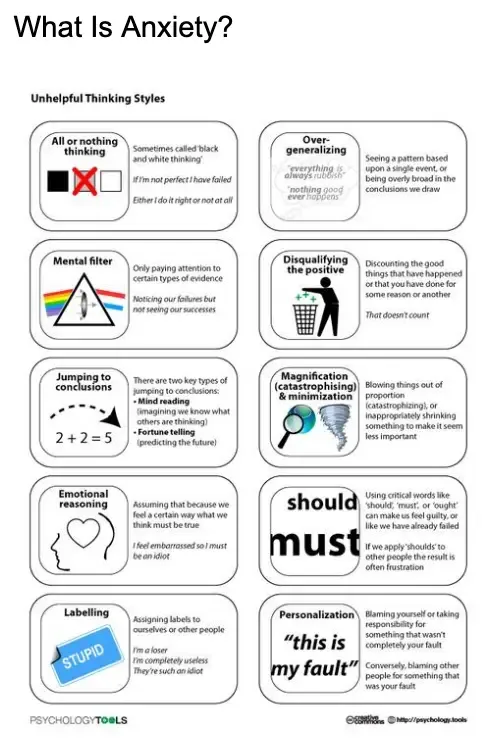
Here is a list of common unhelpful thinking styles or cognitive distortions:
- All-or-Nothing Thinking (Polarized Thinking)
- Seeing things in black-and-white categories with no middle ground
- Example: “If I’m not perfect, I’m a total failure.” [1][3][6][16]
- Overgeneralization
- Viewing a single negative event as a never-ending pattern of defeat
- Example: “I didn’t get the job. I’ll never find a job.” [1][3][6][14][16]
- Mental Filter (Selective Abstraction)
- Focusing exclusively on certain, usually negative aspects of an event while ignoring the rest
- Example: Dwelling on a single critical comment among many positive ones [1][3][6][14][16]
- Disqualifying the Positive
- Rejecting positive experiences by insisting they “don’t count”
- Example: Dismissing a compliment - “They were just being nice.” [1][3][6][14]
- Jumping to Conclusions
- Mind Reading: Assuming you know what people think without evidence
- Fortune Telling: Predicting things will turn out badly without justification
- Example: “I know they all hate me and think I’m stupid.” [1][3][6][13][14][16]
- Magnification (Catastrophizing) or Minimization
- Exaggerating the importance of problems or minimizing the importance of good things
- Example: Believing a small mistake will lead to being fired [1][3][6][13][14][16]
- Emotional Reasoning
- Assuming your negative emotions reflect reality
- Example: “I feel guilty, therefore I must be a bad person.” [1][3][6][13][14][16]
- Should Statements
- Criticizing yourself or others with “shoulds”, “shouldn’ts”, “musts”, “oughts”, etc.
- Creates unrealistic expectations and unnecessary pressure
- Example: “I should be able to handle this on my own.” [1][3][6][13][14][16]
- Labeling and Mislabeling
- Attaching a global negative label to yourself or others
- Example: “I’m a loser.” “He’s a jerk.” [1][3][6][14][16]
- Personalization
- Seeing yourself as the cause of external negative events you were not responsible for
- Example: “It’s my fault my child is struggling in school.” [1][3][6][13][14][16]
Other unhelpful thinking styles mentioned include:
- Control fallacies [14]
- Fallacy of fairness [14]
- Blaming [14]
- Always being right [14]
- Fallacy of change [14]
- Comparison [5]
- Memories triggering distress [15]
The key is being able to recognize these distorted thinking patterns so you can challenge them with more balanced, realistic thoughts. Cognitive behavioral therapy (CBT) focuses on identifying and changing these unhelpful thinking styles to improve mood and well-being.
Citations:
[1] https://mentalhealthcenterkids.com/blogs/articles/negative-thinking-patterns
[2] https://sageclinic.org/blog/negative-thoughts-depression/
[3] https://sdlab.fas.harvard.edu/cognitive-reappraisal/identifying-negative-automatic-thought-patterns
[4] https://www.asha.org/practice-portal/clinical-topics/fluency-disorders/cognitive-distortions-and-fluency-examples/
[5] https://www.healthline.com/health/cognitive-distortions
[6] https://www.verywellmind.com/ten-cognitive-distortions-identified-in-cbt-22412
[7] https://childmind.org/article/how-to-change-negative-thinking-patterns/
[8] https://www.therapistaid.com/worksheets/cognitive-distortions
[9] https://www.psychologytools.com/resource/cognitive-distortions-unhelpful-thinking-styles-extended/
[10] https://www.health.harvard.edu/blog/how-to-recognize-and-tame-your-cognitive-distortions-202205042738
[11] https://www.therapyforyou.co.uk/post/6-unhelpful-thinking-patterns
[12] https://www.familycentre.org/news/post/10-common-negative-thinking-patterns-and-5-steps-for-change
[13] https://accesscbt.co.uk/25-unhelpful-thinking-styles-in-depression-and-anxiety/
[14] https://psychcentral.com/lib/cognitive-distortions-negative-thinking
[15] https://www.getselfhelp.co.uk/docs/UnhelpfulThinkingHabitsWithAlternatives.pdf
[16] https://www.cci.health.wa.gov.au/~/media/CCI/Mental-Health-Professionals/Depression/Depression---Information-Sheets/Depression-Information-Sheet---11—Unhelpful-Thinking-Styles.pdf
[17] https://www.cci.health.wa.gov.au/Resources/For-Clinicians/Unhelpful-Thinking-Styles
[18] https://www.psychologytoday.com/us/blog/in-practice/201301/50-common-cognitive-distortions
[19] https://www.uth.edu/studenthealth/assets/docs/scs/cognitive-distortions.pdf
Challenging and Changing Unhelpful Thoughts
Once you’re aware of your unhelpful thinking styles, you can start to challenge and reframe those thoughts:
- Examine the evidence - What proof do you have that your thought is true? Are you ignoring any facts that contradict it? 3101416
- Consider alternative explanations - Are there any other ways to interpret the situation? Is your perspective the only possible one? 31014
- Put it in perspective - Will this matter in a year? Five years? How much will it really impact your life? 310
- Use more moderate, realistic language - Instead of using extremes like “always” or “never”, stick to accurate descriptions. 1014
- Practice self-compassion - Acknowledge your flaws but don’t judge yourself harshly for them. Treat yourself with the same kindness you’d extend to a friend. 310
Regularly practicing these techniques, ideally by writing your thoughts down, can help ingrain healthier thinking habits. Be patient with yourself as it takes time to shift long-standing patterns. 310If you find yourself really struggling to change your thinking, consider working with a cognitive-behavioral therapist. CBT is considered the gold standard for identifying and changing unhelpful thoughts and behaviors. 2814The key is increasing your awareness of your thoughts and actively choosing to guide them in a more balanced, constructive direction. With practice, it will start to feel more natural and your mood and self-esteem will likely improve as a result.