📓 In your handwritten notebooks
- March 21 – June 9 2026, pp. 212 — *1491 — Charles Mann* → open PDF p229 (file not included in this release)
Index: Personal Journal
DESCRIPTION
NATIONAL BESTSELLER • A groundbreaking work of science, history, and archaeology that radically alters our understanding of the Americas before the arrival of Columbus in 1492—from “a remarkably engaging writer” (The New York Times Book Review). Contrary to what so many Americans learn in school, the pre-Columbian Indians were not sparsely settled in a pristine wilderness; rather, there were huge numbers of Indians who actively molded and influenced the land around them. The astonishing Aztec capital of Tenochtitlan had running water and immaculately clean streets, and was larger than any contemporary European city. Mexican cultures created corn in a specialized breeding process that it has been called man’s first feat of genetic engineering. Indeed, Indians were not living lightly on the land but were landscaping and manipulating their world in ways that we are only now beginning to understand. Challenging and surprising, this a transformative new look at a rich and fascinating world we only thought we knew.
1491 - Charles C. Mann.pdf (file not included in this release)
1491 - Charles C Mann PDF Extracted
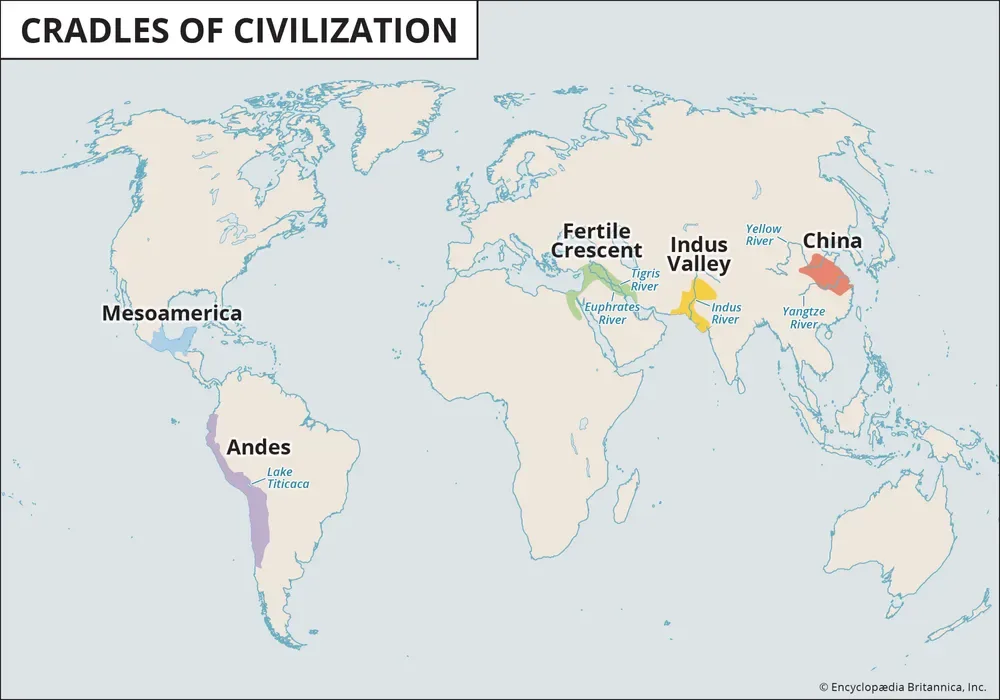
Q: Gap between 1st European arrival introducing disease -> 1620 Plymouth Landing
Full chronology → 1000-1620 - European-Indigenous Contact and Disease in North America — Norse to the Mayflower, every documented pre-1620 epidemic with its mortality estimate, Mann’s figures set against the Smithsonian’s where they conflict, and the Dobyns–Henige fight over the 90–95% claim.
You are referring mainly to Charles C. Mann’s argument in 1491 about New England / the “Dawnland,” especially the Wampanoag, Patuxet, Narragansett, and neighboring peoples.
Core point
Mann argues that many later Europeans did not encounter Native societies at their pre-contact strength. They often arrived after earlier European contact had already brought disease, kidnapping, trade disruption, and political instability. This created a misleading European narrative: Europeans saw “empty” land or weakened Native groups and assumed the region had always been sparsely populated or underdeveloped.
The time gap Mann describes
For New England, the relevant gap is roughly:
First sustained European contacts: late 1400s / early 1500s
to
major English settlement at Plymouth: 1620
So the broad gap is about 100–130 years, depending on where you start.
More specifically:
| Event | Date | Significance |
|---|---|---|
| Possible British fishing contact near Newfoundland | 1480s | Mann says British fishing vessels may have reached Newfoundland this early, and areas farther south soon after. |
| Gaspar Corte-Real abducts Indians from Maine | 1501 | Portuguese contact in Maine; Mann uses this to show that Native peoples in the region had already had European contact before the famous English settlements. |
| Giovanni da Verrazzano describes the coast | 1523–1524 | He gives one of the earliest written descriptions of the “People of the First Light,” describing a densely populated, healthy, confident Native world. |
| Regular European fishing/trading/kidnapping along the coast | 1500s–early 1600s | Europeans were not yet founding permanent colonies in New England, but they were present often enough to transmit disease and destabilize coastal societies. |
| Major epidemic in coastal New England | 1616–1619 | Mann says the pestilence began in 1616, took at least three years to exhaust itself, and may have killed up to 90 percent of coastal New England’s Native population. |
| Pilgrims arrive at Plymouth / Patuxet | 1620 | They arrive after the catastrophe, at a depopulated Native town. Their narrative becomes foundational to later American memory. |
Mann says that when Tisquantum/Squanto returned with Thomas Dermer in 1619, the coast from southern Maine to Narragansett Bay was “utterly void,” with abandoned settlements, untended fields, and skeletons. Mann describes the scene as a kind of vast cemetery: roughly two hundred miles long and forty miles deep. The disease had started in 1616 and lasted at least three years, killing as much as 90 percent of the people in coastal New England.
Who were the “first Europeans”?
Mann gives several layers of earlier European contact:
- British fishing vessels, possibly reaching Newfoundland in the 1480s, and areas farther south soon after.
- Gaspar Corte-Real, a Portuguese adventurer, who in 1501 abducted about fifty Indians from Maine. Mann notes that Corte-Real found some captives wearing Venetian items, suggesting previous European contact.
- Giovanni da Verrazzano, an Italian sailing for France, commissioned in 1523, who sailed north from the Carolinas and described the New England coast as densely populated. He anchored in Narragansett Bay and described confident, healthy Native communities.
- Later regular European visitors: fishermen, traders, and kidnappers from Britain, France, Spain, Portugal, and Italy. Mann says that by 1610, Britain alone had about two hundred vessels operating off Newfoundland and New England, with hundreds more from other European countries.
Who likely introduced the devastating disease?
In the specific New England epidemic Mann discusses, he points to shipwrecked French sailors on Cape Cod as the likely immediate vector.
According to Mann, some French sailors were shipwrecked, captured by Native people, and one of them warned his captors before dying that God would destroy them. Mann then says the Europeans carried a disease and “bequeathed it to their jailers.” Based on symptoms, Mann cites Arthur E. Spiess and Bruce D. Spiess, who argued that the disease was probably viral hepatitis, not necessarily smallpox.
So in this case, the sequence is:
European sailors/traders/fishermen/kidnappers arrive before settlement → shipwrecked Frenchmen likely transmit disease → epidemic devastates Native coastal New England from 1616–1619 → Pilgrims arrive in 1620 and encounter the aftermath.
Who were the later Europeans whose narrative became dominant?
The later Europeans were mainly the English Pilgrims at Plymouth, arriving in 1620.
Mann’s point is that the Pilgrims landed at Patuxet, Tisquantum’s home village, after the epidemic had wiped it out. They interpreted this through their own providential lens: the land seemed “cleared” for them. But Mann argues this was not empty wilderness; it was a recently devastated Native town and part of a much larger shattered coastal world.
Tisquantum’s role is crucial because he had been kidnapped by English sailors about seven years before the Pilgrims arrived, sold into slavery, taken to Spain and England, and eventually returned to find his people gone. Mann says the textbook version of “Squanto helping the Pilgrims” is not exactly false, but it is deeply misleading because it leaves out the kidnapping, epidemic, Native political strategy, and the destruction of Patuxet.
How Mann frames the gap
The gap is not simply “Europeans arrived, then later Europeans arrived.” It is more like:
Contact without settlement → disease and disruption → demographic collapse → later settlement → Europeans mistake the aftermath for the original condition.
That is the key historiographical point. The “second arrival” Europeans — especially the Pilgrims and later English colonists — became the people whose written accounts shaped the dominant story. But they were often describing a post-catastrophe landscape, not the world that existed before European contact.
Q: Did Haudenosaunee/Iroquois Confederacy influence U.S. Founders?
Bottom line
The article’s claim is partly true if stated modestly, but misleading if stated strongly.
A careful version would be:
The U.S. founders and colonial Americans were aware of Native political societies, especially the Haudenosaunee/Iroquois Confederacy, and some Native examples influenced colonial political imagination, ideas of liberty, federal union, diplomacy, and anti-authoritarian self-conception. But the evidence that the U.S. Constitution was directly modeled on the Great Law of Peace is weak, disputed, and probably overstated.
That is close to Charles C. Mann’s own position in 1491. He explicitly says the strong claim that the Great Law of Peace directly inspired the U.S. Constitution is “implausible,” because the Constitution differed sharply from the Haudenosaunee system: majority rule rather than consensus, a bicameral legislature, stronger federal supremacy, private property protection, and no suffrage for women, slaves, or the unpropertied. But Mann still argues that, in a broader cultural sense, colonists and founders were “pervaded by Indian ideals and images of liberty.”
What the article gets right
Mann is on solid ground in saying the Haudenosaunee had a sophisticated political system. In his description, the Great Law of Peace limited the central council’s jurisdiction, required consensus, preserved internal autonomy for member nations, gave women significant authority through clan structures, and was grounded in consent rather than centralized coercion.
It is also fair to say some founders knew Native political life firsthand. Mann notes that John Adams recalled Native visitors from his youth, and Benjamin Franklin negotiated with the Haudenosaunee in 1753, was close to Conrad Weiser, an adopted Mohawk, and printed Indian treaties as important public documents.
The broader “influence” claim is also plausible in the softer cultural sense: Europeans repeatedly commented on Native liberty, social equality, and resistance to hierarchy. Mann cites figures such as Franklin, Montaigne, Rousseau, Locke, Voltaire, Jefferson, and Thomas Paine as thinkers who reflected on Native examples, or on Native criticisms of European society.
What the article likely overstates
The strongest version of the claim — “the Constitution came from” or was “modeled on” the Iroquois Great Law — is not well supported.
The direct-influence thesis runs into several problems:
- Institutional mismatch: The Haudenosaunee system used consensus, clan-based representation, matrilineal authority, and communal property assumptions. The U.S. Constitution used majority mechanisms, elected offices, bicameralism, private property protections, and excluded women and many others from political participation. Mann himself stresses this mismatch.
- Documentary evidence problem: Critics argue there is little direct evidence in the Constitutional Convention debates showing that delegates consciously borrowed constitutional structures from the Haudenosaunee. A TeachingHistory.org summary notes the debate: some scholars see Native/Iroquois governments as models, while others argue the framers already had ample English and European sources for confederation, republicanism, mixed government, and rights language. https://teachinghistory.org/history-content/ask-a-historian/24099
- European antecedents were abundant: The founders explicitly drew on British constitutionalism, common law, classical republicanism, Montesquieu, Locke, Harrington, Hume, the Dutch Republic, Swiss cantons, colonial charters, and their own state constitutions. This does not prove zero Native influence, but it weakens the claim that Native government was a necessary or primary source.
- The most defensible influence may be colonial political culture, not the Constitution’s text: Mann’s revised position is really about the formation of an American anti-authoritarian political temperament — not about direct clause-by-clause borrowing.
The scholarly debate
There is a real scholarly debate, not a simple “myth vs. fact” issue.
Scholars associated with the influence thesis
The pro-influence side is often associated with:
- Donald A. Grinde Jr.
- Bruce E. Johansen
- Some Native scholars and activists
- Some historians emphasizing cross-cultural exchange in colonial America
Their argument is usually that the Haudenosaunee provided a living example of federalism, confederation, liberty, and collective deliberation that colonial Americans could observe.
Congress also gave symbolic support to this view in 1988, when it passed a resolution recognizing the influence of the Iroquois Confederacy on the Constitution and Bill of Rights. However, congressional resolutions are political-historical acknowledgments, not conclusive scholarly proof. A general overview of the debate notes both the 1988 resolution and the continuing lack of scholarly consensus. https://en.wikipedia.org/wiki/Haudenosaunee#Influence_on_the_United_States
Scholars critical of the influence thesis
The skeptical side includes:
- Elisabeth Tooker
- Jack N. Rakove
- Samuel B. Payne Jr.
- Philip A. Levy
- William A. Starna
- George R. Hamell
- Alan Taylor, at least regarding Mann’s broader cultural-influence claim
Elisabeth Tooker’s 1988 article, “The United States Constitution and the Iroquois League,” is one of the most cited critiques. It directly addresses the claim that the League of the Iroquois provided a model for the U.S. Constitution. https://www.jstor.org/stable/482139
Samuel B. Payne Jr.’s “The Iroquois League, the Articles of Confederation, and the Constitution” is another major skeptical article, published in The William and Mary Quarterly in 1996. https://www.jstor.org/stable/2947207
Philip A. Levy’s “Exemplars of Taking Liberties: The Iroquois Influence Thesis and the Problem of Evidence” is also part of the 1996 William and Mary Quarterly forum on the issue. https://www.jstor.org/stable/2947206
Jack Rakove, a major constitutional historian and author of Original Meanings: Politics and Ideas in the Making of the Constitution, has criticized the Iroquois-influence thesis as “tired and dubious” in response to Mann’s version of the claim. Rakove’s book is not only about this issue, but it is one of the best works for understanding the actual ideological and political sources used by the framers. https://www.pulitzer.org/winners/jack-n-rakove
Books and articles that counter or complicate the narrative
Best direct critiques
- Elisabeth Tooker — “The United States Constitution and the Iroquois League”
Best direct scholarly critique of the strong claim. Tooker argues that similarities are overstated and that the institutional structures differ substantially.
Link: https://www.jstor.org/stable/482139 - Samuel B. Payne Jr. — “The Iroquois League, the Articles of Confederation, and the Constitution”
Focuses on whether the Iroquois League meaningfully shaped the Articles or Constitution.
Link: https://www.jstor.org/stable/2947207 - Philip A. Levy — “Exemplars of Taking Liberties: The Iroquois Influence Thesis and the Problem of Evidence”
Good for the evidentiary problem: what would count as proof of influence, and whether the pro-influence side meets that burden.
Link: https://www.jstor.org/stable/2947206 - Jack N. Rakove — Original Meanings: Politics and Ideas in the Making of the Constitution
Not a book solely about the Iroquois thesis, but one of the best books for the mainstream scholarly account of the Constitution’s sources: British constitutionalism, republicanism, state constitutions, federalism debates, political compromise, and ratification politics.
Link: https://books.google.com/books/about/Original_Meanings.html?id=zJlJkNZ897MC
Best books for the broader mainstream founding context
- Gordon S. Wood — The Creation of the American Republic, 1776–1787
Essential for republican ideology, state constitutions, sovereignty, representation, and the intellectual movement from Revolution to Constitution. - Bernard Bailyn — The Ideological Origins of the American Revolution
Strong on pamphlet literature, English opposition thought, classical republicanism, anti-corruption ideology, and constitutional resistance. - Forrest McDonald — Novus Ordo Seclorum: The Intellectual Origins of the Constitution
Useful counterweight because it emphasizes the founders’ classical, British, Scottish Enlightenment, legal, and economic sources. - Pauline Maier — Ratification: The People Debate the Constitution, 1787–1788
Best for seeing how the Constitution was publicly defended, attacked, and understood during ratification. It grounds the debate in actual political argument rather than retrospective origin stories. - Richard Beeman — Plain, Honest Men: The Making of the American Constitution
A readable narrative of the Philadelphia Convention, emphasizing compromise, institutional design, and political conflict. - Alison L. LaCroix — The Ideological Origins of American Federalism
Especially relevant because the Iroquois-influence thesis often centers on federalism/confederation. LaCroix gives a more mainstream account of American federalism’s origins in imperial, colonial, and constitutional disputes.
Best balanced conclusion
The best fact-check rating would be:
Mostly true in a broad cultural sense, but exaggerated or unsupported if presented as direct constitutional borrowing.
A more accurate formulation:
Native political societies, especially the Haudenosaunee Confederacy, were part of the political world known to colonial Americans and helped shape some colonial perceptions of liberty, autonomy, confederation, and anti-hierarchy. But the U.S. Constitution was not simply derived from the Great Law of Peace, and the strongest evidence for the Constitution’s institutional design points to British, colonial, classical, Enlightenment, and state-constitution sources.
INTRODUCTION: Holmberg’s Mistake
Chapter 1: “A View from Above”
Chapter Objective
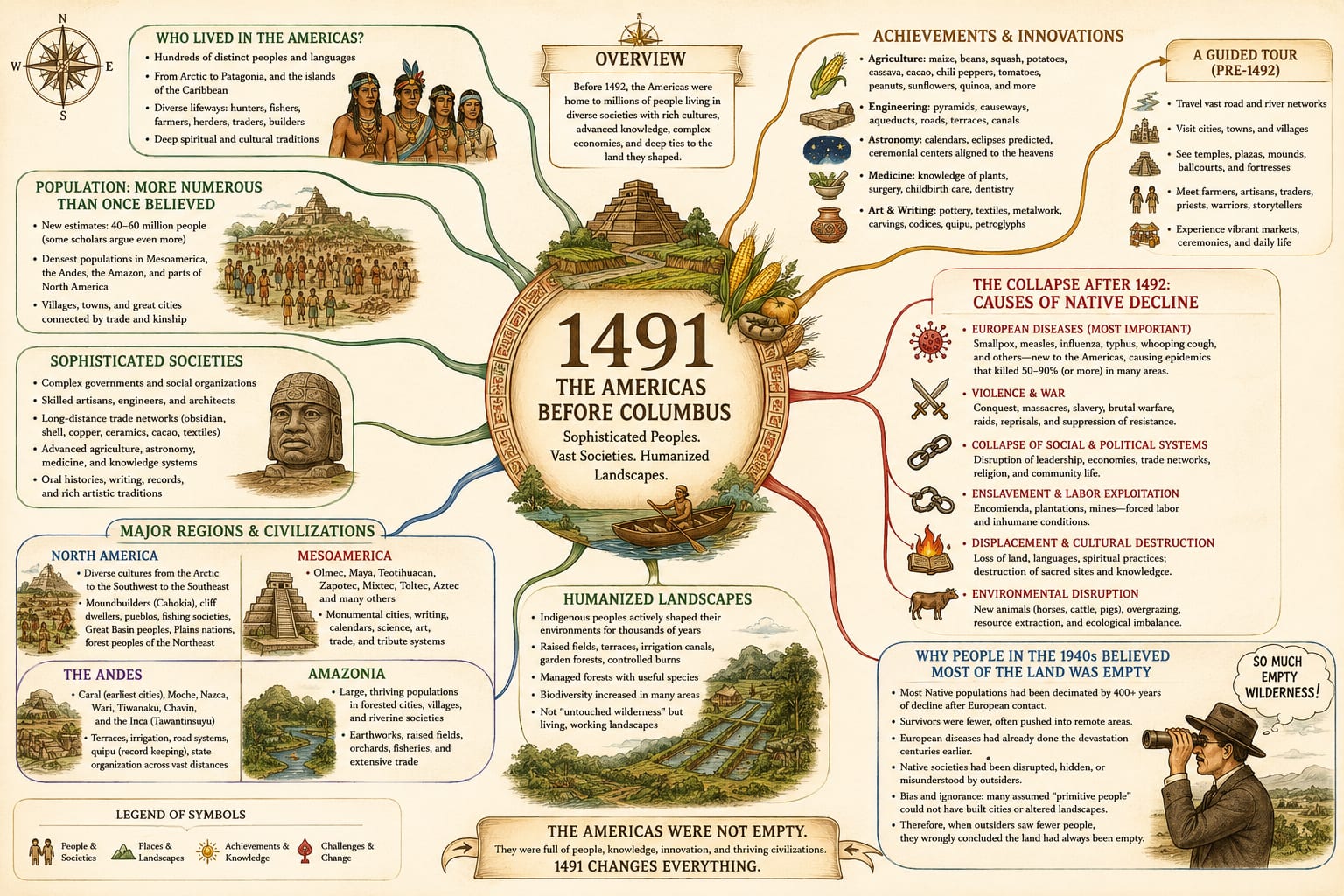
This chapter argues that the pre-Columbian Americas were not an untouched wilderness inhabited mostly by small, static, primitive bands. Mann uses the Beni region of Bolivia, the story of the Sirionó, and a hemisphere-wide survey of ancient American societies to challenge what he calls Holmberg’s Mistake: the assumption that Native Americans lived outside history until Europeans arrived.
The chapter fits the broader argument of 1491 by showing that before Columbus, the Americas were older, more populous, more technologically complex, more ecologically engineered, and more historically dynamic than conventional textbooks long suggested.
In the Beni
Chapter Objective for This Section
Mann begins with an aerial view of the Beni, a seasonally flooded plain in Bolivia, to introduce the chapter’s central claim: many landscapes that Europeans and modern observers interpreted as “natural” were actually shaped by Indigenous engineering.
Main Ideas
- The Beni is a vast, flat Bolivian province, roughly the size of Illinois and Indiana combined.
- For nearly half the year, rain and snowmelt flood the land; during the dry season, the area becomes almost desert-like.
- From the air, Mann sees:
- Circular forest islands
- Raised berms
- Mounds
- Causeways
- Canals
- Raised fields
- Archaeologist Clark Erickson argues that much of this landscape was constructed by a large, technologically sophisticated, populous society more than a thousand years ago.
- Anthropologist William Balée is more cautious but leans toward Erickson’s interpretation.
Challenge to the Old View
- Mann contrasts the older textbook picture of Native Americans with the newer scholarship.
- The older view taught that:
- Indians arrived about 13,000 years ago through the Bering Strait.
- They lived mostly in small, isolated groups.
- They had little lasting impact on the environment.
- The Americas were mostly wilderness in 1492.
- The newer scholarship argues almost the opposite:
- Indigenous peoples may have arrived earlier.
- They were often more numerous.
- They built complex societies.
- They transformed landscapes on a massive scale.
Ecological Implications
- The Beni complicates modern environmental assumptions.
- Much of the environmental movement has relied on what geographer William Denevan calls the “pristine myth”: the belief that the Americas before Columbus were nearly untouched wilderness.
- If Indigenous societies actively shaped ecosystems, then “restoring nature” becomes more complicated.
- In the Beni, Indigenous people may have:
- Built roads, dikes, reservoirs, mounds, canals, raised fields, and fish traps.
- Used large-scale burning to maintain savannas.
- Created or expanded fire-adapted ecosystems.
- This raises a practical question: if the Beni is treated as wilderness, would Indigenous inhabitants still be allowed to burn the grasslands as their ancestors did?
Holmberg’s Mistake
Chapter Objective for This Section
This section explains how an influential anthropologist misread the Sirionó as primitive survivors from humanity’s deep past, when they were actually the devastated remnants of a recently shattered society.
Main Ideas
- Mann, Erickson, Balée, and local Sirionó guides visit Ibibate, one of the tallest forested mounds in the Beni.
- Ibibate is filled with pottery fragments.
- Erickson argues that the ceramics suggest:
- Long-term habitation.
- A large population.
- Skilled labor.
- Organized settlement.
- Possibly feasting and ritual activity.
- The mound is not simply garbage; its scale suggests a structured society capable of massive landscape modification.
Allan Holmberg and the Sirionó
- Between 1940 and 1942, anthropologist Allan R. Holmberg lived among the Sirionó.
- His book, Nomads of the Longbow, became a classic account of South American Indigenous life.
- Holmberg described the Sirionó as among the most “culturally backward” peoples in the world.
- He claimed they had:
- No clothing.
- No domestic animals.
- No musical instruments.
- Little art.
- Little religion.
- Limited counting ability.
- No ability to make fire.
- Poor shelters.
- Holmberg interpreted them as people living in a timeless, primitive state.
Why Holmberg Was Wrong
- Mann emphasizes that Holmberg was not stupid or malicious; he was careful, compassionate, and physically courageous.
- His error was interpretive.
- Holmberg saw the Sirionó as ancient primitives, but they were actually survivors of recent catastrophe.
- In the 1920s, smallpox and influenza devastated the Sirionó population.
- Their population fell from at least 3,000, probably more, to fewer than 150 by Holmberg’s time.
- This was a loss of more than 95 percent in less than a generation.
- The group also suffered:
- Attacks from cattle ranchers.
- Military repression.
- Forced confinement.
- Servitude on ranches.
- The people Holmberg encountered were not untouched representatives of the Paleolithic past; they were refugees from disease, violence, and social collapse.
The Refugee Analogy
- Mann compares Holmberg’s mistake to finding survivors of a Nazi concentration camp and concluding that their barefoot, starving condition represented their normal ancient culture.
- The point is that anthropology can mistake post-catastrophe impoverishment for original simplicity.
The Earlier Beni Civilization
- Holmberg also failed to recognize that the Sirionó were moving through a landscape shaped by an earlier society.
- The Sirionó were probably not the builders of the Beni earthworks.
- Linguistic evidence suggests they were relative newcomers, possibly arriving from the north around the seventeenth century or earlier.
- The earlier builders may have been ancestors of Arawak-speaking peoples, such as the Mojo and Bauré.
- Beginning as much as 3,000 years ago, this earlier society created:
- Mounds for settlement and farming.
- Causeways and canals for transport.
- Fish weirs for food production.
- Managed savannas through burning.
- Erickson believes this society may have reached its height about 1,000 years ago.
- In his reconstruction, as many as one million people may have lived in eastern Bolivia.
Embedded Visual Evidence
- The chapter includes aerial photographs showing raised fields, causeways, and geometric earthworks.
- These images reinforce Mann’s point that landscapes now appearing rural, empty, or natural may preserve visible traces of large-scale Indigenous engineering.
“Empty of Mankind and Its Works”
Chapter Objective for This Section
This section shows that Holmberg’s mistake was not isolated. It represented a broader Western habit of treating Indigenous Americans as timeless, passive, ahistorical people rather than historical actors.
Main Ideas
- Mann argues that for nearly five centuries, Europeans and later Americans imagined Native peoples as living outside normal history.
- This mistake appeared in both negative and positive forms:
- The Indian as savage barbarian.
- The Indian as noble, innocent child of nature.
- Both stereotypes deny Native peoples agency.
- In both versions, Indigenous people are not treated as active makers of history, but as passive beings acted upon by Europeans, nature, or fate.
The Noble Savage Tradition
- Mann traces the “Noble Savage” idea to Bartolomé de Las Casas, the Spanish priest and former conquistador who denounced European cruelty in the Americas.
- Las Casas portrayed Indians as gentle, innocent people living in a kind of earthly paradise.
- This view was sympathetic, but still reduced Indigenous peoples to passive innocence.
- They were imagined as waiting for Christian instruction rather than actively building their own civilizations.
Environmental Romanticism
- Mann connects the Noble Savage idea to modern environmental imagery.
- The idea that Indians lived in perfect harmony with untouched nature became influential in environmental culture.
- Mann mentions the famous “crying Indian” anti-pollution campaign after the first Earth Day.
- Although the image cast Indians in a heroic role, it still implied that they did not significantly alter the natural world.
- Mann’s point: even sympathetic portrayals can repeat Holmberg’s Mistake if they deny Indigenous history and environmental agency.
Negative Versions of the Same Mistake
- Nineteenth- and twentieth-century historians often depicted Indians as backward, violent, lazy, or incapable of civilization.
- Mann cites examples including:
- George Bancroft, who portrayed pre-European North America as an “unproductive waste.”
- Alfred L. Kroeber, who argued that eastern Indians were trapped in endless warfare.
- Samuel Eliot Morison, who claimed Native peoples created no lasting monuments or institutions.
- Hugh Trevor-Roper, who treated non-European peoples mainly as images of humanity’s past.
- Textbooks repeated these assumptions.
- Some twentieth-century U.S. history textbooks claimed that Europeans created civilization where none existed.
Why the Old View Changed
- Mann explains that several developments undermined the old consensus:
- World War II showed that non-Western societies could change rapidly and dramatically.
- Decolonization challenged assumptions of European superiority.
- New academic disciplines transformed the study of the past.
- New technologies made older assumptions harder to sustain.
New Tools and Disciplines
- Mann lists many fields and methods that changed the evidence base:
- Demography
- Climatology
- Epidemiology
- Economics
- Botany
- Palynology, or pollen analysis
- Molecular biology
- Carbon-14 dating
- Ice-core sampling
- Satellite photography
- Soil analysis
- Genetic analysis
- Virtual 3-D reconstructions
- These methods made it increasingly implausible that the inhabitants of one-third of the earth’s surface had remained unchanged for thousands of years.
Revised Picture of Native America
- The emerging view is that the Americas were:
- More populous.
- More urbanized.
- More agriculturally developed.
- More ecologically transformed.
- More culturally diverse.
- Older in human occupation than previously believed.
- Most Native Americans did not live as nomadic bison hunters.
- The great majority lived south of the Río Grande.
- Many lived in cities, towns, farms, fishing communities, and engineered landscapes.
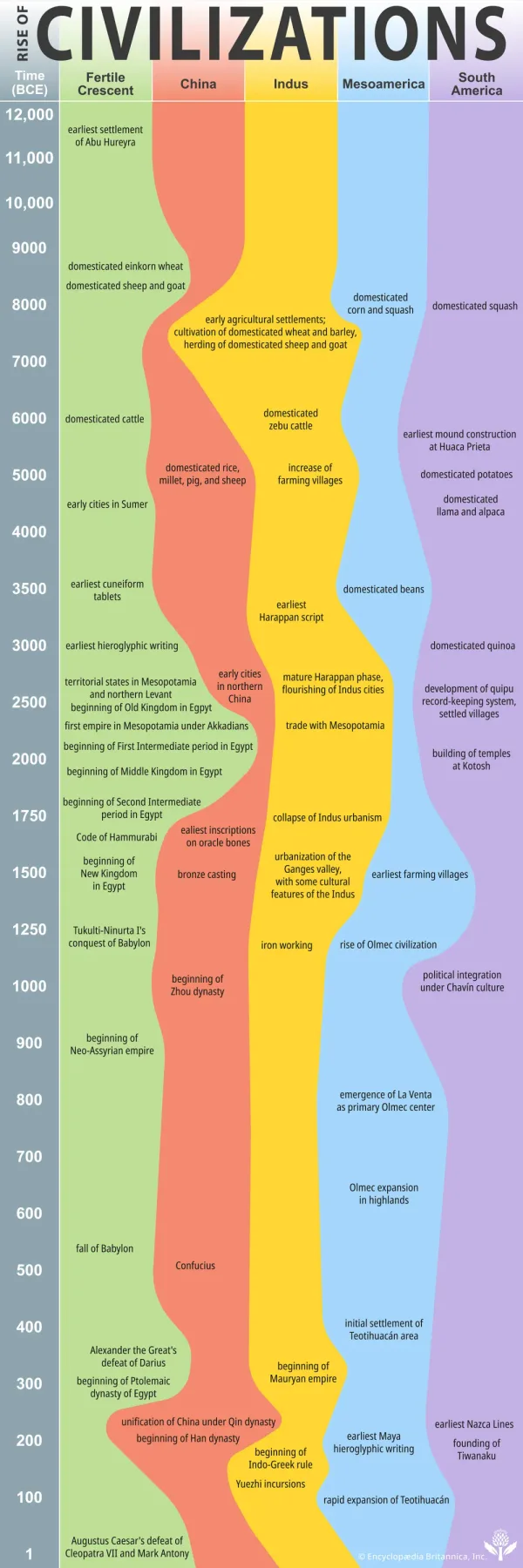
The Other Neolithic Revolutions
Chapter Objective for This Section
This section argues that Native Americans independently developed agriculture and complex societies without inheriting the inventions of the Old World Neolithic Revolution.
Main Ideas
- For much of the twentieth century, archaeologists believed the first Americans crossed the Bering land bridge about 13,000 years ago.
- This theory depended on:
- Lower Ice Age sea levels exposing a land bridge.
- An ice-free corridor through Canada.
- The rise of the Clovis culture shortly afterward.
- In 1997, this model was seriously challenged by evidence from southern Chile.
- Archaeologists accepted that people lived in southern Chile more than 12,000 years ago.
- Because southern Chile is so far from the Bering Strait, people likely arrived before the supposed ice-free corridor opened.
- This forced scholars to reconsider:
- Earlier migration dates.
- Coastal migration by boat.
- Multiple waves of migration.
- More complex settlement patterns.
Political and Moral Controversy
- Native activist and scholar Vine Deloria Jr. objected to migration theories that framed Indians as late-arriving interlopers.
- Deloria argued that such theories could be used to minimize Native claims to the land.
- Mann responds that, regardless of whether today’s Native Americans arrived in a first or later wave, the key issue is their cultural achievement.
- They left Eurasia before the Neolithic Revolution and therefore had to develop agriculture, cities, and complex societies independently.
The Neolithic Revolution
- The Neolithic Revolution refers to the invention of agriculture.
- In the Middle East, it began around 11,000 years ago.
- It eventually led to:
- Farming.
- The wheel.
- Metal tools.
- Writing.
- The rise of Sumer.
- Mann emphasizes that Old World civilizations inherited these earlier innovations.
- Native Americans did not.
- They had to invent their own agricultural systems and social complexity separately.
Independent American Agriculture
- Researchers have long known that an independent Neolithic Revolution occurred in Mesoamerica.
- Archaeological evidence suggests it may have begun roughly 10,000 years ago.
- Another independent agricultural center may have existed in the Andes or coastal Ecuador, where ancient cultivated squash seeds were discovered.
- These American Neolithic revolutions helped create societies such as those in the Beni.
Maize as an Extraordinary Achievement
- Mann highlights maize as one of the greatest Native American achievements.
- Unlike wheat, rice, millet, or barley, maize does not closely resemble an obvious wild ancestor.
- Its closest relative is teosinte, a mountain grass with tiny, unpromising ears.
- Creating maize from teosinte required an extraordinary process of domestication.
- Maize, together with squash, beans, and avocados, provided Mesoamerica with a balanced and highly nutritious diet.
Mesoamerican Civilization
- The Olmec were the first technologically complex culture in the hemisphere.
- Appearing around 1800 B.C. in southern Mexico, they built cities and temple mounds.
- They are famous for colossal stone heads.
- Later Mesoamerican societies developed:
- Multiple writing systems.
- Large trade networks.
- Astronomical knowledge.
- A 365-day calendar.
- Historical records on bark-paper books.
- Mathematics, including the concept of zero.
The Invention of Zero
- Mann presents zero as one of the great intellectual achievements of world history.
- The Maya recorded zero in a carving from 357 A.D.
- This may have occurred before or around the same broad period as the development of zero in India.
- Mann warns against simplistic ranking of civilizations.
- Mesoamericans developed zero and sophisticated astronomy, but did not use the wheel for transport.
- The point is not that one civilization was superior to another.
- The point is that Native societies developed impressive achievements on their own historical paths.
A Guided Tour
Chapter Objective for This Section
Mann concludes with an imagined aerial tour of the Americas around 1000 A.D. to show the diversity, scale, and complexity of pre-Columbian societies across the hemisphere.
Main Ideas
- Mann asks readers to imagine flying over the Americas in 1000 A.D.
- Fifty years ago, many historians would have imagined mostly wilderness, with only Mexico and Peru showing signs of civilization.
- The newer picture is much more complex.
The Beni
- The flight begins over the Beni.
- In 1000 A.D., the causeways, canals, mounds, and fields would have been active and maintained.
- The region was not empty wilderness but a human-made landscape.
Tiwanaku
- Moving west into the Andes, the flight reaches the state of Tiwanaku, centered near Lake Titicaca.
- Lake Titicaca’s relatively warm microclimate made high-altitude agriculture possible.
- Tiwanaku developed into a large religio-cultural and political center.
- It used ecological diversity to sustain exchange among:
- Coastal fishing zones.
- Mountain regions.
- High plains.
- Agricultural lands around the lake.
- The city had:
- Terraced pyramids.
- Monumental architecture.
- Stone breakwaters.
- Reed boats.
- Running water.
- Sewers.
- Painted walls.
- Population estimates are debated:
- Alan Kolata proposed as many as 115,000 in the city and 250,000 nearby.
- Other scholars think the city may have had closer to 20,000–30,000 inhabitants.
- Regardless of the exact number, Mann’s point is that Tiwanaku was a major urban achievement in an extreme environment.
Wari
- North and west of Tiwanaku was Wari, a rival Andean state.
- Wari was more centralized and militarized.
- It built fortresses and controlled a long stretch of the Andes.
- Its capital, also called Wari, may have housed around 70,000 people.
- The city contained:
- Temples.
- Courtyards.
- Royal tombs.
- Multi-story apartments.
- White-plastered buildings.
Climate Stress and Collapse
- Around 1000 A.D., both Wari and Tiwanaku were under severe pressure from climate instability.
- Evidence from ice cores, sediments, and tree rings suggests:
- Dust storms.
- Long droughts.
- Major floods.
- Some scholars connect these events to mega-Niño climate patterns.
- Mann is careful not to reduce history to climate.
- Climate may have intensified political and social stress, but it did not mechanically “cause” collapse.
- Tiwanaku fragmented.
- Wari fell and was later succeeded or absorbed by other states, including Chimor, before the rise of the Inka.
The Maya
- The flight then moves north toward Mesoamerica and the Maya world.
- Mann discusses Calakmul, later identified as Kaan, the Kingdom of the Snake.
- Once thought unknowable beneath forest, Calakmul was revealed to be a huge Maya polity with:
- Thousands of buildings.
- More than one hundred monuments.
- Reservoirs.
- Canals.
- Decipherment of Maya writing allowed scholars to reconstruct parts of its political history.
- The Maya world consisted of dozens of kingdoms and city-states with complex alliances and rivalries.
- By 1000 A.D., parts of the Maya heartland had entered a crisis or “Dark Age.”
- Some cities were abandoned.
- Some inscriptions became meaningless imitations of earlier writing.
- Drought may have contributed to the collapse, but Mann notes that the evidence is complicated:
- Some wetter southern areas were abandoned.
- Some drier northern areas survived or grew.
- This complicates simple ecological-collapse explanations.
Oaxaca, the Toltec, and Chichén Itzá
- In Oaxaca and Guerrero, the Ñudzahui, or Mixtec, were challenging and overwhelming the Zapotec.
- Farther north, the Toltec were expanding from central Mexico.
- Mann discusses the figure Topiltzin Quetzalcoatl, who may have been forced out of power around 987 A.D.
- According to one interpretation, he fled to the Yucatán and conquered or reshaped Chichén Itzá in Toltec style.
- Mann notes that scholars disagree about these events, but murals and reliefs at Chichén Itzá suggest violent Toltec-Maya conflict.
Cahokia and the Mississippian World
- Moving north into what is now the United States, Mann describes Cahokia, near modern St. Louis.
- Around 1000 A.D., Cahokia began constructing a massive earthen mound.
- The mound eventually covered about 15 acres and rose about 100 feet.
- Cahokia was the greatest population center north of the Río Grande.
- Its rulers claimed sacred authority, including power over agricultural fertility and weather.
- Mann suggests that environmental mismanagement may have undermined the city:
- Upstream forests were cut for firewood.
- Logs were floated downstream.
- Loss of ground cover increased flood risk.
- Flooding would have damaged the legitimacy of rulers who claimed control over weather and fertility.
The Great Plains and Northern Trade Networks
- Mann describes the Great Plains as less densely settled than Mesoamerica or the Andes.
- Plains peoples were hunters and gatherers, with simpler material cultures.
- But they were not isolated.
- North America was connected by long-distance trade networks.
- Examples include:
- Gulf of Mexico mother-of-pearl found in Manitoba.
- Lake Superior copper found in Louisiana.
- The continent was “busy” and connected even where cities were absent.
Amazonia
- Mann then imagines flying east from the Beni toward the Amazon.
- In what is now Acre, Brazil, researchers found circular and square earthworks after modern deforestation exposed them.
- These discoveries suggest higher population densities in Amazonian lowlands than previously believed.
- The lower Amazon may have been lined with dense village networks.
- Amazonian peoples practiced agroforestry, or tree-based farming.
- This was unlike European, African, or Asian agriculture.
- Mann also discusses:
- Marajó, a chiefdom near the mouth of the Amazon, possibly with around 100,000 people.
- Santarém, a major settlement area with extensive ceramics and possibly very large population capacity.
Final Argument
- Mann concludes that the new scholarship is filling one of the biggest blanks in world history: the history of the Western Hemisphere before 1492.
- The Americas were not empty, static, or primitive.
- They were:
- Populous.
- Diverse.
- Urbanized in many regions.
- Agriculturally innovative.
- Environmentally transformative.
- Politically dynamic.
- Intellectually sophisticated.
- Much of this world vanished after Columbus because of disease, conquest, and social collapse.
- The erasure was so severe that both conquerors and conquered often forgot the scale of what had existed before.
Key Concepts for “A View from Above”
Holmberg’s Mistake
- The mistaken belief that Indigenous peoples of the Americas lived in a timeless, primitive, unchanging state before European contact.
- Mann uses Allan Holmberg’s interpretation of the Sirionó as the central example.
- The broader mistake is treating post-conquest devastation as if it were pre-contact normality.
The Pristine Myth
- The belief that the Americas before Columbus were untouched wilderness.
- Mann argues that this myth has shaped environmental thinking, conservation policy, textbooks, and popular culture.
- The Beni and Amazonia challenge this view because they show evidence of long-term Indigenous ecological engineering.
Indigenous Agency
- Mann stresses that Native peoples were historical actors.
- They built cities, engineered landscapes, domesticated crops, created trade networks, fought wars, experienced political collapse, and transformed ecosystems.
- They were not passive figures waiting for Europeans to give their history meaning.
Anthropogenic Landscape
- A landscape shaped by human action.
- In the Beni, anthropogenic features include mounds, causeways, canals, raised fields, fish weirs, and managed savannas.
- Mann’s point is that some places that look “natural” may actually be old human artifacts.
Neolithic Revolution
- The invention of agriculture.
- Mann emphasizes that Native Americans developed their own Neolithic revolutions independently of Eurasia.
- This included the domestication of maize, squash, beans, potatoes, manioc, and other crops.
Independent Civilizational Development
- Native American civilizations did not simply lag behind Eurasia.
- They developed under different ecological conditions, with different crops, animals, technologies, and constraints.
- Their achievements must be understood on their own terms rather than judged by a European checklist.
Ecological Collapse and Historical Caution
- Mann discusses climate stress, drought, and ecological strain in Wari, Tiwanaku, the Maya world, and Cahokia.
- But he warns against simplistic explanations.
- Environmental stress matters, but political, religious, social, and economic factors also shape historical outcomes.
Historical Erasure
- Disease, conquest, forced labor, and social collapse destroyed much of pre-Columbian American civilization.
- The destruction was so extensive that later observers often mistook the ruins or survivors for evidence of original emptiness or primitiveness.
Questions for Reflection for “A View from Above”
- How does the Beni challenge the idea that “wilderness” means land untouched by human beings?
- Why is Holmberg’s interpretation of the Sirionó such a powerful example of how scholars can mistake catastrophe for primitiveness?
- How does Mann’s argument complicate both negative stereotypes of Native Americans and positive “Noble Savage” stereotypes?
- What does the independent domestication of maize suggest about Native American technological and intellectual achievement?
- If many pre-Columbian landscapes were human-shaped, how should modern conservationists think about restoration, wilderness, and Indigenous land management?
PART ONE: Numbers from Nowhere
Chapter 2: “Why Billington Survived”
Chapter Objective
This chapter explains why Plymouth survived despite the Pilgrims’ weakness, poor preparation, and near-starvation. Mann argues that Plymouth’s survival was not primarily the result of European superiority, divine providence, or Pilgrim self-sufficiency. It was the result of Native political strategy, especially Massasoit’s decision to ally with Plymouth against the Narragansett, and Tisquantum’s role as translator, agricultural instructor, survivor, and political operator.
The chapter fits the broader argument of 1491 by correcting a simplified colonial myth: Native peoples were not passive helpers or doomed background figures. They were historical actors making calculated decisions under catastrophic pressure.
The Friendly Indian
Chapter Objective for This Section
This section revises the familiar schoolbook story of “Squanto the friendly Indian.” Mann shows that the Plymouth-Wampanoag alliance was not a sentimental Thanksgiving tale but a tense geopolitical bargain made after epidemic collapse had weakened the Wampanoag.
Main Ideas
- On March 22, 1621, a Native delegation approached Plymouth to negotiate with the English settlers.
- The delegation included:
- Massasoit, sachem of the Wampanoag confederation.
- Samoset, sachem of an allied northern group.
- Tisquantum, also known as Squanto, who served as interpreter.
- Massasoit faced an acute political crisis:
- A devastating epidemic had recently killed much of the Wampanoag population.
- Entire villages had been emptied, including Patuxet, the site the Pilgrims occupied.
- The Wampanoag’s rivals, especially the Narragansett, had not been hit as badly.
- Massasoit feared the Narragansett would exploit Wampanoag weakness.
- Before the epidemic, coastal Native societies had managed Europeans carefully:
- They permitted trade.
- They restricted European time ashore.
- They controlled access between Europeans and inland Native groups.
- They acted as middlemen in trade.
- Massasoit now decided to reverse that policy:
- He would allow the English to remain permanently.
- In exchange, he wanted Plymouth as an ally against the Narragansett.
- The famous textbook version presents Tisquantum as a helpful Indian who taught the Pilgrims to plant corn.
- Mann argues that this is not exactly false, but it is misleading.
- Tisquantum did help Plymouth survive:
- He taught the colonists to plant maize.
- He advised them to fertilize maize hills with fish.
- His knowledge helped produce “a good increase of Indian corn.”
- But the standard story omits:
- Tisquantum’s kidnapping by English sailors.
- His enslavement in Spain.
- His years in England.
- His return to a destroyed homeland.
- His own political ambitions.
- The strategic motives behind Massasoit’s alliance.
- Mann’s larger point is that traditional accounts erase Native motives.
- Plymouth survived because Native leaders made choices, not because Europeans were automatically destined to prevail.
Coming of Age in the Dawnland
Chapter Objective for This Section
This section reconstructs the world Tisquantum came from before European colonization devastated it. Mann presents the Dawnland as a complex, settled, politically organized, and ecologically rich Native society rather than a primitive wilderness.
Main Ideas
- Tisquantum was not “an Indian” in the way later Europeans used the term.
- He would have identified primarily with Patuxet, his own coastal settlement.
- Patuxet was part of the Wampanoag confederation, which belonged to a broader network of alliances with the Nauset and Massachusett.
- The people of the region spoke variants of Massachusett, an Algonquian language.
- They called their homeland the Dawnland, meaning the place where the sun rose.
- Its inhabitants were the People of the First Light.
The Landscape of the Dawnland
- New England had once been covered by a massive ice sheet.
- By Tisquantum’s time, it had become an ecologically diverse region of:
- Maple forests.
- Tidal estuaries.
- Cranberry bogs.
- Shellfish beds.
- Sandbars and beaches.
- Fire-managed pine stands.
- Mann emphasizes that this was not untouched wilderness.
- Native people used controlled burning to maintain open forests and improve local ecology.
Settlement and Subsistence
- Dawnland communities varied by geography:
- Upland groups were more mobile and relied heavily on hunting and gathering.
- River valley communities lived in large, permanent villages surrounded by maize, bean, and squash fields.
- Coastal groups like Patuxet combined farming, fishing, shellfish gathering, and seasonal movement.
- These communities were permanent but flexible.
- Families might move short distances between summer and winter homes.
- Villages could spread across estuaries in loose, shifting patterns.
Patuxet
- Patuxet was located near Cape Cod Bay.
- It had:
- Productive maize fields.
- A protected harbor.
- Rich fisheries.
- Alewife runs.
- Nearby forests of oak, chestnut, and hickory.
- The area was productive, well-managed, and attractive to both Native people and later Europeans.
Wetu and Domestic Life
- Tisquantum likely grew up in a wetu, a domed house made from arched poles, mats, and bark.
- Mann stresses that the wetu was not crude:
- It was warm.
- It resisted rain well.
- It could be adjusted seasonally.
- English observers sometimes admired it as superior to English houses.
- The attached chapter includes an image of a wetu and explains its layered bark-and-pole design, emphasizing its practical elegance and insulation.
Family and Education
- Pilgrim observers often described Wampanoag families as close and loving.
- Native children were generally kept close until marriage, unlike English children, who were often sent to work around age seven.
- Childhood involved:
- Swimming.
- Exploring.
- Fieldwork.
- Games.
- Early archery practice.
- Education focused on forming character:
- Courage.
- Hardiness.
- Honesty.
- Self-control.
- Stoic endurance.
Tisquantum as Pniese
- Mann suggests Tisquantum may have been trained as a pniese, a counselor-bodyguard to a sachem.
- Pniese training involved severe discipline:
- Fasting.
- Enduring pain.
- Winter survival.
- Ritual vomiting through bitter drinks.
- This helps explain Tisquantum’s later resilience and political intelligence.
Political Organization
- Patuxet was governed by a sachem.
- Sachems:
- Upheld law.
- Negotiated treaties.
- Managed foreign relations.
- Collected tribute.
- Declared war.
- Provided for widows and orphans.
- Allocated disputed farmland.
- Sachems needed consent because people could leave and join another community.
- Political authority was real but not absolute.
Warfare and Diplomacy
- Conflict was frequent but usually limited.
- Warfare often involved:
- Raids.
- Revenge for insults.
- Status competition.
- Captive-taking.
- Occasional torture of captured men.
- Mann contrasts this with European warfare, which was often more destructive.
- By Tisquantum’s time, political tensions were increasing as population grew and boundaries became more formal.
Tourism and Treachery
Chapter Objective for This Section
This section explains how repeated European visits before Plymouth shaped Native expectations, trade practices, and hostility. Mann shows that New England Indians had long experience with Europeans before the Pilgrims arrived.
Main Ideas
- Europeans had been visiting the New England coast for more than a century before Plymouth.
- They came to:
- Fish.
- Trade.
- Explore.
- Kidnap Native people.
- Early European contact was not uniformly violent, but it was unstable and often treacherous.
Verrazzano and Early Contact
- In 1523, Giovanni da Verrazzano sailed along the coast under French commission.
- He described the coastline as densely populated.
- In Narragansett Bay, Native people confidently approached and traded with him.
- European visitors often described Native New Englanders as:
- Tall.
- Healthy.
- Strong.
- Better nourished than Europeans.
- Free of many European disease scars.
Native Views of Europeans
- Mann stresses that Europeans did not simply observe Indians; Indians also judged Europeans.
- Many Native groups saw Europeans as:
- Dirty.
- Physically weak.
- Unattractive.
- Sexually untrustworthy.
- Technologically useful but culturally unimpressive.
- Mann uses this reversal to undermine assumptions of automatic European superiority.
European Goods and Native Trade
- Native peoples valued some European goods:
- Steel tools.
- Copper kettles.
- Glass beads.
- Cloth.
- But they did not always value what Europeans expected them to value.
- Different groups had different trade priorities based on previous experience and local needs.
John White Images
- The chapter includes engravings based on John White’s late sixteenth-century watercolors.
- Mann notes that the images are not documentary by modern standards because the figures are posed in classical European style.
- Still, their purpose is clear: they depict Native people as healthy and their settlements as orderly, with substantial maize fields.
The Abenaki Contrast
- When Verrazzano reached Maine, the Abenaki were hostile and mocking.
- Mann interprets this as evidence that they had already had negative experiences with Europeans.
- The point: Native responses to Europeans were historically conditioned, not instinctive or irrational.
European Kidnapping and Violence
- By 1610, hundreds of European vessels operated around Newfoundland and New England.
- Some traders kidnapped Native people.
- In 1614, Captain John Smith visited Patuxet and left his lieutenant Thomas Hunt behind.
- Hunt lured Tisquantum and others aboard his ship and kidnapped them.
- He transported them to Europe to sell them.
- This act enraged the Wampanoag and Nauset and helped trigger hostility toward later Europeans.
Tisquantum’s Captivity and Return
- Tisquantum was taken to Spain, where Catholic priests intervened against his enslavement.
- He later reached England, learned English, and found passage back toward North America.
- He eventually returned to New England after about five years away.
- When he came home, Patuxet was gone.
The Place of the Skull
Chapter Objective for This Section
This section explains the demographic catastrophe that made Plymouth possible. Mann argues that the Pilgrims survived partly because they arrived after disease had cleared Native settlements and destabilized the regional balance of power.
Main Ideas
- Mann introduces his ancestor John Billington, a Mayflower passenger later hanged in Plymouth.
- Billington becomes Mann’s entry point into the question: how did the Pilgrims survive at all?
- The Pilgrims were poorly prepared:
- They arrived just before winter.
- They had no proper shelter.
- They lacked livestock.
- Their fishing gear was unsuitable.
- They had little knowledge of the land.
- They refused to hire John Smith as a guide.
- Half of the original 102 Mayflower passengers died during the first winter.
Survival Through Native Stores
- Governor William Bradford recorded that the Pilgrims survived partly by taking food from deserted Native houses and graves.
- They found and stole buried maize from abandoned settlements.
- To the Pilgrims, this was interpreted as divine providence.
- Mann frames it instead as survival made possible by earlier Native catastrophe.
English Colonial Weakness
- Mann argues that English colonial ventures were often badly planned.
- Unlike Spanish and French expeditions, English ventures were frequently funded by speculative investors seeking profit.
- Colonists often lacked:
- Agricultural skill.
- Regional knowledge.
- Adequate supplies.
- Practical survival preparation.
- Jamestown and Plymouth survived largely because Native societies fed, traded with, or tolerated them.
The Epidemic
- From about 1616 to 1619, a catastrophic epidemic swept coastal New England.
- Mann reports that it may have killed as much as 90 percent of the Native population in some areas.
- The disease may have been viral hepatitis, though the exact cause remains uncertain.
- The epidemic left:
- Empty villages.
- Untended fields.
- Houses filled with the dead.
- Skeletons scattered across former settlements.
- Thomas Morton described the land as a new Golgotha, or “Place of the Skull.”
Spiritual Interpretation
- Both Native people and Pilgrims interpreted disease through religious frameworks.
- Many Wampanoag concluded that their spiritual powers had turned against them.
- Pilgrims interpreted the epidemic as God clearing the land for English settlement.
- Mann emphasizes that this theological interpretation masked the political and demographic reality: epidemic disease had radically altered the balance of power.
Political Consequences
- Before the epidemic, Massasoit ruled a substantial community and influenced a large confederation.
- After the epidemic:
- His own community was reduced drastically.
- The Wampanoag confederation was weakened.
- The Narragansett remained comparatively strong.
- This crisis pushed Massasoit toward alliance with Plymouth.
Machinations
Chapter Objective for This Section
This section presents Tisquantum not as a simple helper, but as a politically ambitious survivor trying to use Plymouth to restore his own position and possibly replace Massasoit.
Main Ideas
- Tisquantum made himself indispensable to the Pilgrims.
- He served as:
- Translator.
- Agricultural adviser.
- Diplomatic intermediary.
- Guide.
- The Pilgrims depended on him so heavily that they rescued him when hostile Indians abducted him.
Tisquantum’s Motives
- Mann argues that Tisquantum’s motives were complex.
- He was living in the ruins of his childhood home.
- Returning to Massasoit likely meant renewed captivity.
- He seems to have wanted to:
- Gather the surviving Patuxet people.
- Rebuild Patuxet near Plymouth.
- Use English support to elevate himself.
- Undermine Massasoit’s authority.
- Make the new Patuxet central within the Wampanoag confederation.
Hobamok as Watchman
- Massasoit distrusted Tisquantum.
- He sent Hobamok, one of his pniese, to Plymouth to monitor him.
- Hobamok also adopted a spiritually charged name; in Wampanoag cosmology, Hobamok was associated with evil or dangerous power.
- This detail reinforces Mann’s point that Native actors were using names, symbols, and diplomacy strategically.
Massasoit’s Strategy
- The Pilgrims assumed Massasoit wanted their guns.
- Mann argues that Massasoit’s reasoning was subtler.
- European guns were useful, but seventeenth-century firearms were not automatically superior to Native bows:
- Many colonists were poor shots.
- Guns were slow and unreliable.
- Native bows could be powerful and accurate.
- Massasoit likely wanted Plymouth as a political deterrent.
- If the Narragansett attacked the Wampanoag, they risked disrupting their own trade relationships with Europeans.
- Massasoit was trying to incorporate Plymouth into Native diplomatic politics.
Tisquantum’s Plot
- Tisquantum tried to manipulate both sides.
- In 1622, while away with a delegation, he apparently arranged for a false alarm claiming that the Narragansett and Massasoit were preparing to attack Plymouth.
- His probable aim was to provoke the Pilgrims into attacking Massasoit.
- The plan failed because:
- Bradford recalled Tisquantum with a cannon signal.
- Hobamok denied the claim.
- Hobamok’s wife went to Massasoit and found all quiet.
- Massasoit was furious and demanded Tisquantum’s execution.
- Bradford refused because Tisquantum was too valuable to Plymouth.
Tisquantum’s Death
- Massasoit cut off contact with Plymouth after Bradford refused to surrender Tisquantum.
- Plymouth became vulnerable:
- Trade stopped.
- Drought damaged crops.
- Defensive anxiety increased.
- Tisquantum became trapped, unable to leave Plymouth without protection.
- He later became sick while traveling with Bradford and died within days.
- His political hopes collapsed with him.
Long-Term Outcome
- Massasoit’s alliance with Plymouth lasted for more than fifty years.
- In the short term, it helped protect the Wampanoag from the Narragansett.
- In the long term, it enabled the survival and expansion of English settlement.
- Tens of thousands of Europeans arrived in Massachusetts in the following decade.
- Later epidemics, especially smallpox in 1633, devastated Native groups that had survived the earlier epidemic.
- By 1675, Massasoit’s son launched what became King Philip’s War, a brutal conflict across New England.
- Europeans ultimately won, partly because:
- They had become more numerous.
- Disease had repeatedly reduced Native populations.
- Native groups often did not use the same village-massacre tactics as Europeans.
Key Concepts for “Why Billington Survived”
Native Agency
- The chapter’s central analytical concept.
- Mann argues that Native peoples were not passive helpers, victims, or background figures.
- Massasoit, Tisquantum, Samoset, Hobamok, the Narragansett, and other groups made strategic decisions under changing conditions.
Holmberg’s Mistake Applied to Early New England
- The error here is assuming that Native defeat was inevitable and that Native motives did not matter.
- Older narratives credited Pilgrim survival to God, guns, courage, or European superiority.
- Mann argues that Plymouth survived because Native political actors made decisions that temporarily served their own interests.
Sachemship
- A form of Native political leadership.
- Sachems governed, negotiated, allocated land, made war, and managed alliances.
- Their power depended partly on consent because people could leave and align with another leader.
Confederation Politics
- The Wampanoag, Narragansett, Nauset, Massachusett, Abenaki, and other groups existed in shifting networks of alliance and rivalry.
- Plymouth entered an already existing Native diplomatic system.
- Europeans were initially one more factor in Native politics, not yet the dominant force.
The Middleman Position
- Coastal Native groups controlled trade between Europeans and inland peoples.
- This gave them leverage.
- Massasoit’s alliance with Plymouth must be understood in the context of trade access, military deterrence, and regional rivalry.
Epidemic as Historical Turning Point
- The epidemic of 1616–1619 transformed New England before large-scale English settlement.
- It emptied villages, destroyed communities, weakened confederations, and altered the balance of power.
- Plymouth occupied Patuxet because disease had already destroyed it.
Myth of the Friendly Indian
- The familiar story of Squanto helping the Pilgrims is incomplete.
- Tisquantum was not merely benevolent; he was a traumatized survivor with his own political objectives.
- His help to Plymouth was real, but it was embedded in strategy, coercion, captivity, and ambition.
Technological Misreading
- Mann challenges the assumption that European technology automatically determined the outcome.
- Guns mattered, but early firearms were not simply superior to Native weapons.
- Native canoes, maize agriculture, moccasins, and ecological knowledge were often superior to European alternatives in local conditions.
Colonial Dependence
- Plymouth and other English colonies initially survived through dependence on Native resources, knowledge, food, and political decisions.
- The settlers were not self-sufficient founders entering an empty wilderness.
- They were vulnerable outsiders inserted into a Native world already transformed by disease.
Questions for Reflection for “Why Billington Survived”
- How does Mann’s account change the traditional Thanksgiving story of Squanto, the Pilgrims, and Native assistance?
- Why did Massasoit decide to ally with Plymouth, and why did that decision make sense in the short term but prove disastrous in the long term?
- In what ways does Tisquantum’s story reveal the difference between being a “helper” in colonial mythology and being a political actor in real history?
- How did epidemic disease change the balance of power in New England before English settlement became dominant?
- What does this chapter suggest about the danger of explaining colonial history mainly through European motives, European technology, or European religion?
Chapter 3: “In the Land of Four Quarters”
Chapter Objective
This chapter explains how the Inka Empire, or Tawantinsuyu, became one of the most powerful and sophisticated empires in the world, and why it fell so rapidly to Francisco Pizarro’s tiny Spanish force. Mann’s central argument is that the conquest of the Inka cannot be explained simply by European technological superiority, especially steel weapons, guns, and horses. Those mattered, but the deeper cause was the devastating impact of epidemic disease, especially smallpox, which reached the Andes before most Andeans had ever seen a European.
The chapter fits the broader argument of 1491 by showing that pre-Columbian America was not sparsely populated or culturally simple. It was home to large, complex, highly organized societies whose destruction was so severe that later Europeans often mistook the post-epidemic ruins for evidence of pre-contact weakness.
“Like a Club Right Between the Eyes”
Chapter Objective for This Section
Mann opens with anthropologist Henry F. Dobyns, whose archival research into colonial death records led him to rethink the scale of Native American population collapse after European contact.
Main Ideas
- In the early 1960s, Henry Dobyns worked on a rural-aid project in Peru under Allan R. Holmberg.
- While researching colonial records in Lima and elsewhere, Dobyns found a repeated demographic pattern:
- Many more burials than baptisms.
- Extremely high death rates after Spanish arrival.
- Epidemics appearing again and again in Native communities.
- His earlier work among the Pima Indians in Arizona and northern Mexico had shown the same pattern.
- Dobyns realized that European arrival was followed by massive Native mortality from diseases introduced from the Old World.
- This discovery struck him “like a club right between the eyes.”
- At first, his research focused on specific local populations, but he eventually concluded that the pattern applied across the Americas.
The Larger Historical Problem
- Mann notes that Peru was one of the world’s great centers of civilization, comparable in historical importance to the Fertile Crescent.
- Yet Andean history had been neglected by Western scholars.
- Reasons for this neglect included:
- Spanish destruction of Inka culture.
- Inka suppression or distortion of earlier Andean cultures.
- South America’s relative marginality in European colonial scholarship.
- Cold War debates over whether the Inka were a kind of proto-socialist society.
- Dobyns’s work helped force scholars to reconsider not only Inka history but the history of the entire pre-Columbian hemisphere.
The Biocultural Template
- Mann argues that the Inka and the Wampanoag were very different societies, but both were defeated within a similar biocultural pattern:
- Europeans arrived.
- Epidemic disease spread rapidly.
- Native populations collapsed.
- Political systems destabilized.
- Europeans entered societies already weakened by demographic catastrophe.
- This template helped explain why so many Native societies, large and small, eventually succumbed to European expansion.
Tawantinsuyu
Chapter Objective for This Section
This section describes the scale, organization, geography, and ideology of the Inka Empire before Spanish conquest. Mann presents Tawantinsuyu as one of the most impressive imperial systems in the world.
Main Ideas
- In 1491, the Inka ruled the largest empire on earth.
- Tawantinsuyu was larger than:
- Ming China.
- Ivan the Great’s Russia.
- Songhay.
- Great Zimbabwe.
- The Ottoman Empire.
- The Triple Alliance, commonly called the Aztec Empire.
- Any European state.
- The empire stretched across thirty-two degrees of latitude, comparable to a single state ruling from St. Petersburg to Cairo.
- It included radically different environments:
- Amazonian rainforest.
- Peruvian coastal deserts.
- High Andean mountains.
- Lake Titicaca region.
- Pacific valleys.
- Mann emphasizes the Inka’s environmental adaptability as one of their greatest imperial strengths.
The Inka Imperial Project
- The Inka sought to unify many different ethnic groups, languages, economies, and religions under one imperial system.
- Their goal was not just political conquest but cultural and administrative integration.
- They used:
- Forced population transfers.
- State labor obligations.
- A vast road network.
- Quechua/Runa Sumi as an administrative language.
- State farms and construction projects.
- Administrative record-keeping through khipu, or knotted-string records.
- Mann compares the khipu system to a kind of binary code because it stored information through knots, cords, colors, and positions.
The Map of Tawantinsuyu
- The chapter includes a map titled “Tawantinsuyu: The Land of the Four Quarters, 1527 A.D.”
- The map shows:
- The Inka highway network.
- The four imperial quarters, or suyus.
- Major locations such as Qosqo/Cusco, Cajamarca, Tomebamba, and Lake Titicaca.
- The visual reinforces Mann’s point that Tawantinsuyu was not a loose tribal zone but a geographically vast, infrastructurally integrated empire.
Highland Peru and Environmental Complexity
- Mann emphasizes the extreme conditions of highland Peru.
- Millions of people lived at elevations of 10,000 to 14,000 feet, where:
- Many crops cannot grow.
- Weather is harsh.
- Earthquakes and landslides are common.
- Slopes are extraordinarily steep.
- Yet the Andes repeatedly produced sophisticated civilizations.
- Peru’s geography placed many ecological zones close together.
- A short journey from mountain to coast passed through many environmental types.
Vertical Archipelagoes
- Mann explains John Murra’s concept of vertical archipelagoes.
- Andean communities survived by establishing colonies at different elevations.
- These communities exchanged goods across ecological zones:
- Fish and shellfish from the coast.
- Beans, squash, and cotton from coastal valleys.
- Maize, potatoes, and quinoa from foothills.
- Llamas and alpacas from the highlands.
- This system allowed Andean peoples to:
- Diversify food sources.
- Reduce ecological risk.
- Maintain access to multiple resources.
- Build complex societies in difficult terrain.
Earlier Andean Hegemonies
- The Inka were not the first Andean civilization.
- Mann places them within a longer tradition that included:
- Chavín, which dominated parts of Peru from about 700 B.C. to the beginning of the Christian era.
- Wari, a technologically sophisticated empire.
- Tiwanaku, centered around Lake Titicaca.
- After Wari and Tiwanaku collapsed, the Andes fragmented politically for centuries.
- The Inka emerged from this fragmented world.
The Rise of the Inka
- The Inka were originally a minor group in the region around Qosqo/Cusco.
- Oral traditions claimed they migrated from the Lake Titicaca region.
- Archaeology broadly supports the idea that they arrived in Qosqo from elsewhere around 1200 A.D.
- According to Juan de Betanzos, when the Inka arrived, the region already contained more than two hundred small groups.
- Qosqo itself was initially only a small village of humble straw houses.
Pachakuti and the Chanka Crisis
- The turning point came when the Chanka attacked the Inka.
- The Inka ruler Wiraqocha Inka fled with most of his sons.
- One younger son, Inka Cusi Yupanki, stayed and fought.
- According to legend, even stones rose up to help him.
- After victory, he clashed with his father over honor and succession.
- He eventually took power, renamed himself Pachakuti, meaning “World-shaker,” and launched the empire’s great expansion.
- Mann cautions that these stories come from post-conquest chronicles and must be used carefully, but he treats them as broadly useful when compared across sources.
Conquest by Reciprocity
- Mann uses the example of Chincha to show how the Inka conquered indirectly.
- Pachakuti’s general Qhapaq Yupanki entered Chincha with troops but claimed he wanted nothing from the local elites.
- Instead, he gave them gifts and asked only for symbolic cooperation.
- Later visits escalated demands:
- Building roads.
- Constructing palaces.
- Supplying labor.
- Providing goods.
- Integrating with imperial administration.
- Over time, Chincha became trapped inside the Inka imperial system.
- Mann’s point: Inka conquest often began as generosity and reciprocity but gradually became domination.
Hegemonic Empire
- Mann uses Edward Luttwak’s distinction between territorial empires and hegemonic empires.
- A territorial empire directly occupies conquered lands and removes local rulers.
- A hegemonic empire leaves local rulers in place but turns them into vassals.
- Native American empires, including the Inka, tended toward the hegemonic model.
- Because the Inka lacked horses, they could not easily move armies fast enough to occupy every region directly.
- They often co-opted local elites rather than replacing them.
Qosqo as Imperial and Cosmic Center
- Pachakuti rebuilt Qosqo as the imperial capital.
- The central plaza, Awkaypata, was covered with white sand from the Pacific and surrounded by monumental buildings.
- Inka masonry amazed the Spanish because stones were fitted so precisely that a pin could not be inserted between them.
- Gold plates on the buildings reflected the alpine sun, turning the plaza into a theatrical space of imperial light.
The Four Quarters
- From Awkaypata radiated four roads that divided the empire into four quarters.
- These quarters gave the empire its name: Tawantinsuyu, the Land of the Four Quarters.
- Mann connects this political geography to Inka cosmology:
- The Milky Way was understood as a celestial river.
- Its seasonal positions divided the heavens into four parts.
- Qosqo became the earthly axis of cosmic order.
Wak’a and Zeq’e
- Around Qosqo were more than four hundred wak’a, or sacred places.
- These included:
- Springs.
- Tombs.
- Caves.
- Stones.
- Fields.
- Shrines.
- These sacred places were linked by zeq’e, spiritually powerful lines radiating from the capital.
- The chapter includes a visual showing carved stones around Qosqo, reinforcing the idea that the landscape itself was religiously organized.
- Mann emphasizes that the Inka capital was simultaneously:
- Political center.
- Administrative center.
- Ritual center.
- Cosmological center.
State Labor and Nonmarket Economy
- Pachakuti expanded older Andean communal labor obligations into an imperial labor system.
- All land and property officially belonged to the state or the Inka.
- Peasants owed periodic labor service as:
- Farmers.
- Herders.
- Weavers.
- Masons.
- Artisans.
- Miners.
- Soldiers.
- The state fed, clothed, and housed workers while they performed service.
- The empire functioned without money and without markets.
- Mann calls this system a kind of vertical socialism.
- It created inefficiencies, but mostly surpluses rather than shortages.
- Spanish invaders found warehouses overflowing with cloth and supplies.
- Mann notes that Tawantinsuyu seems to have largely eradicated hunger, an achievement few empires managed.
Forced Resettlement
- The Inka moved populations on a massive scale.
- Newly conquered areas received settlers from distant regions.
- These settlers kept their own clothing and customs but had to communicate using the Inka language.
- This policy served two goals:
- In the short term, it created tensions the Inka could manipulate.
- In the long term, it could have produced a more culturally unified empire.
- Mann compares the scale of Inka resettlement to later population transfers under Stalin and Mao, while noting that the Inka’s purpose was imperial consolidation.
The Gilded Litter of the Inka
Chapter Objective for This Section
This section narrates the succession crises, civil war, and confrontation with Pizarro that preceded the fall of the Inka Empire. Mann shows that the Spanish arrived when Tawantinsuyu had already been destabilized by dynastic conflict and epidemic disease.
Main Ideas
- Mann poses the central question: How did Pizarro conquer such a powerful empire with only 168 men and 62 horses?
- The traditional answer emphasizes:
- Steel weapons.
- Armor.
- Guns.
- Cannons.
- Horses.
- Mann argues that this answer is incomplete.
Thupa Inka
- After Pachakuti died, his son Thupa Inka became ruler.
- Thupa Inka expanded the empire dramatically, pushing into Ecuador and Chile.
- He is compared to conquerors such as Alexander the Great and Genghis Khan in terms of territory conquered.
- The Inka ruler was treated as a divine monarch:
- He traveled in a golden litter.
- People showed extreme reverence.
- Objects he touched were preserved or ritually burned.
- His saliva was treated as sacred.
- Thupa Inka also began the practice of marrying his sister to preserve royal purity.
Wayna Qhapaq
- Thupa Inka’s death produced a succession conflict.
- His son Wayna Qhapaq eventually became ruler.
- Wayna Qhapaq focused more on consolidation than conquest.
- He organized public works and continued strengthening the imperial system.
- Mann notes that some public works had political purposes more than practical ones: they kept laborers occupied and reduced the possibility of rebellion.
- Wayna Qhapaq later moved north toward Ecuador, where he spent years in the warmer climate.
Felipe Guamán Poma de Ayala Visual Source
- The chapter includes images from Felipe Guamán Poma de Ayala, the Inka writer whose illustrated manuscript described Inka society for the Spanish king.
- The portraits are not literal from-life images, but Mann treats them as important evidence for how Inka rulers were remembered by an Indigenous chronicler.
Crisis in Ecuador
- Wayna Qhapaq’s campaigns in the northern forests were difficult.
- The peoples of the equatorial forests resisted fiercely and did not belong to the Andean cultural system.
- Atawallpa, one of Wayna Qhapaq’s sons, was humiliated in battle and rebuked by his father.
- The Inka eventually subdued the region after prolonged fighting.
Death of Wayna Qhapaq
- In 1525, Wayna Qhapaq suddenly became sick and died.
- His designated heir, Ninan K’uychi, also died of the same illness.
- This created a succession crisis.
- The court chose another son, Washkar Inka, who remained in Qosqo.
- Atawallpa stayed in Ecuador with much of the army.
Civil War Between Washkar and Atawallpa
- Relations between Washkar and Atawallpa deteriorated into civil war.
- Washkar had:
- The capital.
- The machinery of state.
- The more legitimate claim.
- Atawallpa had:
- The stronger army.
- The best generals.
- The loyalty of northern troops.
- The war lasted more than three years and was extremely brutal.
- Atawallpa was initially captured, escaped, regrouped, and eventually defeated Washkar’s forces.
- Washkar was captured in 1532.
- Atawallpa’s generals executed Washkar’s wives, children, and relatives in front of him.
- At this moment, Atawallpa learned that strange foreigners had landed on the coast.
Cajamarca
- Atawallpa decided to wait for the foreigners.
- Pizarro persuaded him to enter the square at Cajamarca.
- Atawallpa arrived in a gilded litter with thousands of attendants and troops, most carrying ceremonial rather than battle weapons.
- Pizarro hid his men, horses, and cannons around the square.
- A Spanish priest presented Atawallpa with a Christian breviary.
- Atawallpa discarded it, which the Spanish used as a pretext for attack.
- The Spanish charged with horses, armor, cannons, and steel weapons.
- The Inka forces panicked.
- Many were trampled while trying to flee.
- Spanish soldiers killed thousands and captured Atawallpa.
- The Spanish suffered no casualties.
Atawallpa’s Ransom and Death
- Atawallpa saw that gold and silver obsessed the Spanish.
- He offered to fill a large room with gold and two more with silver in exchange for freedom.
- Pizarro accepted.
- Atawallpa ordered treasures stripped from Qosqo and sent to Cajamarca.
- He also ordered Washkar and other rivals killed, hoping to secure his own rule after release.
- Once the ransom was collected, the Spanish melted the precious objects into ingots.
- They then executed Atawallpa instead of releasing him.
- Pizarro marched to Qosqo.
Mann’s Immediate Conclusion
- The Spanish victory at Cajamarca was extraordinary:
- 168 men defeated a vastly larger force.
- They captured the ruler.
- They seized a huge ransom.
- They struck a devastating blow against the greatest empire in the world.
- But Mann warns that the standard conquest story leaves out the most important cause: epidemic disease.
Virgin Soil
Chapter Objective for This Section
This section gives Mann’s central explanation for the fall of the Inka: smallpox had already shattered Tawantinsuyu before Pizarro’s arrival. The Spanish conquest was not a simple victory of European arms over Native weakness; it was a conquest of an empire already damaged by epidemic mortality, succession crisis, and civil war.
Main Ideas
- Mann begins by admitting that his previous narration of Pizarro’s conquest followed the older standard account.
- That account emphasized:
- Steel.
- Horses.
- Guns.
- Armor.
- Inka lack of the wheel, arch, and steel.
- Mann then argues that this technological explanation is misleading.
Inka Metallurgy Was Different, Not Primitive
- The Inka did not lack metallurgical sophistication.
- Their metallurgy had different goals from European metallurgy.
- Europeans optimized metal for:
- Hardness.
- Sharpness.
- Strength.
- Tools and weapons.
- Andean metalworkers optimized metal for:
- Plasticity.
- Malleability.
- Toughness.
- Display.
- Status.
- Ritual power.
- Inka gold and silver objects were technically refined.
- They created strong, glittering metal sheets through complex alloying and surface treatment.
- Mann’s point: the absence of steel weapons does not mean the absence of technical sophistication.
Fiber Technology and Tension
- Andean engineering often relied on fiber rather than metal.
- Mann contrasts:
- European reliance on compression, such as arches.
- Andean reliance on tension, such as textiles, rope, suspension bridges, and woven structures.
- Andean textiles were extraordinarily precise.
- Elite garments could have very high thread counts.
- Inka soldiers wore quilted cloth armor that was light and effective.
- Spanish conquistadors later abandoned much of their steel armor in favor of Inka-style quilted armor.
Inka Weapons
- The Inka used:
- Bows.
- Javelins.
- Maces.
- Clubs.
- Slings.
- Bolas.
- Slings could be extremely powerful.
- Mann describes sling stones capable of killing horses or breaking weapons.
- The Inka also used fire projectiles:
- Stones heated in fires.
- Wrapped in pitch-soaked cotton.
- Hurled by sling so they ignited in the air.
- During the 1536 counterattack on Qosqo, Inka forces used these weapons to burn much of Spanish-occupied Qosqo.
Horses Mattered, But Were Not Inherently Unbeatable
- Horses were more important than steel in Pizarro’s success.
- They shocked Andean soldiers because no comparable animal existed in the Andes.
- Mounted troops moved faster than Inka military systems expected.
- However, Mann argues that horses were not automatically invincible.
- Inka roads, built for llamas, were often bad for horses:
- They climbed steep slopes directly.
- They included long stairways.
- They forced Spaniards to dismount.
- On these roads, Spanish cavalry became vulnerable.
- Inka forces later learned to roll boulders and use bolas against horses.
- Mann’s point: the Inka could adapt militarily, but they did not have enough time before the Spanish exploited the empire’s crisis.
The Real Decisive Factor: Smallpox
- Dobyns found that Wayna Qhapaq died during a smallpox epidemic around 1524 or 1525.
- The epidemic also killed:
- His designated heir.
- His brother.
- His uncle.
- His sister-wife.
- Major generals.
- Much of the officer corps.
- The regents left in Qosqo.
- This destroyed the imperial succession and helped trigger the civil war between Washkar and Atawallpa.
- Mann emphasizes that Tawantinsuyu’s roads and population movements made it ideal for rapid epidemic spread.
- Smallpox spread through the empire before Pizarro reached it.
- Symptoms included:
- High fever.
- Vomiting.
- Severe pain.
- Oozing blisters.
- Dobyns estimated that the first epidemic may have killed as much as half the population of Tawantinsuyu in about three years.
Virgin Soil Epidemics
- Mann explains the epidemiological term virgin soil.
- A virgin-soil population is one with no prior exposure or immunity to a disease.
- Smallpox evolved in the Old World, likely from animal diseases associated with domesticated animals.
- Because the Western Hemisphere lacked cows, horses, and camels before European contact, smallpox did not evolve there.
- Native Americans had no inherited or acquired immunity.
- Europeans, by contrast, had often encountered smallpox in childhood and many adults were immune.
- This produced radically unequal disease outcomes.
Smallpox Before Europeans
- Dobyns’s key insight was that smallpox reached many Native communities before Europeans themselves did.
- The likely route:
- Smallpox appeared in Hispaniola in 1518.
- It spread to Puerto Rico and Cuba.
- It reached Mexico during the conquest of the Mexica/Aztec Empire.
- It moved through Central America and Panama.
- It crossed into the Andean world.
- This means many Native societies had already been devastated before direct European invasion.
- Later European explorers often encountered depopulated landscapes and assumed they had always been sparsely populated.
Population Estimates and the Dobyns Thesis
- Dobyns argued that colonial population estimates were usually too low because they were made after epidemic collapse.
- Many estimates captured population nadirs, not pre-contact population levels.
- From known before-and-after cases, Dobyns estimated that about 95 percent of the Native population of the Americas died in the first 130 years after contact.
- To estimate pre-Columbian populations, he argued, scholars had to multiply early colonial counts by twenty or more.
- This produced very high estimates.
- According to Mann, if Dobyns was right, the Americas may have contained more people than Europe when Columbus arrived.
- Dobyns’s numbers implied that epidemic disease killed 80 to 100 million Native Americans by the first third of the seventeenth century, or roughly one-fifth of the world’s population.
The Scholarly Controversy
- Dobyns’s work provoked intense debate.
- Some scholars thought his estimates were too high.
- David Henige, author of Numbers from Nowhere, argued that Dobyns implied a precision that the evidence could not support.
- Henige accepted that depopulation occurred but resisted exact claims such as 95 percent mortality.
- Native scholars and activists responded that low estimates could minimize the scale of Native loss and make the Americas seem nearly empty before European occupation.
- Mann presents the dispute as both scholarly and political:
- High numbers imply a massive demographic catastrophe.
- Low numbers can support the idea that Europeans entered underpopulated land.
- The controversy remains unresolved, but Mann’s point is that the stakes are enormous.
Key Concepts for “In the Land of Four Quarters”
Tawantinsuyu
- The Inka name for their empire, meaning Land of the Four Quarters.
- It was organized around four imperial regions radiating from Qosqo.
- Mann presents it as one of the largest, most sophisticated, and most administratively ambitious empires in the world.
Vertical Archipelagoes
- John Murra’s term for the Andean system of maintaining communities across different ecological zones.
- Instead of relying on one environment, Andean societies distributed people and production vertically across coast, valley, foothill, and highland.
- This system helped them manage environmental risk and support complex societies.
Hegemonic Empire
- A form of empire that rules indirectly through local elites rather than directly occupying every territory.
- The Inka often conquered by co-opting local rulers, creating obligations, and gradually absorbing regions into imperial administration.
- The Chincha example shows how gift-giving and reciprocity could become domination.
Khipu
- A knotted-string record system used by the Inka.
- It stored administrative information through knots, cords, colors, and positions.
- Mann treats it as a distinctive form of writing or information management, unlike alphabetic writing but capable of supporting imperial administration.
Mit’a / State Labor Obligation
- The imperial labor system by which subjects worked periodically for the state.
- Laborers built roads, terraces, canals, storehouses, and state farms.
- The system operated without money or markets and redistributed goods through state warehouses.
Wak’a and Zeq’e
- Wak’a were sacred places, objects, or landscape features charged with spiritual power.
- Zeq’e were sacred lines radiating from Qosqo and linking wak’a into a ritual geography.
- Together they made Qosqo not only the political center but also the sacred center of the Inka cosmos.
Virgin Soil Epidemic
- An epidemic striking a population with no previous exposure or immunity.
- Mann uses smallpox as the crucial example.
- Native Americans had no immunity to Old World diseases such as smallpox, producing catastrophic mortality.
Biocultural Template
- Mann’s term-like framework for understanding conquest as a combination of biology and culture.
- European invasion succeeded not simply because of weapons or strategy, but because epidemic disease shattered Native societies before or during conquest.
- This pattern applied to very different societies, including the Wampanoag and the Inka.
Technological Misreading
- Mann challenges the idea that European technology simply overwhelmed primitive Native technology.
- Inka metallurgy, textiles, roads, bridges, weapons, and administrative systems were highly sophisticated.
- The decisive issue was not technological backwardness but the interaction of disease, civil war, command fragility, and Spanish opportunism.
Demographic Revisionism
- Dobyns’s argument that pre-Columbian populations were much higher than earlier scholars believed.
- Because Europeans often counted Native populations after epidemics, the surviving numbers badly underestimated pre-contact populations.
- This remains one of the most controversial questions in the study of the Americas.
Questions for Reflection for “In the Land of Four Quarters”
- How does Mann’s account of Tawantinsuyu challenge the idea that European conquest was simply a triumph of superior technology?
- Why was the Inka system of vertical archipelagoes so well suited to Andean geography?
- How did smallpox create the conditions for Pizarro’s success before he ever reached the Inka heartland?
- What are the strengths and weaknesses of Dobyns’s argument that Native populations before Columbus were far larger than earlier scholars believed?
- How does the debate over population numbers affect the moral and historical interpretation of European colonization?
Chapter 4: “Frequently Asked Questions”
Chapter Objective
This chapter addresses one of the most contested questions in 1491: how many Native Americans lived in the Americas before European contact, and how many died afterward? Mann examines the argument that epidemic disease destroyed vast Indigenous populations before Europeans even recorded them, while also presenting the skepticism surrounding these claims.
The chapter fits the broader argument of 1491 by explaining why later Europeans often encountered landscapes that seemed “empty” or lightly populated. Mann argues that many of those landscapes were not naturally empty; they had been depopulated by disease, violence, and social collapse. The chapter also broadens the loss beyond population numbers: the destruction of Native societies meant the loss of entire intellectual traditions, languages, political systems, religions, and philosophies.
Not Enough for Yankee Stadium
Chapter Objective for This Section
This section uses Hernando De Soto’s expedition through the American Southeast to show how European contact may have caused catastrophic demographic collapse even in places where Europeans did not settle permanently.
Main Ideas
- In 1539, Hernando De Soto landed near Tampa Bay with:
- About 600 soldiers
- 200 horses
- 300 pigs
- De Soto had previously participated in the conquest of the Inka and had grown rich through violence, conquest, and the slave trade.
- His expedition moved through much of what is now the southeastern United States:
- Florida
- Georgia
- The Carolinas
- Tennessee
- Alabama
- Mississippi
- Arkansas
- Texas
- Louisiana
- Mann presents De Soto as brutally destructive:
- He raped, tortured, enslaved, and killed many Native people.
- But, according to some researchers, his most destructive act may have been unintentional: bringing pigs.
The Mississippi Valley Before Collapse
- Anthropologist Charles Hudson reconstructed De Soto’s route.
- When De Soto crossed the Mississippi near present-day Memphis, the surrounding region was densely populated.
- Spanish accounts described eastern Arkansas as:
- “Thickly set with great towns”
- Containing cities close enough that “two or three” could be seen from one another
- Protected by earthen walls, moats, and skilled archers
- This was not a wilderness of scattered nomads.
- It was a region of towns, political organization, fortification, and dense settlement.
The Mississippi Valley After Collapse
- More than a century later, in 1682, the French explorer La Salle passed through the same area.
- The region that De Soto had seen filled with towns appeared largely deserted.
- The French did not see an Indian village for roughly 200 miles.
- Archaeologist Anne Ramenofsky estimated that an area with about 50 settlements in De Soto’s time may have had only about 10 by La Salle’s time.
- Mann uses this contrast to frame the chapter’s central question: what happened between De Soto and La Salle?
Disease and De Soto’s Pigs
- Most historians and anthropologists now suspect epidemic disease as the main cause.
- Ramenofsky and Patricia Galloway argue that the most likely disease vectors were not De Soto’s men but his pigs.
- Pigs could spread diseases into the landscape by:
- Wandering away
- Infecting deer or turkeys
- Transmitting pathogens indirectly to humans
- Mann explains that Europeans lived in close contact with domesticated animals for millennia.
- This made Old World societies reservoirs of zoonotic disease, meaning diseases that jump from animals to humans.
- Indigenous Americans had fewer domesticated animals, so the Americas had fewer such diseases.
Collapse of the Caddo and Coosa
- Mann cites the Caddo and Coosa as examples of southeastern societies that appear to have collapsed after De Soto’s passage.
- The Caddo once built:
- Public plazas
- Ceremonial platforms
- Mausoleums
- Community centers
- After De Soto, they stopped building large public centers and began digging community cemeteries.
- Archaeologist Timothy Perttula estimated that the Caddoan population fell from about 200,000 to about 8,500, a decline of nearly 96 percent.
- Mann compares this scale of loss to reducing New York City to 56,000 people, “not enough to fill Yankee Stadium.”
The Skeptical Problem
- Mann does not present the disease-collapse thesis as uncontested.
- Skeptics object that:
- There are no direct Native written records from the Southeast.
- European accounts are limited and unreliable.
- Mass graves do not yet prove death by pig-borne disease.
- The collapse could be wrongly inferred from sequence alone: post hoc ergo propter hoc.
- The broader methodological problem is that high-population scholars often infer massive earlier populations from later emptiness.
- Critics argue this may be “arguing from silence.”
Population Estimate Problems
- Mann explains why pre-contact population estimates are difficult:
- Early counts were incomplete.
- Many were taken after epidemics.
- Scholars must estimate household size, missing households, and uncounted people.
- Small changes in assumed mortality rates produce huge changes in estimated original populations.
- Example:
- If the Native population north of the Río Grande reached a low point of about 500,000 around 1900, then assuming a 95 percent mortality rate gives a pre-contact estimate of 10 million.
- A 96 percent mortality assumption gives 12.5 million.
- A 98 percent assumption gives 25 million.
- Mann’s point: the debate depends heavily on assumptions, and those assumptions carry large margins of error.
The Genetics of Vulnerability
Chapter Objective for This Section
This section explains why some researchers believe Native American populations may have been especially vulnerable to Old World diseases, not only because they lacked prior exposure but also because of genetic homogeneity.
Main Ideas
- Mann begins with a modern example: a 1967 measles outbreak among the Yanomami near the Brazil-Venezuela border.
- A missionary’s young daughter developed measles after arriving in a Yanomami village.
- The Yanomami had not previously encountered the virus.
- Most or all of the village became infected.
- Seventeen people died in the initial village outbreak, and the disease spread beyond it.
James Neel and Napoleon Chagnon
- Geneticist James Neel and anthropologist Napoleon Chagnon happened to arrive during the epidemic.
- Neel had brought vaccines and tried to create an epidemiological “firebreak.”
- Despite their efforts, affected villages had an average death rate of 8.8 percent.
- Mann stresses the shocking contrast:
- In Western societies, measles was often treated as a common childhood illness.
- Among the Yanomami, almost one in ten died.
Two Kinds of Disease Vulnerability
- Mann distinguishes between two forms of susceptibility:
- Lack of acquired immunity
- Acquired immunity comes from previous exposure to a disease.
- Europeans were often exposed to diseases like smallpox in childhood.
- Survivors became immune.
- Native Americans had no such prior exposure to Old World diseases.
- Restricted immune-system diversity
- Some researchers argue that Native American populations had less genetic diversity in immune-system markers.
- This may have reduced the population-level ability to resist new pathogens.
Genetic Homogeneity
- Mann explains that the first migrants to the Americas likely came in relatively small numbers.
- This created a restricted founding gene pool.
- Native American populations became relatively genetically homogeneous.
- Example:
- More than nine out of ten Native Americans have type O blood.
- Europeans are more evenly divided among blood types O and A.
- Genetic homogeneity is not inherently bad.
- It may have reduced some genetic diseases in the Americas.
- But it can make populations more vulnerable when a pathogen can exploit the common immune profile.
Human Leukocyte Antigens
- Mann discusses human leukocyte antigens, or HLAs.
- HLAs help the immune system identify infected cells.
- A population with more HLA diversity has a better chance that some individuals will recognize and resist a pathogen.
- Virologist Francis L. Black found that South American Indians had fewer HLA types than populations in Europe, Asia, and Africa.
- Mann presents this as one possible explanation for unusually severe epidemic mortality.
- The argument is not that every Native person was genetically doomed, but that population-level immune homogeneity may have allowed diseases to spread more uniformly and lethally.
Siberian Parallels
- Mann compares Native Americans to Indigenous Siberians, their closest genetic relatives.
- Siberian populations also suffered catastrophic mortality after contact with Russian diseases, especially smallpox.
- In Kamchatka, one epidemic killed more than three-quarters of the Indigenous population in the affected area.
- The parallel supports Mann’s argument that some isolated populations were highly vulnerable to Old World pathogens.
Could the Epidemics Have Been Prevented?
- Mann asks Francis Black whether the pandemics could have been avoided if Native peoples had understood contagion.
- Black says prevention would have required hemispheric-scale coordination over centuries.
- Every society would have had to:
- Block infected outsiders.
- Avoid contaminated goods.
- Maintain quarantine systems.
- Coordinate with other societies.
- Continue this until vaccines existed.
- Black concludes that such prevention was practically unimaginable.
- Mann’s implication is grim: once sustained contact began, epidemic spread was probably very difficult to prevent.
“Our Eyes Were Appalled with Terror”
Chapter Objective for This Section
This section shows that large epidemics are not merely hypothetical reconstructions from the sixteenth century. Mann uses better-documented eighteenth-century smallpox pandemics to demonstrate how disease could race across Native trade networks and devastate societies far beyond direct European settlement.
Main Ideas
- Mann turns to historian Elizabeth Fenn’s work in Pox Americana.
- Fenn traced two smallpox pandemics in the Americas during the era of the American Revolution.
- One outbreak began near Boston around 1774 and persisted for years.
- Smallpox affected both Native peoples and European colonists.
Smallpox and the American Revolution
- In Boston, smallpox was so serious that a citywide inoculation campaign overshadowed news of the Declaration of Independence.
- The disease weakened:
- The Cherokee
- The Haudenosaunee/Iroquois
- British military plans
- The Continental Army
- John Adams feared that smallpox might end the American rebellion.
- George Washington’s decision to inoculate the Continental Army at Valley Forge becomes, in Mann’s account, a strategically crucial public-health decision.
The Mexico City Outbreak
- A second major outbreak began in Mexico City in 1779.
- By the end of that year, perhaps 18,000 people had died in the city area.
- The disease moved outward through:
- Guatemala
- Colombia
- Ecuador
- Northern Mexico
- Santa Fe
- Western North America
- Mann suggests that this later spread may resemble the earlier path smallpox took toward the Inka world.
Spread Through Native Networks
- Smallpox moved rapidly along Indigenous trade and communication networks.
- It reached:
- Hopi communities
- Comanche/Nermernuh groups
- Mandans
- Hidatsas
- Ojibwes
- Crows
- Blackfoot
- Shoshone
- Pacific Northwest communities
- Mann emphasizes that Native North America was not isolated or disconnected.
- Its exchange networks helped disease travel across enormous distances.
The Blackfoot and Shoshone Incident
- Mann gives a vivid example from 1781.
- A Blackfoot war party found a Shoshone camp and expected to attack.
- Instead, they found only the dead and dying, bodies ravaged by smallpox.
- The Blackfoot avoided touching the bodies but were infected anyway.
- Smallpox then spread through their own communities.
- The episode illustrates how disease could transform war, diplomacy, and regional power.
Puget Sound and Depopulated Landscapes
- In 1792, British navigator George Vancouver reached Puget Sound.
- His expedition found abandoned villages, empty boats, and human remains scattered along the shore.
- Lieutenant Peter Puget observed survivors badly scarred by smallpox, some having lost their eyes.
- Mann uses this as direct evidence that Europeans often arrived in places already devastated by epidemics.
Social and Cultural Collapse
- Mann stresses that death tolls do not capture the full damage.
- Epidemics destroyed:
- Families
- Kinship networks
- Political leadership
- Ritual knowledge
- Military organization
- Trade systems
- Intergenerational transmission of culture
- Villages became societies of widows, widowers, and orphans.
- Some groups disappeared entirely.
- Others became refugees or launched desperate wars.
Political Decapitation
- Disease killed leaders as well as commoners.
- Mann gives examples:
- King Liholiho Kamehameha II and Queen Kamamalu of Hawai‘i died of measles in London in 1824.
- Their deaths created political instability in Hawai‘i.
- At a 1701 peace conference in Montreal, influenza killed many Native leaders, including the Huron leader Kondiaronk.
- Mann’s point: epidemics did not merely reduce population; they could remove the very people capable of holding societies together.
Cultural Loss
- Mann invokes Claude Lévi-Strauss’s metaphor that cultures are like books in the library of humankind.
- Epidemics burned whole “books” before they could be read, preserved, or translated.
- The loss included:
- Languages
- Prayers
- Political traditions
- Art
- Architecture
- Music
- Philosophy
- Oral histories
- Social memory
- This sets up the final section on the Mexica, where Mann examines one Native intellectual tradition that was unusually well documented before its destruction.
Flowers and Song
Chapter Objective for This Section
This section shows what was lost intellectually when Native societies were destroyed. Mann uses the Mexica/Triple Alliance as an example of a highly developed Native philosophical and literary tradition that was disrupted by conquest and disease.
Main Ideas
- Mann begins with a reported 1524 debate in Tenochtitlan between:
- Twelve Franciscan monks from Spain
- Twelve high priests of the Triple Alliance
- The Franciscans came to convert the Mexica after Cortés’s military conquest.
- Cortés believed that military conquest had to be followed by spiritual conquest.
- The goal was to convert the Native priesthood, who would then convert the wider population.
The Debate Over God
- The Franciscan argument:
- Christianity was the one true religion.
- The Mexica gods were false.
- Spanish conquest was divine punishment for idolatry.
- Conversion would spare the Mexica from further destruction.
- The Mexica response:
- They did not respond as passive children waiting for instruction.
- They framed themselves as religious authorities responsible for their people.
- They argued that abandoning their gods would tear apart the social and moral order.
- Mann’s point: the Franciscans expected simple converts but encountered trained rhetoricians and intellectuals.
Sahagún and the Archive of Mexica Thought
- The debate was reconstructed by Bernardino de Sahagún, a Franciscan who learned Nahuatl and studied Mexica culture for decades.
- Sahagún’s work preserved an extraordinary archive:
- Histories
- Dictionaries
- Customs
- Poetry
- Drama
- Paintings
- Religious descriptions
- Philosophical materials
- Mann presents Sahagún as a contradictory figure:
- He sought conversion.
- But he also preserved much of the intellectual world that conversion was destroying.
Teotihuacan and the Deep Mesoamerican Past
- Mann situates the Mexica within a longer tradition of central Mexican civilization.
- Teotihuacan rose around the time of Christ and became a major imperial city.
- It may have had about 200,000 inhabitants.
- Its monumental architecture included:
- The Avenue of the Dead
- The Pyramid of the Sun
- The Pyramid of the Moon
- The Temple of the Feathered Serpent
- The chapter includes an image of the Pyramid of the Sun, described as one of the world’s largest pyramids.
- Mann notes that the pyramid was built over a deep cave and aligned on a precise grid, suggesting cosmological and architectural sophistication.
The Mexica Rise
- The Mexica were late arrivals to the Basin of Mexico.
- They came to Lake Texcoco around 1250 A.D.
- They were initially poor, marginal, and subordinate to stronger city-states.
- After being driven to a swampy island, they founded Tenochtitlan in 1325, according to their origin story.
- The famous image of the eagle on a cactus comes from this founding myth.
- Tenochtitlan eventually became the only real rival to Teotihuacan in size and splendor.
Political Structure
- Mexica authority was divided between:
- Tlatoani, meaning “speaker,” who handled diplomacy and war.
- Cihuacoatl, meaning “female serpent,” who managed internal affairs.
- In 1428, the Mexica allied with two other city-states to overthrow their overlords.
- This created the Triple Alliance, commonly known as the Aztec Empire.
- The Mexica became the strongest member of the alliance.
Tlacaelel and Historical Rewriting
- Mann presents Tlacaelel as the central architect of Mexica imperial ideology.
- He served as cihuacoatl and ruled behind the scenes for decades.
- After the Mexica victory in 1428, he ordered the burning of old Mexica codices.
- His reasoning was explicitly political:
- The old histories showed poverty and humiliation.
- The new empire needed a more glorious past.
- The priesthood would rewrite history to link the Mexica to the prestigious Toltec and Teotihuacan traditions.
- Mann describes this as Orwellian because it was a deliberate restructuring of historical memory.
Huitzilopochtli and Cosmic Mission
- Tlacaelel elevated Huitzilopochtli, the Mexica patron war god, into a cosmic deity essential to the survival of the universe.
- In Mexica theology:
- The current world existed under the Fifth Sun.
- The sun had to battle darkness daily.
- Eventually the sun would fail and the world would end.
- Human beings could postpone this catastrophe by feeding the sun with chalchíhuatl, the vital life-energy found in human blood.
- This theology turned imperial expansion into sacred duty.
- War produced captives.
- Captives were sacrificed.
- Sacrifice sustained the sun.
- Therefore conquest became, in Mexica ideology, a cosmic necessity.
Human Sacrifice and Historical Judgment
- Mann addresses two myths about Mexica human sacrifice:
- That it did not happen and was merely Spanish propaganda.
- That it made the Mexica uniquely barbaric compared with Europe.
- Mann rejects both.
- Human sacrifice did occur, probably on a large scale.
- But Europeans also practiced public execution, torture, burning, hanging, drawing and quartering, and display of corpses.
- Mann’s point is comparative:
- Mexica sacrifice was real and brutal.
- European public killing was also real and brutal.
- Neither civilization should be reduced only to its violence.
- Just as Greek civilization is not judged only by slavery and warfare, Mexica civilization should not be judged only by sacrifice.
Pinker’s Chapter 4 supplement — belief-dependent violence without a “uniquely barbaric” civilization
Pinker asks why societies would bear the enormous cost of killing valuable captives or community members for supernatural ends. His proposed mechanism combines a dangerous and unpredictable world, a low expected value of life, and a causal model in which gods require blood to avert famine, disease, defeat, or cosmic collapse. Mature literate states may abandon sacrifice when comparative knowledge weakens the causal theory and when observers begin to register the victim’s experience more vividly.
The Japanese burial-sacrifice story makes the second mechanism concrete: after an emperor heard members of his brother’s buried entourage crying for days, the next royal funeral used clay figures rather than living people. That vignette supports Mann’s refusal to rank whole civilizations by one practice: the relevant question is how a once-intelligible institution loses legitimacy. Pinker also repeats a very large estimate for Aztec sacrificial deaths from Matthew White; because the total is highly dependent on disputed reconstruction, it is not imported here as an established count. Chapter 4 synthesis · Human sacrifice across societies, PDF pp. 201–203 (file not included in this release) · Competing explanations and abolition, PDF pp. 203–204 (file not included in this release) · The Japanese substitution of clay figures, PDF p. 204 (file not included in this release)
Tlamatinime
- The tlamatini was a “knower of things,” roughly a philosopher, teacher, or intellectual.
- The plural is tlamatinime.
- These thinkers:
- Preserved codices.
- Taught in elite schools.
- Served as moral examples.
- Reflected on truth, mortality, art, and existence.
- Mann notes that every male citizen of the Triple Alliance had to attend school until about age sixteen.
- This may have been one of the first large-scale compulsory education systems in history.
Nezahualcóyotl and the Philosophy of Impermanence
- Mann discusses Nezahualcóyotl, ruler of Texcoco and a major figure in Mesoamerican thought.
- His poetry reflects on the transience of earthly life.
- The recurring theme is that nothing on earth lasts:
- Jade shatters.
- Gold breaks.
- Feathers tear.
- Human beings vanish like paintings or flowers.
- Mann presents this as a sophisticated philosophical meditation on mortality.
Truth, Art, and “Flowers and Song”
- In Nahuatl thought, “truth” carried connotations of being grounded, stable, and enduring.
- But human life is temporary and dreamlike.
- This created a philosophical problem:
- How can transient beings grasp enduring truth?
- Mann explains that some Mexica thinkers answered through art.
- The phrase “flowers and song” referred to poetry and artistic creation.
- Through poetry, music, and art, human beings could briefly touch something enduring.
- Mann compares this to philosophical traditions elsewhere, suggesting that Mexica thought was part of the broader human search for truth, beauty, and permanence.
Final Argument of the Section
- Mexica philosophy was cut short by conquest.
- It did not have the chance to develop as far as Greek, Chinese, or European traditions.
- But the surviving material shows that it was a serious intellectual tradition.
- Mann’s broader point: the destruction of Native America was not only demographic.
- It was a loss to the entire human enterprise because whole worlds of thought disappeared before they could enter global conversation.
Key Concepts for “Frequently Asked Questions”
High Counters and Low Counters
- High Counters argue that pre-Columbian populations were very large and that epidemic disease caused catastrophic mortality.
- Low Counters are skeptical of very high population estimates and argue that the evidence is too incomplete for precise claims.
- Mann presents the debate as empirical, methodological, and political.
Virgin-Soil Epidemic
- A disease outbreak in a population with no prior exposure and therefore no acquired immunity.
- Smallpox, measles, and influenza were devastating in the Americas because Native populations had not previously encountered them.
- Mann extends the idea by discussing possible genetic vulnerability as well.
Zoonotic Disease
- A disease that passes from animals to humans.
- Mann argues that Old World societies produced more zoonotic diseases because they lived with many domesticated animals.
- De Soto’s pigs become a key example of how animal-borne disease may have spread into Native landscapes.
Acquired Immunity
- Immunity gained after exposure to a pathogen.
- Europeans often acquired immunity to diseases such as smallpox in childhood.
- Native Americans lacked this protection because these diseases were absent from the pre-contact Americas.
Genetic Homogeneity and HLA Diversity
- Mann explains that Native American populations may have had less immune-system diversity because of their founding population history.
- Lower HLA diversity may have made some populations more uniformly vulnerable to introduced diseases.
- This is used to explain why mortality rates could be unusually high.
Post Hoc Ergo Propter Hoc
- A logical fallacy meaning “after this, therefore because of this.”
- Mann raises this in connection with De Soto: just because Native societies collapsed after his expedition does not automatically prove that his pigs or his expedition caused the collapse.
- This concept is central to the chapter’s methodological caution.
Arguing from Silence
- The problem of making large claims based on missing evidence.
- Low Counters accuse High Counters of inferring huge lost populations from the absence of later people.
- Mann treats this as a serious objection, while also showing why many scholars still find the disease-collapse thesis persuasive.
Cultural Loss Beyond Demography
- Mann insists that population loss is only part of the catastrophe.
- Epidemics also destroyed languages, ceremonies, philosophies, political systems, art forms, and historical memory.
- The Mexica example shows what could be lost when a documented intellectual world was violently interrupted.
Tlamatini
- A Mexica “knower of things,” roughly equivalent to a philosopher, teacher, or learned moral guide.
- The tlamatinime maintained codices, taught students, and reflected on truth, impermanence, and art.
- Their existence directly challenges the assumption that Native societies lacked intellectual traditions.
Flowers and Song
- A Nahuatl double expression referring to poetry and artistic creation.
- For some Mexica thinkers, art was the means by which temporary human beings could touch enduring truth.
- Mann uses this as evidence of a sophisticated philosophical tradition.
Historical Memory and Imperial Ideology
- Tlacaelel’s burning and rewriting of Mexica codices shows how empires reshape the past to justify present power.
- The Mexica case demonstrates that Native societies engaged in deliberate historical construction, propaganda, and ideological statecraft.
Questions for Reflection for “Frequently Asked Questions”
- Why does Mann use De Soto’s pigs as a symbol of unintended colonial destruction?
- What are the strongest arguments for and against the claim that massive unrecorded epidemics swept through the Americas before Europeans documented many regions?
- How does the distinction between acquired immunity and genetic vulnerability change the way Mann explains Native population collapse?
- Why does Mann shift from disease and demography to Mexica poetry and philosophy near the end of the chapter?
- What does the phrase “flowers and song” suggest about the intellectual depth of Mexica civilization and the scale of what was lost after conquest?
PART TWO: Very Old Bones
Chapter 5: “Pleistocene Wars”
Chapter Objective
This chapter explains the scholarly conflict over when, how, and by whom the Americas were first peopled. Mann traces the collapse of the old Clovis-first consensus, the debate over whether Paleo-Indians caused the extinction of Ice Age megafauna, and the rise of alternative theories involving earlier migrations, coastal routes, and genetic evidence.
The chapter fits the broader argument of 1491 by showing that Native American history is not only older than once believed, but also more scientifically and politically contested. Mann’s larger point is that the Americas should not be treated as a historically recent “New World.” If people were present from Alaska to Chile while much of northern Europe was still glaciated, the Americas were part of deep human history long before Columbus.
Possibly a Very Odd Haplogroup
Chapter Objective for This Section
Mann opens with Brazilian geneticist Sérgio D. J. Pena to introduce the puzzle of early American origins: whether the first inhabitants of the Americas were directly ancestral to later Native Americans or whether earlier populations may have existed and disappeared.
Main Ideas
- Pena was studying modern DNA in Brazil to search for traces of ancient peoples.
- The puzzle begins with Peter Wilhelm Lund, a Danish botanist who in 1840 found human skeletons in caves at Lagoa Santa, near Belo Horizonte, Brazil.
- The skeletons were found with remains of extinct animals, suggesting possible deep antiquity.
- When the Lagoa Santa skeletons were finally studied in the 1960s, tests suggested they could be around 15,000 years old, possibly among the oldest human remains in the Western Hemisphere.
- Their skulls had features that appeared physically different from most modern Native Americans.
- Some Brazilian researchers wondered whether these remains represented a population distinct from the ancestors of today’s Native peoples.
Pena’s Genetic Strategy
- Direct DNA extraction from Lagoa Santa bones failed.
- Pena therefore tried an indirect route: searching for possible Lagoa Santa-related DNA in descendants of the Botocudo.
- The Botocudo were an Indigenous group from eastern Brazil, later destroyed through Portuguese conquest and warfare.
- Some Brazilian scientists believed the Botocudo resembled the Lagoa Santa people physically.
- Pena reasoned that if Botocudo women had children with European-descended Brazilian men, their mitochondrial DNA might survive in modern Brazilian populations.
Mitochondrial DNA and Haplogroups
- Mann explains that humans have:
- Nuclear DNA in chromosomes.
- Mitochondrial DNA, inherited almost entirely through the maternal line.
- Because mitochondrial DNA passes from mother to child, it can preserve evidence of female ancestry across many generations.
- People with similar mitochondrial DNA belong to the same haplogroup.
- Geneticist Douglas C. Wallace had found that four mitochondrial haplogroups account for most Native American ancestry.
- Pena was searching for a “very odd haplogroup,” one that might not fit standard Native American or European patterns.
- If found, such a haplogroup could suggest a more complicated early history for the Americas.
Broader Importance
- Mann uses Pena’s work to show that the origins of Native Americans remain unsettled.
- The issue is not merely technical; it affects how scholars understand:
- The age of human presence in the Americas.
- The number of migrations.
- Whether early populations were replaced, absorbed, or continuous with later Native peoples.
- How archaeological, genetic, linguistic, and Indigenous traditions should be weighed together.
Lost Tribes
Chapter Objective for This Section
This section traces early European attempts to explain Native American origins, especially the theory that Indians descended from the Lost Tribes of Israel.
Main Ideas
- Mann argues that Europeans were more intellectually disturbed by the existence of Native Americans than Native Americans were by the existence of Europeans.
- Many Native cosmologies already allowed for the existence of different peoples in different parts of the world.
- Europeans, by contrast, had to reconcile Native Americans with the biblical story of human descent from Adam and survival through Noah’s Ark.
Native Responses to Europeans
- Some Native peoples initially treated Europeans as possibly supernatural.
- Mann cautions that this did not mean simple-minded worship.
- Native societies already believed that certain people could wield extraordinary powers.
- Therefore, it was not irrational for them to consider whether Europeans might possess unusual spiritual force.
- Mann also challenges the claim that Motecuhzoma thought Cortés was the returning god Quetzalcoatl.
- According to Mann, this story appears later and is not clearly supported by the earliest conquistador accounts.
European Theological Problem
- Europeans asked: if all humans descended from Adam and Noah, how did people reach the Americas?
- The Jesuit José de Acosta argued in 1590 that Native Americans must have migrated from Europe or Asia by land.
- Acosta therefore anticipated, in rough form, the idea of a land connection between Asia and the Americas.
- Later thinkers proposed many possible ancestors for Native Americans:
- Phoenicians
- Basques
- Chinese
- Scythians
- Romans
- Africans
- Hindus
- Greeks
- Assyrians
- Egyptians
- Atlanteans
- Welsh wanderers
The Lost Tribes Theory
- The most influential theory held that Native Americans descended from the Lost Tribes of Israel.
- This theory solved two problems at once:
- It explained where the Lost Tribes had gone.
- It explained where Native Americans came from.
- The idea was endorsed by figures including Bartolomé de Las Casas, William Penn, and Cotton Mather.
- Archbishop James Ussher’s biblical chronology dated creation to 4004 B.C., which placed hard limits on how old Native American settlement could be.
- If the Lost Tribes departed Israel around 721 B.C., then the Americas could only have been inhabited for a few thousand years.
Collapse of the Lost Tribes Framework
- In the nineteenth century, discoveries of ancient human remains associated with extinct Ice Age animals challenged biblical chronology.
- If humans had lived during the Ice Age in Europe, many evolutionists reasoned, then humans may also have lived in the Americas much earlier than biblical chronology allowed.
- This opened the door to a new scientific question: how ancient was the human presence in the Americas?
“Blind Leaders of the Blind”
Chapter Objective for This Section
This section describes the late nineteenth- and early twentieth-century conflict between amateur discoverers who claimed evidence for ancient Americans and professional scientists who rejected those claims.
Main Ideas
- In 1872, New Jersey physician Charles Abbott found stone tools on his farm in the Delaware Valley.
- Abbott believed the crude tools belonged to a very ancient population, older than known Native Americans.
- He argued that Ice Age people had lived in New Jersey and perhaps even evolved there.
- Other amateurs soon claimed similar finds in New Jersey, Indiana, Ohio, Pennsylvania, and Washington, D.C.
Professional Skepticism
- Professional archaeologists and anthropologists, especially at the Smithsonian Institution, rejected these claims.
- The Bureau of American Ethnology, founded in 1879, wanted to establish anthropology on a scientific footing.
- William Henry Holmes investigated Abbott’s claims and concluded that the supposed ancient tools were actually more recent Native workshop debris.
- W. J. McGee also condemned amateur theorists as untrained “blind leaders of the blind.”
Abbott Versus the Smithsonian
- Abbott resented Holmes, McGee, and the professional establishment.
- Mann portrays Abbott as partly right and partly wrong:
- He was wrong about many specific artifacts.
- But he was right that humans had been in the Americas much earlier than establishment scholars allowed.
- The chapter includes portraits of C. C. Abbott and William Henry Holmes, visually setting up the conflict between amateur enthusiasm and professional authority.
Aleš Hrdlička
- Aleš Hrdlička, a Smithsonian physical anthropologist, became the most influential opponent of early human antiquity in the Americas.
- He rejected claims of ancient American skeletons unless both the bones and the surrounding geological context could be securely dated.
- His methodological caution was often justified.
- But his authority also made archaeologists afraid to claim evidence for ancient Native Americans.
- Mann presents Hrdlička as a boundary-setter whose skepticism helped professionalize the field but also suppressed legitimate inquiry.
Folsom and the Graybeards
Chapter Objective for This Section
This section explains how the discovery at Folsom, New Mexico, finally proved that humans had lived in North America during the Pleistocene.
Main Ideas
- In the early twentieth century, a flood exposed large fossil bones near Folsom, New Mexico.
- Ranch foreman George McJunkin, born enslaved before the Civil War, recognized that the bones belonged to extinct animals.
- McJunkin tried to persuade others of the discovery’s importance but was mostly ignored during his lifetime.
- Eventually the site attracted the attention of the Colorado Museum of Natural History.
The Folsom Discovery
- Excavators found elegant spear points associated with extinct bison bones.
- In 1927, a spear point was found between two bison ribs.
- Scientists observed the point in place and agreed that it proved ancient humans had hunted extinct animals in North America.
- This ended the long denial that humans had been present in the Americas during the Pleistocene.
Significance
- Folsom did not vindicate every amateur claim, but it proved the broader point: humans had been in the Americas much earlier than conservative scholars had allowed.
- Mann notes the irony:
- Hrdlička had been right to reject many bad claims.
- But the amateurs were right that American antiquity was much deeper than the establishment believed.
The Clovis Consensus
Chapter Objective for This Section
This section explains the rise of the Clovis-first model, which became the dominant twentieth-century explanation for the peopling of the Americas.
Main Ideas
- In 1929, Ridgely Whiteman, a young man from Clovis, New Mexico, wrote to the Smithsonian after finding large bones near Blackwater Draw.
- Smithsonian paleontologist Charles Gilmore visited but dismissed the site.
- Later, graduate student Edgar B. Howard investigated and found evidence of ancient human occupation.
- Excavations revealed two ancient cultures:
- Folsom, the later one.
- Clovis, the earlier one.
Clovis Tools
- Clovis culture had distinctive tools:
- Scrapers
- Spear-straighteners
- Choppers
- Crescent-shaped objects
- The famous Clovis point
- Clovis points were large, fluted spear points.
- Mann contrasts them with smaller, finer Folsom points.
- The chapter includes an image comparing Clovis and Folsom points to scale, highlighting the fluting at their bases.
Carbon Dating
- The invention of radiocarbon dating by Willard Libby transformed archaeology.
- Carbon-14 allowed scientists to estimate the age of organic remains with far greater precision than before.
- Dates from Clovis sites clustered around 13,500 to 12,900 years ago.
- This seemed to fit perfectly with the idea of migration from Siberia through a temporarily open corridor in the Canadian ice sheets.
Beringia and the Ice-Free Corridor
- During the Ice Age, sea levels were lower, exposing Beringia, the land bridge between Siberia and Alaska.
- Western Canada was blocked by huge ice sheets.
- According to the Clovis-first model, a brief ice-free corridor opened between these ice sheets.
- Paleo-Indians supposedly crossed Beringia, moved through this corridor, and spread rapidly through the Americas.
- C. Vance Haynes synthesized this model in a 1964 Science paper.
- The theory became widely accepted and entered textbooks.
Overkill Hypothesis
- Mann then discusses Paul Martin’s overkill hypothesis.
- At the end of the Pleistocene, many large American animals went extinct:
- Mammoths
- Mastodons
- Horses
- Camels
- Giant sloths
- Glyptodonts
- Sabertooth cats
- Dire wolves
- Martin argued that Clovis hunters rapidly expanded across the hemisphere and killed off much of the megafauna.
- His model imagined a fast-moving human hunting wave radiating southward from the ice-free corridor.
- Mann notes that overkill was controversial:
- Supporters pointed to similar extinctions after human arrival in places like Australia, Madagascar, New Zealand, and Polynesia.
- Critics argued that climate change and the extinction of non-game species weakened the case.
- Even where disputed, overkill helped shape the image of early Americans as highly mobile big-game hunters.
The Clovis Lifestyle Image
- Clovis people were imagined as:
- Small-band hunters.
- Highly mobile.
- Focused on mammoth and later bison.
- Moving in large territories to follow game.
- Making tools from high-quality stone such as flint, jasper, and chalcedony.
- Mann emphasizes that this image may have been misleading because it was built heavily from hunting sites rather than the full range of Paleo-Indian life.
Continental Divide
Chapter Objective for This Section
This section shifts from scientific debate to Native criticism of archaeology, showing that theories like Clovis-first and overkill carry political and moral implications.
Main Ideas
- Mann recounts reporting on a legal dispute over Pacific Northwest salmon rights.
- The dispute involved Native treaty rights to fish in traditional places.
- Through this episode, Mann introduces Native skepticism toward archaeologists.
- A Native guide named Denny explains why some Indigenous people distrust archaeological claims.
Native Critiques of Archaeology
- Denny and others view archaeology as shaped by colonial assumptions.
- One major grievance is the treatment of Native remains.
- Mann discusses Hrdlička’s excavation at Larsen Bay, Alaska, where he removed around a thousand skeletons, including some from recent graves.
- Hrdlička did this without adequate consent from local Native people.
- The remains were eventually returned and reburied in 1991.
- Mann uses this as an example of why archaeology’s authority is morally contested, not only scientifically contested.
Critique of Overkill
- Some Native critics reject the overkill hypothesis as a way of portraying Native peoples as ecological destroyers.
- Vine Deloria Jr. criticizes overkill and Clovis-first as implausible and ideologically loaded.
- Deloria mocks the idea that Paleo-Indians conveniently crossed Beringia, raced through the ice-free corridor, rapidly overran the hemisphere, and exterminated the megafauna.
- Mann does not simply endorse Deloria’s critique, but he uses it to show that origin theories are not neutral in their public meaning.
The Scientific Collapse of Clovis-First
- Mann stresses that activist critiques alone did not destroy Clovis-first.
- Scientists themselves increasingly challenged:
- The primacy of Clovis.
- The existence or timing of the ice-free corridor.
- The plausibility of overkill.
- By the late twentieth century, the Clovis consensus had fractured.
- Researchers began turning to evidence from:
- Linguistics
- Molecular biology
- Geology
- Archaeology
Linguistic Evidence
- Linguists noted that Native American languages were extremely diverse.
- California alone had dozens of languages across multiple language families.
- Across the Americas, Indigenous peoples spoke roughly 1,200 languages, classified into as many as 180 language families.
- Europe, by contrast, had far fewer language families.
- Mann uses this to raise a problem: could so much linguistic diversity have developed in only the short period allowed by Clovis-first?
Genetic Evidence
- Genetic research complicated the picture further.
- Some studies suggested multiple migrations.
- Others suggested a single migration that later split into separate waves.
- Brazilian researchers studying Haplogroup A argued that Native peoples may have left Asia 33,000 to 43,000 years ago.
- Their model suggested:
- One ancestral group entered Beringia.
- Some moved south before the ice sheets fully blocked the route.
- Others remained in Beringia for thousands of years.
- Later groups moved south after warming resumed.
- Mann emphasizes that genetics did not produce a single clean answer.
- But it did undermine the late-entry Clovis-first model.
Coast to Coast
Chapter Objective for This Section
This section presents Monte Verde and the coastal migration hypothesis as major alternatives to Clovis-first.
Main Ideas
- The key archaeological challenge to Clovis-first came from Monte Verde, a site in southern Chile.
- The site was excavated by Tom Dillehay, Mario Pino, and a team of specialists.
- Their research concluded that humans occupied Monte Verde at least 12,800 years ago.
- They also found suggestive evidence of human presence more than 32,000 years ago.
- Because Monte Verde is about 10,000 miles from the Bering Strait, its age implies that humans must have entered the Americas earlier than Clovis-first allowed.
Monte Verde as a Village
- Monte Verde was not merely a scatter of stone tools.
- Dillehay’s team found evidence of a settlement:
- Tent-like structures.
- Animal hides.
- Poles.
- Twisted reeds.
- Organic materials preserved in wet conditions.
- This made the site especially disruptive because it suggested a settled, possibly sophisticated pre-Clovis presence.
Scholarly Resistance
- Many archaeologists initially rejected Monte Verde.
- Critics argued that the evidence was too poor or misinterpreted.
- Dillehay faced years of harsh professional skepticism.
- In 1997, a group of prominent researchers, including Haynes, visited the site.
- After examining the evidence, they reached a fragile consensus that Monte Verde was real.
- This was a turning point comparable to the earlier acceptance of Folsom.
Coastal Migration Hypothesis
- Mann then discusses the theory associated with archaeologist Knut Fladmark.
- Fladmark proposed that early peoples may have traveled down the Pacific coast by boat rather than walking through the ice-free corridor.
- The theory gained plausibility because:
- The ice-free corridor evidence was weaker than once assumed.
- Coastal refuges may have existed even during the Ice Age.
- Humans had reached Australia by boat tens of thousands of years earlier.
- A coastal route could explain early occupation far south in Chile.
Limits of the Evidence
- Mann is careful: the coastal route remains speculative.
- Evidence is scarce partly because ancient shorelines are now underwater due to post-Ice Age sea-level rise.
- Archaeologists had also not traditionally searched for early settlements along submerged or former coastal zones.
- But Mann notes that the coastal-route theory may fit a broader rethinking of Paleo-Indian life.
Rethinking Paleo-Indian Life
- If early Americans came by coast, they may not have been mainly mammoth-hunting bands.
- The Pacific Northwest coast was rich in:
- Shellfish
- Fish
- Berries
- Marine mammals
- Edible plants
- Mann suggests early migrants may have been maritime foragers, using skin boats and coastal resources.
- This would make them more like other hunter-gatherer societies, in which gathering and fishing often supplied much of the daily diet.
Final Claim
- Mann concludes that the exact route and timing remain uncertain.
- But the central shift is durable: Native Americans may have been in the Americas for 20,000 or even 30,000 years.
- If Monte Verde is correct, people were living from Alaska to Chile while much of northern Europe was still uninhabitable under ice.
- Therefore, the Western Hemisphere should not be casually treated as the “New World.”
Key Concepts for “Pleistocene Wars”
Clovis-First Model
- The theory that the first Americans crossed Beringia around 13,000 years ago, traveled through an ice-free corridor in western Canada, and became the ancestors of all later Native American societies.
- Mann presents this as a once-dominant consensus that later evidence badly weakened.
Beringia
- The Ice Age land bridge connecting Siberia and Alaska.
- It existed because lower sea levels exposed the shallow seabed between Asia and North America.
- In older models, it was the gateway through which the first Americans entered the hemisphere.
Ice-Free Corridor
- A proposed passage between Canadian ice sheets that would have allowed migration from Alaska into the rest of North America.
- Haynes used this idea to explain how Clovis people could have entered the continent.
- Later research cast doubt on whether the corridor existed early enough or was ecologically usable in the required period.
Clovis Points
- Distinctive fluted stone spear points associated with Clovis culture.
- Their widespread appearance helped create the idea of a single founding Paleo-Indian culture.
- Mann uses them to show how one archaeological pattern became the basis for a large historical model.
Overkill Hypothesis
- Paul Martin’s theory that Paleo-Indian hunters caused the rapid extinction of American megafauna.
- It explains the timing of Clovis expansion and megafaunal extinction as linked.
- Mann presents it as influential but controversial, especially because climate change and non-game extinctions complicate the argument.
Monte Verde
- A pre-Clovis site in southern Chile.
- Its acceptance undermined the Clovis-first model because it implied that people reached South America before the ice-free corridor model allowed.
- It became a turning point in the debate over early American settlement.
Coastal Migration Hypothesis
- The theory that early peoples moved down the Pacific coast by boat or shoreline travel.
- It explains how humans could have reached southern Chile early without relying on the inland ice-free corridor.
- Mann treats it as plausible but still under-evidenced.
Haplogroup
- A genetic lineage identified through mitochondrial DNA or other inherited markers.
- Mann uses haplogroups to explain how geneticists reconstruct ancient migrations.
- The search for unusual haplogroups in Brazil reflects the possibility of complex early population histories.
Mitochondrial DNA
- DNA inherited mostly through the maternal line.
- It is useful for tracing ancient ancestry because it passes relatively intact across generations.
- Pena’s attempt to find Botocudo ancestry depends on this principle.
Scientific Consensus and Its Collapse
- Mann shows that scientific consensus can be powerful but provisional.
- The Clovis-first model was once widely accepted because it fit the available evidence.
- New evidence from genetics, linguistics, geology, and archaeology forced scholars to revise or abandon it.
Archaeology and Indigenous Politics
- The chapter shows that scientific theories about Native origins are not politically neutral.
- Native critics object to archaeology’s history of grave excavation, disregard for Native testimony, and theories that portray early Indians as ecological destroyers.
- Mann treats this critique as part of the broader context in which origin debates occur.
Questions for Reflection for “Pleistocene Wars”
- Why did the Clovis-first model become so persuasive, and what kinds of evidence later weakened it?
- How does the Monte Verde site change the timeline and geography of early American settlement?
- What are the strengths and weaknesses of the overkill hypothesis as an explanation for Pleistocene extinctions?
- Why do Native critics such as Vine Deloria Jr. object not only to specific archaeological claims but to the assumptions behind them?
- How does Mann’s discussion of coastal migration alter the image of early Americans as mainly big-game hunters?
Chapter 6: “Cotton (or Anchovies) and Maize”
Chapter Objective
This chapter explains the rise of two independent centers of early American civilization: the Norte Chico on the Peruvian coast and Mesoamerica, especially southern Mexico. Mann’s central argument is that the Americas produced complex societies through pathways that were not simple copies of Eurasian models. In Peru, early urbanism may have emerged from a distinctive economy based on cotton, fishing, irrigation, textiles, and ceremonial labor, while in Mesoamerica civilization was built around the extraordinary domestication of maize and the ecological sophistication of the milpa system.
The chapter fits the broader argument of 1491 by showing that Native American societies were not late, derivative, or technologically backward. They were among the world’s earliest experimenters in urbanism, government, agriculture, genetic engineering, ecological management, and long-term sustainable farming.
Big Building
Chapter Objective for This Section
This section introduces the Norte Chico region of Peru as one of the earliest urban civilizations in the world and challenges older assumptions that civilization necessarily begins with grain agriculture.
Main Ideas
- Mann opens with archaeologist Jonathan Haas handing him a roughly four-thousand-year-old cotton textile at the site of Huaricanga.
- The textile becomes a symbol of the chapter’s first major theme: early Andean civilization was deeply tied to cotton, textiles, and organized labor.
- Haas, Winifred Creamer, and Álvaro Ruiz were excavating Huaricanga in the Norte Chico, a dry region on Peru’s central coast.
- The site contained ancient monumental architecture, including a large temple-like structure.
- Mann emphasizes that the Pan-American Highway had cut through some of the oldest public architecture on earth without much notice.
Huaricanga and the Norte Chico
- Huaricanga was one of at least twenty-five ancient cities in the Norte Chico.
- The temple at Huaricanga was laid out in a shallow U-shape, with:
- A top platform.
- Staircases.
- A sunken plaza.
- Granite walls.
- Stone-filled shicra bags used as construction fill.
- Mann notes that, when built, the Huaricanga temple was among the largest buildings in the world.
- The region’s mounds had been known for decades, but archaeologists often dismissed them because they lacked gold, ceramics, or obvious treasure.
Norte Chico as a World Civilizational Center
- Mann contrasts older world-history models with newer archaeological evidence.
- Earlier world histories usually identified four original centers of civilization:
- Sumer in the Tigris-Euphrates Valley.
- Egypt in the Nile Valley.
- Indus Valley civilization.
- China in the Huang He / Yellow River Valley.
- Mann argues that this list must now include:
- Mesoamerica.
- The Peruvian littoral, especially the Norte Chico.
- Between roughly 3200 and 2500 B.C., large public buildings arose in at least seven settlements on the Peruvian coast.
- At that time, the only other urban complex on earth was Sumer.
- Mann’s point: the Americas were not peripheral to world civilization; they contained one of its earliest independent urban experiments.
Difference Between Eurasia and the Americas
- Eurasian civilizations exchanged inventions, goods, and ideas across long-distance networks.
- Mann, quoting Alfred Crosby’s general point, emphasizes that many Eurasian “inventions” spread by borrowing:
- Algebra.
- Paper.
- The spinning wheel.
- The telescope.
- Metallurgy.
- The alphabet.
- By contrast, Mesoamerica and the Andes had little direct exchange with each other.
- The geographical barrier between them included:
- Thousands of miles.
- Rainforest.
- Mountains.
- Swamps.
- The difficult Panama-Colombia region.
- This isolation meant that Mesoamerica and the Andes developed complex societies mostly independently.
- Mann’s key claim: the Americas produced multiple independent paths to civilization, not one borrowed package.
The Cotton Age
Chapter Objective for This Section
This section explains how the Norte Chico developed an early urban civilization in one of the least obvious environments for civilization: the arid Peruvian coast. Mann presents two competing explanations: the maritime foundations of Andean civilization hypothesis and the cotton-centered inland exchange hypothesis.
Main Ideas
- Peru’s coast is an extreme environment:
- A narrow desert strip between the Andes and the Pacific.
- Very little rainfall.
- Cold ocean air shaped by the Humboldt Current.
- More than fifty rivers carrying snowmelt from the Andes to the sea.
- Despite aridity, river valleys created fertile corridors where irrigation could support settlement.
- Mann stresses that the Peruvian coast seems like an unlikely place for civilization:
- It lacks regular rain.
- Much of it is barren.
- It is climatically unstable.
- It is seismically unstable.
- Yet this was precisely where one of the world’s earliest urban traditions emerged.
Early Coastal Peoples
- People lived in Peru before 10,000 B.C.
- Early groups moved between the foothills and the coast.
- They gathered and hunted inland and harvested marine resources along the shore.
- Sites such as Quebrada Jaguay and Quebrada Tacahuay show early use of:
- Clams.
- Drumfish.
- Cormorants.
- Boobies.
- Other coastal resources.
- By 8000 B.C., people had spread across western South America, living in varied environments and using diverse subsistence strategies.
Chinchorro Mummies
- Mann discusses the Chinchorro of the Atacama region.
- They created the world’s earliest known mummies, beginning before 5000 B.C.
- The Chinchorro diet was overwhelmingly marine:
- Fish.
- Shellfish.
- Marine mammals.
- Seaweed.
- Many child mummies show signs of severe anemia, possibly caused by marine tapeworms acquired from raw seafood.
- Mann uses the Chinchorro to show a long-standing Andean concern with the preserved dead.
- This tradition continued into later Andean societies, including the Inka, where preserved ancestors could exert power over the living.
The Norte Chico “Volcano”
- Sometime before 3200 B.C., monumental civilization appeared in the Norte Chico.
- Haas and Creamer describe the region as extraordinary compared with the rest of the Andes at the time:
- Elsewhere there were small “granules” or a few “anthills.”
- In the Norte Chico, there was a “volcano.”
- The Norte Chico consisted of four river valleys:
- Huaura
- Supe
- Pativilca
- Fortaleza
- The attached map titled “Norte Chico: The Americas’ First Urban Complex, 3000–1800 B.C.” shows the concentration of early urban sites along these river valleys and the adjacent Pacific coast.
- The map helps clarify Mann’s argument that Norte Chico was not a single isolated ruin but an interconnected regional complex.
Aspero and the Problem of What Archaeologists Look For
- The first major archaeological work in the area occurred at Aspero in 1941.
- Archaeologists Gordon Willey and John Corbett found:
- Large trash deposits.
- A multiroomed building.
- No pottery.
- A few maize cobs.
- Several mounds they assumed were natural sand knolls.
- Decades later, Willey returned with Michael Moseley and realized the “natural” mounds were actually human-made platform mounds.
- Willey later admitted this was an example of not finding something because one was not looking for it.
- Mann uses this as a methodological lesson: archaeological assumptions determine what evidence scholars notice.
Caral and the Expansion of the Evidence
- In 1994, Ruth Shady Solis began excavating Caral, inland from Aspero.
- Caral revealed:
- A 150-acre urban center.
- Six large platform mounds.
- Sunken ceremonial plazas.
- Residential architecture.
- Monumental stone buildings.
- Radiocarbon dating showed that Caral was founded before 2600 B.C.
- Haas, Creamer, and Ruiz later found additional urban centers in the Pativilca and Fortaleza valleys.
- Some were as large and complex as Caral, and some may have been older.
- Huaricanga may date to around 3500 B.C., making it one of the earliest known cities in the Americas.
Government as an Independent Invention
- Haas argues that the Norte Chico may represent one of the few places where government was independently invented.
- Massive public works required organized authority.
- People do not normally volunteer to carry rocks and build monumental platforms without some institutional force or shared ideological motivation.
- For Haas, Norte Chico helps answer a classic political question: why do people surrender some personal liberty to a governing authority?
- Mann notes that some archaeologists object to Haas’s claim because other regions, including Amazonia and Africa, also developed complex political systems.
- Still, the Norte Chico remains central because it appears to have developed hierarchy without borrowing the model from a nearby state.
No Clear Evidence of Warfare
- Mann stresses that Norte Chico cities do not appear to have arisen from military competition.
- Archaeologists found little evidence of:
- Defensive walls.
- Strategic military siting.
- Burned settlements.
- Mutilated bodies.
- Warfare.
- This weakens the theory that early government always emerges from mutual defense or military coercion.
- Haas instead argues that Norte Chico rulers may have gained authority through:
- Economic coordination.
- Control of cotton.
- Religious prestige.
- Public feasting.
- Management of irrigation.
Irrigation and Cotton
- The river valleys could be irrigated because water descended quickly from the Andes.
- Fast-moving irrigation water reduced the danger of salt buildup, a common problem in dry-zone agriculture.
- The most important crop was probably cotton, not maize.
- Cotton allowed people to make:
- Fishing nets.
- Textiles.
- Bags.
- Possibly trade goods and status goods.
- Mann describes cotton as the “soft underpinning” of Andean culture.
- Inland sites such as Caral and Huaricanga had cotton, fruit, and vegetables.
- Coastal sites such as Aspero had anchovies, sardines, and other fish.
- Evidence of exchange includes:
- Fish bones inland.
- Fruit seeds and cotton nets on the coast.
Cotton or Anchovies
- Mann presents a major scholarly debate:
- Michael Moseley’s MFAC hypothesis: civilization in Peru arose from the sea, especially the rich fishery of the Humboldt Current.
- Haas and Creamer’s cotton-centered hypothesis: inland agricultural centers controlled cotton production, which fishers needed for nets, giving inland elites economic power.
- MFAC means Maritime Foundations of Andean Civilization.
- Moseley argued that Peru may be a rare case where civilization arose without food agriculture as its foundation.
- Haas counters that agriculture still mattered, but it was agriculture for industrial material rather than direct food: cotton.
- Mann does not fully settle the debate.
- His point is that Norte Chico does not fit simple Eurasian models where grain agriculture automatically produces cities.
Theocratic Authority and Feasting
- Norte Chico chiefdoms were likely theocratic, though not necessarily violently coercive.
- Rulers may have mobilized labor through:
- Religious authority.
- Charisma.
- Ritual obligation.
- Public feasting.
- Archaeologists found:
- Burned stones.
- Fish bones.
- Ash.
- Possible feast remains on temple mounds.
- Mann compares this labor system to civic construction after the French Revolution, when Parisians built the Champ de Mars with a sense of shared participation in a new social order.
- The implication: monumental building may have been experienced not merely as forced labor but as participation in a sacred or civic project.
Staff God and Long Religious Continuity
- Creamer found an etched drawing on a gourd that appeared to show an early version of the Staff God, a major Andean religious figure.
- The image showed a fanged figure holding staffs.
- If genuinely ancient, it would push the Staff God tradition back to around 2280–2180 B.C.
- The attached visual compares the gourd image with a later Staff God figure, highlighting the possible continuity of pose, fangs, and staff imagery.
- Some scholars, including Krzysztof Makowski, are skeptical:
- The gourd may have been ancient but carved much later.
- The “Staff God” may not be a single deity.
- The image may represent a recurring artistic convention rather than one continuous god.
- Mann’s cautious conclusion is that Andean religion evolved over millennia but may have roots in Norte Chico.
Norte Chico’s Legacy
- Mann suggests Norte Chico may have established recurring Andean patterns:
- Long-distance exchange.
- Collective ceremonial labor.
- High valuation of textiles.
- Sacred monumental architecture.
- U-shaped temple layouts with sunken plazas.
- For the next four thousand years, Andean civilization was shaped mostly by internal development.
- The one major outside import before conquest was maize, which came from Mesoamerica.
- Mann ends this section by noting that the next major import after maize was tragically smallpox.
Tiny Cobs
Chapter Objective for This Section
This section shifts to Mesoamerica and explains why the creation of maize was one of the greatest achievements in human agricultural history. Mann presents maize not as a simple domesticated crop but as a deliberate act of biological transformation.
Main Ideas
- Mann begins in Itanoní, a tortilla shop in Oaxaca founded by Amado Ramírez Leyva.
- The shop preserves traditional maize varieties by selling tortillas made from specific local maize strains.
- Itanoní represents a living remnant of Mesoamerica’s long agricultural tradition.
- The shop’s tortillas are made through traditional methods:
- Soaking kernels in lime water.
- Removing the skins.
- Grinding maize into masa.
- Pressing and cooking fresh tortillas.
- The process of soaking maize in lime water is nixtamalization, a crucial Mesoamerican food technology.
Oaxaca as a Center of Agricultural Diversity
- Oaxaca is ecologically diverse:
- Mountains.
- Tropical forests.
- Dry savannas.
- Beaches.
- High elevations.
- Sea-level regions.
- Acidic and basic soils near each other.
- It is also culturally diverse, home to many Indigenous groups.
- Mann argues that this environmental and cultural diversity helped create Mesoamerican agriculture.
- The central achievement was Zea mays, or maize.
From Foraging to Farming
- Paleo-Indians in the region hunted animals such as:
- Deer.
- Horse.
- Antelope.
- Jackrabbit.
- Giant turtle.
- Rodents.
- As game declined, people relied more heavily on gathering.
- They learned:
- How to roast agave.
- How to remove tannic acid from acorns.
- How to harvest cactus fruit.
- How to use wild squash and other plants.
- Over time, this environmental knowledge developed into agriculture.
- Early crops included:
- Squashes.
- Gourds.
- Peppers.
- Chupandilla plums.
- Possibly a millet-like grass.
- Maize was the decisive later achievement.
Why Maize Was So Unusual
- Mann emphasizes that maize is unlike other cereals.
- Wheat, barley, rice, and millet have obvious wild ancestors.
- Wild versions of those crops can still be harvested as food.
- Maize has no known wild form that looks like modern maize.
- Its closest relative is teosinte, a mountain grass with:
- Multiple thin stems.
- Tiny ears.
- Hard seeds.
- Low food value.
- An entire teosinte ear contains less nutrition than one kernel of modern maize.
- Unlike other cereals, maize cannot reproduce effectively without human help because its kernels are trapped inside a husk.
- Mann therefore treats maize as something close to a created species.
The Tehuacán Valley and Tiny Cobs
- In the 1960s, archaeologist Richard S. MacNeish investigated early agriculture in the Tehuacán Valley of Puebla.
- His team found more than 23,000 ancient maize cobs in caves.
- The oldest cobs were tiny, roughly the size of cigarette butts.
- These “tiny cobs” became evidence in a major debate over maize origins.
Mangelsdorf Versus Beadle
- Botanist Paul Mangelsdorf argued that maize came from a vanished wild maize ancestor crossed with Tripsacum grasses.
- Geneticist George Beadle argued that maize descended directly from teosinte.
- The debate became bitter and personal.
- Mangelsdorf’s interpretation dominated for a time because MacNeish’s tiny cobs seemed to support the idea of a now-lost wild maize.
- Later researchers revived and strengthened the teosinte hypothesis.
Later Genetic Theories
- Hugh Iltis proposed that maize originated through a major mutation of teosinte, followed by intensive Indigenous breeding.
- Mary Eubanks proposed a hybridization model involving Zea diploperennis and Eastern gamagrass.
- Other geneticists found teosinte mutations that could plausibly lead toward maize.
- Mann’s conclusion is pragmatic:
- Whether maize came from teosinte alone or through hybridization, it required conscious human selection.
- Indigenous breeders deliberately shaped a radically new food plant.
Maize as Genetic Engineering
- Mann quotes geneticist Nina Federoff, who described maize as perhaps humanity’s greatest feat of genetic engineering.
- The point is not modern genetic engineering in the laboratory sense.
- Rather, Native farmers achieved through selection and breeding what would seem nearly impossible today:
- Transforming an unpromising wild grass into one of the world’s most important crops.
- Mann stresses that modern scientists recognize the scale of the achievement: to create maize from teosinte would be so ambitious that a contemporary researcher might not receive funding for it.
Maize Diversity
- Mexican maize is astonishingly diverse.
- Varieties differ in:
- Color.
- Cob size.
- Kernel size.
- Texture.
- Flavor.
- Culinary use.
- Ecological adaptation.
- Colors include:
- Red.
- Blue.
- Yellow.
- Orange.
- Black.
- Pink.
- Purple.
- White.
- Multicolored.
- More than fifty genetically distinguishable maize landraces have been identified in Mexico.
- At least thirty are native to Oaxaca.
- There may be as many as five thousand cultivars in Mesoamerica.
- The attached image of landrace maize from Oaxaca visually reinforces this diversity through varied cob shapes, colors, and kernels.
Maize as a Living Cultural Archive
- Maize is open-pollinated, meaning pollen spreads easily across fields.
- Without farmer selection, maize varieties would blend into a more homogeneous crop.
- Indigenous farmers maintain diversity by carefully selecting which seeds to plant.
- Each field is therefore the accumulated result of many generations of decisions.
- Mann uses San Juan Chamula, a Tzotzil Maya town in Chiapas, as an example:
- Many farmers still plant the same maize landraces as their fathers.
- The crop embodies local memory, adaptation, and cultural continuity.
Milpa Agriculture
- A milpa is more than a maize field.
- It is a polyculture system containing many crops, such as:
- Maize.
- Beans.
- Squash.
- Avocado.
- Melon.
- Tomatoes.
- Chilis.
- Sweet potato.
- Jicama.
- Amaranth.
- Mucuna.
- Milpa agriculture elaborates a natural ecological relationship:
- Beans climb maize stalks.
- Beans fix nitrogen in the soil.
- Squash covers the ground and contributes vitamins.
- Maize provides carbohydrates and specific amino acids.
- Beans complete the protein profile missing from maize.
- Avocados provide fats.
- Mann presents the milpa as one of the most successful human agricultural inventions.
Long-Term Sustainability
- Modern monoculture agriculture can exhaust soil and require fertilizer, irrigation, and pesticides.
- The milpa is more diverse and ecologically resilient.
- Some Mesoamerican lands have been cultivated for thousands of years while remaining productive.
- H. Garrison Wilkes argues that the milpa may offer lessons for modern agriculture.
- Mann connects this to concerns about the Green Revolution:
- Hybrid crops increased yields and reduced hunger.
- But they often require fertilizer and irrigation.
- They can be more vulnerable to insects and disease.
- They can push traditional cultivars toward extinction.
- Loss of cultivars reduces crop genetic diversity.
- Traditional maize diversity may therefore be a crucial resource for future food security.
Maize and the Rise of Mesoamerican Civilization
- Mann contrasts maize with Old World cereals.
- In the Middle East, wild wheat and barley already grew in dense stands.
- Agriculture extended and managed what already existed.
- In Mesoamerica, there were no wild fields of maize.
- Indigenous farmers created both:
- A new species.
- A new food landscape.
- Mann argues that this had enormous civilizational consequences.
- Michael Coe’s point is central: maize in the milpa is key to understanding Mesoamerican civilization.
- Geographer Anne Kirkby estimated that Oaxacan farmers found milpa agriculture worthwhile when it produced more than about 200 pounds of grain per acre.
- Ancient cobs from the Tehuacán Valley suggest that maize passed that threshold between 2000 and 1500 B.C.
- Around that same period:
- Large-scale land clearing appears.
- The Olmec, Mesoamerica’s first great civilization, emerged.
The Olmec and Maize Symbolism
- The Olmec developed on the Gulf Coast side of southern Mexico.
- Mann argues that they understood maize’s transformative importance.
- Olmec art repeatedly represents maize:
- Ears of maize appear as sacred symbols.
- Maize imagery appears on supernatural beings.
- Rulers wear maize symbols in headdresses.
- Mann compares Olmec sculpture to stained glass in European cathedrals: it dazzled viewers while teaching sacred and political lessons.
- Maize was not just food.
- It became a symbol of rulership, fertility, divine power, and civilization itself.
Key Concepts for “Cotton (or Anchovies) and Maize”
Norte Chico
- The earliest known urban complex in the Americas, located on Peru’s central coast.
- It contained at least twenty-five cities between roughly 3000 and 1800 B.C.
- Mann presents it as one of the world’s earliest independent experiments in urbanism, government, monumental architecture, and organized labor.
Maritime Foundations of Andean Civilization
- The hypothesis, associated with Michael Moseley, that early Andean civilization was based primarily on the rich marine resources of the Humboldt Current rather than on grain agriculture.
- This challenges the usual model that civilization begins with intensive farming.
Cotton-Based Exchange Economy
- Haas and Creamer’s alternative explanation for Norte Chico.
- Inland centers may have controlled cotton production, which coastal fishers needed for nets.
- This would have given inland elites economic leverage over fish-producing communities.
Shicra Construction
- A building technique using reed-fiber bags filled with stones.
- These bags were stacked as construction fill in monumental buildings.
- Mann uses shicra to show the technological ingenuity behind early Norte Chico architecture.
Independent Invention of Government
- Haas’s claim that Norte Chico may be one of the rare places where hierarchical government emerged without borrowing from nearby states.
- The evidence includes monumental construction, coordinated labor, and organized ceremonial centers.
Theocratic Chiefdom
- A political system in which leaders derive authority from religious or ritual power.
- Norte Chico rulers may have mobilized labor by promising prosperity, irrigation success, divine favor, and public ritual celebration.
Staff God
- A recurring Andean religious image: a fanged figure holding staffs.
- A possible early version appears on a Norte Chico gourd, though the interpretation is debated.
- The concept matters because it may suggest religious continuity across thousands of years of Andean history.
Maize Domestication
- The transformation of teosinte or related grasses into maize.
- Mann treats this as one of humanity’s greatest acts of biological engineering.
- Unlike Old World cereals, maize had no obvious wild form and required sustained human intervention to become viable.
Teosinte
- The closest wild relative of maize.
- It is a small, hard-seeded grass that looks very different from maize.
- Its transformation into maize required major genetic and morphological change.
Nixtamalization
- The process of soaking maize in lime water before grinding it into masa.
- It improves nutrition and makes maize suitable for tortillas and other foods.
- Mann uses it as an example of Mesoamerican food technology and accumulated practical knowledge.
Landrace
- A locally adapted family of crop varieties maintained by farmers over generations.
- Mexican maize landraces preserve genetic diversity, culinary specificity, and cultural memory.
- Oaxaca is especially rich in maize landraces.
Milpa
- A Mesoamerican polyculture farming system centered on maize but including beans, squash, chilis, tomatoes, avocados, and other crops.
- It is nutritionally balanced and ecologically resilient.
- Mann presents it as a major Indigenous invention with lessons for modern agriculture.
Genetic Diversity as Agricultural Security
- Traditional maize cultivars preserve traits that may help resist disease, pests, drought, and ecological stress.
- The decline of landraces under modern industrial agriculture threatens long-term food security.
- Mann suggests that Indigenous farming systems may help address problems created by modern monoculture.
Questions for Reflection for “Cotton (or Anchovies) and Maize”
- How does the Norte Chico challenge the standard idea that civilization must begin with grain agriculture?
- Which explanation for Norte Chico’s rise is more convincing: anchovies and maritime resources, or cotton and inland exchange control?
- Why does Mann treat maize domestication as one of humanity’s greatest acts of genetic engineering?
- How does the milpa system differ from modern monoculture agriculture, and why might it matter today?
- What does this chapter suggest about the relationship between environment, technology, and the independent invention of civilization?
Chapter 7: “Writing, Wheels, and Bucket Brigades”
Chapter Objective
This chapter continues Mann’s comparison of Mesoamerica and the Andes by showing how both regions developed complex civilizations through different technological, political, and intellectual pathways. Mann’s central argument is that Native American societies should not be judged by a simple checklist of Old World technologies, such as wheels, steel, or draft animals. Mesoamerican peoples developed writing, calendrics, mathematics, monumental architecture, and sophisticated political systems; Andean peoples developed terracing, irrigation, state logistics, religious spectacle, and large-scale administrative systems.
The chapter fits the broader argument of 1491 by showing that the Americas contained multiple advanced, internally dynamic civilizations. Their differences from Eurasia were not signs of simplicity but evidence of independent historical development.
“Like Grapes They Fall Off”
Chapter Objective for This Section
This section introduces the Olmec and the debate over whether they were the “mother culture” of Mesoamerica or one powerful participant in a broader regional ferment of innovation.
Main Ideas
- In 1939, Smithsonian archaeologist Matthew W. Stirling explored mound sites in Veracruz, Mexico.
- A huge stone head had been discovered decades earlier but had never been fully excavated because of its size.
- Stirling found the head in a region filled with artificial mounds and stelae.
- At Tres Zapotes, workers uncovered a stela with dot-and-bar numerals on the back.
- The inscription turned out to be a date: September 3, 32 B.C.
- This was startling because Tres Zapotes was far west of known Maya territory and seemed older than known Maya sites.
- If the date was genuine, then either:
- The Maya had originated farther west and earlier than believed, or
- Another civilization had developed writing and calendrical mathematics before the Maya.
- Stirling eventually concluded that the people responsible were not Maya but a separate culture: the Olmec.
The Olmec Discovery
- Stirling’s team later excavated La Venta, where they found more colossal heads.
- The heads were:
- At least six feet tall.
- About fifteen feet around.
- Carved from single basalt blocks.
- Transported from distant mountains through difficult swamp terrain.
- Stirling saw La Venta as evidence of a sophisticated earlier civilization.
- He described the Olmec as the possible foundation of later Mesoamerican civilizations.
The “Mother Culture” Model
- For decades, the Olmec were described as:
- Mysterious.
- The mother culture of Mesoamerica.
- This model treated the Olmec as the source from which later Maya, Zapotec, Toltec, and other civilizations developed.
- Mann says recent scholarship complicates this.
- The Olmec did emerge early and dramatically, but they were likely one of several sister cultures developing in southern Mexico after maize agriculture.
- Mann’s emphasis is that Mesoamerica was not the product of one miraculous founding culture.
- It was a zone of competitive interaction, where multiple societies exchanged, borrowed, adapted, fought, and innovated.
Visual Evidence
- The chapter includes a photograph of villagers surrounding one of the great Olmec heads excavated by Stirling in Veracruz.
- The image reinforces both the monumentality of Olmec sculpture and the central question Mann raises: how should we interpret a civilization whose massive artifacts were long visible but poorly understood?
Rubber People
Chapter Objective for This Section
This section explains who the Olmec were, why even their name is misleading, and how their rise fits into a wider Mesoamerican pattern of cultural innovation.
Main Ideas
- The name Olmec is itself historically problematic.
- It comes from Nahuatl and means roughly “people of the land of rubber.”
- The ancient people Stirling called Olmec probably spoke a language in the Mixe-Zoquean family.
- The Mexica used the term “Olmec” for a different group in Puebla, not necessarily for the ancient Veracruz civilization.
- Some archaeologists proposed calling Stirling’s Olmec the La Venta Culture, but the old name persisted.
Olmec Environment
- The Olmec heartland lay in the coastal forests of Veracruz.
- Unlike the arid Peruvian coast, Veracruz was humid, fertile, and river-fed.
- Its environment included:
- Swamps near the coast.
- Fertile plateaus inland.
- The Tuxtla Mountains.
- Seasonal river flooding that enriched alluvial soils.
- This setting supported milpa agriculture and growing population density.
San Lorenzo
- The first traces of the people who became the Olmec date to about 1800 B.C.
- Within a few centuries, they built San Lorenzo, the first large-scale settlement in North America.
- San Lorenzo covered about 2.7 square miles.
- The elite lived on a raised platform about 150 feet high and roughly two-thirds of a mile on each side.
- The platform required the movement of nearly three million cubic yards of rock, much of it transported from quarries about fifty miles away.
- San Lorenzo’s monuments included:
- Massive thrones for living rulers.
- Colossal heads commemorating dead rulers.
- Repeated symbolic images connected to rulership, fertility, deformity, sacrifice, and supernatural power.
Olmec Art and Power
- Mann compares Olmec art to the visual program of European cathedrals: recurring images that taught political and religious meanings.
- Olmec sculpture showed:
- Colossal ruler heads.
- “Were-jaguar” infants.
- Human fetuses.
- People with bodily abnormalities.
- Elite bodies modified by cranial shaping, tooth carving, and nasal piercing.
- These images suggest a society intensely concerned with:
- Sacred kingship.
- Bodily transformation.
- Supernatural mediation.
- Elite display.
- Nobles used fine clothing, jade, magnetite mirrors, jewelry, and body modification to distinguish themselves from commoners.
- Magnetite mirrors could start fires and project images, likely adding to elite spectacle.
San Lorenzo and La Venta
- San Lorenzo fell around 1200 B.C.
- Its monuments were defaced, smashed, and buried.
- The reason is uncertain:
- Revolution.
- Invasion.
- Religious destruction.
- Abandonment followed by ritualized destruction.
- Olmec society did not collapse entirely.
- A larger center, La Venta, rose about forty miles away.
- La Venta flourished roughly from 1150 B.C. to 500 B.C.
- Its ceremonial center included:
- A 103-foot clay mound.
- Painted walls and floors.
- Colored sand and clay surfaces.
- Basalt-column enclosures.
- Monumental sculpture.
- Restricted elite ritual space.
- La Venta was also destroyed around 350 B.C.
Mother Culture Versus Sister Cultures
- Earlier archaeologists interpreted the spread of Olmec iconography as evidence of an Olmec empire.
- Ignacio Bernal imagined the Olmec as a kind of Roman-style Mesoamerican imperial power.
- More recent scholars, especially Kent Flannery and Joyce Marcus, argue that the Olmec were one regional power among several.
- Major Mesoamerican power centers included:
- The Olmec along the Gulf Coast.
- The Central Basin to the north.
- The Oaxaca chiefdoms.
- The later Maya polities.
- Possibly Chalcatzingo.
- Mann sides with the sister-culture interpretation.
- The Olmec were early and influential, but not the sole source of Mesoamerican civilization.
- The attached map titled “Mesoamerica, 1000 B.C.–1000 A.D.” shows the heartlands of major Mesoamerican societies, including the Olmec, Zapotec, Ñudzahui/Mixtec, Maya, and central Mexican centers.
Counting and Writing
Chapter Objective for This Section
This section explains how Mesoamerican writing and mathematics developed, especially through astronomy, calendrics, and political record-keeping.
Main Ideas
- Mann argues that writing begins with counting.
- In Mesopotamia, counting and writing developed from accounting:
- Stored goods.
- Temple property.
- Livestock.
- Trade records.
- In Mesoamerica, the stimulus was different.
- Writing and mathematics grew from timekeeping, astronomy, and the need to calculate religiously meaningful dates.
Mesoamerican Calendars
- Mesoamerican societies developed three calendar systems:
- A 365-day secular calendar.
- A 260-day sacred calendar.
- The Long Count, a continuous count of days from a fixed beginning point.
- The 260-day and 365-day calendars interlocked.
- Together they created a 52-year cycle, after which the same sacred and secular date combination repeated.
- The Long Count solved the problem of distinguishing one 52-year cycle from another.
- The Long Count began at 0.0.0.0.0, usually calculated as August 13, 3114 B.C.
Zero and Positional Notation
- Mann emphasizes that Mesoamerican zero was a true zero:
- A number that could be manipulated.
- A placeholder in positional notation.
- This was a major mathematical achievement.
- Europeans struggled with zero long after its development elsewhere.
- The Tres Zapotes stela’s Long Count date suggests that by 32 B.C., the Olmec or related Mesoamerican peoples likely had:
- The Long Count.
- Calendrical mathematics.
- Positional notation.
- Probably zero.
- Mann notes that this places the invention of zero in Mesoamerica centuries before its known use in India, though he states this cautiously.
San José Mogote and 1-Earthquake
- Mann turns to San José Mogote in Oaxaca.
- Around 750 B.C., the site’s temple was burned and rebuilt.
- Across the threshold, artisans placed a carved stone showing a naked, disemboweled enemy.
- Between the corpse’s feet were two glyphs.
- Joyce Marcus interprets these as the name 1-Earthquake, based on the 260-day sacred calendar.
- If correct, 1-Earthquake is the earliest named individual known in the Americas.
- Even if the glyphs are not a personal name, they show that by 750 B.C. the Zapotec were developing writing and calendrical knowledge.
- The chapter includes an image of the disemboweled figure, with the glyphs shaded between the feet. Mann notes the blood scroll may be a visual pun connected to the Zapotec words for “flower” and “sacrificial object.”
Multiple Writing Systems
- Mesoamerica developed more than a dozen writing systems.
- Some survive only in fragments.
- Olmec writing remained difficult to decipher until longer inscriptions appeared.
- A seven-foot stela from the Acula River in Veracruz helped linguists read an Olmec text about a warrior-king named Harvest Mountain Lord.
- Mann uses this to show that writing in Mesoamerica was not a single invention with one linear path; it was a region-wide explosion of experiments in notation, history, politics, and sacred time.
From 1-Earthquake to 8-Deer
Chapter Objective for This Section
This section follows the development of Zapotec and Ñudzahui/Mixtec political complexity, showing how writing, warfare, genealogy, and royal marriage shaped Mesoamerican statecraft.
Main Ideas
- Around 500 B.C., people from San José Mogote appear to have moved to Monte Albán, located in the center of Oaxaca’s valley system.
- Monte Albán was built atop a steep hill.
- The Zapotec reshaped the summit into a massive terrace.
- At its height, Monte Albán had about 17,000 people and became the most powerful population center in Mesoamerica.
Why Monte Albán Was Built
- Mann presents three competing theories:
- Population growth from maize agriculture caused villages to cluster into a large settlement.
- Warfare forced chiefdoms to form a defensive confederation.
- Monte Albán became North America’s first imperialist state.
- Evidence for the imperial interpretation includes hundreds of carved slabs depicting slain or mutilated enemies.
- These may represent conquered rulers or enemy communities.
Monte Albán and Tilcajete
- Monte Albán fought a long struggle against San Martín Tilcajete, a rival in the southern arm of the Oaxaca Valley.
- Monte Albán sacked Tilcajete around 375 B.C.
- Tilcajete rebuilt in a stronger defensive position.
- Monte Albán attacked again around 120 B.C., burned the king’s palace, and emptied the settlement.
- After this, Monte Albán controlled the Oaxaca Valley and expanded into a domain of nearly 10,000 square miles.
- It stood alongside the Maya states and Teotihuacan as a major Mesoamerican power.
The Ñudzahui/Mixtec
- West of the Zapotec were the Ñudzahui, called the Mixtec by the Spanish.
- Unlike the centralized Zapotec, the Ñudzahui lived in many small principalities.
- These were tiny but politically resilient.
- The Zapotec repeatedly conquered them but never fully absorbed them.
- The Ñudzahui survived for more than a thousand years, while the Zapotec empire collapsed around 800 A.D.
Ñudzahui Codices
- Ñudzahui writing survives in eight codices.
- These were painted books made from deerskin or bark, folded like screens.
- The Spanish destroyed most others.
- Ñudzahui writing was more pictorial than Zapotec or Maya writing.
- Red lines guided the reader through images.
- The codices recorded:
- Dynasties.
- Battles.
- Marriages.
- Royal names.
- Alliances.
- Conquests.
- Mann uses them to reconstruct a political world similar in some ways to medieval Italian city-states or European dynastic politics.
The Story of 8-Deer Jaguar Claw
- Mann gives the extended story of 8-Deer Jaguar Claw, a priest-general-politician born in 1063 A.D.
- 8-Deer was connected to the ruling family of Tilantongo.
- His world was shaped by dynastic rivalry with the kingdom Mann calls Red and White Bundle.
- After a sacred consultation with the Priestess of the Dead, 8-Deer was exiled to Tututepec.
- In exile, he built a private army and conquered many neighboring communities.
- These conquests also removed rivals ahead of him in the line of succession.
- He later returned to Tilantongo and became ruler.
- He had a secret relationship with 6-Monkey, wife of the king of Red and White Bundle.
- After political violence and succession intrigue, 8-Deer attacked Red and White Bundle.
- He found 6-Monkey and her husband mortally wounded.
- He spared her son, 4-Wind, a decision that later destroyed him.
- 4-Wind escaped, gained Zapotec support, organized a rebellion, and defeated 8-Deer.
- In 1115, 4-Wind captured and personally disemboweled 8-Deer.
- 4-Wind then married 8-Deer’s daughter, abandoned his Zapotec allies, aligned with the Toltec, and attacked the Zapotec.
- The empire 4-Wind helped create lasted until the Mexica invasion in the fifteenth century.
Visual Evidence
- The chapter includes a codex fragment showing the jaguar-cowled Lord 8-Deer capturing 4-Wind by the hair.
- The image demonstrates how Ñudzahui codices encoded personal names through visual symbols, such as number circles and name signs.
- Mann uses the image to show that Native American history can sometimes be reconstructed from Indigenous documentary traditions, not only from archaeology or Spanish chronicles.
Wheeled Interlude
Chapter Objective for This Section
This section addresses a common question: if Mesoamerican peoples knew the wheel, why did they not use it for carts, mills, or pottery wheels? Mann uses the question to challenge simplistic judgments about technological “failure.”
Main Ideas
- At Tres Zapotes, Stirling’s team found small wheeled animal figurines.
- Similar wheeled toys have been found near Mexico City.
- These artifacts show that Mesoamerican peoples knew the principle of the wheel.
- Yet they did not broadly apply wheels to transportation, pottery-making, or milling.
- Mann recounts an Italian engineer’s incredulous reaction to this fact: to him, it seemed absurd that people could know wheels and not scale them up.
Why Wheels Were Not Used More Widely
- Mann gives several partial explanations:
- The Americas lacked large domesticated draft animals because of Pleistocene extinctions.
- Without oxen, horses, or donkeys, carts were less useful.
- Much of Olmec country was wet, swampy, and better suited to boats than wheeled vehicles.
- Rough terrain often made skids nearly as useful as wheeled transport.
- These explanations do not fully explain why wheels were not used for pottery or grinding.
Technological Lacunae
- Mann’s deeper point is that every civilization misses some “obvious” technologies.
- He compares Mesoamerica’s wheel issue to Europe’s long failure to adopt the moldboard plow, which China had developed much earlier.
- European farmers spent centuries using inefficient plows even though a superior design existed elsewhere.
- Therefore, lack of one technology does not mean lack of intelligence or civilizational complexity.
- Mann’s key argument:
- Technological complexity and social complexity are not the same thing.
- Societies can build great cities, writing systems, empires, and intellectual traditions while missing technologies that outsiders later regard as obvious.
- Open exchange between different civilizations helps fill these technological gaps.
- Mesoamerica, unlike Europe, had fewer radically different neighboring civilizations from which to borrow.
A Slice of Peru
Chapter Objective for This Section
This section returns to the Andes and explains the rise of Wari and Tiwanaku, two major pre-Inka states whose interaction at Cerro Baúl reveals the complexity of Andean political and technological systems.
Main Ideas
- Mann begins with Bolivia Mar, a small strip of Peruvian coastline symbolically granted to landlocked Bolivia.
- This political-geographic anecdote introduces a journey inland through the Osmore Valley, which cuts through Peru’s ecological zones.
- The route leads toward Cerro Baúl, a massive rock formation in southern Peru.
- Cerro Baúl became the meeting ground of Wari and Tiwanaku, two of the largest pre-Inka societies.
Wari and Tiwanaku as Inka Forerunners
- Both societies inherited patterns from earlier Andean traditions:
- Staff God religious imagery.
- Vertical exchange networks.
- Monumental public architecture.
- Coastal-derived ceremonial templates.
- But they were also very different:
- Wari was more centralized and administrative.
- Tiwanaku was more ritual, theatrical, and pilgrimage-oriented.
Wari Agriculture and Engineering
- Wari rose during a period of drought and climatic instability.
- Its success depended on high-altitude terracing and irrigation.
- Wari used snowmelt from Andean icecaps to farm mountain terraces.
- This allowed Wari to produce food above the drought-prone lower valleys.
- Wari agriculture included:
- Potatoes.
- Chuño, freeze-dried potatoes that could last for years.
- Maize, prized for elite consumption and chicha beer.
- Wari terraces made it possible to grow maize at higher altitudes by capturing more sunlight and water.
- Wari techniques reclaimed more than one million acres of cropland in the Andes.
- Many terraces are now abandoned, meaning the landscape today is less productive than it was a thousand years ago.
Wari Political Power
- Wari’s capital was an enclosed, modular city near modern Ayacucho.
- It contained compounds, high walls, narrow streets, and multi-story buildings.
- Mann notes the absence of dramatic public plazas or spectacular vistas.
- Wari’s power was less about dazzling public performance and more about:
- Administrative control.
- Technology.
- Terracing.
- Irrigation.
- Commercial and intellectual influence.
- Along the Andes, Wari created administrative centers modeled on the capital.
Cerro Baúl
- Around 600 A.D., Wari emissaries arrived in Moquegua.
- Rather than displacing existing populations or withdrawing, they built a colony on Cerro Baúl, a sacred mesa regarded as an apu, or spirit transfigured into rock.
- This was a political statement: Wari placed itself literally above the landscape.
- Living there was logistically difficult.
- Wari engineers carved a fifteen-mile canal through the mountains to bring water to the base of the mesa.
- But water still had to be carried up the steep path by bucket brigades.
- Mann asks readers to imagine servants passing ceramic jars up and down the slope daily to supply elites on the summit.
- The chapter includes an image of Cerro Baúl, emphasizing its visual dominance over the surrounding slopes.
Tiwanaku
- Around 750 A.D., Tiwanaku groups moved into the region around Cerro Baúl.
- Tiwanaku was centered near Lake Titicaca.
- Mann describes it less as a conventional administrative capital and more as a religious spectacle-center: something like the Vatican and Disneyland combined.
- Archaeologist Alexei Vranich argues that Tiwanaku may have had a relatively small permanent population but attracted large numbers of pilgrims.
- Its buildings and monuments were repeatedly altered, perhaps to keep pilgrims impressed and engaged.
- Tiwanaku’s power rested heavily on ritual performance, awe, and design.
Wari and Tiwanaku Interdigitization
- Wari and Tiwanaku lived near one another in Moquegua for about two centuries.
- Evidence from graves shows little trauma associated with violence.
- They appear to have divided the region rather than fighting for it.
- Wari occupied Cerro Baúl and Cerro Mejía.
- Tiwanaku settlements occupied the valley between and around them.
- The Wari canal passed through Tiwanaku territory.
- Tiwanaku allowed the water through but used some of it to irrigate more than 700 acres of terraces.
- Despite sharing the region, they remained socially distinct:
- Wari homes contained Wari goods.
- Tiwanaku homes contained Tiwanaku goods.
- They maintained different languages, clothing, material culture, and spiritual centers.
- Mann calls this interdigitization: groups occupy the same space in an interlocking way without fully merging.
The End of Cerro Baúl
- Around 800 A.D., the Wari colony at Cerro Baúl was abandoned.
- Archaeologists reconstructed a final elite feast in the largest palace.
- High-ranking nobles and priests consumed:
- Llama.
- Alpaca.
- Vizcacha.
- Seven kinds of fish.
- Large amounts of fresh chicha.
- At the end, they smashed ceremonial vessels and burned the palace.
- The chicha brewery, staffed by elite women, was burned last.
- Six shell and stone necklaces were placed on the ashes as a final act of reverence.
- Mann presents this not as chaotic collapse but as a deliberate ritual closure.
Wari and Tiwanaku Decline
- The retreat from Cerro Baúl was part of a broader decline.
- Scholars have attributed the fall of Wari and Tiwanaku partly to drought, but Mann is cautious.
- Wari had survived drought before.
- Tiwanaku’s problem may have been less agricultural than institutional: if its power rested on religious spectacle, its collapse may have come when it could no longer hold its audience.
- Mann’s point: environmental explanations matter but are rarely sufficient by themselves.
Chimor and Chan Chan
- After Wari and Tiwanaku declined, later Andean states combined Wari organization with Tiwanaku spectacle.
- One major successor was Chimor.
- Chimor ruled a coastal empire stretching roughly 700 miles.
- It irrigated tens of thousands of acres around the Moche River.
- After a destructive El Niño around 1100 A.D., Chimor built a massive canal from the Chicama River to the Moche Valley.
- The canal may have failed because parts ran uphill and much water was lost to seepage and evaporation.
- Some archaeologists think it may have functioned as a political demonstration rather than a practical hydraulic project: a public proof that the state was responding to crisis.
- Chimor’s capital, Chan Chan, was a seaside metropolis with:
- A dense center of about four square miles.
- Nine high-walled palace-tombs.
- Five large ceremonial complexes.
- Restricted elite streets.
- Massive storage spaces.
- Gold and silver ornamentation.
- Dead rulers were treated as divine figures, so each required palace-tomb complexes that continued to consume resources after death.
- Mann treats Chimor as a bridge between earlier Andean states and the later Inka Empire.
Key Concepts for “Writing, Wheels, and Bucket Brigades”
Mother Culture Versus Sister Cultures
- The older model treated the Olmec as the “mother culture” from which later Mesoamerican civilizations derived.
- Mann favors the newer sister-culture model: the Olmec were one early and influential participant in a wider Mesoamerican network of mutual influence, trade, competition, and innovation.
Competitive Interaction
- A model of cultural development in which multiple societies influence one another through trade, warfare, imitation, rivalry, and exchange of ideas.
- Mann uses this to explain Mesoamerican development better than a single-source model.
Olmec / “Rubber People”
- The name “Olmec” comes from Nahuatl and means roughly people of the land of rubber, though it was not the ancient group’s own name.
- The label is historically imprecise but conventional.
- The Olmec are important for San Lorenzo, La Venta, colossal heads, elite spectacle, monumental architecture, and early Mesoamerican symbolic systems.
Mesoamerican Calendrics
- Mesoamerican societies developed a 365-day calendar, a 260-day sacred calendar, and the Long Count.
- Their calendrical systems required astronomy, mathematics, and positional notation.
- Mann presents calendrics as a central driver of Mesoamerican writing.
Zero and Positional Notation
- Mesoamerican mathematics included a true zero and positional notation.
- The Long Count date at Tres Zapotes suggests this system existed by at least 32 B.C.
- Mann uses this to show that Mesoamerican intellectual achievements were globally significant.
Zapotec Writing
- The carved figure named 1-Earthquake at San José Mogote is the oldest firmly dated writing in the Americas.
- It shows that Zapotec society was developing writing, calendrics, political memory, and elite propaganda by around 750 B.C.
Ñudzahui / Mixtec Codices
- Indigenous painted manuscripts that preserve dynastic and political history.
- They recorded names, marriages, wars, alliances, and succession disputes.
- Mann uses the story of 8-Deer Jaguar Claw to show that Native histories can be read through Native documentary traditions.
Technological Lacunae
- A missing or underused technology in an otherwise complex society.
- Mann uses Mesoamerica’s limited use of the wheel and Europe’s delayed adoption of the moldboard plow to argue that all civilizations have technological blind spots.
- The absence of one technology does not prove cultural inferiority.
Wari
- A centralized Andean state known for terracing, irrigation, administrative centers, and technological organization.
- Wari power rested less on visible military force and more on infrastructure, agricultural engineering, and administrative reach.
Tiwanaku
- A major Andean religious and political center near Lake Titicaca.
- Mann presents it as a spectacle-based society that attracted pilgrims and projected power through ritual architecture, display, and sacred performance.
Interdigitization
- The coexistence of groups in the same region without cultural merger.
- Wari and Tiwanaku shared Moquegua’s landscape and water resources but maintained separate identities, goods, languages, and ritual loyalties.
Cerro Baúl
- A sacred mesa occupied by Wari in southern Peru.
- Its settlement required extraordinary logistical effort, including a long canal and daily bucket brigades.
- Its final burned feast shows ritualized abandonment rather than simple collapse.
Chimor
- A later Andean coastal empire that inherited elements from Wari and Tiwanaku.
- Its capital, Chan Chan, combined administrative storage, elite spectacle, palace-tombs, and large-scale irrigation politics.
Questions for Reflection for “Writing, Wheels, and Bucket Brigades”
- Why does Mann reject the simple idea of the Olmec as the single “mother culture” of Mesoamerica?
- How did Mesoamerican writing and mathematics emerge from the need to track sacred time rather than from accounting, as in Mesopotamia?
- What does the example of the wheel reveal about the danger of judging civilizations by isolated technologies?
- How did Wari and Tiwanaku represent two different models of Andean power: administrative infrastructure versus ritual spectacle?
- What does Cerro Baúl show about coexistence, separation, and political identity among complex Native American societies?
PART THREE: Landscape with Figures
Chapter 8: “Made in America”
Chapter Objective
This chapter argues that Native Americans were not passive inhabitants of untouched wilderness. Mann shows that many Indigenous societies actively engineered, burned, farmed, irrigated, urbanized, and reorganized their environments on a continental scale. He uses the Maya collapse, widespread Indigenous use of fire, the mound-building traditions of eastern North America, and the rise and fall of Cahokia to show that Native peoples shaped landscapes as deliberately as any Old World civilization.
The chapter fits the broader argument of 1491 by attacking another form of Holmberg’s Mistake: the belief that Native Americans either lived in perfect ecological harmony with nature or destroyed themselves by violating nature’s limits. Mann’s more careful argument is that Indigenous societies were historical actors who made sophisticated environmental choices, sometimes successfully and sometimes disastrously.
Entering the Water
Chapter Objective for This Section
This section opens with the death of the Maya ruler Chak Tok Ich’aak and uses it to introduce the long political struggle between Mutal/Tikal and Kaan/Calakmul, which became one of the central conflicts behind the Maya world’s later instability.
Main Ideas
- On January 14, 378 A.D., Chak Tok Ich’aak, ruler of Mutal, now known as Tikal, died when a military force from Teotihuacan arrived in his court.
- The Teotihuacan expedition was led by Siyaj K’ak’, apparently a general or high official.
- Mutal had already been a rising Maya city-state:
- It was wealthy.
- It was cosmopolitan.
- It had trade links across Mesoamerica.
- Chak Tok Ich’aak had expanded its prestige and influence.
- Teotihuacan, already dominant in central Mexico, seems to have intervened directly in Maya politics.
- The phrase “entered the water” was a Maya euphemism for death, because the afterworld was imagined as a watery realm.
- After Chak Tok Ich’aak’s death, Siyaj K’ak’ installed a new Teotihuacan-backed dynasty in Mutal.
Political Consequences
- The Teotihuacan-backed dynasty helped Mutal rise to even greater power.
- This expansion provoked resistance from Kaan, now known as Calakmul.
- Kaan organized client states and allies against Mutal.
- The conflict lasted roughly 150 years and spread across the Maya heartland.
- It led to:
- The sacking of multiple city-states.
- Repeated campaigns.
- The weakening of both Mutal and Kaan.
- A broader destabilization of the Maya political world.
- Mann presents this war not as a mere court rivalry but as a large-scale political struggle that contributed to the later Maya collapse.
Visual Evidence
- The chapter includes images from a Mutal vase showing foreign soldiers with bundles of spears and atlatls, a Teotihuacan-style building, and the confrontation with the lightly clothed Maya king.
- Mann uses these images to show that Maya political history can be reconstructed from fragments: inscriptions, painted vessels, stelae, and later archaeological interpretation.
“Getting Along with Nature”
Chapter Objective for This Section
This section challenges two opposite myths: that Native Americans lived in perfect ecological balance and that they were primitive ecological failures. Mann argues instead that Native societies actively managed their environments and must be understood historically.
Main Ideas
- Mann begins with the famous question: Why did the Maya abandon many of their cities?
- Archaeologist David Webster notes that the question is almost impossible to answer simply because the Maya world was large, diverse, and politically complex.
- Earlier explanations, especially from Sylvanus Morley, argued that the Maya collapsed because they exceeded the carrying capacity of their environment.
- Later evidence showed that the Maya did:
- Cut down large areas of forest.
- Use wood for fuel and construction.
- Expand agriculture.
- Contribute to erosion and soil stress.
- A major drought between about 800 and 900 A.D. likely intensified these pressures.
The Ecological Cautionary Tale
- Environmental writers often use the Maya collapse as a warning about ecological overreach.
- In this interpretation:
- Maya population grew too large.
- Agriculture expanded too far.
- Forests were overcut.
- Drought pushed the system over the edge.
- Society collapsed after exhausting its ecological base.
- Mann does not dismiss environmental stress, but he argues that this explanation is incomplete.
The Opposite Myth
- Mann points out that environmental literature also often presents Native Americans as models of perfect ecological harmony.
- These two images appear contradictory:
- Native people as ecological destroyers.
- Native people as ecological saints.
- Mann argues that both are versions of Holmberg’s Mistake.
- Both portray Indigenous people as static symbols rather than historical actors.
- The real issue is not whether Native peoples were “good” or “bad” environmentalists.
- The real issue is that they actively transformed landscapes in historically specific ways.
Mann’s Central Reframing
- Native American societies were not passive recipients of nature.
- They were active land managers.
- Their environmental practices varied widely by region and historical circumstance.
- Some systems were remarkably stable.
- Others, such as Cahokia and parts of the Maya world, ran into serious problems.
- Mann’s core claim: Indigenous environmental history must be treated as human history, with success, failure, adaptation, conflict, politics, and unintended consequences.
Fire Place
Chapter Objective for This Section
This section explains how Native Americans used fire as one of their main tools of landscape management, especially across eastern North America and the Great Plains.
Main Ideas
- Mann introduces Adriaen van der Donck, a Dutch lawyer in seventeenth-century New Netherland.
- Van der Donck spent time among the Haudenosaunee and admired their liberty and political culture.
- He observed that the Haudenosaunee burned woods, plains, and meadows every fall.
- These fires:
- Cleared dead vegetation.
- Encouraged new grass.
- Improved hunting.
- Opened travel routes.
- Created more productive landscapes.
Fire and Ecological Succession
- Mann explains ecological succession, the process by which open land gradually fills with grasses, shrubs, trees, and eventually mature forest.
- Fire interrupts succession.
- It resets the landscape to earlier stages and encourages plants and animals that thrive in open or semi-open environments.
- Fire is not unnatural; lightning and human beings have long shaped ecosystems through fire.
- Mann quotes fire ecologist Edward V. Komarek to emphasize that earth has always been a “fire planet.”
Indigenous Fire Management
- Native Americans carried fire-making tools and used fire constantly.
- Fire was used to hunt:
- Deer.
- Buffalo.
- Rabbits.
- Moose.
- Alligators.
- Grasshoppers.
- Fire could drive animals into ambush zones.
- It could also improve habitat for game by encouraging grasses, berries, and mast-producing trees.
- Rather than domesticating large animals for meat, many Native societies managed ecosystems to increase wild animal populations.
The Eastern Forest
- Mann argues that the “primeval forest” imagined by many later Americans was not truly primeval.
- Much of eastern North America was a patchwork of:
- Garden plots.
- Berry patches.
- Pine barrens.
- Open groves.
- Chestnut, hickory, and oak stands.
- Game-rich clearings.
- Early European observers described forests so open that:
- Carriages could pass through them.
- Armies could move through them.
- John Smith claimed he could ride through Virginia forests at a gallop.
- Mann uses this evidence to argue that Native burning produced landscapes Europeans often mistook for natural parkland.
Bison East of the Plains
- Bison once ranged far into the eastern United States.
- Mann argues that Native fire helped extend bison habitat by creating grasslands and open fallows.
- Historian William Cronon described this as a form of distant husbandry: Native peoples were producing food by managing habitat rather than enclosing and domesticating animals.
The Great Plains
- Native burning had its most dramatic effect in the midcontinent.
- Mann says the Great Plains and Midwest prairies were partly maintained and expanded by repeated Indigenous fires.
- Explorer accounts, such as those of Peter Fidler, describe huge fires across the plains.
- These fires created excellent grazing for horses, buffalo, and other animals.
- Mann uses this to challenge the later image of the Great Plains as untouched wilderness.
- It was, in part, a managed pasture.
Forgetting Indigenous Fire
- After disease and conquest reduced Native populations, forest began reclaiming former open areas.
- Later Europeans forgot that these landscapes had been actively maintained.
- Twentieth-century scientists often denied that Indians burned extensively.
- By the late twentieth and early twenty-first centuries, many ecologists and historians reversed course and accepted that Indigenous burning had shaped large portions of North America.
- Mann’s conclusion: Native Americans were living “in balance” with nature, but with their thumbs on the scale.
Ten Thousand Mounds
Chapter Objective for This Section
This section describes the long mound-building tradition in eastern North America and shows that complex public works, ritual systems, and large-scale social organization existed north of Mexico long before European contact.
Main Ideas
- Mann begins with Cahokia, the greatest city north of the Río Grande.
- Around 1100 A.D., visitors traveling up the Mississippi would have seen:
- A massive four-level mound larger in footprint than the Great Pyramid of Giza.
- As many as 120 smaller mounds.
- Palisades.
- Canals.
- Maize fields.
- Hundreds of plastered wooden houses.
- A busy river port with canoes, traders, emissaries, soldiers, fishers, and workers.
- Cahokia covered about five square miles and housed at least 15,000 people.
- It was the largest population concentration north of the Río Grande until the eighteenth century.
Monks Mound and the Artificial Landscape
- Cahokia’s central structure is now called Monks Mound.
- It opened onto a huge plaza.
- Mann describes standing near Monks Mound and realizing that Cahokia was a fully constructed environment.
- A thousand years ago, it may have been the only place for a thousand miles where a person could be completely surrounded by an artificial landscape.
- This directly challenges the idea that North America before Columbus was mostly wilderness.
Misattribution of the Mounds
- Nineteenth-century Americans often refused to believe Native Americans had built the mounds.
- The mounds were attributed to:
- Chinese.
- Welsh.
- Phoenicians.
- Atlanteans.
- Biblical peoples.
- Scandinavian migrants.
- Thomas Jefferson correctly argued that Native Americans built the mounds after excavating one on his estate.
- But many influential writers rejected this.
- Mann uses this history to show how deeply the denial of Indigenous complexity shaped American thought.
Early Mound Builders
- The mound-building tradition was ancient and widespread.
- The earliest known examples appeared in northeastern Louisiana around 5,400 years ago.
- These included the Ouachita mounds, a ring of eleven irregular mounds connected by ridges.
- They were built before full-scale agriculture.
- This challenged the assumption that only agricultural societies could organize major public works.
Poverty Point
- Around 1500 B.C., another major mound center appeared at Poverty Point in Louisiana.
- It included six large concentric C-shaped ridges arranged like an amphitheater.
- The site was so large that its artificial form was not fully recognized until aerial photography.
- Mann treats Poverty Point as evidence that hunter-gatherer or partly agricultural peoples could build large, planned public landscapes.
Adena and the Eastern Agricultural Complex
- Later mound-building traditions developed in the Ohio Valley.
- The Adena built burial mounds and spread customs across a wide region.
- Adena tombs contained:
- Copper ornaments.
- Stone tablets.
- Textiles.
- Awls.
- Tobacco pipes.
- The Adena were linked to the Eastern Agricultural Complex, a now mostly forgotten agricultural system based on crops such as:
- Marshelder.
- Knotweed.
- Maygrass.
- Little barley.
- Mann emphasizes that this was an independent agricultural tradition that later disappeared after maize became dominant.
Interaction Spheres
- Adena influence extended across a large region, but this probably did not mean military conquest.
- Mann introduces the idea of an interaction sphere:
- A broad region in which symbols, practices, technologies, and religious ideas circulate.
- Not a nation-state, but more than isolated villages.
- The Adena interaction sphere lasted roughly from 800 B.C. to 100 B.C.
Hopewell
- The Hopewell followed or developed from the Adena tradition.
- Based mainly in southern Ohio, the Hopewell interaction sphere lasted until about 400 A.D.
- It extended across much of what is now the United States.
- Hopewell exchange networks brought:
- Seashells from the Gulf of Mexico.
- Silver from Ontario.
- Shark teeth from Chesapeake Bay.
- Obsidian from Yellowstone.
- Hopewell exported ideas, including:
- Monumental earthworks.
- Pottery.
- The bow and arrow.
- Religious practices.
- Mann describes Hopewell religion as ecstatic, display-oriented, and connected to trance, shamanism, tobacco, and elaborate burial rituals.
- Hopewell ceremonialism may have helped prepare the cultural ground for Cahokia.
Visual Evidence
- The chapter includes a map titled “Moundbuilders, 3400 B.C.–1400 A.D.”
- The map shows the geographic spread of early occupations, Adena, Hopewell, and Mississippian sites across eastern North America.
- It reinforces Mann’s argument that mound-building was not an isolated curiosity but a vast, long-running cultural tradition.
The Rise and Fall of the American Bottom
Chapter Objective for This Section
This section explains how Cahokia rose rapidly and collapsed through a mixture of maize agriculture, religious authority, environmental manipulation, engineering, flooding, political failure, and earthquake disaster.
Main Ideas
- Cahokia belonged to the broader Mississippian world, a mosaic of chiefdoms across the Mississippi Valley and Southeast.
- It flourished from about 950 to 1250 A.D.
- It was anomalous:
- The only true large city north of the Río Grande.
- At least five times larger than other Mississippian chiefdoms.
- Comparable in population to London at the time.
- Mann notes that Cahokia was not a city in the modern economic sense.
- It was not filled with merchants and craft specialists.
- It was more like a dense concentration of farmers who had to invent urban life from scratch.
Cahokia’s Big Bang
- Around the turn of the first millennium, the American Bottom underwent a sudden transformation.
- Archaeologist Timothy Pauketat called this a “Big Bang.”
- Massive mound construction began.
- Monks Mound was the largest project.
- Its core was built from clay, a difficult material because it swells with water and shrinks when dry.
- Cahokian engineers solved this by wrapping clay in alternating layers of sand and clay to regulate moisture.
- The result was the largest earthen structure in the Western Hemisphere, and it has lasted for about a thousand years.
Two Interpretations of Cahokia’s Rise
- Mann presents competing interpretations:
- Autocratic model
- Pauketat suggests a powerful ruler or ruling class may have seized control.
- The regime organized forced labor.
- Elite burials with sacrificed retainers suggest coercion and hierarchy.
- One burial included more than one hundred sacrificed retainers, including young women buried alive.
- Religious-community model
- Geographer and archaeologist William Woods argues that people may have built Cahokia because they wanted to participate in a sacred community project.
- Monks Mound was a symbol of collective identity and sacred power.
- The city may have functioned like a massive religious revival.
Maize and Centralization
- Maize helped make Cahokia possible.
- Before maize became dominant, local people relied on hunting and the Eastern Agricultural Complex.
- But game was declining, and older crops were less productive.
- Around 800 A.D., people in the region increasingly adopted maize.
- The American Bottom had excellent maize land.
- Maize required storage.
- Storage encouraged communal granaries.
- Granaries required supervision.
- Supervision created opportunities for centralized authority.
- Mann’s point: maize did not mechanically create the state, but it made Cahokia’s concentration of people and power more feasible.
Cahokia’s Environmental Mistakes
- Cahokia’s population required:
- Wood for fuel.
- Wood for construction.
- Fields for maize.
- Water for people and crops.
- The city cleared vegetation from nearby bluffs and cultivated every available acre.
- Because population pressure remained high, forests could not recover.
- Timber had to be carried from farther away.
- Cahokia also began to outstrip the water supply of Canteen Creek.
- Woods argues that Cahokians may have intentionally diverted Cahokia Creek into Canteen Creek.
- This gave the city more water and allowed timber to float closer to Monks Mound.
- But the combined watercourse increased flood risk.
Flooding and Crisis
- With tree cover removed, rainfall washed more rapidly into streams.
- Combined with the altered creek system, this caused repeated floods.
- Starting around 1200 A.D., Cahokia’s maize fields repeatedly flooded.
- The floods did not necessarily cause mass death, but they undermined the legitimacy of rulers who claimed sacred power over fertility, order, and the environment.
Elite Failure
- Rather than solving the ecological problem directly, Cahokia’s rulers tried to reinforce their political and religious authority.
- They built a massive two-mile palisade around the central ceremonial zone.
- The wall:
- Consumed around 20,000 trees.
- Cut through some commoners’ houses.
- Was probably not built mainly for defense.
- Symbolically separated elites from ordinary people while still allowing controlled access.
- Rulers also altered Monks Mound to make rituals more publicly visible and audible.
- This may have been a desperate attempt to restore trust in elite religious power.
Earthquake and Collapse
- A major earthquake in the early thirteenth century devastated Cahokia.
- It likely:
- Damaged Monks Mound.
- Destroyed wood-and-plaster buildings.
- Triggered fires.
- Sent water surging onto the land.
- Cahokia never recovered.
- Social unrest turned violent.
- Woods describes civil conflict in the streets.
- Mann’s conclusion is that Cahokia’s rulers had the engineering capacity to respond but focused on maintaining authority instead of fixing the material problem.
- By about 1350 A.D., Cahokia was almost empty.
- No Indian community north of Mexico would again reach its size.
Visual Evidence
- The chapter includes reconstructions of Cahokia around 1250 A.D., showing dense housing, mounds, plazas, and monumental architecture.
- Another map, “The American Bottom, 1300 A.D.”, shows Cahokia’s relationship to the Mississippi, Cahokia Creek, Canteen Creek, and the artificial or altered channel system.
- These visuals reinforce Mann’s argument that Cahokia was an engineered urban landscape whose collapse was tied to altered hydrology and political failure.
Hundred Years’ War
Chapter Objective for This Section
This section returns to the Maya and argues that their collapse was not simply ecological overreach. Mann presents the Maya heartland as an artificial landscape requiring constant maintenance, then shows how prolonged warfare and political failure undermined that system.
Main Ideas
- Mann recalls visiting Calakmul, the modern name for Kaan, in the 1980s.
- At the time, Calakmul was still largely buried beneath tropical forest.
- Later research revealed it to be the largest known Maya polity:
- It covered as much as twenty-five square miles.
- It had thousands of buildings.
- It contained many monuments.
- It had reservoirs and canals.
- It was called Kaan, the Kingdom of the Snake.
- Decipherment of Maya writing made it possible to reconstruct the long war between Kaan and Mutal.
Artificial Habitability
- Mann emphasizes that the Maya heartland was not naturally easy to urbanize.
- The Yucatán is limestone country.
- Rain falls heavily in the wet season but drains quickly into porous rock.
- During the dry season, water is scarce.
- Some permanent water sources are too salty to drink or irrigate with.
- A research team described parts of the Maya realm as “geochemically hostile” to urban settlement.
- The Maya had to engineer water supplies before large permanent populations could live there.
- They did this by:
- Paving over salty swamp sediments with crushed limestone.
- Building reservoirs.
- Carving canals.
- Creating terraces.
- Raising fields.
- Constructing artificial islands of habitability.
Kaan’s Strategy Against Mutal
- Kaan sought to encircle and weaken Mutal through alliances.
- Its ruler Sky Witness worked to turn Mutal’s vassals against it.
- One major target was Oxwitza’, now known as Caracol.
- Oxwitza’ was:
- More populous than Mutal.
- Almost as territorially powerful.
- A former or current Mutal vassal.
- Kaan’s strategy was to surround Mutal with hostile client states and gradually strangle it politically and economically.
- This long conflict damaged many cities across the Maya heartland.
War and Environmental Vulnerability
- Maya cities depended on artificial systems that required constant maintenance.
- War made maintenance difficult.
- Reservoirs could silt up.
- Terraces could erode.
- Irrigation networks could choke with sediment and weeds.
- Cities could not simply move when their engineered landscapes failed.
- Mann’s key point: environmental stress became catastrophic when combined with warfare and elite mismanagement.
Drought Alone Does Not Explain the Collapse
- Drought mattered, but Mann rejects simple environmental determinism.
- The southern and central Maya lowlands suffered collapse, but the northern Maya cities often continued or even grew.
- This is puzzling because:
- The southern zone was wetter.
- The northern zone was drier and rockier.
- Archaeologist Bruce Dahlin argued that northern centers such as Chichén Itzá survived by changing their political and economic systems.
- Chichén Itzá:
- Reduced the centrality of the divine monarch.
- Elevated merchants.
- Expanded trade.
- Exported salt, cotton, and chocolate.
- Imported maize and other goods.
- Mann compares this to a modern trading economy: Chichén Itzá survived by exchanging exports for needed food and materials.
Political Failure in the South
- Southern Maya elites failed to adapt.
- Their political systems remained centered on divine kings, dynastic glory, and prestige warfare.
- The elites became absorbed in their own struggles and neglected the maintenance of the artificial landscape.
- Mann argues that drought stressed the system, but collapse resulted from political failure to find solutions.
- He compares this to the Soviet Union: drought and bad harvests contributed to crisis, but climate alone did not “cause” communism to collapse.
Final Argument of the Chapter
- Cahokia and the Maya show that Indigenous peoples transformed landscapes on a huge scale.
- Fire, maize, canals, reservoirs, mound-building, orchards, and city planning were all forms of environmental engineering.
- The lesson is not that Native Americans were ecological saints or ecological fools.
- The lesson is that they were complex societies making consequential historical decisions.
- Mann closes by setting up the next subject: Amazonia, where scholars increasingly argue that the forest itself may be, in part, a cultural artifact.
Key Concepts for “Made in America”
Holmberg’s Mistake Applied to Ecology
- The mistaken assumption that Native Americans lived outside history and did not substantially alter the land.
- In this chapter, Mann applies the concept to environmental history.
- Both the “ecological noble savage” image and the “ecological self-destroyer” image flatten Native societies into symbols rather than treating them as historical actors.
Anthropogenic Landscape
- A landscape substantially shaped by human beings.
- Mann applies this to:
- Maya reservoirs and terraces.
- Eastern forests shaped by burning.
- Plains maintained by fire.
- Cahokia’s mounds, canals, plazas, and fields.
- Orchards and mast forests in eastern North America.
Indigenous Fire Management
- The deliberate use of fire to shape ecosystems.
- Native peoples used burning to improve hunting, encourage useful plants, clear travel routes, maintain grasslands, and expand game habitat.
- Mann presents fire as one of the most important tools of Indigenous environmental engineering.
Ecological Succession
- The sequence by which ecosystems change over time, often from open land to shrubs to forest.
- Fire interrupts this process and preserves earlier successional landscapes.
- Native burning repeatedly reset landscapes to favor plants, animals, and human uses.
Distant Husbandry
- William Cronon’s concept for Native management of wild animal populations through habitat manipulation rather than domestication.
- By burning forests and expanding grasslands, Native peoples encouraged deer, elk, bear, bison, and other animals.
Mound-Building Tradition
- A long tradition of constructing earthworks across eastern North America.
- It included early Louisiana mounds, Poverty Point, Adena, Hopewell, Mississippian societies, and Cahokia.
- Mann uses this tradition to demonstrate deep antiquity, public authority, ritual complexity, and large-scale organization north of Mexico.
Interaction Sphere
- A broad cultural region in which ideas, symbols, goods, religious practices, and technologies circulate without necessarily forming a single state.
- Adena and Hopewell influence spread this way across large parts of eastern North America.
Eastern Agricultural Complex
- An independent agricultural tradition in eastern North America based on crops such as marshelder, knotweed, maygrass, and little barley.
- It was later overshadowed by maize agriculture.
- Mann presents it as a major but largely forgotten Native innovation.
Mississippian Culture
- A broad cultural world of chiefdoms in the Mississippi Valley and Southeast.
- Cahokia was the largest and most exceptional Mississippian center.
- Mississippian societies combined maize agriculture, mound-building, hierarchy, ritual power, and long-distance exchange.
Cahokia Big Bang
- The rapid transformation of the American Bottom around 1000 A.D.
- It involved mass migration, mound construction, religious or political centralization, and the rise of Cahokia.
- Mann uses it as an example of sudden urbanization without Old World models.
Artificial Habitability
- The creation of livable urban landscapes in environments that would otherwise be difficult to settle densely.
- The Maya heartland required engineered water systems, reservoirs, terraces, and field systems.
- Cahokia required mound engineering, altered waterways, and large-scale maize agriculture.
Political Ecology
- The interaction between environmental systems and political power.
- Mann’s central examples are:
- Cahokia’s rulers failing to address flooding while trying to preserve authority.
- Southern Maya elites failing to maintain artificial landscapes during war and drought.
- Environmental stress mattered, but political decisions determined whether stress became collapse.
Kaan-Mutal War
- The long conflict between Kaan/Calakmul and Mutal/Tikal.
- Mann presents it as a major destabilizing force in the Maya world.
- It weakened the maintenance of engineered landscapes and helped turn drought into social collapse.
Questions for Reflection for “Made in America”
- How does Mann’s argument challenge both the “ecological noble savage” image and the “ecological catastrophe” image of Native Americans?
- Why was fire such an important technology for Native American land management?
- What does Cahokia reveal about urbanism, political authority, and environmental engineering north of Mexico?
- Why does Mann argue that the Maya collapse should be understood as a political failure, not simply an ecological failure?
- How does the idea of anthropogenic landscape change the way we should think about “wilderness” in the pre-Columbian Americas?
Chapter 9: “Amazonia”
Chapter Objective
This chapter argues that the Amazon was not an untouched, primeval wilderness before European contact. Mann presents the Amazon as a landscape shaped by long-term Indigenous settlement, agriculture, tree cultivation, soil engineering, and regional political organization. The chapter directly challenges the older ecological model associated with Betty Meggers, which held that Amazonian soils were too poor to support complex societies.
The chapter fits the broader argument of 1491 by extending Mann’s critique of Holmberg’s Mistake into the tropical forest. The Amazon, often imagined as the purest surviving wilderness on earth, may in fact be one of the largest examples of an anthropogenic landscape: a partly human-made environment created through thousands of years of Indigenous ecological knowledge.
What Orellana Saw
Chapter Objective for This Section
This section introduces the central historical problem of Amazonia: early European accounts described large, populous societies along the Amazon, but later scientists dismissed those accounts because the modern forest seemed incapable of supporting such societies.
Main Ideas
- Mann begins with the difficulty of reconstructing pre-Columbian Amazonia:
- Many Amazonian peoples did not leave written records.
- Oral traditions preserve meaning and memory, but not always the kind of chronological detail historians want.
- European accounts are biased, self-serving, and often hostile, but they remain important evidence when used cautiously.
- The central European witness is Gaspar de Carvajal, a Dominican friar who accompanied Francisco de Orellana down the Amazon in 1541–1542.
- The expedition began as part of Gonzalo Pizarro’s search for El Dorado:
- Gonzalo left Quito with Spanish soldiers, pigs, and thousands of highland Indian laborers.
- The expedition entered the eastern Andean forests and quickly collapsed into hunger, disease, exhaustion, and disorientation.
- Orellana split off with a smaller party to look for supplies.
- After finding food far downstream, Orellana chose not to return upriver to Gonzalo, effectively abandoning him.
- Carvajal’s written account partly functioned as a legal defense of Orellana:
- Orellana knew Gonzalo would accuse him of betrayal.
- Carvajal therefore framed the downstream journey as forced by necessity.
- This makes the account biased, but not automatically useless.
Carvajal’s Amazon
- Carvajal described the Amazon as densely settled in many regions.
- He reported:
- Villages so close together that there was hardly a “crossbow shot” between them.
- Large settlements along the riverbanks.
- Productive lands and abundant food.
- Military organization.
- Large canoe fleets.
- Feathered soldiers.
- Musical accompaniment in battle.
- Settlements near the Tapajós that seemed to stretch for more than a hundred miles.
- Near the Tapajós, Orellana’s party reportedly encountered:
- A floating force of perhaps two hundred war canoes.
- Thousands of people on the riverbanks.
- Soldiers in feather cloaks.
- Horns, pipes, and rebec-like instruments.
- A coordinated attack that the Spaniards escaped largely because firearms shocked their opponents.
Why Carvajal Was Dismissed
- Many later readers treated Carvajal as unreliable because he included the famous story of female warriors, the “Amazons.”
- Critics argued that if he invented or misunderstood that story, he may have exaggerated everything else.
- Ecologists and physical scientists also rejected his account because it contradicted their model of the Amazon:
- Poor soils.
- Heavy rainfall.
- Limited protein.
- Ecological fragility.
- No capacity for dense, complex societies.
Mann’s Reassessment
- Mann does not say Carvajal should be accepted uncritically.
- His point is that Carvajal’s account should not be dismissed wholesale.
- Modern archaeology, geography, and anthropology increasingly suggest that parts of Amazonia may indeed have supported large, settled, complex societies.
- The chapter’s first visual reinforces this argument: the image of winding forest and river presents the conventional view of Amazonia as endless forest, while the caption stresses that humankind has long been one of the forest’s essential components.
Green Prison
Chapter Objective for This Section
This section presents the older ecological theory of Amazonia: the idea that the forest’s poor soils trapped Indigenous peoples at the level of small-scale slash-and-burn villages and prevented complex civilization.
Main Ideas
- Mann explains that “Amazonia” is often treated as one uniform rainforest, but this is geographically inaccurate.
- The chapter’s Amazon Basin map clarifies the region’s complexity:
- The Amazon basin is the drainage area of the Amazon and its tributaries.
- Amazonia is a broader region bounded by the Andes, the Guiana Shield, and the Brazilian Shield.
- Not all of Amazonia is rainforest.
- About a third is savanna.
- Floodplains make up another significant portion.
- Only about half is upland forest.
Poor Soil and the “Wet Desert”
- Ecologists argued that the Amazon’s lush appearance is deceptive.
- Much of the forest’s fertility is stored in living vegetation, not in the soil.
- The soil is often:
- Acidic.
- Highly weathered.
- Mineral-poor.
- Quickly degraded when exposed to sun and rain.
- If forest cover is removed, rainfall and sunlight can rapidly destroy soil quality.
- This led some ecologists to describe the tropical forest as a “wet desert.”
Betty Meggers and Counterfeit Paradise
- Mann presents Betty J. Meggers as the key defender of the ecological-limits model.
- In Amazonia: Man and Culture in a Counterfeit Paradise, Meggers argued that the Amazon could not support complex societies over the long term.
- Her core claim was the law of environmental limitation of culture:
- The level to which a culture can develop depends on the agricultural potential of its environment.
- Since Amazonian soils are poor, Amazonian societies could not develop beyond small-scale slash-and-burn farming.
Slash-and-Burn as Adaptation
- Meggers viewed slash-and-burn, or swidden agriculture, as the optimal adaptation to Amazonian limits.
- In this system:
- Farmers clear small plots.
- Burn the vegetation.
- Use the ash as a temporary nutrient source.
- Farm for a few years.
- Move on before the soil is permanently damaged.
- For Meggers, slash-and-burn was not primitive failure but ecological wisdom.
- It allowed people to survive within strict environmental limits.
Mega-Niño Events
- Meggers also argued that periodic mega-Niño events disrupted any attempt at permanent agricultural intensification.
- These extreme climate episodes could bring:
- Severe drought.
- Forest fires.
- Reduced food supplies.
- Social fragmentation.
- According to this model, any society that grew too large would periodically be knocked back down to smaller, mobile, slash-and-burn communities.
The Yanomamo as “Windows into the Past”
- The Yanomamo were often portrayed as examples of ancient Amazonian lifeways.
- In the older view, they were small-scale forest peoples living in long-term equilibrium with nature.
- Mann challenges this.
- The chapter’s image caption notes that recent studies cast doubt on the idea that the Yanomamo are unchanged survivals from the deep past.
- Some scholars argue that they were relative newcomers to their current homeland and that their supposedly “natural” small-scale life may have been a post-contact condition created by disease, violence, displacement, and exile.
Marajó as Meggers’s Test Case
- Marajó, a large island at the mouth of the Amazon, was the main apparent exception to Meggers’s theory.
- From about 800 to 1400 A.D., the Marajóara created a sophisticated society with elaborate pottery.
- Meggers and Clifford Evans argued that Marajó was not a truly Amazonian civilization.
- They believed it was an offshoot of a more advanced Andean culture that declined after entering the ecological trap of the Amazon.
- In their view, Marajó’s history was a fall from complexity into simplicity, proving rather than disproving environmental limitation.
Painted Rock Cave
Chapter Objective for This Section
This section presents the archaeological challenge to Meggers’s model, especially through the work of Anna Roosevelt at Marajó and Painted Rock Cave.
Main Ideas
- Mann shifts to the lower Amazon near Santarém, where sandstone ridges and caves preserve ancient pictographs.
- Painted Rock Cave contains rock paintings of hands, stars, frogs, and human figures.
- The site attracted scientific attention because it preserved evidence of very early human occupation.
Anna Roosevelt and Marajó
- Anna C. Roosevelt reexamined Marajó using newer archaeological techniques:
- Topographic mapping.
- Ground-penetrating radar.
- Magnetic-field measurements.
- Electrical conductivity and resistance studies.
- Her conclusions directly opposed Meggers.
- Roosevelt argued that Marajó was:
- A major Indigenous achievement.
- Long-lasting.
- Locally developed.
- Possibly home to more than 100,000 people.
- Supported by intensive subsistence and public works.
- She argued that former Marajóara areas were not ruined by human occupation but often showed especially rich and diverse vegetation.
Roosevelt’s Alternative Model
- Roosevelt argued that Amazonia did not necessarily trap people in ecological poverty.
- The river and forest could create opportunities:
- Fish.
- Fruit.
- Game.
- Transportation by canoe.
- Capacity for social mobility.
- In her view, Amazonian societies may have been less coercive than some Old World states because people could leave more easily.
- This meant complexity did not require massive monuments, rigid state bureaucracy, or forced labor.
Painted Rock Cave and Early Amazonian Settlement
- Roosevelt’s team excavated Painted Rock Cave and found evidence of human occupation as much as 13,000 years old.
- These early Amazonian people:
- Did not use Clovis points.
- Did not primarily hunt big game.
- Ate fish, fruits, turtles, and shellfish.
- Painted cave walls.
- This challenged the idea that early American culture followed a single Clovis template.
- It suggested that Amazonia had its own early cultural trajectory.
Early Pottery
- Painted Rock Cave was later occupied again around 6000 B.C.
- Roosevelt found pottery from this later occupation.
- This pottery may be the oldest known in the Americas.
- Mann uses this to make a major point: Amazonia was not a cultural dead end.
- It was a center of technological innovation.
Manioc and Early Agriculture
- By about four thousand years ago, lower Amazon peoples were growing many crops.
- Mann notes a tally of at least 138 cultivated plants.
- The central staple was manioc, also known as cassava.
- Manioc was ideal for the Amazon because:
- It grows in poor soils.
- It tolerates difficult conditions.
- It can be processed into many foods.
- It remains central to Amazonian cuisine through foods such as farofa.
Rethinking Slash-and-Burn
- Mann then presents a major reversal: slash-and-burn may not be ancient in the way ecologists assumed.
- The problem is the stone ax.
- Clearing forest with stone axes required enormous labor.
- Robert Carneiro’s experiments showed that felling large trees with stone tools could take weeks, while steel axes could do the job in hours.
- If fields had to be moved every few years, pre-metal slash-and-burn would have been brutally inefficient.
- This raises doubts that slash-and-burn was the ancient foundation of Amazonian agriculture.
Steel Axes and Post-Contact Change
- European metal tools transformed Amazonian life.
- Steel axes made forest clearing vastly easier.
- Some scholars argue that widespread slash-and-burn agriculture expanded after European contact because steel tools made it practical.
- Disease and slave raiding also reduced populations, making less productive but less labor-intensive agriculture more attractive.
- Mann gives the Yanomamo as an example:
- They may once have lived in larger settled villages.
- Disease and violence drove many into more mobile forest life.
- Steel tools later helped them return to more settled agricultural communities.
- Distribution of steel tools may have altered trade, marriage, politics, and warfare.
Mann’s Conclusion for This Section
- The common image of ancient Amazonian slash-and-burners living lightly in timeless equilibrium may be historically wrong.
- Slash-and-burn, supposedly the quintessential Amazonian adaptation, may be partly a modern intrusion shaped by European disease, tools, and disruption.
Raindrop Physics
Chapter Objective for This Section
This section explains how Amazonian peoples may have solved the soil problem by developing tree-based agriculture, managed forests, and long-term agroecological systems rather than relying mainly on cleared-field farming.
Main Ideas
- Mann describes visiting a papaya orchard near Iranduba, not far from Manaus.
- The orchard was growing in dark, fertile soil filled with pottery fragments.
- This combination—good soil, successful farming, and evidence of ancient habitation—introduces one of the chapter’s central themes: terra preta.
Raindrop Physics and Soil Exposure
- Mann explains why tropical farming is difficult:
- Heavy raindrops strike exposed soil with great force.
- Without canopy cover, rainfall pounds the soil into slurry.
- Nutrients leach away.
- Soil erodes.
- Slash-and-burn minimizes exposure time, but it is inefficient.
- Intensive agriculture produces more food but exposes soil longer.
- This is the Dilemma of Rainfall Physics.
Tree-Based Agriculture
- Charles R. Clement argues that early Amazonians avoided this dilemma by replacing wild forest with useful forest rather than clearing forest completely.
- Instead of centering agriculture on annual crops, they managed and planted trees.
- Of the known domesticated Amazonian plant species, more than half are trees, and the number may be much higher depending on the definition.
- Useful trees included:
- Sapodilla.
- Calabash.
- Tucumá.
- Babaçu.
- Açaí.
- Wild pineapple.
- Coco-palm.
- American-oil palm.
- Panama-hat palm.
- Peach palm.
Peach Palm
- The peach palm is Mann’s major example of Amazonian tree domestication.
- It produces highly nutritious fruit rich in:
- Oil.
- Beta-carotene.
- Vitamin C.
- Protein.
- It can be used for:
- Flour.
- Cakes.
- Beer.
- Wine.
- Heart-of-palm.
- Peach palm can produce for decades and can yield more per acre than some major grain crops.
- It was domesticated thousands of years ago and spread widely through Amazonia, the Caribbean, and Central America.
- Mann uses it to show that Amazonian agriculture may have been based on orchard-like forest management, not on European-style open-field farming.
Anthropogenic Forests
- Mann argues that many supposedly wild forests may be old orchards or managed fallows.
- William Balée estimated that at least 11.8 percent of nonflooded Amazon forest was anthropogenic.
- Some researchers, such as Clement and Clark Erickson, go much further, suggesting that much or even most of the Neotropical landscape bears human influence.
- This does not mean every tree was planted.
- It means that Indigenous peoples shaped forest composition over centuries by encouraging useful species and managing succession.
Visual and Field Evidence
- The chapter’s image of the “conventional view” of the Amazon shows winding rivers through apparently endless forest.
- Mann’s argument undercuts that image: what looks wild from above may have been culturally shaped.
- The Amazon Basin map also reinforces that Amazonia is not one uniform ecological zone but a set of different environments that could support different kinds of human management.
Gift from the Past
Chapter Objective for This Section
This section explains terra preta, or Indian dark earth, as the strongest evidence that Amazonian peoples did not merely adapt to poor soils but actively created fertile soils.
Main Ideas
- Terra preta do Índio, or Indian dark earth, is rich black soil found throughout Amazonia.
- It is often found on low bluffs near floodplains, exactly where settlements would have been located.
- Terra preta is usually mixed with:
- Broken pottery.
- Charcoal.
- Organic waste.
- Bones.
- Food remains.
- Farmers prize it because it remains fertile for long periods with little fertilization.
- Some terra preta may have retained nutrients for as much as a millennium.
Why Terra Preta Matters
- Terra preta should not exist according to the older soil model.
- It is found under the same rainfall and heat conditions as poor Amazonian soils.
- Its fertility therefore suggests human creation.
- Mann presents it as a direct challenge to Meggers’s environmental limitation thesis.
- Instead of being trapped by bad soils, Amazonian peoples found ways to improve them.
Slash-and-Char
- Researchers argue that terra preta was created partly through slash-and-char, not slash-and-burn.
- In slash-and-burn, much of the biomass becomes ash, and many nutrients are lost into the air.
- In slash-and-char, organic material is incompletely burned into charcoal.
- Charcoal helps soil retain:
- Carbon.
- Nutrients.
- Water.
- Microbial life.
- Japanese researcher Makoto Ogawa showed that charcoal can retain carbon in soil for tens of thousands of years.
- Mann emphasizes that this was a technology Europe and Asia apparently did not understand in the same way.
Modern Experiments
- Researchers such as Christoph Steiner, Wenceslau Teixeira, and Wolfgang Zech tested charcoal-based soil amendments near Manaus.
- Their experimental “terra preta” was highly productive when charcoal was combined with fertilizer.
- Some plots yielded far more than plots with fertilizer alone.
- These experiments suggest that ancient Amazonian soil-making may hold lessons for modern tropical agriculture.
Kayapó Burning
- Susanna Hecht observed the Kayapó using low-temperature fires to manage organic material.
- These fires were “cool” and constant, made from:
- Weeds.
- Cooking waste.
- Crop debris.
- Palm fronds.
- Termite mounds.
- Mann uses this to argue that fire in the Amazon does not always mean destructive wildfire.
- Indigenous burning could be technical, controlled, and productive.
Terra Preta and Settlement
- Terra preta appears alongside evidence of large, settled villages.
- In the central Amazon:
- Some villages date from around 360 B.C. to as late as 1440 A.D.
- Sites include central plazas and defensive ditches.
- At the papaya plantation, terra preta appeared between 620 and 720 A.D.
- By then, similar dark earth seems to have existed beneath villages across the central Amazon.
- Later it appeared in the upper Xingú.
The Upper Xingú
- The upper Xingú provides some of the strongest evidence for complex Amazonian settlement.
- Archaeologist Michael Heckenberger documented ancient settlements linked by roads, plazas, ditches, and managed landscapes.
- These settlements were not cities in the Eurasian sense, but they were also not small isolated villages.
- They formed a networked landscape of large, planned communities.
- Mann uses the Xingú evidence to support the idea that Amazonia supported complex regional societies adapted to forest conditions.
Santarém and the Lower Tapajós
- Mann also discusses the lower Tapajós region near Santarém.
- The plateau around the area is thick with ceramics.
- William Woods suggested that if agriculture there was as intensive as in complex precontact North American cultures, the region might have supported 200,000 to 400,000 people.
- This would make it one of the more densely populated places in the world at that time.
Conservation Debate
- Meggers worried that claims about ancient Amazonian abundance would be misused by developers.
- She feared that saying the Amazon once supported dense populations would give modern industry an excuse to destroy it.
- Mann takes this concern seriously but rejects the conclusion.
- The new evidence does not mean modern deforestation is harmless.
- It means that Indigenous societies knew ecological techniques that modern developers do not.
- Mann’s closing claim is that Amazonian peoples were not merely adapting to nature; they were creating it.
- They were transforming the Amazon into a human-shaped landscape when Columbus arrived and disrupted the process.
Key Concepts for “Amazonia”
Carvajal’s Chronicle
- The first written account of the Amazon, produced by Gaspar de Carvajal during Orellana’s 1541–1542 descent of the river.
- Long dismissed because of exaggerations and the “Amazons” story, it is reassessed by Mann as possibly preserving evidence of dense Indigenous settlement along parts of the river.
Environmental Limitation of Culture
- Betty Meggers’s theory that the level of cultural development depends on the agricultural potential of the environment.
- Applied to Amazonia, it means poor soils prevented complex societies from developing.
- Mann presents the chapter as a sustained challenge to this model.
Counterfeit Paradise
- Meggers’s phrase for the Amazon: lush-looking but ecologically poor.
- The forest appears fertile, but most nutrients are stored in vegetation rather than soil.
- The concept explains why Meggers thought large, permanent settlements were impossible.
Swidden / Slash-and-Burn Agriculture
- A system in which farmers clear and burn small plots, farm them briefly, then move on.
- Meggers saw this as an ancient and sustainable adaptation to Amazonian soil limits.
- Mann presents newer arguments that widespread swidden may be partly post-contact, enabled by steel axes and population collapse.
Mega-Niño Events
- Extreme El Niño-related climate events that may have caused severe droughts and forest fires.
- Meggers used these events to argue that any large Amazonian society would periodically collapse back into smaller communities.
Marajóara Society
- The complex society of Marajó, an island at the mouth of the Amazon.
- Meggers viewed it as a failed Andean offshoot degraded by the Amazon environment.
- Roosevelt viewed it as a major Indigenous Amazonian achievement with intensive subsistence, public works, and possibly more than 100,000 people.
Painted Rock Cave
- A site near Santarém with ancient pictographs and evidence of very early human occupation.
- Roosevelt’s excavations suggested occupation around 13,000 years ago and later early pottery around 6000 B.C.
- It challenges both Clovis-centered models and the idea of Amazonia as a cultural backwater.
Manioc / Cassava
- A major Amazonian staple crop.
- It grows in difficult conditions and can be processed into many foods.
- Its centrality shows the sophistication of Amazonian plant domestication and food technology.
Stone-Ax Problem
- The practical problem that clearing tropical forest with stone axes is extremely labor-intensive.
- This undermines the idea that ancient Amazonian farmers commonly practiced rapid-cycle slash-and-burn before metal tools.
- It supports the idea that older systems may have emphasized permanent fields, managed forests, or tree crops.
Tree-Based Agriculture
- A form of agriculture centered on useful trees and managed forest composition rather than open-field annual crops.
- It allowed Amazonian peoples to produce food while keeping canopy cover and protecting soil.
- Peach palm is Mann’s key example.
Anthropogenic Forest
- A forest whose species composition and structure have been shaped by human activity.
- Mann presents much of Amazonia as potentially anthropogenic, with useful species encouraged, planted, protected, and spread by Indigenous peoples.
Terra Preta do Índio
- Indian dark earth, a fertile black soil created by Indigenous activity.
- It contains charcoal, ceramics, organic waste, and other materials.
- Its long-term fertility directly challenges the claim that Amazonian soils impose strict limits on human settlement.
Slash-and-Char
- A soil-building technique involving incomplete burning that produces charcoal rather than ash.
- Charcoal stabilizes carbon and helps retain nutrients.
- Mann treats this as one of the most important Amazonian ecological technologies.
Upper Xingú Settlement System
- A network of planned settlements, roads, plazas, ditches, and managed landscapes in the upper Xingú.
- It shows that Amazonian complexity could take a form different from cities, pyramids, or imperial capitals.
Amazonia as Cultural Artifact
- Mann’s central conceptual conclusion.
- The Amazon was not simply “nature” before Columbus.
- It was partly the result of human management, including orchards, dark earth, controlled fire, crop domestication, roads, settlements, and altered forest composition.
Questions for Reflection for “Amazonia”
- Why did Carvajal’s account of dense Amazonian settlement seem unbelievable to later scholars, and why does Mann think it deserves reconsideration?
- What are the strongest arguments for and against Betty Meggers’s claim that Amazonian ecology prevented complex societies?
- How does terra preta change the debate about whether Amazonian peoples were trapped by poor soils?
- Why does Mann argue that slash-and-burn may be less ancient and less “natural” than many ecological accounts assumed?
- If much of Amazonia is an anthropogenic landscape, how should that change modern conservation policy and the meaning of “protecting wilderness”?
Chapter 10: “The Artificial Wilderness”
Chapter Objective
This chapter concludes Mann’s argument that the pre-Columbian Americas were not untouched wilderness. Mann explains that after 1492, European disease, imported species, livestock, plants, weeds, and ecological disruption created landscapes that later Europeans mistook for “natural” or “primeval.” His central claim is that much of the “wilderness” encountered by later colonists was actually an artificial wilderness: a landscape produced by the collapse of Indigenous management systems.
The chapter fits the broader argument of 1491 by reversing the standard image of European arrival. Europeans did not simply enter a pristine natural world; they entered a hemisphere already heavily shaped by Native peoples, then accidentally transformed it again by removing Indigenous populations and introducing Old World organisms.
A Thousand Kudzus Everywhere
Chapter Objective for This Section
This section explains the Columbian Exchange as an ecological explosion that reunited biological worlds separated since the breakup of Pangaea. Mann uses invasive species to show how post-1492 America became biologically unstable and increasingly artificial.
Main Ideas
- Until roughly 200 million years ago, Eurasia and the Americas were joined in Pangaea.
- After the continents separated, their plants, animals, microbes, and ecosystems evolved mostly apart.
- Columbus was one of the first Europeans to recognize the biological strangeness of the Americas.
- But he was also one of the last people to see that separation in relatively pure form.
The Columbian Exchange
- Mann uses Alfred Crosby’s term Columbian Exchange for the global movement of organisms after 1492.
- The Columbian Exchange moved crops, animals, diseases, and weeds across oceans:
- Bananas and coffee from Africa became major Central American crops.
- Maize and manioc from the Americas became staples in Africa.
- Rubber, native to Amazonia, spread to Southeast Asia.
- Peppers and tomatoes reshaped Thai and Italian cuisine.
- Potatoes transformed Ireland.
- Apples, native to the Middle East, spread globally.
Ecological Release
- Mann explains ecological release: when a species enters a new ecosystem without its usual predators, parasites, diseases, or competitors.
- Most introduced species fail.
- Some quietly fit into new environments.
- A few explode in number and become ecological dominators.
- Mann uses kudzu as his central example:
- Originally valued in Japan and later planted in the U.S. South to prevent erosion.
- Without its natural constraints, it spread aggressively.
- It smothered fields, trees, barns, houses, and roadsides.
- Mann says what happened after Columbus was like “a thousand kudzus everywhere.”
Imported Species and Ecological Chaos
- European organisms became invasive across the Americas:
- Rats devastated Jamestown food supplies.
- Clover and bluegrass spread rapidly through Kentucky before English settlers arrived there.
- Peaches multiplied so aggressively in the Southeast that farmers feared the Carolinas would become a “wilderness of peach trees.”
- Endive, spinach, mint, artichokes, and peaches spread explosively in South America.
- These examples show that many post-contact landscapes were not stable, untouched natural systems.
- They were chaotic hybrid environments created by biological invasion.
Native Americans as Keystone Species
- Mann introduces keystone species: species whose removal causes disproportionate ecological change.
- Before Columbus, Native Americans were keystone actors across much of the hemisphere.
- They shaped ecosystems through:
- Burning.
- Clearing.
- Replanting forests.
- Building canals.
- Raising fields.
- Hunting.
- Fishing.
- Growing maize, manioc, and Eastern Agricultural Complex crops.
- These systems were not always perfect, but many were stable and resilient.
- When disease removed Native peoples, ecosystem management collapsed.
- Mann writes that epidemics “removed the boss.”
- The result was not a return to nature but ecological deregulation.
Widowed Landscapes
- Mann borrows historian Francis Jennings’s idea that American landscapes became “widowed” after Indigenous population collapse.
- The land was emptied of many of the people who had maintained it.
- Forests expanded, invasive species spread, and animal populations shifted.
- Later Europeans often mistook this post-catastrophe landscape for timeless wilderness.
One Out of Every Four Birds
Chapter Objective for This Section
This section uses the passenger pigeon to show that some famous examples of American “natural abundance” may have been post-contact outbreak populations created by Indigenous demographic collapse.
Main Ideas
- Passenger pigeons once traveled in flocks of billions.
- They ate:
- Acorns.
- Beechnuts.
- Chestnuts.
- Hazelnuts.
- Berries.
- Wheat.
- Oats.
- Maize.
- Their flocks were so large that:
- They darkened the sky.
- Their droppings forced people indoors.
- Branches broke under their weight.
- They devastated crops.
- Naturalist John J. Audubon famously described a flock passing overhead for three days.
- At least one estimate suggested that in Audubon’s time, one out of every four birds in North America was a passenger pigeon.
Extinction and the Standard Lesson
- Passenger pigeons became a symbol of human waste and ecological destruction.
- The last known passenger pigeon, Martha, died on September 1, 1914.
- Conservationist Aldo Leopold later memorialized the species as a victim of human greed and thoughtlessness.
- Mann agrees that the extinction is a warning.
- But he argues that the earlier population explosion also needs explanation.
Passenger Pigeons as an Outbreak Population
- Archaeologist Thomas W. Neumann noticed that passenger pigeons competed with Native Americans for mast and maize.
- Native Americans hunted other competitors such as:
- Deer.
- Raccoons.
- Squirrels.
- Turkeys.
- If passenger pigeons were abundant before Columbus, their bones should appear frequently in archaeological sites.
- But Neumann found that passenger pigeon remains were rare.
- William Woods and Bernd Herrmann reviewed Cahokia-area diet studies and found the same pattern:
- Many bird bones appeared.
- Passenger pigeon bones were scarce.
- Mann presents the implication: passenger pigeons may have been much rarer before European disease reduced Native populations.
Ecological Interpretation
- The huge pigeon flocks of the eighteenth and nineteenth centuries may have been outbreak populations.
- With Native populations reduced:
- Maize fields were abandoned.
- Forests regenerated.
- Mast-producing trees expanded.
- Hunting pressure declined.
- Passenger pigeons then multiplied far beyond earlier levels.
- Mann’s point is that what Europeans called natural abundance may have been a symptom of ecological disorder.
Other Animal Population Explosions
- Mann extends the argument to other species:
- Bison expanded in range and number after Native hunting declined.
- Elk may have become much more abundant in some regions only after epidemics.
- Clams, mussels, and deer increased in parts of California after Native population collapse.
- Hernando De Soto’s expedition saw large Native populations in the Southeast but apparently no bison.
- A century later, La Salle saw far fewer people and many bison along the Mississippi.
- Mann interprets this as evidence that post-contact animal abundance was not necessarily pre-contact normality.
Humanized Landscapes
- Mann summarizes the scale of Indigenous environmental transformation before 1492:
- Agriculture covered large parts of what is now the continental United States.
- The Southwest had terraces and irrigation systems.
- The Midwest and Southeast had maize fields and thousands of mounds.
- Northwestern streams had salmon nets.
- Eastern forests were shaped by Indian fire.
- Mesoamerica and Yucatán were converted into artificial farming environments.
- The Andes were covered with terraces, canals, and roads.
- The Beni had raised fields and causeways.
- Amazonia had farms and agricultural forests.
- The chapter includes photographs of old Native maize hills near Northampton, Massachusetts, still visible centuries after cultivation ended.
- It also includes photographs of Peruvian terraces and an irrigation system near Pisco, showing how durable Indigenous landscape engineering could be.
- Mann uses these visuals to show that Native environmental effects were transformative, subtle, and persistent.
The Humanized Landscapes Map
- The chapter includes a map titled “Humanized Landscapes, 1491 A.D.”
- The map identifies:
- Limits of agriculture.
- Irrigation systems.
- Wintering areas for migratory herds.
- Raised-field regions.
- Forest clearing and game management zones.
- Areas dominated by anthropogenic fire.
- Agroforestry concentrations.
- Mann notes that the map is incomplete because no single map can fully show Indigenous environmental impact.
- The most important omission is fire, which shaped landscapes across much of the hemisphere.
Artificial Wilderness
- After Native population collapse, many managed landscapes reverted or changed.
- Open eastern woodlands became dense forests.
- Former fields filled with weeds, shrubs, and trees.
- Animal populations surged.
- Europeans later imagined these transformed landscapes as ancient wilderness.
- Historian Stephen Pyne argues that the “virgin forest” was not encountered in the sixteenth and seventeenth centuries; it was invented in the late eighteenth and nineteenth.
- Mann’s conclusion: Europeans did not destroy pristine wilderness as much as they created it through disease-driven Indigenous collapse.
Novel Shores
Chapter Objective for This Section
This section reflects on the philosophical and practical implications of Mann’s argument. If many supposedly wild landscapes were human-shaped, then modern conservation cannot simply mean restoring nature to a prehuman state.
Main Ideas
- Mann returns to Santarém in the Amazon during the annual flood.
- The flooded forest appears wild to tourists:
- Forest paths become canals.
- People boat through the trees.
- Cattle stand in barns on stilts.
- Floating islands drift by.
- Boats move through narrow forest channels called furos.
- Yet if the new research is correct, this is not pure wilderness.
- The Amazon may contain old water routes, managed forests, former orchards, and altered soils.
The Conservation Debate
- Mann describes a conflict between:
- Environmentalists who want the Amazon protected as a people-free wilderness.
- Brazilian development advocates who argue that poor people need land, resources, and economic growth.
- Environmentalists warn that cutting the forest will destroy the soil and benefit no one.
- Development advocates reply that rich countries destroyed their own forests and now tell poorer countries not to do the same.
- Mann presents this as a real dilemma, not a simple morality play.
Nomos and Physis
- Mann frames the debate using the Greek contrast between nomos and physis:
- Physis = nature, wildness, the idea that the environment has its own order and should be left alone.
- Nomos = law, culture, order, artifice, the idea that landscapes are shaped by human choices.
- Environmental thought often leans toward physis:
- Nature knows best.
- Human intervention usually harms.
- Wilderness should be left alone.
- The new history of Indigenous landscape management pushes toward nomos:
- Landscapes are historically constructed.
- Human beings have long shaped them.
- “Wilderness” is often a cultural category, not a timeless reality.
The Pristine Myth Revisited
- Mann revisits William Denevan’s term “pristine myth”: the belief that the Americas before Columbus were mostly untouched wilderness.
- William Cronon’s work on New England argued that wilderness, as commonly imagined, had not existed there for thousands of years.
- Environmentalists criticized this argument because they feared it would undermine conservation.
- Mann understands the concern but rejects the conclusion that human influence makes conservation meaningless.
Nature Is Not Normative
- Mann argues that recognizing human influence does not mean “anything goes.”
- The fact that a landscape is human-shaped does not mean humans fully control it.
- Landscapes are arenas where natural and social forces interact.
- They have constraints, feedback loops, and unintended consequences.
- Human beings can shape environments, but they cannot simply command them.
The Garden Analogy
- Mann concludes with the image of future landscapes as gardens.
- If modern societies want landscapes resembling those of 1491, they cannot simply “leave nature alone.”
- They would have to actively create and maintain them.
- Gardens are not pure nature or pure artifice.
- They are collaborations with natural forces.
- Mann’s final lesson:
- The goal should not be to rebuild a lost past.
- The goal should be to use the best knowledge available to shape livable future environments.
- To think like the original inhabitants of the Americas is not to freeze the land in an imagined wilderness, but to manage it intelligently for the future.
Key Concepts for “The Artificial Wilderness”
Columbian Exchange
- The global transfer of plants, animals, diseases, people, and ecological systems after 1492.
- Mann emphasizes its ecological consequences: the reunion of biological worlds separated since Pangaea.
- It transformed both the Old World and the New World.
Ecological Release
- A process in which a species enters a new environment without its usual predators, diseases, parasites, or competitors.
- Such species can become invasive and ecologically dominant.
- Kudzu is Mann’s model example, but he applies the idea broadly to post-Columbian ecological change.
Keystone Species
- A species or actor whose presence has disproportionate effects on an ecosystem.
- Mann argues that Native Americans were a keystone species across much of the hemisphere before 1492.
- Their removal destabilized ecosystems they had managed for centuries or millennia.
Widowed Landscape
- Francis Jennings’s term for landscapes emptied of their Native caretakers after epidemics.
- These landscapes were not restored to nature; they were thrown into unmanaged ecological upheaval.
Outbreak Population
- A population that explodes beyond normal levels after ecological controls disappear.
- Mann applies this to passenger pigeons, bison, elk, and other species that may have increased dramatically after Native American population collapse.
Passenger Pigeon Revisionism
- The argument that passenger pigeons may not have been overwhelmingly abundant before European contact.
- Their nineteenth-century abundance may have resulted from post-contact ecological disruption, abandoned fields, increased mast, and reduced Indigenous hunting.
Humanized Landscape
- A landscape shaped by long-term human activity.
- Mann uses this concept for Indigenous burning, farming, orchards, irrigation systems, terraces, raised fields, canals, mounds, managed forests, and altered animal populations.
Artificial Wilderness
- The chapter’s central concept.
- Many landscapes later celebrated as primeval wilderness were actually produced after Native population collapse.
- Wilderness, in this sense, was not the absence of human history but the aftermath of catastrophe.
Pristine Myth
- The mistaken belief that pre-Columbian America was an untouched natural world.
- Mann argues that the myth distorts both history and conservation policy.
Nomos and Physis
- A philosophical contrast between human order/artifice and natural order/wildness.
- Mann uses it to frame the modern environmental debate.
- Recognizing Indigenous landscape management pushes conservation away from simple “leave nature alone” thinking.
Nature Is Not Normative
- The idea that nature does not automatically provide a moral blueprint.
- Human-shaped landscapes are not automatically bad, and “wild” landscapes are not automatically good.
- The question is not whether humans influence nature, but how intelligently and responsibly they do so.
Garden as Conservation Model
- Mann’s concluding metaphor.
- Future environmental management should be understood as gardening: active, informed, adaptive collaboration with natural forces.
- The aim is not to recreate the past exactly but to shape sustainable futures.
Questions for Reflection for “The Artificial Wilderness”
- How does Mann’s idea of artificial wilderness change the usual story that Europeans entered untouched American nature?
- Why does Mann describe Native Americans as a keystone species in pre-Columbian ecosystems?
- What does the passenger pigeon example suggest about the difference between natural abundance and ecological disruption?
- How does the Columbian Exchange complicate the boundary between native and invasive, natural and artificial?
- What does Mann’s garden metaphor imply for modern conservation policy?
Coda
Chapter 11: “The Great Law of Peace”
Chapter Objective
This chapter argues that Native American political culture, especially the Haudenosaunee/Iroquois Confederacy, helped shape ideas of liberty, equality, limited government, and democratic self-rule in colonial North America and, indirectly, the wider modern world. Mann does not claim that the U.S. Constitution was simply copied from the Great Law of Peace. Instead, he makes a broader cultural argument: European colonists lived beside Native societies that embodied strikingly high levels of personal autonomy, consent-based governance, and social equality, and those examples influenced colonial political imagination.
The chapter fits the broader argument of 1491 by showing that Native Americans were not merely victims, obstacles, or background figures in world history. They were creators of political institutions and social ideals that affected the societies around them.
The Great Law of Peace
Chapter Objective for This Section
This section explains the origin, structure, and political significance of the Haudenosaunee Confederacy, then argues that its culture of liberty influenced European colonists and Enlightenment-era political thought.
Main Ideas
- Mann begins with Vladimir Nabokov’s arrival in the United States in 1940.
- Nabokov, coming from a Russian aristocratic background, was struck by the informal equality of American customs officials.
- The officers treated him without class deference:
- They joked.
- They looked at his butterflies.
- Two even put on his boxing gloves and boxed.
- Mann uses this anecdote to introduce a larger question: where did the American spirit of informal equality and anti-authoritarianism come from?
American Democratic Spirit and Native Influence
- Mann argues that the American “democratic spirit” is often treated as a European inheritance, but one of its sources was Native American political culture.
- He especially emphasizes the Haudenosaunee, also known as the Iroquois Confederacy.
- The Haudenosaunee included:
- Seneca
- Cayuga
- Onondaga
- Oneida
- Mohawk
- Later, after about 1720, the Tuscarora
- Mann calls the Haudenosaunee probably the greatest Indigenous polity north of the Río Grande in the two centuries before Columbus and certainly one of the most important afterward.
Agricultural Change and Warfare
- The ancestors of the Five Nations may have lived around the Finger Lakes since the retreat of the glaciers.
- Around 1000 A.D., maize, beans, and squash appeared in the region.
- Agriculture increased population.
- Rising population and territorial pressure led to more frequent warfare.
- Violence became self-perpetuating because injuries, kidnappings, and deaths required revenge.
- This created a cycle of feud and retaliation.
Deganawidah, the Peacemaker
- Into this violent world came Deganawidah, the Peacemaker.
- Mann notes that scholars debate whether Deganawidah was a historical person or a legendary figure.
- According to tradition:
- He was born to a virgin girl far north of the Five Nations.
- He traveled in a white stone canoe.
- He preached peace in a world of violence and possible cannibalism.
- Deganawidah had a speech impediment, so he relied on Ayenwatha, better known through Longfellow’s distorted version as Hiawatha, to speak for him.
Ayenwatha and Tododaho
- Ayenwatha was an Onondaga orator.
- The main opponent of peace was Tododaho, a powerful Onondaga leader and shaman.
- Tododaho represented the old world of pride, violence, revenge, and war leadership.
- In some traditions, Tododaho killed Ayenwatha’s daughters; in others, they were killed in a raid.
- Their deaths strengthened Ayenwatha’s commitment to ending cycles of vengeance.
The Five Arrows
- Deganawidah and Ayenwatha gradually persuaded the Seneca, Cayuga, Oneida, and Mohawk to join a peace alliance.
- The Onondaga resisted until Deganawidah used the famous arrow bundle demonstration:
- One arrow can be broken easily.
- Five arrows bound together cannot.
- The message was that each nation was vulnerable alone, but strong together.
- A solar eclipse then occurred, shaking Tododaho and helping persuade him to accept the alliance.
- The Onondaga village became the confederacy’s headquarters.
- Tododaho remained the title for the confederacy’s main speaker.
The Great Law of Peace as Constitution
- Deganawidah set out the rules of the alliance in the Great Law of Peace.
- The confederacy was governed by a council of fifty sachems.
- Representation was unequal by nation, but this mattered less because decisions had to be unanimous.
- The Haudenosaunee valued consensus as a social ideal.
- The Great Law also limited the council’s power:
- It governed relations among the nations and with outsiders.
- Internal affairs remained under each nation’s authority.
- The council could negotiate peace but could not declare war.
- Major emergencies required consultation with the people, resembling a referendum.
Women and Political Authority
- Clan heads were female.
- They selected the male sachems.
- Sachems could be removed if they failed their responsibilities.
- Mann stresses that Haudenosaunee society was not “feminist” in the modern Western sense, because men and women had distinct social roles.
- But women had substantial institutional power:
- They held title to land and produce.
- They could influence or block male political decisions.
- The Great Law required leaders to heed the warnings of women relatives.
- Mann notes that nineteenth-century U.S. feminists such as Lucretia Mott, Elizabeth Cady Stanton, and Matilda Joslyn Gage, who lived in Haudenosaunee country, drew inspiration from Native women’s status.
Antiquity of the Confederacy
- Haudenosaunee tradition holds that the alliance began centuries before Europeans arrived.
- Earlier non-Indian scholars doubted this, assuming such a league could not have lasted so long.
- Mann presents evidence suggesting an older origin:
- Paula Underwood, a Seneca historian, estimated a founding date between 1090 and 1150 A.D. based on oral records.
- Barbara Mann and astronomer Jerry Fields used lists of Tododahos and astronomical calculations to suggest a date near 1142 A.D.
- A total solar eclipse visible in upstate New York occurred on August 31, 1142, possibly corresponding to the eclipse in Haudenosaunee tradition.
- If this date is correct, the Haudenosaunee council would be one of the oldest continuously existing representative political institutions in the world, second only to Iceland’s Althing.
Limited Government and Consent
- Mann argues that the Haudenosaunee exemplified a broader North American tradition of limited government and personal autonomy.
- Colonial observers frequently noted that Native leaders could not simply command people as European rulers did.
- Sachems relied on persuasion, consensus, and consent.
- Roger Williams wrote that Native leaders would not decide important matters against the will of the people.
- Mann summarizes this as government based on the consent of the governed.
Comparison with Europe
- Compared to Europe and Asia, where hierarchy, monarchy, hereditary privilege, and servility were common, Haudenosaunee society looked radically free.
- Mann describes it as a “libertarian dream” because:
- Authority was limited.
- People had high personal autonomy.
- Leaders could be removed.
- Decisions required consensus.
- Power was dispersed across clans, nations, and councils.
Did the Great Law Inspire the U.S. Constitution?
- Mann rejects the literal claim that the U.S. Constitution was directly copied from the Great Law.
- The differences are significant:
- The U.S. Constitution grants federal supremacy over states.
- It uses majority rule, not consensus.
- It created a bicameral legislature.
- It denied voting rights to women, slaves, and many propertyless men.
- It protected private property more strongly than Haudenosaunee traditions did.
- But Mann argues that the broader claim is valid:
- Colonists and founders were surrounded by Native examples of liberty.
- Native political culture shaped colonial attitudes.
- Ideas of equality, autonomy, and resistance to arbitrary power were reinforced by contact with Indigenous societies.
Porous Colonial Borders
- For the first two centuries of colonization, Native and European societies were deeply entangled.
- Colonists interacted with Native people in diplomacy, trade, war, captivity, adoption, and daily life.
- Mann gives examples:
- John Adams remembered Native visitors at his father’s house and visiting local wigwams as a boy.
- Benjamin Franklin negotiated with the Haudenosaunee in 1753.
- Franklin’s printing business published Indian treaties, which were treated as important public documents.
- Franklin’s friend Conrad Weiser was an adopted Mohawk.
Native Liberty as Seen by Europeans
- European observers repeatedly described Native societies as unusually free:
- Robert Rogers said every man in Indian villages was free.
- Cadwallader Colden said the Haudenosaunee allowed no superiority of one person over another and banished servitude.
- French missionaries complained that Indians did not know how to obey.
- Jesuits described Native liberty as unrestrained and difficult to govern.
- Mann uses these hostile and admiring sources together to show that Europeans recognized Native autonomy, even when they disliked it.
Native Critique of European Inequality
- Native people were often shocked by European class hierarchy and poverty.
- Lahontan, writing about the Huron, reported that they could not understand why one person should have more than another or why poor Europeans tolerated domination by the rich and powerful.
- Montaigne made a similar observation: Native visitors to France were surprised that starving people did not attack the rich who lived beside them.
- Mann uses these examples to show that Native societies provided Europeans with a living critique of monarchy, class hierarchy, and inequality.
The Attraction of Native Life
- Mann asks scholars whether they would rather have been ordinary Europeans or Haudenosaunee in 1491; all chose the Haudenosaunee, despite discomfort with the presentist nature of the question.
- He notes that many Europeans in colonial America made the same choice in practice.
- Colonists often defected to Native communities:
- English people joined Native groups despite threats of punishment.
- Captives who were returned to colonial society often escaped back to Indian life.
- Franklin observed that Indians raised among Europeans often returned to Native life, while Europeans who lived among Indians frequently preferred Native society.
Native Influence on Colonial Anti-Authoritarianism
- Mann argues that Native liberty made Indian villages competitors for colonists’ loyalty.
- Colonial authorities could not become too oppressive because colonists could leave and join Native communities.
- European colonists absorbed Native habits of independence, informality, and resistance to hierarchy.
- French authorities tried to suppress this influence by forcing French education and deference onto Native people, but failed.
Native Liberty and the Enlightenment
- Mann argues that European thinkers drew on Native examples when developing critiques of monarchy and inequality.
- He names writers such as:
- Locke
- Hume
- Rousseau
- Thomas Paine
- Voltaire
- Mann does not claim these thinkers merely copied Native ideas.
- Rather, Native societies provided concrete examples of non-European political arrangements and helped expand European political imagination.
The Boston Tea Party and Mohawk Symbolism
- Mann notes that Boston colonists dressed as “Mohawks” during the Tea Party.
- This was not accidental costume play.
- The image of the Indian, especially the free and defiant Indian, had become a political symbol of resistance to British authority.
- Mann connects this symbolism to later global protest movements that adopted Native American imagery.
Final Claim
- Mann concludes that liberty and equality are now so widely accepted as ideals that it is difficult to understand how radical they once were.
- He argues that the Haudenosaunee and their neighbors contributed to this transformation.
- The claim is intentionally broad:
- Wherever liberty is cherished, people are in some sense heirs of Native American political example.
- Mann ends by asking non-Indian readers to imagine meeting a Haudenosaunee person from 1491 and recognizing someone closer to themselves, in some political and social assumptions, than their own hierarchical European ancestors.
Key Concepts for “The Great Law of Peace”
Haudenosaunee Confederacy
- A political alliance of the Seneca, Cayuga, Onondaga, Oneida, Mohawk, and later Tuscarora.
- It was one of the most important Indigenous political systems north of Mexico.
- Mann presents it as a durable, sophisticated confederacy based on consensus, limited authority, and inter-nation diplomacy.
Great Law of Peace
- The constitution of the Haudenosaunee Confederacy.
- It established the council of sachems, rules of consensus, limits on central authority, procedures for consultation, and the political role of clans and women.
- Mann treats it as a major Indigenous contribution to political history.
Deganawidah / The Peacemaker
- The legendary or historical founder of the Haudenosaunee peace system.
- He preached an end to revenge warfare and proposed a confederacy built on unity, consensus, and peace.
- His arrow-bundle metaphor expressed the political logic of collective security.
Ayenwatha / Hiawatha
- Deganawidah’s spokesman and collaborator.
- His personal grief over the death of his daughters became, in tradition, part of the moral force behind the peace movement.
- Mann distinguishes the historical/traditional figure from Longfellow’s later literary “Hiawatha.”
Tododaho
- The Onondaga leader who initially resisted the peace alliance.
- After accepting the confederacy, his name became the title for the alliance’s main speaker.
- The Onondaga became the central council fire of the Haudenosaunee.
Consensus Government
- A political system in which major decisions require agreement rather than simple majority rule.
- In the Haudenosaunee council, unanimity was required.
- Mann presents this as a mechanism for limiting coercion and preserving unity among autonomous nations.
Consent of the Governed
- The idea that political authority depends on the people’s acceptance.
- Mann argues that this was a practical reality in many Native societies, where leaders could not command obedience in the European monarchical sense.
- Sachems governed through persuasion, legitimacy, and social trust.
Limited Government
- Government whose jurisdiction and power are restricted.
- The Great Law limited the confederacy council mainly to inter-nation and foreign affairs, while internal matters remained under each nation’s control.
- Mann compares this favorably with the highly coercive monarchies of Europe.
Female Clan Authority
- Haudenosaunee women selected sachems, held land and produce, and could remove leaders.
- This was not modern gender equality, but it gave women major institutional power.
- Mann connects this to the inspiration some nineteenth-century American feminists drew from Haudenosaunee society.
Native Liberty
- Mann’s term-like theme for the high level of personal autonomy observed by Europeans in Native societies.
- It included freedom from class hierarchy, freedom from arbitrary rulers, and resistance to servility.
- This liberty attracted some colonists and troubled European authorities.
Porous Frontier
- The early colonial border between Native and European societies was socially permeable.
- People crossed it through adoption, trade, diplomacy, captivity, marriage, and voluntary defection.
- This allowed Native ideas and practices to influence colonial society.
Cultural Influence on the American Character
- Mann argues that Native American political culture helped shape colonial anti-authoritarianism.
- This influence was not direct constitutional copying but broader cultural transmission through daily contact, admiration, fear, imitation, and contrast.
Native Critique of Europe
- Native observers criticized European inequality, monarchy, poverty, servility, and social hierarchy.
- European writers used these critiques to reflect on their own societies.
- Mann presents this as one pathway through which Native political ideas entered Enlightenment debates.
Questions for Reflection for “The Great Law of Peace”
- Why does Mann reject the claim that the U.S. Constitution was directly copied from the Great Law, while still arguing that Haudenosaunee political culture influenced American democracy?
- How did the Haudenosaunee system balance unity among nations with local autonomy?
- What does the role of women in Haudenosaunee governance reveal about the limits of applying modern political categories to Indigenous societies?
- Why were European observers both fascinated and disturbed by Native American liberty?
- How does Mann’s argument change the usual story of democracy as a purely European intellectual inheritance?