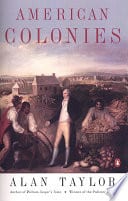
DESCRIPTION
A multicultural, multinational history of colonial America from the Pulitzer Prize-winning author of The Internal Enemy and American Revolutions In the first volume in the Penguin History of the United States, edited by Eric Foner, Alan Taylor challenges the traditional story of colonial history by examining the many cultures that helped make America, from the native inhabitants from milennia past, through the decades of Western colonization and conquest, and across the entire continent, all the way to the Pacific coast. Transcending the usual Anglocentric version of our colonial past, he recovers the importance of Native American tribes, African slaves, and the rival empires of France, Spain, the Netherlands, and even Russia in the colonization of North America. Moving beyond the Atlantic seaboard to examine the entire continent, American Colonies reveals a pivotal period in the global interaction of peoples, cultures, plants, animals, and microbes. In a vivid narrative, Taylor draws upon cutting-edge scholarship to create a timely picture of the colonial world characterized by an interplay of freedom and slavery, opportunity and loss. “Formidable … provokes us to contemplate the ways in which residents of North America have dealt with diversity.” -The New York Times Book Review
American Colonies_ The Settling of North A - Taylor, Alan.pdf (file not included in this release)
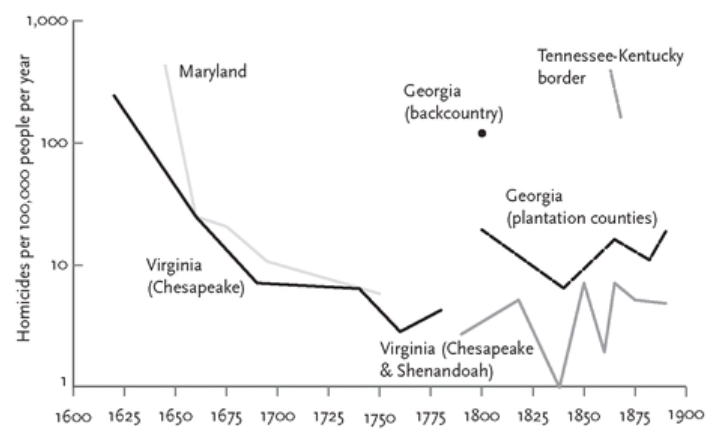
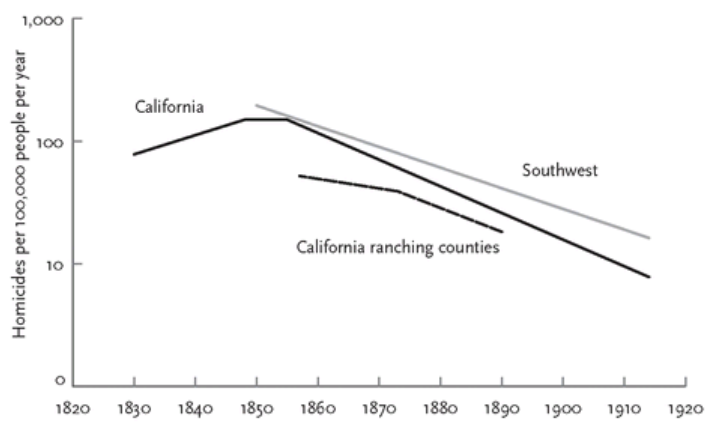
Pinker’s Chapter 3 supplement — North American frontiers followed different homicide trajectories
Pinker’s regional reconstructions reinforce Taylor’s warning against treating “colonial America” as one society. In Roth’s estimates, the Chesapeake began more violent than New England, while parts of the Georgia backcountry and Tennessee–Kentucky border remained far higher into the nineteenth century. Farther west, California and the Southwest later show a greater-than-tenfold fall—from roughly 100–200 homicides per 100,000 people to roughly 5–15 by the early twentieth century—as government, settlement, family formation, churches, schools, and local institutions displaced some forms of frontier self-help.
Figures 3-15 and 3-16 — reconstructed homicide rates in the Southeast, Southwest, and California. These are sparse, heterogeneous historical estimates; the plotted series are generally for whites, small boomtown denominators can produce spectacular rates, and violence against Native, Black, Chinese, Mexican, and other populations may be missing or differently classified. The charts illuminate variation in settler-on-settler homicide and state reach. They do not convert conquest into “civilization” or supply a complete ledger of colonial violence. Chapter 3 synthesis · Regional divergence and Figure 3-15, PDF pp. 152–154 (file not included in this release) · Western frontier violence and small-place estimates, PDF pp. 158–160 (file not included in this release) · Figure 3-16 and the western decline, PDF pp. 160–163 (file not included in this release)
Chapter Summaries
Linked overview
Select any chapter title below to jump to the full argument, evidence, concepts, conclusion, and reflection questions later in this note.
- Introduction: Taylor replaces an Anglocentric national origin story with a continental history of plural, unequal encounters, showing that white colonial opportunity developed alongside Indigenous dispossession and African bondage.
- 1. Natives, 13,000 B.C.-A.D. 1492: Pre-contact North America was dynamic rather than timeless: migration, ecological adaptation, agriculture, urbanization, conflict, and cultural reinvention created diverse societies long before Europeans arrived.
- 2. Colonizers, 1400-1800: European expansion grew from maritime innovation, religious and imperial rivalry, private profit, and Atlantic precedents, while pathogens and ecological exchange—not innate superiority—created a historically contingent advantage.
- 3. New Spain, 1500-1600: Spanish adventurers conquered through Indigenous alliances, disease, and military asymmetries; the crown then converted unstable private conquest into a bureaucratic, extractive empire it could never fully control.
- 4. The Spanish Frontier, 1530-1700: Beyond central Mexico, sparse resources and mobile peoples frustrated rapid conquest, forcing Spain toward subsidized missions and negotiated accommodation, dramatically demonstrated by the Pueblo Revolt.
- 5. Canada and Iroquoia, 1500-1660: The fur trade made the French dependent on Native hunters, brokers, and allies; commerce deepened mutual reliance while intensifying ecological depletion, epidemic loss, arms competition, and alliance warfare.
- 6. Virginia, 1570-1650: Virginia survived only after tobacco replaced dreams of quick plunder, but the crop’s demand for land and labor turned commercial success into systematic Powhatan dispossession and coercive expansion.
- 7. Chesapeake Colonies, 1650-1750: Planter elites stabilized oligarchy after Bacon’s Rebellion by granting white landowners political standing, expanding onto Native land, and constructing a racial slave regime that linked white liberty to Black bondage.
- 8. New England, 1600-1700: Healthy conditions, family migration, diversified farming, towns, and Puritan discipline produced broad white property ownership and participation, though Native land and West Indian slavery underwrote the region’s prosperity.
- 9. Puritans and Indians, 1600-1700: English farms, livestock, law, missions, and markets progressively destroyed Native territorial autonomy; King Philip’s War exposed settler vulnerability but ended the realistic prospect of reversing regional colonization.
- 10. The West Indies, 1600-1700: Sugar plantations concentrated capital, land, and enslaved labor into enormous export wealth, making Barbados and Jamaica the demographic catastrophe and economic engine of English colonial capitalism.
- 11. Carolina, 1670-1760: Carolina adapted the Barbadian model through Native slave raiding, rice, indigo, and African slavery; its wealth and fragile security depended on racial division, Indigenous conflict, and white solidarity.
- 12. Middle Colonies, 1600-1700: English conquest absorbed Dutch and other communities without erasing them, producing a prosperous, ethnically and religiously plural region whose diversity encouraged creativity while frustrating imperial uniformity.
- 13. Revolutions, 1685-1730: Colonial resistance defeated James II’s coercive centralization, yet the post-1688 compromise restored assemblies while building a stronger fiscal, naval, commercial, and administratively integrated British Empire.
- 14. The Atlantic, 1700-1780: Atlantic shipping integrated colonists through news, credit, goods, and migration, but prosperity concealed coercion, debt, class inequality, dispossession, and the forced movement of far more Africans.
- 15. Awakenings, 1700-1775: Print and itinerant preaching turned local revivals into an intercolonial movement whose New Birth challenged established clergy and widened voluntary religion, even as spiritual equality rarely produced social equality.
- 16. French America, 1650-1750: France’s small population and weak garrisons compelled diplomacy, trade, gifts, and kinship with Native majorities; the celebrated middle ground was a strategic accommodation to weakness, not proof of inherent benevolence.
- 17. The Great Plains, 1680-1800: Native peoples used horses, guns, and commerce to remake Plains life and sometimes overpower colonies, while those innovations also intensified raiding, inequality, disease exposure, and ecological strain.
- 18. Imperial Wars and Crisis, 1739-1775: Britain’s victory in the Seven Years’ War destroyed the balance protecting Native autonomy, created debt and administrative burdens, and generated the metropolitan-colonial conflict that led toward revolution.
- 19. The Pacific, 1760-1820: Russian, Spanish, British, and American expansion brought coercive labor, ecological extraction, disease, trade, and rival claims to the Pacific, where maps of possession repeatedly exceeded actual imperial control.
Visual Study Sheets
Whole-Book Summary
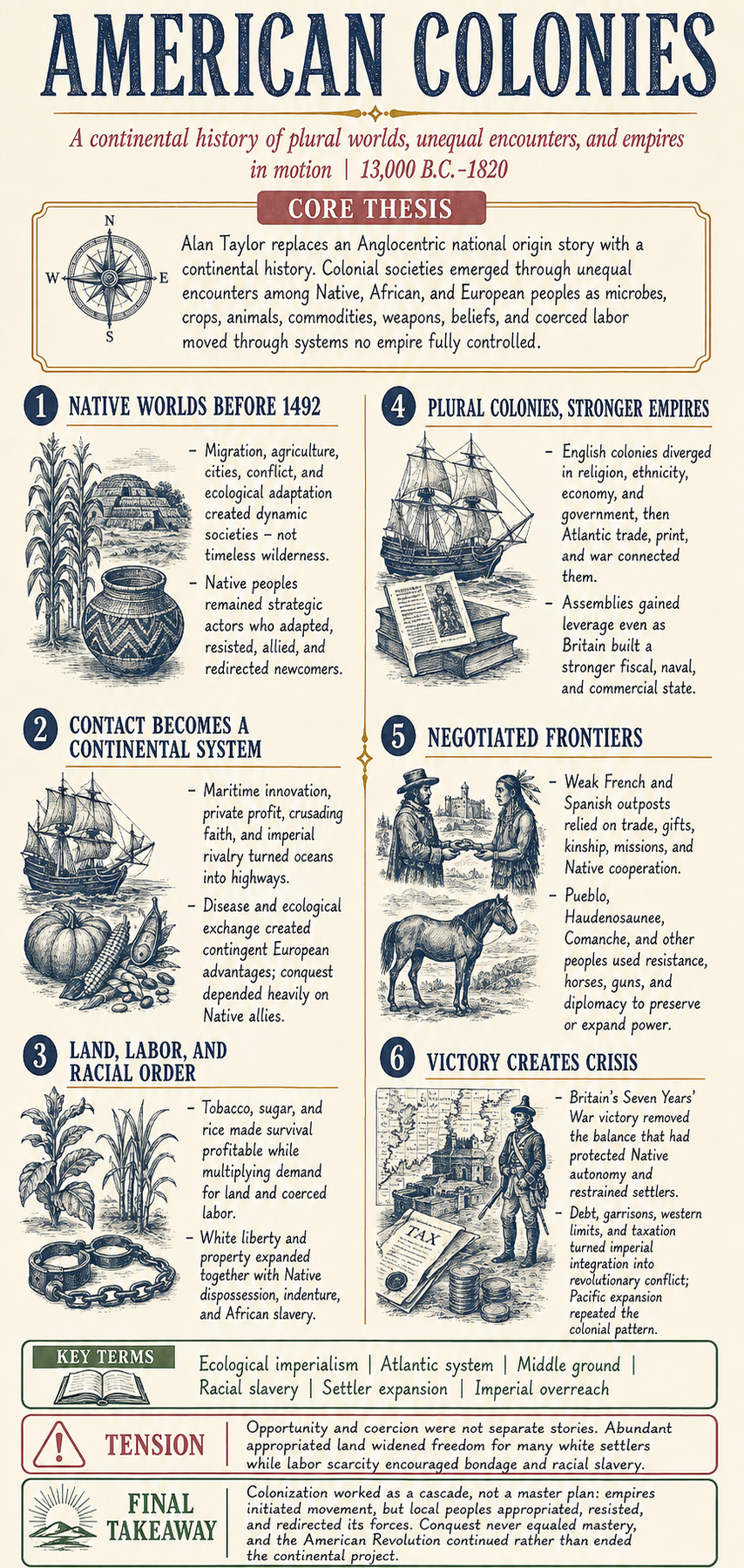
Peoples, Empires & Turning Points Timeline
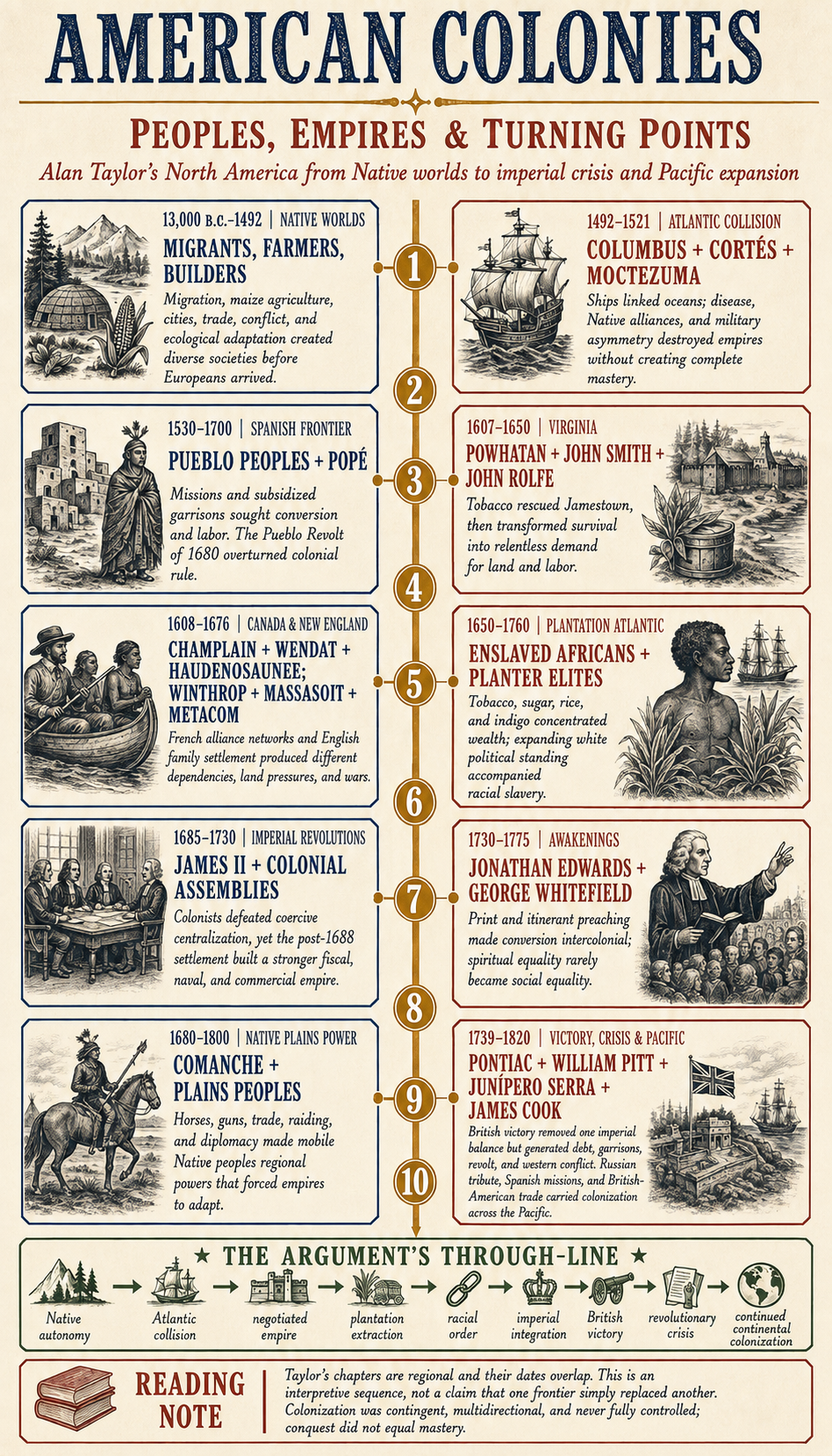
How to read the timeline
Taylor’s chapters are regional and overlap in time. Read the sequence as an interpretive map of changing colonial systems—not as a claim that one frontier simply replaced another. Colonization remained contingent and multidirectional; conquest did not mean complete mastery.
European Arrivals — Simple Chronology
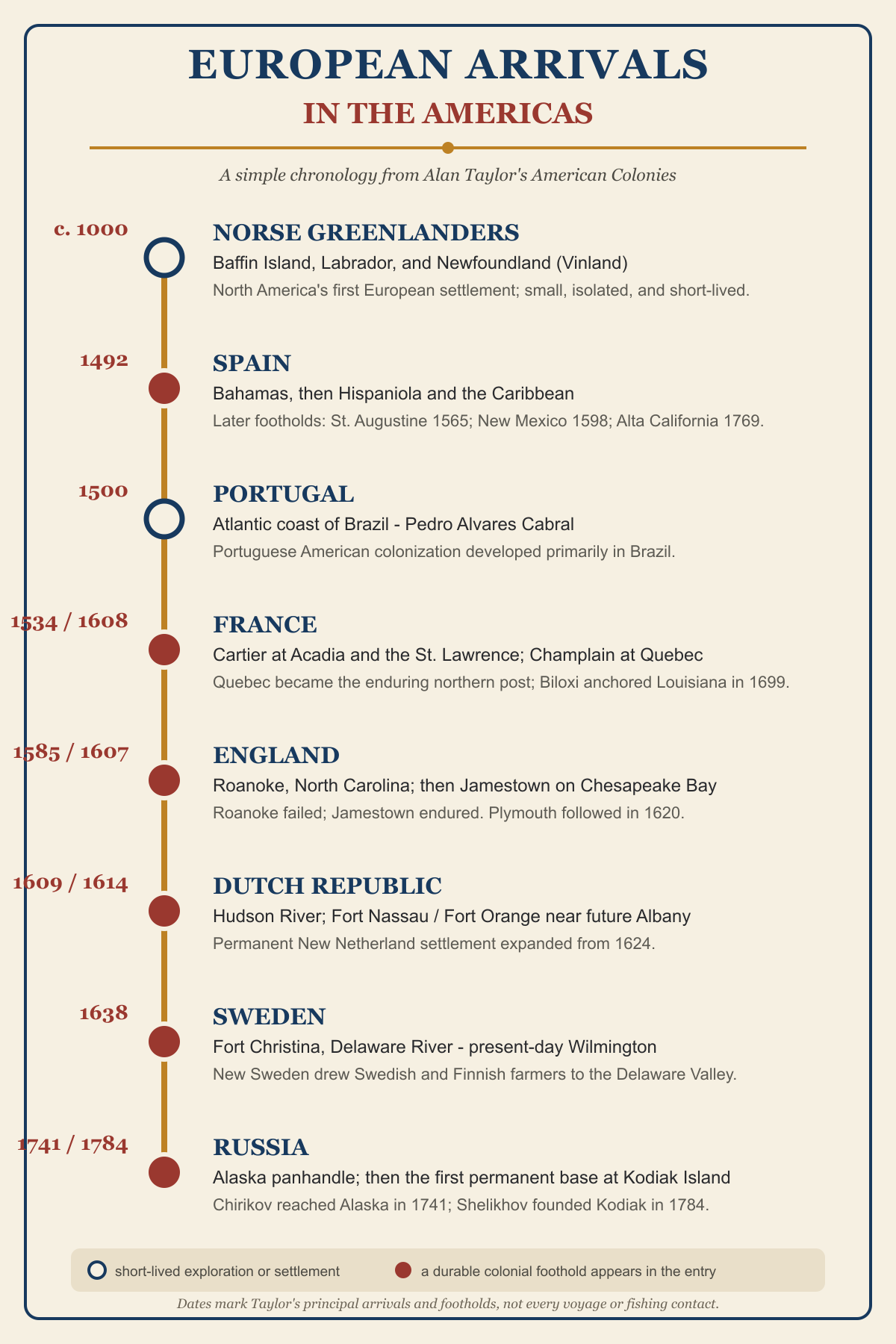
Exploration versus settlement
The first date identifies an arrival, exploration, or failed settlement; where a second date appears, it marks an enduring colonial foothold. These are Taylor’s principal milestones, not every European fishing voyage or temporary landing.
Two-Page Chapter Map
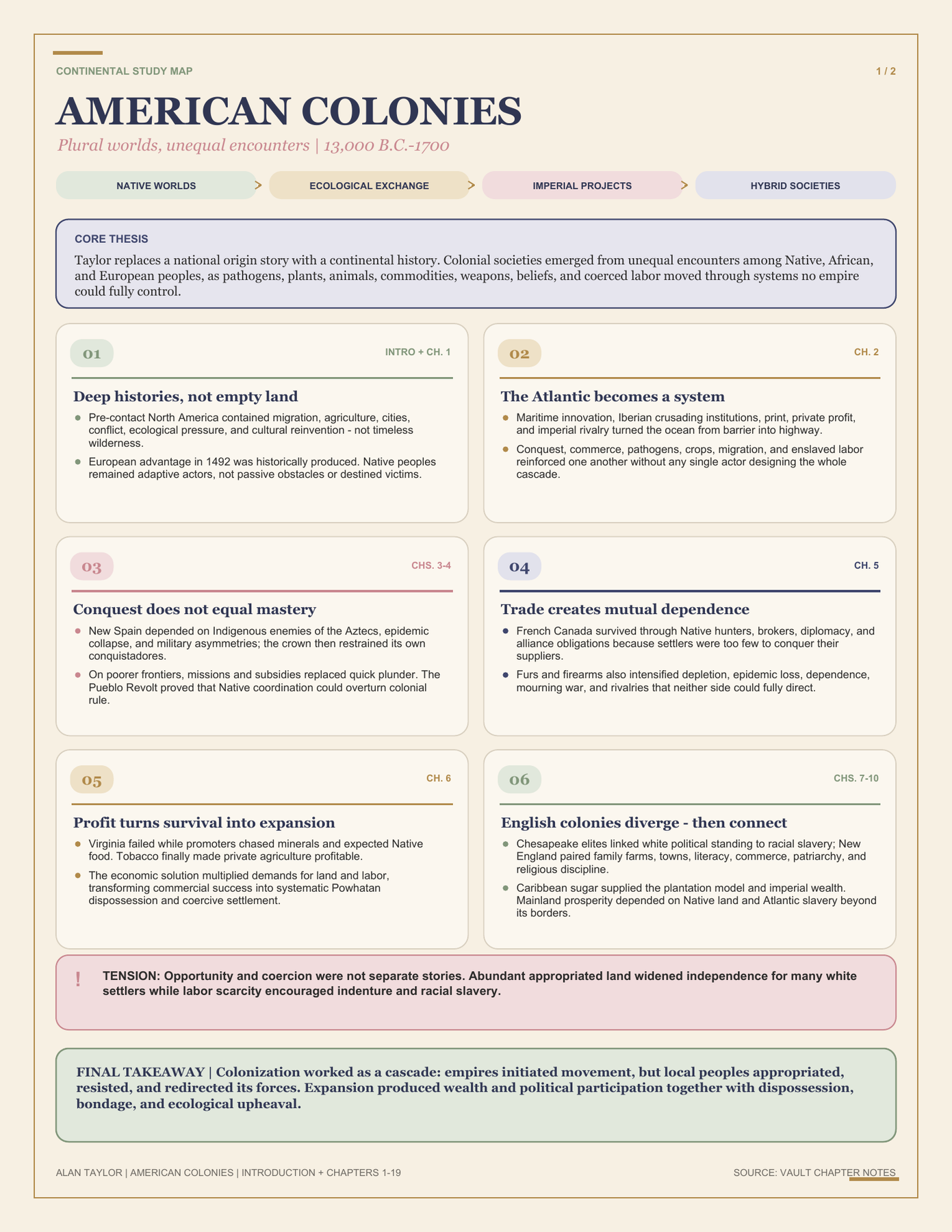
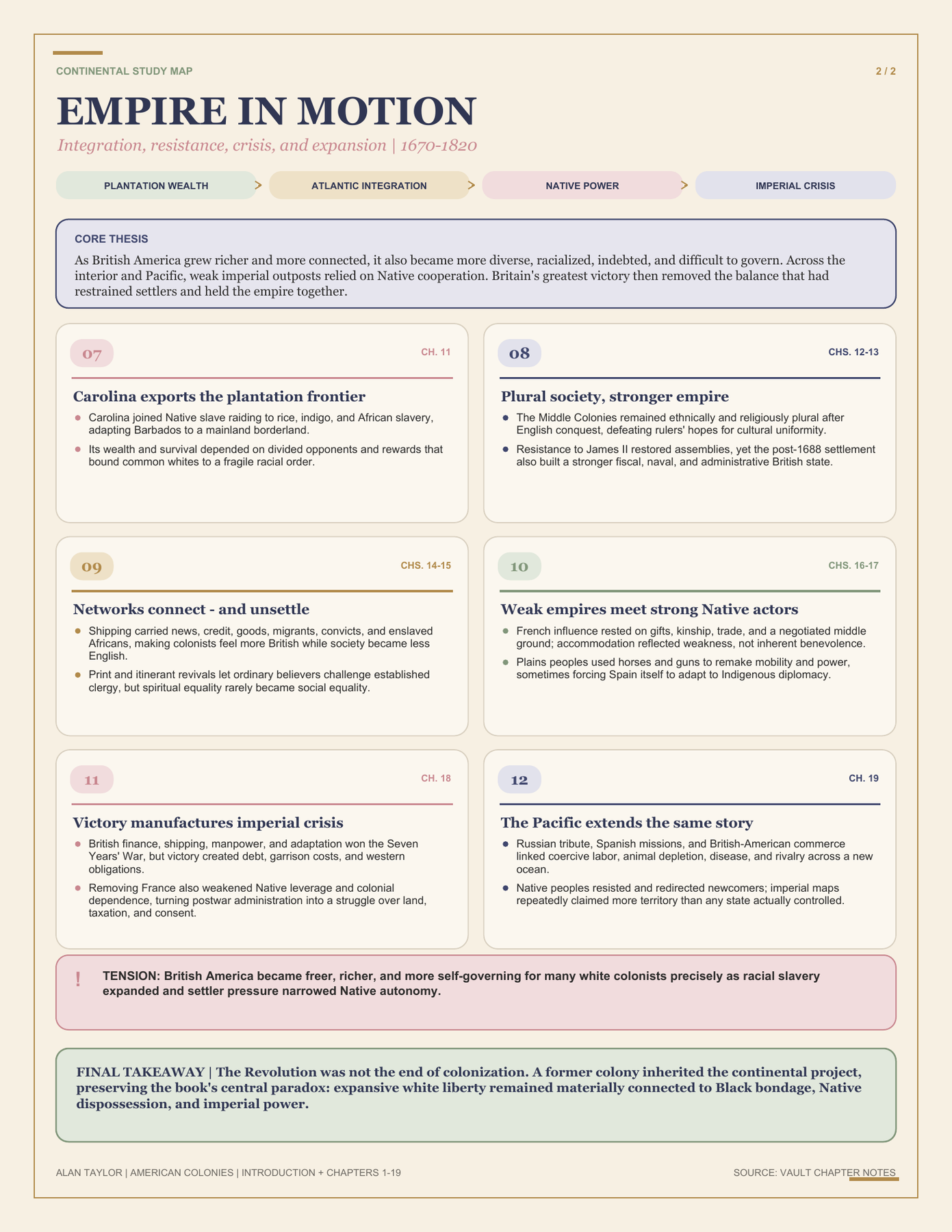
Open or print the complete two-page study sheet (file not included in this release)
Handwritten Notebook Pages
Source
Open the American Colonies notebook pages — start at notebook p. 212 (file not included in this release). The notes continue through the remaining pages of the journal.
Distilled Knowledge
From source to reusable thought
The chapter notes, PDF links, handwritten pages, and visual sheets remain the complete source dossier. The notes below promote only the book’s most reusable concepts and contested claims into the wider vault, then carry them into a provisional position and a possible article.
Concepts promoted from this book
- Continental History of Colonial North America — a method for replacing the thirteen-colonies origin story with a regional, Atlantic, environmental, and ethnohistorical account of the continent.
- Negotiated Colonial Sovereignty — the gap between imperial claims and practical command, including the conditions under which Native nations forced diplomacy, gifts, alliance, or accommodation.
- Colonial Political Economies of Land and Labor — how ecology, staples, property, migration, coerced labor, and political standing formed different regional systems.
Claim and argument under evaluation
- The Thirteen Colonies Framework Distorts Early American History — a qualified historiographical claim distinguishing comprehensive continental history from the legitimate national genealogy of the United States.
- European Conquest and Indigenous Power in Colonial North America — the strongest conquest case, the strongest Indigenous-power case, a regional evidence matrix, and a calibrated synthesis.
Position and writing
- 30 Rhetoric/Politics/My Assessment of American Colonies - Alan Taylor — a provisional assessment separating what Taylor strongly establishes, partially establishes, and does not establish.
- 80 Blog & Writing/Politics/Why the Thirteen Colonies Are the Wrong Starting Point for American History — an article brief with thesis, outline, steelmen, evidence chain, research gaps, and drafting checklist.
Review
Handwrite First
Use this section with the book and notes closed. The goal is retrieval, not polish.
1. Before Reading
Prime your mind before reading.
- Prediction:
- Question I want answered:
- What I already think about this topic:
- What I expect to disagree with:
2. Closed-Book Recall Dump
Close the book and notes. Reconstruct what you read from memory.
-
Main points I remember:
-
Key examples, evidence, stories, or cases I remember:
-
Terms, people, dates, or concepts I remember:
-
-
What feels fuzzy or incomplete:
3. Core Argument From Memory
- The book/section in one sentence:
- Main claim:
- Problem the author is responding to:
- Why the author thinks this is true:
- Best evidence/example I remember:
- Conclusion the author wants the reader to accept:
4. Argument Map From Memory
5. Feynman Check
Explain the idea simply, as if teaching it to someone unfamiliar with the topic.
- Simple explanation:
- Analogy or concrete example:
- Where someone might misunderstand this:
6. Pushback From Memory
- Strongest objection or weakness:
- What evidence would weaken the author’s argument?
- What a rival thinker/book might say:
- My current judgment:
7. Personal Takeaway
- What changed, clarified, or challenged my thinking?
- What am I less certain about now?
- One way I could apply this:
- One question I need to keep investigating:
Type Into Obsidian
Use this section after handwriting. The goal is long-term storage, search, linking, and spaced review.
1. Correction After Checking Notes
Reopen the book/notes. Compare them against your handwritten recall.
- I forgot:
- I misunderstood:
- I overemphasized:
- I underemphasized:
- This needs review:
2. Clean Core Argument
- The book/section in one sentence:
- Main claim:
- Problem the author is responding to:
- Why the author thinks this is true:
- Best evidence/example:
- Conclusion the author wants the reader to accept:
3. What Actually Matters?
- Most important idea:
- Best quote or passage:
- Term/concept worth remembering:
- Most useful example:
- Most surprising point:
- One sentence I want to remember:
4. Connections
- Connects to:
- [[]]
- [[]]
- [[]]
- Supports:
- [[]]
- Challenges:
- [[]]
- Reminds me of:
- [[]]
- Possible future note:
- [[]]
5. Clean Pushback
- Strongest objection or weakness:
- What evidence would weaken the author’s argument?
- What the author might say in response:
- What a rival thinker/book would say:
- My current judgment:
Retrieval Questions
Answer these without looking during future reviews.
Basic Recall
- What is the author’s main thesis?
- What problem is the author responding to?
- What are the 3–5 main claims?
- What are the key terms or concepts?
- What is the best example or piece of evidence?
Argument Reconstruction
- How does the author move from evidence to conclusion?
- What assumptions does the argument depend on?
- What would the argument look like in premise-conclusion form?
- What does the author want the reader to reject?
Comparison
- How does this book/section compare with [[]]?
- How does this support or challenge [[]]?
- Which thinker would agree with this?
- Which thinker would disagree with this?
Criticism
- What is the strongest objection?
- What evidence would weaken the argument?
- What does the author ignore, minimize, or assume?
- Is the author’s conclusion stronger than the evidence allows?
Synthesis
- How does this change my larger framework?
- Where does this fit in the broader historical/philosophical debate?
- What question should I ask next?
- What would I write about using this idea?
Flashcards / Atomic Recall
Use only for facts, definitions, distinctions, names, dates, and compact claims.
- Q:
- A:
- Q:
- A:
- Q:
- A:
Retention Check
24 Hours Later
- I can explain the main argument without notes.
- I remember the best example or evidence.
- I can define the key concept.
- I can state one objection.
24-hour recall notes:
- What I remembered:
- What I forgot:
- What needs another review:
1 Week Later
- I can summarize this in 5 sentences.
- I can reconstruct the argument.
- I can connect it to another book, thinker, or historical period.
- I can state whether I agree, disagree, or remain undecided.
1-week recall notes:
- What I remembered:
- What I forgot:
- New connection:
- Revised judgment:
1 Month Later
- I still remember the core argument.
- I can explain why this matters.
- I know whether this changed my larger framework.
- I know whether this is worth rereading, citing, or building into a permanent note.
1-month recall notes:
- What endured:
- What disappeared:
- What this changed:
- Next action:
Scratchpad
Unfiltered thoughts, questions, comparisons, argument trees, future writing ideas, or possible links.
Simplified rule
Handwrite
Use handwriting for:
- Before-reading predictions
- Closed-book recall dump
- Core argument from memory
- Argument map from memory
- Feynman explanation
- Initial pushback
- Personal takeaway
- Confusion list
These are the sections where the benefit comes from struggling to reconstruct the idea.
Type in Obsidian
Use Obsidian for:
- Corrections after checking notes
- Clean one-sentence thesis
- Clean argument summary
- Important quotes
- Key concepts
- Links to other notes
- Retrieval questions
- Flashcards
- Retention checks
- Review logs
- Scratchpad for future essays or synthesis
These are the sections where the benefit comes from searchability, linking, spaced review, and long-term organization.
Best workflow
Use this order:
1. Handwrite from memory.
2. Check the book/notes.
3. Type only the corrected, useful version into Obsidian.
4. Create retrieval questions.
5. Review those questions later without looking.
Do not type all your handwritten notes into Obsidian. That turns the system into transcription work. Only transfer what is worth preserving, linking, or reviewing.
Notes
Book Argument and Reading Map
Book in one sentence
Alan Taylor replaces an Anglocentric origin story of the United States with a continental history of plural colonies: unequal encounters among Native, African, and European peoples in which ecological exchange, coerced labor, imperial rivalry, cultural adaptation, and resistance produced both expanding liberty for many white colonists and dispossession or bondage for many others.
Taylor organizes the book regionally because colonial North America did not develop as a single society moving inevitably toward the United States. Spanish, French, Dutch, British, Russian, Native, and African projects interacted with different environments and with one another. The recurring mechanism is colonization as a cascade: European ships and imperial ambitions moved people, pathogens, plants, animals, commodities, weapons, and religious ideas; local peoples appropriated, resisted, and redirected those forces; the resulting societies escaped full metropolitan control. British America eventually became the most populous and powerful colonial formation, but that outcome was contingent rather than preordained.
The book’s deepest tension is that colonial freedom and colonial unfreedom grew together. Abundant appropriated land improved the prospects of many European settlers, but made free labor scarce and encouraged elites to import indentured servants and enslaved Africans. Militia service and representative institutions widened political standing among white men at the same time that colonial society increasingly organized privilege through racial subordination. Taylor therefore treats Native death and displacement, African slavery, and popular liberty not as separate stories but as connected products of the same colonial encounters.
Source, scope, and citation method
- These notes cover the Introduction and all nineteen numbered chapters, following Taylor’s original internal section titles.
- Page links use the vault-local PDF: American Colonies_ The Settling of North A - Taylor, Alan.pdf (file not included in this release). PDF page numbers refer to the PDF viewer’s page count, not the printed pagination.
- The summaries reconstruct Taylor’s arguments and qualifications from this edition; they do not add outside historical claims.
Chapter Index
- Introduction
- Chapter 1: Natives, 13,000 B.C.-A.D. 1492
- Chapter 2: Colonizers, 1400-1800
- Chapter 3: New Spain, 1500-1600
- Chapter 4: The Spanish Frontier, 1530-1700
- Chapter 5: Canada and Iroquoia, 1500-1660
- Chapter 6: Virginia, 1570-1650
- Chapter 7: Chesapeake Colonies, 1650-1750
- Chapter 8: New England, 1600-1700
- Chapter 9: Puritans and Indians, 1600-1700
- Chapter 10: The West Indies, 1600-1700
- Chapter 11: Carolina, 1670-1760
- Chapter 12: Middle Colonies, 1600-1700
- Chapter 13: Revolutions, 1685-1730
- Chapter 14: The Atlantic, 1700-1780
- Chapter 15: Awakenings, 1700-1775
- Chapter 16: French America, 1650-1750
- Chapter 17: The Great Plains, 1680-1800
- Chapter 18: Imperial Wars and Crisis, 1739-1775
- Chapter 19: The Pacific, 1760-1820
Introduction
Chapter Objective and Through Line
Taylor opens by challenging the familiar account in which colonial history is principally the story of English-speaking men on the Atlantic seaboard becoming freer, richer, and eventually American. That older narrative contains a partial truth: many free English settlers did gain land, prosperity, and social standing unavailable in England. Its error is to mistake the experience of a favored group for the whole. The same abundance of land depended upon Native dispossession and made voluntary wage labor expensive, encouraging first indentured servitude and then racial slavery. During the eighteenth century, more newcomers arrived in British America as forcibly transported Africans than as freedom-seeking Europeans. Taylor’s enlarged history must therefore explain uplift and catastrophe together, not treat Native depopulation and African bondage as peripheral exceptions. Introduction: exceptionalism and its limits, PDF pp. 14-15 (file not included in this release)
The book also expands the geography and cast. Colonial North America encompassed Spanish expansion north from Mexico, French trade around the Great Lakes and Mississippi, Dutch commerce, Russian colonization of Alaska, British probes into Hawaii, hundreds of Native peoples, diverse African societies, and European settlers who were far from culturally uniform. Their unprecedented encounter mixed people along with microbes, plants, animals, goods, and beliefs. This produced new composite societies, but not among equals: Europeans generally possessed greater ecological, technological, and organizational power, while dominated peoples retained enough agency to resist and redirect colonial projects.
Finally, Taylor explains how he will prevent the later United States from swallowing the colonial past. Regional narratives preserve the coherence and contingency of different colonial Americas; Atlantic, environmental, and ethnohistorical perspectives reveal the processes connecting them. The chronological endpoint consequently slides from about 1775 in the east to about 1820 on the Pacific, where colonial expansion was only beginning. The United States appears not as history’s predetermined goal but as a former colony that became an imperial power. Introduction: regional method and contingency, PDF pp. 19-21 (file not included in this release)
Chapter Structure at a Glance
- Taylor identifies the old Anglocentric narrative and concedes its limited truth about opportunity for free English men.
- He widens the ledger to include the dispossession, coerced labor, disease, and war that made much colonial prosperity possible.
- He replaces three seemingly uniform racial blocs with internally diverse peoples whose identities were remade through encounter.
- He argues that racial categories and white solidarity developed through colonization rather than simply arriving fully formed from Europe.
- He defines a regional, continental method that balances the later rise of British America against alternative imperial and Native possibilities.
- He treats colonization as an open-ended process in which metropolitan visions were consequential but never perfectly imposed.
Section-by-Section Argument
Reframing the colonial story (opening section; no printed heading)
The opening establishes the object of correction. A narrow Atlantic-seaboard story made colonial America appear as a largely successful preparation for the Revolution. Taylor retains its evidence of greater opportunity for many settlers but changes the moral and causal frame: their gains were bound to land seizure, labor coercion, and demographic catastrophe.
- Free settlers generally enjoyed better material conditions after the early decades, and the absence of a full European aristocracy opened status and political space for colonial merchants and planters.
- Yet between 1492 and 1776 disease and war reduced North America’s Native population faster than immigration replaced it. Colonial “abundance” was therefore not an empty natural gift.
- Scarce free labor and plentiful appropriated land encouraged coercion. The freedom of one population could create incentives for the unfreedom of another.
- Restoring women, Native peoples, enslaved Africans, and rival empires changes not merely the number of characters but the explanatory structure of the history.
The argument then turns from inclusion to creation: encounters did not simply bring static groups into contact but generated new identities and power relations.
Peoples, mixture, power, and race (opening section; analytical division)
Taylor treats “European,” “African,” and “Indian” as starting labels that conceal enormous linguistic, ethnic, and regional diversity. Colonial pressure broke down older localized identities and forced new commonalities. European vessels and the linked pursuits of souls and profit created the encounter; all participants borrowed and adapted, although under radically unequal conditions.
- “British” colonists included English, Welsh, Scots, Irish, Germans, Dutch, Swedes, Finns, and French Huguenots whose common identity was still under construction.
- Africans were forced together from societies whose languages and cultures differed profoundly; enslavers’ lumping practices helped produce new African-American identities.
- Hundreds of Native peoples did not initially understand themselves as one “Indian” category. Colonization imposed that abstraction and common predicament.
- Cultural exchange ran in more than one direction: colonizers depended on Native knowledge, African forms entered colonial culture, and subordinated peoples adapted Christianity and imported goods to their own purposes.
Race grew in importance as a way to sort access to power. Taylor emphasizes that early elites often described superiority as Christian “civility,” leaving theoretical space for assimilation. In British America, militia service, Indian war, and slave patrols then gave ethnically diverse common men political leverage and a shared white identity. Elites expanded respect and rights for common whites while hardening the subordination of “black” and “red” people. Liberty for white men and racial hierarchy thus developed in tandem, creating a central legacy with which the later republic would struggle. Introduction: the colonial construction of race, PDF pp. 17-18 (file not included in this release)
Boundaries
The printed section “Boundaries” explains the book’s method and scope. Taylor combines three bodies of scholarship: Atlantic history tracks flows among Europe, Africa, and America; environmental history shows how those flows transformed living systems; ethnohistory reconstructs cultural encounters and Native agency. Their combination permits a continental account organized by regions rather than anachronistic national borders.
- The plural title American Colonies signals the rejection of a singular proto-American development.
- Regional sequencing allows Taylor to show how economy, culture, society, and politics cohered in particular places before comparing them.
- Avoiding teleology preserves real alternatives and the fact that few people in 1775 expected the exact United States that followed.
- Avoiding pure contingency preserves meaningful patterns visible in hindsight, including British America’s eventual demographic and military predominance.
- The sliding endpoint captures colonialism as a process: revolutionary crisis ended British colonial rule in the east while missions, trade, and conquest expanded on the Pacific rim.
Taylor ends with a model of imperial power that guides the rest of the book. Colonizers projected confident plans from distant capitals, but disease, commerce, warfare, missionaries, settlers, and Indigenous resistance regularly escaped their control. Empires were neither omnipotent nor irrelevant: their visions were imperfectly inflicted, powerfully damaging and transformative even when local realities deflected them. Introduction: colonization as process and “imperfectly inflicted” empire, PDF pp. 21-22 (file not included in this release)
Key Concepts and Distinctions
-
American exceptionalism: The uplifting story of Europeans gaining liberty and prosperity in a new land.
-
Significance: Taylor preserves its partial truth for many free settlers but rejects it as a complete account because those gains were intertwined with conquest and coerced labor.
-
Composite colonial societies: New cultures and identities formed through rapid exchanges among diverse peoples and ecosystems.
-
Significance: American distinctiveness lies in mixture and adaptation rather than the transplantation of an already coherent English culture.
-
Race as product: The white/red/black ordering became more rigid through colonial institutions and conflicts.
-
Significance: Racial hierarchy was not merely a timeless prejudice; it helped organize labor, military service, privilege, and political inclusion.
-
Teleology versus contingency: Teleology reads the United States backward as an inevitable destination; contingency preserves unrealized possibilities.
-
Significance: Taylor uses hindsight without allowing it to erase the autonomy of Spanish, French, Native, African, and Pacific histories.
-
Colonization as process: A cascade of linked demographic, ecological, economic, cultural, and political changes.
-
Significance: This definition explains why colonial history cannot be bounded solely by formal settlements or the date 1776.
Essential Evidence and Examples
- The material improvement of many free English colonists is indispensable because it explains why the traditional narrative endured; Taylor revises rather than caricatures it.
- The predominance of forced African migration during the eighteenth century shows why slavery cannot be treated as a marginal departure from a basically free colonial society.
- Common white militia service links external warfare and internal slave control to the formation of political leverage and racial solidarity.
- The east-to-west sliding endpoint—about 1775 to 1820—makes the continental thesis concrete: colonialism could end in one region while accelerating in another.
Chapter Conclusion and Significance
The Introduction supplies the book’s governing synthesis: colonial North America was a field of plural, unequal, and partly uncontrollable encounters. European expansion created enormous advantages and suffering, but Europeans never exercised complete mastery; Native and African peoples remained historical actors who adapted, resisted, and altered the worlds imposed upon them. British America became unusually powerful, yet it must be explained within rather than substituted for that wider history.
The central unresolved tension is productive rather than accidental. The same colonial conditions widened material and political opportunities for many white men while generating racial slavery and Indigenous dispossession. Taylor will trace both the humane and violent legacies of the colonial era, refusing either celebratory exceptionalism or a flattening story in which all outcomes were determined by European commands.
Questions for Reflection
- Does Taylor’s claim that white liberty and racial subordination developed together explain their relationship causally, or does it risk joining several related processes too tightly?
- What is gained—and what becomes harder to see—when colonial history is organized by regions rather than by a single chronology or later national borders?
- How can a historian use the known emergence of the United States to select and connect evidence without turning that outcome into an inevitability?
Chapter 1: Natives, 13,000 B.C.-A.D. 1492
Chapter Objective and Through Line
Taylor’s first chapter dismantles the image of pre-contact Native North America as timeless, thinly populated wilderness. Archaeology and anthropology reveal migrations, population growth, technological adaptation, ecological pressure, political hierarchy, conflict, urbanization, dispersal, and cultural reinvention long before 1492. Native peoples were neither static primitives nor uniformly harmonious environmental saints. Their history matters because European colonizers encountered societies already shaped by millennia of change—and because the differences that later advantaged Europeans must be explained historically rather than attributed to innate superiority.
The argument moves from successive migrations out of Asia through adaptations to post-Ice Age environments, the development and spread of horticulture, and the rise and relocation of populous societies in the Southwest and Mississippi Valley. Taylor uses the Hohokam, Anasazi, and Mississippians to show both Indigenous complexity and the environmental dangers of dense settlement and heavy reliance on maize. Yet he carefully qualifies the lesson: these urbanized cases were unusual, their environmental damage was less enduring than the colonizers’, and collapse often meant migration and reorganization rather than disappearance.
The final movement contrasts Native animism with European Christianity and mercantile capitalism. Native technology and religion developed around localized reciprocity with a living spiritual world; European traditions separated spirit from matter, legitimated human dominion, and supported far more intensive extraction. Europeans in 1492 also possessed oceangoing ships, steel, gunpowder, writing, domesticated mammals, expansionist institutions, and a lethal disease pool. These historically accumulated advantages—combined with colonizing ambition—explain why conquest crossed the Atlantic east-to-west rather than the reverse. Chapter 1 thesis and qualification, PDF pp. 27-29 (file not included in this release)
Chapter Structure at a Glance
- Taylor rejects static depictions of Native America and treats uncertainty about origins and populations explicitly.
- He traces migrations and the adaptive transition from Paleo-Indian big-game hunting to diverse Archaic lifeways.
- He explains horticulture as a gradual Indigenous innovation that increased population, settlement, labor coordination, and hierarchy.
- He uses Southwestern and Mississippian societies to show political complexity, environmental strain, violence, and cultural relocation.
- He contrasts Native and European ecological histories without romanticizing either side.
- He links Native animism and European Christianity-capitalism to distinct modes of perceiving and exploiting nature.
Section-by-Section Argument
Migration
Native peoples descended primarily from several migrations out of northeastern Asia, but Taylor emphasizes that chronology and routes remain disputed. During the Ice Age, lower sea levels exposed Beringia; hunters moved across it and eventually south through or around the glaciers. Their descendants diversified over thousands of years, while later migrations produced Athabaskan speakers and the maritime ancestors of Inuit and Aleut peoples.
- The multiple-wave account undercuts any notion of a single uniform “Indian” culture.
- Migration was slow adaptation, not a single dramatic discovery event; peoples became distinct through varied environments and long separation.
- Taylor states uncertainty rather than disguising inference as fact, reflecting the limits and continuing revision of archaeological evidence.
Paleo and Archaic America
Paleo-Indians entered a rich environment of large mammals whose unfamiliarity with human hunters contributed to spectacular initial returns. Population growth and hunting pressure coincided with climatic warming and the extinction of many large species. Taylor does not assign a monocausal explanation: human predation and environmental change likely interacted.
- Abundance encouraged demographic expansion, which intensified pressure on local resources and pushed bands across the continent.
- After the megafaunal decline, Archaic peoples broadened their diets, developed specialized local knowledge, and used smaller territories more intensively.
- Gathering, fishing, and the harvesting of nuts, roots, seeds, and smaller animals often supplied more reliable calories than big-game hunting; women’s productive roles accordingly became more central.
- Local adaptation produced linguistic and cultural diversity while trade networks continued to move materials and ideas over long distances.
The result was not decline from a heroic hunting age but a more dependable subsistence system capable of supporting much larger populations.
Horticulture
Horticulture emerged incrementally as Native peoples protected and selected productive plants. Mesoamerican cultivators transformed wild maize and developed the maize-beans-squash complex, which spread north only as varieties adapted to cooler climates and shorter growing seasons. Food production supported denser, more permanent settlements but also changed gender, labor, diet, and political organization.
- The three crops were nutritionally and agriculturally complementary: beans replenished soil nitrogen, squash conserved moisture and suppressed weeds, and the combined diet supplied nutrients maize alone lacked.
- Stored surpluses supported population growth and specialized religious or political leaders, but also created targets for tribute and warfare.
- Greater reliance on maize exposed people to soil exhaustion, drought, nutritional deficiency, and the diseases associated with concentrated settlement.
Horticulture therefore increased productive capacity without producing a simple ladder of progress. Its gains created new vulnerabilities that become visible in the large Southwestern and Mississippian centers. Chapter 1: horticultural transformation, PDF pp. 35-38 (file not included in this release)
Hohokam and Anasazi
The Hohokam and Anasazi labels describe broad cultural patterns rather than unified states. Both built complex settlements in the arid Southwest using irrigation, coordinated labor, trade, and ritual authority. Their impressive productive systems increased population but also concentrated ecological and political risk.
- Hohokam communities constructed hundreds of miles of canals; Anasazi pueblos such as Chaco Canyon required massive coordinated building projects.
- Mesoamerican influence appeared in crops, cotton weaving, trade goods, ball courts, and platform mounds, demonstrating continental exchange without requiring political control from Mexico.
- Soil depletion, dependence on maize, and prolonged drought reduced yields. Malnutrition and scarcity intensified conflict and weakened confidence in leaders who claimed spiritual power over rain and crops.
- Hohokam populations dispersed; Anasazi communities moved to more defensible or better-watered places and helped form later Pueblo, Hopi, Zuni, and Acoma societies.
Taylor’s wording matters: these cultures did not simply vanish. Migration and reorganization preserved people and traditions while changing their institutional form.
Mound Builders
In the moist Mississippi watershed, maize horticulture supported dense, hierarchical chiefdoms centered on towns, plazas, temple mounds, tribute, and warfare. Cahokia was the largest northern center, strategically placed at major river junctions and sustained by fertile floodplains, fishing, hunting, and trade.
- Cahokia’s monumental earthworks, stockade, calendrical structure, and population demonstrate complexity comparable in kind—though not scale—to other urban civilizations.
- Sacred chiefs linked political authority to the sun and agricultural fertility; commoners supplied tribute and labor in exchange for promised cosmic and material order.
- Resource depletion, deforestation, waste concentration, climatic stress, malnutrition, disease, and resistance interacted in Cahokia’s decline. Taylor again offers a chain of pressures rather than a single-cause collapse.
- Mississippian culture remained strong farther south after Cahokia fell. Spanish accounts of populous towns and commanding chiefs reveal continuity before disease and violence accelerated transformation.
This evidence refutes the colonizers’ later claim to have found an untouched wilderness while also refusing to idealize Indigenous political life.
Beliefs
Taylor uses the final section to compare ecological power and spiritual frameworks. Native societies sometimes damaged their environments, especially where maize-supported urban concentration became intense, but most Native communities were smaller and more mobile, and even urban failures prompted relocation that allowed ecosystems to recover. Europeans arrived after having already depleted much of their own wildlife and forests and possessed tools and institutions capable of producing more cumulative damage.
Native animism treated spiritual power as immanent in animals, plants, rocks, waters, weather, and people. Harvesting was a social relationship requiring reciprocity, ritual respect, and restraint—not modern environmentalism, but a worldview that often limited accumulation. Dreams, visions, and shamans mediated access to volatile powers. Europeans misread these beliefs through a Christian divine/diabolical binary and treated shamans as witches.
By placing a transcendent God above a disenchanted material world, Christianity made nature spiritually safe for domination. Biblical claims of human dominion helped colonizers interpret intensive cultivation as duty and underused land as forfeited property. In England and the Netherlands especially, mercantile capitalism combined privately controlled land, labor, and capital in pursuit of reinvested profit. Competition rewarded increased extraction. Clerical moral criticism supplied necessary restraints but rarely challenged the assumed superiority of Christian civilization or the demand that Native people convert. Chapter 1: Native ecology, animism, and European contrast, PDF pp. 43-50 (file not included in this release)
Reader question: Is Taylor’s analysis of mercantile capitalism Marxist?
Question. Taylor writes: “Although neither the Dutch nor the English had yet developed the mature form of capitalism characterized by industrial production and a propertyless proletariat, both nations had passed into that early stage known as mercantile capitalism.” Since he is discussing the sixteenth and seventeenth centuries, does this analysis of history come from a Marxist view? Taylor on mercantile capitalism, PDF p. 49 (file not included in this release)
Short answer: Partly in vocabulary and analytical inheritance, but not as an orthodox Marxist interpretation of history.
The expressions “mature capitalism,” “industrial production,” “propertyless proletariat,” and “mercantile capitalism” come from a tradition of historical analysis strongly shaped by Marx and later Marxist historians. This tradition distinguishes forms or stages of capitalism by examining:
- who owns productive property;
- how labor is organized;
- whether workers possess independent access to land or tools;
- whether profit comes chiefly from trade, production, finance, or colonial extraction; and
- how capital is accumulated and reinvested.
Taylor is therefore using a Marxian conceptual vocabulary. In this passage, “propertyless proletariat” has a specifically Marxian resonance: mature industrial capitalism depends upon large numbers of people who lack productive property and must sell their labor for wages. “Mercantile capitalism” likewise describes an earlier commercial formation in which merchants accumulate capital through long-distance trade, colonial commodities, shipping, finance, and state-supported monopoly before factory production and industrial wage labor become dominant.
That does not, however, make Taylor’s total explanation Marxist. An orthodox or strongly Marxist history would normally give greater causal priority to the mode of production, class relations, contradictions between classes, and the transition from one economic system to another. Taylor’s explanation in this chapter is much more eclectic. He gives independent causal importance to:
- religious cosmology and Christian ideas of dominion;
- Native animism and reciprocal obligations toward the natural world;
- environmental conditions and ecological consequences;
- technology, disease, and domesticated animals;
- imperial rivalry and state power;
- cultural misunderstanding and adaptation; and
- historical contingency rather than an inevitable sequence of stages.
Taylor also does not reduce religion to a disguise for class interest. Immediately after describing mercantile capitalism, he argues that Christian criticism placed moral restraints on self-interest and helped markets preserve the trust they required. That is closer to a Weberian concern with the interaction between religious culture and economic conduct than to a simple Marxist model in which religion primarily legitimates material relations. Indeed, Taylor’s claim that Christianity helped prevent capitalism from consuming itself is not an especially orthodox Marxist conclusion.
The most accurate classification is therefore:
Marxian economic vocabulary + Weberian attention to religion and culture + environmental, Atlantic, and ethnohistorical analysis.
Taylor has absorbed concepts that Marxism helped make standard in social history, but he is not presenting class struggle or economic structure as the sole engine of colonial history. The distinction is between using Marx-influenced categories and accepting Marxism as a complete philosophy of history.
Reader question: What are the strongest counterarguments to Taylor’s claim about capitalism, higher purpose, and kleptocracy?
Question. Taylor claims that “without some counterweight and some sense of a higher purpose, capitalist competition degenerates into a rapacious, violent kleptocracy.” What are the best counterarguments? Taylor on Christian restraint, trust, and capitalist competition, PDF p. 49 (file not included in this release)
Short answer: Taylor’s defensible point is that markets require restraints against violence, fraud, broken promises, corruption, and unpriced harms. His vulnerable leap is that these restraints must come from a transcendent “higher purpose,” and that competition without one naturally becomes kleptocracy. The first proposition is broadly true; the second is neither logically necessary nor historically demonstrated.
1. Taylor mistakes the preconditions of markets for a transcendent higher purpose.
Markets require enforceable contracts, reasonably trustworthy money, prohibitions against force and fraud, and expectations that promises will usually be kept. But these restraints can come from law, reputation, repeated transactions, reciprocity, professional standards, civil society, social disapproval, and secular moral norms. Elinor Ostrom’s research shows that cooperation can emerge from communication, known reputations, monitoring, graduated sanctions, exit rights, longer time horizons, and participants’ ability to devise rules. These are institutional conditions, not necessarily expressions of a shared transcendent end. Ostrom’s Nobel lecture
If “higher purpose” means any reason not to steal, Taylor’s proposition becomes nearly tautological: without forces that prevent predation, predation occurs. If it specifically means God or Christianity, he has not shown it to be necessary.
2. Competition can restrain predation rather than produce it.
A firm that persistently cheats customers can lose them to competitors; an abusive employer can lose workers; an unreliable borrower can lose credit; and a merchant who adulterates goods can destroy the reputation on which future transactions depend. Where people possess information and alternatives, competition turns future self-interest into a check upon immediate self-interest.
Hayek’s further point is that prices and competition coordinate people who hold dispersed knowledge and pursue different purposes. A degree of spontaneous order can therefore arise without agreement on one ultimate moral end. Hayek, “The Use of Knowledge in Society”
Competition does not always produce good conduct: it can reward corner-cutting when quality is hidden or costs can be imposed on outsiders. But that establishes the need for appropriate rules, not the necessity of a transcendent purpose.
3. Kleptocracy is more directly associated with concentrated coercive power than with market competition.
Kleptocracy is government by rulers or networks that control state institutions and use public authority for private enrichment. Its characteristic mechanisms are political monopoly, impunity, patronage, expropriation, restricted entry, control of coercion, and the suppression or division of opposition. A prominent economic model accordingly explains kleptocracy through personal rule, weak institutions, resource rents, and divide-and-rule tactics—not excessive open competition. Acemoglu, Robinson, and Verdier, “Kleptocracy and Divide-and-Rule”
Taylor therefore risks conflating distinct activities:
- Market competition: rival actors seek voluntary exchanges.
- Piracy: property is taken through force.
- Kleptocracy: political authority is organized for theft and private enrichment.
Once merchants acquire wealth through violence, fraud, or political privilege, the behavior is better described as predation, rent-seeking, state capture, imperial conquest, or crime. A more plausible causal chain is weak institutions + concentrated coercive power + impunity → kleptocracy.
4. In the colonial setting, the gravest abuses often arose from monopoly and political privilege rather than open competition.
The seventeenth-century colonial economy was saturated with crown charters, exclusive trading privileges, legally favored companies, military protection, colonial land grants, forced labor, slavery, mercantilist restrictions, and the seizure of Indigenous territory. Chartered companies fused commerce with governmental, military, and quasi-sovereign power. Particular merchants could therefore acquire wealth without prevailing in genuinely voluntary exchange.
The colonial merchant became pirate-like not merely because he lacked a higher purpose, but because institutions sometimes enabled him to privatize gains while imposing costs through state-backed force. Taylor’s own evidence can therefore support an alternative explanation: colonial predation emerged from the fusion of commercial ambition with monopoly and imperial coercion.
5. A higher purpose can intensify predation instead of restraining it.
Colonial violence could be represented as advancing Christendom, converting non-Christians, civilizing supposedly inferior peoples, glorifying the nation, or fulfilling providential destiny. Such beliefs did not necessarily restrain acquisitiveness; they could redefine victims as heathens, savages, enemies, or obstacles to providence, thereby making extraordinary violence appear righteous.
Christianity genuinely inspired criticism of greed and defenses of oppressed peoples, but Christian, national, and civilizing purposes also supplied languages that justified conquest, dispossession, forced labor, and cultural destruction. “Higher purpose” is therefore morally double-edged. What matters is the content of the purpose and whether accountable institutions restrain its exercise.
6. Taylor applies skepticism to merchants but not sufficiently to their supposed regulators.
If merchants are self-interested and tempted to exploit others, clergy, monarchs, legislators, governors, and regulators must be analyzed with the same realism. They can seek wealth, prestige, patronage, ideological power, institutional expansion, or protection from rivals.
This is the public-choice objection. James Buchanan criticized analyses that implicitly treat government as a benevolent despot and urged attention to the incentives and constraints facing political actors. Buchanan’s Nobel lecture
Regulation may be necessary, but the counterweight must itself be counterweighted. A durable order uses competition to discipline firms, law to discipline market actors, constitutional limits to discipline government, transparency and independent institutions to expose collusion, and freedom of speech and association to scrutinize them all. No class of moral guardians can safely be presumed to stand outside self-interest.
7. Reputation and repeated exchange can create trust from self-interest itself.
Two merchants who expect repeated dealings may gain once by cheating, but cheating can end a profitable relationship and damage the offender’s standing with others. Honesty can therefore be sustained when the value of future cooperation exceeds the gain from a single deception. Commercial institutions—credit records, audits, brands, warranties, standardized weights, courts, escrow, insurance, collateral, trade associations, ratings, and disclosure—make reliability more visible and wrongdoing more costly.
This is not equivalent to moral virtue, and markets still depend upon some background compliance. It nevertheless shows that trust is partly relational and institutional rather than simply imported from theology. Taylor’s claim then contracts to the modest proposition that no social system survives if nearly everyone is a completely amoral opportunist—a proposition equally applicable to governments, churches, armies, and families.
8. Ordinary market exchange can be positive-sum, whereas the pirate metaphor treats wealth as inherently stolen.
A pirate benefits by leaving the victim worse off. In an ordinary voluntary exchange, buyer and seller participate because each expects to improve his or her position. Competition can reward lower prices, higher quality, innovation, reliability, efficiency, and better service. It does not always do so, especially under monopoly, deception, or externalized costs, but the distinction between value creation and forcible extraction is fundamental. Capitalist profit is not inherently equivalent to plunder.
9. Capitalism is neither necessary nor sufficient for rapacious exploitation.
Predatory extraction has occurred under absolute monarchies, tribute empires, feudal and slave societies, military dictatorships, theocracies, communist party-states, colonial administrations, and warlord regimes. The absence of capitalist competition does not remove predation; abolishing competition can instead unite economic and political power and make exploitation harder to escape.
Conversely, many substantially capitalist societies have avoided violent kleptocracy through combinations of law, democratic accountability, independent courts, competition, unions, civil society, religious institutions, professional norms, and administrative competence. Predation is a general problem of human power and opportunity. Capitalism may amplify, channel, or restrain it depending on its institutional environment.
10. “Counterweight” is too underspecified to carry Taylor’s conclusion.
Christianity, natural law, civic republicanism, secular humanism, law, commercial reputation, family socialization, professional ethics, fear of punishment, and long-term self-interest might all qualify as counterweights. If every force discouraging theft counts, the claim is true by definition but says little. If Taylor intends a narrow religious requirement, orderly commercial societies marked by religious pluralism and secular institutions weigh against it.
What Taylor still gets right.
Markets cannot manufacture all of their prerequisites from nothing. Reputation may fail in anonymous, one-time exchanges; hidden quality can reward deception; companies can externalize environmental harms; political influence can protect incumbents; and ruthless competition can create races to the bottom. Adam Smith himself embedded commercial life within justice, social rules, sympathy, and moral judgment rather than imagining self-interest as a sufficient foundation for society. “Adam Smith’s Moral and Political Philosophy,” Stanford Encyclopedia of Philosophy
Taylor is strongest when reformulated as follows:
Capitalist markets work best when embedded within legal institutions and social norms that restrain violence, fraud, monopoly, corruption, and the externalization of costs.
He is weakest when that sensible institutional proposition becomes a claim that, without God or a shared transcendent end, capitalists naturally become pirates.
Best concise rebuttal.
Taylor is right that markets require a moral and institutional ecology, but he does not show that this ecology must rest on a transcendent “higher purpose.” Rule of law, reputation, repeated exchange, competition, reciprocity, civil society, and decentralized monitoring can sustain cooperation among people who do not share a common ultimate end. Moreover, kleptocracy is normally produced by concentrated coercive power, political privilege, and impunity—not by open competition as such. In the colonial world Taylor describes, much predation resulted from the fusion of commercial ambition with state-backed monopoly and imperial violence. Finally, higher purposes are morally double-edged: Christianity sometimes restrained exploitation, but providential, missionary, and civilizing purposes could also sanctify conquest. The decisive variable is therefore not whether economic actors possess a higher purpose, but whether power is institutionally constrained and whether victims have rights, information, alternatives, and means of redress.
Sharpest formulation: Kleptocracy arises when acquisitiveness acquires coercive power and impunity, not merely when economic actors lack a transcendent purpose—and “higher purposes” have often legitimized that coercion as readily as they have restrained it.
Key Concepts and Distinctions
-
Paleo-Indian and Archaic lifeways: Paleo-Indian denotes early, mobile big-game adaptation; Archaic denotes later diversified and locally specialized subsistence.
-
Significance: The transition demonstrates dynamic adaptation rather than cultural stagnation after the megafaunal extinctions.
-
Horticulture: The cultivation of domesticated plants, especially maize, beans, and squash, alongside continued hunting and gathering.
-
Significance: It enabled demographic and political concentration while producing nutritional, ecological, and military risks.
-
Relocation versus collapse: Large centers could dissolve while their people and cultural practices reorganized elsewhere.
-
Significance: This distinction prevents archaeological abandonment from being mistaken for the disappearance of a people.
-
Animism: A worldview in which natural and supernatural form one web of socially responsive power.
-
Significance: It organized Native reciprocity with other-than-human beings and helps explain forms of restraint that Europeans misinterpreted as failure to improve land.
-
Mercantile capitalism: Early capitalist organization of land, labor, and capital around commodities, profit, and reinvestment.
-
Significance: Together with Christian dominion, it intensified Europeans’ motive and capacity to transform distant ecologies.
Essential Evidence and Examples
- The domestication and northward adaptation of maize shows accumulated Indigenous innovation and continent-wide transmission rather than passive dependence on nature.
- Chaco Canyon’s hundreds of rooms and the Hohokam canal network make coordinated labor, engineering, and dense settlement impossible to dismiss as “primitive.”
- Cahokia’s monumental center and regional trade demonstrate political hierarchy and urban complexity, while its decline reveals interacting ecological and social vulnerabilities.
- Pueblo, Hopi, Zuni, and Acoma continuities show why “collapse” is misleading when communities migrate and reconstitute themselves.
- The contrast between Native expertise in living landscapes and European mastery of metal, animals, ships, and written organization shows that each culture cultivated different forms of intelligence—but only the European complex enabled transoceanic conquest.
Chapter Conclusion and Significance
Pre-contact North America had a deep history of movement, innovation, expansion, environmental pressure, conflict, and cultural survival. Taylor rejects two symmetrical myths: Native people were not static innocents living without ecological effects, but neither were they merely less technologically advanced versions of Europeans destined to be displaced. Their generally smaller scale, mobility, and animist obligations produced different relationships to land, while particular urban systems showed both remarkable coordination and familiar human vulnerabilities.
The chapter prepares the encounter by identifying the historically produced asymmetry of 1492. Europeans combined military and maritime technology, domesticated mammals, writing, expansionist ideology, capitalist incentives, and disease immunity; Native peoples possessed profound local knowledge and adaptive capacity but not a comparable apparatus for global conquest. The decisive question is therefore not who was intrinsically superior, but how different histories furnished one side with the means and motives to invade—and left the other to survive by resistance, selective adoption, and reinvention.
Questions for Reflection
- How successfully does Taylor avoid replacing the myth of the “ecological Indian” with an equally reductive story of universal environmental overuse?
- When do terms such as “collapse,” “migration,” and “reorganization” describe the same evidence differently, and what historical stakes attach to the choice?
- Does the contrast between animism and Christian-capitalist disenchantment explain patterns of ecological action, or does it risk giving belief more causal weight than institutions and technology?
Chapter 2: Colonizers, 1400-1800
Chapter Objective and Through Line
Taylor explains European colonization as the convergence of historically specific motives, capabilities, and ecological accidents rather than as a simple triumph of courage or civilization. In 1400 western Europe was divided, recently ravaged by plague, intellectually conservative, and hemmed in by wealthier Muslim powers. Competition with Islam, demand for Asian and African luxuries, print-fed geographic imagination, Iberian crusading institutions, private profit seeking, and incremental maritime innovation combined to turn the Atlantic from barrier into highway. Once exploration yielded wealth, science, commerce, and empire reinforced one another in a self-expanding cycle. Chapter 2: European maritime expansion, PDF pp. 52-56 (file not included in this release)
The Atlantic islands served as the practical rehearsal for America. On the Canaries, Madeira, and the Azores, Iberians learned to combine royal licenses, private capital, fortified trade, settler conquest, coerced labor, sugar monoculture, and ecological transformation. The destruction and assimilation of the Guanche showed how steel, horses, political division, enslavement, and especially Old World disease could overwhelm an isolated people. Columbus then joined this institutional repertoire to a mistaken geography and a millenarian Christian mission. His error about the size of the world led him to the Caribbean, where Spanish colonization devastated the Taino through forced labor, hunger, violence, dislocation, and epidemics.
Taylor’s broadest claim is that colonization was a multispecies and demographic revolution only partly directed by people. Old World microbes killed Native Americans; American food crops helped swell European and African populations; livestock, weeds, and vermin remade American landscapes; African captives replaced Native labor in plantation zones; and European migrants occupied land disease had depopulated. The exchange overwhelmingly favored Europeans but did not grant complete control. Native peoples appropriated horses, sheep, guns, and trade, while rival empires came to depend on them as allies. Ecological imperialism made continental conquest increasingly probable, yet it remained a centuries-long, contested process.
Chapter Structure at a Glance
- European insecurity and rivalry with Islam created strong incentives to bypass existing trade routes.
- Iberian and Genoese merchants incrementally combined new vessels, navigation, arms, royal charters, and private capital.
- Atlantic island conquest supplied the institutional and ecological model later transferred to the Americas.
- Columbus’s religious-commercial vision and geographic mistake opened a transatlantic route that Spain rapidly converted into colonization.
- Forced labor, malnutrition, war, and disease jointly produced Native demographic catastrophe and an Atlantic demand for enslaved Africans.
- American foods increased Old World carrying capacity while European organisms transformed and alienated Native lands.
- Despite those asymmetries, Native adaptation constrained empire and made Indigenous alliances indispensable.
Section-by-Section Argument
Europe
European oceanic expansion looked unlikely in 1400. The continent was still recovering from the Black Death, politically fragmented, and commercially disadvantaged relative to Muslim realms that controlled routes connecting Africa, Asia, and the Mediterranean. Ottoman expansion and the fall of Constantinople sharpened Christian fears and encouraged a search for sea routes that could divert trade, wealth, and potential allies away from Islam.
- The printing press expanded access to real and fictional travel literature, magnifying visions of Asian wealth and Christian alliance.
- Iberia’s reconquista cultivated militant clergy and hidalgo warriors who would carry crusading assumptions into America.
- Spain and Portugal’s Atlantic geography, combined with Genoese merchant-mariner expertise, positioned them to lead western European expansion.
The pursuit was simultaneously religious and material. Europeans sought spices, gold, converts, and strategic advantage; separating those motives would misrepresent the actors who often experienced them as mutually reinforcing.
The Atlantic
Maritime capability emerged through commercial problem solving rather than a single invention. Trade between the Mediterranean and northern Europe encouraged hybrid ships and techniques suited to different waters. The caravel combined Atlantic strength and cargo capacity with Mediterranean maneuverability. Private adventurers, licensed by crowns that lacked administrative and financial capacity, followed low-risk opportunities along Africa before attempting open-ocean voyages.
- African resistance limited Portuguese power on land; superior ships and guns supported coastal forts, but profitable commerce still depended on treaties with African rulers.
- Uninhabited Atlantic islands invited settler colonization, while inhabited Canaries became sites of conquest, enslavement, and assimilation.
- Iberians used Guanche differences—the absence of Christianity, metallurgy, writing, money, or long-range navigation—to justify domination produced by those same advantages.
- Sugar linked cleared forests, imported labor, distant markets, and high profit. Its land and labor demands created the plantation complex later expanded in the Caribbean.
- Old World pathogens devastated the long-isolated Guanche. Their fate demonstrated the demographic weapon Europeans possessed without understanding or initially controlling it.
The islands were therefore a training ground: they joined crusade, commerce, settlement, coerced labor, export monoculture, and environmental reconstruction before Columbus crossed the Atlantic.
Columbus
Columbus united genuine navigational skill with a profoundly inaccurate estimate of the earth. He wanted to reach Asia, open trade, convert powerful peoples, and recruit wealth for a final crusade. Royal patronage became necessary because private merchants would not assume the risk. After repeated refusals, the Spanish monarchs funded him at the moment their conquest of Granada freed attention and resources for Atlantic expansion.
- Trade winds made the westward crossing feasible, but Columbus interpreted Caribbean islands through an Asian framework and never abandoned the claim that he had reached Asia.
- His religious naming, search for gold, and immediate construction of a fort reveal that “discovery” was colonizing from the outset.
- The Treaty of Tordesillas divided non-European lands between Iberian monarchies without consulting their inhabitants, expressing a Christian imperial law that denied pagan sovereignty.
- Columbus’s violence and inability to govern self-interested settlers led the crown to replace his personal authority with royal administration.
His mistaken map mattered because it activated a ready-made colonial system; error opened the route, but institutions converted voyages into empire.
Hispaniola
Hispaniola displays the coercive logic of early Spanish colonization. Settlers introduced sugar, livestock, and European crops and demanded gold and food from Taino communities. When the anticipated mineral wealth disappointed, colonists intensified forced labor and punishment. Displacement into hills, destruction of subsistence, hunger, overwork, and violence left the Taino exceptionally vulnerable when epidemic disease arrived.
- Taylor resists reducing the catastrophe to either microbial fate or deliberate massacre. Disease was the largest killer, but colonial exploitation magnified exposure and mortality.
- Spaniards wanted Native workers and Christian converts, so mass death undermined their own plans; this is evidence against a general policy of intentional infection in the sixteenth century.
- The labor shortage helped redirect the plantation system toward enslaved Africans, beginning a demographic transformation of the American tropics.
Epidemics
Native Americans lacked immunological experience with the crowd diseases accumulated in densely populated Eurasian and African societies living among domesticated mammals. Smallpox, measles, influenza, and other infections spread beyond direct European settlement, often arriving through Native networks before colonizers themselves. Recurring epidemics attacked successive generations, disrupted care, food production, kinship, political knowledge, and confidence in shamans.
- Taylor presents population estimates cautiously but accepts a post-contact decline of catastrophic scale.
- Social collapse amplified biological infection: when many fell sick simultaneously, communities lost caregivers and basic subsistence.
- Colonizers interpreted survival as providential favor; devastated Native communities sometimes turned to missionaries as sources of stronger spiritual power.
- Prior to 1820, enslaved Africans comprised at least two-thirds of transatlantic migrants to the Americas. That fact reverses a popular image of colonization as primarily voluntary European settlement.
- Africa supplies a comparative control: shared disease pools and tropical pathogens preserved African demographic strength and limited European territorial conquest until the nineteenth century.
Food
The Columbian exchange produced a demographic feedback loop. Native-developed maize, potatoes, and cassava generated more calories or succeeded on land unsuited to traditional European grains. Their adoption increased Old World food supplies and population. Cassava and maize helped support African growth even as the slave trade removed millions; maize and potatoes sustained poorer Europeans and brought marginal soils into cultivation.
- Expanded food delayed Malthusian constraints rather than abolishing them; dependence on a few productive crops created new vulnerabilities, as Ireland later demonstrated.
- Growing European populations supplied emigrants who occupied American lands already depopulated by imported disease.
- Thus the exchange simultaneously emptied Native America and increased the overseas populations able to refill it. Chapter 2: disease, coerced migration, and the food feedback loop, PDF pp. 76-79 (file not included in this release)
Ecological Imperialism
Europeans deliberately imported crops, livestock, and honeybees and accidentally transported microbes, rats, and weed seeds. These organisms often spread faster than political control. Free-ranging pigs and cattle consumed Native foods and destroyed fields; colonists treated the animals as property and Native retaliation as crime, turning ecological trespass into armed conflict. Old World weeds, adapted to plows, grazing, and disturbed soils, followed livestock and stabilized landscapes after helping displace Native species.
- The environment was not pristine before 1492; Native burning, hunting, cultivation, and settlement had long shaped it.
- What changed was the pace, scale, and intercontinental mixture of organisms, amplified by European commercial extraction and domesticated animals.
- “Ecological imperialism” does not imply perfect European management. Feral animals, pests, weeds, and pathogens frequently escaped control while advancing colonization.
- Native adoption of horses, sheep, looms, and firearms shows that exchange could strengthen Indigenous peoples. Plains peoples and Navajos used imported species and technologies to resist or reverse frontier pressures.
Key Concepts and Distinctions
-
Reconquista-crusade complex: Iberian institutions and identities formed through Christian war against Muslim polities.
-
Significance: It joined conversion, conquest, martial status, and royal expansion in the personnel who invaded the Atlantic.
-
Plantation complex: Export monoculture organized through cleared land, concentrated capital, coerced labor, and transatlantic markets.
-
Significance: Developed on Atlantic islands, it became a principal engine of Caribbean slavery and environmental change.
-
Microparasitism and macroparasitism: Disease organisms attacked Native bodies while colonizers extracted Native labor and food.
-
Significance: The distinction clarifies how biological and human exploitation compounded one another without being identical.
-
Columbian exchange: The post-1492 movement of organisms, people, and goods between hemispheres.
-
Significance: Its asymmetry created a demographic and ecological structure favorable to European settlement.
-
Ecological imperialism: Colonization accomplished by an interacting European biota as well as by states and settlers.
-
Significance: It explains how land could become alienated from Native use even where imperial administration remained weak.
Essential Evidence and Examples
- The Guanche conquest prefigured American colonization: disease, mounted steel-armed invaders, political division, enslavement, sugar, and assimilation operated together on a smaller Atlantic stage.
- Hispaniola demonstrates why disease cannot be isolated from coercion: forced labor, hunger, flight, and dislocation made epidemics deadlier.
- The post-1492 reversal in population shares—European growth and Native collapse—captures the global demographic shift underlying colonial power.
- American potatoes, maize, and cassava increased Old World carrying capacity; European migration then followed the very diseases that had cleared American land.
- Free-ranging livestock made ordinary colonial husbandry a form of territorial pressure, while horses and sheep show Native capacity to turn imports toward autonomy.
Chapter Conclusion and Significance
European colonization succeeded because several feedback systems converged. Commercial profit financed navigation and conquest; conquest opened access to commodities; Native foods enlarged Old World populations; Old World pathogens reduced Native populations; and migrants plus enslaved Africans supplied new labor. No individual designed that system, and many colonizers suffered from its disorder, but its aggregate effects transferred demographic and ecological advantage toward Europeans.
The chapter also limits any deterministic reading. Disease and imported organisms did not instantly conquer a continent. Native peoples remained numerous, strategically located, and able to appropriate foreign goods. For centuries European empires needed Indigenous traders, guides, converts, and warriors. The ecological revolution established the unequal field on which the regional histories that follow would unfold; it did not decide every contest in advance.
Questions for Reflection
- How does the Guanche case change the interpretation of America from an unprecedented “discovery” to an extension of an already developing Atlantic colonial system?
- What explanatory errors follow from treating epidemic disease as either a purely natural accident or a deliberate European weapon?
- Does “ecological imperialism” clarify human agency by expanding its mechanisms, or risk obscuring responsibility by attributing conquest to organisms?
Chapter 3: New Spain, 1500-1600
Chapter Objective and Through Line
Taylor explains how a small number of privately organized Spanish adventurers conquered immense American empires and how the crown then converted volatile conquest into durable colonial rule. He rejects both the anti-Spanish Black Legend, which made Iberians uniquely cruel, and a defensive “White Legend” that would minimize the devastation. Spanish opportunity was unusually large because Spain arrived first and confronted Native societies at their moment of greatest epidemiological vulnerability. The mechanisms of conquest—steel, horses, dogs, guns, local Indigenous allies, and disease—were not proof of intrinsic superiority; they were a historically contingent coalition, much of it beyond the conquistadores’ control. Chapter 3: empire and the Black Legend, PDF pp. 86-87 (file not included in this release)
Cortés’s seizure of the Aztec empire illustrates the process. His six hundred Spaniards could not have defeated Tenochtitlán alone. He exploited tributary peoples’ hostility toward Aztec rule, wielded unfamiliar technologies for psychological and tactical effect, and benefited from smallpox’s destruction and demoralization. Conquest rewarded private entrepreneurs with plunder, enslaved captives, and encomienda tribute, generating incentives for further expeditions. The very autonomy and ambition that propelled conquest, however, threatened royal sovereignty. Crown officials and friars therefore displaced the conquistadores politically, tried to restrain their exploitation, and built a bureaucratic imperial order—without ending the forced labor on which its revenue depended.
The empire that emerged was powerful, urban, wealthy, racially mixed, and administratively pervasive but never fully controlled from Madrid. Native communities preserved identity and belief through internal resistance and Catholic syncretism; colonial officials delayed inconvenient commands; smugglers bypassed monopoly; and rival Europeans preyed on bullion. American gold and silver financed Spanish power but also fueled inflation, weakened domestic manufacturing, and provoked costly wars. New Spain therefore made Spain appear globally dominant while creating dependencies and rivals that undermined that dominance and pushed French, Dutch, and English competitors toward colonies of their own.
Chapter Structure at a Glance
- Taylor defines the scale of Spanish empire while rejecting both exceptional condemnation and exoneration.
- Cortés turns Aztec tributary tensions, European weapons, animals, and epidemic disease into an improbable victory.
- The private adelantado-encomienda system rewards conquest and drives ambitious soldiers toward new frontiers.
- Crown and church curb conquistador autonomy, preserving imperial sovereignty while compromising humanitarian reform.
- Migration, intermarriage, slavery, and urban growth create the castas hierarchy of colonial New Spain.
- Spain constructs overlapping bureaucratic checks that extend royal influence but produce delay and local evasion.
- Bullion enriches and destabilizes Spain, attracting piracy and stimulating competing European empires.
Section-by-Section Argument
Conquests
Slave raiding from the Caribbean exposed Spaniards to reports of the rich Aztec empire. Cortés led an unauthorized expedition in 1519, alternating coercion with diplomacy to recruit peoples burdened by Aztec tribute. Tenochtitlán’s size, order, architecture, and wealth awed the Spaniards, but admiration intensified rather than restrained their desire to possess it. Aztec sacrifice furnished a Christian justification for aggression, while Moctezuma’s effort to manage the newcomers by welcoming them gave Cortés access to the empire’s center.
- Cortés converted Moctezuma into a hostage, provoked conflict, retreated, and returned with far more Native than Spanish fighters.
- Spanish steel weapons, cavalry, attack dogs, and a small number of firearms were tactically and psychologically important, but insufficient against vastly larger populations.
- Tributary peoples pursued their own anti-Aztec interests and could not foresee that Spanish rule would become more invasive.
- Smallpox weakened defenders, filled the city with death, and made Spanish survival appear providential to victors while shaking Native confidence in their own spiritual protections.
- Tenochtitlán’s destruction and reuse of temple and palace stone for a cathedral and Spanish residence made material conquest into a visible religious-political replacement. Chapter 3: Tenochtitlán, alliance, siege, and conquest, PDF pp. 88-93 (file not included in this release)
Taylor’s answer to the “few conquered many” puzzle is therefore conjunctural. Technology mattered, but alliance and epidemic transformed the numerical balance; religious interpretations strengthened Spanish morale and weakened that of devastated communities.
Conquistadores
Conquest was initially a speculative private business. An adelantado obtained a crown license, raised money, recruited armed men, and divided plunder while reserving royal sovereignty and a fifth of proceeds. Participants supplied their own equipment and received no regular wage; debt and the hope of transformative gain made aggression structurally necessary.
- Officers came largely from the lower gentry, while rank-and-file men sought escape from middling dependence rather than simple subsistence.
- Encomiendas granted commanders tribute and labor from Native communities in return for nominal defense and Christian instruction.
- Because only high officers received the largest rewards, disappointed subordinates sought new expeditions and thus extended conquest.
- Gold, royal service, conversion, and social ascent were complementary motives in the conquistadores’ own moral universe.
- The requerimiento made resistance legally responsible for its own punishment by ordering Indigenous people—often in an incomprehensible language—to accept Christianity and Spanish sovereignty.
The cruel formality converted unilateral demand into “just war.” It also reveals why legal procedure did not necessarily restrain conquest: law could be designed to absolve the conqueror.
Consolidation
Conquistadores wanted quasi-feudal autonomy; the crown feared hereditary colonial lords. Bureaucrats, clerics, and friars therefore became allies of royal centralization. Missionaries criticized violence and tried to gather Native people into supervised Christian communities. The crown’s reforms reduced some abuses but stopped where Native labor and colonial revenue were threatened.
- Friars attacked Native ritual, images, and priestly authority but depended on Native interpreters and local institutions to spread Catholic forms.
- Indigenous communities frequently concealed older practices within outward conformity, producing religious syncretism rather than simple conversion or unchanged tradition.
- The Virgin’s cult could absorb meanings associated with maternal maize spirits, showing how Native content inhabited Christian forms.
- Encomenderos retained wealth even after losing political command; as population declined, haciendas and wage or share labor replaced encomienda tribute as the principal rural structure.
- Labor camps, livestock intrusion, hunger, and dislocation compounded epidemic disease, reducing central Mexico’s Native population from roughly ten million before conquest to about one million by 1620.
Consolidation substituted a crown-governed colonial elite for military entrepreneurs but did not remove exploitation. It made coercion more institutional and less personally sovereign.
Colonists
About 250,000 Spaniards migrated to the Americas during the sixteenth century, often skilled or middling people anxious about downward mobility at home. Early migration was heavily male, encouraging marriage and concubinage with Native women and the rapid growth of mestizo populations. African slavery and further mixture complicated the conqueror/conquered binary.
- The castas system ranked gradations of ancestry, linking lighter status to greater legal privilege while acknowledging mixture rather than enforcing a simple two-category line.
- Planned towns placed church and government around a central plaza, wealthy families near the center, and poorer, darker populations toward the edges—turning social hierarchy into urban geography.
- Cabildos granted local power to self-reproducing oligarchies rather than democratic assemblies.
Empire
Mexico and Peru became the empire’s demographic and mineral centers. Viceroys, audiencias, archbishops, and periodic inspectors checked one another because the crown feared any colonial official becoming autonomous. The resulting rivalry generated information and preserved appeals to royal authority, but also produced monumental paperwork, delay, and inconsistent action.
- Unlike later British colonies, New Spain had no elected representative assemblies.
- Year-long communications made centralized response ill-suited to local emergencies.
- Officials could “observe but not obey” commands they found impractical, affirming royal supremacy in language while evading it in practice.
The Spanish imperial state was consequently everywhere present but nowhere omnipotent. Administrative conflict was both a design feature for royal control and a cause of incapacity.
Gold and Silver
American bullion funded the Spanish crown, paid for Asian imports, and projected the monarchy’s global power. Yet its abundance expanded money faster than production, contributing to inflation that hurt laborers and made Spanish manufactures uncompetitive. Bullion encouraged imports, discouraged innovation, and financed expensive European wars.
- Colonial wealth strengthened the uncompromising Catholic mission of Philip II and alarmed Protestant and Catholic rivals alike.
- French, Dutch, and English privateers attacked Spanish ships and ports; robbery offered an early route into American riches before rivals could build colonies.
- Spain’s convoy and fortification systems protected silver but increased taxes, costs, and intervals, making foreign smugglers more attractive to colonial consumers.
- The failed 1588 Armada damaged Spanish prestige and forced further defensive spending.
- Rivals gradually learned that piracy produced uncertain windfalls; regular access to tropical commodities required settlements and plantations of their own.
The chapter ends as Spanish success generates the next phase of continental rivalry. Competition turns northern North America from a neglected margin into a strategic frontier. Chapter 3: bullion’s paradox and imperial rivalry, PDF pp. 100-104 (file not included in this release)
Key Concepts and Distinctions
-
Black Legend versus White Legend: The first treats Spanish cruelty as uniquely extreme; the second sanitizes Spanish rule in response.
-
Significance: Taylor uses comparative restraint without losing sight of the enormous damage Spanish colonization caused.
-
Adelantado system: Crown-licensed, privately financed military entrepreneurship.
-
Significance: It explains both the speed of conquest and the crown’s later struggle against autonomous conquerors.
-
Encomienda and hacienda: Encomienda assigned tribute and labor from Native communities; hacienda consolidated private landholding and dependent rural labor.
-
Significance: Their succession marks a shift from conquest tribute toward territorial colonial economy.
-
Syncretism: The fusion of Catholic forms with Indigenous meanings and practices.
-
Significance: It was a mode of cultural survival and adaptation inside an imposed religious order.
-
Castas: A graded legal-social hierarchy of ancestry and mixture.
-
Significance: It organized inequality in a society where conquest had made simple Spaniard/Indian categories untenable.
-
“Observe but not obey”: Formal acknowledgment paired with practical noncompliance.
-
Significance: It captures the gap between Spanish imperial aspiration and colonial administration.
Essential Evidence and Examples
- Cortés’s overwhelmingly Native allied army is indispensable evidence against a story of unilateral Spanish military superiority.
- The epidemic in besieged Tenochtitlán shows how microbial disaster altered combat, morale, and religious interpretation simultaneously.
- The requerimiento demonstrates the capacity of formal law to manufacture consent and transfer moral responsibility to invaded peoples.
- The growth of mestizo and castas populations shows colonization producing new identities rather than maintaining two fixed peoples.
- The bullion-price paradox explains how colonial wealth could enlarge state power while weakening workers, manufacturing, and long-term imperial resilience.
Chapter Conclusion and Significance
New Spain rested on a sequence of imperfect conversions: Native alliances became Spanish sovereignty; speculative conquest became bureaucratic empire; Christian conversion became syncretism; encomienda tribute became hacienda labor; and bullion became both power and dependency. The crown successfully prevented conquistadores from founding independent lordships, but could neither end exploitation nor dictate local practice across distance.
Spain’s sixteenth-century predominance supplied both a model and a target. Its empire demonstrated the profits available from American mines, plantations, labor, and trade, while its atrocities and Catholic universalism furnished rivals with ideological and strategic reasons to challenge it. The Spanish empire thus did more than occupy New Spain: it structured the competitive imperial system in which the rest of colonial North America would develop.
Questions for Reflection
- How should responsibility for the conquest of the Aztecs be apportioned among Spanish decisions, Indigenous rivalries, military technology, and disease?
- Did crown and clerical consolidation meaningfully restrain colonial violence, or mainly transform conquest into a more durable and administratively respectable system?
- In what sense did American bullion strengthen Spain in the short run while weakening the material foundations of its power in the long run?
Chapter 4: The Spanish Frontier, 1530-1700
Chapter Objective and Through Line
Beyond central Mexico, Spanish expansion met a different human geography. Conquistadores could live from the tribute of dense horticultural populations, but scattered mobile peoples offered less food, gold, and coerced labor while proving harder to subdue. The frontier was therefore shaped by repeated searches for another Tenochtitlán, catastrophic failures, and an eventual shift from rapid plunder to weak settlements and missions. Cabeza de Vaca’s transformation from conqueror to dependent healer exposed the possibility of accommodation, but his report also fed fantasies that sent Soto and Coronado into the Southeast and Southwest. Their expeditions found no rich empire; instead they spread violence, disease, displacement, and enduring demographic change. Chapter 4: limits of parasitic conquest, PDF pp. 106-110 (file not included in this release)
The chapter’s middle contrasts two frontiers. Soto’s passage through the populous Mississippian world helped turn an agricultural landscape into the later illusion of primeval wilderness. Epidemics destroyed valley chiefdoms, shifted power toward dispersed upland peoples, and encouraged ethnogenesis as refugees formed new confederacies. Coronado likewise failed to find imagined golden cities among Pueblo peoples; harsh treatment converted suppliers and potential allies into enemies. Florida then demonstrated the weakness of settlement without concentrated wealth: Spain held exposed coastal missions and forts chiefly to block European rivals, while interior Native power remained strong.
New Mexico became the most durable northern colony because Pueblo agriculture could feed settlers and missions, yet the colony was impoverished, divided, and dependent on coerced Native labor. Franciscans demanded spiritual transformation while governors and colonists demanded tribute and slaves. Pueblo communities adopted useful crops, animals, tools, and Catholic powers without surrendering their ancestral framework. Drought, raiding, unrelenting tribute, missionary repression, and public Spanish division finally created a common Pueblo grievance. The revolt of 1680 expelled the colonizers for twelve years. Spanish reconquest succeeded only after Indigenous unity fractured, and long-term rule required compromise: lower tribute, protected Pueblo lands, tacit religious pluralism, and alliance against nomadic powers.
Chapter Structure at a Glance
- Sparse and mobile frontier peoples expose the economic limits of a conquest system dependent on Native surplus.
- Cabeza de Vaca’s loss of Spanish power produces empathy and a policy argument for negotiated pacification.
- Soto’s destructive search for wealth triggers demographic collapse and political reorganization in the Southeast.
- Coronado’s comparable failure reveals the resilience of Pueblo communities and checks further northern conquest.
- Florida remains a thin defensive and missionary borderland rather than a profitable settler colony.
- New Mexico’s missions and settlements impose incompatible labor and religious demands while remaining dependent on Pueblo cooperation.
- The Pueblo Revolt proves Native capacity to reverse colonization and forces a more restrained post-reconquest order.
Section-by-Section Argument
Cabeza de Vaca
Shipwreck stripped Cabeza de Vaca and three other survivors—including the enslaved Moor Esteban—of the material apparatus that made Spaniards conquerors. Dependent on Karankawa and other Native peoples, they moved from captivity to status as sacred healers. Their hosts understood healing through shamanic power; Cabeza de Vaca interpreted it as Christian intercession. The episode reveals mutual interpretation without cultural agreement.
- Dependence compelled the former conquistador to acquire Native knowledge and recognize the humanity of peoples he had once expected to command.
- Traveling west, the survivors saw prosperous villages burned and dispersed by Spanish slave raiders.
- Cabeza de Vaca’s contrast between naked healers who gave and mounted Spaniards who robbed was also a judgment on his former self.
- His proposed “good treatment” still aimed at Christian conversion and royal obedience; empathy changed the means of empire, not its assumed end.
The crown’s gradual preference for “pacification” and missionary oversight emerged partly from this critique, but the expeditions immediately inspired by his travels remained violent.
Soto
Soto treated vague northern rumors as evidence of another wealthy empire. His six hundred men marched through the Mississippian heartland, seizing chiefs, food, porters, and guides. They interpreted large towns and fields as signs that gold must exist, and punished Native people when fantasy failed.
- The expedition’s food demands were a catastrophic levy on town stores; iron collars reveal that enslavement was planned, not incidental.
- Mutilation, attack dogs, burning, and hostage taking sought to make terror substitute for numbers.
- Disease traveled beyond the expedition through Native movement and struck concentrated valley towns especially hard.
- Depopulation undermined tribute, sacred chiefs, and monumental centers; survivors moved to safer uplands or joined other communities.
- Forest and wildlife reclaimed abandoned fields. Later colonizers mistook a post-epidemic landscape for timeless wilderness. Chapter 4: Soto and the remaking of the Southeast, PDF pp. 110-114 (file not included in this release)
The newer Choctaw, Chickasaw, Creek, and Cherokee confederacies arose through the consolidation of displaced peoples. Taylor’s ethnogenesis concept makes colonial destruction and Native creativity part of the same transformation.
Coronado
Fray Marcos de Niza magnified hearsay into a report of golden cities, while Esteban was killed after offending Zuni hosts. Coronado’s large expedition then discovered substantial Pueblo communities but none of the imagined treasure. His force depended on Native food, yet its exactions and violence produced resistance.
- At Tiguex, escalating demands and sexual abuse led to war; Spaniards burned captives and besieged pueblos.
- A Native guide redirected Coronado onto the Plains with tales of Quivira, possibly as strategic deception; the expedition found bison and villagers, not gold.
- The failure discouraged immediate conquest, allowing Pueblo peoples several more decades without permanent Spanish settlement.
The episode shows information itself becoming a frontier weapon. Spaniards projected desires onto Native reports, and Native intermediaries could use those desires to divert danger.
Florida
Florida offered no dense tributary population or precious metals. Spain nonetheless needed coastal forts and missions to protect the Gulf Stream route and deny bases to French or English rivals. French Protestant settlement prompted the brutal Spanish founding of St. Augustine, while English raiders and Native resistance repeatedly exposed its fragility.
- Missions sought to congregate and convert Timucua, Guale, and Apalachee peoples, but depended on Native food and political cooperation.
- Epidemic loss, tribute, and labor drafts weakened mission communities and encouraged flight or rebellion.
- Florida persisted less because it was economically productive than because imperial rivalry made abandonment strategically dangerous.
New Mexico
Juan de Oñate founded New Mexico as a privately led colony in 1598. It lacked the mineral wealth to reward settlers, and violence at Acoma revealed how brutally the regime attempted to impose authority. The crown replaced Oñate’s personal venture with a subsidized royal-missionary colony centered on Santa Fe.
- Franciscans built missions with Pueblo labor, attacked katsinas, dances, polygamy, and shamanic authority, and used whipping or soldiers to enforce discipline.
- Pueblo people also saw benefits: missions offered defensible structures, alliances against Apache and Ute raiders, metal tools, livestock, crops, and access to formidable sacred specialists.
- Native converts often compartmentalized Catholic and ancestral practice. Friars mistook addition for exclusive conversion.
- Epidemics made Christian power attractive to some and suspicious to others; baptism could appear as protection or lethal sorcery.
This ambiguous reception left missions permanently on probation. Pueblo acceptance endured only while Spanish demands and benefits remained tolerable.
The New Mexico Missions
Missionaries and civil governors competed for Pueblo land, labor, and authority while accusing each other of abuse. Governors profited from offices, ranches, workshops, and slave raids against nomadic peoples; Franciscans needed soldiers but feared that secular exploitation destroyed their conversions.
- Slave raiding armed and mounted Apache and Ute enemies, whose retaliation fell on Pueblo communities as well as settlers.
- Some Pueblo refugees chose life among nomads as freer than mission discipline.
- Governors occasionally tolerated dances and Native practices for security; friars interpreted the same tolerance as surrender to paganism.
- Public excommunications, arrests, mockery, and even violence among Spaniards weakened the aura of unified colonial power.
Spanish language and shared grievances meanwhile gave linguistically diverse Pueblo peoples new means to coordinate.
The Pueblo Revolt
Drought and famine in the 1660s-70s intensified nomadic raiding while Spanish tribute remained fixed despite population loss. Each survivor therefore owed more. When Franciscans suppressed a spiritual revival and officials whipped forty-seven shamans in 1675, Pueblo warriors discovered that concerted pressure could make the governor retreat. The punished shaman Popé then organized a multi-town revolt.
- In August 1680, coordinated rebels destroyed missions and ranches, killed roughly one-fifth of the colonists, besieged Santa Fe, and expelled the rest to El Paso.
- Destruction of churches, reversal of baptism, restoration of kivas, and Native names expressed political independence through sacred decolonization.
- Most Pueblo rejected Popé’s demand to abandon useful Hispanic livestock and crops; liberation was selective adaptation, not cultural purification.
- Victory removed the common enemy, allowing old divisions, drought, famine, and renewed raiding to undermine unity.
- Diego de Vargas exploited those divisions to reconquer the Rio Grande pueblos in 1692-96, although Hopi and Zuni communities preserved effective independence.
The greatest Native reversal of European colonization in North America did not permanently expel Spain, but it transformed the terms of rule. Encomienda ended, Pueblo land and legal defenses expanded, friars tolerated ceremonies, and both societies cooperated against nomadic enemies. Chapter 4: causes, course, and settlement of the Pueblo Revolt, PDF pp. 127-133 (file not included in this release)
Key Concepts and Distinctions
-
Core versus frontier: Dense agricultural societies could support tribute; dispersed mobile peoples offered less surplus and greater resistance.
-
Significance: The geography of subsistence shaped where Spanish conquest was profitable and therefore intense.
-
Pacification: A crown policy favoring missionary persuasion and restrained force over unregulated plunder.
-
Significance: It changed imperial technique while preserving conversion and submission as nonnegotiable objectives.
-
Ethnogenesis: The creation of new collective identities from displaced and recombined peoples.
-
Significance: Native nations were adaptive products of colonial disruption, not timeless intact units.
-
Compartmentalization: Maintaining ancestral spiritual practice while adopting selected Catholic forms.
-
Significance: It enabled survival and left an inner basis for resistance beneath apparent conversion.
-
Frontier compromise: Post-revolt Spanish authority traded some extractive and religious ambition for stability and alliance.
-
Significance: Durable empire resulted from Native power forcing accommodation, not from total Spanish victory.
Essential Evidence and Examples
- Cabeza de Vaca’s reversal from mounted conqueror to dependent healer shows how power conditions perception and makes cross-cultural learning possible.
- Soto’s epidemic wake and the return of forest to abandoned fields demonstrate how European action manufactured the “wilderness” later settlers believed they encountered.
- The formation of southeastern confederacies exemplifies Native political invention under demographic catastrophe.
- Pueblo acceptance of livestock and Catholic ritual alongside kiva ceremonies shows selective incorporation rather than either assimilation or pure continuity.
- The successful 1680 expulsion and post-1696 concessions prove that Native resistance could change imperial institutions even when it could not permanently end colonization.
Chapter Conclusion and Significance
The Spanish frontier was not a weaker copy of central Mexico. Sparse resources, mobile enemies, long supply lines, and impoverished settlers made imperial authority dependent on missions, subsidies, Native producers, and local alliances. Expeditions caused transformative destruction without building colonies; later settlements endured only by lowering expectations and living with cultural practices they had meant to erase.
The Pueblo Revolt supplies the chapter’s decisive qualification to a one-way conquest story. Indigenous unity could overthrow a colonial regime, but sustaining unity after victory proved harder than coordinating against a common enemy. Spanish reconquest likewise did not restore the old order. The resulting frontier society was an unequal but mutual accommodation forged by the demonstrated limits of both sides’ power.
Questions for Reflection
- To what extent did Cabeza de Vaca’s empathy challenge imperial ends, and to what extent did it simply recommend a more effective form of empire?
- How does ethnogenesis alter the meaning of Native continuity when a people survives precisely by changing membership, location, and institutions?
- Should the Pueblo Revolt be judged principally by its twelve years of independence, its failure to prevent reconquest, or the durable concessions it forced afterward?
Chapter 5: Canada and Iroquoia, 1500-1660
Chapter Objective and Through Line
New France developed where climate prevented plantation staples and geography protected settlers from Spain. Fish and especially fur made a northern colony viable, but their production required Native labor, knowledge, and political cooperation. French traders arrived in numbers too small to conquer or dispossess their suppliers. They entered an existing diplomatic world as a weak new people and accepted gift exchange, alliance obligations, and Native bargaining. Trade nevertheless deepened mutual dependence: Native peoples exchanged more hunting and autonomy for metal tools, cloth, weapons, and alcohol, while French profit and survival depended on Native hunters and middlemen. Neither side could simply withdraw once commerce had transformed work, ecology, and warfare. Chapter 5: northern colonization and mutual dependence, PDF pp. 135-138 (file not included in this release)
Samuel de Champlain built Quebec and allied with Montagnais, Algonkin, and Huron networks. That choice necessarily made the Five Nation Iroquois enemies. Dutch settlement on the Hudson then gave the Iroquois better and cheaper goods, including firearms. But Taylor rejects the idea that commerce alone created Iroquois warfare. The Great League had redirected older cycles of grief-driven “mourning war” outward; new epidemics increased the dead who needed symbolic replacement, while guns increased both killing power and danger. The resulting wars were partly about trade access and hunting territory, but primarily about restoring people through captive adoption and vengeance.
Jesuit missions added another layer of interdependence and conflict. The priests learned Native languages and adapted to village life, yet their religious exclusivity clashed with Native pluralism. Epidemics made missionaries appear either powerful healers or lethal sorcerers. Conversion divided Huron communities just as Dutch arms strengthened their Iroquois enemies. In 1648-50 the Five Nations destroyed and dispersed the Huron, adopting many captives and helping create the Wyandot diaspora. Victory did not produce simple Iroquois mastery: captives altered Iroquois society, some converted and moved toward French settlements, and new kinship networks crossed imperial lines. Fur, faith, disease, diplomacy, and mourning had entangled colonizers and Native peoples in a violent system none fully chose or controlled.
Chapter Structure at a Glance
- Northern resources shift French colonization from settler extraction toward fishing and Native-produced fur.
- Ritualized trade becomes mutual dependence, even as metal, alcohol, and market hunting disrupt Native life.
- Quebec’s survival requires alliance with a Huron-Algonquian commercial network and therefore war with the Five Nations.
- The Iroquois Great League produces internal peace while enabling external mourning wars for captives.
- Dutch trade and firearms increase Iroquois power and bind European commercial rivalry to Native enmity.
- Jesuits pursue conversion through cultural adaptation but introduce new division and suspicion amid epidemic loss.
- Iroquois destruction of Huron villages produces dispersal and adoption rather than clean imperial victory.
Section-by-Section Argument
The Fur Trade
Seasonal Atlantic fisheries brought Europeans ashore and into exchange with Native hunters. Furs had high value relative to shipping cost, and Native producers already possessed the necessary skill and labor, allowing traders to profit without territorial conquest. At first, Native people interpreted bright metal, glass, and cloth through manitou, valuing the spiritual force of remarkable objects, and treated exchange as diplomatic gift giving.
- Chiefs expected presents, feasting, speeches, and alliance; goods validated words and created reciprocal obligations.
- Experienced Europeans complied because refusal could end trade or provoke seizure, revealing Native bargaining strength.
- Native traders compared buyers and traveled for better prices. Their goal was often to secure desired goods with less labor rather than to maximize accumulation.
- Useful metal tools gradually displaced stone technologies, making trade interruption materially dangerous.
- Alcohol became a route to trance and release from norms of emotional control; violence within Native communities made it destructive even when colonial supply remained sporadic.
- Year-round commercial hunting depleted beaver, pushed hunters into neighbors’ territories, and made access to arms essential in an increasingly competitive environment.
Trade dependence was therefore mutual but not benign. Native peoples retained political leverage while becoming unable to restore a pre-trade material world without severe cost. Chapter 5: Native trade protocols and market transformation, PDF pp. 138-144 (file not included in this release)
Canada
Monopoly companies wanted permanent posts to attract trade and deter European rivals but feared settlers who would become independent competitors. Early Acadian posts failed through winter mortality, scurvy, dispersed coastlines, and English attack. The St. Lawrence offered a defensible bottleneck, deep access to the Great Lakes, northern pelts, and skilled hunters.
- Champlain founded Quebec in 1608, but after two decades New France still had only eighty-five colonists and depended on imported food and Native goodwill.
- Huron towns served as agricultural suppliers and middlemen between western hunters and French buyers rather than as major hunters themselves.
- The Huron-Montagnais-Algonkin alliance excluded the Five Nations, which sought goods, captives, and revenge.
- Champlain’s 1609 musket intervention killed Mohawk chiefs and made French alliance credible, but also fixed the French as Iroquois enemies.
- Firearms ended massed formations and wooden armor, encouraged ambush tactics, and became a trade demand that rival suppliers could not long refuse.
French weakness made alliance necessary; alliance converted commercial selection into military obligation.
The Five Nations
The Five Nations possessed large horticultural surpluses capable of supporting sustained long-distance war. Their warfare pursued prestige, plunder, and territory, but above all addressed death. Loss diminished the spiritual and demographic power of a lineage; condolence rituals restored calm, while captives could be adopted to replace the dead or tortured to channel grief and absorb enemy power.
- Clan matrons determined whether captives were adopted or executed, making mourning war a social process not reducible to male ambition.
- Torture was horrific but not evidence of a uniquely savage continent; early modern Europeans also ritualized public torment of defeated religious and political enemies.
- Deganawida and Hiawatha’s Great League replaced inter-Iroquois revenge with condolence and mutual nonaggression.
- The League was not a centralized state: autonomous villages retained freedom, while ceremonial consensus maintained peace.
- Internal peace redirected the warrior and mourning complex toward external peoples, especially culturally related Iroquoians whose captives could be more readily adopted.
- Epidemics in the 1630s killed roughly half the Iroquois, increasing grief, the demand for captives, and a self-reinforcing cycle of raids and retaliation.
The Dutch Trade
Henry Hudson’s 1609 voyage and Fort Orange gave Mohawks direct access to Europe’s strongest commercial producers. Dutch goods were cheaper and firearms more available than in the French system. The Mohawk displaced Mahican middlemen and made the supposedly Dutch fort almost an Iroquois asset.
- Armed Iroquois intercepted Huron and Algonquian canoe traffic, taking French goods westbound and furs eastbound.
- French forts pushed west but remained too weak to eliminate Iroquois raiding.
- The French paradoxically needed Iroquois danger to prevent northern suppliers from carrying superior pelts to better-paying Dutch traders.
- The Iroquois also feared peace would allow those northern peoples to replace them as Dutch clients.
French and Iroquois interests therefore intersected through enmity: each sometimes needed the other to survive but remain dangerous. The trade system made simple peace economically disruptive. Chapter 5: Quebec, the Great League, and Dutch competition, PDF pp. 144-153 (file not included in this release)
Jesuits
Missions promised French officials more dependable allies, but fur traders feared religious discipline would diminish hunting or destabilize relations. Recollets failed among highly mobile Montagnais; better financed and trained Jesuits concentrated on settled Huron towns. The French could pressure Huron acceptance of priests because trade had become necessary, although French dependence kept that leverage incomplete.
- Jesuits practiced accommodation: they learned languages, lived in villages, and tried to understand Native thought in order to replace it.
- Their celibacy, material disinterest, ritual display, endurance, and willingness to suffer impressed Native observers as signs of sacred power.
- Native pluralism could accept Christianity as an additional truth; Jesuits demanded an exclusive heaven, sexual discipline, monogamy, and abandonment of ceremonies.
- Catholic objects and rituals competed effectively with shamanic powers, but success made priests responsible for rain, fertility, health, and famine in Native eyes.
- Epidemics killed half the Huron in the 1630s. Jesuit proximity to the sick and baptism of the dying made the priests appear connected to death.
- Kinship initially discouraged conversion because it threatened separation in marriage and the afterlife; once entire lineages converted, the same mechanism accelerated the process.
Conversion therefore proceeded collectively and politically, not merely through individual assent to doctrine. It also fractured communities between Christian and traditionalist factions.
Destruction
Dutch guns enabled the Five Nations’ offensive, but Taylor interprets the campaigns of the 1640s-50s as mourning wars first and “beaver wars” second. The Iroquois sought to absorb Huron people who had rejected the Great League. They destroyed villages to prevent adopted captives from escaping and pursued refugee groups across the region.
- Huron survivors gathered near Quebec, moved west, or became adopted Iroquois; Huron and Petun refugees helped form the Wyandot.
- The Five Nations similarly attacked Erie, Neutral, and Petun communities, killing many men and adopting women and children.
- Captives became so numerous that they transformed the victors; some retained Catholic and French ties and promoted secession.
- Kahnawake Mohawks near Montreal strengthened New France but preserved kinship, intelligence, and smuggling connections with the Mohawk Valley and Dutch Albany.
The apparent Iroquois triumph was desperate and internally corrosive. Destruction did not neatly transfer power to one empire, because adopted and displaced peoples built networks that crossed colonial boundaries. Chapter 5: Jesuit encounter and Huron destruction, PDF pp. 153-161 (file not included in this release)
Key Concepts and Distinctions
-
Mutual dependence: Native people needed goods and arms; European traders needed Native producers, routes, and allies.
-
Significance: Dependence did not equal immediate European mastery, but it narrowed everyone’s freedom to exit the system.
-
Manitou: Spiritual power perceived in living beings and material objects.
-
Significance: It explains the early Indigenous valuation and adaptation of shiny European goods outside capitalist categories.
-
Mourning war versus beaver war: One restored people and spiritual power through captives; the other sought commercial advantage.
-
Significance: Taylor treats trade as an amplifier of violence rather than the sole origin of Iroquois objectives.
-
Great League of Peace and Power: A ritual confederacy maintaining internal peace without a coercive central state.
-
Significance: Its success reduced internal feuding but increased capacity and incentive for external warfare.
-
Missionary accommodation: Learning Native languages and lifeways to make exclusive Catholic conversion possible.
-
Significance: Cultural sensitivity served an uncompromising end and did not eliminate misunderstanding.
Essential Evidence and Examples
- Quebec’s eighty-five settlers after two decades demonstrate why French policy had to prioritize alliance over conquest.
- Native chiefs’ enforcement of gift protocol and traders’ grudging compliance show Indigenous authority at the early point of exchange.
- Mohawk control around Fort Orange reveals that a European fort could function politically as a Native asset.
- Epidemic-driven captive demand explains why Iroquois warfare could become extraordinarily destructive without being reducible to profit.
- Huron survival through Wyandot formation and Iroquois adoption shows destruction of towns and polity without extinction of people.
Chapter Conclusion and Significance
Canada did not reproduce the Spanish pattern because fur wealth was dispersed through Native hunters rather than concentrated in mines, fields, or tributary cities. French weakness and commercial purpose gave Native nations unusual bargaining power. Yet the trade’s effects—ecological depletion, arms competition, dependence, epidemic loss, and alliance war—could be as transformative as direct territorial conquest.
No actor obtained the command imagined at the outset. The Huron alliance drew France into costly war; the Great League’s victories filled Iroquois towns with people who altered their politics; missions divided allies; and Dutch-French rivalry made peace threatening to the trade positions of both colonizers and Native brokers. New France survived not by mastering Native North America but by remaining entangled in it.
Questions for Reflection
- How can dependence be genuinely mutual while its long-term consequences remain much more destructive for Native peoples?
- Does Taylor’s emphasis on mourning war correct economic reductionism, or risk underplaying the degree to which trade and firearms changed the scale of violence?
- Were Jesuit methods meaningfully more respectful because they learned Native languages and practices, or more penetrating because accommodation improved conversion?
Chapter 6: Virginia, 1570-1650
Chapter Objective and Through Line
Taylor traces how an implausible English beachhead became an expansive tobacco society. The mid-Atlantic initially seemed commercially mediocre: too cool for sugar, too warm for the best furs, and lacking known precious metals. English promoters nonetheless combined anti-Spanish Protestant strategy, private investment, the Irish precedent of settler conquest, and a domestic plan to export England’s displaced poor. Their rhetoric promised trade, conversion, and “loving” colonization, but their Irish campaigns had taught them to interpret resistance as savage ingratitude and to answer it with terror. Roanoke failed because gold seeking and piracy distracted from subsistence, shipping treated settlement as secondary, and colonists expected Native food rather than agricultural labor. Chapter 6: promoters, poverty, and colonial purpose, PDF pp. 166-175 (file not included in this release)
Jamestown repeated these errors in a disease-ridden site selected for defense rather than health. The Virginia Company sent poorly matched people, imposed communal labor, and encouraged fantasies of mineral wealth. Colonists survived through supplies and coercive trade with Powhatan’s paramount chiefdom, but each side misunderstood the other: Powhatan sought to incorporate the small English settlement as a dependent community, while the English assumed their technology entitled them to command Native food and labor. Disease, hunger, elite brutality, and Native containment killed most early settlers; violence grew when neither side accepted subordination.
Two changes finally made Virginia durable. Private property and headrights gave settlers stronger incentives, while tobacco supplied a high-value, addictive staple suited to the Chesapeake climate and waterways. Profit drew indentured laborers and encouraged dispersed plantations, land hunger, and livestock invasion. Opechancanough’s attacks in 1622 and 1644 nearly destroyed outlying settlements but furnished survivors with a “just” rationale for total dispossession. By mid-century demographic replacement, war, and disease had broken the coastal Algonquian chiefdom. Virginia and Maryland then fulfilled the promoters’ economic vision—absorbing English labor and producing taxable imports—but only through catastrophic mortality among settlers and the violent contraction of Native land and autonomy.
Chapter Structure at a Glance
- English promoters link overseas empire to anti-Spanish strategy and a proposed solution to poverty and social disorder.
- Ireland supplies the real techniques and dehumanizing rhetoric beneath promises of gentle colonization.
- Roanoke shows why piracy, gold seeking, poor logistics, and dependence on Native food cannot sustain settlement.
- Powhatan attempts to contain and subordinate Jamestown while the colony nearly destroys itself through disease, idleness, and misrule.
- Mutual incomprehension and demands for food escalate into terror against Native people and English runaways alike.
- Private property and tobacco realign incentives, create profits, and accelerate immigration and territorial expansion.
- Algonquian resistance fails against a growing colonial population, enabling two prosperous Chesapeake colonies.
Section-by-Section Argument
Promoters
Because the English crown lacked Spanish-scale resources, it licensed private adventurers to bear colonial risk. West Country gentlemen and the Hakluyts promoted colonies as a package: attack Spain, spread Protestant Christianity, secure valuable commodities, create markets for English cloth, and export impoverished people whom elites feared as sources of crime and rebellion.
- English representative institutions were narrow but unusually open by European standards; this political inheritance would matter once English colonies took root.
- Population growth, stagnant cloth exports, enclosure, and lost commons displaced rural people and halved real wages between 1500 and 1650.
- Promoters presented emigration as both moral reform and social discipline: the idle poor would be put under masters and made productive.
- Claims that Native people would welcome English goods and liberation from Spain assumed that no people could rationally prefer its own way of life.
- In Ireland, the same leaders used famine, executions, land seizure, and settlement against peoples described as barbarous. That experience—not benign publicity—was the operational school for Virginia.
Roanoke
Ralegh’s first all-male colony chose a defensible but agriculturally poor island and expected local Algonquians to supply maize. When the Native surplus ran out, Ralph Lane killed Wingina and other leaders, driving away the very producers on whom the colonists depended. The survivors abandoned the colony when a raiding fleet appeared.
- The second colony included families and planned to move to the Chesapeake, but mariners eager for Spanish prizes deposited it at Roanoke.
- War with Spain delayed relief; John White found the settlement abandoned in 1590.
- The “lost colony” likely sought refuge among Native communities, showing how English survival could require movement into Indigenous society.
- Roanoke’s structural lesson was that immediate plunder competed with the patient transport, farming, and diplomacy a plantation required.
Powhatan
Chesapeake waterways and fertile soil offered better prospects. Powhatan had recently assembled about thirty Algonquian groups into a paramount chiefdom through alliance and coercion. He viewed the newcomers as a potentially useful but unruly community to be incorporated, supplied selectively, and contained.
- Jamestown’s swampy, brackish, mosquito-heavy location protected ships but produced dysentery, typhoid, salt poisoning, and malaria.
- Powhatan’s control of surrounding food both preserved and disciplined the colony; he did not initially seek extermination.
- The English underestimated the political complexity of his chiefdom and overestimated Native agricultural surpluses.
Encounter
Both sides interpreted exchange as evidence of hierarchy. Powhatan offered food and ritual incorporation; English leaders saw tribute from inferiors. John Smith’s staged near-execution and rescue by Pocahontas was probably an adoption ceremony, but Smith understood personal deliverance rather than political subordination.
- Each side attributed to the other an agreement never actually shared.
- English goods and weapons made the settlement useful, while English demands and expansion made it dangerous.
- Cultural misunderstanding did not cause all conflict, but it made compromise fragile because identical acts carried opposed political meanings.
Jamestown
The Virginia Company structured labor communally and sent too many gentlemen or specialists seeking quick wealth, too few farmers, and inadequate provisions. High mortality, weak incentives, elite faction, and fantasies of gold undermined subsistence.
- The “starving time” followed the loss of Native access, supply failure, and poor planting; cannibalism and desertion revealed social collapse.
- Leaders blamed idleness and imposed severe military discipline, but their own priorities repeatedly diverted work toward worthless minerals.
- Private plots later improved food production by linking household effort to household survival.
Violence
Colonists expected Native people to feed them and used exemplary terror when refused. Powhatan preferred harassment and containment, which kept settlers trapped at unhealthy Jamestown. English attacks destroyed villages and corn; colonial authorities also tortured hungry workers and executed runaways who preferred Native communities.
- Violence toward Indians and poor colonists arose from the same elite assumption that dependence required coercive discipline.
- Pocahontas’s capture, conversion, and marriage produced a temporary peace and a powerful promotional image of assimilation.
- Her death in England and Powhatan’s death transferred power to Opechancanough, who regarded settlement as an existential territorial threat.
Tobacco
The Virginia Company granted private land and headrights, awarding acreage for each transported person. John Rolfe’s tobacco then connected Chesapeake soil to European addiction and royal taxes. High early prices made land plus labor extraordinarily profitable.
- Tobacco production rose rapidly; plantations followed rivers for shipment and spread settlers over land difficult to defend.
- Most laborers arrived as indentured servants, whose passages investors paid in exchange for years of work and whose survival was uncertain.
- Livestock and plantations invaded Native fields and territories, making expansion an ecological as well as military assault.
- Opechancanough’s coordinated 1622 attack killed nearly a third of colonists but failed to destroy fortified centers. Colonial leaders used it to declare Native expulsion legitimate.
- English counterwar targeted crops before winter and used poisoned peace negotiations, making starvation and deception deliberate weapons.
- The 1644 rising killed more people but a much smaller share of a population that now outnumbered local Native communities. Opechancanough’s capture and death ended the chiefdom. Chapter 6: encounter, tobacco, and wars of dispossession, PDF pp. 183-190 (file not included in this release)
Virginia became royal after company bankruptcy, while Maryland began as Lord Baltimore’s proprietary refuge for Catholics but attracted a Protestant majority through generous land. Religious toleration and experience imported from Virginia allowed Maryland to grow quickly as a second tobacco colony.
Key Concepts and Distinctions
-
Colonial promotion: The bundling of commerce, religion, geopolitics, and social reform to attract state and investor support.
-
Significance: It explains why incompatible goals—piracy, mining, conversion, settlement, and poor relief—burdened early ventures.
-
Irish colonial precedent: English dispossession and plantation of conquered Irish land.
-
Significance: It supplied language and methods that colonizers later applied when Native people rejected assigned roles.
-
Paramount chiefdom: A regional network of subordinate communities under Powhatan’s tributary authority.
-
Significance: Jamestown entered a political order rather than empty land, and its weakness initially made incorporation plausible.
-
Headright system: Land granted for financing one’s own or another person’s migration.
-
Significance: It tied property accumulation to labor importation and accelerated both settlement and inequality.
-
Tobacco staple economy: Commercial society centered on a single export crop.
-
Significance: Tobacco solved Virginia’s revenue problem while creating labor demand, territorial dispersion, and dependence on Atlantic markets.
Essential Evidence and Examples
- Enclosure and falling wages show that colonization drew on a domestic English social crisis, not only overseas ambition.
- Roanoke’s abandonment shows how plunder-seeking mariners and supply-dependent settlers worked at cross-purposes.
- The likely adoption ritual involving Smith and Pocahontas condenses the political misunderstandings of the encounter.
- Jamestown’s mortality and gold fixation demonstrate that English victory was not the easy work of an inherently superior society.
- The 1622 attack’s conversion into a rationale for dispossession shows how Native resistance could hasten the outcome it meant to prevent once colonial numbers and supply lines survived.
Chapter Conclusion and Significance
Virginia became successful only when English aims narrowed from speculative conquest to profitable private agriculture. That correction did not produce peace. Tobacco’s success multiplied the land and labor demands that made the colony irreconcilable with Powhatan’s chiefdom. The economic solution to English failure was therefore the engine of Indigenous dispossession.
By 1650 the Chesapeake had become a durable English base, but its achievement must be measured against enormous settler death, authoritarian discipline, and the reduction of coastal Algonquians from a dominant people to reservation minorities. Colonial prosperity did not replace violence after a rough beginning; it made expansion more systematic and better supplied.
Questions for Reflection
- Did English promoters sincerely believe their rhetoric of gentle colonization, and does sincere self-deception mitigate or aggravate responsibility for later violence?
- Why did private property improve Jamestown’s subsistence while simultaneously increasing the colony’s demand for Native land and bound labor?
- At what point did Powhatan and Opechancanough lose a plausible chance to contain the colony, and which developments made that shift irreversible?
Chapter 7: Chesapeake Colonies, 1650-1750
Chapter Objective and Through Line
Taylor explains the emergence of Virginia’s distinctive political settlement: oligarchic planter rule sustained by broad white male participation and racial slavery. Early Chesapeake leaders were merchants and planters of middling origin who acquired wealth faster than the lineage, education, and manners traditionally expected of rulers. Common planters tolerated them while tobacco and seized Native land made independence widely attainable. When prices fell, good land narrowed, taxes remained regressive, and freed servants faced tenancy, deference broke down. Bacon’s Rebellion joined an intra-elite struggle to the anger of armed frontier farmers and servants, exposing the danger of a labor system that periodically released poor white men into a society of shrinking opportunity. Chapter 7: planter hierarchy and the fading age of opportunity, PDF pp. 192-202 (file not included in this release)
The rebellion frightened both crown and planter elite. Great planters responded by lowering taxes, championing assemblies against governors, supporting expansion onto Native land, and performing a more convincing gentility. Public elections and “condescension” gave common landowning men genuine leverage without opening office to them. Frontier war redirected class resentment outward and promised land through dispossession. The alliance became more stable as servants dwindled and planters imported enslaved Africans whose lifetime labor grew economical in a healthier colony.
Slavery hardened into a racial order through deliberate law and practice. Early black Virginians could sometimes gain freedom, own land, vote, sue whites, and even own slaves; Anthony Johnson shows that African ancestry and bondage were not originally identical. As the enslaved population grew and preserved more visible African culture, masters restricted assembly, movement, property, manumission, arms, marriage, and free black rights. Laws offered every white person authority and material advantage over black people, while militia duty made common whites guardians of elite property. Race made increasingly unequal whites feel equal, disguising concentration of wealth and teaching them to seek status through mastery rather than opposition to their rulers.
Chapter Structure at a Glance
- Dispersed tobacco society creates county and household institutions dominated by leading planters.
- Indentured labor supplies plantations while high mortality initially makes lifetime slavery uneconomical.
- Improved health and abundant seized land create a brief age of freedmen’s prosperity.
- Falling tobacco prices, land concentration, taxes, and frontier conflict produce Bacon’s Rebellion.
- Planter elites rebuild legitimacy through lower taxes, assembly politics, frontier expansion, and genteel performance.
- Declining servant migration and longer life expectancy make African slavery economically preferable.
- Racial law aligns common and great whites while imposing increasingly total subordination on enslaved and free black people.
Section-by-Section Argument
Commonwealths
English colonial government required rulers to share taxation with elected assemblies, unlike the viceroyalties of Spain or New France. Yet the electorate excluded women, servants, and landless men, and office remained concentrated among large planters. Counties, rather than towns, managed courts, roads, militia, taverns, elections, and poor relief in a dispersed river-plantation landscape.
- Anglican parishes joined church and local state under elite vestries.
- Political order rested on nested hierarchies: crown, province, county-parish, and household.
- The household was a “little commonwealth” ruled by a male property holder over wife, children, servants, and slaves.
- Coverture denied married women an independent legal-political identity, while authorities punished household heads for failing to control dependents.
- A male-heavy population left many men without households and aggravated instability.
Representative institutions thus coexisted with coercive dependence. Liberty meant the authority of a propertied male household head rather than individual equality.
Labor
Tobacco demanded long, carefully timed labor and constant clearing of exhausted soil. Native enslavement failed through escape and mortality; early African slavery was too expensive in a colony where workers of every origin died quickly. Indentured English servants therefore supplied at least three-quarters of seventeenth-century migrants.
- Servants exchanged four to seven years for passage, maintenance, freedom dues, and—early on—the possibility of fifty acres.
- “Voluntary” indenture was constrained by hunger and unemployment; migration rose when English wages fell and tobacco prices rose.
- Masters treated contracts as property, used whipping and inadequate support, and relied on planter-run courts that extended terms for flight, pregnancy, or theft.
- Servants resisted by running away, slowing work, killing livestock, or forming prohibited relationships.
- Free migrants were a minority but used their head start to dominate trade, office, and large landholding.
Prosperity
Health modestly improved after 1640 through settlement on better water, “seasoning,” cider, and inherited resistance. Freed servants survived to occupy Native land opened by the 1646 war. Low entry costs and profitable tobacco briefly allowed laborers to become independent small planters.
- Frontier “farm-building” efficiently conserved scarce labor and capital by clearing quickly and shifting fields, though English visitors read its impermanence as slovenliness.
- Colonists traded comfort and life expectancy for food security, land, and autonomy.
- The opportunity depended on Algonquian dispossession and lasted only while prime river land remained available.
- After 1665 overproduction depressed tobacco below cost, wealthy planters accumulated land and labor, and most freed servants became tenants or frontier settlers.
Rebellion
Governor Berkeley’s long-lived faction monopolized offices, trade licenses, land grants, and high salaries funded by regressive poll taxes. Navigation Acts narrowed shipping competition and saturated England with tobacco, while Dutch war added losses. Frontier freedmen, denied affordable land, moved into Native territory and then demanded indiscriminate war after Susquehannock raids.
- Berkeley opposed total war partly to preserve his circle’s Native deerskin trade and maintain laborers as tenants rather than independent frontier farmers.
- Nathaniel Bacon represented a rival elite, not an egalitarian revolutionary, but he mobilized common grievances and promised freedom to servants who joined him.
- Rebels attacked friendly Native communities because they were easier to find than hostile warriors, showing extermination rather than defense at the movement’s core.
- Bacon drove Berkeley out and burned Jamestown, but died of dysentery; the movement collapsed without him.
- The rebels remained loyal to king and empire, imagining resistance to corrupt administration rather than independence.
Bacon’s Rebellion joined class, patronage, labor, and frontier violence. No single cause captures its coalition. Chapter 7: economic crisis and Bacon’s Rebellion, PDF pp. 202-207 (file not included in this release)
Great Planters
Royal intervention restrained Berkeley but briefly threatened local oligarchy. When troops and officials died or withdrew, planter leaders built a wider white constituency to block both crown and popular challenges.
- Assemblies cut poll taxes and presented themselves as protectors of colonists against revenue-seeking governors.
- Support for Native dispossession promised land to freedmen and converted internal frustration into expansion.
- Revived headrights depended on continued seizure of territory; outward violence became the path of least resistance.
- Wealth, education, intermarriage, brick mansions, dress, and hospitality gradually manufactured the pedigree earlier planters lacked.
- “Condescension” flattered common whites while maintaining rank. Public voting and expensive treating gave voters influence but reserved candidacy for wealthy men.
Popular politics did not displace hierarchy. It taught elites to stage deference to voters and voters to seek favors from elite representatives.
Slaves
As English wages rose and alternative colonies attracted migrants, servant supply fell. Increased Chesapeake life expectancy and competitive slave trading made the higher purchase price of lifetime African labor profitable. Slave numbers rose from about 300 in 1650 to 150,000—roughly 40 percent of the region—by 1750.
- Fewer white servants meant fewer landless freedmen capable of another Bacon-style rebellion; this was a stabilizing consequence, though not the original economic cause, of the shift.
- Early slavery had been less legally fixed. Anthony Johnson’s property, litigation, franchise, and slaveholding demonstrate a society where status could precede race.
- With black numbers and African practices more visible, masters imposed passes, patrols, assembly bans, disarmament, longer work, and violent punishments.
- Restricting private crops and manumission removed routes by which enslaved people had purchased freedom.
- Law made any black challenge to a white person punishable and let poor whites benefit from confiscated slave property.
- Interracial marriage and white women’s relationships with black men were punished, while masters’ sexual exploitation of enslaved women went unacknowledged.
- Free black people lost voting, office, arms, mobility, and security; blackness and slavery became legally and culturally “convertible.” Chapter 7: slavery, racial law, and white solidarity, PDF pp. 210-216 (file not included in this release)
Key Concepts and Distinctions
-
Independence: Ownership of sufficient property to avoid a master’s command and govern dependents.
-
Significance: It was the common planter’s ideal and explains both social mobility’s attraction and landless men’s volatility.
-
Little commonwealth: The patriarchal household as the foundational political unit.
-
Significance: Colonial liberty rested upon the sanctioned dependence of women, children, servants, and slaves.
-
Bacon’s coalition: A rival elite mobilizing servants and small planters through class grievance and anti-Native war.
-
Significance: It was neither merely a race war nor a democratic revolt; its instability revealed multiple structural crises.
-
Genteel condescension: Elite performance of affability toward social inferiors.
-
Significance: It made oligarchy compatible with a broad white male electorate.
-
Racial slavery: Hereditary lifetime bondage and civic exclusion organized through African ancestry.
-
Significance: Its construction united whites politically while intensifying labor exploitation and wealth concentration.
Essential Evidence and Examples
- The temporary success of freed servants before 1665 shows that frontier abundance—not an inherently egalitarian culture—created mobility.
- Bacon’s offer of freedom to servants reveals how dangerous the indenture system could become once released laborers faced closed opportunities.
- The tax reductions and public election rituals show elites actively learning how to manage rather than eliminate popular politics.
- Anthony Johnson’s early rights prove that the mature racial order was historically built, not present in finished form from 1619.
- Statutes that rewarded poor whites for policing black people demonstrate the political engineering of cross-class racial solidarity.
Chapter Conclusion and Significance
The mature Chesapeake reconciled two potentially conflicting developments: concentrated planter wealth and substantial political standing for property-owning white men. It did so by making the assembly a champion of taxpayers, promising frontier land, refining elite manners, and defining freedom racially. Those concessions were real enough to secure common white allegiance but limited enough to protect oligarchy.
Slavery did not erase class inequality; it made that inequality less politically visible and increased the capital advantage of the richest planters. White people experienced relative equality through a legally enforced population beneath them, while enslaved Africans resisted within an increasingly comprehensive regime. Taylor’s Chesapeake is therefore the clearest case of liberty, elite rule, expansion, and racial supremacy becoming mutually sustaining.
Questions for Reflection
- Which mattered more to the post-Bacon settlement: material concessions to common whites, elite political performance, frontier land, or racial subordination?
- How does the early life of Anthony Johnson change explanations that treat racial slavery as either immediate in 1619 or an accidental late development?
- Can a political system with a broad male electorate be meaningfully “popular” when candidacy, wealth, household authority, and racial standing remain so unequal?
Chapter 8: New England, 1600-1700
Chapter Objective and Through Line
Taylor explains why the same English pressures that generated Virginia produced a sharply different New England. Puritan migrants were largely self-financing middling families rather than poor single servants. They entered a colder, rockier, less commercially promising but healthier environment, where family labor and diversified farms favored broad property ownership. Their Calvinist pursuit of disciplined “callings” joined piety to production: commercial energy was not necessarily a decline from Puritanism but one of its consequences. Hard work, literacy, moral supervision, and household independence built a relatively egalitarian and stable settler society—while religious uniformity made dissent and perceived supernatural threat intolerable. Chapter 8: Puritan colonists and regional contrast, PDF pp. 218-225 (file not included in this release)
The Great Migration became possible when royal and episcopal pressure convinced some Puritans that reforming England was failing. Massachusetts Bay’s leaders transported their charter and capital, converting a company into a self-governing republic far from the king. About fourteen thousand Puritans arrived in the 1630s; migration then nearly stopped, so natural increase among healthy, balanced families peopled the region. Corporate towns allocated freeholds, supported schools and churches, and enforced communal norms. The ideal was not great wealth but an independent competency sufficient to employ a family and endow children.
Economic adaptation connected that local ideal to Atlantic slavery. When immigration ended, fisheries, shipbuilding, carrying, and sale of food and lumber to the West Indies replaced the migrant-funded boom. Few New Englanders owned slaves, but their freedom and prosperity serviced slave plantations and depended on their markets. Puritan government meanwhile joined high literacy and lay participation to exclusion of Catholics, Anglicans, Baptists, Quakers, and internal dissenters. The Half-Way Covenant, Roger Williams, Anne Hutchinson, and Salem show a society negotiating the contradiction between individual Bible reading and enforced consensus. Taylor rejects the conventional “declension” thesis: commercialization, anxious jeremiads, and even reform controversies reveal the persistence and adaptation of Puritan commitments, not their disappearance.
Chapter Structure at a Glance
- Puritan theology transforms middling discipline and anxiety into a program for church and social reform.
- Charles I and Archbishop Laud’s repression turns a reform movement toward colonial refuge and exemplary community.
- Family migration and a healthy environment produce natural increase, stability, and relative equality.
- Town landholding and household labor make independent competency more attainable than plantation wealth.
- Post-1640 depression drives commercial diversification and deep interdependence with the slave-based West Indies.
- The Bible Commonwealth expands literacy and participation while punishing dissent, sin, and witchcraft.
- Later adjustment and self-criticism preserve rather than dissolve the region’s Puritan core.
Section-by-Section Argument
English Puritans
Church and monarchy were institutionally interwoven, so religious dissent carried political meaning. Puritans considered the English Reformation incomplete and sought scriptural preaching, congregational authority, simple worship, literacy, and a direct relation between the soul and God. Most hoped to purify the established church; Separatists formed independent congregations.
- Calvinist election made salvation God’s arbitrary gift, not a reward earned by conduct.
- Puritans were nonetheless relentless “doers” because disciplined action could manifest grace and honor God even when it could not purchase salvation.
- The movement appealed especially to commercially active small property holders whose thrift, delayed gratification, and household authority aligned with Puritan calling.
- Prosperity could reassure but also tempt; believers sought worldly diligence without allowing wealth to become the ultimate end.
- Their campaign against disorder threatened ordinary English customs and royal hierarchy, making crown officials see moral reform as political subversion.
The Great Migration
Laudian ceremony, censorship, church prosecution, and Charles I’s rule without Parliament made England appear headed toward divine punishment. The Pilgrims founded Plymouth in 1620 on epidemic-cleared Native land; the larger Massachusetts Bay migration began in 1630 under Winthrop.
- Moving the company’s charter to America gave Puritan male voters power to elect governor and General Court.
- Factions spread from Massachusetts into Connecticut, New Haven, Rhode Island, New Hampshire, and Maine; doctrinal conflict and land desire reinforced one another.
- Migration combined religion and profit. Economic insecurity gave middling people reason to move, but nearer opportunities were safer; transatlantic sacrifice required organized religious purpose.
- Winthrop’s “City upon a Hill” was meant both as refuge from England’s punishment and as an example capable of inspiring reform at home.
- The Great Migration was limited and brief, yet family composition and health gave it demographic force far beyond its number.
Religion and Profit
Taylor rejects an either/or choice between faith and material aspiration. Puritans saw property as protection for a godly independent household and interpreted social-economic crisis as divine judgment. The Atlantic passage itself became a shared spiritual trial strengthening communal identity.
- Most migrants paid their way, brought skills and capital, and arrived in families with a much more balanced sex ratio than the Chesapeake.
- Servants and enslaved people remained small minorities because New England lacked a labor-hungry staple capable of financing their purchase.
- Adults commonly lived to about seventy, and six or seven children per family survived to maturity.
- Only 21,000 immigrants produced a population of about 91,000 by 1700—larger than the Chesapeake’s white population despite far greater southern immigration.
Land and Labor
Colonial governments granted land to corporate groups that founded compact towns. Town meetings then allocated household tracts and common resources, elected selectmen, and maintained church and school. This pattern contrasted with individualized Chesapeake headrights and dispersed plantations.
- Most families eventually acquired freehold farms of roughly one to two hundred acres—modest locally but exceptional by English standards.
- Diversified crops and livestock supplied households and local markets rather than a single export staple.
- Scarce capital and hired labor made large families the primary workforce; sons delayed marriage in expectation of parental land.
- Independent competency meant enough property and goods for autonomy and intergenerational continuity, not luxury.
- Broad landholding limited extremes without eliminating rank: merchants and larger farmers led, but the economic distance from ordinary households remained smaller than in plantation regions.
Family Life
Long life and balanced sex ratios gave New England multigenerational continuity rare elsewhere in English America. Families remained patriarchal—fathers controlled property and children’s timing of marriage—but dependence was moderated by the realistic expectation of inheritance and household formation.
- Women’s work in dairying, gardens, textiles, food preparation, and household exchange was indispensable to competency.
- Dense towns sustained female networks of borrowing, childbirth assistance, reputation, and news.
- Women’s oral influence could discipline men and ministers, even though formal political and property authority remained male.
- Frequent female appearances in courts show agency within, not freedom from, a gendered legal order.
Commerce
The end of migration in 1640 removed incoming capital and consumers, producing depression. New England responded with fisheries, many small agricultural and forest surpluses, shipbuilding, and Atlantic carrying. Lack of one staple encouraged diverse “linkages” among farmers, artisans, merchants, and mariners.
- Cod went to southern Europe and to feed enslaved West Indian workers; New England food and lumber sustained Caribbean plantations.
- Sugar, molasses, rum, tobacco, manufactures, and freight charges returned through complex routes.
- Cheap timber let colonial shipyards offset high wages; Boston became a major imperial shipbuilding and shipping center.
- Ship ownership and associated trades distributed maritime gains more broadly than plantation staples did.
- English competitors saw New England as dangerous because its ships and manufactures competed with rather than complemented the mother country.
New England and the West Indies formed an economic pair: one region’s family farms and freedom were materially connected to the other’s plantations and slavery. Chapter 8: migration, competency, and Atlantic commerce, PDF pp. 227-241 (file not included in this release)
Bible Commonwealth
Puritans believed a covenant made collective welfare depend on public faithfulness. Because tolerated sin could bring war, disease, famine, or satanic attack on everyone, government punished immorality and religious dissent. The same theology placed extraordinary value on literacy, schools, sermons, print, and active lay judgment.
- Nearly every town supported a school and church; Harvard trained ministers; most women and nearly all men could read.
- Full membership required a persuasive conversion narrative, while attendance and taxes included the entire town.
- Declining full membership reflected high lay scruple as much as waning belief. The Half-Way Covenant extended baptism to grandchildren of full members and preserved community breadth.
- Massachusetts and Connecticut expelled dissenters and executed returning Quakers; Rhode Island’s pluralism and church-state separation made it both a refuge and a safety valve.
- Williams demanded greater separation from English corruption; Hutchinson’s prophecy and criticism challenged clerical authority and gender hierarchy.
- Witchcraft accusations translated unexplained suffering, occult belief, neighbor conflict, and fear of assertive women into legal danger. Courts usually acquitted, but Salem’s 1692 crisis executed nineteen before elite implication discredited further prosecution.
Declension?
Jeremiads condemned contemporary sin against an idealized founding generation. Historians who read them literally mistake the rhetoric of renewal for evidence that commitment vanished. Commercial ambition flowed from disciplined callings; Half-Way accommodation kept communities within the church; abundant sermons, schools, churches, and anxious self-scrutiny testify to persistence.
Puritanism’s legacy was therefore double: relative equality, education, family stability, industry, and civic participation alongside moral surveillance, intolerance, gender restriction, and persecution. Chapter 8: Bible Commonwealth and the declension question, PDF pp. 242-251 (file not included in this release)
Key Concepts and Distinctions
-
Calling: Worldly vocation performed as service to God.
-
Significance: It made disciplined labor and commercial success compatible with intense piety.
-
Great Migration: The concentrated family migration of Puritans during the 1630s.
-
Significance: Its social composition and timing, more than sheer size, shaped a self-reproducing regional culture.
-
Independent competency: Sufficient household property for autonomy and children’s future.
-
Significance: It explains both broad freehold distribution and the moral limit Puritans claimed to place on accumulation.
-
Bible Commonwealth: A covenanted society using civil power to maintain scriptural worship and morality.
-
Significance: It joined education and participation to coercion and intolerance.
-
Declension thesis: The claim that later commerce and reduced full membership show Puritan decay.
-
Significance: Taylor argues that adaptation and self-criticism instead display institutional durability.
Essential Evidence and Examples
- Massachusetts Bay leaders’ transport of the charter created unusual colonial self-government rather than merely another company outpost.
- New England’s population surpassing the white Chesapeake population with a fraction of its immigration demonstrates the power of health and family reproduction.
- Town freeholds and family labor connect ecological conditions to the region’s relative equality.
- New England trade feeding West Indian slaves is essential to qualifying any contrast between “free North” and “slave South.”
- The end of witch trials after Salem shows belief persisting while elite legal sponsorship changed—a distinction between popular culture and institutional power.
Chapter Conclusion and Significance
New England transformed Puritan middling culture into a regional political economy. Its difficult but healthy environment rewarded family labor rather than mass coercion; its towns sustained schools, churches, and participation; its lack of a staple encouraged commercial diversification. Yet neither prosperity nor social order was self-contained: Native land and West Indian slavery underwrote the achievement.
Puritan New England failed to reform England as a “City upon a Hill,” but it succeeded in reproducing a durable moral, educational, and entrepreneurial culture. Its apparent contradictions—commercial piety, literate intolerance, broad property within patriarchy—are not signs that one side was inauthentic. They are the institutional combination Taylor wants the reader to explain.
Questions for Reflection
- Does Taylor convincingly show that Puritan piety caused rather than merely coexisted with New England’s commercial development?
- How should New England’s relative equality be evaluated once its trade dependence on West Indian slavery and its appropriation of Native land are included?
- Why did Bible reading and lay participation generate both challenges to authority and strong demands for enforced uniformity?
Chapter 9: Puritans and Indians, 1600-1700
Chapter Objective and Through Line
Taylor shows that New England’s celebrated towns, farms, churches, and families arose by transforming a Native-managed landscape and subordinating its peoples. Puritans equated English-style intensive property with godly “improvement” and interpreted Indigenous mobility, commons, and seasonal work as idleness. Yet Native fields, controlled burning, gendered labor, exchange, and sachem-led consensus formed an efficient social-ecological system. Colonists did not recognize it because its values—limited accumulation, generosity, mobility, and shared use—challenged capitalist property and the Puritan fear that frontier settlers might themselves “degenerate” beyond church discipline. Chapter 9: wilderness, Native society, and Puritan anxiety, PDF pp. 253-258 (file not included in this release)
Land deeds became instruments of incompatible meanings. Colonists claimed exclusive permanent title; Native sellers commonly understood continuing shared use. English clearing and livestock then destroyed the hunting, shellfish, and crops on which Native life depended. Trade, epidemics, and colonial alliances destabilized relations among Native bands. Tribute and the Pequot War converted Massachusetts and Plymouth from allies or trading partners into regional overlords. Missions offered weakened peoples physical refuge only at the price of concentrated settlement, English gender roles, labor discipline, and cultural surrender.
King Philip’s War was the culmination. Metacom did not command a unified conspiracy; local grievances and indiscriminate colonial retaliation expanded a decentralized uprising. Armed Native fighters initially shattered frontier towns and the English claim to divine favor. Colonial victory required Native allies, Indigenous tactics, superior resupply, and the rebels’ hunger. The aftermath executed leaders, sold families into slavery, confined allies to reservations, and opened land to settlement. Puritan “civilization” prevailed by mastering Native ways of war and by destroying the ecology that made Indigenous autonomy possible.
Chapter Structure at a Glance
- Puritans define Native land use as wilderness to justify their own civilizing labor.
- Taylor reconstructs Native horticulture, burning, authority, gender, and property as an alternative system.
- Deeds, deforestation, livestock, and trade make English property incompatible with continued Native use.
- Tribute demands and Pequot destruction establish colonial regional supremacy.
- Praying towns convert desperate protection into cultural discipline and land concentration.
- King Philip’s War becomes a Native civil war in which colonial victory depends on Indigenous allies and methods.
- Execution, slavery, reservations, and ecological loss make defeat endure beyond the battlefield.
Section-by-Section Argument
Natives
Southern New England Algonquians lived in autonomous bands led by persuasive sachems rather than coercive states. Women grew interplanted maize, beans, and squash; men hunted, fished, fought, and made equipment. Regular burning produced open nut-bearing forests, berries, and deer habitat. Seasonal mobility limited possessions, while chiefs gained honor through redistribution.
- English observers misread male seasonal leisure and female fieldwork because they projected their own gender division.
- Native work was not absent but calibrated to needs; communal sharing reduced theft and destitution at the cost of smaller stored reserves.
- Sachems assigned use rights while communities defended collective territory; land was not an alienable commodity.
Property
Puritans saw abundant nature as unused capital and labor as the source of superior title. They declared themselves judges of how much land Native people “needed,” then used deeds to validate taking the rest.
- Deed buyers understood exclusion; sellers generally expected coexistence and continued hunting or fishing.
- Steel axes, permanent buildings, export production, and livestock required far more cleared land than Native horticulture.
- Animals crossed English boundaries to destroy Native resources, but colonial courts treated Native retaliation as theft.
- “Improvement” physically removed the ecology on which Native autonomy rested. Chapter 9: incompatible property regimes, PDF pp. 258-260 (file not included in this release)
Tribute and Pequot War
Early Wampanoag alliance with Plymouth was understood by colonists as submission. Growing colonial numbers brought tribute demands in wampum and intervention in Native rivalries. In 1637 Massachusetts, Connecticut, Mohegan, and Narragansett forces attacked the Pequot.
- Colonists burned the fortified Mystic village and killed hundreds, including women and children.
- Native allies expected a limited war and were shocked by English exterminatory practice.
- Survivors were executed, enslaved, or assigned to allied peoples; colonial authorities appropriated Pequot land and even suppressed the collective name.
- Victory intimidated regional bands into tribute but strengthened Mohegan and produced future instability.
Praying Towns
John Eliot’s missions gathered converts into fixed communities under surveillance. Conversion required English names, clothing, hair, farming, gender roles, work rhythm, Sabbath practice, and abandonment of Native ceremonies.
- Stronger Native polities rejected the program; epidemic-shattered groups used it to retain some land and identity.
- Converts combined Christianity with grave goods and other ancestral practices, making the towns syncretic rather than simply assimilated.
- Literacy in an Algonquian Bible enabled converts to judge colonial behavior by Christian standards.
- Most settlers still distrusted praying Indians, revealing the limited protection conversion purchased.
King Philip’s War
Plymouth’s execution of three Wampanoag in 1675 ignited young warriors; local victories and colonial attacks on neutral bands widened the conflict. Flintlocks removed the earlier English technological advantage. Rebels attacked fifty-two of ninety towns and destroyed twelve, using total-war lessons learned from colonists.
- Both sides read destruction as evidence of divine or spiritual power.
- Colonists confined praying Indians on barren harbor islands, where many died or were enslaved.
- About one-third of regional Native people sided with the English, especially Mohegan, Pequot, and praying-town fighters.
- Native allies taught dispersed ambush and tracking; colonial resupply and Iroquois pressure compounded rebel food and ammunition shortages.
- A praying Indian killed Metacom in 1676, exposing the war’s character as an Indigenous civil conflict as well as an anti-colonial rising. Chapter 9: missions and King Philip’s War, PDF pp. 264-270 (file not included in this release)
Victory and Defeat
The victors treated rebels as traitors rather than foreign enemies, executing chiefs and selling captives—including Metacom’s wife and child—overseas. Refugees carried enduring hostility north to Abenaki and French communities. Remaining Native allies became low-wage, reservation minorities and lost more land through war service and fraud.
Colonial population recovered rapidly and occupied the vacated territory. Native decline was not extinction, but ecological and political marginalization made survivors invisible to later white memory.
Key Concepts and Distinctions
-
Improvement: Labor that converted commons and forest into fenced, marketable property.
-
Significance: Puritans treated their economic practice as both title to land and proof of spiritual civilization.
-
Shared use versus exclusive title: Native deeds often authorized coexistence; English deeds extinguished prior rights.
-
Significance: This mismatch explains conflict without making Native people incapable of bargaining or colonists innocent of exploitation.
-
Praying town: A concentrated mission settlement for culturally supervised Native converts.
-
Significance: It offered survival and land while making protection conditional on English transformation.
-
Total war: Destruction of homes, fields, noncombatants, and sacred symbols to break a people.
-
Significance: Colonists pioneered it against the Pequot; rebels adapted it in 1675; colonial capacity ultimately decided the contest.
Essential Evidence and Examples
- Intercropped Native fields and controlled burning refute the claim that Indigenous land was unused wilderness.
- The divergent interpretation of deeds shows how written legal form privileged the party whose courts enforced it.
- Mystic’s destruction established a colonial readiness to eliminate entire communities, not merely defeat warriors.
- The internment of praying Indians shows that cultural accommodation could not overcome racialized suspicion in crisis.
- Reliance on Native allies and tactics qualifies the story of an autonomous English victory.
Chapter Conclusion and Significance
Puritan prosperity and Indigenous dispossession were structurally connected. English farms did not simply replace less productive use on spare land; clearing, animals, law, and markets made continued Native subsistence increasingly impossible. Missions and treaties offered subordinate places inside the colonial order, not cultural or territorial equality.
King Philip’s War proved the settlers vulnerable but also marked the end of a plausible regional reversal. Victory came through Native division, imported resources, and the ability to rebuild. The surviving Native peoples persisted, but on land and within institutions reorganized to deny the autonomy their ancestors had known.
Questions for Reflection
- When colonists and Native people assigned different meanings to deeds, how should historians distinguish mutual misunderstanding from strategic exploitation?
- Did praying towns primarily preserve threatened Native communities or accelerate the colonial transformation of their culture and land?
- How does Indigenous participation on both sides change whether King Philip’s War should be described as anti-colonial resistance, civil war, or both?
Chapter 10: The West Indies, 1600-1700
Chapter Objective and Through Line
Taylor presents the English West Indies as the empire’s economic engine and demographic abyss. Sugar’s European demand and high value allowed tiny islands to import equipment, food, and enslaved labor on a scale no mainland staple could match. Barbados moved rapidly from a frontier of small tobacco farms and indentured servants to a fully cultivated sugar monoculture dominated by a small planter elite and an African majority. The transformation enriched merchants, stimulated New England production and shipping, and expanded English imperial revenue, while consuming land, forests, white smallholders, and black lives. Chapter 10: sugar islands as imperial engine, PDF pp. 274-281 (file not included in this release)
Sugar required synchronized agricultural-industrial operations, expensive mills and boiling houses, abundant credit, and gangs driven through exhausting work. Economies of scale concentrated land and displaced common whites. At the same moment that improving English wages reduced servant supply, racial solidarity made the plantation treatment of white Christians politically troubling and transatlantic traders made African captives cheaper. Slavery became economically and ideologically joined to blackness. Planters created an absentee, militarized, death-haunted society whose extraordinary wealth bought influence at home but little security or civic depth on the islands.
Jamaica repeated the sequence on a larger terrain. Piracy initially protected and capitalized the colony; small settlers and buccaneers then yielded to sugar grandees after Spanish danger declined. Jamaican mountains, unlike cleared Barbados, sustained maroon communities that won conditional autonomy but also returned new runaways. By 1700 the regional structure was clear: rich white planters, declining poor whites, an imported enslaved majority, and small zones of black independence. The plantation system was economically reproducible precisely because people were treated as replaceable inputs.
Chapter Structure at a Glance
- Piracy and strategic island occupation open a Caribbean foothold outside effective Spanish control.
- Barbados’s safety and apparent abundance create a brief smallholder-servant frontier.
- Dutch credit and expertise make sugar the dominant, capital-intensive staple.
- Labor scarcity, race formation, and slave-trade expansion replace white indenture with African slavery.
- Scale economies concentrate land, wealth, politics, and imperial influence in planter hands.
- Displaced whites transfer the model to Jamaica, where piracy gives way to plantation rule.
- Mortality and maroon resistance reveal the human limits hidden by export success.
Section-by-Section Argument
Barbados
Lesser Antilles bases used for smuggling and piracy became permanent colonies. Barbados stood apart: it was larger, flatter, outside the main imperial battleground, and already depopulated by Spanish slave raids. Feral pigs supported early settlers until reckless killing exhausted them.
- Most migrants were young indentured men who initially expected small farms after service.
- Crowding ended land dues and intensified punishment, making “white slavery” a contemporary description of servant treatment.
- Inferior tobacco and falling prices forced a search for a more profitable crop.
Sugar
Sugar combined field and factory. Cut cane spoiled rapidly, requiring disciplined coordination of cutting, transport, crushing, boiling, curing, and distilling. Dutch merchants supplied Brazilian knowledge, equipment, slaves, shipping, and credit.
- Cane yields and European demand made Barbados the empire’s richest colony by 1660.
- Almost every acre became cane, eliminating forest and local food production.
- New England supplied fish, grain, livestock, lumber, and barrels, enabling specialization.
- Monoculture therefore exported prosperity through linkages even while polarizing the island itself.
Slaves
Sugar work was relentless and dangerous, while rising English wages and Barbados’s reputation reduced voluntary migration. White servants could also escape into a free population; African appearance made flight more visible. Political opposition narrowed the use of British prisoners just as slave prices fell.
- The transition reflected economics, but English concern about subjecting whites to plantation degradation reinforced racial solidarity.
- A slave code defined Africans as lifetime property, authorized brutal punishment, restricted movement and assembly, and protected masters.
- Planters imported men disproportionately for field labor; death exceeded birth, requiring continuous purchase.
- African cultural survival and revolt fears hardened surveillance, but the plantation never achieved complete submission. Chapter 10: labor transition and racial slavery, PDF pp. 281-285 (file not included in this release)
Planters
High fixed costs and falling sugar prices rewarded scale. Large operations bought out smallholders until a tiny group controlled most arable land, enslaved labor, the assembly, council, and courts.
- Wealth purchased aristocratic consumption, titles, English estates, and a powerful parliamentary “sugar interest.”
- Three-quarters of white men lacked the property to vote, making Barbados the most politically restricted English colony.
- Absenteeism and early death weakened churches, schools, and local public life.
- Yellow fever, malaria, and other imported diseases killed free and enslaved people; new arrivals sustained a population unable to reproduce itself.
Jamaica
England seized Jamaica from weak Spanish settlement in 1655. Governors licensed buccaneers to deter reconquest and enrich Port Royal; Henry Morgan turned plunder into plantations and political office. Once Spain no longer threatened, piracy’s harboring of runaways and disruption of shipping made it a liability.
- The 1692 earthquake destroyed Port Royal and helped shift authority toward planter-controlled Kingston.
- Land grants attracted Barbadian refugees, but great planters again consolidated estates and imported enslaved workers.
- By 1713 Jamaica surpassed Barbados in sugar and had an eight-to-one black majority.
- Rugged interior terrain allowed maroons to raid and survive; treaties recognized autonomy in return for plantation peace and the return of later fugitives.
The maroons proved that colonial military power had geographic limits, but their particular treaties did not constitute general emancipation. Chapter 10: planter concentration, Jamaica, and maroons, PDF pp. 285-293 (file not included in this release)
Key Concepts and Distinctions
-
Sugar complex: Capital-intensive agriculture, processing, credit, shipping, and coerced labor organized around cane.
-
Significance: It explains why plantation slavery and land concentration advanced together.
-
Economic symbiosis: West Indian specialization depended on mainland provisions and shipping, which in turn depended on plantation markets.
-
Significance: Regional freedom and slavery belonged to one Atlantic economy.
-
Sugar interest: Planter and merchant influence in English politics.
-
Significance: Colonial wealth protected planters from taxes and regulation that burdened less influential regions.
-
Maroon: A self-governing community of escaped enslaved people.
-
Significance: Maroons exposed limits of mastery but could preserve their autonomy by helping contain other slaves.
Essential Evidence and Examples
- West Indian imports worth more than three times mainland produce quantify sugar’s imperial priority.
- The Dutch provision of credit and technology shows empire growing through international commercial cooperation despite national rivalry.
- Barbados’s shift from white majority to enslaved black majority within decades makes the labor revolution visible.
- Political disenfranchisement of most white Barbadians demonstrates that racial privilege did not guarantee class power.
- Only 100,000 of 260,000 imported enslaved people remained alive in 1700 reveals the demographic destruction behind output growth.
Chapter Conclusion and Significance
The West Indies perfected a plantation model that converted concentrated capital and imported life into enormous export value. Its success helped make the wider English empire prosperous and taught other colonies how to organize racial slavery. Yet it produced neither a self-reproducing population nor a balanced local society. Wealth flowed outward while death, fear, and inequality remained.
The islands complicate any mainland-centered story of English America. New England commerce, metropolitan politics, the slave trade, and southern mainland settlement all depended on Caribbean sugar. Barbados and Jamaica were not peripheral excesses; they were the leading edge of English colonial capitalism.
Questions for Reflection
- Was the racialization of plantation labor primarily an economic choice later justified ideologically, or did emerging white solidarity help determine the economic choice itself?
- How should prosperity in New England or England be assessed when sugar-island coercion was essential to its markets and shipping?
- Did maroon treaties weaken slavery by proving escape could succeed, or strengthen it by converting established maroons into a barrier against new runaways?
Chapter 11: Carolina, 1670-1760
Chapter Objective and Through Line
Carolina transplanted the Barbadian planter model to a mainland frontier where abundant land, nearby Native nations, and Spanish Florida changed its operation. Proprietors needed common white settlers for labor and militia while promising great planters vast estates and absolute control over slaves. Colonists escaped Barbados’s land concentration only to reproduce its hierarchy in South Carolina’s rice low country. Expansion rested first on an especially destructive trade that exchanged guns for deerskins and Native captives, deliberately using armed Indigenous clients against other peoples and African runaways. Chapter 11: Barbados model and Carolina frontier, PDF pp. 295-304 (file not included in this release)
Slave raiding destabilized the Southeast. Guns made client peoples dependent on ammunition and enabled them to capture neighbors; victims then sought guns and captives of their own. The Yamasee War revealed the system’s endpoint when indebted and abused allies attacked the colony. South Carolina survived through Native divisions, but the war destroyed the slave-trade network and forced colonists toward a more restrained deerskin diplomacy. Rice and later indigo replaced Native captives as the great profits, creating a black majority in the unhealthy low country and the richest mainland planter elite.
The colony’s leaders claimed “liberty” while living in terror of the enslaved population. The 1739 Stono Rebellion confirmed their fear and intensified surveillance. Georgia began as an effort to create a small-farm white buffer without slavery, large estates, rum, lawyers, or representative government. Colonists interpreted those paternal restrictions as unfreedom and demanded “liberty and property”—meaning the liberty to own enslaved people. Once the trustees yielded, Georgia rapidly replicated South Carolina. Taylor’s conclusion is stark: white liberty in the southern frontier was understood as mastery, and relative solidarity among white classes depended on black slavery and access to Indigenous land.
Chapter Structure at a Glance
- Proprietors recruit Barbadian capital and land-hungry common settlers to challenge Spanish Florida.
- A gun-for-captives trade makes Native dependency and warfare instruments of colonial security and profit.
- Expanding slave raids produce demographic destruction, refugee nations, debt, and eventually the Yamasee War.
- Rice and indigo convert the low country into a West Indian-style plantation zone.
- A black majority preserves African culture and repeatedly exposes planter insecurity.
- Georgia’s free-labor buffer experiment collides with settlers’ demand for slaves and representative “liberty.”
- Plantation convergence stabilizes white politics while deepening inequality and coerced labor.
Section-by-Section Argument
Colonists
Proprietors offered toleration, assembly government, quitrent relief, and generous headrights. Servants could still obtain land, while great planters gained headrights for enslaved “family” members. Goose Creek planters soon dominated South Carolina and displaced weak proprietary authority; North Carolina separated around more dispersed Albemarle settlements.
- Elite Anglicans abandoned broad toleration and used the assembly to entrench themselves.
- The 1719 colonial coup sought royal protection from Spanish and Native enemies, not democratic transformation.
- Crown rule left local planter control largely intact and joined common and great whites through militia dependence.
The Gun Trade and Raiders
Traders offered guns, cloth, rum, and credit for deerskins, captives, and returned African fugitives. Marriage into matrilineal communities gave traders protection and wives’ crucial skin-processing labor, but English men often treated kinship as temporary convenience.
- Firearm dependency made any trade cutoff potentially fatal to hunting and defense.
- Colonists knowingly armed rival peoples and profited as violence spread outward.
- Captives were exported to plantations; thousands of Native people were enslaved while refugee consolidation generated new political identities.
- Debt, sexual abuse, cheating, and encroachment alienated Yamasee and other clients.
- In 1715 coordinated attacks nearly destroyed South Carolina. Cherokee defection and other Native divisions saved the colony; afterward the Native slave trade collapsed and diplomacy became less openly predatory.
Rice
Low-country swamps suited rice, a crop whose relevant cultivation knowledge was strengthened by enslaved West Africans. Planters used irrigation, flooding, and exhausting hand pounding to build a major export economy; indigo later added a protected blue-dye staple.
- Rice supplied most export value by 1740 and made Carolina’s elite the mainland’s wealthiest.
- Large profits financed more enslaved workers, whose labor made further expansion possible.
- Africans became a majority by 1710 and outnumbered whites nine to one in rice districts.
- Disease and work kept deaths above births, so slave imports had to continue. Chapter 11: Native raiding system and rice transformation, PDF pp. 304-315 (file not included in this release)
Terror
Planters responded to demographic vulnerability with passes, patrols, weapons restrictions, informants, torture, and exemplary execution. Stono rebels seized arms, marched toward Spanish Florida under a banner of liberty, recruited plantation workers, and killed selected whites before militia defeated them.
- Spanish refuge made imperial rivalry an escape route and a source of rebellion.
- Rebels spared at least one reputedly humane master, showing judgment rather than indiscriminate violence.
- Planters described themselves as victims of dangerous property while refusing to see the enslaved majority in claims that Carolina was a “land of liberty.”
Georgia
Oglethorpe and the trustees designed Georgia as a taxpayer-supported defensive colony where English poor would become industrious small farmers. Slavery, large holdings, and rum were banned because they dispersed militia, degraded white work, and recreated Carolina inequality—not from equal regard for Africans.
- The buffer was also meant to block Carolina runaways, so Georgia’s free-labor policy protected slavery elsewhere.
- Fifty-acre farms and appointed government frustrated settlers facing a hot, difficult frontier.
- Colonists compared themselves with slaveholding neighbors and treated inability to own black labor as deprivation of liberty.
- Parliament and local pressure secured slavery in 1751; plantation migrants then displaced the trustees’ silk, wine, hemp, and flax vision.
Conclusion
Low-country Georgia and South Carolina became “Carolina in the West Indies,” while the Piedmont preserved farms for more common whites than small islands could. Frontier danger made elite planters dependent on those common militia farmers, producing a stable white alliance without erasing wealth differences. Chapter 11: terror, Georgia, and plantation convergence, PDF pp. 315-321 (file not included in this release)
Key Concepts and Distinctions
-
Gun-slave trade: Exchange of arms and goods for Native captives and deerskins.
-
Significance: It made colonial commerce a self-propagating system of Indigenous warfare and dependency.
-
Rice low country: Marsh plantation zone with an enslaved African majority.
-
Significance: Ecology and staple production created a society more Caribbean than mainland in demography and power.
-
White buffer colony: Georgia’s intended compact freeholding militia frontier.
-
Significance: Its antislavery policy served security and white discipline rather than universal emancipation.
-
Liberty as mastery: White colonists’ claim that independence included the right to hold others as property.
-
Significance: It captures the chapter’s link between popular freedom and racial domination.
Essential Evidence and Examples
- Traders’ boast that ammunition cutoff could “ruin” Native clients shows dependency used intentionally as policy.
- The Yamasee War demonstrates how the trade system endangered the colony by radicalizing its allies.
- African majorities in rice districts make enslaved knowledge and labor central—not supplementary—to Carolina’s success.
- Stono’s march toward Florida links slave resistance to imperial geopolitics.
- Georgia’s reversal shows how neighboring plantation prosperity could defeat a coercively imposed free-labor experiment.
Chapter Conclusion and Significance
Carolina became powerful by separating and manipulating Native and African populations—paying one to capture the other, then relying on common whites to police both. That strategy nearly failed in Native war and lived under constant threat of slave revolt. Its eventual stability depended less on benevolent institutions than on divided opponents and the material rewards that bound whites together.
Georgia confirms that plantation slavery was not inevitable in a physical sense; institutions briefly prohibited it. But colonists and metropolitan interests chose the wealth, hierarchy, and racial standing promised by the Carolina model. The southern mainland therefore reproduced West Indian forms through political struggle, not environmental destiny alone.
Questions for Reflection
- Did Native firearm dependency give Carolinians “mastery,” or did the Yamasee War reveal that dependence could also mobilize a powerful backlash?
- How should Georgia’s original antislavery rule be evaluated when its purpose was white discipline and frontier defense rather than African freedom?
- Why did common white settlers identify liberty with slave property even when plantation concentration threatened their own economic equality?
Chapter 12: Middle Colonies, 1600-1700
Chapter Objective and Through Line
The Middle Colonies emerged from imperial conquest but became North America’s most ethnically and religiously plural English region. Dutch and Swedish settlement occupied the fertile, navigable gap between Chesapeake and New England. England seized New Netherland to weaken a commercial rival, consolidate the coast, discipline its own colonies, and enlarge royal power. Yet the conquest absorbed Dutch, Scandinavian, German, Jewish, African, and other populations whose institutions could not simply be Anglicized. Diversity and proprietary fragmentation defeated the hoped-for uniform empire. Chapter 12: strategic region and imperial consolidation, PDF pp. 323-330 (file not included in this release)
New Netherland itself embodied Dutch commercial priorities. Fort Orange depended on Iroquois trade and power; New Amsterdam and lower-Hudson farms pressed on weaker Algonquian land. The colony attracted a polyglot population and tolerated religions mainly because profit outranked missionary or cultural uniformity. English Navigation Acts and naval conquest replaced the Dutch state, but Dutch communities preserved identity, while English common law narrowed women’s property rights. Through the Covenant Chain, New York then inherited an alliance in which English and Iroquois leaders cooperated against weaker Native peoples but repeatedly disappointed each other’s expectations.
New Jersey and especially Pennsylvania added new proprietary experiments. Penn’s “holy experiment” joined Quaker toleration, family farming, commerce, fairer Native purchase, and private profit. Excellent soil, healthy climate, mature neighboring markets, and weakened local Native populations made Pennsylvania the century’s fastest successful colony. Its peace was sincere but also strategic and temporary: refugee Native communities formed a western buffer while settlement expanded behind them. Middle-colony pluralism generated faction and administrative frustration, but it avoided Europe’s religious slaughter and anticipated a society where no one ethnocultural group could command unquestioned deference.
Chapter Structure at a Glance
- Dutch global commerce and toleration generate a small but diverse Hudson colony.
- Fur interests require accommodation with Iroquois power while farming produces war against lower-Hudson Algonquians.
- English mercantilism converts trade rivalry into Navigation Acts and conquest.
- English law and garrisons change sovereignty without rapidly assimilating Dutch society.
- The Covenant Chain ties Iroquois and English expansion together but remains a conditional alliance.
- Proprietary New Jersey and Pennsylvania recruit settlers through land, representation, and toleration.
- Quaker Pennsylvania turns pluralism and family farming into prosperity while producing intense but mostly peaceful politics.
Section-by-Section Argument
The Dutch Empire
The small Dutch republic became Europe’s shipping, banking, insurance, printing, and manufacturing center through efficient transport, religious toleration, immigration, and armed global commerce. Companies combined private investment with state violence to seize spice, slave, and sugar trades from Iberian powers.
- Dutch freedom attracted skills and capital expelled by uniform states.
- Global overextension left minor New Netherland vulnerable when England and France shifted from allies against Spain to commercial rivals.
New Netherland
Fort Orange tapped the Iroquois-controlled interior; New Amsterdam guarded the Hudson mouth and supplied farms, grain, and lumber. Different economies produced different Native policies.
- Mohawk power made the northern post almost a shared asset; Dutch settlers could not dispossess essential suppliers.
- Lower-Hudson Algonquians contributed less fur and faced growing farms, leading to Kieft’s disastrous war and retaliatory destruction.
- The Dutch West India Company’s monopoly lost to private traders and tax evasion; colony and commerce grew while company finance failed.
- New Amsterdam’s merchants, sailors, Jews, Africans, Europeans, and religions reflected a profit-first pluralism.
- Enslaved company workers built colonial infrastructure; partial or conditional freedoms did not eliminate African bondage.
Navigation Acts and Conquest
Mercantilist Navigation Acts reserved colonial shipping to English vessels, enumerated high-value staples for England, and routed European imports through English ports. They aimed to multiply customs, sailors, shipyards, commerce, and naval power.
- Colonial English ships shared the protected market, so regulation could stimulate as well as constrain colonial growth.
- Dutch commercial efficiency made conflict likely; in 1664 English warships and Long Island militia compelled New Amsterdam’s surrender.
- Capitulation preserved property and church, but later English rule imposed oaths, language, troops, and common law.
- Coverture reduced Dutch women’s commercial and inheritance autonomy.
- Pressure strengthened a collective Dutch identity before gradual assimilation began. Chapter 12: New Netherland, Navigation Acts, and conquest, PDF pp. 330-342 (file not included in this release)
Covenant Chain
English New York inherited Dutch-Iroquois trade and alliance. Albany was both fur center and invasion corridor. Governor Andros recognized Iroquois western claims and used Five Nation warriors to pressure coastal Algonquians; Iroquois leaders received goods, honor, dependents, and room to pursue their own power.
- The Chain was not English command: New York repeatedly failed to provide the military support Iroquois expected.
- Jesuit division and French attack encouraged renewed reliance on Albany.
- The alliance worked when interests converged and exposed each party when they did not.
New Jersey
York’s grant fractured into East and West Jersey, whose proprietors offered toleration and assemblies to attract quitrent-paying farmers. Dutch, Puritan, Scottish, and Quaker clusters produced distinct factions. Crown reunification in 1702 ended separate governments but preserved proprietary land claims and future conflict.
Pennsylvania
William Penn combined radical Quaker religion with genteel wealth, paternal authority, and proprietary profit. His colony promised no established church and equal civil opportunity while selling land and collecting quitrents.
- Quaker Inner Light supported spiritual equality, women’s meeting authority, pacifism, plainness, and early unease with slavery.
- Penn’s capital and networks sent planned shiploads, laid out Philadelphia, and avoided improvised starving times.
- Middling families, fertile soil, rivers, health, and West Indian grain markets produced broad freehold prosperity.
- Penn recognized Lenni Lenape title and paid fairer prices, building peace with peoples weakened by epidemic and war.
- Refugees from less tolerant colonies formed a useful western security buffer.
- Quaker, non-Quaker, Upper- and Lower-County, proprietor and assembly disputes led to Delaware’s separate legislature and chronic resistance to Penn’s authority. Chapter 12: New Jersey and Pennsylvania, PDF pp. 344-354 (file not included in this release)
Diversity
English conquest intended consolidation but multiplied pluralism. No ethnicity or denomination held a majority; groups voted and organized through competing networks. Officials complained that such people were difficult to govern, but rhetorical and electoral conflict largely replaced religious violence.
Pluralism was not frictionless tolerance. It made politics contentious and imperial coordination weak, yet it demonstrated that social order did not require one church or ethnicity—the defining long-term contribution of the region.
Key Concepts and Distinctions
-
Mercantilism: State regulation of finite trade to build revenue, shipping, and war power.
-
Significance: It connects Navigation Acts, naval expansion, and conquest as one political economy.
-
Commercial toleration: Acceptance of diversity because migrants, credit, and trade increased wealth.
-
Significance: Dutch practice produced pluralism without necessarily affirming modern equal respect.
-
Covenant Chain: English-Iroquois alliance joining diplomacy, trade, and claims over dependent peoples.
-
Significance: It was a partnership of unequal but autonomous ambitions, not simple Indigenous submission.
-
Holy experiment: Penn’s profitable proprietary colony built on Quaker toleration and example.
-
Significance: Moral and material motives reinforced one another while producing tension over Penn’s own authority.
Essential Evidence and Examples
- Dutch global success shows the model of commerce, toleration, and naval power England sought to appropriate.
- Fort Orange’s dependence on Mohawk goodwill contrasts with lower-Hudson dispossession and ties policy to Native leverage.
- The decline of Dutch women’s legal autonomy identifies conquest’s effects below the level of flags and governors.
- Pennsylvania’s rapid planned growth shows the timing advantage of a late colony able to learn from and trade with older settlements.
- Elections rather than massacres settling many ethnic disputes marks the political significance of middle-colony pluralism.
Chapter Conclusion and Significance
English victory closed the Atlantic-seaboard gap but did not create a culturally English middle. Institutions, families, faiths, and trade networks survived conquest and attracted still more diversity. Crown and proprietors had to govern through assemblies, bargaining, and tolerated difference.
The region’s prosperity rested on fortunate ecology, family labor, Atlantic markets, weakened Native populations, and strategic peace. Its pluralism prefigured the later United States, but its factions also made unified imperial action difficult. Diversity was simultaneously the Middle Colonies’ creative achievement and the frustration of every ruler seeking command.
Questions for Reflection
- Did Dutch toleration arise from principle, commercial necessity, or an inseparable combination—and does the origin change its historical significance?
- How “peaceful” was Pennsylvania’s expansion when fairer purchase occurred amid Native demographic weakness and a refugee buffer protected settlement?
- Why did English conquest produce greater regional pluralism despite being undertaken partly to consolidate and homogenize empire?
Chapter 13: Revolutions, 1685-1730
Chapter Objective and Through Line
Taylor explains how an imperial crisis that began with James II’s attempt to centralize power ended by making the colonies more securely British. James treated colonial governments as instruments of royal revenue. In the Dominion of New England he abolished assemblies, enlarged taxes, challenged land titles, imposed quitrents, restricted towns, favored Anglicanism, and enforced the Navigation Acts through juryless courts. Colonists answered in the language of inherited English rights, especially the principle that taxation required consent. Yet their revolts were not bids for independence. After William of Orange displaced James in 1688, rebels in Massachusetts, New York, and Maryland claimed to defend the new Protestant monarchs against suspect local officials.
William III preserved the crown’s central objectives while compromising with colonial elites. Assemblies returned, but royal governors, imperial courts, war mobilization, and metropolitan review remained. This mixed constitution joined local representation to greater imperial supervision. Nearly continuous war with France and Spain then expanded the fiscal-military state: Parliament-backed credit, taxation, a huge navy, and overseas commerce reinforced one another. The 1707 Anglo-Scottish union widened the imperial nation; the suppression of pirates secured merchant shipping; the Treaty of Utrecht enlarged British advantages. By about 1720, colonists often complied with the Navigation Acts because British credit, manufactures, markets, and naval protection made participation profitable. The chapter’s paradox is therefore central: resistance defeated arbitrary absolutism but helped legitimate a stronger commercial empire. Colonists learned to regard local liberties, parliamentary monarchy, Protestantism, naval power, and British trade as mutually sustaining. The settlement did not eliminate future constitutional conflict; it established the shared political language in which that conflict would later occur. Chapter 13 opening and argument, PDF pp. 359-390 (file not included in this release)
Structure of the Argument
- James II centralizes colonial rule to raise revenue and weaken representative constraints.
- The Dominion of New England makes taxes, land, religion, courts, and commerce tests of English liberty.
- The Glorious Revolution creates opportunities for local rebellions presented as loyal Protestant defense.
- William III restores assemblies but retains stronger imperial institutions through negotiated settlements.
- Wars against France and Spain turn Britain into a fiscal-military and naval power.
- Union, anti-piracy campaigns, and commercial convergence make the empire more secure and more British.
- Protestant patriotism reconciles many colonists to an empire whose power now appears to protect their prosperity and rights.
Section-by-Section Argument
Dominion
James II regarded colonies as revenue sources that could reduce royal dependence on Parliament. He raised duties, appointed military governors, disparaged assemblies, and in 1686 combined the northern colonies into the Dominion of New England under Sir Edmund Andros.
- The Dominion replaced elected governments with a governor-general and appointed council.
- Andros centralized courts and militia, limited town meetings, displaced Puritan officials, supported Anglican worship, and imposed unprecedented taxes.
- His government questioned titles issued under the old Massachusetts charter, demanded fees for confirmation, and attached annual quitrents.
- Reverend John Wise’s Ipswich resistance claimed that Magna Carta rights crossed the Atlantic and that representatives must consent to taxes; Andros insisted that migration had left colonists dependent on royal grace.
- A vice-admiralty court enforced the Navigation Acts without juries, linking economic grievance to constitutional fear. Dominion policies and resistance, PDF pp. 361-363 (file not included in this release)
Glorious Revolutions
William of Orange’s 1688 invasion was a foreign-assisted coup that Whig memory recast as a united national revolution. News reached America slowly, enabling colonial opponents to portray James’s officials as Catholic conspirators withholding the legitimate Protestant succession.
- Massachusetts militiamen arrested Andros and revived the old governments.
- Jacob Leisler seized New York but his regime polarized the colony by language, class, ethnicity, and region. His Calvinist loyalty to William did not make him a republican or separatist.
- Maryland’s Protestant Associators overthrew Lord Baltimore’s Catholic government and requested royal rule.
- Virginia and the West Indies avoided uprisings because officials quickly recognized William and because slaveholding island elites feared that white disorder would invite enslaved revolt.
The plural title “revolutions” matters: one metropolitan transfer produced locally distinct struggles rooted in existing institutions and grievances.
Resolution
William needed colonial manpower and money for war more than doctrinal consistency. He vindicated Andros and other imperial servants yet compromised with colonial leaders.
- Maryland became royal and established the Church of England while excluding Catholics and Quakers from office.
- Massachusetts received a new royal charter: an elected assembly returned, but the governor became a crown appointee, the franchise ceased to depend on church membership, and toleration broadened.
- Connecticut and Rhode Island retained their corporate charters; New York received royal government and an assembly.
- Leisler’s execution after a contested surrender kept factional memories alive for decades.
The settlement neither restored the old autonomy nor revived James’s absolutism. It created a durable division of power between royal governors and elected assemblies.
Compromise
Governors possessed appointments, vetoes, courts, military command, and imperial instructions; assemblies controlled local taxation and salaries. Each side needed the other. Governors therefore bargained with provincial elites while assemblies used control of money to enlarge their practical authority.
This arrangement was powerful precisely because it was unsettled. It allowed imperial coordination without eliminating local consent, but every emergency reopened the question of where ultimate sovereignty lay.
Men and Money
War drove an English financial revolution. Parliament’s reliable taxation made long-term public borrowing credible; lenders financed forces too expensive for ordinary annual revenue. This was not liberal retrenchment of the state but a new capacity to tax, borrow, and fight under parliamentary monarchy.
- Professional administrators and officers expanded.
- Public debt joined merchants and property holders to the government’s military success.
- Colonial assemblies raised troops and money but disputed quotas, command, and repayment.
The post-1688 constitution paired greater consent at the center with greater state power—a model reproduced imperfectly across the empire.
Colonial and Indian War
King William’s War made the northern border a zone of raids, captivity, burned settlements, and competing Native alliances. French Canada used smaller forces and Indigenous partners effectively, while English colonies struggled to coordinate. Leisler’s failed Canadian expedition and Massachusetts’s unsuccessful Quebec campaign demonstrated that shared Protestant hostility did not produce unified administration.
Native peoples pursued their own security, revenge, and trade; they were not mere auxiliaries. War intensified dependence on them even as colonial accounts reduced them to instruments of France or England.
War of the Spanish Succession
Queen Anne’s War again exposed frontier communities while enlarging British reach. New England captured Port Royal in 1710, and the 1713 Treaty of Utrecht transferred Acadia, Newfoundland claims, Hudson Bay advantages, and the Spanish slave-trade contract to Britain. Military expense was enormous, but victory strengthened the connection between maritime commerce and national power.
Union
The 1707 Acts of Union created Great Britain with a common Parliament, treasury, military, flag, and overseas policy while preserving Scottish law, education, and church. Political subordination gave Scots access to English colonial trade. Scottish merchants, governors, professionals, and migrants rapidly made the empire genuinely British rather than simply English.
Pirates
Piracy changed from imperial resource to commercial threat. A weaker England had licensed privateers and welcomed their coin; a stronger Britain needed predictable seas and foreign trade.
- Pirate crews offered sailors shares, elected authority, compensation for injury, and revenge against abusive captains.
- Their rough equality existed within predation: freedom meant the power to exploit others rather than an end to exploitation.
- After 1713 demobilization and falling wages fed a new pirate surge.
- Merchants, governors, courts, and the navy then cooperated; hundreds were executed between 1716 and 1726, and pirate refuges were destroyed.
Suppression lowered insurance and defense costs and demonstrated that the sea increasingly belonged to the imperial state and respectable capital. Piracy and imperial suppression, PDF pp. 383-386 (file not included in this release)
Commerce and Empire
Britain eclipsed both France at sea and its Dutch ally in finance and trade. Victory rested on a reciprocal system: customs and excise funded the navy; commerce trained sailors and supplied loans; naval protection secured commerce.
- The national debt exceeded £36 million after the war, and taxation rose from about 3 percent of national income in 1688 to 9 percent by 1715.
- The navy consumed the largest share of a state that devoted at least three-quarters of spending to war or debt service.
- By 1720 the Navigation Acts were largely self-enforcing: British goods, credit, ships, and markets now offered colonists advantages, while non-enumerated trade still reached foreign markets in British vessels.
- Anti-French Protestant identity presented commerce, law, liberty, and military victory as one national character.
Colonists did not become less jealous of their assemblies. They came to see those liberties as British liberties protected by a flourishing empire. Commerce, navy, and imperial patriotism, PDF pp. 386-390 (file not included in this release)
Key Concepts and Distinctions
-
Glorious Revolution: The 1688-89 transfer from James II to William and Mary, represented as a defense of Protestantism and parliamentary monarchy.
-
Significance: Its colonial meaning was negotiated through several local revolutions, not mechanically imported from England.
-
Fiscal-military state: A government able to tax, borrow, administer, and sustain large armed forces.
-
Significance: Parliamentary limits on monarchy enabled rather than prevented an unprecedented expansion of British power.
-
Mixed imperial constitution: Crown executives and elected colonial assemblies exercising overlapping, interdependent authority.
-
Significance: Compromise made government workable while leaving ultimate sovereignty unresolved.
-
Commercial convergence: The growing alignment of British and colonial interests within regulated imperial trade.
-
Significance: Compliance followed material advantage and protection as well as coercion.
-
Imperial patriotism: A British Protestant identity built through contrast with Catholic and allegedly despotic France.
-
Significance: It made empire appear the guarantor of liberty, commerce, and security rather than their enemy.
Essential Evidence and Examples
- John Wise’s tax protest identifies the constitutional vocabulary colonists would reuse: inherited English rights and representative consent.
- Massachusetts’s new charter shows the post-revolution bargain—assembly restored, royal control and toleration enlarged.
- The fragmented wartime campaigns reveal the distance between common identity and effective intercolonial coordination.
- The 1707 Union and Scottish migration show that “British” empire was institutionally made rather than an ancient cultural unity.
- The execution campaign against pirates marks the transition from opportunistic raiding to regulated commercial hegemony.
- The mutually reinforcing navy, customs system, credit market, and colonial trade explain how a small island state acquired global power.
Chapter Conclusion and Significance
James II failed because he tried to extract obedience without consent and attacked the institutions by which colonists defined property and liberty. His defeat did not restore a loose seventeenth-century empire. The revolutionary settlement gave assemblies a recognized place while creating the financial, naval, administrative, and ideological foundations of a far stronger state.
For a generation, compromise worked because British and colonial interests substantially converged. War, commerce, Protestantism, and liberty seemed parts of one successful system. The later imperial crisis would be so explosive precisely because both Parliament and colonial assemblies could claim inheritance from this settlement: each regarded consent and British liberty as authoritative, but they disagreed over which representative body could bind the colonies.
Questions for Reflection
- Did the Glorious Revolution protect colonial liberty, strengthen imperial power, or achieve both through the same constitutional settlement?
- When does commercial regulation become effectively consensual—when it benefits most participants, when representatives authorize it, or only when exit is possible?
- What does the pirates’ egalitarian internal order reveal about the difference between freedom from authority and freedom from exploitation?
Chapter 14: The Atlantic, 1700-1780
Chapter Objective and Through Line
Taylor’s Atlantic is a bridge that simultaneously integrates and differentiates British America. More frequent, safer, and cheaper shipping carried news, credit, manufactures, free migrants, convicts, and enslaved Africans. Colonists faced east toward a commercial ocean they regularly crossed more than west toward an unknown, contested interior. London news, imported goods, imperial war, and consumer fashion made free colonists feel increasingly British. Yet the people moving through that British shipping system made the colonies less English: Scots, Germans, and especially coerced Africans predominated over voluntary English emigrants.
Growth was real but radically unequal. Multilateral trade, abundant land, low taxes, and rising productivity raised average free colonial living standards. A consumer revolution spread tea, sugar, tools, ceramics, textiles, and the performance of gentility. But averages conceal the foundations and distribution of prosperity. Enslaved labor produced much of the most lucrative wealth; seaport poverty and rural tenancy grew; frontier land often required debt and Indigenous dispossession; consumer credit bound households to British merchants. Emigration also followed distinct regimes of power. English convicts were sold into long service, Scottish and German families used ethnic networks and redemption contracts, and 1.5 million Africans were imported to British colonies under lifelong hereditary slavery—more than three times the free immigration of the century.
The result was a society in which white opportunity and Black slavery expanded together. Pluralism protected many European Protestants because no group could dominate, while racial law consolidated domination over Africans. Enslaved people nevertheless survived, resisted, created families and cultures, and forced regional compromises in labor. The chapter therefore rejects both the myth of isolated self-sufficient colonists and the myth of America as simply a voluntary asylum. Atlantic integration generated prosperity, diversity, dependency, coercion, and the racial boundary defining who could claim the empire’s liberty. Chapter 14 opening and Atlantic argument, PDF pp. 391-394 (file not included in this release)
Structure of the Argument
- Shipping turns the Atlantic into an information and commercial network binding colonies to Britain.
- Multilateral trade and population growth enlarge output and average free living standards.
- Poverty, tenancy, indebtedness, and slavery expose the unequal distribution and costs of prosperity.
- Consumer goods make British identity tangible while intensifying class and gender competition.
- English convicts, Scots, and Germans enter through different mixtures of coercion, opportunity, and chain migration.
- Protestant pluralism emerges from demographic balance and pragmatic mutual forbearance, not universal tolerance.
- The slave trade and regional plantation systems make racial bondage inseparable from Atlantic growth.
Section-by-Section Argument
News
Annual crossings tripled between the 1670s and late 1730s. Cheaper passage, falling insurance, mail, books, and newspapers reduced isolation. Colonial papers copied London political and cultural news more often than local reporting, training readers to view events from an imperial center. Information integration increased colonists’ awareness of Europe because European war, credit, and policy increasingly affected their lives.
Trade
The Atlantic economy was multilateral rather than a simple colony-Britain exchange. Chesapeake tobacco and West Indian sugar went to Britain; northern fish, grain, lumber, and provisions went to the Caribbean and southern Europe; bills drawn on London balanced transactions and purchased British and Asian goods.
- Wheat shifted economic momentum from New England toward the Middle Colonies and diversified Chesapeake exports.
- Colonial population grew near 3 percent annually, while modest per-capita productivity gains made the economy unusually dynamic.
- Free mainland income probably exceeded European averages, helped by abundant land, food, wood, low imperial taxes, and—in plantation regions—appropriated enslaved labor.
- Regional wealth correlated with slaveholding, but land abundance also gave nonslaveholding New Englanders advantages over workers in Britain.
The economy joined household production to markets: most output stayed local, yet the export fraction paid for indispensable tools and desired comforts. Atlantic trade and colonial growth, PDF pp. 395-398 (file not included in this release)
Poverty
Rising averages did not abolish insecurity. War widows and veterans, post-1763 immigration, seasonal unemployment, and British credit contractions enlarged seaport poor relief. Wealth concentrated sharply among merchants, lawyers, and officials.
In old rural counties, population pressed against acquired land. Tenancy changed from a temporary step toward ownership into a lifelong condition; other young people entered wage work or moved west into debt and conflict. Frontier farms offered an opportunity unavailable in Europe, but mortgages, crop failure, and high interest could erase years of labor. “Opportunity” was a probability structured by capital and conquest, not a universal outcome.
Goods
Cheaper manufactures and expanded credit produced a consumer revolution. Tea and sugar linked ordinary rituals to Asian trade, West Indian slavery, and British shipping. Tools, cloth, housewares, and comforts spread far inland.
Gentility used architecture, furnishings, dress, conversation, and manners to identify an imperial elite. Middling families then bought the same symbols, forcing elites to chase new fashions. Women’s household choices became economically important and provoked patriarchal complaints precisely because consumption offered women greater influence and saved some domestic labor. The dynamic integrated colonists into British culture while leaving them chronically indebted to British merchants. Goods, gentility, and consumer credit, PDF pp. 401-406 (file not included in this release)
English Emigrants
Only about 80,000 English people migrated between 1700 and 1775, far fewer than in the previous century. Better English wages, demand for labor, and military recruitment weakened the push to leave.
More than half were transported felons. From 1718, the crown subsidized shippers who sold about 50,000 convicts into terms commonly lasting fourteen years, mainly in the Chesapeake. Colonial buyers made the system profitable even while leaders protested that Britain treated America as a penal dump. White legal status distinguished convicts from slaves, but brutal labor and nearly nonexistent upward mobility expose the limits of a simple free-versus-slave binary.
Scots
About 145,000 Scots migrated after the 1707 Union. Distinct streams followed different pressures:
- skilled Lowlanders often dispersed and assimilated;
- Highlanders displaced by rent, poverty, and post-1746 repression clustered on frontiers and retained Gaelic culture;
- Ulster Scots fled rent, harvest failure, and sectarian conflict, entered through Philadelphia, and settled in Presbyterian frontier communities.
Chain migration converted early success into information, shipping arrangements, and destinations for later arrivals.
Germans
Roughly 100,000 mostly Protestant Rhineland Germans came in families. War, conscription, taxes, religious constraint, and land pressure pushed them; Pennsylvania’s large farms, low taxes, toleration, and letters from kin pulled them.
Newlanders guided migrants, British merchants provided transport, and poorer families used four- or five-year “redemptioner” contracts that often preserved households and allowed relatives to purchase the contract. Ethnic farmers, churches, schools, and presses then sustained chain migration and cultural continuity. This infrastructure—push, pull, credible information, credit, and settlement networks—explains why hardship produces migration in some settings but not others.
Pluralism
Immigration transformed Pennsylvania: by 1750 Quakers were a minority among large German and Scotch-Irish populations. Groups initially sought homogeneous enclaves and often disliked one another. Because none could impose its faith, mutual forbearance became each group’s best protection and an economic asset.
Pluralism redirected rather than erased conflict. Quakers allied electorally with pacifist Germans; frontier Scotch-Irish resented their refusal to fund militias. Settlement pressure ended Pennsylvania’s exceptional peace. Squatters appropriated Lenni Lenape land, the proprietors used the fraudulent 1737 Walking Purchase, and Iroquois power forced removal. Toleration among Europeans rested beside dispossession of Native peoples. Pluralism, politics, and the Walking Purchase, PDF pp. 414-417 (file not included in this release)
Africans
Enslaved Africans were the century’s dominant migrants. British colonies imported 1.5 million; Britain transported about 2.5 million in total, selling many into other empires. African merchants and rulers sold captives, but European demand and firearms intensified raiding, warfare, and a demographic loss that damaged West Africa.
- Captives endured long coffles to the coast, barracoons, branding, family separation, and efforts to defeat communication.
- In the Middle Passage, tight packing, chains, dysentery, heat, hunger, despair, and suicide killed perhaps 10-20 percent, even after some eighteenth-century improvement.
- Buyers deliberately separated language and kin groups; “new Negroes” faced renaming, forced training, and violence designed to turn persons into productive property.
- Plantation order depended on discretionary whipping, mutilation, sexual coercion, surveillance, and selective privileges.
- Resistance ranged from revolt and maroon communities to flight, work slowdowns, broken tools, theft, arson, and cultural concealment. Masters obtained profitable labor but never the willing submission they imagined. African slave trade and Middle Passage, PDF pp. 417-428 (file not included in this release)
African-Americans
Slavery varied by labor regime and demographic balance:
- North: small, dispersed populations worked farms, homes, ports, and ironworks; proximity encouraged cultural adaptation but hindered family formation. New York’s 1712 revolt and 1741 terror refute benign accounts of northern slavery.
- West Indies: African majorities, sugar gangs, lethal disease, continuous imports, harsh codes, and planter terror created the empire’s most deadly system.
- Carolina-Georgia low country: rice and indigo sustained African majorities, Gullah culture, and the negotiated task system, which left time after assigned work.
- Chesapeake: tobacco was less lethal, families and natural increase produced a creole majority, and enslaved people reshaped English and Christian forms through African grammar, music, healing, and ritual.
These were adaptations within domination, not evidence that bondage had softened. Culture preserved personhood and community while sometimes making immediate collective revolt less feasible. Regional African-American societies, PDF pp. 428-434 (file not included in this release)
Conclusion
British America was simultaneously a land of white opportunity and Black slavery. Free European populations multiplied through healthy conditions and family migration; West Indian slavery consumed lives so rapidly that vast imports produced a smaller surviving population. Race organized the contradiction: liberty, land, and pluralism expanded for many people classified as white through systems that dispossessed Native peoples and treated Africans and their descendants as hereditary property.
Key Concepts and Distinctions
-
Atlantic integration: Increasing circulation of information, credit, goods, people, and force across the ocean.
-
Significance: Greater connection to Britain produced both cultural Anglicization and demographic diversification.
-
Consumer revolution: Broad access to cheaper and more varied imported goods, usually through credit.
-
Significance: Consumption expressed aspiration and imperial identity while deepening dependency and debt.
-
Chain migration: Earlier migrants supplying information, passage, work, and community to later migrants.
-
Significance: Networks transform general hardship into a directed, self-reinforcing movement.
-
Pluralism versus equality: Mutual forbearance among groups unable to dominate versus equal standing across all groups.
-
Significance: Protestant diversity could coexist with anti-Catholic limits, Native dispossession, and racial slavery.
-
Creolization: The formation of new African-American cultures from African inheritances and imposed American conditions.
-
Significance: Enslaved people were creative historical actors without being free architects of their circumstances.
Essential Evidence and Examples
- Colonial newspapers’ reliance on London news shows cultural integration through information rather than simple metropolitan command.
- Rising free income alongside a direct wealth-slavery correlation requires separating aggregate growth from distribution and coercion.
- The contrast between 50,000 transported convicts and German redemptioners complicates celebratory accounts of voluntary migration while showing how contract design and kin networks changed the risks of labor exploitation.
- The Walking Purchase reveals the boundary of European pluralism when expanding settlement confronted Indigenous title.
- The 1.5 million enslaved Africans imported into British colonies decisively overturn the “nation of voluntary immigrants” origin story.
- Regional labor and demographic systems explain different Black cultures and forms of resistance without ranking slavery as humane.
Chapter Conclusion and Significance
The eighteenth-century Atlantic made British America prosperous, informed, consumerist, and culturally connected. The same network transported coerced labor, accumulated debt, widened class differences, and rewarded settler expansion. Its diversity did not dissolve hierarchy; it relocated the strongest dividing line from Protestant ethnicity toward race.
The chapter’s lasting significance is methodological as well as historical. “Average colonist,” “immigrant,” and “opportunity” are bundled categories that hide fundamentally different experiences. Colonial growth can be understood only by tracking who moved voluntarily, who controlled land and credit, whose labor generated trade, who survived, and who could convert work into property and status.
Questions for Reflection
- In what sense did the consumer revolution empower middling households while also making them more dependent on British credit and enslaved production?
- Why did demographic pluralism encourage toleration among European Protestants but intensify the racial boundary separating freedom from slavery?
- How should prosperity be measured in a society where high average free incomes depended partly on people excluded from those averages and deprived of their labor’s returns?
Chapter 15: Awakenings, 1700-1775
Chapter Objective and Through Line
Taylor presents the Great Awakening not as one uniform event or a universal conversion, but as a set of local revivals that print, itinerancy, and Atlantic communication synchronized into an intercolonial movement. Older establishments joined religion to taxation, hierarchy, educated clergy, and community order. Evangelicals answered that authentic Christianity required an individual’s emotionally experienced New Birth. Because divine grace did not respect wealth, office, education, denomination, gender, or race, revivalism could authorize ordinary people to judge ministers, cross parish boundaries, preach, separate, and organize voluntary congregations.
This challenge was enabled by the same communications revolution described in Chapter 14. Jonathan Edwards’s printed narrative connected revivals; George Whitefield used newspapers, roads, celebrity, performance, and Benjamin Franklin’s press to become the first person experienced by a large intercolonial public. Revivalism divided New Lights from Old Lights and moderates from radicals. Its most radical implication was that spiritual authority could belong to poor farmers, women, enslaved Africans, or Indians. Southern Baptists turned persecution by gentry magistrates into evidence of faith; Native converts such as Samson Occom appropriated evangelical Christianity while exposing white exploitation; enslaved hearers encountered moments of equality that alarmed masters.
Yet religious equality did not automatically become social emancipation. Whitefield and Edwards owned slaves, most evangelicals treated bondage as a temporal condition, and institutions gradually disciplined the radical practices on which they had grown. Quakers were the major denominational exception in developing a systematic antislavery discipline. The enduring legacy was therefore neither a democratic revolution in miniature nor a passing emotional frenzy. The awakenings weakened monopoly, normalized choice and itinerancy, enlarged print networks, and taught laypeople to test authority by personal conviction. At the same time, institutionalization repeatedly converted disruptive movements into respectable denominations compatible with colonial hierarchy. Chapter 15 opening and Great Awakening argument, PDF pp. 435-437 (file not included in this release)
Structure of the Argument
- Established churches make religious uniformity a support for political and social hierarchy.
- Extensive church growth coexists with limited full membership and conflict between rationalist and evangelical religion.
- Local revivals become interconnected through ministers, correspondence, print, and shared conversion narratives.
- Whitefield’s itinerancy and publicity create an intercolonial evangelical audience.
- Old Light opposition and New Light radicalism split churches over authority, emotion, education, and order.
- Southern revivals, enslaved converts, and Native evangelists extend spiritual agency to marginalized people without automatically ending material domination.
- Moderate reconciliation and denominational institutionalization preserve voluntary pluralism while narrowing early radicalism.
Section-by-Section Argument
Establishments
Most colonial founders did not seek religious pluralism. They expected an established church, supported by taxes and attendance laws, to enforce morality and order. Congregational establishments dominated much of New England; Anglican establishments expanded in the South and parts of New York after 1690.
- Establishment often strengthened lay elites over ministers: town meetings controlled Congregational salaries and planter vestries controlled Anglican parishes.
- New England’s compact towns supported dense, educated ministry; dispersed southern settlement and the absence of bishops produced shortages.
- Middle-colony diversity prevented establishment but stimulated numerous voluntary congregations competing to preserve group identity.
Institutional strength and spiritual authority were not identical. Churches could be socially pervasive while ministers worried that taxation, routine, and elite control produced formalism rather than conversion. Colonial religious establishments, PDF pp. 437-441 (file not included in this release)
Growth and Limits
By 1750 roughly 1,500 mainland congregations affiliated at least two-thirds of adults with a church. But full communion required an account of conversion that many—especially men—avoided. Attendance remained high while full membership stagnated.
An intellectual division deepened. Rationalist Christians emphasized natural law, moral conduct, educated guidance, and a predictable deity. Evangelicals emphasized revelation, human helplessness, supernatural grace, and a direct transforming encounter with the Holy Spirit. Rationalists associated order with deference; evangelicals suspected learned status could disguise spiritual death.
Revivals
Revivals used “awakening” sermons to move hearers from false security through terror and despair to surrender and the New Birth. Although Calvinists denied that conduct earned salvation, preachers urged seekers to attend sermons and reform themselves, creating a practical tension between divine election and human seeking.
Formerly episodic revivals became coordinated in the 1730s. Theodore Frelinghuysen, the Tennents, and Jonathan Edwards exchanged reports across Dutch Reformed, Presbyterian, and Congregational lines. Edwards’s Faithful Narrative standardized how converts and ministers understood revival, making imitation appear as simultaneous divine action.
Whitefield
George Whitefield transformed revival into transatlantic mass communication. He preached outdoors without notes, used voice and gesture as theater, advertised in advance, and wrote accessible autobiographical tracts. His 1739-41 tour used print, roads, settlement density, and metropolitan reputation to draw unprecedented crowds.
Benjamin Franklin rejected Whitefield’s theology but recognized his entrepreneurial skill, moral influence, and print market. Their collaboration shows that evangelical expansion depended on commercial media as well as inspiration. Whitefield’s denunciation of “unconverted” ministers intensified division by allowing hearers to judge their pastors’ spiritual legitimacy. Whitefield, print, and intercolonial celebrity, PDF pp. 446-450 (file not included in this release)
Old Lights and New Lights
Old Lights defended educated settled clergy, decorum, and institutional process. New Lights defended itinerancy, emotional conversion, and the believer’s right to leave a spiritually “dead” ministry. Radicals such as James Davenport denounced pastors, encouraged separation, claimed immediate inspiration, and staged public excesses that courts treated as disorder or insanity.
The dispute was also social. Revival testimony gave young people, women, artisans, and poor farmers public attention. Critics reasonably feared manipulation and breakdown; defenders reasonably saw elite decorum used to protect unconverted authority. Moderate New Lights ultimately distinguished disciplined experiential religion from radical “enthusiasm.”
Radicals
Separates created voluntary congregations, elevated lay exhorters, permitted unusual female religious speech, and crossed denominational boundaries. They most directly challenged corporate assumptions that people belonged to a parish by residence and should receive truth from a credentialed hierarchy.
Radicalism was unstable. Its refusal of fixed authority multiplied disputes, while persecution could validate the believer’s claim to stand with God against worldly power.
Southern Revivals
Revivalism spread later and differently in the dispersed Anglican South. Samuel Davies built Presbyterian dissent in Virginia, but self-supporting Baptist farmer-preachers expanded faster among common people because they required little salary or education.
Baptist communities used “brother” and “sister,” emotional mutual support, foot-washing, touch, and plain dress to construct an alternative to gentry-dominated Anglican society. Magistrates whipped and jailed unlicensed itinerants; preachers turned suffering into public testimony. Their success made “liberty of conscience” insufficient unless it included active freedom to persuade and change allegiance. Southern revivals and Baptist challenge, PDF pp. 457-459 (file not included in this release)
Race
Evangelicals sought the conversion of Africans and Indians because grace displayed its power most dramatically among people colonial society dismissed. Feeling-centered worship was more accessible than learned formalism and offered enslaved people moments of spiritual equality.
Most revivalists stopped short of opposing slavery. Edwards owned slaves; Whitefield used enslaved labor for his Georgia orphanage; otherworldly equality deferred freedom to heaven. Quaker reformers went farther: they linked pacifism, Native justice, and antislavery discipline, eventually excluding slaveholders from leadership and then membership.
Native enclave communities adapted evangelical visions, music, temperance, and local congregations to resist both destructive alcohol and complete cultural submission. Samson Occom’s celebrated ministry and unequal pay exposed the contradiction between evangelical universalism and white control. His fundraising financed Dartmouth while the promised Indian education was marginalized. Beyond colonial settlements, Native prophets selectively combined Christian morality and cosmology with Pan-Indian resistance.
Legacies
The most intense revivals faded after 1743. Moderate Old and New Lights reconciled, reaffirmed lay roles, and isolated radicals. Over time Baptists and other successful movements educated clergy, pursued respectability, restricted female and lay authority, and accommodated slavery.
What endured was a competitive religious marketplace: itinerants, print, voluntary affiliation, personal testimony, and the possibility that Black or Indian preachers could instruct white audiences. Renewal thus generated a recurring cycle—charismatic protest, expansion, institutional compromise, and new dissent by purists. Legacies and institutionalization, PDF pp. 463-465 (file not included in this release)
Key Concepts and Distinctions
-
New Birth: The felt passage from helplessness and despair to assurance of saving grace.
-
Significance: Personal experience became a source of authority against formal office and social rank.
-
Old Lights and New Lights: Defenders of established clerical order versus supporters of revival and itinerancy.
-
Significance: The division concerned who could authenticate religion, not simply emotional versus unemotional style.
-
Liberty of conscience versus freedom of speech: Tolerating a settled private identity versus permitting active persuasion and conversion.
-
Significance: Revivalists pressed toleration from passive coexistence toward competitive public choice.
-
Spiritual equality versus social equality: Equal access to grace versus equal civil and material standing.
-
Significance: Evangelicalism could dignify enslaved and Native believers while leaving their domination intact.
-
Institutionalization: A movement’s adoption of credentials, property, offices, and conventions to survive and gain respect.
-
Significance: It preserves organization while often narrowing founding radicalism.
Essential Evidence and Examples
- Dense colonial church affiliation refutes simple claims of religious decline before the Awakening.
- Edwards’s printed narrative shows media coordinating formerly local revivals and even shaping the experiences reported.
- Whitefield and Franklin demonstrate the partnership between religious charisma and commercial print.
- Baptist preachers converting punishment into testimony show how persecution could weaken rather than restore establishment authority.
- Occom’s unequal salary and diverted fundraising identify the racial limit of white evangelical universalism.
- Quaker disciplinary antislavery distinguishes institutional reform from merely preaching spiritual equality.
Chapter Conclusion and Significance
The Great Awakening did not sweep all colonies equally or democratize society in a single stroke. It created networks and practices through which ordinary and marginalized people could claim religious judgment, choose communities, and challenge inherited ministers. Its transatlantic scale depended on the commercial and print infrastructure of empire.
Its tension became a durable feature of American religion: immediate spiritual experience disrupts hierarchy, while successful churches acquire the institutions and compromises needed for permanence. That dialectic widened pluralism and voluntary association even when it failed to translate the equal soul into equal freedom.
Questions for Reflection
- Did revivalism democratize authority, or did it replace one kind of authority—education and office—with another—charisma and claimed inspiration?
- Why could evangelicals affirm the spiritual equality of enslaved people without concluding that slavery itself was intolerable?
- Is institutionalization a betrayal of a radical movement or the condition that allows any portion of it to survive?
Chapter 16: French America, 1650-1750
Chapter Objective and Through Line
Taylor argues that French America’s apparent weakness—small settler populations, marginal exports, thin garrisons, and fiscal dependence—also enabled its distinctive continental reach. New France and Louisiana could not dispossess or command Indigenous majorities on the British model. They instead occupied strategic rivers and lakes, traded, distributed presents, arbitrated disputes, married into Native kin networks, and recruited allies. This “middle ground” extended French influence from the St. Lawrence to the Gulf of Mexico, but it was a negotiated relationship that Europeans misrepresented in Paris as sovereignty.
The contrast between settlement cores and Indigenous hinterlands governed French behavior. In the St. Lawrence Valley, habitants lived under centralized crown, church, and seigneurial institutions, yet abundant land and scarce labor gave them far better diets, autonomy, and material lives than French peasants. In the upper country, a few traders, soldiers, missionaries, and métis intermediaries depended upon roughly 80,000 Native people. French “fathers” imagined command; Native “children” expected generosity. Presents purchased influence, not obedience. When officials economized or sought annihilation—as in the Fox wars—allies defected and forced renewed accommodation.
Louisiana reproduced this duality more brutally. Its impoverished plantation core relied on enslaved Africans, coerced Europeans, arbitrary military government, and strategies that divided racial and class groups. In the interior, the French needed Native confederacies, especially the Choctaw, to survive against British commercial advantages. They crushed nearby smaller peoples and the Natchez while paying distant allies at a strategic loss. France therefore became dependent on the very trade relationships it described as Indigenous dependence. French America mattered less as a profitable settler society than as a subsidized geopolitical barrier to British expansion. Its power was real, but derivative: Native peoples could make the French useful against British settlers precisely because the French were too few to dominate them. Chapter 16 opening and French imperial paradox, PDF pp. 466-469 (file not included in this release)
Structure of the Argument
- French demography stays weak because institutions and incentives fail to produce sustained family migration.
- Those who remain as habitants often gain land, diet, autonomy, and security despite seigneurial dues.
- Centralized, paternal, and aristocratic government distinguishes New France from elected British colonies.
- The St. Lawrence settlement core and the upper-country trade empire require different exercises of power.
- The middle ground rests on Native sovereignty, French gifts and mediation, intermarriage, and productive misunderstanding.
- Louisiana combines a fragile plantation core with an immense Native hinterland and authoritarian social control.
- Trade “dependence” is reciprocal, and French strategic dependence on Native allies is often greater.
Section-by-Section Argument
Emigrants
The fur-trading company initially discouraged settlement because Native hunters supplied beaver and more French traders would increase competition. Crown intervention after 1663 subsidized soldiers, indentured engagés, and filles du roi, but most single men returned to France and migration collapsed after subsidies ended.
France’s poverty did not automatically create overseas migration. Peasants retained small plots and village attachments; nearer Spain, Caribbean colonies, and Louis XIV’s huge army competed for mobile labor. The exclusion of Huguenots expelled valuable Protestant migrants into rival empires. Canada’s cold reputation, Iroquois war, frozen shipping, and lack of a profitable staple weakened the pull. Natural increase turned a tiny founding population into a durable society but could not match British numbers.
Opportunity
Most permanent colonists improved their lives. Habitants leased roughly hundred-acre farms, ate meat and white bread, owned horses, hunted, fished, and paid lighter taxes and tithes than peasants in France. Seigneurial dues existed, but land abundance and labor scarcity limited landlords’ practical control.
Long narrow farms fronting the St. Lawrence gave families transport access while inheritance kept holdings near kin. French civil law treated wives as economic partners in contracts and estates more fully than English coverture did; convents offered a small minority of women an institutional alternative to marriage. Patriarchy remained, but household interdependence and legal tradition modified it.
Authority
New France had no elected assembly or autonomous towns. A governor-general, intendant, and bishop competed and cooperated; a sovereign council combined executive, legislative, and judicial functions. Parishes, priests, and militia captains transmitted crown authority, while low literacy and no press limited public politics.
The system was centralized but not omnipotent. Rival offices checked one another; the crown sometimes protected common people from elites; habitants retained practical independence. Seigneurs supplied an unusually visible colonial aristocracy through offices, military commissions, pensions, and fur licenses. Yet noble multiplication without enough patronage produced genteel poverty, revealing a hierarchy designed to preserve rank more than generate enterprise. French authority and seigneurial society, PDF pp. 478-482 (file not included in this release)
The Upper Country
Beyond the cultivated St. Lawrence corridor, only a few thousand French people lived among about 80,000 Native inhabitants. Mission Indians near the valley retained mobility, land claims, and their own murder-compensation law because their warriors defended Canada.
In the Great Lakes, Iroquois attacks had created multiethnic refugee communities that needed firearms and mediation. French posts and coureurs de bois supplied both. Traders learned languages and waterways, married Native women, and helped form métis communities essential to commerce and diplomacy.
The middle ground emerged because neither side could dominate. French gifts “covered graves” and interrupted revenge; Native allies granted trade and military partnership. Calling the governor “father” created a useful misunderstanding: officials heard patriarchal command, while Indians understood an indulgent figure obliged to give more than he received. Chiefs controlled lineages, not nations, so each alliance required repeated councils and gifts.
After the 1701 Iroquois peace, reduced presents and new crowding at Detroit destabilized the system. French efforts to exterminate the Fox frightened allies, who refused to assist. The resulting peace confirmed that French influence survived only through continuing restraint and generosity. Upper country and the middle ground, PDF pp. 482-489 (file not included in this release)
Louisiana
Louisiana aimed to link Canada to the Gulf and block British access to the Mississippi. La Salle’s Texas colony failed, but Biloxi, Mobile, New Orleans, Arkansas Post, and small forts formed a strategic network. The French initially promised southeastern peoples an alternative to Carolina slave raiding, emphasizing gun trade and alliance rather than missions.
The Company of the Indies imported thousands of coerced French settlers, German Catholics, and enslaved Africans. Disease, flood, hurricane, drought, hunger, and desertion devastated them. A surviving plantation core near New Orleans became majority-Black but never developed a competitive staple; crown subsidy and deerskins kept it alive.
Louisiana lacked an assembly. Governors, commissaries, and officers exploited their distance through corruption and smuggling. Elites deliberately used Indians, Africans, soldiers, and poor settlers against one another. Unlike British racial solidarity, French hierarchy permitted brutal punishment of common whites and even used Black executioners against them. Demographic insecurity and garrison rule reinforced ancien-régime authoritarianism. Louisiana settlement and authoritarian core, PDF pp. 489-497 (file not included in this release)
Rebels and Allies
French policy changed with the local balance of power. Near the plantation core, officials enslaved or destroyed weaker “Petites Nations.” At Natchez they treated a still-powerful people as already conquered. A 1729 land seizure provoked an uprising that killed a tenth of Louisiana’s white population and united some Natchez with African slaves. French and Choctaw forces dispersed the Natchez, killing and enslaving hundreds.
Farther inland, Catawba, Cherokee, Creek, Chickasaw, and Choctaw confederacies remained decisive. British traders offered cheaper, better, steadier goods; French officials compensated with presents, hospitality, arbitration, and greater formal respect. France paid heavily to hold Choctaw alliance, subsidized war against Chickasaw, and failed in attempts at genocidal conquest. Native confederacies selected partners and resisted centralization according to their own interests.
Dependence
Canadian and Louisiana trade yielded less than the forts, soldiers, officials, subsidies, and presents cost. Paris repeatedly considered retrenchment. Colonial officials replied that withdrawal would send Native trade to Britain and dissolve France’s territorial claims.
European manufactures and firearms had become Indigenous necessities in an arms race, but this did not produce French control. Native customers could switch suppliers or become enemies; French posts could not survive without their food, warriors, and consent. The crown therefore sold goods below market value and maintained strategically unprofitable alliances. Dependency ran in both directions, and French geopolitical dependence was often the stronger force. Reciprocal dependence and strategic subsidy, PDF pp. 504-506 (file not included in this release)
Key Concepts and Distinctions
-
Middle ground: Negotiated customs created where neither colonizers nor Indigenous peoples can dominate.
-
Significance: French influence depended on accommodation, mediation, and creative misunderstanding rather than settled sovereignty.
-
Settlement core versus trade hinterland: Areas demographically remade by colonists versus regions where sparse posts operated inside Native worlds.
-
Significance: The same empire could practice coercive settler rule in one place and respectful diplomacy in another.
-
Seigneurialism: Crown-granted estates leased to habitants within a hierarchy of inherited rank.
-
Significance: It transplanted aristocratic status but did not reduce habitants to European-style serfdom.
-
Métis intermediacy: Mixed French-Indigenous kinship communities connecting trade, languages, and diplomacy.
-
Significance: Empire traveled through family networks as well as forts and officials.
-
Reciprocal dependence: Each side needs exchange while retaining leverage over its terms.
-
Significance: Access to French goods did not make Native partners politically subordinate.
Essential Evidence and Examples
- Crown-subsidized migration followed by mass return explains why populous France produced a thin American settlement, while the habitants who remained gained acreage, diet, hunting rights, and low taxes despite formal hierarchy.
- Mission Indians’ use of “covering the grave” demonstrates continuing sovereignty beside the French settlement core.
- The “father” metaphor reveals how alliances could function through mutually incompatible interpretations.
- Allied refusal to exterminate the Fox identifies the hard boundary of French command in the upper country.
- The Natchez revolt and subsequent French-Choctaw campaign show policy changing sharply when perceived power changed.
- Below-market trade and costly presents prove that strategic containment, not direct profit, justified French America.
Chapter Conclusion and Significance
French America held an enormous interior with very few settlers because Indigenous peoples often preferred a limited French presence to expanding British settlement. Its forts mapped claims, but its relationships made them operative. That system required constant expenditure, persuasion, and acceptance of Native autonomy.
The French were not inherently kinder colonizers. Where they acquired demographic or military superiority, they dispossessed, enslaved, massacred, and divided. Their celebrated diplomacy was a structural adaptation to weakness. This distinction explains both the durability of French influence before 1750 and its vulnerability when imperial war altered the balance on which the middle ground depended.
Questions for Reflection
- Does an empire exercise sovereignty if it cannot punish allies, command their chiefs, or retain them without continuous gifts?
- How much of the contrast between French and British Native policy followed culture, and how much followed their different settler populations?
- Was the middle ground a humane alternative to conquest, a temporary mode of empire, or both?
Chapter 17: The Great Plains, 1680-1800
Chapter Objective and Through Line
Taylor uses the Great Plains to show colonialism operating far beyond settled colonies and beyond imperial control. Spanish horses and French or British firearms entered Native exchange networks, enabling Plains peoples to reconstruct subsistence, mobility, warfare, property, gender relations, and political power. The mounted Plains Indian was therefore not a timeless pre-contact type but an innovative eighteenth-century response to colonial animals, weapons, commerce, and disease. Indigenous success could reverse conquest locally: Comanche expansion and armed Wichita resistance reduced Texas and New Mexico to vulnerable pockets.
Before the horse, horticultural villagers occupied river oases while Apache and other nomadic bands hunted buffalo on foot and traded or raided for crops. Horses made hunting more productive, travel faster, possessions more portable, and raiding more far-reaching. Guns amplified uneven access. Newcomers such as the Comanche, Lakota, Cheyenne, and others moved onto the Plains; villagers initially held an arms advantage, but epidemic concentration devastated them while dispersed nomads grew relatively stronger. Abundance produced new inequality and ecological pressure: successful men accumulated horses and wives, women gained relief from transport but faced more processing labor and lower relative status, and commercial hide hunting depleted buffalo and winter pastures.
European rivalries intersected with Native rivalries. French traders armed peoples against Spanish clients; Hudson’s Bay posts and French expansion connected northern networks; the Mandan linked goods moving between New Mexico and Hudson Bay. The Spanish Bourbon reforms eventually abandoned exclusive reliance on missions for French-style gifts, diplomacy, division, and subsidized Native alliances. This did not subdue the Plains. It allowed New Mexico to survive by making peace with Comanche and Navajo while concentrating war against Apache. The chapter’s central causal lesson is that imported technologies do not carry fixed political outcomes. Their effects depend on who acquires them, how they fit an ecology and social system, and how Native actors redirect the competition of empires. Chapter 17 opening and Plains transformation, PDF pp. 507-511 (file not included in this release)
Structure of the Argument
- New Mexico survives through Pueblo alliance and warfare against surrounding nomads.
- River-valley horticulturalists and mobile buffalo hunters occupy complementary but often conflicting Plains ecologies.
- Captive trading produces the genizaro caste and ties New Mexico to inter-Native warfare.
- Horses and guns expand hunting, migration, trade, property, hierarchy, warfare, and ecological stress.
- French commerce and Comanche expansion reverse Spanish advantages in Texas and New Mexico.
- Bourbon reform replaces mission-first policy with presidios, gifts, alliances, and strategic division.
- British, French, Spanish, and Native networks converge on the northern Plains without placing them under European rule.
Section-by-Section Argument
Villagers and Nomads
Aridity restricted horticulture to permanent river valleys. Caddoan and Siouan villagers combined crops with seasonal buffalo hunts; women owned lodges and crops, while priest-chiefs maintained medicine bundles, ritual order, and status through redistribution.
Athapaskan-speaking Apache entered from the Rockies and developed mobile buffalo-hunting bands. Dogs hauled limited possessions; extended matrilocal families formed fluid bands. Hunting failure could mean starvation, so nomads alternated trade and raids with Pueblo and Wichita villagers for crops and manufactured goods.
The contrast was not civilized farmer versus primitive wanderer. Each was a sophisticated adaptation to different parts of the same environment, and each depended on exchange with the other.
Genizaros
Spanish tribute reduced Pueblo surpluses and Spanish-organized slave raids widened violence. Nomads also sold captives taken elsewhere. Governors and elites dominated the Taos market, preferring girls for domestic and sexual labor and sending some captives to Mexican mines.
Baptized and renamed detribalized captives became genizaros, perhaps a tenth of New Mexico’s mid-century population. Although most remained subordinate, some became brokers; freed communities received exposed frontier lands in return for military defense. “Rescue” through conversion concealed an economy built on war and coerced labor. Genizaros and captive trade, PDF pp. 518-519 (file not included in this release)
Horses and Guns
The Pueblo Revolt accelerated Native access to Spanish horses, which spread north through trade and theft. Mounted hunters found herds faster, killed more efficiently, hauled larger tipis and food stocks, and experienced new range and security. These advantages drew Kiowa, Comanche, Lakota, Assiniboine, Blackfoot, Cree, Gros Ventre, Arapaho, Cheyenne, and others onto the Plains.
Guns remained more useful in war than buffalo hunting, where bows were faster and quieter. Uneven access shifted power, while disease disproportionately struck dense villages. Smallpox and nomad raids devastated Mandan and other horticultural peoples.
The transformation brought costs:
- horse herds and wives became unequal private wealth held by successful warriors;
- raiding for horses, captives, and reputation elevated a warrior culture and killed many young men;
- women hauled less but processed more hides and meat, tended horses, suffered capture, and lost relative standing;
- concentrated horses damaged scarce winter valleys;
- commercial hide production pressed buffalo herds, and declining herds intensified war.
The horse was liberating technology, status asset, military weapon, labor multiplier, and environmental burden at once. Horses, guns, inequality, and ecology, PDF pp. 519-524 (file not included in this release)
Texas
French traders exchanged guns for hides and captives, arming Wichita and Pawnee beyond Spanish clients. Governor Valverde’s 1720 expedition ended in Pawnee destruction of much of his force. Spain answered with missions and presidios, but Caddo resistance and epidemics defeated eastern Texas efforts.
San Antonio became the small center of an impoverished colony whose inhabitants even smuggled with French Louisiana. Coahuiltecan refugees entered missions for food and defense rather than primarily theology, then suffered crowding and disease. Mission settlement could neither attract Hispanics nor protect Native converts against mounted raiders.
Comanche and Apache
Comanche acquisition of horses, Wichita alliance, access to French guns, abundant buffalo, captive adoption, and control of trade reinforced one another. By 1800 perhaps 20,000 Comanche dominated the southern Plains. Defeated Apache moved west and south: western groups adapted Pueblo weaving, herding, and ceremony into a distinct Navajo identity; others raided Hispanic ranches or sought Spanish protection.
The 1758 Comanche-Wichita destruction of the San Saba mission and defeat of Spain’s counterattack showed conquest in reverse. Spanish alliance with Apache imported Apache enemies into Texas and worsened insecurity. European missions could not override the region’s Native balance of power. Texas, Comanche ascendancy, and Apache displacement, PDF pp. 524-528 (file not included in this release)
The Bourbon Reforms
Enlightenment-influenced officials strengthened presidios, improved pay and training, and reduced missionary control. Recognizing that soldiers remained too few, they used crown-funded goods to ally with Comanche and Navajo against Apache—“peace by deceit,” but also a policy their Native allies believed they had manipulated for their own ends.
Some Apache entered subsidized establecimientos de paz near presidios. Reduced raiding allowed New Mexico’s Hispanic population to double by 1800, but Comanche remained autonomous and continued raiding Texas. Reform secured a limited diplomatic advantage, not Spanish domination.
The Northern Plains
The Hudson’s Bay Company established a small post-based British trade among Cree and Assiniboine. Its employees depended on Native wives and kin despite corporate prohibitions. Guns made clients formidable but dangerously dependent on powder and shot, as warfare during a trade interruption demonstrated.
French expansion under Vérendrye tried to intercept northern trade and find a Pacific route. Alliance with Cree and Assiniboine made Lakota enemies; slave dealing and war provoked the killing of Vérendrye’s son. At Mandan villages, the French found British and Spanish goods already converging. Mandan intermediaries connected a roughly two-thousand-mile corridor from Hudson Bay to New Mexico.
European influence reached everywhere, but often carried by Native traders pursuing agendas different from those of London, Paris, or Madrid. The absence of a fantasy inland sea and the reality of continental scale finally limited French exploration. Northern Plains trade networks, PDF pp. 530-536 (file not included in this release)
Key Concepts and Distinctions
-
Secondary imperial effects: Colonial animals, weapons, diseases, and trade reshaping regions beyond settlement or official control.
-
Significance: A map of forts understates empire’s reach while overstating rulers’ command.
-
Equestrian revolution: Native adoption of horses into hunting, transport, war, property, and social organization.
-
Significance: It was an Indigenous innovation using an introduced animal, not mere cultural imitation.
-
Genizaro: Detribalized Indigenous captive incorporated into Hispanic society as a subordinate laborer, sometimes later a frontier settler.
-
Significance: New Mexico’s survival and hierarchy rested partly on an obscured Native slave trade.
-
Cumulative advantage: Initial access to animals, arms, territory, and captives producing still greater demographic and military leverage.
-
Significance: It explains Comanche ascent better than attributing victory to a single technology.
-
Mission diplomacy versus gift diplomacy: Demanding conversion and settlement versus subsidizing autonomous allies.
-
Significance: Bourbon survival required accepting the failure of traditional frontier conversion as the primary instrument of rule.
Essential Evidence and Examples
- The spread of horses after the 1680 Pueblo Revolt demonstrates how a colonial defeat could generate a continental Native transformation.
- Genizaros forming at least a tenth of New Mexico exposes captivity as a central institution rather than a marginal abuse.
- The 1780-81 smallpox devastation of Mandan shows how settlement density changed the military effects of disease.
- Comanche-Wichita victory at San Saba combines horses, French guns, alliance, and mobility into a reversal of Spanish power.
- New Mexico’s growth after gift diplomacy shows reform working through Native balance-of-power politics.
- Mandan possession of goods from both Hudson Bay and New Mexico proves the depth of Native continental exchange.
Chapter Conclusion and Significance
The eighteenth-century Plains were neither isolated from colonization nor colonized in the usual settler sense. Native peoples reorganized themselves using imperial imports, often gaining power at the expense of both neighboring peoples and European colonies. Technology enlarged possibilities but also violence, inequality, disease exposure, and ecological strain.
Spain preserved New Mexico by accepting that it could not impose its mission order on mounted, armed peoples. The chapter thus reverses the conventional direction of adaptation: empires had to learn Native diplomacy and accommodate Indigenous power. Colonialism transformed the Plains, but Native actors determined much of the form, tempo, and political distribution of that transformation.
Questions for Reflection
- Does using an introduced technology make a Native society more colonized, or can selective adoption strengthen its independence?
- Why did horses initially expand prosperity but eventually intensify hierarchy, gender burdens, warfare, and ecological pressure?
- Should Bourbon diplomacy be understood as successful reform if it preserved the colony without establishing sovereignty over its allies?
Chapter 18: Imperial Wars and Crisis, 1739-1775
Chapter Objective and Through Line
Taylor explains how Britain’s greatest imperial victory destabilized both Native North America and the British Atlantic. Earlier wars left Native peoples room to preserve autonomy by balancing France and Britain. The Seven Years’ War destroyed that equilibrium. Britain used superior finance, shipping, naval power, colonial manpower, and unprecedented spending to conquer New France. Yet conquest created obligations rather than a frictionless empire: vast new lands required garrisons, war had doubled the public debt, Native allies expected diplomacy and presents, and seaboard colonists expected access to western land without accepting new metropolitan control.
The war demonstrated two limits of raw numbers. British officers initially squandered men through arrogance toward colonial and Indigenous expertise, as Braddock’s defeat showed. William Pitt reversed the military trajectory by paying for colonial cooperation, adapting forces, dominating Atlantic supply, and concentrating resources in North America. France’s Native alliances were powerful but “soft”: when trade goods vanished and Montcalm alienated warriors, peoples such as the Lenni Lenape and Shawnee reopened British trade. Victory belonged to Britain’s fiscal-military system, but its financial method generated the debt later used to justify taxation.
For Native peoples, British victory threatened unchecked settlement. Amherst’s elimination of presents and traders’ abuses triggered interconnected rebellions in 1763. Their success forced Britain to adopt French-style conciliation and the Appalachian boundary, angering settlers while failing to stop them. For colonists, victory first confirmed proud British identity. The imperial crisis emerged not from mature separatism but from incompatible postwar projects. Parliament sought revenue, enforcement, troops, and hierarchy; colonial assemblies defended a hard-won autonomy and a society of landholding white male “independence.” The new United States resolved that conflict as an “empire of liberty”: it expanded family freeholding for white citizens by dispossessing Indigenous peoples and maintaining Black slavery. Thus colonial liberty and continental empire were not opposites but mutually constitutive. Chapter 18 opening and victory-to-crisis argument, PDF pp. 537-540 (file not included in this release)
Structure of the Argument
- Renewed war with Spain exposes British fantasies, disease losses, and imperial-colonial mistrust.
- Indigenous alliances and the imperial balance of power determine control of continental corridors.
- The Seven Years’ War begins in the Ohio Valley and turns through British adaptation, finance, and naval supremacy.
- The 1763 settlement removes France but leaves sovereign Native peoples in lands transferred on European maps.
- Indian rebellions force Britain to restore presents, diplomatic respect, and a settlement boundary.
- Debt, taxation, trade enforcement, garrisons, depression, and divergent constitutional societies produce imperial crisis.
- Independence converts colonial autonomy into a white settler “empire of liberty.”
Section-by-Section Argument
Renewed War
The War of Jenkins’s Ear began in 1739 with fantasies of easy Spanish plunder. Yellow fever, strong fortifications, and poor command destroyed assaults on San Agustín and Cartagena. Georgia’s defense was the notable colonial success.
When France entered the conflict, New England volunteers captured Louisbourg in 1745. Britain’s return of the fortress in exchange for European and Indian concessions embittered colonists and taught London to retain future American conquests. The campaigns produced mutual stereotypes: British officers saw provincial troops as undisciplined, while colonists saw regular officers as arrogant and incompetent.
Balance of Power
Native warriors, trade routes, and alliances determined movement through forest and water corridors. Iroquois neutrality after 1701 preserved competition, gifts, and autonomy between Montreal and Albany. Although British colonists vastly outnumbered French colonists, their fourteen separate governments rarely coordinated and their settlers threatened Native land.
France compensated for demographic weakness with posts, hospitality, gifts, intermarriage, mediation, and restraint on settlement. Britain offered cheaper, more abundant goods. Native peoples combined these advantages by balancing suppliers; wartime British naval control weakened France by cutting off the goods necessary to retain allies. Native balance of power and imperial competition, PDF pp. 542-547 (file not included in this release)
The Seven Years War
Virginia governor and land speculator Robert Dinwiddie sent another speculator, George Washington, to expel France from the Ohio forks. Washington’s 1754 attack and surrender transformed local rivalry into global escalation.
Early British campaigns revealed the cost of ignoring Native power. Braddock marched exposed regulars toward Fort Duquesne, dismissed eight Indigenous advisers, and lost nearly a thousand killed or wounded to a smaller forest force. Ohio peoples then drove the colonial frontier eastward. French-Canadian-Native forces captured forts, though Montcalm’s contempt for allied warfare and his interference with captives alienated essential warriors.
William Pitt bought provincial cooperation through reimbursement, deployed about 45,000 troops in 1758, adapted ranger and light-infantry tactics, and exploited naval blockade. Native allies left France as supplies failed. Britain took Fort Duquesne, Louisbourg, Quebec, and Montreal, spending more than ten times France’s Canadian defense expenditure.
The Treaty of Paris ceded Canada and French claims east of the Mississippi to Britain; Spain traded Florida for Havana and received western Louisiana. European diplomats transferred claims, not possession, because Native peoples still held the interior. Britain chose expensive continental territory over more profitable French sugar islands partly because West Indian planters opposed new competitors. Seven Years’ War and Treaty of Paris, PDF pp. 547-553 (file not included in this release)
Indian Rebellions
British traders abused clients, settlers invaded land, and General Amherst ended presents as if conquest of France had also conquered its allies. Cherokee war first exposed the error. South Carolina demanded murder suspects under colonial law rather than accepting compensation, executed visiting chiefs, and provoked destructive conflict before British forces burned Cherokee towns and crops.
In 1763, many Great Lakes and Ohio peoples coordinated attacks under a shared Pan-Indian religious critique of alcohol, land cessions, and colonial dependency. They captured most minor forts and killed or captured about two thousand settlers, but not Detroit, Niagara, or Fort Pitt. Calling the decentralized war “Pontiac’s Rebellion” imposed the European desire for a single commander on autonomous movements.
Settler racial retaliation produced the Paxton Boys’ massacre of peaceful Conestoga people, including prisoners under government protection. Britain replaced Amherst, restored presents, and accepted continued Native independence. Its Appalachian boundary sought to limit settlement, but speculators and squatters overwhelmed enforcement. Conciliation helped win Native allies against American rebels in 1776 even as it deepened colonial resentment. Indian rebellions, Paxton violence, and British conciliation, PDF pp. 553-558 (file not included in this release)
Imperial Crisis
Colonists initially celebrated conquest as Britons. Victory removed their need for French protection, while Britain believed its enormous expense entitled it to revenue and compliance. The debt rose from £73 million to £137 million; interest consumed more than 60 percent of mid-1760s budgets; 10,000 North American troops required support.
Parliament saw prosperous, lightly taxed colonists who had traded with the enemy and ignored the Molasses Act. Colonists saw taxes imposed by a Parliament in which they had no elected members, a standing army that protected Indians and enforced policy, and an attack on assemblies that had gained financial authority during war.
Timing magnified principle. Wartime money and paper currency had created a boom; demobilization, credit contraction, debt suits, currency restriction, Sugar Act duties, and the Stamp Act arrived together. Constitutional resistance translated material insecurity into the language of representative consent.
The two societies had diverged. Britain normalized tenants, wage dependence, concentrated wealth, and high taxation. Mainland colonies allowed many free white men to own land and work for their households. They called this property-based status “independence” and imagined parliamentary precedent reducing them to “slavery”—even while actual enslaved labor made their prosperity and metaphor possible. Imperial crisis, taxation, and colonial independence, PDF pp. 558-564 (file not included in this release)
Empire of Liberty
Before 1775, most protesters sought restoration of the loose, profitable imperial bargain, not national independence. Britain would not retreat, and both sides overestimated their ability to compel the other. Marginal mainland colonies and West Indian islands remained loyal because military protection, markets, or enslaved majorities made rebellion too risky.
Thirteen colonies converted wartime confederation into states and then pursued the continental settlement Britain had tried to moderate. Western farms would reproduce white household independence and postpone a propertyless white laboring class. That liberty required military dispossession of Native peoples and continued African-American slavery—Jefferson’s apt but racially bounded “empire of liberty.”
Key Concepts and Distinctions
-
Balance-of-power autonomy: A weaker people preserving room for action by maintaining competition among stronger powers.
-
Significance: Britain’s conquest of France threatened Native sovereignty more than a simple flag change suggests.
-
Fiscal-military victory: War won through credit, taxation, supply, navy, and concentrated expenditure.
-
Significance: The mechanism of victory produced the debt and administrative logic of postwar crisis.
-
Property-based independence: A household’s ability to direct its labor through ownership rather than dependence on landlord or employer.
-
Significance: Colonial constitutional claims were tied to an unusual social structure, not only abstract legal doctrine.
-
Representation dispute: Colonial consent through provincial assemblies versus Parliament’s claim to legislate for the whole empire.
-
Significance: Both sides invoked British constitutional legitimacy while locating the representative sovereign differently.
-
Empire of liberty: Continental expansion designed to secure freedom and property for white citizens.
-
Significance: Settler liberty operated through conquest and exclusion rather than against empire as such.
Essential Evidence and Examples
- Braddock’s defeat demonstrates that professional discipline without environmental and Native knowledge could become a liability.
- Pitt’s reimbursement policy and Britain’s £4 million Canadian campaign show cooperation being purchased and financial capacity becoming decisive military power.
- The 1763 multi-people rebellions disprove the premise that conquest of France transferred Indigenous sovereignty.
- The Paxton massacre exposes racial frontier solidarity attacking friendly as well as hostile Native communities.
- The twenty-six-to-one per-capita tax disparity between Britain and the colonies explains Parliament’s sense of fairness without resolving the representation question.
- Postwar depression explains why small taxes were experienced as threats to both property and future social position.
Chapter Conclusion and Significance
Britain won a continental empire by mobilizing a commercial and fiscal system no rival could match. It then discovered that victory destroyed the competitive balance protecting Native peoples, created vast administrative liabilities, and removed the French danger that had disciplined colonial allegiance.
The American Revolution grew from this postwar restructuring rather than an inevitable colonial march toward nationhood. The successor republic rejected metropolitan restriction but retained the imperial project of continental expansion. Its promise of widespread white property ownership was historically real and normatively bounded: Native land and Black labor carried the costs of the new liberty.
Questions for Reflection
- Could Britain have preserved its mainland colonies by financing the postwar empire differently, or did settler expansion make conflict unavoidable?
- Why did the same Seven Years’ War strengthen British national pride, Pan-Indian resistance, and colonial arguments for autonomy?
- Does “empire of liberty” name a contradiction, or does it accurately describe how one group’s liberty can be built through domination of others?
Chapter 19: The Pacific, 1760-1820
Chapter Objective and Through Line
Taylor closes by shifting from the Atlantic to a newly integrated Pacific. Rumor, science, commercial ambition, and imperial fear drew Russia, Spain, Britain, and eventually the United States toward distant coasts where all were weaker than their paper claims suggested. Enlightenment exploration served a double purpose: mapping, classifying, and publication presented universal knowledge while establishing national priority and locating commodities. Misperception accelerated colonization. Spanish officials founded Alta California because they imagined nearby Russian and British threats; Russian officials then read Spain’s response as evidence of Spanish aggression.
The empires used different institutions. Russian promyshlenniki adapted Siberian tribute and hostage-taking to compel Aleut sea-otter hunting, producing rapid animal depletion and catastrophic depopulation. Spain tried to secure California through missions, presidios, towns, and ranchos. Because few Hispanic settlers came, Franciscans attempted to turn Native people into colonists by “denaturalizing” them—concentrating, disciplining, converting, and exploiting their labor. Livestock and fire suppression first undermined autonomous subsistence; confinement, sexual violence, disease, malnutrition, and forced labor then killed neophytes at shocking rates. Economic mission success thus rested on demographic disaster.
British voyages under James Cook joined naval science to commerce. Cook’s maps undermined the imagined Northwest Passage, but sea-otter profits connected the Pacific Northwest, Hawaii, China, Europe, and New England. Native peoples were not passive. Moachat traders defended property and manipulated exchange; Hawaiians provisioned ships, traveled abroad, and recruited foreign artisans; Kamehameha used guns and advisers to unify the islands. Adaptation could preserve bargaining power, yet it also magnified war and introduced diseases and ecological change.
Spain’s secrecy, monopolies, missionary priorities, and distrust of entrepreneurs left it behind the hypercommercial British and Americans. The Revolution did not end colonialism: the United States carried Atlantic settler expansion to the Pacific, taking the raincoast, California, Alaska, and eventually Hawaii. The book ends where its argument began—colonization as a continuing, contested process of movement, environmental transformation, coerced labor, Native adaptation, and imperial rivalry rather than a completed origin story bounded by the thirteen colonies. Chapter 19 opening and Pacific integration, PDF pp. 566-570 (file not included in this release)
Structure of the Argument
- Enlightenment science, commerce, and geopolitical fear make Pacific exploration an imperial project.
- Russian fur hunters extend Siberian tribute, hostage-taking, and environmental depletion into Alaska and the Aleutians.
- Spanish fear of rivals produces Alta California settlement despite great distance and little economic pull.
- Missions transform Native land use and labor while disease makes demographic collapse inseparable from economic growth.
- Cook’s voyages connect scientific mapping to commercial discovery and expose the limits of coercive display.
- Pacific Northwest and Hawaiian peoples bargain, appropriate technology, and reshape new relationships for their own purposes.
- British-American commercial institutions eclipse Spanish monopoly, and United States expansion carries colonialism into the nineteenth century.
Section-by-Section Argument
Russians
Russian expansion crossed Siberia by imposing fur tribute on Indigenous hunters. Unlike French trade in Canada, armed promyshlenniki compelled sable production, massacred resistance, introduced alcohol and disease, and exhausted local animals.
Bering and Chirikov’s state-sponsored voyages joined cartography and natural history to Russian claims. Survivors returned with valuable sea-otter pelts, drawing merchant expeditions into the Aleutians. Russians stormed villages, held women and children hostage, sexually exploited women, and forced men to meet hunting quotas.
Ecological and human destruction moved together. Steller’s sea cow was extinct by 1768; sea otters disappeared successively from exploited islands; Aleut men lost time needed to provision their communities. Disease, hunger, labor, and retaliation after the 1763-64 rebellion reduced an Aleut population of perhaps 20,000 to about 2,000 by 1800.
Shelikhov’s permanent Kodiak base and the 1799 Russian-American Company made exploitation more regulated, not noncoercive. Orthodox missionaries could sometimes defend Native people, but hostage labor continued. Four hundred Russians held coastal pockets whose remoteness and tiny population made their feared “empire” exceptionally fragile. Russian fur conquest and Aleut catastrophe, PDF pp. 570-578 (file not included in this release)
Alta California
Exaggerated Russian and British threats persuaded Spain to occupy Alta California. The region was neither empty nor untouched: about 300,000 Native people lived within extraordinary ecological and linguistic diversity. Hunting, gathering, fishing, irrigation, weeding, and frequent low fires created productive anthropogenic meadows and open forests.
Dozens of linguistic peoples lived in autonomous bands with collectively held territory, consensus-dependent chiefs, and powerful shamans. Spanish observers mistook the absence of maize states, metal, and centralized rule for absence of social order and improvement.
Crossings
In 1769 Portolá and Junípero Serra founded San Diego and then Monterey, overlooking superior San Francisco Bay because official instructions privileged the harbor already expected. The colony’s purpose was deterrence against Russians more than local profit.
Spanish soldiers’ rape and violence provoked localized resistance, but fragmented bands could not coordinate against firearms, horses, and military command. Anza used the knowledge of escaped mission Indian Sebastián Tarabal to open a Sonora route, enabling 240 family colonists and new San Francisco establishments. Towns, presidios, missions, and huge ranchos took land without purchase.
The Quechan understood settlement at the Yuma crossing as a reciprocal alliance; Spanish appropriation, rape, and punishment made it domination. Their 1781 revolt destroyed both posts and closed the overland route. Alta California remained a thousand-person, crown-subsidized Hispanic fringe whose survival depended on Native transformation. Alta California peoples, crossings, and settlement, PDF pp. 578-585 (file not included in this release)
Missions
Californios defined themselves as gente de razón against Native gente sin razón. The distinction was more cultural than strictly biological—many colonists were mestizo or mulatto—but it erased distinctions among colonists while making all Indigenous peoples subordinate children supposedly capable of future Hispanic status.
Missions attracted people with ritual, food, metal, livestock, and apparent healing power. Native converts incorporated Christianity into existing spirituality. Choice narrowed as imported livestock consumed acorns and wild plants, colonists prohibited the fires essential to Native land management, European weeds replaced native grasses, and drought intensified hunger. Ecological disruption helped create the dependency used as evidence that missions were necessary.
After baptism, conversion became irreversible. Soldiers retrieved runaways; priests confined unmarried females in disease-ridden barracks; bells imposed agricultural time; whips and shackles enforced labor. The missions became productive ranching and workshop enterprises, but neophytes received subsistence rather than individual wages or shares. Friars held the property “in trust” while repeatedly postponing freedom.
Concentration, introduced diseases, sexual violence, monotonous diet, and intensive work caused demographic collapse. Between 1769 and 1821, the coastal Native population between San Diego and San Francisco fell from about 72,000 to 18,000. Women and infants died disproportionately. Raids for new neophytes sustained mission totals while autonomous communities were depleted.
Friars and civil officials quarreled over who controlled land and labor, but they were interdependent: missions concentrated people; soldiers captured and disciplined them. Paternal protection and exploitation were not alternatives within this system; they operated together. California missions, environmental change, labor, and mortality, PDF pp. 585-593 (file not included in this release)
Islands
Spanish secrecy and a narrow Manila route kept most Pacific knowledge inaccessible. British and French expeditions instead published observations to establish priority, prestige, navigation, and exploitable resources. Improved chronometers and instruments made precise oceanic maps possible.
James Cook represented the Enlightenment professional explorer: disciplined, scientifically rigorous, attentive to scurvy, and often restrained toward Native peoples. Yet exploration still presumed that local people must serve the expedition and accept European punishment. In Hawaii, an attempted hostage seizure after theft triggered combat and Cook’s death. His virtues moderated but could not escape the imperial structure of encounter.
Hawaiians were skilled agriculturalists, navigators, fishers, and builders organized in hierarchical chiefdoms regulated by kapu. Iron entered an existing political contest. Chiefs sought guns and foreign expertise, while commoners and sailors pursued trade and travel.
Nootka
Cook mapped the northwest coast and found wealthy raincoast societies supported by salmon, timber, sea mammals, trade, slavery, art, and potlatch redistribution. Moachat middlemen at Nootka controlled access and drove hard bargains; their collective and exclusive property rules contradicted European stereotypes of Native simplicity.
Cook’s restraint avoided a violent contest over minor shipboard theft. The expedition bought about 1,500 pelts cheaply and later sold them in China at extraordinary returns. Published scientific knowledge revealed a commercial circuit: European and New English ships could acquire pelts on the raincoast, provision in Hawaii, sell in China, and bring Asian goods home. Science did not accidentally become commerce; it supplied capitalism with maps, information, and opportunity. Nootka, Native commerce, and sea-otter circuit, PDF pp. 599-603 (file not included in this release)
Kamehameha
Hawaii’s position made it the provisioning nexus of North Pacific trade. Hawaiians joined foreign crews, while European deserters became chiefly artisans and advisers. Kamehameha acquired guns, artillery, and even a British-supplied warship, combining them with traditional legitimacy and sacrifice.
He conquered most islands in 1795 and received Kauai’s submission in 1810. Unification brought terrible warfare followed by peace under a monarchy able, for a time, to bargain with outsiders and preserve Hawaiian land control. Native adaptation did not prevent every shock, but it shaped their timing and political outcome. Kamehameha and Hawaiian adaptation, PDF pp. 603-604 (file not included in this release)
Conclusion
Spanish institutions favored bureaucratic control, Catholic conversion, secrecy, and monopoly over independent commerce. By ending a California-China sea-otter enterprise to protect the Philippine Company’s monopoly and spending at Nootka on converted Native children rather than trade, Spain ceded initiative.
British and American governments more readily joined private enterprise to naval knowledge. The United States subsequently divided the raincoast, conquered California, purchased Alaska, and overthrew Hawaii’s monarchy. American independence shifted colonialism’s metropolitan base; it did not abolish the practice.
Key Concepts and Distinctions
-
Scientific imperialism: State-supported knowledge production that simultaneously maps, classifies, claims, and identifies resources.
-
Significance: Universal publication and national rivalry could reinforce rather than contradict one another.
-
Tribute versus trade: Compelled production enforced by hostages and arms versus negotiated exchange between parties with alternatives.
-
Significance: Russian America reproduced Siberian coercion more closely than the French-Canadian fur model.
-
Anthropogenic landscape: An environment substantially shaped by sustained human practices such as selective burning.
-
Significance: Spanish “improvement” disrupted an already managed California ecology rather than transforming untouched wilderness.
-
Mission paternalism: Indefinite coercive guardianship justified as education for future equality.
-
Significance: Declaring adults childlike converted domination into protection and made the endpoint endlessly postponable.
-
Commercial circuit: A linked route in which goods, credit, provisioning, and information connect several distant markets.
-
Significance: The sea-otter trade integrated the raincoast, Hawaii, China, Europe, and America into one Pacific system.
Essential Evidence and Examples
- The tenfold Aleut population collapse and extinction of Steller’s sea cow join forced labor to ecological exhaustion.
- Spanish and Russian reciprocal alarm shows imaginary threats producing real colonization.
- Quechan destruction of the Yuma settlements demonstrates that Native guides and allies retained power to close imperial routes.
- Mission livestock and fire suppression created environmental dependency before confinement helped reduce the coastal Native population from 72,000 to 18,000, exposing economic success as demographic catastrophe.
- Moachat bargaining and strict local property norms refute assumptions that European exchange encountered commercially naive peoples.
- Kamehameha’s consolidation shows imported weapons increasing Native state power as well as European power.
Chapter Conclusion and Significance
The Pacific brought the book’s recurring mechanisms into a new ocean: rival empires acted on incomplete information; trade and disease traveled beyond formal rule; labor coercion and environmental extraction reinforced each other; Native peoples selected, resisted, and redirected introduced institutions; and maps of possession overstated actual command.
Britain and the United States gained the advantage because knowledge, naval power, and private commerce formed a flexible system. That institutional explanation should not become a moral ranking: their commercial expansion proved as destructive as Spanish missions or Russian tribute. Taylor’s conclusion denies the Revolution as an endpoint. The new republic inherited and accelerated North American colonization until an Atlantic “empire of liberty” reached across the continent and into the Pacific.
Questions for Reflection
- When does scientific exploration become an imperial act—at state sponsorship, publication of priority, resource identification, or later conquest?
- Were California mission conversions meaningfully voluntary once livestock, disease, fire suppression, and kin recruitment had narrowed alternatives?
- Why did commercial flexibility outperform Spanish monopoly in the Pacific, and did greater effectiveness make British-American colonization any less destructive?