
Description
Alan Taylor reconstructs the era from the Seven Years’ War through the early Jeffersonian republic as a set of overlapping revolutions rather than a self-contained national founding. The struggle was at once a war for independence, an American civil war, a contest over western land and Native sovereignty, and one theater in a global imperial conflict. Independence enlarged political opportunity for many ordinary white men, but it also protected and expanded racial slavery, intensified Native dispossession, limited women’s citizenship, and left rival understandings of union and liberty unresolved.
Vault PDF and source boundary
Open the complete book (file not included in this release)
American Revolutions - Alan Taylor.pdf (file not included in this release)Navigation note: all PDF links in this note use the one-based viewer-page count of this 623-page vault copy, not the printed edition’s pagination. They are navigation links, not PDF annotations or highlights.
Evidence boundary: these notes reconstruct Taylor’s argument from the supplied book. Distinctive causal and historiographical claims are attributed to Taylor; they have not been independently fact-checked against every primary source or work in his bibliography.
Finished-book visual history map
Open the whole-book Canvas (file not included in this release). Follows all twelve chapters through imperial victory and rupture, civil and international war, continental conflict, peace, constitutional reconstruction, parties, and unequal legacies. Each chapter connects events to pressures and consequences, with links back to this note and the vault PDF. Use the six-stage timeline for orientation and the recall prompts for review.
From the end of the war to the Constitution’s signing
Open the detailed national history Canvas, 1783–September 17, 1787 (file not included in this release) · Reading guide and cause-to-response matrix. Follows peace, debt, trade, the West, debtor protest, national reform, convention bargaining, and signing. Individual state constitutions are outside scope.
Source clarification: the original Virginia Plan’s first chamber was popularly elected; the second was selected by the first from state-legislative nominees. See the primary-text qualification to the compressed description below. Existing chapter prose is preserved.
Rival founding visions and productive political conflict
Open the founding-era synthesis, 1787–1804. The ratification dispute helped pair a stronger national framework with explicit rights protections; later Republican leadership changed priorities while using parts of the Federalist institutional inheritance. These are selective combinations rather than equal party contributions or proof that every compromise was beneficial. Taylor also shows repression, racial exclusion, and the persistence of contradictory founding visions. Rights concessions and their limits, PDF p. 372 (file not included in this release) · Republican changes, PDF pp. 398–399 (file not included in this release) · Rival legacies, PDF p. 405 (file not included in this release) · Chapter 10 · Chapter 11.
Chapter-by-Chapter Overview
Linked reading map
Use the entries below to jump to the full argument, analytical divisions, essential evidence, concepts, conclusion, and reflection questions for each part of the book.
- Introduction: Taylor reframes the Revolution as an internally coercive civil war and a continental-global struggle that began an incomplete process of nation-making rather than expressing an already united people.
- 1. Colonies: British victory in 1763 emerged from imperial finance, naval power, and Native alliance shifts, but the conquest exposed incompatible expectations about authority, taxation, race, and western settlement.
- 2. Land: Native resistance, settler hunger for freeholds, elite speculation, and inconsistent British land policy made the western crisis an equal half of the imperial rupture alongside taxation.
- 3. Slaves: Colonists converted a dispute over parliamentary sovereignty into a mass resistance movement while describing taxation as political slavery and largely protecting actual racial bondage.
- 4. Rebels: War split British America into rival coalitions; British errors, Patriot mobilization, enslaved people’s flight, Paine’s republican case, and Washington’s survival made independence possible but never inevitable.
- 5. Allies: Saratoga, foreign arms and credit, the French alliance, and the army’s social transformation reveal that American independence depended on international interdependence as well as domestic endurance.
- 6. Loyalties: Patriots and Loyalists competed for a large wavering population through protection, persuasion, intimidation, and violence, turning much of the war into a local struggle over order, property, race, and survival.
- 7. Wests: The Revolution multiplied western wars as Native nations, settlers, Virginia, Spain, and Indigenous powers on the Plains pursued incompatible sovereignties across a continent no empire fully controlled.
- 8. Oceans: Caribbean wealth, naval power, French troops, Spanish support, and worldwide warfare made Yorktown possible, while the global peace preserved Britain’s wider empire and abandoned Native allies.
- 9. Shocks: Peace produced demobilization, Loyalist and Black displacement, Native confederation, foreign pressure, and interstate rivalry, exposing the Confederation as an intentionally weak union unable to master its territory or finances.
- 10. Republics: Democratic state experiments, wartime contraction, debtor regulation, conservative reaction, and bargaining over representation and slavery produced a Constitution ratified by a reluctant, divided public.
- 11. Partisans: Hamiltonian state-building and Jeffersonian white-male republicanism became rival legacies as western conquest, slavery, the French and Haitian Revolutions, repression, and the election of 1800 reshaped the union.
- 12. Legacies: The Revolution changed the language of legitimacy toward consent, choice, and merit while reconstructing inequality through whiteness, masculinity, property, respectability, and claims of natural difference.
In-Depth Timeline
Taylor’s complete back-of-book chronology
This timeline now includes all 280 dated entries in the book’s Chronology, covering 1651–1819. It is transcribed from PDF pp. 452–464 (file not included in this release), with dates reformatted and line wraps and obvious spelling artifacts normalized. The event selection, wording, and dates follow Taylor’s chronology in this edition; this is not a separately fact-checked chronology. Period headings and chapter study routes are editorial additions. Each event links to its actual source page.
For the interpretive explanations and chapter-specific narrative links from the previous timeline, see Narrative and Causal Overview below.
Jump to a period: 1651–1762 · 1763–1774 · 1775–1776 · 1777–1779 · 1780–1783 · 1784–1790 · 1791–1819
1651–1762 — Empire, revival, and the Seven Years’ War
Chapter study route: Ch. 1 — Colonies.
- October 1651 — The English Parliament adopts the first set of Navigation Acts to regulate colonial trade. PDF p. 452 (file not included in this release)
- 1688–89 — “Glorious Revolution” in England and her colonies: James II replaced as monarch by William and Mary. PDF p. 452 (file not included in this release)
- April 1713 — Treaty of Utrecht transfers French Acadia to British rule as Nova Scotia. PDF p. 452 (file not included in this release)
- 1739–40 — English evangelist George Whitefield tours British America, spreading the “Great Awakening.” PDF p. 452 (file not included in this release)
- November 1747 — Knowles riot in Boston over the naval impressment of colonial sailors. PDF p. 452 (file not included in this release)
- May 1754 — George Washington leads Virginian attack on French troops near Fort Duquesne in western Pennsylvania, sparking renewed war between Britain and France. PDF p. 452 (file not included in this release)
- July 1754 — Delegates from seven colonies meet at Albany to propose Benjamin Franklin’s “Plan of Union” to unite the colonies more closely to Britain. PDF p. 452 (file not included in this release)
- July 1755 — British army of Gen. Edward Braddock routed by French and Indian force near Fort Duquesne in western Pennsylvania. PDF p. 452 (file not included in this release)
- October 1755 — British and colonial troops expel Francophone Acadians from Nova Scotia. PDF p. 452 (file not included in this release)
- June 1756 — French forces capture British naval base at Minorca in the Mediterranean. PDF p. 452 (file not included in this release)
- June 1757 — William Pitt becomes prime minister in Britain. PDF p. 452 (file not included in this release)
- July 1758 — British forces capture the French colonial fortress at Louisbourg on Cape Breton Island. PDF p. 452 (file not included in this release)
- November 1758 — British troops drive the French from Fort Duquesne. PDF p. 452 (file not included in this release)
- September 1759 — British forces seize Quebec, the fortified capital of French Canada. PDF p. 452 (file not included in this release)
- April 1760 — “Tackey’s Rebellion” by slaves disrupts Jamaica. PDF p. 452 (file not included in this release)
- September 1760 — The French governor of Canada surrenders the province to British troops. PDF p. 452 (file not included in this release)
- October 1760 — George III becomes monarch of Great Britain. PDF p. 452 (file not included in this release)
- January 1762 — Spain enters the war as France’s ally against Britain. PDF p. 453 (file not included in this release)
- August 1762 — British forces capture Havana, the capital of Spanish Cuba. PDF p. 453 (file not included in this release)
- October 1762 — British forces seize Manila, Philippines, from the Spanish. PDF p. 453 (file not included in this release)
1763–1774 — Land, taxation, and imperial resistance
Chapter study route: Ch. 2 — Land · Ch. 3 — Slaves.
- February 1763 — Treaty of Paris transfers Florida, Canada, and the eastern half of the Mississippi watershed to British rule and awards the colony of Louisiana to Spain. PDF p. 453 (file not included in this release)
- May 1763 — Natives around the Great Lakes destroy British forts in “Pontiac’s Rebellion.” PDF p. 453 (file not included in this release)
- October 1763 — Royal Proclamation seeks to mollify natives by barring colonial settlement west of the Appalachian Mountains while encouraging settlement in new, coastal colonies. PDF p. 453 (file not included in this release)
- December 1763 — Frontier vigilantes, known as the “Paxton Boys,” massacre peaceful Indians at Conestoga, Pennsylvania. PDF p. 453 (file not included in this release)
- February 1764 — Paxton Boys march on Philadelphia to intimidate the government of Pennsylvania, which agrees to pay bounties for Indian scalps. PDF p. 453 (file not included in this release)
- March 1764 — Parliament passes the Sugar Act to draw new revenue from the colonies. PDF p. 453 (file not included in this release)
- March 1765 — Parliament passes the Stamp Act, levying an internal tax on the colonists. PDF p. 453 (file not included in this release)
- March 1765 — Pennsylvania settler vigilantes, known as “Black Boys,” seize and destroy a British pack train on Indian trade goods. PDF p. 453 (file not included in this release)
- August 1765 — Riots against the Stamp Act erupt in Boston. PDF p. 453 (file not included in this release)
- October 1765 — Stamp Act Congress of colonial delegates meets in New York. PDF p. 453 (file not included in this release)
- November 1765 — Rioters hound the governor of New York. PDF p. 453 (file not included in this release)
- March 1766 — Parliament repeals the Stamp Act but issues the Declaratory Act asserting full sovereignty over the colonies. PDF p. 453 (file not included in this release)
- June 1766 — British troops suppress settler regulators on the Wappinger tract along New York’s eastern border with Connecticut. PDF p. 453 (file not included in this release)
- July 1766 — Great Lakes Indians restore peace in a treaty council conducted by Sir William Johnson at Oswego, New York. PDF p. 453 (file not included in this release)
- June 1767 — To better fund customs officers and vice-admiralty courts, Parliament passes the Townshend Duties on goods imported into the colonies. PDF p. 453 (file not included in this release)
- 1768 — Spanish soldiers and missionaries from Mexico begin to occupy California with a system of presidios and missions. PDF p. 453 (file not included in this release)
- 1768–79 — Captain James Cook conducts three voyages of the Pacific Ocean on behalf of the British Empire. PDF p. 453 (file not included in this release)
- February 1768 — Frederick Stump massacres ten Indians in Pennsylvania. PDF p. 453 (file not included in this release)
- June 1768 — Bostonians riot to protest the seizure of John Hancock’s ship, Liberty, by customs officers. PDF p. 453 (file not included in this release)
- October 1768 — British redcoats occupy Boston to suppress riots and defend customs officers. PDF p. 454 (file not included in this release)
- October 1768 — In the treaty of Hard Labor, South Carolina, John Stuart negotiates a new boundary with southern Indian nations. PDF p. 454 (file not included in this release)
- October 1768 — In the Treaty of Fort Stanwix, New York, Sir William Johnson procures a massive land cession in the Ohio Valley from the Haudenosaunee but at the expense of other natives. PDF p. 454 (file not included in this release)
- October 1768 — Rebellion erupts in New Orleans against Spanish rule. PDF p. 454 (file not included in this release)
- August 1769 — Alejandro O’Reilly’s troops crush rebels in New Orleans, restoring Spanish rule. PDF p. 454 (file not included in this release)
- January 1770 — To defend a liberty pole erected in New York City, Patriots brawl with British troops. PDF p. 454 (file not included in this release)
- March 1770 — British troops shoot and kill five rioters in the so-called Boston Massacre. PDF p. 454 (file not included in this release)
- April 1770 — Parliament eliminates the Townshend Duties except for on tea imported by the colonists. PDF p. 454 (file not included in this release)
- May 1771 — North Carolina’s eastern militia crushes regulators at Alamance. PDF p. 454 (file not included in this release)
- June 1772 — Lord Mansfield issues a judicial ruling in the Somerset Case, limiting slavery in England and outraging masters in the colonies. PDF p. 454 (file not included in this release)
- August 1772 — British Board of Trade approves a massive land grant and a new colony in the Ohio Valley; Lord Hillsborough resigns as Secretary of State. PDF p. 454 (file not included in this release)
- 1773 — British colonial officials make peace with the Black Caribs of St. Vincent in the Caribbean. PDF p. 454 (file not included in this release)
- May 1773 — Parliament reduces the tax on tea belonging to the East India Company, which inflames opposition by colonial merchants. PDF p. 454 (file not included in this release)
- December 1773 — Patriots destroy cargoes of East India Company tea by dumping them into Boston Harbor in the “Boston Tea Party.” PDF p. 454 (file not included in this release)
- January 1774 — Virginia militiamen seize Fort Pitt after British troops withdraw. PDF p. 454 (file not included in this release)
- February 1774 — British Crown adopts new regulations to increase imperial control over, and revenue from, grants of frontier land in the American colonies. PDF p. 454 (file not included in this release)
- March 1774 — Parliament passes the Boston Port Act to shut down that port until the colonists compensate the East India Company for the destroyed tea. PDF p. 454 (file not included in this release)
- May 1774 — Parliament passes the Massachusetts Government Act, altering the colony’s charter to enhance royal control. PDF p. 454 (file not included in this release)
- May 1774 — Parliament passes the Quebec Act to protect Francophones in Canada and extend the colony’s bounds south and west to the Ohio River. PDF p. 454 (file not included in this release)
- August 1774 — Rioters shut down the courts in rural Massachusetts. PDF p. 454 (file not included in this release)
- September 1774 — Colonial delegates assemble as a Continental Congress to coordinate resistance against Parliament’s taxes and coercive measures. PDF p. 454 (file not included in this release)
- October 1774 — Congress adopts the “Continental Association,” a comprehensive boycott of exports to, and imports from, Britain. PDF p. 454 (file not included in this release)
- October 1774 — Lord Dunmore’s War leads to the Battle of Point Pleasant, where Virginian militiamen defeated Shawnee warriors. PDF p. 455 (file not included in this release)
1775–1776 — War begins and independence is declared
Chapter study route: Ch. 4 — Rebels · Ch. 7 — Wests · Ch. 10 — Republics.
- March 1775 — Land speculators led by Richard Henderson procure most of Kentucky in a shady deal with some Cherokees at the Treaty of Sycamore Shoals. PDF p. 455 (file not included in this release)
- April 1775 — Daniel Boone leads a party of settlers to found Boonesborough in Kentucky. PDF p. 455 (file not included in this release)
- April 1775 — British troops march out of Boston to fight Patriot militiamen at Lexington and Concord, Massachusetts, initiating war. PDF p. 455 (file not included in this release)
- April 1775 — Patriots seize control of New York City. PDF p. 455 (file not included in this release)
- May 1775 — The Continental Congress reconvenes in Philadelphia to take charge of the war effort, but balks at declaring independence. PDF p. 455 (file not included in this release)
- May 1775 — Ethan Allen and the Green Mountain Boys seize Fort Ticonderoga beside Lake Champlain. PDF p. 455 (file not included in this release)
- June 1775 — Virginia Patriots drive Lord Dunmore from Williamsburg to take refuge on a British warship in Chesapeake Bay. PDF p. 455 (file not included in this release)
- June 1775 — Congress appoints George Washington to command the Continental Army. PDF p. 455 (file not included in this release)
- June 1775 — In the Battle of Bunker Hill, British troops recapture high ground near Boston but suffer heavy casualties. PDF p. 455 (file not included in this release)
- July 1775 — Washington takes command of the Patriot forces besieging the British garrison of Boston. PDF p. 455 (file not included in this release)
- August 1775 — George III issues a royal proclamation denouncing the colonial rebellion. PDF p. 455 (file not included in this release)
- August 1775 — At Charles Town, South Carolina, Patriots execute Thomas Jeremiah, a free black accused of plotting a slave revolt with British support. PDF p. 455 (file not included in this release)
- November 1775 — Lord George Germain takes charge of the British war effort as Secretary of State. PDF p. 455 (file not included in this release)
- November 1775 — Continental troops capture St. John and Montreal in Canada. PDF p. 455 (file not included in this release)
- November 1775 — Lord Dunmore’s proclamation encourages slaves and servants to escape and help suppress the Patriot rebellion in Virginia. PDF p. 455 (file not included in this release)
- November 1775 — Washington bans recruiting blacks for his Continental Army. PDF p. 455 (file not included in this release)
- December 1775 — Dunmore’s new black recruits routed by Patriots at Great Bridge, near Norfolk. PDF p. 455 (file not included in this release)
- December 1775 — Patriot attack on Quebec crushed with heavy casualties, including the death of the Patriot commander, General Richard Montgomery. PDF p. 455 (file not included in this release)
- January 1776 — Thomas Paine publishes Common Sense to promote independence, union, and republican government. PDF p. 455 (file not included in this release)
- February 1776 — North Carolina Loyalists defeated at Moore’s Creek Bridge. PDF p. 455 (file not included in this release)
- March 1776 — South Carolina Patriot rangers suppress black runaways on islands near Charles Town. PDF p. 455 (file not included in this release)
- March 1776 — Continental Navy captures and plunders New Providence in the Bahamas. PDF p. 456 (file not included in this release)
- March 1776 — By posting cannon on Dorchester Heights, Washington compels the British evacuation of Boston. PDF p. 456 (file not included in this release)
- May 1776 — British forces relieve Quebec and begin to drive Patriot forces out of Canada. PDF p. 456 (file not included in this release)
- June 1776 — Defeat of the British naval attack on Fort Sullivan at the entrance to Charles Town Harbor. PDF p. 456 (file not included in this release)
- June 1776 — New Jersey Patriots sack and arrest William Franklin, the last royal governor in the thirteen rebelling colonies. PDF p. 456 (file not included in this release)
- June 1776 — Richard Henry Lee proposes independence in Congress. PDF p. 456 (file not included in this release)
- July 1776 — Congress votes for independence and promulgates a Declaration of Independence. PDF p. 456 (file not included in this release)
- July 1776 — New Jersey adopts a state constitution that permits widows to vote. PDF p. 456 (file not included in this release)
- July 1776 — Lord William Howe’s British army occupies Staten Island, New York. PDF p. 456 (file not included in this release)
- August 1776 — Howe nearly destroys Washington’s Continental Army in the Battle of Long Island. PDF p. 456 (file not included in this release)
- August 1776 — Dunmore abandons his last base in Virginia. PDF p. 456 (file not included in this release)
- September 1776 — Failed peace conference held on Staten Island between Patriot congressmen and British commissioners. PDF p. 456 (file not included in this release)
- September 1776 — Howe seizes New York City after crushing Patriot resistance at Kip’s Bay; fire subsequently destroys much of the city. PDF p. 456 (file not included in this release)
- September 1776 — Southern militiamen ravage Cherokee villages. PDF p. 456 (file not included in this release)
- September 1776 — Pennsylvania adopts a radical republican constitution. PDF p. 456 (file not included in this release)
- October 1776 — British destroy Benedict Arnold’s Patriot flotilla at Valcour Bay on Lake Champlain. PDF p. 456 (file not included in this release)
- October 1776 — Howe defeats Washington at White Plains in Westchester County, north of New York City. PDF p. 456 (file not included in this release)
- November 1776 — British and Hessian troops capture Forts Washington and Lee on opposite banks of the Hudson River; Washington’s shattered army retreats across New Jersey. PDF p. 456 (file not included in this release)
- December 1776 — British troops capture General Charles Lee, Washington’s second-in-command. PDF p. 456 (file not included in this release)
- December 1776 — Washington counterattacks, capturing a Hessian garrison at Trenton, New Jersey. PDF p. 456 (file not included in this release)
1777–1779 — Alliances and widening wars
Chapter study route: Ch. 5 — Allies · Ch. 6 — Loyalties · Ch. 7 — Wests · Ch. 8 — Oceans.
- January 1777 — Washington defeats a British detachment at Princeton, New Jersey. PDF p. 456 (file not included in this release)
- March 1777 — Execution in England of “John the Painter,” an arsonist who supported the Patriots. PDF p. 456 (file not included in this release)
- July 1777 — Defeated Cherokees cede 5 million acres to the Patriots in the Carolinas and the future Tennessee. PDF p. 457 (file not included in this release)
- July 1777 — British General Burgoyne captures Fort Ticonderoga. PDF p. 457 (file not included in this release)
- July 1777 — Murder of Jane McCrea by Indians supporting Burgoyne’s invasion. PDF p. 457 (file not included in this release)
- August 1777 — At Oriskany, New York, Loyalists and Indians defeat Patriot attempt to relieve siege of Fort Schuyler (formerly Fort Stanwix); British commander subsequently retreats to Canada. PDF p. 457 (file not included in this release)
- August 1777 — Patriot General John Stark defeats Hessians and Loyalists at Hoosick, near Bennington, Vermont. PDF p. 457 (file not included in this release)
- September 1777 — Howe defeats Washington’s army at Brandywine, Pennsylvania, and the victors occupy Philadelphia. PDF p. 457 (file not included in this release)
- September 1777 — Patriots led by Arnold halt Burgoyne’s advance at Freeman’s Farm near Saratoga, New York. PDF p. 457 (file not included in this release)
- October 1777 — Burgoyne surrenders his army to General Gates at Saratoga. PDF p. 457 (file not included in this release)
- October 1777 — Washington’s promising counterattack at Germantown, a suburb of Philadelphia, ultimately falls apart. PDF p. 457 (file not included in this release)
- November 1777 — Congress adopts the “Articles of Confederation” for a loose union of thirteen states and submits this to the states for ratification. PDF p. 457 (file not included in this release)
- November 1777 — Patriot vigilantes murder Cornstalk, a Shawnee chief. PDF p. 457 (file not included in this release)
- December 1777 — Washington moves his ragged army into winter quarters at Valley Forge, Pennsylvania. PDF p. 457 (file not included in this release)
- January 1778 — Washington accepts black recruits in the Continental Army. PDF p. 457 (file not included in this release)
- February 1778 — French and Patriot diplomats frame treaties of trade and alliance. PDF p. 457 (file not included in this release)
- April 1778 — Congress unanimously ratifies the French treaties. PDF p. 457 (file not included in this release)
- April 1778 — Collapse of a Patriot raid on West Florida led by James Willing. PDF p. 457 (file not included in this release)
- May 1778 — Sir Henry Clinton replaces Howe as British commander in North America. PDF p. 457 (file not included in this release)
- June 1778 — Congress rejects peace and reconciliation overtures from the British Carlisle Commission. PDF p. 457 (file not included in this release)
- June 1778 — Washington attacks retreating British troops at Monmouth, New Jersey, but the latter complete their retreat to New York City. PDF p. 457 (file not included in this release)
- July 1778 — George Rogers Clark seizes the Francophone settlements of the Illinois country. PDF p. 457 (file not included in this release)
- August 1778 — Collapse of the French and Patriot siege of the British garrison at Newport, Rhode Island. PDF p. 457 (file not included in this release)
- September 1778 — Indian attack on Boonesborough, Kentucky, fails. PDF p. 457 (file not included in this release)
- September 1778 — French forces capture Dominica in the West Indies. PDF p. 458 (file not included in this release)
- December 1778 — British forces seize St. Lucia in the French West Indies. PDF p. 458 (file not included in this release)
- December 1778 — British forces capture Savannah, Georgia. PDF p. 458 (file not included in this release)
- February 1779 — Clark captures Vincennes and imprisons the British commander, Henry Hamilton. PDF p. 458 (file not included in this release)
- April 1779 — Spain enters the war as an ally of France but not of the United States. PDF p. 458 (file not included in this release)
- June 1779 — French forces commanded by Comte d’Estaing capture St. Vincent in the West Indies. PDF p. 458 (file not included in this release)
- July 1779 — D’Estaing’s forces seize Grenada in the West Indies. PDF p. 458 (file not included in this release)
- July 1779 — Spanish forces commence the siege of the British garrison at Gibraltar. PDF p. 458 (file not included in this release)
- September 1779 — General John Sullivan completes his destructive attacks on Haudenosaunee villages around the Finger Lakes of New York. PDF p. 458 (file not included in this release)
- September 1779 — The Spanish governor of Louisiana, Bernardo de Gálvez, captures British posts on the lower Mississippi River. PDF p. 458 (file not included in this release)
- September 1779 — John Paul Jones of the Continental Navy captures HMS Serapis. PDF p. 458 (file not included in this release)
- October 1779 — Collapse of the French and Patriot siege of the British and Loyalist garrison at Savannah. PDF p. 458 (file not included in this release)
- October 1779 — Philadelphia rioters attack conservatives holed up in the “Fort Wilson” mansion of James Wilson. PDF p. 458 (file not included in this release)
1780–1783 — Global war, Yorktown, and peace
Chapter study route: Ch. 6 — Loyalties · Ch. 7 — Wests · Ch. 8 — Oceans · Ch. 9 — Shocks · Ch. 12 — Legacies.
- January 1780 — Gálvez captures the British post at Mobile. PDF p. 458 (file not included in this release)
- January 1780 — Sir George Rodney’s fleet relieves the British garrison at Gibraltar. PDF p. 458 (file not included in this release)
- March 1780 — Pennsylvania legislature adopts the first state law for gradual emancipation of the enslaved. PDF p. 458 (file not included in this release)
- May 1780 — Spanish forces repel a British and Indian attack on St. Louis in upper Louisiana. PDF p. 458 (file not included in this release)
- May 1780 — Sir Henry Clinton’s British force captures Charles Town, South Carolina, after the surrender of Benjamin Lincoln’s Patriot garrison. PDF p. 458 (file not included in this release)
- May 1780 — Banastre Tarleton’s British cavalry destroys a Virginia regiment at Waxhaw Creek, South Carolina. PDF p. 458 (file not included in this release)
- May 1780 — Attempted mutiny by Connecticut regiments suppressed by Pennsylvania troops. PDF p. 458 (file not included in this release)
- July 1780 — French expeditionary force, commanded by the Comte de Rochambeau, lands at Newport, Rhode Island. PDF p. 458 (file not included in this release)
- July 1780 — Haudenosaunee allies of the British burn the Oneida villages. PDF p. 458 (file not included in this release)
- August 1780 — At Camden, South Carolina, the British army of Lord Cornwallis crushes Continental troops led by General Gates. PDF p. 459 (file not included in this release)
- September 1780 — In India, Haider Ali, the prince of Mysore, destroys the British-led force defending Pollilur. PDF p. 459 (file not included in this release)
- September 1780 — Benedict Arnold defects to the British. PDF p. 459 (file not included in this release)
- October 1780 — Patriots execute John André, a British officer who had helped Arnold defect. PDF p. 459 (file not included in this release)
- October 1780 — Patriots crush Loyalist force at King’s Mountain, South Carolina. PDF p. 459 (file not included in this release)
- October 1780 — Massachusetts adopts a relatively conservative state constitution drafted by John Adams. PDF p. 459 (file not included in this release)
- December 1780 — Britain declares war on the Netherlands. PDF p. 459 (file not included in this release)
- December 1780 — Patriot militias devastate Cherokee villages west of the Appalachian Mountains. PDF p. 459 (file not included in this release)
- December 1780 — British invasion of Virginia begins under Generals Arnold and Philips. PDF p. 459 (file not included in this release)
- January 1781 — Mutiny by the Pennsylvania regiments of the Continental Army at Morristown, New Jersey. PDF p. 459 (file not included in this release)
- January 1781 — Arnold’s troops capture and plunder Richmond, Virginia. PDF p. 459 (file not included in this release)
- January 1781 — Daniel Morgan’s Patriots crush Tarleton’s force at Hannah’s Cowpens, South Carolina. PDF p. 459 (file not included in this release)
- February 1781 — Rodney seizes and plunders the Dutch West Indian island of St. Eustatius. PDF p. 459 (file not included in this release)
- February 1781 — Spanish forces capture St. Joseph’s, a British post on Lake Michigan. PDF p. 459 (file not included in this release)
- February 1781 — Robert Morris becomes Superintendent of Finance for Congress. PDF p. 459 (file not included in this release)
- February 1781 — Maryland’s approval completes the ratification of the Articles of Confederation. PDF p. 459 (file not included in this release)
- March 1781 — Cornwallis defeats Nathanael Greene’s Patriot force at Guilford Courthouse, North Carolina. PDF p. 459 (file not included in this release)
- March 1781 — Renewed Patriot raids destroy more Cherokee villages. PDF p. 459 (file not included in this release)
- April 1781 — Defeat of Tupac Amaru in the highlands of Peru. PDF p. 459 (file not included in this release)
- May 1781 — Gálvez defeats the British to capture Pensacola, the capital of West Florida. PDF p. 459 (file not included in this release)
- May 1781 — Cornwallis takes command of British forces in Virginia. PDF p. 459 (file not included in this release)
- June 1781 — Despite repelling Greene’s attack, British and Loyalist forces withdraw from Ninety-Six, South Carolina. PDF p. 459 (file not included in this release)
- June 1781 — French forces capture Tobago in the West Indies. PDF p. 460 (file not included in this release)
- July 1781 — Quechan Indians destroy the Spanish post at the Yuma crossing of the Colorado River. PDF p. 460 (file not included in this release)
- August 1781 — Elizabeth Freeman wins freedom in a court suit in Berkshire County, Massachusetts. PDF p. 460 (file not included in this release)
- August 1781 — Rodney departs from the Caribbean to return to England to answer lawsuits and a Parliamentary investigation of his plundering at St. Eustatius. PDF p. 460 (file not included in this release)
- September 1781 — In India, British forces defeat Haider Ali. PDF p. 460 (file not included in this release)
- September 1781 — Greene suffers another tactical defeat at Eutaw Springs, South Carolina, but compels a British strategic retreat to Charles Town. PDF p. 460 (file not included in this release)
- September 1781 — At the mouth to Chesapeake Bay, French admiral de Grasse defeats a British attempt to relieve Cornwallis’s army at Yorktown, Virginia. PDF p. 460 (file not included in this release)
- October 1781 — Cornwallis surrenders his army at Yorktown to allied forces commanded by Washington and Rochambeau. PDF p. 460 (file not included in this release)
- November 1781 — British forces capture the Dutch entrepôt of Negapatam in India. PDF p. 460 (file not included in this release)
- January 1782 — British forces capture Trincomalee, a Dutch emporium in India. PDF p. 460 (file not included in this release)
- January 1782 — Lord Germain forced to resign as Secretary of State. PDF p. 460 (file not included in this release)
- February 1782 — British garrison surrenders Minorca to French and Spanish forces. PDF p. 460 (file not included in this release)
- February 1782 — French forces led by de Grasse capture St. Kitts, Montserrat, and Nevis in the West Indies. PDF p. 460 (file not included in this release)
- March 1782 — Prowar administration of Lord North loses its majority in Parliament. PDF p. 460 (file not included in this release)
- March 1782 — Pennsylvania vigilantes massacre Christian Indians at Gnadenhutten in the Ohio country. PDF p. 460 (file not included in this release)
- April 1782 — Loyalists execute a Patriot partisan, Joshua Huddy, outraging Washington and irritating the British high command. PDF p. 460 (file not included in this release)
- April 1782 — British negotiators open peace talks with American commissioners in Paris. PDF p. 460 (file not included in this release)
- April 1782 — Rodney defeats and captures de Grasse in the naval battle of the Saintes in the West Indies. PDF p. 460 (file not included in this release)
- May 1782 — Spanish forces capture the Bahamas from the British. PDF p. 460 (file not included in this release)
- May 1782 — Virginia’s legislature permits individual masters to manumit slaves. PDF p. 460 (file not included in this release)
- June 1782 — British-allied Indians defeat attacking militiamen led by William Crawford at Sandusky in the Ohio country. PDF p. 460 (file not included in this release)
- July 1782 — British forces evacuate Savannah, Georgia. PDF p. 460 (file not included in this release)
- August 1782 — John Laurens dies in an ambush near Charles Town, South Carolina. PDF p. 461 (file not included in this release)
- September 1782 — At Gibraltar, British troops destroy an attack by French and Spanish floating batteries. PDF p. 461 (file not included in this release)
- October 1782 — A British relief fleet lifts the siege of Gibraltar. PDF p. 461 (file not included in this release)
- November 1782 — In the Treaty of Paris, American commissioners conclude a preliminary peace agreement with the British, securing favorable terms. PDF p. 461 (file not included in this release)
- December 1782 — Death of Haider Ali in India. PDF p. 461 (file not included in this release)
- December 1782 — British forces withdraw from Charles Town, South Carolina. PDF p. 461 (file not included in this release)
- March 1783 — At Newburgh, New York, Continental officers protest their treatment by Congress. PDF p. 461 (file not included in this release)
- April 1783 — Lord Shelburne resigns as prime minister in Britain. PDF p. 461 (file not included in this release)
- June 1783 — Most of the Continental Army discharged without pay; disgruntled soldiers harass Congress, which flees from Philadelphia. PDF p. 461 (file not included in this release)
- August 1783 — Native nations of the Great Lakes and Ohio countries form a confederation to resist American expansion. PDF p. 461 (file not included in this release)
- September 1783 — Treaty of Paris becomes official with the French and Spanish making peace with the British. PDF p. 461 (file not included in this release)
- November 1783 — British forces complete the evacuation of New York City, their last garrison on the coast of the new United States. PDF p. 461 (file not included in this release)
- December 1783 — Washington surrenders his command to Congress at Annapolis, Maryland. PDF p. 461 (file not included in this release)
1784–1790 — Confederation, Constitution, and the new government
Chapter study route: Ch. 9 — Shocks · Ch. 10 — Republics · Ch. 11 — Partisans.
- April 1784 — Thomas Jefferson proposes to Congress the first ordinance for organizing territories west of the Appalachian Mountains. PDF p. 461 (file not included in this release)
- June 1784 — Execution of Jean Saint Malo, a maroon leader, by Spanish officials at New Orleans. PDF p. 461 (file not included in this release)
- May 1785 — Congress adopts an ordinance to survey and sell lands in the Northwest Territory (Ohio country). PDF p. 461 (file not included in this release)
- January 1786 — Virginia legislature adopts the “Ordinance of Religious Freedom.” PDF p. 461 (file not included in this release)
- February 1786 — Juan Bautista de Anza negotiates a peace treaty with the Comanches on the margins of New Mexico. PDF p. 461 (file not included in this release)
- August 1786 — Congress roiled by John Jay’s proposal to bargain away navigation rights on the lower Mississippi River. PDF p. 461 (file not included in this release)
- September 1786 — Annapolis Convention by delegates from five states discuss the constitutional crisis in the United States. PDF p. 461 (file not included in this release)
- September 1786 — Regulators (or “Shaysites”) shut down courts in rural Massachusetts. PDF p. 461 (file not included in this release)
- November 1786 — Kentuckians destroy Shawnee villages and execute the chief Molunthy. PDF p. 461 (file not included in this release)
- January 1787 — Regulators (“Shaysites”) falter in attack on the federal armory at Springfield, Massachusetts. PDF p. 462 (file not included in this release)
- February 1787 — Regulators (“Shaysites”) crushed and dispersed at Petersham, Massachusetts. PDF p. 462 (file not included in this release)
- May 1787 — Federal Constitutional Convention opens in Philadelphia; Virginia Plan proposed. PDF p. 462 (file not included in this release)
- June 1787 — The Federal Convention considers constitutional plans proposed by the New Jersey delegation and by Alexander Hamilton. PDF p. 462 (file not included in this release)
- July 1787 — Congress adopts a Northwest Ordinance to regulate territorial government. PDF p. 462 (file not included in this release)
- August 1787 — Key compromises over representation and slavery save the Federal Convention from dissolving. PDF p. 462 (file not included in this release)
- September 1787 — Federal Convention presents proposed new constitution to Congress, which submits it to the states for ratification. PDF p. 462 (file not included in this release)
- January 1788 — British found a penal colony at Botany Bay, in the future Australia. PDF p. 462 (file not included in this release)
- February 1788 — Federal Constitution secures ratification in Massachusetts. PDF p. 462 (file not included in this release)
- March 1788 — Rhode Island voters overwhelmingly reject the Federal Constitution. PDF p. 462 (file not included in this release)
- June 1788 — Ratification by New Hampshire and Virginia secures the Federal Constitution. PDF p. 462 (file not included in this release)
- July 1788 — New York narrowly ratifies the Federal Constitution. PDF p. 462 (file not included in this release)
- August 1788 — North Carolina rejects the Federal Constitution. PDF p. 462 (file not included in this release)
- February 1789 — Washington unanimously chosen as the first president by the electoral college. PDF p. 462 (file not included in this release)
- April 1789 — New federal government begins in New York City. PDF p. 462 (file not included in this release)
- May 1789 — Spanish Capt. Esteban José Martínez provokes the Nootka Crisis by seizing British ships and crews along the Pacific Northwest coast. PDF p. 462 (file not included in this release)
- July 1789 — French Revolution ignited by a mob’s attack on the Bastille, a political prison in Paris. PDF p. 462 (file not included in this release)
- September 1789 — Madison proposes twelve constitutional amendments to secure rights to individuals and the states. PDF p. 462 (file not included in this release)
- November 1789 — North Carolina ratifies the constitution and rejoins the union. PDF p. 462 (file not included in this release)
- February 1790 — Congress rejects antislavery petitions. PDF p. 462 (file not included in this release)
- May 1790 — Rhode Island ratifies the Constitution, restoring the union at thirteen states. PDF p. 462 (file not included in this release)
- July 1790 — Jefferson brokers a compromise that passes Alexander Hamilton’s fiscal program while locating the future federal capital on the banks of the Potomac River. PDF p. 462 (file not included in this release)
- August 1790 — A Creek delegation and federal leaders conclude the Treaty of New York. PDF p. 463 (file not included in this release)
- October 1790 — Spain resolves the Nootka crisis by making concessions and offering compensation to Great Britain. PDF p. 463 (file not included in this release)
1791–1819 — Partisanship, emancipation, expansion, and legacies
Chapter study route: Ch. 11 — Partisans · Ch. 12 — Legacies.
- February 1791 — Washington approves the Bank of the United States proposed by Hamilton, thereby favoring a “loose construction” of the Federal Constitution. PDF p. 463 (file not included in this release)
- June 1791 — Parliament passes the Canada Act, dividing Quebec into Lower and Upper Canada, each with a mixed constitution. PDF p. 463 (file not included in this release)
- August 1791 — “Night of Fire” initiates a massive slave revolt in Saint-Domingue in the French West Indies. PDF p. 463 (file not included in this release)
- November 1791 — Arthur St. Clair’s American army crushed by confederated Indians in the Ohio country. PDF p. 463 (file not included in this release)
- December 1791 — Ratification of ten of Madison’s amendments completed, later known as the Bill of Rights. PDF p. 463 (file not included in this release)
- December 1792 — Washington unanimously reelected president by the electoral college. PDF p. 463 (file not included in this release)
- February 1793 — Congress and the president approve a Fugitive Slave Act. PDF p. 463 (file not included in this release)
- April 1793 — Washington proclaims American neutrality in the renewed warfare between Britain and France. PDF p. 463 (file not included in this release)
- August 1793 — French commissioners offer freedom to the enslaved of Saint-Domingue. PDF p. 463 (file not included in this release)
- February 1794 — French revolutionary government liberates all the enslaved of the French West Indies. PDF p. 463 (file not included in this release)
- July 1794 — Regulators attack the mansion of John Neville, a tax collector, in western Pennsylvania. PDF p. 463 (file not included in this release)
- July 1794 — Richard Allen founds the first African Methodist Episcopal Church in Philadelphia. PDF p. 463 (file not included in this release)
- August 1794 — To enforce a federal excise tax, Washington orders the suppression of regulators, called “Whiskey Rebels,” in western Pennsylvania. PDF p. 463 (file not included in this release)
- August 1794 — Federal force commanded by General Anthony Wayne defeats confederated natives at the Battle of Fallen Timbers in the Ohio country. PDF p. 463 (file not included in this release)
- November 1794 — On behalf of the United States, John Jay negotiates a treaty resolving disputes with the British Empire, thereby alienating the French. PDF p. 463 (file not included in this release)
- August 1795 — Ohio country natives make peace and cede lands to the United States in the Treaty of Greenville. PDF p. 463 (file not included in this release)
- October 1795 — By the Treaty of San Lorenzo, Spain opens the lower Mississippi to American navigation. PDF p. 463 (file not included in this release)
- December 1796 — John Adams narrowly elected president to succeed Washington; the runner-up, Thomas Jefferson, becomes vice president. PDF p. 463 (file not included in this release)
- March 1798 — British launch bloody suppression of the United Irishmen in Ireland. PDF p. 463 (file not included in this release)
- April 1798 — British troops withdraw from Saint-Domingue, conceding power there to Toussaint Louverture. PDF p. 463 (file not included in this release)
- May 1798 — Federalist-dominated Congress prepares the nation for war against France. PDF p. 464 (file not included in this release)
- June 1798 — Congress passes the Alien Acts to slow the naturalization of aliens and speed the deportation for those who criticize the federal government. PDF p. 464 (file not included in this release)
- July 1798 — Congress passes the Sedition Act to criminalize public criticism of federal leaders. PDF p. 464 (file not included in this release)
- November 1798 — Kentucky legislature passes Jefferson-authored resolutions that threaten to nullify the Alien and Sedition Acts as unconstitutional; Virginia follows suit with a Madison-drafted resolution a month later. PDF p. 464 (file not included in this release)
- August 1800 — Failure of Gabriel’s plot to liberate the enslaved in and around Richmond, Virginia. PDF p. 464 (file not included in this release)
- October 1800 — Execution of Gabriel in Richmond. PDF p. 464 (file not included in this release)
- October 1800 — Sierra Leone Company suppresses revolt by former American slaves at Freetown. PDF p. 464 (file not included in this release)
- January 1801 — John Adams appoints John Marshall as chief justice of the U.S. Supreme Court. PDF p. 464 (file not included in this release)
- February 1801 — House of Representatives breaks deadlock to elect Jefferson as president over Aaron Burr. PDF p. 464 (file not included in this release)
- March 1801 — Jefferson inaugurated as the third president of the United States. PDF p. 464 (file not included in this release)
- July 1801 — Toussaint promulgates a new constitution for Saint-Domingue. PDF p. 464 (file not included in this release)
- May 1802 — Toussaint arrested by French forces and shipped away to prison in France, where he died in April 1803. PDF p. 464 (file not included in this release)
- February 1803 — In Marbury v. Madison, Marshall claims for the Supreme Court the power to review the constitutionality of federal laws. PDF p. 464 (file not included in this release)
- October 1803 — U.S. Senate approves treaty with France to purchase Louisiana. PDF p. 464 (file not included in this release)
- January 1804 — After crushing French invaders, Jean-Jacques Dessalines declares the independence of Saint-Domingue as the new nation of Haiti. PDF p. 464 (file not included in this release)
- July 1804 — Hamilton dies of a wound suffered in a duel with Aaron Burr. PDF p. 464 (file not included in this release)
- December 1804 — Jefferson overwhelmingly reelected as president. PDF p. 464 (file not included in this release)
- January 1806 — Virginia legislature discourages further manumissions by individuals. PDF p. 464 (file not included in this release)
- March 1807 — Congress adopts a ban on the importation of foreign slaves, effective January 1, 1808. PDF p. 464 (file not included in this release)
- June 1809 — Death of Thomas Paine in New Rochelle, New York. PDF p. 464 (file not included in this release)
- March 1819 — In McCulloch v. Maryland, John Marshall’s Supreme Court bolsters the nationalist interpretation of the Federal Constitution. PDF p. 464 (file not included in this release)
Narrative and Causal Overview
The book’s through line
The original selective timeline is retained here for its explanations of Taylor’s narrative and causal emphasis and its chapter-specific links. These broader spans summarize arguments and developments; use the complete chronology above for Taylor’s individual dated entries. This section also retains interpretive material outside the backmatter list, including the later Civil War coda.
1688–1763 — The imperial constitution and the victory that created a crisis
- 1688–89 — The Glorious Revolution: King-in-Parliament claims supreme authority while colonial assemblies retain powerful local control over taxation, establishing the constitutional ambiguity that later breaks apart. Ch. 1 — Colonies · PDF p. 23 (file not included in this release)
- 1739–41 — The Great Awakening: itinerant preaching and voluntary religious choice weaken inherited deference and teach colonists to organize across local boundaries without abolishing hierarchy. Ch. 1 — Colonies · PDF p. 40 (file not included in this release)
- 1754 — Continental imperial war begins: the contest that Americans remember as the French and Indian War grows from western rivalry, Native diplomacy, and competing imperial claims. Ch. 1 — Colonies · PDF p. 50 (file not included in this release)
- 1758–60 — British finance and naval power break French power in Canada: massive metropolitan resources and the disruption of French-Native supply enable conquest; colonial manpower alone does not explain victory. Ch. 1 — Colonies · PDF p. 54 (file not included in this release)
- 1763 — Treaty of Paris: Britain gains an enlarged empire, a doubled debt, costly western commitments, and colonists who expect the rewards of victory rather than tighter supervision. Ch. 1 — Colonies · PDF p. 58 (file not included in this release)
1763–1774 — Western land and parliamentary sovereignty become twin crises
- 1763 — Native uprising: distinct western nations attack forts and settlements to reject conquest, abusive trade, settler encroachment, and the reduction of diplomatic gifts. Ch. 2 — Land · PDF p. 65 (file not included in this release)
- 1763 — Royal Proclamation: Britain draws a western boundary to reduce the cost of war and redirect settlement, alarming settlers and speculators without providing durable Native sovereignty. Ch. 2 — Land · PDF p. 67 (file not included in this release)
- 1765–66 — Stamp Act crisis, repeal, and Declaratory Act: direct taxation during depression and enforcement through juryless courts provoke coordinated argument, boycott, and intimidation; repeal teaches resistance can work, while Parliament reserves full sovereignty. Ch. 3 — Slaves · PDF p. 100 (file not included in this release) · PDF p. 107 (file not included in this release)
- 1767–70 — Townshend duties and the Boston Massacre: resistance broadens participation, makes women’s household choices politically consequential, and also polices conformity through surveillance and shaming. Ch. 3 — Slaves · PDF p. 109 (file not included in this release)
- 1768 — Fort Stanwix: Haudenosaunee negotiators cede claims to lands used by other Native peoples, illustrating how imperial officials and speculators convert contested sovereignty into saleable title. Ch. 2 — Land · PDF p. 82 (file not included in this release)
- 1772 — Somerset decision: a narrow English ruling becomes, in colonial reception, evidence that Parliament may threaten slave property, sharpening the contradiction between Patriot slavery metaphors and chattel bondage. Ch. 3 — Slaves · PDF p. 119 (file not included in this release)
- 1773 — Boston Tea Party: destruction of tea rejects Parliament’s claimed authority despite the commodity’s lower price, turning consumption into a constitutional test. Ch. 3 — Slaves · PDF p. 115 (file not included in this release)
- 1774 — Dunmore’s War and the Quebec Act: Virginia expansion defeats Shawnee resistance while imperial accommodation of Catholics and western governance convinces Patriots that Britain will block settler ambitions and rule without representative assemblies. Ch. 2 — Land · PDF p. 85 (file not included in this release) · PDF p. 89 (file not included in this release)
- 1774 — Coercive Acts and Continental Association: punishment of Massachusetts accelerates committee rule; the Association creates parallel local governments that mobilize ordinary white men and discipline dissent before independence. Ch. 3 — Slaves · PDF p. 124 (file not included in this release)
1775–1777 — Civil war, slavery, and the contingent choice for independence
- April–June 1775 — Lexington, Concord, and Bunker Hill: British miscalculation turns coercive policing into war; severe British casualties reveal that conquest will be expensive even when the regulars hold the field. Ch. 4 — Rebels · PDF p. 132 (file not included in this release)
- November 1775 — Dunmore’s proclamation: the promise of freedom to enslaved men of rebel masters who serve Britain draws Black Loyalists and helps consolidate white southern rebellion. Ch. 4 — Rebels · PDF p. 146 (file not included in this release)
- January–July 1776 — Common Sense and the Declaration: Paine joins independence, union, and republicanism; Congress moves toward separation under military pressure, the need for foreign aid, and colonial instructions rather than from a settled national consensus. Ch. 4 — Rebels · PDF p. 152 (file not included in this release) · PDF p. 157 (file not included in this release)
- August–November 1776 — New York defeats: British forces nearly destroy Washington’s army, showing how contingent independence remains and how much Patriot survival depends on retreat, British caution, and continued civilian adherence. Ch. 4 — Rebels · PDF p. 159 (file not included in this release)
- December 1776–January 1777 — Trenton and Princeton: limited victories revive morale, restore militia activity, and validate preserving the Continental Army for a war of attrition. Ch. 4 — Rebels · PDF p. 168 (file not included in this release)
- October 1777 — Saratoga: British strategic fragmentation, Burgoyne’s isolation, and Patriot mobilization destroy a major British army and persuade France that the rebellion can survive. Ch. 5 — Allies · PDF p. 175 (file not included in this release)
1777–1781 — Internationalization, continental violence, and global convergence
- Winter 1777–78 — Valley Forge: hunger, disease, fiscal weakness, coercive requisition, and von Steuben’s training make the camp a crisis of governance as well as a story of military endurance. Ch. 5 — Allies · PDF p. 179 (file not included in this release)
- February 1778 — French alliance: treaty recognition supplies naval and financial power unavailable to the United States and transforms a colonial war into a global imperial conflict. Ch. 5 — Allies · PDF p. 181 (file not included in this release)
- 1779 — Spain enters as France’s ally and a co-belligerent: Spanish campaigns and finance pressure Britain, but Spain does not become a formal American treaty ally and remains wary of U.S. expansion. Ch. 7 — Wests · Ch. 8 — Oceans · PDF p. 182 (file not included in this release)
- 1779 — Sullivan campaign: Patriot forces destroy Haudenosaunee towns and food stores, weakening Native communities while producing refugees more dependent on Britain rather than immediate submission. Ch. 7 — Wests · PDF p. 242 (file not included in this release)
- 1779–83 — Plains smallpox: Taylor estimates that the epidemic probably kills about half the Plains Native population, redistributing power toward more mobile equestrian peoples. Ch. 7 — Wests · PDF p. 262 (file not included in this release)
- May 1780 — Charleston falls: Britain’s swift conquest appears to validate the southern strategy, but compulsory Loyalist militia service destroys neutrality and helps reignite a brutal partisan civil war. Ch. 6 — Loyalties · PDF p. 223 (file not included in this release)
- 1780–81 — Cowpens, Guilford Courthouse, and southern attrition: Greene accepts tactical withdrawal and even defeat to preserve his army, stretch British logistics, and prevent permanent consolidation. Ch. 6 — Loyalties · PDF p. 229 (file not included in this release)
- September–October 1781 — Chesapeake and Yorktown: French naval control, French troops and artillery, Spanish finance and Caribbean coverage, American forces, and British command failures converge in Cornwallis’s surrender. Ch. 8 — Oceans · PDF p. 277 (file not included in this release)
1782–1787 — Peace brings displacement, economic shock, and a crisis of union
- 1782–83 — The global war continues: British recovery at the Saintes and Gibraltar improves London’s bargaining position even though American independence can no longer be reversed. Ch. 8 — Oceans · PDF p. 281 (file not included in this release)
- 1782–83 — Preliminary and definitive peace: American envoys negotiate separately; Britain recognizes independence and grants expansive borders partly to split its enemies and recover commerce, while no Native nation consents to the territorial transfer. Ch. 8 — Oceans · PDF p. 289 (file not included in this release)
- 1783 — Newburgh and Washington’s resignation: unpaid officers pressure Congress, but Washington restrains escalation and publicly relinquishes command, strengthening republican legitimacy without solving fiscal weakness. Ch. 9 — Shocks · PDF p. 297 (file not included in this release)
- 1783–84 — Loyalist and Black displacement: at least 60,000 Loyalist refugees and about 15,000 of their enslaved people leave; separately, British commanders evacuate formerly enslaved Black Loyalists who face constrained freedom in Nova Scotia and Sierra Leone. Ch. 9 — Shocks · PDF p. 304 (file not included in this release)
- 1783–86 — Native confederation and foreign pressure: Native leaders reject conquest, Britain retains western posts, Spain closes the Mississippi, and western settlers court rival empires, exposing the weakness of American territorial claims. Ch. 9 — Shocks · PDF p. 313 (file not included in this release)
- 1784–87 — Northwest ordinances: Congress promises eventual equal statehood and surveys land for sale while imposing authoritarian territorial rule; the 1787 ordinance restricts slavery yet protects fugitive claims. Ch. 9 — Shocks · PDF p. 318 (file not included in this release)
- 1786–87 — Massachusetts regulation and “Shays’s Rebellion”: debtors close courts against taxes and foreclosure; elite repression creates a national symbol, but voters then reject hard-line officials and embrace pardons, tax cuts, and relief. Ch. 10 — Republics · PDF p. 344 (file not included in this release)
1787–1804 — A reluctant union and competing revolutionary legacies
- May–September 1787 — Constitutional Convention: delegates exceed their revision mandate and bargain over state equality, national power, property, commerce, and slavery; three-fifths representation, fugitive recovery, and temporary protection of slave imports help buy a chance at union. Ch. 10 — Republics · PDF p. 350 (file not included in this release) · PDF p. 354 (file not included in this release)
- 1787–90 — Ratification and reluctant entry: Federalist organization, procedure, urban concentration, press networks, and promises of amendments win narrow conventions; North Carolina ratifies with political cover from amendments, while Rhode Island yields under threatened trade exclusion. Ch. 10 — Republics · Ch. 11 — Partisans · North Carolina — PDF p. 372 (file not included in this release) · Rhode Island — PDF p. 373 (file not included in this release)
- 1789–91 — Washington, Hamilton, and the amendments: federal ceremony and fiscal consolidation build authority; ten amendments protect civil liberties without changing slavery or the Constitution’s structural balance. Ch. 11 — Partisans · PDF p. 369 (file not included in this release) · PDF p. 372 (file not included in this release)
- 1791–95 — Native resistance and federal conquest: St. Clair’s defeat exposes U.S. weakness; Fallen Timbers and the Greenville, Jay, and San Lorenzo treaties expand federal reach under conditions also shaped by European war. Ch. 11 — Partisans · PDF p. 377 (file not included in this release)
- 1791–1804 — Haitian Revolution: Black revolutionaries claim the universal rights Americans had proclaimed, defeat slavery and foreign armies, terrify U.S. slaveholders, and make Louisiana available even as Jefferson isolates Haiti. Ch. 11 — Partisans · PDF p. 389 (file not included in this release)
- 1794 — Whiskey resistance: federal mobilization demonstrates coercive capacity and narrows the legitimacy of extra-institutional regulation even though most resisters disperse before combat. Ch. 11 — Partisans · PDF p. 386 (file not included in this release)
- 1798 — Quasi-War and Alien and Sedition Acts: Federalists repress opponents and immigrants; Republican state resolutions answer with a dangerous compact theory of union. Ch. 11 — Partisans · PDF p. 395 (file not included in this release)
- 1800–01 — Electoral deadlock and transfer of power: a constitutional crisis ends without civil war, institutionalizing party competition while showing how little the original Constitution anticipated organized parties. Ch. 11 — Partisans · PDF p. 397 (file not included in this release)
- 1803 — Louisiana Purchase: Haitian resistance ruins Napoleon’s American project, enabling Jefferson to acquire an immense territory and intensify a white settler “empire of liberty.” Ch. 11 — Partisans · PDF p. 400 (file not included in this release)
- 1793 onward — Cotton boom and expanding slavery: northern gradual emancipation coexists with growing forced migration, interstate sale, and cotton production; liberty and white equality deepen Black dispossession. Ch. 12 — Legacies · PDF p. 443 (file not included in this release)
- 1806–08 — Manumission restriction and the import ban: Virginia requires many newly freed people to leave, while the federal ban on overseas imports ends one legal channel of supply without ending slavery’s domestic expansion. Ch. 12 — Legacies · PDF p. 440 (file not included in this release)
- 1860–61 — Coda, not a direct next event: Taylor treats civil war as the eventual explosion of unresolved conflicts over slavery, western expansion, sovereignty, and the meaning of union—not as an outcome mechanically scheduled by the framers. Ch. 12 — Legacies · PDF p. 448 (file not included in this release)
Review
Handwrite First
Use this section with the book and notes closed. Retrieval matters more than polished prose.
1. Before Reading
- Prediction:
- Question I want answered:
- What I already think about this period:
- What I expect to disagree with:
2. Closed-Book Recall Dump
-
Main claims I remember:
-
Key evidence, stories, or contrasts:
-
People, dates, and concepts:
-
What feels fuzzy or incomplete:
3. Core Argument From Memory
- The book or chapter in one sentence:
- The problem Taylor is correcting:
-
The causal chain:
- Best evidence I remember:
- Most important qualification:
4. Feynman Check
Explain the argument in plain language to an intelligent reader who knows the familiar national story but not Taylor’s continental revision. Circle any term—civil war, western crisis, empire of liberty, peace pact, reluctant nation, emancipation, or merit—that you cannot define without looking.
5. Pushback From Memory
- Strongest alternative explanation:
- Claim Taylor may overstate:
- Evidence that would change my mind:
- What follows from Taylor’s evidence, and what remains interpretation:
Type Into Obsidian
After checking the chapter notes and source links, correct the handwritten reconstruction.
1. Correction After Checking
- What I remembered accurately:
- What I distorted or omitted:
- Page or passage that corrected me:
2. Clean Core Argument
- Thesis:
- Reasoning:
- Essential evidence:
- Qualification:
- Connection to the book:
3. Connections
- American Colonies — what carries forward from Taylor’s continental colonial framework?
- Crucible of War — how does the Seven Years’ War produce the post-1763 crisis?
- American Revolution — what does the short military chronology omit about civil war, the West, slavery, and global war?
- New connection:
4. Flashcards / Atomic Recall
- Q: What are Taylor’s four nested scales of revolution? A: Independence, internal civil war, continental land-and-sovereignty conflict, and global imperial war.
- Q: What are the “equal halves” of the constitutional crisis? A: Resistance to parliamentary taxation and the western land crisis, which includes Native resistance, settler pressure, elite speculation, and imperial regulation.
- Q: Why is “Spain was America’s ally” imprecise? A: France was the formal U.S. treaty ally; Spain entered as France’s ally and a co-belligerent whose campaigns and finance aided the Patriot cause.
- Q: Why does Taylor call the Constitution a peace pact? A: It answered interstate rivalry, foreign manipulation, fiscal incapacity, territorial weakness, and fear of volatile state politics.
- Q: What changed most fundamentally in Taylor’s legacy argument? A: The terms of legitimate hierarchy: inherited privilege lost ground to consent and merit, while exclusion was reconstructed through race, gender, property, and supposed natural difference.
Retention Check
24 Hours Later
- Reconstruct the chapter’s structure in five steps.
- Name one claim, one piece of evidence, and one qualification.
1 Week Later
- Compare this chapter with the chapter before and after it.
- Explain what the chapter changes in the familiar national story.
1 Month Later
- Rebuild the book’s causal arc from 1763 to 1804 without opening the note.
- Identify the strongest claim you accept, the strongest you resist, and the evidence needed to decide between them.
Notes
Book Argument and Reading Map
Taylor’s governing claim is that the familiar story of thirteen colonies becoming a united republic hides the Revolution’s most important structures. The colonies entered the crisis as parts of a strengthening British Atlantic empire, not as a latent nation. The Seven Years’ War removed France, disrupted Native balances, enlarged British debt, and created pressure to tax colonists and regulate western expansion. Those measures collided with two colonial expectations: that elected assemblies controlled internal taxation and that victory entitled settlers and speculators to western land. The crisis therefore grew from parliamentary sovereignty and the West together, not from taxation alone.
War then turned political disagreement into a struggle among Americans. Patriots and Loyalists were committed minorities competing for a large wavering population. Patriot committees expanded ordinary white men’s participation while using surveillance, oaths, shaming, confiscation, imprisonment, and militia power to suppress neutrality. British military government and plunder alienated potential supporters; British alliance with Native nations and conditional freedom for enslaved people also terrified white settlers and slaveholders. In Taylor’s account, genuine popular commitment and coercive mobilization reinforced one another.
The United States survived only through international interdependence. French arms, credit, troops, and naval power were indispensable; Spanish campaigns and finance helped disperse Britain without making Spain a formal American ally. The war remained global after Yorktown, and Britain rebuilt a wider empire even as it conceded American independence. Peace did not settle the continent. It displaced Loyalists and Black people, abandoned Native allies, left Congress unable to tax or restrain settlers, and invited British and Spanish manipulation.
The Constitution answered those shocks as a peace pact among distrustful states. It strengthened national taxation, commerce, military capacity, and control over state policy, but ratification also required compromises that protected slavery. Taylor does not reduce the Constitution to a single motive: diplomatic vulnerability, fiscal incapacity, creditor interests, fear of debtor politics, interstate rivalry, territorial ambitions, and slavery all converged. The resulting union remained reluctant and partisan.
The book’s final tension is between expanded claims and reconstructed hierarchy. Revolution weakened inherited deference, enlarged political power for common white men, promoted religious choice, and supplied universal languages of liberty and equality. Yet those languages were restricted by whiteness, masculinity, property, and new claims that inequality reflected merit or nature. Northern gradual emancipation coexisted with segregation; women’s civic importance was redirected into domesticity; Native dispossession became the basis of a white “empire of liberty”; and cotton made slavery more expansive and profitable. The Revolution changed what power had to say about itself, but it did not decide who would finally count as equal.
Interpretive guardrails
- “Civil war” describes the internal Patriot–Loyalist–wavering struggle; it does not erase the war for independence.
- “Nationalism” is a long, incomplete process, not a finished identity in 1776 or 1787.
- “Democracy” chiefly means wider power for common white men and weaker deference, not universal suffrage.
- “Emancipation” must be specified: escape, wartime military freedom, individual manumission, or gradual state abolition produced different legal conditions.
- “Merit” promised fairer competition, not equal outcomes or universal access.
Introduction
Chapter Objective and Through Line
Taylor opens with Nathaniel Hawthorne’s “My Kinsman, Major Molineux,” in which a young provincial sees his royal patron humiliated by a crowd and finally joins its laughter. The retrospective story supplies a model for the Revolution: public ritual attacks inherited authority, forces spectators to choose sides, and invites ambitious common men into a new order. Yet the new order does not abolish hierarchy. An urbane stranger promises that Robin may rise “without the help of your kinsman,” replacing patronage with a language of individual merit. Taylor uses the scene as an interpretive frame rather than eyewitness evidence. Hawthorne frame — PDF p. 14 (file not included in this release)
From there, the Introduction rejects three simplifying narratives. The Revolution was not merely a restrained constitutional dispute; war, disease, destroyed communities, Native massacres, enslavement, refugee flight, and economic contraction made it broadly destructive. It did not express a finished American nation; most colonists had been proud Britons, and conflict began a slow and incomplete process of nation-making. Nor was the crisis caused by taxation alone. Taylor gives equal causal weight to the western land crisis—settler pressure, elite speculation, Native resistance, and British attempts to regulate expansion—and treats the West as still more consequential after independence. Destruction and reluctant nationalism — PDF p. 16 (file not included in this release) · The western half of the crisis — PDF p. 19 (file not included in this release)
The book will therefore move across several nested revolutions: the war for independence, an American civil war, continental struggles over land and sovereignty, and a global imperial war. Patriots built a cross-class coalition by enlarging political respect for ordinary white men, but they also coerced dissent. The Constitution later became a peace pact against interstate rivalry and weakness, not the expression of effortless unity. Its protections for slavery helped secure union while deepening conflicts that expansion would magnify. The central question is not whether the Revolution changed society or left it unchanged, but how it transformed the language of legitimacy while reconstructing hierarchy. Continental and global frame — PDF p. 21 (file not included in this release)
Chapter Structure at a Glance
- Hawthorne supplies the social metaphor: revolutionary crowds destroy patronage and recruit waverers while promising new paths of advancement.
- Taylor restores violence and civil division: the Revolution was comparatively restrained only against exceptionally bloody baselines.
- Nationhood becomes an outcome: war and constitutional conflict slowly create an American identity from divided colonies.
- The West returns to the center: land, Native sovereignty, and imperial regulation stand beside taxation as causes.
- Constitutional union emerges from fear: wartime and postwar shocks make stronger federal power conceivable.
- Liberty produces contradictory legacies: common white men gain opportunity while Native, Black, and female exclusions are renewed in different forms.
Section-by-Section Argument
Civil-war ritual and the destruction of patronage (analytical division)
Hawthorne’s tale condenses the book’s social argument. Robin initially expects advancement through kinship and royal favor. The crowd’s degradation of Major Molineux destroys that route and pressures Robin to identify with the new political community. Revolutionary participation is neither purely spontaneous nor simply imposed; attraction, ambition, mockery, spectacle, and fear work together.
- The crowd includes socially mixed participants, anticipating the Patriot coalition of genteel leaders and common followers.
- Robin’s laughter dramatizes how a wavering observer can become implicated through public ritual.
- The promise that Robin can rise on his own foreshadows the Revolution’s new language of merit—more open than hereditary patronage, but compatible with inequality.
A destructive but comparatively restrained revolution (analytical division)
Taylor accepts that the Revolution killed fewer political prisoners and produced less organized terror than some later revolutions. He refuses, however, to let comparison erase destruction. Battle deaths were only part of a larger human cost produced by epidemic disease, hunger, plunder, property loss, displacement, and postwar exile.
- Civil conflict divided families and neighborhoods; “American” cannot be equated with Patriot.
- Native communities suffered attacks that did not fit a tidy conventional-war narrative.
- Enslaved people pursued freedom through both armies, but wartime movement also produced re-enslavement and renewed coercion.
- The qualification matters: Taylor is revising the “restrained” interpretation, not denying relative differences among revolutions.
Reluctant nationalists and coerced coalitions (analytical division)
The colonies had grown more British before the crisis through trade, consumption, Protestant identity, and imperial war. Independence therefore began nation-making rather than completing it. “Patriot” and “Loyalist” name shifting political alignments among Americans; many people remained neutral, disaffected, or responsive to which side could protect them.
- Patriot elites gained support by promising common white men respect, office, and fairer competition.
- Committees and militias also used oaths, shaming, exclusion, confiscation, and violence to consolidate control.
- Coercion was central to that consolidation, but Taylor does not reduce victory to coercion alone: British conduct, battlefield outcomes, material interests, and ideological commitment also changed allegiances.
The West, the Constitution, and rival futures (analytical division)
Taylor’s largest historiographical intervention is to connect the parliamentary and western crises. Colonists resisted taxes imposed without their assemblies’ consent and restrictions on settlement after a war they believed entitled them to new land. Native nations rejected British and later American claims to rule or sell them. Independence enabled the United States to attract settlers by facilitating dispossession rather than restraining it.
- The Constitution answers the weakness and distrust exposed by war and peace; it is not proof that a nation already existed.
- Its bargains protect property and slavery while creating the capacity for territorial expansion.
- Federalist and Jeffersonian traditions later offer rival ways to use the Revolution: developmental national power versus decentralized white-male politics and expansion.
- French, Haitian, Spanish-American, Canadian, and Native revolutions keep the American story embedded in a wider age of upheaval.
Key Concepts and Distinctions
- American civil war: Taylor’s description of the Patriot–Loyalist–wavering contest within British America.
- Significance: It replaces a unanimous national rising with a struggle to construct political allegiance.
- Reluctant nation: A union produced slowly by war, insecurity, and bargaining rather than preexisting national confidence.
- Significance: It explains both the weakness of the Confederation and the contested character of ratification.
- Western land crisis: The interaction of Native sovereignty, settler migration, elite speculation, and inconsistent imperial regulation.
- Significance: Taylor treats this whole complex—not Native resistance by itself—as the causal equal of tax resistance.
- Peace pact: The Constitution understood as protection against interstate rivalry, foreign manipulation, fiscal incapacity, and territorial disorder.
- Significance: It shifts attention from abstract constitutional design to the dangers the framers and ratifiers feared.
- Empire of liberty: A white settler republic that expands opportunity by opening Native land.
- Significance: The phrase captures the book’s central contradiction between liberty for some and dispossession for others.
Essential Evidence and Examples
- Hawthorne’s Robin: The fictional conversion from dependent provincial to laughing participant shows how the Revolution could destroy patronage, recruit waverers, and preserve hierarchy in a new idiom.
- Franklin’s rupture with his Loyalist son: Taylor uses the family division to make civil war and changing political identity concrete, not to claim that all families divided identically.
- Western policy after 1763: British limits on settlement, Native resistance, and colonial land ambitions show why a tax-only explanation is incomplete.
- The Constitution’s slavery bargains: The three-fifths rule, fugitive recovery, and delayed ban on slave imports illustrate how peace among states depended partly on protection of bondage.
Chapter Conclusion and Significance
The Introduction establishes the book’s method: widen the map, disaggregate “Americans,” and distinguish the ideals of the Revolution from the unequal processes that made them politically effective. Taylor’s argument is strongest when it holds together several truths that familiar narratives separate: independence was a genuine political achievement; Patriot support was real; coercion helped create and police that support; foreign powers were indispensable; and the new republic expanded freedom and domination at the same time.
The unresolved tension is built into the Revolution’s language. Rights, consent, choice, and merit allowed excluded people to formulate new claims, but those same ideals could be narrowed by race, gender, property, and assertions of natural difference. The remainder of the book explains how that contradiction emerged from imperial victory, civil war, continental expansion, and a reluctant constitutional union.
Questions for Reflection
- What is gained—and what might be obscured—by calling the Revolution America’s first civil war?
- Does Taylor’s equal-halves formulation integrate taxation and the West, or risk flattening the different kinds of evidence for each?
- If nationhood was an outcome rather than a cause, which institutions and experiences did the most work in creating it?
Chapter 1: Colonies
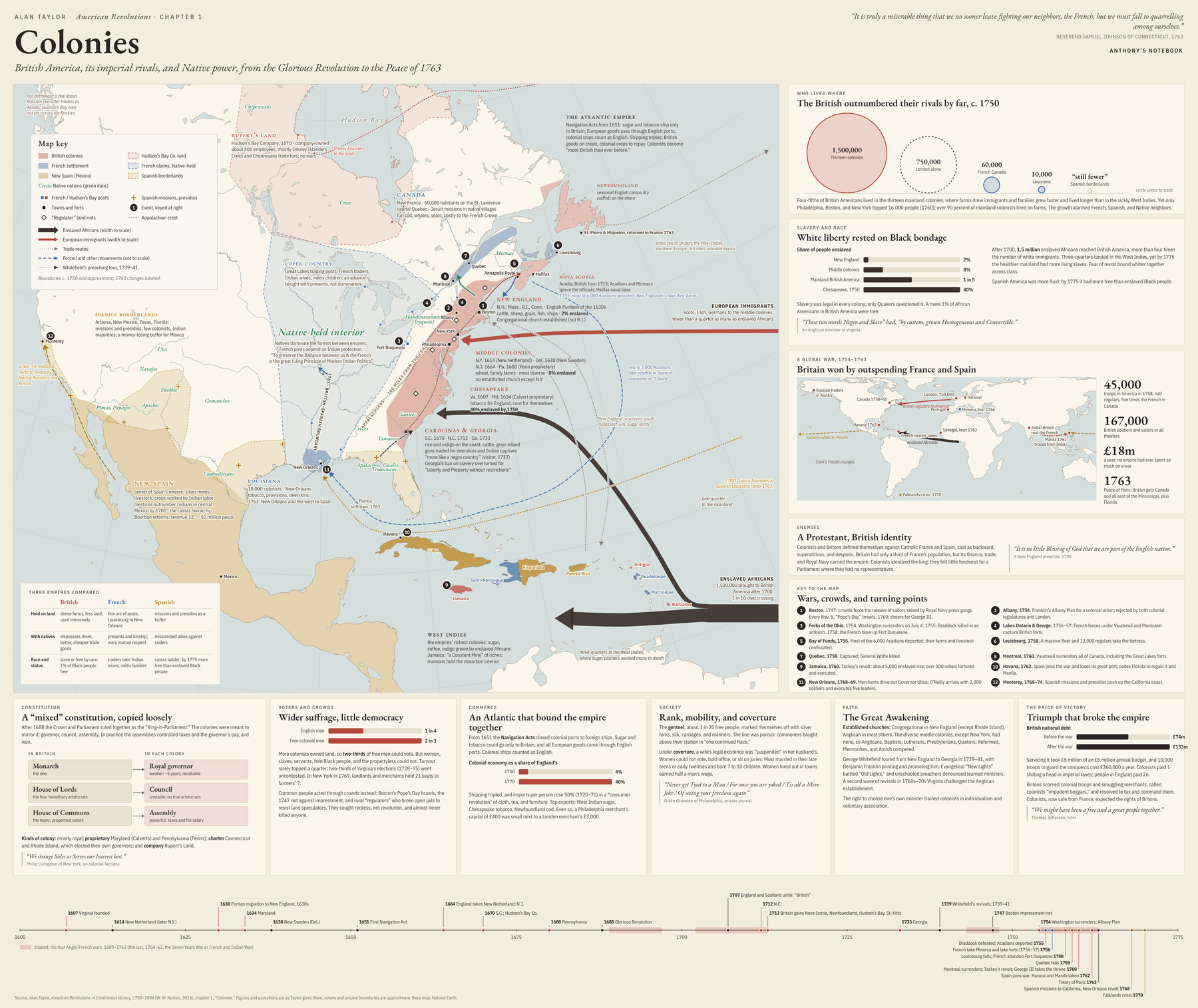
Chapter Objective and Through Line
Taylor reconstructs the imperial world the Revolution would destroy. After 1688, Britain’s composite constitution joined parliamentary sovereignty to colonial assemblies that controlled local taxation and used governors’ salaries to bargain for influence. Free colonists celebrated the monarchy, Protestant security, commercial prosperity, and a conception of British liberty rooted in property. Their political world was neither democratic in a modern sense nor simply despotic: a broad share of free white men could vote, but women, enslaved people, Native peoples, and many poor men remained outside legitimate public power. Post-1688 imperial constitution — PDF p. 23 (file not included in this release) · Assemblies and the electorate — PDF p. 43 (file not included in this release)
The chapter then compares imperial systems. British colonies held a decisive demographic and settler advantage along the Atlantic seaboard, while France and Spain claimed broader continental spaces through thin networks of posts, missions, garrisons, and Native alliances. British prosperity depended on Atlantic trade, consumer credit, settler access to land, and racial slavery. White liberty and Black bondage reinforced one another: coerced labor generated wealth and gave even modest whites a status protected by racial difference. At the same time, the Great Awakening and consumer markets weakened inherited deference by expanding choice, mobility, and voluntary association. Slavery, race, and white opportunity — PDF p. 32 (file not included in this release) · Evangelical choice — PDF p. 38 (file not included in this release)
Native power remains decisive. Britain cannot defeat New France through population alone; it needs metropolitan finance, naval blockade, subsidies, regular troops, and the breakdown of French supply and alliance networks. Victory in 1763 removes an imperial rival but generates debt, garrison costs, contempt between regulars and provincials, and incompatible expectations. British officials expect colonial revenue and obedience. Colonists expect land, autonomy, and the rewards of loyal service. The empire’s greatest triumph thus creates the conditions of its fracture. Native power and imperial balance — PDF p. 49 (file not included in this release) · Victory and postwar rupture — PDF p. 58 (file not included in this release)
Chapter Structure at a Glance
- The post-1688 settlement divides authority: Parliament claims supremacy while assemblies dominate local revenue.
- Colonists become more British: trade, Protestantism, consumer goods, and monarchy bind them to empire.
- Prosperity rests on hierarchy: gentility, coverture, class inequality, and racial slavery organize opportunity.
- Markets and revival unsettle deference: mobility and religious choice train colonists in voluntary association.
- Native diplomacy controls the interior: French and Spanish reach depends on alliances rather than settler density.
- Britain wins globally and loses politically: the expensive conquest of 1763 intensifies disputes over who should pay and rule.
Section-by-Section Argument
The composite British constitution (analytical division)
The imperial constitution is workable because its ambiguities permit bargaining. Parliament and Crown claim final sovereignty, governors execute royal instructions, and the Privy Council can disallow laws. Yet distance and fiscal dependence empower assemblies. By controlling local taxes and official salaries, propertied representatives turn nominal subordination into substantial autonomy.
- Colonial leaders do not initially seek independence; they believe their assemblies are part of a balanced British constitution.
- Political liberty is tied to property and representation, not universal personhood.
- Royal affection and parliamentary suspicion can coexist because colonists distinguish an idealized monarch from ministers and officials.
Demography, empire, and racial political economy (analytical division)
The continental comparison prevents a simple map-based measure of power. French and Spanish empires appear enormous but often govern through Native alliances, missions, traders, and strategically placed posts. British settlement is denser and more commercially productive, yet its land hunger makes accommodation with Native power harder.
- British mainland population and migration promise long-term expansion but do not automatically confer military mastery.
- The plantation colonies bind Atlantic profit to enslaved labor; northern merchants and consumers also benefit from the system.
- Race consolidates white freedom by making African descent a durable marker of enslavability and civic inferiority.
- Taylor’s comparison does not claim Spanish colonies were egalitarian; different racial classifications still sustained coercive empire.
Gentility, coverture, consumption, and revival (analytical division)
Colonial society venerates genteel manners, education, and conspicuous consumption, but commercial growth also lets some ambitious people rise. Married women’s labor remains legally absorbed under coverture, and women’s wages generally command less than men’s. The Great Awakening challenges inherited authority by teaching listeners to judge ministers, cross parish lines, and join voluntary religious networks.
- Consumer goods make colonists “more British” culturally while making boycott a future political weapon.
- Gentility supplies models of refinement that common people can imitate, creating aspiration as well as deference.
- Evangelical choice disrupts establishments but produces new leaders and disciplines rather than social equality.
- These developments prepare repertoires of choice and organization; they do not make revolution inevitable.
Assemblies, crowds, and bounded resistance (analytical division)
About two-thirds of free white adult men can vote in many colonies, a wider electorate than Britain’s, but turnout, malapportionment, property rules, and racial and gender exclusions sharply limit the meaning of participation. Crowds supplement formal politics by enforcing customary norms. Before the imperial crisis, they generally seek correction rather than regime change.
- Assembly control of money gives local elites unusual leverage over governors.
- Crowd action can defend community standards while remaining violent and class-conscious.
- The later Patriot movement will adapt these familiar forms—processions, effigies, intimidation, organized noncompliance—to revolutionary purposes.
Native power and the Seven Years’ War (analytical division)
Native nations hold the continental balance because no European empire can occupy the interior cheaply. Early British disasters show that dense settlement and militia numbers do not substitute for supply, diplomacy, regular forces, and naval power. Pitt’s government changes the balance by borrowing heavily, subsidizing allies, sending tens of thousands of troops, and using the navy to isolate New France.
- Braddock’s defeat exposes British ignorance and the military effectiveness of Native-French cooperation.
- British subsidies and restored diplomatic gifts help recover alliances lost through arrogance and poor trade.
- The fall of Louisbourg, Quebec, and Montreal follows a global strategy that France cannot adequately supply.
- Native allies pursue their own security; their shifting support is not evidence of automatic loyalty to either empire.
Victory as destabilization (analytical division)
Conquest removes France but also removes the rival that had made British officials solicitous of colonists and Native allies. The national debt rises sharply, a large North American garrison appears necessary, and Britons increasingly describe colonists as undertaxed and ungrateful. Colonists remember sacrifice, provincial casualties, and their expectation of western reward.
- Regular officers’ contempt for provincial troops deepens cultural resentment on both sides.
- Parliament sees taxation as a reasonable contribution to imperial defense; assemblies see internal taxation as their constitutional domain.
- Without France, settlers feel safer moving west while Native nations face a more aggressive demographic frontier.
- The empire becomes stronger on a map and more fragile in political practice.
Key Concepts and Distinctions
- Composite monarchy: A polity containing jurisdictions with different institutions under one crown.
- Significance: It explains how Parliament, Crown, and colonial assemblies could all claim legitimate authority before their claims became irreconcilable.
- Gentry and gentility: Wealth, education, manners, and patronage that mark social leadership.
- Significance: Revolutionary politics attacks hereditary deference while retaining elite leadership and aspirations to refinement.
- Coverture: The legal absorption of a married woman’s independent standing into her husband’s.
- Significance: It shows why a culture celebrating British liberty can rest on gendered dependency.
- Racialized liberty: White freedom and opportunity strengthened by the enslavement and legal exclusion of Black people.
- Significance: Taylor makes slavery constitutive of colonial liberty, not an exception outside it.
- Negotiated imperial power: Rule that depends on local assemblies, Native allies, credit, gifts, and cooperation.
- Significance: British victory can enlarge formal sovereignty while weakening the relationships that made authority effective.
Essential Evidence and Examples
- The electorate comparison: Roughly two-thirds of free white adult men could vote in many colonies versus about one-quarter in Britain. The contrast supports Taylor’s claim about colonial political confidence while the denominator exposes exclusion.
- Great Awakening itinerancy: Listeners choose preachers across established boundaries, making religious authority more competitive and voluntary without erasing hierarchy.
- Braddock’s defeat and Pitt’s reversal: Early disaster followed by metropolitan mobilization demonstrates that British victory depended on finance, navy, regular forces, and alliance management—not merely settler population.
- Imperial debt after 1763: The cost of victory gives ministers a fiscal reason to seek colonial revenue, while colonists interpret the same war as proof of sacrifice and entitlement.
Chapter Conclusion and Significance
The chapter overturns any assumption that independence grew naturally from colonial difference. On the eve of crisis, colonists are commercially and culturally more British, proud of Protestant monarchy, and experienced in negotiating autonomy within empire. The same institutions that bind them to Britain—assemblies, consumer markets, imperial wars, and a language of property—also give them resources to resist when postwar officials demand revenue and restraint.
The contradiction is structural. Britain’s victory depends on a fiscal-military state able to borrow, tax, and project power. Colonial prosperity depends on local taxation, expansive settlement, Atlantic commerce, and racial slavery. The conquest of 1763 brings those systems into direct conflict and exposes Native nations to a newly dangerous settler frontier.
Questions for Reflection
- How does the fact that colonists were becoming more British alter the usual explanation of independence?
- In what sense did racial slavery expand freedom for white colonists rather than merely coexist with it?
- Was the Seven Years’ War more destabilizing because Britain won it, or because of how officials tried to manage the victory?
Chapter 2: Land
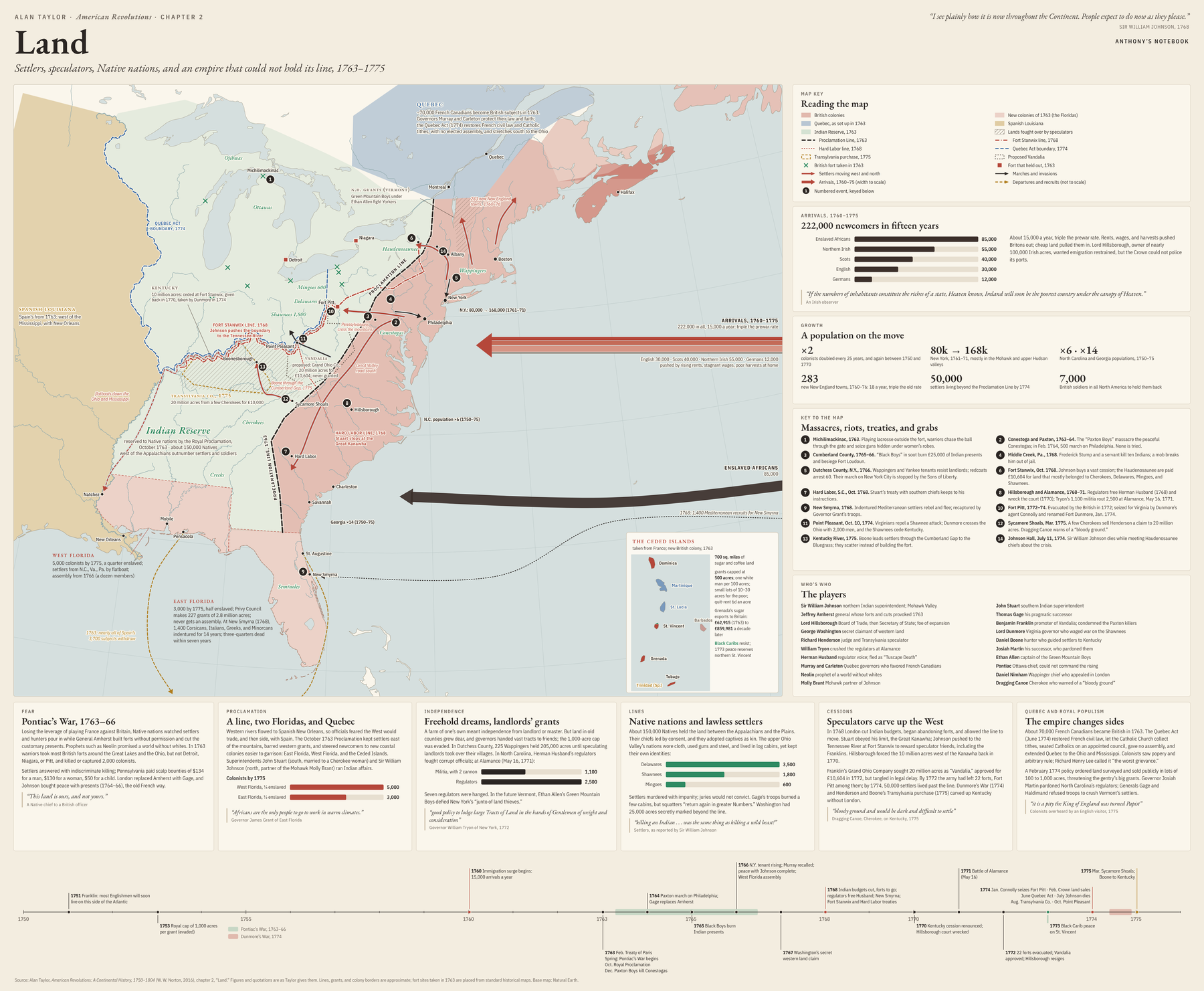
Chapter Objective and Through Line
Taylor moves from imperial victory to the western crisis that victory unleashed. Rapid population growth and immigration push settlers toward land they understand as the basis of household independence. Elite speculators seek immense grants and profits from the same movement. Native nations, far from accepting British conquest, reject forts, abusive traders, reduced gifts, and settlers who treat imperial maps as title. Their 1763 uprising compels Britain to resume diplomacy and establish a proclamation boundary. The line is meant to reduce military costs and channel settlement, not to recognize permanent Native sovereignty, but colonists interpret it as a betrayal of wartime expectations. Native resistance — PDF p. 64 (file not included in this release) · Proclamation policy — PDF p. 67 (file not included in this release)
The imperial state lacks the means and coherence to enforce its own design. Officials, governors, traders, land companies, settlers, and colonial elites pursue contradictory policies. People cross the line, juries excuse them, troops are too few, and well-connected speculators secure exceptions. Conflicts among tenants, landlords, regulators, and land companies show that “the frontier” is not a united democratic force. Settlers want freeholds, but they can dispossess Native people while resisting speculators who monopolize title. Native communities selectively use Christian institutions, markets, livestock, tools, and British law without surrendering identity or sovereignty. Freehold and class conflict — PDF p. 72 (file not included in this release) · Imperial enforcement failure — PDF p. 79 (file not included in this release)
By 1774, elite ambition and settler violence help generate Dunmore’s War and a coerced Shawnee cession. At the same time, the Quebec Act extends a centralized, Catholic-accommodating government into the Ohio country and retains institutions Patriots label despotic. British reforms can sometimes appear as “royal populism” against great colonial proprietors, but they remain inconsistent and weak. Taylor’s larger point is that the western land crisis—including Native resistance, settler migration, elite speculation, and imperial regulation—forms one equal half of the rupture with Britain. Taylor’s equal-halves formulation — PDF p. 19 (file not included in this release) · Dunmore and speculation — PDF p. 84 (file not included in this release) · Quebec and western government — PDF p. 87 (file not included in this release)
Chapter Structure at a Glance
- Demography intensifies pressure: population growth and immigration make western settlement seem both inevitable and dangerous.
- Native nations reject conquest: coordinated but decentralized resistance forces Britain back toward diplomacy.
- The Proclamation attempts managed expansion: officials seek peace and governability rather than permanent Native independence.
- Land divides colonists as well as empire: settlers, tenants, speculators, proprietors, and governors fight over access and title.
- Enforcement collapses: limited troops, resistant juries, corruption, and competing policies make the boundary porous.
- Dunmore and Quebec sharpen the crisis: violent expansion and imperial accommodation offer rival futures for the West.
Section-by-Section Argument
Demographic expansion and imperial anxiety (analytical division)
Colonial population doubles roughly every quarter century, supplemented by European immigration and the forced migration of enslaved Africans. Colonists treat growth as proof that British America will fill the continent. Some metropolitan observers see the same prospect as a threat: abundant land may weaken dependence on landlords, manufactures, and imperial supervision.
- Land promises independence to farm families because ownership reduces dependence on employers and landlords.
- Expansion also serves elite visions of profit through surveys, grants, and resale.
- The collision is not simply Britain versus America; metropolitan and colonial elites cooperate across the Atlantic while rival colonial groups resist one another.
Native resistance and the Proclamation (analytical division)
The 1763 uprising emerges from local grievances and shared alarm, not a single centralized command. Native leaders reject the fiction that France could transfer their lands to Britain. Attacks expose the vulnerability of forts and settlements, forcing officials to replace Amherst’s austerity and contempt with restored gifts and negotiation.
- The label “Pontiac’s Rebellion” can mislead because Pontiac neither commands every participant nor leads British subjects in revolt.
- Britain’s boundary aims to avert another costly war, direct trade, and concentrate settlement where government can reach it.
- The line is therefore both a concession to Native military power and an instrument for more orderly imperial expansion.
- Colonists see restriction after victory as evidence that officials value Native and imperial interests over loyal settlers.
Freehold independence and class conflict (analytical division)
Taylor complicates the celebratory image of the independent frontier farmer. Freehold aspirations can democratize property among whites, but land markets are structured by great grants, quitrents, debt, legal fees, and speculative patronage. Regulators and tenants resist elites while also pressing into Native territory.
- Wappinger people adopt Christianity and legal argument to defend land, showing strategic adaptation rather than cultural disappearance.
- North Carolina regulators attack fees and official corruption; their politics are local and anti-elite, not yet a national revolutionary program.
- Green Mountain settlers resist New York proprietors and courts while advancing their own claims over prior owners.
- Settler conflict with speculators concerns who will profit from dispossession, not whether Native sovereignty will be respected.
The unenforceable boundary (analytical division)
British policy fails because the empire cannot align its agents or impose costs on violators. Troops are too few to police an immense interior, colonial governments refuse cooperation, and local juries sympathize with settlers. Officials who defend the boundary coexist with governors and patrons who promote new grants.
- The army withdraws from many frontier forts to save money, reducing the very presence meant to enforce regulation.
- Armed settlers intimidate traders and officials while presenting themselves as defenders against Native attack.
- George Washington’s private western claims exemplify how Patriot leaders can denounce imperial restrictions while pursuing speculative advantage.
- Formal sovereignty without administrative capacity creates resentment without producing control.
Fort Stanwix, Vandalia, and Dunmore’s War (analytical division)
At Fort Stanwix, Haudenosaunee negotiators cede claims over lands principally used by other Native peoples, allowing British officials and speculators to claim legality without broad consent. Vandalia represents a giant elite project, but it is blocked by rival Virginia interests and imperial politics rather than completed. Virginia leaders then use frontier conflict to subordinate settlers, defeat Shawnee resistance, and defeat competitors for land.
- Rival elites share an expansionist horizon while fighting over jurisdiction and profit.
- Dunmore’s motives are plural: defense, political control, speculation, and rivalry all matter.
- Shawnee concessions are produced under military pressure and do not establish a neutral market transaction.
- The episode makes western war part of the same political crisis as eastern resistance.
Quebec and the limits of royal populism (analytical division)
The Quebec Act accommodates Catholic worship, French civil law, and seigneurial institutions while extending appointed government into the Ohio Valley. Officials hope to stabilize a diverse empire and raise Crown revenue through controlled land distribution. Patriots instead see Catholic toleration, arbitrary government, and a threat to western claims.
- British accommodation is pragmatic governance, not simple favoritism or a plan to destroy Protestantism.
- Smaller grants and restrictions on speculation can protect ordinary purchasers against great colonial proprietors.
- That possibility of “royal populism” remains episodic; other governors aid large speculators, and enforcement repeatedly fails.
- The Act becomes politically explosive because it joins religion, representation, and the West in one imperial policy.
Key Concepts and Distinctions
- Freehold independence: The ideal that landownership gives a household economic and political autonomy.
- Significance: It motivates settlement and anti-elite protest while also driving Native dispossession.
- Native sovereignty: The claim of distinct nations to control their land, diplomacy, and political allegiance.
- Significance: It exposes the 1763 transfer of imperial territory as a European legal fiction rather than accepted conquest.
- Proclamation Line: Britain’s boundary for managing settlement and reducing war.
- Significance: It is neither a permanent Native reserve nor a meaningless gesture; its weak enforcement still alienates colonists.
- Speculative empire: The conversion of contested land into grants, companies, surveys, and anticipated resale profit.
- Significance: It connects governors, merchants, and colonial leaders across the imperial divide.
- Royal populism: Taylor’s possibility that the Crown could sometimes restrain colonial oligarchs on behalf of common settlers.
- Significance: Its inconsistency shows why no stable pro-imperial popular coalition forms around land reform.
Essential Evidence and Examples
- The 1763 uprising: Native military success forces policy change and proves that British conquest of France is not conquest of Native nations.
- East Florida’s failed white-smallholder design: Environment, disease, capital needs, and plantation incentives push planners toward coerced labor, showing the limits of imperial social engineering.
- Fort Stanwix: The treaty shows how one confederacy’s diplomatic leverage can be used to transfer other peoples’ land without their consent.
- Dunmore’s War: Elite speculation, state ambition, settler fear, and Shawnee resistance converge, making frontier violence part of the constitutional crisis.
- The Quebec Act: Accommodation of Catholic and French institutions becomes, in Patriot interpretation, evidence that Britain will combine western restriction with unrepresentative rule.
Chapter Conclusion and Significance
The West is not a vacant space waiting for national settlement. It is a political field inhabited by sovereign Native peoples and contested by settlers, land companies, colonial governments, and imperial officials. Britain’s problem is not simply that colonists disobey; it is that imperial policy cannot reconcile cheap defense, Native diplomacy, settler migration, speculative patronage, and representative government.
This chapter makes Taylor’s equal-halves claim concrete. Parliamentary taxation threatens colonists’ constitutional control over property, while western policy threatens their expectation of acquiring property. Those issues reinforce one another, especially when the Quebec Act appears to join Catholic accommodation, appointed government, and restraint of Anglo-American expansion. Independence will offer settlers a government more willing to advance their land hunger, but it will not eliminate class conflict or Native power.
Questions for Reflection
- Does freehold independence deserve to be called democratic when it depends on Native dispossession?
- How does Britain’s weak enforcement make imperial reform more provocative rather than less important?
- Could a consistent royal-populist land policy have preserved colonial loyalty, or were settler and imperial goals already irreconcilable?
Chapter 3: Slaves
Chapter Objective and Through Line
Taylor examines how a constitutional dispute became a revolutionary movement and why colonists repeatedly described that dispute through the language of slavery. Parliament insisted that sovereignty was indivisible and that virtual representation allowed it to legislate for the whole empire. Colonial leaders accepted imperial connection but claimed that their elected assemblies alone could impose internal taxes. Opposition writers translated this institutional disagreement into a moral psychology: taxation without consent made property insecure, dependence corrupted virtue, and a chain of small precedents could reduce freeholders to political “slaves.” Taylor takes that fear seriously while exposing its relationship to actual racial bondage. Competing sovereignties — PDF p. 95 (file not included in this release)
The Stamp Act became explosive not because its rate was crushing but because it was direct, broad, imposed during depression, and backed by juryless admiralty courts. Genteel opponents enlisted crowds to intimidate stamp distributors, destroy symbols, and pressure merchants, then worried that plebeian action might turn against property and rank. Repeal taught colonists that argument, commercial boycott, and coercive protest could defeat policy. The Townshend crisis institutionalized those methods: committees monitored neighbors, women’s consumption and production became essential, and public language celebrated liberty while narrowing the space for dissent. Stamp Act crisis — PDF p. 100 (file not included in this release) · Repeal’s lesson — PDF p. 107 (file not included in this release)
Slavery gives the chapter its sharpest contradiction. Enslaved petitioners and British critics apply natural-rights language to chattel bondage; the Somerset ruling is read far beyond its narrow English scope as a possible imperial threat to slave property. Most Patriot leaders subordinate antislavery implications to coalition unity. By 1774, the Coercive Acts and Continental Association convert resistance into parallel government. Committees widen public action among white men while enforcing conformity through inspection, shaming, exclusion, and, against persistent opponents, violence. Revolution begins in practice before independence is declared. Political and chattel slavery — PDF p. 116 (file not included in this release) · Continental Association — PDF p. 124 (file not included in this release)
Chapter Structure at a Glance
- Parliament and assemblies define sovereignty differently.
- Opposition ideology turns taxation into a threat to independence and virtue.
- Stamp resistance joins genteel leadership to autonomous crowd power.
- Boycott broadens participation while coercing unity.
- The slavery metaphor invites an antislavery answer most Patriots resist.
- The Association transfers effective authority to local committees.
Section-by-Section Argument
Sovereignty, dependence, and imagined conspiracy (analytical division)
British and colonial positions begin within a shared constitution. Parliament sees taxation and legislation as inseparable expressions of supreme authority; colonial assemblies see internal taxation without elected consent as a destruction of property. Opposition thought supplies a causal chain from debt and taxation to officeholding, dependence, corruption, standing armies, and lost liberty.
- “Virtual representation” seems plausible in Britain but hollow to colonists separated by an ocean and represented in their own assemblies.
- Colonists imagine a ministerial plot to enslave them; officials imagine a colonial project for independence before either conspiracy exists in the form feared.
- Reciprocal suspicion makes compromise appear as surrender rather than adjustment.
Stamp resistance and the disciplined crowd (analytical division)
The Stamp Act reaches courts, newspapers, commercial paper, and everyday legal business. Depression and scarce specie intensify resentment, while admiralty jurisdiction connects revenue collection to the loss of jury trial. Elite critics require mass pressure but fear attacks on wealth and status.
- Patrick Henry and intercolonial protest supply constitutional argument.
- Crowds force resignations and destroy property, including Thomas Hutchinson’s mansion, revealing action that leaders cannot fully control.
- Merchants’ nonimportation gives metropolitan commerce an interest in repeal.
- The Declaratory Act preserves Parliament’s claim even as practical victory encourages further resistance.
Townshend resistance, women, and coerced solidarity (analytical division)
New duties renew the constitutional dispute and turn everyday choices into public tests. Committees publish names, inspect compliance, and transform rumor, print, and neighborhood pressure into enforcement. Women make boycott possible by refusing imports, producing homespun, and managing household consumption, yet men frame their contribution as domestic sacrifice rather than a claim to citizenship.
- Wider participation does not mean liberal pluralism; dissenters can be shunned, threatened, or assaulted.
- The Boston Massacre becomes a Patriot narrative of standing-army tyranny, even as troops face a hostile crowd.
- The movement learns to use publicity as both mobilization and discipline.
Tea, coercion, and the contradiction of slavery (analytical division)
The Tea Act offers cheaper tea but preserves the duty and privileges the East India Company, proving that price cannot settle sovereignty. The Tea Party and Coercive Acts escalate the contest. Meanwhile, Patriot invocations of slavery give enslaved people a language for petitions and let British writers expose colonial hypocrisy.
- Somerset does not abolish colonial slavery; its expansive colonial reception matters politically.
- Virginia elites connect imperial vetoes of slave-trade restrictions and rumors of emancipation to fears of revolt.
- Phillis Wheatley, Black petitioners, and antislavery writers press the universal logic of rights farther than most Patriot coalitions will allow.
Massachusetts counter-government and the Association (analytical division)
By autumn 1774, rural crowds and committees prevent courts from sitting, compel councillors to resign, redirect taxes, and reorganize militia. The Continental Association generalizes that authority through committees of inspection across the colonies.
- At least thousands of local committeemen gain public roles previously monopolized by a narrower elite.
- Enforcement normally relies on inspection, exposure, and shunning, but persistent resistance can draw property damage and violence.
- Committees claim to defend the old constitution while creating a new source of sovereignty.
- Property and racial exclusions remain; democratic mobilization and coercion develop together.
Key Concepts and Distinctions
- Parliamentary sovereignty: The claim that Parliament’s legislative authority over the empire is legally indivisible.
- Significance: It collides with colonial claims to coequal control over internal taxation.
- Political slavery: Patriot language for dependence on rulers who can take property without consent.
- Significance: The metaphor mobilizes colonists but becomes morally unstable beside chattel slavery.
- Nonimportation: Collective refusal to buy British goods.
- Significance: It converts household consumption, merchant credit, and women’s labor into political leverage.
- Committee sovereignty: Practical local authority exercised through inspection, sanctions, and militia organization.
- Significance: It explains how revolution begins before Congress declares independence.
Essential Evidence and Examples
- Stamp distributors’ resignations: Coordinated intimidation prevents enforcement and demonstrates that imperial law requires local cooperation.
- Repeal plus the Declaratory Act: Practical colonial victory and formal parliamentary supremacy coexist, postponing rather than solving the constitutional problem.
- Homespun politics: Women’s production sustains boycott and widens participation without granting formal political equality.
- Somerset’s reception: The gap between a narrow ruling and its expansive colonial meaning shows how slaveholders’ fears shape imperial politics.
- The Continental Association: A commercial agreement becomes an infrastructure of revolutionary government and social discipline.
Chapter Conclusion and Significance
Taylor shows how constitutional resistance becomes revolutionary capacity. The movement succeeds because argument, commerce, voluntary participation, and coercion operate together. Its institutions train ordinary white men to judge neighbors and officials, but the same committees that enlarge participation suppress neutrality and dissent.
The chapter’s title forces a distinction the rhetoric often blurs. Colonists’ fear of political enslavement reflects a genuine constitutional dispute, yet their analogies invite enslaved people to expose the narrow scope of Patriot liberty. The movement reaches 1775 with a powerful language of natural rights and an equally powerful interest in preserving racial property.
Questions for Reflection
- Can Patriot slavery metaphors be analytically useful without trivializing chattel slavery?
- When does coordinated social pressure become revolutionary government rather than protest?
- Did women’s boycott participation challenge gender hierarchy, reinforce it, or do both at once?
Chapter 4: Rebels
Chapter Objective and Through Line
War begins because British leaders underestimate colonial organization, overestimate Loyalist strength, and send too little force to reassert authority without provoking wider resistance. Lexington and Concord turn searches and arrests into open conflict; Bunker Hill leaves Britain holding the ground but suffering losses that discredit assumptions of militia collapse. Congress nonetheless combines war with reconciliation because many colonists still fear civil discord and remain attached to the king. Taylor’s subject is therefore the contingent construction of rebellion, not the unfolding of a unanimous national desire. War’s outbreak — PDF p. 131 (file not included in this release) · Rival coalitions — PDF p. 134 (file not included in this release)
Patriots and Loyalists form rival cross-class coalitions. Loyalists promise legal order and imperial protection; Patriot elites offer common white men greater status and opportunity while disciplining them within committees and armies. The Continental Army embodies the paradox: soldiers submit to drill, hierarchy, long enlistments, and corporal punishment so civilian citizens may claim liberty. Fourteen other British colonies remain outside the rebellion for varied reasons—dependency, naval vulnerability, thin institutions, or slaveholding fear—showing that British oppression does not mechanically produce revolution.
Slavery transforms allegiance. Many planters fear imperial interference and rally to the Patriot cause, while enslaved people treat British lines as a plausible route to freedom. Dunmore’s proclamation is a genuine opportunity for some Black Loyalists and a strategic, conditional offer rather than universal emancipation; it also consolidates white southern rebellion. Paine then popularizes independence, continental union, and republicanism, while the need for foreign aid and British coercion pushes Congress toward the Declaration. Britain nearly destroys the new nation in New York, but Howe’s missed opportunities and Washington’s preservation of his army leave space for Trenton and Princeton to revive the cause. Slavery and allegiance — PDF p. 144 (file not included in this release) · Common Sense — PDF p. 152 (file not included in this release) · New York crisis — PDF p. 158 (file not included in this release)
Chapter Structure at a Glance
- British miscalculation converts coercion into war.
- Rival coalitions compete for divided communities.
- Congress wages war while preserving the possibility of reconciliation.
- Army discipline and slavery expose the limits of revolutionary liberty.
- Paine, foreign necessity, and royal coercion make independence politically possible.
- The 1776 military collapse proves that survival, not declaration, sustains the Revolution.
Section-by-Section Argument
From raid to civil war (analytical division)
Gage lacks the force he believes necessary and tries to seize stores before resistance hardens. Militia networks spread the alarm, and the British retreat from Concord turns a policing action into a regional war. At Bunker Hill, disciplined regulars take the position only after devastating losses.
- The first shot remains uncertain; Taylor avoids making one side the sole author of war.
- Patriot organization predates the battles through committees and militia reform.
- British tactical victory becomes a political defeat because it reveals the price of occupying hostile territory.
Coalitions, Congress, and military discipline (analytical division)
Neither camp maps neatly onto class. Genteel Loyalists recruit ordinary followers through protection and patronage; Patriot leaders mobilize common men through opportunity, local power, and ideology. Families and neighborhoods split. Congress adopts Washington’s army while sending the Olive Branch Petition, using ambiguity to hold together radicals and reconcilers.
- Washington tries to transform short-term provincial forces into a hierarchical Continental institution.
- Soldiers experience the contradiction between liberty as a civilian goal and obedience as a military necessity.
- Militia remain essential for local control even when leaders disparage their reliability.
Loyal colonies and enslaved choices (analytical division)
The rebellion’s geographic limits reveal the importance of institutions and social composition. Colonies with weak representative traditions, strong naval exposure, or enslaved majorities may find British power more protective than threatening. In the South, the same slave system pushes many whites toward resistance and many enslaved people toward Britain.
- Dunmore offers freedom only to enslaved people of rebels who can serve the Crown; the offer is strategic and bounded.
- Enslaved people act for themselves by fleeing, negotiating, serving, or seeking families, not merely as British instruments.
- Disease, military use, abandonment, and re-enslavement make British freedom precarious even when the promise is honored.
- White Patriot repression grows from fear that imperial war will become social revolution.
Canada, Boston, and the turn to independence (analytical division)
The invasion of Canada fails because Patriot appeals lack credibility among Catholics, logistics collapse, enlistments expire, and smallpox devastates the force. Success at Boston depends on captured artillery and British prudence; southern defenses exploit fortification and coordination failures. These mixed results form the setting for Paine’s intervention.
- Common Sense makes monarchy absurd, independence necessary, and union the condition of republican survival.
- Its circulation matters, but Taylor embeds its influence in war, British policy, and preexisting debate.
- Foreign alliance requires a sovereign United States, giving diplomacy a practical argument for independence.
- The Declaration shifts blame toward George III and universalizes rights while retaining grievances against Native resistance and imperial threats to slave property.
New York collapse and recovery (analytical division)
British numerical and naval superiority drives Washington from New York and reduces his army dramatically. Howe repeatedly wins but does not encircle and destroy the Continental force. Washington learns that the Revolution can survive lost cities if the army remains intact.
- British caution has rational roots in terrain, supply, and fear of excessive casualties; Taylor does not treat every pause as inexplicable incompetence.
- Occupation also tests Loyalist recruitment and civilian protection.
- Trenton and Princeton are small compared with the New York campaign but politically decisive because they revive militia, morale, and enlistment.
- The strategic objective becomes endurance until British will or international conditions change.
Key Concepts and Distinctions
- Rebel coalition: The cross-class alliance that joins elite leadership to common white men’s aspirations and local committees.
- Significance: It explains real support without treating all Patriots as socially identical.
- Conditional emancipation: Freedom offered for military service to enslaved people belonging to rebels.
- Significance: It makes Britain a route to freedom for some without turning imperial policy into general abolition.
- Military republican paradox: Citizens’ liberty defended by soldiers subjected to hierarchy and coercion.
- Significance: It shows why revolutionary armies reproduce forms of authority they claim to resist.
- War of survival: Strategy centered on preserving an army and political cause rather than defending every city.
- Significance: It makes Trenton’s political effect more important than its scale.
Essential Evidence and Examples
- Bunker Hill casualties: A British tactical win destroys the expectation that regulars can cheaply intimidate the countryside.
- The fourteen loyal colonies: Their varied choices demonstrate that rebellion requires local institutions, social conditions, and perceived interests—not grievance alone.
- Dunmore’s proclamation: It links slaveholders’ Patriotism to racial fear and enslaved people’s Loyalism to a rational pursuit of freedom.
- Common Sense: Paine packages independence, union, and republicanism as one accessible answer to the crisis.
- New York and Trenton: Near-disaster followed by revival proves how contingent the Revolution remains after July 1776.
Chapter Conclusion and Significance
Independence is made by war rather than merely announced by political philosophy. British coercion, Patriot organization, racial conflict, foreign necessity, and republican argument together move a divided population beyond reconciliation. Taylor therefore resists both a purely ideological explanation and a story of inevitable national awakening.
The chapter ends with survival, not victory. Washington’s army remains fragile, Patriot authority uneven, and Loyalist potential substantial. Trenton restores belief that the cause can last long enough to alter international calculations—the problem the next chapter resolves.
Questions for Reflection
- Which mattered more in 1776: ideological conversion, British coercion, or the practical need for foreign recognition?
- How should Dunmore’s proclamation be evaluated simultaneously as strategy, emancipation opportunity, and cause of white backlash?
- Does the Continental Army contradict republican liberty or reveal a necessary institutional condition for it?
Chapter 5: Allies
Chapter Objective and Through Line
Taylor dismantles the myth of self-reliant independence. The United States lacks the industrial base, specie, credit, expertise, and naval power required to defeat Britain alone. Its leaders want European aid without European entanglement and initially combine republican suspicion of monarchy with maximal territorial claims. Battlefield reverses force a more realistic diplomacy. Saratoga results from British strategic fragmentation, Burgoyne’s logistical isolation, and Patriot mobilization; its decisive consequence is to persuade France that the rebellion can endure. Foreign dependence — PDF p. 170 (file not included in this release) · Saratoga campaign — PDF p. 172 (file not included in this release)
Howe’s occupation of Philadelphia fails strategically because Congress and Washington’s army survive, while Valley Forge exposes the state’s inability to supply its soldiers without coercive requisition. Von Steuben’s training improves discipline, but the army increasingly relies on long-term soldiers drawn disproportionately from the poor, marginal, drafted, and substituted. Women sustain farms, shops, fundraising, camps, nursing, and intelligence without receiving civic equality. The social burden of war thus falls unevenly beneath a rhetoric of citizen-soldiers. Valley Forge — PDF p. 179 (file not included in this release) · Army transformation — PDF p. 187 (file not included in this release)
The French alliance internationalizes the conflict and disperses British forces, but cooperation is strained by prejudice, communication, and different priorities. Spain enters as France’s ally and a co-belligerent, not as a formal U.S. treaty ally. Britain’s late reconciliation proposal cannot reverse the political transformation, and frustration encourages punitive war. By 1780–81, American credit and morale again approach collapse. French loans and Rochambeau’s army do not replace American effort; they make continued American endurance strategically useful. The chapter ends by making interdependence, not autonomous virtue, the condition of victory. French alliance — PDF p. 181 (file not included in this release) · Spain’s distinct status — PDF p. 182 (file not included in this release) · Arnold and disaffection — PDF p. 195 (file not included in this release)
Chapter Structure at a Glance
- Material weakness drives diplomacy despite republican fear of dependency.
- Saratoga converts survival into foreign credibility.
- Philadelphia and Valley Forge expose the difference between occupying a capital and destroying a revolution.
- Alliance turns the war global while multiplying friction.
- Long war shifts sacrifice toward poorer soldiers and women’s unrecognized labor.
- Mutiny, treason, and insolvency make renewed French aid essential.
Section-by-Section Argument
Republican diplomacy and Saratoga (analytical division)
American diplomats prefer commercial treaties without political commitments, yet request arms, loans, protected trade, and recognition from Catholic monarchies. France seeks revenge against Britain but hesitates to back a collapsing rebellion. Burgoyne’s surrender changes the calculation.
- Howe’s Philadelphia campaign deprives Burgoyne of coordination.
- Long supply lines, difficult terrain, militia mobilization, and battlefield resistance isolate the northern army.
- Saratoga is both a military victory and a signal that French investment may produce strategic return.
- French motives remain imperial; shared opposition to Britain does not erase mistrust.
Philadelphia and Valley Forge (analytical division)
Britain captures the capital without capturing Congress or destroying Washington. Occupation consumes resources and fails to control the countryside. At Valley Forge, suffering reflects fiscal and administrative weakness as much as winter weather.
- Requisitioning food and destroying mills can save the army while devastating civilians whose liberty it claims to defend.
- Continental currency depreciation transfers costs unevenly and weakens voluntary supply.
- Von Steuben’s drill makes disparate troops more effective and reinforces hierarchy.
- The episode combines institutional failure, coercion, endurance, and professionalization.
Alliance and world war (analytical division)
French entry forces Britain to defend the Caribbean, Europe, India, shipping, and the home islands. Spain’s entry in 1779 adds pressure through Gulf campaigns, finance, and naval strategy while preserving Spanish suspicion of U.S. western ambition.
- Newport’s failure reveals poor coordination and mutual prejudice.
- France values the Caribbean and global balance, not only North American independence.
- Britain’s 1778 peace commission offers major concessions that might have mattered earlier; after alliance and independence, Congress refuses them.
- Rejection and global strain encourage destructive raids meant to punish and demoralize.
The army’s social transformation (analytical division)
Short-term yeoman volunteers become less representative of the Continental Army as the war lengthens. Bounties, drafts, and substitution draw apprentices, laborers, migrants, servants, and other men with limited alternatives into prolonged service. Officers seek status and compensation while enlisted soldiers face arrears and harsh discipline.
- “Citizen-soldier” remains an ideal but obscures class selection.
- Desertion and mutiny reveal material grievance without proving the absence of commitment.
- Women’s productive and camp labor makes military persistence possible, but public recognition remains domestically framed.
- The Revolution enlarges political participation at home while concentrating danger among those with least economic power.
Arnold, exhaustion, and French rescue (analytical division)
Benedict Arnold’s treason lets leaders isolate betrayal in a corrupt individual, but Taylor places it amid broader officer resentment, failed business, unpaid soldiers, speculation, and declining confidence. By 1780–81, mutinies and insolvency show that the cause still can collapse.
- Arnold’s greed and ambition are real; the interpretive point is that they do not exhaust the setting.
- French leaders distrust American capacity even while concluding that more aid is required.
- Rochambeau’s troops and new loans restore strategic possibility.
- Interdependence is reciprocal: France needs a surviving American army, and Americans need French resources.
Key Concepts and Distinctions
- Interdependence: Victory produced by combined American persistence and European resources.
- Significance: It avoids both national self-reliance mythology and a story in which foreigners simply win the war for passive Americans.
- Alliance versus co-belligerency: France is a formal U.S. treaty ally; Spain fights Britain as France’s ally without the same U.S. treaty relationship.
- Significance: The distinction preserves different diplomatic aims and legal relationships.
- Citizen-soldier ideal: The image of independent farmers temporarily taking up arms.
- Significance: Taylor contrasts it with an increasingly long-service, poor, drafted, and substituted force.
- Punitive war: Destruction intended to weaken political will and punish rejection.
- Significance: It marks Britain’s shift after failed reconciliation and prolonged frustration.
Essential Evidence and Examples
- Saratoga: Its greatest effect is diplomatic: a battlefield surrender turns the rebellion into a credible French partner.
- Valley Forge requisition: The army’s survival can require coercion against civilians, complicating a simple liberty-versus-tyranny frame.
- Newport: A failed combined operation shows that decisive alliance can remain culturally and operationally difficult.
- Army recruitment: Bounties, drafts, and substitutes reveal a class shift hidden by the universal citizen-soldier image.
- Arnold and the mutinies: Treason and collective unrest show different expressions of the same material and institutional exhaustion.
Chapter Conclusion and Significance
The Revolution survives because domestic and international resources finally align. American endurance makes alliance plausible; French alliance makes long-term survival possible; Spain and global war stretch British capacity. None of the partners acts from pure ideological solidarity. The coalition works through overlapping interests, continuing suspicion, and repeated operational failure.
The social history matters as much as diplomacy. Poorer soldiers, civilians subject to requisition, and women performing undervalued labor bear much of the burden. Independence becomes more likely at the moment its rhetoric of virtuous self-reliance becomes least adequate to explain how the war is actually sustained.
Questions for Reflection
- Does dependence on monarchical allies compromise republican independence, or make it materially possible?
- How does the army’s class transformation change the meaning of consent and sacrifice?
- Why does Taylor place Arnold’s treason beside collective disaffection rather than treating it as an isolated moral failure?
Chapter 6: Loyalties
Chapter Objective and Through Line
Taylor shifts from armies and alliances to the social contest that determines whether either side can govern. Committed Patriots and Loyalists are minorities. He estimates that Loyalists probably peak near one-fifth of the population, Patriots at roughly twice that share, and a large remainder wavers, avoids commitment, or follows whichever side can protect family and property. Allegiance grows through kinship, religion, ethnicity, neighborhood pressure, patronage, military control, and fear as much as abstract doctrine. “Patriot” therefore cannot stand for American, and “Loyalist” cannot mean foreign. Fluid allegiance — PDF p. 203 (file not included in this release)
Patriot victory depends on winning and disciplining that middle. Committees use oaths, shunning, blacklists, confiscation, imprisonment, militia duty, and occasional physical abuse; British forces answer with martial law, requisition, imprisonment, and plunder. For civilians, the war often appears less as formal battle than as raids, theft, torture, and retaliation. British officers require Loyalist support but disparage provincials and fail to protect adherents, while Patriot institutions remain embedded in local communities. Coercive mobilization is central to consolidating Patriot control, though Taylor does not claim coercion alone makes victory inevitable. Patriot coercion — PDF p. 208 (file not included in this release) · Civilian war — PDF p. 211 (file not included in this release)
The southern strategy exposes fatal contradictions. White Loyalists often want protection of slavery and settler expansion; enslaved people seek freedom; Native allies seek autonomy and defense of land. British commanders cannot satisfy all three. Northern governments increasingly accept Black service, while southern Patriots reject general emancipation yet sometimes use enslaved people as recruitment bounties or permit enslaved substitutes—distinct practices that should not be conflated. Rapid British conquest of South Carolina collapses when compulsory militia service destroys neutrality. Greene then preserves his army through a campaign of movement and attrition while partisan atrocities escalate. Many white southerners finally treat Patriot victory as the likelier route to order, though that “order” remains proslavery and anti-Native. Contradictory southern coalition — PDF p. 216 (file not included in this release) · Carolina conquest — PDF p. 223 (file not included in this release) · Partisan war — PDF p. 231 (file not included in this release)
Chapter Structure at a Glance
- Minorities compete for waverers rather than reveal fixed national camps.
- Local ties and perceived security organize allegiance.
- Both sides use law, social pressure, and violence to deny neutrality.
- British occupation repeatedly fails to convert military presence into trusted civil government.
- Race makes the southern coalition internally incompatible.
- Attrition and revenge shift white support toward Patriot order.
Section-by-Section Argument
Fluid allegiance and local choice (analytical division)
People often choose with relatives, congregations, ethnic communities, or patrons. Military reverses alter calculations, and some people switch more than once. Taylor’s proportions are qualified estimates, not a census. Their value is analytical: no committed camp can win without mobilizing a much larger uncertain population.
- Ideology matters when carried through trusted local relationships.
- Safety, access to markets, protection from confiscation, and the location of armies shape choice.
- Divided families make the conflict civil in the most intimate sense.
Patriot discipline and British martial rule (analytical division)
Patriot committees make noncommitment costly. They control mills, stores, permits, oaths, property, and public reputation. British occupation can initially attract people who want security, but military government often refuses meaningful provincial authority and permits requisition or contempt that alienates supporters.
- Coercion can create resentment and Loyalism as well as obedience.
- Local Patriot institutions endure when armies move; British protection often disappears with the garrison.
- Prisoner treatment and property seizures radicalize families on both sides.
- Neither coalition monopolizes violence, but asymmetry in local organization helps Patriots.
A contradictory racial coalition (analytical division)
British southern strategy combines groups whose desired victories conflict. Slaveholding Loyalists expect restored racial order. Enslaved fugitives seek freedom and sometimes arms. Native nations seek protection from the same settlers Britain hopes to recruit.
- British commanders employ, evacuate, return, or sell runaways according to military need; policy never becomes universal abolition.
- Black military service expands more readily in the North as manpower shortages outweigh racial resistance.
- Southern legislatures reject proposals to free and arm large numbers, revealing that preserving slavery outranks maximum mobilization.
- Enslaved people offered as enlistment bounties are not the same category as enslaved substitutes serving in another man’s place.
Southern conquest and partisan anarchy (analytical division)
Charleston’s fall seems to vindicate British strategy, but Clinton’s demand that former neutrals serve in Loyalist militia forces people to choose and fuels insurgency. Partisan leaders mobilize local networks, settle personal scores, and plunder enemies. Reciprocal atrocities create a cycle that neither high command fully controls.
- Waxhaws, Kings Mountain, executions, torture, and retaliatory raids become political stories as well as violence.
- Greene avoids destruction, stretches Cornwallis’s supply, and treats tactical defeat as acceptable if British capacity erodes.
- Militia and partisans are indispensable to that strategy despite indiscipline.
- “Victory” means becoming the coalition more capable of restoring a white social order after years of chaos.
Key Concepts and Distinctions
- Waverers: People whose allegiance remains conditional, local, or changeable.
- Significance: They make coalition-building and protection more decisive than a simple count of declared Patriots and Loyalists.
- Coercive mobilization: The coordinated use of social, economic, legal, and physical pressure to produce participation or silence.
- Significance: It explains how Patriot institutions consolidate control without implying that all support is fake.
- Triangular southern war: Conflict among Patriots, white Loyalists, and Black or Native actors pursuing distinct ends.
- Significance: Britain’s military coalition contains political goals that cannot all be fulfilled.
- Partisan war: Decentralized local violence entwined with kinship, property, revenge, and military strategy.
- Significance: It places civilian experience and reciprocal atrocity at the center of the southern campaign.
Essential Evidence and Examples
- Taylor’s allegiance estimates: Their uncertainty is part of the point; political identity changes under pressure.
- Oaths and confiscation: Patriot power operates through civil institutions as well as battlefield success.
- Black military service: Northern recruitment and southern resistance reveal how manpower need competes with racial order.
- Clinton’s militia proclamation: A policy intended to consolidate victory destroys neutrality and enlarges insurgency.
- Greene’s campaign: Strategic success through preserved forces and exhausted opponents challenges a battle-winner’s account of war.
Chapter Conclusion and Significance
Taylor explains Patriot victory as the outcome of a competition for people who do not begin as nationalists. Local institutions, protection, coercion, ideology, battlefield change, and British mistakes interact. The Patriots do not merely discover a majority; they organize, persuade, discipline, and sometimes terrorize one into political effectiveness.
The southern war reveals the racial boundary of restored order. Britain loses white support partly because its Native and Black allies threaten settler land and slave property. Patriot success therefore ends one civil war while reasserting domination over people whose hopes had often led them toward the Crown.
Questions for Reflection
- How can historians distinguish coerced conformity from genuine support when the two reinforce one another?
- Why is British military occupation less durable than Patriot local governance?
- Whose security is restored when white southerners embrace Patriot “order”?
Chapter 7: Wests
Chapter Objective and Through Line
The plural title signals that no single western frontier exists. For Patriots, independence often means converting Native land into private white property. For Native nations, the war is a choice among dangerous empires, settler invasion, neutrality, or shifting alliances. Eastern enclaves sometimes serve with Patriots; autonomous western nations more often lean toward Britain as the power likelier to restrain settlers. Scorched-earth campaigns destroy towns and food but can deepen resistance and refugee dependence rather than produce surrender. Settler liberty and Native sovereignty — PDF p. 239 (file not included in this release) · Scorched-earth war — PDF p. 242 (file not included in this release)
Virginia extends claims through Kentucky and the Illinois country while struggling to govern settlers, reconcile titles, or retain Francophone support. Frontier militants increasingly erase distinctions among hostile, neutral, and allied Native communities. Murders of Cornstalk and White Eyes, Gnadenhutten, and other attacks turn racial categorization into a license for atrocity. Officials may condemn violence yet lack the capacity or will to restrain expansion. The United States later claims conquest, but Taylor treats that claim as a fiction: Native military power remains formidable. Racialized frontier war — PDF p. 246 (file not included in this release)
Taylor then widens the map. Spain captures Gulf posts and West Florida but rules Louisiana through thin garrisons, free Black militia, Native gifts, and local alliances. Bourbon reforms produce revenue and military capacity while provoking revolts across Spanish America. Farther west, horses, guns, trade, and disease enable Comanche, Lakota, and Osage expansion. The 1779–83 smallpox epidemic probably kills about half the Plains Native population, favoring mobile equestrian peoples over dense villages. These Indigenous transformations are revolutions in their own right, not peripheral reactions to the thirteen colonies. Spanish borderlands — PDF p. 250 (file not included in this release) · Plains transformations — PDF p. 259 (file not included in this release) · Smallpox estimate — PDF p. 262 (file not included in this release)
Chapter Structure at a Glance
- Patriot liberty joins independence to settler property.
- Native nations choose locally among neutrality and rival alliances.
- Scorched-earth campaigns devastate without completing conquest.
- Virginia projects sovereignty it cannot fully administer.
- Racialized frontier violence destroys distinctions among Native communities.
- Spanish and Plains revolutions reveal multiple western centers of power.
Section-by-Section Argument
Settler liberty and Native strategy (analytical division)
Patriot committees describe western land as the reward of resistance to Britain. Native leaders see that republican liberty for settlers threatens collective land. Their choices remain plural because geography, old rivalries, trade routes, and the credibility of protection differ.
- Native service for Patriots is strongest where small communities depend on colonial neighbors.
- Britain offers supplies and a possible boundary but also acts instrumentally.
- Neutrality becomes difficult as raids, requisitions, and settler attacks force alignment.
- Shared fear of expansion encourages cooperation without creating a single Native state.
Devastation, refugees, and Virginia’s projected empire (analytical division)
Patriot expeditions burn houses, crops, orchards, and stores, hoping material devastation will force peace. Survivors regroup near British posts, where dependency and disease grow. Virginia uses George Rogers Clark’s victories and its rejection of Transylvania’s private sovereignty to claim an immense West.
- Destruction reduces capacity but can strengthen the motive to resist.
- Kentucky’s growth overwhelms distant administration and multiplies conflicting titles.
- Francophone communities resent taxes and officials imposed by a government with little local presence.
- State maps outrun effective sovereignty just as imperial maps had.
Racial war and the erasure of distinction (analytical division)
Some militants treat all Native people as an enemy race, killing diplomats, converts, allies, and neutrals. This approach undercuts moderates and validates arguments that coexistence is impossible.
- Cornstalk and White Eyes are killed despite efforts at accommodation.
- The murder of Christian Indians at Gnadenhutten exemplifies how piety and neutrality fail to protect people classified racially.
- Patriot authorities’ condemnation matters but does not undo impunity or settler incentives.
- Taylor applies the strongest language of exterminatory intent to specific militants and campaigns, not indiscriminately to every Patriot.
Spanish war and Spanish-American unrest (analytical division)
Gálvez’s campaigns seize British positions and divert resources, but Spanish authority across Louisiana remains thin. Free Black soldiers expand capacity while maroon suppression protects slavery. Bourbon centralization similarly combines reform and coercion throughout Spanish America.
- New taxes and peninsular appointments provoke Indigenous, mixed-race, and creole resistance.
- Creole elites can admire U.S. independence while fearing revolution among nonwhite majorities.
- Spanish victories do not mean full control of the interior.
- Imperial survival depends on negotiation, racial flexibility, and force used selectively.
Horses, guns, and epidemic on the Plains (analytical division)
Equestrian mobility and firearms reorganize hunting, trade, warfare, and political power. Comanche, Lakota, and Osage expansion displaces rivals and presses Spanish and American margins. Smallpox then attacks dense village peoples especially hard.
- These changes are not caused solely by the American Revolution and continue beyond it.
- Mobile groups gain comparative advantage after epidemic loss among agricultural villages.
- The mortality estimate remains approximate and explicitly uncertain.
- A continental history must treat Native powers as makers of geopolitical order, not obstacles awaiting American expansion.
Key Concepts and Distinctions
- Wests: Multiple borderlands with different Native, imperial, ecological, and settler systems.
- Significance: The plural prevents the Ohio or Kentucky frontier from standing for a continent.
- Conquest fiction: The postwar U.S. claim that Britain transferred sovereignty over Native peoples by treaty.
- Significance: It separates diplomatic recognition from military or consensual control.
- Racialized frontier war: Violence that treats Native identity itself as hostile and erases political distinctions.
- Significance: It helps explain why attacks on neutrals intensify rather than end war.
- Native revolution: Indigenous transformation through horses, guns, trade, confederation, migration, and epidemic.
- Significance: It makes Native history contemporaneous and causal rather than merely reactive.
Essential Evidence and Examples
- Sullivan’s devastation: Material success and political failure coexist as refugees become more dependent on Britain.
- Gnadenhutten: The killing of Christian neutrals shows the lethal consequences of racial classification.
- Clark and Virginia’s claims: Military occupation produces expansive legal maps without stable administration.
- Gálvez and free Black militia: Spanish success depends on flexible manpower inside a slaveholding empire.
- Plains smallpox: Taylor’s qualified estimate illustrates how disease redistributes power among Native societies.
Chapter Conclusion and Significance
The western war defeats no continent-wide Native enemy and gives the United States no settled sovereignty. It produces devastation, new refugees, unstable claims, and intensified racial conflict. Britain’s eventual peace grant is more generous on paper than American arms have earned in the West.
The future “empire of liberty” succeeds not because the republic has mastered the interior but because it becomes more willing than Britain to facilitate settler movement and dispossession. Taylor’s continental frame also denies U.S. actors exclusive agency: Spanish campaigns, Spanish-American revolts, and Native transformations on the Plains remake the same historical world.
Questions for Reflection
- When does the pursuit of settler freeholds become an imperial rather than democratic project?
- Why do destructive campaigns sometimes deepen resistance instead of producing submission?
- How does the chapter change if Plains and Spanish-American revolutions are treated as coequal events rather than context?
Chapter 8: Oceans
Chapter Objective and Through Line
The maritime scale explains why American endurance becomes victory. Britain owns the strongest naval tradition but enters the war with an underfunded fleet inadequate to blockade a coastline, supply an army, protect commerce, and defend a worldwide empire at once. Patriot privateers disrupt trade, but the formal American navy cannot decide the war. French entry changes priorities: Caribbean sugar islands carry such fiscal and commercial value that Britain must divert ships and troops from the mainland. Enslaved island populations bear the harshest costs through famine, disease, forced labor, displacement, and blocked imports. Naval systems — PDF p. 266 (file not included in this release) · Caribbean priority — PDF p. 268 (file not included in this release)
Contingency remains crucial. Admiral Rodney’s prolonged plunder of St. Eustatius and later departure help create the Chesapeake opening; they do not alone cause Yorktown. Spanish finance and operations, French Caribbean coverage, de Grasse’s fleet, Rochambeau’s army, French artillery, Washington’s troops, and British failures converge. Nearly half the allied land force is French, and the naval balance is overwhelmingly so, yet American political and military survival makes that concentration useful. Yorktown decides the North American war politically because Britain cannot readily replace Cornwallis’s army, not because global combat ends. Rodney’s delay and departure — PDF p. 275 (file not included in this release) · Multinational Yorktown — PDF p. 276 (file not included in this release)
The global war continues at Gibraltar, the Saintes, and India, restoring British leverage. American commissioners negotiate separately from France, while Britain grants generous western borders to divide former allies and preserve commerce. France and Spain gain less than hoped at great cost; Britain loses thirteen colonies but retains naval, commercial, Caribbean, and Asian power. Defeat encourages a more paternal and authoritarian imperial strategy toward diverse subjects. American independence is therefore one result of a world war, not the event that exhausts it. War after Yorktown — PDF p. 279 (file not included in this release) · Separate peace — PDF p. 285 (file not included in this release)
Chapter Structure at a Glance
- British naval strength is real but globally overextended.
- Caribbean wealth redirects strategy and exposes enslaved civilians to catastrophe.
- Rodney’s diversion helps create, but does not determine, the Chesapeake opportunity.
- Yorktown is a multinational convergence rather than a self-contained American triumph.
- Global fighting continues and improves Britain’s bargaining position.
- Peace recognizes the United States while regenerating Britain’s larger empire.
Section-by-Section Argument
Naval systems and Caribbean value (analytical division)
Naval power requires dockyards, credit, trained sailors, supplies, and administrative reach. Britain rebuilds rapidly, but every additional enemy expands the theater. Privateers raise insurance and capture prizes without creating a battle fleet capable of sea control.
- Sugar islands yield concentrated customs revenue and private wealth.
- Defending Jamaica and other islands can matter more to ministers than retaining particular mainland territory.
- Strategic diversion is therefore rational even when it helps the continental rebellion.
- Enslaved people suffer supply collapse while planters and admirals dominate the surviving records.
Race and imperial manpower (analytical division)
French and Spanish governments arm free Black men pragmatically. British planters resist similar flexibility, fearing any challenge to racial hierarchy, even when manpower shortages carry military cost.
- Armed service does not make Bourbon empires antislavery.
- British tropical forces suffer severe disease, intensifying the manpower problem.
- The comparison shows how a rigid racial order can constrain strategy.
- Island warfare reveals that imperial wealth and enslaved mortality are two sides of the same system.
Chesapeake and Yorktown (analytical division)
Rodney concentrates on confiscating St. Eustatius wealth and is absent when de Grasse moves north. Spanish support helps cover French commitments elsewhere. De Grasse blocks relief in Chesapeake Bay while allied troops march and conduct a formal siege.
- No single decision explains the outcome; timing and coordination across theaters matter.
- Washington’s army remains necessary but cannot close the trap without French sea control and siege resources.
- French participation should not be treated as auxiliary decoration to an essentially American victory.
- Cornwallis’s surrender removes a large share of Britain’s North American striking force and destroys political support for reconquest.
Global recovery and negotiated peace (analytical division)
Yorktown changes British politics, yet war continues. Victory at the Saintes protects Jamaica; Gibraltar survives; British forces and the East India Company retain major Asian interests. American envoys then violate Congress’s instructions to coordinate with France and pursue a separate preliminary agreement.
- Britain uses generous boundaries to detach the United States from France and reopen commerce.
- The United States abandons Native allies’ sovereignty and accepts ambiguous provisions on debts, Loyalists, and enslaved people.
- France gains prestige but deepens debt; Spain recovers territory without Gibraltar.
- Britain’s ability to absorb defeat and redirect empire complicates the language of total American victory.
Key Concepts and Distinctions
- Sea control: Capacity to concentrate fleets, protect supply, and deny an opponent access at a decisive place and time.
- Significance: It is the missing American capability that France supplies at Chesapeake Bay.
- Caribbean priority: The strategic weight of plantation islands in imperial revenue and commerce.
- Significance: It explains choices that appear irrational in a nation-centered war narrative.
- Multinational victory: An outcome produced by American, French, Spanish, and Caribbean-linked resources.
- Significance: It preserves American endurance without erasing foreign indispensability.
- Imperial regeneration: Britain’s long-term reconstruction of power after losing the thirteen colonies.
- Significance: Independence is a major British defeat but not the collapse of the British Empire.
Essential Evidence and Examples
- Privateering versus a fleet: Commercial disruption matters, but it cannot substitute for naval concentration.
- Enslaved Caribbean mortality: It reveals the human cost obscured when islands are valued only as strategic assets.
- St. Eustatius: Rodney’s plunder and delay help enable the opening de Grasse exploits without constituting a sole cause.
- Yorktown force composition: French land and naval participation turns “American victory” into an alliance outcome.
- The Saintes and peace diplomacy: British recovery after Yorktown explains why the global settlement is not dictated by the United States.
Chapter Conclusion and Significance
The chapter completes Taylor’s international argument. American independence becomes possible when a local rebellion survives long enough to be joined to a global contest Britain cannot dominate everywhere. Yorktown is decisive precisely because worldwide commitments make another North American army difficult to replace.
Peace also exposes the limits of alliance. American envoys seek national advantage, France and Spain pursue imperial goals, and Britain bargains to split them. Native nations and displaced Black people bear consequences they never authorized. The new United States emerges from interdependence and immediately begins narrating the result as autonomous national achievement.
Questions for Reflection
- How does Caribbean plantation wealth reorder the usual hierarchy of “main” and “secondary” theaters?
- What is the fairest way to divide causal credit for Yorktown among American endurance, French power, Spanish support, and British failure?
- Did Britain lose an empire in 1783, or exchange one imperial strategy for another?
Chapter 9: Shocks
Chapter Objective and Through Line
Peace displaces rather than resolves revolutionary violence. British evacuation leaves Loyalists vulnerable, restores Patriot control over property, and closes wartime routes to freedom for many enslaved people. Congress cannot tax, soldiers remain unpaid, and nationalist officers use the Newburgh grievance to pressure civilian leaders. Washington supports stronger union and compensation but rejects military intimidation; his final intervention at Newburgh and later resignation turn personal restraint into republican legitimacy. Peace and counterrevolution — PDF p. 294 (file not included in this release) · Newburgh — PDF p. 296 (file not included in this release)
Displacement reveals incompatible meanings of freedom. Carleton honors British evacuation promises to formerly enslaved Black Loyalists despite American treaty demands, but Nova Scotia supplies poor land, low wages, racial exclusion, and violence. Some migrants move again to Sierra Leone, where conflict over quit-rents, company authority, and self-rule culminates in suppression of a Black republican resistance. These people must be distinguished from the roughly 15,000 enslaved people carried away as property by Loyalist refugees. Taylor’s aggregate is at least 60,000 Loyalist refugees plus about 15,000 of their slaves—not 75,000 free Loyalists. Black Loyalist freedom — PDF p. 301 (file not included in this release) · Loyalist diaspora — PDF p. 304 (file not included in this release)
The treaty also purports to transfer western land Britain does not control. Native nations reject conquest and build a confederacy; Britain retains forts, and Spain closes the Mississippi while courting western separatism. The Articles deliberately preserve sovereign states and deny Congress dependable tax power. Land cessions permit ratification and ordinances promise equal future states, but territorial rule remains authoritarian, land policy favors speculators, and antislavery language coexists with fugitive recovery. Trade retaliation, foreign debt, sectionally divided diplomacy, and an impossible unanimity rule make the union a “rope of sand.” Shared weakness creates the case for a stronger peace pact. Native confederation — PDF p. 313 (file not included in this release) · Northwest ordinances — PDF p. 318 (file not included in this release) · Confederation crisis — PDF p. 325 (file not included in this release)
Chapter Structure at a Glance
- Demobilization exposes fiscal and military weakness.
- Washington separates stronger union from military seizure of politics.
- Loyalist and Black migration redistributes people across the British Empire.
- Canada and Sierra Leone develop counterrevolutionary alternatives with constrained liberty.
- Native confederation and foreign powers contest U.S. territorial claims.
- The intentionally weak Articles cannot reconcile state sovereignty with collective survival.
Section-by-Section Argument
Evacuation, Newburgh, and republican legitimacy (analytical division)
The end of British occupation suppresses southern maroons and other wartime alternatives while reviving a slave regime that will expand. Congress’s lack of revenue leaves soldiers and officers unpaid. Nationalists hope military discontent will frighten states into granting taxation, but the tactic risks confirming republican fear of standing armies.
- Officers’ pension demands differ from enlisted soldiers’ more immediate needs.
- Washington’s theatrical appeal to shared sacrifice restrains escalation while preserving his commitment to stronger government.
- His resignation relinquishes power at a moment when personal command could have become political domination.
- Republican symbolism succeeds where fiscal administration still fails.
Black freedom and Loyalist diaspora (analytical division)
British evacuation records protect many Black Loyalists from American recovery claims, but legal freedom is not material equality. Nova Scotia’s land system and white hostility leave migrants dependent; Sierra Leone offers a second beginning under company government that recreates disputes over property and representation.
- Freedom improves family autonomy but remains vulnerable to labor exploitation, poverty, and mob violence.
- Settlers’ opposition to rents and appointed authority echoes disputes they had witnessed in America.
- Company suppression shows that abolitionist sponsorship can coexist with authoritarian colonial rule.
- White Loyalists receive land and subsidies designed to construct a deferential Canadian alternative to U.S. republicanism.
Native confederation and the Articles (analytical division)
Native councils deny that Britain can sell sovereign peoples in the peace treaty. Confederation and British forts keep the Great Lakes and Ohio country politically open. The Articles, meanwhile, create an alliance of states whose weakness is a chosen protection against centralized coercion.
- Western land cessions settle rival state claims enough to complete the union.
- Congress can make policy but cannot reliably tax, pay debts, regulate commerce, restrain settlers, or enforce treaties.
- Federal commissioners assert conquest while lacking power to stop either squatters or Native resistance.
- The gap between legal claim and operational capacity invites Britain and Spain to cultivate buffer zones and separatism.
Ordinances, speculation, and the rope of sand (analytical division)
The land and territorial ordinances survey property, create a path to equal statehood, and restrict slavery in the Northwest. Yet territorial residents first live under appointed authority, speculators receive privileged access, and the fugitive clause protects slaveholders’ claims.
- Equal admission is innovative relative to permanent colonial subordination.
- Grid survey converts contested homelands into abstract saleable parcels.
- Spain’s Mississippi closure and selective trade access tempt westerners to bargain outside the union.
- State tariffs, boundary disputes, foreign debt, and failed amendments turn commercial rivalry into fear of disunion.
Key Concepts and Distinctions
- Counterrevolution: The postwar restoration of slavery and Patriot property order for people whose wartime movement had opened alternatives.
- Significance: Peace can reverse one group’s revolution while confirming another’s.
- Black Loyalist freedom: British-recognized legal freedom for former slaves evacuated with the army.
- Significance: It must be separated from both white Loyalist exile and enslaved people carried away as property.
- Sovereign-state confederation: A union designed to coordinate states without giving Congress direct coercive authority over citizens.
- Significance: Weakness is partly a constitutional choice, not mere incompetence.
- Equal-state territorial system: Federal territories promised eventual admission on parity with existing states.
- Significance: Anti-colonial statehood coexists with appointed rule and Native dispossession.
Essential Evidence and Examples
- Newburgh and resignation: Washington turns refusal of military politics into a national source of legitimacy.
- Nova Scotia and Freetown: Repeated migration tests whether legal freedom can survive racial hierarchy and corporate colonial rule.
- The Loyalist totals: Precise status categories prevent the refugee story from becoming a false tale of universal Black freedom.
- Native councils after 1783: Their refusal exposes the peace treaty’s western boundary as a claim rather than an accomplished sovereignty.
- Northwest Ordinance: Equal statehood, restricted slavery, fugitive recovery, and authoritarian transition coexist in one system.
Chapter Conclusion and Significance
The victory produces a state too weak to secure its debts, borders, trade, or western claims and a society that drives out former neighbors while restoring slavery. Britain and Spain can exploit those weaknesses because Native power and settler disaffection make the map contingent.
Taylor’s “shocks” explain why leaders who had resisted centralized empire can now advocate stronger federal power. The Constitution will not emerge from settled nationalism but from fear that the first union cannot preserve peace among states or independence from foreign influence.
Questions for Reflection
- What does Washington’s resignation solve symbolically that the Confederation cannot solve institutionally?
- How do Nova Scotia and Sierra Leone complicate any binary of British slavery versus American freedom?
- Were the Articles defective by design, or well adapted to revolutionary fears but not postwar conditions?
Chapter 10: Republics
Chapter Objective and Through Line
Taylor begins with a revolutionary bargain: genteel Patriots preserve leadership by recognizing greater civil standing and political power among common propertied white men. State constitutions locate sovereignty in “the people,” strengthen elections and legislatures, and experiment from Pennsylvania’s relatively democratic unicameralism to Massachusetts’s stronger executive and upper house. These are genuine republican innovations within strict boundaries of property, race, and gender. White-male republican bargain — PDF p. 331 (file not included in this release) · State constitutions — PDF p. 334 (file not included in this release)
War then destabilizes the new governments. Taylor reports at least 25,000 American military deaths and cites an estimated 30 percent decline in national income between 1774 and 1790; a separate figure is a 26 percent decline in urban wages. Hard-money taxation funds securities increasingly concentrated among wealthy creditors. Debtors demand paper money, tax reduction, and court relief. In Massachusetts, regulators close courts to prevent foreclosure. Conservative leaders depict the movement as an assault on property and elevate Daniel Shays into its symbol, but voters later reject Governor Bowdoin and General Lincoln, support pardons, reduce taxes, and embrace relief. State republicanism contains electoral correction as well as class conflict. Deaths and national-income contraction — PDF p. 338 (file not included in this release) · Urban-wage decline — PDF p. 339 (file not included in this release) · Regulation and Shays — PDF p. 343 (file not included in this release)
Conservatives draw a different lesson: popular state majorities threaten creditors, contracts, and union. Madison’s enlarged republic is designed to filter leadership and disperse debtor coalitions while solving real fiscal, diplomatic, and commercial weaknesses. The Convention exceeds its mandate and bargains over national power, state equality, and slavery. The Connecticut compromise joins population in the House to state equality in the Senate. The Constitution bars state impairment of contracts and certain monetary policies while protecting slavery through representation, fugitive recovery, and a twenty-year shield for imports. Federalists then win ratification through argument, wealth, organization, press and postal advantages, procedural speed, promises of amendments, and occasional pressure—not a simple national consensus. Convention and competing plans — PDF p. 350 (file not included in this release) · Representation and slavery bargains — PDF p. 354 (file not included in this release) · Short-term union and long-term danger — PDF p. 357 (file not included in this release)
Chapter Structure at a Glance
- State constitutions translate popular sovereignty into varied institutions.
- War mortality and contraction make taxes and debt politically explosive.
- Austerity transfers resources toward creditors and produces democratic resistance.
- Massachusetts regulation and electoral relief alarm nationalists.
- The Convention converts many fears into stronger federal structures.
- Representation and slavery bargains make union possible and dangerous.
- Ratification creates a reluctant nation through contested conventions.
Section-by-Section Argument
Republican constitutions and bounded democracy (analytical division)
Constitution-writing replaces royal legitimacy with the people’s authority, but “the people” remains a restricted body. Annual elections and powerful assemblies enlarge influence for white men while elite designers seek checks against instability.
- Pennsylvania minimizes executive and upper-house barriers; critics fear legislative excess.
- Massachusetts separates powers and strengthens the governor, presenting a conservative republican model.
- Bills of rights and popular conventions establish important precedents even where voting remains unequal.
- “Democratic” is period-relative and cannot be translated into universal citizenship.
War economy, austerity, and debtor politics (analytical division)
Death, destroyed trade, lost British credit, and deflation leave households exposed. Governments tax in hard money to honor public securities, whose ownership becomes concentrated as needy veterans and farmers sell cheaply.
- Fiscal credibility benefits the state and creditors but distributes sacrifice regressively.
- Paper money and stay laws can relieve debtors while imposing losses on creditors and wage earners.
- Taylor’s 30 percent national-income estimate is distinct from the 26 percent urban-wage decline.
- Competing remedies reflect real distributional conflicts, not simply virtue against corruption.
Regulation, repression, and conservative learning (analytical division)
Massachusetts farmers close courts to delay collection and foreclosure. They initially seek redress through familiar regulatory tactics, not general revolution. Bowdoin’s privately funded army and elite rhetoric redefine their action as rebellion.
- Shays becomes a convenient personal label for a decentralized movement.
- Suppression frightens national elites, but the next election repudiates hard-line policy.
- Hancock’s pardons and legislative relief show that state democracy can reduce violence.
- Conservatives interpret the same outcome as proof that property needs insulation from electoral majorities.
Enlarged republic and constitutional bargaining (analytical division)
Madison proposes that a large republic multiply interests, weaken local majorities, and elevate more capable representatives. The Convention’s competing plans reveal disagreement over consolidation, small-state survival, executive authority, and the proper filter between people and government.
- Delegates abandon the Articles’ amendment rule and design an entirely new government.
- Equal state representation in the Senate preserves federalism at the cost of unequal citizen influence.
- The ban on state paper money and contract impairment responds directly to postwar political economy.
- National capacity promises security while deliberately restraining some state majorities.
Slavery bargains and ratification machinery (analytical division)
Southern delegates demand political credit for enslaved populations, protection for human imports, and recovery of fugitives. Northern commercial concessions help secure these bargains. Federalists then appeal over legislatures to special conventions and claim authority from one national “people.” Slavery’s price of union — PDF p. 357 (file not included in this release)
- Euphemism does not weaken the Constitution’s concrete protections for slavery.
- Those protections help buy a chance at ratification; they do not alone explain union or mechanically cause 1861.
- Federalist networks and urban concentration shape convention selection and timing.
- Anti-Federalists force promises of rights amendments and articulate durable fears of distant elite power.
Key Concepts and Distinctions
- Popular sovereignty: Legitimate government grounded in “the people” rather than Crown or inherited authority.
- Significance: Its restricted historical electorate does not erase its institutional novelty.
- Regulation: Collective court closure and protest aimed at changing taxes, debt collection, or local administration.
- Significance: It distinguishes participants’ aims from the revolutionary meaning conservatives assign to “Shays’s Rebellion.”
- Enlarged republic: Madison’s plan to dilute factions through scale and filtered representation.
- Significance: It protects minority property while claiming to improve republican rule.
- Peace pact: A constitutional union meant to prevent interstate and foreign conflict.
- Significance: It joins elite restraint of popular policy to genuine collective-security problems.
Essential Evidence and Examples
- The Pennsylvania–Massachusetts contrast: It displays the range of republican design rather than one inevitable constitutional path.
- Economic figures: Military death, national-income decline, and wage decline quantify different wartime shocks and must not be merged.
- The 1787 Massachusetts election: Popular relief after suppression limits a story in which Shays simply discredits democracy.
- Connecticut compromise: National and federal principles are combined rather than one defeating the other.
- Slavery clauses and ratification: Short-term union is purchased partly by constitutionalizing unequal power.
Chapter Conclusion and Significance
The Constitution emerges from republican experimentation, distributional conflict, foreign vulnerability, and fear. Taylor neither celebrates it as the transparent will of a nation nor dismisses it as only an elite coup. State politics create genuine participation and genuine instability; nationalists respond to both.
Ratification creates stronger institutions without producing national consensus. The price includes structures that restrain popular economic policy, unequal state representation, and protection of slavery. The new nation is capable of action but remains dependent on promises, amendments, and compromises whose contradictions will reappear in partisan and sectional form.
Questions for Reflection
- Does the electoral defeat of Massachusetts conservatives weaken Taylor’s account of elite constitutional reaction or deepen it?
- Can Madison’s enlarged republic be both a republican innovation and a defense of the wealthy minority?
- How should the Constitution’s slavery protections be weighed against its solutions to real interstate and diplomatic weakness?
Chapter 11: Partisans
Chapter Objective and Through Line
Washington’s prestige stabilizes an experimental government, but Federalist ceremony intended to inspire reverence provokes accusations of monarchy. Madison’s amendments protect civil liberties while leaving national structure and slavery untouched. They help North Carolina ratify; Rhode Island returns only after Congress threatens commercial exclusion. Early federal law simultaneously protects slavery through fugitive recovery, slaveholding territories and states, racial restrictions on citizenship and militia, and refusal to entertain national emancipation. Washingtonian Federalism — PDF p. 369 (file not included in this release) · North Carolina ratification — PDF p. 372 (file not included in this release) · Rhode Island trade pressure — PDF p. 373 (file not included in this release)
Hamilton builds public credit, assumes state debt, creates a bank, imposes taxes, and links commercial development to national power. The residence bargain places the capital on the Potomac. Western policy similarly reveals selective strength: federal land sales favor large purchasers, while military defeat exposes Native power. Fallen Timbers and the Greenville, Jay, and San Lorenzo treaties expand U.S. prospects under conditions shaped by European war and imperial calculation, not American force alone. Hamiltonian fiscal state — PDF p. 374 (file not included in this release) · Western policy — PDF p. 376 (file not included in this release)
The resulting party conflict becomes a struggle over the Revolution’s meaning. Federalists favor deference, concentrated fiscal capacity, and order; Republicans mobilize common white men against corruption and hierarchy while defending states’ rights and settler expansion. Whiskey suppression demonstrates federal coercive capacity. The French Revolution internationalizes partisanship, and the Haitian Revolution exposes its racial limit: white Americans recoil as Black revolutionaries claim rights Americans had universalized. The Quasi-War, Alien and Sedition Acts, Kentucky and Virginia Resolutions, and electoral deadlock bring the union near violent rupture. Rival party visions — PDF p. 381 (file not included in this release) · Partisan constitutional crisis — PDF p. 394 (file not included in this release)
Jefferson’s victory institutionalizes low-cost government and expanded white-male political relevance, but decentralization coexists with aggressive territorial power. Haitian resistance enables the Louisiana Purchase; Jefferson isolates Haiti and accelerates Native cessions. Marshall preserves a nationalist constitutional countertradition. Taylor’s legacies are therefore rival but internally varied traditions, not coherent opposites. Jeffersonian and Marshallian legacies — PDF p. 397 (file not included in this release)
Chapter Structure at a Glance
- Washington lends personal legitimacy to institutions while ceremony triggers backlash.
- Rights amendments leave structural power and slavery largely intact.
- Hamilton converts public finance into national capacity.
- Western military and diplomatic change expands federal authority.
- Parties offer rival, racially bounded revolutionary traditions.
- French and Haitian revolutions turn foreign affairs into domestic constitutional conflict.
- The election of 1800 transfers power while Jefferson and Marshall preserve competing futures.
Section-by-Section Argument
Federal consolidation and protected slavery (analytical division)
The first administration creates precedents because the Constitution leaves many practices undefined. Ceremony, titles, tours, and levees seek dignity but evoke monarchy. Amendments answer demands for civil liberties without reconstructing the Senate, taxing power, or federal courts.
- North Carolina and Rhode Island return through different mixtures of amendment, pressure, and isolation.
- Antislavery petitions reveal the issue Congress chooses to restrict or defer.
- The 1793 Fugitive Slave Act gives federal support to master claims across state lines.
- Rights language and slavery protection become coeval products of the new government.
Hamiltonian capacity and the West (analytical division)
Debt funding and assumption bind creditors to the federal state, stabilize credit, and concentrate power. Opponents see speculation and corruption. Western excise then tests whether the government can impose unpopular policy beyond coastal centers.
- Fiscal measures solve real credit problems while distributing gains unequally.
- Whiskey resistance adapts regulatory tradition; a massive militia response stigmatizes extra-institutional protest.
- St. Clair’s defeat proves Native confederacy remains powerful.
- Fallen Timbers and treaties expand the republic, but British and Spanish concessions also reflect European war.
Party formation and revolutionary memory (analytical division)
Federalists interpret 1776 as disciplined constitutional liberty led by the fit; Republicans describe it as resistance to concentrated power and aristocracy. Newspapers, clubs, elections, and symbolic manners organize the division.
- Federalist deference is not identical to monarchy, and Republican equality is restricted to white men.
- Prosperity after 1792 supports Federalism but also reflects neutral trade during European war.
- Adams’s resistance to Hamiltonian military escalation shows internal Federalist division.
- Party conflict makes national politics participatory while depicting opponents as enemies of the Revolution.
France, Haiti, repression, and 1800 (analytical division)
The French Revolution initially appears as an extension of republican liberation, then violence and war polarize opinion. Saint-Domingue forces the universal claim farther: enslaved people overthrow masters and defeat imperial armies.
- Republicans’ sympathy narrows as Black emancipation threatens the U.S. racial order.
- Federalist nativism and the Quasi-War produce Alien and Sedition prosecutions.
- Kentucky and Virginia answer with state interposition, offering a remedy that can endanger union.
- The election deadlock exposes constitutional ignorance of organized parties; peaceful transfer depends on contingent restraint, not automatic design.
Jeffersonian empire and Marshallian survival (analytical division)
Jefferson reduces debt and military expenditure while enlarging territory and settler access. His “weak state” is selective: cheap for white taxpayers, forceful toward Native land and strategically flexible in diplomacy.
- Haitian victory destroys Napoleon’s continental project and makes Louisiana available.
- U.S. isolation of Haiti exposes the racial boundary of republican solidarity.
- Marshall’s Court carries national power forward after the electoral defeat of Federalism.
- The Revolution’s legacy becomes a durable argument about which powers liberty requires and which it must resist.
Key Concepts and Distinctions
- Fiscal state: Public debt, taxation, banking, and credit organized as instruments of national capacity.
- Significance: Hamilton makes finance a foundation of sovereignty, not merely bookkeeping.
- White-male democracy: Declining deference and wider mobilization among common white men.
- Significance: It should not be confused with universal suffrage or racial and gender equality.
- Selective statelessness: Limited expenditure and bureaucracy for some combined with coercive territorial power over others.
- Significance: It clarifies Jeffersonian expansion without calling the government simply weak.
- Partisan revolution: Competing parties each claim to preserve 1776 against the other’s betrayal.
- Significance: National identity grows through conflict rather than consensus.
Essential Evidence and Examples
- Amendments and Rhode Island: Different routes into union prevent a simple story of consensual completion.
- Hamilton’s program: Assumption, funding, bank, and taxes show how institutional capacity creates both credit and opposition.
- Whiskey mobilization: The new government proves it can coerce citizens where the Confederation could not.
- Haiti and Louisiana: Black revolution becomes causally central to U.S. expansion while being excluded from American solidarity.
- Election of 1800: Peaceful transfer is a major achievement that also exposes fragile constitutional design.
Chapter Conclusion and Significance
The new nation becomes more capable and more divided at once. Federalists and Republicans socialize citizens into national politics by warning that the opposing party will destroy the Revolution. Their rivalry institutionalizes disagreement but repeatedly approaches suppression, nullification, or force.
Neither tradition owns liberty. Federalist capacity supports credit, diplomacy, and union while protecting hierarchy; Jeffersonian participation empowers more white men while expanding slavery and dispossession. Marshall ensures that the national alternative survives even after Jeffersonian electoral victory.
Questions for Reflection
- Does party conflict stabilize the Revolution’s legacy by institutionalizing disagreement, or endanger it by making opponents illegitimate?
- In what sense is Jefferson’s government limited if territorial expansion depends on federal diplomacy and coercion?
- Why does Haiti belong at the center rather than the margin of the early U.S. republic?
Chapter 12: Legacies
Chapter Objective and Through Line
Taylor rejects both a no-change interpretation and a simple radical-transformation narrative. The Revolution accelerates existing trends and changes the language in which authority can justify itself. For many propertied white men, inherited deference gives way to “vernacular gentility”: self-discipline, consumption, print, schooling, and improvement promise respectability. Reformers build newspapers, postal networks, museums, academies, and voluntary associations, though access remains uneven and American culture continues to depend heavily on Britain. Vernacular gentility — PDF p. 407 (file not included in this release)
Disestablishment makes religious choice and political choice reinforce one another. Baptists and Methodists grow through itinerancy and emotional conversion, then develop their own seminaries and hierarchies. Women’s wartime labor and political awareness win cultural importance but no general citizenship. The Republican Mother or Wife becomes educated enough to form virtuous men and advise a husband, extending female influence while redirecting it into domestic service. Companionate ideals soften marriage and childrearing, but coverture and male property authority survive. Religious voluntarism — PDF p. 413 (file not included in this release) · Women and republican domesticity — PDF p. 421 (file not included in this release)
Natural-rights rhetoric makes slavery newly contestable, yet property and racial arguments harden in reply. Northern emancipation is gradual, often designed to preserve most of a master’s economic interest; white indentured servitude declines much faster. Free Black communities build churches, associations, and families amid segregation, disenfranchisement, violence, exclusion, and kidnapping. Southern states reject gradual abolition. Briefly liberalized manumission produces a larger free Black population before restrictions such as Virginia’s 1806 removal requirement. Revolutionary antislavery and proslavery — PDF p. 431 (file not included in this release) · Freedom and southern manumission — PDF p. 438 (file not included in this release)
Inheritance reform and commercialization distribute slave property among white heirs while sales, rentals, forced migration, and cotton expansion destroy enslaved families. Equality among whites can therefore intensify Black dispossession. The promise that merit will replace birth does not promise equal outcomes; it helps describe inequality as natural or deserved. Race and gender become increasingly naturalized precisely because explicit hereditary privilege has lost legitimacy. The book closes by returning to Hawthorne: the Revolution opens several voices and new paths of ascent while leaving unresolved which society will occupy the expanding West. Naturalized hierarchy — PDF p. 445 (file not included in this release) · Final synthesis — PDF p. 448 (file not included in this release)
Chapter Structure at a Glance
- Republican merit broadens white middle-class respectability.
- Education, print, and arts pursue national citizenship with uneven reach.
- Disestablishment expands religious competition and new hierarchy.
- Women gain cultural authority without general civic equality.
- Rights rhetoric creates antislavery claims and explicit proslavery defenses.
- Gradual northern freedom coexists with racial exclusion.
- Southern migration and cotton make slavery more national and expansive.
Section-by-Section Argument
Vernacular gentility, print, and self-making (analytical division)
The Revolution weakens the assumption that leadership should follow inherited rank. Ambitious white men pursue manners, education, reading, goods, and occupational advancement as evidence of character. This broadens the middle class while policing poor and Black people as unrespectable.
- Public schooling plans often fail for lack of taxation and political will.
- Newspapers and postal routes expand a shared political culture unevenly across regions.
- Voluntary institutions reward participants with networks and status.
- Markets favor accessible entertainment as well as elite programs of moral uplift.
Religious voluntarism and new authority (analytical division)
Disestablishment ends or weakens coercive religious privilege and permits competitive denominations. Evangelicals thrive because their itinerants and local societies fit a mobile population and a culture of choice.
- Jeffersonian secular hopes and evangelical expansion are distinct outcomes of the same freedom.
- Baptists and Methodists can challenge genteel clergy while building new bureaucracies and educated leadership.
- Religious equality advances most clearly among white Protestants; racial and gender hierarchies persist inside churches.
- Voluntary association becomes a durable institution of republican society.
Women, marriage, and domesticized equality (analytical division)
Women manage farms, shops, households, boycotts, and wartime survival and develop informed political judgments. Yet the postwar settlement treats their contribution as preparation for motherhood and marriage rather than a basis for citizenship.
- Better female education is justified through women’s influence over husbands and sons.
- New Jersey’s temporary female voting exception does not become a general national model.
- Companionate marriage prizes affection and consent, and limited separation becomes more thinkable.
- Coverture, male property control, and practical violence preserve patriarchy beneath softer ideals.
Emancipations, free Black institutions, and racial exclusion (analytical division)
“Emancipation” describes several mechanisms: wartime escape, British military freedom, individual manumission, judicial decisions, and gradual state laws. Northern statutes often free children only after long service, protecting most of masters’ value.
- Black petitions turn Revolutionary natural rights into claims against bondage.
- Massachusetts and New Hampshire follow constitutional or judicial routes different from gradual statutes elsewhere.
- Free Black churches, mutual aid, and Masonry build autonomous institutions.
- White violence, disenfranchisement, segregation, job exclusion, and kidnapping demonstrate that freedom does not yield equal citizenship.
Southern expansion and reconstructed hierarchy (analytical division)
Southern legislatures reject gradual abolition; some briefly ease private manumission and later restrict it. Ending entail and primogeniture distributes estates more evenly among white heirs, which can divide and circulate enslaved people as property. Cotton and western land then create enormous demand.
- Forced sale and migration separate families and connect Atlantic states to expanding plantation frontiers.
- Paternalist Christianity presents domination as care while concealing coercion.
- The end of legal overseas imports does not halt population growth or the domestic trade.
- National markets, northern commerce, and federal territorial policy prevent slavery from being treated as a sectional aberration outside U.S. development.
Several voices, unfinished consequences (analytical division)
Rights language cannot be monopolized. Abolitionists, Black activists, religious dissenters, and advocates for women preserve more inclusive meanings, while defenders of hierarchy invoke natural difference and deserved inequality.
- “Natural aristocracy” replaces hereditary rank with a claim that talent and effort justify leadership.
- Merit remains racially and sexually bounded and never promises equal outcomes.
- Expansion validates the republic while reopening the conflict over what labor system and political order the West will contain.
- The later Civil War grows from these unresolved contradictions without being a mechanically predetermined result.
Key Concepts and Distinctions
- Vernacular gentility: Widely accessible practices of respectability, consumption, education, and self-discipline.
- Significance: It broadens white opportunity while rebuilding class and racial boundaries.
- Religious voluntarism: Churches supported through choice and association rather than establishment.
- Significance: It links republican choice to evangelical growth and new institutional hierarchy.
- Republican Motherhood/Wifehood: Female education and influence justified through service to male citizens.
- Significance: It grants cultural importance without general civic equality.
- Gradual emancipation: Laws freeing future children after years of compulsory service or phasing out slavery slowly.
- Significance: It advances freedom while preserving much of slaveholders’ value and delaying equality.
- Naturalized hierarchy: Inequality defended through claims about race, sex, talent, or merit rather than explicit hereditary privilege.
- Significance: It is Taylor’s answer to how hierarchy survives a revolution in legitimacy.
Essential Evidence and Examples
- Failed school plans and expanding print: Republican cultural ambition grows faster than equal public provision.
- Evangelical growth after disestablishment: Choice weakens old establishments but does not eliminate authority.
- Women’s wartime competence and postwar domesticity: Political awareness is acknowledged and contained in the same ideological move.
- Gradual emancipation formulas: Delayed freedom exposes how antislavery change is negotiated around white property.
- Cotton and forced migration: The Revolution’s white egalitarian reforms and expansion help make slavery more mobile, profitable, and national.
Chapter Conclusion and Significance
Taylor’s final judgment is dialectical. The Revolution changes society by changing what counts as legitimate authority. Consent, individual choice, equal rights, and merit become claims that rulers and social superiors cannot simply ignore. Those standards create real opportunity and supply excluded people with tools for future struggle.
The same transformation produces new defenses of inequality. If inherited rank is suspect, hierarchy must appear natural, earned, domestic, or racially necessary. White men’s broader equality grows alongside Native dispossession and expanding slavery; women’s importance grows through a role that denies citizenship; northern freedom grows beside segregation. The Revolution is unfinished not because nothing changes, but because its most powerful principles and institutions point in conflicting directions.
Questions for Reflection
- Is a change in the language of legitimacy a social revolution if material inequalities persist or deepen?
- How do gradual emancipation and Republican Motherhood combine genuine gains with mechanisms of containment?
- Does Taylor’s continuity-and-change conclusion resolve the book’s contradictions, or name the field on which later conflicts must be fought?