Israel’s radical and moderate Enlightenment
A reading guide to Israel’s categories and principal figures, synthesized from the chapter notes below. These are historical classifications in his argument, not a claim that every thinker fits one camp in every respect. The additional source on Voltaire is identified separately.
Navigate: Definition · Side-by-side comparison · Radicals · Moderates · Mixed cases · Intellectual evolution canvas
What radical means to Israel
Radical thought challenges the religious and philosophical foundations of the established order through reason and natural explanation. In Israel’s account, the defining issue is how far a thinker carries this challenge into religion, morality, and politics.1
- Nature and mind: the Spinozist core explains reality through one necessary natural order. God does not stand outside nature, intervening through miracles or providential exceptions. Human thought and conduct belong within that same order.
- Religion and morality: revelation, Scripture, churches, and inherited doctrines are subject to rational and historical investigation. Moral conduct can be explained through human nature, cooperation, and happiness without depending on revealed commandments or supernatural rewards and punishments.
- Politics and society: institutions and hierarchy must justify themselves through human purposes and common welfare. A supposed divine sanction no longer settles the legitimacy of monarchy, aristocratic privilege, or ecclesiastical power. Israel connects this current with republican, democratic, and egalitarian tendencies, while particular thinkers retain exclusions or different political commitments.
Moderate Enlightenment also promotes reason, inquiry, toleration, and criticism of superstition, while seeking to preserve essential religious beliefs or important inherited institutions. Its leading systems offer different reconciliations of new knowledge with religion and authority. The moderates therefore form a competing enlightened current, distinct from traditionalist resistance to philosophical innovation.1
Spinoza is the organizing figure because Israel sees his metaphysics, biblical criticism, ethics, and politics as a coherent foundation for the radical challenge. “Spinozism” can also designate a broader naturalistic or nonprovidential tendency; being accused of it does not establish exact adherence to Spinoza’s system. Philosophical radicalism, religious belief, and democratic politics must still be assessed separately.
Radical and moderate Enlightenment side by side
Compare the two currents on the same questions. This is a compact guide to Israel’s interpretation, based on the definition and chapter evidence in this note.1
Columns
Radical Enlightenment
Nature and God
The Spinozist core explains mind and matter within one necessary natural order. Miracles and providential interventions cannot override that order. Spinoza’s system
Religion and knowledge
Reason and historical inquiry judge religious claims. Revelation and churches have no independent authority to settle philosophical truth. Philosophy and Scripture
Morality
Human nature, cooperation, happiness, and harm can explain moral conduct without revealed commandments or supernatural reward. Virtuous atheism
Politics and reform
Institutions must justify themselves through common welfare. Israel connects the current with freedom of thought and democratic or egalitarian tendencies, while individual radicals retain exclusions. Freedom and society
Start with: Spinoza, Van den Enden, the Koerbaghs, La Mettrie, and Diderot. Full list and qualifications
Moderate Enlightenment
Nature and God
New science and rational philosophy can coexist with divine governance. Leibniz and Newton offer different alternatives to Spinozist necessity. Leibniz · Newton and Locke
Religion and knowledge
Criticism, biblical scholarship, and toleration can reform religion while preserving essential commitments to revelation or providence. Religious reconstruction
Morality
Reason can explain and defend moral conduct while religious belief, divine justice, or providence remains part of the wider system. There is no single moderate ethical doctrine. Moral responsibility
Politics and reform
Inquiry and reform can coexist with important inherited institutions. Moderate thinkers seek different accommodations between enlightened criticism, religious belief, and established authority. Israel’s opening framework
Start with: Locke, Newton, Leibniz, Wolff, and Le Clerc; Voltaire’s placement needs qualification. Full list and qualifications
Use the distinction carefully: the moderate current contains rival systems; the radical current does not imply identical political commitments. Boulainvilliers combines Spinozism with aristocratic politics, while Rousseau combines radical politics with opposition to materialism. Review the mixed cases.
Radical philosophers and thinkers
| Thinker | Place in Israel’s account | Supporting chapter |
|---|---|---|
| Baruch Spinoza | The philosophical center: one substance, necessary natural causation, biblical criticism, and philosophical freedom. | Chapter 8 · Chapter 13 · Chapter 15 |
| Franciscus van den Enden | Connects naturalistic philosophy with democratic government, common welfare, and popular education, while retaining significant exclusions. | Chapter 9 |
| Adriaen and Johannes Koerbagh | Bring radical criticism into accessible Dutch; Adriaen’s explanation of religious and professional jargon makes public education a challenge to authority. | Chapter 10 |
| Lodewijk Meyer | Makes philosophical certainty the judge of Scripture’s meaning, undermining theology’s independent authority over truth; his method differs from Spinoza’s. | Chapter 11 |
| Pierre Bayle | A major radical influence in Israel’s interpretation through criticism of inherited belief, virtuous atheism, conscience, and toleration. His religious intentions are disputed and his politics are not democratic. | Chapter 18 |
| Frederik van Leenhof | Translates Spinozistic philosophy into an accessible account of happiness, rational conduct, and civic life using the language of philosophical religion. | Chapter 22 |
| Henri de Boulainvilliers | Moves from attempted refutation to exposition and adoption of Spinoza. His aristocratic, anti-democratic politics qualify any equation of radical philosophy with political equality. | Chapter 30 |
| Julien Offray de La Mettrie | Develops materialism through medicine and bodily processes: thought arises from organized matter without a separate spiritual substance. | Chapter 37 |
| Denis Diderot | Moves from early providential deism toward naturalism and materialism; inherits and transforms the earlier radical tradition. | Chapter 37 |
These are principal figures for orientation, rather than an exhaustive roster. Bayle’s placement follows Israel’s interpretation of the work his arguments perform; it should not be treated as certainty about his private beliefs.
Moderate philosophers and thinkers
| Thinker | Why placed on the moderate side | Supporting chapter or source |
|---|---|---|
| John Locke | Promotes inquiry and toleration while retaining Christian revelation and providence. Israel rejects his opponents’ classification of him as a Spinozist. | Chapter 24 · Chapter 27 |
| Isaac Newton | Provides a scientific and natural-philosophical alternative compatible with divine governance; Newtonianism becomes a resource against radical naturalism. | Chapter 27 |
| Gottfried Wilhelm Leibniz | Constructs a rational alternative to Spinoza that preserves intelligent divine choice, providence, and moral responsibility. | Chapter 26 |
| Christian Wolff | Offers a systematic rational philosophy intended to defend religion and moral order against radical necessity, despite accusations that it approaches Spinozism. | Chapter 29 |
| Jean Le Clerc | Combines biblical criticism and toleration with continued commitment to Christian revelation and providence. | Chapter 24 |
| Voltaire | Largely aligned with the moderate philosophical mainstream through Newton and Locke and opposition to materialist radicalism. His fierce criticism of ecclesiastical authority makes his position more complex. | Israel’s Teylers Lecture, pp. 5–6.2 |
Moderate systems disagree sharply with one another. Leibnizian–Wolffian philosophy and Newtonian–Lockean approaches are rival answers to the radical challenge, rather than one shared doctrine.
Precursors and mixed positions
| Thinker | How to understand the position | Supporting chapter |
|---|---|---|
| René Descartes and Christian Cartesians | A foundational precursor and a major current of religious accommodation. Cartesian philosophy destabilizes the older intellectual order, while Christian Cartesians try to reconcile modern philosophy with faith; Spinoza goes beyond that accommodation. | Chapter 1 · Chapter 2 · Chapter 25 |
| Balthasar Bekker | A Christian reformer who denies demonic activity while retaining Christian faith and Satan’s existence. Radicals extend arguments beyond his own religious intentions. | Chapter 21 |
| Bernard de Fontenelle | Popularizes natural explanations of ancient oracles while qualifying their implications and retaining public assurances about supernatural possibilities. | Chapter 20 |
| Jean-Jacques Rousseau | Combines radical political commitments with rejection of materialism and Spinozist necessity. The epilogue treats this mixture beyond the book’s main 1650–1750 period. | Chapter 38 |
Reading rule: examine a thinker’s account of nature, religion, and politics separately before assigning a camp. Boulainvilliers can be philosophically radical without being democratic; Rousseau can be politically radical while opposing radical metaphysics. Israel himself acknowledges hybrid positions.2
My recommended reading plan
| Chapters | Priority | Reason |
|---|---|---|
| 1 | Read | Understand Israel’s central thesis. |
| 8–9 | Read | Spinoza and Van den Enden, the intellectual foundation of his argument. |
| 11, 13, 15 | Read | Biblical criticism, metaphysics, and political philosophy. |
| 16–17 | Read | How radical philosophy circulated and influenced Europe. |
| 18 | Read | Bayle and the problem of interpreting religious skepticism. |
| 24, 26–27 | Read | Religious responses, Leibniz, Locke, Newton, and the contested moderate Enlightenment. |
| 36–38 | Read | Clandestine manuscripts and the development toward Diderot and Rousseau. |
| All remaining chapters | Skim or skip | Specialized regional controversies and additional evidence for arguments encountered elsewhere. |
Detailed chapter allocation
Additional reading guidance supplied on 16 October 2026.
Since you’ve already read Ritchie Robertson’s The Enlightenment, I would divide Jonathan Israel’s Radical Enlightenment into 15 chapters to read, 18 to skim, and 5 to skip.
The goal is to concentrate on Israel’s distinctive contributions, especially Spinoza, intellectual radicalism, and the evidence behind his controversial thesis.
1. Skim these 18 chapters
Read the opening and concluding sections, concentrating on arguments and historical conclusions rather than individual controversies.
| Chapter | Title | What to focus on |
|---|---|---|
| 2 | Government and Philosophy | Political resistance to new philosophical movements. |
| 3 | Society, Institutions, Revolution | Relationship between radical philosophy and political reform. |
| 4 | Women, Philosophy, and Sexuality | Arguments connecting radicalism to equality and emancipation. |
| 5 | Censorship and Culture | How censorship affected intellectual development. |
| 6 | Libraries and Enlightenment | Intellectual networks and the circulation of books. |
| 7 | The Learned Journals | How philosophical ideas spread through periodicals. |
| 10 | Radicalism and the People | The Koerbagh brothers and popular radicalism. |
| 12 | Miracles Denied | Challenges to supernatural explanations. |
| 14 | Spinoza, Science, and the Scientists | Spinoza’s relationship with scientific developments. |
| 20 | Fontenelle and the War of the Oracles | Skepticism toward religious authority. |
| 21 | The Death of the Devil | Changing interpretations of supernatural beliefs. |
| 22 | Leenhof and the ‘Universal Philosophical Religion’ | Connections between Spinozism and religious reform. |
| 25 | The Collapse of Cartesianism | Why Cartesianism lost influence. |
| 29 | Germany and the Baltic | Regional philosophical controversies. |
| 30 | Boulainvilliers and the Rise of French Deism | Development of French deism. |
| 31 | French Refugee Deists in Exile | Spread of French deist thought through exile. |
| 33 | English Deism and Europe | Connections between English deism and continental radicalism. |
| 34 | Germany: The Radical Aufklärung | Development of radical thought in Germany. |
2. Skip these 5 chapters
These provide additional case studies and regional evidence, but you can understand Israel’s central argument without reading them in detail.
| Chapter | Title | Reason to skip |
|---|---|---|
| 19 | The Bredenburg Disputes | Specialized Dutch philosophical controversy. |
| 23 | The ‘Nature of God’ Controversy | Detailed theological dispute that overlaps with broader arguments elsewhere. |
| 28 | The Intellectual Drama in Spain and Portugal | Regional intellectual history; less essential after Robertson. |
| 32 | The Spinozistic Novel in French | Specialized literary evidence of Spinozism’s circulation. |
| 35 | The Radical Impact in Italy | Additional regional material rather than a new foundational argument. |
These omissions will reduce your exposure to the breadth of Israel’s supporting evidence, particularly his argument that radical ideas spread throughout Europe.
3. Keep these 15 chapters as full reads
From the previous recommendation:
Chapters 1, 8, 9, 11, 13, 15–18, 24, 26–27, 36–38
These are the chapters I would retain for understanding and critically evaluating Israel’s main thesis.
The most important are 8, 9, 13, 15, 17, 26, and 27, which address Spinoza, political radicalism, philosophical influence, and moderate alternatives.
This allocation is my reading recommendation, not a scholarly consensus on which chapters are dispensable. It draws on the official Oxford University Press table of contents and the criticisms catalogued in Eigenauer’s 2019 study.
Bottom line: Read Israel for his distinctive historical research into Spinoza and radical philosophical networks. Skim the contextual and regional material, and skip the five specialized case studies. Having already read Robertson, you do not need to reconstruct every European intellectual controversy to appreciate Israel’s contribution.
Chapter notes complete
All 38 chapters have been read in full and summarized using the supplied chapter-review structure. Use the whole-book review and selective timeline for orientation, then follow the chapter and source-page links for the arguments and evidence.
Study route
Intellectual evolution canvas
Open the intellectual evolution canvas — c.1650–1750 (file not included in this release)
Follow the development of ideas across nature and mind, religion and morality, freedom and society, and the circulation of arguments. The canvas maps Israel’s account through five overlapping chronological phases, with chapter links on every substantive card and a separate afterlife panel for Rousseau and revolutionary reception beyond 1750.
Source PDF
Radical Enlightenment - Jonathan Israel.pdf (file not included in this release)
Edition and source method
Jonathan I. Israel, Radical Enlightenment: Philosophy and the Making of Modernity 1650–1750 (Oxford University Press, 2001). The supplied PDF contains 847 viewer pages, including front matter, inserted plates, bibliography, and index. Chapter analysis uses this PDF only and represents Israel’s arguments; it is not an independent historical fact-check. Study questions and analytical divisions are editorial aids. Page citations give printed pages, while PDF links use physical viewer pages. Printed pp. 1–394 have viewer offset +21; printed p. 395 onward has offset +37 because of sixteen inserted plate pages. The malformed hidden text layer was decoded and checked against visible source pages.
Preface — the book’s proposed frame
Israel presents two connected objectives. First, he asks readers to treat the Enlightenment as an integrated European intellectual movement rather than a projection of French or English ideas or a set of primarily national histories. Shared problems, books, and institutions of communication are central to that account. Second, he argues that the radical current was fundamental to the wider movement and that Spinoza and Spinozism formed its intellectual backbone. The moderate Enlightenment often defined itself through responses to the radical challenge.
He also assigns the Enlightenment exceptional importance for the emergence of modern secular and egalitarian principles. These are the author’s interpretive commitments, to be assessed through the subsequent cases. The chapter notes preserve differences between a thinker’s expressed position, an opponent’s accusation, and implications Israel draws from a philosophical system. Preface — printed pp. v–vii (file not included in this release)
Whole-Book Review
This is an editorial retrieval guide to the chapter notes, based on Israel’s account; it adds no independent historical verification.
The argument to reconstruct: philosophical reason and new explanations of nature destabilized inherited authority; a radical current developed an especially far-reaching response; communication networks carried it across borders; rival enlightened systems sought to contain or answer it; later French thinkers transformed this inheritance, and revolutionary actors selectively appropriated it.
- The setting and channels — Chapters 1–7: begin with Israel's chronology and integrated European frame, then censorship, libraries, and journals. Institutions both circulate and constrain ideas.
- The radical system and its dissemination — Chapters 8–17: connect one substance and necessity with liberty and common welfare, then the material work of publication.
- Controversies that expose the stakes — Chapters 18–23: compare morality without orthodox belief with the conflict between reason and revelation and demonic power and evidential criticism.
- Competing Enlightenment solutions — Chapters 24–29: review theological reconstruction, Leibniz's response, and the reception of English philosophy. Modern science could support moderate religious reform as well as radical criticism.
- Transformation and political reception — Chapters 30–38: follow manuscript networks into French materialism and editorial strategy, then Rousseau's mixed position and revolutionary ancestry.
Keep four distinctions in view: an opponent’s accusation versus an expressed doctrine; direct borrowing versus inferred affinity; circulation versus assent; and intellectual preparation versus an explanation of a particular political outcome. These distinctions prevent the book’s strong genealogy from becoming a claim that every thinker or event followed one unchanged system.
Selective Timeline
Dates below follow the source and chapter notes. This selects turning points for recall rather than listing every event in the volume.
- c.1650–1680: Israel’s opening period of intellectual destabilization, before the more developed Enlightenment disputes. Chronological framework
- 1663–1664: the Delaware settlement associated with Plockhoy and Van den Enden briefly puts egalitarian principles into practice before English conquest interrupts it. Experiment and limits
- 1668: Koerbagh’s Dutch dictionary makes criticism of specialized religious language a public educational project. Vernacular enlightenment
- 1670: publication of Spinoza’s Tractatus Theologico-Politicus begins an uneven international history of dissemination and suppression. Publication and reception
- 1677–1678: the Opera Posthuma is produced after Spinoza’s death; distribution begins in January 1678. Preservation and posthumous circulation
- 1680s–c.1750: clandestine manuscripts become a chief vehicle of radical philosophical transmission. Networks and transition to print
- 1686: Bayle’s Commentaire philosophique advances toleration through conscience rather than possession of the true creed. Conscience and toleration
- 1697: Bayle’s Dictionnaire gives Spinoza exceptional visibility even through ostensible refutation. Criticism as transmission
- 1703: Leenhof’s Heaven on Earth triggers a controversy over philosophical religion and its institutional limits. Public controversy
- 1719: the small printing of La Vie et l’Esprit de Spinosa supplements an already active manuscript history. Print, notoriety, and scarcity
- 1747: La Mettrie’s L’Homme machine explicitly advances sensitive matter and one substance; suppression prompts another flight. Materialism and protection
- 1749: the Letter on the Blind brings Diderot imprisonment and changes his subsequent strategy of philosophical expression. Censorship and editorial indirection
- 1762: Émile and The Social Contract express Rousseau’s combination of radical political commitments with opposition to materialist metaphysics. Transformation through disagreement
- 1789 and the revolutionary years: philosophy becomes both a resource for attacking inherited authority and a retrospectively constructed ancestry of heroes. Preparation and appropriation
Chapter Navigation and Completion
These summaries follow Israel’s argument as developed in the detailed chapter notes.
-
1. Introduction — Chapter notes · PDF, printed pp. 3–22 (file not included in this release)
Israel places the Enlightenment’s decisive beginnings in the European upheavals of 1650–1750, when reason and natural explanation challenged religious and inherited authority. He argues that an international radical current, centered on Spinoza, forced both traditionalists and moderate reformers to confront those foundations. -
2. Government and Philosophy — Chapter notes · PDF, printed pp. 23–58 (file not included in this release)
The new philosophy turned disputes over reason, nature, and religion into problems of government. Rulers’ attempts to sponsor or suppress competing systems shaped intellectual life but failed to restore a shared religious and philosophical order. -
3. Society, Institutions, Revolution — Chapter notes · PDF, printed pp. 59–81 (file not included in this release)
Mixed urban circles and new institutions of conversation weakened the authority of inherited rank and made independent judgment more socially possible. Israel connects these changes to challenges against privilege while showing that radical criticism produced different political programs. -
4. Women, Philosophy, and Sexuality — Chapter notes · PDF, printed pp. 82–96 (file not included in this release)
Vernacular philosophy opened intellectual participation to some women and challenged justifications for their exclusion. Naturalistic ethics also made education, gender relations, and sexual norms answerable to human happiness rather than inherited religious rules. -
5. Censorship and Culture — Chapter notes · PDF, printed pp. 97–118 (file not included in this release)
Censorship shaped where Enlightenment ideas could be published, how they traveled, and who could read them. Uneven enforcement encouraged clandestine networks and evasive publishing, while repression continued to impose real costs. -
6. Libraries and Enlightenment — Chapter notes · PDF, printed pp. 119–141 (file not included in this release)
Broad libraries, catalogues, and reference works made comparison across competing religions and philosophies possible. Israel presents them as essential infrastructure for intellectual change, while distinguishing access to radical books from agreement with their arguments. -
7. The Learned Journals — Chapter notes · PDF, printed pp. 142–155 (file not included in this release)
Learned journals connected scattered readers through regular reviews and debates, helping create a European intellectual arena. Even predominantly moderate editors spread radical ideas by explaining and criticizing them. -
8. Spinoza — Chapter notes · PDF, printed pp. 159–174 (file not included in this release)
Israel reconstructs Spinoza’s early development and intellectual relationships to explain his central role in the radical movement. His coherent naturalistic philosophy emerged through sustained inquiry and exchange within an active Amsterdam milieu. -
9. Van den Enden: Philosophy, Democracy, and Egalitarianism — Chapter notes · PDF, printed pp. 175–184 (file not included in this release)
Van den Enden joined naturalistic philosophy to democratic government, social equality, and popular education. His cooperative experiment and failed political conspiracy show efforts to turn that synthesis into practice. -
10. Radicalism and the People: The Brothers Koerbagh — Chapter notes · PDF, printed pp. 185–196 (file not included in this release)
The Koerbagh brothers tried to bring radical criticism to ordinary readers through accessible Dutch and attacks on professional and religious jargon. Their prosecution shows the danger of transforming learned dissent into public education. -
11. Philosophy, the Interpreter of Scripture — Chapter notes · PDF, printed pp. 197–217 (file not included in this release)
Meyer’s claim that philosophy alone could reliably interpret Scripture transferred authority from revelation and religious institutions to reason. The controversy forced theologians across Europe to defend or redraw the boundary between philosophical knowledge and faith. -
12. Miracles Denied — Chapter notes · PDF, printed pp. 218–229 (file not included in this release)
Spinoza rejected the possibility of miracles because nature’s laws follow necessarily from divine nature. This challenged the supernatural credentials of revelation and the authority of those who interpreted extraordinary events. -
13. Spinoza’s System — Chapter notes · PDF, printed pp. 230–241 (file not included in this release)
The Ethics links metaphysics, knowledge, emotion, morality, and social cooperation within one necessary natural order. Israel argues that this coherence gave radical thought both a critique of religious authority and a positive account of freedom and happiness. -
14. Spinoza, Science, and the Scientists — Chapter notes · PDF, printed pp. 242–257 (file not included in this release)
Spinoza participated in scientific work but extended natural explanation further than many contemporary scientists, excluding supernatural exceptions altogether. The chapter separates that philosophical ambition from what observation and experiment could establish. -
15. Philosophy, Politics, and the Liberation of Man — Chapter notes · PDF, printed pp. 258–274 (file not included in this release)
Spinoza’s political philosophy connects freedom to rational self-direction, participation, and institutions serving the common good. Its democratic direction and defense of expression coexist with demands for civil order and restrictions on independent church power. -
16. Publishing a Banned Philosophy — Chapter notes · PDF, printed pp. 275–294 (file not included in this release)
Spinoza’s writings survived suppression through concealed editions, publishing networks, and the collective work of preserving his manuscripts. Israel shows how actual circulation depended on practical cooperation even while legal prohibitions remained effective and dangerous. -
17. The Spread of a Forbidden Movement — Chapter notes · PDF, printed pp. 295–327 (file not included in this release)
Translation, reading circles, biography, popular instruction, and fiction carried Spinozism beyond its original learned circle. Hostile reporting also spread the ideas, helping a persecuted movement acquire an international presence. -
18. Bayle and the ‘Virtuous Atheist’ — Chapter notes · PDF, printed pp. 331–341 (file not included in this release)
Bayle’s defense of virtuous atheists and freedom of conscience undermined claims that orthodox belief was necessary for morality. Israel reads his indirect criticism as a radical intervention, while acknowledging disputes over his religious intentions and the limits of his politics. -
19. The Bredenburg Disputes — Chapter notes · PDF, printed pp. 342–358 (file not included in this release)
Bredenburg’s inability to refute Spinoza exposed a conflict between rational demonstration and Christian revelation within the tolerant Collegiant community. Separating faith from philosophy preserved his belief but, in Israel’s account, conceded reason’s independence and fractured the community. -
20. Fontenelle and the War of the Oracles — Chapter notes · PDF, printed pp. 359–374 (file not included in this release)
Van Dale and Fontenelle explained ancient oracles through human action rather than demonic intervention. Their international controversy tested the reach of natural explanation, while adaptation for wider readers changed how far its conclusions were taken. -
21. The Death of the Devil — Chapter notes · PDF, printed pp. 375–405 (file not included in this release)
Bekker challenged the Devil’s power through biblical interpretation and Cartesian philosophy while retaining belief in Satan’s existence. The disputes show that weakening belief in demons and witchcraft required contested arguments and institutional change, rather than following automatically from science. -
22. Leenhof and the ‘Universal Philosophical Religion’ — Chapter notes · PDF, printed pp. 406–435 (file not included in this release)
Leenhof translated Spinozistic philosophy into an accessible religion of happiness, rational understanding, and civic life. Familiar Christian language expressed a deeply different doctrine, provoking a struggle over whether such a philosophical religion could remain within the Church. -
23. The ‘Nature of God’ Controversy (1710–1720) — Chapter notes · PDF, printed pp. 436–446 (file not included in this release)
Disputes over God’s nature exposed difficulties in reconciling Cartesian philosophy with religious orthodoxy. Accusations of Spinozism made those conceptual problems threats to scholars’ careers and pushed defenders toward limits on philosophical inquiry. -
24. New Theological Strategies — Chapter notes · PDF, printed pp. 447–476 (file not included in this release)
Theologians rebuilt Christianity’s defenses through biblical scholarship, natural theology, or appeals to devotion and spiritual experience. Their competing strategies answered radical criticism but also created methods and concessions that radicals could reuse. -
25. The Collapse of Cartesianism — Chapter notes · PDF, printed pp. 477–501 (file not included in this release)
Cartesianism lost its authority as a moderate settlement between modern philosophy and religion under scientific criticism, theological division, and unsuccessful attacks on Spinoza. Its decline exceeded the replacement of Cartesian physics by Newton’s discoveries. -
26. Leibniz and the Radical Enlightenment — Chapter notes · PDF, printed pp. 502–514 (file not included in this release)
Leibniz developed a major moderate alternative through sustained engagement with Spinoza and dissatisfaction with weaker religious defenses. His system sought to preserve providence, moral responsibility, and established authority without surrendering philosophical reason. -
27. Anglomania: The ‘Triumph’ of Newton and Locke — Chapter notes · PDF, printed pp. 515–527 (file not included in this release)
Newton and Locke gained continental prestige after Cartesianism weakened, supplying influential alternatives to radical naturalism. Israel argues that this uneven and comparatively late reception should not be mistaken for the Enlightenment’s origin or a complete English philosophical victory. -
28. The Intellectual Drama in Spain and Portugal — Chapter notes · PDF, printed pp. 528–540 (file not included in this release)
Spanish and Portuguese reformers made modern experimental inquiry acceptable by presenting it as compatible with faith and established authority. Their achievements in education and science accompanied renewed suppression of materialism and radical religious criticism. -
29. Germany and the Baltic: the ‘War of the Philosophers’ — Chapter notes · PDF, printed pp. 541–564 (file not included in this release)
The disputes over Wolff moved through universities, courts, exile, and international networks, reshaping philosophy’s institutional standing. Rival moderate systems failed to establish a common settlement and sometimes widened the space for radical inquiry. -
30. Boulainvilliers and the Rise of French Deism — Chapter notes · PDF, printed pp. 565–574 (file not included in this release)
Boulainvilliers moved from attempting to refute Spinoza to explaining and defending his philosophy. The later clandestine circulation of his writings supports Israel’s account of French radicalism developing before the celebrated wave of English influence. -
31. French Refugee Deists in Exile — Chapter notes · PDF, printed pp. 575–590 (file not included in this release)
Religiously estranged French emigrants used exile, literary work, and the Dutch book trade to circulate philosophical criticism across Europe. Their divergent positions show why nationality and formal religious affiliation do not adequately describe the radical movement. -
32. The Spinozistic Novel in French — Chapter notes · PDF, printed pp. 591–598 (file not included in this release)
Philosophical travel novels used imaginary societies to expose the contingency of European religion, hereditary authority, and inequality. Fiction carried radical arguments to new readers and provided a space to imagine alternative social arrangements. -
33. English Deism and Europe — Chapter notes · PDF, printed pp. 599–627 (file not included in this release)
Israel places English deism within a European exchange shaped by continental reading, travel, and Spinozistic arguments. English writers adapted those ideas and later transmitted them back abroad, although direct borrowing and broader philosophical affinity require different kinds of evidence. -
34. Germany: The Radical Aufklärung — Chapter notes · PDF, printed pp. 628–663 (file not included in this release)
German radical thought developed through early engagement with Spinoza, clandestine manuscripts, foreign contacts, and local reinterpretation. Israel traces its movement from suppressed controversy toward vernacular study and wider debate, challenging accounts that make it a late foreign import. -
35. The Radical Impact in Italy — Chapter notes · PDF, printed pp. 664–683 (file not included in this release)
Israel traces radical arguments through Italian historical, political, and scientific thought, including thinkers who publicly opposed prominent modern philosophies. The cases require distinguishing explicit naturalism from inferred concealed commitments, philosophical differences, and hostile accusations. -
36. The Clandestine Philosophical Manuscripts — Chapter notes · PDF, printed pp. 684–703 (file not included in this release)
Clandestine manuscripts sustained radical philosophy through copying, collecting, revision, and circulation across borders. These networks connect seventeenth-century arguments to later French radicalism while showing why public publication records alone underestimate their reach. -
37. From La Mettrie to Diderot — Chapter notes · PDF, printed pp. 704–713 (file not included in this release)
La Mettrie and Diderot transformed an inherited radical tradition into more visible French materialism. Censorship shaped their different strategies of direct expression, delayed publication, and indirect argument within the Encyclopédie. -
38. Epilogue: Rousseau, Radicalism, Revolution — Chapter notes · PDF, printed pp. 714–720 (file not included in this release)
Israel connects radical philosophy to the erosion of authority that helped make revolution possible, while separating that preparation from revolutionaries’ selective construction of philosophical heroes. Rousseau’s radical politics and opposition to materialist metaphysics complicate any simple progression from Spinoza to the French Revolution.
Chapter Notes
Chapter 1: Introduction
Read chapter — printed pp. 3–22 (file not included in this release)
Timeline of Thought — From Confessional Authority to Competing Enlightenments
Based on the Introduction, printed pp. 3–22. This reconstructs Israel’s argument rather than an independently verified history of philosophy. The periods overlap: older traditions persist, and moderate and radical responses develop alongside one another.
| Period | Intellectual development | What changes in the basis of thought? | Introduction source |
|---|---|---|---|
| Before c.1650: the confessional and scholastic order | Catholic and Protestant churches disagree over religious truth while sharing core Christian commitments and relying heavily on scholastic Aristotelianism. Education, censorship, theology, and political authority reinforce one another. | The central public question is largely which confession possesses religious truth, within an order whose religious foundations remain broadly accepted. | pp. 3–4 (file not included in this release); pp. 16–17 (file not included in this release) |
| Sixteenth and early seventeenth centuries: concealed precursors | Erudite libertines draw on classical skepticism and irreligious traditions, often disguising dissent through quotation and learned commentary. Naudé and La Mothe Le Vayer exemplify this approach. | Inherited authority becomes vulnerable to criticism, but Israel distinguishes this camouflaged dissent from the later development of explicit, systematic philosophical radicalism. | pp. 14–15 (file not included in this release) |
| From c.1650: the New Philosophy challenges scholastic explanations | Cartesianism and mechanical philosophy offer mathematically grounded explanations of nature; Israel connects their emergence to earlier scientific advances, especially Galileo’s. Most early Cartesians still intend to defend religion. | Nature becomes explainable through mechanism and philosophical reason, creating tension with theology’s authority even when thinkers do not intend an attack on faith. | pp. 14–15 (file not included in this release) |
| c.1650–1680: the “crisis of the European mind” | The older intellectual consensus frays. Cartesianism disrupts scholasticism but cannot establish a replacement consensus: Aristotelianism adapts, Cartesians divide, and churches experience internal disputes. | The problem shifts from deciding between confessions to deciding what can authorize knowledge and belief at all. Intellectual fragmentation precedes the more developed Enlightenment. | pp. 17–20 (file not included in this release) |
| 1650s–1660s onward: a systematic radical current emerges | Relatively freer conditions in the Netherlands and England make more explicit radical philosophy possible. From the 1660s, Israel places Spinoza and Spinozism at the center of an increasingly connected international current. | Reason challenges providence, revelation, miracles, and religious sanctions for hierarchy. Radical thought often acquires republican and egalitarian implications; being accused of Spinozism does not prove strict adherence to Spinoza. | pp. 12–13 (file not included in this release); p. 15 (file not included in this release); p. 22 (file not included in this release) |
| c.1680–1750: rival Enlightenment responses develop | Moderate thinkers seek to reconcile reason and science with essential religious beliefs and inherited institutions. Locke, Newton, Thomasius, and Wolff represent competing alternatives; radicals press deeper challenges, while traditionalists defend the older order. | Thought develops through a three-sided conflict: traditional defense, moderate reconstruction, and radical criticism. These are concurrent responses, not consecutive stages that replace one another. | pp. 8–13 (file not included in this release); p. 20 (file not included in this release) |
| Late seventeenth to early eighteenth century: philosophy gains public force | Philosophical controversies extend into education, medicine, law, administration, and popular attitudes. Mechanical explanations weaken belief in demonic intervention and magic; moderate reformers often exert greater direct influence on popular culture than radicals. | Philosophy moves beyond a subordinate academic role and becomes a means of criticizing and reforming practical life. Israel proposes influence through institutions and intermediaries, rather than mass conversion to philosophical unbelief. | pp. 5–7 (file not included in this release); pp. 10–11 (file not included in this release) |
| 1740s: radical materialism as a culmination | Israel presents the materialist and atheist writings of La Mettrie and Diderot as gathering up several generations of earlier radical philosophy. | The familiar French generation appears as an inheritor and reformulator of an older European radical current, rather than its starting point. | pp. 6–7 (file not included in this release) |
| By c.1750 and afterward: consolidation in Israel’s chronology | Israel argues that the Enlightenment’s major intellectual innovations are already well advanced, and portrays much later activity as consolidation, popularization, and dissemination. | This is the Introduction’s strong claim about intellectual priority. It does not establish that later political and social transformation was complete, or that later thinkers added nothing. | p. 7 (file not included in this release); p. 20 (file not included in this release) |
Thread to remember: shared religious foundations → disruption by new explanations of nature → loss of a common intellectual authority → competing traditionalist, moderate, and radical responses → wider institutional and cultural consequences. In Israel’s account, these developments cross European borders; scientific innovation does not automatically produce unbelief, and philosophical naturalism does not by itself prove a particular political commitment.
Chapter Objective and Through Line
Israel argues that the Enlightenment’s decisive intellectual transformation began considerably earlier than accounts centered on Voltaire and eighteenth-century France suggest. Between approximately 1650 and 1750, philosophical reason and a mechanistic understanding of nature destabilized a culture in which theology, ecclesiastical authority, and inherited social hierarchy had reinforced one another. The problem was larger than the replacement of one scientific explanation with another: if explanations of nature ceased to depend on revealed religion, institutions and moral rules could also be examined without accepting their supposedly divine foundations. The introduction presents that transfer of authority as the organizing problem of the book.
The resulting struggle had three sides. Traditionalists defended inherited religion and its intellectual supports; moderate enlighteners sought to incorporate new science and philosophical criticism into an order that retained providence, revelation, and much of the existing hierarchy; radicals challenged the religious and political foundations themselves. Israel therefore treats conflict within the Enlightenment as indispensable to explaining its development. Moderate thinkers were often responding simultaneously to conservative resistance and radical pressure, rather than advancing together against a single opponent. Spinoza becomes central because Israel sees his philosophy, and the wider movement contemporaries called Spinozism, as the most coherent intellectual foundation of the radical challenge.
To establish this interpretation, Israel first reconstructs the scope and stakes of the transformation, then explains the preceding crisis of European intellectual authority. He insists on a continental frame: the same systems, books, and controversies circulated across countries, despite differences in timing and repression. This chapter supplies a thesis and an interpretive vocabulary that later chapters must substantiate through institutional histories, philosophical arguments, publication networks, and particular controversies. Its sweeping claims about priority and historical significance should be read as Israel’s proposed explanation, whose supporting cases unfold throughout the book.
Chapter Structure at a Glance
- Show that contemporaries understood new philosophy as a threat to religious, moral, and political authority, rather than an isolated scholarly dispute.
- Connect changes in elite thought to the institutions and beliefs shaping ordinary people’s lives.
- Replace a two-sided struggle between tradition and progress with a contest among conservatives, moderate enlighteners, and radicals.
- Explain why Spinozism, including its wider contemporary meaning, identifies a major neglected intellectual current.
- Reconstruct the confessional and scholastic order that the New Philosophy unsettled after 1650.
- Redate the crisis preceding the Enlightenment and defend an international account of radical republicanism’s origins.
Section-by-Section Argument
i. Radical Thought in the Early Enlightenment
Israel opens with the alarm expressed by clergy, physicians, officials, and scholars in several countries. Their apprehension matters because it identifies what they believed was at stake: the authority to determine truth, legitimate institutions, and acceptable conduct. Their complaints suggest a transition from disputes between Christian confessions to disputes over whether revealed religion should organize knowledge and public life at all. This is the first step in Israel’s argument that early Enlightenment philosophy transformed the framework of controversy, rather than merely adding new opinions inside an unchanged framework. Printed pp. 3–5 (file not included in this release)
- Religion and political legitimacy were connected. Seckendorff recognized that ideas associated with Spinoza could remove divine authorization from law and institutions. His warning illustrates why opponents could regard metaphysical naturalism as a danger to civil society, even when a philosophical text was not a program for immediate revolution.
- Morality’s foundation was also contested. Aalstius feared that rejecting divinely ordained morality would turn attention toward happiness in this life. Israel uses the objection to reveal a shift in the grounds on which conduct might be judged; the opponent’s accusation is evidence of anxiety, not a neutral description of every radical’s ethics.
- The effects could extend beyond readers of philosophical books. Elites directed education, preaching, administration, and other institutions shaping popular culture. Israel reasons that changes in their assumptions could reach people unfamiliar with the original arguments. He does not claim that the majority suddenly became philosophers or unbelievers.
The decline of belief in demonic intervention, witchcraft, and magic exemplifies this wider connection. A mechanical account of the universe undermined explanations that had made supernatural agencies part of everyday causation. Israel links those intellectual changes to campaigns and institutional developments affecting ordinary people. He acknowledges that less radical reformers often had a greater direct effect on popular attitudes than the most uncompromising philosophical radicals. That qualification prevents the significance he assigns to radical thought from becoming a claim that radicals alone produced every reform.
The chronology follows from this causal account. If the deepest changes occurred before the familiar mid-eighteenth-century generation, historians should shift attention toward 1650–1750. Israel presents La Mettrie and Diderot’s materialism in the 1740s as a culmination of earlier work, while characterizing much later Enlightenment activity as consolidation and dissemination. This is one of the introduction’s strongest interpretive claims. Remember the distinction between his assertion that major intellectual foundations were already established and any stronger assertion that subsequent political or social change was therefore complete.
The geographical frame follows from the same reasoning. Confessional institutions had developed extensive means of control, but philosophical challenges were difficult to classify using machinery designed to suppress religious heresy. Rulers and churches faced a choice between preserving scholastic orthodoxy and adopting some moderate philosophical alternative against radicalism. Neither choice produced a common European settlement. Different authorities favored competing systems, while disputes within churches and among moderate philosophers weakened coordinated responses.
Doria’s account of intellectual conflict in Italy makes this fragmentation visible. Scholastic Aristotelians faced several respectable modern alternatives—Cartesian, Lockean, and Leibnizian-Wolffian—alongside a radical current he identified with Epicureans and Spinozists. Thomasius similarly saw practical reformers as fighting superstition on one front and atheism on another. These cases support Israel’s triangular model of conflict: a moderate could be progressive in one dispute and a defender of religion or hierarchy in another. Printed pp. 8–11 (file not included in this release)
The philosophical issue is consequently also an issue of authority. Philosophy increasingly became capable of shaping education, medicine, administration, and public conduct instead of serving theology as an auxiliary discipline. Cabriada’s demand for philosophical liberty in medical reform illustrates how an argument about knowledge could become a practical demand for institutional change.
Israel distinguishes the Enlightenment’s two wings by what each sought to preserve. Moderates attacked superstition and ignorance while trying to reconcile new knowledge with essential religious beliefs and inherited institutions. Radicals rejected providential government of the universe, miracles, and religious sanctions for social hierarchy, often combining those views with republican and democratic tendencies. These are historical categories in Israel’s explanation; the moderate camp still contained sharp disagreements over philosophy and religious doctrine.
The accusation of Spinozism complicates the classification. Montesquieu’s critics associated his account of human laws with Spinoza, while he defended his commitment to a providential God. The episode shows how conservatives could blur distinctions between moderate and radical positions for polemical advantage. Israel accordingly recognizes that being called a Spinozist is not identical to strictly accepting Spinoza’s system. Nevertheless, he argues that the broader term had an intelligible meaning: it identified a family of naturalistic or nonprovidential positions challenging revelation and supernatural reward or punishment. Contemporary encyclopedias’ extensive coverage of Spinoza and Spinozism, alongside lists of now-obscure radicals, supports his claim that historians have underestimated this current’s prominence. Printed pp. 12–13 (file not included in this release)
ii. The ‘Crisis of the European Mind’
Israel next explains the intellectual order from which this conflict emerged. The Reformation had divided Europe confessionally, but major churches nevertheless shared core Christian commitments and depended heavily on scholastic Aristotelianism. Within their territories, they had built systems of education, censorship, and supervision that could enforce substantial cultural cohesion. Europe was divided between competing authorities, yet each sought doctrinal unity and accepted a broadly theologically sanctioned world order.
- Scholastic Aristotelianism supplied a shared intellectual support. Explanations through matter, form, qualities, and inherent purposes could be integrated into theological teaching. Israel acknowledges variation and adaptability within that tradition; it was not an entirely uniform or intellectually motionless system.
- Mechanism changed the terms of explanation. The New Philosophy offered mathematically grounded accounts independent of theological sanction. Most early Cartesians did not intend the full weakening of ecclesiastical authority that Israel associates with its consequences.
- Earlier erudite libertinism prepared an audience without constituting the same movement. Selective classical citations and camouflage could circulate irreverent ideas, but the relatively freer setting of England and the Netherlands after 1650 enabled more systematic radical philosophies. Israel distinguishes preparation for a movement from the movement’s developed form.
Cartesianism could break the older consensus without replacing it. Its internal difficulties, religious opposition, persistence of revised Aristotelianism, and rival systems from major thinkers prevented a stable philosophical settlement. Disputes among Cartesians themselves and divisions within churches multiplied the difficulty. Israel’s mechanism is therefore destabilization through competing claims to rational authority, rather than the orderly succession of one universally accepted school by another. Printed pp. 16–19 (file not included in this release)
He adopts Paul Hazard’s idea of a crisis of the European mind while moving its beginning back toward 1650. In this book, approximately 1650–1680 forms the transition in which confessional cohesion frays; 1680–1750 is the period of more developed Enlightenment rethinking. The distinction gives the book a sequence: weakening of the old intellectual order, proliferation of competing systems, and consolidation of different enlightened responses.
This process was also an individual experience. Pascal, Steno, and Magalotti demonstrate that scientific engagement did not reliably produce a comfortable reconciliation of reason and faith. Their different responses expose the psychological and religious strain of the new situation. These cases qualify any picture of secularization as a universally welcomed or emotionally uncomplicated advance.
Finally, Israel considers republican politics and the possible role of the English Revolution. He accepts the presence of democratic and anti-aristocratic tendencies in radical thought, while rejecting an adequately demonstrated claim that continental radicalism chiefly derived from English political movements. Continental upheavals, Dutch commercial and urban republican traditions, and cross-border networks provide a broader context. He contrasts English republicanism’s orientation toward landed political influence with the more egalitarian strand associated with the De la Courts and Van den Enden. The chapter ends by making the international frame a methodological requirement, not an optional enlargement of a national narrative. Printed pp. 21–22 (file not included in this release)
Key Concepts and Distinctions
- Radical Enlightenment: The current Israel identifies with systematic rejection of revealed religious authority, providential intervention, and divine sanctions for hierarchy, often accompanied by republican or democratic tendencies.
Significance: It is the organizing current whose emergence, coherence, and diffusion the book seeks to recover. - Moderate Enlightenment: Reform through reason and new knowledge combined with attempts to preserve essential religious beliefs and important inherited institutions.
Significance: Its conflicts with radicalism help explain its priorities and divisions. - Spinozism, strict and broad: Strictly, Spinoza’s philosophical system; more broadly, the contemporary category linking naturalistic and nonprovidential radical positions.
Significance: The broader usage may reveal a recognizable movement, but an accusation alone cannot establish exact philosophical agreement. - Crisis of the European Mind: Israel’s designation for the mid-seventeenth-century disruption preceding the more developed Enlightenment.
Significance: It provides the transition between a confessionally organized intellectual order and the later contest of philosophies. - Confessional cohesion versus European division: Local religious uniformity could coexist with sharp differences between Catholic and Protestant territories.
Significance: The older order’s apparent fragmentation should not conceal the shared institutional and philosophical supports challenged by the New Philosophy.
Chapter Conclusion and Significance
The introduction establishes the explanatory task for the rest of the book: demonstrate that early philosophical radicalism was coherent, international, and consequential enough to deserve a central place in Enlightenment history. Its importance does not depend on radicals holding the greatest institutional power. It depends on their arguments challenging foundations that moderate reformers and traditional authorities had to confront, while new means of communication carried those disputes across borders.
A central tension remains visible from the start. Israel treats radical thought as a relatively coherent current even though contemporary labels could be polemical, political programs varied, and most intellectual innovators retained religious commitments. The later histories of particular thinkers and controversies must show when philosophical affiliation is directly documented, when opponents supplied the classification, and when Israel is reconstructing connections across divergent positions. Keeping those levels distinct is essential to evaluating the thesis fairly.
Questions for Reflection
- What evidence would distinguish radical thought’s direct influence on reform from its indirect influence through the moderate responses it provoked?
- When does the broad contemporary label “Spinozism” reveal intellectual kinship, and when might it conceal important differences between the accused thinkers?
- How much of Israel’s case for an international Enlightenment depends on shared philosophical problems, and how much depends on demonstrable circulation of books, people, and institutions?
Chapter 2: Government and Philosophy
Read chapter — printed pp. 23–58 (file not included in this release)
Chapter Objective and Through Line
Israel explains how philosophy became a problem of government. During the era of confessionalization, rulers could usually leave scientific and philosophical questions within an intellectual order supervised by established churches. After the mid-seventeenth century, Cartesianism and other forms of the New Philosophy disrupted that arrangement. Disputes over natural explanation, biblical interpretation, and the standing of reason divided universities and churches, reached wider publics, and compelled governments to decide what could be taught or published. The central claim is that philosophical policy became part of statecraft because intellectual authority could no longer be managed through an agreed confessional framework.
The chapter follows this change from the Netherlands through Central Europe and Scandinavia to France and the Italian states. That sequence demonstrates transmission through students, professors, publishing, correspondence, and patronage, rather than a simple spread outward from Descartes’ native France. It also reveals different governmental responses: protection of limited philosophical liberty, restrictions intended to keep philosophy separate from theology, and attempts to restore scholastic Aristotelianism. These responses frequently changed when rulers, alliances, or jurisdictional relationships changed. Their inconsistency made a shared European settlement still less attainable.
The deeper difficulty was that rulers wanted the benefits of new learning without its unsettling consequences. Cartesian defenders insisted their philosophy supported Christianity; opponents associated it with radical naturalism and Spinoza. Attempts to draw a stable boundary between useful innovation and dangerous criticism repeatedly failed. Italy gives the fullest demonstration: modern philosophy could thrive under selective secular protection while remaining ecclesiastically condemned, and a reformer such as Genovesi could eventually turn from philosophical system-building toward practical improvement. The chapter thus links the emergence of philosophical radicalism to the fragmentation of respectable intellectual authority and to the competing purposes of church and state.
Chapter Structure at a Glance
- Explain why the breakdown of confessional supervision forced rulers to adjudicate philosophical disputes.
- Show how Dutch Cartesian controversies produced an influential but unstable compromise between philosophical liberty and religious protection.
- Trace the export of academic Cartesianism into German and Swiss settings, where differing political authorities adopted divergent policies.
- Use Scandinavian disputes to demonstrate both the importance of Dutch training and the struggle to limit philosophy’s application to Scripture.
- Examine Louis XIV’s effort to preserve intellectual hierarchy through a teaching ban, and why unofficial circulation persisted.
- Compare Italian states whose contrasting policies depended on princely preferences, jurisdictional conflicts, and competing defenses of Christianity.
- Conclude with the failure to find a secure moderate philosophical settlement and the resulting turn toward practical reform.
Section-by-Section Argument
i. The Advent of Cartesianism
The opening establishes the older arrangement between government and knowledge. Confessional competition shaped education, welfare, scholarship, and cultural life, while churches provided the recognized criteria for assessing intellectual innovation. Even rulers allowing some religious diversity usually regarded organized churches as necessary supports of the social order. Philosophy could remain peripheral to government because its legitimate activity was already constrained by theology. When new philosophical systems challenged that hierarchy, officials inherited questions for which political authority alone supplied no reliable intellectual answer.
The Dutch Republic was the first major continental arena of this change. Descartes worked there, and his ideas gained influence in universities before becoming comparably prominent in France. At Utrecht and Leiden, philosophical conflict became entangled with divisions between orthodox Voetians and the more liberal Cocceian current in Reformed theology. The significance is not that churchmen stood together against secular outsiders: the churches themselves divided over reason, Scripture, and permissible innovation. Printed pp. 25–28 (file not included in this release)
- Cartesio-Cocceians treated natural reason and revelation as compatible sources of truth. Their opponents feared that this effectively made reason the judge of Scripture.
- Heliocentrism exposed the disagreement. Cartesian interpreters could regard biblical language as adjusted to ordinary appearances; literalist opponents saw that accommodation as jeopardizing scriptural truthfulness.
- Rejecting Aristotelian substantial forms challenged both a theory of nature and theology’s precedence in the hierarchy of disciplines. The institutional stakes help explain the intensity of the dispute.
The States of Holland’s October 1656 decree attempted to contain the conflict. It preserved a qualified liberty to philosophize, restricted the use of Descartes’ name in teaching, and required philosophy to defer to theology wherever their jurisdictions overlapped. Israel regards the compromise as substantially favorable to the Cartesians, despite its prohibitory language. It illustrates the difference between a formal restriction and its practical effect: a state might regulate the presentation of an intellectual current while leaving much of its teaching intact.
The political upheaval of 1672 gave opponents another opportunity. Under restored stadholder authority, an anti-Cartesian campaign culminated in the Leiden prohibitions of 1676. Cartesian scholars answered publicly, and Heidanus lost his chair. Yet the campaign failed to undo the movement’s academic entrenchment. By the 1680s Cartesianism enjoyed a broad, though challenged and incomplete, ascendancy. Israel’s causal emphasis is that prohibitions faced organized communities of teachers and students who already found the new methods compelling; coercion could punish individuals without recreating the previous intellectual consensus.
ii. Cartesianism in Central Europe
The Netherlands became a principal exporter of Cartesian philosophy through prestigious universities, a vigorous publishing industry, and foreign students returning home. This makes diffusion an institutional process rather than simply the influence of a famous author’s nationality. The German and Swiss examples also show why common religious affiliation did not produce common philosophical policy.
At Herborn, Clauberg and Wittichius’ open Cartesian teaching provoked theological opposition. The ruler sought advice from Dutch universities and prohibited the new philosophy, expelling both men. They found protection at Duisburg under Brandenburg-Prussian authority. The same intellectual program could therefore be condemned in one Calvinist territory and promoted in another.
- The Great Elector’s policies followed a different political logic. Dutch experience and the difficulty of governing a predominantly Lutheran population as a Calvinist favored accommodation. He asserted that professors answered to him rather than ecclesiastical authorities and could learn to argue both sides of philosophical questions.
- Protection did not require agreement with radicalism. A ruler could permit competing philosophies for educational or political reasons while remaining committed to Christianity and monarchy.
- Academic movement carried the ideas forward. Professors displaced by repression did not disappear; their relocation strengthened centers willing to receive them.
The Palatinate provides an especially clear example of reversal. Karl Ludwig relaxed confessional restrictions and invited Spinoza to Heidelberg in 1673, but offered freedom bounded by the requirement not to disturb the established religion. Spinoza declined. Israel reports that the elector’s favorable impression arose from Spinoza’s Cartesian exposition and that he apparently did not know the philosopher had written the condemned Tractatus Theologico-Politicus. The episode demonstrates both uncertainty about an author’s identity and the practical ambiguity of a guarantee of philosophical liberty. Printed pp. 32–33 (file not included in this release)
Successors changed course repeatedly: Calvinist restoration, later Catholic accommodation, and then renewed Catholic restriction. The presence of philosophical ideas was consequently shaped by succession, war, alliance, and the political utility of particular religious arrangements. No straightforward progression from repression to freedom describes the case.
The Swiss cantons reproduce the same lack of coordination. Dutch academic connections brought Cartesianism into Reformed Switzerland; Bern imposed stringent bans, including controls on returning students, while Basel and later Geneva became more receptive. Even sympathetic figures such as Gernler grew anxious about radical developments associated with Spinoza. Israel’s qualification matters: moderate support for the New Philosophy could coexist with concern about its implications, and the supporters’ own positions could change as those implications appeared.
iii. The New Philosophy conquers Scandinavia and the Baltic
The Scandinavian story further supports the importance of institutional transmission. Descartes’ brief residence in Sweden produced little direct transformation. Later study in Leiden and Utrecht did much more: Hoffvenius and Rudbeck brought a learned Cartesianism into Swedish teaching, where medical and scientific reform collided with Lutheran guardianship of intellectual life.
The Swedish Church opposed doctrines that limited Scripture’s authority over chronology, cosmology, and natural science. Advocates defended philosophical freedom as necessary for medicine, mathematics, and the humanities. Disputes spread beyond Uppsala to Lund and Åbo, with Dutch-trained medical teachers often introducing the ideas and orthodox theologians resisting them. The clash again ran through established institutions rather than neatly separating religious from irreligious people.
- Hoffvenius continued technical teaching and discreet dissemination after overt exposition became difficult. Restrictions changed the manner of communication without wholly stopping it.
- Defenders argued that Sweden’s scholarship and international standing would suffer if philosophical discussion were suppressed. Intellectual policy thus became entangled with the kingdom’s reputation and institutional competence.
- A royal commission sought a controlled freedom rather than an unrestricted license. Its eventual solution attempted to protect scientific inquiry while preventing philosophical criticism of the Bible.
The royal decree of April 1689 permitted both old and new philosophy while maintaining theological safeguards, resembling the Dutch compromise of 1656. Resistance persisted, especially in Finland, and a broad Cartesian academic ascendancy emerged only around 1700. Israel locates the early eighteenth-century flowering of Swedish science within this initially Cartesian matrix. Later-renowned scientists therefore should not be read backward as products of an already Newtonian intellectual world. The qualification is formative context: he is tracing their early environment, not claiming that all their mature work remained Cartesian. Printed pp. 37–38 (file not included in this release)
iv. France: Philosophy and Royal Absolutism
France’s experience undermines a diffusion story centered on the philosopher’s homeland. Most of its churches and academic institutions initially resisted Cartesianism. Opposition was not limited to Jesuits or straightforward conservatives: Huguenot academies hesitated, and many Jansenists worried about the religious implications, despite Arnauld’s advocacy. These crosscutting affiliations reinforce Israel’s argument that philosophical and confessional lines did not coincide automatically.
Louis XIV intervened in 1671 by prohibiting Cartesian teaching in colleges and universities while stopping short of banning all sale and circulation of Cartesian books. Private instruction and publishing therefore retained room to operate. Bayle’s double life at Sedan—Cartesian privately, Aristotelian in formal instruction—shows how official conformity could conceal intellectual divergence.
The Oratorians’ continued sympathy for Cartesianism brought stronger pressure. Their submission in 1678 reaffirmed theology’s precedence, Aristotelian physical and metaphysical doctrines, and restrictions on political theorizing. The monarchy attempted to enforce a hierarchy of knowledge that matched its preference for order and authority. Yet the policy created resentment among otherwise loyal Catholics who felt required to teach propositions they considered false.
- The danger of attaching Christianity to disputed philosophy was central to criticism of the policy. If Aristotelian doctrines were discredited, an unnecessarily close connection might weaken religion’s credibility as well.
- The royal scientific academy could pursue research but was discouraged from philosophical polemic. This protected selected work by separating it from the larger disputes that made its implications troubling.
- Continuing prohibitions, including the Paris university’s renewed ban in 1705, show that legal persistence did not mean intellectual success. Cartesian ideas continued to penetrate despite formal opposition.
The growth of radicalism intensified the struggle. Traditionalists accused moderate Cartesian or Malebranchist systems of leading toward Spinozism, while defenders stressed their Christian purposes. Tournemine’s attack on Spinoza and his accusation against Malebranchism illustrate how the radical challenge entered disputes among respectable Catholics. His argument from the design of nature was a philosophical response: even defenders of authority had to contest explanatory claims rather than merely invoke office or tradition. Israel reports these polemics as positions held by their participants; the chapter does not demonstrate that Tournemine’s accusations established actual doctrinal identity. Printed pp. 39–42 (file not included in this release)
v. Reaction in the Italian States
Italy supplies the chapter’s richest comparison because different states adopted markedly different policies while confronting connected intellectual currents. Israel contrasts stringent restriction in Tuscany and later Savoy with more flexible or hesitant environments in Venice and Naples. Princely preferences, jurisdictional rivalries, academic traditions, and informal scholarly networks all contributed. “Italy” consequently cannot be treated as a single unit of reception.
Tuscany illustrates the difference between supporting experiments and accepting intellectual freedom. Earlier Medici patronage enabled scientific work but fenced it off from controversial cosmological and philosophical questions. Cosimo III tightened the relationship between court, clergy, and Inquisition, discouraged innovation at Pisa, and restricted the book trade. Marchetti’s Italian Lucretius could circulate in manuscript while publication remained forbidden. Magliabechi’s correspondence and extraordinary knowledge of books nevertheless supplied favored scholars with information and access to prohibited ideas. Restriction of public discourse did not erase private participation in the Republic of Letters.
Even Cosimo’s regime eventually admitted selected English physico-theology when it appeared useful for defending religion. The argument from design offered a religious benefit despite its links with scientific doctrines that previously caused anxiety. Gian Gastone later loosened restrictions, permitted greater philosophical discussion, and publicly honored Galileo. Church opposition and punitive episodes persisted. Israel’s point is conditional liberalization, not complete intellectual emancipation.
Savoy reverses the direction of travel. Educational and administrative reforms initially reduced ecclesiastical control and encouraged moderate intellectual innovation. The 1727 concordat and a changed relationship with Rome were followed by a more restrictive philosophical policy and a university purge. Jurisdictional reform of institutions could thus precede renewed doctrinal repression. State control over education did not necessarily secure freedom to debate.
Venice was a comparatively accessible gateway, with real limits. Its book censorship and inquisitorial powers were weaker than elsewhere, and learned patricians and the university at Padua sustained contact with foreign systems. Fardella defended Cartesian mind–body dualism as a safeguard for Christianity against modern naturalism, while developing an interest in Leibniz. He nevertheless faced investigation himself. The case reveals how a moderate defender of faith could become vulnerable when authorities suspected the implications of his other positions.
Naples combines intellectual organization with selective governmental protection. The Investiganti drew moderate reformers and a libertine naturalistic undercurrent into a shared environment of scientific and philosophical activity. Valletta’s library functioned as a meeting place and resource for the group. Viceroys discreetly encouraged the learned circle without necessarily endorsing its controversial doctrines in public. This protected space allowed Cartesianism to become a vehicle for an organized challenge to inherited academic culture. Printed pp. 49–51 (file not included in this release)
The 1691 “trial of the atheists” shows the fragility of that arrangement. The Inquisition accused junior members of rejecting core religious beliefs; secular resistance to its procedure blocked a coordinated suppression of the New Philosophy. The episode did not end without damage: imprisonment and pressure forced the wider group to reaffirm orthodoxy and remain defensive. Failure of complete repression should not be confused with absence of repression.
The ensuing controversy between Benedetti and the Cartesian defenders exposes rival strategies for preserving Catholicism. Valletta and Grimaldi insisted that Descartes’ distinction between mind and matter protected the immortal soul and that Spinoza, rather than Cartesianism, was the real source of modern naturalism. Benedetti answered that Cartesian premises generated precisely the radical consequences its defenders denied. Both sides used examples from abroad to support their preferred classification, sometimes making selective or tendentious claims. Their arguments show why a governmental authority could not simply identify the “Catholic” philosophical position by consulting church allegiance.
Grimaldi’s replies were printed abroad or under false publication details and circulated with secular connivance. The publication history demonstrates that legal censorship and practical circulation were different realities. Friction between Naples’ government and Rome, under both Spanish and Austrian rule, could create space for works the Church condemned. That space was tied to political circumstances and could contract when patrons became suspicious or the jurisdictional conflict changed.
The section ends with fragmentation’s intellectual consequences. Vico deplored an education assembled from incompatible systems. Genovesi examined competing modern philosophies but concluded that none supplied a satisfactory, safe synthesis of reason and faith. Cartesianism, empiricism, and Leibnizian thought each seemed vulnerable, while radical naturalism represented the most dangerous alternative in his judgment. His later turn toward commerce, agriculture, administration, and other practical questions followed frustration with metaphysical settlement. Israel uses that turn to show a distinctive route within the moderate Enlightenment: practical reform could become attractive because philosophical reconciliation had failed. Printed pp. 56–58 (file not included in this release)
Key Concepts and Distinctions
- Philosophy as statecraft: Government policy concerning permissible systems, teaching, and circulation became necessary when churches could no longer provide a stable intellectual settlement.
Significance: It explains why disputes over knowledge repeatedly reached courts and legislatures. - Qualified liberty to philosophize: Permission to pursue philosophical inquiry subject to protections for theology, Scripture, or the established religion.
Significance: Many authorities sought this compromise, but its boundary was difficult to define and enforce. - Confessional allegiance versus philosophical allegiance: Members of the same church could endorse competing systems, while different churches could share philosophical objections.
Significance: Religious affiliation alone does not explain the chapter’s coalitions. - Formal prohibition versus practical entrenchment: A doctrine could remain legally restricted while becoming influential in teaching, private conversation, or publishing.
Significance: Decrees cannot be treated as straightforward measures of intellectual reception. - Jurisdictional conflict: Disputes over the powers of secular and ecclesiastical authorities, distinct from direct doctrinal disagreement.
Significance: They could protect intellectual circulation for reasons other than philosophical sympathy. - Moderate defense against radicalism: An attempt to show that a modern system secured Christianity more effectively than scholasticism did.
Significance: The radical challenge helped shape the arguments and political vulnerabilities of moderate innovators.
Chapter Conclusion and Significance
The chapter demonstrates that philosophical change was inseparable from institutional policy, but that political authority could not reliably settle philosophical controversy. Rulers could sponsor, regulate, or suppress intellectual activity; their measures changed opportunities and imposed serious costs. Yet differences among states, changes of ruler, cross-border scholarly connections, and divisions inside churches prevented a common restoration of intellectual unity. Governmental involvement repeatedly contributed to the fragmentation it was intended to contain.
For the book’s larger argument, this history explains the environment in which radicalism could develop and circulate. There was no uniformly permissive European public sphere, and modern science did not automatically overthrow ecclesiastical authority. Instead, partial openings, displaced professors, private collections, discreet patronage, and conflicts over jurisdiction created uneven spaces for inquiry. The concluding Genovesi case also preserves a meaningful distinction: commitment to practical improvement could survive a rejection of abstract philosophical confidence. The intellectual crisis generated multiple responses, including reformist responses that explicitly opposed radical thought.
Questions for Reflection
- When a ruler protects philosophical innovation for political or educational reasons, what evidence would show that this protection actually widened freedom of inquiry rather than simply changing the authorized doctrine?
- Why did separating philosophy from theology seem attractive to authorities, and why did disputes over biblical accounts of nature repeatedly defeat that separation?
- Does Genovesi’s turn toward practical improvement indicate the failure of the Enlightenment, or the development of a particular moderate strategy within it? How does the chapter support your interpretation?
Chapter 3: Society, Institutions, Revolution
Read chapter — printed pp. 59–81 (file not included in this release)
Chapter Objective and Through Line
Israel connects philosophical radicalism with changing social relations and political expectations. He asks whether the movement’s emergence can be explained partly by the fluid environments of large commercial and governmental cities, where migration, travel, new reading practices, and unfamiliar forms of sociability weakened inherited distinctions. His argument is not that radicalism belonged to one social class. Rather, mixed intellectual circles enabled people of different backgrounds—including nobles detached from their customary milieu—to encounter ideas and judge claims outside established hierarchies. The new public sphere helped make independence of thought socially imaginable as well as philosophically defensible.
The chapter then examines how that independence could enter moral and political reasoning. Shaftesbury, Radicati, and Vauvenargues illustrate different ways to detach morality and the public good from revealed religion and inherited privilege. Their differences are essential: philosophical radicalism could coexist with a new cultivated elite, a demand for redistribution, or a more qualified acceptance of persistent inequality. Israel therefore does not present social leveling as a uniform policy shared by everyone in the radical current. He instead traces the removal of religious and traditional warrants for hierarchy, which opened institutions to fresh evaluation.
The final section follows that challenge into the problem of revolution. Absolutism supplied a powerful object of criticism, and the Glorious Revolution offered a model of political transformation. Yet Spinoza, Boulainvilliers, and Diderot expose a recurring dilemma: grounding government in the people’s welfare and consent did not necessarily lead a thinker to endorse popular insurrection. Fear of disorder, distrust of the populace, or concern that replacing a ruler would reproduce tyranny could restrain political conclusions. Israel’s through line is the growing revolutionary potential of secular legitimacy, even where its exponents lacked an agreed mechanism for realizing that potential.
Chapter Structure at a Glance
- Identify urban social fluidity and new institutions of discussion as enabling conditions for radical thought.
- Show why radicals’ varied backgrounds resist explanation through a single class identity.
- Distinguish hostile accounts of unbelief’s motives from the intellectual and social independence those accounts reveal.
- Compare three noble thinkers whose separation from inherited expectations produced different moral and political responses.
- Explain how resistance to absolutism gave philosophical criticism a revolutionary horizon.
- Separate opposition to divine-right authority from endorsement of democratic participation, redistribution, or violent resistance.
- Use Diderot and later anti-radical criticism to show the continuing political pressure of the tradition Israel traces to Spinoza.
Section-by-Section Argument
i. Philosophy and the Social Hierarchy
Israel begins with cities as environments of intellectual possibility. Amsterdam, London, Paris, Naples, Venice, and other dynamic centers brought together mobile people whose relationships were less fixed by inherited rank. New journals, libraries, clubs, coffeehouses, and other institutions created places for opinion formation outside established political, judicial, and ecclesiastical procedures. Their relevance is causal: they changed who could meet, which forms of argument carried authority, and how far discussion could move beyond customary supervision. Printed pp. 59–61 (file not included in this release)
The emerging public sphere often retained a polished, quasi-aristocratic tone. Nevertheless, competence in conversation and reading could give non-nobles admission to settings that were not exclusively defined by birth. Israel treats this as a leveling force without equating it with full social equality. Women’s participation was still much narrower, and a required veneer of taste and education placed limits on accessibility.
- Radicals came from varied social positions. Merchant, artisan, clerical, professional, and aristocratic backgrounds all appear. Their common environment mattered more than a simple membership in one class.
- Noble radicals often occupied an unusual relationship to their class. Estrangement, financial difficulty, cosmopolitan residence, or intense intellectual commitments could loosen inherited loyalties. Israel contrasts these circles with comparatively conservative provincial noble reading cultures.
- Language and style altered intellectual access. The declining monopoly of Latin and the growth of vernacular writing separated polite intellectual conversation from traditional academic disputation. Clear, concise argument could matter more than displays of specialist learning.
Contemporary critics supplied a hostile explanation of these changes. Müller, Weber, and Massillon associated philosophical unbelief with travel, foreign fashions, pride, sexual indulgence, and a wish to escape conscience. Israel uses their accounts partly to identify the settings in which radical ideas circulated. Their charges also reveal the perceived link between religious authority and conventional conduct. They should not be treated as established psychological diagnoses of every individual they condemned.
Massillon’s sermons are especially revealing because they distinguished lesser philosophical departures from the radical rejection of providence. His denunciation of Spinoza as an admired model for aristocratic unbelievers demonstrates the philosopher’s perceived cultural prominence. Yet an opponent’s claim that Spinoza owed his appeal to impiety rather than cogency is itself a polemical judgment. The chapter’s argument requires keeping reported reception separate from proof of the motives or convictions of particular readers. Printed pp. 63–64 (file not included in this release)
Prince Eugene and Hohendorf’s circle in Vienna gives a more concrete picture of circulation. Their collections brought together prohibited printed books and clandestine manuscripts, while international visitors connected the circle to a wider network. Giannone could use Eugene’s library to study writings he had not been able to explore comparably in Italy. Israel notes that the circle had little local Austrian or Bohemian influence while possessing greater international significance. This qualification helps separate the existence of a striking intellectual coterie from a claim that it transformed its surrounding society.
The section ends by considering the attraction of arguments against supernatural punishment. People challenging prevailing moral expectations could find reassurance in a philosophy denying providential retribution or the immortality of the soul. Israel regards Spinoza’s systematic demonstrations as particularly important here. The explanatory point concerns one possible relation between life and ideas; it does not establish that practical libertinism and philosophical naturalism were identical, or that the intellectual case was merely an excuse for conduct.
ii. Shaftesbury, Radicati, Vauvenargues
The three principal cases show that nobles could reinterpret morality and society beyond their inherited milieu, but with different results. Israel uses their differences to prevent a social explanation from becoming a claim that one background mechanically produced one philosophy. What connects them is the effort to articulate human goods without relying on ecclesiastical prescription or the intrinsic legitimacy of inherited hierarchy.
Shaftesbury sought an objective moral basis outside revelation. His moral sense and commitment to the public good opposed a reduction of human action to private interest. Israel thus recognizes disagreement with Hobbes and Spinoza inside the larger movement toward non-theological ethics. Shaftesbury’s ideal of politeness imagined a cultivated arena open to commercial and professional participants alongside the gentry. Liberty included conditions for exchange and criticism, not only a constitutional settlement. His response displaced the exclusivity of a traditional landed elite without abandoning the notion of a distinguished, educated leadership.
Radicati pursued a much more uncompromising social argument. Exile, family conflict, and the danger posed by the Inquisition accompanied his development as a radical writer. Israel traces influences from several authors while assigning increasing importance to Spinoza. Radicati’s account of nature denied supernatural intervention and treated good and evil through their relation to human benefit. His defense of suicide in conditions of overwhelming misery provoked prosecution in London, showing that Britain could constrain radical argument despite its relative intellectual opportunities. Printed pp. 68–69 (file not included in this release)
- The example’s significance is the confrontation between a naturalistic ethical conclusion and the religious-moral foundations authorities believed indispensable to society.
- Israel reports official denunciations and arrests as evidence of that confrontation; their severity does not itself establish that Radicati’s reasoning was correct or socially destructive.
- His movement between countries demonstrates both the possibilities of an international refuge network and the costs of dependence on it.
Vauvenargues developed an intensely moral and individual philosophy from the necessity of natural causation. Rejecting free will did not, in his account, eliminate political liberty: security and the conditions created by law remained meaningful. Good and evil were human judgments rather than commands of a providential legislator. Justice depended on institutions, and its quality could differ across places and periods.
His treatment of inequality is a necessary qualification. He did not demand the redistribution urged by Radicati. He nevertheless denied that unequal power and wealth possessed an intrinsic divine legitimacy, and favored reducing their harmful effects. Likewise, he warned that removing a tyrant without changing the structures supporting tyranny would accomplish little. The argument shifts attention from the personality of a ruler to the laws and habits that sustain domination. Israel groups these positions within radical republicanism while preserving the diversity of their practical programs.
iii. The Revolutionary Impulse
Israel places early Enlightenment political criticism against the expansion of absolutism. Centralized, arbitrary monarchy seemed difficult to correct through isolated reforms, giving a more fundamental transformation an intellectual appeal. But radical writers rarely called for mass mobilization, and recent violent upheavals had damaged revolution’s reputation. An incipient revolutionary horizon therefore differed from a fully articulated strategy of insurrection.
The Glorious Revolution supplied a more attractive example, especially when understood as a relatively restrained reversal of divine-right rule in England. Israel explicitly qualifies the image of bloodlessness by distinguishing England from Scotland and Ireland. He also emphasizes Dutch intervention and the settlement’s tendency to concentrate power in the landed gentry. Radicals could celebrate the event while drawing broader conclusions than its conservative defenders were willing to accept. Printed pp. 72–74 (file not included in this release)
- Walten located sovereign power in the people and defended resistance to rulers attacking religion, liberty, or property.
- Toland treated legislative authority as a trust for society’s good. A people could replace representatives who used delegated power against the purposes for which it was entrusted.
- Radicati linked democratic government to economic foundations, arguing for common possession and distribution according to need. His position goes beyond a change of monarch or constitutional machinery; political equality required a transformed property order.
Boulainvilliers demonstrates that anti-absolutism did not necessarily imply democracy. He opposed the clergy’s support for divine-right rhetoric and condemned monarchy’s usurpation of lesser institutions’ rights. Yet he favored a political role for the nobility, not popular participation. He admired aspects of the English settlement while disapproving the revolutionary means that produced it. Once reform through established bodies appeared unavailable, he had little practical remedy beyond resignation. This is an important limit to the coherence of Israel’s radical political tradition: naturalistic religious criticism could coexist with distinctly aristocratic political preferences.
Spinoza’s position displays a related tension. A state had no divine title to rule; it existed for human welfare and depended on people’s acquiescence. Nevertheless, he warned that overthrowing a king would often produce another monarch and renewed repression. Habit and reverence for inherited institutions could reproduce the conditions of tyranny. His account of the Dutch Revolt justified the recovery of the States’ original sovereignty, rather than endorsing a general project to replace monarchy everywhere. Israel finds the argument strained but treats it as evidence of the philosopher’s effort to combine secular legitimacy with political prudence. Printed pp. 76–77 (file not included in this release)
Diderot extends the dilemma into the mid-eighteenth century. Israel explains his political thinking through the social implications of his naturalistic philosophy and encounters with arbitrary government. The distinction between citizen and subject becomes central: a citizen retains judgment and criticism, while the state must preserve liberty rather than merely provide security. Authority derives from the people, and legitimate law serves a general will understood as a common good. These propositions undermine the divine-right account even without an explicit printed call to overthrow monarchy.
Censorship affected how far the Encyclopédie could state such implications openly. Israel also notes substantive limits: Diderot could prefer monarchy as a source of stability, regard sovereignty as indivisible, and rule out justified popular resistance. His demand for laws reducing inequality therefore did not amount to an operational democratic constitution. The unresolved question was how to secure government for the common good without relying on a ruler enlightened enough to provide it voluntarily.
Du Marsais’ account of the philosopher’s devotion to civil society illustrates the resulting secular moral orientation. Social duties and present human interests could take the place formerly occupied by religious sanctions. The chapter closes with Pluquet’s later diagnosis of interconnected radical writings and his demand for a decisive refutation of Spinoza’s foundations. This is evidence that an anti-radical observer perceived intellectual continuity and formidable political implications. Israel draws on that perception, but the critic’s assertion that an entire movement derived from Spinoza remains a claim requiring comparison with the actual texts and routes of transmission.
Key Concepts and Distinctions
- Public sphere: New spaces and media for forming opinion beyond established governmental, judicial, and ecclesiastical procedures.
Significance: They enabled social mixing and alternative forms of intellectual authority. - Class background versus social position: Noble birth did not guarantee continued identification with inherited aristocratic culture; exile and urban intellectual life could alter that relationship.
Significance: Radicalism’s social history cannot be reduced to one class origin. - Secular moral foundations: Grounds for judging conduct through human interests, sociability, and the public good rather than revealed commands.
Significance: They made both morality and institutions available for new justification, without producing one agreed ethical system. - Political liberty versus free will: Necessity in natural causation could coexist with meaningful security and freedom supplied by institutions.
Significance: Vauvenargues’ case shows why philosophical determinism did not automatically imply political passivity. - Anti-absolutism versus democracy: Opposition to arbitrary monarchy could favor aristocratic power, constitutional restraint, republican equality, or other arrangements.
Significance: The chapter’s thinkers did not share a uniform program of popular government. - Revolutionary implication versus revolutionary strategy: A theory might undermine inherited legitimacy while its author opposed or doubted insurrection.
Significance: This recurring gap is the chapter’s principal political qualification.
Chapter Conclusion and Significance
The chapter adds social conditions and political consequences to the book’s account of philosophical change. Mixed urban settings and institutions of conversation helped weaken the exclusivity of inherited rank; secular arguments then made privilege and authority answerable to criteria of human benefit. Yet neither setting nor philosophy determined a single program. Radicati’s redistribution, Boulainvilliers’ aristocratic limitation of monarchy, and Vauvenargues’ qualified leveling demonstrate different responses to the loss of traditional legitimacy.
Israel’s strongest concluding insight is the unresolved pressure between popular welfare as government’s foundation and reluctance to authorize popular resistance. This could make radical political thought explosive without making its proponents consistent advocates of insurrection. The chapter thus explains how a philosophical challenge could acquire a revolutionary horizon before providing settled institutions or tactics for its realization. When reviewing the argument, distinguish the existence of that potential from a claim that a later revolution was already inevitable or that all radicals supported the same future order.
Questions for Reflection
- How convincingly do mixed urban intellectual settings explain radicalism’s growth, and what additional evidence would be needed to distinguish an enabling condition from a decisive cause?
- What remains shared among thinkers who reject divine warrants for hierarchy but disagree over redistribution, aristocratic representation, and democratic participation?
- Does the reluctance of Spinoza and Diderot to endorse insurrection undermine their account of popular legitimacy, or identify a separate problem about the consequences of political action?
Chapter 4: Women, Philosophy, and Sexuality
Read chapter — printed pp. 82–96 (file not included in this release)
Review: Cornell recall questions and answers.
Chapter Objective and Through Line
Israel argues that philosophical change affected gender relations and sexuality earlier and more visibly than it transformed political institutions. Moving intellectual discussion from Latin academic settings into vernacular books, salons, courts, and conversation made some women participants in the new philosophy. Once women could reason about nature and society on the same grounds as men, claims about their natural intellectual inferiority and the religious legitimacy of their subordination became harder to preserve. The chapter’s problem is how intellectual participation could expand into demands for altered education, social relations, and sexual norms.
Israel first follows women as readers, patrons, and philosophical interlocutors, then turns to the implications of naturalism for sexual ethics. His account contains a major qualification: Spinoza himself excluded women from his democratic republic, yet Israel argues that the system’s premises could support conclusions more emancipatory than its author’s own political judgments. Later writers detached sexual conduct from absolute religious rules and assessed it through human benefit and harm. Others defended women’s intellectual equality while remaining anxious about the moral consequences of freer social contact. The argument is therefore about developing implications and contested uses, not a uniform early feminist program.
The second section examines conversation as a social practice that could weaken male supervision. Doria’s proposed answer was education in virtue rather than confinement; Barbapiccola used translation to draw women into philosophy. More radical writers challenged the sexual double standard, while erotic philosophical fiction joined bodily experience to intellectual self-discovery. The chapter closes by stressing a naturalistic ethics in which pleasure could be legitimate but remained subject to the welfare of others and the constraints of human law. Israel’s broader claim is that the radical movement altered the possible grounds for defending gender hierarchy, even while social access remained selective and the positions of its thinkers varied sharply.
Chapter Structure at a Glance
- Explain how vernacular philosophy and new conversational settings admitted some women to intellectual activity.
- Trace women beyond patronage into independent judgments among competing philosophical systems.
- Identify the tension between Spinoza’s exclusion of women and the potentially egalitarian implications Israel draws from naturalism.
- Show how sexual desire and differing educational opportunities became objects of philosophical explanation.
- Contrast conservative supervision with Doria’s argument for women’s education and freer participation.
- Follow radical critiques of absolute sexual morality into philosophical fiction, preserving limits concerning injury and social obligation.
Section-by-Section Argument
i. The Emancipation of Women
The chapter starts from a change in audience. Vernacular writing and social settings outside formal scholarship could reach women whose education did not include Latin. Fontenelle’s accessible scientific conversation treated judgment as more important than accumulated erudition and explicitly addressed women. Israel interprets this as more than popularization: women could acquire an intellectual framework in which claims about authority and their own social position became examinable. Access nevertheless remained concentrated among relatively educated and socially unusual groups. Printed pp. 82–83 (file not included in this release)
The examples distinguish different forms of participation. Sophie of Hanover read Spinoza in French, corresponded about his arguments, and later engaged closely with Leibniz. Her changing judgments demonstrate an active reader rather than a passive recipient of one philosopher’s teaching. Du Châtelet’s interest in Leibniz and Wolff challenged Voltaire’s preferred Newtonian orientation. These cases also prevent women’s participation from being equated with philosophical radicalism: women could take influential roles in moderate projects directed against Spinoza.
- Translations widened access. Sophie’s ability to read the Tractatus in French illustrates why language mattered to reception.
- Women could intervene in philosophical competition. Wolff regarded Du Châtelet as potentially important to the French reception of his system.
- Reputational policing constrained participation. Critics could dismiss a woman’s intellectual work through claims about vanity or sexual conduct, limiting the public authority she could acquire.
Spinoza’s treatment of women creates an explicit tension. He regarded their dependence on men as a reason to exclude them from democratic participation. Israel nevertheless reads the argument as conditional on that dependence: if women could overcome subjection and possess comparable power, the stated exclusion would lose its basis. This is Israel’s account of a possible implication, not a claim that Spinoza advocated women’s political equality. The same distinction applies to sexual ethics: Israel sees naturalistic evaluation of pleasure as undermining an absolute moral difference between sex inside and outside marriage, even though Spinoza himself devoted little attention to sexual issues. Printed p. 86 (file not included in this release)
Beverland developed these themes more directly. He argued that sexual desire belonged to both sexes and that conventional female chastity reflected imposed restraints rather than the absence of desire. His interpretation of the Fall as a sexual allegory tied biblical criticism to a broader philosophy of sexuality. Prosecution, retraction, banishment, and eventual destitution show how costly such arguments could become. The episode supports Israel’s claim that philosophical and sexual controversy were connected; it does not make every detail of Beverland’s theory representative of all radicals.
Bayle, Toland, and Mandeville challenged different aspects of the conventional account. Bayle treated female chastity through reputation and social arrangements; Toland emphasized unequal education, travel, company, and participation in affairs; Mandeville dramatized women’s disadvantage when men possessed superior educational opportunities. The distinction is between an alleged innate limitation and a limitation produced by circumstances.
Traditionalist responses sought to protect women’s greater perceived piety. Undereyck reinterpreted limited study and intellectual ambition as spiritual advantages while treating female obedience as divinely grounded. Israel presents this reasoning as a defense of the existing hierarchy. Its significance lies in how an apparent difference in behavior became evidence for contrasting explanations—social and educational deprivation on one side, providentially distinct natures on the other.
The dispute over Hypatia illustrates competing uses of historical examples. Toland celebrated a learned woman murdered through clerical hostility; his opponent attacked her reputation and propriety. These are polemical representations reported by Israel, not an independently verified reconstruction of the fifth-century events. The example matters because women’s intellectual capacity and ecclesiastical authority were contested through historical narratives as well as contemporary cases.
ii. Conversational Freedom; Sexual Freedom
Freer conversation created a social space in which women could hear and discuss ideas beyond close family supervision. Israel identifies that change, rather than male hedonism alone, as a particularly unsettling innovation. It weakened the ability to regulate women’s knowledge and contacts through the household. Philosophy and sociability were connected because new arguments traveled through new relationships. Printed pp. 91–93 (file not included in this release)
Doria acknowledged women’s intellectual capacity and right to philosophical participation while worrying about the consequences of freer interaction. His reasoning rejects a simple return to exclusion. Keeping women ignorant would leave them vulnerable to seductive language and encourage deception, while effective confinement would require an intolerably restrictive social regime. Education became the alternative: women should learn to value virtue rather than merely have chastity imposed on them.
- Doria assigned moral outcomes to the wider social environment. Women’s conduct reflected the quality of men’s conduct, laws, education, and religion rather than a separate standard of female nature.
- His recognition of equal capacities coexisted with anxiety about sexuality. Israel does not collapse him into an advocate of unrestricted pleasure.
- Ancient women philosophers served as evidence for intellectual ability, but Doria still condemned conduct he considered lascivious. The same examples could support equality in one respect while preserving a moral restriction in another.
Barbapiccola’s Italian translation of Descartes’ Principia gave this educational argument a practical form. She sought to bring women into philosophical discussion and attributed apparently frivolous behavior to poor education rather than nature. She also avoided explicit discussion of sexual issues. Israel emphasizes a constraint on women’s public participation: maintaining a reputation for virtue could require silence about matters male writers could explore more openly. The resulting asymmetry means that much of the printed argument about women’s sexual emancipation came through men’s accounts.
Radicati attacked absolute standards of sexual conduct by emphasizing variation in religious and social rules. His criterion was benefit or injury to individuals and the community. The cross-cultural examples he cited are his reported claims, used to challenge moral universality; they should not be lifted from this chapter as independently established descriptions of other societies. The same caution applies to his speculative explanations of homosexuality and repression. Their function in the argument is to portray restrictive norms as potentially harmful, rather than automatically morally beneficial.
His criticism of the cult of virginity included the fear and punishment confronting unmarried pregnant women. That example supplies a concrete causal argument: a rule designed to defend purity could generate concealment, abandonment, or injury. It shifts evaluation from the holiness attributed to a norm toward consequences for human beings. Israel uses it to illustrate the distinctive naturalistic test of morality.
The chapter culminates in Thérèse Philosophe. Israel regards the work as a development of earlier radical ideas in the erotic sphere rather than simply a product of a new intellectual eruption in 1748. He considers d’Argens its likely author, while the attribution remains qualified. The narrative joins a young woman’s sexual education to release from superstition and restrictive religious supervision. Bodily and intellectual well-being become parts of the same worldly pursuit of happiness. Printed pp. 95–96 (file not included in this release)
This ethic still imposes restraints. Pleasure should not injure others, and the laws sustaining social relations remain consequential. The work’s alternative to conventional chastity is not an unrestricted license to harm. Israel’s final example therefore links sexual emancipation to a secular moral framework, rather than treating the removal of religious prohibitions as the removal of every obligation.
Key Concepts and Distinctions
- Intellectual participation versus full emancipation: Reading, patronage, and philosophical discussion could expand without equal political or social rights.
Significance: The chapter describes an opening and its implications, not completed equality. - Philosopher’s position versus implications of a system: Spinoza excluded women while Israel argues that naturalistic premises could support a challenge to their subordination.
Significance: Later developments should not be attributed directly to positions the original author did not adopt. - Nature versus education: Apparent gender differences could be explained through innate capacity or unequal opportunities and social expectations.
Significance: The explanation chosen shaped whether reform appeared possible or illegitimate. - Liberty of conversation: Women’s opportunity to speak and encounter ideas outside restrictive household supervision.
Significance: It connected intellectual change to altered everyday relations. - Absolute sexual morality versus human benefit and harm: Religious commands supplied one standard; radical naturalism evaluated conduct through its worldly consequences.
Significance: It enabled criticism of double standards while retaining a basis for restraint.
Chapter Conclusion and Significance
Israel locates an early and practical consequence of philosophical change in the altered possibilities of women’s thought and social relations. Accessible philosophy could expose inherited exclusion as a question needing justification, while naturalistic ethics could challenge sexual norms through their effects on human happiness. The chapter adds gender and bodily life to the book’s history of authority, showing why the conflict reached beyond abstract metaphysics.
Its strongest qualification concerns uneven emancipation. Women’s access was selective, their public reputations remained heavily policed, and much of the argument about their sexuality was articulated by men. Philosophical egalitarian implications could also exceed their authors’ actual political commitments. These tensions are part of the history Israel describes, not details to remove in order to create a simpler narrative of progressive liberation.
Questions for Reflection
- What distinguishes recognizing women’s intellectual capacity from giving women the social and institutional conditions to exercise it?
- How should a historian assess emancipatory implications drawn from a philosophy whose author explicitly excluded women from political participation?
- Does replacing absolute sexual prohibitions with benefit-and-harm reasoning adequately address the power inequalities described earlier in the chapter, or does the argument require further institutional changes?
Cornell review — Chapter 4
A recall exercise based on the chapter notes above and the supplied book, printed pp. 82–96. It summarizes Israel’s argument rather than independently verifying the history.3
Use: try answering the left-hand prompts from memory before checking the explanations on the right. Finish with your own three-sentence summary below.
Columns
Cues / questions
1. What begins to change?
What does “emancipation” mean at this early stage?
2. How does access expand?
Which languages, places, and activities make participation possible?
3. Nature or education?
How do critics explain women’s apparent intellectual disadvantages?
4. What is the Spinoza tension?
Distinguish his own position from Israel’s interpretation of its implications.
5. What changes in sexual ethics—and what remains unequal?
Name the new moral test and two limits to emancipation.
Notes / check your explanation
1. Intellectual and social openings. Some women gain greater access to philosophical discussion and independent judgment. This puts their supposed natural inferiority under pressure. It does not establish equal political rights or widespread social equality.
2. New routes into philosophy. Vernacular books and translations reduce the barrier of Latin. Salons, courts, correspondence, and freer conversation connect women to intellectual debate. Sophie of Hanover and Du Châtelet appear as active readers and judges; Barbapiccola uses translation to widen access. pp. 82–83 (file not included in this release)
3. Circumstances become an explanation. Unequal education, restricted experience, and social expectations can produce disadvantages mistakenly attributed to nature. Toland and Mandeville expose these inequalities; Doria argues for education rather than confinement. pp. 91–93 (file not included in this release)
4. Exclusion versus possible implication. Spinoza excludes women from democratic participation. Israel argues that overcoming dependence could undermine the stated basis for exclusion. This is an implication Israel draws, not Spinoza’s explicit advocacy of women’s political equality. p. 86 (file not included in this release)
5. Benefit and harm, with continuing limits. Radical naturalism judges sexual norms through human welfare and injury rather than absolute religious prohibitions. Thérèse Philosophe (1748) joins intellectual and bodily emancipation. Access still favors unusual or educated groups, reputations remain policed, and many claims about women’s sexuality are voiced by men. Pleasure is not permission to harm others. pp. 95–96 (file not included in this release)
My summary from memory — Chapter 4
Three sentences: explain the change, how it happens, and its main limitation.
Write your own reconstruction here before rereading the chapter.
One distinction I must retain: Separate intellectual participation, political equality, and sexual freedom.
Return to the evidence: Chapter 4 and its source-page links · Continue to Chapter 5.
Chapter 5: Censorship and Culture
Read chapter — printed pp. 97–118 (file not included in this release)
Chapter Objective and Through Line
Israel argues that censorship actively shaped the Enlightenment’s geography, readership, publication practices, and philosophical divisions. Its fragmented procedures and frequent failures did not make it inconsequential. Authors, printers, booksellers, carriers, and readers faced real penalties, and those pressures determined where books could appear, how they traveled, and who could obtain them. The chapter’s central problem is how to explain growing intellectual circulation without mistaking either imperfect enforcement for freedom or institutional modernization for a commitment to open inquiry.
The argument first reconstructs French restrictions and the illicit networks connecting France to foreign suppliers, especially Holland. It then follows censorship’s transformation in Central and Southern Europe. In many places, confessional priorities receded and secular officials displaced ecclesiastical control, but protection of the state, morality, and providential religion remained strong. Moderate reformers commonly wanted more efficient regulation and admission of useful modern learning while excluding radical naturalism. Thus the erosion of clerical authority could coexist with renewed intellectual supervision.
The final section distinguishes freedom of conscience or worship from freedom to acquire, publish, and argue ideas. Israel regards a sustained defense of the latter as a radical position, giving Spinoza particular importance. The chapter contributes a material and institutional explanation of why radical thought often adopted anonymity, false imprints, manuscripts, discreet distribution, and foreign publication. It also sharpens the book’s distinction between moderate and radical Enlightenment: reforming the machinery of control and defending broad liberty of thought were different projects. The evidence does not describe a uniform European progression, but an uneven landscape of limited permissions, shifting authorities, and persistent risks.
Chapter Structure at a Glance
- Establish that fragmented censorship could still impose substantial costs, including in relatively free societies.
- Reconstruct French illicit circulation to show how restriction shaped supply routes, intermediaries, and access.
- Separate the relaxation of some prohibitions from uncertainty about what officials would permit.
- Trace Central European censorship’s shift from confessional supervision toward state-directed suppression of radical philosophy.
- Show why jurisdictional conflict could protect writers temporarily without giving them an enduring right to inquiry.
- Use Southern European reforms to distinguish secular administration from intellectual freedom.
- Explain why religious toleration did not necessarily imply freedom of expression or of the press.
Section-by-Section Argument
i. French Royal Censorship
Israel first corrects the assumption that censorship mattered only in the most restrictive states. England’s lapse of prepublication licensing in 1695 created opportunities, but blasphemy restrictions and prosecutions remained. Toland, Tindal, Collins, and Woolston demonstrate different forms of vulnerability. Collins carefully limited public visibility of his books; Woolston’s imprisonment showed the danger of publishing controversial claims openly under one’s own name. Hume’s caution concerning miracles illustrates the effect of anticipated prosecution on what an author chose to present. Printed pp. 97–98 (file not included in this release)
This opening establishes a distinction between absence of a licensing system and protection against punishment after publication. An author could gain one without the other. It also shows why comparatively free countries should not be described as providing unrestricted intellectual liberty.
French censorship under Louis XIV involved police searches, frontier inspections, prohibitions, and book destruction. Books continued to enter, but difficulty and expense made the market dependent on external suppliers and privileged contacts. The Dutch contribution was therefore structural: relative publishing freedom elsewhere supplied works that France could not readily produce legally at home.
Richard Simon’s Histoire critique du Vieux Testament provides a particularly revealing case. It obtained initial approvals and reached printed form before Bossuet secured its suppression. Simon then depended on Dutch publishers while personally criticizing Dutch freedom. The case distinguishes reliance on a permissive publishing environment from an author’s philosophical endorsement of that environment. Bossuet himself had to obtain prohibited works to answer them, showing how enforcement and elite scholarly access could coexist.
Israel then reconstructs particular distribution networks rather than relying only on official decrees. Huchet’s arrest exposed depots housed in aristocratic establishments, foreign suppliers, and changing transport routes. His inventories included theology, learned journals, and serious philosophical works alongside erotic and scandalous literature. Israel uses this composition against an overly indiscriminate picture of illicit reading as principally low-quality scandal or pornography. The materials varied, and erotic writing could itself carry philosophical arguments. Printed pp. 100–103 (file not included in this release)
- Hidden stores separated incriminating stock from shops liable to inspection. Police suspicion of a bookseller did not necessarily reveal the location of his supplies.
- Intermediaries’ access to households, official networks, or diplomatic establishments could make clandestine distribution possible.
- War altered routes without ending the market. Connections through other cities could replace disrupted maritime supply.
These cases support an explanation of circulation as organized adaptation to risk. The continued existence of forbidden books does not establish that repression was negligible; the elaborate arrangements for obtaining them indicate its effects.
After 1715, French policy became more permissive in selected respects. Tacit permissions created an intermediate category between formal authorization and express prohibition. Economic interests and the desire to reduce ecclesiastical influence contributed, alongside intellectual considerations. Yet ambiguity produced jurisdictional quarrels and uncertainty for authors and booksellers. The later Encyclopédie controversy illustrates how official hesitation could persist around a major enterprise.
The section ends by rejecting a general equation between secularization and liberalization. France’s partial relaxation was not a universal outcome. More efficient state administration could increase the rigor of control elsewhere, while Dutch laws against certain religious and philosophical publications remained in place. Changes in enforcement, authorities, and permitted categories must therefore be examined separately.
ii. Philosophy and Censorship in Central Europe
Israel identifies a broad change in censorship’s target: protecting one confession against its competitors increasingly gave way to suppressing naturalism, materialism, fatalism, and related radical doctrines. Rival churches could converge on these objectives even where they disagreed over acceptable moderate philosophies. The emergence of the radical challenge supplied a shared object of concern.
In Switzerland, imported books prompted investigations and stricter inspections. In Germany, territorial governments and the Imperial Book Commission overlapped. The growth of Leipzig relative to Frankfurt mattered because supervision followed the organization of production and trade. Learned journals changed advertising practices, wars disrupted older routes, and a limited number of publishing centers made concentrated surveillance feasible.
- The supply of Dutch books remained important even as fairs and distribution methods changed.
- Censorship’s institutional geography depended on where books were printed, advertised, imported, and sold, rather than simply where readers lived.
- Suppression could be especially strict toward radical material in a country’s vernacular, because officials distinguished elite learned discussion from propagation among the wider population.
Saxony’s changed confessional policy after its ruler’s conversion illustrates the shift. Recognized confessions gained room to publish without inflammatory attacks, while political, moral, and philosophical restrictions persisted. Frederick II’s Prussia likewise relaxed theological censorship but maintained tight political control and restrictions on radical dissemination in German. Neither case supplies a general right to criticize authority. Printed pp. 106–107 (file not included in this release)
Austria supplies a particularly clear example of enlightened censorship. The dispute over banning Montesquieu helped precipitate the transfer to a state commission chaired by Van Swieten. Writers judged suitable for moderate reform could enter, while deistic, naturalistic, and erotic works remained prohibited. In Van Swieten’s classification even Voltaire fell on the unacceptable side. This reveals that the administrative boundary depended on a particular reformer’s conception of a safe Christian Enlightenment, not on an agreed category encompassing all modern authors.
Leibniz’s support for regulating useful and harmful publications gives the policy an intellectual rationale. Censorship could be conceived positively, as a way to guide society toward valuable reading rather than merely remove forbidden texts. Israel’s point is that enlightened improvement could justify stronger selection, not that every reformer supported unrestricted exposure to competing arguments. Printed pp. 108–109 (file not included in this release)
iii. Philosophy and Censorship in Southern Europe
Southern Europe demonstrates how a struggle over authority could enlarge inquiry without creating a durable principle of intellectual freedom. In Naples, Austrian opposition to papal jurisdiction encouraged arguments limiting ecclesiastical power. Grimaldi carried those arguments further: outside defined matters of faith, philosophical and scientific propositions should be judged through their own methods. Political sponsorship had therefore supported reasoning with implications beyond the sponsors’ immediate purposes.
Giannone’s history exposed the limit. He expected secular protection for a work challenging the Church’s role in Naples’ development, but the clerical and popular reaction made accommodation with Rome politically more attractive. The viceroy facilitated his departure instead of securing his position. The government could resist papal demands in one context and decline to protect a useful writer in another. Grimaldi’s later publication similarly ended in suppression despite his previous services to the authorities. Printed pp. 110–112 (file not included in this release)
The causal connection matters: neither writer’s prior usefulness established an independent entitlement to publish. Their fortunes remained contingent on jurisdictional conflict, patronage, and the regime’s willingness to bear the political costs of protection. Secularization of censorship and abolition of the local inquisitorial tribunal subsequently left many philosophical prohibitions intact.
Rome illustrates another response: cultivated circles maintained discreet discussion, correspondence, and manuscript circulation while avoiding public philosophical controversy. Galiani turned toward Newton and Locke as resources for a moderate religious defense, but after confronting the Inquisition he chose not to publish his own work. Private intellectual activity was possible inside a restrictive regime; its existence should not be mistaken for general accessibility.
The Iberian examples extend the distinction into reform of state administration. Verney and other moderate reformers regarded the older machinery as ineffective against new intellectual problems. They wanted a secular basis for vigorous censorship, rather than its removal. Pombal’s Portuguese commission of 1768 continued traditional restrictions and explicitly added the suppression of recent philosophical radicalism. Its list prohibited a broad range of modern thinkers, including some whom other moderate regimes admitted.
The 1769 prohibition on criticism of the Inquisition brings the contradiction into focus. The institution’s practical powers could diminish while its reputation remained useful to state and church. The decree defended revealed religion as indispensable and required the surrender of books casting the Holy Office in a damaging light. These later examples carry the chapter’s argument beyond 1750 to show the outcome of processes begun during the early Enlightenment: modernized institutions did not guarantee freedom to challenge their ideological purposes. Printed pp. 115–116 (file not included in this release)
iv. Freedom of Thought, Expression, and of the Press
The conclusion separates liberties often conflated. A government might allow conscience and religious practice while restricting publication, access to books, or expression of irreligious arguments. Moderates could support the former and oppose the latter because they regarded providential religion as a necessary foundation of obligations and social trust. Locke’s exclusion of atheists from toleration illustrates that limit; Israel also notes Bayle’s reticence about press freedom despite his broader toleration.
Israel assigns Spinoza a distinctive role because his defense of philosophical liberty proceeds from the radical premises already adopted about nature, religion, and civil authority. The sovereign should regulate actions rather than impose belief, while piety should be evaluated through justice and charity. The argument provides a principled basis for permitting people to think and express their judgments without requiring theological approval. Printed p. 117 (file not included in this release)
The chapter ends with d’Argens’ criticism of the continuing European situation. Repression depended partly on public acquiescence in clerical judgments, and Holland’s relative freedom had made publication of major works possible. This is a radical observer’s assessment, not evidence that Dutch liberty was complete. Its relevance is that limited refuge could preserve an international intellectual enterprise even where authors and readers faced restrictions at home.
Key Concepts and Distinctions
- Censorship as a formative condition: Regulation affected authorship, distribution, price, location, and readership as well as suppressing texts.
Significance: Intellectual history needs the material circumstances through which arguments became available. - Licensing versus subsequent punishment: Ending prior authorization did not eliminate prosecution for the content of a published work.
Significance: It qualifies claims about England’s post-1695 freedom. - Secularization versus liberalization: Transfer from clerical to governmental administration could preserve or strengthen control.
Significance: Institutional modernization cannot serve as a proxy for intellectual liberty. - Tacit permission: Practical toleration without unambiguous formal authorization.
Significance: It could widen circulation while preserving insecurity and official discretion. - Positive censorship: Direction of readers toward approved useful books as well as exclusion of harmful ones.
Significance: Moderate reformers could treat control as an instrument of improvement. - Conscience versus expression: Freedom to hold or practice beliefs differs from unrestricted access to arguments and permission to publish them.
Significance: This distinction sharpens Israel’s contrast between moderate toleration and radical philosophical liberty.
Chapter Conclusion and Significance
The chapter explains why growing circulation and persistent repression belonged to the same history. Restrictions generated adaptive networks, selective access, and distinctive publication strategies; uneven jurisdictions supplied opportunities that a uniform system might have denied. Censorship’s failures mattered, but so did its costs and its capacity to shape what could appear publicly.
For Israel’s wider thesis, the decisive distinction is between replacing theological administration and challenging the state’s right to impose intellectual conformity. Many moderate reforms accomplished the former while deliberately refusing the latter. The chapter thus gives institutional content to the book’s division between moderate and radical Enlightenment and prepares the later accounts of libraries, journals, and clandestine texts. The remaining qualification is comparative: degrees of freedom, kinds of enforcement, and boundaries of permitted doctrine varied enough that no country’s formal policy alone can describe the European experience.
Questions for Reflection
- How would you measure censorship’s effectiveness if prohibited books circulated widely but only through expensive, risky, or socially exclusive networks?
- Why might a moderate reformer regard improved censorship as a requirement of enlightenment rather than a contradiction of it?
- What changed when state officials displaced church authorities, and which of those changes actually gave an author or reader a more secure liberty?
Chapter 6: Libraries and Enlightenment
Read chapter — printed pp. 119–141 (file not included in this release)
Chapter Objective and Through Line
Israel argues that libraries were active workshops of the Enlightenment, supplying the materials, organization, and social settings through which new arguments could develop. The crucial change was the rise of the “universal” library: a collection intended to represent competing philosophies, religions, sciences, and current research rather than display a narrow inherited or confessional canon. Such collections could provide a working place for radical thought even where its public propagation remained forbidden. The chapter asks how an institution devoted to collecting knowledge became an infrastructure for intellectual transformation.
The argument first reconstructs the universal ideal and the professional practices required to realize it: informed selection, adequate funding, catalogues, subject organization, facilities, and access. It then examines universities’ difficulty adapting to new subjects and reading needs. Private libraries supplied indispensable alternatives, especially where public collections stagnated or restricted prohibited works. Dictionaries and encyclopedias further widened access by making large bodies of knowledge available in comparatively compact forms. In each case, Israel connects intellectual possibilities to concrete arrangements for obtaining and using books.
The final section introduces a qualification essential to the book’s European thesis. Common intellectual problems circulated across borders, but readers and collectors often knew only a few languages. Translation, intermediaries, and particular linguistic corridors therefore shaped what could travel. Europe could be intellectually interconnected without its scholars being universally multilingual or equally informed. The chapter contributes both the infrastructure of a continental movement and an explanation of its uneven reception. Library ownership, reader access, and philosophical allegiance must remain distinct: possessing a radical text could serve sympathetic study, critical investigation, or attempted refutation.
Chapter Structure at a Glance
- Contrast confessionally selective collections with the emerging ideal of comprehensive, current knowledge.
- Explain why scholarly management and usable facilities mattered as much as accumulation.
- Show how the universities’ curricular and financial difficulties limited their ability to furnish modern research resources.
- Identify private collections as alternative workshops and meeting places for both moderate and radical thought.
- Explain how dictionaries and encyclopedias brought disputes and new knowledge within reach of more readers.
- Distinguish transnational intellectual integration from uniform access across language barriers.
Section-by-Section Argument
i. The ‘Universal Library’
Israel begins by contrasting the purpose of libraries before and after the mid-seventeenth century. Earlier collections often displayed classical learning and confessional allegiance through a relatively limited selection. Acquiring opposed religions or unauthorized philosophies could seem unnecessary or suspicious. The universal ideal instead required representation of diverse traditions and innovations. Its historical importance was that a reader could compare competing claims within a deliberately assembled intellectual environment. Printed pp. 119–121 (file not included in this release)
Naudé supplied an influential formulation. A serious collection should encompass established authorities and modern innovators, include controversial texts, and order the development of disciplines intelligibly. This did not simply mean collecting every available object. The library required informed judgments about editions, translations, scholarly value, and arrangement. It also required a learned librarian rather than custodianship based only on social standing.
- Classification made breadth usable. Shelving by discipline and historical development offered a structure for comparison and study.
- Catalogues converted possession into discoverability. A book unavailable to a reader through adequate description or location could not readily perform its intellectual role.
- Regular access required resources. Staff, opening hours, desks, and other facilities helped turn a prestigious collection into a working institution.
The Mazarine, French royal library, and major German court libraries illustrate the growth of this model. Planned acquisitions and recurring income increasingly replaced reliance solely on gifts and sporadic purchases. Catalogues organized by subject and author helped readers navigate multiplying holdings. Buildings and facilities could also become public statements of intellectual ambition.
Israel nevertheless stresses uneven realization. Many ecclesiastical or traditional collections remained narrow well into the eighteenth century. Even impressive libraries could neglect works in unfamiliar languages. The French royal collection’s concentration on French, Latin, and Italian limited its universal reach. “Universal” therefore names an aspiration and a change of organizing principle, not evidence that any collection contained all knowledge.
Leibniz promoted comprehensive, current collections and also recommended smaller, selected libraries capable of approximating universality. The distinction is practical: breadth could be planned at different scales, but needed learned guidance. Formey’s selection included modern philosophers and defenses of revealed religion, demonstrating how the universal ideal could serve a moderate intellectual project rather than a commitment to every position encountered.
The contrast between formal public access and access to particular books becomes especially clear in Italy. Holberg praised Roman libraries’ helpful staff but found many requested works prohibited without inquisitorial permission. A reader could enter an institution and still be denied the books necessary for inquiry. Conversely, Holland’s prominence as a book market coexisted with the absence of a comparably great public collection. Auctions and dispersed private ownership made books obtainable through a different infrastructure. These contrasts explain why neither a country’s library monuments nor its publishing output alone measures research access. Printed pp. 126–127 (file not included in this release)
ii. The Crisis of the Universities
The universities’ slow library reform belonged to a broader institutional difficulty. Their earlier growth had followed demand for clergy, lawyers, and officials. As the confessional order weakened and new subjects gained importance, many institutions lacked the curricular flexibility and money to adapt. Students seeking modern languages, experimental sciences, technical knowledge, or new medicine increasingly had alternatives in private tutors and specialized schools.
Israel’s explanation is therefore not merely that academics rejected new ideas. Financial limits and inherited structures made comprehensive restructuring difficult even where the deficiencies were understood. Falling enrollments and prestige could prompt expansion of libraries without solving the larger mismatch between available teaching and changing demands. Printed pp. 128–130 (file not included in this release)
- Greifswald expanded a formerly small and confessional collection considerably, yet continued to decline. More books alone were not sufficient institutional reform.
- Some universities relied on professors’ private collections rather than a strong central library. That arrangement could support particular scholarship while leaving the institution dependent on individuals.
- Jena’s restructuring shows the importance of an energetic librarian and princely support; an institutional collection could become an attraction in its own right.
Göttingen offers the clearest contrasting model. Its library was planned as a major part of the new university, supported by state purchases, assigned income, and an appropriate reading space. The institution sought prestige and students in competition with other centers, linking bibliographical ambition to political and economic purposes. Israel uses it as an example of what adequately resourced reform could accomplish, rather than as evidence that the university sector generally succeeded.
Uppsala’s development similarly depended on organized acquisitions, foreign connections, subscriptions to periodicals, and a new catalogue. A comparatively limited supply of major private libraries heightened the importance of its university collection. The contrast with Holland’s dispersed book culture reinforces a comparative point: the same intellectual needs could be met, imperfectly, through different combinations of institutions.
iii. Shelving the Two Enlightenments
Private libraries mattered because great institutional collections were scarce and vulnerable, while many could not provide current or unrestricted resources. Before publishing expanded beyond most individuals’ collecting capacity around the mid-eighteenth century, learned owners could assemble substantial cross-disciplinary collections. Their homes could also become places where readers met, discussed materials, and developed further interests.
The presence of radical works among orthodox or anti-radical collectors is a crucial qualification. Loescher, Jahn, Reimarus, and other learned readers studied material they did not necessarily endorse. A library inventory can show availability and scholarly attention; it cannot, by itself, establish the owner’s acceptance of a doctrine. Israel nevertheless treats these collections as significant because the books acquired a stable place for examination and could become accessible to others. Printed pp. 131–133 (file not included in this release)
The chapter follows this ambiguous role through German and Danish examples, where manuscript and printed clandestine works circulated in learned networks. Arpe’s association with private collections illustrates how access could foster an interest in prohibited literature. The causal claim concerns opportunity and intellectual sociability rather than a guaranteed conversion to radical beliefs.
Italy made private alternatives especially important. Valletta’s collection supported the Neapolitan innovators’ meetings, while Magliabechi supplied bibliographical advice and resources beyond the limitations of public institutions. His influence demonstrates that a person could shape intellectual life through collecting, correspondence, and conversation without publishing an authored book.
Stosch’s library supplies another distinctive case. Its importance rested on the unusual range of prohibited works rather than size alone, and Dutch supply helped sustain it. The later absorption of the collection into a public institution did not make all its holdings public: prohibited materials remained secluded. The transfer of ownership could preserve the books while preserving restrictions on readers. That distinction connects this chapter to the preceding account of censorship.
iv. Lexicons and Dictionnaires
Dictionaries and encyclopedias allowed readers without enormous libraries to encounter broad fields of knowledge and current debate. Their commercial success indicates a market beyond professional scholars, including officials, professionals, courtiers, and some women. Israel interprets them as both products and accelerators of intellectual transformation: they registered new knowledge while helping reshape readers’ expectations about learning.
Works associated with Moréri, Bayle, Chambers, Zedler, and later the Encyclopédie offered differing forms of breadth. Their significance lies in the availability of condensed information, references, and disputes across disciplines. A smaller collection containing these works could supply an orientation otherwise requiring access to many books.
- The comparative account of religious ceremonies compiled by Bernard and illustrated by Picart exemplifies the effort to describe varied traditions rather than simply repeat one confession’s polemic.
- Lexicons frequently carried criticism of superstition, intolerance, and older learning, making their organization of information philosophically consequential.
- Discussion of radical systems could increase awareness even when their conclusions were expressly condemned.
Bayle’s case captures the ambiguity. His dictionary repeatedly connected ancient and Renaissance positions with Spinozism and subjected competing systems to searching criticism. Opponents feared that describing radical arguments and tracing their recurrence would attract readers rather than neutralize them. Israel preserves disagreement about Bayle’s intention. The effect of making an argument visible can be distinguished from proof that its editor wished readers to accept it. Printed pp. 135–136 (file not included in this release)
v. The Early Enlightenment in National Context
The final section reconciles two features of the evidence: shared European concerns and pronounced linguistic selectivity. Many readers possessed substantial learning yet acquired modern books chiefly in their own language, French, or Latin. English, Dutch, German, Italian, and other languages did not circulate equally everywhere. The movement’s integration therefore depended on translations, common learned languages, and specific regional channels.
Locke’s library illustrates the point: residence in the Netherlands did not translate into broad ownership of Dutch-language works. French collections could likewise be remarkably thin in English or German, and Italian readers’ access to foreign debate depended heavily on Latin. A philosopher’s familiarity with an international controversy thus should not be inferred from national proximity or an abstract reputation for cosmopolitanism.
Northern Europe reveals a different pattern. Dutch and German often supplied important modern channels in Scandinavia and the Baltic, with older commercial and linguistic connections helping make Dutch books accessible. Denmark-Norway was comparatively receptive to English books. These differences complicate a familiar modern assumption that English was already the dominant language of international intellectual exchange.
Israel concludes that the principal impulses came from several interacting national environments rather than one originating nation. A northwestern circuit linking Dutch cities, Paris, London, Hamburg, and Berlin had a center of gravity, while Italian centers supplied a significant southern connection. He rejects national isolation as the explanation without denying unequal contributions, differences of timing, or restricted linguistic horizons. An interconnected movement can contain uneven, selective reception. Printed pp. 137–141 (file not included in this release)
Key Concepts and Distinctions
- Universal library: A collection organized to represent knowledge, competing traditions, and current developments across disciplines.
Significance: It altered the intellectual horizon available to readers without necessarily endorsing every included work. - Possession versus access: A library can preserve a text while restricting readers’ ability to consult it.
Significance: Inventories and impressive buildings do not establish practical freedom of inquiry. - Collection versus research infrastructure: Funding, catalogues, staff, facilities, and opening hours make holdings usable.
Significance: Intellectual change depended on organization as well as accumulation. - Private versus institutional universality: Individual collections could supply breadth during a particular publishing environment, while later expansion required larger resources.
Significance: It explains the changing balance of research provision. - Condensation as circulation: Lexicons made diverse knowledge and controversial arguments available through summaries and cross-disciplinary reference.
Significance: They broadened awareness beyond readers possessing specialist libraries. - European integration versus multilingual completeness: Shared debates traveled through limited language repertoires and mediation.
Significance: It supports a transnational account while qualifying any claim of uniform reception.
Chapter Conclusion and Significance
Israel’s institutional argument is that the ability to reason across traditions depended on places and tools that made comparison possible. Broad collections, usable catalogues, private scholarly circles, and encyclopedic reference works supplied those conditions. Their importance extended to moderate and radical readers alike; even attempts to refute radicalism could preserve and circulate its arguments.
The chapter also refines the geographical thesis. Europe was neither a set of sealed national cultures nor a frictionless multilingual arena. Translation, learned languages, regional connections, money, and permission shaped the circulation of ideas. The next chapter’s account of learned journals develops another component of this infrastructure. When evaluating library evidence, keep the inferential sequence explicit: a listed book establishes a holding, access establishes an opportunity, and evidence of reading or response is needed to establish a particular intellectual use.
Questions for Reflection
- What additional evidence is required before ownership of a prohibited work can count as evidence of philosophical influence?
- Which features of the universal library mattered most for intellectual innovation: breadth, classification, accessibility, or the social interaction surrounding the collection?
- How can a European movement remain coherent when its participants have such unequal access to languages, translations, and contemporary publications?
Chapter 7: The Learned Journals
Read chapter — printed pp. 142–155 (file not included in this release)
Chapter Objective and Through Line
Israel argues that learned journals changed the conditions under which Europeans encountered and evaluated ideas. Books could remain expensive, difficult to import, or inaccessible because of language, while reviews conveyed their arguments and controversies across borders. ==From the 1680s, this increasingly regular exchange helped turn dispersed scholarly communities into a common intellectual arena. ==The chapter completes Part I’s account of the institutions carrying the Enlightenment: libraries provided access to accumulated learning, whereas journals organized attention around current discoveries and disputes. Their influence depended on censorship, publishing networks, linguistic reach, and editorial practice as well as the quality of individual writers.
The central problem is that the journals’ cultural effects exceeded their editors’ declared commitments. Their advocacy of impartial judgment, toleration, and resistance to superstition weakened confessional habits of unquestioning assent. Repeated exposure to competing systems also made an inherited European consensus of truth increasingly implausible. Yet almost every journal condemned atheism, materialism, and Spinozism, defining a moderate Christian Enlightenment between religious obscurantism and philosophical naturalism. Israel therefore does not equate an institution’s contribution to enlightenment with its endorsement of radical conclusions.
The argument moves from the emergence and uneven geography of the periodical press to four effects on intellectual culture, then tests its boundaries through controversial reviews. Bayle, Bekker, and Collins reveal the difficulty of keeping inquiry both open and safely Christian. Editors could resist intolerance without accepting everything an accused writer argued; conversely, presenting a forbidden argument fairly could make it available to readers despite accompanying disapproval. Israel concludes that journals strengthened the moderate mainstream while also giving radical thought opportunities to circulate. That conclusion rests partly on demonstrable editorial dilemmas and partly on a qualified inference about concealed intentions, which cannot be read directly from professions of orthodoxy.
Chapter Structure at a Glance
- Explain how regular reviews transformed scattered book news into international intellectual exchange.
- Show why journals flourished unevenly, with Dutch publishing networks and northern German periodicals occupying complementary positions.
- Connect editorial ideals and reporting practices to changing habits of judgment, toleration, and attention.
- Establish that these same journals usually defined and defended a moderate Christian boundary against radicalism.
- Use disputed books to show why the boundary remained difficult to enforce.
- Distinguish the circulation of radical arguments through reviews from an editor’s proven acceptance of them.
Section-by-Section Argument
i. Changing Europe’s Intellectual Culture
The first learned journals did not immediately create an unrestricted forum. The Parisian Journal des Scavants and London’s Philosophical Transactions, both founded in 1665, reported books or scientific developments while avoiding broader contentious questions. The expansion after the Leipzig Acta Eruditorum in 1682, and especially Bayle’s Nouvelles de la République des Lettres in 1684, added sustained critical evaluation. Intellectual exchange now became faster and less dependent on the locality where a book appeared. Israel uses this chronology to explain an institutional transformation rather than simply announce the invention of a new publication type. Printed pp. 142–145 (file not included in this release)
- Language shaped the audience. Latin offered international scholarly reach; vernacular reviews could involve readers beyond professional academics and clergy. Thomasius’s successful German journal demonstrated the possibility of a wider readership. The later Danish journal’s choice of German exposed a competing need: making local scholarship known abroad while introducing foreign learning at home.
- Freedom alone did not guarantee international influence. Britain had comparatively little censorship, but continental knowledge of English was limited and English publishers concentrated on their growing domestic market. French journals in the Dutch Republic had much greater European reach.
- Access to books mattered as much as permission to comment. French border controls and censorship made foreign titles difficult to obtain. Amsterdam’s publishers could supply a breadth of books unavailable to Parisian competitors, giving Dutch reviewers a structural advantage.
The resulting division of labor placed French-language international reviews chiefly in the Netherlands and Latin or German reviews chiefly in northern Germany. Le Clerc’s long editorial career illustrates the combination of publishing support, broad coverage, substantial excerpts, and a reputation for balanced judgment that could sustain influence across confessional boundaries. Catholic scholars might esteem his work while rejecting his theology. Intellectual authority was beginning to travel through critical competence rather than depend wholly on shared religious membership.
Editorial organization also changed. Bayle, Le Clerc, and Basnage de Beauval wrote much of their journals themselves, but expanding coverage eventually made panels of contributors more practical. The success of the Journal Littéraire, contrasted with ventures that collapsed when teamwork failed, shows that international exchange required durable cooperation. The journals were institutions with financial and organizational constraints, not disembodied conduits of reason.
Israel qualifies their cosmopolitanism by examining what they actually reviewed. Dutch-based publishers benefited when reviews publicized books available in their shops. Nearly half the titles discussed in the main Dutch journals were published in the United Provinces, another fifth or quarter in France, and far fewer elsewhere. These proportions describe a selective network rather than equal European representation. Specialized French-language reviews of British and German books later helped correct gaps; reviews of English publications contributed to the anglomanie of the 1730s and 1740s. Printed pp. 147–150 (file not included in this release)
Italian experience supplies a further qualification. Censorship and difficulties obtaining foreign books impeded successive ventures. The Venetian Giornale de’ Letterati established in 1710 nevertheless promoted enlightened inquiry while practicing self-censorship and concentrating increasingly on Italian publications. Its guarded endorsement of learning from Protestant northern journals shows how an institution could expand intellectual possibilities within substantial restrictions.
Israel then identifies four connected effects of the journals:
- Attention moved toward current inquiry. Readers learned about unfamiliar books, discoveries, and disputes more quickly. New work abroad became a regular object of evaluation rather than an occasional report arriving years late.
- Toleration became an intellectual practice. Balanced presentation and resistance to invective encouraged judgment across confessional lines. Israel notes a possible cost: detachment could turn into reluctance to reach a clear conclusion.
- A settled consensus became harder to imagine. Constant reporting of rival systems exposed uncertainty within theology, philosophy, and science. Calls for more evidence undermined the expectation that stronger authority alone could restore intellectual unity.
- Moderation acquired a public platform. The journals attacked ignorance and superstition while defending essential faith and legitimate authority. Their ideal of impartial inquiry generally coexisted with denunciations of atheism and naturalism. Printed pp. 150–151 (file not included in this release)
The first three effects explain why the press could unsettle traditional authority. The fourth explains why its editors could do so while actively resisting radical conclusions. Israel attributes substantial causal importance to their cumulative influence, while acknowledging that the larger cultural transition arose from several interacting factors. The next section examines the instability of the middle position they tried to occupy.
ii. The Journals and the Radical Enlightenment
Public opposition to radicalism was a condition of institutional survival: governments and churches would not tolerate an openly godless periodical. Israel cautions that the positions editors professed therefore cannot always establish their private convictions. This does not license treating every orthodox disclaimer as insincere. Instead, the chapter investigates identifiable disputes in which fairness, opposition to superstition, and religious respectability pulled editorial policy in different directions. Printed pp. 152–154 (file not included in this release)
- Bayle’s dictionary made classification difficult. Its rational criticism and detailed accounts of objectionable thinkers could disseminate radical arguments without yielding an unambiguous doctrinal message. Hostile readers accused Bayle of supplying Christianity’s opponents with new weapons even while he professed Reformed allegiance. Israel uses the controversy to show uncertainty at the boundary, rather than resolve Bayle’s intentions here.
- Bekker exposed the limits of anti-superstition. Editors could accept explanations of ancient oracles through priestly fraud more easily than a comprehensive denial of demonic intervention. Bekker’s arguments could appear reasonable and his treatment intolerant, yet supporting him too far risked association with Spinozism and conflict with civic authorities.
- Institutional pressure altered editorial behavior. Rabus’s cautiously sympathetic treatment of Bekker provoked church pressure on Rotterdam’s government and endangered his journal. Its survival required increased self-censorship. Le Clerc and Basnage likewise explained the dispute while explicitly limiting their approval.
These cases matter because tolerance was not an unlimited principle mechanically governing every review. An editor had to negotiate the subject’s perceived consequences, local political conditions, and the reputational danger of radical allies. Reporting a controversy could itself require an apology, as Le Clerc’s explanation to foreign readers of the Dutch Bekker dispute demonstrates.
Some later periodicals offered stronger reasons to suspect intentional dissemination. Israel identifies L’Europe Savante as a venture involving deistic Catholic scholars working between France and the Netherlands. Its account of Anthony Collins’s denial of free will explained the argument and the possibility of morality grounded in necessity, while offering comparatively mild objections. The review thus gave readers access to a radical moral argument beyond a bare denunciation. Israel treats the participants’ known commitments as grounds for considering deliberate promotion, while retaining uncertainty about particular judgments. Printed pp. 154–155 (file not included in this release)
The journals therefore could neither fully ignore controversial works nor securely contain their effects. Fair explanation, an essential part of their intellectual reputation, opened room for forbidden ideas. Nevertheless, this limited opportunity should not obscure their dominant role in building and defending the moderate Christian Enlightenment.
Key Concepts and Distinctions
- International intellectual arena: A space of recurring exchange created by reviews that carried arguments beyond their original national and linguistic settings. Significance: It supplies an institutional basis for Israel’s European rather than primarily national account.
- Editorial impartiality: A commitment to accurate presentation and measured criticism across disagreements. Significance: It changed habits of intellectual conduct without necessarily removing religious limits on acceptable conclusions.
- Moderate Christian Enlightenment: A reforming position opposing both superstition and naturalistic unbelief. Significance: It explains the journals’ dual role as agents of change and opponents of radicalism.
- Circulation versus endorsement: Making an argument intelligible to readers differs from accepting it. Significance: This distinction prevents a sympathetic or detailed review from becoming automatic proof of radical allegiance.
- Public profession versus private conviction: A published disclaimer could reflect belief, survival requirements, or both. Significance: Inferences about concealed radicalism require additional evidence rather than suspicion alone.
Chapter Conclusion and Significance
The journals gave the Enlightenment a durable rhythm of comparison, criticism, and international attention. Their principal alignment was moderate, but their methods made its boundaries porous. An editor could oppose a conclusion while exposing more readers to the reasoning behind it; a commitment to intellectual fairness could also weaken inherited claims to unquestionable authority.
This institutional account prepares Part II’s reconstruction of philosophical radicalism. It explains both the public environment in which radicals were classified as dangerous and the channels through which their arguments could escape isolation. Israel’s strongest inference concerns the cultural force of the journals collectively; claims about an individual editor’s concealed intention remain more dependent on specific evidence.
Questions for Reflection
- When does accurate criticism of a forbidden argument help suppress it, and when does it help the argument spread?
- How do the journals’ uneven coverage and commercial incentives qualify the claim that they created a common European intellectual arena?
- What evidence would distinguish sincere moderate criticism from a disclaimer designed to protect an editor who privately supported radical ideas?
Chapter 8: Spinoza
Read chapter — printed pp. 159–174 (file not included in this release)
Chapter Objective and Through Line
Israel opens Part II by defending Spinoza’s centrality to the Radical Enlightenment and reconstructing the development behind his public emergence. He rejects the familiar image of an isolated thinker whose difficult philosophy had little contemporary influence. Spinoza’s exceptional notoriety, the early recognition of his abilities, and the coherence of his system instead support Israel’s claim that he supplied a common philosophical foundation for a much wider movement. The argument concerns both an individual achievement and its historical conditions: mechanistic philosophy made possible a systematic naturalism that earlier, scattered forms of irreligion had lacked.
The biographical problem is how Spinoza could have developed an extensive philosophical system by approximately 1660 if his intellectual rebellion began only with his expulsion from Amsterdam’s Jewish community in 1656. Israel challenges that chronology. Testimony from associates, Spinoza’s retrospective account of his own struggle, and records of his family’s commercial difficulties suggest a prolonged period of philosophical inquiry beneath outward religious conformity. The expulsion becomes a decisive change in his social existence rather than the starting point of his thinking. Israel also distinguishes intellectual dissatisfaction from the difficulty of abandoning income, reputation, and community membership: recognizing another possible highest good did not immediately overcome attachment to familiar advantages.
This redating changes the account of influence. Juan de Prado and Isaac La Peyrère arrived too late, in Israel’s reconstruction, to initiate the rebellion; Van den Enden’s teaching becomes more important, though it does not establish that he invented Spinoza’s system. The chapter ends by reinterpreting Spinoza’s withdrawal from commerce and established religion as a condition for an outward-looking philosophical project. His caution and relative seclusion coexisted with disciples, collaborators, and an intention to communicate a path to human improvement. Some steps in this reconstruction are firmly documented; the dating of early convictions, precise motives, and distribution of influence remain partly inferential.
Chapter Structure at a Glance
- Explain why Spinoza’s systematic naturalism, rather than notoriety alone, made him central to Israel’s account of radical thought.
- Establish that the core system and a circle of readers already existed around 1660–1661.
- Use this early maturity to question a philosophical development beginning only in 1656.
- Connect Spinoza’s prolonged personal hesitation to the collapse of the family business and his eventual public break.
- Reassess possible intellectual sources while separating a teacher’s stimulus from proof of philosophical priority.
- Interpret expulsion and withdrawal as changes enabling a communicative philosophical vocation rather than permanent isolation.
Section-by-Section Argument
The chapter has no internal section headings. The following five divisions are analytical aids.
Analytical division 1 — Why one thinker could organize a European radical tradition
Israel’s central claim is that Spinoza gave coherence to a range of earlier naturalistic ideas by joining them to the new mechanistic and mathematical understanding of nature. His importance does not require that every component was unprecedented. It lies in constructing an integrated account of God, humanity, and the universe whose consequences could extend into religion, morality, hierarchy, and politics. Bayle’s characterization of Spinoza as the thinker who systematized atheism serves as contemporary evidence of that perceived unity, although “atheism” is the opponent’s classification. Printed pp. 159–161 (file not included in this release)
- Hobbes was a major rival in notoriety, especially in Britain. Israel nevertheless judges his politics and acceptance of ecclesiastical power and censorship less capable of underpinning the radical redefinition he attributes to Spinoza. This is a comparison of the systems’ reach and implications, not a denial that Hobbes influenced unbelief.
- Older naturalism lacked the same conceptual equipment. Ancient philosophies and learned libertinism supplied precedents, but Galileo and Descartes made possible a comprehensive modern account governed by mathematical rationality. Israel places Spinoza at this conjunction rather than treat him as creating a movement without historical conditions.
- Later materialist developments help define the proposed lineage. Israel connects accounts of self-moving nature and the emergence of life to what contemporaries regarded as Spinozistic. His sweeping claim that Spinoza furnished the radical movement’s philosophical matrix remains the book’s interpretation, to be supported by subsequent reception histories.
Contemporary denunciations establish the exceptional scale of Spinoza’s reputation, including beyond specialist circles. Their evidential role has a limit: frequent condemnation shows perceived danger and recognition, while the particular uses writers made of his ideas require closer investigation. This chapter begins that investigation with the system and networks predating his best-known publications.
Analytical division 2 — A mature philosophy before public notoriety
Oldenburg’s visit in 1661 is significant because Spinoza had not yet published a book and held no academic position. Seeking him out suggests that informed people already regarded him as unusually capable. Oldenburg recognized criticism of Cartesian dualism but did not grasp the whole system, illustrating how intellectual authority could coexist with cautious disclosure.
The Korte Verhandeling, written around 1660–1661, supplies more direct evidence of philosophical development. Israel finds in it most of the later system’s core: one substance, thought and extension as attributes, God as an immanent cause, necessary causation, a naturalistic account of moral categories, and a conception of freedom through reason. Political theory and the developed account of religion remain important later additions. Printed pp. 162–163 (file not included in this release)
- One substance excludes an external governing creator. God is understood through the total reality of nature rather than as an agent who intervenes from outside it. Providence is recast in terms of things’ striving to preserve themselves.
- Necessity removes supernatural exceptions. Miracles, disembodied spirits, and divine commands lose their conventional explanatory place. Human good and evil must be understood in relation to human beings rather than as absolutes inscribed throughout nature.
- Dissemination was already deliberate and selective. Spinoza warned his Amsterdam friends to judge ideas on their merits and communicate cautiously. Israel reads the warning as guidance for propagation under dangerous conditions, not a command to keep the system permanently private.
Borch’s travel diary records a reputation for irreligion alongside an exemplary life and exceptional philosophical skill. Its hostile vocabulary requires care, but its timing helps establish an Amsterdam circle and early awareness of Spinoza’s departure from conventional religion. Together, manuscript, correspondence, and diary make a rapid development from novice to mature philosopher after 1656 seem implausible to Israel. The next stage reconstructs the longer process.
Analytical division 3 — Philosophical conviction and the cost of changing one’s life
Jelles’s account places serious philosophical study, especially of Descartes, before Spinoza abandoned commerce and outward Jewish observance. Spinoza’s Improvement of the Understanding describes an extended struggle over the highest good: familiar wealth, pleasure, and esteem appeared inadequate, but pursuing something different risked losing secure advantages for a goal he might fail to attain. Israel treats this as evidence that intellectual reconsideration preceded visible rupture. Later community tradition supports the chronology, though it is less immediate testimony. Printed pp. 164–166 (file not included in this release)
- Understanding did not automatically transform desire. Spinoza could see the limitations of conventional aims while continuing to want them. The delay is part of the explanation, not evidence that the philosophy began only when he publicly acted on it.
- A double existence proved unstable. Attempts to retain the normal pattern of life while pursuing a different highest good repeatedly failed, according to his retrospective account. The problem involved business and status as well as theological assent.
- Commercial disaster altered the practical stakes. Tax records show declining business, while shipping records identify repeated losses through English seizures and corsair attacks. By the middle of the 1650s, Spinoza inherited a failing enterprise and substantial debts.
Israel details the cargo losses to supply a material explanation for the eventual break. Their importance is cumulative: the established life he hesitated to sacrifice was itself collapsing. He therefore does not portray the change as a purely abstract triumph of reason over temptation. Nor does bankruptcy by itself explain why Spinoza adopted this particular philosophy; the intellectual trajectory had already begun.
Spinoza’s later attack on Cromwell’s regime provides a related but weaker inference. His criticism fits his political analysis of the difficulty of replacing monarchy in a society accustomed to it. Israel also suspects personal resentment after English actions damaged his family’s business. That psychological connection is proposed as plausible, rather than directly established by Spinoza’s own explanation. Keeping those levels of evidence separate matters when biography is used to interpret political thought.
Analytical division 4 — Reassessing the teacher and the supposed initiators
The earlier chronology diminishes Prado and La Peyrère’s possible roles in initiating Spinoza’s rebellion because both reached Amsterdam only in 1655. They could still supply information or companionship. Israel instead assigns an important formative role to the Latin teacher Van den Enden, whose connection with Spinoza is attested by early biographical accounts and other recollections. The question then becomes whether Van den Enden taught a completed radical system or stimulated a pupil who soon surpassed him. Printed pp. 168–171 (file not included in this release)
- A teacher’s influence does not establish priority for a system. Surviving radical writings by Van den Enden do not precede 1661. His later affinities with Spinoza cannot, on their own, demonstrate that he had formulated the same philosophy in the 1640s or 1650s.
- Political originality and metaphysical mastery are separable. Van den Enden’s later political writing could draw on Machiavelli and the De la Courts as well as Spinoza. Israel recognizes his importance while resisting the stronger interpretation of a “proto-Spinoza” who supplied the whole foundation.
- The circle was intellectually reciprocal. Rieuwertsz, Glazemaker, Jelles, Balling, and Meyer supplied conversation, texts, translation, and support. Spinoza learned from them, but testimony also describes him attempting to persuade established acquaintances, including his teacher, rather than behaving as a dependent beginner.
Israel regards Van den Enden as likely the circle’s most outwardly authoritative member because of age and personality, while judging Spinoza its superior metaphysician by around 1660. The chronology of surviving texts supports caution about priority; it does not reveal every undocumented conversation. His reconstruction consequently allows stimulus and mutual development without making the later similarities proof that the teacher invented the pupil’s system.
Analytical division 5 — Public rupture and an outward philosophical vocation
Spinoza’s continued synagogue participation in 1654–1655 and cessation of observance late in 1655 support Israel’s distinction between established inward doubt and a later public decision. The confrontation with religious authorities, followed by the severe ban of July 1656, made the conflict visible. Israel argues that Spinoza refused available compromise and deliberately abandoned conformity, reputation, and commerce. The precise charges behind the expulsion remain unknown, however, and the reconstruction of his intentions goes beyond the surviving formula of the ban. Printed pp. 172–174 (file not included in this release)
- The ban describes repeated efforts to bring him back. Israel reads this as evidence that outward submission could have averted expulsion. It supports a refusal to retract more securely than it establishes every motive for that refusal.
- A friar’s later testimony supplies evidence of the beliefs at issue. His account of conversations with Spinoza and Prado includes rejection of conventional revelation, personal immortality, and a providential God. Israel uses it to reconstruct likely earlier positions; the report dates from after the expulsion.
- A possible Leiden episode remains uncertain. The same testimony says Spinoza studied there, but it is the sole contemporary reference. Israel considers it possible, rather than treating it as an established enrollment history.
Spinoza’s withdrawal from wealth did not mean contempt for practical intelligence. His later retelling of Thales’s profitable use of olive presses illustrates the claim that a philosopher can choose other ends while understanding how wealth is acquired. Israel ends with a distinction between renouncing conventional advancement and renouncing influence: Spinoza sought to teach others and build a necessarily clandestine philosophical community. The solitary thinker was also a participant in a collective project.
Key Concepts and Distinctions
- Systematic naturalism: An integrated explanation of reality through nature’s own necessary order. Significance: It identifies the coherence Israel regards as Spinoza’s distinctive contribution.
- Immanent causation: Causality belonging within the one substance rather than exercised by an external creator. Significance: It connects metaphysics to the rejection of providential intervention.
- Inward conviction versus outward conformity: A person’s philosophical commitments can change before public religious practice does. Significance: It is the organizing distinction in Israel’s redating of Spinoza’s formation.
- Stimulus versus philosophical priority: Encouraging inquiry or teaching tools differs from first formulating a complete system. Significance: It limits what Van den Enden’s influence can prove.
- Highest good: The end judged capable of giving life its deepest satisfaction, contrasted with conventional riches and esteem. Significance: It explains Spinoza’s personal struggle without reducing it to a doctrinal disagreement.
Chapter Conclusion and Significance
Israel makes early maturity, an extended period of concealed inquiry, and active intellectual relationships the basis of Spinoza’s later role. His public break opened space for a vocation already developing; it did not create the philosopher from nothing. This interpretation also makes the Amsterdam circle a setting of exchange, translation, and eventual dissemination rather than merely a list of people influenced after publication.
The chapter prepares the studies of Van den Enden, the Koerbaghs, and Meyer by showing why their arguments must be read in relation to this developing network. Its unresolved questions concern undocumented early influences, motives for public rupture, and the passage from exceptional reputation to specific intellectual effects. Israel offers a forceful reconstruction, while the notes retain the differences between dated evidence, retrospective testimony, and plausible inference.
Questions for Reflection
- Which evidence most strongly supports an early philosophical formation, and which steps in Israel’s chronology remain inferential?
- How much does a coherent system help explain a movement’s development beyond the roles of networks, institutions, and changing social conditions?
- What would be needed to establish whether Van den Enden supplied Spinoza’s conclusions, helped him find his own, or developed alongside him?
Chapter 9: Van den Enden: Philosophy, Democracy, and Egalitarianism
Read chapter — printed pp. 175–184 (file not included in this release)
Chapter Objective and Through Line
Israel uses Van den Enden to show radical philosophy becoming a program for education, social equality, and democratic government. The chapter follows the previous discussion of his relation to Spinoza by locating his principal achievement in political synthesis and militancy. His Free Political Institutions combined recent Dutch republican arguments, cooperative ideals, and naturalistic philosophy with an older Machiavellian inheritance. The resulting position made a free commonwealth dependent on changing the intellectual and social conditions that sustained monarchy, rather than merely removing a monarch.
The argument centers on enlightenment as a prerequisite for freedom. Clerical authority, professional monopolies of knowledge, deference to status, and popular credulity allowed domination to reproduce itself. Accessible education could dismantle those supports and prepare people to pursue a common good. Van den Enden’s partnership with Plockhoy gives this program institutional form through a proposed cooperative settlement in North America. Israel traces influence in both directions while preserving an important difference: Plockhoy grounded equality in religious convictions, whereas Van den Enden incorporated it into a wider radical philosophical project.
The second half follows that project into an attempt to establish a free republic in Normandy, ending with Van den Enden’s execution in 1674. French dissident networks connected theory to political conspiracy, but their involvement does not prove that every noble conspirator shared his egalitarian commitments. Nor were the proposed communities consistently inclusive: women could receive education without obtaining votes, and sweeping religious exclusions were justified as safeguards of toleration. These contradictions qualify the democratic and egalitarian labels. The chapter’s contribution is to show an early radical program with concrete transatlantic and French applications, while exposing the distance between universal language, restricted citizenship, and uncertain political alliances.
Chapter Structure at a Glance
- Locate Van den Enden’s originality in an integrated program joining republican government to education and religious criticism.
- Explain why popular access to knowledge was meant to remove the conditions sustaining domination.
- Trace Plockhoy’s contribution to cooperative equality and its translation into a proposed American constitution.
- Identify exclusions and idealizations that limit the program’s universality.
- Follow Dutch–French dissident connections into the Normandy conspiracy and distinguish ideological influence from proven common conviction.
Section-by-Section Argument
i. Democratic Republicanism
Van den Enden treats government, education, religion, and social relations as interdependent. Monarchy depends on credulity, greed, and submission; a viable republic requires citizens capable of understanding and sustaining a common good. This is the political purpose of his synthesis. Printed pp. 175–177 (file not included in this release)
- Machiavellian manipulation is a problem for enlightenment. Van den Enden rejects using popular fear and ignorance merely to secure power. A successful statecraft of deception could preserve precisely the conditions a just republic must overcome.
- Professional obscurity protects privilege. Latin and specialized terminology allowed supposedly expert groups to monopolize medicine, law, theology, and philosophy. Putting useful knowledge into ordinary language was therefore a political intervention as well as an educational reform.
- Education extended further than citizenship. Women and girls belonged to the intended audience, but women and servants were excluded from voting and decision-making. This is a concrete limit of his equality, not a minor omission from an otherwise fully universal democracy.
The program assumes enlightenment can reconcile private interest with the common good. Israel judges its confidence in popular rational capacities more optimistic than Spinoza’s.
Plockhoy’s “little commonwealth” would pool work, resources, and risks and distribute benefits equitably. Its Christian rejection of hierarchy shows that religious motivation could support social radicalism without sharing Van den Enden’s naturalistic philosophy.
- Shared domestic labor widened useful participation. Communal arrangements were supposed to free most women from continual cooking and cleaning, allowing them to work alongside men. The example links institutional design to equality in everyday life.
- Useful work replaced rank as a basis of worth. The society favored productive skills and rejected the notion that titled people possessed an intrinsically superior nature. This attacked the moral assumptions supporting inherited hierarchy.
- Membership remained selective. Plockhoy admitted only people considered honest, rational, and free of rigid confessional attachments; others could work for wages until deemed ready. Cooperative equality applied within a community whose entry conditions were controlled.
Van den Enden helped Plockhoy secure a charter and constitution for a Delaware settlement. Forty-one settlers arrived in 1663, but English conquest in 1664 prevented prolonged consolidation. This was an application of the principles, with little opportunity to establish durable success. Printed pp. 178–180 (file not included in this release)
Van den Enden condemned slavery and exploitation yet sought to preserve freedom by excluding numerous religious groups. Toleration thus meant protecting selected intellectual conditions, with voting reserved to free men and major decisions requiring a two-thirds majority.
Van den Enden’s praise of Indigenous North Americans supplied an argument against European hierarchy despite his never having seen them. Israel identifies a politically potent “noble savage” ideal, not a verified account. The wider claim of human rational equality also allowed a conditional derogatory exception concerning the Khoikhoi, called “Hottentots” in the source.
ii. Revolutionary Conspiracy
Van den Enden advocated French education for its European reach and cultivated French political exiles in Holland. Those relationships offered a route from philosophical discussion to action against absolutism. Printed pp. 180–183 (file not included in this release)
- La Tréaumont connected theory to a territorial project. Discussions in Amsterdam developed into a plan to detach Normandy from the Crown and establish a republic modeled on Van den Enden’s principles.
- Noble participation complicates the social interpretation. Aristocratic hostility to Louis XIV could coincide with republican enthusiasm, but opposition to the king did not automatically imply endorsement of social equality. Israel leaves open whether particular conspirators accepted the philosophy or chiefly recognized its insurgent usefulness.
- Foreign protection created a further tension. The conspirators sought Spanish money, troops, and arms, proposing that Spain occupy Quilleboeuf and protect the new republic. Its projected freedom consequently depended on military assistance from another monarchy.
Van den Enden moved to Paris in 1671. After a Brussels mission in September 1674, he returned to arrests and the conspiracy’s collapse. Seized French translations, proposed proclamations, and interrogation records connect the project directly to his writing.
Van den Enden’s statements under interrogation contrasted his popular commonwealth with other types of republic and connected it to the earlier American proposal. These are valuable evidence but were produced in captivity, amid torture and the prospect of execution. They establish his claimed intellectual role more securely than every associate’s internal commitment. The destruction of seized manuscripts also limits how fully the republican program can now be reconstructed. The executions ended the attempt; the commoner Van den Enden was hanged while noble conspirators were beheaded, a final expression of the hierarchy he opposed.
Key Concepts and Distinctions
- Democratic republicanism: A commonwealth organized around citizens’ freedom and the common good, with popular decision-making. Significance: It distinguishes Van den Enden’s aim from simply exchanging monarchy for oligarchy.
- Popular enlightenment: Making knowledge intelligible beyond professional and clerical elites. Significance: It is the proposed means of dismantling domination’s intellectual supports.
- Cooperative equality: Sharing labor, resources, risk, and benefits within an intentionally constituted community. Significance: It supplies an institutional expression of the social program.
- Universal principle versus restricted membership: Equality can be proclaimed while women, servants, or religious groups are excluded from political participation. Significance: It prevents the notes from attributing modern universal citizenship to the proposal.
- Ideological alliance versus shared conviction: Participants can cooperate against a ruler while differing about the society to follow. Significance: It qualifies what the Normandy conspiracy proves about radical republicanism’s reception.
Chapter Conclusion and Significance
Van den Enden’s importance lies in tying the transformation of political authority to changes in knowledge, work, and religious power, then seeking to apply that synthesis. The American cooperative and the Normandy conspiracy show two routes from a Dutch radical milieu into wider political projects. Their short or aborted existence supports a history of attempted practice rather than a claim of successful republican transformation.
The chapter also establishes a pattern to watch in later radical thought: expansive freedom can coexist with exclusions justified as necessary to preserve it. Israel’s account gains explanatory force when the democratic ambition and its actual boundaries remain visible together.
Questions for Reflection
- Does Van den Enden’s program provide a convincing mechanism by which wider education would align private interest with the common good?
- How do exclusion of dogmatic believers and denial of women’s votes change the meaning of his claims to equality and toleration?
- What can an unsuccessful conspiracy demonstrate about the political power of an idea, and what remains unproven about its supporters’ commitments?
Chapter 10: Radicalism and the People: The Brothers Koerbagh
Read chapter — printed pp. 185–196 (file not included in this release)
Chapter Objective and Through Line
Israel presents the Koerbagh brothers’ confrontation with church and civic authorities as a test of radical philosophy’s ambition to enlighten ordinary people. The issue was not only unorthodox belief. The brothers sought to make knowledge accessible in everyday Dutch, exposing the terminology through which lawyers, clergy, and other professional groups maintained power. Their encounter with repression therefore illustrates what happened when philosophical criticism left a small learned circle and became an explicit program of popular education. Israel proposes, cautiously, that their trial may have been Europe’s first official suppression of popular philosophical enlightenment as a distinct project.
The chapter develops that claim through three stages. Johannes’s theological interrogations reveal commitments close to Spinoza’s system, as well as the authorities’ concern that he was teaching ordinary people. The Bloemhof turns linguistic clarification into a direct challenge to doctrinal and professional authority: its dictionary format makes apparently technical explanations vehicles for religious criticism. A Light Shining in Dark Places then gives the program a more systematic philosophical basis, denying that revelation can supply truths beyond reason and redefining human improvement through knowledge. Israel treats its attack on Christianity as part of a political and educational account of organized religion.
The final stage follows the interruption of printing, arrests, interrogation, and sentencing. It shows both the capacity of Dutch authorities to extinguish a work’s circulation and the evidentiary limits governing prosecution. Adriaen admitted authorship, while both brothers denied Johannes’s substantive involvement; shared convictions and close association did not supply proof sufficient for the same sentence. The contrast between their intellectual proximity and different legal outcomes is central. Israel’s account also distinguishes a historically important text from a widely influential one: Een Ligt mattered as evidence of an ambitious radical program even though suppression prevented its contemporary dissemination.
Chapter Structure at a Glance
- Connect the brothers’ education and Amsterdam relationships to a program of accessible philosophical knowledge.
- Use Johannes’s recorded examinations to establish the doctrines and popular teaching that concerned the church.
- Explain how a vernacular dictionary could undermine theological authority rather than merely translate words.
- Show the more systematic relation between reason, religion, and human improvement in Een Ligt.
- Follow suppression and prosecution while distinguishing common commitments from legally established authorship.
Section-by-Section Argument
i. The Theologian-Philosopher, Johannes Koerbagh (1634–1672)
The brothers had the resources and lengthy university education needed to engage contemporary philosophy, medicine, law, and theology. Their later Amsterdam relationships brought them into contact with Van den Enden, Spinoza, Meyer, translators, and publishers. Israel’s point is not that an affiliation proves every source of an argument. Adriaen’s acknowledgment of conversations with Spinoza and the brothers’ recorded doctrines provide more specific connections than membership in a radical circle alone. Printed pp. 185–189 (file not included in this release)
- Adriaen’s legal dictionary anticipated the method. He sought to explain law in plain language so readers could recognize and escape dependence on professional obscurity. Unlike the abolition of lawyers proposed by Winstanley, this strategy made public understanding the means of weakening monopoly.
- His political pamphlet extended criticism to clerical intervention. Its attacks on churchmen’s role in Dutch political conflict treated religious mystification as a threat to legitimate secular government and the common good.
- Johannes’s theological answers disclose a philosophical criterion. He rejected the Trinity as unsupported by Scripture and demonstrable reason, treated biblical books as human compositions, and reinterpreted heaven and hell as conditions rather than conventional supernatural destinations.
Further questioning drew out an account of one infinite being, created things as modes, and the impossibility of creation from nothing. These statements make the Spinozistic connection stronger than a general accusation of impiety. Yet Johannes sometimes submitted under pressure, only later to renew his controversial speech. Recantation did not reliably resolve the conflict between his beliefs and the Church’s authority.
The consistory’s warning specifically condemned his propagation of ideas among ordinary people. That detail supports Israel’s central distinction: authorities objected not merely to private speculation but to the social reach of the teaching. Johannes’s earlier signature on the Reformed confession also furnished a basis for ecclesiastical discipline. His reply that he had since become wiser rejected the expectation that a previous profession should permanently bind his judgment.
ii. The Bloemhof
The dictionary published in 1668 made public enlightenment a practical exercise in translation and conceptual criticism. Explaining foreign and technical words in ordinary Dutch was meant to reveal that supposedly mysterious religious notions were unsupported, misleading, or used to secure power. Its educational form and confrontational content belonged to the same project: stripping authority from specialized language would make readers better able to judge the claims presented to them. Printed pp. 190–192 (file not included in this release)
- “Heresy” became a claim to illegitimate jurisdiction. Koerbagh denied that the category identified a real spiritual condition, treating it instead as a device by which clergy appropriated authority belonging to secular government. The entry attacked an instrument of punishment, not merely a word’s meaning.
- “Angel” exposed the politics of translation. Rendering it as “messenger” was supposed to remove the mystification preserved by leaving a foreign expression in biblical Dutch. The accusation of deliberate concealment is Koerbagh’s argument, rather than an independently established account of translators’ intentions.
- “Reformed religion” was tested against reason. Koerbagh argued that a truly reformed faith would rest on intelligible truth and would not require coercion. The name of a confession could not establish the substance of its reform.
Other entries denied Christ’s divinity, miracles, demonic agencies, and magical powers. Israel distinguishes the scale of this public provocation from similar beliefs circulating privately among Socinians and philosophical radicals. What changed was the willingness to print direct accusations in a format intended for a broader readership.
Church representatives obtained prompt civic action under Holland’s anti-Socinian legislation. Copies were seized in Amsterdam and elsewhere; Adriaen fled to Culemborg, while Johannes admitted correcting passages but defended the contents. The sequence shows ecclesiastical and civil authority working together. The Republic’s comparatively favorable conditions for publishing did not extend to this open vernacular assault on Christianity.
iii. The Trial of the Brothers Koerbagh
The unfinished manuscript Adriaen carried into hiding became A Light Shining in Dark Places (Een Ligt schijnende in duystere plaatsen). Its printing failed when the Utrecht printer became alarmed and surrendered the material. Seizure and arrests nearly eliminated the text before it could reach an audience. Israel therefore analyzes its significance as a record of radical intentions, while explicitly acknowledging that it had essentially no contemporary hearing beyond the authorities examining it. Printed pp. 193–196 (file not included in this release)
- Religion is explained through institutions and power. More powerful clergy were said to distort founders’ teachings more extensively. The analysis treats doctrinal development as a social process, connecting the critique of belief to the organization of authority.
- There is no independent theological truth. Whatever theology truly knows must also belong to philosophy. God and nature are accessible through reason; revelation cannot establish exceptions or additional truths beyond that framework. This premise governs the book’s rejection of Christian mysteries.
- Human improvement takes the place of conventional salvation. Knowledge, happiness, and freedom depend on using reason to escape ignorance. The denial that Jesus’s death brings salvation follows from the larger account of how human well-being is achieved.
The book drew on several figures in the circle while expressing their ideas in readily understandable language. It assigned spiritual and educational jurisdiction to secular government and denied supernatural explanations as inconsistent with nature’s order. That combination makes it, for Israel, essentially a political and educational work, despite the theological subjects that most alarmed its judges.
Adriaen was eventually captured and admitted writing both books. He denied discussing their content with Spinoza or Van den Enden and minimized help from Johannes and Van Berckel. Johannes likewise denied joint authorship. Israel finds extensive collaboration plausible, given their common views and expertise, but the surviving interrogation did not establish it. The difference between an historian’s inference and proof required for punishment explains the outcome: after months in prison, Johannes was released.
Adriaen received a 4,000-guilder fine, 2,000 guilders in costs, ten years’ imprisonment, and ten years’ subsequent banishment should he survive. Authorities avoided a public spectacle and burned the confiscated material. Israel reports that imprisonment soon broke his health and spirits; he died in 1669, and Johannes died three years later. Suppression thus removed texts and ended the brothers’ continuing participation in the movement.
Key Concepts and Distinctions
- Popular philosophical enlightenment: Deliberately making critical knowledge accessible outside a specialist circle. Significance: It identifies the ambition that distinguishes this episode from private heterodoxy alone.
- Linguistic mystification: Obscure terminology used, in the brothers’ account, to protect authority and dependence. Significance: It makes translation a means of social criticism.
- Unity of truth: Genuine theological knowledge must already belong to rational philosophy. Significance: It supplies the premise excluding revelation as an independent source of truth.
- Shared ideas versus proven coauthorship: Intellectual proximity does not establish who wrote or helped produce a text. Significance: It explains the unequal legal outcomes without denying the brothers’ common commitments.
- Historical importance versus effective circulation: A suppressed text can document a major ambition without having influenced many contemporaries. Significance: It limits claims about the reception of Een Ligt.
Chapter Conclusion and Significance
The episode reveals the consequences of turning a clandestine philosophical position into a public educational intervention. The brothers attacked dependence on unintelligible doctrines and professional language; church and civic authorities responded by controlling books, printers, and speakers. Their defeat illustrates both the practical vulnerability of popular enlightenment and the strength of institutions capable of limiting its reach.
For the book’s larger argument, the Koerbaghs show radicalism extending from metaphysics to an organized challenge to knowledge and authority. Their case also disciplines the inference from intellectual boldness to historical influence: the most ambitious work here was one the authorities largely prevented anyone from reading.
Questions for Reflection
- When does clarifying a term become an argument against the institution that uses it, and does the Bloemhof always establish that argument?
- How does the premise of one rational truth shape the brothers’ interpretation of religious texts and their idea of human improvement?
- What evidence supports collaboration between the brothers, and how should historical notes represent a plausible inference that a court could not prove?
Chapter 11: Philosophy, the Interpreter of Scripture
Read chapter — printed pp. 197–217 (file not included in this release)
Chapter Objective and Through Line
Israel examines the controversy provoked by Lodewijk Meyer’s anonymous Philosophia S. Scripturae Interpres of 1666 to show radical thought altering the terms of European theological debate. Meyer claimed that philosophy alone provided a certain rule for interpreting Scripture. This transferred authority from revelation, church traditions, and inspired understanding to rational knowledge. The chapter first places the work in the Amsterdam circle and its educational ambitions, then follows the reactions that made it much more than an isolated attack on religion. Opponents agreed that it was dangerous while disagreeing over the grounds on which it should be answered.
The central tension concerns the boundary between legitimate use of reason and the surrender of theology’s independent authority. Wolzogen tried to defend rational interpretation while reserving Christian mysteries beyond reason’s jurisdiction. Traditionalists believed his defense conceded too much and that Cartesianism had already prepared the radical attack. The controversy consequently forced moderate theologians to defend themselves against both philosophical subordination of Scripture and accusations that their own methods led toward it. Israel uses these conflicts to make his three-sided model concrete: a radical intervention could deepen the struggle between conservatives and reformers within the public Church.
Meyer’s position also requires comparison with Spinoza’s. Meyer sought an inner biblical meaning aligned with philosophical truth; Spinoza analyzed Scripture’s human authors, intentions, language, and circumstances without expecting it to contain philosophical knowledge. Israel argues that their methods differed but both denied theology independent access to truth about reality. The chapter traces this dispute through Dutch churches, England, and German and Baltic universities, ending with the absence of an agreed rule for reason’s theological use. Its broader contribution is to show how a clandestine book reorganized public controversy across borders, including through attempted refutations. Israel’s interpretation of Spinoza’s declared separation of theology and philosophy as tactical is explicit, rather than presented here as an uncontested reading.
Chapter Structure at a Glance
- Connect Meyer’s linguistic and publishing work to the Amsterdam circle’s ambition to widen access to knowledge.
- Explain why making philosophy Scripture’s infallible interpreter displaced established theological authority.
- Distinguish Meyer’s rational reconstruction of biblical meaning from Spinoza’s contextual interpretation.
- Show how Wolzogen’s moderate reply became a second controversy over the limits of reason.
- Trace the attack on Cartesian accommodation and the defensive response it forced from its advocates.
- Follow the dispute abroad and identify why refutation did not produce an accepted settlement.
Section-by-Section Argument
i. Lodewijk Meyer (1629–1681)
Meyer’s place in the Amsterdam network matters because the Philosophia joined an existing program of educational and philosophical intervention. His medical and philosophical training, lexicographical work, and collaboration with Spinoza made him more than the author of a single provocative book. Israel locates him among people who believed that clearer language and rational inquiry could change society. Printed pp. 197–200 (file not included in this release)
- The dictionary was a means of widening intellectual access. Meyer’s Woordenschat explained foreign, technical, and obsolete terms in Dutch. His criticism of Latin and professional jargon tied education to resistance against lawyers’ and scholars’ monopolies of knowledge, continuing the theme developed through Van den Enden and the Koerbaghs.
- Publishing involved intellectual collaboration. His correspondence with Spinoza shows him mediating between philosopher, Amsterdam circle, and publisher. Spinoza consulted him about presentation, rather than simply handing a finished system to passive disciples.
- Cartesian method did not require Cartesian conclusions. Meyer praised geometrical reasoning while rejecting Descartes’ account of two substances. His preface to Spinoza’s 1663 exposition explained that its author disagreed with parts of the system he was presenting.
Bouwmeester’s critical and linguistic work supplies another example of the circle’s cooperative resources, including its later role in preparing Spinoza’s posthumous writings. Israel’s discussion of his limited output also avoids assuming that ability and intimate association necessarily yielded substantial independent authorship.
The section connects these activities to the Philosophia: Meyer’s confidence in rational method and hostility to restricted knowledge became a claim about the authority governing biblical interpretation. That claim went well beyond making difficult terminology more accessible.
ii. The Philosophia
Meyer begins from Scripture’s obscure and disputed meanings. Philosophy, defined as certain knowledge, is supposed to resolve ambiguities and end theological conflict. Because rational truth cannot contradict genuine theology, interpretation must conform to philosophy’s conclusions. Israel emphasizes the reversal of authority: the Bible no longer independently decides what is true; prior rational knowledge determines how it can intelligibly be read. Printed pp. 200–204 (file not included in this release)
- Creation and the Trinity expose the transfer of jurisdiction. If reason excludes making something from nothing, a literal creation account cannot govern belief. Philosophical analysis also dissolves the controversy over the Trinity rather than leave its outcome to ecclesiastical judgment.
- The promised benefit is social peace. Ending competing theological claims is meant to remove a longstanding source of strife. The proposal relies on the availability of sufficiently certain philosophy to perform this unifying role.
- The Dutch edition extended the intervention beyond Latin readers. It appeared in 1667 but was vigorously suppressed. The Latin work circulated more durably and was later often bound with Spinoza’s Tractatus, helping to associate them in readers’ minds without making them the same work.
Israel stresses a difference inside that association. Meyer finds a biblical core approximating rational truth and interprets allegory toward it. Spinoza investigates what particular writers intended through language, context, and historical conditions. For him, reason is the tool of interpretation without making Scripture a repository of philosophical knowledge. Their disagreement concerns what a text means and what one should expect from it, even though Israel sees a shared rejection of theology as an independent source of knowledge about reality.
The anonymous publication complicated reception. Authorities and critics sought its author, sometimes suspecting Spinoza or Van Velthuysen. Identification of Meyer came only later and remained unevenly understood abroad. The anonymity helps explain how a controversy about an argument became a controversy about a concealed philosophical network.
Provincial bans and municipal seizures document organized resistance, while Collegiants’ reactions show that religious outsiders did not uniformly welcome the radical challenge. Meyer invited rationalizing dissidents to join him but rejected reliance on a spiritual “inner light” distinct from natural reason. Beelthouwer and Serrarius defended divine inspiration, the latter arguing that reason mistaken for spiritual wisdom amounted to idolatry. Their responses establish a boundary between religious dissent and philosophical radicalism that shared acquaintanceship could not erase.
iii. The Wolzogen Disputes
Wolzogen’s 1668 reply sought to preserve rational biblical interpretation while rejecting Meyer’s subordination of revelation. It thus had to establish a defensible middle position: theology should not contradict proven natural truths, yet rational judgment should not dissolve Christianity’s central mysteries. The attempt provoked attacks nearly as intense as those directed at the original work. Printed pp. 205–208 (file not included in this release)
- Only demonstrated truths could constrain interpretation. Wolzogen required philosophical and scientific propositions to be established beyond doubt before they were admitted into theology. This restricted the authority of speculative systems.
- Mysteries remained outside that constraint. Central Christian doctrines were held to transcend reason. This exception supplied the boundary Meyer had refused to acknowledge.
- Socinian rationality was partly defended. Wolzogen distinguished refusing interpretations that contradict reason from wholly subordinating Scripture to philosophy. His limited concession to Socinians made accusations of disguised heterodoxy easier for opponents.
Critics feared that accepting the shared principle of noncontradiction already conceded the essential ground. Cartesio-Cocceian allies rallied to Wolzogen because their own exegetical methods were at stake; Bekker’s support demonstrates the connections among disputes that later chapters develop. His orthodoxy survived narrow votes within the Walloon Church amid vehement disagreement.
The episode makes the causal sequence clear. Meyer’s intervention did not simply create a united orthodox response. It made the position of rationalizing Christian theologians newly vulnerable, encouraging traditionalists to question whether their alleged compromise could hold. The resulting divisions are evidence for Israel’s account of radicalism shaping the moderate Enlightenment through pressure and reaction.
iv. The ‘New Religion’ of Philosophy
Meyer’s references to a philosophy initiated by Descartes but improved by others were obscure to general readers and recognizable to the small Amsterdam circle. Israel interprets them as pointing to a new authority over knowledge of God, humanity, and happiness. The work’s threat consequently concerned a larger intellectual program than a particular dispute over biblical wording.
The Tractatus Theologico-Politicus intensified that threat. Spinoza declared theology and philosophy separate, whereas Meyer proposed philosophical interpretation of theology. Israel nevertheless argues that Spinoza’s division assigned religion a social and moral function while leaving philosophy alone to explain reality. He reads its public language of separation as a tactical appropriation of an accepted formula. The chapter acknowledges that some interpreters instead take the declaration more directly; this interpretation belongs to Israel’s argument. Printed pp. 208–212 (file not included in this release)
- Spinoza’s prophets are historical human beings. Their imaginative expressions, disagreements, and accommodation to popular beliefs prevent Scripture from serving as a unified source of philosophical explanation.
- Maresius made radicalism an argument against Cartesian accommodation. Once relatively willing to navigate between theological camps, he came to see Cartesianism as preparing the assault on scriptural authority. The emergence of radicals changed how he evaluated reform within the Church.
- Mansvelt defended the same philosophy as a protection against atheism. Writing as “Petrus van Andlo,” he argued that legitimate Cartesian thought upheld Christianity and opposed Spinoza. The dispute was therefore also about which philosophy could safeguard belief.
Maresius distinguished radical “pseudo-Cartesians” from genuine adherents while continuing to argue that the dangerous seeds lay in the system itself. His opponents’ repudiation of radicals could not answer that causal accusation. Mansvelt’s denial of any personal contact with Spinoza likewise addressed association more directly than the claim about philosophical consequences.
Israel uses the pamphlet exchange to show the instability of reputational categories. A moderate defender could be accused of belonging to the very underground he opposed. The accusation is evidence of polemical pressure, not proof of membership. Steno’s Catholic response offered yet another interpretation: the disputes demonstrated, in his view, the inadequacy of Protestant scriptural authority and the need for Rome’s guidance. One controversy could serve sharply different religious projects.
v. The Philosophia in England
English responses came through correspondence and foreign theological literature. Israel concentrates on John Wilson’s The Scriptures Genuine Interpreter of 1678 because it engages both Meyer and the deficiencies Wilson perceived in Wolzogen’s answer. The exchange demonstrates transmission through critical literature rather than require direct contact with the Amsterdam circle. Printed pp. 212–214 (file not included in this release)
- Wilson understood the authority problem. If philosophy already supplies all certain knowledge, Scripture cannot independently teach or confirm truths. Its role would approach that of other religious books rather than retain unique divine status.
- He challenged the proposed replacement’s availability. Where was the certain, infallible philosophy Meyer invoked? Philosophers disputed among themselves, so their method could not simply be assumed to end theological disputes.
- His confessional suspicions did not always identify the movement correctly. Wilson feared assistance to Catholic interests despite the radical writers’ criticism of Rome. Israel presents that suspicion as part of the difficulty opponents had classifying the new challenge.
Wilson’s most consequential objection is structural: a promise to replace conflicting authorities with reason must show how reason reaches an agreed result. The chapter does not adjudicate his reply as an independent philosophical refutation, but it preserves an objection more substantive than denunciation of the book’s impiety.
vi. German and Scandinavian Reverberations
In Germany and the Baltic, the Philosophia became a lasting reference point in opposition to Cartesianism. Petrus van Mastricht’s Novitatum Cartesianarum Gangraena of 1677 exemplifies how traditionalists used the radical book to attack moderate reconciliation of theology and new philosophy. His rejection extended to Cartesian universal doubt and the displacement of philosophy’s subordinate role. Printed pp. 215–217 (file not included in this release)
- Radical outcomes became evidence against the moderates’ starting premises. Mastricht grouped rationalizing exegetes with Meyer and Spinoza because all elevated clear and distinct ideas in judgments about Scripture. He acknowledged differences in boldness while minimizing the security of the boundary.
- Arguments traveled across confessions. Lutheran and Catholic opponents could adopt a Calvinist critic’s analysis where they shared the same perceived danger. This is another mechanism behind Israel’s international history.
- Academic exercises institutionalized the conflict. A Rostock series in 1702 trained students to refute the Philosophia, Spinoza, and related positions, including the adequacy of Wolzogen’s reply. Radical texts became recurring educational opponents even where their conclusions were prohibited.
Library collections show that scholars accumulated the dispute’s publications, but ownership alone cannot determine adherence. The academic refutations provide more direct evidence of sustained engagement. Leibniz’s concluding assessment identifies the unresolved problem: the parties had never agreed on precise rules governing reason’s use in biblical interpretation. The original dispute broadened into a conflict over faith and reason without producing a common settlement.
Key Concepts and Distinctions
- Philosophy as Scripture’s interpreter: Prior rational truth determines the valid meaning of obscure biblical passages. Significance: It transfers ultimate interpretive authority in Meyer’s program.
- Meaning versus truth: Recovering what an author intended differs from showing how a text accords with valid philosophy. Significance: It distinguishes Spinoza’s contextual method from Meyer’s approach.
- Reason above or within theology: Rational inquiry may govern all doctrine or operate within limits set by revelation. Significance: The disputed boundary explains why Wolzogen’s refutation became controversial.
- Mysteries above reason: Doctrines reserved from ordinary rational adjudication without being conceded as false. Significance: This is the exception through which Wolzogen tried to retain theology’s autonomy.
- Polemical association versus allegiance: Critics can group thinkers by perceived consequences despite their mutual opposition. Significance: It prevents accusations against moderate Cartesians from becoming proof of radical membership.
- Certainty versus consensus: A method’s claim to yield truth does not establish that its practitioners agree. Significance: Wilson’s objection and Leibniz’s assessment expose the difficulty of replacing theological conflict with philosophical settlement.
Chapter Conclusion and Significance
The Philosophia acquired force through the controversies its opponents generated, not just through readers persuaded by its thesis. It made the limits of rational interpretation a public question and forced reforming theologians to defend an increasingly contested boundary. The dispute’s international endurance establishes a radical intervention’s capacity to reorganize scholarly agendas even where censorship remained strong.
The chapter adds a second dimension to the Amsterdam movement: its members differed over how to interpret Scripture, while their opponents differed over how to protect it. Neither side was a single voice. Israel’s broader interpretation depends on tracing these exchanges rather than treating every invocation of reason as radical or every opponent as defending the same theology.
Questions for Reflection
- How does separating a text’s intended meaning from its truth change what philosophy should do in biblical interpretation?
- Do Wolzogen’s two restrictions draw a stable boundary for rational theology, or do they leave unresolved who decides which doctrines transcend reason?
- What evidence shows that the Philosophia changed public intellectual debate, even where readers rejected its conclusions?
Chapter 12: Miracles Denied
Read chapter — printed pp. 218–229 (file not included in this release)
Chapter Objective and Through Line
Israel argues that Spinoza’s categorical rejection of miracles exposed the depth of his break with the religious foundations of contemporary authority. Other major thinkers might question particular reports or warn against credulity while leaving supernatural intervention possible. Spinoza instead denied the possibility itself. Because the universe follows necessarily from divine nature, an exception to nature’s order would imply inconsistency in God. A miracle could therefore describe a human failure to understand an event, but not an actual interruption of the world’s causal order. Israel presents this argument as unusually explicit and consequential within the period’s philosophical controversies.
The chapter first reconstructs the reasoning from Spinoza’s early writings through the Tractatus Theologico-Politicus and the Ethics. It then explains how the metaphysical denial changes the interpretation of biblical narratives and challenges the authority of those who claim to explain supernatural signs. Spinoza distinguished things experienced, beliefs about them, and figurative or imagined representations; historical and linguistic interpretation was needed to separate these. Nevertheless, the chapter on miracles relies more directly on philosophical premises than much of the Tractatus. Its conclusions do not arise solely from evaluating the evidence for individual stories.
The second half follows responses from Steno and Albert Burgh, especially Burgh’s appeal to testimony, antiquity, moral transformation, and the Catholic Church’s endurance. Spinoza replied by showing that rival religions could invoke similar kinds of evidence. This exchange makes the criterion of truth the central conflict: whether accumulated tradition and extraordinary experience can overrule a philosophical account of necessity, or whether those claims must themselves be assessed through reason. Its publication gave the dispute a broad European audience. Israel uses the episode to connect metaphysics, biblical interpretation, religious authority, and public reception, while the notes distinguish each side’s polemical descriptions from independently verified judgments about religious history.
Chapter Structure at a Glance
- Distinguish doubts about reported miracles from rejecting supernatural intervention in principle.
- Derive Spinoza’s denial from divine immutability and the necessary order of nature.
- Explain how this premise changes the interpretation of Scripture and the political meaning of religious wonder.
- Reconstruct Steno and Burgh’s appeals to moral experience, testimony, and ecclesiastical continuity.
- Show why Spinoza’s comparison with rival religions challenges those criteria without merely disputing individual reports.
- Trace how publication and hostile replies widened the encounter’s European significance.
Section-by-Section Argument
The chapter has no internal section headings. The following four divisions are analytical aids.
Analytical division 1 — From questioning reports to excluding exceptions
Israel begins with Hobbes to clarify the extent of Spinoza’s departure. Hobbes warned that ignorance of natural causes and hasty belief produced spurious wonders, but accepted miracles as possible divine acts and assigned judgment to the public Church. Spinoza refused both the possibility and the jurisdiction such acts supported. Israel’s broad statement of his uniqueness concerns major thinkers in the period; it should be read with the preceding chapters’ accounts of other radicals who adopted related denials. Printed pp. 218–220 (file not included in this release)
- Necessity is the premise, not the result of inspecting every miracle claim. In the early Cogitata Metaphysica, contingency reflects incomplete understanding. A perfect God does not change intentions or repair an inadequate plan; the complete order would be as necessary to an adequate understanding as mathematical relations.
- Early presentation remained guarded. The 1663 text referred to ordinary and extraordinary divine power, then suggested that an immutable order was the greater wonder. Israel interprets this as caution in presenting implications later stated much more openly.
- The Tractatus identifies God’s decrees with nature’s universal laws. An act contradicting those laws would contradict divine nature. The argument removes the distinction between an external lawgiver and a world that might receive occasional exemptions.
An unexplained event is a “miracle” only relative to an observer’s knowledge. Spinoza also rejects events supposedly above nature without being contrary to it: whatever fails to follow from its eternal order still violates that order. This closes a distinction important to later Christian defenses. Printed pp. 220–221 (file not included in this release)
Analytical division 2 — Reading Scripture and dismantling authority through wonder
Spinoza’s denial of exceptions changes how a biblical event can be interpreted. An event that happened must have natural causes; apparent supernatural agency may instead express the narrator’s belief, a rhetorical aim, or figurative language. Biblical “providence” is recast as nature’s order, while philosophy seeks intelligible causes rather than special favors directed toward human purposes. Printed pp. 221–223 (file not included in this release)
- The rainbow illustrates natural causation beneath religious language. Spinoza interprets its appearance through reflection and refraction, rather than an interruption of nature. The example explains the method without establishing a historical judgment about every detail of the narrative.
- The Red Sea account illustrates selective emphasis. He emphasizes the narrative’s wind and argues that omitting causal circumstances from the central presentation heightens wonder. This connects natural explanation to analysis of how a story is told.
- Historical belief must be separated from perception. Readers need knowledge of the narrators’ assumptions and Hebrew figures of speech to avoid taking imagined or metaphorical descriptions as reported physical events. Not every apparently miraculous statement was intended by its writer as a miracle.
These interpretive distinctions do not remove the philosophical foundation. Israel notes that Spinoza proceeds here principally through metaphysics and only secondarily through philology and history, unlike much of the Tractatus. The limits set by necessary nature determine which explanations remain possible before a particular story is reconstructed.
The Ethics makes the institutional consequence explicit. Spinoza accused revered interpreters of defending ignorance because their authority depended on wonder. Explaining natural causes threatened the power attached to supposed supernatural knowledge. Israel identifies this as an early form of the critique of “priestcraft” developed further in later Enlightenment controversies. The accusation of organized deception is Spinoza’s explanatory claim; the notes do not treat it as a demonstrated motive of every religious teacher.
Analytical division 3 — Moral transformation, testimony, and the Church’s endurance
Steno’s response appealed to a former friend while challenging the consequences of his philosophical project. A scientist familiar with its vocabulary, he argued that extraordinary moral transformations gave continuing evidence against Spinoza’s denial. He also asked what happened to people unable to grasp the new philosophy’s route to happiness. The reply joined an argument about experience to a concern about the social reach of salvation. Printed pp. 223–226 (file not included in this release)
- Conversion was offered as a present miracle. Steno invoked people abandoning long-established vice for holiness. Its force depended on treating transformation as evidence of supernatural power rather than something natural causes could produce.
- Burgh made testimony central. Once a student of Van den Enden and admirer of Spinoza, he converted in Italy and argued that innumerable witnesses and generations of tradition confirmed Christian miracles. He compared rejecting this accumulated evidence to denying ancient Rome despite its records and remains.
- Institutional history became evidence for divine guidance. The Church’s spread, continuity, unity, martyrs, and survival through persecution were offered as mutually reinforcing signs. Burgh regarded them as facts that a philosophical system could not legitimately dismiss.
Burgh also appealed to exemplary lives: the multitude of learned and holy believers made Spinoza’s dissent seem presumptuous. His claims about unchanged doctrine and Catholics’ superiority are reported arguments, not independently established history.
The substantive issue is whether testimony can overturn Spinoza’s necessity principle and uniquely support Catholicism. His reply takes up those questions.
Analytical division 4 — Rival criteria and the public life of the exchange
Spinoza reverses Burgh’s question about the best philosophy by asking how he knows he has found the best religion. He then disputes the uniqueness of the evidence: Jews could claim antiquity, martyrs, durable community, and miracle traditions, while Islamic institutions could be invoked against the claimed superiority of Catholic extent and unity. These comparisons challenge the sufficiency of the criterion, rather than merely offer a competing inventory of miracles. Printed pp. 227–229 (file not included in this release)
- Repeated testimony is not automatically independent observation. Spinoza alleged that people reproduced what they heard as though personally witnessed. The challenge concerns how a tradition generates and preserves its warrant.
- Institutional success does not necessarily certify truth. Organization can explain power and reach without divine validation. His recommendation to examine church history contests a providential interpretation of ecclesiastical supremacy.
- Comparative arguments remained polemical. Spinoza’s descriptions of other religions, including his sweeping claim about Islamic unity, belong to his reply. They are not validated in this source-only chapter note.
Publication of both letters in the Opera Posthuma in 1677 made the disagreement widely available. Catholic critics, Henry More, and Leibniz responded differently; Leibniz could show some sympathy for rational inquiry while More vehemently defended divine justice and supernatural agency. The exchange therefore crossed national and confessional boundaries without producing one uniform response.
Israel assigns particular importance to its Italian reception and to Burgh’s later role as an adviser to the Roman Inquisition. He considers involvement by Burgh and Steno in efforts against publication of the Ethics likely, rather than fully demonstrated here. The persistence of attacks on Spinoza’s denial of the Resurrection shows how the philosophical issue remained inseparable from central Christian claims.
Key Concepts and Distinctions
- Doubt versus impossibility: Questioning testimony differs from denying that the reported kind of event could occur. Significance: It separates Spinoza’s argument from more limited skepticism.
- Necessity of nature: Every real event follows from an immutable causal order. Significance: It supplies the metaphysical basis excluding miracles.
- Unknown cause versus supernatural cause: Failure to explain an event does not establish an exception to natural order. Significance: It prevents ignorance from functioning as positive evidence.
- Event, belief, and representation: Something perceived, an explanation of it, and figurative or imagined description are distinct. Significance: They organize Spinoza’s interpretive demands on biblical readers.
- Tradition versus unique warrant: Endurance and repeated testimony can occur in rival religions. Significance: Spinoza uses this problem to contest Burgh’s proposed test of truth.
Chapter Conclusion and Significance
Denial of miracles connected Spinoza’s most abstract premise to questions ordinary religious institutions could not leave untouched. It challenged revelation’s credentials, conventional providence, and the authority of interpreters who explained extraordinary events. The responses exposed the competing standards by which philosophical necessity and religious testimony claimed priority.
The chapter also demonstrates that reception had its own mechanisms: personal appeals became published letters, and attempted rebuttals spread awareness of the position they condemned. For the larger history, the debate clarifies why radical naturalism could unsettle both orthodox and reforming Christian thought. The source establishes a consequential conflict; it does not independently settle the truth of either side’s claims about miracles or church history.
Questions for Reflection
- How much of Spinoza’s conclusion follows from his metaphysical premises, and how much depends on interpreting historical reports?
- Can testimony establish a miracle if natural necessity is already assumed, or must the dispute first resolve that assumption?
- What additional evidence would make antiquity, institutional survival, or moral transformation a discriminating test between rival religious claims?
Chapter 13: Spinoza’s System
Read chapter — printed pp. 230–241 (file not included in this release)
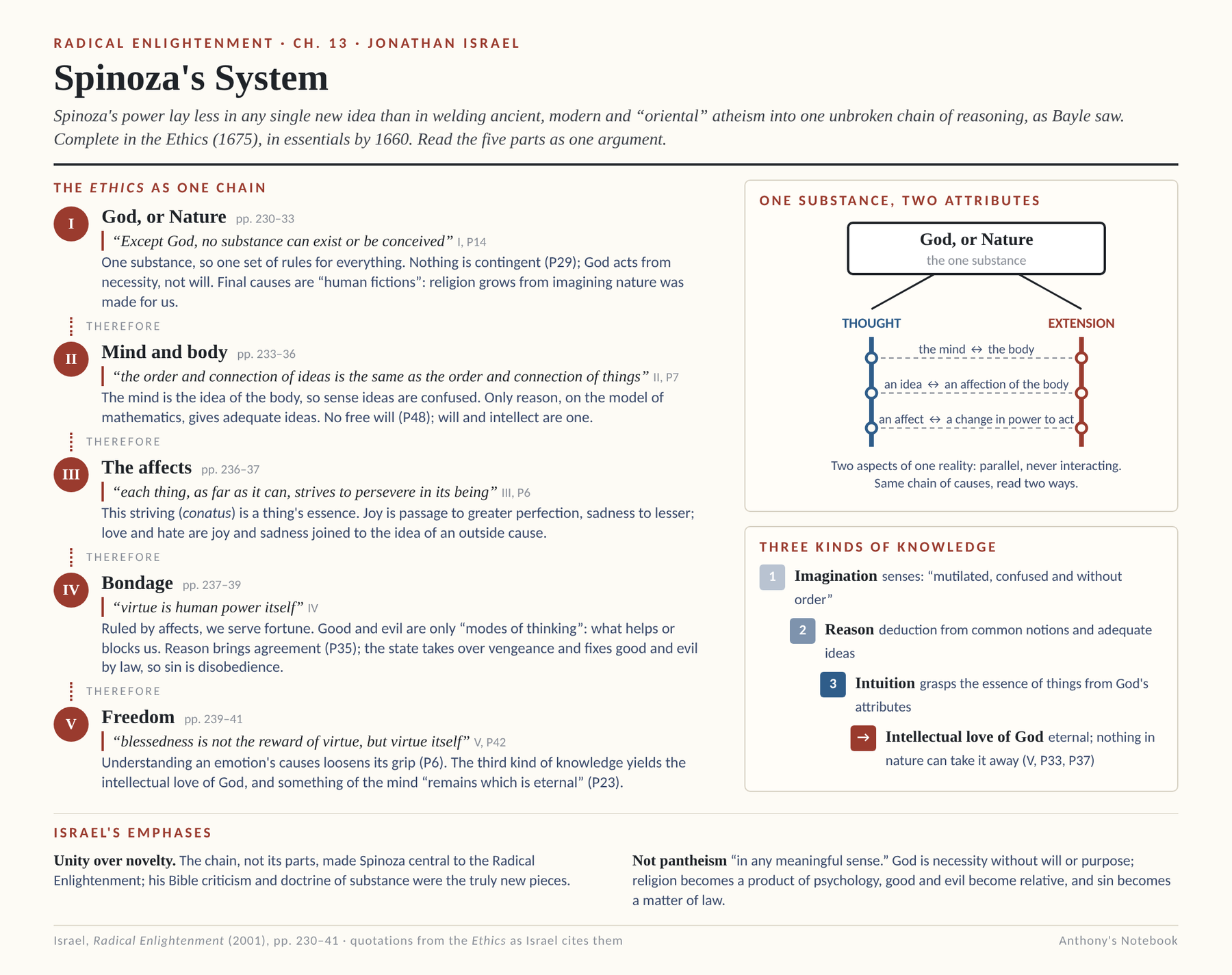
Chapter Objective and Through Line
Israel reconstructs the argument of the Ethics to explain why Spinoza’s system could organize a much wider radical tradition. Its importance lies principally in the connections among its claims: metaphysics, knowledge, psychology, morality, and political society become parts of one explanation. The chapter therefore follows the five parts of the Ethics, showing how an account of one necessary natural order leads to a new understanding of human conduct and happiness. Israel’s historical claim concerns this coherence and its perceived force, rather than the unprecedented originality or demonstrated truth of every component.
The organizing problem is how human beings can understand and improve their lives when they possess no independent will outside nature’s causal order. Spinoza treats confused perception, imagined divine purposes, and emotional bondage as natural phenomena to be explained. Reason provides adequate understanding of those same phenomena and can increase a person’s power of acting. Freedom consequently means a more rational relation to necessary causes, rather than exemption from causation. Likewise, virtue and happiness are grounded in human capacities instead of obedience purchased by divine rewards. The movement from necessity to ethical improvement is essential: without it, the system would explain the loss of conventional freedom but not its proposed replacement.
Israel also preserves tensions within the account. People seldom act rationally, so society needs laws and deterrents rather than an assumption of spontaneous agreement. Good and evil are not absolute properties of nature, but this does not eliminate judgments about what helps or obstructs human flourishing. Finally, the Ethics links intuitive knowledge, intellectual love of God, and an eternal aspect of the mind in passages Israel calls enigmatic. The chapter makes the system reconstructable while distinguishing these difficult final claims from the comparatively clearer causal sequence preceding them. Its contribution is to supply the philosophical framework behind the political, religious, and institutional disputes examined elsewhere in the book.
Chapter Structure at a Glance
- Derive universal necessity from the claim that everything belongs to one substance.
- Explain how human desires generate imagined purposes and providential interpretations of nature.
- Connect mind and body to the distinction between confused perception and adequate knowledge.
- Explain emotions and self-preservation through the same natural order.
- Derive rational virtue and cooperation while accounting for the need for political restraint.
- Show how understanding promises freedom from emotional bondage, then examine the difficult claims about eternity and intuitive knowledge.
Section-by-Section Argument
The chapter has no internal section headings. The following five analytical divisions track Israel’s discussion of the five parts of the Ethics.
Analytical division 1 — One substance, necessity, and imagined purposes
Spinoza begins with substance as what exists independently and proceeds to the conclusion that only God, or Nature, meets that definition. Everything finite belongs to this one reality and is determined through other finite causes. No separate region of existence escapes its order. Israel emphasizes that the infinite complexity of causation limits empirical human knowledge without making its principles intrinsically inaccessible to reason. Printed pp. 230–233 (file not included in this release)
- Creative nature differs from its determinate expressions. Natura naturans identifies nature’s self-sufficient productive power; natura naturata identifies what follows from it. Particular acts of intellect or will belong to the latter, rather than constitute an external divine intelligence choosing a world.
- Divine freedom does not mean alternative choices. God is a free cause through self-sufficiency, while everything follows necessarily from divine nature. The world could not have been produced in a different order through an arbitrary decision.
- Human purposes explain a mistaken picture of nature. Conscious of desires but ignorant of their causes, people imagine themselves freely choosing. They then project purposes onto useful objects and infer rulers who arranged nature for human benefit.
This account explains religion through natural psychological processes. Favorable and adverse events become interpreted as divine rewards or anger, while apparent counterexamples are answered by claims that divine intentions exceed comprehension. Mathematical explanation offers another standard because it studies relations without assuming they exist to serve human ends. The rejection of final causes follows from the system’s metaphysics, while the account of their appeal follows from its psychology.
Analytical division 2 — Mind, body, and adequate knowledge
Thought and extension are attributes of the same substance. The order of ideas corresponds to the order of things; mind and body are distinguishable aspects of reality, not separate substances exchanging causal influence. Israel regards this parallelism as challenging, explaining its role without presenting it as self-evidently established. Printed pp. 233–235 (file not included in this release)
- Bodies differ through relations of motion and rest. Their differences do not require distinct substances. This allows physical variety within a single mechanically ordered nature.
- Perception records encounters through the perceiver’s condition. A person’s ideas of external things involve how their own body is affected. Confused or false ideas therefore remain real mental occurrences while giving inadequate accounts of their objects.
- The sun example separates appearance from knowledge. Knowing its distance does not erase the sensory appearance of closeness. Rational correction need not transform the immediate impression to establish its inadequacy.
Reason supplies the relations and demonstrations needed for adequate ideas. Certainty means positive rational warrant, not merely a person’s absence of doubt; a dogmatic conviction can consequently remain “uncertain” in Spinoza’s technical sense. Will is not a separate faculty choosing whether to affirm an idea: affirmation or negation belongs to the idea itself. The identification of will and intellect prevents mental decisions from becoming exceptions to the necessary order.
Analytical division 3 — Emotions and the striving to persist
Human emotions follow the same natural laws as other phenomena. Spinoza’s conatus names a thing’s striving to persevere in its being, understood as the expression of its determinate essence. It is broader than an occasional instinct to avoid death. Human appetite and desire are particular manifestations of this striving. Printed pp. 236–237 (file not included in this release)
- An affect joins bodily condition and its idea. It increases or diminishes a body’s power of acting and is also apprehended mentally. The explanation remains consistent with one reality expressed under different attributes.
- Joy and sadness register transitions in power. Joy corresponds to increased perfection or capacity; sadness to its diminution. Love and hatred add an idea of an external cause to those transitions.
- Desire is appetite made conscious. People seek what they imagine will enhance their being and resist what seems to diminish it. Their behavior is explicable even when the imagined benefit is mistaken.
The next problem follows directly: a natural striving can be governed by inadequate ideas and produce conduct contrary to a person’s better interests. An explanation of desire alone therefore cannot establish rational virtue or happiness.
Analytical division 4 — Bondage, virtue, and the state
Emotional bondage occurs when people are controlled by external circumstances and passions, even while recognizing a better course. Good and evil have no absolute existence in nature; they acquire meaning through relations to human capacities and purposes. Israel preserves this distinction to explain how Spinoza can reject transcendent moral categories while retaining an ethics. Printed pp. 237–239 (file not included in this release)
- The music example shows relational value. The same music may benefit a melancholy listener, trouble a mourner, and leave a deaf person unaffected. Its value is not an intrinsic property with one meaning in every situation.
- Virtue requires adequate guidance. Seeking self-preservation is not automatically virtuous when directed by confused ideas. Acting from virtue means pursuing real advantage through reason, increasing the capacity to act in accordance with one’s nature.
- Rational advantage supports cooperation. Reason directs people toward goods compatible with others’ enjoyment, and shared efforts meet needs and dangers more effectively. Israel presents Spinoza’s claim that rational people agree as part of the system, alongside the acknowledgment that most people do not live this way.
The prevalence of passions explains the state’s necessity. An affect can be checked by a stronger opposing affect, so deterrence and fear of greater injury restrain harmful conduct when understanding does not. Society appropriates individual powers of judgment and retaliation, establishes common rules, and sustains them through penalties. Sin becomes disobedience to those civil norms, punishable by public institutions rather than an independent ecclesiastical jurisdiction. The state is thus grounded in the psychology already explained, not an assumption that citizens spontaneously become rational.
Analytical division 5 — Freedom, intuitive knowledge, and eternity
Freedom of mind develops when a person understands emotions and their necessary causes more adequately. Detaching an affect from fixation on an external person or object and connecting it to broader understanding reduces its power. This is a change within nature’s causation, not the recovery of an uncaused will. Spinoza’s example of anticipating common dangers shows how repeated reflection can prepare steadier action instead of surrender to fear. Printed pp. 239–241 (file not included in this release)
- Resentment can prolong dependence. Dwelling on wealth, status, or love one lacks intensifies distress. The proposed remedy is cultivating understanding and a desire for freedom, rather than proving oneself detached through continued denunciation.
- Three kinds of knowledge distinguish routes of apprehension. Imagination arises through disordered experience; reason through adequate common notions and inference; intuitive knowledge through a direct grasp of essences and their place in the whole. Israel treats the precise relation of the last two as difficult.
- Eternity differs from personal survival through time. The final account links something eternal in the mind to its grasp of necessary truths, while denying ordinary duration beyond the body’s existence. Israel does not equate this obscure claim with conventional immortality of a disembodied person.
Intellectual love of God, or Nature, joins the highest understanding to the greatest satisfaction. The final ethical claim reverses a reward model: blessedness is virtue itself, and its enjoyment makes the moderation of passions possible. Israel recognizes an enigmatic quality in the argument’s final movement rather than conceal it behind the geometrical form.
Key Concepts and Distinctions
- Substance versus mode: Self-sufficient reality differs from its particular determined expressions. Significance: This grounds the unity of the system without making every finite thing an independent substance.
- Necessity versus contingency: Events have determined causes; apparent contingency reflects incomplete knowledge. Significance: It governs both physical processes and human willing.
- Adequate idea versus conviction: An adequately warranted understanding differs from certainty merely felt. Significance: It allows confident error to be criticized without denying that the experience of it is real.
- Conatus: The striving expressing a thing’s essence and persistence. Significance: It connects ontology to desire, emotion, and human advantage.
- Rational freedom versus free will: Greater power through understanding differs from causal independence. Significance: It explains ethical improvement within determinism.
- Eternity versus continuing duration: Participation in necessary truth differs from an ordinary life extended after bodily death. Significance: It preserves the difficulty of the final claims without importing conventional immortality.
Chapter Conclusion and Significance
Israel’s reconstruction makes the system’s historical force intelligible through its connected reasoning. The same natural order explains mistaken belief, passionate conflict, rational virtue, and civil restraint. Its challenge to received morality is accompanied by a positive account of happiness and cooperation, rather than the simple removal of religious prohibitions.
Its explanatory unity does not make every step equally secure. Israel questions the ease of accepting mind–body parallelism and acknowledges obscurity in the concluding treatment of eternity. These qualifications matter when assessing his historical thesis: a system can give a movement powerful coherence without the historian thereby proving its philosophy.
Questions for Reflection
- Which steps are needed to move from one substance and universal necessity to a defensible account of human freedom?
- Does rational self-advantage adequately explain cooperation, and how does Spinoza’s account handle people governed by passions?
- How does the distinction between eternal understanding and continued personal existence affect the meaning of blessedness in the final argument?
Chapter 14: Spinoza, Science, and the Scientists
Read chapter — printed pp. 242–257 (file not included in this release)
Chapter Objective and Through Line
Israel argues that Spinoza’s philosophy cannot be understood apart from the Scientific Revolution, even though he occupies a marginal place in many histories of scientific achievement. The chapter distinguishes two grounds for his importance: practical participation in optical work and scientific exchanges, and a much broader claim about scientific explanation’s universal scope. Spinoza sought to extend the mechanistic understanding of nature to every aspect of reality, leaving no separate sphere for incorporeal causes or providential intervention. Israel locates the radical consequences of the system in this extension, rather than in scientific method or experimentation by themselves.
The chapter’s problem is how to relate that ambition to the limits of experimental knowledge. Spinoza valued observation but held that experiments acquire meaning within a rational theoretical framework and cannot establish universal propositions on their own. Huygens and Boyle recognized similar problems with Cartesian physics while approaching the balance between experiment and theory differently. Their exchanges therefore expose disagreements inside modern science, rather than a simple opposition between a philosopher and scientists. Israel follows optical collaboration, competing accounts of motion, and the dispute over Boyle’s experiments on saltpetre to show the methodological differences at work.
The religious consequences make those differences especially consequential. Boyle treated nature’s laws as instituted by a creator who could suspend or supplement them; Spinoza treated them as necessary and universally binding. Each connected scientific inquiry to a larger account of truth, but they disagreed over whether its reach allowed a supernatural remainder. Israel explicitly acknowledges that Spinoza’s universal metaphysics could not be scientifically proved or disproved. Its historical connection to mathematical physics is therefore not evidence that experiment established its every conclusion. The chapter supplies the bridge between new science and radical thought while keeping distinct a scientist’s demonstrated results, philosophical extrapolation, and an historian’s proposed intellectual lineage.
Chapter Structure at a Glance
- Reconsider Spinoza’s importance through scientific practice and the universal reach he assigned to natural explanation.
- Explain why his certainty differed from both Cartesian dualism and experimental philosophies that reserved unknown domains.
- Use the Huygens relationship to examine collaboration, rivalry, and the role of experiments in correcting theory.
- Trace motion inherent in matter as a link between metaphysics, physical individuality, and later radical developments.
- Reconstruct the saltpetre dispute as an argument about what an experiment can establish.
- Show how Boyle and Spinoza’s methods supported competing accounts of natural law and supernatural possibility.
Section-by-Section Argument
i. Radical Thought and the Scientific Revolution
Oldenburg’s 1663 invitation that Spinoza and Boyle combine mathematical principles with careful experiments supplies the chapter’s opening challenge to the image of an unscientific recluse. Spinoza’s instrument-making and exchanges were recognized by informed contemporaries. More fundamentally, his account of truth relied on mathematical rationality and the principles of natural causation. Israel argues that this conception gave him an exceptional place in scientific thought even where his lasting research contributions were limited. Printed pp. 242–246 (file not included in this release)
- Scientific explanation had no reserved boundary in his system. Cartesian dualism distinguished thinking from extended substance, while Boyle’s empiricism allowed reality beyond demonstrated mechanical relations. Spinoza denied any region exempt from nature’s necessary order.
- Universal applicability was a metaphysical commitment. Experiment could demonstrate particular regularities without proving that nothing outside them was possible. Israel calls Spinoza’s position historically scientific in its origin and ambition while acknowledging that its universal claim was not itself experimentally decidable.
- Scientific inquiry also had practical ethical value. Medicine, labor-saving techniques, and instruments could reduce bodily pressures and free time for human improvement. Spinoza’s commitment to science was consequently broader than using it as a weapon against religion.
Israel links the denial of miracles to this conception of knowledge: supposed exceptions must be natural events inadequately understood, while inventing and defending miracle stories also requires a natural explanation. The argument extends inquiry to the people who resist it, completing the system’s refusal of a supernatural remainder.
Spinoza’s opposition to skepticism follows the same demand for rational demonstration. A person might lack knowledge of the earth’s shape, but could not sincerely reject a proof they fully understood. Israel presents this as Spinoza’s highly confident account of reason, not as a modern experimental standard that settles every metaphysical dispute. The historical significance lies in the force of the claim that inquiry can, in principle, reach all reality.
ii. Spinoza and Huygens
The optical relationship provides evidence of actual participation in scientific work. Huygens discussed lenses with Spinoza and sometimes acknowledged the superior performance of his arrangements. An observation could confirm Spinoza’s judgment before either man knew its explanation. This is particularly useful evidence against treating his philosophy as indifference to experience. Printed pp. 246–249 (file not included in this release)
- Cooperation did not remove competition. Huygens sometimes withheld a promising optical idea to protect it from rivals. Their exchange belonged to a world of priority, reputation, and limited disclosure as well as mutual intellectual respect.
- Social standing and patronage affected the relationship. Huygens’s courtly connections contrasted with Spinoza’s modest independence. Israel uses these differences to help explain friction, though judgments about private motives are less direct evidence than the surviving letters.
- Similar religious distance did not guarantee philosophical alliance. Israel describes Huygens as privately deistic and publicly discreet. No reply survives to Leibniz’s request for his assessment of the Ethics, so the chapter does not establish a declared endorsement of Spinoza’s system.
The deeper methodological issue involved Descartes’ laws of motion. Huygens criticized reasoning detached from sufficient experiment and corrected Cartesian mechanics. Spinoza likewise rejected important Cartesian principles but tended to subordinate results to an overarching theoretical account. His skeptical comments about Huygens’s unpublished work were mistaken where he inferred failure from nonpublication. That mistake shows why the correspondence must not be read as a transparent measure of what Huygens had actually achieved.
Spinoza’s letters to Oldenburg also disclosed less than his full position. A seemingly limited objection to one Cartesian rule coexisted with much more fundamental criticism elsewhere. Israel therefore reconstructs the argument by comparing different exchanges, rather than taking a guarded report to one correspondent as the entire doctrine. Printed pp. 249–252 (file not included in this release)
The substantive distinction concerns whether matter begins as inert extension requiring an external source of motion. Spinoza argued that such an account could not explain the development of distinct bodies from a uniform continuum. Motion and rest must belong intrinsically to matter; bodies differ through their proportions and relations. The apparent rest of an object is consequently not a basic absence of forces but a balance within interactions.
- Physical individuality becomes a natural process. Differences among bodies and their changing states arise within matter’s own order. Creation no longer requires an external impulse entering an otherwise inert world.
- The implications exceed completed research. Spinoza acknowledged that he had not developed a full physics. Israel interprets the principle as a germ of later accounts of natural formation and mutation, rather than a finished theory of biological evolution.
- Later adoption helps define a radical lineage. The chapter names thinkers who defended intrinsic motion and connects the theme to La Mettrie and Diderot. This is Israel’s reconstruction of continuity, not a claim that all later evolutionary explanations simply reproduce Spinoza.
The Huygens section thus establishes both scientific engagement and its limits. Spinoza contributed to technical discussion, while his broader importance depended on extending a physical principle into a universal philosophical account. The Boyle exchange tests the status of experiment within that account more directly.
iii. Spinoza versus Boyle
Spinoza regarded observations as material requiring interpretation, not self-explanatory statements of natural law. An experiment could confirm or contradict a hypothesis within a framework, but could not alone establish universal necessity. Boyle gave priority to controlled experimental investigation and emphasized the weakness of unaided abstract reason. Israel presents their dispute as a conflict over the grounds and extent of knowledge, with theological consequences, rather than acceptance versus rejection of experiments. Printed pp. 252–255 (file not included in this release)
- Boyle’s mechanism retained a creator beyond matter. Order and complexity supported his argument from design. The mechanical operation of nature therefore did not exclude providence or forms of reality beyond what experimental philosophy could explain.
- Spinoza demanded a prior framework of intelligible relations. Without it, accumulated observations lacked criteria for deciding their general meaning. He regarded senses as liable to confusion and reason as doing the decisive explanatory work on experience.
- Their exchanges were mediated. Oldenburg conveyed comments between the men. Where Boyle’s later texts allude vaguely to a new sect or materialists, Israel sometimes considers a reference to Spinoza likely but cannot identify the target with certainty.
The saltpetre dispute makes their different standards concrete. Boyle’s experiments concerned its decomposition and recombination and the heat, sound, solidity, and fluidity involved. Spinoza judged many effects already apparent in familiar events: friction producing heat, boiling water producing sound, and breath becoming visible under different conditions. Elaborate experiments seemed unnecessary where a broader mechanical account already explained the relevant relationship.
Boyle replied that everyday parallels did not offer the same control of composition and intervention. Wood was more composite than saltpetre, and boiling water required external heat, unlike the reaction under discussion. His reasoning distinguished superficially similar effects through experimental conditions. Spinoza countered that the experiment still left uncertain what its constituents contributed and how the observed heat arose. The disagreement concerns whether an arrangement isolates a cause adequately, not just which example is simpler. Printed pp. 255–257 (file not included in this release)
The exchange also reveals what a finite experiment cannot settle in Spinoza’s view. No series could finally demonstrate that miracles or spirits are impossible, or establish every feature of bodies divided conceptually without limit. These conclusions required rational demonstration from principles. Israel explains that position without equating its confidence with experimental verification.
The initially respectful relationship became more hostile as the Tractatus’s implications were understood. Boyle’s writings defending revelation and miracles responded consciously to Spinoza. This chronology matters: scientific engagement preceded the later intensification of religious opposition, so the relationship cannot be reconstructed as unvarying hostility from its beginning.
Boyle’s final defense turns on divine freedom. God introduced motion and selected nature’s laws, so those laws could be altered or exceptionally suspended. Miracles should nevertheless be interpreted with the smallest necessary departure from normal mechanism. His example of the plague of frogs leaves disposal and decay to ordinary processes after divine intervention. This arrangement lets natural explanation and miraculous action coexist, whereas Spinoza’s account excludes the initiating exception itself.
Boyle also invoked the experienced freedom of human willing against exclusively mechanical explanation. Both the interpretation of such experience and the origin of natural law were therefore contested. The chapter ends with two scientific philosophies organized around different limits: Boyle’s mechanical knowledge within a larger created reality, and Spinoza’s universal necessity encompassing every conceivable event.
Key Concepts and Distinctions
- Universal mechanism versus bounded mechanism: Natural explanation may govern all reality or a domain leaving supernatural possibilities. Significance: This is the decisive difference connecting science to the religious conflict.
- Theoretical framework versus observation: A conceptual account gives experimental results meaning, while observations can constrain or challenge it. Significance: Their relationship organizes the Huygens and Boyle encounters.
- Intrinsic motion versus external impulse: Matter may contain motion as part of its nature or receive it from a creator. Significance: The difference connects physical individuation to competing metaphysics.
- Experimental control versus everyday analogy: Similar effects can arise under importantly different arrangements. Significance: Boyle’s reply identifies what Spinoza’s familiar examples might fail to isolate.
- Necessary versus instituted laws: Nature’s order may follow inevitably from reality or reflect a creator’s free institution. Significance: The latter permits Boyle’s supernatural exceptions, while the former excludes them.
- Scientific participation versus scientific proof: Practical expertise and mathematical influence do not experimentally validate a universal philosophy. Significance: It qualifies Israel’s argument for Spinoza’s place in scientific history.
Chapter Conclusion and Significance
The chapter makes the link between science and radical philosophy depend on an argument about scope. Mathematical and mechanical explanation could support very different positions depending on whether nature had an external author and reserved domains. Sharing modern scientific practices did not make thinkers agree on the reach of reason or the possibility of miracles.
Spinoza’s optical work and correspondence establish meaningful engagement, while the methodological disputes show his philosophy’s ambitions and constraints. Israel’s historical interpretation gains clarity when the universal extrapolation remains distinct from particular discoveries. The chapter supplies that distinction for reading later conflicts between radical naturalism and moderate Enlightenment philosophies.
Questions for Reflection
- What would justify extending successful mechanical explanations into a claim that no other kind of reality is possible?
- How does Boyle’s defense of controlled conditions answer Spinoza’s appeal to familiar examples, and what remains unresolved about universal conclusions?
- Which evidence establishes Spinoza’s practical scientific contribution, and which supports Israel’s broader claim about his philosophical significance?
Chapter 15: Philosophy, Politics, and the Liberation of Man
Read chapter — printed pp. 258–274 (file not included in this release)
Chapter Objective and Through Line
Israel argues that Spinoza’s political radicalism is best understood through its differences from Hobbes and Locke, despite important shared problems and terminology. Spinoza connected liberty to rational self-direction, political participation, and institutions serving the common good. Freedom was more than the private space left unregulated by a sovereign. The chapter develops the consequences of that account for democracy, monarchy, toleration, and equality, showing why political theory belongs within the wider naturalistic system rather than form an independent appendix to it.
The central problem is how a state can secure peace without reducing its people to passive subjects. Spinoza retained natural right as an expression of actual power; a sovereign could not permanently extinguish capacities it failed to control. Rational freedom nevertheless required respect for civil order, because passions and private retaliation endangered everyone’s security. Israel preserves the resulting tension: Spinoza opposed tumult and urged obedience, while his account also explained resistance and revolution as consequences of government that neglected common interests. A monarchy capable of preserving freedom would need institutions that sharply curtailed the king’s effective powers and brought it close to a republic.
The argument then distinguishes liberty of philosophical expression from toleration organized around religious worship. Israel presents Spinoza’s position as broader for individual thought and publishing, but more restrictive toward independent ecclesiastical institutions. Reducing church power was meant to protect individuals from competing authorities and factions. Finally, natural equality becomes a standard for criticizing inherited hierarchy and ownership, feeding a later tradition of representations of “natural man.” The chapter traces affinities with Rousseau and more extreme egalitarians without making their views identical. Its contribution is an integrated account of radical political aims, including the friction between individual freedom, sovereign regulation, institutional equality, and the practical maintenance of order.
Chapter Structure at a Glance
- Distinguish freedom as unimpeded private action from rational and participatory political freedom.
- Connect natural right, actual power, and the common good to both civil obedience and the instability of oppressive government.
- Show how Spinoza’s safeguards for monarchy undermine concentrated royal authority.
- Compare toleration centered on worship with freedom of thought, expression, and publication.
- Explain the restriction of church power as a means of protecting individual freedom, while retaining its tensions.
- Trace natural equality into later critiques of hierarchy and property without erasing differences among their authors.
Section-by-Section Argument
i. In Search of ‘Freedom’
Hobbes defines liberty through the absence of external impediments and locates subjects’ permitted activities in areas the sovereign leaves unregulated. Republican participation does not, in that account, make people inherently freer. Spinoza instead connects freedom to reason, common interests, and forms of government that reduce corruption and domination. Israel uses this contrast to identify the political consequences of the ethics reconstructed in chapter 13. Printed pp. 258–262 (file not included in this release)
- Natural right remains tied to power. In his explanation to Jelles, Spinoza claims that a sovereign’s right extends only as far as its greater effective power. Israel reads this as preserving subjects’ capacity for resistance where government cannot enforce its authority. It is not simply a modern constitutional entitlement granted by law.
- Bondage can be internal. A person driven by inadequate ideas and uncontrollable passions lacks the capacity to pursue real advantage even without external chains. Rational self-direction supplies the positive content of freedom.
- Democracy brings freedom into institutional practice. Debate, consultation, and voting allow citizens to participate in identifying the common interest. A monarchy or aristocracy can protect some liberty, but Israel argues that doing so makes it approximate democratic arrangements.
The ideal rational person acts honestly and cooperatively. Israel qualifies the apparent absolute claim about honesty by distinguishing an entirely free person in the abstract from people navigating a world of injustice and violence. Rational conduct in actual circumstances may involve concealment or deception; the ethical ideal does not describe everyone’s existing condition.
Civil obedience likewise follows from rational concern for peace and security. Spinoza insists on lawful conduct even when a person disagrees with particular measures, while preserving thought and expression as means of criticism. Political order removes common fear and suffering, ends private retaliation, and supports reliable social relations.
Yet forced quiet is not genuine peace. A state that neglects its people cannot secure lasting assent merely through repression. Passivity and servility lack the strength of mind and shared participation needed for a commonwealth. Israel acknowledges an element of tension here: the free person should obey, but the system explains why oppressive arrangements provoke disorder and gives criticism a role in changing them. It neither straightforwardly endorses every rebellion nor confines freedom to compliance under whatever government happens to exist.
ii. Monarchy Overturned
Spinoza measures government by peace, security, and observance of laws rather than the dignity of its title. Where disorder persists, institutions have failed to arrange human tendencies effectively. His unfinished Tractatus Politicus reaches democracy only briefly, but Israel finds the completed treatments of monarchy and aristocracy already infused with democratic principles. Printed pp. 262–264 (file not included in this release)
- Concentrated power encourages fear of subjects. A king who expects threats from influential citizens may weaken or attack them instead of promoting their welfare. Spinoza explains royal oppression through the structure of power, not a claim that every monarch has a uniquely evil nature.
- Pure personal sovereignty is practically impossible. One person must depend on ministers, advisers, and commanders. What appears to be monarchy becomes a concealed aristocracy whose actual power is less publicly accountable.
- Military organization determines dependence. A citizen force performing public duty is intended to prevent a ruler from acquiring a permanent armed interest devoted to him. Paid troops can become a privileged group whose position depends on war and royal favor.
The proposed council of state would be large, drawn from candidates elected by local communities, and renewed through limited terms. The king could not override its major decisions. Broad participation would both limit arbitrary rule and give citizens practical experience in public affairs. Spinoza expects such a council to resist unnecessary wars because citizens bear their costs and threats to security; that is a prediction of his political theory, not a result established here for all representative governments.
These safeguards leave the monarchy close to a “crowned republic.” Israel treats that consequence as revealing the argument’s direction: a monarchy becomes defensible by surrendering much of what ordinarily makes it monarchical. The example of Aragon illustrates the need for effective popular power behind legal forms. Its eventual loss of freedom under Philip II shows, in Spinoza’s account, why retaining constitutional titles is insufficient when the means to defend them have disappeared.
iii. Spinoza, Locke, and the Enlightenment Struggle for Toleration
Israel distinguishes two organizing aims. The Arminian and Lockean tradition primarily protected forms of worship through which individuals sought salvation. Spinoza’s central aim was freedom to think, speak, and publish, including arguments against revealed religion. The comparison concerns scope and justification, rather than whether one thinker supported toleration and the other did not. Printed pp. 265–267 (file not included in this release)
- A worship-centered scheme leaves unclear cases. Israel argues that people without a recognized congregation or precise confession occupy an uncertain position when toleration is defined as exemption for a form of worship. The problem includes deists and others who lack that institutional status.
- Locke restricts certain kinds of religious or irreligious commitment. Catholic allegiance becomes problematic where ecclesiastical authority is claimed to override the sovereign. Atheists are explicitly excluded on the ground that denial of God undermines the binding force of promises and oaths. Israel notes the broad contemporary reach of that category.
- Spinoza restricts churches differently. He permits individual expression and small dissenting congregations while opposing large autonomous religious structures. A simple public faith centered on justice and charity would remain under civic guardianship, preventing an independent clerical authority from competing with the state.
This difference produces a substantial qualification to the claim of wider liberty. Spinoza’s individual freedom coexists with extensive control over religious organization. Israel explains the connection through his theory of faction: competing churches can recruit political leaders, mobilize adherents, and use government to suppress rivals. Institutional expansion then reduces individuals’ ability to express their own judgment. Locke’s scheme, by contrast, requires the state to retreat from parts of the ecclesiastical sphere once legitimate congregational freedoms are recognized.
The argument for expression rests partly on an inability: people cannot surrender their capacity to judge simply because a sovereign demands it. Attempting to dictate every opinion fails and encourages hypocrisy, conflict, and pressure from agitators. The state’s proper purpose is freedom; it should govern actions while accommodating divergent beliefs. The boundary remains important, however. Spinoza distinguishes criticism and inactive disapproval from expression directly hostile to the state’s constitution or openly defying its laws. The chapter therefore describes extensive intellectual liberty within an argument still concerned with political stability. Printed pp. 268–270 (file not included in this release)
His universal public faith allows individuals to understand its tenets philosophically or theologically, including disagreement over necessity, providence, or supernatural rewards. In Israel’s reading, religion’s public function concerns conduct and obedience rather than independent knowledge of reality. Rousseau’s civil religion resembles this institutional arrangement but restores required belief in providence and an afterlife; Israel treats him as combining radical and moderate elements, and regards borrowing from Spinoza as probable rather than proven here.
Publication is the practical culmination. Spinoza opposed Hobbes’s assignment of book censorship to the sovereign, arguing that those who inflame the public against authors can be more destabilizing than the authors themselves. The Dutch conflict of 1618 supplies his example of suppression intensifying factional hostility. Thus free expression is defended not only as an individual good but as a condition of effective and peaceful government. Israel’s strong claim about its exceptional breadth is his comparative interpretation of these toleration theories.
iv. Equality and the Quest for ‘Natural Man’
Natural right remains a measure of civil institutions rather than something left behind once government exists. Democracy is preferred because collective rule preserves equality better than elevating one or a few above the rest. Spinoza also explains ordinary people’s apparent political ignorance through exclusion from knowledge and participation, rejecting an essential difference between their human nature and that of rulers. Printed pp. 270–272 (file not included in this release)
- Equality tests political arrangements. The state is valuable for security and cooperation, but inherited hierarchy does not thereby become naturally justified. Institutions must be judged by how they preserve common capacities and interests.
- Land depends on collective protection. Spinoza argues that an isolated person in the state of nature cannot securely appropriate it. Its civil possession rests on collective power, making the regulation of land a question of the commonwealth’s freedom rather than an unquestionable prepolitical claim.
- Nature becomes a critical comparison. Later writers used imagined or reported societies outside European institutions to expose supposedly unnecessary domination. Israel treats those representations as arguments within the radical tradition; their descriptions are not independently verified ethnography.
Radicati extends these themes into common property and even abolition of marriage and the family. Israel stresses that these extremes exceeded other radicals’ positions. Shared criticism of inequality does not establish agreement on abolishing all property or family relations. Nor does a male author’s language about women being held “in common” warrant translating his scheme into universal individual emancipation.
Rousseau supplies a related but different argument. He describes progressive moral degeneration after the establishment of civil society and private property, whereas Spinoza holds human nature constant and locates civil virtue within society. Their convergence lies in making natural equality a criterion against domination, not in an identical account of historical decline. Israel follows that criterion into Jacobin uses of Rousseau while describing the more distant connection to seventeenth-century radicalism as often unconscious. Printed pp. 273–274 (file not included in this release)
Key Concepts and Distinctions
- Negative versus rational political freedom: Absence of impediments differs from the capacity to live through reason within institutions serving common interests. Significance: It organizes the contrast with Hobbes.
- Natural right as power: Right persists through actual capacities rather than disappearing through a purely formal transfer. Significance: It makes political authority dependent on effective relations and public assent.
- Obedience versus intellectual submission: Lawful conduct need not require agreement or surrender of judgment. Significance: It is Spinoza’s proposed reconciliation of order with criticism.
- Worship versus philosophical expression: Congregational religious liberty differs from freedom to publish arguments against religion. Significance: It explains the comparison with Locke.
- Individual freedom versus ecclesiastical autonomy: Protecting persons can be pursued through restricting organized churches. Significance: It identifies both the logic and the tension of Spinoza’s toleration.
- Natural equality versus historical degeneration: Equality can criticize hierarchy without requiring Rousseau’s account of moral decline. Significance: It separates an intellectual connection from identity of doctrine.
Chapter Conclusion and Significance
The political argument evaluates institutions by the capacities and security they make possible. It combines a demand for lawful order with criticism of arrangements that produce servility, faction, and unequal power. Its radical direction is most visible where preserving freedom transforms monarchy into something close to a republic and makes publication part of the commonwealth’s stability.
The chapter also prevents simple classifications from doing too much work. A wider theory of expression can restrict churches; hostility to domination can coexist with fear of rebellion; related egalitarian writers can disagree fundamentally about property and society. Israel’s larger lineage is clearest when those differences remain part of the explanation.
Questions for Reflection
- Can Spinoza reconcile strict civil obedience with a theory that preserves resistance as a consequence of subjects’ actual power?
- Do restrictions on ecclesiastical organization protect individual liberty, or do they create another means for the state to shape belief?
- How does using natural equality as a political standard differ from treating a state of nature as a verified historical society?
Chapter 16: Publishing a Banned Philosophy
Read chapter — printed pp. 275–294 (file not included in this release)
Chapter Objective and Through Line
Israel reconstructs the publication and suppression of Spinoza’s writings to explain how a prohibited philosophy nevertheless achieved extensive European circulation. The chapter’s central distinction is between formal provincial bans, municipal enforcement under existing laws, and actual access through the book trade. It rejects the claim that the Tractatus Theologico-Politicus circulated freely until 1674 or enjoyed De Witt’s personal protection. Existing legislation permitted early seizures, while hesitation over a special decree could reflect fear of giving a book greater publicity rather than approval of its ideas.
The argument then follows the publisher Rieuwertsz’s responses to those conditions. Successive editions looked deceptively alike; fictitious places, publishers, titles, and dates concealed renewed production. Their formats and timing also indicate attempts to reach different markets as war interrupted ordinary communications. Israel uses bibliographical differences and reception chronologies to connect material circulation to intellectual impact: a book appearing in 1670 did not produce the same response simultaneously in Germany, England, and France. Translation, available supply, and political conditions shaped when readers encountered it. Some market assignments are inferred from that combined evidence, rather than documented in a surviving distribution plan.
The second section follows the failed attempt to publish the Ethics during Spinoza’s lifetime and the successful collective effort after his death. Saving his work required copying, translation, editing, concealment, and decisions about incomplete texts and correspondence. The sweeping ban of 1678 could not end clandestine sales, but it made public endorsement dangerous and established a legal boundary between acceptable philosophy and Spinozism. The chapter therefore explains both evasion and repression: forbidden books could travel widely while their authors, publishers, and readers remained vulnerable. Its contribution is to place the radical movement’s intellectual survival in practical institutions and cooperative work rather than attribute it to ideas spreading without material carriers.
Chapter Structure at a Glance
- Separate delayed formal prohibition from early confiscation and established illegality.
- Reassess De Witt’s position without confusing resistance to stronger church censorship with support for Spinoza.
- Use differences among disguised editions to explain continued supply and uneven international reception.
- Reconstruct why publication of the Ethics failed in 1675 despite an existing network.
- Show how collaborators preserved and prepared the posthumous works in Latin and Dutch.
- Explain why continued illicit sales did not erase the political and cultural effects of the 1678 ban.
Section-by-Section Argument
i. The Tractatus Theologico-Politicus
The first issue is legal chronology. Holland’s anti-Socinian legislation of 1653 gave municipalities grounds to suppress books such as the Tractatus. A special provincial decree in 1674 therefore did not initiate censorship of a previously unrestricted work. Israel supports the distinction with records of seizures and official discussions, not merely later accounts of the book’s scandalous reputation. Printed pp. 275–278 (file not included in this release)
- Leiden acted in May 1670. The local consistory’s complaint was followed within a week by a municipal order to confiscate copies. This establishes enforcement close to publication, before the later general prohibition.
- Utrecht’s wider ban followed local action. The province prohibited the work in 1671, after suppression in its principal city. Different governmental levels need separate chronologies.
- Reforming theologians also favored suppression. Burman and Graevius were appalled by the book. Opposition cannot be reduced to traditionalist Calvinists resisting a united party of modern philosophy.
The synods pressed De Witt and the States to issue a decree against several especially objectionable books. Their discussions concerned whether existing law required a more conspicuous reinforcement, not whether the works were already legal. A named prohibition might increase curiosity and notoriety. The political crisis and invasion of 1672 then disrupted the deliberations while intensifying religious pressure against suspect publications.
Israel rejects the inference that De Witt’s reluctance to strengthen ecclesiastical censorship implied philosophical sympathy. A diary fragment attributed to Gronovius portrays him as hostile to Spinoza and concerned about the loss of belief in rewards and punishment after death. It also reports refusal of an interview. This is evidence against a confident story of personal protection, while remaining a mediated account rather than a direct statement by De Witt preserved here.
Spinoza’s concern about a planned Dutch translation reveals the limits of the Latin book’s precarious position. He asked Jelles to stop publication because vernacular exposure would intensify public alarm and make additional suppression more likely. The translator and publisher’s initiative was halted, and a Dutch edition did not appear until 1693. Protecting the continuing circulation of one edition could therefore require restraining the broader access his political philosophy valued.
The survival of many early copies then creates a different problem: how could an already illegal work achieve such extensive distribution? Library catalogs and surviving holdings document geographical reach, but ownership alone does not identify readers’ adherence. Their role here is to establish availability and supply, which the bibliographical history helps explain. Printed pp. 279–282 (file not included in this release)
- Repeated editions concealed new production. Nearly identical title pages retained an early date and the fictitious Hamburg publisher. Corrected and newly introduced misprints, spacing, and pagination distinguish impressions that might otherwise look like one continuing stock.
- The chapter’s edition table is a reconstruction. It separates printed dates from likely real production dates. This is why a book carrying “1670” cannot simply be assigned to the first edition or used to date when a reader acquired it.
- False titles could disguise the contents entirely. In 1673 some copies masqueraded as medical or historical works by other authors. Israel interprets these choices as suited to Dutch and neighboring markets; Leiden’s protest and subsequent seizure order show that the disguise could be detected.
The evidence points toward successive production by Rieuwertsz in Amsterdam rather than independent foreign piracy. Israel assigns particular importance to this continuity because it identifies an organized clandestine operation. Spinoza’s precise involvement in every publishing decision is less clear, and the chapter does not make the philosopher the documented director of the entire strategy.
War and renewed communication help explain the changing markets. The early German response was already substantial in 1670–1671, while Anglo-Dutch war limited movement into Britain. An edition made to resemble English printing accompanied much wider English reception after peace in 1674. This was an “English” presentation of a Latin text, not evidence of an English translation. Continued war with France delayed broader diffusion there until the peace of 1678, when a French translation and further Latin editions reached more readers. Prominent French scholars had encountered the book earlier, so the chronology concerns widening reception rather than first knowledge by anyone in the country. Printed pp. 283–285 (file not included in this release)
Oldenburg’s changing position exposes the risks for intermediaries. After an initial hostile response, he wrote a more appreciative assessment and agreed to distribute copies among English scholars, but asked that a Dutch merchant receive the shipment and his involvement remain concealed. Intellectual interest did not remove fear of participating in an illicit trade. Boyle, More, Cudworth, and others reacted through critical works, adding another route by which discussion widened.
The French sequence likewise includes readers who valued some insights while condemning the philosophy. Arnauld sought to stop distribution; Le Clerc feared its effects and demanded a better refutation. These responses support the book’s importance without implying an international consensus in its favor. Israel’s explanation connects three kinds of evidence: the material differences among editions, conditions affecting distribution, and dated engagements with the arguments. Their convergence is stronger than any single surviving title page or hostile complaint.
ii. The Battle of the Ethics
Publication of the Ethics faced Spinoza’s accumulated notoriety and a less favorable political environment after 1672. Church authorities investigated whether another work was in preparation and coordinated efforts to prevent it. Spinoza’s 1675 Amsterdam visit to arrange publication quickly produced alarm and pressure on magistrates. He postponed the project; there is no evidence in this account that printing had actually started. Printed pp. 285–288 (file not included in this release)
- Moderate Cartesians helped isolate him. Spinoza complained that they condemned his work to clear themselves of suspicions of sympathy. Their behavior shows how the radical challenge could also force public distancing within modern philosophical circles.
- The manuscript remained narrowly accessible. Only a few trusted readers possessed copies. Wider dissemination was still a practical objective to achieve, not a completed fact assumed from his growing reputation.
- After his death, transfer protected the archive. In February 1677 his landlord secretly sent the manuscript chest to Amsterdam as instructed. Preserving the material was the first step toward publication, not merely a logistical detail after the intellectual work was done.
The associates chose an unusually ambitious plan: publish everything suitable, including correspondence and unfinished works, simultaneously in Latin and Dutch. Israel identifies a team thought to include Jelles, Meyer, Glazemaker, Bouwmeester, Schuller, and Van Gent working with Rieuwertsz. Particular assignments are partly reconstructed, so the division of labor is not equally certain in every case.
The editorial work mattered to the texts readers received. Printers used revised fair copies rather than original manuscripts. Glazemaker carried much of the translation; Latinists revised language, prepared the index, and helped determine the treatment of unfinished works. Letters were selected and sometimes shortened to remove personal or sensitive material. The Opera Posthuma is therefore also the product of decisions made by collaborators, not an untouched manuscript chest reproduced mechanically.
Secrecy grew harder as copying and printing brought more people into the enterprise. Beyond Dutch and Walloon Reformed opponents, Roman Catholic authorities attempted to locate the manuscripts and prevent publication. Neercassel’s inquiries involved a priest, a rabbi, and a Remonstrant trainee, illustrating cooperation across ordinary confessional divisions against the perceived threat. Rieuwertsz falsely minimized what he held and concealed the work until it was ready. The chapter does not establish which former associate first alerted the Roman authorities or every source supplying the investigation. Printed pp. 289–291 (file not included in this release)
Production was completed at the end of 1677, and distribution began in January 1678. The title-page date and the beginning of circulation should therefore remain distinct. Publishing correspondence also created reputational risks: Leibniz objected that his name appeared when he had expected protection, despite his printed letter’s mathematical subject. An accurate account of collaboration need not imply willing public identification with the system.
Municipal seizures followed, and Holland’s decree of 25 June 1678 went beyond prohibiting the new volume. It targeted Spinoza’s philosophy, including reprints, extracts, summaries, and restatements of its fundamental ideas. The wording emphasized denial of miracles and central Christian claims, linking the legal measure to the metaphysical dispute examined in chapters 12–14. Enforcement involved civic government and regular ecclesiastical checks on printers and shops. Utrecht subsequently required surrender of the named prohibited works and related material. Printed pp. 292–294 (file not included in this release)
Illicit sales continued. Neercassel complained that the prohibition chiefly increased the books’ notoriety and price, and Israel connects sustained demand to a changing intellectual culture. The complaint shows an opponent’s perception of failure; it does not prove that the ban achieved nothing. Publishers and buyers could still obtain copies while public promotion, teaching, display, and favorable citation carried heightened risks. The law defined a forbidden philosophical category and helped shape the movement’s clandestine status.
The chapter’s concluding distinction is therefore essential: censorship could fail to stop private circulation and still powerfully regulate public intellectual life. The distribution network explains survival; the legal and reputational boundaries explain why survival did not become unrestricted participation.
Key Concepts and Distinctions
- Formal decree versus existing prohibition: A specially named ban can reinforce illegality already enforced under broader law. Significance: It corrects the chronology of the Tractatus’s suppression.
- Printed identity versus actual production: Title, place, publisher, and date can be deliberately misleading. Significance: Bibliographical comparison is required to reconstruct circulation.
- Availability versus assent: Possession or distribution establishes access without demonstrating endorsement. Significance: It limits what library holdings and intermediaries’ actions can prove.
- Publication versus regional reception: A work can appear once but enter different intellectual settings at different times. Significance: War, translation, and supply explain uneven responses.
- Manuscript versus edited corpus: Copying, selection, translation, and revision intervene between an author’s papers and printed works. Significance: It makes preservation an intellectual as well as practical achievement.
- Evasion versus ineffectiveness: A ban can be breached while still constraining public support and raising risks. Significance: It reconciles widespread survival with durable suppression.
Chapter Conclusion and Significance
The fate of the works depended on a network capable of managing concealment, production, and access under shifting political conditions. Bibliographical details become historically consequential when they explain how books moved and when readers could respond. The posthumous project further demonstrates that Spinoza’s legacy survived through collective judgment and labor.
The chapter establishes the conditions for the movement’s continued spread without turning survival into a story of toleration. Its legal exclusion remained real, and moderate philosophical institutions could participate in maintaining it. That combination prepares the next chapter’s study of a forbidden movement developing inside and beyond the Dutch Republic.
Questions for Reflection
- What evidence is needed to distinguish delayed legislation from actual freedom to publish or sell a book?
- How securely can false titles, edition differences, and reception dates establish a publisher’s intended markets?
- In what ways can an unsuccessful attempt to eliminate books still change the social power and public status of their ideas?
Chapter 17: The Spread of a Forbidden Movement
Read chapter — printed pp. 295–327 (file not included in this release)
Chapter Objective and Through Line
Israel explains how Spinozism became an international movement after the philosopher’s death despite legal suppression and the absence of formal institutions. The chapter shifts attention from a system and its publications to the people, languages, practices, and controversies that carried it. Biography, translation, private conversation, scholarly logic, popular instruction, and fiction all played different roles. Its central claim is that an intellectual movement’s influence cannot be measured solely by the circulation of its original texts: disputes about those texts, accounts of prosecutions, and hostile summaries also transmitted the ideas and made their significance intelligible to new audiences.
The argument begins with Spinoza’s death because his personal conduct became evidence in a larger dispute about unbelief and morality. Admirers fashioned a philosophical hero; opponents insisted either that he secretly repented or that his apparent constancy was pride rather than conviction. Israel distinguishes those partisan constructions from Colerus’s later investigation. He then follows French-speaking intermediaries in the Netherlands and Dutch discussion circles, showing how Spinozism crossed linguistic and social boundaries. The movement sought readers among both learned specialists and people without Latin, though different risks encouraged different degrees of concealment.
Popularization intensified the conflict. The scandal over Philopater and the punishment of its publisher reveal the limits of Dutch toleration, while Smeeks, Sandvoort, and Wyermars demonstrate the variety of vernacular radicalism. These writers were not merely passive transmitters: some recast philosophy as practical instruction, others used fictional experiments or tried to improve Spinoza’s physics. Israel concludes that the Dutch controversies mattered across Europe partly because foreign scholars reported, translated, and classified them. The chapter connects philosophical content to the conditions of its survival, while retaining uncertainty about particular authors, witnesses, and the underground’s size. It completes Part II by explaining how a circle around one thinker became a broader contested presence.
Chapter Structure at a Glance
- Examine the contested deathbed stories and the construction of Spinoza as a virtuous unbeliever.
- Trace French translation and biography through the French-speaking radical milieu of The Hague.
- Establish the reach of Dutch Spinozism through discussion circles, defenses, logic, and popular instruction.
- Use Philopater to explain the escalation from concealment to open vernacular advocacy and prosecution.
- Follow fiction and self-taught writers into the early eighteenth century, distinguishing their positions and risks.
- Explain why hostile reviews and reports of Dutch controversies became important channels of European influence.
Section-by-Section Argument
i. The Death of a Philosopher
Spinoza’s death in February 1677 left a philosophical legacy his associates had to preserve, but also a life opponents and followers immediately contested. Israel treats the resulting biographical struggle as part of the history of ideas. A calm, virtuous unbeliever threatened the assumption that providence and future punishment were necessary supports for morality. An alleged deathbed conversion could restore that assumption while discrediting the philosophy. The issue was therefore more consequential than curiosity about a famous thinker’s final hours. Printed pp. 295–301 (file not included in this release)
Jelles’s preface emphasized austerity, modesty, and the pursuit of the highest good. Lucas’s biography developed a more heroic picture of serenity amid persecution. These accounts helped make Spinoza an exemplary philosophical figure, even though their admiration does not establish the accuracy of every detail. Israel notes that a movement could spread its basic claims among ordinary readers without requiring mastery of the entire Ethics. Its hero’s conduct provided an accessible way to communicate the possibility of happiness and virtue within a natural order.
- The deathbed served as a test of sincere unbelief. Some theologians admitted practical atheists who behaved wickedly and speculative atheists who professed disbelief, but denied that anyone could persist in categorical unbelief when confronting death. A steadfast Spinoza challenged this alleged psychological necessity.
- Competing stories protected competing theories. Reports that radical thinkers recanted circulated without secure corroboration. Other opponents accepted outward constancy but explained it as vanity or desperation. Either interpretation could preserve the claim that genuine, sustained philosophical unbelief was impossible.
- Bayle’s treatment complicated the division between sides. He strongly criticized Spinoza’s philosophy while affirming the favorable account of his character. The resulting exemplary unbeliever could support an argument about morality even without endorsement of the system.
Israel does not treat repeated deathbed stories as independent witnesses. Their circulation often reflected polemical usefulness. Bayle and Lucas claimed reliable information from people close to Spinoza, but the credibility of those intermediaries itself required investigation. Likewise, an opponent’s certainty that recantation must have occurred cannot substitute for evidence that it did. The chapter makes this circularity visible: a theory of human religious consciousness was sometimes used to reject inconvenient testimony before examining it.
Colerus’s investigation is the crucial corrective. Although he detested Spinoza’s doctrines, he interviewed surviving neighbors, including Van der Spyck, and examined apothecary bills. He concluded that Spinoza died calmly, without a last-minute change of conviction, desperate drug use, or an appeal for divine mercy. His inquiries began more than sixteen years after the death, so Israel’s account still involves retrospective evidence; nevertheless, this hostile investigator’s conclusions carried greater weight than an admirer’s praise alone. His biography’s Dutch publication in 1705 and French and English versions in 1706 helped consolidate the reputation of the virtuous atheist.
The identity of the physician attending Spinoza remains disputed in Israel’s references. It should not be made artificially certain to strengthen the larger story. What matters for the chapter is how a comparatively careful investigation altered the debate over character. Its result did not prove Spinoza’s metaphysics, but weakened one familiar way of dismissing it: the claim that its own author could neither live nor die consistently with it.
ii. Lucas, Saint-Glain, and the Hague Coterie
French translation made Spinoza’s thought available to a wider European readership. Israel identifies the French-speaking milieu in the Netherlands as a bridge between Dutch developments and the growth of radical thought in France. The 1678 French Tractatus was especially consequential because it combined a competent rendering with material unavailable in the other early printed versions. The circumstances of translation are partly reconstructable, but its precise authorship and Spinoza’s personal supervision remain uncertain. Printed pp. 302–306 (file not included in this release)
Levier, a later publisher and distributor of clandestine French manuscripts, reported three false titles for the translation. Bibliographical research supports his claim that the differently titled copies belonged to the same edition, although another source disagreed about the sequence of titles. A later near-identical edition reused the disguises. The important mechanism is clear without settling every bibliographical detail: altered titles impeded recognition and censorship while preserving access to the same forbidden argument.
- The translator’s identity was contested. Saint-Glain and Lucas were both candidates. Des Maizeaux supported Saint-Glain through the testimony of Morelli, who claimed acquaintance with Spinoza and Saint-Glain. Marchand questioned Morelli’s reliability and was also engaged in a rivalry with Des Maizeaux. The attribution therefore depends on mediated testimony rather than an uncontested signed record.
- The text establishes access to the inner circle more securely. The translator used Glazemaker’s unpublished Dutch rendering and included supplementary notes from Spinoza’s annotated material. Whether provided by Spinoza himself or by Rieuwertsz after his death, this access connects the project closely to the philosopher’s associates.
- The French edition added substantive material. Thirty pages of supplementary notes appeared there before being printed in Latin or Dutch. Two notes do not occur in the surviving Latin and Dutch manuscript versions. Israel takes this as strengthening the possibility of direct consultation with Spinoza, while leaving that conclusion probabilistic.
This distinction between textual evidence and personal attribution is central to the section. The translation’s exceptional completeness establishes privileged access; it does not independently prove which candidate performed the work or exactly when it began. Israel regards completion entirely after Spinoza’s death as possible but an earlier start as more likely. These alternatives belong in the notes because the broader transmission argument does not require pretending that the uncertainty has disappeared.
The French Tractatus was connected to Lucas’s admiring biography and the clandestine work known as L’Esprit de Mr Benoît de Spinosa or the Traité des Trois Imposteurs. Levier attributed the latter to Lucas, but its authorship and date remain debated. Israel situates its production in a radical Huguenot milieu and discusses Levier’s participation in its eventual publication in 1719. It must not be mistaken for a work authored by Spinoza himself merely because his name furnished its title and authority.
Together these writings did different kinds of work. Translation supplied philosophical access; biography supplied a model of conduct; aggressively antireligious polemic turned philosophy into an instrument against the theological foundations of the existing order. Lucas’s biography could be unreliable and excessively laudatory while still exerting ideological force. Israel’s historical explanation therefore includes works of uneven scholarly quality: influence depended on what a text helped readers imagine, admire, and oppose, as well as its precision.
iii. The Rise of Dutch Spinozism
Israel uses reports from different opponents to establish that Spinozism reached beyond a handful of scholars. Van Velthuysen, Orobio de Castro, Bekker, Deurhoff, and others described its appeal among educated people and sometimes artisans. These accounts indicate perceived growth and social variety, but the movement’s dispersed, clandestine character prevents a secure count. Basnage explicitly acknowledged the difficulty of measuring people who formed no public corporate body. Printed pp. 307–315 (file not included in this release)
The Dutch Republic combined conditions favorable to transmission with intense pressure on those who embraced the ideas. A large export book trade, French-language journals, and Huguenot networks connected its controversies to Europe. Locally, study groups offered encouragement and protection, but also enforced discretion. Schuller’s reported outburst against creation, judgment, demons, and Christ’s divinity provoked alarm among his associates because reckless advocacy could expose everyone to hostility. Underground activity required management of enthusiasm as well as intellectual agreement.
The label “atheist” itself became a battleground. Followers insisted that Spinoza affirmed a conception of God; opponents charged them with using familiar religious words to disguise an incompatible doctrine. Verwer proposed a sharper distinction between people acknowledging dependence on a providential creator and those denying it. His attack is revealing because he understood the dispute as extending through morality, law, and political theory. Yet his prediction that these necessarily collapse without providence is an opponent’s argument, rather than Israel’s demonstration that they actually did.
- The Amsterdam circle survived its founding generation. After Meyer, Bouwmeester, and Jelles died, Van Gent, the younger Rieuwertsz, Block, Mohr, and Overcamp helped sustain discussion and correspondence. Tschirnhaus’s visits and exchanges connected it with intellectual activity outside the Netherlands.
- De Volder linked the circle to academic life. Israel interprets his guarded comments to Stolle, his reading, and his scientific arguments as evidence of sympathy and defense. Ownership of radical books alone would not establish adherence to every doctrine, and the chapter’s reconstruction of his position is partly inferential.
- Different genres addressed different readerships. Cuffeler wrote a large clandestine Latin work, while Van Balen offered accessible Dutch instruction under his own name. Their contrast illustrates a strategy operating in both learned and popular culture.
De Volder’s scientific position connects this chapter with the preceding discussion of Boyle. He maintained that experiment needs a framework supplied by reason, while criticizing both a purely receptive account of the mind and Cartesian mind–extension dualism. Israel finds a convergence with Spinoza without reducing every detail of De Volder’s philosophy to a declared confession of Spinozism. The surviving remarks are valuable precisely because an eminent professor’s defense could be discreet and qualified.
Cuffeler’s 1684 work more openly affirmed one substance, an eternal world, self-preservation, and Spinoza’s distinction between productive nature and its effects. It answered attacks on the system and extended discussion into physics. Motion belongs intrinsically to matter, and apparent rest reflects balanced pressures. This shows followers pursuing the scientific implications of the philosophy, rather than merely repeating its religious conclusions. The work’s false Hamburg imprint echoed the Tractatus and combined concealment with a recognizable signal to informed readers.
Van Balen approached enlightenment as an improvement available to ordinary people. He compared teaching logic to medical treatment, argued that confused thinking deprived people of happiness, and sought to make philosophical reasoning usable without Latin or technical terminology. His biblical criticism disclosed the underlying affinity with Meyer and Spinoza. Israel does not establish contacts with every famous thinker living nearby: the presence of Bayle and Locke in Rotterdam supplies context, not proof of personal collaboration.
The Dutch publication of the Tractatus in 1693 intensified this popular strategy. The delayed translation appeared under the ironic title The Orthodox Theologian, with another false Hamburg imprint; an inferior version followed in 1694. Meanwhile, concealed allusions could enter theology, moral instruction, and apparently unrelated literature. The next section explains what happened when popular advocacy became much more explicit.
Israel also places limits on the chronology of growth. Dutch Spinozism lost momentum from the 1720s, and by the 1730s the radical movement’s principal dynamic centers had shifted toward France and Germany. The Netherlands’ formative importance does not imply that it retained the same leadership indefinitely. The networks and controversies mattered partly because they enabled developments elsewhere to outlast the initial local surge.
iv. Philopater
The Philopater scandal exposes the threshold between tolerated ambiguity and punishable explicitness. Spinozistic passages in Hakvoord’s moral theology or Wolsgryn’s edition of an Italian pastoral play initially passed unnoticed. Success with such concealment could encourage greater confidence, but did not remove the legal danger. At the same time, vernacular attacks on Spinoza necessarily reproduced propositions they meant to defeat, increasing awareness of the philosophy. Suppression and refutation could therefore obstruct circulation while also publicizing the issue. Printed pp. 315–320 (file not included in this release)
The first Philopater, published in 1691, satirized rival theological schools without openly advocating forbidden philosophy. Its student protagonist’s movement between theological positions prepared the second part’s more decisive conversion. Published late in 1697, that continuation led him beyond Cartesian theology into Spinozism. Miracles, demons, providence, personal immortality, and free will were rejected in direct vernacular terms, while the immutability of nature’s order replaced them.
- The novel distinguished radical conclusions from intermediate positions. Philopater’s friends praised Bekker’s courage but mocked his preservation of a powerless Devil as an evasive compromise. A work could therefore welcome an ally’s challenge to superstition while finding it philosophically insufficient.
- Polemic included disputed insinuations. Its claim that Wittichius secretly admired Spinoza and wrote an attack only for cover was widely condemned as calumny. The assertion belongs to the novel’s strategy; Israel does not establish it as fact.
- The response involved interacting institutions. Consistories supplied extracts and pressed magistrates to act. Leiden, Rotterdam, The Hague, Friesland, and Amsterdam reacted at different speeds. The sequence shows local enforcement and pressure rather than a single automatic national response.
Authorship remains more complex than a straightforward attribution to Duijkerius. He admitted writing the first part but denied writing the second and was released by the magistrates, though the consistory remained suspicious. Israel considers a group composition likely, with Wolsgryn serving as principal organizer and inspirer and Duijkerius participating without being the chief author. A related satire suggests collaborative preparation, but the allocation of responsibility remains a reconstruction rather than an indisputable authorship record.
The personal accusations against Duijkerius also require care. Some were reported by the consistory and others were rumors. They contributed to an attempt to connect philosophical unbelief with bad conduct, but neither establish the second part’s authorship nor settle the truth of its arguments. This mirrors the opening section’s struggle over Spinoza’s character, now with hostile biography used against a supposed follower.
Wolsgryn admitted publishing 1,500 copies under a fabricated publisher and place. He reported selling about 150 in his shop before arrest, in addition to copies sent elsewhere; those figures must not be confused with the whole edition’s eventual readership. His May 1698 sentence comprised eight years in the Rasphuis, twenty-five years’ subsequent banishment if he survived, and fines totaling 4,000 guilders. Copies were confiscated and burned, and much of the edition was destroyed. Israel explicitly judges the punishment inhibiting. Continued underground influence is not evidence that enforcement was harmless.
Responses nevertheless preserved a public presence for the suppressed novel. Halma attacked its invitation to ordinary readers to reject theology, while a fictional parody made its converted freethinker die abandoned and repentant. That counter-narrative attempted to reverse the image of the virtuous unbeliever. Surviving copies and references in Germany and the Baltic show a further, geographically limited reach. The episode thus combines a serious local defeat with mediated influence beyond the publisher’s immediate market.
v. Dutch Radicalism at the Beginning of the Eighteenth Century
After Philopater, fiction and popular philosophy continued under varying degrees of concealment. Israel presents several cases to show that vernacular radicalism was both socially wider and intellectually diverse. It could criticize theology without reproducing every proposition of Spinoza, or attempt new arguments from his principles while openly disputing parts of his achievement. Shared hostility to supernatural explanation did not make all radical writers identical. Printed pp. 320–327 (file not included in this release)
Smeeks’s Krinke Kesmes constructed a fictional society able to compare the world’s religions. Its attempt to identify the best confession through open preaching produced abuse rather than agreement. The ruler allowed religious practice while prohibiting theological dispute under threat of death, after which interest shifted toward philosophy. This is a revealing fictional arrangement, not an uncomplicated model of modern free discussion. It illustrates both the novel’s rejection of clerical authority and its coercive solution to conflict.
The story subordinated outward religion to political arrangements and questioned the evidential basis for immortality, heaven, and hell. Its less explicit Spinozism did not prevent seizure or prolonged ecclesiastical censure. Smeeks eventually regained access to communion, and later editions and a German translation enjoyed a wider reception. The case shows changing reception over time without erasing the immediate pressure experienced by the author.
Sandvoort represents philosophical writing emerging from business and vernacular reading rather than academic formation. His defense of comfort and luxury argued that widespread austerity would reduce employment and worsen poverty. Israel identifies an anticipation of Mandevillean reasoning: a moral condemnation of consumption can conflict with its social economic effects. This is a specific argument about consequences, not proof that all indulgence benefits society. His writing provoked suppression in Utrecht.
Anthony van Dalen illustrates an earlier conversational form of popular radicalism. He debated tradesmen, held private meetings, cited Spinoza and Scripture, and rejected supernatural beings and creation from nothing. He must be distinguished from the learned Anthonie van Dale of Haarlem. The similarity of names should not collapse separate figures into one philosophical career. Such discussants helped create an audience before self-taught writers began publishing more ambitious systems.
Wyermars developed the strongest example. A young merchant’s clerk without Latin or higher education, he learned from Dutch books and periodicals and published The Imagined Chaos in 1710. Its production of roughly 450 copies and reported sale of more than 300 in fewer than ten days indicate an immediate audience. Israel describes his intellectual formation as primarily Neo-Cartesian and Spinozist, without discernible influence from Locke, Newton, or English deism. The example challenges a genealogy in which popular Dutch enlightenment necessarily arrived through English thought.
- His purpose included going beyond Spinoza. Wyermars held that Spinoza had not completed the physical explanation of motion. He opposed Sandvoort’s account of the world’s beginning and end and sought to explain its eternal existence and development through immutable natural laws.
- Some apparent criticism supplied camouflage. Israel treats his attribution to Spinoza of opposition to immutable laws as an artificial pretense. The work could profess to refute a forbidden system while clarifying and extending its central commitments.
- Natural explanation governed scriptural interpretation. No supernatural cause could enter the physics. Genesis was consequently treated as an imaginative account reflecting Hebrew conceptions, to be interpreted allegorically rather than accepted as a literal formation of the universe.
The authorities arrested Wyermars and his publisher in October 1710. His refusal to recant and insulting response to his interrogators aggravated the case. The publisher received two years’ banishment; Wyermars received fifteen years’ close imprisonment without writing materials, a 3,000-guilder fine, and twenty-five years’ banishment if he survived. Israel says his survival is unknown and considers it unlikely. The note should preserve that uncertainty rather than supply an unsupported date of death.
The material suppression was severe: copies were impounded, the work was not reprinted, and Wyermars effectively disappeared. Yet his international reputation depended substantially on Heumann’s hostile thirty-page review in 1716, which translated key passages into German. Later writers often relied on this review and reports from Holland instead of reading the rare original. Their apparent agreement therefore does not necessarily constitute numerous independent encounters with Wyermars’s text.
This mediated reception provides the chapter’s final causal explanation. Dutch books and translations mattered, but foreign accounts of trials and controversies could be equally consequential. They gave scattered readers recognizable figures, propositions, and stakes, turning local conflicts into a European intellectual phenomenon. The channel was paradoxical without being simply beneficial: hostile publicity spread knowledge of radical positions while imprisonment, confiscation, and social punishment damaged the people sustaining them.
Key Concepts and Distinctions
- Virtuous atheist: A person represented as living morally without conventional providence or future punishment. Significance: Spinoza’s character challenged claims that religious belief was psychologically unavoidable or indispensable to virtue.
- Partisan biography versus investigation: Exemplary or defamatory stories differ from inquiries testing witnesses and records. Significance: Colerus’s findings carried weight partly because they crossed the investigator’s doctrinal hostility.
- Textual access versus secure attribution: Evidence that a translator possessed privileged manuscripts does not necessarily identify the translator. Significance: It preserves what can be established about the French Tractatus without inventing certainty about its authorship.
- Vernacular enlightenment: Philosophical activity accessible through languages read by people without Latin. Significance: It connects ideas to artisans, merchants, and self-taught authors while changing censorship risks.
- Shared commitments versus uniform doctrine: Radical writers could agree on natural explanation while differing over physics, strategy, or religion. Significance: The movement had internal development and disagreement rather than one repeated formula.
- Direct versus mediated reception: Reading an original differs from encountering translated extracts, reviews, or trial reports. Significance: A large reputation could depend on a small number of intermediaries; repeated reports need not be independent evidence.
Chapter Conclusion and Significance
Israel makes the spread of Spinozism intelligible through a combination of philosophical coherence and practical channels of transmission. The exemplary life, French translations, Dutch reading circles, popular instruction, and fictional narratives allowed different audiences to encounter the radical challenge. Neither membership in a formal organization nor mastery of the original Latin texts was required for participation or influence.
The cases also prevent a simple progress narrative. Censorship sometimes publicized ideas, but it destroyed books, inhibited writers, and imposed devastating punishments. Dutch controversies became internationally formative partly through reports written by their opponents, while the movement’s center later shifted elsewhere. Part II therefore ends with a mechanism connecting Spinoza’s immediate world to the wider European conflicts examined in Part III.
Questions for Reflection
- How much can Spinoza’s virtuous conduct establish about morality without providence, and what can it establish about the truth of his philosophical system?
- How did translation, popular instruction, and fiction alter the audience and the risks of the same philosophical commitments?
- When most later commentators know a writer through one hostile review, how should that affect our interpretation of both the writer’s influence and the apparent consensus about his ideas?
Chapter 18: Bayle and the ‘Virtuous Atheist’
Read chapter — printed pp. 331–341 (file not included in this release)
Chapter Objective and Through Line
Israel argues that Bayle’s contribution to the Radical Enlightenment must be understood through the effects and argumentative structure of his writing, rather than simply his public profession of Reformed belief. Bayle made philosophical reason the criterion for judging truth, challenged consensus and tradition as evidence, and defended the possibility of virtuous unbelief. These positions unsettled both orthodox theology and attempts to reconcile faith with reason. The chapter asks whether his apparent skepticism and appeals to faith genuinely defended Christianity or concealed a corrosive challenge to its intellectual authority. Israel favors the latter interpretation while documenting persistent disagreement among contemporaries and historians.
The argument moves from Bayle’s institutional circumstances to the work his arguments performed. His position in Rotterdam provided greater freedom than France but still required conduct compatible with a Reformed educational institution. The comet controversy offered a route from criticism of one superstition to a general analysis of how widely held opinions acquire authority. Toleration then became an issue of conscience and rational morality rather than membership in a true church. The conflict with Jurieu exposed the political and ecclesiastical limits of that approach, culminating in Bayle’s dismissal. His later treatment of Spinoza raised a further problem: a nominal refutation could make its target central while leaving readers doubtful that it had defeated the system.
The chapter’s contribution is to explain a mode of radical influence different from direct systematic advocacy. Bayle could disclaim conclusions while supplying arguments leading readers toward them; opponents and admirers consequently appropriated him in incompatible ways. His absolutist political commitments also limited the practical reach of his toleration. Israel’s interpretation therefore does not turn Bayle into an uncomplicated duplicate of Spinoza. It connects his critical method to the wider movement while preserving uncertainty about private convictions and the difference between philosophical implications, public professions, and institutional consequences.
Chapter Structure at a Glance
- Establish why Bayle’s public religious identity did not settle the interpretation of his philosophy.
- Follow the comet critique from one popular belief to a challenge against tradition and consensus as proofs.
- Connect rational morality and conscience to toleration, then identify the limits imposed by political obedience.
- Explain how the Jurieu conflict and a change in Rotterdam’s government made his arguments punishable.
- Examine how apparent refutation of Spinoza could coexist with amplification of his importance.
- Distinguish Bayle’s documented reception from claims about his concealed beliefs and final religious state.
Section-by-Section Argument
The chapter has no internal section headings. These four analytical divisions follow its major argumentative shifts.
Analytical division 1 — An institutional insider with an unsettled philosophical identity
Rotterdam appointed Bayle and Jurieu in 1681 after the suppression of the Sedan academy. The position gave Bayle time for research and greater intellectual freedom, while remaining attached to the Reformed order. His public participation in that community does not independently establish his private conviction about every doctrine. Printed pp. 331–333 (file not included in this release)
- Three interpretations already existed in his lifetime. Some regarded him as a sincere if heterodox believer; others saw a concealed opponent of theology; a middle group considered him religious but dangerously productive of arguments others could misuse.
- Suspicion was not a later invention. Protestant as well as Catholic contemporaries accused him of unbelief. Israel rejects the claim that only readers in Voltaire’s generation supplied the radical interpretation.
The assertion that reason cannot establish faith could protect belief from rational criticism or leave it without intelligible justification. The subsequent cases explain Israel’s preference for the latter reading.
Analytical division 2 — From comet superstition to morality and toleration
The Pensées diverses sur la comète of 1682 used comet anxiety to investigate inherited opinions. Familiarity, social pressure, and avoidance of examination can sustain beliefs without adequate evidence. Neither antiquity nor widespread assent guarantees truth. The argument challenges a general way of validating religious and moral claims. Printed pp. 333–336 (file not included in this release)
- Consensus can preserve error. Ancient acceptance of portents would become proof of their truth if unanimous belief were sufficient. The example tests the evidential principle itself rather than merely ridiculing an obsolete opinion.
- Unbelief does not entail immorality. Spinoza’s character and the possibility of an orderly society of atheists challenge the asserted necessity of belief for upright conduct. The argument establishes a possibility; it does not claim that all unbelievers are virtuous.
His qualified praise of Van Dale’s natural explanation of oracles continued the method: exposing inherited falsehoods could ostensibly serve religion while unsettling its traditional supports.
The Commentaire philosophique of 1686 extended the challenge into toleration. Jurieu defended Huguenot rights through the truth of their church and concessions made by the French crown. Bayle argued from conscience and duty more generally, allowing sincere adherence to error to deserve respect. Morality and toleration could therefore not depend simply on possessing the correct creed. This potentially included atheists and people outside recognized confessions.
Reason also judged the use of revelation. Neither miracles nor biblical assertions could compel acceptance of contradictions in elementary rational principles. Theologians’ own efforts to avoid philosophical inconsistency betrayed their recognition of reason’s authority. Israel treats this reversal of philosophy’s subordinate status as central to Bayle’s historical role.
The practical qualification is substantial: deference to the secular sovereign left expression and the press less secure than in Spinoza’s scheme and permitted a mechanism for excluding atheists. Broad moral grounds for toleration did not automatically yield equally broad legal freedoms. Bayle’s politics placed limits on the consequences of his philosophy.
Analytical division 3 — Political conflict turns philosophical suspicion into dismissal
The Avis important of 1690, whose production Israel associates with Bayle while qualifying his precise role, opposed armed resistance to Louis XIV and support for William III’s intervention. Jurieu saw betrayal; Rotterdam initially restrained both parties’ polemics. Doctrine and factional politics now reinforced personal conflict. Printed pp. 336–338 (file not included in this release)
- Protection depended on political circumstances. States-party regents initially supported Bayle. Orangist gains after riots and the removal of anti-Orangist officeholders changed the balance and gave his enemies greater opportunity.
- The consistory prosecuted arguments, not only factional loyalty. Its indictment focused on claims about atheism, morality, and the possibility of an orderly unbelieving society. These passages connected the personal dispute to theology’s perceived social foundations.
- Dismissal restricted livelihood and teaching. In October 1693 Bayle lost his professorship, pension, and permission to give private classes. The penalty affected his institutional capacity to transmit ideas, not merely his reputation.
Israel then states his strongest interpretation: Bayle is properly understood as neither straightforward skeptic nor genuine fideist, because reason remains his criterion for distinguishing truth while faith lacks rational foundations. The unresolved problem is what permits faith to be distinguished from another person’s superstition. His occasional recommendations to follow Scripture against reason might be sincere qualifications or deliberately unsettling gestures; the text does not make the intention transparent.
Analytical division 4 — A refutation that amplifies its target
The Dictionnaire of 1697 made Spinoza’s system the subject of its longest article. Readers disagreed about whether the attack was effective, based on misunderstanding, or deliberately weak. Bernard challenged Bayle’s grasp of substance and God; others suspected deception. Whatever its success as a refutation, the treatment gave Spinoza a commanding place in the history of philosophy as well as contemporary debate. Printed pp. 338–341 (file not included in this release)
The discussion of Zeno exemplifies Israel’s reading of the method. Bayle assembles difficulties for treating motion as external to matter, then professes the conventional position and presents the exercise as evidence of reason’s limits. If readers nevertheless retain reason as their guide, the accumulated objections may push them toward the opposite conclusion. Israel sees tactical use of skeptical argument here, rather than philosophical suspension of judgment as the final objective.
- Radicals claimed him as an ally. Radicati included Bayle in a nonprovidential tradition; an anonymous fictional dialogue attributed protective concealment to him. Appropriation and fiction establish reception, not an actual confession.
- English responses intensified suspicion. Collins praised him; Mandeville reused virtuous unbelief. Law accused both of naturalistic subversion. Their reactions do not independently establish Bayle’s intentions.
- The deathbed remained elusive. Leers reported that he died alone; Durand described unsuccessful requests for a Christian confession. These mediated accounts do not disclose his final thoughts.
Key Concepts and Distinctions
- Consensus versus evidence: Widespread or ancient belief differs from rational warrant. Significance: It connects criticism of comet omens to a challenge against theological appeals to tradition.
- Virtuous unbelief: Moral conduct may occur without conventional religious belief. Significance: It challenges the asserted dependence of social order on providence and future punishment.
- Conscience versus correct doctrine: Sincere duty differs from possession of religious truth. Significance: It supplies Bayle’s general grounds for toleration.
- Moral toleration versus legal expression: Justifying respect for beliefs differs from securing publication against sovereign interference. Significance: It identifies the political limitation of Bayle’s position.
- Tactical skepticism versus final skepticism: Exposing contradictions can direct readers toward a conclusion rather than leave every position suspended. Significance: It is central to Israel’s interpretation of Bayle’s method.
- Reception versus intention: Readers’ appropriation of a writer differs from proof of that writer’s concealed convictions. Significance: It calibrates the evidence for Bayle’s radical influence.
Chapter Conclusion and Significance
Bayle’s indirect argument helped unsettle inherited proofs and amplify the radical challenge, even while he professed religious loyalty and defended sovereign authority. His philosophical effects and punishment are documented more directly than the interpretation that his religious disclaimers were camouflage. Preserving that distinction explains his significance without turning contested intentions into an unequivocal public declaration of Spinozism.
Questions for Reflection
- Which evidence supports Bayle’s radical influence more securely than it establishes his private religious convictions?
- Can a theory grounded in conscience protect toleration adequately while leaving expression subject to broad sovereign authority?
- When a refutation increases its target’s prominence and furnishes objections to rival doctrines, how should its historical effect be evaluated?
Chapter 19: The Bredenburg Disputes
Read chapter — printed pp. 342–358 (file not included in this release)
Chapter Objective and Through Line
Israel uses the Bredenburg disputes to explain how the attempt to reconcile philosophical reason with Christian revelation could destabilize even a community dedicated to toleration. The Collegiants rejected much conventional ecclesiastical authority and welcomed wide differences of opinion. Their internal debate nevertheless became a schism when disagreement about the foundations of truth appeared to threaten the possibility of Christianity itself. The chapter connects this local crisis to a European philosophical problem: could modern natural explanation retain a place for providence, miracles, and revealed moral rules without contradicting its own principles?
Bredenburg initially believed philosophy had to establish the certainty that revelation alone could not supply. He opposed Spinoza but found himself unable to disprove the deterministic reasoning underlying the system. His effort to expose a weak link produced a geometrical demonstration of the position he wanted to defeat. Opponents treated the result as evidence of atheism, while Bredenburg insisted on his continued faith. Publication of his private texts without permission transformed a communal dispute into an international controversy and drew in Orobio de Castro, Aubert de Versé, and Limborch. Their responses reveal distinct ways of defending religion rather than a uniform opposition to modern thought.
The argument culminates in Bredenburg’s separation of philosophical and revealed truth. Revelation retained priority for him, but philosophy could yield contrary conclusions within its own domain. Israel interprets this attempted protection of faith as a surrender of intelligible knowledge to philosophy. The distinction between Bredenburg’s intention and the consequences Israel attributes to it is central. The Collegiants eventually restored some unity by excluding philosophical debate, while the controversy continued to influence readers abroad. The chapter thus explains both an intellectual mechanism of secularization and an institutional retreat from the very discussions that had made the community innovative.
Chapter Structure at a Glance
- Establish the Collegiants’ openness and the growing conflict between spiritual illumination and rational certainty.
- Reconstruct Bredenburg’s attempt to make philosophy establish the foundations of Christian truth.
- Show why his attack on Spinoza became a demonstration of the determinism he hoped to disprove.
- Follow the shift from private dispute to unauthorized publication, external intervention, and institutional schism.
- Compare defenses based on scholastic logic, an alternative natural philosophy, and harmony between reason and revelation.
- Explain the consequences of “double truth” and the movement’s eventual decision to avoid philosophy.
Section-by-Section Argument
The chapter has no internal section headings. These six analytical divisions mark its principal shifts in argument.
Analytical division 1 — An open community confronts competing sources of certainty
The Collegiants minimized formal creeds, clerical authority, and exclusions, emphasizing charity alongside debate and study. Israel sees this arrangement as an innovative response to confessional pressure. Yet openness did not settle the question of what made religious knowledge certain. Increasingly rational approaches challenged the earlier prominence of mystical spiritualism and millenarian expectations. A common vocabulary could conceal disagreement about the source of truth. Printed pp. 342–344 (file not included in this release)
- The “inner light” had competing meanings. For spiritualists it referred to divine inward guidance; for rationalists such as Balling, Israel interprets it as clear and distinct intellectual knowledge. Agreement on the expression did not establish agreement on its philosophical content.
- Cartesianism supplied confidence and pressure. It promised demonstrable certainty but raised the question of whether theology could remain independent of philosophical judgment.
- The circles facilitated radical transmission. Jelles and Balling connected Collegiant discussion with Spinoza and his associates, making a tolerant religious forum useful for arguments not yet available in print.
Balling’s The Light on the Candlestick appeared to bridge the two interpretations while making the need for a reliable guide explicit. Israel reads the promised certainty as mathematical rationality clothed in religious terms. That is his analysis of the text’s underlying position, rather than proof that all readers understood it identically. The Bredenburg crisis brought the latent difference into open conflict.
Analytical division 2 — Philosophy must justify revelation, but its result threatens faith
Bredenburg, a Rotterdam merchant who increasingly devoted himself to intellectual questions, initially defended exceptionally broad toleration and sought harmony between philosophy and Christianity. His early account held that revelation and miracles alone could establish only the possibility of a creator. Certainty required philosophical reasoning from nature. He nevertheless retained Cartesian mind–body dualism and regarded revealed commandments as necessary guidance for the nonmaterial part of human life. Printed pp. 344–347 (file not included in this release)
- Reason supplied the foundation; revelation supplied moral direction. Bredenburg wanted neither ungrounded faith nor a wholly naturalistic morality. This allocation explains why his project depended on proving a distinction between material and nonmaterial reality.
- His 1675 attack understood the concealed structure of the Tractatus. He identified the equation of God and Nature and the distinction between productive nature and its effects, drawing on unpublished material. Israel considers access to the Short Treatise probable; the exact route remains reconstructed.
- Theological consequences intensified the philosophical task. If Scripture taught obedience rather than truth, philosophy would become the only source of fundamental knowledge. Bredenburg rejected that conclusion and needed to defeat the metaphysics supporting it.
The Enervatio therefore defended dualism against Spinoza’s necessity, denial of providential intervention, and rejection of miracles. Israel presents its religious opposition as sincere, despite later accusations of camouflage. The work was written in Dutch and translated into Latin for publication; its language does not establish Bredenburg’s ability to compose Latin himself.
His predicament deepened because he accepted philosophical proof as the test. He examined the chain of Spinoza’s reasoning, seeking a non sequitur that would rescue his intended reconciliation. The Mathematical Demonstration that all Intelligible Occurrence is Necessary, composed in 1675 or 1676, set out that reasoning for others to help refute. Instead of finding a break, he produced an argument for necessary causation that he could not overcome. The distinction between constructing an argument, accepting its philosophical force, and embracing its religious implications is crucial to understanding the ensuing conflict.
Analytical division 3 — A dispute over reasoning becomes a campaign over belonging
Kuyper agreed with Bredenburg in rejecting the Trinity and conventional mysteries but rejected the claim that philosophical foundations were necessary for authentic Christianity. His dialogue The Philosophizing Boer made a sensible biblical reader defeat both a lofty philosopher and a Quaker. It caricatured reliance on philosophy as a route toward denial of spirits and revelation. The conflict thus occurred within rationalizing Christianity: “reason” could mean intelligible scriptural argument without accepting philosophy as the final tribunal. Printed pp. 347–350 (file not included in this release)
Kuyper eventually shifted from attempting persuasion to seeking the Bredenburg brothers’ exclusion. After Hartigvelt’s death removed a moderating influence, denunciations intensified. Most Rotterdam members initially accepted the brothers’ assurances of faith. Galenus Abrahamsz likewise judged relentless accusation more dangerous to Collegiant charity than acknowledged intellectual perplexity. A brief reconciliation and subsequent disciplinary action against the accusers show that exclusion was contested, not the community’s automatic response.
- The parties disagreed about sincerity and consistency. Opponents argued that someone acknowledging the philosophical necessity of all events could not really believe in biblical providence. Defenders allowed a genuine unresolved conflict within a believer.
- The strategy sought other audiences. Kuyper recruited support in Amsterdam through Lemmerman when Rotterdam resisted. The dispute moved between local assemblies before reaching the larger reading public.
- Unauthorized publication changed the stakes. In 1684 Kuyper and Lemmerman printed Bredenburg’s private demonstration and earlier treatise with their critiques. Material composed to request help now publicly identified its author with forbidden conclusions.
The publication put the wider movement’s tolerance under scrutiny. Bredenburg sought recognized scholars who might supply the refutation his associates could not. The resulting interventions brought alternative defenses of religion into the same debate without ending the quarrel.
Analytical division 4 — External critics offer different escapes from Spinoza
Orobio de Castro challenged the logic of Bredenburg’s demonstration and the foundations of one-substance philosophy. His critique focused on the maxim that nothing comes from nothing. “Nothing” was not a positive, equivalent category to “something,” so claims about it could not rule out creation in the way the demonstration assumed. This attacks a premise of the argument rather than accepting its inevitability and then appealing to faith against it. Printed pp. 351–354 (file not included in this release)
Orobio also criticized the insufficient examination of substance and plurality. He proposed to answer Spinozists through logic because they rejected inherited authority. Although Bredenburg requested assistance, the published work bracketed him with the positions he hoped to defeat. Help could therefore increase his public identification with Spinozism without resolving his intellectual difficulty.
Aubert de Versé took a different route: an effective refutation required uprooting Cartesian assumptions that had enabled Spinoza. He attacked the combination of extension with an infinite incorporeal God, arguing that it generated contradictions. He did not propose a return to the schools. Instead, he used an atomist framework associated with Gassendi and Boyle to distinguish inert matter from an intelligent, life-giving creator.
- The proposed remedy conceded much. Aubert’s God was not infinite or omnipotent; the system left no place for other spirits, separate human soul-substance, personal immortality, or creation from nothing.
- An antiradical intention did not guarantee orthodox results. His creator inhered in living nature as its animating force. Israel asks how far this really differed from Spinoza’s productive nature and its effects.
- Later appropriation exposed that ambiguity. D’Holbach used Aubert’s discussion to frame alternatives close to naturalism. This reception does not prove Aubert intended that result, but shows how a defense could become material for its opponents.
The contrasting interventions demonstrate why the moderate response was internally divided. Scholastic categories, biblical rationalism, revised atomism, and Cartesian reconciliation did not supply a common solution. Meanwhile, Latin and French publications widened the controversy, and the Collegiant assemblies split into separate bodies in 1685, with separate annual communion gatherings from 1686.
Analytical division 5 — “Double truth” protects belief by conceding reason’s contrary result
Bredenburg’s response to publication changed his position. He maintained that he believed in free will and religion while treating philosophy’s deterministic conclusions as valid within a separate domain. Revelation belonged to a higher order and took precedence where the two contradicted. The proposed reconciliation therefore stopped requiring that faith and philosophy agree. Israel regards this shift as Bredenburg’s principal contribution to the controversy and its most consequential difficulty. Printed pp. 355–357 (file not included in this release)
- Distinct domains now permitted opposed conclusions. Philosophy established natural necessity; revelation affirmed providence and miracles. Calling the former provisional or partial did not supply a philosophical refutation of it.
- Kuyper also adjusted his defense. He increasingly argued that miracles need not contradict reason. His explanation of multiplying food allowed invisible additional supplies rather than assuming production from nothing. The example shows an effort to preserve supernatural action while answering a specific logical objection.
- Limborch demanded harmony, not separation. He viewed faith as reasonable and could not accept a theory granting atheists that their conclusions followed rationally while maintaining religious truth elsewhere.
The 1685–1686 exchange with Limborch made the opposition explicit. Bredenburg insisted that if reason governed all reality, religion would lose its miracles, providence, and creation. A defense of faith must therefore restrict reason’s reach. Limborch judged this an invitation to unbelief: if atheism could be rational, the philosophical case against it and even its exclusion from toleration would be undermined. His anger concerned both the account of truth and its social consequences. He ended the correspondence without persuading Bredenburg.
Israel endorses Kołakowski’s interpretation that the result surrendered religion to reason while presenting itself as the reverse. Bredenburg chose faith personally, but assigned intelligible demonstration to a philosophy yielding incompatible conclusions. This is an interpretation of the intellectual consequence, not proof that he secretly intended to abandon Christianity. His original religious project and its eventual philosophical effect must remain separate.
Analytical division 6 — Communal reconciliation through intellectual withdrawal
Kuyper tried to broaden the campaign by arranging a Dutch translation of Henry More’s refutation and publishing it with his own attack on the Ethics in 1687. The dispute subsequently produced more personal polemic than new philosophical argument. It subsided after Bredenburg and Kuyper died in 1691, but its institutional divisions persisted. Printed pp. 357–358 (file not included in this release)
Bredenburg’s final defense of Episcopius and toleration against Jurieu shows his continuing attachment to the Collegiant ideal; the text remained unpublished until the nineteenth century. Such commitments complicate an account reducing him to the atheism his opponents alleged. He continued to defend a religious community even after his philosophical defense of its truth had changed radically.
Reconciliation in 1700 restored some unity, while separate general gatherings continued until 1722. A decisive condition was avoiding further discussion of philosophy and Spinozism. The community recovered cooperation partly by abandoning the intellectual project that had generated the crisis. Israel thus distinguishes institutional peace from a solution to the underlying argument. Abroad, the controversy remained an important example in debates over reason, faith, and naturalism long after local disputants stopped discussing it.
Key Concepts and Distinctions
- Spiritual illumination versus rational certainty: Inward divine guidance differs from demonstrable intellectual knowledge, despite shared language of light. Significance: It explains the latent Collegiant division.
- Philosophical foundation versus scriptural confirmation: Revelation may confirm what reason establishes or serve as an independent authority. Significance: The distinction organizes Bredenburg’s initial project and Kuyper’s resistance.
- Argumentative force versus personal assent: Finding a demonstration unbroken differs from willingly adopting all its implications. Significance: It protects Bredenburg’s predicament from simplification into an unqualified conversion.
- Double truth: Philosophy and revelation govern separate domains capable of contrary conclusions. Significance: It preserves Bredenburg’s faith while making rational reconciliation impossible.
- Intended defense versus intellectual effect: A religious remedy may provide premises later used by radicals. Significance: It connects Aubert’s alternative philosophy and Bredenburg’s separation of truths to secularization.
- Reconciliation versus resolution: A community can end conflict by excluding a topic without answering its questions. Significance: It identifies what the Collegiant settlement achieved and what it relinquished.
Chapter Conclusion and Significance
The crisis developed from a sincere demand that religion rest on demonstrated truth. When Bredenburg could not defeat natural necessity, separation of faith from philosophy protected his chosen belief while conceding philosophy’s intelligible independence. Rival defenders offered incompatible remedies, and none restored a common intellectual foundation.
Israel’s wider explanation links this predicament to the secularization of knowledge. It also shows the institutional cost: a community especially open to discussion recovered partial unity through a prohibition on philosophical debate. The controversy’s international afterlife continued the intellectual work that local reconciliation had suspended.
Questions for Reflection
- Does inability to refute a philosophical demonstration require accepting its conclusions, or can it justify preserving an unresolved conflict with faith?
- How do Orobio’s logical critique, Aubert’s alternative metaphysics, and Limborch’s demand for harmony differ in what they must establish?
- Did the Collegiants’ agreement to avoid philosophy preserve their ideal of toleration, limit it, or redefine its purpose?
Chapter 20: Fontenelle and the War of the Oracles
Read chapter — printed pp. 359–374 (file not included in this release)
Chapter Objective and Through Line
Israel argues that the controversy over ancient oracles exposed a central division within the Enlightenment: how far natural explanation could replace inherited testimony about supernatural action. Fontenelle’s widely read history denied that demons operated the pagan oracles and that they fell silent with Christ’s coming. Its familiar place in accounts of the French Enlightenment, however, obscures its dependence on the Dutch scholar Anthonie van Dale. Israel restores that lineage and shows that adaptation for a broad readership also involved modifying the argument. Intellectual transmission changed both the scale of influence and the publicly defensible extent of the conclusions.
The chapter first reconstructs the argument behind Fontenelle’s elegant presentation. Van Dale used classical evidence to explain supposed wonders through priestly manipulation and human credulity, denied the reality of magic, and linked religious institutions to political power. Fontenelle retained public assurances about demons and genuine magic while denying their involvement in the oracles. The resulting disagreement concerned not only historical facts but the consistency of accepting supernatural capacity while explaining its principal alleged manifestations naturally. Supporters and critics then developed different responses: some endorsed the natural account completely, some preserved exceptional demonic interventions, and others defended the Church Fathers’ authority and the miraculous establishment of Christianity.
Israel follows the controversy across France, Germany, Scandinavia, and Spain to make those distinctions visible. Apparently similar criticism of superstition could leave very different claims about what spirits could actually do. Censorship and courtly protection also shaped what writers could say, including decades after the original publication. The chapter contributes to the book by connecting Dutch erudition, French popularization, and continental debate while showing why “enlightened” opinion was not a single settled position. It prepares the discussion of witchcraft and demonic power by distinguishing disbelief in particular reports from denial of the underlying supernatural mechanism.
Chapter Structure at a Glance
- Identify the natural explanation and historical chronology behind Fontenelle’s account of the oracles.
- Recover Van Dale’s scholarly contribution and its connections to earlier criticism of priestly fraud.
- Distinguish Van Dale’s denial of magic from Fontenelle’s public preservation of supernatural possibilities.
- Compare defenders, qualified supporters, and opponents according to the authority and causal mechanisms they retained.
- Explain how the French controversy prompted censorship despite Fontenelle’s prestige and caution.
- Trace the persistence of competing positions across Europe and into the middle of the eighteenth century.
Section-by-Section Argument
The chapter has no internal section headings. These six analytical divisions follow the major shifts in Israel’s account.
Analytical division 1 — A historical correction with theological consequences
Fontenelle’s History of the Oracles of 1687 presented an accessible case that ancient prediction and healing depended on human artifice rather than demons. It also denied that the sanctuaries suddenly ceased operating when Christ appeared. These claims challenged a traditional proof of Christianity’s divine power: the supposed silencing of the pagan supernatural order. The stakes exceeded an antiquarian correction because the causal account supported competing explanations of religious authority. Printed pp. 359–361 (file not included in this release)
- Priestly manipulation supplied a natural mechanism. Sanctuary officials exploited ignorance and credulity to sustain authority, sometimes serving rulers’ interests. The explanation moved attention from invisible powers to institutions and incentives.
- Chronology tested the miracle narrative. Continued operation of oracles after Christ undermined an immediate, universal supernatural defeat. Israel presents the argument from the source; these notes do not independently audit every ancient example.
- Public disclaimers preserved room for orthodoxy. Fontenelle affirmed demons and genuine magic while denying that they operated the particular sanctuaries. Israel interprets his private outlook as more radical than this public formulation.
Later philosophes praised Fontenelle’s account, but he openly acknowledged borrowing its substance from Van Dale’s De Oraculis of 1683. Israel distinguishes originality of ideas from effectiveness of presentation. Popularization can be a major achievement without making the popularizer the originator of the reasoning.
Analytical division 2 — Van Dale turns erudition into a theory of superstition and power
Van Dale combined medical practice, Mennonite and Collegiant connections, classical scholarship, and opposition to credulous accounts of healing and witchcraft. His work supplied extensive evidence for the fraudulence of the oracles, rather than simply making a general accusation. Israel places it within a lineage including Vossius’s study of pagan religions and the uses Herbert of Cherbury and Blount made of that material. Printed pp. 361–364 (file not included in this release)
Blount had emphasized an antagonism between rational philosophers and priests who replaced virtue with invented revelations and ceremonies. Priests and despotic rulers could support each other’s power. Israel values this contribution while distinguishing its relatively limited erudite support from Van Dale’s detailed argumentation. The chapter’s own genealogy is therefore cumulative: earlier classifications became raw material for a political and religious critique, which further scholarship then strengthened.
- Van Dale denied magic’s reality, not only individual frauds. No alleged instance of divination, possession, or demonic intervention had been adequately proved. This broader conclusion separates his position from admitting frequent deception while retaining authentic supernatural cases.
- The critique reached beyond pagan institutions. He compared ancient wonders with fabricated Christian miracles and criticized mainstream churches’ encouragement of credulity. He nevertheless professed the aim of restoring true Christianity rather than identifying himself as a Spinozist.
- Political action explained institutional decline. Imperial decrees and penalties, rather than Christ’s arrival immediately extinguishing demons, closed the sanctuaries. This displaced a theological mechanism with actions by identifiable rulers.
Van Dale’s vision of ancient philosophers fighting superstition organized this evidence into a wider historical interpretation. Charges of atheism could suppress critics while mass credulity sustained priestly power. Israel treats the parallel with contemporary conflicts as consequential, but the historical actors’ claims about universal fraud remain distinct from these notes independently proving that every ancient occurrence had precisely the same cause.
The medical dimension matters because criticism of possession also challenged practices with immediate human consequences. It connected ancient evidence to current diagnoses and witchcraft accusations. The argument thereby moved from classical erudition into the conditions of ordinary life, preparing the next chapter’s larger conflict over demonic power.
Analytical division 3 — Adaptation preserves supernatural possibilities and invites objections
Van Dale admired Fontenelle’s attention but objected to the modification of his thesis. If Satan possessed real divinatory powers and could act through witches, why should those powers be absent from the ancient sanctuaries? For him, oracle craft and magic belonged to one belief system; separating fraudulent oracles from genuine sorcery obscured the argument’s causal unity. He attributed the compromise to fear of royal and ecclesiastical power, a judgment Israel finds plausible rather than an independently demonstrated explanation of every disclaimer. Printed pp. 364–366 (file not included in this release)
Georg Moebius defended demonic participation and treated Van Dale’s removal of supernatural activity as hostile to Scripture. Van Dale accused him of misrepresenting ancient texts to enlarge Satan’s empire. Their exchange thus involved textual interpretation and the permissible reach of natural explanation together. Agreement that spirits existed would not resolve disagreement about their capacity to intervene.
- Bayle and Le Clerc praised the scholarship while qualifying assent. Their favorable reviews helped circulation, but disclaimers prevented an unambiguous public identification with the whole thesis.
- Jaquelot proposed selective divine permission. God might prevent demons from supporting pagan superstition while allowing their activity around Christ to make the deliverance more glorious. This retained miracles within a historically naturalized account.
- Other intermediate positions preserved some authentic cases. Admitting that oracles often involved deception did not justify excluding demons altogether. The difference lies in what remains causally possible, not just how many reports a reader rejects.
The section demonstrates why opposition to superstition alone cannot distinguish radical and moderate positions. Both could expose fraud; they disagreed over whether supernatural exceptions remained necessary or possible. Later reception repeatedly returned to this distinction.
Analytical division 4 — Opponents recognize a contest over scriptural and traditional authority
Oudaen interpreted Van Dale as part of a wider campaign elevating philosophy above Scripture. His translation of Moebius and polemical writings connected the oracle thesis with Meyer, Koerbagh, Hobbes, and Spinoza. He feared that doubt about demons would spread to immortality and resurrection. This genealogy records an opponent’s perception of connected threats; it does not independently establish that every listed author held the same doctrines. Printed pp. 366–367 (file not included in this release)
The accusation also treated Van Dale’s acknowledgment of Satan as strategic camouflage. Israel shows why opponents found the wording insufficient: preserving the name of a supernatural being while denying its operative power could undermine much that traditional belief required. Whether a disclaimer was sincere remained contested, but its philosophical consequences could be examined without solving that psychological question.
In France, Fontenelle’s caution delayed serious complications for about twenty years. Baltus’s attack in 1707 made the authority dispute explicit. He condemned borrowing from an author considered heretical and defended the cumulative testimony of the Church Fathers. He also resisted the idea that entire societies could remain deceived for centuries by priestly manipulation. What Bayle had presented as the possibility of inherited error appeared to Baltus as an implausible assault on enduring religious testimony.
The silencing of the oracles mattered as evidence for the miraculous establishment of Christianity. If imperial coercion supplied the explanation instead, an important apologetic argument lost force. Baltus’s defense therefore addressed both a causal account and the authority of the institutions that had passed it down.
Analytical division 5 — Caution and influence do not remove the danger of censorship
Fontenelle’s position as secretary of the Academy of Sciences and his influential friends helped prevent public humiliation. They did not secure a right to reply. The court ordered silence, and Du Marsais’s planned defense was denied a publication license. He was also forbidden to submit it for judgment or publish it abroad. Israel uses the episode to show how institutional control could suppress debate without staging a conspicuous prosecution. Printed pp. 368–371 (file not included in this release)
- The response could be indirect. Baltus treated Fontenelle more courteously than Van Dale, presenting the prestigious writer as misled. This allowed an attack on the ideas without confronting all his patrons openly.
- Foreign journals kept the discussion alive. Replies outside France prompted another large work by Baltus. International publication offered an alternative audience, while the prohibition still restricted the people within French reach.
- Later recollections require attribution. Voltaire described threats to Fontenelle’s offices and liberty and an accusation of atheism in 1713. Israel uses these retrospective accounts; the notes should not convert them into an unmediated record of every court conversation.
Ecclesiastical defenses of spirits and miracles intensified even as the natural explanation gained readers. Intellectual acceptance and legal security followed different paths. The long delay before the crisis also shows that a work’s initial reception could not guarantee its continuing safety under a changing political and religious environment.
Analytical division 6 — European reception reveals a durable boundary within enlightened opinion
Translations and reports made the controversy European, but acceptance remained uneven and qualified. In Germany, Thomasius praised Van Dale’s role in combating witchcraft belief, while critics classified Van Dale alongside naturalists and Spinozists. Leibniz recognized the intellectual connection between his account of oracles and Bekker’s treatment of demonic power. These responses make Dutch debates formative within German discussion, rather than a marginal national background. Printed pp. 371–374 (file not included in this release)
- Gottsched sought an intermediate answer. His annotated German Fontenelle rejected both regular demonic operation and its categorical absence. Such moderation retained genuine supernatural participation even while exposing extensive fraud.
- Scandinavian discussion preserved a similar distinction. Rydelius criticized excessive credulity while defending spirits’ ability to influence human life. Relevant libraries and seminars also show the importance of Dutch and Latin sources independently of French popularization.
- Feijóo separated himself from Van Dale carefully. He accepted many fraudulent oracles and rejected instantaneous universal cessation at Christ’s coming, yet preserved some demonic operations and a gradual decline as the Gospel spread. He worked from journal reports rather than having read Van Dale directly.
Feijóo’s case also clarifies mediated reception. Similarities between his claims and Van Dale’s need not demonstrate direct reading or wholesale agreement. The channels and retained qualifications matter when reconstructing influence. A moderate reformer could accept part of the historical correction while changing its theological significance.
The boundary remained visible in France decades later. Fréret privately found continued supernatural explanations astonishing, yet d’Alembert’s 1757 account of Du Marsais still cautiously affirmed knowledge of demons through faith and gave Christianity a role in the oracles’ decline. Israel interprets these assurances in the context of continuing constraints. The later Enlightenment had enlarged the natural explanation’s audience without making its most radical conclusion uniformly safe to declare.
Key Concepts and Distinctions
- Historical chronology versus miraculous cessation: The timing of institutional decline differs from a theological account of instantaneous supernatural defeat. Significance: It tests a prominent argument for Christianity’s divine establishment.
- Priestly fraud versus demonic operation: Human incentives and techniques differ from supernatural causal powers. Significance: The choice organizes the dispute over explanation.
- Particular skepticism versus categorical denial: Doubting many reported wonders differs from denying magic’s mechanism entirely. Significance: It separates positions that could all describe themselves as opponents of superstition.
- Original scholarship versus popularization: Producing an evidential argument differs from adapting it effectively for a broader audience. Significance: It recovers Van Dale’s contribution without denying Fontenelle’s influence.
- Public assurance versus underlying commitment: A writer’s orthodox disclaimer may be sincere or protective. Significance: Interpretation requires contextual evidence, rather than treating either possibility as automatic.
- Direct reading versus mediated influence: Journal accounts and translations can transmit selected conclusions. Significance: It explains reception without assuming every adopter read or accepted the entire original work.
Chapter Conclusion and Significance
The oracle controversy became a test of natural explanation’s reach and the authority of inherited testimony. Van Dale’s evidence, Fontenelle’s presentation, and their opponents’ responses created an international debate whose shared criticism of fraud concealed disagreement over spirits, miracles, and historical causation.
Israel’s reconstruction also changes the geography of the story: Dutch scholarship supplied an influential French landmark and helped shape controversies elsewhere. The persistence of qualifications and censorship shows why that transmission did not produce one settled enlightened view. The next chapter expands the same fault line from ancient sanctuaries to the Devil’s alleged activity in everyday human life.
Questions for Reflection
- Does exposing priestly fraud in many cases justify denying all supernatural involvement, and what further argument would that conclusion require?
- How did Fontenelle’s adaptation increase Van Dale’s influence while changing the consistency and reach of his thesis?
- What distinguishes a reasoned intermediate position from a qualification retained chiefly to preserve religious or institutional acceptability?
Chapter 21: The Death of the Devil
Read chapter — printed pp. 375–405 (file not included in this release)
Chapter Objective and Through Line
Israel argues that the struggle over demons and witchcraft was a central European Enlightenment controversy, with Balthasar Bekker occupying an exceptionally influential position. Its organizing distinction is between limiting superstition while retaining supernatural intervention and denying the Devil’s power comprehensively. New science and mechanical philosophy weakened many inherited beliefs but did not automatically exclude spirits or magic. Bekker, a committed Reformed preacher, used Cartesian dualism and biblical interpretation to deny demonic activity without denying Satan’s existence. His religious intention consequently diverged from the radical implications contemporaries attributed to his work.
The chapter develops this argument through Bekker’s intellectual formation, the contents of The World Bewitched, the extraordinary public response, ecclesiastical efforts to discipline him, and the controversy’s international afterlife. His attack combined philosophical impossibility with criticism of particular evidence and opposition to judicial cruelty. It challenged the interpretation of Scripture and the Church Fathers as well as popular fears. Conservatives used the affair against modern philosophy generally, while moderate Cartesians attempted to preserve their principles by containing Bekker’s conclusions. Radicals defended and extended those conclusions, making it harder for him to control their public meaning.
Israel then follows diffusion through translations, journals, libraries, sermons, and campaigns against witchcraft trials. Germany and the Baltic provided the strongest reception; Britain was less engaged with the Dutch controversy but did not remain wholly untouched by the ideas. Later Italian disputes demonstrate that the problem of distinguishing false accusations from allegedly real diabolical power remained unresolved. The chapter contributes a case in which an unintended alliance between religious reform and radical philosophy helped transform practical attitudes across borders. It also qualifies that success: intellectual influence did not remove ecclesiastical condemnation, personal suffering, or the need for moderate reformers to distance themselves from the very writer whose work they used.
Chapter Structure at a Glance
- Distinguish the erosion of particular superstitions from comprehensive denial of supernatural mechanisms.
- Reconstruct Bekker’s Christian and Cartesian argument against demonic power and witchcraft prosecutions.
- Explain how a vernacular controversy turned questions of spirits into a public struggle over philosophy’s authority.
- Follow competing ecclesiastical responses and distinguish church discipline from civil prohibition.
- Trace European transmission and the selective use of Bekker by moderate opponents of witchcraft trials.
- Assess the gap between his religious intentions, radical reception, and long-lasting cultural effects.
Section-by-Section Argument
i. From Van Dale to Bekker
Israel begins with a three-sided contest. Conservatives defended spirits and magic through Scripture, tradition, and reported experience; moderates sought to accommodate supernatural beings within modern accounts of nature; radicals rejected the whole causal framework. The Scientific Revolution weakened older explanations without itself supplying an inevitable conclusion about the nonexistence of demons. The distinction makes Bekker’s place intelligible: he retained Christian supernatural commitments while removing the Devil’s operative power in human affairs. Printed pp. 375–381 (file not included in this release)
- Spinoza’s denial was categorical. Demons could not exist within his system, and stories of apparitions reflected human desires, ignorance, and invention. Koerbagh and later radicals likewise denied the mechanisms rather than merely questioning particular witnesses.
- Mainstream modern philosophy retained possibilities. Dualism and empiricism did not rule out spirits. Locke distinguished lack of sensory knowledge from grounds supplied by revelation, while Boyle, More, and others defended reports of spiritual activity against naturalists.
- Credit for reform became contested. Collins attributed the decline of witchcraft belief chiefly to freethinking. Bentley answered that philosophy and medicine more generally, including Christian authors such as Bekker, deserved credit. Israel grants that a solely radical account overlooks wider effects of modern learning.
Bekker’s career combined Reformed piety, moral reform, Cartesian enthusiasm, scientific curiosity, and a tendency to provoke colleagues. His encounter with Spinoza expressed intellectual interest rather than documented assent to the system. His rejection of comet portents placed him alongside Graevius and Bayle before his larger campaign. Studying a Somerset witchcraft trial convinced him that the alleged proofs were absurd and that the accused woman might be more devout than those prosecuting her.
The World Bewitched, published in four volumes in 1691–1693, developed the argument through history, philosophy, exegesis, and judicial evidence. Its first book traced the elaboration of pagan notions of spirits within Jewish, Christian, and medieval thought. Bekker regarded the Reformation as an incomplete purification: Protestant churches still sustained superstition. This was an internal Christian critique of corrupt belief, not his declared abandonment of revelation.
The philosophical argument used Descartes’ separation of thought and extension to deny causal interaction between disembodied spirits and bodies. Satan could not possess, bewitch, or alter physical events. Bekker nevertheless affirmed angels and the Devil because Scripture clearly taught their existence. He located Satan powerless in Hell, making fear of an earthly diabolical empire both irrational and religiously improper.
- God remained an exception to the noninteraction argument. Bekker conceived God as transcending substances and able to affect nature. Good angels acted as instruments of divine will, rather than independently possessing the powers he denied to evil spirits.
- The tension concerned interpretation. Biblical passages apparently describing Satan’s activity became figurative references to wicked people or human inclinations. Critics saw distortion of plain meanings; Bekker saw reason correcting mistaken readings of natural events.
- Salvation and natural knowledge had different authorities. Scripture retained supreme authority in salvation, while philosophical reason determined what could happen in nature and guided interpretation in that domain. Israel finds proximity to Spinoza’s method without identifying the two positions completely.
Bekker applied the distinction to the Fall, the temptations of Christ and Job, possession, and exorcism. He denied literal demonic action in these accounts and rejected pacts with Satan, divination, ghosts, curses, and charms. This was much stronger than doubting most reported wonders while preserving some genuine cases. It removed the mechanism required to make an accusation of witchcraft true.
The fourth book tested a large body of allegedly attested cases. Unexplained events did not warrant supernatural causes; popular stories and institutional encouragement could sustain false interpretations. The central practical consequence concerned witch trials. Clergy of several confessions promoted fear and pressured magistrates to punish vulnerable people. Bekker demanded adequate evidence from accusers instead of extracting confessions by torturing the accused. His claim that belief itself sustained “magic” joins a causal account of error to a proposed reform of courts, schools, and churches.
Israel’s opening thesis therefore contains two qualifications. A mechanical outlook did not uniformly produce radical denial, and a devout reformer could make conclusions available to radicals without sharing their entire system. The public controversy made those distinctions increasingly difficult to maintain.
ii. The Public Furore
Israel presents the Bekker affair as the largest early Enlightenment intellectual controversy by the number of publications generated, approximately three hundred. The first two volumes’ reported sales—5,750 copies in two months and more than 8,000 by January 1693—support the claim of unusual public reach. They measure circulation as reported in the sources, not the number of persuaded readers. The overwhelmingly vernacular debate forced scholars to address audiences outside Latin learning. Printed pp. 382–388 (file not included in this release)
The dispute quickly exceeded one preacher’s interpretation. Conservatives claimed Cartesianism led toward denial of religious sanctions and Spinozism; Cartesians and Cocceians insisted Bekker had misused their principles. Both opposed his conclusions, while disagreeing about the philosophical remedies. Critics described philosophy itself as the new Devil undermining the church. The conflict concerned which authority should judge the other, rather than simply the existence of a single supernatural being.
- Attributions of influence were unequal. Bekker denied having read Leviathan before publication of the first two volumes, and Israel finds little evidence of Hobbes in his writing. The frequently repeated label “Hobbesian” should not become an established source relationship.
- The relation to Spinoza was more substantial and adversarial. Bekker explicitly discussed him, formulated an opposing account of God, and used approaches to natural knowledge and accommodated biblical language close to his. Intellectual engagement did not amount to the secret adherence opponents alleged.
- The attack on translation broadened the risk. Treating supposed biblical references to demons as misunderstood Hebrew expressions also challenged familiar Bible renderings. Critics feared readers would infer that ecclesiastical authorities had deceived them.
Bekker insisted he was defeating Spinoza, while opponents judged him an instrument of its advance. Bayle and Le Clerc could support the removal of superstitious fear and still reject or distance themselves from the framework. Mastricht identified the authority question directly: should Scripture yield to philosophy or philosophy to Scripture? Israel interprets the controversy as part of the wider competition for intellectual and social supremacy.
Support was especially visible among educated laypeople, students, and philosophically inclined regents, according to Bekker and sympathetic writers. Many remained silent for fear of repercussions. These partisan descriptions indicate a perceived social pattern, not a systematic survey proving that every class divided neatly along the same line. Medals celebrating Bekker as a Hercules slaying the Devil gave the philosophical underground a visual emblem of victory even while the institutional contest continued.
Ericus Walten made the radical appropriation especially explicit. He praised clear philosophy as a means to enlighten people and accused clergy of sustaining ignorance for their own advantage. He went beyond Bekker by denying demons altogether, while attacking ecclesiastical coercion in unusually inflammatory language. His support demonstrates how the controversy became a vehicle for positions its principal author did not fully endorse.
Walten’s treatment also prevents circulation from becoming a simple triumph narrative. Arrested in 1694, he remained imprisoned during a protracted investigation and died in his cell in 1697, probably by suicide in Israel’s account. His Orangist connections and hopes of rescue did not protect him. Intellectual enthusiasm could enlarge the public debate while exposing advocates to devastating personal consequences.
The conservative strategy tried to use this radical support against all modern philosophy. Connecting Descartes, Bekker, and Spinoza could stigmatize inquiry from within the church as a path toward unbelief. The next stage shows why moderate theologians sought to control Bekker while resisting a complete condemnation of the principles they themselves employed.
iii. Churches Divided
Opposition extended across Dutch confessions. Limborch regretted intolerance toward a learned and devout man but judged the doctrines unacceptable; most Collegiant opinion also resisted them, though some members moved further toward denial of spiritual beings. The issue divided reforming theologians as well as traditionalists. Agreement that excessive credulity needed correction did not settle what Scripture required Christians to affirm. Printed pp. 388–392 (file not included in this release)
Deurhoff illustrates a different philosophical response to the same difficulty. He accepted that minds and bodies could not interact directly, but used an occasionalist account of divine coordination to explain relations between them. The process could support both human agency and spiritual activity through God’s will. Bekker’s inference from noninteraction to demonic impotence was therefore not the only conclusion drawn from dualist premises.
Within the Reformed Church, rival approaches emerged despite common rejection of Bekker’s unqualified position. Amsterdam’s relatively strong Cartesio-Cocceian presence favored correction and negotiated clarification. Voetian bodies elsewhere demanded dismissal and comprehensive suppression. The moderate strategy sought to protect modern philosophy from being condemned through one author’s excessive conclusions.
- The Amsterdam settlement retained a crucial asymmetry. Articles published in January 1692 required Bekker to acknowledge good and evil angels, Satan’s leadership of the latter, and good angels’ action as God’s instruments. They did not require him to concede comparable action by the Devil.
- Other bodies rejected that concession as insufficient. Rotterdam circulated objections; Utrecht and Zeeland emphasized threats to Scripture and the encouragement given to freethinkers. The dispute became a coordinated contest across ecclesiastical jurisdictions.
- The outcome separated church and civic decisions. The North Holland Synod condemned the book and declared Bekker unfit to preach in July 1692. Amsterdam’s magistrates permanently suspended him while retaining his salary. Holland’s States refused a general prohibition, though Utrecht’s city government suppressed the work locally.
These distinctions are essential to the chronology. Ecclesiastical condemnation did not mean that the book was uniformly prohibited in the Republic, and removal from the pulpit did not mean loss of all civic financial support. Bekker published the remaining volumes after the synod’s decision. Competing institutions limited the scope of suppression without restoring his ministry or making his doctrine respectable.
The affair therefore exemplifies both constraint and partial protection. The church could discipline an internal critic, but divided ecclesiastical opinion, lay support, and civic reluctance prevented its preferred outcome from becoming a single comprehensive settlement.
iv. The European Diffusion
Israel rejects the interpretation that Bekker enjoyed only a brief scandal and was forgotten by 1706. Decades of reviews, theological disputes, teaching, book ownership, translations, and legal reform demonstrate a durable international presence. Its intensity varied: Germany and the Baltic were central, southern Europe often encountered the arguments through journals, and Britain showed less interest in the Dutch proceedings. Difference in visibility does not establish complete absence of influence. Printed pp. 392–398 (file not included in this release)
Early reviews by Le Clerc and the Acta Eruditorum, correspondence such as Leibniz’s, and translations rapidly transmitted the controversy. The English edition of 1695 covered only the first volume and came through French; plans for other translations should not be confused with completed editions. In German lands, Dutch and French copies supplemented an unsatisfactory German rendering. The language and intermediary mattered as much as the existence of a translated title.
The Hamburg controversy of 1694 shows influence beyond universities. Winckler used a sermon and expanded publication to defend the literal temptation of Christ and fear of Satan against Bekker. Webber replied in German and Dutch, working with Bekker, while critics suspected that his defense went further toward denying the Devil entirely. The exchange adapted Dutch arguments to a Lutheran setting and revived the same distinction between a powerlessness thesis and outright nonexistence.
Pfeiffer, Falck, and Goldschmidt linked removal of demonic fear to immorality and naturalism. These are their predictions about social consequences, not demonstrated results of reduced witchcraft belief. The anxiety explains why even critics of some superstitions treated Bekker’s comprehensive denial as uniquely dangerous. Theologians could concede that he was not personally an atheist while labeling him an indirect promoter of atheism.
- Leibniz approved pruning while rejecting total impotence. He regarded the work as valuable against prejudices but thought Bekker went too far. Selective use enabled reform without endorsing the whole causal account.
- Thomasius turned criticism toward judicial practice. He credited Van Dale and Bekker with decisive intellectual contributions, opposed witchcraft prosecutions, and rejected the automatic equation of Devil-denial with atheism. He nevertheless maintained Satan’s existence and criticized Bekker’s exegetical excesses.
- Legal change did not mean instantaneous extinction. Israel connects the December 1714 Prussian referral requirement to a major decline in prosecutions, while his note records a later legal condemnation in 1728. The account should not become a claim that all trials ended on the decree’s date.
Thomasius’s campaign provoked its own long controversy, illustrating how an argument could contribute to practical reform while association with Bekker remained a liability. Critics and supporters alike identified the Dutch writers as important sources of changed attitudes. Israel uses that converging recognition to support historical significance, while the precise distribution of causal credit remains interpretive.
Northern European seminars and collections further document sustained engagement. Possession of several editions or pamphlet collections establishes scholarly attention, not assent to every thesis. In Britain, Locke’s brief inquiries addressed the affair without supplying an assessment of its central arguments; Beaumont, Bentley, Collins, abridgments, and other allusions show some circulation despite weaker public interest. In France, Bayle and Binet again favored correction of superstition while defending the need to preserve scriptural spiritual operations. Printed pp. 399–401 (file not included in this release)
The Italian debate of the 1740s and 1750s is especially useful because it joins lingering prosecutions to unresolved theory. Tartarotti rejected much purported evidence of witchcraft but insisted that Christians had to affirm genuine demonic power. He condemned Bekker despite admitting he had not read him directly. Reports and reputation therefore mediated a consequential judgment about a rare or forbidden work. Printed pp. 401–403 (file not included in this release)
Maffei argued that effective opposition to trials required attacking the wider edifice of belief in magic. Yet he also distinguished himself from Bekker by preserving earlier diabolical activity before Christ and denying present magic rather than all historical supernatural action. Grimaldi made related qualifications. The debate shows how legal and social reform could depend on a bolder critique while institutional acceptability still demanded a theological limit.
This produces a durable pattern: moderate reformers used Bekker’s work while distancing themselves from him; radicals praised it and urged completion through denial of Satan’s existence. In the Netherlands, synods continued policing Bekkerian views, and a clandestine 1739 reprint renewed opposition. Edelmann’s later categorical rejection of biblical demonology illustrates the radical appropriation. Bekker would not have welcomed all these uses, but inability to control reception did not reduce their extent. Printed pp. 403–405 (file not included in this release)
Israel concludes that Bekker was among the foremost agents of the early Enlightenment’s cultural transformation. That is a strong comparative assessment grounded in reception evidence, not a quantitative demonstration that he alone ended European supernatural belief. Its force lies in the unusually broad connection between philosophical argument, biblical controversy, ordinary fears, institutional conflict, and efforts to change punishment.
Key Concepts and Distinctions
- Existence versus operative power: A spiritual being might be affirmed while denied the capacity to intervene in nature. Significance: This defines Bekker’s position and its difference from radical nonexistence claims.
- Mechanical philosophy versus comprehensive naturalism: Modern explanations can retain supernatural exceptions or rule them out entirely. Significance: New science did not predetermine one theological conclusion.
- Noninteraction versus divine coordination: Separate substances may exclude direct influence while permitting an occasionalist account. Significance: It exposes a disputed inference within the philosophical response.
- Scriptural accommodation versus literal operation: Language adapted to an audience differs from a report of real demonic activity. Significance: Interpretation connects the physical argument to ecclesiastical authority.
- Church discipline versus civil prohibition: Loss of preaching authority differs from suppression of publication by government. Significance: The outcome depended on divided jurisdictions.
- Intention versus appropriation: A Christian reformer’s work can serve radicals who extend it beyond his aims. Significance: It explains influence without making reception proof of secret adherence.
Chapter Conclusion and Significance
The decline of the Devil’s perceived empire depended on contested arguments and institutions rather than an automatic effect of science. Bekker supplied an exceptionally comprehensive challenge whose biblical, philosophical, and judicial dimensions made it useful across countries. His influence survived the attempts to contain it and the qualifications made by reformers drawing on it.
The case also reveals the distance between success and acceptance. Bekker retained his faith while his work became a radical emblem; prosecution harmed supporters; ecclesiastical condemnation persisted long after its arguments helped change attitudes. Israel’s account is strongest when those costs and differences remain visible within the claim of cultural transformation.
Questions for Reflection
- Is affirming Satan while denying every independent operation conceptually different from denying his existence, and why did contemporaries disagree about the difference?
- How did division between ecclesiastical and civic authority limit suppression without protecting Bekker’s position as a preacher?
- What evidence best distinguishes influence on reform from direct agreement with a writer’s complete philosophical and theological framework?
Chapter 22: Leenhof and the ‘Universal Philosophical Religion’
Read chapter — printed pp. 406–435 (file not included in this release)
Chapter Objective and Through Line
Israel argues that Frederik van Leenhof demonstrated the possibility of turning Spinoza’s philosophy into an accessible system of moral, social, and political life. His Heaven on Earth proposed happiness through knowledge of God and mastery of the passions, using familiar religious language while displacing the usual roles of revelation, redemption, and an afterlife. The resulting controversy was therefore larger than disagreement over a preacher’s vocabulary. It concerned whether a philosophical account of salvation and public morality could operate within Christian institutions while undermining their doctrinal foundations. Israel presents Leenhof as a major popularizer whose importance later histories have neglected.
The chapter first reconstructs his philosophical development and republican politics, then examines the book’s conception of happiness and the efforts to secure a retraction. Leenhof’s early letters provide evidence of sympathy with one-substance metaphysics well before the public crisis. His writings on Solomon connect rational legitimacy, equality before law, and institutional restraints on rulers. In Heaven on Earth, these political commitments join an account of heaven and hell as states of human understanding. Church critics recognized a coherent alternative to their teaching; local protectors attempted to reconcile the author with orthodoxy through carefully worded articles.
The prolonged failure of those settlements turned the affair into a contest between civic autonomy and wider ecclesiastical discipline. Book bans, pressure on publishers, and disputes over communal credentials extended its effects beyond Leenhof himself. Israel finally traces reception in Germany and the Baltic, where translations and hostile accounts made the case useful to both radicals and their opponents. The chapter’s contribution is a practical model of how philosophical radicalism could reach ordinary readers and the pulpit. Its qualifications remain essential: not every alleged Spinozist had the same system, signed submission did not resolve doubts about sincerity, and circulation did not spare an author eventual isolation and exclusion.
Chapter Structure at a Glance
- Establish Leenhof’s early philosophical commitments through evidence stronger than later accusations alone.
- Connect one-substance metaphysics to a republican standard of rational government and common welfare.
- Explain how Heaven on Earth recasts salvation as this-worldly understanding and happiness.
- Examine attempted retractions as definitions of the boundary between Christianity and Spinozism.
- Follow jurisdictional conflict from local protection to provincial prohibition and personal exclusion.
- Assess the system’s international popularization and its use within later antiradical campaigns.
Section-by-Section Argument
i. Frederik van Leenhof (1647–1713)
Israel opens with a contemporary visitor seeking out Leenhof because of the enormous controversy, then contrasts that visibility with his later neglect. His importance lies in translating a philosophical system into public religion and conduct. A reputation as a Cartesio-Cocceian reformer concealed a development that can be partly established through surviving texts rather than inferred only from hostile labels. Printed pp. 406–410 (file not included in this release)
- The 1681 correspondence is decisive evidence. Leenhof defended Spinoza’s account of substance and creation in letters to Wittichius, later published anonymously without his permission. His subsequent acknowledgment of authorship establishes early expertise and sympathy, though he also alleged editorial alteration.
- The metaphysical argument began with perfection. An infinitely perfect being could not have lacked the universe or generated something wholly outside itself. Creation from nothing and a world beginning in time were therefore rejected in favor of an eternal, necessary order inherent in God.
- One substance answered a problem in dualism. Leenhof asked how pure spirit could produce extension when they shared nothing. He found Spinoza’s unity more convincing than two distinct substances outside God. Wittichius rejected this inference and retained dualism as protection against both scholasticism and Spinozism.
His public defense of Descartes and Cocceius initially placed him among respectable reformers. Voetian critics attacked this group for allegedly producing atheism, while Leenhof condemned their tendency to equate modern thinkers with forbidden authors. The later controversy thus had a prior setting in disputes about scientific ideas, Cartesian certainty, and the limits of philosophical theology.
The two books on Solomon published in 1700 disclosed the political consequences more openly. Leenhof used a biblical subject to criticize monarchy’s structural defects: personal favor, flattery, distrust of subjects, and courtiers’ private advantage. The exceptional wise king did not validate monarchy generally but highlighted the rarity of virtuous rulers. Political legitimacy depended on reason and the common good, not heredity, ecclesiastical approval, or inherited custom.
Sovereignty was located in laws embodying common welfare. Institutional checks, dispersed power, and a citizen militia were intended to protect it against ambitious rulers and hired troops. Equal application of law mattered more than deference to rank, while access to office should follow ability and virtue rather than birth. These are substantive affinities with Spinoza’s politics, not merely a shared vocabulary of freedom.
The account nevertheless retained coercion. Human passions obstructed rational cooperation, requiring punishment, including capital punishment. Rational government was not defined as the disappearance of all force. It was the ordering of institutions toward common security and welfare, with force directed by law rather than royal ambition. This distinction helps connect the political theory to his subsequent account of human improvement.
ii. Heaven on Earth
The absence of an earlier outcry may have encouraged Leenhof to underestimate the response to Heaven on Earth, published in 1703. He said that years of sermons and conversation had conveyed similar ideas without objection. The book named no prohibited system explicitly, but repeated religious expressions acquired a meaning his former philosophical allies found incompatible with Christianity. Israel interprets the cumulative pattern as an undeclared philosophical program rather than isolated careless phrases. Printed pp. 410–414 (file not included in this release)
Heaven became stable happiness attained through knowledge and love of God; hell became unhappiness arising from inadequate understanding. Neither was treated as a separate place beyond present life. Salvation was available through pursuing the highest good, without the organizing roles normally assigned to Christ, grace, sacraments, and providence. Scripture taught morality, but the route to blessedness was philosophical understanding. The familiar terms therefore carried a different explanatory structure.
- Joy replaced religious terror as the objective. Leenhof criticized the fears of ghosts, demonic power, and portents that sustained misery and witchcraft punishment. Education should cultivate understanding and a religion of joy rather than reinforce darkness.
- Ignorance had institutional causes. He attacked learned people who possessed memory and erudition but obstructed judgment to maintain their own power. The criticism concerned who controlled access to truth as well as mistaken individual beliefs.
- Toleration belonged to the program of improvement. Magistrates could protect thought and expression, encourage respect for different views, and permit people to escape theological faction. Social peace followed freedom to pursue a common rational good rather than enforcement of one confession.
Opponents attacked the implications for morality. Van den Honert associated the rejection of innate good and evil with the disappearance of sin and condemned supposed permission for sexual vice. Israel reports these accusations as interpretations of the system’s danger, not evidence that Leenhof advocated every behavior attributed to him. The underlying issue was whether conduct could be judged through human flourishing instead of a transcendent moral law.
Leenhof’s Clarification acknowledged attentive reading of Spinoza and defended the possibility of borrowing useful insights from him. He emphasized that respectable correspondents had found value in the philosophy and that many thinkers considered its account of the passions an improvement on Descartes. A statement could be true without becoming false merely because Spinoza also maintained it. This challenged an accusation based on association while leaving the extent of systematic agreement disputed.
An anonymous defense, Rational Remarks, more openly stated Spinozist claims and attacked the persecution. Its authorship was uncertain; Leenhof denied writing it. The initials, suspected publisher, and proximity to his circle do not prove that denial false. Its intervention nevertheless intensified suspicion by tying his cause to a defense of the very metaphysics he claimed not to propagate. His adversaries warned that a publisher of an anonymous illegal text could be held responsible for its contents.
The pamphlet exchange spread awareness among nonspecialists. Dialogues, popular verse, and references to ordinary conversation show that the affair extended beyond professional theology. Leenhof predicted that denouncing Spinoza so insistently would revive curiosity and encourage people to read him. That prediction offers one account of controversy’s publicity effects without demonstrating that every polemic actually produced converts.
Leenhof next pursued institutional clearance. In March and April 1704 the Zwolle consistory approved a declaration of orthodox intention and an undertaking not to promote Spinoza’s doctrines, publicly or privately. He sought judgment within a local body containing laymen who knew him rather than an assembly of district preachers less inclined to protect him. The distinction mattered because the town’s magistrates regarded the appointment and discipline of urban clergy as involving their own authority. Printed pp. 414–419 (file not included in this release)
The classis rejected the settlement and tried to suspend him. Zwolle’s government refused to accept an outside body’s unilateral decision about who could preach in the city. This moved the affair from doctrinal interpretation into overlapping jurisdictions. Provincial commissioners initially blocked discussion at the Overijssel synod, provoking indignation among delegates and church bodies elsewhere. Protection depended partly on local autonomy, not simply agreement with Leenhof’s philosophy.
A second, more detailed settlement emerged in August 1704. The consistory compared extracts with Spinoza, produced ten articles, and obtained Leenhof’s signature. Article 3 identified seventeen unacceptable tenets. Israel values this compressed definition because it displays what the church understood the radical alternative to contain. The propositions should be read as a hostile institutional classification, not an unqualified substitute for Spinoza’s own formulations.
The prohibited system can be reconstructed through connected groups:
- Metaphysical unity and necessity: one substance, no God distinct from Nature, creatures belonging to that whole, and an infinite causal order determining events.
- Naturalized humanity: no independently existing soul, no disembodied spirits, a necessarily determined will, and human passions governed by the same nature across time.
- Revised moral foundations: good and evil as human notions, the highest good as understanding the eternal order, and happiness through mastery of passions rather than obedience to a separate divine legislator.
- Scripture and religious institutions: biblical language shaped by imagination and common understanding, organized religion linked to political authority, and no unique revelatory status over other moral writings.
- Philosophical salvation: a general religion requiring love of God and neighbor and obedience to civil law, without Christ as the necessary path; rejection of conventional resurrection, judgment, and an afterlife.
Other articles opposed this scheme explicitly. They subordinated reason to revelation in salvation, affirmed a creator free and distinct from nature, and denied that Christianity originated through political authority. Leenhof acknowledged careless expressions and borrowing that justified suspicion. The published settlement proclaimed him orthodox and attempted to close the matter.
Van den Honert’s critique exposed a consequential ambiguity. The articles condemned the doctrines but did not plainly admit that Leenhof had taught them. They allowed him to appear merely careless or misunderstood, thereby implicitly questioning the accusers’ judgment. Nor did signing an orthodox account prove it corresponded to the position expressed in his books. Israel regards these objections as substantial rather than dismissing every criticism as intolerance. Printed pp. 419–422 (file not included in this release)
Heaven and hell consequently became tests of specificity. Outside critics wanted affirmation of actual places, bodily resurrection, salvation only through Christ, and explicit rejection of the general philosophical religion. They also asked about a written refutation of Spinoza and access to manuscripts. The dispute showed that generic renunciation could fail when each party understood the same religious terms differently. A settlement of institutional status did not yet establish a common interpretation of the underlying claims.
iii. The Politics of Philosophy
The next years reveal how divided civic and ecclesiastical authority could obstruct enforcement without eliminating it. Provincial compromises repeatedly failed to satisfy synods elsewhere. Zwolle resisted both personal expulsion and a comprehensive prohibition of the books, while other provinces came to regard protection of Leenhof as an obstacle to common religious discipline. The controversy therefore tested local and provincial autonomy as well as doctrines of salvation. Printed pp. 422–426 (file not included in this release)
Holland’s December 1706 prohibition of the three disputed books broke with the expectation that Overijssel would settle the matter first. The States General then pressed Overijssel to follow. Its authorities protested interference in an internal provincial question and defended delay partly through the fear that banning works would increase curiosity. Such caution could limit ecclesiastical leverage without constituting approval of the philosophy.
The campaign expanded to Barent Hakvoord, Leenhof’s publisher and a writer, teacher, and church cantor. His School of Christ had accumulated passages about ignorance, happiness through knowledge, the political inculcation of scriptural authority, and angels as messengers. Individually, some might sound unusual rather than plainly radical; together, Israel reads them as a philosophical system presented under Christian forms. Many had entered the 1693 edition, so approvals of earlier editions did not vindicate the revised text.
- Publication and authorship generated different liabilities. Selling Leenhof’s books and publishing an anonymous defense raised one problem; inserting similar ideas in his own manual raised another. The expanding inquiry targeted a network of transmission rather than one preacher alone.
- Language affected the examination. Hakvoord objected that Latin extracts from Spinoza could not be assessed by someone who did not understand Latin. His use of vernacular philosophical materials shows why textual borrowing need not presuppose access to the Latin original.
- Retraction did not immediately restore status. After removal from his positions and exclusion from communion, he admitted borrowing phrases, promised expurgation, and claimed prior ignorance of their consequences. Church bodies still disagreed over whether his submission was sufficient.
The broader drive sought lists of suspect books and a more systematic censorship policy. Bayle, Goeree, Deurhoff, Smeeks, Toland, and others entered the discussion. Some works were suppressed and authors punished; nevertheless, efforts to create a comprehensive regime failed because many regents opposed enlarging ecclesiastical control at the expense of towns. A draft censorship edict was not equivalent to a successfully adopted general policy. Printed pp. 427–430 (file not included in this release)
Church pressure could also operate through mobility. Synods boycotted Zwolle’s certificates of orthodoxy and restricted participation by its preachers. Congregants arriving elsewhere could face individual interrogation before admission. These sanctions made protection of one controversial preacher consequential for other members of the community, spreading doctrinal policing into ordinary travel and affiliation.
The eventual outcome occurred in distinct stages. Overijssel moved toward comprehensive suppression and suspension in 1709; Zwolle still resisted. In 1710 the provincial government pressed the city to remove Leenhof and offered funds allowing a replacement while his salary continued. He finally resigned in December, but initially retained the sacraments, respect, and public signs of local esteem. Only in 1712 did his opponents secure excommunication and disgrace. He died early in 1713, outside participation in a church.
The chapter’s account places the confrontation with the synod in the 1709 sequence, while one cited resolution is dated 1710. The essential outcome is clearer than that single documentary alignment: pressure, book prohibition, loss of pulpit, and excommunication were separate developments. Precision should preserve the secure sequence without inventing certainty about an inconsistent reference.
Neither provincial victory nor his death immediately reconciled all institutions. Zwolle remained under censure in several church bodies for its handling of the case. The episode’s nine-year duration is central to Israel’s interpretation: local protection significantly delayed and modified discipline, but it did not ultimately prevent exclusion.
iv. The Leenhof Controversy in the Netherlands, Germany, and the Baltic
Israel locates the larger significance in popularization. Leenhof offered a philosophical account of society, morality, and politics in language ordinary readers could use without knowing its source. Familiar Christian words served a different framework, allowing concepts to enter the pulpit and nonspecialist discussion before the full controversy exposed them. The case demonstrated a method potentially transferable to other countries with restrictions on direct radical publication. Printed pp. 431–435 (file not included in this release)
The label “Spinozist” nevertheless needs differentiation. Israel distinguishes Leenhof’s largely philosophical system from the more theological or mystical heterodoxy of Van Hattem and Brill. He concedes that Leenhof was not always coherent and that some passages may be better called Epicurean. The argument is that the system substantially derives from Spinozism, not that every sentence reproduces Spinoza or every accused Dutch dissenter belongs to one uniform school.
- Linguistic channels shaped geographical reach. Leenhof’s writings were not translated into French or Latin, limiting visibility in France, Britain, and southern Europe. Dutch posed less of a barrier in Germany and the Baltic; German translations widened access further.
- Accounts were translated even where originals were not. Jenichen’s Latin history of the controversy and the Acta Eruditorum review transmitted documents, classifications, and stakes. Lack of a Latin version of Leenhof’s books did not mean absence of Latin-language mediation.
- Persecution altered the author’s symbolic role. Radicals could regard him as a philosophical martyr, while opponents made the affair a warning about covert dissemination. Neither role implies that all observers read the original work.
Goeree’s guarded remarks, Wyermars’s citations, and the anonymous Letters of Philalethes show the case’s importance to the Dutch underground. Israel considers Goeree the probable author of the latter rather than treating the attribution as certain. Its criticism of spirits, scriptural divinity, and revelation extended the radical program, and its defense of Leenhof intensified demands for censorship. The attempt to suppress publicity could supply the movement with a persecuted hero while still materially restricting its members.
The church continued checking candidates, preachers, and manuscripts for Leenhovian ideas into the middle of the century. This longevity is evidence against a short-lived scandal account. At the same time, library catalogs establish sustained attention more securely than doctrinal agreement. Readers collected attacks as well as defenses, and ownership alone cannot identify an adherent.
German reception changed over time. Some early responses condemned the joy-and-sadness doctrine without stressing Spinoza. Later classifications by Buddeus and others made that relationship central. Lange used a purported Spinoza–Leenhof parallel to attack Wolff, joining several systems under a charge of fatalism. This is a polemical use of genealogy: the association does not by itself prove Wolff shared every premise. New German editions in the 1750s and continuing references demonstrate an afterlife well beyond the original Dutch crisis.
Israel’s conclusion connects influence and suffering rather than choosing between them. A man proposing happiness through understanding experienced exclusion, while his attempt continued to shape the vocabulary and strategies of radical thought. The failure to remain within the church did not erase the demonstration that a philosophical religion could be intelligible and attractive beyond an academic readership.
Key Concepts and Distinctions
- Philosophical salvation: Happiness through understanding and ordering the passions rather than redemption organized around Christ and revelation. Significance: It gives Leenhof’s religious vocabulary a different explanatory structure.
- Rational legitimacy: Government justified through laws serving common welfare rather than dynasty or sacred sanction. Significance: It connects metaphysics and ethics to his republican politics.
- Religious terms versus doctrinal content: Shared words can express incompatible accounts of God, heaven, and grace. Significance: It explains why generic retraction failed to settle the dispute.
- Condemnation versus admission: Rejecting a list of doctrines differs from acknowledging that one’s own published work advanced them. Significance: This was the central objection to the Zwolle settlement.
- Divided jurisdiction: Local, provincial, federal, and ecclesiastical bodies possessed overlapping claims. Significance: It prolonged protection and transformed doctrine into political conflict.
- Accessible system versus identical doctrine: Popular adaptation can preserve a framework while changing or inconsistently extending it. Significance: It calibrates the designation of Leenhof as a Spinozist.
Chapter Conclusion and Significance
Leenhof’s distinctive contribution was to give radical philosophy the form of an ordinary person’s religion and a program of civic life. Its breadth explains why critics attacked both the doctrine and its channels of transmission. Local jurisdiction and support delayed suppression, but compromise articles did not reconcile systems that used familiar language to express incompatible truths.
The case extends the book’s argument from philosophical texts to public teaching and social organization. It also shows why an intellectual movement’s reach differs from an author’s institutional success: Leenhof eventually lost church membership, while his ideas and the controversy surrounding them continued circulating across northern Europe.
Questions for Reflection
- When does using familiar religious language make a philosophical position intelligible, and when does it conceal a change that readers need to understand?
- Can a doctrinal settlement establish sincerity through a signed declaration, especially when it avoids admitting what the disputed books actually taught?
- How did divided political authority protect inquiry, prolong conflict, and eventually permit suppression in different stages of the affair?
Chapter 23: The ‘Nature of God’ Controversy (1710–1720)
Read chapter — printed pp. 436–443 (file not included in this release)
Chapter Objective and Through Line
Israel argues that the fear of Spinozism destabilized academic philosophy even where the participants explicitly rejected Spinoza. By the early eighteenth century, an accusation could threaten employment, reputation, religious standing, and posterity. Scholars sometimes answered by accusing their accusers, making the boundaries between Cartesianism, theological orthodoxy, and radical metaphysics matters of institutional survival. The chapter nevertheless does not reduce these disputes to empty name-calling. It identifies real difficulties concerning mind and body, creation, and the philosophical definition of God that opponents could exploit and that defenders did not always resolve.
The argument proceeds through two connected controversies. At Groningen, Johann Bernouilli’s claims about bodily renewal and the noninteraction of mind and body provoked Paulus Hulsius, while Jean Brun defended Bernouilli through a countercharge of Spinozism. Their competing inferences show why sharing a proposition with Spinoza does not establish adherence to his complete system. The later dispute centered on Jacob Wittichius, a pupil of De Volder and nephew of Christopher Wittichius. His attempted refutation of Spinoza defined God as pure infinite thought, but left a consequential question about how a wholly spiritual God could create a physical universe.
Israel then traces how criticism moved from disputations to appointments, vernacular publication, civic intervention, and judgments solicited from foreign faculties. Leiden’s curators and magistrates protected Wittichius without making the objections disappear. His eventual defense rejected double truth and reserved revealed mysteries as above reason, seeking to preserve a Christian Cartesian settlement. The chapter completes Part III by showing a philosophical center under pressure from its internal difficulties and the policing of radicalism. It prepares Part IV’s struggle over which method could sustain religion and public authority.
Chapter Structure at a Glance
- Establish why an accusation of Spinozism could become an academic emergency.
- Follow competing inferences from bodily change and mind–body noninteraction at Groningen.
- Reconstruct Wittichius’ attempted philosophical refutation of Spinoza’s conception of God.
- Trace the dispute through appointments, publication, and international faculty judgments.
- Explain his final reconciliation of faith and reason through the distinction between contradiction and mystery.
Section-by-Section Argument
The chapter has no titled internal subsections. The following analytical divisions follow its reasoning and chronology.
1. A dangerous label and the problem of mind and body
The Groningen controversy reveals how philosophical disagreements became struggles over reputation. De Volder privately found Cartesianism inadequate but also rejected Leibniz’s account of bodies composed of monads: extended units would reproduce the problem, while nonextended units could not evidently generate extension. His public Cartesian allegiance left these objections unresolved. Printed pp. 436–438 (file not included in this release)
Bernouilli’s 1699 disputation claimed that bodily renewal produced a substantially different body after approximately three years. This is his historical physiological claim, not a verified modern account. It raised questions about personal responsibility and which body would be resurrected. He initially invoked a double-truth strategy resembling Bredenburg’s, then argued that the soul could not act on the body without erasing their distinction.
Hulsius judged the argument heterodox. Brun instead supported Bernouilli and suggested that the contrary position led toward Spinozism. Public disputation and opposing pamphlets in 1702 made the accusation reciprocal:
- Hulsius’ inference: denying the soul’s operation on the body undermined agency and encouraged Bekker’s or Spinoza’s conclusions. Unexplained interaction could still be real.
- Brun’s inference: claiming that a body itself sins attributes desire, perception, and thought to it, collapsing two substances into one. That, he argued, approached Spinoza.
Brun also insisted that a shared formula must be interpreted within its system. Reformed theologians could affirm that events follow divine decree without adopting Spinoza’s metaphysics. The countercharges combined defense and substantive argument. Suspicion of mathematical Cartesianism outlasted the uproar.
2. Refuting Spinoza while reopening creation
Jacob Wittichius’ Duisburg dissertation of 1710–1711 explicitly opposed Spinoza. It nevertheless treated him as proposing a false conception of God rather than simply lacking one. His position thus became a philosophical alternative requiring argument. Printed pp. 439–441 (file not included in this release)
Wittichius framed the possibilities as infinite thought, infinite extension, or their combination. He rejected the combined account as confusing distinct realities and undermining providence; excluding extension then left God as pure thought and will. Leenhof’s correspondence with his uncle supplied a contrasting answer to the same difficulty, making this dispute continuous with Chapter 22.
Driessen attacked both the procedure and its result. If entities sharing nothing cannot cause one another, how could pure spirit create matter? Wittichius admitted that he could not philosophically explain the process. Israel therefore grants the objection substance: the difficulty was not merely a hostile misreading. Opposition simultaneously challenged Spinozism, Cartesian premises, and philosophy’s independent investigation of theology.
3. An appointment becomes an international controversy
Driessen failed to block Groningen’s offer in June 1717, but Wittichius accepted Leiden’s chair in July 1718 instead. An unauthorized Dutch translation, which Wittichius alleged was altered, enlarged the audience; Holland’s high court prohibited it in December 1718. Alteration remains his allegation. Printed pp. 441–443 (file not included in this release)
Church bodies and town officials sought to prevent his teaching. Leiden’s republican, pro-Cartesian government and curators resisted, enabling his September 1718 inaugural address. Protection preserved his position while suspicion remained.
Judgments solicited from Jena arrived in 1719. Buddeus mobilized theology and philosophy faculties against the dissertation. They absolved Wittichius of strict Spinozism but condemned suspect propositions, his treatment of motion, and his geometrical method. Dangerous affinity and doctrinal adherence remained distinct judgments. Complaints continued through 1720 without removing him.
4. Above reason rather than contrary to reason
Wittichius defended himself in further publications and remained at Leiden through the following decades. His eventual response rejected Bredenburg’s double truth: philosophy and theology could not both be true while contradicting each other. Revealed mysteries instead exceeded reason’s competence. Their incomprehensibility did not prove their falsity. Printed p. 443 (file not included in this release)
Wittichius limited inquiry to protect revelation and reconcile science with Christianity. His institutional survival did not resolve the metaphysical problem.
Key Concepts and Distinctions
- Accusation versus adherence: A polemical label does not establish acceptance of a complete system. Significance: It prevents rival charges from becoming the historian’s classifications.
- Noninteraction: Distinct mind and body cannot directly cause changes in one another. Significance: Competing consequences exposed tensions in agency and creation.
- Shared proposition versus shared system: Meaning depends on connected premises and conclusions. Significance: Brun used this distinction against guilt by association.
- Above reason versus contrary to reason: A mystery can exceed understanding without contradicting a truth. Significance: Wittichius used it to reject double truth while preserving revelation.
Chapter Conclusion and Significance
Israel shows Cartesianism struggling to retain a defensible middle position. Opponents could identify unresolved problems while also using the fear of Spinozism to challenge careers and institutional authority. Wittichius survived through civic and academic protection, but his reconciliation depended on restricting what philosophy could investigate. Part III consequently ends with contested boundaries, preparing the competing intellectual defenses of religion examined next.
Questions for Reflection
- What evidence distinguishes borrowing a proposition from adopting the system that originally contains it?
- Does reserving mysteries as above reason reconcile faith and philosophy, or leave their boundary unsettled?
- How did vernacular publication and competing institutions change a dispute that began within academic philosophy?
Chapter 24: New Theological Strategies
Read chapter — printed pp. 447–476 (file not included in this release)
Chapter Objective and Through Line
Israel argues that the early Enlightenment compelled theologians to reconstruct the intellectual defense of Christianity. Spinoza’s biblical criticism threatened more than particular interpretations: it treated Scripture as a human historical document and removed theology’s authority over the determination of truth. Defenders could reject the new methods, adapt them while preserving revelation, or turn away from rational demonstration toward devotion and spiritual experience. The chapter examines these strategies as responses to a shared crisis, while emphasizing that opposition to radicalism did not make their proponents a united camp.
The argument first distinguishes radical historical criticism from the confessional criticism of Richard Simon and Jean Le Clerc. Both modernizers accepted textual difficulties and challenged inherited readings, but Simon used those difficulties to reinforce Catholic interpretive authority, while Le Clerc defended a rationally accessible Christian core. Israel then examines physico-theology, which enlisted scientific discovery and apparent natural design as evidence for a providential creator. This approach helped rival moderate philosophies cooperate against naturalism. Its limitation was equally consequential: evidence of order did not by itself establish the Gospel, and radicals could explain the same observations through necessary natural processes.
Le Clerc, Limborch, and Locke provide the central example of rational Christianity defended through historical testimony and a reduced sphere of essential miracles. Their published encounter with Orobio reveals both their confidence and the possibility of interpreting the evidence differently. Israel finally distinguishes providential from non-providential deism and examines Pascal, Poiret, and Bossuet as representatives of another response, withdrawing religious truth from philosophy’s judgment. The chapter opens Part IV by making the counteroffensive plural. Modern theology could defend revelation while transmitting tools radicals would reuse; opposition to unbelief could also motivate a retreat from the very rational inquiry associated with Enlightenment.
Chapter Structure at a Glance
- Explain why Spinoza’s historical criticism challenged the authority of theology as well as the biblical text.
- Compare modernizing and traditionalist attempts to defend revelation without accepting radical conclusions.
- Reconstruct design arguments as a common scientific and theological defense of providence.
- Test their limits: natural order does not independently establish Christian miracles or exclude necessary self-formation.
- Follow the rational Christian program of Le Clerc, Limborch, and Locke, including a debate whose participants judged its outcome differently.
- Distinguish an alliance with providential deism from the alternative turn toward religion grounded beyond reason.
Section-by-Section Argument
i. Theology and the Revolution in Bible Criticism
Israel locates the decisive change in the status of Scripture. Spinoza made biblical interpretation subject to the same inquiry into language, context, evidence, and inference used elsewhere. The issue was not whether scholars could improve an existing theological interpretation; it was whether theology had any independent authority to govern the investigation. This distinction explains the alarm of opponents and the precariousness of modernizers who shared some methods while rejecting their radical implications. Printed pp. 447–450 (file not included in this release)
Grotius had earlier pioneered linguistic comparison and historical contextualization partly to reduce confessional misuse of Scripture. He still affirmed revelation, providence, and miracles. Spinoza enlarged the distance between the ancient authors’ world and the modern reader, treating the Bible as a collection of human writings with historical limits. Shared critical procedures therefore did not entail identical judgments about its religious status.
- The interpreter must reconstruct meaning rather than impose doctrine. Spinoza accused theologians of attributing their own ideas to divine authority. Language and historical circumstances supplied legitimate evidence; an ecclesiastical ruling could not substitute for research.
- The method acknowledged severe limits. Lost idioms, incomplete histories of composition, and missing original-language texts could make meaning inaccessible or conjectural. Israel presents Spinoza’s historical criticism as a restricted science, rather than a promise that modern scholars could confidently recover every passage.
- Textual variation became a theological problem. Different styles, additions, contradictions, and incomplete transmission contradicted the expectation of a perfectly preserved divine composition. For critics such as Heidegger, the consequences extended to creation, prophecy, miracles, and Christ’s status.
Israel places Spinoza and Meyer within a radical tradition that judged Scripture through philosophy and detached it from theological grounding. Their different interpretive procedures, examined earlier in the book, did not prevent a shared challenge to ecclesiastical authority. Moderate hermeneutics instead appropriated critical tools while preserving a revealed core and some form of religious constraint on their conclusions.
Simon exemplifies the difficulty of that middle course. He accepted that Moses had not composed the entire Pentateuch and that later scribes altered biblical texts. Yet he argued that faithful transmission preserved an essential revelation. Textual imperfection, in his view, made Protestant reliance on Scripture alone untenable and strengthened the need for a divinely guided Catholic interpreter. His work thus used criticism to defend ecclesiastical authority even as church authorities suppressed it.
This position exposed him to attacks from both directions. Traditionalists saw his admissions as undermining the Bible; radicals used them against revealed religion. Simon denied that agreement with Spinoza on particular textual points made his whole project impious. He also resisted Isaac Vossius’ efforts to assimilate their conclusions and Collins’s later celebration of him as a demonstrator of scriptural uncertainty. The uses of his scholarship could exceed its purpose. Printed pp. 451–453 (file not included in this release)
Le Clerc’s competing criticism shows why modernizers failed to form a stable alliance. He opposed Simon’s Catholic solution while adopting similarly disruptive conclusions about composition and textual discrepancies. He defended Christ’s miracles but explained many other supposed wonders through natural events, figurative language, or the assumptions of ancient people. His aim was to remove interpretive accretions while retaining Christianity’s essentials. Simon, conservative theologians, and radical readers nevertheless found affinities with Spinoza in his work.
Their rivalry was substantive. Agreement that received interpretations needed correction did not settle who could correct them, which miracles must remain, or how a revealed core could be identified. Claims of concealed Spinozism arose even within the modernizing camp. The shared scholarly challenge could intensify confessional rivalry rather than overcoming it.
Huet offered a different defense in his Demonstratio Evangelica of 1679. He argued that valuable features of ancient Near Eastern and pagan civilizations derived from Moses, establishing the Pentateuch’s antiquity, integrity, and exceptional influence. Historical context, deployed by radicals against revelation, would instead vindicate it. Israel describes this as Huet’s thesis and a widely influential apologetic strategy; the chapter does not independently establish that ancient civilizations actually descended intellectually from Moses. Printed pp. 453–456 (file not included in this release)
The work’s reception was mixed. Graevius praised it as a decisive refutation, while Justel preferred Henry More’s shorter treatment. Huet’s later polemic again defended the truth of revelation against Spinoza’s reduction of faith to obedience. Catholic successors combined philological defenses with the insistence that the church retained final interpretive authority. A learned counterargument could therefore enlist historical inquiry without surrendering doctrinal control.
Abbadie shifted the defensive burden. Rather than stake Christianity on sweeping claims about the Pentateuch and ancient history, he emphasized a few supposedly certain facts concerning Christ’s miracles, resurrection, and the sincerity of apostolic witnesses. This anticipated the empirical strategy developed by Le Clerc, Limborch, and Locke. Its central move was to distinguish textual difficulties from the alleged certainty of the events Christianity required.
ii. Physico-Theology
The argument from design supplied a common defense of creation and providence across otherwise competing moderate philosophies. Scientific inquiry into natural structures appeared to confirm intelligent purpose, making new knowledge a resource for faith rather than necessarily a threat. Israel presents this as one of the strongest supports of the moderate Enlightenment, but follows the gap between its initial appeal and what it could actually establish against radical alternatives. Printed pp. 456–458 (file not included in this release)
Boyle combined limited human knowledge with confidence that the order, beauty, and usefulness of nature indicated a powerful and good author. Providence meant continuing divine action, rather than only an initial creation. Ray similarly argued that the construction of organs for particular functions required intelligent direction. Their examples were meant to show that mechanical processes alone could not account for organized life.
Bentley, encouraged by Newton, applied the argument to gravity and the solar system. Attraction could not, he argued, be an innate property of matter; the foundation of mechanism consequently required divine activity. This was a theological inference attached to natural philosophy, not a modern scientific conclusion established by the chapter. Its importance lies in the historical claim that a successful account of nature could become a weapon against mechanical atheism.
Leibniz and Malebranche also treated the selection of natural laws as purposive. Malebranche’s discussion of insects extended design beyond usefulness to humans: creatures could adorn the universe and express divine wisdom even without an obvious benefit to mankind. This qualification prevented the argument from depending exclusively on a narrowly human-centered account of purpose.
French apologists used design to redefine the main intellectual struggle. Le Vassor held that Catholic–Protestant conflict was yielding precedence to conflict between revealed religion and philosophical irreligion. His intended audience was especially the uncertain middle, who believed without knowing why. He concentrated on Spinoza as the architect of a coherent unbelieving philosophy and urged theologians to turn science against him. Claims that unbelief arose from moral corruption were part of his polemic, not established psychological explanations. Printed pp. 458–460 (file not included in this release)
Jaquelot likewise considered the age learned and enlightened but feared that demands for scientific certainty were destabilizing religious assent. He argued that showing intended functions in bodies would defeat the necessary, undesigned universe attributed to Spinoza. Both writers treated the defeat of one philosophical system as potentially decisive for the wider defense of revelation. Israel uses their concentration on Spinoza as evidence of his perceived strategic importance, without making their predictions of inevitable victory his own conclusion.
The design argument’s breadth generated a difficulty. A purposeful creator did not entail Christ’s mission, the truth of the Gospel, or ecclesiastical jurisdiction. Natural theology could strengthen providential deism as readily as Christianity. The premise that nature was intelligently ordered required additional arguments to establish a particular revelation. Printed pp. 461–464 (file not included in this release)
Defenders responded by connecting natural order to miracles and testimony:
- Miracles could be redescribed through secondary causes. Rather than violations of laws, they became extraordinary divine deployments of ordinary mechanisms. Grew, for example, explained biblical events through unusual combinations of natural causes while affirming their providential direction.
- Historical witnesses supplied the Christian connection. Abbadie, Locke, and others emphasized testimony to Christ’s deeds and resurrection as compelling evidence. Their argument claimed empirical authority for revealed events; accepting that claim remained a point of dispute.
- Faith remained relevant to the evidence. Jaquelot conceded that the risen Christ did not appear to the public at large and defended the restriction through the role of faith. Appeals to evidence did not eliminate every religious premise from the reasoning.
Some providential deists detached design from miraculous revelation altogether. Morgan defended a universal intelligent governor while attacking traditional divinity and speculative atheism. The argument could therefore sustain a middle position opposing both orthodox Christianity and a non-providential universe.
Formey’s later criticism identifies a deeper limitation. Discussing the young Diderot’s deist response to scientific discoveries, he conceded that natural wonders were impressive but denied that experiment alone could refute Spinoza. A radical could accept every observation of intricate structure and attribute it to necessary processes within nature. The disputed step concerned the inference from order to an external designing intelligence.
As a Wolffian, Formey sought a philosophical demonstration extending beyond experimental findings. Israel’s point is that multiplying observations did not automatically settle their metaphysical explanation. This does not erase physico-theology’s enormous influence; it distinguishes persuasive cultural power from a logically exclusive proof. Its vulnerability becomes part of the reason moderate systems competed to provide a more secure foundation.
iii. Le Clerc, Van Limborch, and Locke
Israel treats Le Clerc, Limborch, and Locke as both disruptive innovators and committed defenders of Christianity. Divisions within major churches allowed intellectuals associated with smaller denominations to acquire influence across confessional boundaries. Their reforming project rested on reason, historical evidence, and a reduced set of Christian essentials, while resisting both ecclesiastical dogmatism and radical denial of revelation. Printed pp. 464–467 (file not included in this release)
Le Clerc rejected unquestioning credulity as a poor defense against unbelief. He argued that reason was the only means of distinguishing truth from error, while Scripture remained clear in essentials despite textual problems. This opposed Simon’s dependence on Catholic interpretive authority as well as Spinoza’s conclusions. The challenge was to identify a core secure enough to anchor faith without restoring the entire traditional apparatus.
The encounter between Limborch and Orobio in the mid-1680s tests the strategy. Locke studied the exchanges and helped prepare the published account. Instead of relying on an Old Testament text as a prophecy whose authority the Jewish interlocutor disputed, the Christian participants advanced arguments from moral excellence, rapid historical expansion, and trustworthy witnesses to Christ’s miracles. They hoped to demonstrate a general Christianity transcending denominations.
Orobio challenged each evidential bridge. In the published dispute, he argued that Christianity had not eliminated sin or suffering, that Islam’s expansion undermined any inference from rapid spread to unique truth, and that testimony to Christian miracles lacked the public certainty claimed for Sinai. He also attacked the reliability of the New Testament’s language and witnesses. These are his recorded arguments, including his claims about Greek and the apostles, rather than facts independently endorsed by this note.
The outcome was contested. Locke, Le Clerc, and Limborch regarded the Christian case as victorious. Israel emphasizes that Orobio’s objections were nevertheless fully reported, allowing later readers such as Boulainvilliers to conclude that Orobio had the stronger argument. A publication intended to establish faith could transmit a reusable critique of its evidence. The example exposes the difference between the advocates’ confidence and unanimous evidential agreement.
The trio’s Christian core included a creator, providence, revelation, divine moral law, future reward and punishment, Christ’s saving mission, essential miracles, and judgment. A restricted sphere of the miraculous also defined philosophy’s limits. Empirical philosophy could support theology, but it must not explain away the revelation preserved within that boundary. Tradition and institutional authority were insufficient substitutes for rational proof.
This effort remained vulnerable to conservative attack. Explaining ordinary disasters through general laws seemed to weaken particular providence; uncertainty over the soul’s nature and the philosophical proof of immortality appeared to threaten religious sanctions. Hickes and Carroll used such positions to accuse Locke and Le Clerc of Spinozism. Israel rejects that classification because both sincerely affirmed Christian revelation and providence, while recognizing that their borrowing and selective skepticism made them vulnerable to association. Printed pp. 468–470 (file not included in this release)
Their reception again exceeded their intentions. Le Clerc could welcome anticlerical arguments without adopting the deistic purposes to which others put them. Tindal praised and adapted his work. Radicals such as Stosch and Boulainvilliers drew on Le Clerc’s criticism of ecclesiastical authority while rejecting the Christianity he sought to preserve. Influence must therefore be distinguished from a common final position.
The feud with Bayle exposed a disagreement inside the defense of religion. Le Clerc saw Bayle’s attack on rational theology as an attack on Christianity itself; Bayle judged the supposed proofs unworkable and thought rationalizing religion served unbelief. Their personal invective was real, but the philosophical issue concerned whether reason could establish divine justice and providence. Holberg’s observation that champions of toleration attacked each other so intemperately captures the institutional and personal costs of that unresolved issue.
Le Clerc’s works were prohibited in France and by the papal Inquisition, yet circulated and were studied across Europe. Some later Catholic modernizers could praise Locke and Le Clerc as defenders against fatalism. Being condemned by major churches did not remove their central intellectual role. Israel’s classification depends on what they sought to defend and how their arguments worked, rather than on official approval alone.
iv. From the ‘Rationalization’ to the ‘Irrationalization’ of Religion
Israel distinguishes the rationalizing coalition from an opposing tendency to remove religion from philosophical judgment. The first strategy increasingly joined Christians to providential deists; the second sought conviction through heart, devotion, and spiritual experience. These responses shared opposition to radical unbelief but differed over the value of reason itself. Printed pp. 471–474 (file not included in this release)
Deism was not one uniform radical position. Belief in a creator distinct from nature, providence, objective divine morality, and immortality placed many deists much closer to rationalizing Christians than to Spinozists or non-providential naturalists. Public labels were further complicated by self-described Christian deists and by the incentives to conceal unpopular convictions. Israel therefore differentiates doctrines rather than letting the term “deist” settle classification.
Woolston illustrates the need for specificity. His rejection of literal Gospel miracles was intended to restore spiritual and allegorical Christianity. Israel distinguishes this theological extremity from a general radical program to overturn society, politics, or education. His unusually extensive toleration was a separate issue. Conversely, Reimarus affirmed design and opposed Spinozism while privately rejecting revelation. Similar opposition to church teaching could thus arise within different metaphysical frameworks.
By the 1740s, Israel argues, the weakening of confessional authority encouraged an alliance defending both natural and revealed religion against non-providential alternatives. The coalition shared belief in a purposive deity and moral order even where its members disagreed over specific Christian claims. Rationalization changed the dividing lines of respectable belief as well as particular doctrines.
Pascal offered another route. A skilled mathematical reasoner, he nevertheless distinguished scientific knowledge from religious truth apprehended through the heart. Israel describes his position as a rejection of philosophy’s spiritual jurisdiction, rather than simply a denial that reason had any legitimate sphere. The distinction separates it from the empirical and metaphysical demonstrations developed earlier in the chapter.
Poiret’s change of direction makes the reaction especially visible. After publishing influential rational theology, he rejected Cartesianism and other philosophies that exalted what he considered corrupted human reason. His mystical Christianity opposed Spinoza but also Locke, Bayle, and rationalizing theologians. Le Clerc accused him of substituting spiritual fantasies for criticism; Poiret replied that Le Clerc selected pleasing conclusions from Scripture without divine inward assistance. Their conflict concerned the faculty entitled to recognize religious truth.
Bossuet’s later strategy extended the response into historical narrative. Israel reads his Discourse on Universal History as reversing the Tractatus without naming Spinoza: it affirmed biblical integrity, miracles, Christ’s historical centrality, ecclesiastical legitimacy, and hereditary monarchy through a powerful depiction of providential continuity. This is Israel’s interpretation of the work’s relation to Spinoza, not an explicit acknowledgment by Bossuet. Printed pp. 475–476 (file not included in this release)
The defense relied on rhetoric, conscience, and imagination rather than a direct philosophical refutation. Bossuet’s final devotional work disparaged the uncertain human intellect and made religious fervor the path to salvation. Part IV’s opening therefore ends with a qualification to any simple story of universal rationalization: the same intellectual pressure could provoke both modernized apologetics and rejection of philosophy’s authority over faith.
Key Concepts and Distinctions
- Historical meaning versus revealed status: Reconstructing a text’s language and composition differs from establishing its divine authority. Significance: Shared critical methods did not unite radical and confessional interpreters.
- Textual imperfection versus preserved core: Errors or additions could coexist, in moderate accounts, with essential revelation. Significance: This was the defensive move separating Simon and Le Clerc from radical criticism.
- Physico-theology: Natural structures and apparent purposes interpreted as evidence of a creator and continuing providence. Significance: It connected scientific inquiry to the moderate counteroffensive.
- Observed order versus exclusive explanation: Agreement about intricate natural phenomena does not establish whether design or necessary nature explains them. Significance: It identifies the limit exposed by Formey.
- Providential versus non-providential deism: A deity governing nature differs from a universe without intentional divine rule. Significance: Israel uses this distinction to classify intellectual alliances more precisely.
- Rational demonstration versus spiritual conviction: Religion grounded through publicly argued evidence differs from truth located beyond reason’s competence. Significance: It organizes the chapter’s opposed defensive strategies.
Chapter Conclusion and Significance
The theological counteroffensive drew strength from modern criticism, scientific discovery, and new forms of historical argument. It also generated tools, publications, and concessions radicals could appropriate. Neither careful textual scholarship nor observations of natural order automatically established the religious conclusions their defenders required.
Israel consequently presents a shifting field of alliances rather than a simple confrontation between religion and science. Rational Christians and providential deists could cooperate against non-providential philosophy, while devotional critics opposed the elevation of reason itself. The effectiveness and limitations of these alternatives explain why the competing philosophical systems examined next mattered to theology and public authority.
Questions for Reflection
- What additional premises are needed to move from historical criticism or observed natural order to the truth of a particular revelation?
- How should intellectual influence be identified when radicals reuse arguments written expressly to defend Christianity against them?
- Does moving religious certainty beyond reason protect faith, or make disagreement harder to adjudicate through shared evidence?
Chapter 25: The Collapse of Cartesianism
Read chapter — printed pp. 477–501 (file not included in this release)
Chapter Objective and Through Line
Israel argues that Cartesianism lost the capacity to serve as Europe’s dominant moderate philosophical settlement during the early eighteenth century. Around 1700 it appeared strong enough to replace scholasticism with a modern framework supported by governments and churches. Its subsequent decline resulted from more than Newton’s scientific success. Experimental criticism, disputes over innate ideas, internal theological disagreement, and repeated failures to refute Spinoza undermined its authority. A philosophy intended to reconcile modern knowledge with religion increasingly appeared either to generate radical conclusions or to require retreat from rational argument when defending faith.
The chapter first traces an empiricist counteroffensive with several origins. Locke became its most important systematic thinker in the long run, but its early continental advance also drew on Boyle, Dutch anti-Cartesians, German eclectics, and Le Clerc. The Franeker struggle between Andala and Regius makes the stakes explicit: both wanted to defend religion, while each accused the other’s philosophy of aiding Spinozism. Israel then examines French deadlock, where court policy, scholarly fragmentation, and uncertainty over whether to publish refutations prevented a coherent response. Lamy’s eventual intervention sought to rescue Cartesianism but also translated and transmitted the system he opposed.
Régis, Mairan, and Houtteville provide the final tests. Régis restricted reason’s competence and appealed to faith for essential religious claims; Mairan privately found Malebranche’s answers to Spinoza inadequate; Houtteville tried to reconcile miracles with general laws but drew criticism from conservatives and radicals alike. Israel ends with the erosion of Cartesianism’s prestige and Houtteville’s partial turn toward Leibniz. The chapter explains why the counteroffensive needed new foundations, while distinguishing intellectual exhaustion from the instant disappearance of Cartesian teaching or every related idea.
Chapter Structure at a Glance
- Contrast Cartesianism’s apparent strength around 1700 with its vulnerability to experimental and philosophical criticism.
- Recover multiple origins of continental empiricism rather than attributing its early advance entirely to Locke.
- Examine competing claims that empiricism or Cartesianism alone could defeat radicalism and preserve religion.
- Show how French theological fragmentation and publication policy obstructed a coherent Cartesian defense.
- Test attempted refutations against their consequences: fideistic withdrawal, private dissatisfaction, and inadvertent transmission.
- Explain why loss of prestige opened the moderate philosophical field to Newtonian and Leibnizian alternatives.
Section-by-Section Argument
i. Empiricism
Israel begins from an apparent reversal. Cartesianism and Malebranchisme seemed formidable around 1700, especially among intellectual elites replacing scholastic explanations. Yet major thinkers abandoned them as experiments, observations, and philosophical objections made their claims to certainty less convincing. The decline concerns their ability to organize a general modern worldview, not simply one disputed physical theory. Printed pp. 477–480 (file not included in this release)
Different critics attacked different parts of the project. Vico objected to elevating geometric reasoning over rhetoric, history, law, and classical education. Nieuwentijt regarded Cartesian science as conjectural and insufficiently grounded in observation. De Volder privately criticized the system he continued publicly to represent; Boerhaave openly embraced Newtonianism in 1715. These examples show an alliance of methodological and cultural objections rather than a single reason for rejection.
The movement toward experiment also had several intellectual sources. Locke eventually supplied the most rigorous and influential philosophical statement, deriving ideas from experience and making assent to revelation answerable to evidence. Israel nevertheless argues that his early continental reach was limited. Boyle, Dutch anti-Cartesian scholars, Thomasius and German eclectics, and Le Clerc independently supplied momentum. Similar empirical commitments must not automatically be reconstructed as borrowing from Locke.
De Vries illustrates the importance of a more conservative route. Rejecting innate ideas and adopting the mind as a receptive blank slate, he discarded much scholastic terminology while retaining elements of Aristotelianism. His empirical critique also attacked Spinoza and Meyer. Empiricism could thus be a defense of revelation rooted in the anti-Cartesian academic establishment, as well as a vehicle for modernizing theology. The methodology did not dictate one political or theological allegiance.
Andala resisted the rising empirical challenge from Franeker. He distinguished genuine Cartesianism from misappropriation by Bekker and other controversial writers, affirming innate knowledge of God, separate mind and extension, divine freedom, and creation from nothing. The otherwise inexplicable conjunction of mind and body required God. Cartesian metaphysics, he believed, supplied the indispensable barrier separating spirit from matter and God from nature. Printed pp. 480–482 (file not included in this release)
- Methodological doubt differed from real unbelief. Andala defended Descartes’ temporary procedure while treating actual skepticism about God as moral perversity. This distinction made Cartesian inquiry compatible, in his view, with established faith.
- Empirical limits looked like destructive ignorance. Locke and Le Clerc admitted uncertainty about spiritual substances and relied on Scripture for assurances unavailable through sensation. Andala argued that this weakened proofs needed to protect religion.
- The mind’s role remained contested. He questioned whether Locke could derive all ideas from experience while also requiring an active mind. Israel grants that this exposed a genuine difficulty in distinguishing perceptions from the logical constituents of thought; the polemic was not wholly empty.
Regius, Andala’s colleague and antagonist, reversed the proposed cure. In his vernacular work of 1714 and Latin polemics of 1718–1719, he argued that only empiricism could defeat radicalism because Spinoza had developed implications already present in Cartesian principles. Lists of former Cartesians who became controversial served as evidence of danger. These were Regius’ classifications and causal claims, rather than proof that every named writer shared one doctrine.
His critique concentrated on substance, extension, necessity, and the mind–body relation. If only God existed independently, created bodies might not count as substances in the full sense. If divine perfection determined natural laws, God’s actions could become necessary. If two substances could not interact, their apparent unity could seem more consistently explained by Spinoza. Regius argued that defending Cartesian premises left opponents unable to refute their radical extension. Printed pp. 482–485 (file not included in this release)
Andala’s answer insisted on the opposite genealogy. Descartes’ distinction between mind and matter was the only effective antidote; writers who erased it were false Cartesians. He repudiated Meyer, Geulincx, De Volder, Leenhof, and others as misusers or vehicles of Spinozism. Redefining the legitimate school helped protect its principles from the consequences critics attributed to its former adherents.
The dispute exposed two incompatible strategies for the same religious purpose. Regius wanted to remove Cartesian foundations; Andala wanted to strengthen them and suppress corrupting books. Each regarded the other as weakening the defense of society and faith. Their conflict also carried confessional implications: Andala believed empiricism helped Catholicism evade Cartesian objections to transubstantiation. Philosophical method, religious identity, and academic authority became mutually entangled.
The Franeker battle consequently dramatizes a fractured middle ground. Its participants agreed about the seriousness of radicalism but could not agree on the conceptual resources required to oppose it. Continued institutional strength did not establish that Cartesianism still possessed the intellectual unity needed for its earlier ambition.
ii. Deadlock in France
French magnificence and concentrated royal authority did not produce philosophical coherence. During the 1680s, prominent defenders of Christianity entered increasingly complicated disputes about providence, reason, grace, and modern science. Bossuet wanted to support authority but could not find a stable philosophical position. Neither scholastic resistance nor Cartesian reform defeated the other, while divisions inside the modern camp multiplied. Printed pp. 485–488 (file not included in this release)
Malebranche’s general laws became a particular source of difficulty. He argued that God chose simple, good rules and ordinarily acted through them rather than by continually issuing particular interventions. Their necessity was practical, not an absolute metaphysical constraint: divine wisdom selected them. Critics feared that this account reduced the providence on which religious life depended. Bayle pressed the claim of effective necessity, while Leibniz denied that interpretation.
The distinction was not merely verbal. It concerned whether a governed mechanical universe retained a free, purposeful God and a meaningful place for grace. Malebranche added appeals to Augustine and the Fathers without abandoning his basic explanation. Greater expression of submission to tradition did not remove disagreement over the system’s implications.
Huet moved further away from his earlier Cartesian allegiance. His critique challenged the supposed exclusive authority of clear and distinct geometric ideas, emphasizing historical, philological, and scriptural erudition. He increasingly regarded Cartesian rationalism as the route to Spinoza’s subordination of revelation. The dispute therefore concerned which kind of reasoning deserved to count as secure knowledge, rather than simply whether scholarship should be abandoned.
His appeal to ancient religious and philosophical agreement carried its own risk. If essential truths about providence, freedom, and immortality were already available outside Christianity, a reader might question the necessity of the church. Arguments intended to restore traditional confidence could supply new grounds for religious independence.
Lamy attempted a direct Cartesian rescue. He composed a geometric refutation of Spinoza with Bossuet’s initial encouragement, but censorship difficulties, official suspicion of Cartesianism, and the fear of giving Spinoza publicity delayed publication for nearly a decade. Bossuet declined to intervene; Malebranche preferred indirect argument without naming the opponent. Silence was a strategy intended to deny influence, not evidence of absence of concern. Printed pp. 488–491 (file not included in this release)
Lamy argued that the strategy had failed because the doctrines were already circulating. His eventual publication received powerful approbations in 1696. Its purposes were twofold: defeat Spinoza and show that Cartesianism had not caused his philosophy. Lamy blamed Spinoza’s appeal on the integration of scattered errors into an apparently coherent system, while insisting that the systematic revision of Descartes’ concepts could not fairly be charged to Descartes himself.
The intervention illustrates limits of intellectual exchange. Lamy knew little of the extensive refutation literature outside France and had dismissed works he knew chiefly through reviews. His defense was not built from a comprehensive international comparison of objections. Confessional and cultural barriers could remain strong even when the philosophy being opposed crossed them.
Publication also changed access. Lamy quoted, translated, and explained extensive passages of the Ethics in French for readers who needed a reply to their doubts. Those same passages offered a route into the prohibited system. Some critics consequently considered the refutation dangerous. Israel’s point is that answering a philosophy publicly can also transmit it; this consequence does not prove the author intended to promote it or that every reader became persuaded.
iii. Régis and the Failure of French Cartesianism
Israel tests the remaining Cartesian defenses through their handling of reason and revelation. Régis’ The Use of Reason and Faith of 1704 tried to strengthen Lamy’s intervention, but did so by restricting reason’s authority. Mairan’s private correspondence then exposed the inability of Malebranche’s general dismissals to satisfy a reader demanding an actual demonstration. Houtteville made a final major attempt, whose disputed account of miracles revealed the same unresolved pressure. Printed pp. 491–494 (file not included in this release)
Régis placed God beyond the duality of created substance and affirmed spirits, immortality, and free will. His treatment nevertheless generated tensions, including the loss of the soul’s specific individuality when the bodily union dissolved. Rather than establish religious claims through Cartesian reason, he largely confined reliable reasoning to the physical sphere and directed questions about God, soul, and faith to church doctrine.
The result, in Israel’s assessment, was withdrawal from the main philosophical contest. Régis recognized that appeals to Scripture could not refute Spinoza for someone who disputed Scripture’s authority. Yet when defending miracles, the Trinity, and angelic activity, he appealed precisely to belief beyond comprehension. A proposition valid within conceivability could be denied jurisdiction over mysteries intended to be believed. This preserved doctrinal allegiance while leaving the opponent’s rational challenge substantially unanswered.
The qualification matters: Israel is evaluating the defense as philosophical argument. Régis’ restriction of reason does not itself demonstrate that religious claims are false; it shows why the work could not provide the rational antidote advertised by the Cartesian counteroffensive. Institutional approval could not make that deficiency disappear.
Subsequent efforts continued without restoring coherence. Lamy wrote a more popular apologetic, while Fénelon’s work on divine existence, published in 1713, appealed widely to design. Tournemine supplied an apparently unauthorized preface directly attacking Spinoza. His claim that Malebranchisme led toward Spinozism provoked a protest and an ordered apology. An attempt to unite defenders against unbelief reopened their quarrel over the source of the danger. Printed pp. 494–497 (file not included in this release)
Mairan’s letters of 1713–1714 supply particularly strong evidence of private dissatisfaction. He expressed religious and social alarm at Spinoza’s conclusions while reporting that repeated reading had failed to reveal a break in the demonstrations. Malebranche answered that the system was obscure and contrary to religion, but did not identify the precise invalid inference Mairan sought. The distinction between repudiating consequences and refuting premises organizes the exchange.
Mairan also challenged Malebranche’s separation of intelligible and created extension, comparing it with Spinoza’s distinctions and asking whether it really secured an independent creator. Malebranche eventually ended the correspondence. Israel treats the exchange as a failure to supply the requested answer, rather than a public debate ending in an acknowledged conversion. Mairan kept the episode private, cultivated a neutral public profile, and later displayed Newtonian sympathies. Inner philosophical development and outward affiliation could diverge significantly.
Houtteville’s Christian Religion Proved by Facts of 1722 sought a more effective modern defense. Its accessible prose, eclectic sources, and relatively unobtrusive Malebranchisme contributed to broad reception. He judged philosophical unbelief a grave social threat concealed by outward piety. His explanation of Spinoza’s appeal relied partly on audacity, moral inclination, and the semblance of rigor; those claims were his diagnosis, not demonstrated motives of every reader. Printed pp. 497–500 (file not included in this release)
He nevertheless insisted on confronting the actual texts and translated substantial passages into French. The refutation became a significant source of access to Spinoza, just as Lamy’s had. Israel also notes later reuse of Houtteville’s characterization in the Encyclopédie, showing how an opponent’s account could enter a different intellectual setting.
Houtteville’s central philosophical distinction separated absolute necessity from general laws freely chosen by God. Miracles could arise through laws or adjustments unknown to humans, without requiring a wholly nonmechanical universe. He then used historical testimony to defend the resurrection against Spinoza’s spiritual interpretation. For Houtteville, a rational Christian accepted evidence rather than replacing it with a hidden figurative explanation.
Desfontaines answered that this accommodation conceded too much. Treating miracles as rare or unknown natural effects could serve Spinozists as well as Christians. He also objected to Spinoza’s disproportionate prominence in a defense of religion and thought the work’s supposed refutation ineffective. The disagreement was again internal to the religious camp: should miraculous truth be asserted directly or reconciled with a system of general laws? Printed pp. 500–501 (file not included in this release)
By the late 1720s, Israel judges the Cartesian and Malebranchiste impulse intellectually exhausted across much of Europe, while acknowledging remaining influence, especially in Catholic settings. Houtteville’s 1728 work partly adopted Leibnizian formulations and praised Leibniz’s defense of providence. The conclusion is a loss of dynamism and general philosophical leadership, not a dated instant when all Cartesian teaching ceased. That distinction explains both the chapter’s strong title and the persistence of individual ideas after the larger settlement failed.
Key Concepts and Distinctions
- Experimental criticism versus inherited system: Observation can challenge a framework previously justified through deduction. Significance: It explains a major source of Cartesianism’s declining authority.
- Multiple origins of empiricism: Similar commitments arose through different scholarly and religious settings. Significance: Early continental developments cannot all be assigned to Locke’s influence.
- Genealogy versus misappropriation: Critics treated radical conclusions as consequences of Cartesian premises; defenders called them distortions. Significance: This organized the Andala–Regius struggle.
- Practical versus metaphysical necessity: Laws wisely chosen by a free God differ from laws whose contrary is logically impossible. Significance: Moderate defenses used the distinction against Spinoza’s necessity.
- Fideistic retreat: Reserving essential doctrines to faith after restricting reason’s reach. Significance: It protected belief while weakening a proposed philosophical refutation.
- Public affiliation versus private conviction: Outward philosophical identity may conceal unresolved doubt or rejection. Significance: Mairan’s letters and De Volder’s position reveal different levels of intellectual evidence.
Chapter Conclusion and Significance
Cartesianism’s decline reflected a failure to maintain a convincing middle position amid experimental criticism and opposing religious strategies. Attempts to refute radicalism could expose internal weaknesses, withdraw essential claims from argument, or expand access to the texts being opposed. The predicament was scientific, theological, and institutional at once.
Israel uses this collapse to explain why Newtonian empiricism and Leibnizian philosophy acquired greater strategic importance. Their rise was not simply the succession of a better physical theory to an obsolete one. It involved competing attempts to restore a secure relation between knowledge, providence, and public authority after the Cartesian settlement lost credibility.
Questions for Reflection
- What would distinguish a radical conclusion logically implied by Cartesian premises from a misuse of those premises?
- Can a refutation grounded in faith succeed against an opponent disputing the authority of the faith invoked?
- How does evidence from private correspondence change a history based mainly on public philosophical affiliations?
Chapter 26: Leibniz and the Radical Enlightenment
Read chapter — printed pp. 502–514 (file not included in this release)
Chapter Objective and Through Line
Israel argues that Leibniz’s philosophical system developed through sustained engagement with the radical challenge and dissatisfaction with the available defenses against it. Leibniz recognized Spinoza’s importance early, sought direct contact with him and his circle, and insisted that denunciation was no substitute for a convincing refutation. At the same time, he aimed to preserve religion, princely authority, and a providential moral order. The chapter therefore presents him as a major architect of the moderate Enlightenment whose alternative required both intellectual openness toward opponents and eventual opposition to their conclusions.
The argument begins with his investigations of Meyer, the Tractatus, and the unpublished Ethics. Correspondence, visits, and surviving notes reveal a deeper encounter than public condemnations alone would suggest. Israel then examines Hanover, where Leibniz had to respond simultaneously to Spinoza and the Catholic fideism of Steno. This encounter clarified the double task: reject a universe governed by blind necessity without abandoning the rational inquiry that could establish truths independently of ecclesiastical authority. The political implications were immediate, because competing accounts of knowledge also offered different justifications for government and religious order.
The final section reconstructs the system Leibniz developed to meet that task. Multiple substances, motive force, distinctions between kinds of necessity, and pre-established harmony were intended to reconcile mechanical explanation with intelligent divine choice. Israel makes the contrast with Spinoza central, while preserving Clarke’s objection that a perfectly good God choosing the best might remain constrained. The chapter’s contribution is an explanation of the moderate counteroffensive as constructive philosophy, rather than merely resistance to innovation. Its unresolved question is whether the proposed reconciliation achieves the freedom and providence it is designed to protect.
Chapter Structure at a Glance
- Establish Leibniz’s early recognition that radical philosophy required serious investigation and argument.
- Trace direct and mediated encounters with Spinoza without confusing curiosity, affinity, and complete adherence.
- Compare Steno’s authority-based faith with Leibniz’s insistence on a rational defense of religion.
- Explain how substance, force, and differentiated necessity support Leibniz’s alternative to radical monism.
- Test the proposed reconciliation through the objection that choosing the best may still constrain God.
Section-by-Section Argument
i. Early Encounters
Leibniz’s investigation began before his mature system. Meyer’s Philosophia exposed a conflict over philosophy’s authority in biblical interpretation; the Tractatus made the challenge wider and more urgent. He initially classified Spinoza among Cartesian expositors, then recognized a distinctive threat requiring more than existing refutations. His insistence on rigorous answers distinguishes criticism from routine condemnation. Printed pp. 502–505 (file not included in this release)
His 1671 approach to Spinoza concerned optics but opened a correspondence. Only the initial exchange survives, limiting certainty about later discussions. Elsewhere he condemned the Tractatus while withholding his personal connection. Israel uses this contrast to reveal different public and private levels of engagement, not to establish that every condemnation concealed agreement.
Information from correspondents was uneven. Early rumors misidentified the authors of clandestine texts; later messages corrected some attributions. Leibniz was investigating a circle and movement as well as one philosopher. Reports of authorship must remain reports, rather than becoming reliable identifications simply because he received them.
In Paris, Tschirnhaus became a crucial intermediary. Leibniz wanted access to the unpublished Ethics, but Spinoza withheld immediate permission to share it. Conversations and notes nevertheless supplied central propositions. During his 1676 journey through Holland, Leibniz cultivated the circle and held repeated, lengthy discussions with Spinoza himself. Printed pp. 505–506 (file not included in this release)
- Contact did not settle affiliation. Leibniz’s later admission of briefly inclining toward the Spinozists shows that the encounter was more than detached curiosity. It does not establish lasting acceptance of the entire system.
- Existing answers seemed insufficient. He urged learned critics to supply substantive refutations rather than invective. His alternative emerged partly from judging the available defenses inadequate.
The inquiry thus combined attraction, alarm, and a search for a better foundation. Hanover would turn these intellectual concerns into responsibilities within a princely and religious setting.
ii. Leibniz, Steno, and the Radical Challenge (1676–1680)
At Hanover, Leibniz advised a Catholic duke while serving in a predominantly Protestant setting. Spinoza’s exchange with the convert Albert Burgh and Steno’s arrival as papal representative brought the question of reason and faith into court discussion. Leibniz opposed radical conclusions but also rejected the fideistic argument that salvation required submission to church authority at the expense of philosophy. Printed pp. 507–510 (file not included in this release)
His commentary on Burgh accepted Spinoza’s defense of demonstrative certainty and the moral importance of justice and charity, while denying that this made particular religious commands and practices superstitious. Agreement on the force of reason did not imply agreement about everything religion required.
Steno sharpened the contrast. Both knew Spinoza and recognized the importance of the surviving Ethics, but Steno sought suppression while Leibniz wanted to read the printed work. Steno increasingly detached faith from science; Leibniz sought rational proof of a wise and good first cause. For him, shared admiration for a holy life could not establish one church’s unique truth: saintliness existed across communities and could be feigned.
Leibniz did not claim philosophy had already solved every difficulty. He acknowledged the unresolved mind–body relation while insisting that established demonstrations retained authority. A religious teaching contradicting genuine demonstrated truth could not be divine. The remedy was to reform philosophical reasoning, rather than surrender its jurisdiction.
The distinction extended to politics. Leibniz served princely power but wanted reason and common welfare to justify it, rather than church demands alone. His emerging enlightened absolutism required rulers to cultivate knowledge, virtue, and practical wisdom. It was not a commitment to democratic equality: he retained hereditary and religious sanctions while assigning philosophy an important corrective role.
Publication of the Opera Posthuma in 1678 enabled direct examination of the Ethics. Leibniz recognized valuable affinities while rejecting one substance, the denial of continuing personal perception after death, and a God acting without intelligent choice. The pivotal disagreement concerned alternatives. Spinoza’s existing order followed necessarily; Leibniz held that events could have been otherwise had God chosen differently. This supplied the organizing problem for his mature system.
iii. Leibniz and the ‘War of Philosophies’
From around 1680, Leibniz moved from inquiry toward shaping the philosophical contest. He opposed Cartesianism and Spinozism without abandoning his criticism of scholasticism, superstition, and fideism. Reform required selecting what remained useful from the past and resisting what was harmful among new doctrines. His system aimed to give modern science a foundation compatible with religion and moral government. Printed pp. 511–514 (file not included in this release)
Israel reconstructs four connected responses:
- Many substances and motive force: Leibniz rejected both bare Cartesian extension and motion inherently contained in matter. Physical phenomena remained mechanically explicable, but the original ground of motion required a further account.
- Monads instead of one substance: Immaterial simple substances supplied his alternative to dualism without accepting Spinoza’s monism. In Israel’s reconstruction, they connected physical order with vitality and soul; they should not be read as experimentally identified particles.
- Differentiated necessity: Eternal logical truths were absolutely necessary. The actual world’s consequences followed a divine choice, while moral necessity meant God’s wise selection of the best among possibilities. Leibniz believed this preserved causality without erasing divine or human freedom.
- Continuing divine conservation: Providence sustained reality and motive force without requiring the abandonment of regular scientific explanation. This supported the wider conception of pre-established harmony.
The resulting order was intelligible and coordinated through a knowing God. Leibniz’s opposition to Spinoza thus concerned the kind of explanation supplied by necessity, not a wish to restore arbitrary events outside rational understanding. His moral defense also preserved future reward and punishment, including eternal damnation, which Israel regards as among the less convincing portions of the Theodicy.
Clarke challenged the decisive distinction. If God necessarily existed and was perfectly wise and good, how could he avoid choosing the best? Calling the resulting necessity moral or hypothetical might not establish a real alternative. Leibniz answered that informed choice differed from blind compulsion. Israel grants force to the criticism while recognizing the ambition of the attempted reconciliation.
The chapter ends with Leibniz’s confidence that providence and foreknowledge need not impair goodness, justice, or freedom. That is the system’s claim, not an independently demonstrated conclusion of the note. Its significance lies in constructing a powerful moderate alternative whose tensions remained open to debate.
Key Concepts and Distinctions
- Engagement versus adherence: Serious study and selective agreement need not imply acceptance of an opponent’s system. Significance: It calibrates Leibniz’s relationship with Spinoza.
- Rational faith versus fideistic submission: Demonstration constrains acceptable belief rather than yielding entirely to authority. Significance: It defines Leibniz’s disagreement with Steno.
- Plural substances versus monism: Many simple substances replace both rigid dualism and a single universal substance. Significance: It organizes the constructive alternative.
- Absolute versus moral or contingent necessity: Logical impossibility differs from consequences of a wise choice among possibilities. Significance: This distinction carries the defense of freedom.
- Pre-established harmony: A coordinated universal order reconciled with divine intelligence and providence. Significance: It unites the system’s scientific and theological ambitions.
Chapter Conclusion and Significance
Leibniz’s counteroffensive preserved philosophy’s authority while contesting the radical account of necessity. Its development depended on direct engagement with opponents and resistance to religious defenses he considered intellectually inadequate. The system became a major alternative after Cartesianism’s loss of authority, but Clarke’s objection leaves its central reconciliation contestable. Israel therefore explains the power of the moderate response without making philosophical success automatic.
Questions for Reflection
- How does Leibniz’s agreement with Spinoza about reason clarify the precise grounds of their disagreement?
- Does a perfectly wise choice among possibilities differ sufficiently from necessity to secure the freedom Leibniz requires?
- What tension arises when philosophy both justifies princely authority and supplies standards by which rulers should be judged?
Chapter 27: Anglomania: The ‘Triumph’ of Newton and Locke
Read chapter — printed pp. 515–527 (file not included in this release)
Chapter Objective and Through Line
Israel argues that eighteenth-century enthusiasm for English ideas should be explained as a development within the Enlightenment rather than treated as its origin. Newton and Locke acquired immense continental prestige during the 1730s and 1740s, but their earlier reception was slow and their eventual ascendancy uneven. Their success followed the weakening of Cartesianism and the search for stronger defenses of religion and providence against radical philosophy. The central distinction is between the visibility of an English intellectual fashion and the actual distribution of philosophical commitments beneath it.
The chapter first examines public celebration and selective appropriation. Voltaire promoted English philosophy sincerely, while the praise offered by encyclopedists could also reassure authorities without expressing every private conviction. Condillac reveals a different complexity: rejecting abstract systems through Lockean methods could contribute to a materialism departing from Locke. Israel then reconstructs Newtonianism as an alliance of mathematical science, philosophy, and theology. It appealed to Christians and providential deists, but its account of divine action and its implications for authority provoked opposition from both Leibnizian thinkers and radicals.
The second section tests claims about Locke’s influence against publication dates, editions, libraries, and regional reception. Italian debates show that English ideas gained advocates because they seemed useful against fatalism, yet continued to face substantial resistance. Continental intermediaries were essential to the apparent English triumph. Israel concludes that the end of Cartesian predominance produced a three-sided contest among Newtonian–Lockean, Leibnizian–Wolffian, and radical currents. The chapter completes the transition from Cartesian decline to rival moderate alternatives without equating scientific progress, public reputation, or a celebrated national influence with universal philosophical agreement.
Chapter Structure at a Glance
- Distinguish Anglomania’s cultural visibility from the claim that English ideas originated the Enlightenment.
- Examine how sincere enthusiasm, strategic praise, and selective appropriation could coexist.
- Reconstruct Newtonianism’s integration of science with providential theology and its appeal to moderate audiences.
- Follow objections from Leibnizian and radical thinkers who rejected the wider system without denying Newton’s scientific stature.
- Test Locke’s supposed early predominance against the timing and geography of reception.
- Replace a universal triumph narrative with a continuing three-sided philosophical contest.
Section-by-Section Argument
i. Europe Embraces English Ideas
Anglomania included literature, language learning, political admiration, and the cult of Newton and Locke. Israel accepts its importance but disputes the inference that its later prominence identifies the Enlightenment’s original intellectual source. He proposes instead that a changing balance of forces made English ideas attractive to a particular moderate coalition. Printed pp. 515–518 (file not included in this release)
Public praise could have different purposes. Voltaire acted as an influential promoter of Newtonianism. D’Alembert and Diderot, by contrast, could celebrate intellectually respectable British figures while privately rejecting parts of their philosophies. Israel links this divergence to censorship and the need to reassure church and state. It is his interpretation of their public and private positions, not a rule that every favorable reference was insincere.
Condillac complicates intellectual genealogy further. His empirical critique dismissed Spinoza and other abstract system-builders as exceeding the mind’s limits. Yet his later reduction of reflection to transformed sensation helped materialist thinkers identify mind with bodily processes. In Israel’s account, methods derived from Locke could be modified into conclusions Locke did not share. “Influence” therefore includes transformation as well as faithful transmission.
The persistence of materialism and determinism also connected mid-century radicals to earlier European currents. Israel rejects a sharp break between late seventeenth-century ferment and the High Enlightenment. Cartesianism declined, but earlier questions and radical alternatives remained active. English ideas entered an existing contest rather than creating the entire field.
Newtonianism’s distinctive appeal lay in combining experiment with mathematical certainty while limiting the investigation of underlying causes. Newton and prominent followers treated passive matter and gravitational attraction as requiring a continuously active divine source. This is the historical theological interpretation Israel reconstructs; successful mathematical physics does not independently establish that interpretation. Printed pp. 518–520 (file not included in this release)
- A religious coalition became possible. Christians and providential deists could agree that an intelligent agent maintained natural order even while disagreeing about revelation. Morgan’s enthusiasm illustrates the bridge.
- The system opposed self-sufficient nature. Attributing motion and power entirely to matter appeared to exclude God. Newtonians presented their account as an antidote to radical necessity and materialism.
- Providential order could support existing authority. Israel connects a divinely governed universe with acquiescence in social hierarchy. Grew expressly defended monarchy. The political inference belonged to particular expositors and Israel’s broader interpretation, not to a theorem entailed by gravitation.
Scientific greatness did not make Newtonianism’s wider framework unassailable. Diderot and d’Holbach rejected its philosophical and theological implications, treating motion as inherent in matter. Leibniz approved Newton’s experimental and mathematical methods but challenged attraction without an intelligible created cause, divine repairs to the cosmic machine, absolute space and time, and the possibility of a vacuum. Printed pp. 521–522 (file not included in this release)
For Leibniz, invoking God to explain otherwise unexplained action risked reintroducing an occult quality. A machine requiring repeated correction also seemed an inadequate product of divine wisdom. His relational conception of space opposed the idea that space existed independently of bodies. These were objections to explanation and metaphysical coherence, not merely disputes over national priority.
Clarke countered that Leibniz’s best-world argument might constrain God and that his account of space threatened the freedom to create a bounded material universe. Each camp accused the other of failing to protect providence against radicalism. Israel preserves the disagreement rather than treating one moderate response as the undisputed victory over Spinoza. He also qualifies its early centrality: Leibniz’s published Theodicy primarily confronted Spinoza and Bayle, while the New Essays remained unpublished.
ii. Locke, Newtonianism, and Enlightenment
Israel tests retrospective claims of Locke’s overwhelming influence against the timing of actual reception. Beyond Le Clerc’s circle and Leibniz, engagement was initially limited. The issue is not whether Locke eventually mattered, but whether later renown has been projected backward and mistaken for an early continental dominance. Printed pp. 523–524 (file not included in this release)
Coste’s French translation appeared in 1700, followed by a second edition in 1723 and a third in 1729. The Latin version of 1709 also made little early impact in Israel’s account. He interprets the long intervals, limited catalog presence, and leading scholars’ reluctance to engage as evidence of slow diffusion. These indicators support his timing argument without measuring exactly how many people read or accepted Locke.
Regional examples reinforce the qualification. Dutch Newtonianism advanced before Locke acquired comparable importance there. Galiani read Locke early in Italy but did not immediately publicize his account; Muratori opposed him, and Vico and Giannone treated him unfavorably or briefly. Italian debate intensified with later French editions. Placement on the papal Index in 1734 complicates any categorical description of universal institutional approval.
Moniglia’s intervention of 1744 demonstrates how opposition could turn into strategic welcome. He defended Locke’s epistemology as a weapon against fatalist metaphysical systems and Newton’s account as support for freedom and providence. Religion and fidelity to rulers, he argued, jointly sustained public tranquillity. He could even praise Voltaire’s role in transmitting Newton. These judgments show the usefulness of English philosophy within a religious counteroffensive, rather than a wholesale embrace of secular radicalism. Printed pp. 525–526 (file not included in this release)
Moniglia nevertheless feared that rivalry between Newtonians and Leibnizians weakened their common defense against Spinozists. His treatment of Collins as a representative of Spinozism was also mediated: Israel notes his apparent lack of first-hand acquaintance with Spinoza’s works. The reported classification must not become proof that every associate of Locke held either Locke’s or Spinoza’s whole system.
Continental interpreters carried much of the diffusion. French and Dutch explanations, including works by ’s-Gravesande, Musschenbroek, and Nieuwentijt, could be more prominent abroad than many British Newtonians. A national origin therefore does not identify every person or institution responsible for successful transmission.
The strongest success of English ideas was in Britain and, eventually, Spain and Portugal. Elsewhere, Wolffianism and radical thought remained powerful; Italy and Switzerland exemplified contested ground, while Sweden, Russia, and the Baltic gave Wolffianism particular strength. Even France’s public cult coexisted with rival currents. Printed pp. 526–527 (file not included in this release)
Israel consequently replaces the earlier four-sided contest with a three-sided one after Cartesian decline. The triumph was substantial but chronologically late, geographically variable, and concentrated within one branch of moderate Enlightenment. These qualifications are the conclusion of his historical argument, rather than a denial of Newton’s scientific accomplishments or Locke’s eventual importance.
Key Concepts and Distinctions
- Public reputation versus doctrinal commitment: Celebration can coexist with selective rejection or strategic presentation. Significance: It qualifies evidence drawn from famous eulogies.
- Transmission versus transformation: Borrowed methods can produce conclusions their originator opposed. Significance: Condillac complicates a simple Lockean genealogy of materialism.
- Scientific achievement versus general system: Mathematical and experimental success differs from the associated theology and politics. Significance: Critics could respect Newton while opposing Newtonianism.
- Reception chronology versus retrospective prestige: Later prominence does not prove earlier influence. Significance: Editions and regional debates test the origin narrative.
- Providential coalition: Christians and moderate deists share a purposeful governor of nature. Significance: It explains part of English philosophy’s continental appeal.
Chapter Conclusion and Significance
The cult of English ideas changed the Enlightenment’s balance without resolving its fundamental contest. Newtonianism and Locke offered a powerful moderate response after Cartesianism weakened, but their diffusion depended on intermediaries and encounters with competing systems. Israel’s account asks the reader to examine timing, reception, and the content of adherence rather than infer hegemony from fame.
Questions for Reflection
- What evidence distinguishes a fashionable public endorsement from acceptance of a philosopher’s central doctrines?
- How can a method borrowed from a moderate thinker contribute to conclusions that thinker rejects?
- Do theological and political uses of a scientific theory follow from its findings, or require additional premises?
Chapter 28: The Intellectual Drama in Spain and Portugal
Read chapter — printed pp. 528–540 (file not included in this release)
Chapter Objective and Through Line
Israel argues that the Iberian Enlightenment belonged to Europe’s common philosophical struggle while developing an unusually concentrated allegiance to English empiricism. Beginning with challenges to scholastic medicine and natural philosophy, reformers gradually made modern inquiry acceptable by presenting it as a defense of faith, providence, and authority. The result was not an unrestricted victory of reason over religious institutions. By around 1750, governments and the Inquisition endorsed a selected modern philosophy while opposing materialism, fatalism, and radical deism with renewed force.
The chapter traces this development from Spanish salons, medical reform, and the Seville academy through the disputes involving Zapata, Palanco, and Lessaca. These arguments concerned whether philosophy could possess independence in natural matters without undermining theology. Zapata’s persecution reveals both the vulnerability of reformers and the difficulty of identifying the precise causes of repression. Feijóo then emerges as a more successful mediator, using an initially eclectic public stance and a growing preference for English experimental philosophy to secure a durable reconciliation of innovation with Catholic authority.
Portugal’s breakthrough, associated with Verney, extends the argument into educational reform and cross-border transmission. Piquer and other writers make the permitted boundary explicit: inquiry may modernize medicine and science, but it must sustain a creator, providence, and the foundations of religion. Israel ends with royal protection of Feijóo as evidence that this moderate Enlightenment became official policy. The chapter qualifies the idea that intellectual modernization necessarily produces broader freedom. It also supports Chapter 27’s geographical argument: the most decisive continental success of English philosophy arose in a region where its religious usefulness could be emphasized and rival modern systems were comparatively weak.
Chapter Structure at a Glance
- Locate Iberian renewal within European exchanges while identifying its distinctive later preference for English ideas.
- Follow medical and philosophical criticism from elite discussion into academies and public controversy.
- Explain the conflict over whether natural inquiry could operate independently of theological authority.
- Show how Feijóo made experimental philosophy acceptable as an ally of Catholic religion.
- Trace the extension into Portuguese education and define the limits imposed against radical alternatives.
- Assess official protection as both a reforming achievement and a restriction on further debate.
Section-by-Section Argument
The chapter has no titled internal subsections. The following analytical divisions follow its chronology and argument.
1. Renewal through medicine, salons, and European connections
Iberian renewal began through intellectual exchange rather than a purely domestic transformation. Naples, Rome, and southern France were important early channels. Spanish salons discussed Cartesianism, atomism, and new medicine while repeatedly professing fidelity to Catholic belief. Israel identifies a common European contest, but emphasizes the later exceptional strength of English empiricism. Printed pp. 528–530 (file not included in this release)
Maignan offered an initially attractive alternative. His mechanical and atomist account rejected scholastic forms without adopting Descartes’ rigid dualism. He also presented philosophy as theology’s protective supplement. Reform could challenge inherited natural explanations while affirming a sacred purpose, although comparing competing systems introduced new uncertainty.
Cabriada’s intervention of the 1680s attacked Galenic medicine and scholastic authority through reason and experience. His admired scientists came from several countries, reinforcing the point that this early reform was not simply a product of Locke or Newton. Zapata initially opposed him, then became a major champion of new learning. Personal philosophical positions could change within the controversy.
The establishment of the Seville academy in 1700 gave reform an institutional vehicle supported by courtiers and approved authorities despite university opposition. The War of the Spanish Succession disrupted communications and established institutions. Subsequent Bourbon consolidation restored royal and ecclesiastical power rather than producing a general commitment to intellectual liberty.
2. Freedom to philosophize and its disputed limits
Palanco attacked modern philosophy as a threat to faith and teaching; defenders stressed its compatibility with Christianity and often preferred eclectic or Maignanist labels to an unqualified Cartesian identity. Zapata’s central claim was that the Church Fathers’ authority in theology did not make their opinions infallible in philosophy and natural science. Compelling natural reasons could justify disagreement outside sacred matters. Printed pp. 531–534 (file not included in this release)
Lessaca rejected the boundary. Scholasticism subordinated philosophy comprehensively to theology; allowing students to philosophize independently would also admit arguments incompatible with the church. The disagreement therefore concerned jurisdiction over inquiry, not merely whether Descartes had personally been a loyal Catholic.
Zapata’s Decline of Aristotelian Forms, composed by 1724, defended philosophical liberty and rejected accusations that modern methods necessarily damaged faith. Suppressed in print, it circulated in manuscript and appeared after his death. The difference between composition, private circulation, and publication matters to its influence.
His arrest and punishment require particular caution:
- The philosophical context does not settle the cause. Israel notes the suggestive timing but also the wider wave of prosecutions for suspected crypto-Judaism. The connection may have been indirect or coincidental.
- The confession was obtained under torture. It records the proceedings and accusations; it should not be treated as independently reliable proof of every alleged religious practice.
- The penalties constrained a prominent reformer. Public humiliation in 1725, imprisonment, confiscation, and banishment show the practical vulnerability of intellectual change within the restored institutions.
The removal of Zapata did not stop reform, but it changed the conditions under which another leader could pursue it. Feijóo’s success depended on making innovation appear a reliable ally of authority.
3. Feijóo makes experimental philosophy religiously acceptable
Feijóo’s Universal Critical Theatre, beginning in 1726, attacked scholastic and popular errors while cultivating an acceptable balance between faith and reason. Publicly he avoided premature commitment to a complete modern system. Private correspondence revealed a stronger early preference for English experiment and its defense of providence and essential Christian miracles. Israel distinguishes these levels of presentation rather than treating every eclectic statement as the whole position. Printed pp. 534–536 (file not included in this release)
His preference became increasingly explicit. Experimental criticism undermined Cartesian claims, while Bacon, Boyle, and Newton appeared to provide a method compatible with religion. Protestant authors could be read selectively: Feijóo appealed to the Inquisition’s permission for their physical works and used that approval against opponents questioning their safety. Their personal confessional difference did not require rejection of every scientific argument.
The program gained wider reach, including Spanish America and the Philippines in contemporary accounts. Berní’s accessible philosophy illustrates its selectivity. He promoted modern science for ordinary readers while accepting the church’s restrictions on Copernican astronomy and insisting on scriptural chronology and spiritual beings. Modernization could replace scholastic explanations without removing every doctrinal constraint.
Nor did endorsement of English empiricism imply uniform acceptance of all its premises. The alliance was organized around experimental usefulness and religious compatibility. The chapter’s later discussion of Piquer’s claims about innate belief makes this selective and eclectic character especially visible.
4. Portuguese reform and the official boundary against radicalism
Verney absorbed modern ideas in Rome and drew substantial inspiration from Feijóo. His True Method of Studying of 1746 challenged Portuguese education and accelerated a move away from entrenched scholasticism. Israel presents this as a cross-border process, in which Spanish and Italian mediation helped transmit the British philosophy adopted as the strongest moderate alternative. Printed pp. 537–540 (file not included in this release)
The leading Iberian reformers were little attracted to Leibnizian–Wolffianism. Their principal concern became the possibility of radical naturalism and materialism. Reception of Spinoza nevertheless varied in depth: Alvarez de Toledo relied on Basnage, Feijóo and Sarmiento chiefly on Bayle and other accounts, while Verney knew at least extracts directly. Hostile familiarity should not be mistaken for comprehensive reading of the original works.
Piquer’s criterion of acceptable philosophy was the preservation of a providential creator. He encouraged independent inquiry in science and medicine while defending strict barriers against radical conclusions. His claim that even professed unbelievers inwardly knew God’s existence was part of his polemic, not evidence about their actual convictions. A commitment to “reason” could consequently coexist with refusing an opponent’s stated position as sincere.
The Portuguese Triumph of Religion similarly praised rational comparison and Newtonian design while attacking radical philosophy. Selective openness was the organizing pattern: examine competing systems, retain what supports religion, and reject materialism and fatalism.
Official support completed the pattern. Ferdinand VI’s edict of 23 June 1750 endorsed Feijóo and similar works and ordered printed attacks on them to cease. Israel interprets this as the elevation of Feijóo’s moderate program into state ideology. Royal protection helped reform overcome opposition, but also curtailed criticism. The same authorities supporting a modern scientific method intensified repression of competing radical positions.
Key Concepts and Distinctions
- Modernization versus unrestricted inquiry: Reformed science and education can remain bounded by religious and political commitments. Significance: This defines the chapter’s central qualification.
- Philosophical jurisdiction versus theological authority: Independent judgment about nature differs from freedom to revise sacred doctrine. Significance: It explains the Zapata–Lessaca dispute.
- Eclectic presentation versus underlying preference: Public comparison can coexist with a stronger private allegiance. Significance: It clarifies Feijóo’s gradual strategy.
- Mediated reception versus direct reading: Secondary summaries establish awareness without establishing full knowledge of a system. Significance: It calibrates Iberian classifications of Spinoza.
- Protection versus toleration: Authorities may secure one reforming program while suppressing alternatives. Significance: It explains the double effect of the 1750 edict.
Chapter Conclusion and Significance
Iberian reform succeeded by joining experimental inquiry to the defense of religion and authority. Its achievements in education, medicine, and public debate were substantial, but its permitted scope was selective. Israel’s account makes official patronage and suppression compatible parts of one moderate Enlightenment, rather than successive stages on an inevitable path to unlimited intellectual freedom.
Questions for Reflection
- How did separating natural inquiry from sacred doctrine enable reform, and why did opponents regard that boundary as unstable?
- What evidence is needed to connect an intellectual dispute causally to a prosecution that occurred during a wider campaign?
- When does official protection strengthen an intellectual movement while limiting its capacity to question its own foundations?
Chapter 29: Germany and the Baltic: the ‘War of the Philosophers’
Read chapter — printed pp. 541–562 (file not included in this release)
Chapter Objective and Through Line
Israel argues that the Wolffian controversies exposed the impossibility of uniting Europe’s moderate Enlightenment around a single philosophical defense of religion and authority. Wolff offered a rational synthesis intended to replace academic disorder and defeat radical necessity. Opponents nevertheless judged its mathematical method and pre-established harmony dangerous to providence, freedom, and moral responsibility. The resulting struggle moved through universities, courts, censorship, exile, translations, and international academies. It changed the institutions governing knowledge as well as the reputation of one philosopher.
The chapter begins with the fragmentation of German learning and the fears expressed by critics of mechanistic explanation. It then follows Wolff’s expulsion from Prussia in 1723 and the competing arguments about whether his system differed sufficiently from Spinoza’s. His sustained defense gradually gained support, but its detailed treatment of radical propositions also encouraged readers to investigate them more seriously. The Wertheim Bible controversy revealed how a self-declared follower could apply rational methods to Scripture in ways Wolff repudiated, giving opponents new ammunition without establishing that their doctrines were identical.
Israel finally traces rehabilitation, renewed conflict with Newtonianism, and regional developments in Denmark, Sweden–Finland, and Russia. Wolff’s return under Frederick did not bring a settled intellectual order; Swedish victory produced a new orthodoxy compatible with major scientific achievements and censorship. The chapter completes Part IV by showing competing counteroffensives whose consequences exceeded their authors’ purposes. Its through line joins intellectual argument to institutional power while preserving differences among persecution, philosophical vindication, regional dominance, and truth. The failure of a common moderate front also prepares Part V’s account of radical thought progressing through clandestine channels and through controversies intended to defeat it.
Chapter Structure at a Glance
- Explain why the collapse of inherited academic consensus created demand for a rational synthesis.
- Reconstruct the charge that mathematical mechanism threatened freedom, providence, and responsibility.
- Follow Wolff’s expulsion and distinguish his actual defenses from opponents’ allegations of Spinozism.
- Examine how public refutation and the Wertheim Bible widened philosophical scrutiny beyond Wolff’s intentions.
- Trace rehabilitation into renewed rivalry with Newtonianism, rather than a final unified settlement.
- Compare Baltic outcomes, including eclectic accommodation, enforced orthodoxy, and scientific growth.
Section-by-Section Argument
i. Deepening Philosophical Crisis
German universities faced a proliferation of systems without a stable replacement for inherited learning. Thomasius encouraged eclectic inquiry, but eclecticism did not supply the common framework many scholars wanted. Wolff offered one: a modified and systematized use of Leibniz, with especially strong emphasis on mathematical rationality. Israel expressly distinguishes Wolff’s philosophy from an exact reproduction of Leibniz’s. Printed pp. 541–544 (file not included in this release)
Critics feared that geometry and mechanism were becoming a universal authority over theology. Poppo’s Spinozism Exposed of 1721 connected Cartesian noninteraction with Bekker’s denial of demonic power and the broader naturalization of miracles, immortality, and moral agency. His predicted catastrophe expressed contemporary anxiety; it did not establish that every mathematical philosopher held those conclusions.
Lange, a well-connected Pietist theologian at Halle, accepted some “genuine” Cartesians while attacking alleged distortions by Geulincx, Bekker, De Volder, and Malebranche. Wolff increasingly entered this suspect category. Earlier controversies mattered because Leenhof had demonstrated the possible popular reach of philosophical religion. The fear concerned ordinary belief as well as elite speculation.
The central issue was philosophy’s jurisdiction. Pietists wanted theology to retain supremacy; Wolff’s independent method seemed to reverse that relation. Shared opposition to Spinoza did not settle what kind of inquiry could safely oppose him.
ii. The Wolffian Controversies (1723–1740)
Wolff’s lecture on Chinese practical philosophy in 1721 intensified an existing conflict. His argument that natural reason could discover moral truths through Confucian maxims appeared to weaken revelation’s necessity. Opponents used contemporary associations between Chinese thought and Spinozism to question his religious loyalty. Their comparison was a polemical interpretation, not proof that Chinese philosophy or Wolff’s system was simply Spinoza under another name. Printed pp. 544–547 (file not included in this release)
Lange mobilized theological and court support. Prussian authorities prohibited Wolff’s philosophy in May 1723; in November he lost his Halle chair and was ordered rapidly out of the kingdom. He obtained protection and a position at Marburg. The same controversial doctrine could therefore be expelled by one prince and welcomed by another. Bilfinger’s advocacy produced a further struggle in Württemberg, where prohibition followed even though critics did not agree on the precise nature of the danger.
Buddeus supplied a confidential adverse judgment in January 1724 that colleagues subsequently published without his permission. He argued that predetermined causal harmony removed responsibility: rewarding or punishing a person acting like a mechanism would be as senseless as rewarding or punishing a clock. Whether Wolff exactly reproduced Spinoza was secondary to the claim that his principles undermined religion. The publication converted an institutional consultation into a wider polemical intervention.
Lange developed related arguments. Once God selected a universal causal order, its subsequent operation seemed indistinguishable from Spinoza’s necessity. Predetermined mind–body coordination appeared to eliminate free choice and spiritual intervention. He also invoked Leenhof’s philosophical happiness as a purported link between Wolff and radical ethics. These genealogies remain his allegations; naming an intermediary does not demonstrate transmission or identical doctrine. Printed pp. 547–550 (file not included in this release)
Wolff answered through extensive publications and a sustained philosophical comparison:
- Body and soul remained distinct. Pre-established harmony explained synchrony without identifying them as one substance. This differed from the monism he opposed.
- Other worlds were possible. God freely chose among alternatives; unrealized possibilities remained possible. Spinoza’s actual order, Wolff argued, excluded such alternatives.
- Natural laws depended on wisdom rather than intrinsic compulsion. Their regularity did not make them absolutely necessary features of matter.
- Creation and miracles remained admissible. His account allowed creation from nothing and divine suspension of natural order. Universal explanation did not, he claimed, entail the impossibility of supernatural action.
Israel emphasizes the comparative restraint of Wolff’s treatment of Spinoza. Its purpose was to show a failure of demonstration rather than rely solely on abuse. The chapter reports Wolff’s defenses without assuming that stating the distinction resolved every objection about necessity.
Suppression nevertheless had substantial personal effects. Engelhard concealed his allegiance before moving to a freer university; Fischer was expelled from Prussia and struggled for years with the stigma of atheism and Spinozism. Jordan’s private enthusiasm faltered when public advocacy would expose him. Silence under prohibition therefore cannot be counted as absence of adherents.
Additional Prussian decrees in 1727 barred sales and even private discussion of the relevant works. Wolff’s international prestige continued to grow, including recognition in France and Sweden. Restrictions on sale and university debate were lifted in 1734. This marked an important reversal, but final rehabilitation was still incomplete. Israel keeps publication rights, academic permission, and restoration of office as separate outcomes. Printed pp. 550–551 (file not included in this release)
iii. Wolff and the Rise of German Deism
Wolff’s defense had consequences beyond vindicating his own position. It encouraged a philosophical rather than exclusively theological assessment of radical claims. Readers could find traditional denunciations insufficient and investigate the disputed texts more deeply. Israel grants that critics perceived a real conduit toward deism, while distinguishing that effect from proof that Wolff secretly endorsed radical doctrine. Printed pp. 552–555 (file not included in this release)
Schmidt’s Wertheim Bible of 1735 made the difficulty concrete. Its naturalistic rendering of the Pentateuch explained away miraculous events and rejected traditional messianic readings. Schmidt acknowledged Wolff prominently, while his work also drew on other critical sources. Lange exploited the publication as evidence of the system’s dangerous offspring; Wolff’s supporters tried to detach its author from their school.
Approximately fifty hostile publications appeared in 1735–1737. Imperial prohibition followed in January 1737, accompanied by confiscations and bans across many territories. Schmidt was arrested, then released by local officials and escaped to Holland before later settling in Altona. Suppression was extensive, but its implementation still depended on overlapping jurisdictions.
The relationship with Wolff was substantive but must be calibrated. Wolff had supported Schmidt’s career; his alleged prior approval of the actual Bible text is reported rather than established without qualification. He repudiated the claim that Schmidt’s Hebrew interpretation was a necessary fruit of his philosophy. A follower’s adaptation could reveal possibilities within a method without proving the master accepted the resulting interpretation.
The affair complicated Prussian rehabilitation. A royal commission in 1736 nevertheless found objectionable passages without endorsing Lange’s accusation of atheistic doctrine. Court allies, translations, and international patronage further advanced Wolff’s cause. French editions mattered even within German courts, where Frederick preferred reading him in French. Language shaped local reception as well as foreign diffusion. Printed pp. 555–557 (file not included in this release)
Wolff and Formey increasingly presented their system as the superior defense against materialism and radical necessity. Formey’s The Beautiful Wolffian used fiction to popularize the distinction between actual events and unrealized possibilities. His explanation of radical adherence through resentment was a polemical psychological account, not demonstrated evidence about readers’ motives. Wolff welcomed the novel’s reach while worrying about its simplified comparison.
Frederick’s accession in 1740 brought Wolff back to Halle; he became rector in 1743. Yet the new king’s preference for foreign intellectuals and freethinking company created a different struggle. The revived Berlin academy became a battleground between Wolffians and Newtonians. Favor toward the philosopher did not produce exclusive allegiance to his doctrine.
The 1745–1747 competition on monads exposed incompatible standards of assessment. The judges divided between empirical and metaphysical commitments, Euler revived the charge of concealed Spinozism, and the prize went to a Newtonian. Israel interprets this as a tense institutional contest, not a neutral demonstration that the winning system had refuted the other. Printed pp. 557–558 (file not included in this release)
Wolff remained strong elsewhere in Germany and abroad. The Encyclopédie likewise accommodated Wolffian and radical elements beneath prominent English influences. A celebrated compilation was not one coherent philosophical party. Frederick’s insistence in 1748 that the academy admit La Mettrie, disliked by both moderate camps as a materialist, supplies the closing irony: their struggle did not secure the common front against radicalism. Israel’s suggestion that radicals benefited is an interpretation of that outcome, rather than proof that the essay competition itself caused materialism’s advance.
iv. Wolffianism versus Newtonianism in the Baltic
Regional outcomes further qualify any single European victory. Sweden–Finland retained Cartesian strength longer than many other areas, then shifted mainly toward Wolffianism. Denmark–Norway cultivated a more eclectic response, while Russia imported both rival systems through its new academy. Institutional and political conditions affected which philosophical coalition became dominant. Printed pp. 558–560 (file not included in this release)
Holberg and Danish theologians combined elements of English philosophy and Wolff. Both approaches defended rational religion, used design, and valued experiment, offering grounds for selective accommodation despite their conflicting foundations. Israel suggests that this eclecticism helped Denmark avoid Sweden’s ferocity; the causal explanation remains an inference, not an experimentally isolated institutional effect.
In Sweden, court support for Wolff met theological and academic resistance. Celsius and Klingenstierna helped advance his cause, while Rydelius attacked monads, alleged necessity, and the purported weakness of providence. Universities scrutinized disputations and restricted suspect teaching. After Rydelius’ death in 1738, Wolffians gained dominance across Uppsala, Åbo, and eventually Lund.
Victory produced a new rigid orthodoxy allied to conservative theology and supportive of censorship. It also coincided with major achievements in Swedish science. Linnaeus’ development from Cartesian and Newtonian exposure toward Wolffian physico-theology exemplifies the connection. Israel does not treat scientific creativity as sufficient evidence of unlimited philosophical liberty. La Mettrie’s appropriation of botanical ideas also shows that a scientist could oppose the radical uses of his work. Printed pp. 561–562 (file not included in this release)
Russia’s academy, founded in 1724 after plans encouraged by Leibniz, drew heavily on German and Swiss recruits. Wolff declined an invitation but influenced appointments; Bilfinger helped his followers retain the upper hand against Newtonians and traditionalists. Imported expertise brought intellectual rivalry as well as scientific capacity. Wolffian predominance continued beyond 1750, reinforcing Chapter 27’s rejection of a universal English conquest of continental thought.
Key Concepts and Distinctions
- Synthesis versus consensus: An integrated system does not automatically win acceptance among institutions or rival disciplines. Significance: It explains why Wolff’s constructive project intensified conflict.
- Doctrinal identity versus alleged dangerous tendency: Critics can concede differences while claiming a system enables radical conclusions. Significance: It calibrates accusations of Spinozism.
- Actual necessity versus unrealized possibility: A chosen causal order differs, for Wolff, from the only logically possible order. Significance: This is central to his defense against fatalism.
- Refutation versus transmission: Detailed criticism can expand access to the philosophy opposed. Significance: It connects the controversy to the growth of deistic inquiry.
- Rehabilitation versus hegemony: Restoring an office or lifting a ban differs from securing exclusive intellectual authority. Significance: Frederick’s patronage did not end the contest.
- Scientific creativity versus philosophical liberty: Productive research can coexist with enforced doctrinal boundaries. Significance: Sweden prevents a simple inference from achievement to freedom.
Chapter Conclusion and Significance
Wolff’s survival and expansion altered the relation between philosophy, theology, and governing institutions. Detailed argument could overcome some accusations and decrees, but neither his success nor Newtonian competition produced a common moderate settlement. Their defenses also enlarged the space for examining radical propositions and applying rational methods beyond intended boundaries.
Part IV thus ends with a contested counteroffensive. Regional victories could become new orthodoxies, patronage could shift, and scientific growth could coexist with censorship. These outcomes prepare the next part’s account of radical progress through networks and appropriations that official intellectual authority could not fully control.
Questions for Reflection
- How can a system sincerely defend religion while supplying methods that followers use to weaken revelation?
- What separates philosophical vindication from the institutional outcomes of exile, rehabilitation, censorship, and patronage?
- Why might major scientific creativity coexist with a rigid philosophical orthodoxy, and what evidence would reveal its limits?
Chapter 30: Boulainvilliers and the Rise of French Deism
Read chapter — printed pp. 565–574 (file not included in this release)
Chapter Objective and Through Line
Israel follows Henri de Boulainvilliers to explain how French radical thought developed through sustained engagement with Spinoza before the better-known eighteenth-century philosophical campaigns. The problem is both intellectual and historical: how did a nobleman initially seeking to refute a dangerous philosophy come to defend it, and how could writings unpublished during their author’s lifetime become important vehicles of change? Israel treats Boulainvilliers as a major early French radical whose trajectory undermines the claim that French deism principally originated in the later reception of English ideas. His philosophical transformation also makes the collapse of earlier defenses of religion visible at the level of an individual reader.
The chapter reconstructs successive positions rather than assigning Boulainvilliers one unchanging identity. He first opposed Spinoza while resisting inaccurate accusations against him. He then developed a providential deism informed by Le Clerc’s biblical criticism, increasingly dispensing with miracles. His critique of Régis weakened confidence in philosophical refutations without yet fully abandoning Christianity. Finally, his Essay de métaphysique adopted the central commitments of Spinoza’s system. This sequence matters because textual criticism, failed refutation, and philosophical reconstruction did different work; the mature position cannot simply be projected backward onto every earlier manuscript.
Israel then follows the writings beyond their author: copying within a protected circle, clandestine publication under a misleading title, suppression, and continued international circulation. Boulainvilliers’ idealized presentation of Islam supplies a further example of indirect criticism of Christianity, although Israel explicitly denies that this favorable treatment characterized radical thinkers generally. The chapter therefore connects philosophical conversion to the material and social means of transmission. It also preserves a political qualification: an aristocratic opponent of absolutism could become a philosophical radical without becoming a democrat. Radical metaphysics and political egalitarianism do not coincide automatically in this case.
Chapter Structure at a Glance
- Establish why the failure of French philosophical defenses opened space for Boulainvilliers’ radical alternative.
- Reconstruct his initial opposition to Spinoza and the intermediate role of biblical criticism and providential deism.
- Show how failed refutations and close study led toward a positive restatement of Spinoza’s system.
- Explain how manuscript preservation and disguised publication converted private study into wider influence.
- Examine the ideological use of Islam and the circle that sustained the philosophical counterculture.
Section-by-Section Argument
The chapter has no internal section headings. The following are analytical divisions, rather than the author’s titles.
A reader moving through competing defenses of religion
The loss of credibility of French Cartesian and Malebranchist solutions opened space for alternatives. Boulainvilliers reached radical naturalism by testing existing arguments.
- He opposed absolutism while seeking noble participation in constitutional life. Elite connections supported inquiry, although suspect research restricted broader acceptance.
- Around 1695 he approached the Tractatus Theologico-Politicus as a prospective refuter. Yet he recognized the difficulty of attacking its argument about miracles and rejected careless claims that its author advocated immorality. Intellectual opposition coexisted with respect for Spinoza’s conduct and reasoning.
- The Abrégé d’histoire universelle, composed in 1699–1703, sought a middle course between biblical literalism and libertinism. Following Le Clerc, it made reason the guide to Scripture; going beyond him, it left no protected category of miracles immune to scrutiny. Boulainvilliers rejected the miraculous and Christ as redeemer while retaining creation and providence. This was an intermediate deism, distinct from his later position.
Copies of the unpublished Abrégé circulated, and Lenglet Dufresnoy incorporated substantial unacknowledged material into his own work: an identifiable route of transmission. Printed pp. 566–568 (file not included in this release)
From exposing inadequate refutation to adopting the system
After encountering the Opera Posthuma in 1704, Boulainvilliers’ Exposition challenged Régis’ failure to establish providence or overturn Spinoza’s definitions. He still protected Christian mysteries by emphasizing philosophy’s limits.
- The Essay de métaphysique marks the decisive change. Its date is uncertain: between 1704 and a copyist’s August 1712 date, probably nearer 1706. Translation of the Ethics in 1705 indicates sustained study.
- Although the preface presents exposition as assistance to a future refuter, Israel judges the actual work an effort to clarify and propagate Spinoza. That judgment depends on its argument and adopted commitments, rather than on taking the protective preface literally.
- Boulainvilliers now accepts one substance, the inseparability of God and the universe, necessity, and the absence of free will. Traditional creation becomes contradictory; a separate intelligent God who directs events is abandoned. His position thus crosses the boundary separating providential from non-providential deism.
- Moral life remains possible in his account. Love of God becomes understanding of one’s place within nature, while virtuous conduct and charity produce happiness in this life. Reward and punishment are transformed into earthly consequences rather than supernatural intervention or judgment after death. Existing worship can be retained if its theology is emptied of meaning and sectarian hatred is removed.
The conversion involved years of study and rewriting difficult propositions into accessible exposition. Printed pp. 569–570 (file not included in this release)
How a private exposition became a clandestine vehicle
The Essay survived in manuscript until Lenglet’s 1731 compilation, Réfutation des erreurs de Benoît de Spinosa. Published clandestinely in Amsterdam with a false Brussels imprint, it incorporated genuine hostile material alongside Boulainvilliers’ much stronger exposition. The title therefore concealed the collection’s tendency.
- Contemporary reviewers recognized the deception, and authorities suppressed the book in France and the Low Countries. Nevertheless, a 1732 review judged it sufficiently familiar that warning readers took priority over avoiding publicity. This documents contemporary perceptions of availability; it is not a precise measure of total readership.
- A Paris police seizure in 1739 included fifty-eight copies of the Réfutation. German manuscript copies, bibliographical discussions, and Frederick’s possession of the compilation supply additional evidence of circulation beyond France.
- Patronage was ambiguous. Soldiers secured Boulainvilliers’ manuscripts on the regent’s orders after his death in 1722, but Israel leaves unresolved whether this protected them, restricted circulation, or served both purposes.
Suppression did not eliminate circulation; preservation, packaging, and distribution connected the work to readers. Printed pp. 570–571 (file not included in this release)
Islam as an indirect criticism and the circle that preserved it
In the unfinished Vie de Mahomed, Boulainvilliers presented Mohammed as a rational teacher and contrasted his religion favorably with corrupt historical Christianity. Israel reads this as an ideological deployment of Islam to prepare the ground for Boulainvilliers’ own naturalistic religion.
- The book’s praise of rationality, freedom from mysteries, and supposed religious unity belongs to Boulainvilliers’ idealized account. It should not be treated as this chapter’s independently established description of Islam.
- Israel explicitly qualifies its representativeness: many radical manuscripts instead depicted Mohammed as an impostor. A favorable comparison with Christianity was one strategy among conflicting radical uses of religious history.
- The elite circle associated with the Entresol preserved and propagated Boulainvilliers’ texts after his death. Fréret, d’Argenson, Du Marsais, and other intimates helped sustain the counterculture. The reported beginning of informal meetings in 1707 rests on a particular account, rather than an unqualified institutional founding date.
Rewriting, comparison, and sustained circulation made the arguments accessible. Printed pp. 572–574 (file not included in this release)
Key Concepts and Distinctions
- Providential and non-providential deism: Belief in a knowing creator differs from identifying God with necessary nature.
Significance: This boundary identifies the decisive change in Boulainvilliers’ thought. - Protective framing: A work can announce a refutation while its actual exposition strengthens the target philosophy.
Significance: Prefaces and publication titles must be assessed alongside content and contemporary reception. - Naturalized moral consequences: Virtue and vice yield happiness or misery through life within nature.
Significance: Removing supernatural judgment does not mean abandoning every account of moral conduct. - Philosophical and political radicalism: Metaphysical rejection of providence can coexist with aristocratic constitutional preferences.
Significance: This case limits assumptions that all radical commitments necessarily advance together. - Clandestine transmission: Copyists, protected circles, publishers, and smugglers sustain otherwise prohibited texts.
Significance: Their activity turns private philosophical development into wider historical influence.
Chapter Conclusion and Significance
Israel connects philosophical conversion to identifiable carriers of its legacy. A prospective refutation became an exposition that clandestine publishing could disseminate more readily than the difficult original. Protection, copying, and printing extended its reach.
A shared philosophical backbone still accommodated differences in politics, moral language, outward worship, and the treatment of Islam. The case requires distinctions between doctrinal commitments, rhetorical strategies, and demonstrated transmission.
Questions for Reflection
- What evidence distinguishes sincere refutation, an intermediate defense of faith, and a concealed effort to propagate a forbidden philosophy?
- How does Boulainvilliers’ aristocratic politics qualify an interpretation connecting radical metaphysics to democratic and egalitarian outcomes?
- Which evidence establishes the influence of his writings, and what remains uncertain about patronage, readership, and the motives of those preserving them?
Chapter 31: French Refugee Deists in Exile
Read chapter — printed pp. 575–590 (file not included in this release)
Chapter Objective and Through Line
Israel identifies an intellectual diaspora that conventional accounts of French religious emigration often overlook. Alongside Huguenots fleeing persecution were former Catholic monks, priests, and other educated readers who left France because philosophical study had estranged them from inherited belief and its institutions. The Netherlands offered relative freedom and livelihoods in the book trade, making it a center of their activity. The chapter asks how this migration contributed to a European radical culture and why neither nationality nor a formal change of confession adequately describes these writers’ intellectual positions.
The argument proceeds through contrasting careers. Books could generate the doubts that prompted flight and then provide employment through journalism, translation, editing, and publication. But the same setting produced providential deists, committed Protestants, radical critics, and unstable combinations. Vallone’s unsparing biblical criticism remained virtually without influence because his manuscript did not circulate. Gueudeville’s revision of Lahontan, by contrast, put radical social and religious criticism into a widely read travel account. Saint-Hyacinthe moved away from his earlier radicalism toward a providential philosophy fiercely opposed to Spinoza, while d’Argens carried carefully veiled arguments to fashionable readers.
These differences allow Israel to show how exile, publication markets, and literary form affected the reach and presentation of ideas without mechanically determining their content. The chapter also cautions against treating literary representations of Indigenous peoples or foreign observers as transparent records of their beliefs. Their role in European controversy depends partly on how authors selected, idealized, or constructed their voices. By following these mediators, Israel strengthens his account of an international Enlightenment: French-language radical culture developed substantially outside France, and residence in England did not necessarily produce allegiance to English philosophy. Relative freedom enabled transmission, but censorship, financial insecurity, confessional hostility, and protective rhetoric continued to shape the result.
Chapter Structure at a Glance
- Identify the ex-Catholic diaspora and the double role of books in provoking departure and sustaining life abroad.
- Use divergent refugee careers to separate escape from Catholic authority, conversion, and philosophical radicalization.
- Contrast Vallone’s strong but scarcely circulated critique with the public reach of revised travel literature.
- Explain how Lahontan and Gueudeville turned an idealized outside observer into a challenge to European institutions.
- Trace Saint-Hyacinthe’s movement toward a providential deism that retained political resistance while opposing Spinoza.
- Show how d’Argens used literary artifice and international comparison to popularize philosophical emancipation.
Section-by-Section Argument
i. The Flight to Holland
The importance of refugee communities lies partly in their concentration of literary skills and experience of competing religious authorities. Israel distinguishes the familiar Huguenot exodus following 1685 from the less studied migration of Catholics alienated by reading and philosophical inquiry. The latter also formed a network centered on Holland, but shared circumstances did not produce a single doctrine.
- Marchand and Picart left France after reading helped them reject Catholic teaching. Picart’s collaboration on an illustrated comparative account of religious ceremonies exemplifies a contribution to toleration. Marchand became a providential deist opposed to stronger radicalism. Their careers prevent the inference that departure or comparison necessarily culminated in Spinozism.
- The book trade supplied employment while keeping refugees in contact with disputed texts. Aubert de Versé worked as a journalist and proofreader and translated Richard Simon. His ostensibly hostile writings compared Malebranche with Spinoza and advanced toleration; Bayle and Jurieu interpreted them as concealed promotion of radical ideas. Israel endorses the radical reading, but specific allegations about Aubert’s doctrines remain distinguishable from his declared purpose.
- Aymon’s dealings with stolen ecclesiastical manuscripts show that this milieu could contain opportunism as well as principled inquiry. His disgrace in the Republic of Letters qualifies any heroic narrative in which every act against Catholic institutions advanced credible scholarship.
The substantial philosophical counterexample is Yves de Vallone. Leaving monastic life, converting to Calvinism, and then becoming disillusioned with Reformed authorities, he wrote La Religion du Chrétien conduit par la raison éternelle around the final years of his life. Israel regards it as an unusually forceful reworking of Spinoza’s critique of revelation. Printed pp. 575–578 (file not included in this release)
- Its intended audience was effectively the author himself: he planned to destroy the manuscript. Surviving copies passed into the collections of Prince Eugene and Hohendorf in Vienna, but Israel finds no discernible influence on other major radicals, apart from a possible opportunity for Giannone to encounter it.
- Vallone adapted the Tractatus’s biblical methods while apparently not knowing the Ethics. His metaphysics combined elements from several thinkers. His departure from Spinoza’s favorable descriptions of prophets and Christ therefore cannot be treated as faithful reproduction of an entire system.
- Because publication was not intended, he could reject revelation without the evasions required by public controversy. The work illustrates the range of radical reasoning more securely than the extent of its dissemination.
- A connection to Leenhof during Vallone’s short stay in Zwolle is explicitly conjectural. Israel finds it plausible they knew one another, but supplies no evidence that Leenhof introduced him to Spinoza.
The contrast between philosophical vigor and negligible circulation prepares the next section’s case of highly effective literary mediation. Printed pp. 578–579 (file not included in this release)
ii. Gueudeville and Lahontan
Gueudeville’s contribution was to make radical criticism travel through an account already attractive to readers. A former Benedictine who fled to Holland in 1688, he eventually combined republican hostility to monarchy with attacks on ecclesiastical power and revelation. His extensive revision of Lahontan’s Nouveaux Voyages sharpened its critical use of Indigenous observers.
- Lahontan had actual experience in Canada, but the book’s philosophical voices were contested. Israel presents its depiction of Native societies as an idealization, not a reliable inventory of beliefs shared by Indigenous peoples. The distinction becomes especially necessary where speakers use recognizable European arguments about God, reason, and revelation.
- The original account already criticized missionary power, royal policy, European subordination, and Christian miracles. The revised 1705 version expanded the religious and philosophical exchanges. Le Clerc and Jean-Frédéric Bernard accused Gueudeville of manipulating the work into a vehicle of Spinozism.
- The social critique reversed the category of the supposedly uncivilized observer. Europeans’ inequalities, property distinctions, honor systems, and obedience to rulers appeared irrational against an imagined society of natural equality and contentment. The purpose was to make familiar institutions look contingent rather than necessary.
- The religious critique made God inseparable from nature, elevated reason, challenged Christian divisions, and denied the claim that Indigenous peoples worshiped Satan. These are the arguments attributed within the book; their critical function can be explained without authenticating the speakers’ supposed testimony.
The work circulated internationally, remained notorious, and was prohibited by the papal Inquisition in 1712. Its importance is not that Israel establishes a faithful ethnography, but that the literary outsider became an influential instrument of social criticism between Spinoza and Rousseau. His comparison to Rousseau locates a recurring critical device; this section does not document a complete chain of personal influence. Printed pp. 580–582 (file not included in this release)
iii. Antagonist of Voltaire: Saint-Hyacinthe (1684–1746)
Saint-Hyacinthe demonstrates that a refugee’s philosophical commitments could change while republican politics and religious dissent persisted. His repeated movement between France, Holland, and England also challenges the assumption that long residence in England ensured conversion to its dominant intellectual models.
- His early work supported the English people’s right, through Parliament, to remove the Stuarts. Drawing on resistance arguments and praising Sidney, he located political legitimacy in the people’s needs rather than dynastic entitlement or divine right. A defense of particular policy thus rested on a broader claim about justified government.
- By the later 1720s his deism had become providential, retaining an immortal soul and future rewards and punishments as safeguards of morality. This moved him away from his earlier radical associates. His quarrel with Voltaire had philosophical differences in the background, but Israel finds no clearly declared substantive issue explaining their continuing mutual insults.
- His daughter’s removal into a convent under a lettre de cachet in 1741 made return to France dangerous and led to renewed exile with his family. The episode shows how religious policing could operate through domestic vulnerability, despite an established literary reputation.
- The Recherches philosophiques of 1743 rejected Christianity and was banned in France, yet also opposed materialists and thinkers identifying God with nature. It retained innate ideas, dualism, and an immortal soul while largely dismissing Locke. Neither its anti-Christian stance nor its author’s English residence makes it Lockean or consistently radical.
For Saint-Hyacinthe, the essential adversary remained Spinoza. He emphasized extensive reading of Spinoza and Cuffeler to avoid the charge of misunderstanding, then sought to defend a free, active Supreme Being and human agency. His claim that Spinozism’s attraction arose from psychology rather than intellectual strength is part of his polemic, not Israel’s demonstrated explanation of every adherent’s motivation. Toland mattered chiefly as another expression of the non-providential position. The case places a hybrid philosophy between Israel’s large categories while confirming Spinoza’s centrality as its chosen target. Printed pp. 583–586 (file not included in this release)
iv. The Marquis d’Argens (1703–1771)
D’Argens carried philosophical criticism toward fashionable readers rather than confining it to scholars. Living by his pen in the Netherlands during the 1730s, then joining court society in Germany, he had incentives to make ideas entertaining, saleable, and sufficiently protected from prohibition. Israel therefore interprets his repeated condemnations of Spinoza in the context of the arguments those condemnations accompany.
- D’Argens’ account of his intellectual awakening in Constantinople comes from his own memoirs. It credits a Sephardic interlocutor and an Armenian Spinozist who lent him a clandestine critique of religion. This is evidence of his narrated formation, rather than independently confirmed testimony about every encounter.
- His techniques included comparing Malebranche with Spinoza, tracing modern naturalism to ancient systems, and explaining Spinozistic views alongside extravagant declarations of their absurdity. Israel reads the incongruity between exposition and denunciation as a device for covert communication.
- Chinese and Jewish fictional correspondents created distance from European assumptions. The Lettres chinoises explained passages of the Ethics while aligning European Spinozists with Chinese commentators. These comparisons are literary and philosophical constructions, not proof that different traditions held identical doctrines.
- D’Argens’ favorable treatment of culturally sophisticated Sephardic Jews gave his comparison a particular social scope. His playful identification of Parisian deists as unknowing Jews is polemical language about escape from Christian theology, not a literal account of their religious identity.
The positive program joined good philosophy to intellectual liberty. Holland and England supplied examples of freer inquiry, but English national self-esteem was criticized, and nearby Flanders was represented as sharply different from Holland. His explanation privileged freedom and repression over climate or national character. His sweeping dismissals of Iberian intellectual life remain his judgments; they should be read alongside Chapter 28’s more differentiated account of reform there. Printed pp. 587–590 (file not included in this release)
D’Argens also admitted the limitation of the project: emancipation had reached mainly educated literary circles, while most people remained subject to credulity. This gap between fashionable circulation and broad liberation prevents the chapter’s publication history from becoming a claim of universal enlightenment.
Key Concepts and Distinctions
- Ex-Catholic intellectual diaspora: Educated migrants whose estrangement followed inquiry as well as religious conflict.
Significance: It enlarges the explanation of French radical culture beyond Huguenot persecution alone. - Relative freedom: A jurisdiction offers greater scope for work and dissent without ending every constraint.
Significance: Migration explains opportunity, but does not guarantee safety or uniform radicalization. - Composition versus influence: A text’s existence and philosophical strength differ from evidence of readers or effects.
Significance: Vallone’s manuscript cannot carry the same historical weight as widely circulated travel writing. - Constructed outsider: An Indigenous, Chinese, or Jewish literary voice exposes European conventions to comparison.
Significance: Its argumentative value must be distinguished from its reliability as testimony. - Hybrid deism: Rejection of Christianity combined with providence, dualism, or immortality.
Significance: Saint-Hyacinthe complicates a binary classification of religious dissent. - Artifice and readership: Concealment and entertaining forms adapt philosophical content to public markets.
Significance: D’Argens’ apparent denunciations require interpretation within their surrounding exposition.
Chapter Conclusion and Significance
The diaspora’s importance comes from an intersection of intellectual dissatisfaction, mobility, literary work, and access to publication. These conditions created routes through which French-language criticism could reach European readers, while producing divergent philosophical outcomes. Some radical thought remained unread; other arguments gained reach through editorial intervention, invented conversations, and fashionable prose.
Israel thus reinforces his continental framework through people who crossed borders without following a simple national sequence of ideas. The unresolved interpretive difficulty is how far concealed arguments establish an author’s commitments. His cases require attention to the actual content, available correspondence, publication setting, and contemporary reactions, while keeping accusations, memoir narratives, and conjectured contacts distinct from demonstrated influence.
Questions for Reflection
- How do the different careers distinguish the effects of exile and publishing opportunity from the effects of philosophical conviction?
- What can the Lahontan–Gueudeville account establish about European radical criticism, and what can it not establish about Indigenous beliefs?
- Does Saint-Hyacinthe’s hybrid position weaken Israel’s categories, or show why they are useful only when supplemented by attention to individual development?
Chapter 32: The Spinozistic Novel in French
Read chapter — printed pp. 591–598 (file not included in this release)
Chapter Objective and Through Line
Israel examines the philosophical travel novel as a vehicle for radical criticism and imaginative social reconstruction. The chapter’s problem is how fiction contributed to intellectual change beyond explicitly philosophical treatises. Remote societies allowed authors to place familiar European practices before unfamiliar judges, making revealed religion, hereditary authority, and social inequality appear contingent or irrational. Israel follows a genre developing through exchange between France and the Netherlands, rather than treating French radical fiction as a purely domestic invention or an effect of later English influence.
The argument distinguishes early emergence from actual historical reach. Vairasse’s Histoire des Sévarambes circulated widely, while the more audacious Histoire des Ajaoiens, probably attributable to Fontenelle, remained unpublished until 1768 and had no known influence during the Early Enlightenment. Its content demonstrates the presence of radical possibilities, without proving that contemporaries absorbed them. Tyssot de Patot subsequently revived the genre in French from within the Netherlands. His anonymous novels gained notoriety, but anonymity denied him the public standing he desired; later writings under his own name exposed him to confessional and municipal punishment.
Israel then explains the novels’ reasoning. Peaceful non-Christian societies challenge the alleged universal agreement supporting religious doctrines and give concrete imaginative form to Bayle’s possibility of a moral society of atheists. Allegory exposes the cruelty and political uses of religious narratives. Tyssot’s Greenland novel extends the criticism into attacks on inherited rank and the subordination of women. These are fictional demonstrations and programs, rather than verified observations of functioning societies. Their contribution is to join negative criticism with an imagined alternative founded on philosophy, equality, and justice, while their publication history reveals how literary freedom remained constrained even in comparatively permissive Holland.
Chapter Structure at a Glance
- Establish the travel novel as a form of cross-border philosophical criticism.
- Compare early utopias while separating their radical content from evidence of circulation.
- Explain Tyssot’s anonymous success and the penalties incurred by named publication.
- Analyze how fictional societies and allegory challenge revealed religion and claims of universal belief.
- Follow the extension from religious criticism to political and sexual equality.
Section-by-Section Argument
The source has no internal section headings. These are analytical divisions, rather than the author’s titles.
Early utopias: invention is different from dissemination
Foigny and Vairasse introduced French radical travel fiction in the 1670s. Vairasse contrasted a society manipulated through fraudulent miracles with the deistic Sévarambes, whose worship required no clergy or ritual. Fiction made religious authority visible as a possible instrument of domination.
- The more radical Ajaoiens, apparently written in 1680–1682, imagined nature replacing a creator, a mortal soul, elected government, and land distribution according to need. Its institutions connected religious criticism with political and social alternatives.
- Attribution to Fontenelle remains probable, not certain. The text appeared only in 1768 and apparently did not circulate in manuscript. Its lack of known early influence limits causal claims despite the audacity of its content.
Israel thereby separates a genre’s development from the reach of each individual work. Printed pp. 591–593 (file not included in this release)
Tyssot: anonymous readership and the cost of public recognition
Tyssot’s French-language writing developed within his Dutch upbringing and long teaching career in Deventer. His desire for recognition conflicted with the protection anonymity provided.
- Jaques Massé carried a false Bordeaux/1710 imprint; Israel places publication at The Hague, probably in 1714. Tyssot’s authorship is supported by a private claim and most scholarly opinion, although it has been disputed.
- A named 1722 essay treated biblical chronology non-literally but explicitly retained providence. Its limited reaction contrasts with his much more provocative Lettres choisies in 1726.
- The latter defended Leenhof and Bekker, challenged biblical and Cartesian claims, and stressed nature’s uniformity. Church discipline was followed by municipal condemnation, dismissal, and expulsion. Tyssot’s later professions of orthodoxy failed to restore his standing.
Dutch opportunity thus coexisted with severe local sanctions; published disclaimers also need to be read in their particular circumstances. Printed pp. 594–595 (file not included in this release)
Jaques Massé: testing Christian claims through fiction
The traveler encounters an orderly society whose inhabitants find Christian doctrines absurd. Their rejection of eternal punishment challenges a creator who makes people and then condemns them, while their moral theory locates good and bad conduct within social law.
- Later encounters juxtapose inquisitorial cruelty with a virtuous unbeliever. Conduct, rather than confessional affiliation, becomes the test of moral character.
- The culminating bee allegory translates creation, prohibition, redemption, sectarian warfare, and priestly privilege into an unfamiliar setting. A ruler punishes behavior arising from his creatures’ natural dispositions, while privileged teachers exploit competing salvation narratives.
- Israel suggests possible inspiration from Mandeville; he does not establish that borrowing. The reported Parisian enthusiasm comes through d’Argenson.
The fictional atheist society gives an intelligible counterexample to alleged universal religious consensus and dramatizes Bayle’s moral possibility. It is a thought experiment, not empirical proof that such a society existed. Dutch, French, English, and German editions nevertheless establish international circulation despite prohibition. Printed pp. 596–597 (file not included in this release)
Greenland: philosophy as social emancipation
In Voyage de Groenland, an escaped monk encounters Rufsal, a subterranean society whose philosophy identifies God with nature. His learning process replaces inherited assumptions with arguments about social organization.
- Witchcraft accusations are treated as the accusers’ folly rather than grounds for punishing supposed witches.
- Birth supplies no rational entitlement to leadership: ability can be found among ordinary people as well as nobles.
- Women are declared equal to men, including in political responsibility. The novel’s explanation also blames women’s ignorance and acquiescence; this belongs to its argument rather than an independently justified account of oppression.
Although Rufsal has a king within the story, Israel interprets the novel’s ultimate critical program as excluding monarchy and inherited hierarchy. The distinction between fictional setting and articulated critique prevents a falsely seamless description of the utopia. Printed pp. 597–598 (file not included in this release)
Key Concepts and Distinctions
- Philosophical travel fiction: Remote societies provide comparison with familiar institutions.
Significance: Readers can question customs otherwise treated as necessary. - Content versus impact: Radical ideas can exist without reaching contemporaries.
Significance: The Ajaoiens supports early emergence rather than demonstrated early influence. - Virtuous unbelief: Ethical conduct is possible without orthodox faith.
Significance: Fiction makes Bayle’s claim imaginable through character and society. - Allegorical estrangement: Familiar doctrines become unfamiliar stories.
Significance: The bee parable exposes tensions obscured by conventional religious language. - Philosophical emancipation: Inquiry becomes a means of changing institutions.
Significance: Religious criticism extends toward rank, gender, and political responsibility.
Chapter Conclusion and Significance
Israel presents the novel as a carrier of radical philosophy and a workshop for alternative social arrangements. Its power lay in connecting arguments with imagined experiences, so that inherited authority could be judged from outside its own assumptions. The uneven circulation of the texts, disputed attribution, protective anonymity, and Tyssot’s punishment qualify any straightforward story of expanding freedom.
Questions for Reflection
- When does a fictional society clarify a philosophical possibility, and when would using it as historical evidence become misleading?
- How does the difference between anonymous novels and named scholarship explain Tyssot’s simultaneous notoriety and professional vulnerability?
- How far do the novels’ political arrangements realize the equality their critical arguments promise?
Chapter 33: English Deism and Europe
Read chapter — printed pp. 599–627 (file not included in this release)
Chapter Objective and Through Line
Israel challenges the account of English deism as a primarily domestic tradition originating in Hobbes, Herbert of Cherbury, and the religious radicalism of the English Revolution. He does not deny those sources. His argument is that the leading deists also depended heavily on continental reading, contacts, and philosophical frameworks, particularly those associated with Spinoza and the Netherlands. The chapter asks both where their arguments came from and when their writings became influential elsewhere in Europe. These are separate questions: an English publication could draw on earlier continental ideas and later return them to continental readers in a more accessible form.
The opening establishes the persistent British and Irish preoccupation with Spinoza, distinguishing systematic philosophical refutation from broader anxiety over Scripture, morality, and public authority. Blount’s direct borrowing gives Israel a firmer evidential basis than accusations alone. Toland, Collins, Tindal, and Mandeville then supply different combinations of continental formation, philosophical adaptation, protective rhetoric, and popularization. Israel’s category of Spinozism does not require exact repetition of every proposition: it identifies a larger naturalistic, necessitarian challenge for which Spinoza supplied the central organizing framework. Nevertheless, similarities, access to books, and opponents’ denunciations must still be distinguished from demonstrable borrowing.
The chapter ends by reversing a familiar direction of influence. Before the 1720s, these writers contributed relatively little to establishing the principal themes of European radical thought; afterward, they became important international publicists. Their contribution was therefore substantial without being chiefly foundational. The cases also expose differences within deism: Shaftesbury’s account of moral virtue conflicts with Mandeville’s, and Temple’s continental affinities do not establish direct dependence on Spinoza. Israel’s argument concerns the movement’s dominant genealogy and framework, rather than an assertion that all British religious dissent or moral philosophy had a single source.
Chapter Structure at a Glance
- Establish Spinoza’s prominence in British controversies despite later histories emphasizing domestic origins.
- Compare Hobbes and Spinoza as resources for radical criticism, using Blount’s borrowing to test the genealogy.
- Trace Toland’s continental formation and creative adaptation of naturalistic philosophy into civic religion.
- Examine Collins’ necessity argument and distinguish Lockean affiliation from his substantive conclusions.
- Explain Tindal’s importance as a transmitter and the mixed sources of his natural religion.
- Locate Mandeville’s moral and political argument within Dutch formation and his dispute with Shaftesbury.
- Assess when English deists became international carriers of an already developed radical impulse.
Section-by-Section Argument
i. The Deist Challenge
Israel begins with the range of Spinoza’s British and Irish antagonists: scientists, university philosophers, Anglicans, and dissenters. This breadth matters because concern was not confined to one confession or party. It also does not mean that every antagonist had engaged deeply with the system. Most feared its implications for Scripture and authority; More and Clarke were unusual in attempting substantial philosophical refutation.
- More opposed one substance with a distinction between matter and spirit, assigning self-motion to the latter. His attack sought to preserve a spiritual order beyond mechanism and the revealed doctrines accompanying it.
- Clarke emphasized the apparent contingency of motion, planetary arrangements, and gravitational laws. Against necessary nature, he proposed intelligent choice and design. These are Clarke’s philosophical inferences from natural phenomena, rather than results established simply by the success of Newtonian science.
- Critics of biblical irreligion saw Spinoza’s methods entering vernacular controversy through deist publicists. Their fear was that weakened revelation also undermined law, clerical authority, and social order.
This evidence establishes the prominence of Spinoza as a perceived adversary. Israel then argues that actual influence went beyond symbolic notoriety. Against a domestic genealogy, he distinguishes the poetic or religious pantheism of earlier English radicals from the later deists’ aspiration to systematic philosophical reasoning. He also contrasts contemporary diagnoses: Bentley emphasized Hobbes, while Berkeley eventually made Spinoza the leading modern source. Contemporary attribution was itself contested. Printed pp. 599–603 (file not included in this release)
The comparison with Hobbes concerns the usefulness of a philosophy for a broader radical program. Israel acknowledges Hobbes’ importance but argues that his absolutism, support for censorship, and concessions concerning revelation and miracles made him less suitable as a framework for unrestricted intellectual and political criticism. Spinoza offered more consistent necessity, a categorical natural account of miracles, and arguments for philosophical liberty. Agreement on mechanism or hostility to ecclesiastical power therefore does not erase differences between their systems.
Blount provides the clearest early example of textual transmission. His deistic writings joined natural religion to criticism of priestly manipulation and the support priests and despots gave one another. Herbert and Hobbes mattered, but so did Dutch authors and direct use of Spinoza.
- In 1683 Blount anonymously published material from the Tractatus’s chapter against miracles. Browne identified the composition as a collage from Hobbes, Spinoza, and Burnet, while showing that the categorical denial relied chiefly on Spinoza. Hobbes questioned particular miracle reports without adopting that same metaphysical impossibility.
- Israel attributes the complete 1689 English Tractatus translation to Blount only probably, and suggests a possible connection with the toleration debate. Neither attribution nor motive should be made certain in the notes.
- Isaac Vossius supplied another continental channel, especially concerning biblical chronology and Chinese antiquity. The resulting formation was mixed rather than a simple replacement of all English sources.
The contrast with Temple tests the scope of the thesis. Temple’s Dutch experience, friendship with De Witt, admiration of Confucius, and connections to Vossius and Saint-Evremond show continental formation. Israel explicitly concedes that these do not prove direct knowledge or borrowing of Spinoza’s philosophy. Parallel concern with improving natural reason and analyzing theological claims to power supports affinity, not an established personal line of influence. Printed pp. 604–606 (file not included in this release)
Israel likewise refuses to accept every accusation indiscriminately. Carroll’s campaign to identify Locke, Le Clerc, and even Clarke as concealed Spinozists contained conspiracy thinking and implausible claims. It demonstrates the damage the label could do and the magnitude of Spinoza’s reputation, rather than proving the accusations. Hickes’ criticism of popular sovereignty and clerical dependence shows why the controversy had political stakes. His attribution of De Jure Ecclesiasticorum to Spinoza was mistaken; Israel places it in the radical circle, probably with Meyer.
Earbery, Grew, Clarke, and Berkeley nevertheless supply convergent evidence that Spinoza remained a major reference point. Grew connected scientific apologetics to a perceived need to protect increasingly bookish Londoners; Berkeley’s Alciphron made a systematic atheistic scheme the central danger. Israel uses the convergence to challenge the idea of negligible British reception. The polemicists’ descriptions of corruption and social contagion are their judgments, not independent measurements of readership or misconduct. Printed pp. 607–609 (file not included in this release)
ii. John Toland (1670–1722)
Toland’s case confronts the opposition between indigenous republican roots and continental philosophical formation. Israel accepts the importance of English political traditions but argues that they cannot explain away Toland’s prolonged Dutch and German encounters or the conceptual commitments contemporaries called Spinozistic. The label could denote participation in a philosophical tendency without implying that Spinoza invented every element of it.
- Leiden in 1692–1693, repeated travels in 1699–1702, and a prolonged Dutch stay in 1708–1711 brought Toland into contact with publishing circles, scholars, and courts. Van Dale, Bayle, and the circle of Eugene and Hohendorf became important resources and channels.
- Leibniz’s increasingly hostile assessment concerns Toland’s intellectual conduct and personality. It is evidence of their relationship and reception, not a sufficient evaluation of every argument Toland produced.
- Adeisdaemon and Origines Judaicae, published at The Hague in 1709, adapted criticism of ancient religion to a contemporary campaign against priestly authority. In the latter, Toland portrayed Moses as a republican legislator and pantheist. That is Toland’s reconstruction, not an independently authenticated account of Moses.
The apparent rejection of Spinoza in Letters to Serena needs to be read against its positive argument. Toland dismissed the system yet defended matter’s inherent motion and a universe of one substance. Wotton responded that the proposed correction essentially reinforced a naturalistic explanation. Israel concludes that the dismissal was not straightforward opposition and interprets it partly as a claim to improve upon Spinoza. His suggestions about envy and leadership ambition are interpretive explanations of Toland’s rhetoric, rather than necessary premises of the philosophical comparison. Printed pp. 610–612 (file not included in this release)
The Pantheisticon projected an underground philosophical religion. Critics doubted Toland’s ability to assemble followers, and Israel gives the text less importance than its notoriety might suggest. He nevertheless resists reducing Toland to a superficial imitator. The stronger writings creatively developed a public program: Nazarenus sought to transform Christianity into a republican civic religion teaching morality, alongside broad liberty of conscience.
This combination shows why literary derivation and intellectual contribution are not mutually exclusive. Toland could use a Spinozistic framework while adapting historical arguments and the political function of religion. Israel’s final judgment grants substantial creativity without treating the imagined sect as an established organization or Toland as an independent originator of radicalism. Printed pp. 613–614 (file not included in this release)
iii. Anthony Collins (1676–1729)
Collins initially looks like the strongest case for an insular Lockean genealogy: Locke’s friend and guardian of his legacy, a cultivated member of the gentry, and an advocate of freethinking. Israel asks whether those affiliations describe the philosophy’s substance. The answer depends especially on Collins’ account of necessity and the mind, rather than on his public professions of respect for religion.
The chapter acknowledges disagreement among modern interpreters over Collins’ providential belief and afterlife. It then examines Dutch connections without allowing them to settle the chronology too simply. Thorschmid attributed Collins’ radical formation to visits in 1710 and 1713, but important parts of the system were already present in 1707–1708.
- Collins’ library included Spinoza’s principal works, Spinozistic novels, and clandestine manuscripts. Dutch buying journeys enlarged the collection, including rare Sephardic criticism of Christianity, and supplied literary contacts.
- His French Discourse translation appeared clandestinely at The Hague in 1714 under a false London imprint. The route shows how English writing could enter European circulation through Dutch mediation.
- Evidence of access and exchange strengthens the continental context without proving that every doctrine originated during those visits. Israel corrects the late chronology while retaining a broader claim of Dutch influence.
In the exchange with Clarke, the substantive issue was whether a thinking material system leaves room for immortality and independent choice. Clarke warned that material thought would follow necessary causes. Collins treated this consequence as compatible with a meaningful kind of freedom: a person is free when able to act as the will directs, even if the willing itself has necessary causes. External restraint and causal determination are therefore different. Freedom from interference does not imply the ability to choose differently under identical circumstances. Printed pp. 614–616 (file not included in this release)
Israel argues that the reasoning closely follows Spinoza. Collins used Lockean limits on substance-knowledge to challenge Clarke’s ability to prove multiple substances, then abandoned those limits when offering stronger claims of his own. This is the basis for Israel’s account of tactical deployment: public allegiance and usable premises do not establish adherence to Locke’s full epistemology. The chapter also places Collins’ ancient and Chinese comparisons within a wider genealogy of necessary nature; their correspondence is Collins’ and Israel’s interpretation, not proof that all those traditions were identical.
- Creation from nothing became a burden of proof for opponents of a self-existent material order. Collins’ ironic deference to Locke did not resolve the problem; it highlighted the absence of a successful demonstration.
- In the 1717 Philosophical Inquiry, Collins reversed the charge of atheism by associating arbitrary free choice with an Epicurean system of chance and necessity with Stoic religiosity. This is a controversial argumentative reversal, not a neutral definition of religion.
- Freethinking remained useful even in a determined world because establishing truth could help shape laws, moral practices, rewards, and penalties. Determination did not make communication or institutional reform causally irrelevant.
The reception was international and uneven: British notoriety preceded a larger continental role, with Israel suggesting particularly substantial French influence by the middle of the century. Later praise from Naigeon records a radical reader’s appraisal, including his dismissive comparison with Clarke; it does not establish the eventual disappearance of Clarke’s work. Printed pp. 617–619 (file not included in this release)
iv. Matthew Tindal (c.1657–1733)
Tindal’s significance lies chiefly in transmitting arguments effectively. Israel is skeptical of his originality but separates that judgment from his influence. His Oxford fellowship provided an unusual institutional shelter: outward religious conformity and complicated removal procedures helped him retain his position despite repeated hostility.
- The Rights of the Christian Church Asserted in 1706 attacked ecclesiastical authority. Christianity as Old as Creation in 1730 made perfect natural religion prior to later priestly distortion; revelation could not improve the law of nature. The latter provoked about thirty replies and represents, for Israel, the climax of British deist controversy.
- Hickes and Carroll alleged that his arguments came from Spinoza and De Jure Ecclesiasticorum. Their mistaken attribution of that tract must remain distinct from demonstrated use of the Tractatus, which Tindal cited on scriptural ambiguity.
- His acknowledged or identifiable sources also included Le Clerc, Bayle, Fontenelle, Toland, and Uriel da Costa. A broad continental genealogy fits the evidence better than a single-source account.
Tindal’s moral argument linked rational conduct to preservation of body and mind, moderation of passion, and pursuit of one’s true interest. Divine requirements could not be explained as serving God’s own needs. Israel regards this orientation as broadly Spinozistic, while the opponents’ more specific accusations about concealed atheism remain polemical evidence to evaluate. Natural moral conduct was supposed to diminish theological conflict; superstition enabled clerical manipulation and could be worse than unbelief.
His writings gained a larger German role in the 1740s than they had abroad during his lifetime. This lag matters for Israel’s larger chronology: eventual European influence does not make Tindal foundational to an earlier radical movement. His survival at All Souls likewise illustrates a particular institutional obstacle to expulsion, not unrestricted academic toleration. Personal insults about gluttony and debauchery show the reception’s hostility but add little to the reconstruction of his argument. Printed pp. 619–622 (file not included in this release)
v. Bernard Mandeville (1670–1733)
Mandeville’s Dutch formation makes the national framing of “English deism” especially misleading. Educated in Rotterdam and Leiden before settling in London, he had encountered Bayle and studied with De Volder. Israel infers an early exposure to Spinoza through this milieu, although Mandeville never cited him directly. His first dissertation was Cartesian; the later philosophy must not simply be projected onto that early work.
- Dutch reading continued in London, and Dutch institutions remained a measure for comparing Europe. Mandeville praised Amsterdam’s government, criticized clerical conflict in Hamburg, and contrasted women’s economic participation in Holland with merely outward English gallantry.
- He preferred the weaker inherited hierarchy of republics and described ordinary Dutch people as refusing homage to birth without legal privilege. These comparisons belong to his appraisal, rather than this chapter’s independent social survey.
- Israel also recognizes the de la Courts’ influence, then argues that the moral and political framework has particularly close affinities with Spinoza. The inference rests on formation and conceptual parallels, not a newly discovered explicit acknowledgment.
The organizing principle is self-preservation. Human conduct follows passions and appetites; government must understand them and make orderly conduct advantageous through law, penalties, insecurity, and fear. In Israel’s reading, Mandeville differs from Hobbes because no founding contract supplies government or church with an automatic claim to obedience. Authority persists through the capacity to maintain itself and organize society. Organized religion has a secondary role in instilling obedience; it does not establish an independent revealed moral foundation. Printed pp. 623–625 (file not included in this release)
The disagreement with Shaftesbury exposes an internal divide in philosophical ethics. Shaftesbury also began from private conservation, but held that reflection and feeling reveal the good of others and the common good, generating a natural criterion of virtue. For him, deliberate public-spirited goodness has real moral standing. Mandeville instead explained accepted virtues through political management, learned sociability, pride, and flattery. Removing biblical authority therefore did not produce agreement about the source or status of moral judgments.
This section concentrates on moral psychology, law, and international transmission rather than offering a full exposition of every economic claim in The Fable of the Bees. Mandeville’s reception abroad became substantial after the 1720s. A French Free Thoughts version supplied the intermediary for a German translation, demonstrating mediation rather than direct national transfer. The main text dates the French edition to 1722, while a footnote notes another scholar’s 1724 dating; the exact date is disputed within the source. Printed pp. 626–627 (file not included in this release)
Key Concepts and Distinctions
- Genealogy versus reception: Where an argument developed differs from when and where its publication influenced others.
Significance: Later English prestige cannot establish early English priority. - Spinozism as a tendency: A family of naturalistic and necessitarian commitments organized around Spinoza’s framework.
Significance: Israel’s classification permits adaptation without requiring complete doctrinal identity. - Borrowing, affinity, and accusation: Textual dependence, conceptual resemblance, and hostile labeling are different evidence.
Significance: Blount, Temple, and Carroll illustrate different strengths of influence claims. - Necessity and liberty: Acting as one wills can coexist with caused volition.
Significance: Collins answers the charge that determination abolishes all meaningful freedom. - Civic religion: Religious forms teach conduct and support political society rather than independently establish philosophical truth.
Significance: Toland creatively adapts inherited religious language to a republican program. - Natural virtue versus constructed morality: Shaftesbury locates genuine virtue in human moral capacities; Mandeville emphasizes learned norms and managed passions.
Significance: Religious dissent does not yield a unified ethics.
Chapter Conclusion and Significance
Israel’s strongest evidence against an exclusively insular account combines identifiable borrowing with actual continental education, reading, travel, and publishing channels. His more ambitious classification of the deists as ultimately Spinozistic also relies on philosophical comparison and a broad definition of the tendency. Keeping those levels distinct makes the argument assessable without reducing it either to hostile accusations or to a claim that British sources were irrelevant.
The chapter contributes a chronology of circulation: English-language writers became increasingly consequential European popularizers after the 1720s, often carrying modified versions of arguments with earlier continental histories. The wider movement developed through return journeys, translations, and adaptation. Their historical effectiveness should be distinguished from originality, and their common challenge to revealed authority from disagreements about moral life and political order.
Questions for Reflection
- Which cases provide direct evidence of borrowing, and where does Israel’s continental genealogy depend chiefly on affinity or contextual inference?
- How much can Collins’ freedom from interference explain responsibility and the usefulness of reform within a necessitarian philosophy?
- Does treating these deists mainly as popularizers undervalue their creative adaptations, or clarify the difference between philosophical invention and historical influence?
Chapter 34: Germany: The Radical Aufklärung
Read chapter — printed pp. 628–663 (file not included in this release)
Chapter Objective and Through Line
Israel reconstructs German radical thought from the arrival of Spinoza’s Tractatus in 1670 to the public controversies and translations of the 1740s. He challenges histories that give early English influence priority and asks how an intensely censored philosophical current could persist, develop, and eventually enter mainstream debate. The answer combines foreign reading and travel with German reinterpretation, selective patronage, clandestine copying, and the publicity generated by opponents. Early German radicalism was neither intellectually isolated nor simply a late import of fashionable English or French thought.
The chapter first establishes contemporary alarm and the central position assigned to Spinoza by German critics. It then follows contrasting cases: Tschirnhaus’ protected but disputed philosophical commitments, Stosch’s prosecuted naturalism, Wachter’s reversal from attacking to defending the connection between Spinoza and cabbala, and Lau’s uncompromising criticism. These cases demonstrate variation within the movement and expose the limits of toleration. They also require distinctions between a thinker’s texts, opponents’ labels, legal classifications, and Israel’s own judgments about concealed commitments. Neither accusations nor silence in prosecution records settle intellectual identity by themselves.
The final sections trace a shift toward wider accessibility. Schmidt’s German Ethics translation and the Wolffian demand to understand an opponent before refuting him enabled more serious public engagement. Mendelssohn’s rehabilitation differed from adherence, while Edelmann openly promoted radical conclusions and brought earlier forbidden texts back into circulation. The transformation remained incomplete: Frederick could shelter Edelmann while prohibiting further publication, and book-burning could generate recognition while effectively silencing an author. Israel’s argument concerns a durable change in philosophical visibility and available arguments, not an uncomplicated victory of toleration or proof that every German eclectic reproduced Spinoza’s system.
Chapter Structure at a Glance
- Establish the early alarm over imported radical books and compare it with later national histories.
- Examine Tschirnhaus’ personal connections and the difference between Cartesian presentation and Spinozistic commitments.
- Use Stosch to distinguish a work’s philosophy, the prosecution’s categories, and its later circulation.
- Trace Wachter’s changing interpretation of cabbala and the protected language of an ancient hidden truth.
- Explain Lau’s radical synthesis and the refusal of moderate toleration to protect it.
- Follow the move toward vernacular study through Schmidt, Wolffian controversy, and Mendelssohn’s qualified rehabilitation.
- Assess Edelmann’s public campaign and the simultaneous persistence of influence and suppression.
Section-by-Section Argument
i. Initial Reaction
The German crisis began sharply in the 1670s, not with the later popularity of English philosophy. Copies of the Tractatus reached Leipzig immediately after publication. Jacob Thomasius, Rappolt, and others treated its defense of philosophical liberty and natural interpretation of religion as threats to the authority joining church and government.
- Rappolt objected to religion reduced to justice and charity, independent scriptural judgment, and reason elevated above revelation. These objections show that the controversy concerned the location of interpretive authority, rather than merely an isolated metaphysical proposition.
- Müller and Lassenius attributed growing irreligion to foreign travel and imported books, with Holland a particularly important supply center. Their accounts establish contemporary perceptions and identify circulation routes; their language of contagion does not provide reliable counts of adherents.
- Müller linked suspect thought to Jewish authors and traditions. Israel’s presentation records the hostility and the prediction that older Jewish criticisms of Christianity would gain readers. The polemic’s anti-Jewish attribution must not be reproduced as a neutral explanation of intellectual corruption.
The Knutzen affair supplied a more concrete example. Three brief manuscripts distributed in Jena in 1674 denied revelation, providence, the afterlife, and supernatural power while criticizing magistrates and clergy. Their author appealed to reason and conscience, defended the exploited poor, and challenged conventional marriage. Government feared the conjunction of Bible criticism with social and political revolt.
- Knutzen claimed a movement of over seven hundred adherents in Jena and followers across Europe. The investigation established little beyond the texts and their author. This is a claimed organization and membership, not a verified movement of that size.
- His reading included David Joris and La Peyrère; Israel notes echoes of Koerbagh. He also explicitly states that no further direct evidence connects Knutzen to Spinoza. Radical affinity should not become an invented personal or textual genealogy.
- The manuscripts’ philosophical and scholarly dimension matters alongside personal resentment. Their argument cannot be explained solely as a frustrated individual’s outburst.
Musaeus’ rebuttal of the Tractatus in the same year focused the dispute on government itself. Against justice and peaceful conduct as the state’s task, he upheld princely protection of religion, ecclesiastical interpretation, and authoritative definitions of virtue. Individual philosophical judgment looked dangerous because it could displace those functions. His extensive quotation also made the forbidden arguments more available while attacking them. Printed pp. 628–632 (file not included in this release)
Later denunciations extended the dispute into magic and the Devil. Falck made Spinoza’s metaphysics the source of a skepticism spread especially by Bekker. In the early eighteenth century, Grapius, Loescher, and Buddeus organized increasingly comprehensive histories of irreligion. The lists included many writers, but each gave Spinoza special importance as a systematic integrator.
- Loescher distinguished religious pantheism that could retain providence from the philosophical identification of God with the universe that he called atheistic. This prevents treating every historical use of “pantheism” as the same category.
- Buddeus joined ancient materialism, Chinese philosophy, Renaissance criticism, Bayle, and modern naturalism into a genealogy centered on Spinoza. That is his historical construction, with hostile purposes; it does not establish identical doctrines or direct transmission across every tradition.
- Their claims about concealed adherents, including apparently Christian writers, require particular caution. Israel uses them to reconstruct the intellectual battleground, but the existence of an accusation does not prove a person’s private commitment.
Israel then compares the polemicists with academic disputations. Before 1720, these repeatedly debated Spinoza and Dutch sources while rarely discussing English deists. This convergence supports his challenge to a later historiography centered on Britain. His proposed explanation for that historiography—later Anglophilia and national prestige preferences—is interpretive, rather than something demonstrated simply by the lists of early texts. Arnold’s less hostile account around 1700 also encouraged a more respectful reception. English and French influences subsequently increased, without erasing the earlier sources. Printed pp. 633–636 (file not included in this release)
ii. Ehrenfried Walther von Tschirnhaus (1651–1708)
Tschirnhaus supplies unusually strong evidence of direct connection. Years in the Netherlands, introduction to Spinoza in 1674, access to the manuscript Ethics in 1675, and continued correspondence establish more than speculative resemblance. His travels linked the circle to scientists in England, France, and Italy.
- He questioned Spinoza closely about freedom, attributes, and motion. Loyalty did not eliminate disagreement; the exchange was intellectually active.
- His report that he had improved Boyle’s and Oldenburg’s view of Spinoza overstated their receptiveness. Israel contrasts the enthusiastic report with evidence of continued opposition, showing why an intermediary’s account of persuasion is not proof that the hearers were converted.
- Preparation of Medicina Mentis et Corporis drew on Van Gent, Block, and the Rieuwertsz publishing network. Translation and publication connected a German manuscript to Latin, Dutch, and German readers.
The book’s Cartesian professions do not, for Israel, exhaust its content. Correspondence admitted determination and denied free will, while public formulation was more cautious. The theory of knowledge, ethics of self-preservation, pursuit of serenity, and innateness of motion likewise aligned with Spinoza. These are substantive comparisons; the more contentious inference concerns whether Tschirnhaus privately accepted one substance despite avoiding it in print.
The ethical aim was health of mind alongside health of body: understanding and mastery of passions were supposed to yield greater joy than sensual pleasure. His account of truth likewise made an intelligible demonstration disclose its own validity and expose error, rather than relying on external doctrinal certification. These parallels help explain why Thomasius’ accusation could gain purchase even without an openly published identification of God and nature.
Christian Thomasius attacked the work in his new German journal in 1688, labeling it disguised Spinozism. Tschirnhaus acknowledged some influence but challenged the claim that his adopted positions contradicted revelation. Israel sees the ethical and epistemological parallels as secure; the question of God and substance depends on further evidence, including a letter to Leibniz, and inferred sincerity. Social rank and court standing helped stop the attack and secure an apology, but the stigma remained. His later defense of Spinoza to the young Wolff indicates continuing esteem, not the erasure of every disagreement. Printed pp. 637–641 (file not included in this release)
iii. Friedrich Wilhelm Stosch (1648–1704)
Stosch’s Concordia Rationis et Fidei demonstrates the difficulty of inferring intellectual character from official prosecution. The 1692 book carried a false Amsterdam imprint but was printed at Guben in Brandenburg. Its references and arguments identify a philosophical naturalism that Israel distinguishes from the Socinian setting of parts of Stosch’s life.
- It identified God with nature and one substance, rejected mind–body separation and immortality, and denied supernatural demons and punishment. Reason governed the interpretation of a fallible Scripture.
- Good and bad were relative to preservation or harm, virtue followed reason, and philosophy supplied happiness or salvation. Christ’s denial of divinity alone could resemble Socinianism, but the combination of positions exceeded it.
- Stosch said he intended the hundred printed copies for limited circulation. Copies nevertheless appeared for sale in 1693, leading to seizure, arrest, and an investigation. Intended readership and actual distribution diverged.
The commission, including Pufendorf and Spener, prosecuted six theological errors and did not explicitly classify the philosophy as Spinozism. The March 1694 retraction likewise used theological language. Some historians take this as evidence against the prominence of philosophical radicalism. Israel offers an alternative: familiar procedures against Socinianism were easier to apply than a new philosophical category. He marks this as an arguable explanation, not a fact directly stated in the verdict. The faculty’s distinction between “old” and “new” Socinians, and Preuss’ denial that the book was genuinely Socinian, lend it support. Printed pp. 641–644 (file not included in this release)
Suppression greatly reduced access to the printed text but did not end its historical presence. Collectors sought originals, manuscript copies circulated within and beyond Germany, and bibliographers or historians summarized and quoted the doctrines. Public discussion could occur in changed Prussian conditions by 1743. Israel thus differentiates rarity from disappearance: a scarce text can remain influential through copies and accounts. Claims of unusually high prices or collectors’ eagerness document notoriety, without establishing a broad mass readership. Printed pp. 644–645 (file not included in this release)
iv. Spinoza and Cabbala: Wachter and Spaeth
Wachter initially attacked Judaism and cabbala by associating them with Spinozism, then reversed the valuation while preserving the association. Israel follows this transformation as both an intellectual change and a strategy for presenting forbidden philosophy as ancient religious truth.
In Amsterdam in 1698–1699, Wachter debated Spaeth, a convert to Judaism who expressly rejected philosophy and Spinoza. Wachter nevertheless portrayed his mystical beliefs as Spinozistic. The resulting Der Spinozismus im Jüdenthumb spread an influential image of Spaeth as an adherent of what he had disavowed. Its reception by Leibniz, Basnage, and later Spanish readers demonstrates the reach of Wachter’s representation, not the accuracy of every description of Spaeth.
- The initial argument attacked Jewish claims to revelation while asserting universal access to God through reason. This deistic premise already placed pressure on Christian reliance on the Old Testament.
- Long vernacular quotations exposed readers to the Ethics even under a hostile framework. Refutation operated simultaneously as exposition.
- Buddeus defended distinctions within cabbala and separated spiritual emanation from Spinoza’s philosophy. This contemporary objection limits Wachter’s equation of mystical and philosophical traditions.
Wachter’s growing sympathy for the position damaged his prospects of a chair. Working at the royal library in Berlin, he developed two further texts. The 1704 Origines Juris Naturalis silently borrowed from Spinoza’s ethics and politics. The Elucidarius Cabalisticus, written in 1702 and published in 1706, explicitly rehabilitated cabbala and Spinoza. Philosophical and natural religion became an ancient truth hidden under the religious language required by ordinary people.
The new position could call Spinoza genuinely Christian while rejecting familiar revealed doctrines. Leibniz found the combination inconsistent. Israel explains its rhetorical logic: esoteric philosophical truth is opposed to the public beliefs of church and state, yet portrayed as their purified religious foundation. That explanation should not turn Wachter’s genealogy into an established history of Judaism or Christianity. Printed pp. 645–650 (file not included in this release)
An unpublished study, first written in 1703 and revised in 1716–1717, proposed Jesus as an Essene teacher of natural religion. Manuscript circulation and later assent show reception of the theory. Israel treats it as a resource for deists seeking to explain Christianity historically; these chapter notes do not independently verify the Essene identification or an unbroken hidden tradition reaching from the Greeks to Spinoza.
After the 1706 outcry, Wachter avoided comparable public statements to preserve employment. His eventual departure from Berlin in 1722, however, followed the monarch’s withdrawal of library funding, not a final prosecution for Spinozism. His move to Leipzig distinguishes economic patronage failure from doctrinal expulsion. Philosophical vulnerability and material vulnerability interacted but did not always have the same immediate cause. Printed pp. 651–652 (file not included in this release)
v. Theodor Ludwig Lau (1670–1740)
Lau’s career exposes the boundary of moderate toleration. Educated in Germany and Holland, he entered administration but lost secure employment and turned to study. The anonymous Meditationes of 1717 provoked Frankfurt authorities to seize and burn copies, briefly imprison him, and order his departure.
- His appeal to Halle and former teacher Thomasius claimed that assuming a freethinking pagan’s voice was an exercise meant to support Christianity. Thomasius instead judged the doctrine radically Spinozistic and supported its suppression.
- Lau challenged the consistency of defending toleration while persecuting him, recalling Thomasius’ condemnation of Vanini’s execution. His further 1719 tract argued that theological confiscation and book-burning promoted despotism, but it too was destroyed.
- Later employment in literary work remained precarious. A public return to Lutheran conformity in 1729 did not undo his reputation or restore a career.
The arguments were more uncompromising than the defense suggested. Nature was the only genuine revelation; reason and science replaced sacred teachers and texts. An eternal universe, mortal material soul, impossibility of miracles, and rejection of supernatural providence reduced revealed religion to political control. Israel gives these commitments priority over the professed literary exercise.
Lau was nevertheless eclectic. He drew on many ancient and modern thinkers, and did not reproduce every Spinozistic detail or demonstrate exceptional mastery of the system. Israel’s point is structural: Spinoza supplied an organizing framework within which scattered arguments about science, religion, and human life could form a coherent naturalistic outlook. Calling him a Spinozist therefore identifies the framework rather than denying other sources. Printed pp. 652–654 (file not included in this release)
vi. Schmidt and the Maturing of German Spinozism
The 1730s and 1740s brought radical ideas into closer contact with mainstream debate. Israel argues that Wolffianism, despite its intended opposition to Spinoza, raised philosophy’s authority and encouraged deistic inquiry. This was an unintended conduit, not evidence that Wolff endorsed every radical conclusion.
Schmidt’s post-Wertheim career illustrates the mechanism. Living in Altona after the Bible controversy, he translated Tindal in 1741, appended a perfunctory refutation, and supplied an extensive defense of intellectual liberty. His chief achievement was the 1744 German Ethics, paired with Wolff’s refutation and a detailed index. Packaging a prohibited work with a recognized opponent made closer comparison and public availability possible.
- Schmidt explicitly wanted readers to encounter an intelligible author rather than a terrifying name. Whether he was a Spinozist or a Wolffian advocating impartial study remained disputed.
- Including Jelles’ Christianizing preface supplied a bridge toward acceptable reception. That device shows how arguments could become accessible without ending debate over their religious meaning.
- Berlin’s academy re-examined Spinoza in 1743–1746. Its rejection of the system coexisted with criticism of Bayle’s presentation and insistence on accurate study. Better understanding did not require conversion.
The easing after Frederick’s accession chiefly concerned philosophical and theological discussion, rather than equivalent political freedom. Gebhardt’s condemned writings also show that public space remained uneven. In the next generation, Mendelssohn’s engagement extended the shift. His 1755 Philosophische Gespräche rehabilitated Spinoza as a major predecessor while retaining allegiance to revelation, Judaism, Leibniz, and Wolff.
Mendelssohn claimed that Spinoza anticipated pre-established harmony and that Leibniz could not safely acknowledge the debt. These are Mendelssohn’s historical and philosophical claims, rather than independent conclusions proved by the chapter. His larger argument was that misrepresentation encouraged sympathy for the injured philosopher; Wolff’s fair exposition offered the strongest refutation. Israel uses this to distinguish respectful rehabilitation from adoption and to show how an opponent’s demand for accuracy could transform reception. Printed pp. 655–659 (file not included in this release)
vii. Johann Christian Edelmann (1698–1767)
Edelmann moved slowly from theological and spiritualist uncertainty toward a public philosophical radicalism. Intensive reading of the Tractatus around 1740 supplied the decisive break: Scripture became a human book, reason displaced revelation, and intellectual freedom became central to reform. Israel emphasizes effectiveness as a publicist more than philosophical originality.
- The Revealed Face of Moses, published clandestinely in 1740, combined this outlook with criticism of marriage as a necessary sanction of sexual relations. These conclusions belong to Edelmann’s reform program, not to every member of the movement.
- He recovered Knutzen’s manuscripts from the collections that had preserved them and reproduced all three tracts. Preservation now became active reuse. Yet he rejected Knutzen’s hostility to the state, regarding government as necessary for order.
- About twenty-four refutations followed; at least one reproduced the older tracts again. Opponents consequently extended the reach of material rescued by the radical campaign.
Edelmann identified God with nature, rejected ecclesiastical authority, and treated early Christianity as fundamentally different from modern churches. His claims that early Christians were Spinozists or that reason alone could reunite humanity are elements of his polemical reconstruction, not authenticated descriptions supplied by these notes. Republican sympathies and hostility to absolutism accompanied the philosophical campaign; he criticized Voltaire’s praise of Frederick.
Protection proved unstable. Berleburg condemned his work and, after the tolerant count’s death, ceased sheltering him. Neuwied offered another comparatively liberal setting, but local religious opposition and the 1746 Glaubens-Bekentniss led to renewed investigation. The Book Commission reported a thousand copies across two editions of Moses and about three hundred of the later confession. These are reported circulation estimates associated with that inquiry, not complete readership counts. Printed pp. 659–662 (file not included in this release)
His final refuge depended on Frederick, the ruler he despised. Admission to Berlin was conditional on publishing nothing more and remaining silent. Israel distinguishes personal tolerance of privately held ideas from willingness to let radical argument reach the population. The enlightened reputation of the court therefore cannot establish a general right to public criticism.
The ceremonial burning of nearly a thousand confiscated copies in Frankfurt on 9 May 1750 publicly marked the threat authorities perceived. Israel interprets the spectacle partly as national recognition of the author’s importance, while acknowledging that Edelmann was effectively silenced and took no further active role. Recognition should not be mistaken for safety or a personal victory over coercion. The wider claim is that his campaign made radical ideas sufficiently visible to contribute to a lasting shift toward deism. That claim of irreversible cultural change is Israel’s historical conclusion, distinct from the evidence of individual suppression.
The chapter ends with a tension rather than a clean triumph: texts and arguments could outlive an author’s ability to speak, but the cost of becoming their carrier remained severe. Printed p. 663 (file not included in this release)
Key Concepts and Distinctions
- Contemporary prominence and later genealogy: Early disputations and polemics can assign different weight to sources than later national histories.
Significance: Israel tests British-priority narratives against earlier German evidence. - Legal classification versus philosophical identity: Proceedings organize offenses through available categories and procedures.
Significance: Stosch’s theological indictment does not by itself settle the character of his thought. - Refutation as transmission: Quotation and exposition can give disputed arguments new readers.
Significance: Opponents become part of the movement’s material history without becoming adherents. - Esoteric historical continuity: A hidden ancient truth is presented as surviving under religious disguises.
Significance: Wachter uses this genealogy to legitimate his changed commitments; its accuracy remains a separate question. - Radical eclecticism: Several sources are arranged within a common naturalistic framework.
Significance: Lau and Edelmann can count as Spinozistic without complete doctrinal fidelity or great originality. - Rehabilitation versus adherence: Accurate exposition and respectful appraisal differ from accepting a philosophy.
Significance: Schmidt and Mendelssohn make fairer reception compatible with continuing disagreement. - Shelter versus public liberty: Permission to remain in a jurisdiction can be conditional on silence.
Significance: Edelmann’s refuge exposes the restricted scope of enlightened patronage.
Chapter Conclusion and Significance
The German cases support Israel’s continental chronology through early engagement, personal networks, actual borrowing, and repeated attempts to suppress ideas. They also show a change in reception: a feared name became a philosophy available for vernacular study and more discriminating criticism. Eclectic appropriation, hidden manuscripts, and fairer refutation all contributed to this process.
The interpretive limits remain central. Polemical histories may overstate unity; inferred concealed commitments need evidence beyond suspicion; and courtly protection could defend a particular individual while limiting general circulation. Israel’s strongest conclusion concerns the persistence and increasing visibility of radical arguments under these constraints. His broader claim that their cultural gains could never be reversed goes beyond the narrower demonstration that particular campaigns survived repression.
Questions for Reflection
- How should historians combine a work’s philosophical content with prosecution records that classify its offenses differently?
- When did refutation increase access to radical ideas, and what evidence would distinguish wider availability from actual persuasion?
- How do Tschirnhaus’ protection, Wachter’s employment, and Edelmann’s enforced silence qualify the meaning of enlightened toleration?
Chapter 35: The Radical Impact in Italy
Read chapter — printed pp. 664–683 (file not included in this release)
Chapter Objective and Through Line
Israel examines Italian thinkers whose positions disrupt a simple division between enlightened supporters of new philosophy and traditionalist defenders of religion. Vico and Doria rejected Cartesianism and later English models while engaging deeply with the radical challenge; Giannone and Conti developed criticism through foreign reading and networks. The chapter asks how radical arguments reshaped Italian historical, political, and scientific thought, and how repression and the need for discretion complicate the interpretation of apparently orthodox language. Opposition to Locke, Newton, or Spinoza in public does not, by itself, settle a thinker’s larger commitments.
The most demanding case is Vico. Israel favors a reading of his “divine Providence” as the natural order of historical development rather than supernatural intervention, and links his treatment of myth, institutions, and equality to Spinoza. This is a substantial interpretation to assess, not a settled conclusion to import without attribution. Doria likewise combined reform and republican preferences with real differences from Spinoza, including immortality and rejection of moral determination. Giannone’s unpublished Triregno supplies more explicit criticism of Scripture and the Church, while his persecution shows the insecurity of successive refuges. The Venetian circle extends the debate into the origin of motion and life.
The chapter concludes through the response of Concina, a Catholic apologist who regarded philosophical unbelief as the central European threat and Spinoza as its main intellectual source. His selective use of Locke illustrates how moderate philosophy could support a religious counteroffensive. Across these cases, Israel argues for radicalism’s centrality to Italian debate while preserving differences in political preference, metaphysics, and public expression. The result is a history of contested interpretation and uneven transmission, rather than a claim that every thinker accused of Spinozism secretly accepted the same system or enjoyed the same reach.
Chapter Structure at a Glance
- Reconsider Vico’s apparent traditionalism through the function of providence in his historical explanation.
- Connect Vico’s account of concepts and social struggle to the radical challenge without equating all his positions with Spinoza’s.
- Examine Doria’s reform program, Neoplatonism, and genuine philosophical differences alongside accusations of concealed radicalism.
- Trace Giannone’s explicit criticism and the relation between unpublished inquiry, public controversy, and persecution.
- Explain Venice’s scientific radicalism and the pressure to distinguish it from acceptable modern philosophy.
- Use Concina’s counteroffensive to reconstruct the perceived sources and stakes of European unbelief.
Section-by-Section Argument
i. Giambattista Vico (1668–1744)
Vico’s rejection of Descartes, lack of enthusiasm for Locke, and defense of monarchy can make him appear anti-modern. Israel argues that engagement with modern intellectual problems and a naturalized account of institutions are better tests than allegiance to particular fashionable systems.
Two readings of providence organize the dispute. In a conventional Christian reading, Vico defends authority and tradition against modern criticism. In Israel’s preferred reading, societies develop through an ordered historical process driven by human needs, irrational impulses, and circumstances. Religious language does not require supernatural intervention, and Christianity performs no unique causal role in the sequence. Israel acknowledges deliberate obscurity and the need to avoid hostile authorities.
- The comparison with Spinoza concerns providence as an unalterable natural order. Vico nevertheless resisted complete determination of individual action, emphasizing conditioning by social circumstances. Shared language or influence does not make their accounts identical.
- Religion helps organize early communities because people fear an imagined divinity and understand laws as divinely sanctioned. Its historical effectiveness therefore differs from its truth as philosophical explanation.
- Vico’s criticism of rational natural-law systems concerns their application to actual institutions. Philosophers cannot simply impose mature reason on communities whose customs and concepts developed through different historical conditions.
Israel reads this as a corrective to Spinoza: philosophical truth and the beliefs sustaining public institutions need not coincide. His interpretation depends on the function of providence in Vico’s reasoning, rather than assuming that every public profession of piety is insincere. Printed pp. 664–668 (file not included in this release)
The account of Homer supplies a methodological parallel. Collective poetic wisdom, myth, and fable sustained institutions before later rational understanding. Israel compares this with the Tractatus’s treatment of Scripture as historically formed writing adapted to popular imagination. Concepts develop with bodily needs and social conditions; poetic sense precedes philosophical intellect. Vico’s reformulation of the relation between the order of ideas and things supplies a further textual link, which Israel interprets as discreet acknowledgment of Spinoza.
- Vico’s social development attacks nobility as an order maintained by violence, exploitation, and beliefs in divine authorization. Common people eventually recognize equal human nature and refuse inferior civil standing.
- Struggle against noble domination can yield equality in republics or monarchies. Vico’s preference for monarchy therefore coexists with a strong critique of inherited privilege; it does not imply preference for democracy.
- Popular government may degenerate into disorder, while monarchy can restrain nobles and secure general satisfaction. This belongs to Vico’s developmental model, not an independently established law of political history.
- Social conflict is judged through its place and purpose in development. Israel finds support for insurrection against aristocratic oppression, rather than a general endorsement of all violence.
The argument joins historical naturalism with egalitarian implications while retaining Vico’s distinctive assessment of government. Israel’s attribution of philosophical radicalism requires that full combination, not merely resemblance in one maxim. Printed pp. 669–670 (file not included in this release)
ii. Paolo Mattia Doria (1662–1746)
Doria’s preference for Plato and classical civic virtue did not exclude an Enlightenment reform program. He advocated cultural and political improvement and women’s intellectual participation while criticizing dominant modern systems. Increasing isolation and accusations of Spinozism reveal how dangerous internal disputes over the defense of religion could become.
- Against Spinelli’s Cartesian defense, Doria argued that unclear accounts of substance and creation could lead readers toward Spinoza. He conceded that sincere Cartesians were not necessarily Spinozists; his claim concerned vulnerabilities in their arguments.
- Earlier dialogues gave opponents more than mere rumor to cite. Doria acknowledged writing them but disowned them as youthful mistakes. Their existence establishes an earlier engagement, while their relation to later conviction remains a question.
- His distinction between spiritual Neoplatonic substance and Spinozistic nature was supposed to preserve intelligent providence. Israel judges the boundaries less reassuring than Doria intended, but acknowledges real differences: Doria retained immortality, future moral judgment, and opposition to Spinoza’s determinism.
The political preferences were equally specific. Doria preferred republics to monarchy but rejected democracy as unstable, idealizing aristocratic Sparta rather than democratic Athens. His critique of monarchy and ecclesiastical influence therefore cannot become an unqualified democratic program.
The unpublished Idea for a Perfect Republic drew official action after his death. When publication was attempted in 1753, the printer was arrested and manuscripts seized. The censor objected to challenges concerning eternal damnation, marriage, celibacy, and education; the work was publicly burned on 13 March. Israel treats this as authoritative confirmation of Doria’s radical reputation, but the state’s classification should still be distinguished from a demonstration that every charge of crypto-Spinozism was correct. Printed pp. 671–674 (file not included in this release)
iii. Pietro Giannone (1676–1748)
Giannone’s Viennese exile offered access to Prince Eugene’s library and a deeper engagement with Spinoza, Toland, and biblical criticism. The Triregno, largely composed in 1731–1734 but unpublished until 1895, became his most radical inquiry. Composition and intellectual development are clearer here than a claim of wide contemporary circulation.
- Criticism of Cartesian dualism and creation led toward one substance. His reconstruction of Moses also drew on Toland’s pantheist interpretation, which remains their historical thesis rather than verified evidence in these notes.
- Against divine authorship of the Pentateuch, Giannone judged moral teaching insufficient proof: non-Christian philosophical writings could teach virtue too. His argument went beyond merely repeating every qualification of Spinoza’s religious language.
- He rejected immortality as a later, illegitimate doctrine and used that rejection against Purgatory, Heaven, and Hell. These are his historical and philosophical claims, not independent conclusions about the origins of those doctrines.
- He explained ecclesiastical supremacy through political developments, especially imperial enforcement of Christianity. Wealth, privileges, ceremonies, and subsequent doctrinal additions changed the Church from its beginnings. This made authority historically acquired rather than self-validating spiritual supremacy.
The difference between this private work and the public Civil History of Naples matters. Israel suggests the Triregno was intended for private use or clandestine manuscript circulation because its content was incompatible with Giannone’s continuing hope of rehabilitation. That intended use is inferred, not established by a known general publication plan. Printed pp. 674–676 (file not included in this release)
Changing political circumstances ended the security of Vienna. Venice initially offered intellectual company but also surveillance; its authorities deported Giannone in September 1735 at papal request. Escaping attempted interceptions, he reached Geneva, then was betrayed during a border visit and imprisoned in Turin in 1736. The Savoyard monarch neither released him nor transferred him to Rome.
Later prison writings retreated toward deference and what Israel calls Catholic deism, perhaps partly to obtain release. The circumstances limit conclusions about free intellectual conversion: a changed position expressed in captivity need not explain itself. The strategy brought no freedom; Giannone died in prison in March 1748. The case shows how access to books could foster inquiry while jurisdictional cooperation progressively closed possible refuges. Printed p. 677 (file not included in this release)
iv. Radical Thought in Venice
Venice and Padua became important centers partly because other Italian settings had tightened restrictions. Relative openness did not prevent the 1735 intervention against Giannone and investigation of Conti. Israel links the episode to a wider disruption of the radical circle while keeping the different outcomes visible.
Conti’s formation crossed philosophical camps. He studied with Fardella, visited Malebranche, corresponded with Leibniz, conferred with Newton and Clarke, and joined French salon circles. His unresolved objections led him away from the moderate systems rather than making travel a simple route to Newtonian allegiance.
- The origin of motion and life was central. Conti increasingly regarded motion as intrinsic to matter and a single substance as capable of generation and development.
- His criticism of Locke distinguished initial sensations from the simple abstractions produced through reflection. Rejecting Locke was part of his constructive inquiry, rather than mere refusal of new ideas.
- With Vallisnieri, he criticized providential design and Cartesian soulless organisms. Their private scientific and philosophical discussion sought explanations within nature.
- Priests’ denunciations of Conti in August 1735 reported rejection of mysteries, immortality, free will, and scriptural authority. Friends among the nobility prevented a formal trial, and he received a rebuke. Reported statements and protective intervention document the controversy without making every denunciation an independently confirmed confession.
The moderate Enlightenment responded by drawing a sharper boundary around acceptable science and philosophy. Lucchi’s 1737 oration publicly examined and refuted Spinoza while quoting his arguments. As elsewhere, opposition also increased availability. Printed pp. 678–680 (file not included in this release)
Concina’s later apologetics supply the chapter’s final perspective. Writing under papal encouragement, he portrayed philosophical unbelief as the Church’s chief new European adversary. His account used Protestant as well as Catholic intellectual resources and treated English and Dutch publication centers as crucial, rather than assigning contemporary French philosophes the primary role.
- Bayle, d’Argens, Toland, Collins, and Mandeville appeared as contributors, but Spinoza supplied the dominant framework threatening miracles, prophecy, immortality, moral absolutes, and human freedom.
- Concina argued that a few readers transmitted arguments to many others. His estimate that scarcely five of a thousand freethinkers had read the difficult originals is rhetorical testimony about mediation, not reliable survey data.
- Locke’s defense of miracles and Resurrection served the counteroffensive, while his epistemology remained potentially hazardous. Malebranche was discredited, and Leibniz and Wolff presented difficulties. Selective philosophical use therefore coexisted with distrust of every available complete system.
The polemic’s claims that determination made murder and charity equally innocent, or that Spinoza could not face death calmly, belong to Concina’s accusations. They should not replace reconstruction of the radicals’ actual moral arguments. His appeals to eyewitness testimony, conversion, and cross-cultural belief show how he argued, not what this chapter independently verifies. Ultimately he located salvation in faith despite extensive use of philosophical weapons. Israel uses this response as evidence of Spinoza’s perceived centrality and the religious stakes of debate, while the apologist’s breadth of accusation cannot establish each author’s precise dependence. Printed pp. 681–683 (file not included in this release)
Key Concepts and Distinctions
- Modern inquiry versus allegiance to modern systems: A thinker can reject Locke or Newton while reconstructing history and society through new methods.
Significance: This is Israel’s central answer to the anti-modern classification of Vico and Doria. - Providence as a historical mechanism: An ordered natural process can be expressed through religious vocabulary.
Significance: Israel’s reading of Vico depends on function and argument, rather than the word alone. - Popular belief and philosophical truth: Institutions can rely on beliefs whose explanatory content philosophers reject.
Significance: Vico’s historical account separates social effectiveness from doctrinal truth. - Radicalism without democracy: Egalitarian criticism or republican preference can accompany monarchy or aristocratic government.
Significance: Vico and Doria qualify assumptions of a uniform political package. - Private inquiry and public reach: A radical manuscript’s composition does not establish widespread contemporary influence.
Significance: The Triregno records intellectual development more securely than general dissemination. - Selective philosophical apologetics: Arguments from a thinker are used while other parts of the system are resisted.
Significance: Concina’s treatment of Locke shows moderate philosophy entering a religious counteroffensive.
Chapter Conclusion and Significance
The Italian cases broaden Israel’s radical genealogy while making its interpretation harder. Explicit naturalism, inferred concealed commitments, historical method, and adversaries’ accusations do not carry identical evidential weight. Vico’s providence requires a sustained interpretive argument; Doria retains substantial differences from Spinoza; Giannone’s private inquiry lacks equivalent public reach. These qualifications are part of the case rather than exceptions to erase.
The chapter also joins intellectual exchange to changing protection. Libraries, travel, and circles enabled development, but local authorities and cross-border action narrowed the space for expression. Concina’s response closes the account by showing how a Catholic defender viewed the same international contest and used selected modern arguments against it. Israel’s conclusion concerns radicalism’s organizing importance within that contest, not the doctrinal identity of every participant.
Questions for Reflection
- What evidence would distinguish Vico’s Christian providence from the naturalized historical process Israel finds in his work?
- How do the politics and metaphysical differences of Vico and Doria qualify the idea of a coherent radical Enlightenment?
- What can hostile apologetics establish about the prominence of a philosophical challenge, and what further evidence is needed to establish actual influence?
Chapter 36: The Clandestine Philosophical Manuscripts
Read chapter — printed pp. 684–703 (file not included in this release)
Chapter Objective and Through Line
Israel asks how an illegal philosophical movement sustained itself before its most famous eighteenth-century spokesmen could publish openly. His answer is that manuscripts were the chief vehicle of radical dissemination from the 1680s to about 1750. They circulated through collectors, diplomats, scholars, copyists, and publishers across borders. Their importance cannot be measured simply by printed editions or public professions of belief: a scarce printed book could coexist with an extensive manuscript circulation, and a respectable public scholar could privately compose forbidden arguments. This chapter gives a material explanation for the continuities reconstructed in earlier chapters and for the radical French philosophy discussed next.
To establish what this underground transmitted, Israel distinguishes the principal philosophical families within it. Renaissance libertine writings, Jewish criticisms of Christianity, providential deism, and English deist manuscripts were present, but he locates the core in explicitly Spinozistic texts and a closely allied French corpus. The second group often lacked direct quotations from Spinoza or an explicit one-substance doctrine, yet converged on the rejection of revelation, miracles, supernatural moral authority, and the separation of theology from philosophy. Israel’s claim is therefore one of both documented borrowing and philosophical convergence; those are different kinds of evidence and should remain distinguishable.
The most widely copied text, the Traité des Trois Imposteurs, provides the central test case. Israel reconstructs its uncertain authorship, later revision, and publicity, arguing that its heterogeneous borrowings served a coherent Spinozistic framework. He then examines the political meaning of the manuscripts’ assault on superstition. Their insistence that religious credulity sustains despotism links intellectual emancipation to political liberty. Yet their denunciation of existing authority usually exceeded their elaboration of alternative political institutions. That imbalance qualifies the chapter’s otherwise strong account of an interconnected radical tradition.
Chapter Structure at a Glance
- Explain why clandestine manuscripts remained indispensable even after forbidden ideas began appearing in print.
- Reconstruct the social routes of circulation and distinguish authors’ motives from collectors’ interests and traffickers’ profits.
- Separate marginal manuscript families from the two principal, philosophically convergent radical groups.
- Use the Traité des Trois Imposteurs to test chronology, authorship, geographical dissemination, and the relation between eclectic sources and systematic purpose.
- Show how attacks on revelation became attacks on despotism, while identifying the limits of the manuscripts’ political development.
Section-by-Section Argument
i. Categories
The manuscript underground was older than the Enlightenment, but its expansion after approximately 1680 created a new historical function. Earlier forbidden writings continued to circulate alongside modern arguments. Israel therefore distinguishes the existence of illicit literature from the emergence of a sustained vehicle for transmitting radical philosophy. The relevant process is a change of scale, organization, and doctrinal content, rather than the invention of secrecy itself.
Print gradually altered this system without immediately replacing it. Changes in censorship around 1740 made clandestine printing easier in several European settings. Nouvelles Libertés de penser, issued in 1743 under a false Amsterdam imprint, assembled radical works without the familiar pretense of publishing them for refutation. Nevertheless, the transition was gradual: before 1750, manuscripts remained central, and even a notorious printed work could be much rarer than its handwritten versions. After 1750, clandestine print increasingly displaced manuscript copying. This explains why histories based predominantly on visible publication can misdate the formation of later radicalism. Printed pp. 684–685 (file not included in this release)
The circulation mechanism depended on restricted access combined with international mobility. Private libraries, diplomatic contacts, trusted friends, and discreet booksellers carried writings that could not safely circulate through ordinary channels. Elite collectors mattered, but modest officials and scholars also participated. Maillet’s Telliamed, concerning the marine origins of life, illustrates how a speculative work could circulate for years before a softened printed version appeared. It is evidence of a transmission environment, rather than proof that every collector accepted every doctrine in their library.
- Authors and dealers had different incentives. Israel generally emphasizes intellectual commitment among authors of difficult, unrewarding clandestine philosophy. Copyists and traffickers could nevertheless profit from scarcity. A commercial route of dissemination does not make the original writing a commercial enterprise.
- Public reputation concealed private production. Du Marsais and other respectable scholars could be known to the authorities as freethinkers without being identified as authors of particular manuscripts. Secrecy complicates attribution as well as reception history.
- Possession did not establish assent. Jordan, Frederick’s literary secretary, collected prohibited works while publicly defending a providential deity and presenting his collecting as curiosity. Such cases prevent a simple equation between a library’s contents and its owner’s convictions.
Police records reveal the risks and the mixed character of the trade. Guillier’s arrest in 1747 exposed the sale of philosophical manuscripts alongside pornography. Richemont’s detention in 1749 involved extracts and connections with suspected dealers even though a forbidden philosophical manuscript was not actually found. These examples show how contacts and copying practices could become incriminating. They also require a distinction between what the police suspected and what a search established. Printed pp. 685–688 (file not included in this release)
Israel organizes the corpus by philosophical content because secrecy alone grouped together writings that argued from incompatible premises. Four peripheral families matter to this classification:
- Renaissance heterodoxy: works associated with Bodin, Bruno, Vanini, and related predecessors remained attractive to collectors, but retained features, including supernatural assumptions, that distinguished them from the later radical core.
- Jewish anti-Christian argument: writings by Orobio de Castro could be translated and adapted for radical use, sometimes with their specifically Jewish commitments reduced or removed. Borrowing altered their function.
- Providential natural religion: texts such as the Difficultés sur la religion, associated with Challe, rejected Christianity while retaining providence, worship, a distinct soul, and free will. Their opposition to Spinozism makes religious heterodoxy an insufficient classification.
- English deist manuscripts: these were closer to the contemporary radical climate, but Israel stresses their comparatively limited French translation and survival before 1750. He uses that distribution against an English-origin explanation of the continental underground.
The two main families are more closely aligned. The first consists of expressly Spinozistic writings or texts with substantial direct borrowing from Spinoza. The Traité, Boulainvilliers’ writings, manuscript translations of the Ethics, and the Symbolum Sapientiae exemplify this group. La Religion Chrétienne analysée, whose authorship and place of composition remain uncertain, recommends Spinoza’s biblical criticism and rejects the spiritual authority of the Churches. The Symbolum, likewise difficult to date and attribute exactly, treats revelation as an instrument of obedience and rejects miracles. Uncertain provenance can coexist with identifiable philosophical content. Printed pp. 689–691 (file not included in this release)
The second family, represented especially by Du Marsais and Lévesque de Burigny, shares much of this rejection of revelation and supernatural explanation without directly invoking Spinoza or explicitly reproducing his substance doctrine. Israel resists calling it Cartesian simply because some of its intellectual formation passed through Cartesian discussion: these texts discard the mind–body dualism central to Descartes. Their use of Locke is also selective. Empiricist formulations could be appropriated to support thinking matter and an uncompromising naturalism that departed from Locke’s own religious and epistemological commitments.
Convergence did not eliminate differences. Du Marsais argued that Christianity was unnecessary for civil society and damaging to knowledge and commerce, whereas other manuscripts retained a social role for religious obedience. Their rhetoric also differed from Spinoza’s philosophical manner. The corpus thus supports Israel’s claim of a connected intellectual core while preserving disagreement about religious utility, exact premises, and presentation. The chapter’s table lists approximately 200 copies of the Traité, 53 of Du Marsais’ Examen, and smaller totals for other works. These catalogued survivals support a comparison of manuscript dissemination; they do not supply a direct count of original readers or believers. Printed pp. 690–694 (file not included in this release)
ii. L’Esprit de Spinosa
The Traité des Trois Imposteurs, also called L’Esprit de Spinosa, matters chiefly as propaganda and a transmission instrument, rather than as an original philosophical achievement. Israel describes its tone as combative and sometimes intolerant. Its broad circulation shows the existence of an energetic radical fringe, but its notoriety should not be confused with general acceptance. A text could attract collectors, alarm opponents, and offend readers while spreading geographically.
Chronology and authorship remain partly unresolved. The opening depends on French Spinoza texts available in 1678, providing a lower chronological bound. Israel favors composition by about 1690, possibly earlier, while emphasizing that substantial impact came only after 1711–1712. Surviving dated copies do not themselves establish that earlier reconstruction. Johan Vroesen and Jean-Maximilien Lucas are rival proposed authors. Israel gives reasons for considering Lucas plausible without presenting the attribution as settled. Evidence for later revision and dissemination is stronger: Charles Levier and his Hague circle, reportedly including Aymon and Rousset de Missy, reworked and propagated the text. Printed pp. 695–697 (file not included in this release)
The philosophical question is whether multiple sources necessarily produce an eclectic system. Israel answers that they do not. The first two chapters establish the governing principles through Spinoza: divine nature cannot be known through prophetic revelation; imagined supernatural agents emerge from human fears and hopes; and miraculous intervention, absolute supernatural moral standards, and free will lose their authority. Later borrowing from Hobbes, Charron, Naudé, and others supplies illustrations and polemical material within that framework. Israel argues that these sources do not independently govern the conclusions.
This distinction is essential to his wider thesis. A work can have mixed textual ingredients yet an organizing logic derived predominantly from one philosophical tradition. Conversely, attaching Spinoza’s name does not make the work a faithful exposition of his writing. The Traité intensifies denunciations of priests and reveals a militancy different from Spinoza’s own presentation. Its historical function lies partly in that transformation: difficult philosophical criticism became a portable attack on authority. Printed pp. 697–698 (file not included in this release)
The history of its publicity demonstrates how manuscript networks and print interacted:
- Copying around Utrecht: diplomatic contacts and collections associated with Prince Eugene and Hohendorf provided channels for new copies. Israel treats some connections between the diplomatic gathering and dissemination as probable, not completely documented.
- The 1716 anonymous reply: a response to La Monnoye’s dismissal of the supposed treatise made its existence internationally notorious. Its acquisition story was fictitious, and the respondent’s identity remains uncertain. Publicity worked by combining enough description to provoke belief with concealment of provenance.
- The 1719 printing: Levier and Johnson produced a small edition without identifying publisher or place. A professed intention to enable refutation supplied protective cover. Many copies remained unsold; Marchand reports that 300 were destroyed after Levier’s death in 1734.
These examples distinguish notoriety, production, sale, and reading. Authorities could react strongly to reports of a manuscript before wide printed distribution existed. Suppression and destruction help explain why a text’s printed survival gives an incomplete picture of its historical activity. The supposedly refutational framing also shows how readers must interpret publication strategies alongside the surface declarations of an illicit book. Printed pp. 698–700 (file not included in this release)
iii. Despotism, Islam, and the Politicization of ‘Superstition’
The manuscripts’ critique of superstition carried a political argument: rulers and priests used credulity to establish obedience, so emancipation required changing the beliefs that sustained domination. Levier’s added treatment of Numa dramatizes this mechanism. Religious fear and allegedly heavenly authorization make tyrannical institutions acceptable to a population already disposed toward divination. This is a historical exemplum inside the manuscript’s argument, not a newly verified account of early Roman government.
The Symbolum similarly connects religious superstition with subjection. Boulanger later argues that durable despotism requires mental foundations—ignorance, education, and cultural conditioning—rather than violence alone. Israel shows that this explanatory approach could oppose climatic accounts of political difference while still employing sweeping stereotypes about Europe and Asia. Those generalizations belong to the writers being analyzed; the note does not endorse their portrayals of whole societies. Printed pp. 701–702 (file not included in this release)
-
Divergent religious comparisons: Boulainvilliers could present Islam positively as a comparatively purified religious form resembling deism. Other radical texts attacked it, alongside Christianity and Judaism, as a fabricated revelation serving despotism. D’Argens could reflect both tendencies. Israel argues that the principal Spinozistic manuscript bloc more often took the hostile position. Shared opposition to Christian authority did not entail one assessment of other religions, and anticlerical argument could reproduce derogatory cultural assumptions.
-
Uneven political development: the endpoint is emancipation from illegitimate authority, with intellectual, moral, sexual, and political dimensions. Republican sympathies sometimes appear, and monarchy’s sacred legitimacy is repeatedly attacked. Yet Israel explicitly recognizes that these manuscripts developed religious and moral consequences more fully than political ones. They reveal an anti-despotic orientation and undermine inherited legitimation, but they do not collectively offer an equally developed institutional program. That qualification matters when connecting this underground to later revolutionary politics. Printed p. 703 (file not included in this release)
Key Concepts and Distinctions
- Clandestine manuscript culture: restricted handwritten circulation operating through trusted networks under censorship. Significance: it explains intellectual continuity that public editions alone cannot establish.
- Philosophical convergence: different texts arriving at substantially overlapping positions without identical citations or metaphysical formulations. Significance: Israel uses it alongside direct borrowing to identify a connected radical core.
- Eclectic sources and organizing system: a mixture of borrowed passages can serve one governing argument. Significance: this is the basis of Israel’s classification of the Traité despite its heterogeneous ingredients.
- Possession, notoriety, and assent: collecting a work, hearing about it, and accepting its claims are separate historical events. Significance: manuscript totals and police reactions cannot automatically measure philosophical conversion.
- Superstition as political support: credulity understood as a resource for securing obedience. Significance: it joins religious criticism to anti-despotism while leaving the construction of political alternatives comparatively unfinished.
Chapter Conclusion and Significance
The chapter supplies the transmission mechanism behind Israel’s account of an early, international radical current. Manuscript copying, selective appropriation, concealment, and publicity connect difficult seventeenth-century philosophy to later, more visible radical expression. The key evidential lesson is that origin, revision, reception, and commitment require separate judgments; their uncertainty does not make the entire network unknowable.
Its political conclusion also sets a boundary for the book’s genealogy. An underground that weakened sacred authority could prepare arguments later used against monarchy and privilege, but this chapter does not establish that its texts already contained the full politics of subsequent revolutions. For the public restatement of this inheritance, continue to Chapter 37.
Questions for Reflection
- How far can surviving manuscript totals and police records establish intellectual influence, and what additional evidence would distinguish circulation from assent?
- Does Israel’s distinction between heterogeneous sources and a coherent organizing framework adequately explain the Traité, or risk treating significant differences as secondary?
- What does the gap between vigorous anti-despotism and limited institutional elaboration imply for a genealogy connecting clandestine philosophy to later revolution?
Chapter 37: From La Mettrie to Diderot
Read chapter — printed pp. 704–713 (file not included in this release)
Chapter Objective and Through Line
Israel presents La Mettrie and Diderot as forceful restaters of a radical tradition formed over the preceding century. Their importance does not primarily consist in inventing materialism in the middle of the eighteenth century. They made earlier arguments central to the wider Enlightenment, while adding distinctive formulations and responding to contemporary natural philosophy. The chapter connects the manuscript underground discussed previously to recognizable French philosophical projects, especially the Encyclopédie. It also asks how the danger of public expression affected the form in which radical arguments became available.
La Mettrie’s medical formation supplies the first route. The dependence of mental states on bodily conditions becomes the basis for a philosophy of sensitive, self-moving matter, rejecting a separate spiritual domain and the inference from natural complexity to a designer. Israel identifies a connected set of radical premises involving necessity, morality, religious utility, and philosophical freedom. Yet he carefully distinguishes affiliation with a Spinozistic tradition from direct study of Spinoza. La Mettrie’s references are vague, often borrowed, and rhetorically ambivalent. A thinker could inherit a transformed public Spinozism without being a close reader of its founding texts.
Diderot illustrates a different strategy of dissemination. His early providential deism gave way to naturalism, and his arrest over the Letter on the Blind taught him the cost of explicit publication. Later work used editorial maneuver, indirect criticism, and selective disclosure, while some of his most forthright philosophy remained unpublished during his life. Israel reads the Encyclopédie as a moderate public framework containing a radical undercurrent. Its contrasting articles on Spinoza provide his culminating example, but the interpretation of concealed intention remains an argument to assess, rather than a transparent statement of every contributor’s beliefs.
Chapter Structure at a Glance
- Trace La Mettrie’s materialism from medical study to an explicit philosophy of one substance.
- Separate his radical inheritance from demonstrable direct knowledge of Spinoza.
- Show why uncompromising expression brought marginalization even among other philosophes.
- Follow Diderot’s movement from providential deism to naturalism and imprisonment.
- Examine how editorial indirection allowed radical arguments to appear inside a publicly moderate encyclopedia.
Section-by-Section Argument
i. Materialism
La Mettrie’s medical education at Leiden under Boerhaave connected philosophy with bodily processes. Israel contrasts Boerhaave’s mechanistic medicine and association of mental with physical states with Haller’s orthodox body–soul dualism. In his Histoire naturelle de l’âme of 1745, La Mettrie made the materialist implications more explicit while still praising providential religion and disparaging Spinoza. Israel does not treat Boerhaave’s alleged Spinozism or La Mettrie’s early religious declarations as simple, settled doctrinal labels.
The work’s implications nevertheless caused scandal and flight from France. L’Homme machine, published in Leiden in 1747, then advanced the stronger claim that matter is self-moving and sensitive, with thought arising from its organization. Bodily complexity does not logically establish a supernatural designer. La Mettrie rejected Cartesian dualism, Leibnizian monads, and the theological conclusions attached to Newtonian natural philosophy. Suppression in Holland led him to Frederick’s court, where royal protection and academy membership gave a notorious author room to continue publishing. Patronage made expression possible without making his philosophy broadly respectable. Printed pp. 704–706 (file not included in this release)
Israel groups La Mettrie’s position around seven connected ideas: one natural order; thinking matter; the generation of life without supernatural creation; deterministic causation; morality created through social regulation; organized religion’s political function; and freedom of philosophical discussion. The moral argument responds to the fear that unbelief destroys society. Laws and education, rather than supernatural rewards, organize conduct. Yet La Mettrie could still defend religion’s usefulness for teaching obedience to people he considered unlikely to become philosophers. Radical metaphysics did not entail one shared judgment about popular religious practice.
- Affiliation differs from direct dependence. La Mettrie never quotes Spinoza directly, and some ostensibly Spinozistic images come through Saint-Hyacinthe. Israel therefore regards him as a summarizer of a simplified radical tradition while acknowledging that direct knowledge of Spinoza is unproven.
- Materialism differs from moral lawlessness. La Mettrie argues that a society of philosophical atheists could sustain itself well. His reliance on legislation and education answers the accusation that removing divine sanction necessarily removes social restraint.
- Outspokenness differs from effective persuasion. His audacity alienated moderates and some radicals who favored gradual philosophical and educational change. This prepares the contrast with Diderot’s methods.
Israel’s judgment emphasizes continuity over originality. La Mettrie made inherited ideas strikingly explicit, but that achievement included vulgarization and extensive borrowing. The chapter consequently asks readers to recognize transmission through altered concepts and reputations, rather than imagine a succession of entirely original systems. Printed pp. 707–709 (file not included in this release)
ii. Diderot
Diderot initially occupied, or presented himself as occupying, a providential deist position. His 1745 translation of Shaftesbury and his Pensées philosophiques of 1746 attacked Christian authority while apparently affirming a designing God and immortality. That was sufficient for condemnation and burning, but it also put him at odds with La Mettrie’s rejection of the argument from design. Anti-Christian criticism could therefore conceal a serious disagreement over the foundations of natural religion.
By 1748, Israel finds Diderot moving toward non-providential naturalism. The Letter on the Blind, published in 1749, stages an argument in which the dying blind Saunderson rejects a clergyman’s providential explanation of nature. Thinking matter and the natural generation or transformation of living forms undermine creation and design. The scene supplies philosophical argument; it should not be read here as a verified record of Saunderson’s last conversation. These speculations are also not a developed modern theory of natural selection. Diderot’s imprisonment at Vincennes and subsequent undertaking to stop producing irreligious works changed the conditions of his authorship. Printed pp. 709–711 (file not included in this release)
The later strategy involved both delayed publication and indirect public intervention:
- Unpublished explicit philosophy: D’Alembert’s Dream, written in 1769, explored matter and sensitivity forthrightly but remained unpublished until 1830. Composition and contemporary public influence must therefore be separated.
- Criticism as disclosure: in his 1753 discussion of Maupertuis, Diderot ostensibly condemned implications associated with thinking matter while exposing tensions in Newtonian explanations of life. Israel reads the performance as an opportunity to advance the very consequences apparently being criticized.
- Editorial shelter: the Encyclopédie had to display a publicly acceptable philosophical framework. D’Alembert’s preliminary discourse praised Bacon, Locke, and Newton and affirmed revealed religion, while selected articles allowed a different line of argument to emerge.
The adjacent articles on Spinoza furnish Israel’s strongest example of that tension. The long, hostile article recycles familiar criticisms, yet acknowledges that major critics did not understand the system and lavishes attention on a thinker supposedly scarcely studied or followed. Israel interprets these inconsistencies as signals to discerning readers; the article’s intention is his inference, not an explicit editorial confession.
Diderot’s short article on Spinozists gives firmer evidence of his own formulation. It distinguishes ancient from modern Spinozism: the latter emphasizes matter’s sensitivity and living forms emerging from inert matter, retaining other consequences of the older system. The chapter ends with a transformed inheritance—more explicitly materialist and concerned with the development of life—appearing within the greatest reference project of the Enlightenment. Printed pp. 711–713 (file not included in this release)
Key Concepts and Distinctions
- Thinking matter: mental activity explained through sensitive, organized matter. Significance: it contests the necessity of an immaterial soul.
- Public Spinozism: a transmitted reputation and cluster of doctrines, sometimes acquired indirectly. Significance: conceptual affinity does not prove direct reading.
- Philosophical freedom: liberty to express and debate arguments. Significance: toleration concerns inquiry as well as religious practice.
- Moderate surface and radical undercurrent: publicly acceptable presentation containing less acceptable implications. Significance: censorship shapes how Israel reads encyclopedic argument.
Chapter Conclusion and Significance
The chapter moves the book’s genealogy into the familiar French Enlightenment while preserving distinctions between inheritance and invention, writing and publication, and conviction and strategic presentation. La Mettrie and Diderot demonstrate different costs and possibilities of making radical philosophy public. The tension between intellectual emancipation and constrained expression persists even inside a major collaborative institution. See the existing Diderot profile and continue to the epilogue's account of Rousseau and revolutionary reception.
Questions for Reflection
- What evidence justifies placing La Mettrie in a Spinozistic genealogy when direct study of Spinoza is uncertain?
- How should a historian test the interpretation that an apparently hostile encyclopedia article deliberately signals sympathy?
- Did censorship primarily obstruct radical dissemination, or also shape literary and editorial forms capable of reaching different readers?
Chapter 38: Epilogue: Rousseau, Radicalism, Revolution
Read chapter — printed pp. 714–720 (file not included in this release)
Chapter Objective and Through Line
The epilogue asks how the early radical tradition relates to the French Revolution without assuming that later revolutionaries understood their own intellectual ancestry accurately. Israel argues that an upheaval attacking monarchy, aristocracy, and the Church required a preceding transformation of ideas. He treats philosophy as an essential component of the pressures that produced revolution, while recognizing that the revolutionaries themselves reinterpreted earlier thought and constructed a selective ancestry. The chapter thus closes the book with two different processes: intellectual preparation for political change, and the retrospective creation of philosophical heroes to justify that change.
Revolutionary commemorations made Voltaire and especially Rousseau prominent while often obscuring older, international sources. Israel uses these acts of remembrance, political invocations, and radical writers’ self-descriptions to show both the perceived power of philosophy and the reshaping of its history. Robespierre’s use of the general will and Rousseauist civic religion is particularly revealing. Revolutionary commitment to a shared good could conflict with what substantial numbers of actual people wanted, while republican religion could oppose the atheism of other revolutionary currents. Neither the Enlightenment nor its revolutionary reception resolves into one undivided position.
Rousseau’s philosophy provides the final test of Israel’s genealogy. He rejects materialism, necessity, and the denial of immortality associated with Diderot and Spinoza, yet attacks inherited authority and grounds legitimate politics in the common good. Israel calls this a combination of radical and moderate elements, developed through sustained dialogue with predecessors. Rousseau transforms that inheritance rather than simply repeating it. The endpoint is therefore a complicated continuity: radical political commitments can coexist with metaphysical opposition to the radical system, and a common intellectual ancestry can produce divergent revolutionary projects.
Chapter Structure at a Glance
- Argue that the Revolution’s attack on entrenched authority presupposed a long transformation of ideas.
- Distinguish philosophical preparation from the revolutionaries’ retrospective construction of their ancestry.
- Use revolutionary commemoration and Robespierre’s Rousseauism to reveal selective appropriation and internal conflict.
- Explain Rousseau’s metaphysical break with materialism and necessity.
- Locate his transformed general will within Israel’s longer genealogy of the common good.
Section-by-Section Argument
The source has no internal subsection headings. The following are analytical divisions for review, not Israel’s titles.
Analytical division 1 — A revolution of ideas and a retrospective ancestry
Israel argues that overthrowing institutions embedded in faith, tradition, property, and status required erosion of their intellectual legitimacy. Ideas form part of a larger causal complex; the epilogue does not separately explain the Revolution’s timing or measure each cause’s weight.
Contemporaries believed philosophy had undermined the ancien régime before revolutionary violence began. Their testimony establishes a perception of causation, while supporting Israel’s reconstruction without conclusively settling causal importance.
- Preparation and commemoration differ. Revolutionaries elevated philosophical predecessors into heroes, recasting earlier thought to serve new political needs.
- National memory could narrow an international history. A pantheon centered on recent French thinkers made older Dutch and other European contributions less visible.
- The genealogy remained contested. Israel favors one integrated European Enlightenment containing rival philosophical currents over either an English-origin story or separate national Enlightenments. Printed pp. 714–715 (file not included in this release)
Analytical division 2 — Revolutionary heroes and competing emancipations
The Panthéon embodied principles through celebrated lives. Mirabeau’s prominence and later removal after his secret court connections emerged show how political judgments changed that canon. Israel connects his reading and publications with older radical and republican traditions. Commemoration interpreted ancestry rather than measuring originality.
Robespierre and Saint-Just drew upon Rousseau’s general will. Its discrepancy with actual popular wishes posed a political problem: who could identify the people’s true interest when the people disagreed?
- A shared revolutionary enemy did not create one religious policy. Robespierre invoked Rousseau in defending a republican civic cult against dechristianizing opponents associated with more atheistic philosophy.
- Rejection of revelation did not mean rejection of morality. Maréchal appealed to the character and work of earlier radical thinkers to rebut that accusation. This is his defense of their legacy, not an independent audit of their lives.
These competing appropriations prevent a straight line from one doctrine to one revolutionary program. Printed pp. 716–718 (file not included in this release)
Analytical division 3 — Rousseau’s metaphysical opposition to the radicals
Israel reads Rousseau’s mature philosophy as a dialogue with earlier radical thought, especially through Diderot. Émile and The Social Contract (1762) connect criticism of social corruption with accounts of human nature and political legitimacy. Natural education culminates in religious instruction rejecting materialism.
The Savoyard Vicar’s position retains ordered natural laws while denying that matter produces its own motion. Rousseau infers an intelligent will governing the world. He also identifies opposed tendencies within human beings and rejects the claim that one substance adequately explains them. Justice is innate as well as self-preservation; moral agency cannot be reduced to mechanically necessary desire.
- Against necessity: being unable to cease wanting one’s welfare does not, for Rousseau, prove the absence of self-mastery.
- For an immaterial soul: duality sustains immortality, future reward and punishment, and an absolute distinction between good and evil.
These moderate commitments coexist with repudiation of institutional religious authority. His persecution shows that rejecting materialism did not make unorthodox religion acceptable to established churches. Printed pp. 718–720 (file not included in this release)
Analytical division 4 — The general will as transformed inheritance
Israel connects Rousseau’s general will to Diderot’s account of a collective good exceeding suspect individual wills, and to Spinoza’s criterion of common welfare. This is the genealogy the epilogue advances; it should not be expanded into an independently verified claim that Diderot invented the phrase throughout intellectual history.
- Transformation: in Israel’s account, Rousseau’s general will requires civil society and the state, unlike the earlier formulation. Political freedom involves submission to a legitimate collective good, not unrestricted pursuit of private advantage. His egalitarian criticism aligns with the radical tradition, while his creator, dualism, immortality, and moral absolutes oppose it.
Rousseau’s radical politics coexist with opposition to radical metaphysics. See the existing Rousseau profile. Printed p. 720 (file not included in this release)
Key Concepts and Distinctions
- Intellectual preparation: prior changes in legitimacy and belief. Significance: Israel treats them as essential to revolutionary possibility.
- Retrospective ancestry: selecting and recasting predecessors to justify current action. Significance: revolutionary memory can obscure historical origins.
- Mixed radicalism: radical politics combined with moderate metaphysical commitments. Significance: Rousseau tests the limits of a simple two-camp classification.
- General will and common good: collective welfare exceeding private interests, substantially reformulated by Rousseau. Significance: continuity does not eliminate conceptual change or problems of political interpretation.
Chapter Conclusion and Significance
The epilogue links earlier disputes to challenges against entrenched authority through selection, opposition, and transformation. It leaves open how philosophical change combined with other causes to produce particular revolutionary outcomes. Rousseau’s mixed position complicates any uninterrupted progression from materialism to democracy.
Questions for Reflection
- What further evidence would distinguish ideas as necessary background conditions from causes explaining the Revolution’s timing?
- Does Rousseau’s combination of radical politics and dualist religion strengthen Israel’s genealogy or challenge its organizing categories?
- How can a common-good account of liberty accommodate disagreement without allowing leaders to substitute their judgment for popular sovereignty?
Footnotes
-
Jonathan I. Israel, Radical Enlightenment: Philosophy and the Making of Modernity 1650–1750 (Oxford University Press, 2001), Introduction, especially printed pp. 8–13; see the detailed Chapter 1 notes and the supplied PDF at viewer p. 33, printed p. 12 (file not included in this release). The definition above is an editorial paraphrase of the chapter notes, not a verbatim quotation. Row-level chapter links lead to fuller arguments and their source-page references. ↩ ↩2 ↩3
-
Jonathan I. Israel, “Teylers Lecture on Radical Enlightenment,” lecture delivered 27 April 2002, adapted text published in Mededelingen van de Stichting Jacob Campo Weyerman 26 (2003), especially pp. 5–6. Full lecture at DBNL. Israel explicitly places Voltaire philosophically with the moderate mainstream while explaining his hybrid position, and distinguishes Boulainvilliers’ Spinozism from his anti-democratic politics. This supplementary source is separate from the supplied book PDF. ↩ ↩2
-
Jonathan I. Israel, Radical Enlightenment: Philosophy and the Making of Modernity 1650–1750 (Oxford University Press, 2001), chapter 4, “Women, Philosophy, and Sexuality,” printed pp. 82–96; supplied PDF, viewer p. 103 onward (file not included in this release). The Cornell prompts and compact explanations are editorial review aids drawn from the existing chapter synthesis. The descriptions of early emancipation and Spinoza’s implications retain Israel’s interpretive status. ↩