Covered in the vault’s survey histories
These volumes’ chapter headings already link to this note; these are the return links.
Evans — A History of Western Philosophy
- A History of Western Philosophy - C Stephen Evans — Chapter 13 – Continental Rationalism: Baruch Spinoza and Gottfried Wilhelm Leibniz (heading contains links, so it can’t be anchored; search the title inside the note)
Israel — Spinoza’s formation, Scripture, and miracles
Source-specific study notes from Jonathan I. Israel’s Radical Enlightenment:
- Formation before the public break: Israel reconstructs a prolonged philosophical development preceding the 1656 expulsion, distinguishing inward conviction from outward religious conformity. The early chronology and allocation of influence remain partly inferential. Chapter 8 · Printed pp. 164–174 (file not included in this release)
- Meaning differs from philosophical truth: Spinoza’s contextual interpretation asks what biblical authors intended; Meyer’s approach seeks meanings aligned with true philosophy. Israel sees a shared denial of theology’s independent authority despite this methodological difference. Chapter 11 · Printed pp. 201–202 (file not included in this release)
- Miracles and necessity: The denial concerns the possibility of supernatural exceptions, rather than only doubts about particular testimony. The Burgh correspondence exposes competing criteria of truth and the problem of rival religions claiming similar warrants. Chapter 12 · Printed pp. 218–229 (file not included in this release)
Israel — System, politics, and the survival of Spinozism
Further source-specific connections from Radical Enlightenment:
- One order, several connected arguments: Israel reconstructs the Ethics from necessity through knowledge and emotion to rational freedom, then distinguishes Spinoza’s practical scientific activity from his universal metaphysical claims. Optical expertise does not experimentally prove that metaphysics. Chapter 13 · Chapter 14 · Printed pp. 230–257 (file not included in this release)
- Liberty and its institutional tensions: Israel contrasts rational and participatory freedom with Hobbes’s account, then distinguishes freedom of expression from congregational toleration. Spinoza’s extensive intellectual liberty coexists with restrictions on autonomous churches and a strong concern for civil order. Chapter 15 · Printed pp. 258–274 (file not included in this release)
- A legacy preserved collectively: Publishers, translators, editors, and reading circles carried the philosophy after suppression and Spinoza’s death. Hostile reviews also transmitted it, while confiscations and imprisonment imposed real costs. Israel distinguishes partisan deathbed stories from Colerus’s later investigation of the philosopher’s conduct. Chapter 16 · Chapter 17 · Printed pp. 275–328 (file not included in this release)
Israel — Reception, philosophical religion, and accusations of Spinozism
Further source-specific connections from Radical Enlightenment:
- A reformer can be appropriated beyond his intentions: Bekker retained Christianity and Satan’s existence while denying demonic power. Radicals extended his argument to deny spirits entirely; that reception does not establish his assent to Spinoza’s complete system. Chapter 21 · Printed pp. 375–381 (file not included in this release)
- A system can reach ordinary readers through familiar terms: Israel treats Leenhof’s religion of understanding and happiness as substantially Spinozist while distinguishing it from other accused schools and noting its inconsistencies. Christian vocabulary could carry a different account of salvation. Chapter 22 · Printed pp. 431–435 (file not included in this release)
- Shared premises do not establish shared systems: Rival accusations at Groningen and Leiden reached declared opponents of Spinoza. Israel identifies genuine problems in creation and mind–body arguments, while distinguishing suspect affinities from adherence to the entire philosophy. Chapter 23 · Printed pp. 436–443 (file not included in this release)
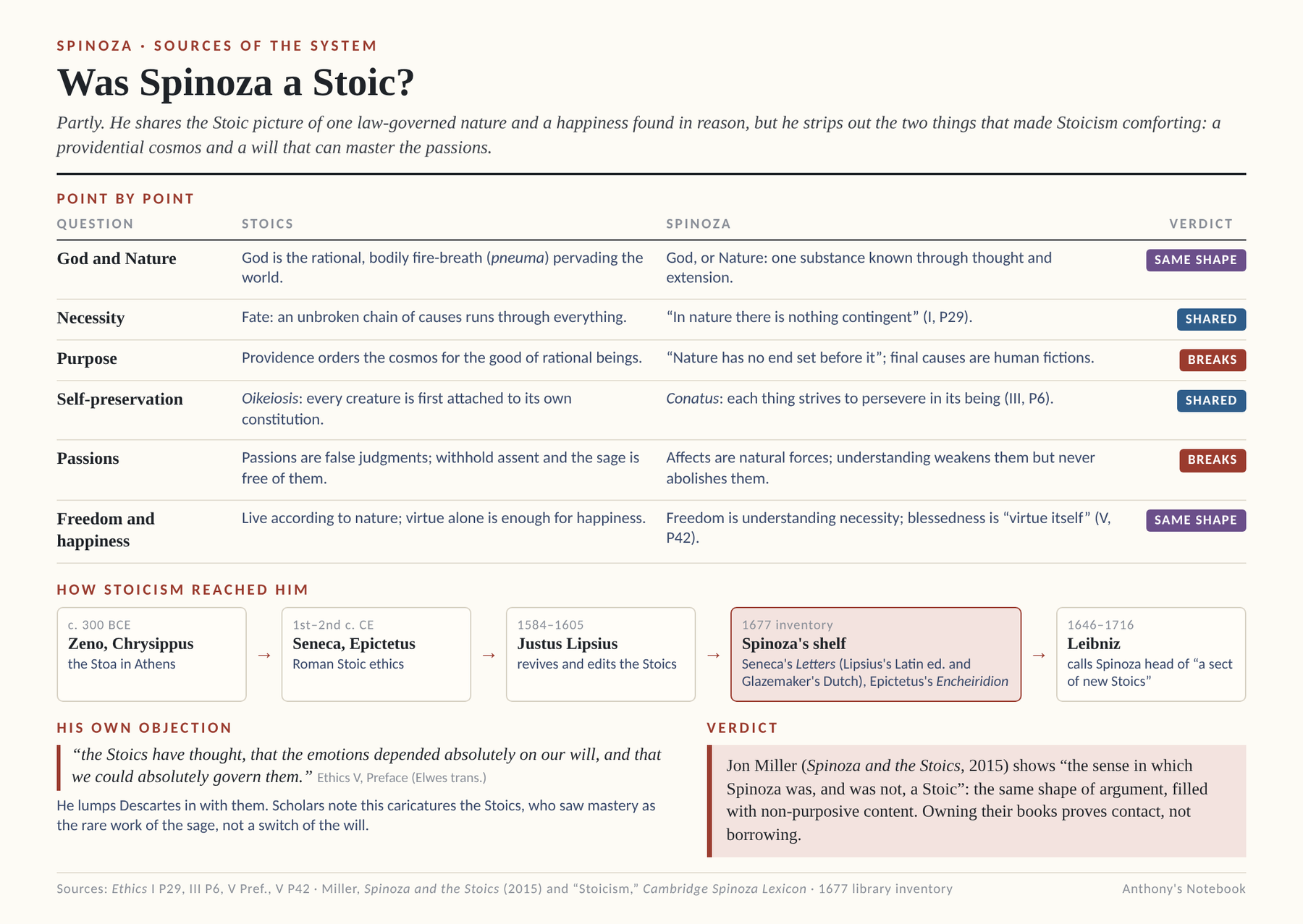
Spinoza and the Stoics
Shared ground: one law-governed nature, necessity, the striving to preserve oneself (conatus and the Stoic oikeiosis), and happiness found in reason. Breaks: no providence or purpose in nature, and no will that can fully master the passions (Ethics V, Preface). Jon Miller’s Spinoza and the Stoics (2015) argues for a qualified answer. Related: Stoicism · Israel, Chapter 13