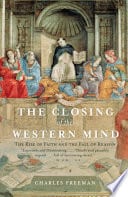
A radical and powerful reappraisal of the impact of Constantine’s adoption of Christianity on the later Roman world, and on the subsequent development both of Christianity and of Western civilization. When the Emperor Contstantine converted to Christianity in 368 AD, he changed the course of European history in ways that continue to have repercussions to the present day. Adopting those aspects of the religion that suited his purposes, he turned Rome on a course from the relatively open, tolerant and pluralistic civilization of the Hellenistic world, towards a culture that was based on the rule of fixed authority, whether that of the Bible, or the writings of Ptolemy in astronomy and of Galen and Hippocrates in medicine. Only a thousand years later, with the advent of the Renaissance and the emergence of modern science, did Europe begin to free itself from the effects of Constantine’s decision, yet the effects of his establishment of Christianity as a state religion remain with us, in many respects, today. Brilliantly wide-ranging and ambitious, this is a major work of history.
Critiques of the Book
Yes. The Closing of the Western Mind by Charles Freeman has been widely commented on, and it is a useful counterpoint to Tom Holland’s Dominion. But the reception is mixed: popular readers often find Freeman persuasive, while many historians of late antiquity, medieval science, and Christianity think his central thesis is too stark.
Basic thesis of Freeman’s book
Freeman argues that the rise of orthodox Christianity, especially after Constantine and the fourth-century imperial Church, narrowed the older Greek/Roman tradition of philosophical inquiry. His subtitle gives the argument: “The Rise of Faith and the Fall of Reason.” He presents Christianity as absorbing some Greek philosophy but subordinating open-ended rational inquiry to dogma, authority, mystery, and theological uniformity.
That is almost the opposite emphasis of Holland’s Dominion, which argues that Christianity did not simply close the Western mind but profoundly shaped Western moral imagination, including ideas of dignity, equality, victimhood, conscience, reform, and even secular liberal values.
Did Tom Holland specifically comment on it?
I found no strong direct review by Tom Holland of Freeman’s The Closing of the Western Mind in the public sources I checked. But Holland’s whole project in Dominion functions as an implicit rebuttal to Freeman’s framing. Holland does not deny that Christianity could be coercive, anti-pagan, doctrinally authoritarian, or intellectually restrictive at times. His larger claim is different: Christianity also transformed the West’s deepest moral assumptions in ways modern secular people often fail to recognize.
Ayn Rand Institute’s 2025 panel explicitly framed Holland’s Dominion and Freeman’s later The Reopening of the Western Mind as opposing interpretations: Holland sees Christianity as foundational to Western science and values, while Freeman presents a more contrary picture.
Copyable source:
[ARI Bookshelf on Dominion and The Reopening of the Western Mind](https://newideal.aynrand.org/the-ari-bookshelf-explores-three-books-on-the-influence-of-christianity-on-western-culture-video/)
Major historians and scholars who criticized Freeman
Mary Beard
Mary Beard reviewed the book in The Independent. She thought Freeman was a good narrative historian, but she objected to the book’s sharp opposition between pagan rationality and Christian irrationality. Her basic criticism was that Freeman over-romanticizes antiquity and underplays the fact that Christian monasteries preserved much classical learning.
Her point is important: the pagan world was not purely rational, tolerant, or scientific. It had magic, astrology, mystery cults, civic religion, emperor worship, persecution, and philosophical dogmatism. So Freeman’s “reason vs. faith” structure can become too binary.
Copyable source:
[Mary Beard, review of The Closing of the Western Mind](https://www.independent.co.uk/arts-entertainment/books/reviews/the-closing-of-the-western-mind-by-charles-freeman-176586.html)
Glen Bowersock
Glen Bowersock, a major historian of the ancient world, criticized Freeman in the Los Angeles Times. His criticism was that Freeman gives a fluent but superficial “potted history” where Christianity enters mainly as a corrupting force. Bowersock argued that Freeman’s claim about Christian orthodoxy stifling independent reason ignores earlier non-Christian examples of repression, such as Socrates’ trial or book burnings under Augustus.
The broader point: intellectual repression was not invented by Christianity. Ancient pagan society also had mechanisms of orthodoxy, censorship, impiety charges, political violence, and enforced conformity.
David C. Lindberg and Ronald Numbers
Historians of science such as David C. Lindberg and Ronald Numbers are often cited against Freeman’s thesis. They argue that the idea of Christianity simply destroying ancient science and plunging Europe into “Dark Ages” anti-intellectualism is an outdated myth. Lindberg specifically uses Freeman as an example of this older narrative surviving in popular history. Ronald Numbers’ edited volume Galileo Goes to Jail and Other Myths about Science and Religion also treats this kind of Christianity-versus-science story as misleading.
This matters because Freeman’s book is partly a history of reason and scientific inquiry. Specialists in medieval science tend to say: yes, Christian institutions restricted some lines of inquiry, but they also preserved texts, built schools, developed universities, transmitted Aristotle, and supported natural philosophy.
David Bentley Hart
David Bentley Hart attacked Freeman very harshly in Atheist Delusions. Hart’s critique is theological and historical: he claims Freeman misunderstands early Christian theology, caricatures Christian intellectual life, and repeats an Enlightenment/Gibbon-style story in which Christianity is treated as the villain of reason.
Hart is not a neutral critic; he is strongly pro-Christian and polemical. But his criticism reflects a broader scholarly objection: Freeman often compresses complicated theological and philosophical developments into a decline narrative.
Copyable source:
[David Bentley Hart, Atheist Delusions reference via Scribd excerpt](https://www.scribd.com/doc/137186550/Atheist-Delusions-David-Bentley-Hart)
Anthony Gottlieb
Anthony Gottlieb, a historian of ideas and former executive editor at The Economist, reviewed the book in The New York Times. His verdict was balanced: he found the story readable and useful as an account of Christian doctrine’s development, but thought the central argument was “highly questionable” and not adequately proven.
That is probably the fairest capsule judgment: Freeman is valuable as a narrative introduction to late antiquity and early Christian doctrine, but less convincing as a grand causal thesis about Christianity “closing” reason.
Freeman’s own later response
Freeman later wrote The Reopening of the Western Mind, which traces intellectual recovery from roughly 500 to 1700. In a 2023 interview, Freeman said he did not mind thoughtful critical reviews but thought some critics had not understood the book’s argument properly.
Copyable source:
[Interview with Charles Freeman, Freethinker](https://freethinker.co.uk/2023/11/the-greek-mind-was-something-special-interview-with-charles-freeman/)
Bottom line
The main scholarly criticism is that Freeman’s book is too “decline narrative”: ancient Greek/Roman reason was not as pure as he implies, Christian intellectual culture was not as closed as he implies, and the survival of classical learning depended heavily on Christian institutions.
But Freeman is not worthless. His book is useful if you want the strongest popular version of the argument that imperial Christianity narrowed intellectual pluralism. Read against Holland, Siedentop, Peter Brown, Lindberg, and Numbers, it becomes part of a larger debate:
Freeman asks: How did Christianity restrict reason? Holland asks: How did Christianity create the moral world modern secular people inhabit? Siedentop asks: How did Christianity generate the Western individual? Lindberg/Numbers ask: Did Christianity actually destroy science, or is that a modern myth?
For your reading project, I would treat Freeman as a provocative counterweight, not as the consensus view.
Open The Closing of the Western Mind notebook pages — start at notebook p. 34 (file not included in this release).
Review
Before Reading
What do I expect this section/book to argue?
Prediction:
Question I want answered:
After Reading
1. Recall Dump
Close the book. From memory, what were the main points?
2. The Core Argument
The book/section in one sentence:
Main claim:
Why the author thinks this is true:
Best evidence/example:
3. Feynman Check
Explain the idea simply, as if teaching it to someone unfamiliar with the topic.
Simple explanation:
4. What Actually Matters?
Most important idea:
Best quote or passage:
Term/concept worth remembering:
Connection to another book/idea:
5. Pushback
Strongest objection or weakness:
How the author might respond:
6. Personal Takeaway
What changed, clarified, or challenged my thinking?
One way I could apply this:
Retention Check
24 Hours Later
I can explain the main argument without notes.
I remember the best example or evidence.
I can state one objection.
1 Week Later
I can summarize this in 5 sentences.
I can connect it to another book, thinker, or historical period.
1 Month Later
I still remember the core argument.
I know whether this book changed my larger framework.
Flashcards / Recall Questions
Q:
A:
Q:
A:
Q:
A:
Scratchpad
Unfiltered thoughts, questions, comparisons, argument trees, or future writing ideas.
Notes
Chapter 1 — Thomas Aquinas and “The Triumph of Faith”
Chapter Objective
This opening chapter frames the central problem of The Closing of the Western Mind: how Christianity came to subordinate reason, philosophy, and empirical inquiry to faith, revelation, and doctrinal authority. Freeman uses Filippino Lippi’s fresco of Thomas Aquinas in the Carafa Chapel as a visual entry point into the book’s broader argument: Christianity did not simply encounter science as a later external challenge; rather, it actively challenged an already sophisticated Greco-Roman tradition of rational and scientific thought.
The chapter also introduces a paradox that will matter for the whole book: Thomas Aquinas is depicted as the defender of faith over reason, yet historically Aquinas also helped reintroduce Aristotle and rational argument into Christian theology.
The Carafa Chapel Fresco as the Chapter’s Framing Image
Freeman begins with a detailed description of a fresco in the Carafa Chapel in Santa Maria Sopra Minerva, a Dominican church in Rome.
The central figure is Thomas Aquinas, shown seated in a place of authority.
The fresco places him within a Roman setting:
St. John Lateran, associated with Constantine.
Porta Ripa Grande, the port by the Tiber.
Fasces, ancient Roman symbols of authority, though here without the axe, suggesting benign rather than tyrannical authority.
The fresco is not just decorative. Freeman reads it as a symbolic argument: Christian theological authority inherits and redirects Roman authority, presenting itself as the legitimate guardian of truth.
Aquinas as the Defender of Revealed Truth
Aquinas is shown crushing a scowling old man beneath his feet.
The old man personifies evil, and he holds a banner reading “Wisdom conquers evil.”
Above Aquinas are biblical texts emphasizing divine truth and revelation.
Most important is the Pauline phrase Aquinas holds: “I will destroy the wisdom of the wise.”
Freeman treats this quotation from Paul as a major clue to the book’s thesis. He argues that Paul’s attack on worldly wisdom, combined with other Pauline condemnations of philosophical reasoning, became an early foundation for the Christian suspicion of Greek philosophy, science, and independent rational inquiry.
The Subordination of Philosophy to Theology
The fresco does not eliminate reason entirely. Around Aquinas sit four personifications:
Philosophy
Theology
Grammar
Dialectic
These represent the medieval curriculum and intellectual disciplines. However, Freeman emphasizes that their placement shows hierarchy rather than equality.
Philosophy, grammar, and dialectic are allowed, but only as preliminary tools.
Theology is superior, marked by her crown and upward gesture toward heaven.
Reason is therefore permitted only when subordinated to revealed doctrine.
The underlying point is that medieval Christianity did not simply reject learning. It reorganized learning around theological supremacy. Reason became useful only when it served faith.
Heresy, Doctrine, and the Trinity
The fresco also depicts defeated heretics and discarded books, symbolizing the doctrinal battles of the fourth and fifth centuries.
Freeman uses two examples:
Arius and the Arians
Arius argued that Jesus was a distinct, lower creation.
His claim is summarized as: “There was a time when the Son was not.”
This position is shown as condemned.
Sabellius and Sabellianism
Sabellius argued that Father and Son were not truly distinct persons.
His view is also shown as condemned.
Other heretics appear as well, including Mani, founder of Manichaeism, the sect Augustine belonged to before converting to Christianity.
The fresco presents Aquinas as upholding the final orthodox solution: the doctrine of the Trinity.
God the Father, Jesus the Son, and the Holy Spirit are distinct persons.
Yet they belong to one Godhead.
Freeman stresses that Aquinas himself admitted this doctrine cannot be established by reason alone, but only by faith.
This becomes a central example of the chapter’s argument: Christian orthodoxy increasingly defined truth not by empirical demonstration or rational proof, but by submission to revealed doctrine.
Faith as a Complex Concept
Freeman then turns from the fresco to the concept of faith itself.
He distinguishes different meanings of faith:
Ordinary psychological faith
Trust in others.
Hope that “all will be well.”
A necessary part of a healthy human life.
Faith in Jesus
Trust in Jesus as a person.
Acceptance of the saving meaning of his crucifixion and resurrection.
Doctrinal faith
Acquiescence to the teachings of the Church.
Treated as a virtue in itself.
The important transition is from faith as trust to faith as obedience to doctrine. Freeman argues that by the fourth and fifth centuries, this doctrinal form of faith had achieved dominance over reason.
The Fourth and Fifth Centuries: Faith Over Reason
Freeman argues that in the fourth and fifth centuries A.D., Christian faith came to overrule the older principles of rational inquiry.
The shift involved several claims:
Knowledge comes from God.
Human reason is weakened by original sin.
Independent thought is therefore suspect.
Empirical observation and logic can be subordinated to revelation.
Augustine is especially important here because Freeman associates him with the idea that the human mind, burdened by Adam’s sin, is diminished in its capacity to think independently.
The result, according to Freeman, was the suppression of independent scientific thinking for centuries. This is one of the chapter’s strongest claims: Christianity did not merely fail to continue ancient science; it created theological conditions that made autonomous rational inquiry dangerous or illegitimate.
The Paradox of Thomas Aquinas
The chapter ends with a major paradox.
The fresco presents Aquinas as the triumphal defender of faith over reason, yet Freeman says Aquinas also played a crucial role in bringing reason back into Christian thought.
Aquinas revived the use of Aristotle.
He made it possible for faith and rational thought to coexist again.
Freeman says the book will return to this “other Thomas” in its final chapter.
This means the chapter does not present Aquinas simply as anti-rational. Instead, Aquinas symbolizes the tension at the center of Christian intellectual history:
Aquinas as defender of revealed truth against heresy and philosophy.
Aquinas as the theologian who reintroduced Aristotelian reason into the Christian intellectual world.
The Book’s Larger Direction
The chapter closes by explaining the structure of the book’s larger argument.
Freeman says the book will:
Return to ancient Greece.
Explain how reason became an intellectual force in Western culture.
Show how Christianity, especially under the influence of Paul’s denunciation of Greek philosophy, built a barrier between:
science
rational thought
religion
Freeman reverses a common modern assumption. The usual story is that science rose and challenged Christianity. Freeman argues instead that Christianity first challenged an already established rational and scientific tradition.
Key Concepts for Thomas Aquinas and “The Triumph of Faith”
Triumph of Faith
The idea that Christian revealed truth came to dominate over independent rational inquiry. In the fresco, this is symbolized by Aquinas enthroned, heretics defeated, and philosophy placed beneath theology.
Revelation over Reason
The view that divine revelation provides a higher and more authoritative source of truth than empirical observation or philosophical reasoning.
Pauline Anti-Philosophy
Freeman’s argument that Paul’s denunciation of “the wisdom of the wise” helped create a Christian suspicion of Greek philosophy and rational inquiry.
Doctrinal Faith
Faith not merely as trust or hope, but as acceptance of Church teaching. Freeman treats this as a decisive shift in Christian intellectual culture.
Heresy and Orthodoxy
The process by which disputed theological claims were condemned and a single authoritative doctrine was established. The fresco’s treatment of Arius, Sabellius, and Mani visually represents this process.
The Trinity as Faith-Based Doctrine
The doctrine that Father, Son, and Holy Spirit are distinct persons within one Godhead. Freeman emphasizes that Aquinas himself saw this as something reason alone could not prove.
The Aquinas Paradox
Aquinas appears as the champion of faith’s victory over reason, yet he also helped reintroduce Aristotle and rational philosophy into Christian theology.
Christianity versus Ancient Rationalism
Freeman’s broader thesis that Christianity did not merely respond defensively to modern science; it actively opposed and displaced an earlier Greco-Roman tradition of rational and scientific inquiry.
Questions for Reflection for Thomas Aquinas and “The Triumph of Faith”
Why does Freeman begin the book with a fresco of Thomas Aquinas rather than with a philosophical argument or historical event?
Is Freeman’s distinction between ordinary psychological faith and doctrinal faith persuasive? Where does trust become intellectual submission?
How does the fresco’s hierarchy of Theology, Philosophy, Grammar, and Dialectic symbolize the medieval ordering of knowledge?
Why does Freeman treat Paul’s phrase “I will destroy the wisdom of the wise” as so important for the history of Christianity and science?
Does the “Aquinas paradox” complicate Freeman’s argument, or does it strengthen it by showing that Christianity later needed to recover the reason it had subordinated?
Chapter 2 — The Quest for Certainty
Chapter Objective
This chapter explains how Greek rational inquiry emerged from a religious, mythic, and politically turbulent society without abolishing religion or myth. Freeman’s larger argument is that ancient Greece developed a uniquely powerful tradition of reasoned explanation, empirical observation, deductive proof, and intellectual competition before Christianity later challenged this tradition. The chapter therefore establishes what was at stake: the Greeks had already created a sophisticated culture of inquiry in which truth was pursued through argument, observation, mathematics, and provisional correction rather than through fixed dogma.
Odysseus and the First Image of Rational Agency
Freeman begins with Odysseus in Homer’s Odyssey, struggling to survive after Poseidon wrecks his ship.
Odysseus is still surrounded by divine forces:
Poseidon threatens him.
Leukothea gives him a protective scarf.
Athena calms the waves.
Yet Odysseus must still make practical decisions:
When to abandon the ship’s timbers.
Whether to land on a rocky coast or keep swimming for a safer bay.
Freeman uses this story to show an early Greek distinction between divine action and human rational decision-making. Odysseus lives in a world full of gods, but his survival still depends partly on his own judgment.
The point is not that Homeric Greece is already scientific. Rather, Freeman argues that Homer shows rational thought as a distinct human activity, not merely the passive result of divine will.
The Rise of the Greek Polis
Freeman then shifts from Homeric aristocratic society to the developing world of the Greek city-state, or polis.
Key social changes include:
Movement from aristocratic palace culture to settled civic communities.
Growth of public spaces, sacred spaces, and domestic areas.
Increasing reliance on intensive agriculture: olives, cereals, and vines.
Emergence of a free citizenry supported by slave labor.
Decline of aristocratic single combat and rise of hoplite phalanx warfare.
Greater segregation of women into enclosed domestic spaces.
The polis becomes crucial because it creates the civic environment in which public argument, legal reasoning, political conflict, and eventually philosophical inquiry develop.
Greek Religion and the Sacred Order of the City
Freeman emphasizes that the Greeks were not secular moderns. They had an intensely religious view of the world.
Greek religion included:
The twelve Olympian gods.
Local heroes and lesser deities.
Sacred places such as caves, springs, temples, and shrines.
Festivals, games, pilgrimages, and oracles.
The gods were close to human life and often portrayed with human emotions and flaws. They represented the full range of human experience:
Dionysus — excess and emotion.
Apollo — reason and order.
Aphrodite — sexuality.
Artemis — virginity and modesty.
Zeus — sky, kingship, victory, thunder, and sexual power.
Greek religion did not function mainly through systematic theology. It worked through ritual, sacrifice, festival, and civic tradition.
Sacrifice as Social and Political Mediation
Freeman gives special attention to animal sacrifice, which was central to Greek ritual.
Sacrifice involved:
Presenting an animal to the gods.
Killing, burning, and eating it communally.
Creating the impression that the animal accepted its death willingly.
Having the community share responsibility by throwing barley.
Allowing women to cry out at the moment of slaughter.
Freeman interprets sacrifice as a ritualized way of managing the seriousness of taking life. It also helped maintain civic cohesion.
The broader function of religion was to mediate:
Political tensions.
Social transitions.
Communal anxieties.
Difficult decisions through oracles and rituals.
Religion therefore helped preserve the city’s stability, but it did not prevent rational thought from emerging.
Political Conflict and the Need for Reasoned Debate
Greek cities were often unstable. Freeman describes repeated conflict among:
Old aristocratic elites.
Newly wealthy traders.
Rising peasant classes.
Democratic factions.
He uses Thucydides’ account of Corfu in 427 B.C. as an example of political breakdown:
Terror and counter-terror escalated.
Fathers killed sons.
Temples were violated.
Moderates were destroyed by both extremes.
The violent potential of civic conflict created pressure for more rational forms of political resolution. Freeman presents Athenian democracy as the most sophisticated Greek answer to this problem.
In Athens:
Male citizens participated in the Assembly.
Citizens served as jurors.
Men over thirty could serve as administrators.
Democracy lasted roughly 140 years.
Freeman does not idealize Athens, since women and slaves were excluded. But he treats it as a major political innovation that helped foster rational public debate.
Eunomie and the Idea of Order
Freeman introduces eunomie, meaning good order or well-ordered civic life.
The Athenian statesman Solon becomes the key example. Solon was asked to resolve a crisis caused by aristocratic exploitation of debt-ridden peasants.
His solution was pragmatic: human beings, not merely gods, must establish order in the city. Yet Solon still personifies Eunomie as a quasi-divine force that helps bring harmony.
Freeman uses this to show a transitional stage in Greek thought:
The city is understood as tending toward order.
Good politics means helping the city return to harmony.
This political idea of order then becomes a model for thinking about the cosmos.
From Political Order to Cosmic Order
Freeman argues that the Greeks made a major intellectual leap: if the city can have an underlying order, perhaps the cosmos does too.
The natural world seemed to show regular patterns:
Seasons.
Stars.
Celestial movements.
Rhythms of nature.
The key figure is Thales of Miletus, who is said to have predicted a solar eclipse in 585 B.C. Freeman treats this as symbolically important because it suggests that nature follows patterns regular enough to be predicted.
The Milesians began asking basic cosmological questions:
What is the cosmos made of?
Why does it move as it does?
What underlying substance or principle explains the world?
Examples:
Thales suggested that the world originated in water.
Anaximander argued for the Boundless, a set of surrounding forces holding the world in balance.
Anaximenes suggested that everything came from air, which could condense into different forms.
Their answers were primitive, but Freeman’s point is methodological: they used observation and reason to challenge rival explanations.
Heraclitus and Logos
Freeman then turns to Heraclitus, who argued that the world’s order is sustained through tension and conflict.
Heraclitus’ key idea is logos:
An underlying rational order.
A principle that makes sense of change.
A structure within apparent flux.
For Heraclitus, harmony does not mean the absence of conflict. A city can be harmonious while still full of debate and activity. His phrase “Justice is strife” captures the idea that order can emerge through tension.
This matters for Freeman because it links Greek rationality to the political life of the city-state. Reason develops through argument, dispute, and the need to justify claims publicly.
Political Debate as the Root of Scientific Reasoning
Freeman draws on Geoffrey Lloyd’s argument that Greek science developed partly from the argumentative culture of the polis.
In political and legal debate, Greeks needed:
Definitions.
First principles.
Evidence.
Cross-examination.
Tests of claims.
Persuasive public argument.
This vocabulary and method transferred into scientific discourse.
Examples:
Legal witness becomes connected to scientific evidence.
Cross-examination becomes a model for testing a hypothesis.
Public argument gives status to those who can reason persuasively.
Freeman’s core point: Greek science did not arise from detached contemplation alone. It emerged from the competitive, argumentative, civic environment of the Greek city.
Parmenides and Pure Reason
Freeman next distinguishes empirical inquiry from pure rational argument.
Parmenides represents one of the earliest attempts to understand reality through reason alone, without relying on observation.
His starting point is the premise:
“It is and it is impossible for it not to be.”
From this, he reasons toward the conclusion that reality must be a single, undifferentiated, unchanging mass.
Freeman’s point is not that Parmenides was correct. Rather, Parmenides showed that once one begins from axioms, reason can move independently toward conclusions.
This created a major philosophical problem:
What happens when reason and observation conflict?
Zeno and the Conflict Between Reason and Experience
Zeno, a follower of Parmenides, sharpened the conflict between logical reasoning and ordinary experience.
Freeman uses two examples:
The arrow paradox
An arrow in flight is always at a specific place.
If it is at a place equal to itself, it appears to be at rest.
Therefore, reason seems to imply that motion is impossible.
Achilles and the tortoise
Achilles must first reach where the tortoise was.
By then the tortoise has moved.
This repeats indefinitely.
Reason seems to imply Achilles can never catch the tortoise.
Experience says both conclusions are false. Arrows move, and Achilles would pass the tortoise. Freeman uses these paradoxes to show that the Greeks recognized difficult tensions between logic, perception, and reality, but were intellectually confident enough to confront them.
Aristotle, Syllogism, and Deductive Certainty
Freeman presents Aristotle as central to the Greek search for certainty.
Aristotle systematized the syllogism, a logical structure where a conclusion follows necessarily from premises.
Classic form:
All men are mortal.
Socrates is a man.
Therefore, Socrates is mortal.
Freeman emphasizes that syllogisms only work when:
The premises are true.
The relationship between premises is valid.
The conclusion follows necessarily.
This matters because Aristotle helped define what a valid argument is. He also showed where arguments fail, such as when shared attributes do not prove identity.
The syllogism becomes part of the Greek achievement in deductive reasoning: deriving specific truths from accepted premises.
Mathematics and the Highest Form of Certainty
Freeman treats Greek mathematics as one of the greatest achievements of ancient rational inquiry.
The Greeks moved beyond practical calculation into abstract proof.
Examples:
Pythagoras’ theorem
The Babylonians knew the relation in practical triangles.
The Greeks generalized it to all conceivable right-angled triangles.
Euclid’s Elements
Began with postulates and common notions.
Derived 467 proofs from a small number of assumptions.
Became one of history’s most important textbooks.
Apollonius’ Conic Sections
Produced hundreds of additional mathematical propositions.
Mathematics gave the Greeks a model of certainty: if premises are accepted and reasoning is valid, the conclusion is secure.
The Natural World and the Problem of Cause
Freeman contrasts mathematics with natural science.
The natural world is harder because it is full of change:
Weather changes.
Plants grow.
Wars happen.
People die.
Bodies become ill.
Scientific explanation requires the isolation of cause and effect.
Freeman uses Herodotus on the Nile floods as an example of early scientific reasoning. Herodotus considers several explanations:
Summer winds hold back the Nile.
The Nile flows from an ocean surrounding the earth.
Melting snow causes the floods.
Herodotus rejects these explanations through observation and rational criticism. His own explanation is wrong, but Freeman stresses that the method is important: Herodotus consciously rejects mythological explanation and tries to reason from evidence.
Hippocratic Medicine and the Rejection of Divine Causation
Freeman then turns to medicine, especially the Hippocratic text on epilepsy, traditionally known as “the sacred disease.”
The Hippocratic author argues:
Epilepsy is no more divine than any other disease.
It has a specific nature and cause.
It is hereditary.
It originates in the brain.
It can be treated like other diseases.
This is one of Freeman’s clearest examples of Greek scientific thought: divine causation is rejected in favor of natural explanation.
However, Freeman adds an important qualification. Greek medicine did not necessarily reject the gods. The Hippocratic oath still invokes Apollo, Asclepius, Hygeia, and Panacea. The issue is not atheism. It is the shrinking of the gods’ role in explaining ordinary natural events.
Greek Assumptions About Natural Order
Freeman argues that Greek inquiry began from the assumption that nature has an underlying order.
In astronomy, Greeks assumed:
Earth is at the center of the universe.
Stars move around it regularly.
Celestial movement is circular.
In medicine, they assumed:
The body tends toward order and health.
Disease is an aberration from normal functioning.
These assumptions were not always correct, but they created a framework for disciplined inquiry. The Greeks then gathered observations and tried to fit explanations to them.
Greek Astronomy: Error, Ingenuity, and Observation
Freeman is careful not to mock Greek astronomy for being geocentric. He argues that the Greek view was based on serious reasoning, not laziness.
The Greeks considered alternatives:
Aristarchus suggested the sun might be central.
Heracleides of Pontus proposed that the earth spins on its axis.
But objections seemed reasonable at the time:
If the earth moved around the sun, why did the stars not appear to shift dramatically?
If the earth spun, why were clouds not left behind?
The Greeks lacked the concept of the stars’ immense distance, so geocentrism looked plausible.
Freeman emphasizes Greek ingenuity in explaining planetary motion. The planets were called planetes, or wanderers, because their motion appeared irregular. Greek astronomers developed increasingly complex circular models to account for these movements, culminating in Ptolemy.
The larger point: the earth-centered model was an assumption, not an article of faith. Had Greek scientific tradition continued uninterrupted, Freeman suggests, someone might have eventually applied the data to Aristarchus’ heliocentric hypothesis, as Copernicus later did.
Greek Mathematical Astronomy
Freeman highlights the practical use of mathematics in Greek astronomy.
Examples include:
Hipparchus
Detected the precession of the equinoxes.
Used naked-eye observation, Babylonian records, and instruments.
Calculated the shift with impressive accuracy.
Aristarchus
Calculated relative sizes and distances of the sun and moon.
Eratosthenes
Calculated the circumference of the earth, possibly within 200 miles of the true figure.
These examples show Greek science at its best: mathematics combined with careful observation.
Aristotle and the Cumulative Search for Knowledge
Freeman presents Aristotle as the most comprehensive example of Greek inquiry.
Aristotle investigated:
Logic.
Zoology.
Ethics.
Politics.
Government.
Rhetoric.
Tragedy.
Metaphysics.
Biology.
His method was:
Master previous views.
Criticize inadequate explanations.
Identify unresolved questions.
Gather empirical evidence.
Move forward cautiously.
Examples:
In zoology, Aristotle studied organisms ranging from bison to mites, octopuses, and oysters.
In politics, he gathered information on 158 Greek constitutions.
In biology, he explored the essence and purpose of living organisms.
Freeman stresses Aristotle’s openness to uncertainty. Aristotle believed knowledge had unity, but he also accepted that much knowledge remains provisional.
Aristotle’s Undogmatic Classification of Life
Freeman uses Aristotle’s difficulty distinguishing plants from animals to show his scientific caution.
Problem cases include:
Sponges
They cling to rocks when pulled.
This suggests some animal-like response.
Yet they cannot live detached from rock.
Jellyfish
They are detached organisms.
Yet Aristotle saw no perception in them.
The problem forced Aristotle to ask whether categories needed to be revised.
Freeman’s point: Aristotle’s greatness lay in refusing to impose rigid categories prematurely. He allowed observation to complicate theory.
Theophrastus and the Competitive Nature of Greek Science
Freeman then uses Theophrastus, Aristotle’s successor, to show how Greek science progressed through criticism.
The example is spontaneous generation.
Aristotle proposed spontaneous generation partly because he could not observe eel reproduction.
Theophrastus investigated similar claims in plants.
He discovered that tiny seeds often explained what looked like spontaneous generation.
He did not fully reject spontaneous generation, but insisted that more evidence was needed.
Theophrastus’ approach shows several features of Greek science:
Respect for previous thinkers did not prevent criticism.
Claims remained provisional.
Evidence had to be gathered by skilled observers.
Even Aristotle could be challenged.
Freeman uses Geoffrey Lloyd’s comparison to make the point sharper: Greek texts repeatedly show individual authors criticizing received traditions and claiming originality. This kind of explicit intellectual competition is much harder to find in surviving Egyptian and Babylonian scientific texts.
Logos and Muthos
Freeman then turns to a major conceptual distinction: logos and muthos.
Logos means:
A reasoned account.
Rational explanation.
Prose inquiry.
Argument that can be defended.
Muthos means:
Mythic story.
Narrative account.
Often poetic or religious storytelling.
A story not governed by rational demonstration.
Freeman emphasizes that the Greeks did not simply discard myth once reason emerged. Myths retained value.
Myth served important functions:
City identity through foundation stories.
Ritual meaning during life transitions.
Emotional and ethical exploration.
Tragic drama.
The key point is that the Greeks generally allowed logos and muthos to coexist. Myth was not expected to produce demonstrable certainty, and logos was not used for claims that could not be defended through reason.
Tragedy as Ethical Inquiry
Freeman presents Greek tragedy as a sophisticated use of myth.
Tragedy allowed a community to examine moral dilemmas through stories inherited from myth.
The audience could watch:
Conflicting obligations.
Bad choices.
Consequences of action.
Human suffering.
Ethical ambiguity.
Aristotle argued that tragedy arouses pity and fear, producing catharsis and making the audience more complete human beings.
For Freeman, tragedy shows that myth remained intellectually and emotionally valuable without needing to compete with reasoned explanation.
Greek Religious Flexibility and Speculation About the Gods
Because Greek religion was not governed by rigid doctrine, thinkers could speculate freely about the gods.
Freeman gives several examples:
Protagoras
Questioned whether humans can know the gods, given the difficulty of the subject and the shortness of human life.
Xenophanes
Criticized anthropomorphic gods.
Suggested that if horses imagined gods, they would imagine them as horses.
Speculated that the divine might be unlike humanity.
Aristotle
Argued for an eternal unmoved mover as the first cause of motion.
Atomists
Proposed that reality is material, made of indivisible atoms.
Greek religion could become intolerant at moments, as with Socrates’ execution in 399 B.C. But Freeman’s general point is that Greek religion had no fixed institutional orthodoxy comparable to later Christian doctrine. It was fluid, mythic, ritual-based, and open to speculation.
Limits of Greek Rationality
Freeman closes by warning against idealizing the Greeks.
Their rational inquiry had real limits:
Empirical evidence was often hard to gather.
Interpretation was shaped by ideology.
Most Greeks likely did not participate in elite intellectual debate.
Hippocratic texts classified women as biologically “other” and reinforced male superiority.
Aristotle linked hot climates to indolence and argued that some peoples were naturally suited for slavery.
The Greeks made extraordinary intellectual advances, but they remained embedded in the prejudices and social hierarchies of their world.
Human Achievement and Moral Limits
Freeman ends with a passage from Sophocles’ Antigone, which praises human intelligence but warns that it can be used for good or evil.
The Greeks celebrated human capacities:
Speech.
Science.
Law.
Shelter.
Hunting.
Control over animals.
Civic organization.
But they also insisted on limits:
Humans cannot defeat death.
Intelligence can serve both justice and injustice.
The city depends on law and moral order.
Hubris and lawlessness make a person “without a city.”
This ending sets up the next chapter. Freeman has shown how the Greeks developed rational thought. The next question is how Greek philosophers connected reason to ethics, justice, and the good life.
Key Concepts for The Quest for Certainty
The Quest for Certainty
The Greek attempt to distinguish what can be known securely from what remains uncertain, especially through logic, mathematics, observation, and rational argument.
Polis
The Greek city-state. Freeman treats it as the social and political environment that made public debate, legal reasoning, and rational inquiry possible.
Eunomie
Good order or civic harmony. Initially a political concept, it becomes a model for thinking about order in the cosmos and nature.
Cosmos
The ordered universe. Greek thinkers increasingly assumed that nature had regular patterns that could be discovered.
Logos
A reasoned account or rational explanation. It becomes the Greek term for systematic inquiry in science, mathematics, history, and philosophy.
Muthos
Mythic or narrative account. Freeman stresses that the Greeks did not necessarily see myth and reason as enemies; they assigned them different functions.
Deductive Reasoning
Reasoning from premises to conclusions that follow necessarily. Aristotle’s syllogism and Euclidean geometry are Freeman’s main examples.
Empirical Observation
The collection and interpretation of evidence from the natural world. Greek inquiry combined observation with rational explanation, though imperfectly.
Provisional Knowledge
The view that many claims about nature are subject to revision as more evidence appears. Freeman associates this especially with Aristotle and Theophrastus.
Intellectual Competition
The Greek practice of challenging predecessors, criticizing received views, and claiming originality. Freeman treats this as central to the development of science.
Natural Causation
The idea that events such as disease, floods, and planetary motion should be explained by natural causes rather than arbitrary divine intervention.
Hubris
Arrogant overstepping of human limits. Freeman uses it to show that Greek rational confidence was balanced by moral and religious warnings against excess.
Questions for Reflection for The Quest for Certainty
How does Freeman use Odysseus to show the coexistence of divine power and human rational agency?
Why does Freeman think the Greek polis was so important for the development of rational inquiry?
What is the difference between logos and muthos, and why does Freeman argue that the Greeks did not treat them as simple enemies?
How did Greek thinkers distinguish between mathematical certainty and the more provisional knowledge of the natural world?
Does Freeman’s account of Greek rationality weaken or strengthen his broader claim that Christianity later disrupted an already sophisticated intellectual tradition?
Chapter 3 — The Quest for Virtue
Chapter Objective
This chapter explains how Greek thinkers moved from the quest for rational certainty into the quest for moral certainty: how should human beings live, speak, judge, and govern themselves? Freeman contrasts two major answers. Plato seeks moral truth in an eternal, immaterial world of Forms, accessible only to a trained intellectual elite. Aristotle grounds virtue in this-worldly human flourishing, practical judgment, habituated character, and rational engagement with ordinary life. This contrast matters for the book’s broader argument because both Platonic and Aristotelian traditions later entered Christianity, shaping Christian views of reason, the soul, virtue, authority, and the relationship between this world and a higher reality.
Rhetoric and the Problem of Persuasion
Freeman begins with the political importance of speech in Greek society.
In Homer, aristocratic leaders needed to persuade others to fight and risk their lives.
Leaders met in council, where one speaker’s view could be moderated by others.
By the sixth century B.C., speakers faced a more difficult audience: the citizen assembly.
Public speech now had to persuade large, volatile, less deferential groups of citizens.
This gave rise to reflection on rhetorike, or rhetoric: the art of persuasive speaking.
The key example is Gorgias, a rhetorician from Leontini in Sicily.
He came to Athens in 427 B.C. to ask for support against Syracuse.
He was a public performer who could extemporize on any theme.
He taught younger citizens that effective public speaking could be learned.
Freeman’s point is that democratic politics created a demand for rhetorical skill, but rhetoric immediately raised a moral problem: does persuasive speech lead people toward truth, or merely manipulate them?
Rhetoric, Emotion, and Political Danger
Freeman shows that rhetoric could produce dangerous political consequences when emotion overruled reason.
Examples from the Peloponnesian War:
Mytilene, 427 B.C.
The Athenian assembly voted to execute all the men of Mytilene after a revolt.
The next day, after emotions cooled, the assembly reversed the decision.
A second ship carrying the reversal reached Mytilene just as executions were beginning.
Trial of the generals, 406 B.C.
The assembly was persuaded to execute eight generals accused of failing to rescue shipwrecked sailors.
Afterward, the assembly regretted the decision and blamed the speakers for having “forced” it.
These examples show the danger of mass politics when public opinion is moved by anger, fear, or rhetorical force rather than stable judgment.
Freeman also notes that Greek writers worried about this problem:
Parmenides warned that words detached from truth could become deceptive.
Aristophanes’ Clouds dramatized a contest between Just Speech and Unjust Speech, where verbal trickery triumphs.
The core problem: rhetoric is powerful because it moves people, but that power can serve justice or injustice.
Isocrates and the Moral Orator
Freeman then presents Isocrates as a defender of rhetoric when properly joined to moral character.
Isocrates looked back to Athens’ earlier leaders:
Solon
Cleisthenes
Themistocles
Pericles
He argued that Athens’ greatness showed that rhetoric could serve the public good.
For Isocrates:
The problem is not rhetoric itself.
The problem is rhetoric without moral responsibility.
A good speaker must cultivate honor, integrity, and public trust.
The more someone wants to persuade, the more he should work to be honorable and reputable.
This view influenced later Roman thought, especially Cicero and Quintilian, who also insisted that the true orator must be morally upright.
Aristotle on Rhetoric and Emotion
Freeman presents Aristotle as more balanced than Plato on rhetoric.
In Aristotle’s Rhetoric, persuasion has three components:
The character of the speaker
The emotional condition of the audience
The argument or demonstration within the speech itself
For Aristotle, emotion cannot be eliminated from persuasion. A good speech depends partly on how the audience is disposed and partly on the speaker’s perceived character.
The solution is not to remove emotion but to make morally responsible use of it.
This reflects Aristotle’s general ethical tendency: he does not reject ordinary human psychology but tries to order it rationally.
Plato’s Crisis: Socrates and the Failure of Democratic Judgment
Freeman then turns to Plato, whose philosophy was shaped by Athens’ political collapse and the execution of Socrates.
Historical background:
Athens lost the Peloponnesian War to Sparta in 404 B.C.
Its walls were destroyed.
Its empire was dismantled.
The Government of Thirty became tyrannical.
After democracy was restored, Socrates was tried and executed in 399 B.C.
Socrates was accused of:
Not acknowledging the gods of the city.
Introducing new divine powers.
Corrupting the young.
Freeman emphasizes that Socrates challenged unexamined assumptions. His maxims included:
“The unexamined life is not worth living.”
“The most knowledgeable man is he who knows he knows nothing.”
Plato drew a major lesson from Socrates’ death: democratic opinion, when guided by emotion and unstable moral assumptions, can kill a good man.
This convinced Plato that moral terms such as good, evil, and justice could not be left to public opinion or rhetorical persuasion. They required objective standards.
Plato’s Attack on Rhetoric
In the dialogue Gorgias, Plato attacks the idea that rhetoric can reliably bring truth to an audience.
Freeman presents Plato’s criticism this way:
Rhetoric often works by deception.
It flatters listeners rather than educating them.
It is judged by effectiveness, not truth.
It gives power to speakers who may lack knowledge of the good.
Plato did not think Isocrates’ solution went far enough. Training speakers to be morally responsible did not solve the deeper issue. Plato wanted objective, eternal standards by which moral claims could be judged.
This leads to the central Platonic project: locating goodness, justice, and beauty beyond unstable human opinion.
Pythagoras and the Background to Plato’s Forms
Freeman identifies Pythagoras as a major influence on Plato.
Pythagoras taught that numbers underlie the natural world.
Example:
A string stretched across a sounding box produces a note.
Halving the string produces a note exactly one octave higher.
This suggested that unseen numerical ratios structure visible reality.
Plato expanded this idea. If numbers exist at a more stable and perfect level than sensory appearances, perhaps moral and aesthetic values do too.
This becomes Plato’s theory of Forms.
Plato’s Theory of Forms
For Plato, the material world contains only imperfect, temporary reflections of higher realities.
Examples:
A beautiful picture is only temporarily and partially beautiful.
True Beauty exists as an eternal Form.
Particular just actions participate in a higher Form of Justice.
Particular good things participate in the Form of the Good.
The Forms are:
Eternal.
Immaterial.
Perfect.
More real than the sensory world.
Accessible only through disciplined reason.
Plato also arranges the Forms hierarchically. At the top stands the Form of the Good, compared to the sun because it illuminates all other truths.
Freeman’s central point is that Plato seeks certainty by leaving the empirical world behind. Unlike the Greek scientific tradition, which works through observation and revision, Plato places truth in a higher, unchanging realm.
Plato’s Soul and the Rule of Reason
Freeman then explains Plato’s view of the soul.
Plato divides the soul into three parts:
Reason
The highest part.
Capable of grasping the Forms.
Desire
Hunger, thirst, sex, bodily appetite.
Spirit
Anger, honor, ambition, love of reputation.
For Plato, virtue means that reason rules over desire and spirit.
The soul is immortal and passes from body to body. Plato also argues that true knowledge is a kind of recollection. In the Meno, a slave is led through a mathematical proof, which Plato interprets as evidence that the soul already contains knowledge and must recollect it.
The argument is that eternal truths, like mathematical truths, exist independently of the material world and can be recovered by the properly trained soul.
The Guardians and the Political Consequences of Plato’s Philosophy
Plato believed only a small intellectual elite could grasp the Forms.
These people, trained from childhood, would become Guardians.
Their role:
Understand the Forms of Good, Justice, and related truths.
Rule society according to this knowledge.
Govern ordinary people who cannot grasp these truths themselves.
Freeman emphasizes the authoritarian implication.
Plato compares the Guardians to doctors:
Doctors know what is best for patients.
Patients may not understand their own good.
Therefore, rulers who know the Good may override ordinary citizens.
In Plato’s later work Laws, Freeman notes, resistance to the proper moral order can justify exile or even execution.
This is one of Freeman’s major criticisms of Plato: the search for moral certainty can become coercive when an elite claims access to truths unavailable to ordinary people.
Plato’s Attack on Empirical Science
Freeman argues that Plato’s philosophy directly challenged the mainstream Greek scientific tradition.
The Greek scientific tradition relied on:
Observation.
Evidence.
Revision.
Engagement with the natural world.
Plato, by contrast, distrusted the world of the senses. Freeman quotes Plato’s argument from The Republic that astronomy should proceed like geometry and “ignore what’s in the sky” if it wants true understanding.
This is a crucial moment in Freeman’s argument.
Plato’s metaphysics implies:
Sensory evidence is inferior.
True knowledge comes from reason alone.
The material world is less real than the immaterial world.
Observation can be dismissed if it conflicts with the supposed reality of the Forms.
Freeman treats this as a danger to empirical inquiry.
Freeman’s Critique of Plato
Freeman identifies several problems in Plato’s philosophy.
The Forms are hard to prove
Plato claims they exist, but it is unclear whether reason can demonstrate their existence.
There is no secure way to resolve disputes
If two people claim to understand the Form of the Good differently, how can the conflict be settled?
There are no clear axioms
Mathematical reasoning begins from agreed postulates.
Plato does not provide comparable foundations for deriving the Form of Beauty, Justice, or Good.
Political danger
If a person, institution, or government claims to know the Forms, it can impose its vision on others.
This opens the door to dictatorship.
Damage to empirical inquiry
A political or philosophical order based on higher immaterial truth may devalue open-ended investigation of the natural world.
Freeman’s judgment is that Plato’s philosophy offers moral certainty at the price of intellectual hierarchy, authoritarian politics, and suspicion of empirical science.
Plato’s Other-Worldliness and the Divine
Freeman argues that Platonism radically changed the Greek relationship between human beings and the divine.
Traditional Greek religion imagined gods who were:
Anthropomorphic.
Mythologically rich.
Emotionally recognizable.
Accessible through ritual and story.
Plato’s Forms, especially the Form of the Good, are very different:
Remote.
Abstract.
Hierarchical.
Accessible only to a trained few.
More divine than ordinary gods in their perfection and immutability.
This created a new division:
Those capable of grasping higher immaterial truth.
The majority who cannot.
Freeman sees this as diminishing the ordinary person’s place in the cosmos. Platonic reason does not necessarily produce human self-confidence. It can produce the opposite: awareness of human insignificance before a superior, immaterial order.
Aristotle’s This-Worldly Ethics
Freeman contrasts Plato with Aristotle.
Aristotle had views Freeman regards as alien or objectionable:
He supported slavery.
He subordinated women.
He believed only free mature males could fully exercise rational thought.
Yet Freeman presents Aristotle as more humane and this-worldly than Plato.
Unlike Plato, Aristotle grounds ethics in ordinary human existence rather than an immaterial realm.
For Aristotle:
Virtue is not an abstract object outside the world.
Virtue is realized when a human being fulfills his nature well.
The goal is eudaimonia, meaning flourishing, well-being, or successful human living.
Aristotle’s ethics is based on the idea that human beings have a natural end or purpose, and virtue is the excellence that allows them to reach it.
Arete, Habit, and Moral Formation
The Greek word for virtue is arete, often translated as excellence.
For Aristotle, virtue develops through:
Proper upbringing.
Orientation toward the good.
Repeated good action.
Practical experience.
Rational reflection.
A child must first be trained to desire good action. But a person becomes good only by actually doing good acts.
This is a central Aristotelian idea:
We become just by doing just acts.
We become courageous by doing courageous acts.
Character is formed through habituated action.
Virtue is not merely knowledge. It is a stable disposition shaped by practice.
Practical Judgment and the Rejection of Absolutism
Freeman stresses that Aristotle does not give simple moral absolutes.
Example: courage
Courage is a virtue.
But attacking an armed soldier while unarmed may be reckless, not virtuous.
The virtuous person must judge the situation intelligently.
Aristotle requires:
Reasoned control of emotion.
Experience with similar cases.
Awareness of likely outcomes.
Adaptation of moral principles to circumstances.
There are no fixed rules that allow a person to avoid responsibility for judgment. The individual must reason through concrete situations.
This is one of Freeman’s key contrasts with Plato:
Plato seeks eternal moral certainty outside the world.
Aristotle seeks practical moral wisdom within the world.
Eudaimonia and Human Fulfillment
A person who develops virtue eventually reaches eudaimonia.
Freeman describes eudaimonia as a complex state where several goods come together:
Success in human affairs.
Moral goodness.
Rational excellence.
Harmony of character.
Peace with oneself.
Aristotle sees contemplation as the highest human activity, but he also recognizes that human beings need community and companionship.
Freeman emphasizes Aristotle’s optimism:
Human beings naturally tend toward fulfillment.
Virtues belong to human nature from birth in potential form.
This is sharply different from later Christian views that emphasize fallen nature, sinful desire, or the need for divine grace.
Plato and Aristotle in Raphael’s School of Athens
Freeman ends with Raphael’s School of Athens, where Plato and Aristotle stand together but gesture in opposite directions.
Plato points upward
Truth lies in the immaterial world of Forms.
The senses are unreliable.
Certainty is beyond the material world.
Aristotle points downward
Truth must be sought in this world.
Knowledge begins with empirical evidence.
Conclusions remain open to challenge and revision.
This image crystallizes the chapter’s central contrast.
Freeman’s broader argument is that these two approaches to certainty and virtue were later woven into Christianity. The conflict between other-worldly certainty and this-worldly empirical reasoning becomes one of the major themes of the book.
Transition to the Next Section
The chapter closes by noting that the fourth-century Greek world of Plato and Aristotle was about to be transformed politically over the next 700 years.
Freeman signals that the next section will examine:
Political developments after the classical Greek period.
The survival of the Greek intellectual tradition.
Continued achievements in religion, philosophy, science, and mathematics.
The chapter therefore functions as a bridge from Greek rational inquiry to the political and cultural transformations that would carry Greek thought into later worlds, including Christianity.
Key Concepts for The Quest for Virtue
Rhetorike
The Greek art of persuasive speech. Freeman presents it as both politically necessary and morally dangerous because it can move audiences through emotion rather than truth.
Moral Orator
Isocrates’ ideal of the speaker whose persuasive power is joined to integrity, honor, and responsibility to the public good.
Forms
Plato’s eternal, immaterial realities behind the imperfect things of the sensory world. Examples include Beauty, Justice, and the Good.
The Good
The highest Platonic Form, compared to the sun because it illuminates and orders all lesser truths.
Tripartite Soul
Plato’s division of the soul into reason, desire, and spirit. Virtue requires reason to govern the lower parts.
Guardians
Plato’s intellectual elite, trained to understand the Forms and rule society according to objective knowledge of the Good and Justice.
Arete
Greek term often translated as virtue or excellence. In Aristotle, it means the realized excellence of a human being acting according to rational nature.
Eudaimonia
Aristotle’s concept of flourishing or well-being. It is the fulfilled life achieved through virtue, reason, moral habituation, and practical judgment.
Practical Judgment
Aristotle’s view that ethical action requires applying reason to concrete circumstances rather than obeying rigid absolutes.
Other-Worldly Certainty
Plato’s search for truth beyond the senses in an immaterial realm.
This-Worldly Ethics
Aristotle’s grounding of virtue in ordinary human life, embodied action, experience, and rational reflection.
Questions for Reflection for The Quest for Virtue
Why does Freeman begin the chapter with rhetoric rather than immediately with Plato and Aristotle?
Does rhetoric become dangerous because it manipulates emotion, or because democratic audiences lack stable standards of judgment?
How does Socrates’ execution shape Plato’s distrust of democracy, rhetoric, and ordinary opinion?
Why does Freeman see Plato’s theory of Forms as a threat to empirical inquiry?
Which ethical model seems more compatible with Freeman’s broader defense of Greek rationality: Plato’s search for eternal moral certainty or Aristotle’s practical account of virtue?
Chapter 4 — Changing Political Contexts: Alexander and the Coming of the Hellenistic Monarchies
Chapter Objective
This chapter explains how the Greek world moved from the independent polis to the age of large monarchies, first under Macedon and then under Alexander’s successors. Freeman’s main point is that the political context that had nourished Greek rational inquiry — the argumentative, civic world of the city-state — was replaced by monarchies built on conquest, dynastic legitimacy, ruler propaganda, and claims of divine favor. Yet the chapter also shows a paradox: although Alexander’s absolutism threatened the Greek intellectual tradition, the later Hellenistic monarchies helped preserve and expand Greek culture through patronage, libraries, museums, cities, science, philosophy, and a shared Greek language, koine, which later became crucial for the spread of Christianity.
The Decline of the Independent Greek Polis
Freeman begins by identifying the major political shift between 350 B.C. and A.D. 100: the spread of monarchical government across the Mediterranean.
By the early second century A.D., the Mediterranean world was under a single ruler, the Roman emperor.
Freeman traces this imperial model back to the Hellenistic monarchies that followed the rise of Philip II of Macedon and the conquests of Alexander the Great.
The independent Greek city-state had reached what Freeman calls an evolutionary dead end.
The polis created a strong setting for:
Political debate.
Intellectual creativity.
Civic identity.
Philosophical and cultural life.
But its narrow citizen base limited its ability to control large territories or sustain long-term power.
Athens briefly created an Aegean empire, but it collapsed after defeat by Sparta in 404 B.C.
Sparta then declined after defeat by Thebes at Leuctra in 371 B.C.
Thebes’ own dominance faded after the death of Epaminondas in 362 B.C.
Smaller cities were weakened by:
War.
Internal political conflict.
Resource exhaustion.
Plunder.
Freeman’s logic: the polis was intellectually fertile but politically fragile. Its small-scale civic structure could not compete with larger military monarchies.
Philip II and the Macedonian Settlement of Greece
Freeman presents Philip II of Macedon as a skilled strategist and diplomat.
Macedon lay between Greece and the Balkans.
Philip defeated the combined armies of Thebes and Athens at Chaeronaea in 338 B.C.
He established hegemony over Greece through the League of Corinth.
His long-term ambition was to conquer Asia Minor, whose land was richer than Greece’s.
Freeman’s assessment of Philip is relatively measured.
Philip understood the importance of securing conquests before expanding further.
His settlement of Greece was moderate.
Athens retained its democracy.
Athens entered a period of renewed prosperity, restoring its navy, docks, and public buildings.
Freeman challenges the traditional lament over the end of the independent city-state. He argues that Philip’s rule brought real benefits: peace, stability, and renewed prosperity.
Alexander’s Brutality and the Destruction of Stability
Freeman sharply contrasts Alexander with Philip.
Alexander inherited the throne after Philip’s assassination in 336 B.C.
Unlike Philip, Alexander imposed his rule brutally.
When Thebes revolted:
6,000 Thebans were killed.
30,000 were enslaved.
This was especially ironic because Thebes was the legendary birthplace of Heracles, whom Alexander’s Macedonian line claimed as an ancestor.
Freeman criticizes Alexander’s contradiction:
He claimed to love Greek culture.
He modeled himself on Achilles and immersed himself in Homer.
Yet he treated Greek cities violently and autocratically.
Alexander’s conquest of the Persian Empire is also treated critically.
Freeman argues that Alexander’s victories dismantled a Persian Empire that had maintained stability and multicultural identity for about 200 years.
Alexander created chaos rather than stable administration.
He founded some cities of veterans, but did little to govern the vast territories he conquered.
Contemporary historian Cleitarchus of Alexandria is cited as reporting that in one Indian valley alone, around 80,000 people were slaughtered.
Freeman’s judgment is severe: Alexander was militarily brilliant but politically destructive.
Alexander’s Autocracy and Persian Kingship
Freeman argues that Alexander increasingly adopted the style of Persian monarchy.
Key examples:
He obsessively hunted down Darius so he could become “King of Kings.”
He adopted Persian royal rituals and court culture.
He tried to impose proskynesis, the Persian custom of prostration before the monarch.
Greek and Macedonian commanders resisted because proskynesis symbolized servility and violated Greek ideals of free dignity.
Alexander eventually gave way on proskynesis, but later assumed Persian royal regalia.
Alexander also tried to integrate Macedonian and Persian elites through marriage.
He married Macedonian commanders to Persian noblewomen.
The policy failed.
After Alexander’s death, the Macedonians abandoned their Persian wives.
Freeman presents this as evidence that Alexander lacked political judgment. He tried to fuse cultures by command rather than by stable institutional design.
Alexander’s Claim to Divinity
Alexander’s autocracy escalated into claims of divine status.
After visiting the oracle of Zeus Ammon at Siwa, Alexander seems to have believed he was the son of Zeus.
Stories circulated that his mother Olympias conceived through a thunderbolt or snake.
By the end of his reign, Alexander wore symbols associated with Zeus Ammon, including the purple robe and ram’s head.
He appears to have asked Greek cities to offer him cult worship.
Freeman treats this as a break with older Greek restraint. Greeks accepted heroic ancestry and divine myth, but they had been cautious about granting divine honors to living men.
Alexander’s self-divinization becomes important for Freeman’s broader argument because it introduces a political-religious model later central to Hellenistic and Roman imperial rule: the ruler as divine or specially favored by the gods.
Alexander’s Damage to Greece and the End of Athenian Democracy
Freeman argues that Greece benefited little from Alexander’s reign.
One key example is Alexander’s decree of 324 B.C., announced at the Olympic Games:
Exiles from Greek cities were allowed to return home.
Around 20,000 exiles reportedly appeared at Olympia to hear the proclamation.
For Alexander, returning exiles could become centers of support.
For Greek cities, the return of dispossessed dissidents threatened instability, land conflict, and political revenge.
When Alexander died in 323 B.C., Athens revolted against Macedon.
Aristotle, because of his Macedonian connections, left Athens for exile.
He said he did not want Athens to commit a second crime against philosophy, the first being the execution of Socrates.
Macedonian troops suppressed the uprising.
Athens’ democracy, which had lasted roughly 140 years, was crushed.
Freeman links this directly to Alexander’s authoritarian legacy. The world of civic debate was being replaced by military monarchy.
The Wars of the Successors and the Birth of Hellenistic Kingdoms
Alexander failed to create a stable administration or appoint a successor.
When dying, he allegedly answered that succession should go “to the strongest.”
This led to about twenty years of conflict among his commanders.
Alexander’s half-brother Arrhidaeus and posthumous son Alexander were used as puppets before being eliminated.
By 307 B.C., surviving commanders openly declared themselves kings.
The main Hellenistic dynasties were:
Ptolemies in Egypt.
Seleucids in Asia.
Antigonids in Macedonia.
Later, the Attalids around Pergamum in Asia Minor.
Freeman argues that these dynasties had no legitimacy except conquest, so they modeled themselves on Alexander.
This created a durable relationship between:
Monarchy.
Military power.
Dynastic ambition.
Large mercenary armies.
Continuous war.
Freeman sees this as a precedent for Roman imperial rule.
Royal Propaganda and the Image of the Ruler
Alexander and his successors used art as political propaganda.
Alexander’s favored sculptor Lysippus portrayed him as:
A heroic conqueror.
Beardless and youthful.
Thick-haired.
Gazing upward with what Plutarch called a “melting look.”
Sometimes associated with Heracles.
These images were copied by later rulers.
Hellenistic dynasts adopted Alexander-like poses.
Roman leaders adopted the same imagery.
Pompey was portrayed with an “Alexander haircut.”
Constantine still used the upward “melting look” pose in imperial imagery centuries later.
Freeman’s point: after Alexander, art and monarchy became tightly linked. The ruler’s image was no longer just portraiture; it was ideological propaganda.
Ruler Cult and Divine Monarchy
Freeman argues that Hellenistic monarchy made divine kingship acceptable in the Greek world.
Before Alexander:
Greek myth allowed gods to father mortal heroes.
But Greeks were reluctant to give formal divine honors to living human beings.
Alexander was the first Greek ruler to claim actual divine sonship.
The Ptolemies in Egypt were especially successful in developing ruler divinity.
They used Egyptian traditions in which the pharaoh was the son of Amun.
Ptolemy II Philadelphos proclaimed his late father Ptolemy I and his wife as gods in 279 B.C.
He later declared himself and his wife divine while still alive.
Other dynasties associated themselves with gods:
Attalids with Athena.
Macedonians with Heracles.
Ptolemies with Dionysus, Serapis, and Isis.
Cities also created ruler cults, often for practical reasons: to attract royal patronage.
Freeman emphasizes that ruler cult became central to Hellenistic and Roman imperial rule. It gave monarchy a sacred aura and made political resistance potentially impious. This matters for the book’s larger Christian argument because Christianity’s later assimilation into the Roman state cannot be understood apart from the existing tradition of divine or semi-divine rulership.
Freeman’s Critique of Alexander’s Legend
Freeman criticizes overly favorable interpretations of Alexander, especially Plutarch’s famous eulogy claiming that Alexander unified peoples through persuasion and created a shared world.
Freeman rejects this as rhetoric rather than historical truth.
His counterpoints:
Alexander’s attack on Persia was unprovoked.
His pursuit of Darius was obsessive.
His massacres in the East were incompatible with the idea of humane unity.
His forced marriages between Macedonians and Persian women failed.
His appreciation of Homer did not include Homer’s deeper sensitivity to the pity of war.
His commitment to Greek culture was shallow.
Freeman presents Alexander not as a civilizing cosmopolitan hero but as a ruler who violated core Greek values:
Reasoned argument
Planning
Respect for the natural order
Civic liberty
The execution of Callisthenes, who opposed proskynesis and divine honors for Alexander, becomes Freeman’s key example. Alexander not only bypassed rational thinking; he brought irrationality and absolutism into government.
The Paradox of Hellenistic Patronage
Despite Freeman’s criticism of Alexander, he argues that the Greek intellectual tradition survived partly because of Alexander’s successors.
Hellenistic monarchs used cultural patronage to enhance their status and maintain the loyalty of Greek subjects.
They supported:
Palaces.
Temples.
Festivals.
Libraries.
Museums.
Showcase cities.
Philosophers, scientists, poets, and scholars.
Major examples:
Pergamum
Developed by the Attalids into a major cultural city.
Attalus II honored Athens with a new stoa.
Alexandria
Made grand by the Ptolemies using the resources of the Nile.
Contained the famous Library of Alexandria, possibly holding around 500,000 papyrus rolls.
Contained the Museum, literally a shrine of the Muses, functioning as a center of scholarship and debate.
Freeman’s point is paradoxical: monarchy threatened the civic foundations of Greek intellectual life, but royal patronage created new institutional centers for Greek learning.
Hellenistic Science, Mathematics, and Interdisciplinary Culture
Freeman argues that Hellenistic intellectual achievement remained impressive, especially in science and mathematics.
Examples:
Herophilus
Worked in Alexandria.
Isolated the nerves.
Showed that nerves run back to the brain.
This was a major medical breakthrough.
Apollonius Rhodios
Wrote the Argonautika.
Incorporated contemporary medical knowledge into poetry, describing Medea’s love for Jason in physiological language.
Eratosthenes
Combined geography, astronomy, and geometry to measure the circumference of the earth.
Archimedes
Developed work foundational for integral calculus, applied mathematics, hydrostatics, area and volume calculation, and very large numbers.
Freeman uses the famous “Eureka” bath story to symbolize the intellectual energy of the age.
This section shows that the Hellenistic age was not intellectually decadent. Its scientific and mathematical achievements were among the greatest of the ancient world.
Athens, Epicureanism, and Stoicism
Athens remained the leading center of philosophy.
Two major movements emerged there:
Epicureanism
Stoicism
Both offered philosophies of life available more broadly than Plato’s elite intellectual path or Aristotle’s male citizen-centered ethics.
Epicureanism
Freeman presents Epicureanism as a philosophy of withdrawal and peace of mind.
The individual should withdraw from stressful public life.
The gods are harmless models, not active threats.
The goal is pleasure, but not crude sensual indulgence.
True pleasure is calm, stability, friendship, and refined living.
Political involvement should be abandoned if it disturbs tranquility.
Stoicism
Stoicism was more demanding and more influential.
Founded by Zeno of Citium around 311 B.C.
Developed into a systematic philosophy by Chrysippus.
Taught that matter is unified, like a web.
The cosmos is in constant cyclical change.
The world is suffused by an invisible rational principle: logos.
This logos does not exist apart from matter; it is embedded in nature.
Freeman highlights the development of logos as especially important. Here logos becomes not merely a reasoned account but a rational principle within the cosmos itself.
Stoic Freedom, Passion, and Duty
Freeman explains a core Stoic problem:
If everything is part of an ordered cosmic web, are human beings free?
If the cosmos unfolds according to rational necessity, can humans make real choices?
The Stoics accepted that human freedom exists within limits.
Freedom means:
Rational response to events.
Control over passions.
Freedom from irrational impulses.
Acceptance of the cosmic order.
Moral action within the world as it exists.
Unlike Epicureans, Stoics did not reject public life.
They could serve in government.
They could act as soldiers.
They could perform civic duties.
This explains why Stoicism later became influential in Roman public life.
Stable Hellenistic Administration
Freeman argues that Hellenistic intellectual life required stable administrations, which Alexander himself had failed to create.
The successor dynasties succeeded where Alexander failed by adapting older political structures.
Examples:
Ptolemies
Used Egyptian pharaonic traditions.
Built temples in Egyptian style.
Exploited the old Egyptian bureaucracy for taxation.
Examples include temples to Horus at Edfu and Isis at Philae.
Seleucids
Used Persian royal estates.
Adopted the satrapy system.
Gave regions autonomy as long as tax revenue continued.
Dynastic succession was secured through:
Emphasis on divine dynasty.
Giving royal sons effective power before the king died.
Public military proclamation.
Strategic marriages.
Freeman contrasts these stable dynasties with Alexander’s brief and chaotic rule.
Reassessing the Hellenistic Age
Freeman closes by challenging the traditional view that the Hellenistic age was merely showy, vulgar, or decadent compared with classical Greece.
He concedes:
Wealth was concentrated in fewer hands.
Rulers flaunted wealth to create status.
Literary achievement did not equal Aeschylus or Sophocles.
But he argues that the Hellenistic age achieved much:
Remarkable science.
Advanced mathematics.
Limited but real technological achievement.
Stable dynasties.
Wider Greek cultural networks.
Dissolution of narrow polis boundaries.
Example of technology:
Pergamum survived because water was piped from a higher spring through about 240,000 linked lead pipes.
Freeman ends by emphasizing the wider Greek world created by Hellenistic political structures.
Greeks from over 200 cities settled in Egypt.
Old Greek dialects dissolved into koine.
Koine later became the Greek of the Gospels and Paul’s letters.
This is the chapter’s bridge to Christianity: the political destruction of the polis helped create the broader Hellenistic cultural world in which Christianity could later spread.
Key Concepts for Changing Political Contexts: Alexander and the Coming of the Hellenistic Monarchies
Polis Decline
The weakening of the independent Greek city-state as a durable political form. Freeman sees it as intellectually fertile but too small and exclusive to sustain large-scale power.
Hellenistic Monarchy
The large dynastic kingdoms that emerged after Alexander’s conquests, especially the Ptolemies, Seleucids, Antigonids, and Attalids.
Macedonian Hegemony
The domination of Greece by Macedon, first under Philip II and then more brutally under Alexander.
Alexander’s Absolutism
Freeman’s critique of Alexander’s autocratic style, divine pretensions, violence, and disregard for Greek civic values.
Proskynesis
Persian-style prostration before the monarch. Freeman uses it as a symbol of the clash between Greek ideals of free citizenship and eastern-style royal absolutism.
Ruler Cult
The religious honoring of kings as divine or specially favored by gods. This became central to Hellenistic and Roman imperial rule.
Royal Propaganda
The use of art, sculpture, pose, mythic association, and divine imagery to legitimize monarchic power.
Patronage
The use of royal wealth to support libraries, museums, temples, philosophers, scientists, poets, and cities. It preserved Greek intellectual life even after the decline of the polis.
Library and Museum of Alexandria
Major institutions of Hellenistic scholarship, science, and debate, supported by the Ptolemies.
Epicureanism
A Hellenistic philosophy focused on peace of mind, withdrawal from stress, friendship, and refined pleasure.
Stoicism
A Hellenistic philosophy teaching that the cosmos is ordered by logos, and that virtue consists in rational self-control, freedom from passion, and alignment with cosmic order.
Koine
The common Greek language that emerged after older dialects dissolved. Freeman emphasizes its later importance as the language of the Gospels and Paul’s letters.
Questions for Reflection for Changing Political Contexts: Alexander and the Coming of the Hellenistic Monarchies
Why does Freeman treat the decline of the polis as both a political failure and an intellectual loss?
How does Freeman’s portrayal of Philip II differ from his portrayal of Alexander, and why does that contrast matter?
In Freeman’s account, did Alexander spread Greek culture, or did he undermine the values that made Greek culture intellectually powerful?
How did Hellenistic monarchs both threaten and preserve the Greek intellectual tradition?
Why is the emergence of koine important for Freeman’s later discussion of Christianity?
Chapter 5 — Absorbing the East, Rome and the Integration of Greek Culture
Chapter Objective
This chapter explains how Rome absorbed the Greek and Hellenistic world while transforming it into a Roman imperial order. Freeman’s larger argument is that Greek culture did not disappear after the decline of the polis or the Hellenistic monarchies; rather, it was taken into Rome through conquest, plunder, education, rhetoric, architecture, literature, religion, and philosophy. At the same time, Rome created a new political structure — the imperial monarchy — that fused Roman republican traditions, Hellenistic ruler ideology, Greek culture, and local provincial administration. This matters for the book’s broader argument because Christianity later emerged and spread inside this already integrated Greco-Roman imperial world, shaped by Greek language, Roman government, ruler cult, religious pluralism, and imperial order.
Rome’s Military Culture and Expansion
Freeman begins by explaining Rome’s rise from a small city in central Italy into the dominant power of the Mediterranean.
Rome’s survival depended on military resilience:
It had to defend itself from neighboring peoples of the Latin plain.
It had to resist mountain peoples who could raid and retreat into strongholds.
From the beginning of the Republic in 509 B.C., Rome’s leading magistrates, the two consuls, held military command.
Political advancement depended heavily on military service.
Rome’s strength came from a combination of aggression and manpower integration.
Loyal communities could receive full citizenship or Latin rights.
Defeated cities often became allies required to supply soldiers.
Rome converted conquered peoples into future military resources.
Freeman contrasts this with Greek city-states, which were far less able to share citizenship widely and therefore failed to build durable empires.
The example of Hannibal shows Roman resilience.
Hannibal invaded Italy across the Alps in 218 B.C.
Rome suffered severe battlefield defeats.
Yet Rome refused to collapse and eventually wore him down.
Rome also learned naval warfare by copying and improving captured Carthaginian ships.
By 200 B.C., Rome had conquered Italy and the former Carthaginian territories, including Sicily, North Africa, and Spain, becoming the dominant power in the western Mediterranean.
Rome’s Early Contact with Greek Culture
Rome was never culturally isolated from Greece.
Freeman notes several early connections:
Greek cities existed in southern Italy and Sicily.
Rome traded with Greeks early on.
Rome adopted a foundation myth linking itself to the East through Aeneas, a refugee from Troy.
Rome’s first history, by Fabius Pictor, was written in Greek, suggesting that Greek recognition mattered for Roman status.
In 433 B.C., Rome adopted Apollo, the Greek god of reason and healing, during a plague.
Greek and Roman gods were easily assimilated:
Jupiter absorbed Zeus.
Venus absorbed Aphrodite.
Ceres absorbed Demeter.
By the time of Ovid, Greek and Roman mythologies had become deeply intertwined.
Freeman’s point is that Rome conquered the Greek world after already having absorbed some Greek religious and cultural patterns.
Greek Plunder and Roman Cultural Appropriation
As Rome conquered Greek cities in southern Italy and the eastern Mediterranean, it brought back Greek art, books, and cultural objects.
Examples:
After victory over Macedonia in 168 B.C., Aemilius Paullus brought back the Macedonian royal library.
After Macedonia’s final defeat in 148 B.C., Quintus Caecilius Metellus selected sculptures by Lysippus showing Alexander and his companions.
These sculptures were displayed in Rome under a portico designed by a Greek architect.
Freeman stresses that Roman appropriation of Greek culture had two sides:
It was a symbol of conquest.
It also reflected genuine admiration and cultural discrimination among elite Romans.
Yet much of Greek intellectual life remained foreign to Roman habits.
Romans were often impatient with:
Philosophy.
Greek science.
Mathematics.
Naked athletic competition in gymnasia.
The example of Carneades shows this tension. When he argued one day that justice was essential to government and the next day that it was not, traditional Romans were shocked. The philosophers were sent back to Athens. Rome admired Greek culture selectively, especially when it served public life, prestige, or political ambition.
Rhetoric as the Greek Skill Rome Embraced
Freeman argues that the Greek intellectual practice Rome adopted most enthusiastically was rhetoric.
This suited Roman politics because:
Magistrates were elected by citizens.
Public speaking mattered in elections.
Advocates gained prominence in public trials.
Military success alone was not enough for political advancement.
The central figure is Marcus Tullius Cicero.
Cicero studied rhetoric intensively in Greece for two years.
He built a political career through public speaking rather than the normal military path.
In 70 B.C., he prosecuted Gaius Verres, the corrupt former governor of Sicily.
His opening speech was so devastating that Verres went into exile.
By 63 B.C., Cicero was elected consul.
Freeman uses Cicero to show how Greek rhetorical culture entered the heart of Roman political life.
The Instability of the Late Roman Republic
By Cicero’s time, the Roman Republic was unstable.
The Senate had once preserved balance by preventing military commanders from turning battlefield success into permanent political power. But imperial expansion weakened this arrangement.
Key causes of instability:
Commanders stayed overseas for long campaigns.
They accumulated wealth through conquest and plunder.
Soldiers became loyal to generals rather than the state.
Generals grew accustomed to acting like dictators abroad.
The Senate became too slow and conservative to manage imperial crises.
Land tensions and unrest in Italy further destabilized the system.
Freeman presents the late Republic as both:
A struggle among ambitious men for supreme power.
A structural transition toward a more effective form of government for a Mediterranean empire.
The Roman Republic was not designed to manage an empire of such scale.
Pompey, Caesar, and the Collapse of Republican Order
Freeman traces the collapse of the Republic through Pompey, Julius Caesar, and Octavian.
Pompey
Pompey was an exceptional general.
He cleared pirates from the Mediterranean in three months.
In 63 B.C., he defeated the Seleucid dynasty.
He reorganized the East into new provinces and client kingdoms.
His settlement brought Rome large and stable tribute.
Yet Pompey did not seize power when he could have.
He returned to Italy.
He disbanded his army.
He returned to republican politics.
When Caesar challenged the state, Pompey sided with the Senate and Republic.
Julius Caesar
Caesar conquered Gaul and gained wealth, prestige, and a loyal army.
His decisive break came in 49 B.C.:
He refused to surrender his command.
He crossed the Rubicon with his army.
This symbolized armed defiance of the Republic.
Caesar defeated Pompey at Pharsalus in 48 B.C.
Pompey fled to Egypt.
He was murdered as he stepped ashore.
Caesar became involved with Cleopatra, the last Ptolemy.
He later defeated Pompey’s remaining supporters in Asia, North Africa, and Spain.
Caesar’s Dictatorship and Assassination
When Caesar returned to Rome, the old republican order appeared dead.
He accumulated unprecedented authority:
Dictator for life.
Permanent consulship.
Pontifex maximus, head of the priesthood.
Triumphs, honors, a gilded chair, expanded Senate packed with supporters.
Major building projects funded by his Gallic campaigns.
At one festival, Mark Antony tried to place a crown on Caesar’s head. Caesar pushed it aside, but Roman fears of kingship were aroused.
In 44 B.C., senators assassinated Caesar under the old republican slogan of libertas, resistance to dictatorship.
Freeman’s point: Caesar’s assassination did not restore the Republic. It exposed that the Republic no longer had the legitimacy, structure, or popular support to govern the empire.
Octavian, Antony, Cleopatra, and the End of the Hellenistic World
After Caesar’s assassination:
The Senate had little popular support.
Brutus and Cassius fled Rome.
Mark Antony rallied the crowds.
Caesar’s heir, Octavian, arrived in Rome at age eighteen.
Octavian used Caesar’s name to raise an army.
He defeated Antony initially.
Forced the Senate to grant him a consulship.
Later reconciled with Antony.
Together they defeated Brutus and Cassius.
The empire was divided between them.
Mark Antony took the eastern empire and became involved with Cleopatra.
Octavian used propaganda effectively:
He portrayed Antony as dominated by a decadent foreign queen.
When Cleopatra accompanied Antony to Greece in 31 B.C., Octavian framed it as a foreign invasion.
Octavian defeated them at Actium.
Antony and Cleopatra fled to Egypt and committed suicide.
Egypt became Octavian’s personal province.
This completed Rome’s absorption of the Hellenistic kingdoms:
Antigonids
Seleucids
Ptolemies
Attalids
Rome now controlled the entire Mediterranean.
Cicero as Political Casualty and Cultural Bridge
Freeman presents Cicero as one of the great casualties of the Republic’s collapse.
Cicero was committed to republican ideals:
Public service.
Senate government.
Civic virtue.
Resistance to dictatorship.
But political chaos forced him into impossible choices.
He supported Pompey.
Made peace with Caesar after Pompey’s defeat.
Rejoiced at Caesar’s assassination.
Tried to use Octavian against Mark Antony.
Attacked Antony in the Philippics.
This miscalculation cost him his life.
Antony placed Cicero on the list of enemies.
Octavian allowed it.
Cicero was killed in 43 B.C.
His head and hands were displayed on the speaker’s rostrum in the Roman Forum.
Freeman then shifts to Cicero’s intellectual legacy.
In his final years, Cicero wrote major works on:
Grief.
Epistemology.
Moral philosophy.
The aims of existence.
The nature of the gods.
Freeman describes Cicero as a bridge by which Greek philosophy passed into the Latin world.
Cicero’s importance:
He read widely across Greek philosophical schools.
He was skeptical but broad-minded.
He distrusted dogmatism.
He valued cultural diversity.
Freeman calls him a founder of European liberal humanism and a forerunner of the Enlightenment.
His works later survived even when Greek was forgotten in the West, though Christian suspicion of his paganism and skepticism delayed full appreciation until the Renaissance.
Roman Leaders, Divine Honors, and the Politics of the Gods
Freeman connects Rome’s eastern expansion to Hellenistic ruler worship.
Roman commanders in the East were treated like Hellenistic kings:
Pompey was called “saviour”.
He received a cult on Delos.
A month was named after him in Mytilene.
Pompey did not exploit these honors in Italy, but Caesar did.
Caesar accepted or received honors that blurred the line between human and divine:
His own priest.
His house decorated like a temple.
His image placed among the gods in processions.
A month named after him: July.
After Caesar’s death, Roman taboos against deifying men were ignored. Caesar was declared a god. Octavian then claimed to be the son of a god by adoption.
Freeman’s point: Roman imperial monarchy absorbed Hellenistic ideas of ruler divinity, which became central to imperial legitimacy.
Augustus and the Masking of Monarchy
Octavian returned to Rome in 29 B.C. with enormous power:
Sixty legions.
The wealth of Egypt.
Caesar’s name.
Military victory.
A military dictatorship seemed likely. Instead, Octavian carefully disguised monarchy within republican forms.
His strategy:
Disband much of his army.
Settle veterans as farmers using his own wealth.
Negotiate with the Senate.
Receive republican offices and powers.
Preserve senatorial dignity in public.
Avoid the visible marks of dictatorship.
In 27 B.C., the Senate gave him the title Augustus, meaning “the revered one.”
Freeman treats Augustus as a political genius because he understood what Caesar did not: Rome could accept monarchy only if it was presented as the restoration of republican tradition and peace.
Augustus as Hellenistic Monarch and Roman Traditionalist
Over the next forty years, Augustus accumulated powers while maintaining republican appearances.
He became:
Tribune.
Pontifex maximus.
Pater patriae, Father of the Fatherland.
In practice:
Petitions came to Augustus.
He made key decisions.
The Senate retained ceremonial importance.
Eastern cities honored him with cult worship.
Augustus avoided comparable worship inside Rome itself. Instead, he emphasized Roman religious tradition.
He restored eighty-two temples and presented himself as the embodiment of pietas.
Pietas combined:
Respect for the gods.
Loyalty to the fatherland.
Duty to family.
Freeman’s point is that Augustus fused Hellenistic monarchy with Roman moral and religious conservatism.
Augustan Propaganda and the Ara Pacis
Freeman discusses the Ara Pacis, the Altar of Peace, as a key representation of Augustan ideology.
The altar presents Augustus:
Veiled.
Modest.
Approaching sacrifice.
Surrounded by family and officials.
Its purpose was to celebrate the peace brought by Augustus at home and abroad.
Its imagery also links Augustus to Rome’s sacred past:
Aeneas appears in the reliefs.
Rome’s mythical and historical greatness is connected to Augustan rule.
The regime is presented as the culmination of Roman destiny.
Freeman argues that Augustus used public imagery as a sustained political strategy.
In the Forum of Mars Ultor, Augustus displayed:
Aeneas.
Romulus.
Rome’s great commanders and statesmen.
Augustus himself in a four-horse chariot.
The message: the gods had guided Rome toward Augustus’ rule.
Greek Culture in Augustan Rome
Under Augustus, Rome became a city whose dominant elite culture was heavily Greek, but used for Roman political ends.
Examples:
The Ara Pacis procession echoes the Parthenon frieze.
Greek craftsmen carved Roman imperial monuments.
A Greek pediment was reused in a restored temple to Apollo.
Porticoes, theaters, basilicas, and temples drew on Greek models.
Augustus preferred restrained fifth-century Greek art over more exuberant Hellenistic styles.
Roman literature also absorbed Greek models.
Examples:
Propertius openly modeled his poetry on Greek lyric and Hellenistic authors while making them Italian.
Horace acknowledged that conquered Greece had culturally conquered Rome.
Virgil’s Aeneid drew on Homer:
The wandering structure echoes the Odyssey.
The battle scenes echo the Iliad.
Freeman uses Virgil to summarize Rome’s self-understanding:
Greeks excelled in sculpture, eloquence, astronomy, and art.
Romans excelled in ruling, imposing law, sparing the conquered, and crushing the proud.
Greek culture was absorbed, but Roman power gave it a new imperial function.
Roman Provincial Government
Freeman then turns to the practical machinery of empire.
Augustus created a stable system of government over the provinces.
Forms of rule included:
Client kingdoms
Local kings governed internally while serving Roman interests.
Over time, many were absorbed as provinces.
Direct provinces
Governed by Roman governors.
Taxed by Rome.
Examples include Britain and Gaul.
Augustus personally controlled vulnerable frontier provinces and appointed legates to administer them.
The Senate controlled more secure provinces such as Achaia.
Roman rule could be relatively light where there was no immediate security threat.
The deeper mechanism was local cooperation:
Rome relied on local elites.
These elites benefited from order and status under Rome.
In the East, such elites already existed in Greek cities.
In the West, Rome had to create new elites among conquered Celtic populations.
Religious Assimilation and Romanization
Roman rule was helped by religious flexibility.
Rome generally tolerated local deities and absorbed them into the Roman pantheon.
Examples:
Sulis, goddess of the hot springs at Bath, was equated with Minerva.
The Celtic god Lug was linked with Mercury.
Over time, this helped create Romanization:
Shared Greco-Roman culture.
Compatible religious systems.
Common political belonging.
Integration of local elites into imperial order.
Freeman’s argument is that Rome did not rule only through force. It ruled through cultural assimilation, religious flexibility, elite cooperation, law, and administration.
Judaea as a Difficult Province
Freeman uses Judaea as a case study of the limits of Roman religious and political assimilation.
Rome respected ancient traditions, but Judaism created special difficulties because of exclusive monotheism.
Roman concerns:
Judaism was ancient and therefore worthy of some respect.
But Jewish refusal to assimilate gods threatened Roman religious pluralism.
Roman rulers often acted insensitively toward Jewish sacred boundaries.
Examples:
Pompey entered the Holy of Holies in the Jerusalem Temple.
Caligula later proposed putting a statue of himself in the Temple, causing outrage.
Rome first governed Judaea indirectly.
Hyrcanus, a Hasmonaean, was appointed high priest.
Internal conflict undermined this arrangement.
Rome then appointed Herod king in 37 B.C.
Herod’s rule:
He married into the Hasmonaean family.
He rebuilt the Jerusalem Temple magnificently.
He maintained peace and Roman favor.
Jews distrusted him.
His later reign became increasingly brutal.
After Herod’s death in 4 B.C., his territories were divided among his sons.
Herod Antipas ruled Galilee until A.D. 39, covering Jesus’ youth and ministry.
Archelaus ruled Judaea but was deposed in A.D. 6.
Judaea then became a Roman province.
Freeman notes that Roman rule in Judaea was often lighter than popular images suggest.
The prefect was based at Caesarea, not Jerusalem.
The high priest handled day-to-day order in Jerusalem.
Roman troops entered Jerusalem mainly during major festivals.
Most Jews would rarely have seen Roman soldiers.
Judaeans, however, knew they paid taxes to Rome in addition to Temple dues.
Pontius Pilate and Roman Misrule
Freeman then discusses Pontius Pilate, appointed prefect of Judaea by Tiberius in A.D. 26.
Pilate was an unsuccessful governor.
Examples of his misrule:
He entered Jerusalem with standards bearing the emperor’s image, provoking outrage.
He used Temple funds to build an aqueduct, causing riots.
He violently suppressed unrest.
He attacked a group of Samaritans assembled for religious reasons, interpreting them as seditious.
Freeman cites Philo of Alexandria, who described Pilate’s administration as marked by bribery, insults, robberies, executions without trial, and cruelty.
Freeman concludes that ordering Jesus’ crucifixion probably would not have weighed heavily on Pilate.
Pilate was dismissed in A.D. 36 by Tiberius, who understood that volatile governors were counterproductive.
Imperial Succession After Augustus
Freeman closes by explaining how Augustus secured the principle of imperial succession.
Officially, Augustus was only first citizen. In practice, he controlled succession.
The process was messy:
His daughter Julia was used for dynastic marriages.
After marriage to the older Tiberius, she rebelled through scandalous adulteries.
Augustus exiled her.
Tiberius became heir and succeeded Augustus in A.D. 14.
After Augustus’ death:
A senator claimed to see his body rise from the funeral pyre.
The Senate declared him a god.
His divinity was justified by his benefactions to the whole world.
Tiberius was capable and preserved stability, though his later years brought disillusionment.
After Tiberius:
Caligula succeeded in A.D. 37.
He was unstable and cruel.
There was no constitutional method to remove him.
He was assassinated in A.D. 41.
Claudius was acclaimed by the imperial guard.
Claudius proved unexpectedly successful and added Britain to the empire.
Freeman ends with the claim that imperial rule was never again seriously challenged as the governing form of the empire. The imperial system lasted, in one form or another, until Constantinople fell to the Ottoman Turks in 1453.
Key Concepts for Absorbing the East, Rome and the Integration of Greek Culture
Roman Expansion
Rome’s transformation from a central Italian city into a Mediterranean empire through military resilience, aggression, citizenship extension, alliances, and conquest.
Latin Rights
A favored legal status given to loyal communities, allowing Rome to integrate manpower without always granting full citizenship.
Cultural Assimilation
Rome’s ability to absorb Greek art, religion, myth, rhetoric, architecture, and literature while adapting them to Roman purposes.
Rhetoric
The Greek art of persuasive public speech, adopted enthusiastically by Romans because it served elections, trials, and elite political competition.
Republican Instability
The structural breakdown of the Roman Republic as military commanders gained wealth, armies, prestige, and personal loyalty beyond senatorial control.
Libertas
The Roman ideal of freedom from domination or dictatorship, invoked by Caesar’s assassins as justification for killing him.
Ruler Divinity
The Hellenistic practice of honoring rulers as divine or god-favored, later absorbed into Roman imperial ideology through Caesar and Augustus.
Augustan Settlement
Octavian/Augustus’ political arrangement that concentrated power in his hands while preserving republican offices, senatorial dignity, and traditional religious forms.
Pietas
Roman virtue combining duty to gods, family, and fatherland. Augustus used it to present himself as the moral restorer of Rome.
Romanization
The gradual spread of Greco-Roman culture, law, political identity, religious assimilation, and elite cooperation across the empire.
Client Kingdom
A semi-independent kingdom ruled by a local monarch who maintained internal order while serving Roman interests.
Pontifex Maximus
The head of the Roman priesthood. Caesar and later Augustus used this office to connect supreme political power with religious authority.
Greco-Roman World
The integrated cultural and political environment formed by Rome’s absorption of Greek culture and Hellenistic territories; this becomes the world in which Christianity spreads.
Questions for Reflection for Absorbing the East, Rome and the Integration of Greek Culture
Why was Rome able to build a durable empire where the Greek city-states failed?
How did Rome absorb Greek culture without simply becoming Greek?
Was Augustus restoring the Republic, disguising monarchy, or creating something genuinely new?
Why does Freeman treat Cicero as such an important bridge between Greek philosophy and later European thought?
How does Judaea reveal both the strengths and limits of Roman religious tolerance and provincial administration?
Chapter 6 — “All Nations Look to the Majesty of Rome”: The Roman Empire at Its Height
Chapter Objective
This chapter explains the Roman Empire at its cultural, intellectual, religious, and political height in the first and second centuries A.D. Freeman’s aim is to challenge the idea that the empire was intellectually exhausted before Christianity. Instead, he presents a world of continuing Greek rationalism, sophisticated science, philosophical pluralism, religious tolerance, civic patronage, and imperial stability. At the same time, he stresses the darker foundations of Roman society: cruelty, slavery, public execution, religious limits, and the eventual tension between Roman civic religion and Christian exclusivism. The chapter fits the book’s broader argument by showing that Christianity did not arise in a spiritually dead or intellectually barren world; it emerged inside a rich, pluralistic, and still rationally vigorous Greco-Roman culture.
Plutarch’s Dinner Party and the Survival of Greek Intellectual Life
Freeman opens with a reconstructed dinner party from Plutarch, set sometime after A.D. 75.
The guests are Greek-speaking intellectuals representing:
Platonism
Stoicism
Aristotelianism
Mathematics and geometry
Their topic is whether the moon has a face, but the conversation quickly ranges across major astronomical issues:
Whether the moon’s markings reflect the earth’s oceans.
Why the moon does not fall to earth.
The relative sizes of the earth and moon.
The distance between earth, moon, and stars.
How eclipses can be used to measure the moon.
Whether the moon stays aloft through motion, like a missile in a sling.
Whether Aristarchus’ heliocentric hypothesis might be correct.
How to handle very large numbers, drawing on Archimedes’ Sand Reckoner.
Freeman uses this dinner-party scene to refute the claim that the Roman imperial period lacked intellectual energy. The participants combine astronomy, mathematics, philosophy, poetry, and inherited Greek learning in a sophisticated conversation.
Against the “Decline of Genius” Thesis
Freeman contrasts Plutarch’s intellectual world with Edward Gibbon’s famous dismissal of the period as one of critics, compilers, commentators, and corrupted taste.
Freeman’s counterargument:
Intellectual life remained sophisticated.
Greek learning continued under Roman rule.
The empire provided conditions in which elites could flourish culturally.
Modern scholarship has increasingly recognized the achievements of Greeks under Roman imperial government.
The larger point is that the Roman Empire at its height was not intellectually stagnant. It preserved and developed Greek rational traditions.
The Second Sophistic and Greek Cultural Revival
Freeman introduces the Second Sophistic, a cultural movement beginning in the mid-first century A.D.
It was led by Greek city elites and characterized by:
Renewed interest in classical Greek glory.
Revival of rhetoric.
Pride in Greek language and culture.
Conservative rather than radical intellectual tendencies.
This movement differed from the earlier fifth-century sophists. The first sophistic had been radical and questioning; the second was more nostalgic and elite-centered. Yet Freeman insists it was still sophisticated.
Example:
Dio Chrysostom, “Dio the Golden-tongued,” gave a speech at the Olympic Games in A.D. 97 praising Zeus, Pheidias’ statue of Zeus at Olympia, and the greatness of Hellenism.
The Second Sophistic allowed Greeks to accept Roman political dominance while maintaining cultural superiority. Plutarch embodied this balance by pairing Greeks and Romans as equals in his Lives.
Nero and Imperial Attention to Greek Culture
Freeman traces one origin of the Greek cultural revival to Nero’s visit to Greece in A.D. 66–67.
Nero saw himself as:
A Hellenistic-style monarch.
A patron of the arts.
A performer in Greek contests.
Roman aristocratic writers such as Suetonius mocked Nero’s Greek performances:
Nero competed in chariot races.
He allegedly fell out of his chariot but was still awarded victory.
Audiences supposedly pretended to be dead so they could be carried out while Nero performed musically.
Freeman’s point is more restrained: despite Roman mockery, the Greeks seem to have been flattered by an emperor giving such attention to their traditions.
Hadrian as the Climax of Imperial Hellenism
Freeman presents Hadrian as the emperor who most fully embodied Roman imperial Hellenism.
Hadrian ruled from A.D. 117 to 138.
He was:
Born in Spain.
Connected to Trajan.
Competent as commander and administrator.
Exceptionally well-traveled.
Associated with major monuments:
The Pantheon
His Mausoleum in Rome
His villa at Tivoli
Hadrian’s Wall in Britain
Hadrian was also psychologically complex. Freeman quotes a contemporary description portraying him as contradictory: stern and cheerful, harsh and affable, cruel and merciful, and always changeable.
Hadrian’s Greek Patronage
Hadrian’s love of Greek culture shaped his reign.
Examples:
He was initiated into the Eleusinian mysteries in A.D. 124.
He completed the massive temple of Zeus in Athens, unfinished for about 600 years.
He created a new quarter of Athens.
He founded the Panhellenion, a council of ancient Greek cities.
Representatives met in the precinct of the temple of Zeus and offered cult worship to Hadrian.
Hadrian also displayed his learning in Alexandria, where he summoned scholars and posed difficult philosophical questions before answering them himself.
His relationship with Antinous, a young Bithynian, is presented as another aspect of his Greek cultural identity, though Freeman notes that its intensity went beyond classical Athenian norms. After Antinous died in the Nile in A.D. 130, Hadrian declared him divine, founded Antinoopolis, and promoted his cult across the Greek world.
Hadrian’s Villa and the Geography of Empire
Hadrian’s villa at Tivoli becomes a physical map of his imperial imagination.
Its features echoed sites and traditions from across the empire:
A pool recalling Canopus and the Greco-Egyptian god Serapis.
A recreation of the temple to Aphrodite at Cnidus.
A gorge named Tempe, after the valley in Thessaly.
Areas named after Athenian philosophical schools:
The Academy
The Lyceum
The villa symbolizes the cultural integration of the empire: Greek, Egyptian, eastern, and Roman traditions gathered into one imperial landscape.
Imperial Benefaction and Local Elites
Freeman emphasizes Hadrian’s effectiveness as a ruler.
During his twenty-one-year reign, Hadrian gave:
More than 200 benefactions.
To around 130 cities across the empire.
These benefactions often worked through local elites.
Their function:
Strengthened ties between emperor and city elites.
Reinforced the status of local elites.
Fostered local pride.
Restored or completed ancient buildings.
Combined imperial patronage with local religious identity.
About a third of Hadrian’s known building projects involved temples. Most honored Olympian or local gods rather than the emperor himself.
Freeman’s point: Roman imperial rule at its best operated through patronage, religious tolerance, local pride, and elite cooperation.
The Good Emperor as Parent of the Empire
Freeman argues that under Trajan and Hadrian, the emperor’s public image shifted from first citizen to parent of the empire.
Trajan helped establish the model of the good emperor.
His reforms included:
Assistance for poor children in Italy.
Aid for children mistreated by fathers.
A rescue service for exposed free-born babies.
Hadrian continued this image of imperial care.
Examples:
An old woman once challenged him to read her petition, saying that if he would not respond, he should stop being emperor. Hadrian accepted the rebuke and read it.
Hadrian is credited with laws forbidding the castration of slaves and the shackling of agricultural slaves.
Antoninus Pius restricted when slaves could be tortured.
Marcus Aurelius was represented in art as merciful, raising his hand in forgiveness toward defeated barbarians.
Freeman does not overstate these reforms. They were limited and difficult to enforce. But they helped keep the office of emperor from becoming pure despotism.
Imperial Protection and the Antonine Altar at Ephesus
Freeman explains how eastern cities related to the emperor through:
Patronage.
Elite recognition.
Public games.
Protection from external enemies.
The greatest eastern threat was the Parthian Empire.
The Antonine Altar at Ephesus is Freeman’s example of imperial propaganda in the Greek East.
It celebrated Lucius Verus, co-emperor with Marcus Aurelius.
The altar showed:
Lucius as a baby held by Antoninus Pius in the presence of Hadrian.
Lucius in battle against the Parthians.
Lucius being received into heaven.
Lucius deified among the gods.
Cities rejoicing in deliverance from the Parthian threat.
The emperor appears as protector, warrior, divine favorite, and savior of civic order.
Greek Rationalism Under Rome
Freeman then surveys continuing intellectual achievement under the empire.
Diophantus and Algebra
Diophantus, probably active in the third century A.D., made major advances in algebra.
His contributions included:
Using symbols for unknown numbers.
Working with powers higher than three.
Studying indeterminate equations.
The branch of algebra called Diophantine analysis preserves his name.
Galen and Medicine
Galen, born in A.D. 129, was the dominant medical figure of the period.
He was from Pergamum and later served in Rome at the court of Marcus Aurelius and his successors.
Galen’s achievements:
Wrote enormously; around 20,000 pages survive.
Integrated medicine with philosophy.
Used Plato’s tripartite soul:
Rational element linked to the brain.
Spirited element linked to the heart.
Appetites linked to the liver.
Conducted hundreds of dissections.
Understood arteries as vessels carrying blood.
Studied the bladder and nervous system.
Demonstrated nerve functions through animal vivisection.
Tried to define certainty in medicine through logic and empirical practice.
Freeman presents Galen as both a physician and logician, a figure who joined practical observation with rational system-building.
Ptolemy and Astronomy
Freeman treats Ptolemy as the summit of ancient astronomy.
Ptolemy worked most intensely in Alexandria between A.D. 127 and 141.
His achievements:
Improved observations using the armillary astrolabe.
Plotted and predicted movements of the moon, sun, and planets.
Developed complex circular models under the geocentric assumption.
Produced the work later known as the Almagest, preserved in Arabic and later translated into Latin.
Also worked on geography, acoustics, and optics.
Freeman acknowledges that Ptolemy’s basic geocentric assumption was wrong. Yet the mathematical achievement was still extraordinary because of its rigor, data range, and systematic ambition.
In geography, Ptolemy contributed to:
Coordinate grids.
Minutes and seconds.
Scaled mapping.
Latitude measurement.
Projection of the globe onto a flat surface.
Ptolemy also shows that scientific rationality did not eliminate spirituality. He could pursue rigorous astronomy while feeling awe before the universe.
Muthos and Logos in the Roman World
Freeman returns to the Greek distinction between muthos and logos.
For the Greeks:
Logos referred to reasoned argument and rational account.
Muthos referred to myth, story, and symbolic narrative.
They could coexist without conflict because they served different purposes.
Mathematical proof could be certain.
Myth was flexible, emotionally powerful, and ritually meaningful.
Myth did not need to be defended as literal dogma.
Freeman argues that Romans held a similar attitude toward their own founding myths and religious rituals.
Example:
Cicero could be skeptical about the gods in On the Nature of the Gods while still serving as a priest in civic cults.
For Romans, religious practice was tied to:
Public order.
State loyalty.
City identity.
Family duty.
Psychological continuity through ancient rituals.
Private belief mattered less than public ritual participation.
Roman Religious Tolerance and Assimilation
Roman religion was generally inclusive.
Romans assumed that other peoples’ gods were important parts of their own societies.
Examples:
Publius Servius dedicated offerings to “whichever” gods protected the conquered city of Isaura Palaia.
Roman legions in the Libyan desert honored the local god Gholia alongside Roman gods.
Local gods were often equated with Roman or Greek gods.
Zeus Hammon became Zeus as protector of caravan routes.
Freeman sees the Edict of Milan in 313, which granted toleration to Christianity and other cults, as the culmination of this long tradition of religious inclusiveness.
Pagan Monotheism and the Supreme God
Freeman argues that by the second century A.D., many pagans increasingly imagined the divine world as ordered under one supreme god.
This did not mean strict monotheism in the later Christian sense. Rather, many gods could be understood as:
Manifestations of one supreme deity.
Lesser divine forces.
Different names for the same ultimate god.
Examples:
Isis spread across the empire as a universal mother goddess.
The cult of theos hypsistos, “the Most High God,” appeared across the East and Egypt.
Some worshippers of the Most High God borrowed Jewish practices such as Sabbath observance without adopting circumcision.
Celsus argued that it made little difference whether one called the supreme deity Zeus, Adonis, Sabaoth, Amun, or other names.
Freeman’s major point: pagan monotheism was already a strong trend before and alongside Christianity.
Different traditions had different supreme principles:
Romans: Zeus/Jupiter
Aristotelians: the unmoved mover
Platonists: the Good
Jews: the God of Israel
Stoics: a supreme rational principle surviving cosmic cycles
Freeman cites later scholars Athanassiadi and Frede to support the claim that Christianity should be seen as part of this broader late antique movement toward supreme deity theology, not as something wholly outside it.
Debate Over the Nature of the Supreme God
Belief in one supreme deity did not end debate. It generated new philosophical questions.
Debates concerned whether the supreme God:
Existed eternally.
Created matter from nothing.
Ordered pre-existing matter.
Interacted with the world.
Was benevolent.
Was indifferent.
Was accessible to reason.
Could be described in human terms.
Freeman emphasizes that these debates remained fruitful as long as no ruler imposed a fixed definition of God.
This point is central to the book’s larger argument: religious speculation flourishes under pluralism but narrows when backed by coercive orthodoxy.
Mystery Cults and New Spiritual Needs
The rise of supreme deity theology was accompanied by renewed interest in mystery cults.
The older model was Eleusis, centered on Demeter and Persephone, which had become so respectable that Roman emperors could be initiated.
Newer mystery cults spread across the empire because they were not tied to a single shrine.
Examples:
Isis
The cult of Isis involved:
Ritual bathing.
Transmission of secret teachings.
Ten days of fasting.
A final initiation ceremony.
Intense visionary experience.
In The Golden Ass, Lucius describes the initiation as reaching the borders of death, seeing the sun at midnight, and entering the world of the gods.
Mithraism
Mithraism originated in Persian religious traditions around the cattle god Mithras.
It was especially popular among:
Soldiers.
Businessmen.
Men generally.
Its features:
Exclusively male initiation.
Meeting in cave-like spaces.
Communal meals.
Hierarchical grades of membership.
Spread as far west as London.
Christianity as Comparable to Mystery Cults
Freeman notes that Christianity shared several features with mystery cults:
Initiation through baptism.
Communal meals.
Promise of blessed afterlife.
Priestly elite with privileged authority to interpret sacred meaning.
Christianity was distinctive, but not culturally isolated. It belonged to a wider religious world of initiation, salvation, hierarchy, and sacred secrets.
Philosophy as an Ethical System
Freeman notes that Roman religion itself did not provide a full ethical system. Those seeking moral guidance turned to philosophy.
Major options:
Epicureanism
Preached an ideal way of life.
Encouraged withdrawal from public stress.
Did not appeal strongly to traditional Romans because it seemed to reject civic duty.
Stoicism
Stoicism fit Roman values better.
It emphasized:
Public service.
Resistance to tyranny.
Emotional restraint.
Endurance.
Duty.
Willingness to die for principle.
Examples:
Seneca, adviser to Nero, wrote on conduct under difficult circumstances and committed suicide when Nero became intolerable.
Marcus Aurelius embodied Stoic duty by remaining on the northern frontier with the army and writing his Meditations in Greek during campaigns.
Middle Platonism and the Rise of a Supreme Good
Freeman argues that Platonism became the dominant philosophy of the period.
Platonism emphasized:
Reason over emotion.
Suspicion of sensual pleasure.
The soul’s ascent beyond the material world.
The higher reality of the Forms.
The supreme Form of the Good.
In Middle Platonism, the Good began to be understood not merely as an abstract Form but as something closer to a supreme God.
Key developments:
The Good has active intelligence.
The Forms are its thoughts.
The Forms act as blueprints for the material world.
The material world may have been chaotic until shaped by the Forms.
This development is crucial for Freeman because it creates a bridge between Greek philosophy and Jewish-Christian theology.
Philo of Alexandria and the Fusion of Judaism with Platonism
Freeman presents Philo of Alexandria as a major bridge between Judaism and Greek philosophy.
Philo was a Greek-speaking Jewish philosopher active in the first half of the first century A.D.
His argument:
Moses understood the Forms before Plato.
The God of the Old Testament is equivalent to Plato’s Good.
God is eternal, unchanging, outside space and time, and free from passion.
Anthropomorphic Old Testament descriptions of God’s face, hands, or emotions should not be taken literally.
Philo uses the concept of logos to explain how God acts.
In Philo:
Logos is divine reason.
It organizes the Forms.
It acts as a directing force.
It mediates between God’s essence and God’s activity in the world.
It can appear in the world, as in the voice from the Burning Bush.
It organizes creation according to a divine blueprint, like an architect planning a city.
Freeman emphasizes Philo’s importance: he made the Old Testament God intelligible in Platonic terms, allowing later Greek philosophers to find a place in Jewish and Christian theology.
John’s Logos and the Christian Innovation
Freeman notes that no direct connection between Philo and John is established, but John’s Gospel uses logos in a related way.
In John:
The Logos was with God in the beginning.
The Logos was involved in creation.
The Logos becomes flesh in Jesus.
This last claim is the Christian innovation.
For Platonists, the idea that divine reason or logos could become flesh was deeply troubling, because Platonism tended to rank the material world below the immaterial and divine world.
This becomes one of the major intellectual tensions between Christianity and Greek philosophy.
Creation, Matter, and the Human Soul
Middle Platonists and related thinkers debated creation.
Major questions:
Did matter exist eternally?
Did God organize pre-existing chaos?
Did God create matter from nothing?
Is the material world good, inferior, or evil?
How does the human soul relate to the body?
Freeman notes that creation from nothing was difficult for many Greek thinkers to conceive, but it appears in Basilides in the early second century and is adopted by Christians by around A.D. 180.
Platonists arranged reality hierarchically:
God or the Good.
The Forms.
The human soul.
The material world and body.
The material world is less divine than the soul, and the body is lower than the soul.
This hierarchy raised the problem of evil:
Is evil caused by dilution of divine goodness?
Is evil created by free human choices?
Is the soul good but corrupted by matter?
Is the soul imprisoned in an evil body?
Gnosticism and Radical Dualism
Freeman introduces Gnosticism as one movement drawing on Platonic themes.
Gnostics were dualists.
They believed:
The material world is evil.
It was created by an evil or inferior creator.
The human soul is good.
The soul is trapped in the body.
The body is the evil jailer of the soul.
Liberation comes through gnosis, or enlightenment.
Jesus could be treated as one teacher of liberating knowledge.
Freeman notes that Gnosticism’s relationship with early Christianity was complex. Christians eventually separated themselves from it. The later Christian creeds’ insistence on “one Lord Jesus Christ” partly responds to the Gnostic possibility of many Christs or savior figures.
Plotinus and Neoplatonism
Freeman presents Plotinus as the most sophisticated Platonic thinker and the founder of Neoplatonism.
Plotinus lived from 204 to 270.
He was:
From Egypt.
Interested in Persian and Indian wisdom.
Later active in Rome.
A mystic focused on reunion with the One.
Written up by his follower Porphyry in the Enneads.
Plotinus’ system:
The One
Ultimate being.
Supernatural.
Self-caused.
Absolutely good.
Beyond all material reality and values.
Nous
Mind.
Proceeds eternally from the One.
Contains the Forms as thoughts.
World Soul
Proceeds from nous.
Exists as the soul of animate beings.
Appears individually in human souls.
Plotinus used ousia and hypostasis to explain unity and distinction:
The One, nous, and world soul share a single substance.
Each retains a distinct personality or mode of being.
The soul naturally seeks return upward:
From material life.
To nous.
Finally to mystical reunion with the One.
This structure later became highly influential for Christian theology, even though Plotinus himself had no direct Christian ties and Porphyry opposed Christianity.
Plotinus Against Miracles and Demon-Cures
Freeman stresses that Plotinus remained within the Greek rational tradition.
In one conversation, Plotinus rejected the idea that illness could be cured by casting out demons through special prayers.
His reasoning:
Demons do not exist.
Real gods would not respond to spells.
Illness usually has natural causes such as exhaustion, overindulgence, or poor diet.
Illness should be treated with medicine and disciplined living.
Freeman’s point is sharp: even a mystical philosopher like Plotinus rejected miracle-thinking when dealing with the natural world.
This reinforces Freeman’s wider theme: sophisticated pagan thought could combine spirituality with rational natural explanation.
Spiritual Pluralism in the Empire
Freeman argues that it is impossible to know how many people followed each philosophical or religious movement.
Most inhabitants likely continued traditional practices without deep speculation.
Nevertheless, the empire contained a wide range of spiritual options:
Traditional civic cults.
Local gods.
Mystery cults.
Isis worship.
Mithraism.
Stoicism.
Epicureanism.
Platonism.
Judaism.
Christianity.
Gnosticism.
Pagan monotheism.
These traditions competed but generally did not exclude one another. The traditional gods were offended by neglect but were not jealous in the exclusive sense.
Freeman rejects the common Christian-history claim that pagan spirituality had reached a dead end and Christianity arrived as the answer everyone was seeking. Pagan religion remained rich, varied, and intellectually capable of answering serious theological questions.
The Roman Empire at Its Height
Freeman presents the second-century Roman Empire as mature and comparatively stable.
Its strengths included:
Relative peace.
Effective defense.
Flourishing elites.
Intellectual and spiritual freedom.
Sophisticated legal system.
Possibility of social advancement, especially through the army.
Better legal protection for Roman citizens.
“Good” emperors and moderate governors could rule with reasonable benevolence.
But Freeman insists this picture must be qualified.
The Cruel Foundations of Roman Society
The Roman world also had a deep streak of cruelty.
Examples:
Public executions.
Crucifixion.
Amphitheater slaughter.
Humiliation of criminals.
Elite enjoyment of violent spectacles.
Harsh treatment of slaves.
Torture as a legal tool.
Banditry and local violence.
Even benevolent emperors watched and sponsored slaughter.
Slavery was central to society.
Slave testimony was admissible only after torture.
Stoics such as Seneca urged humane attitudes toward slaves.
Some slaves were freed for good service.
But neither Roman society nor Christians fundamentally challenged slavery.
Freeman’s final point is that Roman achievement and Roman brutality must be held together. The empire at its height was culturally and intellectually impressive, but it rested on hierarchy, coercion, slavery, and sanctioned violence.
Religious Limits and the Christian Problem
Roman tolerance had limits.
Romans distrusted excessive religious fervor, called superstitio.
Christianity could be mocked as an extravagant or degenerate superstition.
Judaism received some respect because of its antiquity, but Jews were often mocked and sometimes treated insensitively.
Examples:
Hadrian tried to ban circumcision.
This helped provoke the Jewish revolt of A.D. 132.
The revolt was crushed brutally.
Jerusalem was rebuilt as a Roman colony.
Jews and Greeks rioted in Alexandria in A.D. 38 and 66.
The Christians presented a deeper problem because they:
Rejected the gods of the state.
Proselytized for converts.
Saw Rome in hostile apocalyptic terms, as “the whore of Babylon.”
Freeman closes by noting that this conflict eventually led to state-sponsored persecution of Christians.
Key Concepts for “All Nations Look to the Majesty of Rome”
Second Sophistic
A Greek cultural revival under Roman rule, centered on rhetoric, classical Greek identity, elite education, and renewed pride in Hellenism.
Imperial Hellenism
The Roman imperial adoption and patronage of Greek culture, especially under Nero and Hadrian.
Benefaction
The emperor’s use of gifts, buildings, games, temples, and restorations to bind cities and local elites to imperial authority.
Good Emperor
The imperial ideal of the ruler as protector, benefactor, parent, judge, and source of clemency.
Greek Rationalism Under Rome
Freeman’s argument that mathematics, astronomy, medicine, and philosophy continued to develop under imperial rule through figures such as Diophantus, Galen, and Ptolemy.
Muthos and Logos
The distinction between mythic narrative and reasoned argument. Freeman stresses that Greek and Roman culture allowed both to coexist without requiring myth to become dogma.
Religious Tolerance
The Roman tendency to absorb local gods into the imperial religious order, provided public ritual and civic loyalty were maintained.
Pagan Monotheism
The late antique tendency to understand many gods as manifestations of, or subordinate to, one supreme deity.
Theos Hypsistos
“The Most High God,” a cultic expression of supreme deity worship that borrowed some Jewish practices while remaining distinct from Judaism.
Mystery Cults
Initiatory religious movements such as Isis worship and Mithraism, offering secrecy, communal rites, purification, and often hope of blessed afterlife.
Middle Platonism
A development of Platonism that increasingly understood the Good as an active divine intelligence whose Forms shaped the material world.
Logos
Divine reason or ordering principle. In Philo it mediates between God and creation; in John it becomes flesh in Jesus.
Gnosticism
A dualist movement teaching that the material world is evil and the soul is a divine spark trapped in the body, liberated through gnosis.
Neoplatonism
Plotinus’ philosophical system centered on the One, nous, and world soul, with the soul seeking mystical reunion with the divine.
Superstitio
Excessive, socially disruptive, or suspect religious fervor. Romans used this category to criticize groups such as Christians.
Questions for Reflection for “All Nations Look to the Majesty of Rome”
Why does Freeman open the chapter with Plutarch’s dinner party about the moon, and what does that scene prove about Roman-era intellectual life?
How does Hadrian’s patronage show both Roman imperial power and Greek cultural prestige?
Why does Freeman reject the idea that pagan religion was spiritually exhausted before Christianity?
How did logos move from Greek rational discourse to Philo’s Jewish theology and then to John’s Christian theology?
How can the Roman Empire be both a world of intellectual freedom and a society built on slavery, spectacle, coercion, and religious limits?
Chapter 7 — The Empire in Crisis, the Empire in Recovery: Political Transformations in the Third Century
Chapter Objective
This chapter explains how the Roman Empire moved from the relative stability of the second century into the third-century crisis, then recovered through the authoritarian reforms of Diocletian. Freeman’s central argument is that external military pressure, internal instability, rapid imperial turnover, economic disorder, and religious anxiety forced Rome to abandon the looser, more pluralistic imperial model of the earlier empire. In its place emerged a more centralized, bureaucratic, militarized, and sacral monarchy. This new imperial order made Christianity appear politically dangerous because Christians refused participation in the public religious rituals that Diocletian considered essential to imperial unity. The chapter prepares for Constantine by showing why persecution failed and why absorbing Christianity into the state became a more effective solution.
Rome’s Vulnerable Frontiers
Freeman begins by stressing that the Roman Empire, despite its power, was always geographically vulnerable.
The Rhine-Danube frontier stretched roughly 2,000 kilometres.
The route between the Black Sea and Red Sea was about 3,000 kilometres.
The African provincial borders ran for around 4,000 kilometres, often through desert.
Small raids could be managed locally, but large or surprise invasions could break through.
Once raiders entered the empire, Roman roads allowed them to move rapidly toward wealthy and often undefended cities.
The empire’s infrastructure, normally a strength, became a liability once enemies crossed the frontier.
Diplomacy and the Germanic Frontier
Rome tried to manage the northern frontier through diplomacy as much as force.
Roman strategies included:
Keeping Germanic tribes divided.
Giving money or protection to selected tribal leaders.
Raising sons of chieftains at the imperial court so they would return with Roman loyalties.
Recruiting Germans as mercenaries.
Supporting local rulers to build prestige.
Freeman emphasizes that the frontier was not a sealed wall. There was constant contact through trade, diplomacy, military service, and elite patronage.
But the situation became more dangerous because:
Germanic populations appear to have been growing.
Local resources became more stretched.
Tribal coalitions formed under charismatic leaders.
New confederations emerged.
Important groups included:
Alamanni — a loose confederation on the central German border.
Franks — a northern confederation.
Goths — formed near the Black Sea through the merging of migratory peoples and local populations.
Sarmatians — a nomadic people pushed toward Roman territory.
None of these groups could normally defeat a Roman legion in open battle, but repeated raids caused disruption. Rome could buy off tribes, use one against another, or station troops beyond the border, but no method produced lasting stability.
The Sassanid Challenge in the East
At the same time, Rome faced a new eastern threat: the Sassanid Empire.
Before the Sassanids, Rome’s main eastern rival was the Parthian Empire.
Rome had fought Parthia repeatedly.
Roman campaigns in the 160s and 190s were successful.
In 197, Septimius Severus sacked the Parthian capital Ctesiphon and extended Roman power as far as the Tigris.
The Parthian Empire then declined and was replaced in the 220s by the Sassanids.
The Sassanids were:
Fiercely nationalistic.
Self-consciously Persian.
Claimants to the legacy of the old Achaemenid Empire, which Alexander had overthrown.
Ambitious under Shapur I, who ruled from 239 to 270.
The Sassanids claimed borders that reached deep into Roman territory. This created a two-front strategic crisis: Germanic pressure in the north and Sassanid pressure in the east.
The Third-Century Crisis
Freeman defines the third-century crisis as a roughly fifty-year period from 234 to 284, marked by repeated attacks, border raids, internal disorder, and imperial instability.
Examples of raids and invasions:
Goths reached Ephesus in 253.
Alamanni attacked Milan in 260.
Heruli sacked Athens in 267, destroying its celebrated Hellenistic stoas.
Some raiders reached as far as Spain.
The Sassanids sacked Antioch in 253 or 254.
In 260, Shapur captured the emperor Valerian, a profound humiliation for Rome.
Freeman notes that Shapur’s triumph was commemorated in Sassanid rock reliefs showing humbled Roman generals pleading before him.
The crisis produced rapid imperial turnover.
Eighteen emperors are known from this fifty-year span.
Average reigns lasted under three years.
Emperors depended heavily on military victory for legitimacy.
Defeated emperors could be killed by their own soldiers.
Victorious generals were tempted to declare themselves emperor.
Roman armies fought each other when unity was most needed.
Some emperors were capable, but the system remained unstable.
Examples:
Gallienus won important victories.
Claudius II defeated the Goths.
Aurelian defeated the Alamanni and built the great wall around Rome.
The building of walls became a major priority. Cultural and civic building projects declined. Freeman notes that there is not a single dedicatory inscription at Olympia after 265, showing how public life and cultural patronage were affected by insecurity.
Diocletian’s Rise
By the 280s, stability still seemed remote.
Aurelian and Probus were killed by their own men.
Carus invaded Persia successfully but died during the campaign.
His son Numerian was declared emperor in the east but was found dead in his litter.
The praetorian prefect Aper was suspected of murder.
Diocles, a senior officer, killed Aper before the army.
Diocles then defeated Carus’ other son, Carinus, and in 284 became emperor under the name Diocletian.
Freeman emphasizes the remarkable outcome: Diocletian remained in power for twenty years and restored order to the empire.
Diocletian as Organizer and Statesman
Diocletian came from the Balkans and had humble origins, perhaps even as a freed slave or the son of one.
Freeman presents him as:
Tough.
Militarily effective.
Politically shrewd.
An exceptional organizer.
A statesman who understood the need for structural reform.
His achievement was not simply that he won battles. He redesigned the imperial system.
The Tetrarchy
Diocletian’s major political reform was the Tetrarchy, meaning rule by four.
He appointed:
Maximian as co-emperor with the title Augustus.
Galerius as junior emperor, or Caesar.
Constantius as another Caesar.
The plan:
The two Caesars would eventually succeed the two Augusti.
Each ruler would actively defend a region of the empire.
The system would reduce succession crises and allow faster military response.
Regional responsibilities:
Constantius — Britain and Gaul.
Maximian — Italy and Africa.
Galerius — the Danube frontier.
Diocletian — the East.
The Tetrarchy helped Rome fight back. In 297, Galerius defeated the Sassanids, producing decades of peace on the eastern frontier.
Military and Administrative Reforms
Diocletian’s military victories allowed longer-term defensive planning.
His reforms included:
Building new forts.
Strengthening walls and barriers.
Narrowing gateways to make them easier to defend.
Expanding the army to around 400,000 men.
Dividing the army into smaller units for faster response.
He also reorganized provincial administration.
Previously, governors often combined military command and tax collection. Diocletian separated these roles.
Civilian governors handled taxation.
Military commanders, called duces, handled defense.
Provinces were divided into smaller units.
This made administration more efficient and reduced the danger of provincial governors becoming too powerful.
Taxation, Budgeting, and Economic Control
Diocletian also reformed taxation.
Land was assessed according to productivity.
A fixed tax was levied.
Assessments were reviewed every five years.
For the first time, an imperial budget and some long-term planning became possible.
He also tried to stabilize the currency.
The empire had suffered from inflation caused by repeated debasement of coinage.
Diocletian introduced a standard gold coin.
Inflation continued, probably because large numbers of bronze coins were still being minted.
In A.D. 301, Diocletian issued the Edict of Prices.
The edict:
Set maximum prices for goods.
Fixed rates for professional services.
Included prices for labor, teaching, bathing, and many commodities.
Examples Freeman gives:
A shipwright on a seagoing ship: sixty denarii a day.
Teachers of Greek and geometry: 200 denarii per pupil per month.
Bathhouse attendant: two denarii per bather.
Freeman judges the edict as too ambitious for the economy and argues that it encouraged black-market activity. Still, it reveals Diocletian’s determination to impose order across the empire.
The Sacralization and Distance of the Emperor
Freeman argues that the third century transformed the public image of the emperor.
Earlier emperors such as Hadrian could be approached directly by petitioners. Under Diocletian, the emperor became remote, ceremonial, and sacral.
New imperial style included:
Addressing the emperor with abstractions such as Your Majesty and Your Serenity.
Requiring supplicants to prostrate themselves.
Requiring petitioners to kiss the emperor’s robes.
Relaying petitions through officials to preserve imperial inaccessibility.
Dressing the emperor in rare and expensive purple.
Displaying the emperor in grand audience halls.
Freeman uses the value of purple dye to show the theatrical nature of imperial majesty: purple-dyed wool was valued at its weight in gold in the Edict of Prices.
Divine Legitimacy and Imperial Ideology
The emperor was now linked more explicitly to the gods.
Formal praise speeches, or panegyrics, proclaimed that Diocletian’s rise itself proved divine favor.
Key elements:
Diocletian associated himself with Zeus.
Maximian associated himself with Hercules.
The emperor’s adoption by the gods was called consecratio, or “making sacred.”
Divine favor, not Senate approval, popular support, or dynastic descent, became the key basis of legitimacy.
Freeman sees this as a major development in imperial ideology. The Hellenistic kingship model begun by Alexander had now been fully absorbed into Roman imperial rule.
The emperor became:
Remote.
Mysterious.
Semi-divine.
Above ordinary debate.
Clothed in sacred authority.
Centralization and Common Citizenship
Freeman contrasts Diocletian with Alexander.
Alexander embraced monarchy and divinity but neglected administration. Diocletian sacralized monarchy while also creating a centralized and effective administrative state.
Diocletian built on earlier developments, especially the A.D. 212 grant of Roman citizenship to all free subjects of the empire.
He pushed the idea further:
Common citizenship meant common responsibility.
All subjects were expected to show allegiance to the state.
Those with questionable loyalties became vulnerable.
This leads directly to the Christian problem.
Christianity as a Political Problem
Christians became suspect because they refused participation in traditional public religious rituals.
Freeman describes Christianity by this stage as organized and distinct.
Christianity had:
Bishops as a clear authority structure.
An evolving theology.
Worship of the Christian God, drawn from Judaism.
Belief in Jesus Christ as savior and some kind of divine manifestation.
Its own calendar and feast days.
Initiation rites separating believers from outsiders.
Ethical demands comparable to philosophical schools.
Secure communities in a time of instability.
By A.D. 300, some eastern cities may have had Christian majorities.
Freeman’s point is not that Christians were merely private believers. They formed a visible, organized, socially resilient community whose refusal to honor the gods of the empire looked like civic disloyalty.
The Roman Dilemma of Tolerating the Intolerant
Freeman frames the Christian issue as a political dilemma:
How far can a tolerant state tolerate a group that condemns the state’s tolerance?
Christians did not deny the existence of pagan gods. Instead, they interpreted them as demons and believed pagans faced eternal punishment.
This made Christianity different from other cults:
Other cults could coexist in Roman religious pluralism.
Christianity rejected the legitimacy of that pluralism.
Christians refused public sacrifices.
They saw the Roman state in hostile terms, including as “the whore of Babylon.”
Before the third century, persecution had usually been local and irregular, depending on provincial governors.
The first empire-wide persecution came under Decius in 250–251.
Bishops were especially targeted.
Freeman notes that Decius may have aimed primarily to restore traditional cults rather than persecute Christianity as such.
Diocletian’s Logic of Persecution
By Diocletian’s time, the logic of the centralized state made Christianity harder to tolerate.
A large group that refused to acknowledge the gods of the empire appeared incompatible with civic unity.
Yet Diocletian was cautious.
He understood that Christians were a determined minority.
He knew persecution could be politically unwinnable.
Many Christians had previously capitulated, but others embraced martyrdom.
Martyrdom was central to Christian identity because Jesus, Peter, and Paul had died at the hands of the state.
Galerius pushed for harsher persecution.
Diocletian consulted widely and even sought advice from the oracle at Didyma.
Freeman presents Diocletian not as a reckless fanatic, but as a centralizer forced by his own system toward repression.
The Great Persecution
Diocletian’s first edict in 303 targeted Christian property rather than Christians themselves.
It ordered action against:
Christian buildings.
Christian texts.
Sacred vessels.
Some bishops surrendered property, believing the faith could survive without it. Others, especially in North Africa, refused and condemned those who complied. This caused a major and lasting schism.
The situation escalated.
A fire in Diocletian’s palace at Nicomedia was blamed on Christians.
Uprisings in the East were interpreted as Christian-inspired.
Diocletian’s health declined.
Power shifted toward Galerius.
New decrees demanded:
Christian clergy be imprisoned until they sacrificed to the gods.
In April 304, all Christians sacrifice or face death.
The persecution varied by region.
In the West, Constantius applied it sparingly, focusing mostly on property.
In the East, Galerius pursued Christians violently.
Some governors rounded up, tortured, and executed Christians.
Others avoided harsh enforcement by claiming local Christians had already sacrificed.
Some asked Christians only to affirm belief in a supreme deity without specifying Zeus or the Christian God.
In Alexandria, some pagans sheltered Christians.
Freeman emphasizes that even at the height of persecution, enforcement was inconsistent and often resisted or softened locally.
The Failure of Persecution
By 310, persecution was haphazard and losing energy.
Galerius became desperately ill with bowel cancer and died in 311. Christian writer Lactantius interpreted his horrific symptoms as divine punishment for persecuting Christians.
Freeman’s conclusion:
Christianity survived.
Persecution divided Christians internally.
But the faith proved resilient under oppression.
The state could not destroy Christianity without enormous cost.
From Persecution to Absorption
The chapter ends with the key transition to Constantine.
Freeman argues that Christianity and Diocletian’s authoritarian empire were incompatible. But persecution was not the only option.
The alternative was to absorb Christianity into the authoritarian structure of the state.
This would:
Defuse Christianity as a threat.
Convert an organized religious community into an asset.
Integrate Christian authority with imperial authority.
Freeman identifies this as Constantine’s achievement, whether his motives were personal, political, or both.
Before examining Constantine, Freeman says the next task is to understand how Christianity survived at all, given that it began as a response to the execution of a man condemned by a Roman provincial governor.
Key Concepts for The Empire in Crisis, the Empire in Recovery
Third-Century Crisis
The period roughly from 234 to 284 when Rome faced repeated invasions, raids, economic disorder, civil war, and rapid imperial turnover.
Alamanni, Franks, and Goths
Germanic confederations or peoples whose raids exposed Rome’s difficulty in permanently pacifying the northern frontier.
Sassanid Empire
A new Persian power that replaced the Parthians and claimed the legacy of the Achaemenids, creating a major eastern threat to Rome.
Military Legitimacy
The dependence of imperial authority on battlefield success. Defeat could lead to assassination; victory could tempt generals to claim the throne.
Tetrarchy
Diocletian’s four-ruler system: two senior Augusti and two junior Caesars, designed to improve defense and stabilize succession.
Dux
A military commander separated from civilian governors under Diocletian’s administrative reforms.
Edict of Prices
Diocletian’s A.D. 301 attempt to impose empire-wide price controls to combat inflation. Freeman sees it as overambitious but revealing of Diocletian’s centralizing will.
Sacral Monarchy
The transformation of the emperor into a remote, ceremonial, semi-divine figure whose legitimacy came from divine favor.
Consecratio
The “making sacred” of the emperor through divine adoption or association with the gods.
Centralization
Diocletian’s effort to make the empire more coherent through administrative division, tax reform, military reorganization, and common civic responsibility.
Christian Nonconformity
The Christian refusal to participate in sacrifices and public cults, making Christianity appear politically disloyal in a state where religion and civic allegiance were intertwined.
Great Persecution
The empire-wide persecution beginning in 303, initially against Christian property and later against clergy and all Christians who refused sacrifice.
Martyrdom
The Christian willingness to suffer and die rather than sacrifice to Roman gods. Freeman presents this as a major reason persecution could not easily succeed.
Absorption Strategy
The alternative to persecution: integrating Christianity into the imperial state, which Freeman identifies as Constantine’s later achievement.
Questions for Reflection for The Empire in Crisis, the Empire in Recovery
Why did the Roman frontier system become harder to manage in the third century?
How did the Sassanid threat differ from earlier Germanic raiding, and why did it make the crisis more severe?
Was Diocletian’s centralization a rational response to crisis, or did it create a more authoritarian empire that made religious coercion more likely?
Why did Christianity pose a different problem for Rome than other religions or mystery cults?
Why did persecution fail, and why might absorption into the state have been a more effective imperial strategy?
Chapter 8 — Jesus
Chapter Objective
This chapter attempts to recover the historical Jesus from sources that are fragmentary, theologically shaped, and written decades after his death. Freeman’s central claim is that Jesus should be understood first within first-century Judaism, especially the social and religious tensions of Galilee, rather than as a figure already detached from Judaism or as the founder of a fully formed Gentile Christianity. The chapter fits the book’s broader argument by showing how Jesus’ life, death, and resurrection stories were quickly interpreted in multiple ways, creating the unstable but powerful foundation from which later Christian theology developed.
The Problem of Recovering the Historical Jesus
Freeman begins by stressing that recent scholarship has made it easier to place Jesus in his Jewish context.
The study of early Christianity has been enriched by expanded Jewish sources, especially the Dead Sea Scrolls.
Modern scholarship increasingly emphasizes the Jewishness of Jesus.
Jesus is now often seen not as someone standing outside Judaism, but as someone preaching within Judaism and perhaps calling for a return to traditional Jewish values.
However, Freeman warns that the lack of contemporary Jewish sources about Jesus makes every reconstruction uncertain.
The historical problem is that Jesus is known mainly through Christian sources written after his death.
There are only a few references to Jesus outside the New Testament.
Josephus’ reference may have been altered by later Christians.
Paul’s letters are the earliest Christian writings, from the 50s, but say little about Jesus’ life.
The four canonical Gospels were written later, for Christian communities in the Gentile Greco-Roman world.
Many other Gospel traditions once existed but are lost.
Later non-canonical texts, such as the Gospel of Thomas and the Nag Hammadi materials, are probably too late to be of much value for reconstructing Jesus’ life.
Freeman’s basic methodological point: only a tiny portion of early Jesus tradition survives, and what survives is already shaped by later Christian needs.
The Gospels as Theological Interpretation
Freeman treats the Gospels not as modern biographies but as interpretive narratives.
Mark is usually seen as the earliest Gospel, probably around A.D. 70.
It begins with Jesus’ baptism by John the Baptist.
Its original ending appears to stop with the empty tomb.
It has no birth narrative.
Later resurrection appearances were added.
Luke and Matthew were written after Mark.
They draw on Mark.
They also appear to draw on a lost sayings source called Q.
Matthew is often placed around A.D. 80–90, probably for a community in Antioch.
John is usually dated around A.D. 100.
It differs sharply from the Synoptic Gospels.
It is more explicitly theological.
Freeman says it is the first Gospel to present Jesus as divine.
Yet John may preserve some independent historical material, especially around Jesus’ trial.
The Gospels draw on earlier sayings collections, or pericopes, but the Gospel writers place those sayings in their own narrative contexts. This means the same sayings can appear in different settings in different Gospels.
Freeman’s conclusion: the Gospels preserve real traditions, but they also shape Jesus according to the needs of later communities.
Matthew as a Case Study
Freeman uses Matthew as a major example because it became highly influential in early Christianity.
Matthew’s distinctive emphases include:
A long version of the Sermon on the Mount.
Repeated attempts to connect Jesus’ life to Jewish prophecy.
Strong concern to place Jesus within the Hebrew scriptures.
A sharp indictment of the scribes and Pharisees.
A portrayal of Jesus as rejected by Jewish leaders and crowds.
A strong emphasis on punishment, including the “burning furnace,” “eternal punishment,” and Gehenna.
Freeman argues that Matthew presents Jesus in a double way:
Jesus is the fulfillment of Jewish prophecy.
Yet Jesus is rejected by the Jews and opposed by Jewish sects.
This tension likely reflects Matthew’s own community.
Matthew’s Jewish Community and Later Anti-Jewish Use
One scholarly interpretation Freeman presents is that Matthew wrote for a community that was Jewish in origin and still understood itself as Jewish.
This community may have been based in Antioch.
It may have been ostracized by more orthodox Jewish communities after the destruction of Jerusalem and the Temple in A.D. 70.
Matthew presents Jesus as the Messiah rejected by his own people.
Yet Matthew does not present Judaism itself as abolished.
Jesus says he came not to abolish the Law but to complete it.
For Matthew, the community of Jesus’ followers becomes the true guardian of Israel’s faith.
However, Freeman argues that later Gentile Christians reinterpreted Matthew in ways Matthew likely did not intend.
Matthew’s polemic against those Jews who rejected Jesus was later generalized into hostility against all Judaism.
The crowd’s cry, “His blood be on us and on our children,” became a major text in later Christian anti-Jewish polemic.
Matthew’s language of punishment contributed to later Christian doctrines of eternal hell.
At the same time, Matthew’s Sermon on the Mount became foundational for Christian ethics.
The historian’s difficulty is that Gospel texts were written for specific communities but later became canonical texts for the wider church.
Jesus in Galilee
Freeman begins his historical reconstruction of Jesus in Galilee around A.D. 27, with Jesus’ baptism by John the Baptist.
John preached:
Repentance.
Moral urgency.
The imminent arrival of God’s kingdom.
Galilee was not directly ruled as a Roman province during most of Jesus’ ministry.
It was ruled by Herod the Great and then by Herod Antipas.
Jesus entered directly Roman-governed territory only when he moved into Judaea.
Galilee was agriculturally fertile and had good fishing.
Yet Galileans were culturally distant from the more sophisticated Jewish centers.
They were surrounded by Greek and Phoenician populations.
Increasing Greek presence may have intensified Galilean feelings of exclusion.
Freeman draws on Richard Horsley to argue that Galilean peasant life was under pressure.
Taxation increased burdens.
Population growth strained resources.
Herodian rule disrupted traditional village structures.
Peasant landholdings fragmented.
Family structures came under pressure.
This context helps explain why Galileans might respond to charismatic religious leaders calling for renewal, justice, and restoration of traditional values.
First-Century Judaism as Diverse
Freeman emphasizes that Judaism in Jesus’ time was not monolithic.
Common Jewish commitments included:
Belief in one providential God.
God’s special covenant with Israel.
The centrality of the Law.
The authority of scripture.
Circumcision.
Dietary restrictions.
Sabbath observance.
Prohibition of idols.
Strong family structures.
Repentance and sacrifice.
The Temple in Jerusalem was central.
Male Jews were expected to visit the Temple during major festivals, though this was impossible for many in the diaspora.
The Temple was staffed by a large priestly class, possibly around 20,000 including Levites.
Priests alone had the right to sacrifice.
Herod had rebuilt the Temple magnificently.
But many Jews saw the Temple elite as compromised by Herodian and Roman patronage.
Freeman then distinguishes important Jewish groups.
Pharisees
Interpreted the Law intensely and insisted on strict observance.
Had no formal political power but were respected.
Believed in an afterlife and final resurrection, though not all Jews shared this belief.
Could feel threatened by teachers who interpreted the Law differently.
Sadducees
Conservative supporters of traditional priestly ritual.
Well represented among the aristocratic priesthood.
Did not believe in an afterlife.
Came into conflict with groups like the Pharisees because the Pharisees moved interpretation of the Law beyond the Temple priesthood.
Essenes
Practiced strict observance of the Law.
Held property in common.
Encouraged celibacy in at least the Qumran community.
Believed in an afterlife of the soul, though not necessarily bodily resurrection.
Divided humanity into sons of light and sons of darkness.
Were millennarian, awaiting divine liberation.
Freeman does not connect Jesus directly to the Essenes, but he uses them to show that expectations of a coming Messiah, liberation, healing, and good news for the poor were already present in first-century Jewish life.
Messiah and Jewish Expectation
Freeman explains the concept of Messiah, translated into Greek as Christos.
Messiah means one anointed by God for a special purpose.
The term could be applied broadly, even to Cyrus of Persia.
It became especially associated with King David and the promise that David’s line would endure.
Many Jews expected a descendant of David to rule wisely and securely.
Some traditions expected a priestly Messiah.
The Qumran community may have expected two Messiahs: one royal and one priestly.
Freeman stresses an important point: in Jewish expectation, the Messiah was not normally divine. He was a human being exalted or chosen by God.
This matters because later Christian claims about Jesus’ divinity go beyond ordinary Jewish messianic categories.
Jesus’ Personality and Ministry
Freeman argues that Jesus cannot be reduced to one simple label.
Scholars have described him as:
A holy man.
Prophet.
Miracle worker.
Teacher.
Marginal Jew.
Peasant leader.
Revolutionary.
Freeman’s view is that Jesus overlaps many categories but fits none completely.
Some features are more secure:
Jesus was charismatic.
He drew people through personality, teaching, and healing.
He lived closely with his followers and did not elevate himself above their modest way of life.
He chose twelve disciples, likely echoing the twelve tribes of Israel.
He mixed with tax collectors, prostitutes, and social outsiders.
His parables were rooted in ordinary agricultural village life.
He seems more at home in villages than towns.
He had a reputation as a healer and exorcist.
Freeman stresses Jesus’ compassion.
His miracles are not presented primarily as displays of power.
They are acts meant to relieve suffering.
His parables often show outsiders, prodigals, Samaritans, and lost sheep as capable of repentance and goodness.
Jesus and the Jewish Law
Freeman argues that Jesus remained deeply within Judaism.
He knew the scriptures.
His followers were almost all Jews.
Much of his teaching happened in synagogues.
He may have understood his mission as directed mainly to Israel.
He said he came not to abolish but to complete the Law.
Jesus did not usually place himself above the Law. Freeman notes one major exception: when Jesus tells a man to follow him rather than bury his father, despite the Jewish obligation to bury the dead.
Freeman follows Paula Fredriksen’s historical guideline: the historian must reconstruct a Jesus whose mission would make sense to first-century Jewish hearers.
The Kingdom of God
Jesus’ message echoed John the Baptist’s focus on the imminent kingdom of God.
Freeman notes that the Gospels are not always clear about what Jesus meant.
Different possibilities appear:
The kingdom has already arrived with Jesus.
The kingdom will arrive soon.
It will come after a dramatic or catastrophic event.
It will involve the fulfillment of messianic expectation.
It will bring judgment, reward, and punishment.
Freeman concludes that Jesus can reasonably be seen as a millennarian prophet, though the exact content of his expectation remains debated.
The kingdom is tied to moral renewal.
Worldly values will be overturned.
Wealth is dangerous.
One must become like a child.
Outcasts and the poor are favored.
Traditional family and village structures may be restored.
Jesus’ strict teaching on divorce may reflect this concern for social renewal.
Freeman uses Horsley’s interpretation: the kingdom of God means the renewal of Israel, and the renewal of Israel means revitalizing families and village communities according to Mosaic covenant principles.
Jesus’ Ethics
Freeman stresses that Jesus’ ethics draw heavily from Jewish tradition.
“Love thy neighbour as thyself” comes from Leviticus.
The Sermon on the Mount condenses many of Jesus’ ethical emphases.
Jesus focuses especially on the marginalized.
He emphasizes repentance, mercy, compassion, and the reversal of status.
The parables show that goodness can appear outside expected religious boundaries.
Jesus’ moral teaching was not abstract philosophy. It was rooted in village life, social suffering, repentance, and restoration.
Titles: Son of Man and Messiah
Jesus’ followers tried to identify him through available titles.
Son of Man
Jesus often uses Son of Man.
In the Synoptic Gospels, Freeman notes that it may function as a modest indirect self-reference.
In John, it becomes more directly connected with Danielic messianic hopes and eternal life.
Messiah
Some followers likely believed Jesus was the Messiah.
Stories that Jesus was from the House of David reflect this expectation.
Freeman says it is unclear whether Jesus himself accepted the title.
Some scholars argue he did; others argue he claimed no title beyond being a messenger of God.
Freeman cites the cautious conclusion of E. P. Sanders and W. D. Davies: Jesus may have claimed no fixed title, but saw himself as bearing a decisive message from God whose acceptance or rejection would matter when the kingdom arrived.
Why Jesus Provoked the Authorities
Freeman argues that Jesus was bound to attract suspicion.
Reasons:
He was popular.
He drew crowds.
He was associated with miracles.
He preached the coming kingdom.
Herod Antipas had already executed John the Baptist as potentially insurrectionary.
Pharisees could be troubled by his interpretation of the Law.
Traditionalists were offended by his suggestion that sinners could be welcomed without repentance through Temple sacrifice.
Jesus’ move from Galilee into Judaea and Jerusalem may reflect either growing danger or a deliberate decision to bring his mission to its climax.
The Entry into Jerusalem
Jesus arrived in Jerusalem around Passover, probably around A.D. 30, though dates between 29 and 33 have been proposed.
His entry carried messianic symbolism.
He rode in on a donkey, echoing Zechariah’s prophecy of a king entering Jerusalem.
Crowds connected him with David’s kingdom.
Matthew says crowds called him Son of David.
The situation was already tense.
Jerusalem was crowded with Passover pilgrims.
Pontius Pilate had come from Caesarea with troops to maintain order.
There had already been unrest in the city.
Barabbas was in custody and likely facing execution.
Caiaphas, the high priest, was responsible for maintaining order under Roman oversight.
Pilate was known as insensitive and cruel, requiring careful handling.
Jesus entered this volatile setting as an outsider from Galilee, surrounded by followers with distinctive accents and messianic expectations attached to him.
The Temple Incident
Freeman treats Jesus’ action in the Temple as the immediate catalyst for his arrest.
Jesus overturned the tables of the money changers.
He may have spoken of the Temple’s destruction.
The action was provocative because the Temple was central to Jewish worship.
His followers do not appear to have joined in, perhaps because of the Temple’s sacred significance.
Freeman gives several possible meanings of the action:
A symbolic sign that the old order was passing.
A gesture announcing the coming kingdom.
A protest against the Temple elite.
A political act expressing popular discontent.
For Caiaphas, the action was too dangerous to ignore.
Possible motives for Caiaphas:
Prevent disorder during Passover.
Support the Temple priests.
Show Pilate that he could act decisively.
Avoid Roman retaliation.
Manage popular unrest around Barabbas.
Freeman suggests that Jesus the outsider may have been used as a way to preserve order in the city.
Caiaphas, Pilate, and the Crucifixion
Once Caiaphas decided to act, the problem was finding a charge.
Attempts were made to get Jesus to admit he was the Messiah or Son of God.
Emphasis was placed on the disorder he provoked.
Jesus was handed to Pilate.
Pilate accepted the accusation that Jesus had called himself King of the Jews.
Pilate ordered crucifixion.
Freeman sees Pilate’s decision as primarily political.
A supposed “King of the Jews” was a threat to public order.
Pilate was vulnerable to accusations of disloyalty if he failed to act.
Given his earlier mistakes in Judaea, he would have been cautious about unrest.
Freeman doubts that Pilate would have hesitated long over another crucifixion.
A striking point: neither Jewish nor Roman authorities then moved against Jesus’ followers.
Freeman takes this as evidence that Caiaphas aimed only to remove Jesus himself and judged that Jesus’ death would satisfy both Roman and Temple authorities.
The Trauma of Crucifixion
Freeman presents the crucifixion as psychologically devastating for Jesus’ followers.
Jesus had promised the coming kingdom.
Some may have believed he was the Messiah.
He entered Jerusalem amid hopes of transformation.
Then he was executed as a minor political nuisance.
Judas betrayed him.
The disciples scattered.
Crucifixion involved public humiliation, nakedness, agony, and disgrace.
The inscription INRI, “Jesus of Nazareth, King of the Jews,” intensified the humiliation.
Freeman notes that Christians did not depict Jesus nailed to the cross for nearly 400 years, showing how traumatic and shameful the image was.
Resurrection Experiences
Freeman argues that resurrection experiences must be understood against the background of trauma and despair.
He emphasizes that the accounts are confused and contradictory.
Mark’s original ending stops with the empty tomb.
Later additions to Mark include appearances to Mary Magdalene, two disciples, and the eleven.
Matthew reports an appearance near the tomb and then a meeting on a mountain in Galilee.
Luke places the appearances in or near Jerusalem and says Jesus is not always immediately recognizable.
John gives Mary Magdalene the first vision, then appearances to the disciples in Jerusalem and at the Sea of Galilee.
Paul provides the earliest surviving interpretation.
Paul’s letters are from the early 50s.
He had his own vision of Jesus as a blinding light on the road to Damascus.
He later met Peter in Jerusalem.
In 1 Corinthians, Paul says Jesus appeared to Peter, then the twelve, then 500, then James, then the apostles, and finally Paul.
Mary Magdalene is absent from Paul’s list, which Freeman suggests may reflect later male authority concerns.
Freeman’s interpretation of Paul is important: Paul does not seem to describe Jesus as a revived corpse. He distinguishes the perishable body from the resurrected body, suggesting a transformed or spiritual mode of existence.
The scattered appearance traditions suggest distinct apparitions rather than Jesus simply resuming ordinary earthly life.
From Disciples to Apostles
After Jesus’ death, the disciples likely returned to Galilee but later came back to Jerusalem, expecting the kingdom still to appear there.
At this stage they become Apostles, meaning those who are sent.
Under Peter’s leadership:
They preached continued belief in Jesus.
They expected his return.
They remained within Judaism.
They continued to frequent the Temple.
They observed Jewish rituals.
Freeman stresses that the earliest Jesus movement was not yet a separate religion. It was a Jewish movement centered on the claim that Jesus had been raised and exalted by God.
Reinterpreting Jesus as the Suffering Messiah
A major theological problem faced Jesus’ followers:
If Jesus was Messiah, why did he die in humiliation instead of triumph?
Jewish messianic expectation usually imagined victory, not crucifixion.
The solution was to reinterpret scripture.
Isaiah’s suffering servant passages became central.
Jesus’ death could be seen as atonement.
The Messiah could be understood as one who suffers for others.
This allowed followers to continue calling Jesus Christos, the anointed one.
This was a radical reinterpretation of Messiahship. It converted apparent failure into divine purpose.
The Name “Christians” and Antioch
Freeman notes that the first recorded use of the term Christians does not come from Jerusalem but from Antioch in Syria, according to Acts 11:26.
This is significant because it suggests that the Jesus movement’s identity shifted as it moved beyond its original Jewish setting into broader urban and Gentile environments.
The Historical Jesus and the Power of Myth
Freeman returns to the question of whether the historical Jesus can be recovered.
His answer: only with the greatest difficulty.
Reasons:
The sources are late and theological.
Jesus’ words and the Gospel writers’ interpretations cannot be cleanly separated.
His charisma, death, and resurrection stories quickly became myth.
“Myth” here is not used as an insult, but as a living truth capable of working at different levels for different audiences.
Jesus was later interpreted by many movements beyond Christianity, including Gnosticism, theos hypsistos followers, Manichaeism, and Islam.
Freeman nevertheless thinks recent scholarship has a plausible direction: Jesus is best understood in relation to first-century Galilean tensions, especially as a leader appealing to burdened peasant communities and reinforcing, rather than overturning, traditional Jewish values.
Stephen, the Temple, and the Move Beyond Traditional Judaism
Freeman closes by describing tensions within the emerging Christian communities.
Some followers remained traditional Jews focused on the Temple.
Others became more hostile to the Temple, perhaps drawing on Jesus’ prophecy of its destruction.
The key example is Stephen, a Hellenized Jew in Acts.
Stephen argued that the Temple should never have existed.
He claimed the God of Jesus stood independently of it.
Jewish authorities treated this as blasphemy.
Stephen was stoned to death.
He became the first Christian martyr.
Freeman ends by noting that Saul, later Paul, watched over the clothes of those who stoned Stephen. This sets up the next stage of the story: Paul’s transformation of the Jesus movement.
Key Concepts for Jesus
Historical Jesus
The attempt to reconstruct Jesus as a first-century Jewish figure behind the later theological interpretations of the Gospels.
Jewishness of Jesus
Freeman’s central framing: Jesus taught within Judaism, drew on Jewish ethics, and may have sought renewal of traditional Jewish values rather than founding a new religion.
Canonical Gospels
The four Gospels accepted as authoritative by the early church. Freeman treats them as theological narratives shaped by community needs rather than neutral biographies.
Pericopes
Short sayings or episodes of Jesus preserved in early tradition and placed into different narrative contexts by Gospel writers.
Q Source
A hypothetical lost sayings source used by Matthew and Luke alongside Mark.
Synoptic Gospels
Matthew, Mark, and Luke, called synoptic because they share a broadly similar perspective and much common material.
Matthew’s Jewish-Christian Community
Freeman’s case study for how a Gospel could preserve Jewish concerns while later being reinterpreted by Gentile Christianity in anti-Jewish ways.
Kingdom of God
Jesus’ central proclamation, variously interpreted as present, imminent, future, moral, social, or apocalyptic. Freeman links it to Jewish renewal and Galilean social pressures.
Millennarian Prophet
A charismatic religious figure announcing imminent divine intervention and social reversal. Freeman says Jesus can plausibly be understood this way.
Messiah or Christos
The anointed one. In Jewish expectation, usually a human chosen by God, often linked to Davidic kingship; later Christians reinterpreted Jesus as a suffering Messiah.
Son of Man
A title Jesus uses frequently. Freeman notes that it may function modestly in the Synoptics but acquires stronger messianic meaning in John.
Temple Incident
Jesus’ disruption in the Temple, which Freeman treats as the likely catalyst for his arrest because it threatened religious and political order during Passover.
Crucifixion as Political Execution
Freeman presents Jesus’ death as a Roman punishment for a perceived political threat, mediated through Temple authorities concerned with order.
Resurrection Experiences
Post-crucifixion visions or appearances interpreted by followers as evidence that Jesus had been raised and exalted by God. Freeman stresses their contradictory but transformative character.
Suffering Messiah
The reinterpretation of Jewish scripture, especially Isaiah, to explain how a Messiah could suffer and die rather than triumph politically.
Apostles
“Those who are sent.” Freeman uses the term for Jesus’ followers once they begin preaching independently after the resurrection experiences.
Myth
Not falsehood in Freeman’s usage, but a living interpretive truth that can carry meaning for different audiences and communities.
Questions for Reflection for Jesus
Why does Freeman insist that Jesus must first be understood within first-century Judaism rather than as already separate from it?
How does Matthew’s Gospel show both continuity with Judaism and the beginnings of later Christian anti-Jewish interpretation?
Was Jesus’ message primarily apocalyptic, ethical, social, political, or some combination of these?
Why was the Temple incident so dangerous in the political atmosphere of Passover Jerusalem?
How did Jesus’ followers transform the apparent failure of crucifixion into the idea of a suffering and exalted Messiah?
Chapter 9 — Paul, “The Founder of Christianity”?
Chapter Objective
This chapter examines whether Paul can be called the founder of Christianity. Freeman does not argue that Paul invented Christianity from nothing, but he presents Paul as the decisive architect of Gentile Christianity: the figure who gave Jesus’ death and resurrection a universal theological meaning, detached Christian identity from full observance of Jewish Law, and created communities that could survive outside Judaism. The chapter also develops Freeman’s larger argument that Christianity came into conflict with the Greco-Roman world partly through Paul’s teachings on faith, idols, sexuality, outsiders, and Greek philosophy.
Paul’s Dominant Role in Gentile Christianity
Freeman begins by emphasizing Paul’s centrality in the early Gentile church.
Paul formulated a meaning for Jesus’ death and resurrection.
He planted and supported Christian communities in Asia Minor and Greece.
He helped these communities survive in what they increasingly viewed as a hostile world.
Unlike Jesus, Paul insisted on a sharp break not only with traditional Jewish culture but also with Greco-Roman culture.
Freeman contrasts Paul with Peter and the Jerusalem Christians.
Peter and the Jerusalem Christians remembered Jesus primarily as a human being, “a man commended by God.”
Paul’s Christ mattered above all through death and resurrection.
Paul’s theology was not built around Jesus’ earthly life, but around the cosmic and salvific meaning of the crucified and risen Christ.
This is why some have called Paul the founder of Christianity. Freeman treats the label as partly illuminating but also problematic.
The Difficulty of Interpreting Paul
Freeman stresses that Paul is difficult to interpret because his letters were not systematic theology.
They were:
Written to fragile communities.
Responses to particular crises.
Emotionally charged.
Often defensive.
Shaped by Paul’s threatened authority.
Written under the assumption that the Second Coming was imminent.
This matters because later Christianity treated Paul’s situational letters as universal doctrinal authority.
Freeman argues that this created several problems:
Paul’s contradictions were smoothed over by later Church Fathers.
His views on idols, sexuality, and philosophy became embedded in Christian tradition.
Issues that were not central in Jesus’ teaching became central in later Christianity because of Paul.
Paul probably never expected his letters to become permanent sacred texts.
Freeman suggests that Paul’s personality is essential for understanding his theology. His insecurity, emotional intensity, and sense of embattlement shaped his religious ideas.
Paul’s Jewish Background
Paul was the “Apostle to the Gentiles,” but Freeman emphasizes that he was thoroughly Jewish.
Paul was:
A Pharisee.
Probably from Tarsus in Cilicia.
A Roman citizen, according to Acts.
A Greek-speaking Jew of the Diaspora.
A tent-maker by profession.
Familiar with travel across the eastern Mediterranean.
Deeply trained in Jewish scripture, especially through the Septuagint.
Freeman notes possible parallels between Paul and the Essenes.
Shared language and themes include:
God’s righteousness
Children of light
Sinful flesh
Strong insider-versus-outsider thinking.
Apocalyptic expectation.
Emphasis on the saved and the unsaved.
Freeman does not claim a direct Essene connection, but he sees Paul as drawing from a Jewish apocalyptic world that already contained sharp dualisms between good and evil, light and darkness, saved and condemned.
The Sources for Paul’s Life
Paul’s life is known mainly from:
His letters.
The Acts of the Apostles.
Freeman warns that both sources have limits.
The letters are occasional documents and reveal biography only indirectly.
Acts may present Paul’s relationship with the Jerusalem Apostles as more harmonious than it really was.
Some letters attributed to Paul are disputed.
Dates for Paul’s early missions remain difficult to reconstruct.
The generally accepted Pauline letters include:
Romans
1 Corinthians
2 Corinthians
Galatians
Philippians
1 Thessalonians
Possibly 2 Thessalonians
Philemon
Often Colossians
Freeman’s point is methodological: Paul is better documented than Jesus, but still hard to reconstruct because the sources are partial, polemical, and theologically shaped.
Paul’s Personality
Freeman gives a strong psychological portrait of Paul.
Paul appears as:
Austere.
Tough.
Mentally resilient.
Abrasive.
Highly sensitive to threats to his authority.
Often in conflict.
Unmarried and uneasy with sexuality.
Deeply committed to Christ despite hardship.
Paul could write tenderly at times, as in his affection for followers or his treatment of Onesimus in Philemon. But Freeman stresses that Paul was not easy to work with.
Examples of conflict:
He persecuted Christians before his conversion.
He clashed with Barnabas.
He confronted Peter.
He provoked opposition in Jewish settings.
He feared disorder, jealousy, gossip, and conflict in his communities.
Freeman contrasts Paul with Jesus:
Jesus drew people to him through charisma.
Paul often alienated or provoked people, even while writing with great force.
This difficult personality, Freeman argues, helped produce Paul’s theological depth. His conflicts forced him to define his beliefs.
The Damascus Experience and Paul’s New Mission
According to Acts, Paul experienced a vision of Christ on the road to Damascus while traveling to persecute Christians.
Freeman treats this moment cautiously.
It may have been a vision of Christ.
It may have been the culmination of a psychological crisis.
Either way, it transformed Paul’s life.
After Damascus:
Paul began preaching that Jesus was the Son of God.
His first Christian mission was apparently to Jews.
He did not initially see himself as working outside Judaism.
He was accepted by the Jerusalem Apostles only through Barnabas.
He soon came into conflict again and returned to Tarsus.
Paul later came to Antioch, the first community known to call itself Christian.
Paul and the Gentiles
Paul increasingly focused on Gentiles, especially the theosebeis, or “god-fearers.”
These were Gentiles who:
Were attracted to Judaism.
Often attended synagogues.
Did not fully accept Jewish Law.
Usually avoided circumcision and full ritual conversion.
Paul went beyond the Jewish idea that righteous Gentiles might have a place in God’s kingdom.
He argued that:
Faith in Christ’s death and resurrection broke down the barrier between Jew and Gentile.
The Law had been superseded.
Circumcision and dietary laws were no longer required.
Gentiles could enter the Christian community directly through faith.
Around A.D. 50, Paul negotiated a role with the Jerusalem Apostles.
He would preach to Gentiles.
Gentile converts would not need circumcision.
Paul would collect money for the poor Christians of Judaea.
Freeman presents this as a practical settlement, but not a final resolution of deeper tensions.
Paul’s Missions and Martyrdom
Paul spent the 50s traveling through the eastern Mediterranean.
Major locations include:
Galatia
Macedonia
Philippi
Thessalonika
Athens
Corinth
Colossae
Ephesus
He raised money for the Jerusalem community and delivered it around A.D. 57.
In Jerusalem:
He ran into conflict with Jews.
He created disorder in the Sanhedrin.
He was taken into Roman custody.
He appealed to the emperor as a Roman citizen.
He was transported to Rome.
He likely died as a martyr in the 60s.
Freeman notes Paul’s own list of sufferings, including repeated beatings, as evidence of his extraordinary endurance.
Paul’s Authority Problem
Paul had a permanent vulnerability: he had not known Jesus personally.
Freeman argues that this may explain why Paul distanced himself from the earthly Jesus and from the original disciples.
Paul insisted that:
His gospel was not received from men.
His authority came directly through revelation from Christ.
His message was centered on Christ’s death and resurrection, not Jesus’ earthly life.
Freeman suggests two possible motives:
Paul needed a theological field where he could claim independent authority.
Paul was personally drawn to Jesus’ weakness on the cross as a symbol of transformation through suffering.
Paul’s theology of baptism reflects this: believers die with Christ and rise into new life.
Paul’s Conflict with Jewish Christians
Paul’s claim that the Law was superseded angered many Jewish Christians.
The conflict involved:
Circumcision.
Dietary restrictions.
The continuing authority of the Law.
Whether Gentile Christians had to become Jewish in practice.
Whether Paul had correctly understood Jesus.
Freeman argues that Paul’s identity as a Jew became unstable.
Sometimes he emphasized his Jewishness.
Sometimes he distanced himself from Jewish requirements.
His Jewish categories remained essential, but his mission forced him beyond Judaism.
Freeman also notes that Paul may have failed to make his Jewish theological concepts intelligible to Gentile audiences.
Paul and Greek Philosophy
Freeman argues that Paul was not an intellectual in the manner of Philo of Alexandria.
Philo integrated Judaism with Greek philosophy.
Paul shows little direct knowledge of Greek philosophy.
His thought is more emotional and apocalyptic than philosophical.
Freeman describes Paul’s style as a “rhetoric of the heart.”
Paul’s appearance in Athens, described in Acts, becomes important.
He identifies the altar to an Unknown God with the Christian God.
He proclaims resurrection.
He is mocked by sophisticated Athenian thinkers.
Freeman suggests that this rejection may underlie Paul’s hostility to Greek philosophy.
Paul’s attack on the “wisdom of the world” becomes, for Freeman, one of the roots of Christianity’s later conflict with Greek rationalism.
Paul’s Theology of Christ, Sin, Spirit, and Flesh
Freeman argues that Paul’s theology developed situationally and often inconsistently, but several broad themes can be identified.
Paul’s basic narrative:
Adam sinned.
Sin entered the world.
Sin became a heavy burden on the human race.
God acts providentially to rescue humanity.
Christ’s death and resurrection open a new era.
Those who have faith in Christ enter new life.
Paul frames existence as a conflict between:
Spirit
God’s power.
Divine love.
Christian life.
Salvation.
Flesh
Humanity in opposition to God.
Sinful existence.
Dark forces.
Enslavement.
Paul also sees pagan gods as demons. Freeman links this dualistic pattern to wider Near Eastern and Jewish apocalyptic traditions, including Zoroastrian, Essene, and Gnostic-like patterns of thought.
Paul and the Law
The Law is one of Paul’s central problems.
Paul gives it both positive and negative roles.
Positive:
It provides moral guidance.
It teaches love of neighbor.
It served as a guardian before Christ.
Negative:
It cannot save.
It belongs only to one people.
It leaves those under it enslaved to Sin.
It must be superseded by Christ.
Freeman’s key contrast:
Jesus may have intended to fulfill the Law.
Paul presents Christ as effectively replacing the Law.
This becomes one of the deepest tensions between Jesus’ Jewish setting and Paul’s Gentile Christianity.
Christ as Second Adam and Final Sacrifice
Freeman argues that Paul does not clearly present Christ as part of the Godhead in the later Trinitarian sense.
Instead:
Jesus appears as a man.
Through death and resurrection he is exalted by God.
He becomes a second Adam.
He reverses the consequences of Adam’s sin.
He acts as intermediary between humanity and God.
Paul also interprets Christ’s death through Jewish sacrificial categories.
Sacrifice atones for wrongdoing.
Christ’s sacrifice is final and complete.
No further sacrifices are needed.
This rejection applies not only to Jewish sacrifices but also to pagan sacrifices.
This is one reason Paul’s Christianity became incompatible with Greco-Roman public religion, which depended heavily on sacrifice.
Christ as Intermediary
Freeman emphasizes that Paul sees Christ as subordinate to God, not yet fully equal within a later doctrine of the Trinity.
Christ functions as:
Mediator.
Exalted Lord.
Agent of salvation.
Intermediary between God and humanity.
Paul also presents himself as an intermediary figure, urging followers to imitate him as he imitates Christ.
Freeman notes a later irony:
The early Christian world developed many intermediaries: Mary, martyrs, saints.
The Reformation later used Paul to argue against such intermediaries and for direct faith in Christ.
Faith and Justification
Paul’s teaching on faith is central.
For Freeman, Pauline faith is:
An opening of the heart to Christ.
Trust in God’s goodness.
Emotional rather than rational.
A personal identification with Christ’s death and resurrection.
This differs sharply from traditional Greco-Roman religion, where public ritual mattered more than inward belief.
Paul’s faith creates an inward religious life:
The believer dies with Christ.
The believer rises with Christ.
The believer becomes part of Christ’s body.
The believer “puts on” Christ.
Freeman sees this as one of Paul’s most original contributions to antiquity: the turn from public ritual to intense inward identification with a savior.
Paul’s doctrine of justification teaches that God accepts the believer as righteous through faith.
But Freeman notes unresolved tension:
Some passages imply faith alone is enough.
Other passages emphasize charity, love, and conduct.
Paul’s expectation of the imminent Second Coming may explain why he did not fully resolve the question of faith and works.
The Problem of Christian Conduct After the Law
Once Paul declared the Law superseded, he had to explain how Christians should live.
His answer was to live according to the Spirit, but Freeman argues this was vague.
This created a dangerous possibility:
If the Law is gone, some believers might think they are free from all traditional moral limits.
Paul reacts strongly to moral disorder in his communities.
One Corinthian’s sexual relationship with his stepmother provokes Paul’s demand that the man be handed over to Satan.
Freeman sees echoes of Essene exclusion practices here.
Paul’s communities therefore require discipline, not merely faith.
Outsiders, Condemnation, and Eternal Punishment
Freeman emphasizes the darker side of Paul’s teaching: the fate of those without faith.
Paul is inconsistent.
Sometimes he suggests all may be saved in Christ.
Elsewhere he says enemies of Christ are destined for destruction.
Romans presents those who refuse to honor God as culpable because God’s existence should be obvious.
2 Thessalonians speaks of eternal punishment for those who reject the gospel.
Freeman argues that later Christians drew heavily on the harsher side of Paul.
The result was a powerful doctrine of insider and outsider:
Believers are saved.
Outsiders are condemned.
Refusal to join the Christian community becomes morally perverse.
Universal mission intensifies exclusion because everyone is expected to accept the message.
This insider-outsider logic becomes one of Paul’s most consequential legacies.
Faith Against Reason
Freeman treats Paul’s hostility to Greek wisdom as central to the book’s larger thesis.
For Paul:
The wisdom of the world is foolishness before God.
Philosophers become foolish in claiming wisdom.
Logic and rational argument are spiritually dangerous if they do not submit to Christ.
Freeman argues that this was a decisive break with the Greek intellectual tradition.
Greek culture had distinguished:
Logos — rational account, argument, inquiry.
Muthos — mythic or symbolic meaning.
Paul’s move, according to Freeman, was to claim that Christian faith, which belongs to the world of muthos, contains truths superior to those reached by rational argument.
Freeman sees this as one of the roots of the later conflict between Christianity and science.
Paul on Idols
Paul’s Jewish inheritance appears strongly in his hatred of idols.
He condemned:
Pagan statues.
Idol worship.
Sacrifice to pagan gods.
Greco-Roman religious imagery.
In Paul’s lifetime, Christians could not attack pagan temples openly. But Freeman argues that by the fourth century, Pauline teaching, combined with Old Testament texts, helped justify the destruction of pagan art and architecture.
This created long-term tensions inside Christianity itself.
Christians made symbols and images in tombs.
Later they made reliefs and statues.
Relics became objects of devotion.
The boundary between representation and idolatry became unstable.
This later produced iconoclasm in Byzantium and image destruction during the Reformation.
Paul on Sexuality
Freeman argues that Paul was deeply preoccupied with sexuality.
Paul condemns:
Sexual immorality.
Adultery.
Homosexual acts.
Bodily passions.
Desire outside controlled marriage.
Paul values celibacy, his own chosen path, but allows marriage as a way to contain sexual desire.
Freeman contrasts Paul with Jesus and the Greeks.
Jesus prohibited divorce but was not preoccupied with sexuality in the same way.
Greeks generally saw sexual desire as a natural part of being human, though governed by convention.
Some Greek philosophers valued celibacy for concentration, but did not usually treat the body as morally polluted.
Paul treats the body as a temple of the Holy Spirit, capable of desecration through sexual sin.
Freeman sees this as one of Paul’s most enduring influences on Christianity. Sexuality became one of the central moral battlegrounds of Christian history.
The Fragmented Self
Freeman stresses the emotional power of Paul’s anthropology.
Paul presents human beings as divided within themselves.
They want to do good but do evil.
Sin lives inside them.
The self is not at peace.
The battle between good and evil reaches into the personality itself.
Salvation comes only through Christ.
Freeman contrasts this with pagan philosophical traditions such as Stoicism and Epicureanism, which generally aimed at calm, discipline, and self-mastery.
Paul’s legacy is a Christian view of the self as inwardly conflicted and unable to find peace without divine rescue.
Paul and Church Institution
Freeman credits Paul with helping create an institutional framework for Christianity.
Paul provided:
A central symbol: Christ’s death and resurrection.
A communal identity.
A theology of faith.
Warnings of judgment.
Ethical discipline.
Letters that guided communities.
Structures that later evolved into ecclesiastical authority.
Freeman is cautious, however.
Paul did not found every Christian community.
Antioch and Rome developed independently of him.
There is no evidence he had contact with Alexandria or North Africa.
Some communities associated with Paul may have disappeared.
Still, Freeman argues that Christianity might have faltered institutionally without Paul’s energy and formulations.
Bishops and Institutional Authority
Freeman notes that later New Testament writings associated with Paul, such as Timothy and Titus, describe bishops more clearly, even though they were probably not written by Paul himself.
By the second century:
The bishop became the senior figure in a Christian community.
Presbyters, later priests, acted as delegates.
The priesthood became a distinct elite.
Priests administered sacraments.
Priests interpreted scripture.
Freeman sees this as the beginning of institutional authority in Christianity.
It also created conflict with movements like the Montanists, who believed revelation could still come directly to spiritually open believers.
Paul’s Immense Influence and Limitations
Freeman accepts Paul’s immense importance.
Romans is described as one of the most influential documents in Western history.
Paul’s language remains powerful.
His theology gave Christianity coherence and urgency.
His writings shaped Christian identity for centuries.
But Freeman also emphasizes Paul’s limits.
Paul’s theology was shaped by:
Personal isolation.
Insecurity over authority.
Ambivalence about Judaism.
Conflict with rivals.
Expectation of the imminent Second Coming.
Little apparent engagement with Jesus’ earthly life.
Limited understanding of Greek philosophy.
Freeman’s core judgment is paradoxical:
Paul created a Christianity for the Greco-Roman world.
But he also implanted within it hostility toward Greco-Roman art, sexuality, sacrifice, and philosophy.
Marcion and the Canonization of Paul
Paul’s writings survived partly because of Marcion, a second-century admirer.
Marcion:
Collected ten Pauline letters.
Added an edited version of Luke.
Created the first known New Testament canon.
Argued that Jesus revealed a new God, different from the Old Testament God.
Rejected the Hebrew scriptures.
Treated Paul as the key interpreter of Christianity.
Marcion was excommunicated in Rome in 144, but his movement remained influential.
In response, orthodox Christians:
Created their own canon.
Included the four canonical Gospels.
Included thirteen Pauline letters.
Reasserted the authority of the Hebrew scriptures.
This ensured Paul’s permanent place in Christian scripture.
Paul Versus Matthew and Jewish Christianity
Freeman closes by returning to the unresolved conflict between Paul and Jewish Christianity.
Paul argued:
The Law was superseded.
Gentiles need not be circumcised.
Faith in Christ replaced full Torah observance.
Matthew’s Gospel appears to push back.
Matthew emphasizes Jesus saying:
He came only to the lost sheep of Israel.
He came not to abolish the Law but to complete it.
Peter is central to the church.
Freeman suggests Matthew’s community may have defined itself against Paul’s teaching.
The Ebionites, a Jewish Christian sect, later used Matthew alone and rejected Paul as an apostate from the Law.
After the destruction of the Temple in A.D. 70, Jewish Christianity weakened.
Peter, Paul, and James were all likely martyred in the 60s.
Jewish Christians became suspect during and after the Jewish revolt.
The future belonged to Gentile Christianity.
Christianity’s Break with the Greco-Roman World
Freeman ends with the claim that Gentile Christianity, through Paul, declared war on the Greco-Roman world.
Paul’s Christianity rejected:
Pagan gods.
Pagan idols.
Pagan sacrifices.
Greek wisdom.
Many Greco-Roman sexual customs.
The religious pluralism of the empire.
This made Christian communities:
Introspective.
Exclusive.
Isolated.
Often dysfunctional in relation to surrounding culture.
In need of internal coherence and authority.
This search for authority becomes one of the driving forces in the next stages of Christian history.
Key Concepts for Paul, “The Founder of Christianity”?
Gentile Christianity
Christianity adapted for non-Jews. Freeman presents Paul as its decisive architect because he removed circumcision, dietary law, and full Torah observance as entry requirements.
Pauline Theology
Paul’s interpretation of Christ through death, resurrection, sin, faith, Spirit, Flesh, and imminent judgment. Freeman stresses that it is often situational and internally inconsistent.
Apostle to the Gentiles
Paul’s self-defined role as missionary to non-Jews, negotiated with the Jerusalem Apostles but always contested.
Theosebeis
“God-fearers,” Gentiles attracted to Judaism but not fully converted. They became a key audience for Paul’s mission.
Faith
For Paul, an inward opening of the heart to Christ and identification with his death and resurrection. Freeman contrasts this with Greek rational inquiry and Roman public ritual.
Justification
The idea that God accepts the believer as righteous through faith. Freeman notes that Paul leaves unresolved tensions between faith, charity, and good works.
Spirit and Flesh
Paul’s dualistic framework in which Spirit represents God’s saving power and Flesh represents humanity in opposition to God.
Second Adam
Paul’s interpretation of Christ as reversing Adam’s sin and inaugurating a new humanity.
Christ Replaces the Law
Freeman’s formulation of Paul’s view that the Jewish Law was temporary and superseded by Christ, in contrast to Jesus’ likely aim of fulfilling the Law.
Final Sacrifice
Paul’s interpretation of Christ’s death as the sacrifice that ends the need for further sacrifice, Jewish or pagan.
Insider-Outsider Dichotomy
Paul’s sharp distinction between believers and unbelievers, saved and condemned, light and darkness.
Faith Against Reason
Freeman’s claim that Paul elevated Christian faith over Greek rational argument and thereby helped create the later conflict between Christianity and classical rationalism.
Idolatry
Paul’s condemnation of pagan images and worship, later used to justify Christian attacks on pagan art and temples.
Body as Temple
Paul’s view that the body belongs to God and can be desecrated by sexual sin. Freeman sees this as foundational for later Christian sexual ethics.
Canonical Paul
The transformation of Paul’s occasional letters into authoritative scripture, especially through later canon formation.
Marcion
A second-century Christian thinker who elevated Paul, rejected the Hebrew scriptures, and forced the emerging church to define its own canon.
Jewish Christianity
Early forms of Christianity that remained committed to Jewish Law. Freeman contrasts these with Paul’s Gentile mission and suggests Matthew may preserve resistance to Paul.
Questions for Reflection for Paul, “The Founder of Christianity”?
In what sense is Paul the “founder” of Christianity, and in what sense is that label misleading?
Did Paul faithfully extend Jesus’ message, or did he transform it into something substantially different?
How did Paul’s lack of personal knowledge of Jesus shape his emphasis on death, resurrection, and revelation?
Why does Freeman see Paul’s attack on Greek wisdom as so important for the later conflict between Christianity and rational inquiry?
How did Paul’s teachings on Law, faith, idols, sexuality, and outsiders make Christianity both more universal and more exclusive?
Chapter 10 — “A Crowd That Lurks in Corners, Shunning the Light”: The First Christian Communities
Chapter Objective
This chapter explains how the first Christian communities developed after Paul, especially as Christianity moved from its Jewish origins into the Greco-Roman world. Freeman’s central argument is that early Christianity was not a unified, settled religion from the beginning. It was a fragmented, anxious, often secretive movement trying to define its identity against Judaism, pagan religion, Greek philosophy, and the Roman state. The chapter fits the book’s broader argument by showing how Christian authority hardened: sacred texts, bishops, doctrine, anti-Judaism, Platonism, faith over reason, and martyrdom all helped create a more exclusive and hierarchical religious culture.
Paul and Barnabas at Lystra: Christianity Enters the Greco-Roman Imagination
Freeman opens with a story from Acts 14.
Paul and Barnabas arrive in Lystra, in the Roman province of Galatia.
Paul heals a man crippled from birth.
The crowd assumes Paul and Barnabas are gods in human form:
Barnabas is identified as Zeus.
Paul is identified as Hermes.
Priests prepare garlanded oxen for sacrifice.
Paul and Barnabas try to redirect the crowd toward the “living God.”
Jewish opponents then arrive, and Paul is driven from the city and left for dead.
Freeman uses this story to show how different the Greco-Roman religious world was from Judaism.
In Judaism, the boundary between God and human beings was absolute.
In the Greco-Roman world, human beings could appear to cross into divinity.
This cultural setting made it easier for later Christians to imagine Jesus not merely as exalted after death, but as always divine.
The story sets up the chapter’s main theme: Christianity was transformed as memories of Jesus entered the spiritually fertile world of Greek and Roman religion.
The Gospel of John and the Divinization of Jesus
Freeman treats the Gospel of John, usually dated around A.D. 100, as a major turning point.
John’s background is uncertain.
It was probably not written by John the Apostle.
It may have been reworked over time by later contributors.
It may have emerged from a marginal Christian community, possibly Jewish in origin, now separated from and hostile to mainstream Judaism.
Unlike Matthew, John does not focus much on the church as an institution.
Instead, John offers a theological image of Jesus meant to unify an uncertain and divided community.
John’s Jesus is associated with images of unity and care:
The vine and branches
The shepherd and flock
The bread of life
Light
Freeman stresses that John is not primarily writing history. He arranges material for theological effect.
Example:
In the Synoptic Gospels, Jesus’ Temple action comes near the end of his ministry and helps trigger his arrest.
In John, the Temple action appears at the beginning, probably to symbolize Jesus’ transcendence over traditional Jewish worship.
John structures Jesus’ ministry around signs, including:
The miracle at Cana.
The resurrection appearance to Thomas, who doubts, touches Jesus’ wound, and believes.
Logos Made Flesh
John’s famous prologue states that “the Word,” logos, was made flesh.
Freeman treats this as one of the boldest theological innovations in the New Testament.
The term logos had several possible backgrounds:
Greek philosophy, where it referred to reason, rational order, or divine ordering principle.
Philo of Alexandria’s Jewish-Platonic theology.
Jewish Wisdom traditions from Proverbs and related texts.
John’s innovation is that the logos does not merely order the world from above. It becomes incarnate in Jesus.
This matters because:
Greek Platonism did not imagine a Form becoming human.
The incarnation of logos into time, space, and flesh was conceptually radical.
It opened the way for later speculative theology.
By identifying Jesus with logos, John gives claims about Jesus the force of rational and cosmic truth.
Freeman argues that this became one of the foundations of later church authority: if Jesus is the logos, and the church speaks authoritatively about Jesus, then church teaching can claim certainty.
John’s Christology and the Seeds of the Trinity
John presents Jesus as the Son sent by the Father.
This produces several major doctrinal possibilities:
Jesus reveals God.
Jesus links humanity back to God.
Jesus offers eternal life.
Jesus is not sent to condemn the world, but to save it.
Jesus returns to the Father, but his message continues through the Holy Spirit.
Freeman contrasts John with Paul.
Paul often emphasizes the angry day of judgment.
John emphasizes Jesus as light, nourishment, love, and salvation.
John also raises the later problem of how Jesus relates to God.
Some passages imply unity:
Jesus and the Father are one.
To see Jesus is to see the Father.
Other passages imply subordination:
The Father is greater than Jesus.
Freeman argues that these tensions are understandable because John is entering new theological territory. Later doctrines, especially the Trinity, were not yet worked out.
John and the Development of Christian Anti-Judaism
Freeman argues that John’s divinization of Jesus intensified anti-Jewish implications.
If Jesus was merely a holy man, then those responsible for his death killed a holy man. But if Jesus was divine, then the charge could become deicide, the killing of God.
John includes sharp anti-Jewish language:
Jesus rejects “the Jews.”
He says they want to kill him.
He says their father is the devil.
Freeman’s point is not that this accurately represents the historical Jesus. Rather, John’s Gospel reflects a Christian community distancing itself from Judaism at a time when Christians were increasingly excluded from synagogues.
This becomes one of the darker legacies of early Christian theology.
The Christian Appropriation of Hebrew Scripture
Christianity began as a Jewish movement, so it naturally used the Hebrew scriptures.
Jesus drew on Hebrew scripture.
Paul used the Greek translation, the Septuagint.
Matthew interpreted Jesus as fulfilling Jewish prophecy.
The suffering Messiah was read through Isaiah.
But as Christianity separated from Judaism, Christians needed to justify using Jewish sacred texts while rejecting Jewish authority over them.
Freeman argues that this produced a major anti-Jewish claim:
Jews had become unworthy of their own scriptures.
Christians were the true interpreters of those scriptures.
Jewish Law was treated as inferior, temporary, or punitive.
Examples:
Tertullian argued that circumcision was unnecessary because Adam was created “intact.”
Justin Martyr argued that the Law was given to Jews because of their stubbornness.
Cyprian claimed God had ceased to be the Father of the Jews because they had forsaken him.
Origen interpreted Jewish suffering under Rome as punishment for what they had done to Jesus.
Freeman notes that many Church Fathers wrote works titled Against the Jews. This became almost a ritual assertion of Christian theological identity.
At this early stage, Christians were too weak to persecute Jews politically. But once Christianity gained power, this anti-Jewish theology became destructive.
Isolation and the Search for Christian Identity
Freeman says the key to understanding early Christian communities is their relative isolation.
To become Christian meant a full conversion:
Turning away from one’s inherited belief system.
Rejecting the Greco-Roman gods.
Treating surrounding culture as spiritually dangerous.
Focusing on salvation in the next world rather than status in this one.
The failure of the expected Second Coming left Christians in a difficult position.
Jesus had remained within Judaism.
Gentile Christians withdrew from their inherited religious world.
They had to live inside a culture they condemned.
They therefore became socially cautious and often secretive.
The chapter title comes from a Christian around A.D. 200 who described Christians as a group hiding in corners and avoiding the light.
Critics noticed this secrecy.
Celsus accused Christians of infiltrating homes and targeting women and children.
A Syrian Christian text warned against singing psalms or reading scriptures in pagan gatherings.
Christians met mostly in private houses.
Only one pre-fourth-century Christian meeting place has been found, at Dura-Europos in Syria.
By contrast, more than 400 Mithraic meeting places have been discovered.
Secrecy also made Christianity vulnerable to rumor.
The Eucharist could be misrepresented as cannibalism.
Christian love could be misrepresented as sexual license.
Social Composition and the Role of Women
Critics such as Celsus mocked Christianity as a religion of the low-status:
Wool-workers.
Cobblers.
Laundry workers.
Slaves.
Women.
Children.
Freeman argues that this is partly elite snobbery.
Christianity attracted people across the social spectrum. One example is Lydia of Philippi, a woman involved in the lucrative purple-dye trade, whose conversion brought her whole household into Christianity.
Women had a complex place in early Christianity.
Paul’s communities mention some women by name.
Christianity offered widows, unmarried women, and women renouncing marriage a spiritual refuge.
The ascetic suspicion of sexuality could give women an alternative to marriage.
Yet over the next two centuries women were pushed into more subordinate roles.
This subordination was justified by the idea that women posed a sexual threat and carried the stigma of Eve.
Freeman uses Tertullian as an example of this conservative tendency. When girls in his congregation renounced marriage, some Christians thought they could remove their veils, but Tertullian objected: sexual danger, in his view, was not so easily overcome.
By the fourth century, perpetual virgins received a distinct status in Christian society, often greater than they would have had in pagan society.
Christian Rituals and Social Support
Because Christians distanced themselves from wider society, they needed internal support systems.
The earliest sacrament to take recognizable form was baptism.
It separated Christians from non-Christians.
It usually followed about three years of preparation.
Some delayed baptism to reduce the time between the cleansing of sins and death.
Infant baptism appeared by the end of the second century, though theologians such as Origen questioned its logic because it implied infants were sinners.
The Eucharist was celebrated by the baptized, though the later medieval doctrine of transubstantiation had not yet been fully developed.
Christian communities also regulated marriage.
Christians could marry only other Christians.
Christianity probably spread through kinship and household networks.
Conversion of the household head could bring the whole household, including slaves, into the church.
Christian communities built strong social support systems.
Tertullian said Christians held everything in common except wives.
The church in Rome supported about 1,500 poor in the mid-third century.
Antioch supported around 3,000 destitute in the early fourth century.
Freeman emphasizes that care for the poor became one of Christianity’s strongest communal features.
Boundary Problems: Withdrawal, Household, and Contamination
Paul’s legacy forced Christians to define boundaries between themselves and the pagan world.
The Book of Revelation condemned Rome as Babylon, the mother of prostitutes and filth. Some Christians believed commitment to Christ required radical withdrawal:
Renouncing material comfort.
Leaving city life.
Becoming ascetics.
Living in the desert.
Seeking martyrdom.
But most Christians could not break completely with society.
A compromise developed: the Christian household.
Tertullian thought the Roman household structure could be Christianized:
Head of household converts.
Family and slaves follow.
Traditional obedience remains.
The pagan world is treated as dangerous contamination.
This created ongoing tensions.
Could Christians do business with pagans?
Could they serve in public office?
Could they participate in civic festivals?
Could they work in professions connected to idols?
Freeman notes that even late second-century Christians complained that other Christians were too involved in business, wealth, pagan friendship, and worldly affairs.
The Development of Christian Authority
Freeman argues that Christianity’s need to define boundaries led to sophisticated structures of authority.
This was revolutionary in the Greco-Roman religious world.
In Greco-Roman religion, one could belong to multiple cults.
Christianity required exclusive allegiance.
Christians lacked obvious ethnic markers like Jews had: language, territory, circumcision, and dietary law.
Other groups were also claiming Jesus:
Gnostics saw him as a revealer of saving knowledge.
Followers of theos hypsistos saw him as an angel.
Ebionites saw him as a man elected by God.
Christian leaders therefore had to secure control over Christ’s meaning.
They did so through two linked developments:
A canon of sacred texts.
An institutional hierarchy of bishops.
Sacred Texts and the Christian Canon
Freeman stresses that the idea of a sacred text containing spiritual truth was familiar in Judaism and Egypt, but unusual in the Greco-Roman world.
For Greeks, mythic stories, muthoi, were flexible narratives. Christianity increasingly froze such narratives into texts that could be interpreted as sources of doctrinal truth, logoi.
Important developments:
Around A.D. 135, Christians increasingly accepted written texts as superior to oral traditions.
The Old Testament was adopted mostly through the Greek Septuagint.
Jerome later distinguished the Apocrypha, books found in the Septuagint but not in the Hebrew scriptures.
The Old Testament gave Christianity ancient roots, countering critics who dismissed Christianity as a new religion without tradition.
Christian exegesis developed from Jewish scriptural interpretation but changed its purpose.
Jewish scholars focused heavily on the Law.
Christian exegetes focused on prophecy and Christological meaning.
Christians read Hebrew scripture as foretelling Christ.
Augustine later claimed that nearly all the Psalms referred to Christ and the Church.
Freeman notes that this gave Christians another argument for superiority: they claimed to find meanings in Jewish scripture that Jews themselves had missed.
The New Testament Canon as Exclusion
The New Testament canon took longer to form.
There were many competing texts:
Multiple Gospels.
Letters.
Revelations.
Writings used by groups later defined as heretical.
Freeman emphasizes that canon formation was a process of exclusion.
Excluded voices included:
Marcionites.
Gnostics.
Jewish Christians.
Possibly women.
Even the accepted New Testament retained diversity and doctrinal tensions. Critics noticed contradictions between:
Different Gospels.
Old and New Testaments.
Peter and Paul.
Different theological emphases.
Freeman’s point: critical analysis of scripture did not begin in the Enlightenment. It existed from the start of Christian history.
Once the canon was accepted, texts originally written to small, local communities were treated as universal doctrinal authorities.
The Suppression of Direct Revelation
The rise of scripture and episcopal authority weakened direct revelation.
The major example is Montanism.
Montanists claimed direct messages from the Holy Spirit.
Their leadership was more egalitarian than hierarchical.
Two of their three named leaders were women.
Asian bishops condemned them before A.D. 200.
The campaign against Montanism gave church authorities control over what counted as revelation.
The Book of Revelation was risky because it too claimed direct revelation, but it was eventually included in the canon by treating John as the last prophet directly inspired by the Holy Spirit.
The result:
Revelation became a closed category.
Bishops and councils increasingly controlled doctrine.
Charismatic inspiration was subordinated to institutional authority.
Irenaeus and Apostolic Succession
Freeman presents Irenaeus, bishop of Lyons from 178 to 200, as an early architect of orthodoxy.
In Against Heresies, Irenaeus responded to critics who said scripture was too diverse to provide a clear message.
His answer:
The Apostles possessed the truth.
They handed it down through successors.
Those successors are the bishops.
Only those in apostolic succession can interpret doctrine securely.
Everyone else is suspect: heretics, evil-minded, or outside the truth.
This is a key step in Christian authority.
Truth is no longer simply found in scripture, reason, or revelation. It is found in scripture interpreted by the bishops who claim succession from the Apostles.
Cyprian and the Power of the Bishop
Freeman treats Cyprian, bishop of Carthage from 248 to 258, as even more decisive in strengthening episcopal authority.
Cyprian’s crisis came after the persecution of 251.
Many Christians had sacrificed to pagan gods to avoid martyrdom.
After the persecution, some priests readmitted these lapsed Christians.
Cyprian objected.
He called North African bishops together.
They agreed that readmission had to happen publicly and under the bishop’s authority.
Cyprian argued that those who had lapsed could not validly baptize others.
He described opposition to bishops in political language:
Rebels.
Enemies of the altar.
Fighters against God’s will.
Opponents of Christ’s sacrifice.
Freeman sees this as a crucial moment. The bishop begins to resemble a provincial governor with authority over his religious province.
This helped close off doctrine-making outside the institutional church.
Rome, Stephen, and the Limits of Papal Primacy
Cyprian clashed with Stephen, bishop of Rome.
The issue:
Cyprian said lapsed clergy could not validly baptize.
Stephen said they could.
Rome already claimed some special authority because Peter had supposedly been martyred there. Irenaeus had also said Rome was the church with which all should agree.
But Freeman stresses that Roman primacy was not yet secure.
Asian bishops had earlier rejected Roman pressure over the date of Easter.
Cyprian isolated Stephen.
Firmilian of Caesarea accused Stephen of cutting himself off from the church.
Freeman’s point: by the third century there was an idea of one church, but the reality was fragmented and contested. Eusebius’ later image of a unified church from the beginning is historically misleading.
Miracles, Demons, and Christian Authority
Early Christians accepted the continuing activity of God through miracles and portents.
Acts is full of miracles attributed to the Holy Spirit.
Miracles became signs that someone was favored by God.
Conversion stories often relied on divine signs.
Examples:
In the apocryphal Acts of John, John prays before the temple of Diana at Ephesus, half the temple collapses, and mass conversion follows.
In Caesarea in 305, a Christian is drowned; an earthquake follows; the body washes ashore; the town converts.
Demons were central to early Christian imagination.
Christians did not deny pagan gods existed.
They interpreted them as demons.
Exorcism became a public demonstration of Christian power.
Freeman uses the story of Anthony and the philosophers:
Philosophers visit Anthony.
Anthony challenges them to heal demon-possessed men by logic.
They cannot.
Anthony makes the sign of the cross and the men are healed.
The story dramatizes the Christian claim that faith and divine power surpass philosophical argument.
Pagan Criticism and the Need for Greek Philosophy
Christian reliance on miracles made the movement vulnerable to criticism.
Critics argued:
A god who needs miracles to prove power loses dignity.
Christians attract the foolish, slaves, women, and children.
Christians rely on faith instead of reason.
Christians follow “undemonstrated laws.”
Freeman says these criticisms had some force because Paul’s anti-philosophical emphasis had pushed Christianity outside Greek rational traditions.
But this became a problem.
Educated converts had philosophical training.
Greek intellectual culture valued debate between schools.
Christianity needed intellectual respectability.
Therefore, Christian thinkers had to accommodate Greek philosophy.
Justin, Clement, Augustine, and the Appropriation of Greek Philosophy
Christian intellectuals began claiming that Greek philosophy belonged to Christianity.
Key figures:
Justin Martyr
A Platonist by training.
Claimed that whatever philosophers taught that was good belonged to Christians.
Clement of Alexandria
Claimed God gave philosophy to the Greeks as a preparation for Christ.
Augustine
Later argued that Christians should take whatever truth Platonists possessed and use it properly.
This approach treated Greek philosophy as incomplete Christianity.
Christian thinkers argued:
Logos in Greek philosophy was really Christ.
Philosophers had unknowingly approached Christian truth.
Plato’s insights could be found in the Old Testament.
Eusebius even claimed much of Plato was mirrored in Hebrew scripture.
Freeman’s point is that Christianity did not simply reject Greek philosophy. It selectively appropriated it, especially Platonism, while subordinating it to Christian doctrine.
Middle Platonism and Christian Theology
Freeman argues that Middle Platonism was especially useful for Christianity.
It offered:
An unseen immaterial world.
A supreme Good or One.
A providential God.
A soul distinct from the body.
Forms as divine thoughts.
A way for God to act in the world through intermediate principles.
The logos could be understood as one of God’s thoughts, uniquely incarnate in Jesus.
Platonism also helped justify hierarchy.
Platonists believed only a few could grasp higher reality.
Those few could teach the rest.
Christians could identify the “few” with bishops and theologians.
Freeman uses Origen to show how faith shifted meaning.
Originally, faith could mean openness to revelation or trust in Jesus. In Origen’s formulation, faith becomes useful for the multitude who cannot pursue rational argument. They are taught to believe without thinking through the reasons.
Freeman sees this as a decisive shift:
Reason becomes reserved for the elite.
Faith becomes obedience to authority.
Questioning dogma becomes spiritually suspect.
Platonism reinforces rather than threatens church hierarchy.
The Tension Between Hebrew God and Platonic God
Freeman emphasizes a major theological problem: the Hebrew God and the Platonic God are not the same kind of being.
The Hebrew God is:
Emotional.
Loving.
Angry.
Providential.
Active in history.
Able to intervene directly.
The Platonic God or Good is:
Remote.
Immutable.
Austere.
Perfectly unified.
Beyond ordinary emotion.
Less directly involved in history.
Christian theologians had to reconcile these.
One solution was to distinguish:
God as ultimate supreme being.
God’s outgoing power in the world, represented by logos.
Jesus as the incarnate logos.
This allowed Christians to explain how God could act in the world without the transcendent God himself suffering or changing.
Early Christological Options
Before later orthodoxy, Christians held different views of Jesus’ relation to God.
Freeman highlights two extremes:
Sabellians
Jesus/logos is a manifestation of God.
Jesus is not fully distinct from the Father.
This risks collapsing Father and Son into one person.
Adoptionists
Jesus is fully human.
God elects or adopts him.
The moment of adoption could be baptism or resurrection.
Most Christians tried to maintain some distinction between God and Jesus because God could not suffer, while Jesus clearly suffered.
The exact relationship remained unsettled until later doctrinal conflicts.
Soul, Body, and the Platonization of Christianity
Freeman contrasts Aristotle and Plato.
Aristotle saw the soul as the essence or form of a living body.
Plato treated the soul as independent of the body and able to survive apart from it.
Christianity gradually adopted a more Platonic view:
Each person has an individual soul.
The soul exists eternally after death.
It receives heaven or hell.
The body becomes secondary to the immortal soul.
This created unresolved problems.
Does the soul enter through semen?
Is it created directly by God at conception?
If God creates it, how can it already carry original sin?
This later became a problem for Augustine’s doctrine of inherited sin.
Freeman argues that Christian Platonism widened the gap between the body and soul, earth and heaven, creature and Creator.
Origen as the Great Christian Platonist
Freeman presents Origen as one of the most creative theologians of early Christianity.
Origen was:
Born Christian in Alexandria.
The son of a martyr.
Possibly self-mutilated to escape sexual desire, according to one report.
A prolific writer, with perhaps 2,000 works.
A master of Hebrew and biblical scholarship.
A founder of Christian textual criticism and commentary.
Origen’s method was primarily allegorical.
Scripture should not always be read literally.
It contains deeper symbolic meanings.
This allowed him to reconcile difficult biblical passages with Platonic theology.
Allegorical interpretation had precedent in Greek readings of Homer.
In De Principiis, Origen develops a highly Platonic system.
His theology:
God is uncreated, transcendent, unified, and source of all being.
Originally, all souls were equal and attached to God.
All souls except Christ fell away from God.
Some became angels.
Some became human souls imprisoned in bodies.
The worst became demons.
Evil is not a separate force; it is distance from God.
Christ is the one unfallen soul, inseparably united with logos.
Human souls retain memory of God and desire return.
Transformation requires discipline, will, and Christ’s aid.
The goal is to become like Christ and return to God.
Origen believed in universal salvation.
Even Satan would eventually return to God.
A truly providential and all-powerful God could not finally abandon creation.
Eternal damnation would imply that God had failed.
Freeman presents Origen as a major alternative path in Christian thought: intellectually ambitious, Platonist, disciplined, and less punitive than later orthodoxy.
The Suppression of Origen
Origen’s theology was later condemned.
Reasons:
He saw Christ as created and subordinate to God.
He rejected bodily resurrection.
He taught eventual universal restoration.
His views conflicted with later Nicene orthodoxy.
His universalism weakened the idea of eternal punishment as moral incentive.
Freeman argues that as Christianity became political, eternal punishment became more doctrinally useful.
Augustine later defended eternal hell.
Augustine also emphasized human inability to overcome sin without grace.
Origen’s more optimistic view was suppressed.
The first major condemnation came from Theophilus of Alexandria in 402.
Freeman notes that Theophilus also oversaw the destruction of the temple of Serapis in Alexandria and the plundering of the great library there.
Origen was finally condemned more broadly at the Second Council of Constantinople in 553, though Freeman says this likely relied on distorted interpretations of his writings.
The Christian Overthrow of the Greek View of Humanity
Freeman compares Christian Platonism with an older Greek worldview represented by Pindar.
In the Greek view:
Gods and humans share a common origin in Gaia.
Humans are inferior to gods but not utterly unlike them.
Humans share some likeness with gods in intelligence and strength.
In Christian Platonism:
God is transcendent, eternal, and all-powerful.
God creates the material world at a distinct moment.
The world is totally subject to him.
The gulf between Creator and creature becomes immense.
Human beings understand themselves primarily as sinners.
Freeman sees this as a dramatic overthrow of the traditional Greek worldview.
The alternative biblical idea that humans are made in God’s image existed, but Freeman says it fitted poorly with Christian Platonism, where the gulf between Creator and creature was absolute. It would later fare better in the more Aristotelian Christianity of Thomas Aquinas.
Roman Suspicion and Persecution
Christian isolation from Roman religious and civic life provoked suspicion.
Romans tolerated ancient Judaism because it had age and tradition. Christianity, however, seemed new, rootless, and hostile to the traditional gods.
Christianity raised a political problem:
How can a religiously tolerant society tolerate a group that wants traditional gods overthrown?
Early reactions varied.
In A.D. 64, Nero blamed Christians for the fire of Rome.
Freeman says this persecution reflected Nero’s character more than Christian activity.
Yet Nero’s cruelty produced some sympathy for Christians.
A more measured response appears in correspondence between Pliny and Trajan around A.D. 110.
Trajan’s policy:
Do not hunt Christians proactively.
Punish active Christians who refuse sacrifice.
Acquit those who are no longer active Christians.
Keep normal legal procedures against malicious accusations.
In the second century, persecution remained local and sporadic.
By the third century, refusal to sacrifice became more serious because the state increasingly demanded visible loyalty to the gods.
Christians could avoid punishment by sacrificing publicly and receiving a certificate. Many did so, then later sought readmission to the church, causing major disputes.
Martyrdom and Christian Memory
Those who refused sacrifice could face martyrdom.
Freeman stresses that many Christians welcomed martyrdom because of their belief in the glory of the life to come.
Martyr stories developed a distinct pattern:
The martyr refuses to renounce faith.
Authorities try to break him or her.
Cruel torture follows.
The martyr remains steadfast.
The death becomes a triumph rather than a defeat.
Important examples:
Perpetua, killed at Carthage in 203 with her slave girl Felicity.
Agnes, who died rather than surrender her virginity.
Martyrdom had major effects.
Tertullian saw martyr blood as the seed of Christianity.
By the fourth century, martyr memory dominated Christian calendars.
Martyr relics became centers for churches.
Later legends attached martyrdom to nearly every early bishop of Rome.
Martyrdom became a source of Christian identity, prestige, and sacred memory.
How Large Was Christianity Before Constantine?
Freeman warns that the numbers are uncertain.
Christianity was still a minority movement in the third century.
Estimates for the mid-third century range from:
About 2 percent of the population.
Up to about 10 percent.
Christianity was mainly:
Urban.
Eastern.
Greek-speaking.
Rome itself had only about twenty-five known pre-Constantinian Christian communities, apparently based in apartment blocks.
Many western regions knew little of Christianity. Freeman notes that Constantius did not think it necessary to enforce Diocletian’s persecution heavily in the West.
Blurred Boundaries with Roman Society
Despite Christian claims of separation, boundaries between Christians and society blurred.
Reasons:
Christians needed to work.
Some became state officials.
Some served as soldiers.
Some belonged to the imperial household.
Synods eventually permitted certain public roles under conditions.
Examples:
A Spanish synod allowed Christians to suspend Christian practice to become municipal presidents, provided they avoided theater or gladiatorial shows, then return after two years.
A synod at Arles in 314 allowed Christians to become provincial governors with episcopal approval.
Tertullian could write that Christians lived alongside pagans in markets, baths, inns, agriculture, trade, and the army.
Freeman’s point: Christianity’s public ideology of separation coexisted with practical integration.
The Hidden Discord of Early Christianity
Freeman ends by criticizing later church histories, especially Eusebius’ Ecclesiastical History, for presenting the early church as unified.
Freeman argues the reality was different.
Christian communities were divided.
Doctrine was contested.
Bishops disputed authority.
Heresies and schisms were frequent.
Persecution exposed internal weakness.
Disputes intensified once Christianity gained imperial support.
This leads to the chapter’s final transition: Christianity was about to move from outsider religion to insider religion. That transformation under Constantine would be of incalculable importance for Western history.
Key Concepts for “A Crowd That Lurks in Corners, Shunning the Light”
Greco-Roman Divinization
The cultural possibility that humans could cross into divine status. Freeman uses Lystra to show why Jesus’ divinity became more plausible in Gentile settings than in Judaism.
Logos Made Flesh
John’s claim that divine reason became incarnate in Jesus. Freeman treats this as one of the central innovations leading to later Christology and church authority.
Incarnation
The doctrine that the divine logos entered material human existence in Jesus. Freeman stresses that this is a bold innovation not clearly found elsewhere in the New Testament.
Johannine Christology
John’s theology of Jesus as Son, logos, light, shepherd, vine, and bread of life. It provides early material for later Trinitarian doctrine.
Deicide
The charge that Jews killed God, made possible by identifying Jesus as divine. Freeman treats this as one of the most destructive consequences of early Christian anti-Judaism.
Christian Anti-Judaism
The theological rejection of Judaism through claims that Jews misunderstood scripture, rejected the Messiah, and became unworthy of their own sacred texts.
Conversion
For early Gentile Christians, conversion meant a radical turning away from inherited Greco-Roman religious culture into an exclusive Christian identity.
Sacred Text
A written source of spiritual truth. Freeman emphasizes that Christianity turned flexible religious narratives into authoritative texts used to define doctrine.
Canon
The accepted body of authoritative scripture. Freeman stresses that canon formation excluded rival voices, including Gnostics, Marcionites, Jewish Christians, and possibly women.
Exegesis
Scriptural interpretation. Christian exegetes read Hebrew scripture as prophecy of Christ and used this to claim superiority over Jewish interpretation.
Apostolic Succession
The claim that bishops inherit authority from the Apostles and therefore possess the right to interpret Christian truth.
Episcopal Authority
The authority of bishops over doctrine, discipline, baptism, readmission, and communal boundaries.
Montanism
A charismatic Christian movement claiming direct revelation from the Holy Spirit. Its condemnation helped bishops control what counted as revelation.
Martyrdom
Death for refusing to renounce Christian faith or perform pagan sacrifice. Martyrdom became a central source of Christian identity and prestige.
Middle Platonism
The philosophical framework that helped Christianity articulate God, soul, logos, and immaterial reality while also reinforcing hierarchy.
Faith as Obedience
Freeman’s claim that faith shifted from openness to revelation into submission to what church authorities decreed.
Origenism
Origen’s Platonist theology of preexistent souls, the fall from God, allegorical scripture, Christ as unfallen soul/logos, and eventual universal restoration.
Universal Salvation
Origen’s belief that all souls, even Satan, would ultimately return to God. Later orthodoxy rejected this in favor of eternal punishment.
Christian Platonism
The fusion of Christianity with Platonic metaphysics, especially the gulf between material and immaterial reality, soul and body, Creator and creature.
Persecution Certificates
Documents proving sacrifice to the gods during persecution. They exposed the practical conflict between Christian loyalty and Roman civic religion.
Outsider-to-Insider Transformation
Freeman’s final framing: Christianity began as marginal, secretive, and oppositional, but was about to become integrated into imperial power.
Questions for Reflection for “A Crowd That Lurks in Corners, Shunning the Light”
How did the Greco-Roman religious world make possible new interpretations of Jesus that would have been difficult within Judaism?
Why does Freeman treat John’s claim that logos became flesh as such a major turning point in Christian doctrine?
How did Christianity’s need for identity produce both social support and hostility toward outsiders?
Was the development of bishops and canon necessary for Christian survival, or did it close down legitimate diversity?
How did Platonism help Christianity become intellectually respectable while also reinforcing hierarchy and suspicion of the material world?
Chapter 11 — Constantine and the Coming of the Christian State
Chapter Objective
This chapter explains how Constantine brought Christianity into the Roman imperial state and, in doing so, transformed both the empire and Christianity. Freeman’s main argument is that Constantine should not be understood simply as a sincere convert who submitted to the church. Rather, Constantine appears as a Roman emperor and political strategist who saw Christianity as a useful force for imperial unity, while still maintaining links with pagan symbolism, imperial cult, and traditional Roman power. The chapter fits the book’s broader argument by showing how Christianity moved from a persecuted, marginal, anti-imperial movement into a state-supported religion whose doctrine, hierarchy, wealth, and relationship to war were reshaped by imperial authority.
Eusebius and the Traditional Conversion Story
Freeman begins by challenging the familiar story of Constantine’s conversion.
The traditional account says:
Constantine saw a divine sign before the Battle of the Milvian Bridge.
He defeated Maxentius outside Rome in 312.
He converted to Christianity.
Christianity then emerged from persecution and began consolidating its doctrine openly.
Freeman argues that this story depends heavily on Eusebius, bishop of Caesarea, whose Life of Constantine is openly panegyrical.
Eusebius presents Constantine as:
A Christian hero.
A new Moses.
A ruler guided by divine signs.
A victorious emperor supported by God.
Freeman warns that Eusebius shaped the evidence to fit a Christian heroic biography. Outside Eusebius, there is little evidence that Constantine knew much about Christ or Christian moral teaching.
Constantine as Political Strategist
Freeman presents a different Constantine: not primarily a theologian, but a highly effective political ruler.
Drawing on H. A. Drake, Freeman suggests that Constantine’s aim was to create a neutral public space in which Christians and pagans could coexist.
Constantine’s likely goals:
End the failed persecution of Christians.
Bring Christian communities into the state.
Avoid alienating pagans, who still made up most of the empire.
Create a broad coalition around his rule.
Use Christianity’s existing hierarchy as a stabilizing institution.
Freeman’s key claim is that the Milvian Bridge did not necessarily mark a conversion in the later Christian sense. It gave Constantine a public rationale for supporting Christianity.
This created a major historical shift: Christianity became associated with imperial victory, even though the New Testament did not present Christ as a god of war.
Constantine’s Rise to Power
Constantine was born in 272 or 273.
His background:
His father, Constantius, came from Illyria.
Constantius became one of Diocletian’s Caesars in the west.
Constantine began his career at Diocletian’s court.
He served militarily against the Sassanids and Sarmatians.
He joined his father in Britain and was acclaimed emperor by the army at York in 306 after Constantius’ death.
Constantine quickly proved himself:
A capable military commander.
A strong organizer.
A brutal but decisive general.
A politically shrewd operator.
He rejected the limits of Diocletian’s Tetrarchy and increasingly grounded his legitimacy in dynastic descent from Constantius rather than in the formal tetrarchic system.
Constantine’s Early Religious World
Freeman emphasizes that Constantine’s early religious identity was conventional and pluralistic.
Before his Christian patronage, Constantine associated himself with several divine powers:
Hercules, through his marriage connection with Maximian.
Apollo, who supposedly appeared to him in a vision in 310.
Sol Invictus, the Unconquered Sun.
The cult of Sol Invictus was especially useful because the sun symbolized:
Light.
Power.
Victory.
Supreme divinity.
Imperial authority.
Philosophical truth, especially through Platonic symbolism.
Constantine used sun imagery on coins and statues, sometimes with rays coming from his head. Freeman sees this as part of his sophisticated use of visual propaganda.
The Battle of the Milvian Bridge
In 312, Constantine moved against Maxentius in Italy.
The battle:
Maxentius destroyed the Milvian Bridge and replaced it with a bridge of boats.
Constantine defeated him outside Rome.
Maxentius’ troops fled back toward the city.
The temporary bridge collapsed.
Maxentius drowned in the Tiber.
Constantine then controlled Italy and north Africa.
Freeman compares two versions of Constantine’s vision:
Lactantius’ version
Constantine had a dream the night before battle.
He was told to place the heavenly sign, the chi-rho, on his soldiers’ shields.
Eusebius’ later version
Constantine saw a cross of light above the sun.
The sign said, “By this sign, conquer.”
Christ later appeared in a dream and instructed him to use the sign.
Freeman stresses the importance of the sun’s presence in the story. Constantine’s Christian symbolism remained intertwined with solar symbolism.
The Edict of Milan and Religious Toleration
After the Milvian Bridge, Constantine and Licinius issued the Edict of Milan in 313.
The edict declared:
Christianity should be tolerated.
All other cults should also be tolerated.
Confiscated Christian property should be restored.
Individuals should be free to worship as they chose.
Freeman treats the Edict of Milan as historically important because it formally stated the right to freedom of worship in unusually clear terms.
It also allowed Constantine to bring Christians back into the Roman civic order without immediately attacking pagan religion.
The edict referred to a highest divinity, a phrase broad enough to be acceptable to both Christians and pagans. This fits Freeman’s interpretation of Constantine’s policy: careful religious ambiguity in the service of imperial peace.
Constantine’s Balancing Act Between Christianity and Paganism
Freeman argues that Constantine did not immediately abandon pagan imagery or practice.
Evidence:
The Arch of Constantine in Rome includes no clear Christian imagery.
It depicts traditional gods such as Mars, Jupiter, and Hercules.
Victory is associated with the sun and the goddess Victory.
Constantine continued to issue coins with Sol Invictus until around 320.
His statue in Constantinople showed him with sun-god attributes.
This was not accidental. Constantine was trying to appeal to both Christian and pagan audiences.
The sun made this possible because Christians also used solar symbolism:
Christians worshipped on Sunday.
Some Christian imagery portrayed Christ as a sun-god figure.
December 25, the festival of Sol Invictus, later became Christ’s birthday.
Even in the fifth century, Pope Leo rebuked Christians for turning toward the rising sun at St. Peter’s.
Freeman’s point: Constantine’s religious language remained deliberately flexible.
Constantine’s Patronage of Christianity
Despite his religious ambiguity, Constantine’s support for Christianity was immense.
He granted Christian clergy:
Exemption from civic duties.
Tax privileges.
Legal and social favor.
He also began major church-building projects.
Freeman interprets this as traditional Roman patronage applied to Christianity. Constantine treated Christian clergy as a useful class serving the state.
This patronage transformed the church:
Christian communities gained wealth.
Bishops gained status.
The church became tied to imperial favor.
Christianity became a public institution rather than a marginal movement.
But this also created new problems. Once Constantine gave privileges to Christian leaders, he had to decide which Christians counted as legitimate.
The Donatist Crisis in North Africa
The first major problem was the Donatist controversy in north Africa.
The dispute involved the legitimacy of bishops who had compromised during Diocletian’s persecution by surrendering scriptures or cooperating with pagan authorities.
Key figures:
Caecilian, bishop of Carthage, received Constantine’s support.
His opponents argued that his consecration was invalid because it involved a compromised bishop.
The dissenters elected Majorinus, later succeeded by Donatus.
The movement became known as Donatism.
Constantine referred the issue to councils of bishops.
The councils rejected the Donatists.
Constantine eventually withdrew patronage from them in 316.
Freeman argues that Constantine’s real concern was political. The internal divisions of the church threatened his plan to use Christianity as a stabilizing force.
His decision also helped define the western church that would become the Roman Catholic Church, since the Donatists represented much of north African Christianity but were excluded from imperial favor.
Constantine Becomes Sole Emperor
Constantine remained co-emperor with Licinius after the Edict of Milan, but both men were ambitious.
Key events:
In 316, Constantine forced Licinius to surrender his European provinces.
In 324, Constantine defeated Licinius decisively.
Licinius abdicated.
Licinius was executed in 325.
Licinius’ son was killed the following year.
Constantine was now sole emperor.
This brought him into direct control over the eastern empire, where Christianity was more widespread, more Greek-speaking, and more theologically contentious.
The Eastern Church and Doctrinal Conflict
Constantine was shocked by the intensity of Christian disputes in the east.
The central issue became the relationship between:
God the Father
Jesus Christ the Son
The immediate controversy involved:
Alexander, bishop of Alexandria.
Arius, a presbyter in Alexandria.
Arius challenged Alexander’s teaching and was excommunicated.
Freeman emphasizes that the traditional church-history account of Arianism is misleading. Later orthodox writers, especially Athanasius, portrayed Arius as a heretic challenging an already settled orthodoxy. Freeman argues that the evidence is more complicated.
The Strength of the Arian Position
Freeman presents Arianism not as a fringe absurdity, but as a position with substantial scriptural, theological, and philosophical support.
Arians emphasized passages where Jesus appears distinct from or subordinate to God.
Examples:
Jesus says only God is good.
Jesus prays to the Father in Gethsemane.
John distinguishes the “only true God” from Jesus Christ whom God sent.
Paul gives glory to God through Jesus Christ.
Hebrews says Jesus learned obedience and was made perfect.
Proverbs says Wisdom was created by God, and Christians often identified Wisdom with Christ.
Arians also drew on earlier Christian theologians.
Freeman notes that many earlier figures, including:
Justin Martyr
Clement of Alexandria
Origen
treated the Son as in some sense derivative from the Father.
Freeman cites Richard Hanson’s judgment that before Athanasius, some form of subordinationism was nearly universal in Christian theology.
Arianism and Platonism
Arianism also drew on Platonist categories.
The basic philosophical issue:
God as supreme being must be indivisible, self-sufficient, and unchanging.
The logos mediates between God and the created world.
If Jesus is the logos, then he may be divine yet subordinate to God.
If Christ suffers, then he cannot be identical with the impassible supreme God.
Arius argued that:
The logos was created by God.
The Son was distinct from the Father.
The Son was exalted but subordinate.
God became Father by creating the Son.
Christ served as mediator of divine glory.
Freeman stresses that “Arianism” was not a single coherent system. It covered a range of views about how Jesus was similar to or different from the Father.
Constantine’s Impatience with Theological Dispute
Constantine saw the Arian controversy primarily as a threat to imperial unity.
He considered the dispute trivial and divisive.
In a letter to Arius and Alexander, Constantine urged them to seek harmony and suggested they could learn from pagan philosophers about how to disagree without tearing the community apart.
But the controversy spread among bishops and congregations. Constantine therefore intervened directly.
This is one of the chapter’s central turning points: the emperor summoned bishops to define doctrine under imperial auspices.
The Council of Nicaea
Constantine called the bishops to Nicaea in 325.
Freeman emphasizes the imperial staging.
The bishops gathered in the imperial palace.
Constantine appeared in purple, gold, and jewels.
Eusebius described him almost as a heavenly being.
Constantine opened the council in Latin, marking his distance from the Greek-speaking bishops.
He sat prominently, later remembered visually as the central figure of the council.
The council’s traditional number of bishops, 318, is likely symbolic. It echoes Genesis 14:14, where Abraham gathers 318 men to rescue Lot.
Most bishops were eastern. The bishop of Rome was represented only by observers.
The Nicene Creed and Homoousios
The council began with a conciliatory creed proposed by Eusebius of Caesarea.
It avoided the most divisive questions.
But the creed that emerged was much stronger.
It declared that Jesus Christ was:
Of the substance of the Father.
True God of true God.
Consubstantial, or homoousios, with the Father.
It also condemned Arian claims, especially:
That there was a time when the Son did not exist.
That the Son was of a different substance from the Father.
Freeman emphasizes that homoousios had no clear scriptural basis.
It had also been treated suspiciously before and had even been condemned at Antioch in 268. It may have been used at Nicaea precisely because Arius rejected it.
Freeman’s likely explanation: Constantine, impatient for unity, forced through a formula that sharply rejected Arius.
Constantine’s Role in Enforcing Doctrine
Freeman argues that Constantine’s position at Nicaea was overwhelming.
His power came from:
Imperial authority.
Military prestige.
Patronage of the church.
The bishops’ dependence on him.
His determination to impose consensus.
Freeman suggests Constantine may have found political advantage in absorbing Christ into the Godhead.
If Christ remained a distinct figure — a man of peace, executed by a Roman governor — he might remain awkward for a militarized Christian empire. Making Christ fully part of the Godhead made it easier to subsume him into Constantine’s broader theology of the supreme deity.
Constantine used imperial power to enforce the council’s decision:
Arius was excommunicated.
Arius and two supporters were exiled.
The creed was backed by the state.
Freeman’s judgment is sharp: the church had submitted to Constantine’s conception of its role.
Nicaea’s Short-Term Failure
Although Nicaea later became foundational for orthodox Christianity, Freeman stresses that it did not settle the issue at the time.
In the short term:
Many bishops signed and then continued teaching as before.
Most occupied positions somewhere between Arius and Alexander.
The creed did not immediately gain universal authority.
Within ten years, many leading supporters of Nicaea were deposed, exiled, or disgraced.
The council was not called “ecumenical” until decades later.
Athanasius revived the authority of Nicaea in the 350s.
Constantine himself eventually moved toward reconciliation with Arians.
Exiled Arian bishops were restored.
Arius was personally welcomed by Constantine.
Arius’ revised views were treated as orthodox.
Alexander was ordered to reinstate Arius but died before doing so.
Athanasius refused and was exiled to Gaul.
Arius died dramatically in a public latrine before being readmitted to communion in Constantinople, which Nicene supporters interpreted as divine judgment.
Freeman notes the irony: Constantine was eventually baptized by an Arian bishop, Eusebius of Nicomedia.
Constantine’s Christianity and Roman Brutality
Freeman argues that Constantine showed little interest in the ethical message of the Gospels.
He did make some reforms:
Made divorce more difficult.
Treated infanticide as murder.
Banned crucifixion.
Banned public branding.
Possibly restricted sacrifice.
But he also preserved harsh Roman punishments.
Examples:
A free woman who had sex with a male slave could be executed along with the slave.
Slaves involved in seduction could have molten metal poured down their throats.
Constantine did not create a society of Christian equality.
Christians played little role in his administration.
The army remained pagan.
He expanded the senatorial order.
He maintained traditional social distinctions.
Freeman also discusses the mysterious execution of Constantine’s son Crispus and his wife Fausta in 326. This episode shocked pagans and Christians alike and showed the emperor’s brutality.
Constantine’s Visit to Rome and Christian Patronage
Constantine visited Rome in 326 for his twentieth anniversary.
He still held the title pontifex maximus, head of the traditional priesthood.
According to one account, under pressure from Bishop Ossius of Cordoba, he refused to perform traditional sacrifices on the Capitoline Hill, offending many Romans.
His Roman building patronage remained careful and conventional:
He completed a great basilica begun by Maxentius.
He placed an enormous statue of himself there.
He rebuilt parts of the Circus Maximus.
He supported Christian churches outside or at the edges of the city.
Freeman notes that early Constantinian churches in Rome, such as St. John Lateran and St. Peter’s, were lavish inside but plain outside. This suggests Constantine was careful not to offend pagan Rome too openly.
Constantinople: Constantine’s City
Constantine needed a new capital.
Rome was:
Politically difficult.
Religiously sensitive.
Far from the frontiers.
Poorly positioned for imperial defense.
He chose Byzantium, an ancient Greek city on the Bosphorus.
Its advantages:
Strong defensive position.
Strategic location between east and west.
Control of important routes.
Small enough to be replanned.
Free enough from entrenched Roman aristocratic traditions.
Freeman emphasizes that Constantinople was Constantine’s city, not simply a Christian city.
Eusebius later claimed it had no pagan temples, but Freeman rejects this as misleading. Constantine’s foundation used traditional Roman and pagan elements as well as Christian ones.
The city celebrated Constantine’s glory above all. It was a new imperial center built around his power.
Constantine’s Baptism and Burial
Constantine delayed baptism until the end of his life, a common practice among some Christians because baptism cleansed sins and people feared sinning again afterward.
In his final weeks:
He discarded imperial purple.
He dressed in the white robes of the newly baptized.
He was baptized by Eusebius of Nicomedia, an Arian bishop.
He died on May 22, 337.
His burial was highly revealing.
He was buried in a circular mausoleum in Constantinople.
His tomb lay under the central dome.
Around it were twelve symbolic tombs for the Apostles.
Constantine was positioned as a thirteenth apostolic figure.
Freeman sees this as consistent with Constantine’s self-image. Constantine did not see himself as subordinate to the institutional church. He once said that bishops governed those inside the church, while he was perhaps a bishop appointed by God over those outside.
After his death, his sons issued a coin showing:
Constantine’s veiled head.
The title “the deified Constantine.”
Constantine ascending to heaven in a chariot.
God’s hand reaching out to welcome him.
Freeman’s point: Constantine’s death imagery still preserved strong continuities with pagan imperial consecration.
Constantine’s Transformation of Christianity
Freeman concludes that Constantine’s impact was immense.
He successfully:
Reunited the empire under one emperor.
Ended persecution.
Supported Christianity without alienating many pagans.
Integrated Christianity into imperial patronage.
Used Christian bishops as part of imperial order.
Gave Christianity wealth, status, and institutional security.
But this transformation severed Christianity from many of its earlier roots.
New tensions emerged over:
Whether authority lay in scripture, bishops, councils, or emperors.
Whether doctrine should be defined by imperial councils.
Whether Christian wealth was compatible with the Gospel.
Whether bishops were spiritual leaders or imperial officials.
Whether Christianity could serve a military state.
Whether Christ’s message could be reconciled with imperial power.
Freeman argues that many of these tensions remain unresolved even centuries later.
Christianity and War
One of Constantine’s most consequential legacies was linking Christianity to war.
Constantine was a soldier-emperor.
He connected victory with the Christian God.
Eusebius called him “God’s Commander-in-Chief.”
Every victory strengthened the association between Christian divine favor and military success.
This was a major departure from earlier Christian memory.
Jesus had been:
A man of peace.
Executed by Roman soldiers.
Condemned by a Roman governor.
A figure whose Gospel message did not naturally support imperial war.
Yet after Constantine, Christ could be reimagined in military terms.
Examples:
Ambrose of Milan later said the army was led by the name and worship of Jesus.
In the Archiepiscopal Chapel in Ravenna, Jesus is shown dressed as a Roman soldier, trampling a lion and adder.
Later art even shifted blame for the crucifixion visually away from Roman soldiers and onto Jews.
Freeman sees this transformation of Jesus into a warrior figure as one of the clearest signs that Constantine forced Christianity into new channels.
Key Concepts for Constantine and the Coming of the Christian State
Constantinian Settlement
The integration of Christianity into the Roman imperial state through toleration, patronage, legal privilege, church-building, and imperial involvement in doctrine.
Eusebian Constantine
The idealized Constantine presented by Eusebius: Christian hero, new Moses, divinely guided ruler, and protector of the church.
Neutral Monotheism
Constantine’s flexible religious language, centered on a “supreme deity,” allowing Christians and many pagans to support him without immediate theological conflict.
Sol Invictus
The Unconquered Sun, a solar cult Constantine used as an imperial symbol. Freeman sees solar symbolism as a bridge between pagan and Christian audiences.
Milvian Bridge
The 312 battle in which Constantine defeated Maxentius. Freeman treats it less as a simple conversion event and more as the political platform for Constantine’s Christian policy.
Edict of Milan
The 313 proclamation by Constantine and Licinius granting toleration to Christianity and all other cults. Freeman treats it as a major statement of religious freedom.
Imperial Patronage
Constantine’s use of wealth, tax exemptions, legal privileges, and building projects to support the church and bind it to the state.
Donatism
A North African Christian movement rejecting bishops who had compromised during persecution. Constantine’s rejection of Donatism helped define the imperial-backed western church.
Arian Controversy
The dispute over whether the Son was created and subordinate to the Father or fully divine and of the same substance as the Father.
Subordinationism
The view that Christ the Son is in some way derivative from or subordinate to God the Father. Freeman argues this was widespread before Athanasius.
Council of Nicaea
The 325 council summoned by Constantine to impose doctrinal unity. Freeman emphasizes its imperial setting and Constantine’s dominating role.
Homoousios
“Of the same substance.” The Nicene term used to declare that the Son is consubstantial with the Father, despite having no clear scriptural basis.
Imperial Doctrine
Doctrine defined or enforced through councils called under imperial authority. Freeman sees this as a major shift in Christianity’s development.
Pontifex Maximus
Traditional Roman title meaning head of the priesthood. Constantine retained it, showing his continuing connection to Roman religious authority.
Constantinople
Constantine’s new capital, founded on Byzantium. Freeman presents it as Constantine’s imperial city rather than simply a Christian city.
Christianity and War
Constantine’s linkage of Christian divine favor with military victory, which reshaped Christian attitudes toward state power and warfare.
Christ as Warrior
The later transformation of Jesus from a man of peace into an imperial and military figure, made possible by the Constantinian fusion of Christianity and empire.
Questions for Reflection for Constantine and the Coming of the Christian State
Was Constantine’s support for Christianity primarily religious conviction, political strategy, or a combination of both?
How did Constantine’s use of Sol Invictus and “supreme deity” language help him avoid alienating either Christians or pagans?
Did the Council of Nicaea resolve Christian doctrine, or did it reveal how unstable and politically dependent doctrine had become?
Why does Freeman think the link between Christianity and war was one of Constantine’s most important legacies?
Did Constantine save Christianity from persecution, or did he fundamentally distort it by making it a religion of imperial power?
Chapter 12 — “But What I Wish, That Must Be the Canon”: Emperors and the Making of Christian Doctrine
Chapter Objective
This chapter explains how fourth-century Christian doctrine was shaped by imperial power, not merely by scripture, reason, or church consensus. Freeman argues that after Constantine, the Roman state had a direct interest in defining who counted as a legitimate Christian because clerical privileges, tax exemptions, church property, and imperial patronage now depended on doctrinal identity. The chapter shows how the unresolved conflict after Nicaea eventually produced the state-backed doctrine of the Trinity, especially under Theodosius, and how this shifted Christianity toward an authoritarian model in which truth was defined by councils, bishops, and emperors, then imposed by law.
The Church After Constantine: Doctrine Becomes a State Problem
After Constantine’s death in 337, his sons divided the empire after eliminating rival family members.
Constantine II died in 340 after invading Constans’ territory.
Constans was assassinated in 350.
Constantius II defeated Magnentius in 351 and became sole emperor until 361.
Freeman uses this political instability to explain the new condition of Christianity. The church was no longer a persecuted outsider movement. It was now an imperial institution with privileges.
The state therefore had to define:
Who was truly Catholic, meaning correct or orthodox.
Who was a heretic or schismatic.
Which clergy deserved tax exemptions and privileges.
Which churches could receive imperial recognition.
This made doctrine an administrative and political issue. Christian truth was increasingly tied to imperial order.
Nicaea Had Not Settled the Christological Problem
The Council of Nicaea had declared that the Son was homoousios, meaning of the same substance as the Father.
Freeman argues that this solved little in the short term.
The Nicene formula was vulnerable because:
Homoousios was not found in scripture.
It seemed to conflict with older Christian traditions that saw the Son as somehow subordinate to the Father.
Many bishops accepted the creed under Constantine’s pressure but continued teaching as before.
The Gospels, especially Matthew, Mark, and Luke, often seemed to portray Jesus as distinct from and subordinate to God.
Christian doctrine drew from too many unstable sources: scripture, Greek philosophy, tradition, previous Church Fathers, and imperial councils.
The result was doctrinal confusion. Freeman emphasizes that personal rivalries, accusations of heresy, theological ambiguity, and imperial pressure became inseparable.
The Problem of Theological Language
Freeman gives special attention to the difficulty of using Greek philosophical terms to define Christian doctrine.
Important terms included:
Ousia — substance or being.
Homoousios — of the same substance.
Homoios — like.
Homoiousios — of similar substance.
Hypostasis — person, personality, or concrete reality.
Logos — word, reason, or divine ordering principle.
These terms came from Greek philosophy, not from Christian scripture. They were difficult enough in Greek, but the problem worsened when they were translated into Latin.
A major confusion:
Latin theologians translated ousia as substantia.
Greeks sometimes translated substantia as hypostasis.
So when Latins spoke of one substance, Greeks might hear one person.
This could sound like Sabellianism, the view that Father, Son, and Spirit are only modes of one divine person rather than distinct persons.
Freeman’s point is that Christian doctrine was being built with technical language that was unstable, non-scriptural, and difficult to translate.
Constantius II and the Homoean Compromise
Constantius II wanted a formula that could unify the churches without the divisive Nicene term homoousios.
The compromise was the Homoean position.
It taught that:
The Son is divine.
The Son is like the Father.
The Son is like the Father according to the scriptures.
The exact manner of the Son’s generation is unknowable.
The word ousia should be avoided because scripture does not use it.
This position was expressed through several Sirmium Creeds, especially the Dated Creed of 359.
Freeman presents the Homoean formula as politically useful because it avoided precision. It was broad enough to gather many Christians who opposed Arius but were also uncomfortable with Nicaea.
Its weakness was the same as its strength: the word like was too vague. Critics mocked it as a formula that could mean almost anything.
Ariminum, Seleucia, and Constantinople: Doctrine by Imperial Management
Constantius tried to impose the Homoean formula through councils.
Major gatherings:
Ariminum in the West.
Seleucia in the East.
Constantinople in 360.
The western bishops initially preferred the Nicene formulation because the Latin West had a stronger instinct toward a simpler monotheistic view in which Father and Son shared divinity.
But through pressure and negotiation:
Western delegates were persuaded to accept the Dated Creed.
Eastern bishops were then persuaded not to differ from the West.
Constantius called a joint council at Constantinople.
The Dated Creed was approved.
Earlier creeds were declared heretical.
The settlement was backed by imperial edict.
Freeman’s key argument: doctrine was not being resolved by free inquiry or rational consensus. It was being managed by imperial power.
Julian the Apostate and the Pagan Critique of Christianity
Constantius was succeeded by Julian, who had been raised Christian but rejected Christianity.
Julian’s hostility came partly from experience:
His family had been brutalized by Constantine’s sons.
He had seen Christian infighting at close range.
Ammianus Marcellinus wrote that Julian believed no wild beasts were as dangerous to humans as Christians were to each other.
Julian restored religious freedom and withdrew Christian privileges.
His policies included:
Allowing all religious groups to practice openly.
Removing clerical exemptions.
Forbidding Christians to teach rhetoric or grammar.
Arguing that Christians should not teach classical culture while attacking classical religion.
Freeman presents Julian as a philosopher emperor, inspired by Marcus Aurelius and shaped by Neoplatonism. He combined rational criticism, mysticism, and traditional religious practice.
In Against the Galileans, Julian attacked Christianity on several grounds:
Only John clearly presents Jesus as divine.
Christian readings of Old Testament prophecy are forced.
The Old Testament God appears tribal and anthropomorphic.
If God is universal, it is strange that he ignored most of humanity for thousands of years.
Christian doctrinal quarrels undermine Christian claims to possess truth.
Greek achievements in law, mathematics, medicine, astronomy, philosophy, and theology surpass Christian achievements.
Julian also defended pagan pluralism. He argued that a supreme god could rule through lesser gods, each associated with different peoples and cultures. This made religious diversity seem appropriate for a multiethnic empire.
Julian’s challenge was serious, but his reign failed.
He alienated sophisticated pagans by reviving blood sacrifice.
Christians hated his policies.
His Persian campaign failed.
He died in 363 after only eighteen months as emperor.
Valentinian, Valens, and the Return of Christian Imperial Politics
After Julian, the empire returned to Christian rulers.
Important figures:
Jovian, who ruled briefly.
Valentinian I, emperor in the West.
Valens, emperor in the East.
Gratian, Valentinian’s son.
Valentinian II, later western emperor.
Valentinian I adopted a relatively tolerant policy.
He did not force one doctrine on all Christians.
He tolerated paganism.
He prioritized order over doctrinal coercion.
This allowed debate to continue. The West leaned increasingly toward Nicaea, while the East remained more divided and often more sympathetic to Homoean Christianity.
Adrianople and the Crisis of Imperial Unity
In 378, the empire suffered a major defeat at Adrianople.
The background:
The Huns pushed westward.
The Goths crossed the Danube as refugees.
Roman officials mishandled them.
The Goths revolted and ravaged Thrace.
Emperor Valens confronted them.
The result:
Valens was killed.
Around 10,000 Roman soldiers died.
The battle became a symbolic turning point in Rome’s loss of control over barbarian peoples.
Freeman uses Adrianople to explain why religious unity became politically urgent. The empire was under severe external pressure. A unified orthodoxy could function as a symbol of imperial cohesion.
Athanasius and the Revival of Nicene Orthodoxy
Freeman presents Athanasius of Alexandria as the major eastern defender of Nicaea.
Athanasius argued:
The Son was not created.
The Son existed eternally within the Godhead.
Father and Son shared equal divinity.
The logos became incarnate because humanity was trapped in sin and needed redemption.
Freeman recognizes Athanasius’ courage and persistence but criticizes his methods.
Athanasius was:
Combative.
Frequently exiled.
Accused of violence and intimidation.
Relentless in denouncing opponents.
His polemic against Arians was severe.
He portrayed Arians as:
Inspired by the devil.
Comparable to Jews.
Comparable to pagans.
Corrupt interpreters of scripture.
Freeman argues that once Athanasius became a hero of orthodoxy, his intolerant style became legitimized within Christian tradition.
Athanasius and the Darkening of Christian Anthropology
Freeman also sees Athanasius as shifting Christianity toward a more pessimistic view of humanity.
Compared with Origen, Athanasius was much darker.
Origen had believed:
Human beings possess free will.
Souls can move back toward God.
Creation is ultimately guided toward restoration.
Universal reconciliation may be possible.
Athanasius emphasized:
Humanity’s inherent disobedience.
The corruption caused by sin.
The worsening of human evil.
The necessity of divine rescue through the incarnation.
Freeman treats this as part of Christianity’s movement away from older Greek confidence in moral development, reason, and self-improvement.
Hilary, Ambrose, and the Western Nicene Cause
In the Latin West, the Nicene position gained strength through major theologians.
Key figures:
Hilary of Poitiers
Exiled by Constantius for pro-Nicene views.
Wrote De Trinitate, probably the first full Latin defense of the Trinity.
Denounced Constantius after Julian’s rise.
Eusebius of Vercelli
Helped organize pro-Nicene support.
Ambrose of Milan
Became one of the most powerful bishops in the empire.
Wrote De Fide in support of Nicaea.
Helped consolidate Nicene authority in the West.
Freeman presents the West as increasingly aligned with Nicaea, even while the East remained more contested.
The Cappadocian Fathers and the Trinitarian Formula
The decisive theological solution came from the Cappadocian Fathers:
Basil of Caesarea
Gregory of Nyssa
Gregory of Nazianzus
Their formula:
There is one divine ousia, or substance.
There are three distinct hypostaseis, or persons.
Father, Son, and Holy Spirit are distinct persons within one Godhead.
This allowed them to avoid two extremes:
Arianism, which subordinated the Son.
Sabellianism, which collapsed Father and Son into one undifferentiated divine person.
Freeman stresses that the Cappadocians were deeply shaped by classical philosophy, especially Neoplatonism.
Plotinus had described a hierarchy of:
The One
Nous
World-Soul
Each had a distinct hypostasis while sharing divine likeness. Freeman argues that this gave the Cappadocians the conceptual tools to formulate the Trinity.
The Holy Spirit and the Completion of the Trinity
The Cappadocians also elevated the Holy Spirit into the Godhead.
The final structure:
The Father is unbegotten.
The Son is begotten from the Father.
The Spirit proceeds from the Father.
All three are equal in status.
All three share one divine substance.
Each remains personally distinct.
This satisfied Christians who wanted God to remain active in the world through the Spirit.
Freeman emphasizes that the doctrine of the Trinity was not obvious or inevitable. It was a compromise positioned between several alternatives:
Jewish monotheism, which had no place for Jesus or the Spirit as divine.
Greek polytheism, which could easily accept lesser divine beings.
Arianism, which subordinated the Son.
Sabellianism, which erased real distinction within God.
The Conceptual Difficulties of the Trinity
Freeman stresses that the Trinity had limited scriptural support and severe logical problems.
Difficulties included:
The Synoptic Gospels often show Jesus as subordinate to the Father.
Jesus prays, suffers, obeys, and fears death.
The Holy Spirit does not clearly appear in scripture as equal to Father and Son.
The term hypostasis in Hebrews seems to complicate, rather than support, the Cappadocian distinction.
If the Son is eternally begotten, it is unclear what “begotten” means without time.
If the Spirit proceeds from the Father alone, the Father may appear superior.
If there is one Godhead and three persons, it remains hard to avoid either tritheism or modalism.
When pressed, the Cappadocians appealed to mystery and faith.
Freeman notes that even Thomas Aquinas later admitted that the Trinity cannot be discovered by natural reason. It must be accepted as revelation.
This is one of Freeman’s central claims: the doctrine that became orthodox was not secured by ordinary reason or empirical evidence. It required authority.
Valens, Ulfila, and Homoean Gothic Christianity
The Cappadocians developed their theology while the eastern empire was still largely Homoean under Valens.
Valens supported the Homoean settlement and promoted Homoean bishops.
This mattered for the Goths.
The missionary Ulfila:
Was descended from Roman captives among the Goths.
Spoke Latin, Greek, and Gothic.
Was consecrated bishop in 341.
Translated scripture into Gothic.
Probably created the Gothic alphabet.
Supported the Homoean creed.
Valens required Goths entering the empire to adopt his preferred Homoean Christianity.
The result:
Homoean Christianity became part of Gothic identity.
Gothic peoples later carried it into the western empire.
This created a long-term divide between Nicene Romans and Homoean Germanic peoples.
Theodosius and the Imposition of Nicene Orthodoxy
After Valens died at Adrianople, Theodosius became emperor in the East.
Theodosius was pro-Nicene, though Freeman says the reasons are not fully clear.
In 380, at Thessalonika, Theodosius declared that the Nicene faith supported by the bishops of Rome and Alexandria would be the authorized faith. Alternatives would be punished as heresies.
After being baptized by the pro-Nicene bishop Acholius, Theodosius acted more forcefully.
In 381, he issued an edict ordering churches to be handed over to bishops who confessed:
Father, Son, and Holy Spirit of one majesty.
Same glory.
One splendor.
Distinct persons.
United Godhead.
Homoeans and Arians were expelled from their churches.
Freeman emphasizes that many Christians in Constantinople were not Nicene. Theodosius entered the city almost like a conqueror, and his policy threatened communities that had previously enjoyed property, privilege, and recognition.
The Council of Constantinople in 381
Theodosius summoned a council of pro-Nicene bishops in Constantinople.
Important features:
About 150 bishops attended.
They were all eastern.
They were bishops of Theodosius’ own faith.
Their first act was to install Gregory of Nazianzus as bishop of Constantinople.
The council appears to have been chaotic.
No full contemporary record of its creed survives.
The creed later associated with this council appeared clearly only at the Council of Chalcedon in 451.
It expanded the Nicene Creed by giving the Holy Spirit fuller status:
The Spirit is Lord and Life-giver.
The Spirit proceeds from the Father.
The Spirit is worshipped and glorified with Father and Son.
Freeman argues that the council largely followed the doctrinal direction Theodosius had already imposed by edict.
Orthodoxy Becomes Law
Theodosius followed the council with an edict enforcing the approved creed.
The edict declared:
Approved believers could call themselves orthodox Christians.
Others were heretics.
Heretical assemblies could not call themselves churches.
Heretics would face divine condemnation and imperial punishment.
Freeman treats this as a decisive turning point.
Christian truth had become legally defined. Those outside the approved doctrine were no longer merely mistaken; they were enemies of both God and the state.
This continued Constantine’s earlier decision to privilege one Christian faction, but Theodosius made the move more systematic and punitive.
The Emperor as Definer and Enforcer of Orthodoxy
Freeman’s central conclusion is that Theodosius confirmed the emperor as the practical definer of orthodoxy.
Orthodoxy now meant:
Clerical tax exemptions.
Access to church buildings.
Imperial patronage.
Social prestige.
Legal protection.
Control over the title “church.”
Heresy meant:
Loss of privileges.
Loss of buildings.
Stigma.
Possible punishment.
Exclusion from the state-backed religious order.
Freeman argues that this was not simply theology. It reflected the needs of an empire under pressure after Adrianople. Orthodoxy became a symbol of loyalty and unity.
The defeat of Valens could even be reinterpreted as divine punishment for leading the Goths into Homoean Christianity. Later Gothic attacks could then be presented as assaults of evil on the true faith.
Resistance, Diversity, and the Myth of Consensus
Freeman rejects the idea that Nicene orthodoxy triumphed because of overwhelming church consensus.
Evidence of resistance:
Expulsions of Homoean bishops caused riots.
Constantinople’s population was largely non-Nicene.
Valentinian II in the West remained Homoean.
Homoean communities continued to worship outdoors.
Homoean processions continued into the early fifth century.
Inscriptions from Anatolia show diverse “heretical” Christian beliefs continuing for generations.
Freeman stresses that orthodox Christian literature exaggerates the speed and completeness of victory.
Many rural and illiterate communities could not realistically distinguish between technical terms such as:
Homoousios
Homoiousios
Homoios
Hypostasis
Doctrinal uniformity was imposed slowly and unevenly.
Scripture Subordinated to Orthodoxy
One of Freeman’s most important arguments is that Nicene orthodoxy changed the status of scripture.
Arians and Homoeans often claimed to be more faithful to scripture than the Nicenes.
They emphasized:
Jesus’ suffering.
Jesus’ prayers to the Father.
Jesus’ obedience.
Jesus’ apparent distinction from God.
The absence of homoousios from scripture.
The human Jesus of the Synoptic Gospels.
Freeman argues that the Nicene formula made the human Jesus of the Gospels harder to interpret. A Jesus who eats, drinks, argues, suffers, fears, and prays seems difficult to reconcile with a Jesus who is fully one in substance with the impassible God.
Nicene theologians therefore had to reinterpret scripture through doctrine.
Freeman uses Augustine as the key example.
Augustine argued:
He would not believe the Gospel unless moved by the authority of the Catholic Church.
Scripture must be interpreted according to the rule of faith.
Passages that do not fit true faith or good morals should be read allegorically.
Freeman’s point: scripture was no longer an independent source against which doctrine could be tested. It was increasingly interpreted through the authority of the church.
Augustine, Allegory, and Church Authority
Freeman compares Augustine’s allegorical method with Origen’s.
Origen used allegory to reconcile scripture with Platonism.
Augustine used allegory to reconcile scripture with Nicene orthodoxy.
This gave church interpreters enormous freedom. Difficult biblical passages could be reclassified as symbolic whenever they conflicted with approved doctrine.
Freeman sees this development as foundational for later Catholic authority.
He connects Augustine’s approach to the later Council of Trent, where Catholics were required to accept scripture in the sense held by the church and not interpret it contrary to church authority.
The larger consequence: the church gained control over the meaning of scripture.
Paul’s Renewed Importance in the Imperial Church
Freeman closes by noting a renewed emphasis on Paul in the late fourth century.
In Rome, Paul’s burial place had originally been a modest shrine. Under Theodosius and other emperors, it was transformed into the great basilica San Paolo Fuori le Mura, rivaling St. Peter’s.
Freeman sees this as symbolic.
Paul became increasingly important because:
He was the apostle to the Gentiles.
His writings offered authority for a Christianity aimed at pagans.
His polemics against idols, sexuality, and Greek philosophy fit the imperial church’s campaign against paganism.
His emphasis on authority and discipline suited the needs of the state-backed church better than the Gospels, where Jesus often challenges religious and imperial authority.
Freeman notes that Augustine’s conversion was triggered by a passage from Paul, and Augustine’s Confessions refers to Paul far more often than to the Gospels.
The Transformation of Jesus in Doctrine and Art
Freeman ends by connecting doctrine, imperial imagery, and anti-pagan mission.
As Nicene theology elevated Christ fully into the Godhead, Christian art increasingly presented Jesus in imperial majesty.
Freeman refers to the Santa Pudenziana mosaic, where Christ appears enthroned in imperial style, surrounded by apostolic authority. This imagery reflects the transformation of Jesus:
From a crucified man executed by a Roman governor.
Into an imperial ruler.
Into the visible center of orthodox authority.
Freeman argues that this transformation went together with:
Imperial control over church hierarchy.
State-backed orthodoxy.
The attack on paganism.
The elevation of Paul’s anti-idol and anti-pagan themes.
The transfer of enormous wealth and power to the church.
The chapter ends by stressing that European history was redirected by this fusion of imperial power, Christian doctrine, and ecclesiastical authority.
Key Concepts for “But What I Wish, That Must Be the Canon”
Imperial Orthodoxy
Doctrine defined, enforced, and protected by imperial authority. Freeman argues that fourth-century orthodoxy cannot be understood apart from emperors, councils, edicts, and state patronage.
Catholic Faith
In this chapter, “Catholic” means the authorized or correct faith. It became legally important because privileges were reserved for Catholic clergy.
Homoousios
“Of the same substance.” The Nicene term declaring that the Son shares the same divine substance as the Father.
Homoios
“Like.” The Homoean term used to say the Son is like the Father according to scripture while avoiding the controversial language of substance.
Homoiousios
“Of similar substance.” A compromise formula between Nicene equality and stronger subordinationist views.
Ousia
Substance or being. A Greek philosophical term central to Trinitarian debate but not scriptural in this doctrinal usage.
Hypostasis
Person, personality, or concrete subsistence. The Cappadocians used the term to distinguish Father, Son, and Holy Spirit within one divine substance.
Subordinationism
The view that the Son is in some sense derivative from, subordinate to, or lesser than the Father. Freeman argues this was common before Nicene orthodoxy triumphed.
Homoean Christianity
The doctrine that the Son is like the Father according to scripture, while avoiding ousia-language. It was supported by Constantius and Valens and became important among the Goths.
Arianism
A broad category used by Nicene opponents for views that treated the Son as created, subordinate, or distinct in nature from the Father. Freeman stresses that “Arianism” was more diverse and scripturally grounded than later orthodox polemic admitted.
Athanasius
Bishop of Alexandria and major defender of Nicaea. Freeman credits his courage but criticizes his polemical intolerance and pessimistic anthropology.
Cappadocian Formula
One ousia and three hypostaseis: one Godhead in three distinct persons. This became the conceptual basis of orthodox Trinitarian doctrine.
Trinity
The doctrine that Father, Son, and Holy Spirit are distinct persons within one Godhead. Freeman emphasizes its difficult, precarious, and politically enforced development.
Julian’s Pagan Pluralism
Julian’s defense of a supreme god ruling through many lesser gods, allowing different cultures and nations to retain their own religious identities.
Theodosius’ Edicts
The imperial decrees of 380 and 381 that made Nicene Christianity orthodox and branded rival Christian groups as punishable heretics.
Rule of Faith
The principle that scripture must be interpreted according to established orthodox doctrine.
Scripture Under Church Authority
Freeman’s claim that after Nicene orthodoxy triumphed, scripture was increasingly subordinated to church-defined doctrine rather than serving as an independent source of theological argument.
Imperial Christ
The image of Christ transformed from crucified outsider into enthroned ruler, reflecting the fusion of Christian doctrine with Roman imperial power.
Questions for Reflection for “But What I Wish, That Must Be the Canon”
Did Nicene orthodoxy triumph because it was the best scriptural argument, or because it gained decisive imperial backing?
Why did technical terms such as ousia, homoousios, and hypostasis create so much theological confusion?
Does Julian’s critique show that pagan philosophical religion remained intellectually serious in the fourth century?
Did the Cappadocian formula solve the Trinity problem, or did it create a mystery protected by faith and authority?
What changes when scripture is interpreted through the authority of the church rather than used as an independent source for doctrine?
Chapter 13 — “Enriched by the Gifts of Matrons”: Bishops and Society in the Fourth Century
Chapter Objective
This chapter explains how fourth-century bishops were transformed from vulnerable leaders of persecuted Christian communities into wealthy, legally empowered, politically significant figures embedded within the Roman imperial order. Freeman’s larger argument is that Christianity’s incorporation into the state changed the social character of the church: bishops gained wealth, status, judicial authority, public influence, and control over resources. This made the church increasingly conservative, hierarchical, and aligned with traditional structures of power, even while some bishops used their wealth and authority to aid the poor. The chapter prepares for Ambrose of Milan by showing how bishops became powerful enough not merely to serve the state, but sometimes to challenge it.
From Persecuted Bishops to Imperial Guests
Freeman begins with a dramatic reversal.
Under Diocletian, bishops had lived in fear as imperial edicts against Christianity became increasingly punitive. Yet by 325, Constantine welcomed bishops at Nicaea to a magnificent imperial banquet celebrating what he called “a great victory.”
This reversal transformed the bishop’s status.
Bishops who accepted imperial doctrine gained access to:
Imperial patronage
Tax exemptions
Church wealth
Social prestige
Legal authority
Influence in civic life
Freeman uses Hilary of Poitiers’ warning as the chapter’s framing idea: the emperor does not enslave bishops by imprisoning them, but by honoring them inside the palace. The danger is that privilege itself becomes a form of dependence.
Wealth, Status, and the New Episcopal Elite
Freeman stresses that the new wealth of bishops was immense.
In Rome:
A quarter of the income from estates left to the church was earmarked for the bishop’s household.
By the end of the fourth century, Ammianus Marcellinus could describe Roman bishops as riding in carriages, dressing splendidly, dining lavishly, and being enriched by wealthy matrons.
Freeman does not claim all bishops became corrupt. Some were repelled by church wealth and turned toward asceticism. Others used wealth for poor relief.
But the structural point remains:
Bishops became men with a stake in social order.
The church became associated with wealth, conservatism, and traditional hierarchy.
This association endured for centuries.
Freeman gives later examples to show the long-term pattern:
By the Domesday Book in 1086, about a fifth of England’s resources were controlled by the church.
In the sixteenth century, Archbishop Thomas Cranmer had several major palaces before Henry VIII appropriated the finest.
The fourth-century transformation therefore had deep consequences for European Christianity.
Bishops and the Political Geography of the Empire
Bishops had always been based in cities. After Constantine, the hierarchy of bishops increasingly mirrored the hierarchy of the Roman state.
The basic pattern:
The capital city of a province became the seat of a metropolitan bishop.
The metropolitan bishop supervised other bishops in the province.
He called synods, approved appointments, and oversaw episcopal conduct.
This meant ecclesiastical authority became linked to administrative importance rather than sacred memory.
Freeman’s main example is Jerusalem.
If spiritual importance alone mattered, Jerusalem should have held primacy because it was the site of Jesus’ crucifixion and resurrection.
Yet Jerusalem was subordinated to Caesarea, where the Roman governor resided.
Jerusalem was often called Aelia, its Roman colonial name derived from Hadrian.
It did not receive special patriarchal honor until the Council of Chalcedon in 451.
This shows Freeman’s point: the church’s hierarchy increasingly followed the empire’s political map.
Rome, Alexandria, Antioch, and Constantinople
Freeman then discusses the major bishoprics.
Rome
Rome claimed special status because it was traditionally associated with the martyrdom of Peter.
But Freeman emphasizes that Rome’s practical influence was limited in this period.
The bishops of Rome were vulnerable to imperial pressure.
Bishop Liberius was deposed by Constantius and restored only after accepting a Homoean creed.
After Liberius’ death, the election of Damasus was violent; over a hundred people reportedly died.
Roman bishops did not attend the major councils where Nicene doctrine was formulated.
In Rome itself, pagan senatorial aristocrats remained socially dominant into the early fifth century.
Freeman’s point: later claims of Roman primacy should not be projected backward too strongly. In the fourth century, Rome’s bishop had prestige but limited doctrinal control.
Alexandria and Antioch
In the East, the major Christian cities were Alexandria and Antioch.
Alexandria maintained influence over Egypt even after Egypt was divided administratively.
Antioch remained one of the great eastern Christian centers.
Constantinople
The most revealing case is Constantinople.
At the Council of Constantinople in 381, its bishop was elevated to second place after Rome because Constantinople was the “new Rome.”
Freeman stresses the political nature of this move:
Constantinople had no apostolic foundation.
It had been a minor bishopric before Constantine rebuilt the city.
Its rise depended entirely on imperial status.
This angered both Rome and Alexandria.
This decision intensified rivalry in the eastern church. Bishops of Constantinople had direct access to the emperor, making their office politically valuable and vulnerable to intrigue.
Examples:
John Chrysostom was deposed in 403.
Nestorius was deposed in 431.
The rise of Constantinople showed that the church had become a political institution.
Bishops as Judges and Legal Officials
The authority of bishops was also consolidated through law.
Constantine and later emperors gave bishops legal powers.
Bishops could:
Free slaves, a right long held by magistrates.
Hear civil cases if both parties agreed.
Enforce laws supporting Nicene orthodoxy.
Judge the suitability of candidates for ordination.
Enforce laws against pagans, Jews, and heretics.
In 407, Honorius gave bishops the right to ban pagan funeral rites. In 408, bishops received status comparable to praetorian prefects, with no appeal from their judgments.
Freeman notes how this changed episcopal life. Augustine complained that he spent long hours hearing cases involving:
Property disputes.
Adultery.
Inheritance.
Pagans.
Donatists.
The bishop was no longer only a spiritual leader. He was becoming a judicial and administrative officer.
Christianity and Slavery
Freeman uses slavery to show how fully Christianity had become embedded in traditional social structures.
Christian writers urged masters to treat slaves humanely, much as Stoics had done. But they did not challenge slavery as an institution.
Freeman’s evidence includes:
Ephesians commands slaves to obey their masters as they obey Christ.
Basil of Caesarea required escaped slaves seeking monastic life to be returned to their masters unless the masters were exceptionally cruel.
Leo, bishop of Rome, declared slaves ineligible for ordination.
Augustine argued that slavery was a punishment for sin and part of God’s judgment.
Freeman’s argument is that Christianity did not overturn the social order. In some respects, it reinforced it by spiritualizing obedience and presenting slavery through the language of sin, duty, and divine order.
Church Buildings and Imperial Patronage
Freeman then turns to church architecture and patronage.
In the ancient world, cities glorified themselves through temples. Constantine redirected this pattern toward churches.
Important shift:
Pagan temples housed cult statues.
Christian churches had to house congregations.
Constantine adopted the basilica as the standard form.
This was significant because basilicas were also imperial audience halls. Freeman suggests this reinforced the link between Christianity and imperial authority.
The scale of Constantine’s patronage was enormous.
One early church in Rome dedicated to Christ the Redeemer had an apse coated in gold:
About 500 pounds of gold.
Costing roughly 36,000 solidi.
Enough to support around 12,000 poor people for a year.
Freeman equates this to around £60 million in modern terms.
Additional silver and gold were used for light fittings and vessels.
Freeman’s point is that Christianity now absorbed huge material resources, often stripped from pagan temples.
The Problem of Christian Opulence
The new wealth created a theological problem.
The New Testament seemed hostile to sacred luxury.
Acts says God does not live in shrines made by human hands.
The Gospels give little support for wealth.
Jesus is presented as disdaining material riches.
Yet Christians found support for luxury elsewhere.
They appealed to:
Old Testament references to gold and silver.
The Book of Revelation’s heavenly city of precious stones.
Ezekiel’s description of divine radiance.
The Song of Solomon, interpreted allegorically as referring to Christ.
This produced a theological justification:
Heaven is rich in treasure.
A church can symbolize heaven on earth.
Precious metals become sacred when used for God.
Gold, mosaic, lamps, and liturgy give worshippers a glimpse of paradise.
Freeman notes that Platonism again helped Christianity. For Pseudo-Dionysius, visible beauty could lift the mind toward immaterial reality. Earthly gold became a stepping stone toward contemplation of heavenly glory.
Domes, Mosaics, and Heaven on Earth
Freeman explains how architecture itself was shaped by the desire to represent heaven.
The basilica was economical for large congregations, but domed churches were much more expensive and less practical.
Yet domes became important because they symbolized the heavens.
Examples:
The Golden Octagon of Antioch, consecrated in 341.
Hagia Sophia in Constantinople, whose dome Procopius described as appearing suspended from heaven.
In Byzantine churches:
The dome became a symbolic sky.
God or Christ could appear at the center above the congregation.
Worship became a dramatic sensory experience.
The congregation experienced the liturgy through light, gold, chant, mosaic, curtain, and ritual.
Freeman’s broader point: Christian worship became increasingly visual, theatrical, hierarchical, and imperial.
Imperial Imagery and the Transformation of Christ
Freeman argues that Christian art adopted the imagery of the imperial court.
The closest earthly model for heaven was the emperor’s court. Therefore, Christ, Mary, saints, martyrs, and angels were increasingly shown in imperial clothing.
Major examples:
The sarcophagus of Junius Bassus in 359 shows Christ entering Jerusalem like an emperor entering a city and enthroned above heaven.
In S. Apollinare Nuovo in Ravenna, Christ appears in imperial purple.
Archangels appear in court dress.
In San Vitale, Justinian and Theodora are shown in courtly splendor.
In Santa Maria Maggiore, Mary is dressed like an imperial attendant.
In the basilica of St. Agnes, the martyr appears as an empress against a gold background.
Freeman sees a deep irony here.
Agnes had rejected earthly vanities through martyrdom.
Her reward is to be shown in heaven surrounded by the very imagery of gems, gold, and imperial splendor.
Even Christian symbols were transformed.
The cross became jeweled and golden.
The Gospels were encased in jeweled covers.
Every part of church decoration was embellished with treasure.
The crucified outsider had become visually absorbed into imperial majesty.
Wealthy Patrons and the Expansion of Church Wealth
Imperial patronage was soon joined by elite private patronage.
The most famous example is Melania the Younger.
Her annual income at marriage in 397 was said to be 120,000 solidi.
Freeman compares this to more than £200 million.
She gave much of her wealth to the church.
She funded a monastery on the Mount of Olives.
Other wealthy patrons included:
Olympias, an aristocratic widow in Constantinople.
Pulcheria, who gave a jeweled chest as a symbol of virginity.
Roman bishops who founded churches supported by their own resources or patrons.
Major churches founded in fifth-century Rome included:
S. Sabina
S. Maria Maggiore
SS. Giovanni e Paolo
Freeman notes that patronage created competition. Bishops and cities wanted magnificent churches, and one act of giving encouraged another.
Even Homoean Goths competed in ecclesiastical splendor. In Ravenna, under Theodoric the Ostrogoth, Homoeans and Nicenes tried to outdo one another in church decoration.
Relics, Martyrs, and Pilgrimage
Freeman next explains how churches became more powerful through relics.
As martyrdom receded into the past, martyrs became more important in Christian imagination.
Beliefs about relics:
Martyrs had reached spiritual perfection.
Their bones were sacred.
Relics could perform miracles.
Even tiny fragments retained the power of the whole body.
Important examples:
Churches were built over supposed burial places, such as St. Peter’s in Rome.
The legend of Helena finding the True Cross became established by the end of the fourth century.
Many churches claimed fragments of the True Cross.
Bones believed to be those of St. Stephen were discovered near Jerusalem in 415 and carried across North Africa and the West.
Augustine, initially skeptical of relics, accepted their power after they arrived in Hippo.
The movement of martyrs’ bones into churches inside city walls broke older taboos against burial within cities. This helped define the city itself as Christian.
Relics also helped establish the great pilgrimage routes of the Mediterranean. Freeman mentions Egeria, a Spanish-born nun who traveled to the Holy Land in 384 and recorded her pilgrimage.
Bishops as Estate Managers and Financial Overlords
As church wealth grew, bishops became administrators of large institutions.
They managed:
Estates.
Churches.
Charitable institutions.
Clergy.
Liturgical staffs.
Legal cases.
Building projects.
Relic cults.
Patronage networks.
Freeman notes that the staff of Hagia Sophia numbered around 500 by the mid-sixth century.
The bishop increasingly resembled:
An estate manager.
A financial overlord.
A civic patron.
A public official.
John Chrysostom complained that bishops had become more like merchants and shopkeepers than guardians of souls and protectors of the poor.
Freeman also notes reports that bishoprics in Asia Minor could be bought.
Bishops as Civic Leaders
Bishops gained influence partly because they held office for life, unlike provincial governors who served only briefly.
They also had direct weekly access to congregations through preaching.
As city elites declined, bishops increasingly took over traditional civic responsibilities.
Examples:
Synesius of Cyrene helped remove an unpopular governor.
Flavian of Antioch interceded with Theodosius after riots in 387 in which imperial statues were torn down.
Bishops negotiated tax and military exemptions.
Basil of Caesarea wrote many letters asking officials for relief from taxation or military service.
Bishops were expected to restrain mobs and preserve public order.
Synesius organized defense against desert nomads.
Bishops sometimes had to restrain monks who attacked pagan temples.
Freeman emphasizes a key point: even in a Christianizing empire, public order mattered more than uncontrolled Christian violence. The Theodosian Code warned Christians not to attack peaceful Jews and pagans, and required restitution if they did.
Bishops and the Traditional Elite
Freeman argues that bishops increasingly came from the same social class as bureaucrats and local aristocrats.
They were usually:
Educated.
Landowning.
Socially connected.
Trained in rhetoric.
Skilled in administration.
Capable of dealing with imperial officials.
This meant bishops absorbed paideia, the classical education and social polish of the upper classes.
Paideia taught:
Courtesy.
Friendship management.
Control of anger.
Persuasive speech.
Dealing with official violence.
Public poise.
Freeman notes Gregory of Nyssa’s complaint that church leaders were now consuls, generals, prefects, and trained rhetoricians rather than ordinary men like Christ’s disciples.
This is one of the chapter’s major themes: the church’s leadership became socially elite.
Rhetoric, Crowds, and Episcopal Power
Bishops used rhetoric to build authority.
They could:
Stir emotion.
Mobilize congregations.
Send political messages through crowds.
Pressure officials.
Shape public opinion.
Examples:
Ambrose of Milan was a master of oratory.
Augustine arrived in Milan as official city orator before his conversion.
When Empress Eudoxia visited Jerusalem, a monk named Barsauma organized a congregation to chant anti-Jewish slogans so loudly that the message reached the emperor Theodosius II.
Freeman’s point is that bishops became politically effective because they combined education, public speech, religious authority, and mass mobilization.
Bishops and the Poor
Freeman gives a more favorable account of episcopal charity.
The poor had always mattered politically in cities because hunger could cause riot. Roman society had used bread and circuses to manage the urban masses.
Christian bishops continued this civic function but gave it a new religious meaning.
Constantine distributed largesse for the poor through bishops.
This allowed bishops to:
Maintain lists of the poor.
Control begging through licenses.
Distribute aid.
Serve state interests by preserving order.
But Freeman also says many bishops went beyond political necessity.
Basil of Caesarea is the chief example.
He urged wealth to flow to the poor like water through many channels.
He founded hospitals and a leper colony known as the Basileia.
Christian writers began describing the homeless poor with a detail largely absent from earlier classical literature.
The church gradually adopted its medieval role as provider for the sick and poor.
Freeman’s judgment is balanced: church wealth could corrupt, but it also enabled real charity and institutional care.
The Bishop’s Many Roles
By the late fourth century, a bishop could function as:
Spiritual leader
Preacher
Judge
Estate manager
Builder
Patron
Diplomat
City representative
Guardian of orthodoxy
Protector of the poor
Mediator with imperial officials
Defender of public order
Freeman quotes Basil’s condolences to Neocaesarea after the death of Bishop Musonius to show what a bishop represented:
Father to young men.
Brother to elders.
Leader of nobles.
Champion of the people.
Nurturer of the poor.
The bishop had become a central civic institution.
Rivalry, Corruption, and the Struggle for Bishoprics
Because bishoprics now carried wealth and influence, they became objects of rivalry.
Freeman gives several examples.
Sasima
Gregory of Nazianzus described the bishopric of Sasima as a battleground between rival bishops. The dispute was supposedly over souls but really involved control over taxes and contributions.
Alexandria
Athanasius’ career involved repeated factional displacement. Each change in control meant the transfer of tax exemptions and resources to another Christian faction.
Synnada
A bishop named Theodosius of Synnada left to complain about heretics at the imperial court. In his absence, the leading heretic Agapetus declared himself orthodox, seized the bishopric, and could not be removed.
Freeman’s point: when orthodoxy and access to resources were linked, doctrinal conflict became materially profitable.
Wealth, Poor Relief, and Misuse of Resources
Freeman closes the chapter’s main body by showing how episcopal wealth produced ethical tension.
Examples:
Cyril of Jerusalem was accused of selling church treasures for poor relief during famine.
Ambrose was accused by Homoean opponents of similar behavior.
Theophilus of Alexandria was accused of diverting money meant for shirts for the poor into building projects.
Athanasius was accused of selling grain that had been granted by the emperor for the poor.
Freeman presents these examples to show that episcopal wealth could be used in sharply different ways: charity, construction, patronage, factional politics, or personal power.
Cyril of Alexandria and Ecclesiastical Bribery
The most striking example is Cyril of Alexandria, bishop from 412 to 444.
Cyril wanted to destroy his rival, Nestorius, bishop of Constantinople, over the question of Christ’s two natures.
After manipulating the Council of Ephesus to support his position, Cyril needed imperial approval from Theodosius II.
Freeman says Cyril used massive bribery at court.
The gifts included:
77,760 gold pieces
Tapestries
Carpets
Ostrich eggs
Double gifts to known opponents
The value was enough to feed and clothe 19,000 poor people for a year.
The strategy worked.
Nestorius was deposed.
He was exiled.
In 435, Theodosius ordered his writings burned.
Freeman uses this as a culminating example of how doctrine, wealth, imperial access, and episcopal rivalry had become fused.
The Final Transformation of Christian Leadership
Freeman ends by contrasting early Christianity with fourth-century episcopal Christianity.
Originally, Christianity proclaimed a message associated with:
Renunciation of wealth.
Suspicion of power.
Rejection of conventional status.
A spiritual leader executed by the empire in humiliating fashion.
By the fourth and fifth centuries, Christian leaders were embedded in:
Social hierarchy.
Imperial administration.
Legal structures.
Wealth management.
Church property.
Political patronage.
Civic order.
The state had achieved a major transformation by tying bishops into the imperial system and giving them access to wealth and status.
But this also altered the balance of power. Some bishops became confident enough to assert church authority over the state itself. Freeman identifies Ambrose of Milan as the prime example, setting up the next stage of the book’s argument.
Key Concepts for “Enriched by the Gifts of Matrons”
Episcopal Transformation
The fourth-century change by which bishops moved from persecuted community leaders to wealthy, legally empowered, politically influential figures within the imperial system.
Imperial Patronage
The emperor’s use of wealth, privilege, buildings, tax exemptions, and legal authority to bind bishops and churches to the state.
Metropolitan Bishop
The bishop of a provincial capital, whose authority mirrored the Roman administrative hierarchy and extended over other bishops in the province.
Political Ecclesiology
Freeman’s implicit argument that church hierarchy came to reflect political geography more than apostolic memory, especially in the rise of Constantinople.
Episcopal Jurisdiction
The legal authority given to bishops to judge civil disputes, free slaves, enforce religious laws, regulate ordination, and act within the imperial legal order.
Church Wealth
The accumulation of estates, precious metals, buildings, donations, and tax-exempt property that transformed the church into a major economic institution.
Christian Opulence
The theological and artistic justification for gold, mosaics, basilicas, domes, jeweled crosses, and lavish liturgy as signs of heavenly glory.
Visual Rhetoric
The use of architecture, mosaic, imperial clothing, gold, light, and ritual to create an overwhelming sensory image of Christianity as heaven on earth.
Imperial Christ
The artistic transformation of Christ from crucified victim into enthroned ruler dressed in imperial symbols.
Relic Cult
The veneration of martyrs’ bones and sacred objects as miracle-working presences that enhanced churches, pilgrimage, and Christian identity.
Paideia
Classical elite education in rhetoric, manners, emotional control, and public persuasion, increasingly absorbed by bishops drawn from the upper classes.
Bishop as Civic Patron
The bishop’s role as mediator with government, distributor of charity, protector of the poor, defender of the city, and manager of public order.
Episcopal Conservatism
The church’s growing association with social order, hierarchy, property, slavery, and elite authority.
Ascetic Reaction
The movement of Christians toward austerity or monastic renunciation in response to the wealth and worldliness of the institutional church.
Doctrinal Materialism
The practical fusion of doctrine with resources: orthodoxy brought buildings, tax exemptions, patronage, and power; heresy meant loss of status and property.
Questions for Reflection for “Enriched by the Gifts of Matrons”
How did imperial favor change the social meaning of being a bishop?
Did church wealth make Christianity more effective in caring for the poor, or did it compromise the original message of Jesus?
Why does Freeman think the rise of Constantinople’s bishopric proves that the church had become a political institution?
How did Christian art transform Jesus, martyrs, and saints into figures modeled on the imperial court?
When bishops became judges, patrons, estate managers, and civic leaders, did they strengthen Christianity or absorb it into the Roman social order?
Chapter 14 — Six Emperors and a Bishop: Ambrose of Milan
Chapter Objective
This chapter explains how Ambrose of Milan became one of the clearest examples of the new fourth-century bishop: politically skilled, rhetorically powerful, embedded in imperial society, and capable of challenging emperors in the name of the church. Freeman’s broader argument is that Christianity’s entry into imperial power did not simply make bishops servants of the state. It also gave ambitious and capable bishops the tools to claim authority over the state itself. Ambrose shows this transition in action: he used doctrine, crowd politics, relics, sermons, letters, councils, and imperial access to establish the Nicene church as the moral authority before which even emperors had to bow.
Ambrose as the Model Late-Fourth-Century Bishop
Freeman opens by presenting Ambrose, bishop of Milan from 374 to 397, as one of the most important and fascinating bishops of late antiquity.
Ambrose became one of the Doctors of the Church, alongside Augustine and Jerome. Much of his reputation comes from:
His own carefully crafted letters.
A panegyrical biography by his secretary Paulinus.
Later Christian memory, which presents him as a confident bishop always in control.
Freeman qualifies this image. Modern scholarship suggests that behind Ambrose’s composed public image was a less secure and more improvisational figure. His career was not a simple story of serene authority, but one of “hectic improvisation” in a dangerous political environment.
Milan as the Political Center of the Western Empire
Milan mattered because it was one of the key cities of the western Roman Empire.
Its advantages:
It was well placed on the road network.
It was close enough to the northern frontiers for military campaigns.
It was secure enough to serve as an imperial court.
It ranked among the empire’s major cities.
This made religious peace in Milan a political necessity.
Before Ambrose, the bishop of Milan was Auxentius, a Homoean supported by Constantius and Valentinian. When Auxentius died in 374, conflict threatened to erupt between:
Homoeans, who rejected the full Nicene formulation.
Nicenes, who supported the creed of Nicaea.
Ambrose, then the local provincial governor, was called in to keep order. Unexpectedly, the crowd acclaimed him bishop.
This was striking because:
Ambrose was not yet baptized.
He was not a trained churchman.
Within a week, he was baptized and installed as bishop.
Emperor Valentinian accepted the appointment.
Freeman uses this as evidence that church appointments were now deeply political. The priority was not apostolic purity or theological depth, but public order.
Ambrose’s Aristocratic Authority and Political Skills
Ambrose came from the Roman governing elite.
He was:
The son of a praetorian prefect.
Trained in administration.
Skilled in public authority.
An effective orator.
Politically astute.
Capable of manipulating situations to his advantage.
Ambrose projected an impassive, commanding public image. Augustine, who later became his most famous convert, found him difficult to penetrate emotionally.
Freeman stresses that Ambrose was not an original theologian.
His On the Duties of Ministers reworked Cicero’s On Duties from a Christian perspective.
Jerome criticized him for borrowing heavily from Greek works.
Ambrose knew Greek but did not fully master the technical subtleties of eastern theology.
His strength was not speculative originality. It was political theology, applied rhetoric, and institutional maneuvering.
Ambrose’s Sexual Austerity and Nicene Commitment
Ambrose’s theology had a strong ascetic strain.
He emphasized:
Virginity
Sexual purity
Perpetual virginity of Mary
Classification of Christians by degrees of sexual purity
His own chastity became a model for others, especially Augustine.
Ambrose initially appears to have kept peace among rival Christian groups in Milan. Over time, however, he became a strong defender of the Nicene Creed, probably influenced by his close ties with Christians in Rome and his relationship with Damasus, bishop of Rome.
Justina, Valentinian II, and the Homoean Challenge
After the disastrous death of Valens at Adrianople, the young emperor Valentinian II and his mother Justina fled to Milan.
Justina was a committed Homoean. She demanded a basilica in Milan for Homoean worship.
The basilica was probably the Basilica Portiana, later known as San Lorenzo, located near the imperial palace. Freeman notes that its location suggests it may originally have been built as a Homoean church under Constantius.
Ambrose now faced a strengthened Homoean community.
The political problem:
Justina supported Homoean worship.
Valentinian II was young and under his mother’s influence.
Milan contained rival Christian factions.
Ambrose had to defend Nicene control without provoking imperial retaliation.
De Fide and Ambrose’s Attack on Homoeans
Gratian asked Ambrose to explain his faith, likely because complaints had reached court about Ambrose’s conduct toward Homoeans.
Ambrose responded with the first books of De Fide, his defense of the Nicene Creed.
Freeman’s evaluation is critical:
De Fide does not significantly advance Nicene theology.
It assumes the western position that Father, Son, and Holy Spirit share one divinity.
Its main force is polemical rather than philosophical.
Ambrose’s method was political:
Take various non-Nicene positions.
Group them together under the label Arianism.
Associate opponents with condemned heretics.
Portray Homoeans as enemies of church and empire.
This was intellectually unfair. Homoeans, who said the Son was like the Father, were grouped with those who said the Son was unlike the Father.
Ambrose also interpreted the Gothic threat theologically: God had sent the Goths against the empire because of its heresies.
Freeman uses this to show Ambrose’s style: he weaponized doctrine, history, and political fear in defense of Nicene orthodoxy.
Gratian and the Council of Aquileia
Ambrose impressed the uncertain emperor Gratian, who increasingly looked to Ambrose as a father figure.
In 381, Gratian called a council at Aquileia.
Originally, it was meant to include bishops from East and West, but Theodosius’ Council of Constantinople overshadowed it. Most attendees were northern Italian bishops loyal to Ambrose.
The key opponent was Palladius of Ratiaria, the most sophisticated Homoean bishop.
Freeman presents Aquileia as a staged tribunal rather than a fair council.
Ambrose’s tactics:
Converted the council into a hearing in a side room.
Sat in a position of authority.
Associated Palladius with writings of Arius that Palladius had not seen.
Had the proceedings recorded by stenographers, intimidating his opponent.
Used the meeting to condemn Homoean bishops.
The outcome was predictable: condemnation of the Homoeans.
Freeman’s point is that Ambrose was not merely defending doctrine. He was using procedural control, rhetoric, and political networks to eliminate rivals.
Gratian’s Break with Pagan Tradition
Ambrose was one influence among several Christian figures at Gratian’s court.
Gratian made major breaks with pagan tradition:
He refused the robes of pontifex maximus.
He ended state subsidies for pagan ceremonies.
He ordered the Altar of Victory removed from the Roman Senate house.
The Altar of Victory was politically symbolic because sacrifices were made there at the start of Senate meetings.
When pagan senators protested and traveled to court, Ambrose persuaded Gratian not to receive them.
This marks an important shift: Christian bishops were no longer merely asking for toleration. They were helping persuade emperors to remove public supports for pagan religion.
Ambrose and the Basilica Crisis
Gratian was killed by his own troops in 383, leaving a power vacuum.
Magnus Maximus, commander of the British legions, was acclaimed emperor by his troops and threatened the young Valentinian II.
Ambrose traveled to Trier and successfully persuaded Maximus to delay any plan to bring Valentinian under his control. This helped keep Valentinian in Milan, where Ambrose could still influence events.
Then the Homoean basilica crisis intensified.
Justina persuaded Valentinian II to proclaim freedom of worship for Homoeans and attempted to reclaim a basilica for them.
The first attempt failed in 385. In 386, imperial troops were sent to seize the more central Basilica Nova, then the cathedral.
Ambrose refused to yield.
His strategy:
Filled the Basilica Nova with supporters.
Used passionate oratory.
Organized continuous hymn singing.
Used psalms about persecution to frame the conflict.
Sustained morale through antiphonal singing.
Freeman notes that this standoff is the first recorded western example of a divided choir singing antiphonal hymns.
The court backed down rather than risk violence. This was humiliating for Valentinian’s regime and a major victory for Ambrose.
Relics of Protasius and Gervasius: A Propaganda Coup
Despite the basilica victory, Ambrose remained legally vulnerable. Valentinian’s laws still protected Homoean worship and allowed severe punishment for interference.
Ambrose needed a dramatic demonstration of divine support.
In 386, while building the Basilica Ambrosiana, Ambrose searched for relics to legitimate the new church. He claimed to have a presentiment of where two local martyrs, Protasius and Gervasius, were buried.
The bodies were found.
Ambrose emphasized miraculous signs:
The bodies were supposedly well preserved.
Blood was found around their severed heads.
Crowds surged to touch the bodies.
Miracles were proclaimed.
A blind man was said to regain sight after touching a cloth rubbed on the bones.
Ambrose interpreted this as divine confirmation of the Nicene cause.
Freeman sees this as a brilliant political and religious maneuver. The discovery of relics created mass enthusiasm, weakened the Homoean court party, and gave Ambrose a dramatic claim that God favored him.
Maximus, Theodosius, and Ambrose’s Changing Political World
In 387, Maximus invaded Italy. Valentinian II and Justina fled east to Thessalonika and appealed to Theodosius.
Theodosius intervened:
He defeated Maximus at Aquileia in 388.
Maximus was executed.
Valentinian II was restored as western emperor.
Theodosius remained in Milan.
Theodosius was the fifth emperor Ambrose had dealt with and the first unequivocally committed to the Nicene cause.
Yet Ambrose did not immediately dominate him. Freeman emphasizes that Theodosius was a more confident ruler than Valentinian or Gratian. The social and political gulf between emperor and bishop remained immense.
Their first known encounter was awkward. At communion in the Basilica Ambrosiana, Theodosius approached with the presbyters, as an emperor might in the East. Ambrose told him to approach with the ordinary faithful. This may have been a misunderstanding, but it showed how delicate the relationship was.
The Callinicum Synagogue Affair
Ambrose then found a way to force a confrontation.
In 388, a Christian mob led by its bishop destroyed a synagogue in Callinicum, a town on the Euphrates.
Theodosius ordered:
The criminals punished.
The synagogue rebuilt or compensated.
The law applied evenly to maintain order on the frontier.
Ambrose objected.
His argument:
A Christian emperor should not compel Christians to rebuild a place where Christ was denied.
If the bishop refused, Theodosius would risk making him a martyr.
Ambrose even declared that he would take responsibility for the burning himself.
Freeman stresses the disturbing nature of Ambrose’s position. He showed little concern for Jewish rights or property. He used the incident to press a larger principle: the emperor should privilege Christians over their enemies.
Ambrose then preached directly to Theodosius when the emperor attended mass. In Ambrose’s own version, Theodosius yielded and withdrew his order.
Freeman is cautious. Ambrose later edited his letters to make his victory seem greater than it probably was. Theodosius may not have been deeply impressed, and there is evidence Ambrose may have been banned from court afterward.
The Callinicum Affair and Anti-Jewish Policy
Freeman discusses the historian Marcus Simon, who argued that Callinicum marked a turning point in imperial treatment of Jews.
According to this view:
The empire’s protection of Jewish persons and property weakened.
Later legislation became more hostile.
The climate of anti-Jewish rhetoric intensified.
Freeman accepts that hostility toward Jews increased in this period but is cautious about giving Ambrose too much credit for the shift.
Other bishops were more openly vicious toward Jews, especially:
John Chrysostom
Jerome
Even so, Callinicum shows an important development: a bishop could pressure an emperor to suspend ordinary legal justice when Christian interests were involved.
The Thessalonika Massacre and Theodosius’ Penance
In 390, riots broke out in Thessalonika after the death of the garrison commander Butheric.
Theodosius ordered retaliation. The surviving accounts suggest that thousands were killed.
Freeman is careful:
The accounts may simplify the events.
The emperor’s orders may not have been as harsh as later reports claimed.
Local troops may have acted with excessive indiscipline.
But Theodosius could not escape ultimate responsibility.
The massacre was a public relations disaster.
Ambrose expressed horror and indicated that he could not give the emperor communion.
Theodosius then staged a public penance ceremony in the Basilica Ambrosiana, the largest public building in Milan.
Freeman stresses the ambiguity:
Theodosius may have used Ambrose to restore his reputation.
Ambrose interpreted the scene as the emperor submitting to church discipline.
Contemporary accounts connected the massacre and penance, suggesting the public saw Theodosius as morally rehabilitated.
The crucial point is not simply what happened, but how it was remembered.
Ambrose’s Interpretation and the Church Over the State
Ambrose’s version eventually triumphed.
According to Ambrose’s interpretation:
The emperor had sinned.
The bishop had excluded him from communion.
The emperor came to church for purification.
Therefore, the emperor accepted the moral supremacy of the church.
Freeman argues that this became foundational for the later Roman Catholic view of church-state relations.
Later medieval use:
Pope Gregory VII invoked Ambrose’s treatment of Theodosius when excommunicating Emperor Henry IV in the 1070s.
Henry’s submission at Canossa echoed the memory of an emperor doing penance before spiritual authority.
Freeman’s point is that Ambrose’s framing had immense long-term consequences. It created a model in which episcopal authority could claim superiority over secular power.
Theodosius’ Anti-Pagan Laws and the End of Public Pagan Worship
Ambrose’s larger ambition was to persuade emperors to support Christianity directly against paganism.
This succeeded under Theodosius.
Within weeks of the public penance, Theodosius issued laws that effectively banned expressions of cult worship at pagan shrines.
Consequences:
Christian mobs began destroying ancient shrines.
Public pagan cult became increasingly suppressed.
The Olympic Games, nearly twelve hundred years old, were held for the last time in 395.
Freeman’s argument is that Ambrose helped push Christianity from protected religion into aggressive public dominance.
Valentinian’s Death, Eugenius, and Theodosius’ Final Victory
In 392, Valentinian II was found dead at Vienne in Gaul.
A new claimant, Eugenius, declared himself Augustus.
Theodosius responded by declaring his own son Honorius co-Augustus and successor in the West.
In 394, Theodosius defeated Eugenius at the Battle of the Frigidus.
Theodosius returned to Milan, fell ill during celebratory games, and died on January 17, 395.
Ambrose’s Funeral Oration for Theodosius
Ambrose delivered a major funeral oration for Theodosius.
In it, he claimed Theodosius for the church:
Theodosius now enjoyed eternal light.
He was rewarded for his deeds.
He deserved the company of the saints because he loved God.
Ambrose also condemned Theodosius’ enemies.
Maximus and Eugenius were said to have gone to hell.
Theodosius’ sons, Honorius and Arcadius, were presented as inheritors of his Christian faith.
Freeman treats this as a final act of ideological capture. Ambrose placed Theodosius and his dynasty inside the story of the church and Christ.
Ambrose’s Death and Legacy
Ambrose died at Easter in 397.
He was buried in his own basilica near Protasius and Gervasius, making him the first bishop known to have been buried in a church he had built.
Freeman emphasizes Ambrose’s versatility.
He used:
Letters to emperors.
Councils and tribunals.
Public rhetoric.
Hymns.
Crowds.
Relic discoveries.
Doctrinal polemic.
Political timing.
Episcopal authority.
Ambrose did not always succeed. Freeman thinks the Callinicum affair was probably less victorious than Ambrose claimed. But he survived in office and helped establish a permanent role for the western church in state affairs.
Ambrose’s Ideological Significance
Freeman ends by stressing Ambrose’s deeper importance.
Ambrose was not a great speculative thinker. His importance lay in bringing Christian ideology into political and social life.
He presented the Nicene church as:
The guardian of divine truth.
The enemy of paganism and heresy.
The moral authority over all Christians.
The institution before which even emperors stood as equal sinners.
Ambrose used classical rhetoric in the service of the church. Freeman quotes Ivor Davidson’s judgment that Ambrose’s showmanship worked because it convinced the Italian elite that the saeculum, the secular world outside the church, had been defeated by revealed truth.
The final message: Ambrose helped redirect the tools of Roman elite culture — rhetoric, authority, hierarchy, and public performance — into the service of a church that now claimed supremacy over society.
Key Concepts for Six Emperors and a Bishop
Ambrose of Milan
Bishop of Milan from 374 to 397. Freeman presents him as the model late-fourth-century bishop: aristocratic, politically skilled, rhetorically powerful, and decisive in asserting church authority over emperors.
Hectic Improvisation
Freeman’s description of Ambrose’s career beneath the surface of confident episcopal control. Ambrose survived by adapting rapidly to unstable imperial politics.
Homoean Christianity
The anti-Nicene position that the Son is like the Father according to scripture, without affirming the Nicene claim that the Son is of the same substance as the Father.
Nicene Orthodoxy
The doctrine that Father, Son, and Holy Spirit share one divinity. Ambrose became one of its most aggressive western defenders.
De Fide
Ambrose’s defense of the Nicene Creed, written for Gratian. Freeman treats it as polemical and politically effective rather than theologically original.
Council of Aquileia
The 381 council Ambrose turned into a tribunal against Homoean bishops, especially Palladius. It shows how councils could function as managed political-theological performances.
Basilica Crisis
The confrontation between Ambrose and the Homoean imperial court over control of churches in Milan. Ambrose’s occupation of the Basilica Nova with supporters showed the power of episcopal crowd mobilization.
Antiphonal Hymnody
Divided choir singing used by Ambrose’s supporters during the basilica standoff. Freeman notes this as the first recorded western example of such singing.
Relic Politics
Ambrose’s use of the discovered bodies of Protasius and Gervasius to claim divine support for the Nicene cause and weaken the Homoean court.
Callinicum Affair
The controversy over a Christian mob’s destruction of a synagogue. Ambrose pressured Theodosius not to require Christians to rebuild it, showing how bishops could subordinate legal justice to Christian solidarity.
Thessalonika Massacre
The 390 massacre ordered or permitted by Theodosius after riots. Ambrose used the crisis to frame the emperor as subject to church discipline.
Public Penance of Theodosius
The ceremony in which Theodosius sought penance after Thessalonika. Freeman emphasizes the ambiguity of the event but argues Ambrose’s interpretation later became decisive for church-state theory.
Church Supremacy over State
The later interpretation of Ambrose’s actions as proof that emperors are subject to episcopal moral authority.
Anti-Pagan Legislation
Theodosius’ laws suppressing pagan cult worship, encouraged by the Christian political climate Ambrose helped shape.
Saeculum
The secular world outside the church. Freeman presents Ambrose as a figure who taught elites that the saeculum had been defeated by revealed Christian truth.
Rhetoric in Service of the Church
Ambrose’s use of classical oratorical skill, crowd psychology, and elite political culture to advance ecclesiastical authority.
Questions for Reflection for Six Emperors and a Bishop
Why does Freeman treat Ambrose as a more important political figure than theological thinker?
How did Ambrose use crises — basilicas, relics, councils, synagogues, massacres — to strengthen the authority of the Nicene church?
Was Theodosius’ public penance a genuine submission to church authority, or a politically useful act of imperial damage control?
How did Ambrose’s career help transform the bishop from imperial servant into a figure who could challenge emperors?
What does Ambrose’s use of rhetoric, relics, and crowd mobilization reveal about the changing relationship between Christianity and Roman political culture?
Chapter 15 — Interlude: Quintus Aurelius Symmachus and the Defence of Paganism
Chapter Objective
This interlude explains the final intellectual and symbolic defense of Roman paganism in the late fourth century, especially through Quintus Aurelius Symmachus and the aristocratic pagan families of Rome. Freeman uses an ivory diptych associated with the Symmachi and Nicomachi families as a visual entry point into the spiritual vitality of late paganism. The chapter fits the book’s broader argument by presenting a direct clash between two rival ideas of wisdom: the older Greco-Roman view that truth may be approached through many traditions, rituals, myths, and philosophical paths, and the Christian view, represented by Ambrose, that truth is known through the revealed word of God alone.
The Symmachi-Nicomachi Diptych as a Window into Late Paganism
Freeman begins with a small ivory plaque in the Victoria and Albert Museum in London.
The panel shows:
A woman dressed as a respectable Greek matron.
An ivy garland in her hair.
A ritual scene in which she scatters incense over an altar.
A young girl holding a vase and a bowl of figs.
An oak tree in the background.
The plaque was one leaf of a diptych, a two-panel object that originally functioned as a form of elite communication.
Freeman explains the history of diptychs:
Earlier diptychs were wooden panels with wax surfaces used for messages.
By the late fourth century, ivory diptychs had become elite status objects.
Consuls and high officials used them to announce office and display imperial favor.
The surviving companion panel, now in the Musée de Cluny in Paris, shows another priestess:
Less formally dressed.
Holding two downward-facing flaming torches.
Standing near a small sacrificial altar.
Shadowed by a pine tree with cymbals hanging from it.
The panels are inscribed:
SYMMACHORUM — “of the Symmachi.”
NICOMACHORUM — “of the Nicomachi.”
These were two leading pagan senatorial families in late fourth-century Rome. Freeman reads the diptych as more than decoration. It is a symbolic statement of pagan religious identity at the moment Christianity was becoming dominant.
Religious Symbols in the Diptych
Freeman shows that the diptych draws on multiple pagan traditions rather than one single cult.
The Nicomachi panel appears to evoke the cult of Cybele and Attis.
Relevant symbols:
Downturned torches.
Pine tree.
Cymbals.
Mourning and rebirth.
In the myth, Attis dies and Cybele searches for him with torches. The pine tree was connected with Attis and featured in Cybele’s March festival in Rome.
The Symmachi panel appears to evoke several overlapping traditions:
Dionysus
The ivy garland suggests Dionysiac ritual.
Children could have roles in Dionysiac ceremonies.
Persephone/Kore
Downturned torches also appear in Eleusinian mystery contexts.
Persephone’s descent and return symbolized death and renewal.
Pietas
The priestess resembles Roman images of pietas, the virtue of loyalty, duty, comradeship, justice, and proper religious observance.
Freeman’s main point is that the diptych displays the richness and flexibility of pagan religion. It combines Anatolian, Greek, and Roman symbols into one sophisticated visual language.
Paganism as Spiritually Vital, Not Dead
Freeman uses the diptych to challenge the idea that pagan religion was spiritually exhausted by the late fourth century.
The diptych shows:
Ritual seriousness.
Mythological depth.
Artistic refinement.
Religious pluralism.
Aristocratic attachment to traditional cults.
Continuing reverence for mystery traditions.
Its style echoes restrained fifth-century B.C. Athenian grave reliefs, while its imagery draws from cults of Cybele, Attis, Dionysus, Persephone, and Roman pietas.
This matters for Freeman’s larger argument: Christianity did not simply replace a dead religious culture. It triumphed over a living and intellectually defensible tradition.
Rome’s Pagan Senatorial Aristocracy
Although Rome had become politically marginal by the late fourth century, its senatorial families remained wealthy and prestigious.
Many of these old families continued to support the traditional gods even as Christianity expanded.
The late fourth century brought increasing pressure from:
Christian bishops.
Christian emperors.
Anti-pagan legislation.
Pauline hostility to idols.
The growing public power of the church.
The construction of San Paolo Fuori le Mura in the 380s symbolizes Paul’s rising importance in Rome during this period. Freeman connects this to the intensifying Christian attack on pagan symbols, statues, and worship.
The Altar of Victory Controversy
The central political-symbolic conflict was the removal of the Altar of Victory from the Roman Senate house.
The altar mattered because:
It represented Rome’s ancient religious traditions.
Sacrifice was performed there before Senate meetings.
It symbolized the link between Rome’s political order and the old gods.
Its removal represented the denigration of pagan religious and civic identity.
In 382, pagan senators sent a delegation to Milan to ask Emperor Gratian to restore the altar. Ambrose persuaded Gratian not to receive them.
After Gratian died in 383, the pagan senators tried again under the young emperor Valentinian II.
This time, Symmachus, now prefect of Rome, wrote a powerful letter defending the altar and the broader pagan tradition.
Symmachus’ Argument: Many Roads to Truth
Symmachus’ defense was not merely nostalgia for an old object. It was a defense of pagan intellectual and religious pluralism.
His key argument:
The divine mystery is too great to be approached through only one path.
Different peoples may pursue truth through different traditions.
Rome’s ancestral cults deserved respect because they had sustained the city.
Religious diversity was compatible with reverence and wisdom.
His most important line is:
“What does it matter by which wisdom each of us arrives at the truth? It is not possible that only one road leads to so sublime a mystery.”
Freeman treats this as one of the clearest expressions of the Greek speculative tradition: truth is profound, difficult, and approached through multiple forms of wisdom.
Ambrose’s Reply: Revealed Truth Against Speculative Wisdom
Ambrose replied from the opposite worldview.
His answer to Symmachus was:
“What you are ignorant of, we know from the word of God. And what you try to infer, we have established as truth from the very wisdom of God.”
Freeman sees this as a pivotal moment in the book.
The conflict is between two kinds of wisdom:
Pagan/Greek wisdom
Truth is approached through many paths.
Speculation, tradition, ritual, and philosophical inquiry all have value.
Religious plurality is intellectually acceptable.
Christian revealed wisdom
Truth is known through God’s revelation.
Speculative alternatives are ignorance.
One exclusive truth overrides the claims of other traditions.
Ambrose won the dispute. Valentinian refused Symmachus’ request, and the Altar of Victory was not restored.
Theodosius and the Decline of Pagan Public Worship
Symmachus gained a minor victory when Theodosius visited Rome in 389 and appointed him consul for 391. This showed that pagan aristocrats still had prestige and political usefulness.
But Theodosius did not restore the Altar of Victory.
In the 390s, under the influence of Ambrose and the broader Christian political climate, Theodosius passed comprehensive laws banning pagan worship.
This marks a turning point:
Paganism was no longer merely losing patronage.
Public pagan cult was being legally suppressed.
Christian authority was now backed by imperial law.
Eugenius and the Last Political Defense of Pagan Tradition
After Valentinian II died in 392, Eugenius, a professor of rhetoric and associate of Symmachus, was proclaimed emperor in the West.
Eugenius was:
Nominally Christian.
Tolerant of polytheism.
Willing to support the survival of pagan tradition.
Under Eugenius:
The Altar of Victory was returned to the Senate house.
Pagan aristocrats had one final moment of political hope.
But this restoration was brief.
Theodosius wanted the western empire for his own son Honorius. He marched west against Eugenius.
The Battle of the Frigidus and the “Triumph” of Christianity
In 394, Theodosius and Eugenius met at the Battle of the Frigidus.
The battle had strong religious symbolism:
Eugenius placed a statue of Jupiter overlooking the battlefield.
His troops advanced behind statues of Hercules.
Theodosius fought as the champion of Christian imperial legitimacy.
During the battle, a violent wind, the bora, disrupted Eugenius’ army. His forces were destroyed.
Freeman emphasizes that the battle was essentially a power struggle between imperial rivals, but it was widely interpreted as a religious victory.
The storm was seen as:
A sign of the Christian God’s favor.
Proof that pagan divine powers had failed.
A marker of Christianity’s triumph.
After the defeat:
Nicomachus committed suicide.
Symmachus lived until 402.
Pagan political resistance lost its final serious imperial support.
Praetextatus and the Possible Meaning of the Diptych
Freeman then returns to the diptych and asks what it commemorated.
It might relate to the deaths of Symmachus or Nicomachus, but Freeman finds this unlikely because both families are treated equally.
A more plausible figure is Vettius Agorius Praetextatus, a prominent pagan senator who died in late 384.
Praetextatus embodied the pluralistic pagan tradition.
His tomb inscription connected him with many cults:
Vesta
Eleusinian mysteries
Hecate
Serapis
Mithras
Cybele
Sol
He was known for his deep knowledge of the gods. Freeman quotes an account praising him as a man who knew the secrets of the divine and could explain them.
Symmachus considered Praetextatus’ death a devastating blow to paganism.
It is possible that the diptych commemorated Praetextatus and proclaimed the continued vitality of pagan cults to sympathetic aristocratic families.
Pietas and the Defense of Traditional Family Values
Freeman suggests that the image of pietas may have had special significance.
Pietas traditionally meant:
Loyalty to family.
Duty to gods.
Civic responsibility.
Justice.
Comradeship.
Continuity with ancestral tradition.
This mattered because Christian asceticism challenged traditional family obligations.
In 384, Jerome wrote a widely publicized letter to Julia Eustochium, arguing that loyalty to her father should take second place to her desire to preserve virginity by not marrying.
Freeman suggests that Symmachus may have emphasized pietas in response to this Christian attack on traditional Roman family values.
This creates another contrast:
Pagan aristocratic morality valued family continuity and public duty.
Christian asceticism increasingly elevated virginity and withdrawal from ordinary family obligations.
Jerome’s Attack on Pagan Religious Duty
Freeman also notes Jerome’s harsh view of Praetextatus.
Jerome claimed that Praetextatus’ zeal for pagan duties meant he had gone straight to hell.
This illustrates the hardening Christian worldview:
Pagan religious devotion was not admirable error.
It was damnable.
Pagan piety was reinterpreted as spiritual failure.
This is another example of the shift from pluralistic tolerance to exclusive religious judgment.
The Christianization of Rome
By the fifth century, Christianity was dominant in Rome.
Major changes:
Almost all old Roman aristocratic families had converted.
Massive churches were built inside the city walls.
S. Maria Maggiore was completed in the 430s.
S. Sabina was built between 422 and 432.
The old temples were left to decay or converted into churches.
Pagan aristocrats no longer had enough power to resist Christian building projects.
Freeman quotes Jerome’s image of Rome:
The gilded Capitol decays.
Dust and cobwebs cover the temples.
People stream past half-fallen shrines toward martyrs’ tombs.
The symbolic center of Rome had shifted from temples of the gods to shrines of the martyrs.
The Final Silence of Delphi
Freeman ends with a final oracle from Delphi:
Apollo’s hall has fallen.
The god no longer has his house.
The oracle, bay leaves, and sacred stream are gone.
The waters that spoke are stilled.
This closing image captures the interlude’s main theme: the old Greco-Roman religious world did not vanish because it was empty, but because Christian imperial power made its survival impossible.
The transition from the old wisdom to the new was irreversible.
Key Concepts for Quintus Aurelius Symmachus and the Defence of Paganism
Symmachus
Roman senator and prefect of Rome who defended pagan religious pluralism and the restoration of the Altar of Victory.
Symmachi-Nicomachi Diptych
An ivory diptych associated with two leading pagan senatorial families. Freeman uses it as evidence of the continuing vitality, refinement, and pluralism of late pagan religion.
Pagan Pluralism
The belief that divine truth can be approached through many traditions, cults, symbols, rituals, and philosophies.
The Altar of Victory
A sacred object in the Roman Senate house symbolizing Rome’s traditional religious order and the link between civic authority and the old gods.
Two Wisdoms
Freeman’s central contrast between Greek/pagan speculative wisdom, which allows many paths to truth, and Christian revealed wisdom, which claims exclusive certainty from God.
Ambrose’s Revealed Truth
Ambrose’s claim that Christians possess truth through the word and wisdom of God, making pagan speculation unnecessary and false.
Pietas
Traditional Roman virtue involving duty to gods, family, city, and social order. Freeman suggests its image on the diptych may defend traditional Roman values against Christian asceticism.
Cybele and Attis
Mystery-cult figures connected with death, mourning, castration, and rebirth. Their symbols appear in the diptych’s imagery.
Persephone/Kore
Goddess associated with descent to the underworld and seasonal return. Downturned torches link her to funerary and mystery-cult symbolism.
Dionysiac Ritual
Ritual tradition suggested by the ivy garland and possible child participation in the Symmachi panel.
Praetextatus
Pagan senator and religious expert whose death may have inspired the diptych. He represented the learned, pluralistic, multi-cultic pagan aristocracy.
Battle of the Frigidus
The 394 battle in which Theodosius defeated Eugenius. Though politically an imperial conflict, it was interpreted as the triumph of Christianity over paganism.
Christian Exclusivism
The Christian claim that revealed truth supersedes all pagan paths, making pagan worship not merely different but false and damnable.
Christianization of Rome
The fifth-century transformation of Rome’s religious landscape: aristocratic conversion, new churches, decaying temples, and the rise of martyr shrines.
Questions for Reflection for Quintus Aurelius Symmachus and the Defence of Paganism
Why does Freeman begin this interlude with an ivory diptych rather than with Symmachus’ letter itself?
What does the Symmachi-Nicomachi diptych reveal about the continuing vitality of late pagan religion?
How does Symmachus’ defense of the Altar of Victory represent a broader defense of religious pluralism?
Why does Freeman treat the exchange between Symmachus and Ambrose as a clash between two wisdoms?
Was the defeat of paganism primarily an intellectual defeat, a political defeat, or a legal suppression backed by Christian imperial power?
Chapter 16 — The Ascetic Odyssey
Chapter Objective
This chapter explains the rise of Christian asceticism as both a reaction against the newly wealthy imperial church and a continuation of older Greco-Roman traditions of discipline, self-command, and philosophical training. Freeman’s broader argument is that asceticism intensified Christianity’s inward turn: the struggle for truth moved into the self, the body, sexuality, guilt, obedience, and fear of salvation or damnation. The chapter also shows how asceticism, which might have challenged the wealth and power of the church, was gradually institutionalized through monasteries and clerical authority, reinforcing the Christian movement away from autonomous reason toward obedience, discipline, and submission to spiritual hierarchy.
Asceticism as a Reaction Against Church Wealth
Freeman begins by emphasizing a major contradiction in fourth-century Christianity.
On one side:
The church was acquiring immense wealth.
Bishops were building costly churches.
Christian buildings were decorated with gold, jewels, mosaics, and precious materials.
Imperial patronage made Christianity socially powerful.
On the other side:
Many Christians renounced wealth entirely.
Some withdrew from cities.
Some rejected sex, family, property, comfort, and public status.
Some tortured or deprived the body to purify the soul.
Freeman presents asceticism as partly a protest against the worldliness of the post-Constantinian church. The church had become rich, but the Gospel still seemed to praise poverty, suffering, and renunciation.
This tension is captured by Jerome’s complaint that Christian manuscripts were adorned with purple parchment, gold lettering, and jeweled covers while Christ lay naked and dying at the door.
Askesis in the Ancient World
Freeman stresses that askesis, or disciplined training, was not invented by Christianity.
In the ancient world, discipline was central to:
Athletic training.
Rhetorical practice.
Philosophical preparation.
Moral self-control.
Elite Roman emotional restraint.
The Greek athlete and the Christian hermit were different figures, but Freeman sees a structural similarity: both used discipline to transform the self.
He gives the example of Pindar’s victory odes, where a winning athlete comes close to the gods through disciplined excellence. Paul makes a similar comparison in 1 Corinthians 9:24, contrasting athletes who train for a fading wreath with Christians who train for an eternal one.
Freeman’s point is that Christian asceticism drew from existing ideals of discipline but gave them a more intense theological meaning.
Plato, Soul, Body, and the Philosophical Basis of Asceticism
Freeman identifies Plato as one of the clearest philosophical foundations for asceticism.
In Plato:
The soul and body are distinct.
The soul contains reason, spirit, and desire.
The body burdens the soul with lusts, fears, fantasies, and distractions.
Philosophical progress requires the rational soul to subdue bodily desire.
This creates the basic logic of asceticism:
The body distracts the soul.
Desire blocks higher knowledge.
Renunciation clears the way to spiritual ascent.
The soul must dominate the body to reach a higher state.
Freeman’s larger argument is that Christian asceticism inherited this Platonic soul-body tension and intensified it with doctrines of sin, demons, judgment, and salvation.
Roman Restraint and Stoic Self-Control
Asceticism also had a Roman moral background.
Among Roman elites, continence and emotional control were valued because uncontrolled passion was socially degrading.
Stoicism reinforced this ideal.
The Stoic elite valued:
Emotional restraint.
Courage before pain.
Indifference to death.
Duty to public life.
Control over sexual desire.
Freeman notes that Augustus used traditional family values to stabilize the empire after civil war. Sexual restraint was linked to legitimacy, inheritance, and public order.
Some pseudo-scientific ideas supported sexual restraint. One theory held that men had a limited supply of semen and that preserving it maintained bodily strength.
So Christian sexual restraint was not culturally unprecedented. What was new was its dramatic theological intensity.
Christian Asceticism Goes Beyond Conventional Restraint
Freeman argues that Christian asceticism often moved beyond ordinary discipline into obsessive intensity.
Important sources of Christian ascetic pressure included:
Jesus’ injunctions toward poverty.
The memory of Jesus’ suffering.
The recent memory of Christian martyrs.
The belief that suffering proved faith.
Guilt over church wealth.
Fear of hell.
Hope for heaven.
Pauline anxiety over flesh, sin, and desire.
Fourth-century Christians were haunted by the martyrs of the previous generation. Once persecution ended, some Christians seem to have sought new forms of suffering as a substitute for martyrdom.
Asceticism became a kind of bloodless martyrdom.
The body became the place where faith could still be tested.
Heaven, Hell, and Total Commitment
Freeman emphasizes that belief in the afterlife intensified ascetic discipline.
Christianity offered powerful images of:
Eternal bliss in heaven.
Eternal torment in hell.
Virgin glory.
Demonic temptation.
Judgment before God.
Jerome’s Letter XXII to Eustochium gives both sides:
The glorious reward of the virgin in heaven.
Jerome’s own terror of hell.
This made moderate commitment appear dangerous. If eternal salvation or damnation was at stake, total renunciation could seem rational.
Sexual renunciation became especially central.
Freeman notes that Augustine assumed conversion would require celibacy. A young Alexandrian in the 320s similarly saw becoming Christian as inseparable from becoming a monk and keeping the body unstained until Christ’s return.
Desire as Cosmic Battle
Freeman contrasts pagan and Christian ways of understanding desire.
Many pagan philosophers saw self-control as a matter of perspective, will, and training. Epictetus could say that managing the soul was easy if one simply willed rightly.
Christian writers dramatized desire more intensely.
For many Christians:
Sexual desire was not merely appetite.
It was a demonic force.
The body became a battlefield.
The self was divided against itself.
Victory required spiritual combat.
Examples:
Jerome recalls being alone in the desert, surrounded by scorpions and wild beasts, yet still imagining Roman pleasures and dancing girls.
John Chrysostom calls sexual desire a wild beast that must be bridled by fear of hellfire.
Augustine dramatizes his struggle with sexual desire throughout the Confessions.
Anthony encounters the devil in the form of a woman when other temptations fail.
Freeman sees Paul as the key background. Romans 7 presents the self as divided: the believer wills good but finds sin living within.
This interior conflict becomes one of the foundations of Christian ascetic psychology.
Flesh, Sin, and Demons
Freeman clarifies that Christian asceticism was not supposed to mean hatred of flesh itself.
This distinction mattered because:
Christ took on flesh.
The resurrection involved the return of flesh to the soul.
Flesh could not be evil in itself if Christ assumed it.
The problem was not flesh as such. The problem was sin acting through the flesh.
Ascetic discipline trained the will against:
Sin.
Demons.
Bodily passions.
Sexual temptation.
Hunger.
Comfort.
Pride.
The goal was not merely physical pain. The goal was strengthening the will and purifying the soul.
The Desert as Spiritual Battlefield
The desert became the ideal setting for ascetic struggle.
Freeman explains why:
It removed the ascetic from city life.
It exposed the body to heat, thirst, hunger, and isolation.
It lacked the normal rhythms of cultivated society.
It symbolized permanence and changelessness.
It was traditionally feared as the home of demons.
In Egypt, the contrast between the fertile Nile valley and the barren desert created a powerful symbolic geography.
To enter the desert was to:
Leave civilization.
Attack demons at their source.
Purify the soul through deprivation.
Move physically outward while journeying spiritually inward.
The Egyptian desert became the most prestigious destination for ascetics.
Egyptian and Syrian Asceticism
Egyptian ascetics became especially famous.
Cassian, who had spent time in the Egyptian desert, told western Christians that they were unlikely to match the perfection of Egyptian ascetics.
Some western ascetics imitated Egypt symbolically:
Martin of Tours wore camel hair.
Another Gallic ascetic insisted on imported Egyptian herbs.
Aristocratic women traveled to Egypt to visit ascetics.
Freeman notes the irony that the desert eventually became crowded. So many pilgrims and ascetics came that the desert was said to be as busy as a city.
Syrian ascetics became famous for even more dramatic practices.
The Stylites lived on pillars, sometimes for decades.
They ascended pillars to come closer to heaven.
Their bodies suffered from exposure and immobility.
Followers were hauled up in baskets for consultation.
Freeman uses these examples to show how asceticism became public drama as well as private discipline.
Anthony as the Archetype of the Desert Ascetic
The central model of desert asceticism was Anthony.
Anthony was:
An Egyptian Christian.
Coptic-speaking rather than Greek-speaking.
Uninterested in formal literacy.
Inspired by the Gospel command to give away possessions.
A figure who moved progressively deeper into the desert.
His path:
He gave away his inheritance.
Sent his sister to a nunnery.
Withdrew first to the desert edge.
Then moved to an abandoned fort across the Nile.
Then withdrew even farther into places associated with nomadic tribes.
Freeman interprets this as an ascetic odyssey: the movement into physical remoteness mirrors the journey into the innermost depths of the self.
Anthony’s life was written by Athanasius or someone close to him around 357.
The biography presented Anthony as possessing apatheia:
Perfect self-control.
Freedom from passion.
Victory over emotional weakness.
Christlike mastery over the self.
The Life of Anthony became immensely influential. Augustine reports that two of his friends were inspired by reading it to abandon imperial careers and pursue ascetic life.
Ascetic Literature and Celebrity Holy Men
Anthony’s biography helped create a new genre: the celebrity ascetic life.
These texts combined:
Historical memory.
Miracle stories.
Spiritual instruction.
Demon battles.
Models of renunciation.
Manuals for ascetic practice.
Lives of ascetics spread rapidly across languages.
Jerome’s life of Paul of Thebes was translated quickly into:
Latin.
Greek.
Syriac.
Coptic.
Ethiopian.
Ascetic literature allowed ordinary Christians to imitate ascetic ideals without necessarily entering the desert.
Examples:
Women refused marriage.
Married couples gave up sex.
Wealthy patrons built monasteries.
Parents consecrated daughters to virginity.
Some practiced asceticism in their own homes.
Asceticism became a mass cultural ideal, not merely an eccentric desert practice.
The Reversal of Social Values
Freeman stresses that asceticism shocked many people because it reversed ordinary social values.
Ancient society valued:
Marriage.
Family continuity.
Cleanliness.
Social status.
Civic duty.
Proper clothing.
Household order.
Public honor.
Asceticism could reject all of these.
Paula, Jerome’s companion, told her nuns:
“A clean body and clean clothes betoken an unclean mind.”
This captures the reversal. Cleanliness, normally a sign of respectability, became suspect because it might show attachment to the body.
Pagan critics were horrified.
The Neoplatonist Eunapius described monks as men who looked human but lived like pigs and treated contempt for the divine as piety. He saw ascetic monks who attacked pagan sanctuaries as evidence of the decline of human virtue.
Freeman’s point is that asceticism was culturally disruptive. It deliberately inverted the values of the civilized city.
Asceticism and Women
Freeman argues that one of the most profound consequences of asceticism was the transformation of women’s roles.
In ancient society, a woman’s primary role was usually:
Marriage.
Childbearing.
Household management.
Producing heirs.
Maintaining family alliances.
Perpetual virginity disrupted this system.
A woman who renounced sex could:
Escape marriage.
Avoid childbirth.
Reject household subordination.
Read scripture.
Gain spiritual authority.
Found or support monasteries.
Become an intellectual or religious adviser.
Because this challenged gender norms, ascetic women were often described as honorary men.
Examples:
Melania the Younger’s renunciation was praised as “manly deeds.”
Olympias was described as a “remarkable human being” and, despite outward appearance, “a man.”
Freeman notes that this produced genuine new power for some elite women.
Some women became:
Wealthy patrons.
Scriptural readers.
Students of Hebrew.
Teachers of spiritual life.
Founders of religious communities.
Macrina, sister of Basil of Caesarea and Gregory of Nyssa, is presented as a major example. She was respected by her brothers and their circle as a scholar and spiritual authority.
Virginity and the Cult of Mary
The elevation of virginity helped produce the cult of the Virgin Mary.
Freeman notes that the Gospels say relatively little about Mary. John does not even mention her by name.
Mary’s virginity was supported by interpreting Isaiah’s prophecy, “Behold a virgin will conceive,” as referring to Christ’s birth. Freeman points out that this interpretation depended on the Greek Septuagint, which translated the Hebrew word for “young woman” as parthenos, meaning virgin.
This scriptural foundation was therefore unstable.
Complications included:
The Gospels mention Jesus’ brothers and sisters.
Julian had used this against Christian claims about Mary’s perpetual virginity.
Christians later reinterpreted Jesus’ siblings as cousins, brethren, or children of Joseph by a previous marriage.
By the fourth century, Mary’s perpetual virginity gained doctrinal importance.
Important developments:
Athanasius helped popularize the term “ever virgin.”
Jerome defended the superiority of the Septuagint in this case.
Augustine argued that Jesus was born of a virgin to avoid the taint of sin transmitted through sexual conception.
Some argued Mary gave birth without losing physical virginity.
Jerome used Ezekiel’s closed gate as symbolic proof.
The cult reached a doctrinal climax at the Council of Ephesus in 431, where Mary was declared Theotokos, or Mother of God.
Mary as Popular Goddess Figure
Freeman argues that Mary’s cult developed not only from elite ascetic theology but also from popular religious need.
Christianity had been founded by Jesus and shaped by Paul, both unmarried men. Mary filled a need for a maternal, tender, protective sacred figure.
Mary absorbed attributes of older goddesses.
Examples:
Rhea and Tyche in Constantinople.
Isis, the universal mother goddess.
Isis as protector of sailors became a model for Mary as “star of the sea.”
Isis’ rose symbolism was also transferred to Mary.
Images of Isis with baby Horus helped shape Christian images of Mary and the infant Jesus.
Freeman’s point is not that Mary was simply copied from pagan goddesses. Rather, Christian devotion to Mary drew into itself older patterns of female sacred power.
Popular Devotion and S. Maria Maggiore
Freeman uses S. Maria Maggiore in Rome as an example of Mary’s growing cult.
The basilica was built by Sixtus III in the 430s, after the Council of Ephesus had declared Mary Mother of God.
Its mosaics show Mary in great splendor, dressed like a Byzantine princess.
The Annunciation scene draws on an apocryphal story:
Mary is shown spinning.
The story says she served in the Temple and wove a veil for the Holy of Holies.
This detail has no scriptural basis.
Freeman argues that church authorities willingly adopted popular apocryphal stories when they strengthened devotion to Mary.
Virgin and Whore: The Dark Side of Marian Devotion
The elevation of Mary and virginity had a destructive consequence.
Women who did not embrace virginity could be cast as temptresses.
Freeman describes the resulting dichotomy:
Virgin
Pure.
Mary-like.
Spiritually elevated.
Freed from sexuality.
Whore
Eve-like.
Sexually dangerous.
Source of male temptation.
Spiritually suspect.
Tertullian becomes Freeman’s chief example. He told women that Eve is you, blaming women for being the devil’s gateway and the first betrayers of God’s law.
Freeman argues that this left no acceptable space for ordinary female sexuality. The Christian tradition increasingly linked sex and sin.
Jovinian’s Rejection of Ascetic Superiority
Freeman highlights Jovinian as an important Christian critic of asceticism.
Jovinian was a monk who later rejected the idea that asceticism had superior spiritual value.
His arguments:
Virginity does not make someone more valuable before God than marriage.
Eating and drinking are acceptable if one gives thanks.
Baptism, faith, and repentance matter more than sexual renunciation.
Scripture supports marriage and procreation.
Genesis commands humans to be fruitful and multiply.
Judaism did not value celibacy as Christianity increasingly did.
Mary could not have given birth while remaining physically intact.
Freeman presents Jovinian as balanced, realistic, and scripturally grounded.
But his view failed.
Jerome attacked him viciously, calling his work vomit and accusing him of debauchery. Ambrose also opposed him. Jovinian was declared a heretic, flogged with leaded whips, and expelled.
Freeman sees this as a major lost alternative. Sex and sin remained fused in Christian tradition.
Asceticism and the Problem of Self-Absorption
Freeman then asks whether asceticism served others or only the ascetic’s own salvation.
The tension:
Judaeo-Christian ethics stressed care for others.
Asceticism often involved withdrawal from others.
Some praised freedom from family obligations as spiritual liberation.
Jerome even praised Melania’s reaction to the deaths of her husband and sons because it freed her to serve God.
This could make asceticism appear self-serving.
But ascetics also claimed social and spiritual functions.
They could act as:
Intermediaries between God and humans.
Receivers of revelation.
Discerners of demons.
Detectors of false prophets.
Defenders of the community against demonic attack.
Some ascetics claimed that by drawing demons toward themselves, they protected ordinary Christians, like defenders on a fortress wall.
Ascetics as Spiritual Experts
Freeman gives examples of ascetic authority.
Pachomius argued that divine revelation was the essential mark of the ascetic. Without the Lord’s self-disclosure, ascetics were merely ordinary men.
Martin of Tours was famous for detecting devils, even when they appeared in Christian disguise.
One story says Martin saw a vision of Christ in majesty but rejected it because the true Christ would appear as a sufferer. Therefore, the vision must be Antichrist.
Freeman uses this to show how ascetics became spiritual specialists in a world anxious about:
Heresy.
Demons.
False revelations.
Antichrist.
The boundary between true and false Christianity.
The Limits of Solitary Asceticism
Freeman notes that experience exposed the dangers of solitary ascetic life.
Problems included:
Loneliness.
Self-deception.
Mental disturbance.
Obsessive guilt.
Doubt over whether one had done enough to be saved.
Intensification of vice when hidden.
Cassian, who admired asceticism, also saw its dangers. He warned that solitude could make distorted personalities worse. Others observed that one cannot escape oneself by leaving society.
This insight led to the rise of communal asceticism.
Pachomius and Communal Monasticism
By the fourth century, ascetics increasingly gathered into communities.
Pachomius, an Egyptian, is credited with the first major rule for communal monastic life.
He founded a monastery on the Upper Nile and, by his death in 346, was said to preside over:
Nine monasteries.
Two nunneries.
At first, monasteries were seen as a halfway stage. They trained believers in silence, order, and discipline before deeper solitary retreat.
Eventually, however, monastery life became an end in itself.
Communal monasticism spread quickly throughout the East.
Basil and Authoritarian Monastic Order
Basil of Caesarea helped shape eastern monasticism.
After touring monasteries in:
Egypt.
Palestine.
Syria.
Mesopotamia.
He founded a monastic community on his family estate in Cappadocia.
Basil’s ideal involved breaking the links binding soul to body:
No city.
No house.
No personal property.
No particular friendships.
No possessions.
No ordinary livelihood.
His communities required:
Prayer.
Scripture reading.
Silence.
Humility.
Self-abasement.
Most importantly, Basil emphasized authority.
Monks were divided into:
Those entrusted with leadership.
Those whose duty was to follow and obey.
Freeman stresses that monastic discipline discouraged individual self-expression. Asceticism became ordered, hierarchical, and obedient.
Eastern and Western Monasticism
Freeman contrasts eastern and western monasticism.
In the East:
Monasteries were often remote.
The desert remained the ideal.
Mount Athos later preserved this tradition.
Even today, some monastic spaces exclude women and female animals.
Anthony’s monastery in the Egyptian desert remained extremely remote.
In the West:
Monasticism developed closer to cities.
It became more connected to ordinary Christian communities.
This was largely due to Cassian.
Cassian had experience in:
Bethlehem.
The Egyptian desert.
Rome.
Marseilles.
In Marseilles, he founded monastic houses for men and women.
Cassian’s Balanced Asceticism
Freeman presents Cassian as a more balanced and perceptive thinker than Jerome.
Cassian’s works, Institutes and Conferences, explored ascetic life, vice, virtue, and the goal of spiritual discipline.
For Cassian, the goal was purity of heart.
The path involved:
Ceaseless prayer.
Reading scripture.
Active meditation.
Disciplined structure.
Authority of elders.
Humility.
Obedience.
Cassian warned against charismatic instability. The monk should not follow every dramatic holy man, but remain on the royal road built on apostles, prophets, saints, and Christ.
He echoed Basil in insisting that humility means submitting not only one’s actions but even one’s thoughts to elders.
This is crucial for Freeman’s thesis: asceticism increasingly trained Christians not in independent reason, but in obedient self-surrender.
Monastic Charity and Community Service
Cassian also softened the extreme withdrawal model.
He argued that ascetics must remain sensitive to the needs of others.
Food is not evil; domination by desire is the problem.
Monks should be loved by their brothers.
Charity may require easing the demands of rigorous perfection.
Monasteries can serve wider social needs.
This opened the way for monasteries to become:
Havens for the poor.
Hospitals.
Schools.
Centers of charity.
Models for Christian communal life.
Freeman sees this as the point at which asceticism becomes more socially constructive.
Martin of Tours and the Monastic Bishop
In the West, asceticism entered mainstream clerical life through figures such as Martin of Tours.
Martin:
Founded the first monastery north of the Alps at Ligugé around 360.
Became bishop about ten years later.
Retained his ascetic identity after becoming bishop.
His biographer Sulpicius praised him for combining episcopal authority with monastic humility and rough clothing.
This helped create a new ideal: the bishop as monk.
The boundary between desert and city became blurred.
Asceticism Absorbed into the Church
Freeman argues that asceticism might have challenged the wealthy institutional church, but it largely did not.
Instead:
Monks became politically quiet.
The church and state regulated them.
Monasticism was incorporated into ecclesiastical order.
Monasteries gradually gained state protection.
Some monasteries became wealthy institutions.
The Council of Chalcedon in 451 is Freeman’s key example.
Canon Four declared that monks who disturbed church or civil affairs should remain in assigned places, fast and pray, and avoid involvement in church or secular business.
The message was clear:
Ascetics should not challenge bishops.
Ascetics should not disturb civil order.
Monks must be regulated by authority.
Ascetic protest was to be domesticated.
Asceticism and the Intensification of the Self
Freeman ends by emphasizing the psychological legacy of asceticism.
Asceticism intensified Christianity’s preoccupation with the individual self.
In Plato, the soul-body conflict can be discussed philosophically and impersonally.
In Stoicism, moral improvement depends on will and discipline, without overwhelming guilt.
In Paul and later Christianity, the struggle becomes emotionally charged.
The self is:
Divided.
Guilty.
Watched by God.
Threatened by hell.
Vulnerable to demons.
Never fully sure of salvation.
Engaged in continuous moral combat.
Freeman contrasts Stoic confidence with Pauline anguish.
Seneca says that whatever can make you good is in your power. Paul cries: “What a wretched man I am. Who will rescue me from this body doomed to death?”
Ambrose echoes the same inward anxiety: the greatest danger is not outside us but within us.
Obedience and the Abdication of Moral Responsibility
Freeman’s final and most severe point concerns obedience.
If the self is always unstable, guilty, and unable to know whether it is saved, one way to find peace is to surrender personal moral responsibility to authority.
This is where obedience becomes central.
Freeman quotes William James on the monastic consolation of obedience:
If one obeys, one commits no fault.
The superior may be wrong, but responsibility belongs to the superior.
The obedient monk is freed from personal guilt.
Freeman concludes that here the abdication of the power to think for oneself is complete.
This links the chapter to the book’s broader thesis. Asceticism did not merely discipline the body; it helped produce a Christian culture where safety lay in obedience, hierarchy, and submission rather than independent rational judgment.
Key Concepts for The Ascetic Odyssey
Askesis
Disciplined training. In Greek and Roman culture it applied to athletes, rhetoricians, philosophers, and moral self-control; Christianity transformed it into a path of spiritual purification.
Asceticism
Renunciation of bodily pleasure, wealth, sex, comfort, and ordinary social ties in pursuit of closeness to God and purification of the soul.
Soul-Body Dualism
The belief that soul and body are distinct and that the body’s desires can obstruct the soul’s ascent. Freeman links this especially to Plato.
Apatheia
Freedom from passion or perfect self-control. In Christian asceticism, Anthony is presented as achieving this Christlike state.
Bloodless Martyrdom
The idea that ascetic suffering replaced martyrdom after persecution ended, allowing Christians to prove faith through self-imposed deprivation.
Desert Spirituality
The ascetic movement into the desert as a symbolic and physical battle against demons, civilization, comfort, and bodily weakness.
Anthony
The archetypal Egyptian desert ascetic whose biography inspired Christians across the empire and helped create the model of the holy man.
Stylites
Syrian ascetics who lived on pillars, often for decades, as a dramatic form of withdrawal and spiritual elevation.
Virginity
The supreme ascetic ideal, especially for women. It allowed some women to escape traditional family roles but also intensified suspicion of ordinary sexuality.
Cult of Mary
The fourth- and fifth-century elevation of Mary as perpetual virgin and Mother of God. Freeman links it to ascetic ideals, popular devotion, and the absorption of older goddess imagery.
Theotokos
“Mother of God,” the title formally proclaimed for Mary at the Council of Ephesus in 431.
Virgin-Whore Dichotomy
The Christian polarization of women into pure virgins or dangerous temptresses, leaving little space for ordinary female sexuality.
Jovinian
A Christian critic of ascetic superiority who defended marriage, eating, drinking, baptism, faith, and repentance against claims that virginity was spiritually superior.
Pachomius
Founder of early communal monasticism in Egypt, associated with the first rule for organized monastic life.
Basilian Monasticism
Basil of Caesarea’s model of communal ascetic life organized around prayer, scripture, humility, self-abasement, authority, and obedience.
Cassian
A major transmitter of eastern monasticism to the West. Freeman presents him as a balanced figure who integrated ascetic discipline with communal charity and social usefulness.
Purity of Heart
Cassian’s term for the goal of ascetic discipline: inner purification through prayer, meditation, humility, and disciplined living.
Monastic Obedience
Submission of action and thought to elders or superiors. Freeman treats this as central to monastic order and as part of the Christian move away from independent judgment.
Desert and City
Freeman’s contrast between solitary withdrawal and urban Christian community, later blurred as monastic ideals entered mainstream church life.
Ascetic Institutionalization
The process by which radical ascetic withdrawal was absorbed into the church and regulated by bishops, councils, and eventually the state.
Inward Guilt
The Christian intensification of the inner self as a site of sin, temptation, uncertainty, and fear of damnation.
Abdication of Judgment
Freeman’s final critique: obedience can relieve moral anxiety by transferring responsibility to superiors, but at the cost of independent thought.
Questions for Reflection for The Ascetic Odyssey
How does Freeman connect Christian asceticism to older Greek and Roman traditions of discipline while also showing that Christianity intensified it?
Why did the new wealth of the church make ascetic withdrawal more attractive to some Christians?
How did Christian asceticism transform the meaning of the body, sexuality, and inner struggle?
Did asceticism empower women by offering alternatives to marriage, or did it deepen misogynistic suspicion of female sexuality?
Why does Freeman end the chapter with obedience, and how does monastic obedience connect to the book’s broader argument about the closing of the Western mind?
Chapter 17 — Eastern Christianity and the Emergence of the Byzantine Empire, 395–600
Chapter Objective
This chapter explains how Christianity developed in the Greek-speaking eastern Roman Empire after the formal division of the empire in 395. Freeman’s central argument is that eastern Christianity became inseparable from the Byzantine imperial state: the emperor was imagined as God’s representative on earth, orthodoxy became a condition of full civic belonging, and religious dissent increasingly became a legal and political problem. Yet Freeman also stresses that the “triumph” of Christianity was incomplete and uneven. Paganism, Judaism, heretical Christianity, local cults, and hybrid religious practices continued for centuries beneath the surface of imperial Christian legislation.
The Division of the Roman Empire in 395
In 395, the Roman Empire was formally divided between the two sons of Theodosius I:
Arcadius ruled the East.
Honorius, still a child, ruled the West.
The division roughly followed linguistic lines:
The West was predominantly Latin-speaking.
The East was predominantly Greek-speaking.
Freeman presents this as a decisive turning point for Christianity.
The two halves of the empire developed differently:
The Eastern Empire consolidated around Constantinople and evolved into the Byzantine Empire, surviving until the Ottoman conquest in 1453.
The Western Empire disintegrated politically.
Christianity now developed in two different political and linguistic cultures.
The eventual split between Roman Catholicism and Eastern Orthodoxy was rooted not only in doctrine, but in the political and linguistic division created after 395.
Freeman’s main contrast:
In the East, church and state remained closely bound, with the emperor representing God on earth.
In the West, bishops, especially the bishop of Rome, eventually gained greater independence from imperial power.
The Christian Emperor as God’s Representative
Freeman argues that fourth- and fifth-century imperial ideology fused Christian kingship with earlier Roman and pagan models of sacral monarchy.
The emperor was presented as:
God’s representative on earth.
The upholder of Christian law and worship.
A mirror or image of divine order.
A quasi-sacred figure whose palace and household could be described in sacred terms.
This ideology drew on several earlier developments:
Diocletian had elevated the emperor above ordinary subjects and linked himself to Jupiter.
Constantine redirected imperial sacredness toward the Christian God.
Eusebius described Constantine’s banquet after Nicaea as an image of the kingdom of Christ.
Later writers claimed that the emperor bore the image of God, while the bishop bore the image of Christ.
The orator Themistius described the emperor as an emanation of divine nature and providence close to earth.
Theodosius II’s Law Code declared even the imperial palace and its stables to be “sacred.”
Freeman stresses the tension here. Theologians insisted on an infinite gulf between Creator and created, yet Christian art and political language blurred the world of God and the world of the emperor.
Imperial Power and Punitive Theology
The emperor’s sacred image was matched by enormous coercive power.
The emperor controlled:
The army.
Foreign policy.
Law.
Taxation.
Life and death.
Freeman gives two examples of imperial power used against cities.
Antioch, 387
In 387, riots broke out in Antioch over tax demands. Statues of Theodosius I were defaced, which was treated as a grave offense because imperial images were honored as if the emperor himself were present.
The city feared catastrophic retaliation. Many fled to the hills. Bishop Flavian went to plead with the emperor, while John Chrysostom told his congregation that they had to throw themselves on the mercy of both emperor and God.
The city was treated relatively leniently.
Constantinople, 532
In 532, the Nika revolt broke out in Constantinople under Justinian.
Justinian, encouraged by Theodora, sent in troops.
Between 30,000 and 50,000 citizens may have been massacred.
Freeman’s point is that Christian monarchy did not soften imperial brutality. Because God himself was imagined as capable of punitive action, the emperor as God’s earthly representative could also act violently against enemies and rebels.
Church and State as Embattled Allies
The Byzantine Empire had to focus constantly on survival.
It needed:
Soldiers.
Taxes.
Frontier defense.
Internal order.
Administrative control.
Ideological unity.
Christianity and the state became natural allies because both defined themselves as surrounded by enemies.
The enemies included:
Jews.
Polytheists.
Heretics.
Schismatics.
Foreign invaders.
Internal rebels.
Freeman highlights the rhetoric of imperial law:
Jews were associated with “madness” and “impiety.”
Pagans were associated with “error” and “insanity.”
Non-orthodox Christians were grouped under heresy, perfidy, and schism.
For the first time in Roman history, full participation in Roman society increasingly required correct religious adherence.
Punishments could be severe:
Sacrifice could be punished by death.
Heretics could lose churches and legal standing.
Pagan cults were legally suppressed.
Jews faced harsher legislation and growing social exclusion.
Freeman qualifies this carefully: imperial laws were often stronger than actual enforcement. The empire was vast, local elites retained independence, and many areas remained only weakly controlled.
John Chrysostom and the Tensions of Eastern Christianity
Freeman uses John Chrysostom to show the tensions within eastern Christianity.
John was born around 347 in Antioch.
He was:
The son of a civil servant.
Educated in classical rhetoric under the pagan teacher Libanius.
Converted to Christianity as a young man.
Formed by ascetic practice.
Deeply influenced by Paul.
Suspicious of sex and luxury.
Famous for his emotional, vivid preaching.
John’s admiration for Paul was intense. He believed Paul had taught him everything he needed to know.
Freeman presents John as a brilliant preacher but an unstable political actor. He embodied the continuing Christian mentality of weakness and embattlement, even when Christianity had become powerful.
Chrysostom as Preacher Against Luxury
In Antioch, John became famous for attacking the everyday moral failures of urban Christians.
His targets included:
Wealthy women wearing pearls and luxurious clothing.
Consecrated virgins who still displayed social vanity.
Men obsessed with chariot races.
Theater, pantomime, flute music, banquets, and dancers.
Wealthy households using expensive objects while the poor froze outside.
Freeman gives one of John’s most vivid contrasts: John denounces those who use silver chamber pots while a man made in God’s image is dying of cold.
John’s preaching was powerful because it connected Christian moral seriousness with ordinary urban inequality.
Chrysostom’s Anti-Jewish Sermons
Freeman then turns to the darker side of Chrysostom’s rhetoric: his Against the Jews sermons.
These sermons show that the Jewish community in Antioch remained vigorous.
Jews still:
Celebrated festivals openly.
Attracted some Christians to Jewish rituals.
Maintained ancestral religious identity.
Refused to disappear despite Christian dominance.
John was enraged by this. His anti-Jewish rhetoric included claims that:
Jews had shed the blood of Christ.
Christians must not join Jewish festivals.
Synagogues were equivalent to brothels.
Jewish festivals were sensual and corrupt.
Jews should be shunned like a plague.
Freeman stresses that John used Old Testament passages and early Christian anti-Jewish texts, especially Matthew’s “His blood be upon us and our children,” to support his attack.
Because the sermons were rhetorically powerful and later translated into Latin, their influence extended far beyond Antioch. They became part of both eastern and western Christian anti-Jewish tradition.
Chrysostom as Bishop of Constantinople
In 398, John was unexpectedly appointed bishop of Constantinople.
This should have been a major promotion, but Freeman argues John was unsuited for the position.
Constantinople required a bishop skilled in:
Court politics.
Elite courtesy.
Diplomacy.
Compromise.
Managing clergy.
Maintaining imperial favor.
Avoiding conflict with Alexandria.
John lacked these skills.
He:
Preferred eating alone.
Disliked court luxury.
Criticized clergy harshly.
Insulted powerful figures.
Condemned clergy living with professed virgins.
Criticized monks who left monasteries and wandered the streets.
Overreached by deposing bishops in Asia Minor.
His theological view that priesthood outranked imperial purple was especially dangerous in Constantinople, where the church was expected to serve the imperial order.
Theophilus, Eudoxia, and John’s Fall
John became vulnerable to Theophilus, bishop of Alexandria.
Theophilus had condemned Origen in Egypt and persecuted Origenist monks. A group known as the Tall Brothers fled to Constantinople and sought John’s help.
John did not fully endorse them, but he offered hospitality. They appealed to Emperor Arcadius.
Theophilus feared being judged by the imperial court, but circumstances shifted in his favor:
John preached against female vanity.
Empress Eudoxia interpreted the sermon as an attack on herself.
Theophilus gathered charges against John.
At the Synod of the Oak, John refused to appear.
He was deposed and exiled in 403.
John was recalled after an apparent misfortune in the imperial household was interpreted as divine punishment, but the reconciliation did not last.
In 404, he was expelled again. Popular unrest followed, and Hagia Sophia and the Senate house were burned. John died in exile in 407.
Freeman contrasts John with Ambrose:
Ambrose knew imperial administration and kept bishops and clergy on his side.
John alienated clergy, court, monks, and rival bishops.
Ambrose used crowds strategically.
John’s supporters rioted without helping him politically.
The Christological Problem After Nicaea
Freeman then moves to the doctrinal debates of the fifth century.
The Nicene Creed had declared Christ fully part of the Godhead. This solved one problem but created another:
If Christ is fully God, how can he also be fully human?
If God is impassible, how can Christ suffer?
If the logos is consubstantial with God, can the logos experience pain, hunger, fear, or death?
If Jesus grows in wisdom, as Luke says, how can he be perfect God?
After resurrection, does Christ remain human or revert to pure divinity?
Freeman presents the problem as conceptually unstable because the gulf between God and humanity had become too wide.
Earlier subordinationist models allowed the logos to be less than God and therefore more easily united to Jesus. Nicene orthodoxy made the union much harder to explain.
Competing Christological Solutions
Freeman summarizes several competing attempts to explain Christ’s nature.
Adoptionism
Jesus is fully human.
God adopts or elects him as Son.
This preserves Jesus’ humanity but weakens his divinity.
Docetism
Jesus only appears to be human.
He is fully divine and cannot truly suffer.
This preserves divinity but denies real humanity.
Apollinarianism
Christ has a human body.
His soul and mind remain divine.
This was condemned as heresy.
Theodore of Mopsuestia
Jesus has both divine and human forms.
Sometimes described as a Two Sons formula.
Theodore tried to preserve both natures in one person, but the formula created suspicion.
The debate was tied to Mary’s title:
Is Mary Theotokos, bearer of God?
Is she Anthropotokos, bearer of a human?
Or Christotokos, bearer of Christ?
This question became the flashpoint for the next major conflict.
Nestorius and the Theotokos Controversy
Nestorius became bishop of Constantinople in 428.
He objected to the title Theotokos for Mary because he feared it compromised Jesus’ humanity. He preferred Anthropotokos, or at least the compromise Christotokos.
Nestorius’ concern was theological:
Mary gave birth to a human being capable of suffering and death.
That human being was also united with the divine logos.
Calling Mary “Mother of God” risked denying Jesus’ human nature.
Nestorius favored the language of conjunction rather than union to describe how Jesus’ two natures coexisted.
Freeman portrays Nestorius as theologically clumsy but not necessarily as extreme as later polemic claimed.
Cyril of Alexandria Against Nestorius
Nestorius became the target of Cyril of Alexandria, nephew of Theophilus.
Cyril used the controversy to undermine Constantinople and restore Alexandrian prestige.
His strategy:
Circulated a pastoral letter defending Theotokos as the only orthodox title.
Won support from Celestine, bishop of Rome.
Won support from Pulcheria, the powerful sister of Theodosius II.
Wrote increasingly aggressive letters to Nestorius.
Issued twelve anathemas against Nestorianism.
Freeman argues that Cyril distorted Nestorius’ views, overemphasizing his stress on Jesus’ humanity until he could accuse him of Adoptionism.
Yet Cyril’s own position was also problematic. His claim that the logos suffered “in the flesh” came close to making Jesus’ human nature unnecessary.
Freeman’s key judgment: neither Nestorius nor Cyril could clearly explain how Christ’s human and divine natures coexisted. The debate became a political struggle.
The Council of Ephesus, 431
The emperor Theodosius II called the Council of Ephesus in 431 to settle the dispute.
Cyril dominated the council.
Freeman describes his tactics sharply:
He arrived early.
He brought a large group of strong men euphemistically called “hospital attendants.”
He overawed the imperial commissioner.
He completed proceedings before Nestorius’ supporters had arrived.
He used massive bribery to maintain support at court.
Nestorius was condemned as a heretic.
Theodosius II, stunned by the conflict, accepted Nestorius’ condemnation but negotiated that Cyril’s divisive anathemas be withdrawn from the center of debate.
In 435, Nestorius’ writings were ordered burned by imperial decree.
Freeman presents Ephesus as another example of doctrine being settled through force, timing, intimidation, court influence, and imperial law, not through calm rational clarification.
The Robber Council of Ephesus, 449
The dispute continued.
In 449, a second council met at Ephesus, dominated by Dioscorus, Cyril’s successor as bishop of Alexandria.
Dioscorus emphasized those parts of Cyril’s theology that subordinated Christ’s human nature to the divine.
His methods were brutal:
He had imperial support.
Armed guards helped control the council.
Bishops were intimidated.
Some were forced to sign blank documents.
Charges included usury, sorcery, blasphemy, and sodomy.
Flavian, bishop of Constantinople, was so badly treated that he died of his injuries.
Leo, bishop of Rome, was excommunicated after his Tome was rejected.
Leo later called the council the “Robber Council.”
Freeman uses this episode to show how theological controversy had become entangled with ecclesiastical rivalry and physical intimidation.
Chalcedon and Imperial Reassertion
The emperors learned that doctrine could not be settled if personal and institutional rivalries controlled councils.
After Theodosius II died in 450, Pulcheria married Marcian, who became emperor in the East.
A new council was planned for Nicaea but moved to Chalcedon, near Constantinople, so imperial supervision would be stronger.
At Chalcedon:
Marcian and Pulcheria attended one session.
They were acclaimed as “the new Constantine and the new Helena.”
Imperial administrators ran the proceedings.
Issues were presented in writing and debated like legal documents.
Riotous clergy were expelled from the area.
Bishops were warned that popular acclamations were not suitable.
Freeman emphasizes that Chalcedon was tightly managed by imperial power.
The council also strengthened ecclesiastical order:
Monks were restricted from interfering in church and civil business.
Constantinople’s authority was expanded.
Rome protested, but its objections were ignored on the question of Constantinople’s status.
The Chalcedonian Definition
Doctrinally, Chalcedon accepted Leo’s Tome, a major moment because Rome took a determining role in defining Christian dogma.
The council declared that after the Incarnation Christ is:
Fully God.
Fully human.
In two natures.
Without confusion.
Without change.
Without division.
Without separation.
Freeman presents this as a practical compromise rather than a conceptual solution.
It tried to preserve both:
The full divinity of Christ.
The full humanity of Christ.
But the council was followed by an imperial law punishing any discussion that disagreed with its conclusions.
Once again, doctrinal compromise was protected by legal coercion.
The Failure of Chalcedon to Create Unity
Marcian hoped Chalcedon would end division. Freeman argues that it did not.
Nestorianism
Nestorius himself reportedly read Leo’s Tome and felt it represented his own position fairly. But by this point, what Nestorius actually believed mattered less than what his enemies said he believed.
“Nestorianism” became a heresy associated with overemphasis on Christ’s human nature. It became influential in the far eastern empire and Persia.
Monophysitism
On the other side, Monophysites believed Christ had one nature, containing both divine and human elements.
They looked to Dioscorus as an inspiration, even though he had been condemned for misconduct rather than formally as a heretic.
Monophysite churches emerged, including:
The Coptic Church in Egypt.
The Jacobite Church in Syria.
Freeman notes that even Monophysites disagreed among themselves.
Many feared that Chalcedon’s declaration of two natures compromised the Trinity.
Later Imperial Attempts at Compromise
The emperors continued to seek formulas that could unify Christians.
In 482, Emperor Zeno issued a declaration emphasizing that the Trinity remains the Trinity even after one person of the Trinity, God the logos, becomes flesh.
This formula said Christ was:
Homoousios with the Father according to divinity.
Homoousios with humanity according to humanity.
Still one Son.
Later, Justinian condemned Nestorian positions further at a council in Constantinople in 553.
Freeman’s conclusion: it was probably impossible to make a fully satisfying reconciliation between the doctrine of the Trinity and the doctrine of Christ’s two natures. The state repeatedly had to impose compromise formulas by law.
Christianity on the Ground: Fluid Boundaries
Freeman then shifts from elite doctrinal debate to ordinary religious life.
He argues that Christianity was less dominant on the ground than official writings suggest.
Reasons:
Many people remained only partly Christianized.
Pagan elites still had to be managed carefully.
Remote communities preserved traditional practices.
Many catechumens delayed baptism for years.
Boundaries between Christian, pagan, and heretic remained fluid.
Example:
In Bulla Regia in 411, Augustine rebuked catechumens for joining local wine-drinking and dancing festivals.
They replied that, as catechumens rather than baptized Christians, they did not have to follow clerical standards.
Freeman’s point is that the imperial Christian state did not immediately produce a uniformly Christian population.
Christianity as a New Polytheistic-Like World of Sacred Figures
Although Christianity officially taught one God in Trinity, popular Christianity contained many sacred figures.
These included:
The Virgin Mary.
Saints.
Martyrs.
Angels.
Demons.
Local holy figures.
Relic shrines.
Freeman argues that this supernatural density would not have seemed alien to pagans. Pagans already lived in a world of many divine or semi-divine powers.
Conversions could therefore be gradual and syncretic rather than abrupt.
Martyrs Replacing Local Gods
Freeman emphasizes that many pagan practices continued under Christian names.
Examples:
Existing pagan festivals were linked to local martyrs.
Christian shrines absorbed older rituals.
Martyrs took over functions once assigned to pagan gods.
Paulinus of Nola records that peasants brought pigs to the shrine of St. Felix to be slaughtered in ways resembling older sacrifices.
Martyrs were asked for:
Good weather.
Fertility.
Safe childbirth.
Healing.
Protection from enemies.
Straightening limbs.
Restoring sight.
Mental healing.
Freeman quotes Ramsay MacMullen’s point that late antique martyrs performed the same practical roles pagan gods such as Asclepius had long fulfilled.
Christian Adaptation of Pagan Practice
Church leaders sometimes tolerated or redirected pagan practice.
Examples:
Jerome defended candles around martyrs’ tombs by saying that what was detestable when done for idols was acceptable when done for martyrs.
Cyril of Alexandria promoted the martyrs John and Cyrus to replace a local healing cult of Isis.
Gregory the Great later told missionaries to convert Anglo-Saxon shrines by removing idols, sprinkling holy water, installing altars and relics, and keeping the places of worship.
Freeman’s point: Christianization often worked by relabeling sacred space rather than abolishing sacred habits.
Even Augustine reassured one convert who wanted to keep everyday gods for ordinary life that the Christian God cared about everything, even the welfare of a hen.
Pagan Adaptation to Christianity
Pagans also adapted.
Some treated Christian shrines as one more source of divine power.
Freeman gives the example of a pagan woman from Seleucia who sought healing from:
Jewish magical healers.
The tomb of the mythical hero Sarpedon.
The shrine of the Christian saint Thecla.
Pagan cults also borrowed Christian imagery. Mosaics from New Paphos in Cyprus portray Dionysus as a baby in a pose resembling the child on Mary’s lap.
Pagans also adjusted their rituals to avoid legal penalties:
They met outdoors instead of in temples.
They killed animals and ate together.
They sang hymns to deities.
They claimed this did not technically violate anti-sacrifice laws.
Freeman shows that religious change was negotiated, improvised, and locally varied.
Christian Violence Against Jews
Despite local fluidity, official Christianity remained defined by rejection of Judaism, paganism, and heresy.
Freeman describes increasing violence and intimidation against Jews.
Example: the Letter of Severus, written by the bishop of Mahon in Minorca in 415.
According to the letter:
The bishop brought Christians from neighboring communities.
He demanded a public meeting with Jews on the Sabbath.
Jews barricaded their synagogue.
Severus ordered the synagogue interior burned.
The Jews were forced into making peace.
Freeman describes this as part of a broader pattern of intimidation and anti-Jewish legislation that pushed Jews into a long period of desolation.
However, he also stresses that Judaism survived. It was not subjected to the same coherent campaign of elimination as some Christian heresies or pagan cults.
Christian Iconoclasm Against Paganism
Paganism suffered more direct physical destruction.
Christian attacks were justified by:
Old Testament commands to destroy idols.
Pauline hostility to idolatry.
The claim that the pagan gods were demons.
The argument that if gods could not defend their temples, they had no real power.
Freeman notes several forms of Christian iconoclasm:
Cutting phalluses from Egyptian temple reliefs.
Carving crosses onto pagan statues.
Erasing gods’ names from inscriptions.
Destroying statues.
Melting down bronze images.
Converting bathhouses into churches.
Marking buildings with crosses.
Destroying or abandoning sacred precincts.
The famous bronze equestrian statue of Marcus Aurelius survived only because it was mistakenly believed to represent Constantine.
Freeman argues that temple destruction was revolutionary because temples were not merely religious buildings. They were the soul of civic and rural communities. Destroying them damaged long-standing social, ritual, and economic rhythms.
The Emotional Suppression of Pagan Culture
Freeman adds that the elimination of paganism involved a broader cultural shift.
Pagan religion had included:
Dance.
Song.
Public emotion.
Festival.
Sensuality.
Local communal celebration.
Christianization dampened these forms of expression. Freeman notes that the emotional quiet of church culture became so effective that even today people lower their voices when entering a church.
He connects this with a Platonic preference for emotional restraint and ordered seriousness.
Cyril of Alexandria, Hypatia, and the Violence of Christian Power
Freeman gives Cyril of Alexandria as a major example of episcopal aggression.
Cyril became bishop of Alexandria in 412 and quickly asserted power.
His forces included the parabalani, whose numbers became so frightening that the emperor limited them to 500.
Cyril’s interventions intensified tensions in Alexandria:
He clashed with the city prefect Orestes.
A mob of monks injured Orestes.
Jewish synagogues were seized.
Christian mobs acted with increasing boldness.
The most shocking episode was the murder of Hypatia, a philosopher and mathematician.
Hypatia:
Wrote commentaries on Diophantus and Apollonius, now lost.
Was attacked in the streets by a Christian mob.
Was torn apart.
Freeman presents Hypatia’s death as symbolically significant. For the historian of mathematics Morris Kline, her fate symbolized the end of the era of Greek mathematics. Gibbon also made her murder a major episode in Decline and Fall.
Justinian and the Full Legal Assault on Paganism
Freeman argues that the full weight of law was enforced against paganism only under Justinian, emperor from 527 to 565.
Justinian’s laws required unbaptized people to come forward with their households, receive instruction, renounce former error, and undergo baptism.
Those who refused could be:
Excluded from the state.
Deprived of property.
Stripped of legal rights.
Reduced to poverty.
Subject to further punishments.
Other measures included:
Death penalty for pagan cult practice.
Banning pagan teachers.
Removing the license of philosophers to teach.
Targeting specific centers of pagan survival.
Freeman emphasizes the significance of withdrawing parrhesia, the traditional freedom of speech or license to teach.
The Closing of Plato’s Academy and Philae
Under Justinian, two symbolic acts marked the destruction of ancient pagan intellectual and religious life:
Plato’s Academy in Athens was closed in 529, after about 900 years of teaching.
The temple of Isis at Philae in southern Egypt was closed in 526, ending one of the last functioning Egyptian temple cults.
Freeman treats these as major markers in the closing of the classical world.
The Academy represented the long tradition of Greek philosophical inquiry. Philae represented the survival of ancient Egyptian cultic religion. Both were suppressed by Christian imperial power.
Paganism Still Survives
Even Justinian’s laws did not eliminate paganism.
Freeman cites John of Ephesus, who in 542 went inland into the mountains and found thousands still worshipping at traditional temples with sacrifices.
One temple near Thralles claimed authority over 1,500 other shrines.
Freeman uses this evidence to warn against speaking too easily of Christianity’s triumph. Official Christian law and literary triumphalism did not necessarily reflect religious reality on the ground.
Similarly, inscriptions from Anatolia suggest that in many parts of Asia Minor, groups considered heretical or schismatic were still the majority.
Zoara, St. George, and the Recasting of Sacred Space
Freeman gives a final example of local religious transformation at Zoara, south of the Dead Sea.
In 515, the local god Theandrites was replaced by St. George.
The old temple was reconstituted as a church with an inscription declaring that:
God now dwells where demons once lodged.
Redeeming light has replaced darkness.
Angels now dance where sacrifices to idols once took place.
Freeman uses this to show the Christian logic of replacement:
Pagan gods become demons.
Pagan temples become Christian churches.
Sacred space survives, but its meaning is reversed.
Islam and a New Religious Transformation
The chapter ends by looking beyond Byzantine Christianity.
Just over a century after Zoara’s transformation, Arab Muslim armies swept through:
The Holy Land.
Syria.
Egypt.
North Africa.
Other eastern territories.
Christianity lost many of its most important regions, including:
Jerusalem.
Antioch.
Alexandria.
North Africa.
Freeman closes with an inscription from the Dome of the Rock in Jerusalem, which denies the Trinity and declares that Jesus is not God’s son but an apostle and word from God.
This ending connects the chapter’s themes to later world history.
Byzantium survived as a Christian theocratic state, but the religious map of the eastern Mediterranean was transformed again. The doctrinal puzzle that had preoccupied Christian emperors and bishops — especially the claim that God has a Son and exists as Trinity — was rejected by the rising power of Islam.
Key Concepts for Eastern Christianity and the Emergence of the Byzantine Empire, 395–600
Byzantine Empire
The eastern Roman Empire centered on Constantinople, developing after 395 into a Christian imperial state that lasted until 1453.
Political-Linguistic Division
The split between Latin West and Greek East after 395. Freeman treats this as a root cause of the later division between Roman Catholicism and Eastern Orthodoxy.
Christian Sacral Monarchy
The model of the emperor as God’s representative on earth, upholding Christian law and worship.
Imperial Christianity
Christianity as a state-backed public order, enforced through law, privilege, coercion, and the emperor’s authority.
Correct Religious Adherence
The new principle that full civic participation depended on belonging to the authorized Christian faith.
John Chrysostom
Bishop, preacher, ascetic, and polemicist. Freeman uses him to show the tension between Christian moral rhetoric, anti-Jewish invective, episcopal ambition, and imperial subordination.
Anti-Judaism
The Christian theological and rhetorical hostility toward Jews, intensified in sermons, laws, synagogue attacks, and social exclusion.
Christological Controversy
The post-Nicene debate over how Christ could be both fully divine and fully human.
Theotokos
“Mother of God,” the title for Mary defended by Cyril and accepted at Ephesus. Freeman presents it as both doctrinally significant and politically weaponized.
Nestorianism
The condemned position associated with separating Christ’s human and divine natures too sharply. Freeman stresses that the heresy named after Nestorius may not accurately reflect Nestorius’ own views.
Cyril of Alexandria
Bishop of Alexandria, defender of Theotokos, and aggressive political operator who used intimidation, court alliances, and bribery against Nestorius.
Council of Ephesus
The 431 council that condemned Nestorius. Freeman presents it as dominated by Cyril’s tactics rather than by transparent theological reasoning.
Robber Council
The second Council of Ephesus in 449, dominated by Dioscorus and remembered for coercion, intimidation, and violence.
Council of Chalcedon
The 451 council that defined Christ as fully God and fully human in two natures, without confusion, change, division, or separation.
Chalcedonian Definition
The compromise formula attempting to preserve both Christ’s full divinity and full humanity.
Monophysitism
The belief that Christ has one nature containing both divine and human elements. It produced enduring churches in Egypt and Syria.
Religious Fluidity
Freeman’s description of ordinary life, where boundaries between Christian, pagan, Jew, catechumen, heretic, and local cult practice often remained blurred.
Martyr-Shrine Substitution
The process by which saints and martyrs took over the practical functions of pagan gods: healing, fertility, protection, weather, childbirth, and local patronage.
Christian Iconoclasm
The destruction, defacement, or conversion of pagan temples, statues, inscriptions, and cultic spaces.
Parabalani
The militant attendants associated with the Alexandrian church under Cyril, used as a force of intimidation.
Hypatia
Alexandrian philosopher and mathematician murdered by a Christian mob. Freeman treats her death as a symbol of the violent suppression of Greek intellectual culture.
Justinian’s Anti-Pagan Laws
Sixth-century laws forcing baptism, banning pagan cults, suppressing pagan teachers, and stripping non-Christians of rights and property.
Parrhesia
Freedom of speech or license to teach. Freeman emphasizes its withdrawal from pagan philosophers under Justinian as a symbolic attack on classical intellectual liberty.
Closing of Plato’s Academy
The closure of the Academy in Athens in 529, symbolizing the end of one of the longest traditions of Greek philosophical teaching.
Philae
The temple of Isis in southern Egypt, closed in 526, marking the suppression of one of the last functioning Egyptian pagan cults.
Christian Theocratic State
Byzantium as a state where imperial authority, Christian orthodoxy, law, and religious identity were fused.
Questions for Reflection for Eastern Christianity and the Emergence of the Byzantine Empire, 395–600
How did the political and linguistic division of 395 shape the later separation between eastern and western Christianity?
Why did the Byzantine model make the emperor, rather than the bishop, the central figure in defining and enforcing religious order?
How did the Nicene doctrine of Christ’s full divinity create new problems about Christ’s humanity?
Were the councils of Ephesus and Chalcedon genuine theological clarifications, or were they imperial-political compromises enforced by law?
Why does Freeman warn against speaking too simply of the “triumph” of Christianity, despite the anti-pagan laws of Theodosius and Justinian?
Chapter 18 — The Emergence of Catholic Christianity in the West, 395–640
Chapter Objective
This chapter explains how Latin western Christianity emerged as a distinct tradition after the division of the Roman Empire in 395. Freeman’s central argument is that western Catholic Christianity did not simply inherit the leadership of the universal church from Peter and Rome. Rather, it developed through a complex process shaped by geographical separation from the Greek East, the decline of western imperial authority, the rise of Latin theology, the growing authority of the bishop of Rome, and especially the immense influence of Tertullian, Jerome, Augustine, and Gregory the Great. The chapter fits the book’s broader argument by showing how the western church increasingly subordinated reason to faith, scripture, church authority, and Augustinian doctrines of sin, grace, and predestination, helping form the mental world of medieval Catholicism.
Rome’s Weak Early Position in Christianity
Freeman begins by challenging traditional Catholic histories that portray Peter’s arrival in Rome as the obvious foundation of the universal church.
The traditional story claims:
Peter resolved his uncertainty about the Gentile mission.
He went to Rome because it was the imperial capital.
He established the church there.
Later tradition even claimed he served as bishop of Rome for twenty-five years.
Freeman argues that this picture is misleading.
From the perspective of early Christianity:
The church was still overwhelmingly Greek-speaking.
Christianity was stronger in the East than in the West.
Rome was geographically distant from the older Christian centers of Jerusalem, Antioch, and Alexandria.
Rome was not yet the obvious center of Christian authority.
The Roman Christian community itself remained marginal in a city still dominated by pagan senatorial aristocrats into the late fourth century.
Freeman’s point is that Roman primacy was not inevitable from the beginning. It developed slowly, through political collapse, linguistic separation, and the eventual weakening of rival Christian centers.
The Latin West and the Greek East
Freeman stresses that the split between East and West was not only theological. It was also linguistic, cultural, and political.
The western church became increasingly Latin-speaking, while the eastern church remained Greek-speaking.
Consequences:
Many Greek Church Fathers were never translated into Latin.
Western Christians often lacked access to Greek theological debates.
Latin theologians struggled to translate Greek concepts into Latin categories.
Western theology became less speculative and more legal, moral, rhetorical, and authoritarian.
The bishop of Rome was separated from the major Greek-speaking centers of Christian thought.
The Council of Constantinople in 381 had already shown Rome’s difficulty. Constantinople was elevated to second place after Rome because it was the new imperial capital, implying that ecclesiastical importance depended partly on political power, not only apostolic memory.
This damaged Rome’s claim that its authority rested uniquely on Peter.
Tertullian and the Beginnings of Latin Theology
Freeman presents Tertullian as the first major Latin theologian and a decisive figure in shaping western Christianity.
Tertullian was:
Born in Carthage in North Africa.
Probably the son of a Roman centurion.
Educated in both Greek and Latin.
Possibly trained as a lawyer.
Converted to Christianity in the late second century.
Rhetorically powerful, conservative, combative, and severe.
Tertullian’s temperament mattered because he helped define a western Christian style:
Suspicious of Greek philosophy.
Suspicious of intellectual curiosity outside church authority.
Drawn to paradox.
Morally rigid.
Highly concerned with sexuality.
Hostile to women as sources of temptation.
Legalistic and uncompromising.
His famous contrast between Athens and Jerusalem captures his anti-philosophical stance. For Tertullian, Christian revelation had no need to submit itself to Greek dialectic.
Yet Tertullian also gave the Latin West important theological tools.
He coined or helped establish Latin theological terms, including Trinitas.
He began the process of expressing Christianity in Latin rather than merely translating Greek ideas.
He helped create a western theology less comfortable with speculative Greek Platonism and more focused on rule, revelation, discipline, and authority.
Freeman sees him as a crucial origin point for the Latin church’s distrust of independent reason.
Tertullian’s Moral Severity
Tertullian saw the world as hostile to Christians.
For him, Christian life required constant vigilance against:
Sexual temptation.
Pagan society.
Moral laxity.
Female seduction.
Intellectual pride.
Compromise with the world.
He eventually joined the Montanists, who claimed continuing direct revelation from God.
This is ironic: Tertullian opposed intellectual curiosity beyond church rule, yet he joined a movement that claimed new prophetic inspiration.
Freeman’s broader point: Tertullian helped give western Christianity a severe moral and rhetorical tone that would later influence Jerome and Augustine.
Jerome: Scholar, Ascetic, Translator
Freeman next turns to Jerome, one of the most learned but personally difficult figures in the chapter.
Jerome was:
Born around 345 near Dalmatia.
Educated in Rome.
Fluent in Latin and Greek.
One of the few Christians of his age to master Hebrew.
Ascetic, combative, sexually tormented, and easily offended.
Famous above all for the Vulgate, the Latin Bible.
Freeman presents Jerome as both impressive and unattractive.
His strengths:
Extraordinary linguistic range.
Mastery of scripture.
Elegant Latin prose.
Knowledge of Hebrew rare among Christians.
Ability to produce a more reliable Latin biblical text.
His weaknesses:
Vindictiveness.
Plagiarism or heavy dependence on earlier commentators.
Personal insecurity.
Aggressive polemic.
Obsessive asceticism.
Hostility toward opponents.
Jerome’s Vulgate and the Latin Bible
Jerome’s greatest achievement was the Latin translation of scripture later known as the Vulgate.
The old Latin translations were:
Poorly translated.
Inconsistent.
Textually unstable.
In need of correction.
At the urging of Damasus, bishop of Rome, Jerome revised the Latin Gospels and then worked for many years on the Hebrew scriptures.
His decision to translate from Hebrew was controversial.
Many Christians preferred the Greek Septuagint, which had achieved sacred authority in the Greek East. Augustine feared that abandoning the Septuagint for the Hebrew original could deepen the divide between East and West.
Freeman emphasizes that Jerome’s work was not immediately accepted. It only became fully dominant centuries later, especially in the age of Charlemagne.
The Vulgate mattered because it helped create a specifically Latin biblical culture for western Christianity.
Jerome, Origen, and the Problem of Orthodoxy
Jerome was deeply influenced by Origen, whose scholarship and biblical commentaries shaped his own work.
But when Origen came under attack as a heretic, Jerome abandoned him.
The controversy involved:
Epiphanius of Salamis, an aggressively orthodox bishop.
Rufinus, Jerome’s former friend and translator of Origen.
The question of whether Origen’s speculative theology inspired Arianism.
Rufinus translated Origen’s On First Principles into Latin and reminded readers that Jerome had once admired Origen. Jerome responded furiously.
He:
Branded Rufinus a heretic.
Distorted Rufinus’ translation.
Tried to associate him with extreme views he had not expressed.
Shattered an old friendship through polemical excess.
Freeman uses this episode to show how late antique Christian scholarship was becoming inseparable from suspicion, orthodoxy policing, and personal denunciation.
Jerome and Augustine
Jerome corresponded with Augustine, who was younger but intellectually more powerful.
Augustine initially wrote to Jerome asking for Latin translations of Greek theologians, especially because Augustine’s Greek was weak.
Their dispute centered partly on Galatians, where Paul rebukes Peter.
Jerome suggested the confrontation may have been staged.
Augustine objected that this undermined scriptural truth.
If one biblical event could be treated as simulated, then any passage could be destabilized.
Jerome responded angrily, but Augustine answered with restraint and magnanimity. Freeman presents Augustine as Jerome’s intellectual superior in temperament and charity, even if Jerome remained the greater linguistic scholar.
Jerome died in 419 or 420, still combative and still denouncing heresy.
Augustine as the Cornerstone of Western Christianity
Freeman presents Augustine as the decisive figure in western Christian thought.
Augustine was:
Born in Thagaste in North Africa in 354.
Trained in Latin rhetoric.
Weak in Greek and unable to read Hebrew.
Deeply shaped by his mother Monnica.
A former Manichean.
Influenced by Platonism.
Converted under the influence of Ambrose and Paul.
Bishop of Hippo from the 390s until his death in 430.
Freeman’s evaluation is complex.
Augustine was:
Brilliant.
Original.
Philosophically curious.
A powerful writer.
A major pastor.
The bridge between classical antiquity and medieval Christianity.
But his legacy was also troubling.
Freeman argues that Augustine’s gradual subordination of reason to faith, scripture, and church authority did much to undermine the classical tradition of rational inquiry.
Augustine’s Early Life and Manicheism
Augustine’s youth was marked by ambition, intellectual hunger, and psychological dependence on his mother.
Important features:
His father, Patricius, is shadowy in the Confessions.
Monnica is emotionally dominant.
Augustine studied rhetoric in Carthage.
Cicero’s lost Hortensius awakened his love of philosophy.
He lived for about fifteen years with an unnamed woman and had a son, Adeodatus.
Freeman pushes back against Augustine’s own later self-portrait as wildly debauched. His life appears relatively stable, but Augustine later interpreted even ordinary sexuality through guilt.
For nine years Augustine was associated with Manicheism.
Manicheans taught:
Evil is a cosmic force.
Matter is evil.
The body imprisons the soul.
Good and evil are locked in cosmic conflict.
Christ could not truly have taken flesh because matter corrupts.
Augustine eventually rejected Manicheism because:
Its “scientific” claims ignored Greek science.
Its view of matter as evil seemed crude.
It implied Good could be defeated by evil.
Augustine sought a higher, unassailable Good.
This search led him toward Platonism.
Platonism and Augustine’s Conversion
In Milan, Augustine encountered Christian Platonists and the preaching of Ambrose.
Platonism gave Augustine several crucial ideas:
Ultimate reality is incorporeal.
God is eternal, immaterial, and unassailable.
Evil is not a substance but a falling away from goodness.
The soul can ascend toward truth.
The material world is inferior to spiritual reality.
But Freeman says Platonism did not fully satisfy Augustine.
Traditional Platonism required a long intellectual ascent through reason. Augustine wanted a more immediate way across the gap between the human soul and God.
Christianity supplied this through:
Christ as mediator.
Church authority.
Scripture.
Faith.
Baptism.
Moral renunciation.
Augustine’s famous conversion scene came through Paul’s Letter to the Romans. Hearing a child’s voice say “take it and read,” he opened Paul and found a passage warning against revelry, lust, quarrels, and bodily appetite.
For Augustine, this resolved his crisis. Conversion meant Christian faith and sexual renunciation.
Monnica, Ostia, and Shared Mystical Insight
After conversion, Augustine reconciled with his mother.
Freeman highlights the famous scene at Ostia, where Augustine and Monnica share a moment of mystical contemplation before her death.
This matters because it shows that divine insight, for Augustine, was not only the achievement of trained intellectuals.
Augustine was highly educated.
Monnica was devout but less intellectually sophisticated.
Both could share a moment of contact with eternal Wisdom.
This scene helps explain Christianity’s power for Augustine: it offered a universal path to God beyond elite philosophical training.
Augustine as Bishop of Hippo
Augustine returned to North Africa in 388.
Orthodox Christianity there faced several challenges:
Donatists outnumbered orthodox Christians in many areas.
Pagans remained present.
Manicheans still attracted followers.
Most ordinary Christians were illiterate.
Bishops had heavy pastoral and legal duties.
Augustine became:
Priest in 391.
Bishop of Hippo in 395–396.
Pastor, judge, theologian, preacher, and administrator.
Freeman says Augustine was an excellent pastor and unusually attentive to the problem of explaining complex theology to ordinary believers.
But Freeman also argues that Augustine’s move back to Africa narrowed his intellectual world.
Hippo was culturally provincial.
North African theology was authoritarian.
Augustine’s debates became polarized confrontations.
His reliance on reason diminished as his reliance on faith and authority increased.
The Confessions and the Inward Self
Augustine’s Confessions is treated as one of the great breakthroughs in western literature.
Freeman emphasizes that it is not simply autobiography. It is:
Testimony.
Prayer.
Self-examination.
Theology.
Dialogue with God.
A narrative of the soul’s movement toward faith.
Its importance lies in its inwardness.
Augustine explores:
Memory.
Desire.
Guilt.
Sin.
Sexual anxiety.
Childhood wrongdoing.
Restlessness.
The longing for God.
Freeman notes Augustine’s famous claim that people marvel at mountains, seas, rivers, and stars but neglect themselves. Augustine turns inward and makes the self a primary field of theological investigation.
This is central to Freeman’s larger argument: Christianity increasingly relocates the drama of truth and salvation inside the guilty, divided self.
Augustine’s Punitive God
Freeman stresses that Augustine’s God is not simply the serene Platonic Good.
Augustine’s God is:
Loving but punitive.
Merciful but angry.
A teacher through pain.
A judge who punishes sin.
A God who smites in order to heal.
Freeman contrasts this with Origen’s more hopeful and universalist God, who ultimately welcomes all souls back.
Augustine’s God becomes central to western Christianity’s darker anthropology:
Human beings are deeply corrupted.
Slavery can be interpreted as punishment for sin.
Suffering may be divinely educative.
Eternal punishment becomes thinkable.
Salvation depends radically on grace.
Augustine’s De Trinitate
Augustine’s major work De Trinitate defended the orthodox doctrine of the Trinity.
He accepted Nicene orthodoxy but developed it in a distinctive Latin way.
Key features:
Strong emphasis on the shared divinity of Father, Son, and Spirit.
Less concern with the distinct “personalities” of the three persons than in the Greek East.
Preference for Latin essentia rather than substantia to avoid confusion.
Development of the idea that the Holy Spirit proceeds from both Father and Son, later known as the double procession or filioque.
Freeman notes that the double procession became doctrine in the West but was never accepted in the East. It later contributed to the schism between Catholicism and Orthodoxy.
Augustine also developed a psychological analogy for the Trinity.
The soul contains:
Self-awareness.
Understanding.
Will.
These distinct but unified aspects of the soul mirror the Trinity. This helped make the human soul itself a theological map.
Faith, Authority, and the Subordination of Reason
Freeman sees Augustine’s mature intellectual development as one of the decisive movements away from the classical tradition.
Early Augustine still valued reason.
But over time he argued:
Some truths must be taken on trust.
Trust requires acceptance of authority.
Humility requires submission to church teaching.
Pride in one’s own intelligence is spiritually dangerous.
The church authorizes scripture.
Scripture must be interpreted through church doctrine.
His famous line is central: Augustine says he would not believe the Gospels except on the authority of the Catholic Church.
Freeman’s concern is not that authority is always unnecessary. His point is that Augustine moves toward blind or insufficiently critical submission to church authority.
Reason survives, but mainly as a servant of already accepted faith.
Augustine and Miracles
Freeman notes a parallel change in Augustine’s attitude toward miracles.
Earlier Augustine was skeptical of miracle claims.
Later Augustine accepted and promoted them.
Examples:
He reported cures at the shrine of St. Stephen in Hippo.
He included cases of people supposedly raised from the dead.
He advised that healing objects from Jerusalem be placed in a special shrine for public use.
For Freeman, this is another sign of the shift away from Greek rationalism. Augustine increasingly accepted miracle testimony as a support for faith.
Augustine’s Scriptural Interpretation
Augustine studied scripture intensively but had serious limitations as a biblical scholar.
He:
Could not read Hebrew.
Had weak Greek.
Relied on poor Latin translations.
Assumed scripture had complete inner coherence.
Assumed scripture could not contradict Catholic doctrine.
Used allegory freely when literal readings were difficult.
In De Doctrina Christiana, Augustine subordinated all secular learning to scripture.
Mathematics, science, rhetoric, and philosophy had value only insofar as they helped interpret scripture or serve Christian teaching.
Freeman’s criticism is that this framework made Augustine less critical toward the Bible and more willing to make difficult passages fit orthodoxy.
Original Sin
Freeman presents original sin as Augustine’s most consequential and problematic doctrine.
Augustine developed it partly from a Latin reading of Romans 5:12.
He argued:
Adam’s sin corrupted human nature.
Adam passed guilt to all humanity.
Sin is transmitted through sexual intercourse.
Human beings are born already guilty.
Even infants can be subject to damnation.
Human free will is gravely weakened.
Salvation depends entirely on God’s grace.
Freeman argues that the scriptural basis for original sin is weak and partly rests on mistranslation from Greek into Latin.
This explains why the doctrine did not take root in the Greek East in the same way.
Original sin matters because it transforms human nature:
Humans are expected to fail.
Reason is weakened.
Desire is suspect.
Sexuality becomes tied to evil.
Grace replaces moral self-development.
Authority becomes more necessary because the fallen mind cannot reliably guide itself.
Pelagius and the Defense of Free Will
Augustine’s first major opponent was Pelagius, a British monk active in Rome and Jerusalem.
Pelagius argued:
Human beings possess real free will.
The Fall did not destroy human moral ability.
Reason makes humans superior to creatures governed by sense.
People can choose between good and evil.
Baptism forgives past sins and releases moral capacity.
God helps those who seek him, but salvation is not mechanically dependent on irresistible grace.
Pelagius used the image of a man rowing across a lake: the man begins the effort, and God’s grace is like a wind that helps him.
Freeman sees Pelagius as an optimist against Augustine’s pessimism.
However, Pelagianism was demanding.
It was ascetic.
It required moral rigor.
It attracted people troubled by social corruption and breakdown.
It expected humans to pursue perfection.
Freeman’s judgment is important: Pelagius was sincere and should not simply be dismissed as a heretic. His condemnation was politically and institutionally driven.
The Pelagian Controversy
The conflict erupted openly around 415.
Events:
Some councils condemned Pelagius.
Others defended him.
North African councils condemned Pelagians in 416.
Augustine wrote to the bishop of Rome, arguing that too much emphasis on free will undermined episcopal authority.
Pope Innocent supported Augustine.
His successor Zosimus initially sympathized with Pelagius.
Emperor Honorius condemned Pelagians by edict in 418 and ordered them out of Rome.
Zosimus then reversed himself and condemned Pelagianism.
Eighteen Italian bishops refused to support the condemnation.
Freeman stresses how unsatisfactory this doctrinal settlement was.
Once again:
The issue was not settled by reasoned consensus.
Imperial authority intervened for order.
The church’s institutional need for control shaped doctrine.
A serious alternative anthropology was suppressed.
Julian of Eclanum’s Objection to Augustine
Julian of Eclanum, one of the dissenting bishops, offered the clearest critique of Augustine.
Julian objected that Augustine’s doctrine made God unjust.
The problem:
Babies are punished for Adam’s sin.
Guilt attaches before action.
Innocents can be damned.
God becomes the punisher of those who have done nothing personally wrong.
Freeman treats Julian’s objection as morally powerful. It exposes the ethical difficulty of original sin: it makes inherited guilt more important than personal responsibility.
Donatism and Coercion
Freeman then turns to the Donatists in North Africa.
Donatists believed:
The church must be a community of saints.
Clergy who had lapsed during persecution could not validly administer sacraments.
The orthodox church was compromised because its hierarchy descended from bishops who had failed during persecution.
Augustine replied that sacraments do not depend on the personal worthiness of the priest.
For Augustine:
Sacraments come from God.
A sinful minister can still administer a valid sacrament.
The church can contain sinners and still remain the channel of grace.
The church’s holiness depends on God, not the moral purity of every bishop or priest.
This strengthened institutional Catholicism. The church no longer had to be a pure community of saints. It could be a mixed body of sinners and saints while remaining authoritative.
But Augustine also defended coercion against Donatists.
He argued:
God coerced Paul on the road to Damascus.
The Old Testament contains examples of forced correction.
If coercion is done in love, it can serve salvation.
Freeman notes that Augustine did not endorse the death penalty for heretics, because death removed the chance of repentance. But he did provide a rationale for religious coercion that later centuries would exploit.
The City of God
Augustine wrote The City of God after the sack of Rome by Gothic invaders in 410.
The sack produced several reactions:
Pagans blamed Christianity for abandoning the old gods.
Some Christians thought the fall of Rome signaled the last days.
Others saw the collapse as a crisis for the idea of a Christian empire.
Augustine responded by separating the fate of Rome from the destiny of God’s people.
He argued:
The earthly state is always flawed.
Saints and sinners are mingled in history.
No earthly empire is the true kingdom of God.
The true City of God exists only in heaven.
Christians live as pilgrims in the earthly city.
Human political life can relieve disorder, but cannot achieve ultimate justice or peace.
Freeman sees this as a rejection of the classical ideal found in Plato and Aristotle: the idea that the city is the place where human virtue reaches its highest form.
For Augustine, the state is not the school of virtue. It is a necessary structure for order in a fallen world.
Augustine’s Social Conservatism
Augustine accepted the need for political authority, hierarchy, and coercive order.
He argued:
Christians may serve as soldiers or administrators.
War is regrettable but sometimes necessary.
Soldiers may kill under orders, even unjust orders.
Executioners have a necessary place in law.
Hierarchy is natural in church, state, and family.
Slavery exists as divine punishment for sin.
Reform cannot overcome the deep corruption of human nature.
Freeman’s conclusion: Augustine was a social conservative.
He did not expect progress. He expected failure, sin, conflict, hierarchy, and the need for order.
This is one of the most important western inheritances from Augustine: a powerful theology of authority built on a pessimistic view of humanity.
The Collapse of the Western Empire and the Rise of Rome
The western empire disintegrated politically in the fifth century.
This changed the position of the bishop of Rome.
Earlier Rome had been weak because:
Christianity was stronger in the East.
Rome was geographically remote.
North Africa was independent and intellectually powerful.
The emperor was often elsewhere.
Constantinople was rising.
But as western imperial authority collapsed, the bishop of Rome became one of the few stable institutions in the West.
Freeman’s larger argument:
Rome’s religious authority grew partly because imperial political power in the West weakened.
The papacy emerged in a world where bishops increasingly took over social and administrative functions.
Rome’s later supremacy should not be projected backward into the early church.
Leo the Great and Papal Authority
Although the surviving excerpt does not give as much detail as later Catholic summaries, Freeman’s broader chapter places the growth of Roman authority in this post-imperial context.
Leo the Great is important because:
He asserted Roman episcopal authority more strongly.
He contributed decisively to Christological doctrine through his Tome.
His position at Chalcedon gave Rome a determining role in defining dogma.
He helped form the image of the bishop of Rome as a universal spokesman for orthodoxy.
Yet Freeman’s earlier analysis complicates this: Rome’s rise was not merely spiritual. It was tied to western political fragmentation and the weakening of rival centers.
Gregory the Great and the Medieval Papacy
Freeman presents Gregory the Great, pope from 590 to 604, as the founder of the medieval papacy.
Gregory inherited a collapsing western world.
His strengths:
Moral authority.
Pastoral sensitivity.
Administrative competence.
Monastic seriousness.
Practical moderation.
Independence from the East.
Ability to guide conversion without unnecessary brutality.
Gregory’s pastoral vision was less obsessed with heresy than many earlier writers. He stressed good example and compassionate authority.
He described the ideal priest as someone close to each person through compassion, yet elevated through contemplation.
Gregory also supported the Rule of St. Benedict, which balanced austerity and humanity.
Gregory was an admirer of Augustine, but Freeman stresses that he softened some of Augustine’s harsher implications.
Gregory:
Did not accept the most extreme consequences of Augustinian damnation.
Helped develop an early idea of purgatory.
Allowed the living to intercede for the dead.
Accepted that good works and pious practices matter.
Treated the problem of evil as ultimately mysterious.
Was less sexually obsessive than earlier writers.
Accepted clerical marriage when celibacy was too difficult.
Defended images as teaching tools rather than idols.
His response to a bishop who destroyed church images is especially important: Gregory distinguished between adoring images and learning through images.
Freeman sees Gregory as humane but still authoritative. That combination made him effective in establishing the papacy’s independence and prestige.
The Conversion of the Angles
Gregory’s missionary method toward the Angles shows his practical flexibility.
Rather than destroy every pagan shrine, Gregory advised missionaries to:
Remove idols.
Sprinkle holy water.
Install altars.
Place relics.
Convert places of worship rather than erase them completely.
This was a strategy of cultural redirection.
It resembled the wider late antique process by which Christian saints, relics, and churches absorbed the functions of older sacred places.
Freeman treats Gregory’s approach as more sensitive than the harsher methods used by many other Christians.
North Africa, Islam, and Rome’s Simplified World
North Africa had long been one of the strongest challenges to Roman ecclesiastical authority.
It produced:
Tertullian.
Cyprian.
Donatism.
Augustine.
Vigorous independent Christian communities.
Justinian reconquered North Africa in the 530s, restoring it to orthodox Christianity. But in the seventh century, Arab Muslim conquests overran North Africa.
Freeman argues that this had major consequences for Rome.
With North Africa lost:
Rome lost its most powerful western rival.
The papacy became more isolated.
The bishop of Rome became the single major religious center of the barbarian West.
Later western Christian history was rewritten as though Rome had always been the obvious center.
Freeman’s correction is sharp: the early church was predominantly Greek and eastern. The later story of eastern churches “breaking away” from Rome reverses the historical development.
The Final Detachment from Byzantium
Freeman ends by framing the rise of western Catholicism as a process of detachment from Byzantine political allegiance.
The decisive later movement was not simply the East breaking from Catholicism.
Rather, it was:
The papacy detaching from Byzantine imperial control.
The formation of a distinct western Christian world.
The emergence of a new western empire.
The eventual coronation of Charlemagne by Pope Leo III in 800.
This is the long-term consequence of the chapter’s process: Rome becomes the religious center of the West after political collapse, loss of rivals, and separation from the Greek East.
Fursey’s Vision and the Medieval Catholic Imagination
Freeman closes with the story of Fursey, a seventh-century Irish ascetic.
In Fursey’s vision:
He dies and faces judgment.
Demons accuse him.
Even apparently good deeds are shown to be tainted if they did not spring from pure love.
A burning sinner brushes against him, leaving a scar.
He reaches heaven with angelic help.
When he awakes, the scar remains.
Whenever he recounts the experience, he sweats with terror.
Freeman uses this story to show the mental world that had emerged in the Latin West.
It is a world shaped by:
Judgment.
Demons.
Purgatorial fire.
Anxiety over intention.
Fear of hidden sin.
Need for intercession.
Hope of salvation.
Terror of damnation.
This is the medieval Catholic imagination in formation: deeply moral, inward, fearful, sacramental, hierarchical, and oriented toward postmortem purification.
Key Concepts for The Emergence of Catholic Christianity in the West, 395–640
Latin Christianity
The western Christian tradition shaped by Latin language, Roman law, North African theology, Augustine, Jerome’s Vulgate, and the growing authority of Rome.
Greek-Latin Divide
The linguistic and cultural separation between Greek East and Latin West. Freeman sees this as foundational for later Catholic-Orthodox divergence.
Roman Primacy
The claim that Rome held special authority because of Peter. Freeman argues that its practical authority developed slowly and was not obvious in early Christianity.
Tertullian
First major Latin theologian. He helped create a western style marked by revelation, moral severity, anti-philosophical rhetoric, and theological Latin.
Trinitas
Tertullian’s Latin term for Trinity, showing the beginning of a distinct western theological vocabulary.
Jerome
Latin biblical scholar, ascetic, and translator of the Vulgate. Freeman presents him as brilliant but vindictive and insecure.
Vulgate
Jerome’s Latin translation of the Bible, eventually dominant in the western church and foundational for Latin Christianity.
Augustine
Central theologian of western Christianity. Freeman treats him as brilliant but also as the thinker who most powerfully subordinated reason to faith, authority, and grace.
Confessions
Augustine’s autobiographical dialogue with God, central to the western discovery of the inward, guilty, self-examining soul.
Manicheism
Dualist religion teaching cosmic conflict between good and evil. Augustine rejected it but retained a deep concern with evil and inner division.
Christian Platonism
Augustine’s use of Platonic ideas of immaterial reality, the soul’s ascent, and evil as privation, reworked under Christian authority.
De Trinitate
Augustine’s major work on the Trinity, using psychological analogies of memory, understanding, and will.
Filioque or Double Procession
Augustine’s idea that the Holy Spirit proceeds from both Father and Son. It became western doctrine and later contributed to the East-West schism.
Faith Seeking Understanding
Freeman’s formulation of mature Augustine’s position: reason remains, but mainly to understand what faith and authority have already accepted.
Original Sin
Augustine’s doctrine that Adam’s sin corrupted all humanity and is transmitted through sexual generation. Freeman sees it as based partly on mistranslation and as central to western pessimism.
Grace
God’s saving action, necessary because fallen humans cannot save themselves through reason, free will, baptism, or works alone.
Predestination
The idea that God alone knows and determines who will be saved. Freeman treats this as part of Augustine’s darker anthropology.
Pelagianism
The teaching associated with Pelagius that humans retain free will and can pursue salvation through moral choice aided by God. Freeman presents it as sincere and optimistic, not simply heretical.
Julian of Eclanum
Pelagian sympathizer who offered a powerful ethical critique of Augustine’s inherited guilt doctrine.
Donatism
North African movement arguing that sacraments administered by compromised clergy were invalid. Augustine’s response strengthened institutional Catholicism.
Coercion in Love
Augustine’s rationale for limited coercion against religious dissent, later used more harshly by medieval persecutors.
The City of God
Augustine’s response to Rome’s fall, distinguishing the flawed earthly city from the heavenly city of God.
Earthly City
The realm of human politics, hierarchy, war, corruption, and order. It can reduce suffering but cannot achieve final justice.
City of God
The heavenly community of the saved, known fully only after judgment.
Social Conservatism
Augustine’s acceptance of hierarchy, war, slavery, obedience, and political order as necessary in a fallen world.
Gregory the Great
Pope from 590 to 604, often seen as founder of the medieval papacy. Freeman presents him as humane, pastoral, authoritative, and pragmatic.
Purgatory
A developing idea in Gregory: a place or state of purification after death where sins are cleansed before heaven.
Benedictine Rule
Monastic rule praised by Gregory for balancing discipline and humanity.
Medieval Papacy
The papal institution that emerged as Rome detached from Byzantium and became the central religious authority of the barbarian West.
Questions for Reflection for The Emergence of Catholic Christianity in the West, 395–640
Why does Freeman reject the idea that Rome’s authority over Christianity was obvious from the age of Peter?
How did the shift from Greek to Latin change the character of western Christian theology?
Did Augustine deepen Christianity intellectually, or did his stress on sin, grace, and authority narrow the possibilities of rational inquiry?
Was Pelagius’ emphasis on free will a dangerous threat to Christianity, or a lost alternative to Augustine’s pessimistic anthropology?
How did the collapse of western imperial power allow the bishop of Rome to become more powerful than he had been in the earlier empire?
Chapter 19 — “We Honour the Privilege of Silence Which Is Without Peril”: The Death of the Greek Empirical Tradition
Chapter Objective
This chapter explains Freeman’s core claim about the closing of the Western mind: by late antiquity, Christian doctrine, ecclesiastical authority, miracle culture, and the fear of heresy increasingly displaced the older Greek traditions of open speculation, rational argument, empirical observation, and intellectual confidence. Freeman does not argue that Christianity alone destroyed Greek science in a simplistic way. Rather, he argues that the Christian intellectual world that emerged by the fourth to sixth centuries made independent inquiry dangerous, morally suspect, or irrelevant. The chapter fits the book’s broader argument by showing the final cultural consequences of earlier developments: faith over reason, authority over inquiry, miracle over nature, orthodoxy over debate, and silence over speculation.
Dostoyevsky’s Grand Inquisitor and the Burden of Freedom
Freeman opens with Dostoyevsky’s Grand Inquisitor from The Brothers Karamazov.
The Grand Inquisitor argues that Jesus gave humanity too heavy a burden:
Freedom of conscience.
Free choice between good and evil.
The demand to follow truth without coercion.
The refusal to rely on miracle, mystery, and authority.
The Inquisitor claims that ordinary people do not really want such freedom. They want:
Order.
Certainty.
Security.
Authority.
Relief from the burden of choosing.
Freeman uses this passage as a framing device for late antique Christianity. By the end of the fourth century, Christianity had increasingly come to rely on what Dostoyevsky calls:
Mystery
Magic
Authority
These three terms organize much of the chapter. Freeman argues that the church soothed theological anxiety by restricting speculation, elevating mystery, validating miracle, and enforcing orthodoxy through institutional authority.
Doctrinal Conflict and the Search for Certainty
Freeman argues that fourth-century Christian debate was unusually bitter because Christianity lacked clear intellectual foundations for resolving doctrinal disputes.
The sources of doctrine were diverse and unstable:
Scripture.
Tradition.
Church Fathers.
Councils.
Synods.
Greek philosophy.
Imperial decrees.
Local ecclesiastical authority.
This made coherence difficult.
Freeman notes that both Epiphanius and Augustine could list more than eighty heresies. For orthodox writers, these heresies were demonic distortions of truth. For Freeman, the sheer number of heresies shows how difficult it was to establish a single coherent Christian doctrine from such diverse materials.
The central problem:
Scripture contained many different voices.
New fourth- and fifth-century theological problems had not been in the minds of biblical authors.
Different texts could support different doctrines.
Eternal punishment raised the emotional stakes of doctrinal error.
Freeman’s conclusion is that Christian theologians became trapped in a philosophical cul-de-sac. They needed certainty, but the available intellectual materials did not provide it cleanly.
This helps explain why emperors intervened. Doctrinal conflict threatened public order, so imperial power declared one position orthodox and deprived rivals of patronage, property, and legitimacy.
Gregory of Nazianzus and the Turn Toward Silence
One way to escape doctrinal chaos was to declare that God was ultimately unknowable.
Freeman presents Gregory of Nazianzus as a major figure in this move.
Gregory was:
One of the Cappadocian Fathers.
Deeply educated in Greek philosophy.
Torn between public theology and ascetic withdrawal.
Brought to Constantinople in 379 to preach to the small Nicene community.
Suddenly elevated when Theodosius declared Trinitarian orthodoxy.
In Constantinople, Gregory encountered intense theological argument in the streets and churches. His response was to limit who could speak about God.
He argued:
Speculation about God often becomes theatrical performance.
Only those purified in heart and properly trained should contemplate divine mysteries.
Even then, God cannot truly be described.
Freeman connects Gregory’s position to Basil of Caesarea, who had argued that Christians should be satisfied with knowing Christ as the good shepherd. Questions about God’s size, limits, or essence are dangerous and unanswerable.
Gregory eventually became disgusted with the Council of Constantinople and its bishops, whom he compared to noisy birds, adolescents, and wasps. He left Constantinople and later praised “the privilege of silence which is without peril.”
Freeman treats this phrase as emblematic: silence became safer than inquiry.
John Chrysostom and Faith Against Speculation
Freeman then shows that John Chrysostom echoed Gregory’s suspicion of theological speculation.
In sermons preached at Antioch in 386–387, John attacked those who investigated the nature of God.
His view:
Faith sets the proper limits of knowledge.
God’s revelation must be accepted, not pried into.
Angels worship in reverent silence.
Human speculators display arrogant presumption.
Human language cannot capture God’s true nature.
For John, speculation was not intellectually adventurous. It was spiritually dangerous.
Freeman connects this directly to the broader Christian move away from Greek inquiry. Greek philosophy had valued disciplined questioning; John presents questioning as impious meddling.
Pseudo-Dionysius and Mystical Unknowing
Freeman then moves to Pseudo-Dionysius, probably writing in Syria around 500–520.
Pseudo-Dionysius became highly influential because later Christians believed he was the first-century convert of Paul mentioned in Acts. Modern textual analysis shows that his writings were deeply shaped by Neoplatonism.
His theology emphasized:
God’s inaccessibility.
The inadequacy of sensory knowledge.
The inadequacy of reason.
The soul’s ascent into darkness beyond understanding.
The impossibility of conceptualizing God.
This created a powerful mystical tradition.
Freeman’s point is not that mystical unknowing is irrational in a crude sense. Rather, when joined to ecclesiastical authority, it helped restrict open inquiry. If God is beyond reason, then rational examination of doctrine can be dismissed as spiritually inappropriate.
The Conceptual Problem of an Unknowable God
Freeman then identifies a major contradiction.
Christian creeds made many positive claims about God:
God is Father.
Jesus is begotten, not made.
The Son is of one substance with the Father.
The Holy Spirit proceeds.
Christ is fully divine and fully human.
God has revealed himself in scripture.
But if God is unknowable, how can such claims be known with certainty?
Freeman asks several problems:
Can a creed full of positive assertions coexist with the claim that God is unknowable?
If God revealed himself in the Old and New Testaments, how can Christians say they have no knowledge of him?
If doctrine is partly knowable and partly unknowable, who draws the boundary?
How can the church claim doctrinal authority over what it also says is beyond comprehension?
Freeman argues that this incoherence arose because Christian concepts of God came from too many conflicting sources:
Jewish scripture.
Greek philosophy.
Pauline theology.
Johannine logos theology.
Nicene and post-Nicene councils.
Imperial orthodoxy.
Mystical theology.
For a pagan like Themistius, many descriptions of God posed no problem because religious plurality was acceptable. Christians, however, needed one narrow definition of God. Freeman argues that this could not be done in a fully coherent philosophical way.
The claim that God was unknowable became a pragmatic way to stop the debate.
Theodosius II, Imperial Order, and the Management of Doctrine
Freeman argues that the turn toward doctrinal silence suited the political needs of emperors.
Emperors wanted:
Public order.
Doctrinal settlement.
Reduced factional violence.
A church that supported imperial unity.
Stable definitions of orthodoxy.
Theodosius II is Freeman’s main example.
His Code of Laws, promulgated in 438, gathered roughly 2,500 imperial laws since Constantine, many defending Christianity and condemning its rivals.
Theodosius II wanted the Council of Ephesus in 431 to settle the Nestorian controversy through order and research rather than abuse. He hoped an imperial commissioner could guide the bishops toward consensus.
But Cyril of Alexandria outmaneuvered him:
Cyril dominated the council.
Pushed through his position.
Later used massive bribery to gain imperial backing.
By Chalcedon in 451, imperial authorities were better prepared. A compromise formula was prepared and imposed, and an imperial decree tried to silence further debate.
Freeman’s point: once doctrine threatened order, emperors treated theology as an administrative problem. Debate was not resolved so much as managed, constrained, and eventually silenced.
Gregory the Great and the Construction of Seamless Orthodoxy
In the West, the fall of the Latin empire in the 470s allowed new structures of authority to emerge outside direct imperial control.
Freeman presents Gregory the Great as crucial in consolidating a western rationale of papal supremacy.
Gregory helped tidy up Christianity’s turbulent past by claiming that orthodoxy had always been known.
This involved several claims:
The patriarchs already knew the Trinity.
Scripture spoke with one voice.
The Church Fathers were unanimous.
The orthodox councils expressed the true voice of the church.
Heresies were innovations, not alternative developments.
Gregory treated the four councils as equivalent in authority to the four Gospels:
Nicaea, 325.
Constantinople, 381.
Ephesus, 431.
Chalcedon, 451.
Freeman argues that this required historical cleaning-up.
Passed over were:
The bitterness of earlier debates.
The contradictory scriptural interpretations.
The limited western participation in key councils.
The role of emperors in calling councils.
The pressure used to force consensus.
The fact that some positions later called heretical had once been widely held.
Gregory also asserted that councils had no binding force without the authority and consent of the apostolic see, meaning Rome.
This was decisive for western Catholicism. The pope now claimed final doctrinal authority.
Silence, Speculation, and the End of Greek Intellectual Freedom
Freeman distinguishes two positions:
It is reasonable to admit that God or ultimate reality may be beyond complete human knowledge.
It is different to prohibit speculation about God.
Greek philosophy could accept the first. Christianity increasingly enforced the second.
Freeman argues that the older Greek tradition valued:
Speculation without fear.
Individual moral responsibility.
Open debate.
Rational inquiry.
Intellectual risk.
The freedom to test arguments.
By contrast, late antique Christianity increasingly valued:
Submission to orthodoxy.
Faith over inquiry.
Silence over danger.
Humility over intellectual confidence.
Authority over independent judgment.
This marks the death of the older Greek empirical and speculative tradition.
The Decline of Classical Rhetoric
Freeman argues that rhetoric also changed fundamentally.
In the classical tradition of Isocrates and Quintilian:
Good rhetoric depended on the moral character of the speaker.
Argument, character, and persuasion were linked.
The speaker was responsible for the coherence and truth of his words.
In the Christian tradition, especially following Paul, the preacher became an intermediary for God.
Paul had rejected “the arguments that belong to philosophy” so that faith would depend on God’s power rather than human wisdom.
Later Christians developed this approach:
The preacher speaks through the Spirit.
The individual speaker matters less.
Orthodoxy matters more than moral or intellectual originality.
A bad person can deliver a true sermon if the doctrine is correct.
Freeman notes Augustine’s view in De Doctrina Christiana: an eloquent but evil person can compose a true sermon for a good but less eloquent person to deliver.
This breaks with classical rhetoric. Truth no longer depends on the character, argument, or intellectual responsibility of the speaker. It depends on doctrinal correctness.
The result was a decline in rhetoric as an art of reasoned argument and individual creativity.
Aristotle as a Casualty
Freeman gives Aristotle as one of the major casualties of this intellectual shift.
The specific target was Aristotle’s Categories.
The Categories provided a framework for asking questions about any entity:
Size.
Quality.
Relation.
Time.
Place.
Other modes of being.
Earlier theologians such as Aetius the Syrian had used Aristotelian categories to speculate about God. But once open-ended theological speculation became dangerous, the Categories became suspect.
By the seventh century, Anastasius, abbot of St. Catherine’s monastery in Sinai, identified the ten horns of the dragon in Revelation with Aristotle’s ten categories.
Freeman’s point is clear: intellectual tools designed for analysis became recast as instruments of heresy.
With the exception of two works of logic, Aristotle disappeared from the western world until he was preserved and later reintroduced through Arab interpreters in the thirteenth century.
The Rejection of Secular Learning and Natural Inquiry
Freeman argues that hostility to philosophical speculation spread into hostility toward natural inquiry.
Christian writers attacked curiosity about natural causes.
Examples:
John Chrysostom urged Christians to empty their minds of secular learning so they could receive divine words.
Basil preferred the simplicity of faith to demonstrations of human reason.
Lactantius mocked scientific knowledge, asking what benefit there is in knowing where the Nile rises.
Philastrius of Brescia treated natural explanations of earthquakes as heretical because they ignored God’s power.
This is central to Freeman’s thesis.
The Greek empirical tradition asked:
What causes earthquakes?
What causes disease?
How do the heavens move?
What can observation teach us?
The emerging Christian mindset often asked instead:
What is God’s purpose in this event?
What sin is being punished?
What miracle reveals divine power?
What doctrine must be protected?
Natural causation was displaced by theological causation.
The Decline of Book Learning
Freeman then describes the institutional consequences.
As Christian learning became dominant:
Books became less available.
Education became increasingly ecclesiastical.
Secular learning was valued mainly for biblical exegesis.
Libraries narrowed.
Classical authors became harder to locate.
The Greek Fathers disappeared from western libraries.
Examples:
Alexandria was described as suffering a “most horrible desolation” in philosophy and culture.
Gibbon reported the story that Theophilus of Alexandria allowed the great library’s shelves to be pillaged.
Basil of Caesarea lamented that his city no longer had meetings, debates, or wise men gathering in the agora.
A bishop of Melitene in 457 said it was better to uphold Nicaea and avoid difficult questions because clever theologians quickly become heretics.
Freeman contrasts Cassiodorus and Bede.
Cassiodorus, in the sixth century, still valued the seven liberal arts, though subordinated to theology.
But by the time of Isidore of Seville, classical texts were already difficult to locate.
By Bede’s time, his library consisted mostly of:
Scriptural commentaries.
Latin Fathers.
Christian treatises.
Secular works useful for biblical interpretation, such as Pliny’s Natural History.
Freeman concludes that learning became narrower, less original, and more confined to ecclesiastical purposes.
Icons, Rote Learning, and Visual Orthodoxy
In the East, Freeman says, learning shifted toward:
Rote memorization.
Fixed approved texts.
Visual forms of doctrine.
Icons.
Icons helped define what Christians were allowed to see and believe.
The rise of fixed images, especially of the Virgin and Child, gave orthodoxy a visual structure. Icons also acquired miraculous prestige.
Freeman gives the example of an icon of the Virgin believed to have helped save Constantinople from the Persians in 626.
This matters because images became another form of authority. They did not encourage inquiry; they stabilized accepted belief.
The Christian Absorption of Plato, Ptolemy, and Galen
Freeman asks what Christianity did with the great Greek thinkers.
The answer: it either ignored them or absorbed them into a Christian worldview.
Plato
Plato could become an honorary Christian because parts of his thought fit Christianity:
The immaterial world.
The soul.
The divine craftsman.
The ordered cosmos.
The Timaeus was especially useful.
But by the twelfth century, the Timaeus was the only Platonic dialogue widely known in the West, and even that only in incomplete translation.
Ptolemy
Ptolemy’s empirical and mathematical work originally showed openness to fresh observation.
But Christian Platonism froze his geocentric cosmology into doctrine.
His layered universe was Christianized:
Earth at the center and lowest point.
Moon, planets, and stars in ascending spheres.
Higher spheres closer to changelessness.
Genesis’ firmament fitted into the model.
Heaven placed beyond the outermost sphere.
Freeman’s point: a provisional scientific model became a theological structure.
Galen
Galen’s teleological view of the body fit Christianity because it suggested purpose and design.
But his rational medical method was not preserved in its full spirit.
Instead, Galen became a fixed authority. His medical writings were canonized around 500 and remained largely unquestioned for centuries.
Freeman argues that the method of rational inquiry vanished while the authority of ancient texts remained.
Medicine, Saints, and Miraculous Healing
Freeman argues that Christian medicine increasingly preserved the magical side of ancient healing rather than the empirical side.
Older pagan healing practices were converted into Christian forms.
Examples:
The Asclepion in Athens was Christianized.
Its incubation stoa, sacred spring, and hostel were incorporated into a church.
Healing dreams and offerings continued, now in Christian form.
Sacred springs became associated with saints.
Saints replaced healing gods.
Sickness was interpreted religiously:
God could send plague as punishment.
Leprosy could be blamed on lust.
Saints became patrons of specific diseases.
Cosmas and Damian became patrons of surgery.
St. Apollonia became patron of toothache.
St. Margaret of Antioch became associated with childbirth.
Freeman does acknowledge Christian care for the sick. Hospitals and monasteries achieved real good. But he argues that healing increasingly served a religious frame:
Saving the soul mattered more than curing the body.
Suffering could test faith.
Caring for the sick could become a means of salvation for the carer.
Priests mattered more than doctors near death.
Relics, Amulets, Demons, and Miracle Culture
Freeman describes the rise of a Christian magical world.
Mechanisms of miracle included:
Relics.
Icons.
Sacred texts.
Martyrs’ bones.
Saints’ shrines.
Holy men.
Exorcisms.
Protective objects.
Examples:
John Chrysostom noted that children in Antioch wore small codices of the Gospels around their necks for protection.
Epilepsy, once treated by Hippocrates as a natural illness, came under the care of St. Christopher.
The relics of Thomas Becket were later believed to cure blindness, insanity, leprosy, and deafness.
Byzantine sources described demons inhabiting seas, rivers, wells, cliffs, marshes, trees, forests, and pagan tombs.
Miracle stories became a genre:
A sick person visits a monk.
The monk heals him.
The healed person converts.
Or the saint offers a cure if the sufferer first converts.
Freeman cites Gibbon’s sarcastic observation that miracles became so common that they ceased to be deviations from the ordinary course of nature.
The key point: miracle became central to Christian prestige and authority, while natural explanation faded.
Irrationality, Paradox, and the Reversal of Classical Values
Freeman does not reject irrationality entirely.
He notes that human beings need both reason and emotion. Some truths cannot be reached by narrow logic alone. Christian paradoxes sometimes captured deep psychological and ethical truths.
Examples:
The poor may see what the powerful miss.
The rejected may possess moral insight.
The foolishness of God may expose the limits of worldly wisdom.
Jesus’ elevation of the poor and unloved was a major ethical development.
But Freeman argues that Christianity went further. It gave irrationality the status of universal truth and subordinated reason to it.
The result:
The uneducated were preferred to the educated.
Miracle was preferred to natural law.
Intellectual confidence became pride.
Curiosity became dangerous.
Free moral responsibility was weakened after the defeat of Pelagius.
Faith and obedience became higher virtues than inquiry.
This reversal undermined the Greek achievement, whose foundation had been empirical observation, rational debate, mathematical inquiry, philosophical confidence, and intellectual curiosity.
The End of the Greek Empirical Tradition
Freeman closes with a symbolic endpoint.
The last recorded astronomical observation in the ancient Greek world was made by Proclus in A.D. 475.
This came nearly 1,100 years after Thales’ prediction of an eclipse in 585 B.C., traditionally marking the beginning of Greek science.
Freeman then looks forward:
It would be more than 1,000 years before astronomy began to move forward again with Copernicus’ De revolutionibus in 1543.
This ending captures the chapter’s thesis: the Greek empirical tradition did not continue naturally into medieval Christianity. It was arrested by a culture that elevated mystery, magic, authority, obedience, and doctrinal safety over free inquiry into nature.
Key Concepts for “We Honour the Privilege of Silence Which Is Without Peril”
Mystery, Magic, and Authority
Freeman’s organizing triad for late antique Christianity: mystery limits inquiry, magic validates divine power through miracle, and authority enforces orthodoxy.
Philosophical Cul-de-Sac
Freeman’s description of Christian doctrinal debate, where diverse sources made coherence difficult but eternal stakes made certainty emotionally necessary.
Heresy
Alternative Christian interpretations condemned as false doctrine. Freeman treats the proliferation of heresies as evidence of doctrinal instability rather than merely demonic corruption.
Unknowable God
The claim that God’s nature is beyond human understanding. Freeman sees this as partly a pragmatic response to unresolved theological contradictions.
Privilege of Silence
Gregory of Nazianzus’ phrase representing the retreat from dangerous speculation into doctrinal quietness.
Apophatic Theology
Theology emphasizing what cannot be said about God. Pseudo-Dionysius develops this into mystical unknowing beyond sense and reason.
Imperial Management of Doctrine
The use of councils, commissioners, laws, and decrees to impose theological consensus for political order.
Seamless Orthodoxy
Gregory the Great’s retrospective construction of Christian doctrine as if scripture, apostles, Fathers, and councils had always spoken with one voice.
Papal Supremacy
The claim that Rome, as the apostolic see of Peter, has final authority over doctrine and councils.
Pauline Anti-Philosophy
Paul’s rejection of human wisdom as the basis of faith. Freeman sees this as foundational for later hostility to Greek rational inquiry.
Christian Rhetoric
The idea that the preacher is a conduit of divine truth rather than an autonomous moral speaker responsible for reasoned argument.
Devaluation of Rhetoric
The decline of classical rhetoric as argument, character, and creativity were subordinated to doctrinal correctness.
Aristotle’s Categories
A tool of logical analysis that became suspect because it encouraged speculative questioning about God.
Secular Learning
Mathematics, science, philosophy, and rhetoric increasingly valued only insofar as they served scripture or church doctrine.
Ecclesiastical Learning
Education centered on scripture, commentaries, patristic texts, approved sermons, and doctrinally safe knowledge.
Visual Orthodoxy
The use of icons and fixed sacred images to define acceptable belief visually.
Christianized Ptolemaic Cosmos
Ptolemy’s geocentric system transformed from a scientific model into a theological cosmology.
Canonized Galen
Galen’s medical works preserved as authority but separated from the empirical spirit of Greek medicine.
Miracle Culture
A religious world in which relics, saints, icons, texts, and holy men routinely interrupt natural causation.
Natural Causation vs. Theological Causation
The displacement of inquiry into natural causes by explanations based on sin, divine punishment, demons, saints, or miracles.
Death of the Greek Empirical Tradition
Freeman’s claim that ancient traditions of observation, speculation, and scientific progress withered under late antique Christian intellectual conditions.
Questions for Reflection for “We Honour the Privilege of Silence Which Is Without Peril”
Why does Freeman use Dostoyevsky’s Grand Inquisitor to frame the late antique church?
Was the turn toward divine mystery a profound theological insight, or a way to avoid unresolved doctrinal contradictions?
How did the fear of heresy change the conditions for intellectual inquiry?
Why does Freeman see the Christian handling of Aristotle, Ptolemy, and Galen as preservation without genuine continuation?
Did Christianity’s elevation of the poor, foolish, and humble enrich Western ethics while also weakening confidence in reason and empirical inquiry?
Chapter 20 — Thomas Aquinas and the Restoration of Reason
Chapter Objective
This chapter explains how reason re-entered western Christian thought after centuries in which Christian authority, miracle, obedience, and doctrinal control had narrowed the space for independent inquiry. Freeman’s central argument is that Thomas Aquinas restored a major role for Aristotelian reason, empirical observation, natural law, and confidence in the created world. Yet this restoration was unstable: Aquinas reconciled reason and faith only by assuming that both ultimately came from God, but later scientific discoveries exposed tensions between empirical evidence and scriptural or ecclesiastical authority. The chapter fits the book’s broader argument by showing that the Western mind was not permanently closed; reason survived through the Islamic world, returned through Aristotle, and was powerfully reabsorbed into Christianity through Aquinas.
Rusafa, Sergius, and Religious Coexistence
Freeman opens with the story of Sergius, a Christian Roman army officer martyred in the early fourth century.
Sergius:
Was a high-ranking military officer and friend of the emperor.
Refused to sacrifice to the Roman gods after being denounced by rivals.
Was sent to Antiochus, a former protégé and governor of a frontier province.
Refused again and was executed by the sword.
Was buried at Rusafa, a fortress city on the Syrian steppes near the Euphrates.
In the fifth century, a local bishop gave 300 pounds of gold to build a basilica over Sergius’ remains. Rusafa became wealthy through pilgrimage.
The story then shifts after the Arab conquest.
Rusafa came under Umayyad rule.
Caliph Hisham built a mosque in the courtyard of Sergius’ basilica.
The basilica itself was not destroyed.
Sergius may have been honored as an Islamic holy man.
Christian pilgrimage continued there for centuries.
In the twelfth century, Rusafa was still described as mostly Christian.
Thirteenth-century chalices found there suggest continued Christian worship until shortly before the Mongol invasions.
Freeman uses Rusafa to make a broad comparative point: a monotheistic faith could assert its identity without destroying other religious traditions. Islam, at least in this context, allowed Christian worship to continue and could even show respect for a holy figure across religious boundaries.
Islam and the Preservation of Greek Thought
Freeman then contrasts Islamic openness to Greek learning with the earlier Christian narrowing of intellectual life.
Arab scholars encountered Greek thought through conquest and translation. Instead of suppressing it, they preserved and expanded it.
The ninth-century scholar Abu al-Hasan Tabith praised the achievements of the Greeks, whom he called “heathens,” for:
Building cities.
Constructing harbors.
Conserving rivers.
Revealing hidden sciences.
Developing medicine.
Improving modes of life.
Advancing wisdom.
Freeman’s point: Islamic scholars could honor pagan intellectual achievement without feeling that this threatened monotheism.
Greek philosophical ideas were also incorporated into Islamic theology.
Examples:
Plato’s Good.
Aristotle’s unmoved mover.
Plotinus’ One.
These concepts were used to reflect on the nature of Allah.
Arabic Translation and Scientific Continuity
In the ninth and tenth centuries, major Greek thinkers were translated into Arabic.
Important figures included:
Aristotle
Plato
Hippocrates
Galen
Euclid
Ptolemy
Freeman emphasizes that Greek thought did not have to be heavily doctored to survive in the Islamic world. Philosophers such as Averroës argued that religion and philosophy could reach the same truths by different routes.
The key point is that Islamic scholars preserved Greek thought without freezing it.
Examples:
Avicenna used Greek medical sources but added his own research and observations.
Al-Razi criticized earlier authorities, including Aristotle and Galen.
Al-Razi argued that reason should govern and not be governed.
Al-Razi distinguished between smallpox and measles.
Ibn al-Nafis corrected Galen by arguing that blood passed through the lungs, not between the cavities of the heart.
Freeman contrasts this with Christian Europe, where Galen’s works were treated as fixed authorities rather than starting points for further investigation.
The Islamic world sustained the Greek tradition because it respected ancient thinkers without being overawed by them.
The Long Western Gap Before Scholasticism
Freeman then returns to western Europe.
After the Christian triumph, western intellectual life remained focused mainly on:
Scripture.
Commentary.
Summary.
Canonical authorities.
The other world rather than the natural world.
For roughly 500 years between Boethius and Anselm, Freeman says there was almost no western Christian philosopher of major importance.
Boethius
Boethius’Consolation of Philosophy, written around 524, became a medieval bestseller, but it did not produce a continuing renaissance of independent philosophical inquiry.
Erigena
The major exception was the ninth-century Irish thinker Erigena.
Erigena:
Knew Greek, which was rare in the West.
Introduced Pseudo-Dionysius into western thought.
Helped found western mysticism.
Wrote The Division of Nature.
Explored reality through a Neoplatonic framework.
May have followed Origen in believing that all would ultimately be saved.
Freeman presents Erigena as original but isolated. He did not arise from a living intellectual tradition, and his thought was later condemned as heretical. His removal from the tradition shows how difficult originality remained in medieval Christian thought.
Anselm and the Reopening of Reason
In the eleventh century, Anselm of Canterbury reopened the possibility that reason could serve orthodox Christianity.
Anselm argued that some doctrines of faith could be demonstrated by reason, such as the need for divine assistance through the incarnation.
Freeman treats Anselm as important but not yet decisive. The broader recovery of intellectual confidence came in the twelfth century with Scholasticism.
Scholasticism, Universities, and the Return of Aristotle
In the twelfth century, a new investigative spirit emerged in western Europe.
This included:
The rise of Scholasticism.
The compilation of summae, encyclopedic syntheses of knowledge.
The founding of universities such as Paris around 1170 and Oxford around the same period.
The translation of Aristotle and Arabic commentaries into Latin.
Renewed attention to secular learning, provided it did not openly subvert church authority.
Hugh of Saint-Victor represents an early stage of this shift. He argued that knowledge of the world did not necessarily threaten God or the church.
The return of Aristotle was decisive because Aristotle supplied:
Formal logic.
Scientific method.
Empirical attention to nature.
A systematic ethics.
A philosophy of human flourishing.
A way of understanding the body and soul without Platonic contempt for matter.
But Aristotle also posed a problem.
He was:
A pagan.
A thinker who valued reason and observation.
A philosopher whose unmoved mover did not relate personally to creation.
A source previously treated with suspicion.
In 1215, the Faculty of Arts at the University of Paris forbade the use of Aristotle’s works as a basis for discussion. Aristotle had to be made safe for Christianity before he could be fully absorbed.
Albert the Great and the Rehabilitation of Aristotle
The first major Christian figure to present Aristotle fully to Europe was Albert the Great, a German Dominican.
Albert argued that:
Scientific exploration of the natural world has value in itself.
The findings of science cannot ultimately conflict with faith.
Reason and faith can harmonize in the knowledge of God.
Aristotle should not be feared.
Freeman treats Albert as a crucial precursor to Aquinas. Albert restored respect for reason and empiricism, preparing the ground for the fuller synthesis carried out by Aquinas.
In 1248, Albert gained a new student: Thomas Aquinas.
Thomas Aquinas’ Life and Intellectual Formation
Aquinas was probably born near Naples in 1225.
His background:
Aristocratic family.
Seventh son.
Sent at age five to the Benedictine abbey of Monte Cassino.
Studied at Naples.
Encountered Aristotle, Jewish philosophy, and Arab philosophy.
Joined the Dominicans, a new mendicant order known for learning and teaching.
His family opposed his choice of the Dominicans because the order had lower social status than older religious institutions. His brothers kidnapped him and took him to a family estate, but Aquinas escaped and continued his Dominican path.
Aquinas studied in:
Paris
Cologne, under Albert the Great
Later again in Paris and Italy
Freeman presents Aquinas as reserved, intellectually immense, and unusually systematic. Unlike Augustine, he does not dramatize his inner life. He writes with technical clarity, logic, and little self-revelation.
Aquinas’ Major Works
Aquinas wrote several million words.
His major works included:
Summa contra gentiles
A defense of Christianity aimed especially at non-Christians.
Notably avoids reliance on scripture because its audience may not accept scripture.
Uses natural reason, which Aquinas says all people must acknowledge.
Summa theologiae
A vast theological synthesis intended for Dominican students.
The second part alone contains about a million words.
Integrates Aristotle deeply into Christian theology.
Commentaries on Aristotle
Aquinas wrote commentaries on most surviving Aristotelian works.
He benefited from William of Moerbeke, who translated Aristotle directly from Greek into Latin.
Freeman stresses the importance of direct Greek translation. Earlier versions of Aristotle had passed through Greek, Syriac, Arabic, Spanish, and Latin, losing clarity along the way.
Aquinas’ Breakdown and Condemnation
In December 1273, Aquinas experienced some kind of breakdown.
Possible explanations include:
Mystical experience.
Exhaustion.
A realization that reason was pushing against orthodoxy.
Physical illness.
Aquinas had critics from two sides:
Traditionalists who disliked his rationalism and Dominican associations.
Radical Aristotelians who disliked his Christianizing of Aristotle.
In 1274, he was summoned to a council at Lyons, where he may have faced criticism. He fell ill on the way and died.
Three years later, several of his theses were condemned:
First in Paris.
Then in Oxford.
The Paris condemnation lasted fifty years.
Freeman notes no record that the Oxford condemnation was ever revoked.
This shows that Aquinas’ later status as official Catholic intellectual hero was not immediate. His rationalism was controversial.
Aquinas’ Method: Natural Reason Before Scripture
Freeman emphasizes Aquinas’ distinctive method.
In Summa contra gentiles, Aquinas does not begin from scripture because his audience may not accept Christian scripture.
Instead, he turns to natural reason.
This is a major shift. Aquinas argues that:
All people can use reason.
Reason can demonstrate many truths.
Rational argument can persuade across religious boundaries.
Some truths must be accepted by faith, but not all theological claims are beyond reason.
Only in the fourth and final book of Summa contra gentiles does Aquinas introduce doctrines known only by revelation, including:
Trinity
Incarnation
Creation ex nihilo
Aquinas even admits that he cannot disprove the Aristotelian and Platonic view that matter existed eternally alongside God.
Freeman’s point: Aquinas restores reason’s dignity within Christianity. He does not treat it as a threat but as a gift from God.
Reason as a Gift of God
Aquinas directly challenges the Augustinian pessimism about human nature.
For Aquinas:
Reason is God-given.
The created world is intelligible.
Studying nature reveals God’s order.
Human beings can use reason to move toward God.
God reveals only what reason cannot discover by itself.
Aquinas argues that diminishing the creature diminishes the Creator. If God created humanity with reason, then despising reason dishonors God’s creative power.
This is Freeman’s central contrast between Augustine and Aquinas:
Augustine emphasizes corruption, sin, helplessness, and the need for grace.
Aquinas emphasizes created goodness, rational capacity, free will, and moral development.
For Aquinas, human beings act freely because they are rational. Freeman calls this a striking contrast with Augustine’s darker view of humanity as trapped in sin.
Aquinas, Body and Soul
Aquinas also restores dignity to the body.
Against the Platonic-Christian tendency to see the body as dragging the soul downward, Aquinas follows Aristotle.
His view:
Soul and body are inseparably joined.
The human being is an ensouled body.
The soul is not merely a sailor in a ship.
Body and soul relate like wax and the impression stamped into it.
The rational mind begins from what it learns through the senses.
Therefore, the body should not be despised.
This was crucial for empirical knowledge.
If the senses are reliable enough to supply knowledge, then observation of the natural world becomes meaningful. Aquinas thereby reopens a path toward scientific inquiry.
Aristotle’s Ethics and Human Flourishing
Freeman argues that Aristotle’s influence on Aquinas was immense, especially through the Nicomachean Ethics.
Aristotle taught that human beings naturally seek their final and fullest development: flourishing through rational activity.
Aquinas absorbs this into Christianity.
For Aquinas:
Human beings naturally desire the good.
Reason helps them identify moral truth.
Moral life involves cultivated virtues.
The final fulfillment of human nature is knowledge and love of God.
Aquinas adopts and Christianizes key Aristotelian virtues:
Temperance
Prudence
Fortitude
Justice
Freeman sees this as a major relief after the tortured moral psychology of Paul, Jerome, and Augustine. Aquinas gives Christianity a more balanced, practical, and optimistic anthropology.
Natural Law
One of Aquinas’ most influential contributions is natural law.
Aquinas argues:
God’s eternal law orders creation.
Human beings participate in that order through reason.
People naturally seek the good proper to rational beings.
Therefore, reason can identify basic moral principles.
Freeman gives Aquinas’ formulation that humans naturally seek truth about God and civilized life with others. Therefore, people should:
Avoid ignorance.
Not offend those with whom they must live in society.
Pursue the requirements of rational social life.
Natural law has precedents in:
Plato.
Aristotle.
Roman law.
But Aquinas’ formulation became central to western thought.
Its influence includes:
Catholic moral theology.
Human rights language.
Crimes against humanity.
Just war theory.
Modern debates over contraception, especially Humanae Vitae in 1968.
Freeman notes a problem: natural law raises difficult questions about how to identify moral absolutes and distinguish universal principles from historically variable customs.
Just War and Moral Reasoning
Aquinas’ treatment of just war remains influential.
Although Freeman does not expand this section heavily, he notes that Aquinas’ formulation still matters in modern debates.
The significance is that Aquinas gives Christians a rational moral framework for public life.
War is not judged only by scripture, emotion, or authority. It is examined through reasoned ethical criteria.
This shows the broader effect of Aquinas: he gives Christian theology tools for structured moral analysis.
Reason and Faith Reconciled
Aquinas’ central achievement is restoring the relationship between reason and faith.
For Aquinas:
Faith reveals truths beyond reason.
Reason investigates what can be known naturally.
Both come from God.
Therefore, properly used reason cannot ultimately contradict true faith.
Articles of faith can function like axioms from which theology reasons.
This made Christianity intellectually expansive again.
But Freeman emphasizes the hidden problem.
Aquinas assumed harmony between faith and reason, but he did not foresee later conflicts between empirical evidence and scripture.
Example:
Scripture seemed to teach that the earth was fixed.
Copernicus and Galileo later argued that the earth moved around the sun.
This produced the famous conflict between Galileo and the Catholic Church.
The problem was not that Aquinas rejected reason. The problem was that he restored reason while keeping it subordinate to doctrines protected by faith and church authority.
The Inherent Flaw in Aquinas’ Legacy
Freeman argues that Aquinas unintentionally exposed a future conflict.
If reason and empirical evidence are genuinely valuable, then they may challenge traditional doctrine.
But if orthodox doctrine cannot be revised, then reason must eventually be circumscribed.
This creates a tension:
Aristotelian inquiry gives priority to evidence over theory.
Christian orthodoxy protects doctrines received by revelation and church authority.
If evidence conflicts with doctrine, the church must restrict reason or reinterpret doctrine.
Freeman sees this tension as central to later western intellectual history.
Aquinas reopened reason, but Christianity later absorbed Aristotle into orthodoxy just as it had absorbed Plato, Ptolemy, and Galen. Aristotle himself became a Christianized authority, which later rationalists attacked.
Two Philosophical Christianities
Freeman concludes that Christianity contains two major philosophical strands:
Platonic Christianity
This tradition emphasizes:
The immaterial world.
The soul’s superiority over the body.
The gulf between God and creation.
Suspicion of the senses.
Mysticism.
Authority.
Inner sinfulness.
The influence of Augustine.
Aristotelian Christianity
This tradition emphasizes:
The created world as intelligible.
The unity of body and soul.
The reliability of the senses.
Rational ethics.
Natural law.
Human flourishing.
The influence of Aquinas.
Freeman argues that Christianity cannot be understood as a single coherent philosophical system independent of history. Its doctrines were shaped by changing social, political, linguistic, and intellectual contexts.
This is one of the chapter’s broadest historiographical claims: doctrine developed historically. It did not simply unfold from an internally consistent original deposit of faith.
Aquinas’ Canonization and the Restoration of Independent Thinking
Despite early condemnations, Aquinas was eventually recognized as a saint.
In 1316, the canonization process began, even though some of his works were still banned in Paris.
The required miracles were weak.
One story claimed that on his deathbed Aquinas asked for herrings, unknown in Italian seas, and the next fish delivery produced them. But the witnesses had never seen herrings before and could not be sure what they saw.
Pope John XXII resolved the difficulty by saying:
There were as many miracles as there were articles in the Summa.
Aquinas was canonized in 1323.
Freeman ends with this irony: Aquinas’ miracles were not the decisive issue. His real miracle was intellectual. Through the Summa, independent thinking and reason regained a status they had nearly lost.
Key Concepts for Thomas Aquinas and the Restoration of Reason
Restoration of Reason
Freeman’s description of Aquinas’ achievement: reestablishing reason, empirical observation, and natural inquiry as legitimate within Christian theology.
Rusafa
The Syrian pilgrimage city of St. Sergius, where Christian worship continued under Muslim rule. Freeman uses it as evidence that monotheism need not destroy rival religious traditions.
Islamic Preservation of Greek Thought
The translation, preservation, and development of Greek philosophy, mathematics, medicine, and science in the Arabic-speaking world.
Averroës
Islamic philosopher who argued that philosophy and religion can reach the same truth by different routes.
Avicenna
Islamic philosopher and physician who used Greek sources while adding his own observations and research.
Al-Razi
Persian physician and rationalist who criticized Galen and Aristotle, distinguished smallpox from measles, and insisted that reason should govern.
Ibn al-Nafis
Physician who corrected Galen’s account of blood movement by describing pulmonary circulation more accurately.
Scholasticism
The medieval investigative method that used logic, disputation, and systematic synthesis to reconcile authorities and expand knowledge.
Summa
An encyclopedic synthesis of theology, philosophy, and knowledge. Aquinas’ Summa theologiae is the supreme example.
Albert the Great
Dominican scholar who introduced Aristotle fully to Christian Europe and argued that natural science cannot ultimately conflict with faith.
Aristotelianism
The philosophical tradition emphasizing reason, empirical observation, natural order, ethics, and the form-matter unity of things.
Natural Reason
Reason available to all human beings, independent of scripture. Aquinas uses it especially in arguments aimed at non-Christians.
Articles of Faith
Doctrines knowable only through revelation, such as the Trinity, Incarnation, and creation out of nothing.
Creation ex nihilo
Creation out of nothing. Aquinas accepted it by faith while admitting reason could not disprove Aristotle and Plato’s view that matter was eternal.
Reason as Gift of God
Aquinas’ view that reason is part of God’s creation and therefore should not be despised.
Body-Soul Unity
Aquinas’ Aristotelian view that soul and body are inseparable in the human person, opposed to the Platonic image of the soul as merely inhabiting the body.
Empirical Knowledge
Knowledge gained through the senses and observation. Aquinas’ respect for the senses reopens the possibility of studying nature.
Human Flourishing
Aristotle’s idea that humans naturally develop toward their fullest rational and moral form, absorbed by Aquinas into Christian theology.
Natural Law
The idea that human reason can grasp moral principles built into the created order. Aquinas’ formulation became central to Catholic ethics and western moral philosophy.
Just War
A rational moral framework for judging when war may be legitimate. Aquinas’ formulation remains influential.
Faith and Reason
Aquinas’ synthesis: reason and faith come from God and therefore should ultimately harmonize, though some truths exceed reason.
Aquinas’ Inherent Tension
Freeman’s argument that Aquinas restored reason but also exposed the future conflict between empirical evidence and fixed church doctrine.
Platonic Christianity
Christianity shaped by Plato, Neoplatonism, Augustine, inwardness, soul-body suspicion, and emphasis on transcendence.
Aristotelian Christianity
Christianity shaped by Aristotle, Aquinas, natural order, embodied humanity, reason, empirical knowledge, and moral flourishing.
Questions for Reflection for Thomas Aquinas and the Restoration of Reason
Why does Freeman begin a chapter on Aquinas with the story of Rusafa and Islamic tolerance?
How did the Islamic world preserve Greek reason differently from medieval Christian Europe?
Why was Aristotle both useful and dangerous for Christianity?
In what ways does Aquinas reverse Augustine’s pessimistic view of human nature?
Did Aquinas successfully reconcile faith and reason, or did he expose a conflict that later science would make unavoidable?
Epilogue
Chapter Objective
The epilogue clarifies Freeman’s central argument: the book is not claiming that Christians never used reason, nor that Christians were inherently irrational. Rather, Freeman argues that reason could not provide agreed theological certainty because Christian doctrine lacked stable, universally accepted axioms comparable to mathematics or empirical science. As doctrinal conflict intensified, especially under imperial pressure, the church increasingly relied on authority, orthodoxy, bishops, councils, and imperial enforcement rather than open rational inquiry. The epilogue also restates the book’s broader thesis: the Greek rational tradition did not simply fade away; it was suppressed by a politicized Christian state, though reason later re-emerged through figures such as Aquinas.
The Limits of Reason in Theology
Freeman begins by distinguishing between mathematical reason, empirical reason, and theological reasoning.
In mathematics:
Reason begins from clear axioms.
Example: Pythagoras’ theorem begins from any right-angled triangle.
The proof is universally valid regardless of time or place.
In empirical inquiry:
Evidence functions as the starting point.
Conclusions remain provisional because evidence can change.
Yet there is still an external standard: the observable world.
Freeman’s problem is theology.
Theological reasoning needs axioms, but it is unclear where those axioms come from.
Possible sources fail to provide stable foundations:
Self-evident principles
Aquinas and others tried to reason from self-evident truths.
But later thinkers, especially in the Enlightenment, disputed what counted as self-evident.
Revelation
Anyone can claim revelation.
The Montanists showed the problem: there is no neutral rational test for deciding which revelation is valid.
Scripture
The Gospels, Paul’s letters, Revelation, and the Old Testament do not form a simple, coherent axiomatic system.
Different sides in disputes, such as the Arian controversy, could appeal to different biblical texts.
Freeman’s conclusion: Christians did attempt rational theology, but theology did not provide the stable foundations needed for reason to produce universal agreement.
Revelation, Scripture, and the Need for Control
Because revelation and scripture could be interpreted in competing ways, the church gradually asserted control over both.
Freeman argues:
The Montanists were suppressed because open-ended revelation threatened episcopal authority.
Scripture had to be interpreted so that it never contradicted established orthodoxy.
Even Aquinas, one of Europe’s greatest defenders of reason, had to suspend reason when it conflicted with orthodoxy.
This is a key point in Freeman’s argument.
The issue is not that Christian leaders were incapable of reasoning. The issue is that reason did not settle theological disputes, so authority had to decide what counted as true.
Christianity’s Revolutionary Demand for Unity
Freeman then asks why Christianity differed from other ancient spiritual movements.
Many ancient religious movements could coexist in diversity. Christianity, however, insisted that Christians across the empire adhere to a common authority and a common orthodoxy.
Reasons for this included:
A common allegiance to Christ.
The need to control competing claims about Christ from Gnostics, Jewish Christians, theos hypsistos followers, and other groups.
Paul’s insistence that Christians reject many surrounding Greco-Roman values.
Christianity’s lack of ethnic markers comparable to Judaism:
No circumcision requirement for Gentiles.
No common territory.
No single language.
No inherited ethnic identity.
No clear cultural boundary unless the church created one.
Christian identity therefore had to be made institutionally.
This required:
Bishops.
Apostolic succession.
Hierarchy.
Canon.
Orthodoxy.
Heresy-definition.
Boundary enforcement.
Freeman argues that authority ultimately rested not in reasoned argument but in the episcopal hierarchy.
Diversity Rather Than Original Unity
Freeman stresses that modern scholarship increasingly sees early Christianity as diverse, not unified.
Christian communities were shaped by:
Local cultures.
Local religious traditions.
Different languages.
Different interpretations of scripture.
Different philosophical assumptions.
Distance from other Christian communities.
New inscriptions and local evidence have made this diversity clearer.
Freeman argues that doctrinal certainty was impossible because there was no single coherent foundation from which all Christians naturally reasoned.
The later image of early unity is therefore misleading. Orthodoxy had to be imposed from above.
Constantine and the Politicization of the Church
Freeman identifies Constantine as the turning point.
Constantine realized that bishops could support imperial authority, but he underestimated how divided the church was.
His plan:
Tolerate Christianity.
Patronize bishops.
Give clergy privileges and tax exemptions.
Bring the church into the imperial structure.
Use Christianity as a force for social unity.
But this failed because bishops were deeply divided.
Freeman quotes Constantine’s frustration with bishops, accusing them of encouraging discord and hatred and even contributing to the destruction of the human race.
This led Constantine to call the Council of Nicaea.
Freeman’s interpretation:
Nicaea was not simply a theological council.
It was also an imperial attempt to create doctrinal unity for political order.
The fourth-century theological story is largely the story of emperors trying to impose orthodoxy to preserve a united society.
Under Theodosius, this process became more coercive. Nicene orthodoxy was enforced by imperial decree, and opponents were crushed.
Freeman’s conclusion is stark: politics won over theology.
Why Reasoned Argument Was Suppressed
Freeman argues that failed theological reasoning produced bitterness.
Because disputes could not be resolved by shared rational standards, they became personal and abusive.
Examples:
Jerome
Athanasius
Their writings often rely on invective rather than calm reasoning.
This became a problem for the state. The empire wanted a disciplined church that could support imperial unity, not endless doctrinal conflict.
Therefore, authority was imposed.
Freeman argues that the suppression of reason was carried out by:
A state needing unity.
A church politicized by imperial patronage.
Christian suspicion of pagan science and philosophy.
A theological culture that valued doctrinal certainty over open inquiry.
Reason, Tolerance, and External Standards of Truth
Freeman then explains why the suppression of reason mattered.
Reason is important because it provides:
Deductive logic.
Inductive inquiry.
External standards of truth.
Empirical testing.
Intellectual progress.
Medical and scientific advancement.
A way to reduce personal animosity in debate.
Scientific disagreements are often less destructive because they can appeal to evidence outside the disputants. Religious disputes become more dangerous when there is no shared external standard and when personal or institutional authority is at stake.
Freeman argues that rational inquiry requires tolerance.
Reason progresses only when people are allowed to:
Propose arguments.
Criticize authorities.
Test evidence.
Revise conclusions.
Disagree without being branded heretics.
By contrast, doctrinal certainty without external standards tends toward coercion.
Certainty, God, and the Problem of Defining the Divine
Freeman argues that one of the Greek intellectual achievements was recognizing where certainty is possible and where it is not.
The divine, if it exists, cannot be grasped with certainty because there is no external evidence comparable to geometry or empirical science.
Freeman says the problems described in the book do not come primarily from:
The teachings of Jesus.
The nature of Christians themselves.
He suggests they may be traced partly to Paul, but more fundamentally to the later drive to make certain statements about God.
The pressure to define God became more intense because Christianity taught:
Eternal salvation.
Eternal punishment.
Orthodoxy as the condition of salvation.
Heresy as spiritually catastrophic.
If no external standard can define God, then authorities must be created to define God for others.
This produces:
Bishops.
Councils.
Creeds.
Imperial enforcement.
Suppression of independent thought.
Rational Thought and Free Will
Freeman identifies a major theme running through the book: the link between rational thought and free will.
Rationalism tends to support optimism about human beings because it assumes:
Humans can think.
Humans can choose.
Humans can improve.
Humans can understand the world.
Human life can be transformed by knowledge.
Those who denigrate reason often develop a more pessimistic view of humanity.
This explains why Freeman prefers to end the book with Aquinas rather than Augustine.
Augustine represents a darker anthropology:
Sin.
Dependency.
Grace.
Authority.
Human failure.
Aquinas represents a more balanced anthropology:
Reason.
Free will.
Created goodness.
Natural law.
Confidence in the intelligibility of the world.
Freeman does not deny the importance of emotion and spirituality. His conclusion is that human beings need a healthy balance between reason and the spiritual-emotional life.
Why the Political Dimension Was Forgotten
Freeman then asks why the political making of Christian doctrine has been so successfully erased from western church history.
He argues that western Christianity often presented doctrine as if it had an inner coherence independent of history.
This reflects the triumph of Platonism within Christian theology.
In Plato:
The Forms exist eternally.
Their reality is independent of time, place, and historical circumstance.
Christian doctrine came to be treated in a similar way:
Orthodoxy was imagined as eternally true.
Councils merely defended already existing truth.
Heresies were treated as corrupt novelties.
The historical circumstances of doctrinal formation were treated as irrelevant.
This allowed church historians to ignore:
The role of emperors.
The political pressures behind councils.
The violence and coercion involved.
The economic incentives tied to orthodoxy.
The way doctrine emerged from conflict rather than timeless consensus.
Gregory the Great and the Rewriting of Church History
Freeman argues that by the time of Gregory the Great, the rewriting of church history was largely complete.
Gregory’s situation:
Western imperial authority had disintegrated.
The bishop of Rome had growing independence.
There was no strong emperor in the West to correct papal historical claims.
Gregory could therefore present doctrine as if the church had always possessed one unified truth.
This reversed fourth-century political reality.
Earlier:
Emperors often controlled councils.
Emperors influenced doctrine.
Bishops could become dependent on imperial patronage.
Hilary of Poitiers said emperors made bishops their slaves.
Later western memory:
Popes were imagined as controlling emperors.
Councils were seen as purely ecclesiastical.
The imperial role in making doctrine was minimized.
Freeman’s correction: the suppression of Greek rational thought was not simply done by “Christians” in the abstract. It was done by a state supported by a church that the state itself had politicized.
Christianity as Historically Fragmented, Not Naturally Coherent
Freeman rejects the idea that Christianity developed as a naturally coherent system.
He distinguishes several historical forms of Christianity:
The Christianity of Jesus’ earliest followers.
The Christianity of Paul.
The persecuted pre-Constantinian church.
The imperial church of Constantine and Theodosius.
The medieval western church after Rome’s collapse.
These were not identical.
The church of Constantine and his successors was shaped by:
Late imperial stress.
Military pressure.
Taxation.
Doctrinal conflict.
State patronage.
Need for unity.
Bishops embedded in politics.
It was in this context, not in the original Gospel context, that the suppression of rational thought occurred.
After the western empire collapsed, the church adapted again. Its battle against the classical intellectual tradition was, for the moment, over. It turned to new challenges in the emerging kingdoms of Europe.
Gregory’s Positive Role
Freeman’s judgment on Gregory is not purely negative.
He calls Gregory one of the greatest spiritual leaders of the West.
Gregory restored:
Moderation.
Moral integrity.
Pastoral seriousness.
Practical leadership.
Freeman contrasts Gregory with the excesses of the fourth and fifth centuries:
Obsessional ascetic narcissism.
Destructive invective.
Bitter doctrinal warfare.
Gregory marks a new phase: not the original suppression of reason, but the construction of a medieval Christian order after that suppression had already occurred.
Final Restatement of the Book’s Thesis
Freeman ends by restating the book’s central theme.
The Greek intellectual tradition did not simply fade away.
It was suppressed.
This suppression matters because it helps explain why serious mathematical and scientific thinking in Europe largely disappeared for about a thousand years.
Freeman acknowledges that readers may dispute his explanations, but he insists that the question itself deserves more attention:
Why did Greek science and mathematics stop developing in Europe?
Why did the empirical tradition vanish?
Why did reason survive more vibrantly in the Islamic world before returning to Europe?
Why has western church history often minimized the political and coercive dimensions of doctrine-making?
The epilogue closes the book by framing the suppression of rational inquiry as one of the neglected turning points in European cultural history.
Key Concepts for Epilogue
Axioms
Foundational premises from which reasoning begins. Freeman argues that theology lacked stable axioms comparable to mathematics or empirical science.
Theological Certainty
The attempt to make definitive statements about God. Freeman argues that such certainty became dangerous because it lacked external standards of verification.
Revelation
Claimed divine disclosure. Freeman argues that revelation cannot be rationally assessed in a neutral way, which forced churches to control what counted as valid revelation.
Scriptural Authority
The use of biblical texts as theological foundations. Freeman argues that scripture did not provide a single coherent axiomatic basis, because different texts could support competing doctrines.
Orthodoxy
The authorized doctrine enforced by bishops, councils, and eventually emperors. Freeman treats orthodoxy as historically imposed rather than naturally self-evident.
Apostolic Succession
The claim that bishops inherit authority from the apostles. Freeman sees this as crucial to the early church’s consolidation of authority.
Episcopal Hierarchy
The network of bishops and bishoprics that became the institutional basis for doctrinal authority.
Imperial Christianity
Christianity after Constantine, when the church was brought into the structure of the Roman state through patronage, privilege, and doctrinal enforcement.
Politicized Church
Freeman’s term in effect for a church whose hierarchy, doctrine, and authority became tied to imperial power.
Nicaea
The council called by Constantine to define common doctrine. Freeman treats it as a political-theological intervention aimed at imperial unity.
Theodosian Orthodoxy
The enforcement of Nicene Christianity by Theodosius through imperial decree, making orthodoxy a matter of state power.
Reasoned Argument
Deductive or inductive inquiry based on shared standards. Freeman argues that Christianity’s doctrinal conflicts increasingly replaced this with authority and invective.
External Standards of Truth
Evidence or logical foundations outside personal authority. Freeman argues that science and mathematics possess these more clearly than theology.
Tolerance
A necessary condition of rational inquiry, because reason progresses through disagreement, criticism, and revision.
Free Will
Freeman links belief in reason to belief in human freedom and moral responsibility.
Platonized Orthodoxy
The treatment of doctrine as if it were timeless, eternal, and independent of historical context, like a Platonic Form.
Rewritten Church History
The later presentation of doctrine as if it had always been unified, minimizing the roles of emperors, politics, coercion, and conflict.
Suppression of the Greek Intellectual Tradition
Freeman’s central thesis: Greek rational inquiry was not merely lost through neglect; it was actively suppressed by a politicized Christian imperial order.
Questions for Reflection for Epilogue
Why does Freeman think theology cannot produce certainty in the same way as mathematics or empirical science?
How did the lack of agreed theological axioms make bishops, councils, and imperial authority more important than reasoned argument?
Why was Christianity’s demand for empire-wide doctrinal unity so different from other ancient spiritual movements?
How did later church history erase or minimize the political role of emperors in making Christian doctrine?
Does Freeman’s argument show that Christianity suppressed reason itself, or more specifically that a politicized imperial Christianity suppressed independent rational inquiry?
Distilled Knowledge
What this source contributes
Freeman supplies the closing half of a long institutional argument: Greek traditions of public reasoning and empirical inquiry narrowed as imperial centralization, doctrinal unity, ecclesiastical authority, educational change, and Western political collapse altered who could teach, which texts were copied, and what kinds of disagreement remained legitimate.
Reusable concepts
Institutions of Intellectual Openness — reframes “the Western mind” as an ecology of schools, libraries, patrons, churches, states, cities, universities, and mechanisms of correction.
Closing and Reopening timeline — preserves the two-volume chronology without forcing the argument into a single turning point.
Claims to carry forward carefully
The strongest version of Freeman’s thesis concerns politicized imperial Christianity, not an undifferentiated claim that religious belief extinguished reason.
Imperial demand for doctrinal unity gave bishops, councils, and theological propositions forms of coercive authority that differed from ordinary philosophical disagreement.
Selective copying and educational priority can cause intellectual loss without a comprehensive program to destroy every pagan text.
Christianity’s rise interacted with political centralization that preceded Constantine and with Western institutional collapse that cannot be reduced to doctrine.
The Christian institutional record is dual: suppression and exclusion in some settings; preservation, education, adaptation, and later recovery in others.
Evidence boundary
Freeman’s detailed narrative is an interpretive source, not the final scholarly verdict on late antiquity. Before using emblematic cases such as Hypatia, the Serapeum, Justinian’s measures, or the “death” of Greek empirical thought in published argument, compare specialist scholarship and verify the precise primary evidence. The older vault synthesis Suppression and Resurgence is now explicitly marked for that audit.