
Review route, about 8–10 minutes: Retention → Argument → Timeline → Closed-book retrieval. Use the reference lists and chapter index as needed.
Companions: B5 overview · Values card · Argument Canvas (file not included in this release) · Source PDF (file not included in this release).
Edition, coverage and page links
Based on the supplied The Radicalism of the American Revolution: Preface, Introduction, all nineteen chapters and their back notes. The narrative runs through PDF p. 449; notes occupy PDF pp. 450–550. No chapter is omitted.
Edition: Copyright 1991; originally published by Alfred A. Knopf in 1992; first Vintage Books edition March 1993. The supplied ebook gives eISBN 978-0-307-75896-5 and version 3.1. The
publishproperty records the original publication year;total: 550records this PDF’s viewer-page count, not another edition’s printed pagination. PDF p. 7 (file not included in this release)Navigation: Every PDF citation uses the one-based viewer-page count of this exact copy. A range link opens its first page. These are reading links, not PDF annotations.
Evidence boundary: The notes reconstruct Wood’s argument. Primary passages and rival historians cited through him have not all been checked in their original publications. The analytical subsection headings below are added for study. Reading completion was explicitly reported on 9 November 2026 and recorded in the linked board and reading record. Completion of this summary is separate from completion of the book.
What I Should Retain
Three arguments
- The Revolution was radical because it changed social relationships, not merely rulers. Household dependence, patronage and inherited rank had helped make monarchy work.
- Republican leaders hoped virtue, education and benevolence would replace those bonds. Their natural aristocracy rewarded merit rather than birth, but still expected an elite to lead.
- Equality and ordinary people’s interests carried the change further into democracy: useful work, paid office, commerce, voluntary association and public opinion challenged gentlemen’s special authority. The result exceeded the founders’ design. PDF pp. 13–19, 235–236, 279–296, 448–449 (file not included in this release)
Three evidence anchors
- Washington, 23 December 1783: Relinquishing military command makes classical disinterestedness concrete. PDF pp. 254–255 (file not included in this release)
- Findley, 1786: In the Pennsylvania bank debate, he defends openly interested advocacy while rejecting a false claim to impartiality. PDF pp. 312–314 (file not included in this release)
- Paid and regulated office: Salaries and later impersonal safeguards make government possible without assuming a gentleman’s independent fortune or exceptional honor. PDF pp. 352–356, 371–372 (file not included in this release)
Essential anchors: Monarchy → Republicanism → Democracy names changing relationships, not three nonoverlapping date blocks. Independence in 1776 did not immediately produce the order visible by the 1820s–1830s. Social equality did not mean equal wealth or universal inclusion.
Two disagreements to remember: Wood contests measuring revolution mainly by poverty or class displacement; he also contests measuring equality solely by wealth. See the qualifications and source boundaries.
One connection: A historical explanation of why people trust moral feeling or public opinion does not establish what is morally right. Compare the descriptive versus normative distinction.
One implication to reconsider: Could a revolution transform everyday dignity and authority while preserving or intensifying major forms of domination? Treat this as a question for judgment, not a belief attributed to me.
Whole-Book Argument
Wood begins by challenging the assumption that colonial Americans were already essentially modern democrats. They considered themselves free Britons, yet freedom coexisted with hierarchy. Fathers, masters, patrons and magistrates exercised overlapping kinds of authority. Kinship, credit and personal favors linked people vertically; rank helped determine who could act independently and whose will counted politically. Monarchy was therefore a social order as well as a form of government. PDF pp. 13–19, 21–120 (file not included in this release)
That order was vulnerable. Colonial elites lacked some of the wealth, permanence and institutional reinforcement of European aristocracies. Population movement, expanding commerce, evangelical choice and changing ideas about children and consent loosened older relationships. These developments preceded independence; the Revolution accelerated and redirected them rather than creating social change from nothing. PDF pp. 139–209 (file not included in this release)
In 1774–1776, resistance institutions challenged attachments to the crown and made allegiance to the people a new standard. The attack on hereditary privilege and dependence also affected inheritance, office and service. Yet the founders generally hoped not for leadership by everyone, but for a republic led by educated men of talent and virtue. Washington’s resignation on 23 December 1783 embodied this expectation: authority earned respect through visible public sacrifice. Enlightenment education and benevolence were meant to make such authority compatible with voluntary obedience. PDF pp. 210–277 (file not included in this release)
Equality proved harder to limit. If ordinary people could recognize right and wrong, support society through useful work and choose their rulers, why should cultivated gentlemen monopolize office? During the 1780s, larger legislatures and demands for credit revealed interests that refused to dissolve into one gentlemanly public good. Findley’s 1786 bank intervention defended honest acknowledgment of those interests. Madison’s Constitution of 1787 sought elevated arbiters above factions; Hamilton’s later financial arrangements sought attachments to national authority. Neither solution contained the full democratic force of ordinary people’s claims. PDF pp. 279–329 (file not included in this release)
In the following decades, useful work acquired dignity while aristocratic leisure became suspect. Salaries made public service an occupation; permanent parties and more impersonal administration organized participation. Migration and domestic exchange connected people through markets, banks, corporations and courts. Religion and voluntary associations remained powerful, but did not simply restore a single community under elite direction. By the 1820s–1830s, middle-class respectability and public opinion increasingly set standards that gentlemen no longer controlled. PDF pp. 330–444 (file not included in this release)
The founders’ later disappointment is Wood’s concluding evidence of unintended consequences. They had helped authorize a democracy they did not fully want. His account credits the resulting dignity and opportunity of many ordinary working people while recognizing costs such as materialism and distrust of learning. Its scope must remain clear: white men benefited disproportionately, slavery survived, women remained unequal, and westward opportunity rested partly on Indigenous dispossession. The expansion of a principle and the realization of equal freedom are different historical claims. PDF pp. 423–449 (file not included in this release)
Selective Timeline
Turning points in Wood’s social argument; this is not a military chronology. Dates overlap the book’s three conceptual parts.
Date → event → significance
- 1688–1689: Britain’s political settlement limits monarchy → republican values can develop inside a monarchical constitution. PDF pp. 21–27, 121–124 (file not included in this release)
- 1693: Locke’s educational thinking makes experience central to character → parental authority becomes responsible for cultivating the child. PDF pp. 186–190 (file not included in this release)
- 1717: London’s first Grand Lodge → a model for voluntary bonds beyond blood and locality. PDF p. 275 (file not included in this release)
- 1730s onward: Scottish factors expand in the Chesapeake tobacco trade → planters lose some intermediary leverage over smaller producers. PDF pp. 177–179 (file not included in this release)
- 1748: Montesquieu’s account of governments clarifies virtue’s special place in republican thought. PDF pp. 121–128 (file not included in this release)
- 1750s–1770s: Migration, consumption and credit expand → dependence becomes less stable and expectations rise. PDF pp. 157–181 (file not included in this release)
- 1760: George III’s accession receives colonial enthusiasm → opposition was not an original rejection of monarchy. PDF pp. 26–27 (file not included in this release)
- 1763: Imperial victory precedes intensified disputes → local authority conflicts become entangled with the imperial crisis. PDF pp. 157–166, 210–218 (file not included in this release)
- 1765: Stamp Act resistance brings artisan organization into politics → participation can develop into claims to govern. PDF pp. 297–300 (file not included in this release)
- 1774–1775: Committees and congresses challenge royal authority → personal allegiances are redirected toward the people. PDF pp. 263–265 (file not included in this release)
- 1775: Philadelphia antislavery organization → equality sharpens challenges to bondage without abolishing it nationally. PDF pp. 230–231 (file not included in this release)
- 1776: Independence and republican constitution-making → inherited dependence and the source of legitimate authority are contested together. PDF pp. 210–234 (file not included in this release)
- 1775–1783: Wartime procurement and money issues → markets, production and commercial expectations expand. PDF pp. 301–304 (file not included in this release)
- 1783: Cincinnati controversy and Washington’s resignation → contrasting tests of hereditary distinction and disinterested virtue. PDF pp. 254–256, 293 (file not included in this release)
- 1786: Pennsylvania’s bank debate → Findley legitimates openly interested representation. PDF pp. 312–314 (file not included in this release)
- 1787–1789: Constitution, ratification and new government → the search for elevated leadership meets group representation and demands for salaries. PDF pp. 308–318, 354–358 (file not included in this release)
- 1790s: Financial patronage and speculation → national connections grow while elite independence becomes harder to claim. PDF pp. 318–325 (file not included in this release)
- 1798: Sedition Act controversy → who decides political truth becomes a question of democratic authority. PDF pp. 440–442 (file not included in this release)
- 1800–1801: Jefferson’s victory and Bishop’s polemics → attacks on Federalist government also challenge habits of social deference. PDF pp. 330–335, 400 (file not included in this release)
- 1811–1819: General manufacturing incorporation in New York and the Dartmouth decision → corporate opportunity and protected charter rights develop together. PDF pp. 392–393 (file not included in this release)
- 1821: New York’s constitutional debates → property, representation and officeholding expose the move away from classical leadership. PDF pp. 327–329, 365–368; notes pp. 521–522, 528–529 (file not included in this release)
- 1829–1830s: Jacksonian patronage and regulation; visitors describe ordinary officials → democracy acquires organizational forms suited to interested, replaceable officeholders. PDF pp. 369–372 (file not included in this release)
People and Institutions at a Glance
| Person or institution | Period and role in the argument | Important distinction |
|---|---|---|
| George III and royal officials | Colonial monarchy, especially 1760s–1770s; a personal apex of allegiance | Colonial enthusiasm preceded repudiation. |
| Thomas Hutchinson | Massachusetts official; moderate paternal authority loses legitimacy | A capable paternal ruler could still fail to command trust. |
| Landon Carter | Virginia planter; household authority under strain | His account of benevolence does not erase coercion or slavery. |
| John Locke | Late seventeenth-century education and consent | Forming character and justifying political rule are related but distinct. |
| George Washington | Revolutionary command and later leadership | Fame rewarded conspicuous disinterestedness; guarding it shaped decisions. |
| Benjamin Franklin | Printer, gentleman philosopher and public servant | His later workingman image differs from his mature self-understanding. |
| John Adams | Revolutionary leader and theorist | An advocate of distinction could also defend ordinary capacities and paid office. |
| Jefferson and Madison | Republican leaders confronting democratic outcomes | Jefferson trusted future enlightenment; Madison sought elevated constitutional arbitration. |
| Alexander Hamilton | National state-building in the 1790s | Recognizing interests did not make him a celebrant of all popular business culture. |
| Findley and Robert Morris | Pennsylvania bank debate, 1786 | Open advocacy versus a claimed position above interests. |
| Matthew Lyon and Nathaniel Chipman | Vermont’s changing social politics | Wealth and gentlemanly standing did not coincide. |
| Van Buren and Jacksonian officeholders | Organized democratic politics, 1820s–1830s | Party connection and office could create standing rather than follow it. |
| Lodges, associations, banks and courts | New means of connection and trust | Their voluntary or impersonal form did not guarantee equal access. |
Reference synthesis from Chapters 1–19; use the linked chapter discussions for evidence and qualifications.
Three Social Orders Compared
| Question | Monarchy | Republicanism | Democracy |
|---|---|---|---|
| What chiefly binds people? | Kinship, patronage and dependence | Virtue, respect and benevolence | Interests, exchange, parties, voluntary association and public opinion |
| Who is fitted to lead? | Established men of rank and connections | Educated, independent men of talent and virtue | Ordinary citizens represented by people sharing their concerns |
| How is work understood? | Necessity can mark dependence | Independence from the market can support public judgment | Useful work, including paid office, becomes respectable |
| Where is the central tension? | Dependence coexists with British liberty | Equality coexists with a natural aristocracy | Social dignity coexists with wealth disparities and exclusion |
An analytical comparison of Wood’s ideal types, not a claim that earlier relationships vanished. PDF pp. 13–19, 282–283 (file not included in this release)
Interpretive Disagreements and Limits
- What makes a revolution social? In his Introduction, Wood disputes the contrast, associated with Hannah Arendt’s On Revolution and with class-centered historiography, between an American political revolution and a genuinely social revolution elsewhere. Changing the relationships through which people obeyed and gained standing is his alternative test. This reports Wood’s framing; Arendt’s whole argument has not been independently summarized here. PDF pp. 13–19, 450 (file not included in this release)
- What counts as equality? Wood challenges wealth-centered assessments, explicitly citing Edward Pessen’s criticism of the egalitarian image. He acknowledges increasing inequality of wealth but argues that declining deference is another consequential dimension. This is a disagreement over the measure, not a rebuttal of the existence of inequality. Pessen’s article is encountered through Wood’s discussion and citation, not directly read for this note. PDF pp. 414–417, 542–543 (file not included in this release)
The strongest internal question is whether the gains in ordinary white men’s standing receive more causal and evaluative weight than persistent or intensified domination elsewhere. Taylor’s existing vault note provides a complementary emphasis on continental war, slavery, Native sovereignty and unequal legacies. That is a comparison of emphasis between available notes, not a claim that the authors disagree about every event.
Whole-Book Retrieval
Close the note first. Answer briefly, then open the feedback.
- Name the three social orders and the bond most characteristic of each.
- What did Washington do on 23 December 1783?
- What was novel in Findley’s 1786 argument?
- How could a society become more equal in Wood’s sense while wealth became more unequal?
- Why does the founders’ disappointment support Wood’s thesis, and what would it fail to prove by itself?
Answers and Feedback
- Monarchy: personal dependence; republicanism: virtue and benevolence; democracy: interests and more voluntary or impersonal connections. Treat these as overlapping patterns, not an exhaustive inventory. PDF pp. 13–19, 282–283 (file not included in this release)
- He resigned his military commission before Congress. Explain why giving up power exemplified classical public virtue. PDF pp. 254–255 (file not included in this release)
- He accepted openly interested representation as legitimate. Merely accusing Morris of selfishness would not be the novel step. PDF pp. 312–314 (file not included in this release)
- Declining inherited superiority and deference are different from the distribution of money. Add the limit: equal treatment and legal rights were not secured for everyone. PDF pp. 414–417, 423–424 (file not included in this release)
- They encountered consequences of liberty and equality beyond their intended elite-led republic. Disappointment alone cannot establish the cause, universality or desirability of every change; the chapters’ social mechanisms and evidence must carry those claims. PDF pp. 444–449 (file not included in this release)
Next learning step
Exercise: Reconstruct the transition using three cases: Washington’s resignation, Findley’s bank argument and paid officeholding.
Why it helps: These make it harder to confuse republican virtue with democratic participation or social equality with equal wealth.
First attempt, 8 minutes: With the note closed, draw three columns headed Monarchy, Republicanism and Democracy. Put each case in the appropriate column and write one sentence explaining what changed and one exclusion that remained. Then check the comparison and the feedback. Leave uncertain points as questions rather than filling them with guesses.
B5 Notebook Overview
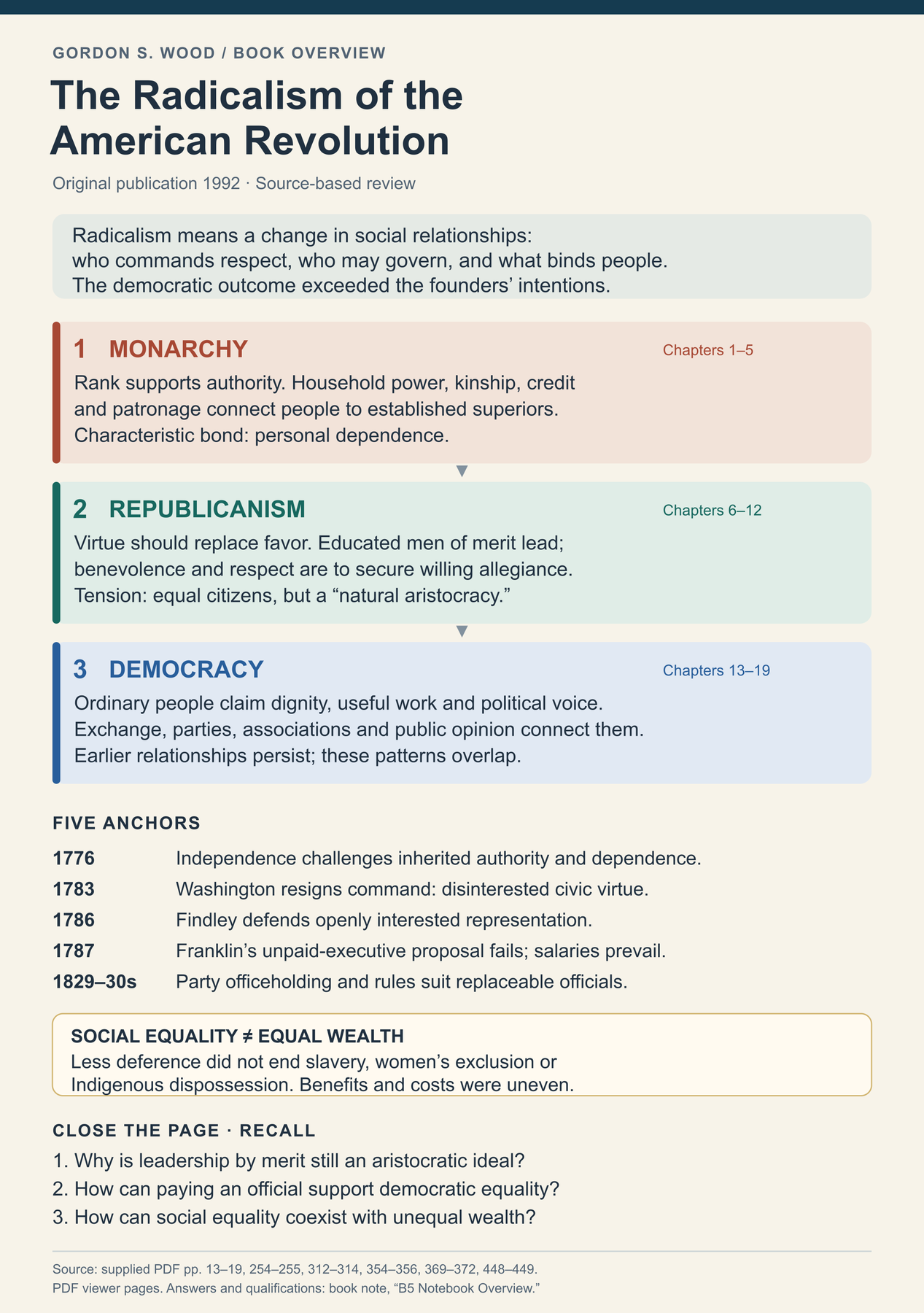
Print or import the B5 PDF (file not included in this release) · Scalable original · Open the companion Canvas (file not included in this release).
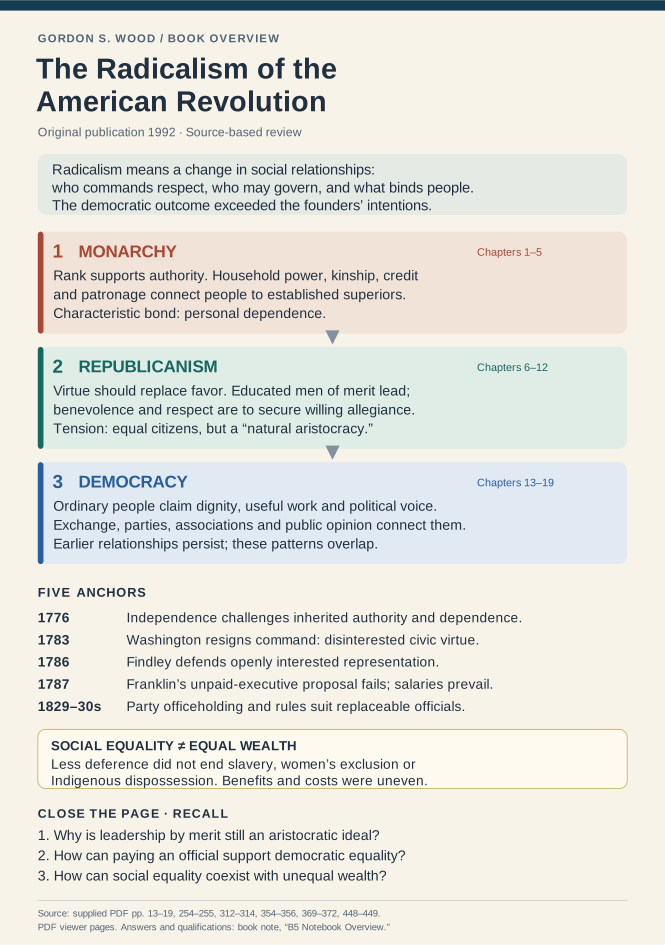
The overview selects the central mechanism and a few anchors; the detailed note supplies qualifications and feedback. The Canvas asks how a society holds together when inherited dependence loses legitimacy, with links into the chapters and source.
B5 and Canvas recall feedback
- Merit-based leadership remains aristocratic when a specially cultivated few are expected to lead everyone else. It opens the elite without abolishing its claim to superior standing. PDF pp. 242–244 (file not included in this release)
- Honest salaries make service possible for people without independent fortunes and replace a personal debt of gratitude with defined compensation. Pay still needs safeguards against abuse. PDF pp. 352–356 (file not included in this release)
- People can reject inherited superiority and demand equal treatment while their holdings remain unequal. That distinction does not remove exclusions in legal rights or unequal bargaining power. PDF pp. 414–417, 423–424 (file not included in this release)
Values that built America (full B5)
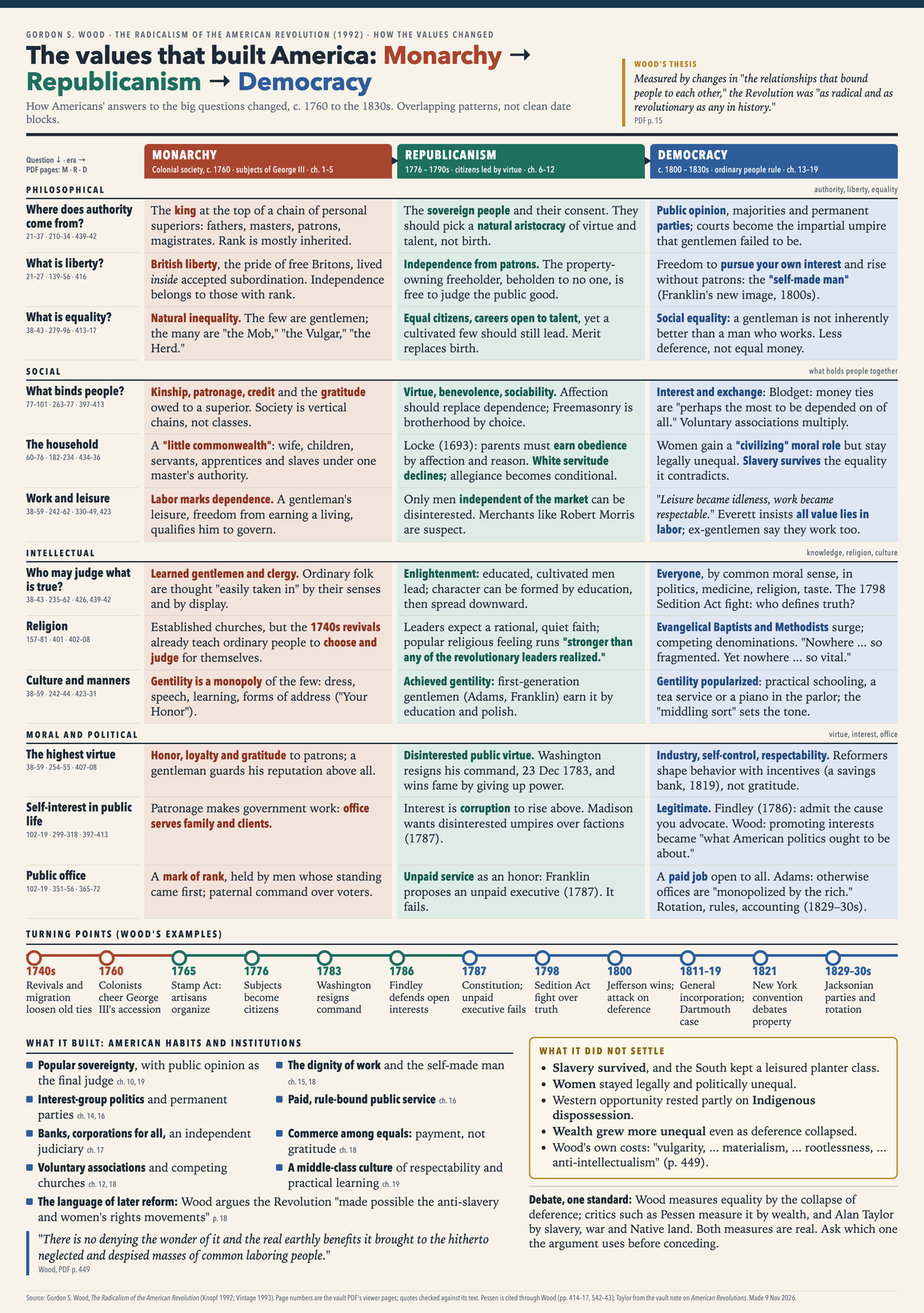
Notebook card (full B5), made 9 November 2026. The overview above gives one line per era; this card goes deeper. It is a grid of 12 questions, read across the three eras. The comparison table has four of them.
The rows, in four groups:
- Philosophical: where authority comes from, liberty, equality.
- Social: what binds people, the household, work and leisure.
- Intellectual: who may judge what is true, religion, culture and manners.
- Moral and political: the highest virtue, self-interest in public life, public office.
Below the grid:
- Twelve turning points, from the 1740s revivals to Jacksonian rotation in office (see the timeline).
- What the change built in American habits and institutions.
- What it did not settle.
- A debate line: Wood measures equality by the collapse of deference, while Pessen measures it by wealth and Taylor by slavery, war and Native land.
Quotes and page numbers were checked against the PDF text, using viewer pages. The anchor quotes:
- p. 15 (file not included in this release), the thesis.
- p. 401 (file not included in this release), popular religion.
- p. 411 (file not included in this release), Blodget.
- p. 423 (file not included in this release), “Leisure became idleness”.
- p. 449 (file not included in this release), benefits and costs.
Caveats:
- Pessen is cited only through Wood.
- The Taylor point comes from the vault note, not his book.
- A few cells summarise this note rather than quoting Wood.
Card source file: HTML (file not included in this release).
Chapter Navigation
Part I: Monarchy
- 1. Hierarchy — Liberty within inherited rank. PDF 21–37.
- 2. Patricians and Plebeians — Gentility, work and honor. PDF 38–59.
- 3. Patriarchal Dependence — Household power and political capacity. PDF 60–76.
- 4. Patronage — The connections behind opportunity and authority. PDF 77–101.
- 5. Political Authority — Governing through established social influence. PDF 102–119.
Part II: Republicanism
- 6. The Republicanization of Monarchy — Civic virtue within a monarchical world. PDF 121–138.
- 7. A Truncated Society — Why colonial hierarchy was vulnerable. PDF 139–156.
- 8. Loosening the Bands of Society — Mobility, markets and religious choice. PDF 157–181.
- 9. Enlightened Paternalism — Benevolent authority becomes conditional. PDF 182–209.
- 10. Revolution — Independence remakes dependencies and public authority. PDF 210–234.
- 11. Enlightenment — Educated character as a basis for leadership. PDF 235–262.
- 12. Benevolence — Sympathy as a replacement for patronage. PDF 263–277.
Part III: Democracy
- 13. Equality — Ordinary capacities challenge natural aristocracy. PDF 279–296.
- 14. Interests — Representation becomes legitimate advocacy. PDF 297–329.
- 15. The Assault on Aristocracy — Leisure becomes idleness; work gains honor. PDF 330–349.
- 16. Democratic Officeholding — Paid officials, parties and rules. PDF 350–372.
- 17. A World Within Themselves — Domestic markets, credit, corporations and courts. PDF 373–396.
- 18. The Celebration of Commerce — Interest becomes a positive social connection. PDF 397–422.
- 19. Middle-Class Order — Respectability, public opinion and unintended consequences. PDF 423–449.
PDF p. 120 and p. 278 are Part dividers; chapter ranges above exclude them. Back notes: PDF pp. 450–550 (file not included in this release).
Chapter 1: Hierarchy
What I Should Retain
- Three claims: Colonial monarchy organized relationships throughout society; British liberty coexisted with accepted subordination; and rank was experienced through personal connections more than modern economic classes.
- Evidence anchors: Benjamin Rush’s awe before the throne in 1768; court robes and royal portraits; and college precedence and unequal military land grants.
- Factual anchors: The Glorious Revolution of 1688–89 limited the crown. George III’s accession in 1760 strengthened colonial expressions of loyalty. Englishness helps explain both resistance to authority and attachment to monarchy.
- Connection: When a political institution supplies the model for households, churches and public manners, what changes when its legitimacy collapses?
Timeline
- 1688–89: The Glorious Revolution helps establish a limited monarchy → liberty becomes part of British national pride.
- 1750s: Imperial warfare mobilizes colonial men, money and trade → attachment to the British world intensifies.
- 1760: George III succeeds to the throne → colonial celebrations express real enthusiasm.
- 1764: New York’s supreme court orders legal dress → ceremony deliberately dignifies authority.
- 1768: Rush visits the throne in London → personal testimony reveals monarchy’s emotional reach.
Chapter Objective and Through Line
Wood establishes the social order that the Revolution eventually transformed. Mid-eighteenth-century Americans participated in a British world of ranks, privileges, obligations and personal loyalties. A distant king could still structure their understanding of authority because monarchy reached them through governors, churches, courts and ordinary expectations of deference.
The chapter also explains why liberty-loving colonists could sincerely be monarchists. British constitutional liberties qualified royal power without dissolving the hierarchy of social life. Recovering that combination makes later republican change visible: the colonists were changing a culture they had inhabited, admired and helped maintain. PDF pp. 21–27 (file not included in this release)
Chapter Structure at a Glance
- Treat monarchy as an organizing social relationship.
- Recover the colonists’ British identity and pride in liberty.
- Show how institutions and ceremony cultivated royal allegiance.
- Explain the everyday experience of rank and reciprocal dependence.
- Distinguish a vertical hierarchy from modern class organization.
Section-by-Section Argument
The following are analytical divisions; Wood’s chapter has no corresponding subsection headings.
British liberty inside a monarchical culture
Being a subject involved personal allegiance to a paternal sovereign. The king provided a connection between otherwise diverse people. That relationship reached beyond obedience to particular laws: it supplied images of family, dependence, status and belonging.
British people nevertheless celebrated themselves as unusually free. The constitutional changes associated with 1688–89 made it possible to claim security from arbitrary arrest, jury trials and representative institutions while retaining kingship. Colonial unruliness belonged partly to this English inheritance. The contrast between a supposedly traditional Britain and an already modern America therefore exaggerates the distance between their cultures. Colonial readers shared British literature, legal authorities and political examples; their provincial capitals imitated English towns. PDF pp. 21–26 (file not included in this release)
Wood treats freedom and dependence as relative positions within this world. A landowner might exercise authority over tenants or servants while remaining dependent on a patron above him. An English tenant could boast of independence relative to a continental peasant. Liberty did not yet require treating every relationship as one between autonomous equals.
Making distant royalty present
The accession of George III in 1760 generated colonial enthusiasm. Royal birthdays, emblems, governors’ entertainments and pardons made the crown visible locally. Governors could cultivate gratitude and awe by sparing condemned people. These were practical mechanisms of authority in colonies where royal institutions were relatively thin.
Courts also performed hierarchy. In 1764, New York required robes and gowns to enhance judicial dignity. Massachusetts employed wigs, scarlet robes and royal portraits. The props matter because political legitimacy worked through sensory impressions and learned habits as well as abstract constitutional arguments.
Rush’s experience in 1768 is especially revealing. An American who would become a revolutionary felt overwhelmed by the throne and wanted to sit upon it. Wood uses this personal recollection to recover emotions that later republican memory obscured. Imperial commerce and the warfare of the 1750s likewise gave colonists material reasons to identify with Britain. PDF pp. 26–29 (file not included in this release)
Hierarchy as a coherent moral order
Churches strengthened obedience by teaching duties toward superiors. Beyond explicitly Anglican royalism, religious images of a social body encouraged each person to occupy a station and perform its obligations. Hierarchy promised reciprocal care and a recognized place, even to people with little freedom.
This order was enforced locally. Towns could remove strangers who lacked a recognized place of settlement. Colleges taught graded respect. Military grants reproduced rank through sharply different allocations of land. Titles, seating arrangements and the language of address instructed people how to behave.
The underlying assumption was that social inequality belonged to the order of creation. Advancement was possible, but the person advancing was expected to acquire the qualities appropriate to a higher station. This was a culture of fitted places and responsibilities, not simply a rich minority imposing rules on an otherwise egalitarian society. PDF pp. 29–33 (file not included in this release)
Relationships before classes
Money mattered without fully determining status. Wood notes that colonial wealth could be more evenly distributed than nineteenth-century wealth while social relations were more explicitly hierarchical. Economic distribution and social equality therefore require separate measures.
People typically knew themselves through relations to particular superiors and inferiors. Occupational categories existed, but they had not yet produced the broad solidarities of modern classes. Henry Fielding’s ladder of servants, gentlemen, lords and sovereign illustrates how someone could command one person while serving another. Familiarity and deference were calibrated to each encounter. This prepares Wood’s later argument that changing the bonds between people could be revolutionary even without redistributing property between whole classes. PDF pp. 33–37 (file not included in this release)
Key Concepts and Distinctions
- Monarchical society: A pattern of personal dependence organized around kingship; it extends beyond the formal constitution.
- Relative independence: Authority in one relationship can coexist with subordination in another.
- Vertical hierarchy: Particular chains of superior and subordinate; this differs from solidarity among people in the same economic stratum.
- Rank versus wealth: Property contributes to standing, while birth, education, office and recognized reputation also establish it.
Essential Evidence and Examples
- Rush and the throne, 1768: Evidence of monarchy’s emotional hold on a future revolutionary. PDF p. 26 (file not included in this release)
- Court dress, 1764: Institutional theater helped produce respect for government. PDF pp. 27–28 (file not included in this release)
- College rules and military land grants: Everyday practices taught sharply graded rank. PDF pp. 32–33 (file not included in this release)
- Fielding’s ladder: A concise model of relational rather than class identity. PDF pp. 35–37 (file not included in this release)
Cautions and Limits
Wood reconstructs the dominant language and expectations of colonial order. Practice varied by colony, religion, wealth and legal condition. Enslavement was a form of coercion with consequences that cannot be reduced to courteous deference.
Chapter Conclusion and Significance
The colonial starting point combines personal loyalties, British constitutional freedom and accepted hierarchy. The chapter makes the Revolution’s social stakes intelligible: overturning monarchy could unsettle the model that connected authority, identity and everyday conduct. The next chapter identifies the distinction between gentlemen and commoners that gave this hierarchy its most consequential social boundary.
Questions for Reflection
- What did the Glorious Revolution change about British monarchy?
- Which future revolutionary visited the throne in 1768?
- What is a vertical hierarchy?
- Why could colonists celebrate liberty while accepting subordination?
- Why does a relatively even distribution of wealth fail to establish social equality?
Answers and Feedback
- It limited royal power and reinforced constitutional liberties. Kingship and social hierarchy continued. PDF pp. 23–24 (file not included in this release)
- Benjamin Rush. His awe helps recover genuine royal attachment. PDF p. 26 (file not included in this release)
- A chain of particular superior–subordinate relationships. The same person can occupy both positions. PDF pp. 35–37 (file not included in this release)
- Liberty was understood through British rights and relative independence. It did not require equal standing in every social relationship. A strong answer connects constitutional limits with social hierarchy. PDF pp. 23–31 (file not included in this release)
- Rank also depended on birth, honor, education and recognized status. Wealth distribution and the legitimacy of deference measure different things. PDF pp. 33–35 (file not included in this release)
Chapter 2: Patricians and Plebeians
What I Should Retain
- Three claims: Gentlemen and commoners were treated as different kinds of people; gentility rested on recognized independence and cultivation; and manual labor carried a stigma that later democracy would overturn.
- Evidence anchors: Franklin retired from printing at forty-two to live as a gentleman; Copley resented having painting treated as a useful trade; honor and dueling marked relationships among social equals.
- Factual anchors: English gentry differed from hereditary peers, but both belonged to the aristocratic order. The physician and traveler Alexander Hamilton is a different person from the future Treasury secretary.
- Connection: Does a society honor skilled work itself, or honor people who can afford to stop doing it?
Timeline
- 1744: The physician Alexander Hamilton travels through the colonies → his observations reveal gentlemanly assumptions.
- 1748: Benjamin Franklin retires from business at forty-two → economic success enables a change in social identity.
- 1755: John Bartram resists making his son a gentleman → many ordinary families still value a secure calling over status ambition.
- 1767: John Singleton Copley complains about painting’s trade status → excellence does not erase the stigma of manual work.
- 1774: The Continental Association condemns extravagance → political resistance still carries genteel assumptions about consumption.
Chapter Objective and Through Line
Wood explains the most powerful social boundary within colonial hierarchy: the division between the few qualified for public distinction and the many expected to labor. Gentlemen could be admired for intellect, education, honor and apparent freedom from material necessity. Commoners were often understood as dependent, narrow in outlook and driven mainly by appetite.
These assumptions shaped economic behavior and political expectations. They made it plausible that leadership belonged to a cultivated few and that productive work signaled lower status. Wood’s objective is to restore the scale of the cultural change involved when ordinary people later asserted their dignity, judgment and right to govern. PDF pp. 38–44 (file not included in this release)
Chapter Structure at a Glance
- Identify the distinction between gentlemen and commoners.
- Explain English and colonial forms of aristocratic status.
- Connect gentility to independence from necessary labor.
- Show why consumption and reputation sustained hierarchy.
- Explain honor, dueling and condescension as social practices.
Section-by-Section Argument
Analytical divisions.
The cultural boundary between great and ordinary people
The distinction between patricians and plebeians crossed other differences within colonial society. Gentlemen were assumed capable of ambition, honor and broad judgment; ordinary people were often treated as preoccupied with immediate needs. Wood quotes attitudes from people who later became revolutionary leaders to show how deeply these expectations were shared.
English gentry occupied the lower reaches of an aristocracy that included titled peers. The absence of many peers in the colonies increased the importance of being accepted as a gentleman. Colonial aristocratic culture could therefore be socially forceful despite its comparatively modest formal titles.
Wood also examines commoners’ own expectations. Devereux Jarratt remembered the awe surrounding gentlefolk. In 1755, John Bartram wanted his son to acquire a viable occupation, not to become a gentleman. Many families sought honorable subsistence within an accepted order. Their later confidence in equal standing consequently requires explanation; it cannot simply be projected backward from modern values. PDF pp. 38–46 (file not included in this release)
Independence defined through leisure
Birth and property contributed to gentility, but the central ideal was freedom from dependence. A gentleman should possess the resources and cultivation to choose his activities. Necessary labor appeared servile because it subordinated the worker to immediate material wants and the demands of others.
Gentlemen could manage estates, experiment, write, speculate or trade. They presented these activities as avocations, public improvements or exercises of cultivated judgment. The boundary concerned the perceived necessity and social meaning of the work as much as the activity itself. Colonial lawyers, physicians and clergy drew status from education, background and reputation; professional expertise alone did not establish full gentility.
Franklin’s retirement from printing in 1748, at forty-two, illustrates the transition. The money earned through business allowed him to leave necessary employment and enter a world of public service and cultivated leisure. Copley’s complaint in 1767 shows the opposite problem: patrons classified painting alongside useful manual trades, despite his artistic accomplishment. Wood uses these examples to recover a moral hierarchy that honored escape from work more than excellence within work. PDF pp. 47–55 (file not included in this release)
Consumption, luxury and the social order
The old view of consumption assigned different duties to different ranks. The rich spent; the poor produced. Gentlemanly luxury could be defended as supporting dependent workers, while the same consumption among ordinary people threatened idleness and pretension.
A New Jersey farmer’s defense of gentlemen’s foxhunting in 1770 makes the reciprocal logic explicit. Their purchases helped sustain the farmers whose fields their leisure activities disturbed. Expensive goods could thus express rank and a supposed service to those below.
The Continental Association in 1774 criticized extravagance and dissipation while organizing resistance to Britain. Wood connects such policies to assumptions about elite consumption and moral discipline. As ordinary people acquired consumer goods, however, dress and possessions became less reliable markers of natural difference. The debate over luxury reflected concern about boundaries as well as concern about household budgets. PDF pp. 48–54 (file not included in this release)
Honor and the maintenance of reputation
Where legal titles supplied limited protection, gentility relied heavily on public recognition. Education, manners, dress, liberal hospitality and accepted family background all helped establish reputation. Credit and opportunity followed recognition, giving honor material consequences.
This dependence helps explain vicious political attacks. To destroy an opponent’s character was to challenge the social authority supporting his arguments. Dueling offered gentlemen a means of defending honor among equals; insults from inferiors could be dismissed because those people supposedly lacked standing to challenge it.
Gentlemanly familiarity also depended on secure inequality. Condescension meant a superior voluntarily descending toward an inferior. A general’s easy manners could create attachment precisely because his rank remained unquestioned. Wood’s examples complicate the assumption that a less formal interaction always indicates greater equality. Sometimes an unquestioned hierarchy permits forms of familiarity that later respectability finds uncomfortable. PDF pp. 55–59 (file not included in this release)
Key Concepts and Distinctions
- Gentility: A recognized combination of independence, cultivation, manners and reputation, carrying an expectation of leadership.
- Leisure: Freedom from earning subsistence; in this setting it legitimized the gentleman’s judgment and public service.
- Honor: Reputation among acknowledged equals, protected through conduct and sometimes violence.
- Condescension: A superior’s voluntary familiarity with inferiors; its eighteenth-century praise presupposed inequality.
Essential Evidence and Examples
- Franklin’s retirement: Economic achievement purchased freedom from a trade and access to gentlemanly status. PDF p. 54 (file not included in this release)
- Copley’s frustration, 1767: Artistic distinction still encountered the stigma attached to manual occupations. PDF p. 54 (file not included in this release)
- The New Jersey farmer, 1770: Consumption was represented as a reciprocal favor supporting producers. PDF p. 50 (file not included in this release)
- Honor and parole: Trust and military treatment differed according to recognized gentlemanly standing. PDF pp. 55–58 (file not included in this release)
Cautions and Limits
Wood describes powerful ideals alongside their contradictions. Gentlemen frequently pursued money and merchants could acquire status. Regional differences were substantial. His comparison of status divisions should not be mistaken for a claim that enslavement was a minor distinction or lacked its own violent legal structure.
Chapter Conclusion and Significance
The radicalism of later democracy becomes clearer once ordinary labor’s low status is recovered. Equality would challenge assumptions about who could possess judgment, deserve recognition and enter public life. The chapter also establishes why revolutionary gentlemen could undermine inherited rank while continuing to expect an elite place for themselves: their own independence and cultivation still appeared to justify leadership.
Questions for Reflection
- How did the gentry differ from hereditary peers?
- What did Franklin’s retirement demonstrate about gentility?
- What was condescension in eighteenth-century social usage?
- Why did wealthy artisans still struggle to become gentlemen?
- How could informal behavior express hierarchy rather than equality?
Answers and Feedback
- Gentry occupied an aristocratic social rank below the titled peerage. Access depended heavily on recognition, while peerage carried hereditary titles and specific political privileges. PDF pp. 39–40 (file not included in this release)
- A gentleman should be free from necessary employment. Leaving printing in 1748 helped Franklin turn wealth into socially recognized independence. PDF pp. 53–55 (file not included in this release)
- A superior’s willing descent into familiarity with inferiors. It was praised because superior standing remained intact. PDF pp. 58–59 (file not included in this release)
- Money did not erase the dependence associated with working for a living. A strong answer explains the distinction between accumulated wealth and the social meaning of an occupation. PDF pp. 47–54 (file not included in this release)
- Secure superiors could mix with inferiors without surrendering rank. Familiarity might strengthen attachment and make hierarchy more comfortable. PDF pp. 57–59 (file not included in this release)
Chapter 3: Patriarchal Dependence
What I Should Retain
- Three claims: The household performed many functions later assigned to specialized institutions; kinship linked property to political power; and independence meant possessing a will that another person could not command.
- Evidence anchors: Family monopolies in local office; sons waiting into middle age for land; married women’s legal disabilities; and the coercive conditions of colonial servitude.
- Factual anchors: Primogeniture privileges the eldest son; entail restricts the future disposal of an estate. New England’s more divisible inheritances still supported paternal authority.
- Connection: How does the economic organization of a household determine who can speak and act independently in public?
Timeline
- 1718–1775: Britain transports tens of thousands of convicts and vagabonds to America → bound labor extends legal dependence.
- 1730s–1760s: Intermarried families dominate colonial offices and landholding → family connection channels opportunity.
- 1750s: Scarcer land in older settlements delays sons’ independence → inheritance becomes an instrument of paternal control.
- 1764: Matthew Lyon arrives as an indentured immigrant → a later democratic politician begins in legal dependence.
- 1774: James Wilson describes dependence as subjection to another’s will → an older social category has immediate political meaning.
Chapter Objective and Through Line
Wood grounds paternal political language in the actual household. Masters and fathers commanded labor, property, discipline and many decisions about marriage and advancement. The family was simultaneously a workplace, a system of care, a school and an institution of government. Its reach made the paternal model of public authority intelligible.
The chapter moves from kinship and inheritance to legal unfreedom and tenancy. It explains why colonial freedom depended on escaping another person’s control and why so many people were excluded from political participation. The subsequent challenge to dependence would therefore affect relations within communities as well as allegiance to the crown. PDF pp. 60–62, 76 (file not included in this release)
Chapter Structure at a Glance
- Connect the paternal state to the working household.
- Trace kinship through land, marriage and public office.
- Explain inheritance as provision and control.
- Distinguish the legal situations of wives, servants, apprentices and enslaved people.
- Connect dependence to political exclusion.
Section-by-Section Argument
Analytical divisions.
The household as a small government
Colonial people could understand a king as a father because everyday authority operated through fathers and masters. A household included people dependent on one head, extending beyond the modern nuclear family. Its activities included production, training, care of the poor and discipline of the wayward.
Weak alternative institutions could make household authority particularly extensive in the colonies. A dependent person’s access to the world often passed through the patriarch. Religious instruction reinforced these relationships by linking duties to parents, rulers and God. The similarity of language expressed an institutional connection: subordination learned at home helped make wider hierarchy appear natural. PDF pp. 60–62 (file not included in this release)
Kinship, property and succession
Marriage joined families into networks that could encompass entire communities. The influence of a family name connected officeholding, business partnerships and access to land. In 1775, more than a quarter of Captain John Parker’s Lexington militiamen were related to him by blood or marriage. Even mobilization for the coming Revolution worked through inherited social ties.
Inheritance carried reciprocal obligations as well as property. Primogeniture directed land to an eldest son; entail sought to preserve an estate within a family line. New England commonly divided estates, but this was compatible with traditional efforts to maintain family continuity and provide for heirs. Favored heirs could owe support, use-rights and payments to other relatives.
As land became less available in established settlements after 1750, sons might marry and reach middle age while awaiting an inheritance. Fathers’ control over property gave their wishes practical force. The family could care for dependents while using the prospect of provision to constrain their choices. PDF pp. 62–69 (file not included in this release)
Legal dependence and its differences
Married women’s restricted legal capacity formed part of this order. Wood describes limitations on contracts, property transactions and independent action in court, together with expectations of obedience. Children and apprentices also faced discipline and controlled access to employment or marriage.
Enslaved Africans occupied a uniquely severe and hereditary condition. Wood places slavery within a broader culture comfortable with coercion and dependence, while recognizing its extraordinary degradation. Slavery existed in northern colonies as well as the South. Its everyday presence helped teach white people the meaning of mastery.
Indentured servants also encountered harsh controls. Many immigrants contracted labor to finance passage. Colonial terms could last much longer than the annual service common in England; indentures could be transferred, and masters controlled movement and marriage. Between 1718 and 1775, approximately 50,000 British and Irish convicts and vagabonds were transported, according to the estimate Wood reports. Matthew Lyon, who arrived in 1764, was sold between masters. These examples show how familiar personal unfreedom could be among white colonists. PDF pp. 67–74 (file not included in this release)
The differences remain essential: indenture usually ended, while racial slavery was lifelong, inheritable and enforced through a distinctive legal regime. Wood’s argument concerns how contemporaries situated these practices within a hierarchy, not an equivalence of their consequences.
Protection, tenancy and political personality
Landlord–tenant ties could also combine material exchange and paternal obligation. Some landlords allowed rent arrears or extended credit, while tenants offered loyalty beyond the payment of rent. Protection and dependence were intertwined.
This social structure supplied the logic of political exclusion. In 1774, James Wilson described dependence as an obligation to conform to another person’s will. A person whose choices were controlled by someone else supposedly lacked an independent political personality. That reasoning excluded wives, minors, servants, apprentices and some tenants from voting.
Many white men experienced these conditions only temporarily or avoided them altogether. Wood therefore closes by pointing toward less formal dependencies. Owning property or completing an indenture did not end every relationship through which a superior could command deference. PDF pp. 74–76 (file not included in this release)
Key Concepts and Distinctions
- Household: A productive and disciplinary unit organized around a master, encompassing kin and other dependents.
- Primogeniture / entail: Respectively, preference for an eldest son and a restriction preserving property through a family line.
- Coverture: The married woman’s legal personality was subordinated to her husband’s in important civil matters.
- Independent will: Capacity to act without another person directing one’s choice; a foundation of restricted political participation.
- Temporary versus hereditary unfreedom: Indenture ordinarily ended; slavery descended across generations.
Essential Evidence and Examples
- Parker’s Lexington company, 1775: Kinship remained a practical basis of collective action. PDF p. 63 (file not included in this release)
- Delayed inheritance: Land scarcity sustained fathers’ authority over adult sons. PDF pp. 68–69 (file not included in this release)
- Matthew Lyon’s indenture: A later democratic figure experienced the sale of his labor contract. PDF p. 73 (file not included in this release)
- Wilson’s formulation, 1774: Social dependence translated directly into a theory of political exclusion. PDF p. 76 (file not included in this release)
Cautions and Limits
Household authority varied by legal jurisdiction and circumstance. Wood’s broad language about women describes the dominant legal model; particular women exercised economic agency. His placement of slavery in a spectrum of dependence explains a contemporary framework without erasing racial slavery’s distinctive violence and permanence.
Chapter Conclusion and Significance
Dependency was a lived arrangement of property, care, discipline and constrained choice. The political ideal of independence drew force from experiences that colonists could identify in family and working life. Wood has now established both the social depth of paternal authority and the constituency potentially affected by challenges to it. The next chapter follows the subtler obligations surrounding people who were legally free.
Questions for Reflection
- Which functions did the colonial household combine?
- How did entail differ from primogeniture?
- What happened to Matthew Lyon after his arrival in 1764?
- Why did dependence justify denying a person the vote?
- How can paternal protection also preserve domination?
Answers and Feedback
- Production, education, discipline and care. These functions gave its head substantial public as well as domestic authority. PDF pp. 61–62 (file not included in this release)
- Primogeniture preferred an eldest son; entail restricted the estate’s disposal across generations. Both could strengthen family continuity. PDF pp. 63–65 (file not included in this release)
- His indenture was sold between masters. Wood later contrasts this dependent beginning with Lyon’s democratic career. PDF p. 73 (file not included in this release)
- A dependent supposedly lacked a will independent of a superior. A strong answer connects legal or economic control to assumptions about political judgment. PDF p. 76 (file not included in this release)
- Provision can attach the recipient to a provider whose decisions govern opportunity. Examples include delayed inheritance, rent indulgence or control over apprenticeship. Recognize genuine care without ignoring constrained choice. PDF pp. 65–69, 75–76 (file not included in this release)
Chapter 4: Patronage
What I Should Retain
- Three claims: Legally free people remained embedded in personal obligations; scarce impersonal credit and small markets strengthened patrons; and social advancement usually depended on someone influential recognizing talent.
- Evidence anchors: Carpenter William Falk returned to Isaac Norris’s patronage after insecure day work; great planters supplied credit and market access; Franklin’s rise repeatedly drew support from governors and other leading men.
- Factual anchors: A colonial “interest” could mean a network of clients. “Friendship” often described unequal obligations. A person could be a patron locally and a client elsewhere.
- Connection: Which freedoms increase when banks, markets or formal selection procedures replace reliance on a particular benefactor, and which forms of security may be lost?
Timeline
- 1720: John Carter sponsors the young Benjamin Waller → patronage can turn recognized talent into a public career.
- 1750s: Falk tests independent day labor and returns to a wealthy patron → security can make dependence attractive.
- 1753: Franklin becomes deputy postmaster general → imperial office becomes another channel of advancement.
- 1761–1762: James Otis attacks Hutchinson → family grievance, status resentment and public argument intertwine.
- 1760s–1771: Franklin’s imperial ambitions are frustrated → his later autobiographical self-presentation acquires a new political context.
Chapter Objective and Through Line
Wood extends the analysis of dependence beyond legal bondage. A freeholder, tradesman or merchant could be politically active and economically capable while still relying on patrons for work, credit, introductions or access to customers. These relationships constituted the infrastructure of a society with few banks, limited bureaucracy and intensely personal local communities.
The chapter links ordinary economic exchange to the distribution of influence. Its culminating example, Franklin, challenges the later self-made-man story without dismissing talent or effort. The distinction matters to the book’s argument: the Revolution would weaken a system in which achievement commonly had to pass through the favor of particular superiors. PDF pp. 77–81, 98–101 (file not included in this release)
Chapter Structure at a Glance
- Decode friendship and interest as terms for reciprocal obligation.
- Explain the significance of small, face-to-face communities.
- Connect credit, markets and deference.
- Show how local justice sustained relationships.
- Trace patronage through careers and Franklin’s imperial ambitions.
Section-by-Section Argument
Analytical divisions.
Friendship as the language of obligation
Eighteenth-century friendship included relationships that modern readers might call professional sponsorship, customer dependence or political patronage. Sons, wives, clients and servants could describe superiors as friends. The language acknowledged reciprocal care while softening the implication that one person’s opportunity depended on another’s will.
Small communities made personal knowledge economically valuable. Reputation affected credit; introductions reduced uncertainty about strangers. Franklin deliberately made his industry visible, even wheeling paper through the streets to display his commitment to business. John Adams advised a younger man to be seen among people whose recognition mattered.
Public and private concerns consequently overlapped. In 1761–62, Otis’s hostility to Hutchinson combined a dispute about his father’s expected appointment, resentment of social superiority and constitutional criticism. Henry Laurens’s movement toward resistance in the 1760s likewise developed through quarrels with officials. Wood presents personal encounters as mechanisms through which public positions formed. PDF pp. 77–84 (file not included in this release)
Economic dependence behind deference
An artisan commonly worked for known patrons instead of an anonymous market. A powerful customer’s spending could determine whether a shop prospered. In the 1750s, William Falk attempted to replace Norris’s patronage with independent day labor; irregular employment drove him back. Patronage constrained choice while supplying protection against insecurity.
Credit reinforced these ties. Much inland exchange operated through long-running book accounts rather than immediate cash payment. Neighbors exchanged labor and goods, recording obligations that could endure for years. Wealthy lenders supplied capital and received stable income without the public stigma of working for wages.
Wood distinguishes this proprietary wealth from riskier entrepreneurial wealth. Creditors saw rents and interest as a legitimate basis of independence. They could dismiss paper-money advocates as insubstantial even when those people were prosperous farmers or expanding entrepreneurs. The conflict therefore cannot always be read as a simple division between rich creditors and impoverished debtors. It could concern competing kinds of property and competing routes to economic advancement. PDF pp. 85–93 (file not included in this release)
Intermediaries, courts and local power
Great Chesapeake planters were economic intermediaries. They gathered smaller farmers’ tobacco for export, imported goods, extended loans, supplied advice and helped secure work or offices for dependents. These services made their political “interest” substantial. The expectation of deference rested on real control over opportunities.
County justices similarly exercised authority through recognized standing. Their aim was often to reconcile relationships and obligations, especially debts. Discretion and paternal admonition could matter more than specialized professional knowledge. Public punishment sought to involve the offender’s community through shame as well as bodily coercion.
The same system connected local influence to provincial government. William Allen cultivated patrons above him and clients below. In 1764, he helped secure appointments and other favors that strengthened his position. Political gratitude was woven into a broader network of social and economic assistance. PDF pp. 93–97 (file not included in this release)
Mobility through sponsors
Patronage could reward ability. The barrier was the need to attract someone positioned to convert ability into opportunity. In 1720, Carter noticed Benjamin Waller’s promise and took responsibility for his education and advancement. Similar stories involved Pendleton, Hamilton, Arnold and artists sent abroad with subscribers’ support.
Franklin’s career illustrates the rule more than an exception to it. Governors recognized his literacy and intelligence; leading men assisted his printing business; office brought further access. His appointment in 1753 as deputy postmaster general formed part of a continuing search for place within the British world.
The frustration of those hopes matters. By the late 1760s, imperial preferment looked increasingly remote. His autobiographical project in 1771 emerged from this disappointed context. Later readers reconstructed a democratic Franklin who had risen by character and labor alone. Wood retains those qualities but restores the patrons and ambitions obscured by that story. PDF pp. 97–101 (file not included in this release)
Key Concepts and Distinctions
- Patron–client relationship: Assistance exchanged for attachment, gratitude and support, often between unequal parties.
- Interest: A network of people whose connections a leading figure could mobilize.
- Proprietary wealth: Income-bearing property such as rents and loans, supporting an ideal of leisure and stability.
- Book credit: Recorded personal obligations that enabled exchange without immediate cash settlement.
- Mobility versus autonomy: A system can advance talented people while requiring dependence on sponsors.
Essential Evidence and Examples
- Falk’s return to Norris: Dependence could supply desirable economic security. PDF p. 85 (file not included in this release)
- Creditor gentry and paper money: Disputes involved kinds of wealth and development, not merely its quantity. PDF pp. 90–93 (file not included in this release)
- Waller’s sponsorship, 1720: Talent became a career through a patron’s institutional access. PDF p. 98 (file not included in this release)
- Franklin’s patrons: The self-made narrative omits the relationships enabling advancement. PDF pp. 99–101 (file not included in this release)
Cautions and Limits
Colonial economic practices varied, and Wood explicitly recognizes dispute over how deeply northern farmers participated in markets. Patronage supported mobility as well as domination. Its replacement by more impersonal arrangements should not be presumed to eliminate inequality or guarantee security.
Chapter Conclusion and Significance
Personal dependence reached beyond households into work, credit, justice and career formation. The chapter gives economic substance to deference and shows why changes in markets or institutions could alter the structure of authority. Wood next focuses on government, where patronage’s normality became both a source of influence and a target of opposition.
Questions for Reflection
- What could “interest” mean in colonial political usage?
- Why did Falk return to Norris?
- Which imperial office did Franklin obtain in 1753?
- Why can calling all paper-money advocates “poor” mislead a historian?
- What does Wood’s Franklin example change about the self-made-man story?
Answers and Feedback
- A mobilizable network of friends, clients and dependents. It was more personal than a modern interest category. PDF pp. 94–97 (file not included in this release)
- Independent day labor proved insecure. Patronage supplied continuing work and protection. PDF p. 85 (file not included in this release)
- Deputy postmaster general of North America. It connected advancement to imperial office. PDF p. 100 (file not included in this release)
- Some were substantial entrepreneurs seeking a different financial environment. Established creditors judged their less stable wealth by proprietary standards. PDF pp. 91–93 (file not included in this release)
- It adds sponsorship, institutional access and disappointed imperial ambitions to ability and effort. A strong answer explains how later democratic memory changed the meaning of the same career. PDF pp. 98–101 (file not included in this release)
Chapter 5: Political Authority
What I Should Retain
- Three claims: Officeholding extended social authority into government; small colonial governments mobilized private resources for public purposes; and patronage helped explain limited popular participation even where many white men could vote.
- Evidence anchors: Franklin distributed postal appointments among relatives and friends; Franklin declined a militia colonelcy before retirement; and Laurens dispersed a Stamp Act crowd through personal recognition.
- Factual anchors: Patronage served both the crown and local notables. “Patrimonial” officeholding treated positions as attached to families or persons. Ritual crowd action could reinforce an order it temporarily challenged.
- Connection: What changes when authority belongs to an office independently of the officeholder’s inherited standing?
Timeline
- 1753: Franklin receives postal authority and makes connected appointments → patronage operates as ordinary government practice.
- 1757: Jeremiah Gridley seeks militia command to influence an election → coercive and social authority reinforce each other.
- 1759: Massachusetts justices resign over an unsuitable colleague → institutional standing depends on social respectability.
- 1765: Stamp Act protests include both restrained rituals and destructive attacks → familiar boundaries come under pressure.
- 1776: State constitution-makers attack executive appointment power → the machinery of influence becomes a central target.
Chapter Objective and Through Line
Wood explains how a monarchical social structure actually governed. Officials depended on personal wealth, connections and local standing because colonial governments lacked large administrative staffs and police forces. Granting offices, fees or privileges was a way to obtain public action from private people.
This organization made the character of rulers politically consequential. A gentleman’s reputation supposedly supplied the credibility through which an office commanded obedience. The chapter also shows the limitations of measuring political openness only through formal suffrage: patronage, dependence and assumptions about rightful leadership could restrict participation without extensive legal prohibitions. PDF pp. 102–109, 112–115 (file not included in this release)
Chapter Structure at a Glance
- Locate patronage at the center of government.
- Recover the overlap between public responsibility and private resources.
- Explain gentlemanly officeholding and patrimonial succession.
- Connect personal influence to elections and public deference.
- Examine popular crowd action within the paternal order.
Section-by-Section Argument
Analytical divisions.
Patronage made government work
When Franklin became deputy postmaster general in 1753, he appointed relatives and associates to postal positions. Wood begins with an example that later standards readily classify as nepotism. Within the older order, however, it expressed the same personal obligation that organized other institutions.
Royal patronage in America was limited compared with Britain’s, but colonists could still experience it as powerful. A governor’s ability to distribute even modest offices influenced substantial parts of a small elite. Provincial notables also built networks of their own. Power radiated through people linked to the crown without being controlled effectively from a single center.
This distinction explains the coexistence of weak imperial administration and intense colonial concern about corruption. The influence visible in local appointments mattered even when the governor lacked the patronage needed to dominate an assembly. In 1776, new state constitutions would direct particular hostility toward executive appointment powers. PDF pp. 102–106 (file not included in this release)
Public action through private standing
Colonial governments relied on delegation. Courts assessed taxes, licensed activities, supervised roads and handled relief. Municipal authorities required residents to maintain adjacent streets. Legislatures granted corporate rights and privileges to people expected to perform useful tasks.
The arrangement externalized costs. Governments possessed legal authority but limited tax revenues and administrative capacity, so they enlisted private resources. Offices might bring fees or benefits that encouraged people to accept responsibilities. Gentlemen were also expected to sacrifice time because wealth and leisure supposedly fitted them for public service.
Political authority therefore emerged from social position. Men with money, reputation and connections could compel compliance without a modern coercive apparatus. Their private power supported public action. This makes colonial government different from a small modern state whose professional offices happen to have low budgets. PDF pp. 106–110 (file not included in this release)
Reputation, office and legitimate leadership
Some positions appeared almost inheritable. Men resigned in favor of sons; prominent families moved their members quickly into office. In 1759, eleven justices protested a Massachusetts appointment because they considered the appointee socially unsuitable. They feared his company would make their judicial role contemptible.
Franklin understood these expectations. He declined a militia colonelcy in 1747, while still a working printer. After retiring in 1748, he considered himself eligible for the gentlemanly activities of philosophy, public service and military command.
Attacks on an officeholder’s character threatened the office’s authority. Seditious libel and restrictions on personal criticism drew force from that connection. Both officials and colonial opponents could agree that the wrong sorts of people should be excluded from leadership, even while disagreeing about who those people were. The Revolution thus involved a struggle over rightful social leaders as well as constitutional power. PDF pp. 110–113 (file not included in this release)
Elections and paternal command
Legal eligibility did not necessarily produce practical independence. Wood describes low turnout and communities whose available voters were immobilized by connections. In 1757, Gridley sought a militia colonelcy partly because control over recruitment would place townsmen in dependence upon him.
John Hancock illustrates the reciprocal construction of influence. He supplied employment, assistance, hospitality and public amenities, spending much of his inherited fortune while creating a formidable constituency. His popularity rested on the services he provided as well as the loyalties he expected.
Wood’s mechanism is circular: wealth creates influence, influence brings office, and office creates additional opportunities to help people and command gratitude. Deference therefore had material support beyond custom or the abstract belief that gentlemen knew best. PDF pp. 113–116 (file not included in this release)
Crowds within the existing order
Popular riots could articulate grievances without proposing to replace the hierarchy. Ritual inversions, effigies and customary interventions allowed subordinate people to express power temporarily. Crowds sometimes enforced accepted prices or community standards against perceived violations.
Wood distinguishes the destruction of Hutchinson’s house on 26 August 1765 from more regulated Stamp Act protests. It alarmed contemporaries because it exceeded expected boundaries. In Charleston that year, Laurens called rioters by name and used familiar authority to disperse them. The crowd’s eventual cheers reveal how protest could end by reaffirming paternal standing.
The chapter closes with the strategic self-restraint demanded by this political culture. Ambitious people learned caution, flattery and concealment of resentment. A younger revolutionary generation increasingly disliked these requirements, helping prepare an assault on the social organization that sustained them. PDF pp. 116–119 (file not included in this release)
Key Concepts and Distinctions
- Government by delegation: Legal authority mobilizes private resources instead of directly providing extensive public administration.
- Patrimonial office: A position treated as attached to a person, family or inherited social standing.
- Personal authority: The officeholder’s reputation and connections help secure obedience.
- Ritual protest: Temporary inversion or selective coercion that can affirm customary expectations.
- Formal versus effective participation: Possession of a vote differs from practical freedom to use it independently.
Essential Evidence and Examples
- Franklin’s postal appointments, 1753: Kinship and government operated through the same networks. PDF p. 102 (file not included in this release)
- Gridley’s request, 1757: Military office could produce electoral dependence. PDF pp. 114–115 (file not included in this release)
- Franklin’s delayed colonelcy: Social eligibility changed with retirement and recognized leisure. PDF pp. 111–112 (file not included in this release)
- Laurens and the crowd, 1765: Personal familiarity could restore order during protest. PDF p. 118 (file not included in this release)
Cautions and Limits
Explaining patronage’s institutional function does not excuse every abuse. Colonial protest also developed beyond the limits described here. Wood’s account of ritual restraint belongs to particular episodes and should not turn the Revolution into a uniformly orderly or nonviolent event.
Chapter Conclusion and Significance
Part I ends with a society whose political institutions depended on private hierarchies. Weak bureaucracy and extensive personal influence belonged to the same arrangement. Changing political legitimacy could consequently force a reconsideration of office, merit, criticism and ordinary people’s competence. Part II traces the values and social changes that made this order vulnerable from within.
Questions for Reflection
- How did Franklin use postal appointments after 1753?
- What does government by delegation mean?
- Why did Laurens’s recognition of rioters matter in 1765?
- Why can broad formal suffrage coexist with limited effective participation?
- Why was a personal attack on an official also a threat to political authority?
Answers and Feedback
- He appointed relatives and friends. Public office extended existing networks of obligation. PDF p. 102 (file not included in this release)
- Authorities assigned public responsibilities to private actors using legal obligations, offices or privileges. This reduced direct administrative and fiscal costs. PDF pp. 107–109 (file not included in this release)
- It restored face-to-face relationships and his paternal standing. The men were familiar dependents or neighbors, not simply an anonymous crowd. PDF p. 118 (file not included in this release)
- Patronage and economic dependence could discourage or direct voting. A strong answer distinguishes electoral rules from the social power surrounding elections. PDF pp. 113–115 (file not included in this release)
- An official’s private reputation was part of the means by which he governed. Discrediting the person could remove the respect that supported the office. PDF pp. 112–113 (file not included in this release)
Chapter 6: The Republicanization of Monarchy
What I Should Retain
- Three claims: Republican values spread inside monarchies before republican constitutions; classical antiquity supplied standards for criticizing corruption; and civic virtue demanded independence from private advantage.
- Evidence anchors: Montesquieu’s mixed-government analysis; Pitt’s refusal to profit from office; and elite enthusiasm for classical art that weakened the inherited legitimacy of birth.
- Factual anchors: Republicanism here is a social and moral ideal as well as a constitutional form. Disinterested means free from a controlling private stake, not uninterested.
- Connection: Can a reforming elite teach principles that eventually undermine its own right to lead?
Timeline
- 1688 and 1714: Dynastic changes demonstrate that hereditary monarchy can be politically reconstructed.
- 1721–1742: Walpole’s administration becomes a major target of classical anti-corruption criticism.
- 1746: William Pitt rejects lucrative perquisites as paymaster → disinterestedness acquires a celebrated example.
- 1748: Montesquieu publishes The Spirit of the Laws → mixed government and its animating principles receive influential formulation.
- 1785–1786: Aristocrats admire David’s Oath of the Horatii and Mozart’s Marriage of Figaro → cultural reform exceeds its sponsors’ intentions.
Chapter Objective and Through Line
Part II begins by explaining how the values needed to challenge monarchy emerged within it. Eighteenth-century people could remain loyal to a king while admiring republican independence, public service and government directed toward a common good. These principles circulated through classical education, literature, criticism and the language of enlightened reform.
Wood traces a gradual corrosion rather than a single ideological conversion. Republicanism made social relationships and political leadership answerable to demanding standards. It challenged dependence, inherited privilege and the pursuit of office for private profit, while still reserving leadership largely to cultivated independent men. That combination explains its power and its limits. PDF pp. 121–128 (file not included in this release)
Chapter Structure at a Glance
- Separate republican values from the immediate overthrow of kings.
- Locate those values inside Britain’s mixed monarchy.
- Explain antiquity’s role in public criticism.
- Define virtue, disinterestedness and independent citizenship.
- Show why elite moral character remained the decisive political problem.
Section-by-Section Argument
Analytical divisions.
Reforming monarchy with republican standards
Wood describes republicanism as a way of life that could coexist with monarchical institutions. Intellectuals commonly wanted to improve kingship rather than abolish it. They invoked liberty, merit and public service without embracing a program of regicide.
Britain’s constitutional history made this coexistence especially plausible. The settlements of 1688 and 1714 weakened inherited sacred mystique, while parliamentary checks limited royal autonomy. Writers could praise the British king as an impartial protector of a free people. A monarchy capable of being judged by republican criteria had already absorbed principles that challenged its older social foundations.
Montesquieu’s The Spirit of the Laws in 1748 gave influential expression to the mixtures and animating principles of different governments. Honor drove monarchy; virtue sustained a republic. The analytical distinction could be applied critically even by people who accepted the actual constitution they inhabited. PDF pp. 121–126 (file not included in this release)
Antiquity as a language of judgment
Roman authors supplied more than decorative quotations. Cicero, Cato, Tacitus and other classical models gave educated people an ethical vocabulary for evaluating rulers. The Renaissance had renewed these traditions, and the Enlightenment spread them through literature, education and public discussion.
The administration of Walpole between 1721 and 1742 attracted criticisms that drew on republican images of corruption and decline. Writers of different political allegiances could deploy the same ancient examples against their opponents. Even supporters of the Hanoverian settlement needed language that condemned arbitrary rule.
This circulation could work against elite interests. Aristocrats who admired David’s painting in 1785 or applauded Mozart’s opera in 1786 did not necessarily intend to destroy their status. Yet public admiration for merit, civic sacrifice and the humanity of servants weakened the claim that birth naturally entitled some people to rule. Ideas could acquire consequences beyond their patrons’ purposes. PDF pp. 126–131 (file not included in this release)
Virtue and the problem of interests
Republican virtue meant sacrificing private wants to the common good. Industry, thrift and prudence might make a person successful privately without ensuring public-minded conduct. The virtue needed for government was therefore a distinct requirement.
“Disinterestedness” named freedom from the pull of a private stake. A leader should judge between competing claims rather than exploit public authority for gain. Pitt’s refusal in 1746 to enrich himself through his paymaster position made this ideal concrete.
The ideal rested on a demanding social assumption. People needed independence to resist pressure and temptation. A farmer supported by his own land might qualify; a laborer dependent on an employer, or a merchant tied to customers and profits, supposedly faced stronger pressures. Republicanism could thus extend a magnanimous view of the people while preserving a patrician theory of officeholding. This later became a fault line between republican leadership and democratic claims. PDF pp. 131–136 (file not included in this release)
Political liberty and the character of rulers
Wood uses the modern distinction between positive and negative liberty cautiously. Participation in self-government and protection of personal rights were often understood as connected within the classical ideal. Citizens defended their liberty by helping govern a virtuous commonwealth.
Republican government appeared fragile because its cohesion relied on voluntary devotion. Monarchy possessed additional bonds—kinship, patronage, rank and coercion—that could operate despite selfish behavior. Republicanism required citizens and leaders to supply moral resources in their place.
Gifted leaders were especially dangerous if ambitious and corrupt. Their talents might give them the ability to mislead ordinary people and seize power. Political jealousy therefore seemed a necessary safeguard. Yet enlightened reformers ultimately hoped to make rulers trustworthy, allowing suspicion to diminish. Institutional checks mattered, but virtuous character remained central to their explanation of good government. PDF pp. 132–138 (file not included in this release)
Key Concepts and Distinctions
- Republicanization: The spread of republican social and moral standards within an existing monarchy.
- Public virtue: Willingness to sacrifice private advantage for the commonwealth.
- Disinterestedness: Capacity to judge without being governed by personal profit or a particular stake.
- Classical republicanism: A tradition connecting independent citizenship, civic participation and public-minded leadership.
- Republicanism versus democracy: The first could legitimate a cultivated leadership elite; the second would broaden ordinary people’s claims to participation.
Essential Evidence and Examples
- Montesquieu, 1748: Governmental forms depended on social principles, making culture part of constitutional judgment. PDF pp. 124–125 (file not included in this release)
- Classical criticism of Walpole: Republican standards operated across partisan divisions. PDF pp. 128–131 (file not included in this release)
- Pitt, 1746: A refusal of private gain provided an example of public virtue. PDF p. 134 (file not included in this release)
- Elite sponsorship of merit: Aristocrats could help circulate principles corrosive of inherited hierarchy. PDF pp. 126–127 (file not included in this release)
Cautions and Limits
Republicanism had varied meanings and mixed with monarchical and commercial ideas. Wood’s description of its classical standards should not be flattened into a complete account of every Enlightenment thinker. His use of positive and negative liberty is explanatory vocabulary applied to an earlier context.
Chapter Conclusion and Significance
The moral resources of revolution developed inside the culture they would transform. Republicanism provided a language for attacking dependence and corruption without requiring everyone initially to seek independence from Britain. Its patrician assumptions also explain why the founders could imagine a freer society directed by people much like themselves. Subsequent chapters examine why colonial social conditions made that reforming ideal unusually disruptive.
Questions for Reflection
- What does republicanization mean?
- What did disinterestedness mean to eighteenth-century writers?
- Why was Pitt’s behavior in 1746 celebrated?
- How could loyal monarchists promote ideas corrosive of monarchy?
- Why did republicanism retain an elite conception of leadership?
Answers and Feedback
- The spread of republican standards inside monarchical institutions and culture. It preceded formal abolition of monarchy. PDF pp. 121–126 (file not included in this release)
- Freedom from controlling private advantage or profit. It means impartial public judgment, not lack of concern. PDF pp. 132–133 (file not included in this release)
- He declined lucrative perquisites of office. This made public-minded leadership seem practically possible. PDF p. 134 (file not included in this release)
- They used merit, independence and civic virtue to reform an existing order. Those principles could later delegitimate inherited status and patronage beyond the reformers’ intentions. PDF pp. 126–131 (file not included in this release)
- Cultivation, leisure and material independence supposedly enabled impartial judgment. A strong answer explains why people working within particular interests were considered less qualified. PDF pp. 134–138 (file not included in this release)
Chapter 7: A Truncated Society
What I Should Retain
- Three claims: Colonial society lacked both Britain’s uppermost aristocratic ranks and its great mass of destitute people; weak foundations made gentlemanly authority vulnerable; and widespread freeholding encouraged republican expectations before independence.
- Evidence anchors: The scale of colonial fortunes compared with British estates; planters’ dependence on markets and heirs’ competence; and contrasting political stability in Virginia, New Hampshire and Rhode Island.
- Factual anchors: Truncated describes the social hierarchy’s missing extremes. Landownership increased opportunities for many white men while slavery remained pervasive.
- Connection: How can a society be governed through hierarchy yet lack the material resources needed to keep that hierarchy secure?
Timeline
- After 1688: Britain develops a more integrated crown–local relationship → colonial institutions remain differently fragmented.
- 1740s–1750s: Governors describe shortages of suitable wealthy officeholders → the social basis of authority appears thin.
- After 1763: Imperial assertions of sovereignty confront colonies accustomed to local autonomy.
- 1760s–1770s: Planter debts and nonimportation expose the cost of aristocratic consumption.
- 1776: Republican reform offers some elites a means of rescuing their societies from instability and dependence.
Chapter Objective and Through Line
Wood explains why the monarchical structure described in Part I was unusually vulnerable in British America. The colonies possessed neither a full aristocratic hierarchy nor the broad destitution that made dependence so deeply entrenched in parts of Europe. Their gentry exercised real power but struggled to support the image of independence that supposedly justified it.
The result was a society pulled in two directions. Widespread property ownership and local institutional autonomy encouraged republican expectations. Economic underdevelopment preserved personal credit and paternal relationships. These contradictory pressures made social connections brittle and helped explain why republican language could produce such extensive consequences. PDF pp. 139–145, 154–156 (file not included in this release)
Chapter Structure at a Glance
- Identify colonial conditions favoring republican principles.
- Explain the absence of the hierarchy’s highest ranks.
- Trace the gentry’s commercial dependence and insecurity.
- Compare social cohesion and political faction across colonies.
- Connect broad freeholding to the fragility of paternal rule.
Section-by-Section Argument
Analytical divisions.
Institutions with a republican bias
The colonists drew especially strongly on the republican elements of British culture. Royal authority was distant, governors often lacked the means to stage impressive rule, and religious organization was fragmented. Congregational influence over clergy and the absence of a colonial bishop weakened a unified ecclesiastical support for kingship.
Local institutions also differed from Britain’s integrated constitutional arrangement. Assemblies and communities often experienced the crown as an external authority layered over their own privileges. When imperial policy became more intrusive after 1763, colonists were ill prepared to accept a sovereign power reaching deeply into local affairs.
None of this means they had already abandoned monarchy. Their assumptions and institutions favored independence of judgment while their language and relationships remained strongly hierarchical. The chapter explains a predisposition whose full political significance emerged during the imperial crisis. PDF pp. 139–142 (file not included in this release)
A gentry without secure aristocratic foundations
Colonial fortunes, houses and public establishments were small by British standards. Even impressive American leaders struggled to reproduce the leisured position of English landed gentlemen. There were few upper tiers above the gentry to stabilize their position within a complete aristocratic order.
Land abundance and mobility made stable rentier wealth difficult. Tenants could move, leases changed hands, and landlords had trouble collecting. Planters remained dependent on staple prices, creditors and close management. They could not easily withdraw to Europe while estates generated reliable income at home.
Inheritance exposed another weakness. An estate’s survival could depend on the competence of an eldest son. Wood’s examples of debt and dissipation show why primogeniture and entail might jeopardize, instead of preserve, family status in this setting. By the 1760s and 1770s, nonimportation offered planters a socially acceptable reason to reduce luxury consumption. Republican frugality could appeal as a rescue from the burdens of an aristocratic performance they struggled to finance. PDF pp. 142–148 (file not included in this release)
Unsettled leadership and faction
In northern colonies and North Carolina, the social credentials of rulers were especially contested. Some men gained high position without education or independent fortune; successful traders found little time to perform unpaid public service. Entry into the gentry was more open, but that openness created rivalry over who genuinely deserved recognition.
Wood compares colonies to test the source of political instability. New Hampshire combined strong royal government with a cohesive ruling group centered on Wentworth. Virginia combined weaker royal authority with an entrenched group of interrelated families. Both could remain comparatively stable. Rhode Island had little royal influence and bitter faction.
The inference is that social cohesion among rulers could matter more than the degree of crown authority. Colonial opponents often blamed imperial intrusion for contention that Wood sees as rooted in local social competition. This is one of his clearest causal claims about the relationship between social structure and politics. PDF pp. 149–154 (file not included in this release)
Freeholding and contradictory expectations
Compared with Britain, the colonies gave many more white farmers access to land. Wood also describes a smaller proportion of white people permanently dependent on relief. Freehold possession fostered the expectation that a person could support a household without submission to a landlord.
These conditions encouraged colonists to see themselves as unusually independent and equal. They help explain why republican ideas resonated strongly. Yet access was unequal, enslaved people remained outside this freedom, and many young men or newcomers lacked land.
Commercial underdevelopment added a paradox. Americans had fewer impersonal alternatives to patronage, even while lacking the aristocratic wealth needed to sustain it. They expected deference but could not reliably command it; they valued independence while needing personal credit and connections. That tension is the chapter’s explanation of colonial society’s fragility. PDF pp. 154–156 (file not included in this release)
Key Concepts and Distinctions
- Truncated hierarchy: A social structure missing the full upper aristocracy and much of the permanently destitute population characteristic of European societies.
- Freeholding: Land possession that could support claims to independence from a landlord.
- Rentier independence: Living from secure property income; difficult for many colonial gentlemen to sustain.
- Social versus constitutional instability: Competition for rank and leadership can produce faction even where imperial authority is weak.
Essential Evidence and Examples
- Colonial and British fortunes: Comparative scale reveals the weakness beneath American aristocratic display. PDF pp. 142–143 (file not included in this release)
- Planter dependence on commerce: Wealthy elites still had to manage business and face market risks. PDF pp. 146–148 (file not included in this release)
- Virginia, New Hampshire and Rhode Island: Contrasts support Wood’s argument about elite cohesion. PDF pp. 153–154 (file not included in this release)
- Widespread white freeholding: Material circumstances made republican independence plausible for many colonists. PDF pp. 154–156 (file not included in this release)
Cautions and Limits
“Truncated” is a comparative model centered heavily on white colonial society. Slavery, Indigenous dispossession and regional poverty complicate any general picture of abundance. Wood’s argument that faction had social roots should be distinguished from a claim that particular imperial measures had no effects.
Chapter Conclusion and Significance
The colonies were primed for republicanism without already possessing an impersonal democratic order. Their contradictions made demands for independence potent and gentlemanly authority insecure. The next chapter follows the population growth, migration and expanding exchanges that strained those relationships further.
Questions for Reflection
- Which extremes were missing from Wood’s truncated hierarchy?
- Why was a secure rental income difficult to obtain?
- What did nonimportation offer indebted planters?
- What is the significance of the Virginia–New Hampshire comparison?
- Why could widespread freeholding coexist with personal dependence?
Answers and Feedback
- Britain’s highest aristocratic tiers and its large permanently destitute population. The comparison particularly concerns the situation of white colonists. PDF pp. 142–143, 154–155 (file not included in this release)
- Land availability, mobility and uncertain collections weakened stable tenantry. Owners often depended on speculative and commercial activity instead. PDF pp. 144–145 (file not included in this release)
- A respectable reason to reduce costly consumption. It aligned economic necessity with republican opposition to luxury. PDF p. 148 (file not included in this release)
- Both could be stable despite different levels of royal authority. A strong answer identifies cohesive ruling groups as Wood’s alternative explanation. PDF pp. 153–154 (file not included in this release)
- Property reduced some dependencies while limited markets and credit institutions preserved others. Independence was substantial but uneven and relational. PDF pp. 155–156 (file not included in this release)
Chapter 8: Loosening the Bands of Society
What I Should Retain
- Three claims: Population growth and migration weakened inherited connections; commercial expansion offered alternatives to local patrons; and religious choice reinforced ordinary people’s claims to judge for themselves.
- Evidence anchors: New England warning-out laws became unworkable; written credit and paper currency supported dealings beyond familiar neighbors; Scottish tobacco factors reduced small planters’ reliance on great planters.
- Factual anchors: Wood follows interacting changes from the 1740s into the early republic. Increased consumption could encourage work instead of idleness. Commercialization means expanding markets and exchange, not the arrival of large factories.
- Connection: Explain a change in political behavior through a change in how someone obtains land, credit, customers or a religious community.
Timeline
- 1730s onward: Scottish tobacco factors expand in the Chesapeake → smaller farmers gain alternatives to elite middlemen.
- 1740s–1770s: Migration, settlement and production for markets accelerate → local ties and institutions strain.
- 1751 and 1764: Parliament restricts paper currency as legal tender → conflicts over the means of inland exchange intensify.
- 1759–1763: British victory opens greater claims to western territory → settlers and speculators pursue expansion.
- 1769–1774: Virginia’s Baptist congregations multiply → religious allegiance becomes more competitive.
- 1790s: New England abandons old warning-out practices → mobility receives greater legal accommodation.
Chapter Objective and Through Line
Wood introduces the large demographic and economic forces that pushed a fragile hierarchy toward transformation. Population growth, movement and expanding exchanges altered people’s practical options before independence. Young people could leave family supervision; farmers could reach new purchasers; religious dissenters could choose communities outside established authority.
These developments connect material change to political possibility. They weakened patrons’ ability to organize loyalty while creating insecurity and a need for replacement attachments. Wood treats the imperial crisis as part of this larger transformation, whose changes continued well beyond the Revolutionary War. The chapter supplies an explanation of why republican ideas found relationships ready to be reorganized. PDF pp. 157–163 (file not included in this release)
Chapter Structure at a Glance
- Explain population growth and migration.
- Follow the strain on family, community and representation.
- Connect consumer demand to production and commercial ambition.
- Trace changing credit and tobacco marketing.
- Show how evangelical religion both repairs and challenges old attachments.
Section-by-Section Argument
Analytical divisions.
Migration loosened the old social fabric
Wood describes a population doubling roughly every twenty years in the later colonial period, supplemented by substantial immigration. People moved between settled communities as well as toward western lands. Their movement separated relatives and created places where established institutions could not keep pace.
British victory between 1759 and 1763 encouraged new settler and speculative ambitions. Land increasingly appeared as a commodity to buy, improve and resell, as well as a patrimony to preserve for heirs. Moving could release debtors or sons from dependence while leaving older relatives and communities with diminished support.
Representation also lagged behind growth. Small assemblies represented expanding populations through outdated allocations. The material scale of society was moving beyond its intimate institutional structure. Wood therefore connects demands for political change to demographic pressures rather than presenting them solely as reactions to British constitutional decisions. PDF pp. 158–163 (file not included in this release)
Freedom from attachments could produce insecurity
New England’s warning-out laws assumed that everyone properly belonged to a community responsible for them. Increasing numbers of strangers overwhelmed that system. Changes in residency requirements during 1771, followed by abandonment of older practices in the 1790s, acknowledged a world of greater mobility.
Frontier communities could struggle to establish courts, churches and accepted leaders. The Anglican traveler Charles Woodmason described the Carolina backcountry in the 1760s as socially disordered, without the cultivation and reliable assistance he expected.
Wood uses the account to show how loosening bonds could be frightening as well as liberating. A person without relatives or connections might lack care during illness. Religious and civic improvisation answered real needs left by disrupted relationships. The language of disorder also reveals the observer’s gentlemanly expectations and hostility toward unfamiliar communities. PDF pp. 163–168 (file not included in this release)
- ! Argument against AnCap?
Consumers changed the meaning of work and trade
Expanding Atlantic demand drew more farmers into production for distant markets during the 1740s–1770s. Growing towns, transport services and internal exchanges accompanied the export trade. Household manufacture also expanded, allowing families to raise income.
Consumer aspiration supplied an additional incentive. Tea sets, textiles and other goods once associated with elite standing became objects of ordinary ambition. In a hierarchy with permeable boundaries, possessing such goods could imply advancement. Desire for improvement encouraged increased labor and production.
This challenged the traditional belief that poverty was needed to make common people work. In 1761, James Otis openly questioned that assumption. Wood connects the changing experience of ordinary consumption to emerging arguments about productivity and prosperity. The new social facts made familiar moral descriptions of luxury harder to sustain. PDF pp. 168–175 (file not included in this release)
Credit and marketing changed dependence
Long-running book accounts among neighbors became less adequate as trade crossed local boundaries. Creditors demanded signed, interest-bearing obligations with deadlines. Such instruments could enable exchange between strangers but also subject borrowers to more precise and impersonal enforcement.
Paper currency offered another alternative to dependence on wealthy local lenders. Farmers and shopkeepers could use it to participate in inland trade. Parliamentary restrictions in 1751 and 1764 therefore affected arrangements with social as well as monetary significance. Wood also describes Rhode Island’s innovations in debtor relief as responses to an entrepreneurial economy.
The Chesapeake tobacco trade provides a concrete institutional example. Beginning in the 1730s, Scottish factors purchased crops directly, sold imports and supplied credit. Small planters gained access without relying as heavily on great planter neighbors. The factors did not generally translate commerce into the same local paternal leadership. Economic intermediation changed, loosening a source of political allegiance. PDF pp. 175–179 (file not included in this release)
Religious judgment and electoral competition
As smaller farmers became less dependent, elections grew more competitive. Virginia gentry complained about rising costs, unsuitable contenders and the reluctance of voters to accept their leadership. Their warnings against corruption expressed anxiety about losing control as well as principled concern.
Evangelical movements offered new communities to people detached from older hierarchies. Presbyterians, Baptists and Methodists challenged the Anglican establishment, whose clergy and lay patrons blamed each other for defections. Between 1769 and 1774, Wood reports Virginia Baptist churches increasing from seven to fifty-four.
The revivals sought moral order but encouraged personal religious judgment. Choosing and examining one’s own allegiance weakened automatic obedience. Their effects converged with mobility and commerce: people gained practical and moral experience in deciding which authorities deserved their loyalty. PDF pp. 179–181 (file not included in this release)
Key Concepts and Distinctions
- Demographic mobility: Population movement changes the relationships through which authority and assistance operate.
- Consumer emulation: Pursuing goods associated with superior status can motivate labor and blur social rank.
- Impersonal credit: Formal obligations support exchange beyond a continuing relationship among familiar people.
- Commercialization: Expansion of production and exchange for markets, possible without large-scale industrialization.
- Conditional allegiance: Loyalty rests increasingly on individual judgment and continuing satisfaction.
Essential Evidence and Examples
- Warning-out laws: A settlement system based on fixed membership strains under mobile populations. PDF pp. 163–164 (file not included in this release)
- Otis, 1761: Rising expectations challenge the claim that poverty alone encourages industry. PDF pp. 171–172 (file not included in this release)
- Scottish factors: A changed trading institution increases small planters’ options and reduces great-planter patronage. PDF pp. 178–179 (file not included in this release)
- Baptist growth, 1769–1774: Religious choice helps undermine a gentry-led establishment. PDF pp. 180–181 (file not included in this release)
Cautions and Limits
Woodmason’s hostile descriptions are evidence of elite perception as well as information about frontier conditions. Settler expansion occurred on Indigenous lands, not an empty continent. The chapter’s material changes predated independence; distinguishing their interaction with revolution from inevitability remains an important causal question.
Chapter Conclusion and Significance
Independence became increasingly imaginable because people had new practical means of escaping particular superiors. Those means also disrupted support and generated uncertainty. The Revolution would intensify and give public legitimacy to changes already underway. Before reaching the rupture itself, Wood examines how educated reformers tried to modernize relationships while preserving the authority of benevolent gentlemen.
Questions for Reflection
- What were warning-out laws intended to do?
- Which traders altered Chesapeake tobacco marketing?
- What happened to Virginia Baptist congregations between 1769 and 1774?
- How could consumer aspiration stimulate work?
- How did market expansion weaken patronage without making everyone secure?
Answers and Feedback
- Identify people who lacked local settlement rights and limit a community’s responsibility for their support. Migration eventually overwhelmed the older framework. PDF pp. 163–164 (file not included in this release)
- Scottish factors operating for merchant houses. They offered smaller farmers direct buying, imports and credit. PDF pp. 178–179 (file not included in this release)
- They increased from seven to fifty-four in Wood’s account. The change illustrates competition with the Anglican establishment. PDF pp. 180–181 (file not included in this release)
- Desired goods made additional production worthwhile. A strong answer connects consumption to changing expectations and social status. PDF pp. 169–172 (file not included in this release)
- More purchasers, lenders and places to move reduced reliance on particular patrons. Formal debt, competition and lost communal support introduced different risks. PDF pp. 162–168, 175–179 (file not included in this release)
Chapter 9: Enlightened Paternalism
What I Should Retain
- Three claims: Reformers helped destabilize authority by making it justify itself; changing ideas of education turned paternal rule toward affection and reason; and contractual thinking made allegiance conditional.
- Evidence anchors: Landon Carter’s anxious diary; Hutchinson’s conviction that he was a benevolent governor; and New England troops treating military service as a bargain.
- Factual anchors: Locke’s Some Thoughts Concerning Education appeared in 1693. His political theory distinguished parental authority from political consent, yet changing family practices helped contemporaries reuse the analogy.
- Connection: If obedience is supposed to follow from benevolent rule, what happens when continued disobedience becomes evidence that a ruler has failed?
Timeline
- 1689–1693: Locke’s political and educational works challenge inherited assumptions about authority.
- 1750s: New England soldiers invoke enlistment agreements against British commanders → obedience acquires contractual conditions.
- 1765: Witherspoon’s educational advice seeks a middle ground between harshness and indulgence.
- Early 1770s: Harvard and Yale abandon social ranking of entering students → inherited precedence becomes harder to defend.
- 1774–1776: Political arguments depict rulers as accountable servants and attack hereditary monarchy.
- 1777: Paine still describes independence as coming of age → older familial imagery remains useful after the break.
Chapter Objective and Through Line
Wood explains a paradox: superiors weakened their own authority while trying to make it more reasonable and humane. Enlightened fathers, masters and governors increasingly claimed legitimacy through care, persuasion and the development of dependents’ capacities. This shifted the burden of maintaining obedience toward the person exercising authority.
The chapter follows the consequences from education and family life into religion, employment, military service and imperial politics. As relationships became more consensual, contract offered a new model. A subject could become a party whose continuing allegiance depended on the ruler’s fulfillment of obligations. The mechanism helps explain how reform within paternal rule could prepare a more radical break. PDF pp. 182–189, 196–209 (file not included in this release)
Chapter Structure at a Glance
- Identify authority’s growing need for justification.
- Explain the educational challenge to arbitrary patriarchy.
- Examine Carter and Hutchinson as anxious paternalists.
- Trace the shift toward voluntary, transactional contracts.
- Follow familial and contractual language through the imperial crisis.
Section-by-Section Argument
Analytical divisions.
Children as persons to be formed
The household remained hierarchical, but affection and attention to individuality became more important. Parents increasingly faced advice about nurturing reason, respecting growing capacities and avoiding arbitrary punishment. Young people claimed more say over marriage and their futures.
Locke’s educational work of 1693 was especially influential. If experience formed the mind, parents bore responsibility for arranging experience well. Authority should gradually become internalized judgment rather than permanent external compulsion. Wood argues that this educational model could be more corrosive of absolutist paternal assumptions than a direct constitutional argument alone.
The change was uneven and contradictory. Traditional concerns about blood and breeding persisted. Literature could affirm the moral claims of loving adoptive parents while still resolving a marriage plot by revealing the heroine’s genteel birth. Reformers sought better authority, not necessarily social equality in all relationships. PDF pp. 184–189 (file not included in this release)
The anxiety of being benevolent
In his educational advice of 1765, Witherspoon asked parents to avoid both brutality and excessive indulgence. They should reason with dependents without surrendering the right to command. Such advice made the exercise of authority self-conscious and exposed rulers to blame when obedience failed.
Landon Carter’s diary provides Wood’s extended example. Carter understood himself as a cultivated and conscientious master, yet he repeatedly felt mocked or disobeyed by sons, grandson, workers and enslaved people. Threats alternated with indulgence, persuasion with violence. His expectation that goodness should command esteem intensified his sense of failure.
Wood treats this exceptional diary as an exaggerated expression of wider tensions. What matters is not whether Carter’s self-portrait was true, but how his assumptions made authority difficult to take for granted. The people he dominated could withhold the gratitude and respect he believed he had earned. PDF pp. 189–194 (file not included in this release)
A governor caught in his own justification
Political paternalism changed with family paternalism. Locke had distinguished natural parental duties from political authority based on consent. Contemporaries nevertheless continued to use the family as a political model because their lived society remained organized through personal relationships.
Now, however, the parent was supposed to be caring, reasonable and responsive. Religious discussion also increasingly emphasized persuasion and benevolence. Under these assumptions, sustained resistance suggested that the person in authority had mishandled the relationship.
Hutchinson regarded himself as such a benevolent ruler. He valued relief of the vulnerable, moderation and public service; in 1774, he criticized the severity of closing Boston’s port. Yet colonists’ anger became evidence against his claim to rule. He could not secure obedience merely by insisting on his good intentions. Wood’s explanation brings the loyalist dilemma into view without reducing it to personal cruelty or stupidity. PDF pp. 194–201 (file not included in this release)
Contracts change the meaning of obligation
Earlier contracts often recognized customary duties within unequal relationships. Emerging commercial contracts specified voluntary promises between formally equal parties. They focused more closely on particular transactions and remedies.
Wood illustrates the change through New England soldiers in the 1750s. They understood enlistment as an agreement about conditions and service. When British commanders tried to alter those terms, soldiers treated the contract as broken. In 1756, Governor Fitch tried to explain this reasoning to Loudoun, who expected military allegiance and discipline.
The point is broader than disobedience. An obligation could now be judged from the standpoint of agreed terms. Authority had to show what entitled it to command. This also linked familiar covenants, everyday bargaining and the political language of consent. PDF pp. 201–205 (file not included in this release)
From children to parties to a bargain
During the imperial crisis, both sides used familial language. Loyalists invoked gratitude to a parent; colonial opponents described Britain as a parent violating the duties that made obedience reasonable. Contract language sharpened the latter argument.
By 1774, Americans could describe colonial charters as agreements connecting them specifically to the king, with Parliament outside the bargain. Protection and allegiance were reciprocal considerations. If the government failed in its obligations, allegiance could lapse.
Franklin’s marginal comments pushed further: government resembled directors hired by owners, and power returned to the people who supplied it. Paine in 1776 attacked hereditary kingship, yet in 1777 still explained independence as a child reaching adulthood. Wood ends with the persistence of older metaphors inside a change that was making rulers increasingly accountable to equal human beings. PDF pp. 205–209 (file not included in this release)
Key Concepts and Distinctions
- Enlightened paternalism: Authority justified through benevolence, reason and the welfare of dependents.
- Patriarchy versus parental responsibility: Inherited command differs from an obligation to develop a child’s capacity for judgment.
- Status contract versus transactional contract: Recognition of customary relations differs from specified voluntary promises.
- Consent: An increasingly central ground for authority, making allegiance conditional rather than naturally permanent.
- Unintended institutional consequences: Humane reforms can destabilize the structure they aim to improve.
Essential Evidence and Examples
- Locke’s education theory: Forming autonomous judgment changes what a parent is responsible for. PDF pp. 186–189 (file not included in this release)
- Carter’s diary: A paternalist’s self-understanding reveals insecurity and contradictions in domination. PDF pp. 190–194 (file not included in this release)
- Hutchinson’s dilemma: Benevolent self-justification cannot command the people’s confidence. PDF pp. 199–201 (file not included in this release)
- Military contracts, 1756: Enlistment terms become a basis for resisting orders. PDF pp. 203–204 (file not included in this release)
- Paine, 1776–1777: Rejection of monarchy coexists with continued use of the parent–child analogy. PDF p. 209 (file not included in this release)
Cautions and Limits
A master’s description of himself as benevolent is evidence of his justification, not proof of humane treatment; Carter’s violence is explicit. These changes were uneven and especially visible in literate elites. Wood’s causal account of education, religion and politics is an interpretation of interacting developments, not a demonstration that one book caused the Revolution.
Chapter Conclusion and Significance
Paternalism became vulnerable as it placed increasing moral obligations on superiors and recognized the judgment of subordinates. Contract then translated reciprocal duties into claims that authority could be questioned or withdrawn. Wood has explained how familiar social languages could generate revolutionary conclusions without every participant intending that result at the outset.
Questions for Reflection
- Which work by Locke appeared in 1693?
- Why are Carter’s diary and Hutchinson’s self-defense useful evidence?
- What did New England soldiers claim their enlistment agreements established?
- How could benevolent paternalism undermine a ruler?
- What changed as contract shifted from a customary relationship toward a voluntary transaction?
Answers and Feedback
- Some Thoughts Concerning Education. Wood emphasizes its role in changing expectations of parents and children. PDF pp. 186–189 (file not included in this release)
- They reveal how paternalists understood and justified authority. Their claims require separation from dependents’ experiences and from the historian’s assessment. PDF pp. 190–201 (file not included in this release)
- Specific conditions governing service. They considered materially altered terms a breach that could end their obligation. PDF pp. 203–204 (file not included in this release)
- It made earned trust central to obedience. Persistent anger could then count as evidence that the ruler had failed to meet his responsibilities. PDF pp. 197–201 (file not included in this release)
- Obligations became more explicit, consensual and conditional. A strong answer connects equal parties, specified terms and the possibility of breach to the politics of allegiance. PDF pp. 202–208 (file not included in this release)
Chapter 10: Revolution
What I Should Retain
- Three claims: Independence turned opposition to royal patronage into a wider assault on dependence; citizenship redirected legitimate authority toward the people; and reforms disrupted inherited status without making access to freedom universal.
- Evidence anchors: Loyalist departures broke influential networks; inheritance reforms attacked family privilege; white servitude declined; republican legislatures claimed a newly distinct public authority.
- Factual anchors: The contrast is initially patriot versus courtier, not a modern class war. A natural aristocracy meant cultivated talent, not automatic rule by existing workers. Northern antislavery change coexisted with the endurance of racial slavery.
- Connection: How can the same principle enlarge personal independence and empower a government claiming to represent everyone?
Timeline
- 1763 onward: Imperial reforms collide with changing colonial expectations of independence.
- 1766: Virginia’s Robinson scandal intensifies criticism of offices, family connections and public money.
- 1775–1776: Revolutionary equality makes existing dependencies newly vulnerable to criticism.
- 1776: State constitutions relocate authority from crown prerogative to popular consent.
- 1780s: Inheritance reform and the decline of indentured servitude give social substance to the change.
- 1786–1816: Early journeymen’s strikes reveal the emerging distinction between employers and employees.
Chapter Objective and Through Line
Wood reaches the Revolution’s social mechanism. Colonists reacted fiercely to perceived threats partly because relative prosperity and independence seemed both valuable and insecure. Gentry competition encouraged popular mobilization, and the imperial crisis gave that mobilization a common language of resistance.
Independence then transformed the stakes. A polity of citizens had to justify distinctions differently from a monarchy of subjects. Family influence, inherited offices and personal dependence became vulnerable to criticism beyond the immediate struggle against royal officials. Wood follows the consequences through property, labor, slavery and state power, showing how political change could reorder the social world without a simple replacement of one economic class by another. PDF pp. 210–218 (file not included in this release)
Chapter Structure at a Glance
- Explain revolutionary anxiety amid relative prosperity.
- Define the struggle between patriots and courtiers.
- Trace Loyalist departure and the disruption of patronage.
- Follow reforms in inheritance and labor relations.
- Examine slavery’s new ideological vulnerability.
- Explain the new problem of sovereign public power.
Section-by-Section Argument
Analytical divisions.
Independence as a social expectation
Wood argues that many white colonists mobilized to protect gains they already possessed. Their situation differed from a revolution driven mainly by mass deprivation. Recent mobility and opportunity heightened anxiety that political changes might return them to subordination.
After 1763, imperial attempts to obtain revenue and strengthen control became entangled with older contests over patronage and leadership. Colonial gentry appealed to ordinary people against rival officials and families. Once brought into politics through the rhetoric of liberty, those people acquired expectations that could exceed the gentry’s immediate aims.
Wood defines the leading opposition as patriots against courtiers. Courtiers gained place through connections above; patriots claimed recognition through talent and service below. The categories expressed a conflict over the source of legitimate standing, even though many leaders on both sides possessed substantial property. PDF pp. 210–218 (file not included in this release)
Breaking networks and challenging birth
Loyalist emigration disrupted society beyond the emigrants’ numbers. Some departing people occupied central points in networks of office, commerce and kinship. Their removal could weaken many connections at once. New elites filled vacancies, but reconstructed relationships on less secure terms.
Republican leaders also attacked hereditary privilege within the Patriot community. The Virginia scandal of 1766, involving John Robinson’s handling of public money, made the link between office and friendship especially visible. After 1776, constitutional and legal reforms rejected inherited office and dismantled primogeniture and entail.
The founders hoped to open leadership to talent. Their ideal still involved acquiring education, independence and cultivated character. The son of a poor man might rise into a natural aristocracy; this was different from treating every existing occupation as an equally sufficient preparation for high office. That distinction helps explain later democratic conflict with revolutionary elites. PDF pp. 218–227 (file not included in this release)
Family reform and the declining legitimacy of white servitude
Inheritance reform could improve the property position of daughters and widows and weaken a strictly male-line family order. Wood also describes greater recognition of women’s autonomy in some contractual and divorce arrangements. Such changes occurred within continued legal and political subordination.
White servitude became harder to reconcile with republican independence. The Revolutionary era accelerated an existing decline in indentured labor. In 1784, New Yorkers raised subscriptions to release arriving immigrant servants from their contracts. By 1800, Wood reports an unfree share below two percent of Philadelphia’s labor force, compared with a much larger mid-century share.
Changing terminology and behavior reflected the new expectations. White domestic workers rejected “master,” sought equal treatment and presented themselves as help. Apprenticeship and journeyman labor became more visibly commercial. Between 1786 and 1816, major craft strikes revealed interests increasingly understood as those of employees and employers instead of members of a paternal household. PDF pp. 227–230 (file not included in this release)
Slavery becomes a sharpened contradiction
The republican distinction between free citizens and slaves collapsed the older language of many graded dependencies. In Wood’s argument, that made racial slavery more conspicuous and harder to take for granted. The antislavery organization formed in Philadelphia in 1775 supplies an institutional anchor for the new challenge.
The outcome remained sharply unequal. Slavery continued, expanded in parts of the country and acquired new defenses. Wood argues that the Revolution created ideological pressures contributing to northern abolition and later conflict. His further claim that those pressures led inexorably toward Civil War is a large retrospective interpretation, not an outcome the chapter’s examples alone can establish as inevitable. PDF pp. 230–231 (file not included in this release)
From royal prerogatives to public sovereignty
Republican constitutions in 1776 made consent the exclusive justification of governmental authority. Rulers lost inherited personal rights to command. The new governments could distinguish a public sphere more sharply from the private networks that had performed public tasks under monarchy.
This could enlarge state capacity. Legislatures claimed authority to pursue common purposes; cities developed paid public workforces and tax-supported functions. Corporate privileges granted for private advantage became objects of suspicion.
The result created a new dilemma. If a legislature expressed the sovereign people, what protected an individual against its decisions? Consent through representatives could be used to justify taking property for public purposes. Wood ends with the problem of limiting popular institutions while retaining popular sovereignty, preparing the later discussion of interests and constitutional design. PDF pp. 231–234 (file not included in this release)
Key Concepts and Distinctions
- Subject / citizen: Personal allegiance to a superior differs from membership in a sovereign people.
- Patriot / courtier: Rival accounts of how merit, public service and connections justify authority.
- Natural aristocracy: A leadership ideal based on virtue and cultivated talent instead of hereditary privilege.
- Public sovereignty: Governmental authority derived from the people and exercised for a common purpose.
- Social radicalism: Transformation of relationships and accepted standing, which can coexist with continuing inequalities.
Essential Evidence and Examples
- Loyalist departures: Removing central patrons breaks networks beyond the number of individual emigrants. PDF pp. 218–220 (file not included in this release)
- Inheritance reforms: Legal change attacks durable supports of family privilege. PDF pp. 225–228 (file not included in this release)
- White servitude and craft strikes: Labor relations move away from a patriarchal household model. PDF pp. 228–230 (file not included in this release)
- Antislavery organization, 1775: Republican equality creates an institutional challenge to bondage. PDF pp. 230–231 (file not included in this release)
- Public authority: State constitutions create a problem of popular power and individual rights. PDF pp. 231–234 (file not included in this release)
Cautions and Limits
The Revolution’s social effects varied by region and status. The same movements that enlarged white independence could exclude women, preserve slavery and facilitate settler expansion. Wood’s estimate of Loyalist departures and his claims about slavery should be cited as his interpretations and estimates, not converted into proof of complete equality or an inevitable national future.
Chapter Conclusion and Significance
The Revolution altered what dependence and political legitimacy meant. Its reforms attacked social bonds that had once seemed natural, while its public institutions claimed a new kind of authority. The unresolved question was what would connect independent citizens once inherited loyalties lost legitimacy. Wood next examines the Enlightenment’s effort to cultivate sociability and virtue as the answer.
Questions for Reflection
- What distinguished a patriot from a courtier in Wood’s account?
- What did the founders mean by a natural aristocracy?
- What institutional antislavery development occurred in 1775?
- Why could Loyalist departure have effects beyond the number leaving?
- How could popular sovereignty produce a problem for individual rights?
Answers and Feedback
- Patriots claimed independent merit and public service; courtiers relied on favor and connections above. These are contemporary social-political categories, not a simple income division. PDF pp. 217–218 (file not included in this release)
- Educated, independent leaders of virtue and talent. The ideal opened advancement without immediately validating every ordinary occupation as a qualification for office. PDF pp. 223–225 (file not included in this release)
- An antislavery society formed in Philadelphia. Wood presents it as evidence of slavery’s sharpened ideological vulnerability. PDF pp. 230–231 (file not included in this release)
- Some emigrants occupied pivotal positions in patronage and kinship networks. A strong answer explains how removing a connector affects many remaining people. PDF pp. 218–220 (file not included in this release)
- A legislature could identify its decisions with the sovereign people’s will. Protecting property and minorities then required limits that could not simply invoke a competing royal prerogative. PDF pp. 231–234 (file not included in this release)
Chapter 11: Enlightenment
What I Should Retain
The founders needed a replacement for the personal dependencies that independence had weakened. They hoped education would produce virtuous citizens and leaders whose merit would command voluntary respect. Their Enlightenment extended beyond science and constitutional liberty to manners, humane punishment, taste and everyday conduct. They treated character as something people could cultivate.
This was a new standard of aristocracy, not the abandonment of aristocracy. Many revolutionary leaders were first-generation gentlemen who had acquired education or cultivated themselves rather than inherited an established place. Washington’s resignation in 1783 exemplified their ideal: a victorious commander demonstrated public virtue by surrendering power. Robert Morris’s difficulties show its costs. Commercial activity could finance the Revolution while discrediting a merchant’s claim to disinterested leadership. Remember the distinction between achieved gentility and the later democratic validation of ordinary work. PDF pp. 235–262 (file not included in this release)
Timeline
- 1761: James Otis presents sacrifice for country as a gentleman’s public duty.
- 1767: John Dickinson writes as a “Pennsylvania Farmer,” presenting himself as independent of commercial pressures.
- 1781: Robert Morris becomes superintendent of finance while remaining a merchant; accusations of private interest follow.
- 23 December 1783: Washington resigns his military commission before Congress.
- 1784–1789: Canal shares, the Constitutional Convention and the presidency repeatedly test Washington’s reputation for disinterestedness.
- By 1805: Several states have followed Pennsylvania in establishing penitentiaries as institutions of reformation. PDF pp. 239–240, 252–262 (file not included in this release)
Chapter Objective and Through Line
Wood explains the positive social project behind the attack on monarchy. If inherited rank and personal favor no longer justified authority, people needed other reasons to obey. Enlightened reformers hoped that improved character, humane institutions and exemplary leaders would generate affection and respect. Their confidence rested on the belief that experience and education could shape human beings.
The chapter moves from this cultural program to the self-fashioning of particular leaders. Washington becomes the fullest example because his concern for reputation materially affected his decisions. Morris supplies a revealing contrast: the same ideal that dignified voluntary public service could make an active merchant appear unsuitable for it. PDF pp. 235–236, 254–262 (file not included in this release)
Chapter Structure at a Glance
Education and reform → moralized gentility → first-generation gentlemen → Washington’s exemplary conduct → commerce’s uneasy place in public leadership.
Section-by-Section Argument
Analytical divisions; the chapter has no titled internal sections.
1. Create the character a republic requires
The revolutionary generation believed that institutions and repeated experience could form habits of virtue. Education therefore included architecture, painting, historical writing and public symbols as well as schools. In 1782, Paine described independence as a transformation in how Americans perceived and thought. Wood presents this optimism as a program of cultural reconstruction, not simply enthusiasm about a new constitution.
Humane treatment was part of that project. During the 1780s and 1790s, Pennsylvania replaced many bodily punishments with fines and imprisonment, retaining execution for murder. Reformers expected isolation and reflection to produce penitence; by 1805, other states had built penitentiaries. The intended mechanism was reforming an individual’s mind rather than publicly marking a subordinate body. The chapter reports reformers’ hopes; it does not establish that solitary confinement actually fulfilled them. PDF pp. 235–240 (file not included in this release)
2. Make gentility a moral achievement
Politeness mattered because small courtesies were thought to make society less painful and more cooperative. The emerging language of civilization joined material comfort to manners, tolerance and cultivated judgment. A gentleman increasingly meant someone who behaved generously and reasonably, possessed a liberal education and rose above local prejudice.
These criteria appealed especially to provincial elites in America and Scotland, where hereditary grandees were less dominant. They gave ambitious men a standard they could acquire. Yet Wood insists that Jefferson and John Adams remained aristocrats in their own understanding. Their ideal was an independent, cultivated leader, rather than a member of a modern occupational middle class. Changing the entrance requirements did not abolish the distinction between gentlemen and the people they expected to lead. PDF pp. 240–244 (file not included in this release)
3. Understand the founders as men making themselves
Many leaders were the first college-educated gentlemen in their families. Those without college, including Washington, Franklin and Nathanael Greene, pursued self-cultivation. Their modest origins and large ambitions help explain their attraction to merit and their resentment of inherited superiority.
The variations matter. Washington concentrated on disciplined behavior and decorum; Franklin cultivated scientific and literary standing. Otis used classical learning and public sacrifice to answer the slights directed at his family. Jefferson’s education at Williamsburg encouraged cosmopolitan taste and contempt for provincial roughness. Greene made the overcoming of an educational disadvantage a claim to greater merit. These lives connect ideas to social experience without reducing every republican conviction to personal resentment. PDF pp. 244–252 (file not included in this release)
4. Turn disinterestedness into visible conduct
In 1761, Otis described the good citizen as willing to sacrifice wealth, comfort and life for country. Samuel Adams carried the ideal unusually far, shunning patronage and subordinating private concerns to public service. Washington’s resignation on 23 December 1783 made a similar claim on an international stage. His return to Mount Vernon recalled Cincinnatus, the Roman commander who relinquished power and returned to farming.
Washington consciously guarded the reputation that resignation created. His distress over the canal shares offered in 1784–1785, his hesitation about the 1787 Convention and his reluctance to accept the presidency were partly concerns about how his motives would appear. Fame and virtue were intertwined: an honorable reputation made public leadership possible, but pursuing a reputation could itself look self-interested. Wood treats this difficulty as evidence of the ideal’s power, rather than dismissing the behavior as mere vanity. PDF pp. 252–259 (file not included in this release)
5. Expose the tension between commerce and civic honor
Dickinson’s 1767 farmer persona implied independence from the marketplace. Merchants seeking office often retired or converted trading wealth into landed status. Robert Morris, however, continued private commerce after becoming superintendent of finance in 1781. Using commercial resources for public purposes did not protect him from charges of profiting through office.
During the late 1780s and early 1790s, Morris sought an aristocratic identity through land, patronage and lavish hospitality. Wood connects his eventual financial ruin to this effort to display indifference to money. The example reveals an unstable standard: energetic business could be indispensable to the republic while the businessman remained suspect as a republican leader. Later chapters explain how Americans came to challenge that standard. PDF pp. 259–262 (file not included in this release)
Key Concepts and Distinctions
- Enlightenment: Improvement of knowledge, institutions, manners and treatment of others; broader than scientific discovery.
- Achieved gentility: Standing grounded in cultivated behavior and education rather than ancestry alone.
- Natural aristocracy: Leadership by virtue and talent; still an expectation of superior leaders.
- Disinterestedness: Freedom from private advantage in public decisions, not lack of concern or effort.
- Fame and honor: A durable public reputation that both rewarded virtue and made motives vulnerable to scrutiny. PDF pp. 235–262 (file not included in this release)
Essential Evidence and Examples
- Pennsylvania’s penal reforms show an attempt to reshape conduct through institutions. PDF pp. 239–240 (file not included in this release)
- The many first-generation gentlemen connect the republican ideal to social mobility within the leadership. PDF pp. 244–252 (file not included in this release)
- Washington’s 1783 resignation gives a concrete instance of voluntarily surrendering power. PDF pp. 254–255 (file not included in this release)
- His canal-share and Convention dilemmas show how concern for disinterestedness constrained action. PDF pp. 256–259 (file not included in this release)
- Morris’s public-private entanglement exposes the problem the ideal created for active merchants. PDF pp. 260–262 (file not included in this release)
Cautions and Limits
Wood reconstructs the leaders’ understanding of virtue; their self-image does not prove their conduct was uniformly humane. Their language of civilization could also stigmatize Indigenous peoples and others as backward. Cultivated manners, humane intentions and universal equality are separate claims. His account of penitentiaries concerns the rationale of reform, not proof of beneficial effects.
Chapter Conclusion and Significance
Republican leaders sought to replace inherited authority with earned moral authority. Their cultivated character was meant to make free citizens willingly follow them. The ideal widened access to elite standing, yet retained an aristocratic conception of leadership. The next chapter considers the companion hope that benevolence could bind independent people together. PDF pp. 235, 262 (file not included in this release)
Questions for Reflection
- What did Enlightenment education include beyond schools?
- What did Washington do on 23 December 1783?
- Why did Morris’s mercantile activities create political difficulty?
- Why does Wood resist calling the founders a modern middle class?
- How could concern for a virtuous reputation both support and complicate public service?
Answers and Feedback
- The wider shaping of culture through symbols, architecture, history, manners and institutions. The aim was to form habits and judgment, not merely transmit information. PDF pp. 235–240 (file not included in this release)
- He surrendered his military commission to Congress and retired. The action embodied the classical citizen’s willingness to relinquish power. PDF pp. 254–255 (file not included in this release)
- Private profit could make his public decisions appear self-interested. Commercial usefulness did not remove the republican suspicion of dependence on business. PDF pp. 260–262 (file not included in this release)
- They understood themselves as cultivated aristocrats whose merit entitled them to lead. Achieved status changed the basis of superiority without eliminating it. PDF pp. 242–244 (file not included in this release)
- It encouraged restraint and sacrifice, but made every decision vulnerable to questions about motives. Washington could fear that either accepting or refusing office would appear selfish. PDF pp. 256–259 (file not included in this release)
Chapter 12: Benevolence
What I Should Retain
The revolutionary project required new social bonds, not simply the removal of old rulers. Patriots redirected allegiance toward the people through committees, oaths and coercive recantations. Enlightened writers hoped that a natural human sociability could supply a gentler, more durable connection. They adapted austere classical virtue into sympathy, politeness and benevolence.
The resulting ideal extended affection beyond family and locality toward humanity. Freemasonry offered an institutional example: voluntary brotherhood could connect strangers across differences of occupation, place and religion. But benevolence could also preserve inequality. Superiors expected gratitude from people they helped, and gratitude could demand the very dependence that equality challenged. The unresolved issue is whether voluntary affection can replace hierarchy while still securing obedience to leaders. Wood closes the republican section by showing why that reconciliation would become harder in a democratic society. PDF pp. 263–277 (file not included in this release)
Timeline
- 1717: The first Grand Lodge forms in London; modern Masonry later spreads through the colonies.
- 1730s onward: Colonial Masonic lodges begin developing a voluntary structure of brotherhood.
- 1753–1754: Discussions of benevolence and friendship illustrate the search for natural social bonds.
- 1774–1776: Revolutionary committees use oaths and recantations to transfer allegiance from the crown to the people.
- 1779 and the next twenty years: Wood counts twenty-one Massachusetts lodges in 1779 and fifty more created over the following two decades. PDF pp. 263–265, 270–271, 275 (file not included in this release)
Chapter Objective and Through Line
Wood asks what could keep people together after patriots attacked patronage and hereditary dependence. Changing the source of political authority did not immediately create a functioning social order. The chapter examines two related responses: ceremonies that redirected personal loyalty, and an Enlightenment account of natural affection that promised to make society cohere without coercive hierarchy.
The argument follows benevolence from moral theory into cosmopolitan conduct and voluntary association. It ends with a contradiction: leaders still wanted grateful followers, while the revolutionary language of equality made the obligations of gratitude increasingly uncomfortable. PDF pp. 263–277 (file not included in this release)
Chapter Structure at a Glance
Transfer allegiance → soften classical virtue → explain natural sociability → extend sympathy across boundaries → confront gratitude’s dependence.
Section-by-Section Argument
Analytical divisions; the chapter has no titled internal sections.
1. Redirect the personal attachments of monarchy
As royal authority collapsed in 1774–1775, committees and congresses built new structures from below. They understood that prominent Loyalists could influence many dependents. In December 1776, armed patriots brought James Allen before Pennsylvania’s council of safety partly because of his property and influence. Even a lumberman supplying royal naval masts could attract suspicion because of his contractual dependence on the crown.
Oaths, public confessions and recantations sought to sever such attachments and reintegrate individuals into a community defined by allegiance to the people. These procedures sometimes involved serious intimidation, including tarring and feathering. Their reintegrative purpose does not make them voluntary or harmless. Wood’s point is that revolutionaries understood loyalty as a personal and moral relationship that had to be deliberately remade. PDF pp. 263–265 (file not included in this release)
2. Replace heroic self-denial with sociability
Classical republican virtue seemed too severe for a large, prosperous commercial society. Hume contrasted ancient civic sacrifice with the conditions of modern life; reformers wanted a virtue compatible with ordinary human inclinations. Benevolence, politeness and sympathy promised such a virtue.
This was more than a reduction in moral demands. It changed where virtue originated. Instead of arising chiefly from participation in public government, it could develop through social interaction in homes, clubs, drawing rooms and commerce. Paine and James Wilson distinguished society’s positive cooperation from government’s need to restrain wrongdoing. Commerce itself could become a source of mutual confidence rather than necessarily a corruption of civic character. The chapter therefore prepares the later celebration of commercial society. PDF pp. 265–269 (file not included in this release)
3. Treat sympathy as a natural social force
Enlightenment writers looked for moral equivalents to the forces that explained the physical world. They hoped benevolence could bind people together as reliably as attraction operated in nature. Clergymen could see this reasoning as confirming Christian love rather than replacing it with irreligion.
In 1753, Samuel Cooper described benevolence as sustaining families, churches and states. In 1775, John Adams explained social affection through widening circles from self and family toward humanity. Self-love did not have to be charity’s opposite: friendship could contribute to one’s own happiness. The difficult question was how to prevent self-love from stopping at local interest or becoming selfishness. Liberal education was supposed to expand the circle. These are historical moral theories reported by Wood, not demonstrations that benevolence must always overcome conflict. PDF pp. 269–272 (file not included in this release)
4. Build relationships beyond locality and nationality
Cosmopolitanism meant relating sympathetically to strangers and refusing to make every difference a division. During the war, scientific cooperation could survive political hostility. Franklin’s protection for Captain Cook’s expedition in 1779 and Washington’s return of captured medical lecture notes illustrated the idea that science belonged to humanity.
Freemasonry gave voluntary sociability an organizational form. From the first London Grand Lodge in 1717 and colonial growth beginning in the 1730s, lodges connected people through shared ritual, mutual aid and a language of brotherhood. Their expansion after independence helped create familiar relations among strangers in a mobile society. Wood interprets them as an experiment in constructing social kinship rather than simply inheriting it. This is a claim about their social function, not evidence that every lodge admitted everyone equally. PDF pp. 272–276 (file not included in this release)
5. Reveal the dependence hidden inside gratitude
Sympathy could mean recognizing another person’s inner life, yet it could also mean a superior imaginatively condescending to an inferior. Benevolent language softened unequal relations without necessarily ending them. Patronage could survive under the name of friendship.
Gratitude sharpened the problem. Leaders hoped generosity would produce willing obedience, but a recipient might experience the expected response as subordination. If a favor created an enduring political debt, benevolence had recreated a personal dependency. The Revolution’s equality would make that obligation harder to enforce. Wood ends Part II at this fault line between a republic led by beneficent gentlemen and a democracy increasingly unwilling to recognize their claims. PDF pp. 276–277 (file not included in this release)
Key Concepts and Distinctions
- Social adhesive: A relationship or practice that connects people and makes cooperation possible.
- Classical versus sociable virtue: Heroic public self-sacrifice versus humane conduct cultivated through ordinary interaction.
- Cosmopolitanism: Extending identification beyond locality or nation; compatible here with patriotism.
- Artificial consanguinity: Brotherhood deliberately created by association rather than blood relationship.
- Benevolence and gratitude: Giving care versus the obligation a recipient may be expected to acknowledge. PDF pp. 265–277 (file not included in this release)
Essential Evidence and Examples
- Revolutionary oath-taking in 1774–1776 shows allegiance being actively reconstructed. PDF pp. 263–265 (file not included in this release)
- Paine’s and Wilson’s distinctions between society and government relocate virtue into social life. PDF pp. 268–269 (file not included in this release)
- Adams’s widening circles of affection show how self-love and universal concern were supposed to connect. PDF p. 271 (file not included in this release)
- Wartime protections for science make cosmopolitanism concrete. PDF p. 273 (file not included in this release)
- Masonic expansion supplies an institutional example; the closing discussion of gratitude identifies its broader conceptual problem. PDF pp. 274–277 (file not included in this release)
Cautions and Limits
An aspiration to universal sympathy does not establish universal inclusion. Wood’s examples concern particular educated circles and associations. Nor does the language of friendship prove an equal relationship: his final pages explicitly warn that the term could conceal continued dependency. Claims about natural benevolence belong to the thinkers whose expectations the chapter reconstructs.
Chapter Conclusion and Significance
Republicanism tried to connect independent people through virtue, sympathy and voluntary association. But its leaders still hoped for deference to superior merit. Equality threatened to dissolve the debts of gratitude on which that authority rested. The next part examines the democratic order that emerged from this unresolved tension. PDF p. 277 (file not included in this release)
Questions for Reflection
- What did revolutionary recantations seek to change?
- How did sociable virtue differ from austere classical virtue?
- What institution exemplified voluntary brotherhood?
- How could patriotism coexist with cosmopolitanism?
- Why might gratitude conflict with equality?
Answers and Feedback
- Personal allegiance and dependency, redirecting them from royal authority toward the people. The ceremony had a social purpose beyond expressing an opinion. PDF pp. 263–265 (file not included in this release)
- It emphasized sympathy and decent everyday relations rather than exceptional martial self-sacrifice. The difference made virtue seem compatible with commercial modernity. PDF pp. 266–269 (file not included in this release)
- Freemasonry. Lodges offered mutual recognition and aid among people not already connected by kinship. PDF pp. 274–276 (file not included in this release)
- A person could serve a country while recognizing obligations and intellectual fellowship across national boundaries. Wartime protection of science is a useful example. PDF pp. 272–274 (file not included in this release)
- An expected return for a favor could place the recipient under continuing personal obligation. Equality made that claim to obedience harder to distinguish from patronage. PDF pp. 276–277 (file not included in this release)
Chapter 13: Equality
What I Should Retain
Equality carried republicanism beyond the founders’ expectations. They wanted careers open to virtue and talent, with enough property-holding to sustain independent citizenship. Many ordinary Americans drew a more disruptive conclusion: a cultivated gentleman was not inherently better than someone who worked for a living. The capacity for moral judgment seemed common to people rather than reserved for the learned.
This changed the political conflict. Patriots had opposed courtiers; democrats increasingly opposed aristocrats, including the republic’s newly educated gentlemen. Nathaniel Chipman and Matthew Lyon make the distinction memorable. Chipman’s modest origins did not stop his Yale education from seeming aristocratic; Lyon’s considerable wealth did not make him socially genteel. The resulting equality challenged deference without abolishing economic differences. Wood presents it as an extraordinarily powerful transformation, but its principal benefits remained uneven and especially associated with white men. PDF pp. 279–296 (file not included in this release)
Timeline
- 1761–1766: John Adams argues for ordinary people’s capacities and natural equality while pursuing distinction himself.
- 1776: Republican independence makes equality a principle with consequences beyond constitutional change.
- After 1777: Changes in Boston titles and occupational designations illustrate weakening formal rank among adult white men.
- 1783: The Order of the Cincinnati provokes fears of hereditary military nobility.
- 1787: The federal Constitution partly responds to the social and political developments troubling revolutionary leaders.
- 1791–1809: Observers describe increasingly assertive equality; Elias Smith openly celebrates democracy in 1809. PDF pp. 280–295 (file not included in this release)
Chapter Objective and Through Line
This chapter explains how a republican attack on inherited privilege became a democratic attack on social superiority itself. Founders expected equal citizenship to coexist with leadership by educated men of merit. Their confidence in ordinary people’s moral capacities helped undermine the special claims of those very leaders.
Wood moves from the founders’ disappointment to the meanings of equality and then to a concrete confrontation between a gentleman and a wealthy nongentleman. The central mechanism is ideological expansion: a justification for selecting a better elite becomes a reason to question why an elite should command deference at all. PDF pp. 279–296 (file not included in this release)
Chapter Structure at a Glance
Republican disappointment → equality of opportunity and independence → common moral capacity → challenges to natural aristocracy → democrats versus aristocrats.
Section-by-Section Argument
Analytical divisions; the chapter has no titled internal sections.
1. See democratic outcomes within the republican Revolution
After 1776, many leaders complained that citizens preferred money, locality and private pursuits to the general good. Enlarged, frequently elected legislatures brought forward leaders unlike the cultivated republicans they had expected. The Constitution of 1787 sought partly to temper these tendencies, but institutional barriers could not fully contain the larger social changes.
Some Federalists blamed the French Revolution, distinguishing a supposedly sober American founding from foreign democratic excess. In 1800, John Quincy Adams promoted that distinction through a translation of Friedrich von Gentz. Wood challenges the explanation: the forces they disliked also arose from American revolutionary principles. By 1809, Elias Smith could embrace democracy without embarrassment. Democracy here means a social order as well as a broader franchise or electoral competition. PDF pp. 279–283 (file not included in this release)
2. Distinguish several meanings of equality
Republican citizenship first challenged inherited standing. After 1777, Boston’s changing forms of address made distinctions less explicit; in the 1790s, Charleston faced pressure over honorific titles. Founders could welcome such changes while still expecting distinctions of learning and ability.
Equality of opportunity was supposed to permit talent to circulate and prevent dynasties from hardening. A rough equality of property also mattered because dependence on another’s will seemed incompatible with citizenship. This did not normally mean identical holdings or systematic redistribution. The crucial further development was social equality: the belief that an ordinary person was fundamentally as good as a gentleman in everyday life. That belief could flourish alongside competition for money. PDF pp. 283–285 (file not included in this release)
3. Follow moral capacity beyond educational rank
Republican government already assumed that ordinary voters could recognize good leaders. Sympathy also implied that a low-status person possessed a real inner life comparable to one’s own. Enlightenment environmentalism weakened claims that rank reflected fixed natural differences.
John Adams embodied the tension. In 1761, he questioned narrow definitions of genius by pointing to invention in ordinary employments; in 1766, he affirmed natural equality while continuing to aspire to classical fame. Moral-sense theories strengthened the implication. If a basic capacity to recognize right and wrong belonged to ordinary people, professors could not claim a monopoly on sound judgment. Jefferson’s comparison of a ploughman and a professor expresses that possibility. Wood’s historical claim is about the democratic force of this reasoning, not a proof that education never improves judgment. PDF pp. 285–292 (file not included in this release)
4. Turn suspicion from hereditary privilege to every elite
The Order of the Cincinnati, founded by former officers in 1783, drew fierce criticism because its hereditary features seemed to recreate nobility. But suspicion reached beyond inherited associations. Exclusive entertainments, professional knowledge and college degrees could all become evidence of pretension.
In 1786, French observer Louis Otto described gentlemen claiming preeminence that the people refused to concede. This is why Wood rejects the idea that anti-aristocratic language was meaningless in a country without titled nobles. Americans could encounter social superiority through a lawyer, magistrate or college graduate even when no duke existed. The conflict had shifted from merit against birth to the ordinary citizen against claims of exceptional standing. PDF pp. 292–294 (file not included in this release)
5. Use Chipman and Lyon to separate rank from wealth
Nathaniel Chipman graduated from Yale in 1777, left the army in 1778 and sought opportunity in Vermont. His education seemed to promise public leadership. Matthew Lyon had arrived as an indentured servant in 1764 and moved to Vermont in 1773. He became a wealthy entrepreneur and political leader but remained ungenteel in educated observers’ eyes.
Lyon could therefore speak for the poorer sort while being richer than Chipman. Their antagonism was not simply rich against poor. It concerned the standing of a self-made working man in relation to professional gentility. Chipman’s family found the charge of aristocracy absurd because his background and manners seemed republican. Wood explains why the charge nevertheless made sense within Vermont’s changing standards of equality. The closing irony is that judging people by money rather than mind could itself look egalitarian: anyone might acquire wealth, while cultivated superiority still claimed a special kind of personhood. PDF pp. 294–296 (file not included in this release)
Key Concepts and Distinctions
- Equality of opportunity: Access to advancement rather than fixed inherited careers.
- Rough equality of condition: Broad independent property-holding, without a requirement of identical wealth.
- Social equality: Rejection of inherent superiority in ordinary relations.
- Common moral sense: A widely shared capacity for moral judgment, distinct from specialized knowledge.
- Democrats versus aristocrats: A conflict over legitimate status and leadership that cannot be mapped directly onto income. PDF pp. 284–296 (file not included in this release)
Essential Evidence and Examples
- Reactions to democracy after 1776 reveal outcomes the revolutionary leaders had not intended. PDF pp. 279–283 (file not included in this release)
- Changing titles show equality entering daily practices. PDF p. 284 (file not included in this release)
- Adams’s discussion of genius and Jefferson’s moral-case comparison undermine claims of exclusive elite capacity. PDF pp. 288–292 (file not included in this release)
- Opposition to the 1783 Cincinnati challenges distinctions within the patriot leadership itself. PDF p. 293 (file not included in this release)
- Chipman and Lyon distinguish educational standing from economic position. PDF pp. 294–296 (file not included in this release)
Cautions and Limits
Wood’s descriptions of America as exceptionally egalitarian are interpretive and sometimes sweeping. Here equality chiefly concerns social standing and deference, not measured wealth distribution or universal civil rights. The chapter itself acknowledges people who excluded women, Black people or Indigenous people from its premises. Do not convert the expansion of an ideal into a claim that everyone experienced its benefits.
Chapter Conclusion and Significance
Equality destabilized both hereditary authority and the founders’ natural aristocracy. The Revolution helped citizens demand respect in their own right, even when they lacked education or genteel credentials. That demand opened political life to people carrying their ordinary occupations and interests into it. PDF pp. 292–296 (file not included in this release)
Questions for Reflection
- What three meanings of equality should be distinguished?
- Why was the Order of the Cincinnati controversial?
- Which was richer, Lyon or Chipman?
- How could common moral sense undermine natural aristocracy?
- Why does Wood reject explaining American democracy chiefly as French influence?
Answers and Feedback
- Opportunity, a rough equality of independent property-holding, and equal basic social standing. They overlap without requiring identical wealth or talents. PDF pp. 284–285 (file not included in this release)
- Its hereditary features suggested a new military nobility. Revolutionary service did not shield officers from egalitarian suspicion. PDF p. 293 (file not included in this release)
- Lyon. His wealth did not erase his nongenteel standing or his resentment of professional gentlemen. PDF pp. 294–295 (file not included in this release)
- It implied that educated gentlemen had no exclusive access to right judgment. A strong answer distinguishes moral capacity from every form of expertise. PDF pp. 291–292 (file not included in this release)
- The democratic forces also followed from Americans’ own revolutionary commitments. Blaming France could avoid confronting the domestic consequences of equality. PDF pp. 280–283 (file not included in this release)
Chapter 14: Interests
What I Should Retain
American democracy came to mean ordinary people entering government as people with occupations and interests, rather than merely choosing gentlemen to govern. Artisans demanded their own spokesmen; war and expanding markets multiplied the interests seeking legislation. Credit and paper-money controversies were therefore conflicts over both economic policy and the social meaning of property.
Three responses organize this dense chapter. Madison hoped an extended republic would elevate disinterested arbiters above local factions. William Findley, in the Pennsylvania bank debate of 1786, accepted the legitimacy of openly interested representation and challenged elite claims to impartiality. Hamilton used financial interests and patronage to strengthen national government. Wood locates the roots of democratic pluralism especially in the ordinary Anti-Federalists’ argument, not simply in Federalist No. 10. By 1820–1821, even defenders of landed privilege often described land as one interest among others, conceding much of the conceptual transformation they opposed. PDF pp. 297–329 (file not included in this release)
Timeline
- 1765–1774: Resistance organizations and artisan associations develop explicit claims for representation.
- 1774: Proposals to include mechanics and Germans in Philadelphia’s resistance leadership make group representation visible.
- 1775–1783: War purchasing, credit and paper issues expand inland commerce and entrepreneurial interests.
- 1786: Findley and Morris debate the Bank of North America’s rechartering.
- 1787–1788: Constitutional debates pit an elevated national leadership against demands for representation by people of similar interests.
- 1788: German voters in Pennsylvania press for representation in the new federal government.
- 1790s: Hamilton’s financial and patronage arrangements seek to bind interests to national authority.
- 1794: Timothy Ford defends the distinct interest of South Carolina’s Tidewater slaveholders.
- 1821: New York’s constitutional convention exposes changing justifications for property qualifications. PDF pp. 327–329; notes pp. 521–522 (file not included in this release)
Chapter Objective and Through Line
Wood explains how the promotion of interests changed from a charge against legitimate government into a justification of representative politics. The issue was not whether people had private interests; everyone knew they did. The question was whether representatives should rise above them, harness them from a commanding government, or openly advocate them as the business of politics.
The chapter connects this conceptual shift to war mobilization, commercial expansion and institutional conflict. It is also an argument about property: land and accumulated wealth increasingly became assets participating in the market, rather than a supposedly stable foundation for independence from it. PDF pp. 297–329 (file not included in this release)
Chapter Structure at a Glance
Artisan participation → wartime proliferation of interests → Madison’s arbiters versus Findley’s advocates → Hamilton’s national attachments → property becomes an interest.
Section-by-Section Argument
Analytical divisions; the chapter has no titled internal sections.
1. Turn popular participation into actual representation
Beginning with resistance to the Stamp Act in 1765, urban artisans increasingly organized as a distinct mechanical interest. Philadelphia artisans won four of ten elected city offices in 1770. In 1774, proposals to include mechanics and Germans in resistance committees helped make occupation and ethnicity explicit grounds for representation.
This differed from customary crowd protest. A riot could appeal to paternal obligations while leaving the structure of authority intact. Artisans now claimed a continuing share in making decisions. The premise was mistrust of representation by socially different people: a gentleman could not automatically know or defend a mechanic’s concerns. Some radicals openly defended self-interest as a normal motive and useful work as compatible with office. Gentry critics saw such claims as placing parties in judgment of their own causes. PDF pp. 297–301 (file not included in this release)
2. Let war reveal the scale of commercial interests
During the 1775–1783 war, the needs of American, British and French armies enlarged markets for transport, food and manufactures. Paper currency spread through inland exchange, drawing new producers and consumers into transactions beyond their neighborhoods. Wood emphasizes expanding aspirations rather than treating debt as a simple sign of destitution or hostility to commerce.
When wartime demand receded in the 1780s, indebted farmers and traders sought relief and additional circulating money. These could be the demands of enterprising market participants rather than anticapitalist resistance. Rentier creditors, however, understood depreciated debts as threats to trust, property and their independence. Enlarged legislatures gave these conflicting concerns new access to government. New Hampshire’s house grew from thirty-four members in 1765 to eighty-eight in 1786, with a greater rural presence. The stakes concerned who could define the public good. PDF pp. 301–307 (file not included in this release)
3. Compare Madison’s umpire with Findley’s advocate
In 1787–1788, Madison acknowledged diverse interests but hoped the extended republic would keep local factions from controlling public authority. A smaller number of nationally selected leaders would be more likely to possess the independence and perspective needed to arbitrate among interests. Wood stresses that this was not simply a modern theory in which policy automatically emerges from bargaining. Madison still wanted an identifiable public authority capable of judgment.
William Findley’s intervention in the 1786 Pennsylvania bank debate made a different move. He accused Robert Morris and other bank supporters of having financial stakes, but did not stop at denouncing hypocrisy. Interested people could legitimately advocate their causes, provided those interests were acknowledged rather than disguised as disinterested virtue. Their opponents could then evaluate their votes accordingly. If representatives were advocates, campaigning for office also became legitimate. Findley’s argument challenged the ideal of the gentleman reluctantly answering a public call. PDF pp. 308–314 (file not included in this release)
4. Recognize pluralism beyond the Constitution’s designers
Ordinary Anti-Federalists argued that different occupations and communities needed representatives who shared their circumstances. This did not describe every Anti-Federalist: men such as George Mason could oppose centralized power without embracing a socially leveling program.
In the elections of 1788, Pennsylvania’s Federalists themselves encountered the pressure for occupational and ethnic representation. Germans, whom Wood describes as roughly a third of the state’s population, sought a more proportionate presence and elected three German congressional candidates drawn from competing tickets. The example explains how local and group claims could cross the barriers intended to produce an elevated national leadership. For Wood, Anti-Federalists lost ratification but helped shape the politics of the government that followed. Their reasoning also pushed toward a connection between representation and the individual vote, without immediately extending that vote to everyone. PDF pp. 314–318 (file not included in this release)
5. Follow Hamilton’s effort to bind interests to government
During the 1790s, Hamilton sought an energetic national state, not a government that left competing interests alone. Debt, banking and appointments could create attachments between people of property and federal authority. Wood calls these monarchical surrogates because they supplied connections resembling patronage, while explicitly distinguishing Hamilton from someone seeking the restoration of hereditary monarchy.
The scheme had weaknesses. It favored established proprietary wealth and did not fully accommodate multiplying entrepreneurs. Federalists who claimed elevated public virtue were themselves drawn into speculation; failed land ventures damaged reputations for prudence and independence. Hamilton’s personal resistance to speculative enrichment could not create a whole governing class equally removed from private concerns. The leaders’ theory of interested behavior made their own claim to special disinterestedness harder to sustain. PDF pp. 318–325 (file not included in this release)
6. Transform property from a qualification into a claim
In 1794, Timothy Ford defended South Carolina’s Tidewater planters as a distinct slaveholding interest requiring protection from a backcountry majority. He no longer relied simply on the assertion that cultured planters represented everyone. The language of interests could thus support entrenched domination as well as popular inclusion.
At New York’s constitutional convention of 1821, James Kent and other conservatives defended special property qualifications, increasingly portraying landed property as a farming interest in need of protection. For Wood, this conceded a fundamental shift. Property was no longer self-evidently the source of an independent identity fitted to govern; it was a material asset among other assets. Republicans could then argue that equal persons, rather than unequal shares of property, formed the political community. The conceptual change undermined inherited deference even when economic inequality remained. Wood’s narrative sometimes uses 1820 or 1820–1821; the proceedings identified in his citations are those of the 1821 convention. PDF pp. 326–329; notes pp. 521–522 (file not included in this release)
Key Concepts and Distinctions
- Actual representation: Representation by someone sharing the locality, circumstances or interests of those represented.
- Virtual representation: A claim to represent others without their own direct electoral choice or matching spokesmen.
- Disinterested umpire: Madison’s ideal of public judgment above competing private causes.
- Openly interested advocacy: Findley’s alternative: legitimate representation acknowledges the cause it serves.
- Proprietary property versus venture capital: Wealth as a stable basis of independent standing versus assets borrowed, traded and risked in enterprise. PDF pp. 299–329 (file not included in this release)
Essential Evidence and Examples
- Philadelphia’s artisan and German representation proposals in 1774 make pluralism concrete. PDF pp. 298–300 (file not included in this release)
- Wartime purchasing and postwar debt connect political disputes to commercial expansion. PDF pp. 301–304 (file not included in this release)
- The 1786 bank debate is the key evidence for openly interested representation. PDF pp. 312–314 (file not included in this release)
- Pennsylvania’s 1788 German vote demonstrates the force of group claims within federal elections. PDF pp. 316–318 (file not included in this release)
- Ford in 1794 and Kent in 1820–1821 show defenders of privilege adopting the language of particular interests. PDF pp. 326–329 (file not included in this release)
Cautions and Limits
Wood’s account does not make every debtor poor, every creditor rich, every Federalist disinterested, or every Anti-Federalist democratic. Nor does legitimating group interests ensure fair outcomes: Ford uses the logic to defend slaveholders’ power. The chapter’s claim about the origins of pluralism is Wood’s interpretation of a contested intellectual development, not proof that one speech created the later system.
Chapter Conclusion and Significance
Government increasingly became an arena in which ordinary people openly pursued particular concerns. The disinterested gentleman lost his exclusive claim to rule, and property lost its unquestioned meaning as a certificate of political independence. The remaining chapters trace the cultural and institutional consequences of this change. PDF pp. 328–329 (file not included in this release)
Questions for Reflection
- What distinction separates customary crowd protest from the new artisan demands?
- What did Findley argue in 1786?
- What did Madison hope the extended republic would produce?
- Why can debtor relief express commercial ambition rather than rejection of commerce?
- How could defending land as an interest weaken the older justification of property qualifications?
Answers and Feedback
- A continuing role in government’s deliberations and decisions. Protest alone could coexist with paternal hierarchy; artisans demanded representation as artisans. PDF pp. 297–301 (file not included in this release)
- Interested advocacy was legitimate when openly acknowledged. The novelty was accepting the right to advocate, not merely exposing a conflict of interest. PDF pp. 312–314 (file not included in this release)
- Leaders capable of judging above local factions. Wood distinguishes this hope from policy emerging automatically out of interest-group bargaining. PDF pp. 308–311 (file not included in this release)
- Borrowers might want credit to expand farms, businesses and consumption. Their requests could arise from market participation and frustrated expectations. PDF pp. 303–304 (file not included in this release)
- It made land one material stake among others. That conceded the shift away from property as a special source of independent political character. PDF pp. 327–329 (file not included in this release)
Chapter 15: The Assault on Aristocracy
What I Should Retain
The decisive cultural attack on aristocracy reversed the meaning of leisure. A gentleman’s freedom from earning a living had once qualified him for public service. Democratic critics redefined that leisure as idleness and dependence on other people’s labor. Useful work became a claim to dignity, citizenship and leadership.
Abraham Bishop attacked learned superiority as a means of domination, but most critics argued that gentlemen were not fundamentally different from workers. Artisans, small craftsmen and substantial businessmen could unite against a genteel status order even when their economic positions differed. Former gentlemen eventually defended themselves by insisting that they too worked. Edward Everett’s broad category of working people completed the reversal: professionals, merchants and manual laborers all contributed useful effort. Wood emphasizes the North; the persistence of a leisured slaveholding elite in the South sharpened the contrast. PDF pp. 330–349 (file not included in this release)
Timeline
- Late 1760s: Charleston mechanics answer Drayton by contrasting useful skill with inherited fortune.
- 1790: John Adams identifies the question of who must work as fundamental.
- 1792: Benjamin Rush privately attacks the disabling conventions of gentlemanly status.
- 1797–1798: George Warner and William Manning voice working people’s anger at genteel rule.
- Around 1800: Abraham Bishop’s attacks seek to break Connecticut voters’ deference to Federalist leaders.
- 1820s onward: Workingmen’s movements and defenses of professional labor help make useful work a general badge of respectability. PDF pp. 330–346 (file not included in this release)
Chapter Objective and Through Line
Wood explains how a weakened aristocracy lost the cultural justification that had survived its declining economic position. Critics did not merely demand access to an established honor. They changed the standard by which honor was awarded, replacing the distinction between leisured leaders and dependent workers with an expectation that everyone should work.
The chapter follows that reversal through radical polemic, artisan responses, awkward political alliances and the self-defense of educated gentlemen. Its endpoint is an American language of working people broad enough to include employers and professionals, not yet the later division between industrial capital and wage labor. PDF pp. 330–349 (file not included in this release)
Chapter Structure at a Glance
Expose deference as learned → attack aristocratic leisure → unite diverse working occupations → remake the founders as workers → redefine everyone’s useful effort as labor.
Section-by-Section Argument
Analytical divisions; the chapter has no titled internal sections.
1. Challenge the culture that makes people defer
Around the election of 1800, Abraham Bishop urged Connecticut audiences to stop treating Federalist gentlemen as natural rulers. A Yale graduate himself, he understood education and manners from within. His distinctive move was to concede the leaders’ accomplishments while denying that these entitled them to govern. Superior eloquence and knowledge could make domination more effective.
Bishop also treated feelings of inferiority as learned conventions. If deference had been created by people, people could undo it. His descriptions of elite luxury and military glory asked ordinary listeners who paid the costs. Wood sees this as an unusually explicit cultural attack, rather than simply another accusation that Federalists wanted a king. Bishop’s rhetoric is evidence of a democratic challenge, not an impartial description of every Federalist’s motives. PDF pp. 330–335 (file not included in this release)
2. Turn the gentleman’s qualification into a disqualification
Most critics pursued a different strategy: they denied the gulf between gentlemen and common people. In the late 1760s, Charleston mechanics answered William Henry Drayton by asking what useful skill he possessed beyond inheriting an estate. His lack of mechanical competence could count against him rather than against them.
During the 1790s, critics increasingly identified leisure with living on others’ toil. In 1798, farmer William Manning described a struggle between those who labored and those who did not, connecting political influence to rents, interest, fees and education. The argument also changed the moral language of property. People who worked or improved land could claim merit against absentee owners and speculators. Such producer claims were powerful, but did not guarantee respect for everyone’s prior rights. PDF pp. 336–340 (file not included in this release)
3. Explain alliances that cross later class lines
A struggling shoemaker, a substantial manufacturer and a wealthy merchant could share resentment of genteel contempt. Wood uses Walter Brewster, Christopher Leffingwell and Joseph Williams to show why unequal wealth did not automatically divide the laboring interest. Their common experience was being treated as people of trade rather than as gentlemen.
This helps explain the alliance between northern entrepreneurs and the Republican leadership of southern planters. Planters could portray themselves as productive cultivators against financiers and officeholders. Yet the rhetoric could turn against them: others could ask whether slaveholding leisure actually counted as useful work. The coalition contained contradictions rather than a settled agreement about labor or equality. PDF pp. 340–342 (file not included in this release)
4. Recast even Washington and Franklin as working examples
By 1792, Benjamin Rush was privately ridiculing the conventions that prevented gentlemen from doing practical tasks. A status supposedly grounded in independence could make its holder incapable of helping himself. As useful work acquired honor, old heroes needed new descriptions.
Parson Weems transformed Franklin into a model for artisans and presented Washington’s estate management as exemplary industry. The important point is the change in the meaning of work. Authority over a farm had once distinguished a gentleman from those laboring on it; now attentive management itself could be praised as labor. These biographies fitted the founders to the aspirations of a later generation. They should not be mistaken for transparent accounts of how the founders had originally understood themselves. PDF pp. 343–345 (file not included in this release)
5. Let gentlemen reenter society as workers
In speeches of 1830–1831 addressing the rise of workingmen’s politics, Edward Everett insisted that professionals and learned men also worked. The busy lawyer and the mechanic both exerted themselves; intellectual and manual effort could belong within one useful social whole. Formerly distinct activities became variations on making a living. PDF pp. 345–346; note 28, p. 524 (file not included in this release)
Visitors such as Tocqueville and Michel Chevalier noticed the resulting association between respectability and occupation, especially outside the South. Salaried public service could appear compatible with dignity because even the president earned pay. Wood argues that this broad identification as working people helped inhibit an exclusive class identity based on wage labor. It did not remove employer-worker conflict, wealth disparities or later distinctions between kinds of work; it changed the shared language in which those conflicts occurred. PDF pp. 345–349 (file not included in this release)
Key Concepts and Distinctions
- Leisure versus idleness: The same absence of paid exertion could signify fitness to govern or parasitism.
- Useful labor: An expanding moral category that eventually included professional and managerial work.
- Producer identity: Solidarity through contribution to society rather than membership in a single modern income class.
- Cultural deference: Learned habits that make superiority seem natural and politically binding.
- Reconstructed founders: Earlier leaders retold as models suited to later democratic values. PDF pp. 330–349 (file not included in this release)
Essential Evidence and Examples
- Bishop’s attacks around 1800 separate accomplishment from a right to rule. PDF pp. 330–335 (file not included in this release)
- The mechanics’ reply to Drayton elevates skill above inherited leisure. PDF pp. 337–338 (file not included in this release)
- Manning’s 1798 argument links leisure, proprietary income and political influence. PDF pp. 339–340 (file not included in this release)
- Brewster, Leffingwell and Williams explain alliances across unequal economic positions. PDF pp. 340–341 (file not included in this release)
- Weems and Everett show the assimilation of gentlemen into the category of workers. PDF pp. 344–346 (file not included in this release)
Cautions and Limits
The language of working people was especially shaped around free white men and northern conditions. Celebrating work did not automatically dignify enslaved laborers or recognize Indigenous landholding. Wood also relies on polemics and visitors’ impressions: use them to identify changing standards of legitimacy, not as a statistical measure of how every American lived.
Chapter Conclusion and Significance
The gentleman no longer secured respect by claiming exemption from ordinary economic necessity. He increasingly had to describe his activity as work. That reversal dissolved an important justification of aristocratic leadership and prepared the acceptance of public office as another paid occupation. PDF pp. 347–349 (file not included in this release)
Questions for Reflection
- What did critics rename aristocratic leisure?
- How did most critics differ from Bishop’s particular argument?
- How did Everett broaden the meaning of labor?
- Why could a wealthy manufacturer join a small artisan against the gentry?
- What does Weems’s Washington reveal about historical memory?
Answers and Feedback
- Idleness, often supported by other people’s work. The reversal attacked a central qualification of the old gentleman. PDF pp. 336–340 (file not included in this release)
- They stressed similarity between common people and gentlemen; Bishop emphasized the dangers of exceptional elites. Both approaches challenged deference through different routes. PDF pp. 333–337 (file not included in this release)
- He included intellectual, professional and commercial effort alongside manual work. Gentlemen could defend their place by becoming workers in this wider sense. PDF pp. 345–346 (file not included in this release)
- Both could share the social stigma of earning a living through trade. Common status resentments need not imply equal wealth or identical economic interests. PDF pp. 340–341 (file not included in this release)
- A later culture could recast a founder to fit its own values. Describing estate management as industry made Washington usable as a democratic model. PDF pp. 344–345 (file not included in this release)
Chapter 16: Democratic Officeholding
What I Should Retain
Public service changed from an obligation of leisured gentlemen into paid work open, in principle, to ordinary citizens. The founders’ own financial difficulties helped bring this about. A demand for unpaid service could reserve government to the wealthy, while clear salaries could make an official accountable for a defined job rather than place the public under a debt of gratitude.
The most memorable contrast is Franklin versus John Adams. Franklin’s 1787 proposal for an unpaid executive expressed the classical ideal; Adams argued that officials should earn an honest living and that unpaid service invited aristocratic monopoly or hypocrisy. Professional parties later supplied new bonds, and Jacksonian patronage connected officials to party rather than inherited local standing. Wood’s final step is institutional: when government could not rely on gentlemen’s honor, it needed rules, accounting and checks. Democracy helped make administration impersonal even while patronage remained partisan. PDF pp. 350–372 (file not included in this release)
Timeline
- 1776: Pennsylvania rejects offices of profit while allowing reasonable compensation.
- 1778–1781: Financial pressures make congressmen question whether public service can coexist with earning a living.
- Mid-1780s: John Adams defends honest salaries in correspondence with John Jebb.
- 2 June 1787: Franklin proposes an unpaid executive; the Convention postpones his proposal.
- 1789: Congress establishes compensation while debating its own pay.
- Around 1820: Van Buren and allies defend permanent, disciplined party organization.
- 1825–1829: John Quincy Adams resists dismissals merely for political opposition.
- From 1829: Jacksonian rotation and partisan appointments help reshape officeholding.
- 1831: Tocqueville observes officials’ relatively ordinary social behavior. PDF pp. 350–372 (file not included in this release)
Chapter Objective and Through Line
Wood traces the interaction between economic necessity, democratic dignity and administrative change. Officials could not consistently act as unpaid, independent gentlemen because many needed income. Once paid service became acceptable, an office could be understood as a job rather than an expression of a preexisting social rank.
The chapter then explains how party loyalty supplied a new connection between government and citizens, and why this required safeguards beyond personal honor. Its argument is not that salaries or parties automatically produced good government. It is that the changing identity of the official required a different account of legitimacy and responsibility. PDF pp. 350–372 (file not included in this release)
Chapter Structure at a Glance
The costs of service → salaries and public dignity → office as occupation → permanent parties and patronage → impersonal administrative controls.
Section-by-Section Argument
Analytical divisions; the chapter has no titled internal sections.
1. Make the material costs of civic virtue visible
During the Revolution, army officers and congressmen struggled to meet public duties without adequate income. Thomas Stone resigned from Congress in 1778 because continuous attendance undermined his law practice. In 1781, James Lovell asked why being a delegate could not be a paid profession like teaching or ministry.
Pennsylvania’s constitution of 1776 distinguished reasonable compensation from offices of profit, preserving the hope that public employment would not become an inducement to faction. Jefferson retained an ideal of burdensome, sacrificial officeholding, but his plantation and enslaved labor gave him support unavailable to many officials. The conflict was structural: a government depending on unpaid sacrifice either needed unusually wealthy servants or risked neglect and disguised private advantage. PDF pp. 350–354 (file not included in this release)
2. Compare two republican answers to salaries
In letters of the mid-1780s, John Adams argued that honest remuneration was not the evil; abuse and hidden benefits were. Unpaid office could exclude the poor and middling ranks. It could also make citizens feel beholden to a benefactor. Payment instead put service on a basis of justice and preserved the people’s own dignity.
Franklin offered the classical answer on 2 June 1787: executive officials should receive no salary because profit would attract ambitious, self-interested competitors. Washington’s unpaid military service seemed to prove honorable motives sufficient. Delegates respected Franklin but did not accept his practical conclusion. The Constitution provided compensation, leaving the amounts to Congress. The debate illustrates the collapse of a governing ideal among people who continued to admire it. PDF pp. 352–356 (file not included in this release)
3. Treat office as a livelihood with defined responsibilities
In 1789, Congress debated its own pay as well as compensation for other branches. Members invoked living costs and the need to attract able people; some senators also wanted compensation suitable to their dignity. These were awkward claims for an elite still praising indifference to money.
By 1800, a New York report argued that unpaid, generally shared responsibilities could become nobody’s responsibility. Defined work and remuneration promised greater accountability. Yet office could also become a source of wealth or position, encouraging intense competition. In 1805, Matthew Lyon defended doing business with the government while serving in Congress. Wood does not equate all officials with such conduct; the example shows how the separation between public duty and private interest became harder to sustain. PDF pp. 356–363 (file not included in this release)
4. Build the bonds of a permanent political party
The founders’ parties of the 1790s did not readily accept permanent legitimate opposition. Both sides hoped that defeating the threat they opposed would end party conflict. Jefferson welcomed the apparent suppression of party after the War of 1812, and Monroe still denied in 1816 that parties were necessary to free government.
Martin Van Buren’s generation made a different case. Around 1820, disciplined party organization could unite otherwise isolated citizens, challenge powerful families and provide a continuing structure for electoral competition. Loyalty increasingly displaced personal accomplishment or genteel birth as the criterion for advancement. Party solidarity reproduced something of collective public commitment, but directed it toward an organization that sought and maintained power. It supplied a connection suited to a mobile society of strangers. PDF pp. 363–366 (file not included in this release)
5. Recast patronage and then constrain officeholders
Jefferson took office in 1801 hoping to undo Federalist patronage but faced demands to appoint Republicans. John Quincy Adams, president from 1825 to 1829, resisted removing officials merely for supporting another candidate. For younger politicians, that restraint could appear politically disabling.
Jacksonian practice from 1829 treated offices as positions ordinary party supporters could occupy and rotate through. This resembled older influence-building, but its personnel and rationale differed from appointing locally established gentlemen. A post could now create a person’s influence rather than recognize it. Equality also shaped official behavior: Tocqueville in 1831 noticed their accessibility and lack of expected aristocratic separation.
If ordinary interested people held office, their character could not be the sole safeguard. Wood therefore connects democratic officeholding to more impersonal rules, receipts, accounting and cross-checks. Rotation presumed that an institution could remain coherent while its occupants changed. His argument identifies a move toward bureaucratic government; it does not claim Jacksonian administration met modern standards of neutrality or professional competence. PDF pp. 366–372 (file not included in this release)
Key Concepts and Distinctions
- Compensation versus corrupt profit: Payment for defined work differs from exploiting office for private advantage.
- Honor versus accountability: Personal reputation as a safeguard versus enforceable rules and records.
- Office as rank versus occupation: Recognition of a gentleman’s standing versus a job that can itself confer standing.
- Notable-led coalition versus permanent party: Temporary opposition around leaders versus an organization designed to continue competing.
- Rotation and bureaucracy: Replaceable officeholders require offices defined independently of their personalities. PDF pp. 351–372 (file not included in this release)
Essential Evidence and Examples
- Lovell’s 1781 question connects public service to ordinary paid professions. PDF p. 354 (file not included in this release)
- Adams’s salary arguments join access to office with public dignity. PDF pp. 352–354 (file not included in this release)
- Franklin’s 1787 proposal makes the competing classical standard explicit. PDF pp. 354–356 (file not included in this release)
- Van Buren’s party discipline shows a new means of association and political advancement. PDF pp. 364–366 (file not included in this release)
- Wood’s closing account of rules and accounting links democracy to administrative form. PDF pp. 370–372 (file not included in this release)
Cautions and Limits
Expanded participation chiefly concerned white men; broad white male suffrage was not universal adult suffrage. Salaries do not by themselves establish fair access, party discipline does not guarantee public benefit, and rotation can conflict with expertise. Wood explains the rationale and consequences of a transition without making its every practice desirable.
Chapter Conclusion and Significance
Democracy changed both the person entitled to hold office and the institution occupied. Salaried, replaceable officials connected through parties needed safeguards that did not assume exceptional virtue. The old dream of government by disinterested gentlemen gave way to governing ordinary interested people through rules. PDF pp. 371–372 (file not included in this release)
Questions for Reflection
- What was Franklin’s 1787 proposal?
- What was Adams’s argument for salaries?
- What distinguished Van Buren’s conception of parties?
- How did patronage under democratic conditions differ from recognizing established local gentlemen?
- Why does Wood connect democratic officeholding to bureaucracy?
Answers and Feedback
- Executive officials should serve without salary or reward. He feared profit would attract the wrong motives into office. PDF pp. 354–355 (file not included in this release)
- Honest pay widened access and put service on justice rather than gratitude. Unpaid office risked reserving government to wealthy men. PDF pp. 352–354 (file not included in this release)
- Permanent, disciplined organization and continuing electoral competition were legitimate. This differed from hoping party conflict would disappear after victory. PDF pp. 363–366 (file not included in this release)
- An appointment could create a person’s local standing and reward party loyalty. Office need not follow inherited or previously established rank. PDF pp. 369–371 (file not included in this release)
- Institutions needed to function with replaceable, ordinary interested officials. Rules, records and checks supplied safeguards previously sought in a gentleman’s honor. PDF pp. 371–372 (file not included in this release)
Chapter 17: A World Within Themselves
What I Should Retain
The early republic could remain rural while becoming much more commercial. Migration weakened inherited connections; household production, inland exchange and demands for credit created new ones. Wood’s argument is not simply that factories or new machines made America modern. The scale of movement and the spread of market activity changed relationships before large-scale industrialization.
Three institutional developments matter. State-chartered banks supplied circulating notes and credit. Corporations, once selective instruments serving public purposes, multiplied and increasingly became private enterprises. An independent judiciary acquired authority to distinguish protected rights from legislative power. The resulting paradox is central: public authority and private rights could both expand. Courts increasingly claimed the impartial role that republican gentlemen and popular legislatures had failed to sustain. Keep the human costs of westward settlement beside the settlers’ language of opportunity; land described as empty or free was not necessarily uninhabited or unclaimed. PDF pp. 373–396 (file not included in this release)
Timeline
- 1780s–1820s: Population growth, migration and exchange disrupt established local relationships.
- 1787: Hamilton gives due process a specifically judicial interpretation in the New York assembly.
- 1790–1820: State-chartered banking expands rapidly; Wood counts more than 300 such banks by 1820.
- 1804–1812: The Mann family’s straw-braid work connects household income to regional manufacturing.
- 1810: Elkanah Watson uses competitive agricultural exhibitions to encourage improvement.
- 1811: New York extends general incorporation to manufacturing, reducing reliance on individual legislative grants.
- 1819: The Dartmouth College decision protects a corporate charter through the Constitution’s contract clause.
- By the early nineteenth century: Judges increasingly claim a professional role distinct from other political activity. PDF pp. 375–396 (file not included in this release)
Chapter Objective and Through Line
Wood connects democratic culture to the changing structure of the economy and community. He begins with disorientation and apparent loss of cohesion, then explains the migration and commercialization beneath it. Banks, corporations and courts emerge as institutional responses to a society whose older relationships could no longer organize its growing activity.
The chapter’s thread is therefore more specific than economic growth. It asks how new relationships were financed, authorized and protected, and how these developments changed the boundaries between public government and private action. Social disintegration and new forms of integration occur together. PDF pp. 373–396 (file not included in this release)
Chapter Structure at a Glance
Disruption and movement → rural commercialization → banks and credit → proliferation of corporations → courts mediate public power and private rights.
Section-by-Section Argument
Analytical divisions; the chapter has no titled internal sections.
1. Recognize disorientation without treating alarm as measurement
In 1787, Charles Nisbet described Americans as disconnected individuals lacking cohesion. Contemporary complaints about disorder, alcohol and urban violence expressed fears that independence had outrun social restraints. Larger anonymous populations also weakened the magistrate’s personal authority.
Some reformers adapted rather than merely lamenting. In 1810, Elkanah Watson promoted agricultural exhibitions, prizes and competition in Berkshire County. Improvement would come through emulation and personal interest rather than instruction by gentlemen. His strategy offers a miniature of the broader transformation: public benefits could emerge by engaging ordinary ambitions. Reports of unusual crime or declining manners explain the period’s anxieties, but cannot alone prove a general rise in violence. PDF pp. 373–376 (file not included in this release)
2. Connect migration to the weakening of inherited standing
Population growth and mobility continued after 1800, even as birthrates began to fall. New settlements brought together people who had not grown up recognizing one another’s families as superior or inferior. In 1792, a Kentuckian explained to Madison how this made a new community different from a settled one.
Wood partly agrees with Frederick Jackson Turner about the frontier’s democratic effects, but changes the explanation. Land availability alone is insufficient. Speed, scale, the fragility of existing institutions and republican principles carried by settlers all mattered. The movement did not simply place unchanged people on new soil. It repeatedly broke relationships through which rank and dependency had been maintained. Settlers’ descriptions of wilderness must be distinguished from the presence and rights of Indigenous peoples. PDF pp. 376–380 (file not included in this release)
3. Look below an agricultural surface
Wood warns that fragmentary economic data support conflicting estimates of early national prosperity. A model equating transformation only with English-style factories can miss household manufacturing and growing inland markets. A family could farm, produce goods and trade at the same time.
The Mann household illustrates this process. In 1804, a local hat factory began buying its straw braids directly; by 1812, the town of Franklin was producing thousands of hats annually. Women’s and children’s earnings could rival the father’s farm income, affecting both purchasing power and patriarchal authority. The desire for comforts could stimulate work rather than undermine it. Internal roads, canals and bridges accordingly became ways to bind the republic together. “Commerce” increasingly encompassed domestic exchange, not only overseas trade. PDF pp. 380–385 (file not included in this release)
4. Create credit through banks rather than state bills
The Constitution restricted states from issuing bills of credit, but did not eliminate popular demands for circulating paper and loans. State legislatures chartered banks that issued notes, including institutions designed to serve farmers, mechanics and communities outside major ports. Wood counts twenty-five new banks during 1790–1800, followed by substantial growth, with more than three hundred state-chartered banks by 1820.
Bank notes were promises of payment, not identical to the specie in their vaults. Their circulation nevertheless enlarged the resources available for exchange. Some older revolutionaries, including Jefferson and Adams, mistrusted the difference between paper liabilities and metallic reserves. Wood emphasizes why entrepreneurs valued the new medium. His account explains expansion; it does not imply that every bank was sound or that financial risk disappeared. PDF pp. 385–388 (file not included in this release)
5. Convert a public privilege into a more general private instrument
Corporate charters had allowed governments to mobilize private wealth for public tasks, often through exclusive privileges. After independence, such exclusivity provoked objections grounded in equality. Yet democratic legislatures kept granting charters to competing groups seeking banks, roads, bridges and other enterprises.
The pressure helped move incorporation toward a general entitlement rather than a special favor. New York’s manufacturing incorporation law of 1811 exemplifies this change. At the same time, distinguishing privately endowed corporations from tax-based public bodies made their charters look more like private property. Defenders could argue that a legislature could not simply revoke what it had granted. The Dartmouth College decision of 1819 gave constitutional force to charter protection. Public purpose, private investment and sovereign control had become separable issues rather than one undifferentiated grant of authority. PDF pp. 388–393 (file not included in this release)
6. Find the remaining umpire in the judiciary
As legislatures became arenas of competing interests, advocates of an independent judiciary portrayed courts as better guardians of rights. In 1787, Hamilton argued that due process referred to judicial proceedings rather than an ordinary legislative act. Such reasoning helped place some questions beyond immediate majoritarian determination.
Earlier judges had often exercised broad political and magisterial authority based on standing, not specialized expertise. Even the 1790s included justices engaged in diplomatic and partisan work. Increasing professionalization helped separate legal adjudication from other governing functions. Courts could then claim impartial authority over contracts, property and constitutional boundaries. Wood’s closing paradox is that stronger public authority and stronger private rights could develop together, mediated by judges. The impartiality was an institutional aspiration and justification, not proof that courts lacked interests or political consequences. PDF pp. 393–396 (file not included in this release)
Key Concepts and Distinctions
- Commercialization versus industrialization: More market exchange need not require mechanized factories or urban predominance.
- Household manufacturing: Family production linked to wider markets, involving labor obscured by simple occupational categories.
- Bank notes and specie: Promises circulating as money versus the metallic reserves backing them.
- Special charter versus general incorporation: An individualized legislative privilege versus access under general legal terms.
- Independent judiciary: Courts claiming a distinct professional authority to mediate rights and public power. PDF pp. 380–396 (file not included in this release)
Essential Evidence and Examples
- The Kentuckian’s 1792 observation explains how migration disrupted inherited inferiority. PDF pp. 378–379 (file not included in this release)
- The Mann family shows market expansion changing household income and authority. PDF p. 384 (file not included in this release)
- Banking growth demonstrates the scale of the demand for credit and circulating notes. PDF pp. 386–388 (file not included in this release)
- New York in 1811 and Dartmouth in 1819 mark different stages in incorporation’s transformation. PDF pp. 392–393 (file not included in this release)
- The judiciary’s changing role supplies the chapter’s institutional answer to competing interests. PDF pp. 394–396 (file not included in this release)
Cautions and Limits
Wood explicitly acknowledges uncertain economic data; do not turn this chapter into an exact growth-rate claim. Accounts of supposedly empty western land reproduce settlers’ perspectives and require the separate recognition of Indigenous occupation and dispossession. Banking expansion and corporate competition could generate opportunity and risk simultaneously. Judicial independence does not make judicial decisions value-free.
Chapter Conclusion and Significance
Americans formed a more integrated commercial world while old local ties weakened. New financial, corporate and legal relationships connected strangers and protected their transactions. The move toward democracy therefore included the construction of institutions as well as the release of individual ambition. PDF pp. 385–396 (file not included in this release)
Questions for Reflection
- How can a society be rural and highly commercial?
- What change does the Mann family illustrate?
- What was significant about New York’s 1811 incorporation law?
- How does Wood modify the frontier explanation of democracy?
- Why could private rights and public authority expand together?
Answers and Feedback
- Farm households can participate extensively in manufacturing, buying and selling. Urbanization is not a necessary measure of every commercial change. PDF pp. 380–384 (file not included in this release)
- Household production for wider markets could increase women’s and children’s income and alter family authority. The example links economic activity to social relationships. PDF p. 384 (file not included in this release)
- It opened manufacturing incorporation through general terms rather than requiring a special act for each enterprise. This weakened the character of incorporation as selective privilege. PDF p. 392 (file not included in this release)
- He emphasizes rapid movement, weakened social ties and republican ideas as well as available land. Geography alone cannot explain the outcome. PDF pp. 378–380 (file not included in this release)
- Courts could enforce rights while defining the limits of a stronger state. The paradox concerns distinct spheres being elaborated at the same time. PDF pp. 393–396 (file not included in this release)
Chapter 18: The Celebration of Commerce
What I Should Retain
Commerce became a positive account of how society held together. Exchange could connect strangers without requiring enduring gratitude to a superior. This was socially leveling even when it increased inequality of wealth. The key distinction is less deference, not equal money. A farmer demanding payment could disregard a gentleman’s house and reputation; both met as parties to a transaction.
Other adhesives persisted. Voluntary associations multiplied, and evangelical religion became a major force beyond the founders’ expectations. But associations could become more financial and less personal, while religious choice could multiply denominations rather than restore one encompassing church. Reformers increasingly appealed to self-control and acquisitive interest. The self-made man, proud of an unpolished rise without patrons, displaced the older model of becoming a gentleman through sponsored advancement. Honor, dueling and gentlemanly identity consequently lost some of their earlier coherence, especially outside the South. PDF pp. 397–422 (file not included in this release)
Timeline
- 1800–1801: Jefferson’s victory promises simpler government; inherited and voluntary attachments nevertheless persist.
- 1802: Paine returns to find his religious skepticism unpopular in the society he helped liberate.
- 1804: Hamilton’s death intensifies criticism of dueling.
- 1809–1810: Laommi Baldwin and Erick Bollman explain the democratic effects of exchange and money.
- 1811: People v. Ruggles connects the protection of Christian morality to social obligations.
- 1812–1815: War fails to purge commercial striving and instead encourages domestic production.
- 1819: A New York savings bank exemplifies reform through thrift, industry and self-interest.
- 1828: Webster’s definition makes gentlemanly status compatible with every occupation. PDF pp. 399–420 (file not included in this release)
Chapter Objective and Through Line
Wood asks how Americans reconciled themselves to a society so absorbed in making money. The chapter first surveys alternatives to commercial interest—limited government, voluntary benevolence and religion—then explains why exchange itself acquired moral and political legitimacy.
Its through line is the replacement of hierarchical obligations by more impersonal connections. People might lose the old security of personal trust while gaining freedom from a superior’s expectations. Wood follows the consequences into social mobility, status, honor and professional life. The result was not the disappearance of distinctions but a change in the kinds that could be defended publicly. PDF pp. 397–422 (file not included in this release)
Chapter Structure at a Glance
Anxiety about money → associations and evangelical religion → reform through self-interest → commerce as social connection → self-made standing → transformed gentility and professions.
Section-by-Section Argument
Analytical divisions; the chapter has no titled internal sections.
1. Confront commercial striving instead of imagining it away
By 1800, observers described the pursuit of trade and gain as pervasive. Inventor Oliver Evans defended patents because inventors without independent fortunes needed a return for their labor. Public usefulness and personal profit could reinforce one another rather than be opposites.
Some hoped war would restore sacrifice and a national character resembling 1776. The War of 1812–1815 did not remove commercial ambition. It strengthened domestic production and encouraged a more realistic acceptance of economic pursuits. Older family connections and patronage also survived, although their obligations were increasingly described in explicit terms of interest. Wood’s social transition is therefore not an overnight replacement of every earlier bond. PDF pp. 397–400 (file not included in this release)
2. Try voluntary association and religion as social bonds
After independence, humane, missionary, charitable and reform associations multiplied. They let dispersed individuals combine their efforts. Yet giving money rather than personal time could make participation broader and less intimate. A person could support several organizations without being deeply involved in each.
The growth of evangelical Christianity likewise exceeded many leaders’ expectations. Paine’s reception after his return in 1802 showed how far popular religious opinion could diverge from elite freethinking. In 1811, Chancellor Kent’s decision in People v. Ruggles treated attacks on Christianity as threats to moral obligation despite the absence of an established church. Some educated elites embraced religion as a possible restraint on disorder even when their own beliefs remained skeptical. Wood reconstructs these social uses of religion, not an argument establishing or refuting religious truth. PDF pp. 400–404 (file not included in this release)
3. Let religious choice and reform relocate responsibility
The Second Great Awakening did not simply restore a unified church over society. Competition among denominations and personal freedom to change affiliations could intensify fragmentation. Baptists, Methodists and newer movements challenged older religious authorities; individuals increasingly understood conscience and salvation as their own responsibilities.
Reform consequently focused on individual character. Moral societies and new urban institutions sought to change conduct, not merely relieve suffering or evoke grateful dependence. Their judgments could be intrusive: poverty and crime were often attributed to presumed vices. A savings bank established in New York in 1819, for example, promised to encourage thrift by letting people see small savings grow. Even reformers who condemned selfishness could rely on the hope of advancement to cultivate self-control. PDF pp. 404–408 (file not included in this release)
4. Defend exchange itself as an egalitarian adhesive
Samuel Blodget’s writings of the early nineteenth century treated commerce broadly: ordinary domestic buying and selling, not just international trade. Joint-stock enterprises could link people through shared interests. Destutt de Tracy went further by identifying society with reciprocal exchanges and services.
Laommi Baldwin in 1809 and Erick Bollman in 1810 drew attention to money’s effects. Bollman imagined a farmer who wanted a dollar for his turkey and was unimpressed by the buyer’s conspicuous house. Payment could end a transaction without creating an ongoing obligation of deference. This destroyed one kind of personal trust while opening relationships to people outside established patronage networks. Wage labor could similarly seem freer than personal service, even though disputes about wages and bargaining power remained. Wood explicitly notes that wealth became more unequal while many people felt more equal. These are different dimensions of social life. PDF pp. 409–415 (file not included in this release)
5. Celebrate a rise without patrons
Older mobility often required acquiring genteel manners and disguising humble origins. The new ideal made those origins a badge of achievement. Franklin’s Autobiography, published after his death in 1790, helped later readers construct an industrious, self-made model different from the retired gentleman his contemporaries had known.
By the early nineteenth century, people could boast of rising without family assistance, patrons or college. Money appeared a comparatively open measure of achievement because it did not formally require inherited standing or exclusive cultural credentials. Wood calls this leveling without claiming that actual opportunities were equal or that fortunes were literally made unaided. The cultural success of the self-made image is the historical issue. PDF pp. 415–417 (file not included in this release)
6. Make gentlemanhood compatible with earning a living
As ordinary white men adopted the title of gentleman, its exclusive meaning weakened. Honor and dueling likewise became harder to sustain as special codes of a bounded elite. Hamilton’s death in 1804 intensified condemnation, but broader claims to dignity also eroded the premise that only gentlemen could demand satisfaction. Southern practices remained distinctive.
In 1828, Webster defined gentlemanly standing in terms compatible with every occupation. The change affected lawyers: earlier gentlemen had treated legal learning as part of cultivation and public usefulness, while later practitioners increasingly described law as full-time technical work. People who retained the older ideal could feel stranded. The Dana family’s discomfort illustrates the problem of preserving cultural distinction when nearly everyone claimed respectable work and gentlemanly treatment. PDF pp. 418–422 (file not included in this release)
Key Concepts and Distinctions
- Commerce as exchange: Everyday reciprocal transactions as well as international trade.
- Impersonal equality: Dealing without an assumed debt of personal gratitude; different from equal wealth or bargaining power.
- Voluntary denominationalism: Religious affiliation organized through choice and competing groups rather than a single encompassing establishment.
- Self-made identity: A celebrated claim to advancement without patrons, not proof of isolation from assistance.
- Gentleman by occupation: Respectability compatible with earning money rather than defined by exemption from doing so. PDF pp. 400–422 (file not included in this release)
Essential Evidence and Examples
- Evans’s patent argument connects private returns to public invention. PDF p. 398 (file not included in this release)
- Paine’s reception in 1802 shows the difference between popular religion and elite expectations. PDF pp. 402–403 (file not included in this release)
- The 1819 savings bank illustrates reform through acquisitive incentives. PDF p. 408 (file not included in this release)
- Bollman’s turkey transaction separates money payment from paternal credit and deference. PDF p. 413 (file not included in this release)
- Webster’s 1828 definition registers the compatibility of gentility and ordinary occupations. PDF p. 420 (file not included in this release)
Cautions and Limits
An exchange can be less personally subordinate while still unequal in resources, power or available alternatives. Wood’s commercial equality is not a defense of every market outcome. His sweeping descriptions of religion and national identity need to be read alongside the variety of actual beliefs, the persistence of slavery and the exclusions built into citizenship. The founders were not uniform in their theology.
Chapter Conclusion and Significance
Commercial interest became both a normal motive and a positive explanation of social cohesion. It helped ordinary people demand equal treatment without becoming gentlemen in the older sense. Yet a society built on restless ambition still needed standards of trust, character and order. The final chapter explains the middle-class culture that sought to supply them. PDF pp. 410–422 (file not included in this release)
Questions for Reflection
- What is the difference between commercial equality and equal wealth?
- Why does Bollman’s turkey example matter?
- What happened to the older exclusivity of gentlemanhood?
- Why did evangelical growth not necessarily restore one encompassing community?
- How did the self-made ideal differ from older sponsored mobility?
Answers and Feedback
- A transaction can disregard inherited status even while participants possess unequal resources. Wood explicitly separates perceived standing from the distribution of wealth. PDF pp. 414–415 (file not included in this release)
- The farmer wants payment rather than accepting a gentleman’s property and reputation as a claim on him. Money can free a relationship from personal dependency. PDF p. 413 (file not included in this release)
- The title became more widely applied and compatible with earning a living. Webster’s 1828 definition captures the shift. PDF pp. 418–420 (file not included in this release)
- Choice and competition multiplied affiliations and stressed individual responsibility. Vital religion and institutional fragmentation could increase together. PDF pp. 404–406 (file not included in this release)
- It celebrated humble origins and independence from patrons rather than concealing the rise through genteel acculturation. This concerns a changed ideal, not proof that anyone succeeded without social support. PDF pp. 415–417 (file not included in this release)
Chapter 19: Middle-Class Order
What I Should Retain
Wood’s middle class is a cultural order, not a claim that everyone had a middle income. Middling Americans combined useful work with widely available signs of gentility. They popularized manners, practical education and moral discipline. This weakened the separate identities of a leisured aristocracy and a working population while leaving large inequalities and exclusions intact.
The same democratization dispersed intellectual authority. More people claimed the right to judge politics, medicine, religion and taste for themselves. Public opinion became a collective authority that no single gentleman controlled. It could liberate judgment while also encouraging conformity, distrust of expertise and susceptibility to deception. The founders’ disillusionment supplies the final irony: the Revolution had not simply failed to realize their principles; ordinary white men had carried liberty and equality beyond the elite-led republic the founders expected. Wood credits this outcome with substantial benefits while acknowledging materialism, rootlessness and anti-intellectualism. PDF pp. 423–449 (file not included in this release)
Timeline
- 1798: Debate over the Sedition Act turns the authority to define political truth into a public issue.
- 1810: Charles Ingersoll describes an apparently single-rank society while explicitly excepting southern slavery.
- 1811: James Mease’s Philadelphia survey exemplifies confidence in accumulating facts and leaving judgments to readers.
- 1818 onward: James Guild’s journal records a quest for money, respectability and self-control.
- 1820s: Practical education, etiquette manuals and middling consumption spread genteel attributes.
- 1822–1825: Jefferson’s hopes about religious enlightenment and the rising generation reveal his distance from the emerging culture.
- 1831–1834: Tocqueville and Emerson describe democratic sameness and a social whole produced by many separate lives. PDF pp. 423–447 (file not included in this release)
Chapter Objective and Through Line
The final chapter explains how a society of independent, competing individuals could produce recognizable order and shared standards. Wood follows the diffusion of gentility and work into middle-class culture, then the diffusion of judgment into public opinion. He closes by comparing the founders’ intended republic with the democracy their Revolution helped create.
The through line is unintended consequence. Improving the people’s manners could create a culture no longer directed by gentlemen; encouraging judgment could make inherited expertise suspect; trusting future enlightenment could produce a more evangelical public. The change was not a clean victory of one principle but a new configuration of social authority. PDF pp. 423–449 (file not included in this release)
Chapter Structure at a Glance
Middling cultural predominance → mobility and purchased gentility → moral reform and women’s roles → dispersed judgment and public opinion → founders’ disillusionment and democratic success.
Section-by-Section Argument
Analytical divisions; the chapter has no titled internal sections.
1. Understand the middle class as a norm
In 1810, Charles Ingersoll claimed that America had one rank apart from enslaved southerners. Wood immediately calls the exception jarring and rejects a literal classless society. The claim matters because contemporaries contrasted American manners with older divisions between patricians and plebeians.
Middling people appropriated cultivated behavior from above and useful work from below. Practical education became a priority; critics of classical languages could ask what they contributed to a mechanic or merchant. Some leaders who had attacked educational exclusivity recoiled when ordinary people’s access seemed to dilute liberal learning. The emerging conflict was between competing kinds of culture, rather than merely cultivated people and an undifferentiated uncultivated remainder. PDF pp. 423–427 (file not included in this release)
2. Follow one aspiring man through money and respectability
James Guild, born in 1797 and bound out as a boy, sought alternatives to farming when he came of age. His journal from 1818 onward records humiliation, itinerant occupations, self-presentation and a growing determination to make money. He learned to read strangers, but also to deceive them and cultivate an appearance of gentility.
Money gave Guild a goal around which he organized self-denial. Returning home as an independent gentleman, he found satisfaction in reversing his former relation to his master. Yet he also felt a brief attraction to the contentment and attachments he had left behind. The case illustrates both liberation and loss. Portraits, manners and stylish consumption made previously exclusive attributes available to middling customers; they did not necessarily produce the founders’ cultivated public virtue. PDF pp. 428–431 (file not included in this release)
3. Popularize moral cultivation and redefine women’s significance
The founders had wanted public buildings and artistic institutions to improve popular taste. Jefferson’s plans for Virginia’s capitol during the 1780s embodied that hope. As the audience broadened, however, instruction increasingly stressed useful habits, punctuality, practical manners and simplified access to respectability.
Moral cultivation also acquired a distinct domestic emphasis. During the 1810s, writers described wives and mothers as essential civilizing agents whose education would shape husbands and children. This assigned women a consequential role while continuing to define their importance largely through service to a gendered household. It did not establish political equality. Wood’s discussion of accounts about Indian agent Benjamin Hawkins makes a related evidentiary point: those stories reveal white reformers’ beliefs about work, exchange and civilization more reliably than they describe Indigenous society. Their assumptions must not be adopted as neutral ethnography. PDF pp. 431–436 (file not included in this release)
4. Find order in the activities of a multitude
Observers increasingly saw society’s direction as the combined result of many small actions rather than the achievement of heroic leaders. The collection of facts and statistics offered one way to grasp this complexity. In 1811, James Mease proposed assembling information about Philadelphia while leaving much interpretation to the reader.
The same emphasis on individual judgment could undermine professional authority. Critics anticipated every person becoming their own lawyer, physician or clergyman. Ordinary people were told to trust their own observation rather than a superior’s education. Wood sees an epistemological crisis here: liberation from inherited authority could leave people vulnerable to plausible frauds and confident misconceptions. This is an account of changing trust, not a conclusion that expertise is always sound or popular judgment always false. PDF pp. 436–440 (file not included in this release)
5. Turn public opinion into a new authority
The Sedition Act controversy of 1798 made the issue politically explicit. Federalists defended the possibility that qualified institutions could identify and punish false political attacks; Republicans resisted concentrating that authority and argued for allowing competing opinions to confront one another. Wood connects the debate to a widening public of readers, printers and speakers.
Public opinion had mattered before, but gentlemen had often imagined its rational spokesmen as people like themselves. Now many more ordinary participants helped form it. A collective judgment could claim legitimacy precisely because it belonged to no single patron or ruler. This did not end authority: it relocated it. An enlarged public could itself constrain individuality, a problem visible in contemporary warnings against treating opinion as an unquestionable guide. PDF pp. 440–444 (file not included in this release)
6. Explain disappointment as an outcome of success
The founders who survived into the new century often disliked the society emerging around them. Rush in 1812 lamented its banking, whiskey and money culture. Washington condemned party loyalty in 1799; John Adams in 1813 wondered how apparent chaos could become order. Jefferson still predicted in 1822 a religious future very different from the evangelical reality, and in 1825 described his estrangement from the new generation.
Wood’s concluding argument is that these frustrations arose partly because liberty and equality had worked beyond their intended limits. Ordinary white men claimed independence, profit and political voice without accepting direction from an enlightened elite. These principles also supplied resources for later struggles by excluded people, but those struggles were neither completed nor guaranteed at the founding. The democratic result brought material and social gains to many formerly despised working people, alongside serious costs. That combination is the book’s meaning of radicalism. PDF pp. 444–449 (file not included in this release)
Key Concepts and Distinctions
- Middle-class order: Cultural predominance of respectable work and accessible gentility; not a uniform income distribution.
- Popularization of cultivation: Wider access that also changes the content and authority of genteel standards.
- Dispersed judgment: More individuals claiming the authority to assess ideas and conduct for themselves.
- Public opinion: A collective authority enlarged beyond the circle of recognized gentlemen.
- Unintended success: Revolutionary principles producing outcomes their advocates neither designed nor welcomed. PDF pp. 423–449 (file not included in this release)
Essential Evidence and Examples
- Ingersoll’s 1810 claim and Wood’s immediate qualification prevent a literal classlessness reading. PDF pp. 423–424 (file not included in this release)
- Guild’s journal connects money, mobility, identity and the costs of weakened attachments. PDF pp. 428–431 (file not included in this release)
- Women’s civilizing role shows expanded significance within continued inequality. PDF pp. 434–436 (file not included in this release)
- The 1798 controversy links free political expression to the question of who can define truth. PDF pp. 440–442 (file not included in this release)
- The founders’ late writings support Wood’s distinction between intended republicanism and achieved democracy. PDF pp. 444–449 (file not included in this release)
Cautions and Limits
The book’s final judgments are an interpretation of a long transformation, not a claim that all consequences followed from one cause. Cultural equality coexisted with slavery, gender inequality, dispossession and differences of wealth. Popular opinion is not logically identical to truth or moral rightness. Recognizing its historical authority does not establish that majorities are always correct.
Chapter Conclusion and Significance
The Revolution’s deepest consequences lay in the social expectations it made possible: ordinary people could insist on dignity, pursue their interests and participate in forming public judgment. The founders had hoped to guide that transformation through virtuous leadership; the resulting democracy placed much of its direction beyond their control. Wood ends by asking the reader to recognize both the benefits and the continuing costs of that outcome. PDF pp. 448–449 (file not included in this release)
Questions for Reflection
- Does Wood’s middle-class order mean that income classes disappeared?
- What did money allow Guild to claim?
- What controversy made political truth a public issue in 1798?
- How did public opinion change without becoming an entirely new phenomenon?
- Why does Wood call the founders’ disappointment a consequence of success?
Answers and Feedback
- No. It describes the predominance of a cultural standard combining work and gentility. Wood explicitly recognizes large inequalities and exclusions. PDF pp. 423–424 (file not included in this release)
- Independence, respectability and gentlemanly treatment. His experience also shows manipulation, emotional cost and the weakening of older attachments. PDF pp. 428–431 (file not included in this release)
- The Sedition Act debate. It raised the issue of whether officials or open public argument should determine acceptable political claims. PDF pp. 440–442 (file not included in this release)
- Its participants and recognized spokesmen broadened beyond the educated gentry. Reputation mattered earlier too, but the relevant public had been narrower. PDF pp. 442–443 (file not included in this release)
- Ordinary people extended liberty and equality beyond the elite-guided republic intended in 1776. A strong answer includes both increased agency and unresolved exclusions. PDF pp. 444–449 (file not included in this release)