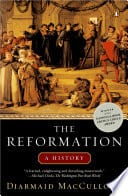
DESCRIPTION
The Reformation and Counter-Reformation represented the greatest upheaval in Western society since the collapse of the Roman Empire a millennium before. The consequences of those shattering events are still felt today—from the stark divisions between (and within) Catholic and Protestant countries to the Protestant ideology that governs America, the world’s only remaining superpower. In this masterful history, Diarmaid MacCulloch conveys the drama, complexity, and continuing relevance of these events. He offers vivid portraits of the most significant individuals—Luther, Calvin, Zwingli, Loyola, Henry VIII, and a number of popes—but also conveys why their ideas were so powerful and how the Reformation affected everyday lives. The result is a landmark book that will be the standard work on the Reformation for years to come. The narrative verve of The Reformation as well as its provocative analysis of American culture’s debt to the period will ensure the book’s wide appeal among history readers.
Review
Handwrite First
Use this section with the book and notes closed. The goal is retrieval, not polish.
1. Before Reading
Prime your mind before reading.
- Prediction:
- Question I want answered:
- What I already think about this topic:
- What I expect to disagree with:
2. Closed-Book Recall Dump
Close the book and notes. Reconstruct what you read from memory.
-
Main points I remember:
-
Key examples, evidence, stories, or cases I remember:
-
Terms, people, dates, or concepts I remember:
-
-
What feels fuzzy or incomplete:
3. Core Argument From Memory
- The book/section in one sentence:
- Main claim:
- Problem the author is responding to:
- Why the author thinks this is true:
- Best evidence/example I remember:
- Conclusion the author wants the reader to accept:
4. Argument Map From Memory
5. Feynman Check
Explain the idea simply, as if teaching it to someone unfamiliar with the topic.
- Simple explanation:
- Analogy or concrete example:
- Where someone might misunderstand this:
6. Pushback From Memory
- Strongest objection or weakness:
- What evidence would weaken the author’s argument?
- What a rival thinker/book might say:
- My current judgment:
7. Personal Takeaway
- What changed, clarified, or challenged my thinking?
- What am I less certain about now?
- One way I could apply this:
- One question I need to keep investigating:
Type Into Obsidian
Use this section after handwriting. The goal is long-term storage, search, linking, and spaced review.
1. Correction After Checking Notes
Reopen the book/notes. Compare them against your handwritten recall.
- I forgot:
- I misunderstood:
- I overemphasized:
- I underemphasized:
- This needs review:
2. Clean Core Argument
- The book/section in one sentence:
- Main claim:
- Problem the author is responding to:
- Why the author thinks this is true:
- Best evidence/example:
- Conclusion the author wants the reader to accept:
3. What Actually Matters?
- Most important idea:
- Best quote or passage:
- Term/concept worth remembering:
- Most useful example:
- Most surprising point:
- One sentence I want to remember:
4. Connections
- Connects to:
- [[]]
- [[]]
- [[]]
- Supports:
- [[]]
- Challenges:
- [[]]
- Reminds me of:
- [[]]
- Possible future note:
- [[]]
5. Clean Pushback
- Strongest objection or weakness:
- What evidence would weaken the author’s argument?
- What the author might say in response:
- What a rival thinker/book would say:
- My current judgment:
Retrieval Questions
Answer these without looking during future reviews.
Basic Recall
- What is the author’s main thesis?
- What problem is the author responding to?
- What are the 3–5 main claims?
- What are the key terms or concepts?
- What is the best example or piece of evidence?
Argument Reconstruction
- How does the author move from evidence to conclusion?
- What assumptions does the argument depend on?
- What would the argument look like in premise-conclusion form?
- What does the author want the reader to reject?
Comparison
- How does this book/section compare with [[]]?
- How does this support or challenge [[]]?
- Which thinker would agree with this?
- Which thinker would disagree with this?
Criticism
- What is the strongest objection?
- What evidence would weaken the argument?
- What does the author ignore, minimize, or assume?
- Is the author’s conclusion stronger than the evidence allows?
Synthesis
- How does this change my larger framework?
- Where does this fit in the broader historical/philosophical debate?
- What question should I ask next?
- What would I write about using this idea?
Flashcards / Atomic Recall
Use only for facts, definitions, distinctions, names, dates, and compact claims.
- Q:
- A:
- Q:
- A:
- Q:
- A:
Retention Check
24 Hours Later
- I can explain the main argument without notes.
- I remember the best example or evidence.
- I can define the key concept.
- I can state one objection.
24-hour recall notes:
- What I remembered:
- What I forgot:
- What needs another review:
1 Week Later
- I can summarize this in 5 sentences.
- I can reconstruct the argument.
- I can connect it to another book, thinker, or historical period.
- I can state whether I agree, disagree, or remain undecided.
1-week recall notes:
- What I remembered:
- What I forgot:
- New connection:
- Revised judgment:
1 Month Later
- I still remember the core argument.
- I can explain why this matters.
- I know whether this changed my larger framework.
- I know whether this is worth rereading, citing, or building into a permanent note.
1-month recall notes:
- What endured:
- What disappeared:
- What this changed:
- Next action:
Scratchpad
Unfiltered thoughts, questions, comparisons, argument trees, future writing ideas, or possible links.
Simplified rule
Handwrite
Use handwriting for:
- Before-reading predictions
- Closed-book recall dump
- Core argument from memory
- Argument map from memory
- Feynman explanation
- Initial pushback
- Personal takeaway
- Confusion list
These are the sections where the benefit comes from struggling to reconstruct the idea.
Type in Obsidian
Use Obsidian for:
- Corrections after checking notes
- Clean one-sentence thesis
- Clean argument summary
- Important quotes
- Key concepts
- Links to other notes
- Retrieval questions
- Flashcards
- Retention checks
- Review logs
- Scratchpad for future essays or synthesis
These are the sections where the benefit comes from searchability, linking, spaced review, and long-term organization.
Best workflow
Use this order:
1. Handwrite from memory.
2. Check the book/notes.
3. Type only the corrected, useful version into Obsidian.
4. Create retrieval questions.
5. Review those questions later without looking.
Do not type all your handwritten notes into Obsidian. That turns the system into transcription work. Only transfer what is worth preserving, linking, or reviewing.
Notes
Why the Reformation’s American Legacy Alarms MacCulloch
MacCulloch makes the claim in the Introduction but develops the substance later. Let me find where he elaborates — the “American Beginnings” coda and the concluding chapter.Let me read the closing pages of the final chapter, where MacCulloch returns to the modern American legacy and voices his concern. Great question — this is one of the quiet throughlines MacCulloch plants early and pays off at the very end of the book. Here’s what he actually claims, formatted so you can drop it into Obsidian.
The core claim (Introduction) MacCulloch argues that the United States is the one huge exception to the rule that Europe’s overseas religious expansion was mostly a Catholic story. In America, Protestantism from England and Scotland set the original patterns of identity, and the internal diversity of English Protestantism reached what he calls “a new synthesis.” His striking formulation: the Reformation, in its English Protestant form, produced “the ideology dominant in the world’s one remaining superpower” — and Reformation (and Counter-Reformation) habits of thought remain, in his word, “often alarmingly” alive and central in American culture even after they have become mere history in Europe. In the Introduction he only names this ideology; he fills in its content later.
The ideas that make up this ideology Drawn mainly from Ch 12 (“American Beginnings”) and Ch 17 (“Outcomes”), the synthesis rests on:
- Covenant — the settlers understood themselves as a chosen, elect people bound by a mutual agreement with God and with each other (an idea running back to Bullinger’s Zürich, carried through English Puritanism).
- Providentialism and the “city upon a hill” — a sense of being visibly under God’s eye. (Note a precise MacCulloch point: he insists Winthrop did not mean American exceptionalism or a special national destiny — that reading came later. Winthrop meant Massachusetts would be watched and judged, like any godly venture.)
- Biblicism / “the religion of the book” — Scripture as ultimate authority, and an unusually literate, book-centered society (arguably the most literate then on earth).
- Apocalyptic expectation — a live belief in the imminent Last Days shaping how people acted (it even, he argues, dampened missionary effort, since the conversion of the Jews was expected first).
- Congregational self-government — a federation of self-selecting “Saints,” with the elect running the commonwealth; godly discipline over daily life.
- The pluralism paradox — intolerant covenant communities (New England hanging Quakers, banishing dissenters) generated their own dissent, and that dissent produced the radical toleration of Rhode Island, Maryland, and Penn’s Pennsylvania. That denominational pluralism became the actual American pattern.
Does he return to it? Yes — three times
- Introduction — plants it as a deliberate theme, while admitting the book “has no room” to trace the full transformation abroad.
- Ch 12, “American Beginnings” (the British Coda) — the historical build-out: Virginia vs. New England, Winthrop, the Half-Way Covenant, Hutchinson, Roger Williams, the Quaker hangings, Maryland, Pennsylvania.
- Ch 17, “Outcomes” (“Tolerating Difference” and “The Enlightenment and Beyond,” plus the closing pages) — where he assesses the modern legacy and voices his unease.
His thoughts (the assessment) He’s fascinated by the paradox that intolerant, fearful covenant-communities are the ancestors of American religious freedom. On the modern legacy he notes what evangelicalism kept — biblicism, revivalism, providentialism, apocalypticism (even exported witch-killing in parts of Africa, he says, is a borrowing from the Western Christian inheritance) — and what it dropped: the fear of Hell and Calvinist predestination, which he calls a “posthumous victory” for Arminius and for Wesley over Edwards. He also credits American religious pluralism with sparing Anglo-America the vicious anti-clericalism that still haunts the Counter-Reformation’s heirs in southern Europe and Latin America. His verdict on the Enlightenment is even-handed: in America it was often an ally of Protestantism (Wesley, Edwards, Pietism), not just its enemy.
Why it “alarms” him The alarm is about timing and power: pre-modern, pre-Enlightenment modes of thought — apocalyptic literalism, biblical inerrancy, chosen-nation providentialism — surviving and even strengthening at the center of the world’s sole superpower, whose actions carry global consequences. His concrete example: Ronald Reagan believing in an imminent biblical apocalypse as firmly as any 17th-century Transylvanian prince or Interregnum Puritan. He explicitly frames the widening gap between a secularizing Europe and a religiously vibrant (and, in rhetoric, intensifying) United States as one of the most likely causes of misunderstanding and failure of communication between Europe and the USA over the coming century.
The deeper worry is temperamental. MacCulloch openly identifies as a child of the Enlightenment — someone whose instinct is to compare, assess, and above all subject even sacred texts to honest historical criticism (he singles out biblical criticism as the West’s, and Judaism’s, unique achievement). What unsettles him is a superpower animated by exactly the unquestioning certainties the Enlightenment tried to temper — and how that fuels culture-war absolutism. His illustration is the modern fight over biblical authority and homosexuality, which he thinks leaves churches a stark choice (follow the Bible’s assumptions, or concede the Bible is simply wrong on the point) and is splitting the heirs of both Reformation and Counter-Reformation along new lines.
One nuance worth holding onto for your notes: MacCulloch is careful not to make this a simple lament. He genuinely admires the American toleration/pluralism outcome and the Enlightenment-as-ally story. The “alarm” is specifically directed at the survival of unreformed certainties — apocalyptic, literalist, providential — inside a globally powerful state, not at American religiosity as such.
Church sapping money from the local people
Source: MacCulloch, The Reformation, Ch 1 “The Old Church, 1490–1517” — tithes/benefices, annates and the Concordats, clergy as consumers of landed wealth. Outside sources cited inline and listed at the end.
MacCulloch is careful not to paint the pre-Reformation Church as simply greedy or corrupt — his whole thesis is that it largely worked and met people’s spiritual needs. But he identifies a real and widely felt grievance that money flowed out of local communities and up to distant institutions. He splits it into three channels, laid out below.
Summary
The Grievance in One Line Money drained away from ordinary parishioners toward distant beneficiaries — local monasteries and chantries, the Curia in Rome, and land locked up permanently in clerical hands. The grievance was real; whether it added up to broad popular anticlericalism is genuinely contested.
Channel 1 — The Local Drain: Tithes, Fees, and Diverted Revenue
Every parishioner owed the parish a tithe (a tenth of agricultural produce) plus offerings, but MacCulloch notes that monasteries and wealthy chantry colleges often diverted that revenue to fund their own prayer duties, growing rich on it. The result: tithe-payers felt taxed for a far-off institution that did them little direct good.
The wider record backs this up, especially in England, where death and burial were flashpoints:
- The mortuary was a customary fee claimed by the priest on a parishioner’s death. In early-sixteenth-century London there was real friction between parishioners and clergy over tithes, offerings, and mortuary fees.
- The Richard Hunne case (1511–1514) became the notorious example: Hunne refused to pay the mortuary fee (his dead infant’s christening robe) to his Whitechapel rector, was later charged with heresy, and was found hanging in his cell in December 1514 under suspicious circumstances. A coroner’s jury charged the bishop’s chancellor and two officials with his murder, and Parliament debated reforming the mortuary law.
- Simon Fish’s A Supplication for the Beggars (c. 1529) turned this into anti-clerical propaganda addressed to Henry VIII; the Church condemned it as heretical in 1530. Fish cast the clergy as ravenous wolves in shepherds’ clothing devouring the flock for their own wealth and power.
Channel 2 — The Drain to Rome: Annates and Papal Fiscality
MacCulloch introduces annates (papal taxation of clerical benefices) directly: the Polish castellan Jan Ostroróg (c. 1475) demanded they be abolished along with legal appeals to Rome, and that clergy be taxed by the crown like everyone else — a programme, he notes, that Henry VIII enacted in the 1530s. He also shows rulers cutting deals to stem the flow: the Concordat of Vienna (1448) let German chapters elect bishops but let the papacy keep collecting annates, which meant more money bled from German lands to Rome than from Spain or France — a standing grievance of German rulers. France had pushed back earlier with the Pragmatic Sanction of Bourges (1438), the root of Gallicanism, later renegotiated in the Concordat of Bologna (1516).
The machinery behind this was elaborate and much resented:
- Annates were essentially the first year’s revenue of a benefice paid to the papal treasury (the Camera); the oldest form was the servitia communia paid on the appointment of bishops and abbots. Related levies included pallium fees for archbishops and visitatio ad limina tributes.
- Peter’s Pence was a separate payment flowing to Rome chiefly from northern kingdoms (England, Denmark, Poland), which began as a pious offering but came to be collected like a tax.
- The system was never applied uniformly and was never willingly accepted by the clergy; disputes were continual, and the papacy kept “reserving” more benefices to increase its revenue.
Channel 3 — The Drain on the Economy: Land and the “Dead Hand”
MacCulloch notes friars mocking monks as useless and idle consumers of landed wealth, and secular clergy and friars competing for lay money at a time when many clergy struggled to make fixed incomes meet changing economic conditions. Behind the jibes lay a structural fact — the Church’s enormous landholding:
- In England the Church owned more land than the crown in 1450, controlling between a quarter and a third of the arable; by the end of the Reformation only about 4 percent remained in Church hands. (The oft-repeated “one third of all Europe” figure is real but needs caution — “the Church” was hundreds of separate orders and dioceses, not one owner.)
- The economic sting was mortmain, the “dead hand.” Because a religious corporation never died, never came of age, and could never be attainted, land it acquired stopped generating the feudal taxes the crown levied on grant or inheritance — as if owned by the dead. Land in mortmain was effectively removed from the economic and feudal system.
- Rulers fought this early: the Statutes of Mortmain (1279 and 1290, under Edward I) aimed to stop land passing to the Church specifically to preserve the kingdom’s revenues.
How Prominent Was the Grievance?
Prominent enough to become a formal, recurring political document — but its depth is debated. In Germany it crystallized as the Gravamina (“grievances of the German nation”). First circulating from 1455 (presented by the Archbishop of Mainz in response to the Vienna Concordat), they culminated in the “Centum Gravamina” — one hundred grievances — brought by the princes at the Diet of Nuremberg in 1522–23. A central charge was ruthless papal taxation and the sense that Frenchmen, Italians, and Spaniards ran the Curia while German lands were milked hardest to fund papal luxury. The printing press turned this into a “literature of grievance” that fed a growing perception of crisis Luther could exploit.
Two qualifications keep this honest. First, MacCulloch’s own point: much “anticlerical” rhetoric was recycled from long-standing feuds among the clergy themselves, not spontaneous lay revolt. Second, even contemporaries framed the Gravamina as complaints from within the Church by people with no wish to leave it — aimed at Rome and the papacy more than at the faith. Historians still argue over how widespread lay anticlericalism actually was (the Dickens-vs-Duffy debate), since the true extent of anticlericalism in early-sixteenth-century England is genuinely hard to document.
Important
MacCulloch’s Bottom Line He resists letting this “money” theme carry too much explanatory weight. He treats the fiscal grievance as real and combustible, but insists the Reformation’s real engine was ideas — above all the Bible — not a corrupt or bankrupting Church. The grievance was fuel, not cause.
Sources
- Diarmaid MacCulloch, The Reformation: A History (Penguin, 2003) — Ch 1, “The Old Church, 1490–1517.”
- “Centum gravamina teutonicae nationis,” Wikipedia. https://en.wikipedia.org/wiki/Centum_gravamina_teutonicae_nationis
- “Nationalism and Nation-building in the Lutheran Reformation” (LMU Undergraduate Library Research Award). https://digitalcommons.lmu.edu/cgi/viewcontent.cgi?article=1097&context=ulra
- “Annates,” Catholic Encyclopedia (1913), New Advent. https://www.newadvent.org/cathen/01537b.htm
- “Annates,” 1911 Encyclopædia Britannica (Wikisource). https://en.wikisource.org/wiki/1911_Encyclop%C3%A6dia_Britannica/Annates
- “Peter’s Pence,” Wikipedia. https://en.wikipedia.org/wiki/Peter’s_Pence
- “Richard Hunne,” Wikipedia. https://en.wikipedia.org/wiki/Richard_Hunne
- “Simon Fish,” Wikipedia. https://en.wikipedia.org/wiki/Simon_Fish
- “Once Again, The Case of Richard Hunne,” Albion 1.1 (1969), Cambridge Core. https://www.cambridge.org/core/journals/albion/article/abs/once-again-the-case-of-richard-hunne/7591ADD65F848F44EDAC8558B6B1FB99
- “Statutes of Mortmain,” Wikipedia. https://en.wikipedia.org/wiki/Statutes_of_Mortmain
- “Landholding,” Encyclopedia.com (Europe, 1450 to 1789). https://www.encyclopedia.com/history/modern-europe/ancient-history-middle-ages-and-feudalism/landholding
Overall Summary
Abstract
The Big Picture (read this first) MacCulloch tells the story of how the Western Latin Church — a single society bound together by the pope and a shared Latin culture — was torn apart in the 16th century over how humans should wield God’s power in the world, and even over what it means to be human.
Three moves define his approach:
- The late-medieval Church was healthy, not rotten. Recent scholarship shows it largely satisfied ordinary people’s spiritual needs. So the Reformation wasn’t an easy blow against a dying target — it was the corrosive power of ideas (above all, the Bible) overcoming a successful institution.
- There were many Reformations, not one. Lutheran, Reformed (Zwinglian/Calvinist), Radical, English, and a genuine Catholic renewal (“Counter-Reformation”) all coexisted and competed. Protestantism was plural from the start.
- The deep engine is Augustine’s theology of grace — sin, the bound will, salvation by God’s initiative — which drives Luther, Calvin, and even shapes the Catholic response.
The book runs a chronological narrative (Parts I–II) and then steps back into thematic, experiential chapters (Part III) on death, discipline, family, sex, images, and witches. Its final question is the biggest: why did the heirs of Latin Christianity, uniquely among world cultures, eventually begin to reject religion sanctioned by a sacred book? — i.e., the road to toleration, doubt, and the Enlightenment.
Quote
Author’s standpoint MacCulloch writes as a non-confessional historian from an Anglican background who no longer holds religious dogma — and treats that distance as an advantage for explaining the era to a world that has half-forgotten what it was about. He deliberately avoids reducing the story to a handful of “great men” (Luther, Calvin, Loyola…) and insists on popular feeling, ordinary lives, and dynastic politics. He also covers the whole map — Poland, Transylvania, the Baltic, the Netherlands — not just Germany and England.
🗺️ Contents / Navigation
- 🏛️ PART I — A Common Culture (chs 1–6) · the shared medieval world and how it fractured (to ~1570)
- ⚔️ PART II — Europe Divided, 1570–1619 (chs 7–12) · the confessional age, region by region
- 🌾 PART III — Patterns of Life (chs 13–17) · social & intellectual themes; the long legacy
- 🔑 MacCulloch's Key Arguments (Takeaways)
- 🕰️ Timeline of Major Events
- 👤 Cast of Major People
🏛️ PART I — A Common Culture (chs 1–6)
What Part I does Establishes the common late-medieval culture everyone shared, then narrates the break and its first four decades of diversification and hardening — from the two “pillars” of the old Church, through Luther’s accidental revolution, to the moment (~1570) when reunion was finally impossible.
Ch 1 — The Old Church, 1490–1517
- Portrays a functioning, satisfying late-medieval Church, refusing the Protestant caricature of corruption.
- Pillar One — the Mass & Purgatory: the whole economy of salvation. The living help the dead through prayers, Masses, chantries, and indulgences; salvation is seen in church through images, saints, and ritual.
- Pillar Two — Papal Primacy: the pope as head and guarantor of unity.
- The cracks: Renaissance popes as Italian princes entangled in politics; the unresolved conciliarism vs papal monarchy question; and the rising tension between “Church” and “Commonwealth” as secular rulers assert authority over the Church in their own lands.
Ch 2 — Hopes and Fears, 1490–1517
- Shifting boundaries of Christendom: Constantinople already lost (1453), the Ottoman threat pressing, and the Iberian exception — Reconquista completed (Granada 1492), Jews expelled, the Inquisition, and the export of Western Christianity overseas after 1492.
- Printing as the transformative new technology — “a new world from books.”
- Christian humanism: ad fontes — return to biblical and patristic sources, reform of piety and scholarship; Erasmus as its emblem (his Greek New Testament, 1516).
- An apocalyptic mood: the age feels poised between renewal or the Last Days.
Ch 3 — New Heaven: New Earth, 1517–24
- The shadow of Augustine: grace, sin, and the bound will — the theological core of everything to come.
- Luther the monk (1483–1517) and his breakthrough on justification by faith alone.
- An “accidental revolution”: the Ninety-Five Theses (1517) against indulgences escalate through Leipzig and excommunication to the Diet of Worms (1521); Luther is outlawed, shelters at the Wartburg, and translates the New Testament into German.
- The movement spreads and splinters: Zwingli in Zürich, early radicalism, iconoclasm, and disorder — the “years of carnival.”
Ch 4 — Wooing the Magistrate, 1524–40
- The German Peasants’ War (1524–25) — “Europe’s greatest rebellion” — and Luther’s savage condemnation of it. The lesson the reformers draw: rely on princes and magistrates for order.
- Princely churches vs Christian separation (Anabaptist/radical withdrawal).
- The birth of Protestantisms: the Marburg Colloquy (1529) splits Luther and Zwingli over the Eucharist; the name “Protestant” (Speyer 1529); the Augsburg Confession (1530).
- Strassburg (Bucer) as a mediating hub between the parties.
- Kings and reformers: Henry VIII’s break with Rome.
- Münster (1534–35): the violent apocalyptic Anabaptist “kingdom” and its bloody fall — a trauma that discredits radicalism and pushes everyone toward disciplined, magistrate-backed reform.
Ch 5 — Reunion Deferred: Catholic & Protestant, 1530–60
- A Catholic “southern revival”: the Italian spirituali, reforming bishops, new devotional life.
- Ignatius Loyola and the early Jesuits (Society of Jesus approved 1540).
- The last real chance of reunion — the 1541 Regensburg colloquy — collapses.
- The Council of Trent opens (first session 1545–49), defining Catholic doctrine against Protestant positions.
- Calvin in Geneva: the Reformed “answer to Münster” — a disciplined godly city.
- Calvin & the Eucharist: Protestant divisions confirmed (Reformed vs Lutheran); alternative Reformed voices (Bullinger); the Consensus Tigurinus (1549) unites the Swiss but not the Lutherans.
Ch 6 — Reunion Scorned, 1547–70
- Habsburg crisis: Charles V crushes the Protestant princes at Mühlberg (1547) — but the victory unravels.
- 1555 — the double climax: the Peace of Augsburg (cuius regio, eius religio — the ruler sets the religion) and Charles V’s exhaustion and abdication; meanwhile a pope’s (Paul IV’s) obsessions.
- A Catholic recovery in England under Mary I (1553–58), with Protestant martyrs.
- 1558–59 — dynastic turning points: Elizabeth I accedes; the Peace of Cateau-Cambrésis; the map of power resets.
- The final session of Trent (1561–63) completes Catholic definition and reform.
- Protestants take up arms: the French Wars of Religion begin (1562) and revolt brews in the Low Countries — reunion is now unthinkable.
⚔️ PART II — Europe Divided, 1570–1619 (chs 7–12)
What Part II does A region-by-region tour of a Europe now hardened into confessional blocs. Instead of a single narrative thread, MacCulloch surveys the Protestant north, Catholic south, and contested centre, showing how each society settled (or failed to settle) its religious identity — ending in the catastrophe that froze the map.
Ch 7 — The New Europe Defined, 1569–72
- A hardened north/south, Protestant/Catholic geography.
- Tridentine successes and the Catholic defence of Christendom — Lepanto (1571) against the Ottomans.
- A militant Protestant international.
- The St Bartholomew’s Day Massacre (1572) in Paris — a defining Protestant trauma.
- Poland-Lithuania (1569–76) as an “alternative future”: the Warsaw Confederation (1573) enshrines a remarkable religious toleration.
- Providence: Protestants increasingly read themselves as a chosen, elect people.
Ch 8 — The North: Protestant Heartlands
- Defining Lutheranism: the Formula of Concord (1577) → Book of Concord (1580) ends internal Lutheran feuds.
- The “Second Reformation”: Calvinism advancing into Lutheran Germany.
- Baltic contests: Poland-Lithuania and Scandinavia.
- The Dutch Revolt: the northern Netherlands’ Protestant victory — then the Arminian crisis, resolved (harshly) at the Synod of Dort (1618–19).
- Reformed Scotland (Knox); Elizabethan England as a genuinely Reformed church (the “hotter sort” of Protestant); Ireland and the arrival of the Counter-Reformation.
Ch 9 — The South: Catholic Heartlands
- Italy as the Counter-Reformation’s engine room — Rome, Carlo Borromeo, new orders, the Roman Inquisition, the Index.
- Spain and Portugal: the church of Philip II.
- The Counter-Reformation as world mission — Jesuit and other missions across the Americas and Asia (Xavier).
Ch 10 — Central Europe: Religion Contested
- The Empire and Habsburg lands as a “shattered church” — a confessional patchwork.
- A Habsburg/Wittelsbach-led Catholic recovery (Bavaria as its spearhead).
- Transylvania as a “Reformed Israel” — striking toleration, including Antitrinitarianism.
- France: the collapse of the kingdom (1572–98) in the Wars of Religion, resolved by Henri IV and the Edict of Nantes (1598), followed by a brilliant late Counter-Reformation flowering.
Ch 11 — 1618–48: Decision and Destruction
- The Bohemian crisis: the Defenestration of Prague (1618), the Calvinist “Winter King” (Frederick V), and his crushing at the Battle of White Mountain (1620).
- The Thirty Years War — devastation that destroyed the religious diversity of Reformation Europe.
- The Peace of Westphalia (1648): an exhausted, polarized settlement that essentially froze the confessional map of the continent.
Ch 12 — Coda: A British Legacy, 1600–1700
- A distinctive English “avant-garde conformity”: Richard Hooker, Lancelot Andrewes, later Laud — a High-Church strand almost unique in Protestant Europe.
- The early Stuart church’s contested “golden age.”
- The War in Three Kingdoms (1638–60): covenant, civil war, the regicide (1649), Interregnum, and Restoration (1660).
- A spectrum of Protestantisms (1660–1700): sects, dissent, the slow drift toward toleration.
- American beginnings: the export of militant English Protestantism to New England (Winthrop, the Puritans) — one of the Reformation’s most consequential long-term outcomes.
🌾 PART III — Patterns of Life (chs 13–17)
What Part III does Steps out of chronology to ask what the Reformation did to lived experience — how it reshaped time, death, discipline, family, sex, images, and belief itself — and then draws the long threads out to the Enlightenment and the modern world. This is MacCulloch’s most original material and the part most easily forgotten.
Ch 13 — Changing Times
- Time ending: pervasive apocalypticism and a new reckoning of history’s shape.
- Hearing God’s voice: the Word, preaching, prophecy, providence.
- Fighting Antichrist — Idols: iconoclasm and the war on images, a central Reformed impulse that reshaped worship and art.
- Fighting Antichrist — Witches: the great witch-hunts as a product of the anxious confessional age (Protestant and Catholic).
Ch 14 — Death, Life and Discipline
- Negotiations with death and magic: abolishing Purgatory transformed dying, mourning, and how the living related to the dead.
- Telling out the Word: literacy, catechism, and a new sermon culture.
- Godly discipline: consistories, church courts, and moral policing — social discipline pursued by Calvinists and Catholics alike.
- “A spirit of Protestantism?”: a careful interrogation of Weber-style claims linking Protestantism to modern attitudes.
Ch 15 — Love and Sex: Staying the Same
- The common Christian inheritance on marriage, gender, and the family carried into the Reformation era.
- The family in society and its patriarchal ordering.
- The fear of sodomy as a marker of moral and cosmic order.
Ch 16 — Love and Sex: Moving On
- The “Reformation of Manners”: an intensifying official regulation of morality (especially sexual) that began before the Reformation (15th c.) and was accelerated by it — driven also by the arrival of syphilis and by Erasmian moralism. The secular ruler becomes the moral father of his territory (Landesvater).
- Catholicism, the family, and celibacy: clerical celibacy reaffirmed at Trent.
- Protestantism and the family: married clergy and the pastor’s household as social model; the sanctification of marriage — but also new controls over it.
- Choices in religion: the beginnings of a culture of confessional choice.
Ch 17 — Outcomes
- Wars of Reformation: the human cost of a century and a half of confessional conflict.
- Tolerating difference: how a grudging, pragmatic toleration emerged out of exhaustion and pluralism (Poland, Transylvania, the Dutch Republic, later England).
- Cross-currents: the interplay with humanism and natural philosophy (the Scientific Revolution), and with Judaism and doubt (Socinians, Spinoza, the roots of scepticism).
- The Enlightenment and beyond — the book’s climax: the Reformation’s shattering of religious authority, plus a growing culture of choice and doubt, created the conditions for the Enlightenment and for the West’s peculiar capacity to abandon book-sanctioned religion. Crucially, MacCulloch argues the Enlightenment was often as much an ally of Protestantism as its enemy (Wesley, Edwards, Pietism), and that both Reformation and Counter-Reformation live on — in worldwide evangelicalism and Pentecostalism, and in a revived, centralized Catholicism (Vatican I’s infallibility in 1870; the dialogue attempted only at Vatican II, 1962–65).
🔑 MacCulloch’s Key Arguments (Takeaways)
The theses worth remembering
- The old Church worked. It wasn’t decadent or doomed — so what needs explaining is the power of ideas, not institutional collapse.
- There was no single Reformation. Multiple Protestantisms (Lutheran, Reformed, Radical, English) plus a real Catholic renewal — all plural and competing.
- Augustine is the hidden protagonist. The theology of grace and the bound will underlies Luther, Calvin, Jansenism, and the Catholic debates alike.
- The “Counter-Reformation” was genuine reform, not mere reaction — and both confessions shared a drive to discipline and moralize society (the “Reformation of Manners”).
- The Reformation was pan-European and interwoven. Poland, Transylvania, the Baltic, and the Netherlands are central, not peripheral.
- It reshaped daily life — death, family, sex, images, discipline, and the fear of witches — not just doctrine and politics.
- Its greatest unintended legacy is modernity’s religious condition: pluralism, toleration, doubt, the Enlightenment, and the uniquely Western willingness to set aside sacred-book authority.
- A British–American epilogue matters disproportionately: militant English Protestantism, exported to America, became one of the Reformation’s most world-shaping outcomes.
🕰️ Timeline of Major Events
Prelude — the Late-Medieval World (pre-1517)
- 1453 — Fall of Constantinople; Ottoman power presses on Christendom.
- c. 1450s — Gutenberg’s movable-type printing at Mainz; the information revolution begins.
- 1478 — Spanish Inquisition established.
- 1492 — Fall of Granada completes the Reconquista; Jews expelled from Spain; Columbus reaches the Americas.
- 1494 — French invasion of Italy begins decades of war; syphilis spreads across Europe.
- 1509 — Erasmus, Praise of Folly; accession of Henry VIII in England.
- 1516 — Erasmus publishes his Greek New Testament.
- 1517 — The Fugger bank finances the Albrecht of Brandenburg indulgence — the immediate trigger.
The Break — 1517–1540
- 1517 — Luther’s Ninety-Five Theses against indulgences (31 Oct, Wittenberg).
- 1519 — Leipzig Disputation (Luther vs Eck); Charles V elected Holy Roman Emperor; Zwingli begins reform in Zürich.
- 1520 — Luther’s great reform treatises; papal bull Exsurge Domine threatens excommunication.
- 1521 — Diet of Worms; Luther outlawed; hides at the Wartburg and translates the New Testament.
- 1524–25 — German Peasants’ War; Luther condemns the rebels.
- 1525 — Luther marries Katharina von Bora; Anabaptism emerges in Zürich.
- 1529 — Marburg Colloquy (Luther–Zwingli split on the Eucharist); Diet of Speyer produces the label “Protestant.”
- 1530 — Augsburg Confession (Melanchthon).
- 1531 — Zwingli killed at Kappel.
- 1534 — Henry VIII’s Act of Supremacy (England breaks with Rome); Loyola and companions take vows at Montmartre.
- 1534–35 — Anabaptist kingdom of Münster rises and falls.
- 1536 — Calvin’s Institutes (1st ed.); Calvin arrives in Geneva; Tyndale executed.
- 1540 — Society of Jesus (Jesuits) approved by Paul III.
Confession & Council — 1540–1570
- 1541 — Colloquy of Regensburg fails; Calvin returns to Geneva (Ecclesiastical Ordinances).
- 1542 — Roman Inquisition reorganized.
- 1545–49 — Council of Trent, first session.
- 1546 — Luther dies; Schmalkaldic War begins.
- 1547 — Charles V wins at Mühlberg; Henry VIII dies → Edward VI (Protestant reforms in England).
- 1549 — English Book of Common Prayer (Cranmer); Consensus Tigurinus (Calvin–Bullinger).
- 1553–58 — Mary I restores Catholicism in England; Protestant martyrs (Cranmer, 1556).
- 1555 — Peace of Augsburg (cuius regio, eius religio); Charles V begins to abdicate.
- 1558–59 — Elizabeth I accedes; Elizabethan Settlement (1559); Peace of Cateau-Cambrésis; Index of Prohibited Books.
- 1560 — Scottish Reformation (Knox); Scots Confession.
- 1561–63 — Council of Trent, final sessions (closes 1563).
- 1562 — French Wars of Religion begin (Massacre of Vassy).
- 1566 — Iconoclastic Fury (Beeldenstorm) in the Low Countries; Dutch Revolt builds.
A Europe Divided — 1570–1618
- 1569 — Union of Lublin creates the Polish-Lithuanian Commonwealth.
- 1571 — Battle of Lepanto (Holy League defeats the Ottoman fleet).
- 1572 — St Bartholomew’s Day Massacre (Paris, August); the Dutch Revolt goes open (Sea Beggars take Brielle).
- 1573 — Warsaw Confederation guarantees Polish religious toleration.
- 1577 — Formula of Concord (→ Book of Concord, 1580).
- 1579 — Union of Utrecht binds the northern Dutch provinces.
- 1584 — William of Orange assassinated.
- 1588 — Spanish Armada defeated.
- 1593–98 — Henri IV ends the French Wars (converts 1593).
- 1598 — Edict of Nantes grants French Protestants toleration.
- 1600 — Giordano Bruno burned in Rome.
- 1609 — Twelve Years’ Truce (Dutch–Spanish).
- 1618–19 — Synod of Dort enforces Calvinist orthodoxy against the Arminians.
War & Settlement — 1618–1660
- 1618 — Defenestration of Prague ignites the Thirty Years War.
- 1620 — Battle of White Mountain crushes the Bohemian Protestants.
- 1625 — Charles I accedes in England.
- 1630–32 — Swedish intervention under Gustavus Adolphus (killed at Lützen, 1632).
- 1638 — Scottish National Covenant.
- 1642–51 — English Civil Wars.
- 1648 — Peace of Westphalia ends the Thirty Years War and largely freezes the confessional map.
- 1649 — Execution of Charles I.
- 1660 — Restoration of the Stuart monarchy.
Legacy — 1660–1700 and beyond
- 1670 — Spinoza’s Theologico-Political Treatise.
- 1685 — Louis XIV revokes the Edict of Nantes; Huguenot exodus.
- 1688–89 — English “Glorious Revolution”; Toleration Act (1689).
- 1730s–40s — Wesley and Methodism; the Great Awakening (Jonathan Edwards) in America.
- 1870 — First Vatican Council declares papal infallibility (completing Trent’s unfinished agenda).
- 1962–65 — Second Vatican Council finally engages the Enlightenment legacy.
👤 Cast of Major People
Magisterial Reformers
- Martin Luther — Wittenberg; justification by faith; the movement’s founder.
- Philipp Melanchthon — Luther’s systematizer; author of the Augsburg Confession.
- Huldrych Zwingli — Zürich; the first Reformed reformer; broke with Luther on the Eucharist.
- Heinrich Bullinger — Zwingli’s successor; vast pan-European influence.
- John Calvin — Geneva; the Institutes; architect of Reformed theology and discipline.
- Theodore Beza — Calvin’s successor and defender.
- Martin Bucer — Strassburg; great mediator between the parties.
- Thomas Cranmer — Archbishop of Canterbury; the Book of Common Prayer; martyred 1556.
- John Knox — the Scottish Reformation.
Radicals & Dissenters
- Andreas Karlstadt — early radical ally, then rival, of Luther.
- Thomas Müntzer — apocalyptic preacher of the Peasants’ War.
- The Anabaptists — Grebel, Hutter, and the peaceable Menno Simons; at Münster, the violent Jan of Leiden.
- Kaspar Schwenckfeld — spiritualist mystic.
- Michael Servetus — Antitrinitarian, executed in Geneva (1553).
- The Sozzini (Socinus) — founders of the rationalist, Antitrinitarian Socinian tradition.
Catholic Reform & Counter-Reformation
- Erasmus — the great Christian humanist who stayed Catholic and criticized both sides.
- Gasparo Contarini & the spirituali — Italian reformers who hoped for reconciliation.
- Ignatius Loyola — founder of the Jesuits.
- Francis Xavier — pioneering Jesuit missionary in Asia.
- Carlo Borromeo — model Counter-Reformation bishop (Milan).
- Teresa of Ávila — Carmelite reformer and mystic.
- Robert Bellarmine — leading Jesuit theologian and controversialist.
- Popes: Paul III (Trent, Jesuits), Paul IV (hardliner), Pius V (Lepanto).
Rulers & Dynasts
- Charles V — Holy Roman Emperor; defender of Catholic unity; abdicated 1555–56.
- Philip II — Spain; the Counter-Reformation’s great secular champion.
- The English Tudors: Henry VIII (the break), Edward VI (Protestant), Mary I (Catholic restoration), Elizabeth I (the settlement).
- Henri IV — ended the French Wars of Religion; Edict of Nantes.
- Frederick V — the Calvinist “Winter King” of Bohemia.
- Gustavus Adolphus — Sweden’s Protestant champion in the Thirty Years War.
- Gábor Bethlen — Prince of tolerant, Reformed Transylvania.
The British / American Legacy & Intellectual Cross-Currents
- Richard Hooker & Lancelot Andrewes — architects of a distinctive English religious style.
- William Laud — Charles I’s archbishop; the high-church experiment that helped spark civil war.
- John Winthrop — led the Puritan settlement of New England.
- John Wesley & Jonathan Edwards — bridged Enlightenment and Evangelical revival (Methodism, the Great Awakening).
- Paracelsus, Giordano Bruno, Jakob Boehme, Baruch Spinoza, Jacobus Arminius — the doubters, mystics, and natural philosophers who carried the story toward the Enlightenment.
Tip
How to use this note Each Part and chapter above is a collapsible callout — scan the headers first, then expand only what you need to refresh. The Timeline callouts are grouped by era; the Cast callouts by role. For the deepest recall value, re-read Ch 17 (Outcomes) and the Key Arguments box together — that pairing is where MacCulloch’s overall thesis lives.
Chapter Notes
Introduction
Chapter Objective
MacCulloch’s introduction explains what the Reformation was, why its terminology is unstable, and why the sixteenth-century religious upheavals remain central to modern European and global history. The chapter frames the book’s broader argument: the Reformation was not a single Protestant revolt against a dead or obviously corrupt Church, but a plural set of Reformations—Protestant, Catholic, political, social, intellectual, and devotional—that fractured the common inheritance of Latin Christendom and exported those divisions across the world.
The Problem of the Word “Catholic”
- MacCulloch begins by asking: “Who or what is a Catholic?”
- The word Catholic is presented as a contested term with several overlapping meanings:
- The whole Christian Church founded in Palestine.
- The western half of Christianity after its split from the Greek East.
- The part of western Christianity loyal to Rome after the sixteenth century.
- Some Protestants who still claimed to represent authentic Catholic Christianity.
- Modern Anglo-Catholic currents within Anglicanism.
- His point is that the Reformation made Christian labels more complicated, not less.
- The book therefore treats the Reformation as multiple Reformations, including:
- Protestant reform movements.
- Tridentine Catholicism.
- The Catholic Reformation.
- The Counter-Reformation.
Religious Labels as Weapons
- MacCulloch emphasizes that many religious labels began as insults or polemical labels.
- Examples:
- Calvinist originally functioned as a hostile nickname for followers of John Calvin.
- Anabaptist means “rebaptizer,” but those believers rejected the term because they believed adult baptism was the only real baptism.
- Anglican may have first been used disapprovingly by King James VI of Scotland.
- The term Protestant originally had a narrow political meaning:
- It came from the 1529 Diet of Speyer, where reforming princes and cities issued a Protestatio after finding themselves in the minority.
- Only later did “Protestant” become a broad label for reforming Christians.
- Because of this, MacCulloch often prefers the term evangelical for early reformers, since it was widely used at the time and pointed to their central concern: the Gospel, or evangelium.
Words, Scripture, and the Reformation
- Reformation conflicts were disputes over words because Christianity itself centered on:
- The Word of God.
- The Bible as the “Book.”
- The interpretation of Scripture.
- MacCulloch argues that it is impossible to understand modern Europe without understanding the sixteenth-century upheavals in Latin Christianity.
- The Reformation created the greatest rupture in Christian culture since the earlier division between Greek East and Latin West.
- This book focuses mostly on the western Latin Church, not Orthodox Europe, because Orthodox Christianity did not experience a comparable Reformation.
Latin Christendom and the Western Church
- The author defines his subject as the Western Church of the Latin Rite, also called:
- The western Church.
- The Latin Church.
- Latin Christendom.
- Before the Reformation, this culture was unified by:
- The symbolic leadership of the Pope.
- The shared language of Latin.
- Common religious institutions and rituals.
- The sixteenth century tore this world apart through disputes over:
- How humans should exercise God’s power in the world.
- What it meant to be human.
- Whether older devotional practices were sacred or corrupt.
- MacCulloch uses Peter Matheson’s comparison to Brecht’s idea of alienation:
- Reformers made the familiar unfamiliar.
- Practices once seen as holy, such as the Mass or papal authority, could suddenly be viewed as satanic or corrupt.
The Reformation’s Continuing Effects in Europe
- The Catholic-Protestant division still shapes Europe culturally, even where religious practice has declined.
- Examples:
- Protestant Prussia versus Catholic Poland.
- The Protestant Netherlands versus Catholic Belgium.
- Northern Ireland, where Catholic and Protestant communities preserve historical grievances.
- MacCulloch argues that both Catholics and Protestants narrowed religious options:
- Rome did so through the Council of Trent.
- Protestants did so by rejecting Roman practices and suppressing rival Protestant or radical alternatives.
- The result was not unlimited religious freedom but competing systems of religious “tidiness.”
- Europe’s modern diversity comes from both:
- A shared Latin Christian inheritance.
- A divided confessional inheritance.
The Global Significance of the Reformation
- The Reformation’s consequences were not limited to Europe.
- As Europe divided religiously, Europeans were expanding into:
- The Americas.
- Coastal Asia.
- Coastal Africa.
- Because Spain and Portugal remained loyal to Rome, early European religious expansion overseas was largely Catholic.
- The major exception was the United States:
- English and Scottish Protestantism shaped early American identity.
- American Protestantism preserved and intensified many energies of the sixteenth-century Reformation.
- MacCulloch argues that Reformation and Counter-Reformation mentalities remain influential in:
- American culture.
- African Christianity.
- Asian Christianity.
- In Europe, these religious patterns may feel historical; elsewhere, they remain socially and politically alive.
How the Book Will Tell the Story
- MacCulloch says the book will begin with an interwoven narrative, because people experienced the Reformation as overlapping religious, political, social, and intellectual events.
- He wants to avoid reducing the Reformation to a few famous men, such as:
- Luther.
- Zwingli.
- Calvin.
- Loyola.
- Cranmer.
- Henry VIII.
- Various popes.
- These figures matter, but the story also includes:
- Popular religious feeling.
- Ordinary people’s changing lifestyles.
- Political and dynastic interests.
- The concerns of landed elites.
- A major historical correction is that the late medieval Church was not simply corrupt, decayed, or spiritually empty.
- The old Church often satisfied the spiritual needs of late medieval people.
- That makes the reformers’ success more striking: they were not merely knocking down a dead institution; they introduced ideas powerful enough to challenge a functioning religious order.
The Power of Ideas and the Bible
- MacCulloch insists that ideas mattered profoundly.
- The reformers’ ideas had independent force and could be corrosive or destructive.
- The most explosive source of ideas was the Bible.
- He suggests that readers should understand basic Christian texts, including:
- The Bible’s Old and New Testaments.
- The creeds.
- The Ten Commandments.
- The Lord’s Prayer.
- These were the basic religious materials available to people caught up in the Reformation.
Historical Scope and Periodization
- The Reformation is placed within the early modern period, roughly from the late fifteenth to the eighteenth century.
- MacCulloch’s survey runs from around 1490 to 1700.
- The 1490s matter because European politics shifted dramatically when warfare moved into Italy.
- The ruling houses of France, Spain, and the Holy Roman Empire competed for European dominance:
- Valois.
- Trastámara.
- Habsburg.
- This political context shaped the religious crisis that followed.
Structure of the Book
- The book’s first section is a continent-wide narrative organized around major crisis points:
- 1517: the Lateran Council ended without significant reform, while Luther emerged as a symbol of religious and social transformation.
- 1525: popular reforming excitement peaked and then collapsed with the defeat of the German Peasants’ War.
- 1541–1542: real hopes for reunion and settlement failed.
- 1570–1572: political crises shifted the balance toward Protestant strength in the north and Catholic strength in the south.
- MacCulloch also wants to avoid treating England in isolation.
- English religious change must be understood as part of a wider European religious and political system.
Confessionalization and the Failure of Reunion
- After 1570, the narrative divides into regional stories:
- Northern Europe.
- Southern Europe.
- Central Europe.
- MacCulloch introduces confessionalization:
- The process by which churches developed fixed identities, doctrines, institutions, and boundaries.
- These churches had often begun by claiming to be truly Catholic and truly reformed, not by seeking permanent separation.
- Confessionalization represents the failure to restore a unified Latin Church.
- The Thirty Years War, beginning in 1618, sealed that failure.
- The war followed a crisis in Bohemia, where Protestant forces tried to resist Catholic Habsburg rule by electing a German Calvinist monarch.
- The resulting conflict destroyed much of the remaining religious diversity of Reformation Europe.
- By 1648, Europe was more exhausted, polarized, and confessionally hardened.
The Atlantic Isles and North America
- MacCulloch treats England, Ireland, Scotland, and Wales separately as the Atlantic Isles.
- This is not simply a return to British insularity.
- The religious and political crisis of the Atlantic Isles from the 1620s onward had enormous consequences.
- One of the most important was the export of militant English Protestantism to North America.
Social and Intellectual Themes
- The third part of the book turns from chronology to themes.
- MacCulloch plans to examine:
- Everyday religious experience.
- Changing ideas about time.
- The relation between this world and the world after death.
- Women and children in the new religious societies.
- Deviance and the treatment of deviants.
- The possible roots of later western skepticism toward sacred-book-based belief systems.
- This shows that the Reformation was not only about churches and rulers.
- It changed ordinary life, social norms, moral boundaries, and eventually the intellectual possibilities of western culture.
The Author’s Viewpoint
- MacCulloch identifies his background as Anglican but says he does not write from a confessional or dogmatically Christian position.
- He has sympathy for Anglicanism’s culture, self-questioning, and seriousness, but he does not personally subscribe to religious dogma.
- He argues that this distance may help him explain the Reformation to a modern world that has forgotten or misunderstood it.
- He warns that both blind unbelief and blind belief can distort history.
- Histories written from a hidden confessional agenda often bend the narrative to fit prior commitments.
Note on Usage and Proper Names
- MacCulloch explains several editorial choices:
- Primary-source quotations are modernized in spelling.
- Capital letters are used for sacred or special terms such as Church, Mass, Bible, Eucharist, and Saviour.
- Place-names usually follow modern usage, unless sixteenth-century usage better reflects the population of the time.
- The term Atlantic Isles is used instead of British Isles.
- Personal names usually follow the birth-language of the individual, except for major figures known across multiple languages.
- Dates use Common Era terminology: CE and BCE.
- He generally uses Old Testament and New Testament for simplicity.
Key Concepts for Introduction
- Multiple Reformations: The Reformation was not one event or one movement. It included Protestant reform, Catholic reform, Counter-Reformation renewal, radical movements, and political-social transformations.
- Catholic as a Contested Term: “Catholic” could mean universal Christianity, western Christianity, Roman loyalty, or even a Protestant claim to authentic Christianity.
- Evangelical: MacCulloch’s preferred term for many early reformers because it reflects their own emphasis on the Gospel rather than the later, broader label “Protestant.”
- Latin Christendom: The shared religious and cultural world of western Europe before the Reformation, unified by Latin, papal symbolism, and common religious practices.
- Confessionalization: The post-Reformation process by which churches hardened into distinct Catholic, Lutheran, Reformed, Anglican, and other identities with clearer doctrine, discipline, and institutional boundaries.
- Reformation as Alienation: The reformers made familiar sacred realities appear strange or corrupt. The Pope, the Mass, images, and traditional devotions could be reinterpreted as signs of spiritual danger rather than holiness.
- The Bible as Explosive Force: Scripture was not merely a religious text but a disruptive source of ideas that could challenge inherited institutions and reorder society.
Questions for Reflection for Introduction
- Why does MacCulloch resist treating the Reformation as a single Protestant movement against Roman Catholic corruption?
- How does the contested meaning of Catholic reveal the deeper struggle over religious legitimacy in the sixteenth century?
- Why is it significant that many religious labels—such as Calvinist, Anabaptist, and Protestant—began as polemical or politically specific terms?
- If the late medieval Church was not simply corrupt or spiritually dead, what explains the explosive success of reforming ideas?
- How did the Reformation both reduce religious diversity and create new forms of long-term cultural diversity?
Part I: A Common Culture
Chapter 1: The Old Church 1490–1517
Chapter Objective
MacCulloch’s goal in this chapter is to reconstruct the religious world of western Christendom before Luther, showing that the late medieval Church was not simply corrupt, lifeless, or waiting to collapse. It was a deeply embedded religious system built around two “pillars”: the Mass and papal primacy. The chapter fits the book’s broader argument by explaining why the Reformation was so explosive: reformers were not attacking a dead institution, but a rich, powerful, emotionally satisfying, and socially pervasive religious order.
Seeing Salvation in Church
- MacCulloch begins with the parish church at Preston Bissett, where a strange medieval carving shows a figure displaying its buttocks toward the high altar.
- The point is not merely comic.
- The carving reveals how hard it is for modern readers to recover the mental world of medieval Christianity.
- In this world, the physical, comic, grotesque, spiritual, and sacred could coexist inside church life.
- He then turns to Wenhaston in Suffolk, where a painted Doom, or Last Judgement, once stood above the Rood screen.
- Parishioners heard the Latin Mass while looking toward images of Christ crucified, Mary, John, heaven, hell, and souls awaiting judgement.
- The church building itself dramatized the entire Christian story:
- Human sin.
- Christ’s crucifixion.
- The Mass as Christ’s bodily presence.
- Death, judgement, heaven, hell, and Purgatory.
- Medieval worship fused sight, ritual, architecture, doctrine, fear, and hope.
- The Mass was not an abstract doctrine; it was visually and bodily staged for ordinary people.
- The priest’s elevation of the consecrated bread and wine made Christ present before the people.
- MacCulloch also connects this devotional world to medieval Christian attitudes toward Jews.
- Christians inherited Jewish Scripture but often resented Judaism as the parent religion.
- Augustine argued that Jews should be allowed to survive as a sign and warning to Christians, though without full equality.
- Later medieval anti-Jewish hostility intensified through blood-libel myths, preaching, forced segregation, and suspicion.
- The section ends by introducing Nicholas Ridley’s later Protestant claim that the old Church stood on two “massy posts and mighty pillars”:
- The Mass, especially its “idolatrous” use.
- The papal primacy of Rome.
- MacCulloch adopts this as the chapter’s structure: to understand the old Church, one must understand the Mass and the Pope.
The First Pillar: The Mass and Purgatory
- The Mass was the western name for the Eucharist, the Church’s central act of worship.
- It represented, or re-created, Christ’s Last Supper.
- It bridged the physical and spiritual worlds through bread and wine.
- It connected Christ’s sacrifice with the needs of the living and the dead.
- By the twelfth century, laypeople usually received communion rarely, often only at Easter.
- Their main role was to watch the miracle reverently.
- Seeing the elevated host became a central act of lay devotion.
- The Mass became closely tied to Purgatory.
- The New Testament offered a stark contrast between heaven and hell.
- Medieval western theology developed a third state: a place of purging where souls destined for heaven could be cleansed.
- This made death less final and gave the living a role in aiding the dead.
- Purgatory generated an entire economy of prayer.
- Chantries funded priests to say Masses for the dead.
- Obits provided temporary prayer arrangements.
- Colleges and endowed foundations often began as institutions for intercession before they became educational centers.
- Good works also entered this spiritual economy.
- Giving alms, building bridges, supporting hospitals, or paying communal taxes could generate spiritual benefit.
- The living prayed for the dead, and the dead in Purgatory were expected to reciprocate.
- MacCulloch stresses that this system was especially intense in northern Europe.
- Northern wills show heavy investment in Masses and prayers for the dead.
- Germany saw a surge in Mass endowments after 1450.
- Mediterranean Europe appears to have been less intensely focused on the Purgatory industry.
- This matters because Luther’s early attack on indulgences and soul-prayer struck at a devotional system that mattered most in northern Europe.
- He was not attacking a marginal abuse.
- He was telling people that practices they trusted for salvation were clerical frauds.
- MacCulloch also notes variation within northern Europe.
- Some regions were heavily invested in gilds and Masses.
- Others, possibly influenced by Lollard skepticism, showed weaker commitment.
- The central point: medieval laypeople were not passive. They interpreted death, prayer, and salvation for themselves, sometimes in ways different from official Church teaching.
Layfolk at Prayer
- Prayer was the unifying practice of late medieval religion.
- The Mass was the highest form of prayer.
- But lay prayer also took organized, communal, and private forms.
- Gilds, brotherhoods, sisterhoods, and confraternities were major lay institutions.
- They were voluntary associations bound by oath, money, shared devotion, and mutual responsibility.
- Many funded Masses, altars, chapels, and chantries.
- They show that late medieval religion was not simply controlled by priests; laypeople actively funded, managed, and shaped religious life.
- MacCulloch argues that Protestant dissolution of the gilds could actually reduce lay control over parish religion.
- The Reformation did not automatically empower ordinary believers.
- In some ways, it stripped them of institutions they had previously controlled.
- Italian confraternities developed strong charitable functions.
- In Bologna, different confraternities focused on praise, discipline, charity, or spiritual examination.
- In Genoa, the Oratory founded by Ettore Vernazza combined Eucharistic devotion with care for the sick, especially those suffering from syphilis.
- These Italian devotional networks later helped form Catholic reform energies.
- Pilgrimage was another major lay practice.
- Shrines, relics, holy wells, and sacred places gave laypeople direct access to divine power.
- Marian shrines such as Walsingham and Loreto flourished.
- Compostela remained a major international pilgrimage destination.
- Devotion was also competitive and consumer-driven.
- Shrines rose and fell depending on lay enthusiasm.
- Some relics, such as supposed relics of Christ’s Holy Blood, generated skepticism as well as devotion.
- MacCulloch gives examples of religious enthusiasm escaping official control:
- Hans Behem at Nikiashausen in 1476 used Marian devotion to preach social transformation and was burned by his bishop.
- In Regensburg in 1519, anti-Jewish violence and Marian devotion combined in the cult of the “Beautiful Mary.”
- Late medieval piety increasingly centered on Christ’s suffering humanity.
- Earlier medieval art emphasized Christ as victorious king.
- Later devotion stressed the broken, tortured, compassionate Christ.
- Grünewald’s Isenheim Altarpiece is used as an example of Christ’s suffering body speaking to the sick and disfigured.
- Devotion to Mary also intensified.
- Mary was imagined both as tender mother and cosmic intercessor.
- The debate over the Immaculate Conception showed the overlap between popular devotion and scholastic theology.
- The Devotio Moderna offered an intense, introspective, practical spirituality.
- It encouraged laypeople, women, married couples, and children to seek high devotional standards previously associated with clergy or monks.
- Thomas à Kempis’s The Imitation of Christ embodied this spirituality.
- The Fifteen Oes of St Bridget illustrate late medieval devotional habits:
- Repetition.
- Beads.
- Meditation on Christ’s Passion.
- Numerical calculation.
- Promised reductions of time in Purgatory.
- MacCulloch closes the section by showing that the Mass was not merely solemn but also communal, theatrical, and enjoyable.
- Easter and Whitsuntide rituals in German churches involved mock battles with devils, dramatic processions, wooden doves, water, noise, and play.
- Such apparent irreverence showed confidence in the old system, not contempt for it.
- The section ends with the theological vulnerability of the Mass:
- The doctrine of transubstantiation depended on Aristotelian categories of substance and accidents.
- Thomas Aquinas gave this theory its classic form.
- But many late medieval thinkers were nominalists, who rejected Aristotelian realism.
- Once confidence in Church authority was shaken, transubstantiation became intellectually vulnerable.
The Second Pillar: Papal Primacy
- The second pillar of the old Church was the authority of the Bishop of Rome, the Pope.
- MacCulloch traces papal primacy to the major Church reforms of the eleventh and twelfth centuries.
- Gregory VII helped centralize and reorganize the western Church.
- MacCulloch calls this earlier transformation a kind of “first Reformation.”
- R. I. Moore’s phrase “the formation of a persecuting society” captures its darker side: the Church increasingly defined heresy, regulated sexuality, and disciplined society.
- The medieval Church became a highly organized clerical structure.
- The clergy became professional Christians.
- Literacy, liturgy, canon law, and celibacy marked them off from laypeople.
- Monasticism also changed.
- Originally, monks were often lay ascetics withdrawn from the world.
- Over time, more monks became priests so they could say Masses.
- Celibacy, once primarily monastic, became expected of all western clergy.
- The papal system developed powerful institutions:
- Cardinals elected the Pope.
- The Curia became the papal administrative and legal apparatus.
- Canon law became a universal legal system for western Christendom.
- Canon law was powerful because it worked.
- It settled conflicts.
- It regulated intimate moral and social matters.
- It provided a universal legal framework when secular legal systems were fragmented.
- The religious orders also embodied Christian internationalism.
- Cistercians, Premonstratensians, Carthusians, Cluniacs, Benedictines, and military orders spread across borders.
- The Church gave western Europe a shared cultural identity.
- MacCulloch’s main point is that the medieval Church was not merely a set of beliefs.
- It was the largest, most complex, most literate, most administratively sophisticated organization in western Europe.
- It shaped time, law, architecture, education, charity, politics, and daily life.
A Pillar Cracks: Politics and the Papacy
- The papal project began to falter in the thirteenth and fourteenth centuries.
- The first major crisis was the move to Avignon in 1309.
- Pope Clement V settled outside Rome.
- There were practical reasons, but many Italians saw it as a disaster comparable to Babylonian exile.
- The second crisis was the Great Schism beginning in 1378.
- Rival popes were recognized by different parts of Europe.
- This made a mockery of papal claims to visible unity.
- Dissent movements also challenged papal authority.
- John Wyclif in England attacked Church structures and questioned the Mass.
- His followers, the Lollards, survived as small dissident communities.
- Wyclif’s writings influenced Jan Hus in Bohemia.
- Hus’s execution at the Council of Konstanz in 1415 triggered rebellion.
- Within five years, Bohemia had established a Hussite Church independent of Rome.
- The mainstream Hussites, or Utraquists, used Czech in worship and insisted that laypeople receive both bread and wine in the Eucharist.
- More radical Hussites, the Unitas Fratrum, rejected violence, oaths, a separate priesthood, and the traditional Eucharistic miracle.
- Bohemia became the first major region of western Europe to slip from papal obedience.
- MacCulloch notes that only in such places does the term Roman Catholic make real sense before the Reformation.
- The papacy’s greatest internal challenge came from conciliarism.
- Conciliarists argued that ultimate authority in the Church should rest in a general council, not the Pope alone.
- The Council of Konstanz ended the schism by electing Martin V.
- Its decree Sacrosancta declared that the council held authority directly from Christ and that even the Pope must obey it in matters of faith, schism, and reform.
- Conciliarism failed to become a stable constitutional alternative.
- Popes resisted it.
- Conciliarists disagreed about whether authority came from the whole people of God or from the ordained clergy.
- Secular rulers were not eager to replace papal absolutism with conciliar absolutism.
- By the late fifteenth century, the papacy rebuilt centralized authority, but its moral credibility was damaged.
- Alexander VI promoted his Borgia family and children.
- Julius II acted like a warrior-prince, personally involving himself in Italian wars.
- Their behavior made papal claims to universal spiritual leadership look hollow.
- MacCulloch argues that this made the papacy hypersensitive to later challenges.
- When Luther revived older criticisms after 1517, Rome recognized dangerous precedents.
Church Versus Commonwealth?
- MacCulloch now turns to the relationship between the clerical Church and secular powers.
- He warns against reading early modern Europe through modern nationalism.
- Europe was not yet a continent of nation-states.
- Loyalties were usually dynastic, local, civic, regional, or corporate.
- Dynasty and local privilege mattered more than modern national identity.
- The word state was also not yet fully natural for this world.
- Many territories were tied to ruling families and divine providence.
- Machiavelli helped make the more abstract idea of the state thinkable, though his political realism shocked many readers.
- Secular rulers increasingly resented Church power.
- The papacy had legal, financial, and jurisdictional reach across Europe.
- Papal nuncios acted as representatives of Rome with ecclesiastical authority.
- Monarchs and city governments saw this as interference, even when they remained devout.
- Different regions negotiated Church power differently:
- France developed Gallicanism, defending French ecclesiastical independence from Rome.
- The 1516 Concordat of Bologna gave both the Pope and the French crown certain powers, angering some conciliar and Gallican critics.
- England’s Henry VII was pious but still fought clerical privilege when it obstructed royal authority.
- In many cities, resentment toward clergy was economic and political.
- Clergy often owned large amounts of tax-exempt property.
- Mainz, Würzburg, and other cities suffered from conflicts between civic authorities and ecclesiastical privilege.
- Some laypeople disliked specific clergy while remaining devoted to the Church itself.
- Noble families often captured wealthy Church offices.
- Bishoprics, cathedral chapters, and monasteries were filled with aristocratic relatives.
- This turned Church institutions into extensions of family power.
- Some cities and princes took increasing control over local churches.
- Nuremberg, Augsburg, Zürich, and other communities asserted civic authority over ecclesiastical life.
- Zürich’s Grossmünster became a symbol of civic religion overcoming aristocratic ecclesiastical power.
- These developments produced Landeskirchen, or locally governed churches, before the Reformation.
- Princes and magistrates increasingly saw themselves as responsible for religious life.
- This helps explain why many early reformers later looked to princes and city councils rather than bishops to carry out reform.
- MacCulloch ends with an important distinction:
- Late medieval conflicts over clerical privilege, jurisdiction, and reform were real.
- But they had happened before and could have been healed.
- The Reformation became lasting because it involved deeper theological and spiritual ideas, not merely political complaints.
Key Concepts for The Old Church 1490–1517
- The Mass: The central act of western Christian worship, understood as the sacramental making-present of Christ’s body and blood through bread and wine.
- Purgatory: A western doctrine of postmortem purification for souls destined for heaven. It allowed the living to aid the dead through Masses, prayers, indulgences, and good works.
- Chantry: An endowed institution funding priests to say Masses for the soul of a dead person, family, or group.
- Gilds and Confraternities: Lay religious associations that organized prayer, charity, Masses, altars, processions, and mutual aid. They show the active role of laypeople in late medieval religion.
- Devotio Moderna: A late medieval devotional movement emphasizing inner discipline, imitation of Christ, personal piety, and lay access to serious spiritual life.
- Transubstantiation: The scholastic explanation of the Eucharist in which the substance of bread and wine becomes Christ’s body and blood while the accidents remain unchanged.
- Scholasticism: The medieval university method of theological reasoning through logical questioning, authorities, distinctions, and systematic argument.
- Nominalism: A philosophical tendency that rejected universal realities such as “breadness” or “sheepness,” thereby weakening the Aristotelian framework behind transubstantiation.
- Papal Primacy: The claim that the Bishop of Rome held supreme authority in the western Church as Christ’s vicar on earth.
- Canon Law: The Church’s legal system, developed through papal administration, regulating doctrine, morality, marriage, clerical life, property, and jurisdiction.
- Conciliarism: The theory that a general council of the Church could possess authority superior to the Pope, especially in crises of heresy, schism, or reform.
- Gallicanism: The French tradition of defending the rights of the French Church and monarchy against excessive papal interference.
- Landeskirche: A locally or territorially governed church, often under a prince or city council, emerging before the Reformation and later becoming crucial to Protestant reform.
Questions for Reflection for The Old Church 1490–1517
- Why does MacCulloch argue that the old Church was powerful and satisfying rather than simply corrupt or spiritually dead?
- How did the doctrine of Purgatory make death socially manageable and bind the living and dead into one religious economy?
- Why was Luther’s attack on indulgences and Masses for the dead especially explosive in northern Europe?
- How did laypeople shape late medieval religion through gilds, pilgrimages, confraternities, and devotional practices?
- Why did the Reformation become more permanent than earlier conflicts over papal power, clerical privilege, and Church reform?
Chapter 2: Hopes and Fears 1490–1517
Chapter Objective
MacCulloch’s purpose in this chapter is to explain the unstable mixture of anxiety and expectation in western Christendom just before Luther. Around 1500, Latin Christianity faced military danger from Islam, internal reform pressures, new global expansion, new technologies of communication, and a new scholarly culture rooted in humanism. The chapter fits the book’s broader argument by showing that the Reformation did not emerge from nowhere: it arose from a Europe already experiencing geopolitical fear, religious renewal, textual revolution, and apocalyptic expectation.
Shifting Boundaries
- Western Christendom around 1500 feared that it might contract or disappear.
- Its frontiers were unstable:
- The Scandinavian colonies in Greenland had died out.
- Cyprus, a Latin Christian outpost in the eastern Mediterranean, remained culturally western but politically vulnerable.
- The Ottoman Empire was expanding into former Byzantine and Latin Christian territories.
- The Ottoman capture of Constantinople in 1453 and later advances under Süleyman the Magnificent intensified Christian fear.
- The fall of Rhodes in 1522 and the destruction of the kingdom of Hungary at Mohács in 1526 showed that Islam was not merely a distant threat.
- The Ottoman siege of Vienna in 1529 made the danger feel existential.
- MacCulloch argues that this fear shaped the religious atmosphere of the Reformation:
- Christians interpreted military disasters as signs of God’s anger.
- Both Catholics and Protestants increasingly believed that correct belief was necessary to avert divine judgement.
- The irony is that Ottoman pressure indirectly helped Luther:
- Charles V was too preoccupied with defending Europe’s southeastern frontier to crush Protestantism quickly.
The Iberian Exception
- Iberia was the one region where the crusading ideal seemed to succeed.
- The capture of Granada in 1492 completed the Christian Reconquista and was celebrated across Europe.
- Spanish Catholicism developed a uniquely militant character because it had been shaped by centuries of conflict with:
- Islam.
- Judaism.
- Conversos, or Jewish converts to Christianity.
- Moriscos, or Muslim converts to Christianity.
- The joint monarchy of Fernando of Aragon and Isabel of Castile made Catholic unity central to political identity.
- The Spanish Inquisition became the main instrument of this religious-political project.
- It targeted suspected Judaizers and later Moriscos.
- It reinforced the idea that religious deviation could be hereditary.
- This produced the doctrine of limpieza de sangre, or “purity of blood.”
- MacCulloch presents Spain as having an Iberian Reformation before the Reformation:
- The monarchy disciplined the Church.
- Bishops and clergy were reformed.
- Papal interference was limited.
- Religious uniformity was enforced.
- The chief figure was Francisco Ximénes de Cisneros:
- Observant Franciscan.
- Confessor to Queen Isabel.
- Archbishop of Toledo.
- Founder of the University of Alcalá.
- Patron of scholarship and book printing.
- Inquisitor General.
- Ximénes embodies the ambiguity of Spanish reform:
- Serious spiritual discipline and scholarship.
- Harsh coercion against Jews, Muslims, and heterodox Christians.
- MacCulloch’s judgment is severe: after Spain rejected its multicultural past, Spanish Christianity became a major practitioner of ethnic cleansing.
The Iberian Achievement: The Western Church Exported
- Iberian Christianity did not merely purify itself internally; it began exporting Latin Christianity beyond Europe.
- Portugal led the earliest overseas expansion:
- Captured Ceuta in 1415.
- Explored the African coast.
- Entered the slave trade from the 1440s.
- Rounded the Cape of Good Hope.
- Reached India by 1498.
- Reached Brazil in 1500.
- Portuguese expansion combined:
- Crusading zeal.
- Commercial ambition.
- Maritime skill.
- Religious intolerance.
- Spain’s overseas expansion began dramatically with Columbus’s 1492 voyage.
- Pope Alexander VI divided overseas missionary and imperial claims between Spain and Portugal, later confirmed by the Treaty of Tordesillas.
- Spanish conquest in the Americas was presented as an extension of the Reconquista.
- MacCulloch contrasts two missionary models:
- Militant crusading Christianity, tied to conquest.
- Friar-based missionary Christianity, more flexible and sometimes protective of native peoples.
- The chapter uses Bartolomé de las Casas as a key example:
- He began as a colonial official and plantation-owner.
- A Dominican sermon against colonial brutality converted him into a defender of the Indios.
- He argued that native peoples were rational human beings, not natural slaves.
- His writings later fed the Protestant stereotype of Spanish cruelty.
- MacCulloch notes Las Casas’s moral ambiguity:
- In trying to protect Indigenous Americans, he initially recommended importing African slaves.
- He later realized the mistake, but the damage was already done.
- Francisco de Vitoria developed a more theoretical response:
- He questioned whether conquest could be justified as a crusade.
- He argued that non-Christian commonwealths had real sovereignty.
- He helped pioneer the idea of international law based on natural law rather than papal world-monarchy.
- The result was paradoxical:
- Iberia expanded Latin Christianity globally.
- But its expansion also weakened older medieval claims that the Pope had universal jurisdiction over all peoples.
New Possibilities: Paper and Printing
- MacCulloch presents printing and paper as revolutionary conditions for the Reformation.
- Paper made texts cheaper and more available.
- Movable-type printing allowed mass reproduction of books, pamphlets, indulgences, Bibles, and polemics.
- Printing transformed religion before Protestantism:
- The first dated English printed item was an indulgence.
- The earliest datable printed book was a Latin Psalter.
- Printers supplied conventional religion first because it was profitable.
- But printing also served reform:
- Protestantism became good business for printers.
- Printing became good for Protestantism because a “religion of the book needs books.”
- MacCulloch emphasizes that printing helped explain why earlier dissent, such as Lollardy, failed to spread widely while later evangelical movements succeeded.
- Bible printing was especially important:
- German, Italian, Dutch, Spanish, Czech, Catalan, and French biblical texts appeared before Luther’s movement fully developed.
- The increase in Bibles helped create the Reformation rather than merely resulting from it.
- Printing also changed intellectual habits:
- Manuscript culture emphasized preservation, scarcity, and copying.
- Print culture emphasized multiplication, distribution, comparison, and correction.
- More reading encouraged more private, inward, text-centered religion.
- This shifted piety away from purely public ritual toward:
- Personal reading.
- Private devotion.
- Books of Hours.
- A more individual relationship with Scripture and devotional texts.
Humanism: A New World from Books
- MacCulloch defines humanism carefully.
- It did not originally mean secular unbelief.
- Most humanists were sincere Christians.
- Humanism was a movement of literary, textual, rhetorical, and historical recovery.
- Humanists valued:
- Ancient Greek and Roman texts.
- Rhetoric and persuasive language.
- Historical accuracy.
- Textual criticism.
- Returning ad fontes, “to the sources.”
- Humanism was tied to the Renaissance, meaning rebirth or recovery of ancient learning.
- Civic humanism used classical models to think about government, public virtue, and the commonwealth.
- The rediscovery of Greek was decisive.
- Greek manuscripts came west partly because of the Ottoman conquest of the eastern Christian world.
- Plato became newly available and challenged the dominance of Aristotelian scholasticism.
- Humanists developed a new test of authority:
- Not merely “who has always said this?”
- But “what does the earliest and best source actually say?”
- This undermined older medieval authorities.
- The Donation of Constantine, long used to support papal claims, was exposed as a forgery.
- Humanist study of Hebrew corrected errors such as Jerome’s mistaken rendering that gave Moses “horns.”
- Biblical humanism was especially explosive.
- The western Church had based its Bible on Jerome’s Latin Vulgate.
- Humanist return to Greek and Hebrew showed that the Vulgate was a translation with errors and interpretive choices.
- Hearing Paul and the New Testament in Greek made Scripture sound different from the Latin Church’s inherited reading.
- MacCulloch argues that this helps explain why the Latin West experienced a Reformation while the Greek-speaking East did not:
- The West suddenly heard its sacred texts in a new voice.
- Humanists did not intend to destroy the Church.
- Many bishops, cardinals, and popes patronized humanist scholarship.
- But humanist tools made it possible to challenge centuries of ecclesiastical interpretation.
Putting Renewal into Practice
- Reform was not only theoretical; many people tried to renew the Church before Luther.
- Reform from the top largely failed.
- The Fifth Lateran Council created expectations but produced little structural change.
- The papacy feared strong councils because of earlier conciliar challenges.
- Reform from below and within religious orders was more energetic.
- The Observant movements among friars sought stricter discipline and a return to founding ideals.
- Franciscans, Dominicans, and later Capuchins emphasized preaching, poverty, and pastoral renewal.
- In Ireland, Observant Franciscans and Dominicans helped sustain a religious fervor that later resisted Protestantism.
- Older monastic orders also experienced reform.
- Benedictine congregations, especially the Cassinese, cultivated meditation, mysticism, scholarship, and biblical study.
- MacCulloch shows reformers as complex figures:
- Egidio of Viterbo combined humanism, mysticism, and ecclesiastical leadership.
- Johannes Trithemius mixed scholarship, monastic reform, historical forgery, and occult interests.
- Bishops also attempted diocesan reform.
- Christoph von Utenheim of Basel drew on humanism and the Devotio Moderna.
- Guillaume Briçonnet of Meaux created preaching centers and promoted scriptural instruction with the help of figures such as Lefèvre and Guillaume Farel.
- The Meaux experiment shows the danger of reform in the 1520s:
- A Catholic evangelical reform effort could easily be accused of Lutheran heresy.
- The boundary between loyal reform and Protestant revolt became unstable.
Reform or the Last Days?
- MacCulloch turns to the apocalyptic mood of the period.
- Girolamo Savonarola is the central example.
- A Dominican friar in Florence.
- Preached about the Last Days.
- Claimed prophetic communications from God.
- Rose to power after the Medici weakened and French armies invaded Italy.
- Savonarola’s Florence became a religious-political experiment.
- He denounced corruption, luxury, clerical vice, and moral decay.
- He inspired dramatic acts of public purification.
- His followers staged the famous Bonfire of the Vanities, destroying luxury objects, cosmetics, art, and worldly goods.
- His movement alarmed authorities because reform, prophecy, politics, and mass enthusiasm had fused.
- Savonarola was eventually excommunicated, overthrown, tortured, hanged, and burned.
- Yet his legacy remained powerful:
- Pious humanists admired his writings.
- The Piagnoni preserved his memory in Florence.
- His example showed both the appeal and danger of prophetic reform.
- MacCulloch places Savonarola in a wider culture of expectation.
- Europe around 1500 was full of prophecies, visions, apocalyptic hopes, and utopian schemes.
- Thomas More’s Utopia belongs to this atmosphere of imagining ideal societies.
- The question was who would harness these energies: Church reformers, monarchs, radicals, or Protestant revolutionaries.
Erasmus: Hopes Fulfilled, Fears Stilled?
- Erasmus embodies many themes of the chapter:
- Devotio Moderna spirituality.
- Humanist scholarship.
- Biblical criticism.
- Print culture.
- Moral reform.
- Suspicion of clerical privilege.
- He became Europe’s leading man of letters.
- He lived by writing, patrons, reputation, and print.
- His Adagia became an early bestseller.
- His wit, learning, and mobility made him a pan-European intellectual figure.
- Erasmus’s most important contribution was his Greek-Latin edition of the New Testament.
- He admired Jerome but effectively attacked the Vulgate’s authority.
- He showed that major theological constructions rested on debatable Latin translations.
- One key example is metanoeite.
- Jerome rendered John the Baptist’s command as “do penance.”
- Erasmus argued it meant “repent” or “come to your senses.”
- This threatened the medieval theology of penance.
- Erasmus also challenged excessive Marian interpretation.
- He objected to redirecting Old Testament allegories toward Mary.
- His revisions weakened some biblical supports for Mary as treasury of merit and intercessor.
- Yet Erasmus was not a Protestant.
- He believed some truths rested on Church tradition, not Scripture alone.
- His handling of Mary’s perpetual virginity exposed a major Reformation question: Does the Bible contain all sacred truth?
- Erasmus criticized:
- Relics.
- Pilgrimage excesses.
- Clerical ignorance.
- Monastic pretension.
- Scholastic obscurity.
- But he wanted reform on his own terms:
- Literate.
- Moderate.
- Peaceable.
- Moral.
- Led by educated princes and elites.
- His political ideal gave secular rulers a greater role in moral and religious reform.
- MacCulloch connects this to the later Reformation of Manners, when both Catholic and Protestant governments regulated public morality more aggressively.
Key Concepts for Hopes and Fears 1490–1517
- Crusading Ideal: The belief that Christian warfare against Islam or non-Christian peoples could defend or expand Christendom. It failed in the eastern Mediterranean but succeeded in Iberia and was exported overseas.
- Reconquista: The centuries-long Christian conquest of Muslim-ruled Iberia, culminating in the fall of Granada in 1492.
- Spanish Inquisition: A monarchy-controlled institution used to enforce religious uniformity, especially against conversos, Moriscos, Judaizers, and later Protestants.
- Limpieza de Sangre: “Purity of blood”; the Spanish idea that Christian loyalty could be tainted by Jewish or Muslim ancestry.
- Iberian Reformation before the Reformation: MacCulloch’s idea that Spain and Portugal reformed, disciplined, and centralized their churches before Protestantism, but in a coercive and intolerant direction.
- Patronato and Padroado: Papal grants giving Spain and Portugal control over evangelization in their overseas territories.
- International Law: A developing framework, especially through Vitoria, that treated non-Christian peoples and states as possessing real sovereignty under natural law.
- Print Culture: The new world of mass-produced texts that increased access to books, expanded literacy, accelerated controversy, and made Protestant polemic possible.
- Humanism: A Christian scholarly movement focused on classical learning, rhetoric, philology, historical criticism, and returning ad fontes—to the original sources.
- Ad Fontes: “Back to the sources”; the humanist method of recovering original texts, especially Scripture in Greek and Hebrew, rather than relying on inherited medieval authorities.
- Textual Criticism: The scholarly comparison and correction of manuscripts to recover the most accurate version of a text.
- Apocalyptic Reform: Reform driven by the expectation that the world was nearing divine judgement, exemplified by Savonarola.
- Erasmian Reform: A program of educated, moderate, text-centered Christian renewal emphasizing Scripture, moral improvement, peace, and elite-led reform rather than revolution.
Questions for Reflection for Hopes and Fears 1490–1517
- How did Ottoman expansion intensify the religious urgency that shaped both Catholic and Protestant reform?
- Why does MacCulloch treat Spain as both a model of successful Catholic reform and a warning about coercive religious uniformity?
- How did overseas expansion force western Christians to rethink sovereignty, mission, slavery, and the limits of papal authority?
- Why did printing and humanism make the Bible more dangerous to inherited Church authority?
- In what ways did Erasmus prepare the ground for the Reformation while still trying to avoid religious revolution?
Chapter 3: New Heaven: New Earth 1517–24
Chapter Objective
MacCulloch’s goal in this chapter is to explain how the Reformation moved from theological insight to public revolution between 1517 and 1524. The chapter argues that Luther’s breakthrough was not mainly a protest against corruption or clerical abuse, but a renewed and explosive statement of Augustine’s theology of grace, which then collided with papal authority, print culture, urban politics, popular anticlericalism, and rival reform movements. The chapter fits the broader book by showing the Reformation becoming a movement beyond Luther’s control: first evangelical, then political, then radical.
The Shadow of Augustine
- MacCulloch contrasts Renaissance humanist optimism with Augustinian pessimism.
- Humanists such as Pico della Mirandola emphasized human dignity, creativity, free will, and moral improvement.
- Augustine emphasized the Fall, original sin, human helplessness, predestination, and salvation by God’s grace alone.
- Augustine’s conflict with Pelagius is central.
- Pelagius stressed moral effort and human responsibility.
- Augustine argued that fallen humans could not earn salvation because original sin had corrupted the whole person.
- For Augustine, salvation depended entirely on God’s grace.
- God chose whom to save.
- Human merit contributed nothing.
- Predestination became central to his soteriology, or doctrine of salvation.
- MacCulloch says this is essential for understanding the Reformation.
- The old Church was not collapsing from weakness.
- It was strong enough that only a powerful theological idea could break it.
- That idea was a renewed version of Augustine’s doctrine of salvation.
- Late medieval theology had softened Augustine through the via moderna.
- Gabriel Biel’s formula, facere quod in se est—“do what is in oneself”—allowed human effort a role in salvation.
- God, by covenant, graciously accepted imperfect human effort as if it had value.
- Luther and others reopened Augustine’s harder question:
- Is the Church’s sacramental system more important?
- Or is Augustine’s doctrine of grace more important?
- MacCulloch uses B. B. Warfield’s summary: the Reformation was the triumph of Augustine’s doctrine of grace over Augustine’s doctrine of the Church.
- Erasmus resisted this Augustinian turn.
- He preferred Origen, who allowed more room for human reason, spirit, and moral improvement.
- Erasmus’s anthropology preserved a humanist confidence in education, reason, and reform.
- This created a fault line:
- Luther’s Reformation became an Augustinian revolution.
- Erasmus represented a humanist alternative that both Protestants and Catholics largely rejected.
Luther, a Good Monk: 1483–1517
- Luther came from a respectable, upwardly mobile family.
- His father Hans wanted him to study law.
- Luther instead entered the Augustinian Eremites after surviving a thunderstorm in 1505 and vowing to St Anne that he would become a monk.
- MacCulloch rejects overly psychological explanations of Luther’s later rebellion.
- Luther’s father mattered less than Augustine.
- Luther’s crisis was primarily theological, not merely personal or familial.
- Luther was a serious and successful monk.
- He was ordained in 1507.
- He visited Rome in 1510.
- In 1511 he began teaching at the new university of Wittenberg.
- Wittenberg was crucial.
- It was protected by Friedrich the Wise, Elector of Saxony.
- It had a printing industry.
- It presented itself as a modern, humanist alternative to older scholastic universities.
- Luther used humanist tools but was not really a humanist.
- He valued close reading of Scripture.
- But he rejected humanist optimism about human potential.
- He increasingly rejected Aristotle and the via moderna.
- His lectures on the Psalms and Romans formed his theology before Erasmus’s Greek New Testament appeared.
- He interpreted the Psalms christologically.
- In Romans he found human beings trapped in sin and dependent entirely on God.
- His image of fallen humanity was incurvatus in se—turned inward on itself.
- Luther’s breakthrough centered on justification by faith.
- God does not make humans righteous by their merit.
- God declares them righteous by imputing Christ’s righteousness to them.
- Faith is a gift, not a human achievement.
- This discovery made the indulgence system intolerable to him.
- Indulgences assumed that merit, penance, saints, papal authority, and Purgatory could be managed through the Church.
- Luther’s theology denied the logic beneath the system.
- The immediate trigger was the indulgence campaign for St Peter’s Basilica, organized through Pope Leo X, Archbishop Albrecht of Brandenburg, and the Fugger banking network.
- Johann Tetzel’s preaching made the campaign appear crudely commercial.
- Luther’s anger had a ready audience because many already disliked the emotional manipulation and financial machinery of indulgences.
An Accidental Revolution: 1517–21
- Luther’s Ninety-Five Theses of 1517 were not originally a revolutionary manifesto.
- They still assumed Purgatory, penance, and some traditional structures.
- They were framed as academic disputation.
- The revolution began because Luther made the dispute public.
- He sent the theses to Archbishop Albrecht.
- Printed copies spread in Latin and German.
- A local academic argument became a public controversy.
- MacCulloch stresses the power of print.
- The Luther controversy showed that public opinion could now form beyond the control of Church and imperial authorities.
- At Heidelberg in 1518, Luther presented a broader theology.
- He moved beyond indulgences to grace.
- He contrasted the theology of the Cross with the theology of glory.
- The theology of the Cross says God saves through weakness, suffering, and divine grace, not human achievement.
- Luther wanted to discuss grace; his opponents wanted to discuss obedience.
- This mismatch escalated the controversy.
- Papal defenders treated him as a threat to Church authority.
- Luther’s meeting with Cardinal Cajetan at Augsburg in 1518 failed.
- Cajetan was intellectually capable of nuance on indulgences.
- But as papal representative, he demanded submission.
- Luther increasingly concluded that Church authority could be wrong.
- At the Leipzig Disputation in 1519, Johann Eck forced Luther into dangerous territory.
- Luther admitted that some teachings of Jan Hus were “evangelical and Christian.”
- This implied that the Council of Konstanz had condemned a man who may have been right.
- Luther was now positioned against both papal and conciliar authority.
- In 1520 Luther published three major works:
- Address to the Christian Nobility of the German Nation
- Attacked papal power.
- Appealed to imperial nobles.
- Treated the Pope as Antichrist.
- Criticized the clerical estate as a false separation from ordinary Christians.
- The Babylonian Captivity of the Church
- Attacked the sacramental system.
- Reduced the seven sacraments by demanding scriptural warrant.
- Denied the Mass as sacrifice.
- Recast clergy as ministers rather than ontologically distinct priests.
- The Freedom of a Christian
- Explained Christian liberty through paradox.
- The Christian is free before all because salvation is by grace.
- The Christian serves all because good works flow from gratitude, not merit.
- Address to the Christian Nobility of the German Nation
- At the Diet of Worms in 1521, Luther refused to recant unless convinced by Scripture or plain reason.
- The famous phrase “Here I stand” is later editorial condensation, but it captures the meaning of the event.
- Charles V honored Luther’s safe-conduct but condemned him.
- Friedrich the Wise staged Luther’s “kidnapping” and hid him in the Wartburg.
- Luther disappeared from public view for ten months.
- When he returned in 1522, it was to control a revolution that had begun outrunning him.
Whose Revolution? 1521–2
- MacCulloch asks who had authority to carry forward reform.
- Luther was only a Doctor of Theology, not a bishop, prince, or pope.
- His authority came from Scripture and theological proclamation.
- In the Wartburg, Luther translated the Bible into German.
- He treated Scripture intimately and boldly.
- He ranked books according to how clearly they proclaimed Christ and justification by faith.
- He favored John, Romans, Galatians, Ephesians, 1 Peter, and the Psalms.
- He distrusted Hebrews, James, Esther, and 2 Maccabees.
- Luther’s Bible work shows his paradoxical relationship to Scripture.
- He made Scripture supreme.
- But he also judged Scripture by the gospel message he believed he had found within it.
- The question of authority widened.
- Pope and bishops rejected Luther.
- Emperor Charles V rejected Luther.
- Other monarchs, including Henry VIII, condemned him.
- Possible support came from several unstable places:
- Bohemian Hussites, though divided.
- Scandinavian rulers, especially Christian II, though politically unstable.
- Imperial cities such as Nuremberg.
- Lesser nobles such as Franz Sickingen.
- Local towns and communities in Electoral Saxony.
- This produced no single model of reform.
- Was reform to be led by princes?
- Cities?
- Local congregations?
- Nobles?
- Every baptized Christian?
- The uncertainty mattered because Luther’s own writings had opened the door to lay and local action.
- He had attacked hierarchy.
- He had praised Christian freedom.
- He had suggested communities could choose ministers.
- Reform was no longer merely Luther’s intellectual project.
- It had become a social and political problem.
Evangelical Challenges: Zwingli and Radicalism 1521–2
- MacCulloch introduces Huldrych Zwingli as an independent reforming leader in Zürich.
- Zwingli resembled Luther socially but differed intellectually and politically.
- He came from prosperous Swiss farmers.
- He was trained in humanist and scholastic learning.
- He worked as a parish priest, not primarily as a university lecturer.
- He was deeply influenced by Erasmus.
- Zwingli’s Christianity was more civic and activist than Luther’s.
- He believed Christianity should reform society.
- His Swiss context encouraged confidence in local communities and civic self-rule.
- His experience with Swiss mercenaries made him hostile to war.
- In Zürich, Zwingli began preaching systematically through Matthew and Acts.
- This ignored the Church’s prescribed lectionary.
- It allowed Scripture, not liturgical tradition, to set the agenda.
- The Swiss Reformation began publicly with the sausage incident of 1522.
- Printer Christoph Froschauer and friends ate sausages during Lent.
- Zwingli did not eat, but defended the act in preaching.
- His argument was that Lenten fasting was a human command, not divine law.
- This reveals a key difference between Luther and Zwingli.
- Luther sharply opposed law and gospel.
- Zwingli called the Bible Divine Law and saw God’s law as a positive guide for reforming society.
- Meanwhile in Wittenberg, Luther’s absence created radical experimentation.
- Philipp Melanchthon systematized Luther’s theology in the Loci Communes.
- Andreas Karlstadt pushed reforms further by attacking clerical celibacy, the Mass, vestments, and traditional Eucharistic practice.
- On Christmas Day 1521, Karlstadt celebrated communion in ordinary dress and gave both bread and wine to laypeople.
- Radical voices then arrived in Wittenberg, including the Zwickau Prophets.
- They claimed direct inspiration from the Spirit.
- They challenged infant baptism and traditional authority.
- Luther returned from the Wartburg to restore order.
- He rejected uncontrolled prophecy.
- He opposed forcing reform through mob action.
- He insisted that change must come through preaching and lawful order.
- In Zürich, radicalism developed from Zwingli’s own principles.
- If Scripture is divine law, reformers asked, why retain practices not clearly commanded?
- Infant baptism became the crucial issue.
- Radicals argued that baptism required conscious faith and should not be administered to infants.
- Zwingli defended infant baptism by using the analogy of circumcision and covenant.
- Baptism became the sign of entry into the new Israel, as circumcision had marked entry into old Israel.
- This strengthened the Reformed emphasis on covenant.
- In 1525, radicals in Zürich baptized one another.
- They were called Anabaptists, meaning rebaptizers.
- Zürich’s reforming authorities responded coercively.
- In 1526, four were drowned in the River Limmat.
- MacCulloch’s point is sharp:
- Reformers who had protested coercion by the old Church soon used coercion against more radical reformers.
- The Reformation was beginning to harden into disciplined, territorial, civic churches.
The Years of Carnival 1521–4
- MacCulloch describes 1521–24 as a period of Wildwuchs—wildfire growth.
- Luther’s writings flooded Germany.
- In 1523 alone, 390 editions of Luther’s works appeared.
- Around three million related pamphlets had been printed in German by 1525.
- The Reformation spread through:
- Pamphlets.
- Sermons.
- Songs.
- Public readings.
- Printed images.
- Clerical preaching.
- Luther’s success came from his ability to speak at many levels:
- Academic disputation.
- Popular German prose.
- Preaching.
- Hymns.
- Polemic.
- The atmosphere of apocalyptic expectation helped.
- Many believed the Turks, Antichrist, and the Last Days signaled divine judgement.
- Luther appeared to many as the prophet who could explain the crisis.
- Popular reception transformed Luther’s message.
- Laypeople heard Christian liberty as release from clerical control.
- Communities used reform to attack tithes, chantries, confession, monasteries, and clerical privilege.
- Monks and nuns interpreted liberty as freedom from vows and celibacy.
- The movement also produced iconoclasm.
- In towns, young reformers especially destroyed images and altars.
- Riga in 1524 provides a vivid example: a statue of the Virgin Mary was treated like a witch, ducked in the river, declared guilty because it floated, and burned.
- These actions expressed liberation from objects once believed to possess sacred power.
- Luther was disturbed by the disorder.
- He wanted reform, but not spontaneous popular upheaval.
- His own polemic had helped create the anger he now wanted to restrain.
- He increasingly turned to lawful magistrates and princes.
- Romans 13:1 became central: governing authorities are instituted by God.
- Yet Acts 5:29—“We must obey God rather than man”—remained a rival Reformation text.
- Luther developed the two kingdoms teaching.
- The spiritual realm concerns faith and cannot be coerced.
- The temporal realm concerns order and must use law and coercion.
- But his position remained unstable.
- He wanted princes to protect reform.
- He feared ungodly princes could obstruct reform.
- He affirmed congregational rights in 1523 while also moving toward reliance on magistrates.
- By 1524, the Reformation was passing from carnival-like liberation into a more controlled and institutional phase.
- The crisis of 1524–25 would force Luther and other reformers to choose order over popular revolution.
Key Concepts for New Heaven: New Earth 1517–24
- Augustinian Soteriology: Augustine’s doctrine of salvation, centered on original sin, human helplessness, predestination, and grace as God’s unilateral gift.
- Pelagianism: The view, opposed by Augustine, that human effort and moral discipline can contribute to salvation.
- Via Moderna: Late medieval nominalist theology that allowed humans to “do what is in themselves,” with God graciously accepting imperfect human effort.
- Justification by Faith: Luther’s central doctrine that God declares the sinner righteous through faith in Christ, not through works, merit, penance, or sacramental accumulation.
- Theology of the Cross: Luther’s claim that God is known through suffering, weakness, and the crucified Christ, not through human wisdom, power, or glory.
- Theology of Glory: Luther’s term for religious thought that trusts human achievement, reason, merit, or visible success.
- Christian Liberty: Luther’s paradox that the Christian is free from the burden of earning salvation yet bound in love to serve others.
- Priesthood of All Believers: Luther’s rejection of an ontological divide between clergy and laity; all Christians share priestly status, though not all hold public ministry.
- Scriptural Authority: The principle that doctrine must be judged by Scripture, though Luther and Zwingli applied this principle differently.
- Divine Law: Zwingli’s understanding of Scripture as God’s law for reforming Christian society, distinct from Luther’s sharper law/gospel contrast.
- Covenant Theology: The emerging Reformed idea that God binds his people into a covenant community, later used to defend infant baptism through analogy with circumcision.
- Anabaptism: A radical reform movement rejecting infant baptism and insisting on conscious adult commitment; treated as dangerously divisive by both Catholic and magisterial Protestant authorities.
- Wildwuchs: “Wildfire growth”; MacCulloch’s term for the uncontrolled spread of evangelical ideas, pamphlets, iconoclasm, anticlericalism, and local initiatives in the early 1520s.
- Two Kingdoms: Luther’s distinction between the spiritual realm of faith and the temporal realm of law, order, and coercive authority.
- Magisterial Reformation: The form of Protestant reform that depended on magistrates, princes, and city councils to discipline and institutionalize religious change.
Questions for Reflection for New Heaven: New Earth 1517–24
- Why does MacCulloch argue that Augustine, rather than corruption or politics alone, is the key to understanding Luther’s Reformation?
- How did Luther’s doctrine of justification by faith undermine the logic of indulgences, Purgatory, the Mass as sacrifice, and clerical priesthood?
- Why did Luther’s appeal to Scripture and Christian freedom produce results he himself found alarming?
- What is the fundamental difference between Luther’s law/gospel framework and Zwingli’s view of Scripture as Divine Law?
- How did the Reformation move from theological renewal into public disorder, iconoclasm, and the need for political control?
Chapter 4: Wooing the Magistrate, 1524–40
Chapter Objective
MacCulloch’s aim in this chapter is to explain how the early Reformation moved from a volatile popular religious uprising into more durable but narrower forms of magisterial Protestantism. After the chaos of the Peasants’ War and radical experiments, reformers increasingly sought protection from princes, city councils, and monarchs. The chapter fits the book’s broader argument by showing that Protestantism did not simply spread as spiritual renewal; it survived by negotiating with political authority, while radical reformers either separated from society, were crushed, or retreated into clandestine spirituality.
Europe’s Greatest Rebellion: 1524–5
- The chapter opens with the anxious atmosphere of 1524.
- Astrological predictions of a planetary conjunction in Pisces produced fears of a catastrophic flood.
- This panic intensified an already unstable religious and social mood shaped by apocalyptic expectation and popular Reformation preaching.
- The Peasants’ War began in south-west Germany and became the largest European popular uprising before the French Revolution.
- MacCulloch stresses that the “peasants” were often not destitute laborers but prosperous Bauern:
- Rural householders.
- Local community leaders.
- People accustomed to legal negotiation over rents, burdens, tithes, and privileges.
- The Reformation made old social grievances more explosive.
- Tithe disputes now carried evangelical language.
- Many landlords were monasteries, cathedrals, or collegiate churches.
- Protesters could frame economic demands as religious justice.
- The uprisings spread across the Empire:
- South-west Germany.
- Alsace.
- Tyrol under Michael Gaismayr.
- Hungary among miners.
- Teutonic Knights’ lands in Poland.
- Repression was brutal once trained imperial forces were free after Charles V’s victory at Pavia.
- Peasant armies could not withstand professional troops.
- Thousands were tortured or executed after defeat.
- Luther’s response was decisive and damaging.
- He first published An Admonition to Peace.
- Then he issued the furious appendix Against the Robbing and Murdering Hordes of Peasants.
- He justified violent suppression by appealing to Romans 13:1, obedience to governing authorities.
- MacCulloch sees Luther’s position as partly defensive:
- Luther knew his own writings had helped release the energy behind the revolt.
- He needed to separate evangelical reform from social revolution.
- Thomas Müntzer is treated carefully.
- Later polemicists, including Luther and Marxist historians, exaggerated Müntzer’s centrality.
- MacCulloch presents him as an apocalyptic mystic and preacher, not the true architect of the Peasants’ War.
- The Twelve Articles of 1525 better represent the movement:
- They combined traditional legal, social, and economic complaints with ideas from Luther’s 1520 writings.
- Their first article echoed Luther’s earlier call for communities to elect pastors.
- Main point:
- The Peasants’ War forced Luther and other reformers to choose between popular religious liberty and political order.
- Luther chose order.
Princely Churches or Christian Separation: 1525–30
- After 1525, the Reformation increasingly depended on princes and magistrates.
- The first major princely success came from Albrecht of Brandenburg-Ansbach, Grand Master of the Teutonic Order.
- He secularized the Order’s Prussian territories.
- He became hereditary Duke of Prussia under Polish overlordship.
- He created the first evangelical state Church in Europe.
- Other rulers followed:
- Duke Johann in Electoral Saxony.
- Landgraf Philipp of Hesse.
- The Duchy of Schleswig-Holstein.
- Some Estates in Habsburg lands forced toleration for evangelical preaching.
- The principle later summarized as cuius regio, eius religio began to emerge:
- “Whose region, his religion.”
- The ruler’s religion would determine the religion of the territory.
- Religious pluralism was generally not the goal.
- MacCulloch contrasts this with the Graubünden, where villages could choose Catholic or Reformed worship locally.
- This was unusual because the region lacked a strong prince.
- Luther accepted increasing princely control out of necessity.
- He stopped emphasizing congregations electing pastors.
- He accepted that princes would administer church wealth, appoint clergy, and reform parishes.
- He later described such rulers as emergency bishops.
- The Saxon visitations of 1527 shocked Luther.
- He found ordinary people ignorant of basic Christian teaching.
- This led to his Short Catechism and Large Catechism in 1529.
- Teaching became a central function of the Protestant Church.
- Radical reformers developed in a different direction.
- Balthasar Hubmaier briefly represented a possible alternative:
- An Anabaptist state church in Nikolsburg.
- He accepted believers’ baptism but also defended magistrates, social order, and limited coercion.
- His experiment was destroyed when Habsburg power intervened.
- Hubmaier’s execution radicalized Anabaptism.
- Many Anabaptists concluded that all worldly power was corrupt.
- The Schleitheim Confession of 1527 demanded separation from the world:
- No lawsuits.
- No military service.
- No oaths.
- No alliance between Church and magistrate.
- The Hutterites developed communal living in Moravia.
- They shared goods.
- Organized disciplined “beehive” communities.
- Developed education, health, sanitation, and craft production.
- Their model applied the communal ideal of Acts to an entire society of men, women, and children.
The Birth of Protestantisms: 1529–33
- The name Protestant came from the 1529 Protestation at the Diet of Speyer.
- Evangelical princes and cities protested against the traditionalist majority.
- This shows that Protestantism was politically embedded from the start.
- Yet Protestantism was not only a political alliance.
- It became a durable religious identity because many ordinary people genuinely accepted its message.
- Townspeople, especially in German-speaking cities, were attracted by preaching, Luther’s Bible, hymns, and the claim that traditional religion had deceived them.
- MacCulloch emphasizes that zealous traditionalists often became zealous evangelicals.
- The Reformation did not mainly recruit the indifferent.
- Those who had invested most in the old religion could feel most betrayed by it.
- Protestant unity quickly fractured.
- The Marburg Colloquy of 1529 failed to unite Luther and Zwingli.
- The core issue was the Eucharist.
- Luther insisted on Christ’s real bodily presence: “This is my body.”
- Zwingli and the Swiss argued for a more symbolic understanding.
- The failure created a lasting division between Lutheran and Reformed Protestantism.
- The Diet of Augsburg in 1530 also failed.
- Melanchthon drafted a moderate statement hoping for reconciliation.
- Charles V wanted unity but chose the papal-aligned path.
- Melanchthon’s draft became the Augsburg Confession, the foundation of Lutheran identity.
- The failed reunion led to the Schmalkaldic League.
- Protestant princes and cities formed a defensive alliance.
- It was political and military, but driven by religious zeal.
- Zwingli’s Swiss political project also collapsed.
- The Christian Civic Union tried to advance reform by alliance and pressure.
- Zwingli pushed too far against Catholic Swiss cantons.
- He died at the Battle of Kappel in 1531.
- Heinrich Bullinger stabilized Zürich after Zwingli.
- He avoided Zwingli’s overt political militancy.
- He built a wide correspondence network.
- He developed Reformed theology, especially on the Eucharist and Covenant.
- Bullinger’s Covenant theology became central to later Reformed Protestantism:
- God’s covenant embraced not only worship but social, political, and moral life.
- Baptism and Eucharist were covenant “seals.”
- The Reformation could be interpreted as a renewal of God’s covenant people.
Strassburg: New Rome or New Jerusalem?
- Around 1531–32, Strassburg looked like it might become the center of Protestantism.
- It was a major imperial city.
- It sat between French and German worlds.
- It was commercially strong and politically independent.
- The city’s Reformation began through preaching, especially by Matthis Zell.
- The city council gradually moved toward evangelical reform.
- The Mass was prohibited in 1529.
- Martin Bucer became the leading reformer of Strassburg.
- He was a former Dominican.
- He sought unity among Protestants.
- He emphasized God’s love more than many reformers.
- He tried to mediate between Luther, Zwingli, radicals, and even some Catholics.
- Bucer’s major contribution was his doctrine of discipline.
- Luther usually identified the true Church by preaching and sacraments.
- Bucer argued for a third mark: disciplined moral community.
- This later influenced Calvin and the Reformed tradition.
- Strassburg was unusually tolerant.
- The city punished open disorder or extreme provocation.
- But it often allowed radicals to survive if they did not disturb civic peace.
- This attracted many radicals.
- Some questioned not only papal authority but the foundational doctrines of the early Church.
- Radical thinkers challenged the doctrine of the Trinity and the nature of Christ.
- MacCulloch explains two radical Christological directions:
- Docetic or celestial flesh views: Christ’s body was heavenly, not truly derived from Mary’s human flesh.
- Anti-Trinitarian views: Jesus was not fully God in the Nicene sense; the Trinity was unbiblical.
- Figures include:
- Caspar Schwenckfeld, spiritualist and advocate of celestial flesh.
- Melchior Hoffmann, millenarian preacher.
- Michael Servetus, anti-Trinitarian critic of orthodox doctrine.
- Hoffmann declared Strassburg the New Jerusalem and predicted Christ’s return in 1533.
- His followers flooded the city.
- Strassburg imprisoned him rather than execute him.
- His failed prophecy later fed into the catastrophe at Münster.
- Main point:
- Strassburg revealed the Reformation’s unresolved problem: once Scripture and Spirit were set against inherited authority, how far could reconstruction go?
Kings and Reformers, 1530–40
- By 1531, no sovereign monarch had yet fully embraced Protestantism.
- Evangelicals had to win or at least neutralize powerful rulers:
- Charles V.
- Ferdinand.
- Sigismond I of Poland-Lithuania.
- François I of France.
- Henry VIII of England.
- James V of Scotland.
- Scandinavian monarchs.
- Poland-Lithuania became one of the most religiously diverse regions in Europe.
- It contained Latin Christians, Orthodox Christians, Jews, Lutherans, and later other Protestant groups.
- The powerful Szlachta nobility could protect religious minorities.
- Kings remained personally Catholic but often avoided strong persecution.
- France was more centralized, so royal favor mattered more.
- François I had reasons to avoid breaking with Rome because the Concordat of Bologna gave him useful control over the French Church.
- His sister Marguerite d’Angoulême protected humanist evangelicals.
- But iconoclastic and anti-Mass actions hardened the King’s opposition.
- The key turning point in France was the Affair of the Placards in 1534.
- Anti-Mass posters appeared across France, allegedly even near the King’s bedchamber.
- François responded with executions.
- Evangelical intellectuals fled.
- John Calvin emerged from this crisis.
- He fled France and wrote the first version of the Institutes in 1536.
- Calvin’s central theme was the double knowledge of God and self.
- Honest knowledge of God reveals human shame and helplessness.
- Salvation depends on God’s free grace.
- Calvin’s preface to François tried to distinguish disciplined evangelicals from Anabaptist radicals.
- MacCulloch notes the tension: Calvin’s movement shared some radical themes, especially suffering, discipline, and resistance to false authority.
- Calvin arrived in Geneva by accident in 1536.
- Guillaume Farel pressured him to stay.
- Geneva’s location made it ideal as a base for French evangelical mission.
- Calvin and Farel were expelled in 1538 after conflict with city leaders.
- In Strassburg, Calvin learned from Bucer how to organize a city Church.
- His return to Geneva in 1541 gave him the chance to build a disciplined Reformed center.
- In the Atlantic Isles, Henry VIII’s Reformation began as a royal-papal jurisdictional crisis, not as Lutheran conversion.
- Henry originally detested Luther.
- His need to annul his marriage to Catherine of Aragon led him to assert royal supremacy.
- The Act of Supremacy in 1534 made him Supreme Head of the Church of England.
- Thomas Cromwell and Thomas Cranmer pushed the English Reformation in an evangelical direction.
- Cranmer became Archbishop of Canterbury and annulled Henry’s marriage.
- Anne Boleyn promoted evangelical literature and reforming clergy.
- Cromwell became Vice-Gerent in Spirituals and used royal power to reshape the Church.
- The Pilgrimage of Grace in 1536–37 showed strong northern resistance to religious change.
- Henry deceived and crushed the rebels.
- Cromwell emerged stronger.
- Cromwell dissolved monasteries and friaries between 1532 and 1540.
- This destroyed monastic life in England and Wales and much of Ireland.
- It also removed major supports of traditional religion.
- Cromwell fell in 1540 after the failed Anne of Cleves marriage and aristocratic opposition.
- Henry executed both evangelicals and papal loyalists, showing his unstable “middle way.”
- William Tyndale’s English Bible was crucial.
- Printed abroad in 1525–26.
- Smuggled into England.
- Became the basis for later English Bibles.
- About 16,000 copies may have entered England before Tyndale’s death in 1536.
- Henry later authorized English Bibles in churches, then restricted Bible reading when popular enthusiasm alarmed him.
- Scotland saw evangelical communities emerge, especially in east-coast ports, but the monarchy remained hostile in this period.
A New King David? Münster and Its Aftermath
- The most dramatic radical crisis was Münster.
- Münster’s Reformation began in a familiar urban way:
- Preaching by Bernd Rothmann.
- Civic pressure from guilds.
- Conflict with the Catholic Prince-Bishop Franz von Waldeck.
- Rothmann moved beyond standard Lutheran reform.
- He accepted violence as a tool of reform.
- He rejected infant baptism.
- Dutch Anabaptist enthusiasm transformed Münster.
- Jan Matthijszoon preached the Last Days.
- Thousands saw Münster as the site of the coming millennial kingdom.
- In February 1534 Anabaptists seized the city.
- Catholics and Lutherans cooperated to besiege Münster.
- The threat now seemed greater than ordinary confessional rivalry.
- After Matthijszoon died, leadership passed to Jan Beukels, known as John of Leiden.
- He redistributed property.
- Created a council of Twelve Elders.
- Instituted polygamy.
- Proclaimed himself messianic king of the world.
- Münster became a desperate apocalyptic society under siege.
- Hunger increased.
- Social order became theatrical and coercive.
- The city eliminated much traditional religious furnishing and imagery.
- The city fell in June 1535.
- John of Leiden and his chief supporters were tortured and executed.
- Their bodies were displayed in iron cages on St Lambert’s church tower.
- Münster’s effects were enormous.
- It discredited militant Anabaptism.
- It justified harsher persecution of radicals.
- It pushed magisterial Protestants closer to political authority.
- It helped convince some rulers that radicalism was a greater threat than Lutheran or Reformed Protestantism.
- After Münster, radicalism split into quieter forms.
- David Joris promoted discreet spiritualist dissent.
- He survived by concealment and lived respectably in Basel under a false name.
- Spirituals emphasized inward religion.
- God’s Spirit speaks directly to the human spirit.
- Scripture, sacraments, and preaching could become secondary.
- Some even called Scripture a “paper pope.”
- The Family of Love, founded by Hendrik Niclaes, developed a clandestine spiritualist network.
- It appealed to educated, artistic, and socially influential people.
- Members often conformed outwardly to established churches while maintaining inner religious identity.
- Menno Simons created the most enduring peaceful Anabaptist tradition.
- He rejected Münster’s violence.
- He gathered traumatized Dutch radicals into disciplined, pacifist congregations.
- The Mennonite tradition survived on both sides of the Atlantic.
- MacCulloch ends by emphasizing the institutional consequences:
- Magisterial Protestants became more willing to persecute heresy.
- Protestant churches codified doctrine, ministry, and discipline.
- Parish registers became more common partly to monitor infant baptism.
- Münster also helped traditional Catholicism recover credibility by making religious order look desirable again.
Key Concepts for Wooing the Magistrate, 1524–40
- Magisterial Reformation: Protestant reform carried out in alliance with secular rulers, city councils, and magistrates.
- Peasants’ War: The massive 1524–25 uprising in the Empire, combining older economic grievances with new evangelical language.
- Romans 13 Politics: Luther’s use of Paul’s command to obey governing authorities to justify repression of rebellion.
- Cuius Regio, Eius Religio: The emerging principle that the ruler’s religion should determine the religion of the territory.
- Emergency Bishop: Luther’s term for a prince acting temporarily as church governor because proper ecclesiastical authority had failed.
- Catechism: A question-and-answer manual of Christian teaching; Luther’s catechisms became central tools of Protestant instruction.
- Anabaptist Separation: The radical rejection of Christendom, infant baptism, oath-taking, military service, lawsuits, and alliance with magistrates.
- Schleitheim Confession: The 1527 Swiss Brethren statement defining separatist Anabaptist commitments.
- Hutterite Communalism: A radical Anabaptist model of shared goods, communal discipline, education, and separation from worldly society.
- Augsburg Confession: Melanchthon’s 1530 statement of Lutheran belief, originally meant for reconciliation but becoming a confessional foundation.
- Lutheran and Reformed Protestantism: The two main Protestant identities emerging from disputes over the Eucharist, church order, covenant, images, and discipline.
- Covenant Theology: Bullinger’s Reformed framework interpreting Christianity as God’s covenant with his people, with social and political implications.
- Church Discipline: Bucer’s claim that a true Church must not only preach and administer sacraments rightly but also morally discipline its members.
- Spiritualism: Radical inward religion emphasizing direct contact between God’s Spirit and the human spirit, often minimizing external church structures.
- Millenarianism: Belief in an imminent end-time kingdom of the saints, central to Hoffmann and the Münster radicals.
- Münsterite Radicalism: The violent apocalyptic Anabaptist experiment of 1534–35, which became the cautionary symbol used against all radicals.
- Mennonite Quietism: Menno Simons’s pacifist, separatist Anabaptism, shaped by rejection of Münster’s violence.
Questions for Reflection for Wooing the Magistrate, 1524–40
- Why did the Peasants’ War force Luther to move from rhetoric about Christian liberty toward reliance on political authority?
- How did the failure of popular revolution help create the magisterial Reformation?
- Why did Protestantism split into Lutheran, Reformed, and radical forms so quickly after 1529?
- What made Strassburg such an important temporary center of religious experimentation?
- How did Münster change the way both Catholic and Protestant rulers thought about religious dissent?
Chapter 5: Reunion Deferred: Catholic and Protestant, 1530–60
Chapter Objective
MacCulloch’s purpose in this chapter is to explain why the mid-sixteenth century’s serious chances for Catholic-Protestant reunion failed. Between 1530 and 1560, both sides still contained people who hoped for compromise, especially around grace, justification, and institutional reform. But by the end of the period, the Roman Church had chosen a more disciplined, Tridentine, inquisitorial identity, while Protestantism had hardened into separate Lutheran and Reformed families. The broader argument is that the Reformation did not immediately produce fixed confessions; those identities were formed through failed negotiations, political crises, doctrinal decisions, and the destruction of middle-ground reform.
A Southern Revival
- MacCulloch begins by emphasizing that religious renewal was not confined to northern Protestantism.
- Southern Europe also experienced reforming energy, especially in Italy and Spain.
- These currents included humanist scholarship, mystical spirituality, new religious orders, episcopal reform, and concern for moral renewal.
- Italy after the 1527 Sack of Rome was spiritually shaken.
- The catastrophe made many believe God was warning the Church to reform.
- Some Italians read Luther or other northern evangelicals, but northern writers seemed culturally alien to many south of the Alps.
- The key southern reforming figure is Juan de Valdés.
- A Spanish refugee from the Inquisition, Valdés settled in Naples and gathered an influential circle.
- His circle included Bernardino Ochino, Peter Martyr Vermigli, Vittoria Colonna, Giulia Gonzaga, Gasparo Contarini, and Reginald Pole.
- Their spirituality emphasized grace through faith, the work of the Holy Spirit, and inward transformation.
- These reformers became known as Spirituali.
- They were not simply Protestants.
- They sought a deeper, more personal Catholic renewal.
- Some, however, moved close to Protestant doctrines of grace and justification.
- MacCulloch contrasts two Catholic reforming temperaments:
- Spirituali: inward, mystical, grace-centered, often open to evangelical ideas.
- Zelanti: zealous defenders of discipline, obedience, orthodoxy, and institutional authority.
- Gian Pietro Carafa, later Pope Paul IV, represents the harsher reforming line.
- He helped found the Theatines, an austere order of clerks regular.
- He opposed compromise with Protestants.
- He later became central to the Roman Inquisition.
- The section’s main argument:
- Italy had real reforming energy, but it did not become an Italian Reformation.
- It lacked the mass anticlerical rhetoric, political conditions, and militant leadership that helped Protestantism succeed in northern Europe.
- Catholic renewal therefore turned inward and institutional rather than revolutionary.
Ignatius Loyola and the Early Jesuits
- MacCulloch presents the Society of Jesus as one of the most important Catholic renewal movements, though not originally designed as an anti-Protestant order.
- Ignatius Loyola’s conversion began after his injury at Pamplona in 1521.
- While recovering, he read devotional works rather than the chivalric romances he preferred.
- His imagination redirected knightly ambition into service of Christ and Mary.
- His vigil before the Black Madonna of Montserrat symbolized this transformation.
- MacCulloch contrasts Loyola with Luther.
- Luther’s struggle led to freedom from ecclesiastical bondage.
- Loyola’s struggle led to obedience, discipline, service, and Catholic loyalty.
- This contrast symbolizes the divide between Protestant Reformation and Catholic Counter-Reformation.
- Loyola developed the Spiritual Exercises.
- They were not primarily a book to read but a method to be practiced under guidance.
- They trained the will, imagination, conscience, and emotions.
- They made Loyola a master of what he called discernment of spirits.
- The Jesuits emerged after Loyola and his companions failed to reach Jerusalem.
- They offered themselves to the Pope for whatever mission he required.
- The “Company” or “Society” of Jesus was approved by Pope Paul III in 1540.
- Early Jesuit identity was unusual:
- They were not monks.
- They had no distinct habit.
- They did not emphasize communal choir worship.
- They were mobile, disciplined, educated, and centrally directed.
- Their motto in practice was that “the world is our house.”
- The Jesuits initially did not focus chiefly on fighting Protestantism or running schools.
- Their early work centered on preaching, confession, mission, and spiritual direction.
- Education became central almost by accident, beginning with colleges such as Gandía and Messina.
- These schools later became a major Counter-Reformation weapon, especially for forming elites.
- MacCulloch also discusses other Catholic educational and catechetical initiatives:
- Angela Merici and the Ursulines, focused on female religious life, charity, and teaching.
- Castellino da Castello, whose catechetical work in Milan anticipated the Sunday school.
- The Barnabites, who promoted preaching, procession, and lay devotion.
- Main point:
- Catholic reform did not merely react to Protestantism.
- It generated new forms of disciplined, activist, lay-facing spirituality capable of competing with Protestant preaching and education.
Hopes for a Deal: The 1541–2 Crisis
- Around 1540–41, real reunion still seemed possible.
- The Emperor Charles V wanted religious peace in the Empire.
- The Ottoman threat made Christian division dangerous.
- Some Catholic and Protestant theologians still believed agreement was possible.
- The middle ground included figures such as:
- Gasparo Contarini.
- Reginald Pole.
- Martin Bucer.
- Philipp Melanchthon.
- Johann Gropper.
- Reform-minded Catholic territories also seemed promising.
- Hermann von Wied, Archbishop of Cologne, attempted serious reform while remaining formally loyal to Rome.
- His theologian Johann Gropper produced a nuanced theology that interested both Catholics and Protestants.
- The key theological proposal was double justification.
- Gropper tried to reconcile Catholic sacramental theology with Protestant emphasis on Christ’s imputed righteousness.
- Human beings receive grace through the Church and sacraments, but still require Christ’s “alien righteousness” to stand before God.
- Bucer found this promising.
- The Regensburg Colloquy of 1541 was the great test.
- Contarini represented the papal side.
- Bucer and others represented the Protestant side.
- Both sides briefly agreed on justification.
- The agreement collapsed over other issues:
- Transubstantiation.
- The necessity of confession to a priest.
- The authority of the Church.
- Suspicion from Rome and Wittenberg alike.
- The failure of Regensburg destroyed the middle ground.
- Contarini died soon afterward under suspicion.
- Ochino and Vermigli fled north into Protestant exile.
- Carafa used these defections to justify a harsher anti-heresy policy.
- In 1542, Pope Paul III established the Roman Inquisition.
- Carafa became one of its leaders.
- His famous spirit is summarized by his vow that even if his own father were a heretic, he would gather wood to burn him.
- Main point:
- 1541–42 was a decisive missed opportunity.
- After this crisis, Catholic reform increasingly meant purification through discipline, censorship, and coercion rather than negotiated reunion.
A Council at Trent: The First Session 1545–9
- The Council of Trent finally opened in December 1545.
- It had been delayed by politics, suspicion, and disagreement over location.
- Trent was a compromise: imperial territory, but south of the Alps.
- Attendance was limited and heavily Italian.
- Many bishops from France, the Atlantic Isles, and northern Europe were absent.
- This meant the Council did not represent all western Christendom evenly.
- MacCulloch stresses that Trent did not begin simply as a hardline papal machine.
- Some participants, including Reginald Pole, still represented penitential and reformist concerns.
- Yet the Council’s decrees narrowed space for theological ambiguity.
- The first major decree concerned authority.
- Trent rejected Scripture alone.
- It declared that divine truth was contained in both written Scripture and unwritten tradition.
- Both were held in the custody of the Catholic Church.
- This was partly a response to radical reinterpretations of Christianity.
- Protestants themselves had discovered that certain practices, such as infant baptism or Sunday worship, were hard to defend by Scripture alone.
- But Trent’s principle of tradition also gave Rome wide doctrinal authority.
- Trent’s decree on justification was equally decisive.
- It rejected Protestant justification by faith alone.
- It affirmed that God’s grace begins salvation.
- But it also insisted that human free will remains after the Fall.
- Good works, sacraments, baptism, and penance remain part of the process of justification.
- The Council also reaffirmed all seven medieval sacraments as instituted by Christ.
- For figures such as Pole, the decree was painful.
- It rejected the conciliatory possibilities of double justification.
- Pole left Trent and never returned.
- The Council’s decisions convinced many Italian evangelicals that they no longer belonged within Rome’s Church.
- Others went underground.
- Some fled north.
- The Spirituali were effectively excluded from the future of official Catholicism.
- After Paul III moved the Council from Trent to Bologna, imperial trust collapsed.
- Charles V was angered.
- The Council lost momentum.
- By 1548 it was suspended.
- The papal conclave after Paul III’s death offered one last possibility.
- Reginald Pole nearly became Pope.
- Carafa blocked him by raising suspicion of heresy.
- The election of Julius III in 1550 marked the end of the Erasmian or Spirituali possibility for the papacy.
Calvin in Geneva: The Reformed Answer to Münster
- While Trent was defining Catholic reform, Calvin was constructing a model of Reformed Catholic order in Geneva.
- Calvin returned to Geneva in 1541 after exile in Strassburg.
- Unlike Luther, he cared deeply about how the Church should be structured.
- He drew from Bucer’s Strassburg model.
- The Ecclesiastical Ordinances of 1541 created a disciplined Genevan Church.
- Calvin identified four ministries:
- Pastors: care and preaching.
- Doctors: teaching and scholarship.
- Elders: discipline.
- Deacons: charity and practical care.
- These offices produced a Church structure alongside the civil government.
- Calvin identified four ministries:
- The Consistory became central.
- It joined pastors and elders in moral discipline.
- It supervised marriage, conduct, neighborly disputes, and public morals.
- It expressed Bucer’s idea that discipline was a mark of the true Church.
- Geneva’s structure reflected its unusual politics.
- The civil elite were native Genevan patricians.
- The Church leadership was largely French immigrant clergy.
- Calvin himself was not a native citizen and only later received bourgeois status.
- This produced constant tension between Church and magistrates.
- The central question was who controlled excommunication.
- Calvin insisted the Church must have real disciplinary authority.
- Many Genevan elites resented being disciplined by foreign clergy.
- Calvin’s opponents were labeled Libertines.
- They were not necessarily Catholics.
- Many were evangelicals who disliked Calvin’s strict discipline and foreign clerical authority.
- Their conflict with Calvin became a struggle over what Geneva’s Reformation would mean.
- Calvin also faced theological opponents:
- Sebastian Castellio, who challenged Calvin over biblical interpretation and later defended toleration.
- Jérôme Bolsec, who attacked Calvin’s doctrine of predestination.
- Michael Servetus, who denied orthodox Trinitarian doctrine.
- The Servetus affair was decisive.
- Servetus was arrested by the Inquisition in France, escaped, then foolishly appeared in Geneva while Calvin was preaching.
- Geneva burned him in 1553.
- Calvin supported the death sentence, though he preferred a less cruel execution method.
- Most Protestant leaders endorsed Geneva’s action.
- Castellio and Basel critics objected, attacking persecution of heretics.
- MacCulloch’s point is that Servetus’s execution strengthened Calvin.
- It showed Calvin as defender of orthodox, Catholic Christianity against radicalism.
- It increased his international authority.
- It helped Geneva become a disciplined Reformed center rather than another Münster.
- Calvin’s power rested above all on preaching.
- His sermons were intensive expositions of Scripture.
- His commentaries and Institutes developed from the same biblical labor.
- Geneva became a training center for Reformed pastors and missionaries.
Calvin and the Eucharist: Protestant Divisions Confirmed
- Calvin’s Eucharistic theology became central to the division between Lutheran and Reformed Protestantism.
- He rejected both extremes:
- Against Zwingli, he thought the Eucharist was more than a bare memorial.
- Against Luther, he denied that Christ’s body and blood were physically present in the bread and wine.
- Calvin’s concerns included:
- Avoiding idolatry.
- Protecting true worship “in spirit and truth.”
- Preserving Christ’s true humanity and heavenly location.
- Avoiding excessive devotion to material objects.
- Calvin also differed from Luther and Zwingli in his attitude toward Mary.
- Luther and Zwingli retained more reverence for Mary as witness to the Incarnation.
- Calvin treated Marian devotion as a danger to proper worship of God.
- Calvin used the Chalcedonian Definition to frame his theology.
- Christ is one person in two natures, divine and human.
- Calvin’s principle was distinction without separation.
- This allowed him to distinguish sign and reality in the Eucharist without separating them entirely.
- Calvin’s view:
- Bread and wine are not merely reminders.
- They are signs through which God truly gives grace.
- The Holy Spirit lifts the elect believer to feed spiritually on Christ in heaven.
- Christ’s body is not physically everywhere, as Lutherans claimed.
- This produced the Consensus Tigurinus of 1549.
- Calvin and Heinrich Bullinger reached agreement on the sacraments.
- The statement united Geneva and Zürich sufficiently to form a broader Reformed Protestant family.
- It became foundational for later Reformed confessions.
- Lutherans reacted angrily.
- Joachim Westphal attacked the Consensus.
- Calvin responded fiercely.
- The “Supper-strife” hardened the Lutheran-Reformed divide.
- The Peace of Augsburg in 1555 worsened the problem.
- It legally recognized Lutheranism within the Empire.
- It did not recognize Reformed Protestantism.
- This meant Protestant division was now built into European politics.
- Main point:
- Reunion failed not only between Catholic and Protestant.
- It also failed within Protestantism itself.
Reformed Protestantism: Alternatives to Calvin 1540–60
- MacCulloch warns against equating all Reformed Protestantism with Calvin.
- Calvin became dominant later, but the Reformed tradition had multiple centers:
- Zürich.
- Bern.
- Basel.
- Strassburg.
- East Friesland.
- England.
- Poland-Lithuania.
- Hungary and Transylvania.
- Calvin became dominant later, but the Reformed tradition had multiple centers:
- East Friesland under Countess Anna became an important early Reformed territory.
- It was religiously flexible and politically cautious.
- Its capital Emden later became crucial for Dutch Protestantism.
- England under Edward VI briefly looked like a major Reformed center.
- Cranmer welcomed exiles such as Peter Martyr Vermigli, Martin Bucer, and Jan Łaski.
- Edward’s government accelerated evangelical reforms:
- Destruction of images.
- Homilies promoting evangelical doctrine.
- Dissolution of chantries.
- Prayer Books in English.
- Reform of canon law.
- Cranmer’s 1552 Prayer Book moved England closer to Reformed Eucharistic theology.
- Jan Łaski’s London Stranger Church became an important model for Reformed church order.
- Edward VI’s death in 1553 ended this possibility.
- Mary Tudor restored Roman obedience.
- Foreign reformers fled.
- English Protestants went into exile.
- England lost the chance to lead international Reformed Protestantism.
- In Hungary and Transylvania, political collapse after Ottoman conquest created space for Protestant pluralism.
- Habsburg Royal Hungary tolerated Lutheranism more than Reformed religion.
- Transylvania and the Partium allowed greater religious variety.
- German-speaking communities transmitted Protestant ideas eastward.
- Bullinger’s writings influenced Hungarian-speaking theologians.
- Eastern Europe also became a home for radical Protestantism.
- Italian refugees carried anti-Trinitarian and unitarian ideas into Poland and Transylvania.
- These ideas challenged the Nicene and Chalcedonian foundations accepted by both Catholics and mainstream Protestants.
- The Edict of Torda in 1568 was extraordinary.
- It recognized Catholic, Lutheran, Reformed, and effectively anti-Trinitarian communities.
- It declared that faith is a gift of God and should not be compelled by force.
- MacCulloch treats this as one of the earliest official recognitions of radical Christian communities.
- Poland-Lithuania also became highly plural.
- Lutheranism developed in German-speaking towns.
- Reformed Protestantism spread among nobles.
- Anti-Trinitarians eventually formed a “Minor Reformed Church.”
- Jan Łaski tried unsuccessfully to unify Polish Protestantism.
- In France, Calvin’s influence became increasingly decisive.
- French Protestant groups formed structured congregations.
- Calvin attacked “Nicodemites,” those who concealed Protestant belief while outwardly conforming to Catholic worship.
- In 1555, a formal Genevan-style consistory met in Paris.
- Jeanne d’Albret, Queen of Navarre, converted privately to Protestantism, signaling noble involvement in the French Reformation.
- Under Henri II, French Protestant hopes faded.
- He initially supported some Church reform.
- But growing Protestant visibility alarmed him.
- He turned toward persecution and framed himself as the “Most Christian King.”
- Main point:
- By 1560, the main future confrontation was no longer simply Pope versus Luther.
- It was increasingly Rome versus the Reformed cause, with Calvin rising as the most important Reformed voice.
Key Concepts for Reunion Deferred: Catholic and Protestant, 1530–60
- Spirituali: Italian Catholic reformers emphasizing grace, faith, the Holy Spirit, inward spirituality, and often sympathy with evangelical theology while trying to remain within the Church.
- Zelanti: Hardline Catholic reformers emphasizing obedience, discipline, orthodoxy, institutional authority, and suppression of heresy.
- Theatines: An austere order of clerks regular founded by Carafa and Gaetano da Thiene, modeling disciplined clerical reform loyal to Rome.
- Society of Jesus: Ignatius Loyola’s mobile, disciplined, non-monastic order devoted to mission, confession, preaching, spiritual direction, and eventually education.
- Spiritual Exercises: Loyola’s structured method of guided prayer, self-examination, discernment, and surrender to God’s service.
- Double Justification: A proposed compromise theology combining Catholic sacramental grace and human renewal with Protestant-style reliance on Christ’s imputed righteousness.
- Regensburg Colloquy: The 1541 Catholic-Protestant negotiation that briefly found agreement on justification but collapsed over sacraments, confession, and authority.
- Roman Inquisition: The centralized papal anti-heresy institution founded in 1542, marking the victory of coercive orthodoxy over conciliatory reform in Italy.
- Council of Trent: The Catholic council that defined Roman doctrine against Protestantism, especially on Scripture and tradition, justification, sacraments, and Church authority.
- Scripture and Tradition: Trent’s principle that divine revelation comes through both written Scripture and unwritten apostolic tradition preserved by the Church.
- Ecclesiastical Ordinances: Calvin’s 1541 framework for Geneva’s Church, organizing pastors, doctors, elders, deacons, the Company of Pastors, and the Consistory.
- Consistory: Geneva’s disciplinary body of pastors and elders, responsible for moral oversight and church discipline.
- Predestination: Calvin’s doctrine that God elects some to salvation and others to reprobation, tied to his larger vision of divine providence.
- Consensus Tigurinus: The 1549 agreement between Calvin and Bullinger on the sacraments, creating a broader Reformed Protestant identity.
- Symbolic Instrumentalism: Calvin’s Eucharistic view that bread and wine are signs through which God truly communicates grace to the elect by the Holy Spirit.
- Nicodemism: Calvin’s polemical term for secretly Protestant believers who outwardly conformed to Catholic worship.
- Anti-Trinitarianism: Radical Protestant rejection of the doctrine of the Trinity, especially influential in parts of Italy, Poland, and Transylvania.
- Edict of Torda: The 1568 Transylvanian settlement recognizing multiple Christian communities and rejecting coercion in matters of preaching and faith.
Questions for Reflection for Reunion Deferred: Catholic and Protestant, 1530–60
- Why did the Catholic middle ground represented by Contarini, Pole, Valdés, and the Spirituali fail to become the future of Roman reform?
- How did the Jesuits answer Protestant criticisms of clericalism while still strengthening loyalty to Rome?
- Why was the failure of the Regensburg Colloquy such a decisive turning point for Catholic-Protestant relations?
- How did Trent transform Catholicism from a flexible medieval system into a more defined confessional identity?
- Why did Calvin’s Geneva become a model of Reformed order after Münster, and why did that order require discipline, exclusion, and coercion?
Chapter 6: Reunion Scorned, 1547–70
Chapter Objective
MacCulloch’s aim in this chapter is to explain how the hope of restoring a unified Western Church collapsed between **1547 and 1570. Earlier possibilities for compromise—Cologne, Regensburg, moderate Catholic reform, Lutheran-Reformed reconciliation, and Catholic restoration in England—were now overtaken by war, dynastic crisis, papal hardening, Protestant rebellion, and confessional polarization. The chapter fits the book’s broader argument by showing the transition from a still-fluid Reformation world into a Europe of increasingly hardened Catholic, Lutheran, and Reformed** identities.
Crisis for the Habsburgs, 1547–55
- The Schmalkaldic Wars marked the first major military crisis between the Emperor and Protestant powers in the Empire.
- MacCulloch begins with the failure of Archbishop Hermann von Wied’s Cologne reform.
- Von Wied’s Pia Consultatio, largely shaped by Martin Bucer, proposed a moderate evangelical reform within an archbishopric.
- It attacked misuse of images, prayer to saints, and the traditional theology of the Mass.
- Conservative canons of Cologne resisted fiercely and enlisted Johann Gropper to answer with the Antididagma.
- Charles V now moved against the Schmalkaldic League.
- Duke Moritz of Saxony, though Lutheran, allied with Charles against his cousin Johann Friedrich, Elector of Saxony.
- Von Wied was deposed and resigned in 1547.
- This removed the last major Catholic archbishop trying to bridge Rome and Protestantism.
- Charles won a stunning victory at Mühlberg in 1547.
- Johann Friedrich was captured.
- Philipp of Hesse surrendered.
- Charles seemed briefly able to impose religious order on the Empire.
- The Emperor’s Augsburg Interim of 1548 tried to force a temporary settlement.
- It allowed married clergy and communion in both kinds.
- Otherwise it offended Lutheran theology and worship.
- Even the softer Leipzig Interim provoked evangelical fury.
- The Interim fractured Protestantism.
- Some accepted compromise.
- Hardliners fled.
- The crisis spread Reformed Protestantism into new areas.
- Strassburg lost its chance to become the center of European Protestantism; Bucer and Peter Martyr Vermigli left for England.
- Charles’s victory did not last.
- Bohemia rebelled against Ferdinand using Protestant language.
- Moravia preserved unusual religious plurality.
- Ottoman pressure made Ferdinand seek settlement.
- Moritz of Saxony turned against Charles and allied with Protestant princes and Henri II of France.
- The Peace of Passau in 1552 prepared the way for the Peace of Augsburg in 1555.
- The Peace of Augsburg accepted the religious division of the Empire.
- Rulers could choose Catholicism or Lutheranism for their territories.
- Church lands already in Lutheran hands by 1552 were accepted as lost.
- The principle of cuius regio, eius religio became the practical basis of peace.
- MacCulloch stresses the settlement’s major flaw:
- It recognized Lutheranism but ignored Reformed Protestantism.
- This exclusion later fueled the “Second Reformation” and contributed to the crisis that led to the Thirty Years War.
- Even so, the Peace of Augsburg achieved something real:
- It gave central Europe more than sixty years of relative peace.
1555: An Emperor’s Exhaustion, a Pope’s Obsession
- Charles V’s abdication symbolized the failure of universal Catholic monarchy.
- He divided his vast inheritance between Philip II of Spain and Ferdinand I.
- No ruler again held Charles’s world-spanning combination of Spanish, Burgundian, imperial, Italian, and American power.
- His retirement to Yuste marked the collapse of his hope for a united Western Church.
- The papacy moved in the opposite direction under Pope Paul IV, formerly Gian Pietro Carafa.
- Paul IV embodied anti-compromise Catholic rigorism.
- He elevated the Roman Inquisition into a central instrument of papal policy.
- His 1557 Index of Forbidden Books condemned many authors, including Erasmus.
- Paul IV’s policies were harsh and obsessive.
- He censored Renaissance art, including nudity in religious art.
- He forced Jews in the Papal States into ghettos and distinctive dress.
- He distrusted the Jesuits and tried to make them more like a conventional religious order.
- He pursued former Spirituali such as Reginald Pole and Giovanni Morone as suspected heretics.
- His hatred of Spain and the Habsburgs was politically disastrous.
- He treated devout Catholic rulers such as Charles V, Ferdinand, and Philip II as enemies.
- He allied with France against Spain.
- The result was the opposite of what he wanted: Spain became more entrenched in Italy after the Peace of Cateau-Cambrésis in 1559.
- Paul IV’s death in 1559 provoked public celebration and attacks on Inquisition offices.
- His successor Pius IV released prisoners, restored Morone, and resumed the Council of Trent.
- Yet Paul IV’s legacy remained.
- Later Pope Pius V, another Inquisition-trained rigorist, continued the hardline Catholic agenda.
- The papal style of Paul IV and Pius V helped make the Protestant claim that the Pope was Antichrist seem plausible to many Reformed Protestants.
A Catholic Recovery: England 1553–8
- Mary Tudor’s accession in 1553 offered Catholicism its most promising recovery in Europe.
- She overthrew the Protestant attempt to install Lady Jane Grey.
- She had broad initial support because many English people resented Edwardian religious change.
- Mary pursued two unpopular goals:
- Marriage to Philip of Spain.
- Return to Roman obedience.
- Her marriage to Philip was politically rational but domestically unpopular.
- England had long commercial ties with Habsburg lands.
- But many feared Spanish influence.
- Wyatt’s rebellion in 1554 used anti-Spanish rhetoric while concealing Protestant aims.
- England returned to Rome in 1554 under Cardinal Reginald Pole.
- Pole entered as papal legate with a message of reconciliation rather than punishment.
- The English nobility accepted reunion only after securing possession of former Church lands.
- The trial and execution of Thomas Cranmer became a major Catholic propaganda failure.
- Cranmer first signed several recantations.
- At the last moment, in Oxford, he withdrew them.
- He died by burning and thrust his “unworthy right hand” into the flames.
- This transformed him from defeated archbishop into Protestant martyr.
- Pole tried to build a renewed Catholic Church in England.
- Spanish Dominicans such as Pedro de Soto, Juan de Villagarcia, and Bartolomé Carranza helped.
- Clergy were separated from wives.
- Churches were refurnished.
- Bishops were ordered to reside.
- Seminaries were planned.
- A tabernacle for the reserved sacrament was placed at the center of the altar, anticipating later Counter-Reformation practice.
- Marian Catholicism did not simply restore the medieval past.
- English Bibles were restricted but not absolutely banned.
- Some Protestant-style catechetical and homiletic tools were adapted.
- Purgatory, shrines, gilds, and chantries did not recover their former strength.
- The burnings of Protestants destroyed much of Mary’s religious achievement.
- Nearly 300 people were executed for heresy.
- Their deaths supplied John Foxe with material for Acts and Monuments, later known as Foxe’s Book of Martyrs.
- Foxe’s work became a cornerstone of English Protestant identity.
- Mary and Pole died on the same day in 1558.
- Elizabeth inherited a kingdom bitterly polarized by religion.
1558–9: Turning-Points for Dynasties
- The late 1550s reshaped Europe’s dynastic landscape.
- The Peace of Cateau-Cambrésis in 1559 ended decades of Valois-Habsburg war.
- It seemed to open the possibility of Catholic monarchs uniting against Protestants.
- But the accidental death of Henri II of France shattered French stability.
- France passed into fragile regency politics under Catherine de’ Medici.
- Her sons were young and weak.
- The nobility became more assertive.
- The growth of Huguenot Protestantism made the monarchy increasingly unstable.
- In England, Elizabeth I quickly established a Protestant regime.
- MacCulloch argues that the 1559 settlement was less of a compromise than often claimed.
- It restored Edwardian Protestant forms from 1552, with limited concessions.
- The Elizabethan Settlement included:
- English liturgy.
- Rejection of papal authority.
- Restoration of Protestant doctrine.
- Retention of bishops, cathedrals, and some ceremonial conservatism.
- Elizabeth’s Protestantism was conservative and idiosyncratic.
- She liked some church music and imagery.
- She disliked excessive preaching.
- She distrusted married clergy.
- She blocked further reforms proposed by bishops in 1563 and 1566.
- This made the Church of England distinctive.
- It remained Protestant but preserved episcopacy, cathedrals, and certain inherited structures.
- It gradually moved away from the more fully Reformed model many returning exiles desired.
- Scotland followed a different path.
- Its 1559–60 Reformation was a successful armed Protestant rebellion.
- It was Reformed, not Lutheran.
- John Knox, shaped by Geneva, helped steer the new Kirk.
- The Scottish Kirk rejected more traditional structures than Elizabeth’s Church of England.
- It used the Book of Common Order and the Geneva Bible.
- It reorganized old diocesan structures into superintendencies.
- It became a prophetic example of Reformed Protestant rebellion against Catholic monarchy.
- The image on page 28 reinforces this northern Reformed network by pairing portraits of John Knox and Jan Łaski, two figures who helped transmit Reformed Protestantism across linguistic and national boundaries.
France: The Last Attempt at Reunion
- After Henri II’s death, French Protestantism grew rapidly.
- A Venetian ambassador described it as spreading through every layer of society, especially among nobles and younger people.
- Some bishops also showed sympathy for reform.
- Catherine de’ Medici and Cardinal Charles de Lorraine sought a compromise.
- Lorraine was not simply a Catholic fanatic.
- He hoped a moderate settlement might save the French Church.
- He looked to the Augsburg Confession as a possible middle ground.
- The Colloquy of Poissy in 1561 was the last major attempt at general reunion in the sixteenth century.
- It brought Catholic and Protestant theologians together.
- Theodore Beza and Peter Martyr Vermigli represented the Reformed side.
- The attempt failed because French Protestantism was now Reformed, not Lutheran.
- Lorraine’s appeal to the Augsburg Confession did not attract the Reformed.
- Eucharistic disagreement remained central.
- Poissy tied French Protestantism more closely to Geneva.
- After Poissy, both sides prepared for armed confrontation.
- The French Wars of Religion were now close.
The Last Session of the Council of Trent, 1561–3
- Pius IV reconvened Trent partly because he feared independent French attempts at religious compromise.
- Catherine de’ Medici and Cardinal Lorraine wanted a new council open enough to attract Protestants.
- A revived Trent did the opposite.
- It hardened Catholic identity and excluded serious Protestant participation.
- The final session of Trent consolidated Roman Catholic reform.
- It clarified doctrine.
- It legislated discipline.
- It defined episcopal responsibilities.
- It provided structures for clergy reform and education.
- Cardinal Morone, released after Paul IV’s death, played a major role in getting the Council completed.
- Trent’s final result was not reunion but confessional Catholicism.
- Catholicism now possessed a clearer doctrinal and institutional profile.
- It was better equipped for internal reform and external combat.
- MacCulloch presents Trent as one side of a wider European process:
- Protestants were defining confessions.
- Catholics were doing the same.
- The flexible middle ground was disappearing.
The Netherlands: Reformed Revolt and Spanish Repression
- The Netherlands became a major theater where religious protest fused with local political resistance.
- Philip II’s government threatened traditional liberties.
- Dutch nobles resisted royal centralization and Spanish-style religious policy.
- Their goal was not necessarily revolution at first; they wanted to preserve local privileges.
- Reformed Protestantism became increasingly visible.
- Public services began in 1562.
- In 1563 the emerging churches produced the Belgic Confession.
- The confession was modeled on the French Reformed confession but adapted to distinguish Reformed churches from Anabaptists.
- The government’s response was confused.
- Philip removed Granvelle but still insisted on enforcing heresy laws.
- Lesser nobles petitioned against persecution in 1566.
- Regent Margaret’s concessions encouraged Protestant activism.
- The “wonder-year” of 1566 saw open Protestant mobilization.
- Exiles returned from England and Emden.
- Preaching energized crowds.
- Iconoclastic attacks on churches erupted in a “fury” more intense than similar attacks in Scotland and France.
- Philip responded with force.
- In 1567 he sent the Duke of Alva with a Spanish army.
- Alva created the Council of Troubles, remembered as the Council of Blood.
- Around 1,000 people were executed, including leading nobles.
- Thousands fled.
- The repression scattered Dutch Reformed communities across northern Europe.
- Antwerp’s Protestant community dispersed to London, Emden, and the Palatinate.
- This diaspora strengthened international Reformed Protestantism.
- William of Orange emerged as leader of resistance.
- His own Protestantism was not narrowly Reformed.
- He allied with French Huguenot leaders.
- The Netherlands now entered a long revolt against Spanish rule.
Key Concepts for Reunion Scorned, 1547–70
- Schmalkaldic Wars: The imperial war against the Protestant Schmalkaldic League, beginning in 1546–47, which temporarily gave Charles V military dominance but failed to restore Catholic unity.
- Augsburg Interim: Charles V’s imposed 1548 religious settlement, allowing limited concessions to Protestants while largely restoring Catholic practice; it provoked Protestant resistance and division.
- Peace of Augsburg: The 1555 settlement recognizing Catholicism and Lutheranism within the Empire under cuius regio, eius religio, but excluding Reformed Protestantism.
- Cuius Regio, Eius Religio: The principle that the ruler’s religion determines the territory’s public religion; it made rulers central to confessional identity.
- Second Reformation: The later spread of Reformed Protestantism into territories previously Lutheran or religiously mixed, especially after the Peace of Augsburg ignored Reformed claims.
- Roman Inquisition: The papal machinery of doctrinal control, intensified under Paul IV and Pius V, used to destroy Italian evangelicalism and police Catholic orthodoxy.
- Index of Forbidden Books: A formal list of prohibited writings, issued broadly under Paul IV, reflecting the Catholic turn toward censorship and doctrinal discipline.
- Elizabethan Settlement: The 1559 religious settlement establishing a Protestant Church of England with retained bishops, cathedrals, and limited ceremonial conservatism.
- Marian Restoration: Mary Tudor’s attempt to return England to Catholic obedience and renew Catholic worship, ultimately damaged by persecution and reversed after her death.
- Foxe’s Book of Martyrs: John Foxe’s Protestant martyrology, using Marian executions to create a durable anti-Catholic English Protestant memory.
- Huguenots: French Reformed Protestants, increasingly organized and politically active after 1559.
- Colloquy of Poissy: The failed 1561 French attempt to negotiate Catholic-Protestant reconciliation; its failure confirmed French Reformed alignment with Geneva.
- Council of Trent Final Session: The 1561–63 session that completed Catholic doctrinal and disciplinary consolidation, ending serious hopes of reunion.
- Belgic Confession: The 1563 Reformed confession of the Netherlands, modeled on French Reformed doctrine and shaped against both Catholicism and Anabaptism.
- Iconoclastic Fury: The 1566 wave of Protestant attacks on images and church furnishings in the Netherlands, which provoked Spanish repression.
- Council of Blood: The nickname for Alva’s Council of Troubles, used to punish Dutch resistance and heresy after 1567.
Questions for Reflection for Reunion Scorned, 1547–70
- Why did Charles V’s military victory over the Protestants fail to produce religious reunion in the Empire?
- How did the Peace of Augsburg solve one problem while creating another by excluding Reformed Protestantism?
- Why did Mary Tudor’s Catholic restoration fail despite initial popular support and serious reforming effort?
- How did Elizabeth’s settlement create a Protestant Church that was still distinct from the fully Reformed churches of Scotland, Geneva, and the Netherlands?
- Why did the failures at Poissy and Trent mark the end of serious reunion politics in the sixteenth century?
PART II: EUROPE DIVIDED: 1570–1619
Chapter 7: The New Europe Defined, 1569–72
Chapter Objective
MacCulloch’s purpose in this chapter is to show how the years around 1569–72 fixed the broad religious geography of Europe. By this point, the early Reformation generation was gone, reunion had failed, and Christians increasingly identified themselves as Catholic, Lutheran, or Reformed. The chapter fits the book’s broader argument by marking the shift from a fluid Reformation crisis into a more permanent confessional Europe: Protestant north, Catholic south, and a volatile central zone where religious identity, monarchy, war, and popular hatred became inseparable.
Northern and Southern Religion
- By the late 1560s, the first generation of reformers had largely died:
- Luther died in 1546.
- Calvin died in 1564.
- Zwingli had died earlier at Kappel.
- Bullinger survived longer, but he belonged to an earlier world of attempted Protestant reconciliation.
- Protestantism had hardened into two major camps:
- Lutheran Protestantism, centered culturally on German-speaking Europe and Scandinavia.
- Reformed Protestantism, more international, crossing linguistic and political boundaries through Geneva, Zürich, France, Scotland, the Netherlands, England, Hungary, Poland-Lithuania, and Transylvania.
- MacCulloch introduces confessionalization:
- Churches now used formal confessions, catechisms, and doctrinal statements to define identity.
- Civil rulers increasingly backed these identities.
- Religion became part of political loyalty and social discipline.
- Lutheran identity was anchored in documents such as the Augsburg Confession.
- Reformed identity was expressed in documents such as:
- Heidelberg Catechism.
- French Confession.
- Belgic Confession.
- MacCulloch warns against reducing Reformed Protestantism to Calvinism.
- Calvin mattered enormously, especially in later militant Reformed churches.
- But earlier Reformed traditions also came from Bucer, Cranmer, Peter Martyr Vermigli, Melanchthon, Jan Łaski, and Bullinger.
- Geneva was never a Protestant Vatican, even if Calvin’s influence became especially strong in Scotland, France, the Netherlands, and parts of Germany.
- The broad European pattern was becoming clearer:
- Northern Europe increasingly favored Protestantism.
- Iberia and Italy became decisively Tridentine Catholic.
- Central Europe, the Netherlands, France, Switzerland, Hungary, Transylvania, and Poland-Lithuania remained contested or plural.
- Catholic rulers also resisted total papal control.
- Philip II of Spain implemented Trent but modified details to preserve royal control.
- French Gallicanism continued to assert the rights of the French monarchy against papal interference.
- Even Catholic Europe did not become uniformly obedient to Rome.
- The chapter’s framing point:
- Europe’s religious map was not predetermined, but by 1572 the north-south divergence had become far harder to reverse.
- The Massacre of St Bartholomew became the symbolic catastrophe proving to both Catholics and Protestants that their enemies might seek their destruction.
Tridentine Successes
- By the late 1560s, the Roman Catholic Church had regained confidence after the Council of Trent.
- Trent’s work was extended through major standardizing documents:
- Roman Catechism of 1566.
- Roman Breviary of 1568.
- Roman Missal of 1570.
- The new Tridentine Mass symbolized Catholic uniformity.
- A Catholic could enter a church almost anywhere in the world and encounter the same Latin rite.
- The old medieval Church had allowed more local variety; Tridentine Catholicism imposed greater order.
- The papacy became the visible symbol of unity.
- Rome’s rebuilding of St Peter’s Basilica continued, now representing Catholic confidence rather than the indulgence scandal that helped ignite Luther’s protest.
- Papal government expanded through nuncios, congregations, and eventually global missionary coordination.
- The Society of Jesus became a leading force of Catholic renewal.
- The Jesuits increasingly shifted from Catholic reform to Counter-Reformation combat.
- Jerónimo Nadal’s experience in Germany convinced him that the Society must actively resist Protestantism.
- MacCulloch notes that the later idea that Jesuits were founded to fight Protestantism was partly retrospective, but it became central to their identity.
- Catholic reformers now competed with Protestants in moral discipline.
- The Church sought to regulate sex, marriage, confession, social behavior, and clerical standards.
- Like Protestant churches, it participated in a broader Reformation of Manners.
- Catholic reform also revived poor relief and lay devotion.
- Religious orders and Jesuits absorbed or renewed some functions previously handled by medieval gilds.
- Charity increasingly combined bodily relief with spiritual supervision.
- The Catholic Church reclaimed its medieval inheritance but adjusted it.
- Early Counter-Reformation art and music often showed austerity and restraint.
- Soon, however, Catholicism rediscovered the power of grandeur, emotion, architecture, music, and spectacle.
- This movement helped produce the Baroque religious aesthetic.
- MacCulloch gives examples:
- Jesuit churches such as St Roch in Lisbon and the Gesù in Rome began with restrained architecture but later accumulated rich decoration.
- Music moved from simplified polyphony, such as Palestrina, toward the dramatic splendor of Venetian composers such as Gabrieli and Monteverdi.
- Preaching became more important in Catholicism.
- Trent emphasized that bishops should preach.
- Sermon manuals and model sermon collections proliferated.
- Catholic churches used preaching alongside images, music, and liturgy rather than replacing them.
- The image on page 14 illustrates this Catholic preaching strategy.
- Diego Valadés shows a Franciscan preacher using visual aids and a pointer to teach an illiterate congregation.
- The image demonstrates how Counter-Reformation preaching could combine word, image, and dramatic instruction, rather than adopting Protestant suspicion of sacred art.
- Parish clergy were expected to become more educated, disciplined, and pastorally active.
- Trent required seminaries.
- Priests were expected to teach catechism.
- Confession became more regularized.
- Carlo Borromeo popularized the confessional box as a tool of disciplined pastoral care.
- Lay devotion also revived through the rosary.
- The rosary gave laypeople a structured, physical, repeatable form of prayer.
- Rosary confraternities promoted frequent communion and disciplined devotion.
- For many ordinary Catholics, the rosary became a personal holy object, almost like a portable relic.
The Catholic Defence of Christendom, 1565–71
- MacCulloch next turns to Catholic military success against the Ottoman Empire.
- The Ottoman threat remained one of the central realities of sixteenth-century Europe.
- The Siege of Malta in 1565 became a major Catholic victory.
- Sultan Süleyman sought to finish the work begun decades earlier when the Knights of St John were driven from Rhodes.
- Around 9,000 Christian defenders faced roughly 35,000 Ottoman troops and a large fleet.
- The elderly Grand Master Jean Parisot de La Valette held out through a brutal four-month siege.
- The eventual Spanish relief fleet forced Ottoman withdrawal.
- The new city of Valletta honored La Valette’s leadership.
- The Ottomans then struck Cyprus in 1570–71.
- Venice’s fortified cities fell despite heavy defensive investment.
- Famagusta was defended heroically but suffered brutal treatment after surrender.
- The Orthodox population of Cyprus did not necessarily mourn Latin Christian defeat, since Latin rule had suppressed Orthodox structures.
- Cyprus galvanized Catholic powers into the Holy League.
- Pope Pius V pushed Spain, Venice, and other Catholic powers to cooperate.
- Don John of Austria, Philip II’s half-brother, led the fleet.
- The Battle of Lepanto in 1571 was a major symbolic victory.
- The Holy League crippled the Ottoman fleet.
- The battle did not destroy Ottoman power entirely, but it ended Ottoman hopes of dominating the central and western Mediterranean.
- Pius V interpreted Lepanto as a Marian victory.
- He attributed success to the intercession of Mary, invoked through the rosary.
- The battle day became the Feast of Our Lady of Victory.
- Lepanto gave Tridentine Catholicism a heroic story of divine favor, Marian devotion, and military defense of Christendom.
- The victory even impressed some Protestants.
- MacCulloch notes the irony of Protestant admiration for Catholic noblemen doing the old chivalric work of defending Christendom against Islam.
- James VI of Scotland later wrote an epic poem praising Don John, though he awkwardly qualified his praise because Don John was a Catholic.
Militant Northern Protestants, 1569–72
- While Catholic Europe celebrated Lepanto, northern Protestants faced their own defining crises.
- In Scotland, the Protestant regime consolidated after Mary Queen of Scots was forced out.
- Mary fled to England in 1568.
- Her remaining Scottish supporters gradually lost ground.
- Edinburgh Castle, her last major stronghold, surrendered in 1573.
- English troops aided the Protestant Scottish regime.
- This marked a historic shift:
- Protestantism brought England and Scotland into alignment after centuries of hostility.
- This alliance eventually prepared the way for James VI of Scotland to inherit the English throne in 1603.
- In England, Mary Queen of Scots’s presence destabilized Elizabeth’s regime.
- Mary was a Catholic heir to the English throne.
- Conservative Catholics began withdrawing from conformity to the Church of England and became recusants.
- The northern rebellion of 1569 showed that Catholic resistance had real political danger.
- Pope Pius V worsened the position of English Catholics with Regnans in Excelsis in 1570.
- The bull excommunicated Elizabeth and released her subjects from allegiance.
- It came too late to help the northern rebels.
- It made English Catholics appear politically suspect.
- MacCulloch treats it as a major papal blunder.
- The Elizabethan government responded with sharper anti-Catholic policy.
- Parliament passed stronger laws against recusancy and Catholic practice.
- Clergy were required to subscribe to the Protestant Thirty-Nine Articles.
- Protestant bishops and reformers gained ground in the early 1570s.
- In Scandinavia, Protestantism also advanced, though unevenly.
- Denmark’s Lutheran Reformation was secure under Christian III.
- Norway was harder to reform, but Lutheran structures gradually took root.
- Jørgen Erikssøn, appointed to Stavanger in 1571, became known as the “Norwegian Luther.”
- Sweden moved more slowly and remained unstable, but the 1571 Church Order committed it more clearly to evangelical faith.
- In the Netherlands, 1571–72 marked a turning point.
- Dutch Protestant leaders met in exile at Emden in 1571.
- They adopted the Belgic Confession and a presbyterian church structure.
- The Church had almost no territory, but it planned as though it would soon have one.
- The Sea Beggars seized Brielle in 1572.
- They killed nineteen Catholic priests, showing how ideologically violent the conflict had become.
- William of Orange moved to lead a broader revolt.
- The northern Netherlands rose against Spanish rule.
- The Dutch revolt became an international Protestant struggle against Spain.
The Massacre of St Bartholomew, 1572
- The chapter’s central catastrophe is the Massacre of St Bartholomew in France.
- It began during a wedding meant to heal the kingdom:
- Marguerite de Valois, daughter of Catherine de’ Medici, married Henri of Navarre, leader of the Huguenot party.
- Many leading Huguenot nobles gathered in Paris.
- Tensions exploded after an attempted assassination of Admiral Gaspard de Coligny.
- The Huguenots were furious.
- The royal council panicked.
- Charles IX and Catherine approved a pre-emptive strike.
- On 24 August 1572, royal troops killed Huguenot leaders in Paris.
- Parisian Catholic mobs then turned the political killing into mass religious violence.
- Killings, mutilations, and attacks spread through Paris.
- Similar massacres followed in other French cities.
- MacCulloch gives an estimate of around 5,000 victims.
- The massacre showed that confessional identity had become popular, emotional, and violent.
- Earlier religious violence had often been official repression or warfare.
- Now ordinary people increasingly owned the labels Catholic, Protestant, Lutheran, and Reformed.
- They could hate neighbors as representatives of a rival religious identity.
- MacCulloch compares this kind of hatred to later conflicts in places such as Belfast, Mostar, and Rwanda.
- The point is not direct equivalence, but the pattern of neighborly hatred hardened by collective identity.
- The massacre devastated French Protestantism.
- Some Huguenots returned to Catholic conformity.
- Protestant strength retreated especially from the north.
- Huguenot survival became concentrated more in the south and west.
- Those who remained became more defensive, militarized, and convinced that Catholics might seek their extermination.
- St Bartholomew changed European diplomacy.
- It made inter-confessional diplomacy far more difficult.
- Protestants now saw Catholic promises of toleration as potentially treacherous.
- Catholics and Protestants alike increasingly believed survival required political and military strength.
Poland 1569–76: An Alternative Future?
- MacCulloch contrasts France’s massacre with Poland-Lithuania’s experiment in toleration.
- Around 1570, Poland-Lithuania did not have a clear religious future.
- Lutheranism was strong in German-speaking towns.
- Reformed Protestantism had major noble support.
- Anti-Trinitarian radicals had unusually open institutions.
- Catholicism retained hierarchy, rural support, and monarchical continuity.
- The Academy of Raków represented a radical alternative.
- It became a major anti-Trinitarian center.
- Its later catechism became an internationally known statement of non-Trinitarian belief.
- Its community challenged traditional hierarchy, property, and rank.
- Catholicism still had major advantages:
- The monarchy never broke with Rome.
- The Catholic hierarchy retained institutional continuity.
- Rural populations largely remained Catholic.
- Jesuits established a strategically important base at Braunsberg in 1564.
- The major political development was the Union of Lublin in 1569.
- It joined Poland and Lithuania more closely into the Polish-Lithuanian Commonwealth.
- The new Commonwealth was not an absolutist monarchy.
- Its nobility elected the king and guarded their privileges.
- European observers compared it to Venice as a kind of aristocratic republic.
- This political structure protected religious pluralism.
- Nobles insisted on their right to choose religious allegiance.
- The king had already been pressured not to enforce ecclesiastical court decrees against nobles.
- Religious diversity became linked to noble liberty.
- The death of Sigismond II Augustus in 1572 created a test.
- The Jagiellon male line ended.
- The nobility had to elect a new king.
- The leading candidate was Henri Duke of Anjou, brother of the French king.
- News of the St Bartholomew’s massacre arrived during negotiations.
- Polish Reformed nobles demanded guarantees that France’s violence would not be repeated.
- This produced the Confederation of Warsaw in 1573.
- The Confederation declared religious freedom among the nobility.
- It became a cornerstone of Polish political and religious life.
- Later King Stefan Bathory, though a devout Catholic, accepted it.
- MacCulloch presents this as a real alternative future: a major European power choosing coexistence rather than confessional extermination.
Protestantism and Providence
- The chapter closes by widening the consequences of the early 1570s.
- Europe now had three major zones of ideological conflict:
- France.
- The Netherlands.
- England.
- These conflicts were interconnected.
- French Huguenots looked to England and the Dutch Reformed.
- Mary Queen of Scots gave Catholics a potential alternative to Elizabeth.
- Elizabeth could not avoid being drawn into continental Protestant struggles.
- England and Spain moved from alliance toward enmity.
- The Reformation’s conflicts now expanded overseas.
- English and Dutch Protestants increasingly challenged the Spanish global empire.
- European religious conflict began shaping Atlantic and global power politics.
- Protestants in the 1570s could easily feel defeated.
- Catholicism had revived.
- France had massacred Huguenots.
- Spain remained powerful.
- Protestants were divided among Lutheran, Reformed, radical, and national identities.
- Yet MacCulloch’s larger point is that Reformed Protestantism had saved the Reformation from stagnation.
- Lutheranism had consolidated but stopped expanding rapidly.
- Reformed Protestantism created militant, international, missionary, and political energy.
- Its failures and sufferings intensified its providential self-understanding.
- Protestant identity increasingly turned on the interpretation of suffering.
- Defeat, massacre, exile, and persecution could be read as signs that the true Church was being tested.
- Providence became a way to explain both catastrophe and survival.
Key Concepts for The New Europe Defined, 1569–72
- Confessionalization: The process by which churches and states turned religious identities into formal, disciplined systems of doctrine, worship, education, and social belonging.
- Tridentine Catholicism: The post-Trent form of Roman Catholicism marked by standardized liturgy, catechism, clerical reform, papal coordination, and renewed discipline.
- Reformed Protestantism: The international non-Lutheran Protestant family shaped by Zürich, Geneva, Strassburg, England, France, Scotland, the Netherlands, Hungary, Transylvania, and Poland-Lithuania.
- Calvinism: A later shorthand for Reformed Protestantism, useful but potentially misleading because Reformed Protestantism had multiple sources beyond Calvin.
- Reformation of Manners: The effort by both Catholic and Protestant churches to discipline ordinary social life, especially sexuality, marriage, worship, morals, and communal behavior.
- Baroque Catholicism: The emotionally powerful Catholic aesthetic of architecture, music, image, and drama that developed after an early phase of Counter-Reformation restraint.
- Rosary Devotion: A structured Marian prayer practice promoted by Dominicans, Jesuits, confraternities, and the papacy as a tool of lay Catholic renewal.
- Holy League: The Catholic military alliance organized against the Ottomans, culminating in victory at Lepanto in 1571.
- Recusancy: Refusal to attend official Protestant worship in Elizabethan England, turning Catholic nonconformity into a political and legal problem.
- Regnans in Excelsis: Pius V’s 1570 bull excommunicating Elizabeth I and releasing her subjects from allegiance, which worsened the position of English Catholics.
- Presbyterian Church Order: A Reformed structure of consistories, synods, ministers, and elders, adopted by Dutch exiles at Emden and later central to Dutch and Scottish Reformed life.
- St Bartholomew’s Day Massacre: The 1572 massacre of French Huguenots, symbolizing the arrival of mass confessional hatred and the collapse of French reunion politics.
- Union of Lublin: The 1569 political union creating the Polish-Lithuanian Commonwealth, a major aristocratic republic with elected monarchy and space for religious pluralism.
- Confederation of Warsaw: The 1573 agreement guaranteeing religious freedom among the Polish-Lithuanian nobility, offering a rare alternative to confessional coercion.
- Providential Protestantism: The habit of interpreting Protestant suffering, exile, defeat, and survival as part of God’s hidden plan for his true Church.
Questions for Reflection for The New Europe Defined, 1569–72
- Why does MacCulloch treat the years 1569–72 as a watershed in defining the religious map of Europe?
- How did confessionalization turn theological disagreement into social identity and political loyalty?
- Why did Tridentine Catholicism become more effective after the 1560s, and how did it use both discipline and beauty?
- How did the Massacre of St Bartholomew change Protestant and Catholic assumptions about coexistence?
- Why does Poland-Lithuania represent an alternative path for Europe, and why did that path remain unusual?
Chapter 8: The North: Protestant Heartlands
Chapter Objective
MacCulloch’s purpose in this chapter is to explain how northern Europe became the durable heartland of Protestant Christianity after the fluid decades of early reform. The chapter shows that “Protestantism” did not settle into one unified identity. Instead, the north developed several competing Protestant worlds: confessional Lutheranism, Reformed Protestantism, Dutch Calvinism, Scottish Presbyterianism, English Puritanism within an episcopal Church, and a failed Protestant project in Ireland. The broader argument is that by the late sixteenth and early seventeenth centuries, Protestant identities had become institutional, territorial, doctrinal, and socially embedded.
Defining Lutheranism: Towards the Formula of Concord
- After Luther’s death in 1546, he became a near-mythic figure for Lutherans.
- His birthplace, Eisleben, became a kind of Protestant pilgrimage site.
- Legends grew around his memory, including stories that pictures of Luther could survive house fires.
- His sayings, writings, and even table conversation were collected as authoritative inheritance.
- But Luther’s legacy was contested.
- Two rival editions of Luther’s works symbolized competing claims to authentic Lutheranism:
- Wittenberg, associated with Melanchthon’s circle.
- Jena, associated with hardline defenders of Luther’s uncompromising positions.
- The dispute was not merely editorial; it was a fight over the theological future of Lutheranism.
- Two rival editions of Luther’s works symbolized competing claims to authentic Lutheranism:
- The central theological conflict was between:
- Gnesio-Lutherans: “genuine Lutherans,” who claimed to defend the authentic Luther.
- Philippists: followers of Philipp Melanchthon, who were more open to compromise and Protestant unity.
- The major disputed issues were:
- Free will and salvation:
- Luther’s harsher view emphasized the bondage of the will and salvation by God’s action alone.
- Melanchthon allowed a more meaningful human reception of grace.
- Good works:
- Georg Major argued that good works were signs of faith.
- Hardliners feared this compromised justification by faith alone.
- The Eucharist:
- Lutherans insisted on Christ’s real bodily presence in the Eucharist.
- Reformed Protestants denied that Christ’s physical body could be locally present in bread and wine.
- Free will and salvation:
- MacCulloch emphasizes that Lutheran arguments were sharpened by opposition to the Reformed.
- If Calvin or the Reformed affirmed something, Lutheran orthodoxy increasingly defined itself against it.
- The doctrine of ubiquity became central: because Christ’s divine and human natures were united, Lutherans argued that Christ’s body could be present wherever the Eucharist was celebrated.
- Lutheran worship preserved more medieval continuity than Reformed worship.
- Lutherans retained:
- Wafers rather than ordinary bread.
- More elaborate ceremonies.
- Music beyond metrical psalms.
- Some sacred images.
- The elevation of the host.
- Reformed Protestants often saw this as “popish” survival.
- Lutherans retained:
- The disputes culminated in the Formula of Concord and the Book of Concord in 1580.
- These documents defined Lutheran orthodoxy.
- They accepted Melanchthon’s unvaried Augsburg Confession while rejecting his more Reformed-leaning revisions.
- Lutheranism emerged as a distinct Protestant confession: less predestinarian than Calvinism, but strongly committed to real eucharistic presence.
- MacCulloch describes mature Lutheranism as an “invigorated traditionalism.”
- It was a real Protestant revolution.
- But it preserved much of the structure, rhythm, and ceremonial culture of late medieval northern Christianity.
- In many German territories, confiscated Church wealth was used for clergy support, schools, hospitals, and public purposes rather than simple private plunder.
The Second Reformation in Germany
- The Formula of Concord closed the door on Lutheran-Reformed unity.
- Rulers who disliked strict Lutheranism increasingly had to identify with the Reformed tradition.
- This produced what historians call the Second Reformation: a later attempt to “complete” the Reformation by Calvinizing or Reformed-remodeling already Protestant territories.
- The key example is the Palatinate under Elector Friedrich III.
- Friedrich sought a Reformed settlement that could include Melanchthonian, Zürich, and Genevan elements.
- He gathered scholars at Heidelberg, including Zacharias Ursinus, Kaspar Olevianus, Thomas Erastus, and Girolamo Zanchi.
- The major product was the Heidelberg Catechism.
- It carefully avoided hardline Lutheran eucharistic language.
- It became one of the most successful Reformed confessional texts, translated into many languages.
- Heidelberg began to rival Geneva as an international Reformed center.
- The chapter’s map on page 3 shows the Holy Roman Empire around 1600, highlighting territories where Calvinist rulers officially adopted the Second Reformation and others where rulers failed to impose it. The map visually reinforces MacCulloch’s point: the Second Reformation was geographically scattered, politically dependent, and unevenly received.
- The Second Reformation exposed a major Reformed problem: who governs the Church?
- Zürich’s model gave magistrates strong control.
- Geneva’s model gave church consistories more independent disciplinary authority.
- Thomas Erastus argued that excommunication belonged finally to the civil magistrate, not to an independent church court.
- This produced the later term Erastianism.
- Reformed reform “from above” often met popular resistance.
- In the Palatinate, Reformed clergy destroyed medieval images, angering many locals.
- In Amberg, anti-iconoclastic riots showed that ordinary people could prefer Lutheran ceremonial continuity over Reformed purification.
- Similar resistance appeared later in Hesse-Kassel and Brandenburg.
- MacCulloch’s conclusion is important:
- By 1600, religious identity was no longer something rulers could simply alter by decree.
- Popular habits had hardened.
- Lutheranism, Reformed Protestantism, and Catholicism were becoming lived cultures, not just official policies.
- The long closure of Bremen Cathedral symbolizes intra-Protestant hostility.
- Bremen’s civic elite became Reformed.
- The cathedral canons remained Lutheran.
- The cathedral was locked and unused for seventy-seven years.
- Protestant division could be as bitter as Protestant-Catholic division.
Baltic Religious Contests: Poland-Lithuania and Scandinavia
- Poland-Lithuania remained a striking exception to European confessional uniformity.
- Janusz Tazbir famously called it “a state without stakes.”
- MacCulloch qualifies this: people were sometimes punished or killed for religion, but far less systematically than in western Europe.
- The Commonwealth hosted unusual religious diversity:
- Catholics.
- Lutherans.
- Reformed Protestants.
- Orthodox Christians.
- Greek-Catholics.
- Arians and anti-Trinitarians.
- Jews.
- Various radical communities.
- MacCulloch gives the example of a Spanish Dominican, Damian Fonseca, who was startled to find Catholic, Orthodox, and Arian nobles socializing freely at a magnate’s court.
- This would have been almost unimaginable in Spain.
- It illustrates Poland-Lithuania’s unusual aristocratic culture of religious coexistence.
- The anti-Trinitarian tradition flourished especially through Fausto Sozzini and the Minor Church.
- “Socinianism” became a broad label for anti-Trinitarian and rationalizing Christian thought.
- These currents later contributed to the weakening of older Reformation certainties.
- Catholicism nevertheless recovered strongly in Poland-Lithuania.
- The monarchy never broke with Rome.
- Rural populations remained largely Catholic.
- The Jesuits built an impressive educational network.
- Jesuit schools attracted noble families, gradually turning elite culture back toward Catholicism.
- The Union of Brest in 1596 was a major Catholic success.
- Some Orthodox bishops accepted union with Rome.
- The resulting Greek-Catholic or Uniate Church kept Slavonic liturgy, married parish clergy, and separate hierarchy while accepting papal supremacy and Catholic Eucharistic doctrine.
- This provoked fierce Orthodox opposition and long-term religious bitterness.
- Orthodoxy revived in response.
- Piotr Mohyla helped rebuild Orthodox institutions.
- His Kiev college borrowed Jesuit educational methods to strengthen Orthodoxy against Catholic and Protestant competition.
- Protestantism gradually declined in the Commonwealth.
- Noble patrons converted to Catholicism.
- Jesuit education reshaped elite loyalties.
- Protestant churches and processions were increasingly harassed.
- The Academy of Raków, a major anti-Trinitarian center, was eventually closed after an anti-image incident.
- In Scandinavia, Catholic recovery failed.
- Sweden briefly appeared open to Catholic revival under Johan III, whose wife was Catholic and who experimented with liturgy influenced by Tridentine forms.
- A Jesuit college in Stockholm might have become a Catholic educational beachhead.
- But Rome rejected compromise, Swedish clergy and nobles resisted, and Johan’s brother Karl rallied Protestant opposition.
- After Sigismond of Poland failed to hold the Swedish throne, Sweden committed itself to Lutheranism.
- By the early seventeenth century, the Baltic world had largely become confessionally Lutheran, except for the plural and increasingly Catholic-leaning Polish-Lithuanian Commonwealth.
The Northern Netherlands: Protestant Victory
- The Low Countries split into:
- A Catholic south, roughly the future Belgium.
- A Protestant north, the future Dutch Republic.
- This outcome was not obvious at first.
- Early Protestant militancy was strongest in the southern Low Countries, especially Antwerp.
- The revolt initially did not aim to depose the Habsburg monarchy.
- The Reformation gave rebels the ideological language needed to imagine rejecting a long-established ruler.
- In 1572, rebels meeting at Dordrecht claimed to represent the Netherlands and recognized William of Orange as leader.
- Holland began replacing Catholic magistrates with Protestants.
- The Reformed Church, previously planned in exile at Emden, began taking territorial shape.
- William himself was Protestant but wary of strict Calvinist confessionalism.
- The Pacification of Ghent briefly suggested possible reunion of the provinces under Habsburg overlordship.
- But Habsburg policy, Spanish military brutality, and Calvinist militancy made compromise impossible.
- The Union of Utrecht in 1579 became the basis of the future Protestant republic.
- In 1581, the northern provinces formally deposed Philip II.
- The Dutch revolt became an international Protestant cause.
- The assassination of William of Orange in 1584 was a major blow.
- English intervention under the Earl of Leicester failed politically.
- The Spanish Armada’s defeat in 1588 shifted momentum.
- By 1590, the United Provinces accepted republican sovereignty.
- The Dutch Republic became economically extraordinary.
- Its maritime commerce, manufacturing, and urban prosperity made it one of Europe’s most dynamic societies.
- MacCulloch notes that the northern Netherlands, like England, escaped the recurrent danger of mass starvation after harvest failure.
- Yet the Reformed Church never achieved total religious monopoly.
- Dutch society was urban, commercial, literate, and locally governed by merchant oligarchies.
- Around 1600, only a minority were full members of the Reformed Church, though more attended its services.
- Catholics, Mennonites, Libertines, Spirituals, Jews, and heterodox groups all survived in varying degrees.
- The major theological crisis was Arminianism.
- Jacobus Arminius questioned strict Calvinist predestination, especially irresistible grace.
- His opponents, especially Franciscus Gomarus, defended stricter Calvinism.
- The dispute became political because it raised the question of whether church synods or civil magistrates had final authority.
- The conflict became a struggle between:
- Johan van Oldenbarnevelt, favoring a broader and less clerically dominated religious settlement.
- Prince Maurits of Nassau, who allied with strict Calvinists.
- The Synod of Dordt settled the dispute against the Arminians or Remonstrants.
- It articulated five major Calvinist positions:
- Unconditional election.
- Limited atonement.
- Total corruption of humanity.
- Irresistible grace.
- Perseverance of the elect.
- Oldenbarnevelt was executed as the Synod ended.
- The Dutch Reformed Church became a central reference point for international Calvinism.
- It articulated five major Calvinist positions:
A Reformed Success: Scotland
- Scotland, England, and Ireland all experienced Reformations shaped by the Reformed tradition, but their outcomes were very different.
- Scotland was the most thoroughgoing Reformed success.
- Its Reformation began in revolution, not royal policy.
- Protestant nobles, clergy, and lay supporters shaped the Kirk before James VI could impose royal direction.
- Scotland inherited a complex settlement.
- The new Reformed Kirk existed alongside the financial ghost of the old Catholic structure.
- Old office-holders kept much of their revenue even when they no longer governed the Church.
- This created tension between reforming ideals and practical political compromise.
- The Kirk’s aspiration was strongly international and Reformed.
- It looked to Geneva and other Reformed churches.
- It valued preaching, discipline, and presbyterian structures.
- It resisted attempts by monarchy to dominate the Church too completely.
- James VI proved politically skillful.
- He inherited a Church shaped before he could control it.
- He gradually bent the settlement toward royal purposes without destroying the Reformed character of the Kirk.
- Scotland thus produced a workable but tense settlement between Reformed churchmen and monarchy.
- MacCulloch treats Scotland as the most successful northern example of a national Reformed Protestant Church built from below and then negotiated with monarchy.
England: The Uncompleted Reformation
- England was Protestant, but not in the same way as Scotland or the Netherlands.
- The Elizabethan Church retained:
- Bishops.
- Cathedrals.
- The Book of Common Prayer.
- Some ceremonial conservatism.
- A royal supremacy over the Church.
- Many Protestants found this incomplete.
- They believed the Church of England had not gone far enough in purging Catholic remnants.
- These critics became known as Puritans, though they often called themselves the godly.
- Puritans objected to:
- Episcopal hierarchy.
- Set liturgy.
- Ceremonial dress.
- Insufficient preaching.
- The survival of Prayer Book forms that seemed too close to the Mass.
- Not all Puritans were Presbyterians.
- Some wanted deeper preaching and moral reform within the existing Church.
- Others, like Thomas Cartwright, argued for a presbyterian system modeled on Geneva.
- Cartwright’s lectures comparing the Church of England to the New Testament Church made English episcopacy appear defective.
- Archbishop Edmund Grindal briefly seemed to offer reforming promise.
- He supported preaching exercises known as prophesyings.
- Elizabeth disliked them because they encouraged clerical independence and popular religious activism.
- Grindal’s fall showed that the Queen would not allow the Church to become fully Reformed.
- The political context made Puritanism both powerful and vulnerable.
- Anti-Catholic feeling grew after Mary Queen of Scots, papal excommunication, Catholic plots, and war with Spain.
- Puritans could claim to be the most loyal Protestants.
- But they lost support when they seemed to threaten national unity or royal authority.
- The execution of Mary Queen of Scots and the funeral of Sir Philip Sidney created competing symbols:
- Mary represented Catholic dynastic danger.
- Sidney represented Protestant martial sacrifice in the Netherlands.
- The Martin Marprelate Tracts damaged the Puritan cause.
- Their satirical attacks on bishops were witty and popular.
- But they horrified moderate Puritans and gave conformists ammunition.
- After the Armada’s defeat in 1588, it became easier to argue that God approved England’s established Church.
- Richard Bancroft helped expose presbyterian organization, and leading Puritans faced prosecution.
- Puritanism then shifted from overt presbyterian agitation toward more inward, moral, and theological forms.
- William Perkins became central.
- His writings offered detailed analysis of conscience, predestination, assurance, and the path to salvation.
- English Puritanism survived by becoming less a party for church polity and more a culture of disciplined Protestant godliness.
Ireland: Protestant Failure and Catholic Consolidation
- Ireland was the northern exception: the Protestant Reformation failed to take deep root.
- English Reformation legislation was formally extended to Ireland, but effective enforcement was limited.
- English power was strongest in the Pale around Dublin.
- Much of Ireland remained beyond practical Tudor control.
- The established Protestant Church lacked energy and legitimacy.
- Many clergy conformed outwardly while continuing traditional practices.
- The ban on the Roman Mass in 1568 was largely ineffective.
- Irish chantries were never fully dissolved, and some revenues continued to support Catholic clergy.
- Catholicism gained strength through international connections.
- Irish elites built ties with Spain, Portugal, and France.
- Irish students trained abroad in Catholic colleges.
- Franciscan Observants and Jesuits supported Catholic renewal.
- Gaelic Ireland’s access to continental Europe through its long coastline made it harder for England to isolate.
- MacCulloch notes that Catholic identity in Ireland was not merely old medieval survival.
- The Counter-Reformation reshaped Irish traditional religion.
- Catholic clergy increasingly chose open allegiance to Rome.
- The Irish aristocracy, gentry, and towns became increasingly Catholic in political and cultural identity.
- Protestantism’s long-term future in Ireland depended less on conversion than on colonization.
- Trinity College Dublin was founded in 1594 to educate a Protestant governing class.
- The Ulster Plantation from 1609 created a Protestant ascendancy with long-term consequences for Irish history.
Key Concepts for The North: Protestant Heartlands
- Gnesio-Lutheranism: Hardline Lutheranism claiming to preserve Luther’s authentic doctrine against Melanchthonian compromise.
- Philippism: The theological tendency associated with Philipp Melanchthon, more open to free will language, Protestant compromise, and modification of Luther’s Eucharistic doctrine.
- Formula of Concord: The 1577 Lutheran doctrinal settlement, incorporated into the 1580 Book of Concord, which defined confessional Lutheran orthodoxy.
- Ubiquity: The Lutheran doctrine that Christ’s human body can be present everywhere because of the union of Christ’s divine and human natures; used to defend real presence in the Eucharist.
- Second Reformation: The later Reformed effort to remodel Lutheran or mixed Protestant territories along Calvinist or Reformed lines, especially in parts of Germany.
- Heidelberg Catechism: A major Reformed confession produced in the Palatinate, designed to unite non-Lutheran Protestants and later widely adopted internationally.
- Erastianism: The view, originating with Thomas Erastus, that final authority in church discipline, especially excommunication, belongs to the civil magistrate rather than an independent church court.
- Socinianism: Anti-Trinitarian and rationalizing Christian thought associated with Fausto Sozzini and the Polish Minor Church.
- Union of Brest: The 1596 agreement creating the Greek-Catholic or Uniate Church, uniting some Orthodox believers with Rome while preserving eastern liturgy and married parish clergy.
- Dutch Reformed Church: The established Protestant Church of the United Provinces, Calvinist in doctrine but unable to monopolize religious life in a plural urban republic.
- Arminianism: The Dutch Reformed challenge to strict Calvinism, especially the denial that divine grace is irresistible.
- Synod of Dordt: The 1618–19 Dutch synod that condemned Arminianism and gave classic form to strict Calvinist doctrine.
- Presbyterianism: A Reformed system of church government by ministers and elders through graded courts such as consistories, presbyteries, and synods.
- Puritanism: English Protestant “godly” reformism seeking a more thoroughly Reformed Church, especially through preaching, discipline, moral reform, and sometimes presbyterian polity.
- Recusancy: Refusal to attend the established Protestant Church, especially by Catholics in Elizabethan England and Ireland.
- Protestant Ascendancy: The later Irish Protestant ruling order, rooted partly in English colonization, education, land settlement, and especially the Ulster Plantation.
Questions for Reflection for The North: Protestant Heartlands
- Why did Lutheranism preserve so much medieval ceremonial culture while still understanding itself as a Protestant revolution?
- How did the Second Reformation reveal the limits of princely power over popular religious identity?
- Why did Poland-Lithuania remain unusually tolerant while most of Europe moved toward confessional uniformity?
- How did the Dutch Republic become both a Calvinist stronghold and a haven for religious diversity?
- Why did Scotland become a Reformed success, England an incomplete Reformation, and Ireland a Protestant failure?
Chapter 9: The South: Catholic Heartlands
Chapter Objective
MacCulloch’s aim in this chapter is to explain how southern Europe became the secure base of Tridentine Catholicism after the Reformation. Unlike the north, where Protestantism created durable Lutheran and Reformed heartlands, the south—especially Italy, Spain, Portugal, and their overseas empires—remained loyal to Rome and became the engine of Catholic renewal, discipline, mysticism, art, censorship, and global mission. The chapter fits the book’s broader argument by showing that the Reformation did not merely divide Europe into Protestant and Catholic zones; it also transformed Catholicism itself into a more centralized, missionary, emotionally intense, and globally expansive religious system.
The South: Catholic Heartlands
- By the 1570s, southern Europe was largely secure for the old Western Church.
- Catholic power stretched from Spain and Portugal to Italy and the Venetian Adriatic territories.
- Around 1600, the majority of surviving Roman Catholic dioceses were in the south.
- Italy alone contained roughly half of all Roman Catholic bishoprics that had not been lost to Protestantism.
- The southern task was different from the northern one.
- In the north, Catholicism had to fight Protestant churches directly.
- In the south, Catholicism had to reshape inherited medieval religious practices into a form compatible with Trent.
- The goal was not only obedience but deeper emotional possession: Catholics were to understand, love, and claim their faith.
- MacCulloch gives a vivid example of the problem.
- A Portuguese archbishop encountered peasants chanting, “Blessed be the Holy Trinity and His sister the Virgin Mary.”
- This showed that popular devotion could be fervent but theologically confused.
- Tridentine reform therefore involved both correction and cultivation.
- The chapter’s larger point:
- Southern Catholicism was not simply repression by monarchs, bishops, and inquisitors.
- It was also a world of intense spiritual search, saintly devotion, Baroque splendor, missionary ambition, and mystical experimentation.
Italy: The Counter-Reformation’s Heart
- Rome became the symbolic center of Catholic recovery.
- The rebuilding of St Peter’s Basilica projected papal confidence.
- Its inscription from Matthew—“Thou art Peter; and on this Rock will I build my Church”—asserted Rome’s claim to ancient Christian continuity and papal authority.
- The rediscovery of the catacombs from 1578 gave Rome a powerful apologetic weapon.
- Protestants claimed to have recovered the early Church.
- Rome could now point to the bones of ancient martyrs as evidence that the Catholic Church was the true heir of early Christianity.
- Filippo Neri and the Oratorians helped turn the catacombs into a devotional and polemical resource.
- Martyrdom became central to Catholic imagination.
- Ancient martyr bones were identified, named, processed, and distributed as relics.
- Churches displayed graphic martyrdom scenes to inspire heroic Catholic loyalty.
- The English College in Rome used martyrdom art to prepare priests who might return to Elizabethan England and face death.
- The chapter’s map on page 4 shows the Iberian world empires around 1600, emphasizing that Catholic heartlands were no longer merely European. Spanish and Portuguese imperial networks carried Catholicism into the Americas, Africa, and Asia.
- The papacy also became a more centralized state.
- The Papal States supplied much of the Pope’s income after northern revenues were lost.
- Popes such as Sixtus V intensified taxation, bureaucracy, and clerical administration.
- Cardinals became both spiritual princes and major political patrons.
- Yet reform had limits.
- Nepotism and church wealth still benefited elite families.
- The rhetoric of reform shifted away from structural abuses such as pluralism and simony toward personal devotion, theology, and religious orders.
- Italy became hostile to vernacular Scripture.
- The Index of Forbidden Books restricted lay access to the Bible.
- By 1596, Italian vernacular Bibles were banned completely.
- Between 1567 and 1773, no Italian-language Bible was printed in the Italian peninsula.
- MacCulloch treats this as a major cultural difference from Protestant Europe and even from some Catholic regions that had to confront biblically literate Protestants.
- The Roman Inquisition largely eliminated Italian evangelicalism.
- By the 1580s, Protestant heresy had mostly disappeared from Italy.
- Surviving Protestant communities remained only in remote Alpine zones, such as the Waldensian valleys.
- Catholic censorship also damaged Italy’s wider literary culture.
- Works by Boccaccio, Petrarch, Ariosto, Castiglione, and Machiavelli were restricted.
- MacCulloch suggests that the Counter-Reformation helped finish the cultural contraction begun by the Italian wars.
- Catholic power in Italy was not monolithic.
- Spain controlled parts of Italy and resisted papal interference.
- Savoy was Catholic but pursued dynastic interests first.
- Venice was proudly Catholic but fiercely independent of Rome.
- Venice tolerated foreign Protestants when commerce required it and kept the local Inquisition under civic restraint.
- Paolo Sarpi represents the Venetian resistance to Roman centralization.
- During the 1606 conflict between Venice and Pope Paul V, Sarpi defended Venice against papal claims.
- He later wrote a hostile history of the Council of Trent, portraying it as a lost opportunity for wider Christian reform.
- Carlo Borromeo represents the opposite model: disciplined episcopal Counter-Reformation.
- As Archbishop of Milan, he made his diocese a showcase of Tridentine reform.
- He founded seminaries, reorganized clergy, insisted on preaching, regulated confession, promoted catechism, and supported schools.
- By his death, Milan had hundreds of schools, thousands of teachers, and tens of thousands of pupils under instruction.
- Borromeo also shows the dangers of Tridentine discipline.
- He tried to regulate family life, confession, dancing, carnival, clerical conduct, and parish practice in exhaustive detail.
- His attempts to suppress carnival and police women’s childcare through confession produced resentment.
- MacCulloch presents him as both heroic and authoritarian.
- Southern Catholicism also revived shrines, saints, and confraternities.
- Canonization resumed after decades of pause.
- The Sacred Congregation of Rites brought bureaucratic regulation to sainthood.
- Popular devotion remained powerful and sometimes resisted clerical skepticism, as in the case of the Carmelite scapular tradition.
- Because parish reform was slow, missionaries treated parts of Italy itself as mission territory.
- Jesuits called remote Catholic regions the “Indies.”
- Jesuit missions used dramatic preaching, processions, Eucharistic display, and emotional spectacle.
- The forty-hours devotion became a theatrical rival to carnival.
- These missions permanently shaped southern Italian Catholicism as public, processional, emotional, and visually intense.
Spain and Portugal: King Philip’s Church
- Philip II of Spain ruled one of the first truly global Catholic empires.
- He inherited much of Charles V’s world and added Portugal and its empire in 1580.
- He saw himself as a defender of Catholicism, especially after Lepanto.
- Yet MacCulloch presents him as burdened, anxious, overwhelmed, and often unable to manage the vast flow of information his empire produced.
- Philip supported Tridentine reform, but on royal terms.
- Spain implemented Trent early and seriously.
- But royal officials controlled how reform was applied.
- The Spanish monarchy preserved its independence from direct papal interference.
- Spain built on older reform traditions.
- Cardinal Ximénes’s earlier efforts to reform religious houses continued.
- Royal officers sometimes used force against resistant monks, friars, and nuns.
- Seminaries expanded, especially in Castile.
- Catechesis became a major Spanish success.
- The Church printed primers, tracts, and illustrated religious materials in Spanish literary languages.
- By the 1580s, a high proportion of people examined by the Inquisition in Cuenca could recite basic Christian texts.
- MacCulloch suggests that Spanish catechesis may have outperformed much of Protestant northern Europe.
- Spanish Catholicism did not simply suppress popular culture.
- Carnival customs were regulated rather than abolished.
- Figures such as giants, dragons, dwarfs, and saints were moved from inside churches to public squares.
- The villancico, a humorous vernacular carol, brought comic and popular voices into church festivals.
- The Spanish Inquisition remained central.
- It enforced religious uniformity and monitored conversos, Moriscos, Judaizers, Protestants, blasphemers, and sexual offenders.
- Its public autos-da-fé dramatized judgement, repentance, damnation, and reconciliation.
- Sambenitos displayed offenders’ shame in parish churches.
- MacCulloch complicates the stereotype of the Inquisition.
- It did use torture and execution.
- Yet its execution rate after 1540 was lower than many contemporary secular courts.
- It was also skeptical about witchcraft and often restrained witch persecution.
- Spanish Catholic identity depended heavily on popular consent.
- “Old Christians” often supported the Inquisition.
- Anti-heresy was bound to anxiety about Jews, Muslims, conversos, Moriscos, and foreign influence.
- Spain’s Catholic uniformity was coercive, but it also reflected a widely shared cultural project.
- Spain also invented or intensified sacred histories.
- Granada’s forged lead books claimed ancient Christian origins for the city.
- Even papal skepticism could not erase local enthusiasm.
- This shows how Counter-Reformation Catholicism blended scholarship, mythmaking, civic pride, and popular devotion.
- Devotion to the dead expanded.
- Funeral Masses and concern for Purgatory, formerly stronger in northern Europe, became more prominent in Iberia.
- MacCulloch suggests this may even have distorted economic life through heavy investment in Masses and ritual.
- Spanish Catholicism also produced extraordinary mysticism.
- The traditions of Judaism, Christianity, Islam, converso experience, alumbrado spirituality, and Inquisition pressure generated a rich but tense spiritual world.
- Out of this came Teresa of Ávila and John of the Cross.
- Teresa of Ávila embodied disciplined female mystical reform.
- She came from a converso family.
- She experienced illness, visions, and intense mystical union with God.
- She founded the Discalced Carmelites, seeking a return to austere Carmelite origins.
- Her convents rejected social rank and emphasized poverty, prayer, and reform.
- MacCulloch’s memorable phrase is that she was “an enclosed nun constantly on the roads,” building communities through persuasion and pressure.
- John of the Cross deepened the mystical tradition.
- Also from converso background, he knew poverty and suffering.
- He worked among the sick before becoming a Carmelite.
- His imprisonment by opponents within the Carmelite order helped produce the spiritual vision later expressed in The Dark Night.
- His writings turn suffering, absence, and longing into a theology of union with God.
- Teresa and John show that Counter-Reformation Spain was not merely inquisitorial.
- It was also capable of intense interiority, mystical creativity, and radical reform from within.
The Counter-Reformation as World Mission
- MacCulloch emphasizes that Protestants did little overseas missionary work in the sixteenth century.
- They were preoccupied with survival, internal division, and European conflict.
- Catholicism, by contrast, used Spanish and Portuguese empires to create a global missionary project.
- The Council of Trent said little about world mission.
- This silence is striking because Catholic missions had been active for decades.
- Rome had limited control because Spain and Portugal held missionary rights through the Patronato and Padroado.
- Mission therefore operated through Iberian imperial systems as much as through Rome.
- Portugal became an early Jesuit base.
- Ignatius Loyola established Jesuit headquarters in Lisbon in 1540.
- A missionary college followed at Coimbra.
- Portugal’s maritime empire gave the Jesuits access to Africa, Asia, and Brazil.
- In Spanish America, friars led before Jesuits arrived.
- Franciscans and Dominicans developed the first major theology of mission.
- By 1550, millions of Indigenous Americans had been baptized.
- Missionaries destroyed or replaced pre-Christian religious structures and built churches over sacred sites.
- They helped create grid-plan towns centered on churches, reshaping the map of Central America.
- Spanish missionaries also questioned conquest.
- MacCulloch notes that the Spanish empire was unusual in how insistently it questioned its own right to conquer.
- Yet even missionaries who defended Indigenous peoples generally assumed that rival religions had no rightful future.
- Catholic mission was protective in some ways, but not pluralist.
- American Catholicism became hybrid and enduring.
- Indigenous elites could participate in Catholic rituals while preserving some local status.
- In Peru, Inka nobles joined Corpus Christi processions wearing Andean costume and insignia.
- In Mexico, the Virgin of Guadalupe became the supreme symbol of Catholic-Indigenous synthesis.
- MacCulloch treats Guadalupe as a creative fusion of biblical, Augustinian, Spanish, and Indigenous imagination.
- Asia and Africa posed different problems.
- Portuguese power was often limited to coastal enclaves.
- Missionaries could not usually rely on military conquest.
- They had to face sophisticated civilizations in India, China, Japan, and Ethiopia.
- In India, Catholic missionaries encountered caste.
- Early success often came among lower-status groups, such as the Paravas.
- Francis Xavier began a major Jesuit Asian mission in 1542.
- Robert de Nobili later adopted the dress and habits of a high-caste Indian holy man, learned local languages, and distinguished himself from Portuguese colonial culture.
- This represented a new missionary strategy: adaptation rather than simple cultural conquest.
- In Asia, Jesuits sometimes respected elite cultures more than popular cultures.
- Missionaries like Matteo Ricci in China pursued accommodation to Confucian civilization.
- They argued that some local customs could be compatible with Christianity.
- This created later conflict over whether such adaptations compromised the faith.
- The Philippines became the major Asian exception.
- There, Christianity took deep root because Spanish colonial power supported mission, as in the Americas.
- Manila was initially linked ecclesiastically to Mexico, showing how Spanish America and Asia were connected through Catholic empire.
- Ethiopia shows the limits of Catholic accommodation.
- Ethiopia already had an ancient Christian tradition.
- Portuguese aid had helped Ethiopia survive Islamic attack.
- But Jesuits treated Ethiopian practices as “Judaizing” errors and attacked them aggressively.
- Ethiopian resistance led to expulsion and executions of Jesuits in the 1630s.
- MacCulloch’s final judgment is mixed.
- Catholic missionaries showed extraordinary courage, endurance, and imagination.
- Many died at sea, in persecution, or in frontier violence.
- Yet European missionaries rarely accepted non-European Christians as equals.
- They were reluctant to ordain native clergy on a large scale or entrust local churches with full authority.
- The global Catholic mission was therefore both one of the great achievements of the Counter-Reformation and one of its deepest contradictions.
Key Concepts for The South: Catholic Heartlands
- Tridentine Catholicism: The post-Council of Trent form of Catholicism emphasizing doctrinal clarity, clerical discipline, standardized worship, catechesis, moral regulation, and renewed devotion.
- Counter-Reformation: Catholic reform defined in opposition to Protestantism, especially through discipline, education, missionary work, censorship, and institutional consolidation.
- Catholic Reformation: Catholic renewal that was not merely anti-Protestant, including mysticism, pastoral reform, religious orders, charity, education, and devotional revival.
- Roman Inquisition: The central machinery of Catholic doctrinal surveillance in Italy, used to eliminate evangelicalism and regulate intellectual life.
- Index of Forbidden Books: Catholic censorship system restricting heretical, dangerous, or morally suspect writings; in Italy it severely limited vernacular Scripture and parts of Renaissance literature.
- Catacomb Catholicism: The Counter-Reformation use of Rome’s rediscovered early Christian burial sites and martyr relics to claim continuity with the ancient Church.
- Baroque Catholicism: A Catholic aesthetic of emotional intensity, grandeur, spectacle, architecture, music, and visual drama, developed as a weapon against Protestant restraint.
- Borromean Reform: The disciplined episcopal model associated with Carlo Borromeo: seminaries, preaching, confession, catechism, parish supervision, schools, and moral regulation.
- Auto-da-fé: A public Inquisition ritual dramatizing judgement, repentance, punishment, and reconciliation; MacCulloch compares it to a staged Last Judgement.
- Discalced Carmelites: Teresa of Ávila’s reformed Carmelite movement, emphasizing poverty, austerity, contemplative intensity, and spiritual reform.
- Dark Night of the Soul: John of the Cross’s mystical language for the soul’s passage through suffering, abandonment, purification, and union with God.
- Patronato and Padroado: Papal grants giving Spain and Portugal control over missionary activity in their empires, limiting direct papal control over global Catholic expansion.
- Missionary Accommodation: The strategy of adapting Christian presentation to local cultures, especially in Asia, associated with Jesuits such as Robert de Nobili and Matteo Ricci.
- Guadalupe Synthesis: The fusion of Spanish Marian devotion, Indigenous Mexican identity, biblical imagination, and Catholic theology in the cult of the Virgin of Guadalupe.
- Global Catholicism: The transformation of Catholicism from a mainly European church into a worldwide religious system through Spanish and Portuguese imperial expansion.
Questions for Reflection for The South: Catholic Heartlands
- Why does MacCulloch insist that southern Catholicism was not merely repression, but also devotion, mysticism, art, education, and mission?
- How did Rome use the rediscovery of the catacombs to answer Protestant claims about the early Church?
- Why does Carlo Borromeo represent both the strengths and dangers of Tridentine reform?
- How did Spain combine catechesis, popular culture, Inquisition, mysticism, and monarchy into a distinct Catholic identity?
- Why was the global Catholic mission both a triumph of the Counter-Reformation and a source of unresolved contradictions?
Chapter 10: Central Europe: Religion Contested
Chapter Objective
MacCulloch’s aim in this chapter is to explain why central Europe, unlike the Protestant north and Catholic south, remained religiously unstable and politically combustible. From France to the Black Sea, Protestant and Catholic forces were too evenly balanced for either side to win easily. This contested middle zone became the incubator of the Thirty Years War, the scene of major Catholic recovery under Habsburg and Wittelsbach patronage, the home of militant Reformed Transylvania, and the setting for France’s collapse into civil war before the fragile settlement of the Edict of Nantes.
The Empire and Habsburg Lands: A Shattered Church
- MacCulloch begins by distinguishing central Europe from southern Europe.
- In Italy or Spain, Catholic authorities could use inquisitions.
- In central Europe, this was usually impossible because Protestantism was too public, too aristocratic, and too politically entrenched.
- Bishop Georg Stobaeus mocked the idea of introducing an inquisition in Inner Austria because there was nothing hidden to investigate: the leading officials were openly Protestant.
- The Habsburgs dominated central Europe, but their authority was fragmented.
- They ruled hereditary lands, claimed influence in Bohemia and Hungary, and held the imperial dignity in the Holy Roman Empire.
- Their power was checked by Estates, Diets, local nobility, cities, and the need for military taxation.
- Protestantism often became a political weapon used by nobles and towns against Habsburg centralization.
- The southern Netherlands became the western Catholic outpost of Habsburg central Europe.
- After decades of war against the Protestant north, the Spanish Netherlands stabilized under Archdukes Isabel and Albert.
- They tried to create a Catholic showcase through restored churches, Jesuits, monasteries, confraternities, and the continued scholarly strength of Leuven.
- The Austrian Habsburgs faced a strategic dilemma:
- Look west toward the Holy Roman Empire.
- Or look south and east toward Bohemia, Hungary, the Balkans, and the Ottoman frontier.
- The map on page 5, “East and central Europe, 1648,” shows why this region was so unstable.
- It places the Habsburg lands between Protestant northern powers, Catholic Bavaria and Austria, Poland-Lithuania, Ottoman Hungary, Transylvania, and the shifting Turkish frontier.
- The map visually reinforces MacCulloch’s central point: central Europe was a crowded political-religious borderland, not a neat confessional zone.
- The Peace of Augsburg shaped imperial politics after 1555.
- It recognized Catholicism and Lutheranism but not Reformed Protestantism.
- Many imperial princes and most free cities had accepted Protestantism.
- The Emperor therefore had to govern through compromise.
- Ferdinand I and Maximilian II followed a moderating policy.
- Both personally disliked Protestantism, but they recognized political realities.
- Their restraint helped preserve peace in central Europe for several decades.
- Other Habsburg archdukes were more aggressive.
- From the 1570s, aided by Pope Gregory XIII and the Jesuits, they began promoting Catholic restoration in the hereditary lands.
- This marked a shift from grudging coexistence to planned reconversion.
- Catholic recovery faced major obstacles.
- German-speaking nobles, towns, miners, and free peasants in many hereditary lands were Lutheran.
- Protestantism was especially strong among aristocrats who used it to resist Habsburg authority.
- In Slovene areas such as Lower Styria and Carniola, Lutheranism failed to win peasants because it was associated with German-speaking feudal landlords.
- MacCulloch uses the Slovene “Leapers” as an example of popular religion moving in an unexpected direction.
- These peasants rejected both official Catholic control and aristocratic Lutheranism.
- They followed visionary prophets, Marian devotion, and church-building enthusiasm.
- Catholic authorities later suppressed them, but only after their anti-Lutheran energy had helped the Counter-Reformation.
- The old Catholic hierarchy survived but was often unreformed.
- Imperial bishops generally stayed Catholic.
- But they were aristocratic, independent, and often resistant to Tridentine centralization.
- Many tolerated vernacular Bible use, communion in both kinds, local liturgical customs, and clerical concubinage.
- MacCulloch’s point is that Catholicism survived institutionally before it recovered spiritually.
- The “husk” of the old Church remained.
- But serious Catholic renewal required outside pressure from Rome, Jesuits, new colleges, and sympathetic rulers.
- Rottweil is presented as an exception.
- The city chose to remain Catholic and found an energetic local preacher, Johannes Uhl.
- Uhl functioned almost like a Catholic version of Bucer or Bullinger: a civic reformer using preaching and teaching to revive local Catholic devotion.
- Because most German Catholic bishops and clergy lacked reforming energy, Rome founded the Collegium Germanicum in 1573.
- Its purpose was to train a new aristocratic Catholic clerical elite for German cathedral chapters and bishoprics.
- This was a long-term strategy to reshape the German episcopate from within.
Habsburgs, Wittelsbachs and a Catholic Recovery
- The Catholic recovery in central Europe depended on powerful lay patrons.
- Jesuits needed invitation, protection, funding, and political cover.
- The crucial allies were the Austrian Habsburgs and the Bavarian Wittelsbachs.
- The Wittelsbach duchy of Bavaria became the most effective Catholic power in the Empire.
- Its rulers combined genuine Catholic zeal with state-building.
- Catholicism helped them discipline nobles, towns, schools, clergy, and administrative institutions.
- A dynastic Catholic alliance formed between Bavaria and Inner Austria.
- In 1571, Maria of Bavaria married Archduke Karl of Inner Austria.
- Karl brought Jesuits to Graz, then a major Lutheran center.
- Jesuit education began competing directly with Protestant schools and eventually produced a university.
- The crucial Catholic strategy was formulated at the Munich conference of 1579.
- The Catholic rulers agreed that immediate military confrontation was too dangerous.
- They chose gradual attrition:
- Promote Catholics to office.
- Undermine Protestant privileges.
- Control schools.
- Use court favor as religious pressure.
- Import reliable Catholics where necessary.
- Their policy was summarized as acting “not with sound and fury, but surreptitiously and slowly.”
- Under Archduke Karl and later Ferdinand II, this strategy intensified.
- Protestant institutions were slowly marginalized.
- In 1598, Protestant ministry in Graz was abolished and the Protestant school closed.
- Advancement in Habsburg service increasingly required Catholic profession.
- In 1599, Ferdinand introduced reformation commissions.
- These were episcopal visitations backed by state officials and troops.
- They burned Protestant books, expelled Lutheran clergy, desecrated Protestant graveyards, and destroyed Protestant churches.
- This was a more coercive phase of Catholic recovery.
- The Cologne War showed Catholic recovery moving from attrition to armed intervention.
- Archbishop Gebhard Truchsess von Waldburg converted to Protestantism, married, and tried to keep his archbishopric.
- This threatened to transfer a major imperial ecclesiastical territory and electoral vote to Protestantism.
- Bavaria and Spanish Habsburg forces intervened militarily and removed him.
- The result was a major Catholic victory.
- Cologne came under long-term Bavarian Wittelsbach control.
- Rome accepted morally dubious pluralist bishops because Bavaria was too useful a Catholic ally.
- This showed the practical compromises behind Counter-Reformation success.
- MacCulloch emphasizes that Ottoman pressure helped Catholic rulers.
- Protestant nobles disliked Habsburg religious policy.
- But they still needed Habsburg leadership against the Turks.
- Fear of peasant revolt and social disorder also made Lutheran nobles reluctant to resist militantly.
- The Jesuits led Catholic re-education.
- Their work in central Europe was less theatrical than in southern Italy.
- They focused on schools, colleges, parish teaching, pastoral work, and elite formation.
- Later, Capuchins and Piarists widened the work among rural and poorer populations.
- Catholic recovery also reclaimed sacred memory.
- Jesuit churches in Cologne and Bonn deliberately used old Gothic and Romanesque styles to present Catholicism as Germany’s ancestral faith.
- Relics, saints, Marian shrines, and pilgrimages were revived.
- Bavaria imported bones from the Roman catacombs and celebrated saints as weapons against Protestant memory.
- Mary became a major symbol of Catholic reconquest.
- Jesuits promoted the rosary and Marian congregations.
- Shrines such as Altötting, Mariazell, and Scherpenheuvel became centers of renewed devotion.
- These shrines helped bind Habsburg territories and Catholic identity together.
- By 1600, Catholic recovery had achieved visible results.
- Episcopal visitations shifted from basic clerical scandals to more ordinary parish management.
- This signaled that a functioning Catholic system had been rebuilt.
- Protestants in Bohemia, Moravia, and Hungary had reason to fear that similar methods might eventually be used against them.
Transylvania: A Reformed Israel
- East of the Habsburg lands, the old Kingdom of Hungary had been shattered after Mohács.
- The result was a three-part division:
- Habsburg Royal Hungary.
- Ottoman-controlled central Hungary.
- The autonomous Partium and Transylvania.
- The result was a three-part division:
- Catholicism was discredited by political catastrophe.
- German communities often became Lutheran.
- Non-German Latin Christians increasingly moved toward Reformed Protestantism.
- By 1600, more than three-quarters of Hungarian and Transylvanian parishes were Protestant, with a large Reformed component.
- Transylvania was unique.
- It was a Latin Christian territory east of Muslim power and near Orthodox Christianity.
- Its princes saw themselves as protectors of Christians under Ottoman rule and defenders of Protestants against Habsburg Catholicism.
- Hungarian Reformed ministers interpreted their people through an Old Testament lens.
- Hungary became a new Israel.
- Its suffering, exile, warfare, and survival paralleled the biblical chosen people.
- This gave Hungarian Calvinism a powerful providential and national story.
- Catholic recovery failed in Transylvania at first.
- István Báthori, though Catholic, could not make the Jesuits effective there.
- The Transylvanian Diet expelled the Jesuits in 1588, and later expulsions followed.
- The Reformed cause rose decisively under István Bocskai.
- Bocskai rebelled against Habsburg and Báthori policy in 1604–5.
- He was proclaimed prince-protector and “Moses of the Hungarians.”
- In 1606 he forced the Habsburgs to concede worship rights for Reformed and Lutheran Protestants.
- The Reformed Church became nearly established.
- Princes and magnates supported it financially.
- Ministers gained privileges.
- Anti-Trinitarians, once tolerated under the Declaration of Torda, now faced increasing restrictions.
- Transylvanian Reformed Protestantism differed from Genevan Calvinism.
- It retained bishops or superintendents.
- It had clerical hierarchy and archdeacons.
- It did not initially use a full presbyterian system with lay elders.
- MacCulloch uses this to stress that Reformed Protestantism cannot be reduced simply to Calvinism.
- Transylvanian students studied abroad.
- They went to Heidelberg, Franeker, Cambridge, and other Reformed centers.
- They brought back Puritan moral intensity, presbyterian ideas, and English devotional literature.
- Writers such as William Perkins, William Ames, and Lewis Bayly became influential.
- This created internal conflict.
- Returned students criticized the local hierarchy.
- Some demanded presbyterian or even congregational structures.
- Their opponents feared elitist emotional religion that would despise ordinary Christians and weaken sacramental life.
- MacCulloch compares these struggles to English Puritan disputes.
- Transylvania experienced its own version of Puritan-conformist conflict.
- The English royalist cleric Isaac Basire later arrived and warned Transylvanian rulers that presbyterianism could lead to regicide, drawing on the English Civil War.
- Transylvania’s militant Protestant dream eventually overreached.
- György II Rákóczi imagined himself as a Davidic Protestant prince.
- His disastrous invasion of Poland in the 1650s brought Ottoman, Polish, and Tartar retaliation.
- Transylvania never recovered its earlier strength.
- Catholicism later advanced in Hungary and Transylvania, and even the Rákóczi dynasty eventually converted to Catholicism.
France: Collapse of a Kingdom, 1572–98
- France followed a different path from the Habsburg lands.
- Central Europe avoided general religious war for decades while Catholic power advanced gradually.
- France collapsed into repeated civil war after St Bartholomew’s Day.
- Henri III inherited a traumatized kingdom in 1574.
- MacCulloch presents him as intelligent, sensitive, theatrical, devout, and politically trapped.
- His enemies caricatured him as corrupt and effeminate, but MacCulloch treats him more sympathetically.
- In calmer times, he might have been remembered as a reforming and artistic monarch.
- France was destabilized by great aristocratic houses.
- The Guises led ultra-Catholic politics.
- The Bourbons, especially Henri of Navarre, embodied Huguenot hopes.
- The Montmorencys and other magnates pursued regional and family power.
- Henri III tried compromise.
- The Peace of Monsieur and the Edict of Beaulieu offered concessions to Protestants.
- Catholic militants responded by forming the Catholic League.
- The Estates General at Blois in 1576 humiliated the king and pushed him toward renewed war.
- After the death of the Duke of Anjou in 1584, succession became explosive.
- The next heir was Henri of Navarre, a Protestant.
- Philip II of Spain and the Guises moved to prevent a Protestant king of France.
- France’s civil war became an international Catholic-Protestant struggle.
- The Catholic League became a revolutionary force.
- It challenged royal authority in the name of militant Catholicism.
- Paris became a center of Catholic extremism.
- Preachers and activists pushed the idea that a heretical or insufficiently Catholic king could be resisted or removed.
- Henri III eventually struck back.
- He arranged the murder of the Duke of Guise in 1588.
- This deepened the crisis rather than solving it.
- In 1589, Henri III himself was assassinated by the Dominican friar Jacques Clément.
- Henri of Navarre became Henri IV, but only after a prolonged struggle.
- As a Protestant claimant, he could not easily win Catholic France.
- He converted to Catholicism in 1593.
- MacCulloch treats this not as mere cynicism, but as the act of a ruler recognizing that the monarchy had to stand above confessional absolutism if France were to survive.
- The Edict of Nantes in 1598 settled the immediate crisis.
- It granted Huguenots limited toleration, fortified places, worship rights in specified areas, and legal protections.
- It did not create modern religious equality.
- It was a pragmatic settlement designed to preserve the kingdom.
- MacCulloch’s deeper point:
- France discovered, through catastrophe, a political language that could partially transcend confessional identity.
- Henri III’s earlier phrase that Catholics and Protestants were “friends and citizens of the same country” anticipated a more secular idea of citizenship.
France: A Late Counter-Reformation
- After 1598, French Catholicism could finally rebuild.
- Two generations of civil war had consumed Catholic energy.
- Only now could France begin serious Tridentine reform.
- France remained unusual because of Gallicanism.
- Henri IV resisted formal reception of Trent.
- Even when Trent’s decrees were partially received in 1615, only doctrinal sections were officially recognized.
- The monarchy and French legal elites resisted papal centralization.
- The Jesuits remained controversial in France.
- Their association with League extremism and assassination attempts made many French Catholics suspicious.
- Anti-Jesuit feeling persisted among secular clergy, bishops, lawyers, and Gallicans.
- French bishops unexpectedly became major reformers.
- Before 1600, the episcopate was aristocratic and often spiritually weak.
- After 1600, more bishops were university-educated and ordained priests before appointment.
- Carlo Borromeo became their model, especially because he combined strict reform with strong episcopal authority.
- Monastic reform was also necessary.
- French monasteries had been damaged by war and by the older system of aristocratic exploitation through commendams.
- Reform had to rebuild discipline, finances, and spiritual seriousness.
- French Catholic renewal had a distinctive tone.
- It was less uniformly Jesuit or papal than in southern Europe.
- It relied on bishops, secular clergy, reforming orders, and spiritual directors.
- It was shaped by the need to live beside a legally protected Huguenot minority.
- François de Sales and Vincent de Paul represent a quieter Catholic missionary style.
- Unlike more theatrical Jesuit missions in southern Europe, they emphasized persuasion, gentleness, pastoral care, charity, and spiritual direction.
- This style suited contested regions where Catholicism had to win back Protestants rather than merely discipline existing Catholics.
- A theological fracture emerged inside Catholicism itself: Jansenism.
- Cornelius Jansen, formed at Leuven and Paris, returned to Augustine’s severe teaching on grace, sin, and human helplessness.
- He opposed the Jesuit theology associated with Luis de Molina, which emphasized human freedom within divine foreknowledge.
- Jansen saw Jesuit casuistry as morally lax and too flexible.
- MacCulloch presents Jansenism as a kind of Catholic Augustinian reform.
- It was not Protestantism.
- But it took seriously Luther’s central Augustinian problem: how can fallen humans receive grace?
- Jansenists emphasized rigor, moral seriousness, biblical reading, and suspicion of theatrical “cheap grace.”
- The result was a Counter-Reformation divided against itself.
- Jesuits emphasized adaptability, missionary energy, education, and casuistic moral guidance.
- Jansenists emphasized austerity, Augustine, inward seriousness, and resistance to moral compromise.
- This Catholic internal struggle became one of the major religious dramas of seventeenth-century France.
Key Concepts for Central Europe: Religion Contested
- Contested Middle Zone: MacCulloch’s central category for the broad belt from France to the Black Sea where neither Catholicism nor Protestantism could easily dominate.
- Estates and Diets: Representative political bodies of nobles, clergy, and towns that limited dynastic authority and often used Protestantism to resist Habsburg centralization.
- Habsburg Catholic Recovery: The gradual reconquest of Protestant lands through patronage, Jesuit education, office-holding, legal pressure, commissions, and occasional military force.
- Wittelsbach Catholicism: The Bavarian form of Counter-Reformation state-building, combining sincere Catholic devotion with dynastic consolidation.
- Reformation Commissions: Habsburg-controlled visitations backed by officials and troops, used to dismantle Protestant institutions, burn books, expel clergy, and restore Catholic practice.
- Collegium Germanicum: A Roman college founded to train a new German Catholic clerical elite capable of reshaping cathedral chapters and bishoprics.
- Catholic Reclaiming of Sacred Memory: The revival of relics, shrines, saints, Marian devotion, pilgrimage, and old architectural styles to present Catholicism as the ancestral religion of central Europe.
- Reformed Israel: The Hungarian and Transylvanian Reformed interpretation of their people as a new Israel suffering under foreign oppression and called to defend God’s cause.
- Transylvanian Reformed Hierarchy: A non-Genevan Reformed model using bishops or superintendents, showing that Reformed Protestantism had multiple institutional forms.
- Puritan Internationalism: The spread of English and Dutch Reformed devotional, moral, and presbyterian ideas into places as distant as Transylvania.
- Catholic League: The militant French Catholic movement that opposed concessions to Huguenots and eventually challenged royal authority.
- Politiques: French moderates who argued that civil peace and the survival of the monarchy required limiting confessional absolutism.
- Edict of Nantes: Henri IV’s 1598 settlement granting limited legal toleration and protections to Huguenots while preserving Catholic monarchy.
- Gallicanism: The French Catholic tradition of limiting papal authority and defending the rights of the French monarchy and episcopate.
- Jansenism: A rigorous Augustinian Catholic movement emphasizing original sin, grace, moral seriousness, and opposition to Jesuit Molinism and casuistry.
- Molinism: Jesuit theology associated with Luis de Molina, defending human free choice within divine foreknowledge and providence.
Questions for Reflection for Central Europe: Religion Contested
- Why was central Europe unable to follow either the Protestant north or Catholic south into a relatively clear confessional settlement?
- How did the Habsburgs and Wittelsbachs use Catholic reform as both a religious mission and a tool of state-building?
- Why did Jesuit education become more important than inquisitorial coercion in central Europe?
- How did Transylvanian Reformed Protestantism show that Calvinism was not the only possible form of Reformed Christianity?
- Why did France’s civil wars eventually force political thinkers and rulers to imagine loyalty to the kingdom as something partly separate from religious uniformity?
Chapter 11: 1618–48: Decision and Destruction
Chapter Objective
MacCulloch’s purpose in this chapter is to explain how the unresolved religious tensions of central Europe exploded into the Thirty Years War, and how that catastrophe changed the future of western Christianity. The chapter argues that the war began as a genuinely confessional crisis—Catholic and Protestant rulers believed they could decisively reshape Europe—but ended by proving that total religious victory was impossible. The Peace of Westphalia did not create modern secular Europe overnight, but it marked a decisive shift: rulers increasingly learned that political survival and religious uniformity could not always be the same thing.
1618–48: Decision and Destruction
- MacCulloch opens by noting that “crisis” originally meant decision.
- The years 1618–19 brought two major decisions:
- The Synod of Dordt committed the Dutch Reformed Church to a strict form of Calvinist predestination.
- The Bohemian crisis began the Thirty Years War.
- The years 1618–19 brought two major decisions:
- The war caused immense destruction.
- In the German lands, population losses may have reached between 15 and 40 percent, depending on the estimate.
- War, famine, disease, and military violence devastated central Europe.
- The bitterness of the conflict was so deep that peace negotiations could not even be held in one place.
- Catholics and Protestants negotiated separately in Münster and Osnabrück.
- The resulting Peace of Westphalia was completed on 24 October 1648.
- MacCulloch rejects a purely dynastic explanation.
- The conflict did involve Habsburg and Wittelsbach rivalry.
- But religion was not a decorative excuse.
- Both sides genuinely believed they were defending the true Christian order and could eliminate the rival confession.
- The central dynastic confrontation was:
- Ferdinand II, the intensely Catholic Habsburg ruler shaped by Jesuit Counter-Reformation politics.
- Friedrich V, the Reformed Protestant Elector Palatine, imagined by many Protestants as a providential champion.
- The chapter’s map on page 4, “Confessional divisions in Europe, c. 1600,” shows the fractured religious geography before the war:
- Catholic south and Habsburg lands.
- Lutheran Scandinavia and northern Germany.
- Reformed pockets in Scotland, the Netherlands, parts of France, Switzerland, and the Palatinate.
- Orthodox and Muslim regions on Europe’s eastern and southeastern frontiers.
- The map visually explains why central Europe was the most dangerous zone: it was not a settled confessional bloc but a patchwork of rival religious-political claims.
Ferdinand II and Catholic Resolve
- Ferdinand II was the heir to the hardline Catholic Habsburg program developed in Inner Austria.
- He had already dismantled Protestantism in his own duchy during the 1590s.
- He carried that same program into imperial politics.
- Ferdinand’s piety was severe and disciplined.
- His court lacked the sexual scandals common among many rulers.
- His religious life centered on Mass, the Offices of the Church, pilgrimage, and devotion to restored Catholic shrines.
- Jesuits strongly influenced his politics.
- Guillaume Lamormaini, a Jesuit adviser from Luxembourg, became especially important.
- MacCulloch compares Lamormaini’s role near Ferdinand to Theodore Beza’s anxious oversight of Henri IV: a clerical figure pressing a ruler to live up to God’s purposes.
- Ferdinand represented a major Habsburg shift.
- Earlier emperors such as Ferdinand I, Maximilian II, and even Matthias had tolerated coexistence to preserve peace.
- Ferdinand’s faction believed moderation had gone too far.
- Their aim was not compromise but Catholic restoration.
Friedrich V and Protestant Expectation
- Ferdinand’s opponent was Friedrich V, Elector Palatine.
- He belonged to the Protestant branch of the Wittelsbach family.
- The Palatinate had become one of the leading centers of Reformed Protestantism.
- Friedrich’s genealogy made him symbolically important.
- His grandfather was William the Silent, hero of the Dutch revolt.
- In 1613 he married Elizabeth Stuart, daughter of James VI and I of Scotland, England, and Ireland.
- Many Protestants interpreted the marriage as the beginning of a pan-European Protestant alliance.
- Friedrich himself was not a commanding political personality.
- MacCulloch presents him as sincere, attractive, imaginative, and amiable, but not strong.
- He was vulnerable to the mythic role others projected onto him.
- His main adviser was Christian of Anhalt.
- Christian was a fervent Calvinist.
- He blended Reformed militancy with interests in hermeticism, Paracelsian speculation, magic, and mystical philosophy.
- He believed Friedrich had a providential role: to break the alliance of Pope, Jesuits, and Habsburgs.
- Protestant Europe was already tense.
- The Peace of Augsburg had not legally protected Reformed Protestantism.
- Lutherans and Reformed Protestants remained divided.
- The Protestant Union formed in 1608.
- The Catholic League, led by Bavaria, formed in 1609.
- James VI and I did not share the militant Protestant interpretation of Friedrich’s marriage.
- James hoped the marriage would lower tensions and balance a possible Spanish Catholic marriage for his son Charles.
- Protestant militants ignored this cautious diplomatic vision.
Apocalyptic Expectation and Rosicrucian Hope
- Protestant expectation intensified around the 1617 centenary of Luther’s protest.
- Lutherans helped pioneer the idea of commemorating historical centenaries.
- Plays, poems, medals, and pamphlets celebrated Luther as Germany’s Moses.
- The medal pictured on page 8 illustrates this Protestant memory culture.
- It commemorates the Augsburg Confession of 1530.
- One side shows Luther; the reverse portrays the Pope on Antichrist’s throne.
- The image captures the confessional imagination of the age: history was read as a struggle between God’s truth and papal tyranny.
- Halley’s Comet appeared in 1618 and contributed to the mood of coming decision.
- Many Protestants expected God to reveal a new Davidic leader after Luther’s Mosaic role.
- MacCulloch connects this atmosphere to the Rosicrucian manifestos of 1614–16.
- These texts claimed the existence of a secret brotherhood of enlightened Christian philosophers.
- The Rosicrucians did not actually exist.
- But the writings expressed the hope for a new age of Protestant wisdom, harmony, culture, and transformation.
- The Rosicrucian material pointed indirectly toward Friedrich V.
- If Friedrich acted, many imagined that a new phase of sacred history might begin.
- MacCulloch treats this as evidence that Protestant expectation had moved beyond normal political calculation into apocalyptic imagination.
Bohemia and the Defenestration of Prague
- Ferdinand secured recognition as king-designate in Bohemia and Royal Hungary before Emperor Matthias died.
- Bohemia was religiously diverse:
- Utraquist Hussites.
- Bohemian Brethren.
- Lutherans.
- Reformed Protestants.
- Catholics.
- Ferdinand regarded Bohemian religious liberty as intolerable.
- The Letter of Majesty of 1609 had expanded Protestant rights.
- Ferdinand revoked it and began excluding Protestants from office, censoring publications, and harassing congregations.
- The crisis exploded on 23 May 1618.
- Bohemian Protestant delegates seized two royal regents and a secretary.
- They threw them from a window in Prague Castle.
- The victims survived by landing in a compost heap.
- This became the famous Defenestration of Prague.
- The act had deep symbolic force.
- Bohemia had been the first great armed center of Reformation resistance under the Hussites.
- Protestants interpreted the new Bohemian crisis as a possible divine return to the beginning of the Reformation story.
- Bohemian Protestants expected international support.
- Earlier Protestant elites, including James I and Lutheran princes, had supported church-building in Prague.
- Now they hoped a wider Protestant coalition would defend them.
Friedrich’s Bohemian Crown and the White Mountain Catastrophe
- In August 1619, the Bohemian Estates offered the crown to Friedrich V.
- He accepted, declaring it a divine calling.
- Archbishop Abbot in England encouraged him, treating acceptance as a religious duty.
- Events briefly seemed favorable to Protestants.
- Ferdinand became Emperor in 1619, but Friedrich’s Bohemian crown might give Protestants a future majority in imperial elections.
- Gábor Bethlen of Transylvania attacked Habsburg power in Hungary.
- Provincial Estates in Habsburg lands rebelled.
- Friedrich entered Prague and was crowned in St Vitus’s Cathedral.
- The coronation was performed by Utraquist clergy.
- MacCulloch notes that this was the last public act of the Utraquist Church after two centuries.
- The new regime quickly alienated its own supporters.
- Friedrich’s Reformed advisers disliked Utraquist liturgical conservatism.
- They destroyed statues and sculptures in the same cathedral where he had been crowned.
- This iconoclasm offended Bohemian Protestants whose religion retained older ceremonial forms.
- Protestant support failed to materialize.
- Bethlen cut a deal with the Habsburgs.
- Lutheran princes distrusted Friedrich’s Calvinism.
- The Dutch were recovering from the Arminian crisis.
- James I sought mediation rather than war.
- On 8 November 1620, Catholic forces under Maximilian of Bavaria defeated the Bohemians at the Battle of the White Mountain.
- The Protestant dream of a continent-wide deliverance collapsed.
- Rosicrucian literature ceased soon after.
- Friedrich became a landless exile, later mocked as the “Winter King.”
- The consequences were severe.
- Bavaria overran the Palatinate.
- Friedrich’s electoral title was transferred to Maximilian of Bavaria.
- Heidelberg was sacked in 1622.
- The famous Palatine library was taken and sent to Rome, becoming, in MacCulloch’s phrase, a kind of Calvinist prisoner in the Vatican.
The Destruction of Bohemian Protestantism
- White Mountain was catastrophic for Protestantism in central Europe.
- Ferdinand and Maximilian dismantled Protestant church structures.
- The Utraquist Church was destroyed.
- Protestant nobles were targeted.
- Catholic restoration in Bohemia was often brutal.
- MacCulloch gives examples of coercive recatholicization.
- Some Jesuit missionaries used violence and intimidation to uncover hidden Protestant books.
- Protestants were pressured to convert, flee, or become crypto-Protestants.
- The Utraquist Hussites disappeared entirely.
- MacCulloch stresses that this was unique: they were the only major western Christian Church to vanish completely from the European scene.
- The Bohemian Brethren nearly disappeared as well.
- They survived through exile and the later work of Jan Amos Comenius.
- A remnant eventually found refuge under Count Zinzendorf in Saxony and became the Moravian Brethren.
- Through the Moravians, the old Hussite legacy later influenced John Wesley and eighteenth-century English Methodism.
- The Hutterites also left Moravia.
- Their migration eventually carried them across the Atlantic.
- In North America, they preserved communal Anabaptist life in a form tied to their early modern origins.
The Edict of Restitution and the Expansion of War
- Habsburg victories continued through the 1620s.
- Protestant landowners in Inner Austria were expelled in 1628 unless they converted.
- Many outwardly became Catholic while privately remaining Protestant.
- Ferdinand then tried to extend Catholic victory across the Empire.
- In 1629, he issued the Edict of Restitution.
- It ordered the return of Church lands and bishoprics seized since the Treaty of Passau in 1552.
- It strengthened Catholic clergy who held territorial power.
- It reinforced the ban on Reformed Protestantism in most of the Empire.
- The Edict overreached.
- Even moderate Catholics were uneasy.
- Lutheran allies of the Emperor were outraged.
- Lutherans began serious talks with Calvinists about cooperation.
- A 1630 Leipzig agreement even used the word toleration for relations between Protestant confessions.
- The Edict alarmed major outside powers.
- Sweden, under Gustav Adolf, entered the war in 1630.
- France, though Catholic, also moved against Habsburg power.
- Gustav Adolf temporarily revived Protestant hopes.
- His military brilliance saved the Protestant cause in Germany.
- French subsidies helped his campaign.
- Friedrich V briefly saw hope of restoration.
- But both Gustav Adolf and Friedrich died in 1632.
- Friedrich died of plague.
- Gustav Adolf died after victory at Lützen.
- No later Protestant monarch successfully assumed the role of universal deliverer.
Magdeburg and the Confessional Imagination
- MacCulloch highlights the sack of Magdeburg in 1631 as the event that lodged most deeply in Protestant memory.
- Magdeburg was a great Imperial Free City and symbol of Protestant resistance.
- Its destruction by imperial forces killed much of its population and left the city devastated.
- The event became a Protestant trauma.
- Captured towns were often sacked in early modern warfare.
- But Magdeburg’s scale and symbolism were exceptional.
- Protestant pamphlets compared it to the Babylonian destruction of Jerusalem.
- The interpretation of Magdeburg reinforced apocalyptic thinking.
- The war was seen not merely as politics but as part of the Last Days.
- This helped intensify brutality and religious hatred.
- MacCulloch connects this mood to later violence in the Atlantic Isles, especially Ireland.
- The memory of Magdeburg contributed to the apocalyptic and retaliatory imagination of the 1640s and 1650s.
Westphalia and the New Political Reality
- The Peace of Westphalia took five years to negotiate.
- It had to settle religious disputes, imperial politics, territorial claims, and internal divisions within both Catholic and Protestant camps.
- The settlement froze much of the religious map at 1624.
- Protestantism lost the Habsburg hereditary lands.
- But the Edict of Restitution was nullified.
- Catholicism could not reclaim lands it had not possessed in 1624.
- Religious minorities regained private worship rights where such rights had existed in 1624.
- Westphalia did not end religious hostility.
- Catholics and Protestants still distrusted and despised each other.
- Rulers continued to persecute minorities.
- But the settlement made total confessional victory unrealistic.
- The war also weakened the prestige of the Holy Roman Empire.
- It remained an institution and framework for German life.
- But it would never become a centralized Christian empire.
- The medieval dream of a unified western Christendom under imperial and papal forms was effectively finished.
- MacCulloch stresses the growing separation between politics and religion.
- Cardinal Richelieu had already argued that the interests of state and religion were different.
- Catholic France fought against Catholic Habsburgs and supported Protestant Sweden when it suited French interests.
- Pope Urban VIII himself disliked Habsburg power and was willing to give thanks for Protestant victories when they weakened Spain and Austria.
- The chapter ends with René Descartes.
- Descartes had witnessed the horrors of religious war.
- Educated by Jesuits and still a devout Catholic, he later worked in the pluralist Protestant Netherlands.
- His response was to strip certainty down to the self: “I think, therefore I am.”
- MacCulloch uses Descartes as a symbol of a post-Reformation world in which inherited religious certainties had been shattered, and new foundations for knowledge had to be sought.
Key Concepts for 1618–48: Decision and Destruction
- Crisis as Decision: MacCulloch uses the Greek origin of “crisis” to frame 1618–19 as a moment when Europe had to choose between competing religious futures.
- Thirty Years War: The destructive war of 1618–48, beginning as a confessional struggle in the Holy Roman Empire and expanding into a European power conflict.
- Confessional War: A war in which religious identity was central to political allegiance, propaganda, military mobilization, and hatred.
- Habsburg Counter-Reformation Militancy: Ferdinand II’s policy of moving beyond coexistence toward Catholic restoration through law, force, confiscation, and institutional reconstruction.
- Protestant Messianism: The expectation that a providential Protestant ruler, especially Friedrich V, might inaugurate a decisive victory for God’s cause.
- Rosicrucian Expectation: The early seventeenth-century fantasy of a hidden brotherhood promising a new enlightened Protestant age, reflecting the apocalyptic mood before the war.
- Defenestration of Prague: The 1618 act of throwing Habsburg officials from a window in Prague Castle, triggering the Bohemian revolt and the wider war.
- Winter King: The later nickname for Friedrich V, whose rule as King of Bohemia lasted only one winter before defeat at White Mountain.
- Battle of the White Mountain: The 1620 Catholic victory that destroyed Bohemian Protestant hopes and began the recatholicization of Bohemia.
- Edict of Restitution: Ferdinand II’s 1629 decree demanding return of Church lands seized since 1552 and excluding Reformed Protestantism; its extremism widened the war.
- Magdeburg Trauma: The 1631 destruction of Magdeburg, interpreted by Protestants as a biblical catastrophe and symbol of Catholic-imperial brutality.
- Peace of Westphalia: The 1648 settlement that ended the war, froze many territorial-religious arrangements at 1624, and confirmed that total confessional victory was impossible.
- Reason of State: The emerging principle that political interests could diverge from confessional loyalties, exemplified by Richelieu’s France.
- Post-Confessional Certainty Crisis: The intellectual aftermath of religious war, symbolized by Descartes’s search for certainty beginning from the thinking self.
Questions for Reflection for 1618–48: Decision and Destruction
- Why does MacCulloch insist that the Thirty Years War cannot be reduced to dynastic rivalry or secular power politics?
- How did Protestant expectations around Friedrich V repeat earlier Reformation hopes for a providential deliverer?
- Why was the Battle of the White Mountain so catastrophic for central European Protestantism?
- How did the Edict of Restitution turn Catholic success into strategic overreach?
- Why does MacCulloch end the chapter with Descartes, and what does that suggest about the intellectual consequences of religious war?
Chapter 12: Coda: A British Legacy, 1600–1700
Chapter Objective
MacCulloch’s objective in this chapter is to explain why the Atlantic Isles deserve separate treatment after 1600. England, Scotland, and Ireland largely avoided direct involvement in the Thirty Years War, but they experienced their own religious-political catastrophe in the Wars of the Three Kingdoms, the execution of Charles I, the rise of Protestant sects, the formation of Anglicanism, and the beginnings of English-speaking North American religion. The chapter fits the book’s broader argument by showing that the Reformation’s long-term global legacy was not simply Lutheran Germany, Calvinist Geneva, or Tridentine Rome, but the fractured Protestant world of Britain and America: Anglicanism, Puritanism, Dissent, Presbyterianism, Quakerism, and denominational religious liberty.
New English Beginnings: Richard Hooker and Lancelot Andrewes
- MacCulloch begins with Priston church in Somerset as a small symbol of England’s Reformation identity.
- The memorial to Thomas Wats, “preacher of the word of God,” replaced the kind of saintly image that would once have stood over the church porch.
- Its command to “repent and believe the Gospel” represents the shock of Protestant reform: preaching and justification by faith displaced old devotion to saints.
- Yet the story quickly becomes more complicated.
- Wats had studied at Oxford with Richard Hooker.
- Hooker came from a strongly Reformed Protestant network, but his mature theology pushed England away from mainstream Reformed Protestantism.
- Hooker’s Laws of Ecclesiastical Polity became foundational for later Anglican identity.
- It was originally written against Puritan arguments for presbyterian reform.
- Its deeper significance was that it challenged the Puritan assumption that all church order must be directly derived from Scripture.
- Hooker widened the category of adiaphora, or “things indifferent.”
- Matters not essential to salvation could be governed by:
- Scripture.
- Reason.
- Historical experience.
- The needs of Church and Commonwealth.
- This allowed bishops, ceremonies, liturgy, and inherited church structures to be defended without claiming that every detail was directly commanded in the Bible.
- Matters not essential to salvation could be governed by:
- Hooker did not simply become anti-Protestant.
- His eucharistic theology remained broadly Reformed.
- He did not deny that presbyterian churches were true churches.
- He did not embrace divine-right monarchy.
- He also avoided calling the Pope Antichrist, which was unusual among English Protestants.
- MacCulloch presents Hooker’s theology as deeply Elizabethan.
- Like Elizabeth I, Hooker valued dignified ceremony, distrusted excessive preaching, avoided crude anti-Roman rhetoric, and preferred a broad religious settlement.
- Lancelot Andrewes carried this shift further.
- Like Hooker, Andrewes began within Reformed Protestant circles.
- He later emphasized the early Church, sacramental devotion, beauty, reason, and the Eucharist.
- He disliked harsh predestinarian Calvinism and helped develop a more ceremonial, patristic, and sacramental English churchmanship.
- A new theology of episcopacy also emerged.
- Earlier defenders of bishops said episcopacy was useful or appropriate.
- Later conformists began claiming bishops were divinely intended for the Church.
- This reversed the Puritan argument: if presbyterians claimed their system was jure divino, conformists now claimed the same for bishops.
- The result was avant-garde conformism.
- These clergy outwardly defended conformity to the Church of England.
- But they redefined conformity in a more ceremonial, episcopal, anti-Puritan, and quasi-Catholic direction.
- This became one root of later Anglicanism.
- MacCulloch stresses the importance of cathedrals.
- England uniquely preserved cathedral corporations, choral worship, and elaborate liturgy within a Protestant Church.
- Westminster Abbey especially fostered a devotional culture in which beauty, music, hierarchy, and sacrament survived the Reformation.
- This cathedral tradition gave Anglicanism a liturgical and aesthetic inheritance unlike most Reformed churches.
Early Stuart England: The Church’s Golden Age?
- James VI and I inherited England in 1603 after ruling Scotland.
- He was personally Reformed Protestant, loved sermons, and disliked Roman Catholic terrorism.
- Yet he also disliked Presbyterian attempts to control monarchy and sought wider Christian peace.
- The Hampton Court Conference of 1604 disappointed Puritans.
- James granted no major Puritan reforms.
- The major result was the project that became the King James Bible of 1611.
- At the same time, avant-garde conformists began speaking more openly in public.
- James balanced factions carefully.
- He promoted some avant-garde conformists.
- But he also appointed the strongly Calvinist George Abbot as Archbishop of Canterbury.
- He sent English and Scottish delegates to the Synod of Dordt, keeping England visibly connected to international Reformed Protestantism.
- Under James, the Church of England in some ways reached a high point.
- Church estates were better protected.
- Clerical education improved.
- A learned preaching ministry became more common.
- The Church still looked Protestant and Reformed, but it also retained bishops, cathedrals, Prayer Book worship, and ceremonial survivals.
- The balance began to fail late in James’s reign.
- His foreign policy sought peace and a Spanish marriage for Prince Charles.
- This angered militant Protestants, especially after the Palatinate crisis and the defeat of Frederick V.
- James increasingly favored Arminians because they were less aligned with militant Calvinist politics.
- In England, Arminianism meant more than disagreement over predestination.
- It referred to clergy who promoted:
- Ceremonial worship.
- Sacramental devotion.
- Clerical dignity.
- The language of “priests.”
- Suspicion of Calvinist predestination.
- Their opponents saw them as a rebellion against Reformed orthodoxy.
- It referred to clergy who promoted:
- Under Charles I, Arminianism became royal policy.
- William Laud rose to power and eventually became Archbishop of Canterbury.
- Charles and Laud pushed worship toward altars, rails, kneeling, ceremonial holiness, and a more sacramental understanding of the Church.
- MacCulloch presents this as an attempted Counter-Reformation without Jesuits.
- Laud rejected Roman authority, but his reforms looked anti-Reformation to many English Protestants.
- New church plate imitated pre-Reformation forms.
- Communion tables were treated as altars.
- Church interiors were reordered.
- Bishops and clergy asserted new authority.
- The reforms offended not merely Puritans but many ordinary parishioners.
- People resented paying to reorder churches after earlier Protestant arrangements.
- Communion rails became political symbols.
- Laud’s attempt to stop dogs entering churches is used by MacCulloch as a revealing example: the Laudian pursuit of holiness collided with long-standing parish custom.
War in Three Kingdoms, 1638–60
- Charles I tried to impose religious and political revolution from above.
- He ruled without Parliament after 1629.
- He promoted divine-right monarchy.
- His clergy promoted divine-right episcopacy.
- He raised money through old legal devices that seemed dangerously novel.
- The crisis began in Scotland.
- Charles tried to bring the Scottish Kirk closer to English worship.
- In 1637 he imposed a Prayer Book with more Catholic-looking features than the English Prayer Book.
- Scotland erupted in protest.
- The Bishops’ Wars of 1639–40 destroyed Charles’s position.
- Scottish resistance defeated royal armies.
- English critics secretly cooperated with the Scots.
- Charles was forced to summon Parliament.
- The Long Parliament attacked Laud, Strafford, and the religious-political regime of the 1630s.
- England briefly experienced revolutionary hope.
- Parliament attacked Arminianism, royal overreach, and episcopal power.
- But radical Protestant crowds also attacked churches and Catholic houses.
- Many moderate Protestants feared that Parliament’s religious reform might destroy the Church of England entirely.
- The decisive rupture came with the Irish rebellion of 1641.
- Irish Catholics rose against Protestant settler power.
- Reports of atrocities spread in exaggerated form across England.
- English Protestants remembered Magdeburg and imagined another Catholic massacre.
- The central question became whether Charles could be trusted with an army to suppress Ireland.
- The English Civil War began in 1642.
- Royalists increasingly defended the 1559 Church settlement.
- Parliamentarians divided between:
- Presbyterians, who wanted a Scottish-style national Church.
- Independents, who wanted looser church structures and more congregational autonomy.
- The Westminster Assembly produced the Westminster Confession in 1646.
- It was Calvinist and presbyterian.
- It became central to the Church of Scotland.
- It had less lasting authority in England because the army and Independents became politically dominant.
- Charles I was defeated, tried, and executed in 1649.
- MacCulloch stresses the uniqueness of this event: no reigning European monarch had previously been formally tried and executed by his own people.
- Charles’s death helped create the image of the royal martyr, strengthening later Anglican memory.
- The Commonwealth and Protectorate followed.
- England became a republic in the name of the Commonwealth.
- Oliver Cromwell conquered Ireland brutally, destroying Catholic Confederate and royalist power.
- Catholic landowners were dispossessed with confessional severity comparable to Habsburg treatment of Protestants in central Europe.
- The Interregnum unleashed radical Protestant diversity.
- With the old Church dismantled, people made religious decisions outside parish control.
- Groups such as Independents, Baptists, Diggers, Ranters, and Quakers emerged or became permanent.
- Apocalyptic expectation intensified after the king’s execution.
- George Fox and the Quakers disciplined some of this radical energy.
- The Quakers emphasized the Inner Light.
- Their roots connected back to earlier radical Reformation spiritualism.
- Unlike some antinomian radicals, Fox gave the movement organization and purpose.
- Cromwell could not create a stable settlement.
- Scotland and Ireland resisted English rule.
- The army became too powerful and too expensive.
- Parliament and army repeatedly clashed.
- Cromwell’s Protectorate increasingly resembled a military-backed monarchy without the title.
- After Cromwell’s death in 1658, the system collapsed.
- Charles II was restored in 1660.
- The Restoration looked like a return to 1641, but the religious world had changed permanently.
Restoration, Anglicanism, Dissent, and the Glorious Revolution
- After 1660, the Church of England was restored.
- MacCulloch says this was the moment when the Church could accurately be called Anglican.
- It represented a posthumous triumph for Hooker and Andrewes, though their thought was partly reshaped by later needs.
- The restored Church could not become exactly what Laud had wanted.
- England retained deep Protestant memories:
- Foxe’s Book of Martyrs.
- Anti-Armada celebrations.
- Anti-Guy Fawkes commemorations.
- Popular anti-popery.
- Anglicanism therefore oscillated between Protestant and Catholic poles.
- England retained deep Protestant memories:
- The settlement of 1662 created Dissent.
- Presbyterians, Independents, Baptists, and Quakers were pushed outside the Church of England.
- The restored Anglican establishment persecuted Protestant Dissenters with unusual severity.
- Public office was tied to Anglican communion, turning the sacrament into a political test.
- Charles II himself was not a zealous Anglican.
- He reluctantly supported Anglican persecution.
- He was personally drawn toward Roman Catholicism and converted on his deathbed.
- He spent his later reign defending the succession rights of his Catholic brother James.
- James II united Protestants against him.
- Unlike Charles II, James was serious, politically clumsy, and openly Catholic.
- His policies alarmed Anglicans and Dissenters alike.
- In 1688, he was replaced by William of Orange, his Dutch Protestant son-in-law.
- The Glorious Revolution was “glorious” partly because it was almost bloodless in England.
- MacCulloch notes the irony: William was the last foreign ruler to invade England successfully.
- The conflicts in Scotland and Ireland were much bloodier.
- The battles of the Boyne and Aughrim became explosive memories in Irish Protestant-Catholic relations.
- The Toleration Act of 1689 created a new religious arrangement.
- Dissenters could worship legally under restrictions.
- The Anglican Church remained established.
- But the Church of England had effectively surrendered the claim to be the only legitimate public Christianity in the kingdom.
- This produced a distinctive English-speaking Protestant world.
- Anglicanism survived as establishment.
- Protestant Dissent survived legally beside it.
- Scotland became firmly Presbyterian.
- Irish Protestant settlers remained divided between Anglican establishment and Presbyterian identity.
- The result was not religious equality, but it began a long movement toward civil rights for non-Anglicans.
American Beginnings
- MacCulloch connects Charles I’s religious policies to North American colonization.
- Some anti-Arminian gentry and Puritans considered emigration when reform at home seemed impossible.
- But English colonization had begun earlier, driven by rivalry with Iberian empires, economic ambition, and Protestant expansion.
- The map on page 5, “North American seaboard, c. 1700,” shows the developing English colonial belt from Virginia and the Carolinas through Maryland, Pennsylvania, New York, New England, and nearby French and Native American zones. It visually supports MacCulloch’s argument that the Atlantic Reformation produced not one established church but a patchwork of religious settlements.
- Virginia was the first lasting English colony.
- It established an Anglican church system.
- But Virginian Anglicanism remained more like the moderate Protestant Church of James I than Laud’s Arminian churchmanship.
- Lay-controlled vestries became powerful, limiting clerical control.
- New England was shaped by Puritan migration.
- John Winthrop and Massachusetts created a covenanting Congregational establishment.
- The Puritans did not originally seek modern pluralism.
- They wanted a godly commonwealth, not a marketplace of religions.
- Maryland offered a different experiment.
- It was founded under Catholic elite patronage.
- It allowed a degree of Christian toleration because Catholics were a minority.
- But it did not produce full religious liberty.
- Pennsylvania became the most important model.
- William Penn, a Quaker, received a royal charter in 1682.
- He rejected coercion in religion more fully than earlier colonies.
- He allowed free exercise and political participation for monotheists.
- His colony attracted Quakers, Presbyterians, Lutherans, Anabaptists, Moravian descendants, and other groups.
- Pennsylvania did not perfectly fulfill Penn’s ideals.
- Quaker dominance weakened under diversity.
- Catholics, Jews, and non-believers were later disenfranchised under English pressure.
- Relations with Native Americans deteriorated.
- Still, Pennsylvania anticipated the later American religious pattern.
- No single church could claim exclusive public status.
- Religious groups became denominations competing on a broadly equal basis.
- This was different from European toleration, where a dominant church grudgingly permitted dissent.
- It moved toward religious liberty, where multiple groups could exist without one being “the” Church.
- MacCulloch ends by stressing the global importance of this British legacy.
- Anglicanism survived in America as the Episcopal Church, but it became only one denomination among many.
- The dominant American Protestant inheritance came more from Puritan covenant language, Presbyterian revivalism, separatist memory, and English Protestant anti-Catholic rhetoric.
- Because the United States retained an English-speaking Protestant ethos, the British Reformation’s fractured legacy became one of the most dynamic forms of modern Christianity.
Key Concepts for Coda: A British Legacy, 1600–1700
- Anglicanism: The distinctive post-Reformation identity of the Church of England, combining Protestant doctrine, episcopal government, liturgical continuity, cathedral worship, sacramental seriousness, and selective Catholic inheritance.
- Adiaphora: “Things indifferent”; matters not necessary to salvation that may be regulated by reason, tradition, and public order rather than explicit biblical command.
- Avant-Garde Conformism: MacCulloch’s label for English clergy who defended conformity to the Church of England while redefining that conformity in a more ceremonial, episcopal, sacramental, and anti-Puritan direction.
- Jure Divino Episcopacy: The claim that bishops are divinely mandated for proper church order, developed in response to presbyterian claims that their system was commanded by Scripture.
- Arminianism in England: A label for anti-Calvinist, ceremonial, sacramental, and clerically assertive churchmanship under James I and Charles I; distinct from Dutch Arminianism’s narrower dispute over predestination.
- Laudianism: The religious policy associated with William Laud, emphasizing altars, rails, kneeling, clerical authority, beauty, holiness, and a more sacramental Church of England.
- Wars of the Three Kingdoms: The intertwined conflicts in England, Scotland, and Ireland from the late 1630s to 1660, driven by disputes over monarchy, parliament, episcopacy, Presbyterianism, Catholicism, and Protestant reform.
- Westminster Confession: The 1646 Calvinist and presbyterian doctrinal statement produced by the Westminster Assembly, central to Scottish Presbyterianism but less decisive in England.
- Dissent: Protestant groups outside the restored Church of England after 1662, including Presbyterians, Independents, Baptists, and Quakers.
- Inner Light: The Quaker and radical spiritualist idea that God speaks directly within the believer, continuing themes from earlier radical Reformation spirituality.
- Toleration Act of 1689: The settlement allowing Protestant Dissenters legal worship under restrictions, marking a major step away from enforced Anglican monopoly.
- Religious Liberty: A stronger principle than toleration; not merely permission granted by a dominant church, but a public order in which multiple religious bodies compete without one claiming exclusive status.
- Denominationalism: The American pattern in which churches become voluntary religious bodies rather than one official Church of the whole commonwealth.
- British Protestant Legacy: The export of English, Scottish, Anglican, Puritan, Presbyterian, Baptist, and Quaker religious conflicts into North America, where they helped create the modern American religious landscape.
Questions for Reflection for Coda: A British Legacy, 1600–1700
- Why did the Church of England move away from the wider Reformed Protestant family and develop into something later called Anglicanism?
- How did Hooker’s concept of adiaphora weaken the Puritan argument that all church practice must be explicitly grounded in Scripture?
- Why did Charles I and Laud’s attempt to make worship more holy and sacramental produce political rebellion rather than religious renewal?
- How did the execution of Charles I transform both monarchy and Anglican memory?
- Why does MacCulloch treat Pennsylvania and American denominationalism as a new stage beyond European toleration?
PART III: PATTERNS OF LIFE
Chapter 13: Changing Times
Chapter Objective
MacCulloch’s purpose in this chapter is to shift from institutional and political narrative to the lived mental world of Reformation Europe. He argues that people experienced the Reformation as a crisis of time, providence, divine judgement, sacred space, and supernatural danger. The chapter fits the book’s broader argument by showing that Protestant and Catholic reform were not merely doctrinal programs; they reshaped how ordinary people interpreted calendars, disasters, sermons, images, fasting, prophecy, witches, and the approaching end of history.
Changing Times
- MacCulloch begins with literal time: the reform of the Julian calendar.
- The Julian calendar made the year slightly too long.
- Over centuries, the error accumulated into a serious discrepancy.
- Pope Gregory XIII, relying on Jesuit mathematical expertise, especially Christopher Clavius, decreed the Gregorian calendar in 1582.
- The calendar reform suppressed ten days:
- 4 October 1582 was followed by 15 October 1582.
- Gregory also ordered the year to begin on 1 January rather than 25 March, the Feast of the Annunciation.
- What should have been a technical correction became a confessional crisis.
- Catholic countries such as France, Spain, Portugal, and Italy adopted the reform quickly.
- Protestants and Orthodox Christians often resisted it because it came from the Pope.
- Many Protestants saw the reform as another act of the Papal Antichrist.
- The result was chronological chaos.
- Different parts of Europe used different calendars.
- The Holy Roman Empire and Switzerland became especially confusing.
- Military victories or political pressure could change local dating systems.
- Scotland adopted 1 January as New Year in 1600 but refused the “popish” ten-day correction.
- England resisted full calendar reform until 1752.
- MacCulloch’s point:
- The Reformation fractured even the measurement of time.
- A rational scientific correction became another battlefield in the struggle over religious authority.
Time Ending
- The calendar dispute becomes MacCulloch’s symbol for a larger issue: Reformation Europeans did not merely think time had changed; many believed time was ending.
- People interpreted events through apocalyptic expectation.
- Wars, bad harvests, Ottoman advances, comets, religious upheaval, and persecution seemed like signs of the Last Days.
- The Reformation was not only a search for salvation; it was an attempt to act correctly in God’s final drama.
- MacCulloch argues that apocalyptic belief helps explain events that otherwise look merely destructive or fanatical.
- Luther’s revolt.
- Savonarola’s Florence.
- Münster’s “New Jerusalem.”
- Franciscan missionary urgency in the Americas.
- Friedrich V’s acceptance of the Bohemian crown.
- Transylvanian Protestant militancy.
- Cromwell’s readmission of Jews to England.
- The English Reformation under Edward VI is used as an example.
- The destruction of church interiors and ceremonial life can look like vandalism.
- MacCulloch says it should also be understood through the conviction that the world was close to its end and had to be purified.
- Bishop Hugh Latimer preached in 1552 that the world was nearing the end of its allotted six thousand years.
- The Bible supplied many apocalyptic frameworks:
- Matthew 24: Christ’s warnings about the end.
- Daniel: the rise and fall of empires.
- Revelation: cosmic struggle and final divine victory.
- II Esdras: extra-canonical but influential apocalyptic vision.
- Joachim of Fiore supplied another powerful model.
- He divided history into three ages:
- Age of the Father.
- Age of the Son.
- Coming Age of the Spirit.
- His ideas influenced Franciscans, radicals, millenarians, and later Protestant apocalyptic thought.
- He divided history into three ages:
- Early mainstream Reformers were often uneasy about the Book of Revelation.
- Erasmus doubted its canonical value.
- Luther distrusted it but used Cranach’s anti-papal illustrations in his German Bible.
- Melanchthon, Bucer, Calvin, and Cranmer generally avoided making it central.
- Heinrich Bullinger helped make Revelation more respectable for mainstream Reformed Protestantism.
- His commentary was shaped by the Marian exile crisis after 1553.
- He used Revelation to comfort persecuted Protestants.
- John Foxe then drew heavily on this historical-apocalyptic framework in Acts and Monuments.
- By the later Reformation, apocalyptic expectation strengthened rather than faded.
- Reformed Protestants especially viewed themselves as fighting the Papal Antichrist.
- Lutherans also used Daniel and Revelation to interpret world history.
- Bad harvests in the 1590s and the Thirty Years War reinforced fears of famine, war, and divine judgement.
- MacCulloch notes that even Isaac Newton, often treated as a symbol of modern scientific rationality, devoted major energy to theological speculation on Revelation. This illustrates how long apocalyptic frameworks remained intellectually serious.
Hearing God’s Voice
- Reformation Europeans believed God spoke through:
- Sermons.
- Prophets.
- Natural disasters.
- Strange births.
- Weather.
- Comets.
- Earthquakes.
- Printed reports of wonders.
- Protestant print culture amplified providential interpretation.
- Cheap pamphlets spread stories of divine signs across borders.
- A strange Norwegian herring marked with mysterious signs could quickly become a printed marvel for English readers.
- Such stories circulated between pulpit and print.
- Disasters became occasions for theological argument.
- When lightning damaged St Paul’s Cathedral in 1561, Catholics saw divine judgement on Protestant worship, while Protestants blamed irreverent misuse of the cathedral.
- When a floor collapsed beneath a clandestine Catholic congregation in London in 1623, Protestants saw judgement on popery, while Catholics interpreted it as either trial by God or faulty construction.
- The 1580 earthquake in England, northern France, and the Netherlands illustrates how natural events could reshape religious and moral culture.
- Some interpreted it as divine anger.
- It may have contributed to hostility toward public theatre.
- Coventry used such fear to suppress its traditional Corpus Christi play and replace it with a Protestant play about Jerusalem’s destruction.
- MacCulloch links this providentialism to the Reformation of Manners.
- If disasters revealed God’s anger, communities responded with discipline.
- The English town of Dorchester, after a destructive fire in 1613, became a Puritan “mini-Geneva” under John White.
- Moral reform, lower illegitimacy, charity, libraries, and godly order were seen as ways to avert further judgement.
- Fasting became a major Protestant response to crisis.
- Bucer and Calvin promoted public fasting as a communal act of repentance.
- The Scottish Kirk developed a formal liturgical service for fasting.
- Fasts were ordered in times of plague, war, or crisis, unlike Catholic fixed fasts such as Lent.
- English Puritans adopted similar practices where they had local strength.
- Public fasting functioned as a Protestant equivalent to Catholic penitential processions and pilgrimages.
- Protestants rejected Catholic processions as superstition.
- But their own public fasts offered a similar communal drama of repentance, discipline, and appeal to God.
Fighting Antichrist: Idols
- For Reformed Protestants, idolatry was a central cause of divine wrath.
- If God’s judgement was near, churches had to be purged of idols.
- Image destruction was therefore not merely vandalism; it was seen as communal protection.
- MacCulloch distinguishes Reformed and Lutheran attitudes toward images.
- Reformed Protestants generally pushed toward iconoclasm.
- Lutherans removed the most objectionable medieval art but often restored or created Christ-centered paintings, including Crucifixion altarpieces.
- This difference helped make Reformed “Second Reformations” bitterly controversial in Lutheran areas.
- Iconoclasm took different forms.
- Sometimes it was spontaneous mob action, as in the Wildwuchs of the 1520s or the Protestant movements in Scotland, France, and the Netherlands.
- Sometimes it was cautious and bureaucratic, led by nobles, clergy, bishops, churchwardens, or magistrates.
- In Poland-Lithuania and eastern Europe, some reformers advised caution.
- Altars could be closed off.
- Images could be covered, moved, or turned to the wall.
- The goal was to remove sacred power without provoking peasant outrage.
- England provides many examples of selective destruction.
- Saints’ faces were scraped from rood screens.
- Prayers for the dead were removed from tomb inscriptions.
- Heads were cut from stained-glass figures.
- Some stained glass was whitewashed rather than removed.
- The goal was not always total destruction but disempowerment.
- Words replaced images.
- Reformed church interiors were covered with biblical texts.
- Churches displayed the Creed, Ten Commandments, and Lord’s Prayer.
- The church became a kind of biblical scrapbook.
- MacCulloch rejects the idea that Protestantism abolished sacred space.
- Protestants destroyed one form of sacredness and created another.
- A whitewashed, text-filled church could still be holy because the Word of God surrounded the congregation.
- Broken images could remain as visible trophies of superstition defeated.
- The image on page 15, from the 1563 edition of John Foxe’s Acts and Monuments, visually summarizes the Edwardian Reformation:
- Image-smashing and burning appear at the top.
- Roman Catholics carry sacred objects away by ship.
- Edward VI distributes the Protestant catechism.
- A purified church shows Reformed baptism, Eucharist, and preaching.
- The engraving presents iconoclasm not as disorder but as the construction of a new godly order.
- William Dowsing becomes MacCulloch’s English Civil War example.
- In 1643 he received authority to remove “monuments of superstition.”
- He smashed stained glass, levelled altar steps, scraped tombs, and even removed prayers to saints from bells.
- For Dowsing, invisible inscriptions could still broadcast superstition; therefore even hidden remnants had to be purged.
Fighting Antichrist: Witches
- MacCulloch connects the war on idols with the war on witches, both understood as battles against Satan.
- The witch-craze was not unique to either Protestantism or Catholicism.
- Both confessions participated in it.
- Between 1400 and 1800, roughly 40,000–50,000 people died in Europe and colonial North America on witchcraft charges.
- Witch-belief existed before and after the Reformation, but mass persecution intensified after 1500.
- Executions rose significantly around 1560.
- This was around the time large-scale executions of Protestant and radical heretics were declining.
- The energy of persecution shifted toward another perceived enemy of God.
- The geography of witch-hunting was uneven.
- Central Europe saw major outbreaks.
- England had severe but more limited episodes.
- Scotland became one of the worst Protestant examples.
- The Netherlands largely recovered early from witch persecution.
- Ireland and Iberia remained comparatively resistant.
- Poland, Hungary, Transylvania, Scandinavia, Finland, and Russia had later and different patterns.
- MacCulloch rejects simple stereotypes about accused witches.
- They were not always poor, old, marginal women.
- Accused people could be young or old, male or female, poor or prosperous.
- In western Europe, many victims were women, especially widows, partly because widows often lacked male defenders after years of accumulated suspicion.
- In parts of eastern Europe, men were accused more often because local traditions of male shamans or spirit-battle figures interacted with western witch stereotypes.
- A key background assumption was that supernatural power existed and could be manipulated.
- The medieval Church itself claimed supernatural power through the Mass.
- Conflict over witchcraft was partly a struggle over who could legitimately mediate supernatural power.
- Elite scholarship helped intensify persecution.
- Humanist and reform-minded intellectuals were not necessarily skeptical.
- Johannes Trithemius combined learning, magic, and harsh views of witchcraft.
- The Malleus Maleficarum of 1487, written by Dominican inquisitors Heinrich Krämer and Jakob Sprenger, gave learned shape to witch panic.
- The papal bull Summis desiderantes affectibus supported inquisitorial action against witches.
- The Malleus was strongly misogynistic.
- It argued that women were more likely to be witches because they were supposedly less rational and more passion-driven.
- MacCulloch treats misogyny as important, but not a complete explanation.
- Secular law intensified the danger.
- Charles V’s Lex Carolina of 1532 prescribed death for witches and permitted torture.
- This brought secular courts deeply into witchcraft prosecution.
- Catholic and Protestant witch-hunting had different emphases.
- Catholic demonological literature, especially Martin Del Rio’s 1595 textbook, gave systematic form to ideas of witches’ sabbats, aerial gatherings, and sexual relations with the Devil.
- Protestants accepted witch persecution partly because they were competing with Catholics in moral seriousness and expected the Last Days.
- Scripture, especially Exodus 22:18, supplied warrant.
- MacCulloch emphasizes local conditions.
- Witch panics depended on the interaction of popular fear, elite anxiety, legal structures, torture, and institutional discipline.
- Small political units could be especially vulnerable to panic.
- Larger centralized legal systems could sometimes restrain it.
- The Dutch case shows how skepticism could succeed.
- Johann Weyer criticized witch persecution while still accepting witches existed.
- Dutch political resistance to Spanish Catholic discipline made skepticism attractive to humanist elites.
- Later, Balthazar Bekker’s Bewitched World helped shame some Protestant authorities into abandoning witch trials.
- Scotland shows the opposite pattern.
- James VI personally investigated the North Berwick witch affair after storms delayed his bride Anne of Denmark.
- He became convinced that witches had conspired with the Devil to destroy him.
- His Demonologie became a major defense of witch-belief.
- Afterward, the Scottish Kirk made witch-hunting a major disciplinary campaign, with more than a thousand likely executions.
- England moved differently.
- James became more skeptical in England after the Anne Gunter possession case.
- Archbishop Richard Bancroft and conformist clergy distrusted both Catholic and Puritan exorcists.
- English witchcraft prosecutions declined during James’s reign.
- England’s central legal system and relative avoidance of torture limited the spread of continental-style demonological confessions.
- The exception was the Civil War crisis.
- Matthew Hopkins, the “Witchfinder-General,” and John Stearne tortured or examined hundreds in East Anglia.
- Their campaign followed the same Puritan burned-over geography as Dowsing’s iconoclasm.
- MacCulloch sees both campaigns as part of the wartime struggle against Antichrist.
- Catholic central Europe could be just as brutal.
- Some of the worst persecutions occurred in the Archbishopric of Cologne under Ferdinand of Bavaria.
- MacCulloch suggests that Counter-Reformation discipline, Jesuit moral rigor, clerical celibacy, and anxiety about sin helped produce a search for Satan’s agents.
- The chapter’s larger point:
- Witch-hunting was not medieval backwardness simply surviving into the Reformation.
- It was intensified by the Reformation age’s combination of discipline, fear, apocalyptic expectation, legal authority, print, theology, and social crisis.
Key Concepts for Changing Times
- Gregorian Calendar Reform: Pope Gregory XIII’s 1582 correction of the Julian calendar; technically accurate but confessionally divisive because Protestants and Orthodox Christians distrusted papal authority.
- Apocalyptic Expectation: The belief that contemporary events signaled the imminent Last Days; central to how many Europeans understood reform, war, disaster, and religious purification.
- Millenarianism: The expectation of a thousand-year reign of the saints before the Last Judgement, often linked to Daniel, Revelation, II Esdras, and Joachim of Fiore.
- Joachimite History: Joachim of Fiore’s three-age model of history—Father, Son, Spirit—which shaped later radical, Franciscan, and Protestant apocalyptic interpretations.
- Providentialism: The belief that God directly governed and signaled meaning through events such as earthquakes, fires, strange births, storms, disease, and military disasters.
- Reformation of Manners: The drive to discipline public and private behavior because sin was thought to provoke divine judgement.
- Public Fasting: A Protestant communal ritual of repentance in crisis, especially developed in Reformed and Scottish contexts as an alternative to Catholic processions and pilgrimages.
- Iconoclasm: The destruction, removal, or disabling of religious images understood by Reformed Protestants as idols that provoked God’s wrath.
- Transformed Sacred Space: MacCulloch’s argument that Protestantism did not abolish sacred space but remade it through whitewash, Scripture texts, preaching, and the symbolic defeat of images.
- Papal Antichrist: A Protestant apocalyptic identification of the papacy as the enemy of true Christianity, especially important in Reformed and Lutheran interpretations of history.
- Witch-Craze: The early modern intensification of witch persecution across both Catholic and Protestant Europe, driven by theology, law, fear, discipline, and social crisis.
- Malleus Maleficarum: The 1487 Dominican witch-hunting manual that gave learned support to persecution and helped systematize misogynistic demonology.
- Lex Carolina: Charles V’s 1532 imperial legal code, which prescribed death for witchcraft and permitted torture, helping secularize and intensify witch trials.
- Demonology: Learned discourse about demons, witches, sabbats, possession, and Satan’s activity in the world.
- Exorcism Controversy: A struggle over spiritual authority in which Catholic priests, Puritan ministers, bishops, and skeptics disputed who could identify and defeat demonic power.
Questions for Reflection for Changing Times
- Why did a technical calendar correction become a symbol of Europe’s religious fragmentation?
- How does apocalyptic expectation help explain Reformation actions that otherwise appear merely destructive or irrational?
- In what sense did Protestants replace one sacred world of images, saints, and shrines with another sacred world of words, sermons, and disciplined spaces?
- Why did both Catholics and Protestants participate in witch persecution despite their deep theological hostility to each other?
- What does MacCulloch’s treatment of providence, disasters, and witchcraft reveal about the difference between early modern and modern ways of interpreting reality?
Chapter 14: Death, Life and Discipline
Chapter Objective
MacCulloch’s purpose in this chapter is to explain how the Reformation changed the ordinary experience of death, burial, memory, magic, Scripture, preaching, psalm-singing, and discipline. The chapter fits the book’s broader argument by showing that the Reformation was not only a battle over doctrine or political power. It reshaped the everyday practices by which people negotiated fear, grief, social order, supernatural danger, and moral formation. Protestant reformers tried to replace the late medieval economy of Purgatory, saints, soul-prayer, and ritual mediation with a culture of Word, sermon, catechism, psalmody, and godly discipline—but they repeatedly had to compromise with popular custom and human need.
Negotiations with Death and Magic
- MacCulloch begins with the greatest Catholic-Protestant divide over death:
- The late medieval Church claimed that the living could assist the dead through Masses, prayers, chantries, saints, and Purgatory.
- Protestantism, especially Luther’s doctrine of justification by faith alone, denied this entire system.
- The change is visible in wills.
- Medieval English wills often commended the soul to God, Our Lady, and the company of heaven.
- Protestant wills increasingly commended the soul to God alone, often specifying trust only in the merits of Jesus Christ.
- Protestant funeral liturgy deliberately removed the idea that the living could help the dead.
- Cranmer’s 1552 funeral service in the Book of Common Prayer addressed the living, not the corpse or the departing soul.
- Early evangelicals sometimes went further, holding plain or nocturnal burials without clergy.
- Reformed Scotland and early New England minimized clerical participation at gravesides.
- Yet the Protestant attack on funeral ritual did not last in pure form.
- Luther himself restored more elaborate funeral processions and hymns because ceremony could teach believers to mock death’s terror.
- Nobility and gentry reasserted ceremonial hierarchy through grand funerals.
- Funeral sermons became a major Protestant replacement for requiem Masses.
- The funeral sermon became both pastoral and social.
- It allowed preachers to instruct the living.
- It publicly honored the dead.
- It reinforced social hierarchy.
- Printed funeral sermons became a major publishing genre.
- Protestant communities also preserved or reinvented forms of communal charity around death.
- Funeral doles of food, drink, or money continued in many places.
- Even where Protestants worried that such charity resembled Purgatory-based almsgiving, it still served a strong communal function.
- Tombs and monuments survived strongly in Protestant Europe.
- Puritan magnates in England could commission large tombs.
- Dutch churches became paved with monuments to the wealthy dead.
- Scotland officially opposed tombs inside churches, but eventually tolerated them through fines.
- Protestantism abolished prayer for the dead, but it did not abolish the desire for memory.
- MacCulloch then turns to popular beliefs about ghosts and the unsettled dead.
- The medieval doctrine of Purgatory had given the Church a way to manage popular fears about souls lingering after death.
- Protestants abolished Purgatory, creating a sharper boundary between living and dead.
- Yet ordinary people continued to believe in ghosts, and even some leading Reformers believed they had seen them.
- Protestant theologians generally followed Augustine:
- Apparitions were not the souls of the dead.
- They were demonic deceptions.
- Yet pastors still had to help people cope with ghost stories and supernatural fear.
- Ludwig Lavater’s 1569 ghost book is MacCulloch’s example of this pastoral compromise.
- It maintained the Augustinian view that ghosts were demonic.
- It also offered practical guidance for people who still believed they encountered spirits.
- Angels gained new importance in Protestantism.
- Since saints had been displaced, angels could become biblically legitimate helpers.
- Protestants restored attention to angels as servants of God.
- The image on page 11, showing the Mariners’ Gallery at Burntisland parish church in Scotland, demonstrates that even Reformed Scots could tolerate angel imagery when it was not treated as idolatrous.
- Protestantism also tolerated more popular magic and custom than its theology suggested.
- Lutheran sacramental realism encouraged some people to seek baptismal water or leftover communion bread for magical purposes.
- The English Prayer Book’s sign of the cross in baptism created similar tensions.
- Reformed authorities often took a surprisingly mild line toward folk healing, holy wells, Midsummer customs, and residual seasonal rituals.
- MacCulloch’s explanation is practical:
- Protestant clergy had larger priorities.
- They had destroyed the main public structures of the old religion.
- They now had to educate entire populations.
- Local customs could be tolerated if detached from official parish worship and no longer directly supported Catholic theology.
- His example of the hot-cross bun is telling.
- It may have originated in Catholic Good Friday eucharistic custom.
- But once detached from the Mass and parish worship, Protestant clergy could treat it as harmless folk custom rather than a serious theological threat.
Telling Out the Word
- Protestantism’s greatest cultural success was religious instruction.
- In most Protestant territories, it eventually reshaped popular culture.
- The main exceptions were Poland-Lithuania and Ireland, where Protestantism failed to become the framework of ordinary religious life.
- Early Reformers had hoped that the Bible alone would persuade people.
- The chaos of the 1520s, the Peasants’ War, radicalism, and Münster showed the danger of unsupervised Bible-reading.
- Lutheran state churches increasingly preferred catechisms for children and restricted direct Bible use to the more educated.
- Reformed Protestants were more willing than Lutherans to encourage lay Bible-reading.
- Yet they still wanted reading to be guided.
- Reformed Bibles often included dense marginal notes, effectively placing a minister beside the reader.
- Catholics remained suspicious of vernacular Bible-reading.
- English Catholic exiles produced biblical translations for priests and polemicists, not primarily for ordinary lay devotion.
- The Bible in the vernacular was treated as dangerous unless controlled by Catholic interpretation.
- Preaching became the central Protestant act of instruction.
- In Scotland, ordination symbolism shifted from medieval ritual objects to a Bible and a key to the pulpit.
- Protestant pulpits became large, central, and visually dominant.
- In many churches, seating and interior arrangements were turned away from the old altar-focus toward the pulpit.
- The sermon was a form of popular theatre.
- It competed with and often exceeded the playhouse in weekly cultural importance.
- In Scotland, the sermon became a communal drama:
- Bells gathered the congregation.
- Doors could be locked.
- Listeners responded aloud.
- Children and servants were expected to repeat the sermon at home.
- Sermons were powerful, but not sufficient.
- People slept, misbehaved, forgot, or misunderstood.
- Catechism and class teaching became the necessary supplement.
- Protestant catechisms translated doctrine into teachable form.
- Luther’s catechisms became central in Lutheran territories.
- The Heidelberg Catechism became central in Reformed territories.
- Catechism taught ordinary believers the grammar of Protestant identity:
- Creed.
- Ten Commandments.
- Lord’s Prayer.
- Sacraments.
- Moral duty.
- Psalm-singing was another powerful tool of Protestant identity.
- The Reformed tradition especially used metrical psalms as portable, communal Scripture.
- Psalms could be sung in church, at home, in fields, or in exile.
- They crossed borders more effectively than many theological treatises.
- The Genevan Psalter became an international Reformed bond.
- Clement Marot’s French psalmody spread from Geneva.
- Ambrosius Lobwasser translated it into German.
- Albert Szenczi Molnár translated it into Hungarian.
- In Transylvania, singing Molnár’s psalms to French tunes became a symbol of Puritanizing international Reformed identity.
- The visual material reinforces this point.
- Page 12 shows a 1606 Geneva Bible New Testament prefaced by a map of Palestine, suggesting how Protestant Bible culture connected Scripture, geography, print, and the age of exploration.
- Page 13 shows a tiny bilingual Dutch-French psalter, portable enough for a purse or soldier’s pack, illustrating the mobility and cross-border character of Reformed devotion.
Godly Discipline
- MacCulloch stresses that discipline was a positive word in Reformation culture.
- Modern readers often hear it as repression.
- Reformation Christians often saw it as the proper ordering of society under God.
- Discipline promised moral order, divine favor, and communal stability.
- Both Catholics and Protestants inherited this impulse from Erasmus and late medieval reform.
- Erasmus imagined ordinary life being lived with the seriousness once associated with monks.
- Rulers and churches then tried to act like abbots over whole societies.
- Catholic discipline remained centered on confession, penance, and church courts.
- The Counter-Reformation intensified private confession.
- Jesuits promoted devotional associations, regular confession, and general confession—a structured review of one’s entire life.
- Catholic discipline remained sacramental and clerically guided.
- Reformed Protestantism developed a different disciplinary model.
- Bucer in Strassburg and Calvin in Geneva made discipline one of the marks of a true Church.
- Consistories, elders, and ministers supervised moral conduct, marriage, sexuality, neighborly conflict, and religious conformity.
- England and Lutheran Germany occupied intermediate positions.
- England retained medieval ecclesiastical courts after a failed attempt to reform canon law under Edward VI.
- This left the Church of England less fully Reformed than Scotland, Geneva, or the Netherlands.
- Lutheran churches lacked Reformed-style consistories and often retained or revived private confession to pastors.
- Discipline was not merely punitive.
- It tried to create reliable Christian habits.
- It educated people in self-examination.
- It linked personal conduct to communal salvation.
- It aimed to make the whole commonwealth godly.
- Yet discipline also generated resentment.
- People resisted interference in ordinary customs, sexuality, recreation, drinking, festivals, and neighborhood life.
- MacCulloch warns against modern romanticizing of “the people” against reformers: popular culture itself could be violent, cruel, superstitious, or oppressive.
- The chapter closes by connecting Protestant discipline to the later idea of the Protestant work ethic.
- MacCulloch discusses the Weber-Tawney thesis that Calvinism helped produce modern capitalism through self-discipline, frugality, and calling.
- He treats the thesis as suggestive but insufficient.
- Protestant England and the Dutch Republic did become major economic powers, but that cannot be explained by religion alone.
- Political shifts, the decline of Mediterranean commercial dominance, the rise of the North Sea world, war, empire, finance, and social structures also mattered.
- MacCulloch’s final point is balanced:
- Reformed Protestant culture did produce disciplined, self-examining, self-reliant people.
- But it is too simple to say Protestantism caused capitalism.
- The Reformation reshaped habits of life, but those habits interacted with much larger economic and political changes.
Key Concepts for Death, Life and Discipline
- Soul-Prayer Industry: The late medieval system of Masses, chantries, prayers, saints, and Purgatory through which the living tried to help the dead.
- Purgatory: The Catholic doctrine of postmortem purification, rejected by Protestants because it conflicted with justification by faith alone.
- Requiem Mass: The Catholic Mass for the dead, attacked by Protestants because it implied that ritual action could benefit souls after death.
- Funeral Sermon: A major Protestant replacement for older funeral rites, using death to instruct the living, honor the dead, and reinforce social order.
- Soul-Sleep: The belief that souls sleep until the Last Judgement; accepted by Luther for a time but rejected by Calvin and most later Protestants.
- Ghosts as Demons: The Augustinian-Protestant interpretation that apparitions were not souls of the dead but demonic deceptions.
- Black Economy of Spirituality: MacCulloch’s idea that unofficial supernatural beliefs and practices continued beneath official Catholic and Protestant systems.
- Catechism: A structured teaching tool for basic doctrine, used to discipline Bible-reading and form Protestant identity.
- Metrical Psalter: Psalms translated into singable verse, especially central to Reformed Protestant worship and international identity.
- Genevan Psalter: The most influential Reformed psalm tradition, spreading from Calvin’s Geneva into French, German, Hungarian, Dutch, Scottish, English, and American Protestant cultures.
- Godly Discipline: The Protestant project of ordering personal, familial, and communal life according to divine law.
- Consistory: A Reformed disciplinary body of ministers and elders supervising morals, worship, marriage, and communal behavior.
- General Confession: A Catholic devotional practice promoted by Jesuits involving a systematic review of one’s whole life in confession.
- Reformation of Manners: The broader early modern attempt by churches and rulers to regulate conduct, sexuality, work, worship, recreation, and public morality.
- Protestant Work Ethic: The Weber-Tawney thesis that Protestant self-discipline and calling helped foster capitalism; MacCulloch treats it as partly plausible but too reductive.
Questions for Reflection for Death, Life and Discipline
- Why was Protestant rejection of Purgatory so disruptive to ordinary practices of death, burial, memory, and charity?
- How did Protestantism abolish prayer for the dead while still preserving powerful forms of remembrance through sermons, tombs, and communal ritual?
- Why did Protestant clergy tolerate some folk customs and magical survivals after attacking Purgatory, saints, images, and sacramental magic?
- How did preaching, catechism, Bible-reading, and psalm-singing work together to create a new Protestant culture?
- Why does MacCulloch resist a simple causal link between Protestant discipline and capitalism, even while acknowledging that Reformed Protestantism encouraged disciplined habits?
Chapter 15: Love and Sex: Staying the Same
Chapter Objective
MacCulloch’s objective in this chapter is to explain how the Reformation changed Christian teaching about marriage, celibacy, gender, and sexual discipline, while also stressing how much remained continuous. Protestantism made a major break with medieval Catholicism by rejecting the superiority of virginity and clerical celibacy and by elevating marriage as a godly vocation. Yet Protestants and Catholics still shared older assumptions about patriarchy, female inferiority, sexual disorder, and the dangers of sodomy. The chapter fits the book’s broader argument by showing that the Reformation transformed daily life, but did not create modern attitudes toward sex, gender, or family; it reshaped inherited structures more than it abolished them.
A Common Legacy
- MacCulloch begins from a broad anthropological premise:
- Human bodies and basic emotional capacities have changed little across prehistory.
- What changes is the ideological framework through which people interpret love, lust, marriage, gender, and sexual conduct.
- Christianity became one of the major voices in the long history of sexual interpretation.
- Its sexual teaching was not simple or uniform.
- It combined biblical material with Greek philosophy, Roman law, ancient medicine, clerical assumptions, and later theological systems.
- The deepest Christian tension concerned the relative status of:
- Virginity and celibacy.
- Heterosexual marriage.
- Christianity inherited two different traditions:
- Judaism, which valued marriage, family, procreation, and the goodness of creation.
- Greek philosophical asceticism, especially Platonic suspicion of bodily pleasure.
- Early Christianity increasingly absorbed the Greek suspicion of flesh.
- Paul’s cooler comments on marriage gave later ascetic writers material to work with.
- From the rise of monasticism, virginity became a higher state.
- Marriage remained legitimate, but often treated as spiritually second-class.
- The medieval Western Church intensified this hierarchy.
- Clerical celibacy became compulsory in the western Church from the twelfth century.
- Theologians such as Jerome and later moral writers exalted virginity at marriage’s expense.
- Vincent of Beauvais’s claim that excessive love of one’s own wife was shameful illustrates the suspicion of marital passion.
- The Council of Trent reaffirmed the Catholic hierarchy of virginity over marriage.
- Trent anathematized the claim that marriage was better or happier than celibacy.
- Cardinal Bellarmine’s catechism expressed the same idea by calling marriage “human” and virginity “angelical.”
- Protestantism made a fundamental break here.
- It denied that celibacy was spiritually superior to marriage.
- It attacked compulsory celibacy as a papal deception.
- It affirmed marriage as a proper Christian calling.
- Yet this did not mean Protestants became modern sexual egalitarians.
- Both Catholics and Protestants inherited the same ancient medical and philosophical assumptions about sex and gender.
- Ancient medicine shaped Christian sexual thought.
- The theory of the four humours associated men with heat and women with coldness.
- Aristotle’s reproductive theory gave the male seed the central role in generation.
- This made masturbation, contraception, and same-sex acts appear as forms of wasted or murdered generative power.
- Galen’s theory treated male and female bodies as versions of the same body turned inside or outside.
- Male organs were treated as superior because they were external and supposedly hotter.
- This supported a hierarchy of male superiority.
- Augustine gave these ideas a powerful theological form.
- He linked sexual shame to the Fall in Genesis.
- He saw orgasm as a sign of disorder caused by fallen self-will.
- He interpreted Eve’s role in the Fall as evidence that women threatened order.
- MacCulloch’s judgment is blunt:
- Much Christian sexual theory was ancient nonsense.
- But it had coherence within its own intellectual system.
- It reinforced patriarchy, meaning the organization of society for male benefit at female expense.
- Humanism did not significantly liberate women.
- Some humanists, including Erasmus, favored female education in exceptional cases.
- But most humanists were men writing for male patrons.
- Juan Luis Vives supported women’s education but still emphasized female obedience, chastity, and weakness.
- The formal position of women often worsened in the sixteenth century.
- Some German cities withdrew citizenship privileges from women.
- Roman law reinforced assumptions of female incapacity.
- Classical education, the key to elite power, remained overwhelmingly male.
- The example of Anna Maria van Schurman, the “Learned Maid of Utrecht,” illustrates the limits of female education.
- She received an extraordinary classical and theological education.
- She attended university lectures hidden behind a curtain.
- Her brilliance was treated as a marvel, not as a model for general female equality.
- The image on page 17 reinforces this: she is portrayed as learned and dignified, but still physically separated from normal university participation by the curtain.
- Protestant treatment of Mary reveals the limits of Reformation change.
- Protestants attacked Marian pilgrimage, images, and excessive devotion.
- Yet Luther, Zwingli, Bullinger, and even Calvin preserved deep respect for Mary.
- They maintained the traditional doctrine of Mary’s perpetual virginity.
- This was theologically awkward for Protestants.
- Perpetual virginity was not clearly grounded in Scripture.
- Erasmus had already shown the weakness of the biblical case.
- Yet Protestants retained it because abandoning it would strengthen radicals and threaten traditional Christology.
- Mary’s perpetual virginity became linked to two larger problems:
- The defense of Christ’s true incarnation.
- The defense of doctrines not explicitly stated in Scripture, such as infant baptism.
- MacCulloch’s main point:
- The Reformation changed Christian sexuality by affirming marriage.
- But it preserved many shared assumptions about gender, hierarchy, virginity, order, and sexual danger.
- This chapter therefore studies both continuity and transformation.
The Family in Society
- MacCulloch turns from theology to actual family structures.
- His key claim is that the Reformation did not significantly alter the basic structure of European family life.
- Family forms were already regionally established before the Reformation.
- Europe had two broad family systems:
- Extended family households:
- Common in eastern Europe, Mediterranean Europe, Ireland, and western Scotland.
- Included multiple generations and wider kinship networks.
- Nuclear family households:
- Common in north-western Europe: Scandinavia, the Holy Roman Empire, the Netherlands, northern France, England, and Lowland Scotland.
- Consisted mainly of parents, children, and servants.
- Extended family households:
- These patterns did not align neatly with Catholic-Protestant divisions.
- Catholic northern France and southern Germany shared north-western nuclear patterns.
- Religiously mixed Hungary, Transylvania, and Poland-Lithuania often belonged to extended-family zones.
- Therefore family structure was more deeply shaped by region, economy, inheritance, and social custom than by confessional identity.
- The north-western nuclear family had several features:
- Households usually contained two generations.
- Wider kin mattered, but did not usually live in the same household.
- Kinship terms such as “cousin” were flexible and selective.
- People married relatively late.
- Late marriage was central.
- In seventeenth-century England, men often married around twenty-eight and women around twenty-six.
- Late marriage limited fertility and population growth.
- It also made practical patriarchy more negotiable, since wives were mature adults, not very young dependents.
- Servants were a major difference between early modern and modern nuclear households.
- Servants often lived in the household instead of extended kin.
- Many were young unmarried people in a life-cycle stage before marriage.
- Children therefore grew up among non-kin young adults who were also subordinate to household authority.
- The nuclear family was economically flexible.
- It could form when wages and opportunity allowed.
- It could reactivate wider kin networks in crisis.
- It adapted well to changing economic conditions.
- Marriage was lifelong in theory, but death made remarriage common.
- In Stuart England, up to one-third of marriages were second or later marriages.
- Many children lost one birth parent.
- “Lifelong marriage” often meant serial monogamy through widowhood rather than one uninterrupted marital partnership.
- The age structure of society encouraged hierarchy.
- The population was young.
- Large numbers of children, adolescents, servants, apprentices, and journeymen made obedience a social priority.
- Older people, including older women, had rare authority because age itself carried social weight.
- Elderly women could become important religious actors.
- Widows, mothers, grandmothers, and elderly nuns could manipulate patriarchal language to exert influence.
- They could enforce religious norms or promote religious change.
- MacCulloch rejects the idea that medieval and early modern families lacked affection.
- Parents could love children.
- Spouses could love each other.
- The death of a spouse or child could be mourned deeply.
- The evidence for loveless premodern families is selective and overstated.
- Protestantism added new public language for marriage and affection.
- Clergy began marrying and writing from direct experience.
- The Scottish First Book of Discipline treated attraction between young people as “a work of God.”
- It even allowed ministers to override parents who blocked marriage merely because of rank or property.
- This Reformed defense of marital affection did not abolish patriarchy.
- But it did create theological space for love, consent, and marriage as a godly relationship rather than merely a social contract or sexual concession.
- MacCulloch then identifies a major social puzzle:
- If people married late, what happened sexually during the “missing years” between puberty and marriage?
- The evidence is sparse.
- Bastardy rates were low in England between 1580 and 1660.
- Contraceptive knowledge existed but probably had limited demographic effect.
- Some communities practiced courtship customs such as bundling, where courting couples shared a bed under constraints.
- Other possible outlets included:
- Chastity.
- Masturbation.
- Non-penetrative sexual activity.
- Prostitution.
- Same-sex sexual activity.
- MacCulloch ends this section by turning to sodomy because same-sex activity helps reveal wider assumptions about sexuality, hierarchy, patriarchy, and disorder.
The Fear of Sodomy
- MacCulloch uses attitudes toward same-sex activity as a test case for broader sexual assumptions.
- In Reformation Europe, the main fear concerned male same-sex activity.
- This was because men occupied social power, and male sexual disorder seemed to threaten patriarchal order from within.
- The term sodomy was broader than modern “homosexuality.”
- It could refer to male same-sex acts.
- It could also refer to other non-procreative or “unnatural” sexual acts.
- It was treated as a behavior, not an identity.
- There was no modern category of homosexual identity.
- Authorities saw sodomy as a sinful act that anyone might fall into.
- This meant official language was both broad and terrifying.
- The sin was considered so dangerous that it was often described as “not to be named among Christians.”
- Renaissance humanism sometimes offered classical models of same-sex love.
- Theodore Beza’s youthful poetry played with male and female desire in classical literary style.
- Antonio Rocco’s seventeenth-century Venetian text openly praised same-sex relations through the figure of Alcibiades.
- But these were exceptions, not the dominant culture.
- The dominant Christian tradition remained hostile.
- In the eleventh and twelfth centuries, the Western Church increasingly classified sodomites alongside heretics, Jews, and other enemies of Christian order.
- This was part of the broader “formation of a persecuting society.”
- Sodomy was understood as cosmic disorder.
- Augustine had linked sexuality generally to disorder after the Fall.
- Sodomy represented a more extreme violation of nature.
- The biblical destruction of Sodom and Gomorrah supplied the terrifying model of divine judgement.
- Sodomy accusations were useful polemically.
- Catholics linked sodomy to heretics.
- Protestants linked sodomy to popery and clerical celibacy.
- Christians linked sodomy to Muslims and Turks.
- Europeans linked sodomy to Indigenous peoples during imperial expansion, using the accusation to dehumanize and justify conquest.
- MacCulloch shows that public rhetoric and legal practice diverged.
- Public denunciations were vague, apocalyptic, and moralizing.
- Legal records could be more precise.
- Geneva’s courts distinguished among rape, child abuse, adolescent experimentation, consensual adult same-sex acts, and repeat patterns.
- This precision did not mean tolerance.
- Geneva punished sexual acts harshly.
- But its lawyers sometimes came close to recognizing patterns that resemble modern concepts of sexual orientation.
- Ordinary same-sex behavior often did not match the terrifying official category.
- Many people accused of sodomy seemed bewildered that their acts were being associated with the monstrous crime described by preachers and lawyers.
- In practice, same-sex activity often occurred in ordinary social structures, especially where people of the same sex shared beds.
- MacCulloch describes much early modern same-sex activity as lifecycle homosexuality.
- It could function as one outlet during the long years before marriage.
- It was often embedded in hierarchies:
- Master and servant.
- Teacher and pupil.
- Adult and adolescent.
- Tutor and student.
- Superior and inferior.
- This meant same-sex activity often mimicked hierarchy rather than subverting it.
- It was not necessarily experienced as a separate identity.
- It was often part of the same patriarchal social order that publicly condemned it.
- Authorities were inconsistent.
- The Essex schoolmaster accused of “beastly behaviour” apparently faced little consequence when he ignored court summons.
- Nicholas Udall, headmaster of Eton, was briefly imprisoned after sexual involvement with a pupil was uncovered, but later resumed a successful career.
- Equal adult same-sex relationships were harder to imagine.
- The dominant models were hierarchical.
- Court favorites of monarchs, such as those associated with Henri III, James VI and I, or Edward II, offered one visible but politically dangerous model.
- Such relationships threatened hierarchy because favorites could gain power beyond their rank.
- Protestant martyr literature sometimes allowed emotionally intense male bonds.
- John Foxe’s account of letters between John Careless and John Philpot uses affectionate, even erotic-sounding spiritual language.
- Puritan devotional writers could also use the Song of Songs to imagine themselves as the bride of Christ.
- These forms of language show that early modern religious culture could contain intense same-sex emotional expression without identifying it as modern homosexuality.
- Occasionally, records reveal men who did speak in terms close to equal same-sex love.
- Ludwig Boudin of Frankfurt made repeated declarations of love to male friends.
- Portuguese Inquisition records preserve love letters from long-standing same-sex relationships.
- MacCulloch treats such cases as real but still relatively isolated in the sixteenth and seventeenth centuries.
- A recognizably gay subculture emerged only near the end of the Reformation era.
- Around the 1690s, Amsterdam and London developed semi-public homosexual subcultures:
- Clubs.
- Pubs.
- Shared language.
- Jokes.
- Parody.
- Public style.
- Around the 1690s, Amsterdam and London developed semi-public homosexual subcultures:
- MacCulloch links this emergence to broader social and religious change.
- The integrated sacred order was weakening.
- Church discipline no longer held society together as completely.
- England and the Netherlands were increasingly pluralist.
- Economic surplus created more leisure and personal choice.
- He also connects this to changing gender theory.
- The older humoral and Galenic model treated gender as a continuum.
- By 1700, gender was increasingly understood as rigidly binary.
- The effeminate male homosexual and the “mannish” lesbian emerged as new social stereotypes.
- The chapter closes by suggesting that this transformation marks the end of the Reformation era.
- When people could begin forming durable sexual identities outside the older sacred social order, the unified Reformation framework of discipline, sin, and hierarchy was beginning to break apart.
Key Concepts for Love and Sex: Staying the Same
- Virginity over Marriage: The medieval Catholic hierarchy that treated celibacy and virginity as spiritually superior to marriage.
- Protestant Marriage Revolution: The Protestant rejection of compulsory celibacy and its elevation of marriage as a godly vocation.
- Patriarchy: The organization of society around male authority and female subordination, supported by theology, law, medicine, and custom.
- Humoral Theory: Ancient medical theory dividing bodies and temperaments according to blood, choler, melancholy, and phlegm; used to explain gendered behavior.
- Galenic Gender Model: The ancient theory that male and female bodies were versions of the same body, with male organs external and female organs internal.
- Augustinian Sexual Disorder: Augustine’s interpretation of sexual shame and bodily unruliness as consequences of the Fall.
- Perpetual Virginity of Mary: The doctrine that Mary remained virgin throughout her life; retained by magisterial Protestants despite weak scriptural grounding.
- Scripture and Tradition Problem: The Protestant difficulty of defending doctrines such as Mary’s perpetual virginity and infant baptism while claiming Scripture as supreme authority.
- Nuclear Family System: The north-western European family pattern of parents, children, and lifecycle servants, with late marriage and flexible kin ties.
- Lifecycle Servants: Young unmarried servants living in households before marriage, central to early modern nuclear-family society.
- Lifecycle Homosexuality: MacCulloch’s description of same-sex activity as one possible outlet during the long pre-marital years of early modern life.
- Sodomy: A broad early modern category for “unnatural” sexual acts, especially male same-sex acts, treated as a behavior rather than an identity.
- Formation of a Persecuting Society: The medieval process by which the Western Church classified heretics, Jews, lepers, sodomites, and other groups as threats to Christian order.
- Closeted Nicodemism Analogy: MacCulloch’s comparison between Calvin’s Nicodemite—outwardly conforming while inwardly dissenting—and the concealed same-sex desiring man in a repressive culture.
- Gay Subculture: The late seventeenth-century emergence in Amsterdam and London of semi-public homosexual identity, spaces, language, and style.
- Desacralization of Society: The weakening of a unified religious framework for social life, allowing new forms of personal identity and choice to emerge.
Questions for Reflection for Love and Sex: Staying the Same
- Why did Protestantism’s affirmation of marriage mark a real break with medieval Catholic teaching, even though Protestants retained patriarchal assumptions?
- How did ancient medical and philosophical theories shape Christian views of men, women, reproduction, and sexual sin?
- Why did magisterial Protestants preserve Mary’s perpetual virginity despite their stated commitment to Scripture alone?
- How did the north-western European nuclear family complicate practical patriarchy, even when patriarchal theory remained dominant?
- Why does MacCulloch treat the emergence of a recognizable gay subculture around 1700 as a sign that the Reformation era was ending?
Chapter 16: Love and Sex: Moving On
Chapter Objective
MacCulloch’s purpose in this chapter is to explain what changed in Christian attitudes to love, sex, marriage, family, celibacy, women’s religious agency, and discipline between 1400 and 1700. The chapter follows naturally from Chapter 15: after showing the continuities in patriarchy, family structure, and sexual assumptions, MacCulloch now traces the Reformation-era transformations. His central argument is that both Protestant and Catholic Europe became more determined to regulate sexual life, but they did so in different ways: Protestants exalted marriage, clerical family life, and sometimes divorce, while Catholics reasserted celibacy, promoted the Holy Family, and created new spaces—but also new restrictions—for women’s religious life. By 1700, the older sacred framework of sexual discipline was beginning to weaken, especially in pluralist urban societies such as London and Amsterdam.
The Reformation of Manners
- MacCulloch begins by identifying a broad late medieval and early modern movement toward official regulation and moral strictness.
- This began before Luther.
- It affected Catholics and Protestants alike.
- Its central concern was the policing of sexual behavior.
- Secular courts increasingly took responsibility for sexual morality.
- Venice and Florence saw rising sodomy prosecutions in the fifteenth century.
- England’s 1533 statute against buggery was the first parliamentary attempt to regulate personal sexual morality.
- This reflected the growing idea of the ruler as Landesvater, or father of the territory, responsible for the moral order of his people.
- MacCulloch identifies two major pre-Reformation forces behind this stricter mood:
- Syphilis, or the “French pox.”
- Erasmus’s moral and spiritual vision.
- Syphilis created a new atmosphere of fear around sex.
- The disease appeared in Europe around the time of the French invasion of Italy in 1494.
- Scholars struggled to understand it because it had no clear ancient Greek or Latin name.
- This exposed the weakness of Renaissance dependence on classical authorities.
- Italian charitable networks responded practically.
- New hospitals for syphilis sufferers were founded, often called Incurabili.
- Job became an honorary patron of pox sufferers.
- The American wood guaiacum was used as a treatment.
- Protestant suspicion of guaiacum grew because the Fugger banking family profited from its trade, and Protestants associated the Fuggers with the indulgence scandal that helped trigger Luther’s protest.
- Fear of syphilis helped close licensed brothels.
- Luther called for brothel closures in 1520.
- Protestant cities commonly closed them.
- Henry VIII closed the Southwark brothels in 1546.
- Catholic rulers and popes also moved in the same direction.
- Public explanations were usually moral, not medical.
- Public bath-houses also disappeared across much of Europe.
- There was no strong theological reason for this.
- MacCulloch sees fear of promiscuous bodily contact as the likely explanation.
- Ironically, this may have lowered standards of personal hygiene.
- Erasmus intensified moral regulation in another way.
- His spirituality was inward, restrained, and suspicious of uncontrolled physicality.
- His idea that the state was “a great monastery” gave rulers a powerful justification for moral supervision.
- Princes could imagine themselves as abbots over their territories.
- Catholics and Protestants competed in strictness.
- Jesuits encouraged rulers to become moral regulators.
- Maximilian I of Bavaria issued a Law for Morality and Religion in 1598.
- Protestant rulers and cities did the same through courts, consistories, marriage courts, and public discipline.
- A major target was espousal custom.
- Medieval laity often treated mutual consent as the beginning of marriage.
- Sexual relations might begin after espousal, before a church wedding.
- Protestant and Catholic authorities increasingly reclassified this as fornication.
- Geneva and Basel became examples of Protestant regulation.
- Calvin’s Geneva strictly supervised marriage and premarital sex.
- Basel’s marriage court, founded in 1533, increasingly prosecuted engaged couples for sex before church marriage.
- Catholic courts acted similarly.
- Aragonese church courts in Catalonia showed comparable disciplinary concerns.
- This demonstrates that the Reformation of Manners was not simply Protestant puritanism.
- England became a major example of church-court success.
- From about 1580, English ecclesiastical courts increasingly prosecuted premarital sex that older custom had tolerated.
- Church weddings increased.
- Public penance and shame reinforced conformity.
- Falling bastardy rates in the early seventeenth century suggest that the campaign had some social effect.
- The most extreme form of regulation was the attempt to impose the death penalty for adultery.
- Pope Sixtus V attempted this in Rome in 1586.
- Reformed Protestant territories, especially Geneva and Scotland, were more likely to adopt Old Testament penalties.
- Even there, executions were relatively few and often reserved for persistent offenders.
- The legislation revealed the persistent patriarchal double standard.
- Married women were punished more harshly because adultery was treated as rebellion against husbandly authority.
- Men were often treated more like ordinary fornicators unless they had violated another man’s marriage.
- The English Puritan attempt to legislate death for incest and adultery in 1650 largely failed.
- Very few cases were tried.
- MacCulloch treats this as evidence that biblical discipline could provoke lasting resentment when imposed too rigidly.
Catholicism, the Family and Celibacy
- MacCulloch then turns to Catholic change.
- Catholicism did not merely preserve old positions unchanged.
- It had to show that it valued marriage and family while also defending clerical and monastic celibacy against Protestant attack.
- The Council of Trent’s decree Tametsi was crucial.
- It required marriage consent to be declared before a priest and two witnesses.
- This simplified older complicated rules about private vows and future promises.
- It strengthened ecclesiastical courts by giving them clearer legal standards.
- Tametsi also created new opportunities for legal maneuvering.
- Dissatisfied spouses could search for technical defects in their marriages.
- Venetian courts received frequent petitions for separation and annulment.
- Some laypeople became skilled at exploiting the rules.
- Catholic Church and secular authority both promoted the sacred family.
- This was especially important in Spain, where demographic decline and imperial needs made family formation politically urgent.
- The Holy Family became the model of Christian domestic life.
- The rise of St Joseph is central to MacCulloch’s argument.
- Before the fifteenth century Joseph had often been a comic or marginal figure.
- In the Counter-Reformation he became a major cult figure.
- He became Mexico’s patron saint and Spain’s official protector.
- Joseph’s role was complicated but useful.
- He modeled male chastity rather than sexual prowess.
- He embodied forgiveness, since he accepted Mary despite initial suspicion.
- He provided a model for men whose family role required restraint or suffering.
- For English “church papists,” Joseph could symbolize outward compromise for the sake of family survival.
- Mary remained central, but her image changed in many Counter-Reformation contexts.
- Medieval preaching and art often emphasized Mary’s bodily grief and physical motherhood.
- Counter-Reformation reformers increasingly emphasized her passivity, silence, humility, and spiritual obedience.
- Images of Mary suckling Christ became less common because they seemed too physical or indecorous.
- This change was strongest where Catholics faced Protestant criticism.
- In northern Europe, Catholic preachers had to defend Marian devotion carefully.
- In Mediterranean Catholicism, Mary could still appear triumphantly as Our Lady of Victory, especially after Lepanto.
- The image on page 14 from Naples Cathedral shows Mary interceding while local and universal Catholic symbols combine against heresy; Luther and Calvin’s books are trampled underfoot.
- The Catholic exaltation of family life existed alongside renewed celibacy.
- Trent intensified the campaign against clerical partnerships.
- Catholicism had to defend clerical celibacy as a badge of identity against Protestant clerical marriage.
- The Jesuits illustrate the tension between women’s religious agency and male clerical control.
- Ignatius Loyola’s early mission depended heavily on elite women patrons.
- Margaret of Austria, Leonor de Mascarenhas, Elena de Mascarenhas, and other women helped open doors for the Society of Jesus.
- Once the Society became established, public credit shifted toward male patrons and churchmen.
- Jesuits continued to use women as patrons and fundraisers.
- Wealthy widows and noblewomen endowed schools, missions, and colleges.
- This made the Jesuits pioneers of professional charitable fundraising.
- It also provoked family resentment when dowries and legacies flowed into church institutions.
- Female religious orders expanded dramatically.
- Nuns increased in Florence, Valladolid, Venice, and France.
- In Venice, around half the women of the ruling class became nuns between 1580 and 1642.
- Some families benefited economically because convent dowries were cheaper than marriage dowries.
- MacCulloch does not reduce this growth to family economics.
- Many women genuinely wanted active religious lives.
- The Counter-Reformation gave women new opportunities, but male authorities tried to confine those opportunities.
- Enclosure became the central issue.
- Trent and Pius V pushed nuns toward strict cloistered life.
- The ideal convent became “wealthy, silent, and invisible.”
- Many women resisted because they wanted active ministry, education, charity, or contact with the wider world.
- Mary Ward represents a failed attempt to create a female equivalent of the Jesuits.
- Her Institute of the Blessed Virgin Mary sought mobility, central direction, and papal accountability.
- It looked too much like a female version of male clerical authority.
- It was suppressed, and Ward herself was imprisoned.
- The Ursulines were more successful.
- They spread rapidly from Brescia.
- Jesuits helped steer them toward female education.
- They avoided a single centralized structure and a uniform dress code, which made them harder to control.
- Some, such as Anne de Xainctonge, developed day schools for poor girls in frontier regions where episcopal control was weak.
- Female Catholic mission also expanded overseas.
- Marie de l’Incarnation and Marie-Madeleine de la Peltrie founded an Ursuline mission in Quebec.
- Marie learned Indigenous languages and wrote dictionaries and devotional works.
- Their frontier convent was far from the enclosed ideal of Milan or Venice.
- Vincent de Paul and Louise de Marillac created another model.
- The Sisters of Charity avoided strict enclosure.
- Vincent’s formula was: “For your grille, the fear of God; for your veil, holy modesty.”
- They educated girls, nursed the sick, ran soup kitchens, and worked in parishes.
- This showed how Catholic women could maneuver around patriarchal rules by using the language of service, humility, and obedience.
Protestantism and the Family
- Protestantism gave new prominence to marriage and family.
- The family had already gained importance in fifteenth-century devotion.
- Protestantism made this emphasis central by rejecting celibacy as a superior religious state.
- Erasmus helped prepare the way.
- His Encomium matrimonii praised marriage and attacked celibacy.
- He called celibacy a barren way of life and described wedlock as the holiest form of life when lived chastely.
- Though Erasmus remained Catholic, Protestants made his pro-marriage rhetoric central.
- The decisive Protestant shift was clerical marriage.
- Protestant clergy married eagerly, often to former nuns.
- Luther’s marriage to Katharina von Bora became the most famous example.
- Martin Bucer married early and developed a theology of marriage from direct experience.
- Bucer gave Protestant marriage its major theological shape.
- He interpreted Genesis 2 as showing that marriage existed to cure loneliness: “it is not good that the man should be alone.”
- He made companionship the primary purpose of marriage, not merely procreation.
- He connected human love to divine love.
- He argued that marriage existed before the Fall and therefore should not be treated as merely a concession to sin.
- Protestant marriage still reinforced patriarchy.
- Bucer’s Genesis and Ephesians texts also supported male headship.
- The Protestant father replaced the mother as the ideal leader of family prayer.
- Protestant exemplars shifted from Mary to Abraham, from maternal piety to patriarchal faith.
- Practice was more complex than theory.
- Many ministers married ex-nuns from higher social backgrounds.
- Women such as Wibrandis Rosenblatt and Katharina Zell were forceful partners rather than passive dependents.
- Early clerical marriages were often forged amid shared religious struggle.
- Beards became symbols of Protestant clerical masculinity.
- Married ministers wanted to show they were not a separate celibate caste.
- Reformers such as Bullinger and Cranmer adopted bearded images.
- The visual material on page 26 presents Bullinger and Cranmer as “two important Reformation beards,” showing how physical presentation became theological symbolism.
- Cranmer’s 1549 English marriage service made a major liturgical innovation.
- It officially declared that marriage existed for “mutual society, help, and comfort.”
- MacCulloch treats this as the first Christian marriage liturgy to state officially that marriage could be emotionally enjoyable.
- This translated Bucer’s theology of companionship into public worship.
- Protestant clergy families became cultural models.
- At first, clergy wives were mocked as whores or concubines.
- Over time, the clergy wife became the new Protestant female ideal, replacing nun and anchoress.
- The parsonage or manse became one of Protestantism’s great cultural institutions.
- Protestantism also made divorce thinkable.
- Since Protestants denied that marriage was a sacrament, they could treat it as a contract.
- Bucer argued that some dead marriages could be dissolved.
- He allowed both parties to remarry and showed concern for mistreated women.
- Early Protestant thought on marriage was unstable.
- Bucer and Melanchthon even suggested bigamy as a solution for Henry VIII and later supported Philip of Hesse’s bigamy.
- The Pauline privilege in 1 Corinthians 7 opened questions about whether a believer could leave an unbelieving spouse.
- Some early Protestants used religion to justify separation.
- Anne Askew left her traditionalist husband and became a Protestant martyr.
- Elizabeth Bowes left her husband to follow John Knox’s circle into exile.
- Calvin and the Geneva Consistory forced a Catholic husband to choose conversion or losing his wife and daughter after finding them in Geneva.
- Catholic critics accused Protestants of inventing “spiritual fornication.”
- A spouse could allegedly be abandoned not only for sexual adultery but for being a papist.
- MacCulloch’s point is that Reformation zeal could radically reconstruct intimate relationships.
- Protestant authorities soon tried to contain this radicalism.
- Marriage courts in Zürich and Basel helped re-establish boundaries.
- The same pattern appears repeatedly: early female and lay initiative during crisis, followed by male institutional reassertion.
- Protestantism also reshaped domestic and church space.
- Family pews seated households together without gender division.
- Churches became maps of village social structure.
- Laud’s later campaign against obtrusive family pews misjudged how deeply Protestant family identity had entered worship.
- Protestants increasingly imagined family reunion in heaven.
- Not all clergy approved, because heaven was supposed to center on contemplation of God.
- But popular demand for reunion with loved ones was powerful.
- Clergy resistance weakened because many clergy were now family men themselves.
Choices in Religion
- MacCulloch closes by emphasizing women’s agency within patriarchal systems.
- Women often accepted the language of submission but used it strategically.
- Anne Locke’s statement captures the pattern: there were great things she could not do because of her sex, but what she could do, she ought to do.
- Women played major roles in both Protestant and Catholic survival.
- Protestant women sustained Marian exiles.
- Catholic women in Elizabethan England helped preserve recusant and church-papist networks.
- Women often exploited legal and social assumptions that made male authorities underestimate them.
- The Reformation created new choices in religion.
- Confessional division meant that women and men could now choose against family, spouse, ruler, or local community.
- Religious conviction could justify defiance of patriarchal expectations.
- Yet male authorities repeatedly reasserted control.
- Protestant women’s opportunities narrowed once churches stabilized.
- Catholic women’s initiatives were redirected into enclosure or supervised charitable work.
- Still, women repeatedly found ways to preserve agency through patronage, education, piety, exile networks, and family religion.
- By 1700, the whole disciplinary project was weakening in some places.
- London and Amsterdam developed consumer urban cultures where identity became more flexible.
- These were also the cities where the first stable male same-sex subcultures emerged.
- MacCulloch links this to the decline of an integrated sacred order.
- The Societies for the Reformation of Manners illustrate the decline of old discipline.
- Founded in England from the 1690s, they tried to enforce morality through informers and prosecutions.
- They targeted blasphemy, Sabbath-breaking, lewdness, and brothel-keeping.
- They failed because England’s post-1688 pluralist culture no longer accepted this level of moral surveillance.
- MacCulloch’s final conclusion is that continuity and change coexisted.
- The family remained central.
- Patriarchy survived, but its theological foundation weakened.
- Male church attendance declined in many Protestant settings and later in some Catholic ones.
- By 1700, patriarchy was increasingly defended by appeals to nature and reason rather than direct sacred analogy.
- The chapter ends with the shift from Reformation theology to early modern philosophy.
- Hobbes and Locke weakened the older analogy between God’s rule over creation, the king’s rule over subjects, and the father’s rule over household.
- Locke still defended patriarchy, but on practical grounds of male strength and ability rather than intimate divine order.
- MacCulloch suggests that once patriarchy lost its sacred foundation, its eventual erosion became possible.
Key Concepts for Love and Sex: Moving On
- Reformation of Manners: The broad early modern campaign by churches, rulers, courts, and moral reformers to regulate sexual behavior, marriage, public morality, and social conduct.
- Landesvater: The ruler as “father of the territory,” responsible not only for law and order but for the moral and religious discipline of subjects.
- Syphilis as Moral Catalyst: The “French pox” intensified sexual regulation, helped close brothels and bath-houses, and heightened fear of bodily contact and sexual sin.
- State as Great Monastery: Erasmus’s idea that the entire commonwealth should be morally ordered like a monastery, with rulers acting as abbots over their people.
- Espousal Custom: The older lay practice of treating mutual consent as the beginning of marriage; Reformation-era authorities increasingly condemned pre-wedding sex as fornication.
- Tametsi: The 1563 Tridentine decree requiring marriage before a priest and witnesses, strengthening Catholic ecclesiastical control over marriage.
- Holy Family Devotion: Counter-Reformation promotion of Jesus, Mary, and Joseph as a model for Christian family life, especially useful in Catholic imperial and missionary settings.
- Rise of St Joseph: The Counter-Reformation elevation of Joseph as model husband, chaste father, forgiving spouse, and masculine restraint.
- Enclosure: The Tridentine requirement that female religious life be cloistered, restricting women’s public ministry while preserving female celibate vocation.
- Female Catholic Activism: Women’s use of patronage, education, charity, mission, and religious foundations to shape Catholic renewal despite male clerical limits.
- Protestant Marriage Revolution: The Protestant elevation of marriage over celibacy, especially through clerical marriage and the theology of companionship.
- Companionate Marriage: Bucer’s and Cranmer’s emphasis that marriage exists for mutual help, society, comfort, and love, not merely procreation or sexual restraint.
- Clerical Family: The Protestant pastor’s household as a new religious model, replacing the monastery or convent as a visible ideal of Christian life.
- Marriage as Contract: The Protestant view that marriage, no longer a sacrament, could in some circumstances be dissolved by divorce.
- Pauline Privilege: The use of 1 Corinthians 7 to discuss whether religious difference between spouses could justify separation or divorce.
- Spiritual Fornication: A Catholic polemical term for the Protestant idea that marriage to a “papist” could be spiritually corrupting and therefore dissolvable.
- Family Pew: A Protestant spatial expression of household religion, turning church seating into a map of social and family order.
- Desacralization of Patriarchy: The gradual weakening of the older theological analogy between God, king, and father, leaving patriarchy to be defended by nature or reason rather than sacred order.
Questions for Reflection for Love and Sex: Moving On
- How did fear of syphilis and Erasmus’s moral vision combine to produce a new atmosphere of sexual regulation?
- Why did both Catholics and Protestants attack older espousal customs even though they disagreed about whether marriage was a sacrament?
- How did Catholicism simultaneously promote family life and intensify the defense of celibacy?
- Why was Protestant clerical marriage such a powerful symbolic break with medieval Catholic society?
- How did women exploit the language and structures of patriarchy to create real religious agency in both Protestant and Catholic worlds?
Chapter 17: Outcomes
Chapter Objective
MacCulloch’s purpose in this final chapter is to assess what the Reformation and Counter-Reformation had produced by around 1700 and what remained of their legacy afterward. He argues that the Reformation did not simply end in Protestant victory, Catholic defeat, or modern secular tolerance. Its outcomes were mixed: religious war, state-building, confessional division, toleration, scientific and philosophical doubt, Jewish-Christian encounters, Enlightenment critique, global Protestant expansion, and Catholic renewal. The chapter closes the book by showing that the Reformation era both hardened Christianity into rival confessions and unintentionally helped create the conditions for modern religious pluralism, skepticism, and global Christianity.
Outcomes
- MacCulloch opens with the hymn “Faith of Our Fathers.”
- It was written by Frederick W. Faber, a nineteenth-century convert from High Church Anglicanism to Roman Catholicism.
- Faber meant it as a Catholic hymn remembering Protestants’ persecution of Catholics in England.
- Methodists later adopted it, altered its Catholic references, and turned it into a Protestant evangelical hymn.
- The story illustrates several outcomes of the Reformation:
- Catholics and Protestants could inherit and reuse each other’s devotional culture.
- Their conflicts were often bitter, but they also shared much more than either side admitted.
- Both sides also shared darker habits: repression of radicals, moral policing, censorship, and persecution of witches.
- MacCulloch frames the chapter around a central question:
- By 1700, had the Reformation ended?
- His answer is yes in one sense: the original Reformation world of confessional certainties was beginning to break apart.
- But in another sense, no: the identities created by Reformation and Counter-Reformation still shaped modern Christianity, politics, and culture.
Wars of Reformation
- Around 1700, Protestant Europe looked weaker than it had a century earlier.
- In 1590, around half of Europe’s landmass was under Protestant government or Protestant culture.
- By 1690, that had fallen to about one-fifth.
- Catholic recovery had succeeded dramatically in central and southeastern Europe.
- Protestant losses were especially severe in:
- Bohemia.
- Moravia.
- The Austrian Habsburg lands.
- Transylvania.
- Poland-Lithuania.
- Waldensian communities in the western Alps.
- Catholic power seemed resurgent.
- The Habsburgs continued Catholic restoration after Westphalia.
- Louis XIV of France revoked the Edict of Nantes in 1685.
- Louis also conquered Protestant territories, including Alsace and Strasbourg, once one of Protestantism’s major centers.
- Yet Protestant Europe survived because of William of Orange.
- Louis XIV’s invasion of the Dutch Republic provoked William’s resistance.
- William later became king of England in the Glorious Revolution of 1688.
- After his death, Britain continued the struggle against France under Queen Anne and the Duke of Marlborough.
- Marlborough’s victories helped halt what MacCulloch portrays as a seemingly unstoppable Catholic advance.
- The Reformation can therefore be viewed as nearly two centuries of war.
- The Peasants’ War followed only a few years after Luther’s protest.
- The Schmalkaldic Wars, French Wars of Religion, Dutch Revolt, Thirty Years War, and later wars against Louis XIV all carried confessional force.
- These conflicts produced mass refugee movements unmatched in Europe between the fall of Rome and the twentieth century.
- Religious refugees reshaped Europe and the Atlantic world.
- Huguenots, Dutch Protestants, Waldensians, Anabaptists, and others moved to safer territories.
- Many crossed the Atlantic to North America.
- The Reformation helped create an international culture of exile, migration, and religious transplantation.
- War also strengthened the state.
- Larger armies required more taxation, bureaucracy, and centralized administration.
- Governments became more complex and autonomous.
- The older language of commonwealth gradually gave way to the modern idea of the state.
- Confessional conflict also helped create state-nations.
- Rulers promoted common religious and linguistic identities.
- Castilian Spanish, northern French, High German, and London English gained importance.
- Latin declined as the universal scholarly language.
- By the eighteenth century, state identity was moving toward national identity.
- Reformation politics produced two opposite theories:
- Divine-right monarchy, used by rulers who wanted religious and political obedience.
- Resistance theory, used by Protestants and Catholics who opposed rulers of the wrong confession.
- MacCulloch’s main conclusion in this section:
- The Reformation did not weaken political power.
- It unintentionally helped build stronger states, sharper identities, and modern political conflict.
Tolerating Difference
- MacCulloch next contrasts Catholic and Protestant soundscapes.
- In Catholic Europe, many bells still sounded from parish churches, monasteries, convents, hospitals, and religious houses.
- In Protestant Europe, the parish church usually dominated alone.
- England developed the distinctive Protestant practice of change-ringing, turning church bells into a national religious-cultural habit.
- Official churches still wanted religious monopoly.
- Catholic rulers wanted Catholic conformity.
- Protestant rulers wanted Protestant conformity.
- Dissenters, radicals, Catholics under Protestant rule, and Protestants under Catholic rule remained problems for established churches.
- Yet toleration gradually emerged because rulers could not always destroy religious minorities.
- The Edict of Nantes tolerated Huguenots in Catholic France.
- The Dutch Republic tolerated Catholics, Mennonites, Jews, Libertines, and other groups despite Reformed clerical disapproval.
- England after 1662 grudgingly tolerated some Protestant dissent, though often harshly and inconsistently.
- MacCulloch distinguishes toleration from religious liberty.
- Toleration is a concession granted by a dominant church or state.
- Religious liberty means multiple groups compete more equally without one claiming total public monopoly.
- Eastern Europe offered earlier examples of broader toleration.
- The Declaration of Torda in Transylvania declared that faith was a gift of God.
- The Confederation of Warsaw promised not to shed blood over differences in faith.
- MacCulloch treats these as unusually sane alternatives in a violent century.
- Toleration also gained intellectual defenders.
- Sebastian Castellio argued against persecution after Calvin’s Geneva burned Servetus.
- Dutch Arminians, after suffering repression from strict Calvinists after Dordt, produced stronger arguments for toleration.
- Simon Episcopius argued that the variety of scriptural interpretations made persecution irrational.
- By the late seventeenth century, persecution for heresy declined.
- Executions for religious opinion became less frequent.
- Cromwell’s readmission of Jews to England became a permanent achievement.
- Locke’s Letters Concerning Toleration marked an important step, though Locke still excluded Catholics and atheists.
- The 1736 repeal of English and Scottish witchcraft laws symbolized a further retreat from older sacred coercion.
- MacCulloch’s point:
- Toleration was not born mainly from modern kindness.
- It emerged from exhaustion, failure, pluralism, political necessity, intellectual doubt, and the practical impossibility of forcing one confession on everyone.
Pinker’s Chapter 4 supplement — from mutually certain sects to workable toleration
Pinker’s account sharpens the intellectual-doubt strand in MacCulloch’s synthesis. Sebastian Castellio answered Calvin’s execution of Servetus by pointing out that rival sects were equally certain of mutually incompatible doctrines: if each treated disagreement as heresy worthy of death, the logic ended in reciprocal extermination. The rise of fallibilism and empirical standards weakened not only particular dogmas but the authority to force belief through punishment.
Pinker treats Westphalia as an institutional waypoint rather than modern religious liberty. It confirmed rulers’ confessional choices while allowing minority denominations a more durable space to survive; persecution and legal inequality continued. The shift joined war exhaustion, political stalemate, skepticism, and a growing preference for preserving lives over policing souls. His Rummel- and Schama-derived death totals for the religious wars are cited estimates in a 2011 synthesis and should not override MacCulloch’s more specific chronology or a current demographic audit. Chapter 4 synthesis · Crusades, Inquisition, and confessional persecution, PDF pp. 209–212 (file not included in this release) · Wars of Religion and Westphalia, PDF pp. 212–214 (file not included in this release) · Castellio, fallibilism, and toleration, PDF pp. 214–215 (file not included in this release)
Pinker’s Chapter 5 supplement — why confessional war lasted and what sovereignty changed
Chapter 5 adds the international-war mechanism to the toleration story above. Following Evan Luard, Pinker labels 1559–1648 an overlapping “Age of Religions,” with at least twenty-five international and twenty-six civil wars involving confessional coalitions. The distinctive accelerant was not religion as a timeless essence but non-negotiable sacred stakes: when diplomacy with the enemy could itself look like heresy or treason, a normal off-ramp from war was disabled. Civilians of the wrong confession became legitimate targets, while crop destruction, famine, and disease multiplied the toll.
Westphalia then narrowed the range of claims for which rulers could legitimately intervene and helped consolidate sovereign states. That reduced the number of independent war-making units, but it did not create modern religious liberty or automatic peace; larger states also built larger, more disciplined, more lethal armies. Pinker’s ages are a coarse statistical overlay on the detailed history in this note, not a replacement for MacCulloch’s chronology, and the numerical conflict counts depend on Luard’s classifications. Chapter 5 synthesis · Dynastic and religious ages, PDF pp. 331–334 (file not included in this release) · Religious passion and failed negotiation, PDF pp. 334–335 (file not included in this release) · Westphalia, sovereignty, and state consolidation, PDF pp. 335–338 (file not included in this release)
Cross-Currents: Humanism and Natural Philosophy
- MacCulloch then turns to intellectual currents that did not fit neatly into Catholic-Protestant polemic.
- Humanism had helped create the Reformation by returning scholars to original texts.
- But Reformers soon subordinated humanist inquiry to confessional warfare.
- Humanism’s original strength was its rhetoric of doubt.
- It compared texts.
- It questioned inherited authorities.
- It enjoyed uncertainty and investigation.
- Confessional theologians disliked this because they needed certainty.
- Both Catholics and Protestants used humanist tools.
- Philology.
- Historical criticism.
- Education.
- Classical languages.
- Scriptural scholarship.
- But they often used them to produce uniformity rather than open inquiry.
- Some humanists withdrew into safer fields.
- Classical history, antiquarianism, and secular scholarship offered refuge from theological conflict.
- Others explored esoteric traditions such as Hermeticism, Neo-Platonism, and Cabbala.
- MacCulloch treats Paracelsus as a symbol of intellectual disruption.
- He rejected classical medical authority.
- He combined medicine, theology, magic, alchemy, and biblical speculation.
- He became attractive to unconventional Protestants who saw the Reformation as liberation from inherited falsehood.
- Rosicrucian writings show the strange overlap of Reformed Protestant politics, esoteric wisdom, and apocalyptic expectation.
- They reflected hopes for a new Protestant age of wisdom.
- These hopes were tied to the failed Bohemian-Palatine adventure of Friedrich V.
- Their collapse did not immediately end interest in esoteric knowledge.
- MacCulloch rejects the simple modern story of “science versus religion.”
- Early modern natural philosophy was still understood as the study of God’s creation.
- Newton wrote about Revelation as well as gravity.
- Many investigators saw no contradiction between theology, Scripture, mathematics, astronomy, and natural inquiry.
- The real tension came when natural philosophy challenged biblical interpretation.
- Copernicus proposed heliocentrism.
- Luther, Melanchthon, and Calvin all found it troubling.
- The issue was not merely science but whether Scripture’s apparent cosmology could be reinterpreted.
- The Galileo affair became the central Catholic embarrassment.
- Galileo’s support for Copernican astronomy forced the Roman Church to confront whether scientists could reinterpret biblical texts.
- The Inquisition condemned him in 1633.
- MacCulloch stresses that the battle-lines were not simple:
- Some Protestants hated Copernicanism.
- Some Catholic scholars discussed it favorably.
- The Roman Inquisition’s coercive action made Catholicism look especially hostile to inquiry.
- By the end of the seventeenth century, natural philosophy had more room to develop in Protestant northern Europe.
- Protestant diversity made coordinated censorship harder.
- Natural philosophers increasingly emphasized rationality.
- Many tried not to abolish Christianity but to make it more reasonable.
Cross-Currents: Judaism and Doubts
- MacCulloch next turns to Judaism as a persistent presence inside western Christendom.
- Jews were marginal, vulnerable, and often persecuted.
- The Iberian expulsions created the Sephardic diaspora, one of the great religious disasters of the period.
- Humanism did not greatly improve Jewish fortunes.
- Christian Hebraists often valued Hebrew and Cabbala for Christian purposes, not out of respect for Jews.
- Erasmus was strongly anti-Jewish.
- Spanish authorities suspected excessive interest in Hebrew studies.
- Luther’s record on Jews was contradictory but ultimately vicious.
- In 1523 he wrote more generously, partly because he hoped evangelical preaching would convert Jews.
- By 1543, his disappointment led to On the Jews and Their Lies, which MacCulloch describes as a blueprint for later anti-Jewish violence.
- Luther recommended burning synagogues, confiscating Jewish books, and suppressing Jewish teaching.
- Some Protestants resisted anti-Jewish myths.
- Andreas Osiander attacked the blood-libel myth.
- He pointed out the lack of evidence for Jewish ritual murder.
- His defense took intellectual courage and predictably led opponents to accuse him of being Jewish.
- Reformed Protestants eventually became somewhat more open to Jews than Lutherans.
- They identified with exile and diaspora.
- They valued the Old Testament more strongly.
- Calvin was less obsessed with apocalyptic conversion of the Jews.
- Territories such as Transylvania and the Dutch Republic sometimes offered Jews better conditions.
- Amsterdam became the most important Jewish haven.
- Its Sephardic community flourished.
- Synagogues became famous tourist sights.
- Jewish culture interacted with Christian radicalism, commerce, publishing, and philosophical doubt.
- Jewish-Christian encounters helped destabilize older Christian certainties.
- The Sephardic diaspora carried alternative religious memories.
- Italian Spirituali, Spanish mysticism, Socinianism, anti-Trinitarianism, and Amsterdam Jewish thought all contributed to new forms of questioning.
- MacCulloch treats doubt as a major late outcome of the Reformation era.
- Doubt existed before, but it was usually hidden.
- Inquisitions preserve rare evidence of ordinary irreverence, unbelief, and alternative belief.
- Domenico Menocchio, the Friulian miller, is one famous example of an ordinary person reimagining Christianity from fragments of reading and inherited folk belief.
- Classical skepticism also mattered.
- Lucretius, Lucian, and Sextus Empiricus gave educated Europeans safer ways to explore doubt.
- By the seventeenth century, scattered skepticism began turning into more systematic confrontation with religious tradition.
- The Dutch Collegiants illustrate this movement.
- Emerging from Arminian defeat after Dordt, they rejected dogmatism and clerical monopoly.
- They emphasized meetings without preachers.
- They increasingly described the inner light as the light of reason, not only the Holy Spirit.
The Enlightenment and Beyond
- MacCulloch presents the Enlightenment as partly the child of the Reformation era.
- It did not simply appear from nowhere.
- It grew out of humanist doubt, confessional exhaustion, natural philosophy, Jewish-Christian encounter, Socinian rationalism, and the failure of coercive religious monopoly.
- One form of the Enlightenment attacked Christianity directly.
- Voltaire attacked clerical stupidity and cruelty.
- Hume displayed serene indifference to traditional hopes of life after death.
- The French Revolution replaced Catholic worship with the cult of Reason.
- Anti-Catholicism often became anti-Christianity.
- But MacCulloch insists that much Enlightenment thought was not simply unbelief.
- Many sought a clearer, more rational Christianity.
- Socinians, Collegiants, Arminians, and rational dissenters wanted to purify Christianity of mystery, dogma, and coercion.
- Spinoza also belongs to this world of radical rethinking, even if his final position remains difficult to categorize.
- The Reformation’s global outcome was especially Protestant in the English-speaking world.
- North American Protestantism drew on Puritan covenant language, Presbyterian revivalism, individualism, and the memory of English Reformation struggle.
- After the American Revolution, disestablishment created a stronger form of religious liberty than most of Europe had known.
- American Christianity became denominational and revivalist.
- No single church could monopolize public Christianity.
- Protestantism became energetic, competitive, voluntary, and missionary.
- MacCulloch sees modern American Protestantism as one of the most dynamic heirs of the Reformation.
- Protestant global expansion later took forms the Reformers would recognize and forms they would not.
- Revivalism continued Reformation themes of conversion and biblical urgency.
- Pentecostalism became a major modern carrier of global Protestant energy.
- Apocalyptic beliefs and witchcraft fears also reappeared in new settings.
- Yet modern Protestantism largely abandoned older emphases such as predestination and fear of hell.
- Catholicism also recovered after the Enlightenment and French Revolution.
- After 1815, it rebuilt itself in a more centralized Tridentine form.
- The First Vatican Council of 1870 declared papal infallibility, completing an agenda left unfinished at Trent.
- Catholicism expanded globally through missionary work, often using the space created by Protestant empires and toleration.
- The Second Vatican Council finally tried to engage seriously with the Enlightenment legacy.
- Yet John Paul II later reaffirmed many Counter-Reformation themes of obedience, dogmatic certainty, and centralized papal authority.
- MacCulloch sees this as powerful but limited because it often treated the Enlightenment as an enemy.
- The modern sexual crisis shows that Reformation issues are not dead.
- Catholicism faces deep challenges from contraception and clerical abuse.
- Protestantism faces a major crisis over homosexuality and biblical authority.
- MacCulloch argues that homosexuality has become the modern symbolic battlefield over whether the Bible is simply authoritative or can be judged wrong on some matters.
- The chapter ends with a major contrast:
- In Europe, public Christian practice has declined sharply.
- In the United States and much of the wider world, Christian practice remains socially powerful.
- The Reformation and Counter-Reformation still live, but in new forms and with new battle lines.
Key Concepts for Outcomes
- Reformation Outcomes: The long-term consequences of the Reformation: confessional division, religious war, migration, state-building, toleration, pluralism, skepticism, global mission, and modern denominational Christianity.
- Wars of Reformation: MacCulloch’s framing of the sixteenth and seventeenth centuries as an age in which religious conflict repeatedly drove war, displacement, and political transformation.
- State-Building: The process by which confessional warfare strengthened taxation, administration, armies, bureaucracy, and centralized authority.
- State-Nation: A developing early modern political form in which rulers promoted one language, culture, and religious identity to consolidate government.
- Toleration: A grudging concession allowing religious minorities to exist under a dominant church or state.
- Religious Liberty: A stronger principle than toleration, in which multiple religious groups coexist without one claiming exclusive public legitimacy.
- Confessional Soundscape: MacCulloch’s use of church bells to symbolize the practical difference between Catholic plurality of religious institutions and Protestant parish-centered worship.
- Humanist Doubt: The questioning habit of Renaissance scholarship, often suppressed or redirected by confessional polemic.
- Natural Philosophy: Early modern investigation of the created world, ancestor of modern science, still usually understood as compatible with belief in God.
- Galileo Affair: The Roman Church’s condemnation of Galileo as a symbol of Catholic defensiveness over biblical interpretation and intellectual authority.
- Sephardic Diaspora: The Jewish dispersion produced by Iberian expulsions and forced conversions, later contributing to religious and intellectual pluralism.
- Socinianism: Anti-Trinitarian rational Christianity that challenged inherited dogma and helped prepare later Enlightenment religion.
- Collegiantism: Dutch post-Arminian lay Christianity emphasizing anti-dogmatism, open meetings, and increasingly reason as an inner light.
- Enlightenment: The eighteenth-century movement toward reason, critique of clerical authority, toleration, natural religion, skepticism, and sometimes atheism.
- Denominationalism: The especially American pattern in which churches become voluntary competing bodies rather than branches of a single public church.
- Post-Reformation Christianity: The modern religious world in which Reformation and Counter-Reformation identities persist but face pluralism, secularization, global religions, sexual ethics, and new interpretations of authority.
Questions for Reflection for Outcomes
- Why does MacCulloch use the altered history of “Faith of Our Fathers” to introduce the Reformation’s legacy?
- How did religious war unintentionally strengthen the modern state?
- Why did toleration emerge more from failure, exhaustion, and pluralism than from abstract generosity?
- How did humanism, natural philosophy, Judaism, and Socinianism weaken the older confessional certainties of both Protestants and Catholics?
- Why does MacCulloch see the modern debates over contraception, clerical abuse, homosexuality, and biblical authority as continuations of Reformation-era conflicts?
Distilled Knowledge
Source contribution
MacCulloch supplies the confessional and institutional hinge between medieval Christendom and modern pluralism. The Reformation fractured a functioning common culture through the force of ideas, politics, print, and competing reforms; it did not simply liberate reason from a dying or uniformly corrupt Church.
Reusable routes
- Institutions of Intellectual Openness — confessional multiplication both intensified local discipline and made a universally closed European order harder to restore.
- Plural Enlightenments — later national and religious enlightenments inherited different Reformation settlements.
- Christianity as Western Foundation? — uses the Reformation to test linear Christian-foundation and secular-liberation stories.
Claims to carry forward
- There were many Reformations: Lutheran, Reformed, Radical, English, and Catholic renewal cannot be reduced to one Protestant program.
- The late-medieval Church’s vitality makes theological and scriptural conflict more causally important than a simple corruption narrative.
- Augustinian grace, scripture, print, rulers, cities, dynastic conflict, and popular religious expectation interacted; none is a sufficient master cause.
- Toleration often arose from failed coercion, exhaustion, political settlement, and durable plurality rather than pure philosophical generosity.
- Religious war strengthened states and confessional discipline even while the eventual plurality helped prepare conditions for wider freedom.
Evidence boundary
The Reformation was not a one-way transition to liberalism, individualism, nationalism, capitalism, or secularism. Each proposed legacy requires a defined mechanism and comparative cases. MacCulloch’s synthesis should be used against triumphalist Protestant memory and equally against histories that treat theology as only a mask for material interest.
Position and writing route
- My Assessment of Christianity as a Western Foundation
- Christianity Neither Invented Nor Merely Obstructed the Modern West