Vault cross-reference
This material has a live political afterlife. In Arab and Palestinian discourse Israel is routinely cast as “the second Crusader state” — a foreign implant that lasted 88 years and was then expelled — which functions less as an insult than as a prediction that patience and violence will eventually work. Einat Wilf treats this as one of the three standard analogies (with French Algeria and the Americans in Afghanistan) that make the conflict legible to the other side. Jones’s argument here — that crusading was never a stable civilizational war but a shifting, contractual institution — is one of the better counters to that framing. → Colonizers · Zionism · We Should All be Zionists - Einat Wilf
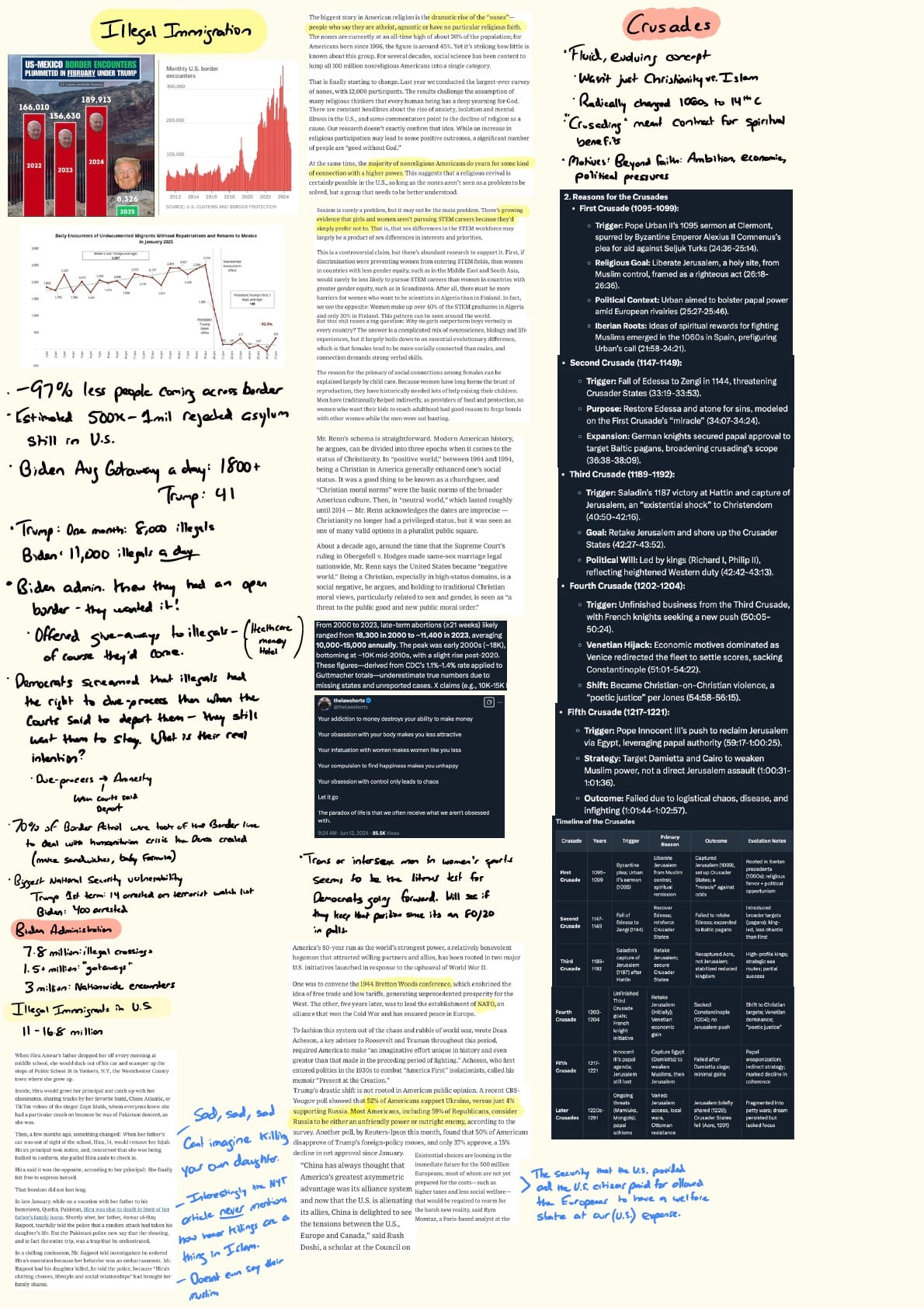
- Crusading as a Fluid, Evolving Concept
- Not a Fixed War: Jones emphasizes that crusading wasn’t a static “civilizational war” between Christianity and Islam. It changed radically from the 1060s to the 14th century, driven by diverse motives beyond religion (0:07, 12:55-13:33).
- Crusaders vs. Crusades: He suggests focusing on “Crusaders”—individuals who took the cross via a formal church vow—rather than numbered “Crusades,” a historian’s construct (9:30-10:15). Crusading meant a contract for spiritual benefits (e.g., remission of sins), not just a campaign (10:28-11:54).
- Complexity of Motives: Beyond faith, personal ambition (making a name, finding purpose), economic gain, and political pressures shaped participation (12:17-12:36, 13:59-14:06).
- Reasons for the Crusades
- First Crusade (1095-1099):
- Trigger: Pope Urban II’s 1095 sermon at Clermont, spurred by Byzantine Emperor Alexius II Comnenus’s plea for aid against Seljuk Turks (24:36-25:14).
- Religious Goal: Liberate Jerusalem, a holy site, from Muslim control, framed as a righteous act (26:18-26:36).
- Political Context: Urban aimed to bolster papal power amid European rivalries (25:27-25:46).
- Iberian Roots: Ideas of spiritual rewards for fighting Muslims emerged in the 1060s in Spain, prefiguring Urban’s call (21:58-24:21).
- Second Crusade (1147-1149):
- Trigger: Fall of Edessa to Zengi in 1144, threatening Crusader States (33:19-33:53).
- Purpose: Restore Edessa and atone for sins, modeled on the First Crusade’s “miracle” (34:07-34:24).
- Expansion: German knights secured papal approval to target Baltic pagans, broadening crusading’s scope (36:38-38:09).
- Third Crusade (1189-1192):
- Trigger: Saladin’s 1187 victory at Hattin and capture of Jerusalem, an “existential shock” to Christendom (40:50-42:16).
- Goal: Retake Jerusalem and shore up the Crusader States (42:27-43:52).
- Political Will: Led by kings (Richard I, Philip II), reflecting heightened Western duty (42:42-43:13).
- Fourth Crusade (1202-1204):
- Trigger: Unfinished business from the Third Crusade, with French knights seeking a new push (50:05-50:24).
- Venetian Hijack: Economic motives dominated as Venice redirected the fleet to settle scores, sacking Constantinople (51:01-54:22).
- Shift: Became Christian-on-Christian violence, a “poetic justice” per Jones (54:58-56:15).
- Fifth Crusade (1217-1221):
- Trigger: Pope Innocent III’s push to reclaim Jerusalem via Egypt, leveraging papal authority (59:17-1:00:25).
- Strategy: Target Damietta and Cairo to weaken Muslim power, not a direct Jerusalem assault (1:00:31-1:01:36).
- Outcome: Failed due to logistical chaos, disease, and infighting (1:01:44-1:02:57).
- Evolution and Decline
- Shift in Focus: From Jerusalem-centric holy wars (First-Third) to opportunistic campaigns (Fourth) and papal power plays (Fifth onward) (38:33-1:00:07).
- Christian-on-Christian Violence: The Fourth Crusade’s sack of Constantinople (1204) and later petty wars (e.g., 14th-century Iberian conflicts) diluted the original ethos (56:09-1:07:53).
- Endurance of the Dream: Despite failures, the idea persisted into the 16th century (e.g., Henry VIII’s ambitions) and echoes in modern conflicts (1:09:23-1:12:18).
- Failure Narrative: Jones calls it a “weird blip,” not triumphalist—structurally unsustainable due to distance, cost, and waning will (1:06:40-1:07:30).
- Modern Parallels and Perception
- Communications Revolution: Jones compares crusading’s spread to today’s digital revolution, akin to the Reformation’s printing press (1:52-3:52).
- Cultural Legacy: From heroic tales (e.g., 1991’s Robin Hood) to a critique of Western imperialism, the Crusades’ image flipped in public consciousness (1:06:03-1:06:34).
- Ongoing Resonance: Seen in extremist rhetoric (e.g., ISIS calling victims “Crusaders” in 2019 Sri Lanka bombings) (1:11:55-1:12:18).
Timeline of the Crusades
| Crusade | Years | Trigger | Primary Reason | Outcome | Evolution Notes |
|---|---|---|---|---|---|
| First Crusade | 1095-1099 | Byzantine plea; Urban II’s sermon (1095) | Liberate Jerusalem from Muslim control; spiritual remission | Captured Jerusalem (1099), set up Crusader States; a “miracle” against odds | Rooted in Iberian precedents (1060s); religious fervor + political opportunism |
| Second Crusade | 1147-1149 | Fall of Edessa to Zengi (1144) | Recover Edessa; reinforce Crusader States | Failed to retake Edessa; expanded to Baltic pagans | Introduced broader targets (pagans); king-led, less chaotic than First |
| Third Crusade | 1189-1192 | Saladin’s capture of Jerusalem (1187) after Hattin | Retake Jerusalem; secure Crusader States | Recaptured Acre, not Jerusalem; stabilized reduced kingdom | High-profile kings; strategic sea routes; partial success |
| Fourth Crusade | 1202-1204 | Unfinished Third Crusade goals; French knight initiative | Retake Jerusalem (initially); Venetian economic gain | Sacked Constantinople (1204); no Jerusalem push | Shift to Christian targets; Venetian dominance; “poetic justice” |
| Fifth Crusade | 1217-1221 | Innocent III’s papal agenda; Jerusalem still lost | Capture Egypt (Damietta) to weaken Muslims, then Jerusalem | Failed after Damietta siege; minimal gains | Papal weaponization; indirect strategy; marked decline in coherence |
| Later Crusades | 1220s-1291 | Ongoing threats (Mamluks, Mongols); papal schisms | Varied: Jerusalem access, local wars, Ottoman resistance | Jerusalem briefly shared (1229); Crusader States fell (Acre, 1291) | Fragmented into petty wars; dream persisted but lacked focus |
Crusading Changes Across Time:
- 11th Century: Began as a religious pilgrimage with spiritual rewards, sparked by Iberian experiments and Byzantine distress (1060s-1090s).
- 12th Century: Became a duty to defend fragile Crusader States, expanding targets (e.g., Baltic pagans) as success bred ambition.
- 13th Century: Shifted to political and economic ends (e.g., Fourth Crusade’s Venetian pivot), with papal overreach diluting focus.
- 14th-16th Centuries: Devolved into symbolic gestures and local conflicts, losing coherence as Ottoman power rose and Western will faded.
Critical Notes
- Reasons Evolve: The podcast underscores that crusading wasn’t solely religious—political necessity (defending states), personal gain, and papal power shaped each wave. The First’s “miracle” (28:52) set an unsustainable precedent.
- Not Triumphalist: Jones rejects heroic narratives (1:05:43), highlighting failures (e.g., Second, Fifth) and absurdities (Fourth’s Christian-on-Christian turn), a contrast to pop culture’s gloss (1:06:08).
- Data Gaps: Specific participant numbers or economic costs aren’t detailed, reflecting medieval records’ limits—Jones relies on narrative synthesis over stats.
- Modern Lens: The shift from “cool” (1990s) to “ imperialist critique” (2020s) mirrors woke culture’s influence, though Jones avoids that term (1:06:15).
This breakdown captures the podcast’s core historical insights, aligning with your focus on reasons and timeline, while noting crusading’s messy, non-linear arc. Let me know if you’d like deeper dives into specific Crusades or themes!