1: Roots of Reason
Here’s a comprehensive summary of the lecture, broken into thematic sections for clarity:
Overview and Shifting Perspectives on European History
-
The lecture introduces a course on European history titled “Europe: Rise and Fall.”
-
Historically, Europe was viewed as the center of global progress (“The Expansion of Europe”), a narrative now seen as outdated and Eurocentric.
-
The traditional view saw European culture as dominant and final—exemplified by Francis Fukuyama’s The End of History—but this confidence has eroded in the age of decolonization, cultural critique, and economic and political decline.
-
Present-day discussions focus on reparations, artifact repatriation, and critiques of European exceptionalism.
-
History is not about morality
-
Should European History be defended?
-
No other continent is talked about how the West is, having to defend their history and being stained by them
What is Europe?
-
“Europe” as a concept evolved over time: originally denoting lands north and west of the Mediterranean.
-
The idea of a distinct European civilization arose between the 15th and 18th centuries, as Europeans encountered other cultures.
-
The 19th century marked “Europe’s Century,” when it was considered the civilizational standard globally.
- Controlling civilization
-
Greco-Roman + Judeo-Christian values
Course Structure
The course is structured in 8 lectures, covering:
- Origins of Modernity (1688–1815) – Enlightenment and Revolutions.
- Europe’s Century – Industrialization and Imperialism.
- Decline of Europe – Two World Wars and the Cold War.
- The Future of Europe – The EU and debates on identity and destiny.
Why Begin in 1688?
Four pivotal events:
- End of religious wars (Glorious Revolution in 1688).
- Isaac Newton’s Principia (1687): introduced a rational, understandable universe.
- Locke’s Essay Concerning Human Understanding (1689): argued knowledge comes from experience, not innate ideas (religion). Blank slate.
- Political reform in England: Bill of Rights, religious toleration, rise of Parliament.
- “The civil wars of ancient Rome brought slavery, but the troubles in England have brought liberty.” -Voltaire
Key Enlightenment Ideas
-
Reason: Humans should use intellect, not superstition.
-
Toleration: End religious persecution.
-
Freedom: Of thought, speech, and belief.
-
Optimism and Progress: The world can improve through knowledge.
-
Happiness and Benevolence: Human flourishing as a right.
-
Nature: Seen as rational, good, and a model for society.
-
Leave behind fanaticism
-
Francis Bacon: “Knowledge is power”
-
Reason, Freedom and the Birth of Modern Politics
-
John Locke, from the work that I mentioned earlier, and this is hugely important, and he couldn’t have written this before. If he had, he’d have been probably locked up. “Faith,” he says, “faith can have no authority against the plain and clear dictates of reason.” So religion does not dictate what we must believe. Reason dictates what we can believe. Also, Locke: “Men are naturally free.” The governments of the world were made by the consent of the people. Now, we know that this idea runs all the way through 18th-century political thinking, and of course, it’s embodied in the American Constitution.
-
Lord Shaftesbury, who I’ll shortly be mentioning again, but he was a considerable figure who wrote influential works on politeness. I’ll come to politeness in a moment. So Shaftesbury said, “There is a mighty light which spreads itself over the whole world, especially in those free nations of England and Holland, on whom the affairs of Europe now turn.”
-
Immanuel Kant, who was asked what Enlightenment meant, what did the Aufklärung mean, and he said it means “sapere aude,” dare to know. Those, I think, are key ideas of the Enlightenment.
-
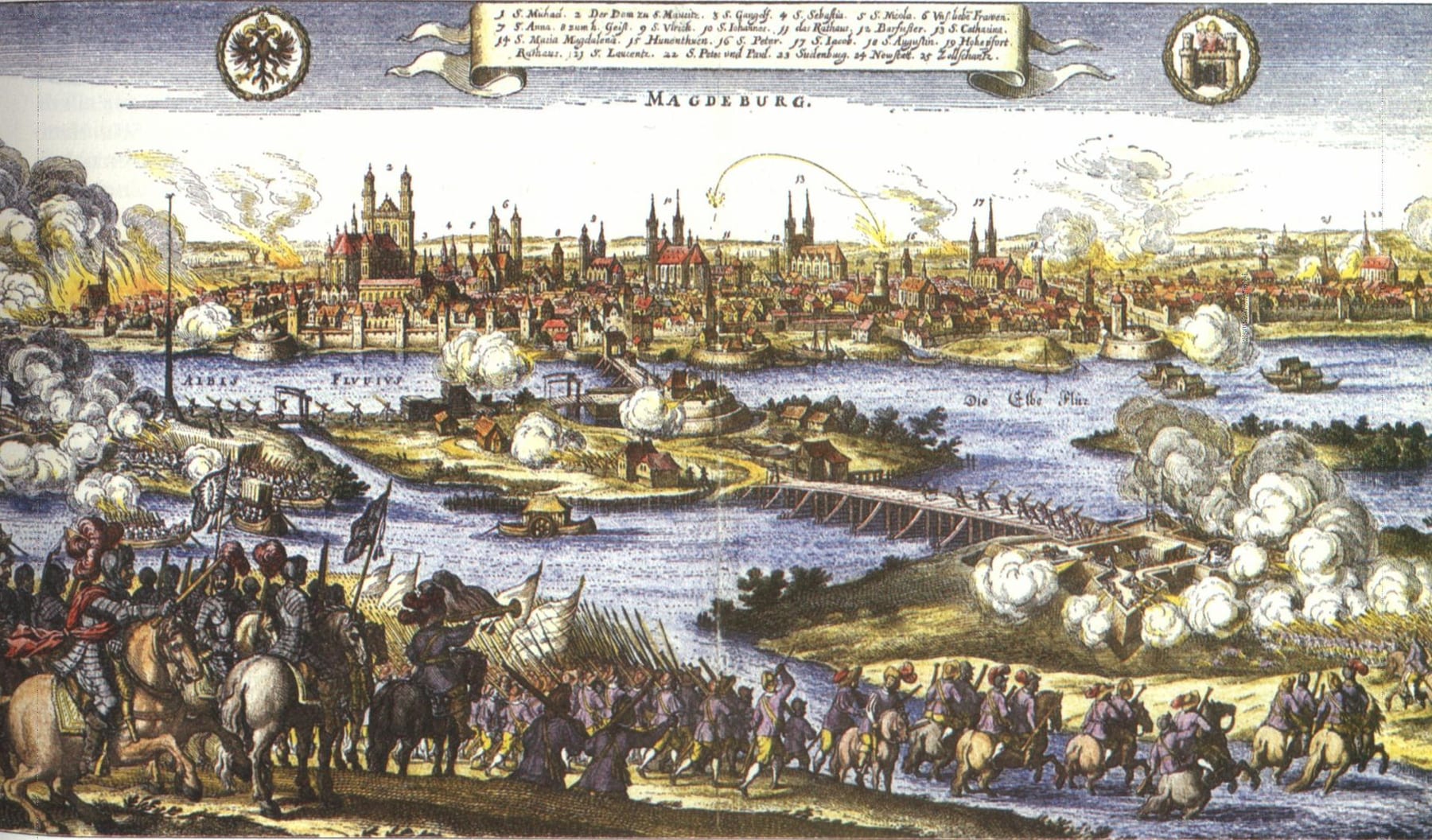
What’s the context? Now, why are people talking and thinking like this now? The context is a desire to replace religious conflict and persecution with toleration and Shaftesbury’s idea of politeness. There’d been more than 150 years of terrible religious conflict, as I said. Here is a picture of the siege of Magdeburg in 1631, in which apparently 20,000 people were killed in one town. This gives you an example of what Europe was like in the 17th century.
-
Millions killed in wars
-
Towards toleration of difference
-
John Locke wanted freedom to think things out, and changes in religious belief encouraged the view that the world was not coming to an end as many people had believed. It was not racked by witchcraft and the devil. It was not stained by sin. One theologian had said, well, the world is a dirty little planet, and most people were not doomed to hell, and that happiness and pleasure were part of being human. This was a huge change in thinking.
Cultural and Intellectual Changes
-
Public sphere: New places for discussion—salons, coffeehouses, pubs.
-
Books and newspapers flourished; cultural consumption increased.
- Daniel Defoe’s novel, Robinson Crusoe, was probably the first, the first proper novel in English, probably the first, certainly the first international bestselling novel. Why Robinson Crusoe? Because it’s the story of an individual faced with nature, alone in nature, and using his reason to survive and to create a kind of miniature civilization for himself.
-
Mozart and Haydn moved from court employment to public celebrity.
- Household servants
- Artists from servants, to artists servants of the public
-
Rise of the “Republic of Letters”: international intellectual exchange.
- a man named Thomas Turner, who had a grocery shop in Sussex in the south of England. He owned more than 70 books and periodicals, including works by Locke, which I mentioned, by the essayist Addison, the novelist Lawrence Stern, the nature poet Edward Young, the works of Shakespeare and Milton. He was reading several new books a year. He read sermons to his friends, and he read Locke’s great work in his shop between customers. So ordinary people, too, were taking part in this new cultural life.
-
Coffee houses
-
Freemasons
-
Cultural Movements
-
Pubs
-
Public life left controlled
-
Encyclopédie
- there’s a mission statement of Enlightenment, which comes in its greatest work, I think its greatest single work, which is the French Encyclopedia, the Encyclopédie, which was published in 35 volumes between 1751 and 1772. Around 20,000 people contributed to this enterprise, which shows the scale of this phenomenon. I think only in France could this have been done at the time, though it was still quite dangerous to do.
- And the editor wrote—and this, I think, is very important—he wrote that the aim of the Encyclopédie, and I’m quoting now, was “to collect all the knowledge scattered over the face of the Earth so that our children, by becoming more educated, may at the same time become more virtuous and happier. All things must be examined, debated, investigated without exception and without regard to anyone’s feelings. We have long needed a reasoning age when men would no longer seek the rules in classical authors, but in nature.”
- there’s a mission statement of Enlightenment, which comes in its greatest work, I think its greatest single work, which is the French Encyclopedia, the Encyclopédie, which was published in 35 volumes between 1751 and 1772. Around 20,000 people contributed to this enterprise, which shows the scale of this phenomenon. I think only in France could this have been done at the time, though it was still quite dangerous to do.
-
John Wilkes
-
So there were limits to freedom, quite considerable limits to freedom, even in England. In France, much worse. Almost at the same time, 1766, a young man called the Chevalier de la Barre was also accused of blasphemy on very slight grounds, and he came off less well than Wilkes, who ended up as Lord Mayor of London. So there was a happy ending for Wilkes, but the Chevalier de la Barre was sentenced to death for blasphemy. He was tortured, first of all, to make him reveal his accomplices; he didn’t. Had his tongue torn out, and then he was burnt, and a copy of the works of Voltaire thrown onto the pyre with his body.
-
So there were limits to freedom, and you were always like Diderot, risking the Bastille. The fortress in Paris is where writers could be locked up. That was the usual place for locking up writers. And you didn’t need a trial. You just have a signature on a document from the king or from a minister who would lock you up. So it was still a dangerous world. But even in this dangerous world
Major Enlightenment Figures & Works
- Locke, Voltaire, Kant, Rousseau, Montesquieu, Adam Smith, Beccaria, Richardson, and Defoe.
- Works included Robinson Crusoe, Spirit of the Laws, Wealth of Nations, Candide, Social Contract, and the Encyclopédie.
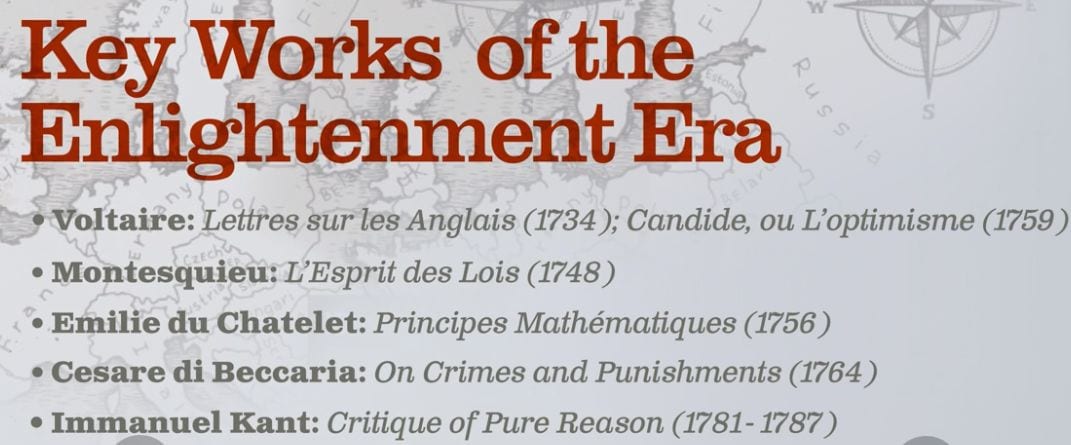
Montesquieu and Adam Smith
- Montesquieu: Separation of powers as the basis of liberty.
- Classify different types of political systems
- Smith: Market forces (the “invisible hand”) organize society naturally.
- Doesn’t need to be run by Churches or Monarches
Jean-Jacques Rousseau’s Critique of Enlightenment
-
Argued civilization corrupts natural goodness.
-
Advocated for small communities close to nature (as in Émile and Julie).
-
Introduced the concept of the “general will”, a powerful idea that could justify authoritarianism in the name of unity.
-
Enlightenment superstar
-
Civilization is bad and corrupt, away from “true nature”
-
Rousseau’s idea about social corruption and the desire to “destroy the system and start afresh” have had a lasting impact on modern thought
Tension Within Enlightenment Thought
-
Example: Rousseau vs. Lord Chesterfield on upbringing and manners.
- Rousseau: authenticity and nature.
- Chesterfield: polished, performative politeness.
-
Contradictions between ideals of nature vs. artificiality, freedom vs. control, and individualism vs. conformity.
-
“Everything is good as it leaves the hands of the creator; everything degenerates in the hands of man. He wants nothing as nature has made it, not even man; he has to be trained like a circus horse, twisted like a tree in his garden.” -Rousseau, Emile (1762)
-
“Apply yourself to Marcel’s lectures.” Marcel was a famous dancing master. “Apply yourself now to Marcel’s lectures. Desire him to teach you every genteel attitude that the human body can be put into. Take particular care, take particular care, that the motions of your hands and arms be easy and graceful.” -Chesterfield
-
“If I were a dancing master, I would not do all Marcel’s monkey tricks. I would take my student to the foot of a rock to tread the steep paths lightly. I would make him copy a mountain goat rather than a ballet dancer.” -Rousseau
-
“The man of the world consists wholly of his mask. What he is means nothing to him; what he appears to be means everything.” -Rousseau
-
Chesterfield thinks that the hallmark of success is that people might think you are French. And he says to his son, “The ideal is to make the French say, qu’on diroit que c’est un François.” The French say, “You’d think he was French.” So exactly, Chesterfield doesn’t care what you really are. He cares about what you look like. Here we have this deep divergence within this 18th-century culture. Rousseau was encouraging and spreading admiration for nature. But Enlightenment ideas of nature were often aimed at improving it, rather like Chesterfield improving his son’s movements. There’s a huge vogue for English-style gardens all over Europe. But the thing about a garden, of course, English-style gardens, were meant to look natural, but of course, they were not natural. They were pretending to be natural, rather like Chesterfield’s son.
-
“He wants nothing as nature has made it, not even man.” -Rousseau
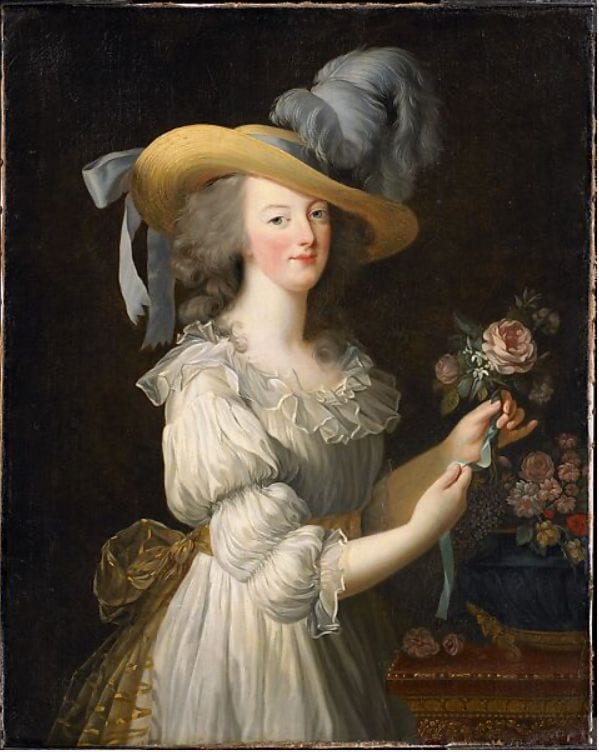
Marie Antoinette by Elisabeth Vigee Lebrun (1783)
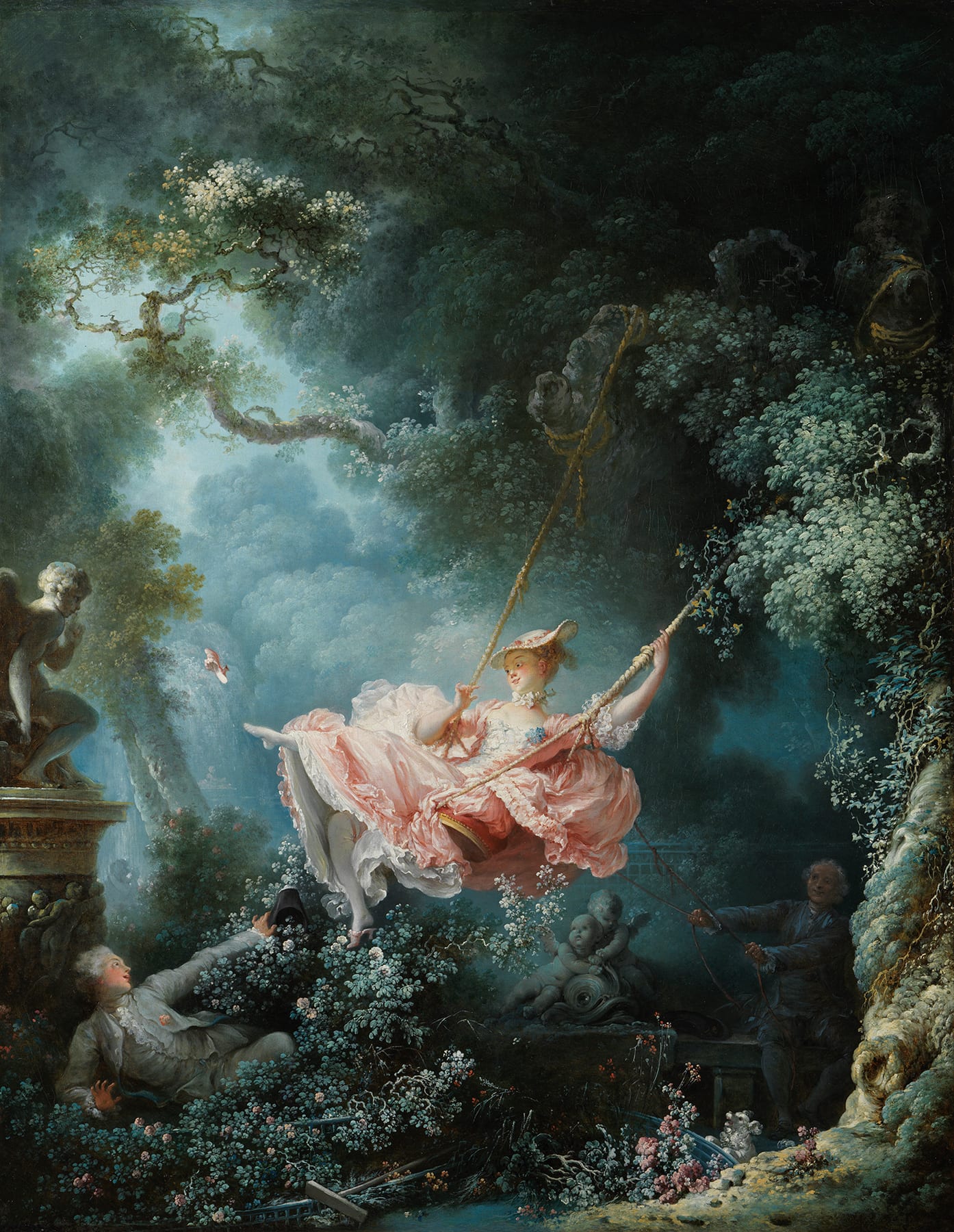
The Swing by Fragonard (1767)
Nature, Science, and Colonialism
- Enlightenment embraced both admiration for nature and scientific manipulation of it.
- Voyages of discovery and the exploitation of foreign lands blurred lines between curiosity, admiration, and domination.
- Enlightenment thinkers exoticized and often misrepresented non-European cultures (e.g., Omai, Equiano).
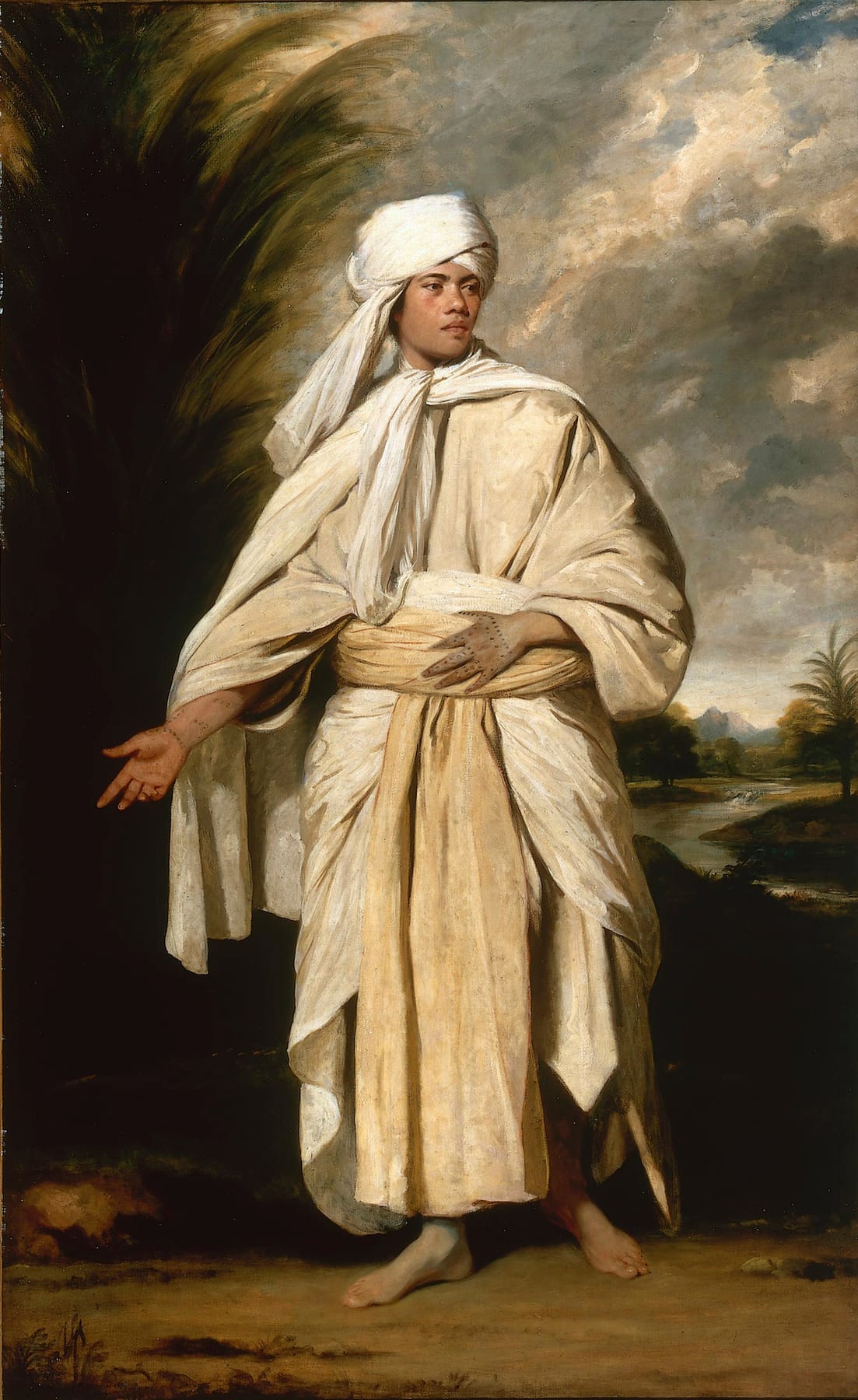
Critiques of the Enlightenment (Modern and Historical)
-
Critics argue Enlightenment universalism enabled racism, colonialism, and male-dominated norms.
-
It established the “white, Western male” as the standard of civilization.
-
Enlightenment thought created systems to classify, order, and control—tools of both science and imperialism.
-
Postmodern critiques challenge the Enlightenment’s claim to objective truth.
-
“The past is still present,” says the Pitt Rivers, “and the invisible structures of colonialism still persist today. These invisible structures, known as coloniality, shape our ideas about race, class, culture, gender, and sexuality. Coloniality divides the world into the West and the rest, and assigns racial, intellectual, and cultural superiority to the West. Coloniality creates and shapes these ideas through three overall processes—by establishing hierarchies, by controlling knowledge, and by imposing white culture and place names.”
Defending the Enlightenment
-
Despite its contradictions and dark legacies, Enlightenment values underpin many modern ideals:
- Freedom of thought, rational inquiry, scientific advancement, and human progress.
-
The lecture concludes with Kant’s phrase: “Sapere aude” — Dare to know, as a rallying call for ongoing critical thought.
-
We have to beware of caricaturing 18th-century culture, which was a time, after all, of great debate and ferment. There was not a single set of ideas, and many of the criticisms made by present-day commentators were made by leading thinkers at the time. Some thought that their ideal of creating a peaceful and free world of commerce had failed. Many criticized slavery and colonial conquest as immoral. This was hugely important because nobody else in history had criticized it.
-
And in a sense, to prove its dangers, a monster that had emerged from the Enlightenment. So it’s right to see the complexities of the Enlightenment, including its dark sides, its failures and its illusions. But it would be a caricature to see only the dark sides. And undeniably, much of what we see as gains of the modern world, including freedom of thought, of speech, of writing, rational investigation, including in science, technology, medicine, the belief that human life can be improved and we are not stuck in unchanging ancestral ways. All these things, too, owe a huge debt to Enlightenment thought.
Q&A Highlights
- On Rousseau: Had a vision, but impractical; his concept of the general will could be used to justify totalitarianism.
- I just wondered if you could tell me if Rousseau had a prescriptive vision for the rebuilding or if he just criticized what was around him at the time.
- Well, he did, but I don’t think it could be said to be a very realistic one, and I’m not sure that he felt it was real. I mean, his idea of society is that it must be close to nature. Well, it’s a nice idea, but in practice, the way he developed it was a fairly inhuman one. If Emile had been a real person, you would think, gosh, this poor boy is being put through the most appalling ordeal in his childhood and is bound to turn out badly. But in his social contract, it’s one of many contractual theories of government in which you assume that there is, there has been a pre-state age, as it were.
- Hobbes called it the state of nature when life was, I can’t remember quite the phrase, nasty, brutish, and short. Then people somehow get together and they agree to set up a government. OK, this is fiction, but the idea that government comes from people agreeing together to set up a government and obeying that government is, I suppose, in many ways, the foundation of what we assume about modern democracies. But Rousseau’s idea was based on his experience in Geneva, and he did say he thought this was only possible in small communities, because in a large state like France, 20 million people, you couldn’t have the citizens all coming together to agree on their laws.
- There is always a problem, and has always been a problem since, in what do you mean, how do you represent people in a state? Even if you want to be democratic, how can you actually do it? I don’t think Rousseau really had an idea. His solution was to talk about the general will, which is a somewhat mysterious idea, which doesn’t just mean the majority view. It means that somehow there is, in the community, a vision or a view of things which is the one that must prevail, and that anyone who doesn’t agree with it becomes an outlaw.
- Well, in the French Revolution, and indeed, in later totalitarian regimes, some of which have been blamed on Rousseau, this idea can obviously be put to very dangerous uses. If you claim that I represent the general will, you, because you disagree with me, are a traitor and therefore deserve to die, as Rousseau said. It’s not what we would think of as a pluralistic, liberal way of conducting democratic affairs. It’s a kind of—someone called it a totalitarian democracy. I don’t think Rousseau ever did really have a solution, and what he suggested was very dangerous, or at least it was put to very dangerous uses.
- On Indigenous Influence: Enlightenment thinkers idealized indigenous people as “noble savages” but rarely understood them deeply; real-world contacts were often exploitative or ended tragically.
- The Nobel Savage
- Projected onto societies
- Captain James Cook was sent off with instructions to treat indigenous people with respect but ultimately killed in a clash with Polynesians.
- Intentions may have been high-minded, but had unintended consequences.
- On Religion and Science: Enlightenment wasn’t purely anti-religious. Many thinkers (e.g., Newton, Locke) were devout. The goal was to remove superstition and see religion through rational lenses.
- if I gave the impression that the Enlightenment was an anti-religious movement, that’s wrong. I mean, the Enlightenment consisted of all sorts of things. People like Newton himself was highly religious. And as you may know, he believed that the force of gravity, which he, in a sense, discovered or at least explained, was the result of the will of God. I mean, he didn’t—and he also believed that the world was coming to an end. I can’t remember whether he thought the year 2000 was the likely date. But many Enlightenment philosophers were definitely working within a religious framework.
- And although there were some, of whom Voltaire is the most famous or notorious, who were extremely opposed to the Catholic Church, it was particularly in France that Enlightenment took on an anti-Catholic and eventually anti-religious element, largely because of the structure of power within that society. But in Britain and in Germany and in Italy, there was not such a conflict between science and religion. And indeed, many clergy were prominent as Enlightenment thinkers and writers.
- But the difference was between what is often called a Calvinist understanding in which, as I said, it was assumed that everything that happened was a result of divine will and intervention, or indeed of diabolical intervention. That is, which then many 18th-century thinkers regard or start to call superstition. They want religion to be purified of superstition and fanaticism, and to become, as they see it, a truer, and indeed, Rousseau calls it, a more natural form of religion. So there is a God, there is a creator, and that creator ought to be worshiped, honored. But the creator is not someone who is constantly interfering in human society to punish some and to reward toward others.
- And indeed, a famous analogy was to talk about the creator as rather like a clockmaker who creates this complex universe and then allows it to operate on its own. So there comes to be an idea of the divine and of religion that is much closer to what they would have thought of as philosophy. And therefore, for Locke, as I said, reason cannot be disproved by religion, but then that’s because he thinks that the works of God are rational. So there’s no conflict between reason and religion. Science and philosophy are the way of helping to discover the true nature of creation and the true nature of religion.
2: Conflict in the Age of Reason
Here’s a thorough summary of the lecture, which explores the contradictions of the Enlightenment and the tumultuous political, social, and military transformations of the 18th century:
1. The Contradictions of the Enlightenment
- Enlightenment ideals—tolerance, peace, reason, and improvement—coexisted with immense violence and warfare. The 18th century, often called the “Century of Light,” was also a century of blood, witnessing six of the twelve biggest wars in history.
- Major wars included the
- Nine Years’ War, the
- War of the Spanish Succession, the
- War of the Austrian Succession, the
- Seven Years’ War (a global conflict), the (First World War?)
- American Revolutionary War, and the
- French Revolutionary and
- Napoleonic Wars.
- Over 5.5 million battlefield deaths occurred during this time, excluding vast civilian casualties.
2. Enlightenment Disillusionment
- Leading thinkers questioned the Enlightenment’s promise:
- Voltaire’s “Candide” satirized the optimism of the time, ending with a retreat to private life (“cultivate our garden”).
- David Hume worried that too much liberty might be dangerous.
- Adam Smith feared commerce, rather than promoting peace, might drive war and conquest.
3. Geopolitical Landscape Around 1710
- Major powers included
- **Qing China (210M),
- Mughal India (150M)
- France (20M).
- German (20M)
- Ottoman Empire (25M)
- Russia (25M)
- Britain (9M) was relatively small, yet rose in power due to financial and naval dominance.
- France was Europe’s superpower but became the focus of efforts to curb hegemony (especially post-Louis XIV).
4. Britain vs. France: The Rise of Sea Power
- Neptune’s trident (sea power) came to define global dominance.
- I was reading French foreign ministry archives from the 18th century and was very impressed by how perceptive many of them were. One of the reports says, “Once, land forces made the destiny of states. But since a century ago, Neptune’s trident has become the scepter of the world.” That was written in 1779.
- British strength lay in commerce, taxation, credit, and institutional trust (e.g., the City of London and Parliament), unlike France’s monarchy, which investors didn’t trust.
- The “second Hundred Years’ War” (1688–1815) was essentially a long struggle to contain or defeat French power.
- Napoleon defeated at waterloo
- It’s because power and wealth now come from sea, the sea, from control of the sea, from global commerce. Means that the second Hundred Years’ War, the core of it, will be a conflict between the great land power, France, and the rising sea power of Britain.
5. Enlightened Despotism
- Enlightenment principles were adopted by rulers like Frederick II (Prussia), Catherine the Great (Russia), and Joseph II (Austria) to rationalize governance and strengthen state power—not necessarily to foster liberty.
- Example: Russia abolished the death penalty not out of compassion but to preserve labor value (slave laborer).
- Reason used to strengthen rulers without the best morality.
6. Slavery and Abolition
- Slavery fueled global trade, especially sugar, tobacco, and coffee. Britain led the transatlantic slave trade as shippers; France and Brazil were leading buyers.
- Ethical opposition rose in the late 18th century:
- British abolitionists like Wilberforce led campaigns against slavery and the slave trade.
- Campaign was damaged by fears of revolution and outbreak of war with France
- Visual propaganda (e.g., the slave ship Brooks, Wedgwood’s “Am I not a man and a brother?” badge) fueled public sentiment.
- The trade was banned in the British Empire in 1807, slavery abolished in 1833.
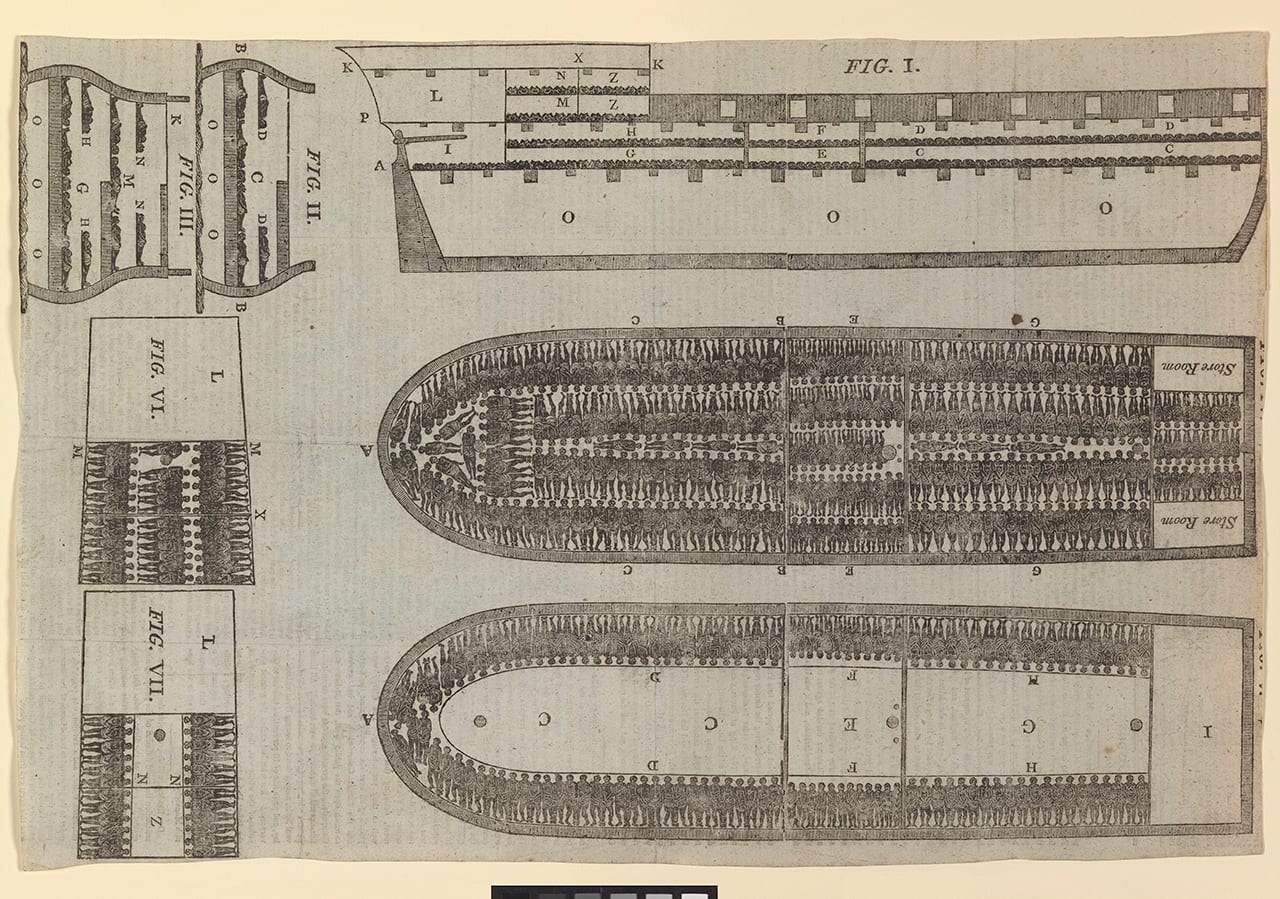
- British abolitionists like Wilberforce led campaigns against slavery and the slave trade.
7. Rise of Patriotism and Political Change
- Patriotism replaced dynastic loyalty. It was both a political tool and an emotional ideology, but also a threat to monarchic legitimacy.
- Samuel Johnson warned that patriotism was “the last refuge of the scoundrel.”
- Paintings like David’s Oath of the Horatii portrayed patriotism as a male civic virtue.
- Politicians like William Pitt the Elder were seen as patriots challenging traditional authority and corruption.
- What the French say about him is this. “His ambition is not wealth, for he despises it and is incorruptible, but power. In France, Mr. Pitt would end his days in prison. In Russia, would have made a revolution or had his tongue torn out. In England, he obtained high office.”
- Frederick the Great of Prussia famously said, “The Prince is only the first servant of the state.” So the justification for Frederick being king is he is the servant. If you can bring that off, if you can call yourself a patriot king, as George III in England did, or Frederick II of Prussia, then maybe you can ride out this patriotic wave. You can put yourself at the head of the patriotic movement.
- But if you fail to do that, then you’ll find yourself in great political difficulties in which the king himself, as in the case of France, is seen as not serving the nation, not serving the state, serving himself or his courtiers, but not the true interests of the nation. And that’s, in a sense, why, to cut a long story short, revolution takes place in France in July ‘89.
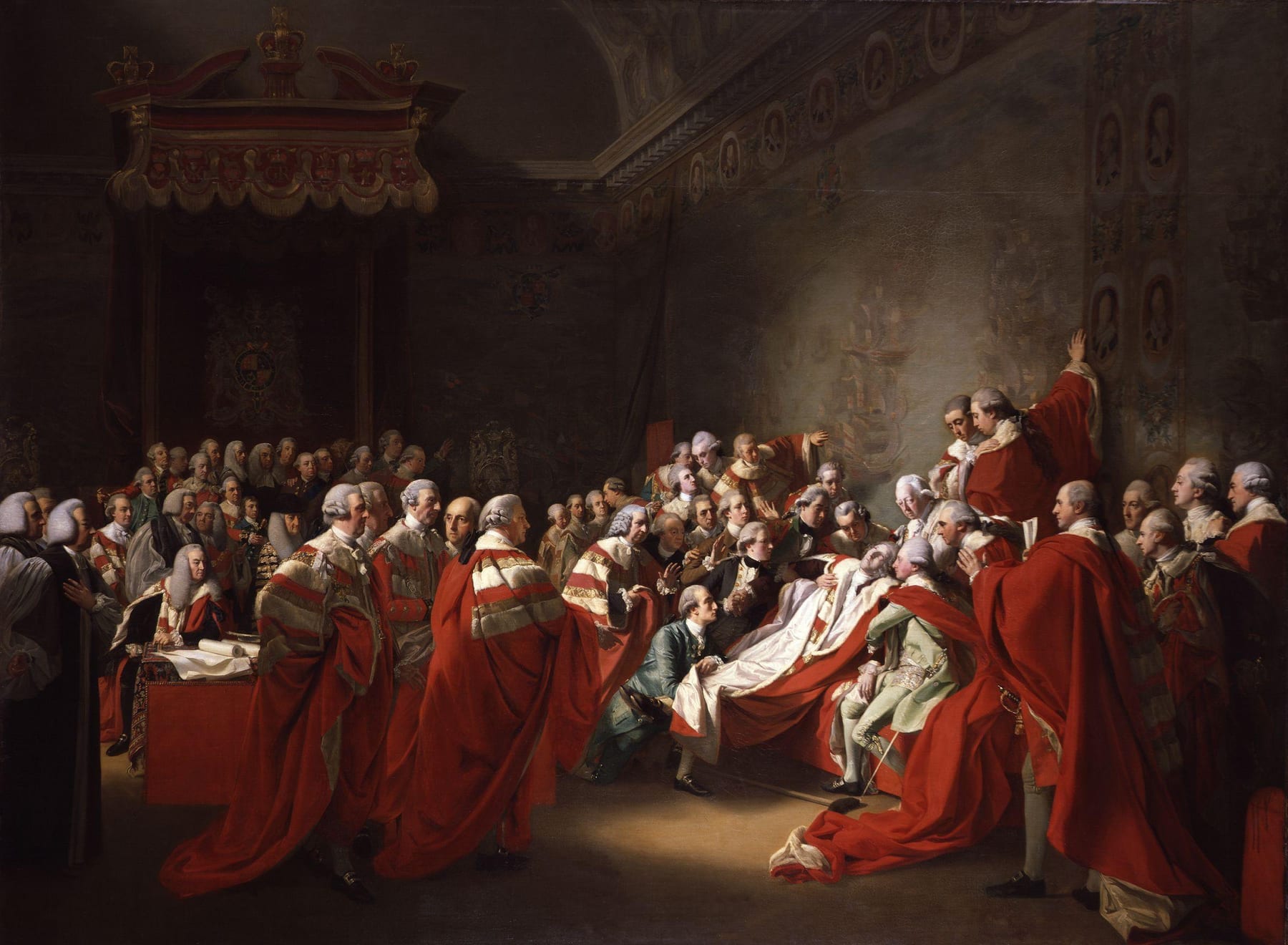
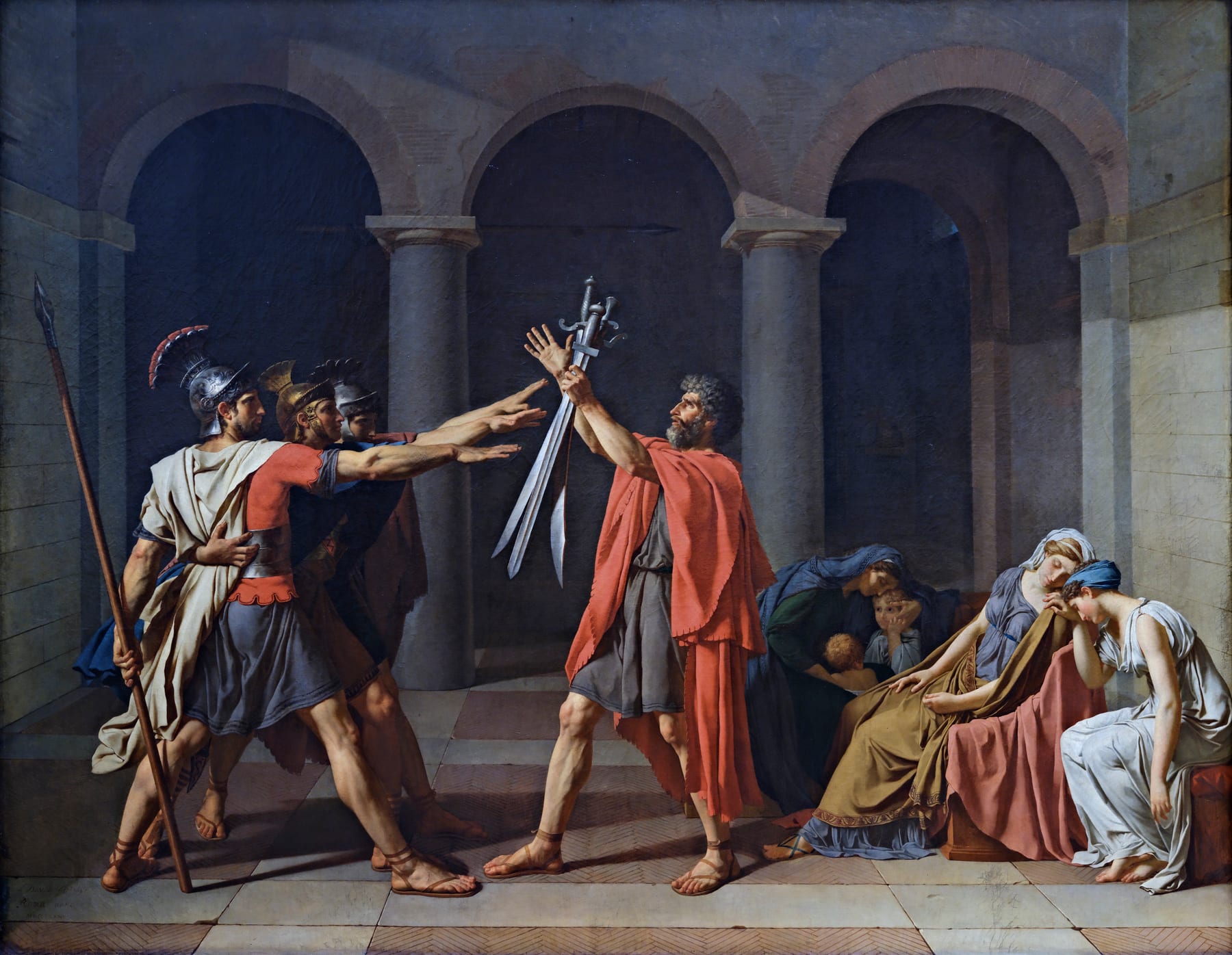
- But if you fail to do that, then you’ll find yourself in great political difficulties in which the king himself, as in the case of France, is seen as not serving the nation, not serving the state, serving himself or his courtiers, but not the true interests of the nation. And that’s, in a sense, why, to cut a long story short, revolution takes place in France in July ‘89.
8. The French Revolution (1789)
- Sparked not primarily by tyranny but by financial collapse from war (especially with Britain).
- France’s ambition to be both land and sea power bankrupted it, unlike Britain, which could specialize.
- Enlightenment ideals became institutionalized:
- Declaration of the Rights of Man and Citizen (1789) affirmed liberty, equality, sovereignty of the nation.
- Declaration of the Rights of Man and the Citizen, which was adopted in August 1789. Article 1—Men are born and remain free and equal in rights. Article 2— The aim of every political association is the protection of the natural and imprescriptible rights of man. These rights are liberty, property, security, and resistance to oppression. Article 3—The principle of all sovereignty resides essentially in the nation. Nobody and no individual may exercise any authority that does not expressly emanate from it. So the sovereign is not the king, the sovereign is the nation.
- France helped Americans to break away from British empire and was the final straw. War of Revenge Against Britain
- Declaration of the Rights of Man and Citizen (1789) affirmed liberty, equality, sovereignty of the nation.
- English poet William Wordsworth, who turned against it later. But he wrote of his feelings at the time, and you may know this line, “Bliss was it in that dawn to be alive, but to be young was very heaven!” Because it seemed the world was changing before their eyes and the ideals of the Enlightenment were at last being embodied.
9. Women and Citizenship
- Years before, the English writer Mary Astell had written, “If all men are born free, why is it that all women are born slaves?”
- Women’s rights remained deeply problematic:
- Citizenship was tied to the ability to fight; since women didn’t, many denied their full inclusion.
- The divorce law was used initially to empower men.
- Passed after French Revolution
- Abolished after they found women were getting rid of their husbands instead
- Olympe de Gouges and Mary Wollstonecraft argued for women’s rights, but de Gouges was executed and women’s political clubs were banned.
- Olympe de Gouges wrote a Declaration of the Rights of Woman and the Citizeness in 1791
- And in England, Mary Wollstonecraft wrote A Vindication of the Rights of Women.
10. Revolutionary Radicalism and the Reign of Terror (French Revolution)
- Revolutionaries tried to start society anew, rejecting English models and historic French provinces.
- Introduced the metric system, new calendar, and worship of reason or supreme being.
- Edmund Burke criticized this utopianism in Reflections on the Revolution in France (1790), predicting dictatorship.
- Fairy land of philosophy. Not how human nature works.
- We need prejudices. Can only rely on force.
- Radicalism travelled far from French Revolution
- Netherlands, Germany, Italy
- Saint-Domingue: Haiti
- Huge slave colony
- Slave rebellion
- Showed slave system was not eternal
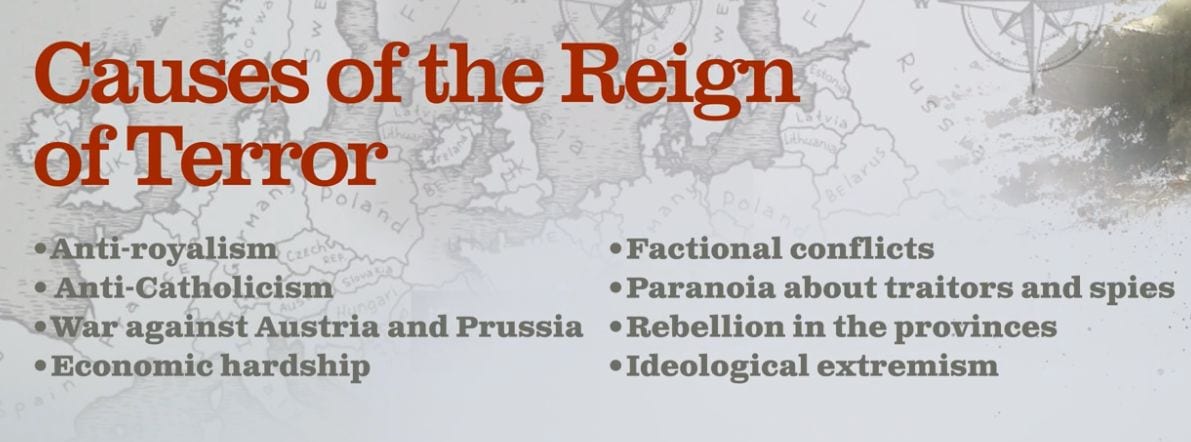
- The Reign of Terror (1793–94) emerged from:
- War, economic hardship, factionalism, paranoia, and ideology (influenced by Rousseau).
- Robespierre famously declared terror an emanation of virtue.
- I want to quote to you something that was said in a speech in the French Convention, the French Parliament, by the principal theorist and practitioner of terror, Maximilien Robespierre, who himself was guillotined at a fairly early age. I think he was only 34. This was all a very young man’s revolution. He was certainly influenced by Rousseau, and he insisted that terror is an emanation of virtue. And this is his speech of February 1794, and it seems to me, as I say, it recalls Rousseau’s condemnation of the corruption and frivolity of 18th-century society.
- “We will substitute morality for egoism, probity for honor, the empire of reason for the tyranny of fashion, good people for good company, merit for intrigue, genius for cleverness, truth for brilliance, delight in goodness for satiety and voluptuousness, the greatness of man for the pettiness of great men, a magnanimus, powerful and happy people for an agreeable, frivolous, and wretched people. That is to say, all the virtues and all the miracles of the Republic for all the vices and all the absurdities of monarchy.”
- Virtue imposed by terror, only terror can cure them of their corruption.
- I want to quote to you something that was said in a speech in the French Convention, the French Parliament, by the principal theorist and practitioner of terror, Maximilien Robespierre, who himself was guillotined at a fairly early age. I think he was only 34. This was all a very young man’s revolution. He was certainly influenced by Rousseau, and he insisted that terror is an emanation of virtue. And this is his speech of February 1794, and it seems to me, as I say, it recalls Rousseau’s condemnation of the corruption and frivolity of 18th-century society.
11. Napoleon and the Aftermath of Revolution
- Napoleon Bonaparte emerged as a dictator after chaos and briefly restored monarchy.
- Crowning himself symbolized secular power and self-legitimation.
- He modernized Europe (abolished serfdom, reformed law, ended Inquisition), admired by Goethe and Beethoven.
- But his endless wars (2 million battlefield deaths) led to exhaustion and defeat.
- Ultimately defeated at Waterloo (1815) by a coalition led by Wellington.
- Last of the Enlightenment despots
- Liberates religious minorities
- Abolishes Ghetto in Italy and Spain
- Abolishes Spanish Inquisition
- Not a Stalin or a Hitler
- Napoleon domestic policy was good.
- The great distinguished historian Paul Schroeder has written a great book about this period, says that one thing he said about Napoleon is he didn’t know how to make peace. And it’s true. He was unwilling or unable to make a sustainable peace with other states.
- France was living off looting much of Europe. How would you untangle all that? It was difficult for Napoleon to make peace, but he didn’t really try. And yet he was unable to win. He couldn’t defeat Britain or Russia.
- Couldn’t do a deal with Napoleon and a danger to European Civilization
- Many of his own followers also thought that. His ministers, his generals began to think, this man is crazy and he’s going to destroy us all. We have to get rid of him. A great alliance of all the other European states, largely paid for by Britain, defeated Napoleon.
- He was forced to abdicate in 1814, forced by his own army. He was rather gently treated. He was sent as Prince of Elba, had his own little tiny kingdom off the coast of Italy. But he returned from Elba to France in 1815, seized power again, and started another round of wars, which didn’t last very long because, as you know, he was defeated on the 18th of June 1815, at Waterloo by an international army, commanded by the Duke of Wellington.
- And that was the end of Napoleon and the end of the second Hundred Years’ War, and for some people, the end of the Enlightenment.
- Revolutionary Cycle
- Initial optimism, followed by disorder, chaos, and eventually a restoration of order through a new, more efficient dictatorship.
12. Post-Napoleonic Europe and Peacekeeping
- Napoleon’s downfall convinced rulers of the need for peace.
- Congress of Vienna and Concert of Europe established a peacekeeping framework.
- No general European war for 100 years.
- Modeled on cooperation, diplomacy, and conservative restoration of order.
- Think of Europe as an entity
- Foreshadowing League of Nations or United Nations
13. Population and Modernization
- The slower French population growth puzzled many.
- Possible causes: modernization, secularization, family planning, fewer children to better educate them.
- Britain’s rapid growth contrasted with France’s stagnation, worrying French leaders like de Gaulle.
14. Suffrage and Exclusion
- Universal suffrage was not considered a right at the time.
- Voting was seen as a responsibility tied to property or military service.
- Women and Catholics were often excluded.
- Left-wing parties opposed women’s suffrage fearing conservative votes.
- A British exam once posed the question: “If German women had not been given the vote, would Hitler have come to power?”
This lecture captures the paradoxes and transformations of the Enlightenment era—its idealism and violence, its promises and betrayals, its revolutions and restorations. It ends with Europe entering a new age of industrialization and political rethinking, as Enlightenment ideals remained both a source of hope and a cautionary tale.
3: Industry and Innovation
Here is a thorough summary of the lecture titled “Cities, Factories, and Nations”, the third in the series “Europe’s Century,” which traces the profound transformation of Europe between 1750 and 1900. This lecture shifts focus from political revolutions to the Industrial Revolution, urbanization, and the rise of nationalism, Romanticism, and mass politics, arguing these were the most fundamental changes in human history since the Agricultural Revolution.
I. A Quiet, Unnoticed Revolution Begins
- While Enlightenment thinkers and political revolutions were shaking ideas and institutions, a deeper material transformation was unfolding, first unnoticed but eventually world-altering: the Industrial Revolution.
- Examples:
- Pump for coal mines (1712)
- Spinning machine (1764)
- Iron-making process (1783)
- These were not revolutionary moments in themselves but symptoms of a vast shift from an organic economy (wind, water, animal, and human power) to a mineral economy (coal, then oil, then nuclear).
II. The Industrial Revolution: Origins and Meaning
- The term “Industrial Revolution” emerged in the 1820s, gaining traction only by the late 19th century.
- It was not perceived at the time as a single event—change happened gradually and in many places.
- While often criticized today for initiating pollution and climate change, it vastly improved human survival:
- Without it, most people today wouldn’t exist.
- Before, most lived in extreme poverty, lacked education, and died young.
III. Economic Transformation and Global Impact
- This revolution began in 18th-century England and spread through Europe, the U.S., and globally.
- In three centuries prior: per capita wealth grew <50%; in the two centuries after: >700% growth.
- Interestingly, rice cultivation in China remained a greater CO₂ source than coal until 1960.
IV. Causes of Industrialization
- Rising demand: The “industrious revolution”—people worked longer/harder, consumed more.
- Population growth: Drove increased demand.
- Wage incentives: High wages in England made mechanization worthwhile.
- A London laborer earned 3x a Peking laborer in 1750.
- In 1760, England was slightly richer than India and China in the year 2000.
- Introduction of Technology
- You wouldn’t, as it was tried, introducing machinery into France or India as labour was so cheap you didn’t need machines.
- Legal and political conditions: Property rights, inheritance law, stable governance.
- Cultural factors: Science, individualism, perhaps Protestantism (principle of hard work).
- Resources: Especially coal. England had it; the Netherlands (similarly wealthy) did not.
- Slavery as a cause: Debated and generally dismissed by economic historians as minor in the overall economy, though politically potent.
- But some historians, one in particular, has recently gone further. The crucial process for making wrought iron, which I mentioned earlier, and which has been described as “the cornerstone of the Industrial Revolution,” was, it has been claimed, stolen from slaves in Jamaica. They invented it; the English stole it from them. If you follow this logic, British and European wealth is based on theft and exploitation. So huge reparations must be paid. One Jamaican academic has demanded the equivalent of several years of Britain’s total GDP in reparations. But though this is an exciting story, examination of the basic evidence has shown that it is in fact made up.
V. Spread and Consequences
- Took off between 1750 and 1850 across Britain, Western Europe, United States and eventually India and Japan.
- Between 1750–1850, rapid changes in:
- Transport: Railways, steamships.
- Communications: Postal services, telegraph cables (still used for internet).
- Urbanization: London, Paris, Manchester, Birmingham, Lille, Essen grew rapidly.
- Living standards: Debated.
- Urban crowding, disease, and falling average height in early stages.
- But population growth didn’t trigger the Malthusian collapse thanks to industrialization.
- Public health efforts (clean water, better food) from the 1850s onwards improved life significantly.
- Agreed above narrative now: When populations grow fast you’d expect living standards to collapse. didn’t have that.
VI. Malthus and the Delayed Catastrophe
- Thomas Malthus (1798) predicted that population would outpace food, leading to famine and disease.
- Industrialization postponed this crisis by creating surplus wealth and employment.
VII. Social and Cultural Change: Romanticism
- Romanticism reacted against Enlightenment rationalism and urban-industrial life.
- Emphasized emotion, spirituality, nature, intuition, and individual creativity.
- Romantic artists rejected classical norms; emotion replaced structure.
- Back to Jean-Jacques Rousseau and the cult of nature.
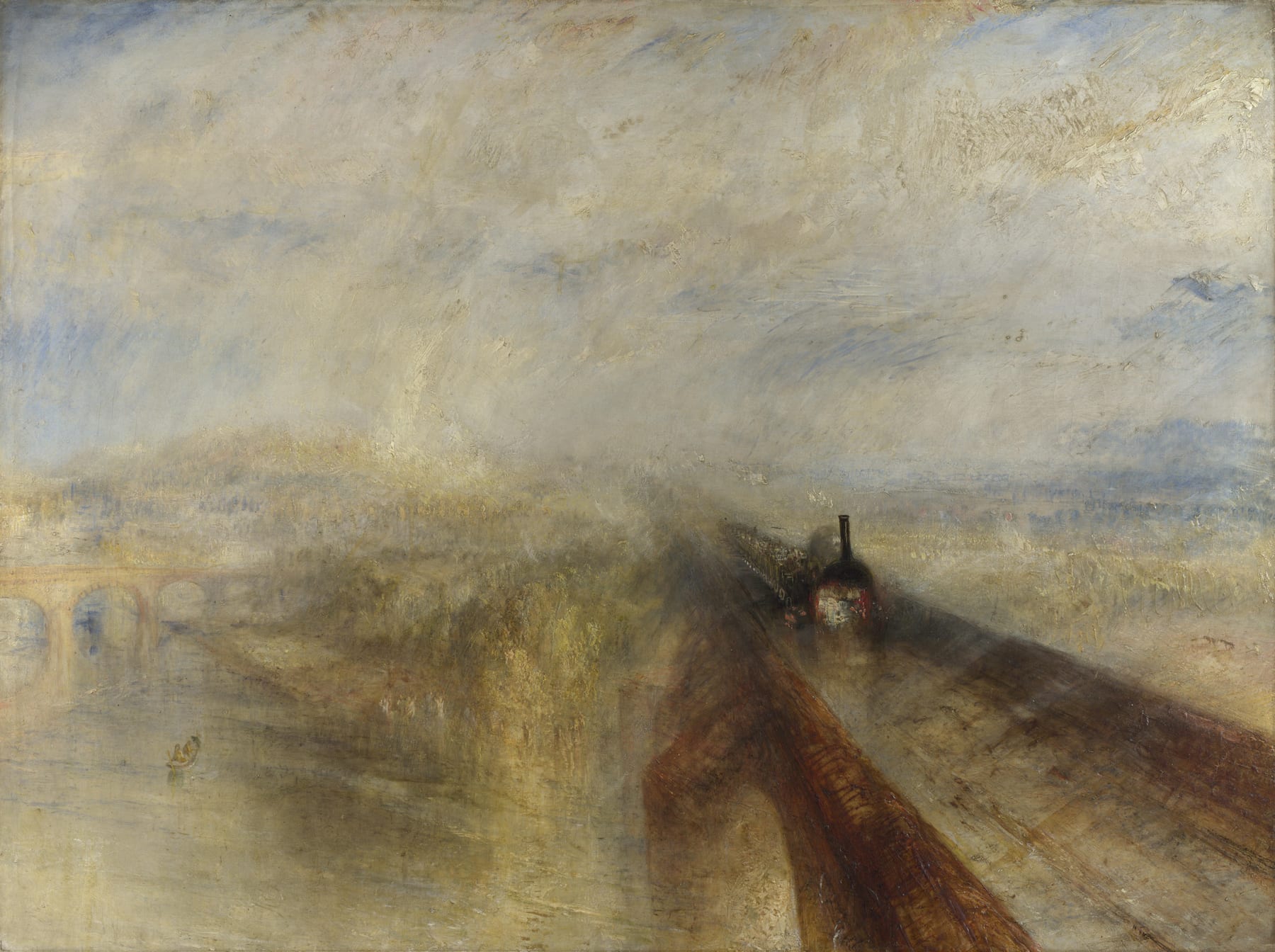
- Turner’s “Rain, Steam, and Speed” (1844): celebrates industrial modernity in emotional tones.
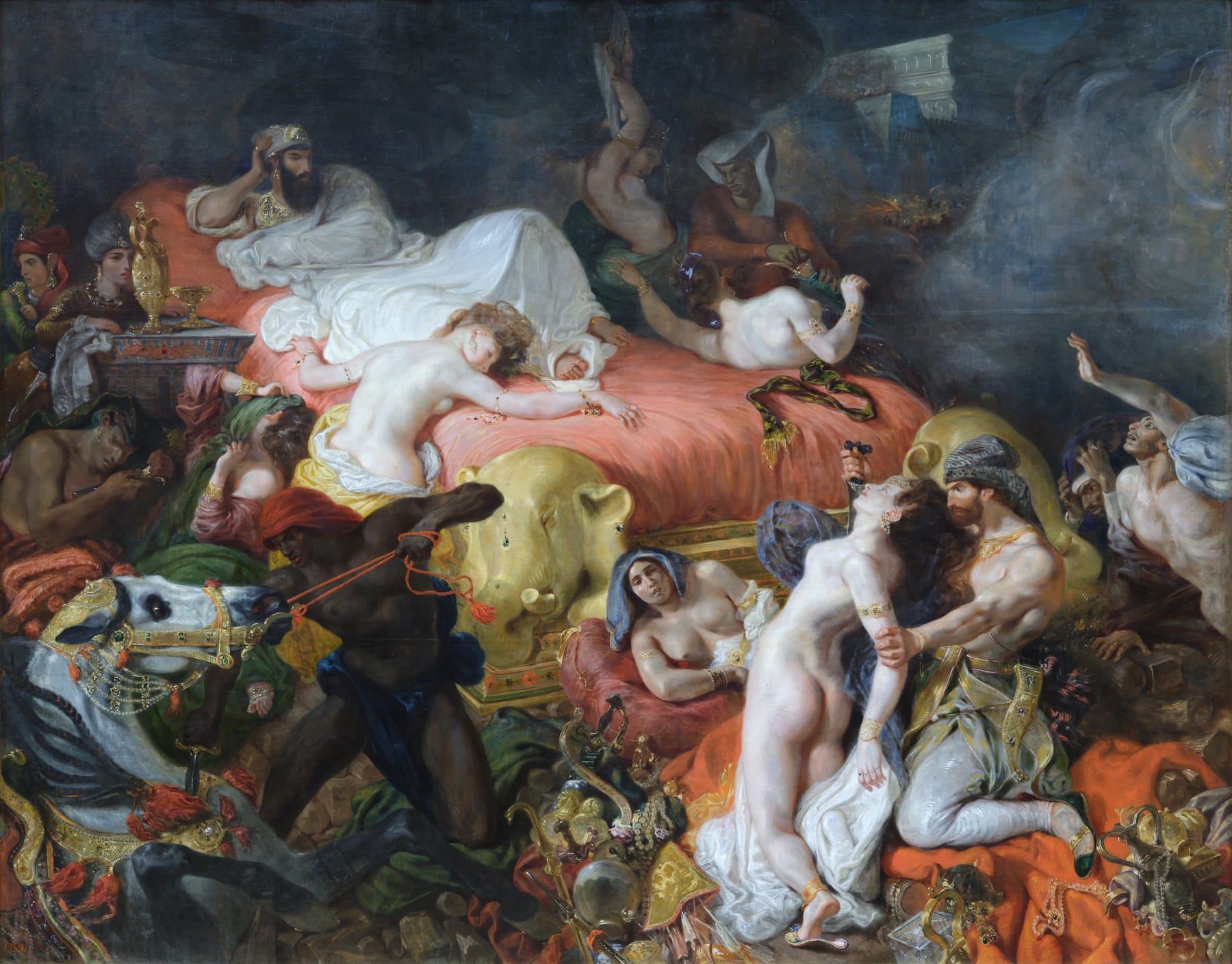
- Delacroix’s “Death of Sardanapalus” (1827): dramatic, sensual, and anti-classical.
- Art became a medium for personal vision and social critique.
VIII. Romanticism, Revolution, and Nationalism
- Romanticism helped fuel a new vision of revolution:
- Delacroix’s “Liberty Leading the People” (1830) glorifies revolutionary heroism.
- Real revolutions, however, were often messy, accidental, and disappointing.
- Most enduring idea shaped by Romanticism: Nationalism.
- Different from 18th-century patriotism (based on loyalty to monarchy or civic state).
- Ethnic nationalism emerged—nations defined by language and culture, not territory or dynasty.
- Language became central to identity in urban-industrial societies (Ernest Gellner).
- Nationalists created nations (e.g., Italy, Germany), often from above, imposing a shared language and identity.
- Example: Italy. Most areas had different languages and then Italian was the national language.
- Nationalism a form of radicalism
IX. Nationalism in Action
- Giuseppe Garibaldi: Romantic revolutionary in Italy; wanted democratic republic. Result: Italy became a monarchy.
- Otto von Bismarck (Prussia): Conservative nationalist. Used “blood and iron” to unify Germany through war, not democracy.
- Nationalism shifted from liberal-democratic roots to tools of state-building and power politics.
X. Broader Political Demands and Mass Movements
- New rights demanded by middle and working classes:
- Freedom of speech, press, assembly, trade unions.
- Right to work, welfare, representation, education.
- 1848 revolutions: Springtime of the Peoples—spread across Europe but failed due to:
- Internal divisions (class, ideology)
- Lack of control over armies
- Conservatives like Bismarck adapted: “If there must be a revolution, we will make it.”
- I said earlier that this was the age of revolutions, and Bismarck—I quoted him a moment ago—pointed to 1848 as a mistake. But the revolutions across Europe culminating in 1848 and usually starting off in France, the Austrian statesman Metternich famously said, “When Paris sneezes, Europe catches cold.” And often, if there was a revolution in France, it would spread. And in 1848, that’s precisely what happened. And you can actually follow. You can draw a map with circles on it showing how the news of revolution in Paris spreads by train, by steamboat on the rivers, by the arrival of newspapers. And when the news comes through, then you get a revolution breaking out in Austria, in Germany, in Italy.
- The last great outbreak of revolution in 19th-century Europe was in 1870 to ‘71 in Paris, and it ended in a bloodbath. And it led—the phrase that I like, the distinguished French historian François Furet to say, “Amid Paris in flames, the French Revolution said farewell to history.” If you see this whole period from 1789 to 1871 as the time when people felt that revolution was going to happen and revolution was the way in which they would finally get whatever it was, democracy, national rights, a republic, then 1871 was the end of that period because it finally shows that this is not going to work. “The French Revolution says farewell to history.”
- Labor Strikes and Violence
XI. Socialism and the Workers’ Movement
- Utopian socialism (1830s): Ideal rural, communal societies (e.g., the Shakers).
- Later Marxism: Revolution as a historical inevitability, but in practice, most socialist parties became reformist, not revolutionary.
- Lenin broke from this: formed the Bolsheviks (1903), advocating violent revolution by a vanguard party.
- Modeled on Robespierre and the Jacobins of 1793.
XII. Electoral Politics and Reform
- Gradual extension of suffrage in Western Europe:
- Britain: Working-class men got the vote in 1867 and 1884.
- France: Full male suffrage by 1870.
- Germany: Manhood suffrage from 1871 (limited power).
- Emergence of party politics and celebrity politicians like:
- Léon Gambetta (France)
- William Ewart Gladstone (UK)
XIII. The Women’s Rights Movement
-
Women demanded:
- Right to work (e.g., coal-sorting “pit brow” girls)
- Education, property rights, divorce, custody, and eventually the vote.
-
Divided between:
- Radicals like Louise Michel (anarchist, 1871)
- Moderates like Millicent Fawcett (peaceful suffragist)
-
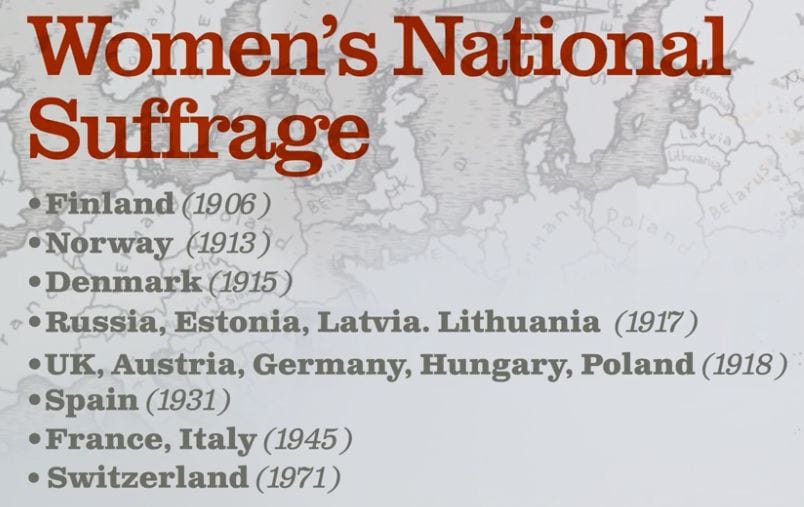
Women gained voting rights mostly after WWI:
- Finland (1906), Russia (1917), UK/Germany/Austria (1918), France/Italy (1945), Switzerland (1971).
-
-
Trade Unions
-
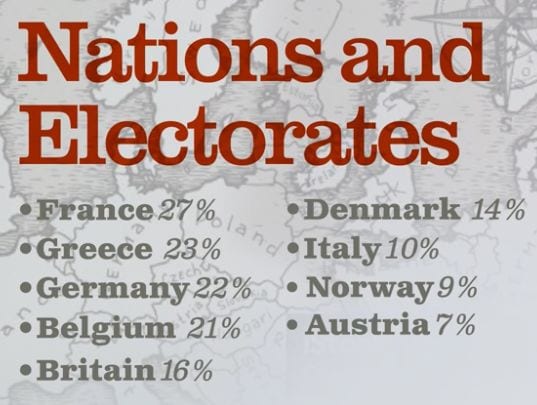
Percentage that can vote at end of 19th Century:
XIV. Limits and Exclusions
- Voting rights remained limited by class in many places (e.g., Austria, Italy).
- Multinational empires (Austria-Hungary, Russia, Britain with Ireland) denied national rights to many groups.
- Racial and religious identity began shaping politics more clearly:
- Antisemitism rose in Russia, Germany.
- Religion shaped politics via Christian Democratic parties.
- Growing belief in eugenics and class-based biological theories.
- By the left
XV. The End of the Revolutionary Century
-
The Paris Commune (1871) was the final revolutionary flame in France.
- Suppressed violently; marks the end of the revolutionary era that began in 1789.
-
The new paradigm was reform through parliament, mass politics, parties, and gradual progress, not insurrection.
-
But the optimism of Progress would be tested soon.
-
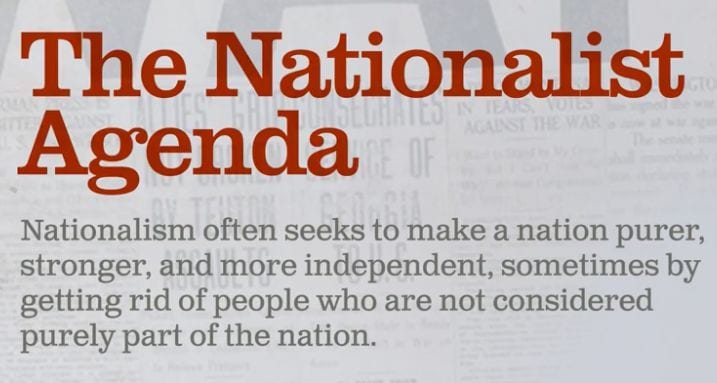
Patriotism is a love for their country. Nationalism is patriotism with an ideological aim. Nationalist is not happy with the way things are and wants to change their country.
Closing Note: In Greek tragedy, hubris precedes nemesis. This belief in unstoppable progress would be shattered in the early 20th century—a subject reserved for the upcoming lecture on Empires and Globalization.
4: Imperial Impact
I. The Importance and Ambiguity of Empires in History
- Historical Significance: Future historians may view 19th-century empires, particularly the European ones, as more central than nations, parliaments, or revolutions. Empires shaped the modern world—according to both pro-empire historian Niall Ferguson and anti-empire critic Edward Said.
- Empire as Modernity’s Foundation: If empires created the modern global system, debates about colonialism are implicitly debates about the modern world itself.
II. The Rise of European Empires in the 19th Century
Nine Causes of Expansion:
- Decline of non-European empires (Mughal, Ottoman, Persian, Chinese) created power vacuums.
- Exploration opened up trade, migration, and conquest.
- Weak or fragmented indigenous political structures, especially in Africa, made regions vulnerable.
- Technological superiority from industrialization (e.g., weapons, railways).
- Population growth prompted migration and colonial pressure.
- Global trade created illusions of profitability.
- Desire for security against instability, piracy, and slave raiders—some regions requested imperial protection.
- Humanitarian lobbying from missionaries and anti-slavery advocates.
- National competition and fear of being left out of imperial carve-up.
Latecomers to Empire: Germany, Italy, Japan, and the U.S. joined the imperial race late, driven by the belief that the world would be permanently divided into empires.
III. The British Empire: Structure, Nature, and Contradictions
- Enormity and Complexity: A “global mosaic” with dominions, protectorates, treaty ports, and colonies.
- Managed on a Shoestring: Despite its size, the British Empire had limited resources. For example, 113 clerks ran the Colonial Office in 1903; India was administered by 2,000 British civil servants.
- Spontaneous Growth: Empire often expanded via men-on-the-spot and commercial actors like the East India Company, not centralized imperial planning.
- A “World System”: According to historian John Darwin, it functioned more as a system coordinated through economic, political, and elite collaboration, rather than as a classic hegemonic structure.
Motivations:
- Commerce was key.
- Expansion was often reluctant or reactive.
- Many colonies (like Fiji or parts of Africa) actively requested to join for protection or stability.
IV. British vs. French Imperial Models
- British: Commercial, decentralized, pragmatic.
- French: Prestige-driven, more centralized, idealistic about “civilizing” missions. Empire was a post-1870 compensation for military defeat.
V. Costs and Benefits of Empire
For Britain:
- Strengths: Global markets, naval dominance, cheap investment opportunities.
- Weaknesses: High costs, overstretched administration, military vulnerabilities.
- Economic Impact: Important but not dominant—5–6% of national income. Some industries like textiles were kept alive by empire but at long-term economic cost.
For Colonies:
- Mixed legacy. Some colonies like India and the Gold Coast thrived economically. Others suffered from neglect, especially rural agriculture.
VI. Indigenous Reactions and Cultural Exchange
- Diverse Responses: Collaboration, resistance, intermarriage, requests for protection, adoption or rejection of European ideas.
- Examples:
- Raja Ram Mohan Roy: Advocated blending European and Indian traditions.
- Gandhi: Rejected Western modernity for Indian self-reliance.
- Cetshwayo (Zulu king): Made diplomatic overtures to the British after war.
- Many saw opportunities: liberated slaves, low-caste individuals, women, and youth sometimes gained status under empire.
VII. Slavery and Moral Controversies
- Debates:
- Was European slavery uniquely racist?
- Was slavery the foundation of European wealth?
- Was abolition driven by economic pragmatism or ethical motives?
Counterpoints:
- Slavery was not unique to Europeans.
- It was not the basis of the Industrial Revolution.
- British abolitionism was genuinely moral/religious, often costly and unpopular abroad.
- Emancipation involved both slave resistance and British reformers.
VIII. Empire as a Cultural and Psychological Force
- Cultural Impact on Europe: Tea, curry, colonial novels, and imperial adventure stories influenced British culture. Debate continues on how deeply empire permeated popular consciousness.
- Humiliation and Resistance:
- Anti-colonial thinkers like Fanon emphasized psychological degradation.
- But not all colonial subjects experienced humiliation; some felt empowered by new opportunities.
IX. Empire Today: Legacy and Controversy
- The Benin Bronzes: Raise moral questions about looted art, reparations, and how to honor victims of slave societies.
- Orientalism:
- Edward Said’s theory: Western portrayals of the East served to dominate and stereotype.
- Critics argue many Europeans studied other cultures respectfully and helped preserve them.
- Decolonization Movements:
- Today’s calls to decolonize everything from classics to computer science are often based on theoretical frameworks that ignore empire’s real complexities.
- Irony: Many who decry colonial influence still promote universal human rights—an arguably Western idea.
X. Final Reflections
- Contradictions Abound:
- Empire was both oppressive and liberating, exploitative and developmental.
- Judging empire requires judging the modern world it helped build.
- It cannot be dismissed wholesale as racist and evil, nor glorified as purely civilizing and beneficial.
- Key Takeaway: The age of empire was defined by unintended consequences, illusions of permanence, and great historical complexity.
5: World War I Era
1. Europe at the End of the 19th Century: Confidence and Blind Spots
- By the late 1800s, Europe was at the height of its power—economically, politically, and imperially. Despite concerns (bourgeois culture, population stagnation in France, class decline), confidence prevailed.
- Few predicted large-scale disaster, making the 1914 outbreak of war shocking. This is why historians call World War I “the seminal catastrophe”—it triggered a cascade of subsequent disasters.
2. The Spark: Assassination of Archduke Franz Ferdinand
- The Austrian heir was killed in Sarajevo in June 1914, due to a fluke involving a wrong turn and a stalling car.
- Initially seen as a distant and minor incident. Many in Europe remained focused on domestic scandals and summer leisure.
3. Naïveté and Misplaced Optimism
- Intellectuals like G.P. Gooch and Norman Angell believed globalization, economic interdependence, and rationality would make war between advanced nations impossible or short-lived.
- Angell’s The Great Illusion argued war would be irrational and economically disastrous—he was half-right: war was disastrous but not unthinkable.
4. Underlying Tensions in Europe
- Despite the optimism, several pressures made war likely:
- Militarism and conscription in all major powers.
- Aggressive nationalism in education, politics, and culture.
- Rising powers (Germany, Russia) destabilizing the balance with weaker France and Austria.
- National honor and fear drove each power to perceive a “now or never” moment in 1914.
5. The Schlieffen Plan and German Responsibility
- Germany, anticipating war on two fronts (France and Russia), planned to defeat France swiftly via Belgium, assuming Russia would mobilize more slowly.
- The plan left no room for delay—mobilization meant war. It violated Belgian neutrality, provoking British entry.
- Critically, the German military operated with little civilian oversight, escalating the danger.
6. Who Was to Blame?
Historians debate responsibility:
- All powers shared blame—a system-wide failure of imperialism and militarism (e.g., Christopher Clark’s Sleepwalkers).
- No one was to blame—it was an accident (e.g., Lloyd George: “slithered into war”).
- Capitalism and imperialism—Lenin’s structural view.
- France and Russia—escalated a Balkan crisis into a continental war.
- Britain—its entry globalized the conflict.
- Austria—pushed war with Serbia to suppress nationalism.
- Germany—most commonly blamed due to the Schlieffen Plan and strategic aggression.
The lecturer believes German and Austrian generals were the decisive agents, having prepared for and even welcomed war in 1914.
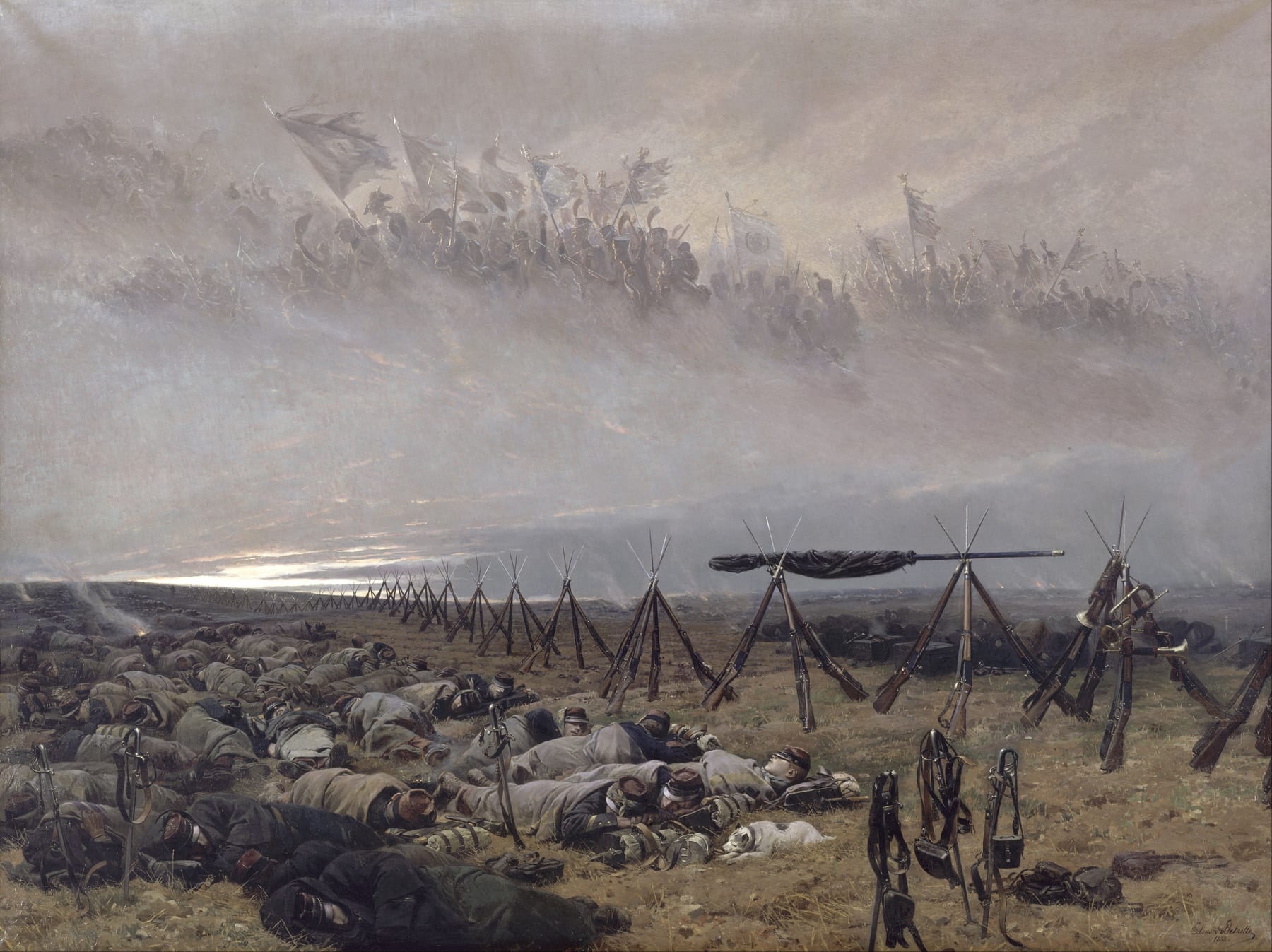
7. The First Industrial War
- War became a contest of industrial and economic might:
- Nearly a million British women worked in munitions.
- Massive shell production and artillery barrages.
- Shells cost more to make than soldiers were “worth” economically.
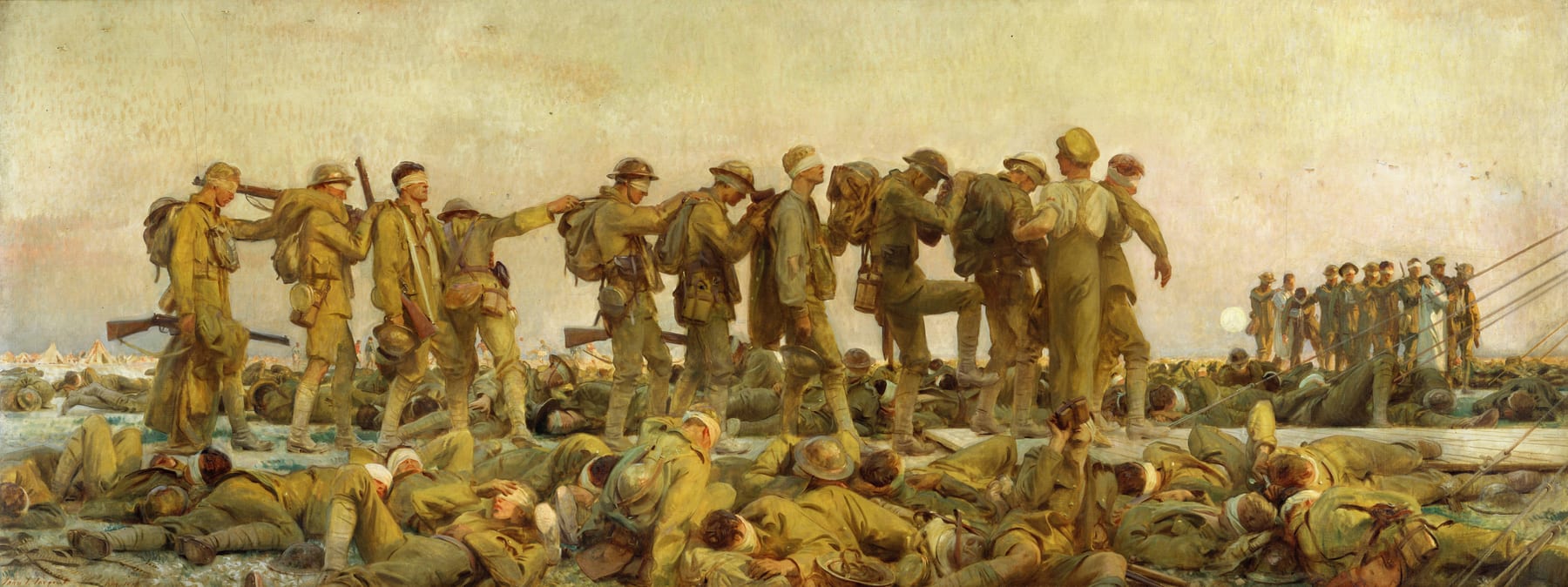
- Art and culture reflected the horror (e.g., Sargent’s Gassed, Paul Nash’s Menin Road).
- Chemical weapons, mass artillery, and trench warfare transformed perceptions of war.
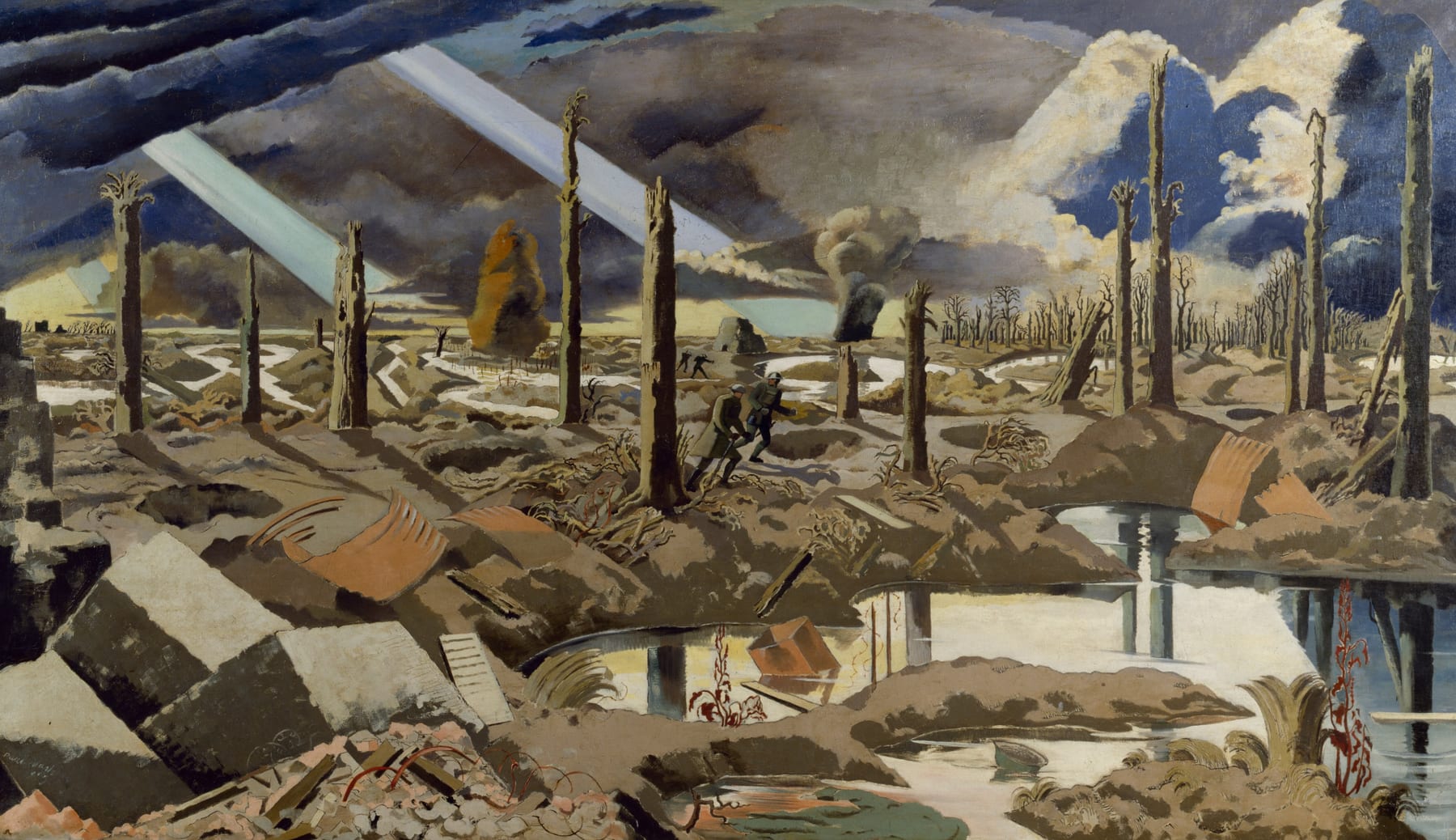
8. Embryonic Total War
- Civilian targeting began early:
- German atrocities in Belgium.
- Russian pogroms.
- Austrian massacres in Serbia.
- British blockade caused starvation in Germany.
- Submarine warfare (e.g., Lusitania).
- Air raids, genocide (Armenians), and colonial conflicts.
- The war became global—Africa, the Middle East, and eventually America joined.
- Societies began to break down under strain: Russia (1917), Austria, France, Italy, Germany (1918).
9. Aftermath: Social and Economic Collapse
- Peace did not restore stability. Post-war chaos included:
- Revolutions (Russia: Bolsheviks; Germany: Weimar Republic vs. left and right).
- Breakup of multiethnic empires (Austro-Hungarian, Ottoman, Russian, German).
- Rebellions, starvation, and interethnic violence (e.g., Bulgaria, Greece-Turkey war).
10. Interwar Crisis: Economy and Extremism
- War left Europe with crippling debts, inflation, and protectionism.
- Example: German hyperinflation (1923)—1 paper mark = 1 trillion gold marks.
- French invasion of Ruhr triggered economic collapse.
- Wall Street Crash (1929) worsened instability.
- Governments responded with austerity and trade barriers.
- Result: mass unemployment and political radicalization.
11. Rise of Totalitarianism
Defined as:
- Utopian violence to remake society.
- Total control of politics, society, economy.
- Disregard for legal/moral norms.
- Cult of personality (Hitler, Stalin, Mussolini).
- Mass mobilization, not just repression.
- Terror and suppression of dissent.
Examples:
- Italy (1922): Mussolini’s fascism.
- USSR (1917 onward): Bolshevik dictatorship.
- Germany (1933): Nazis rise via legal channels but seize control through violence and terror.
12. Death Tolls and Brutality (Interwar Period)
Soviet Union:
- Famine (1921–22): 5 million.
- Collectivization (1930s): 8 million+.
- Punished 2,000 people for cannibalism.
- Great Terror (1937–38): ~1 million.
- Total: ~14 million dead before WWII.
Fascists (pre-WWII):
- Italy’s attack on Abyssinia (1930s): 200,000
- Spain Civil War (White Terror): 200,000
- Germany (Internal repression by Nazis and killing disabled people): 500,000
- Balkins: 200,000
- Nazis had not yet launched the Holocaust, but mass repression and sterilization had begun.
- Total: 1,100,000
13. Denial and Intellectual Complicity
- Many intellectuals (especially on the Left) ignored atrocities.
- Victor Gollancz named Stalin “Man of the Year” during the purges.
- George Bernard Shaw praised both fascism and communism.
- Fascists also had intellectuals: Martin Heidegger, Nazi-sympathizing academics and artists.
- Naïve or willfully blind belief that democracy had failed and extremism was the future.
- Large number of SS had doctorates
14. Symbolic Turning Points and Ironies
- 1937 Paris exhibition: Nazi and Soviet pavilions face off—enemies in ideology, but similar in method.
- 1939: Non-aggression pact between Hitler and Stalin stunned the world—“the isms had become wasms.”
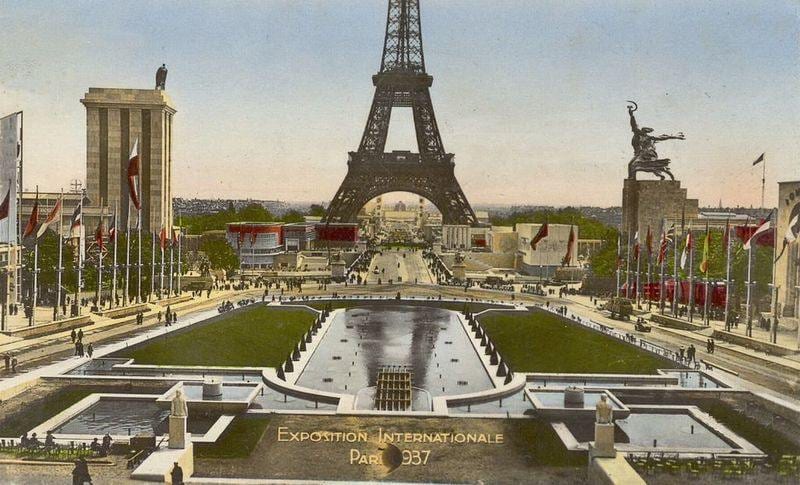
15. Final Reflection: A Civilization in Ruins
- Tony Judt called WWI the moment Europe “destroyed a civilization.”
- “The cumulative effect of these blows was to destroy a civilization. The scale of the disaster that Europe had brought upon itself was perfectly clear to contemporaries, even as it was happening.”
- The catastrophe led to authoritarianism, extremism, and further war—but democratic sentiment persisted.
- In 1939, 87% public opinion favored Britain, France and Russia to stand up to fascism.
- Poll in France showed 76% willing to contemplate war to stop further German aggression
- Hope remained despite trauma.
16. Bonus: On Napoleon, Hitler, and Stalin
- The lecturer suggests that Hitler and Stalin were not driven by patriotism or normal ambition but by internal compulsions—likely psychopathic.
- Their ideologies served as vehicles for personal, pathological drives.
- In normal times, such men would have remained marginal. Extreme conditions made them powerful.
17. Modern Parallels?
- Audience question on current anxieties (AI, climate) and rising authoritarian tones in media and culture.
- Lecturer notes that modern fears may differ, and cultural fascination with war today lacks the predictive novels and speculative urgency of pre-1914 Europe.
- Green politics may be disruptive, but likely anti-war. Dangers might come from opportunistic regimes (Russia, China) responding to Western instability.
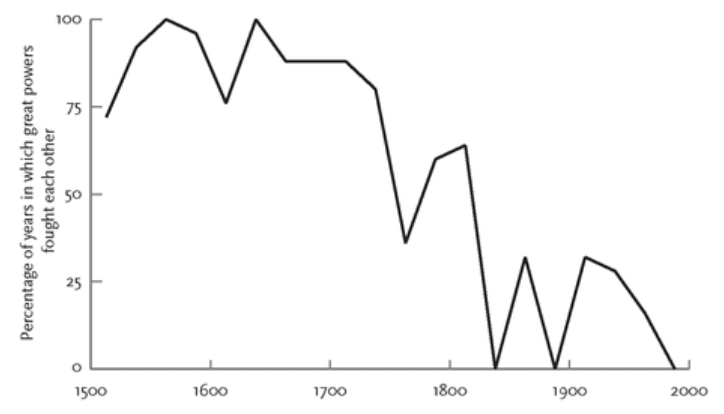
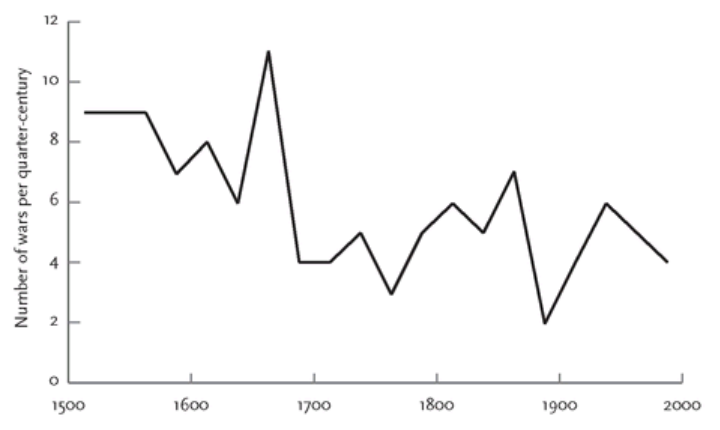
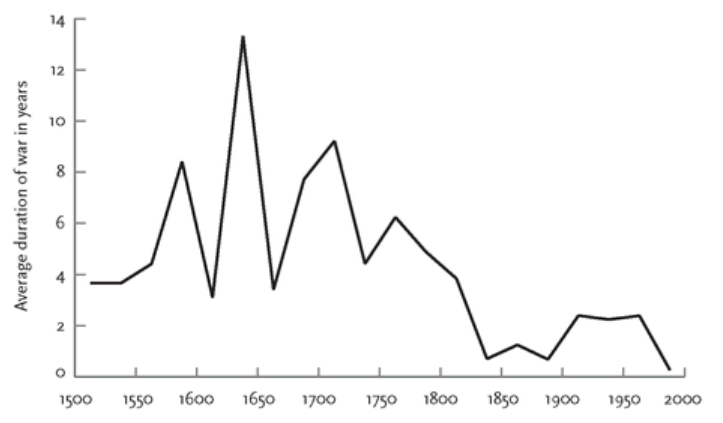
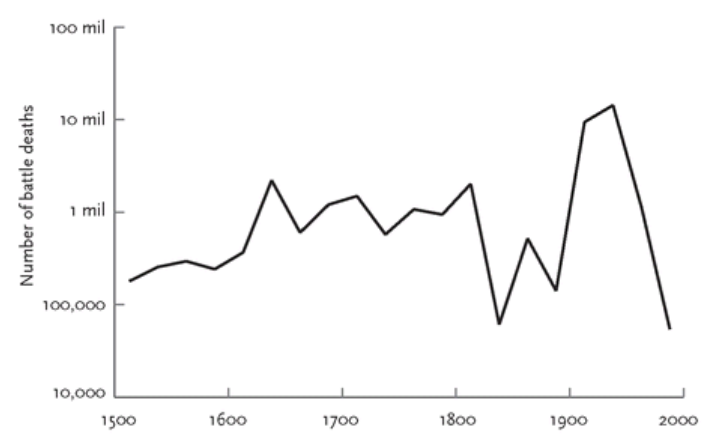
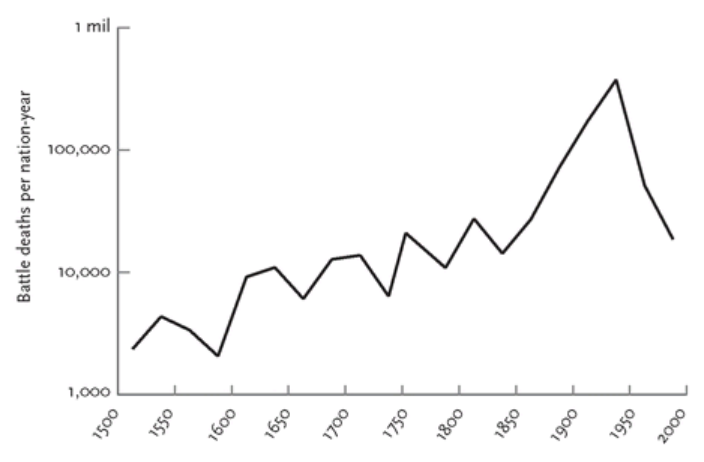
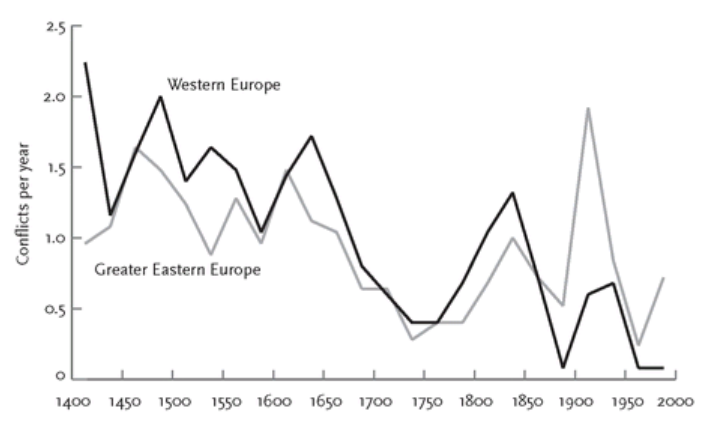
Pinker’s Chapter 5 supplement — the long statistical counterpoint to Europe’s war narrative
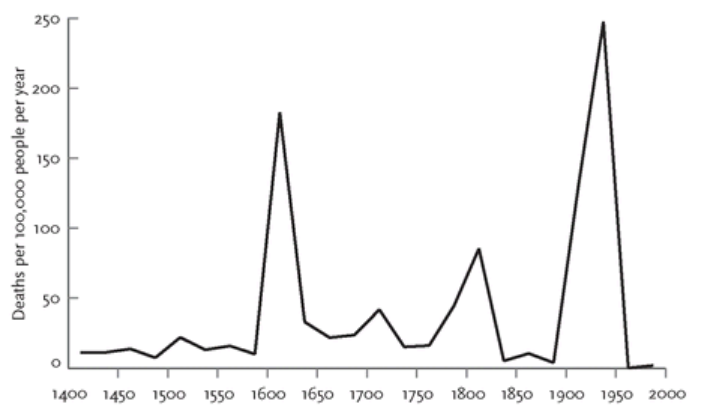
Pinker’s long-run series complicate both decline triumphalism and catastrophe-centered history. From 1500 to 2000, great powers spent less time fighting one another, entered fewer wars, and fought shorter wars. Yet the wars that did occur became more destructive through the first half of the twentieth century as consolidated states, professional armies, conscription, industry, and transport increased their capacity. Only after World War II do frequency, duration, total battle deaths, and “concentration” of killing all fall together.
Figures 5-12 to 5-16 — Years at war, frequency, duration, deaths, and concentration in wars involving great powers, 1500–2000.
Figures 5-17 and 5-18 — Conflicts per year and conflict death rates in greater Europe, 1400–2000. Pinker reads the peaks as overlapping ages of religious, revolutionary/Napoleonic, nationalist, and ideological war, separated by lower basins rather than a smooth decline. The data are a 2011 synthesis, mostly ending in 2000. Levy’s great-power series excludes most colonial and civil wars and changes membership over time; counts depend on thresholds and coding; death estimates are reconstructed; and these aggregate curves cannot by themselves assign causation or establish the state of European war after 2000. Chapter 5 synthesis · Scope and construction of the great-power dataset, PDF pp. 319–322 (file not included in this release) · Figures 5-12 to 5-14, PDF pp. 322–324 (file not included in this release) · Figures 5-15 and 5-16, PDF pp. 324–326 (file not included in this release) · European conflict series and source limits, PDF pp. 326–330 (file not included in this release)
6: World War II Era
From Peace to Catastrophe: Europe’s Descent into WWII and Total War
1. The Illusion of Peace After WWI
- After WWI, there was widespread hope for a new, peaceful era:
- The League of Nations was founded to maintain peace.
- Disarmament and pacifism were popular.
- Many former empires embraced democracy.
- Some believed in a future United States of Europe or a world socialist revolution.
- The victorious Allies even sought to appease Germany, believing the Versailles Treaty had been too harsh.
Quote: “Most people, certainly all progressive people, felt that they had entered a new era.”
2. Appeasement and the Munich Agreement (1938)
- Britain and France repeatedly tried to negotiate with Germany and Italy, culminating in the Munich Conference:
- Germany was allowed to annex the Sudetenland (German-speaking region of Czechoslovakia).
- Neville Chamberlain returned declaring he had secured “peace for our time.”
- Chamberlain was wildly popular for a time, even suggested for the Nobel Peace Prize.
Churchill’s warning: “This is only the first sip, the first foretaste, of a bitter cup.”
3. Could Hitler Have Been Stopped?
- In hindsight, yes—military resistance in 1936 (Rhineland) or 1938 (Czechoslovakia) might have worked.
- Even German generals considered overthrowing Hitler if war seemed imminent.
- But at the time, no one believed that was realistic.
- Public opinion was pacifist, and “fighting a war over a timetable” seemed absurd.
Quote: “In theory, yes. In practice, probably no.”
- The Germans remilitarized the Rhineland, which had been demilitarized after the First World War in 1936. And we now know that, had there been any resistance by the French, the Germans would have pulled out, and Hitler would probably have been humiliated and possibly overthrown. But the French Army had no plan for resisting the Germans, and hardly any political figure in the West thought that they should have done. So we can now say, in theory, knowing what we know, they should have done this, but nobody at the time thought it was good. Even Churchill, I think, thought, if the Germans wanted to remilitarize the Rhineland, they had the right to do so.
4. Hitler’s True Goals
- Lebensraum (living space): War of conquest and extermination in Eastern Europe.
- Needed land and food to survive a future blockade by Britain and the U.S.
- Wanted global racial war, not limited European revision.
Quote: “Hitler’s aims were global war… a war of racial superiority.”
- Hitler believed war was inevitable and desirable, and was frustrated by the peace of Munich.
5. Western Misunderstanding
- Western leaders couldn’t comprehend that Hitler wanted war.
- They believed he could be reasoned with.
- Chamberlain: “We’re all human after all.”
- Halifax: “My dream is that one day Mr. Hitler and the King will enter Buckingham Palace side by side.”
- When the British Foreign Secretary, Lord Halifax, went to Germany and met Nazi leaders, met Hitler, he said, “We’re not talking the same language.” He couldn’t really understand. One of them said to him, I think it might have been Hitler, said to him, “You’re having all this trouble in India with Gandhi and the Indian nationalists. All you have to do is shoot Gandhi and a few hundred of the Congress leaders, and your problem’s over. Why can’t you just do that?” Halifax said, well, that’s not really how we do things. But couldn’t really understand that all this was how the Nazis thought.
- British Foreign Office lost their copy of Mein Kampf — Careless oversight
- This belief that if you could just get through to Hitler and really understand what he wanted then you could come to some deal.
- The French Prime Minister, Daladier, seems to have got a bit closer, perhaps because the French had had closer dealings with the Germans for a long time. But he came to England and had a meeting with British ministers and diplomats, and he said, “You have to understand something. Hitler is not like the Kaiser. He’s like Genghis Khan.” And the head of the foreign office said, “Well, it’s very eloquent, but it’s all complete nonsense.” And of course, he was right, but they couldn’t see that.
French PM Daladier warned: “Hitler is not like the Kaiser. He’s like Genghis Khan.”
British Foreign Office responded: “Very eloquent, but it’s all complete nonsense.”
- And in response to the danger, the clear danger, a common response was to become more pacifistic, to insist more on disarmament rather than resistance, including some pacifist groups who advocated quasi-military training in non-violent resistance or psychological exercises, including knitting, sitting in silence, and folk dancing. That was supposed to neutralize the threat of the Nazi stormtroopers. In France, there was a campaign of what was called moral disarmament. You have to make people feel that disarmament is the right thing to do.
- In short, they couldn’t grasp the psychology of the people they were dealing with. The former Prime Minister, liberal Prime Minister, Lloyd George, called Hitler “the greatest German of the age.” Veteran Labour party leader George Lansbury went to meet Hitler, and he was very pleased to find that Hitler didn’t drink alcohol, was a nonsmoker and a vegetarian, and therefore, he thought, well, Hitler’s fine. He wants peace. “Germany needs peace,” wrote Lansbury. “Nobody understands this better than Herr Hitler.” If Germany were given a fair share of the world’s resources and markets, Hitler would cooperate in discussions on how to abolish war.
6. The Path to War (1939)
- Hitler continued aggression. Poland was next.
- Chamberlain still tried to negotiate, offering colonies in Africa.
- Britain and France eventually guaranteed Poland’s independence.
- War was declared after Germany invaded Poland.
Quote: “By that time… many people had decided that war was going to come.”
- Most people were expecting a repeat of the First World War. That is to say, a long war and a static war.
- The Germans were using more steel for barbed wire than they were for tanks in 1939, because they, too, were expecting another First World War of fixed, fortified trench lines that would go on for several years. The French and British realized that they might win a war like that because they would have their empires to mobilize. They tended to control the world’s communications by sea. The Americans would probably come in at some time or another. So a repeat of the First World War scenario would mean that Germany would inevitably lose. And of course, you might say, well, that was actually true because that’s what happened.
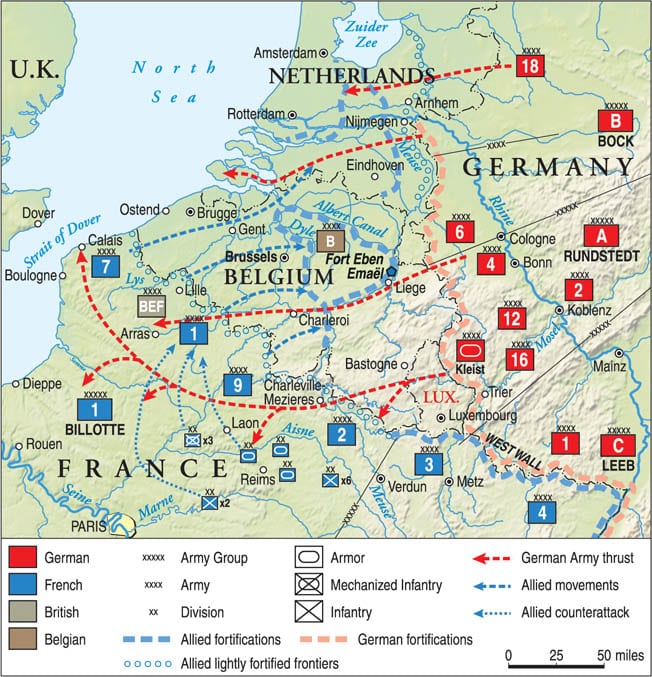
- But the Germans realized that, too. And the German army, in a way that seems to me slightly reminiscent of the Schlieffen plan in 1914, had come up at the last minute with what they knew was a very risky plan for winning the war quickly. We will lose a long war, so we have to win a short war. And the chief of the German general staff said something like, “Even if there’s only one chance in 10 that this will work, we have to take it.” So what happened was that the German army completely deceived the French and British as to the main area of their attack
7. The Blitzkrieg and the Fall of France
- Germany launched a surprise attack through the Ardennes, bypassing defenses.
- France collapsed, and British forces evacuated from Dunkirk.
- Germany now dominated continental Europe.
8. Churchill’s Defiance
- Many British ministers wanted to negotiate peace.
- Churchill refused, insisting on continued resistance.
Churchill’s rationale: “Even if we’re defeated, it won’t be worse than giving up now.”
- I want to quote a German U-boat officer who was really rather perceptive. And he said, he wrote this. “The English can hold out under existing conditions for years. The U-boat arm”—the U-boats are German submarines—“the U-boat arm will not break them, nor airmen either. Time is on the side of the English, and we cannot afford to give them time.”
- And Hitler himself, looking back on what had happened a few weeks before he committed suicide, said he had, I quote, “underestimated one factor, the extent to which Churchill’s Englishmen were influenced by the Jews, and so denied Germany its ultimate victory.” So there was a stalemate, 1940, ‘41. The Germans could not invade Britain. Britain could not defeat Germany. So what do you do? What Hitler decided to do was that they had to attack Russia.
9. Hitler Invades the Soviet Union (1941)
- Believed Britain held out expecting Russian help.
- Germany saw Soviet weakness (after Stalin’s purges) and racial inferiority.
- Hitler also declared war on the U.S. after Japan’s attack on Pearl Harbor.
- To distract American with war with Japan and therefore couldn’t focus on war with Germany.
10. Germany’s Strategic Weakness
-
Despite its control over Europe, Germany lacked vital resources, especially oil.
- Britain and the U.S. outproduced Germany drastically.
- Example: Britain received 5,000 American aircraft, Germany only 78 from occupied countries.
-
Germany’s position seemed on the face of it very strong. It largely controlled the Euro-Asian continent, and it looked as though it was defeating Russia in 1941-42. But the Royal Navy’s blockade of Germany and of occupied Russia, as in the First World War, cut off or reduced essential supplies to the Axis war effort, which included oil, fertilizer, not a very glamorous product, but it was this in part that was responsible for a catastrophic fall in agricultural productivity in both world wars and hence for food shortages. Animal feed, the same. Much animal feed was imported from outside Europe, as it still is.
- Rubber, all from outside Europe. Copper, nickel, cotton, wool. So the Germans had to manufacture synthetically oil from coal and manufacture synthetic rubber. And this caused chronic food and fuel shortages and strangled industrial production. Consequently, the German conquest of Western Europe was giving them far less benefit than they expected. Let me give you a couple of statistics. By the end of 1941, Britain had shipped in over 5, 000 American aircraft. Germany had occupied France and Holland, both of which had aircraft industries, but the total number of aircraft that they’d received from France and Holland was 78. So 5,000 the British get, 78 the Germans get.
- Germany had at most eight million tons of oil per year. And from this, it had to try to supply Italy and its conquered territories, which it was hoping to use as centers of production. Whereas Britain imported over 10 million tons of oil in 1942, despite the submarine campaign that the Germans were waging in the Atlantic. And in 1944, Britain was importing 20 million tons a year. So Britain alone had more than twice the amount of oil that the whole of German-occupied Europe had.
- It’s often said that, in talking about wars, amateurs talk about tactics and professionals talk about logistics. Wars are won by supply, and the supply of oil was crucial.
11. Total War and Genocide
- Goebbels asked: “Do you want total war?” The Berlin crowd answered: “Yes!”
- Germany’s war was total:
- Subjugation, extermination, total mobilization.
- Hunger Plan: Intentional starvation of 35 million Eastern Europeans.
- Holocaust planned at Wannsee Conference (Jan 1942).
Hitler (Jan 1941): “The result will not be the Bolshevization of the Earth… but the annihilation of the Jewish race in Europe.”
- A senior British diplomat, Sir Robert Vansittart, said in September 1940—which seems to me to show that people knew what they were facing—he said, “Either the German Reich or this country has got to go under, and not only under, but right under. Right under.”
- Hitler, I mentioned this earlier, said in 1939, “Who now talks about the Armenians?” People had forgotten the Armenian genocide in the First World War. Hitler thought they’d soon forget about genocide that he might commit. The Poles were to be destroyed as a society and subjugated. The Slavs were to be cleared out and starved. The Jews were to be removed and/or killed. And as I say, the expected result of these plans ran into the tens of millions of deaths. But the Russians were doing their part, too. War provided a pretext and an opportunity and a cloak for actions that went far beyond military necessity. In Poland, both the Germans and the Russians were aiming at exterminating Polish society, not necessarily of exterminating the Poles, but reducing them to slavery.
- Einsatzgruppen on the Eastern front, who were to exterminate Bolshevik leaders and Jews. The Germans liked to think that many Bolsheviks were Jews and vice versa.
- Christopher Browning: Genocide began when Germany was winning, showing it was a true goal, not a desperation measure.
- Perpetrators were ordinary men, not fanatics.
- So Hitler made a speech to the Reichstag in January 1941, before the invasion of Russia, in which he said this. “Today, I will once more be a prophet. If the international Jewish financiers in and outside Europe should succeed in plunging nations once more into a world war”— blame it on the Jews, of course—“then,” he says, “the result will not be the Bolshevization of the Earth, and this the victory of jury, but the anihilation of the Jewish race in Europe.”
- They persisted with the genocide even when this was damaging their own war effort. After all, they were short of labor and of skilled labor, and it would have been sensible to use—after all, these are ruthless people. They use people. Why not use the Jews as laborers? But no, it was more important to kill them than to use them.
- Hannah Arendt’s “banality of evil”—killings committed by ordinary people for petty reasons.
12. Hunger and Bombing as Weapons
-
Caloric rations in 1941:
- Britain: 2,800 (adequate)
- Germany: 2570 -> In 1945: 860
- Norway: 1600
- France: 1,300
- Poland: 850
- Polish Jews: 400—starvation-level
- German POW camps allowed 10,000 Russians to die daily.
-
British bombing campaign:
- Massive effort, aimed at “de-housing” workers.
- Caused firestorms like Hamburg (1943)—37,000 killed.
- Total German losses from bombing: 353,000
- Total bombing deaths: 600,000 civilians.
- Dropped 1 million tons of bombs on Germany
- Fire storms deliberately done by British
- No way to invade Germany
- Aircraft couldn’t hit small targets, so it had to target cities
- Destroy German economy
- Now, this was questioned morally during the war, famously by the Bishop of Chichester, who said it was destroying civilization. And since then, by many historians who have often said, well, not only was this a barbarous act of war, but it also didn’t work, which you might think makes it worse. But did bombing work? I think that recent research has shown, in fact, that it did. I’m not sure if that’s more disturbing or less disturbing. But yes, bombing Germany worked.
- It was a huge effort. In 1944, Britain had 50,000 air crew, 174,000 ground staff servicing the aircraft, 26,000 aircraft were produced, and this was a major proportion of the war effort. But in Germany, what really worked more than anything else was that Germany was forced to defend itself against aerial attack. Two million workers were engaged in building aircraft, and this absorbed over 40% of German total war production. Whereas if I remember rightly, the production of tanks for fighting the Russians was only 7% of production. 70 % of all Germany’s fighter planes were in the West, and home air defenses, guns, and so on, fire brigades, absorbed over 900,000 men.
- So the key effect of the bombing campaign was, first of all, to force Germany’s war effort into air defense and away from everything else, and in the end, indeed, to destroy the German infrastructure. It also did demoralize the population. Demoralized workers were staying away from their jobs. Nazi party members were no longer wearing their party badges, were no longer giving the Hitler salute. The Gestapo reported that no leading industrialists any longer believed that Germany could win. And this is pretty symbolic. In August 1943, the chief of the German air staff, the chief of Luftwaffe, committed suicide. So the German economy and German society were indeed breaking down, but at huge cost.
13. Wartime Mobilization
- Britain: 90% of men and 40% of women in war work or military.
- Germany: Relied on slave labor (millions) and exploitation of occupied territories.
- Russia: Extreme compulsion, but aided by German atrocities.
Attlee (1940): “It’s necessary that the government should be given complete control over all persons, rich and poor…”
- There were differences between the East and the West. The fighting in the East was far more atrocious than the fighting in the West. Certain methods were not used. Poison gas was not used, though people had been terrified it would be. Women were not used for frontline combat, either by the Nazis or by the Western Allies, though they were by the Russians. And aims, in the end, it turned out that Germany, Italy, and Japan were relatively little changed as societies.
14. The Endgame (1944–1945)
- D-Day (June 1944): 7,000 ships, 500 trainloads of petrol.
- Germany resisted fiercely due to fear—especially of the Soviets.
- The Allies insisted on unconditional surrender, prolonging the war.
- Hitler committed suicide April 30, 1945.
- Germany surrendered May 7, 1945.
15. Could Nazi Germany Have Won?
- Likely not. Allied control of oceans, U.S. support, and German shortages doomed them.
- Historian Harry Hinsley believed Bletchley Park’s codebreaking shortened the war by several months, potentially preventing an atom bomb being dropped on Berlin.
- Germans started losing on the periphery, first of all, in North Africa, Russia, and then Italy. And of course, there was also a war going on against Japan in Burma and the Pacific.
16. Facing the Horror
- Bergen-Belsen’s liberation shocked the British public.
- BBC didn’t believe Richard Dimbleby’s report—until they saw the film.
- Only in 1945 did many begin to grasp the full evil of Nazism.
17. Postwar Cultural Trauma
- Adorno: “After Auschwitz, to write poetry is barbarism.”
- Initial reactions: denial, silence, forgetting.
- Public acknowledgment came decades later:
- Jacques Chirac (1995): First to admit French state’s complicity in the Holocaust.
- A “past that wouldn’t pass.”
18. Audience Q&A Highlights
- Why didn’t Hitler stop at Poland?
His entire ideology centered on global domination and racial war—there was no off-ramp.
Historian Richard Evans: “German morale was much shakier than that of France or Britain in 1940.”
Hitler’s grip strengthened after the easy victory over France.
- But the German people didn’t want war. Didn’t elect the Nazis, well, 40% of them, in order to have a war. They did so because they wanted to have a cure for unemployment. The terrible effect of the collapse of France in 1940, which I described earlier, which was due not to Hitler, but to the brilliance, unfortunately, of the German general staff—it made Hitler seem like a genius, and his prestige among the German people became unassailable after 1940 because it seemed he’d won this war almost cost-free.
7: After the Wars: Europe Divided
Postwar Ruins and Moral Collapse (1945)
-
Europe was physically and morally devastated after WWII:
- 40+ million deaths, mostly civilians.
- Germany, once admired for culture and science, was now associated with genocide.
- Widespread rape (esp. by Soviet soldiers), displacement, starvation, and destruction (e.g. ¾ of Berlin’s buildings uninhabitable).
-
Germany was divided among the Allies. Eastern Prussia became part of Poland, and over a million German POWs died in Soviet camps.
-
Millions had been enslaved. About a million German women were raped, mainly by Russians, in 1945. More than 50 million people were without homes. More than 6 million people were displaced, many of them ethnically cleansed from Eastern Europe.
-
So what was left? Well, physically, huge destruction. Three-quarters of the buildings in Berlin were uninhabitable. Economically, much of the continent was starving and workless. Socially, millions of people displaced, orphaned, homeless. Politically, too, many states had been destroyed. Their rulers were dead, exiled, or discredited, and national pride was shattered. Psychologically, what does it do to millions of people who’ve lived through these deeply traumatizing experiences?
-
over a million German prisoners of war died in Soviet camps.
-
Divided into occupation zones by the Russians, the British, the Americans, and the French. Large parts of Eastern Germany, some of the oldest parts of the Prussian Kingdom, were turned into another country, Poland, and their population expelled. And Germany was about to be, or soon would be, divided permanently between the Russian and the Western Allied zones.
Moral Reckoning and Denial
- Mass collaboration, indifference, and betrayal during the war led to shame and scapegoating post-liberation.
- Example: Women accused of sleeping with occupiers were paraded, shaved, and painted with swastikas.
- Retribution was widespread:
- France: ~10,000 killed
- Yugoslavia: ~70,000
- Denazification in Germany was largely superficial.
“They were refusing to look at the screen… they were just turning their heads away.” – Symbolizing Germany’s willful amnesia.
- People wanted to move on and forget.
Cold War and Distraction from Guilt
- The Cold War distracted from reckoning with the past.
- Former Nazis were sometimes recruited by Allied intelligence.
- Recovery through the Marshall Plan and welfare systems (e.g. UK’s NHS, called by a Conservative politician “the nearest thing the British today have to a religion”).
Churchill: “The nation itself had been used as an excuse to attack others.”
- food and necessities continued to be rationed in England until 1954.
Cold War Division
- USSR imposed puppet communist regimes in its zone.
- Winston Churchill’s “Iron Curtain” speech (1946) marked the ideological divide:
- Border from Baltic to Adriatic with barbed wire, minefields, guard dogs, machine guns.
- The Cold War spread globally and lasted over 40 years.
Decolonization and Collapse of Empires
-
Causes:
- Decline in European power.
- US opposition to colonialism.
- Support for anti-colonialism from USSR and China.
-
The empires had been built up in the 19th century. They reached a peak in the early 20th century, and they declined and disappeared at the end of that century. Why? I think the answers are pretty obvious. The decline of European power, wealth, and prestige. Secondly, the hostile or at least ambivalent attitude of the USA, and the, thirdly, the encouragement of anticolonial rebellions, often communist-inspired by the Soviet Union and China.
India (1947)
- Partition into India and Pakistan caused massive violence and ethnic cleansing.
- The biggest event, I suppose, without doubt, was the independence of India, which was by far the most populous and largest of European colonial dependencies. India had had a degree of internal self-government since the 1920s, and it had been promised full independence during the war to help ensure Indian cooperation. The tragedy was that Hindus and Muslims, against the preferred policy of Britain, forced a partition into Hindu India and Muslim Pakistan, and this was accompanied by huge ethnic cleansing and bloodshed.
- Debate persists over who is to blame—Britain or internal sectarianism.
- Some British historians would answer that it had always been the policy of the British government and the colonial authorities to keep India united, but they hadn’t got the power to prevent the partition, which became an unstoppable movement of ethnic cleansing, violence, and the movement of people.
France
- Emphasized its “civilizing mission” and fought brutal wars in:
- Vietnam (1945–54) – Lost to communist rebels.
- Algeria (1954–62) – Over 400,000 Algerians died; nearly triggered French civil war.
- One general said: “The Mediterranean runs through France as the Seine runs through Paris.”
Britain
- Expected to retain empire, especially in Africa.
- “Wind of Change” speech by Harold Macmillan marked the shift toward managed independence via the Commonwealth.
- Violence occurred:
- Malaya Emergency (1948–60) – Suppressed communist rebellion successfully.
- Kenya/Mau Mau rebellion – Brutally crushed; 100,000+ hanged, interned, or killed.
- Mau Mau portrayed as barbaric by British.
- African superstition
- Britain, too, expected to retain much of its empire, especially its African empire, which was seen as economically valuable and not ready for self-government. But in the late 1950s and early 1960s, this changed. And the Prime Minister, Harold Macmillan, made a very famous speech in South Africa in which he said “a wind of change” was blowing through the continent. And after that, British policy became largely one of preparing colonies for independence and hoping to keep them economically and politically close to Britain through the Commonwealth—of course, as you know, a free association of former colonial states.
Some older Indians have said they regretted independence, especially when postcolonial governments were corrupt.
-
Relations between Malaysia and Britain remained, and I suppose remained pretty friendly, and in the case of Singapore, very friendly indeed. In fact, I think Singapore and Hong Kong are probably the only places in which people will openly say that they thought the Empire had been a very good experience.
-
But by far, the bloodiest decolonization war was in Algeria, between 1954 and 1962, with appalling atrocities on both sides. It was complicated by Algeria’s strange legal status as part of France. One French general said, “The Mediterranean runs through France as the Seine runs through Paris.” Algeria was France. This had been proclaimed during the 1848 revolution, ironically, which had claimed that Algeria was a land forever French. And so it was not like, at least they didn’t see it as decolonization. They saw it as a removal of part of French territory and also complicated by the presence of a European settler population.
- 400,000 Algerians died in the fighting
Critique of Modern Decolonization Rhetoric
- Museum quote:
“Colonialism seeks to overwrite existing cultural systems…”
- Lists capitalism, communism, religion, science, gender binary as colonial impositions.
- Professor critiques this:
“It’s bizarre to suggest that patriarchy and gender binary were imposed… on societies like the Zulus or Benin.”
- He notes that many empires were weak, run by few officials, and relied on local cooperation.
Anecdote: In a Senegalese town, the French Empire was just three men: the schoolmaster, stationmaster, and sergeant.
- I’ve talked about European empires before, and I’ve said they were enormously complex with multiple causes, very different methods of rule, very contradictory consequences, and also empires differed from each other, and individually, they changed a great deal over time, which makes it very difficult to draw up some balance sheet of costs and benefits—though, as I may have said before, this is not something that we usually demand of other empires.
- We don’t ask whether the Ottoman Empire or the Mughal Empire or the Chinese Empire were on balance, good or bad. But I suppose the European empires are still too recent for them to be regarded as simply historical phenomena. Most empires relied on acceptance and collaboration by their peoples. Sometimes this was coerced, often not. One historian has called the British Empire in Asia and Africa, really a joint enterprise with Indians, as much of its economy was run by Indian merchants and Indian workers, as indentured workers, moved to various parts of the empire, and indeed were supported in doing so by the government of India.
- And I think one has to remember how small and, in many ways, weak colonial empires were. It’s often said, and I guess it’s true, that United Nations agencies and NGOs have far larger numbers of people involved in Africa than the European empires ever did in their heyday. So they were fairly weak and they relied on being accepted. But when they offered less, as they did after the war, and when they seemed vulnerable, or when a new indigenous elite began to demand power, and when that elite received outside support from the Russians or from the Chinese or from the Americans or indeed from the United Nations, which was adopted, which had adopted a policy of decolonization, then there was no way that these empires could long persist or even perhaps, really, wanted to persist.
- At best, empires offered law and order, economic development, modern technology, and a new vision of the future. Ironically, this is now precisely what is criticized by some exponents of decolonization. Not, by which they don’t mean independence for colonies, which of course happened long ago, but the rejection in principle of Western values, which many postcolonial rulers of ex-colonies actually wanted for a time to espouse.
- I’ve read some of what the Pitt Rivers Museum in Oxford makes of this, which I quoted because after all, it’s a great cultural institution in a great world university. Let me just quote a little bit of it again. “Colonialism seeks to overwrite existing cultural systems in the belief that colonial cultures are superior.” Now, you might say that was at least partly true. “The cultural systems that often get imposed are capitalism, communism, religion, scientific logic, racism, patriarchy, and gender binary.”
- Well, some of this is patently untrue. It’s bizarre to suggest that patriarchy and gender binary were imposed by colonial authorities on societies like the Zulus or the Asante Kingdom or Benin, or indeed on India, which were themselves highly patriarchal and with very developed sense of a gender binary. And much of this seems, in any case, vastly overstated and vague. It assumes huge power by often short-lived empires and implies that indigenous people were and remain entirely passive and powerless. Once you’ve been touched by coloniality, it seems that you’re incapable of ever escaping from it. But that is clearly not true.
- It must seem very offensive that European place names are applied to places in other cultures. You might well want to change the names back to the indigenous names, so that in Australia, Ayers Rock becomes Uluru. But do we also want to reject scientific logic? Have any former colonized peoples chosen to reject scientific logic? And what about other colonial impositions, such as human rights, civil liberties, the rule of law, democracy or individual freedom? Was it tyrannical to forbid the burning of widows, forced marriage, or female genital mutilation?
- I mentioned in an earlier lecture Zulu warriors, who complained that under the British, they had practically lost control over their girls and women. Was that a bad thing? Was it colonial oppression to stop slavery, cannibalism, the human sacrifice of slaves, and tribal warfare? In some non-European territories, the murder rate due to tribal warfare reached 500 times the murder rate in Britain. Is it not also very strange for today’s enemies of coloniality often to be critics of non-European countries that refuse gay and transgender rights? Should they not regard this as coloniality today?
Communism and the Gulag
- USSR ruled Eastern Europe with repression and show trials.
- Hungary (1956) uprising crushed by Soviet tanks.
- Khrushchev’s secret speech exposed Stalin’s brutality.
- Lost intellectual support for communism when immediately leaked to Western public
Intellectuals’ Turn
- François Furet renounced communism, shifted toward liberal interpretations of French history.
- Eric Hobsbawm remained loyal to Marxism—accused of downplaying atrocities.
Key Literary Works:
- Koestler – Darkness at Noon
- Orwell – Animal Farm (1945), 1984 (1949)
- Gustaw Herling – A World Apart: First-hand account of Soviet camps.
- Pasternak – Doctor Zhivago (1957)
- Solzhenitsyn:
- One Day in the Life of Ivan Denisovich (1962) – Describes a “good day” in a gulag.
- The Gulag Archipelago (1973) – History of Soviet repression; confirmed later by archival access.
1960s Youth Rebellion and Cultural Shift
- Caused by:
- Postwar trauma and rejection of authority (esp. in Germany).
- Economic boom (“30 Glorious Years” in France).
- Country to town
- Urbanization, rising youth wages (+83% in 1950s UK), and education.
- American cultural influence (jazz, rock).
- Sexual liberation, women’s rights, contraception.
“The generation growing up in the 1960s was probably more unlike its parents’ generation than any other in history.”
-
Legal and cultural revolutions:
- Capital punishment abolished (e.g. UK in 1969).
- Homosexuality decriminalized, divorce increased, religion declined.
-
terroristic left-wing organizations in Germany and Italy, calling themselves Red Brigades in the case of Italy, and the Baader-Meinhof Gang, as it was called in the case of Germany, which carried out terrorist attacks, kidnappings, and assassinations in the cause of communism, largely recruited from the same kind of youthful demographic as the other forms of youth rebellion.
-
Crime also increased. In 1957, there were only 1,200 robberies in the whole of England. Seems like another age. By 1977, there were 14,000. Sexual freedom hugely expanded, both in reality and in books, films, stage performances. Famous example in England was that D. H. Lawrence’s novel, Lady Chatterley’s Lover, was prosecuted for obsenity, and it was a big cause célèbre, and eventually it was found not to be obscene. Public—sorry, not public—capital punishment, hanging, was abolished in 1969. Homosexuality was decriminalized in 1966. Theater censorship was abolished in 1968. An awful lot is happening in just a few years.
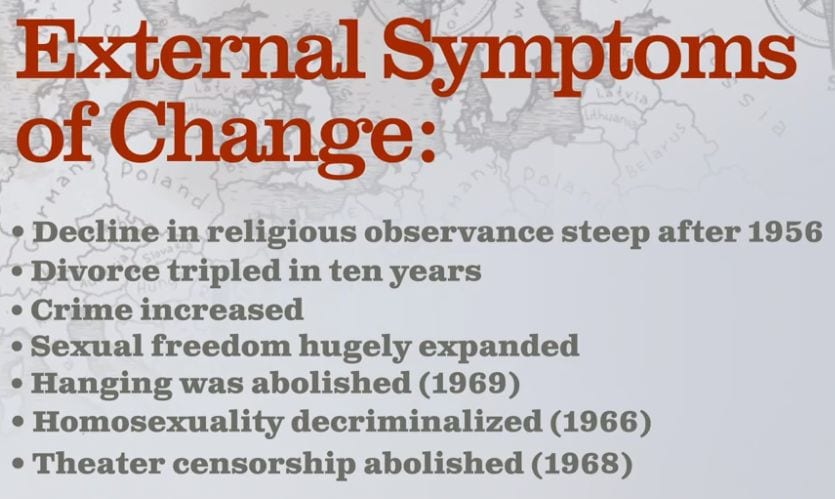
- It is, in fact, the end of an old society which was much more conformist, much more disciplined, much more patriarchal, if you like that word. This was falling away very quickly. This is the same throughout Europe. Things that were happening elsewhere in Europe, which were not so relevant to Britain, is that the old communist left went into steady decline. It was very powerful in Italy and France, and it was replaced by various new left-wing movements. The old authoritarian right, based on religion, social conservatism, and authoritarianism, also lost power all over southern Europe. After all, Portugal, Spain, and Greece were all dictatorships until this period.
- I looked at the abolition of the death penalty to show as a sign of liberalization. It was abolished in Belgium in 1950, in the UK in 1969, in Greece in 1975, in Spain in 1978, in France in 1981, and has now more or less disappeared all across Europe. So this is the period of change. Legislation of the contraceptive pill, UK, 1961, France, 1967, Italy, 1971, Ireland, 1980. So a single generation, really.
Soviet Collapse
- Soviet economy failed:
- Over-reliance on oil, rusting industry, constant shortages.
- Cultural hollowness—no one believed in the system anymore.
- Gorbachev’s reforms (1985) allowed space for dissent.
- 1989: USSR renounces military intervention—Eastern Bloc collapses, Berlin Wall falls.
“The most dangerous moment for any authoritarian system is when it starts to try to reform itself.” – Alexis de Tocqueville (quoted).
- Russia’s global power was costing it too much. It was having to compete with America in producing arms technology. It was subsidizing communist regimes. It was helping to support communism all around the world, and it just couldn’t afford it. Its own people were losing too much. And finally, the coup de grâce is that dissident movements were growing in Eastern Europe during the 1980s, which formed an invincible combination of workers, students, the churches, and intellectuals. And these could not all be suppressed, and these began to force political change.
- And it first of all happened in Poland, with strikes in the shipyards at Gdańsk, in fact, largely at first about the standards of living, wages and costs, but became built into a demand for political liberty, for representation, for democratic government. In 1985, Mikhail Gorbachev was appointed Soviet leader with the aim of reforming the communist system by a modest degree of liberalization and modernization. But this set off a collapse. More than a century earlier, the French political philosopher, Alexis de Tocqueville, had pointed out that the most dangerous moment for any authoritarian system is when it starts to try to reform itself.
End of History?
- Francis Fukuyama (1992):
“The universalization of Western liberal democracy as the final form of human government.”
- But professor notes this didn’t happen:
- Religious and ideological revivals have challenged Enlightenment ideals.
On Marxism’s Resurgence
-
Modern “woke” ideology may incorporate aspects of Marxism, especially its anti-capitalist critique.
-
But postmodernism originally challenged all ideologies, including Marxism.
-
Lenin, not Marx, blamed imperialism for capitalism’s survival.
-
Contemporary ideologies often lack Marxism’s coherence:
“Contemporary ideologies seem to me pretty chaotic and intellectually weak.”
-
If you think that Marx was correct in predicting that capitalism would finally be destroyed by its own internal contradictions, or if you think that Lenin was right, that the only thing that was keeping the capitalism going was the exploitation of the rest of the world, then you could see some of the themes of post-colonialism, wokeness, as being linked with Marxism, which I think they are.
-
First of all, I think Marxism, whether you think it was, how useful you think it is as a description of history, was at least a coherent system. I mean, it was very thoroughly worked out by Marx himself and many others, whereas much of contemporary ideologies seem to me pretty chaotic and intellectually weak.
-
I think originally, postmodernism was also an enemy of, or at least was highly subversive of, Marxism. Because if postmodernism is saying all these things that people are telling us are true are not true—they’re just discourses, they’re just forms of words, they’re just collections of ideas, they’re not true—then Marxism, too, is not true. It’s just another ideology, another grand narrative. And indeed, I thought at the time that this was largely what postmodernism was going to be about. It was going to be demolishing things like Marxism.
- But certainly, Marxism has, to some extent, survived and been incorporated into or has incorporated postmodernist thinking in a rather incoherent way, it seems to me. But the thing that they have in common is, I suppose, the desire to subvert the Western system and to blame all the ills of the world on capitalism, essentially that. OK, Marx didn’t talk much about empire. In fact, he rather approved of it. In fact, he explicitly approved of it. He thought this was a way of spreading modernity. But it was Lenin who blamed imperial exploitation for propping up the capitalist system.
On the Gulag System
-
Based on Leninist class war: all “class enemies” (even small landowners) became targets.
-
Camps served for slave labor (e.g. White Sea Canal), not extermination per se, but conditions often lethal.
-
Difference from Nazi camps: survivability was possible in gulags.
-
Solzhenitsyn’s quote (from Ivan Denisovich):
“Today was a good day. I got extra soup. I didn’t get beaten. I got a blanket.”
-
Be used as a source of cheap labor. And many of the Russian camps were set up, at least in theory, as labor camps. It could be that they were doing forestry, they were building roads, they were building railways, they were building canals and so on. But the way it was done was certainly not one that was aimed at efficient use of labor. It was aimed at punishment, at the creation of terror, and eventually the death of many of the prisoners. So there were various levels of camp in which some were regarded as more punitive than others.
-
If you’re being sent to a labor camp well to the north of the Arctic circle and you were being fed very little, you would have very little protective clothing, you’d be working outside in sub-zero temperatures, then you would know and your captors would know that you would not live long and you were not expected to live long. The difference between the gulag and the German system is that the gulag was not explicitly an extermination system. It did kill very many people, but it did not have the machinery of mass killing that the Nazi system had in places like Auschwitz.
-
So you could survive a Russian camp. If you were a Jew in Auschwitz, you would not survive and you were not intended to survive. You might be used as a slave laborer for a brief period, but death would be the final end. You could survive a camp. And if you were not in the most severe camp, you might survive even for years. The book I mentioned, Solzhenitsyn’s book, One Day in the Life of Ivan Denisovich, is quite moving. He ends up by saying, he’s describing his whole day in the camp, and he says, “I’ve had a good day. I got an extra helping of soup. I didn’t get beaten up. I wasn’t sent on one of the worst work assignments, so I wasn’t injured. I managed to get a bunk with an extra blanket, so I didn’t freeze to death. So today was a good day.”
8: Efforts Toward Unity
1. Opening Reflections: Europe’s Identity
- The course ends by questioning what Europe is: a geographical space, a civilization, or a historical project.
- A recent European Union report, European Historical Consciousness, declares:
“The European Union is a community of destiny (Schicksalsgemeinschaft), and it should be understood as such and not as a community of one shared collective memory.”
2. The Dream of European Unity
- The idea of European unity has long roots—called by some “the last Enlightenment grand narrative.”
- Victor Hugo (1867) envisioned a united Europe with Paris as its capital.
- In the 1920s–30s, intellectuals proposed unity, including inviting Hitler and Chamberlain to proclaim a federation—“a remarkable degree of optimism.”
- Aristide Briand (1929–30) proposed a Franco-German federation.
- Unity was viewed as:
- A means of escape from war and conflict.
- An expression of shared values: humanism, tolerance, democracy, rule of law.
3. Realism and Idealism in European Integration
- Idealism justified the project; realism drove it—especially Franco-German reconciliation.
- Iconic image: Mitterrand and Kohl holding hands at Verdun.
- As a historian noted:
“To the French, it was a flag of convenience. To the Italians, it was preferable by definition to government by Rome. To the Germans, a welcome escape route. And to the Benelux nations, a better choice than being dominated by powerful neighbors.”
4. From Coal to Euro: Milestones
- 1950: European Coal and Steel Community—“No coal, no steel, no war.”
- 1957 Treaty of Rome: Founded the European Economic Community.
- Integration motives:
- Reaction to war and extremism.
- Economic recovery.
- Fear of USSR.
- American pressure for unity.
5. Britain’s Ambivalent Role
- Initially abstained—seen as too global due to empire.
- Joined in 1973 after decolonization and fear of economic decline.
- Charles de Gaulle delayed Britain’s entry, saying it wasn’t “sufficiently European.”
- Britain contributed to market liberalization (Single European Act, 1986), then grew skeptical under Thatcher.
- Tony Blair supported Eastern enlargement and freedom of movement, which later fueled Euroskepticism.
6. The Euro: Political Overreach?
- The Euro (1999) was designed more for political unity than economic efficiency.
- Critics warned Europe wasn’t an “optimal currency area”:
- Different living standards, no shared fiscal system.
- “If you want a common currency, you need a federal system”—akin to the US.
- Italy and Greece suffered; Italy saw no growth since adopting the Euro.
7. Brexit and Its Causes
- Brexit (2016) was a major rupture:
- Britain had less traumatic 20th-century experiences (no occupation or revolution).
- Stronger global ties, suspicion of centralized power, and non-adoption of the Euro.
- EU was seen as undemocratic and elite-driven.
- Consequences (uncertain):
- Economic catastrophe didn’t occur.
- Political marginalization predicted—but UK remained active globally.
- However: instability, unresolved border issues (esp. Northern Ireland), and cultural polarization.
“The crucial step was that it did not adopt the Euro. Had Britain been in the Eurozone, I don’t believe it would have voted to leave.”
8. The EU Post-Brexit
- Other nations didn’t follow Britain—Brexit dampened Euroskepticism.
- Euroskeptic parties (France, Netherlands, Hungary, etc.) now aim to change the EU from within—not exit.
- Without Britain, deeper integration seemed possible—but instead, fragmentation has grown.
“The EU is now governed not by its principles or its people, but by its bank board.”
9. Open Questions
The professor posed profound unresolved issues:
- Is the EU in irreversible decline?
- Is there a true European demos?
- Is democracy possible without one?
- Is the EU headed for fragmentation or technocracy?
- Does Europe share any real values—and can it defend them?
- Can it respond to migration, stagnation, disaffection?
“Is there really a thing called Europe? Has there ever been?”
10. Broader Reflections on Europe and the West
- From 1688 to WWII, Europe exported modernity—reason, liberalism, democracy.
- Yet totalitarianism and genocide undermined its superiority.
“To write poetry after Auschwitz is barbaric.” — Adorno
- Critics now say Europe’s crimes weren’t betrayals of modernity but results of it:
“Was Stalin the heir of Robespierre and Rousseau?”
Michel Foucault:
“The Enlightenment has determined, at least in part, what we are, what we think, and what we do today.”
- Colonialism, today, is seen as Europe’s greatest sin. The Pitt Rivers Museum in Oxford:
“Colonialism seeks to overwrite existing cultural systems… The cultural systems that get imposed are capitalism, communism, religion, scientific logic, racism, patriarchy, and gender binary.”
Professor’s critique:
- Claims like these cast non-Europeans as helpless or dupes.
- European empires were short-lived—Clive’s tortoise lived longer than his empire.
- I went to India a few years ago and saw a little notice about the pet tortoise of Lord Clive, Robert Clive, the great East India Company soldier who conquered Bengal and much of Eastern India, and he had a pet tortoise. Well, the tortoise lived until the 1950s, and it occurred to me that Clive’s tortoise actually lived longer than Clive’s empire.
- So we have to realize that European empires were actually quite short, and some of them were very short indeed, only a few years, less than a single generation. So is it really true that they left an indelible print on the world, that decolonized peoples are unable to throw off without our help? Another thing that seems to me strange is that this obsession with decolonization and coloniality exposes European history and culture to a hostile scrutiny that would seem absurd or offensive if applied anywhere else. Imagine arguing that Asian culture should be rejected because of Japanese atrocities in the Nanking massacre in 1937, because of Chinese mass starvation under Mao in the ’50s and ’60s, or the horrors of the Cambodian genocide in the 1970s. What is it about Asian culture that has caused all these horrors? Should we not be thinking how Asian culture should be deconstructed and dismantled? Or Africa. Surely there’s something wrong with African culture, if Africans for centuries were willing to sell other Africans into slavery, were willing to sacrifice human beings, and still want to continue genital mutilation of young girls. Is there not something wrong with Africa and African culture?
- Of course, we don’t say those things, and to say them sounds ridiculous, but we do say them, or some people say them, about European culture and European history. I would say that that shows that the decolonization vogue is political rather than truly intellectual or historical. Moreover, it’s based on blatant double standards, as I’ve said. Is the attempt to impose modern Western progressive ideas on parts of Africa and on Arab cultures not another form of coloniality? Yet in this case, practiced by those who criticize, in principle, the colonialist legacy.
- Hypocrisy: Why not critique Asian or African cultures for past atrocities?
“Is imposing modern progressive values on Africa not a new form of colonialism?”
- It was recently stated in a recent conference in Cambridge that, I quote, “the British Empire was far worse than the Nazis. It lasted far longer. It killed far more people. And in fact, in many ways, the Nazis were copying large elements of the British Empire.” If there are any rational purposes in making such comments, as opposed to pure provocation, perhaps they are intended to create division and to make a reasonable history of empire impossible.
11. Two Damaging Effects of This Orthodoxy
-
Lord Sumption:
“It can only fragment our society, obstruct the integration of minorities, and undermine any sense of community.”
-
Secondly, if European values are destroyed, what replaces them? Likely:
- A nihilistic vacuum domestically.
- More conflict and criminality globally.
- Even Russia sees decolonization discourse as diplomatically useful.
-
We’ve seen this in recent months with democratic campaigners in Hong Kong, waving the Union Jack. Does this sort of thing matter? I think it does. Across the English-speaking world, and continental Europe may not be far behind, we see a comprehensive attack on European and Western history as essentially destructive and malign. And this view is increasingly found in schools, universities, museums, and other cultural institutions.
-
There are at least two damaging results. First, as the distinguished judge and historian Lord Sumption has put it recently, I quote, “It can only fragment our society, obstruct the integration of minorities, and undermine any sense of community.” I think one would have to conclude that those are the intentions. The intentions are to fragment society, to obstruct the integration of minorities, and to undermine a sense of community. That is why these things are being said.
12. Closing Thought: Matthew Syed (Sunday Times, Jan 28, 2024)
- I’m going to end by quoting a journalist, which I don’t think I’ve done very much so far, a journalist called Matthew Syed, who wrote very recently in the Sunday Times, in fact, on the 28th of January, 2024. He said, “We’ve spent an inordinate amount of time trashing our own nations and histories, which would have been fine if the debate had been conducted with nuance and wisdom. But the cartoon indictments of the West rarely take account of what we might call the plausible counterfactual. How would the world have looked if the Islamists, Bolsheviks, or genocide Chinese Communist Party had been in charge?” We could add, of course, what if the Nazis had won? “The West, in this context,” says Syed, “can be seen as the world’s greatest blessing, not its greatest curse.”
The professor’s final word:
“To treat that history as wholly negative… is a gross distortion and intellectually dishonest. And no good purpose is served by it.”
Audience Q&A Highlights
-
Q: Why do former British colonies in Africa seem more successful?
A: Possibly due to smaller, more homogeneous populations, better institutional legacies, and fewer natural resources (avoiding the “resource curse”). -
Q: Do we learn from history?
A:“The only lesson we learn from history is that we don’t learn from history.”
But history can teach humility, broaden understanding, and help us relativize our own beliefs. -
Q: Why not bomb German industry instead of cities in WWII?
A: It was tried, but accuracy was too poor. Only later, with new tech, did precision strikes become feasible.