
DESCRIPTION
An enlarged edition of Thomas Sowell’s brilliant examination of the origins of economic disparities Economic and other outcomes differ vastly among individuals, groups, and nations. Many explanations have been offered for the differences. Some believe that those with less fortunate outcomes are victims of genetics. Others believe that those who are less fortunate are victims of the more fortunate. Discrimination and Disparities gathers a wide array of empirical evidence to challenge the idea that different economic outcomes can be explained by any one factor, be it discrimination, exploitation, or genetics. This revised and enlarged edition also analyzes the human consequences of the prevailing social vision of these disparities and the policies based on that vision—from educational disasters to widespread crime and violence.
Discrimination and Disparities - Thomas Sowell.pdf (file not included in this release)
Cofnas’s hereditarian challenge—and its limit
Nathan Cofnas argues that Sowell’s culture-first treatment of racial disparities is “wishful thinking.” His specific source audits deserve attention: he reports that he could not substantiate Sowell’s often-repeated claim that Dunbar High School students reached an average IQ of 111, and he questions a quotation attributed to Cicero. If a number or quotation is undocumented, it should be corrected regardless of the critic’s politics.
The broader inference does not follow automatically. Showing that one school anecdote is unsupported does not establish that racial test-score gaps are substantially genetic. Sowell’s multi-prerequisite framework—family, education, incentives, timing, geography, institutions, health, culture, and individual traits—also explains why outcome gaps can greatly exceed any single causal difference. Cofnas is right that culture and genes can interact and that individual intelligence is partly heritable; current molecular genetics still does not identify the causal genetic share of broad racial IQ gaps. Read the two as competing causal emphases, not as if falsifying one anecdote proves the other’s complete worldview. → Nathan Cofnas > Race, intelligence, and free inquiry
Chapter 1: Disparities and Their Explanations
Intro: Disparities and Their Explanations
- Sowell opens by noting the widespread disparities in economic and other outcomes among individuals, groups, and nations.
- He lays out a spectrum of explanations:
- At one end: disparities reflect innate genetic inferiority of less successful groups.
- At the other: disparities reflect victimization by more fortunate groups (discrimination, oppression).
- He argues that everyone agrees the actual disparities are much larger and more skewed than what “random chance” would suggest.
- But, crucially, he claims:
- Large disparities in outcomes do not require:
- Equally large disparities in innate ability, or
- Equally large disparities in how people are treated.
- Instead, they can come from prerequisites: success requires multiple conditions, and small differences in meeting those prerequisites can yield huge differences in outcomes.
- Large disparities in outcomes do not require:
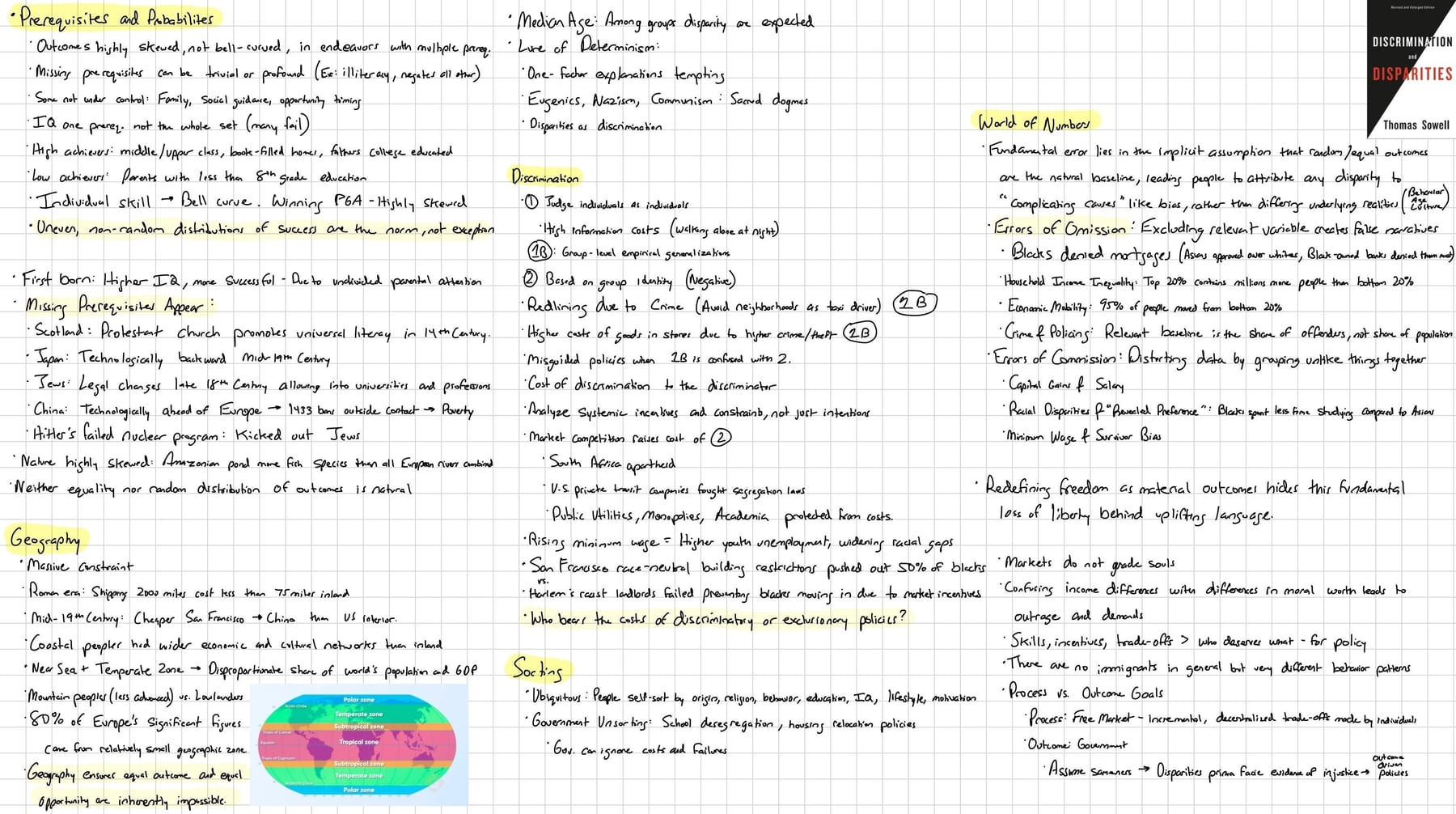
PREREQUISITES AND PROBABILITIES
- Sowell uses a simple probability model:
- Consider an endeavor that requires five prerequisites.
- Suppose each prerequisite is fairly common: any given person has each one with probability 2/3.
- The chance of having all five simultaneously is:
[(2/3)^5 = 32/243 \approx 1/8] - This means:
- Roughly 1 in 8 people have all prerequisites → success.
- About 7 in 8 fail, even though each single prerequisite is common.
- Key implications:
- Outcomes will be highly skewed, not bell-curved, in endeavors with multiple prerequisites.
- Having 4 out of 5 counts as failure if all five are required.
- People with “most” of what it takes can still be “utter failures” in that domain.
- He stresses that missing prerequisites can be trivial or profound, but either way can nullify everything else:
- Example: illiteracy in a modern economy: all other virtues are negated in many careers if one cannot read.
- Not all prerequisites are under personal control:
- Some include family background, social guidance, opportunity timing.
- Even extraordinary strengths in some areas cannot compensate for crucial missing factors.
- Terman’s gifted children study:
- 1,470 children with IQ ≥ 140 followed for decades.
- Despite all being in the top 1% in IQ:
- Some reached very high achievement (many graduate degrees, notable careers).
- About 20% were “disappointments” (few degrees, modest or poor careers).
- The least successful 150 men: only 8 had graduate degrees; dozens had only high school diplomas, while an equally sized group among the most successful had 98 graduate degrees.
- Two boys excluded from the study for IQs below 140 later became Nobel laureates in physics, while none of Terman’s high-IQ subjects did.
- Takeaway: IQ is one prerequisite, not the whole set.
- Terman’s key differentiator: family background:
- High achievers: middle/upper-class families, book-filled homes, many fathers college-educated (rare at the time).
- Low achievers: many had parents with less than 8th-grade education.
- Sowell generalizes:
- Sometimes the missing prerequisite is as simple as someone to point you toward college or a path of achievement.
- People in some social groups apply to college as a norm, others don’t.
- He then applies the “multiple prerequisites” logic to golf and other sports:
- Individual skills (like putting or driving distance) are closer to a bell curve.
- But winning PGA tournaments (which require many skills together) is highly skewed:
- Most pros never win a single PGA event.
- Three players—Arnold Palmer, Jack Nicklaus, Tiger Woods—won more than 200 tournamentscombined.
- Similar patterns appear in baseball, tennis, etc.
- Broader conclusion:
- With multiple prerequisites, uneven, non-random distributions of success are the norm, not the exception.
- Shifts in one prerequisite (technological, political, educational) can dramatically reorder who leads and who lags over history.
EMPIRICAL EVIDENCE
Sowell now looks at real-world data to test the assumption that unequal outcomes must reflect either genetics or discrimination.
People
- Birth order and merit:
- Study of National Merit Scholarship finalists:
- In five-child families, the firstborn was the finalist more often than the other four siblings combined.
- Firstborns also dominated in 2-, 3-, and 4-child families.
- Similar patterns across IQ data (Britain, Germany, US, Netherlands, Norway):
- Firstborns have higher average IQs than later-born siblings.
- Second-borns higher than third-borns, and so on.
- These studies involve hundreds of thousands of cases.
- Study of National Merit Scholarship finalists:
- Education and professional outcomes:
- Medical school data:
- University of Michigan, Class of 1968: firstborn men more than twice as common as later-borns; vastly more than fourth-born+ men.
- New Jersey med school applicants (1978): firstborns over-represented among applicants and even more among those accepted.
- University degrees by birth order:
- 2003 Britain:
- 22% of eldest children earned degrees,
- 11% of fourth-born,
- 3% of tenth-born.
- Late 20th-century France (20,000+ sample):
- Only child: 18% of males, 23% of females completed four years of college.
- Firstborn: slightly lower.
- Fifth-born or later: ~7% of males, 5% of females completed four years.
- 2003 Britain:
- Career outcomes:
- Income and occupational status decline with later birth order.
- Firstborns are overrepresented among lawyers in Boston, members of Congress, Apollo astronauts (22 of 29 were firstborn/only children), and leading classical composers.
- Medical school data:
- What’s different for firstborns?
- Same parents, same house, same race, similar environment—yet significant differences.
- The distinct advantage: undivided parental attention early in life.
- Evidence from twins:
- Twins tend to have slightly lower average IQs than singletons.
- When one twin dies early, the surviving twin’s IQ approaches that of those born singly—suggesting divided parental attention is a key factor.
- Class differences in early language exposure:
- Professional families: children hear ~2,100 words/hour.
- Working-class: ~1,200 words/hour.
- Welfare families: ~600 words/hour.
- Quality of interaction also varies by class.
- Implications:
- Outcomes differ even within the same family, much more so across social classes.
- It is unrealistic to expect equal outcomes from children raised under dramatically different family and class conditions.
- Differences in goals and priorities also matter: not everyone is aiming at the same kind of mobility or success.
- Historical examples of “sudden” success when the missing prerequisites appear:
- Scotland:
- For centuries poor and backward; nobles reputedly illiterate in the 14th century.
- After Protestant church campaigns promoting universal literacy and intense effort to learn English(expanding access to books and knowledge), Scots rapidly became over-represented in British intellectual life (Watt, Smith, Hume, Black, Scott, Mill, etc.).
- Japan:
- Mid-19th century: technologically backward and astonished by Western ships and rail.
- After intense modernization, Japan became a technological leader by the late 20th century (e.g., bullet trains surpassing American rail tech).
- Jews:
- Historically, Jews had high literacy and “human capital” but were largely barred from universitiesand many professions in Europe.
- With legal changes (e.g., US Constitution’s religious neutrality, French post-1789 reforms), barriers ease; Jews flood into universities (e.g., 30% of students at Vienna University by the 1880s).
- 1870–1950: Jews become highly overrepresented in arts and sciences relative to their population share.
- In the late 20th century, Jews (less than 1% of world population) received a disproportionate share of Nobel Prizes in chemistry, medicine, and physics.
- Lesson: they already had many prerequisites (literacy, culture emphasizing study); the removal of a few legal/institutional barriers completed the set and led to dramatic outcomes.
- China vs. Overseas Chinese:
- Historical China: technologically ahead of Europe (cast iron, advanced ships, voyages predating Columbus).
- Crucial decision in 1433: stop long-distance voyages, ban building large ships, restrict contact with the outside world.
- Europe, meanwhile, builds on Chinese inventions (printing, gunpowder) and explores the world.
- China falls behind; parts of the country are dominated or carved up by foreign powers; by late 19th–early 20th century, China resembles a Third World country.
- However, ethnic Chinese emigrants (“overseas Chinese”), often poor and uneducated at arrival, become remarkably prosperous abroad.
- By 1994, ~57 million overseas Chinese produced as much wealth as the billion people in China.
- Moral: the people’s capabilities remained, but one missing prerequisite—wise policy regarding openness—crippled the nation.
- Hitler’s failed nuclear weapon program:
- Germany had early start and strong nuclear physics.
- But many top physicists were Jewish, and Nazi anti-Semitism drove them out.
- Jewish émigré scientists alerted the US to the nuclear threat and helped launch the Manhattan Project, where Jewish scientists played major roles.
- Hitler’s racism effectively denied Germany a crucial scientific prerequisite; that missing factorhelped prevent a Nazi nuclear bomb.
- Scotland:
Institutions
- Sowell extends the multi-prerequisite logic to organizations and firms:
- Great civilizations (Greece, Rome) once far ahead of northern Europeans in literacy and culture; centuries later, Northern and Western Europe pulled ahead.
- Organizational success is often contingent on specific technologies and environments, and can collapse when conditions change.
- Eastman Kodak:
- For over a century, Kodak dominated global photography.
- Eastman simplified photography for the masses with small cameras and roll film, removing technical hurdles.
- As late as the 1990s:
- Huge global market share in film.
- 145,000 employees worldwide, nearly $16B in revenue.
- Then digital photography emerges:
- Film camera sales peak in 2000; within a few years, digital cameras overtake and then far surpass film cameras.
- Kodak actually invented an early electronic image sensor, but others (like Sony) took the digital camera market lead.
- With film’s rapid decline, Kodak’s core film-based ecosystem collapses, and the company goes bankrupt.
- Message:
- You can have all prerequisites for success in one era, but when one prerequisite changes (e.g., technological paradigm), those assets can become obsolete.
- This pattern is not unique to Kodak: many companies fall from dominance after shifts in a single crucial prerequisite.
Nature
- Nature also shows highly skewed outcomes driven by multiple prerequisites:
- Tornadoes:
- Over 90% of the world’s tornadoes occur in the United States, despite similar individual climatic features existing elsewhere.
- It’s the unique combination and frequency of those factors that matters.
- Lightning and thunderstorms:
- Africa has more lightning than Europe and Asia combined.
- In the US, southern Florida has thunderstorms 20 times more often than coastal California.
- Earthquakes:
- Common around the Pacific Rim, rare along the Atlantic.
- Biodiversity:
- The Amazon Basin shows extreme disproportion: a single tree can harbor dozens of ant species, comparable to the entire ant fauna of Britain; a small Amazonian pond can have more fish species than all European rivers combined.
- Tornadoes:
- Humans as part of nature:
- Chimpanzees share over 90% of their genetic makeup with humans; some small worm-like creatures share most of their genes with humans as well.
- Yet these species have not produced anything like human civilization.
- Again, having many prerequisites is not enough; missing key factors prevents certain outcomes.
IMPLICATIONS
Sowell uses these examples to draw broader conclusions about how we should interpret disparities.
- The recurring pattern: grossly unequal outcomes are normal in systems with multiple prerequisites.
- Therefore:
- Neither equality nor random distribution of outcomes is natural.
- Skewed outcomes do not automatically imply differences in genes or discriminatory treatment.
- Economic historian David Landes: “The world has never been a level playing field.”
- Sowell argues:
- The belief that the world would be level absent genes or discrimination is a preconception, contrary to logic and evidence.
- Human sins (including discrimination) are real, but not automatically the primary cause of every observed disparity.
- Geography and demography alone are enough to break any expectation of uniform outcomes.
Geography
- Geography is a massive constraint on equal opportunity and outcomes.
- Historical transport costs:
- Roman era: shipping across 2,000+ miles of Mediterranean cost less than hauling the same goods 75 miles inland.
- Mid-19th century: faster and cheaper to reach San Francisco from China by sea than from the US interior by land.
- Result: coastal peoples had far wider economic and cultural networks than inland peoples.
- Fertility of land and climate:
- Most fertile lands are in temperate zones, not the tropics.
- Fertile land supports productive agriculture, which supports cities, which support advanced civilization.
- Areas near the sea and in temperate zones host a disproportionate share of the world’s population and GDP.
- Historical path dependence:
- Even though modern transportation (rail, truck, airplane, container ships) reduces geographic barriers, it cannot undo centuries of developmental divergence caused by past geography.
- Mountain peoples vs lowlanders:
- Mountain peoples, spread across continents, have been geographically constrained:
- Expensive transport.
- Limited access to trade and ideas.
- Mountain populations make up 10–12% of humanity—far more than Italy’s population—but have produced no cluster of landmark figures comparable to Italy’s (Galileo, da Vinci, Michelangelo, Marconi, Fermi).
- A classic study of a mid-20th-century Italian mountain village: people were desperately poor and largely cut off from the outside world.
- Their relative lack of achievement reflects geographic constraints, not other people’s oppression.
- Mountain peoples, spread across continents, have been geographically constrained:
- Geographic location itself:
- Greek civilization advanced earlier partly because of proximity to the Middle East, where agriculture and writing developed.
- Britain, Scandinavia, and other regions farther away received advanced knowledge later.
- Over time, many waves of discovery, disease, migration, war, and technology spread unevenly, creating persistent locational advantages and disadvantages.
- Multi-ethnic societies:
- Modern nations with multiple ethnic groups inherit cultural legacies shaped by different geographic and historical conditions, even after they now share the same territory.
- Empirical work (Braudel, Horowitz, Weiner, others) shows:
- No society has regions or groups developing equally.
- “Proportional representation” of groups in occupations or institutions is virtually never observed.
- Ethnic groups naturally cluster into different niches of occupation, education, income, and status.
- Even military forces rarely mirror the ethnic composition of the population.
- Charles Murray’s Human Accomplishment:
- 80% of Europe’s significant artistic and scientific figures came from a relatively small geographic zone, excluding Russia, Scandinavia, much of Eastern Europe, Iberia, Ireland, much of Scotland, and portions of Italy and France.
- In the US, notable achievers have been disproportionately from the northeast, not the South (with some exceptions like Virginia).
- Bottom line: geography ensures that equal outcome and equal opportunity are inherently impossible across regions and groups.
Demography
- Age structure differences:
- Within a country, difference in median age can matter more for income than race.
- In the US, middle-aged people earn much more on average than young adults, and this gap has grown as economies shift from muscle power to human capital (skills, experience).
- Different ethnic groups often have very different median ages:
- Example: Japanese Americans vs Mexican Americans:
- Japanese Americans: median age ~51.
- Mexican Americans: median age ~27.
- This alone guarantees different representation in:
- Professions, managerial roles, and other positions requiring years of education and experience.
- It makes no sense to treat unequal representation as proof of discrimination if the age structures are so different.
- Example: Japanese Americans vs Mexican Americans:
- Even for a single person:
- A man at different ages does not have the same productivity, experience, or earnings.
- So “equal treatment” in rights and law cannot produce equal outcomes; it virtually guarantees inequality in performance and results.
- For Sowell, this implies:
- Disparities in group outcomes are expected, even with equal rights and no discrimination.
- Genes or discrimination may still be relevant in particular cases, but must be treated as hypotheses, not default explanations.
The Lure of Determinism
- Sowell targets one-factor explanations, especially the temptation to treat one cause as the master key:
- Early 20th century: genetic determinism was dominant.
- Late 20th/early 21st century: many treat discrimination as the central explanation.
- Eugenics era:
- American universities offered many courses on eugenics, just as many now offer courses assuming disparities = discrimination.
- Support for eugenics cut across ideologies and countries:
- In Britain: Keynes, Wells, Shaw, Julian Huxley, Laski, the Webbs, Churchill, Chamberlain.
- In the US: leading figures in sociology and economics, pioneers of mental testing.
- Some claimed certain minorities “cannot master abstractions” or that Jews were not particularly intelligent—claims now obviously false.
- Sowell’s point:
- Even top intellectuals are not immune to stampedes toward simplistic explanations.
- Just as genetics was once a dogma, disparities-as-discrimination can become a new dogma.
- Analogy with climate:
- Sunlight is scientifically hotter in the tropics, yet:
- Highest recorded temperatures on multiple continents occurred outside the tropics.
- Some European cities have higher record highs than equatorial Singapore.
- Why? Other factors (ocean currents like the Gulf Stream, humidity, geography) modify the effect of latitude.
- So a true major factor (tropical sun) still doesn’t determine all outcomes by itself.
- Sunlight is scientifically hotter in the tropics, yet:
- Extension to social issues:
- Discrimination is real, but other factors can outweigh it in particular contexts.
- One must not assume that any disparity automatically proves discrimination.
- Crime disparities:
- Murder rates have long been much higher in Eastern Europe than Western Europe.
- Latin America has:
- About 8% of world population
- But around 38% of recorded murders.
- Within its cities, 80% of violent killings occur on just 2% of streets.
- Again: highly skewed outcomes; no simple “equality of crimes” either.
- Final warning:
- The 20th century saw Nazism and Communism:
- Nazism: dogmatic belief in genetic inferiority led to mass slaughter.
- Communism: dogmatic belief in “exploitation” and class enemies led to mass atrocities and impoverished economies.
- In both cases, key ideas (race, exploitation) were treated as sacred dogmas, not as testable hypotheses.
- Sowell fears that discrimination as a total explanation for disparities could become a similar dogma if insulated from evidence and logic.
- The 20th century saw Nazism and Communism:
- His proposed stance:
- Treat all explanations—genes, discrimination, geography, culture, demography—as hypotheses to be tested against facts.
- Avoid turning any of them into untouchable dogma, no matter how emotionally satisfying or politically useful.
Chapter 2: Discrimination: Meanings and Costs
Chapter Framing: Two Very Different Meanings of “Discrimination”
- Sowell opens by noting the dual meaning of “discrimination”:
- Praiseworthy: someone has discriminating tastes (careful, discerning judgment).
- Condemned: someone treats people differently based on group identity, regardless of individual merit.
- Both kinds can lead to large differences in outcomes:
- A wine expert chooses one wine far more often (and pays more).
- Employers, schools, etc., may end up hiring/admitting certain groups more than others.
- Central question:
- Are disparities due to:
- Internal differences in behavior and capabilities, correctly perceived?
- Or external impositions based on bias, stereotype, or hostility?
- Are disparities due to:
- Sowell insists this is an empirical question, and the answer can differ across groups, places, and times.
- Before answering, we must be precise about what “discrimination” means in each context.
MEANINGS OF DISCRIMINATION
Discrimination I vs Discrimination II
- Discrimination I:
- Broad, neutral sense: discerning real differences in people or things and acting accordingly.
- Ideal form (applied to people): judge individuals as individuals, not as group members.
- Discrimination II:
- Narrow, common sense: negative treatment based on group identity, rooted in bias, aversion, or animosity (e.g., racism, sexism).
- This is the type that anti-discrimination laws usually target.
Context and Cost: When Individual-Level Judging Is Too Expensive
- In the real world, pure Discrimination I is rare because:
- Judging each person individually often has high information costs and sometimes personal risk.
- Sowell’s example:
- Walking alone at night, seeing a shadowy figure in an alley:
- Ideally you’d judge them as an individual.
- In practice, you may cross the street to avoid risk.
- Walking alone at night, seeing a shadowy figure in an alley:
- In a college classroom, a professor might judge students individually; on a dark street, the same professor uses group/generalizations because the cost of being wrong is higher.
- Key idea: the applicability of Discrimination I vs II is heavily shaped by cost, including:
- Cost in money.
- Cost in time.
- Cost in safety (risk to life, property, etc.).
Discrimination IA vs Discrimination IB
Sowell refines Discrimination I into two versions:
- Discrimination IA
- The ideal:
- Pay the cost to acquire information to judge each individual on their own merits.
- Example: running criminal background checks on all applicants, so no one is judged purely by group averages.
- More expensive, but most precise and individually fair.
- The ideal:
- Discrimination IB
- When individual-level information is too costly, decision-makers rely on group-level empirical generalizations.
- Example (hypothetical):
- Group X: 30% alcoholics, Group Y: 2% alcoholics.
- Employer who cannot cheaply test everyone may prefer Group Y for safety-sensitive jobs.
- Result:
- 70% of Group X (who are not alcoholics) unfairly lose opportunities, even though the employer is not acting from bias, but from cost-based risk management.
- Crucially, Discrimination IB is not Discrimination II:
- It is based on empirical group data, not on personal hatred or animus.
Group Interactions and Workplace Efficiency
- Employers may also use Discrimination IB because groups interact differently with each other:
- Historical example: Irish Protestants vs Irish Catholics in 19th-century America—mixing them in a workplace could import old-world antagonisms and reduce productivity.
- Gender example:
- In female-dominated fields (e.g., nursing), a male nurse might be equally qualified, but mixed-gender dynamics might reduce overall efficiency.
- Similarly, in overwhelmingly male jobs (e.g., lumberjacks), adding a woman may distract the rest.
- Observers who insist “this individual is equally qualified” miss Sowell’s point:
- The question is not just what the individual can do, but how others react, and what that does to productivity.
Redlining, Crime, and the Cost of Sorting
- High-crime neighborhoods:
- Most residents are law-abiding, but the cost of individually sorting criminals from non-criminals is very high.
- So businesses, taxi drivers, delivery services, etc., may “redline”:
- Avoid entire neighborhoods.
- Refuse deliveries or charge more.
- Consequences:
- Law-abiding residents pay a high price:
- Fewer services.
- Higher prices.
- They are effectively paying for the behavior of the criminal minority, not for anything they themselves did.
- Law-abiding residents pay a high price:
- Sowell emphasizes:
- This pattern is driven by Discrimination IB (empirical risk management), not necessarily Discrimination II.
- Mislabeling it as II leads to misguided policy responses.
The Poor Pay More – Misdiagnosis of Cause
- Study: The Poor Pay More claimed low-income consumers are “exploited” because they pay higher prices in inner-city stores.
- Sowell’s analysis:
- Many low-income areas = high-crime areas.
- High prices largely reflect higher costs of doing business:
- More theft, vandalism, burglary, higher insurance, etc.
- Profit rates in such stores are actually lower than average, not higher, undermining the “price-gouging” narrative.
- Policy implication:
- If policymakers assume Discrimination II (“greedy landlords/store owners exploiting minorities”), they may impose price controls or other measures that drive more businesses away, worsening service and access.
- This dynamic appears in poor white areas as well (e.g., eastern Kentucky’s “hillbilly tax”), showing it is not specifically racial but structural and cost-based.
Sidebar – Factors Behind Price Differences
- Sowell briefly explains why big-box chains like Walmart can charge less than small neighborhood stores, even aside from crime:
- Inventory turnover:
- Walmart can sell items faster, making more total profit on lower margins.
- Delivery economics:
- Delivering 100 boxes of cereal to one Walmart is much cheaper than delivering 10 boxes to each of 10 separate stores.
- Inventory turnover:
- These structural cost differences further explain price gaps without invoking Discrimination II.
COSTS OF DISCRIMINATION
Sowell now turns explicitly to Discrimination II and its costs—for both victims and discriminators.
Causation
- Discrimination II (bias-based exclusion) has unquestionably existed:
- “No Irish need apply,” “Whites Only” ads.
- Jim Crow laws and European ghettos.
- “Untouchables” in India.
- However, Sowell warns:
- You cannot simply treat any statistical disparity in hiring, promotions, or income as proof of Discrimination II.
- Pre-existing conditions—like age structure, education, family background—can produce disparities even if employers are practicing Discrimination IA (true individual-based assessment).
- Example: Median age differences between Japanese Americans and Mexican Americans:
- Big differences in age structure alone will produce different income and occupation profiles, even without bias.
- Likewise, occupational self-selection:
- Women earn most degrees in education, men in engineering—this shapes workplace demographics beyond employer bias.
Costs and Their Effects
- Sowell emphasizes the cost of discrimination to the discriminator:
- In a competitive market, employers who refuse qualified workers from a disfavored group pay a price:
- Higher wages to attract replacements.
- Lower productivity or fewer good workers.
- Society as a whole also pays when large pools of talent (e.g., women) are arbitrarily barred from work.
- In a competitive market, employers who refuse qualified workers from a disfavored group pay a price:
- Key point:
- We must analyze systemic incentives and constraints, not just intentions.
- Both Adam Smith and Friedrich Engels:
- Agreed that “what emerges” in a market is often not what anyone specifically intended.
- Contrast with academic/social commentary that:
- Often recounts discriminatory schemes (e.g., post-Civil-War plans to suppress black wages)
- But fails to examine whether such schemes actually succeeded under market pressures.
Example: Post–Civil War South (Market Feedback)
- Economist Robert Higgs studied the actual outcomes for black incomes after slavery:
- Whites tried to coordinate to keep black wages low and cheat sharecroppers.
- But competitive pressures made these agreements fragile:
- Landowners who broke ranks and offered better terms could secure better workers and larger crops.
- Blacks moved toward those offering better deals, regardless of formal economics.
- Result:
- Black per-capita income by 1900 was almost 50% higher than in the late 1860s, growing faster than overall U.S. income—despite pervasive prejudice.
- Lesson:
- Market competition raises the cost of Discrimination II, undermining its effectiveness over time, even where hostile attitudes remain.
South Africa Under Apartheid
- Sowell uses apartheid as a “no ambiguity” test case:
- White minority rule.
- Blacks denied the vote.
- Laws explicitly enforcing white supremacy and racial job ceilings.
- Yet empirical reality:
- Many firms in competitive sectors (e.g., construction) regularly violated apartheid job restrictions:
- Hired more blacks than legally allowed.
- Promoted blacks into positions legally reserved for whites.
- Government crackdowns in the 1970s led to hundreds of firms being fined.
- Many firms in competitive sectors (e.g., construction) regularly violated apartheid job restrictions:
- Housing:
- Apartheid laws banned non-whites from white-only areas.
- But many non-whites lived there anyway, including Walter Williams as a visiting researcher.
- In at least one “white” area, non-whites became a majority.
- Explanation:
- White racists still preferred themselves, but:
- Employers and landlords in competitive markets faced real costs if they refused profitable transactions with black workers and tenants.
- Politicians faced no such market cost and faced political penalties if they did not support discriminatory laws.
- White racists still preferred themselves, but:
- Bottom line:
- Discrimination II persisted most strongly where market feedback was weak or absent, and least where competition penalized it.
Institutional Incentives and Constraints
Sowell contrasts political vs economic incentives in US segregation history.
Streetcars, Railroads, and Segregation Laws
- Post–Civil War South:
- Racial segregation laws on public transit were passed once blacks lost political power after Reconstruction.
- Before laws:
- Blacks and whites often sat wherever they wished on streetcars and trains.
- Private transit companies:
- Profit depended on maximizing ridership, black and white.
- They saw enforced segregation as bad for business:
- Offends black riders.
- Can also offend some whites if they must stand while seats reserved for the other race sit empty.
- Companies:
- Fought segregation laws in legislatures and courts (e.g., cooperated with Homer Plessy to create a test case).
- After losing, often refused to enforce segregation until threatened with prosecution.
- Railroads:
- Forced to buy extra coaches and burn more fuel to run separate cars—another costly consequence of segregation laws.
Public Utilities, Monopolies, and Academia
- Sowell generalizes:
- Government-regulated public utility monopolies:
- Prices and profits controlled by regulators.
- Additional costs from discrimination (or preferences) can be passed on to customers.
- So decision-makers don’t personally pay the cost of Discrimination II.
- Nonprofits and government agencies:
- Similar insulation; they can follow fashionable prejudices or preferences without direct financial penalty.
- Government-regulated public utility monopolies:
- Example: Telephone industry (pre-cell, landline era):
- A.T.&T. subsidiaries had near-monopoly regional control.
- 1930: only 331 black women among 230,000 telephone operators.
- 1950: black women still just 1% of women employed by phone companies.
- After fair-employment laws (esp. outside the South), black hiring surged.
- Yet regional differences:
- Southern states lagged badly; first black operators in many Southern cities were only hired in 1964.
- Similar pattern in regulated utilities (oil/gas) and universities/hospitals/foundations:
- Historically strong discrimination against blacks and Jews.
- After WWII, in response to political/moral climate and civil rights laws, rapid shift to preferential hiring/admissions for minorities.
- In both directions, decision-makers did not bear major costs for these policies; customers, donors, taxpayers, and students did.
UNINTENDED CONSEQUENCES
Sowell now shows how laws with different stated purposes can reshape discrimination in practice.
Minimum Wage Laws
- Minimum wage laws are race-neutral on their face, but:
- They change the cost structure of hiring, and therefore the cost of Discrimination II.
- In a free market with no effective minimum wage:
- Wages adjust; no chronic surplus of applicants.
- Employers who reject qualified minority applicants must pay more to attract replacements, raising the cost of discrimination.
- With a binding minimum wage (set above market rate):
- You get a chronic surplus of job seekers: more applicants, fewer hires.
- Employers can easily reject qualified applicants from a disfavored group and still fill positions with other surplus applicants.
- The marginal cost of discrimination falls toward zero.
- Historical data:
- After inflation eroded the 1938 federal minimum wage, by 1948 it was non-binding, effectively absent.
- 1948 teenage male unemployment:
- Black 16–17: 9.4%
- White 16–17: 10.2%
- White 18–19: 9.4%
- Black 18–19: 10.5%
- Essentially no racial gap.
- As the minimum wage was repeatedly raised and became binding again:
- Teen unemployment skyrocketed overall.
- The racial gap in teenage unemployment opened and persisted, with black teenage unemployment often twice that of whites.
- Labor force participation:
- Mid-1950s: black and white teenage male participation rates were similar, sometimes higher for blacks.
- Over subsequent decades, as minimum wage levels rose:
- Black teenage participation declined relative to whites, age group by age group (younger cohorts first, older later).
- Sowell’s inference:
- Rising minimum wages correlate strongly with:
- Higher overall youth unemployment.
- Widening racial gaps in unemployment and participation.
- Explanations based solely on racism, poverty, or bad schools cannot explain the timing and pattern of the reversals.
- Minimum wage laws inadvertently make Discrimination II cheaper and more sustainable for employers, especially against less-experienced black youth.
- Rising minimum wages correlate strongly with:
Building Restrictions
- 1970s building restrictions (zoning, “open space,” environmental rules) in places like coastal California sharply limited new housing construction.
- Economic effect:
- Rising demand, restricted supply → housing prices soar.
- San Francisco Bay Area prices rise to more than triple the national average.
- Palo Alto: no new homes built in the 1970s, yet existing homes’ prices nearly quadruple.
- Racial effect:
- San Francisco’s black population:
- 1970 to 2005: less than half of its previous size, even as total population grows.
- Black populations also declined in Los Angeles, San Mateo, and Alameda Counties (each losing 10,000+ black residents between 1990–2000), while their overall populations rose.
- San Francisco’s black population:
- Contrast with early 20th-century Harlem:
- Harlem was predominantly white in 1910.
- White landlords and realtors explicitly tried to prevent blacks from moving in.
- Yet black in-migration succeeded, and Harlem became a predominantly black neighborhood.
- Those who refused to rent to blacks ended up with vacancies and lost rent, while those who rented to blacks filled their buildings.
- Comparison:
- Explicit racist efforts in Harlem failed because market incentives punished them.
- Race-neutral building restrictions in modern San Francisco effectively pushed blacks out by making housing unaffordable—without any explicit racial intent.
- Sowell’s conclusion:
- What matters is not just attitudes, but who bears the costs of discriminatory or exclusionary policies.
- Policies that look “race-neutral” or “progressive” can have more severe racially skewed outcomes than openly racist policies that markets undermine.
Overall Takeaways from Chapter 2
- “Discrimination” is not one thing:
- Discrimination I (empirical discernment) vs Discrimination II (bias-based hostility).
- Within I, IA (individual-level information) vs IB (group-level generalizations under costly information).
- You cannot infer the type of discrimination solely from where data are collected or from statistical disparitiesalone.
- The costs facing decision-makers—employers, landlords, politicians, regulators—are crucial:
- In competitive markets, Discrimination II is often costly and therefore limited or undermined.
- In regulated monopolies, nonprofits, and government, decision-makers can indulge Discrimination II (or fashionable preferences) at little personal cost, shifting burdens to others.
- Laws and policies that are not aimed at race or discrimination, such as minimum wage laws and building restrictions, can substantially alter:
- The cost of discriminating.
- The distribution of burdens and opportunities by race and class.
- Misdiagnosing Discrimination IB (empirical, cost-driven generalizations) as Discrimination II leads to bad policy:
- Targeting the wrong actors (store owners instead of criminals, landlords instead of zoning boards).
- Implementing measures that worsen the conditions of the very groups they are meant to help.
Chapter 3: Sorting and Unsorting People
Chapter Overview: Self-Sorting, Third-Party Sorting, and Unsorting
- Sowell argues that human interaction is not random: people typically cluster with selected subsets similar to themselves—by culture, behavior, class, or outlook—rather than mixing evenly with everyone.
- He distinguishes:
- Self-sorting: people voluntarily cluster where and with whom they feel affinity.
- Imposed sorting: governments or others dictate where people can live or associate.
- Unsorting: deliberate attempts (usually by government) to break up existing patterns in the name of integration, diversity, or fairness.
- Core claim:
- Uneven, skewed patterns are the normal outcome of self-sorting and cost-constrained behavior (Discrimination IB), not necessarily proof of hostile, imposed discrimination (Discrimination II).
- Misdiagnosing the cause leads to policies that backfire, harming both intended beneficiaries and others.
RESIDENTIAL SORTING AND UNSORTING
Residential and Social Self-Sorting
- Immigrants don’t move randomly:
- Origin countries:
- Mid-19th c. Spain: two provinces with 6% of the population supplied 67% of Spanish immigrantsto Argentina; they then clustered in specific Buenos Aires neighborhoods.
- Italian emigration: Italians abroad (Australia, Brazil, Canada, Argentina, U.S.) formed Italian enclaves, and within these, people from Genoa, Naples, Sicily clustered by origin town.
- Eastern European Jews in New York’s Lower East Side:
- Neighborhood was broadly Jewish, but within it, Hungarian, Romanian, Russian Jews formed their own sub-enclaves.
- Earlier-arrived German Jews had already begun moving out as they rose socioeconomically, forming separate communities; similar separations appear in Chicago, San Francisco, Boston, and in Australian Jewish history (Western vs Eastern European Jews, separate synagogues, differing religious and secular agendas).
- Lebanese immigrants in Sierra Leone and Colombia:
- Clustered not only by being Lebanese, but by region of origin and religion (Catholic, Orthodox, Shiite Muslim) from specific parts of Lebanon.
- Germans in 19th-c. New York:
- Settled in Kleindeutschland (“little Germany”), but Hessians and Prussians clustered in different parts of that German area.
- Origin countries:
- Marriage patterns show the same granular sorting:
- Japanese immigrants in Brazil:
- Lived in Japanese enclaves.
- Many Okinawans married other Okinawans, not even other Japanese, much less Brazilians.
- German immigrants in NYC:
- Bavarians married Bavarians, Prussians married Prussians.
- Irish in NYC:
- Most marriages were between people from the same county in Ireland.
- Italian immigrants in Griffith, Australia (1920–1933):
- 90% of Venetian men who married took wives who were also from Venice; only small fractions married other Italians or “British-Australian” women.
- Japanese immigrants in Brazil:
- Sowell notes these patterns are statistically striking but visually subtle:
- In contrast, black–white neighborhood differences in the U.S. are highly visible, so many people (and policymakers) treat them as unique and automatically caused by discrimination.
- Historically there have been imposed ghettos (Jews in Europe, blacks in the U.S.), but that doesn’t mean all sorting is externally imposed or needs to be eradicated.
Within-Group Sorting Among Black Americans
- Self-sorting occurs inside black communities as well:
- E. Franklin Frazier’s 1930s research on Chicago’s black community:
- Divided into seven zones; zones differed heavily in:
- Adult/child ratios.
- Male/female ratios.
- Percentage of mulattoes.
- These differences tracked socioeconomic levels, family stability, and behavior.
- Delinquency rates ranged from >40% in some areas to <2% in others.
- Divided into seven zones; zones differed heavily in:
- Residential differentiation by status:
- 19th-c. Detroit: black homeowners clustered together, separate from black renters; similar patterns in Cleveland.
- Harlem: observers noted occupational differences by which subway stop people used when returning home.
- Mid-20th-c. income data: black income distribution slightly more unequal than white; by 2016, top 10% of black earners had nearly 10x the income of the bottom 10%, vs about 8x among whites.
- Elite concentration:
- 1966 study: out of 4+ million black families, only about 5,200 families produced all black physicians, dentists, lawyers, and PhDs—averaging 2.25 such professionals per family (roughly 9 per 4 families).
- Black elites and their enclaves are well-documented in books like Aristocrats of Color, Our Kind of People, Certain People; notable upscale areas: “Strivers’ Row” and “Sugar Hill” in Harlem.
- 409 Edgecombe Avenue became symbolic of the black elite; “409” was enough for a taxi driver to know the destination.
- E. Franklin Frazier’s 1930s research on Chicago’s black community:
- Cultural polarization from Southern migration:
- Long-established Northern black communities (19th-c. Chicago, etc.) were small enclaves in mostly white cities and acculturated heavily to mainstream norms.
- Massive 20th-c. migration of Southern blacks to cities like Chicago brought large numbers steeped in different behavior norms:
- The Chicago Defender and other black papers denounced newcomers as vulgar, rowdy, criminal, and unwashed.
- Newspapers printed admonitions to Southern arrivals: don’t use foul language, don’t fight in the streets, don’t side with lawbreakers, don’t betray employers’ trust.
- Pre-existing Northern blacks worried that the newcomers’ behavior would provoke white backlash, threaten gains, and cause retrogression in race relations—and they were right:
- Studies showed violent crime rates among Southern-born black migrants in Pennsylvania were about 5x those of Northern-born blacks.
- The South, among blacks and whites, had long been the most violent region, and that culture arrived with migrants.
- Backlash followed: new school segregation in some Northern areas; exclusion of blacks from theaters, restaurants, hotels, and white-collar jobs in cities like Washington, Cleveland, Chicago, St. Louis; dormitory segregation at Oberlin and Harvard.
Sidebar: FEAR OF RETROGRESSION
- Sowell generalizes the pattern: established subgroups fear that less acculturated co-ethnics will trigger backlash.
- Example: Australia’s Jewish community and refugees before WWII:
- The Australian Jewish Welfare Society opposed admitting “hordes” of refugees.
- New arrivals were given cards with instructions:
- Don’t speak German loudly in public.
- Don’t be conspicuous in groups.
- Remember Jews are judged collectively by individuals; your behavior affects the whole community.
- Pacific Coast case:
- Before WWII, West Coast black populations were small, more assimilated, and faced relatively less discrimination:
- San Francisco: integrated schools and mixed neighborhoods with whites and Chinese.
- WWII: war industries attracted large Southern black migration:
- Richmond, CA: from 270 black residents (1940) to 10,000+ imported shipyard workers.
- Oakland, Berkeley, SF black populations massively multiplied between 1940 and 1950.
- Established West Coast blacks viewed newcomers as vulgar and poorly behaved; again, retrogressions in race relations followed.
- Before WWII, West Coast black populations were small, more assimilated, and faced relatively less discrimination:
- Sowell’s reading:
- These swings in race relations are too large and time-specific to be explained by timeless racism alone.
- Better explained by Discrimination IB:
- Whites and pre-existing blacks correctly perceived behavioral differences in new migrants.
- Attempts to treat this as pure Discrimination II (false perceptions and irrational racism) ignore both the empirical crime and behavior data and the agreement of black and white observers.
The Prevalence of Sorting
- Sorting is widespread and multi-dimensional:
- IQ and marriage:
- Husbands’ and wives’ IQs correlate as strongly as siblings’ IQs, despite no biological link—evidence of assortative mating.
- Consumer behavior:
- Whole Foods shoppers have college degrees at more than double the rate of Family Dollar shoppers.
- Whole Foods stores sit in communities whose average population is five times that of communities with Dollar General stores.
- Lifestyle clustering:
- Bohemian neighborhoods like Greenwich Village represent a sorting by lifestyle that unsorts by race or class origins (lots of mixing across those axes within the Bohemian niche).
- IQ and marriage:
- Hard to find the “even, random” distributions assumed by many commentators:
- Instead, almost everywhere, some group is overrepresented in certain places, roles, or consumption patterns.
- Moral and practical problem:
- Individuals who belong to a group with some hooligans or criminals can suffer:
- Higher suspicion, higher prices, restricted access, avoidance by others.
- They are clearly victims—but victims of:
- The misbehavior of their own group’s troublemakers, and
- The costly context that pushes others toward Discrimination IB.
- Individuals who belong to a group with some hooligans or criminals can suffer:
- Example: William Julius Wilson’s elevator story:
- As a casually dressed black man, he feels fear and unease from neighbors in his upscale condo; feels anger and sarcasm toward them and relief when the elevator is empty or when he wears a tie.
- He interprets this as racial prejudice.
- Sowell contrasts Wilson’s reaction with Walter Williams’ perspective:
- Williams: information is costly; people economize by using cheap visible proxies when cost of error is high.
- Race, dress, context become proxies for hard-to-observe attributes (like crime risk).
- Past black elites often blamed the misbehavior of the underclass for inviting backlash on everyone; Wilson does not.
- Sowell’s point: Discrimination IB creates real victims, but blaming only the proximate avoiders (store owners, neighbors in elevators) misses the full causal chain and leads to moral and policy dilemmas without obvious solutions.
Imposed Residential and Social Sorting
Government and Formal Restrictions
- Beyond spontaneous sorting, Sowell acknowledges explicit Discrimination II:
- European Jewish ghettos; the Russian Empire’s “Pale of Settlement”; residential restrictions on overseas Chinese in Southeast Asia; and the long U.S. history of formally and informally restricting where blacks could live (zoning, covenants, violence).
- Question is not whether such things exist, but:
- Whether any observed clustering automatically implies such restrictions.
- Whether statistics alone can prove imposed discrimination, without careful investigation.
Causation: Oscillations in Black–White Relations
- Sowell traces oscillations in black status since colonial times:
- Early on, some Africans were treated like European indentured servants—bonded for a term then freed.
- Over the 17th century, perpetual hereditary slavery developed in law, creating a major retrogression.
- 19th-century divergence:
- Both North and South imposed restrictions on free blacks, but:
- In the South, restrictions hardened over time: free blacks were seen as a threat to plantation slavery, offering an example and practical help to escaping slaves.
- In the North, with few blacks and no plantation regime, restrictions loosened over time as free, Northern-born blacks acculturated to local norms.
- Signs of progress in the North:
- Illinois removed legal restrictions on black access to public accommodations.
- Detroit: blacks went from not being allowed to vote (1850) to voting in the 1880s; by the 1890s blacks were elected to statewide office by a mostly white electorate.
- 1880 census: blacks and whites living next door; black upper class integrated socially with white elites; black children in the same schools and colleges as white elites.
- W.E.B. Du Bois (1899) noted growing liberalism in Philadelphia and easing of prejudice with black access to white neighborhoods.
- School desegregation in the North:
- Early 19th century: black kids often segregated or excluded.
- By 1870, most Northern states had reversed exclusion and passed anti-segregation laws; courts enforced black children’s admission to white schools.
- Both North and South imposed restrictions on free blacks, but:
- Then the 20th-century retrogression:
- Massive migration of Southern blacks to Northern cities:
- Populations large enough that assimilation to mainstream norms was slower and less complete.
- Behavioral and educational problems concentrated among Southern-origin black children.
- By 1940, Northern school segregation (though mostly de facto) was more extensive than at any time since Reconstruction, achieved via district gerrymandering and other tactics.
- Reasons cited: educational and behavioral issues, concentrated among Southern-origin black children.
- Massive migration of Southern blacks to Northern cities:
- Sowell’s conclusion:
- These cycles—restriction, progress, retrogression—cannot be explained by static racism alone.
- They align better with changes in local black cultures and behaviors, perceived via low-cost Discrimination IB by white officials (and often by black elites) rather than new waves of sheer irrational hatred.
UNSORTING PEOPLE
By mid-20th century, many came to see the uneven outcomes of sorting itself as wrong, assuming that, absent “malign interventions,” outcomes would be even or random. Unsorting—especially in schools and neighborhoods—became a moral and policy priority.
Educational Unsorting
Brown v. Board of Education
- Brown (1954) declared racially segregated public schools unconstitutional, overturning Plessy v. Ferguson’s “separate but equal” doctrine.
- The Court’s key empirical claim:
- Segregating black children “solely because of their race” generates a feeling of inferiority that harms them “in a way unlikely ever to be undone.”
- Therefore, segregation is inherently unequal, regardless of tangible facilities.
- Sowell challenges the factual basis of that claim by pointing to Dunbar High School, an all-black public high school in Washington, DC, located about a mile from the Supreme Court:
- In 1954:
- Dunbar sent a higher percentage of graduates to college than any white public high school in DC.
- In 1899:
- On city-wide tests, Dunbar (then under another name) scored higher than two of three white academic high schools.
- Over decades:
- Graduates gained admission to elite colleges (Amherst, Harvard, Yale, Williams, Cornell, Dartmouth).
- Among 34 admitted to Amherst (1892–1954):
- 74% graduated.
- 28% graduated Phi Beta Kappa.
- Dunbar produced numerous “first black” milestones: first black woman PhD, first black federal judge, first black general, first black Cabinet member, first black tenured professor at a major university, and blood-plasma pioneer Charles Drew.
- In 1954:
- Sowell’s inference:
- Segregated schools are not inherently unequal as institutions; most were poor, but that’s not the same as all being doomed by segregation itself.
After Brown: Busing, Neighborhood Schools, and Dunbar’s Collapse
- Post-Brown era:
- Massive desegregation crusade: busing to integrate, lawsuits, social turmoil, backlash.
- Sowell notes: despite all this, there was no general educational improvement merely from seating black kids next to white kids.
- Dunbar in particular:
- To comply with Brown, DC converted schools to neighborhood schools, ending city-wide selective admission.
- Dunbar could no longer draw self-selected, motivated students from across the city; it drew only from its local ghetto neighborhood.
- Results:
- Dunbar quickly became a typical failing ghetto school, with serious academic and behavioral problems.
- By 1993, a smaller percentage of students went to college than had in 1933—despite the 1990s being prosperous vs. the Great Depression.
- Lesson:
- Neither racial integration, nor increased prosperity, nor a newer building replaced the value of self-sortingamong students and families willing to uphold a rigorous academic culture.
Charter Schools and New Self-Sorting
- Sowell highlights charter school chains as modern analogues:
- Success Academy and KIPP show that in low-income, mostly black/Hispanic neighborhoods, high achievement is possible.
- Success Academy (NYC, 2017):
- 14,000 students, overwhelmingly black/Hispanic from low-income families.
- Passed state English and math exams at higher rates than any regular public district in New York State.
- Their family incomes were roughly one-quarter those of students in the state’s highest-scoring regular district (predominantly white/Asian).
- Admission is by lottery, not merit:
- Children differ from random only in that their parents cared enough to enter them into the lottery.
- Self-sorting by parental motivation substitutes for formal selection.
- Sowell connects this to Dunbar:
- In both cases, self-sorting (motivated families opting in and willing to accept discipline) is crucial.
- Third-party sorting based on race, geography, or “diversity” goals performed far worse than letting families self-select into demanding environments.
- Implication:
- The usual explanations—legacy of slavery, discrimination, poor neighborhoods—cannot explain why black and Hispanic kids from those same neighborhoods succeed in charters while failing in regular schools.
- Internal differences and self-sorting matter enormously.
Residential Unsorting
- Parallel to school integration, governments pursued residential integration:
- Build affordable housing in middle-class areas.
- Provide subsidies (vouchers, etc.) so low-income/minority families can live in higher-income neighborhoods.
- Underlying assumption:
- Social isolation of ghettos causes pathology; moving people to better neighborhoods will improve behavior and outcomes.
- Brown’s logic (separate facilities inherently unequal) extended to housing: integration/diversity presumed to benefit both newcomers and existing residents.
- Sowell notes the strongest resistance often came from black working- and middle-class residents already in those neighborhoods:
- Chicago Tribune reported that criticism of dispersing public-housing tenants came more from blacks than whites.
- Complaints included:
- Newcomers’ teens hanging out on corners, playing late-night basketball, blasting profane music.
- Frequent gunfire; burglaries, wild parties, assaults on local kids (Bay Area case).
- Homicides clustering in areas where housing-project people had been concentrated (Louisville).
- Black homeowners called newcomers “project people,” “lowlifes,” “freeloaders,” insisted they had “worked hard” and didn’t want neighbors who would “tear up their homes.”
- One homeowner: whites don’t want me as a neighbor because they assume I’m from public housing; she herself wants distance from “those people.”
- White examples:
- Hillbilly Elegy: a white grandmother sees government-placed underclass whites as a betrayal:
- Complains about drugs, late-night fighting, misuse of welfare, and the unfairness of hardworking people “scraping by” while “deadbeats” buy liquor and phone coverage with tax money.
- Pattern is not strictly racial; it’s class/behavioral.
- Hillbilly Elegy: a white grandmother sees government-placed underclass whites as a betrayal:
Empirical Evaluation: “Moving to Opportunity”
- Sowell cites multiple studies of HUD’s “Moving to Opportunity” (MTO) program, which randomly moved thousands of very low-income families to lower-poverty neighborhoods in five cities and tracked them over 10–15 years:
- Studies in Journal of Human Resources, American Journal of Sociology, Econometrica, American Economic Review, and a HUD report all found no consistent, statistically detectable improvement in:
- Adult employment, earnings, welfare use, “self-sufficiency.”
- Children’s educational achievement, school behavior, or engagement.
- Risky or criminal behavior in adults/children.
- Some scattered benefits existed in specific subgroups or outcomes, but nothing close to the transformative effects promised by proponents.
- Studies in Journal of Human Resources, American Journal of Sociology, Econometrica, American Economic Review, and a HUD report all found no consistent, statistically detectable improvement in:
- Nonetheless, HUD Secretary Shaun Donovan (2013) vowed to further relocate urban blacks to suburbs for access to better schools, jobs, and amenities, and broadened fair-housing enforcement using disparate impactstandards:
- Any housing or credit policy that produces fewer blacks/Latinos in housing or loans than whites—even if race-neutral and evenly applied—can be deemed discriminatory.
- Sowell’s critique:
- Once again we see the assumption that unequal outcomes can only come from unequal treatment, impervious to contrary evidence.
- Major difference between self-sorting and government unsorting:
- When individuals sort themselves, they bear both costs and benefits of their choices.
- Government officials who unsort others bear neither, and face political costs if they admit policy failure—giving them incentives to persist regardless of outcomes.
“Disparate Impact” in Employment
- Sowell shifts to legal unsorting in employment via disparate-impact doctrine:
- If some job requirement (like a diploma or background check) produces unequal group outcomes, the employer must justify it or be presumed discriminatory.
- This reverses normal legal principles where accusers bear the burden of proof.
- Practical consequences:
Costs to Employers
- Employers can be accused based solely on statistics (no individual complainant), forced into long, costly litigation:
- Sears case:
- Government charged Sears with sex discrimination based on statistics.
- Sears spent $20 million in legal fees and 15 years in litigation before finally winning.
- No specific woman employee claimed discrimination; stats alone kept the case alive.
- Many firms settle even when innocent:
- Example: PepsiCo paid $3+ million to settle an EEOC charge that criminal-background checks discriminated against blacks—even though a later study showed firms using such checks actually hired more blacks than those that did not.
- Sears case:
- The cost structure means:
- Evidence quality is less decisive than the threat of expensive trials and bad publicity.
- Victory after a decade in court is not an economic victory.
Costs to Workers and Locational Avoidance
- Disparate-impact liability also affects workers:
- Employers know that hiring minorities raises their legal exposure, because any statistical imbalance in the workforce can trigger investigations.
- Rational response: locate away from areas with high minority concentrations to reduce vulnerability to statistical accusations.
- Sowell notes Japanese firms looking for U.S. locations explicitly avoiding black-heavy areas; American firms likely do the same less visibly.
- Irony and uncertainty:
- Anti-discrimination enforcement is meant to help minorities, but may:
- Make employers more wary of hiring them.
- Reduce job opportunities in minority-dense areas.
- Net effect on minority employment is therefore uncertain.
- Anti-discrimination enforcement is meant to help minorities, but may:
Historical Context: Market Demand Despite Racism
- Sowell reminds us that strong demand for black labor has existed even under openly racist regimes:
- Apartheid South Africa: white employers eagerly sought black workers despite extreme racial ideology.
- Jim Crow South: landowners’ attempts to suppress black wages or earnings repeatedly collapsed under competition; blacks’ incomes rose significantly by 1900.
- Northern recruiters traveled into the Jim Crow South to hire black workers at such scale that Southern legislatures enacted laws restricting these recruiters.
- Ford and other Northern employers made arrangements with black clergy to vet black applicants, effectively buying low-cost, local information so they could practice Discrimination IA (individual assessment) rather than crude group generalizations.
- Implication:
- If racism couldn’t stop markets from demanding black labor, it would be painfully ironic if anti-discrimination law has become one of the factors cutting that demand.
Overall Takeaways from Chapter 3
- Sorting is ubiquitous:
- People self-sort by origin, religion, behavior, education, IQ, lifestyle, and motivation.
- This naturally produces unequal, skewed patterns in neighborhoods, schools, marriages, workplaces, and consumer behavior.
- Discrimination IB vs Discrimination II:
- Many patterns and “backlashes” are better explained by Discrimination IB—cost-driven reliance on group averages in the face of real behavioral differences—than by pure, irrational Discrimination II.
- Mislabeling IB as II leads to misdirected blame and ineffective “solutions.”
- Imposed sorting and unsorting:
- Governments have sometimes enforced blatant Discrimination II (ghettos, Jim Crow), but they have also unsorted people in ways that don’t deliver promised benefits:
- School desegregation via busing did not, by itself, raise black educational outcomes and destroyed high-performing segregated institutions like Dunbar.
- Housing relocation policies (MTO) did not significantly improve earnings or education for low-income families.
- Governments have sometimes enforced blatant Discrimination II (ghettos, Jim Crow), but they have also unsorted people in ways that don’t deliver promised benefits:
- Incentives matter:
- When people choose for themselves, they live with the consequences.
- When officials unsort others, they can ignore costs and failures, insulated by political incentives and protected by rhetoric about equality and diversity.
- Sowell’s underlying message:
- Unequal outcomes are not automatically evidence of injustice.
- Causal explanations must distinguish between self-sorting, cost-constrained IB, overt II, and policy-driven unsorting—and be tested against actual empirical evidence, not assumptions about how a fair world must look.
Chapter 4: The World of Numbers
Opening: Statistics, Lies, and Hidden Assumptions
- Sowell starts with Mark Twain’s line about “lies, damned lies, and statistics” to frame the chapter.
- Statistics are powerful tools for describing disparities and testing causal explanations, but they are:
- Often misunderstood because the words describing them are misleading (e.g., “income,” “unemployment,” “arrests”).
- Distorted by implicit assumptions, especially the idea that:
- Equal or random outcomes are the natural baseline.
- So any large disparity must be due to “complicating causes” like genes or discrimination.
- Sowell reiterates his core theme from earlier chapters:
- There is no logical or empirical reason to expect equal or random outcomes among people, groups, or nations.
- Misreading disparate numbers as proof of injustice often reflects something wrong in our assumptions, not in reality.
He then distinguishes two main ways statistics go wrong: errors of omission and errors of commission.
ERRORS OF OMISSION
Group Disparities: Mortgage Lending
- Early 2000s: a big political and media campaign claimed “rampant racial discrimination” in mortgage lending.
- Key statistic often cited:
- In 2000, 44.6% of black applicants for conventional (prime) mortgages were turned down vs 22.3% of white applicants.
- Omitted facts from the same Civil Rights Commission report:
- Whites themselves were rejected at almost twice the rate of Asian Americans and Native Hawaiians(22.3% vs 12.4%).
- This undermines any blanket story of “white lenders discriminating” if they are also _apparently_discriminating against whites in favor of Asians.
- Another omitted piece (from the Atlanta Journal-Constitution):
- Credit scores:
- 52% of blacks had scores low enough that they qualified only for subprime loans.
- 16% of whites did.
- Outcome:
- 49% of blacks in the data set ended up with subprime mortgages, vs 13% of whites and 10% of Asians—matching the rank order of credit ratings.
- Credit scores:
- Even more damaging to the discrimination narrative:
- Black-owned banks turned down black applicants at higher rates than white-owned banks.
- Sowell’s point:
- With credit scores and Asian data included, the pattern is consistent with Discrimination IA (individual risk assessment), not Discrimination II (hostile racial bias).
- Omitting these facts turned accurate numbers into a trap, reinforcing a preconception.
Household Income Statistics
- Public debates often use household income quintiles (“top 20% vs bottom 20% of households”) to dramatize inequality.
- Problems Sowell highlights:
- Different number of people per household
- 2002 data:
- Bottom 20% of households: 40 million people.
- Top 20% of households: 69 million people.
- Later data (2015): gap rises to 36+ million more people in the top quintile.
- So “the top 20% of households have X times the income of the bottom 20%” overstates inequality between people, because more people live in the top households.
- 2002 data:
- Different number of earners per household
- The top quintile has 4× as many earners as the bottom quintile.
- Most bottom-quintile households have no one working.
- It is hardly mysterious that “a household with four earners makes more than a household with one or zero.”
- Changes over time in household size
- For decades, the number of households has grown faster than the number of people, so average household size has been shrinking:
- Smaller families.
- More people able to live on their own instead of with relatives or roommates.
- If:
- Per capita income rises by 25%, but
- Average household size falls (e.g., from 6 to 4),
- Then household income can fall even if everyone’s individual income went up.
- For decades, the number of households has grown faster than the number of people, so average household size has been shrinking:
- Compositional effects (roommates splitting apart)
- Two low-income people share an apartment: combined household income = $40k.
- Later each earns $30k and moves into separate apartments:
- Now there are two households at $30k each.
- Household income statistics show more “poor” households, even though each person’s income rose.
- Why use household income at all?
- Most income goes to individuals, and “individual” is always one person.
- Household stats are:
- Less honest for understanding human well-being.
- More useful for political crusades because they exaggerate inequality.
- Simple per capita real income statistics (total income ÷ population, adjusted for inflation) are rarely highlighted, though they’re much cleaner.
Time and Turnover
- A key omission in income debates is time.
- “The poor” are often treated as a static class:
- If the bottom quintile’s income appears flat for years, commentators say “the poor are stagnating.”
- Longitudinal data tell a different story:
- University of Michigan study (1975–1991):
- 95% of those originally in the bottom 20% had left it by 1991.
- 29% had risen all the way to the top 20%.
- Only 5% remained in the bottom quintile; that’s 1% of the entire population.
- Another study:
- Between ages 25–60, over three-quarters of Americans will be in the top 20% at some point.
- University of Michigan study (1975–1991):
- Implication:
- Talking about “the poor” or “the rich” as fixed groups is misleading; we’re usually talking about income brackets, not enduring classes of people.
- Same pattern appears in other countries (Australia, Canada, Greece, Britain, New Zealand).
- Turnover at the top is even greater:
- Fewer than half of those in the top 1% in 1996 were still there in 2005.
- Over a lifetime, 11% of Americans are in the top 1% at least once (roughly 1 in 9).
- In the tiny top 0.01% and top 400 incomes, turnover is faster still.
- Sowell’s takeaway:
- Much rhetoric about how “this favored fifth” has captured all the gains since 1979 implicitly assumes the same people remained in that fifth, which is simply false.
Crime Statistics and Arrest Statistics
- Common claim: police target blacks, based on statistics that blacks are arrested at rates far above their 13% share of the population.
- Sowell’s NBA analogy:
- If someone argued NBA referees are biased because >13% of fouls are called on black players, anyone who knows the NBA would see the fallacy:
- The percentage of black players on the court is far above 13%.
- Likewise, what matters for arrest stats is the share of offenses committed, not share of population.
- If someone argued NBA referees are biased because >13% of fouls are called on black players, anyone who knows the NBA would see the fallacy:
- For testing policing bias, we need crime data independent of police actions:
- Homicide:
- A dead body cannot be ignored; homicides are recorded almost regardless of race.
- For as long as stats exist, blacks are homicide victims at multiples of their population share.
- Most black homicide victims are killed by other blacks, just as most white victims are killed by whites.
- Thus blacks commit homicides at rates multiples of whites, so it is not surprising that arrests for homicide also show large disparities.
- Speeding on the New Jersey Turnpike:
- Independent researchers used radar + cameras on nearly 40,000 drivers.
- Found a higher proportion of black drivers speeding, especially at high speeds.
- When comparing:
- Blacks’ share of speeding drivers vs
- Blacks’ share of drivers stopped by state troopers,
- The pattern matched, contradicting the racial profiling charges.
- But activists and media preferred comparison to share of population, not share of offenders, because it fit the profiling narrative.
- Homicide:
- Demographic nuance:
- Younger people speed more.
- Groups differ in median age by 10–20 years; so we should never expect equal speeding rates.
- Political pressure:
- Statisticians avoid this issue for fear of being called racist.
- Many police back off proactive enforcement to avoid career-ending accusations.
- Result: crime rises, law-abiding black residents suffer most.
- Sowell cites Sterling A. Brown: kindness that denies reality can be as harmful as cruelty, and cannot replace genuine respect.
ERRORS OF COMMISSION
Capital Gains
- Another major distortion comes from lumping together:
- Annual wages/salaries (earned that year), and
- Capital gains (accrued over many years, realized in a single year),
under the single label “income.”
- Example:
- Farmer buys a farm for $100,000.
- After 20 years of improvements, sells it for $300,000.
- Statistically, that year he “earns” $200,000, same as someone with a $200,000 salary.
- But in reality:
- Farmer has averaged $10,000/year in capital gains over 20 years.
- He cannot expect another $200,000 next year.
- Capital gains vs wages:
- Low incomes are usually wages.
- Very high annual incomes are often capital gains spikes.
- IRS data:
- Of those who earned over $1 million/year at some point (1999–2007), half did so just once.
- Among the top 400 incomes (1992–2000), fewer than 13% were in that group more than twice.
- 1992–2014: 4,584 people were in the “top 400” at least once; 71% were there only once.
- Implication:
- The “top 400” is thousands of people over time, not a fixed oligarchy.
- Talk of “the top 10%” or “the top 400 fortunes” often treats brackets as if they were people—a fundamental error.
- If “the system is rigged” by “the top 400,” why would most of them rig it so badly that they fail to remainin that bracket?
- Global billionaires:
- In 2015, the 400 richest people in the world had net losses of $19 billion.
- Total billionaire wealth declined by $570 billion; the number of billionaires fell.
- If they rigged the system, they didn’t do it very competently.
Sidebar: Capital Gains and Inequality
- Hypothetical:
- 10 people in a high-income bracket ($500k/year), 10 in a low-income bracket ($50k/year).
- Statistically: 10:1 income gap.
- But if:
- Only one of the high-bracket people actually earns $500k every year;
- The other 9 are there for one year each due to capital gains, then drop to, say, $100k/year…
- Over a decade:
- Those 9 each earn $1.4M total (1 year at $500k + 9 years at $100k).
- The permanently high earner gets $5M.
- Together: $17.6M for the high-bracket group across 10 years.
- The low-bracket group (10 people at $50k/year) gets $5M total.
- Person-level disparity ≈ <4:1, not 10:1.
- Once you count all 91 people who pass through the high bracket over the decade, their average income is less than 3× that of the low-bracket individuals.
- Real-world mobility (lower incomes usually rising faster than top) reduces person-level inequality even further.
Racial and Ethnic Disparities
- Debate: Are black–white economic gaps mainly due to:
- External discrimination?
- Or internal differences in behavior and culture?
- William Julius Wilson’s approach:
- Uses survey data from ghetto residents:
- “Nearly all” say they support the work ethic.
- In one survey, fewer than 3% denied the importance of hard work; 66% said it is “very important.”
- Wilson admits surveys are imperfect but still treats verbal endorsement of values as refuting “underclass culture” claims.
- Uses survey data from ghetto residents:
- Sowell’s critique:
- Economists use revealed preference (what people actually do), not just what they say.
- Examples:
- Credit use:
- Columbia University researchers: 59% of low-income respondents say buying on credit is a bad idea.
- But most still use credit for major purchases.
- Study habits:
- In affluent Shaker Heights, black high school students:
- Spent less time on homework than white classmates.
- Spent more time watching TV.
- Other data show even larger gaps when comparing black students and Asian students in the U.S.
- In Australia, Chinese students spent more than twice as much time on homework as white students.
- In affluent Shaker Heights, black high school students:
- Credit use:
- Countries:
- Asian nations like Japan, South Korea, Singapore show high student effort and strong international test results, often outperforming Western nations.
- Implication:
- These patterns undermine genetic determinism:
- If genetics explained group outcomes, you’d expect to find a group whose students work less but outperform harder-working ones; but examples are the other way around (more work → better results).
- These patterns undermine genetic determinism:
- Comparing “same education” across groups:
- Early 20th-century U.S.:
- Black schools (mostly Southern) had shorter school years and inferior resources.
- A black child attending 3 months/year for 6 years would complete at most half the grades of a white child attending 6 months/year for 6 years.
- Statistically both have the “same years of schooling,” but not the same actual education.
- So wage differences for “same years of schooling” are not necessarily due to discrimination at the workplace; discrimination may have occurred earlier in the school system.
- Later era:
- Even after legal desegregation, black high school graduates often have test scores below white students several years younger.
- Employers can’t be blamed for not paying them the same as whites with objectively stronger skills, even if both are “high school graduates.”
- Early 20th-century U.S.:
- When we compare truly comparable individuals (same test scores, same quality of degrees, same publication record), disparities often:
- Shrink dramatically, disappear, or reverse.
- Examples:
- 1972–73: white faculty earned more than black faculty on average.
- But among those with:
- PhDs in the same fields,
- From similarly ranked departments,
- Similar publication records,
- Black faculty actually earned more than comparable white faculty.
- Similarly, male vs female faculty:
- Men in general earned more.
- But never-married women faculty with comparable qualifications earned more than never-married men.
Minimum Wages and Unemployment
- Sowell examines how survey research has muddied the debate on minimum wage laws.
- Standard economic argument:
- Minimum wage raises the price of low-skill labor.
- Employers hire fewer such workers → more unemployment among low-skilled, especially youth.
- Complication: “the poor” are not a fixed group.
- About half of those earning at or near minimum wage are 16–24.
- Most move on to other jobs and higher wages; they’re transitory occupants of that bracket.
- Entry-level jobs:
- Often more about:
- Learning to show up on time.
- Follow instructions.
- Work with others.
- These “soft skills” become prerequisites for later, better-paid work.
- High turnover (100%+ per year) in retail and fast food shows these are stepping stones, not “dead-end jobs,” because people don’t stay in them.
- Often more about:
- Survey challenges to the traditional view:
- 1940s: Richard Lester surveyed employers; their answers about how they would respond to higher labor costs didn’t match textbook predictions, and he concluded the traditional model was flawed.
- 1990s: Princeton economists (Card & Krueger) surveyed fast-food restaurants before and after a minimum wage hike; they reported no employment loss and proclaimed the old “myth” refuted.
- Sowell’s key methodological critique: survivor bias.
- You can only survey the firms that are still there after the policy change.
- Extreme analogy:
- If you survey people who’ve played Russian roulette, all respondents are, by definition, survivors, and it might appear the game is safe.
- In minimum wage context:
- When some firms are profitable, some marginal, some struggling:
- Higher mandated wages can push marginal firms out of business and deter new ones from entering.
- Survivors may maintain employment levels, but overall industry employment and number of firms decline.
- When some firms are profitable, some marginal, some struggling:
- Empirical examples:
- San Francisco Bay Area restaurant study:
- Minimum wage hikes caused low-rated restaurants to close; high-end 5-star restaurants were unaffected.
- Closed restaurants cannot be surveyed, so a survey of survivors misses the effect.
- Seattle:
- Local minimum wage hikes led to a number of restaurant closures.
- NBER study:
- Measured both employment and hours.
- Found that the minimum wage ordinance reduced low-wage employees’ earnings by $125/month on average in 2016, because hours fell enough to outweigh the higher hourly rate.
- San Francisco Bay Area restaurant study:
- Visibility problem:
- Workers directly affected by minimum wage are a small fraction of the total labor force; their unemployment can be hidden in aggregate data.
- Effects show more clearly when focusing on teenagers or black teens—which Sowell discussed earlier.
- Cross-national and historical comparisons:
- Countries/times without minimum wage laws often have strikingly low unemployment:
- Switzerland, Singapore, Hong Kong under British rule.
- 1920s U.S. under Coolidge: unemployment between 1.8% and 4.2% during the last four years of his administration.
- Countries/times without minimum wage laws often have strikingly low unemployment:
- Despite abundant data, debates often proceed on the basis of intentions and rhetoric (“raise the pay of the poor”) rather than actual consequences.
IMPLICATIONS
- Sowell closes by stepping back to the meta-level problem:
- High-powered statistical methods are built on foundational numbers that may not measure what people think they measure:
- “Income” mixing wages and capital gains.
- “Top 1%” treated as a static class.
- Ignoring taxes and transfers when measuring inequality.
- High-powered statistical methods are built on foundational numbers that may not measure what people think they measure:
- He criticizes the uncritical celebration of Thomas Piketty’s Capital in the Twenty-First Century as an example:
- Percentages vs absolute levels
- Piketty writes: “The poorer half of the population are as poor today as they were in the past, with barely 5 percent of total wealth in 2010, just as in 1910.”
- But total wealth is vastly higher now; if the bottom half still has 5%, they are absolutely far richer, not “as poor.”
- Static vs fluid classes
- Piketty says:
- The top decile is “a world unto itself.”
- The top 1% sit atop a “structure of inequality.”
- Sowell notes: just over half of Americans are in the top decile at some point in life; the top 1% is highly fluid.
- Data on the 400 richest Americans show that Piketty “naively assumes it’s the same people getting richer,” when in fact most fortunes are newly earned, not inherited, and membership in the top rung churns heavily.
- Piketty says:
- Percentages vs absolute levels
- Taxes and revenues:
- Another domain where errors of omission and simplistic thinking abound:
- People say “a $300 billion tax increase” or “cut” as if rates translate mechanically into revenues.
- Historical cases show that:
- Sometimes higher tax rates reduce revenues (money hides in tax shelters).
- Sometimes lower rates increase revenues (money flows back into taxable investments).
- 1920s example:
- Top rate cut from 73% to 24%.
- Income tax revenue rose, especially from high-income people.
- Before cuts, huge sums were sheltered in tax-exempt bonds.
- Andrew Mellon argued a 24% tax on previously sheltered income yields more revenue than 73% of nothing.
- Result: record budget surplus, able to pay off about a quarter of the national debt.
- Similar patterns followed some Kennedy, Reagan, and George W. Bush tax cuts, but are often ignored; critics simply assert that rate cuts “sap the Treasury,” regardless of data.
- Another domain where errors of omission and simplistic thinking abound:
- Final warning:
- Whole political and academic cultures operate as if certain conclusions are axiomatic:
- Tax cuts must reduce revenue.
- Static “rich” and “poor” classes exist.
- Disparities reflect exploitation or rigging.
- Vast bodies of official statistics (IRS, Census, demographic data) might as well not exist when they clash with the prevailing social vision.
- Whole political and academic cultures operate as if certain conclusions are axiomatic:
- For Sowell, the real danger is not math, but moralized innumeracy:
- Numbers are selectively used, selectively described, and selectively interpreted to validate a pre-existing conception of “social justice.”
- Good policy and honest analysis require:
- Questioning what the numbers actually measure.
- Watching for omissions and conflations.
- Treating equality of outcome and perfect randomness as false baselines, not moral or empirical defaults.
Chapter 5: The World of Words
Chapter Overview
Sowell shifts from numbers (Chapter 4) to language, arguing that words can be even more dangerous than statistics because they tap directly into emotion, obscure cause and effect, and often smuggle a social vision into the conversation without ever being tested against reality. The chapter traces how key terms—racism, diversity, opportunity, privilege, violence, change, trickle-down, income distribution, freedom—are constantly redefined to shield a particular ideological worldview from empirical scrutiny.
Emotions Versus Causation
Sowell begins with the tension between moral outrage and causal analysis:
- People rightly condemn slavery, Jim Crow, segregation, redlining, public housing policy, discrimination, etc. (he quotes William Julius Wilson’s long list of injustices), but:
- Simply reciting this “litany of wickedness” is not the same as showing causation for current disparities.
- Counterexamples:
- Since 1994, poverty among black married couples has remained under 10%, sometimes lower than poverty among whites overall.
- In 2016:
- Black poverty overall: 22%
- White poverty: 11%
- Black married couples: 7.5%
- Do racists care whether blacks are married? If racism is the main mechanism, why do married blacks fare so differently from other blacks?
- Education and culture indicators:
- As early as 1969, young black males who:
- Had newspapers, magazines, library cards at home, and
- Had the same education as white males
…earned similar incomes to white peers.
- Charter schools (e.g., KIPP, Success Academy) enroll low-income black and Hispanic students by lottery, yet often outperform:
- Nearby regular public schools, and
- Affluent, mostly white suburban schools.
- As early as 1969, young black males who:
- These facts suggest:
- Historic injustice is real, but not “automatic destiny.”
- Internal lifestyle and cultural choices—marriage, reading, labor force participation, entering lotteries for demanding schools—matter enormously.
- Sowell’s core question:
- Do we want better outcomes for disadvantaged groups, or do we want to keep a “legacy of slavery” narrative alive because it supports a social vision, political careers, and institutional “fiefdoms”?
He stresses that demography, geography, birth order, culture all produce differences no one alive caused, yet they heavily shape outcomes—so blaming “society” versus “the victim” is a false binary.
- Do we want better outcomes for disadvantaged groups, or do we want to keep a “legacy of slavery” narrative alive because it supports a social vision, political careers, and institutional “fiefdoms”?
Changing Words and Meanings
Sowell turns to how common words are repurposed:
- Innocent, familiar terms like “change,” “opportunity,” “violence,” “privilege” are quietly given new meaningsthat align with a particular ideological program.
- Meanwhile, older realities get euphemized:
- “Vagrants” → “the homeless”
- Thugs → “troubled youths”
- “Balkanization” → “diversity”
He focuses on “diversity” as the flagship example.
“Diversity”
Historically:
- A fragmented, conflict-prone society divided into rival group identities was called “Balkanized”—with the Balkans’ history of ethnic strife, massacres, atrocities as the warning image.
Now: - The same basic reality—strong group identities by race, ethnicity, religion, etc.—is rebranded as “diversity”, a word that:
- Sounds positive and benign.
- Is assumed to bring mutual enrichment, creativity, and social benefits, often by definition, without serious empirical testing.
Sowell’s argument:
- “Diversity,” as used in elite discourse, doesn’t just mean “different people present”; it presupposes positive interactions and benefits.
- But history’s track record of strong group identities is often catastrophic:
- India: deeply divided by caste, religion, language; independence in 1947 accompanied by hundreds of thousands killed in mob violence. Later violence included episodes like the 1992–93 Mumbai riots, with “neighbors leading long-time friends to gory deaths.”
- The Balkans: 20th-century genocides show that people who lived in “times of harmony or acceptance” could suddenly take part in horrific violence.
- Sri Lanka: hailed at independence as a model of cordial relations between Sinhalese majority and Tamil minority; within a decade, political entrepreneurs inflamed resentment, leading first to discriminatory laws, then decades-long civil war and atrocities on both sides.
Takeaway:
- Automatically attributing statistical disparities to deliberate maltreatment and constantly highlighting group grievances is historically dangerous:
- It stokes resentment, erodes social trust, and often precipitates violence—which disproportionately harms the less fortunate in the long run.
- Whether promoting group identities is beneficial is an empirical question, not something we can settle by simply relabeling “Balkanization” as “diversity.”
Ex Ante Words and Ex Post Meanings
Sowell then analyzes a systematic verbal move: taking terms that properly describe initial conditions (ex ante) and using them to describe outcomes (ex post).
Key examples:
- People are said to have been “denied opportunity” or “access” when they fail to meet standards that others met.
- People whose outcomes are relatively better are labeled “privileged”, even if they faced fewer opportunities at the outset than others.
This conflates: - Opportunity (ex ante) with
- Achievement/result (ex post)
Case study: Malaysia - The Malay majority is officially given preferential treatment in university admissions, government jobs, and even private employment.
- Yet the Chinese minority has higher average incomes.
- Academic literature calls the Chinese “privileged” and Malays “deprived,” even though policy clearly favors Malays at the starting gate.
- In the ordinary meaning of words, Malays are “privileged,” but their results lag because they have not used these advantages as effectively as the Chinese have used their more limited opportunities.
- A Malay leader who long advocated preferences later concluded that Malays had relied on these policies to their own detriment.
In the U.S.: - Achievement is routinely rebranded as “privilege”:
- “White privilege” and “middle-class privilege” language treats results as if they were unearned starting advantages.
- Even successful descendants of poor immigrants (Irish, Jewish, Chinese, Japanese) or middle-class blacks whose ancestors were slaves are now sometimes described as “privileged.”
- This verbal move:
- Insulates a social vision from empirical testing by redefining any substantial achievement as evidence of initial privilege.
- Encourages guilt in families who have actually made difficult sacrifices (discipline, work, study, child-rearing) for their children’s success.
- Obscures the reality that others are being raised with values and habits that practically guarantee few adult options besides welfare dependency or crime.
“Mobility” versus “Movement”
Sowell extends the ex ante/ex post critique to social mobility:
- True mobility is the capacity to move up or down given certain rules—analogous to whether a car’s engine works.
- Movement is whether people actually move—analogous to whether a car is currently driving or parked.
- Many studies measure mobility by observed movement (how many poor people ended up rich) and then declare “equality of opportunity” a myth if movement is low.
- Joseph Stiglitz: defines “equality of opportunity” as the likelihood that someone at the bottom makes it to the top.
- Angus Deaton uses a similar ex post-based criterion.
- Problem:
- Movement depends not just on external conditions but also internal factors—effort, skills, ambition, culture.
- Treating results as pure reflections of “opportunity” implicitly assumes the behavior of individuals and families is irrelevant.
- Immigration as a stress test:
- Poor immigrant groups (e.g., Cuban refugees in the U.S., Fujianese Chinese in NYC) start as poor as domestic low-income groups but often rise above both the domestic poor and the native population as a whole.
- Example: children from low-income Chinese immigrant areas in NYC pass entrance exams into elite public high schools at high rates, surpassing native students from higher-income neighborhoods.
- In England: among children poor enough to qualify for free lunch:
- Children of immigrants from Africa and Bangladesh meet test benchmarks ~60% of the time.
- White native-born children at same income level meet them ~30% of the time.
- Other immigrants (e.g., Indian subcontinent) are heavily overrepresented in medicine, law, science, economics faculties.
These examples threaten the prevailing vision that blames external structures alone. The response is typically:
- Ignore such cases.
- Call their success “privilege” (using the redefined word).
- Stigmatize comparisons as “implicit racism.”
Sowell notes that these tactics are weaker in countries where the underclass is white and some successful immigrant groups are non-white, because the racism charge is harder to wield.
Bottom line:
Redefining ex post results as ex ante conditions (privilege, opportunity, mobility) erases the role of culture and behavior and protects an ideological narrative from conflicting evidence.
“Violence”
He then critiques the inflation of the word “violence”:
- After riots in Harlem in the 1960s, Kenneth B. Clark claimed the real horror was the “quiet violence” done daily to the human spirit in the ghetto.
- The Nation similarly spoke of an “institutional form of quiet violence” that deprives people of choices.
- Black clergymen advertised against “silent and covert violence” inflicted by white middle-class America.
- Books with titles like Savage Inequalities treat inequality as a kind of violence.
Sowell’s argument: - However bad you think these conditions are, they are not violence:
- Violence is physical harm—riots, assaults, killings.
- Equating economic or social disadvantages with violence is like saying “mountains are rivers” because you value one more than the other. Changing your preference doesn’t change what they are.
- This rhetorical inflation:
- Creates a false equivalence between actual physical violence and abstract systemic grievances.
- Justifies excusing riots, campus disruptions, speech codes, and “micro-aggressions” as legitimate responses to “violence.”
- Leads to absurdities like calling A’s speech to B an “aggression” against C, who simply hears about it. That’s like calling a match a forest fire.
- Consequences:
- This language encourages lawlessness and social disorder.
- The principal victims of that disorder are the poor and less powerful in those communities.
“Change”
Next, Sowell examines the word “change”:
- In much elite talk, “change” implicitly means left-leaning political change, especially redistribution and intervention.
- Massive shifts in everyday life that aren’t driven by progressive policy are often ignored or denigrated.
He uses the 1920s as a case study: - Genuine sweeping changes:
- Urbanization: 1920 census – first time urban population > rural; urban growth far outpaced rural.
- Electrification: in 1920, 35% of homes had electric lights; by 1930, 68%.
- Radio: nearly non-existent in 1920; 24% of homes had radios by 1925; 40% by 1930.
- Automobiles: 26% of families owned a car in 1920; 60% by 1930.
- Higher education: college enrollment doubled 1920–1930.
- Air travel: regular passenger service began mid-1920s; passengers rose from <6,000 (1926) to >170,000 (1929).
- Entertainment and sports:
- Talking movies, soaring cinema attendance.
- Jazz revolutionized popular music.
- MLB attendance records surpassed all previous years; NFL founded, with attendance tripling between 1921 and 1928.
- Retail: chain stores spread rapidly, lowering prices via economies of scale.
Yet many intellectuals labeled the 1920s:
- “Stagnant,” “reactionary,” “negative,” a “Sargasso Sea” of history (Commager and Morris).
- A “Great Ice Age” (sociologist Edward A. Ross).
- Arthur Schlesinger Jr. put “prosperity” in scare quotes and called wages “unsatisfactory,” despite real per capita income rising by nearly one-third from 1919–1929.
Why? - Because the decade lacked what they valued most: government redistribution and intervention.
- Presidents Harding and Coolidge favored low taxes and minimal federal interference, contrary to Progressive and New Deal ideals.
- They cut top income tax rates from 73% to 24%. Intellectuals labeled this “tax cuts for the rich,” ignoring that:
- Revenue from high-income taxpayers increased.
- Unemployment during Coolidge’s last four years ranged from 1.8% to 4.2%.
By contrast:
- The 1930s—heavy government intervention under Hoover and especially Roosevelt—are lionized as the decade of “change,” despite:
- Unemployment peaking at 25%, staying at or above 20% for 35 consecutive months, and at or above 20% for 46 months total in the decade.
- Breadlines, soup kitchens, widespread scavenging in garbage dumps.
- Research suggesting interventions prolonged the Great Depression by several years.
Sidebar: The Crash and the Interventions
Sowell separates:
- 1929 crash vs 1930s depression:
- After the October 1929 crash, unemployment never reached double digits in the next 12 months; peak 9%, then declined to 6.3% by June 1930.
- Then came Smoot–Hawley tariffs:
- Passed despite warnings by more than 1,000 economists.
- Within five months, unemployment hit double digits and stayed there through the rest of the decade.
- Tariffs were one factor among many interventions.
Core lesson:
- The 1920s and 1930s matter less here than the pattern:
- Intellectual elites treat decades as “change” or “stagnation” not based on measurable transformations in people’s lives, but on whether their preferred policies were implemented.
- “Change” becomes a value-laden word serving a social vision, not a neutral descriptor.
Other People’s Words
Sowell then shifts to the practice of misrepresenting opponents’ positions:
“We fight for and against not men and things as they are, but for and against the caricatures we make of them.” – J.A. Schumpeter
“Trickle-Down” Theory
- Sowell’s central claim: no serious economist has ever argued the “trickle-down theory” as critics describe it.
- There is no trace of such a theory in:
- Policy documents.
- Major works like Schumpeter’s History of Economic Analysis.
- The writings of those accused of holding it.
- There is no trace of such a theory in:
- Yet major figures—Joseph Stiglitz, Alan Blinder, Paul Krugman, editorial boards, politicians—denounce “trickle-down” endlessly without quoting anyone who actually espouses it.
What actually exists: - A separate, testable theory: lowering confiscatory tax rates can:
- Increase taxable activity, reduce sheltering.
- Raise total revenue, especially from high earners.
- Encourage investment and economic growth.
- Advocates range from:
- John Maynard Keynes in 1933 (warning that taxation can be “so high as to defeat its object”).
- Woodrow Wilson–era Treasury officials.
- Andrew Mellon in the 1920s.
- Later Kennedy, Reagan, and Bush administrations.
Empirical support (previous chapter):
- After 1920s rate cuts from 73% to 24%:
- People earning $100k+ went from paying 30% of all income tax revenues (1920) to 65% (1929).
- Similar patterns in later rate cuts.
Critics respond not by grappling with that theory, but by attacking “trickle-down”—a straw man that no one actually defends.
Fictitious Villains
Sowell gives concrete examples of falsifying opponents’ positions:
Andrew Mellon
- A widely used history textbook claims Mellon argued that:
- Taxes should fall more heavily on lower-income groups.
- The rich’s “tax-free profits” would “trickle down” as wages and salaries.
- Reality (from Mellon’s Taxation: The People’s Business and IRS data):
- Mellon condemned tax-exempt securities as an “evil,” “repugnant” in a democracy, and “grotesque” because:
- They allowed millionaires to pay no income tax, shifting the burden to modest earners.
- He argued that wealth was not carrying its share and called for ending loopholes.
- After his rate cuts:
- People with incomes ≤$5,000 went from paying 15% of income taxes (1920) to under 0.5%(1929).
- People with incomes ≥$1 million went from paying <5% of income tax revenues to 19%.
- Mellon condemned tax-exempt securities as an “evil,” “repugnant” in a democracy, and “grotesque” because:
- Yet textbooks insist he “shifted the burden from the rich to the middle class” and cite no primary sources.
Daniel Patrick Moynihan
- Moynihan, a liberal Democrat and advocate of civil rights and anti-poverty programs, wrote The Negro Family: The Case for National Action as an internal memo:
- Warned that one-third of black children being raised in broken homes (1960s) posed grave social risks.
- Paralleled this to historic Irish family disorganization and drew on his own traumatic experience of father abandonment.
- When leaked, the report was denounced as racist and fascist; Moynihan was vilified, sometimes to the point of tears.
- Ironically:
- The proportion of black children in broken homes later rose to two-thirds overall and over four-fifthsamong poor blacks—validating his concerns.
Other Targets
- Charles Murray:
- Faced campus disruptions, cancellations, and violence.
- Accused of saying vile things not found in his books and often the opposite of what he wrote.
- Clarence Thomas:
- William Julius Wilson is quoted in AP saying Thomas claims to have “pulled himself up by his bootstraps.”
- Thomas’s memoir credits his grandfather and teachers, not self-congratulation. He invited the nuns who taught him to his swearing-in as a justice.
- Walter Williams:
- Labeled by Lanny Ebenstein as “committed to the welfare of the top few,” despite a lifetime of arguing for free markets chiefly on behalf of ordinary and poor people, including blacks and victims of apartheid.
Sowell’s point:
- Labeled by Lanny Ebenstein as “committed to the welfare of the top few,” despite a lifetime of arguing for free markets chiefly on behalf of ordinary and poor people, including blacks and victims of apartheid.
- These distortions may not always be deliberate lies; often people rely on what “everybody knows” within an ideological monoculture and don’t check primary sources.
- The real victims are students:
- They learn rhetorical habits—slogans, caricature, unfalsifiable narratives—instead of methods for testing conflicting claims.
Sidebar: A Project for Students
Sowell suggests a simple educational exercise:
- Read Mellon’s Taxation.
- Look up IRS data before and after the 1920s tax cuts.
A student who does this will likely gain:
- Skepticism about political catchwords.
- A habit of checking facts before repeating rhetoric.
Insinuation
Finally, Sowell examines more subtle mechanisms: insinuation and euphemism.
“Income Distribution”
- Repeated use of “income distribution” insinuates:
- Income is a collective pool that exists apart from individuals.
- Some agent (society, government, the “system”) then distributes it, like food at a table.
- Reality:
- In a market economy, most income is earned directly:
- People get paid for goods or services others voluntarily buy.
- There is a “distribution” only in the statistical sense (like the distribution of heights), not a literal process of handing out shares.
- In a market economy, most income is earned directly:
- When commentators say the top 1% “grabbed” or “cornered” a larger share of “our income” or “the nation’s wealth,” they:
- Covertly collectivize output created by countless individuals.
- Imply that high earners took something away from others’ fair share.
- Ignore the fact that these incomes consist of voluntary payments for valued outputs.
He notes similar rhetorical moves on a global scale:
- American production is called “world wealth,” and the U.S. is accused of taking an unfair share, though countries essentially consume what they themselves produce, with trade as an exchange of outputs.
Euphemisms and Freedom
Sowell criticizes euphemistic phrases that mask government compulsion:
- John Rawls speaks of how “society can arrange” outcomes:
- This hides the fact that only government has the coercive power to override individual transactions.
- Interior decorators “arrange”; governments compel.
- Redefining freedom:
- Traditional meaning: absence of coercion; what slaves, serfs, prisoners, and people under dictatorship lack.
- New academic meanings:
- Freedom as the ability to “achieve one’s goals”; to have certain material conditions or government supports.
- Angus Deaton defines freedom as the ability to live a good life and avoid poverty and poor health.
- This redefinition:
- Equates government-provided benefits with “freedom.”
- Conceals the trade-off between more government power and less personal choice.
- Lets expansion of state control be sold as an expansion of “freedom”, not a restriction.
Overarching point:
- Inequalities of economic outcome still permit rising living standards for the poor.
- But increasing inequality of power—by empowering the state to override voluntary exchanges—inevitably shrinks actual freedom.
- Redefining freedom as material outcomes hides this fundamental loss of liberty behind uplifting language.
Chapter 5 – Core Takeaways
- Words can override thought
Emotional, redefined, or euphemistic terms—diversity, privilege, violence, change, trickle-down, income distribution, freedom—often function to shut down causal inquiry and protect an ideological vision from empirical challenge. - Ex ante vs ex post confusion is central
Treating results as evidence of blocked opportunity (“lack of mobility,” “denied access,” “privilege”) erases the role of culture, behavior, and choice, and lets any disparity be blamed on structures, discrimination, or “the system.” - Misrepresentation of opponents is routine
Critics like Mellon, Moynihan, Murray, Thomas, Williams are not simply disagreed with—they’re cast as villains whose views are caricatured or inverted, making rational debate impossible. - Insinuations about “distribution” and “freedom” conceal coercion
Speaking as if income is pre-distributed and as if state control creates “freedom” legitimizes redistributionist power grabs without ever admitting the coercion and lost autonomy involved. - Education often amplifies, rather than checks, these distortions
When schools teach slogans and moralized narratives instead of rigorous fact-checking and concept-clarification, they produce citizens who are easily swayed by the “money of fools”—clever words untethered from reality.
Overall, Sowell argues that if we want to understand and address real disparities, we must strip away the verbal camouflage, resist emotional catchwords, and force social visions to engage with unwelcome facts instead of reshaping language to avoid them.
Chapter 6: Social Visions and Human Consequences
1. Opening: What Social Visions Do
- People typically hold coherent sets of beliefs across issues, rooted in an underlying “vision” of how the world works, rather than random opinions.
- In building such visions, there is a constant temptation to find one key factor that explains everything (genes, exploitation, racism, etc.), even though the same observable trait can have very different causes.
- Example: children who speak late may be severely mentally disabled, autistic, or brilliant (Einstein), so lateness in speech cannot be tied to a single cause.
- Sowell argues that, as in real science, social visions ought to be treated as hypotheses to be tested logically and empirically, not as dogmas.
- He warns that elastic and vague uses of key words (“income,” “education,” etc.) mislead people into thinking that things with the same label are actually the same in substance.
- “Think things instead of words” (Oliver Wendell Holmes) is his guiding admonition for evaluating such claims.
2. Foundations of the Prevailing Vision
2.1 The “Invincible Fallacy”
- At the heart of the modern social vision is what Sowell calls an “invincible fallacy”:
If there were no biased interventions (no discrimination) and no genetic deficiencies, group outcomes would tend to be equal, comparable, or at least random.
- Rousseau’s line about “the equality which nature established among men and the inequality which they have instituted among themselves” exemplifies this assumption that inequality is wholly man-made.
- This vision systematically ignores major non-moral factors—geography, demography, culture, parenting, and other environmental conditions—that can powerfully shape outcomes.
2.2 Sidebar: Geographic Isolation
- Sowell uses extreme geographic isolation to show how nature itself “rigs” opportunities.
- The Canary Islands: when Spaniards arrived in the 15th century, they found a Caucasian population living at a Stone Age level.
- Australia: British arrivals in the 18th century found black aborigines also living at a Stone Age level, in contrast with black Africans who had developed iron-working centuries earlier, despite Australia having iron ore.
- Both locations had species of flora and fauna found nowhere else, and lacked common animals like cats or horses—evidence of long-term isolation that inhibited human development as well.
- More broadly, mountains, jungles, deserts, and other geographic conditions correlate with lagging socioeconomic development.
- Key point: nature has created as much or more inequality of opportunity as humans have.
2.3 Multiple Prerequisites and Skewed Outcomes
- Many outcomes depend on multiple prerequisites; having all but one results in the same outcome as having almost none—failure.
- Example: tornadoes require several conditions simultaneously. Many countries share some of these, but the U.S. has nearly all the necessary conditions co-occurring, so it gets ~90% of the world’s tornadoes.
- Natural resources (petroleum, iron ore), earthquakes, and navigable waterways are all unevenly distributed.
- Human societies developed within these uneven environments; groups arriving later in multiethnic societies bring cultures shaped by very different ecological and historical conditions.
2.4 Group Specialization and Unequal Representation
- Sowell shows that inequalities in representation across occupations and industries are normal and pervasive:
- Jewish, Italian, and Irish immigrants in New York: Irish often dominated politics; Italians were prominent in wine-making; Jews in the garment trade. Each group exceeded the others in different niches.
- Germans: globally successful brewers (Tsingtao in China, leading beers in Argentina, Australia, U.S.) but rarely leading figures in politics, high fashion, or haute cuisine.
- Poor mountain peoples in various places produce high-quality handicrafts despite lagging in other economic measures.
- It is actually hard to find endeavors where groups have equal outcomes; even when incomes are similar, groups earn them in different activities.
2.5 “Disparate Impact” and the Narrowing of Focus
- Law and policy often focus on narrow slices of activity—an individual firm, specific job categories, etc.—and then treat unequal representation as evidence of discrimination.
- The narrower the endeavor, the less plausible equal representation is, so the more likely we are to find “disparate impact” numbers if we go looking.
- In the NFL, blacks are hugely over-represented among star players but almost absent among kickers. Discrimination suits do not follow only because the same organizations hire both kinds of players, undermining the discrimination narrative.
- Sowell stresses that group preferences, abilities, histories, and goals matter; there is no reason to assume all groups want or are prepared to do the same things.
2.6 Upstream Differences: Families, Culture, and Skills
- He cites research on how families from different social classes speak to their children:
- Professional parents use more words, more varied vocabulary, more complex sentences, and more affirmative feedback.
- Welfare families use more negative commands (“Don’t,” “Stop,” “Shut up”), with negative comments outnumbering positive ones by more than 2 to 1.
- Children raised with these very different inputs do not arrive at employers, colleges, or courts as the same people, even if later data are collected in those institutions.
2.7 Mistaking the Site of Statistics for the Site of Causation
- A recurring error is to assume that causes lie where statistics are collected:
- Under-representation of women in Silicon Valley is attributed to what happens in Silicon Valley.
- Higher prices in poor neighborhoods are blamed on store owners.
- But these ignore factors that may have shaped people or markets before they arrive there.
- The U.S. Supreme Court’s “disparate impact” standard embeds this assumption, treating outcome differences in employment, pay, and promotion as legal evidence of discrimination by employers.
- Medical example: hospitals with higher death rates may simply be those handling the most severe cases (brain surgery, heart transplants), not those giving inferior care.
2.8 Political Prerequisites of the Prevailing Vision
- For the prevailing vision to work politically:
- Beneficiaries of government programs must not be seen as causally or morally responsible for their misfortunes.
- Causation is framed as external (“the system,” “the rich,” “society”), not internal (choices, culture, behavior).
- Multiculturalism (all cultures equally worthy, and “blaming the victim” taboo) fits this requirement by refusing to acknowledge cultural differences that might contribute to different outcomes.
- The existing social order must be seen as morally illegitimate (“the system is rigged”), which helps justify rule-breaking or violence by “victims.” Opponents of the vision are to be discredited and silenced rather than debated, especially on campuses.
3. Human Consequences
3.1 Why Equal Outcomes Are Inherently Unlikely
- Even if we assume similar mental potential at conception across groups, developed abilities will differ due to:
- Geography and social isolation (e.g., Appalachia, Hebrides, canal boat communities, various immigrant enclaves).
- Prenatal environment (nutrition, alcohol, drugs).
- Child-rearing patterns in different classes and cultures.
- Against this background, automatically inferring discriminatory bias from outcome disparities is intellectually indefensible.
3.2 Genes, Environment, and Misuse of Biology
- Sowell accepts that genetics matter (identical twins’ IQs are more similar than fraternal twins’), but insists genetic influence does not imply that all group differences are genetic.
- Early 20th-century eugenicists not only treated average group IQ differences as genetic but posited a racial “ceiling” so low for some groups that their reproduction should be limited.
- Subsequent history (black fighter pilots in WWII, black medical pioneers in blood plasma and neurosurgery) falsified those ceilings.
- Arthur Jensen later abandoned “ceiling” theories and emphasized the role of social background: lower-class children with IQ 60–80 often did better than middle-class children with the same IQ, showing that the same score can indicate different capacities in different environments.
3.3 The Limits of Discrimination Explanations
- No one serious now dismisses environment; the real debate is over the relative importance of genes vs. environment and which environments matter.
- Neither genes nor discrimination has been shown to have the all-powerful, deterministic role claimed in popular narratives.
- The empirical case for inferring discrimination from “under-representation” or “over-representation” is weak; “glass ceiling” stories often collapse when other variables (hours worked, specialties, life choices) are accounted for.
3.4 Historical and International Examples of Disparity
- Sowell lists “middleman minorities” who dominate commerce despite being politically subordinate or even despised (overseas Chinese in Southeast Asia, Jews in Eastern Europe, Indians in East Africa, Lebanese in West Africa, etc.).
- Disparities in outcomes—“over-representation” in certain economic roles—are a near-universal phenomenon, not something unique to America or to modern racism.
3.5 Age Structures, Family Structures, and Crime
- Median age differences between groups and countries (some with median age in the 40s, others under 20) alone make equal occupational outcomes impossible, especially for jobs requiring long training or youthful strength.
- Incarceration: most prisoners grew up in homes with one or no parents. Groups with high single-parent rates will have more people in prison even without discrimination in the justice system—but believers in the invincible fallacy attribute disparities to police, courts, or prisons where data are collected.
3.6 Morally Neutral but Powerful Factors
- Seemingly minor or impersonal differences can have huge effects:
- Potato famine in Ireland vs. no crisis in the U.S., even with the same potato variety. A fungus in fertilizer flourished in Ireland’s mild, moist climate but not in Idaho’s hot, dry summers—producing a million deaths and massive emigration.
- Crop failures, birth order, geographic setting, demographic structure, and cultural differences are “morally neutral” causes of unequal outcomes, but they receive less attention because they do not fuel moral outrage or political crusades.
4. A Toxic Vision
- Promises that policy can eliminate group disparities rest on the assumption that equal outcomes are natural and any inequality is unjust.
- When such promises repeatedly fail, but people are constantly told they are entitled to a demographically defined “fair share,” the result is resentment, bitterness, and sometimes violence.
- Example: a New York Times headline characterizing admissions standards at elite schools as a “moat” to keep the less fortunate out. This type of rhetoric frames standards as deliberate exclusionary tools of the privileged.
- Sowell argues that this narrative undermines the moral basis for shared norms and cohesion. If “the system is rigged” and morality is a fraud, factions lose “good temper and moderation” (Adam Smith), and society risks descending into something like Hobbes’ war of each against all.
- He notes that it was not the poorer first half of the 20th century but the more affluent second half—shaped by this new social vision—that saw a “decivilizing” of significant segments of society in the U.S. and Britain.
5. Educational Implications
- Education policy often assumes groups value education equally and have similar orientations, so disparities must be due to unequal treatment. Sowell argues this is empirically false.
5.1 Peer Norms and “Acting White”
- Survey of 90,000 black, white, and Hispanic students in 175 schools:
- Black students with GPAs ≥ 3.5 had fewer same-race friends than black students with lower GPAs, consistent with stigma for “acting white.”
- NBER study: a higher percentage of black schoolmates lowered educational achievement for black students, especially high-ability ones.
- Ability grouping (tracking) improved outcomes for high-ability students, particularly minority students.
- Similar patterns (high achievers ostracized or threatened) appear among Hispanic Americans, Maori, Burakumin, and the British white underclass, showing the phenomenon is broader than race or country.
5.2 Class Treachery, Violence, and Wasted Potential
- In Britain’s white underclass, students who strive academically may be threatened with violence for “class treachery”; similar pressures exist for U.S. ghetto blacks accused of “acting white.” Some students abandon schooling under this duress and later regret it.
- School atmospheres in such neighborhoods are often “on the knife-edge of anarchy”—again paralleled in parts of the U.S.
- About one-sixth of children in both Britain and the U.S. are functionally illiterate, a catastrophic waste of human capital that poor communities can least afford.
5.3 Discipline, “No Child Left Behind,” and Disparate Impact
- Sowell criticizes policies like “No Child Left Behind” and later federal efforts under Obama that pressured schools to reduce disciplinary disparities across racial lines.
- He argues that a handful of disruptive or violent students can ruin the education of an entire class; these students must be separated if others are to have a chance.
- The prevailing vision’s invincible fallacy insists sorting by behavior or ability is taboo, as if schools exist primarily to stage a tableau of social justice rather than to educate those who want to learn.
6. Political Implications
- Marxism, the most politically successful doctrine of the 20th century, rests on the assumption that differences in wealth arise from capitalist exploitation of workers.
- Sowell’s empirical test: if exploitation explains poverty, then regions with many rich capitalists should have _more_poor people.
- Yet the U.S., with many more billionaires than Africa and the Middle East combined, has far higher living standards, even for those below the poverty line, than those regions.
- Marxist countries like the Soviet Union, despite rich natural resources, never achieved worker living standards comparable to capitalist countries like the U.S. or most of Western Europe.
- Non-Marxist doctrines built on similar “exploitation” premises have underpinned expansive welfare states, especially from the 1960s onward.
- Hypothesis-testing has been marginal in these intellectual and political developments. Scholars who test the prevailing views against data often face hostility, demonization, and even riots aimed at preventing them from speaking on elite campuses.
7. Social Implications
- If the clash of visions were purely academic, it would matter less, but the catchwords and rhetorical styles of intellectuals spread widely through culture.
- Dalrymple reports British prisoners describing their crimes in passive constructions (“the knife went in”) that minimize personal agency—mirroring academic language about “structural” causes and “social forces.”
- Pop culture echoes the same theme (“I’m depraved on account I’m deprived” in West Side Story): deprivation supposedly explains and excuses depravity.
- Sowell notes that low-income communities in the first half of the 20th century, though materially poorer, had far less violence and social pathology than similar communities in the second half, when welfare-state and “system is to blame” visions were ascendant.
- Overall, he argues that social visions that deny personal responsibility, treat disparities as self-evident proof of injustice, and redefine words to fit a narrative have corrosive effects on norms, behavior, and the stability of free societies.
Chapter 7: Facts, Assumptions and Goals
Introduction
Sowell opens by saying he is not offering “solutions” (i.e., new programs or blueprints for society) but clarificationthat can outlast specific policies or conditions. He wants readers to have a framework for evaluating future claims about disparities, not a frozen policy agenda.
From the survey of disparities earlier in the book, he stresses that multiple prerequisites—in nature and in human affairs—lead to highly skewed outcomes that rarely resemble a bell curve.
He uses the image of life as a relay race: each person receives the baton at a time, place, and family they did not choose; parents, birth order, country, and culture are already set. Some prerequisites can be influenced later (choices, policies), but many are locked in, and no institution has enough knowledge or power to equalize all of them. We cannot change the past, yet “the past lives in us.”
EQUALITY: MEANINGS AND PROSPECTS
Sowell asks: when critics call for “equality,” what do they mean? We plainly cannot all sing like Pavarotti, think like Einstein, or land a plane like Sully Sullenberger. Real people differ even from themselves over time, let alone from others.
Even if everyone started with equal potential at conception, developmental paths diverge: families, accidents, choices, and environments differ, so realized capabilities differ.
Key ideas:
- Equality as identical capability is impossible in practice; humans vary in talent, health, energy, and opportunities, even within the same family.
- “Prospects” for equality depend on how we define it. Equality of legal status or process (e.g., rule of law, no arbitrary barriers) is very different from equality of outcomes.
- Many political demands for equality implicitly assume equal starting points and similar development, assumptions the empirical record contradicts.
Merit versus Productivity
Sowell distinguishes between merit (as moral desert) and productivity (value of output in a given context). Even a highly “meritorious” person may not produce what a particular employer or buyer needs; market decisions reflect productivity rather than moral worth.
Implications:
- Markets do not grade souls. They reward usefulness in specific circumstances, not who “deserves” more as a human being.
- Confusing income differences with differences in moral worth leads to outrage and demands for “fair shares” that ignore how complex productivity is.
- Policy arguments framed in terms of “who deserves what” often sidestep the harder questions about skills, incentives, and trade-offs that actually generate outcomes.
LANGUAGES
In this section, Sowell warns that language shapes thought and can entrench bad assumptions about equality and disparities.
Modern Western languages often use single words—like “equality,” “justice,” “rights,” or “opportunity”—to cover multiple, very different concepts, which invites confusion. Discussions of fairness and disparities are then conducted in imprecise, emotionally loaded vocabulary rather than in precise, factual terms.
He notes that linguistic habits can:
- Make different realities look the same because we call them by the same term.
- Blur important distinctions between equality before the law, equality of opportunity, and equality of results.
- Encourage people to treat rhetoric and moralizing as substitutes for empirical investigation.
The upshot: a lot of controversy over “equality” and “disparities” is really about confused language, not just clashing values or facts.
DISPARITIES RECONSIDERED
Here Sowell links back to earlier chapters and revisits what disparities actually mean once we reject the “invincible fallacy” (the assumption that equal or random outcomes are the natural baseline).
He stresses:
- Skewed outcomes are normal in nature and human affairs, even where neither genes nor discrimination are involved.
- Factors like birth order, geography, culture, and demography play large roles in determining people’s capacities and choices long before we observe statistics in jobs, schools, or prisons.
- Thus, to treat deviations from proportional representation as suspicious by default is to misread both logic and empirical evidence.
“Reconsidered,” disparities no longer automatically signal injustice. They may reflect complex combinations of morally neutral and morally charged causes, which can only be disentangled by careful empirical work.
CULTURE
Sowell then focuses on cultural differences as a crucial, under-acknowledged determinant of outcomes.
Key points:
- The same welfare-state benefits are available to different groups, but responses vary by culture.
- Asian Americans, for example, tend to have high education levels and strong work/education norms, which give them better options than long-term dependence on welfare, despite the same welfare availability.
- Scandinavians historically had high living standards and strong honesty norms; for them, life on welfare may be less attractive than for some lower-income groups in other countries.
This leads to a general principle: institutions (like welfare states) interact with pre-existing cultures. The same policy can produce very different patterns of dependency, crime, or upward mobility depending on the group’s cultural traits.
Scandinavia
Because Scandinavian welfare states are often praised as models, Sowell takes a closer look at how they actually worked and how they have changed.
Historically:
- Sweden and its neighbors had very homogeneous populations—few immigrants, and those who did arrive were mostly from culturally similar European countries, often well-educated and with high labor-force participation.
- In 1940, only about 1% of Swedes were foreign-born; this rose gradually, but remained low and mostly European through 1970.
In recent decades: - Immigration patterns changed sharply: more refugees from the Middle East and other non-Western countries, often with much lower education levels.
- Welfare use, unemployment, and long-term dependency became much higher among these newer immigrant groups:
- Only about 6.8% of immigrants from Nordic countries received “social assistance,” versus 44.3% of immigrants from the Middle East.
- Immigrants are a minority of the population but a majority of the long-term unemployed and welfare recipients in Sweden.
- Similar patterns show up in Norway and Denmark, where labor-force participation is high among natives but dramatically lower among some non-Western immigrant groups.
Cultural tensions: - Some Middle Eastern groups have brought practices like honor killings, higher crime rates, and low assimilation; foreigners are heavily over-represented in Swedish prisons and in serious crimes.
Takeaway: the Scandinavian welfare model worked very differently under homogeneous, high-trust cultural conditions than under newer conditions of cultural heterogeneity. The welfare state is an influence, not a predestination; its effects depend on the cultures interacting with it.
Immigration Issues
Next, Sowell generalizes to immigration debates. He argues that talking about “immigrants” in the abstract is meaningless, because immigrants from different countries and cultures show very different patterns in education, employment, and crime.
Key ideas:
- “Immigrants in general” do not exist as a meaningful category; there are only specific groups with specific histories and traits.
- Some immigrant groups have created whole industries in their host societies—e.g., Huguenots in British watch-making, German immigrants building the first pianos in colonial America, and entrepreneurial immigrants in Latin America and Southeast Asia.
- Ironically, the immigrants who bring badly needed skills are often the most resented, accused of “taking over” industries that did not even exist before they arrived.
He illustrates the dangers of a blame-“society” vision: - During the 1992 Los Angeles riots, over 2,000 Korean-owned stores were burned and looted—despite Koreans having no connection to slavery or the immediate causes of the riot.
- North African immigrants in France attacked Chinese immigrants because they had “nice clothes” and “big cars.”
Debates about immigration policy typically exclude hard facts about group differences. Attempts to talk factually are treated as morally suspect. Concerns about preserving a domestic culture that supports prosperity and freedom are dismissed as phobias or racism, and the fallacy of sameness—assuming equal developed capabilities across cultures—is treated as morally mandatory.
PROCESS GOALS VERSUS OUTCOME GOALS
In the final section, Sowell draws a sharp distinction between process goals and outcome goals.
- Process goals: objectives about how decisions are made—e.g., “free markets,” “government of laws and not of men,” due process, equal rules for all.
- Outcome goals: objectives about what results must look like—e.g., eliminating group “gaps,” securing proportional representation, having more women in Silicon Valley or more minorities in Ivy League colleges.
He emphasizes: - Everyone cares about outcomes, but in a process-goal system (like a free market), the specific outcomes that matter are decided by the individuals directly involved—buyers, sellers, workers—each weighing their own costs, benefits, and trade-offs.
- In an outcome-goal system, third-party decision-makers (politicians, judges, bureaucrats) choose target outcomes (e.g., demographic quotas) and impose them on others through government power. The people who bear the costs don’t control the trade-offs.
He contrasts: - Incremental, decentralized trade-offs made by individuals under process goals, where those making the decisions also bear the consequences.
- Categorical priorities imposed from above under outcome goals, where costs and benefits are allocated by outsiders, often in pursuit of numerical targets like closing “gaps.”
The larger message of the chapter (and the book) is that many contemporary visions: - Assume sameness of developed capabilities across groups,
- Treat disparities as prima facie evidence of injustice,
- And then demand outcome-driven policies enforced from above.
Sowell’s alternative is a fact-focused, process-oriented view that recognizes how deeply history, geography, demography, and culture shape capabilities and outcomes, and warns against empowering third parties to remake society in pursuit of abstract “fairness” without regard to these realities.