Individual video dossier
This note preserves the complete transcript, screenshot analysis, claim-by-claim fact-check, outside-evidence review, and source-provenance investigation for one Basic Logic video. Claims attributed to the channel are not endorsed here. See Basic Logic Youtube Channel Research for comparisons across the channel.
Project context
- Channel: Basic Logic
- X account: @BasicLogicIQ
- X “About this account”: Account based in Portugal; joined August 2025. X says this country/region field is inferred from aggregated IP addresses, so it is evidence about where the account has been operated—not proof of the creator’s nationality, birthplace, or permanent residence.
- Video: The Genetics Behind Unequal Societies
- Video premise: “Is biology racist?”
- Research date: 2026-09-02
- Status: Full fact-check and direct admixture-outcomes evidence review complete; source-lineage model revised after tracing the mixed-child claim to pre-2025 racialist material. Creator identity remains unproven.
Decoding the video’s euphemisms
The user’s mapping, based on the video’s visual and argumentative parallels, is:
- Squares = Black people / populations of African ancestry
- Circles = white people / populations of European ancestry
- Triangles = Asian people / populations of Asian ancestry
“Circle–square,” “circle–triangle,” and “square–triangle” therefore refer to mixed-ancestry people. This mapping is essential to understanding the historical, political, and racial claims hidden beneath the video’s hypothetical terminology.
Executive assessment
Bottom line
The video is best described as scientifically misleading, not fabricated from beginning to end. It uses several real results from population genetics, but repeatedly converts narrow statistical findings into claims about group neurology, intelligence, personality, civilization, political compatibility, and mixed-race maladaptation that the cited studies did not test or establish.
The defensible core is narrow:
Human populations with different geographic ancestries exhibit statistical differences in allele frequencies, including at some biologically relevant loci.
The video’s larger thesis is much stronger:
Broad racial groups possess different neurologies that explain their characteristic psychologies and civilizations; political systems should therefore be ancestry-specific; and some mixed-race children are neurologically mismatched to both parental societies.
The evidence shown in the video does not establish that thesis. Its inference chain largely breaks after the first step:
population history and allele-frequency differences                 supported
                         ↓
population-wide neurological phenotypes                             not shown
                         ↓
intelligence, personality, and temperament differences              not shown
                         ↓
racially characteristic civilizations and political systems         not shown
                         ↓
ancestry-specific “optimal” social orders                            not shown
                         ↓
mixed-race neurological and social maladaptation                     not shown
The screenshots make the problem especially clear. The video accurately identifies a nervous-system-related enrichment result in Wu and Zhang (2011), but it selectively turns annotations into psychology. It relabels a limited ancestry PCA from Gaspar and Breen (2019), mistakes distance in ancestry space for individual kinship, calls Admixed American populations simply “Mixed,” and treats the deliberate omission of African-admixed test populations as evidence for a real genetic “no-man’s-land.” It then uses a real ancestry–SES correlation in Cheng et al. (2012) as though it were worldwide causal evidence for European genetic superiority in European-created societies.
Provenance bottom line
The research now supports a shared source lineage more strongly than a shared creator. The parent-versus-stranger claim can be traced through Frank Salter–derived racialist material from 2003 and later forum/compilation circulation. Gottskálk remains important because his June 2025 article is the earliest source presently found that attaches that older argument to Gaspar–Breen while also citing Wu–Zhang. This makes direct influence plausible, but it substantially weakens the idea that the shared claim identifies Gottskálk as Basic Logic.
Direct-evidence bottom line
An independent review of human admixture outcomes finds narrow ancestry-sensitive effects but no general mixed-ancestry maladaptation syndrome. HLA matching, particular disease alleles, local adaptation, and possible mitonuclear interactions are legitimate research areas. Some multiracial groups also show elevated psychological burdens in particular contexts. The evidence does not join those findings into a genome-wide incompatibility, a mismatched neurology, or an inability to function in either parental society.
Verdict key
- Supported: the narrow factual claim is accurately represented.
- Partly supported: a real result is present, but the language compresses or overgeneralizes it.
- Misleading: crucial context, sampling, or measurement changes what the claim appears to mean.
- Unsupported inference: the conclusion is not tested or entailed by the cited evidence.
- False under the ordinary meaning: the claim confuses distinct quantities or contradicts standard definitions.
Revised claim-by-claim fact-check
| Timestamp | Video’s claim | Assessment | What the evidence actually shows |
|---|---|---|---|
| 1:00–1:27 | Geography produced substantial genetic differences because Black Africans were largely isolated from the rest of humanity for roughly 40,000 years. | Partly true; oversimplified | Geography and population separation produce genetic structure. But “Black Africans” were not one population continuously sealed behind the Sahara for 40,000 years. Africa contains extensive internal population structure, repeated migrations, admixture, and gene flow. The Sahara also underwent major environmental changes and did not function as one permanent barrier. |
| 1:28–1:34 | Dogs became distinct from wolves about 15,000–30,000 years ago. | Roughly reasonable chronology; misleading analogy | Dog domestication is ancient and its timing remains complex. Modern breeds also underwent bottlenecks, closed breeding, and intense artificial selection unlike continental human populations. |
| 1:43–2:06 | (F_{ST}) is basically a measure of matching alleles, with values below .15 indicating low/moderate differentiation and values above .15 often indicating very different subspecies or species. | Misleading | (F_{ST}) measures differentiation in allele frequencies relative to variation within populations. It is not simply a count of “matching alleles.” Familiar threshold bands are rough heuristics, not universal biological boundaries for species or subspecies. |
| 2:36–3:06 | White–Black (F_{ST}\approx.15), white–Asian (\approx.11), and Black–Asian (\approx.19). | Numbers are real for specific samples; presentation overgeneralizes them | The video gives no source onscreen, but its numbers closely match Nelis et al. (2009): CEU–YRI = .153, CEU–JPT = .111, CEU–CHB = .110, YRI–CHB = .190, and YRI–JPT = .192. CEU, YRI, CHB, and JPT are particular sampled populations—not universal measurements of every white, Black, or Asian person. |
| 2:49–2:54 | Black and East Asian people are more differentiated than domestic dogs are from gray wolves because .19 is greater than .17. | Invalid comparison | (F_{ST}) depends on sampling, within-population diversity, marker selection, and estimator. Values from different organisms and datasets are not a universal ruler for ranking taxonomic or biological distance. |
| 3:15–3:40 | Population differences are not only “skin deep”; highly differentiated genes include genes involved in nervous-system development. | Substantially supported as a narrow description of Wu and Zhang | Wu and Zhang found enrichment of unusually high-(F_{ST}) SNPs in several Gene Ontology categories, including nervous-system development, neuron differentiation, and hindbrain development. The same figure also contains many non-neural categories. |
| 3:40–3:53 | Because nervous-system genes differ, populations logically differ in intellect, personality, and temperament. | Unsupported inference | Wu and Zhang did not measure intelligence, personality, temperament, neural anatomy, political preferences, or social behavior. Pathway annotation and SNP differentiation do not establish a direction, magnitude, or behavioral consequence. |
| 3:56–4:43 | Whites built decentralized, individualistic civilizations; Asians built centralized, collectivist ones; Blacks generally built no comparable civilization. These patterns likely reflect different neurologies. | Historically reductive and genetically unsupported | The video supplies no genetic evidence connecting the cited population-genetic results to civilization type. The categories flatten enormous variation within Europe, Asia, and Africa. The claim about African civilization is also historically indefensible as a generalization. |
| 4:56–5:04 | Human racial groups are analogous to Chihuahuas and German Shepherds being suited to different roles. | Poor analogy | Modern dog breeds were produced by severe bottlenecks, reproductive isolation, and deliberate artificial selection for specialized traits. Human continental populations do not have an equivalent breeding history. |
| 5:15–5:50 | A white person who has a half-Asian child can be more genetically distant from that child than from an unrelated white stranger. | False if “genetically related” has its ordinary meaning | The graph is a PCA from Gaspar and Breen (2019). An admixed child might lie farther away on selected ancestry principal components than a same-ancestry stranger, but PCA distance is not kinship. A biological child inherits roughly half of each parent’s autosomal genome and is far more closely related by descent than an unrelated stranger. |
| 5:15–6:00 | The PCA is a comprehensive map of how genetically far apart individuals are. | Seriously overstated | In the displayed plot, PC1 explains 2.95% of variance and PC2 explains 2.55%—about 5.5% combined. A two-dimensional ancestry plot is a simplified view of selected axes, not total genomic distance or relatedness. |
| 5:58–6:22 | An interracial child resembles a husky–Ibizan-hound cross adapted to neither parental environment. | Unsupported | Human admixture is common in population history. No general genetic principle says that admixed children are biologically or neurologically unfit for both parental social environments. The canine climate analogy assumes, rather than demonstrates, ancestry-specific human social adaptations. |
| 6:24–6:52 | White–Asian children fall among pre-existing “middle” populations that possess societies suited to their genetics. | The source figure is misrepresented | The groups relabeled “Mixed” are the paper’s Admixed American superpopulation, including Latin American samples with varying European, Indigenous American, and African ancestry—not an established class of European–East Asian mixed populations. The paper maps ancestry structure; it does not identify “middle civilizations.” |
| 6:54–7:24 | Black–white and Black–Asian offspring occupy a sparse genetic “no-man’s-land,” unlike white–Asian offspring, leaving no historical population or environment optimized for them. | Strongly misleading; contradicted by the source’s design | Gaspar and Breen deliberately withheld African-admixed ASW and ACB populations from the training map for later testing. Relevant dots are absent partly by design. The paper later assigns mixed ancestry probabilities to these samples rather than treating them as biologically anomalous. |
| 6:54–7:24 | An empty region on a PCA means an admixed person lacks an evolved biological or social niche. | False inference | Empty plot regions can reflect sampling and study design. PCA does not imply that every ancestry coordinate needs an ancient population, civilization, or specialized social order for a person to function normally. |
| 7:31–7:48 | Greater European admixture is among the most reliable predictors of Black socioeconomic success worldwide. | A correlation exists in one U.S. sample; “worldwide” is unsupported | Cheng et al. Table S2 reports modest ancestry–SES associations among 5,470 African Americans in ARIC and JHS. It is not a worldwide comparison. For example, median African ancestry was 81.8% among participants with at least a bachelor’s degree and 86.2% among participants with less than high school; affluent and low-income categories showed the same medians. |
| 7:31–7:48 | The Cheng correlation indicates that European genes make Black people more able to succeed in European societies. | Not established | Cheng et al. studied ancestry, SES covariates, and type 2 diabetes. Their observational table does not identify the mechanism behind the correlation. Family background, geography, phenotype/colorism, discrimination, assortative mating, historical class structure, education, inherited wealth, and genetics can be correlated in the same population. |
| 7:43–8:21 | Mixed Black populations struggle because white or Asian societies are neurologically optimized for their own ancestries; homogeneous Asian societies prudently avoid the mismatch. | Unsupported | None of the studies establishes ancestry-specific optimal political or social orders. The claim would require causal variants, replicated behavioral effects, population-level phenotype estimates, environmental controls, and a causal link between those traits and institutional compatibility. |
| Overall thesis | Biology demonstrates that racial groups possess different neurologies suited to different civilizations and that certain interracial combinations are socially maladapted. | Not supported by the presented evidence | The video substitutes a chain—ancestry → neural genes → psychology → civilization → social compatibility—for evidence that would need to be produced at every link. |
Study-by-study evidence audit
Nelis et al. (2009): the (F_{ST}) values
Paper: Mari Nelis et al., “Genetic Structure of Europeans: A View from the North–East”, PLOS ONE 4(5): e5472. DOI: 10.1371/journal.pone.0005472.
The video gives no onscreen source for its three headline values, but they closely match the HapMap comparisons reported in Nelis et al.:
- (F_{ST}(CEU,YRI)=.153)
- (F_{ST}(CEU,JPT)=.111)
- (F_{ST}(CEU,CHB)=.110)
- (F_{ST}(YRI,CHB)=.190)
- (F_{ST}(YRI,JPT)=.192)
The values are therefore not invented. The problem is the relabeling:
- CEU: Utah residents with Northern and Western European ancestry
- YRI: Yoruba in Ibadan, Nigeria
- CHB: Han Chinese in Beijing
- JPT: Japanese in Tokyo
The paper’s samples do not license universal statements about all “white,” “Black,” and “Asian” populations. Nor does (F{ST}=.19) mean that two persons are “19% genetically different,” 19% less related, or equivalent to two species separated by some fixed taxonomic distance. (F{ST}) is a population statistic whose value depends on how the populations and loci are defined.
Dog–wolf comparison
The video’s comparison is methodologically invalid even if one provisionally accepts its canine estimate. Comparing a human (F_{ST}) from one marker set and sampling frame to a canine estimate from another cannot establish that Africans and East Asians are “more biologically distinct” than dogs and wolves. The statistic is not a cross-study, cross-species universal ruler.
Wu and Zhang (2011): nervous-system differentiation
Paper: Dong-Dong Wu and Ya-Ping Zhang, “Different level of population differentiation among human genes”, BMC Evolutionary Biology 11:16. DOI: 10.1186/1471-2148-11-16.
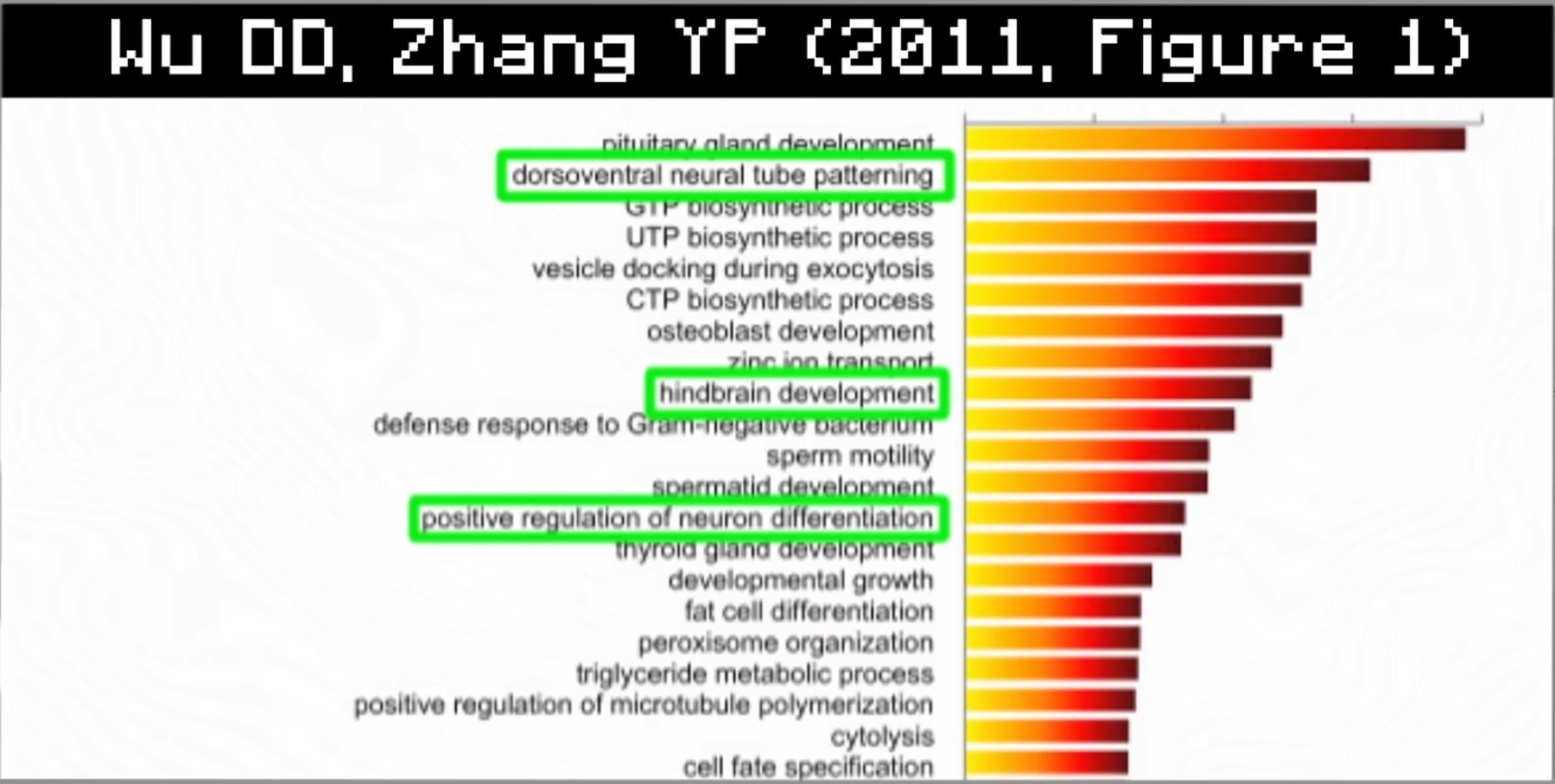
The screenshot is genuinely based on Figure 1. The paper found that several Gene Ontology categories were enriched for high-(F_{ST}) SNPs, including:
- dorsoventral neural-tube patterning;
- hindbrain development;
- positive regulation of neuron differentiation;
- neuron development.
The video is therefore substantially accurate when it says that nervous-system-related categories appeared among the differentiated gene groups. Two qualifications matter.
First, the figure also includes pituitary development, nucleotide biosynthesis, exocytosis, osteoblast development, zinc transport, sperm biology, thyroid development, fat-cell differentiation, triglyceride metabolism, and other processes. Highlighting only neural categories creates a narrative selection effect.
Second, an enriched annotation is not a measured group psychology. The study did not test IQ, personality, temperament, collectivism, individualism, political organization, or societal performance. It does not identify which high-(F_{ST}) variants cause a relevant psychological phenotype, in which direction, or with what effect size. The authors also noted that demographic history can produce differentiation and could not be completely excluded as an explanation.
The valid and invalid conclusions are therefore:
Supported: Some variants in genes assigned to nervous-system-related processes differed in frequency among the sampled HapMap populations.
Not established: The sampled racial populations possess systematically different intellects, personalities, temperaments, political dispositions, or optimal civilizations because of those variants.
Gaspar and Breen (2019): ancestry PCA and “mixed” populations
Paper: Héléna A. Gaspar and Gerome Breen, “Probabilistic ancestry maps: a method to assess and visualize population substructures in genetics”, BMC Bioinformatics 20:116. DOI: 10.1186/s12859-019-2680-1.
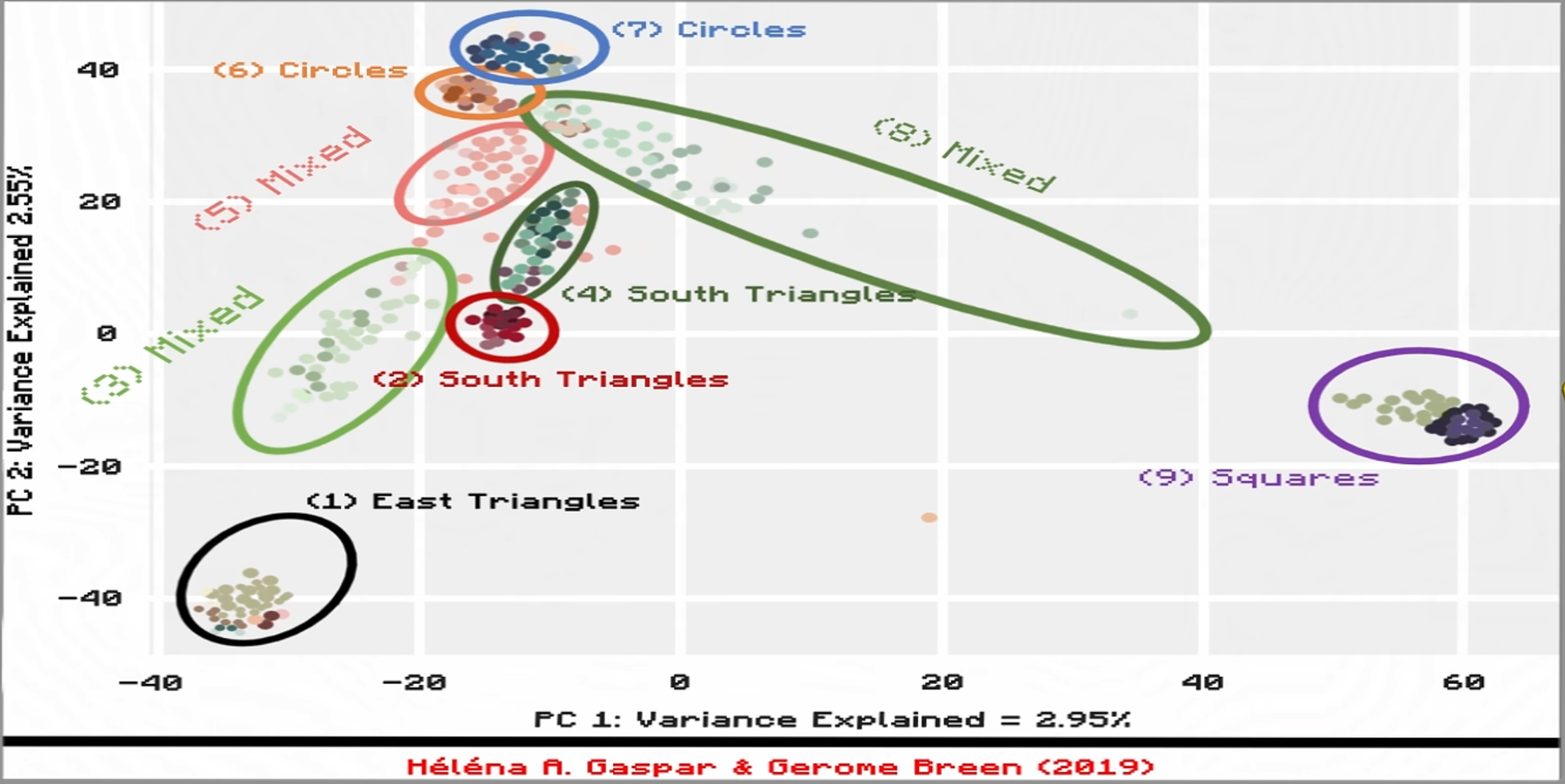
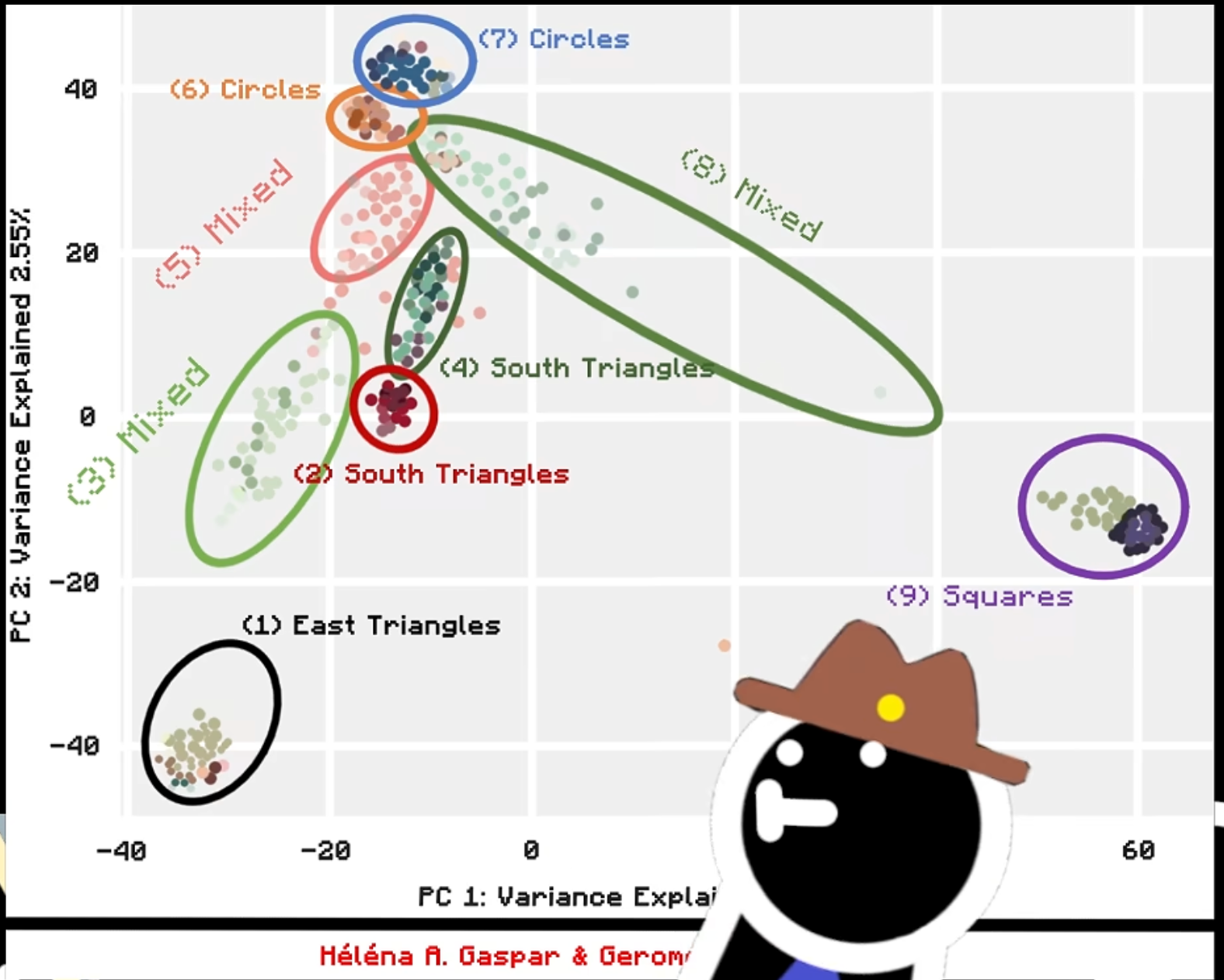
This is the most serious source misuse in the video.
What the original figure does
The paper uses 1000 Genomes data to compare methods for visualizing ancestry structure and correcting population stratification in genetic association studies. Its PCA is an ancestry visualization, not a map of individual kinship, neurological type, political preference, environmental fitness, or civilization.
The displayed axes explain only:
- PC1: 2.95% of variance
- PC2: 2.55% of variance
- Combined: approximately 5.5%
Literal distances on those two axes are therefore a highly compressed representation of broad structure, not a complete measure of genetic distance.
Relabeling the source
The video replaces the paper’s population labels with its racial code:
- “East Triangles” = East Asian samples
- “South Triangles” = South Asian samples
- “Circles” = European samples
- “Squares” = African samples
- “Mixed” = the paper’s Admixed American samples
The “Mixed” category is crucial. It includes Latin American populations such as Puerto Ricans, Colombians, and Peruvians with varying European, Indigenous American, and African ancestry. It is not a set of European–East Asian mixed people. The figure therefore does not demonstrate the video’s claimed pre-existing white–Asian middle population.
PCA distance is not kinship
The statement that a same-race stranger can be genetically closer to a parent than the parent’s own mixed child equivocates between two different quantities:
distance on selected ancestry principal components
                         ≠
identity by descent / biological relatedness
A parent and child are first-degree relatives. An unrelated same-ancestry stranger does not become more closely related merely because the stranger plots nearer to the parent on two ancestry PCs.
The manufactured “no-man’s-land”
Gaspar and Breen deliberately excluded several populations from the training map so that they could later be treated as external tests. Those excluded populations included:
- ASW: Americans of African Ancestry in Southwest USA
- ACB: African Caribbeans in Barbados
These are directly relevant to the video’s African-admixture claim. Their absence from the displayed training plot is therefore partly an artifact of study design. The later classification analysis gives such populations mixed ancestry assignments; it does not describe them as people without a viable ancestry space.
The video converts missing observations into a biological theory:
sample not plotted
      ↓
empty region on a two-dimensional PCA
      ↓
no historical population exists there
      ↓
no society is adapted to that ancestry
      ↓
admixed children are neurologically maladapted
None of those downstream steps follows.
Cheng et al. (2012): ancestry and socioeconomic status
Paper: Ching-Yu Cheng et al., “African Ancestry and Its Correlation to Type 2 Diabetes in African Americans”, PLOS ONE 7(3): e32840. DOI: 10.1371/journal.pone.0032840.
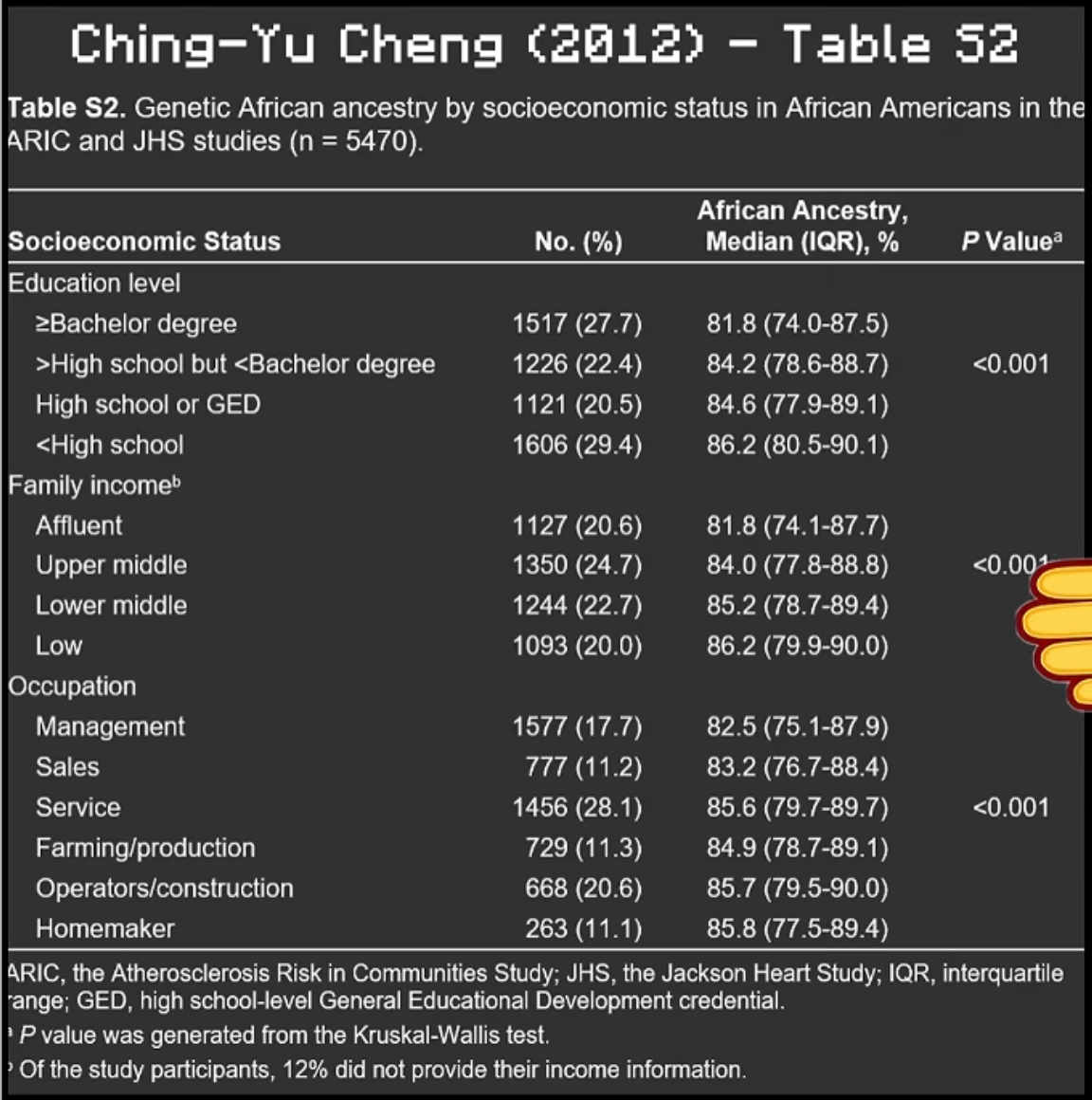
The screenshot is authentic Table S2. Among 5,470 African Americans in the ARIC and Jackson Heart Study cohorts, African-ancestry proportion was statistically associated with education, family income, and occupation.
Examples from the table:
| SES category | Median African ancestry |
|---|---|
| At least bachelor’s degree | 81.8% |
| Less than high school | 86.2% |
| Affluent | 81.8% |
| Low income | 86.2% |
That is a real association. It does not establish the video’s claim.
The study concerns three U.S. African-American cohorts and primarily investigates type 2 diabetes. The SES table uses two cohorts with available measures; it is not evidence about “Black success worldwide.” More importantly, the association is observational. In a historically stratified admixed population, ancestry can be correlated with phenotype, colorism, discrimination, geography, family background, assortative mating, inherited socioeconomic position, education, and genetic variants simultaneously. The table cannot isolate a causal path from European ancestry to European neurology to social success.
The correct evidentiary statement is:
European- and African-ancestry proportions correlate with several SES measures in this particular African-American sample.
The unsupported transformation is:
European ancestry proportion
            ↓
European psychological or neurological traits
            ↓
greater ability to succeed in European civilization
Cheng et al. did not test that causal chain. The authors treated SES as a potentially confounding non-genetic factor in their diabetes models.
Direct evidence test: Are admixed humans biologically or socially maladapted?
Question and scope
The preceding sections show that the video’s PCA and cited papers do not establish mixed-ancestry maladaptation. This section asks the independent question: Does other human evidence support the claim anyway? This is a targeted, source-grounded review rather than a registered systematic review or meta-analysis. It distinguishes organismal fitness, specific medical effects, psychological adjustment, cultural adaptation, and civilizational claims. It includes evidence that cuts against the conclusion as well as the strongest findings that could plausibly be offered in its favor. Research checked through September 2, 2026.
Direct verdict
No general human “genetic no-man’s-land” or mixed-ancestry maladaptation syndrome has been demonstrated. Human admixture is pervasive, and the reviewed evidence does not show that children of continentally separated parents are generally infertile, unhealthy, cognitively impaired, neurologically incompatible with both parents, or incapable of functioning in either society. There are, however, real ancestry-sensitive medical phenomena—particular disease alleles, local adaptation, HLA matching, and possible mitonuclear interactions. Some multiracial groups also show worse average mental-health outcomes in particular studies. Those findings are heterogeneous, locus- or context-specific, and do not establish the video’s proposed genome → neurology → civilization mechanism.
Convert the rhetoric into testable predictions
The video does not formally specify its hypothesis. Its claims imply at least five predictions:
| Prediction implied by the video | Evidence that would be needed | What would not be sufficient |
|---|---|---|
| P1. Greater parental population distance generally reduces offspring biological fitness | Genotyped parents and offspring; a prespecified distance measure; fertility, survival, developmental, and health outcomes; nonlinear tests; environmental and assortative-mating controls; replication across populations | Dog-breed analogies, an ancestry PCA, or one disease association |
| P2. Admixed genomes are broadly incompatible rather than affected at occasional loci | A replicated genome-wide burden or syndrome that rises with ancestry discordance and affects multiple fitness outcomes | A local-ancestry association, one HLA haplotype, or one mitochondrial biomarker |
| P3. Admixed people have neurologies poorly suited to both parental populations | Direct neurodevelopmental, cognitive, or behavioral phenotypes; genomic admixture measures; family-based or otherwise credible causal design; replicated ancestry-by-environment interaction | Neural Gene Ontology enrichment, racial self-identification, or population-average SES |
| P4. Psychological difficulties are intrinsic genetic consequences of admixture | Evidence connecting genomic ancestry combinations to psychological outcomes after discrimination, identity denial, family context, SES, phenotype, migration, and neighborhood are addressed | A multiracial/monoracial survey comparison without genomic data |
| P5. Admixed populations cannot sustain stable communities or institutions | Operational definitions of stability and institutional fit, appropriate historical comparisons, and a causal link from specific inherited traits to institutional outcomes | Sparse dots in a training PCA or the absence of an ancient group at an exact coordinate |
None of the video’s four scientific papers performs these tests.
1. Human admixture is ordinary population history, not an exceptional biological state
The classification “admixed” depends on the timescale and reference populations selected. Gopalan et al.’s 2022 review, “Human genetic admixture through the lens of population genomics”, notes that extensive gene flow is a hallmark of human evolution and that, at sufficient resolution, nearly all populations can be described as descending from multiple ancestries. Hellenthal et al.’s global atlas of admixture history inferred numerous historical mixture events across sampled populations. Ancient and recent European, African, Asian, American, and Oceanian populations are not timeless genetic endpoints.
Recent three-way admixture is also directly documented in large living populations. Moreno-Estrada et al. reconstructed European, African, and Indigenous American contributions in Caribbean populations; Bryc et al. measured ancestry mosaics in African Americans and U.S. Latinos; and genomic work documents multigenerational, multi-continental admixture in South African populations. These facts do not prove that every possible ancestry combination has identical health effects. They do refute the literal premise that a midpoint on a PCA must correspond to an unprecedented type of person for whom no viable population history exists.
What this does and does not establish
The existence and persistence of admixed populations is strong evidence against a universal or severe viability barrier. It is not, by itself, proof that every trait is unaffected by ancestry or that every admixed community has equal social outcomes. Those narrower questions require outcome-specific evidence.
2. Fitness, fertility, and generalized outbreeding depression
Inbreeding depression is established; continental outbreeding depression is not
Human evidence strongly supports costs from increased homozygosity and close parental relatedness. In a study of 354,224 people from 102 cohorts, Joshi et al. found that longer genome-wide runs of homozygosity were associated with lower height, forced expiratory lung volume, general cognitive ability, and educational attainment, with similar effect sizes across four continental groups: “Directional dominance on stature and cognition in diverse human populations”. This does not prove that distant ancestry mixing produces a general benefit, because heterozygosity, ancestry distance, environment, and particular alleles are different quantities. It does show that the clearest replicated genome-wide human effect runs against a simple “more within-population similarity is healthier” rule.
The strongest human evidence sometimes invoked for an intermediate optimum comes from Helgason et al.’s Icelandic genealogical study. Couples related at approximately the third- or fourth-cousin level had the highest recorded reproductive success. That finding deserves inclusion rather than dismissal, but it does not test African–European, African–Asian, or European–Asian offspring. It compares fine degrees of relatedness within a historically structured Icelandic population over changing demographic periods. Number of children and grandchildren is also affected by mate availability, age at marriage, rural residence, migration, family networks, contraception, and economic change. A later broad review of human assortative mating describes evidence for “optimal outbreeding” as mixed, not settled.
Large admixed-population scans do not reveal strong genome-wide purging
Bhatia et al. scanned 29,141 African Americans for deviations in local ancestry that would indicate directional selection after admixture and found no genome-wide-significant locus: “Genome-wide scan of 29,141 African Americans finds no evidence of directional selection since admixture”. The study could not exclude weak selection, polygenic effects, or effects that leave no detectable local-ancestry signature. It is therefore indirect evidence. Still, a theory of broad, serious incompatibility predicts stronger post-admixture selection or attrition than this study observed.
Other admixed populations can show selection at particular regions. Malagasy populations, for example, show selection favoring African ancestry across part of chromosome 1, including a region containing the Duffy blood-group gene. That is evidence of local adaptation after admixture—not evidence that the entire African–Asian ancestry combination is maladapted. Selection can favor, disfavor, or leave neutral particular ancestry segments depending on the locus and environment.
Perinatal associations are real but do not follow a genetic-distance gradient
Some U.S. birth-record studies report different perinatal risks across parental racial pairings. Getahun et al. analyzed more than 21 million singleton births from 1995–2001 and reported elevated risks relative to white-mother/white-father births for white-mother/Black-father and Black-mother/white-father pairings. But the Black-mother/Black-father category had the highest reported stillbirth risk of the four groups: “Adverse perinatal outcomes among interracial couples in the United States”. A 2026 analysis of more than 26 million live births found that paternal-race associations varied by outcome: Black and Hispanic father categories were associated with higher preterm-birth risk in several comparisons, whereas Asian fathers were associated with lower preterm-birth risk and Black or Asian fathers with lower hypertensive-disorder risk: “The Influence of Maternal and Paternal Race on Perinatal Outcomes”.
These are important health disparities, but they are not a monotonic “greater parental genetic distance → worse offspring” result. The studies classify parents socially by race rather than measuring genomic distance; they cannot fully control healthcare, stress, discrimination, geography, paternal involvement, phenotype, assortative mating, or all maternal risk factors. Their mixed directions and dependence on which parent belongs to which category are incompatible with a single general outbreeding penalty.
Fitness verdict
Generalized continental outbreeding depression in humans: not established. The strongest replicated genome-wide evidence demonstrates costs of homozygosity; one historical Icelandic study suggests an intermediate fertility optimum within Iceland; perinatal racial-pairing associations are heterogeneous and observational; and large post-admixture scans do not show the strong genome-wide selection expected from severe generalized incompatibility.
3. Narrow biological effects that must not be overstated
Mitonuclear interactions: a real research question, not a demonstrated maladaptation syndrome
Mitochondrial DNA is maternally inherited, while most proteins needed for mitochondrial function are encoded by nuclear DNA. In principle, ancestry discordance between the mitochondrial and nuclear genomes could alter their interaction.
The most relevant direct study is Zaidi and Makova’s 2019 analysis of six admixed American populations, “Investigating mitonuclear interactions in human admixed populations”. It reported that greater discordance between mitochondrial ancestry and nuclear ancestry correlated with lower mitochondrial-DNA copy number in lymphoblastoid cell lines, along with population-genetic patterns consistent with selection on some nuclear-encoded mitochondrial genes. This is legitimate evidence for a possible ancestry-sensitive molecular effect.
Its limits are equally important:
- mitochondrial-DNA copy number in transformed cell lines is a biomarker, not a measurement of survival, fertility, intelligence, personality, or social adaptation;
- the analysis does not show a general health deficit among admixed people;
- it concerns nuclear–mitochondrial ancestry combinations, not a child’s overall position between clusters on an autosomal PCA;
- effect sizes and clinical consequences require further study.
Sloan, Fields, and Havird’s 2015 analysis found generally weak mitonuclear linkage disequilibrium and no preferential species-wide signal at nuclear genes encoding mitochondrial proteins: “Mitonuclear linkage disequilibrium in human populations”. The authors concluded that they did not find compelling evidence of strong selection conserving co-adapted human mitonuclear combinations.
A newer 2025 study of 2,490 1000 Genomes samples identified a small fraction of nuclear variation in non-random association with mitochondrial variants and reported enrichment among genes annotated for neurological development and function: González-Orozco, Martínez-Guerrero, and Montiel. This is an emerging population-genetic signal worth monitoring. It did not measure neurodevelopmental outcomes, intelligence, personality, psychiatric disease, civilizational compatibility, or mixed-ancestry maladaptation. As with Wu and Zhang, functional enrichment is not itself a behavioral phenotype.
The responsible synthesis is therefore:
Supported: Some nuclear–mitochondrial allele combinations may be non-randomly associated, selected, or functionally consequential in humans, including admixed populations.
Not established: Mixed-ancestry people generally possess mismatched neurologies or are poorly adapted to both parents’ societies.
HLA and bone-marrow matching: a donor-pool problem, not evidence that a patient is unfit
HLA matching is unusually demanding because the HLA region is extremely diverse and successful transplantation depends on finding another person with a sufficiently similar combination. Gragert et al. modeled 21 U.S. racial and ethnic groups and estimated that the probability of finding an available optimal 8/8 adult donor ranged from 75% for white patients of European descent to 16% for Black patients of South or Central American descent: “HLA match likelihoods for hematopoietic stem-cell grafts in the U.S. registry”. The same study found that cord-blood options greatly expanded coverage, including for groups with poor optimal adult-donor availability.
This establishes an important healthcare-access problem produced by HLA haplotype frequencies, registry composition, donor availability, and the specificity of transplant matching. It does not show that an admixed patient’s own organs are internally mismatched or that the person lacks a viable biological niche. A rare HLA combination can make an unrelated donor harder to find while the patient remains otherwise physiologically ordinary. The remedy is better recruitment, typing, cord-blood banking, and transplant technology—not racial separation.
Disease risks after admixture are local and trait-specific
Admixture mapping works precisely because ancestry at a particular genomic region can be associated with a particular disease or protective allele. The direction can be harmful, protective, or neutral, and global ancestry is not a substitute for local genotype. Reviews of genetic ancestry inference and disease mapping treat admixed populations as informative for locating variants and improving medicine, not as a single pathological class.
Examples such as Duffy-mediated malaria protection, APOL1-associated kidney risk, HLA variation, or ancestry-dependent drug response cannot legitimately be summed into “one ancestry mixture is maladapted.” Each requires its own allele, exposure, outcome, and effect-size analysis. The video offers none of those.
4. Mental health and psychological adjustment
The psychosocial literature requires a more qualified conclusion than either “mixed people struggle” or “mixed people never experience distinctive problems.”
An influential 2005 review by Shih and Sanchez found that multiracial people in nonclinical samples were generally as well adjusted as monoracial peers on most measured outcomes, while earlier detrimental findings depended heavily on clinical samples: “Perspectives and research on the positive and negative implications of having multiple racial identities”.
A newer systematic review by Oh et al. examined 22 quantitative studies published from 2016–2022. Multiracial groups tended to have worse mental-health outcomes than monoracial comparison groups, but results varied by subgroup, outcome, definition, and reference population. Discrimination and ethno-racial identity emerged as important explanatory factors: “Mental health outcomes of multiracial individuals”. This newer review should prevent an overconfident “no disparity” conclusion.
What it does not establish is just as important:
- the studies generally classify people by self-identified or administratively assigned race, not genomic admixture or parental genetic distance;
- worse mental health is not evidence of mitonuclear or autosomal incompatibility;
- identity denial, discrimination, family racial socialization, neighborhood context, and belonging are plausible causal pathways;
- subgroup heterogeneity contradicts a single biological effect of “being mixed.”
The broader evidence supports these social pathways. A meta-analysis of 51 studies and 18,545 participants found that discrimination was associated with worse adjustment and that some forms of ethnic/racial identity commitment buffered the association: Yip et al. 2019. A 2024 systematic review and meta-analysis linked racism exposure in children and young people with adverse physical-health and biomarker outcomes as well as wellbeing: Priest et al.. Conversely, a review of 152 studies of biculturalism among U.S. Latinos reported that a substantial majority found positive associations between biculturalism and adjustment: Safa and Umaña-Taylor 2021. Biculturalism is not identical to genetic admixture, but it directly contradicts the assumption that navigating more than one cultural system is inherently impossible.
The causal alternatives are therefore:
mixed or multiracial classification
              ↓
identity denial, discrimination, family or peer conflict,
context-dependent classification, and reduced belonging
              ↓
stress and some worse mental-health outcomes
versus the video’s proposed but untested path:
continental ancestry mixture
              ↓
intrinsically mismatched neurology
              ↓
inability to function in either parental society
The first pathway has direct empirical support. The reviewed psychological literature does not test or demonstrate the second.
Psychological verdict
Some multiracial populations experience real and sometimes elevated psychological burdens, but the evidence points to heterogeneous social and identity contexts rather than a demonstrated genomic maladaptation. Treating those burdens as proof of biological incompatibility would mistake socially mediated outcomes for evidence of an intrinsic genomic defect.
5. No direct evidence for ancestry-specific neurological or civilizational fit
The central claim is not merely that alleles vary or that a particular health effect exists. It is that continental ancestries possess different neurologies, that societies are optimized for those neurologies, and that admixed people inherit a compromise suited to neither social order.
The reviewed literature contains no direct test of that model. A valid study would need to specify:
- the neurological phenotype;
- the causal variants or genomic measure;
- the relevant developmental environment;
- the social order supposedly optimized for the phenotype;
- a preregistered ancestry-by-environment interaction;
- a comparison showing that admixed people perform worse in both parental environments;
- controls for discrimination, language, migration, SES, education, family context, and phenotype-based treatment;
- replication in independent populations.
Neither PCA position, mitonuclear disequilibrium, neural Gene Ontology enrichment, nor an ancestry–SES correlation supplies that evidence. Modern genetic prediction is itself less reliable in admixed and underrepresented populations because training data and local-ancestry structure create portability problems. A confident theory of ancestry-specific civilization therefore outruns even far narrower forms of trait prediction.
The word “environment” also shifts meaning inside the video’s analogy. A husky’s cold tolerance concerns a defined physical exposure and measurable physiology. “European civilization,” “Asian collectivism,” or a political system is not one stable environmental variable. Institutions, language, class, family, law, technology, religion, and historical contingencies cannot be treated as an inherited climatic niche without independent evidence.
6. Claim-by-claim verdict after reviewing outside evidence
| Broader claim | Direct-evidence verdict | Reason |
|---|---|---|
| Human admixture can have no biological consequences | Too strong / false as an absolute | Particular alleles, local ancestry, HLA combinations, and possible mitonuclear interactions can matter |
| Admixed humans suffer a general genome-wide incompatibility | Not supported; evidence weighs against a severe general effect | Admixture is pervasive; large populations persist; no replicated general syndrome or strong genome-wide post-admixture selection has been shown |
| Greater continental parental distance generally reduces fertility or survival | Not established | Icelandic kinship evidence is narrow; perinatal findings are heterogeneous and do not follow a distance gradient; direct genotyped tests are lacking |
| Admixed people may have difficulty finding an unrelated HLA-matched donor | Supported in some populations and registries | HLA diversity, rare combinations, donor availability, and registry representation affect match probability |
| HLA matching difficulty means the patient is biologically maladapted | False inference | Compatibility with an external donor is not whole-organism internal fitness or neurological suitability |
| Mitonuclear ancestry discordance can affect molecular phenotypes | Plausible and supported by limited emerging evidence | Copy-number and disequilibrium signals exist; clinical magnitude and generality remain uncertain |
| Mitonuclear evidence demonstrates mixed-race neurological maladaptation | Unsupported | No relevant cognitive, behavioral, developmental, or social-compatibility phenotype was measured |
| Multiracial people never experience worse psychological outcomes | Too strong | A recent systematic review found tendencies toward worse outcomes in some comparisons and substantial heterogeneity |
| Worse psychological outcomes prove genetic incompatibility | Unsupported | The studies do not measure genomic incompatibility; discrimination, identity, and context have direct evidentiary support |
| Admixed people are unable to function in either parental culture | Contradicted as a generalization | Nonclinical adjustment is often ordinary; bicultural competence is frequently associated with positive adjustment; outcomes vary with context |
| Sparse PCA space identifies a population with no viable society | False | Plot density reflects sampling and dimensional reduction; numerous multigenerational admixed populations exist |
| The video’s full ancestry → neurology → psychology → civilization chain is independently supported | No | Evidence exists for selected fragments of the chain but not for the causal connections joining them |
7. Strongest responsible steelman—and where it stops
A scientifically responsible steelman would say:
Human populations differ in allele frequencies because of drift, migration, and selection. After admixture, local ancestry and particular combinations of nuclear, mitochondrial, immune, or disease-related variants can influence specific biological outcomes. People classified as multiracial can also experience distinctive psychological and social pressures. These issues deserve population-specific medical research and better social and clinical support.
That statement is defensible. The video adds claims not warranted by it:
Therefore broad races possess civilization-specific neurologies; mixed children fall between adaptive peaks; African-admixed people occupy a biological no-man’s-land; and homogeneous societies are more neurologically suitable.
No reviewed study establishes those additions.
8. What evidence would change this verdict?
The conclusion should remain falsifiable. It would need revision if replicated studies showed all or most of the following:
- a prespecified measure of parental genomic distance predicts lower offspring fertility, survival, or broad health after family and environmental controls;
- the relationship is monotonic or has a reproducible threshold across multiple continental pairings;
- a genome-wide incompatibility burden, rather than a handful of loci, mediates the effect;
- admixed individuals perform worse in both matched parental environments in preregistered neurological or behavioral tests;
- measured genetic mechanisms explain the result better than discrimination, SES, migration, phenotype, or family context;
- the effect replicates across generations and independently sampled populations.
Conversely, the current verdict would become still stronger if large family-based genomic cohorts found no ancestry-distance penalty, if mitonuclear signals failed to predict clinical outcomes, or if psychological disparities substantially attenuated after social-context variables were addressed.
Final direct-evidence assessment
The video identifies a legitimate general topic—biological consequences of genetic variation and admixture—but advances a conclusion far beyond the evidence. Narrow ancestry-sensitive effects exist and should be studied without euphemism. They do not aggregate into a demonstrated racial-neurological incompatibility, an ancestry-specific political optimum, or a general biological indictment of mixed-ancestry people. The most defensible current explanation for observed difficulties is outcome-specific: particular alleles and medical systems for some health questions, and social treatment, identity context, and institutions for many psychological and socioeconomic questions.
Cross-cutting methodological errors
1. Equivocation between race, ancestry, sample, and population
The video treats Yoruba, CEU, Han Chinese, and Japanese samples as though they were interchangeable with all Black, white, and Asian people. Broad racial labels are socially and geographically heterogeneous. A statistic comparing selected reference samples cannot be silently universalized.
2. Reification of statistical plots
PCA coordinates summarize variance in a selected dataset. They are not physical territories, ecological niches, psychological types, political systems, or proofs that each coordinate requires an old, socially specialized population.
3. Ancestry-space distance substituted for kinship
The mixed-child argument relies on using “genetic distance” ambiguously. Population-cluster position answers a different question from parent–offspring relatedness by descent.
4. Annotation-to-phenotype leap
Genes can have many functions, annotations can be broad, and enriched SNP categories do not by themselves identify a measured phenotype. The video moves from “neural-development annotation” to “intellect, personality, and temperament” without intermediate functional or behavioral evidence.
5. Within-group genetics substituted for between-group causation
Even if a trait is heritable within populations, that does not identify the cause of an average difference between populations exposed to different environments. Within-group heritability does not supply the missing causal evidence in this video.
6. Correlation-to-genetic-causation leap
The Cheng table cannot distinguish ancestry-linked genetic effects from social history and correlated environments. The video treats an association as though it had already survived causal identification.
7. Cross-species analogy used as measurement
Dog breeds and dog–wolf comparisons import intuitions produced by artificial selection, closed breeding, and very different datasets. Analogies can illustrate a hypothesis; they cannot replace population-specific causal evidence.
8. Historical selection and civilizational essentialism
The video’s Europe–Asia–Africa typology selectively compresses thousands of societies into three racial psychologies. It neither defines “comparable civilization” consistently nor tests alternative causes such as geography, disease burden, trade networks, state competition, colonialism, institutions, resources, and contingency.
9. Missing intermediate evidence
To support the overall thesis, the channel would need at least:
- identified variants with demonstrated causal effects on the relevant psychological traits;
- valid cross-population measurement of those traits;
- replicated population differences attributable to those variants rather than environment or stratification;
- evidence that the traits causally determine institutional or civilizational form;
- evidence that the relevant institutions are truly ancestry-specific optima;
- direct evidence of generalized mixed-ancestry maladaptation.
The cited papers provide none of this full bridge.
Source-provenance investigation
Evidentiary boundary
The provenance research identifies an existing citation ecosystem and several unusually close antecedents. It does not prove that Basic Logic copied any specific author or page. Direct copying would require the creator’s source list, notes, browsing record, acknowledgement, shared wording/images that rule out a common source, or another comparably strong link.
Corrected conclusion: no single verified Substack source contains everything
No single verified Substack article or Substack author was found containing all four distinctive research modules:
- Nelis/HapMap (F_{ST}) values;
- Wu and Zhang nervous-system differentiation;
- Gaspar and Breen’s ancestry PCA;
- Cheng Table S2 on ancestry and SES.
The better model is a distributed hereditarian/HBD citation network in which different papers and interpretations circulate in overlapping blogs, OpenPsych papers, bibliographies, forum posts, Substacks, and source dumps.
Possible reference websites used by the creator
Candidate-source watchlist
The following sites are possible references Basic Logic may have consulted, not confirmed sources of the video. Their inclusion records leads for comparison of citations, wording, screenshots, publication dates, and distinctive inference chains.
- The Boomer Tribune — Medium archive — Candidate source ecosystem. The archive should be searched for the video’s four distinctive research modules, reused figures, and arguments about population psychology, civilization, or mixed ancestry. No direct-use finding has yet been recorded.
- Jonathan Barazzutti — “On Discussing Population Differences in Intelligence” — Already documented in this dossier as a temporally close article that highlights the same Wu–Zhang neural-development categories and connects them to possible psychological differences. It does not, by itself, account for all of the video’s sources.
- Emil Kirkegaard — Clear Language, Clear Mind — A broader archive containing material on population genetics, admixture, race/IQ, socioeconomic outcomes, and Wu and Zhang. It is a plausible citation-clearinghouse or upstream reference ecosystem, but direct use by Basic Logic has not been established.
- Emil O. W. Kirkegaard — Substack — Additional candidate archive to examine for reposts, source compilations, linked studies, exact wording, and cross-links to the website above. Direct use by Basic Logic has not been established.
- Gottskálk — “Hvað er Kynþáttur?” on Opin Augu — Verified June 27, 2025 guest post and the earliest source presently found that combines Wu and Zhang (2011) with Gaspar and Breen (2019) in this ideological argument. It remains a strong possible upstream source. The mixed-child/parent-versus-stranger claim itself is much older, however, so sharing that error is evidence of a source lineage rather than strong evidence of common authorship.
- Gottskálk — Substack profile — Public profile attached to the Opin Augu byline. As checked on September 2, 2026, it displays the pseudonym and handle but no visible biography, external social account, publication list, or link to Basic Logic. It is an identity lead, not an identification.
Candidate-source checks
- Search The Boomer Tribune archive for Wu and Zhang (2011), Gaspar and Breen (2019), Cheng et al. (2012), Nelis et al. (2009), and the four distinctive numerical (F_{ST}) comparisons.
- Compare the video’s Wu–Zhang highlights and wording against Barazzutti’s article.
- Search both Kirkegaard archives for the Gaspar–Breen PCA, Cheng Table S2, the parent-versus-stranger claim, and “genetic no-man’s-land” language.
- Compare Gottskálk’s article and public profile against Basic Logic’s exact wording, visual edits, upload chronology, linked accounts, avatars, and cross-promotion; do not infer a private identity from a pseudonym or ideological similarity.
- Record the earliest publication date for each matching citation, image, and inference.
- Distinguish a shared primary citation from shared selection, shared wording, shared image editing, or the same unusual misuse.
Reddit source-dump hub: “Sources? I got you fam”
Thread: “Libleft forbidden fbi crime stats”
Direct source-dump comment: “Sources? I got you fam”
This Reddit comment is a particularly important provenance lead because it does not merely link one crime statistic. It assembles, in one place, a long racial-hereditarian source package containing:
- FBI and NYPD race-and-crime statistics;
- homicide and county-level crime claims;
- victimization, incarceration, and socioeconomic comparisons;
- IQ heritability papers;
- a racial brain-structure claim;
- population-genetics and human-taxonomy material;
- Wu and Zhang (2011);
- education and testing gaps;
- claimed polygenic-selection evidence;
- and the title of Cheng et al. (2012).
That makes the comment a concrete example of the ready-made citation ecosystem hypothesized in this dossier. A creator could encounter diverse papers without independently searching each scientific field. It does not establish that Basic Logic saw or used the comment. The diagnostic next step is to compare its exact images, link order, labels, and errors against the video’s sources and editing.
Problems visible before a full fact-check
- The source dump labels one item “2016 Violent Crime FBI stats” but links to FBI Table 43 for 2011. The primary page is explicitly “Arrests by Race, 2011.” The year and measure are both important.
- Arrests are not identical to crimes committed. Arrest data depend on reported crimes, clearances, identification, enforcement, agency participation, and multiple arrests or offenses. They are evidence about arrests for charged offenses, not a direct census of every offender.
- The FBI’s 2019 Table 43 reports separate percentages for all arrests, murder arrests, robbery arrests, and violent-crime arrests. Converting a homicide or robbery percentage into “all crime” is an offense-category error.
- The Reddit post itself contains commenters pointing out that the associated “13/52” image is a meme and that the 2019 FBI table does not support the claim that Black Americans account for roughly half of all crime.
- The working NYPD primary link is the 2018 Crime and Enforcement Activity Report. It distinguishes victims, known suspects, and arrestees; suspect race/ethnicity can come from a victim’s assessment, and race/ethnicity is unavailable for many suspects in some categories.
- “The CDC Confirms It” is the title of an Unz Review commentary, not a CDC publication. The article may analyze CDC data, but its causal and rhetorical headline must not be attributed to the CDC.
- The BJS “0%” item comes from a National Crime Victimization Survey table using victims’ perceived race of offenders. The relevant rape/sexual-assault cell is starred; the report says starred estimates are based on roughly ten or fewer sample cases. A displayed zero in a sparse survey cell is not proof of an impossible event or a stable population rate.
- The county-concentration item shows geographic concentration of murders; it does not by itself identify race as the cause of that concentration.
- “Race, Wealth and Incarceration” concerns incarceration outcomes. Incarceration is influenced by offending, detection, arrest, charging, adjudication, sentencing, and prior records; it cannot be relabeled without qualification as a direct measure of crimes committed.
- Imgur and Catbox images are mirrors or transformed infographics. Their labels, denominators, crops, and calculations must be checked against primary tables before use.
Crime-statistics and homicide links in the Reddit source dump
Full link catalog: crime, homicide, victimization, and incarceration
“2016 Violent Crime FBI stats” — source-dump label; the linked FBI table is actually from 2011:
- Imgur image
- Catbox mirror
- Imgur gallery
- FBI Table 43 — Arrests by Race, 2011
- FBI Table 43 — Arrests by Race and Ethnicity, 2019 — added as the direct comparison used elsewhere in the thread.
2018 New York City crime and enforcement statistics:
- Catbox image
- Imgur image
- NYPD 2018 Crime and Enforcement Activity Report — corrected current domain.
“The CDC Confirms It: America’s Homicide Problem Is Entirely Driven by Black People” — title belongs to the secondary commentary, not the CDC:
- Unz Review article
- Archive.is copy
- Imgur image
- Catbox mirror
- CDC QuickStats — age-adjusted homicide rates by race/ethnicity, 2015–2016 — added as a direct CDC comparator.
“54% of U.S. counties in 2014 had zero murders; 2% had 51% of murders”:
King County firearm-violence claim:
“Whites account for 0% of Black rapes” / 2005 National Crime Victimization Survey table:
- Imgur crop
- Catbox mirror
- Bureau of Justice Statistics, Criminal Victimization in the United States, 2005 Statistical Tables
Race, wealth, and incarceration:
Gun ownership, race, and gun-homicide infographic:
General crime-statistics infographic:
“Why Do Black People Commit More Crime?”:
“Racial differences in homicide rates are poorly explained by economics”:


Associated IQ, brain, genetics, testing, and hereditarian links
The same comment proceeds directly from the crime material into IQ, neuroscience, population genetics, testing gaps, and claimed polygenic-selection evidence. This adjacency matters for provenance: it shows that the crime claims and the genetics/civilization claims circulated as one ideological research bundle.
Full link catalog: associated hereditarian source bundle
IQ heritability:
- “Genetics and intelligence differences: five special findings” — labeled “IQ is 80% genetically heritable” in the source dump.
- Archive.is copy
- “Genetic and Environmental Influences of General Cognitive Ability: Is g a valid latent construct?” — labeled “IQ is 86% genetically heritable.”
- Archive.is copy
Frontotemporal anatomy claim:
- “Variability in Frontotemporal Brain Structure: The Importance of Recruitment of African Americans in Neuroscience Research”
- Archive copy
Population history and “human biodiversity” images:
- Last-common-ancestor Imgur image
- Catbox mirror
- “The genetic relationships of modern human races”
- Human Biodiversity Imgur image
- Catbox mirror
Hormone claim:
Population-genetics sources:
- “Worldwide human relationships inferred from genome-wide patterns of variation” — Archive.is · Internet Archive PDF
- “Genetic Structure, Self-Identified Race/Ethnicity, and Confounding in Case-Control Association Studies” — Archive.is
- “Different level of population differentiation among human genes” — Archive.is · verified primary full text
- “Genetic Similarities Within and Between Human Populations” — Archive.is
Education, aptitude testing, and class:
5.1. “Wide racial gap persists in education testing” — Archive.is
5.2. The North Carolina 2010 SAT Report — Internet Archive
5.3. “Family Income Differences Explain Only a Small Part of the SAT Racial Scoring Gap” — Archive.is
5.4. “Race, Poverty and SAT Scores: Modeling the Influences of Family Income on Black and White High School Students’ SAT Performance” — Internet Archive
5.5. “Standardized Tests: The Interpretation of Racial and Ethnic Gaps” — Archive.is
5.6. Analysis of LSAT Performance and Patterns of Application for Male and Female Law School Applicants
5.7. The Bell Curve
5.8. The g Factor
5.9. Money and School Performance: Lessons from the Kansas City Desegregation Experiment — Internet Archive
5.10. “The Minnesota Adoption Studies: Genetic Differences and Malleability” — PubMed archive · PDF mirrorHuman taxonomy and sampling:
6.1. “Is Homo sapiens polytypic? Human taxonomic diversity and its implications” — Archive.is · Internet Archive PDF
6.2. “Toward a More Uniform Sampling of Human Genetic Diversity” — Archive.isClaimed recent selection, brain-size loci, and cognitive genetics:
7.1/7.4. “Factor Analysis of Population Allele Frequencies as a Simple, Novel Method of Detecting Signals of Recent Polygenic Selection” — Internet Archive
7.2. “Ongoing Adaptive Evolution of ASPM, a Brain Size Determinant in Homo sapiens” — Archive.is
7.3. “Molecular evolution of microcephalin, a gene determining human brain size” — Archive.is
7.5. “Mitochondrial DNA and IQ in Europe” — Internet Archive PDF
7.6. “Racial Differences and the Probability of C2orf16 rs191912 to be the Major Gene Locus of General Cognitive Ability” — Internet Archive PDF
7.7. “Single nucleotide polymorphism in the neuroplastin locus associates with cortical thickness and intellectual ability in adolescents” — Internet Archive
7.8. “Evidence suggesting that Homo neanderthalensis contributed the H2 MAPT haplotype to Homo sapiens” — Internet Archive PDFAdmixture and SES:
- Cheng et al., “African Ancestry and Its Correlation to Type 2 Diabetes in African Americans” — verified primary full text. The Reddit comment supplies the title but no functioning outbound link in the captured text.


Provenance matrix
| Node | Material found there | Relevance | Evidentiary limit |
|---|---|---|---|
| Human Varieties (2013–2014) | Cheng et al. and many ancestry–SES studies assembled into a racial-hereditarian argument | Demonstrates that a pre-existing online project mined biomedical admixture research for SES correlations | Does not show Basic Logic used the site |
| Marc Dalliard, OpenPsych (2014) | Explicitly directs readers to “Cheng et al., 2012, Table S2” | Strong explanation for how an obscure supplement table entered race/IQ citation circulation | Contains one module, not the whole video |
| John Fuerst, OpenPsych (2015) | Wu and Zhang; Cheng; extensive continental (F_{ST}) discussion | Combines roughly three of the video’s research modules inside one hereditarian treatment | Predates Gaspar and Breen; does not contain the video’s exact complete package |
| Emil Kirkegaard / Clear Language, Clear Mind | Separate pieces on admixture/Cheng and on Wu and Zhang | Functions as a clearinghouse linking genetics papers to hereditarian interpretations | Separate posts do not prove direct sourcing |
| Medium race/IQ compilation | Reproduced Wu and Zhang Figure 1 and paired it with admixture, IQ, and SES arguments | Shows the exact type of cross-literature source compilation hypothesized by the user | Identity and direct influence require further verification |
| Jonathan Barazzutti, Substack (June 13, 2026) | Highlights the same Wu–Zhang neural categories and connects them to possible psychological differences | A temporally close example of the same selective reading circulating shortly before the video | Does not contain Cheng, Gaspar–Breen, or the Nelis module; no copying claim is warranted |
| Frank Salter / American Renaissance treatment (February 2003) | Frames population-relative allele sharing as “ethnic genetic interests” and says an English parent of an English–Bantu child is only slightly more related to that child than to a random coethnic | Establishes a much older ideological ancestor for the video’s parent-versus-stranger argument | Not a Gaspar–Breen or PCA argument; documenting the lineage does not validate the claim or show Basic Logic read this particular text |
| Stormfront post (July 2019) and Europe Awake / Ancient Forums package (2020) | Repeats the mixed-child-versus-random-coethnic claim; the 2020 package joins it to bone-marrow matching and dog/wolf/hybrid analogies | Shows that the claim circulated as a reusable racialist argument package years before Gottskálk | Extremist/forum sources are provenance evidence, not scientific authorities; exact copying path remains uncertain |
| The Motte discussion (December 2024) | Repeats the French-parent/Chinese-child version and immediately extrapolates from genetic distance to psychology, culture, instincts, and cognition | Demonstrates a pre-Gottskálk version of the video’s kinship → psychology → culture transition | Does not cite Gaspar–Breen or contain the full four-study package |
| Gottskálk guest post on Opin Augu (June 27, 2025; directly verified) | Combines Wu–Zhang and Gaspar–Breen; moves from neural annotations to behavior/thought/emotion and then societies/cultures; attaches Gaspar–Breen to the older claim that an Icelandic mother is less genetically related to her African-Icelandic child than to an unrelated Icelander or Pole | The earliest verified node found that joins the unusual two-paper pair to the inherited Salter-style argument | Strong evidence of a shared argument/source lineage and a plausible direct source; much weaker evidence of common authorship than initially thought |
| Reddit “Sources? I got you fam” source dump (2021) | Crime statistics, IQ heritability, brain structure, population genetics, Wu–Zhang, testing gaps, selection claims, and Cheng bundled in one comment | A concrete, pre-video one-stop bibliography closely matching the type of multi-domain research package needed to make the video | No evidence Basic Logic used it; several labels conflate years, arrests with offending, sparse cells with population facts, or commentary with primary agencies |
Human Varieties: literature mining already done
The 2014 article “Is there no population genetic ‘support’ for a racial hereditarian hypothesis?” describes searching large numbers of admixture studies for correlations between continental ancestry and education, income, occupational status, and related outcomes. It includes Cheng et al. The site’s 2013 article “More than Just ‘Colorism’: Part 1” also uses ancestry, skin color, IQ, and socioeconomic correlations inside a hereditarian argument.
This makes the obscure medical citation much less mysterious. A later video creator did not need to independently read thousands of diabetes and admixture papers; the relevant table had already been extracted and ideologically framed.
Dalliard/OpenPsych: the exact Cheng table singled out
Marc Dalliard’s 2014 OpenPsych commentary explicitly cites “Cheng et al., 2012, Table S2” and emphasizes negative correlations between African ancestry and education, occupation, and family income in the sample. This is unusually diagnostic because the video displays that exact supplemental table rather than merely citing the main diabetes result.
Fuerst (2015): most of the intellectual toolkit in one document
John Fuerst’s The Nature of Race: The Genealogy of the Concept and the Biological Construct’s Contemporaneous Utility contains Wu and Zhang, Cheng, and substantial continental (F_{ST}) discussion. It therefore brings together three major modules years before the video, although its estimates are not identical in every respect and the 2019 Gaspar–Breen paper did not yet exist.
Emil Kirkegaard: a citation clearinghouse
Clear Language, Clear Mind contains posts devoted to admixture analysis, race/IQ, population genetics, and natural selection. A 2020 post, “Quantitative genetic and natural selection: 2018–2020 studies”, cites Wu and Zhang and immediately connects nervous-system differentiation to behavioral adaptation. Other posts in the same ecosystem collect biomedical admixture research, including Cheng.
Jonathan Barazzutti: close timing, incomplete overlap
Jonathan Barazzutti’s June 13, 2026 Substack article “On Discussing Population Differences in Intelligence” selects the same Wu–Zhang neural-development categories and argues that population psychological differences are genetically plausible. This is notable because it appeared shortly before the video and uses the same selective move. It is not evidence that Basic Logic used Barazzutti, and it does not contain the other three distinctive modules.
Earlier lineage of the parent-versus-stranger claim
Provenance, not endorsement
Several sources in this subsection are white-nationalist, extremist, or racialist publications. They are included only to trace how a false or misleading argument circulated. They are not treated as scientific authorities.
The distinctive claim that a parent may be “more genetically related” to an unrelated coethnic than to the parent’s own mixed-ancestry child did not originate with Gottskálk, Gaspar and Breen, or Basic Logic. The present search found the following earlier chain:
| Date | Source | Form of the claim | What it establishes |
|---|---|---|---|
| February 2003 | American Renaissance treatment of Frank Salter’s On Genetic Interests | Says an English parent of an English–Bantu child would be only slightly more genetically related to the child than to a random member of the parent’s own “ethny” | The core comparison was already present more than two decades before the video and was originally framed through Salter’s theory of aggregate “ethnic genetic interests,” not through PCA |
| July 2019 | Stormfront discussion citing Salter | Uses population differentiation to claim that a mixed child can be less related to a parent than a random coethnic | Shows direct circulation of the stronger “less related” formulation before Gottskálk |
| 2020 | Ancient Forums, “Race Mixing” and a closely matching Europe Awake PDF | Repeats that a white mother has more “genetically in common” with a random white stranger than with her mixed child, then moves to bone-marrow matching and dog/wolf/hybrid claims | Shows that the proposition circulated as part of a reusable polemical package; the bone-marrow adjacency later reappears in Gottskálk |
| December 2024 | The Motte discussion | Gives a French-parent/Chinese-child version, then extrapolates to psychology, phenomenology, culture, instinct, and cognition | Supplies a pre-Gottskálk example of nearly the same kinship → psychology → culture transition |
| June 27, 2025 | Gottskálk, “Hvað er Kynþáttur?” | Attaches the inherited comparison to Gaspar and Breen’s ancestry-map paper and follows it with mixed-ancestry bone-marrow discussion | Earliest source presently found that joins the old claim to Gaspar–Breen and also cites Wu–Zhang |
| August 30, 2026 | Basic Logic video | Uses the Gaspar–Breen PCA to restate the parent-versus-stranger idea and extend it to a “genetic no-man’s-land” and civilizational maladaptation | A later and more elaborate visualization of the same inherited category error |
This changes the provenance inference. The old argument compares population-relative allele sharing or a theorized group genetic interest with ordinary genealogical relatedness. Those are not interchangeable quantities. A parent remains a first-degree biological relative of the child; an unrelated coethnic is not transformed into a closer genealogical relative by an F-statistic or proximity on ancestry principal components.
No indexed pre-June-2025 source was found that combines the exact Wu–Zhang + Gaspar–Breen paper pair or explicitly attaches Gaspar–Breen to the Salter-style claim. That negative search result is not proof of uniqueness, but it preserves Gottskálk’s importance as a possible intermediate node while sharply reducing the identity value of the parent-versus-stranger claim itself.
Gottskálk/Opin Augu: strongest two-paper convergence; creator identity unproven
The direct page has now been recovered and checked: Hvað er Kynþáttur? (“What Is Race?”), published as a guest post on Opin Augu on June 27, 2025 under the public pseudonym Gottskálk. Its byline links to the Substack profile @gottskalk. The article directly cites both Wu and Zhang (2011) and Gaspar and Breen (2019) and makes two distinctive transitions:
Wu and Zhang
      ↓
brain-related population differences
      ↓
behavior, thought, and emotion
      ↓
societies and cultures
and:
Gaspar and Breen ancestry map
      ↓
mixed child allegedly less related to a parent
than an unrelated member of the parent's population
The article’s wording is substantively close to the video’s inference chain. It says the main population differences supposedly concern gene activity affecting brain function rather than skin pigmentation, then moves directly to behavior, thought, and emotion, and from there to how societies and cultures developed. Later, it uses the Gaspar–Breen paper while claiming that an Icelandic mother with an African father is less genetically related to her own child than to a random Icelander or even a Pole. The latter repeats the same category error identified in the video: population placement or allele-frequency differentiation is not individual genealogical kinship, and a parent transmits approximately half of the child’s autosomal DNA.
What remains distinctive after tracing the older claim
| Shared feature | Gottskálk article | Basic Logic video | Provenance value |
|---|---|---|---|
| Unusual paper pair | Cites Wu–Zhang and Gaspar–Breen in one short ideological essay | Uses both papers in one video | Stronger than sharing one famous race/IQ citation |
| Wu–Zhang interpretive leap | Nervous-system-related differentiation → behavior, thought, emotion → societies and cultures | Nervous-system-related differentiation → intellect, personality, temperament → unequal civilizations | Strong similarity in argument structure; not proof of copying |
| Gaspar–Breen attachment | Uses the 2019 ancestry-map paper to illustrate an older Salter-style parent-versus-stranger claim | Uses the paper’s PCA geometry to restate the claim and infer maladaptation | The paper attachment remains unusual; the underlying claim is not unique to either source |
| Political conclusion | Genetic ancestry is treated as a basis for national solidarity and cultural continuity | Ancestry-linked neurology is used to argue that groups build different political orders | Same broad ideological destination, with different phrasing and emphasis |
| Material not shared | Does not supply the video’s Cheng Table S2 or its Nelis-based exact module | Adds Cheng and Nelis material and a more elaborate “genetic no-man’s-land” visual argument | Shows that the video was not merely a complete translation or direct reproduction of this one article |
Public-profile and creator-hypothesis check — September 2, 2026
- The article is explicitly labeled a guest post by Gottskálk and ends with “G.” and “Gullbringusýsla, 2025,” presenting an Icelandic geographic/literary persona but not a verified real-world identity.
- The linked Substack profile is sparse: it shows the pseudonym/handle, an avatar, six subscribers, and sixteen subscriptions at the time checked, but no visible biography, external website, X account, or list of authored posts.
- Searches for public cross-links among
Gottskálk,Opin Augu,@BasicLogicIQ, and “Basic Logic” did not reveal an indexed account connection, self-identification, or repost tying the two accounts together. - A direct check of Basic Logic’s X “About this account” page showed “Account based in Portugal.” The same page reported that the account joined in August 2025, was verified in August 2026, had made one username change (last changed in August 2025), and was connected through the web at the time checked.
- This is more informative than a freely typed profile-location label. X’s own documentation says the “About this account” country or region is inferred from aggregated IP addresses. It therefore supports the limited conclusion that the account has been operated from IP addresses X associates with Portugal. It does not establish Portuguese nationality, a permanent Portuguese residence, one-person ownership, or the operator’s place of origin; travel, a VPN or relay, organizational access, and multiple operators remain possible explanations.
- Portugal neither confirms nor eliminates the Gottskálk hypothesis. An Icelandic-language author could live or work abroad, while an unrelated Portuguese-based operator could also reuse the Icelandic article’s source chain. The location clue becomes probative only if it can be joined to an independent public link, such as matching self-disclosure, cross-posting, reused assets, or a shared account.
- The verified Opin Augu article predates the video, which a public BitChute mirror dates to August 30, 2026. Chronology therefore permits influence or common authorship but cannot distinguish them.
Current identity assessment
Best-supported conclusion: Gottskálk remains the strongest known candidate specific upstream source or source-lineage node because it is the earliest verified page found that combines Wu–Zhang, Gaspar–Breen, the neural-to-civilizational inference, and the inherited parent-versus-stranger argument. The new lineage evidence makes common upstream sources or direct borrowing substantially more likely than common authorship. It is not established that Gottskálk created Basic Logic. No public cross-link, admission, distinctive reused asset, matching contact detail, or sufficiently identifying account metadata connects the accounts. The Portugal account signal remains relevant public metadata, but neither location, nationality, ideology, nor a pseudonym is sufficient to identify a private person.
Competing provenance hypotheses
These hypotheses are not mutually exclusive: Basic Logic could have borrowed from Gottskálk while also drawing other modules from the wider hereditarian citation ecosystem.
| Hypothesis | Evidence that favors it | Evidence that limits it | Current assessment | What would materially update it |
|---|---|---|---|---|
| H1 — Gottskálk and Basic Logic are the same author/operator | Unusual Wu–Zhang + Gaspar–Breen pairing; close inference structure; Gottskálk predates the X account and video | Parent-child claim is widely pre-existing; no public cross-link, matching contact detail, reused asset, or admission; X reports Portugal while the article presents an Icelandic persona | Possible but weak; not the leading explanation | Explicit public self-identification, an account cross-link, identical unpublished visual edits, or another uniquely identifying public artifact |
| H2 — Basic Logic directly borrowed from Gottskálk | Chronology permits it; Gottskálk is the earliest verified two-paper convergence; both attach Gaspar–Breen to the same inherited argument | No identical wording, acknowledgement, or proven image lineage; Basic Logic adds Cheng, Nelis, and the “no-man’s-land” construction | Plausible and moderately supported | An archived description/source list, identical crop or annotation, distinctive translation correspondence, or a public repost |
| H3 — Both draw from a shared racial-hereditarian source ecosystem | Salter lineage is traceable to 2003; the claim/bone-marrow/dog-hybrid package circulated by 2019–2020; The Motte supplied psychology/culture extrapolation by 2024; Wu and Cheng already circulated in Human Varieties/OpenPsych/Kirkegaard | The precise Wu–Zhang + Gaspar–Breen combination has not been found before Gottskálk | Strongest broad explanation | Discovery of an earlier bibliography, forum post, image, or article containing the combined papers and inference chain |
| H4 — Independent synthesis from the primary literature | Every paper is publicly accessible and different researchers can make similar errors | The full combination includes obscure papers, an obscure supplement table, selective neural categories, and a recurring inherited misuse | Possible, but less likely for the complete package | Creator notes showing independent searches, or absence of any shared wording/images despite a more exhaustive archive search |
Most likely source-chain model
The evidence currently favors this layered model:
Frank Salter / “ethnic genetic interests” argument (by 2003)
          ↓
racialist forums and compilations
(parent-vs-stranger + bone marrow + dog/hybrid analogies, 2019–2020)
          ↓
psychology/culture extrapolation already circulating (by 2024)
          ├──────────────────────────────────────────────┐
          ↓                                              ↓
Gottskálk adds Gaspar–Breen + Wu–Zhang (2025)      wider HBD citation network
          │                                        (Human Varieties, OpenPsych,
          │                                         Kirkegaard, source dumps)
          └──────────────────────┬───────────────────────┘
                                 ↓
                Basic Logic or another intermediate source
                                 ↓
                “The Genetics Behind Unequal Societies” (2026)
This model is more plausible than assuming that the creator independently located Wu and Zhang, an obscure Cheng supplement, Gaspar and Breen’s PCA, and the exact HapMap (F_{ST}) comparisons, then independently invented the same interpretive synthesis already circulating online. It also explains why no single earlier page necessarily contains all four modules. The strongest conclusion is a source lineage, not a creator identification.
Citation laundering / source laundering
The provenance pattern creates a presentation effect:
primary paper asks a narrow scientific question
          ↓
ideological secondary source selects a suggestive result
          ↓
later writers repeat the expanded interpretation
          ↓
video cites or reproduces the primary paper
The viewer sees the authority of “Wu and Zhang (2011)” or “Cheng et al. (2012)” rather than the secondary ecosystem’s interpretive leap. Returning to the originals reveals that they studied substantially narrower questions.
Research revision history
- Transcript-only pass: Identified authentic population-genetic facts followed by unsupported jumps to psychology, civilization, and mixed-race maladaptation.
- Visual clarification request: Flagged the (F_{ST}), Wu–Zhang, PCA, “no-man’s-land,” and ancestry–SES visuals as decisive.
- Screenshot pass: Confirmed Wu–Zhang Figure 1, identified the Gaspar–Breen PCA and its relabeling, and authenticated Cheng Table S2.
- Revised table: Upgraded the narrow Wu–Zhang description to substantially supported; downgraded the PCA argument further because Admixed American populations were mislabeled and African-admixed test populations were omitted by design.
- Initial provenance pass: Found a broad Human Varieties/OpenPsych/Kirkegaard/Medium/Barazzutti citation ecosystem.
- Provenance correction: Rejected the overstatement that one Substack or one Substack author contained every study.
- Deeper provenance pass: Identified Fuerst as an older three-module node and Gottskálk/Opin Augu as the most distinctive reported antecedent, while preserving the no-proof boundary.
- Reddit source-dump pass: Identified the 2021 “Sources? I got you fam” comment as a single pre-video bundle combining race-and-crime links with IQ, brain, population-genetics, Wu–Zhang, testing, selection, and Cheng material; corrected obvious year, metric, and source-type mislabeling without treating the bundle as proof of direct use.
- Gottskálk page recovery and public-profile pass: Directly verified the June 27, 2025 Opin Augu article, its Wu–Zhang/Gaspar–Breen pairing, its neural → psychological → civilizational inference, and its parent-versus-stranger claim. Checked the linked public Substack profile and indexed cross-links; found strong source-lineage evidence but insufficient evidence of common authorship or account identity.
- Basic Logic X metadata pass: Directly verified X’s “Account based in Portugal” field, August 2025 join date, August 2026 verification, and one August 2025 username change. Classified Portugal as an aggregated-IP inference that helps locate account operation but does not establish nationality, permanent residence, or common authorship with Gottskálk.
- Salter-lineage and competing-hypotheses pass: Traced the parent-versus-stranger claim to a 2003 treatment of Frank Salter and its later circulation on Stormfront (2019), in a Europe Awake/Ancient Forums package (2020), and on The Motte (2024). Found no indexed pre-Gottskálk source attaching Gaspar–Breen to the claim. Revised the leading inference from “possible common authorship” toward “shared ecosystem and/or direct borrowing,” and added a falsifiable four-hypothesis matrix.
- Direct maladaptation evidence review: Converted the video’s mixed-ancestry thesis into five testable predictions and reviewed human admixture history, homozygosity, fertility, post-admixture selection, perinatal outcomes, mitonuclear interactions, HLA matching, disease mapping, multiracial mental health, discrimination, and bicultural adjustment. Preserved narrow biological findings and real psychosocial disparities while finding no evidence for a general genome-wide incompatibility or ancestry-specific neurological/civilizational fit.
Open questions and next research steps
- Archive a durable copy of the now-recovered Gottskálk/Opin Augu page, including its images, outbound links, and page metadata.
- Test the Gottskálk–Basic Logic direct-borrowing and common-authorship hypotheses using only public, non-invasive evidence: exact phrase reuse, identical figure crops or annotations, avatar/banner reuse, public cross-posts, linked accounts, publication timing, and explicit self-disclosures.
- Look for public statements or cross-posts that independently connect Basic Logic’s Portugal-based account operation with Iceland, Opin Augu, or Gottskálk; do not try to derive a precise location or private identity from IP-based country metadata.
- Reverse-image-search the edited Gaspar–Breen PCA to find earlier copies with the same labels, circles, and annotations.
- Trace the exact or near-exact parent-versus-stranger sentence. The underlying claim predates Gottskálk and appears in Salter-derived material by 2003, a Stormfront discussion in 2019, a closely repeated forum/PDF package in 2020, and a psychology/culture extrapolation on The Motte in 2024.
- Find the earliest source that specifically attaches the Gaspar–Breen ancestry map to the older Salter-style claim. Current indexed searches found Gottskálk first, but older unindexed posts or images may exist.
- Identify the precise source for the video’s dog–wolf (F_{ST}=.17) claim and determine whether the estimator and markers are comparable.
- Determine whether Nelis et al. was the channel’s direct source or merely the closest numerical match.
- Find the original Medium compilation identified in the first provenance pass and preserve its author, date, URL, and images.
- Search X, Telegram, Reddit, 4chan archives, YouTube descriptions, and bibliographies for the four-source combination.
- Compare Basic Logic’s screenshots, captions, link order, and wording against the Reddit source-dump comment, especially any identical image crops or repeated mistakes.
- Determine where the Reddit source-dump author copied the bibliography from; the comment may itself be downstream of an earlier 4chan, forum, blog, or image-board package.
- Fact-check the crime-statistics cluster separately, preserving the distinction among reported incidents, arrests, known suspects, convictions, incarceration, victimization-survey estimates, victims, and population rates.
- Compare the video’s wording and visual edits to Barazzutti, Gottskálk, Fuerst, Dalliard, Human Varieties, and Kirkegaard line by line.
- Verify the channel creation date and video publication date from archived channel metadata.
- Expand the historical fact-check of the claims about African, European, and Asian civilizations.
- Add a separate evidence review on admixture, health, identity, and psychological outcomes. The review finds narrow ancestry-sensitive medical and molecular effects, plus heterogeneous psychological disparities, but no demonstrated general biological, neurological, or civilizational maladaptation syndrome.
Source register
Primary scientific sources shown or closely matched
- Nelis, Mari, et al. 2009. “Genetic Structure of Europeans: A View from the North–East.” PLOS ONE 4(5): e5472. DOI
10.1371/journal.pone.0005472. - Wu, Dong-Dong, and Ya-Ping Zhang. 2011. “Different level of population differentiation among human genes.” BMC Evolutionary Biology 11:16. DOI
10.1186/1471-2148-11-16. - Cheng, Ching-Yu, et al. 2012. “African Ancestry and Its Correlation to Type 2 Diabetes in African Americans.” PLOS ONE 7(3): e32840. DOI
10.1371/journal.pone.0032840. - Gaspar, Héléna A., and Gerome Breen. 2019. “Probabilistic ancestry maps: a method to assess and visualize population substructures in genetics.” BMC Bioinformatics 20:116. DOI
10.1186/s12859-019-2680-1.
Direct evidence review: admixture, health, and adjustment
- Gopalan, Shyamalika, et al. 2022. “Human genetic admixture through the lens of population genomics.” Philosophical Transactions of the Royal Society B 377:20200410. DOI
10.1098/rstb.2020.0410. - Hellenthal, Garrett, et al. 2014. “A genetic atlas of human admixture history.” Science 343:747–751. DOI
10.1126/science.1243518. - Moreno-Estrada, Andrés, et al. 2013. “Reconstructing the population genetic history of the Caribbean.” PLOS Genetics 9:e1003925. DOI
10.1371/journal.pgen.1003925. - Bryc, Katarzyna, et al. 2015. “The Genetic Ancestry of African Americans, Latinos, and European Americans across the United States.” American Journal of Human Genetics 96:37–53. DOI
10.1016/j.ajhg.2014.11.010. - Joshi, Peter K., et al. 2015. “Directional dominance on stature and cognition in diverse human populations.” Nature 523:459–462. DOI
10.1038/nature14618. - Helgason, Agnar, et al. 2008. “An association between the kinship and fertility of human couples.” Science 319:813–816. DOI
10.1126/science.1150232. - Bhatia, Gaurav, et al. 2014. “Genome-wide scan of 29,141 African Americans finds no evidence of directional selection since admixture.” American Journal of Human Genetics 95:437–444. DOI
10.1016/j.ajhg.2014.08.011. - Pierron, Denis, et al. 2018. “Strong selection during the last millennium for African ancestry in the admixed population of Madagascar.” Nature Communications 9:932.
- Zaidi, Arslan A., and Kateryna D. Makova. 2019. “Investigating mitonuclear interactions in human admixed populations.” Nature Ecology & Evolution 3:213–222. DOI
10.1038/s41559-018-0766-1. - Sloan, Daniel B., Peter D. Fields, and Justin C. Havird. 2015. “Mitonuclear linkage disequilibrium in human populations.” Proceedings of the Royal Society B 282:20151704. DOI
10.1098/rspb.2015.1704. - González-Orozco, Eduardo, Christian E. Martínez-Guerrero, and Rafael Montiel. 2025. “Genome-wide analysis in human populations reveals mitonuclear disequilibrium in genes related to neurological function.” Scientific Reports 15:27794. DOI
10.1038/s41598-025-11696-2. - Gragert, Loren, et al. 2014. “HLA match likelihoods for hematopoietic stem-cell grafts in the U.S. registry.” New England Journal of Medicine 371:339–348. DOI
10.1056/NEJMsa1311707. - Getahun, Darios, et al. 2005. “Adverse perinatal outcomes among interracial couples in the United States.” Obstetrics & Gynecology 106:81–88. DOI
10.1097/01.AOG.0000165274.06811.86. - Jones, Sora, Natsume Furukawa, and Tetsuya Kawakita. 2026. “The Influence of Maternal and Paternal Race on Perinatal Outcomes.” Online ahead of print. DOI
10.1055/a-2869-3264. - Shih, Margaret, and Diana T. Sanchez. 2005. “Perspectives and research on the positive and negative implications of having multiple racial identities.” Psychological Bulletin 131:569–591. DOI
10.1037/0033-2909.131.4.569. - Oh, Hans, et al. 2024. “Mental health outcomes of multiracial individuals: A systematic review between the years 2016 and 2022.” Journal of Affective Disorders 347:375–386. DOI
10.1016/j.jad.2023.11.040. - Yip, Tiffany, et al. 2019. “Moderating the association between discrimination and adjustment: A meta-analysis of ethnic/racial identity.” Developmental Psychology 55:1274–1298. DOI
10.1037/dev0000708. - Priest, Naomi, et al. 2024. “Racism and health and wellbeing among children and youth—An updated systematic review and meta-analysis.” Social Science & Medicine 361:117324. DOI
10.1016/j.socscimed.2024.117324. - Safa, M. Dalal, and Adriana J. Umaña-Taylor. 2021. “Biculturalism and adjustment among U.S. Latinos: A review of four decades of empirical findings.” Advances in Child Development and Behavior 61:73–127. DOI
10.1016/bs.acdb.2021.05.002.
Provenance and secondary-literature nodes
- Human Varieties. 2013. “More than Just ‘Colorism’: Part 1.”
- Human Varieties. 2014. “Is there no population genetic ‘support’ for a racial hereditarian hypothesis?”
- Dalliard, Marc. 2014. OpenPsych commentary citing “Cheng et al., 2012, Table S2.”
- Fuerst, John. 2015. The Nature of Race: The Genealogy of the Concept and the Biological Construct’s Contemporaneous Utility.
- Kirkegaard, Emil. 2020. “Quantitative genetic and natural selection: 2018–2020 studies.”
- Barazzutti, Jonathan. 2026. “On Discussing Population Differences in Intelligence.”
- Reddit. 2021. “Libleft forbidden fbi crime stats.” See especially the “Sources? I got you fam” source-dump comment.
- Gottskálk. 2025. “Hvað er Kynþáttur?” Opin Augu, June 27, 2025. Guest post; byline links to the public
@gottskalkSubstack profile. - American Renaissance. 2003. February 2003 issue discussing Frank Salter’s On Genetic Interests. Included only as an ideological-provenance source for the older parent-versus-stranger formulation.
- Stormfront. 2019. Forum discussion citing Salter and repeating the mixed-child/random-coethnic comparison. Extremist provenance source; not scientific authority.
- Ancient Forums. 2020. “Race Mixing”. Closely parallels the Europe Awake PDF compilation; included to document circulation of the claim, bone-marrow argument, and canine-hybrid analogy.
- The Motte. 2024. Culture War Roundup discussion containing the French-parent/Chinese-child claim and psychology/culture extrapolation.
- Basic Logic. 2026. “The Genetics Behind Unequal Societies” — public BitChute mirror, first published August 30, 2026; mirror links to the original YouTube video.
- X. “How to change your country settings.” Defines the public “About this account” country/region as an inference from aggregated IP addresses and distinguishes it from the optional profile-location field.
Full transcript supplied for the fact-check
Transcript (user-supplied; lightly normalized only for spacing)
0:00–0:57 — Opening and coded groups
Trust the science. That’s what we must all do. Yet for some reason, the science trademark doesn’t seem to want to advertise its findings on certain biological studies, especially disparities between groups. No doubt fearing the backlash from the science deniers would much rather such data be buried so that they can continue in their fairy-tale worldviews like blank slatism or egalitarianism.
Which is why in this video we’ll be covering topics that the anti-science crowd would rather be forgotten. And if you enjoyed it, consider subscribing. It helps the channel.
But we’ll be doing so with tact. Biology at scale can be a sensitive topic, which is why when discussing its effects in human groups, instead of naming the actual groups, I’ll stick to hypothetical examples to illustrate my points. These will be the circles, the squares, and the triangles. And if you notice any real-life parallels, that’s just you projecting your own preconceived notions, which if you think about it actually makes you the racist.
1:00–1:43 — Geography and separation
One of the most important parts about biology that is often overlooked is the effect that geography has on it, which is why we’ll be creating a hypothetical world to illustrate the points for our hypothetical identities. As you can see, the circles, squares, and triangles all live very far from one another.
However, what’s quite important to note is this region. It’s a massive desert that has almost completely cut off contact between the squares and the rest of the world for nearly 40,000 years.
For reference, domestic dogs became a distinct species about 15 to 30,000 years. So naturally, under such a massive time span with very limited admixture, squares would continue to adapt under unique circumstances from the rest of the world.
1:43–3:06 — Fixation index and dog–wolf comparison
Biologists have many measures by which they demonstrate the genetic differences between organisms. One of the most widely recognized measures is the fixation index. It’s simply a measure of the allele frequency in two organisms. The more matching alleles, the more related the organisms are. If the fixation index is below 0.15, the genetic difference is considered moderate to low. This is where we can find closely related subspecies or members of the same species. For example, different North American gray wolves, even though they are different subspecies, fall into this category.
At levels greater than 0.15, we find greatly differentiated organisms. Often very different subspecies or an entirely different species. The domestic dog and the gray wolf, which are different species, for example, are usually measured at about 0.17.
Now, what about circles, squares, and triangles? Circles differentiate from squares at a fixation index of 0.15, making them borderline greatly differentiated. Triangles differentiate from squares at a fixation index of 0.19, making them more distinct from each other than domestic dogs are to gray wolves. By comparison, the circles and triangles have a fixation index of 0.11, which is similar to what you’d expect from members of closely related subspecies or isolated members of the same species.
3:06–3:53 — “Skin deep,” neural pathways, and psychology
But what do these differences actually mean in practice? After all, the purpose of the fixation index isn’t taxonomy. There’s a popular misconception in the world of circle, square, and triangle people that most differences between them are just cosmetic, skin deep. That has been thoroughly debunked.
In a 2011 study, researchers comparing circle, square, and triangles consistently found that skin-deep differences account for only a tiny minority of the total genetic differentiation. And in fact, genes impacting the nervous system were among the most differentiated. On screen, you’re seeing the results. Naturally, when trying to build a cohesive society, similarities in the nervous system, which logically result in similarities in intellect, personality, and temperament, are some of the most important factors.
3:56–4:56 — Civilization and race-specific political systems
When studying the histories of circles, squares, and triangles, we find very stark differences in the societies that they build and thrive under. For example, generally the circles built individualistic and decentralized civilizations. Triangles instead built more collectivist and centralized civilizations. And lastly, the squares, for the most part, didn’t build any comparable civilization.
Are we to believe that these differences are purely random? Would it not make more sense instead to infer that different peoples optimize their societies for their own unique neurologies? Many in the world of circles, squares, and triangles treat politics as a god. They believe there’s one objective system, usually their preferred system, that works for all peoples and that all would prosper equally. But their history contradicts this.
In truth, it wouldn’t be right for a circle to tell a triangle that his way of doing things, which has been working for the triangle for thousands of years, is wrong just because it wouldn’t work for the circle, and vice versa.
4:56–6:22 — Dog breeds, mixed children, and genetic distance
Differences ought to be respected. Just because a Chihuahua and a German Shepherd are the same species does not mean they’ll equally thrive in the same working dog roles. But this leads to an interesting question. What happens if significantly different people intermarry? What is the optimal system for their offspring? On screen, you’re now seeing a graphic demonstrating the genetic differences between peoples.
Imagine you are a circle person, and this data point is you. Here is your next-door neighbor, and here is a data point representing a circle you’ve never met from a different country you’ve never been to. These data points are representing squares, and these are the ones representing triangles. If you, as a circle person, were to intermarry with a triangle, this would be the data point representing your offspring. As you can see, your own son would be more genetically distant from you than a random circle person you’ve never met in a country you’ve never been to. The same is true from the perspective of your spouse.
This will pose unique challenges because neither you nor your spouse are specialized to the environment your offspring would be most comfortable in. It’s the same logic for if you breed a husky who loves snowy environments and an Ibiza Hound who prefers desert environments. The offspring in such a situation would neither thrive in the snow nor the desert, but only be partially adapted to both. And social order is a far more specialized and complex environment than climate.
6:24–7:31 — “Middle groups” and the alleged Black-admixture “no-man’s-land”
Thankfully, in a circle-triangle situation, both have shown partial adaptability to the other’s social order. Not to mention that circles and triangles have never been fully separated from each other as you can see on the graph. Your offspring would fall into this pre-existing middle group which have developed specialized environments for him to thrive in. Plus, you can learn about to understand your son’s unique challenges and advantages. As a result, circle-triangle people have generally adapted well to their circumstances.
But the same cannot be said if there’s intermarriage with a square. Again, as you can see, since squares were separated from the rest of the world for so long, the genetic midway point between them and any other group is sparse, effectively a no-man’s-land. Not only is square history itself very sparse with very few clues about what works for square societies, your offspring would also not have any historical long-lasting communities that are genetically similar to him. When attempting to create an optimal environment for him to thrive, you’d effectively be shooting in the dark. You just have to hope that his neurology ends up taking more strongly to one of the parents.
7:31–8:21 — Ancestry, Black socioeconomic outcomes, and the final political claim
And this isn’t just an inference. One of the most consistently reliable predictors for the success of square people worldwide is how dominant the circle admixture they have is. It should come as no surprise then that square-circle and square-triangle people are seriously struggling in societies optimized for triangles or circles. And not only do we not know a fix for this, even if we did, we wouldn’t be able to implement it without making the societies themselves less optimal for circles or triangles.
This has not stopped the circles from trying though, but the results so far have been very poor. Neither the circles, nor the squares, nor the circle-squares seem to be happy. The triangles, on the other hand, have opted generally not to try, and instead keep their societies optimized for their own. While some could argue this is callous, given the results, it’s hard to disagree with them.