Project context
- Video: Why Is Africa Like That?
- Transcript source: YouTube automatic English captions, retrieved 2026-09-02
- Visual review: Full video inspected; five claim-bearing frames preserved below
- Research status: Full transcript and principal factual/inferential claims audited against official data and scholarly sources
- Overall verdict: Mostly misleading. The video contains several correct historical kernels, but its central continent-wide theory of climate/resource-driven “short-termism” is not demonstrated, and several essential premises are false, incomplete, or measured with unsuitable evidence.
Executive verdict
The video asks a legitimate question—why development outcomes in sub-Saharan Africa have often lagged—and correctly rejects any explanation that makes colonialism the only cause. It also correctly notes that precolonial African states participated in slave trading, that European buyers commonly purchased captives through African intermediaries, that natural-resource dependence can become a “resource curse,” and that Moroccan firearms helped defeat Songhai.
Those concessions do not validate the video’s main argument. It constructs this chain:
abundant raw resources + warm climate
                 ↓
little need for institutions, planning, or innovation
                 ↓
“extreme selection for short-termism”
                 ↓
low national IQ scores and weak impulse control
                 ↓
slavery, infrastructure failure, corruption, and aid dependence
                 ↓
a continent-wide moral prescription for “Africans”
Almost every arrow needs independent evidence. The video provides none. Its onscreen world-IQ map is a reused Lynn–Vanhanen graphic built from heterogeneous national estimates, not a measure of inherited African time preference. Individual-level correlations between cognitive-test performance and delay discounting are modest; they cannot be moved to nations, centuries, or civilizations without committing an ecological fallacy. “Selection for short-termism” is never defined genetically or culturally, and no selection evidence is presented.
Several factual anchors also fail. Sub-Saharan Africa’s life expectancy, child survival, electricity access, primary-school completion, and real output per person have improved over the available post-independence series, although progress has been highly uneven. Ethiopia was conquered and occupied by Fascist Italy from 1936 to 1941. Zimbabwe did inherit substantial productive capacity, but also extreme racial inequality and a war- and sanctions-damaged capital stock; the 2020 compensation agreement paid for improvements on expropriated farms, not “reparations” inviting white farmers back to fix the country. Mali, Songhai, and Great Zimbabwe did not merely exchange raw materials while neglecting complex institutions. The slavery slide mixes a valid observation about African sellers with an undefined global ranking and a monocausal demographic claim about castration.
Bottom line
The strongest defensible conclusion is multi-causal: precolonial institutions and political conflict, slave trades, ecology and disease, colonial extraction and border-making, postcolonial governance and war, commodity dependence, education and health, infrastructure, and the international economy all matter in different places and periods. The video replaces that difficult comparative history with a single psychological essence.
Verdict key
- True: supported in the scope stated.
- Mostly true: core is supported, but important limits are omitted.
- Mixed: contains both supported and unsupported components.
- Misleading: uses a true fragment to imply a broader conclusion the evidence does not establish.
- False: contradicted by the best available evidence.
- Unsupported: the video supplies no valid test of the claim.
Claim ledger
| Time | Video claim | Verdict | Why |
|---|---|---|---|
| 0:00 | A colonialism explanation fails because it cannot explain why Africa was colonized | Logically invalid | Causes of military conquest and consequences of colonial rule are different causal questions. Both can be studied simultaneously. |
| 0:36 | Ethiopia was not colonized and is poorer than many colonized African states | Misleading | Ethiopia retained independence after Adwa in 1896, but Italy conquered, annexed, and occupied it in 1936–41. One non-random comparison cannot estimate colonialism’s effect. |
| 0:55 | African living standards and infrastructure became worse after colonialism | False as a continental trend | Major welfare indicators improved substantially after independence, despite reversals and stagnation in some countries and periods. |
| 1:10 | Mali, Songhai, and Great Zimbabwe became rich principally by selling raw resources | Mixed/oversimplified | Long-distance trade mattered, but agriculture, livestock, crafts, taxation, administration, military organization, and control of trade routes also sustained these states. |
| 1:32 | Resource abundance meant these states did not need to invest in people or complex institutions | False/unsupported | The named states themselves had substantial political, fiscal, urban, commercial, and administrative institutions. No comparative test is supplied. |
| 1:49 | Europe had significantly fewer extractable resources, forcing refinement and innovation | Unsupported and historically implausible | Coal and iron were major European advantages; industrialization has multiple proposed causes. The resource diagram is an assertion, not evidence. |
| 2:03 | Warm climates and lack of brutal winters reduce planning and innovation | Unsupported | This resembles “Cold Winters Theory,” but latitude/climate comparisons are confounded and do not isolate evolved planning. African rainfall and drought regimes also require storage and long-horizon adaptation. |
| 2:22 | Songhai collapsed because Morocco had gunpowder weapons | Mostly true but compressed | Moroccan firearms and cannon were decisive at Tondibi in 1591, alongside Songhai political weakness and Moroccan interest in trans-Saharan trade. |
| 2:28 | The Swahili states collapsed when advanced navies seized their trade routes | Partly true but compressed | Portuguese naval coercion disrupted and subordinated ports, but Swahili commerce and polities reconfigured rather than simply disappearing; Omani power later displaced Portugal. |
| 2:34 | Resource extraction should jump-start development rather than create dependence | Reasonable policy proposition | Resource-curse research supports risks but also shows that institutions and policy mediate outcomes; the curse is not universal or uniquely African. |
| 2:52 | Africa’s resources and predictable climate allowed unusually persistent short-term strategies | Unsupported | No cross-regional measure of climate predictability, time preference, institutions, or causal mechanism is shown. |
| 3:03 | Sub-Saharan Africa has the world’s lowest average IQ | Misleading measurement claim | The map is based on disputed national estimates with heterogeneous tests, samples, years, and imputations; national colors are not inherited population traits. |
| 3:19 | IQ is strongly correlated with long-term planning and impulse control | Overstated | Research finds small-to-modest individual associations with delay discounting, not a strong continent-to-civilization causal law. |
| 3:27 | African history reflects “extreme selection for short-termism” | Unsupported | The video defines neither the phenotype nor whether “selection” is genetic or cultural, and provides no intergenerational or genomic test. |
| 3:35 | Investment is often punished by seizure, favoring immediate extraction | Plausible mechanism in insecure settings | Insecurity and weak property protection can rationally shorten time horizons, but that is an institutional/environmental explanation, not evidence of racial selection. |
| 3:53 | African states had large internal slave economies and long-running external demand | Broadly true | Forms, scale, sex ratios, destinations, and periods varied greatly. The claim cannot support a uniform African psychology. |
| 4:05 | Europeans generally did not raid far inland but bought captives from African sellers | Mostly true for the mature Atlantic trade | European traders were heavily dependent on African rulers, merchants, and intermediaries; early direct seizures occurred, and European demand transformed scale and incentives. |
| 4:21 | Africans were enslaving and selling “their own people” | Misleading framing | Sellers and captives often belonged to rival polities and communities; a modern continental identity is projected backward. Some sellers did victimize subjects, debtors, or neighbors, so African agency should not be erased either. |
| Slide, 3:55 | The “African Slave Trade” was history’s largest; Southeast Asian and Arab trades rank next | Unverifiable/unsupported ranking | The categories overlap and no unit, date range, territorial scope, or source is supplied. SlaveVoyages estimates 12.52 million embarked in the transatlantic trade alone. |
| Slide, 3:55 | Castration explains why the Middle East lacks a large Black population | Misleading monocausal claim | Eunuch-making and castration occurred, but female-skewed flows, mortality, manumission, intermarriage, assimilation, sex ratios, and modern racial classification also matter. |
| Slide, 3:55 | The word slave derives from Slav | True, with linguistic nuance | English came through French/Medieval Latin sclavus, an extended use of the ethnonym for frequently enslaved Slavs. |
| 4:43 | Foreign aid substitutes for industry and enriches political leaders | Sometimes, not generally established | Leakage, dependency, and elite capture are real risks; aid types and effects are heterogeneous. The video supplies no program, country, comparison, or causal estimate. |
| 4:55 | “Africans” must overcome short-termism to achieve larger ambitions | Normative generalization unsupported by the audit | It converts varied historical and institutional outcomes into a collective psychological character judgment. |
Evidence audit
1. Post-independence welfare trends
The video’s broad claim that standards of living and infrastructure became worse after colonialism is contradicted by the World Bank’s Sub-Saharan Africa aggregate. These series do not prove that every postcolonial government performed well, nor do they identify the cause of improvement. They do show that “worse, not better” is not a valid continent-wide description.
| Indicator | Earlier observation | Latest observation used | Change |
|---|---|---|---|
| Life expectancy at birth | 41.4 years (1960) | 62.8 years (2024) | +21.4 years |
| Under-five mortality | 178.5 per 1,000 (1990) | 73.2 per 1,000 (2023) | −59.0% |
| Access to electricity | 25.7% (2000) | 53.3% (2023) | +27.5 percentage points |
| Primary completion rate | 53.1% (1990) | 68.8% (2023) | +15.7 percentage points |
| Real GDP per capita, constant 2015 USD | $1,157.9 (1960) | $1,588.9 (2024) | +37.2% |
Sources: World Bank indicators for life expectancy, under-five mortality, electricity access, primary completion, and real GDP per capita, retrieved 2026-09-02.
What the aggregate does not say
Regional averages conceal enormous variation. Several countries experienced civil war, state collapse, economic contraction, infrastructure decay, or lost decades; GDP per capita growth has been disappointing relative to other regions. The valid correction is “uneven progress with serious failures,” not “everything improved” or “everything deteriorated.”
2. Colonialism is neither the sole cause nor an irrelevant cause
The opening attacks a maximalist claim—“all problems stem from colonialism”—without citing a professor or serious literature making that exclusive argument. Modern research is multi-causal. It examines differences among colonial regimes, extractive institutions, coerced labor, infrastructure built around export corridors, border-making, indirect rule, disease environments, precolonial state capacity, slave trades, postcolonial policies, conflict, and commodity shocks.
- Heldring and Robinson’s review stresses variation but concludes that colonialism probably had a negative average effect on African development.
- Acemoglu, Johnson, and Robinson test how colonial settlement conditions shaped institutions and long-run income. Their framework has generated debate, but it illustrates the kind of causal model the video lacks.
- A review of Africa’s historical development legacies treats precolonial, slave-trade, colonial, and postcolonial mechanisms together.
- Research on indirect rule and state weakness and colonial trade-network design gives specific institutional and infrastructure pathways.
“Why could conquest occur?” concerns relative military technology, logistics, disease, interstate competition, and political fragmentation. “What did colonial rule subsequently do?” concerns institutions, extraction, investment, borders, violence, and human capital. An answer to one does not logically nullify the other.
3. Ethiopia is not a clean uncolonized control
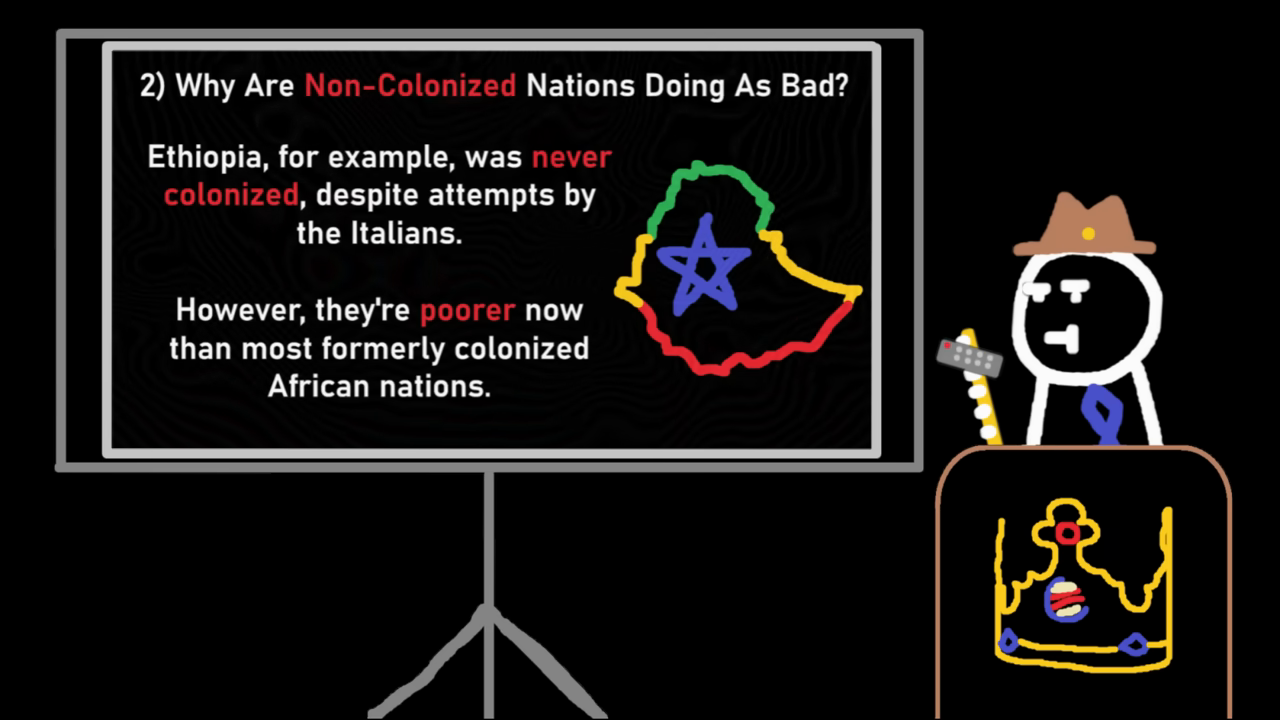
Ethiopia’s victory at Adwa in 1896 preserved independence during the main partition of Africa. But Fascist Italy invaded in 1935, captured Addis Ababa, annexed Ethiopia to Italian East Africa, and occupied it until 1941. A Cambridge history chapter calls this the Italian occupation; scholarship on Ethiopian resistance notes both Italy’s declaration of a colony and the incompleteness of control.
More importantly, Ethiopia is not a randomized counterfactual for the rest of Africa. Its later trajectory includes imperial rule, the Derg dictatorship, famine, war with Eritrea, civil conflict, landlocked geography after Eritrean independence, and distinct institutions. One exceptional country’s poverty cannot estimate what colonization did elsewhere.
4. Zimbabwe: real collapse, false before-and-after story
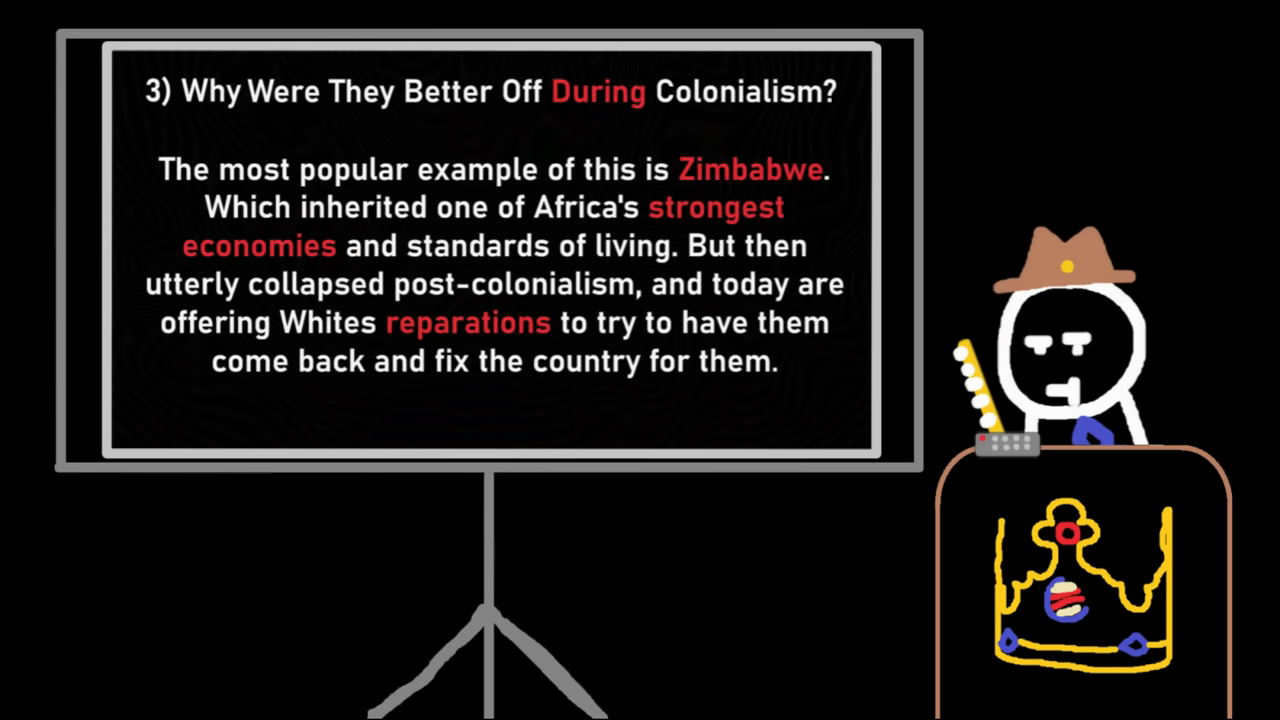
Zimbabwe inherited diversified agriculture, mining, manufacturing, infrastructure, and a comparatively skilled workforce. It also inherited severe racial inequalities in land, income, education, capital, and social services, while sanctions and the liberation war depleted infrastructure and productive assets. A World Bank assessment records both the economic potential and the unequal/depleted inheritance.
The economy did not “utterly collapse” immediately after independence. Another World Bank review reports real GDP growth of 10.6% in 1980 and 12.5% in 1981, followed by disappointing per-capita performance across the decade. The catastrophic breakdown associated with violent land seizures, fiscal and monetary mismanagement, political repression, drought, and disputed external constraints became especially severe after 2000. That history supports criticism of postcolonial governance; it does not validate the video’s clean colonial-success/postcolonial-failure contrast.
The 2020 Global Compensation Agreement was not an offer of “reparations to come back and fix the country.” Zimbabwe agreed to compensate former farm owners for improvements—buildings, wells, irrigation, and similar assets—not for the land itself. The government’s official agreement statement and Associated Press explanation describe a debt-resolution and international-reengagement measure.
5. Precolonial states and the resource diagram
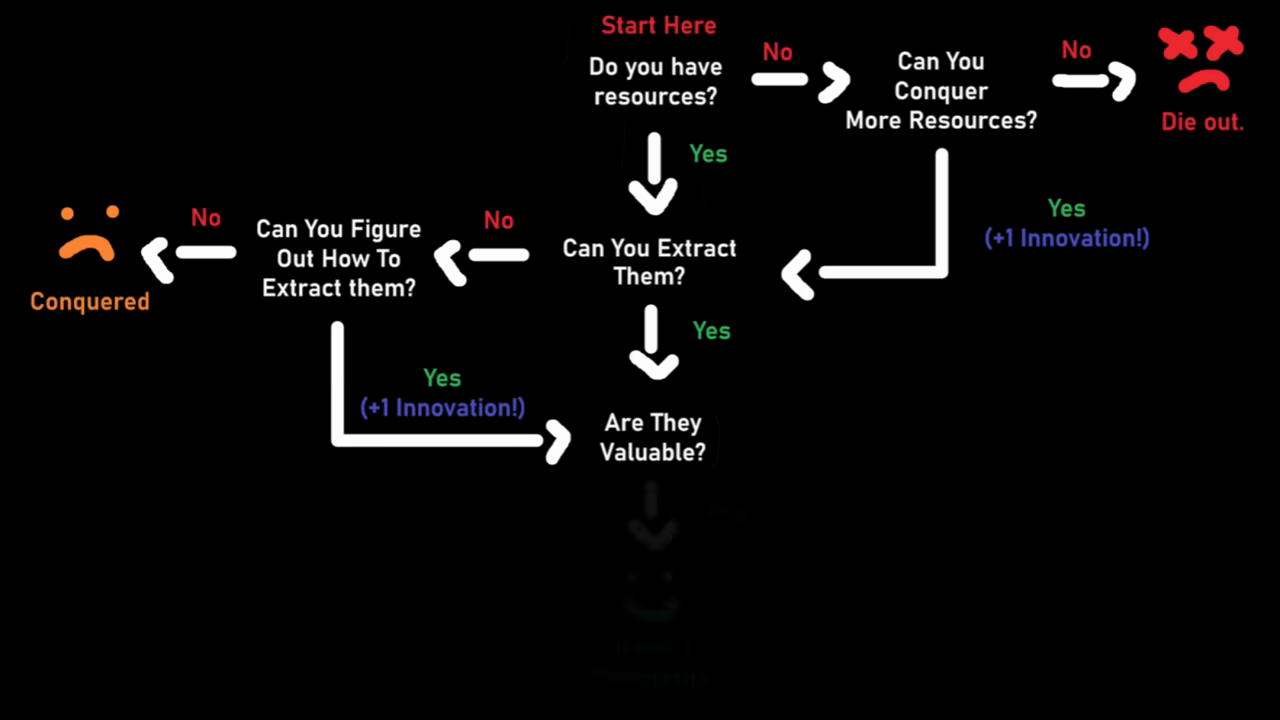
The diagram presents a universal choice: resources allow extraction and stagnation; scarcity forces conquest, value creation, and innovation. Economic history does not support that binary.
- Songhai’s wealth included Niger floodplain agriculture and taxes on trade. It had centralized offices, provincial administration, inspectors, and standardized weights and measures. See OpenStax’s synthesis.
- Great Zimbabwe combined crop farming, cattle, local production, elite redistribution, and long-distance gold and ivory trade. See the Metropolitan Museum of Art overview and archaeological complex-society review.
- Mali drew revenue from agriculture and taxation of commercial routes and maintained military and administrative institutions.
Natural-resource dependence can weaken diversification, increase rent-seeking, expose states to price shocks, and intensify conflict. But the resource-curse literature treats institutions and policy as mediators, and major resource-rich counterexamples exist. Meanwhile, European coal and iron were assets, not evidence of resource poverty; research on coal and industrialization finds that proximity to coal mattered substantially in Britain. “Europe innovated because it lacked extractable resources” is therefore not an established historical explanation.
6. Winter, climate, and the likely “Cold Winters” lineage
The climate passage closely resembles the hereditarian Cold Winters Theory associated with Richard Lynn and J. Philippe Rushton: cold Eurasian environments allegedly selected for intelligence, planning, storage, and impulse control. A modern sympathetic exposition explicitly credits Rushton/Jensen and Lynn while describing cold-winter selection for planning (Frost 2019). Emil Kirkegaard also hosts a paper defending the theory.
This establishes a likely idea lineage, not a direct source for the video. The video supplies no citation and no distinctive quotation linking it to one author.
The theory is not demonstrated by saying Africa is warm. Latitude bundles disease burden, agricultural ecology, transport access, colonial history, current income, education, health, and migration. Sub-Saharan environments also include seasonal rains, drought, altitude, and highly variable growing conditions that reward forecasting, storage, cooperation, and risk management. Even if a climatic correlation existed, it would not by itself identify genetic selection, a cognitive mechanism, or the direction of causation.
7. Songhai and the Swahili coast
The Moroccan victory over Songhai at Tondibi in 1591 is the video’s strongest historical example. Firearms and cannon helped a smaller Moroccan force defeat Songhai, while dynastic weakness and Morocco’s desire to control trans-Saharan commerce complete the context. The narrow military-technology point is substantially correct.
Portuguese fleets likewise used naval artillery and coercion to attack and dominate parts of the Swahili commercial network. Yet the coast did not simply “collapse”: ports survived, shifted alliances, and continued trading, while Omani power later expelled or displaced the Portuguese in much of the region. The OpenStax Swahili-coast history supplies a useful overview.
These episodes establish that military technology can shift power. They do not establish that resource-rich Africans evolved short-term psychology.
8. The reused national-IQ map
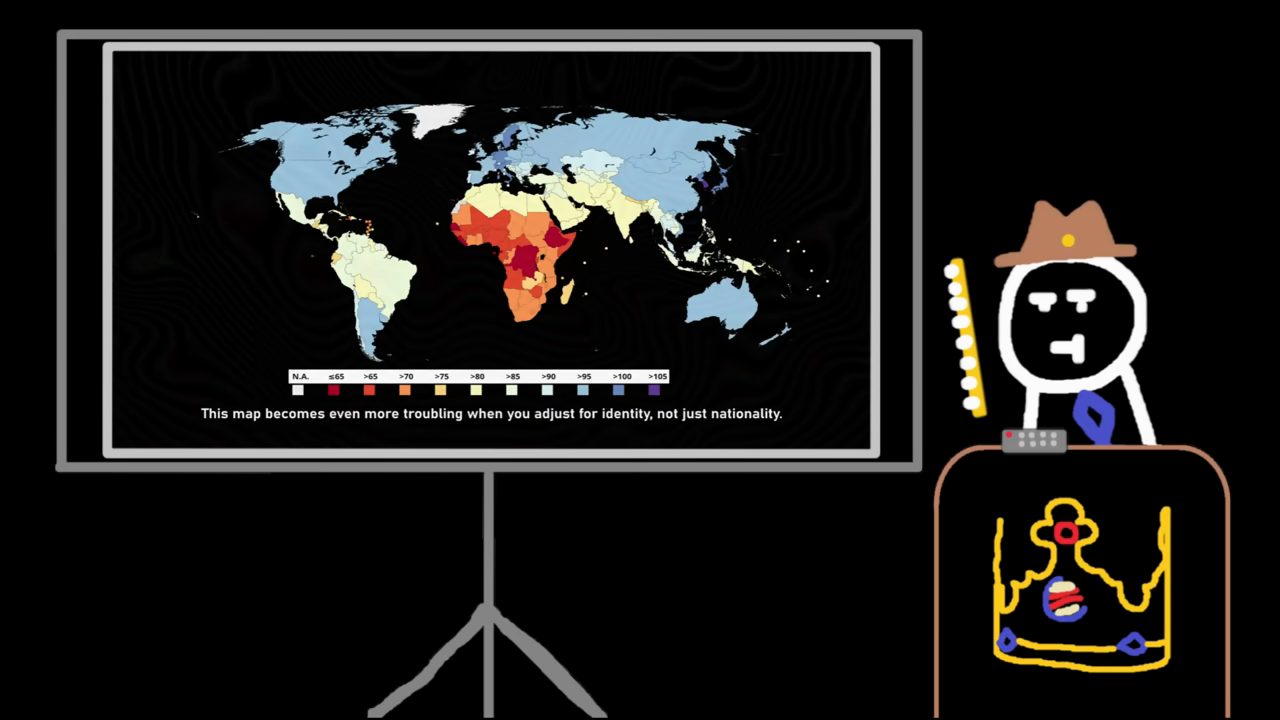
This is the same Lynn–Vanhanen 2002 world-IQ map family already audited in Racial Egalitarianism - All Arguments Ranked and Debunked and The IQ Debate We're Not Allowed To Have. The subtitle—“This map becomes even more troubling when you adjust for identity, not just nationality”—presents no calculation, adjusted dataset, or method. The visible figure is still a national map.
The estimates mix different tests, ages, years, languages, sampling frames, and often very small or unrepresentative samples; missing countries have historically been inferred from neighboring countries. Rebecca Sear’s methodological critique explains why such datasets are unsuitable for evolutionary claims about national populations. The European Human Behaviour and Evolution Association issued a related statement on national-IQ datasets.
Even a valid current test-score difference would not identify its cause. Nutrition, infectious disease, schooling quantity and quality, language, test familiarity, conflict, lead exposure, and family income can affect performance. The map neither partitions genetic/environmental causes nor measures “short-termism.”
IQ and planning are not interchangeable scales
A meta-analysis of 24 studies reported an individual-level association of approximately between intelligence and delay discounting: higher scores were associated with somewhat less discounting. A later large-sample study found only four of eleven cognitive measures significantly associated with discounting after controls, all below .
These are small-to-modest individual associations. They do not show that a national IQ estimate causes a society’s institutions, that IQ equals impulse control, or that historical institutions selected genes for either trait. Moving from persons to country averages and then to civilizational history changes both the unit and the causal question.
9. “Extreme selection for short-termism” is not an empirical result
The video does not specify:
- whether selection is genetic, cultural, institutional, or merely metaphorical;
- a measured phenotype, population comparison, or time period;
- heritability, differential reproduction, relevant variants, or a selection coefficient;
- an intergenerational design separating transmission from current insecurity;
- a prediction that distinguishes the theory from colonial extraction, disease, conflict, weak property rights, or poverty.
The video itself offers an environmental mechanism: people who invest may have the fruits seized. Where property is insecure, credit scarce, mortality high, or governments predatory, prioritizing present consumption can be rational. That mechanism undercuts the attempt to present short horizons as an unexplained racial or continental essence.
10. Slave-trade slide
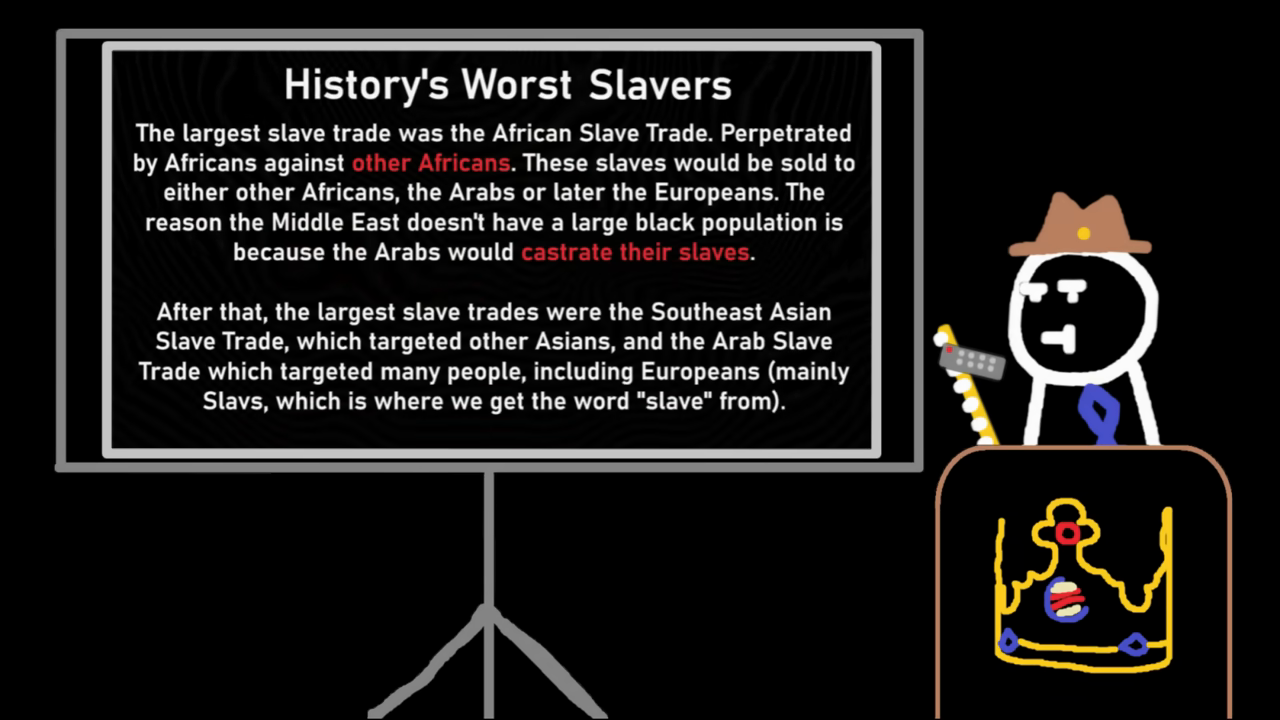
The mature Atlantic trade generally depended on African political and commercial networks to capture, transport, hold, and sell enslaved people. Herbert Klein’s history of African organization of the trade explains that European traders rarely penetrated far inland and depended on African sellers. African responsibility is real and should not be erased.
But responsibility is not zero-sum. European plantation demand, finance, shipping, weapons, insurers, states, and colonial law greatly expanded and maintained the Atlantic system. A history of West African slavery notes how transatlantic demand expanded slavery after 1550. The SlaveVoyages methodology estimates about 12.52 million captives embarked and 10.7 million disembarked in the Americas.
“Selling their own people” obscures the political world in which captives and sellers were often from different kingdoms, ethnic communities, or enemy groups. It would be equally misleading to describe medieval Europeans selling Slavs or rival Christians as “Europeans selling their own people.” Still, African rulers and merchants sometimes enslaved subjects, judicial victims, debtors, neighbors, and war captives; replacing the video’s distortion with a story of no African agency would also be false.
The global ranking is not auditable. “African,” “Arab,” and “Southeast Asian” slave trades can refer to internal slavery, exports, overlapping Indian Ocean routes, populations at a point in time, or cumulative trafficking over different centuries. No source or common metric appears on the slide.
Castration did occur in Islamic-world slave systems, especially in the production of eunuchs, and could be extraordinarily lethal. It cannot alone explain modern diaspora visibility. UNESCO’s General History of Africa notes that trans-Saharan and Red Sea flows were female-skewed, with demand for concubines. Manumission, intermarriage, assimilation, mortality, varied destinations, and racial classification also affect descendant populations. The etymology claim is the clean exception: the Oxford English Dictionary traces English slave through French/Medieval Latin sclavus, apparently an extended use of Slav.
11. Foreign aid
The closing resembles a popular “aid dependency” literature, including Dambisa Moyo’s Dead Aid, whose publisher describes her argument that over a trillion dollars of development aid fostered dependency and corruption (Macmillan). That is a plausible provenance lead, not proof of direct use.
The empirical record does not support “aid obviously causes dependence” as a universal statement. Aid includes vaccinations, antiretroviral treatment, disaster relief, food, schools, roads, direct budget support, technical assistance, concessional finance, and military/security transfers. Their incentives and outcomes differ. A meta-analysis of the aid-growth literature found a small positive average effect amid heterogeneity; a later quasi-experimental study also found positive effects on growth. Corruption, fungibility, donor self-interest, distorted accountability, and weak local ownership remain genuine risks.
The video never identifies which aid flows it means, measures industrial displacement, or compares similarly situated recipients. A montage of corrupt leaders cannot estimate the net effect of trillions of dollars across dozens of countries and sectors.
Methodological errors
| Error | How it appears here | Why it matters |
|---|---|---|
| Straw-man baseline | “Leftist professors” allegedly say all problems stem from colonialism | Avoids the actual multi-causal literature. |
| Causes/consequences confusion | Weakness before conquest is offered against damage from rule | The causal questions are independent. |
| Selection on one case | Ethiopia is treated as the uncolonized counterfactual | Countries differ on many determinants besides colonial status. |
| Before/after fallacy | Zimbabwe’s later collapse is compared with settler-era output | Inherited inequality, war damage, early gains, timing, and counterfactuals disappear. |
| Continental aggregation | Fifty-plus countries and many centuries become “Africa” | Mechanisms and outcomes vary across place and time. |
| Just-so evolutionary story | Warmth and resources allegedly selected short-termism | No measured selection process or discriminating prediction is supplied. |
| Ecological fallacy | Individual IQ–discounting correlations become African history | Associations at one level do not transfer automatically to another. |
| Measurement substitution | A national-IQ map stands in for inherited cognition and impulse control | The variables, units, and causes are different. |
| Post hoc narrative | Slavery, weak infrastructure, and aid follow from short-termism | Compatible chronology is not causal identification. |
| Undefined ranking | “History’s worst/largest slavers” | No metric or comparable categories make the ranking testable. |
| Moralization of aggregates | Outcomes become the “character” of Africans | Heterogeneous people are assigned a collective disposition from group averages. |
Source provenance
High-confidence reuse
- Lynn–Vanhanen national-IQ map: the exact image family is now verified in three Basic Logic videos. Its recurrence, including the same identity-adjustment subtitle in this video, indicates internal reuse or a shared visual source.
Probable intellectual lineage, direct copying unproven
- Cold Winters Theory: the warm-climate → less planning/innovation passage matches the Lynn/Rushton/Pesta/Frost hereditarian theory closely.
- Resource curse: the video borrows a real development-economics term, but turns a conditional institutional theory into a transhistorical continental psychology.
- Aid dependency: the “trillions in aid” framing resembles Dambisa Moyo and a wider anti-aid literature.
- African sellers in the Atlantic trade: this is standard scholarship but also a recurring online race-polemical corrective. The video’s distinctive global ranking and castration language may come from a secondary graphic or post; no exact pre-video source was found in phrase searches.
Search result
Exact-phrase searches for the “History’s Worst Slavers” wording, its order of African → Southeast Asian → Arab trades, and its castration sentence did not locate an indexed pre-video source. That absence does not prove the slide is original; images, deleted posts, private groups, and unindexed video scripts remain possible.
Cross-video connections
- The Lynn–Vanhanen world-IQ map is now a verified three-video recurrence, linking this dossier to Racial Egalitarianism - All Arguments Ranked and Debunked and The IQ Debate We're Not Allowed To Have.
- The inference chain extends The Genetics Behind Unequal Societies: population difference → presumed neurology/intelligence → psychology/time preference → civilization and political prescription.
- Like Why Is Black America Like That, this video begins with real disparities, singles out one preferred psychological/cultural cause, minimizes institutional alternatives, and ends with a judgment about group character.
- Like Why Is Per Capita Impossible For Them, it uses a recognizable empirical object—a map, historical event, or statistic—as if it answered a different causal question.
- The climate and national-IQ pairing adds a stronger Lynn/Rushton-related provenance signal to the channel-wide citation ecosystem, while still falling short of identifying the creator or proving a particular immediate source.
Open questions
- Can the exact “History’s Worst Slavers” graphic or text be located in an earlier forum, X post, video, or image archive?
- Did Basic Logic take the Cold Winters argument from Lynn/Rushton/Pesta directly, from Emil Kirkegaard’s hosted copy, or from a later summary?
- What source supplied the video’s claim that Zimbabwe was offering white people “reparations to come back,” and did it confuse compensation for improvements with land restitution?
- Does the channel use the same national-IQ map file/crop across all three videos, or did it re-download variants from the same online family?
- Which aid total and period underlie “trillions,” and does the creator distinguish official development assistance from loans, private investment, remittances, and humanitarian aid elsewhere?
Principal sources
Official data and contemporary records
- World Bank: Sub-Saharan Africa indicators
- Zimbabwe government: Global Compensation Agreement statement
- SlaveVoyages: Trans-Atlantic methodology and estimates
Scholarly and methodological sources
- Heldring and Robinson, “Colonialism and Economic Development in Africa”
- Michalopoulos and Papaioannou, “Historical Legacies and African Development”
- Frankel, “The Natural Resource Curse: A Survey”
- Sear, “National IQ datasets do not provide accurate, unbiased or comparable measures of cognitive ability worldwide”
- Shamosh and Gray, “Delay discounting and intelligence: A meta-analysis”
- Klein, “The African Organization of the Slave Trade”
- Manning, “Slavery & Slave Trade in West Africa 1450–1930”
- OpenStax, Songhai and the Swahili coast
Research limits
- The transcript comes from automatic captions and may contain minor wording errors.
- Regional indicator trends cannot establish the causal effect of independence, aid, or colonialism; they are used only to test the video’s direction-of-change assertion.
- Historical estimates of slave trades outside the Atlantic are incomplete and often incomparable. This audit rejects the video’s ranking because its metric is undefined, not because a complete alternative ranking is available.
- The provenance findings establish recurrence and intellectual similarity, not the creator’s civil identity or a proven direct copying path.
Related notes
Full transcript
Full transcript (YouTube automatic captions; lightly normalized)
Automatic captions can mishear names, numbers, and punctuation. The wording below is retained as evidence of what the video appears to say, not as authentication of every proper noun or statistic.
0:00 — Extreme poverty, unmaintained infrastructure, sky-high criminality, and corruption coupled with ethnic tensions leading to regular acts of violence. Why is sub-Saharan Africa like that? Ask a leftist professor and they’ll tell you all problems stem from colonialism. But ask an online history buff and they’ll give you an answer that violates YouTube’s TOS. So let’s pull the curtain back. How much of Africa’s present-day state can be attributed colonialism and how much of it is a result of internal factors? The issue with the colonialism explanation is threefold. First, it fails to explain why nearly all of sub-Saharan Africa was so weak that it could even be colonized in the first place. Second, it fails to explain why African nations that were not colonized, such as Ethiopia, are in a similar or worse situation than formerly colonized nations. And lastly, it fails to explain why after colonialism, these nations’ standard of living and infrastructure
1:00 — have gotten worse, not better, while relying on Western foreign [music] aid. To understand why almost the entirety of sub-Saharan Africa was able to be colonized so easily, we must look at their history. Contrary to internet memes, sub-Saharan Africa did have powerful kingdoms, including the Songhai, Great Zimbabwe, and most notably the Mali Empire. All of these kingdoms became rich and powerful by selling valuable raw resources. After all, sub-Saharan Africa is one of the richest places in the world in terms of raw resources. But that gift turned out to be a curse because it meant those empires never had the strong need to invest deeply into their own people or complex institutions. They could just rely on resource extraction. If they ever wanted something more complex, they could always trade their resources with a more technologically advanced society. Compare this to Europe, which had significantly fewer easily extractable raw resources and
2:01 — therefore had stronger incentives to produce and refine goods to trade. Europe had a much stronger drive toward technological innovation. Additionally, the sub-Saharan climate is perpetually warm with no need to prepare for a brutal winter as seen in countries with four seasons. Another factor that historically drives planning and innovation. The issue with the strategy is that the more technologically advanced nations end up with stronger militaries. The Songhai collapsed because the Moroccans had gunpowder weapons and invaded. The Swahili coast nations collapsed when nations of more advanced navies took over their trade routes. Resource extraction as the main source of a nation’s prosperity is great in the short term, but what happens when those resources run out or someone else decides to take them? Extraction should be a way to jump-start your civilization, not depend on it perpetually. But Africa was so rich and the climate so predictable that they could get away with short-term
3:02 — strategies for longer than other peoples. Let’s address the elephant in the room. Sub-Saharan Africa has the lowest average IQ scores in the world. People have different theories for why that is, whether they believe it is largely innate or a result of environment, or they debate IQ’s reliability entirely. But we do know one thing. IQ is strongly correlated with long-term planning and impulse control. And the history of sub-Saharan Africa is one of extreme selection for short-termism. Africans that try to invest in the future often end up poorer than those that focused on immediate resource extraction. And frequently the fruits of their labor were taken by force. Don’t forget, African resource extraction wasn’t just for for goods, but also for slaves. They had some of the largest slave economies in the world with perpetual demand amongst themselves and from Arab nations for over a thousand years. And a major surge when
4:04 — Europeans entered that market. The idea that Europeans ran into the African interior, kidnapped people en masse, and then put them into ships is a fantasy. In reality, foreign merchants would go to African kingdoms and buy slaves from them as had been standard practice in Africa for thousands of years. Is enslaving your own people and selling them to foreigners a good long-term strategy for a civilization? No. But it does make you rich in the short term. Is neglecting your infrastructure a good long-term strategy? No. But it does mean less work right now. Is relying on perpetual foreign aid instead of developing your own industry a good long-term strategy? Obviously not. But it does make your political leads a lot of money. Short-termism is terrible for any people and if Africans don’t overcome it, they can forget having any grander societal ambitions.