He Wants to Be Famous, Let’s Make it Happen - YouTube
Judith Jarvis Thomson's Violinist Argument for Abortion Rights

Pinker’s Chapter 7 supplement — falling abortion rates and what the trend cannot settle
Pinker answers one historical slippery-slope prediction: after abortion became broadly available, Western societies did not move toward legal infanticide or rising violence against children; during the same period, other measured forms of violence declined. That temporal record weighs against the prediction that legalization would necessarily erode every restraint on killing. It does not by itself settle abortion’s moral status, prove why violence declined, or show that every legal regime has the same effects.
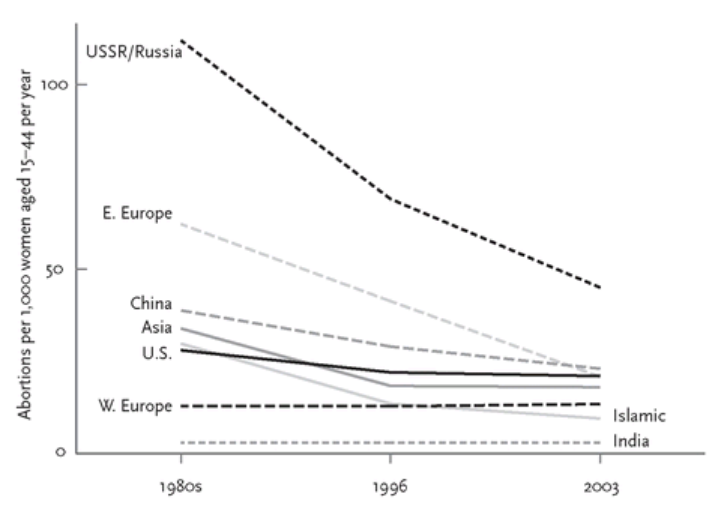
Figure 7-16 — Reported abortion rates by selected world regions, the 1980s, 1996, and 2003. Pinker emphasizes a broad decline, especially in the former Soviet bloc, and proposes improved access to contraception as an important practical cause. The source quality varies widely; the aggregates cover selected countries rather than every country in a region, and “Islamic” consists only of Tunisia and Turkey. India and Western Europe begin low and do not decline in this graph. Pinker’s further argument that moral concern tracks consciousness and thalamocortical activity around twenty-six weeks is a philosophical interpretation joined to a neuroscience claim, not a neutral scientific definition of personhood. This is a historical figure ending in 2003, not a current international comparison. Chapter 7 synthesis · Slippery-slope argument and consciousness framing, PDF pp. 592–594 (file not included in this release) · Figure 7-16, PDF p. 594 (file not included in this release) · Interpretation and contraception, PDF p. 595 (file not included in this release)
Haidt’s Chapter 7 supplement — sanctity explains part of the dispute but does not settle it
Haidt argues that a pain-only framing cannot explain the full abortion conflict because many opponents speak of the sanctity of life, not only present sentience. Sanctity/degradation can represent a fetus, body, reproductive act, or medical practice as hallowed or desecrated; Care and Fairness can simultaneously frame pregnancy through fetal vulnerability, maternal harm, equality, responsibility, or bodily autonomy. The foundations model helps identify why participants may answer different moral questions while believing the other side is evading morality.
This is a map of moral salience, not a verdict. A sanctity response does not determine fetal moral status, the rights and health of the pregnant person, gestational distinctions, medical facts, legal authority, policy effects, or when coercion is justified. Disgust and sacred language can preserve dignity, but they can also encode sexual control and stigma. Conversely, showing that an intuition has cultural or evolutionary roots does not refute it. Use the framework to reconstruct each concern, then decide through evidence and explicit normative argument. Sacredness and nonfungible value, PDF pp. 179–180 (file not included in this release) · Sanctity, the body, and biomedical controversies, PDF pp. 181–183 (file not included in this release) · Chapter 7 source audit
Evidence audit: abortion decisions and crime
Fact-check: Pinker on abortion decisions, later outcomes, and crime (Chapter 3)
Verdict: There is evidence that, in some groups of pregnant adolescents, stronger preexisting school performance and educational goals predict abortion rather than birth. It does not establish that women who continue an unintended pregnancy are generally fatalistic, disorganized, or less disciplined. Nor does it establish Pinker’s suggested reversal of the abortion–crime hypothesis. This is an empirical audit of those claims, not a judgment on abortion’s morality or legality.
Pinker and his citation. Pinker argues that the people ending unintended pregnancies may be more future oriented than those continuing them, cites Ted Joyce (2004), and speculates that abortion might therefore select against future self-control in a birth cohort. He also rejects the claim that legalized abortion explains the 1990s crime decline. Book PDF p. 182 (file not included in this release) · Joyce’s paper. Joyce summarizes earlier studies, including a 1972–74 Ventura County sample in which pregnant teens with better grades, more schooling, and no public assistance were more likely to abort. Those grades and circumstances predated the decision; they are not evidence that abortion caused better grades or that the alternative decision reveals an inferior character.
Educational selection: a limited real pattern. In prospective Add Health data, stronger educational goals predicted termination of an unintended adolescent pregnancy; measured risk behaviors did not predict that decision. Afterward, teen motherhood was associated with less substance use and fewer sexual partners, complicating a general “discipline” story. Gomez-Scott & Cooney (2014). A small UK comparison (19 teens seeking termination, nine receiving antenatal care) found longer and clearer career plans in the former group, but cannot generalize to all women. Bell et al. (2014). National U.S. estimates also show different abortion shares among unintended pregnancies by education and income, which may reflect resources, access, opportunity costs, and preferences, not a measured personality ranking. Finer & Zolna (2016).
The personality claim is unproven. In one prospective U.S. study, a rough measure of conscientiousness before adolescent pregnancy had only a borderline association with abortion in one racial subgroup; the fuller personality inventory was collected years after the pregnancy, so it cannot cleanly identify an earlier trait. Harville et al. (2015). In a German panel, the raw pre-event conscientiousness score was lower in the abortion group than the live-birth group (3.77 versus 3.99), the opposite of Pinker’s proposed direction. But that comparison includes pregnancies with differing intentions, so it is not a direct test of his “unprepared” subset. Huss & Kaiser (2022). Neither result supports a broad moral or psychological classification.
Why a pregnancy continues. Interviews with 33 U.S. women (13 abortions, 20 continuations, three of the latter placed a child for adoption) found that those continuing often weighed support, resources, obstacles, and values; the small recruited sample cannot estimate population shares. Spierling & Shreffler (2018). A Dutch interview study of 109 people after options counseling found deliberation in both outcome groups; its sample was selected for decision difficulty. Brauer et al. (2019). Interviews with 45 teenagers describe different opportunity structures and reasons for seeing parenthood as a disruption or a meaningful addition, not evidence that continuation is simply a fantasy about a baby. Ragins (2017). Access and affordability can also determine whether someone obtains an abortion they wanted; “did not abort” is not always an unconstrained preference. KFF women’s survey (2024). A 2021–22 clinic sample included many people who already had children (56%) or had income below twice the poverty line (73%); it was not nationally representative, and a teen career-planning result should not stand in for all abortion patients. Jones et al. (2023).
Later schooling and welfare do not measure initial character. In the Turnaway Study, 813 people seeking abortion near clinic limits were followed; those denied and giving birth had higher adjusted odds of poverty (3.77) and public assistance (6.26) six months later than recipients, with differences lasting years. This comparison shows that a birth and access constraints can shape later economic outcomes; later assistance is not proof of a preexisting disposition. Foster et al. (2018). Among 280 participants enrolled in education, a related study found no clear adjusted difference in whether they graduated or dropped out over five years, though recipients who graduated more often earned postsecondary degrees. Ralph et al. (2019). A longer Add Health analysis associates abortion of a teen pregnancy with higher adult education and income after matching, but selection and abortion underreporting limit causal inference. Everett & Taylor (2024). Comparing abortion with miscarriage is also tricky: miscarriage among people who might otherwise abort is not socially random. Ashcraft, Fernández-Val & Lang (2013).
Crime is a separate and disputed causal question. Joyce’s cohort comparisons found little consistent evidence that legalization appreciably reduced subsequent crime. Joyce (2004). Donohue and Levitt’s later aggregate analysis estimated about a 20% reduction in crime from 1997 to 2014 attributable to legalized abortion, while Lott and Whitley reported an association in the opposite direction; model choice, timing, confounding, and measurement remain disputed. Donohue & Levitt (2019) · Lott & Whitley (2007). None of these aggregate comparisons measures the hypothetical personality or criminal behavior of people who were never born, or verifies Pinker’s proposed maternal-trait/genetic/environmental pathway.
Safer formulation: In some historical samples, pregnant adolescents with stronger educational prospects or goals were more likely to terminate an unintended pregnancy. Decisions to continue reflect differing values, resources, support, access, and opportunities. Later schooling and public assistance combine prior differences with consequences of childbearing; the evidence does not justify a general character ranking or Pinker’s speculative crime reversal.
Book context: The Better Angels of Our Nature, Chapter 3.