Filed with Politics MOC · Related: Ideology & Foundations · 60.10 Argumentation
📓 Handwritten journal
Journal connection: Three pages capture political and debate arguments associated with NotSoErudite, including causal reasoning, evidence standards, and counters to essentialist claims.
Source boundary: These pages are personal argument notes and paraphrases; speaker attribution and empirical claims require checking against the underlying source.
PDF++ pages: p. 39 (file not included in this release) · p. 40 (file not included in this release) · p. 41 (file not included in this release)
Embedded preview:
Journal - Feb-March 21 2026.pdf (file not included in this release)
Open the journal index
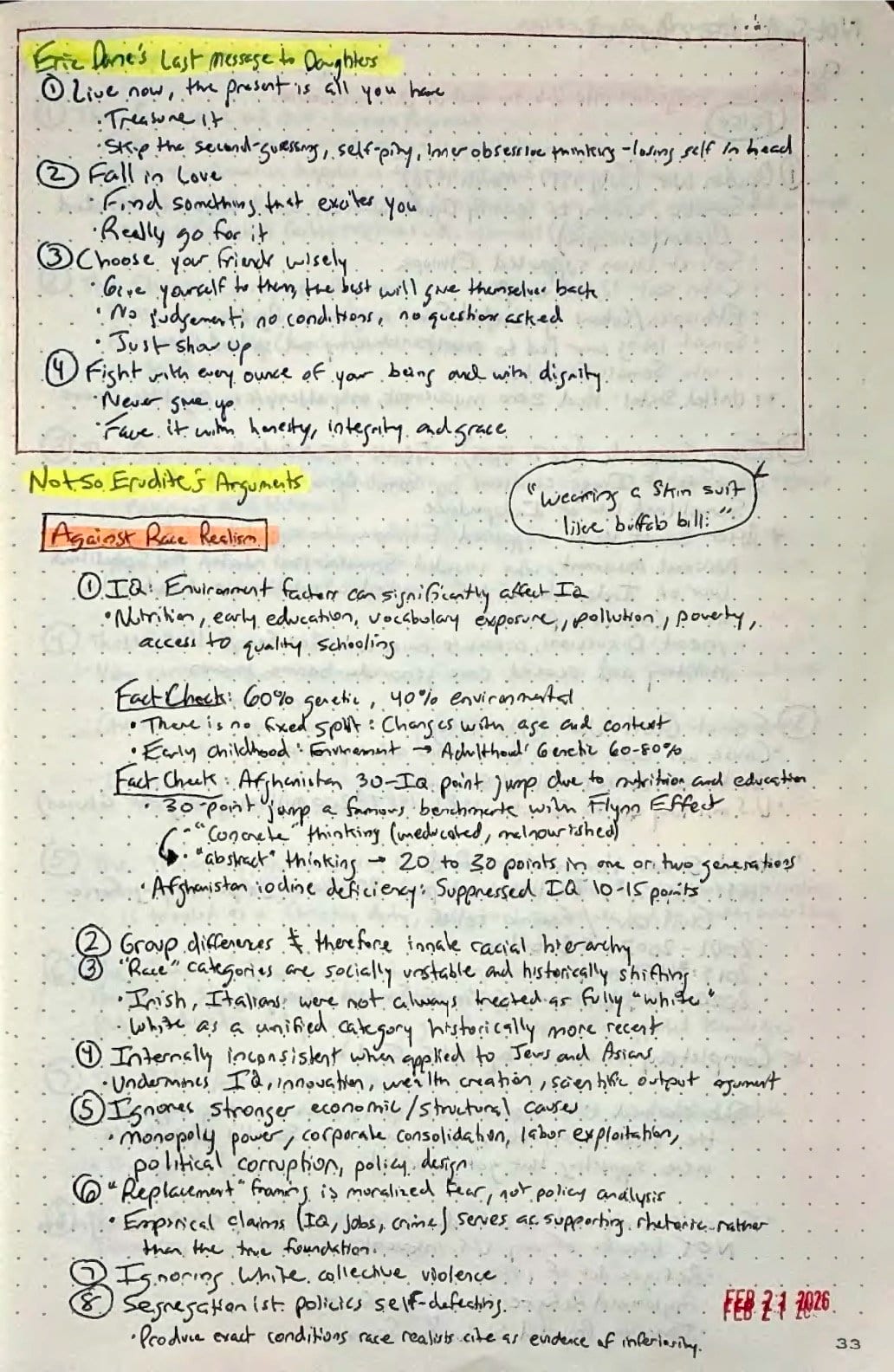
Against Race Realism
Main Arguments Against Race Realism (from transcript)
1) Environmental factors can significantly affect IQ (not just genetics)
The interviewer argues that IQ differences are heavily shaped by environmental conditions, not simply innate racial/genetic differences.
Main points used
- Nutrition matters
- Early education matters
- Vocabulary exposure in early childhood matters
- Pollution and poverty conditions matter
- Access to quality schools matters
Example used
- He cites an Afghanistan example/study claim to argue that daughters with better nutrition/education had much higher IQ scores than their mothers (he claims a large jump, around 30 points, across generations).
Why this matters to anti-race-realist argument
- If IQ can move significantly due to environment, then racial IQ gaps cannot be confidently treated as fixed, biological racial destiny.
2) Cross-group differences do not prove racial essence
He repeatedly pushes the question: “Why?” when Hayden says Europeans have higher IQ than Africans.
Main point
- Simply observing an average difference (or asserting one) does not prove a racial-genetic cause.
- Alternative explanations (nutrition, schooling, poverty, pollution, state capacity, etc.) are plausible and must be considered.
Anti-race-realist logic
- Race realists often move too quickly from:
- “group difference exists”
to - “therefore innate racial hierarchy”
- “group difference exists”
- The interviewer argues this is an unsupported inference.
3) “Race” categories are socially unstable and historically shifting
The interviewer argues that “white” is not a timeless, fixed biological-political category in the way race realists often imply.
Main points used
- Historically, many European groups (Irish, Italians, etc.) were not always treated as fully “white.”
- “White” identity was expanded and redefined over time.
- The obsession with “white” as a unified political category is historically more recent than race realists often admit.
Why this matters
- If racial categories are historically fluid, race-realist claims that depend on hard civilizational racial boundaries become weaker.
4) Race realism is internally inconsistent when applied to Jews and Asians
The interviewer uses a consistency test:
Argument structure
- If Hayden values IQ, innovation, wealth creation, and scientific output as key racial criteria,
- then by Hayden’s own logic, Asians and Jews should outrank whites in many categories.
- But Hayden still prioritizes “white” identity.
Anti-race-realist conclusion
- This suggests the position is not really about IQ/objective metrics, but about ingroup preference/ethno-loyalty, with IQ used selectively as post hoc justification.
5) The race-realist explanation ignores stronger economic/structural causes
The interviewer redirects many complaints (declining wages, farmer collapse, job precarity, neighborhood stress, etc.) toward:
- oligarchy / monopoly power
- corporate consolidation
- labor exploitation
- political corruption
- policy design
Main anti-race-realist point
- Race realism acts as a misattribution framework:
- it blames immigrants/race for problems better explained by political economy and elite incentives.
6) Immigration outcomes can be beneficial at the societal level
The interviewer claims that large immigration increases often correlate (within a time horizon) with improvements such as:
- GDP growth
- job development
- life quality improvements
Why this matters
- This challenges the race-realist assumption that importing nonwhite populations necessarily degrades a country.
(Note: in the transcript this is asserted, not deeply documented.)
7) Historical causation matters (Somali example)
The interviewer argues that Somali migration (especially to Minneapolis) should not be framed as merely “inferior people replacing whites,” but as a consequence of:
- war
- state collapse
- foreign intervention
- geopolitical destabilization
Anti-race-realist point
- Refugee flows are often the result of historical and political causes, not simple civilizational inferiority.
- Therefore moral blame should be directed at states/policies, not racialized populations.
8) “Replacement” framing is moralized fear, not a coherent policy analysis
The interviewer exposes that Hayden’s core concern is not GDP, jobs, democracy, or policy coherence, but:
- “I am pro-white”
- “I want white people to have a future”
- “I want replacement reversed”
Anti-race-realist implication
- The underlying motivation appears to be ethnic preservation / racial preference, with empirical claims (IQ, jobs, crime, etc.) often serving as supporting rhetoric rather than the true foundation.
9) Claims about racial violence/morality are selective and historically one-sided
When Hayden suggests whites are less violent (or not violent “to that degree”), the interviewer brings up:
- postcard lynchings
- racial terror culture
- white supremacist violence after slavery
Anti-race-realist point
- Race-realists often portray violence/antisocial behavior as disproportionately tied to nonwhite groups while ignoring major historical patterns of white collective violence.
10) Segregationist policy proposals are self-defeating and anti-human flourishing
The interviewer links Hayden’s proposals (anti-Section 8, segregation-like outcomes, forced concentration of poor people) to predictable outcomes:
- continued poverty
- low education
- malnutrition
- social immobility
Anti-race-realist point
- Even if framed as “order,” these policies can reproduce the exact conditions that race realists then cite as evidence of inferiority.
Core anti-race-realist thesis in the transcript (condensed)
The interviewer’s main challenge is that race realism confuses observed group disparities with innate racial destiny, while ignoring environmental, historical, political, and economic causes. He also argues the position is often internally inconsistent (especially on Jews/Asians and IQ) and functions more as an ethno-political identity project than a coherent evidence-based theory.
Debate strategy used (important for analysis)
The interviewer does not only argue with facts; he also uses:
- consistency tests (“By your logic, shouldn’t Jews/Asians lead?”)
- alternative causal explanations (nutrition, education, pollution, oligarchy)
- historical category critique (“white” is socially constructed/fluid)
- moral reframing (blame policy/elites, not racialized immigrants)
- exposure of underlying motive (“replacement” fear over stated metrics)
Race Realism Debate Analysis (Transcript-Based)
What this note is
A combined breakdown of the transcript’s anti-race-realist case, organized into:
- Main arguments against race realism
- Empirical arguments
- Conceptual / philosophical arguments
- Rhetorical weaknesses in Hayden’s responses
- Debate strategy used by the interviewer
- Key takeaways / strongest lines of critique
1) Main Arguments Against Race Realism (High-Level)
Core thesis presented in the transcript
The interviewer’s central challenge is that race realism:
- treats observed group disparities as proof of innate racial hierarchy
- while underweighting or ignoring:
- environmental causes
- historical causes
- political/economic causes
- category instability (“race” itself)
- and often uses empirical claims selectively to support a pre-existing ethno-political preference (“pro-white” / anti-replacement), rather than following the evidence wherever it leads.
2) Empirical Arguments Against Race Realism (from the transcript)
A. IQ is shaped by environment, not only genetics
The interviewer argues that major IQ differences can be influenced by:
- nutrition
- early education
- vocabulary exposure
- pollution
- poverty conditions
- school access / quality
Why this matters
- It undercuts the move:
“group IQ difference exists -> therefore genetic racial inferiority/superiority.” - It reframes IQ outcomes as at least partly developmental and structural, not purely innate.
B. Afghanistan example (nutrition + education)
The interviewer cites an Afghanistan example/study claim to argue:
- after improved nutrition and girls’ education over a generation,
- daughters showed a large IQ increase relative to mothers (he claims ~30 points).
Function of this example in the debate
- Not mainly to prove exact numbers on the spot
- But to establish a principle:
- intergenerational environmental improvements can dramatically alter cognitive outcomes
Anti-race-realist force
- If true (or even directionally true), this weakens race-realist certainty that group averages reflect immutable racial biology.
C. Group differences do not establish group essence
When Hayden asserts Europeans score higher than Africans, the interviewer repeatedly asks:
- “Why?”
Point being made
Observed average differences do not themselves determine causation.
Possible contributors include:
- nutrition
- education
- disease burden
- poverty
- environmental toxins
- state instability
- war/conflict disruptions
Anti-race-realist force
- The interviewer is attacking the inference, not merely the observation.
- This is a key distinction:
descriptive difference ≠ proof of biological race hierarchy
D. Economic decline is misattributed to race/immigration
The interviewer redirects grievances (jobs, wages, agriculture, household precarity) toward:
- monopoly power
- vertical integration
- oligarchic capture
- labor exploitation
- policy failures
Example themes used
- corporate consolidation
- destruction of small farmers
- low wages as an employer/policy issue, not “brown people” issue
Anti-race-realist force
- Race realism is presented as a bad causal model for social decline.
- It offers an easy scapegoat while ignoring stronger explanatory variables.
E. Immigration can improve macro outcomes
The interviewer claims that large immigrant inflows tend to produce (over time):
- GDP increases
- job creation/development
- quality-of-life improvements
Function in the debate
- Challenges the deterministic claim that nonwhite immigration necessarily degrades national outcomes.
Important note
- In the transcript this is asserted more than demonstrated in detail.
- Still, the debate purpose is to contest race-realist inevitability claims.
F. Refugee migration has political-historical causes (Somali example)
The interviewer argues Somali migration to Minneapolis should be understood through:
- war
- state collapse
- foreign intervention
- displacement
- geopolitical history
Anti-race-realist force
- Counters the framing of Somali presence as proof of “civilizational inferiority”
- Reframes migration as a result of historical causation and policy, not race essence
G. Segregation-like housing policy reproduces deprivation
When Hayden argues against Section 8 and effectively for keeping poor people (disproportionately minorities) out of “nice neighborhoods,” the interviewer points out this likely perpetuates:
- poverty
- weak education access
- malnutrition
- generational disadvantage
Anti-race-realist force
- Shows a feedback loop:
- create/exacerbate disadvantage
- then cite resulting disparities as evidence of inferiority
3) Conceptual / Philosophical Arguments Against Race Realism (from the transcript)
A. “Race” categories are historically unstable (especially “white”)
The interviewer argues that “white” is not a fixed, timeless category:
- Irish, Italians, etc. were not always treated as fully “white”
- “whiteness” expanded over time
- identity boundaries shifted depending on politics/history
Philosophical point
- If the category itself is historically constructed/fluid, race-realism claims built on rigid racial essences become less credible.
What this targets
- Essentialism
- Civilizational racial mythology
- Retroactive projection of modern race categories into the past
B. Internal inconsistency: IQ metrics vs actual group preference
The interviewer runs a consistency test:
- If IQ / innovation / output are your core standards,
- then Asians and Jews (by Hayden’s own concessions) should rank very highly
- yet Hayden still centers “white” identity as the preferred category
Philosophical implication
- The argument may not actually be:
- “I follow objective metrics”
- but rather:
- “I prefer my ingroup, and use metrics selectively”
This is a strong anti-race-realist critique because it targets
- inconsistency
- motivated reasoning
- post hoc rationalization
C. “Replacement” language reveals the real normative core
Hayden ultimately says explicitly:
- he is “pro-white”
- wants white people to have a future
- wants demographic replacement reversed
- doesn’t care much about GDP/economy if whites lose relative demographic dominance
Philosophical implication
- The debate is not primarily about neutral empirical truth claims
- It is fundamentally about:
- ethnic preference
- collective identity
- political power
- fear of status loss
Why this matters
This reframes “race realism” as partly an ideological project rather than a purely empirical thesis.
D. Selective moral framing of violence
Hayden implies whites are less violent / less dangerous in relevant ways.
The interviewer counters with:
- lynching postcards
- racial terror culture
- organized white supremacist violence
Philosophical point
- Race-realist narratives often moralize present behavior while selectively forgetting historical violence by the preferred group.
- This exposes asymmetrical moral accounting.
E. Democracy, dictatorship, and common-man welfare
Hayden argues for a benevolent dictatorship.
The interviewer challenges him to name a dictatorship with:
- better quality of life
- better innovation
- better neighborhoods
than liberal democracies
Anti-race-realist adjacency
- It shows how race realism in this conversation is bundled with anti-democratic authoritarian fantasies that are weakly defended.
- The interviewer ties modern progress to:
- liberal institutions
- science
- democratic systems
rather than racial purity or dictatorship.
4) Rhetorical Weaknesses in Hayden’s Responses (as shown in transcript)
A. Repeated assertion without causal argument
Pattern:
- “Whites have higher IQ”
- “Europeans > Africans”
- “White people invented everything”
- “It just is”
Weakness
- He often states conclusions without defending causation.
- The interviewer keeps pressing “why?” and Hayden frequently declines or defaults to intuition.
B. Concession drift (partial agreement, then return to prior claim)
Hayden repeatedly concedes:
- nutrition matters
- education helps
- early vocabulary matters
- environment can influence IQ
But then returns to broad racial claims without integrating those concessions.
Weakness
- Creates a tension between:
- admitted environmental effects
- and continued confidence in racial-essential conclusions
C. Selective use of IQ as a value metric
He uses IQ to justify racial preferences, but:
- backs away when Jews/Asians outperform on some metrics
- still maintains white primacy based on non-IQ preferences
Weakness
- Indicates metric inconsistency
- Suggests IQ is a rhetorical tool, not a stable principle
D. Moving between “I’m not mad at them” and demeaning framing
Hayden says he is not angry at Somalis/immigrants and understands why they come, but also:
- describes them as lesser
- describes communities in demeaning terms
- uses “replacement” framing
Weakness
- Rhetorical contradiction between claimed neutrality and expressed hierarchy/hostility.
E. Policy claims are often slogan-level, not mechanism-level
Examples:
- ban Section 8
- bring back segregation / equivalent outcomes
- dictatorship to “whip everyone into shape”
Weakness
- Little serious policy mechanism
- No robust evidence for downstream effects
- Heavy reliance on vibes, grievance, and anecdote
F. Historical claims made with low confidence / weak knowledge
Notable pattern:
- strong claims about history (Russia, Jews, etc.)
- then “I don’t know / that’s news to me” when pressed
Weakness
- Overconfidence followed by retraction
- Signals a shallow knowledge base under rhetorical certainty
G. Anecdote substitution
Example:
- workplace anecdote about five women vs one white man
- father’s Jack in the Box story as social proof of broad national decline
Weakness
- Personal anecdotes are not sufficient to establish race-level claims.
- They smuggle normative conclusions from limited cases.
5) Debate Strategy Used by the Interviewer (useful for your own analysis)
A. Consistency tests
He repeatedly asks questions that expose internal contradictions:
- If IQ is the standard, why not prefer Asians/Jews?
- If immigrants are the problem, why do macro labor/economic dynamics point elsewhere?
- If dictatorship is better, name one example that outperforms liberal democracies.
Why effective
- Forces the opponent to reveal the real priorities behind the rhetoric.
B. Alternative causal explanations
Instead of merely denying racial disparities, he offers competing explanations:
- nutrition
- education
- pollution
- oligarchy
- monopoly
- structural incentives
- foreign intervention / war
Why effective
- Moves the debate from moral outrage to causal analysis.
C. Historical reframing
He introduces historical material that destabilizes simplistic narratives:
- shifting whiteness categories
- lynching postcards / white racial violence
- intervention history and refugee flows
Why effective
- Breaks “common sense” racial storytelling by adding ignored context.
D. Motive exposure
He gets Hayden to state more openly:
- “I’m pro-white”
- demographic preservation as central concern
- economy/GDP secondary
Why effective
- Clarifies that the dispute is not only empirical (“what do the data say?”)
- but also normative/political (“what group should dominate / be preserved?”)
E. Moral redirection (from scapegoating to institutions)
He repeatedly reframes:
- from blaming immigrants/minorities
- to blaming elites, policy, state violence, and corporations
Why effective
- Competes directly with scapegoat narratives
- Keeps focus on policy-level accountability
6) Strongest Anti-Race-Realist Points in This Transcript (Condensed)
Strongest empirical point
Environmental and developmental factors can significantly affect cognitive outcomes, so race-realist claims that IQ gaps straightforwardly prove innate racial hierarchy are overconfident.
Strongest conceptual point
“White” is not a stable timeless category, and race-realist arguments often rely on historically shifting identity boundaries as if they were natural constants.
Strongest internal critique
If IQ/innovation were truly the governing principle, Hayden’s own ranking logic would elevate groups he still resists (e.g., Jews/Asians), which suggests the theory is driven more by ingroup preference than by consistent metrics.
Strongest political critique
Race realism misattributes social/economic decline to racialized populations while underemphasizing oligarchy, monopoly power, and policy design, which are often stronger causal explanations.
Strongest moral critique
Segregation-style or exclusionary policies can reproduce the very deprivation later cited as evidence of inferiority.
7) Transcript-Based Limits / Cautions (important for notes)
This transcript segment is useful for identifying argument structure, but:
- some claims are asserted without full evidence in the moment
- some examples are rhetorically used rather than carefully sourced
- a few historical claims in the exchange (especially around Somalia) are compressed and should be fact-checked separately
So this note is best used for:
- argument analysis
- rhetorical diagnosis
- debate structure
rather than as a final source on every factual point.
8) One-Paragraph Summary (copy-friendly)
The transcript’s anti-race-realist case argues that race realism improperly treats group disparities (especially IQ differences) as evidence of innate racial hierarchy while ignoring environmental and structural causes such as nutrition, education, pollution, poverty, war, and political economy. The interviewer also attacks the framework conceptually by showing that “white” is historically fluid rather than a fixed civilizational category, and by exposing internal inconsistency in using IQ as a standard while still privileging white identity over groups (e.g., Jews/Asians) that may outperform on the very metrics invoked. The broader critique is that race realism functions less as a coherent evidence-based theory and more as an ethno-political preference structure that scapegoats immigrants/minorities for problems better explained by elite incentives, institutional failures, and policy choices.
Race Realism Debate Cards (Transcript-Based)
How to use these
Each card is structured as:
- Claim
- Hidden premise
- Counter
- Follow-up question
- Evidence needed
Use these as rapid-response prompts in debate, note review, or objection handling.
Card 1 — “Group IQ differences prove racial hierarchy”
Claim
Average IQ differences between racial groups show innate racial superiority/inferiority.
Hidden premise
Observed average differences are primarily caused by stable genetic racial traits, not environment/history/institutions.
Counter
Observed differences do not by themselves establish causal origin. IQ outcomes are influenced by:
- nutrition
- early education
- vocabulary exposure
- pollution
- poverty
- stress
- institutional quality
So the inference from disparity -> innate racial hierarchy is under-argued.
Follow-up question
“What is your evidence that the observed gap is primarily genetic rather than developmental and environmental?”
Evidence needed
- Cross-generational outcome shifts under improved conditions
- Studies on nutrition/education/pollution and cognitive development
- Heritability vs environment interaction literature
- Within-group variance and developmental data
Card 2 — “It just is” (assertion without causation)
Claim
Europeans have higher IQ than Africans (or similar group ranking claims), therefore race realism is true.
Hidden premise
Stating a group difference is equivalent to explaining it.
Counter
A ranking claim is descriptive. Race realism requires a causal argument. Without causal evidence, the conclusion is incomplete.
Follow-up question
“Why, specifically? What causal model are you defending?”
Evidence needed
- Causal modeling, not just score comparisons
- Controls for education, nutrition, disease burden, toxins, conflict, and poverty
- Replication across contexts and generations
Card 3 — “IQ is mostly genetic, so environment is secondary”
Claim
IQ is highly heritable, therefore race-level differences are mostly innate.
Hidden premise
High heritability within a population means between-group differences are mainly genetic.
Counter
That inference is invalid. A trait can be highly heritable within a group and still strongly affected by environment between groups with different developmental conditions.
Follow-up question
“Do you agree that within-group heritability does not, by itself, explain between-group differences?”
Evidence needed
- Basic behavior-genetics literature on heritability interpretation
- Examples where environments alter outcomes despite heritability
- Clarification of within-population vs between-population inference limits
Card 4 — “Race categories are biologically fixed and politically obvious”
Claim
“White” (or similar race categories) are stable, natural categories that can ground political systems.
Hidden premise
Modern racial categories are timeless, biologically clear, and historically continuous.
Counter
Racial categories (especially “white”) have shifted across history and politics:
- who counted as white changed over time
- group boundaries expanded/contracted
- categories track social power as well as ancestry
This weakens essentialist political claims built on supposedly fixed race categories.
Follow-up question
“If ‘white’ is a natural fixed category, why did so many European groups move in and out of social whiteness historically?”
Evidence needed
- Historical work on racial formation
- Immigration-era classification history
- Legal/social definitions of whiteness across periods
Card 5 — “I value IQ, innovation, civilization output”
Claim
IQ/innovation justify preferring whites as the dominant group.
Hidden premise
The speaker is consistently applying a neutral metric.
Counter
If IQ/innovation are the actual governing criteria, then groups like Asians and Jews (as the transcript exchange highlights) may outrank whites on the same metrics in many contexts. Continuing to prefer “white” suggests the framework is not metric-first, but identity-first.
Follow-up question
“If IQ and innovation are the standard, why not support whichever group scores highest on those criteria, regardless of race?”
Evidence needed
- The speaker’s stated metrics vs actual preferences
- Comparative outcomes across groups (if the debate is empirical)
- Consistency analysis (logical, not just statistical)
Card 6 — “Immigrants/nonwhite groups are causing national decline”
Claim
Economic decline, job loss, falling quality of life, and social breakdown are primarily due to immigration/nonwhite populations.
Hidden premise
Race/immigration is the dominant causal variable, rather than institutions, capital concentration, or policy.
Counter
Many of these harms are often better explained by:
- oligarchy / monopoly power
- wage suppression
- corporate consolidation
- labor market restructuring
- housing policy
- corruption / regulatory capture
Race realism often functions as a scapegoat theory that misidentifies the cause.
Follow-up question
“What evidence shows immigration is the primary driver relative to monopoly power, labor policy, and corporate consolidation?”
Evidence needed
- Labor market studies
- Wage/productivity and concentration data
- Housing and cost-of-living policy analysis
- Local vs macro causation comparisons
Card 7 — “Nonwhite immigration necessarily makes the country worse”
Claim
Importing nonwhite populations necessarily degrades a country.
Hidden premise
Race itself determines social/economic outcomes more than institutions, assimilation, incentives, and time horizon.
Counter
This is a deterministic race-essential claim. Outcomes vary depending on:
- immigration policy design
- labor market absorption
- education access
- local institutions
- integration pathways
- economic context
Race alone is not a sufficient explanatory variable.
Follow-up question
“What mechanism makes race itself the decisive variable, independent of institutions and policy?”
Evidence needed
- Comparative immigration outcome studies
- Cross-country / cross-cohort comparisons
- Assimilation and second-generation outcome data
Card 8 — “I’m not mad at them, I just think they’re lesser / replacing us”
Claim
The speaker is not hostile to immigrants/minorities; he’s only defending his people.
Hidden premise
Hierarchy claims and replacement rhetoric are compatible with neutral/non-hostile reasoning.
Counter
Saying “I’m not mad at them” while also describing them as lesser, undesirable, or demographic threats is still a hierarchy-based political stance. The emotional tone may vary, but the normative structure remains exclusionary.
Follow-up question
“If you believe they are lesser and should be excluded/restricted for that reason, how is that not a racial hierarchy claim?”
Evidence needed
- The speaker’s own explicit statements (transcript quotes)
- Consistency between stated neutrality and proposed policies
Card 9 — “Section 8 destroys neighborhoods, so ban it / keep it out of nice areas”
Claim
Section 8 causes crime and property decline; therefore it should be banned or confined away from nice neighborhoods.
Hidden premise
Housing assistance itself is the root cause, and geographic exclusion is socially beneficial.
Counter
Concentrating poverty and excluding poor families from opportunity-rich neighborhoods can perpetuate:
- weak schools
- low mobility
- poor health outcomes
- persistent inequality
This can reproduce the very disparities later cited as evidence of inferiority.
Follow-up question
“Are you distinguishing between poverty concentration effects and the mere presence of voucher holders?”
Evidence needed
- Housing mobility research
- Neighborhood effects studies
- Crime/property value analyses with controls
- Policy design comparisons (dispersed vs concentrated assistance)
Card 10 — “We need a benevolent dictatorship”
Claim
Democracy is too corrupted/stupid; a benevolent dictatorship would better restore order.
Hidden premise
Authoritarian concentration of power can be kept benevolent and will improve common-man outcomes.
Counter
This is mostly an assertion plus fantasy governance. Historically, dictatorships tend to:
- reduce accountability
- entrench corruption
- suppress dissent
- perform poorly on rights and often long-run welfare
If the case is empirical, it needs comparative evidence—not vibes.
Follow-up question
“Name a dictatorship that outperformed liberal democracies in quality of life, innovation, and stable broad prosperity.”
Evidence needed
- Comparative regime studies
- Historical examples with outcome metrics
- Institutional constraints analysis
Card 11 — “White people are less violent / safer in aggregate moral terms”
Claim
White populations are not violent in the relevant way; the threat comes from others.
Hidden premise
Historical white violence is irrelevant, exceptional, or less structurally important.
Counter
This selectively ignores documented histories of:
- lynching
- racial terror
- pogroms
- ethnic cleansing/colonial violence
- organized supremacist violence
Moral comparisons become unreliable when one group’s violence is individualized and another’s is historicized away.
Follow-up question
“Why are contemporary harms attributed to racial essence, but historical white violence treated as irrelevant to white essence?”
Evidence needed
- Historical violence records
- Comparative framing analysis
- Consistent standards for group moral inference
Card 12 — “I’m just following the evidence”
Claim
The position is evidence-based, not ideological.
Hidden premise
The speaker updates beliefs consistently when counterevidence appears.
Counter
In the transcript, there is repeated:
- concession of environmental factors
- limited historical knowledge
- fallback to assertions
- metric inconsistency (IQ vs pro-white preference)
- reliance on anecdotes/slogans
This pattern suggests motivated reasoning rather than neutral evidence-following.
Follow-up question
“What evidence would change your view, specifically? Can you name a falsifier?”
Evidence needed
- A clear falsification standard
- Examples of belief revision
- Consistency across claims and concessions
Card 13 — “Race realism is just realism; opponents are denying reality”
Claim
Opponents deny obvious group differences because of ideology.
Hidden premise
Recognizing disparities logically entails endorsing racial-essential explanations.
Counter
You can accept disparities while rejecting race-essential causation. The real dispute is usually:
- causation
- interpretation
- policy response
not whether disparities exist at all.
Follow-up question
“Do you distinguish between acknowledging group differences and claiming innate racial hierarchy as the cause?”
Evidence needed
- Causal distinctions
- Competing explanations with testable predictions
- Policy-outcome comparisons
Card 14 — “The core issue is replacement, not economics”
Claim
Demographic replacement is the central issue; GDP/economy are secondary.
Hidden premise
Ethnic demographic preservation is a self-justifying political goal.
Counter
This concedes the debate is not mainly about neutral empirical claims (IQ/jobs/crime), but about a normative preference for ethnic dominance or preservation. That should be argued openly as a political-moral position, not smuggled in as “science.”
Follow-up question
“If the primary goal is demographic preservation of your group, why frame the argument as objective empirical necessity rather than an explicit moral/political preference?”
Evidence needed
- The speaker’s own admissions
- Distinction between empirical claims and normative aims
- Policy implications stated clearly
Quick Use Section (Rapid Responses)
Fast response to race-IQ essentialism
“Group disparities don’t prove genetic racial hierarchy by themselves. You need a causal argument, and you’re skipping environmental, developmental, and institutional explanations.”
Fast response to IQ inconsistency
“If IQ is your real standard, apply it consistently—even when it points to groups you don’t want to prioritize.”
Fast response to replacement rhetoric
“That’s an ethnic-preservation argument, not a neutral scientific conclusion. Argue it as a moral claim if that’s what you mean.”
Fast response to immigrant scapegoating
“You’re blaming populations for outcomes better explained by incentives, policy, and elite power.”
Fast response to Section 8/segregation logic
“Concentrating poverty helps reproduce deprivation and then gets used as evidence of inferiority. That’s a self-fulfilling loop.”
One-Line Meta Summary
The strongest anti-race-realist move in this transcript is to separate observed disparities from race-essential explanations, then expose that the race-realist framework is often causally underdeveloped, internally inconsistent, and normatively driven by ethnic preference more than by consistent empirical reasoning.
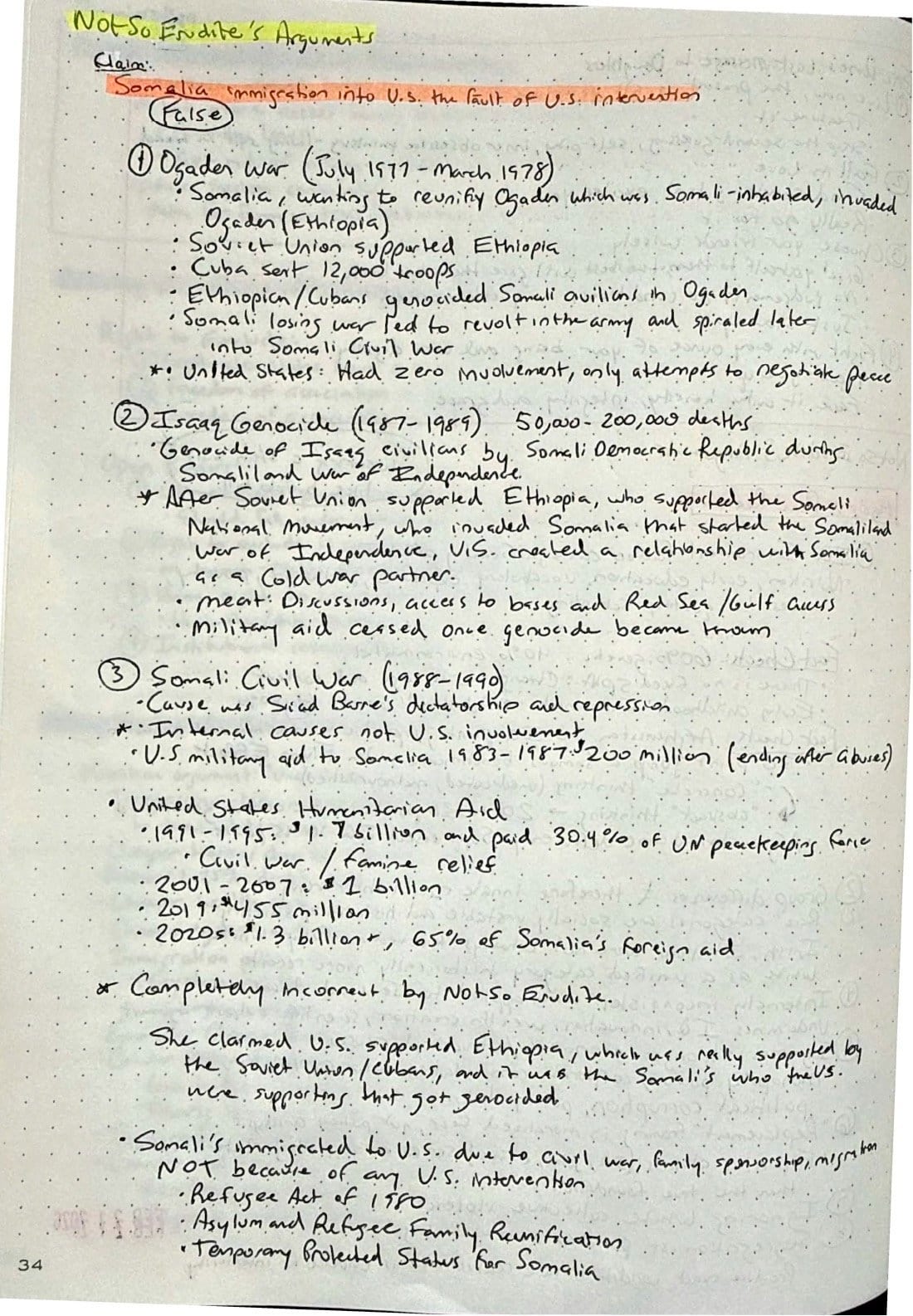
Somalia Immigration
This claim is a mashup of some real history and several major inaccuracies/overstatements.
Verdict (overall)
Mostly false / misleading.
It blends:
- real U.S. Cold War involvement in Somalia,
- real violence involving Somalis in Ethiopia (Ogaden and later conflicts),
- real Somali refugee resettlement to the U.S./Minnesota,
but ties them together in a way that is historically inaccurate.
Claim-by-claim fact check
1) “Somalis are in Minneapolis because we destroyed their country”
Misleading / oversimplified.
Somali migration to Minnesota is primarily tied to:
- the Somali civil war (state collapse starting 1991),
- refugee resettlement starting in the early 1990s,
- and then secondary migration within the U.S. driven by jobs, family/community networks, and resettlement infrastructure. Minnesota sources explicitly note arrivals in 1992 and subsequent relocation from other U.S. states.
Minnesota became a hub because of: - refugee agencies,
- family sponsorship,
- community growth,
- employment opportunities,
not because the U.S. “fast-tracked citizenship” for Somalis to Minneapolis.
2) “America funded a military group in Ethiopia that wiped out a massive amount of the Ogaden Somali group”
Not supported as stated (and historically confused).
This appears to mix up multiple periods/conflicts:
- Ogaden War (1977–78): Somalia invaded Ethiopia; the USSR and Cuba decisively backed Ethiopia during the war and helped turn the tide. The U.S. was considering aid to Somalia during the alliance flip, but the claim that the U.S. funded a force in Ethiopia that carried out a genocide of Ogaden Somalis is not an accurate description of the war.
- There were serious abuses against civilians in Ethiopia’s Somali-inhabited regions in later conflicts (documented by human rights reporting), but calling this a specific U.S.-funded Ethiopian military genocide of “the Ogaden Somali group” is not a cleanly supported historical claim in the way it’s stated here.
So this is at best a distorted compression of regional conflict history.
3) “That led to America being like, ‘Oops, sorry, we’ll just fast-track your citizenship’”
False.
There was no special U.S. policy of “sorry, we caused this, so here’s fast-tracked citizenship for Somalis.”
What happened:
- Many Somalis entered through refugee resettlement and related humanitarian pathways.
- Refugees in the U.S. must generally apply for a green card after 1 year, and later may apply for naturalization under normal legal requirements. That is a pathway to citizenship, but not the same thing as “fast-tracked citizenship” as compensation.
4) “They ended up moving them mostly to Minneapolis”
Misleading.
Somalis were resettled in multiple places across the U.S. and many later moved (secondary migration). Minnesota became a major center over time due to community networks and opportunity. Official/educational sources describe this process, and Minnesota health data also show Somali refugees were resettled across many states (not just Minnesota).
5) “We destroyed their capacity to build government / helped topple their government”
Partly true in a broad geopolitical sense, but overstated and imprecise.
It is fair to say U.S. Cold War policy in the Horn (including support to Siad Barre’s Somalia after the Soviet realignment) contributed to a militarized regional environment. The U.S. did support Somalia during part of the Cold War for strategic reasons.
But saying the U.S. alone “destroyed Somalia’s capacity to build government” or “toppled their government” is too strong and erases major internal causes:
- clan politics,
- Barre regime repression,
- internal insurgencies,
- civil war dynamics,
- warlord fragmentation,
- regional interventions.
Somalia’s collapse was multi-causal, not a simple U.S.-did-it story.
6) “Militants using old American guns… because we didn’t want communism”
Partly plausible framing, but too sweeping as stated.
Cold War proxy dynamics absolutely helped flood the region with weapons and military aid. The anti-communist motive is also broadly consistent with U.S. strategic policy at the time.
But the claim is still too broad because:
- arms in the region came from multiple sources (Soviet, U.S., local stockpiles, regional trafficking),
- conflict actors and timelines differ,
- and not all later Somali militants can be straightforwardly attributed to “old American guns.”
What’s the more accurate version?
A stronger, fact-checked version would be something like:
The Somali community in Minneapolis grew mainly because of refugee resettlement after Somalia’s state collapse and later secondary migration driven by jobs and family/community networks. U.S. Cold War policy in the Horn of Africa did contribute to militarization and supported Somalia’s authoritarian government at one stage, but the claim that the U.S. specifically caused a genocide of Ogaden Somalis in Ethiopia and then “fast-tracked citizenship” for Somalis into Minneapolis is historically inaccurate.
Quick note for debate use
This speaker is using a moral-causal compression argument:
- “Western intervention contributed to instability” (often partly true)
- then compressing that into
- “therefore this exact refugee settlement pattern is direct compensation for a U.S.-caused genocide” (not supported)
That move sounds forceful rhetorically, but it collapses too many distinct events into one storyline.
If you want, I can also turn this into a clean Obsidian-ready note with: - Claim
- What’s true
- What’s false
- What’s misleading
- Better wording / corrected version
Yes — but with one important distinction:
What I can measure reliably (year-by-year)
The best clean public source I found for Minnesota year-by-year Somali arrivals is the Minnesota Department of Health’s refugee arrivals dataset. That gives you Somalia-origin refugee arrivals to Minnesota by year (not all Somali immigration, because it does not fully capture all secondary migration, family-based immigration, asylum grants, births in the U.S., etc.).
Somali arrivals to Minnesota (last 30 years, 1995–2024)
These are Somalia-origin refugee arrivals in Minnesota from the MDH table:
- 1995 — 281
- 1996 — 538
- 1997 — 230
- 1998 — 287
- 1999 — 1,450
- 2000 — 2,176
- 2001 — 1,495
- 2002 — 125
- 2003 — 684
- 2004 — 2,322
- 2005 — 2,282
- 2006 — 3,639
- 2007 — 1,146
- 2008 — 164
- 2009 — 253
- 2010 — 670
- 2011 — 327
- 2012 — 804
- 2013 — 843
- 2014 — 1,128
- 2015 — 1,006
- 2016 — 1,425
- 2017 — 446
- 2018 — 75
- 2019 — 105
- 2020 — 37
- 2021 — 67
- 2022 — 155
- 2023 — 653
- 2024 — 1,490
Total (1995–2024)
- 24,972 Somalia-origin refugee arrivals to Minnesota (based on this MDH series).
Why Minnesota (main reasons)
Minnesota’s Somali population grew through a mix of:
- Refugee resettlement (especially after Somalia’s state collapse/civil war in the early 1990s),
- Family sponsorship / reunification, and
- Secondary migration (Somalis first resettled in other U.S. states later moving to Minnesota).
Minnesota historical and state sources explicitly note these pathways.
Minnesota became a hub partly because once a community is established, chain migration/network effects make it easier for later arrivals to relocate there (family, language, community institutions, mosques, businesses, support systems). Minnesota historical sources and Somali-Minnesota overviews describe this pattern.
Reasons Somalis left Somalia (push factors)
The main drivers were:
- Civil war / state collapse beginning in the early 1990s,
- Violence and insecurity,
- Humanitarian crises (including displacement and prolonged instability).
These are the core reasons Somalis entered refugee/asylum pathways and why Somalia has repeatedly remained relevant for humanitarian protections.
Were there laws that made it easier for Somalis than others?
Short answer
Not usually a single “Somali-only” immigration law for most migration to Minnesota. Instead, Somalis benefited from existing U.S. legal pathways that apply to eligible people from many countries, especially when conditions in Somalia met those criteria.
Main legal pathways that mattered
- Refugee Act of 1980 / U.S. Refugee Admissions Program (USRAP)
This is the foundational U.S. refugee framework used for refugee resettlement. It is not Somalia-specific, but it enabled resettlement for people meeting the refugee definition. - Asylum and Refugee Family Reunification (I-730 “follow-to-join”)
Refugees/asylees in the U.S. can petition for certain close family members (spouse/unmarried children) to join them. This can significantly expand communities after an initial refugee cohort arrives. - Temporary Protected Status (TPS) for Somalia
TPS for Somalia was first designated in 1991 and has been extended/redesignated many times due to ongoing conflict and humanitarian conditions. TPS does not create a direct immigrant visa path or bring people in from abroad; it mainly allows eligible Somalis already in the U.S. to remain/work temporarily.
Important nuance
If you’re asking whether Somalis got a special shortcut to citizenship compared to everyone else, the answer is generally no. Refugees and asylees do have a legal path to permanent residence/citizenship under U.S. law, but that framework applies broadly, not uniquely to Somalis.
Why your “how many a year” question is harder than it sounds
If by “immigration” you mean all Somali newcomers to Minnesota each year, there is no single perfect public series because:
- refugee arrivals are tracked,
- but secondary migration is not systematically captured,
- and family-based / other immigration pathways are tracked differently.
Minnesota legislative and state materials note this data limitation. oai_citation:11‡Minnesota Legislative Online
If you want, I can also build you a second version with: - a cleaned Obsidian-ready table, and
- a timeline split into phases (early wave / peak resettlement / slowdown / post-2020 rebound).
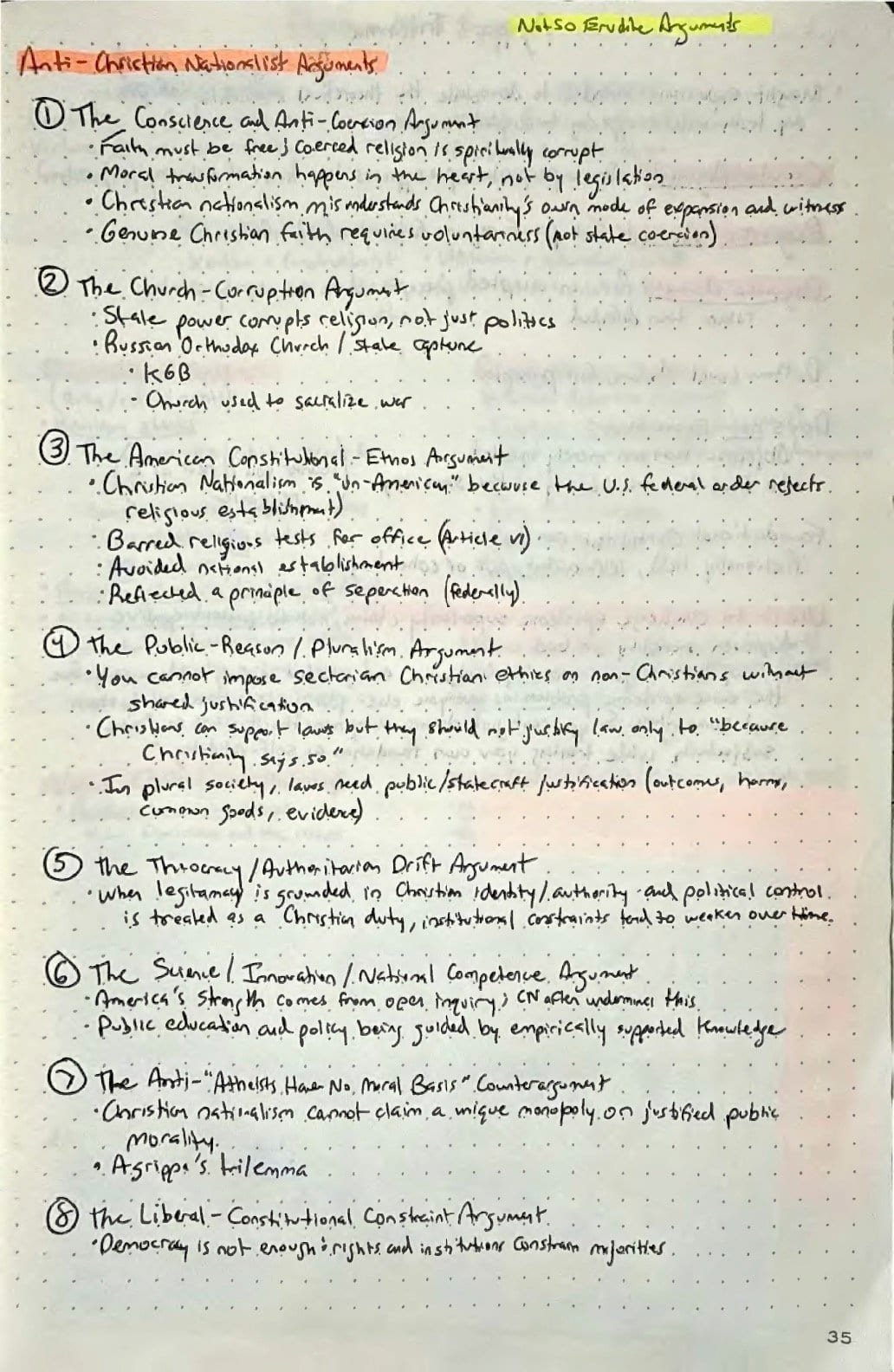
Anti-Christian Nationalist Arguments
Core framing of the anti-CN position
Kyla’s position is not anti-Christian. It is better described as:
- anti-fusion of church and state
- pro-liberal constitutional order
- pro-religious liberty / conscience protections
- pro-public policy justified by shared reasons (consensus, outcomes, evidence), not sectarian doctrine
- anti-theocratic drift, especially in the U.S. context
This distinction is explicit in her opening, where she argues that liberal protections are not foreign to Christianity, and that Christianity itself is harmed when it seeks coercive state power (around 2:06–5:22).
The anti-CN case in the transcript, broken into major argument families
1) The Conscience and Anti-Coercion Argument
(Faith must be free; coerced religion is spiritually corrupt)
What she argues
In her opening, Kyla’s strongest moral-theological line is:
- Faith must be freely chosen
- Conscience must be protected
- Political power must be limited
- Coercion cannot produce genuine faith
- Moral transformation happens in the heart, not by legislation
Key timestamps: - 2:13–2:25 (faith/conscience/political limits)
- 4:34–4:47 (equal protection, freedom of speech, limits on state power)
- 4:41–4:47 (“coercion cannot produce genuine faith”; moral transformation starts in the heart)
- 5:04–5:16 (truth persuades; should not be enforced)
Why this is a strong anti-CN argument
This is powerful because it is an internal critique from within Christianity, not just a secular critique.
It says, in effect:
Christian nationalism misunderstands Christianity’s own mode of expansion and witness.
That gives the argument more force against Christian audiences than a purely secular “keep religion private” argument would.
Hidden assumptions
- Genuine Christian faith requires voluntariness (or at least cannot be created by state coercion)
- State-enforced Christian norms damage Christian witness
- Legal morality is not the same thing as spiritual formation
Where Andrew pressures this argument
Andrew pushes a version of:
- States always legislate morality
- Why is Christian morality uniquely disqualified from law?
- Parents impose moral norms on children; why can’t states do similarly?
You can see this dynamic in the prostitution/father analogy exchange around 2:43:25–2:46:05.
Vulnerability in her presentation
Kyla at times sounds like she’s saying Christians should never legislate values, but later clarifies that Christians can support laws if justified by public/statecraft reasons. That clarification is good, but she could have stated it more cleanly from the start.
2) The Church-Corruption Argument
(State power corrupts religion, not just politics)
What she argues
In the opening she says:
- “when church and state merge, bias corrupts the state”
- “more importantly… power corrupts the church” (2:32–2:43)
She later expands this using the Russian Orthodox Church / state capture example: - state infiltration
- politicized clergy
- church being used to sacralize war
- institutional distortion when church-state boundaries collapse
Key timestamps: - 2:38–2:43 (power corrupts church)
- 2:46:05–2:49:46 (Russian Orthodox / Kirill / state corruption example)
Why this is one of her strongest arguments
This is probably the single strongest prudential anti-CN argument in the entire debate.
Why:
- It does not depend on proving secularism is metaphysically true
- It does not depend on proving liberalism is morally ultimate
- It relies on institutional incentives and historical observation:
- state power selects for loyalists
- churches become tools of regime legitimacy
- religious leaders become political operators
This is a very strong argument even for many conservative Christians who dislike “state religion” but still want public Christianity.
Hidden assumptions
- Institutional incentives matter more than declared theology
- Political patronage will deform religious institutions over time
- Real-world CN projects tend toward state instrumentalization of Christianity
Where Andrew counters
He tries to reframe the Russian example as:
- secular communist takeover, not Christian nationalism
- the problem is anti-Christian persecution, not church-state integration per se
That’s a real counter. But Kyla’s response is still meaningful because her point is broader:Once church and state are fused enough, the state can more easily weaponize the church apparatus.
She could have made that mechanism even clearer.
3) The American Constitutional-Ethos Argument
(Christian nationalism is “un-American” because the U.S. federal order rejects religious establishment)
What she argues
She repeatedly argues that the U.S. founding (especially at the federal level) intentionally:
- barred religious tests for office (Article VI)
- avoided national establishment
- reflected a principle of separation (at minimum federally)
- moved over time toward broader disestablishment and anti-test principles
Key timestamps: - 2:19–2:25 (constitution banned religious tests)
- 20:20–20:30 (founders barred test clauses federally despite widespread state clauses)
- 51:44–54:11 (Article VI, no religious test; debate about why)
- 1:35:22–1:36:18 (federal design + founding intent + England as cautionary example)
- 3:54:57–3:57:20 (explicit claim that Christian nationalism wants to impose religion and violates core U.S. federal principle)
Why this is a strong argument
It’s strong within the specific proposition “Christian nationalism in the U.S.”
She’s not arguing “all religious politics everywhere are illegitimate.”
She’s arguing:
In the American constitutional tradition, a federal Christian-national project conflicts with core founding architecture and downstream constitutional development.
That is a much tighter and more persuasive claim.
Her best move in this lane
She emphasizes that:
- the founders could have made the federal government explicitly Christian if they wanted
- they did not
- they explicitly rejected federal religious tests
That’s a clean institutional argument.
Where the argument gets vulnerable
Andrew attacks by distinguishing:
- federal non-establishment vs state establishments
- compromise politics vs principled separation
- no national denomination because denominations competed (especially Protestant/Catholic issues)
This is where she occasionally overstates her claim. The strongest version of her argument is: - The founding was not uniformly modern secular-liberal in every state at once
- but the federal constitutional architecture decisively rejected national religious qualification/establishment
When she speaks as if “the founders” all shared one clear separation doctrine in the modern sense, Andrew finds room to press back.
Bottom line on this argument
Still very strong if phrased precisely:
- federal constitutional anti-establishment: strong
- uniform founding-era anti-establishment across all levels: weaker / easier to contest
4) The Public-Reason / Pluralism Argument
(You cannot impose sectarian Christian ethics on non-Christians without shared justification)
What she argues
Kyla’s recurring policy principle is:
- Christians can support laws
- but they should not justify law only by “because Christianity says so”
- in a plural society, laws need public/statecraft justification (outcomes, harms, common good, evidence)
This is explicit in the prostitution exchange: - “What they can’t do is impose specific Christian ethics onto non-Christians…”
- if there is a statecraft/empirical case, that is different
Key timestamps: - 2:43:25–2:44:59 (no purely sectarian law imposition; need statecraft/empirical reasons)
- 2:44:43–2:44:59 (non-Christian minority concern)
- 2:53:10–2:53:15 (liberalism > democracy; democracy constrained by liberal values)
Why this is a serious anti-CN argument
This is basically a plural constitutional order argument:
- the state governs citizens with different worldviews
- legitimacy requires reasons that are at least in principle shareable
- otherwise law becomes domination by sectarian fiat
This is one of the most philosophically mature parts of her position.
Hidden assumptions
- Political legitimacy requires some form of public reason
- Statecraft and pastoral care are different domains
- A Christian can affirm Christian morality while rejecting sectarian coercion in civil law
Where Andrew pressures it
He keeps asking versions of:
- all laws reflect some moral framework; why single out Christian reasons?
- what if the “empirical” and “Christian” arguments converge?
- are you saying Christians must bracket their convictions in politics?
He also pushes hard with edge cases (e.g., babies, authoritarian hypotheticals, oppressive consensus) to expose weakness in her “consensus/what works” formulation.
Her strongest clarification (and a key one)
She later clarifies she is not a democracy absolutist:
- she prefers liberalism to pure democracy
- democracy should be constrained by liberal rights/values
That happens around 2:52:51–2:53:15 and helps stabilize her argument substantially.
5) The Theocracy/Authoritarian Drift Argument
(Christian nationalism tends to expand beyond modest moral influence into coercive rule)
What she argues
Very early, after defining CN in broad terms, she says the likely trajectory of strong CN politics is:
- reduction of constitutional policy protections
- increase in explicitly Christian policy
- potentially all the way to theocracy
Key timestamps: - 11:13–11:24 (CN to extent liberalism allows)
- 11:37–11:44 (movement toward more Christian policy, potentially theocracy)
- 3:09:26–3:09:46 (explicitly says CN threatens life/liberty and would, if it had full way, usher in theocracy)
She also directly says: - “I think theocracies are bad” (2:44:18–2:44:24)
Why this argument matters
This is a trajectory argument, not a “CN = immediate theocracy” claim.
It’s saying:
Once the core principle is “Christians should retain power and rule by Christian ethics,” the internal logic pushes toward greater political enforcement of religious norms.
That’s a legitimate concern and historically intelligible.
Where it is vulnerable
This is also one of the easiest arguments for Andrew to challenge if not carefully defined, because he can ask:
- What exactly counts as Christian nationalism?
- What specific policy threshold turns it into theocracy?
- Are you conflating moral legislation with theocracy?
- Are you treating all CNs as Fuentes-style actors?
And she does sometimes rely on examples that feel like “internet Christian nationalist archetypes” rather than a tight formal definition.
Better version of her argument (the one she’s gesturing toward)
The strongest form is:
- not “all moral legislation = theocracy”
- but “when legitimacy is grounded in Christian identity/authority and political control is treated as a Christian duty, institutional constraints tend to weaken over time”
6) The Science / Innovation / National Competence Argument
(America’s strength comes from open inquiry; CN often undermines this)
What she argues
A major theme in the opening is that America’s success is tied to:
- inquiry
- experimentation
- science
- engineering
- evidence-based adaptation
She frames CN as threatening that ethos, especially through anti-evolution / anti-science tendencies.
Key timestamps: - 2:43–3:35 (science, testing, innovation, “do what works”)
- 3:31:03–3:33:18 (CN as rejecting science/evolution; public education should teach empirically supported evidence)
- 4:31:24–4:31:52 (response to anti-evolution TTS: evolution is falsifiable/testable)
Why this argument has force
It’s not just “science good.”
It’s:
A modern superpower needs an institutional culture that rewards open empirical inquiry, and a politically empowered religious movement that suppresses or narrows scientific teaching can harm national capacity.
That is a legitimate anti-CN concern.
Where it gets vulnerable
This is where she arguably overgeneralizes the most.
Andrew (and the audience/TTS) press:
- opposition to some scientific claims is not identical to being anti-science
- science itself can be abused (eugenics, race science)
- moral and political evaluation of science is still needed
Kyla’s strongest reply is that she is not defending everything ever called science; she’s defending public education and policy being guided by empirically supported knowledge (e.g., evolution in schools).
But she sometimes blurs: - “some CNs reject specific scientific claims”
with - “Christian nationalism as such is anti-science”
That weaker formulation invites pushback.
7) The Anti-“Atheists Have No Moral Basis” Counterargument (Meta-ethical / epistemic)
(Christian nationalism cannot claim a unique monopoly on justified public morality)
What she argues
In the long middle section, she challenges Andrew’s claim that secular/atheist systems lack a moral basis, by pressing:
- demand for stance-independent reasons
- the problem of axioms in all worldviews
- Agrippa’s trilemma / foundational limits
- Christian claims also resting on assumptions
Key timestamps: - 1:50:51–1:52:11 (Agrippa / axioms / foundational justification)
- 2:26:12–2:27:04 (stance-independent reason challenge)
- 2:32:31–2:33:55 (pressing how “God says X” becomes public moral fact)
Why this matters for anti-CN arguments
This is a key anti-CN move because Christian nationalism often depends on:
- a claim to moral truth
- plus a claim to epistemic superiority for public rule
Kyla targets (2):Even if Christianity is true, Christian nationalists still need to explain why their theological premises should function as coercive political premises for all citizens.
Where this line is strong
It effectively blocks a simplistic “secular people have no basis, therefore Christian state” leap.
Where it is weak (rhetorically)
This section gets very technical and abstract. The debate drifts into meta-ethics and justification theory, which can obscure the political argument.
If the goal is persuading a general audience against CN, this is useful but should be shorter and more directly connected to governance legitimacy.
8) The Liberal-Constitutional Constraint Argument
(Democracy is not enough; rights and institutions constrain majorities)
What she argues
Kyla clarifies that she is not simply saying “consensus = morality.”
She eventually argues:
- liberal democracy works best
- democracy should be constrained by liberal values
- founding institutions were designed partly to resist pure majoritarianism
Key timestamps: - 1:41:55–1:42:01 (initial “consensus / democracy” answer)
- 1:47:46–1:48:46 (Andrew pressure via oppressive-majority scenarios)
- 2:52:51–2:53:15 (critical clarification: “I actually like liberalism more than democracy”)
Why this is important
This is the backbone she needed when Andrew kept giving “what if the majority votes for evil?” hypotheticals.
Once she says liberalism constrains democracy, her argument becomes much stronger:
- anti-CN is not just “majority preference”
- it’s also about rights, institutions, and limits on power
Main weakness in presentation
She gets to this eventually, but not early enough. Andrew scores points by forcing her to refine the framework live.
The strongest anti-Christian Nationalist arguments in this transcript (ranked)
If I were summarizing the best anti-CN case as it appears here, the top arguments are:
1) Church corruption by state power (very strong)
- “Power corrupts the church” + Russian Orthodox example
- Strong because it is institutional and historically plausible
2) Conscience / anti-coercion / faith must be free (very strong)
- Internal Christian critique of coerced religiosity
- Strong because it appeals to Christian theology and liberal protections simultaneously
3) American federal constitutional anti-establishment framework (strong, if precisely framed)
- Article VI, no religious tests, non-establishment logic
- Strong in U.S.-specific debate
- Weakens only when overstated as a totally uniform founding consensus
4) Public reason / plural legitimacy (strong)
- Don’t impose sectarian ethics on non-Christians without public/statecraft reasons
- Strong in plural societies
- Needs clearer articulation to avoid sounding like moral relativism
5) Science/open inquiry as national strength (moderately strong)
- Good prudential argument
- Weaker when she broad-brushes all CN as anti-science
6) Meta-ethical critique of Christian monopoly on moral grounding (intellectually relevant, rhetorically mixed)
- Good for blocking “atheists have no basis”
- Less effective when the debate gets too abstract
Main weaknesses in the anti-CN case as presented (important if you want to sharpen it)
1) Equivocation risk: “un-American” vs “bad policy” vs “immoral”
Andrew repeatedly pressures her because she sometimes moves between:
- unconstitutional
- historically un-American
- anti-liberty
- bad outcomes
- immoral
These are related but not identical.
A stronger version would explicitly separate: - constitutional argument
- prudential argument
- moral-theological argument
2) “What works” is underdefined
She says America does “what works” and emphasizes science/evidence, but Andrew presses:
- what counts as “works”?
- works for what end?
- can evil but stable societies “work”?
She eventually moves toward rights/liberal constraints, but the opening “what works” line leaves a gap.
A stronger formulation would be:Public policy should be evaluated by empirically testable effects within constitutional and moral constraints (rights, due process, equal protection).
3) Overgeneralization about Christian nationalists
At points she seems to treat CN as:
- anti-vax
- anti-evolution
- anti-science
- Fuentes-adjacent
That may fit some real actors, but Andrew can easily respond: - “That’s not all Christian nationalists”
- “You’re attacking a caricature”
Better move: - distinguish soft CN / civil religion conservatives / integralists / theocrats / post-liberals / ethnonationalist CNs
- then target the common institutional risks
4) She doesn’t always clearly distinguish “Christian moral influence” from “Christian nationalist state legitimation”
This is the conceptual heart of the debate.
A sharper anti-CN line would be:
- Christians should absolutely influence politics as citizens
- Christian nationalism becomes problematic when:
- political legitimacy is tied to Christian identity
- law is justified by sectarian authority rather than public reason
- dissenters become second-class citizens in principle or practice
She says versions of this, but not always in one clean package.
The deepest underlying anti-CN framework in her position (what she’s really defending)
Underneath the back-and-forth, Kyla is defending something like this:
A) Christianity can inform personal and communal morality
She is not secularizing Christianity out of public life.
B) The civil state is a different institution than the church
Statecraft and discipleship are not the same project.
C) In a plural republic, coercive law needs shared justification
Sectarian truth claims may guide believers, but they do not automatically supply civic legitimacy.
D) Limited government protects both liberty and religion
Church-state separation is not hostility to Christianity; it is a guardrail for both institutions.
E) American strength depends on institutional openness
Open inquiry, constitutional limits, and non-establishment have practical civilizational benefits.
That is a coherent anti-Christian Nationalist framework, even if parts of her debate presentation are uneven.
A stronger “steelman” version of the anti-Christian Nationalist argument (built from the transcript)
If I compress and strengthen her best points into one clean argument, it would look like this:
Christians should participate fully in politics, but the state should not be constituted as a Christian nationalist project. In a plural republic, civil law must be justified by public reasons and constrained by rights, due process, and equal protection—not by sectarian authority alone. The U.S. federal constitutional order deliberately rejected religious tests and national establishment, not because Christianity is false, but because conscience must be free and political power corrupts both governance and religion when fused. Christianity does not need coercive state privilege to be true or to flourish; in fact, state patronage often deforms it. A healthy republic protects both religious liberty and institutional boundaries, while allowing Christians to advocate moral policies through arguments accessible to all citizens.
That is, in my view, the strongest anti-CN case that emerges from this debate transcript.
Obsidian-ready condensed takeaway (copy/paste)
Anti-Christian Nationalist Arguments (Transcript Analysis)
- Faith and conscience argument: Genuine faith must be freely chosen; coercion cannot produce genuine belief (opening, ~2:13–5:22).
- Church corruption argument: State power corrupts churches; fusion incentivizes politicized religion (opening + Russian Orthodox example, ~2:38–2:43; 2:46–2:49).
- American constitutional argument: U.S. federal design rejected religious tests and national establishment (Article VI / founding architecture) as a core guardrail (~2:19–2:25; 51:44–54:11; 1:35–1:36).
- Pluralism/public-reason argument: Christians can support laws, but should not impose sectarian ethics on non-Christians without public/statecraft justification (~2:43–2:45).
- Anti-theocracy drift argument: Christian nationalism tends to expand from “Christian influence” toward coercive rule / theocratic outcomes if unconstrained (~11:37–11:44; 3:09:26–3:09:46).
- Science/open inquiry argument: America’s strength comes from experimentation, evidence, and open inquiry; politicized religious suppression of science harms national competence (~2:43–3:35; 3:31–3:33; 4:31).
- Meta-ethical counter to “atheists have no basis”: Christian nationalists cannot simply claim monopoly on justified public morality; all systems face foundational assumptions (~1:50–1:52; 2:26–2:33).
- Liberal constraints over democracy: Her model is not “majority rule = morality”; it is constitutional liberal democracy with rights/institutional limits (~1:41–1:48; 2:52:51–2:53:15).
Main weaknesses in presentation
- Sometimes blurs “un-American”, “bad policy”, and “immoral”
- “What works” standard is underdefined unless tied to rights/constitutional constraints
- Sometimes overgeneralizes all CN as anti-science or fringe
- Could more clearly distinguish Christian political participation from Christian nationalist state legitimation
Agrippa’s Trilemma Münchhausen trilemma - Agrippa's Trilemma
What Kyla is trying to do (the core move)
Kyla’s Agrippa move is not mainly:
- “there is no morality”
- “nothing matters”
- “all views are equally good”
- “Christianity is false”
Her actual move is: - At the foundational level, all systems hit a justification limit
- This includes:
- secular moral systems
- Christian moral systems
- divine command systems
- metaethical realism/anti-realism frameworks
- Therefore, it is inconsistent to single out secular systems as uniquely “baseless”
That’s the strongest version of what she’s doing.
The transcript moments where this becomes clear
1) Kyla explicitly says all foundational systems face the same problem
Around 1:51:08–1:53:34, she says (paraphrasing the transcript’s wording):
- every worldview / normative system / metaethic is unjustifiable at the foundation
- they all fail Agrippa’s Trilemma in one of three ways:
- dogmatism
- infinite regress
- circularity
This is the key philosophical equalizer.
2) She directly targets Andrew’s asymmetry (“secular has no basis, but mine does”)
Around 2:02:35–2:02:47, she makes one of her strongest points:
- she says she wouldn’t go to secular people and say “your moral system is unjustifiable”
- because she already knows hers is unjustifiable at the foundational level too
- i.e. she is accusing Andrew of a double standard, not denying all morality
That is the heart of the rebuttal.
3) She gets Andrew to effectively concede assumptions/axioms
Around 2:04:33–2:05:50, the conversation lands on:
- all systems build on axioms / assumptions
- math and logic also begin from accepted starting points
- if Christianity starts with “God exists” and builds from there, that can be “as justified as something can be”
This is important because it means: - Andrew cannot then turn around and claim only secular systems lack foundations
4) She frames the “secular systems have no justification” argument as something she can short-circuit
Around 2:06:02–2:06:15, she says (paraphrasing):
- you’re trying to walk me into “secular people have no justification”
- but she jumps ahead and says: fine, we’re assuming at the base
That is a debate tactic: - she is trying to stop a long presupp-style chain by challenging the privileged status of his foundation.
5) The “stance-independent reason for God” exchange
Around 2:25:44–2:27:04, she presses for a “stance-independent reason” for God.
Even though the wording gets messy, the underlying point is good:
- if the Christian says secular morality is “just assumption”
- but then the Christian’s proof of God also depends on interpretation, reasoning, and prior commitments
- then the Christian has not escaped the same epistemic structure
This was a valid pressure point, even if the phrase “stance-independent reason” became rhetorically slippery.
6) She keeps forcing the distinction between “assumed foundation” and “anything goes”
Around 2:29:49–2:34:26, she keeps challenging:
- if “God exists” is assumed at the foundation,
- how does that make the resulting moral claim uniquely “factual” in a way secular foundations can’t be?
Again, the strongest version of her argument here is not: - “there are no moral facts”
It is: - “you haven’t shown your moral facts are epistemically privileged over other foundational systems.”
Agrippa’s Trilemma in plain terms (and why it matters here)
Agrippa’s Trilemma says attempts to justify beliefs eventually end in one of three unsatisfying options:
- Infinite regress
Every reason needs another reason forever. - Circularity
The conclusion is smuggled into the premises. - Dogmatism / brute stopping point
You stop at an axiom / basic belief / presupposition.
Kyla’s use is basically:
- “If everyone ends in (3), don’t pretend only my side does.”
That is a strong anti-presuppositional symmetry argument.
The main thing Andrew tries to do in response (and where the clash happens)
Andrew repeatedly tries to force this conclusion:
- If foundational justification fails, then:
- no moral facts
- no objective morality
- no right/wrong
- no critique of Christian nationalism
- “anything goes” / bad faith can’t be criticized
You can see that line in multiple places, especially around:
- 2:13:23–2:15:17
- 2:25:05–2:25:44
- 6:55:14–6:58:29
This is the move:
“Agrippa ⇒ moral anti-realism / nihilism ⇒ you can’t object to me”
Why that move is too strong (and where Kyla is right to resist it)
Because Agrippa is fundamentally an argument about ultimate justification structure, not automatically an argument for:
- moral nihilism
- anti-realism
- “nothing matters”
- inability to reason morally
- inability to compare systems
You can accept Agrippa-style limits and still hold: - moral realism
- constructivism
- contractualism
- natural law
- virtue ethics
- secular humanism
- religious ethics
What changes is not necessarily your moral position — it changes your epistemic humility about foundations.
That’s exactly the place Kyla was trying to push the debate.
Where Kyla is strongest in the transcript
1) She correctly identifies the asymmetry problem
Her best point is essentially:
“You don’t get to say secular morality is invalid because it rests on assumptions, while your God-based morality is valid even though it also rests on assumptions.”
That’s the strongest anti-Christian-nationalist use of Agrippa in this context.
2) She distinguishes foundational unjustifiability from practical moral reasoning
She repeatedly implies:
- yes, foundations are assumed
- but people still reason, compare, persuade, test coherence, and build moral systems
That is a good point. Foundational limits do not erase all second-order reasoning.
3) She points out Andrew is trying to use a foundational critique selectively
This is rhetorically important in debates:
- selective skepticism is not neutral skepticism
- if you deploy Agrippa-like pressure against secularism, it rebounds on your own system too
Where Kyla gets weaker (and how to improve the argument)
This is important if you want to use her argument effectively.
Weakness 1: She sometimes lets the debate drift into “I guess we’re all just assuming”
That framing gives Andrew an opening to translate her position into:
- arbitrariness
- anti-realism
- nihilism
- “no reason to object to Christian nationalism”
The improved version should be: - “Yes, all systems have basic commitments”
- “No, that does not mean all commitments are equally good”
- “We can still compare systems by coherence, explanatory power, consequences, human flourishing, consistency, and institutional performance”
In other words:
brute foundations ≠ arbitrary superstructure
Weakness 2: “stance-independent reason” became easy to caricature
The phrase itself is not wrong, but in this exchange it became a target for wordplay and confusion.
A cleaner version would be:
- “Can you give a non-question-begging reason for your moral foundation that doesn’t already presuppose your theology?”
That’s much clearer and harder to dodge.
Weakness 3: She sometimes blurts toward anti-realism without stabilizing her own position
At points, Andrew successfully forces the conversation into:
- “So you’re saying no moral facts exist?”
Even when she resists, the framing gets messy.
A stronger version would be to state explicitly: - “I am not arguing no moral truths exist.”
- “I am arguing you haven’t shown your Christian foundation is uniquely justified in a way secular foundations are not.”
That would have prevented a lot of the confusion.
How this argument should be used to refute “secular systems lack a moral basis”
Here is the strongest form of the rebuttal, using Kyla’s core insight but tightening it.
Step 1: Concede the real point (strategic honesty)
Start by granting something true:
- Yes, secular systems cannot produce a final, indisputable, non-contestable proof of morality that escapes all philosophical problems.
Then immediately add: - Neither can Christian systems.
This disarms the “you’re dodging” accusation and forces symmetry.
Step 2: Apply Agrippa symmetrically
Say:
- Any worldview eventually bottoms out in:
- axioms/basic beliefs
- self-evident principles
- revealed truths
- intuitive norms
- or circular support structures
For Christians, those may be:
- God exists
- God is good
- God reveals moral truth
- God is not a deceiver
- Scripture/Church/tradition is authoritative
For secular systems, those may be: - suffering matters
- persons have dignity
- reciprocity/fairness is binding
- reason/public justification matters
- coercion requires strong justification
The point:
both sides have foundations.
The question is not “who has zero assumptions?”
The question is “which framework is more coherent, humane, workable, and publicly justifiable?”
Step 3: Separate “moral basis” from “metaphysical certainty”
This is the key correction to Andrew’s framing.
A secular system can have a moral basis without claiming:
- absolute metaphysical certainty
- infallible grounding
- revelation
A moral basis can be: - philosophical (Kantian, utilitarian, contractualist, virtue-ethical, naturalistic realist, constructivist)
- social-political (constitutionalism, rights traditions, overlapping consensus)
- anthropological (shared vulnerability, reciprocity, anti-cruelty norms)
In other words:
“not ultimate” does not mean “nonexistent.”
Step 4: Turn the burden of proof back onto Christian nationalism
Even if one grants Christian morality as coherent for Christians, that still does not prove Christian nationalism is justified politically.
Why not?
Because political legitimacy in a plural society requires more than:
- “my theology says so”
It requires showing: - why coercive law should be grounded in specifically Christian premises
- why non-Christians owe obedience to sectarian authority claims
- why one Christian interpretation should rule over competing Christian interpretations
Kyla hints at this broader issue earlier in the transcript (different Christians / different foundations). That’s a powerful anti-Christian-nationalist line if sharpened.
Step 5: Emphasize comparative reasoning (not foundational absolutism)
The best secular reply is not:
- “We have no assumptions.”
It is: - “We do have assumptions, but so do you. The difference is we try to build public moral-political systems from principles that can be shared across disagreement.”
That is the stronger liberal/pluralist answer.
A cleaner, stronger version of Kyla’s argument (debate-ready)
If you wanted to deploy this argument in a tighter form, it could sound like this:
- You claim secular morality lacks a foundation.
- But your Christian morality also rests on foundational assumptions (God exists, your account of God is correct, your interpretation is correct, etc.).
- Agrippa’s Trilemma shows all systems hit a justificatory stopping point (dogma, regress, or circularity).
- Therefore, you haven’t shown secular morality is uniquely baseless.
- The real debate is not “who has no assumptions?” but:
- which framework is more coherent,
- less self-contradictory,
- better at handling pluralism,
- less prone to abuse,
- and more capable of justifying coercive law to people who don’t share your theology.
That is the strongest anti-Christian-nationalist use of the Agrippa move.
What not to say (because it weakens the argument)
These lines make the Agrippa rebuttal collapse into confusion:
- “Nothing is justified, so nothing matters”
- “Everything is arbitrary”
- “Reason doesn’t exist”
- “There are no moral facts” (unless you are explicitly defending anti-realism and can do it cleanly)
- “I’m just assuming, so whatever”
Those statements let the opponent say: - “Great, then you can’t object to Christian nationalism.”
Even if that’s not your actual view, it hands them the rhetorical win.
Best interpretation of Kyla’s position in this transcript
The most charitable and philosophically strong reading of Kyla here is:
- She is arguing for epistemic parity at the foundation, not moral nihilism.
- She is saying Christian nationalists often weaponize foundational critique selectively against secular ethics.
- She is trying to force the debate onto:
- internal consistency
- comparative reasonableness
- practical moral reasoning
- and away from a fake “my side grounded / your side ungrounded” dichotomy.
That is a legitimate and important critique.
Bottom line
Kyla’s Agrippa move is strongest when used to say:
- Secular systems do not uniquely lack a moral basis.
- All systems rely on foundational commitments.
- Christian nationalism does not win by merely pointing out that secularism has assumptions.
- It must still justify why sectarian Christian premises should govern a plural society.
That is the proper anti-Christian-nationalist use of this argument.
If you want, I can also do a second pass that turns this into an Obsidian-ready note with sections like: - Claim
- Counter-claim
- Agrippa framework
- Best rebuttal lines
- Weak rebuttal lines to avoid
- Debate traps Andrew used
- Stronger formulations for future use