Filed with Politics MOC · Related: Ideology & Foundations · 60.10 Argumentation
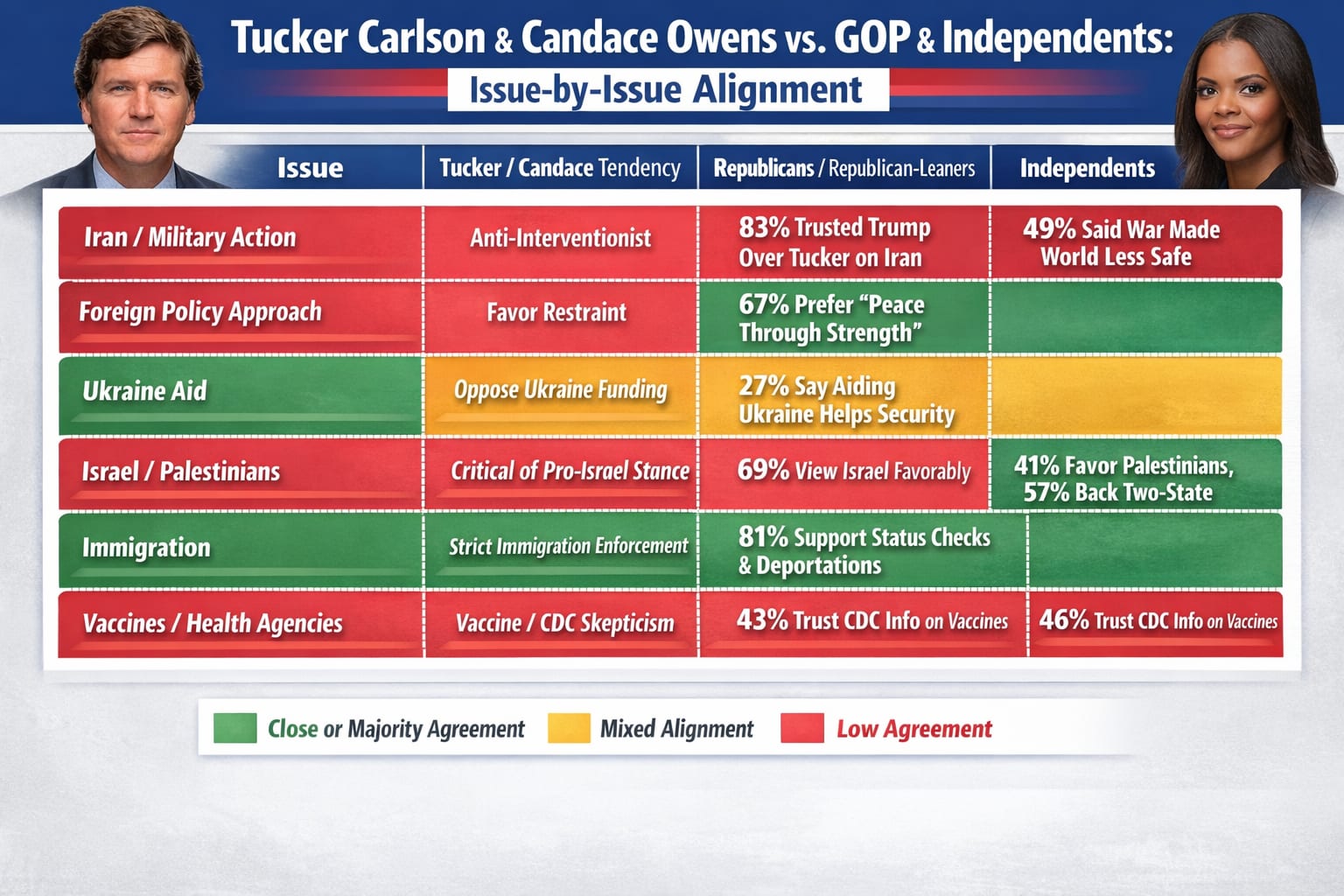
Here’s the higher-level issue-by-issue breakdown.
The broad pattern is: Tucker Carlson has meaningful agenda-setting influence inside the GOP, especially on foreign-policy skepticism, but he usually does not beat Trump when Republican voters are forced to choose. Candace Owens has a real audience, but polling suggests she is less central and more polarizing than Tucker. The best direct favorability data I found had Tucker at 73% favorable among GOP/Trump voters and Candace at 60% favorable.
I would read the Iran article you linked as real but narrow: it shows that on that issue, Republican voters sided heavily with Trump over Tucker-style dissent, not that Tucker or Candace are irrelevant.
| Issue | Tucker / Candace tendency | Republicans / Republican-leaners | Independents | What this suggests |
|---|---|---|---|---|
| Iran / direct military action | Tucker has been a visible anti-interventionist critic; Candace has also leaned skeptical of foreign wars. | J.L. Partners found 83% of likely Republican voters supported the Iran operation, 83% trusted Trump over Tucker/Megyn on Iran, and 55% said they’d be less likely to back a GOP candidate aligned with the Carlson-Kelly camp. Quinnipiac found 79% of Republicans thought the war would make the world safer. | Quinnipiac found independents were much more skeptical: 49% said the war would make the world less safe vs. 35% safer. | Low evidence of Tucker/Candace winning the GOP on Iran; stronger resonance with independents on skepticism than with Republicans. |
| Foreign policy overall: “peace through strength” vs restraint | Tucker is more restraint-oriented than traditional GOP hawks; Candace often overlaps with that anti-interventionist lane. | Manhattan Institute found 67% of the current GOP preferred “peace through strength,” versus 29% for “diplomacy first.” Even among Republicans with a favorable view of Tucker, 72% still backed the more proactive, military-forward line. | I did not find a directly comparable recent independent-only question in the same source. | Tucker influences the conversation more than he changes the GOP median position. |
| Ukraine aid | Tucker has long been skeptical of Ukraine aid; Candace has often occupied a similar anti-aid space. | Pew found only 27% of Republicans said supporting Ukraine helps U.S. national security, while 40% said it hurts it. Republicans were also more likely than Democrats to say the U.S. was giving Ukraine too much support. | Pew source opened here did not give the same independent breakout on the national-security question in the snippet I reviewed. | This is one of the issues where Tucker is closest to where a large chunk of Republicans already are. |
| Israel / Palestinians | Tucker and Candace have both pushed a more skeptical line toward reflexive pro-Israel positioning than older GOP orthodoxy. | Gallup still found Republicans to be the most pro-Israel partisan group: 70% sympathized more with Israelis; 69% viewed Israel favorably. But GOP support for a two-state solution was only 33%, and pro-Israel sentiment had softened from prior years. | Independents have shifted much more: 41% sympathized more with Palestinians vs. 30% with Israelis; independents rated Israel and the Palestinian Territories equally favorable at 41% each; 57% of independents supported a two-state solution. | Tucker/Candace are still to the left of the GOP median on Israel, but they may be closer to younger Republicans and clearly closer to independents than old-school GOP hawks are. |
| Immigration / deportation enforcement | Both are generally restrictionist and critical of illegal immigration. | Pew found 54% of Republicans and Republican-leaning independents said all immigrants in the country illegally should be deported. Among Republicans, 81% supported status checks during routine stops, 84% supported arrests in homes, and 89% supported arrests at protests/rallies. Gallup found 85% of Republicans approved of Trump’s handling of immigration. | Gallup found only 28% of independents approved of Trump’s handling of immigration. | On immigration, Tucker/Candace are broadly aligned with Republicans, not independents. This is not a fringe lane inside the GOP. |
| Vaccines / public-health skepticism | Both, especially Candace, have often voiced vaccine skepticism or distrust of public-health institutions. | KFF found just 43% of Republicans trusted the CDC for vaccine information; only 40% had at least some confidence in federal agencies on childhood vaccine schedules. Just 28% of Republicans said they were confident in the safety of COVID vaccines for children. | Independents were somewhat more trusting than Republicans but still skeptical: 46% trusted the CDC for vaccine information, 45% had at least some confidence in agencies on childhood schedules, and 45% were confident in the safety of COVID vaccines for children. | This is a lane where Candace/Tucker-style distrust has much more room inside the GOP than in the country overall, though independents are also fairly distrustful. |
My overall read:
Tucker Carlson
- Stronger than Candace as a measurable Republican opinion leader.
- Most aligned with Republican sentiment on Ukraine skepticism and some broader elite/foreign-policy distrust.
- Less aligned with the GOP median on Iran and still somewhat less aligned on Israel, though he is closer to younger dissident-right voters there.
Candace Owens
- Has a substantial GOP audience, but less broad reach than Tucker in the polling I found.
- More polarizing, and there is less good issue-by-issue polling that ties her specifically to opinion shifts.
- Her lane seems strongest where the Republican coalition is already skeptical of institutions: vaccines/public health, some foreign-policy distrust, and anti-establishment cultural politics.
Bottom line
- On the biggest “who leads Republicans?” test, Trump beats Tucker and Candace handily.
- On issue alignment, Tucker sometimes sits near where a large minority or even a plurality of Republicans already are, especially on Ukraine.
- On Iran, the article you linked is basically showing that Tucker’s influence has limits: Republicans may listen to him, but they still sided with Trump decisively.
- Independents often look closer to Tucker/Candace on war skepticism, but not on immigration, and there is much less evidence that independents treat either of them as leaders rather than just media voices.
If you want, I can do a second table that ranks each issue by “high / medium / low alignment” for Tucker vs. Candace separately.
I dug further and the cleaner way to frame this is:
Tucker Carlson is best described as more accommodationist toward some U.S. adversaries and more anti-interventionist than the median Republican, not simply “pro” those regimes. There is strong evidence that he gave unusually friendly or lightly challenged platforms to Vladimir Putin, Sergey Lavrov, Qatar’s leadership, and Iran’s president, and that he has made rhetoric-friendly comments about feudalism. Reuters and AP both noted that his Putin interview let Kremlin talking points run largely unchallenged, and Reuters later reported his Iran interview in which he said he avoided some questions because he did not expect honest answers.
Candace Owens is easier to characterize on the “conspiracy” side because there are direct fact-checks and legal actions. Reuters reported that Emmanuel and Brigitte Macron sued Owens over her false claim that Brigitte Macron is male, and Reuters Fact Check separately found that a French appellate ruling did not confirm Owens’ claim. Reuters also reported that Australia’s government prevailed in court after denying Owens a visa over concerns tied to views officials described as including Holocaust denial/downplaying, Islamophobia, antisemitism, and anti-vaccination rhetoric.
On polling, the big pattern remains the same: Republicans often like Tucker more than his critics do, but they do not consistently follow him issue-for-issue. Pew found Republicans and Republican leaners much less hostile to Russia than they were in 2022: 40% called Russia an enemy in April 2025, down from 69% near the start of the war, and 16% viewed Russia favorably. Gallup also found 69% of Republicans wanted the U.S. to help end the Ukraine war as soon as possible, even if that meant territorial concessions, which puts a large chunk of the GOP closer to Tucker’s restraint line than to older hawkish Republican orthodoxy.
But on Iran, Republicans were much more hawkish than Carlson’s anti-war line. Pew found 71% of Republicans and Republican leaners said the U.S. made the right decision to use military force in Iran, while Quinnipiac found 79% of Republicans said the war would make the world safer. Independents were noticeably more skeptical: Quinnipiac found 49% said the war would make the world less safe, and Pew found Republican-leaning independents were far less supportive than self-identified Republicans.
On Qatar, there is much less direct polling than there is evidence of Carlson’s rhetoric. What we do have is Manhattan Institute data showing the GOP is fragmented on Qatar, with no clear majority position, and newer Republicans are more Qatar-friendly than core Republicans. That means Carlson’s Qatar line appears to be a niche within the coalition rather than the coalition’s center.
On feudalism, I found no direct polling asking Republicans or independents whether they agree with Carlson’s feudalism praise. So the honest answer is that this is more of an elite rhetorical signal than something you can directly compare to voter sentiment. The closest indirect evidence is that Manhattan Institute still found large GOP majorities backing conventional “peace through strength” and rule-enforcement positions, which suggests Carlson’s feudal rhetoric is outside normal voter language even when parts of his broader anti-liberal critique resonate.
For Owens, the strongest polling overlap is not with her most exotic claims but with institutional distrust, especially around vaccines and public health. KFF found only 43% of Republicans trusted the CDC for vaccine information in February 2026, versus 46% of independents, and Republicans were much more likely than independents to trust Trump and RFK Jr. on vaccine information. But that still does not show broad support for Owens’s specific Macron-style conspiracy claims; on those, the evidence is mostly legal, factual, and media-tracking rather than public-opinion polling.
Inside the GOP specifically, Tucker is stronger than Candace. Manhattan Institute found Candace Owens was the most divisive figure they tested inside the current GOP: 50% favorable, 23% unfavorable, with stronger support among younger and newer Republicans. The same report found Tucker’s admirers still did not fully share his foreign-policy instincts, which is another sign that his influence is real but incomplete.
I also made an expanded infographic that adds this research to the earlier image:
Download the expanded infographic

A compact text version is here:
| Topic | Tucker / Candace evidence | Republicans / Republican-leaners | Independents | Takeaway |
|---|---|---|---|---|
| Russia / Ukraine | Tucker interviewed Putin and Lavrov; AP and Reuters said Putin used the interview to push his narrative and that Carlson left major claims lightly challenged. | Pew: 40% call Russia an enemy; 16% view Russia favorably. Gallup: 69% want the war ended quickly even with concessions. | Gallup says independents are more mixed and closer to national averages than to GOP softness. | Tucker is closer to a sizable GOP faction here than on most foreign-policy issues. |
| Iran | Tucker opposed escalation and interviewed Iran’s president. Reuters documented the interview and his rationale. | Pew: 71% said striking Iran was right. Quinnipiac: 79% said war made world safer. | Quinnipiac: 49% said war made world less safe. | Republicans were much more hawkish than Tucker here. |
| Qatar | Carlson publicly elevated Qatar and questioned whether it should be a chief U.S. ally; direct polling is thin. | Manhattan Institute: GOP views on Qatar are split, no clear majority. | I did not find a strong recent independent-only Qatar favorability poll. | Clear rhetoric, weak polling match. |
| Feudalism | Carlson explicitly praised feudalism. | No direct polling found. | No direct polling found. | Too niche for a clean public-opinion comparison. |
| Owens conspiracies | Reuters lawsuit and fact-check record establish false or unsubstantiated claims, especially on Brigitte Macron. | KFF shows strong GOP distrust of health authorities, which overlaps with Owens’s anti-institutional style more than with her specific claims. | Independents are somewhat skeptical too, but less so than Republicans on vaccines. | Owens’s strongest overlap is distrust, not broad support for her most specific conspiracy claims. |
The shortest honest conclusion is: Tucker has meaningful issue influence, especially on Russia/Ukraine restraint, but Republicans often stop following him when Trump or the broader party moves hawkishly. Candace has a real audience, but her support is narrower and more polarizing, and her more specific conspiracy claims do not appear to have broad polling support.
If you want, I can turn this into a cleaner Obsidian-friendly markdown brief with section headers and source notes.