Biography
| | |
Covered in the vault’s survey histories
These volumes’ chapter headings already link to this note; these are the return links.
Evans — A History of Western Philosophy
- A History of Western Philosophy - C Stephen Evans — Chapter 3 – Socrates and the Sophists (heading contains links, so it can’t be anchored; search the title inside the note)
Adamson — Classical Philosophy
- Classical Philosophy - Peter Adamson — 1. Socrates’ disappointment and the “two sides” of Anaxagoras (heading contains links, so it can’t be anchored; search the title inside the note)
- 1. Why “Socrates without Plato”?
- 2. Aristophanes’ Socrates: sophist, natural philosopher, and clown
- 3. Xenophon’s Socrates: pious, proud, and exemplary
- Method Man: Plato's Socrates
Adamson — Hellenistic & Roman Worlds
- Philosophy in the Hellenistic and Roman Worlds - Peter Adamson — Chapter 1 — Fighting Over Socrates: Hellenistic Schools (heading contains links, so it can’t be anchored; search the title inside the note)
|---|---|
|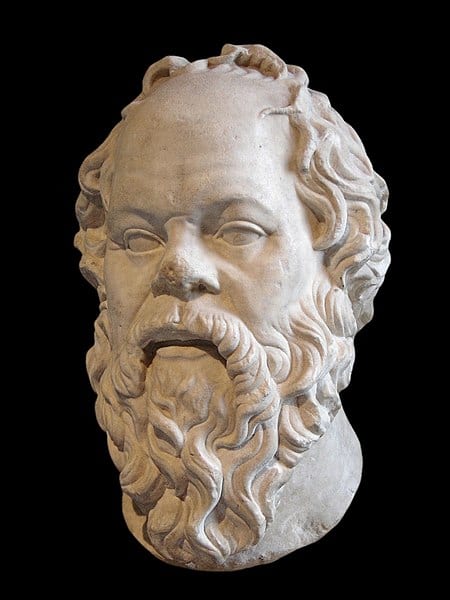
A marble head of Socrates in the Louvre (copy of bronze head by Lysippus)| |
|Born|c. 470 BC
Deme Alopece, Athens|
|Died|399 BC (aged approximately 71)
Athens|
|Cause of death|Forced suicide by poisoning|
|Spouse(s)|Xanthippe, Myrto (disputed)|
|Children|Lamprocles, Menexenus, Sophroniscus|
|Family|Sophroniscus (father), Phaenarete(mother), Patrocles (half-brother)|
|| |
|Era|Ancient Greek philosophy|
|Region|Western philosophy|
|School|Classical Greek philosophy|
|Notable students|- Plato
- Xenophon
- Antisthenes
- Aristippus
- Alcibiades
- Critias|
|Main interests|Epistemology, ethics, teleology|
|Notable ideas|- Social gadfly
- Socratic dialogue
- Socratic intellectualism
- Socratic irony
- Socratic method
- Socratic paradox
- Socratic questioning
- “The unexamined life is not worth living”|
Life
- Socrates fulfilled his military service during the Peloponnesian War and distinguished himself in three campaigns, according to Plato.
- Socrates attracted great interest from the Athenian public and especially the Athenian youth. He was notoriously ugly, having a flat turned-up nose, bulging eyes and a large belly; his friends joked about his appearance.
- Socrates was indifferent to material pleasures, including his own appearance and personal comfort. He neglected personal hygiene, bathed rarely, walked barefoot, and owned only one ragged coat.
- Socrates was attracted to youth, as was common and accepted in ancient Greece, he resisted his passion for young men because, as Plato describes, he was more interested in educating their souls. Socrates did not seek sex from his disciples, as was often the case between older and younger men in Athens.
- Socrates died in Athens in 399 BC after a trial for impiety and the corruption of the young. He spent his last day in prison among friends and followers who offered him a route to escape, which he refused.
- One of the things that seemed strange about Socrates is that he neither labored to earn a living, nor participated voluntarily in affairs of state. Rather, he embraced poverty and, although youths of the city kept company with him and imitated him, Socrates adamantly insisted he was not a teacher (Plato, Apology 33a–b) and refused all his life to take money for what he did.
Impact on Philosophy
- an enigma, an inscrutable individual who, despite having written nothing, is considered one of the handful of philosophers who forever changed how philosophy itself was to be conceived. All our information about him is second-hand and most of it vigorously disputed, but his trial and death at the hands of the Athenian democracy is nevertheless the founding myth of the academic discipline of philosophy, and his influence has been felt far beyond philosophy itself, and in every age.
- Plato’s thought is often compared with that of his most famous student, Aristotle, whose reputation during the Western Middle Ages so completely eclipsed that of Plato that the Scholastic philosophers referred to Aristotle as “the Philosopher”. The only Platonic work known to western scholarship was [Timaeus](https://en.wikipedia.org/wiki/Timaeus(dialogue) “Timaeus (dialogue)”), until translations were made after the fall of Constantinople, which occurred during 1453. However, the study of Plato continued in the Byzantine Empire, the Caliphates during the Islamic Golden Age, and Spain during the Golden age of Jewish culture. Plato is also referenced by Jewish philosopher and Talmudic scholar Maimonides in his The Guide for the Perplexed_.
- The works of Plato were again revived at the times of Islamic Golden ages with other Greek contents through their translation from Greek to Arabic. Neoplatonism was revived from its founding father, Plotinus.
Concepts
- Socratic Method
- Socrates initiates the dialogue by asking his interlocutor for a definition of the subject. As he asks more questions, the interlocutor’s answers eventually contradict the first definition. The conclusion is that the expert did not really know the definition in the first place.
- Socrates also tests his own opinions through the Socratic method. Thus Socrates does not teach a fixed philosophical doctrine. Rather, he acknowledges his own ignorance while searching for truth with his pupils and interlocutors.
- Socratic Questioning
- Socratic questioning illuminates the importance of questioning in learning. This includes differentiating between systematic and fragmented thinking, while forcing individuals to understand the root of their knowledge and ideas. Educators who support the use of Socratic questioning in educational settings argue that it helps students become active and independent learners. Examples of Socratic questions that are used for students in educational settings:
-
Getting students to clarify their thinking and explore the origin of their thinking
e.g., ‘Why do you say that?’, ‘Could you explain further?’
-
Challenging students about assumptions
e.g., ‘Is this always the case?’, ‘Why do you think that this assumption holds here?’
-
Providing evidence as a basis for arguments
e.g., ‘Why do you say that?’, ‘Is there reason to doubt this evidence?’
-
Discovering alternative viewpoints and perspectives and conflicts between contentions
e.g., ‘What is the counter-argument?’, ‘Can/did anyone see this another way?’
-
Exploring implications and consequences
e.g., ‘But if…happened, what else would result?’, ‘How does…affect…?’
-
Questioning the question
e.g., ‘Why do you think that I asked that question?’, ‘Why was that question important?’, ‘Which of your questions turned out to be the most useful?’
-
- Socratic questioning illuminates the importance of questioning in learning. This includes differentiating between systematic and fragmented thinking, while forcing individuals to understand the root of their knowledge and ideas. Educators who support the use of Socratic questioning in educational settings argue that it helps students become active and independent learners. Examples of Socratic questions that are used for students in educational settings:
- Politics
- Socrates asserts that societies have a tripartite class structure corresponding to the appetite/spirit/reason structure of the individual soul. The appetite/spirit/reason are analogous to the castes of society.
- Productive (Workers) – the labourers, carpenters, plumbers, masons, merchants, farmers, ranchers, etc. These correspond to the “appetite” part of the soul.
- Protective (Warriors or Guardians) – those who are adventurous, strong and brave; in the armed forces. These correspond to the “spirit” part of the soul.
- Governing (Rulers or Philosopher Kings) – those who are intelligent, rational, self-controlled, in love with wisdom, well suited to make decisions for the community. These correspond to the “reason” part of the soul and are very few
- According to Socrates, a state made up of different kinds of souls will, overall, decline from an aristocracy (rule by the best) to a timocracy (rule by the honourable), then to an oligarchy (rule by the few), then to a democracy (rule by the people), and finally to tyranny (rule by one person, rule by a tyrant).
Criticism
- Many recent philosophers have also diverged from what some would describe as ideals characteristic of traditional Platonism.
- Friedrich Nietzsche notoriously attacked Plato’s “idea of the good itself” along with many fundamentals of Christian morality, which he interpreted as “Platonism for the masses” in Beyond Good and Evil (1886).
References
Socrates (Stanford Encyclopedia of Philosophy)
Socrates - Wikipedia