DESCRIPTION
Plato. Aristotle. Augustine. Hume. Kant. Hegel. Every student of philosophy needs to know the history of the philosophical discourse such giants have bequeathed us. Philosopher C. Stephen Evans brings his expertise to this daunting task as he surveys the history of Western philosophy, from the Pre-Socratics to Nietzsche and postmodernism—and every major figure and movement in between.
AI Summary
Chapter 1 – Introduction to the Project
I. Overview: What This Book Is Trying to Do
Evans opens by explaining that before he can tell a “history of Western philosophy,” he has to clarify three central terms:
- What is “Western” philosophy?
- What is philosophy?
- What is the history of philosophy?
He admits that each of these could justify a book-length treatment, so his goal here is to sketch the working assumptions that will guide the rest of the book. The chapter therefore serves as a methodological and conceptual introduction: it defines the tradition he is narrating, clarifies what counts as philosophy within that tradition, and explains what kind of historical narrative he aims to write—explicitly acknowledging his own perspective as both a professional philosopher and a Christian.
II. What Is “Western” Philosophy?
1. An Ostensive Definition of the Western Tradition
Instead of attempting a general definition of “the West,” Evans offers an ostensive definition of Western philosophy: he “points” to a particular intellectual movement that:
- Begins in Ionia (especially Miletus) in the 6th century BC with Greek-speaking thinkers in what is now Turkey.
- Flourishes in Athens with Socrates, Plato, and Aristotle.
- Spreads in the Hellenistic world throughout the Middle East.
- Helps shape the Roman Empire, notably in intellectual centers such as Alexandria and Rome.
- Continues through the medieval period among Islamic, Christian, and Jewish thinkers in Europe and the Middle East.
- Develops further in early modern Europe, shaped by figures like Descartes, Hobbes, Locke, and Spinoza.
- Reaches an Enlightenment high point in the 18th century with thinkers such as Hume and Kant.
- Is reshaped in the 19th century by movements like idealism and positivism.
- Splits into two major strands in the 20th century:
- Analytic philosophy (dominant in the English-speaking world, including North America, Australia, and New Zealand).
- Continental philosophy (with strong roots in France and Germany).
This tradition is what Evans will mean when he talks about “Western philosophy.”
2. Recognizing Other Philosophical Traditions
Evans stresses that:
- Other parts of the world (e.g., China, India) have ancient and profound philosophical traditions.
- Therefore, Western philosophy is not identical with philosophy as such.
- Nonetheless, Western philosophy has become a global phenomenon: its thinkers and questions are represented in universities around the world.
Because of this global diffusion, the era when Western philosophy could be seen as a relatively self-contained movement may be ending, since major philosophical traditions are increasingly in conversation with each other.
He cites Kierkegaard’s observation that “life is lived forward but must be understood backward” to justify his focus: this book is history, not prophecy, and will therefore look backward at Western philosophy as a discrete tradition.
3. Why Focus on Western Philosophy?
Evans notes that:
- Historically, Western philosophers knew little about Indian, Chinese, or other non-Western traditions because of geographical isolation.
- Even though Western philosophy is only one great tradition among others, its role in shaping “the West” and “modernity” gives it enormous historical importance.
- Throughout the book, when he uses the term “philosophy” without qualification, he generally means “Western philosophy”—the qualifier is implied unless he explicitly speaks in a more global sense.
III. What Is Philosophy?
1. No Single Agreed Definition
Evans acknowledges that:
- There is no universally accepted definition of philosophy.
- The question “What is philosophy?” is itself a philosophical question, and philosophers disagree about it.
He lists different views: - Some see philosophy as a quest for timeless, universally valid truths.
- Marxist philosophers see philosophy as reflecting class conflicts rooted in economic systems.
- Materialist or naturalist philosophers see philosophy as something that must build on the progress of science.
These are only examples; many other conceptions exist even within the Western tradition.
2. The Changing Meaning of “Philosophy” in the West
Evans emphasizes that the meaning of “philosophy” has shifted historically:
- Today, philosophy is a distinct discipline, separate from mathematics, natural and social sciences, theology, and literary criticism.
- Among the early Greek philosophers, however, philosophy included all of these subjects and more.
Etymologically, philosophy is the “love of wisdom.” For the early Greeks: - The search for wisdom included a quest for all kinds of knowledge.
- Philosophy was not narrowly academic; it was a unified pursuit of understanding.
The older view is still faintly visible in the modern university’s “doctor of philosophy” (PhD) degree, which can be earned in many fields, including the sciences.
Evans adds that whenever scholars in any field raise basic or foundational questions about their discipline—such as: - A literature professor asking how a text can “mean” something.
- A physicist asking whether the models used to understand the physical world are “real” in some sense.
—they are effectively doing philosophy. This shows that philosophy is not confined to professional philosophers.
3. The Early Greek Conception: Theory and the Good Life
Evans then focuses on the early Greek philosophers to illuminate what philosophy originally involved:
- They asked questions about the natural world that we would now call the beginnings of natural science—so they can be viewed as early scientists as well as philosophers.
- But they were also deeply concerned with practical questions about:
- The meaning of human life.
- How life should be lived.
- What constitutes happiness and living well.
For them:
- Wisdom was not just scientific knowledge of nature; it “encompasses an understanding of human life and how it should be lived.”
- Human beings are part of the natural world, so understanding the cosmos is connected to understanding human existence.
- Thus, early philosophical speculation about the cosmos partly aimed at clarifying the human place in the worldand, through that, the good life.
Evans insists that whatever else wisdom may be, it must include an understanding of human life and how it should be lived.
4. Contemporary Philosophy and the Loss (and Recovery) of Wisdom
Evans then contrasts this with contemporary academic philosophy:
- Professional philosophers do not seem obviously wiser than anyone else.
- Studying philosophy in the modern academic context does not guarantee one becomes wiser (though Evans believes it can still foster wisdom).
The deeper problem, he argues, is not just failure to find wisdom, but that much of contemporary philosophy appears little interested in wisdom at all: - Ethics still exists as a branch of philosophy, and some philosophers still ask what the good life is.
- But much of today’s work focuses on technical questions that seem only remotely connected—if at all—to the kind of wisdom that helps a person live well.
This raises the question of whether the academic discipline now called “philosophy” has much continuity with what the Greeks called philosophy.
Despite these concerns, Evans maintains that: - Contemporary philosophy is still a descendant of what began with the Greeks.
- Its chief end can still be understood as wisdom.
- To see this continuity, we must start from the Greek conception, where the quest for wisdom and the good life is most vivid, and then use that conception to interpret the later history.
In his view: - Philosophy is a quest for wisdom, and wisdom is at least partly practical.
- A wise person:
- Understands what it is to be human.
- Understands how human life should be lived.
- Understands the world in which humans live.
With that conception in mind, we can trace ongoing concerns with wisdom throughout the history of Western philosophy—more clearly, Evans suggests, when our understanding is shaped by the early Greeks.
5. Philosophy as a Human Cultural Creation
Evans then argues that:
- What we call “philosophy” is a human cultural creation, not a fixed “natural kind.”
- This explains why its content and boundaries have changed over time.
However: - This does not mean philosophy could be anything at all. Calling ditch-digging “philosophy” would not make it so.
- There are enduring questions and strategies that define Western philosophy, even amid change.
These enduring questions cluster into three core areas:
- Metaphysics – Questions about the nature of reality:
- What is the basic “stuff” of the natural world?
- Is reality one interconnected whole or many discrete entities?
- Is matter composed of indivisible atoms or is it continuously divisible?
- Do humans have souls?
- What happens after death?
- Are there divine beings? What are they like, and how do they relate to humans and nature?
- Ethics – Questions about the good life and moral norms:
- Early Greeks noticed differences in ethical customs between city-states and between Greeks and Persians.
- This led them to ask if ethical ideals are:
- Mere cultural constructions, or
- Rooted in nature or some transcendent reality, and thus objective.
- They also asked:
- What does it mean to live well?
- What should be the goals of human life, both individually and collectively?
- Epistemology – Questions about truth and knowledge:
- Divergent metaphysical and ethical views led to worries about the status of our convictions.
- Epistemology asks:
- What is truth?
- Can truth be known?
- How is knowledge possible?
- When are humans justified in their beliefs?
- What counts as a justification?
- Early skepticism about knowledge prompted renewed efforts to show how knowledge might be attainable.
Across these areas, philosophers have relied on reasoning and intellectual reflection:
- Even empiricists, who think all knowledge ultimately comes from sense experience, argue for this view using reason.
- Most philosophers have therefore seen logic, understood as an account of good reasoning, as a central tool.
Evans quotes William James’s famous line that philosophy is “an unusually obstinate effort to think clearly.” He suggests this works as a definition if we add that the questions at issue are: - Basic or foundational questions that arise for all humans, or
- Questions prompted by the fundamental assumptions of specific disciplines.
IV. What Is the History of Philosophy?
The final part of the chapter explains how Evans understands “history” and what kind of historical work he intends to do.
1. The Ambiguity of “History”
Evans notes that the English word history is ambiguous:
- It can mean the actual series of past events (“what really happened”).
- It can also mean the narratives humans construct to represent those events.
The question then becomes: What is the goal of these narratives?
2. Objectivity vs. Perspective
He contrasts two major approaches:
- In the 19th century, some historians claimed history should be an objective science, describing the past “as it really happened” (associated with Leopold von Ranke).
- Others argued that this is impossible because:
- Historical narratives are always selective.
- They are written from a particular point of view.
- Historians have biases—personal, political, religious—that shape how they tell the story.
Evans thinks contemporary historians generally recognize truth in both sides:
- Good historians:
- Aim to be honest.
- Want to know and describe what really happened.
- Base conclusions on the best evidence and reasoning available.
- But no historian has what Thomas Nagel called “the view from nowhere.”
- Each historian brings a perspective.
- Perspectives affect:
- How evidence is interpreted and weighed.
- Which events are considered important enough to be included.
He illustrates with examples:
- A Marxist historian and a libertarian conservative will tell very different stories about the French Revolution.
- An atheist historian who thinks religion is ignorance and superstition will interpret the decline of religious belief among European intellectuals after the Enlightenment as due to better reasoning and scientific knowledge.
- A religious thinker like Kierkegaard will interpret the same development as due to a decline in emotional and imaginative capacities.
3. How to Respond to Situatedness
Evans asks: if historians are always situated, should we despair of truth?
His answer is no:
- Human beings are historically situated, but perspectives are not always distorting. Sometimes they help bring truth into clearer focus.
- Historical truth is often complex; historians may appear to disagree while emphasizing different aspects of a larger, multifaceted story.
The right response is not to pretend to be neutral, but to: - Acknowledge one’s perspective openly.
- Make it easier for both the historian and the audience to judge:
- What might be distortion.
- What might be genuine insight.
A commitment to honesty and fairness remains essential; one should still seek evidence that can potentially convince people with different perspectives. But one should not deny that one’s point of view affects selection and interpretation.
4. Evans’s Own Perspective
Evans then discloses two key aspects of his own standpoint that will shape his history of Western philosophy.
a. He Writes as a Philosopher
First, he is a philosopher, not simply a chronicler of ideas:
- He regards the history of philosophy as part of philosophy itself, not merely a neutral record of past opinions.
- One motivation for studying the history of philosophy is to make progress in philosophy.
- He does not only want to describe past philosophers’ claims, but also to evaluate them.
- Evaluations, he suggests, help explain the history: dissatisfaction with certain ideas often motivates the development of new theories.
He insists that: - You cannot properly tell the story of philosophy without attending to the arguments and criticisms philosophers level against one another.
- This cannot be done in a fully impartial fashion, because sometimes:
- The best explanation for why a view was eventually rejected is that it is a bad theory, resting on inadequate reasoning.
If he were doing a purely “history of ideas” project, he might focus more on:
- The best explanation for why a view was eventually rejected is that it is a bad theory, resting on inadequate reasoning.
- Social and economic causes of philosophical theories.
Such a focus can be informative—for instance, it can illuminate why philosophers accepted views we now find obviously false or repugnant, such as certain attitudes toward women, race, or slavery, shaped by their social context. But that alone would not yield insight into whether their ideas are true or false. Evans wants to do both: locate philosophy in its context and assess its arguments.
b. He Writes as a Christian Believer
Second, Evans is a Christian:
- Part of his interest in philosophy comes from the conviction that philosophy is a valuable tool for Christianswho:
- Want a deeper understanding of their faith.
- Want a deeper understanding of the Western world, partly shaped by philosophy.
He notes that the history of Western philosophy frequently intersects with:
- The history of theology.
- The history of the Abrahamic faiths: Christianity, Judaism, and Islam.
He argues that: - A history of philosophy cannot be sharply separated from:
- The history of religion.
- The history of science.
- The history of art.
In his own account, he will pay special attention to the links between philosophy and religious faith.
He cites the biblical line: “the fear of the Lord is the beginning of wisdom” and suggests that:
- For people of biblical faith, it is plausible that such faith may contribute something important to philosophy.
- Philosophy can benefit people of faith, but faith may in turn offer something philosophy needs.
Some readers might worry that this perspective compromises the value of his work, believing philosophy and religion must be strictly separated. Evans acknowledges that they must be distinguished, but argues: - The history of Western philosophy is truer and richer if it fully accounts for the relations between philosophical thought and religious belief.
- Many major ancient, medieval, and even modern thinkers were intensely interested in questions about God and spiritual realities.
- Ignoring this fact would impoverish any serious history of philosophy—just as ignoring the connection between philosophy and scientific developments would.
V. How This Chapter Connects to the Overall Book
This introductory chapter lays the conceptual foundation for the rest of Evans’s history:
- Scope and Focus
- It defines what counts as “Western philosophy” for the purposes of the book: a tradition with a specific historical trajectory from Ionia to contemporary analytic and continental philosophy.
- It clarifies that when Evans says “philosophy” in the book, he usually means Western philosophy.
- Substantive Conception of Philosophy
- It frames philosophy as a quest for wisdom, especially about:
- The nature of reality (metaphysics).
- The good life and moral norms (ethics).
- Truth and knowledge (epistemology).
- It anchors the narrative in the Greek conception of philosophy as unified theoretical and practical wisdom, which will be used as a lens throughout the book.
- It frames philosophy as a quest for wisdom, especially about:
- Method of Historical Narrative
- It sets out an approach to the history of philosophy that:
- Aims at truth and fairness.
- Recognizes the historian’s situatedness and perspective.
- Explicitly incorporates philosophical evaluation of ideas.
- It sets out an approach to the history of philosophy that:
- Declared Perspective: Philosophical and Christian
- Evans is transparent about his dual identity as:
- A professional philosopher, who views history of philosophy as part of ongoing philosophical inquiry.
- A Christian believer, who sees deep connections between Western philosophy and religious thought, especially in the Abrahamic traditions.
- Readers are thus prepared for a narrative that:
- Highlights links between philosophy and religious faith.
- Treats philosophical positions not only descriptively but also critically, in terms of their reasoning and coherence.
In short, Chapter 1 explains what Evans is studying (the Western philosophical tradition), how he understands philosophy (a historically evolving but enduring quest for wisdom), and how he intends to write its history (with explicit awareness of his own perspective, and with sustained attention to the interplay between philosophy, religion, and broader culture).
- Evans is transparent about his dual identity as:
Chapter 2 – The Beginnings of Western Philosophy: The Pre-Socratics
This chapter traces how Western philosophy first emerges among the early Greek thinkers we call the Pre-Socratics, beginning in Ionia (especially Miletus) in the 6th century BC. It explains why philosophy may have arisen in this setting, then walks through the main early figures and schools, showing how their attempts to explain the natural world introduce themes that will shape the entire later tradition: the search for a basic principle (archē), the idea that nature is rational and law-governed, the contrast between appearance and reality, and early reflections on God, knowledge, and the good life.
1. Why Did Philosophy Begin in Ionia?
1.1 Greek Context and Social Conditions
Western philosophy begins in the Greek city of Miletus in Ionia (on the coast of present-day Turkey) during the 6th century BC. Evans notes that there is no definitive explanation for why it starts there, but he surveys several plausible contributing factors:
- Some appeal to the supposed genius of the Greeks, given their remarkable achievements in art, literature (e.g., the Iliad), and later philosophy. But pointing to their greatness simply restates what needs explaining.
- A more helpful explanation looks at social structure:
- Many Greek city-states were prosperous, allowing a leisured class with time for cultural and intellectual pursuits.
- Political power was often shared among a broad aristocratic class, not concentrated in a single absolute ruler.
- Unlike some Near Eastern societies, there was no dominant priestly caste enforcing a rigid orthodoxy. Priests and cults existed, but not as a centralized, controlling class.
These conditions meant there were more people with time and interest for theoretical reflection and more “space” for unconventional ideas.
1.2 Miletus as a Trading Hub and Cultural Crossroads
Miletus shared these Greek advantages and added some distinctive ones:
- It was a wealthy trading center with contact with Persian, Babylonian, and Egyptian cultures.
- This cross-cultural encounter likely spurred creative reflection, as exposure to alternative ways of thinking forced Greeks to compare and question their own assumptions.
- Egyptians and Babylonians had advanced mathematics and astronomy. Educated Milesians probably knew their work:
- Egyptian mathematics was highly practical (for accounting, surveying, etc.), whereas the Greeks push toward general theorems and proofs, making mathematics a genuine theoretical science.
- Babylonian astronomers were precise observers of planetary motions but tied their work closely to religion and astrology; Greeks increasingly treat heavenly phenomena as natural events to be explained.
Plato can thus claim that the Greeks borrowed much from foreigners but brought it to a higher level of theoretical perfection.
1.3 Religion and Mythology as a Spur to Critique
Another factor is Greek religion in poetic form (Homer, tragic drama).
- Educated Greeks absorbed theology through epic poetry and tragedy.
- The gods are portrayed as immortal and noble yet also as committing morally dubious acts (theft, adultery, deception).
- These tensions and contradictions leave thoughtful people with unresolved questions about the gods and their relation to the world.
From very early on, Greek philosophers can be seen questioning and correcting the traditional religious stories, which becomes part of the philosophical enterprise.
2. The Milesians: First Natural Philosophers
2.1 Thales of Miletus
We have no complete works from the earliest philosophers; we know them mainly through later authors (often critical), so reconstruction of their views is always somewhat uncertain. Ancient testimony agrees that philosophy begins in Miletus with Thales (c. 624–546 BC).
Biographical anecdotes
Ancient stories about Thales include:
- He supposedly predicted a solar eclipse in 585 BC.
- He allegedly measured the height of the Egyptian pyramids.
- He supposedly provided an engineering solution to help the Lydian army bridge the Halys River.
Other anecdotes probably play on stereotypes about philosophers: - Plato’s story of Thales falling into a well while star-gazing, mocked by a Thracian maid.
- Aristotle’s story of Thales using his knowledge of weather to corner the olive-press market for profit after being mocked for his poverty.
Regardless of their factual accuracy, the stories underline Thales’s reputation for scientific and practical ingenuity.
Thales’s central claim: water as the archē
Thales’s philosophical importance lies in his attempt to explain the whole natural world with a single basic principle (archē):
- He proposes that water is the fundamental “stuff” out of which everything is composed.
- Aristotle speculates about his reasons:
- Water can transform: evaporate to something like air, freeze to something solid.
- Moisture is associated with the origin and sustenance of life, a point still reflected when scientists look for water to infer potential life on other planets.
The deeper achievement
More important than whether water is the right answer is the decision to ask the question this way:
- Thales assumes:
- The natural universe is rational and intelligible.
- It is a unity that can be explained by one or a small number of simple principles.
- There is a distinction between appearance and reality: things are not simply as they appear but have an underlying nature.
These assumptions will profoundly shape both later philosophy and the natural sciences.
2.2 Anaximander
Anaximander, probably an associate or student of Thales, is said to have died in 547 BC at age sixty-four.
The archē as the apeiron (the boundless/indefinite)
Anaximander accepts the Milesian project—explaining the world via a basic principle—but rejects water as too specific to account for the world’s diversity. He proposes instead:
- The archē is the apeiron (“the boundless” or “the indefinite”).
- This “unbounded” reality:
- Is the ground of all things.
- Is itself indeterminate and in some ways beyond language.
- Is eternal and has a quasi-divine transcendence.
He also suggests a kind of cosmic justice:
- Things that come into being must later perish and “pay penalty and retribution for their injustice.”
- This implies an ordered universe, governed by necessary laws of coming-to-be and passing-away.
- Motion and change are eternal because they are rooted in the eternal apeiron.
Cosmology and proto-evolutionary speculation
Anaximander is credited with several speculative ideas:
- He rejects the view that the earth is a flat disk floating on water. Instead, the earth is “aloft” with no support, staying in place because it is equidistant from its surroundings—effectively at the center of the universe with no reason to move in any direction.
- He offers an early speculation that humans evolved from other animals, suggesting humans may originally have come from creatures better adapted to early conditions.
2.3 Anaximenes
Anaximenes (c. 585–528 BC), likely a student of Anaximander, agrees that there must be an archē but criticizes Anaximander’s apeiron as too vague to explain anything.
Air as the basic stuff
Anaximenes proposes:
- The archē is air, conceived not as our scientific mixture of gases but as a fine, invisible mist.
- Air is:
- Infinite and divine, like Anaximander’s apeiron.
- Yet more definite and thinkable, giving it explanatory usefulness.
He explains change through condensation and rarefaction:
- As air is rarefied, it becomes fire.
- As it condenses, it becomes first wind, then cloud, then water, then earth and stone.
Thus he tries to carry forward Thales’s concreteness and Anaximander’s indefiniteness in a single principle.
Cosmology and synthesis
In his cosmology:
- The earth, sun, and moon are said to “ride upon the air.”
- This resembles Anaximander’s idea of the earth suspended in space but offers a “something” (air) that supports them, addressing Thales’s wish for a physical explanation of what holds things up.
End of the Milesian school
Miletus later revolts against the Persian Empire (499 BC) and is destroyed in 494 BC, effectively ending the Milesian school as a local institution. Their ideas, however, continue to influence later thinkers. They are often called “naturalists” because of their preoccupation with explaining the natural world, though the later distinction between “nature” and the “divine” would have been foreign to them.
3. Xenophanes: Critic of Anthropomorphic Religion and Early Epistemologist
Xenophanes (570–478 BC), from Colophon in Ionia near Miletus, overlaps chronologically with the Milesians and probably knew their ideas. He is significant mainly for his critique of traditional religion and his reflections on knowledge and belief.
3.1 Critique of Homeric and Olympian religion
Xenophanes applies rational criticism to the gods as depicted by Homer and Hesiod:
- He condemns poets for attributing to the gods actions that, among humans, are shameful: theft, adultery, mutual deception.
- He mocks anthropomorphism:
- Ethiopians say their gods are flat-nosed and dark; Thracians say theirs are blue-eyed and red-haired.
- If horses or oxen could draw, they would depict gods that look like horses and oxen.
This anticipates later thinkers (e.g., Feuerbach) who will claim humans tend to project their own image onto the divine.
3.2 A move toward monotheism and divine attributes
Xenophanes is not an atheist. He is the first known Greek philosopher to articulate something clearly recognizable as monotheism:
- “God is one, greatest among gods and men, not at all like mortals in body or thought.”
- God shakes all things by the thought of his mind, suggesting omnipotence through intellect.
- God is unmoved (“always remains in the same place, moving not at all”) and simple (“all of him sees, all of him thinks, all of him hears”).
These are striking anticipations of classical theistic attributes: unity, immutability, intellectual supremacy.
3.3 Skepticism and the distinction between belief and knowledge
Xenophanes also questions what humans can know:
- He insists that no man has seen or will know the full truth about the gods and the things he speaks of.
- He distinguishes truth from belief and suggests that true belief alone is not yet knowledge.
For this reason, he is sometimes called the “father of epistemology”, as he explicitly raises questions about what knowledge is and how it differs from mere opinion.
4. Pythagoreanism: Mathematics, the Soul, and a Hidden Spiritual Reality
Pythagoras (c. 570–497 BC) is born on Samos near Ionia but eventually emigrates to southern Italy, where he founds a lasting religious-philosophical community.
4.1 The Pythagorean community and its rules
Because we have no writings directly from Pythagoras, it is hard to separate his own ideas from those of his followers (Pythagoreans). The community is marked by:
- Odd ritual rules, such as:
- “Do not stir the fire with a knife”;
- “Do not have swallows in the house”;
- “Do not urinate facing the sun”;
- “Rub out the mark of a pot in the ashes”;
- “Roll up your bedclothes and smooth out the imprint of the body.”
- A strong ascetic streak, including:
- Forbidding beans, possibly for reasons linked to ritual purity or bodily disturbance.
- A commitment to vegetarianism, tied to their beliefs about the soul.
4.2 The soul and reincarnation
Pythagoreans teach that the soul is immortal and undergoes reincarnation (metempsychosis):
- After death, the soul is reborn in new forms—possibly even animals.
- This raises the (perhaps intentionally vivid) possibility that meat-eating could mean eating one’s own ancestor.
This view is tied to a type of Orphic religious outlook (which also influences Plato), emphasizing purification and the soul’s liberation from the body.
4.3 Mathematics as purification and as the structure of reality
The Pythagoreans are famous for their contributions to mathematics:
- The Pythagorean theorem (square of the hypotenuse equals sum of squares of the other sides of a right triangle) is associated with them.
- They see mathematical activity not only as intellectually valuable but as purifying for the soul.
Philosophically, they go further: - Aristotle reports that they took the “elements of numbers to be the elements of all things” and that numbers constitute the “substance of all things” and even “the whole heaven.”
- They hold that the universe is mathematical in character.
This idea is motivated by discoveries such as: - The relationship between musical intervals and mathematical ratios:
- Doubling a string’s length yields a note an octave lower; halving it yields an octave higher.
- This suggests that the “deep structure” of the physical world (here, string length) is mathematical and manifests itself both in physical configuration and aesthetic harmony.
From this they develop a view that:
- The natural, physical world is merely an appearance of a deeper, hidden spiritual/mathematical reality.
This anticipates later metaphysical idealism, and its influence is especially strong on Plato, whose philosophy can be seen in part as a sophisticated development of Pythagorean themes.
Evans notes that this view is less strange when compared with modern physics, where reality is often represented fundamentally by mathematical equations, and visual “models” are secondary to the math.
5. Heraclitus: Flux, Logos, and the Unity of Opposites
Heraclitus of Ephesus (c. 540–484 BC) is one of the most influential and difficult Pre-Socratics, known in antiquity as “Heraclitus the Obscure.”
5.1 Character and style
Heraclitus has a reputation for elitism and contempt for others:
- He says the citizens of Ephesus should all hang themselves for banishing their best man, Hermodorus.
- He mocks poets and earlier thinkers (“much learning does not teach insight”), claiming ordinary opinions are only children’s playthings.
His surviving fragments are aphoristic and often paradoxical.
5.2 Fire, change, and the river
At first glance Heraclitus looks like the Milesians in seeking an archē:
- He says that “all things are an exchange for fire and fire for all things,” suggesting that fire is fundamental.
It is unclear whether he means literal fire or uses fire as a symbol of universal change. In either case, the emphasis is on constant flux: - He is famous for the claim that one cannot step twice into the same river, illustrating that the world is in continuous change.
5.3 Logos and the order of change
Heraclitus is not merely a philosopher of chaos. He also asserts that:
- The world’s constant change is governed by a Logos—a Greek term meaning reason, word, or explanation.
- A few centuries later, the author of the Gospel of John will deliberately use this word in “In the beginning was the Logos” to describe Christ.
Although Heraclitus’s exact meaning is hard to pin down, it is likely that: - The Logos names an underlying rational order in nature.
- It is this order that makes it possible for things to have identity through change.
Heraclitus delights in speaking of the unity of opposites: - “The road up and the road down are one and the same.”
- The same thing is both living and dead, young and old, as it constantly transforms.
5.4 Divine perspective, necessity, and “war”
Heraclitus also suggests that:
- From the perspective of God, all things are beautiful, good, and just, while human judgments about justice and injustice are limited and unreliable.
- Change is governed by necessity, not randomness.
- He famously declares “war is the father of all and king of all,” implying that strife and conflict are structural features of reality, necessary for its dynamic order.
These views anticipate later Stoicism, which will: - Emphasize a divine, rational fire permeating the cosmos.
- See the world as governed by Logos.
- Argue that, seen correctly, the world is perfect and to be affirmed, despite apparent evils.
6. The Eleatics: Parmenides and Zeno on Being and the Illusion of Change
Heraclitus stresses change; his opposite is Parmenides of Elea (c. 515–450 BC), whose philosophy denies the reality of change altogether. Together with his disciple Zeno, he forms the core of the Eleatic school.
6.1 Parmenides’s poem and the two “paths”
Parmenides writes a philosophical poem in which a goddess reveals two paths:
- The path of truth, linked to persuasion and what really is.
- The path of opinion, reflecting how things appear to ordinary people.
He starts with a stark logical disjunction: - What is either is or is not.
- What is not has no being and thus:
- Cannot exist.
- Cannot be known, spoken of, or thought.
From this seemingly obvious starting point, he draws radical conclusions.
6.2 Denial of change and plurality: absolute monism
Parmenides argues:
- Change requires something to move from nonbeing to being (coming-into-existence) or from being to nonbeing (perishing). But nonbeing is impossible, so genuine change cannot occur.
- Likewise, plurality requires something between things that distinguishes them. That “between” would have to be nonbeing, which is disallowed.
Therefore: - Reality must be one, undivided, changeless, and eternal—often called “the One.”
- Any perception of many changing things is mere appearance, not true reality.
This is a form of absolute monism, radically at odds with everyday experience.
Parmenides may have imagined this One as a kind of perfect sphere, uniform in every direction. Yet his thought also contains seeds of idealism: - He says that thinking and being are the same, suggesting that true reality is something grasped by thought, not by the senses.
- He distrusts sense experience and privileges reason, foreshadowing philosophical rationalism.
Evans notes that similar absolute monism appears in Advaita Vedānta in Indian thought, which also distinguishes radically between appearance and a single, undivided divine reality (Brahman). Such views often attract mystics.
6.3 Zeno’s paradoxes: attacking motion and plurality
Parmenides’s doctrine seems absurd to common sense, so Zeno seeks to defend it by showing that belief in motion and plurality leads to its own absurdities.
Zeno develops several famous paradoxes:
- The racecourse
- To finish a race, a runner must first reach the halfway point, then half the remaining distance, and so on infinitely.
- Each segment takes time, and there are infinitely many segments, so the runner can never actually reach the finish line.
- Achilles and the tortoise
- Achilles gives a tortoise a head start.
- Whenever Achilles reaches the point where the tortoise was, the tortoise has moved further ahead.
- This process repeats indefinitely; thus Achilles can never catch up.
- The arrow
- At any instant, the flying arrow occupies a space equal to its length; in that instant, it is at rest.
- If, at every instant, it is at rest, when is it ever in motion?
- Therefore motion appears impossible.
- Divisibility of objects
- If a physical object has a definite size, then each of its parts must also have some size.
- If it has infinitely many parts, each with size, the object itself can’t be finite—an absurd result.
These paradoxes do not persuade many that motion is unreal, but they force philosophers to refine their concepts of space, time, and continuity. They leave a long-lasting imprint, influencing Plato and later thought.
6.4 Influence on later philosophy and theology
The Eleatic arguments:
- Push later thinkers to grapple with the tension between change and stability, appearance and reality.
- Inspire the view (adopted by Plato and many later thinkers) that what is truly real must be changeless, and whatever changes is less real.
- Shape Western theology, where an absolutely real God is often conceived as immutable.
7. Empedocles and Anaxagoras: Reconciling Change with Permanent Being
The clash between Heraclitus (change is fundamental) and the Eleatics (change is an illusion) sets the stage for later thinkers who seek a middle path. Empedocles and Anaxagoras both try to explain real change while keeping Parmenides’s principle that being cannot come from or go into nonbeing.
7.1 Empedocles: four elements, love, and strife
Empedocles (c. 490–430 BC), from Sicily near Elea, accepts that:
- True being cannot be created or destroyed (as Parmenides argued).
- Yet change is obviously real, so what appears must not be what ultimately exists.
He proposes that: - The basic constituents of the universe are the four elements: earth, air, fire, and water.
- These elements are eternal and unchanging, but the mixtures composing ordinary objects change constantly.
- Change is thus the rearrangement of unchanging elements, not creation or annihilation.
He adds a quasi-mythical account of forces driving these mixtures: - Two great principles govern combination and separation: Love (which unites) and Strife (which separates).
- This allows him to grant the Eleatic insight about unchanging being while affirming the Heraclitean flux at the level of mixtures.
7.2 Anaxagoras: infinitely many “seeds” and Mind (Nous)
Anaxagoras (500–428 BC), from Clazomenae near Ionia but long resident in Athens, adopts a similar strategy with important differences.
Seeds as basic constituents
He agrees with Empedocles that:
- Change is a process of mixing and unmixing more basic, ungenerated and indestructible realities.
However, he: - Rejects the idea of just four basic elements.
- Posits innumerably many basic “seeds” of different kinds.
On his view: - Every object contains all kinds of seeds, but exhibits the character of those seeds that predominate in it.
- This hidden presence of all seeds explains how objects can change properties when underlying proportions shift.
He also denies there is a smallest part of an object (unlike later atomists).
Vortex and Mind as ultimate cause
Anaxagoras explains the world’s structure and motion by:
- A great vortex, a swirling motion that continually mixes and separates the seeds.
- The ultimate cause of this vortex is Mind (Nous).
He makes a sharp distinction between: - Matter (the seeds) and
- Mind, which is not material and has control over all things.
Mind is not said to create matter, but to order and govern it.
Near-monotheism and limitations of his theory
Anaxagoras’s Nous represents a significant move toward monotheism:
- It is a single, controlling Mind that exercises sovereignty over the cosmos.
Aristotle and Plato praise this as a sobering advance beyond purely material explanations. At the same time, they criticize Anaxagoras for not fully exploiting this principle: - Aristotle says Anaxagoras invokes Mind only when he cannot find another cause, but otherwise explains things mechanically.
- Plato’s Socrates recalls being initially excited at the idea that Mind explains everything but then disappointed that Anaxagoras mostly appeals to air, aether, water, and other physical causes.
Thus, Anaxagoras introduces an idea (a cosmic Mind) that later philosophers will develop more fully, even if he himself seems not to draw out all its implications.
8. Atomism: Leucippus and Democritus
The final group discussed are the atomists, whose metaphysics strikingly anticipates parts of modern physics. The basic ideas originate with Leucippus (about whom little is known) and are developed systematically by Democritus of Abdera (460–360 BC), a contemporary of Socrates and Plato.
8.1 Atoms and the void: answering Parmenides and Zeno
Parmenides objected that:
- You cannot explain plurality because “gaps” or distinctions between things would have to be nonbeing, which cannot exist.
- You cannot explain motion without changing from being to nonbeing or vice versa.
The atomists respond by distinguishing between: - Atoms: tiny, indivisible, eternal particles that really exist.
- The void: not mere nonbeing but a kind of empty space or container in which atoms move.
On their view: - Atoms cannot be created or destroyed (like Parmenides’s One).
- They are in constant motion in the void, colliding and sometimes interlocking due to their shapes.
- These combinations yield physical objects, which persist until new collisions break them apart.
Thus, they preserve some Eleatic insights (unchanging fundamental entities) while still affirming plurality and motion.
8.2 Varieties of atoms and mechanistic explanation
Democritus holds that:
- There are indefinitely many atoms differing in size, shape, and position, but not in qualities like color or taste.
- Atoms move according to necessary mechanical laws, and no further explanation is sought for their motion (they have “always” been moving).
Ordinary qualities are reduced to interactions of atoms: - Atoms themselves have no color.
- Color, sound, and smell arise from how atoms impinge on our sense organs.
They explain perception via “effluences”: - Physical objects constantly give off thin films of atoms that strike our senses and produce images.
8.3 Reason over sense and the ethical ideal of cheerfulness
Because atoms are too small to perceive:
- Democritus argues that reason is more reliable than the senses as a source of knowledge.
Ethically, he does not simply advocate unrestrained pleasure: - The good life consists in a state of cheerfulness or contentedness (sometimes called euthymia), where the soul is free from fear, superstition, and violent passions.
- Pleasure is acceptable if it contributes to this stable cheerfulness, but uncontrolled pursuit of pleasure brings more pain than gain.
- Thus he recommends a life of moderation—limiting desires to what is achievable.
8.4 The gods and freedom from fear
Democritus is not a straightforward atheist:
- He does not deny the existence of gods but regards them as long-lasting combinations of atoms, like everything else.
- The gods are largely indifferent to human affairs.
- Recognizing this helps free people from superstitious fear of divine punishment.
This aspect of atomism will be especially important later when Lucretius revives the theory in Roman times as a way to liberate people from religious terror.
8.5 Link to modern science
Evans notes that:
- Modern science revived atomism in chemistry (elements composed of atoms).
- Although later discoveries show atoms are themselves divisible and composed of smaller particles, the spirit of the atomist project survives:
- Scientists still aim to analyze reality into basic, smallest constituents and explain observable phenomena in terms of these and their laws.
In this sense, contemporary physics continues as an intellectual descendant of the Greek atomists.
- Scientists still aim to analyze reality into basic, smallest constituents and explain observable phenomena in terms of these and their laws.
9. How This Chapter Fits into the Book’s Larger Project
This chapter shows how Western philosophy begins as a distinct enterprise, with the Pre-Socratics taking the first steps from mythic and poetic explanations toward rational, systematic accounts of the world. It contributes to the book’s overall aims in several ways:
- Establishing the core questions and methods
- The early thinkers introduce:
- The quest for a basic principle (archē) of reality.
- The belief that nature is rationally intelligible and law-governed.
- The contrast between appearance and reality.
- They rely on reasoned argument and, increasingly, on general principles, launching the philosophical style of inquiry that will persist throughout the tradition.
- The early thinkers introduce:
- Connecting philosophy with religion, science, and ethics
- Xenophanes and others critically engage traditional religion, moving toward more abstract conceptions of God.
- The Milesians, Pythagoreans, and atomists simultaneously lay foundations for science (physics, astronomy, mathematics).
- Democritus, Pythagoras, Xenophanes, and Heraclitus raise questions about how to live well, thus linking metaphysics and cosmology with ethics.
- Setting up enduring tensions
- Heraclitus vs. Parmenides crystallizes a central tension between flux and permanence.
- Empedocles and Anaxagoras try to reconcile change with invariant being; atomists offer another solution.
- These debates will deeply influence Plato, Aristotle, and later philosophers (and theologians), who must respond to Eleatic challenges and Heraclitean insights.
- Foreshadowing later developments in philosophy and theology
- Pythagorean and Xenophanean ideas anticipate later idealism and classical theism.
- Heraclitus’s Logos prefigures both Stoicism and Christian usage.
- Anaxagoras’s Nous prefigures metaphysical systems that give a central role to divine intellect.
- Atomism anticipates scientific naturalism.
By the end of the chapter, the reader sees that Western philosophy begins as a bold attempt to explain the world as a rational, unified whole, to rethink the divine, to analyze change and permanence, and to ask what kind of knowledge and life are truly possible—questions that will echo through every subsequent stage of the history Evans sets out to narrate.
Chapter 3 – Socrates and the Sophists
1. Overview: Why Socrates Is a Turning Point
Evans opens by emphasizing that Socrates (470–399 BC) dominates the history of Western philosophy so much that all earlier Greek thinkers are lumped together as the “pre-Socratics.” His life and death mark a decisive shift from cosmology to questions of ethics, reasoning, and the examined life.
Before treating Socrates himself, Evans sets the stage by explaining the Sophists, a group of itinerant teachers and intellectuals with whom Socrates was often confused by the Athenian public—an association that helped lead to his execution.
2. The Sophists: Rhetoric, Relativism, and Suspicion
2.1 Political context and the rise of rhetorical experts
In the fifth century BC, under Pericles, Athens develops into a democracy (still excluding women and slaves). In this setting:
- Public life revolves around persuasion in the Assembly and law courts.
- To pass laws or win lawsuits, one must speak effectively.
Wealthy families therefore seek teachers who can train their sons in rhetoric. A group of professional educators arises, known as Sophists: - The word originally meant “wise man” or “philosopher.”
- In this new usage it refers to itinerant teachers who sell instruction, primarily in persuasive speaking.
The Sophists are typically outsiders, not native Athenians (e.g., Protagoras from Thrace, Gorgias from Sicily, Thrasymachus from Chalcedon). Their outsider status heightens their awareness of differences between ethical and political customs across societies.
2.2 From physis to nomos: ethics as convention
Earlier philosophers often tried to ground ethics in nature (physis). The Sophists are skeptical about this:
- They tend to treat ethical principles as products of custom or convention (nomos).
- If ethics is a matter of convention, it is changeable and lacks absolute authority.
- A kind of relativism follows: no universal, objective moral truths.
Initially, demand for their services is high. But over time their relativistic teaching produces a backlash among conservative aristocrats, who resent the undermining of traditional norms.
2.3 Reputation: clever “hired guns”
Sophists market themselves as men who can teach one to “make the weaker argument defeat the stronger”:
- They appear as “hired guns”, willing to argue any side for pay.
- Their only clear loyalty seems to be to their own financial gain.
- In modern terms, Evans likens them to unscrupulous lawyers who will employ any argument to win.
This opportunism meshes with their skepticism about objective truth, especially in ethics: - If there is no objective right and wrong, then rational argument becomes simply a tool for power, not a way of discovering truth.
Hence the lasting negative connotation: - The English adjective “sophistical” still means arguments that persuade through fallacy or trickery.
This atmosphere of relativism, rhetorical manipulation, and moral unease forms the intellectual background against which Socrates must be understood.
3. Three Key Sophists
3.1 Protagoras: “Man is the measure”
Protagoras of Abdera (c. 490–420 BC) is one of the earliest and most financially successful Sophists. He is best known for the aphorism:
“Man is the measure of all things: of the things which are, that they are, and of the things which are not, that they are not.”
Most interpreters take “man” to mean the individual human being. On that reading:
- Truth becomes a human creation, not something objective to be discovered.
- Each person is the “measure” of what is true or false for them.
- Protagoras is therefore the first clear anti-realist in Western philosophy: truth is made, not found.
He also expresses agnosticism about the gods: - He claims to be unable to know whether gods exist or do not exist.
- This stance eventually leads to his banishment from Athens and the burning of his books.
Protagoras is also credited with the claim that equally good arguments can be given on both sides of any question, reinforcing his association with the idea that Sophists make “the worse argument seem the better.”
3.2 Gorgias: radical skepticism or parody?
Gorgias comes to Athens in 427 BC as an ambassador from Sicily. He is best known for a work titled On What Is Not, or On Nature, apparently a parody or extreme development of Eleatic arguments. The text is lost, but ancient summaries present three shocking theses:
- Nothing exists.
- If anything exists, it cannot be known.
- If anything can be known, it cannot be communicated.
The argument for (1), in brief:
- If something exists, it must be either what is or what is not.
- “What is not” cannot be anything.
- But “what is” cannot exist either, because:
- If it is eternal, it would be infinite and thus be nowhere; what is nowhere does not exist.
- If it began, it would have to come from what is not, which is impossible.
Whether Gorgias intends this as serious philosophy or as a mocking demonstration of the futility of speculative arguments is debated. Either way, the net result is that philosophy as a search for truth collapses, and Gorgias settles into the role of a teacher of rhetoric.
3.3 Thrasymachus: justice as the advantage of the stronger
We know Thrasymachus mainly through Plato’s Republic. In Book I he bursts into the discussion and defines justice as:
“The advantage of the stronger.”
On this view:
- Justice is just whatever the powerful impose on others.
- Laws and moral rules are tools of domination; “might makes right.”
- It is rational to obey the law only as far as it is expedient; the real aim is power.
Evans notes that Thrasymachus anticipates Nietzsche’s “will to power” account of morality: ethical systems are essentially instruments for controlling others. Someone who accepts this will view morality as non-objective, conforming only when it suits their interests.
Given these themes, it is unsurprising that conservative Athenians blame the Sophists for Athens’ moral and political troubles during the Peloponnesian War.
4. Sources for Socrates: How Do We Know Him?
Socrates himself wrote nothing, so his legacy comes entirely from others’ portrayals and from the influence he had on students like Plato. Evans reviews three main sources.
4.1 Aristophanes’ Clouds: satire and public perception
The comic playwright Aristophanes presents Socrates in the play The Clouds as:
- A pompous, vain intellectual, introduced in a basket suspended in the air, “contemplating the sun.”
- A man who “makes the weaker argument defeat the stronger”—the stock charge against Sophists.
As satire, this is not historically reliable, but it reveals how the Athenian public might have lumped Socrates together with the Sophists.
4.2 Xenophon’s Memorabilia: the moralist Socrates
Xenophon, an aristocrat and soldier, remembers Socrates as:
- A brave comrade in arms.
- A moral teacher whose discussions focus “almost exclusively” on ethical questions and on making Athenians better people.
Most scholars see Xenophon’s picture as basically accurate but incomplete: he may not have grasped the full depth of Socrates’ philosophical work.
4.3 Plato’s dialogues: Socrates vs. Plato?
The bulk of our information comes from Plato’s dialogues, where Socrates is usually (though not always) the main speaker. This raises a critical question:
- Do these dialogues preserve the historical Socrates, or
- Is “Socrates” a mouthpiece for Plato’s own ideas, especially metaphysics (e.g., the theory of Forms)?
Evans notes arguments on both sides: - Because Socrates was a public figure, it is plausible that Plato could not simply invent doctrines for him without contradiction by witnesses.
- But in antiquity it was common for disciples to ascribe their own ideas to the revered master as a way of honoring him.
The key issue is whether the theory of Forms (abstract, separate essences) is Socratic or Platonic. Evans follows the majority view, supported by Aristotle’s testimony: - Aristotle says Socrates sought universal definitions but did not treat universals as separate, independently existing entities.
- The doctrine that Forms exist “apart” from particulars is attributed to Plato.
On this view: - Some dialogues (e.g. Apology, Euthyphro, Crito) are considered early and closer to historical Socrates, focusing on ethics and definitions without full Platonic metaphysics.
- Later dialogues introduce developed theories (Forms, immortal soul, etc.) that likely reflect Plato’s own system, even if Plato himself sees them as logical developments of Socratic insights.
Evans ultimately suggests a middle position: the theory of Forms is Plato’s but is presented as what naturally followsfrom Socrates’ deep commitment to objective meanings of ethical concepts.
5. Apology and Euthyphro: Socrates’ Method and Mission
5.1 The Apology: trial, charges, and Socratic self-portrait
In 399 BC Socrates is charged with:
- “Not believing in the gods in whom the city believes, but in other new spiritual things,” and
- “Corrupting the young.”
He is convicted and executed. Plato’s Apology purports to present Socrates’ defense speech at the trial. - The trial is a public event.
- Plato’s goal is to vindicate Socrates and show the verdict unjust.
- Evans argues that Plato likely gives a substantially accurate account of the defense, not a fictional one, since any gross distortion would have been obvious to many eyewitnesses.
In the Apology, Socrates explains his life’s work: - He has spent years questioning politicians, Sophists, poets, and others who claim wisdom.
- He exposes their ignorance, revealing that they do not truly understand virtues such as courage, justice, friendship, piety.
He connects this mission to the famous oracle at Delphi: - His friend Chaerophon asked the oracle if anyone was wiser than Socrates.
- The oracle replied: no one is wiser.
- Socrates was puzzled, since he claimed no knowledge of anything important.
- To test the oracle, he interrogated reputedly wise men, only to find that they thought they knew what they did not know.
- Socrates concludes that he is wiser only in this sense: he recognizes his own ignorance.
Evans quotes Socrates’ interpretation of the oracle:The god is wise, and uses Socrates as an example to show that “human wisdom is worth little or nothing,” and that the wisest is the one “who, like Socrates, understands that his wisdom is worthless.”
Thus, Socratic wisdom is awareness of one’s own ignorance.
5.2 The Euthyphro: definition of piety and the Euthyphro dilemma
The Euthyphro takes place shortly before the trial. Socrates meets Euthyphro, a self-proclaimed religious expert, at the court:
- Euthyphro is there to prosecute his own father for manslaughter, because his father allowed a murderous servant to die.
- Most Greeks would find such a prosecution shocking and impious; Euthyphro, however, is sure it is an act of piety.
Socrates responds with characteristic irony: - He praises Euthyphro’s expertise and asks him to teach him the nature of piety, so Socrates can defend himself against the charge of impiety.
Key steps in the dialogue:
- Example vs. definition
- Euthyphro first defines piety by example: doing what I am doing now.
- Socrates insists he needs a general definition—what all pious acts have in common.
- “What the gods love”
- Euthyphro then proposes: piety is what the gods love.
- Socrates objects that on a polytheistic view, the gods may disagree, making the same act both pious and impious.
- The deeper problem (Euthyphro dilemma)
- Even if the gods agree, Socrates presses the deeper question:
- Do the gods love pious acts because they are pious, or
- Are acts pious because the gods love them?
- If acts are pious just because the gods love them, divine love looks arbitrary.
- If the gods love them because they are pious, then there must be some independent quality that makes them pious, which even the gods recognize and approve.
In the dialogue, Euthyphro glimpses the problem but ends up circling back to his original position, and the dialogue closes without a positive definition.
Evans later notes that this structure has inspired philosophical arguments about whether moral obligations can be grounded solely in divine commands, and sketches a theistic response, but the core point here is that Socrates uses questioning to expose unexamined assumptions even in religious experts.
- Even if the gods agree, Socrates presses the deeper question:
5.3 Features of the Socratic method highlighted
Evans distills several defining features of Socrates’ philosophical activity as illustrated in Euthyphro and Apology:
- Interrogative method (elenchus):
- Socrates questions those who claim knowledge and exposes their lack of understanding. He rarely lectures; he asks pointed questions.
- Irony:
- He pretends to seek instruction from others, claiming ignorance, while subtly revealing their confusion.
- This “Socratic irony” later inspires Kierkegaard, who models his own critique of complacent “Christendom” on Socratic irony.
- Quest for universal definitions:
- Socrates seeks general accounts of concepts like piety, justice, courage, virtue.
- He assumes these universals have an objective reality; one can be right or wrong about them.
- This assumption, Evans suggests, leads Plato to formulate the theory of Forms—universal realities that particular instances “participate in.”
- Inconclusiveness and intellectual humility:
- Many dialogues end without a final answer, but with mistaken views cleared away.
- Socrates’ willingness to admit lack of knowledge is itself a mark of his wisdom.
- Practical orientation:
- Socrates turns away from natural science to the question of how to live well as a human being.
- Central questions: What is virtue? Can it be taught? Why should we care about it?
- He famously claims in the Apology that “the unexamined life is not worth living.” Evans notes that, from his own perspective, this may overstate the case, but sees the core insight: reflection enriches life and matters deeply for the pursuit of virtue.
6. Socrates as a Religious Thinker
Evans stresses that it is a bitter irony that Socrates was condemned for impiety, because Socrates’ own outlook is deeply religious.
6.1 “The God” and divine vocation
In the Apology, when Socrates speaks in his own voice he often shifts from “the gods” to “the God”:
- He claims God has ordered him to live the philosophical life, examining himself and others.
- He tells the court that even if they order him to stop, he will not obey: “I will obey the god rather than you.”
Socrates thus sees philosophy as a divine calling with overriding authority.
6.2 The daimōn: inner prophetic voice
Socrates describes a “prophetic voice” (his daimōn), an inner sign he has heard since youth:
- It regularly warns him against certain actions.
- At the trial, he notes that it has not opposed him at any point in his defense.
- He infers from this that he has chosen the right course, even though it leads to death, and concludes that death must be a blessing rather than an evil.
Socrates trusts that following God’s will guarantees that ultimately good will come to him.
6.3 Death and immortality
On death, Socrates in the Apology presents two possibilities:
- Death is “nothing”—a kind of dreamless sleep.
- Death is a relocation of the soul to another place where people are immortal and judged justly.
In the Phaedo, which narrates his final day, Socrates speaks more confidently of immortal souls that survive bodily death, with the good eventually freed from reincarnation to dwell in a perfect realm. Evans notes that this later dialogue may include more of Plato’s own philosophy, but the outlook fits well with Socrates’ convictions in the Apology.
6.4 “Soul-making” and the worst evil
Socrates’ most radical religious conviction, as Evans presents it, is that God has given humans the task of “soul-making”:
- The supreme concern of life is becoming good and righteous.
- He asks the Athenians to understand that caring for their souls is more important than wealth or reputation.
- He even urges his friends to rebuke his sons if they care more for money than for virtue.
For Socrates: - The worst thing that can happen is not to be treated unjustly, nor to suffer physical misfortune, but to do evil.
- Only injustice and wrongdoing can truly damage the soul.
- Hence he can say that a good man cannot be harmed in the deepest sense, because his goodness, under God’s providence, cannot be destroyed—even by execution.
7. The Death of Socrates: Crito and the Ethical Argument Against Escape
Normally Socrates’ death sentence would have been carried out immediately, but a sacred ship had been sent on a religious mission, and no executions were allowed until its return. The delay leaves Socrates in prison, giving his friends time to plan an escape.
7.1 Crito’s plea
In Plato’s Crito, his wealthy friend Crito visits Socrates and urges him to flee:
- Socrates’ friends will miss him.
- His sons will be left without their father’s guidance.
- People will think his friends refused to pay enough to bribe the guards.
Crito frames the issue mainly in terms of consequences.
7.2 Socrates’ reasoning: the good, just, and beautiful life
Socrates responds by insisting they focus not on reputation or fear, but on what is right:
- It is not mere life that matters, but the good life.
- Crito agrees: the good life, the beautiful life, and the just life are one and the same.
From this Socrates draws several principles:
- Some acts are always wrong, regardless of circumstances.
- It is always wrong to do injustice or harm, even in retaliation:
- One must never return evil for evil, or injury for injury.
- Evans notes the striking parallel with Jesus’ teaching about loving enemies and not returning evil for evil.
- Breaking promises or agreements is a form of injuring others.
Socrates then applies these principles to his own case:
- By choosing to live in Athens, accepting its laws and benefits, he has implicitly agreed to obey those laws.
- To escape illegally would be to break that implicit contract, and thereby injure the city.
- Even if the verdict against him is unjust, he cannot justify doing wrong in response.
Crito finds Socrates’ reasoning impeccable and, despite his grief, agrees that staying and accepting execution is right.
7.3 Final scene in Phaedo
Plato’s Phaedo gives a moving account of Socrates’ last day:
- Socrates spends the day arguing for the immortality of the soul and the blessedness of the good.
- He then calmly drinks the hemlock in the presence of his friends.
Evans postpones detailed discussion of the immortality arguments to the next chapter, but notes that Socrates’ calm acceptance of death fits his religious worldview: - Human life is about soul-making and goodness.
- The world is governed by moral order and providence.
- Ultimately, virtue will be rewarded, so death is not an evil for the truly good person.
8. How This Chapter Connects to the Overall Book
Chapter 3 accomplishes several things in Evans’ broader history:
- Contrast with the Sophists
- Sets Socrates’ use of reason—aimed at truth, virtue, and care of the soul—against Sophistic rhetorical manipulation and relativism.
- Shows why Athenians sometimes confused them, yet why the difference is crucial.
- Shift of philosophical focus
- Marks the transition from pre-Socratic concerns with cosmology and nature to Socratic emphasis on ethics, the examined life, and definitions of virtue.
- Link between philosophy and religion
- Presents Socrates as deeply religious, with a belief in a divine mission, providence, and (at least probable) immortality.
- Illustrates the intimate connection between philosophy and religious belief in the Greek world—one of the book’s recurring themes.
- Foundation for Plato and later thought
- Socrates’ method of seeking universal, objective definitions sets the stage for Plato’s Forms.
- His stance that doing evil is worse than suffering it influences later ethical and religious traditions.
- His life and death become a model of the philosopher as moral exemplar, shaping the entire subsequent Western tradition.
In Evans’ narrative, Socrates stands at the center: reacting to the Sophists but going far beyond them, turning philosophy decisively toward the care of the soul, the search for truth, and the demand that a life be examined if it is to be fully human.
Chapter 4 – Plato
1. Overview: Plato’s Place in Western Thought
Evans presents Plato (c. 428–348/347 BC) as one of the absolutely central figures of Western philosophy—so influential that Whitehead could say the European philosophical tradition is “a series of footnotes to Plato.” Evans endorses this almost literally after decades of teaching. Plato’s impact extends beyond philosophy into theology, political theory, and even the arts, both through admiration and strong criticism.
The chapter does four main things:
- Sketches Plato’s life and the Academy.
- Lays out his metaphysical and epistemological vision: the theory of Forms and the immortality of the soul.
- Explains the famous images of the Divided Line and Cave.
- Summarizes his ethical and political philosophy, especially in the Republic, and notes how later Christian thinkers rework Platonic themes.
2. Plato’s Life and the Academy
Plato came from a distinguished Athenian family and would naturally have been expected to pursue public life. Two events deeply shaped his decision to turn instead to philosophy:
- The failure of Athenian democracy to produce sound leadership in the Peloponnesian War.
- The execution of Socrates, his friend and teacher.
Disillusioned by politics, Plato largely avoided office, except for trips to Sicily where he tried (unsuccessfully) to educate a ruler.
Around 387 BC he founded the Academy, often called the first university in Western history, though Evans prefers to see it as a forerunner of the modern university: - It was both a teaching and research institution (notably in mathematics).
- It was also a community with shared ideals and moral–spiritual practices, not just a place for lectures.
Plato remained its leader until his death at around eighty.
Evans warns against equating everything later called “Platonism” with Plato himself. Many later developments go beyond or rearrange Plato’s own ideas, even if most “Platonist” themes can be traced back to his works.
Because no lecture notes survive, what we have are his dialogues, apparently all preserved, mostly written for a broader audience.
3. The Dialogues: Early, Middle, and Late
Evans adopts the common threefold division (recognizing it’s not certain):
- Early dialogues – primarily Socratic in style and content, focusing on ethics:
- Apology, Euthyphro, Crito, Protagoras, Gorgias, etc.
- These largely reflect Socrates’ own concerns (as far as we can tell).
- Middle dialogues – still featuring Socrates, but now including metaphysics and epistemology and introducing doctrines generally seen as distinctively Platonic:
- Meno, Phaedo, Symposium, Phaedrus, Republic, etc.
- Here we find the theory of Forms, the immortality of the soul, and more systematic views of knowledge and reality.
- Later dialogues – more technical and sometimes more explicitly religious:
- Parmenides, Sophist, Statesman, Timaeus, Laws, etc.
Evans will mostly follow this developmental schema while acknowledging scholarly disputes.
- Parmenides, Sophist, Statesman, Timaeus, Laws, etc.
4. Plato’s Metaphysical and Epistemological Vision
Evans stresses how tightly Plato’s view of reality (metaphysics) is bound to his view of knowledge (epistemology). He takes Francis Cornford’s phrase “twin pillars of Platonism” as a starting point:
- The theory of Forms.
- The immortality of the soul.
At the heart of Platonism lies the conviction that: - The visible, physical universe is not the highest reality.
- What is truly real are the Forms:
- Invisible, non-spatial, non-temporal, unchangeable realities.
- Particular physical things “participate” in or imitate these Forms.
- The human soul is itself a spiritual reality with an innate capacity to know the Forms.
Nearly all later versions of Platonism preserve some version of: - A higher, invisible reality superior to the physical world;
- Human beings as spiritual beings naturally ordered toward that higher realm.
4.1 What are the Forms and why believe in them?
Evans starts from the Socratic quest for definitions. In many dialogues, Socrates asks “What is X?” about things like beauty, piety, courage, virtue. Simply asking the question assumes:
- There is a correct answer.
- One can be right or wrong about what courage, justice, beauty, etc. really are.
This implies that such qualities have objective reality; they are not just personal or cultural projections.
To illustrate, Evans imagines a particular person, Sampson, who is courageous: - Sampson performs many courageous acts, but neither he nor his acts are identical with Courage itself.
- Sampson can become more or less courageous or even cowardly, but Courage itself remains Courage.
- Many different people and actions can be courageous; they must all share something in common.
Plato explains this by saying: - All instances of courage participate in or share the Form of Courage, an ideal standard that particulars approximate to different degrees.
- The Form is unchanging, while particulars change.
Thus a Form: - Is not in space or time.
- Has no specific size or shape.
- Is timeless—it does not come to be or pass away.
- Stands in an ontological relation to particulars:
- Particulars derive some of their reality from the Form, but the Form is not diminished by this.
Forms also exemplify their own property: the Form of the Good is itself perfectly good, the Form of Beauty is perfectly beautiful, etc.
- Particulars derive some of their reality from the Form, but the Form is not diminished by this.
4.2 What Forms are there?
Plato seems most confident about:
- Ethical and normative Forms: courage, justice, beauty, goodness.
- Mathematical Forms: equality, circularity, etc. (partly under Pythagorean influence).
Example: - No drawn circle is perfectly circular, so there must be a perfect, timeless Circularity that all drawn circles approximate.
Plato sometimes mentions Forms of: - Colors (e.g. Whiteness).
- Relational qualities (Largeness, etc.).
But he denies Forms of negative qualities: - Evil is not a positive Form but a privation—a lack of Form.
- In Parmenides, Socrates is unsure whether there are Forms of trivial things; he denies there are Forms for mud and dirt, which signals that not every feature of reality has a corresponding Form.
4.3 Synthesizing earlier thinkers: Heraclitus and Parmenides
Evans presents Plato’s metaphysics as a synthesis of the Pre-Socratics:
- With respect to the ordinary sensory world, Plato sides with Heraclitus:
- It is a world of flux, “becoming,” like a river into which you cannot step twice.
- Such a world is too unstable to be the object of genuine knowledge.
- With respect to genuine reality, he sides with Parmenides:
- Knowledge must be of what truly is, which must be unchangeable Being.
The Forms are this unchanging Being. This pattern—treating what is immutable as “more real”—heavily influences Western theology, where God is often conceived as the supremely real and therefore entirely unchangeable.
- Knowledge must be of what truly is, which must be unchangeable Being.
5. The Divided Line and the Cave
Plato’s metaphysics and epistemology are illustrated most vividly in two famous images from the Republic: the Divided Line and the Allegory of the Cave.
5.1 The Divided Line
Socrates asks us to imagine a line divided into two unequal sections, then each section again divided proportionally. Evans prefers to picture this vertically:
- Lower half: The world of becoming, perceived by the senses.
- Upper half: The intelligible world, the world of Being, known by pure thought.
Each half has two parts:
- Lower half of the lower section – Shadows and images
- Representations: reflections, pictures, etc.
- If we take these for reality, we have error or mere imagining.
- Upper half of the lower section – Ordinary physical objects
- Plants, animals, artifacts.
- Correctly believing they exist gives us true belief (right opinion), useful for everyday life.
- But this still falls short of knowledge, because it concerns changeable things.
- Lower half of the upper section – Forms grasped with images (e.g. mathematics)
- The mind uses diagrams or drawn figures (circles, triangles) as aids.
- Mathematicians here rely on hypotheses—assumptions taken for granted but not fully justified.
- Upper half of the upper section – Pure dialectical knowledge of the Forms
- The mind moves beyond images and unexamined hypotheses.
- Through dialectic, it arrives at a direct “intellectual seeing” of the Forms themselves.
- This is the highest mode of knowledge, aiming at certainty about the unchanging.
The Divided Line thus maps:
- Levels of reality (from images to Forms)
- To levels of cognition (from imagining to opinion to mathematical reasoning to dialectical understanding).
5.2 The Allegory of the Cave
The Cave allegory deepens this picture:
- Prisoners are chained in a cave, facing a wall.
- Behind them is a fire and a parapet along which people carry puppets—figures resembling real objects.
- The prisoners see only shadows on the wall and hear echoes; they take these for reality and even compete in naming them correctly.
Now imagine: - One prisoner is freed, turns around, and struggles at first to see the puppets and fire (the light hurts his eyes).
- Dragged out of the cave into the sunlight, he is again blinded initially, but eventually recognizes:
- The outside world is real.
- What he took for reality were shadows of imitations.
If he returns to the cave:
- His eyes, adjusted to daylight, no longer see well in the dark.
- The remaining prisoners mock him as ruined and would resist his attempts to free them; Plato suggests they might even kill him, a clear allusion to Socrates’ fate.
Symbolism: - Shadows = images and appearances.
- Puppets = ordinary physical objects (copies of Forms).
- The world outside = the intelligible realm of Forms.
- The sun = the Form of the Good, the ultimate source of reality and intelligibility.
The Cave dramatizes the ascent of the mind from ignorance to knowledge and the resistance of people still in darkness to philosophical enlightenment.
6. Knowledge as Recollection and the Immortality of the Soul
Plato holds that genuine knowledge is knowledge of the Forms. But how can we, as embodied beings, know realities that are not in space or time and cannot be seen?
6.1 The “trick argument” in Meno and Plato’s response
In Meno, Socrates presents a “trick argument” suggesting that learning is impossible:
- If you already know what you are seeking, you don’t need to inquire.
- If you don’t know, you wouldn’t recognize it even if you found it.
To escape this paradox, Plato proposes recollection (anamnesis): - The soul is immortal and nonphysical, like the Forms.
- Before birth, it had direct knowledge of the Forms.
- At birth, this knowledge is forgotten, but not lost entirely; humans retain a capacity to recover it through rational inquiry.
Socrates likens himself to a midwife: he does not put knowledge into others but helps them “give birth” to truths already latent within them.
6.2 The slave boy and innate knowledge
Plato illustrates this in Meno through the famous episode of the uneducated slave boy:
- Socrates, using only questions, leads the boy to discover how to construct a square double the area of a given square.
- The boy first thinks you just double the side length, but this would quadruple the area.
- Through guided questions, he arrives at the correct solution: draw the new square using the diagonal of the original square.
- This effectively shows an implicit grasp of the Pythagorean theorem (the square on the hypotenuse equals the sum of the squares on the other sides).
Since the boy had no formal instruction, his ability to recognize mathematical truth suggests he is recollectingknowledge his soul already possesses.
Plato concludes: - “If the truth about reality is always in our soul, the soul would be immortal,” and we should confidently seek to recollect what we “do not know”—that is, what we do not presently remember.
6.3 Dualism and the philosopher’s vocation (Phaedo)
In the Phaedo, Socrates, facing death, argues passionately for the soul’s immortality:
- The body belongs to the world of flux and perishes.
- The soul is eternal, capable of knowing timeless truths.
- The philosopher’s vocation is preparation for death:
- Disciplining bodily desires.
- Purifying oneself to live, after death, as a pure soul in the realm of Forms.
Plato thus presents a strong soul–body dualism:
- The true self is the soul.
- After death, the soul may undergo reincarnation, but the genuinely wise and virtuous person will eventually attain a pure spiritual existence in the realm of Forms.
7. Beauty and the Form of the Good
While Phaedo might suggest Plato despises the body and physical world, Symposium and Phaedrus offer a more nuanced picture.
7.1 The ladder of love (Symposium)
In the Symposium, Socrates recounts a speech by the prophetess Diotima on erotic love:
- Love of a beautiful body can be the first step toward wisdom.
- A mature lover progresses:
- From loving one beautiful body
- To appreciating beauty in all bodies
- To loving beautiful actions
- To loving the beauty of knowledge
- Finally to apprehending Beauty itself — the Form of Beauty.
Here, physical love is a springboard, not the goal; but it is still a genuine starting point for the ascent toward the intelligible.
The Form of Beauty in this account is not just one Form among many; it functions as a supreme Form that unifies all instances of beauty.
7.2 The Form of the Good
In the Republic, a similar role is played by the Form of the Good:
- It is not simply one Form among others, but the source of the being and intelligibility of all the Forms.
- Plato writes that not only do the objects of knowledge owe their being known to the Good, but their being is also due to it, even though the Good is “not being, but beyond being in rank and power.”
Sometimes Plato speaks of the highest reality as “the One” rather than Beauty or the Good; most scholars see these as different names for the same ultimate reality.
Two big questions about the Forms are thereby addressed:
- How are the Forms related to each other?
- The Form of the Good unifies them; they derive their reality from this single transcendent source.
- How do the Forms relate to ordinary objects?
- Ordinary things are imitations or copies of the Forms and “participate” in them.
- The Forms are the source of the world of becoming; particulars have derived reality.
7.3 The Timaeus: Demiurge and Christian Platonist revisions
In the Timaeus, Plato explores the relation between Forms and the physical world through a cosmic craftsman, the Demiurge:
- The Demiurge shapes preexistent formless matter into the world, using the Forms as patterns.
- This influenced many Christian theologians, though they modify it:
- The Christian God creates ex nihilo (from nothing), not from preexistent stuff.
- The Forms are understood as divine ideas in God’s mind, not as independent realities external to God.
Evans notes that:
- Plato has many elements of the Christian God, but “not arranged in the right way” from a Christian perspective.
- The Form of the Good is the transcendent source of being and knowledge but is not clearly a personal agent.
- The Demiurge is a personal agent but lacks the status of supreme creator.
Later Christian Platonists (e.g. Augustine) will unify these: God becomes both the personal creator and the source of all truth, goodness, and being.
8. Plato’s Ethical and Political Philosophy (Republic)
Evans then turns to ethics and politics, noting that the Republic, though packed with metaphysics and epistemology, is primarily about justice—both in the individual and in the city.
8.1 The challenge: Why be just?
The Republic begins by examining conventional views of justice:
- “Giving each what is owed.”
- “Helping friends and harming enemies.”
Socrates criticizes these and then confronts Thrasymachus, who puts forward the radical claim that:“Justice is what is in the interest of the stronger.”
On this view: - “Justice” is simply a tool of the powerful; morality is purely conventional.
- There is no reason for a powerful person to abide by moral rules when they conflict with his interests.
Glaucon and Adeimantus, though inclined to believe Socrates, insist he must show that justice itself—not just its consequences—is worthwhile: - Glaucon recounts the story of the Ring of Gyges: a man finds a ring that makes him invisible and uses it to murder the king and seize power.
- Given such power, would anyone remain just? Or is justice merely what people accept because they lack the means to do otherwise?
They challenge Socrates to compare: - A perfectly just man who is despised, thought unjust, and suffers hardships,
- With a thoroughly unjust man who enjoys a reputation for justice, gaining honors and rewards (a kind of proto-Machiavellian prince).
Socrates must show that genuine justice in the soul is more valuable than mere reputation or external success.
8.2 The just city and its three classes
Socrates responds by constructing an ideal city as a larger-scale model of the soul:
- A city is larger and easier to inspect; understanding justice in it may help us see justice in the individual.
He describes three classes:
- Workers/producers – the majority, who produce goods and services, each specializing in their own craft and exchanging with others.
- Guardians – those who defend the city against external enemies and internal lawbreakers.
- Rulers (philosopher-kings) – selected from the guardians who are especially intelligent, virtuous, and capable; they receive prolonged education, including:
- Physical training
- Mathematics
- Ultimately philosophy
Education of rulers is tightly controlled:
- Literature is censored to remove false ideas about the gods.
- Music must be chosen to promote discipline and order, not sensuality.
Plato sees Athenian democracy as disastrous; he believes that a healthy city requires rulers chosen for wisdom, not popularity. In short: philosopher-kings.
Radical features of the ideal city include: - Women with the necessary talents and virtues should be educated and allowed to be rulers—a strikingly progressive view in a society where women were excluded from civic life.
- To prevent corruption, rulers:
- Own no private property; their goods are held in common.
- Even wives are shared among them, so family ties do not tempt them to use power for private ends.
Plato seems to believe that proper education can reshape human character radically. Evans notes that this invites questions about whether the city is utopian in the unrealistic sense. Plato himself appears pessimistic about its actual realization, given his bad political experiences in Athens and Syracuse.
8.3 The tripartite soul and the virtues
Parallel to the three classes in the city, Plato posits three parts of the soul (the true self):
- Reason – the rational part, which should govern.
- Spirit (thumos) – source of honor, anger, courage; responsive to reason.
- Appetite – bodily desires for food, sex, wealth, etc.; often unruly.
In the Phaedrus, he illustrates this with the chariot image:
- The charioteer = Reason.
- One horse = wild, unruly appetite, barely controllable.
- The other horse = spirited element, responsive to guidance and shame.
Corresponding virtues: - Temperance – control of appetites (especially for workers, but needed by all).
- Courage – steadfastness in seeking the right (especially for guardians/spirit).
- Wisdom – knowledge of the true good (especially for rulers/reason).
Justice, both in the soul and in the city, is: - Each part doing its proper work under the rule of reason.
- In the individual: reason rules, with spirit as ally, keeping appetite in check.
- In the city: wise rulers govern, guardians enforce, workers produce, each class fulfilling its proper function without usurping the others.
Injustice arises when: - Appetite rules, or
- Spirit honors something other than wisdom, or
- Any part usurps another’s role.
Plato argues that humans should want to be genuinely just, not just appear just, because: - Only the just person can truly flourish.
- Those who gain power or wealth by injustice damage their souls.
- Power and riches are worthless if one does not know how to use them well, and only the just and wise person has that knowledge.
9. Conclusion: Plato’s Enduring Vision
Evans closes by explaining why Plato’s thought has had such enduring impact:
- Through the dialogues, Socrates appears as a philosophical saint and martyr, embodying the examined, virtuous life.
- In the later dialogues, Plato develops and extends Socratic ideas, sometimes beyond what Socrates himself might have said.
The result is a sweeping vision in which: - Human beings are spiritual and eternal in their deepest nature.
- They are called to a higher vocation of wisdom and virtue, to “soul-making.”
- Reality has two levels:
- A visible world of change and becoming.
- A higher, invisible realm of unchanging Forms, culminating in the Good/Beauty/One.
This chapter thus situates Plato as the central architect of a two-level view of reality and human life that will shape the rest of Western philosophy and, through later Christian adaptations, much of Western theology as well.
Chapter 5 – Aristotle
1. Overview: Aristotle’s Place in Western Philosophy
The chapter presents Aristotle (384–322 BC) as a thinker whose influence rivals Plato’s and, in some areas (logic, natural science, ethics), surpasses it in direct impact.
Main themes of the chapter:
- Aristotle as system-builder: logic, epistemology, metaphysics, psychology, ethics, politics, and art are all woven into a single, coherent vision.
- His method: begin from appearances and common opinions, work through puzzles, and preserve as much as possible of what seems true.
- His moderate empiricism and foundationalist epistemology: knowledge is ultimately rooted in experience, but involves grasping universals.
- His hylomorphic metaphysics (form–matter composition), four causes, and teleological view of nature.
- His conception of God as an unmoved mover, and of human flourishing (eudaimonia) as virtuous activity in accordance with reason.
- His role as a bridge between classical Greek philosophy and later Jewish, Christian, and Islamic thought.
The chapter also continually contrasts Aristotle with Plato, showing both his dependence on and critique of his teacher.
2. Life, Schools, and Historical Role
- Aristotle was born in Stagira in Thrace, near Macedonia. His father served as physician to the Macedonian king, linking Aristotle early to the Macedonian court.
- As a teenager he went to Athens and spent about twenty years in Plato’s Academy as student and later associate.
- When Plato died (c. 348 BC), leadership passed to Speusippus. The Academy turned more strongly toward mathematics, a direction Aristotle did not share, and he left Athens for Assos and later the court of Macedon.
- From around 343–340 BC he served as tutor to the future Alexander the Great, then eventually returned to Athens and founded his own school, the Lyceum.
- The Lyceum gathered a community of researchers; the name “Peripatetics” comes from the association with walking in the Peripatos (“walking around”).
- After Alexander’s death in 323 BC, anti-Macedonian sentiment in Athens led to a charge of impiety. Remembering Socrates’ fate, Aristotle left Athens “lest the city sin twice against philosophy” and died soon afterward.
Evans emphasizes that, like Plato, Aristotle’s historical impact is almost impossible to overstate: he invented logic, shaped physics and biology for centuries, and wrote foundational works in ethics, metaphysics, political theory, and aesthetics.
3. Logic and Epistemology
3.1 Logic as an Instrument of Science
Aristotle does not treat logic as a purely formal game. It is:
- A theory of correct reasoning, and
- A tool for scientific knowledge (for arriving at demonstrated truths).
Important points: - Logical doctrines are developed across several works (Categories, Analytics, Topics).
- He is a realist: logical structures mirror structures of being.
- The Categories classify predicates that can be said of a subject, but these are also kinds of qualities that can inhere in substances.
- Ways of conceiving an object correspond to ways an object can be.
So logic gives metaphysical insight, not just rules of thought.
3.2 Syllogistic reasoning and demonstration
A syllogism is a piece of reasoning in which a conclusion follows necessarily from premises, e.g.:
All humans are mortal.
Socrates is a human.
Therefore, Socrates is mortal.
- The universal premise is the major premise; the particular one is the minor premise.
- Aristotle distinguishes such forms (including what we now call modus ponens, modus tollens, and disjunctive syllogisms).
A scientific demonstration (the highest form of knowledge) requires: - A valid syllogism,
- True premises, and
- Premises that are better known than the conclusion and explanatory of it.
If these conditions are met, the conclusion counts as scientific knowledge.
He also distinguishes dialectical reasoning: - Begins from widely accepted but not certain premises.
- Helps to “explain the appearances,” even if it falls short of strict demonstration.
3.3 Foundationalism and first principles
Aristotle recognizes that not all knowledge can come from demonstration:
- An infinite chain of demonstrations is impossible for humans.
- Circular reasoning is unacceptable.
Therefore: - “First principles” of a science are not themselves demonstrated but known in another way.
- They are recognized as true by someone with sufficient experience.
Against Plato, he denies that these are recollected; instead, they are derived from experience in a broadly empiricistway, but not as mere inductive generalizations: - From experience of many particulars, the mind grasps a universal form implicit in them.
- This grasp of universals yields basic principles which then function as premises for demonstrations.
He also notes principles like non-contradiction (“a proposition and its negation cannot both be true”) as first principles presupposed by all reasoning. - Their justification lies in the fact that any attempt to deny them presupposes them.
Aristotle’s epistemology is thus foundationalist, but without the later modern demand for absolute indubitability. He explicitly rejects the idea that we should seek the same degree of precision in every field, remarking that:“Precision is not to be sought for alike in all discussions.”
Ethics, for example, is adequately treated if it has “as much clearness as the subject-matter admits of.”
3.4 Method: from appearances and puzzles
Aristotle’s philosophical practice:
- Set out the appearances and puzzles.
- Give special weight to the “most authoritative” opinions of wise predecessors.
- Seek an account that preserves as many common opinions as possible while answering objections.
Such an account has “proved the case sufficiently,” even if it is not beyond doubt. Philosophy for Aristotle begins in wonder, not in radical doubt.
4. Metaphysics (“First Philosophy”)
4.1 The scope of metaphysics
Aristotle’s “first philosophy,” later titled Metaphysics, studies “being as being”—what all forms of being have in common.
- Particular sciences (physics, ethics, etc.) study regions of being.
- Metaphysics asks what it means for anything to be.
Evans notes that modern usage often extends “metaphysics” to many more specific questions (souls, free will, etc.), while ontology is sometimes used for the narrower study of being as such.
4.2 Form and matter: hylomorphism
Aristotle accepts universals (forms) but rejects Plato’s separate, independent Forms. Instead he teaches hylomorphism:
- All natural substances are composites of form (what kind of thing it is) and matter (what it is made of).
- Forms and matter can be distinguished in thought, but there are no Forms “floating free” from particulars (except possibly God).
Critiques of Platonic Forms include:
- Explanatory uselessness
- Saying objects “participate in” or “imitate” Forms is dismissed as poetical metaphor rather than real explanation.
- Inability to explain change
- Timeless, changeless entities cannot themselves explain coming-to-be and passing-away.
- This is especially aimed at versions of Platonism that identify Forms with numbers or mathematical entities.
- The “third man” argument
- If a Form “Man” is supposed to explain why men resemble each other, and the Form itself is a man-like entity, then we need yet another Form to explain the resemblance between the first Form and particulars—leading to an infinite regress.
Thus, for Aristotle, individual substances—like Socrates or this particular desk—are primary. They are enduring composites of form and matter that bear properties.
- If a Form “Man” is supposed to explain why men resemble each other, and the Form itself is a man-like entity, then we need yet another Form to explain the resemblance between the first Form and particulars—leading to an infinite regress.
4.3 Substance, essence, and accidents
Key distinctions:
- Substance: that which exists in itself and bears properties.
- Essential properties (essence): those without which a thing would cease to be what it is.
- If humans are essentially rational animals, then losing rationality altogether (or ceasing to be an animal) would mean ceasing to be human.
- Accidental properties: features that can change without altering the thing’s fundamental nature.
- Socrates can lose “being a fast runner” without ceasing to be human.
Substances always have some accidental properties, but which ones they have is contingent. Species terms (e.g., “humans”) can be called substances in a secondary sense because they name the form that many individuals share.
- Socrates can lose “being a fast runner” without ceasing to be human.
4.4 The four causes and teleology
To explain change (broadly understood: generation, growth, movement, decay), Aristotle introduces four causes:
- Material cause – what something is made of (the “stuff”).
- Formal cause – what it is to be the kind of thing it is (its form or structure).
- Efficient cause – the source of change (the agent or process that brings it about).
- Final cause – the purpose or goal of the process.
Examples:
- A statue:
- Material cause: bronze.
- Formal cause: the shape of the statue.
- Efficient cause: the sculptor (or the skill of sculpture).
- Final cause: the existence of the statue (e.g., to be a beautiful object).
In nature:
- A tomato plant grows into maturity because of its form (what it is) and may fail due to defective matter (lack of water).
- Final cause is clearest in organisms: the heart’s final cause is to pump blood; this function explains why it is the way it is.
Important qualifications: - Not every phenomenon has all four causes (e.g., an eclipse has no final cause).
- In the natural world, formal and final causes often coincide: the end of a process is the full actualization of the form.
- Aristotle insists that nature is teleological: regular processes aim at outcomes good for the flourishing of creatures.
He does not (unlike later theists) attribute these ends to a conscious divine plan. Aristotle denies that the world was created in time and does not portray God as a creator.
4.5 Potentiality and actuality
Aristotle generalizes the idea of change as the actualization of potentiality:
- A seed is potentially a plant; becoming a plant is its potential made actual.
- A rock at a height is potentially at the ground; falling actualizes this.
Matter is associated with potentiality; form with actuality. - From an explanatory standpoint, actuality is primary: only something already actual can actualize a potential.
- For example, something potentially hot becomes hot through something actually hot.
5. Psychology: Soul and Body
Aristotle’s hylomorphism shapes his view of the soul (psychē):
- The soul is the form of the body; human beings are psychosomatic unities, not souls trapped in bodies (as in strong Platonic dualism).
Different levels of life correspond to different kinds of soul: - Vegetative soul (plants): nutrition and growth.
- Sensitive soul (animals): perception and sensation.
- Rational soul (humans):
- Theoretical reason (understanding, science).
- Practical reason (deliberation and choice).
He does suggest some independence for higher rational functions, speaking of an “active intellect” with a kind of immortality, but this:
- Does not clearly imply personal post-mortem survival.
- Seems more like a divine, impersonal intellect than an individual human self.
This marks a clear difference from Plato’s robust doctrine of an immortal, preexistent and postexistent soul.
6. God: The Unmoved Mover
Aristotle rejects naturalism in the modern sense:
- Beyond the physical universe, he posits a God who is the ultimate cause of all change.
Argument outline: - Everything in the world is a mix of potentiality and actuality.
- To explain change, we must ultimately reach something that is pure actuality, with no unrealized potentials, otherwise explanation would never end.
- This Unmoved Mover causes change not by pushing or making, but as a final cause: it is the ultimate object of desire and love, drawing things toward actuality.
Features of Aristotle’s God: - Not a creator in time: Aristotle denies the universe had a beginning.
- God is the final cause of the world’s motion, not its efficient cause in the sense of creating from nothing.
- God’s activity is thinking; the most perfect being must think of the most perfect object, so God’s thought is “thought thinking itself.”
Evans notes how later thinkers (especially Thomas Aquinas) adapt Aristotle’s arguments to Christian theology, but also stresses the distance: - The Christian God is personal, creator, providential, and engaged with the world, not simply an object of cosmic longing thinking only of himself.
7. Ethics: Happiness, Virtue, and the Mean
Aristotle’s ethics (especially in the Nicomachean Ethics) is teleological: all action aims at some end (telos).
7.1 Happiness (eudaimonia) as the final end
- Many activities are done for the sake of something else (brushing teeth for health, etc.).
- There must be a final end desired for its own sake, or our pursuits would be pointless.
- That end is happiness (eudaimonia) – better translated as “flourishing” or “living well” rather than mere feeling of contentment.
This claim is almost a truism; the real dispute is what happiness consists in.
Aristotle critiques common views: - Pleasure:
- Pleasure is a genuine good and part of a happy life, but happiness cannot be only pleasure.
- A life of pleasure without friends or achievement would be lacking; some pleasures (e.g., sadistic cruelty) are bad.
- Honor:
- Honor depends on others’ opinions, whereas happiness should be something more truly one’s own.
- People want to be honored for being good, which suggests a more basic good than honor.
7.2 Human function and rational activity
Aristotle uses his general teleology: just as eyes, hands, or arts (like carpentry) have functions, so do humans.
- Humans are rational animals.
- Therefore the human good must involve activity in accordance with reason.
Happiness = a life of rational activity in accordance with virtue: - The highest happiness is contemplation (theoretical activity).
- Practically, for most humans, it is a life of virtuous action guided by right reason.
7.3 Virtue, the mean, and character
Aristotle’s ethics focuses on character and virtues (excellences): stable dispositions to feel and act in the right way.
- Central virtues overlap with Plato’s: wisdom, justice, courage, temperance.
- Virtue involves regulating desires and emotions by reason.
Doctrine of the mean: - For many traits, virtue is a mean between extremes of excess and deficiency, relative to us and discerned by practical wisdom.
- Courage lies between cowardice (too much fear) and recklessness (too little fear).
- Temperance lies between self-indulgence and insensibility.
- The mean is not a flat average, but what is appropriate for the person and situation (an athlete and a scholar should not eat the same amount).
Not everything has a mean: some acts (e.g., adultery) are wrong in themselves.
Acquisition of virtue: - Requires good upbringing, but also practice.
- We acquire virtues by imitating virtuous people and repeatedly acting as they do until it becomes second nature.
7.4 Fortune, weakness of will, and justice
Aristotle nuances the Socratic-Platonic claim that “virtue is sufficient for happiness”:
- He wants happiness to depend mainly on what is within our control (our character).
- But he admits that extreme misfortune (severe injustice, great suffering) can prevent a life from being truly happy.
- Thus happiness also requires a measure of good fortune.
On wrongdoing: - Socrates said all wrongdoing stems from ignorance. Aristotle partly agrees but allows for akrasia (weakness of will):
- People can know what is right in one sense, yet fail to act accordingly because passions overrule reason.
- He suggests such a person “knows” in a general way (e.g., “injustice is wrong”) but fails to apply that knowledge to the here-and-now act (“this is unjust”).
On justice:
- In a broad sense, “the just person” is one who has all the virtues.
- In a narrower sense, justice is the virtue concerning fairness in distribution and exchange.
Friendship occupies a crucial role: - True friendship involves seeing the friend as an “other self”; your friend’s good is partly your own.
- This relation softens the tensions between egoism and altruism and can make questions of strict justice less central within genuine friendships.
8. Political Theory
Aristotle’s Politics is based on empirical study (his school collected many city-state constitutions). He distinguishes three basic types of regime, each with a healthy and corrupted form:
- Rule by one –
- Healthy: monarchy (for common good).
- Corrupt: tyranny (for the ruler’s own good).
- Rule by few –
- Healthy: aristocracy (best citizens ruling for common good).
- Corrupt: oligarchy (few ruling for private benefit).
- Rule by many –
- Healthy: polity.
- Corrupt: democracy (in his pejorative sense, where the many rule for themselves alone).
Aristotle prefers a good aristocracy, is skeptical of the masses’ capacity for good rule, but also:
- Respects history and tradition.
- Does not insist on a single ideal constitution for all societies.
This contrasts with Plato’s blueprint-like ideal city in the Republic.
9. Philosophy of Art
Against Plato’s suspicion of art as “imitation of imitation,” Aristotle sees art as potentially cognitive:
- Because forms are present in particulars, artistic representations can reveal universal aspects of reality.
Poetry, especially tragedy, is central: - The poet presents not just isolated events (as a historian does) but general patterns of possibility.
- Tragedy arouses pity and fear, and by experiencing the tragic action the audience undergoes catharsis (a purging or release of these emotions).
The exact nature of catharsis is obscure, but tragedy helps us face and process aspects of life (suffering, death) that we cannot fix, giving them a kind of intelligible shape.
10. Conclusion and Connection to the Book’s Larger Story
Evans closes by highlighting Aristotle’s enduring role in the history of Western philosophy:
- Immediately after his death, Aristotle’s influence is surprisingly limited, but his ideas permeate all major later schools.
- In the Christian West, much of his work is lost after the fall of Rome but preserved among Byzantine Christians and Muslim philosophers.
- Through Islamic Spain, the West regains Aristotle in the Middle Ages, leading to a powerful Aristotelian revival in thinkers such as Thomas Aquinas and Duns Scotus.
Within the book’s overall arc: - Aristotle stands as Plato’s great successor and critic, grounding philosophy more firmly in experience and natural science, while still affirming universals, teleology, and God.
- He provides a comprehensive framework—logical, metaphysical, ethical, political, and aesthetic—that becomes the standard reference point for later debates.
- For Evans’s larger project (connecting philosophy with religion and culture), Aristotle is crucial:
- His teleological universe, virtue ethics, and unmoved mover are reinterpreted and integrated into Jewish, Christian, and Islamic theologies, shaping how the West thinks about reason, nature, and God for centuries.
In sum, the chapter presents Aristotle as the second great “pillar” of classical philosophy after Plato, whose systematic vision of a teleological, form–matter world and a rational, virtue-seeking human life becomes a central axis for the subsequent history Evans is narrating.
- His teleological universe, virtue ethics, and unmoved mover are reinterpreted and integrated into Jewish, Christian, and Islamic theologies, shaping how the West thinks about reason, nature, and God for centuries.
Chapter 6 – Philosophy in the Hellenistic and Roman Periods: Epicureanism, Stoicism, Skepticism, and Neoplatonism
I. Historical Setting and Overall Character of Hellenistic Philosophy
After Plato and Aristotle, the independent Greek city-states lose political importance. Greece is drawn into the Macedonian empire of Alexander the Great, then absorbed into Rome (Macedonia defeated in 197 BC; Rome’s dominance consolidated through to the fall of the western empire in AD 476).
Key features of the period:
- Greek culture and language spread widely (first via Alexander, then Rome).
- Individuals now live in a vast empire, with little real control over political life.
- Philosophy takes on an intensely practical and ethical focus:
- What is “the good life”?
- How can an individual achieve happiness / tranquility amid large, impersonal structures?
Four major schools dominate:
- Epicureanism
- Stoicism
- Skepticism
- Neoplatonism
All four:
- Ask about human nature and the nature of the world, so they continue to engage metaphysics.
- Confront competing schools, so they also develop epistemology.
Evans treats each school in its own internal chronology, so the chapter is thematic rather than strictly linear.
II. Epicureanism
1. Epicurus, Lucretius, and the Fear of Death
Epicurus (born c. 342 BC on Samos) founds a school in Athens with close friends; his personal character leads followers to treat him almost as a saintly, godlike figure, despite the school’s strongly “secular” tone.
- Epicureanism remains influential for nearly five centuries, especially via Lucretius’s poem De Rerum Natura(1st c. AD).
- Much of what we attribute to Epicurus comes through Lucretius; the tradition changes little over time.
Epicurus’ starting point: human fear of death and what follows. - He claims there’d be no need for “natural science” except for our anxiety that death might somehow harm us.
- Religion in the ancient world commonly inspired terror rather than comfort:
- Evans quotes Cephalus in Plato’s Republic, who in old age becomes afraid that stories about post-mortem punishment might be true.
- Epicurus wants to banish such fears by understanding the nature of the universe, thus showing these tales are false.
- Central claim: death is the end of the person; “nothing can harm us when we do not exist.” Fear of non-existence is irrational; rational people should be glad death is final.
2. Epicurean Metaphysics: Renewed Atomism
To undercut fear of an afterlife, Epicurus revives Democritean atomism:
- Everything is composed of indestructible atoms moving in the void.
- Coming-to-be and passing-away = clusters of atoms forming or dissolving; atoms themselves remain.
- Qualities of ordinary objects are explained mechanically by the shapes and configurations of atoms.
- Sensation: objects constantly shed films of atoms; sensation = causal encounter with these films.
- “Sweet” or “bitter” tastes depend on smooth vs rough/angled atoms.
On the gods:
- Epicurus does not deny their existence; if they exist, they are also material.
- But nature is not governed by them:
- The world was not created by gods.
- Gods are indifferent and have no role in directing events.
- There is no teleology in nature; events result from mindless mechanical causes.
Epicurus slightly modifies strict mechanism by introducing the “swerve” (clinamen): - Atoms occasionally deviate randomly, rather than following a perfectly straight path.
- Lucretius uses this to defend human freedom in a material world.
- Evans notes the tension: random swerves do not straightforwardly yield responsible choice—actions due to chance are not obviously free in a morally relevant sense.
Human beings (including soul and mental states) are just clusters of atoms: - Mental states consist of very fine, fast-moving atoms.
- When the bodily arrangement dissolves, the person ceases to exist, atoms dispersing.
- This underwrites the slogan: death is nothing to us—as harmless as the time before we were born.
3. Epicurus’ Account of Knowledge
Epicurus wants to keep atomism but avoid Democritus’ conflict with experience and Aristotle’s criticisms:
- He confronts Skeptical challenges about whether we can distinguish appearances that correspond to reality from those that do not.
Epicurean strategy: - We must begin by trusting our senses; otherwise we collapse into global skepticism, which Epicurus sees as incoherent and psychologically destructive.
- He denies we need a special “criterion” to tell reliable from unreliable experiences.
- Instead he asserts: all sense-perceptions are true.
Problem: conflicting appearances (e.g., straight stick looks bent in water). - Epicurus responds: both perceptions are “true” as records of how the films of atoms reach us in different conditions.
- However, Evans notes that this may give us knowledge only of appearances/films, not of objects themselves—we know how things appear, not what they are.
4. Epicurean Ethics: Tranquility, Pleasure, and Moderate Living
Goal of life: ataraxia, a state of tranquility and peace with minimal pain.
- Epicurus adopts hedonism: pleasure is the good, pain is bad.
- Unlike the caricature “epicurean” in modern English (luxurious sensualist), Epicurus advocates simplicity and moderation.
Key points: - Pleasure is detected directly by experience; no further justification is needed.
- But unrestrained sensual indulgence leads to more pain than pleasure (health problems, frustration).
- The wise person:
- Chooses simple food and drink.
- Limits desires so they are easy to satisfy.
- Finds deep pleasure in friendship and modest needs.
- Paradoxically, the true Epicurean lifestyle is almost ascetic.
On justice: - No natural or metaphysical grounding—justice is not objective in itself.
- Justice arises from mutual agreements: we refrain from harming others in exchange for not being harmed.
- Different societies make different agreements; hence no absolute concept of justice, only locally useful compacts.
III. Stoicism
1. Origins and General Ethos
Founded by Zeno of Citium (334–262 BC), who taught on the Stoa (porch) in Athens, giving the school its name. Later Athenian figures include Cleanthes (author of a Hymn to Zeus) and Aristo of Chios. In the Roman period Stoicism flourishes in elite circles with Cicero, Seneca, Epictetus, and Marcus Aurelius as major representatives.
Stoics, like Epicureans, seek the good life, but:
- Reject hedonism and the identification of happiness with pleasure.
- Follow Socrates in thinking true happiness is found in wisdom and virtue, life in accordance with Reason.
- Emphasize control of emotions and inner attitudes rather than external circumstances.
2. Stoic Metaphysics: Materialism and Immanent God
Stoic worldview is both materialist and deeply religious:
- They deny non-physical substances with causal power.
- But affirm an all-pervasive divine Reason (Logos) immanent in the world.
Basic structure: - There are incorporeals (meaning, void, place, time) but these are not causally efficacious.
- Real entities are material and have causal powers.
- Matter has both passive and active aspects; form gives the active character.
- The active principle is identified with God, the Logos that shapes and orders everything.
God is: - The rational, fiery principle of order permeating the cosmos.
- Described as Fire (following Heraclitus) – the most refined and active form of matter.
- Present in all things as the source of natural law; everything happens according to Providence and is ultimately for the best.
World-cycle: - The cosmos arises from divine fire and will end in a purifying conflagration, after which a new world begins, in an eternal recurrence.
On humans: - Humans are material but have a soul (a fiery pneuma) pervading the body.
- The soul enables movement, perception, and reason.
- Each person possesses a “spark of the divine,” since reason in us participates in the cosmic Logos.
3. Stoic Ethics: Acceptance, Inner Freedom, and Apatheia
Because everything external happens by necessity, happiness cannot lie in external conditions but in our attitudetoward them.
Central ethical themes:
- We cannot control what happens, only how we respond.
- The ideal inner state is apatheia—better translated as serenity or freedom from disturbing passions, not modern “apathy.”
- Epictetus:
- “You are an actor in a play”; the Playwright chooses whether it is short or long, rich or poor, healthy or crippled.
- The task is to play one’s assigned role well, not to choose the role.
- Another Epictetan maxim: Do not will events to happen as you want, but want them to happen as they do, and you will have peace.
The contrast between Epictetus (a former slave) and Marcus Aurelius (emperor) dramatizes the Stoic claim that happiness does not depend on status: both can achieve serenity by aligning will with Providence.
Tensions: - Freedom vs determinism:
- If natural law and Providence determine everything, how can we be free to control our inner attitudes?
- Stoics insist we do have such freedom but struggle to explain its basis.
- Love vs indifference:
- Their ideal of being undisturbed even by the death of loved ones seems hard to reconcile with real emotional attachment.
- They try to allow affection while insisting that grief should not disturb the wise person’s inner harmony.
4. Justice, Cosmopolitanism, and Natural Law
Stoic doctrine of the spark of divinity in every rational being leads to a powerful idea of universal moral duty:
- Justice is not just local custom or contract; it is grounded in natural law, accessible to all rational beings.
- All humans belong to one cosmopolis, a worldwide community.
- Duties extend beyond family and city to all humanity.
These ideas about natural law and cosmopolitanism become influential for later Roman law and Christian moral theology.
5. Stoic Epistemology: Kataleptic Impressions and the Sage
Given rival schools and Skeptical challenges, Stoics also develop an epistemology. They distinguish:
- Opinion – weak, unstable assent, often false.
- Knowledge – unchangeable, certain grasp of truth.
- Comprehension – an intermediate, fallible grasp that can mature into knowledge.
Problem of the criterion: How to recognize reliable perceptions? - Stoics speak of “irresistible” or “graspable” impressions that carry their own mark of truth.
- Critics object that people often feel compelled by false impressions.
- Stoic response:
- True discernment belongs to the sage, who has comprehensive experience and reflection.
- The sage can reliably identify kataleptic impressions.
This invites charges of circularity (we recognize the sage by his grasp of truth, but recognize truth by referring to the sage). Stoics might answer by appealing to the sage’s moral character and serenity, and to a holistic view where experience and reason together allow convergence on truth.
IV. Skepticism
1. Skepticism as a School and Way of Life
Ancient Skepticism is not just an attitude but an organized “school” (Pyrrhonism, Academic Skepticism).
- Term skeptikoi means “inquirers” or “seekers,” not “doubters” in the modern sense.
- They see themselves as reacting to the dogmatism of other schools.
- Like the others, they present Skepticism as a path to happiness—specifically ataraxia (peace of mind) achieved by letting go of the anxiety produced by competing claims to knowledge.
Origins and major figures: - Pyrrho of Elis (c. 365–270 BC) – the eponym of “Pyrrhonism”; little direct writing survives.
- Later, Plato’s Academy under Arcesilaus and Carneades develops Academic Skepticism, returning to the inconclusive dialectic of Socrates.
- Carneades emphasizes probability: while knowledge is impossible, degrees of plausibility guide life.
- Our main source is Sextus Empiricus (c. AD 200), whose Outlines of Pyrrhonism systematically presents Skeptical methods and aims.
2. The Problem of Self-Refutation and the Strategy of Epochē
Core difficulty:
- If the Skeptic says “we know that knowledge is impossible”, this seems self-contradictory.
Ancient Skeptics avoid this by: - Aiming not at affirming a doctrine but at achieving epochē, a suspension of judgment.
- They admit suspending belief is not natural—belief is natural.
- To reach epochē they cultivate equipollence: setting equally strong arguments for and against any claim, so the mind sees no reason to decide either way.
3. Tropes Against Trusting the Senses and the Criterion Problem
Sextus lists ten “tropes” or modes that undermine confidence in any claim to know reality:
- Differences in animal perception (world appears differently to different species).
- Differences between individual humans and between our own senses (sight vs touch etc.).
- Variations with distance, position, and conditions (a tower appears round from afar, square up close).
- Dreams and hallucinations that seem real at the time.
These support the criterion problem: - We only accept some appearances as veridical; we need a criterion to distinguish true from false.
- Any proposed criterion either:
- Is dogmatically asserted, or
- Requires another criterion (leading to an infinite regress).
Skeptics do not doubt that we have appearances; they doubt that we can know whether and how appearances match reality. As Sextus says, the doubt concerns not the appearance but “the account given of that appearance.”
4. Living Without Dogmatic Belief
Skepticism is not meant to paralyze action. Skeptics claim one can live by “going with the appearances” without committing to their truth. Guidance for action comes from four sources:
- Nature – involuntary sensations and thoughts.
- Passions – natural desires (e.g., hunger) push us to act.
- Laws and customs – follow local practices (including religious rites) to avoid needless trouble.
- Arts and skills – practical know-how from experience.
They promise that letting go of the demand for ultimate certainty brings peace of mind: no more torment over which system is right.
Evans raises two worries:
- Can humans really abandon the quest for truth about important matters? Even Skeptics admit it is hard.
- Skepticism encourages conformism—“do as the Romans do”—and offers little basis for criticizing injustice or challenging ignorance, since it renounces firm convictions.
V. Neoplatonism
1. Plotinus and His Aims
Plotinus (c. AD 204–270), educated in Alexandria and later active in Rome, founds what we call Neoplatonism.
- He sees himself as a Platonist, not an innovator, but his synthesis is highly original.
- His student Porphyry arranges his 54 treatises into six groups of nine, the Enneads.
Like other Hellenistic schools, Neoplatonism is intensely practical and spiritual: - Philosophy is a path to union with God, not an end in itself.
- The highest goal is a mystical experience that goes beyond discursive thought and language.
2. Plotinus’s Metaphysical Hierarchy: The One, Divine Mind, and World Soul
Drawing on various Platonic themes, Plotinus constructs a hierarchy of being:
- The One
- The Divine Mind (Nous)
- The World Soul
- The physical world and individual souls
The One:
- Supreme, utterly transcendent reality.
- Beyond all categories; cannot be described by positive predicates, not even properly called “a being.”
- Known only via negative (apophatic) theology—by saying what it is not.
- Completely unchanging, beyond space and time.
The One does not choose to create; that would imply change. Instead, reality emanates from the One as light from a sun: - Emanation does not diminish the One.
- It is a necessary outflow of its overflowing perfection.
First emanation: Divine Mind (Nous) - “Image of the One.”
- Like Aristotle’s God, it is pure intellect thinking itself.
- Here reside the Forms (Ideas) as contents of the divine thinking.
Second emanation: World Soul - Analogous to Plato’s Demiurge.
- Contemplates the Divine Mind and fashions the physical universe in accordance with the Forms.
- Existing in time, it exercises continuous governance over the cosmos.
Thus we get a triad—One, Mind, Soul—that has surface parallels to the Christian Trinity, but with key differences: - The three levels are hierarchical and unequal; only the One is beyond being.
- The World Soul is temporal; the One and Mind are timeless.
- The One is not a “person” in any ordinary sense.
3. Soul, Matter, and the Problem of Evil
Below these divine levels lies the physical world. Human beings:
- Possess a nonmaterial soul emanating from the World Soul.
- Thus stand between the divine realm of Being and the material realm of Becoming.
Neoplatonism sharply opposes Epicurean and Stoic materialism: - True understanding requires recognizing that immaterial realities (One, Mind, Soul, Forms) are more real and perfect than bodies.
- Matter is the furthest stage of emanation, where Being shades off toward nonbeing, a realm of shadows and deficiency.
Evil is explained as a necessary consequence of emanation and individuation: - As realities emanate farther from the One and seek individual existence, they lose fullness of being.
- Since being, goodness, and beauty are ultimately one, less being means less goodness and less beauty.
The “fall” of the human soul: - In some passages, its descent into the body is necessary within the emanation scheme.
- Yet Plotinus also speaks of guilt and “submission” to the lower realm—a “voluntary descent which is also involuntary.”
- The body and bodily desires weigh the soul down, obscuring its orientation toward the divine.
4. The Ascent of the Soul: Beauty, Virtue, and Union
Corresponding to emanation downward is the soul’s natural longing to return upward. The ascent often begins with an encounter with beauty:
- Physical beauty (nature, art) shows unity, symmetry, harmony—traces of the Forms.
- Love of such beauty awakens the soul’s memory of its true home.
Stages:
- From physical beauty to Beauty itself (the nonmaterial Form of Beauty).
- From beauty of bodies to beauty of virtues (justice, wisdom), which are “more beautiful than dawn or evening.”
- Acquiring the virtues purifies the soul from attachment to bodily desires—like washing dirt off a naturally beautiful body.
The soul thus becomes “all Idea and Reason” and can contemplate the Divine Mind. Yet this is still not the final goal:
- The highest aim is likeness to God, since all beauty and goodness flow from the One.
- The soul moves through World Soul and Divine Mind toward the One.
Plotinus describes three main paths to God, corresponding to temperaments: - The musician – led by harmony and rhythm to the invisible Harmony behind music.
- The lover – led from particular beautiful bodies to the One Principle underlying all beauty.
- The metaphysician – already at home in thought, who needs only a guide to rise higher.
But even philosophical understanding is penultimate. The final stage: - The soul passes beyond knowing, beyond subject–object duality.
- It experiences an ineffable union with the One, unsayable and outside conceptual thought.
- Plotinus insists this experience cannot be written or fully described; it can only be hinted at, but brings supreme bliss.
He accepts preexistence and reincarnation of the soul, but the emphasis is on its ultimate destiny: permanent union with the One, of which rare mystical moments in this life are a foretaste. The good life is, ultimately, life with God.
VI. How Chapter 6 Fits the Book’s Overall Narrative
This chapter shows how philosophy evolves after Plato and Aristotle into distinct schools that are:
- Deeply concerned with practical questions of living in a large empire.
- Still engaged with metaphysics (nature of reality, God, soul, matter) and epistemology (criteria of truth, possibility of knowledge).
Each school embodies a characteristic answer to the core philosophical triad (reality–knowledge–the good life): - Epicureanism – A material, atomistic universe without providence; knowledge from trust in senses; good life = tranquil pleasure, freedom from fear of gods and death, modest desires.
- Stoicism – A material but divinely ordered cosmos, permeated by Logos; knowledge through kataleptic impressions and the sage; good life = virtue, inner freedom, and acceptance of providence.
- Skepticism – Radical suspension of judgment about reality and truth; action guided by appearances, customs, and skills; good life = peace of mind through renouncing dogmatic commitments.
- Neoplatonism – A hierarchical, spiritual universe emanating from the One; knowledge as graded ascent from sensible beauty to the Forms and finally beyond knowledge; good life = purification and mystical union with God.
For Evans’ larger project—linking philosophy with religion and the shaping of Western culture—this chapter is crucial: - Epicureanism and Stoicism anticipate later secular naturalism and theistic providentialism respectively.
- Stoic ideas about natural law and cosmopolitan justice deeply influence Roman law and Christian ethics.
- Skepticism foreshadows later epistemological crises in modern philosophy.
- Neoplatonism provides a major conceptual framework for late antique and medieval Christian theology, especially in its conceptions of God, creation, evil, and the soul’s ascent.
Together, these schools form the bridge from classical Greek philosophy to the late antique and early Christianintellectual worlds that the subsequent chapters will explore.
Chapter 7 - Early Christian Thought Through Augustine
This chapter traces the development of early Christian philosophy from its Jewish and Greco-Roman roots up to Augustine. It shows how Christian thinkers engaged with Greek philosophy (especially Platonism and Neoplatonism), how they used these tools to clarify Christian doctrines, and how Augustine brought many of these strands together in a powerful synthesis on knowledge, being, ethics, history, and politics.
Key themes:
- The tension and convergence between biblical revelation and Greek philosophical categories.
- Competing attitudes toward “Athens and Jerusalem” (whether philosophy helps or threatens faith).
- The gradual development of Christian accounts of God, creation, the soul, salvation, and history.
- Augustine as the culminating figure whose thought becomes foundational for later Western philosophy and theology.
1. Jewish and New Testament Background
Philo of Alexandria
The chapter begins by noting that early Christian thought emerges from both Jewish and Greek worlds, and that Philo of Alexandria (a Hellenistic Jew) is a crucial bridge.
Philo:
- Attempts to harmonize the Hebrew Bible with Platonism and Stoicism.
- Reads Scripture allegorically to extract philosophical meaning.
- Uses the concept of the Logos (Word) as an intermediary between the transcendent God and the world, a rational principle through which God creates and governs.
This Logos notion prepares the way for early Christian talk about Christ as the divine Word.
The New Testament
The chapter then surveys New Testament themes with philosophical significance:
- Paul uses concepts familiar to Greek moral philosophy (e.g., the virtues) but subordinates them to the reality of Christ’s death and resurrection.
- John’s Gospel explicitly calls Christ the Logos, echoing Greek philosophical language while radically reinterpreting it: the Logos is not just rational structure but a person who “became flesh.”
The New Testament thus does not present a worked-out “philosophy” but provides conceptual seeds (Logos, creation, resurrection, love, grace) that later thinkers will develop philosophically.
2. Early Christian Apologists and Theologians
Justin Martyr and Clement of Alexandria
The apologists defend 60.11.2 Christianity against pagan critics and begin to appropriate Greek philosophy.
- Justin Martyr sees Greek philosophers as having grasped partial truths through the “seed of the Logos” distributed to all humanity. Christ, the full Logos, is the fulfillment of this scattered wisdom.
- Clement of Alexandria is even more positive about philosophy, calling it “a covenant, as truly as the Old, given to the Greeks,” preparing them for the Gospel.
Both treat philosophy as a preparatory discipline that leads to Christ, not as a rival.
Tertullian: Suspicion of Philosophy
In sharp contrast, Tertullian famously asks, “What has Athens to do with Jerusalem?” signaling skepticism about mixing Greek philosophy with Christian faith.
- He worries that philosophy generates heresies and undermines the simplicity of faith.
- For Tertullian, Christianity is fundamentally about trusting revelation, not constructing systems out of pagan thought.
The chapter uses him to highlight an enduring tension: philosophy as aid versus philosophy as danger.
3. Origen: A Major Early Synthesis
Origen represents a bold attempt to integrate Platonism with Christian doctrine.
Key points:
- He affirms God’s transcendence and uses Platonic ideas to describe the relation between God, the world, and rational creatures.
- Origen develops a sophisticated spiritual exegesis of Scripture, distinguishing levels of meaning (literal, moral, spiritual) in a way that parallels philosophical distinctions between body and soul.
- He speculates about pre-existent souls and universal restoration, showing how far philosophical speculation can go when combined with Christian themes.
The chapter notes that some of Origen’s views were later judged heterodox, but his attempt to think Christianity in philosophical terms set a pattern for later theologians.
4. The Cappadocian Fathers
Before turning to Augustine, the chapter briefly introduces three Cappadocian thinkers—Basil of Caesarea, Gregory of Nazianzus, and Gregory of Nyssa—whose work shapes Eastern Christian theology.
Highlights:
- They contribute decisively to Trinitarian and Christological doctrine and to the eventual triumph of the Nicene Creed.
- Their work has inspired modern “social trinitarianism,” emphasizing the three distinct persons in one divine essence.
- Basil is a practical pastor who organizes monastic life and the church’s care for the poor and sick.
- Gregory of Nyssa combines an Aristotelian account of knowledge (rooted in sense experience) with a Neoplatonic metaphysics; he stresses that God’s essence is unknowable and must be approached via the via negativa, knowing God by negation rather than by positive concepts.
For Gregory of Nyssa, humans truly come to know God not by speculative reasoning but by mystical contemplation and grace-driven union with God.
5. Augustine: Life, Conversion, and Influences
Biographical Sketch and Early Struggles
The chapter then turns to Aurelius Augustinus (Augustine), presented as the towering figure of early Christian philosophy.
- Born in 354 in Tagaste (North Africa) to a pagan father and Christian mother, Monica, whose intense influence and concern for his soul the author notes (she is even described as a “busybody”).
- Educated in Carthage, Augustine becomes devoted to philosophy after reading Cicero.
Initially Augustine joins Manichaeism, a dualistic religion positing two divine principles, one good and one evil. Manichaeism attracts him because it: - Seems to explain the presence of evil.
- Claims to rely solely on reason and not on faith.
After nine years he becomes disillusioned: Manichaeism offers an intellectual explanation but no real solution to his moral struggles. He then turns for a time to Skepticism (“the Academic philosophy”).
Augustine’s personal life is marked by moral struggle: - He lives in sexual immorality and fathers a child with a mistress.
- The strict chastity demanded by Christianity is a major barrier to faith.
Even after becoming intellectually persuaded of Christianity’s truth, he hesitates to commit. In his Confessions he recalls praying in youth, “Give me chastity and continence, but not yet!”
Ambrose, Neoplatonism, and Conversion
After a period in Rome, Augustine obtains a professorship in Milan. There, the preaching of Ambrose, the bishop of Milan, deeply affects him:
- Ambrose models how Christian faith can be combined with Neoplatonism.
- Ambrose’s allegorical interpretation of difficult Old Testament passages helps Augustine overcome intellectual obstacles.
Augustine begins to see that Christianity offers plausible answers to the problems raised by Manichaeism.
The author emphasizes that Augustine is not best described as becoming a Neoplatonist first and then a Christian; rather, he is drawn to a “Platonized Christianity” because he is already attracted to Neoplatonism. Platonic influences in his work are clear and especially prominent in his early writings.
Augustine’s conversion is memorably narrated in Confessions: - In 386 he hears a child’s voice chanting “tolle lege, tolle lege” (“take and read, take and read”).
- He takes this as a divine command, picks up Paul’s Epistle to the Romans, and reads Romans 13:13–14 (“Not in carousing and drunkenness, not in sexual immorality and debauchery…”).
- He is suddenly filled with conviction and certainty, both that Christianity is true and that he can live according to its demands.
Returning to Africa, he is ordained a priest and later becomes bishop of Hippo. Despite heavy pastoral responsibilities, he writes prolifically until his death in 430; more than one hundred works survive. Major works highlighted include Confessions, City of God, and On the Trinity.
6. Augustine on Knowledge, Faith, and Divine Illumination
Response to Ancient Skepticism
Augustine’s epistemology is developed in works such as On the Good Life (De beata vita) and Against the Skeptics(Contra academicos), both answering ancient Skepticism, which had presented itself as a path to peace of mind (ataraxia).
Key moves:
- Augustine insists that genuine seeking implies a desire to find truth; a person who claims to seek but resists knowing is in “bad faith.”
- He formulates his famous view of faith and knowledge: “one must believe in order to understand,” and “faith is understanding’s step, understanding is faith’s reward.”
Against the Skeptic Carneades, who held we can have probabilities but not knowledge, Augustine argues that probability itself presupposes knowledge: we cannot say A is more probable than B unless we know something about both.
He notes that even the skeptic knows basic logical truths and at least knows that he exists if he doubts, anticipating Descartes’s later “I think therefore I exist.”
Divine Illumination and Universals
Augustine, in good Platonic fashion, emphasizes our knowledge of universals—truths of logic and ethics—as foundational.
He asks how such knowledge is possible:
- In place of Plato’s doctrine of recollection and pre-existent souls, Augustine proposes divine illumination: the universals we grasp mirror the Divine Ideas in God’s mind.
- Because humans are made in God’s image, the divine Logos gives us the capacity to grasp these eternal truths; the Logos is the “true light that enlightens everyone who comes into the world.”
Unlike Plato, Augustine gives a more positive account of sense perception: - The senses are a gift of God, adequate for practical life.
- The structure of the physical world reflects the Eternal Ideas, so knowledge of the latter gives some insight into the former.
He develops the notion of rationes seminales (“rational seeds”) implanted by God in nature, which allow created things to unfold according to divinely given patterns.
Faith and reason, for Augustine, work together: faith is not irrational; it is the trusting openness that allows one to receive and deepen in truth.
7. Augustine’s Metaphysics: God, Creation, and Evil
Augustine’s metaphysical views are sharpened in his critique of Manichaeism.
Rejection of Dualism and Privation Theory of Evil
- Manichaeism posits two eternal principles, one good and one evil, and sees the universe as a battlefield between them.
- Augustine rejects this dualism. Evil is not a positive substance equal to God; it is a privation, a lack or loss of being in what God has created.
Although he later gives a rich account of how evil stems from the human will, he consistently maintains that evil is a defect in existing things, not an independent principle. This takes him decisively beyond Manichaean dualism.
Creation ex nihilo and God’s Eternity
In Augustine’s thought:
- Creation replaces Neoplatonic emanation: God’s act of creating is free and sovereign, not a necessary overflow.
- God creates ex nihilo (out of nothing), not from pre-existing matter as in Plato’s Timaeus.
- Matter itself is good as God’s creation; the problem is wrongly valuing the material above the spiritual, not embodiment as such.
Creation is ad extra: God creates a world distinct from his own nature. God is present to creation (aware of and active in all of it) but must be clearly distinguished from it, against views like modern panentheism.
God’s creative activity: - Has a beginning for the universe but is not confined to that moment. God continually sustains and conserves the world and brings about processes that unfold over time.
On divine eternity: - God is eternal not merely as everlasting in time, but as entirely outside change; in God there is “no change at all.”
- Time is the “measure of change,” whereas eternity is an unchanging realm. Scriptural depictions of God as acting sequentially are accommodations to human understanding, not literal depictions of God’s inner life.
- God’s action is best conceived as one eternal decree whose temporal effects appear sequential to us.
8. Augustine’s Ethics: Happiness, Love, and Ordered Loves
The chapter warns against squeezing Augustine into modern ethical categories (deontology, virtue ethics, consequentialism); he addresses law, virtue, and ends together.
Happiness and the Beatific Vision
For Augustine, true happiness (beatitudo) is found in God:
- He famously writes, “You have made us for yourself, and our heart is restless until it finds rest in you.”
- God can be known in this life, so blessedness is possible now, but the direct “beatific vision” of God is only attainable in eternity when we transcend temporal limitations.
The central question of happiness becomes: how can God be known? - Augustine answers: through faith in Christ and hope of the resurrection, mediated by God’s revelation and the church (especially the sacraments as means of grace).
- Knowing God is inseparable from being transformed morally; knowledge of God requires becoming godly.
Love and Disordered Loves
For Augustine, love is the key moral category:
- Because “God is love,” it is love that enables obedience to God’s law. He captures this with the epigram, “Love and do what you will.”
He teaches: - Everything that exists is in some way good, since all being comes from God; therefore, everything is in some sense worthy of love.
- The problem is disordered love: a hierarchy of being implies a hierarchy of value, and sin consists in preferring lower goods (sensual pleasures, self) over higher ones (God).
There is no inherent conflict between body and spirit; the conflict arises when a person loves self more than God and chooses bodily gratification over God’s law. Properly ordered love requires loving God absolutely—as commanded in Matthew 22:37 (“Love the Lord your God with all your heart…”)—and this full reordering of love can only be accomplished by God’s grace.
The Pelagian Controversy
The final decades of Augustine’s life are dominated by his dispute with Pelagius, a British monk.
Pelagius holds:
- Humans can only be morally responsible if they have the ability not to sin.
- Therefore, after the fall, humans still retain the full capacity to choose God and cooperate freely with grace.
Augustine responds that this view underestimates the depth of sin: - Humanity after Adam is “sinners by nature” and cannot please God without divine aid.
- Adam’s sin is transmitted to all his descendants; without grace, humans are powerless to love God rightly or keep his law.
This dispute crystallizes Augustine’s doctrines of original sin, the necessity of grace, and the radical dependence of human freedom on God’s healing action.
9. Augustine on Politics and History: City of God
The chapter closes with Augustine’s philosophy of history and politics, set against the backdrop of Rome’s decline.
After the sack of Rome in 410 by the Visigoths, many pagans blamed the fall on Christianity and the abandonment of traditional gods.
Augustine’s City of God responds by offering a grand theological narrative—a metanarrative—of human history:
- History begins with creation and the fall.
- Most of history is the unfolding of God’s redemptive plan, starting with Israel and culminating in Christ and the church.
- History will end in God’s final victory, when God will be “all in all.”
Central is the distinction between two cities: - The City of Man, rooted in love of self.
- The City of God, grounded in love of God.
This distinction: - Predates human history, beginning with the angelic rebellion.
- Runs through all history: even when the earthly city opposes God, it still ultimately serves God’s purposes, because God can bring good from evil (as in Christ’s death).
The visible church is the present expression of the City of God, as Israel once was, but membership in the institutional church does not guarantee citizenship in the heavenly city. The true City of God is currently invisible; only God knows its members. It will be eternally established, while the City of Man will pass away.
Earthly States and Just War
Although the earthly city is founded on self-love and even enmity toward God, God uses earthly governments for his ends. Civil authorities hold power under God’s providence, and the proper end of the state is justice and peace.
Christians, as citizens of the City of God, can still be good citizens of earthly states and work to help them achieve their rightful purposes.
Augustine also lays out the key elements of a just war theory:
- War must have a just cause (e.g., defending the innocent against aggression), not mere expansion or greed.
- It must be waged with right intentions and declared by legitimate authorities.
- Conduct in war is morally constrained: no suffering beyond what is necessary, and a sharp distinction must be maintained between combatants and innocent noncombatants.
A Linear View of History
Finally, the chapter notes Augustine’s distinctive attention to history:
- Ancient thinkers like Aristotle privilege universals over particulars and often see history as philosophically secondary; Stoics and others view history as cyclical.
- Augustine instead sees human history as having a beginning, an end, and a determinate direction. The particular events of history are not meaningless; they are the means by which God carries out his plan of salvation.
10. Connection to the Overall Book
Within the broader History of Western Philosophy, this chapter:
- Shows how early Christian thought inherits, critiques, and reshapes Greek philosophy (especially Platonism and Neoplatonism).
- Presents Augustine as the key figure in whom many classical themes—about knowledge, being, the soul, ethics, and politics—are integrated into a Christian framework.
- Prepares for later medieval philosophy by showing how Augustine’s synthesis will dominate Western thought for centuries.
The chapter’s final emphasis on Augustine’s metaphysics of creation, his account of grace and sin, his vision of history, and his just war reflections underscores his enduring significance as the central bridge from the ancient philosophical world to the medieval Christian tradition.
Chapter 8 – Early Medieval Philosophy
1. Overview: A “Preserving” Age That Prepares a Revival
The chapter covers roughly the period from Augustine’s death (430) to about 1200. In the West this is largely an age of preserving rather than extending classical learning:
- After the fall of Rome, invasions and political instability cause a decline of learning.
- Monasteries and cathedral schools safeguard books and education, but intellectual life is limited.
- There is a brief Carolingian Renaissance under Charlemagne (late 8th–early 9th century), with more schools and translations, followed by another decline.
- Serious philosophical work restarts in the 11th–12th centuries, setting the stage for the great universities and High Medieval philosophy of the 13th century.
In this period, no hard line exists between philosophy and theology. Thinkers distinguish: - Views defended solely by reason
- Views upheld because of authoritative revelation
But both sorts of questions show up in Scripture and in rational argument, so philosophy and theology constantly overlap—much like in contemporary Christian philosophy.
The story centers on a few key Christian figures (Pseudo-Dionysius, Boethius, Eriugena, Anselm, Abelard) and then follows how Muslim and Jewish thinkers shape the rediscovery of Aristotle in the West.
2. Pseudo-Dionysius and Boethius
2.1 Pseudo-Dionysius: Negative Theology and Neoplatonism
A mysterious author writing around the late 400s calls himself “Dionysius the Areopagite”, claiming to be the convert of Paul mentioned in Acts 17. Medieval Christians believe this and treat his works as carrying apostolic authority. Modern scholarship, noting his heavy Neoplatonic influence, calls him Pseudo-Dionysius.
His influence is immense:
- His works are translated into Latin by John Scottus Eriugena around 827.
- They are widely read and commented on throughout the Middle Ages.
Key themes: - The transcendence and oneness of God
- Emphasis on negative theology (via negativa), especially in Mystical Theology:
- We best speak of God by denials: God is not in time, not bodily, not limited.
- Ultimately we grasp God in a “darkness of unknowing”: we know him best when we see that we do not really know him.
He also writes The Divine Names, affirming positive predicates for God (e.g., goodness, being):
- We may call God “Good” or “Being” because he is the source of all goodness and being.
- But these terms must be qualified: God is not goodness or beauty as we know them, but superessentialGoodness/Beauty—beyond our comprehension.
- The negative way thus retains a kind of priority.
Through Pseudo-Dionysius, a strongly Neoplatonic, mystical, apophatic strand enters the mainstream of medieval Christian thought.
2.2 Boethius: Definitions, Eternity, and Foreknowledge
Boethius (c. 480–524) studied in Athens, served under the Ostrogothic king Theodoric, and was eventually executed for alleged treason.
His importance is twofold:
- Transmission of Aristotle
- He translates some of Aristotle’s logical works into Latin, preserving Aristotelian logic in the West.
- Original philosophical work
- Especially The Consolation of Philosophy, written while awaiting execution.
Two definitions from Boethius become standard medieval tools:
- Especially The Consolation of Philosophy, written while awaiting execution.
- Person: “an individual substance of a rational nature.”
- Eternity: “the complete, simultaneous and perfect possession of everlasting life.”
This definition of eternity allows the classical idea of unchanging eternity to be combined with the personal, living God of Christianity—a theme already present in Augustine.
Boethius also tackles the classic problem of divine foreknowledge and human freedom: - Moral responsibility seems to require alternative possibilities.
- But if God infallibly knows beforehand what we will do, how could we possibly do otherwise?
Boethius’s strategy: - First: knowledge does not cause actions. Observing a free action doesn’t make it unfree.
- Second and more crucial: for God there is no “before” and “after.”
- God is eternal in Boethius’s sense, outside time.
- So God does not _fore_know; he simply knows timelessly all that occurs.
- All times are present to God at once.
Thus God’s certain knowledge does not function as a temporal cause that removes our ability to act freely.
Boethius’s student Cassiodorus also classifies the seven liberal arts (trivium: grammar, logic, rhetoric; quadrivium: arithmetic, geometry, music, astronomy), establishing a curriculum model that shapes medieval education.
3. John Scottus Eriugena: Christian Neoplatonist and Suspected Pantheist
John Scottus Eriugena (c. 800–c. 877), an Irish scholar, stands out as the most original philosopher between Boethius and Anselm.
Background and role:
- Likely trained in Irish monasteries, where Greek learning persisted.
- Invited to the court of Charles the Bald (in what is now France).
- Translates Pseudo-Dionysius and Gregory of Nyssa into Latin.
- Criticized by opponents for relying too much on dialectic rather than Scripture.
Eriugena builds a bold synthesis of Christian doctrine and Neoplatonism. He sees himself as orthodox, but his views are repeatedly condemned (in 855, 859, and 1050), largely because they appear to blur the line between God and creation.
3.1 Eriugena’s Fourfold “Division of Nature”
In The Division of Nature, “nature” means all of reality, including God. He distinguishes four “natures”:
- “Nature that creates and is uncreated” – God.
- “Nature that is created and creates” – the Forms and other incorporeal created beings (angels, etc.), which are causes of the visible world.
- “Nature that is created and does not create” – the physical world we experience.
- “Nature that neither creates nor is created” – “nonbeing,” but in a special sense.
This last category is paradoxical:
- “Nonbeing” has a kind of reality, because God transcends being and is in a sense identified with this “nonbeing,” considered as the ultimate final cause to which all things return.
Creation for Eriugena looks like eternal emanation from God and a corresponding return to God, echoing Plotinus and Eastern ideas of theosis (divinization).
3.2 Apophatic Theology and Christ
Influenced by Pseudo-Dionysius and Neoplatonism, Eriugena stresses that:
- God is beyond all positive concepts; we mostly proceed by negation.
- He even says God’s infinity is such that God is incomprehensible even to himself (a deliberately paradoxical way of stressing transcendence).
“Creation” (better: emanation) is the articulation of God in the Word (the second Person of the Trinity): - The Word creates the Ideas/Forms, which in turn are causes of the created world.
- Human beings stand midway in the hierarchy—rational souls joined mysteriously to bodies.
- The Incarnation is central to the process of return: by taking flesh, Christ redeems the material world and leads all back to God, reflecting Origen’s universalism.
Because this emanation-return scheme seems to imply creation out of God’s own being rather than ad extra, many detect pantheistic tendencies. Eriugena’s work later inspires mystics like Meister Eckhart and Nicholas of Cusa, and modern idealists such as Hegel see in him an ancestor of “dialectical” philosophy.
4. Anselm of Canterbury
Anselm (1033–1109), archbishop of Canterbury, is a central figure and self-consciously in the Augustinian tradition:
“I do not seek to understand in order to believe; I believe in order to understand.”
His motto is often summarized as “faith seeking understanding.” Faith is not an inferior state to be replaced by understanding; rather, trusting and loving God enables deeper understanding, and understanding in turn nourishes faith. Yet Anselm’s arguments are also explicitly addressed to unbelievers.
4.1 Arguments for God’s Existence
Anselm presents major arguments in Monologion and Proslogion.
4.1.1 The “Goodness” Argument in the Monologion
Inspired by Platonic thinking about degrees of perfection:
- When we say different things are good to varying degrees, we implicitly commit to the reality of goodness itself.
- If several things are “supremely good,” they must be equal in goodness.
- What makes them equal must either be identical with them or distinct:
- If identical, these “many” are actually one.
- If distinct, that distinct reality is the true supreme good.
So there must be a single highest reality, a supreme standard of goodness and greatness, which Anselm identifies with God. He then derives traditional divine attributes (omnipotence, etc.) from this.
4.1.2 The Ontological Argument in the Proslogion
This short but enormously influential argument begins with the psalm: “The fool has said in his heart, ‘There is no God.’”
- Even the fool must have some idea of God to deny his existence.
- Anselm defines God as: “a being than which none greater can be conceived.”
- A being that exists both in the mind and in reality is greater than one that exists only in the mind.
- If God existed only in the mind, he would not be the greatest conceivable being; we could conceive something greater—one that exists in reality.
- Therefore such a being must exist in reality as well as in the mind.
Gaunilo, a contemporary monk, responds with the famous “perfect island” parody: if the reasoning worked, we could prove the existence of a “perfect island,” which is absurd.
Anselm’s reply: - Only a necessary being could be “that than which nothing greater can be conceived.”
- Islands and other finite things are contingent, so the parody misfires; the notion of a “necessary island” is incoherent.
Later critics (notably Kant) say the argument wrongly treats existence as a property. Some modern defenders (e.g. Plantinga) recast it to involve necessary existence as a “great-making” property and argue the logic can be repaired. The chapter notes that this debate continues: some see the argument as profound, others as a clever but flawed piece of wordplay.
Anselm also uses perfect-being theology to explore divine attributes: if knowledge is a perfection, God must be omniscient; likewise omnipotent, impassible, timeless, and simple—although modern philosophers sometimes challenge whether classical impassibility really is a perfection.
He defends the coherence of attributes (e.g., how God can be both unable to sin and omnipotent): being able to sin is a defect, so inability to sin can be a mark of greater power, not lesser.
4.2 Atonement: Cur Deus Homo
Before Anselm, Christ’s atonement is often pictured in ransom terms: Christ dies as a ransom freeing humans from sin, death, or Satan. This raises puzzles:
- To whom is the ransom paid—God or Satan?
- Does Satan really have a rightful claim on humans?
- Some versions imply God tricks Satan, which seems morally problematic.
Anselm instead develops a satisfaction theory: - God, as Creator and owner of all, is owed honor and gratitude.
- Humans have withheld this honor and so are in debt to God.
- This debt is infinite (because it concerns our relation to God) and cannot be repaid by humans, who already owe God everything.
- Yet only a human ought to pay it (because humans incurred it), and only God can pay it (because of its magnitude).
- Therefore the debt is paid by God-become-human: Christ.
- Christ, living a sinless life, did not need to die; his voluntary death is a supererogatory act that gives God the honor humans failed to give, satisfying the debt on our behalf.
Later Protestant reformers adopt elements of this but shift emphasis from “satisfaction of honor” to penal substitution: Christ suffers the punishment we deserve under God’s justice.
4.3 Freedom and Sin
In On Freedom of Choice and related works, Anselm defines freedom positively as the power to do what is right for its own sake, not just freedom from constraint.
- Generally, something is “right” or “true” when it fulfills its design.
- Statements are true when they represent reality; the human will is ordered to justice, which here means willing what is right because it is right, not for external reward or fear of punishment.
Humans and angels are created with wills that desire both happiness and justice. Sin occurs when a creature wills its own happiness ahead of justice—the original rebellion of humans and fallen angels.
Why give such a divided will? Anselm answers: - Only in this way can creatures be the ultimate source of their own actions.
- If God determined the will directly, creatures would lack genuine moral responsibility.
5. Abelard and the Medieval Debate Over Universals
The status of universals (justice, humanity, whiteness, etc.) is a major medieval issue, echoing the Plato–Aristotle dispute.
Three basic medieval positions:
- Realism (Platonist or Aristotelian) – universals are real, not just in the mind.
- Many early medieval thinkers lean toward extreme/“exaggerated” Platonism: one shared human substance helps explain doctrines like original sin (Adam’s sin affecting all).
- Nominalism – no real universals; common terms are names grouping similar particulars.
- Early defender: Roscellinus (Roscelin), Abelard’s teacher.
- His Trinitarian speculations (three divine persons as distinct substances) lead to accusations of tritheism, though his view anticipates later “social” Trinitarianism.
- Conceptualism – a middle position associated with Peter Abelard (1079–1142).
Abelard’s life is famous for his tragic love affair with Heloise, resulting in his castration by her uncle’s hired men; afterward they both enter religious life and exchange remarkable letters.
Philosophically, Abelard:
- Accepts with nominalism that universals do not exist extra-mentally.
- Insists universal terms are not mere sounds; they express concepts that track real resemblances among particulars.
- So common names are “mere names” in reference, but they carry meaning grounded in reality.
Theologically, Abelard develops a “moral influence” atonement theory: - Christ’s death is above all an overwhelming demonstration of God’s love.
- This revelation transforms human hearts, drawing us to repentance and obedience.
Critics note that this seems to weaken the idea that Christ’s death is necessary for forgiveness, since other acts of love might also influence us morally.
Abelard also profoundly affects method through Sic et non (Yes and No): - A compilation of seemingly contradictory patristic quotations on many issues, with no direct resolution.
- He offers advice on reconciliation but leaves the work of harmonization to readers.
- This becomes a central teaching tool, encouraging students to tackle conflicts dialectically.
Along with Peter Lombard’s Sentences (a later collection of authorities on Scripture and doctrine), Abelard’s book shapes the way medieval thinkers do systematic theology and philosophy.
6. Muslim and Jewish Philosophy in the Middle Ages
Finally, the chapter turns to Muslim and Jewish thinkers, not to give a complete account, but to show their crucial influence on Western philosophy—especially the reintroduction of Aristotle.
After the Muslim conquests of the 7th–8th centuries, much of the former Christian heartland becomes Islamic. The Muslim conquest of Spain makes Iberia a place where Muslim, Christian, and Jewish scholars can (at times) interact. Through this contact, Western Christians recover many Aristotelian works that had been lost to them.
6.1 Avicenna (Ibn Sīnā)
Avicenna (980–1037), working in Persia, is a polymath who writes on medicine, physics, mathematics, and philosophy. His medical works remain influential in Europe into early modern times.
Philosophically, he blends Aristotle and Neoplatonism:
- Creation is an emanation from God through a hierarchy of Intelligences.
- Ten levels of Intelligences culminate in the Agent/Active Intellect, responsible for the physical world.
On the mind: - Human minds have the potential for knowledge but actual understanding requires the Active Intellect, which is one and the same for all people.
- This raises worries for Christians about personal individuality and immortality: if intellect is ultimately one, what happens to the individual after death?
Avicenna may intend some form of personal survival, but many see his system as tending toward a universal intellectin which individuality is lost.
Initially, because Aristotle comes to the West largely through such Muslim commentators, Aristotelian philosophy is greeted with suspicion and occasionally condemned, but it gradually becomes central to medieval thought once carefully reinterpreted.
6.2 Averroës
Averroës (1126–1198), from Cordoba in Muslim Spain, writes towering commentaries on Aristotle. Even critics like Aquinas learn much from him and treat him with respect.
On the intellect, Averroës goes further than Avicenna:
- Not only the Active Intellect but even the Passive Intellect is universal, not individual.
- Hence, personal immortality cannot be philosophically defended, though Averroës affirms it as a religious doctrine.
This leads to the controversial doctrine of “twofold truth”: - A proposition can be philosophically false yet theologically true.
- Interpreters debate what he means; likely he takes religious statements symbolically or allegorically, while philosophy expresses strict truth.
In effect, philosophy appears to have priority, while religion offers a pictorial version of truth for the masses. This “Averroism” feeds further suspicion of Aristotle and philosophy in Latin Christendom, even as his work spurs intense engagement.
6.3 Maimonides
Moses Maimonides (1135/38–1204), a Jewish philosopher and physician, is also from Cordoba and later settles in Cairo. His Guide for the Perplexed profoundly influences Christian thinkers like Aquinas and Duns Scotus.
Main commitments:
- An uncompromising monotheism: God is one, immaterial, utterly unchanging, timelessly eternal.
- To worship God with false beliefs (e.g., thinking God is material) is a form of idolatry.
He views the 613 commandments of the Torah as aimed at proper worship and belief in God.
On Scripture and philosophy: - Anthropomorphic language about God is accommodation.
- “Seeing” God in Scripture means intellectual rather than sensory vision.
- When literal interpretation conflicts with proven philosophical or scientific truths, the literal reading must be rejected.
On God and language: - We can prove that God exists (e.g., via Aristotelian first-mover arguments).
- But we cannot positively know what God is; Maimonides strongly favors negative theology (via negativa).
- We can say what God is not (not material, not changing), but not truly what God is; even comparisons like “more powerful than humans” mislead, since they suggest a shared scale.
- The highest praise is, in a sense, silence. However, God has authorized certain biblical language, so we may use it while recognizing its inadequacy.
On creation: - He weighs three views:
- Moses – creation out of nothing with a beginning in time.
- Plato – shaping of pre-existent matter.
- Aristotle – eternally existing world with God as first cause.
- He publicly favors creation ex nihilo, though he admits this cannot be demonstrated philosophically.
- He rejects the Muslim kalam argument that tries to prove a temporal beginning of the world.
- His main reason for preferring creation ex nihilo: it preserves divine freedom and contingency. An eternal world governed by necessity leaves no room for God to have acted otherwise, yet Maimonides sees signs of contingency (even in heavenly bodies) and insists God could have issued different commandments.
Maimonides thus provides a sophisticated model for reconciling revelation with Aristotelian science, one that Latin Christian thinkers will heavily draw on and adapt.
7. How This Chapter Fits the Book’s Larger Story
This chapter bridges the gap between late antiquity (Augustine, Neoplatonism) and the High Middle Ages (Aquinas, etc.):
- It shows how early medieval thinkers preserved and reworked Greek philosophy in Christian terms (Pseudo-Dionysius’s negative theology, Boethius’s definitions and foreknowledge solution, Eriugena’s Christian Neoplatonism).
- It highlights Anselm as the first major Western philosopher after Augustine, developing classical theistic arguments, reflection on divine attributes, and a systematic atonement theory from within a “faith seeking understanding” framework.
- It introduces Abelard and the universals debate, setting up later scholastic controversies about realism and nominalism.
- It connects Western Christian philosophy with Muslim and Jewish thought, especially in the rediscovery and transformation of Aristotle.
By the end of the chapter, medieval philosophy is ready to flourish: Aristotle is largely known again; sophisticated debates about God, creation, universals, and reason-revelation relations are underway; and the intellectual infrastructure (schools, texts, methods) is in place for the High Medieval synthesis that the next chapter will describe.
Chapter 9 – The High Middle Ages (I): Thomas Aquinas
1. Big Picture: What This Chapter Is Doing
This chapter presents Thomas Aquinas (1225–1274) as the central philosopher of the High Middle Ages and one of the most influential thinkers in Western philosophy and theology. It situates him in:
- The new university culture of 13th-century Europe.
- The rediscovery of Aristotle, largely via Muslim and Jewish commentators.
- Ongoing tensions between Augustinian–Neoplatonic tradition, conservative Franciscans, and radical Averroists.
Core themes: - Aquinas’s life and works.
- His attempt to synthesize Christian doctrine and Aristotelian philosophy.
- His metaphysics (substance, form/matter, essence/existence, God as pure being).
- His arguments for God’s existence and account of the divine nature.
- His epistemology and psychology (abstraction, active intellect, immortality of the soul).
- His ethics (eudaimonism, virtue, natural law, divine law).
- The later history of Thomism and its modern revival.
2. Historical Context and Aquinas’s Life
2.1 Universities and the 13th Century
The chapter begins by stressing that the 13th century was not a “Dark Age” intellectually:
- By 1300, at least 33 universities had been founded in Europe.
- Many grew out of cathedral schools training clergy.
- Important early centers: Salerno and Bologna; later Oxford (c. 1115) and Cambridge (c. 1209).
- The University of Paris became the premier place for theology, law, arts, and sciences; both Bonaventure and Aquinas taught there.
2.2 Aquinas’s Life
Key biographical points:
- Born near Naples (most likely 1225–1227) to an aristocratic Italian family.
- Educated at Monte Cassino (Benedictine abbey) and the University of Naples.
- At Naples he encounters the Dominican Order (a new order devoted to preaching and teaching) and decides to join, against his family’s wishes.
- His family kidnaps and imprisons him to stop him from going to Paris; they eventually relent.
Career highlights: - In 1245 he goes to Paris and studies under Albert the Great, a major expert on Aristotle. He follows Albert to Cologne, then back to Paris.
- Turned down a prestigious offer to become abbot of Monte Cassino, choosing instead the vocation of teaching and scholarship.
- Known for his large stature and quiet modesty, he is nicknamed “the dumb ox”—a name that soon proves ironic as his genius becomes clear.
- Completes the medieval equivalent of a PhD (master of theology) and becomes regent master in theology at Paris (1256).
- Teaches in Paris and Italy (Naples, Orvieto, Rome); recalled to Paris in 1268 partly to address controversies about Aristotle.
- In 1272 university lectures in Paris are suspended due to conflict with the bishop; Aquinas returns to Italy.
- After a mystical experience in Naples, he abruptly stops writing, saying that what he has written seems “like straw” compared to what he has seen.
- Dies in 1274 en route to the Council of Lyons.
3. Aquinas’s Writings and Method
3.1 Major Works
Two main encyclopedic works:
- Summa theologiae
- Massive but unfinished work, intended as a comprehensive summary of Christian theology.
- Includes extensive material we would classify as philosophy: metaphysics, ethics, psychology, philosophy of religion.
- Summa contra Gentiles
- Written in a more straightforward prose style.
- Sometimes thought (probably wrongly) to be a missionary manual for debates with Muslims and Jews in Spain.
- Most of the book presents rational arguments for general monotheism; only Book 4 deals with distinctively Christian doctrines.
Other writings:
- Many biblical commentaries.
- Thirteen detailed commentaries on Aristotle, often line-by-line; still valued by Aristotle scholars.
- Commentaries on Boethius.
- Works on disputed questions and shorter independent treatises like On Being and Essence.
- Special treatises addressing controversial Aristotelian themes: human soul and eternity of the world.
3.2 The “Dialectical” Method of the Summa
A typical Summa theologiae article:
- States a question.
- Lists objections—arguments for a position Aquinas ultimately rejects or qualifies.
- Adds a brief “On the contrary” (sed contra), usually citing authority (Scripture, Augustine, etc.).
- Gives the main body: “I answer that…”, where Aquinas argues for his own view.
- Replies individually to the initial objections.
This method reflects the medieval practice of disputation and shows Aquinas’s commitment to taking opposing views seriously before responding.
4. Aquinas, Aristotle, Averroës, and Augustine
The chapter then shows how Aquinas navigates between three major influences:
- Aristotle (newly recovered in the West).
- Averroës and other Muslim/Jewish commentators on Aristotle.
- The earlier Augustinian–Neoplatonic tradition (Augustine, Boethius, Pseudo-Dionysius).
Key points:
- Aquinas embraces many Aristotelian doctrines, especially in epistemology and metaphysics, and refers to Aristotle simply as “the Philosopher.”
- He criticizes Platonic “separate Forms”, insisting universals do not exist independently of particulars.
- Yet he remains deeply Augustinian / quasi-Platonic:
- Universals exist in the mind of God.
- Creatures “participate” in higher reality.
- He frequently cites Augustine positively; he is not rejecting but reinterpreting the Augustinian heritage.
4.1 Controversy 1: The Soul and Immortality
The chapter describes the medieval debate over Aristotle’s De Anima:
- Aristotle distinguishes active and passive intellect.
- Avicenna reads this as supporting individual immortal souls.
- Averroës reads Aristotle as teaching a single, universal active intellect shared by all humans.
- The universal intellect is immortal, but individual persons are not; at death, individuality is lost.
Aquinas’s response:
- The universal intellect is immortal, but individual persons are not; at death, individuality is lost.
- Vigorously rejects the Averroist view.
- Argues that each human has his or her own active intellect.
- The human soul is immaterial (it can think of immaterial entities) and can exist apart from the body, though its full nature is to be united with a body.
- After death, the soul survives in a disembodied state until the resurrection.
4.2 Controversy 2: Eternity of the World
Aristotle seems to teach that the world has always existed.
- Averroës accepts this as true and may see biblical creation as a mythical picture of the eternal dependence of the world on God.
Aquinas’s position: - As a Christian, he holds that the world began in time and was created out of nothing by God.
- But he insists this cannot be philosophically proved; it is known only by revelation.
- Philosophically, both an eternal world and a world with a beginning are rationally defensible; Aristotle was not irrational given his limited information.
- This stance parallels Maimonides, who also considers several creation views rationally possible.
4.3 “Twofold Truth” and Condemnations
Averroism comes to be associated with the dangerous idea of “twofold truth”:
- One and the same proposition could be theologically true but philosophically false, or vice versa.
- The more nuanced actual view: philosophical and theological statements may seem to conflict but, properly interpreted, do not; theology uses metaphorical language.
Still, this trend worries church authorities. In 1277, the archbishop of Paris condemns 219 theses, many seen as Averroist. Some suspicion falls on Aquinas too, even though he is actually trying to resist radical Averroism.
So Aquinas is squeezed between: - Conservative Augustinian/Franciscan thinkers (like Bonaventure), wary of Aristotle.
- Radical Averroists, who push Aristotle in ways that conflict with Christian orthodoxy.
5. Aquinas’s Metaphysics
5.1 Substances, Form, and Matter
Following Aristotle, Aquinas develops a hylomorphic (form–matter) view of substance:
- Primary substances are individual entities (this human, this tree).
- Two broad kinds:
- Immaterial substances (angels, demons).
- Material substances (plants, animals, humans).
For material substances:
- Form = the principle of actuality, structure, causal powers; what makes a thing the kind it is.
- Matter = the principle of potentiality; what can receive different forms.
- Pure “prime matter” without form is only a conceptual abstraction, never exists in reality.
Aquinas distinguishes: - Substantial forms – make something the kind of thing it is; losing them means ceasing to exist as that kind.
- Accidental forms – properties that can change without destroying the substance (e.g., “having two arms” in a human).
Important thesis: a primary substance has only one substantial form. - A living human has one substantial form (the soul) that gives unity to the whole body.
- Detached human flesh counts as a distinct substance with its own substantial form, but while part of a living human it does not have a separate form.
- When a person dies and the body is cut up, new substances (parts) come into existence, each with its own form, where before there was one substance with one form.
- Artifacts (e.g., a shovel made from wood and steel) are usually not substances in the strict sense but compositesof substances united by an accidental property (being assembled).
Individuation: - Substances of the same kind share the same form; they are individuated by their matter—their particular place, time, and history.
- Immaterial substances (angels) cannot be individuated by matter, so each angel has its own unique form.
5.2 Essence and Existence
A major move beyond Aristotle is Aquinas’s distinction between essence and existence:
- For every created being, what it is (essence) is distinct from that it is (existence).
- Forms are actual relative to matter, but potential relative to existence itself.
- Existence (the “act of being”) is given by God.
Thus: - All creatures are composites of form and existence (and, in material beings, matter as well).
- God alone is “pure being” (ipsum esse subsistens). In God, essence = existence. God is not “one being among many” but the source of all being.
Consequences: - Only God exists necessarily in himself; everything else is contingent and depends on God.
- God is not just another substance in the inventory of the world; God is the ground of all other reality.
6. Arguments for God’s Existence – The “Five Ways”
Aquinas thinks God’s existence is not self-evident to us (though it is to God). So he offers arguments, most famously the Five Ways in Summa theologiae I.3.
6.1 The First Three Ways: Cosmological Arguments
All three start from general features of the world and seek a first or ultimate cause/explanation that must be God.
- From motion (change)
- “Motion” = any change, not just spatial movement.
- A chain of simultaneous movers (stick–hand–will, etc.) can’t regress infinitely; there must be a First Mover.
- This depends heavily on Aristotelian physics (e.g., celestial movers) and is hard to translate into modern terms.
- From efficient causality
- There is a chain of efficient causes; this chain cannot regress infinitely in the relevant way, so there must be a First Efficient Cause.
- From contingency and necessity (“Third Way”)
- Some things are contingent: they exist but might not have existed.
- Contingent beings require an explanation (cause) of their existence.
- A series of contingent causes cannot explain itself; it needs a necessary being whose existence is not contingent.
- This necessary being is the cause of all contingent beings and is identified as God.
These arguments rely on a version of the Principle of Sufficient Reason: every positive fact or contingent being must have an adequate explanation.
6.2 The Fourth Way: From Degrees of Value
- We recognize degrees of goodness, nobility, perfection.
- Such comparisons imply an absolute standard of goodness.
- Aquinas, influenced by Platonic assumptions, holds that this standard must really exist, not merely as a mental ideal.
- The source of all finite goodness is a supremely good being—God.
6.3 The Fifth Way: Teleological Argument
- Observes that non-intelligent natural things “act always or for the most part in the same way so as to attain what is best.”
- That is: there is regularity in nature and this regularity serves valuable ends (e.g., lungs, heart, ecological systems).
- Such goal-directed regularity is characteristic of intelligence.
- Since these things lack intelligence, they must be directed by some intelligent being → God.
The chapter notes that evolution does not automatically refute this argument: - Evolution presupposes deeper order and law in nature.
- That deeper order could itself be read as evidence of rational direction.
7. The Nature of God: Simplicity, Eternity, Attributes
Aquinas distinguishes between truths about God that require revelation (Trinity, Incarnation) and those accessible to natural reason (existence, some attributes).
7.1 Can We Say Anything Positive About God?
- Some passages emphasize God’s transcendence so strongly that it can sound like we know only what God is not(via negativa).
- A radical version of this appears in Maimonides, whom Aquinas criticizes.
- Aquinas holds that, because effects resemble their cause, we can make analogical positive statements about God:
- When we call creatures “good,” that goodness exists pre-eminently in God.
- Predicates apply to God analogically—neither in exactly the same sense (univocal) nor in a totally different sense (equivocal).
7.2 Divine Simplicity
Central doctrine: God is simple, without parts.
- In creatures, essence ≠ existence; in God they are identical.
- God is pure act, with no potentiality.
- Divine simplicity implies that what we distinguish conceptually (God’s will, intellect, power) is in reality one in God.
From simplicity and pure actuality, Aquinas derives classical “classical theism” attributes: - Impassible – cannot be affected or changed by something outside God.
- Immutable and eternal – God is outside time; any change implies before/after.
- Omniscient – God knows all things; all of time is somehow present to God. God does not “foreknow” as we do; he knows timelessly.
- Omnipotent – can do all that is logically possible (square circles are not “things” at all).
- Perfectly good – since being and goodness are convertible, and God is pure being, God is Goodness itself.
8. Aquinas’s Epistemology and Psychology
8.1 Knowledge and Abstraction
Like Aristotle, Aquinas takes knowledge for granted; his task is to explain how it is possible, not to refute global skepticism.
Core points:
- Origin in sense perception: “Whatever is in the intellect must have previously been in the senses.”
- But genuine scientific knowledge (scientia) is of universals and necessary truths, not just particular sensory facts.
- The Forms exist:
- In God as Divine Ideas.
- In creatures as their essences.
- In our minds as abstracted universals.
Process:
- Sense perception receives a phantasm (a sensory image) caused by the object.
- The active intellect “abstracts” from the phantasm, grasping the universal essence.
- The intellect thereby comes to know, say, “triangle as such,” not just this triangle.
There are no innate ideas (aside from capacities); but we are naturally equipped to form concepts given experience.
8.2 Soul, Body, and Immortality
- Humans are soul–body composites (hylomorphic).
- The active intellect is immaterial and can exist without the body.
- At death, the soul survives, capable of consciousness and moral improvement (e.g., in purgatory).
- Strictly speaking, the human person as a full soul-body substance is incomplete without the body, so full human existence awaits resurrection.
The chapter notes a debate over whether Aquinas is a dualist: - He clearly rejects Cartesian dualism.
- Yet he is not a simple monist, since the soul survives and carries personal identity.
- Best seen as a non-Cartesian dualist within a hylomorphic framework.
8.3 Intellect, Will, Passions, and Freedom
Capacities of the human soul:
- Shared with plants: vegetative (nutrition, growth).
- Shared with animals: sensory and locomotive.
- Distinctively human: rational faculties – intellect and will.
Relations: - Intellect seeks truth; will is rational appetite, desire for the good as understood.
- Aquinas is often called an intellectualist: the will can only will what the intellect presents as good in some respect.
- The passions (emotions) can aid or distort both intellect and will (e.g., unreasonable fear distorts judgment; healthy fear aids it).
Problem: How do we explain sin and bad choices if the will always pursues the apparent good? - Aquinas: every sinful act is chosen as a lesser good at the expense of a higher good.
- Adultery, for example, seeks the genuine good of pleasure, but wrongly prefers it to the higher good of marital fidelity.
- Sometimes sin arises from negligence or willful ignorance—where the will chooses not to know or reflect adequately.
To handle the complexity, Aquinas develops a dynamic mutual influence between intellect and will: - Intellect moves will as a final cause (by presenting something as good).
- Will moves intellect as an efficient cause (by choosing to consider or ignore certain things).
This interplay leaves an unresolved tension: the will seems both dependent on and able to shape the intellect’s judgments. The chapter notes that clarifying this tension becomes a task for later thinkers.
9. Aquinas’s Ethics: Happiness, Virtue, and Law
Aquinas’s ethics can be described as:
- Eudaimonistic – focused on happiness/flourishing as the ultimate end.
- A form of virtue ethics – emphasizes character and virtues over rule-lists.
- A natural law ethic – moral norms are rooted in the natures of things and in God’s providential order.
9.1 Happiness (Eudaimonia)
- Every human action aims at some end; there must be a final end desired for its own sake → happiness.
- “Happiness” is not mere pleasure, but flourishing and fulfillment.
- Aquinas accepts Aristotle’s view that happiness is a life of virtue in accordance with reason, but calls this an imperfect happiness.
- True and perfect happiness = union with God, culminating in the beatific vision after death, where intellect and will are fully satisfied in knowing and loving God.
- Perfect happiness exceeds natural powers and requires grace.
9.2 The Virtues
Seven primary virtues:
- Four cardinal (natural) virtues
- Prudence (practical wisdom)
- Justice
- Courage (fortitude)
- Temperance
- Three theological (supernatural) virtues
- Faith
- Hope
- Charity (love)
Features:
- Cardinal virtues can be acquired by habituation (Aristotelian style), but also have infused versions given directly by God.
- The theological virtues are infused only; we cannot produce them ourselves.
- Yet infused virtues are still genuine virtues because they are habits in us that we exercise and develop.
- Charity (love of God) is the root of all virtues, transforming and perfecting even the natural ones.
Each virtue orders us toward the good: - Prudence – right reasoning about actions.
- Justice – giving others their due; seeking the good of others.
- Temperance – ordering bodily desires so they serve higher goods.
- Courage – facing dangers rightly in pursuit of the good.
- Faith – assent to God’s self-revelation.
- Hope – confident trust in God’s help and ultimate fulfillment.
- Charity – love of God above all and love of neighbor in God.
9.3 Law, Natural Law, and Divine Law
Aquinas’s ethics also has a strong law dimension, influenced by Judaism and the Stoics.
- Law = rational ordering of things to the common good, by one who has care of the community.
- Eternal law – God’s timeless plan and rule for the whole universe.
- Natural law – our participation in the eternal law; the moral law knowable by reason, grounded in human nature and the goods we naturally seek.
Fundamental precept of natural law:“We should do and seek good, and shun evil.”
From this, other precepts follow, guided by recognition of basic goods. Because of sin, we often fail to see or follow the natural law; it has both a descriptive and a normative aspect.
Example: - Theft is ordinarily a mortal sin.
- But Aquinas holds that in extreme need, taking from someone’s superfluous abundance is not theft, because “in cases of need, all things are common.”
Because natural law can be obscured by sin, we also need divine law: - The portion of the eternal law revealed in Scripture (Old and New Testaments).
- Provides absolute prohibitions, a more explicit guide, and directs us to the supernatural end (union with God).
- The “new law” of the Gospel is especially associated with Christ and the inner work of the Holy Spirit.
Thus Aquinas’s ethic is both virtue-centered and deeply theological, integrating character, law, grace, and final destiny.
10. Thomism and Later Influence
The chapter concludes with the reception history of Aquinas’s thought.
Immediately after his death:
- Some of his theses are condemned along with Averroist propositions in 1277.
- Condemnations are lifted in 1325, shortly after his canonization as a saint.
- Debates continue between Dominicans (who champion Aquinas) and Franciscans (influenced by Bonaventure, Duns Scotus, Ockham), who see him as departing from Augustine.
Later developments: - Aquinas’s thought is preserved especially in Dominican institutions.
- In the late 19th century, Pope Leo XIII calls for a revival of Catholic intellectual life and singles out Aquinas in the encyclical Aeterni Patris.
- This helps spur Neo-Thomism (e.g., Jacques Maritain, Étienne Gilson), which re-presents Aquinas in dialogue with modern philosophy.
Today: - Aquinas is no longer seen as the “official philosopher” of the Catholic Church, but this has freed him to be read more widely.
- There are not only historians of Aquinas but living Thomists across confessional lines, including analytic philosophers like Eleonore Stump and John Haldane.
- Aquinas is now a central interlocutor in contemporary debates in metaphysics, philosophy of religion, ethics, and philosophy of mind.
11. How This Chapter Fits the Book’s Overall Narrative
Within the broader history of Western philosophy, this chapter:
- Shows how the university world and the recovery of Aristotle transform medieval philosophy.
- Presents Aquinas as the key figure who forges a rich synthesis of:
- Aristotelian metaphysics and epistemology,
- Augustinian/Neoplatonic insights, and
- Christian doctrine of creation, grace, and salvation.
- Prepares the way for the next chapters on Bonaventure, Duns Scotus, and Ockham, who will challenge and modify Aquinas’s synthesis.
Aquinas emerges as a pivotal bridge between the classical tradition and later medieval and modern philosophy, whose categories (essence/existence, act/potency, natural law, analogical language about God, etc.) continue to shape philosophical discussion to this day.
Chapter 10 – The High Middle Ages (II): Bonaventure, Scotus, Ockham
1. Overall Aim of the Chapter
This chapter continues the story of medieval philosophy after Aquinas by focusing on three major figures:
- Bonaventure – a more Augustinian–Franciscan alternative to Aquinas in the 13th century.
- John Duns Scotus – the “Subtle Doctor,” who develops powerful new positions in metaphysics, theology, ethics, and freedom.
- William of Ockham – a radical nominalist and critic of natural theology, famous for “Ockham’s razor.”
Evans’ main themes: - The diversity of medieval thought (far from a monolithic, conformist “Age of Faith”).
- Different ways of relating reason, revelation, and church authority.
- Key debates over God’s nature, universals, freedom, moral obligation, and knowledge of God.
The chapter closes by stressing that all four major medieval figures (Aquinas, Bonaventure, Scotus, Ockham) remain committed Christians, yet reach quite different philosophical conclusions.
2. Bonaventure
2.1 Life, Role, and General Orientation
- Born Giovanni Fidanza in Tuscany (1221). As a child he was healed from illness; the healing was attributed to Francis of Assisi’s prayers, which encouraged his joining the Franciscan order.
- Educated and later taught at Paris, then became minister general of the Franciscans. He reformed the order’s internal chaos and is called the “second founder” of the Franciscans.
- Made bishop and cardinal, played a key role in attempts at reconciliation with the Eastern Orthodox churches, and died in 1274 during such a council.
Intellectually: - Well acquainted with the newly translated Aristotle and uses ideas like act/potency and the four causes.
- But compared with Aquinas, he is more selective and remains strongly rooted in Augustinian and Neoplatonictraditions.
- Makes no sharp separation between theology and philosophy, freely using Scripture alongside argument.
He holds that philosophy is valuable mainly as a path to knowledge of God, which is necessary for union with God, our highest good. But these are themselves philosophical claims, so Evans insists Bonaventure belongs in a history of philosophy.
2.2 Natural Knowledge of God: Several Routes
Like Aquinas, Bonaventure thinks God’s existence can be known by reason without appeal to revelation, but his strategies differ.
He uses several kinds of arguments:
a) World-based arguments (starting from nature)
- Accepts hylomorphism: all created entities are composed of form and matter and thus of actuality and potentiality.
- Goes further than Aquinas: even angels have matter as well as form (Aquinas had denied this).
- From the composite nature of creatures (form + matter, potential + actual) he argues they must derive from a cause with no such composition: a being that is pure form and pure actuality.
- Thus all created things become “signs” pointing to God, their pure-actuality Source.
He also argues (against Aquinas) that philosophy can prove the world had a beginning in time: - An actually infinite number of past finite events is, for him, absurd.
- Therefore the world cannot be infinitely old. Aquinas had held that only revelation could settle this; Bonaventure thinks reason itself rules out an eternal world.
b) Illumination and the transcendentals
Bonaventure follows Augustine in urging a turn inward to the mind to find God. The intellect not only depends on God but images God.
He uses the transcendentals – being, unity, truth, goodness – as starting points. These are:
- Not just properties that some things have; they are universal features of all reality.
Tim Noone and R. E. Houser (whom Evans follows) classify three intellect-based arguments:
- Illumination argument
- We have a capacity to know truth with certainty, including universals and necessary truths.
- This requires a “light” of Truth that our finite minds participate in.
- God is not the only cause of knowledge (our faculties contribute), but our ability to abstract universals with certainty presupposes divine illumination.
- Causal argument from ontological truth
- Bonaventure treats truth not only epistemically (true statements) but ontologically: a thing is “true” insofar as it lives up to what it is meant to be.
- This ontological truth in creatures must have a formal cause in an eternal Truth in which they participate.
- So God is the formal cause both of epistemic truth and of the ontological truth of beings realizing their natures.
- Ontological-style argument
- Once reason sees that hylomorphic creatures must derive from a pure actuality, it grasps the concept of a being whose essence is pure act.
- Properly understanding this concept reveals that such a being must exist and cannot be just one creature among others.
- Bonaventure defends this kind of ontological argument against Gaunilo-style parodies (“greatest island”): only a being with no matter and no potentiality has an essence that entails existence.
Evans notes that Bonaventure is the last major medieval defender of an ontological argument before Descartes, Spinoza, and Leibniz revive such arguments in the modern period.
2.3 Creation as Ongoing Process
Following Augustine, Bonaventure sees creation not as a once-for-all completed event but as involving built-in seedsof future development:
- God implants rationes seminales (“seminal reasons/ideas”) in creation—structural principles with the potential to develop into higher forms.
- This allows for new and higher forms of life to emerge over time.
Some have seen this as a distant precursor to evolutionary thinking, but Evans stresses key differences: - Bonaventure does not ground development in competition between species.
- Crucially, he insists human souls must be directly created by God and cannot arise by mere natural process.
Many of Bonaventure’s writings are still untranslated, so his work remains relatively underexplored.
3. John Duns Scotus
3.1 Life and Character
- “Scotus” means “the Scot”; his family name was Duns.
- Born near the English–Scottish border (c. 1265–66); ordained Franciscan in 1291.
- Studied at Oxford (1288–1301), then taught at Paris. Expelled temporarily for backing the pope against the king, later reinstated and made regent master for the Franciscans in Paris (1304).
- Transferred to Cologne in 1307 and died there in 1308.
His writings are numerous, technically complex, and highly original, earning him the title “Subtle Doctor.”
3.2 Natural Theology and Knowledge of God
Scotus largely agrees with Aquinas:
- Our knowledge begins with experience of finite things.
- We can prove God’s existence by reasoning from those finite realities to an ultimate cause.
- In this life, we cannot know God’s essence directly.
But he disagrees with Aquinas about how we talk about God.
Univocity vs Analogy
Aquinas held that when we say “God is good” and “this person is good,” “good” is used analogically: neither in exactly the same sense nor wholly unrelated. Scotus argues instead for univocal predication:
- We use the same concepts when we apply positive predicates (like “good,” “wise”) to God and creatures.
- Our concepts all come from experience of finite things; there is no separate set of “God-only” concepts. If we couldn’t apply ordinary concepts to God, we couldn’t speak of God at all.
He refines this with the idea of “pure perfections” (inspired by Anselm): - Some perfections (like having strong muscles) imply limitations (e.g., having a body). These are not predicated of God.
- Others (like wisdom, goodness, being) do not imply limitation and thus can be predicated univocally of both God and creatures.
- Creatures possess such perfections in finite degree; God possesses them infinitely.
Scotus’s Cosmological Argument
Scotus develops a highly intricate cosmological argument. Key elements:
- Distinction between accidentally ordered and essentially ordered causal series:
- Accidentally ordered: A causes B, B causes C; but C does not depend on A’s continuing existence (e.g., generations in a family).
- Essentially ordered: later causes depend here and now on prior ones; causes act simultaneously (e.g., my will → leg movement → football moving).
- Scotus argues that the existence of accidentally ordered series implies there is at least one essentially orderedseries.
He then argues: - Nothing can be the cause of itself; nothing comes from nothing. So the natural world needs a cause.
- An infinite regress in an essentially ordered series is impossible; nor can the series be circular.
- Thus there must be a first agent beyond the natural order.
He further argues this first agent is: - The ultimate cause of everything else.
- The final goal of finite things.
- Maximally excellent, possessing perfections to an infinite degree.
Scotus wants this to be a genuine demonstration, grounded not in contingent facts (like “something has been produced”) but in necessary facts about being (like “something is producible”).
God as Infinite Being
For Scotus, the key concept is infinite being:
- Not a mere “potentially infinite” series (quantitatively extendable), but an intrinsic, qualitative infinity.
- All other divine attributes (omniscience, goodness, etc.) are implicit in the concept of infinite being.
3.3 Metaphysics: Form, Matter, and Individuation
Scotus’s metaphysics is both Aristotelian and innovative.
Form, Matter, and Prime Matter
- Like Aquinas, he holds substances are composed of form (essence) and matter.
- But he diverges:
- Matter can exist without form (i.e., prime matter is not just a conceptual abstraction; it has some actuality).
- Immaterial beings (angels) can still have potentiality; potentiality is not restricted to matter.
So the tidy mapping “form = actuality, matter = potentiality” is, for Scotus, incomplete:
- Purely immaterial beings can be actual yet still have unfulfilled potentials.
- Matter cannot be purely potential; it must have some minimal actuality to persist through change.
Multiple Substantial Forms
Aquinas held that each substance has one substantial form. Scotus rejects this:
- He points out that if the soul is the single substantial form of a human, then when the soul departs at death the body becomes a new substance.
- Yet it seems natural to say the corpse is in some sense the same body that was previously ensouled.
- Scotus resolves this by positing an additional “form of corporeity” that remains, so the body retains a genuine substantial identity until it decomposes.
Individuation and “Thisness” (Haecceity)
Aquinas:
- The form of human nature is universal; individuals are distinguished by matter and their unique histories.
Scotus: - Allows more than one form in a substance.
- Holds that in addition to a universal form (e.g., human nature), each individual has a unique “thisness”(haecceitas).
- So Socrates has not only humanity but also “Socrateity”, an individual form that makes him this particular person and no other.
This reinforces the idea that God intentionally creates particular individuals with unique identities, feeding later Christian-influenced individualism.
On the soul: - Distinct from the body and capable of survival after death.
- Scotus, however, does not think immortality can be philosophically proven; it depends on God’s will.
3.4 Epistemology
Scotus takes over the Aristotelian–Thomistic framework:
- We have a passive intellect dependent on senses, and an active intellect that abstracts universals from phantasms.
- In this life, conceptual thought depends on sensory input.
He goes further by allowing intuitive cognition: - Sensory intuition: direct awareness that a particular object exists (“this dog here”).
- Intellectual intuition: he sometimes suggests we can have direct awareness of immaterial realities, such as our own intellectual acts, without relying on sensory phantasms.
He vigorously defends the reliability of natural cognitive powers against both Skeptics and advocates of necessary divine illumination: - If our natural faculties weren’t trustworthy, appealing to divine illumination wouldn’t help, since we couldn’t know God or that God illuminates us.
- He holds that we can have certainty about first principles and many of their consequences and even some causal judgments based on experience.
3.5 Moral Psychology and Ethics
Scotus is critical of Aquinas’s intellectualist model (where will depends on intellect’s presentation of the good).
Freedom and the Will
He argues:
- Moral responsibility requires genuine freedom: we must be able to act otherwise given the same understanding.
- A choice determined solely by intellectual judgment would not be truly free.
- Therefore he adopts a more voluntarist picture: the will has real libertarian freedom—it is not causally determined by prior states, even by its own understanding.
He distinguishes two fundamental affections or orientations of the will (drawing from Anselm):
- Affection for advantage – desire for happiness and self-fulfillment.
- Affection for justice – desire to do what is morally right because it is right.
Sometimes these conflict. To act morally, we must prioritize justice over self-centered happiness. Scotus therefore rejects simple eudaimonism (the idea that ethics is entirely about pursuing one’s own flourishing in this life).
He agrees with Aquinas that our ultimate end is eternal life with God, but argues paradoxically that we reach that end only by loving something more than our own earthly happiness now.
Divine Command Ethics
Scotus develops a nuanced divine command theory:
- Moral obligations come from God’s commands.
- But not all commands are the same. He distinguishes two “tables” of the Decalogue:
- First table (e.g., worship God alone) – These commands are necessary. God cannot command idolatry, since that would contradict his own goodness.
- Second table (e.g., prohibitions of theft, etc.) – These are contingent: they are fitting and appropriate for promoting the good, but God could have issued different detailed commands (for example, abolishing private property in favor of complete sharing, as in Acts 2:44).
So:
- Some moral truths are necessary and unchangeable.
- Others depend on God’s contingent commands, but those commands are never arbitrary; they are always ordered to the good.
Compared with Aquinas, Scotus allows more discretion to God over the shaping of specific moral laws, but still preserves a strong link between God’s will and the good.
4. William of Ockham
4.1 Life, Conflict with the Papacy, and Political Thought
- Raised in Ockham (southwest of London), born around 1280–1288.
- Became a Franciscan (1306), studied in London and then at Oxford, but never completed his theology degree (hence called the “Venerable Inceptor”).
- Summoned to Avignon in 1323 on charges of heresy, stayed there about four years while investigated.
At Avignon he became involved in a major dispute with the pope over Franciscan poverty: - Ockham came to see the pope as not only mistaken but corrupt.
- He and some Franciscans escaped on stolen horses and sought refuge with Louis of Bavaria, a political enemy of the pope.
- Excommunicated and pursued, he nonetheless lived out his days under Louis’ protection, writing strongly anti-papal works on church–state relations.
He is an early advocate of: - Separation of church and state,
- Some form of freedom of speech,
- Tolerance for unorthodox views.
4.2 Ockham’s Razor
Ockham is associated with the principle now called “Ockham’s razor” often phrased as “entities are not to be multiplied beyond necessity.”
- He never writes that exact formula nor calls it a “razor.”
- He champions theoretical parsimony, but applies it primarily to hypotheses, not directly to “entities.”
The idea of simplicity as a theoretical virtue goes back at least to Aristotle and is widely shared in the Middle Ages. Ockham’s distinctiveness is: - His vigorous application of the principle,
- His tendency to challenge extraneous metaphysical posits (such as certain kinds of universals and intermediary entities).
Evans notes that it is often unclear what makes a theory “simpler,” as theories can trade simplicity in entities for complexity in laws or vice versa.
4.3 Nominalism and Universals
Ockham is best known for his nominalism:
- Only concrete individuals exist in reality.
- Universals (like “human nature” or “whiteness”) do not exist as real entities, whether in things or in God’s mind.
Contrast: - Extreme realism (often Augustinian): universals are real, existing as ideas in God’s mind.
- Moderate realism (Aquinas, Scotus): universals are real but exist immanently in particulars, not as separate things.
Ockham’s key argument: - Suppose universals were real and constituted a common essence shared by all members of a species.
- Then if God annihilated one individual, he would have to annihilate the universal that gives it being, which would annihilate the whole species.
- But we know God can destroy one individual without destroying all; thus universals cannot be real entities.
Realists reply: God would destroy the instance of the universal, not the universal itself. But Ockham finds it problematic to ascribe unity and existence to something shared by many.
Ockham does not deny we have concepts of universals. His view (often labeled “conceptualism,” though Evans notes this is basically a form of nominalism) is: - Our minds group individuals based on resemblances.
- We form general concepts and general terms that apply to many individuals.
- There is nothing extra in reality besides individuals and their resemblance relations.
Realists insist that resemblance itself points to shared properties, so the debate turns on whether we can make sense of similarity without universals.
This issue had theological stakes: - For Aquinas, transubstantiation is explained via substance and accidents, with universal forms doing real work.
- A strict nominalist like Ockham must explain the Eucharist without robust universals and substantial forms, which raises questions about his orthodoxy in some eyes.
4.4 Logic, Language, and Knowledge
Ockham contributes significantly to logic and philosophy of language:
- He analyzes logical connectives (and, or, not) and operators with technical precision.
- He develops a causal theory of reference: many terms refer to objects because of a causal connection between thought and object.
He also posits a “mental language”: - Underneath spoken languages lies a language of thought; thoughts are the primary bearers of meaning.
- Spoken/written words mean what they do because they express certain thoughts, and those thoughts are causally linked to real objects.
Epistemologically, Ockham is a kind of empiricist like Aquinas and Scotus, but with a distinctive twist: - Most medievals are representational realists: we are directly aware of mental representations (phantasms, species) that represent externals.
- Ockham is a direct realist: our perception is direct awareness of external objects, not of inner representations.
- He argues that representationalism risks skepticism: if we only know our mental images, we may never know the external world.
Here he anticipates later thinkers like Thomas Reid (and contrasts with Berkeley, who denies matter altogether).
4.5 Ethics and Divine Command Voluntarism
Traditionally, Ockham is read as a more radical divine command theorist than Scotus:
- Moral obligations require positive law issued by an authority.
- Ultimately, God’s free will is the basis of moral law.
On this reading: - God could, in principle, have commanded rape and murder, and these would then be right and obligatory.
- There are no necessary moral laws; all are contingent on God’s arbitrary choice.
This radical voluntarism is motivated by a desire to protect divine sovereignty: if laws were constrained by an independent standard of goodness, God would be subject to that standard.
Recent scholarship (e.g. Marilyn Adams) has softened this picture, arguing: - Ockham recognizes human nature and the desire for happiness as sources of reasons for action.
- He allows that pagans, through “right reason,” can discern much of morality, even without Scripture.
Evans agrees there is more Aristotelian content in Ockham than the caricature suggests, but still thinks the traditional view of radical voluntarism is largely correct: - Ockham insists that God could have commanded differently; nothing necessitated the specific moral commands he gave.
- That right reason and morality coincide is thus, for Ockham, a contingent fact grounded in God’s free choice, not a necessary alignment.
So while reason can help us recognize what God has commanded, the ultimate ground of obligation remains God’s sovereign will.
4.6 Rejection of Natural Theology
Perhaps Ockham’s sharpest break with earlier medieval thinkers is his stance on natural theology.
- As a Christian he believes in God and holds this belief is reasonable.
- But he denies that God’s existence can be demonstrated by philosophical argument.
On the ontological argument: - He concedes that there must be a greatest being if there are beings at all, but denies we can prove this being is God.
- He is skeptical that purely a priori reasoning can establish the existence of a greatest possible being with divine attributes.
On cosmological arguments:
- First efficient cause version – claims there must be a first efficient cause because an infinite causal series is impossible.
- Ockham: if the world has no beginning (as Aristotle thought), there would be an infinite causal series over time, and that’s not logically impossible.
- Conservation version – claims there must be a present conserving cause of existence; infinite simultaneous causes are impossible.
- Ockham grants infinite simultaneous causes are impossible, but denies we can know the world needs such a conserving cause.
- For all reason can tell, the world might be a “brute fact”.
Thus belief in God rests not on demonstrative proofs but on faith in divine revelation:
- Ockham is sometimes called a fideist, but Evans clarifies: he does not reject reason.
- For Ockham, faith is a reasonable response to God’s self-revelation, not an irrational leap.
- He anticipates later Protestant emphases on Scripture rather than philosophical argument as the primary way to know God.
5. Conclusion: Diversity within Medieval Christian Philosophy
Evans ends the chapter by stressing that the disagreements among Aquinas, Bonaventure, Scotus, and Ockhamreveal the rich plurality of medieval philosophy, against the stereotype of uniform dogmatism.
- Thomists sometimes portray later medieval thought as a decline that undermines rational foundations for faith.
- Yet all these thinkers are trying to be faithful both to reason and to Christian tradition.
- All accept the essentials of the faith as summarized in the creeds, but they differ sharply on:
- How far reason can go in proving God’s existence.
- The nature of universals and individuals.
- The relationship between intellect and will, and the nature of freedom.
- Whether morality is primarily natural law or divine command.
Evans suggests this pluralism is probably inevitable in a fallen world where finite, fallible thinkers do philosophy—even within a shared Christian framework. The chapter thereby prepares the way for the Reformation-era debates and the even greater philosophical fragmentation of the modern period, while showing that medieval thought is already far from monolithic.
Chapter 11 – Philosophy Between the Medieval and Modern Periods
1. Purpose and Framing of the Chapter
The chapter explains how European thought moves from the High Middle Ages into what we call the modern period, usually said to begin (philosophically) with Descartes. There is no sharp date dividing “medieval” from “modern,” so Evans treats this as a transitional era shaped by:
- Late medieval mystical and speculative figures.
- The Renaissance (cultural and intellectual “rebirth”).
- The Protestant Reformation and resulting religious conflict.
- The rise of modern science and a new “mechanistic” picture of nature.
- Early modern materialism and political theory in Hobbes.
Rather than a single “turning point,” the chapter shows multiple, overlapping developments that collectively reshape philosophy and prepare the stage for modern questions about certainty, skepticism, science, politics, and the self.
2. Meister Eckhart: A Late Medieval Mystic with Later Impact
2.1 Life, Sources, and Mystical Focus
Meister Eckhart (1260–1328) is formally a medieval Dominican priest and administrator, contemporary with Scotusand Ockham, but his influence is felt far more strongly later, especially in modern German thought.
Key points:
- A Dominican priest, effective administrator of several houses, and widely admired preacher.
- For centuries, only a selection of his sermons (in German) survived; in the 19th century, Latin works once thought lost were rediscovered, sparking renewed interest.
- Late in life he was accused of heresy; a papal bull condemned several of his statements.
Philosophically, Eckhart is less Aristotelian than many contemporaries; he is shaped by: - Neoplatonism, especially Proclus (a disciple of Plotinus).
- Pseudo-Dionysius, who already blended Christianity with Neoplatonic negative theology.
This leads Eckhart to emphasize mystical union with God and a strong “via negativa”: God is approached by negation and inner transformation more than by systematic rational theology.
2.2 Panentheistic Tendencies and Controversy
Trouble arises from passages that blur the line between God and creation:
- At times he suggests a “ground of the soul” that is always one with God.
- The world itself may be described as in some way part of God or at least directly stemming from God’s own reality.
These ideas resemble what we now call panentheism (everything “in” God without full identity). Eckhart’s thought is unsystematic, often aphoristic and seemingly contradictory, so interpretations vary widely: - Some Catholic thinkers defend his orthodoxy, reading him as using paradoxical language to stress God’s nearness while keeping a Creator–creature distinction.
- Some post-Christian mystics celebrate him precisely for seeming to dissolve that distinction and anticipate later monistic views.
- Modern German idealists, especially Hegel, take inspiration from his picture of reality as an interconnected whole in which the divine and finite are deeply intertwined.
So Eckhart stands as a late medieval mystical peak whose real philosophical influence blooms in early modern and 19th-century thought.
3. The Renaissance and Pico della Mirandola
3.1 Renaissance Art and the Sense of a “New Age”
The Renaissance (“rebirth”) begins primarily as an artistic movement that recovers and imitates classical antiquity. Medieval religious art was:
- Symbolic and non-naturalistic, used to teach and inspire largely illiterate people.
- Integrated into worship—art as devotional focus, not museum object.
Late medieval and Renaissance artists begin to: - Portray human anatomy and landscapes with striking realism.
- Develop sophisticated techniques of perspective, giving a three-dimensional feel.
This culminates in figures like Leonardo da Vinci and Michelangelo (e.g., the David, the Sistine Chapel ceiling). The artistic rebirth then encourages a broader return to ancient texts and philosophies—Skepticism, Stoicism, etc.—contributing to the sense of a new, modern era distinct from medieval Christendom.
3.2 Pico’s Oration on Human Dignity and Renaissance Humanism
Giovanni Pico della Mirandola (1463–1494) captures the Renaissance spirit in his famous Oration on Human Dignity. Medieval theologians already affirmed human dignity as beings made in God’s image, occupying an exalted position in the “great chain of being” (from angels down to shadows).
Pico reinterprets this dignity:
- Our worth does not lie only in a fixed place God assigns us.
- Humans are uniquely given the freedom to choose their place in the hierarchy.
- We have a nature, but also the capacity to shape and redefine ourselves, becoming in a sense our own co-creators with God.
This anticipates later existentialist claims that humans, to some extent, define their own “essence.” Pico does not fully adopt that language, but his emphasis on self-fashioning pushes in that direction.
He becomes a key voice of Renaissance humanism—a movement that shifts attention more toward this-worldly human life, creativity, and freedom, without necessarily abandoning belief in God but loosening the focus on eternity and ecclesiastical structures.
4. Machiavelli and Realist Political Thought
4.1 The Prince and the Reality of Power
Niccolò Machiavelli (1469–1527) is best known for The Prince, a sharp, unsentimental manual of political rule. He also wrote more republican works, but The Prince remains central.
Evans compares Machiavelli to Thrasymachus and Glaucon in Plato’s Republic:
- Thrasymachus: justice is “the advantage of the stronger”; moral rules serve the interests of rulers.
- Glaucon: people care more about the appearance of justice than justice itself; reputation matters more than inner virtue.
Machiavelli effectively accepts Glaucon’s worry—at least for political leaders: - A wise prince will praise morality and educate subjects to be moral.
- The prince will also zealously guard his reputation for justice.
- But when order and power are at stake, moral rules must give way.
He writes bluntly that a ruler “must know how not to be good” and use that knowledge as necessity dictates. The good prince keeps promises only when it suits his purposes, while maintaining plausible rationalizations when he breaks them.
4.2 Fear, Love, and the Machiavellian Ruler
Machiavelli’s most famous question: Is it better for a ruler to be loved or feared?
- Ideally, both.
- But if a choice must be made, it is safer to be feared than loved.
Reasons: - Love is fragile and outside the prince’s control.
- Fear can be engineered and sustained—so long as the ruler avoids being hated by, for instance, confiscating too much property.
Those who sacrifice morality for expediency are still called “Machiavellian”, reflecting the lasting association between his name and cold political realism.
5. The Protestant Reformation and Its Philosophical Fallout
5.1 Luther and the Break with Rome
The Protestant Reformation is another crucial transition. It begins (symbolically) on October 31, 1517, when Martin Luther (Augustinian monk) publishes his Ninety-Five Theses protesting abuses in the Catholic Church—especially the sale of indulgences to reduce time in purgatory.
Key developments:
- Luther initially intends reform, not schism.
- The theses are rapidly printed in Latin and German, spreading through Germany.
- Debate expands from corruption to core doctrines—salvation by grace alone and the principle of sola Scriptura(Scripture alone as final authority).
- At the Diet of Worms (1521) Luther refuses to recant unless shown wrong by Scripture, leading to his excommunication and outlaw status.
Some German princes side with Luther, partly from religious conviction, partly from resentment toward papal power. Their “protests” against imperial edicts give the movement the name “Protestant.”
Luther, sheltered by Frederick of Saxony at Wartburg, translates much of the Bible into German, exploiting the new printing press to great effect.
5.2 Reformation Beyond Germany
- In Switzerland, Zwingli begins reform in 1519.
- John Calvin (French theologian) settles in Geneva in 1541. Geneva becomes a refuge for Protestants and a center of Reformed theology, which spreads to the Netherlands and Scotland.
- In England, the Reformation starts as a political maneuver: Henry VIII breaks with Rome when denied an annulment, declaring himself head of the English Church.
- Successive monarchs swing between Calvinist Protestantism and Catholicism until Elizabeth I crafts a “middle way” Anglicanism grounded in Cranmer’s Book of Common Prayer.
5.3 War, Anxiety, and the Turn to Epistemology
Consequences:
- Christendom is fracturing into Catholic and multiple Protestant camps.
- Religious disagreements intertwine with dynastic and political ambitions, igniting wars well into the 17th century.
This has deep philosophical effects: - Europeans are stunned by persistent, serious disagreement over matters believed to be of ultimate importance.
- This fuels a longing for certainty, a desire to know what can be firmly established despite religious conflict.
- As a result, epistemology—questions about what we can know and how—moves to the center of modern philosophy (e.g., Descartes’ project).
Over time these conflicts also contribute to arguments for religious tolerance (e.g., John Locke, John Milton) and provoke a Catholic Counter-Reformation, with new orders (especially the Jesuits) spearheading renewed Catholic intellectual life.
6. Revival of Skepticism: Montaigne and Pascal
6.1 Michel de Montaigne’s Skeptical Way of Life
The Renaissance reintroduces ancient schools, especially Skepticism associated with Pyrrho and Sextus Empiricus. Many modern philosophers—starting with Descartes—write in response to this challenge. Some, however, embrace a form of skepticism.
Michel de Montaigne (1533–1592), in his Essays, offers no system but uses skepticism as an ethos:
- Skepticism is not believing nothing; it is a habit of revisability, constantly open to new evidence and perspectives.
- He opposes dogmatism, which he sees as feeding the violence and anxiety of post-Reformation religious wars.
- The genuine skeptic lives according to the customs and beliefs of his society but does not treat them as ultimate or universally binding.
- The focus shifts to the art of living well, attending to personal experience while refraining from sweeping universal judgments about how everyone must live.
6.2 Pascal: Science, “Night of Fire,” and the Limits of Reason
Blaise Pascal (1623–1662) combines scientific brilliance with deep religious seriousness and a strong sense of reason’s limits.
Scientific achievements:
- Important work in conic geometry, hydraulics, atmospheric pressure, and the vacuum.
- Inventor of the syringe and the first mechanical calculating machine, an ancestor of modern computers.
Religious development: - Chronic ill-health and involvement with Jansenists at Port-Royal reinforce an Augustinian theology of grace and a strict, ascetic Christian life.
- On 23 November 1654, he experiences a “night of fire,” an overwhelming encounter with God that he records and sews into his coat lining. The memorial includes:
“God of Abraham, God of Isaac, God of Jacob, not of the philosophers and scholars. Certitude, certitude, feeling, joy, peace…”
After this, Pascal publicly declares he is abandoning scientific work (though he continues some research privately).
Works: - Provincial Letters – witty, polemical “public letters” defending Jansenism and attacking lax Jesuit moral theology; they help shape modern French prose.
- Pensées – posthumously compiled notes for an unfinished apology for Christianity; a patchwork of aphorisms, arguments, sermons, and reflections that becomes a classic.
In Pensées: - Pascal does not rely primarily on traditional proofs for God’s existence.
- He focuses on the human condition: without God, humans are both wicked and wretched.
- Much of life is spent in “diversions,” distractions that keep us from confronting our misery and moral failure.
- His apologetic strategy: awaken people to this wretchedness and show that Christian faith offers a precisely fitting remedy.
He appeals to Scripture and to miracles, but insists evidence never forces belief: people ultimately believe what they find attractive. He famously writes: - “There is enough light for those who desire only to see, and enough darkness for those of a contrary disposition.”
- “The heart has its reasons that reason does not know.”
So for Pascal, awareness of reason’s limits should not produce radical skepticism but rather humility, opening us to God’s self-revelation in Christ, which shows us who we are and who we can become by grace.
7. The Development of Modern Science
7.1 From Medieval Synthesis to Scientific Revolution
Medieval thinkers engaged in natural science, often using Aristotle’s physics and Ptolemy’s geocentric astronomyas frameworks. Educated medievals did not think the earth flat; they knew it was spherical. But they largely trusted ancient paradigms, interpreting tensions with observation as puzzles to be harmonized.
From the 1500s onward, several changes transform this picture:
- New instruments: microscopes and telescopes.
- New discoveries in chemistry and biology (e.g., Robert Boyle, William Harvey).
- Most dramatically, a revolution in astronomy and physics.
Key figures in astronomy/physics: - Copernicus – proposes heliocentrism: the sun at the center, the earth rotating and orbiting.
- Tycho Brahe – precise observations confirming Copernican patterns.
- Johannes Kepler – mathematical laws of planetary motion fitting Brahe’s data.
- Galileo – laws of acceleration and dynamics, telescope observations (e.g., moons of Jupiter), experimental method.
- Isaac Newton – laws of motion and universal gravitation unify celestial and terrestrial mechanics.
Consequences: - The Earth is no longer the obvious center of the cosmos; it is a medium-sized planet among others.
- This challenges earlier assumptions about Earth’s privileged place in God’s plan.
7.2 Empiricism, Induction, and Bacon
Modern science also prompts reflection on method. One strand stresses empirical observation and induction:
- Francis Bacon criticizes excessive reliance on tradition and purely verbal scholastic disputes.
- He argues that knowledge should be built from careful inductive tests and observations.
- His slogan “knowledge is power” captures his conviction that science should yield control over nature, not just theoretical understanding.
However, Bacon underplays the role of theory: in reality, scientific progress depends heavily on conceptual models and hypotheses guiding what we observe and how we interpret data.
7.3 Mathematics, Mechanism, and Primary vs Secondary Qualities
A second strand emphasizes mathematical modeling:
- Ptolemaic astronomy used complicated epicycles to fit observations.
- Kepler’s simpler mathematical equations, despite being empirically equivalent, are more elegant and parsimonious.
- Newton develops calculus to articulate his laws.
This elevates mathematics (especially geometry) as a paradigm of certainty and clarity, influencing rationalist philosophers such as Descartes, Spinoza, and Leibniz.
At the same time, we see a revival of materialist, atomistic accounts: - Ancient atomists distinguished primary qualities (size, shape, motion, mass) from secondary qualities (color, taste, sound).
- Modern science similarly tends to treat the world fundamentally as matter in motion with primary qualities.
- Secondary qualities become subjective—the way primary-quality bodies affect our senses.
Thus the emerging scientific world-picture appears mechanistic and value-neutral: a universe of particles obeying laws, with color, sound, and value existing only in minds.
Importantly, most early scientists (including Newton) are religious, but God plays little direct role in their scientific explanations. Much of modern philosophy either extends this mechanistic outlook or reacts against it.
8. Thomas Hobbes: Materialism and Political Absolutism
Although often classed as a fully “modern” philosopher, Thomas Hobbes (1588–1679) is treated here as a bridge from the medieval world to early modern thought.
8.1 Life and Intellectual Setting
- Lived through the turbulent era of the English Civil War.
- Had aristocratic connections as tutor to the Earl of Cavendish, went into exile, then returned.
- Eventually enjoyed good relations with Charles II.
This violent political background shapes his dark view of human nature and the need for strong authority.
8.2 Materialist Metaphysics and Mind
In Leviathan, Hobbes offers a comprehensive materialist account:
- Reality is “matter in motion.”
- He is empiricist in a basic sense: no concepts in the mind that are not first “begotten upon the organs of sense.”
- Sensory experiences are literally motions in the brain; memory and imagination are “decaying movements”—lingering motions of past sensations.
- Thought and reasoning are made possible by language, socially instituted signs that track these internal movements.
By modern standards this looks crude, but structurally it resembles current physicalist views that try to reduce mental states to brain states. Both face the same fundamental challenge: showing how conscious experience—what it is like to feel or think—can be identical to physical processes, not merely dependent on them.
Theologically, Hobbes is unusual: - He does not deny God’s existence.
- But since he cannot conceive non-physical reality, he suggests God must be material; if not, God’s nature is incomprehensible to us.
- He offers a quasi-naturalistic genealogy of religion from fear of the unknown and curiosity.
8.3 Subjective Ethics and Thin Natural Law
Ethically:
- “Good” = what we desire or are attracted to.
- “Bad” = what we hate or avoid.
So value is subjective; goodness isn’t an objective property but a label for our emotional responses. Hobbes likely assumes some shared human nature, explaining rough uniformity in values, but this is a sharp break with Aristotelianideas of an objective human good (flourishing).
This subjectivism yields a pared-down natural law in his politics, very unlike Aquinas’s rich natural law ethic.
8.4 The State of Nature and the Social Contract
Hobbes’s political theory starts with the state of nature—a hypothetical condition without effective government:
- Humans are roughly equal in vulnerability: the weak can kill the strong with weapons or allies.
- Three causes of conflict: competition, fear, and glory (reputation).
- With no common power, people have a right to everything, even others’ bodies; there is no justice or injustice, no secure property, no industries or arts—only “continual fear and danger of violent death.” Life is “solitary, poor, nasty, brutish, and short.”
Hobbes defends this pessimistic picture by pointing to real behavior even in civil society: people travel armed, lock their doors, and secure their valuables—revealing their deep mistrust.
From this, he derives a small set of laws of nature (dictates of reason):
- Seek peace and follow it – since the state of nature is intolerable.
- Be willing, when others are too, to lay down your right to all things and accept only as much liberty as you allow others.
- Keep covenants – agreements must be honored.
He also mentions principles of gratitude, conciliation (“complaisance”), and forgiveness, but the core is the rational move from mutual fear to mutual covenant.
However, Hobbes insists that covenants are unstable without a coercive power to enforce them. Thus the covenant leads to the creation of a sovereign:
- The people contract with one another, authorizing a sovereign to wield absolute power for the sake of peace.
- The sovereign may be a monarch or an assembly, but must have a monopoly on force (army, police).
- The sovereign is not a party to the contract, so owes no promises to the people.
- There is no right of revolution; if the sovereign loses control, a successful rebel simply becomes the new sovereign.
The sovereign’s laws define justice and injustice; by definition, no law the sovereign issues can be unjust.
This picture raises obvious concerns about unchecked power, but Hobbes’s reply is that even bad government is preferable to the horrors of the state of nature. Modern examples of failed states lend some plausibility to his recurring warning.
9. How Chapter 11 Connects Medieval and Modern Philosophy
This chapter shows that the transition from medieval to modern philosophy is multi-layered rather than a single break:
- Late medieval mysticism (Eckhart) anticipates modern panentheistic and idealistic currents.
- The Renaissance and Pico introduce new emphases on self-fashioning, human freedom, and this-worldly humanism.
- Machiavelli develops a starkly realist political ethics that prioritizes power and stability over traditional virtue.
- The Reformation fragments Christian unity, generating deep epistemic anxiety and pushing questions about certainty and toleration to the forefront.
- Renaissance Skepticism (Montaigne, Pascal) revives ancient doubts and reshapes how faith and reason are related.
- The scientific revolution transforms our picture of the cosmos, exalts mathematics, and encourages mechanisticand materialist interpretations of nature.
- Hobbes pulls these strands into a boldly materialist, naturalistic account of mind and politics, setting up key modern debates about consciousness, morality, and the state.
All of this prepares the way for Descartes and his successors, who will grapple explicitly with skepticism, the relation of mind and matter, the authority of science, and the foundations of morality and political order in a world no longer unified by a single religious authority.
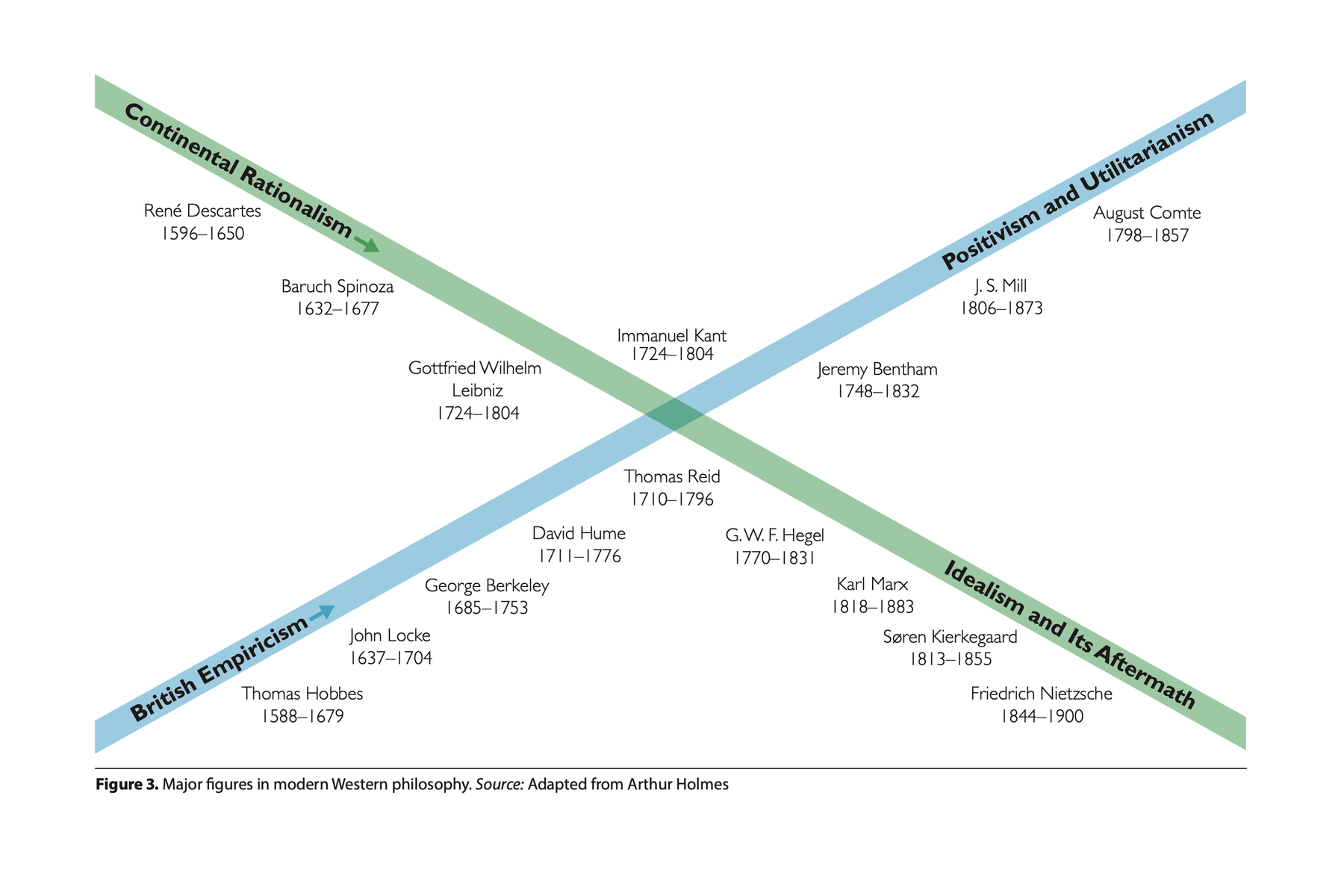
Chapter 12 – Descartes and the Beginning of Modern Philosophy
1. Main Aim and Themes of the Chapter
The chapter presents Rene Descartes (1596–1650)** as the standard starting point of “modern” philosophy and uses his Meditations on First Philosophy to show why.
Evans focuses on:
- Descartes’s rationalism and classical foundationalism.
- His attempt at a radical new beginning in philosophy.
- The method of doubt (senses, dream argument, evil demon).
- The cogito (“I think, therefore I am”) and the notion of clear and distinct perception.
- His proofs of God’s existence and the “vicious circle” problem.
- His mind–body dualism and account of the external world.
- The legacy of Descartes for modern philosophy and Christian thought.
Descartes’s project shifts philosophy’s center of gravity from metaphysics and the good life to epistemology and method.
2. Descartes’s Rationalism and Classical Foundationalism
2.1 Mathematics as the Model of Knowledge
Descartes is also a mathematician (pioneer of analytic geometry), and his philosophy is deeply shaped by the mathematical ideal of certainty:
- In mathematics we have basic truths (e.g., about lines, numbers) that are intuitively “seen” by the “eye of reason” as certain.
- From these, further theorems are deduced; when deduction is correct, the results share the same certainty.
He wants all genuine science to have this structure: - Foundational truths known with absolute certainty.
- Derivations from those foundations that are themselves indubitable.
This leads to rationalism: - Reason/intuition (rather than sense experience) is the paradigm of certainty.
- Empirical knowledge has a subordinate role.
This rationalist strand dominates much of continental philosophy up to Kant.
2.2 Foundationalism as a “House of Knowledge”
Descartes fits what later thinkers call “classical foundationalism”:
- Many beliefs are based on others (e.g., “It is raining” based on “I see raindrops”).
- To avoid infinite regress or circular justification, there must be basic beliefs not derived from others.
- Knowledge is pictured as a building:
- Foundations = basic, certain beliefs.
- Superstructure = beliefs justified by those foundations.
Descartes insists that both:
- The foundations must be absolutely certain (like mathematical axioms).
- The rules of inference must be equally secure.
Empiricists like Locke and Berkeley will share this foundationalist picture but treat immediate sense-experience, not rational intuition, as the base. Evans emphasizes that rationalism and empiricism are rival versions of the same basic model of knowledge.
3. The “Radical New Start” – and Hidden Assumptions
3.1 “Demolish Everything and Start Again”
In the First Meditation, Descartes declares that he has accepted many falsehoods since childhood, leaving the whole “edifice” of his beliefs doubtful. He resolves once in his life to “demolish everything” and begin again “from the foundations” if he is to build anything stable in the sciences.
This posture contrasts with the medieval practice of beginning from authorities and tradition. It is part of why he is called the father of modern philosophy.
Evans notes, however, that Descartes does not truly start from scratch. He continues to take many inherited assumptions for granted—ideas that seemed so obvious in his intellectual culture that he never thought to question them. This is used as a general lesson about unexamined assumptions and the value of doing history of philosophy.
3.2 Detachment, Emotion, Solitude, and Individualism
At the start of the Meditations, Descartes says he is now free of “cares” and has withdrawn into solitude with leisure to think. From this, Evans extracts a characteristic modern “package” of assumptions:
- Good reasoning requires emotional detachment – feelings are seen as potential distortions; the “head” must be separated from the “heart.”
- Solitary reflection is the ideal setting for philosophy – away from the pressures of action and community influence.
- Suspicion of tradition and community – to think well we must free ourselves from inherited beliefs, which usually come via communities.
Evans notes challenges to this picture: - Neurologist Antonio Damasio argues that people whose emotional centers are damaged can do IQ-style reasoning but are impaired in real-life decision-making, suggesting emotions are necessary for good reasoning.
- Later philosophers like Kierkegaard, Nietzsche, William James will reject the ideal of cool detachment and highlight the role of passion and commitment in genuine understanding.
- The individualist image of knowledge (“dare to use your own reason” in Kant) may underplay our fundamental social dependence in knowing.
So Descartes’s “new start” already rests on significant unquestioned modern assumptions about emotion, individuality, and tradition.
4. The Method of Doubt and Radical Skeptical Scenarios
4.1 Doubt as Method, Not Goal
Descartes wants not skepticism but certainty. Yet his route is a universal, methodical doubt: suspend any belief that is not “completely certain and indubitable.” Even slight reasons to doubt are taken as grounds to withhold assent.
This reverses what later pragmatists will say:
- For them, belief is the default and doubt must be earned—we only doubt when we have positive reasons.
- They argue that universal doubt is impossible; we always doubt some beliefs on the basis of others we are not doubting at that moment.
Evans notes that thinkers from Hume and Reid to Kierkegaard agree that a total suspension of all belief is not psychologically or logically workable.
4.2 First Step: The Fallibility of the Senses
Descartes observes that the senses sometimes deceive; therefore, “it is prudent never to trust completely those who have deceived us even once.” He treats occasional error as a reason for complete methodological distrust of sense-derived beliefs.
Evans questions this principle with the analogy of counterfeit money: being occasionally fooled by counterfeit bills does not justify never trusting any money again.
Descartes may be better read as performing a thought experiment rather than literally suspending all everyday trust, but in the text he works hard to supply real doubt-motives, not just symbolic ones.
4.3 The Dream Hypothesis
To push doubt further, Descartes introduces the dream argument:
- We have vivid dreams that we take as reality while asleep.
- For any current experience, we cannot prove we are not dreaming now.
- So sensory experiences cannot guarantee the existence of an external world.
Even so, he initially thinks that certain basic structures—numbers, shapes, arithmetic truths—remain certain whether he is awake or dreaming (“two plus three make five,” a square has four sides).
4.4 The Evil Demon Hypothesis
Finally, Descartes introduces an even more radical scenario: what if instead of a good God, a malicious powerful demon is systematically deceiving him?
- This demon could make all of Descartes’s experiences misleading, including mathematical intuitions.
- Any test or evidence he might use could itself be part of the deception.
Modern analogues: brain-in-a-vat stories and films like The Matrix are updated versions of this global skeptical hypothesis.
At this stage, it appears no belief about the external world, mathematics, or even ordinary reasoning is safe from doubt.
5. Overcoming Doubt: The Cogito and First Certainties
5.1 “I Think, Therefore I Am”
In the Second Meditation, Descartes discovers something that even the evil demon cannot undermine:
- If he is being deceived, he must exist to be deceived.
- Whenever he is conscious—doubting, believing, imagining—he cannot truly doubt that he exists.
This is the famous cogito (“I think, therefore I am”), though in the Meditations it appears more as “I am, I exist” whenever I am thinking.
Evans emphasizes: - The cogito is not a deductive argument from “I think” to “I exist”; it is an immediate insight—self-evident when entertained.
- “Thinking” is broad: it covers all conscious states, including sensory experiences as they appear to the mind.
5.2 Representationalism in Perception
Descartes holds (without argument) a representationalist view of perception:
- The immediate objects of awareness are not external physical things but mental representations or “ideas.”
- When he “sees a tree,” he is directly aware of an internal sensory representation, which may or may not correspond to an actual tree.
This assumption, inherited from earlier tradition, is not examined by Descartes in his project, yet it becomes crucial for later debates. - Thomas Reid will later reject this “way of ideas,” arguing instead for direct realism (we directly perceive external objects), and will blame representationalism for leading to skepticism about the external world and other minds.
5.3 The Criterion of Truth: Clear and Distinct Perception
From his experience of the cogito, Descartes claims another certainty:
- He not only exists but exists as a “thinking thing.”
- He also claims to know what knowledge is: it is a clear and distinct perception of truth—a kind of rational “seeing” that excludes doubt.
Evans notes problems: - It is not obvious that the self must be a substance (“thing”) rather than, say, a series of mental events (Hume will question this).
- The notion of “clear and distinct” itself is vague and may be interpreted differently by different people.
- If someone denies that a certain proposition is clear and distinct, Descartes has no further argument to convince them; the method runs out at its own foundation.
5.4 The Wax Example
Anticipating objections from materialists and empiricists, Descartes uses the wax example:
- A piece of wax has certain sensory properties (shape, color, smell).
- When melted, all these sensory properties change.
- Yet we still recognize it as the same piece of wax.
Conclusion: what we truly grasp as “wax” is not the sensory qualities but the intellectual concept of an extended, flexible substance.
From this Descartes infers: - Bodies are known “by the intellect alone”, not strictly by the senses or imagination.
- Thus he has a more evident grasp of his mind (which thinks) than of any body.
6. Proving God as Guarantor of Knowledge
Once he has the cogito and criterion, Descartes turns in the Third Meditation to proving God’s existence, which he needs to escape the evil demon scenario and to justify trust in his cognitive faculties.
6.1 Why Descartes Needs God
- He wants assurance that sense-based beliefs (e.g., about external objects) are not merely natural impulses but are reliable.
- If a good, non-deceiving God created him and his faculties, then it would be reasonable to trust clear and distinct perceptions and, more cautiously, natural impulses.
- So he argues that a perfect God exists and is the cause both of his existence and of his idea of God.
He offers two causal arguments in Meditation III and a third, ontological argument in Meditation V.
6.2 First Causal Argument: The Idea of God
Outline:
- Descartes finds in himself an idea of God as an infinitely perfect being.
- He adopts a principle (seen by the “natural light”) that a cause must possess at least as much reality or perfection as its effect.
- His idea of an infinitely perfect being cannot have been caused by himself, since he is obviously imperfect.
- Nor could any lesser being originate the idea of infinite perfection.
- Therefore only an actually perfect being—God—can be the cause of this idea.
Evans’s critical points:
- This argument presupposes an old “great chain of being” framework where reality comes in degrees (from God at the top down to shadows). Modern philosophers often reject the notion of degrees of existence, treating reality as “all or nothing.”
- Even if God is maximally perfect, it is unclear what it means for the idea of God to have a certain amount of “reality” that demands an equally perfect cause.
- A naturalistic alternative: we could form the idea of God by extrapolating from finite perfections (power, knowledge) and removing their limits. Descartes responds that recognizing imperfection presupposes an innate grasp of perfection, but this remains controversial.
6.3 Second Causal Argument: The Cause of Descartes’s Existence
The second argument looks like a personalized cosmological argument:
- Descartes exists as a finite, imperfect thinking thing.
- Whatever exists must have a cause, and self-causation is excluded.
- He could not cause himself, since if he had such power he would have given himself all perfections.
- Even if he had always existed, the present continuation of his existence still demands a cause.
- His parents (or other finite causes) cannot ultimately account for his idea of an infinite God.
- Therefore there must be a first, perfect cause of his existence—God.
Evans notes that once you strip away the personal focus, this is essentially a standard cosmological argument starting from some existing, contingent being and inferring a necessary, perfect cause. It shares the same attractions and objections as other such arguments.
6.4 Third Argument: The Ontological Proof
In Meditation V, Descartes restates a version of the ontological argument:
- God is defined as a being possessing all perfections.
- Existence is treated as a perfection.
- A God lacking existence would be less perfect than one who exists.
- Therefore the idea of God as maximally perfect entails God’s existence.
He compares this to the idea of a triangle: when we think of a triangle, we clearly see that it must have three angles; similarly, he claims that the idea of God necessarily includes existence.
Evans situates this in the long debate: - Later rationalists (Spinoza, Leibniz) will defend versions of the argument.
- Kant famously criticizes it, insisting that existence is not a property and thus not a “perfection.”
- Modern defenders sometimes shift to “necessary existence” as a property, but most philosophers remain unconvinced.
The chapter does not settle these debates, but shows how central they are to Descartes’s project.
6.5 The “Vicious Circle” (Cartesian Circle)
A key objection raised by contemporaries (e.g., Arnauld):
- To refute the evil demon and trust our faculties, we must prove God’s existence.
- But any proof of God uses reason, which might itself be unreliable if an evil demon exists.
- So Descartes seems to need reliable reason to prove God, and God to prove reason’s reliability—a circle.
Descartes’s reply (Objections and Replies): - He distinguishes between:
- What is clearly and distinctly perceived right now by reason.
- What we remember having perceived, or what we infer via perception and memory.
- He claims:
- Clear and distinct perceptions are self-evidently reliable at the moment we have them; no further guarantee is needed.
- God is needed only to guarantee the continued reliability of our faculties (memory, perception) and to justify trusting what we’re not currently intuiting clearly and distinctly.
Evans thinks this avoids strict circularity, but raises another question:
- Why is it legitimate to trust reason without proof while demanding proof for the reliability of memory and perception?
- If, as Thomas Reid later says, all basic faculties “come out of the same shop,” then either we trust them all or we have no place to start.
7. Meditations IV–V: Error, Free Will, and the Nature of Matter
7.1 Meditation IV: Why We Make Mistakes
Descartes faces an epistemic version of the problem of evil: if a perfect God created us, why do we err?
He answers with a kind of free-will theodicy:
- Our intellect is finite; there are limits to what we can clearly and distinctly understand.
- Our will has a sort of “infinity” in that we can choose to affirm or deny any proposition presented to us.
- Error occurs when we exercise will beyond understanding—when we assent or dissent regarding matters we do not clearly grasp.
Thus: - Neither finite intellect nor free will is a defect.
- We misuse free will by deciding to believe things that we do not adequately understand; the fault lies with us, not with God.
7.2 Meditation V: Essence of Material Things
Even before proving that material objects exist, Descartes asks what their essence would be if they did exist.
He concludes that:
- The only clear and distinct idea of matter is as extended in space, with measurable properties: length, breadth, depth, size, shape, position, motion, duration.
- In other words, matter is essentially quantitative, accessible to mathematics.
Consequences: - The physical world is conceived as “matter in motion”—a vast mechanism describable in purely quantitative terms.
- Secondary qualities (color, sound, taste, smell) are not in bodies themselves but are sensations in the mindcaused by bodies with primary, measurable qualities.
This reflects and supports the emerging scientific picture of nature as a mechanistic system, preparing the way for later materialism.
8. Meditation VI: Mind–Body Dualism and the External World
8.1 Distinctness of Mind and Body
In the Sixth Meditation, Descartes argues for mind–body dualism. The key principle:
- Whatever we can clearly and distinctly conceive apart can in principle be separated by God and thus are distinct substances.
He claims he can: - Clearly conceive of himself as a thinking, non-extended being.
- Clearly conceive matter as extended, non-thinking.
- Conceive of himself existing without a body.
Therefore, he concludes, he is essentially a thinking substance (mind/soul), distinct from any material body, even though he is currently closely united to one.
Evans stresses what this does and does not imply: - It does not prove that the soul is naturally immortal or permanently separate from the body—only that separation is possible, if God wills.
- It is compatible with very strong dependence of the mind on the body in this life; neuroscience about mind–brain dependence does not by itself refute Cartesian dualism, understood just as distinctness.
Descartes himself goes beyond mere separability to an interactionist dualism: - The soul and body causally influence each other (the body, via the brain; the mind, via the will).
- He sometimes speculates that the interaction occurs in the pineal gland, but the deeper problem is not “where” but how such interaction is possible.
Evans suggests that dualists might treat mind–body interaction as causally basic, just as gravity is in physics: - We cannot explain “how” one mass attracts another; we just state that it does.
- Similarly, we may have to accept mind–body causal laws as primitive.
Descartes also emphasizes that he is not simply “a sailor in a ship”: - He feels himself “tightly joined” and “commingled” with his body, forming one unified person.
8.2 The Existence of Material Things and the Body
Can he now trust that material objects exist and that he has a body? He points to:
- Certain faculties that appear not to belong to him as a pure thinking thing—especially sense perception and locomotion.
- Sensory ideas arrive without his consent, often against his will, suggesting an external source.
Given that: - These ideas present themselves as caused by external bodies.
- A good God would not be a deceiver by giving him a powerful natural inclination to believe in an external world if none existed.
Descartes concludes it is reasonable to believe: - That he has a body, and
- That external material objects exist, causing his sensory ideas.
However, he remains cautious: physical things may not always be exactly as they appear. Scientific investigation is needed to determine the true nature of matter; the senses alone are not infallible guides.
9. Descartes’s Legacy for Modern Philosophy and Christian Thought
9.1 Philosophical Legacy
Evans highlights several enduring features of Descartes’s legacy:
- Philosophy now begins with doubt rather than wonder.
- Epistemology—questions of what we can know—becomes central.
- There is a new preoccupation with method, trying to make philosophy a “science” modeled on mathematics.
- The “problem of knowledge” (skepticism, certainty, the external world, other minds) becomes the dominant theme of modern philosophy.
His mind–body dualism also raises enduring questions: - How to reconcile human consciousness and freedom with a mechanistic, scientific picture of nature.
- How to avoid making the human being into a “ghost in the machine” (Gilbert Ryle’s later caricature), isolated from the rest of nature.
9.2 Christian Assessment and Dualism
For Christians, Descartes’s dualism is partly attractive, partly problematic.
Positive points:
- Christian eschatology typically involves some form of existence after bodily death, whether in an intermediate state or immediate resurrection, which seems to presuppose some distinction between person and current body.
- Descartes’s arguments that we are not identical to our bodies thus support a core Christian intuition.
Concerns: - Cartesian dualism can appear to downplay the body, treating the “real self” as mind alone.
- A more balanced Christian view might see humans as “bodily souls”:
- We are souls (self-conscious persons), not souls + bodies as two parts.
- But our mode of existence in this life is essentially bodily; we are meant to live in and through a body.
Evans also notes that Descartes draws too sharp a line between humans and the rest of nature:
- Medieval Aristotelians thought all animals and even plants had souls (of different kinds).
- Descartes suggests animals might be mere machines, without consciousness. Some disciples even reportedly mistreated animals on the assumption they do not feel pain.
- This leaves the human mind as an inexplicable immaterial exception in a purely mechanical world—a tension later thinkers will struggle to resolve.
10. How This Chapter Fits the Book’s Overall Story
Within the history of Western philosophy, this chapter marks the transition to modern philosophy:
- Descartes takes up medieval themes (God, soul, knowledge) but reframes them under a new epistemological and methodological focus.
- He sets the agenda for later rationalists (Spinoza, Leibniz) and empiricists (Locke, Berkeley, Hume), who will either develop or react against his foundationalism, skepticism about the senses, and dualism.
- He leaves to his successors a double challenge:
- To find a secure method for knowledge in the face of skepticism.
- To do justice to the distinctive character of human persons without severing them from the natural, scientifically describable world.
Evans’s chapter thus shows why Descartes is widely regarded as the starting point of “modern” European philosophy, while also emphasizing the extent to which he still stands within—and transforms—the older Christian and philosophical traditions.
Chapter 13 – Continental Rationalism: Baruch Spinoza and Gottfried Wilhelm Leibniz
1. Overview: What This Chapter Is Doing
This chapter traces the “continental rationalist” line after Descartes, focusing on Baruch Spinoza and G. W. Leibniz. Both:
- Share Descartes’s faith in reason, innate ideas, and mathematical-style certainty.
- Offer ambitious metaphysical systems that attempt to make reality fully intelligible.
- Reject Cartesian mind–body dualism and direct interaction between distinct substances.
- Defend some kind of determinism and try to reconcile it (or not) with human freedom.
Spinoza develops a strict monism in which God and nature are one substance. Leibniz develops a pluralist “monadology” in which the world is a harmony of countless simple, “spiritual” substances. The chapter closes by comparing these systems and their limits.
2. Spinoza
2.1 Life, Context, and Works
- Baruch (Benedict/Benedictus) Spinoza (1632–1677) was born into a Portuguese Jewish family exiled to the Netherlands.
- Raised in a traditional Jewish setting and taught mainly religious subjects, he later developed views that led to his excommunication from the Amsterdam synagogue and exclusion from the Jewish community.
- Lived modestly as a lens-grinder; became widely known across Europe as a thinker.
- Declined a philosophy chair at Heidelberg for fear that constraints on freedom would hinder his pursuit of truth.
- His major work, the Ethics, along with writings on politics (defending democracy) and biblical criticism, was mostly published posthumously. He sharply criticized giving political power to religious authorities.
The Ethics is not just moral theory; it contains a full metaphysical system that undergirds his ethics.
2.2 Method: Philosophy “More Geometrico”
Spinoza takes Descartes’s admiration for mathematics and actually writes like a geometer:
- The Ethics begins with numbered definitions and axioms.
- From these, he proves numbered propositions, each step justified by earlier axioms, definitions, or propositions.
- The text reads more like Euclid than like Descartes’s first-person Meditations.
Key definitions (Part I): - Substance: “that which is in itself and is conceived through itself,” whose conception does not require another thing.
- God: “an absolutely infinite being, that is, substance consisting of infinite attributes, each of which expresses eternal and infinite essence.”
From these and the axioms, he argues that: - God necessarily exists (Ethics I, proposition 11).
- No other substance besides God can exist or be conceived (I, proposition 14).
So Spinoza arrives at metaphysical monism: there is only one substance, and that substance is God. Everything else is a way this one reality is expressed.
Evans notes a crucial issue: no matter how tight the logic, the system is only as strong as its axioms and definitions. Critics like Hobbes object that such substantial metaphysical results cannot rest on what look like stipulative definitions, though Spinoza insists his definitions express clear and distinct ideas, not arbitrary word-choices.
2.3 Metaphysics: God or Nature
2.3.1 From Substance to Monism
Spinoza develops the traditional idea of substance (what can exist “on its own”) to a radical conclusion:
- Following Aristotle, he distinguishes substances (independent) from attributes/properties, which can’t exist on their own.
- Descartes had three kinds of substance:
- God (infinite substance),
- Mind (thinking finite substances),
- Body (extended finite substances).
Spinoza argues:
- If finite minds and bodies depend on God to exist, they cannot be fully independent and thus are not substances in the strict sense.
- By his definition, a substance’s conception must not require another thing; created things fail that test.
Result: - There are no finite substances; only the one infinite substance, God, truly qualifies.
Hence the famous formula “God or Nature” (Deus sive Natura). God is not a being separate from the world: the world is in God. This looks like pantheism (everything is God), though Evans suggests panentheism (“all in God”) may be closer, since God has an infinite mind and is not merely identical with the physical world.
2.3.2 Attributes, Neutral Monism, and Mind–Body
- God has infinitely many attributes, each infinite.
- Humans know only two: thought and extension.
- Thinking of God under the attribute of thought → God-as-mind.
- Thinking of God under extension → God-as-nature.
These are attributes of the same substance, not two substances (unlike Descartes). Spinoza thus offers a kind of neutral monism: ultimate reality is one thing that is both “mental” and “physical,” irreducible to either.
On mind–body:
- There is no causal interaction of distinct substances—because there are no distinct substances.
- For every physical configuration, there is a parallel mental “idea”; mind and body run in parallel (a “double aspect”) rather than interact.
This avoids Descartes’s puzzle about interaction between radically different substances but at the cost of replacing it with a synchrony without interaction.
2.3.3 God, Necessity, and Immanent Causality
Spinoza’s God:
- Has no deliberation among possibilities; God necessarily does what God’s nature entails.
- Is free only in the sense of being unconstrained by anything outside—not in the sense of choosing among alternatives.
God is not an external efficient cause creating a world distinct from himself, but an immanent cause: - God is the inner principle of everything that exists.
- Nature can be conceived as natura naturans (“nature naturing,” active production) and natura naturata(“nature natured,” the products).
Spinoza also attributes to the universe a pervasive conatus or striving: everything “wants” to persist in its being. This is not teleology aimed at a final goal; it is simply the universal tendency of each thing to maintain and express its nature.
Finite things (including us) are “modes” of God—particular expressions or modifications of the divine attributes. There are also infinite modes (e.g., mathematical laws, physics) that express God more directly and constantly.
2.4 Determinism, Human Freedom, and Ethics
2.4.1 Determinism and Illusion of Free Will
Apart from God, nothing is free:
- Everything follows with necessity from God’s nature and the network of modes and laws.
- Human belief in free will is ignorance of the true causes of our actions; if we saw the full chain, we would see they could not have been otherwise.
So regret (“I could have done otherwise”) is irrational. In this, Spinoza resembles the Stoics: accept what must be, without blaming yourself or the world.
2.4.2 The Ethical Goal: Intellectual Love of God
Ethically:
- Judgments of “good” and “bad” reflect what satisfies or frustrates our desires, not objective values “in things.”
- The wise person seeks freedom from reactive passions (regret, fear) by understanding the necessity of things.
- True blessedness is to see the world sub specie aeternitatis (“under the aspect of eternity”)—seeing the whole system as necessary and beautiful.
This culminates in the “intellectual love of God”: - Not person-to-person love seeking reciprocity.
- More like contemplative awe at a perfect mathematical proof or law of physics.
Evans raises worries: - If everything is necessary, then even my regret is necessary—so how meaningful is it to exhort people to change their attitudes?
- Emotionally, telling someone who has lost a child that this was necessary and should be accepted “from eternity’s viewpoint” seems like cold comfort.
- Spinoza acknowledges the difficulty; he admits humans cannot fully transcend their partial perspectives, but can reduce the power of passions through understanding.
For Spinoza, egoism is basic—we naturally seek our own happiness—and he affirms this. But the deepest happiness lies in knowledge, especially knowledge that leads to the intellectual love of God. That understanding is virtue and salvation.
3. Leibniz
3.1 Life and Achievements
Gottfried Wilhelm Leibniz (1646–1716):
- Early prodigy; studied philosophy (Leipzig), mathematics (Jena), and law (Altdorf).
- Co-discovered the infinitesimal calculus, independent of Newton.
- A bitter dispute followed over priority; modern scholars think both discovered it independently.
- Served as a diplomat and adviser to European nobility.
- Proposed ambitious projects: a pan-European union and reconciliation between Protestants and Catholics.
- Major works: Discourse on Metaphysics, New System of Nature, Monadology, Essays in Theodicy.
- Pioneer in logic; some ideas foreshadow modern symbolic logic.
- First president of the institution that became the Prussian Academy of Sciences.
- Ironically, he died relatively neglected, his influence rising again only later.
3.2 Monads, Space, and Time
3.2.1 From Compounds to Simple Substances
Leibniz starts with the idea of compounds:
- Many things we see are aggregates (watches, organisms, etc.).
- Their parts may themselves be aggregates.
To avoid an infinite regress of “compounds of compounds,” he argues there must be simple substances with no parts—monads.
He rejects physical atoms (tiny extended particles): - Anything with spatial extension can at least be conceived as divisible.
- Hence, true simplicity cannot belong to extended atoms.
Instead, monads are non-extended “spiritual atoms”, more like centers of force/energy than tiny lumps in space.
3.2.2 Space and Time as Relational
Against Descartes and Spinoza (who treat extension as basic), Leibniz argues:
- Space understood as an independent “container” substance is incoherent—it would be a “thing” with no properties.
- What is really basic is something like force/energy, present in both minds and nature.
- Space and time are relational, grounded in the relations among monads and their states—not independent entities.
He describes space and time as “well-grounded illusions”: they are part of the phenomenal world we experience, but depend on the deeper reality of monads. The analogy of a computer-generated virtual reality helps: space appears on the screen, but is a projection of deeper mathematical structures.
3.3 Monads: Windowless Spiritual Atoms
3.3.1 Features of Monads
- Monads are simple and have no parts; only God can create or annihilate them.
- Each monad is created with its entire “script”—its full past and future—built in.
- Each is “laden with the past” and “pregnant with the future.”
- They are “windowless”: no monad is causally affected by any other (except God).
The appearance of interaction is explained by pre-established harmony: - Each monad follows its own script.
- Because God designed all scripts to mesh, monads appear to interact (like perfectly synchronized clocks).
Every monad contains some representation of the whole universe; each “mirrors” the whole from its perspective. - There is a continuum of monads: from “bare” monads (physical objects) to richer ones (plants, animals) to human minds and finally God, the supreme Monad.
- There is no sharp mind–body divide; instead, a graded spectrum of complexity.
3.3.2 Perception, Apperception, and Panpsychism
Leibniz’s view is panpsychistic in spirit:
- All monads have perception—internal representations of the universe.
- In inanimate monads, perceptions are dim and unconscious; in humans they can rise to apperception—conscious, self-aware perception.
- Humans also have “little perceptions,” unconscious perceptions we are not aware of.
All monads also have a tendency or drive (like Spinoza’s conatus), analogous to will. For lower monads this is an unreflective urge to continue being what they are; in humans it becomes self-conscious will.
Thus Leibniz dissolves a strict “mental vs physical” divide; everything mental and physical is grounded in monads with perception and appetite.
3.3.3 Mind–Body Without Interaction
On mind and body:
- The body is an aggregate of monads organized by an “intelligible form” (a structural principle).
- A human mind is a particular monad; its body is the ensemble of monads it is related to.
- The body can change its constituent monads while preserving identity through its form—much like Aristotelian accounts of substance.
Apparent mind–body interaction (thoughts influencing bodily movements, bodily events giving rise to sensations) is again explained by pre-established harmony: internal states of mind-monad and bodily monads unfold in sync without direct causation.
3.4 God, the Principle of Sufficient Reason, and Possible Worlds
3.4.1 Principle of Sufficient Reason
Leibniz’s core principle: Principle of Sufficient Reason (PSR):
- For every truth or event, there must be a reason why it is so rather than otherwise.
He uses PSR to support: - The relational view of space and time.
- The identity of indiscernibles (if two things had exactly the same properties, they would be identical).
- A cosmological argument for God’s existence.
Necessary truths are those whose denial is contradictory (grounded in the principle of noncontradiction).
Contingent truths are not self-contradictory; their truth cannot be explained solely from the concepts involved, so they need an external reason.
Apply this to the whole universe: - Even if every contingent event were explained by another contingent event, the whole chain of contingents would lack an ultimate explanation.
- PSR asks: why does anything contingent exist at all?
- Only a necessary being whose nonexistence is impossible can explain the existence of all contingent beings.
- This necessary being is God.
3.4.2 Possible Worlds and “Best of All Possible Worlds”
Leibniz introduces possible worlds:
- A possible world is a maximal set of events God could actualize without logical contradiction.
- The actual world is one such possible world, but God could have chosen others.
Since God is omniscient and good, he will choose the best of all possible worlds to actualize. Therefore, Leibniz concludes, this is the best of all possible worlds.
Objections and Leibniz’s responses: - The world seems to contain a great deal of evil; how can it be “best”?
- Leibniz replies:
- We see only a tiny corner of the cosmic “painting”; what looks pointless up close may contribute to the beauty of the whole.
- God can bring greater good out of permitted evils.
- Evil is a privation, a lack or defect, not a positive thing God creates.
This “best world” thesis is famously ridiculed by Voltaire’s Candide, but Leibniz stands by a rational theodicy driven by PSR and God’s perfection.
Possible worlds also become important later as a way of analyzing modal terms:
- A proposition is logically possible if true in at least one possible world.
- Necessary if true in every possible world.
Debates continue about whether there even is a “best” world, whether God must create it, and how creaturely freedom limits which possible worlds God can actualize.
3.5 Human Freedom and Compatibilism
Leibniz appears to have a deterministic universe: every monad follows an unchangeable script. Yet he insists we have a kind of freedom, so he develops a compatibilist account.
He distinguishes:
- Absolute necessity – could not be otherwise on pain of contradiction.
- Hypothetical (conditional) necessity – necessary given certain conditions but not absolutely.
Human actions: - Are hypothetically necessary—given the monad’s nature and world-choice, they must occur.
- But not absolutely necessary, since God could have created a different world with different monads and therefore different actions.
Libertarians find this unsatisfying: given the actual world and nature of a person, no alternative action is really possible. Furthermore, if God must create the best world, his own “freedom” also looks constrained.
Leibniz’s intuition is that freedom = self-determination: being moved by one’s own inner principles rather than external forces. On that definition, every monad enjoys a minimal kind of freedom (like Spinoza’s freedom of God to act from his nature), though human minds have a richer freedom because they represent God and can see themselves as members of a rational kingdom under God. Human acts arising spontaneously from such rational representation are free.
3.6 Epistemology: Truth, Innate Ideas, and Sense
Leibniz defines a true proposition as one in which the predicate is contained in the subject.
- This works straightforwardly for analytic truths (e.g., a bachelor is unmarried).
- It seems less plausible for contingent truths, but he argues that in reality, given monads, each substance “contains” all its predicates (its whole history).
The necessary vs contingent distinction is handled by: - Necessary truths: containment is clear and tied to noncontradiction.
- Contingent truths: containment is still real, but only God can see it clearly; humans must discover them.
Since monads are windowless, all ideas are in a sense innate—everything is inside each monad. But: - Many ideas are only obscure or confused initially.
- It appears that we learn from the senses and from others because of the pre-established harmony.
Leibniz is thus a strong rationalist, giving primacy to innate ideas and self-evident principles (noncontradiction, PSR, identity of indiscernibles). Yet he also acknowledges a limited role for sense perception in triggering and helping clarify ideas, even though, at a deeper level, all ideas are grounded inside the monads themselves.
4. Conclusion: Rationalism After Descartes
Evans ends by summarizing how Descartes, Spinoza, and Leibniz share a rationalist outlook but diverge in important ways.
Common features:
- Strong confidence in human reason, modeled on mathematics.
- Belief in innate ideas and some truths that are self-evident to reason.
- Sense experience needs rational grounding to yield trustworthy knowledge.
- Ambitious attempts to give a fully intelligible, systematic account of reality.
Spinoza and Leibniz especially share: - A kind of panpsychism or mind-in-all-things.
- Determinism: everything unfolds necessarily from the nature of God and monads.
- Spinoza concludes humans lack freedom.
- Leibniz defends compatibilist freedom.
- Rejection of Cartesian dualism and of direct mind–body interaction.
- An affirmation that the world, properly seen, is to be embraced:
- Spinoza: see it “under eternity” and love God intellectually.
- Leibniz: see this as the best possible world, ultimately good in God’s plan.
Differences:
- Metaphysics:
- Spinoza: strict monism (one substance—God or Nature).
- Leibniz: pluralism of countless monads (qualitative monism: all are monads, but numerically many).
- Mind–body problem: both avoid interaction, but whether their alternatives really solve the issue is doubtful. Descartes’s dualism may, in some respects, match common-sense experience more closely (body affecting mind and vice versa).
The chapter notes that the mind–body problem is a deep “world-knot”—so difficult that nearly every conceivable position has had defenders, from Spinoza’s neutral monism to Leibniz’s monads to Malebranche’s occasionalism, which attributes apparent interaction directly to God’s intervention at each “occasion.”
Despite the rationalists’ ambition and confidence, they did not succeed in giving final answers. But they decisively shape the modern conversation about reason, God, freedom, and the structure of reality, setting up the ensuing clash with British empiricism and the later critiques of Kant and beyond.
Chapter 14 – British Empiricism: John Locke and George Berkeley
1. Main Focus and Themes
This chapter turns from continental rationalism (Descartes, Spinoza, Leibniz) to British empiricism, concentrating on John Locke and George Berkeley. It explores:
- How Locke reshapes philosophy around experience, ideas, and probability rather than innate ideas and purely rational certainty.
- How Berkeley pushes Locke’s empiricist premises to a radical idealist conclusion: there is no mind-independent matter.
- The continuing assumption (shared with Descartes) that epistemology is foundational, and Evans’s critique of that assumption.
The chapter is both historical and critical: it narrates Locke’s and Berkeley’s systems but also highlights tensions and long-term implications for debates about knowledge, personal identity, matter, and God.
2. John Locke
2.1 Life, Context, and Motivation
- John Locke (1632–1704) came from a Puritan family in Somerset, studied and taught at Oxford, and was involved in public life as a physician and advisor to the Earl of Shaftesbury.
- Major works:
- An Essay Concerning Human Understanding
- Two Treatises of Civil Government
- Religious works: The Reasonableness of Christianity and An Essay on Toleration.
Locke lived through intense religious–political conflict:
- The English Reformation, oscillation between Catholic and Protestant monarchs, and the civil war(Parliamentary/Puritan vs royalist, more “Catholic” church).
- This background fostered a desire for a rational method to resolve disputed religious and political questions.
In the Essay’s “Epistle to the Reader,” Locke recalls a discussion with friends where they got stuck on religious issues. He concluded they had “taken a wrong course” and needed first to “examine our own abilities”—to find out what the understanding is fitted to deal with.
So, like Descartes, Locke: - Makes epistemology the starting point of philosophy.
- Seeks a method that could, in principle, settle major disputes “once and for all.”
Evans comments critically that this faith in epistemology as foundation is misguided for two reasons:
- Disagreements in epistemology are no easier to resolve than disputes in ethics or metaphysics.
- Epistemology itself presupposes views about human nature, metaphysics, and even ethics (e.g., what counts as responsible belief). There is a reciprocal dependence among branches of philosophy; none is an absolute foundation for the others.
2.2 Ideas and the Attack on Innate Ideas
2.2.1 What Locke Means by “Idea”
Locke uses “idea” very broadly for anything the mind is aware of—whatever is meant by “phantasm, notion, species,” etc.
Evans notes several problems:
- Locke does not analyze what ideas are; he assumes they are familiar from experience.
- He often fails to distinguish clearly between the act of thinking and the object of thought.
- He assumes a representational theory: we are directly aware not of external objects themselves, but of mental ideas that represent them.
- Sometimes “idea” means a concept, other times a proposition (e.g., a principle like “whatever is, is”).
These ambiguities will later cause trouble, especially once Berkeley presses them.
2.2.2 Tabula Rasa and Arguments Against Innate Ideas
Locke famously claims the mind at birth is a “tabula rasa”—blank paper with no characters written on it. All ideas must come into the mind.
His anti-innatism has several strands:
- Burden of proof: if Locke can explain all our ideas through experience, there is no need to posit innate ideas.
- No universal consent: even the strongest candidates for innate speculative principles, such as “whatever is, is” or “it is impossible for the same thing to be and not to be,” are not known by “children, idiots, etc.” and thus not universally held.
- Rationalist reply and Locke’s rejoinder:
- Rationalists say innate ideas are dispositions or capacities: everyone can recognize them as self-evident when they consider them.
- Locke replies that if “innate” just means “we can recognize it when we encounter it,” then every idea is innate in that trivial sense, and the innateness thesis becomes empty.
He extends this to moral principles:
- Candidates like principles of justice and promise-keeping are not universally accepted; “outlaws and villains” either reject them or treat them as mere rules of convenience.
He denies that the idea of God is innate as well, citing supposed cultures without any notion of God (Evans notes Locke’s anthropology here is doubtful). Even universal belief would not prove innateness, since the idea of God could arise from “visible marks of extraordinary wisdom and power” in creation.
Evans points out why rationalists are unimpressed: - Locke unfairly foists on them the claim that innate truths must be consciously held by all, including children.
- More deeply, Locke does not explain how experience alone could yield necessary truths (how things must be, not just how they are).
Still, Locke’s “blank slate” vision has been highly influential, feeding later views that human nature is highly malleable, shaped by environment and experience.
2.3 Empiricist Theory of Meaning: Sensation and Reflection
Once innate ideas are rejected, Locke must explain how we get the ideas we have. His basic thesis:
The mind, initially “white paper,” gains all its materials “from EXPERIENCE.”
He distinguishes two sources:
- Sensation
- Through the senses we are affected by external objects, yielding ideas such as “yellow, white, heat, cold, soft, hard, bitter, sweet.”
- These are ideas of sensible qualities; the source is outer experience.
- Reflection
- We also have an inner awareness of the operations of our own mind (perceiving, doubting, believing, reasoning, willing, etc.).
- Ideas arising from this inner awareness are “ideas of reflection.”
All ideas are ultimately from sensation or reflection, or some combination of the two.
Locke further distinguishes:
- Simple ideas – basic, unanalyzable.
- Complex ideas – combinations of simple ideas (e.g., the idea of a dog includes color, shape, smell, etc.).
We may never encounter simple ideas in complete isolation, but they must be distinct because we can conceive them separately.
2.3.1 Primary and Secondary Qualities
As a realist, Locke believes external objects exist and cause our ideas. He calls features in objects that produce ideas in us qualities.
He distinguishes:
- Primary qualities: inseparable from bodies (solidity, extension, figure, motion/rest, number). These are present in every particle, no matter how divided.
- Our ideas of these resemble the qualities in the object.
- Secondary qualities: powers to produce sensations (colors, sounds, warmth, etc.).
- In objects, these are just powers grounded in primary qualities; the ideas they produce in us do not resemble anything in the object.
So the physical world is a mathematically describable system of solid, extended particles; color, sound, warmth are mind-dependent. Locke’s world resembles Descartes’s Fifth Meditation picture: a colorless, soundless physical reality undergirding our sensory experiences.
- In objects, these are just powers grounded in primary qualities; the ideas they produce in us do not resemble anything in the object.
2.3.2 Universals and Abstract Ideas
Locke thinks we do have general and abstract ideas, but their status is tricky:
- We obviously do not perceive universals directly.
- He leans toward conceptualism: abstract ideas are “creatures of the understanding”, not constituents of reality.
Rough model: - Starting from an idea of a particular dog, the mind “abstracts” by stripping away determinate features (this size, this color, this smell) to form a vague idea that can represent any dog.
Evans notes: - This looks like a compromise between realism (universals in reality) and nominalism (only names and individuals).
- It is unclear whether this conceptualism fits smoothly with Locke’s strict empiricism about the origin of ideas.
2.4 Knowledge: Its Nature, Degrees, and Limits
Despite his differences with Descartes, Locke shares several key assumptions:
- He is a classical foundationalist: knowledge must have foundations, and those foundations must be highly certain.
- He treats knowledge as a kind of immediate rational awareness (“seeing”) and thus sets a very demanding standard.
2.4.1 “We Only Know Our Ideas”
Locke claims that:
- The mind has no immediate object but its own ideas.
- Knowledge requires immediate awareness or “seeing.”
- Therefore, strictly speaking, we only know our ideas.
Given his representationalism, this is unsurprising, but it raises the Berkeleyan worry: how can we know anything about a mind-independent world?
2.4.2 Knowledge as Perceiving Agreement of Ideas
Locke defines knowledge as “the perception of the agreement or disagreement of two ideas.”
He distinguishes four kinds of such “agreement/disagreement”:
- Identity/difference – recognizing two ideas as the same or different.
- Relations – grasping relations between ideas (e.g., “square” related to “quadrilateral”).
- Necessary coexistence in substances – e.g., gold always remaining gold under fire (this part of Locke’s view is underdeveloped and problematic).
- Real existence – judging that an idea “agrees” with the idea of existence (e.g., that something with a certain idea actually exists).
He also distinguishes three degrees of knowledge: - Intuitive knowledge – immediate “seeing” (e.g., that 3 < 5).
- Demonstrative knowledge – based on a chain of reasoning, each step intuitively certain, though more error-prone and less vivid than intuition.
- Sensitive knowledge – our awareness of the existence of particular external things through sensation.
Strictly, only the first two are “knowledge” in the highest sense; sensitive knowledge “falls short” but is close enough that Locke allows it to “pass under the name of knowledge.”
Evans points out Locke’s tendency to adjust his theory to common sense:
- His principles suggest we only know our own ideas, yet he refuses to deny that we “know” the existence of external objects.
- In contrast, Berkeley will accept the theoretical implications and deny matter’s existence altogether.
Locke says we know: - Our own existence (by intuition).
- God’s existence (by demonstration).
- The existence of external particulars currently present to the senses (by sensitive knowledge).
We cannot strictly know the existence of other minds; that rests on faith or reasonable belief. Our actual knowledge is thus quite limited, but Locke holds that the certainty we enjoy is “as great as our condition needs.”
2.5 Belief, Probability, Faith, and Evidentialism
Because knowledge is limited, Locke emphasizes belief and probability:
- Beliefs can be more or less probable; rational belief must track evidence.
- He is an evidentialist: one ought to believe in line with sufficient evidence, and the degree of belief should be proportioned to that evidence.
Beliefs often rely on testimony: - We must consider the witness’s own evidence plus reasons to trust the witness’s character and competence.
Locke uses “faith” in a special sense for belief on the basis of testimony, especially revelation:Faith is assent to a proposition not derived by logical deduction, but accepted on the credibility of a proposer claiming to speak for God.
Key points about reason and revelation:
- Revelation cannot give new simple ideas; it works with material supplied by experience.
- Some revealed truths could also be known by reason, but knowing them by revelation does not confer the same degree of certainty as demonstrative knowledge.
- We must not accept as revelation anything that contradicts the clear evidence of reason.
- There are truths “above reason” (not contradicting reason but inaccessible to it) that can be believed on revelation if there is good evidence the revelation is genuine.
Locke thinks there is such evidence for Christianity (miracles, fulfilled prophecies), so religious belief can be rational, while still largely a matter of faith rather than knowledge. This underpins his defense of religious toleration, though he remains sharply critical of “enthusiasm” and of beliefs not governed by rational scrutiny.
2.6 Locke’s Metaphysics: Substance, Identity, and Freedom
2.6.1 Substance: “Something, I Know Not What”
Given his empiricism, the idea of substance is problematic:
- We never sense “bare substance”; we only perceive qualities.
- Locke concludes that “pure substance in general” is just the vague notion of a “something, we know not what,” that supports qualities.
He amusingly compares this to the Indian who said the world rested on an elephant, which stood on a tortoise, which in turn was supported by “something, he knew not what.” Our idea of substance is similarly thin.
Still, Locke does not discard substance talk entirely (unlike some later empiricists); again, a concession to common sense that something must “have” the properties we observe.
He affirms both material and spiritual substances: - Material substances support solid, extended properties and causal “impulse.”
- Spiritual substances support mental operations: thinking, reasoning, fearing, etc.
But in both cases, the ultimate nature of substance is obscure.
2.6.2 Identity of Matter, Plants, Animals, Humans, and Persons
Locke distinguishes several kinds of identity:
- Lumps of matter: identity is tied to spatiotemporal continuity of mass/parts.
- Plants: identity is grounded in the continued functioning of an organized life-system that takes in and distributes nourishment. Parts can change without destroying identity.
- Animals: similar to plants but with more complex life processes.
- “Man” (human being): a kind of animal; identity tied to continuation of the same organized living body over time.
Crucially, this “man” is distinct from a person: - Person = “a thinking intelligent being that has reason and reflection, and can consider itself as itself, the same thinking thing, in different times and places.” (Locke’s own thought, as summarized by Evans.)
- Personal identity is grounded in consciousness (especially memory), not in the sameness of substance (soul or body).
Thus: - Whatever consciousness extends over (present or past actions) belongs to the same person.
- If my consciousness were transferred to a different substance (material or spiritual), I would go with my consciousness, not with the original substance.
Some consequences: - A criminal with complete amnesia of his crime, on Locke’s view, is no longer the same person, even if the same human animal persists.
- If I genuinely remember being Socrates drinking the hemlock, then, on Locke’s principle, I am Socrates.
Evans notes a serious objection: - False memories are possible. What distinguishes a true memory from a convincing but false apparent memory?
- The natural answer: a memory is true only if the person who remembers is identical to the one who had the original experience.
- That means we presuppose personal identity to determine genuine memory; memory cannot be the basis of identity.
So memory provides evidence for personal identity but does not constitute it. Locke’s account faces a deep circularity.
2.6.3 Freedom and the Lockean “Locked Room”
Locke argues the question “Is the will free?” is a category mistake:
- Freedom or liberty is a property of agents, not of the will.
- Will is a power to choose; liberty is the power to act (or not act) as one wills.
A person is free when: - They can act or refrain from acting according to their will.
The will itself is determined by the mind’s assessment of goods and evils, but that does not threaten freedom on Locke’s definition. This yields a compatibilist position: actions can be causally determined and still free if they flow from the agent’s will without external constraint.
His famous thought experiment: - A man is in a room he has no desire to leave; unbeknownst to him, the door is locked from the outside.
- Locke claims the man is free as long as he can do as he wills, even though he could not do otherwise if he got the desire to leave.
2.7 Political Philosophy: Social Contract and Limited Government
Locke’s Two Treatises of Civil Government (1690) are central to modern political theory and were closely tied to the “Glorious Revolution” of 1688, which deposed James II and established William and Mary under parliamentary supremacy.
Like Hobbes, Locke:
- Begins with a state of nature and a social contract.
- Holds that people form governments to escape the inconveniences of having no common authority.
But their views diverge sharply:
- Natural law and rights in the state of nature
- Hobbes: in the state of nature each has a right to whatever they can seize; property rights arise only with a sovereign.
- Locke: from the outset, humans have God-given rights (to life, health, liberty, possessions). We are God’s property, so harming others wrongs God.
- Property
- Locke argues that God gave the world to humans in common, but private property arises when one mixes one’s labor with unowned resources (e.g., turning a fallen tree into a desk).
- Condition: appropriation is legitimate only if “enough and as good” is left for others—a condition hard to satisfy in a world of scarce resources.
- Protection of property is a central purpose of government: “the reason why men enter into society is the preservation of their property.”
- The contract and the right of revolution
- Hobbes: the sovereign is not a party to the contract; citizens contract with each other and grant absolute power to the sovereign, leaving no right to revolt.
- Locke: the contract is between the people and the government.
- People surrender their private “executive power” in exchange for protection of their rights and the common good.
- A government that fails in this forfeits its legitimacy; citizens then have a right to resist and replace it.
Locke concludes that absolute monarchy is not a true civil government at all:
- An absolute monarch remains in a kind of state of nature relative to his subjects, unrestrained by law, and more dangerous than many private individuals.
- He ridicules the idea that people would give up mutual vulnerability to “polecats and foxes” only to place themselves at the mercy of a “lion.”
His vision requires separation of powers—executive, legislature, judiciary—and directly influenced the American Declaration of Independence and Constitution.
3. George Berkeley
3.1 Life, Works, and Theological Motivation
George Berkeley (1685–1753):
- Born and educated in Ireland (Trinity College Dublin).
- Anglicans clergyman; later Dean of Derry and Bishop of Cloyne.
- Lived several years in Rhode Island, the only early modern philosopher to have spent time in America, hoping (unsuccessfully) to found a college in Bermuda.
Key works: - A Treatise Concerning the Principles of Human Knowledge (1710)
- Three Dialogues Between Hylas and Philonous (1713)
- An Essay Towards a New Theory of Vision (1709)
- De Motu (on mechanics)
- Alciphron (a work of Christian apologetics)
Berkeley’s philosophical project is deeply shaped by his Christian convictions: - He fears that belief in a material world underwrites mechanistic explanations that marginalize God and encourage deism or atheism.
- His idealism is meant to block that route: once matter is denied, the order and regularity of the world must be directly grounded in God’s activity.
Yet most of his arguments for idealism do not presuppose religion and are admired even by non-religious philosophers as brilliant (if not compelling).
3.2 Idealism: Esse est percipi
Berkeley starts from Locke’s empiricism:
- No innate ideas; all ideas from sensation or reflection.
- Simple ideas combined into complex ones.
What he rejects is Locke’s realism and representationalism. Berkeley’s core thesis:To be is to be perceived (esse est percipi), except for minds/spirits which perceive.
More precisely: - All that exists (apart from minds) are ideas—objects of perception or thought.
- We cannot make sense of a supposed “thing” existing unperceived and unconceived.
Example: - “The table I write on exists” means: I see and feel it; if I were out of the room, it means that I could perceive it if I were there, or some other spirit does perceive it.
- The claim that the table exists wholly unperceived is unintelligible for Berkeley.
He accepts that thoughts, passions, and ideas clearly depend on mind, and extends that dependence to sensory objectsthemselves. There is no coherent extra step to a mind-independent material support.
3.3 Arguments Against Matter
3.3.1 From Nominalism and Abstract Ideas
Berkeley first attacks Locke’s abstract ideas:
- We never actually think of a dog with no particular size, shape, or color; whenever we think of a dog, it has some determinate features, even if we don’t attend to them.
- So there are no genuine abstract ideas; we merely use general names for groups of resembling particulars.
He embraces a robust nominalism. This immediately bears on the idea of matter: - The “idea of matter” is an extreme abstraction—a featureless “something” underlying qualities.
- If there are no abstract ideas, then we have no idea of matter at all.
Without a coherent concept of matter, the doctrine that matter exists is empty. Berkeley likes to point out that Locke himself described substance as “something, I know not what.”
Important nuance: - Berkeley does not deny the existence of ordinary things—tables, trees, dogs.
- He accepts them as “substances” in the vulgar sense: bundles of sensible qualities that appear together.
- What he denies is a philosophical “substratum” of matter distinct from the sensible qualities themselves.
So the target is the philosophers’ matter, not common-sense furniture of the world.
3.3.2 From Empiricist Limits on Knowledge
Suppose (for argument’s sake) that the notion of matter is meaningful. How could we ever know such things exist?
- We do not sense material objects directly; by hypothesis we only sense ideas.
- Reason/inference must ultimately base itself on experience.
- But we have no experience of material things as they are in themselves.
Therefore we have no empirical basis for any inference to unperceived matter. Berkeley concludes we have no way to know such entities exist.
3.3.3 Against the “Resemblance” Thesis
Locke said ideas of primary qualities resemble qualities in objects. Berkeley argues this is impossible:
- An idea can only resemble another idea (one color resembling another, one shape resembling another).
- It makes no sense to say “a color is like something invisible”, or that a felt softness resembles something that cannot be felt.
So the resemblance theory collapses; we cannot compare mental ideas to non-mental, unperceived qualities at all.
3.3.4 Collapsing the Primary / Secondary Distinction
Locke already granted that secondary qualities (color, warmth) are mind-dependent. Berkeley argues the same logic applies to primary qualities (shape, size, motion):
- They are observer-relative: the same coin appears round head-on and elliptical from the side; size and motion also vary with the observer.
- Locke’s argument that observer-relative qualities must be ideas in us therefore applies equally to primary qualities.
Moreover, we never experience primary qualities without secondary ones: - We cannot imagine a body with extension but no color, or with shape but no tactile qualities.
- To say that objects exist with only primary qualities and no secondary ones is inconceivable.
Thus, if secondary qualities are mind-dependent, primary qualities are too; all sensible qualities exist only in minds.
3.4 Positive Metaphysics: Spirits, God, Space, and Laws of Nature
3.4.1 Minds/Spirits and God
For Berkeley, reality contains:
- Ideas (passive, perceived).
- Spirits/minds (active perceivers and willers).
- God, the infinite Spirit.
He defines a spirit as a simple, indivisible, active being; as it perceives ideas it is called understanding, and as it produces or operates on them it is called will.
But we do not perceive spirits directly: - We only infer them from their effects (ideas).
- Given his empiricism, this means we have no idea of spirit.
To avoid losing the notion entirely, Berkeley distinguishes between ideas and “notions”: we lack an idea of spirit but have a notion sufficient to use the term meaningfully. Evans notes this is a vulnerable point: the notion/idea distinction is unclear, and Berkeley risks making “spirit” as obscure as Locke’s “I know not what.”
God is essential in Berkeley’s system: - If to be is to be perceived, then for objects to continue to exist unperceived by humans, there must be an ever-present perceiver—God.
- The stability, order, and regularity of the world reflect God’s constant perception and ordering of our ideas.
Evans illustrates this with two limericks, one expressing the worry that trees must vanish when unobserved, the other answering that God is “always about in the Quad,” so the tree continues to be.
3.4.2 Real vs Imaginary Objects
If everything we perceive is an idea, how do we distinguish reality from dreams or imagination?
Berkeley replies that the difference lies in the character of experience:
- Real objects present themselves with greater force, vividness, and regularity.
- Dreams and imaginings are more irregular and under our control.
He notes that “real fire” and “imaginary fire” are different experiences, as are real and imagined pain, even though both are mental.
3.4.3 Space as Mind-Constructed
A common objection: if everything is mental, then nothing is really at a distance in space. Berkeley answers:
- In dreams we easily represent objects as far or near, above or below, even though the whole dream occurs in one mind.
- So spatial relations are part of the structure of experience; they do not require a mind-independent container called “space.”
He had already developed this in An Essay Towards a New Theory of Vision: our visual perception of space arises from learned associations of visual and tactile ideas.
Thus space is a kind of mental construction, which aligns Berkeley loosely with Leibniz (relational view of space) and anticipates Kant’s later arguments that space is imposed by the subject.
3.4.4 Causation and Laws of Nature
Without matter, “physical” causation must be reinterpreted:
- No material object can push or pull another; the only genuine causes are spirits, above all God.
- When a rock “breaks” glass, strictly speaking it is God who orders our ideas so that perception of the approaching rock is followed by perception of shattered glass.
Berkeley allows everyday causal talk (“fire heats,” “water cools”) but, like talk of sunrise and sunset, treats it as useful but literally inaccurate. We should “think with the learned and speak with the vulgar.”
For him, laws of nature are not deep explanatory forces but descriptive summaries of how God normally orders our sensory experiences: - “Gravity,” for example, is just a name for the regular pattern that heavy bodies fall when unsupported; it does not name a hidden power in matter.
- Laws allow us to predict what will happen, enabling us to act responsibly, but they do not explain events apart from God’s will.
Thus the world is fundamentally “a world of ideas and spirits,” whose order expresses God’s consistent activity.
Evans remarks that few accept Berkeley’s conclusions, but it is hard to find exactly where all his arguments go wrong; later thinkers (Reid, Hume) appreciate his insights even while rejecting full-blown idealism.
4. How This Chapter Fits the Book’s Larger Story
This chapter shows how British empiricism reshapes and challenges the rationalist picture:
- Locke continues Descartes’s focus on epistemology and method, but replaces rationalist innate ideas with an experience-based theory of ideas, a demanding but slightly softened notion of knowledge, and a heavy emphasis on probability, evidence, and testimony.
- He develops influential views on substance, personal identity (via consciousness and memory), freedom (compatibilism), and social contract theory, shaping later Anglo-American thought and political institutions.
- Berkeley accepts Locke’s empiricist framework and representationalism but argues they logically lead to idealism: only minds and ideas exist; matter is an incoherent and unknowable posit.
- To sustain a stable, ordered world, Berkeley make God central as the ever-perceiving, law-giving Spirit, reinterpreting space, causation, and laws of nature in the process.
The chapter thereby: - Prepares the way for Hume and Reid (who will be treated in the next chapter), each reacting to Locke and Berkeley in different ways.
- Deepens themes already present in the book: the tension between reason and experience, the challenge of skepticism, the nature of self and identity, and competing visions of how God relates to the world.
It shows that early modern philosophy is not just Descartes and continental rationalism, but also an empiricist tradition that profoundly shapes the later development of analytic philosophy, political theory, and philosophy of mind.
Chapter 15 – The Scottish Enlightenment (I): David Hume
1. Overall Purpose and Themes
This chapter introduces David Hume as the first half of a pair (Hume and Thomas Reid) representing the Scottish Enlightenment. It:
- Sets Hume and Reid in historical and institutional context, especially their influence on American higher education.
- Presents Hume as a radical empiricist who pushes Locke’s and Berkeley’s ideas to their limits.
- Explains Hume’s core distinctions (impressions/ideas, “Hume’s fork”), his analysis of causality and induction, and his treatment of substance, self, and religion.
- Shows how Hume’s epistemology feeds his views on miracles and natural theology, and ends with his ethics, which is influentially “sentimentalist” and metaethically antirealist.
Evans repeatedly notes that Hume can be read both as a skeptic and as a more “constructive” naturalizer of epistemology and morality, and that Reid’s “common-sense” program is, in part, a reaction to Hume’s conclusions.
2. Hume, Reid, and the Scottish Enlightenment
The chapter opens by situating Hume and Reid:
- Both are major 18th-century Scottish philosophers.
- In the late 18th and 19th centuries, especially in America, Reid was regarded as the greater philosopher. His “common-sense” philosophy (Scottish realism) dominated American higher education.
- As American universities secularized in the 20th century, interest shifted: Hume became central in Anglo-American philosophy and is now often hailed as the greatest philosopher to write in English.
- From the late 20th century there has been a revival of interest in Reid, particularly his epistemology of perception.
Reid and Hume saw each other as near opposites: - Reid admired Hume’s rigor, seeing his skepticism as a reductio of the assumptions of Descartes and Locke.
- Hume was more dismissive of Reid, at least in letters, joking that clergy like Reid should “worry one another” and leave philosophers to argue calmly. This irritation may betray that Hume felt the sting of Reid’s criticisms.
Evans notes, however, that if we interpret Hume as more constructive and less wholly skeptical, similarities between Hume and Reid emerge, even though both would have rejected that idea.
3. Hume’s Life and Major Works
Evans briefly sketches Hume’s life:
- Born 1711 to a middle-class family in Berwickshire, south of Edinburgh.
- Father died early; Hume entered the University of Edinburgh at around eleven.
- Raised in a seriously religious Presbyterian environment, attending his uncle’s church.
- Left university at fifteen, flirted with law, but moved toward literary and philosophical pursuits.
- Lost his religious faith in his early twenties but remained preoccupied with religious questions.
Key works and career turns: - 1739–40: publishes A Treatise of Human Nature (three volumes), mostly written in France. It “fell dead-born from the press” and disappointed him.
- 1741–42: Essays Moral and Political – more successful.
- 1748: An Enquiry Concerning Human Understanding – a shorter, more popular reworking of key parts of the Treatise, including a famous attack on belief in miracles, which gained attention and reputation.
- Twice unsuccessfully applied for university posts (Edinburgh and Glasgow). Opposition came largely from his reputation as an atheist or critic of religion, despite support from friends like Adam Smith.
- Worked as a librarian and as secretary to notable figures; enjoyed a popular stay in Paris.
- Later wrote a multi-volume History of England, which was hugely successful and made him financially secure and widely known more as a historian than as a philosopher.
- Died in 1776 of an intestinal disease (likely cancer), reportedly calm and unshaken in his irreligious outlook.
- After his death, the Dialogues Concerning Natural Religion and Natural History of Religion were published; Hume had suppressed them in life to avoid further religious controversy.
4. Impressions and Ideas: Hume’s Empiricist Starting Point
Hume follows Locke and Berkeley in empiricism, but sharpens the terminology:
- All “perceptions” of the mind are divided into:
- Impressions – the more forceful and lively perceptions: immediate experiences of seeing, hearing, feeling, loving, hating, desiring, willing.
- Ideas – the fainter copies of impressions, occurring in memory or imagination.
Example:
- Feeling pain from fire now is an impression; later remembering that pain is an idea.
Hume’s “copy principle”: - All ideas ultimately derive from impressions; imagination can only “compound, transpose, augment, or diminish” materials originally provided by experience.
Methodological payoff: - Philosophical confusion comes from unclear ideas.
- To test whether a philosophical term is meaningful, ask from which impressions the corresponding idea is ultimately derived.
- If no such impression can be identified, suspicion that the “idea” is empty is confirmed.
Hume believes this method could, if used properly, make philosophical disputes intelligible and resolve them by exposing meaningless pseudo-concepts.
He also proposes a rudimentary “science of mind”, a psychological analogue to Newton’s physics: - Ideas are associated by three “brute” principles (not further explained):
- Resemblance
- Contiguity in time or place
- Cause and effect
These describe how we come to link perceptions — especially important for how we infer beyond what is immediately given.
5. “Hume’s Fork”: Relations of Ideas vs Matters of Fact
Hume divides all objects of human knowledge into two types:
- Relations of ideas
- Matters of fact
Relations of ideas:
- Propositions knowable by the “mere operation of thought,” independently of what exists.
- Mathematics and logic: their truth depends only on the relations between the ideas involved.
- Essentially the realm of Lockean intuitive and demonstrative knowledge.
Matters of fact: - Concern how the world actually is.
- Known only through experience.
Test: - If the contrary of a proposition is inconceivable or contradictory, the proposition is a relation of ideas.
- If both the proposition and its contrary are possible (no contradiction either way), it is a matter of fact.
Example: - “The sun will rise tomorrow” – its denial is conceivable, so it is a matter of fact, not demonstrable.
Key conclusion: - No matter of fact can be demonstrated.
- Demonstration belongs only to relations of ideas; matters of fact must be discovered a posteriori.
Hume focuses on matters of fact beyond present sense and memory — that is, the vast majority of our everyday and scientific beliefs — and asks: how are these justified?
He claims:
- All such knowledge ultimately rests on causal inference.
- All causal knowledge is based only on experience, never a priori.
We learn causality by observing patterns (e.g., bread nourishes, cotton burns) and never by simply reflecting on the idea of a cause.
6. Causality, Induction, and the Limits of Reason
6.1 Causal Inference and Its Form
Hume analyzes our causal reasoning as follows:
- From repeated experience, we observe that a type of event A has always been followed by a type of event B.
- We then expect that similar A’s will be followed by similar B’s in the future.
He grants that we do in fact infer future effects from past patterns, and even “allows” that this inference is justified in some sense. But he insists the connection is neither intuitive nor demonstrative, i.e., not rational in the strict sense.
6.2 The Problem of Induction
Appealing again to the fork:
- The principle “the future will resemble the past” is not a relation of ideas, since its denial is not contradictory; we can easily conceive laws of nature changing.
- Can it be grounded as a matter of fact? Any attempt to justify it by past success of induction presupposes the very principle we’re trying to prove. That is circular.
So: - We have no demonstrative proof that induction is reliable.
- We also have no non-circular empirical proof for induction.
Hume’s conclusion is stronger than “we are not 100% certain”: we have no evidential justification at all for induction in the classical foundationalist sense.
6.3 Custom or Habit
Why, then, do we keep using induction? Hume’s answer: custom/habit, not reason, explains our practices.
- Human beings (like animals and even infants) automatically form expectations based on repeated conjunctionsof events.
- This is a basic principle of human nature, akin to gravity in physics: a descriptive psychological law, not a rational insight.
Hence:“All inferences from experience … are effects of custom, not of reasoning.”
Hume insists his skeptical reflections will not stop people from acting; “Nature will always maintain her rights” and override abstract doubt.
6.4 Skeptic or Naturalizer?
By classical standards (Descartes, Locke), Hume’s position is deeply skeptical:
- If justified belief requires self-evident foundations or demonstrable inferences, then most of our beliefs about the world and science are unjustified.
But Evans notes another reading: - Hume may be undermining classical foundationalism itself, suggesting that human knowledge should be understood naturalistically as the functioning of an evolved animal, not as an attempt to see things from a “God’s-eye” view.
On this “constructive” reading, Hume does not deny we know many things; he denies that our knowledge can be given the kind of rational justification rationalists demanded.
In any case, Hume’s analysis identifies causation with constant conjunction and our psychological tendency to project a felt “necessity” onto the world; the objective world, empirically speaking, contains only recurring patterns, not observable necessary connections.
7. Material and Spiritual Substance; The Self
7.1 Matter
Hume follows Berkeley in rejecting the idea of an unknowable underlying “matter” that supports properties. Our belief in matter is again a product of the imagination:
- When we track an object through smooth changes, our thought’s continuity leads us to ascribe identity across time.
- When changes are large, our thought is “broken,” and we reconcile continuity and change by “feigning something unknown and invisible” that persists — called “substance” or “matter.”
This “something” is unintelligible: we have no impression of it and hence no legitimate idea.
However, Hume diverges from Berkeley in presentation: - He agrees Berkeley’s arguments against philosophers’ matter are irrefutable but “produce no conviction.”
- In practice, humans cannot help believing in material objects.
What he ends up affirming as “material objects” are essentially bundles of impressions and ideas arranged in space-time — close to Berkeleyan phenomenalism, but framed as common sense.
7.2 The Self and Spiritual Substance
Hume is more radical than Berkeley regarding spiritual substance:
- Berkeley had rejected material substance but defended minds (finite and divine) as necessary subjects of ideas.
- Hume applies his own test: when he introspects, he never finds a self apart from particular perceptions of heat, cold, love, hate, etc. He “never can catch himself without a perception.”
Therefore: - We have no idea of a substantial self, merely a “bundle” or stream of perceptions united by psychological relations (e.g., memory).
- Talk of a “soul” or enduring self is another imaginative fiction, paralleling the fiction of material substance.
Hume acknowledges serious doubts about this bundle theory in an appendix: - He cannot find a satisfactory theory of what unites successive perceptions.
- Problems include:
- How to distinguish my bundle from yours if there is no owner-self.
- His own constant talk of “the mind” as a thing that constructs ideas undercuts the denial of an enduring subject.
Evans suggests Hume may need to say, as with matter, that belief in an enduring self is a natural instinct we cannot rationally justify, yet cannot abandon.
8. Hume’s Philosophy of Religion
Hume’s religious thought is presented mainly through the Dialogues Concerning Natural Religion and the famous essay on miracles.
8.1 Dialogues: Natural Theology and the Design Argument
The Dialogues have three main characters:
- Demea – advocates a priori arguments and stresses God’s incomprehensibility; little sympathy from Hume the empiricist.
- Cleanthes – defends an empirical argument from design, likening the universe to a machine.
- Philo – skeptical critic of both; usually read as closest to Hume.
Cleanthes’ argument (from analogy): - We observe artifacts (machines, etc.) showing purposive adaptation of means to ends; these are produced by intelligence.
- The universe reflects similar order; therefore its cause is an intelligent designer.
Philo’s criticisms (drawing on Hume’s causality):
- Weak analogy – the universe is vastly more complex than a watch; similarity to human artifacts is doubtful.
- Alternative analogies – universe could be more like an organism (vegetable, animal) implying very different causes (seeds, eggs, generation). We have no reliable way to rule these out.
- Material causation – perhaps the material world itself contains principles sufficient to generate order; Hume writes pre-Darwin, but gestures toward some naturalistic explanation of apparent design.
- Even if we infer a designer, nothing warrants the specific attributes of the theistic God: omnipotence, omniscience, perfect goodness, uniqueness. The data fit scenarios like a finite, incompetent, or aging deity, or a committee of gods.
Philo also raises the problem of evil, quoting the classic Epicurean trilemma: if God is willing but not able to prevent evil, he is impotent; able but not willing, malevolent; both able and willing — whence evil?
He carefully does not claim this proves God’s nonexistence, but argues it seriously undercuts natural theology’s ability to justify belief in a perfectly good, omnipotent deity based solely on the world.
Interestingly, at the end Philo concedes a modest conclusion:
- The cause of order in the universe probably bears “some remote analogy to human intelligence,” but this has little religious significance.
- The most “natural sentiment” for a well-disposed mind is a longing for revelation to alleviate our ignorance — the idea that only divine self-revelation can give us a robust conception of God.
Evans notes that, from a Christian perspective, this concession is quite plausible: natural theology may at best support anti-naturalism (that a transcendent mind exists) without yielding a full picture of the God of faith.
8.2 Miracles and Testimony
In the Enquiry, Hume offers a famous argument against the reasonableness of belief in miracles:
- A miracle is defined as a violation of a law of nature by God or some supernatural agent.
- Laws of nature are established by uniform experience; by definition, a miracle is maximally improbable.
His core epistemic claim: - When evaluating testimony, we weigh:
- The reliability of the witness.
- The prior probability of what is reported.
- Since miracles are (by definition) extremely improbable, it will always be more likely that the testimony is false(mistake, deception) than that the miracle occurred — unless the falsity of the testimony would itself be a miracle.
He adds several historical points (witnesses from “ignorant and barbarous” times; miracles reported in remote places; conflicting miracle claims in different religions), but these are more contingent and easier to dispute.
Evans’s critiques: - Belief in miracles is not always based solely on testimony; there can be direct experience or physical evidence.
- Hume’s account of probability is too crude: it ties probability only to frequency of occurrence.
Example: - If a giant meteor has struck Earth only once in billions of years, Hume’s frequency view would make a future strike extremely improbable; yet if scientists present strong astronomical evidence, it would be irrational to say, “It’s so rare, they’re probably wrong.”
In reality, we assess probabilities using all relevant background knowledge, not just frequencies.
Similarly for miracles, the prior probability of a miracle depends on broader questions (Does God exist? Would God have reasons to intervene? What are the specific circumstances?), not merely on how often miracles are thought to occur.
Evans concludes that Hume’s general argument against rational belief in miracles fails, although it rightly stresses that miracle-claims must meet high evidential standards.
9. Hume’s Ethics: Sentiment, Antirealism, and Utility
The final part of the chapter turns to Hume’s ethics, which he himself considered extremely important.
9.1 Morality, Realism, and Sentiment
Hume’s ethical position is antirealist in a modern sense:
- Moral judgements do not report objective moral facts that exist independently of human minds.
- Instead, they express and systematize human sentiments of approval and disapproval.
Analogy with beauty: - A circle’s geometric properties are objective; its beauty is not one of those properties but a response in the mind.
- Likewise, “virtue” and “vice” are not properties detected by reason in acts; they are the effects those acts have on our feelings.
Hume also insists that reason alone does not motivate; “reason is and ought to be the slave of the passions.” If moral judgment is inherently connected to motivation, it must be rooted in passion/sentiment, not in cold reason.
Yet Hume is not a nihilist: - He thinks ordinary moral judgements (disapproval of cruelty, approval of generosity) are systematic and generally reliable, because human nature is sufficiently uniform.
- We often admire virtues even in enemies and condemn vices even in friends, showing that sympathy and concern for others, not just self-interest, underlie morality.
9.2 Utility and Influence on Utilitarianism
Hume holds that we tend to approve traits and actions that are “useful or agreeable” to the agent or to others.
- Some moral rules are the result of conventions or agreements, grounded in their utility to society (e.g., rules of property and promise-keeping).
- This aspect of his ethics strongly influenced Bentham and the later utilitarian tradition, where utility becomes central.
9.3 Evans’s Critical Reflections
Evans grants that Hume may be right that emotions are essential to our grasp of moral truths — for example, anger at injustice or revulsion at cruelty may be how we perceive moral features of situations.
However, he argues Hume goes too far in making sentiment the ground of moral truth:
- On Hume’s view, if human attitudes changed radically, so would moral truth.
- Yet we are strongly inclined to say that even if we came to approve of rape and murder, those acts would still be wrong; the change would be in us, not in the moral facts.
Evans suggests an alternative: - Emotions may function like sensory experiences that allow us to access objective moral truths, rather than constituting those truths.
- Hume’s epistemology, which limits knowledge of facts to sense-experience, cannot easily accommodate emotions as revealing objective values; this helps push him toward subjectivism.
Hume wants a morality independent of God or any transcendent order, but the chapter ends with the worry that human sentiment alone is a fragile foundation for ethics.
10. How This Chapter Fits the Book’s Larger Story
Within the book’s narrative of Western philosophy, this chapter presents Hume as:
- The culmination of early modern empiricism, carrying Locke’s and Berkeley’s premises to their skeptical or naturalized consequences.
- A decisive critic of rationalist metaphysics and natural theology, sharply limiting what reason can legitimately claim.
- A major source for later naturalized epistemology, philosophy of religion, and metaethics (antirealism and sentimentalism).
At the same time, Hume’s work provokes Reid’s “common-sense” response, which will be the subject of the next chapter. Reid will argue that Hume’s skepticism shows the inadequacy of the representationalist, classical foundationalist picture inherited from Descartes and Locke, and will try to reconstruct a more trust-based account of perception, memory, testimony, and moral knowledge.
Thus, this chapter both completes the story of early modern empiricism and sets up the internal critique of that tradition within the Scottish Enlightenment.
Chapter 16 – The Scottish Enlightenment (II): Thomas Reid
1. Overview: Aim and Place in the Book
This chapter presents Thomas Reid (1710–1796) as the main Scottish “common-sense” alternative to the rationalist–empiricist tradition culminating in Hume.
The central themes are:
- Reid’s rejection of representationalism (“the way of ideas”) shared by Descartes, Locke, Berkeley, and Hume.
- His direct realism about perception and the notion of natural signs.
- His break with classical foundationalism and insistence on fallibilism.
- His account of common sense and “first principles.”
- His externalist trust-in-faculties response to skepticism.
- His views on self, personal identity, free will, and moral realism.
- His historical influence and legacy.
Within the book’s broader story, Reid is portrayed as both a critic of early modern assumptions (especially Descartes, Locke, Hume) and a source for contemporary developments in epistemology and moral theory.
2. Reid’s Life and Historical Context
- Born 1710 in Kincardineshire, Scotland, one year before Hume but on the same birthday (April 25).
- Studied at Aberdeen, then served as a pastor for 17 years; married and had nine children.
- During his ministry he read Hume and began formulating his response.
- In 1751, left the parish to teach philosophy at Aberdeen; in 1764, published An Inquiry into the Human Mind on the Principles of Common Sense and took a chair in moral philosophy at Glasgow.
- Later published Essays on the Intellectual Powers of Man and Essays on the Active Powers of Man, mainly drawn from lectures.
- Died in 1796, having outlived his wife and eight of nine children.
Reception: - In the 19th century, Reid’s fame exceeded Hume’s, especially in America, where “Scottish common-sense realism” strongly influenced college curricula and theology.
- Interest waned mid-20th century (partly due to Humean-influenced logical positivism) but revived strongly at the end of the 20th and into the 21st centuries.
3. Attack on Representationalism (“The Way of Ideas”)
3.1 What Reid is Targeting
Reid calls the dominant early modern approach the “theory of ideas” or “way of ideas”:
- We do not directly experience external objects.
- We are immediately aware only of mental entities (“ideas,” “impressions,” images) that represent those objects.
He thinks this doctrine is the root of the skepticism of Berkeley and Hume and must be rejected to avoid skepticism about both material bodies and minds.
3.2 Conflict with Ordinary Experience
Reid’s first observation:
- The theory is “directly contrary to the universal sense of men who have not been instructed in philosophy.”
- When we see the sun or moon, “we have no doubt that the very objects we immediately see are very far distant from us.”
Ordinary people experience themselves as directly perceiving distant objects, not inner images.
This doesn’t by itself refute the theory, but it shows that it needs strong arguments. Instead, Reid finds that representationalists mostly treat it as an unexamined assumption.
Example: - Locke simply says it will “easily be granted” that there are ideas in our minds and that we are conscious of them.
- Reid replies: he is conscious of perceiving, remembering, imagining, but not of mental images as objects of those acts.
Hume similarly writes that philosophy teaches “nothing can ever be present to the mind but an image or perception” – but, Reid notes, this is simply asserted, not argued.
3.3 The Causal Argument and Reid’s Reply
The main argument for the theory of ideas:
- We cannot directly perceive an object unless we causally interact with it.
- Nothing can act or be acted upon where it is not present.
- Distant external objects are not “in” the mind.
- So the mind must interact only with internal objects (ideas).
Reid’s response: - He grants the principle “nothing can act or be acted on where it is not present”, but denies that perception requires this kind of mutual action between mind and object.
- When I see an orange on the table:
- The orange does nothing—it undergoes no change by being seen.
- It is not clear that I do anything to the orange either.
- Our ignorance of how perception occurs does not justify positing intermediaries that introduce more puzzles than they solve.
Reid insists that theories of ideas are “conjectures” that “if they were true, would solve no difficulty but raise many new ones.”
3.4 Reid’s Alternative: Immediate Perception of Real Objects
Reid’s positive claim:
“Every man feels that perception gives him an invincible belief of the existence of that which he perceives … not the effect of reasoning, but the immediate consequence of perception.”
So:
- Philosophy’s job is not to justify perceptual beliefs by argument.
- Perception itself produces an “invincible belief” in the existence of what is perceived.
Reid notes a similarity to Hume here: - Hume says that human nature cannot help believing in external objects and in induction, apart from rational proof.
- Reid agrees we cannot help these beliefs, but—unlike Hume—treats our faculties as God-given “original and simple powers” intended to lead us to truth.
4. Direct Realism and the Role of Sensations as Natural Signs
4.1 Seeing the Tree vs Seeing a Sensation
Reid is a direct realist: when I see a tree, I literally see the tree, not an inner picture of it.
He acknowledges that:
- Perception normally involves physical processes (light hitting the retina, neural signals, etc.).
- It also involves sensations (e.g., a certain visual “feel”).
But: - These sensations are not what we perceive; they are part of the causal pathway and the mental process, not the perceived object.
- To identify the sensation with the object is to confuse perception with the mechanism that makes it possible.
Reid illustrates this with the distinction between perception and sensation:The senses “furnish us with a variety of sensations … at the same time they give us a conception, and an invincible belief of the existence of external objects. … This conception and belief … we call perception. The feeling which goes along with the perception we call sensation.”
4.2 Sensations as “Natural Signs”
Sensations, for Reid, function as “natural signs” of external qualities:
- Example (touch): I put my hand on a table and have a certain tactile sensation.
- That sensation is not itself “hard” and doesn’t resemble hardness.
- Rather, I immediately and spontaneously form the belief “this table is hard.”
So: - The sensation suggests the table’s hardness; it is a sign, not the object perceived.
- The mind does not infer from sensations to external objects; it directly perceives the object by means ofsensations.
Conditions for a natural sign:
- A reliable connection between the sign and the thing signified (in a “loose” causal sense).
- A natural connection between the sign and the conception and belief it evokes in us.
Reid distinguishes:
- Artificial signs (words, traffic signs): connections are conventional.
- Natural signs: connections are grounded in our constitution.
Among natural signs: - Original natural signs – not learned; in normal cases they lead almost irresistibly to the corresponding belief (e.g., feeling resistance when pushing on a wall).
- Acquired natural signs – learned over time (e.g., lemon smell as a sign of a lemon, or facial expressions as signs of emotion).
Even acquired natural signs can be very strong but are more fallible and modifiable.
Reid emphasizes that occasional error in using natural signs does not undermine their general reliability; fallibility is compatible with trust.
5. Reid’s Break with Classical Foundationalism
Reid is a foundationalist (some beliefs are basic; others are based on them), but he rejects “classical foundationalism.”
Classical foundationalism (Descartes, Locke, many others):
- Foundational beliefs must be infallible or at least immune to serious doubt (e.g., clear and distinct perceptions, self-evident axioms).
- All other justified beliefs must be anchored in those foundations by strong inference.
Reid’s alternative: fallibilist foundationalism. - We do sometimes attain certainty, but for Reid certainty is a psychological attitude, not the elimination of all skeptical possibilities.
- Foundational beliefs do not need to be infallible; it is enough that our faculties are generally reliable.
Historical diagnosis: - The “craving for certainty” in early modern philosophy, fueled by religious conflicts and scientific revolution, led philosophers to try to put knowledge on a basis as secure as mathematics.
- This pushed them toward representationalism: if certainty is demanded, it seems safer to start from what is “inside” the mind (ideas, impressions), not from risky external judgments.
Reid’s fallibilism allows him to: - Reject the demand that all foundations be introspective or infallible.
- Accept external, world-directed beliefs (like perceptual beliefs) as legitimate foundations.
He is deeply influenced by Newton: - Emphasizes experiment and observation over a priori speculation.
- Treats laws of nature, not causes in the strong metaphysical sense, as the basic explanatory tools; strictly speaking, only agents (God and finite persons) are true causes.
6. Common Sense: First Principles of Human Knowledge
6.1 What “Common Sense” Is (and Is Not)
“Common sense” for Reid is a technical term:
- Not folk wisdom or street smarts.
- Not a special mystical faculty.
It refers to the capacity of sane adult humans to grasp certain “first principles”, truths we all take for granted in thought and practice.
Examples (paraphrased):
- Things we perceive by the senses really exist and are roughly as we perceive them.
- Other human beings we interact with are alive and intelligent.
- Things we distinctly remember really happened.
- In nature, future events in similar circumstances will probably resemble past ones (a principle of induction).
- We have power to act.
- Human testimony is, in general, to be given some weight.
- We exist and retain personal identity through time.
Reid’s key claims about these principles:
- They are not guaranteed infallible and not logically necessary in the strict sense.
- They are not accepted simply because “everyone believes them,” though their universal acceptance among the sane is evidence.
- They cannot all be denied at once without collapsing rational thought and practical life.
Any attempt to argue for or against them must itself presuppose at least some of them (since all arguments use premises).Philosophy “has no other root but the principles of common sense; it grows out of them, and draws its nourishment from them.”
Philosophy depends on common sense, not the other way round.
6.2 Fake Skepticism vs Real Madness
Reid thinks philosophers who deny common-sense principles do not genuinely disbelieve them.
- A philosopher may claim to doubt the existence of the external world, but he still avoids fire and water, interacts with others, etc.
- This shows such doubt is “pretended” or theoretical rather than lived.
He distinguishes: - Philosophical pseudo-skepticism – to be answered with “gentle ridicule”, not argument.
- Genuine madness (e.g., someone who literally thinks he is made of glass or denies his own existence) – a medical, not philosophical, problem.
We cannot prove the principles of common sense without circularity, because any proof would already rely on them. So they must be accepted on trust as part of our human constitution.
Reid sometimes treats common sense as: - A set of explicit principles believed by all, and sometimes as
- A set of implicit presuppositions built into our practices (more plausible, since many people never consciously formulate these principles).
Either way, philosophy begins with reasonable trust, not radical doubt.
7. Trusting Our Faculties and Responding to Skepticism
Reid’s psychology is a faculty psychology, distinguishing various intellectual powers (sensation, perception, conception, reason, memory, induction, reliance on testimony) and active powers (our capacities to act and exercise will).
Each intellectual power:
- Has its own characteristic inputs and outputs.
- Is part of our constitution; we did not create it.
- Is linked to a first principle of common sense (e.g., trust in perception, memory, testimony).
We cannot fully understand how these powers operate, but we do not need to in order to rely on them.
Reid’s diagnosis of skepticism: - The skeptic doubts the outputs of one or more faculties (perception, memory, testimony, induction).
- Yet the skeptic inevitably relies on some other faculty (e.g., reason, sensation) without argument.
Example: Descartes. - He tries to prove the reliability of perception and the existence of an external world by reasoning.
- To do so, he must already trust reason.
- If he then tries to “prove” the reliability of reason by proving God’s existence, he still uses reason—thus arguing in a circle.
Reid’s rhetorical question:Why trust reason more than perception, when both “came out of the same shop, and were made by the same artist”?
This is an early and influential form of epistemological externalism: - Justification for many basic beliefs lies in the fact that our faculties are reliable, truth-tracking, even if we cannot give a noncircular internal proof of that reliability.
- That they are reliable is a fact about the world (and, for Reid, about God’s design), not something that must be established from an entirely neutral standpoint.
Internalist demand (“we are justified only if we know our faculties are reliable”) is rejected as too God-like a standpoint. Finite creatures must trust their faculties from within their own condition.
7.1 Testimony as a Test Case
Testimony is crucial, since most of what any person knows (science, history, etc.) comes from others.
Hume’s line (and many others):
- We are justified in believing testimony only because we have evidence that it tends to be reliable (past experience of testimony being true).
Reid replies that this is circular: - We can only know that testimony is generally reliable by relying on testimony (others telling us of their experience with testimony).
- Without default trust, we could never accumulate the experience needed to calibrate when testimony is more or less trustworthy.
Thus: - A default stance of trust in what others say is rational, even before we have specific evidence about their character.
- Over time, we learn to be more discriminating, but that learning itself presupposes an initial trusting posture.
8. Reid on the Self, Personal Identity, and Free Will
8.1 The Self vs the Bundle Theory
Against Hume’s “bundle” theory, Reid insists on a substantial self:
- Our experiences form a succession of perceptions, but there must be something that has those experiences—something that “bundles” them.
- Otherwise, there is no basis for saying this sequence of perceptions belongs to me and that other sequence belongs to you.
This “owner” of experiences: - Cannot itself be merely another transient experience (since those are always changing).
- Must be a simple, non-composite subject, distinct from its changing states.
Reid treats belief in a substantial self as another principle of common sense that cannot be argued from more basic premises.
8.2 Critique of Locke’s Memory Theory
Reid targets Locke’s view that personal identity is constituted by consciousness or memory:
- Locke: a person at t₂ is the same person as at t₁ if they remember the earlier experiences.
Reid’s famous counterexample: - A boy steals fruit and is punished.
- As an officer, he remembers being the boy who stole fruit.
- As an old general, he remembers being the officer but forgets the childhood theft.
By Locke’s criterion: - Boy = Officer (because the officer remembers being the boy).
- Officer = General (because the general remembers being the officer).
- But Boy ≠ General (since the general does not remember being the boy).
Thus personal identity becomes non-transitive, which is impossible. So memory cannot constitute identity; at most it presupposes it and supplies evidence.
8.3 Persons as Simple, Non-Bodily Subjects
Reid also argues for a kind of soul–body dualism:
- Persons are simple, without parts, so personal identity is an all-or-nothing matter, unlike the identity of a boat whose parts change.
- Bodies do have parts; therefore persons are not identical with bodies.
- Nor are they mere streams of psychological events; the self is the possessor of these events.
8.4 Libertarian Free Will
Reid rejects Locke’s compatibilism. For Locke, freedom is acting according to one’s will, even if the will is causally determined.
Reid’s libertarian view:
- Genuine moral responsibility requires that the agent has power to determine the will—to will or not to will a given action.
- If my willing is fully determined (e.g., by a brain condition), then I am not morally responsible and deserve neither praise nor blame.
He recognizes degrees: - Sometimes passions overpower us and we are not fully free.
- Sometimes passions influence but do not determine us.
- Sometimes our actions flow from cool, considered judgment.
We are morally responsible when we could have willed otherwise, even if we cannot always carry out what we will (e.g., paralysis).
Awareness of this power is itself a deliverance of common sense: - We directly experience ourselves, in deliberation and promise-making, as having genuine alternatives.
- If we had no free will, we would try to predict our behavior instead of deliberating or making promises.
9. Reid’s Moral Philosophy: Realism against Sentimentalism and Contractarianism
Reid positions himself against two major 18th-century trends:
- Sentimentalism (Hutcheson, Adam Smith):
- Moral qualities founded in human feelings of approval or disapproval.
- Moral judgments are cognitive but based on facts about human psychology.
- Contract views (Hobbes):
- Morality is essentially an agreement to further mutual self-interest.
Hume blends these:
- Morality is essentially an agreement to further mutual self-interest.
- Moral judgements express sentiments (not stating facts), and some rules (especially justice) arise from conventions because they are useful.
Reid’s contrary position: - Morality is objective and cognitive.
- Universal moral truths (e.g. “lying is wrong”) are necessary and known by reason (in the rationalist sense: seeing relations of ideas).
- Particular moral truths (“it was wrong for John not to return the tool”) are contingent, combining general principles with particular facts.
He allows that emotions may play a role in how we come to know moral truths, but they do not ground those truths.Rape and murder would not become morally good even if human nature were so corrupt that people took pleasure in them.
9.1 “Natural Signs” and Moral Perception
Reid applies his natural sign framework to moral knowledge:
- We perceive some people as kind or mean, just as we perceive them as clever or slow.
- Facial expressions, tone, actions serve as natural signs of moral character.
Many of these signs are acquired (we learn to read them), but this is no more troubling than the role of education in mathematical knowledge; it does not undermine objectivity.
9.2 Promise-Making and Obligation
Reid uses promising to argue for objective obligation:
- When we make a promise, we place ourselves under an obligation.
- This presupposes that there really are obligations; if no such thing as moral obligation existed, we could not bring it into being by speech.
Thus ordinary social practices make best sense if moral properties are real features of the world.
9.3 Against Subjectivism
Reid notes that moral properties differ from properties like popularity:
- Popularity clearly depends on others’ attitudes; if people’s feelings change, popularity changes.
- Moral qualities do not behave this way: if a community becomes cruel and racist, their approval does not make cruelty right.
So morality cannot be reduced to subjective response.
Reid’s own normative ethics is relatively conventional and unsystematic (duties to God, self, others), but that fits his view that moral knowledge belongs to common sense, available to all normal humans.
Again, he does not claim infallibility or absolute proof, but treats moral objectivity as another deliverance of common sense that should be trusted unless we have overriding reasons to doubt it.
10. Reid’s Legacy and Connection to the Rest of the Book
Reid’s immediate and long-term impact:
- In the 19th century, especially in America, Scottish common-sense realism inspired by Reid dominated philosophy courses and much theology (e.g., at Princeton Seminary).
- With the rise of the German research university model and increasing secularization in the 20th century, this influence declined.
- However, Reid continued to shape Scottish thought (e.g., C. A. Campbell) and influenced G. E. Moore and later ordinary-language philosophy (J. L. Austin) in England.
- In the last fifty years, Reid’s philosophy of perception and epistemological externalism have attracted secular philosophers who value his emphasis on human finitude and the continuity between humans and animals—even though Reid himself is a theist and not a naturalist.
Within Evans’s history, Reid represents: - A decisive break with the representationalist, classical foundationalist project of Descartes, Locke, and Hume.
- A move from an epistemology that starts in doubt and interiority to one that begins in trust and direct engagement with the world.
- A robust defense of objective moral truths, in contrast to Hume’s sentimentalist antirealism.
For Evans, Reid illustrates an alternative modern tradition in which philosophy grows out of common sense, guided but not dictated by it, and in which our basic faculties—perception, memory, reason, moral sense—are treated as fallible but fundamentally trustworthy gifts, rather than as suspect processes in need of global philosophical certification.
Chapter 17 – Enlightenment Deism, Jean-Jacques Rousseau, and Mary Wollstonecraft
1. Main Idea and Themes
This chapter serves as a bridge between earlier Enlightenment thinkers and Kant. Evans surveys three interconnected strands:
- English deism – a “natural religion” that minimizes or rejects special revelation and sees true religion as moral and rational.
- French philosophes and Rousseau – Enlightenment critics of authority, with Rousseau offering a distinctive, often critical, twist on Enlightenment optimism.
- Mary Wollstonecraft – an early feminist thinker applying Enlightenment ideas of rights and reason to women’s status.
These movements shape the intellectual background against which Kant develops his moral philosophy, his account of religion, and his emphasis on freedom and autonomy.
2. English Deism
2.1 What “Deism” Means Here
Evans distinguishes two main senses of “deism”:
- God-as-distant-Creator view
- God creates the universe but does not intervene in it; contrasts with theism, where God continually sustains and providentially guides the world.
- Natural-religion-without-revelation view
- “Deist” as someone who defends natural religion: all important religious truths can be known by reason; no special revelation (Scripture, prophets) is needed.
For the “English deists” Evans discusses, the second sense is primary: they emphasize a moral, rational religion accessible to all humans, downplaying or denying the need for revelation and the distinctiveness of Christianity.
- “Deist” as someone who defends natural religion: all important religious truths can be known by reason; no special revelation (Scripture, prophets) is needed.
2.2 Edward Herbert of Cherbury
Edward Herbert of Cherbury (1583–1648) is presented as the originator of English deism.
- In works such as On Truth and A Dialogue Between a Tutor and His Pupil, he argues for a universal natural religion.
- He claims there are five basic principles known by reason, which teach:
- There is a God.
- God should be worshiped.
- True worship consists in moral conduct.
- God will judge humans after death according to their moral life.
Herbert:
- Denies divinely inspired special revelation.
- Denies the superiority of Christianity over faiths like Islam.
- Sees doctrines beyond his five principles as human constructions, often invented by religious leaders seeking power and control.
2.3 Other English Deists and Tindal
Several thinkers follow Herbert’s lead: Charles Blount, John Toland, Anthony Collins, and especially Matthew Tindal.
- Tindal (d. 1733) publishes Christianity as Old as Creation, or the Gospel a Republication of the Religion of Nature in 1730.
- This work becomes known as “the deists’ Bible.”
- It claims to “restore” original Christianity but in fact attacks many distinctively Christian doctrines, presenting a purified “religion of nature” as the real core.
Evans notes a tension in the deists’ rhetoric: - Sometimes they attack Christianity as corrupted superstition.
- At other times they insist true deism is the real Christianity, stripped of later distortions.
2.4 Who Is Not a Deist?
Some historians have tried to include Hobbes, Spinoza, and Locke among the deists, but Evans resists this:
- Locke is strongly rationalist and wary of religious “enthusiasm,” but he affirms revelation and does not fit deism.
- Hobbes is religiously ambiguous, but his published views do not align with deism.
- Spinoza may influence deists, but his pantheism differs sharply from most deism.
2.5 Later Influence of Deism
As an organized movement, English deism fades by the mid-18th century, but its ideas spread:
- To Germany, France, and the United States.
- Among U.S. “founding fathers,” Thomas Paine, Benjamin Franklin, Thomas Jefferson, John Adams show clear sympathy with deist themes.
- The deist notion that true religion centers on morality influences Kant, and so does the idea that religion can be supported by reason without appealing to revelation.
- Many 19th-century liberal Protestants share similar ideas, even if they avoid the term “deism.”
- Something like deism remains alive in some Unitarian Universalist circles and among those who call themselves “spiritual but not religious.”
3. The French Philosophes
3.1 General Character and the Encyclopédie
The philosophes are 18th-century French thinkers who:
- Challenge governmental, religious, and moral authorities in the name of reason.
- Take up and propagate many English deist themes.
Their great collective project is the Encyclopédie, edited by Denis Diderot and Jean Le Rond d’Alembert: - Around 35 volumes, published 1751–1780.
- Celebrates intellectual daring and critical examination of received views.
Voltaire (1694–1778) is among the most important contributors: - Openly defends deism against both atheism and traditional religion.
- Famous for Candide, a satire of Leibniz’s claim that this is “the best of all possible worlds.”
3.2 Radical Materialism and Atheism
The radical wing of the philosophes goes beyond deism to mechanistic materialism and atheism.
- The most famous is Baron d’Holbach (1722–1789).
- D’Holbach:
- Denies God, nonphysical souls, and human free will.
- Humans are purely physical entities governed by laws of nature, which determine all actions.
3.3 Relation to the French Revolution
The philosophes are often linked to the French Revolution (1789-):
- Their critical spirit “helped make such an event possible.”
- They themselves would likely have been horrified by some revolutionary excesses and by Napoleonic authoritarianism, but their radical critique of authority contributes to the intellectual climate that enables revolution.
- French military successes then help spread these ideas across Europe.
4. Jean-Jacques Rousseau
4.1 Life and Character
Jean-Jacques Rousseau (1712–1778) is a complex, controversial figure, both biographically and philosophically.
- Born in Geneva to a middle-class family.
- Mother dies soon after his birth; father is exiled when Rousseau is ten, leaving him to be raised by a pastor.
- Education is irregular; he leaves Geneva at sixteen.
Key life episodes: - Supported by Baronne de Warens, who sends him to Italy where he converts to Catholicism, later returning to Calvinism.
- Attempts various careers, including music copying and composition; writes an opera, Le Devin du Village (The Village Soothsayer).
- Meets many philosophes in France; initially friendly but later quarrels with them. They celebrate science and culture; he sees “civilized” society as morally corrupting.
Personal life: - In 1745 meets Thérèse Levasseur, an uneducated laundry maid; she becomes his partner and later wife.
- They have five children, all abandoned at a foundling hospital—very likely leading to their deaths. Critics later cite this as evidence of his poor character.
Fame: - 1749: learns of an essay competition on whether arts and sciences have improved morals.
- According to Rousseau, he has a sudden inspiration and writes an essay arguing they have made morals worse—humans are born good; society corrupts them.
- This essay wins first prize, making him famous overnight and launching his central theme:
“Man is born free but is everywhere in chains.”
Later works: - Discourse on the Origin of Inequality – develops his account of human psychology and social development.
- Julie, or the New Heloise – a bestselling novel.
- The Social Contract – his main political work.
- Emile – major work on education.
Later years: - Banished from Paris and Geneva for religiously unorthodox views.
- Invited by David Hume to Britain; their relationship ends in a bitter quarrel, and Rousseau seems to develop paranoid delusions.
- Quarrels with Voltaire as well.
- Dies in 1778; later buried in the Panthéon in Paris after the Revolution as a hero of French radical thought.
- His posthumous Confessions is a brutally frank autobiography that does not always flatter him.
4.2 Rousseau’s Psychology: Self-Love and the “Fall” of Society
Rousseau offers a distinctive view of human nature:
- The basic human instinct is self-love (l’amour de soi), a drive for self-preservation.
- Expresses itself in attending to basic needs: food, shelter, etc.
- Not evil; in the state of nature, people can satisfy these needs and are endowed by a good God with what they require.
- Humans also possess a natural compassion and concern for others’ well-being.
In this early, simple condition: - Humans are free, not enslaved by their appetites.
- They have the potential to develop into rational, self-conscious beings as social relations grow more complex.
But as society develops, new conditions arise: - Deception, oppression, domination.
- The development of a second kind of self-love, l’amour propre – a status-based self-love dependent on others’ opinions (often translated “pride” or “vanity”).
- L’amour propre leads to competition, struggle for recognition, and attempts to control others.
Rousseau sees social development as a kind of “fall” from original innocence. He: - Explicitly rejects Christian original sin.
- Offers instead a quasi-Pelagian view: evil stems from societal corruption, not from a deep, inherited fault in human nature.
There is still a role for reason: - Reason can become conscience, a moral capacity that transcends instinct.
- But Rousseau is pessimistic: reason is often put in the service of domination, not goodness.
4.3 Political Philosophy: The Social Contract and the General Will
Rousseau’s political philosophy, especially in The Social Contract, is a distinctive version of social contract theory, to be compared with Hobbes and Locke.
Common ground:
- Like Locke, he thinks state legitimacy arises from the citizens, not from divine right or tradition.
Key innovation: the “general will” (volonté générale). - The general will is an ideal will in which the good of all citizens is expressed.
- When the state genuinely embodies the general will, it does not restrict true freedom; even coercive laws are, in a sense, citizens willing their own good.
- Rousseau sometimes describes the general will:
- Procedurally, as the result of proper citizen deliberation.
- Idealistically, as what citizens would will if they fully understood their true interests.
Hence the paradoxical slogan that the sovereign may “force people to be free”—compelling them to act for their true good:
- This has a potentially totalitarian tone: authority claims to know citizens’ “real” will better than they do.
Rousseau also: - Rejects representative government (unlike Locke). He prefers a kind of direct democracy, likely influenced by Geneva’s small-scale republicanism.
- Fears factions and parties; distinguishes:
- The general will – what everyone should will as citizens.
- The “will of all” – the mere aggregation of individual self-interested wills; often diverges from the general will.
A serious tension:
- The state requires a degree of virtue to function well, but existing societies are deeply corrupt.
- Rousseau invokes a benevolent legislator who, exploiting the plasticity of human nature, will shape citizens through good laws.
- But it is unclear where such a virtuous legislator comes from, and again we sense an undertone of forcing people for their own good.
4.4 Rousseau and the Enlightenment
Rousseau has an ambivalent relationship to the Enlightenment:
As a typical Enlightenment figure:
- Emphasizes freedom and individualism.
- Rejects traditional Christian doctrine; in Emile he presents the story of a Savoyard vicar who defends a natural, deist-friendly religion. This earns the book censorship and contributes to Rousseau’s exile.
- Shares Enlightenment faith in the basic goodness and malleability of human nature.
As a critic of Enlightenment optimism: - Argues that science and culture have often corrupted rather than improved humanity.
- Takes a pessimistic view of modern society, anticipating Romantic emphasis on nature and feeling over reason.
Evans notes that Kant admired Rousseau deeply (Kant kept Rousseau’s picture in his office), especially for his commitment to individual freedom and autonomy, even though Kant grounds morality in pure reason, which Rousseau does not.
4.5 Influence on Education
Rousseau’s Emile proposes a “natural education”:
- Education should be oriented toward personal development, not merely the transmission of information.
- Although Rousseau says we cannot and should not return to a literal state of nature, he trusts that if human nature is allowed to develop in a natural, instinctive way, much of its native goodness will emerge.
There is a striking tension in his thought: - He simultaneously trusts what is “natural” and emphasizes the plasticity of human nature and the power of social arrangements to shape it.
5. Mary Wollstonecraft
5.1 Context: A Masculine History and a “Recovered” Figure
Evans prefaces his discussion by noting that the history of Western philosophy has been overwhelmingly male, because women were long denied education and recognition.
- A proper history must largely focus on male philosophers but should also recover neglected women thinkerswhere possible.
- Mary Wollstonecraft (1759–1797) is one such figure who was recognized in her own time but has gained much more attention in the late 20th century.
5.2 Life and Character
- Contemporary of Kant; a genuine Enlightenment thinker.
- Dies in childbirth at thirty-eight.
Family and education: - Born into a downwardly mobile family; her father squanders a substantial inheritance.
- Receives little formal schooling but, remarkably, develops deep familiarity with ancient philosophers and moderns like Locke and Leibniz.
Career and personal life: - Works as a lady’s companion and governess to make a living.
- Founds a school, but it fails financially.
- In France, has a relationship with an American man; they have a child, and she is devastated when he rejects her, to the point of attempting suicide.
- Later marries William Godwin, a radical writer; dies giving birth to their daughter Mary, who becomes Mary Shelley, author of Frankenstein and wife of poet Percy Shelley.
After her death, Godwin publishes a frank biography of Wollstonecraft, revealing details of her unconventional life. This harms her reputation in a conservative era, although he likely did not intend that.
5.3 Main Works and Political Thought
Her two most important works:
- A Vindication of the Rights of Men (1790)
- A Vindication of the Rights of Woman (1792)
5.3.1 A Vindication of the Rights of Men
This text responds to Edmund Burke’s celebrated attack on the French Revolution.
- Burke argues that the Revolution, grounded in abstract rational principles, would descend into anarchy and then despotism (a prediction largely borne out).
- He defends tradition, gradual change, and deference to existing institutions shaped by history and custom.
Wollstonecraft counters: - Burke is rationalizing injustice.
- A society that privileges inherited rank and fortune prevents most people from realizing their God-given rights, which she sees in a broadly Lockean vein.
- Governments should be judged by how they protect rights and promote the common good, not by how well they preserve traditional hierarchies.
Interestingly, in later writings she moves somewhat closer to Burke: - She comes to see that free-market inequalities can be even worse than inequalities rooted in inherited status.
- She becomes critical of what we might now call consumerist society.
5.3.2 A Vindication of the Rights of Woman
This is her most famous work, often cited as an early feminist classic.
Key ideas:
- The family is the foundation of society; women’s equality is needed to strengthen family life, not to dissolve it.
- Women cannot be good wives and mothers if they are denied education and full citizenship rights.
- Thus, she argues for women’s empowerment primarily on the grounds that it will benefit society, though she also claims it will increase women’s own happiness.
Critique of marriage: - The existing institution of marriage is fundamentally unjust to women.
- Marriage ought to be based on friendship and equality, but in her society it treats women as property.
Evans notes that: - Her argument can sound “old-fashioned” today, because it grounds women’s rights largely in their roles within the family.
- Her own life (having a child out of wedlock) was used by critics to undermine her case for improved marriage and family life.
Yet, in retrospect, she is recognized as a pioneer in defending the full humanity of women. Some contemporary feminists criticize her for appealing to “male” values such as rationality and civic virtue, but Evans sees her as a paradigmatic Enlightenment thinker: - She measures society by rational standards.
- She anticipates what we now call liberal feminism, arguing that women, as rational beings, should enjoy the same basic rights and opportunities as men.
6. How This Chapter Connects to the Overall Book
Evans uses this chapter to fill out the intellectual landscape of the 17th and 18th centuries before turning to Kant:
- English deism and the French philosophes help define an Enlightenment picture in which:
- Reason and morality become central to religion.
- Revelation and ecclesiastical authority are marginalized or rejected.
- The natural world is often seen as a mechanistic system, sometimes with God at a distance or eliminated entirely.
- Rousseau shapes Enlightenment and post-Enlightenment thought by:
- Recasting social contract theory around freedom and the general will.
- Offering a powerful vision of human beings as naturally good but corrupted by social inequality and pride.
- Emphasizing individual freedom, which profoundly influences Kant’s ideas of autonomy and moral self-legislation.
- Wollstonecraft applies Enlightenment ideas of rights and reason to the status of women, anticipating modern arguments about equality, citizenship, and education.
Together, these figures: - Illustrate different ways of reconfiguring religion, politics, and morality in the modern world.
- Provide key themes—natural religion, moralized faith, freedom, individuality, rights, and equality—that define the Enlightenment and set the stage for Kant’s attempt to ground morality in reason and autonomy while still leaving room for a rational, moralized form of religion.
Chapter 18 – Immanuel Kant
1. Kant’s Place in Modern Philosophy
Immanuel Kant (1724–1804) is presented as the central figure of the Enlightenment and the most important German philosopher of the modern period. He famously defined Enlightenment as the courage to “use your own reason.”
Intellectually, he stands at the crossroads of:
- Continental rationalism (especially Leibniz and Wolff).
- British empiricism (especially Hume).
- Newtonian science (taken as the paradigm of genuine knowledge).
Biographically: - Born and lived his entire life in Königsberg (now Kaliningrad).
- Raised in pietist Lutheran piety, which permanently shaped his concern with morality and religion.
- Studied at the University of Königsberg, then worked as a tutor, then lecturer, and finally professor of philosophy (from 1770).
- Famously disciplined in work habits; never married but had many friends.
Major works highlighted: - The three Critiques:
- Critique of Pure Reason (1781; 2nd ed. 1787).
- Critique of Practical Reason (1788).
- Critique of Judgment (1790).
- Other key works:
- Prolegomena to Any Future Metaphysics (1783).
- Groundwork of the Metaphysics of Morals (1785).
- Metaphysics of Morals (1797).
- Religion Within the Bounds of Mere Reason (1793).
- Perpetual Peace (1795) and an earlier essay proposing a League of Nations–type institution.
2. Kant’s Central Aim: Reconciling Science, Morality, and Religion
Kant is deeply committed to Newtonian science, but equally concerned about:
- The apparent threat scientific mechanism poses to freedom, morality, and religion.
- The skeptical challenge from Hume, especially regarding causation.
His project:
- Vindicate Newtonian science
- Show that key scientific concepts (substance, causation, laws, mathematics) have a secure foundation.
- Answer Hume’s skepticism about causation and induction.
- Protect morality and religion from scientific reductionism
- Mechanistic physics seems to leave no room for genuine freedom or a personal God.
- Kant wants a clear account of the limits of theoretical reason so that science cannot overreach and discredit morality or faith.
He famously describes his project as an attempt to “deny knowledge in order to make room for faith”:
- Theoretical reason (used in science) must be shown limited.
- It cannot ground or refute morality and religion.
- Morality and religion will instead be grounded in practical reason (reason as guide to action).
3. Kant Between Rationalism and Empiricism
Kant starts as a Leibnizian rationalist, aiming to prove God and other metaphysical theses by pure reason. Hume’s critique “awakens him from his dogmatic slumber.”
Key Humean challenge:
- The concept cause–effect cannot be justified by experience or reason in the way earlier philosophers assumed.
Kant’s reaction: - If causality cannot be derived from experience, but is required for science, it must be an a priori concept“springing from the pure understanding.”
- He generalizes: there must be a set of a priori concepts (not derived from experience) that structure experience and ground the possibility of science.
His synthesis: - Rationalists are right: there is a priori knowledge (necessary, universal truths).
- Empiricists are right: we cannot have theoretical knowledge of transcendent realities (God, the immortal soul, things “beyond” possible experience).
Hence his famous claim:“Though all our knowledge begins with experience, it does not follow that it all arises out of experience.”
So: - Experience triggers our knowing.
- But certain structural features of knowledge (space, time, causality, substance) derive from the mind’s own contribution, not from experience.
4. “Critical Philosophy”: Critique of Reason and Method
Kant wants a new method for philosophy, parallel to the scientific method in physics.
He follows Locke in making epistemology “first philosophy”: before solving disputes in religion, ethics, or metaphysics, we must:
- Critique reason itself to discover:
- What can be known a priori.
- What is only knowable a posteriori (from experience).
- What cannot be known at all.
But Evans raises a Reidian-style worry:
- From what standpoint can we critique reason?
- We must use reason to carry out the critique, so we cannot treat reason itself as untrusted until proven.
- Some basic trust in reason is unavoidable; a critique of reason presupposes that reason is already reliable enough to critique itself.
Reid-like counterpoint: - If we must start by trusting reason, why not also trust perception, memory, testimony, etc.?
- All faculties “came out of the same shop.”
Kant, in the Prolegomena, attacks Reid and other “common-sense” philosophers for appealing to common sense instead of penetrating deeply into the nature of reason. Evans thinks this shows Kant misunderstood Reid: - Kant still seems to seek absolute, classical foundational certainty for science, whereas Reid accepts fallibilismand rejects the need for indubitable foundations.
5. Kant’s “Copernican Revolution”
Traditional approach (shared by rationalists and empiricists):
- Assume objects are mind-independent realities.
- Ask how our ideas can accurately represent those objects.
Kant’s radical move: - Instead of assuming that our knowledge must conform to objects, assume that objects of experience must conform to the structure of our cognition.
- Some basic features of experienced reality are not read off from the world; they are imposed by the mind’s own forms and categories.
Analogy: - Rose-colored glasses: you can know a priori that everything you see through them will have a rose tint.
- Black-and-white screen: you know a priori that the tie will appear only in shades of gray, regardless of its actual color.
Likewise: - With a human mind, you can know a priori that any possible experience will be structured by space, time, and certain conceptual categories (substance, causality, etc.).
- You cannot remove these “glasses”; they are built-in conditions of human experience.
Consequence: - We have a priori knowledge of how the world of experience (phenomena) must appear.
- But this knowledge is only of the phenomenal world (world-as-appearing), not of things in themselves(noumenal world).
Kant gladly accepts this limitation: - Science tells us about phenomena.
- We have no theoretical access to things-in-themselves, including God, the soul, free will as noumenal realities.
- This limitation protects freedom and faith from being refuted by science.
6. Key Distinctions and Technical Terms
Kant’s system introduces a lot of terminology; Evans highlights the essentials:
- Transcendent vs Transcendental
- Transcendent: beyond any possible experience (e.g. God, soul as noumenal). We can think such things but not know them theoretically.
- Transcendental: conditions that make experience possible, e.g. space, time, categories. These we can analyze and know a priori.
- Faculties of the mind (theoretical use)
- Intuition – passive receiving of sensory representations (seeing, hearing, touching).
- The study of its a priori forms (space & time) = Transcendental Aesthetic.
- Understanding – active faculty that forms judgments by applying concepts to intuitions.
- The study of its a priori concepts (categories) = Transcendental Analytic.
- Reason (in the narrow sense) – faculty of inference, seeing how judgments logically relate.
- The study of its role and illusions = Transcendental Dialectic.
- Intuition – passive receiving of sensory representations (seeing, hearing, touching).
- A priori vs A posteriori
- A priori: not based on experience; marked by necessity and universality.
- A posteriori: grounded in particular experience.
- Analytic vs Synthetic Judgments
- Analytic: predicate concept is already contained in the subject concept; truth depends on meanings (e.g., “a vixen is a female fox”; “all bodies are extended”).
- Synthetic: predicate concept adds something not contained in the subject (e.g., “all bodies are heavy”).
7. Kant vs Hume: The Possibility of Synthetic A Priori
Hume’s distinction:
- Relations of ideas: necessary, knowable a priori, but empty of factual content (logic, math).
- Matters of fact: about the world; never necessary; knowable only a posteriori.
Kant’s matrix (reframed): - Analytic a priori – yes (both Hume and Kant).
- Synthetic a posteriori – yes (both).
- Analytic a posteriori – no (both).
- Synthetic a priori –
- Hume: no (does not exist).
- Kant: yes – this is crucial.
Kant’s central claim:
- There are truths that are synthetic (extend our knowledge of reality) and yet a priori (necessary and universal), such as core claims of mathematics and the foundations of physics.
- The Critique of Pure Reason seeks to explain how synthetic a priori knowledge is possible.
8. Transcendental Aesthetic: Mathematics, Space, and Time
Kant argues mathematical propositions are:
- A priori (necessary, universal).
- Synthetic (not mere unpacking of concepts).
Example: “7 + 5 = 12” - The concept “sum of 7 and 5” does not already contain “12”; one must construct the sum (e.g., by counting or imagining successive addition).
- So this is not analytic; it adds new content.
Geometry: - Claims like “the shortest distance between two points is a straight line” are also synthetic a priori.
How is this possible?
Kant’s answer: - We possess pure intuitions of space and time.
- Space = the form of outer sense:
- Not an entity “out there” (like Newton’s absolute space).
- Rather, the framework in which we necessarily organize all outer experiences.
- Time = the form of inner sense:
- The form in which we are aware of our inner states and, ultimately, all events.
Since space and time are forms supplied by the mind, we can know a priori:
- The form in which we are aware of our inner states and, ultimately, all events.
- That all objects of possible experience must be spatial and temporal.
- Certain structural truths about space and time (hence geometry and arithmetic).
So mathematics is possible because: - It is about the forms of our intuition, not about mind-independent things-in-themselves.
But this means: - The spatio-temporal world we know is phenomenal—the world as structured by our intuition, not reality as it is in itself (noumenal).
Evans notes some problems and later challenges: - Alternative philosophies of mathematics (formalism, Platonism) do not require Kant’s strong claim that space/time are mind-dependent forms.
- Non-Euclidean geometries cast doubt on the idea that Euclidean geometry expresses necessary conditions of any possible experience.
9. Transcendental Analytic: Categories and the Foundations of Physics
For physics, Kant wants synthetic a priori principles that:
- Are necessarily true of any possible experience of nature.
- Provide a secure foundation for science (reflecting his classical foundationalist impulse).
He argues: - Mere sensations + empirical concepts (e.g. “sweet”) yield only subjective judgments (“judgments of perception”).
- Objective experience and science require that perceptions be unified and ordered by pure concepts of the understanding – the categories.
Examples: - Substance – underlying enduring subject in which properties inhere (e.g., sugar as something that remains the same while taste, shape, etc. vary).
- Causality – necessary connection according to universal laws (“if X, then Y”).
These are not derived from experience but are conditions for having experience as of an objective world.
Source of categories: - Kant analyzes the forms of judgment available in traditional logic (drawing on Aristotle).
- He claims there are twelve logical forms of judgment, grouped in four sets of three; each corresponds to a category (pure concept).
- Example:
- Categorical judgments (“S is P”) → category of substance.
- Hypothetical judgments (“If p then q”) → category of cause and effect.
- Disjunctive judgments (“Either p or q”) → category of community (reciprocal interaction).
We can know a priori that:
- Example:
- Any possible experience must be structured by these categories (e.g., all events must stand in causal relations, all properties must belong to substances, etc.).
Hence: - There is a pure science of nature that supplies universal laws (e.g. causality, conservation) prior to and independent of specific empirical discoveries.
- This solves Hume’s problem of induction on Kant’s terms: we know a priori that experience must exhibit lawful regularities because those laws are imposed by the understanding.
Evans notes worries: - Is Kant’s derivation of exactly twelve categories from logical forms really compelling?
- Could different cultures and languages support different logical forms?
- Modern physics (and especially interpretations of quantum mechanics involving indeterminacy) challenges the idea that strict universal causality is an a priori feature of all possible experience.
Kant’s own label: - He is a “transcendental idealist” but “empirical realist”:
- The world of experience is objectively real for us (shared, structured, lawful).
- But its structure is partly due to our cognitive faculties, so it is “ideal” in the transcendental sense.
- There is a noumenal reality causing our sensations, but we cannot know it as it is in itself.
10. Transcendental Dialectic: Reason and the Limits of Metaphysics
The third faculty, reason (in the narrow sense), forms inferences and seeks ultimate explanations. From its very structure, it generates ideas of reason (not categories):
- Soul – the self as a simple, thinking substance.
- World-as-a-whole – the complete totality of conditions in space and time.
- God – the ultimate ground of all possibility and existence.
These arise from the three main types of syllogisms (categorical, hypothetical, disjunctive) and represent ideas of the unconditioned condition that would complete chains of explanation.
Kant’s central thesis here: - We must form these ideas (they are inevitable), but
- We cannot have knowledge of the corresponding objects, because:
- Knowledge requires application of the forms of intuition and categories.
- Those only apply within the bounds of possible experience (the phenomenal realm).
- Soul, world-as-a-whole, and God (as metaphysical totalities) are beyond experience (transcendent), so they cannot be known.
Still, these ideas have a regulative role:
- They guide inquiry, preventing us from treating any finite explanation as ultimate.
- They function as ideals toward which theoretical reason strives, even though we can never reach them as objects of knowledge.
11. Illusions of Metaphysics: Paralogisms, Antinomies, and Theistic Arguments
Kant provides detailed critiques of traditional metaphysics:
11.1 The Soul (Paralogisms)
- We inevitably think an “I think” must accompany all experiences.
- But from that we illicitly infer the existence of a simple, enduring, spiritual substance (an immortal soul).
- This transition is a paralogism (fallacious inference):
- The necessity of thinking of experience as “mine” does not give theoretical knowledge of a metaphysical ego-substance.
11.2 The World-as-a-Whole (Antinomies)
Reason, considering the world as a totality, falls into antinomies—pairs of seemingly valid arguments for contradictory conclusions, e.g.:
- The world has a beginning in time / The world has no beginning.
- The world is composed of simple parts / No simple parts exist.
- There is no freedom; everything is causally determined / Free causes exist.
- A necessary being exists / All beings are contingent.
Kant’s diagnosis:
- These contradictions show reason has overstepped its bounds by treating the world-as-a-whole as an object of knowledge.
- Once we distinguish phenomena from noumena, the paradoxes can be resolved:
- In the first two antinomies, both sides are false (they treat space and time as things-in-themselves).
- In the latter two, both sides may be true, but in different senses:
- Phenomenal realm: everything determined by causal laws (no freedom, all contingent).
- Noumenal realm: possibly genuine freedom and an unconditioned necessary being.
11.3 Critique of Theistic Arguments
Kant examines three traditional theistic proofs:
- Ontological argument (Anselm, Descartes, Leibniz):
- Claims God’s existence follows from the concept of a most perfect being.
- Kant’s famous objection: “Existence is not a predicate.”
- Existence is not a property added to a concept; adding “exists” doesn’t change the content of the concept like “bald” or “red” would.
- So you cannot define something into existence.
- Cosmological argument:
- From contingent beings to a necessary being.
- Kant says it secretly depends on the ontological argument: it concludes there must be a necessary being and then relies on the ontological argument to show that being must exist.
- Design (physico-theological) argument:
- From apparent design in nature to an intelligent designer.
- Kant is sympathetic: he praises this argument as powerful and natural.
- But he claims it cannot yield apodictic certainty nor the full God of theism (omnipotent creator ex nihilo). At best it shows an intelligent architect who orders pre-given materials.
Overall, he concludes:
- These arguments may make belief in a designer plausible, but they fall short of strict proof.
Evans’s critical response: - Kant’s demand for absolute, unassailable proof is itself questionable; by that standard, most philosophical arguments fail.
- Arguments can still have value if they make belief reasonable or probable, even if not compelling to all.
- Some of Kant’s specific criticisms are not decisive (e.g., one might argue that “necessary existence” can function as a property), and the cosmological argument may not rely on the ontological one in the strong way Kant assumes.
- Kant tends to assume a representationalist model of experience that Reid had already criticized; this may unduly restrict his view of whether God can be experienced.
12. Kant’s Ethics: Good Will, Duty, and the Categorical Imperative
Despite his skepticism about metaphysical knowledge of God and freedom, Kant believes morality can be given a firm a priori foundation and that this moral standpoint justifies belief in God, freedom, and immortality (later sections of the chapter continue this, but we already see the setup).
In Groundwork of the Metaphysics of Morals, Kant:
- Starts from common moral consciousness
- Ordinary people already distinguish actions done from duty vs from inclination.
- Claims only a good will is “good without qualification”
- Talents (intelligence, courage) and even qualities like perseverance can be used for evil; they are conditionally good.
- A good will—a will that wills rightly out of duty—is unconditionally good.
- Duty and acting “from duty”
- It is not enough that actions conform to duty; they must be done for the sake of duty itself.
- Examples:
- A truthful shopkeeper who is honest only to protect his reputation acts merely in accordance with duty; his motive is self-interest.
- Someone who helps others only because of sympathetic feeling is admirable, but the highest moral worth lies in acting from respect for the moral law, especially when inclination pulls the other way.
- Duty as “necessity of an action from respect for law”
- What makes the good will good is its determination by a law the will recognizes as binding.
- Moral worth is independent of consequences; the crucial issue is the principle (maxim) on which one acts.
- The Categorical Imperative (first formulation)
- Since the law cannot depend on particular empirical ends (like happiness), the only suitable moral principle is:
Act only on that maxim through which you can at the same time will that it should become a universal law.
- This universalizability test is Kant’s core expression of the categorical imperative.
Example: false promising to repay a loan:
- Since the law cannot depend on particular empirical ends (like happiness), the only suitable moral principle is:
- Proposed maxim: “When I need money, I will make a promise I know I cannot keep.”
- Universalized: everyone acts this way.
- The practice of promising would collapse; the maxim defeats itself.
- So the maxim is irrational and immoral.
Kant emphasizes: - Moral knowledge is a priori, grounded in pure reason.
- We do not derive morality from experience (or from God’s commands); rather, we already possess an ideal of moral perfection in reason, and we see God (if we believe in him) as exemplifying that ideal, not as creating it arbitrarily.
Evans notes that Kant will go on (beyond the truncation point) to: - Elaborate other formulations of the categorical imperative (e.g., treating humanity always as an end in itself, not merely as a means).
- Use practical reason to argue that morality requires us to postulate:
- Human freedom (we are capable of obeying the moral law).
- Immortality (for the full realization of moral worth).
- God (as guarantor of the ultimate harmony between virtue and happiness).
Thus, even though theoretical reason cannot know God and freedom, practical reason gives us a rational basis for belief in them.
13. Critical Reflections and Connection to the Book’s Larger Story
Evans closes this part of the chapter by emphasizing that Kant’s system, despite its “critical” self-image, still rests on controversial assumptions:
- His ambitious view of space and time as mind-dependent forms of intuition.
- His insistence that science needs a pure, absolutely certain synthetic a priori foundation (a classical foundationalist demand).
- His strict separation between phenomena and noumena and the related limits on what can be known.
These issues will be picked up in later chapters on Kant’s successors, many of whom will: - Radicalize Kant into various forms of idealism (e.g., Hegel).
- Challenge or revise his sharp splits between theoretical and practical reason, and between phenomenon and noumenon.
Within the overall book, this chapter: - Marks a major turning point, where both rationalism and empiricism are transformed and partially absorbed.
- Provides the framework for later debates about knowledge, science, metaphysics, and ethics—debates that dominate 19th- and 20th-century philosophy.
Kant appears as the thinker who: - Limits human knowledge to experience-structured-by-mind,
- Thereby defends both modern science and a space for freedom and moral faith,
- And sets the terms for much of subsequent Western philosophy.
Chapter 19 – German Idealism and Georg Wilhelm Friedrich Hegel
1. Main Idea and Themes
This chapter explains how Kant’s critical philosophy—meant to limit metaphysics—gave rise to the highly metaphysical movement of German Idealism (often called Absolute Idealism), culminating in Hegel.
Key themes:
- How one can move from Kant to a view in which reality itself is “Mind/Spirit” (Geist).
- Brief sketches of Fichte and Schelling as early German Idealists.
- A much fuller treatment of Hegel’s philosophy, especially:
- His rejection of epistemology as the “first” or foundational discipline.
- His method of dialectic and the idea that “the True is the whole.”
- His views on history, ethics, the state, and religion.
- The later split between “right” and “left” Hegelians and the rise of British neo-Hegelianism, plus its role in provoking analytic philosophy.
Throughout, Evans stresses both the philosophical ambition of German Idealism (to give a complete account of reality) and the ambiguity over whether its “Absolute” is genuinely theistic, pantheistic, or a naturalized reinterpretation of religious language.
2. From Kant to Absolute Idealism
2.1 Kant’s Transcendental Idealism and Its Tensions
Kant distinguishes between:
- Phenomenal world – reality as it appears to us, structured by space, time, and the categories of understanding.
- Noumenal world – reality “in itself,” as God might know it, which we cannot know.
He insists he is not a metaphysical idealist (like Berkeley) because he affirms a real noumenal world. But this raises problems: - How can we know that an unknowable noumenal world exists?
- If we cannot use the categories (e.g., substance, causality) beyond phenomena, how can we even think the noumenal?
- Can we describe the noumenal as “one world”? Are there substances? Events? Are there even “objects” there, if all these notions depend on categories that apply only to appearances?
Evans points out that Kant’s own restrictions (no categories beyond experience) make talk of a noumenal realm look empty or incoherent.
2.2 Three Moves Toward Absolute Idealism
Evans sketches a logical path from Kant to German Idealism (not as the actual thoughts of any one idealist, but as a reconstruction):
- Collapse the noumenal/phenomenal distinction
- The Kantian noumenal world looks unknowable and even unthinkable.
- So: identify the phenomenal world we know with reality itself. What Kant calls “the world of experience” just is the real world.
- Keep Kant’s “Copernican revolution”
- Accept Kant’s idea that the world we know is structured by mind (forms of intuition, categories).
- There would “in some sense be no world without a mind to think that world.”
- Move from finite minds to an Absolute Mind/Spirit
- The world obviously does not depend on any individual human mind, which is itself part of the world.
- Hence there must be an Absolute “I”, an infinite Mind/Spirit that grounds and conceives the world—the Absolute.
Remaining questions (which divide idealists):
- Is the Absolute distinct from the world (more theistic, or panentheistic)?
- Or is the Absolute basically identical with the world (a more Spinozist, often pantheistic line)?
German Idealism thus emerges as a transformation of Kantian themes rather than a return to old-style rationalist metaphysics.
3. J. G. Fichte
Johann Gottlieb Fichte (1762–1814) came from a poor family but received an education through patronage. He taught at Jena and later Berlin, was associated with radical political and religious views, and was accused of atheism and nihilism.
3.1 Critique of Kant and Unified System
Fichte:
- Rejects Kant’s phenomenal/noumenal split and aims at a unified philosophical system called Wissenschaftslehre (“doctrine of science”), encompassing all knowledge.
- Thinks Kant’s system is divided:
- Theoretical philosophy: describes a mechanistic world of appearances.
- Practical philosophy: centers on freedom and moral agency.
He wants a system where freedom is fundamental everywhere.
3.2 Primacy of the “I” and Practical Reason
Fichte’s key move:
- There are only two possible starting points:
- Objects/mechanistic things.
- A free self (“I”) aware of its own freedom.
- Neither can be demonstratively proved as the starting point; they are basic commitments.
- If we start with things, we cannot capture the reality of the free self.
- If we start with the free I, we can reconstruct the world as the necessary “field of action” for that I.
So: - Begin with the self-conscious, free “I”; from this, we can explain the existence of objects as conditions required for moral activity.
- Idealism is thus both metaphysically true and compatible with a kind of common-sense realism in practice.
For Fichte, practical reason has primacy: our moral vocation requires that the Absolute be conceived in moral terms, grounded in freedom.
4. F. W. J. Schelling
Friedrich Schelling (1775–1854), a friend of Hegel and the poet Hölderlin, also begins as an Idealist and later shifts positions multiple times. He ends his career critiquing Hegel in the same Berlin chair.
4.1 Nature and Spirit as Unity
Schelling shares the problem: how to reconcile the freedom of the knowing self with the apparently deterministicnatural world.
- Kant solves this by placing freedom in the noumenal realm and nature in the phenomenal.
- Schelling wants a more unified picture:
- The self cannot be understood without a real “other”.
- Therefore self (“I”) and nature must form a unity.
- Nature is part of a subject—an unconscious or pre-conscious dimension of Spirit.
4.2 Aesthetic Experience and the Absolute
Schelling is more influenced by Kant’s aesthetics than by his morality:
- Kant’s Critique of Judgment hints that nature is more than mechanism and that there’s a connection between natural beauty and human freedom in art.
- The artist is conscious of intentions, but the finished work exceeds those intentions; there is more in the work than the artist’s plan.
For Schelling: - Aesthetic experience (of art and nature) is the key to grasping a world that is both product of mind and yet opaque to reflection.
- The natural world is a manifestation of mind/Spirit, but mind that is not fully transparent to itself.
Evans notes that Schelling’s writings are often obscure and ambiguous: it is unclear how literally one should take the language of a transcendent Subject. Is he describing a metaphysical Spirit, or re-describing nature in spiritual terms?
5. G. W. F. Hegel – Life and Works
Georg Wilhelm Friedrich Hegel (1770–1831):
- Born in Stuttgart in a Protestant family; studies theology at Tübingen with Schelling and Hölderlin.
- Finds the seminary’s theology dry; turns to Kant and the French Revolution for intellectual excitement.
- Moves away from orthodox Christianity but later claims his philosophy is in harmony with Christian faith (a claim Evans doubts).
Career: - Early major work: Phenomenology of Spirit (often previously translated “Mind”; original term: Geist).
- Later works: Science of Logic, Encyclopedia of the Philosophical Sciences, Philosophy of Right (political theory).
- Posthumously published lecture series on history, philosophy of history, history of philosophy, aesthetics, and philosophy of religion.
The chapter focuses especially on Phenomenology of Spirit and Hegel’s general system.
6. Hegel’s Critique of “Epistemology First”
Hegel criticizes Kant’s idea (shared by many moderns) that epistemology is foundational:
Before we inquire about God or essences, we must first examine the “faculty of cognition.”
Hegel’s objections:
- To examine our cognitive “instrument,” we must already use that instrument.
- If we “don’t know anything,” we could never arrive at a theory of knowledge or of how knowledge is gained.
- Even to explore the limits of reason, we must use reason.
Thus: - Philosophical understanding of a subject follows knowledge; it is not a precondition.
- Epistemology has no special priority; it is just one part of philosophy.
He sums this up with the famous line that philosophy is like the “owl of Minerva”, which “takes flight only at dusk”—philosophy comes after life and knowledge, not before.
He mocks the idea of wanting to know before we know as being like the scholastic who refuses to enter the water until he has learned to swim.
7. Hegel’s Starting Point and Method: Ordinary Consciousness and Dialectic
Hegel rejects both:
- Dogmatic a priori metaphysical starting points (as in some rationalists).
- Starting with unargued faith-based presuppositions.
Instead, he says: - Start with “immediacy”, the standpoint of ordinary consciousness and common sense.
- But this is only a starting point, not a foundation. It must be criticized from within.
Hegel’s method is dialectical and internal: - We begin with some view as it is held by consciousness.
- We then explore its inner tensions, contradictions, and one-sidedness.
- Those tensions push consciousness to more adequate views that preserve what was true in the earlier ones at a higher level.
In the Phenomenology, Hegel traces a developmental path:
- Consciousness – ordinary awareness of objects as independent; moves toward something like Kant’s insight that mind shapes experience.
- Self-consciousness – reflection on the self that knows, including intersubjective relations (“Lordship and Bondage,” skeptic, “unhappy consciousness”).
- Reason → Spirit → Religion → Absolute Knowing – consciousness comes to see that what is ultimately real is Spirit, realized in communities, art, religion, and finally philosophy.
The Phenomenology is both a (loose) “history” of culture and a self-help manual guiding the reader from naive consciousness to absolute knowing.
8. Six Propositions Summarizing Hegel’s View of “The True”
Evans tries to summarize Hegel’s philosophy in six propositions, while warning that this kind of summary is itself somewhat un-Hegelian, since Hegel thinks the True is ultimately the whole story, not a list of theses.
8.1 Proposition 1 – The True is the Whole
- Hegel’s philosophy aims to present the truth about the whole of reality, not isolated truths.
- Historical philosophies each capture a partial truth; we must see how they all fit in a larger unity.
- Any single proposition is one-sided; only the completed dialectical story can approximate “the True.”
This makes Hegel hard to critique: criticisms are often reinterpreted as partial truths to be incorporated into his system. Critics like Kierkegaard worry about being absorbed as just another “paragraph” in Hegel’s system.
8.2 Proposition 2 – The True is the Rational
Kant: we must conceive the world in certain ways, but we can’t know if reality-in-itself is like that.
Hegel:
- Rejects this gap: “The real is the rational and the rational is the real.”
- If we have strong rational grounds to conceive reality in a certain way, we should affirm that reality truly is that way.
This underlies his Idealism: reality is fundamentally Spirit/Rationality.
8.3 Proposition 3 – The True is a Process
Like Spinoza, Hegel is a kind of monist, but not a static one.
- Reality is not just “substance” but subject—something that becomes what it is.
- We understand reality only by seeing it as a dynamic process that unfolds over time, reaching clarity about itself only at the end.
8.4 Proposition 4 – The True is Dialectical
Dialectic is both:
- A description of how reality unfolds.
- A description of how thought must proceed to understand reality.
Basic pattern: - A starting position (often naive, “in itself”).
- A negation or opposite (“for itself”) that exposes one-sidedness.
- A higher unity that incorporates truth from both (“in and for itself”).
This often appears as thesis–antithesis–synthesis, though Hegel himself rarely uses that terminology.
Hegel’s own system: - Logic – Spirit “in itself” (sometimes cast as God before creation).
- Philosophy of Nature – Spirit as matter, “slumbering Spirit” that has negated itself.
- Philosophy of Spirit – Spirit as in-itself-and-for-itself, manifest in human consciousness, social institutions, and the activities of art, religion, and philosophy.
8.5 Proposition 5 – The True is the Concrete
For Hegel:
- “Concrete” does not mean raw, uninterpreted experience; that is actually very abstract, describable only as “this here, now.”
- What is concrete is richly articulated and determinate, expressible in a complex structure of concepts.
Thus: - Ideals like God or ethical norms must become concrete in history—especially in communities and institutions.
- The gap between is and ought is provisional; reality is in process of realizing the ideal.
History is therefore profoundly meaningful: it is “the theater in which the divine is becoming itself fully.” Hegel uses Christian ideas of incarnation and Spirit to express this: God is not remote but realized in human life and history.
8.6 Proposition 6 – The True is a System
Since reality is rational Spirit, all of it is in principle intelligible as a unified system:
- This does not mean we can deduce each fact a priori.
- It means that, in retrospect, every fact can be understood in relation to the whole.
This rational, systematic structure of reality is what Hegel calls the intelligibility of being.
9. Hegel’s Philosophy of History, Ethics, and the State
9.1 History as the Self-Realization of Spirit
Hegel:
- God/Spirit is not a separate personal being standing over against the world; rather, all reality is Spirit in various modes.
- Nature is Spirit not yet conscious of itself; human communities are where Spirit attains self-consciousness.
So history is: - The arena in which Spirit comes to know and realize itself.
- Governed by Reason (or, religiously, by God’s providence).
Hegel offers a “grand narrative”: - History is about the progress of freedom.
- Stages:
- Asian despotism – only the ruler is free.
- Greek city-states – some are free, but slavery persists and the community is narrow and particular.
- Modern European state – slavery abolished, all are citizens, everyone is recognized as free and equal.
Hegel sees the modern European state as the “end of history”, where the tension between individual and community is finally reconciled.
He emphasizes that progress occurs through negativity—conflict, death, and destruction. History is a kind of “Golgotha” (Calvary), where suffering leads to the triumph of Spirit.
And he introduces the “cunning of Reason”:
- Historical actors (like Napoleon) pursue their own goals (glory, power), but Reason uses them to advance its own aim: the spread of freedom and the modern state.
- Such figures are “world-historical individuals.”
9.2 Ethics: From Kant’s Morality to Hegel’s “Ethical Life”
Hegel criticizes Kant’s ethics of Moralität (individual morality tested by the categorical imperative):
- It is too abstract and formal; it doesn’t give concrete, practical guidance.
For Hegel, reason must be incarnated in the laws and customs of a people; this is Sittlichkeit (ethical life): - The modern nation-state embodies universal principles in concrete institutions.
- The state is not a mere contract among individuals (as in Hobbes/Locke).
- Rather, the state constitutes individuals; it makes it possible for them to have an identity.
Hence: - The claims of the state outrank private conscience or even institutions like family and civil society.
- He wants a “concrete universal”: a universal realized in history, not just an abstract principle.
- The distinction between “is” and “ought” is softened: what is truly real is what is rational, and vice versa.
9.3 Absolute Spirit: Art, Religion, Philosophy
Within the modern state, Spirit comes to full explicit self-awareness in Absolute Spirit, expressed in three activities:
- Art – Spirit grasped sensuously.
- Religion – Spirit grasped in pictures or narratives (“picture-thinking,” myth, story).
- Philosophy – Spirit grasped in pure thought, conceptually.
All three have the same object (God/Spirit), but differ in how they present it. Philosophy has priority as the most adequate form, and thus is the judge of theology, even though it does not use theological language.
Hegel ranks religions:
- Christianity is “Absolute Religion” because its Trinity and doctrine of incarnation/Spirit best express the unity of the divine and human, and God’s indwelling in the community.
He claims his philosophy defends Christianity against Enlightenment skepticism and historical criticism: - Religious narratives are “picture-thinking” expressing philosophical truth, not literal descriptions vulnerable to historical debunking.
Evans notes that Kierkegaard later argues this is not a defense but a betrayal, turning Christianity into something very different from its original, existential form.
10. After Hegel: Right and Left Hegelians and Neo-Hegelianism
10.1 Right vs Left Hegelians
Even before Hegel’s death, his followers split into “right” and “left” Hegelians over religion and politics.
- Right Hegelians:
- Emphasized Hegel’s language about God as a substantive reality.
- Interpreted him more compatibly with Christian orthodoxy, often as panentheistic (God in the world but also beyond it).
- Politically conservative, viewing the existing Prussian state as the realization of Reason and freedom.
- Left Hegelians:
- Emphasized that the divine exists only insofar as it is realized in history.
- Took Hegel’s religious language as symbolic for immanent human values, not as implying a transcendent personal God.
- Politically radical, stressing that dialectical progress requires negating the status quo.
This split anticipates later figures like Marx and forms of theological and political radicalism.
10.2 Neo-Hegelianism and the Rise of Analytic Philosophy
After Hegel’s influence wanes in Germany, British and American neo-Hegelianism flourishes in the late 19th and early 20th centuries.
Key figures:
- Britain: Bosanquet, F. H. Bradley, J. M. E. McTaggart.
- U.S.: Josiah Royce.
Their Absolute Idealism: - Emphasizes that all reality is grounded in being conceived by an Absolute Mind.
- Often portrays the Absolute as timeless, beyond time altogether.
Evans notes that this timeless Absolute is significantly different from Hegel’s more historically oriented Spirit.
This strong metaphysical idealism provokes a “revolt” led by G. E. Moore and Bertrand Russell, giving rise to analytic philosophy, which remains dominant in Britain and North America.
11. Connection to the Book’s Larger Narrative
This chapter shows how:
- Kant’s limitations on knowledge and his talk of mind-structured experience directly fuel attempts to build a grand metaphysical system in which Spirit is ultimate reality.
- Fichte and Schelling start the move by:
- Making freedom or aesthetic experience central.
- Rejecting Kant’s noumenal/phenomenal split.
- Hegel creates the most influential version of Absolute Idealism, treating history, politics, religion, and culture as the self-realization of Spirit.
In the broader history: - German Idealism becomes a target for later critics—Marx, Kierkegaard, analytic philosophers—who shape 19th- and 20th-century philosophy.
- At the same time, Hegel’s ideas deeply influence theology, continental philosophy, and pragmatism.
Thus this chapter marks the transition from Kant’s critical project to the grand synthetic systems of 19th-century German Idealism, setting the stage for the backlash that leads to both existentialism and analytic philosophy.
Chapter 20 – Karl Marx
1. Overview: Who Marx Is and What the Chapter Does
The chapter presents Karl Marx (1818–1883) as:
- A revolutionary political theorist and economist whose ideas shaped both communist revolutions and democratic socialism.
- A thinker whose early philosophical writings (influenced by Hegel and Feuerbach) are crucial for understanding his later “scientific socialism” in Capital.
- A critic of religion, the state, and capitalism whose central diagnostic category is alienation.
- Someone whose thought contains both enduring insights and serious flaws, especially in ethics and economics.
Evans aims to show the continuity between Marx’s early and later work: the language changes (from “alienation” to economic categories), but many basic ideas persist—so do the problems.
2. Marx’s Early Philosophical Background
2.1 Life Sketch and Rediscovery of Early Writings
- Born in Germany to a Jewish family; his father converted to Christianity to practice law. Marx himself likely never had serious Christian faith.
- Early career: a philosopher, with a doctorate on Epicurus and Democritus, both largely indifferent to the gods—already signaling a secular outlook.
- Wrote early philosophical pieces:
- Economic and Philosophic Manuscripts (1844)
- Theses on Feuerbach (1845)
- Essays like “On the Jewish Question” and “Contribution to a Critique of Hegel’s Philosophy of Right.”
Most of these were unpublished or obscure in his lifetime, overshadowed by his later fame as author of Capital and co-theorist (with Engels) of revolutionary socialism.
In the 20th century, the rediscovery of these early manuscripts led to a renewed interest in Marx as a philosopher, not only as an economist. Orthodox Leninists and some conservative critics both tended to dismiss this early work; Evans argues it actually illuminates Marx’s project and shows both his humanistic appeal and his persistent weaknesses.
3. Marx, the Young Hegelians, and Feuerbach
3.1 Right vs Left Hegelians
Evans situates Marx within the Young (Left) Hegelians:
- Right Hegelians:
- Read Hegel as preserving a transcendent God who manifests in nature and history.
- Politically conservative: Hegel as vindicating the Prussian state as “end of history.”
- Left Hegelians:
- Treat Hegel’s religious language as symbolic; “God” is a way of talking about ideals immanent in nature and history.
- Emphasize Hegel’s negative, revolutionary dialectic, seeing it as a tool for radical critique of the existing social order.
Marx belongs to this left wing.
3.2 Feuerbach’s Projection Theory
Marx’s most important early influence is Ludwig Feuerbach, especially The Essence of Christianity:
- Feuerbach breaks from Idealism into materialism (his quip: “man is what he eats”).
- God is a projection of human ideals:
- Humans are “species-beings” meant for loving community.
- Because we fail to live this way, we project our true nature into an imagined being—God—who is fully loving and powerful.
- God does not exist, but belief in God has real effects: humans waste energy serving an imaginary being rather than healing human relationships.
Feuerbach urges abandoning concern for God in favor of human community.
Marx deeply admires Feuerbach and even calls him the necessary “stream of fire” through which one must pass to reach truth and freedom. He adopts: - A materialist stance.
- The idea that humans are essentially social.
But he also finds Feuerbach lacking and formulates his critique in the “Theses on Feuerbach.”
3.3 The Theses on Feuerbach: Practice, Activism, and Critique of Materialism
Two central criticisms appear in the Theses:
- Materialism ignores human activity (praxis)
- Traditional materialism (Feuerbach’s included) treats reality as something to be contemplated rather than as sensuous human activity.
- It neglects the active, practical side of human life—how people transform the world.
- This mirrors Hegel’s insistence that Spirit must be seen as subject (active) and not only substance.
- The problem of the “educator” and elitism
- A common materialist view says humans are products of circumstances and that changing those circumstances will change people.
- Marx objects: this picture forgets that humans change circumstances and that “the educator must himself be educated.”
- Any scheme in which enlightened social engineers reshape everyone else risks dividing society into an elite and the rest—a prescient warning against vanguard parties and technocratic rule.
Marx also criticizes Feuerbach’s approach to religion:
- He agrees God is a human invention, but insists religion is a symptom, not the root problem.
- Religion arises from “heartless” social conditions; simply abolishing it would not heal the misery that makes people need it.
- Hence his famous claim (elsewhere) that religion is both the “opium of the people” and the soul of soulless conditions—a consolation in a harsh world, but also something that can dull the impulse to change that world.
This leads to his best-known thesis: - “The philosophers have only interpreted the world; the point is to change it.”
- Truth must be proved in practice; philosophy becomes explicitly revolutionary and activist.
4. Alienation: The Central Problem
The Economic and Philosophic Manuscripts of 1844, unpublished until 1932, develop Marx’s notion of alienation—a key bridge between Hegelian/Feuerbachian themes and his later economics.
4.1 Alienation in Hegel and Feuerbach
- In Hegel’s Phenomenology, the “Unhappy Consciousness” is a self that imagines its true self as a distant God; this is a form of alienation.
- Feuerbach reinterprets God as a projected ideal self—also an account of alienation: humans estranged from their true social nature.
Both see alienation primarily in religious consciousness.
4.2 Marx: Religious and Political Alienation as Symptoms
Marx agrees that:
- Religion is alienating: it projects human ideals into a separate divine realm.
- The modern state is also alienating:
- It offers a false community—political equality on paper—while preserving deep inequalities.
- Like God, the state becomes an alien power standing over people, used by the powerful for their own interests.
He shares with anarchists the view that the state is an instrument of oppression. But he insists religion and the state are not the deepest forms of alienation.
4.3 The Fundamental Alienation: Labor under Capitalism
The root alienation is economic—particularly the alienation of workers from their labor in a capitalist system. Marx diagnoses four dimensions:
- Alienation from the product
- Under capitalism, the worker “pours himself” into what he makes, but the finished product belongs to the capitalist, not to him.
- Locke had said mixing your labor with something makes it your property; Marx notes that capitalism breaks this connection.
- The more wealth the worker produces, the poorer he becomes; productivity enriches owners, not workers.
- Alienation from the activity of work
- Work becomes meaningless, repetitive, and external—something endured purely for wages.
- Humans should find identity and fulfillment in creative work, but wage labor reduces them to mere survival machines.
- Marx writes that people feel truly free only in “animal functions” like eating and sex; human functions become animalized.
- Alienation from “species-being”
- Humans are essentially social, cooperative beings.
- Capitalism pits worker against worker in competition for jobs and wages.
- Solidarity is undermined; people cannot live out their nature as members of a genuine community.
- Alienation from other humans (class antagonism)
- The relationship between worker and capitalist is inherently hostile and unequal.
- Here Marx introduces his central historical category: class struggle.
- He recalls Hegel’s “master–slave” dialectic: eventually the oppressed may gain power through their work.
5. “Turning Hegel Right Side Up”: Dialectical Materialism and Historical Materialism
5.1 From Hegel’s Spirit to Marx’s Material History
Marx eventually comes to see Hegel’s entire system as a kind of religious or philosophical alienation:
- Hegel’s story of Spirit realizing itself in history is, for Marx, a distorted reflection of real, material processes.
- In a mirror, things appear reversed; so, Marx says, we must invert Hegel. He famously claims he found Hegel “standing on his head” and had to set him on his feet.
He retains Hegel’s dialectical method (development through contradiction and negation) but relocates it in: - Material reality, especially class relations and economic forces.
- Hence, dialectical materialism: history as the self-development of humanity through labor, not the self-development of Spirit.
5.2 Base and Superstructure
This yields historical materialism:
- The economic “base” (forces and relations of production—who owns what, how work is organized) is fundamental.
- Law, politics, religion, philosophy form the “superstructure”, shaped and constrained by the base.
- Thus ideas, including Hegel’s, are historically significant but ultimately dependent on economic structures.
5.3 The Grand Narrative of History
Marx offers a sweeping story with a built-in telos (end):
- Primitive Communism
- Early tribal societies without private property in the modern sense.
- Relative equality but harsh struggle for survival.
- Undermined by the division of labor and emergence of private property and classes.
- Agrarian Class Societies
- Slave-based empires with aristocratic warrior classes owning land and slaves.
- State power concentrated in monarchs and elites.
- Feudalism
- Serfs bound to land under lords.
- Some serfs escape to towns; guilds and urban artisans form a small middle class.
- Early Bourgeois Society
- Growth of trade, early manufacturing, and burghers/bourgeoisie.
- Middle class gains economic and eventually political power (e.g., the French Revolution as a “bourgeois revolution”).
- Industrial Capitalism
- Industrial revolution creates large‐scale factories.
- Independent artisans and small farmers are pushed into becoming wage laborers, forming the proletariat.
- Capital tends toward monopoly: large firms swallow small ones; capitalists become fewer, workers more numerous.
Marx identifies a core contradiction in capitalism:
- Wages tend toward subsistence level (on his view), limiting workers’ purchasing power.
- Capitalism produces enormous quantities of goods, but workers are too poor to buy them.
- This leads to crises of overproduction, layoffs, and spiraling unemployment.
These periodic crises (recessions, depressions) seemed, in Marx’s time, to confirm his analysis.
5.4 The Proletarian Revolution and “End of History”
Marx predicts that:
- As capital concentrates and crises deepen, workers will be driven toward revolution.
- The proletariat, unlike previous revolutionary classes, forms the vast majority; there is no lower class to exploit.
- When the proletariat takes power, it will establish social ownership of the means of production and a classless society.
This final stage: - Ends class exploitation; the state, as an instrument of class rule, will “wither away.”
- Abundance produced by industry removes the need for competition driven by scarcity.
- Society will embody the principle that each contributes according to ability and receives according to need.
- Religion too will fade as people no longer require consolations for a “heartless world.”
Although Marx calls this “scientific socialism,” Evans notes its utopian flavor: it anticipates a “new humanity” no longer selfish or acquisitive.
6. Capital: The Economic Turn
In Capital, Marx tries to give empirical, economic grounding to the ideas he developed philosophically. He distinguishes his “scientific socialism” from earlier “utopian” socialisms based on ideals. Ironically, his appeal to “science” is itself Hegelian, since Hegel also saw his system as a Science and treated ideals as emerging in actuality.
6.1 The Problem of Profit and the Labor Theory of Value
Marx asks: if rational agents generally exchange equal values for equal values, where does profit come from?
His framework:
- Distinguish use-value (how useful something is) from exchange-value (its worth in the market).
- The price of a commodity fluctuates with supply and demand, but Marx claims these fluctuations center around its cost of production.
He argues for a labor theory of value: - In the long run, the exchange-value of a commodity reflects the socially necessary labor time required to produce it.
- Raw materials, machinery, etc., ultimately reflect past labor.
6.2 Surplus Value and Exploitation
Labor itself is a commodity under capitalism, with:
- An exchange-value: roughly the cost of keeping the worker alive (subsistence).
- A use-value: the worker’s capacity to produce value.
Example (schematic): - A worker produces goods worth, say, $200 in a day.
- His subsistence wage might be $100.
- The difference—surplus value—accrues to the capitalist.
Thus: - Profit arises because the capitalist purchases labor power at its market value but uses it to generate more value than it costs.
- All profit ultimately comes from the unpaid portion of workers’ labor.
6.3 Commodity Fetishism
While Capital drops the explicit language of “alienation,” it introduces a related idea: commodity fetishism.
- People perceive the value of goods as if it were an intrinsic property of the commodities themselves.
- This obscures the fact that value is rooted in human labor and relations.
- Commodities appear almost magical, endowed with “mysterious” worth, masking the social relationships behind production.
Modern economics, Evans notes, generally rejects Marx’s objective value theory, seeing value as arising from subjective preferences rather than labor time.
7. The Later History of Marxism
7.1 Social Democracy and Revisionism
Marx and Engels expected socialism to emerge in advanced industrial countries (Britain, Germany) once capitalism’s contradictions ripened.
What actually happened:
- By late 19th century, large socialist parties and trade unions had formed in Western Europe.
- As socialists entered electoral politics, many goals (minimum wages, workplace protections, universal health care) began to be achieved within democratic systems.
- Revolution seemed less urgent; “revisionists” argued that socialist aims could be realized through gradual reform.
This evolution produced modern social democracy—welfare-state capitalism with strong labor protections.
In World War I, Marx’s prediction that workers would unite across nations failed: most socialist parties backed their own governments; national loyalties trumped class solidarity.
7.2 Lenin, the Soviet Union, and Totalitarianism
The exception was Russia:
- Russia was economically backward, lacking the industrial base Marx considered necessary for socialism.
- After wartime disasters and the fall of the czar, a democratic revolution faltered.
- The Bolsheviks, led by Lenin, seized power with a small, disciplined vanguard party.
On Marx’s own theory, this should not have worked: the material preconditions for socialism were absent; the population was mostly peasants, not an industrial proletariat.
Lenin’s strategy: - Substitute the political will of the party and its armed force for the impersonal economic process Marx described.
- Claim to rule in the name of the workers, but without real democratic control by them.
Predictably, this drifted toward totalitarianism: - Power concentrated in the party, then in a small leadership group.
- Under Stalin, mass killings, forced famines, and labor camps followed.
- The Soviet system became a grim caricature of Marx’s hoped-for “new humanity.”
Later “communist” regimes in China, Vietnam, Cuba, North Korea show at best selective adherence to Marx’s economics while retaining one-party rule and frequent human-rights abuses.
Evans suggests Marx himself might have predicted the economic failure of trying to create socialism in nonindustrial societies, but argues that Marx helped make such regimes possible by: - Downplaying the importance of liberal rights and freedoms.
- Treating “bourgeois” political liberties as relatively unimportant compared to economic issues.
History shows that neglecting political rights enables regimes that are both economically unjust and politically repressive.
By contrast, democratic socialist parties in Europe (e.g., Scandinavian countries) have managed to combine robust social safety nets with political freedom and rule of law, and often look far more attractive than communist systems.
8. Critical Evaluation: Strengths and Weaknesses
8.1 What Is Attractive and Enduring in Marx
Evans highlights several valuable elements in Marx’s thought:
- Moral passion for justice:
- Marx’s description of 19th-century factory conditions, drawn from British government reports, reveals real exploitation and misery.
- Modern readers can see parallels in low-wage, precarious work (fast food, big-box retail), automation, and job outsourcing.
- Insight into alienation:
- Many workers today experience jobs as meaningless, insecure, and external to their identities, echoing Marx’s analysis.
- His focus on how economic systems shape human relations has reshaped history, sociology, and political science.
- Influence beyond socialism:
- Some proposals from the Communist Manifesto—free public education, universal suffrage, progressive taxation—are now widely accepted in non-socialist democracies.
These aspects help explain why millions found Marx’s vision inspiring, and why his work remains relevant in a globalized economy.
- Some proposals from the Communist Manifesto—free public education, universal suffrage, progressive taxation—are now widely accepted in non-socialist democracies.
8.2 Ethical Problems
Evans sees a major flaw in Marx’s approach to ethics:
- Marx insists his critique of capitalism is not moral; he tends to treat moral frameworks as ideologies that mask underlying class interests.
- This lends itself to a “the end justifies the means” politics: if all morality is relative and class-bound, violent means can be excused as necessary for revolution.
- Lenin and later revolutionaries appeal to this sort of view to justify harsh tactics.
Yet Marx himself clearly writes with strong moral indignation about exploitation and suffering—suggesting a tension between his theory (which relativizes morality) and his practice (which relies on moral judgment).
8.3 Theological Critique: Sin and Human Nature
From his Christian standpoint, Evans argues Marx underestimates human sinfulness:
- Marx denies original sin and believes transforming social conditions will morally transform people.
- A more realistic view of human nature suggests that even in conditions of abundance, people can remain selfish and power-hungry.
- Concentrating vast power in social engineers or party elites makes abuse likely, as seen in the Soviet Union, where a “new class” of officials exploited the system for their own benefit.
On this reading, Marx’s optimism about a “new humanity” is dangerously naïve.
8.4 Economic Critiques
Evans also points out serious economic problems:
- Labor theory of value:
- If labor were the sole source of profit, the most labor-intensive industries should be the most profitable; in reality, industries often become more profitable by reducing labor through mechanization.
- Subsistence theory of wages:
- In many democratic societies with strong unions and labor laws, wages have risen substantially above bare subsistence.
- Minimum wage legislation, collective bargaining, and “enlightened” employers show capitalism can adaptand share gains.
While global inequalities and exploitation persist, Marx’s specific predictions about capitalism’s inevitable collapse and the shape of its crises have not straightforwardly come true.
9. How the Chapter Fits the Book’s Larger Story
In the wider narrative of the book, Marx:
- Develops Hegelian themes (history, alienation, dialectic) into a materialist, revolutionary theory.
- Treats religion and philosophy as reflections of economic structures, not independent sources of truth.
- Offers a powerful but ultimately problematic vision of human emancipation through the overthrow of capitalismand the creation of a classless society.
The chapter prepares the way for later discussions of: - Critics of Marx (e.g., existentialists, analytic philosophers).
- The ongoing debates about capitalism, socialism, freedom, and justice in modern thought.
Marx emerges as a figure whose ideas are too important to ignore, yet whose blind spots—especially regarding ethics, sin, and the dangers of concentrated power—help explain some of the tragedies committed in his name.
Chapter 21 – Søren Kierkegaard
1. Main idea and themes of the chapter
This chapter presents Søren Kierkegaard (1813–1855) as:
- A profoundly Christian philosopher, arguably the greatest since the medievals, whose work is as much theology as philosophy.
- A thinker who attacks Christendom (cultural, taken-for-granted Christianity) and tries to “reintroduce Christianity into Christendom.”
- A philosopher of existence: what it means to be a self, to choose, to have faith, and to live before God.
- A critic of Hegelian system-building and of any attempt to replace lived Christian faith with intellectual “understanding” of history.
Key themes: - The self as a task: existence as becoming who God calls you to be.
- The distinction between objective knowledge and subjective truth (the truth you must live).
- The three spheres/stages of existence: aesthetic, ethical, and religious.
- Faith as passionate, paradoxical commitment to the God-man, not reducible to ethics or to culture.
- A distinctively Christian ethic of love centered on love of God and neighbor.
The chapter also sketches Kierkegaard’s life story, his unusual authorship (pseudonyms vs signed “discourses”), and his subsequent reception and influence, especially on theology and existentialist philosophy.
2. Kierkegaard’s life and personal context
2.1 Family background and early formation
- Youngest of seven children of Michael Pedersen Kierkegaard, a self-made, very wealthy merchant, and his second wife.
- The father came from extreme poverty, once cursed God on a barren hill as a child; soon afterward his fortunes radically improved. He later felt deep lifelong guilt and melancholy, which profoundly marked Søren.
- The father also married a household servant who was already pregnant with his child, probably another source of guilt.
Søren’s upbringing: - Extremely strict; he later complained he was never really allowed to be a child.
- Exposed early to heavy themes of sin and atonement.
- Nominally part of the state Lutheran church, but also influenced by Moravian Pietism, which emphasized personal, heartfelt faith and conversion-like experience.
At university, Kierkegaard rebelled against this strict Christianity; the details are unclear, but he later regarded himself as morally compromised and described himself as a “penitent”. Before his father’s death, he returned both to his father and to the Christian faith.
2.2 Regine Olsen and the broken engagement
The decisive biographical event is his relationship with Regine Olsen:
- Met in 1837 (he 24, she 15); engaged in 1840 after an intense courtship.
- Almost immediately, Kierkegaard became convinced he had made a mistake:
- He believed Regine could not truly understand the depths of his guilt, melancholy, and relationship to his father without disclosures he felt morally unable to make.
- He concluded he could not justly marry her.
To free her, he staged himself as a cad, hoping she would hate him and accept the break; she did not. Regine and her family tried to salvage the engagement, but Kierkegaard insisted on breaking it and fled to Berlin for a time (where he attended Schelling’s lectures in the same room as Friedrich Engels).
Though he broke off the engagement, he:
- Loved Regine deeply, thought and wrote about her constantly.
- Prayed for her and left her his possessions in his will (she later refused almost everything).
He interpreted this renunciation in explicitly religious terms: - Saw himself as called by God to renounce ordinary domestic happiness, as an “exception.”
- Understood his sacrifice of Regine as analogous to Abraham’s willingness to sacrifice Isaac, a theme he would explore in Fear and Trembling.
- Later he wavered, at times thinking that true faith might have meant marrying her after all.
Evans stresses that, right or wrong, this experience made him an author: - Since direct communication with Regine was now impossible, his early works are “dedicated to that individual” who will someday be named—widely understood to be Regine.
- At the same time, he wrote out of a deep Christian calling; his work was never merely personal.
3. The authorship: pseudonyms, discourses, and mission to “Christendom”
3.1 Two streams: pseudonymous and signed works
Kierkegaard’s writings fall into two main streams:
- Pseudonymous works (aesthetic, philosophical, and exploratory in tone), attributed to fictional authors such as:
- Either/Or – edited by Victor Eremita; includes papers of the aesthete “A” and letters from Judge William(ethical defender).
- Fear and Trembling – by Johannes de silentio.
- Repetition – by Constantine Constantius.
- Philosophical Fragments and Concluding Unscientific Postscript – by Johannes Climacus.
- The Concept of Anxiety – by Vigilius Haufniensis.
- Signed religious works, especially the Upbuilding (Edifying) Discourses:
- Short sermon-like pieces published under his own name, often in small collections.
- He did not call them “sermons” because he was not ordained, though he had done pastoral training.
The pseudonyms were not meant to conceal his authorship:
- He sometimes appears as “editor” on title pages and the intellectual elite in Copenhagen knew he wrote them.
- Each pseudonym is more like a fictional character with a recognizable voice and worldview.
3.2 Unity of the authorship and missionary self-understanding
In On My Work as an Author and The Point of View for My Work as an Author, Kierkegaard claims there is deep unityin his writings:
- “My authorship, regarded as a totality, is religious from first to last.”
- “The whole of my authorship relates itself to Christianity.”
He describes himself as a kind of missionary—but not to pagans: - His “mission field” is Christendom, a society that assumes everyone is Christian simply by birth, baptism, and cultural participation.
- He believes this is a massive illusion: genuine Christianity requires being “born again” and cannot be identical with any human culture.
Thus his task is to “reintroduce Christianity into Christendom.” - This is harder, he thinks, than mission to pagans: first he must break down the illusion that people already are Christians.
- For much of his life he remains a loyal member of the church (taking Communion, sometimes preaching).
- Near the end, he attacks the state church fiercely, claiming that “New Testament Christianity” has ceased to exist.
3.3 Direct vs indirect communication
Given that his culture idolizes objective knowledge, Kierkegaard thinks direct sermons or arguments would only reinforce the confusion of Christianity with mere ideas.
- Objective truths (e.g. historical facts) can be communicated directly: the listener simply adds a new belief.
- But existential or “subjective” truth—truth that must be lived—requires a different kind of communication.
To communicate such truth, the listener must perform a “double reflection”:
- Understand the content.
- Reflect on what it means for his or her own life.
This second movement cannot be supplied by the author; the reader must do it. Hence the need for indirect communication:
- Pseudonymous works dramatize different ways of living and thinking.
- Like a great novel (Evans compares Dostoevsky’s Brothers Karamazov), these characters embody worldviews rather than merely describing them.
- The reader is prompted to see him- or herself in these figures and so to begin genuine self-examination.
4. Human existence, the self, and subjectivity
4.1 Existence as becoming a self
Kierkegaard uses “to exist” in a special sense: it refers to the distinctively human mode of being.
- Humans are not just “selves” by default; selfhood is a task given by God.
- God creates us unfinished and invites us to co-operate in our own development, day by day, through choices.
- Many people drift through life as if a wagon were driven by a drunk coachman who fell asleep and let the horses go where they please—technically a “driver,” but only comically so. Many “selves” are similarly half-awake, letting environment and impulse choose for them.
So: - One can be intellectually advanced and yet undeveloped as a self.
- Meaningful choices require commitment, and commitment is “subjectivity” or “inwardness”—not detached neutrality.
- Reflection can aid choice, but cannot replace it; at some point one must stop endless thinking and care enough to act.
Kierkegaard believes his contemporaries have “forgotten what it means to exist”, which is why they misunderstand Christianity: - Christianity is not just knowing or assenting to propositions; it is a way of living before God.
- Therefore his philosophical work on existence is a necessary preliminary to his religious purpose.
5. Pseudonyms and the three spheres/stages of existence
5.1 The three basic ways of life
Kierkegaard thinks the many views of life can be understood as variations on three main “stages” or “spheres”:
- Aesthetic – living for immediate satisfaction of desire.
- Ethical – living by commitment to ideals and responsibility.
- Religious – living before God, confronting sin and guilt and receiving grace.
They are called “stages” because there is a natural psychological development from aesthetic to ethical to religious; they are “spheres” because a person can choose to remain in one (e.g. as a conscious aesthete).
The pseudonymous characters occupy different positions in this map and thus invite readers to locate themselves.
5.2 The aesthetic life
The aesthetic life is about satisfying desire and defeating boredom.
- It is not simple hedonism, because desires can be sensuous (sex, drink) or refined (art, music).
- What matters is getting one’s own way: “Enjoyment consists not in what I enjoy but in getting my own way,” says the aesthete “A” in Either/Or.
Kierkegaard distinguishes: - Immediate aesthete – exemplified by Don Juan, incarnation of pure sensuousness.
- Reflective aesthete – an educated, sophisticated person who lives for culture, art, cleverness, but still seeks a life of “interesting moments.”
Every child naturally begins life as an aesthete; growth ideally involves learning to delay gratification and form a stable identity. Yet adults can choose to remain in the aesthetic sphere, refusing marriage, vocation, or any binding commitment that would limit their freedom—like “A” or the seducer Johannes in the “Diary of a Seducer.”
Problems of the aesthetic life: - Vulnerability to fortune (illness, poverty) and to the consequences of excess.
- Above all, ultimate boredom and emptiness: even the reflective aesthete can come to feel, with Ecclesiastes, that “all is vanity.”
5.3 The ethical life
The ethical life aims at a unified self with coherent identity and obligation.
- Judge William in Either/Or represents this stage.
- In his letters to “A”, he defends marriage and vocation as forms of commitment that shape a true self.
In the first letter, on the “aesthetic validity of marriage”: - He meets the aesthete on aesthetic ground, granting the value of romantic love.
- He argues that marriage, far from killing romantic love, allows it to endure and deepen, giving it a history and stability.
- Thus the ethical choice to marry can be aesthetically richer than endless seduction.
In the second letter, “Equilibrium Between the Aesthetic and Ethical”: - The most important choice is to take choice seriously—to commit to becoming a self.
- William is optimistic: he thinks the person who takes this task seriously will naturally recognize the importance of marriage, work, friendship, and so on.
- Ethics here is closely tied to social roles and institutions.
Yet at the end of Either/Or II, the judge includes a sermon whose theme is “the edification to be found in the thought that over against God we are always in the wrong.” This hints that ethical optimism is fragile; before God, our righteousness is questionable.
5.4 The religious life: Fear and Trembling and beyond
The religious life emerges when one confronts suffering and guilt, which neither the aesthete nor the ethical person can adequately handle.
Johannes de silentio in Fear and Trembling claims:
- “An ethics that ignores sin is an altogether futile discipline.” Once ethics fully recognizes sin, it goes beyond itself.
5.4.1 Abraham and the “teleological suspension of the ethical”
Fear and Trembling meditates on Genesis 22: God commands Abraham to sacrifice Isaac, his beloved “child of promise,” then at the last second stops him.
- Abraham is both an ethical man (loving father, faithful) and a paradigm of faith.
- Yet in this story, faith does not consist in fulfilling ethical duties (like protecting one’s child), but in trusting and obeying God even when God’s command appears ethically wrong.
Silentio argues: - If there is no goal higher than ethics—no “telos higher than the ethical”—then Abraham is simply a murderer.
- To call him a hero of faith presupposes the possibility of a “teleological suspension of the ethical” and an “absolute duty to God.”
He presents this as a dilemma to the reader rather than resolving it. The challenge is aimed at a dominant liberal view (including Kant’s) that true religion is simply moral conduct and that God’s commands can never conflict with universal ethics.
Silentio also sketches characters (Sarah in Tobit, Shakespeare’s Gloucester, the Merman from a Danish legend) who cannot realize the ethical ideal. For such flawed individuals, Abraham’s story suggests another path: perhaps faith can redeem those who fail ethically. This points toward a Christian view in which we all stand in such a position because of sin.
5.4.2 Religiousness A and B
In Concluding Unscientific Postscript, Johannes Climacus expands the picture:
- A deeper ethical life is already proto-religious: the truly ethical person must have “an absolute commitment to the absolute and a relative commitment to the relative.”
- This leads to resignation—willingness to give up all worldly goods for what is infinite—and to suffering and guilt-consciousness.
Climacus calls this natural religious stance “Religiousness A”: - It involves inwardness, resignation, and guilt.
- It prepares a person to hear the Christian message, which he calls “Religiousness B.”
Religiousness B is specifically Christian: - Rooted in divine revelation and the incarnation: the God-man is not merely a teacher but the central fact.
- The idea that God becomes human is the “absolute Paradox”, beyond what human reason can make probable.
- Faith in the God-man is not produced by argument or evidence but is a gift from God, given in a first-hand encounter with Christ (through historical presence or through testimony that makes one his “contemporary” in faith).
- Christianity first makes us aware that our guilt is sin—a condition we cannot fix ourselves—and then offers forgiveness and atonement through Christ.
Thus genuine Christianity, for Kierkegaard, is not a mild extension of ethics; it is a radical transformation of the self through encounter with Christ, grounded in awareness of sin.
6. “Truth is subjectivity” – what Kierkegaard means
In Concluding Unscientific Postscript, Climacus famously writes that “truth is subjectivity.” This is often misread as saying truth is relative (“true for me, false for you”), but that is not his point.
He distinguishes:
- Objective orientation: focuses only on whether beliefs are correct propositions; a person is “in the truth” if they believe what is objectively true.
- Subjective orientation: focuses on how the individual relates to what is believed.
On the subjective view, a person might, as Climacus puts it, relate himself “in truth” even to untruth; that is, his mode of existence could be honest, passionate, wholehearted, even if his beliefs are factually mistaken. Conversely, someone might hold correct beliefs in an indifferent or hypocritical way and thus live “in untruth.”
He illustrates with a comparison: - One person, in Christendom, prays to the true God but does so in untruth (without inwardness or sincerity);
- Another, in an idolatrous land, prays with “all the passion of infinity” to an idol.
The second person, he suggests, may have more truth in his life than the first, though his propositions are wrong; the first “in truth” worships an idol because his relation to the true God is false.
This does not mean objective truth is irrelevant. Climacus says that the mode of acceptance is “even more important” than the content, but the Christian insists that both matter. Later he adds that the distinctively Christian starting point is actually that “subjectivity is untruth,” because sin has corrupted our subjectivity; only through faith in Christ can our subjectivity be healed and brought into the truth.
Thus “truth is subjectivity” is about what it means to live in the truth, not about denying objective reality.
7. Kierkegaard’s critique of Hegel and “Christendom”
7.1 Hegel’s reinterpretation of Christianity
Kierkegaard sees Hegelian philosophy as a subtle way of emptying Christianity of its original meaning while using its language:
- Hegel treats doctrines like the incarnation as symbolic expressions of the fact that the divine is realized in human society and history.
- “God” becomes a name for the values and rational structures of modern culture, especially the modern state.
- Hegel’s system justifies Christendom: the assumption that modern European society, especially the Prussian state, embodies the final truth about human life.
On this view: - The educated person can go beyond faith to “absolute knowledge” of the whole.
- Faith becomes a lower stage, useful for the uneducated masses.
Kierkegaard rejects this: - Faith is not a primitive stage to be outgrown but the highest human passion, created by God himself in the individual who encounters Christ.
7.2 Against the “presuppositionless” system
Hegel claims to begin with ordinary consciousness, making no presuppositions, and to develop a comprehensive system that captures reality as a whole.
Kierkegaard, through Climacus, argues:
- A logical system is possible; logic works with timeless truths.
- But a system of existence is impossible for a human being, because:
- We are finite and historically situated;
- Existence and our knowledge are always in flux;
- Only God, who stands outside time, can see existence as a complete “system.”
Therefore it is incoherent for an existing human being to claim a final, complete, absolute system of reality. We can aim at truth and approximate it, but never achieve Hegel’s “absolute knowledge.”
Moreover, no human thinker actually begins in presuppositionless pure thought:
- We always start with existing beliefs, commitments, desires, and historical contexts.
- The supposed neutrality of “pure thought” is an illusion.
Kierkegaard finds this pretension comic: - There is a contradiction between the claim to be pure, dispassionate thought and the very human, culturally specific system that results.
- He likens the Hegelian system to a magnificent mansion in which the philosopher does not live; he actually lives in a dog kennel on the property.
7.3 History, meaning, and the individual
Hegel’s philosophy of history sees the unfolding of Spirit and the progression of freedom, culminating in the modern state at the “end of history.”
Kierkegaard’s complaint:
- Such a view turns history into a “slaughter-bench”: countless human lives serving merely as means toward a final goal that only a few at the end of history fully understand.
- Most human lives would then be essentially meaningless.
He would level a similar critique at Marx’s teleological view of history leading to a perfect society: again, most lives become mere stages, not meaningful in themselves.
By contrast: - For Kierkegaard, every person is created by God with the task of becoming a self.
- This task is the same in essence for all, but concretely different for each individual in his or her unique situation.
- No life is wasted or meaningless because of when or where it occurs.
7.4 Modernity, the “public,” and the church
Kierkegaard thinks modernity makes the task of becoming a self harder:
- The rise of mass media (newspapers, magazines) creates an anonymous authority: “the public.”
- People fear going against “what they say” or what “we all know.”
- Small, concrete communities are weakened; individuals become “naked” before this impersonal force.
His hoped-for solution is faith: - By turning to God and becoming the selves God wills us to be, we might then find authentic community.
But Kierkegaard himself did not experience such community. - He came to see the Danish state church not as the answer but as a central part of the problem: a prop for Christendom that lets people imagine they are Christians while living like pagans.
- In his last months he launched fierce public attacks, claiming “the Christianity of the New Testament has ceased to exist,” and criticizing pastors as state functionaries.
- His writings helped inspire “free churches” in Scandinavia that broke from the state church.
8. Kierkegaard’s Christian ethics
In his later, explicitly Christian works—either signed or attributed to the Christian pseudonym Anti-Climacus—Kierkegaard develops a rich Christian ethic.
8.1 The Sickness unto Death
In The Sickness unto Death, Anti-Climacus offers a Christian psychology:
- The self is a synthesis of opposites: necessity and possibility, time and eternity, finitude and infinitude.
- We must accept the necessary aspects of our existence (things we did not choose) while receiving possibilities from God.
- Failure to relate properly to this task is despair, the “sickness unto death.”
8.2 Works of Love and neighbor-love
In Works of Love, Kierkegaard moves beyond the ethical “sphere” to a distinctively Christian ethic centered on the two great commandments:
- Love God above all.
- Love your neighbor as yourself.
Key points: - Because we must love God above all, we must obey God’s command to love the neighbor.
- Neighbor-love is not the same as natural loves (friendship, romance, family).
- The neighbor is every human being, including strangers and enemies, each bearing “inner glory” as one made in God’s image—something we see “in the light of eternity.”
- We must also love friends and spouses as neighbors; otherwise natural loves become idols.
Thus: - Love of God and love of neighbor are inseparable.
- No purely human moral theory can substitute for God’s authority; modern Western philosophy is, in Kierkegaard’s phrase, a kind of “mutiny” against that authority, leading not to freedom but to doubt, lawlessness, and a moral “vortex.”
9. Reception and influence
After his death, Kierkegaard was little known outside Scandinavia:
- His works gradually appeared in German translation in the late 19th century.
- The critic Georg Brandes lectured on him, spreading his reputation in Europe.
- He was read by thinkers like Miguel de Unamuno in Spain.
In the early 20th century: - Karl Barth drew on Kierkegaard in his Commentary on Romans to attack liberal theology.
- Catholic as well as Protestant theologians began to read him.
- He was translated into Japanese before English; English translations followed in the 1930s–40s (notably by David Swenson and Walter Lowrie).
Kierkegaard’s thought seemed prophetic after the devastation of World War I: - He had rejected 19th-century optimism and analyzed the dangers of mass society and loss of meaning.
- He influenced existentialist philosophers such as Heidegger, Sartre, and Camus, though most of them were atheist and sometimes pulled his ideas away from his Christian intent.
Even Wittgenstein reportedly called Kierkegaard “the most profound philosopher of the 19th century,” though “too deep for me.”
Evans concludes that to understand Kierkegaard properly, we must not primarily see him as the father of secular existentialism, but as a Christian writer addressing “the individual”, calling each person to become a self before God through faith in Christ.
Chapter 22 – John Stuart Mill and Nineteenth-Century Positivism
1. Main overview
This chapter returns from continental philosophy (Kant, German Idealism, Marx, Kierkegaard) to the Anglo-American tradition, tracing how:
- Hume’s empiricism and skepticism, though initially overshadowed by Reid’s commonsense realism, later re-emerge very powerfully.
- Nineteenth-century positivism and utilitarianism become central in English-speaking philosophy.
- Auguste Comte represents an early, socially ambitious positivism.
- Jeremy Bentham founds classical utilitarianism, grounding morality in pleasure and pain.
- John Stuart Mill develops and modifies utilitarianism, articulates a powerful defense of liberty, and exemplifies a thoroughgoing empiricism.
The chapter thus situates Mill within a broader positivist and utilitarian movement, while critically assessing both the philosophical strengths and weaknesses of these currents.
2. Auguste Comte and nineteenth-century positivism
2.1 Positivism vs logical positivism
Evans first distinguishes nineteenth-century positivism from twentieth-century logical positivism:
- Both are empiricist and strongly pro-science.
- But:
- Nineteenth-century positivists (Comte) link science with progressive political reform and do not adopt an austere theory of meaning.
- Logical positivists (Vienna Circle) combine empiricism with symbolic logic and hold that a statement is meaningful only if empirically verifiable. On this view, talk about God or objective ethics is not just false but literally meaningless as factual discourse.
Comte and other nineteenth-century positivists are strongly anti-traditional religion, but they do not claim religious language is meaningless; they simply regard theology as outdated.
2.2 Comte’s philosophy of science and “law of three stages”
Comte:
- Often hailed as the father of sociology.
- Among the first to give a systematic philosophy of science, classifying six “fundamental sciences”:
- Mathematics
- Astronomy
- Physics
- Chemistry
- Biology
- Sociology
He also proposes the influential “law of three stages” as a model of intellectual development in any discipline:
- Theological stage
- Phenomena explained by reference to gods or spirits.
- Example: thunder as Thor throwing his hammer.
- Metaphysical stage
- Gods replaced by abstract principles or essences.
- Example: thunder explained by a “sonic principle” inherent in clouds.
- Positive (scientific) stage
- Explanations given in terms of empirically discoverable laws.
- Laws are provisional, refined as science progresses toward truth.
This scheme supports a narrative in which science supersedes theology.
2.3 Evans’s critique of Comte
Evans notes:
- Comte’s story looks more like a priori ideology than careful history:
- Historically, magic (aimed at controlling nature) may be a closer predecessor to science than religion.
- Many great scientists (e.g. Newton) were deeply religious, and scientific discovery often increases awe, which can nourish faith rather than replace it.
2.4 Comte’s “religion of humanity” and break with Mill
Comte still recognizes that humans need meaning and purpose, something akin to religion. He therefore proposes a “religion of humanity” or “humanism” as a surrogate religion, devoted to the collective human race.
- Late in life, he tries to organize this as a quasi-religious movement.
- This alienates many followers, including John Stuart Mill, who had earlier sympathized with Comte’s positivism but rejects the idea of a full-blown “religion of humanity.”
3. Jeremy Bentham and classical utilitarianism
3.1 Life and reforming spirit
Jeremy Bentham (1748–1832):
- Trained as a lawyer, but spent his life writing on morality and on political and social reform.
- Known as the inventor of utilitarianism: morality grounded in the “greatest happiness for the greatest number.”
- Deeply involved in practical reform topics (poor laws, legal reform, prison design), often frustrated but influential, especially abroad before he was taken seriously in Britain.
A famous practical project: the Panopticon prison design: - Circular building with cells facing inward and a central watchtower, enabling constant surveillance.
- Bentham believed “the more strictly we are watched, the better we behave.”
- The design was never built in England but versions were implemented elsewhere, including the United States.
In death, Bentham arranged for his own mummified body to be publicly displayed at University College London, for educational purposes.
3.2 Hedonistic utilitarianism
Bentham’s moral theory:
- Core principle: morality should aim at “the greatest happiness for the greatest number.”
- Happiness = pleasure and absence of pain.
- He opens Introduction to the Principles of Morals and Legislation with the claim that humanity is under the governance of two “sovereign masters,” pain and pleasure, which determine both what we do and what we ought to do.
He is influenced by empiricism and by Hume’s notion of utility: - Rejects appeals to natural law and “natural rights” (famously calling the latter “nonsense upon stilts”) and is critical of documents like the U.S. Declaration of Independence that invoke inalienable, God-given rights.
- Seeks a secular, experiential grounding for morality.
Bentham is both: - A psychological hedonist: people as a matter of fact always seek their own pleasure and avoid their own pain.
- A normative hedonist: people ought to maximize happiness, understood hedonistically.
There is a tension: - Psychology is egoistic (each seeks their own happiness).
- Morality is impartial (each ought to seek the greatest happiness for all).
3.3 Sanctions and the link between egoism and morality
To reconcile egoistic motivation with impartial morality, Bentham posits sanctions—connections between personal pleasure/pain and others’ welfare:
- Physical sanctions: natural consequences (e.g., hangover after drunkenness).
- Political/legal sanctions: punishments and rewards from the state.
- Social sanctions: approval and disapproval of others.
He hopes to design social systems so that pursuing one’s own good aligns with promoting the common good.
3.4 The “felicific calculus”
Bentham’s hedonism is purely quantitative:
- All pleasures are the same kind; they differ only in measurable features like intensity, duration, certainty, and number of people affected, plus “purity” (how mixed with pain they are).
- In principle, we can calculate and compare alternatives via a “felicific calculus.”
This quantifying ambition underlies modern ideas like cost-benefit analysis: policy alternatives should be evaluated by their overall contribution to happiness.
Evans notes that Mill will later reject this purely quantitative view, and that Bentham’s approach raises serious problems that Mill tries to address.
4. John Stuart Mill: empiricism and utilitarianism
4.1 Life, formation, and empiricism
John Stuart Mill (1806–1873):
- Son of James Mill, a close associate of Bentham; raised from infancy in a strict utilitarian and empiricist environment.
- Extremely intense education (Greek, Latin, history) from age three; at twenty he suffered a nervous breakdown.
- He partly recovered by recognizing the importance of emotion and feeling, not just rational calculation.
Philosophically: - Mill is “the epitome of empiricism,” trying to ground all knowledge in experience.
- Initially friendly to Comte and his positive science; later distances himself, especially from Comte’s quasi-religion.
Mill’s empiricism goes further than Hume’s: - Hume treated mathematics and logic as a priori “relations of ideas.”
- Mill attempts to explain even math and logic as very general empirical truths derived from constant experience of counting and reasoning—a view called psychologism.
Evans notes: - Few philosophers accept this; mathematical and logical truths seem necessary, whereas experience shows only how things are, not how they must be.
- Mill does, however, offer enduringly useful methods of inductive reasoning (e.g. his “Methods” for causal inference), widely used in science.
4.2 Mill’s utilitarianism: continuity with and departure from Bentham
In Utilitarianism, Mill restates the Greatest Happiness Principle:
- Actions are right in proportion as they promote happiness, wrong as they produce the reverse.
- Happiness = pleasure and absence of pain; all desirable things are either pleasure themselves or means to it.
However, Mill diverges sharply from Bentham on the nature of pleasure.
4.2.1 Qualitative vs quantitative hedonism
Bentham: all pleasures are equal in kind; only quantity matters.
Mill calls this absurd: if we consider quality everywhere else, why ignore it for pleasure? He introduces qualitative hedonism:
- Some pleasures are higher because they exercise our “higher” mental faculties (intellect, imagination, moral feeling).
- A life full of such higher pleasures may be more desirable, even if it contains more pains, than a life with more low-level pleasure.
- He famously writes that it is “better to be a human being dissatisfied than a pig satisfied; better to be Socrates dissatisfied than a fool satisfied,” and suggests that disagreement from the pig or fool simply reflects their ignorance of higher forms of life.
Evans notes two serious problems this raises:
- Incommensurability and calculation
- Once we admit qualitative differences, it becomes difficult to compare outcomes objectively.
- Bentham’s hope for an almost mathematical calculus breaks down; Mill ends up appealing to what competent judges would prefer, which introduces subjectivity.
- Is Mill still a hedonist?
- If higher pleasures are better because they develop our higher faculties, it seems that the development of these faculties is intrinsically valuable, not just the pleasure they bring.
- This suggests that pleasure is not the only basic good, undermining Mill’s official hedonism.
4.2.2 Virtue, happiness, and inconsistency
Evans highlights an internal tension in Mill’s treatment of virtue:
- On one hand, Mill states that self-sacrifice is not good in itself; it’s good only as a means to increased overall happiness.
- On the other, he insists that virtue itself is something we can and should desire disinterestedly, as if it were an intrinsic good.
To reconcile this, Mill argues that through association and habit, people come to desire virtue as a part of their happiness. But if virtue is only valued as part of my own happiness, it seems I do not value it for its own sake—contradicting his own moral intuitions and ordinary moral thought.
Evans concludes that Mill’s moral sensibilities keep pushing him beyond strict hedonism, even as he tries to remain a hedonist in theory.
4.2.3 Sanctions and conscience
Like Bentham, Mill links morality to sanctions:
- External: legal punishment and social approval/disapproval.
- Internal: conscience and a sense of duty, which he regards as especially important.
Mill thinks conscience is acquired, not innate, and hopes education and upbringing will robustly connect individuals’ happiness with the happiness of all.
4.2.4 Mill’s “proof” of utilitarianism and the naturalistic fallacy
Mill concedes that ultimate ends cannot be proved like empirical or logical claims. Instead, he offers a quasi-empirical argument:
- We know something is visible because people actually see it.
- Similarly, the only evidence that something is desirable is that people actually desire it.
- Since each person desires his or her own happiness, happiness is a good for that person, and therefore the general happiness is a good for the aggregate of persons.
Evans points out several issues: - This commits what G. E. Moore later calls the naturalistic fallacy: inferring “good” from “desired.” The fact that something is desired does not show that it ought to be desired.
- Even if individual happiness is a good for each person, it does not follow that everyone’s happiness is a good for each person, or that happiness is the only intrinsic good.
Thus Mill’s “proof” fails to establish that happiness alone is the foundation of morality.
5. Act vs rule utilitarianism
Bentham seems to envision straightforward act utilitarianism: for each act, directly apply the utility principle and choose what maximizes happiness. Critics object:
- We often lack time and information to calculate consequences.
- Our predictions about outcomes are highly uncertain.
Mill responds by emphasizing moral rules: - In practice, we mostly rely on “secondary” or “intermediate” principles (do not lie, do not kill, keep promises), which have been vetted by long experience as generally utility-promoting.
- The principle of utility justifies these rules, but we need not consciously appeal to it in ordinary decisions.
This anticipates the later distinction between: - Act utilitarianism – evaluate each act by direct reference to utility.
- Rule utilitarianism – evaluate rules by utility, and then judge acts by their conformity to these rules.
Evans suggests Mill is ultimately closer to act utilitarianism with rule-of-thumb guidance: - Mill allows that in exceptional cases, if we clearly see that following a rule conflicts with utility, we should break the rule.
- That makes the principle of utility the ultimate standard, with rules as generally reliable shortcuts.
6. Utilitarianism, justice, and rights
6.1 The problem: justice vs overall happiness
A central challenge to all consequentialist theories (including utilitarianism):
- It seems possible to maximize total happiness while still treating some people unjustly.
Evans uses the example of a racist society: - Suppose 95% are in a dominant group and 5% are a despised minority.
- Racist laws may greatly increase the majority’s happiness, even factoring in the minority’s suffering.
- From a utilitarian perspective, such a system could, in principle, maximize happiness, yet it remains deeply unjust.
So it is not obvious that happiness-maximizing action always aligns with justice.
6.2 Mill’s account of justice and rights
Mill tries to secure a special place for justice within utilitarianism by linking it to rights:
- He agrees with Bentham that there are no innate, God-given natural rights, but says a person has a right when society ought to protect that person in possession of something.
- Rights are crucial because they protect our most fundamental interest: personal security. Without security, all other goods are precarious.
Because security is so basic, it takes on an absolute, incommensurable feel, which we associate with justice. Still, Mill ultimately grounds justice and rights in “general utility”: - We should protect rights because doing so best promotes overall happiness.
Evans’s critique: - In practice, societies can and do feel quite secure while committing grave injustices (e.g., lynchings in the American South). The majority may not feel threatened at all.
- Even if injustice generally does reduce overall happiness, that would show at most that justice and utility often coincide, not that justice is based on utility.
- To show a genuine grounding, one must consider cases where justice and utility diverge, and Mill’s approach struggles here.
Many philosophers thus conclude that consequentialism (including Mill’s form) does not fully account for justice and rights.
6.3 Other deep problems for utilitarianism
Evans outlines further issues:
- Special relationships
- Utilitarianism demands strict impartiality; everyone’s happiness counts the same.
- But we typically think it is morally acceptable, even required, to show special concern for one’s children, friends, or spouse.
- Example: spending money on Christmas gifts for your children rather than on unknown poor children may reduce overall happiness, but seems morally permissible. Utilitarianism has difficulty explaining this.
- Extreme demandingness
- If every discretionary dollar could save or improve others’ lives more than our own, strict utilitarianism seems to require near total self-sacrifice—forgoing movies, luxuries, even modest comforts.
- Some utilitarians accept this implication; many find it implausibly demanding.
- “Elimination” arguments
- If utilitarianism only cares about the net balance of pleasure over pain, eliminating very unhappy people (e.g., via non-voluntary euthanasia) could increase overall happiness.
- Similar reasoning underlies some arguments for voluntary euthanasia and selective abortion of fetuses with disabilities, on the assumption that their lives will contain more pain than pleasure.
- These implications are deeply troubling to many moral thinkers and suggest utilitarianism may miss something important about the intrinsic value of persons.
Despite these problems, Evans acknowledges that consequences do matter morally and that utilitarian considerations are a valuable part of ethical thinking. The difficulty lies in treating consequences as the only relevant factor.
7. Mill on liberty and the individual
Finally, Evans turns to Mill’s influential political work On Liberty:
- Mill worries about the “tyranny of the majority” in democracies.
- He argues that government should not do what individuals or private groups can do better.
- The state should interfere with individual conduct only to prevent harm to others, not to prevent self-harm.
This is sometimes called the harm principle and underlies classical liberal or libertarian thought. Mill famously says that over his own body and mind, the individual is sovereign.
Consequences: - Strong protection for freedom of speech and lifestyle choices, even those others regard as self-destructive.
- Skepticism toward state efforts to make people morally better or happier against their will.
Evans notes that this is a strongly individualistic vision, sharply contrasting with Hegel’s communitarian view that the self’s identity is bound up with the community and common good. Questions arise: - Can we clearly separate self-regarding and other-regarding actions in a deeply social world?
- Risky behaviors (smoking, not wearing helmets) may impose burdens on healthcare systems and harm families, so it is not obvious where self-harm ends and social harm begins.
Nevertheless, Mill’s defense of individual liberty has been enormously influential, especially in American political culture, shaping debates about suicide, assisted dying, and abortion, where appeals to self-ownership and bodily sovereignty are common.
8. Connection to the book’s larger narrative
This chapter shows how, in the nineteenth-century Anglo tradition:
- Hume’s empiricism and skepticism re-emerge in positivism and utilitarianism.
- Comte offers a science-centered, secular story of intellectual progress and even a substitute religion, influencing but eventually alienating Mill.
- Bentham and Mill develop a powerful consequentialist ethic and a distinctive view of the role of science and experience in knowledge and politics.
- Mill in particular becomes a central figure in the liberal tradition, with far-reaching impact on moral and political philosophy.
In the broader arc of the book, this chapter: - Completes the picture of mainstream modern philosophy alongside continental movements like German Idealism and Marxism.
- Sets the stage for later twentieth-century developments such as logical positivism and the analytic tradition, which will further develop some of Mill’s empiricist and logical concerns while often critiquing his utilitarian ethics.
Chapter 23 – Friedrich Nietzsche
1. Why the book ends (philosophically) with Nietzsche
Evans chooses Nietzsche as the last major philosopher of the book (though not the last chapter overall). The reasons:
- Nietzsche challenges and undermines most of the earlier Western tradition, including Christianity and Western morality.
- He anticipates many dominant themes of the twentieth century: suspicion of truth, critique of morality, focus on power, and the problem of nihilism.
- He forces hard questions about the future of Christianity and of “Western morality,” which he sees as historically entangled with Christianity.
Evans thinks the last 125 years of philosophy are too close to us for a confident historical perspective, so figures after Nietzsche are sketched only briefly in the concluding chapter.
2. Nietzsche’s life
- Born 1844 in Saxony to a family of Lutheran ministers (father and grandfather). His father died when Nietzsche was four.
- Raised in a household of women—mother, grandmother, sister, two aunts. Despite this (or partly in reaction to it), he later glorifies strength, virility, masculinity, though he himself suffers chronic illness.
- Studies philology at Leipzig but reads Greek philosophy intensely.
- At 24, appointed professor at Basel without even completing a doctorate—evidence of remarkable brilliance. He teaches there for about ten years, writing early works including The Birth of Tragedy.
- Resigns in 1879 because of bad health; spends much of the rest of his life wandering in Italy, living off his writing.
- In 1889 in Turin, he has a famous breakdown: on seeing a horse beaten, he throws his arms around its neck and collapses in tears. He never regains sanity, living until 1900, first in care, then looked after by his sister.
That sister later becomes important as the editor and shaper of his posthumous reputation, especially in relation to nationalist and anti-Semitic movements.
3. Schopenhauer’s influence
Nietzsche is deeply marked by Arthur Schopenhauer, especially The World as Will and Representation:
- Schopenhauer follows Kant in distinguishing:
- World as appearance (a construction of our intellect).
- World as thing in itself.
- Unlike the German Idealists, he argues the thing-in-itself is not rational Spirit but a blind, nonrational Will—an endless, unsatisfiable striving.
- Intellect masks this irrationality by representing the world as a rational order, but beneath the surface all is aimless will.
Consequences: - The world is not created by a good, personal God; it has no final meaning or purpose.
- Existence is inherently painful because the will can never be fully satisfied.
- We can partially alleviate suffering through:
- Ascetic practices (moderating desire).
- Compassion for others.
- Art, which briefly lifts us above self-absorbed desire into disinterested contemplation.
Nietzsche initially admires Schopenhauer but later breaks with him, especially over compassion, which he comes to see as a symptom of European decadence. Still, he retains:
- Atheism and rejection of cosmic purpose.
- The idea that reality is fundamentally will (though Nietzsche recasts it as “will to power”).
- A deep sense of the centrality of art (especially in his early work).
4. The Birth of Tragedy – Apollo, Dionysus, and the death of Greek tragedy
4.1 Apollo and Dionysus
In The Birth of Tragedy from the Spirit of Music, Nietzsche asks how the Greeks invented tragedy and what it meant:
- Greek culture is a tension-filled synthesis of:
- Apollonian forces (Apollo): order, form, clarity, individuality, intelligibility.
- Dionysian forces (Dionysus): ecstasy, instinct, music, intoxication, communal frenzy, the dissolving of individuality into a larger whole.
He sees Greek Dionysian festivals—drunken, musical, communal revelry—as the seedbed of tragedy. The chorus in tragedy, which comments and frames the action, grows out of these Dionysian celebrations; tragedy arises when Apollonian form is imposed on this Dionysian core.
4.2 Tragedy as a quasi-religious response to a meaningless world
For Nietzsche, Greek tragedy:
- Presents a world that is not morally ordered—the good are not always rewarded, nor the wicked punished.
- Shows existence as irrational and driven by passions rather than reason or morality.
Yet the Apollonian form of the play gives an aesthetic shape that lets audiences face this harsh reality. Tragedy thus functions somewhat like a religion: it gives courage to embrace a world without ultimate moral structure or caring god.
4.3 Socrates, philosophy, and the decline of tragedy
Nietzsche blames Socrates—and the rational, moralistic impulse he represents—for destroying tragedy:
- Socrates insists that reality must make rational and moral sense.
- This rationalism undermines the tragic, Dionysian insight that life is not ultimately intelligible or morally neat.
- Socratic rationality prepares the way for Christian morality, which Nietzsche later labels a “slave morality” of weakness and resentment.
Thus the history of the West, in Nietzsche’s eyes, is not a triumphant march of reason (as in Hegel), but a decline into weakness and decadence.
4.4 Wagner and the broken friendship
Early on, Nietzsche befriends Richard Wagner, whose operas based on pre-Christian Nordic myth seem to him a possible modern rebirth of Greek tragedy and Dionysian art. He dedicates The Birth of Tragedy to Wagner.
Later, though, he breaks with Wagner:
- Wagner is virulently anti-Semitic; Nietzsche despises this kind of anti-Semitism.
- Wagner’s Christian opera Parsifal feels to Nietzsche like a betrayal, dragging art back under Christian morality.
Wagner, like Schopenhauer, becomes for Nietzsche another embodiment of the decadence he is trying to overcome.
5. Master morality vs slave morality: the Genealogy of Morals
5.1 Morality as human creation
In On the Genealogy of Morals, Nietzsche treats morality not as objective truth but as a human invention: there is no transcendent moral law; there are different moralities, all “human, all too human.”
He traces Western morality as a struggle between two radically different value systems:
- “Good-and-bad” (master morality / aristocratic morality).
- “Good-and-evil” (slave morality / Christian morality).
5.2 Master morality: “good-and-bad”
Originally, in cultures like Homeric Greece or Nordic myth:
- Values are created by strong, dominant warriors—the “masters.”
- “Good” means noble, powerful, beautiful, happy, blessed—qualities of the aristocratic class.
- “Bad” simply means common, low, weak, base—traits of the masses.
Compassion and pity count for little; what matters are strength, courage, honor, self-assertion. The masters say “yes” to themselves spontaneously; their morality is positive and affirmative, not self-doubting.
5.3 Slave morality: ressentiment and reversal
The “slave revolt in morality” begins when the oppressed masses experience ressentiment (deep, frustrated resentment) but are too weak to directly retaliate. Their response is to create a new morality in thought:
- The erstwhile “good” noble is rebranded as “evil”—cruel, oppressive, destined for divine punishment.
- The weak, poor, humble, meek—those like themselves—are rebranded as “good”.
This new value system is reactive and negative: - It defines itself by saying “no” to the noble, rather than affirming its own strength.
- It uses images like those in the Sermon on the Mount or Mary’s Magnificat (lifting the humble, casting down rulers) to celebrate the weak and condemn the strong.
Nietzsche sees Judaism as the origin of this slave revolt (“Only those who suffer are good, only the poor, the powerless are good”), and Christianity—especially in Jesus—as its culmination and global projection. Christianity is, for him, the triumph of slave morality over aristocratic values.
6. Guilt, the priestly class, and the “bad conscience”
6.1 Guilt from debt and cruelty
Nietzsche traces the origin of guilt to ancient debt relations:
- In early societies, if a debtor could not repay, the creditor took revenge by inflicting suffering.
- Punishment is a way to “balance the books”; making others suffer is pleasurable, so the creditor gains a kind of emotional compensation.
- Thus from the beginning guilt and suffering are linked, and guilt is bound up with cruelty, which Nietzsche considers a basic human drive.
6.2 The priest and internalization
In caste societies, alongside warrior nobles there is a priestly caste:
- Priests represent not brute strength but the sacred, the “higher” reality of the community.
- Individuals owe a debt to society and so, symbolically, to the gods. The priest becomes custodian of this debt.
Because priests cannot compete militarily with warriors, they use cunning and shrewdness: - They teach people to feel debt and guilt even when no specific wrong has been done.
- They turn cruel instincts inward: instead of venting aggression on others, individuals punish themselves.
- They interpret all suffering as deserved punishment for guilt, giving suffering a meaning: “what arouses indignation is not suffering itself but its senselessness.”
This produces the “bad conscience”—a pervasive sense of being in the wrong, deserving suffering, even when no outward authority is punishing you.
Nietzsche sees the Jewish people as an especially powerful “priestly nation of ressentiment,” and the church(especially Christianity) as the great instrument by which slave morality and bad conscience triumph across Europe.
7. Nietzsche’s ambivalence about Christianity and slave morality
Nietzsche clearly detests much in Christianity and Christian-influenced morality:
- He sees modern democracy and socialism as secularized forms of Christian slave morality (equality, concern for the weak).
- Even self-styled “freethinkers” who reject the church often still embrace its moral “poison” without realizing it.
Yet his attitude is not simply “go back to master morality”. It is more complex: - He repeatedly calls us to go “beyond good and evil”, not back to “good-and-bad.”
- He recognizes that slave morality and bad conscience have made humans more interesting, more intelligent, capable of great art, science, and philosophy.
He speaks of the “blond beast”—the pure aristocratic warrior of old—as in some ways enviable (closer to instinct, full of vitality) but also “a beast,” lacking depth and intelligence. Slave morality, with its self-denial and inwardness, has “spiritualized” cruelty and made possible the achievements of civilization.
So: - Bad conscience is an illness, but like pregnancy—a painful condition that can give birth to something higher.
- The goal is not to erase everything Christian morality has produced, but to reappropriate and transform these capacities into a healthier, more honest morality.
This is the background to Nietzsche’s figure of the Übermensch (Overman) in Thus Spoke Zarathustra: a new type of human who uses the discipline and inward power developed under slave morality for more life-affirming ends.
8. Nietzsche and racism
Nietzsche’s writings contain racially charged language and stereotypes:
- He sometimes speculates about “blond” Aryan conquerors vs darker pre-Aryan peoples.
- He often uses anti-Jewish language and harsh criticisms of Judaism.
Historically, his sister, an anti-Semite and admirer of Hitler, edited his unpublished notes in a way that emphasized such passages; Nazis later claimed Nietzsche as a kind of philosophical ally.
Evans’s assessment: - Many scholars convincingly argue Nietzsche himself was not a proto-Nazi and criticized the anti-Semites of his day (including his sister and Wagner), mocking their “Christian-Aryan-bourgeois” posturing.
- He also hated German nationalism and frequently mocked Germany and Germans.
However, even if Nietzsche would have rejected Nazism had he lived to see it, there remain elements in his thoughtthat can feed racist and fascist views: - He denies objective moral truth and rejects human equality and natural rights as Christian fictions.
- He often disparages compassion and praises cruelty, strength, and hierarchy.
If there are no objective rights or dignity, there is no solid basis, within Nietzsche’s framework, to condemn enslavement or murder of others (including racial persecution) as morally wrong. Nietzsche himself may not endorse such acts, but his moral antirealism and glorification of power ease some of the constraints that would normally count against them.
Evans notes that Heidegger, a major Nietzsche-influenced philosopher, became a Nazi and remained unrepentant, apparently lacking the virtue of compassion. Nietzsche’s philosophy, he suggests, can make that lack harder—not easier—to criticize.
9. Style, self-contradiction, and perspectivism
Nietzsche’s style:
- Brilliant, witty, aphoristic, often mocking.
- Works are structured in short numbered sections, shifting topics rapidly.
- He seldom offers careful, linear arguments or a “system”; he prefers provocation.
This leads to “many Nietzsches” and divergent interpretations:
- Existentialist Nietzsche
- Influences Heidegger, Sartre, Camus.
- Emphasizes the self as a project (“become what you are”), the need for authentic choice, and the critique of herd mentality.
- Naturalistic Nietzsche
- Stresses humans as basically animals driven by instinct.
- Treats religion, morality, philosophy as products of biological and psychological forces.
- Urges faithfulness to the body, the earth, and to natural drives.
- Proto–postmodern Nietzsche
- Anticipates thinkers like Foucault, who see truth-claims as tied to power and domination.
- Treats philosophies and moralities as “confessions” of their authors’ deepest desires rather than as windows onto objective reality.
This leads to Nietzsche’s perspectivism:
- There are no pure “facts in themselves,” only interpretations.
- Even physics is an interpretation suited to our purposes, not a final description of reality.
- Knowledge is always “perspective seeing” and “perspective knowing,” shaped by the will.
He applies this even to his own views: the claim that everything is interpretation is itself an interpretation.
Tension: naturalism vs perspectivism
Evans highlights a tension:
- On the one hand, Nietzsche seems sure that atheism and naturalism are true, that “God is dead,” that Christianity is false.
- On the other, perspectivism undermines the very idea of objective truth (including the truth of atheism or naturalism).
Nietzsche himself hints at this in suggesting that belief in truth is bound up with belief in God; if God is dead, perhaps truth must die as well. This leaves him pulled between a hard naturalism and a radical relativizing of truth.
10. The death of God and the problem of nihilism
Nietzsche’s most famous image of “God is dead” appears in the parable of the Madman in The Gay Science. The Madman runs through the marketplace crying “I seek God,” then declares:
- “We have killed him—you and I! We are all his murderers.”
- He describes this as wiping away the horizon, unchaining the earth from its sun, leaving us wandering in an infinite nothing without “up” or “down.”
Crucially: - The bystanders already do not believe in God, but they do not grasp the implications.
- The Madman says he has come too early; the consequences of God’s death have not yet been felt.
Nietzsche’s point: - Nineteenth-century secularists (like Comte) assume we can lose religious belief yet keep our inherited moral framework intact.
- Nietzsche insists that Western morality is deeply rooted in Judeo-Christian theism; once God is truly gone, those values lose their foundation.
- This opens the door to nihilism: “nothing is true, everything is permitted”—a condition where all values seem arbitrary and meaningless.
Yet Nietzsche does not embrace nihilism as the final word. He sees it as a threat to be overcome: - The death of God is a catastrophic but potentially creative event; it allows for the revaluation of values and the birth of a higher morality.
- The Madman hints that we must become “gods” ourselves to be worthy of this deed—preparing the way for the Übermensch.
11. Übermensch and eternal recurrence
11.1 The Übermensch (Overman)
In Thus Spoke Zarathustra, Nietzsche’s prophetic figure Zarathustra announces the Übermensch (often translated “Overman”):
- “Man is a rope fastened between animal and Overman—a rope over an abyss.”
- Humans are not ends in themselves (contra Kant) but a bridge, great only as potential for something beyond themselves.
The Overman: - Cannot yet be described in detail; he is genuinely new.
- Is a creator of values, replacing Christian morality with healthier, earth-affirming values.
- “Remains true to the earth”—rejects otherworldliness, despising any hope of a supernatural afterlife.
- Lives with such intensity that he can say “my happiness should justify existence itself.”
The Overman is not a mere hedonist or wanton: - He exercises self-discipline and self-denial, but harnessed to earthly, life-affirming goals rather than heavenly ones.
- He faces the temptation to contempt for humanity (which Nietzsche himself often displays), yet must find a way to affirm life as a whole, not retreat into disgust.
11.2 Eternal recurrence as existential test
Nietzsche links the Overman ideal with the idea of eternal recurrence (or eternal return):
- Ancient notion found in Indian, Pythagorean, and Stoic thought: everything recurs endlessly.
- In one metaphysical version: if the universe has finite particles and possible configurations, but infinite time, every combination will recur infinitely many times.
Whether Nietzsche literally believes this cosmology is unclear and, in modern physics terms, implausible. Evans suggests it may function more as a myth or thought experiment than as a sober doctrine.
As a test, eternal recurrence asks: - Can you will your life, with all its joys, boredom, suffering, and even what you detest, to be repeated exactly as it is, eternally?
- Can you say to every moment, “Thus I will it, and thus I will it again, forever”?
To be truly great, Nietzsche says, is to love one’s fate (amor fati):To want nothing to be different—not forward, not backward, not in all eternity—but to love what is necessary.
This is his “formula for greatness”: the Overman must not merely bear necessity but love it.
Evans notes how these ideas—Übermensch, eternal return, amor fati—echo in modern culture, for example in Kubrick’s film 2001: A Space Odyssey, which portrays a kind of human ascent beyond current humanity, accompanied musically by Strauss’s Also sprach Zarathustra.
12. Nietzsche’s place in the larger story
Within Evans’s broader history, Nietzsche:
- Attacks almost every major tradition before him: Platonism, Christianity, Kantian morality, Hegelian idealism, liberal egalitarianism.
- Forces a confrontation with the possibility that, without God, our moral values lose their foundation and must either be radically remade or collapse into nihilism.
- Anticipates key twentieth-century movements: existentialism, critical theory, poststructuralism, postmodern suspicion of truth and power, and naturalistic revaluations of human nature.
He is both fascinating and dangerous: - Fascinating because he sees more clearly than many secular thinkers what is at stake in the “death of God” and because he offers a powerful critique of hypocrisy and self-deception in morality and religion.
- Dangerous because his antirealism about morality, contempt for compassion, and glorification of power undercut many of the resources we might use to criticize cruelty, racism, and tyranny.
Evans closes the chapter with the suggestion that Nietzsche helps us see the depth of the crisis modernity faces—especially the crisis of meaning and nihilism—and that any response must take his challenge seriously, even if it ultimately rejects his solutions.
Chapter 24 – Conclusions: Some Lessons from the History of Western Philosophy
1. Overview: What the Chapter Aims to Do
Evans closes the book by:
- Sketching major philosophical movements in the twentieth century (especially analytic and continental traditions) and how they grow from the earlier thinkers in the book.
- Drawing lessons from the entire history of Western philosophy, focusing especially on:
- The relation between philosophy and religion.
- The modern “quest for certainty” and methodological obsession.
- The way Nietzsche and Kierkegaard frame the future of philosophy.
- Proposing a Christian, fallibilist realism: affirming objective truth and the reliability of human cognition, while abandoning any dream of an infallible method.
The chapter is therefore both a historical epilogue and a programmatic statement about how philosophy (especially Christian philosophy) might go forward.
2. Philosophy at the Beginning of the Twentieth Century
Evans begins by locating philosophy around 1900. Three big movements are in play:
- Neo-Hegelian Idealism in Britain
- A continuation of Hegelian Absolute Idealism, briefly discussed in chapter 19.
- Dominant in late 19th- and early 20th-century British philosophy.
- Positivism
- A continuation of Humean empiricism, already described earlier (Comte, then later Mill).
- Strongly pro-science, suspicious of metaphysics.
- Pragmatism (the genuinely new movement)
- Centered in the United States: Charles S. Peirce, William James, John Dewey.
- Unites concern for logic and science with practical consequences as tests of philosophical views.
2.1 Pragmatism in Outline
Peirce:
- Criticizes the Cartesian primacy of doubt.
- Says we should start from our existing beliefs, which have “shown some pragmatic value or they would not have survived.”
- Advocates a coherentist model: beliefs as a web or net, mutually supporting, tested as a package against experience.
James: - A psychologist and philosopher who rejects the static “ideas/impressions” picture of British empiricism.
- Sees experience as fluid, dynamic, arising from continual interaction between self and world.
- Defends the rationality of religious belief in “The Will to Believe,” on pragmatic grounds.
Dewey: - Extends pragmatism into political philosophy and education.
- Critiques the Western “quest for certainty” (title of one of his books).
- Argues that philosophy has undervalued practice and overvalued contemplation.
- Advocates liberal democracy and experimental, interactive education rather than passive reception of ideas.
Evans notes that pragmatists challenge classical foundationalism—the idea that knowledge must rest on indubitable foundations. Instead they offer a coherentist, fallibilist picture. But when James and Dewey treat truth not just as tested by what “works” but as defined by what works, this can seem to undermine belief in objective truth.
3. Analytic and Continental Philosophy
Evans then sketches the two broad “camps” of twentieth-century philosophy: analytic and continental. He stresses this is a simplification: each camp contains diverse and often conflicting positions, defined more by style, sources, and vocabulary than by a single doctrine.
3.1 Analytic Philosophy
Analytic philosophy comes from two main developments that soon interact:
3.1.1 The “realist revolt” against Absolute Idealism
Leaders: G. E. Moore and Bertrand Russell in Britain.
- Both reject the Kant–Hegel line that the world is fundamentally shaped by mind.
- Defend realism: human knowledge is of a world independent of the knower.
- Moore:
- Influenced by Thomas Reid’s common sense.
- Famously “proves” the external world by holding up his two hands—a symbolic gesture that ordinary certainty outruns skeptical argument.
- Also influential in ethics.
- Russell:
- Combines British empiricism with new symbolic logic.
- Helps develop quantified logic, using existential and universal quantifiers.
- Shows, for example, how “The present king of France is bald” can be analyzed without implying there is a present king of France—undercutting certain metaphysical arguments about nonexistent objects.
This new logical apparatus inaugurates the “analytic” style: solving philosophical problems through precise logical analysis of language and propositions.
3.1.2 Logical positivism
The second strand is logical positivism, originating in the Vienna Circle:
- These philosophers combine empiricism with symbolic logic.
- They propose the verifiability theory of meaning:
- A sentence is meaningful (beyond analytic truths) only if it is empirically verifiable.
- This echoes Hume’s distinction between relations of ideas and matters of fact.
- A. J. Ayer popularizes the view in English with Language, Truth and Logic.
Jewish members of the Vienna Circle flee Nazism to the UK and USA, bringing logical positivism into the Anglophone academy.
3.1.3 Wittgenstein: early and later
Ludwig Wittgenstein is a pivotal figure, connected to both Russell and the positivists but not fully at home in either camp.
- Early work: Tractatus Logico-Philosophicus
- Develops a picture theory of meaning:
- The world is a totality of atomic facts.
- Atomic propositions “picture” these facts; complex propositions are built via logical connectives.
- Propositions and facts share a logical form that cannot be said in language but only shown.
- Wittgenstein concludes that his own propositions are, strictly speaking, “nonsensical” elucidations to be discarded once understood: “a ladder that one kicks away.”
- He also insists that science leaves “the problems of life” untouched and hints at a mystical dimension: “There are, indeed, things that cannot be put into words… They are what is mystical.”
The Vienna Circle takes the Tractatus as foundational, interpreting “atomic propositions” as empirical observations, and using Wittgenstein to underwrite their scientific empiricism.
- Develops a picture theory of meaning:
- Later work: Philosophical Investigations
- Wittgenstein abandons the idea that language’s essence is picturing facts.
- Emphasizes that language has many uses; “to imagine a language is to imagine a form of life.”
- Meaning is often best understood by examining use in ordinary contexts.
- This leads to “ordinary language philosophy,” influential in mid-century analytic thought.
3.1.4 The demise of positivism and pluralism in analytic philosophy
logical positivism eventually collapses:
- The verifiability principle itself is not empirically verifiable, and it appears too restrictive for science (which speaks of unobservable entities like quarks and black holes).
- By late twentieth century, positivism is “almost universally regarded as dead.”
Its fall allows: - A revival of metaphysics.
- The growth of diverse subfields (philosophy of language, mind, science, etc.).
- A renaissance of Christian philosophy within analytic circles:
- In the US: William Alston, Alvin Plantinga, Nicholas Wolterstorff, founders of the Society of Christian Philosophers.
- In the UK: Richard Swinburne.
Analytic philosophy becomes too pluralistic to summarize simply.
3.2 Continental Philosophy
Continental philosophy is shaped especially by phenomenology and existentialism.
3.2.1 Husserl’s phenomenology
Edmund Husserl wants philosophy to become a rigorous science and foundation for all others. His method: phenomenology, the careful description of experience as experienced.
Key ideas:
- We must suspend the “natural attitude” that focuses on objects and instead “bracket” it to attend to experience itself.
- Many forms of consciousness are intentional: they are about or directed at something.
- This yields a structure:
- Noesis – the act of consciousness (believing, imagining, hoping…).
- Noema – the content or object of consciousness.
- The same content can occur in different acts (dreaming that you are married vs believing or hoping it), and the same act-type can have many contents.
- Experience has a “focus and fringe” structure; any object appears against a “horizon of possibilities”—we perceive it as what it is and what it could be.
Husserl hopes phenomenology will reveal essences that ground all the sciences.
3.2.2 Heidegger and existential phenomenology
Husserl’s student Martin Heidegger transforms phenomenology into existential phenomenology in Being and Time:
- Central concept: Dasein (human existence) as “being-in-the-world”.
- Intentionality becomes a matter not just of cognition but of practical engagement:
- We first encounter the world as agents using tools, not as detached spectators.
- Dasein is characterized by:
- Thrownness – we find ourselves already in a world not of our choosing.
- Being shaped by socially defined meanings—what “they” say.
- The possibility of authentic existence, opened by confronting our own death.
Heidegger wants this analysis to lead to a deeper understanding of the “meaning of being.” Later he turns more toward poetry and art as sources for thinking about being. His Nazi involvement and anti-Semitism, mentioned earlier in the book, darken his legacy.
3.2.3 French existential phenomenology and postmodern themes
Heidegger influences French thinkers like Jean-Paul Sartre and Maurice Merleau-Ponty:
- They describe human existence phenomenologically, emphasizing that the self is an achievement, not a given substance.
- Sartre:
- Claims “existence precedes essence”—we first exist and then define ourselves.
- Rejects God; unlike Kierkegaard, the self is alone in a godless universe.
- Argues that without God, values must be created by individuals.
“Continental philosophy” in the later twentieth century is highly diverse, but a common theme is rejection of classical foundationalism and an embrace of finitude and historicity. Under the label postmodernism, some strands:
- Question realism; reality is seen as constructed rather than simply “out there.”
- Jacques Derrida questions language’s capacity to refer to a stable reality.
- Michel Foucault, following Nietzsche, sees discourse as shaped by power, with truth-claims functioning as instruments of social control.
Evans signals that he will later assess what is right and wrong in these postmodern tendencies.
4. Philosophy and the Religious Character of the Human Self
Evans next draws a major lesson from the history of philosophy and religion: attempts to sharply separate philosophy and theology distort both history and present practice.
4.1 Boundary-policing between philosophy and theology
He notes examples where:
- Philosophers who defend religious views (especially Christian ones) are dismissed as “not real philosophers.”
- Textbooks portray ancient philosophy as beginning when thinkers discard religious explanations (Homeric mythology) for natural explanations, as if philosophy replaces religion.
Evans argues this is false to the history: - Socrates was executed partly for religious critique, yet he saw his philosophical mission as divine.
- Plato and Aristotle both treat thinking about the divine as central to philosophy; their conceptions of God profoundly shape Jewish, Christian, and Muslim theology.
- Even Epicureans, though seeing nature mechanistically and denying divine intervention, still believe in gods; their theology aims to free people from fear of capricious deities.
The historian Pierre Hadot, Evans notes, shows that ancient philosophical schools functioned much like religious communities, with spiritual exercises, liturgies, and communal practices.
4.2 Neglect of medieval and religious dimensions in modern philosophy
Evans complains that:
- Medieval philosophy is marginalized in curricula because it is so obviously religious, despite being a period of great intellectual creativity.
- Modern philosophers’ religious commitments are often misrepresented or ignored:
- Locke sometimes labeled a deist, though he wrote The Reasonableness of Christianity, appealing to miracles and prophecy.
- Spinoza portrayed as naturalist/atheist, though he is deeply devoted to “the intellectual love of God,” even if his God is not personal.
- Descartes’s religious beliefs are often downplayed.
- Kant is praised for demolishing traditional proofs of God, but his moral argument and claims that we should see duties as divine commands, with God as sovereign of the “kingdom of ends,” are neglected.
4.3 Humans as “incorrigibly religious”
Evans argues that philosophy cannot divorce itself from religion because:
- Philosophers are human beings, shaped by hopes, fears, desires, not just abstract beliefs.
- Both believers and unbelievers bring their religious or anti-religious commitments into their work.
He notes that thinkers like Nietzsche and Kierkegaard rightly insist “none of us is the embodiment of ‘pure reason.’”
He also appeals to contemporary cognitive psychology suggesting humans are “hardwired” to believe in gods or God. Atheist psychologists may see this as an evolutionary trick; but if God exists, this may be exactly what we should expect of creatures made for relationship with God.
Thus, humans are “incorrigibly religious”; it is natural to ask whether nature is all there is and what happens after death. If so, it is artificial and distorting to insist that philosophy and religion be rigorously segregated.
5. Modern Philosophy, the Quest for Certainty, and Obsession with Method
Evans next reflects on a second large lesson: the modern preoccupation with certainty and method.
5.1 The rise of epistemological anxiety
He emphasizes:
- Ancient and medieval philosophy did not begin with epistemological doubt; they began with wonder.
- From Descartes and Locke onward, however, modern philosophy is dominated by anxiety about the security of knowledge.
- John Dewey may overstate by calling all Western philosophy a “quest for certainty,” but that description fits modern philosophy well.
This leads to a focus on method:“Just about every modern philosopher is distressed by the lack of assured results in philosophy, and just about every one of them tries to remedy the situation by committing to a method that will allow philosophers to obtain assured results.”
Examples: - Descartes – method of universal doubt, privileging reason.
- Spinoza – mathematical method, deriving truths geometrically.
- Locke, Berkeley, Hume – empiricist method grounding ideas in sense experience.
- Kant – “critical” method: reason examining its own limits.
- Hegel – dialectical method, promising philosophy as “rigorous science” with absolute knowledge.
- Logical positivists – combine symbolic logic and empiricism to give philosophy a scientific method.
- Husserl – phenomenology as rigorous method providing foundations for all sciences.
5.2 Why the search for a guaranteed method fails
Evans judges that the hope for an algorithmic method that secures certainty and resolves philosophical disputes has failed.
- Disagreements in metaphysics and ethics reappear within epistemology itself.
- Epistemology, metaphysics, and ethics are mutually entangled; you cannot make one the foundational science for the others:
- Epistemological claims presuppose metaphysical beliefs about human nature as knowers.
- For example, differences between a tradition that sees humans as essentially rational and Nietzsche’s view of humans as driven by instinctual will to power shape what one finds plausible in epistemology.
Therefore, philosophical controversy is inescapable: from antiquity to today we find enduring clashes (materialism vs idealism, theism vs atheism, empiricism vs rationalism), because philosophical positions entail different ways of living, and people want to live in different ways.
5.3 Embracing fallibility and finitude
Evans concludes that we must give up the quest for absolute, doubt-proof certainty:
- As finite creatures (and, from his Christian perspective, sinful ones), we are fallible.
- We never occupy “the view from nowhere”; we are always somewhere, historically and culturally situated.
- This means no method can guarantee that we are invulnerable to error.
The key question becomes: what does accepting finitude and fallibility mean for philosophy? This sets up his final contrast between Nietzsche and Kierkegaard as models for the future.
6. Nietzsche, Kierkegaard, and the Future of Western Philosophy
Evans now returns to two late figures in the book—Nietzsche and Kierkegaard—as offering rival responses to finitude and the collapse of foundationalism.
6.1 Nietzsche: finitude “with a vengeance”
Nietzsche represents a radical break in Western thought:
- His naturalism and materialism have ancient antecedents (Epicurus, Lucretius) and echoes in Spinoza.
- But unlike those earlier thinkers, Nietzsche:
- Elevates instinct (especially the will to power) over reason.
- Dispenses with a rational, moderating ethic; even Epicureans and Spinoza valued reason and moderation.
Nietzsche thus pushes the acceptance of human finitude further: humans are animals driven by non-rational forces. Evans likens the closest precursor to Hume’s emphasis on custom as instinct.
Nietzsche’s influence on postmodern anti-realism is profound:
- Kant’s anti-realism still posited a rational, universal structuring mind and a noumenal reality known by God.
- Nietzsche-inspired postmodernism, by contrast:
- Emphasizes multiple “worlds” shaped by different cultures and individuals.
- Often abandons belief in any ultimate, mind-independent truth, especially once belief in God is gone.
Evans sees something right in this: postmodernism reminds us that we are not disembodied reason; our thinking is shaped by gender, class, race, faith, social location. It punctures the Enlightenment myth of pure objectivity and highlights how “particularities” can help us see truths (e.g. oppression) that would otherwise be missed.
But he also warns of a danger: the critique of objectivity can slide into relativistic despair about truth itself.
6.2 Kierkegaard: fallibilism without nihilism
Evans then contrasts Nietzsche with Kierkegaard.
Similarities:
- Kierkegaard also emphasizes passion and emotion; his Either/Or begins with the striking epigraph:
“Is reason alone baptized? Are the passions pagans?”
- He rejects Hegel’s claim to absolute knowledge and agrees that we can never attain a godlike standpoint.
Johannes Climacus (Kierkegaard’s pseudonym) famously writes:“A logical system is possible, but a system of existence is impossible for anyone but God.”
So systematic, final grasp of reality is beyond humans.
Differences from Nietzsche: - Kierkegaard still affirms objective truth:
- Reality is a “system” for God, even though humans cannot fully systematize it.
- Truth is what God knows; we, as creatures made in God’s image, can approximate this truth sufficiently for our needs.
- This aligns him with Reid’s common sense: trust in our basic cognitive powers, while retaining fallibilism.
Kierkegaard, however, is more sensitive than Reid to the impact of sin on our cognitive life—our moral failings distort our perception and thought. Still, both show how belief in God can: - Guard against despair and skepticism: we are finite but not abandoned.
- Guard against intellectual arrogance: being made in God’s image does not cancel being made from “the dust of the earth.”
6.3 Postmodern critique and self-refutation
Evans then analyzes the self-refuting danger in radical postmodern skepticism:
- If all thinking is just disguised will to power, then that very claim is also a power move, undermining its own authority.
- If truth is abandoned, there is no reason to accept postmodern claims as true.
He uses Richard Rorty as an example: - Rorty rejects the idea that philosophy mirrors nature or seeks objective truth.
- Famously quips (or is reputed to quip) that “truth is what your colleagues will let you get away with saying.”
- Argues that humans do not have rights because of inherent dignity, but because we as a community choose to extend rights.
Evans worries that this may work for morally decent people in stable liberal cultures, but asks: - What if one’s “colleagues” are racists or neo-Nazis?
- If truth and intrinsic dignity are denied, what restrains them from “getting away with” radically unjust “truths”?
6.4 The shared assumption of moderns and postmoderns
Evans claims modern foundationalists and postmodern skeptics share a hidden premise:
“If there is objective truth, then there must be a method that will guarantee that we have access to that truth.”
- Classical foundationalists accept the antecedent (there is objective truth), and therefore seek the guaranteeing method.
- Postmodern critics deny the consequent (there is no such method), and therefore conclude there is no objective truth.
Evans rejects the conditional itself. Following fallibilists like Reid and Kierkegaard, he proposes: - There is objective truth.
- There is no algorithmic method guaranteeing access to it.
6.5 A Christian, fallibilist way forward
From Evans’s Christian perspective:
- Philosophers can both:
- Affirm a truth to be sought.
- Recognize that we can only approximate it, using our finite, fallible, historically situated capacities.
- Being made in the image of God gives reason to trust our cognitive powers (as gifts of a gracious Creator), even while recognizing their limits.
- Christian faith can therefore protect philosophy from despair (as in nihilism) and from hubris (as in claims to final, absolute systems).
Evans also stresses that Christian faith acknowledges revelation—truths given historically in Israel and climaxing in Jesus of Nazareth. This means: - Reason has limits; some truths must be received, not derived.
- Recognizing the limits of philosophy is itself rational if we are finite creatures.
So, in his view, a Christian philosophy will: - Acknowledge objective reality and truth (against radical postmodernism).
- Renounce any guarantee of certainty or infallible method (against classical foundationalism).
- Welcome philosophy as a fallible but real quest, guided by both reason and faith, for a truer understanding of God, the world, and ourselves.
7. How This Chapter Connects to the Whole Book
This concluding chapter:
- Shows how twentieth-century movements (pragmatism, analytic and continental philosophy, postmodernism) grow from the earlier history traced in the book.
- Draws out recurring themes:
- The persistent entanglement of philosophy and religion from the Presocratics onward.
- The tension between quest for certainty and recognition of finitude.
- The contrasting legacies of Nietzsche and Kierkegaard for the future of thought.
- Ends by recommending a Christian, fallibilist realism as a way to honor:
- The insights of modern science and philosophy,
- The critiques of postmodernism,
- And the enduring claim of Christian revelation.
In that sense, the chapter is not just a summary but a normative proposal: how to live and think philosophically _after_the long story of Western philosophy Evans has told.