⬅️ Hub: 60.9.3.2 Ethics · Related: Moral Realism vs. Anti-Realism · Moral Naturalism · Hume Is-Ought Problem
Metaethics asks what moral judgments mean, what kind of mental states they express, whether they can be true or false, whether moral facts exist, and how such facts could be known or motivate action. It sits above normative ethics and applied ethics: before asking which acts are right, it asks what right is doing in that sentence.
Do moral judgments express beliefs and aim at truth?
flowchart TD
    A[Moral judgment] --> B{Truth-apt and belief-like?}
    B -->|Yes: cognitivism| C{Any moral claims true?}
    C -->|Yes| D[Moral realism]
    C -->|No| E[Error theory]
    B -->|No, or not only| F[Non-cognitivism]
    F --> G[Emotivism]
    F --> H[Prescriptivism]
    F --> I[Expressivism]
    I --> J[Quasi-realism]
    B -->|Both belief and attitude| K[Hybrid theories]
Cognitivism
Moral sentences express beliefs and are apt for truth or falsity. Cognitivism alone does not entail realism:
- a realist says at least some moral claims are true because moral facts exist;
- an error theorist says moral claims try to report facts, but no such facts exist, so ordinary positive moral claims are systematically false.
Non-cognitivism
Moral judgments primarily express practical, desire-like states—approval, disapproval, commitments, prescriptions, norms, or plans—rather than ordinary descriptive beliefs.
| View | Positive proposal | Main pressure point |
|---|---|---|
| Emotivism | moral language expresses and evokes attitudes | risks reducing reasoned disagreement to clashing approval and disapproval |
| Prescriptivism | moral judgments are universalizable prescriptions | must explain the descriptive and emotional richness of moral language |
| Norm/plan expressivism | judgments express acceptance of norms or plans for action | must supply a compositional logic for embedded moral claims |
| Quasi-realism | earns the right to truth-like, fact-like moral discourse from an expressivist base | critics ask whether it reconstructs realism while officially denying it |
| Hybrid theories | a judgment can carry descriptive content and express an attitude | must explain how the two components interact |
The central arguments
Motivation
Moral judgments often seem intrinsically connected to action. Non-cognitivists treat that practical pull as evidence that moral states are desire-like. Cognitivists can reply that a belief motivates only alongside a standing desire or rational disposition, or that moral beliefs are a distinctive kind of belief.
Open-question argument
Even after identifying goodness with a natural property—pleasure, preference satisfaction, flourishing—it can remain an intelligible question whether that property really is good. This pressures simple analytic reductions; it does not by itself rule out synthetic identities such as those defended by some moral naturalists.
Is–ought gap
Purely descriptive premises do not transparently entail a normative conclusion without some normative bridge. See Hume Is-Ought Problem. The issue is both logical and explanatory: where does the practical “ought” enter?
Practical disagreement
People may agree on every immediately relevant descriptive fact yet still disagree about what to do. Non-cognitivism explains this as conflict in commitments; realism explains it as disagreement about reasons or value despite factual agreement.
Frege–Geach or embedding problem
Moral sentences retain logical roles when they are not directly asserted:
If stealing is wrong, asking your brother to steal is wrong.
Stealing is wrong.
Therefore, asking your brother to steal is wrong.
A simple “boo stealing” translation struggles to preserve the same content inside the conditional and the assertion. Sophisticated expressivism is largely an attempt to solve this compositional problem.
Moral uncertainty and wishful thinking
- Uncertainty: How can a non-cognitivist represent degrees of confidence about moral propositions rather than merely strength of attitude?
- Wishful thinking: If accepting a moral claim is adopting a plan, how does the theory distinguish rational moral judgment from convenient commitment?
Where realism branches
| Position | What makes morality objective? | Live question |
|---|---|---|
| Naturalism | moral facts are natural facts, properties, or facts grounded in the natural world | how descriptive facts generate normativity |
| Non-naturalism | moral properties are irreducibly normative | how we know or causally interact with them |
| Constructivism | principles emerge from an appropriate rational or social procedure | whether the procedure discovers or creates normativity |
| Subjectivism | truth depends on an individual’s attitudes | whether disagreement becomes merely autobiographical |
| Relativism | truth is indexed to a culture, framework, or standpoint | how cross-framework criticism and moral progress work |
Constructivism, subjectivism, and relativism do not fall into one neat semantic box. A theory’s semantics, psychology, metaphysics, and epistemology must be classified separately.
A four-question diagnostic
For any metaethical theory, ask:
- Semantics: What does “murder is wrong” mean?
- Psychology: What mental state does sincerely uttering it express?
- Metaphysics: What, if anything, makes it true?
- Epistemology: How could a person know or rationally justify it?
This prevents category errors—for example, treating cognitivism (a semantic/psychological claim) as if it automatically entailed robust non-natural moral objects.
📓 In your handwritten notebooks
- March 21 – June 9 2026, pp. 160–162 — Lance Bush critiques Andrew Wilson’s metaethics → open PDF p172 (file not included in this release)
- Feb – March 21 2026, pp. 7 — Meta-Ethics mindmap → open PDF p13 (file not included in this release)
Index: Personal Journal
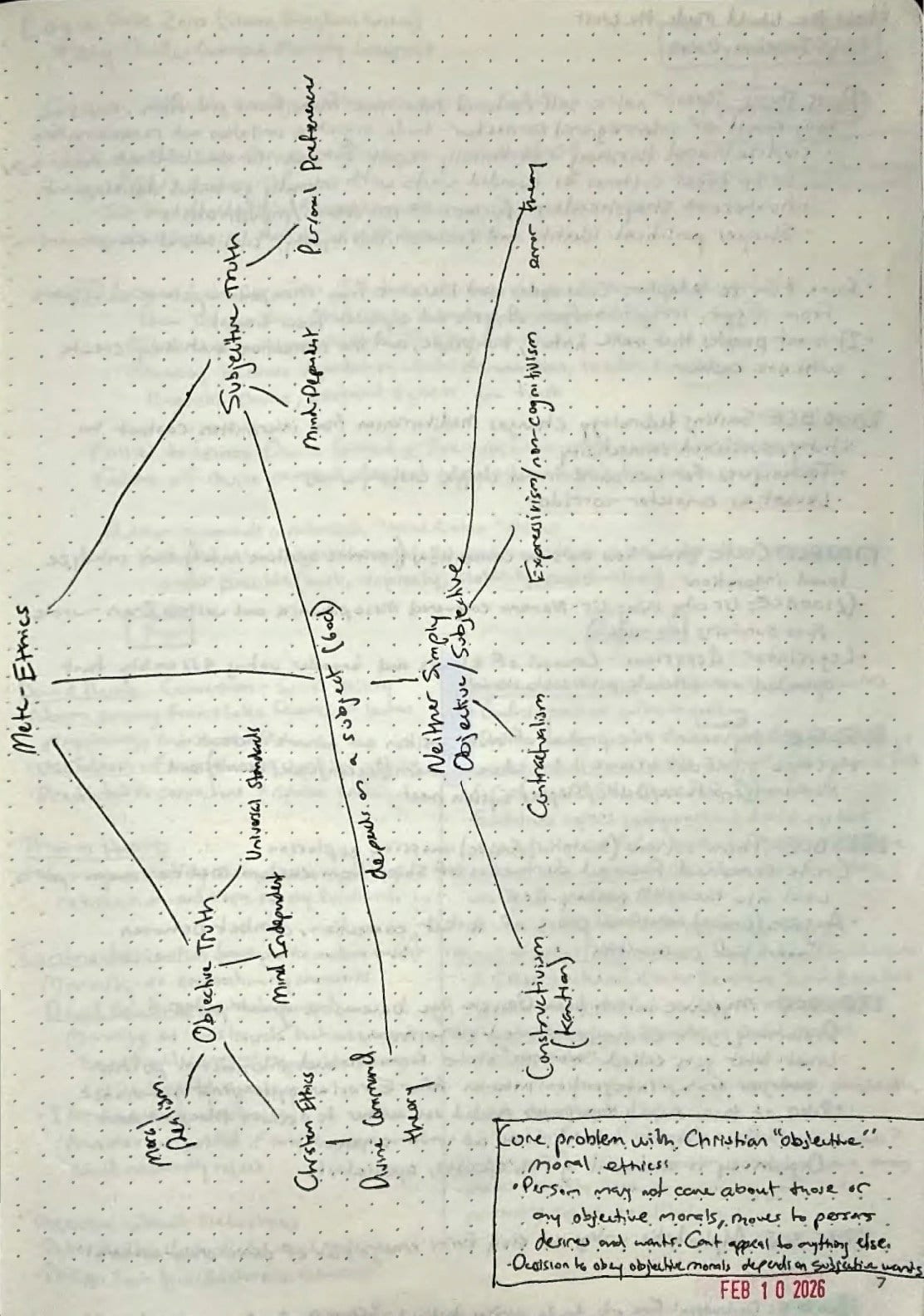
Handwritten Notebook Pages
Source
Open Metaethics notebook pages — start at notebook p. 90 (file not included in this release).
Retrieval questions
- Why can an error theorist still be a cognitivist?
- What does the Frege–Geach problem demand from an expressivist semantics?
- Which part of a theory is addressed by the open-question argument?
- How do subjectivism, relativism, and constructivism differ?
- What must a moral naturalist explain beyond identifying a natural property?