Haidt’s Chapter 6 challenge — utilitarianism as a “one-receptor” cuisine
Haidt’s fictional True Taste restaurant serves only sweeteners because sweetness gives the strongest pleasure signal. He uses its failure as an analogy for Bentham’s felicific calculus: welfare is real and morally important, but a theory can become psychologically narrow if one metric erases loyalty, authority, sanctity, character, or relationship. He also presents Bentham’s calculus as a remarkable achievement of systemization.
This is an objection about descriptive adequacy and practical moral psychology, not a refutation of consequentialism. Haidt explicitly rejects judging a theory by its founder’s psychology, and his retrospective suggestion that Bentham might now receive an Asperger’s diagnosis is speculative. Rule and indirect consequentialists can also count the effects of stable dispositions, institutions, and relationships. True Taste and moral monism, PDF pp. 136–138 (file not included in this release) · Bentham, systemizing, and the calculus, PDF pp. 142–147 (file not included in this release) · Chapter 6 source audit
Pinker’s Chapter 7 supplement — suffering, species, and imperfect behavioral proxies
Pinker treats animal welfare as the clearest rights expansion that cannot be explained by reciprocity: laboratory rats, livestock, and animals used in entertainment cannot organize or repay their advocates. Bentham’s question—whether an animal can suffer—supplies the utilitarian criterion; Peter Singer’s Animal Liberation extends it into a critique of “speciesism.” Pinker also preserves limits: sentience is uncertain at some biological boundaries, many human–animal conflicts are zero-sum, and concern for animals does not guarantee concern for humans.
He grounds the change in a personal failure. As a twenty-year-old laboratory assistant in 1975, Pinker left a rat in an avoidance-conditioning box overnight. The rat failed to learn the lever and was shocked every six seconds until Pinker found it cold, convulsing, and beyond rescue. He says he had already suspected the procedure was wrong but complied because it was standard practice. The story is an autobiographical confession and ethical illustration, not a prevalence estimate for laboratories then or now.
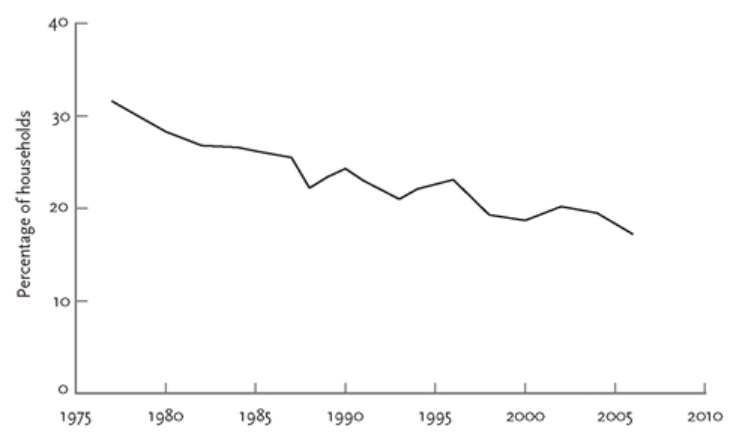
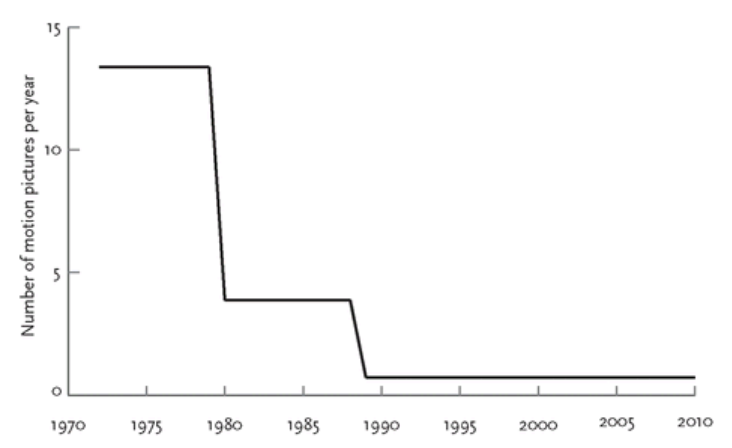
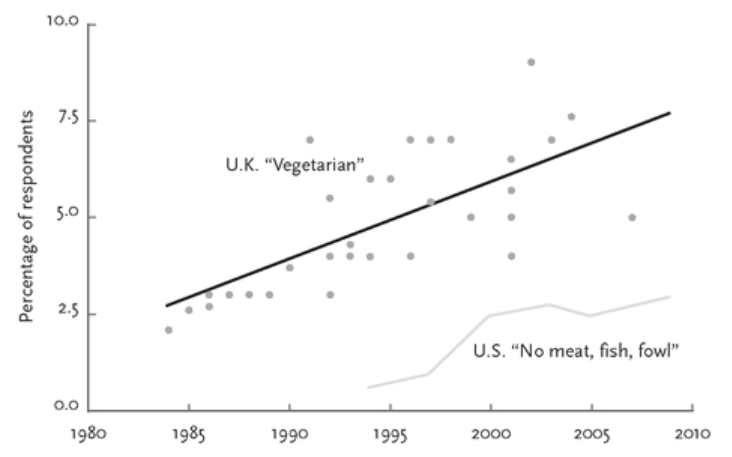
Figures 7-26 to 7-28 — Hunting households, films with recorded animal harm, and vegetarian self-identification, 1972–2010. Fewer U.S. households reported a hunter from 1977–2006 while wildlife watching rose in separate Fish and Wildlife data; the graph does not isolate compassion from urbanization, aging, cost, or leisure change. Figure 7-27 comes from the American Humane Association’s certification system and can depend on which films were monitored and how “unacceptable” treatment was recorded. Figure 7-28 combines heterogeneous U.K. polls and stricter U.S. questions; the fitted line rises from a low base, while definitions and samples vary. Pinker’s “Broiler Chicken Revolution” is the countertrend: growing chicken consumption can increase the number of animals suffering even while attitudes become more humane. These figures support moral and institutional change, not a simple claim that aggregate animal suffering fell. Chapter 7 synthesis · The rat and laboratory reform, PDF pp. 630–633 (file not included in this release) · Bentham, Singer, and the expanding circle, PDF pp. 643–645 (file not included in this release) · Figure 7-26, PDF p. 648 (file not included in this release) · Figure 7-27, PDF p. 650 (file not included in this release) · Chicken countertrend and Figure 7-28, PDF pp. 651–654 (file not included in this release) · Figure 7-28, PDF p. 653 (file not included in this release)
Pinker’s Chapter 8 supplement — trolley dilemmas are brain evidence, not a moral verdict
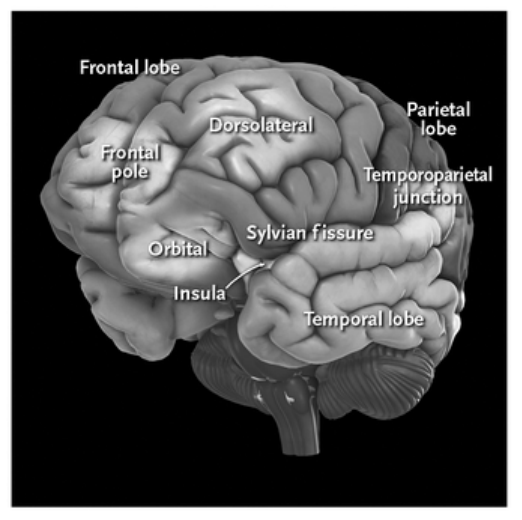
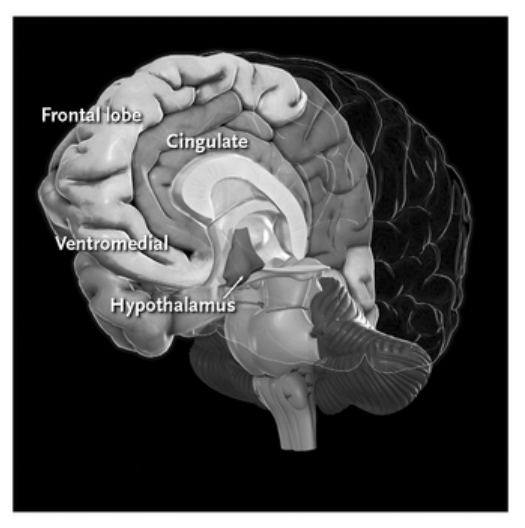
Pinker uses the footbridge and related trolley dilemmas to distinguish an emotionally vivid, personal act of harm from an impersonal calculation with the same body count. In the early neuroimaging literature he summarizes, personal-harm dilemmas engaged regions associated with emotion and social valuation, while difficult tradeoffs also recruited dorsolateral control and anterior-cingulate conflict monitoring. Patients with damage to orbital or ventromedial regions were reported as more willing to endorse personally harming one person to save several.
Figures 8-3 and 8-4 — Cortical orientation views used in Pinker’s discussion of moral judgment and regulation. The findings are descriptive and source-dated. Activation does not tell us which judgment is ethically correct, a lesion does not turn a patient into a philosophical theory, and no region is a self-contained “utilitarian” or “deontological” module. The experiments therefore inform moral psychology without settling utilitarianism. Chapter 8 synthesis · Figure 8-3, PDF p. 695 (file not included in this release) · Figure 8-4, PDF p. 696 (file not included in this release) · Trolley dilemmas and moral judgment, PDF pp. 700–703 (file not included in this release)
Haidt’s Chapter 3 companion — the fMRI contrast describes judgment; it does not justify it
Haidt reports Joshua Greene and Jonathan Cohen’s early fMRI study of eighteen participants judging personal- and impersonal-harm dilemmas. Direct personal harm, such as pushing a person from a footbridge, produced greater activity in regions associated with emotional processing; the pattern helps explain why an apparently identical one-for-five arithmetic tradeoff can feel different when the act is bodily and intentional.
The inference must stop before ethical validation. Affective activation cannot prove that the deontological response is a rationalization, that the utilitarian answer is objectively correct, or that calculation is emotion-free. The chapter’s own endnote says the original claim that utilitarian answers took longer was later challenged as an artifact of the selected stories. Neuroscience can constrain a psychological story about how a verdict forms; utilitarianism still needs an independent normative defense. Greene study, PDF pp. 86-88 (file not included in this release) · Endnotes 40-43, PDF p. 374 (file not included in this release) · Chapter 3 source audit
Definition
- Utilitarianism is an ethical theory that determines right from wrong by focusing on outcomes. It is a form of consequentialism.
- Utilitarianism holds that the most ethical choice is the one that will produce the greatest good for the greatest number.
Proponents
- Jeremy Bentham
- John Stuart Mill
- Henry Sidgwick
Main Ideas
Utilitarianism: Overview
Utilitarianism is a consequentialist ethical theory that suggests that the moral worth of an action is determined by its outcome. The guiding principle of utilitarianism is often summarized as: “the greatest happiness for the greatest number.” In this framework, an action is considered morally right if it leads to the greatest amount of pleasure or well-being, and wrong if it leads to pain or harm.
Key Concepts in Utilitarianism:
- Happiness/Pleasure as the Ultimate Goal:
• Utilitarianism is hedonistic, meaning it considers pleasure (or happiness) as the ultimate good and pain (or suffering) as the ultimate bad. - Maximization of Utility:
• “Utility” refers to the overall well-being or happiness. Utilitarianism emphasizes maximizing the total utility (happiness) for everyone affected by the action. - Impartiality:
• Utilitarianism requires equal consideration for everyone’s happiness. No one person’s well-being is more important than another’s. - Consequentialism:
• The morality of an action is determined solely by its outcomes (consequences). Good intentions are irrelevant if they lead to bad results, and vice versa.
Types of Utilitarianism:
- Act Utilitarianism:
• Associated with Jeremy Bentham, act utilitarianism evaluates each individual action by considering whether it maximizes happiness. Every action must be assessed on its own merits based on the specific situation. - Rule Utilitarianism:
• Associated with John Stuart Mill, rule utilitarianism suggests that instead of evaluating each action, we should follow general rules that tend to maximize happiness in the long run. Rules like “tell the truth” or “don’t steal” usually lead to better consequences overall, so they should be followed.
Important Thinkers in Utilitarianism
Jeremy Bentham (1748-1832):
• Bentham is often regarded as the founder of modern utilitarianism.
• His key work, An Introduction to the Principles of Morals and Legislation (1789), introduced the idea that actions are judged by their ability to produce pleasure or reduce pain.
• Bentham proposed the “felicific calculus” (also known as the hedonic calculus) as a way to measure pleasure and pain, based on factors like intensity, duration, certainty, and extent (how many people are affected).
• He was a strong advocate for social reform, including legal reforms and animal rights, promoting actions that would lead to the greatest well-being for the largest number of people.
Key Ideas:
• Act Utilitarianism: Each action should be judged by whether it maximizes happiness.
• Felicific (Hedonic) Calculus: A method for calculating the pleasure and pain an action might produce.
John Stuart Mill (1806-1873):
• Mill is one of the most influential thinkers in utilitarianism. His work Utilitarianism (1861) expanded upon Bentham’s ideas while introducing several refinements.
• Mill distinguished between higher and lower pleasures, arguing that intellectual and moral pleasures (e.g., reading, personal growth) are superior to physical pleasures (e.g., food, drink).
• He advocated Rule Utilitarianism, suggesting that people should follow general rules (e.g., “tell the truth”) that, if followed by everyone, would lead to greater overall happiness.
• Mill also addressed common criticisms of utilitarianism, defending it against claims that it was a “doctrine worthy only of swine” (i.e., only focused on base pleasures).
Key Ideas:
• Higher and Lower Pleasures: Intellectual pleasures are of higher quality than mere physical pleasure.
• Rule Utilitarianism: Following rules that generally promote happiness leads to better outcomes than evaluating each action individually.
Henry Sidgwick (1838-1900):
• Sidgwick was another key utilitarian philosopher who contributed to refining and formalizing utilitarian ideas.
• His book The Methods of Ethics (1874) is considered one of the most comprehensive treatments of utilitarian ethics.
• He stressed the importance of rationality in ethics and believed that utilitarianism provided a rational foundation for morality.
Key Ideas:
• Emphasized practical reasoning in ethics.
• Attempted to reconcile utilitarianism with other ethical theories like intuitionism.
G.E. Moore (1873-1958):
• Although Moore is often known for his contributions to ethical intuitionism, his work Principia Ethica (1903) introduced the concept of ideal utilitarianism.
• He argued that aesthetic experiences and personal relationships are intrinsically valuable, expanding utilitarian thought beyond just pleasure and pain.
Key Ideas:
• Ideal Utilitarianism: Other things, like beauty and personal relationships, are valuable in themselves, not just happiness.
Strengths of Utilitarianism:
• Practical and Flexible: It focuses on outcomes, which makes it adaptable to a wide range of situations.
• Promotes Well-Being: By aiming to maximize happiness, utilitarianism encourages actions that promote the general good.
• Impartiality: Everyone’s happiness is given equal consideration, which makes it egalitarian.
Criticisms of Utilitarianism:
• Too Demanding: Utilitarianism requires that individuals always act to maximize the overall good, which may be unrealistic or overly demanding.
• Ignores Individual Rights: By focusing on the greatest good for the greatest number, utilitarianism can justify actions that harm individuals or violate their rights (e.g., sacrificing one person to save many).
• Measurement Problems: It’s difficult to measure and compare happiness or well-being, especially when considering different types of pleasure.
• Potential for Immorality: Utilitarianism could justify morally questionable actions (like lying or killing) if they lead to a greater overall benefit.
Modern Influence
Utilitarianism remains a highly influential theory in ethics, especially in fields like public policy, law, and economics, where decision-makers often weigh the consequences of actions in terms of costs and benefits. It’s also foundational in areas like effective altruism, where the goal is to do the most good with available resources.
Criticisms
- trouble accounting for values such as justice and individual rights
- most reason-based approach to determining right and wrong, it has obvious limitations.