An Introduction to Political Philosophy by Jonathan Wolff
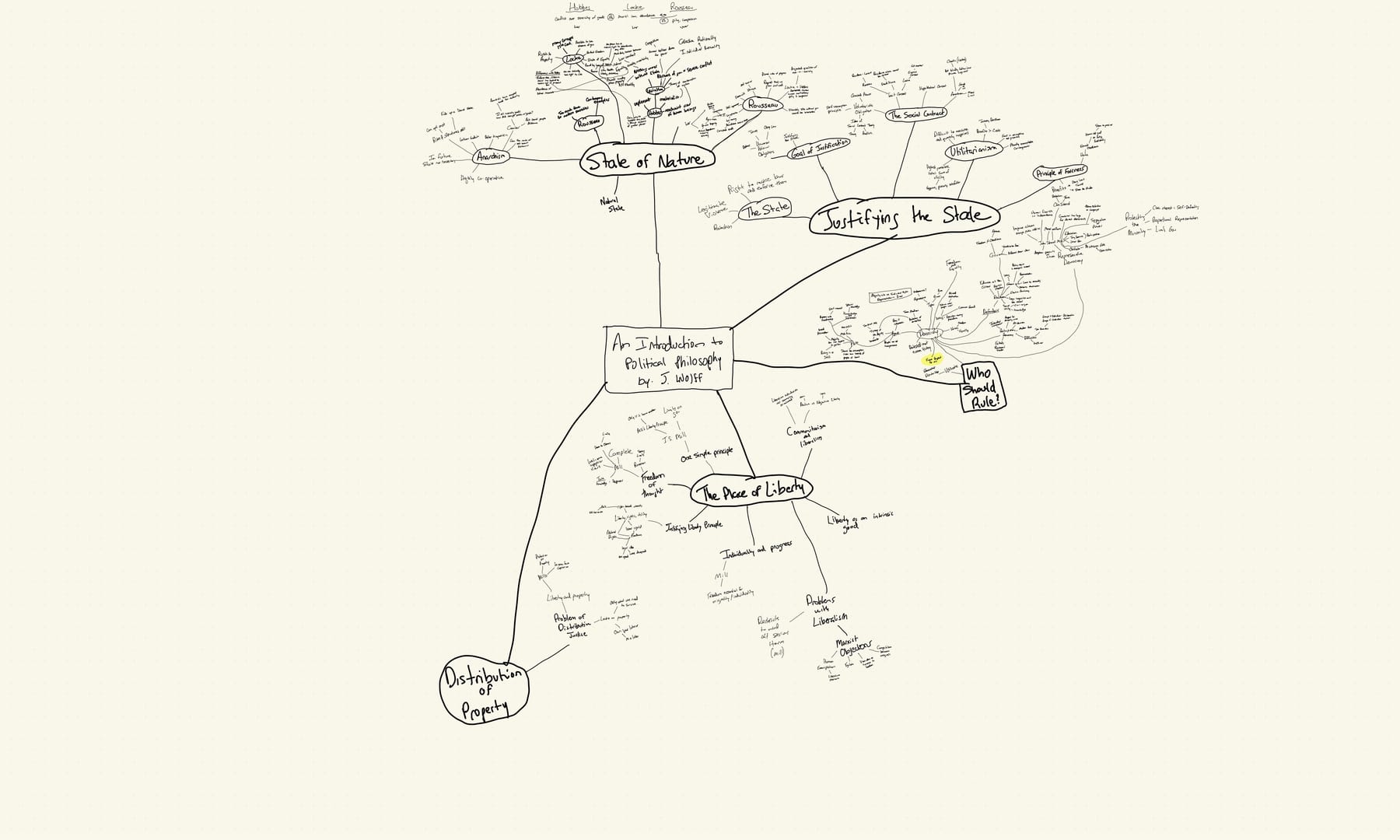
Intoduction
Here is a bullet-point summary of the main ideas from the provided text from Jonathan Wolff’s An Introduction to Political Philosophy (pages 13-17):
-
Core Questions of Political Philosophy: Political philosophy is often boiled down to two key questions:
- Who gets what? (concerns the distribution of material goods, rights, and liberties).
- Says who? (concerns who has political power and the authority to enforce laws).
-
Political Power: Political power is defined as the right to create laws and punish those who disobey. There is a fundamental question as to why one person should have this power over another.
-
Interplay of Wealth and Power: In many societies, wealth and political power are intertwined, but political philosophy questions whether this connection is justified.
-
Autonomy vs. Authority: Political philosophers aim to find the balance between individual freedom (autonomy) and the power of the state (authority). Anarchists emphasize autonomy, while authoritarians stress the importance of state power.
-
Normative vs. Descriptive Studies:
- Normative political philosophy asks how things ought to be, establishing ideal standards for justice, liberty, and power distribution.
- Descriptive political studies focus on how things actually are, describing the distribution of goods, power, and behavior in society.
-
Human Behavior and Normative Philosophy: Normative theories of justice must be informed by realistic views of human behavior and motivation. Political philosophy requires a balance between understanding how things are and proposing how they should be.
-
Methodology of Political Philosophy: Philosophers use logical reasoning and arguments to address political questions, drawing distinctions, and testing for consistency between different propositions.
-
Practical Necessity of Political Philosophy: While some philosophical questions (e.g., free will) can be left unanswered, political philosophy is unavoidable because political power and property distribution affect everyone. Inaction or disinterest results in endorsing the status quo.
-
Structure of the Book: The book will explore key questions of political philosophy, including:
- The state of nature (life without government).
- Political obligation (why obey the state?).
- Democracy vs. other forms of governance.
- The balance between state power and individual liberty.
- Distributive justice (how goods should be distributed in society).
This summary covers the main points Wolff introduces in the early pages of his book, setting the stage for deeper exploration of political philosophy’s enduring questions.
1. The State of Nature
Here is a bullet-point summary of the main ideas from Jonathan Wolff’s An Introduction to Political Philosophy (pages 18-45), specifically focusing on the concept of the “state of nature”:
- State of Nature as a Thought Experiment:
- Political philosophers, such as Hobbes, Locke, and Rousseau, use the idea of a “state of nature” to explore life without government or political power.
- It serves as a thought experiment to understand why we have a state and what life would be like without it.
Hobbes’s View of the State of Nature:
- State of Nature as a State of War: Hobbes describes the state of nature as a place of constant fear, violence, and insecurity.
- Human Nature: Hobbes believes that humans are driven by self-preservation and a desire for power, which leads to competition and conflict.
- Three Causes of War:
- Competition (for resources),
- Diffidence (fear of others),
- Glory (seeking reputation).
- Life without Government: Hobbes famously describes life in the state of nature as “solitary, poor, nasty, brutish, and short.”
- Rationale for a State: The fear of violent death would eventually lead humans to form a state for protection and order.
Locke’s View of the State of Nature:
- More Optimistic View: Locke believes the state of nature could be peaceful and governed by natural laws.
- Natural Law: In the state of nature, people have a moral duty to preserve life, health, liberty, and property, which Locke sees as inherent rights granted by God.
- State of Nature Not a State of War: Locke distinguishes between the state of nature and a state of war, emphasizing that people can coexist peacefully without government.
- Right to Punish: In the state of nature, individuals have the right to punish transgressors and enforce natural law, but disputes over justice might still lead to conflict.
- Property and Scarcity: Locke argues that initially, there was plenty of land and resources, so conflict over resources was rare. However, the introduction of money and property leads to inequality and eventual disputes, creating the need for government.
Rousseau’s View of the State of Nature:
- Natural Man and Compassion: Rousseau believes that humans are motivated by self-preservation but also by compassion, which restrains them from harming others.
- Criticism of Hobbes and Locke: Rousseau argues that both philosophers project traits of modern, socialized humans onto natural man, who, according to him, was solitary and peaceful.
- Minimal Desires in Nature: Rousseau depicts the natural man as having few desires and little foresight, reducing competition and conflict. The introduction of society, agriculture, and property corrupts human nature and leads to inequality and war.
- Inevitability of Conflict in Society: Rousseau admits that while the state of nature was peaceful, the development of civilization eventually leads to conflict and war.
Anarchism and the State of Nature:
- Challenges to Hobbes and Locke: Anarchist thinkers like Godwin and Kropotkin argue that humans, when perfected, can be cooperative and non-aggressive, making the state unnecessary.
- Mutual Aid: Kropotkin suggests that cooperation, rather than competition, is the key to human survival and evolution.
- Critique of Government: Anarchists claim that governments are often the source of anti-social behavior and that society can be organized through voluntary cooperation and mutual support without the need for a state.
- Tension with Reality: Despite these claims, even anarchists acknowledge the need for some form of social control and coordination, making the distinction between anarchism and a liberal democratic state less clear.
Conclusion:
- While Hobbes, Locke, and Rousseau offer differing views of the state of nature, all agree that it eventually leads to conflict, making some form of government necessary.
- Anarchists provide an optimistic view of human nature, but their arguments often struggle to distinguish themselves from the need for state-like structures.
This overview captures the philosophical debate on the state of nature and its implications for the justification of political power and government.
2. Justifying the State
Here is a summary of the main ideas from Jonathan Wolff’s An Introduction to Political Philosophy (pages 46-73), focusing on the justification of the state:
Introduction to Justifying the State:
- Necessity of the State: Without a state, life in the state of nature becomes intolerable due to a lack of enforceable restraints on individuals, as argued by philosophers like John Stuart Mill.
- Negative Justification: Many argue that the state is justified simply because there is no viable alternative.
- Positive Justification: Defenders of the state aim to show that individuals have a moral duty to obey the state through more concrete arguments such as consent, utilitarianism, and fairness.
Consent Theory (Locke):
- Autonomy and Consent: Locke asserts that humans are naturally free, equal, and independent. Legitimate political power must be based on consent.
- Social Contract: Locke’s theory relies on the idea that individuals consent, either explicitly or tacitly, to give up certain freedoms in exchange for the protections of the state.
- Criticism: The idea that everyone has given consent to the state is questioned, particularly regarding those who have never explicitly agreed to its authority.
Utilitarian Justification (Bentham):
- Happiness as the Primary Value: Utilitarians like Jeremy Bentham argue that the state is justified if it maximizes the overall happiness of society.
- State vs. State of Nature: Utilitarianism suggests that the state produces more happiness than the chaos of the state of nature, thereby justifying its existence.
- Criticism of Utilitarianism: The theory may justify morally questionable acts, such as punishing innocent individuals, if it increases the general happiness (e.g., the scapegoat objection).
The Principle of Fairness:
- Fair Distribution of Benefits and Burdens: H.L.A. Hart argues that those who benefit from the state’s laws and protections have a duty of fairness to obey the laws and contribute to the state.
- Criticism by Nozick: Robert Nozick challenges this by arguing that unsolicited benefits (such as those provided by the state) do not create an obligation to reciprocate or follow its laws.
Tacit and Hypothetical Consent:
- Tacit Consent: Locke suggests that by enjoying the state’s protection and benefits, individuals give tacit consent to its authority. Critics, like David Hume, argue that staying in a country cannot be equated to genuine consent, as leaving may not be a feasible option.
- Hypothetical Consent: Even if individuals have not explicitly consented, theorists argue that rational people would choose to enter a social contract if they found themselves in the state of nature. However, this form of consent is criticized as too hypothetical and disconnected from real-world obligations.
Anarchism and the State:
- Philosophical Anarchism: Anarchists argue that if the state’s authority cannot be justified through voluntary consent, its legitimacy is questionable. They maintain that individuals should not feel obligated to obey the state unless it aligns with their own moral judgments.
- Criticism of Anarchism: The anarchist view is seen as promoting moral self-indulgence, where individuals follow personal codes rather than shared laws, potentially leading back to chaos similar to the state of nature.
Conclusion on Justifying the State:
- Incomplete Theories: Each justification for the state—whether through consent, utilitarianism, or fairness—has its weaknesses. None provides a universal obligation for all citizens to obey the state.
- Practical Implications: Despite these theoretical issues, most people still follow the law because of the practical benefits of living in a stable society. The state may enforce its authority even on those who question its legitimacy, but it typically acts with the approval of the majority.
This summary outlines the various theories presented in these chapters regarding how the state’s authority might be justified and the criticisms each theory faces.
3. Who Should Rule?
Here is a bullet-point summary of the main ideas from Jonathan Wolff’s An Introduction to Political Philosophy (pages 74-115), focusing on the concept of “Who Should Rule?”:
Introduction to the Question of Rule:
- Rousseau’s View on Freedom: The people of England are free only during elections. Once representatives are elected, the people fall back into what Rousseau considers “slavery” under the rulers.
- Who Should Rule?: Philosophical debates surrounding whether democracy, aristocracy, or dictatorship is the best form of governance. Democracy is often seen as the most justifiable, but Wolff questions if it really deserves its reputation.
Democracy:
- Government “of, by, and for the people”: Democracy is typically understood as a system where the government exists for the people, represents the people’s interests, and is ruled by the people. However, alternative systems (like a benevolent dictatorship) also claim to work for the people’s benefit.
- Majority Rule vs. Individual Rights: A tension exists between the concept of majority rule and protecting individual rights. This issue, famously called “the tyranny of the majority” by Alexis de Tocqueville, is explored in democratic theory.
Debates on Democratic Models:
- Direct vs. Representative Democracy: Direct democracy, where citizens vote on every law or policy, contrasts with representative democracy, where elected officials make decisions on behalf of the people.
- Concerns with Majority Rule: Majority rule can often suppress the rights of the minority, leading theorists like John Stuart Mill to argue for the protection of minority rights in democratic systems.
Plato’s Opposition to Democracy:
- Plato’s Craft Analogy: Plato argues that just as only trained experts should navigate a ship, only philosophers or trained rulers should govern a state. He equates democracy to allowing unskilled sailors to steer a ship, leading to disaster.
- Philosopher Kings: Plato believed that philosophers, trained in reason and justice, should rule since they are best equipped to understand the common good.
Problems with Guardianship:
- Corruption Risk: Plato’s guardians are prone to corruption, even if they are experts. Who will guard the guardians? The philosopher kings could still manipulate their power for personal gain.
- Disinterest in Power: Plato acknowledges that philosopher kings might not desire power, but they accept the role to avoid worse rulers from taking control.
Democratic Critiques and Defenses:
- Expert Knowledge in Ruling: Some critics argue that expert rulers may not have sufficient knowledge of the public’s real interests. Moreover, people’s interests are varied, making it difficult to determine a single “common good.”
- Voting and Preferences: Voting often fails to reflect people’s true preferences because individuals might vote based on moral principles rather than their own self-interest, creating “mixed-motivation voting.”
The Values of Democracy:
- Freedom and Equality: Democracy is valued not only for achieving the common good but also for embodying freedom (allowing people a say in decisions) and equality (giving all citizens an equal voice in governance).
- Intrinsic Value: Democracy may be intrinsically valuable, even if it doesn’t always lead to the best outcomes. It allows citizens to exercise political agency and fosters freedom and equality in society.
Rousseau’s General Will:
- Common Interest: Rousseau distinguishes between the “will of all” (individual self-interest) and the “general will” (common interest). Laws, in Rousseau’s view, should express the general will.
- Elimination of Class Differences: Rousseau argues that a true democracy requires equality among citizens. Large disparities in wealth undermine the formation of a general will.
Participatory Democracy:
- Participatory Involvement: Contemporary critiques of Rousseau’s model call for more individual involvement in political decision-making, beyond just legislation.
- Technological Solutions: Modern technology, such as the internet, could make direct participation in politics more feasible, allowing for broader engagement.
This summary provides an overview of the various philosophical debates discussed in these pages, including critiques of democracy, Plato’s objections, Rousseau’s defense of the general will, and the evolving models of participatory democracy.
4. The Price of Liberty
Here is a bullet-point summary of the key ideas from Jonathan Wolff’s An Introduction to Political Philosophy (pages 116-144), focusing on John Stuart Mill’s concept of liberty:
Mill’s Principle of Liberty (Harm Principle):
- Core Principle: Power can only be rightfully exercised over individuals against their will to prevent harm to others. Personal good (physical or moral) is not sufficient justification for interference (from On Liberty).
- Limitations of Democracy: Even in a democracy, the tyranny of the majority is a real threat. The majority can pass laws that oppress minorities, so protections against such oppression are necessary.
Balancing Freedom and Authority:
- Spectrum of Views: Political views range from anarchism (complete individual freedom) to absolutism (complete state control). Mill positions himself between these extremes, advocating for a balance where the state can intervene, but only when necessary to prevent harm.
- Liberty and Moral Progress: Mill argues that liberty is essential for moral and intellectual progress. He believes that freedom fosters individuality, which leads to social progress.
Freedom of Thought and Expression:
- Advocacy for Unpopular Views: Mill asserts that even the most unpopular views should not be silenced, as suppressing them would harm society. Suppressing true views robs humanity of truth, and even suppressing false views deprives society of the opportunity to reaffirm its beliefs.
- Truth vs. Certainty: Mill emphasizes the difference between being certain of an opinion and assuming its absolute truth. History has shown that many long-held beliefs turned out to be false, highlighting the importance of open debate.
Limits on Freedom of Expression:
- Harm to Others: Mill agrees that free expression can be limited if it poses a direct harm to others. For example, inciting violence through speech could justifiably be restricted to protect public safety.
Defining Harm:
- Self-Regarding vs. Other-Regarding Actions: Mill distinguishes between actions that affect only the individual and those that impact others. Society has no right to intervene in self-regarding actions, but may regulate other-regarding actions.
- Challenge of Defining Self-Regarding Actions: Critics argue that even seemingly self-regarding actions can affect others indirectly, complicating the application of Mill’s principle.
Rights and Utility:
- Utility as the Foundation: Mill bases rights not on abstract concepts, but on utility (the idea of promoting happiness). He argues that respecting individual rights maximizes overall happiness in the long run.
- Rights-Based Interests: Mill introduces the idea of rights-based interests, where certain individual interests (like safety) are protected by laws because they contribute to the general well-being of society.
Liberty and Individuality:
- Importance of Individuality: Mill argues that individuality is essential to human flourishing. A society that promotes personal freedom and the ability to engage in “experiments in living” fosters innovation, creativity, and personal growth.
- Progress through Experimentation: Allowing individuals to live in diverse ways promotes social progress, as people can learn from the successes and failures of others.
Criticism of Mill’s Optimism:
- Is Liberty Always Good?: Critics like James Fitzjames Stephen argue that liberty is not always beneficial. Liberty, like fire, can be good or harmful depending on how it is used.
- Human Progress and Liberty: Mill’s case for liberty rests on the assumption that humans are capable of learning from experience and progressing morally. Critics challenge this optimistic view, arguing that human nature may not always lead to progress.
Communitarian Critique:
- Community vs. Individualism: Communitarians criticize Mill’s liberalism for promoting excessive individualism. They argue that humans are inherently social beings whose identities and values are shaped by their communities, and that excessive liberty can lead to social fragmentation.
- Positive Liberty: Communitarians advocate for a concept of “positive liberty,” where individuals are guided by society’s moral values to make the right choices. They believe true freedom comes from social integration, not isolation.
This summary captures Mill’s defense of liberty, the debates around its limits, and critiques of his views, particularly regarding the balance between individual freedom and social cohesion.
5. The Distribution of Property
Here is a bullet-point summary of the main ideas from Jonathan Wolff’s An Introduction to Political Philosophy (pages 145-188), focusing on The Distribution of Property:
The Problem of Distributive Justice:
- David Hume’s Warning: Hume warns that simple solutions to distribution, like assigning the most possessions to the most virtuous, could lead to the dissolution of society. Distributive justice is more complex.
- Liberty and Property (Mill’s View): Mill argues that individual liberty requires protection from harm, including protection of property. However, he does not believe in protection from the workings of a competitive market.
- Mill supports laissez-faire capitalism, but with some social provisions like taxation for welfare.
Theories of Property Rights:
- Libertarianism (Nozick’s View): Libertarians like Robert Nozick believe in very strong natural rights to property, where government interference is limited to protecting individuals’ property rights.
- Nozick’s “minimal state” focuses on the enforcement of property rights and protection from aggression but rejects redistribution of wealth through taxation.
- Welfare Liberalism (Rawls’s View): John Rawls, in contrast to Nozick, argues for redistribution of property to ensure equal liberty for all.
- Rawls supports government intervention to correct inequalities that limit the opportunities of the poor.
Rawls vs. Nozick on Distributive Justice:
- Nozick’s Entitlement Theory: Property is just if it is acquired or transferred according to justice and no one has an initial claim to it.
- Justice in Acquisition: Individuals can gain rights over previously unowned resources.
- Justice in Transfer: Voluntary exchange of property is just, and no one can interfere with it.
- Rawls’s Theory of Justice: Rawls’s principles suggest that inequalities should only exist if they benefit the least advantaged. He emphasizes fair equality of opportunity and rejects the large inequalities that arise from libertarian principles.
Economic Models: Free Market vs. Planned Economy:
- Free Market Capitalism: In a free market, goods and resources are allocated through voluntary exchanges based on supply and demand. It promotes efficiency and individual liberty but can lead to vast inequalities.
- Hayek’s Argument: F. A. Hayek argues that the market functions as an efficient information system, signaling shortages and surpluses through price mechanisms.
- Planned Economy: In a planned economy, the state controls resources and production to meet the needs of all citizens. While theoretically more equitable, planned economies have historically struggled with inefficiencies, shortages, and limited consumer choice.
Criticisms of the Free Market:
- Engels on Wastefulness: Friedrich Engels argues that capitalism is wasteful, prone to crises, and creates unproductive roles, such as middlemen, which contribute nothing to production.
- Alienation of Workers (Marx): Workers in capitalist societies often face alienation due to the division of labor, where their work becomes monotonous and disconnected from their humanity.
- Exploitation: Marxists argue that capitalists exploit workers by extracting surplus value from their labor. Those who own property benefit without contributing equivalent labor.
Utilitarian Defense of the Market:
- Maximizing Happiness: Utilitarians argue that the free market system maximizes happiness by encouraging productivity and rewarding efficiency. Inequality can sometimes incentivize hard work and innovation, ultimately benefiting society.
Rawls’s Theory of Justice (Expanded):
- Original Position and Veil of Ignorance: Rawls’s hypothetical contract places individuals in an “original position” where they are ignorant of their social status. This ensures impartiality when choosing principles of justice.
- Liberty Principle: Equal basic liberties for all.
- Difference Principle: Inequalities are acceptable only if they benefit the least advantaged.
- Fair Opportunity Principle: Everyone should have fair access to positions of advantage, regardless of their starting point in life.
This section delves into the philosophical debates over how property and resources should be distributed in society, comparing libertarian and welfare liberal approaches, while discussing the moral and practical justifications of the free market system versus alternatives like socialism.
6. Individualism, Justice, Feminism
Here is a bullet-point summary of the key ideas from Jonathan Wolff’s An Introduction to Political Philosophy (pages 189-211), focusing on Individualism, Justice, and Feminism:
Individualism vs. Anti-Individualism:
-
Individualism Assumptions:
- Liberal individualism emphasizes that individuals are naturally free, equal, and independent (e.g., Locke’s perspective).
- The focus is on formulating abstract principles of justice that assign rights and duties to individuals.
- Liberal individualists prioritize freedom and equality, with justice being considered the first virtue of social institutions.
-
Challenges to Individualism:
- Communitarianism: Opposes individualism by asserting that individuals are shaped by society and that their identity is deeply connected to social customs and traditions.
- Conservatism: Critiques the idea that political philosophy should focus on reason and abstract principles, emphasizing the value of tradition and inherited institutions instead (e.g., Burke’s view).
- Holism: Philosophers like F. H. Bradley argue that individuals are inseparable from their social and cultural contexts, rejecting the individualist notion that rights and duties stem solely from individual actions.
Feminist Critique of Liberal Individualism:
-
Equality and Women’s Rights: The feminist demand for equal rights is rooted in liberal individualist values, but feminists argue that formal equality is insufficient to address deeper systemic inequalities.
- Discrimination: Despite laws against discrimination, women still face subtle forms of bias, especially in employment and pay.
- Special Needs and Rights: Feminists argue for recognizing the distinct needs of women, particularly related to childbirth and child-rearing, which require specific rights and policies (e.g., parental leave).
-
Gender Roles and Social Construction: Feminists draw a distinction between biological sex and socially constructed gender roles, arguing that many traditional roles are arbitrary and should be subject to change.
Affirmative Action:
-
Purpose of Affirmative Action: Aims to correct historical injustices and provide equal opportunities for disadvantaged groups, including women and minorities.
- Forms of Affirmative Action: Can range from recruitment efforts to preferential hiring or admissions based on race or gender.
- Criticisms: Affirmative action is often criticized for being discriminatory, counterproductive, and stigmatizing beneficiaries. Critics argue that it undermines meritocracy.
-
Defenses of Affirmative Action:
- Equality of Opportunity: Affirmative action compensates for inequalities in access to education and resources.
- Social Utility: It promotes diversity and serves the needs of underrepresented communities (e.g., providing black professionals for underserved neighborhoods).
- Reparation: It is seen as a way to make reparations for historical injustices, such as the legacy of slavery or systemic discrimination against women.
Feminist Proposals Beyond Affirmative Action:
- Social Policy and Gender Roles: Feminists call for broader social reforms, such as replacing maternity leave with parental leave, to challenge traditional gender roles and promote equality in the workplace and family life.
- Critique of Capitalism: Some feminists argue that capitalism is inherently linked to patriarchy and must be overthrown to achieve true gender equality.
Feminist Ethics and Justice:
- Justice vs. Care: Feminist theorists like Nancy Chodorow and Carol Gilligan argue that traditional concepts of justice are gendered, reflecting male values of abstraction and separation. Women, on the other hand, are seen as valuing connectedness and care, which are often neglected in political philosophy.
- Justice as a Male Perspective: Justice, according to some feminists, prioritizes abstract rights over personal relationships and care, reflecting a male-centric view of morality and social organization.
- Incorporating Care: While justice remains important, feminist critics argue for a more nuanced approach that includes care and attention to the specific needs of individuals.
Conclusion:
- Balancing Justice and Care: Political philosophy should aim to balance abstract principles of justice with the virtues of care and citizenship. Feminist theory suggests enriching the concept of justice to address systemic inequalities and promote more meaningful human relations.
This section delves into feminist critiques of liberal individualism, the role of affirmative action, and the tension between justice and care in political philosophy.