Pinker’s Chapter 5 supplement — “democratic peace” is dyadic, not democratic innocence
Pinker’s strongest version of the claim is not that democracies are peaceful in every setting. Mature democracies have fought nondemocracies, acquired and defended empires, conducted covert interventions, and can experience civil conflict. The narrower dyadic hypothesis is that two established democracies are less likely to fight one another. Pinker favors Russett and Oneal’s quantitative version: among country-pairs at risk of conflict from 1886–2001, a fully autocratic less-democratic partner roughly doubled the chance of a militarized dispute relative to an average pair, while two full democracies cut it by more than half after specified controls.
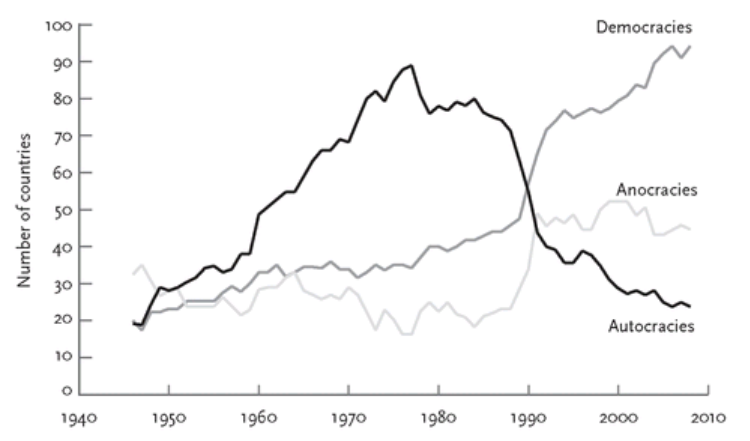
Figure 5-23 — Democracies, autocracies, and anocracies, 1946–2008. The chart supports Pinker’s chronological premise that democracy expanded in the postwar decades; it is not a current regime count. The peace result depends on definitions of democracy and war, substitutes militarized disputes for the much smaller number of full wars, and remains entangled with wealth, education, trade, alliances, institutions, geography, and prior political norms. Pinker explicitly rejects using the thesis as a warrant to invade autocracies and notes that fragile democracies can host disproportionate civil war. Chapter 5 synthesis · The democratic-peace mechanisms, PDF pp. 394–396 (file not included in this release) · Figure 5-23 and proposed counterexamples, PDF pp. 396–398 (file not included in this release) · Definitions, controls, and militarized disputes, PDF pp. 398–401 (file not included in this release) · Results and causal limits, PDF pp. 401–402 (file not included in this release)
Pinker’s Chapter 6 supplement — anocracy is not a halfway house to peace
Pinker’s cited fragility analysis found that anocracies—regimes combining democratic and autocratic elements—were about six times as likely as democracies and two-and-a-half times as likely as autocracies to undergo a new societal war. In civil-war models summarized from Bethany Lacina, conflicts in democracies caused fewer than half as many battle deaths after the specified controls. Barbara Harff’s analysis of political crises from 1955–2008 found autocracies about 3.5 times as likely as full or partial democracies to commit genocide or politicide; partial democracies could be more crisis-prone yet, conditional on crisis, less genocidal than autocracies.
These are historical model estimates and associations, not universal laws or a license for externally imposed regime change. Definitions, controls, case selection, and the chapter’s 2011 evidence horizon matter. The useful distinction is between electoral labels and the institutional capacity, constraints, and legitimacy that make a regime stable. Chapter 6 synthesis · Regime type, civil war, and anocracy, PDF pp. 436–441 (file not included in this release) · Regime type and genocide risk, PDF pp. 477–479 (file not included in this release)
Henrich, Chapter 9 — medieval self-government as an institutional pathway, not democracy’s single origin
Henrich locates an early pathway to representation in western European towns. Charters and sworn urban associations granted market rights, stronger property claims, courts, tax privileges, and partial self-government; by 1500, he says most western European cities were at least partly self-governing. Magdeburg Law spread through daughter cities and began separating family from individual criminal liability. London obtained elected sheriffs and local courts while loosening blood money, trial by combat, and inherited limits on land sales. These were not modern liberal democracies, but they trained practices of oath-bound office, election, individual standing, and rule-governed association. town charters and partial self-government, PDF pp. 312–313 (file not included in this release) · Magdeburg, Lübeck, and London, PDF pp. 313–315 (file not included in this release)
Figure 9.6 associates centuries of local Western Church exposure with the modeled probability that an urban area adopted some representative government. The result is historically suggestive, not proof that “the Church caused democracy”: Church entry, urban growth, security, rulers’ fiscal incentives, settlement, trade routes, and political bargaining were not randomly assigned, and the proposed psychological mediator is not directly observed. Nor does an institution’s competitive success establish equal rights, broad suffrage, or justice. Treat this as one prehistory of representative organization alongside classical, Germanic, legal, fiscal, state-building, and material explanations. Church exposure and representative urban government, Figure 9.6, PDF p. 317 (file not included in this release) · urban-law and modeling sources, Chapter 9 endnotes, PDF pp. 576–577 (file not included in this release) · Chapter 9 source audit
Henrich, Chapter 12 — democratic institutions require fit and can then reshape psychology
Henrich proposes three routes from weakened kinship to representative government: greater individual choice and lower automatic deference, more voluntary organizations in which elections and consent rules can be practiced, and fewer dense kin blocs that turn voting into a fixed contest among lineages. His evidence links lower origin-country kinship intensity to immigrant political participation, longer Western Church exposure to medieval urban representation, and lower national cousin-marriage prevalence to higher democratic quality. Representative institutions and psychological fit, PDF pp. 404–409 (file not included in this release) · Cousin marriage and democratic quality, Figure 12.1, PDF p. 409 (file not included in this release)
None is a universal law. Figure 12.1 is a country-level association; the immigrant and medieval-city comparisons are observational; and Henrich reports that allowing people to vote on a rule raises cooperation in some populations but has null or opposite effects in rural China and Mongolia. The strongest causal claim comes from 262 participants in 174 Swiss communities: longer pre-1803 participatory history predicts more conditional cooperation, with Duke Berthold’s unexpected heirless death used as an instrument for earlier autonomy. The design supports a feedback hypothesis only if that shock affects modern psychology principally through democratic exposure. It does not show that elections alone produce liberal rights, competent government, or peace. Swiss democracy and conditional cooperation, PDF pp. 410–411 (file not included in this release) · design and related Italian evidence, Chapter 12 endnotes 29–30, PDF p. 598 (file not included in this release) · Chapter 12 source audit
Core Problem: Democracy Can Destroy Itself
Yes, one of the most famous internal contradictions or vulnerabilities of democracy is that democracy can be used to end itself—that is, through legal, democratic means, the people can vote to establish an anti-democratic regime or leader who then dismantles democratic institutions. This flaw has been recognized and debated by political theorists from ancient Athens to the Founding Fathers and modern philosophers.
⚖️ Core Problem: Democracy Can Destroy Itself
This problem is sometimes referred to as:
- The “paradox of democracy”
- “Democratic suicide”
- Karl Popper’s “paradox of tolerance” (related idea)
- “One man, one vote, one time” – phrase used to describe how democratic elections can lead to authoritarian takeovers
🏛 Historical Perspectives
1. Plato (Ancient Greece)
- In The Republic, Plato was deeply skeptical of democracy.
- He argued that democracy leads to demagoguery, where charismatic leaders exploit the passions of the masses.
- Ultimately, he thought democracy devolves into tyranny.
“Excess of liberty, whether in states or individuals, seems only to pass into excess of slavery.”
2. Aristotle
- Supported a more balanced mixed government and warned that democracy often degrades into mob rule.
- He distinguished between democracy (rule by many for the poor’s interest) and polity (rule by many for the common interest).
🇺🇸 American Founding Fathers
James Madison
- Deeply wary of pure democracy, which he equated with mob rule.
- In Federalist No. 10, Madison argued that:
“Democracies have ever been spectacles of turbulence and contention; have ever been found incompatible with personal security or the rights of property.”
- Madison advocated for a republic, where elected representatives and institutional checks prevent majority tyranny.
Alexander Hamilton
- Feared that demagogues could manipulate the masses to seize power.
“The people are turbulent and changing; they seldom judge or determine right.”
John Adams
- Thought republicanism must be restrained by virtue and law, not just popular will.
- Warned about the tyranny of the majority.
Thomas Jefferson
- More democratic than others but still insisted on education and civic virtue to prevent demagogues from exploiting the people.
📚 Modern Thinkers
Alexis de Tocqueville
- In Democracy in America, Tocqueville praises democratic equality but warns about the tyranny of the majority:
“There is no freedom of mind in America.”
- He noted that democratic societies need independent institutions and free press to survive.
Karl Popper
- In The Open Society and Its Enemies, Popper argued for the paradox of tolerance:
If a society is tolerant without limit, its ability to be tolerant will eventually be seized or destroyed by the intolerant.
- He said democracies must defend themselves by not allowing movements that aim to abolish democracy.
🧠 Philosophical Summary
| Thinker | Concern | Proposed Safeguard |
|---|---|---|
| Plato | Democracy devolves into tyranny | Philosopher-kings, not mob rule |
| Madison | Factionalism and mob rule | Republic with checks and balances |
| Tocqueville | Tyranny of the majority | Civic institutions, free press |
| Popper | Intolerant movements can destroy tolerance | Limit tolerance of the intolerant |
| Rousseau | Majority can be manipulated | General will must be informed and virtuous |
🔐 Safeguards in Practice
Modern democracies attempt to guard against democratic suicide through:
- Constitutional limits (e.g., Bill of Rights)
- Judicial review
- Independent institutions
- Electoral safeguards (e.g., term limits, two-chamber legislatures)
- Free press and education
But none of these are foolproof without civic virtue and an informed populace.