Binder1.pdf (file not included in this release)
1: Rand’s Rights
Peterson Academy - The Philosophy of Politics Part II (Hicks) - Lecture 01.pdf (file not included in this release)
Overview
- The transcript introduces a post-1945 starting point for political philosophy and uses Ayn Rand and later Robert Nozick to frame a defense of individualism, rights, liberty, and capitalism against collectivism, statism, and totalitarianism.
- The speaker’s central argument is that politics cannot be understood apart from philosophy:
- political systems rest on assumptions about human nature
- those assumptions rest on views about reason, morality, knowledge, and value
- The lecture presents Rand’s claim that capitalism is not merely an economic system, but the only moral social system because it:
- recognizes individual rights
- protects life, liberty, and property
- bans physical force from ordinary human relations
- The lecture then connects Rand to Robert Nozick’s libertarian political theory, especially his “Tale of the Slave” thought experiment, to argue that even modern democracies may preserve residual forms of domination if individuals are still subject to coercive control by others.
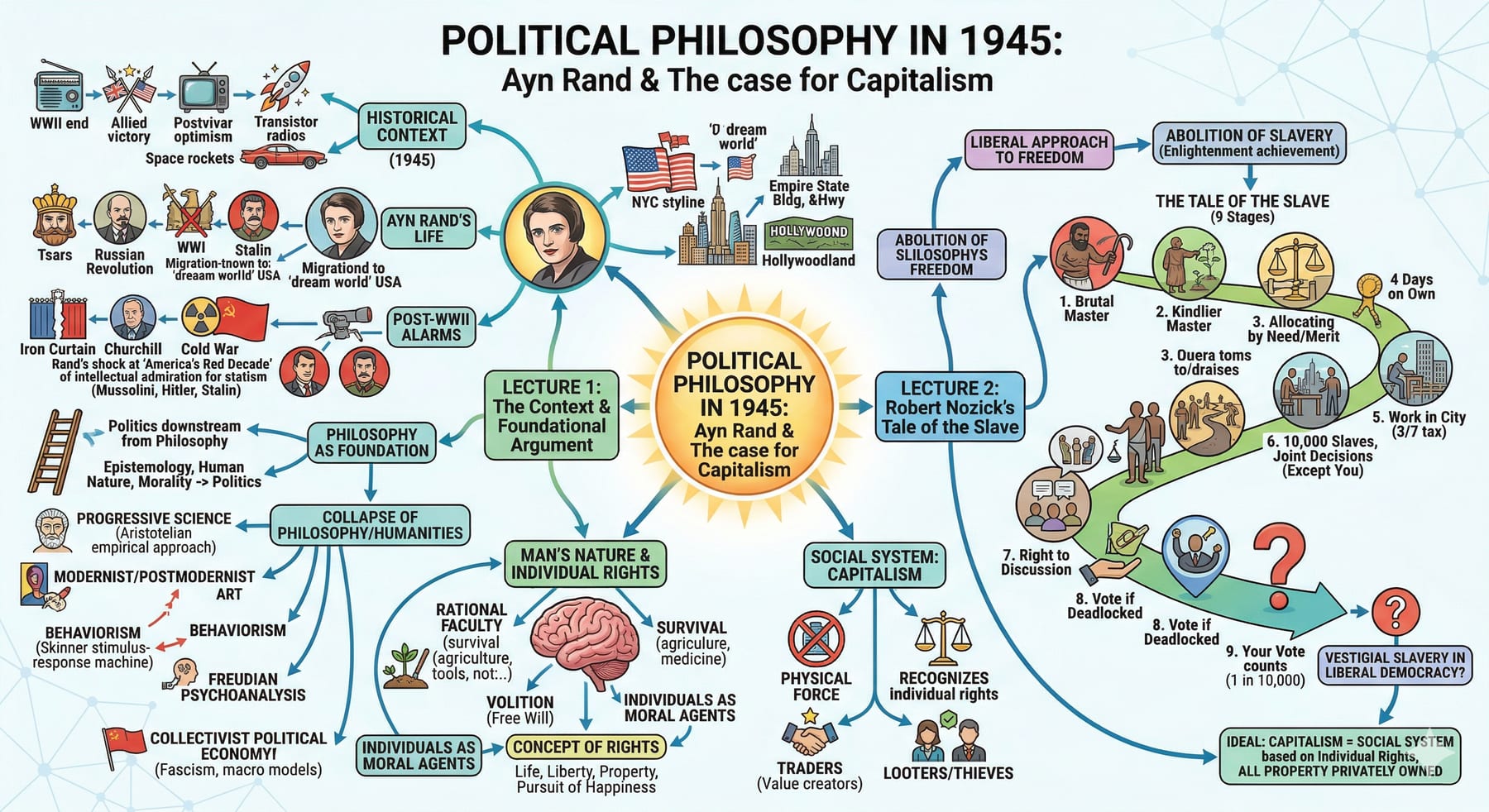
1. Historical and Political Setting: Why Begin in 1945?
- 1945 is presented as a decisive moment in political thought because:
- World War II ends
- the world experiences relief, especially in the Allied countries
- yet a new ideological struggle is immediately emerging
- The war is framed as a fight against several militaristic, collectivistic, dictatorial, totalitarian regimes:
- Nazi Germany under Adolf Hitler
- Fascist Italy under Benito Mussolini
- Imperial Japan, described as militaristic and dictatorial
- The lecture emphasizes that, for the United States:
- the war was fought on two fronts
- victory seemed to promise a return to peace, normalcy, and progress
- At the same time, the aftermath of the war created a new political reality:
- Western Europe was liberated by Allied powers
- Eastern Europe fell under Soviet communist control
- the world entered the Cold War
Key historical events mentioned
- End of World War II (1945)
- Russian Revolution
- Rise of Lenin
- Rise and consolidation of Stalin
- Fascist control of Italy
- Nazi control of Germany
- Soviet takeover of Eastern Europe
- Churchill’s Iron Curtain speech (1946)
- Beginning of the Cold War
2. Postwar Optimism and Modern Achievement
- The lecture describes the late 1940s and 1950s as an era of extraordinary optimism, especially in America.
- The United States is portrayed as a symbol of:
- technological progress
- material abundance
- creative achievement
- human possibility
- Examples used to illustrate this optimism:
- New York skyline
- Empire State Building
- architecture of Frank Lloyd Wright
- Hollywood during its golden age
- transistor radios
- television
- air conditioning
- increasingly affordable cars
- advances in vaccination
- the polio vaccine
- future achievements like space rockets
- The broader point is that modern Western civilization, especially America, seemed capable of:
- solving practical human problems
- expanding comfort and freedom
- improving ordinary life on a mass scale
Main idea
- The postwar period contained a tension:
- enormous grounds for optimism
- but also deep political and ideological anxieties
- This tension is what makes Rand’s intervention important in the lecture.
3. Ayn Rand’s Biography and Intellectual Formation
- Ayn Rand is introduced as:
- Russian-born
- born in 1905
- later emigrated to the United States
- a novelist with experience in Hollywood screenwriting
- Her personal history is presented as crucial to her politics:
- she lived through Tsarist Russia
- World War I
- the Russian Revolution
- the rise of communist rule
- the consolidation of power under Stalin
- A vivid anecdote is used:
- while Rand was a student in St. Petersburg
- outspoken students began disappearing
- she concluded she would not be free to write under communism
- She forms a plan to escape Russia and come to America.
Main idea
- Rand’s anti-collectivism is presented not as abstract theory alone, but as a response to lived experience:
- she saw firsthand what happens when the state crushes dissent
- America appeared to her as the opposite:
- freedom
- ambition
- beauty
- human achievement
4. Rand’s Shock at American Intellectual Life
- Rand expected America to be the country where educated people would strongly defend:
- freedom
- individual rights
- free-market capitalism
- liberalism
- democracy
- republicanism
- Instead, the lecture says she discovered that many American intellectuals were sympathetic to collectivist European ideologies.
- The 1930s are described as America’s “red decade”:
- many intellectuals admired or flirted with:
- Stalin
- Hitler
- Mussolini
- many intellectuals admired or flirted with:
- Rand is portrayed as shocked that so few intellectuals were firmly defending:
- individualism
- liberal democracy
- capitalism
Main idea
- The lecture suggests Rand’s real conflict was not mainly with popular American culture, but with the intellectual class.
- Her concern was that bad philosophy had infected politics and culture.
5. The Cold War Context
- After World War II, the struggle against totalitarianism is presented as unfinished.
- The lecture highlights Winston Churchill’s Iron Curtain speech as a turning point:
- Europe was divided into a free West and a communist East
- The Cold War is described as:
- a global ideological struggle
- a confrontation between:
- liberal democracy, markets, republican institutions
- communist dictatorship and collectivism
- It is called “cold” because:
- the superpowers did not directly fight each other in total war
- but they threatened one another with atomic/nuclear devastation
- and fought indirect or peripheral struggles elsewhere
Main idea
- Rand’s nonfiction political philosophy is framed as a response to this moment:
- the battle against totalitarian ideas was still ongoing
- victory in World War II did not settle the deeper philosophical conflict
6. Rand’s Intellectual Project
- By the 1950s, Rand had published:
- We the Living
- The Fountainhead
- and later Atlas Shrugged (1957)
- The lecture describes her shift after Atlas Shrugged:
- from philosophical fiction
- to more direct nonfiction essays on philosophy
- These writings cover:
- moral philosophy
- philosophy of art
- epistemology / cognition
- political philosophy
- Her goal is described as:
- rescuing the Enlightenment tradition
- restoring a philosophical defense of:
- individual rights
- constitutional government
- separation of powers
- free markets
Main idea
- Rand thinks capitalism has not been adequately defended at the deepest level.
- Economists and political theorists have explained parts of it, but philosophers have failed to ground it properly.
7. The Importance of Philosophy in Politics
- One of the lecture’s strongest themes is Rand’s belief that politics is downstream from philosophy.
- Political disagreements are often unproductive because people do not explicitly identify their underlying philosophical premises.
- Politics depends on answers to deeper questions:
- What is the good?
- What is justice?
- What is a human being?
- What is knowledge?
- How do we know moral or political principles are true?
- The lecture presents Rand as insisting that any viable politics must rest on:
- metaphysics / human nature
- epistemology
- ethics
- then finally politics
Main idea
- Political ideologies are powerful because they embody our deepest convictions about reality, morality, and human life.
- Bad politics reflects bad philosophy underneath.
8. Rand’s Historical Diagnosis: The Decline from Enlightenment to Irrationalism
- Rand’s historical narrative is:
- the 18th century Enlightenment produced strong ideas of:
- reason
- rights
- liberty
- productive cooperation
- but the 19th century marked a philosophical collapse
- the 18th century Enlightenment produced strong ideas of:
- The lecture says Rand contrasts Enlightenment thinkers with later European philosophers such as:
- Hegel
- Schopenhauer
- Karl Marx
- Friedrich Nietzsche
- Her criticism of them, as presented here:
- they are forms of irrationalism
skepticismcism** - and often anti-individualism
- they are forms of irrationalism
- America, being intellectually young, imported these European trends with harmful consequences.
Main idea
- The Enlightenment provided the philosophical basis for liberty.
- Later European thought undermined that basis and opened the door to modern collectivism and statism.
9. Rand’s Critique of the Humanities and Sciences
Humanities
- Rand argues the humanities had already largely “crashed” by the 20th century.
- Modern and postmodern culture are depicted as:
- strange
- irrational
- anti-humanistic
- Art is treated as a cultural indicator:
- it reveals a civilization’s deepest assumptions about human aspiration and meaning
Psychology
- The lecture says Rand saw the dominant schools of psychology as dehumanizing:
- Behaviorism
- associated with B. F. Skinner
- reduces human beings to stimulus-response mechanisms
- ignores consciousness
- Psychoanalysis / Freudianism
- reduces human beings to irrational unconscious drives
- treats reason as weak and superficial
- Behaviorism
- In both cases, consciousness and rational agency are downgraded.
Political economy
- Rand’s criticism is that economists often adopted collectivist premises without admitting it.
- Instead of starting from the individual:
- they begin with “the nation”
- “the community”
- “resources”
- “the common good”
- The lecture portrays Rand as objecting to macroeconomic thinking when it treats society as a manipulable machine:
- move the money supply
- move interest rates
- push social levers from above
- This ignores the real source of action: individual choosers
Main idea
- Across the humanities, psychology, and economics, Rand sees the same error:
- neglect of individual rational agency
- drift toward collectivism
- suspicion of reason
10. Individualism vs. Collectivism
- This is one of the lecture’s central conceptual oppositions.
- Rand’s question is: what is the true unit of reality and value?
- the individual
- or the collective
- Examples of collectivist framing:
- serving the nation
- serving one’s class
- serving the state
- subordinating personal life to the “common good”
- Rand’s argument:
- only individuals think
- only individuals choose
- only individuals act
- therefore politics must begin with individuals, not abstractions like “society” or “the nation”
Main idea
- Any political philosophy that starts with collectives rather than persons is, on Rand’s view, already on the wrong track.
11. Rand’s Critique of Altruism and Statism
Altruism
- Rand uses altruism in a strong moral-political sense:
- the doctrine that one ought to live for others
- self-sacrifice is treated as moral duty
- Applied politically, this can justify:
- coercion
- redistribution by force
- compulsory service to others
- The lecture presents her view that altruism often becomes enforced altruism through the state.
Statism
- Rand also targets statism:
- the belief that the state should direct social life toward collective goals
- Figures like Hegel, Marx, and Auguste Comte are associated with this tendency.
- The state becomes the supreme moral-political instrument.
Main idea
- Altruism and statism, in Rand’s framework, reinforce one another:
- if people are morally required to live for others
- the state can present itself as the enforcer of that obligation
12. The “Soul-Body Dichotomy” and the Low Status of Commerce
- A striking part of the lecture is Rand’s historical-cultural argument about why capitalism has been hard to defend.
- She claims European culture long treated:
- spirit/intellect as higher
- material production/manual labor as lower
- This produced contempt for:
- commerce
- money-making
- profit-seeking
- practical work
- Traditional social hierarchy reflected this:
- nobles/aristocrats did not work with their hands
- clergy pursued spiritual concerns
- peasants/serfs/slaves performed labor
- This cultural inheritance made it difficult for intellectuals to see:
- production as noble
- trade as moral
- wealth creation as an achievement
Main idea
- Rand thinks capitalism is not only resisted economically or politically, but also culturally and psychologically because older civilizations treated productive labor as inferior.
13. America as a Partial Break with Europe
- The lecture contrasts Europe with America:
- in America, productive work could be seen as honorable
- making money could be admired
- the “American dream” reflected a new valuation of effort and achievement
- Yet Rand thinks even America never fully grasped the philosophical basis of its own success.
- American rights-based thought remained:
- strong in practice
- but only partially understood in theory
Main idea
- America represented a better social experiment, but its philosophical foundations remained incomplete and vulnerable.
14. Rand’s Theory of Human Nature
- Rand’s political theory begins with a theory of human nature.
- Her central claim:
- man’s essential characteristic is his rational faculty
- Human beings differ from animals because:
- they survive by thought
- not by instinct alone
- not by brute physical strength
- The lecture gives many examples:
- agriculture
- shelter-building
- fire
- cloth
- tools
- wheels
- airplanes
- surgery
- electric light bulbs
- All of these require:
- conceptual thought
- long-range reasoning
- applied knowledge
Volition / free will
- Rand also insists reason is volitional:
- people must choose to think
- thought requires effort and focus
- many people choose not to exert that effort
Main idea
- Human survival depends on rational thought.
- Since thought is individual and voluntary, political systems must protect the freedom of thinkers and producers.
15. Producers, Imitators, and Looters
- The lecture develops a stark moral contrast in Rand:
- producers / makers
- imitators / followers
- looters / takers
- If someone chooses not to think:
- they may survive by copying routines discovered by others
- If someone chooses neither to think nor produce:
- they can survive only by taking what others made
- This becomes a moral and political distinction:
- creators make civilization possible
- looters parasitize creators
Main idea
- Rand’s moral world is built around the dignity of productive rational agency and the immorality of coercive appropriation.
16. Rights as the Political Expression of Human Nature
- The lecture says Rand moves from human nature to politics through the concept of individual rights.
- Rights are defined as:
- a moral principle
- defining and sanctioning a person’s freedom of action in a social context
- Rights are modern because earlier systems spoke more in terms of:
- duties
- obligations
- privileges granted by superiors
- Rand insists rights are not arbitrary:
- they are grounded in what a rational human being needs to live
Specific rights discussed
Right to life
- presented as the foundation of all other rights
- each person’s life belongs to that person
Right to liberty
- because one must be free to act in order to sustain life
Right to property
- because action and production culminate in the creation and use of values
- if a person makes something, it belongs to that person by right
Pursuit of happiness
- a person must be free to shape a life plan and pursue chosen goals
Main idea
- Rights are the social conditions necessary for rational human life.
17. Capitalism as the Moral Social System
- Rand’s question becomes: what social system fits human beings as rational individuals?
- The lecture says she reduces this to two fundamental questions:
- Does the system recognize individual rights?
- Does it ban physical force from human relationships?
Why force matters
- Rights are violated through force:
- murder violates life
- kidnapping/slavery violate liberty
- theft/confiscation violate property
- A moral society is one where people relate by:
- persuasion
- voluntary exchange
- trade
- not coercion
Definition of capitalism in the lecture
- capitalism is:
- a social system based on recognition of individual rights
- including property rights
- with private ownership of property
Role of government
- government is justified only as a protector of rights:
- stop thieves, fraudsters, aggressors, murderers
- enforce a framework in which peaceful cooperation is possible
Main idea
- Capitalism is not defended merely as efficient, but as the only system fully consistent with human dignity and rights.
18. Transition to Robert Nozick
- The lecture then shifts from Rand to Robert Nozick, described as:
- a Harvard philosopher
- broadly within the same liberal/libertarian tradition
- someone who agreed with Rand in important respects, though not fully
- His key work here is Anarchy, State, and Utopia (1971).
- His argument, as presented:
- only a minimal state is morally legitimate
- larger political control risks violating freedom
Main idea
- Nozick is introduced as a more academic, analytic philosopher who continues the rights-based critique of coercive political authority.
19. Nozick’s “Tale of the Slave”
- This is one of the lecture’s most important sections.
- Nozick uses a gradual thought experiment to test whether people truly reject slavery in principle.
Structure of the thought experiment
- Start with an obvious slave:
- beaten cruelly by a brutal master
- Then gradually make the arrangement seem more humane:
- kinder master
- more predictable punishments
- some free time
- partial independence
- ability to work for wages
- taxation-like payments back to the master
- restrictions justified for “your own good”
- collective decision-making by many masters
- discussion rights
- tie-breaking vote
- finally, one vote among thousands
The point
- At each stage, the subject may seem “freer”
- But Nozick asks whether the core structure remains:
- others retain coercive authority over your life
- By the final stage, the situation starts to resemble modern democratic citizenship
- majority rule
- taxation
- regulation
- token participation
- The provocative conclusion:
- democracy can still contain elements of slavery
- if individuals remain subject to collective control over their lives and property
Main idea
- Nozick is challenging complacency:
- opposition to slavery must be principled, not merely opposition to its harshest forms
20. Freedom, Democracy, and the Limits of Majority Rule
- The speaker uses Nozick to press a broader libertarian point:
- democracy is not automatically equivalent to freedom
- A majority ruling over a minority can still be domination if:
- the individual’s rights are not protected
- the majority can seize earnings, regulate life choices, or compel service
- This reinforces Rand’s and Nozick’s shared concern:
- liberty requires more than participation
- it requires limits on coercive power
Main idea
- The lecture distinguishes sharply between:
- popular rule
- and individual freedom
- A society can be democratic and still insufficiently free.
21. Core Philosophical Themes of the Lecture
Politics rests on philosophy
- all political systems presuppose views about:
- reality
- knowledge
- morality
- human nature
Individualism vs collectivism
- the individual is the true unit of thought, action, value, and rights
Reason as central to human life
- humans survive and flourish through rational thought and productive work
Rights as objective moral principles
- rights are not conventions or privileges
- they arise from what rational beings need in order to live
Force vs voluntary exchange
- the fundamental political question is whether people deal by coercion or by consent/trade
Capitalism as a moral system
- capitalism is presented as the only system that fully protects rights and bans coercive predation
Skepticism toward democracy without limits
- majority rule can still violate liberty
- therefore constitutional or minimal-state restraints are necessary
22. Major Persons Mentioned
- Ayn Rand
- Vladimir Lenin
- Joseph Stalin
- Adolf Hitler
- Benito Mussolini
- Winston Churchill
- Frank Lloyd Wright
- Aristotle
- Hegel
- Arthur Schopenhauer
- Karl Marx
- Friedrich Nietzsche
- B. F. Skinner
- Sigmund Freud / Freudians
- Auguste Comte
- Robert Nozick
23. Books, Essays, and Sources Mentioned
By Ayn Rand
- We the Living
- The Fountainhead
- Atlas Shrugged
- Capitalism: The Unknown Ideal
- essay: “What Is Capitalism?”
By Robert Nozick
- Anarchy, State, and Utopia
- section: “The Tale of the Slave”
Historical reference
- Churchill’s “Iron Curtain” speech
24. Likely Biases / Framing in the Lecture
- The lecture is strongly sympathetic to:
- Ayn Rand
- libertarian / classical liberal thought
- It presents several controversial judgments as largely correct or at least plausible:
- that 19th-century philosophy broadly collapsed into irrationalism
- that most macroeconomics is implicitly collectivist
- that behaviorism and psychoanalysis are both deeply anti-human
- that modern democracies may preserve slavery-like features
- The lecture largely does not present strong counterarguments from:
- egalitarian liberalism
- socialism
- welfare-state theory
- communitarianism
- democratic theory
Main idea
- This is not a neutral survey lecture; it is a philosophically guided defense of a particular tradition.
25. Related Topics for Further Exploration
- The Enlightenment and individual rights
- Classical liberalism vs libertarianism
- Ayn Rand’s Objectivism
- Robert Nozick vs John Rawls
- The moral foundations of property rights
- The critique of altruism in modern political thought
- Totalitarianism in the 20th century
- The Cold War as an ideological conflict
- Individualism vs collectivism in political philosophy
- The role of coercion in taxation and regulation
- Aristotle’s influence on modern political philosophy
- Rand’s critique of Marxism, fascism, and statism
- The history of slavery and abolition
- The difference between democracy and liberty
- Minimal state vs welfare state debates
- Behaviorism, psychoanalysis, and conceptions of the self
- The philosophical foundations of capitalism
- Human nature in political theory
- Property, labor, and Locke vs Rand
- Whether majority rule can become tyrannical
26. Concise Takeaway
- The lecture argues that postwar political philosophy must confront the deeper philosophical conflict between individualism and collectivism.
- Ayn Rand is presented as reviving the Enlightenment case for:
- reason
- rights
- liberty
- property
- capitalism
- Robert Nozick extends this line of thought by questioning whether even democratic societies have fully escaped coercive domination.
- The overall thesis is that a just society must begin with:
- the rational individual
- the right to life, liberty, and property
- and a political order that minimizes coercion and protects voluntary exchange.
2: John Rawls’ Justice
Peterson Academy - The Philosophy of Politics Part II (Hicks) - Lecture 02.pdf (file not included in this release)
Overview
- The lecture begins in 1964, under President Lyndon B. Johnson, and uses the launch of the War on Poverty as the entry point for a broader discussion of:
- modern views of poverty
- redistribution and capitalism
- the philosophical debate within liberalism
- John Rawls’ theory of justice
- The transcript’s central argument is that the mid-20th century debate over poverty and welfare policy reflects a deeper philosophical conflict:
- whether justice should prioritize freedom and individual entitlement
- or equality, redistribution, and protection against morally arbitrary disadvantages
- The speaker presents John Rawls as one of the most important philosophers of modern liberalism, especially because he offers a systematic theory for why a just society should correct inequalities rooted in luck, birth, and natural endowment.
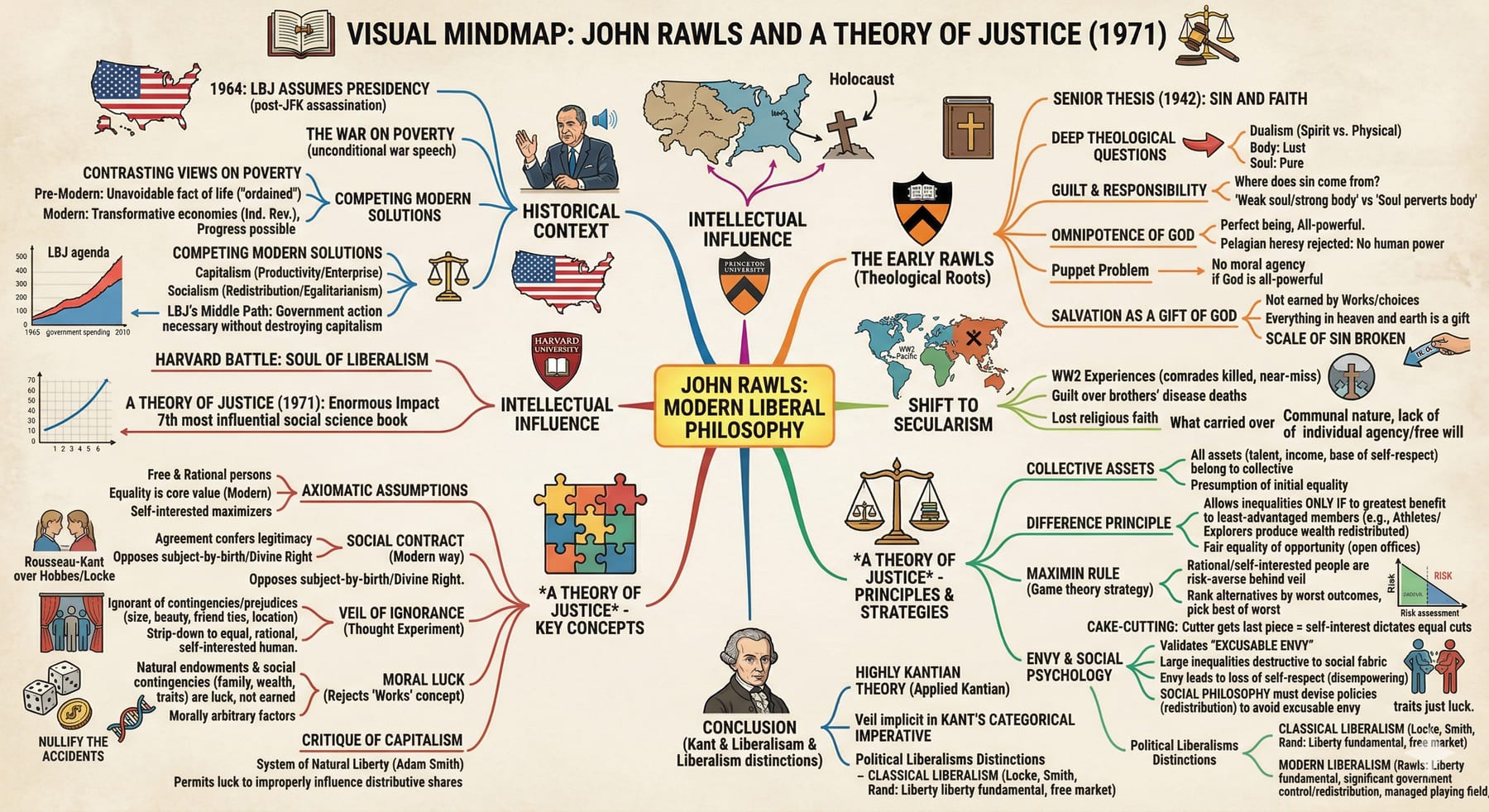
1. Historical Starting Point: 1964 and the War on Poverty
- The lecture opens in 1964, shortly after a major political transition:
- John F. Kennedy was assassinated in 1963
- Lyndon B. Johnson assumed the presidency
- Johnson moved quickly to expand or accelerate major government initiatives.
- One of the most important was the War on Poverty.
- Johnson’s famous formulation is quoted:
- the administration declares “unconditional war on poverty in America.”
Main historical significance
- The War on Poverty is presented as more than a policy program:
- it symbolizes a major shift in modern political thinking
- it reflects the belief that poverty is no longer an unavoidable fact of life
- it assumes modern societies have both the means and the obligation to eliminate poverty
2. Poverty as a Modern Political Problem
- The lecture contrasts pre-modern and modern understandings of poverty.
Pre-modern view
- For most of history, poverty was seen as:
- inevitable
- permanent
- perhaps divinely ordained
- simply part of the natural order
- The common assumption was:
- some people will always be rich
- most people will remain poor
- human beings cannot fundamentally eliminate poverty
Modern view
- In the modern era, poverty begins to look solvable because of:
- scientific progress
- technological development
- industrialization
- liberalized economies
- increased productivity
- As living standards rise, people begin to think:
- poverty may not be a permanent feature of the human condition
- human beings can make progress in reducing or eliminating it
Main idea
- The very question, “How do we solve poverty?” is presented as a distinctly modern question.
- Modern politics emerges partly from the belief that social conditions can be transformed.
3. Competing Modern Answers to Poverty
The lecture outlines two major modern answers to the poverty problem.
A. Redistribution / socialist-leaning answer
- Since modern economies produce so much wealth, the solution is:
- take from those who have more
- give to those who have less
- Variants include:
- strong egalitarianism
- socialism
- redistributive state policies
- This view assumes:
- the productivity problem is basically solved
- the remaining task is fairer distribution
B. Capitalist / free-market answer
- Redistribution only works if wealth is first created.
- Productive wealth depends on:
- freedom
- markets
- enterprise
- capitalism
- A healthy capitalist economy solves poverty by:
- creating jobs
- raising overall wealth
- strengthening family and social support networks
- enabling philanthropy
Main contrast
- Both approaches are modern because both think poverty can be reduced.
- But they disagree about the mechanism:
- redistribution first
- or productivity first
4. Johnson’s Middle Position
- The lecture presents LBJ’s position as an attempt at a middle path.
- Johnson’s administration is described as rejecting both extremes:
- not pure laissez-faire capitalism
- not full socialism
- The view is:
- capitalism remains the productive engine
- but markets alone will not eliminate all poverty
- government should step in to redistribute part of the excess wealth
- The United States, being the wealthiest nation, should not tolerate persistent poverty.
Main idea
- Johnson’s approach is portrayed as:
- capitalism plus active government welfare intervention
- a morally ambitious but non-socialist reform program
5. Growth of Government Anti-Poverty Spending
- The lecture references a historical graph showing changes in U.S. anti-poverty spending.
Historical pattern described
- Earlier U.S. history:
- relatively low spending on poverty relief
- Late 1920s / 1930s:
- the Great Depression leads to a large increase in welfare-state spending
- World War II:
- some of this is paused or redirected
- Postwar era:
- welfare programs resume
- 1960s / LBJ era:
- a major philosophical and political shift occurs
- anti-poverty spending rises dramatically
Main idea
- Johnson represents not just another increase in spending, but a deeper shift in political philosophy:
- the federal government increasingly sees poverty reduction as a direct responsibility
6. The Intellectual Battle Within Liberalism
- The practical political debate over welfare is mirrored by an academic debate.
- The lecture frames this as a struggle for the “soul of liberalism.”
Two broad liberal options
Libertarian / classical liberal direction
- emphasizes:
- strong individual freedom
- limited government
- free markets
- minimal redistribution
Modern welfare liberal direction
- emphasizes:
- civil and political rights
- equal participation
- regulated markets
- redistribution
- active government management of fairness
Main idea
- This is not framed as liberalism vs anti-liberalism.
- It is a fight between different forms of liberalism:
- one centered more on freedom
- one centered more on fairness and equality
7. John Rawls and the Importance of
A Theory of Justice
- John Rawls is introduced as the key philosopher of modern liberalism.
- His book A Theory of Justice was published in 1971.
- The lecture emphasizes its enormous influence across:
- political philosophy
- moral philosophy
- social philosophy
- economics
- broader social science
- The book is described as one of the most influential social science books of the 20th century.
Main idea
- Rawls is presented as a towering intellectual figure whose work reshaped modern debates about justice, equality, and liberalism.
8. The Young Rawls: Religion, Sin, and Faith
- The speaker gives biographical background to explain Rawls’ deeper philosophical roots.
- As an undergraduate at Princeton, Rawls wrote a long senior thesis:
- A Brief Inquiry Into the Meaning of Sin and Faith
- written in 1942
- At that time Rawls was:
- strongly religious
- rooted in Protestant Christianity
- possibly considering a religious vocation
Main issues in the thesis
- the relation between:
- soul and body
- spiritual and physical reality
- sin and moral responsibility
- divine omnipotence and human agency
Main idea
- The lecture suggests that Rawls’ later secular theory may still preserve some deep structures from his earlier theology.
9. Theological Questions That Shaped Rawls
The lecture highlights several classic Christian theological problems Rawls wrestled with.
A. Mind-body / spirit-body dualism
- Human beings are understood as:
- physical beings
- but also spiritual beings
- This raises a moral question:
- does the body corrupt the soul?
- or does the soul choose wrongly and thus corrupt the body?
B. Sin and guilt
- If people know the good but still do evil:
- where does moral responsibility lie?
- Is sin caused by:
- bodily impulses overpowering the soul?
- or free moral choice?
C. Divine power vs human free will
- If God is truly omnipotent:
- how can humans have real moral agency?
- But if humans have no real agency:
- how can they be morally responsible?
Main idea
- Rawls is shown grappling with the tension between:
- God’s sovereignty
- and human freedom/responsibility
10. Pelagianism, Salvation, and the Rejection of Individual Desert
- The transcript introduces Pelagius and the issue of Pelagianism:
- the view that humans have enough agency to contribute to their own salvation through moral effort
- Rawls rejects this.
- He sides with the view that:
- salvation is not earned
- salvation is a gift from God
- human beings do not deserve redemption by their own works
Important implications
- everything one has is fundamentally given
- one does not truly deserve one’s advantages
- gifts come from:
- God
- and often through the community
- the self is understood as fundamentally communal, not self-made
Main idea
- This early theological perspective anticipates Rawls’ later suspicion of claims like:
- “I earned this entirely myself”
- “my advantages are fully deserved”
11. War, Personal Tragedy, and Rawls’ Loss of Faith
- After graduating, Rawls was drafted into World War II.
- He saw combat in the Pacific theater.
- He witnessed:
- terrible violence
- death of comrades
- near-death experiences himself
- Earlier in life:
- two of his brothers died of diseases they had caught from him
- this left Rawls with a lasting sense of guilt
- Learning about the Holocaust also deeply affected him.
Result
- After the war, Rawls lost his religious faith and became a secular thinker.
Main idea
- The lecture suggests that Rawls’ secular philosophy may still carry over key elements of his earlier religious outlook:
- anti-desert thinking
- communalism
- suspicion of self-made merit
- concern for the morally arbitrary
12. Rawls’ Theory of Justice as a Complex Philosophical System
- The speaker warns that Rawls’ book is difficult because it is not built around one simple idea.
- Instead, it is a patchwork / jigsaw puzzle of interlocking concepts.
- To understand Rawls properly, one must grasp several major components:
- social contract
- freedom and equality
- veil of ignorance
- moral luck
- collective assets
- difference principle
- maximin
- envy
- Kantian moral philosophy
Main idea
- Rawls is systematic, technical, and historically embedded.
- His theory must be understood as a whole, not reduced to one slogan.
13. The Social Contract Tradition
- Rawls is placed in the tradition of social contract theory.
- Social contract theory asks:
- what gives political power legitimacy?
- The modern answer:
- legitimate rules are those people would agree to voluntarily
Why this matters
- Government is different from other institutions because:
- its rules apply to everyone
- it uses coercive force
- it can imprison, confiscate property, even take life
- Therefore, its legitimacy requires especially strong justification.
Contrast with premodern theory
- In older political theories:
- people were born as subjects
- authority was often justified by divine right
- obligation preceded consent
- Social contract theory rejects that model.
Major figures mentioned
- Thomas Hobbes
- John Locke
- Jean-Jacques Rousseau
- Immanuel Kant
14. Different Social Contract Theories
The lecture explains that social contract theorists differ because they have different views of human nature.
Hobbes
- pessimistic about human nature
- people are:
- distrustful
- grasping
- conflict-prone
- therefore they need:
- a powerful sovereign
- near-absolute authority
- rule through fear and restraint
Locke
- more optimistic
- people are:
- rational
- productive
- capable of trust and cooperation
- therefore they need:
- limited government
- freedom for contracts, business, and family life
Rousseau
- more collectivist
- people are not fundamentally separate individuals
- true political life expresses a general will
- government should embody the collective will
Rawls
- develops the Rousseau-Kant side of the social contract tradition
- but in a modern, secular form
15. Rawls’ View of Human Nature and Basic Moral Assumptions
Rawls begins with several key assumptions.
Human beings are:
- free
- equal
- rational
- self-interested
Why these assumptions matter
- Freedom and equality are treated as non-negotiable starting points.
- Rationality means people can reason abstractly and choose principles.
- Self-interest means people care about their own life plans and outcomes.
Main idea
- Rawls does not deny that people are self-interested.
- Instead, he tries to show that even self-interested people would choose fair principles under the right conditions.
16. The Veil of Ignorance
- This is presented as one of the most famous thought experiments in philosophy.
- People are imagined choosing the rules of society from behind a veil of ignorance.
What they know
- they know they are human beings
- they know society will have rules about liberty, opportunity, wealth, and institutions
- they know general facts about human life and social organization
What they do not know
- their class
- their wealth
- their race or social standing
- their family background
- their talents
- their strength or beauty
- their religion
- their friendships and personal ties
- their position in society once the veil is lifted
Why ignorance matters
- It prevents people from rigging the rules in favor of their accidental advantages.
- It filters out:
- prejudice
- favoritism
- self-serving bias based on morally irrelevant contingencies
Main idea
- Justice requires designing institutions without knowing whether you will end up privileged or disadvantaged.
17. Moral Luck
- Rawls argues that much of what people have is due to luck, not moral desert.
Types of luck discussed
Natural luck
- beauty
- strength
- health
- intelligence
- temperament
- talent
- perseverance
- energy
Social luck
- family background
- neighborhood
- parenting
- wealth at birth
- educational environment
- social class
Main idea
- Since people do not earn these starting advantages, they should not be allowed to determine the structure of justice.
- The distribution of benefits in society should not be dictated by morally arbitrary starting points.
18. Rawls’ Critique of Free-Market “Natural Liberty”
- Rawls is presented as directly opposing the libertarian/classical liberal model associated with:
- Adam Smith
- later Ayn Rand
- Robert Nozick
- He calls the free-market model the system of natural liberty.
Rawls’ objection
- Free-market systems allow distributive outcomes to be shaped by:
- natural endowments
- inherited social advantages
- arbitrary starting conditions
- These are morally arbitrary, so they should not determine who gets what.
Main idea
- Freedom alone is not enough for justice if unequal starting points distort outcomes from the beginning.
19. Collective Assets and Equality as the Starting Point
- Rawls argues that society should begin from an assumption of equal distribution.
- He includes within society’s distributable assets:
- liberty
- opportunity
- income
- wealth
- the bases of self-respect
Crucial claim
- What individuals bring into society should not be treated as purely private moral property from the outset.
- Since natural and social advantages were not earned, they should be viewed as part of a larger social pool.
Main idea
- Justice begins not by asking what people naturally possess, but by asking what equal persons would agree to under fair conditions.
20. The Exception to Equality: Productive Inequality
- Rawls is not portrayed as a strict communist or absolute egalitarian.
- He allows inequality when it improves outcomes.
Initial formulation
- inequalities are permissible if they work to everyone’s advantage
Later refinement
- inequalities are justified if they improve the position of the least advantaged
Main idea
- Rawls allows incentives and unequal rewards, but only if they help those at the bottom too.
21. The Difference Principle
- This is one of Rawls’ most famous doctrines.
Core idea
- Social and economic inequalities are acceptable only if:
- positions are open to all under fair equality of opportunity
- the inequalities benefit the least advantaged
Two parts
A. Fair equality of opportunity
- people must genuinely be able to compete for positions
- not merely formal access, but fair access
B. Benefit to the least advantaged
- inequalities must raise the floor
- the worst-off must do better than they would under stricter equality or under laissez-faire alternatives
Example in the lecture
- A physically disabled person may do better in a society that permits some inequality and productivity growth, if redistribution ensures they are still better off than under a flat egalitarian society.
Main idea
- The point of inequality is not to reward superiority as such, but to improve the condition of those with the fewest advantages.
22. Talents as a Common Asset
- Rawls extends his anti-desert argument beyond wealth and family background to talent itself.
- Natural talents include:
- intelligence
- musical ability
- athletic ability
- persistence
- drive
- energy
- self-discipline
- These, too, are morally arbitrary.
Main idea
- Since talent is unearned, society may justly regulate how its rewards are distributed.
- Exceptional talent is not simply private property in a moral sense; its social rewards must be justified in terms of the common good, especially the least advantaged.
23. The Maximin Rule
- Rawls adds a decision rule from game theory: maximin.
Meaning
- when choosing among alternatives, focus on the worst possible outcome
- choose the option whose worst-case scenario is better than the worst-case scenarios of the alternatives
Why it matters behind the veil
- since you do not know what position you will occupy in society
- and you might end up among the worst-off
- it is rational to choose principles that make the worst position as tolerable as possible
Main idea
- Rational self-interest under uncertainty leads people to favor protections for the least advantaged.
24. Cake-Cutting Example
- Rawls uses a simple fairness analogy:
- one person cuts the cake
- everyone else chooses first
- the cutter gets the last piece
Why this works
- the cutter has an incentive to divide the cake equally
- otherwise the cutter risks ending up with the smallest piece
- this illustrates the logic of:
- fairness
- maximin
- rational self-interest constrained by fair procedure
Main idea
- Just procedures can make self-interest produce fair outcomes.
25. Envy and the Social Psychology of Inequality
- Rawls also incorporates social psychology into political theory.
- He argues that large inequalities generate:
- envy
- social resentment
- fractured solidarity
- loss of self-respect among the disadvantaged
His concern
- even if someone becomes rich through voluntary market success, others may react with:
- bitterness
- humiliation
- alienation
- extreme inequality damages the social fabric.
Excusable envy
- Rawls says some envy is not simply sinful weakness.
- It can be excusable when it arises from conditions where unequal outcomes are rooted in arbitrary luck and lead people to lose self-respect.
Main idea
- Justice must account not only for formal fairness, but for the psychological effects of social arrangements.
- Redistribution helps contain the destructive effects of inequality and envy.
26. Rawls and Kant
- The lecture closes by stressing Rawls’ debt to Immanuel Kant.
- Rawls explicitly says his theory is highly Kantian.
- He even disclaims originality, saying the deep structure of his theory is already implicit in Kant.
Connection to Kant
- the veil of ignorance is linked to the logic of the categorical imperative
- both try to strip away contingent self-interest and ask what principles can be justified universally
Main idea
- Rawls is not inventing justice from scratch.
- He is modernizing and applying a Kantian moral framework to political institutions.
27. Liberalism: Classical vs Modern
- The lecture ends with a clarification about terminology.
Why the label “liberal” is confusing
- John Rawls is called a liberal
- Robert Nozick is also called a liberal in a broader sense
- Ayn Rand can also fall under the liberal tradition because she prioritizes liberty
Two broad versions
Classical liberalism
- associated with:
- Locke
- Adam Smith
- Rand
- Nozick in many respects
- emphasizes:
- property
- markets
- limited government
- individual liberty
Modern liberalism
- associated with Rawls
- emphasizes:
- fairness
- redistribution
- equality of opportunity
- social correction of morally arbitrary inequalities
Main idea
- In political discussions, one must ask:
- what kind of liberalism is being defended?
28. Major Historical Events Mentioned
- Assassination of John F. Kennedy (1963)
- Lyndon B. Johnson assuming the presidency
- War on Poverty (1964)
- Great Depression
- World War II
- Holocaust
- Publication of A Theory of Justice (1971)
29. Major Thinkers Mentioned
- Lyndon B. Johnson
- John F. Kennedy
- John Rawls
- Thomas Hobbes
- John Locke
- Jean-Jacques Rousseau
- Immanuel Kant
- Adam Smith
- Pelagius
- Ayn Rand
- Robert Nozick
30. Books and Works Mentioned
- A Theory of Justice — John Rawls
- A Brief Inquiry Into the Meaning of Sin and Faith — John Rawls
- Political Liberalism — John Rawls
- On the Wealth of Nations — Adam Smith
31. Core Takeaways
- The lecture uses the War on Poverty as the practical political backdrop for a major philosophical debate about justice.
- Rawls is presented as the chief theorist of modern liberalism because he argues that:
- people do not deserve most of their advantages
- justice must neutralize morally arbitrary luck
- fair institutions are those people would choose without knowing their own place in society
- His theory combines:
- social contract
- freedom and equality
- veil of ignorance
- moral luck
- difference principle
- maximin
- concern for self-respect and envy
- Kantian moral foundations
- The larger issue is whether liberalism should center on:
- freedom and individual entitlement
- or fairness, equality, and redistribution
3: Third Way Politics
Peterson Academy - The Philosophy of Politics Part II (Hicks) - Lecture 03.pdf (file not included in this release)
Overview
- The lecture begins in 1989, with the fall of the Berlin Wall, and uses that moment to frame a major question in political philosophy:
- if communism has failed and the Cold War is ending, what comes next?
- The speaker argues that after 1989 many believed liberalism had won, but there was immediate disagreement over what kind of liberalism should define the future:
- strong free-market / libertarian liberalism
- or a more centrist, mixed-economy “third way”
- The central intellectual response discussed in the lecture is James Buchanan’s public choice economics, which studies how governments and political actors actually behave in mixed economies.
- The main thesis of the lecture is that once the state is deeply involved in economic life, politics develops predictable distortions:
- lobbying
- rent-seeking
- pork barrel politics
- bureaucratic growth
- regulatory capture
- vote buying
- coalitions of special interests
- The speaker’s larger normative point is that mixing state power with the economy produces systematic dysfunction, much as mixing state power with religion historically produced corruption, monopoly, and conflict.
1. Historical Starting Point: 1989 and the Fall of the Berlin Wall
- The lecture opens in 1989, with the Berlin Wall coming down.
- The wall is described as both:
- a physical barrier
- and a symbolic barrier
- It had separated:
- East and West Berlin
- East and West Germany
- more broadly, communism/socialism in the East from capitalism/liberal society in the West
- Its collapse brought:
- celebration
- family reunification
- expanded opportunities, especially for Eastern Europe
- the end of the Iron Curtain
Main historical meaning
- The wall’s fall represents the visible collapse of Eastern bloc communism.
- Communist governments are described as effectively recognizing failure and giving up.
- This creates a new global question:
- if communism has failed, what political system is now vindicated?
2. The Post-Cold War Mood: Liberalism Appears to Have Won
- The lecture emphasizes the enormous optimism of the post-1989 moment.
- After a century of ideological conflict, it seemed that:
- fascism had failed
- national socialism had failed
- communism had failed
- liberalism remained
Larger historical background invoked
- the fall of feudalism and tribalism
- the rise of fascism and national socialism
- the world wars
- the rise of communism
- the Cold War
Main idea
- By 1989, many political theorists thought modern history had settled the major ideological alternatives.
- Liberalism now appeared to be the only viable system left standing.
3. Francis Fukuyama and “The End of History”
- The lecture introduces Francis Fukuyama and his influential book:
- The End of History and the Last Man
- Fukuyama’s thesis is described as:
- the triumph of liberalism marks the “end of history”
- This idea is linked to Hegel:
- history has a direction
- history has an end point
- history culminates in a final political-cultural form
Fukuyama’s argument as presented here
- liberalism is the only successful modern political philosophy
- rival systems have failed:
- in theory
- in practice
- liberal societies provide:
- food
- housing
- entertainment
- civil liberties
- broad freedom
- illiberal societies may still exist, but they are expected to eventually follow the Western path toward liberalism
Main idea
- Fukuyama represents the most optimistic post-Cold War view:
- history’s ideological struggle is basically over
- the future belongs to global liberalism
4. Immediate Disagreement: What Does Liberalism Mean?
- The speaker stresses that the debate did not end with communism’s collapse.
- The new question became:
- what kind of liberalism had won?
One answer
- a full-spectrum liberty model:
- civil liberty
- political liberty
- economic liberty
- religious liberty
- This points toward:
- strong capitalism
- strong free markets
- perhaps strong libertarianism
Opposing answer
- many thinkers rejected socialism and communism
- but also rejected fully principled capitalism or libertarianism
- they wanted a centrist alternative
Main idea
- The post-1989 debate was not liberalism vs anti-liberalism.
- It became a dispute between:
- strong market liberalism
- and centrism / mixed-economy liberalism
5. The “Third Way” Politics of Clinton and Blair
- The lecture identifies Bill Clinton and Tony Blair as the major political representatives of this post-Cold War centrism.
- Clinton is quoted as saying the debate between:
- “government is the problem”
- and “government is the solution”
- is now outdated
Third Way as defined in the lecture
- not old-style socialism
- not laissez-faire capitalism
- instead:
- a modernized social democracy
- a middle position between left and right
- state involvement without state control
- markets without radical anti-government ideology
Blair’s formulation
- the Third Way moves beyond:
- the old left, associated with:
- state control
- high taxes
- and the new right, associated with:
- suspicion of public investment
- hostility to collective action
- the old left, associated with:
Main idea
- The Third Way claims to be a practical synthesis:
- preserve markets
- preserve some state direction
- avoid both socialism and libertarianism
6. James Buchanan and the Birth of Public Choice Economics
- Into this debate enters James Buchanan, who had won the Nobel Prize in Economics shortly before the Berlin Wall fell.
- He is presented as a founder of public choice economics.
- Public choice asks:
- not just how private markets work
- but how public decisions are actually made
- especially when government is a major economic actor
Why this matters
- Standard economics had developed powerful tools for understanding:
- supply and demand
- prices
- marginal utility
- decentralized coordination
- But modern economies are not purely private:
- government is huge
- often 1/3 to 1/2 of the total economy
- If economists ignore the state, they ignore one of the largest actors in the system.
Main idea
- Public choice extends economic analysis to politics itself.
- Politicians, regulators, agencies, and voters must be studied as actors with incentives, not idealized guardians of the common good.
7. The Core Insight of Public Choice
- Buchanan’s key challenge is methodological and political.
- He argues that economists often treat:
- markets realistically
- governments idealistically
- This is a major theoretical mistake.
Traditional pattern criticized
- economists study the market and identify:
- unemployment
- shortages
- inefficiencies
- bad private decisions
- They then conclude:
- the government should fix it
- But they do not seriously study:
- how the government will behave
- what incentives public officials face
- what costs political solutions create
Buchanan’s demand
- compare both systems empirically
- study both sides:
- market failure
- government failure
- evaluate:
- costs
- benefits
- risks
- unintended side effects
Main idea
- It is bad social science to assume:
- private actors are flawed and self-interested
- but public actors are wise and benevolent
8. The Violin Competition Analogy
- Buchanan’s criticism is illustrated with a story:
- a king holds a violin competition
- one violinist plays
- before hearing the second violinist, the king declares the second the winner
- The point:
- you cannot compare alternatives fairly if you only test one of them
Application to politics
- Many theorists:
- observe market problems in reality
- compare them to an idealized government solution
- But they do not test how actual governments behave.
Main idea
- Realistic markets cannot be compared with imaginary governments.
- Both alternatives must be judged by actual performance.
9. Mixed Economies and the Need for a New Science
- Buchanan argues modern political economies are neither:
- purely capitalist
- nor purely socialist
- Instead, they are mixed economies:
- private markets plus large public sectors
- government agencies
- regulation
- subsidies
- public-private partnerships
Why this changes the analysis
- Governments shape:
- agriculture
- transportation
- energy
- fisheries
- commerce
- finance
- In third-way politics, this is not accidental:
- it is an explicit principle of governance
- Therefore we need a descriptive science of:
- how political-economic partnerships actually function
Main idea
- Public choice is presented as the science of the mixed economy.
10. Major Public Choice Concepts Introduced
The lecture says public choice developed a whole vocabulary for recurring patterns in mixed economies.
Key concepts named
- unintended consequences
- bureaucratic growth
- regulatory capture
- pork barrel politics
- logrolling
- lobbying
- concentrated benefits and dispersed costs
- vote buying
- revolving door
- bootleggers and Baptists
Main idea
- These are not treated as isolated abuses.
- They are described as systemic tendencies built into mixed-economy politics.
11. Unintended Consequences
- Governments often try to solve real problems.
- But the solution can:
- fail
- worsen the original problem
- create even larger new problems
Example type discussed
- a bureaucracy is created to solve a limited problem
- over time:
- the problem may stay the same or shrink
- but the bureaucracy grows much larger
Main idea
- Government intervention often expands beyond its original rationale.
- The effects of intervention are frequently unpredictable and self-amplifying.
12. Bureaucratic Growth and the Power Motive
- Buchanan argues that bureaucrats do not need a profit motive to pursue self-interest.
- In government, the relevant incentive is often:
- power
- prestige
- budget growth
- A bureaucrat increases status by:
- expanding staff
- increasing department budget
- enlarging the agency’s scope
Example mentioned
- the Department of Agriculture and farm subsidies
- initially justified as temporary during crisis
- but instead of disappearing, the agency and subsidies keep growing
Main idea
- Bureaucracies have internal incentives to preserve and enlarge themselves.
- This helps explain why government programs rarely disappear once created.
13. Regulatory Capture
- A government regulator is supposed to discipline an industry.
- But frequently:
- the regulator becomes aligned with the industry instead
- This is called regulatory capture.
Mechanism described
- regulators often come from the industry they regulate
- they may later return to that industry
- they therefore have incentives to:
- protect future employers
- shape rules in ways advantageous to insiders
- maintain cozy relationships rather than adversarial oversight
Main idea
- Regulation often serves the regulated rather than the public.
- The very institutions meant to control private power can become instruments of it.
14. The Revolving Door
- Closely related to regulatory capture is the revolving door.
- Individuals move:
- from private sector roles
- into regulatory agencies
- then back into private sector roles
Why this matters
- people inside agencies write or administer complex rules
- they may later return to the private sector and profit from:
- insider knowledge
- networks
- influence
- rules they helped create
Example used
- a Wall Street professional joins a federal regulatory body
- helps shape rules
- later returns to Wall Street
- uses special knowledge of those rules to private advantage
Main idea
- The line between public service and private advantage becomes blurred.
- Institutions intended to protect the public become channels of insider privilege.
15. Behavioral Symmetry: Politicians Are People Too
- One of Buchanan’s major principles is behavioral symmetry.
- The same kinds of motives seen in private markets should also be expected in politics.
Old assumption criticized
- in markets:
- people are self-interested
- profit-seeking
- competitive
- in government:
- people are treated as public-spirited
- selfless
- guardians of the common good
Buchanan’s correction
- human nature does not change when a person enters office
- politicians and officials remain:
- self-interested
- strategic
- status-seeking
- alliance-building
- some may be genuinely public-minded
- but many are not
Main idea
- Public choice rejects the assumption that state actors are morally transformed by office.
- Political behavior must be studied with the same realism applied to markets.
16. Pork Barrel Politics
- Pork barrel politics refers to elected officials channeling public money toward their own constituencies.
- A senator’s formal duty may be to the national interest.
- But in practice, their electoral incentive is:
- bring benefits home
- help local supporters
- win reelection
Example used
- the senator from Illinois goes to Washington
- instead of thinking primarily about national welfare
- the senator focuses on securing:
- grants
- subsidies
- spending
- special benefits for Illinois
Logic of the system
- other senators from other states are doing the same
- each tries to capture as much of the public treasury as possible for local purposes
Main idea
- Mixed economies encourage representatives to act as redistributors for their own regions rather than trustees of the whole polity.
17. Logrolling
- Logrolling refers to mutual vote trading among politicians.
- It means:
- “I’ll vote for your project if you vote for mine.”
Example given
- senator from Illinois wants support for agriculture spending
- senator from Maine wants support for fisheries spending
- senator from Colorado wants support for mining or energy spending
- each may not care about the others’ projects
- but they support each other to secure their own targeted gains
Main idea
- Policies pass not because they serve the national good, but because politicians exchange support for each other’s local interests.
- This creates coalitions of mutually beneficial spending regardless of broader value.
18. Lobbying and the Real Nature of Interest Politics
- Lobbying is treated as an inevitable part of a system where government controls economic advantages.
- As soon as government has power to:
- subsidize
- regulate
- tax
- redistribute
- interest groups have powerful incentives to influence it.
Quotations and references used
- Voltaire:
- government often means taking money from one group to give to another
- P.J. O’Rourke:
- when legislatures control buying and selling, legislators become what is bought and sold
- Johnson administration official:
- people never asked for fairness, only for an unfair advantage
Main idea
- Lobbying is not just corruption at the margins.
- It becomes a structural feature of mixed-economy politics.
19. Concentrated Benefits and Dispersed Costs
- This is one of the lecture’s most important analytical ideas.
- A policy often gives:
- large benefits to a small, organized group
- small costs to a large, unorganized public
Why this matters
- the beneficiaries care intensely
- they organize and lobby hard
- the taxpayers each pay only a small amount
- so they do not mobilize against it
Philosophy grant example
- a fictionalized example is given involving philosophy professors
- a professional society lobbies for federal cultural grants
- a few philosophers get substantial benefits
- ordinary taxpayers each pay only a few cents
- taxpayers do not resist because:
- the cost is tiny individually
- the benefit is invisible to them
- the organized profession, however, has every incentive to preserve the subsidy
Main idea
- This mechanism explains why many dubious public programs persist for decades.
- Small organized minorities repeatedly beat large indifferent majorities.
20. Vote Buying
- The lecture argues that democratic systems often slide into vote buying, not necessarily through direct bribery, but through selective public spending.
Stadium example
- a wealthy sports owner wants a new stadium
- proposes:
- private financing for part
- taxpayer financing for the rest
- city officials approve, arguing:
- civic pride
- economic stimulus
- tax revenue
- many citizens who do not care about sports must still pay
Why this is “vote buying”
- politicians can campaign on delivering visible benefits
- sports fans enjoy the stadium
- some ticket costs are effectively subsidized
- the politician gains electoral support by spending others’ money
Main idea
- Public expenditure becomes a tool for creating political loyalty.
- Benefits are targeted; costs are socialized.
21. The Farmers’ Road Example
- Drawing on Gordon Tullock, the lecture describes farmers lobbying for roads.
- Extending roads to remote farms is not cost-effective in pure economic terms.
- But farmers can:
- organize
- lobby
- pressure officials
- shift the cost onto the whole public
Logic
- each farmer’s private gain is high
- each taxpayer’s cost is low
- the organized minority wins
Main idea
- Even inefficient projects become politically rational when benefits are concentrated and costs are dispersed.
22. Bootleggers and Baptists
- This is one of the most memorable public choice examples.
- The phrase comes from Bruce Yandle, building on the public choice tradition.
- It describes strange coalitions between:
- moral reformers
- and profit-seeking interests
Prohibition example
- Baptists want alcohol banned for moral reasons
- bootleggers want alcohol banned because illegality creates black-market profits
- neither group alone may be strong enough
- together they form a successful coalition
Why this matters
- very different motives can support the same policy:
- one moral and public-facing
- one self-interested and hidden
- the moral group gives legitimacy
- the self-interested group gains materially
Main idea
- Political coalitions in mixed systems often unite idealists and profiteers.
- Public rhetoric may conceal private gain.
23. Politics Without Romance
- Buchanan later described public choice as “politics without romance.”
- This phrase captures the spirit of the entire lecture.
What “romance” means here
- the elevated civic myth that:
- voters are public-spirited
- politicians are wise
- agencies serve the common good
- democratic deliberation reliably produces just outcomes
Buchanan’s correction
- some truth remains in the ideal
- but real politics is much messier
- incentives, interests, and power struggles matter enormously
Main idea
- A healthy democracy requires realistic understanding, not civic mythology.
24. Arrow, Black, and the Instability of Democracy
- Buchanan builds partly on the work of Arrow and Black.
- Their work is described as showing that:
- democracy does not automatically generate a stable, unified “common good”
- Instead:
- shifting majorities impose shifting preference orderings
- minorities are set aside
- then attempt to become the next majority
Result
- democracy can be unstable
- there is no single settled collective will
- majority rule may produce cycling coalitions and unstable outcomes
Main idea
- The democratic process does not magically aggregate all interests into one coherent general interest.
25. Majority Rule and the Problem of Minority Rights
- Buchanan accepts democratic processes but worries about their legitimacy.
- If majority rule allows:
- repeated discrimination against minorities
- or arbitrary domination
- then why should minorities support the system?
Key concern
- democracy is supposed to protect:
- freedom
- equality
- legitimacy
- but bare majoritarianism can become:
- unstable
- oppressive
- normatively suspect
Main idea
- A democratic republic needs constitutional limits, not just ordinary majority voting.
26. Wicksell, Unanimity, and Supermajority Rules
- The lecture introduces Knut Wicksell as part of this discussion.
- Wicksell argued:
- if policy truly affects everyone
- and we want to avoid majority tyranny
- then simple majority rule may be insufficient
- Full unanimity may be ideal in theory, though often impractical.
- Therefore:
- supermajorities may be a more realistic constitutional standard
Main idea
- Important decisions should require broader consensus than ordinary legislation.
- This is especially true for major structural or constitutional changes.
27. The Return to Constitutionalism
- Buchanan’s solution is not anarchism or abolition of government.
- Instead, he calls for a stronger distinction between:
- ordinary legislation
- and constitutional-level decisions
His argument
- routine matters may be decided by normal majoritarian politics
- but major questions involving:
- liberty
- institutional power
- large-scale redistribution
- structural bureaucracy
- should require:
- more public awareness
- more scrutiny
- higher voting thresholds
- supermajority approval
Link to the American founding
- Buchanan presents this as a renewal of James Madison’s constitutional spirit
- not a totally new invention
- rather:
- restoring lost constitutional seriousness
- using modern economic tools to update it
Main idea
- The mixed economy has drifted far beyond what ordinary democratic mechanisms can safely manage.
- The answer is more constitutional constraint.
28. Public Choice as an Update of Madisonian Government
- Buchanan argues the founders already understood:
- factions
- incentives
- self-interest in politics
- What is new in the 20th century is:
- economics
- mathematics
- statistics
- cost-benefit analysis
- These provide better tools for diagnosing and correcting political-economic distortions.
Main idea
- Public choice is presented as a modern extension of constitutional republican realism.
29. The Analogy Between State-Economy Mixing and State-Religion Mixing
- The lecture ends with a large analogy.
- Buchanan argues that many of the same pathologies that arise when state and religion mix also arise when state and economy mix.
Religion-state parallels listed
If the state gets involved in religion, we can expect:
- lobbying by religious groups
- monopoly religion
- import restrictions on foreign religions
- subsidies to favored religions
- bureaucracies to manage religion
- oppression of minority sects
- conflict and politicization of conscience
Economic parallel
If the state gets involved deeply in the economy, we can expect:
- lobbying by industries
- monopoly privileges
- restrictions on competition
- subsidies to favored sectors
- bureaucratic expansion
- oppression of small players or outsiders
- conflict and politicization of commerce
Main idea
- Just as modern societies learned to separate church and state for reasons of:
- liberty
- peace
- efficiency
- Buchanan suggests we should consider a stronger constitutional separation of:
- economy and state
30. Larger Normative Conclusion
- The lecture is not only descriptive.
- It has a moral and constitutional conclusion:
- mixed economies generate predictable corruption and inefficiency
- the problem is systemic, not accidental
- therefore societies should reconsider how much discretionary power the state has over economic life
Final implication
- The more government controls economic allocation,
- the more politics becomes a struggle for unfair advantage
- Freedom, fairness, peace, and efficiency may require:
- limiting that power
- much as liberty of conscience required limiting religious power in the state
31. Major Historical Events and Context Mentioned
- Fall of the Berlin Wall (1989)
- End of the Cold War
- collapse of communism in Eastern Europe
- earlier rise and failure of:
- fascism
- national socialism
- communism
- post-Cold War politics under:
- Bill Clinton
- Tony Blair
- Prohibition in the United States
- New Deal / Department of Agriculture expansion (1930s)
- post-World War II growth of government spending
32. Major Thinkers and Figures Mentioned
- Francis Fukuyama
- G. W. F. Hegel
- Bill Clinton
- Tony Blair
- James Buchanan
- Gordon Tullock
- Voltaire
- P. J. O’Rourke
- Bruce Yandle
- James Madison
- Kenneth Arrow
- Duncan Black
- Knut Wicksell
- Al Capone (indirectly via Prohibition-era organized crime)
33. Books and Works Mentioned
- The End of History and the Last Man — Francis Fukuyama
- The Calculus of Consent — James Buchanan and Gordon Tullock
- Politics Without Romance — phrase/title associated with Buchanan’s explanatory piece on public choice
34. Core Takeaways
- 1989 created the impression that liberalism had defeated all major ideological rivals.
- But the real debate shifted to what kind of liberalism should dominate:
- free-market liberalism
- or third-way mixed-economy liberalism
- James Buchanan’s public choice theory argues that mixed economies produce recurring distortions because political actors are not neutral servants of the public good.
- Public choice explains:
- bureaucratic expansion
- rent-seeking
- pork barrel politics
- logrolling
- regulatory capture
- revolving doors
- vote buying
- special-interest coalitions
- The broader lesson is that economic power mixed with state power corrupts politics in predictable ways.
- The lecture’s final suggestion is that modern societies should think about separating economy and state more seriously, just as they learned to separate religion and state.
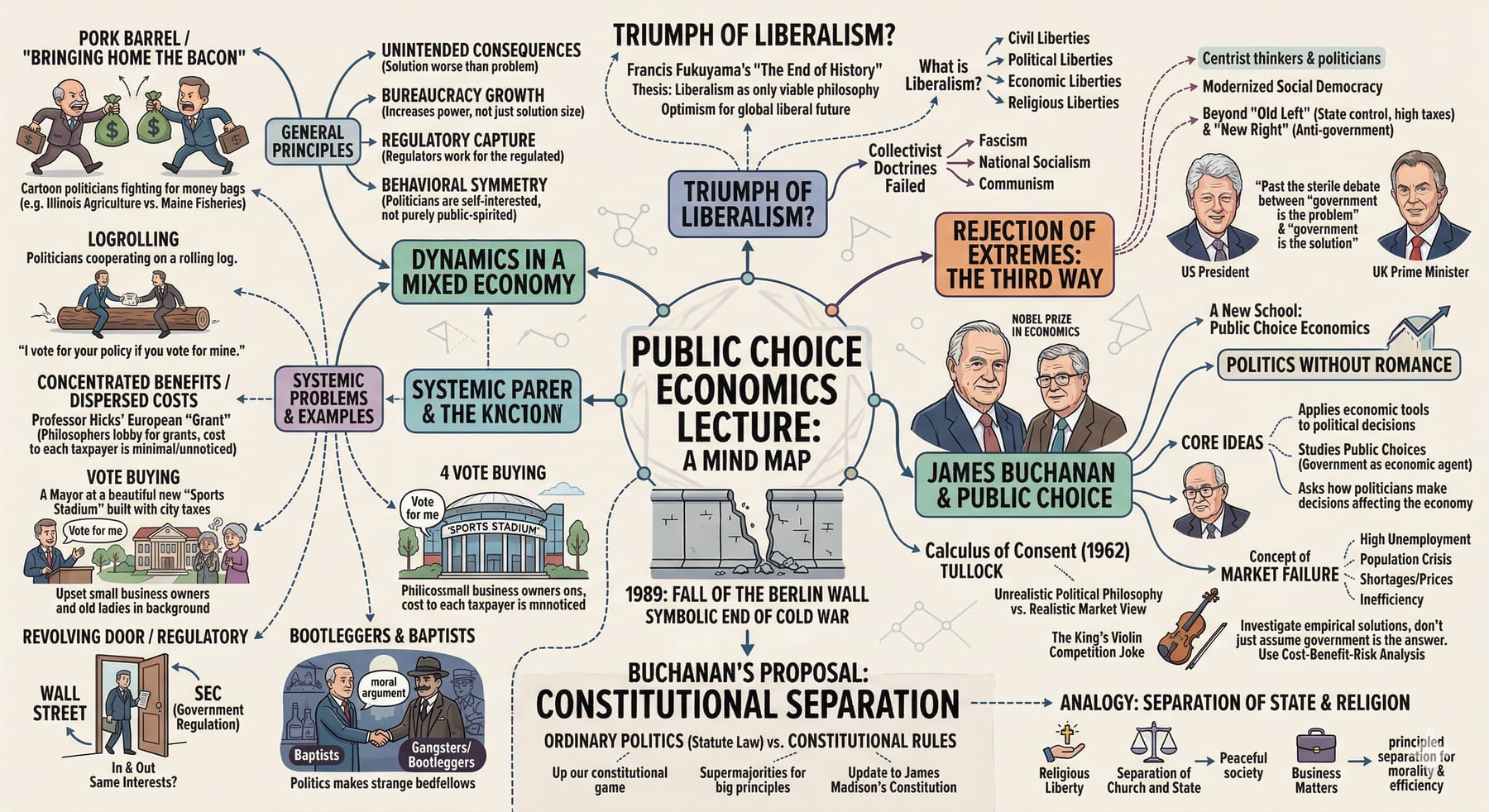
4: Leftist Thought
Peterson Academy - The Philosophy of Politics Part II (Hicks) - Lecture 04.pdf (file not included in this release)
Overview
- The lecture begins in 1968, a year that started with revolutionary hope for the far left but ended in defeat.
- The failed uprisings of 1968 led to a major strategic and theoretical reassessment on the left, especially the far left.
- The speaker argues that this reassessment pushed many radicals back toward the Frankfurt School and critical theory, a neo-Marxist tradition that sought to explain:
- why capitalism had not collapsed
- why workers in the West were not becoming revolutionary
- why liberal society appeared free while remaining, in their view, deeply oppressive
- The lecture’s central arc moves through:
- the Frankfurt School’s revision of Marxism
- its synthesis with Freud and, later, Heidegger in Marcuse
- Marcuse’s theory of “repressive tolerance”
- the turn from old Marxism to the New Left
- the post-1968 temptations of violence and terrorism
- and finally the strategic shift toward a long march through education and the universities
1. 1968 as Hope and Disaster for the Left
- 1968 is presented as a pivotal year for the political left, especially the far left.
- It began with the belief that mass unrest could:
- significantly transform Western society
- perhaps overthrow existing liberal-capitalist institutions
- The unrest included:
- riots and demonstrations in major cities in Europe and America
- student-led movements
- support from associated intellectuals
- These radicals saw Western society as:
- deeply oppressive
- deeply repressive
What happened
- The uprisings were suppressed by:
- police
- in some cases, the National Guard
- By the end of the year, the riots had failed.
Main significance
- 1968 became a moment of defeat and soul-searching for the left.
- The key question became:
- what strategy comes next after street revolt fails?
2. Return to the Frankfurt School and Critical Theory
- After 1968, many on the left returned to the Frankfurt School for guidance.
- The Frankfurt School is described as:
- initially Marxist
- later neo-Marxist
- centered on what came to be called critical theory
- It is associated with:
- the city of Frankfurt, Germany
- an institute devoted to advanced research
Meaning of “critical theory”
- The term “critique” signals Kantian roots.
- The lecture notes that whenever “critique” appears prominently in modern academic thought, it often reflects:
- Kantian influence
- neo-Kantian traditions
- Kant’s major works mentioned as background:
- Critique of Pure Reason
- Critique of Practical Reason
- Critique of Judgment
Main idea
- Critical theory emerges as a fusion of:
- Marxist politics
- philosophical critique
- social theory
- eventually psychology and culture critique
3. Founders of the Frankfurt School
Max Horkheimer
- Horkheimer is presented as a central founder.
- He received a major grant from a wealthy donor to start an institute for studying:
- Marxism
- its future
- its intellectual development after World War I
- He also had strong philosophical credentials:
- wrote his doctoral dissertation on Kant
Theodor Adorno
- Adorno joined Horkheimer and became another foundational figure.
- As a young man, Adorno had a formative philosophical experience reading:
- Kant’s Critique of Pure Reason
- He was both:
- philosophically sophisticated
- politically Marxist
Main theoretical problem
- These thinkers were trying to integrate:
- Kantian philosophy
- with Marxist social and political philosophy
Herbert Marcuse
- Later joined as a younger and eventually very influential figure.
- He would become especially prominent in the 1960s.
- He is portrayed as:
- a transition figure from the Old Left to the New Left
- the “father” or “philosopher” of the New Left
4. The Frankfurt School’s Two Big Problems in the 1920s–1930s
The lecture says the Frankfurt School faced both a practical and a theoretical problem.
A. Practical problem: Nazism
- In Germany during the late 1920s and early 1930s:
- National Socialism is rising
- Adolf Hitler comes to power in 1933
- For Marxists and communists, Nazism is:
- a bitter enemy
- a disaster politically
- a threat physically, especially for Jewish intellectuals
B. Theoretical problem: Marxism no longer predicts reality
- Marx’s original theory no longer seemed to fit the post-World War I West.
- The Frankfurt thinkers believed classical Marxism had once seemed:
- beautiful
- noble
- true
- But now it was failing as social science:
- it did not predict developments in advanced capitalist societies
- Western workers were not becoming revolutionary
- capitalism was not collapsing as expected
Main significance
- The Frankfurt School concluded that Marxism needed revision.
- This produced the turn from classical Marxism to neo-Marxism.
5. Exile from Germany
- In the 1930s, the major Frankfurt School thinkers left Germany.
- Reasons included:
- their Marxist or communist commitments
- the increasingly dangerous Nazi regime
- the Jewish background of many of the critical theorists
Interesting biographical point emphasized in the lecture
- If they were Marxists fleeing Germany, one might expect them to go:
- east, to the Soviet Union
- Instead, they chose to go:
- west, to Britain or especially the United States
- They took academic positions in places like:
- New York
- California
Main idea
- This move solved the immediate practical problem of survival.
- But it left unresolved the deeper theoretical question:
- how should Marxism be reformulated?
6. Supplementing Marx with Freud
- The Frankfurt School concluded that classical Marxism was too materialist and too dismissive of the mind.
- Traditional Marxism had treated consciousness as:
- secondary
- derivative
- epiphenomenal
- According to that view:
- what people think does not really explain events
- underlying material forces do all the causal work
Why this seemed inadequate
- It did not explain why workers in capitalist societies were not revolutionary.
- Material conditions alone were not enough to explain social stability.
Turn to Freud
- The Frankfurt School turned to Sigmund Freud to supplement Marx.
- Freud offered:
- a theory of consciousness and the unconscious
- an account of repression
- a psychology of instinct, desire, aggression, and civilization
Main theoretical move
- Marx explains:
- class structure
- economic oppression
- Freud explains:
- psychological repression
- why people adapt to and internalize oppression
7. Marx + Freud: Society as Oppressive and Repressive
- Marx had argued that society is divided into:
- bourgeoisie (owners)
- proletariat (workers)
- Workers are exploited by capitalists, and eventually should rise in revolution.
The problem
- In the West of the 1920s and 1930s, workers were not acting revolutionary.
- Instead, many were becoming:
- more comfortable
- more prosperous
- more materially content
- Examples mentioned:
- workers buying Model T cars
- taking trips
- living in bigger homes
- having more food
Frankfurt School diagnosis
- The workers are still oppressed materially, but also repressed psychologically.
- Capitalist society has taught them to repress their revolutionary instincts.
- The result:
- a society that appears prosperous and free
- but is actually both oppressive and repressive
Main idea
- Critical theory becomes a synthesis:
- Marxist oppression
- plus Freudian repression
8. Postwar Critique: Dialectic of Enlightenment
- After World War II, Horkheimer and Adorno published:
- Dialectic of Enlightenment
- The title signals:
- Hegelian and Marxist influences through the word “dialectic”
- The target is the Enlightenment.
Why the Enlightenment is central
- Liberal capitalist societies tell a story in which the Enlightenment gave rise to:
- science
- engineering
- industry
- rights
- anti-slavery movements
- longer life expectancy
- growing wealth
- liberation
- The West sees itself as the heir of this positive legacy.
Frankfurt School response
- The Enlightenment must be critiqued, not celebrated.
- Their major thesis:
- the Enlightenment contains the seeds of its own destruction
- it is not a pure story of progress
- it generates new forms of domination
Main idea
- The task of critical theory is to expose the dark underside of modernity.
9. A Major Revision of Marxism: Capitalism Does Raise Living Standards
One of the lecture’s most important points is that the Frankfurt School accepts something classical Marxism denied.
Classical Marxist expectation
- capitalism makes:
- the rich richer
- the poor poorer
- this worsening misery should produce revolution
Frankfurt School revision
- that prediction is false
- capitalism does increase productivity
- it does improve material life, even for workers
What they now argue instead
- capitalism creates:
- greater wealth
- better commodities
- higher living standards
- but it also creates:
- more psychological dependence
- more passivity
- more social control
- a loss of authentic humanity
Main formula
- material progress
- alongside spiritual / psychological regression
Main idea
- Capitalism no longer fails because it impoverishes workers.
- It fails because it pacifies and manipulates them through comfort, media, and consumer life.
10. Mass Culture, Entertainment, and False Satisfaction
- The lecture stresses the Frankfurt School critique of mass culture.
- Capitalism gives people:
- radios
- television
- magazines
- entertainment
- consumer goods
- This creates the appearance of freedom and satisfaction.
Their critique
- these comforts function as tools of control
- people become:
- entertained
- distracted
- stupefied
- politically passive
Key idea in the lecture
- modern society functions like an updated version of “bread and circuses”
- material abundance plus low-grade entertainment neutralizes revolt
Factory-life example
- the worker:
- goes to a repetitive job
- obeys the boss
- ends the day exhausted
- goes home, drinks, watches garbage television, and sleeps
- repeats the cycle
- This is presented as the real condition of capitalist modernity from the critical-theory perspective.
Main idea
- Modern capitalism controls people less through starvation and more through:
- commodities
- entertainment
- routine
- exhaustion
- internalized conformity
11. Crisis of the Old Left and the Need for a New Left
- By the 1950s, further developments deepened the crisis of classical Marxism.
Problem 1: Soviet failure
- Socialist and communist societies were supposed to be:
- more productive
- more humane
- But the Soviet Union did not seem materially successful.
- Worse, it was increasingly revealed to be brutally repressive.
Problem 2: Khrushchev’s revelations after Stalin’s death
- After Stalin died, Khrushchev exposed:
- secret police terror
- arbitrary arrests
- torture
- killings
- mass imprisonment
- the gulag system
- This showed:
- communist regimes were not morally superior
- the “old left” could no longer serve as the model
Problem 3: Hungary, 1956
- In 1956, workers and students in Hungary rose up.
- The Soviet Union sent in:
- tanks
- armed repression
- The revolt was crushed.
- International audiences saw this, including on television.
Main significance
- The old left, tied to Soviet communism, had lost credibility.
- A new left had to emerge.
12. Herbert Marcuse as Father of the New Left
- Herbert Marcuse is presented as the philosopher who becomes central to the New Left.
- By the 1960s he is:
- a senior philosopher
- widely published
- influential on campuses
- interviewed widely
- speaking across the United States
Marcuse’s philosophical roots
- Politically:
- Marxist / neo-Marxist
- Philosophically:
- Heideggerian
- His doctoral work was titled:
- Contribution to a Phenomenology of Historical Materialism
- This title shows his synthesis of:
- Marxism (historical materialism)
- Heideggerian phenomenology
Main idea
- Marcuse fuses:
- Marxist politics
- Frankfurt critical theory
- Freudian social psychology
- Heideggerian philosophy
- He becomes the chief theorist of the New Left.
13. Marcuse’s “Repressive Tolerance” (1965)
- In 1965, Marcuse published his famous essay:
- Repressive Tolerance
- It became highly influential in New Left circles.
The basic paradox
- Liberal society praises itself for being tolerant:
- freedom of speech
- freedom of religion
- freedom of assembly
- open discussion
- Marcuse argues this tolerance is actually:
- a mask for deeper repression
- a mechanism that stabilizes oppression
His striking thesis
- true tolerance would require:
- intolerance toward prevailing policies, attitudes, and opinions
- tolerance toward those views now suppressed or marginalized
Main idea
- Liberal tolerance is not neutral.
- It benefits the already dominant system and therefore helps maintain oppression.
14. Why Liberal Tolerance Is, in Marcuse’s View, Fake
Marcuse’s argument in the lecture runs like this:
A. Existing society is already oppressive
- Capitalism is assumed to be:
- exploitative
- alienating
- morally evil
- Therefore, allowing capitalism and its defenders full speech rights is not neutral; it is tolerance of evil.
B. Formal equality of speech is not real equality
- Society is structurally unequal.
- The ruling system has:
- more power
- more institutions
- more publishers
- more media
- more educational influence
- Therefore:
- “neutral” free speech merely reinforces the already dominant side
C. Protest is allowed only in harmless forms
- People can:
- vote
- write letters
- demonstrate
- But only so long as they stay within controlled, non-threatening bounds.
- These outlets let dissenters:
- blow off steam
- while changing nothing fundamental
Main idea
- Liberal freedoms function as a pressure-release valve that preserves the system instead of transforming it.
15. Critique of the Marketplace of Ideas
- Marcuse attacks the classical liberal idea, associated especially with John Stuart Mill, that truth emerges from open competition in a marketplace of ideas.
Marcuse’s objection
- A marketplace only works if the competitors are more or less equal.
- But society is already dominated by entrenched powers.
- Therefore the “marketplace of ideas” is not fair competition:
- dominant ideas start with overwhelming advantages
- minority radical views are drowned out
Parallel with economics
- Just as a capitalist market can become monopolistic,
- so too can the intellectual marketplace become controlled by entrenched interests.
Main idea
- The ideal of open discussion is, in practice, rigged in favor of the status quo.
16. False Consciousness and Indoctrination
- Marcuse argues that people in liberal capitalist societies live under false consciousness.
- They believe:
- they are free
- they choose for themselves
- their society is progressive
- But in fact they have been:
- conditioned
- indoctrinated
- made compliant
- This indoctrination is often not even recognized as indoctrination.
Examples of the mechanisms
- business culture
- publicity / advertising
- educational institutions
- media
- consumer desire
- employer discipline
- social conformity
Main idea
- People do not simply fail to revolt.
- They are psychologically shaped into accepting and reproducing their own domination.
17. From Nonviolence to the Question of Violence
- Marcuse says that if tolerated dissent achieves nothing, then the issue of violence must be reconsidered.
- Liberalism distinguishes:
- violent action
- from nonviolent action
- Marcuse argues that this distinction is misleading because:
- society is already violent in its structure
- the system’s violence is normalized and hidden
Therefore
- revolutionary violence and reactionary violence are not morally equivalent
- violence used by the system to preserve domination is unjustified
- violence used to overthrow oppression may be historically justified
Key historical reference
- Robespierre and the French Revolution
- Marcuse invokes the difference between:
- terror for liberty
- terror for despotism
Main idea
- Marcuse opens the door to radical and even violent measures by claiming:
- liberal society is already violent
- and history is not constrained by ordinary ethics
18. History Above Morality
- Marcuse explicitly says that revolutions may involve:
- inhuman acts
- evil acts
- But he places historical transformation above conventional morality.
Philosophical background invoked
- Hegel
- world-historical figures transcend ordinary ethics
- Marx
- revolutionary change is historically necessary and violent
- Marcuse channels both traditions.
Main idea
- He treats revolutionary transformation as more important than adherence to ordinary moral rules.
19. Who Decides What Is Progressive? The Vanguard of Intellectuals
- Marcuse faces the question:
- who determines what is genuinely progressive or regressive?
- His answer is not:
- the majority
- the ordinary citizen
- Instead, it is a smaller, more advanced group:
- those who see through false consciousness
- those mature enough to understand society critically
Analogy used
- Drawing on Plato and even a limited point from Mill:
- children are not ready for full freedom
- most adults, on Marcuse’s view, remain politically immature
- Therefore:
- a more advanced minority must lead
Main idea
- Marcuse effectively argues for an intellectual vanguard
- not unlike Lenin’s revolutionary elite, but now grounded in critical theory
20. Liberal Education vs Revolutionary Education
The lecture contrasts two educational models.
Liberal education model
- expose students to many viewpoints
- encourage debate
- promote intellectual maturity
- allow students to form their own conclusions
- value institutional neutrality and diversity of opinion
Marcuse’s rejection
- this model only helps dominant views prevail
- if society is structurally unequal, then “neutrality” is not neutral
- real liberation requires:
- suppressing oppressive views
- empowering radical ones
Main idea
- Marcuse rejects the liberal university ideal.
- Education should not neutrally host all views; it should actively favor left revolutionary views.
21. “Liberating Tolerance”
This is the most famous policy conclusion of Marcuse’s essay.
Marcuse’s formula
- “Liberating tolerance” means:
- intolerance toward movements from the right
- tolerance toward movements from the left
Practical implications given in the lecture
- rewrite textbooks
- remove certain teachers
- hire only those aligned with the proper political perspective
- suppress or delegitimize right-wing views in:
- schools
- universities
- newspapers
- magazines
- journalism
- public discourse
Main idea
- Marcuse advocates an intentionally uneven playing field
- speech and education should be politically directed toward revolutionary ends
22. Suspension of Free Speech and Free Assembly
- Marcuse argues that in emergency conditions, censorship is justified.
- He claims society is in such an emergency:
- not temporarily
- but as its normal condition
Therefore
- the rights of:
- free speech
- free assembly
- may be suspended for those on the wrong side of politics
His reasoning
- in wartime, states censor enemy propaganda
- society is already in a state of war:
- the continuing war of oppressive capitalism against true freedom
Main idea
- Marcuse justifies censorship and suppression as emergency measures in a permanent crisis.
23. 1968 and the Call to Radical Minorities
- In a 1968 postscript, Marcuse says the struggle is not over.
- He claims tolerance will not be gifted by those in power.
- It must be won by:
- radical minorities
- willing to be:
- militantly intolerant
- disobedient
- revolutionary
Main idea
- Marcuse explicitly shifts away from trust in the majority or normal democratic politics.
- He places hope in organized, militant minorities.
24. After 1968: From Failed Revolution to Terrorism
- When the 1968 uprisings failed, some radicals concluded that:
- street protest was insufficient
- argument was insufficient
- even student revolt was insufficient
- The next temptation was:
- terrorism
German example
- Radical activists formed the Red Army Faction
- also called the Baader-Meinhof Group
- founded in 1970
- They embraced:
- kidnapping
- assassination
- violent uprising
- The lecture cites Ulrike Meinhof, who argues that anti-imperialist struggle requires:
- annihilation
- destruction
- shattering of the power system
Main idea
- Some strands of the New Left moved from theory and protest into outright political violence.
25. International Upsurge of Neo-Marxist Terrorism
- The lecture says the late 1960s into the early 1970s saw a broader rise in terrorism inspired by:
- neo-Marxism
- separatism
- nationalism
- Countries mentioned include:
- United States
- Peru
- Germany
- France
- Canada
- Japan
Main idea
- The post-1968 radicalization was not isolated to Germany.
- It was part of a wider crisis on the far left after the failure of older revolutionary models.
26. Failure of the Terrorist Phase
- These terrorist movements were eventually:
- suppressed
- imprisoned
- broken up
- The specific terrorist strategy also failed to produce the hoped-for revolution.
Result
- another moment of depression and reassessment on the far left
Main idea
- By the mid-1970s, overt revolution, street revolt, and terrorism all appeared to have failed.
27. Marcuse in 1974: The Long March Through the Universities
- The lecture ends with a 1974 interview with Marcuse.
- He is asked what happened to the student movement of the late 1960s.
- His answer:
- it is not dead
- it will resurrect
- But the resurrection will not come through:
- direct street revolution
- economic insurrection
- terrorism
- immediate mass uprising
Where will it happen?
- inside the universities
- through:
- long-term reeducation
- shaping future generations
- intellectual and cultural formation
Main idea
- The final strategic shift is from overt revolution to institutional and educational transformation.
- The university becomes the key site of the New Left’s long-term project.
28. Major Historical Events Mentioned
- World War I
- Rise of Hitler / Nazi takeover of Germany (1933)
- World War II
- Death of Stalin
- Khrushchev’s revelations about Stalinist terror
- Hungarian uprising (1956) and Soviet suppression
- The upheavals of 1968
- Founding of the Red Army Faction / Baader-Meinhof (1970)
29. Major Thinkers Mentioned
- Immanuel Kant
- Max Horkheimer
- Theodor Adorno
- Herbert Marcuse
- Karl Marx
- Sigmund Freud
- G. W. F. Hegel
- Martin Heidegger
- Edmund Husserl
- John Stuart Mill
- Plato
- Robespierre
- Lenin
- Stalin
- Khrushchev
- Ulrike Meinhof
30. Books, Essays, and Works Mentioned
- Critique of Pure Reason — Immanuel Kant
- Critique of Practical Reason — Immanuel Kant
- Critique of Judgment — Immanuel Kant
- Dialectic of Enlightenment — Horkheimer and Adorno
- Contribution to a Phenomenology of Historical Materialism — Herbert Marcuse
- Repressive Tolerance — Herbert Marcuse
31. Core Theoretical Shifts Highlighted in the Lecture
From classical Marxism to neo-Marxism
- classical economic determinism was no longer enough
- psychology and culture had to be added
From oppression alone to oppression + repression
- capitalism dominates not just bodies and labor
- but consciousness and desire
From immiseration theory to comfort-as-control
- workers are not becoming poorer in absolute terms
- instead, material prosperity pacifies them
From the Old Left to the New Left
- Soviet-style communism is discredited
- a new revolutionary framework must emerge
From liberal tolerance to “liberating tolerance”
- neutral free speech is treated as a fraud
- suppression of the right becomes justified
From mass revolt to militant minority
- the majority is seen as brainwashed
- change must come through radical minorities
From failed terrorism to long institutional capture
- if street revolt and terror fail, universities become the long-term battleground
32. Concise Takeaway
- The lecture presents 1968 as the turning point where far-left hopes for immediate revolution collapsed.
- In response, radicals returned to the Frankfurt School and critical theory, which had already reworked Marxism by combining it with:
- Freud’s psychology
- later Heideggerian philosophy in Marcuse
- Their revised theory held that capitalism no longer mainly survives by making workers poorer, but by making them:
- materially comfortable
- psychologically repressed
- culturally manipulated
- Marcuse’s answer was to reject liberal neutrality and argue for:
- intolerance toward the right
- tolerance toward the left
- censorship in emergency conditions
- militant minority action
- After the failures of protest and terrorism, the strategy shifted to a long march through the universities, where future generations could be reeducated and the revolution pursued indirectly.
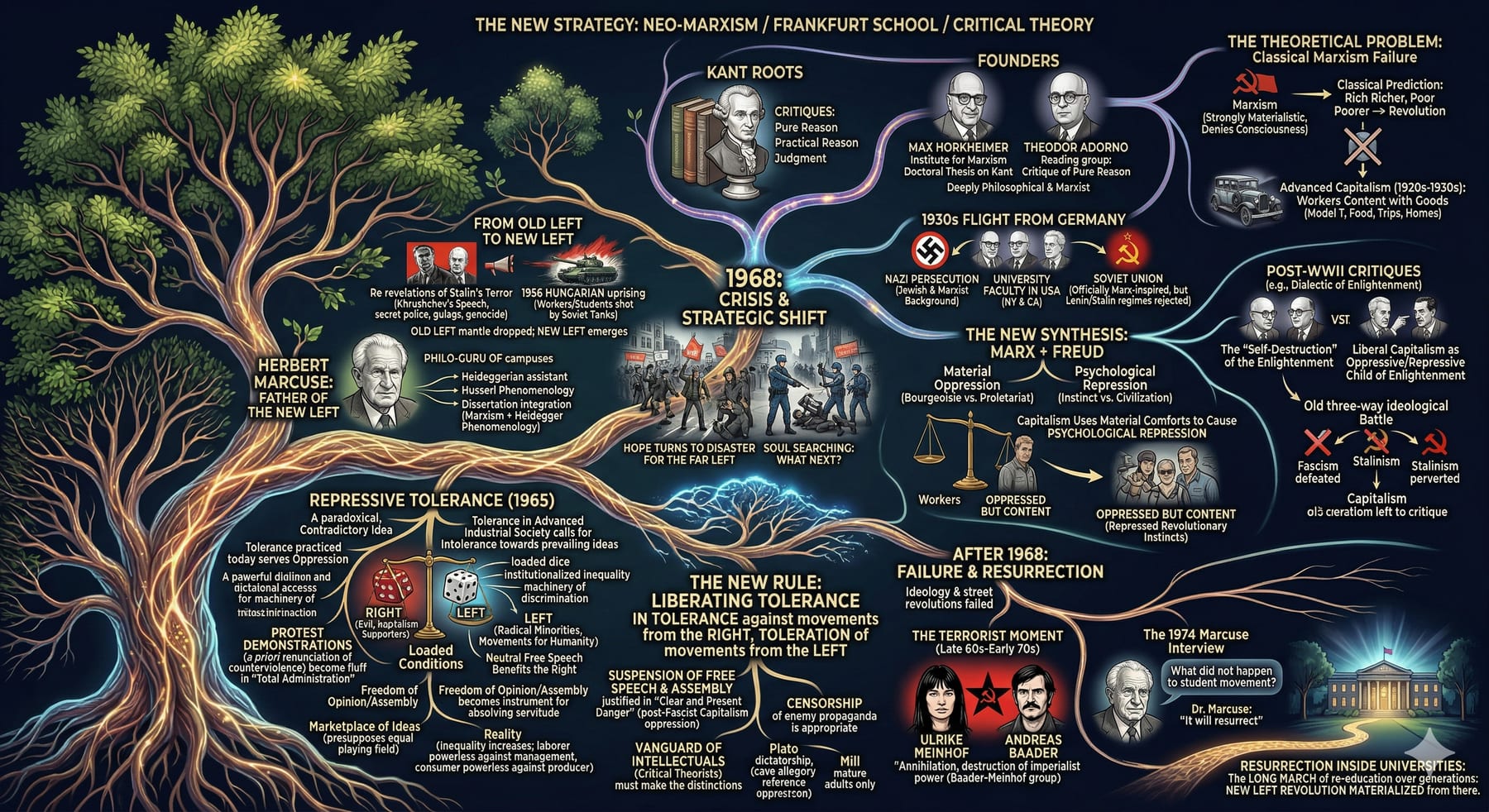
5: Foucault’s Paradox
Peterson Academy - The Philosophy of Politics Part II (Hicks) - Lecture 05.pdf (file not included in this release)
Overview
- The lecture begins with Michel Foucault’s 1978–79 visit to Iran during the Islamic Revolution and asks why:
- an atheist
- a far-left thinker
- and a postmodern philosopher
would speak positively about a religious theocratic revolution
- The transcript uses this puzzle to introduce Foucault’s broader political philosophy, especially his 1975 book Discipline and Punish: The Birth of the Prison
- The lecture’s central argument is that Foucault rejects both:
- premodern justice, which openly used brutality and religion
- and modern justice, which presents itself as humane, rational, and progressive
- Foucault’s claim, as presented here, is that modern society did not become less oppressive. It became:
- more subtle
- more bureaucratic
- more scientific
- more surveillant
- and more focused on controlling the psyche, not just the body
1. Starting Point: Foucault in Iran, 1978–79
- The lecture opens with Michel Foucault visiting Iran during the Islamic Revolution.
- This is presented as surprising because:
- Foucault is an atheist
- he is identified with the far left
- he is known as a postmodern thinker
- Iran at that moment appears to represent the opposite of left-modern politics:
- a return to religious rule
- fusion of theology and state power
- hierarchical politics
- subordination of women
- explicit rejection of modern Western liberalism
Why this matters
- The coming Iranian regime under Ayatollah Khomeini is portrayed as:
- anti-modern
- anti-liberal
- anti-American
- theocratic
- The U.S., by contrast, is presented as the clearest symbol of modernity:
- Enlightenment influence
- science
- liberalism
- separation of religion and politics
- increasing equality for women
Central puzzle
- If postmodernism rejects both the premodern and the modern, why would Foucault sympathize with Iran’s revolution?
Main idea
- The lecture suggests that Foucault’s support makes sense once we understand that his main target is modern Western power, especially liberal capitalist modernity.
2. Focus of the Lecture: Discipline and Punish
- The lecture centers on Foucault’s 1975 book:
- Discipline and Punish: The Birth of the Prison
- This book is introduced as one of the most influential works in social thought.
- The speaker notes Foucault’s extraordinary impact by citing social-science rankings:
- Discipline and Punish is among the most cited books in the field
- The History of Sexuality is also among the top-ranked
Why this book matters here
- The lecture frames criminal justice as a major topic in political theory:
- how societies treat “bad people”
- how power is exercised in the name of justice
- how punishment changes across historical eras
Main idea
- The judicial system becomes Foucault’s lens for explaining how modern power works.
3. Comparative Starting Point: Iran vs the United States on Capital Punishment
- The lecture begins its legal discussion by comparing Iran and the United States on the death penalty.
In Iran
- The post-revolutionary theocratic regime allows capital punishment for crimes such as:
- blasphemy
- insulting the prophet
- corruption on earth
- fornication
- adultery
- sodomy
- same-sex acts
- terrorism
- drug-related crimes
In the United States
- Capital punishment is associated with a very different set of crimes:
- murder in some cases
- genocide
- espionage
- murder of certain political/judicial officials
- terrorism
- drug trafficking
Main contrast
- Iran’s list reflects:
- religious crimes
- sexual morality enforcement
- theocratic priorities
- The U.S. list reflects:
- political crimes
- crimes against the state or legal system
- extreme violence
Main idea
- Legal systems reveal a society’s value hierarchy.
- Iran and the U.S. show very different moral and political priorities.
4. Historical Trend: Death Penalty and Modern Judicial Self-Understanding
- The lecture notes that in post-revolution Iran:
- executions increase
- In the 20th-century U.S.:
- executions generally decline
- especially by the 1970s
In the United States during the 1970s
- the death penalty becomes the subject of intense constitutional debate
- two Supreme Court cases are highlighted:
- Furman v. Georgia
- Gregg v. Georgia (1976)
Significance of these cases
- The Court places strong restrictions on the death penalty
- States are forced to rethink procedures and statutes
- The broader issue becomes:
- what kind of country is a modern liberal democracy?
- can such a society morally and constitutionally use the death penalty?
Main idea
- Modern liberal societies see themselves as increasingly humane and cautious in the use of punishment.
5. Premodern Justice: Ordeal, Barbarism, and Divine Judgment
The lecture then steps back into earlier legal history to show what the moderns believed they were overcoming.
Premodern examples given
Witch trials by dunking
- A woman accused of witchcraft is repeatedly submerged in water
- If she survives:
- only supernatural help could explain it
- therefore she must be a witch
- If she dies:
- she was innocent, but too late
Trial by ordeal using hot iron
- The accused must hold a red-hot iron
- If unharmed:
- God protected the innocent
- If burned:
- guilt is proven
Underlying worldview
- Justice is not primarily human reasoning
- God actively reveals guilt or innocence through intervention in nature
Main idea
- Premodern justice relied on:
- divine judgment
- religious assumptions
- ordeals
- visible bodily suffering
- Modern people look back on this as irrational and barbaric.
6. Biblical Models of Justice
- The lecture highlights the importance of biblical sources in premodern legal thinking.
Old Testament model
- From Exodus:
- “life for life, eye for eye, tooth for tooth…”
- This implies:
- punishment is required
- proportionality matters
- but it can also seem harsh and physically retaliatory
New Testament tension
- From Romans:
- “Vengeance is mine; I will repay, says the Lord.”
- This raises questions:
- should humans administer vengeance at all?
- should justice be left to God?
Main idea
- There was no simple religious consensus.
- Even within scripture, legal punishment raised deep tensions about:
- divine authority
- human fallibility
- vengeance
- moral restraint
7. The Early Modern Turn: From Divine Ordeal to Rational Procedure
- By the 1500s and after, trials by ordeal begin to be abandoned.
- They increasingly seem:
- random
- barbaric
- unreliable
- New procedures emerge that are still recognizable today.
Examples of change
Jury trial / compurgation
- guilt is assessed by human peers
- no longer by direct divine intervention
Expert judgment and inquisitions
- some argued that justice should be handled by trained authorities
- including theological or crown-appointed experts
Growing skepticism about torture
- torture remains common for a long time
- but is increasingly challenged as the modern world develops
Main idea
- The early modern era begins to replace:
- ordeal
- direct appeals to divine signs
with: - evidence
- procedure
- reason
- increasingly human institutions
8. The Big Modern Questions About Justice
The lecture identifies several philosophical questions that shaped the modernization of law.
A. How do we know truth?
- Is truth known by:
- revelation
- tradition
- power
- or reason?
B. What is human nature?
- Are humans born:
- sinful and morally compromised?
- or neutral / innocent / blank-slate-like?
C. Who carries the burden of proof?
- Should the accused prove innocence?
- Or should the prosecution prove guilt?
D. Are people equal before the law?
- Premodern systems often had:
- class-based law
- different standards for nobles and commoners
- Modern systems increasingly move toward:
- legal equality
E. What should punishment aim at?
- revenge?
- proportionality?
- reform?
- deterrence?
- moral expression?
- social control?
Main idea
- Modern legal reform required major shifts in:
- epistemology
- ethics
- political philosophy
- anthropology / views of human nature
9. Cesare Beccaria and Enlightenment Reform
- The lecture names Cesare Beccaria as the most famous Enlightenment reformer of punishment.
- His key work:
- On Crimes and Punishments (1764)
Why Beccaria matters
- He synthesizes earlier modern debates
- His work strongly influences:
- Italy
- France
- Britain
- the United States
- He is presented as a major influence on the American founding generation
Link to the U.S. Constitution
- The Eighth Amendment reflects Beccaria’s reformist spirit:
- opposition to cruel and unusual punishments
- The modern ideal becomes:
- punish proportionately
- but not barbarically
Main idea
- Beccaria represents the Enlightenment’s humane, rational, reforming self-image.
10. The Modern Self-Congratulatory Story
- The lecture says the modern West tells itself a “good news” story:
- the premodern world was cruel, religious, irrational, and barbaric
- the modern world became humane, rational, and scientifically just
- This story includes:
- reduced use of torture
- shorter lists of capital crimes
- better procedures
- jury trials
- rights protections
- less cruelty
Example mentioned
- The absurdity of older legal systems is illustrated by crimes like:
- attempted suicide
- In older law, a failed suicide attempt could itself lead to execution
Main idea
- Modernity portrays itself as a moral advance in punishment and justice.
11. Foucault’s Fundamental Challenge
- Foucault rejects the easy story that modern punishment became genuinely more humane.
- He argues that this interpretation is too superficial.
His core claim
- punishment did not become less intense in a morally meaningful sense
- instead:
- its object
- its methods
- and its social role
changed
Foucault’s suspicion
- Modernity did not humanize punishment
- It redistributed and repackaged punishment
Main idea
- The modern judicial system is not better in the simple moral sense.
- It is more sophisticated, more masked, and more psychologically invasive.
12. Foucault’s Famous Opening Example: Damiens (1757)
- Foucault opens Discipline and Punish with the case of Damiens the regicide, executed in 1757
- The sentence included:
- public humiliation
- flesh torn with red-hot pincers
- hand burned
- wounds filled with molten substances
- body drawn and quartered
- remains burned and scattered
Why Foucault uses this example
- It represents the old regime of punishment:
- spectacular
- public
- bodily
- theatrical
- brutal
Modern interpretation of this example
- Enlightenment reformers looked at such scenes and said:
- this is exactly what civilized society must leave behind
Main idea
- Foucault uses the extremity of premodern punishment as the backdrop for questioning whether modern reform was really moral progress.
13. The Shift from Body to Soul
- Foucault’s most famous thesis in this lecture is:
- modern punishment no longer targets the body in the same way
- it targets the soul or psyche
- “Soul” is used metaphorically:
- not as a religious reality
- but as the inner person, consciousness, mentality, subjectivity
What changes
Premodern punishment
- bodily pain
- spectacle
- open violence
Modern punishment
- investigation
- diagnosis
- normalization
- correction
- reform
- surveillance
- psychological management
Main idea
- Modern punishment is less visibly violent, but more inwardly invasive.
- It seeks to shape the person, not merely wound the body.
14. Judges No Longer Judge Only the Crime
- Foucault says that modern justice no longer simply asks:
- did this person commit this act?
- what is the legal penalty?
- Instead, modern systems ask many other questions:
- what kind of act was it?
- what psychological condition produced it?
- what role did heredity, instinct, environment, or unconscious processes play?
- what sort of person is this offender?
- can this person be reformed?
Modern justice becomes a “scientifico-juridical complex”
- law becomes entangled with:
- psychiatry
- psychology
- criminology
- biography
- social investigation
- expert testimony
- forensics
Main idea
- The court no longer judges only the deed.
- It judges the person, the psyche, the life-history, and the future risk.
15. Power and Knowledge: Foucault’s Reversal
This is one of the deepest philosophical points in the lecture.
The modern self-understanding
- first we gather knowledge objectively
- then we use power in service of truth and justice
Foucault’s reversal
- power comes first
- knowledge is constructed within power relations
- what counts as “truth” is shaped by the needs of power
- there is no neutral, objective knowledge standing outside power
Key Foucauldian idea
- knowledge and power are intertwined
- institutions do not discover truth neutrally
- they produce “truth” regimes that justify the forms of control they already want
Main idea
- Modern justice does not rest on disinterested truth-seeking.
- It rests on a knowledge system built to support particular power arrangements.
16. No Objective Justice, Only Competing Regimes
- The lecture presents Foucault as radically skeptical of:
- objective truth
- ultimate justice
- neutral standards
- He argues that claims about justice are always tied to:
- value systems
- institutions
- power struggles
Therefore
- there is no final, objective foundation for justice
- different regimes claim justice for themselves
- legal systems are battles among power-backed interpretations
Main idea
- Justice talk is inseparable from power.
- Modern legal rationality is not a transcendence of domination; it is one form of domination.
17. The Birth of the Prison
- Moderns say:
- we are more humane because we kill fewer people
- instead of destroying bodies, we incarcerate
- Foucault responds:
- prison is not simply mercy
- it is a new disciplinary technology
What prison does
- scripts behavior
- imposes timetable
- enforces obedience
- creates routine
- monitors continuously
- trains conformity
Main idea
- Prison is the emblem of modern punishment because it disciplines rather than spectacularly destroys.
18. Prisons, Factories, Schools, Armies: One Shared Logic
- Foucault argues the prison is not isolated.
- It reflects a broader social pattern found in:
- factories
- schools
- universities
- barracks
- workplaces
- public administration
Shared features
- fixed schedules
- assigned places
- supervision
- obedience to authority
- routines
- evaluation
- normalization
- punishment for deviation
Examples from the lecture
Factory
- workers must show up on time
- do assigned tasks
- follow orders
- serve the economic machine
School
- children are trained early:
- be on time
- sit where told
- obey the bell
- follow the teacher
- internalize discipline
Military
- individuals are broken down and rebuilt through drill, routine, and command
Main idea
- Modern society as a whole is disciplinary.
- Prison is one concentrated expression of a wider social order.
19. Capitalism and Discipline
- The lecture links Foucault’s analysis to capitalism.
- Modern disciplinary institutions produce the type of person capitalism requires:
- punctual
- obedient
- trainable
- regularized
- surveilled
- productive
Core argument
- the body becomes a force of production
- therefore it must be:
- organized
- trained
- subordinated
- made useful
Punishment fits this world
- prison reforms those who resist discipline
- it prepares or re-prepares people for their proper place within the social order
Main idea
- Modern punishment is tied to the needs of the capitalist and administrative order.
20. Panopticism
- The key Foucauldian concept introduced is panopticism
- It comes from Jeremy Bentham’s design for the Panopticon
Basic structure
- a central observer can potentially see all prisoners
- each prisoner knows he may be watched at any moment
- actual force becomes less necessary because surveillance is internalized
What this does psychologically
- people regulate themselves
- they become self-monitoring
- they conform because they assume they are being watched
Foucault’s broader claim
- panopticism is not only a prison design
- it is a model for modern society:
- schools
- workplaces
- institutions
- public life
- surveillance systems
Main idea
- Modern power works by making people visible, observable, and self-disciplining.
21. The Time-Regime of Modernity
- Another key theme is that modern society disciplines through time
- Everything becomes scheduled:
- workday
- school day
- military drill
- institutional routine
Historical parallel
- Foucault connects modern timetables to older religious-monastic discipline:
- monks had strict routines of prayer, labor, and rest
- Modern industrial society secularizes that structure:
- bells
- schedules
- work periods
- institutional sequencing
Main idea
- Modern society subjects people to the clock.
- Time itself becomes a mechanism of power.
22. Foucault’s Intellectual Sources
The lecture emphasizes that Foucault is not an isolated thinker. He synthesizes several traditions.
A. Frankfurt School
- He acknowledges major overlap with:
- Horkheimer
- Adorno
- Marcuse
- He even says knowing them earlier would have saved him work
B. Heidegger
- Foucault says:
- “Heidegger has always been, for me, the essential philosopher.”
- Heidegger is a foundational influence
C. Marx
- Foucault briefly joined the French Communist Party
- He later left because of Stalinism
- But Marxist language remains central:
- proletariat
- class conflict
- dictatorship
- revolutionary struggle
D. Nietzsche
- Foucault says, in effect:
- “I am simply a Nietzschean.”
- This highlights:
- the death of God
- the will to power
- the suspicion of objective truth
- genealogy
Main idea
- Foucault’s postmodernism is a synthesis of:
- Marx
- Nietzsche
- Heidegger
- and strands of critical theory
23. Anti-Humanism
- Foucault rejects not only traditional religion, but also modern humanism.
Premodern view
- God is central
Modern view
- after the “death of God,” man becomes central
- the modern world celebrates:
- rational subjectivity
- dignity
- rights of man
- autonomous agency
Foucault’s rejection
- this too is a false construction
- there is no sovereign autonomous subject at the center
- instead:
- “thinking without a subject”
- anonymous systems
- impersonal structures
- discursive formations
- power relations
Main idea
- Postmodernism, in Foucault’s version, means:
- not only the death of God
- but also the death of modern man as a stable center of meaning
24. Why Foucault Supports Revolution, Including Iran
- If modern Western society is a disciplinary, capitalist, surveillant regime,
then revolt against it becomes attractive, even when it comes from unexpected sources.
Why Iran appealed to Foucault
- not because he believed Islamic theology
- not because he wanted a premodern order in itself
- but because the Iranian revolution represented:
- a challenge to Western modernity
- a challenge to the United States
- a rupture with liberal capitalist forms of power
- a “political spirituality” capable of revolution
Key line from the lecture
- Foucault values Iran as:
- “a new manifestation of the very idea of revolution”
Main idea
- The revolutionary energy matters more to Foucault than doctrinal consistency.
- The enemy of his enemy can become, at least strategically, an object of admiration.
25. Strange Bedfellows: Postmodernism and Theocracy
- The lecture emphasizes the paradox:
- a postmodern atheist praising a religious revolution
- The explanation offered is political rather than theological:
- Foucault’s deepest hostility is toward:
- modernity
- liberalism
- capitalism
- especially the United States
- Foucault’s deepest hostility is toward:
- Therefore, anti-modern forces can appear attractive.
Main idea
- Foucault’s sympathy for Iran reflects his revolutionary anti-modernism, not religious agreement.
26. Larger Arc of the Lecture
The lecture moves through three broad stages:
Stage 1: Historical transformation of punishment
- premodern justice is overtly brutal, religious, spectacular
- modern justice becomes procedural, scientific, institutional
Stage 2: Foucault’s critique of modernity
- modern justice is not more moral
- it is more hidden, more disciplinary, more totalizing
- modern punishment shifts from body to psyche
Stage 3: Political implications
- if modernity is itself the deeper enemy
- then anti-modern revolutions can appear politically meaningful
- this explains, in part, Foucault’s response to Iran
27. Major Historical Events Mentioned
- Iranian Revolution (1978–79)
- rise of Ayatollah Khomeini
- modern U.S. death penalty debates in the 1970s
- Furman v. Georgia
- Gregg v. Georgia (1976)
- premodern European ordeals and inquisitorial justice
- Enlightenment-era judicial reforms
- publication of Beccaria’s On Crimes and Punishments (1764)
28. Major Figures Mentioned
- Michel Foucault
- Ayatollah Khomeini
- Sayyid Qutb (mentioned as influence on Khomeini, to be covered next)
- Jeremy Bentham
- Cesare Beccaria
- Horkheimer
- Adorno
- Marcuse
- Heidegger
- Marx
- Nietzsche
29. Books and Works Mentioned
- Discipline and Punish: The Birth of the Prison — Michel Foucault
- The History of Sexuality — Michel Foucault
- On Crimes and Punishments — Cesare Beccaria
30. Core Takeaways
- The lecture uses Foucault’s visit to revolutionary Iran as an entry point into his broader political philosophy.
- Foucault is presented as a thinker who rejects:
- religious premodern justice
- but also liberal modern claims to humane, objective justice
- In Discipline and Punish, he argues that modern punishment did not become less oppressive:
- it shifted from spectacular violence against the body
- to scientific, institutional control of the soul/psyche
- Modern society’s core institutions:
- prisons
- schools
- factories
- armies
- bureaucracies
all share a logic of discipline, surveillance, and normalization
- His philosophy draws from:
- Nietzsche’s will to power
- Marxist conflict theory
- Heidegger
- and overlaps with critical theory
- This helps explain why Foucault could praise aspects of the Iranian revolution:
- not because he embraced Islam
- but because he saw it as a revolutionary challenge to modern Western liberal-capitalist power
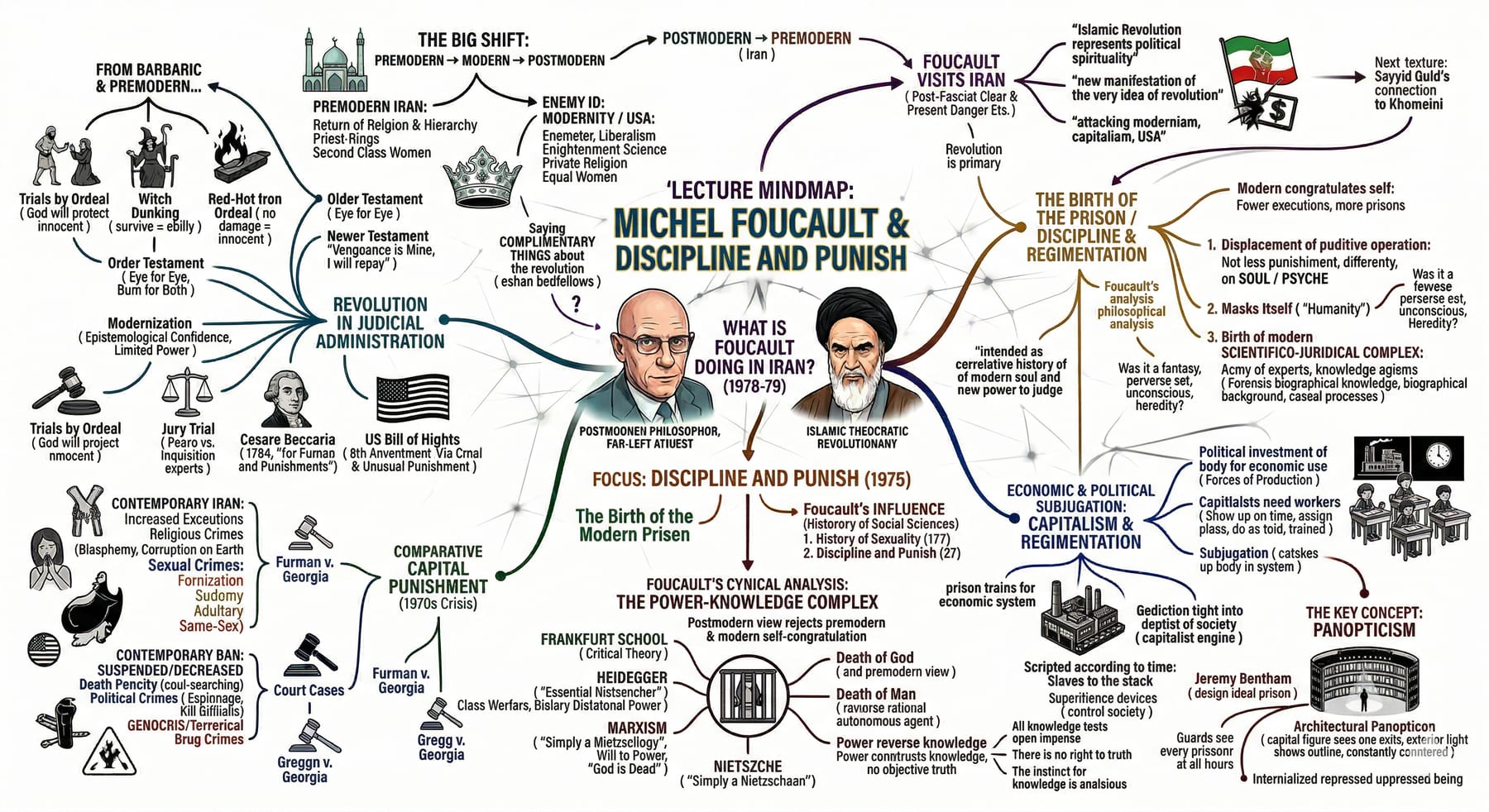
6: Qutb’s Islam
Peterson Academy - The Philosophy of Politics Part II (Hicks) - Lecture 06.pdf (file not included in this release)
Overview
- The transcript explains September 11, 2001 by tracing an ideological lineage back to Sayyid Qutb, especially his 1960s Islamist manifesto Milestones.
- Its central argument is that modernity—both Western capitalism and Eastern socialism—had failed, and that only a return to fundamental Islam as a total political-religious order could save mankind.
- The summary follows the development of:
- Qutb’s anti-American and anti-modern worldview
- the distinction between Islam and Islamism
- the doctrines of vanguardism, Jahiliyyah, Sharia, jihad, and martyrdom
- and the transmission of these ideas through Muslim Brotherhood, Muhammad Qutb, Osama bin Laden, and Khomeini/Iran
1. Opening Frame: 9/11 and the Need to Look Back
- The lecture begins with September 11, 2001, when planes struck the World Trade Center.
- The immediate question is:
- How could this happen?
- Why could this happen?
- The speaker argues that a major part of the answer goes back not just to the late 20th century, but to 1948, over half a century earlier.
- The key figure in the story is Sayyid Qutb, an Egyptian intellectual whose ideas became foundational for later Islamist movements.
Main idea
- 9/11 is not presented as an isolated terrorist event.
- It is framed as the downstream result of a long ideological tradition rooted in Islamist political theology.
2. Sayyid Qutb’s Background
- Sayyid Qutb is introduced as:
- an Egyptian
- born and raised in Cairo
- well educated in:
- Islamic/religious traditions
- classical Arabic literary traditions
- European literature and philosophy
- He was familiar with major Western thinkers, especially:
- Hegel
- Marx
- Nietzsche
- and particularly German thought more broadly
Importance of this background
- Qutb is not portrayed as an ignorant fanatic.
- He is shown as a serious intellectual who had:
- deep exposure to Western ideas
- knowledge of both Islamic and European traditions
- This makes his later rejection of the West more ideologically significant.
Main idea
- Qutb’s anti-Westernism was not based on unfamiliarity.
- It was the result of a deliberate judgment formed by someone who had studied the West closely.
3. Qutb’s Trip to America (1948)
- In 1948, Qutb traveled to the United States.
- America fascinated him because it seemed like:
- a giant modern power
- a new civilizational force
- a model for how modernity had developed outside Europe
- He studied in:
- California
- and more formally in Colorado
Why the trip mattered
- Qutb wanted to understand:
- the place of Egypt in the modern world
- the place of Islam in the modern world
- and the meaning of this rising American power
Main idea
- America served as Qutb’s direct encounter with modernity in practice.
4. Qutb’s Horror at America
- Qutb’s reaction to America was overwhelmingly negative.
- He judged Americans as:
- shallow
- herd-like
- materialistic
- obsessed with bodily appetites
- He says:
- “I found the herd everywhere”
- Americans appear to him like:
- cattle
- sheep
- beings devoted to eating, sex, sleep, and trivial pleasures
His reaction to American women
- Qutb is especially disgusted by American women.
- He sees them as:
- shameless
- sexually provocative
- wrongly pursuing equality and liberty
- He condemns what he regards as:
- open sensuality
- flaunting of the body
- moral disorder
Main idea
- America becomes, for Qutb, the symbol of a morally decayed civilization:
- materially powerful
- spiritually corrupt
- sexually degraded
- anti-hierarchical in the wrong way
5. 1948 and the Creation of Israel
- Also in 1948, the state of Israel is created.
- This is experienced in the Arab and Muslim world as:
- a profound outrage
- a political and religious affront
- Israel is described as:
- partly secular
- but also significantly religious
- formed in part as a response to the Holocaust
Qutb’s reaction
- Qutb sees Israel negatively as well.
- Thus, in a single period:
- America is terrible
- Israel is terrible
- These events reinforce his sense that the modern world is deeply disordered and hostile.
Main idea
- 1948 radicalizes Qutb’s vision by linking:
- Western moral corruption
- and geopolitical humiliation of the Muslim world
6. Egypt After World War II: Competing Ideologies
- After returning to Egypt, Qutb enters a country in political and ideological turmoil.
- Several competing visions are fighting for supremacy.
A. Secular nationalism
- Some argue Egypt should become a modern secular nation-state.
- They draw on:
- European nationalist thought
- especially post-Hegelian traditions
B. Arab socialism / ethnic socialism
- Others argue that what matters most is:
- Arab identity
- common language
- common ethnicity
- They combine this with socialist ideas imported from Europe.
C. Politicized Islam
- A third faction argues that the deepest identity is:
- not national
- not ethnic
- but religious
- Islam must not remain private.
- It must be:
- social
- political
- all-encompassing
Main idea
- Qutb enters an Egypt where the future is contested between:
- secular modernity
- socialism / Arab nationalism
- and Islamism
7. Qutb and the Muslim Brotherhood
- Qutb joins the Muslim Brotherhood in the 1950s.
- The Brotherhood is:
- activist
- religious
- political
- committed to making Islam socially and politically authoritative
- Qutb becomes involved in opposition activity against the Egyptian regime.
- He is caught up in:
- plots
- assassination attempts
- anti-regime activity
- He is arrested, tried, and imprisoned.
Main idea
- Prison becomes the setting in which Qutb formulates his mature Islamist doctrine.
8. Milestones: The Islamist Manifesto
- While imprisoned, Qutb writes Milestones.
- This work is described as:
- partly a religious manifesto
- partly a political manifesto
- It becomes one of the most influential texts in modern Islamism.
Importance of the book
- Its influence extends:
- beyond the Muslim Brotherhood
- across the Middle East
- into later Islamist and jihadist movements
Main idea
- Milestones is presented as a foundational text for modern political Islam in its radical activist form.
9. Islam vs Islamism
The lecture carefully distinguishes between two terms.
Islam
- a religion
- a faith tradition
- broader and more general
Islamism
- a political subset within Islam
- insists Islam must be:
- politicized
- activist
- supreme over rival religions and ideologies
- not merely a private belief system
- but a movement for total social and political transformation
Main idea
- Qutb is not simply an Islamic thinker.
- He is an Islamist thinker: Islam must conquer political life.
10. Qutb’s Diagnosis: Humanity Is at the Edge of Disaster
- Qutb opens Milestones with an apocalyptic diagnosis.
- Humanity stands “on the brink of a precipice.”
- The problem is not just local or Egyptian.
- It is universal:
- mankind as a whole lacks the values necessary for real progress
Why the West has failed
- The West itself, in Qutb’s view, recognizes its own failure.
- Western civilization cannot provide healthy values for humanity.
Main idea
- Qutb’s message is universal and civilizational:
- the whole modern world is in crisis
- not just Egypt or Islam
11. Qutb’s Rejection of Both West and East
Qutb rejects the two dominant systems of the modern world.
A. Western liberal democracy / capitalism
- He sees Western democracy as:
- spiritually sterile
- politically exhausted
- economically compromised
- He argues that the West is borrowing socialist policies, which proves its own bankruptcy.
B. Eastern socialism / Marxism
- Qutb says Marxism has failed:
- intellectually
- practically
- Soviet communism has produced:
- hunger
- shortages
- a low standard of living
- Neo-Marxist revisions are treated as signs that Marxism itself no longer works.
Main idea
- Both major modern systems are bankrupt:
- Western capitalism
- Eastern socialism
- Therefore, modernity as a whole has failed.
12. Islam as the Only Alternative
- Qutb concludes that humanity now needs new leadership.
- The only true system capable of leading mankind is:
- Islam
- But not a modernized, diluted Islam.
- Islam must be restored to:
- its original form
- its foundational purity
Main idea
- Qutb presents Islam not as one option among many, but as:
- the only valid civilizational alternative
- the only universal answer to modern collapse
13. The Vanguard
- Qutb says Islam needs a vanguard.
- This is a small group of disciplined believers who:
- understand the true doctrine
- internalize it fully
- lead the broader struggle
- The language resembles Marxist revolutionary theory:
- especially the idea of a vanguard party
Role of the vanguard
- to set out first
- to preserve purity
- to struggle through the surrounding world of corruption
- to prepare for transformation
Main idea
- Not everyone will begin the movement.
- A committed elite must lead the re-Islamization of the world.
14. Jahiliyyah
- One of the most important concepts in the text is Jahiliyyah.
- In the lecture, this refers to:
- the realm of non-Islam
- falsehood
- ignorance
- anti-values
- moral disorder
- Qutb extends the concept beyond pre-Islamic Arabia to apply it to:
- the entire modern non-Islamic world
Implication
- The world outside true Islam is not merely mistaken.
- It is morally corrupt and spiritually illegitimate.
Main idea
- Jahiliyyah is the condition of modern civilization itself.
- Islam must confront and overcome it globally.
15. The Quran as Total Action Guide
- Qutb insists the Quran is:
- universal
- sufficient
- not merely a text for contemplation
- It is not to be approached for:
- intellectual culture
- academic curiosity
- philosophical debate
- It is to be approached as:
- an instruction manual for action
- a battlefield bulletin for a soldier
Main idea
- The Quran is not primarily speculative theology.
- It is a practical guide for disciplined struggle and political-religious transformation.
16. Separation from Jahili Society
- Once a person embraces true Islam, he must:
- cut himself off from Jahiliyyah
- resist pressure from the surrounding society
- refuse loyalty to non-Islamic systems
- This involves:
- moral withdrawal
- communal separation
- refusal of compromise
Main idea
- Islamist identity requires a break with surrounding secular or non-Islamic society.
- Integration and compromise are treated as betrayal.
17. Islam as a Total System
- Qutb insists Islam governs:
- all aspects of life
- every human sphere
- both this world and the next
- There is no private or secular sphere outside religion.
- Islam is total:
- moral
- political
- legal
- social
- civilizational
Main idea
- Islamism rejects the modern distinction between:
- religion
- politics
- law
- private conscience
- Everything must fall under divine authority.
18. Submission as the First Principle
- Qutb says the first requirement of faith is:
- submission
- This is not a doctrine of liberty in the Western sense.
- It is a doctrine of:
- obedience
- hierarchy
- bowing before divine command
Main idea
- Western ideas of autonomy and self-direction are rejected.
- The core of the faith is total submission to God.
19. Sharia and the Power of the State
- The law that must govern society is:
- Sharia
- Not:
- secular law
- Roman law
- British common law
- American constitutional law
- Islam must not remain private.
- The state must back and enforce divine law.
Main idea
- Islamism is explicitly anti-secular.
- Divine law must be politically institutionalized.
20. Not an Intellectual Debate, but a Whole-Self Commitment
- Qutb warns against treating Islam as:
- an abstract theory
- a subject for detached intellectual discussion
- The true commitment is:
- of the whole self
- centered in the heart
- expressed in action
Main idea
- Rational debate is secondary.
- The first step is existential and spiritual-political commitment.
21. Collective, Not Individual, Transformation
- Qutb emphasizes that Islam cannot flourish as:
- isolated private belief in individual hearts
- It must become:
- an organized community
- an active and cooperative group
- under its own leadership
- This leadership must be:
- independent of Jahili leadership
Main idea
- Islamism is explicitly communal and political.
- The faithful must organize as a distinct body within or against the broader society.
22. Universalism Beyond Race, Nation, and Ethnicity
- Qutb rejects:
- nationalism
- racism
- ethnic particularism
- regionalism
- Islam is for:
- all mankind
- Loyalty must be to the faith, not to:
- nation
- race
- ethnicity
- family interest
Main idea
- Islamism presents itself as universalist, not nationalist.
- The Muslim political project is global.
23. The Enemy: Jews, Christians, Polytheists, Hypocrites
- Qutb cites Quranic teaching to define the enemies of the movement.
People of the Book
- Jews and Christians
- must be fought when they are enemies
Polytheists
- followers of multiple gods
Hypocrites
- those without full integrity in faith
- possibly secularists, half-believers, or compromised believers
Main instruction
- jihad should be declared
- they should be treated harshly
Main idea
- Qutb’s worldview is deeply conflictual.
- It frames non-Islamic and insufficiently Islamic groups as adversaries in a religious-political struggle.
24. Islam Is Not Defensive
- Qutb explicitly says Islam is not merely defensive.
- It is not simply reacting to persecution.
- It is a proactive, world-transforming mission.
Why this matters
- Islam must spread
- divine sovereignty must become universal
- therefore offense is necessary, not just defense
Main idea
- Islamism is expansionary and revolutionary.
- It seeks to reorder the world under divine authority.
25. Jihad as Total Struggle
- Qutb presents jihad as:
- military
- spiritual
- civilizational
- The first battle is internal:
- against fear
- comfort
- selfishness
- family attachments
- personal ambition
- Then comes the external battle:
- against Jahili systems
- against competing beliefs
- against existing political orders
Main idea
- Jihad is both:
- inner purification
- outer struggle for Islamic supremacy
26. The Need to Annihilate Jahili Systems
- Qutb argues that non-Islamic systems will not allow true Islam to organize itself fully.
- Therefore:
- those systems must be changed at the root
- in some passages, effectively annihilated
- This includes:
- laws
- institutions
- leadership
- social systems
Main idea
- Coexistence is not the goal.
- Transformation and overthrow are.
27. Martyrdom and the Devaluation of Earthly Life
- A major theme in Qutb is that earthly life is not of highest value.
- Western and humanist systems wrongly elevate:
- life
- comfort
- pleasure
- worldly success
- Qutb says true believers must transcend these concerns.
Martyrdom
- dying for the faith is:
- noble
- glorious
- the highest honor
- everyone dies
- the best death is death in the service of God
Main idea
- The highest value is not survival.
- It is faith proven through sacrifice, even unto death.
28. Parents and the Death of Children
- Qutb applies martyrdom theology even to parental grief.
- If a child dies in the cause:
- the parent should praise God
- This becomes a test of true faith.
Main idea
- Islamist commitment must override even the most powerful natural attachments:
- family
- parental love
- grief
29. Heaven, Hell, and the Scale of Value
- Qutb contrasts:
- temporary worldly pleasures
- eternal divine judgment
- Earthly gains count for little.
- The true scale is:
- faith
- submission
- divine favor
- Martyrs receive sustenance from God.
- Unbelievers receive:
- temporary enjoyment
- then hell
Main idea
- This is an explicitly otherworldly value system.
- Earthly calculations are subordinated to eternal destiny.
30. The Final Call of
Milestones
- In closing, Qutb addresses those who want to join the vanguard.
- They must be willing to live through:
- poverty
- hardship
- frustration
- torment
- sacrifice
- death
- This world is not the place of reward.
- The struggle is fundamentally:
- not political in the narrow sense
- not economic
- not racial
- but between:
- faith
- and unbelief
- Islam
- and Jahiliyyah
Main idea
- Qutb’s movement is framed as a total existential and civilizational conflict.
31. Qutb’s Execution and Martyrdom
- Qutb was sentenced to death by the Egyptian regime.
- In 1966, he was executed.
- His execution transformed him from:
- theorist
- activist
- into:
- martyr
- symbol
- model for followers
Main idea
- His death amplified, rather than ended, his influence.
32. Muhammad Qutb and the Transmission of the Doctrine
- Qutb’s younger brother, Muhammad Qutb, also embraced Islamism.
- He left Egypt and moved to Saudi Arabia.
- There he became a professor at a major university.
- Through teaching, he transmitted his brother’s ideas to a new generation.
Main idea
- Qutbism became institutionalized through education, not only underground activism.
33. Osama bin Laden and Al-Qaeda
- One of Muhammad Qutb’s students was:
- Osama bin Laden
- Bin Laden came from:
- a wealthy Saudi construction family
- Under this ideological influence, he became radicalized.
- In 1988, he founded Al-Qaeda.
Main idea
- The lecture presents a direct ideological chain:
- Sayyid Qutb
- Muhammad Qutb
- Osama bin Laden
- Al-Qaeda
- 9/11 is thus linked back to Qutb’s doctrine.
34. Qutb’s Influence on Iran and Khomeini
- Qutb’s influence also extended eastward into Iran.
- The lecture says:
- Khomeini, as a younger scholar, translated Qutb’s works into Persian
- This carried Qutb’s ideas into Iranian Islamist circles.
Iranian Revolution
- In 1978–79, Iran undergoes a successful Islamic Revolution
- Khomeini becomes the central ruler of the new Islamic Republic
- His successor, Ayatollah Khamenei, rules from 1989 onward
Main idea
- Qutb’s ideas influenced not only Sunni Islamist militancy, but also the revolutionary theocratic model of Iran.
35. Women in the Islamist Order
- The lecture returns at the end to the issue of women.
- Under the Iranian Islamic Republic:
- women who had enjoyed significant freedom protested the new rules in 1979
- especially rules involving dress and restrictions
- These protests were suppressed.
- A few years later, women appear in full-body coverings in public life.
But women are also mobilized
- The regime does not imagine women only as passive figures.
- Women are expected to:
- serve the cause
- be disciplined into the ideological struggle
- even prepare for armed participation and martyrdom
Main symbolic contrast
- The transcript closes by contrasting:
- the Western female ideal Qutb condemned in 1948
- with the armed, fully covered Islamist female ideal in revolutionary Iran
Main idea
- Women become one of the clearest symbols of the clash between:
- Western modernity
- and Islamist theocratic politics
36. Major Historical Events Mentioned
- 1948:
- Qutb’s visit to America
- creation of the state of Israel
- Post-World War II turmoil in Egypt
- 1950s:
- Qutb joins the Muslim Brotherhood
- 1966:
- execution of Sayyid Qutb
- 1978–79:
- Iranian Revolution
- 1988:
- founding of Al-Qaeda
- 1989:
- death of Khomeini
- rise of Khamenei
- September 11, 2001
37. Major Figures Mentioned
- Sayyid Qutb
- Muhammad Qutb
- Osama bin Laden
- Ayatollah Khomeini
- Ayatollah Khamenei
- Hegel
- Marx
- Nietzsche
38. Key Text Mentioned
- Milestones — Sayyid Qutb
39. Core Themes of the Transcript
Civilizational crisis
- modernity has failed globally
Total critique of the West
- America is decadent, sensual, herd-like, spiritually empty
Rejection of both capitalism and socialism
- neither Western liberalism nor Eastern Marxism can guide humanity
Islam as universal total order
- religion, law, politics, society, and morality are inseparable
Vanguardism
- a committed elite must lead the movement
Jahiliyyah
- the non-Islamic world is a realm of ignorance, falsehood, and immorality
Anti-secular politics
- Sharia must govern all of life, backed by state power
Jihad and militancy
- Islam is not merely defensive; it must take initiative
Martyrdom
- earthly life is secondary to faith and divine purpose
Ideological transmission
- from Qutb to Brotherhood to Saudi networks to bin Laden and Al-Qaeda
- and from Qutb to Khomeini and revolutionary Iran
40. Concise Takeaway
- The transcript presents Sayyid Qutb as one of the central ideological architects behind modern Islamism.
- His book Milestones argues that:
- the modern world is bankrupt
- both capitalism and socialism have failed
- mankind needs new leadership
- only a restored, total, politicized Islam can provide it
- This doctrine calls for:
- a vanguard
- rejection of secular society
- implementation of Sharia
- jihad against rival systems
- and willingness to embrace martyrdom
- The lecture traces this ideology forward through:
- Muhammad Qutb
- Osama bin Laden
- Al-Qaeda
- and also through Khomeini into revolutionary Iran
- In this telling, 9/11 becomes the long-term result of an ideological tradition built over decades, not a sudden eruption.
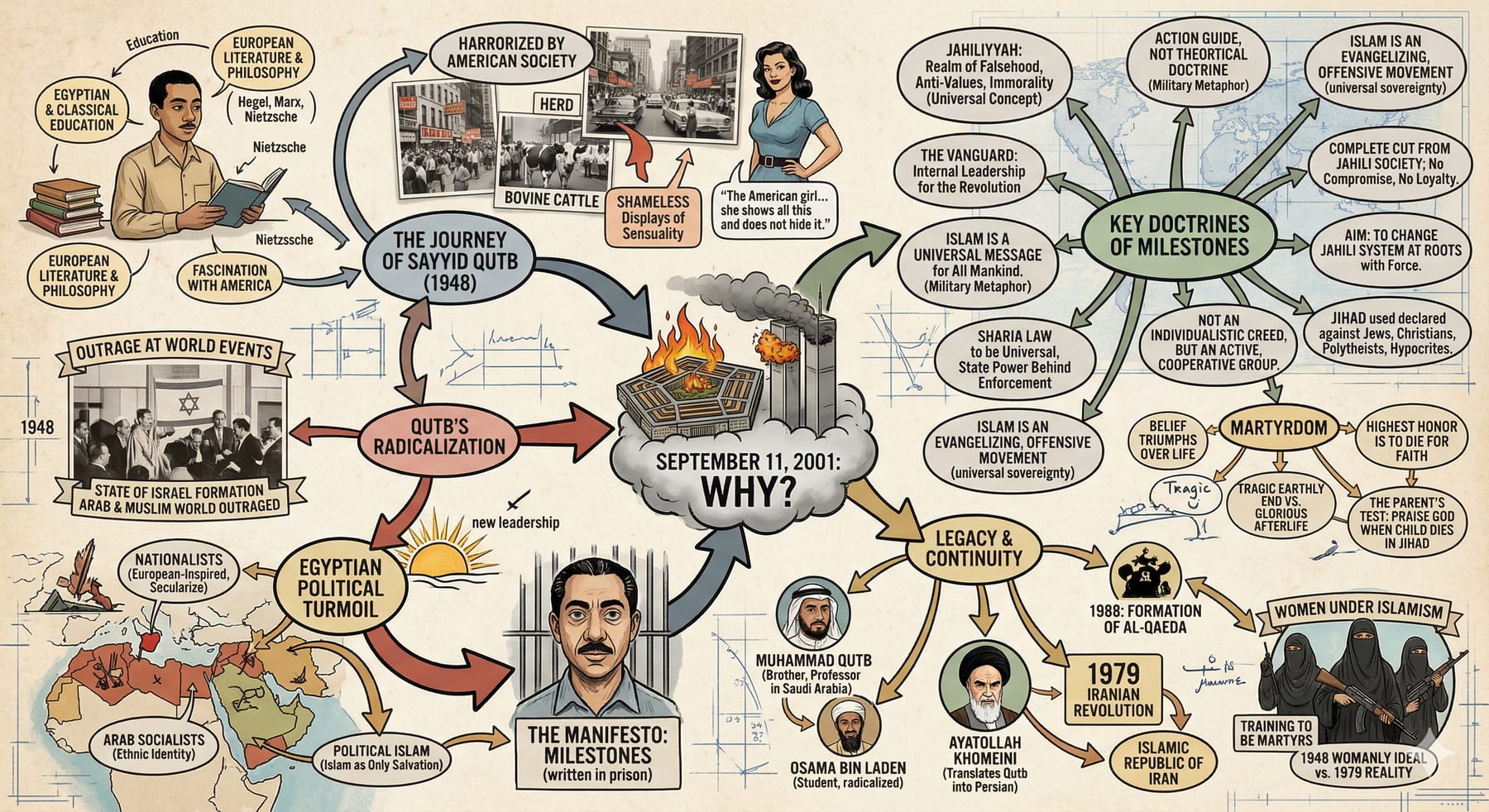
7: Dugin’s Vision
Peterson Academy - The Philosophy of Politics Part II (Hicks) - Lecture 07.pdf (file not included in this release)
Overview
- The lecture begins in 1991, with the collapse of the Soviet Union, and asks what ideological future Russia would choose after the failure of communism.
- The central figure is Aleksandr Dugin, who is presented as a major post-Soviet Russian political philosopher advocating:
- a revival of fascism
- a synthesis of fascism and Bolshevism
- a rejection of liberalism
- and eventually a broader doctrine called the Fourth Political Theory
- The transcript’s main argument is that Dugin sees the 20th century as a struggle among:
- liberalism
- communism
- fascism
- With fascism defeated in World War II and communism collapsing by 1989–91, liberalism seems victorious. Dugin’s project is to create a new anti-liberal ideology for Russia by combining:
- the anti-capitalist aspects of fascism
- the anti-liberal critique of Marxism
- religious traditionalism
- Heideggerian philosophy
- and a geopolitical doctrine of Eurasian multipolarity
1. Historical Starting Point: 1991 and the End of the Soviet Union
- The lecture opens in 1991, when the Soviet Union falls.
- This is described metaphorically as:
- the Marxist “ship of state” crashing aground
- the great Soviet experiment failing
- The geopolitical world before this had been split broadly into:
- the West:
- liberal democracy
- republicanism
- capitalism
- the East:
- Marxism
- socialism
- communism
- the West:
- With the Soviet Union gone, one of the two great poles disappears.
Main question
- What will the new Russia become?
- What ideology will fill the vacuum after communism?
Main idea
- The collapse of the Soviet Union did not simply end an old ideology.
- It opened a struggle over Russia’s next civilizational identity.
2. Aleksandr Dugin Enters the Scene
- Into this ideological vacuum steps Aleksandr Dugin, described as:
- a philosopher
- political thinker
- widely read
- charismatic
- influential from a relatively young age
- In 1997, he publishes a provocative article titled:
- “Fascism—borderless and red”
Why the title matters
“Borderless”
- suggests Russia should not simply accept its reduced post-Soviet borders
- raises the question of whether Russia should reclaim or transcend its existing boundaries
“Red”
- may evoke:
- blood
- violence
- revolution
- socialism / communism
Main idea
- Dugin is signaling from the start that Russia’s future should not be liberal-democratic.
- Instead, it should involve a renewed revolutionary form of Russian fascism.
3. Dugin’s Reading of the 20th Century
- Dugin interprets the 20th century as a grand ideological struggle among three forces:
- liberalism
- communism
- fascism
- These are associated geographically with:
- the West = liberalism
- Eastern Europe / Soviet world = communism
- Central Europe = fascism / national socialism
What happened in his view
- Fascism was defeated in World War II
- Communism lasted longer, but failed by:
- 1989 (fall of the Berlin Wall)
- 1990–91 (collapse of the Soviet Union)
- That leaves:
- liberalism as the only ideology standing
Dugin’s reaction
- He sees liberalism’s triumph not as good news, but as a catastrophe.
- Liberalism is not merely mistaken; it is treated as the great enemy.
Main idea
- Dugin’s entire project begins from the belief that the 20th century ended in the wrong victor.
4. What Dugin Means by Fascism
- Dugin does not treat fascism as an embarrassing mistake to be buried.
- He argues it should be:
- revived
- purified
- adapted for Russia
His definition of fascism
Economic level
- fascism is:
- socialist
- or moderately socialist
- it subordinates:
- personal economic interests
- individual self-interest
- it is anti-capitalist and anti-individualist
Cultural level
- fascism rejects:
- humanism
- softness
- bourgeois intellectualism
- it values:
- brutality
- action
- intensity
- superhuman aspiration
- discipline
Mussolini as hero
- Dugin explicitly presents Mussolini as one of the great heroes of fascism.
- He quotes the spirit of “fascist and proletarian Italy” as revealing fascism’s socialist orientation.
Main idea
- Dugin insists fascism is not a conservative defense of capitalism.
- It is a revolutionary, collectivist, anti-bourgeois form of socialism.
5. Why Fascism Failed, According to Dugin
- Dugin argues that fascism failed historically because it made compromises.
The mistake of historical fascism
- Mussolini, Hitler, Franco, Salazar, and others allied with:
- conservatives
- national capitalists
- big owners
- corporate elites
- This corrupted fascism from within.
His language
- capitalism is described as the “virus” within fascism
- compromise with capital led to:
- degeneration
- failure
- death
Main idea
- For Dugin, fascism failed not because it was too radical, but because it was not radical enough in rejecting capitalism.
6. Fascism as Left-Wing / Socialist
- Dugin strongly rejects the idea that fascism is a right-wing ideology.
- He says fascism belongs to the left, because it is a form of socialism.
His redefinition
- National Socialism = German socialism
- Russian fascism = Russian socialism
Important clarification
- The socialism must not be an abstract universal theory imposed on Russians.
- Rather:
- socialism must be adapted to the Russian people as they really are
Main idea
- Dugin wants to reclaim fascism as a national form of socialism, not as liberalism’s right-wing enemy.
7. Organic Society and Russian Identity
- A major theme in Dugin is that society is an organism, not a collection of individuals.
- This opposes the liberal model of:
- social contract
- individual rights
- autonomous selves
His formula
- not “Russians for socialism”
- but “socialism for the Russians”
Meaning
- one must begin with:
- the spiritual
- ethical
- cultural
- historical identity of the nation
- only then shape political ideology around that identity
Main idea
- Political systems should grow organically from a people’s identity.
- Russia must have a Russian socialism/fascism suited to its own civilization.
8. Revolutionary Youth and Purification
- Dugin calls for a new kind of militant youth.
- He celebrates:
- national revolutionaries
- the young
- the fearless
- the passionate
- those without limits
Their task
- to:
- build
- destroy
- obey
- command
- purge enemies of the nation
Main idea
- Dugin’s vision is not contemplative or merely academic.
- It is revolutionary, activist, and purifying.
9. The National Bolshevik Party
- Dugin was a cofounder and chief thinker behind the National Bolshevik Party in post-Soviet Russia.
- The very name signals the synthesis:
- National = fascist / nationalist / organic-collective
- Bolshevik = communist / revolutionary / socialist
- The party’s iconography blends:
- communist red
- hammer and sickle
- visual resemblance to fascist/Nazi aesthetics
Main idea
- Dugin’s project is not disguised moderation.
- It explicitly fuses the symbols and methods of the 20th century’s defeated anti-liberal ideologies.
10. Putin and the Question of Influence
- By the late 1990s and early 2000s, Vladimir Putin rises to power:
- former KGB officer
- later head of the FSB
- becomes prime minister/president around 2000
- The world wonders:
- what kind of Russia will Putin build?
- what is the ideology behind him?
The Dugin question
- Some observers speculate that:
- “Putin’s brain is Dugin”
- The lecture notes:
- Putin has never openly credited Dugin directly
- But there are notable similarities between:
- Dugin’s worldview
- Putin’s rhetoric and practice
Main idea
- Even without a formal acknowledgment, Dugin is presented as a useful guide to understanding the ideological atmosphere around Putin’s Russia.
11. Religion and the Russian State
- The lecture stresses that post-Soviet Russia is not returning simply to secular nationalism.
- It is also reviving Russian Orthodoxy.
Key signs
- Putin regularly appears with the patriarch of the Russian Orthodox Church
- He cites religious figures positively
- The old Soviet atheism is gone
Implication
- church and state are moving closer together
- Russia is re-sacralizing politics
Main idea
- Dugin’s anti-liberalism fits well with a Russia that rejects secular liberal modernity and reintegrates religion into state identity.
12. Thinkers Putin Has Cited Favorably
The lecture uses philosophers and writers Putin has cited to infer the ideological direction of the regime.
A. Leontiev
- a conservative Tsarist and later monk
- argued for:
- closer cultural ties between Russia and the East
- rejection of Western egalitarianism
- rejection of utilitarianism
- rejection of revolutionary modernity
B. Ilyin
- described as seeing affinity among:
- Hitler’s National Socialism
- Mussolini’s Fascism
- the Russian White movement
- admired:
- patriotism
- sacrifice
- discipline
- rebirth of the country
- strong authority
- a form of social justice
Main idea
- The intellectual current around Putin points toward:
- anti-liberalism
- authoritarian traditionalism
- spiritualized nationalism
- and a willingness to draw selectively from fascist precedents
13. The Fourth Political Theory (2009)
- In 2009, Dugin publishes his major work:
- The Fourth Political Theory
- This is presented as the mature articulation of his worldview.
Why “fourth”?
- The first three modern political theories were:
- liberalism
- communism
- fascism
- Since liberalism has defeated the other two, a new theory is needed:
- one that overcomes liberalism while learning from fascism and communism
Main idea
- The Fourth Political Theory is meant to be the next great anti-liberal ideology after the failures of the 20th century.
14. Liberalism as the Main Enemy
- Dugin’s basic conviction is that liberalism must be defeated.
- Liberalism is treated as:
- corrupt
- universalist
- individualist
- capitalist
- spiritually empty
- historically exhausted
Signs of liberalism’s weakness
A. 9/11
- Islamist attacks show America is not invincible
B. Postmodernism
- thinkers like:
- Foucault
- Derrida
- critical theorists
- are seen as signs that the West is internally undermining itself
C. Technological unreality
- social media
- simulation
- virtual existence
- detachment from reality
- all interpreted as symptoms of civilizational decay
Main idea
- The West’s enemies on the outside and critics on the inside both reveal that liberalism is vulnerable.
15. Inspiration from Postmodernity
- Dugin says the Fourth Political Theory should draw “dark inspiration” from:
- postmodernity
- the liquidation of the Enlightenment
- the society of simulacra
- He sees postmodernity not as liberation, but as:
- the death-stage of modernity
- the exhaustion of Enlightenment civilization
- the final breakdown of the liberal worldview
Main idea
- Postmodernism is useful to Dugin because it helps destroy faith in liberal truth, reason, and universalism.
16. Return to the Premodern
- Dugin argues that if modernity and postmodernity are both exhausted, then the Fourth Political Theory can turn back to what came before modernity.
- That means:
- tradition
- religion
- premodern identities
- premodern metaphysics
- spiritual hierarchy
Main idea
- Dugin is not trying to improve modernity.
- He wants to move beyond it by reviving premodern civilizational sources.
17. Apocalyptic Religious Language: The Antichrist
- Dugin describes postmodernity and globalization as:
- the kingdom of the Antichrist
- He presents this not as mere metaphor but as:
- a real religious fact
- part of the Apocalypse
- He claims similar end-times thinking appears in:
- Christianity
- Islam
- Judaism
- Hinduism
- other traditional religions
Main idea
- Dugin sacralizes geopolitics.
- The struggle against liberalism becomes an eschatological battle at the end of history.
18. Heidegger as the Deepest Philosopher of 4PT
- Dugin explicitly says the deepest ontological basis of the Fourth Political Theory is:
- Martin Heidegger
- He calls Heidegger:
- the most profound thinker of being
- the essential philosopher for the project
Why Heidegger matters
- Heidegger hated liberalism
- Heidegger explored:
- authenticity
- rootedness
- being
- historical destiny
- the “event” (Ereignis)
Main idea
- Dugin uses Heidegger to give metaphysical depth to his anti-liberal and anti-modern politics.
19. The Event (Ereignis) and Russia’s Mission
- Dugin interprets Heidegger’s “event” as a kind of:
- great awakening
- apocalyptic turning point
- civilizational rebirth
- He claims this event will occur in Russia.
Russia’s role
- Russian history is a long dialectical struggle against the West
- Russia has:
- its own truth
- its own messianic role
- its own version of the end of history
Main idea
- Russia is not just another country.
- It is the site of an impending world-historical spiritual transformation.
20. Liberalism, the Individual, and Dugin’s Rejection of Human Autonomy
- Dugin says liberalism encourages the person to:
- “be himself”
- realize himself as an individual
- This is exactly what he rejects.
Against liberal individualism
- the individual is not primary
- the individual should not be treated as the moral center
- human beings are fundamentally members of:
- collectivities
- ethnic communities
- spiritual-historical worlds
Explicit claim
- “Man is anything but an individual.”
- the individual must be dethroned
Main idea
- Dugin’s politics is a direct attack on the liberal vision of autonomous personal self-realization.
21. Ethnos, Not Race
- Dugin rejects racism in a biological sense.
- He argues that the true collective unit is not race but ethnos.
Ethnos means
- a spiritual-cultural community
- shared:
- language
- religion
- customs
- resources
- goals
- landscape
- an organic community
Important distinction
- ethnicity/spiritual-cultural rootedness is good
- biological racialism is rejected
- he also rejects the idea that one people is objectively superior to another
Main idea
- Dugin combines anti-individual collectivism with a kind of cultural relativism, not biological racism.
22. Subjectivism and Relativism
- Dugin says cultures can be compared, but none can be said to be objectively better.
- Any such judgment is:
- subjective
- culture-bound
- This means:
- no universal morality
- no universal standard of rights
- no universal human political model
Main idea
- He rejects liberal universalism and replaces it with cultural pluralism grounded in distinct civilizational identities.
23. The Village State and Rooted Identity
- Instead of the liberal individual or even the centralized abstract nation-state, Dugin prefers the image of:
- the village state
- This emphasizes:
- rootedness
- locality
- environment
- traditional life
- belonging
Main idea
- Political life should be grounded in local organic collective identity, not mobile cosmopolitan individuality.
24. What Dugin Takes from Marxism
- Dugin rejects Marxism’s:
- materialism
- atheism
- economic determinism
- He calls these the most repulsive parts of Marxism.
But he keeps Marxism’s strengths
- critique of capitalism
- critique of liberalism
- analysis of contradictions within capitalist society
Main idea
- Marxism is useful as a weapon against liberalism, even if its positive doctrine must be rejected.
25. The Anti-Liberal Core of 4PT
Dugin summarizes the Fourth Political Theory as combining what is anti-liberal in the old ideologies.
It is:
- anti-capitalist
- anti-liberal
- anti-cosmopolitan
- anti-individualist
- anti-modernization
- anti-progress in the liberal sense
Main idea
- The Fourth Political Theory is fundamentally a coalition of everything opposed to liberal modernity.
26. Against the Idea of Progress
- Dugin rejects the modern idea that history is:
- open-ended progress
- rational development
- emancipation
- technological improvement
- But he also rejects the simple decline story.
His preferred alternative
- history is cyclical
- civilizations rise and fall organically
- they go through:
- birth
- growth
- maturity
- decline
- death
- Then others rise
Thinkers cited for this view
- Oswald Spengler
- Carl Schmitt
- Ernst Jünger
- Heidegger
- Toynbee
- Danilevsky
Main idea
- Liberal civilization is now in its death phase.
- Russia should be entering a new phase of ascent.
27. Liberalism Is Not Morally Innocent
- Dugin argues that liberals attack fascism and communism for:
- camps
- war
- genocide
- repression
- But he insists liberalism is no moral saint.
Charges he makes against the West
- slavery
- destruction of Native Americans
- atomic bombing of Japan
- Serbia / Balkans
- Iraq
- Afghanistan
- broader American imperial violence
Main idea
- Liberalism is portrayed as just as violent and criminal as the ideologies it condemned.
28. Unipolarity and the United States as the Great Enemy
- Dugin says the current world is unipolar:
- the West dominates globally
- the United States is the core of this dominance
- America seeks to organize the entire planet according to its own interests.
Why this is evil in his view
- it destroys the sovereignty of other peoples
- it imposes one model on many civilizations
- it functions as:
- empire
- dictatorship
- global moral imperialism
Main claim
- “The American Empire should be destroyed.”
Main idea
- The United States is the geopolitical embodiment of liberalism and therefore the main target.
29. Multipolarity as the Alternative
- Dugin opposes unipolar American dominance with a multipolar world.
- Different civilizations should have their own centers of power.
Likely poles he envisions
- the United States / Americas
- Europe / European Union
- China / East Asia
- Russia / Eurasia
Main idea
- Multipolarity is not just a power arrangement.
- It is the geopolitical expression of civilizational pluralism against liberal universalism.
30. Traditionalists Inside the West as Potential Allies
- Dugin says not everyone inside the West is truly liberal.
- There are traditionalists in Europe and America who:
- reject modernity
- reject postmodernity
- want to return to premodern religious and cultural traditions
His message to them
- they are potential allies
- all traditionalists should oppose:
- globalization
- liberal modernity
- postmodern decay
Main idea
- Dugin seeks a transnational anti-liberal coalition, even including Western traditionalists.
31. Religion and 4PT
- Dugin says the Fourth Political Theory must incorporate the best from:
- Christianity
- Islam
- Judaism
- Hinduism
- Buddhism
- other traditional religions
- What they share:
- suspicion of materialism
- critique of pleasure-centered life
- emphasis on sacrifice and service
- apocalyptic or end-times horizons
Main idea
- 4PT is not merely secular fascism plus socialism.
- It is meant to be a spiritually grounded anti-modern meta-ideology.
32. Dasein as the Subject of 4PT
- Dugin says the proper subject of the Fourth Political Theory is not:
- the liberal individual
- the Marxist class
- the fascist race
- Instead, it is:
- Dasein, from Heidegger
Why this matters
- Dasein means a concrete historical way of being
- each people has its own being-in-the-world
- this supports:
- ethnos
- rootedness
- civilizational uniqueness
Main idea
- Heidegger gives Dugin a philosophical way to move beyond individual, class, and race toward deeper civilizational identity.
33. From Russia to Eurasianism
- In earlier Dugin writings, the focus is heavily on Russia itself.
- By The Fourth Political Theory, the focus broadens to Eurasianism.
What this suggests
- Russia is the center, but not the whole
- the real geopolitical unit may include:
- Ukraine
- Belarus
- Crimea
- the Caucasus
- Central Asia
- buffer states between Europe and Asia
Meaning of Eurasianism
- a larger civilizational sphere under Russian-centered influence
- neither Europe nor Asia alone
- but a distinct bloc
Main idea
- Dugin’s project expands from Russian nationalism to a broader imperial-civilizational vision.
34. National Bolshevism and Eurasianism Together
By the end of the lecture, Dugin’s system has several layers.
Ideological layer
- National Bolshevism
- synthesis of fascism and communism
- minus racism, materialism, and atheism
Spiritual-philosophical layer
- Heidegger + traditional religion + apocalyptic expectation
Geopolitical layer
- Eurasianism
- Russia-led civilizational bloc
- opposed to Atlanticist/American liberalism
Main idea
- Dugin is not offering a single policy program.
- He is constructing a full civilizational worldview.
35. Major Historical Events Mentioned
- Fall of the Soviet Union (1991)
- Fall of the Berlin Wall (1989)
- World War II and defeat of fascism
- Putin’s rise to power around 2000
- September 11, 2001
- Balkan / Serbia conflicts
- Afghanistan and Iraq wars
36. Major Figures Mentioned
- Aleksandr Dugin
- Vladimir Putin
- Mussolini
- Hitler
- Franco
- Salazar
- Lenin
- Stalin
- Trotsky
- Mao Zedong
- Bill Clinton
- Tony Blair
- Leontiev
- Ilyin
- Martin Heidegger
- John Stuart Mill
- Ayn Rand
- Spengler
- Carl Schmitt
- Ernst Jünger
- Toynbee
- Danilevsky
- Foucault
- Derrida
37. Books / Works Mentioned
- “Fascism—borderless and red” (1997 article by Dugin)
- The Fourth Political Theory (2009) — Aleksandr Dugin
38. Core Takeaways
- Dugin sees the 20th century as a battle among:
- liberalism
- communism
- fascism
- With liberalism victorious after 1991, he wants to build a new anti-liberal ideology for Russia.
- He argues for:
- reviving fascism in purified form
- combining it with elements of Bolshevism
- rejecting capitalism, liberalism, cosmopolitanism, and individualism
- grounding politics in:
- ethnos
- religion
- tradition
- Heideggerian philosophy
- He sees:
- the United States as the core of evil unipolar globalization
- multipolarity as the geopolitical answer
- Russia/Eurasia as the civilizational force destined to lead the anti-liberal struggle
- The Fourth Political Theory is therefore presented as:
- post-communist
- post-fascist
- anti-modern
- anti-Enlightenment
- anti-liberal
- spiritualized
- and apocalyptic in tone
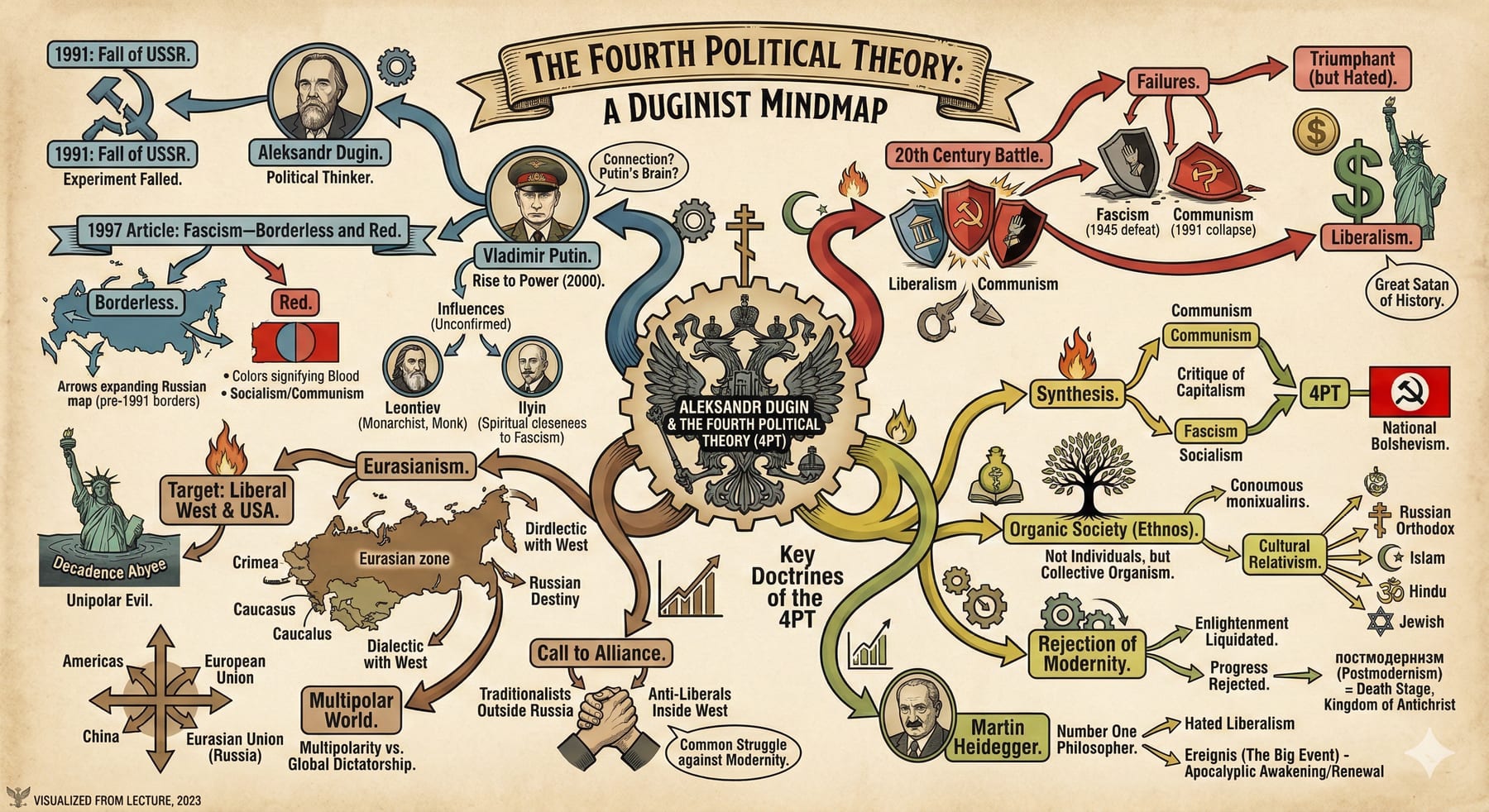
8: Scruton’s Conservatism
Peterson Academy - The Philosophy of Politics Part II (Hicks) - Lecture 08.pdf (file not included in this release)
Overview
- This lecture serves as the conclusion to the series on political philosophy from the Cold War to after 9/11.
- It returns to the big question: what does political philosophy look like in the contemporary world, especially from the standpoint of 2014?
- The lecture contrasts:
- external threats to Western civilization
- with internal ideological and cultural transformations within the West
- It then turns to Roger Scruton as a leading representative of modern conservatism and uses him to:
- define conservatism
- distinguish it from liberalism and socialism
- and reflect on the broader task of classifying political ideologies
- The lecture ends by arguing that left-right language is too simplistic, and that serious political philosophy requires answering multiple distinct questions rather than relying on a single spectrum.
1. Framing the End of the Series
- The lecture opens by reminding us that the series began with three liberal thinkers:
- Ayn Rand
- Robert Nozick
- John Rawls
- It ends by turning to Roger Scruton, presented as:
- one of the most respected conservative philosophers of the contemporary era
- The goal is to assess the world from the perspective of 2014 and ask:
- what is happening outside Western civilization?
- what is happening inside it?
Main idea
- The lecture is both:
- a study of Scruton’s conservatism
- and a reflective wrap-up on the whole course’s political-philosophical framework
2. The World in 2014: External Pressures on the West
The lecture identifies several major developments outside or at the edges of Western civilization.
A. Rise of Islamism
- Politicized forms of Islam continue to expand and radicalize.
- Some Islamist movements adopt terrorism as a political weapon.
- In 2014, the Islamic State (ISIS) is especially important:
- seizing territory in Syria and Iraq
- becoming a major destabilizing force in the Middle East
B. China and Hong Kong
- 2014 is also marked by China’s crackdown on:
- democracy movements
- freedom movements
- especially in Hong Kong
- Hong Kong is described as:
- formerly a British colony
- shaped by liberal capitalism
- one of the freest and wealthiest places in the world under British administration
- After being returned to China, Beijing had promised autonomy, but was increasingly encroaching.
- By 2014, that encroachment becomes more forceful and visible.
C. Russia under Putin
- Russia is now firmly under Putin’s control.
- It is becoming more expansionist.
- In 2014, Russia:
- annexes Crimea
- signals broader ambitions regarding Ukraine
- Crimea matters strategically because it gives Russia:
- a Black Sea port
- access toward the Mediterranean
D. Dugin and Heidegger
- Also in 2014, Aleksandr Dugin publishes his book on Martin Heidegger.
- This is symbolically significant because it reflects the continued development of:
- anti-liberal
- anti-Western
- neo-fascist / neo-imperial thought in Russia
Main idea
- By 2014, the West faces serious external threats from:
- Islamism
- Chinese authoritarianism
- Russian expansionism
3. Internal Pressures on the West
The lecture then pivots to a different, and for Scruton perhaps even more serious, question:
- Is Western civilization also being undermined from within?
The West as a broad tradition
- The West is described as:
- liberal
- democratic
- republican
- capitalist
- partly conservative
- These institutions and traditions have developed over centuries.
Scruton’s deeper worry
- The West may not die by conquest from the outside.
- It may instead:
- weaken itself internally
- lose confidence in its own foundations
- permit its internal enemies to destroy it
Main idea
- External threats matter, but internal self-destruction may be even more dangerous.
4. Cultural Shift Around 2014: David Rozado’s Media Analysis
- The lecture introduces data work by David Rozado, who studies word frequency in major media outlets.
- The newspapers analyzed include:
- New York Times
- Los Angeles Times
- Washington Post
- Wall Street Journal
The pattern
Across several categories, word usage remains relatively stable for decades, with some fluctuations, but then jumps sharply around 2014.
A. Race / racism
- Some discussion across earlier decades
- Moderate spikes in the 1990s
- But around 2014, a dramatic increase
B. Sexism / misogyny
- Similar pattern
- Relatively lower use before
- Huge increase after 2014
C. Transphobia / transphobic
- Very little before about 2010
- Then rapid growth
- Especially large increase after 2014
D. White privilege
- Almost absent earlier
- Small early blips
- Then dramatic increase after 2014
Geographic spread
- The same pattern is said to appear not just in U.S. papers but across the Anglosphere:
- Canada
- Britain
- Australia
- New Zealand
Questions raised by the lecture
- Is the media responding to:
- a real increase in racism/sexism/transphobia?
- Or are journalists and editors, shaped by universities, increasingly bringing an ideology centered on these themes into public discourse?
Main idea
- The lecture interprets 2014 as a turning point in cultural-intellectual life inside the West.
5. Scruton’s
The Meaning of Conservatism
(Second Edition, 2014)
- In 2014, Roger Scruton publishes a new edition of The Meaning of Conservatism
- The original version had appeared in 1980
- The new edition updates the work but does not fundamentally alter its outlook
Why the timing matters
- 2014 is presented as a moment when:
- external threats are serious
- internal ideological shifts are accelerating
- So the question “what does conservatism mean now?” becomes especially urgent.
Main idea
- Scruton’s book serves as a philosophical response to both long-term ideological change and contemporary cultural crisis.
6. Scruton’s Formative Experience: 1968
- Scruton reflects on his experience in Paris in 1968
- He directly witnessed:
- student rebellion
- university unrest
- revolutionary enthusiasm
- Unlike many of his peers, he reacted against the rebellion itself.
Scruton’s self-understanding
- He became:
- “a rebel against the rebels”
- This led him to the conviction that:
- he was a conservative
- and that conservatism was fundamentally different from the revolutionary mood of the left
Main idea
- 1968 was Scruton’s moment of political-philosophical self-discovery.
7. Conservatism Is Not About Freedom, but Authority
One of the lecture’s key claims is Scruton’s statement that:
- conservatism is not fundamentally about freedom
- it is fundamentally about authority
Why this matters
- This distinguishes Scruton:
- from student radicals, who glorify freedom as rebellion
- from economic liberals, who glorify freedom as market choice
Against the left’s notion of freedom
- The left often treats freedom as:
- breaking structures
- rebelling against order
- overthrowing authority
- Scruton sees this as anarchic and destructive.
Against economic liberalism
- Economic liberals emphasize:
- free markets
- individual choice
- autonomous exchange
- Scruton argues that this, too, is not the essence of conservatism.
Main idea
- For Scruton, authority, not freedom, is the primary political reality.
8. Conservatism as Preservation of a Social Organism
- Scruton defines conservatism as an attempt to perpetuate a social organism.
- Society is treated not as a contract among individuals, but as:
- a living historical order
- an inherited structure
- something with continuity, personality, and a will to live
Key implications
- change can heal an organism
- but change can also kill it
- Western civilization, in Scruton’s view, is undergoing potentially fatal growth and transformation
Main idea
- Conservatism is fundamentally about protecting the inherited social organism from destructive forms of change.
9. Marxism and Socialism as University Orthodoxy
- Scruton notes that when he was forming his views, especially in the late 1970s:
- socialism and Marxism were dominant in universities
- Dissent from these views was rare.
Personal anecdote
- At Birkbeck College, Scruton jokes that only two conservatives existed:
- himself
- and the “tea lady,” who displayed a picture of the Pope
Broader implication
- If generations of elites are educated in socialism/Marxism, then decades later they will carry those assumptions into:
- media
- law
- politics
- culture
- institutions
Main idea
- The university is presented as one of the main pipelines through which anti-conservative ideology enters public life.
10. Scruton Against Natural Rights
- Scruton is skeptical of the liberal idea of natural rights
- He argues that the claim that rights exist:
- objectively
- prior to positive law
- and independently of legal institutions
is philosophically disputed and not well established
His evidence
- Even major liberals disagree sharply:
- John Rawls
- Robert Nozick
- If liberalism were straightforwardly true, its own major thinkers should be clearer and more unified about its foundations.
Main idea
- Scruton sees natural rights not as settled truths, but as controversial philosophical constructions.
11. Scruton Against Democracy as an Absolute
- Scruton also argues that democracy is a contested idea.
- He questions whether democracy should be treated as:
- an end in itself
- or merely a means to other goods
His reasoning
- If democracy is just a process, it could produce terrible outcomes.
- Majorities might:
- strip minorities of rights
- reintroduce forms of oppression
- empower destructive policies
- Therefore democracy cannot be automatically sacred.
Main idea
- Democracy has value only if it serves deeper goods.
- It is not self-justifying simply because it is democratic.
12. Conservatism Is Not Ideological in the Same Way as Liberalism or Socialism
- Scruton argues that conservatism is difficult to formulate as a rigid doctrine.
- Unlike liberalism or socialism, it does not naturally present itself in:
- slogans
- formulas
- precise definitions
- systematized ideology
Key phrases
- conservatism’s “essence is inarticulate”
- when forced to express itself, it does so skeptically and cautiously
Why this matters
- Conservatives are often rhetorically disadvantaged
- Their rivals can:
- rally people with simple slogans
- offer universal doctrines
- present themselves as morally clear
- Conservatism is more likely to say:
- we know the danger when we see it
- we react against threats
- but we do not reduce everything to an abstract system
Main idea
- Conservatism is more temperamental, historical, and instinctive than doctrinaire.
13. The 20th Century as an Age of Violent Ideologies
- Scruton argues that the 20th century was marked above all by violence
- He links this violence to the rise of ideology
- Great causes were invoked:
- equality
- freedom
- social justice
- These slogans were used to mobilize populations into massive conflict
A subtle point in Scruton’s interpretation
- He suggests ideology may not always cause violence from the beginning
- Instead:
- violence happens
- and ideology later arises as an attempt to explain or justify it
Main idea
- Ideologies provide abstract and intoxicating justifications that can deepen or rationalize mass conflict.
14. The European Mind and the Search for “Deep Descriptions”
- Scruton says the European mind especially wants:
- deep explanations
- systematic doctrines
- total political theories
- Liberals and socialists both try to satisfy this desire by offering:
- principles
- doctrine
- policy systems
- abstract coherence
Conservative contrast
- Conservatives distrust:
- excessive abstraction
- systematic ideological thinking
- intellectual overconfidence
- Scruton even says conservatives see:
- value in prejudice
- danger in abstract thought
Main idea
- Conservatism resists the modern urge to turn politics into a complete rationalized system.
15. The Bigotry of Liberalism
- One of the sharpest claims in the lecture is Scruton’s view that:
- there is no greater bigotry than the bigotry of liberalism
- This is paradoxical because liberalism presents itself as:
- tolerant
- anti-bigoted
- pluralistic
Why Scruton says this
- Liberals claim their principles are:
- clear
- universal
- rational
- But this makes them unwilling to reconcile with those who reject liberal assumptions.
- Liberalism becomes dogmatic in the name of anti-dogmatism.
Main idea
- Liberalism is not neutral.
- It is itself an aggressive and exclusionary worldview.
16. The Real Enemy of Conservatism: Not Radicals, but Reformers
- Scruton says the most dangerous opponent of conservatism is not the radical
- Radicals are at least clear enemies.
- The more dangerous enemy is the reformer:
- always acting “in a spirit of improvement”
- always wanting to change what lacks a strong reason to remain
Source of this spirit
- Victorian liberalism
- social Darwinism
- progressive faith in constant improvement
Main idea
- Gradual reformism may be more dangerous than open revolution because it erodes tradition piece by piece while sounding reasonable.
17. Scruton Against the Conservative Party’s Drift
- Scruton criticizes the British Conservative Party for abandoning true conservatism.
- He says it has absorbed too much from:
- liberalism
- socialism
A. From liberalism
- free markets
- economic internationalism
- individual choice
- natural-rights language
B. From socialism
- egalitarian ideology
- institutional subjugation to equality-based planning
Main idea
- Scruton sees the Conservative Party as insufficiently conservative because it has accepted the basic assumptions of its enemies.
18. Liberalism as Conservatism’s Principal Enemy
- Scruton identifies liberalism—not socialism—as the deepest enemy of conservatism.
- Liberalism comes with:
- individual autonomy
- natural rights
- abstract freedom
- anti-authoritarian assumptions
Why this is so serious
- Socialism is obviously hostile
- Liberalism is more dangerous because:
- it often appears respectable
- it shapes institutions deeply
- it can absorb and neutralize conservatives from within
Main idea
- For Scruton, liberalism is the more profound and corrosive challenge because it redefines the terms of political life.
19. Scruton’s View of Freedom
This is one of the most important sections of the lecture.
Liberal starting point
- freedom is primary
- law comes later as a restriction on freedom
Scruton’s reversal
- social order and law come first
- freedom exists only within an established framework of lawful constraint
His position
- there cannot be unrestricted freedom of speech in a healthy society
- society may legitimately forbid:
- abuse
- hatred
- libel
- obscenity
- blasphemy
- sedition
- subversive materials
Main principle
- freedom means:
- the freedom to do what is not forbidden by law
- law does not merely limit freedom
- law defines the arena in which freedom is possible
Main idea
- Freedom is not absolute or foundational.====================
- It is a consequence of an accepted social arrangement.
20. Authority and Government Come First
- Scruton says the first need of society is:
- government
- not individual self-rule
- He rejects the liberal model in which:
- individuals are primary
- government is their delegated servant
Conservative model
- society is primary
- authority is primary
- government is necessary for membership in a social order
- individuals are formed by the order before they exercise any meaningful freedom
Main idea
- The conservative political world is experienced through authority, not autonomy.
21. Belonging, Membership, and the Social Organism
- Conservatism begins in the sense that one belongs to:
- a continuing social order
- a preexisting tradition
- a culture that existed before oneself
- This belonging is not chosen from scratch.
- It is inherited, inhabited, and gradually understood.
Strong formulation
- society is not only organism-like
- it also has:
- personality
- history
- culture
- repositories of value
- the society itself becomes the end
- the individual is secondary
Main idea
- For Scruton, the political self is not autonomous first and social second.
- It is social first and only later individually reflective.
22. True Conservatives Live in Friendship with Their Nation
- Scruton says true conservatives are attuned to the principles of their inherited society.
- They seek to live:
- in friendship with their nation
- This means:
- supporting institutions
- identifying with the inherited culture
- resisting radical internal destruction
Main idea
- Conservatism is a posture of loyalty to an existing civilizational inheritance.
23. Scruton’s Place Within Conservatism
The lecture then broadens out and situates Scruton among different kinds of conservatism.
A. Paleo-conservatism
This older, more traditional form typically believes:
- religion is absolutely necessary
- one’s own religion is uniquely true
- principles are absolute
- tradition should be revered
- the modern world has gone badly wrong
- society should return more decisively to older forms
B. Scruton’s conservatism
The lecture presents Scruton as a more modern or flexible conservative.
Religion
- important, but not absolutely necessary in the strongest possible sense
- more often culturally central than dogmatically absolute
Particular religion
- Christianity matters deeply for Britain
- but Scruton does not insist on strict universal imposition of doctrinal Christianity
Scope
- not universalist
- different cultures may conserve different traditions
- there is a kind of cultural relativism here
Principles
- flexible
- pragmatic
- adaptable to circumstances
Tradition
- should be honored, not necessarily revered in a semi-sacral way
Change
- not opposed to all change
- opposed to too rapid and overly abstract change
Main idea
- Scruton is not a reactionary pure traditionalist.
- He is a conservative of:
- continuity
- restraint
- cultural particularity
- slow adaptation
24. The Structure of the Whole Course
The lecturer then steps back and reviews the whole series.
Major thinkers and ideologies covered
Earlier modern and 19th-century / early 20th-century figures
- Edmund Burke — conservatism
- Hegel — nationalism
- Marx — communism
- J. S. Mill — liberalism
- William James / John Dewey — pragmatism and progressivism
- Mussolini / Gentile — fascism
- Heidegger — national socialism
- Keynes — interventionism
- Hayek — Austrian/free-market liberalism
Cold War and after
- Ayn Rand — objectivism/capitalism
- Robert Nozick — libertarian liberalism
- John Rawls — welfare-state liberalism
- Michel Foucault — postmodernism
- Herbert Marcuse — critical theory
- James Buchanan — public choice
- Sayyid Qutb — Islamism
- Aleksandr Dugin — post-Soviet anti-liberalism / Eurasianism
- Roger Scruton — modern conservatism
Main idea
- A major purpose of the course has been to make:
- great thinkers
- great texts
- and the major “isms”
part of the student’s intellectual furniture.
25. Why Read the Original Texts?
- The lecturer emphasizes again the value of reading original sources.
- Lectures are useful for:
- context
- overview
- explanation
- But the best way to encounter great thinkers is:
- in their own words
Why this matters
- difficult texts strengthen the mind
- they reveal:
- what you know
- what you do not know
- where your own thinking is weak or uncertain
- reading the greats is described as:
- “playing against the best”
Main idea
- Serious political philosophy requires direct encounter with original thinkers, not just summaries.
26. The Problem With “Left” and “Right”
The lecture ends by criticizing the standard left-right spectrum.
Why it is inadequate
- Left-right began as a very specific historical seating arrangement in the French Revolution
- Over time it became a vague one-dimensional shorthand
- But modern political philosophy involves many more questions than one spectrum can capture
Main idea
- “Left” and “right” are too crude for serious analysis.
27. The Lecturer’s Multi-Dimensional Framework for Political Philosophy
The lecture proposes that at least eight or nine separate questions must be answered to produce a coherent political philosophy.
1. Liberty vs authority
- How free should people be?
- How much authority should govern them?
2. Individual vs collective
- Is the basic unit:
- the individual?
- or collective entities such as class, race, religion, nation, ethnicity?
3. Conservatism vs revolution
- Should society preserve itself?
- Or should it radically change itself?
4. How many should meaningfully rule?
- one ruler?
- aristocratic few?
- majority?
- supermajority?
- unanimity?
5. Equality vs hierarchy in status and law
- Should the same standards apply to all?
- Or should different groups be governed differently?
6. Degree of government power
- no government?
- limited government?
- extensive government?
- total government?
7. Status of rules and principles
- fixed and rigid?
- flexible and situational?
- absolute?
- rule-of-thumb?
8. Process vs outcome
- Is politics mainly about fair procedure?
- Or about reaching a particular social end-state?
Possible additional dimensions
- The lecturer leaves open that more may be needed.
Main idea
- Real political philosophies are multi-dimensional packages, not positions on a single line.
28. Why This Framework Matters
- Once we abandon one-dimensional left-right thinking, we can see many new combinations:
- authoritarian collectivist conservatives
- liberal individual revolutionaries
- democratic but hierarchical systems
- egalitarian but authoritarian systems
- conservative but non-religious systems
- and many others
Main idea
- Political ideologies are complex structures.
- Serious citizens should learn to think in terms of combinations of principles, not labels alone.
29. Main Themes of Scruton’s Conservatism in This Lecture
To condense Scruton’s position:
He rejects
- socialism and Marxism
- liberal natural-rights theory
- abstract democracy-worship
- absolute freedom
- rapid reformism
- excessive free-market liberalism
- individual autonomy as the political center
He affirms
- authority
- established government
- tradition
- historical continuity
- social membership
- national belonging
- cultural inheritance
- freedom as constrained and law-shaped
- cautious and slow change
Main idea
- Scruton’s conservatism is a defense of inherited order against both ideological revolution and abstract liberal dissolution.
30. Major Historical Events Mentioned
- 1968 Paris student revolts
- Rise of ISIS in 2014
- China’s 2014 crackdown in Hong Kong
- Russia’s annexation of Crimea in 2014
- the broader post-Cold War and post-9/11 context
31. Major Thinkers Mentioned
- Roger Scruton
- Ayn Rand
- Robert Nozick
- John Rawls
- Edmund Burke
- Hegel
- Marx
- John Stuart Mill
- William James
- John Dewey
- Mussolini
- Gentile
- Heidegger
- Keynes
- Hayek
- Foucault
- Marcuse
- Buchanan
- Sayyid Qutb
- Aleksandr Dugin
- Margaret Thatcher
32. Book Mentioned
- The Meaning of Conservatism — Roger Scruton
33. Final Takeaway
- The lecture uses Roger Scruton to present a serious modern conservatism that is distinct from:
- socialism
- liberalism
- free-market individualism
- and revolutionary politics
- Scruton argues that conservatism is centered not on freedom but on:
- authority
- social continuity
- inherited order
- and the defense of a living social organism
- The lecture then broadens into a methodological conclusion:
- the standard left-right framework is inadequate
- political thought must be analyzed across many distinct dimensions
- The overall message of the series is that understanding politics requires:
- reading the great thinkers
- learning the major isms
- and developing a more precise and multidimensional vocabulary for political life
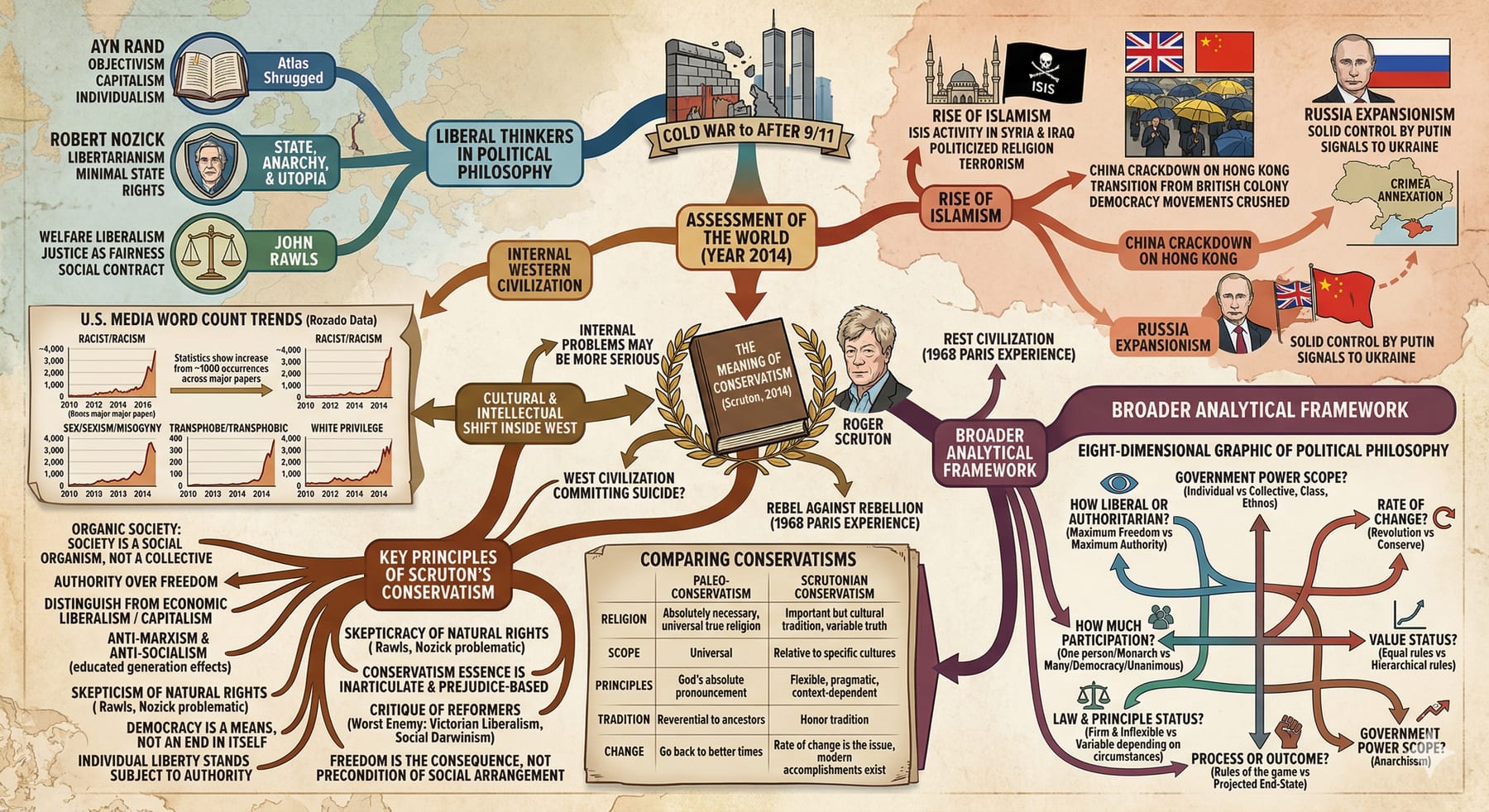
Content
The Philosophy of Politics: Part 2