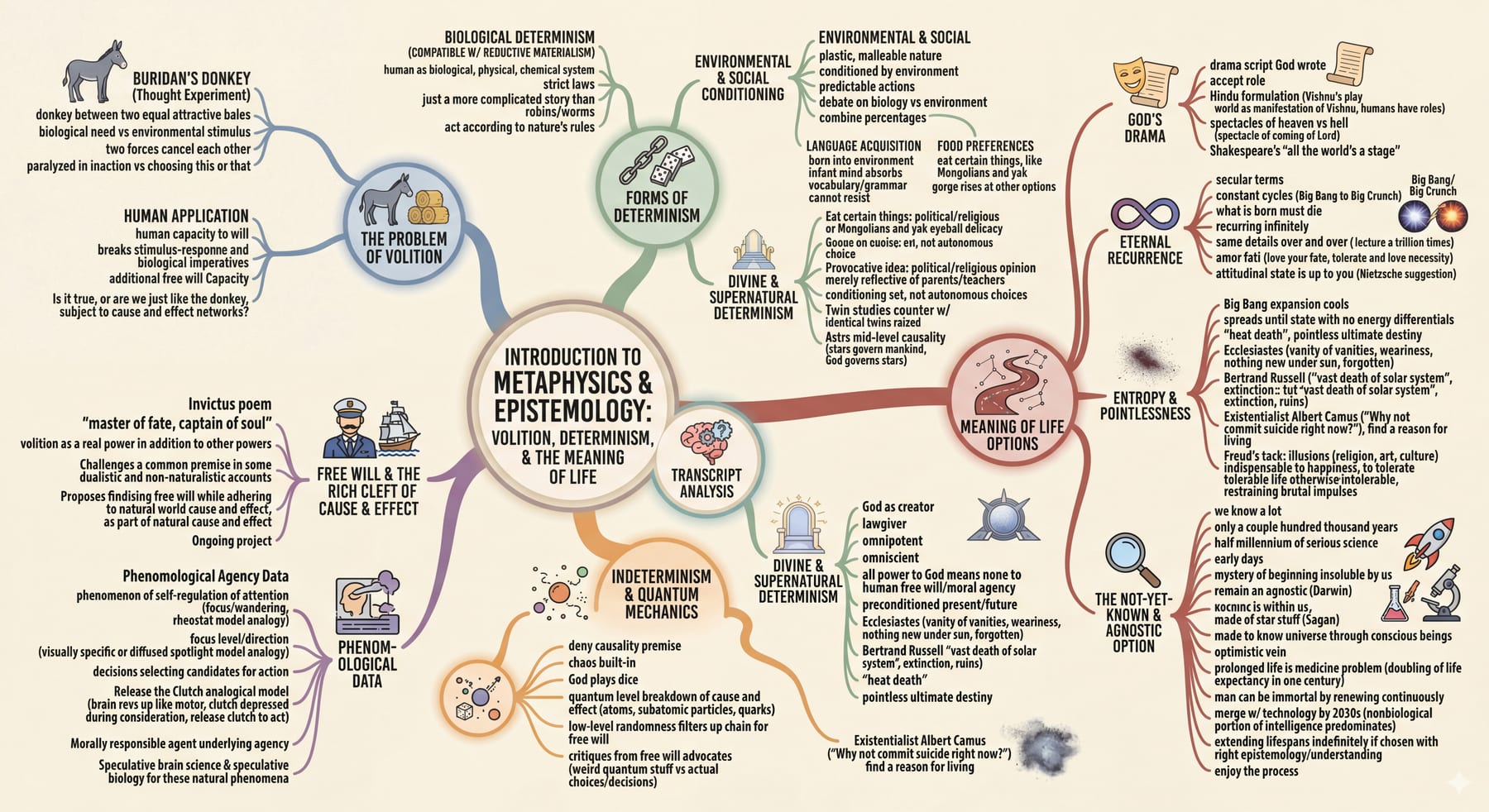
Handwritten journal source
Consolidated source: PDF pp. 64–77 (file not included in this release)
Source boundary: These are handwritten source pages. Use the scan for exact wording; verify quotations and factual claims before reuse.
Embedded preview:
March 21-June 9 2026.pdf (file not included in this release)
Open the journal routing table
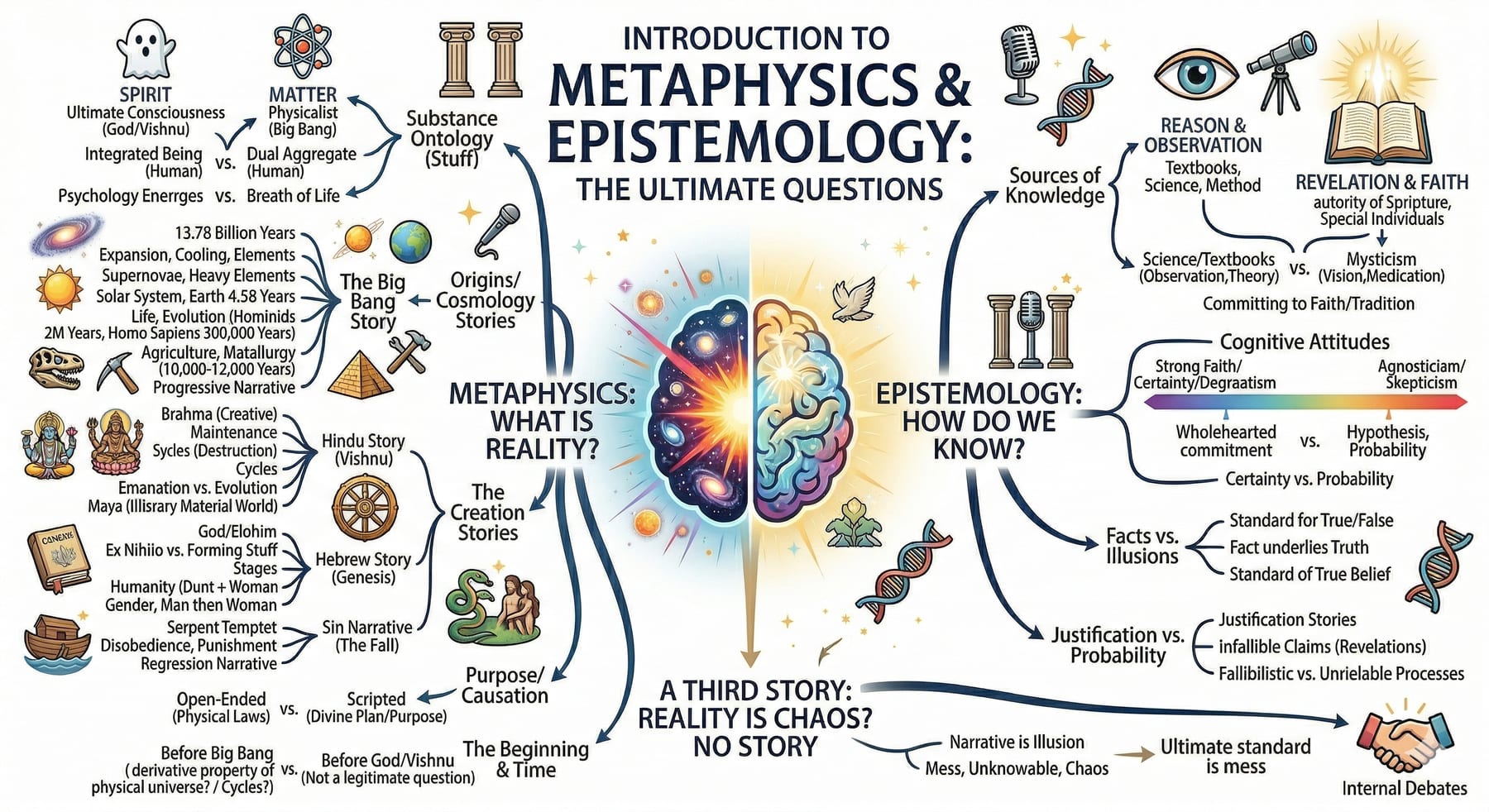
1: Origins of Reality
Peterson Academy - Intro to Metaphysics Epistemology (Hicks) - Lecture 01.pdf (file not included in this release)
Overview
- The lecture introduces metaphysics and epistemology by using three broad origin frameworks:
- the Big Bang / scientific cosmology story
- a Hindu creation account centered on Vishnu
- a Genesis / Abrahamic creation account
- The speaker’s main goal is not to prove one story true, but to show that each story carries deep philosophical assumptions about:
- what is ultimately real
- whether matter or consciousness comes first
- what a human being is
- whether life has purpose
- how knowledge is acquired
- whether questioning should remain open-ended or stop at a foundational authority
1. Opening philosophical setup
- The lecture begins with the experience of looking at the stars and asking:
- What are they?
- Where did they come from?
- Why are we here?
- The speaker argues that this kind of wonder is the beginning of philosophy.
- He frames the course as an inquiry into the deepest and most controversial questions philosophers ask.
Main point
- Human beings naturally ask ultimate questions, and those questions lead into metaphysics and epistemology.
2. The Big Bang story as a philosophical narrative
Core outline of the story
- About 13.78 billion years ago, all matter and energy were compressed into a singularity.
- The universe rapidly expanded and cooled.
- Early light elements formed:
- hydrogen
- helium
- beryllium
- lithium
- Around 380,000 years later, the universe entered what the speaker calls the Dark Ages.
- After hundreds of millions of years:
- proto-galaxies formed
- then full galaxies
- Heavy elements were later created through stellar collapse and supernovae:
- iron
- carbon
- oxygen
- The sun and the solar system formed.
- The Earth formed about 4.5 billion years ago.
- Early life emerged after long geological development.
- There were extinction events, especially:
- the dinosaur extinction 66 million years ago
- Hominids emerged, then Homo sapiens around 300,000 years ago.
- Major human turning points:
- agriculture in Mesopotamia around 10,000–12,000 years ago
- metallurgy around 7,000 years ago
- the rise of civilizations across multiple continents
- later Greece and Rome
Main philosophical meaning the speaker draws from it
- This story is physicalist:
- matter and energy come first
- life, mind, and consciousness come later
- mental life is derivative of physical processes
- It tends to suggest:
- human beings are part of nature
- there may be a broad pattern of progress
- inquiry remains open
- unanswered questions remain legitimate
3. The Hindu creation story and its philosophical implications
Main elements discussed
- The account is presented through Vishnu and the Bhagavad Gita.
- Vishnu says:
- he is the source of spiritual and material worlds
- everything emanates from him
- The speaker focuses on key metaphysical language:
- source
- emanation
- evolution
- He raises philosophical questions:
- If creation is emanation, is everything fundamentally the same “stuff” as Vishnu?
- If all things evolve from Vishnu, does Vishnu himself change, or only the world?
- He notes cyclical creation/destruction patterns associated with:
- Brahma
- Krishna
- Shiva
- He also introduces the distinction between:
- Purusha: universal consciousness / spirit
- Prakriti: the material world
- The material world is presented in many Hindu strands as:
- less real
- less important
- sometimes illusory
Main philosophical meaning the speaker draws from it
- This story gives priority to consciousness or spirit, not matter.
- It implies:
- spiritual reality is higher than material reality
- the material world may be deceptive or secondary
- reality may be cyclical rather than linear
- human destiny may lie in transcending material existence and returning to ultimate spiritual reality
4. The Genesis creation story and its philosophical implications
Main elements discussed
- The speaker turns to Genesis 1 and highlights two interpretive possibilities:
- creation ex nihilo: God created the world from nothing
- formation from pre-existing formless matter: God shaped what was already there
- He compares:
- “In the beginning, God created the heavens and the earth”
- “When God began to create the heavens and the earth, the earth was without form and empty”
- He treats this as an important philosophical issue:
- Did God bring matter into existence?
- Or did God impose order on pre-existing chaos?
Human creation
- Man is formed from:
- dust of the ground
- plus the breath of life
- This suggests a dualistic anthropology:
- matter + spirit
- Woman is created from man’s rib.
- The speaker notes this may raise questions about similarity and difference between the sexes.
Fall and moral decline
- The serpent tempts Eve.
- Eve and Adam disobey God.
- This introduces themes of:
- sin
- deception
- responsibility
- punishment
- Punishments include:
- painful labor
- death
- pain in childbirth
- The Cain and Abel story adds:
- envy
- murder
- Human corruption escalates until the Flood.
- God destroys most of humanity and begins again through survivors.
- Yet sin persists afterward.
Main philosophical meaning the speaker draws from it
- Genesis presents:
- spirit before matter
- humans as dual beings
- history as a moral drama
- a story of decline or regression, not progress
- It also suggests:
- the universe has purpose
- God has a plan
- human beings are morally compromised
- salvation or restoration requires more than ordinary human effort
5. Metaphysical contrasts between the stories
The lecturer uses the stories to introduce core metaphysical debates.
A. What comes first: matter or mind?
- Big Bang story
- matter and energy come first
- consciousness emerges later
- Creation stories
- spirit or consciousness comes first
- material reality depends on it
B. What is a human being?
- Big Bang / naturalist view
- humans are integrated physical organisms
- mind emerges from body/brain
- Genesis-style view
- humans are dual beings
- body and soul are distinct components
C. What happens at death?
- If mind depends entirely on body:
- death likely ends consciousness
- If soul is separable from body:
- afterlife becomes possible
D. Is the world good, bad, or secondary?
- Big Bang framing
- the physical world is primary and valuable
- human flourishing should happen within it
- Hindu / Genesis-style spiritual framing
- the spiritual realm may be higher
- the material world may be illusory, fallen, or a trap
E. Is history progress or decline?
- Big Bang / civilization story
- from primitive survival toward increasing control and advancement
- Genesis story
- from Eden downward into corruption and suffering
F. Is there a script or purpose?
- Big Bang story
- no obvious scriptwriter or final purpose built into the cosmos
- Creation stories
- reality is purposeful
- creation has an author, direction, and intended end
6. Epistemology: how do we know what is true?
This is one of the strongest parts of the lecture.
The two broad epistemic models
A. Scientific / Big Bang epistemology
- Knowledge comes from:
- observation
- measurement
- experimentation
- science
- mathematics
- theory-building
- In principle, anyone can participate.
- Knowledge is usually held with:
- degrees of confidence
- probability
- openness to revision
- This model tends toward:
- fallibilism
- skepticism about certainty
- continued questioning
B. Scriptural / mystical / revelatory epistemology
- Knowledge comes from:
- revelation
- sacred texts
- mystical experience
- authoritative tradition
- The authority structure is often:
- divine source
- special recipient
- followers
- For ordinary believers, knowledge often depends on:
- trust
- faith
- acceptance of authority
- This model tends toward:
- stronger certainty claims
- reverence for scripture
- resistance to questioning foundational claims
Main point
- The lecture contrasts open-ended inquiry with authoritative closure.
- The scientific approach asks:
- keep investigating
- The revelatory approach often says:
- ultimate truth has already been disclosed
7. Key philosophical concepts introduced
Metaphysics
- Defined as inquiry into:
- what is real
- what exists as a whole
- the most general features of reality
- The speaker explains it as stepping back from particular objects to ask about the whole package.
Epistemology
- Defined as inquiry into:
- what knowledge is
- how we distinguish truth from falsehood
- what counts as justification
- how certainty, probability, and speculation differ
Ontology
- Mentioned as a sub-branch of metaphysics.
- Concerned with:
- the “furniture of the universe”
- what kinds of things exist
Causation
- Another major issue introduced.
- Questions include:
- What causes what?
- Is causation linear, cyclical, progressive, or regressive?
- Is there one basic causal force or many?
Illusion vs fact
- Every worldview must explain:
- how illusions occur
- how facts are identified
- how truth differs from appearance
8. The “third possibility”: maybe all grand stories are imposed fictions
Final philosophical twist
- The speaker suggests a third option beyond both scientific and religious grand narratives:
- maybe reality has no neat story at all
- maybe human beings impose order, categories, and narrative structure on something fundamentally chaotic or unknowable
- This introduces a more skeptical or anti-systematic possibility:
- perhaps both the Big Bang story and creation stories are human attempts to make reality intelligible when it may not be
Main significance
- The lecture does not simply contrast science and religion.
- It also opens the door to:
- skepticism
- anti-realism
- epistemic humility
- the possibility that reality resists total narrative capture
9. The follow-up discussion on Jesus, revelation, and authority
User question raised in transcript
- The interlocutor points out a difference:
- many religious figures say they received revelation
- but Jesus says, in Christian belief, that he is God
Speaker’s answer
- He treats this as a more specific case within the broader mystical/revelatory framework.
- Standard revelatory structure:
- source
- messenger
- followers
- In the Christian claim about Jesus:
- the “middleman” is removed
- the messenger claims to be the divine source
- This changes the justificatory burden:
- the key question becomes whether the claim “I am God” is justified
Main point
- Christianity is presented as a special subtype of revelatory religion, not as a wholly different epistemic category.
10. The follow-up discussion on free will and philosophical sophistication within religions
Free will question
- The interlocutor asks whether traditions like Hinduism or Islam have a concept of free will.
Speaker’s response
- Some do, some do not.
- He says:
- Hinduism and Buddhism contain highly sophisticated philosophy
- Jewish, Christian, and Islamic traditions also developed sophisticated philosophical schools
- He warns against reducing all religion to:
- mere blind assertion
- He notes that many internal traditions also engage:
- argument
- interpretation
- hermeneutics
- observation
- philosophical debate
Main point
- The speaker’s broad contrasts are heuristic.
- He acknowledges that within religious traditions there are:
- nuanced schools
- rigorous thinkers
- debates over reason, authority, and interpretation
11. Major historical references and events mentioned
- Big Bang: approximately 13.78 billion years ago
- Early formation of elements
- Dark Ages of the universe
- Formation of proto-galaxies and galaxies
- Formation of the sun and Earth
- Emergence of early life
- Dinosaur extinction: about 66 million years ago
- Emergence of hominids
- Emergence of Homo sapiens: about 300,000 years ago
- Agricultural revolution in Mesopotamia: about 10,000–12,000 years ago
- Development of metallurgy: about 7,000 years ago
- Rise of civilizations in:
- Africa
- Europe
- Asia
- the Americas
- Rise of Greece and Rome
- Biblical events:
- Creation
- Fall
- Cain and Abel
- Flood / Noah
12. Main themes of the lecture
- Philosophy begins in wonder.
- Competing origin stories are also competing metaphysical systems.
- The central metaphysical divide is often:
- matter-first vs mind/spirit-first
- The central epistemological divide is often:
- observation/inquiry vs revelation/authority
- Human self-understanding changes depending on which worldview one adopts:
- natural organism within a physical cosmos
- spiritual being trapped in matter
- fallen creature in need of redemption
- The lecture repeatedly emphasizes that:
- stories carry hidden assumptions
- philosophy’s job is to expose and analyze those assumptions
13. Strengths of the lecture
- It clearly frames metaphysics and epistemology through memorable contrasts.
- It helps beginners see that cosmology is never just about astronomy; it also shapes views of:
- human nature
- morality
- purpose
- knowledge
- It introduces complex issues in accessible form:
- physicalism
- dualism
- idealism
- revelation
- skepticism
- certainty vs probability
14. Important limitations or caution points
- The lecture simplifies very large traditions for introductory purposes.
- Its presentation of Hinduism, Christianity, Judaism, and Islam is broad and sometimes generalized.
- It tends to contrast:
- science with open inquiry
- religion with closure and certainty
- But, as the speaker later admits, many religious traditions also contain sophisticated philosophical argument and internal debate.
- Likewise, scientific cosmology is presented narratively, but actual scientific practice includes many unresolved controversies and technical nuances not covered here.
15. Books, texts, and sources mentioned in the transcript
Explicitly mentioned
- Bhagavad Gita
- Book of Genesis
- Hebrew Scriptures
- The Bible
- The Quran / Qur’an
Figures and traditions mentioned
- Vishnu
- Brahma
- Krishna
- Shiva
- Purusha
- Prakriti
- God
- Adam
- Eve
- Cain
- Abel
- Noah
- Lot
- Jesus
- Muhammad
- Greeks as founders of systematic philosophy
- Jewish, Christian, Islamic, Hindu, Buddhist traditions
16. Suggested related topics for further exploration
Metaphysics
- Physicalism vs dualism vs idealism
- The mind-body problem
- Personal identity and the soul
- Ontology: what kinds of things exist?
- Causation and whether the universe has a direction
- Teleology: does reality have purpose?
Epistemology
- Faith and reason
- Revelation as a source of knowledge
- Mysticism and religious experience
- Certainty, probability, and justification
- Skepticism and whether ultimate reality is knowable
- The distinction between appearance and reality
Philosophy of religion
- Creation ex nihilo
- The problem of evil and suffering
- The philosophical meaning of the Fall
- Free will in Christianity, Islam, Hinduism, and Buddhism
- The status of scripture as authority
- The claim of Jesus’ divinity compared with prophetic revelation
History of ideas
- Early Greek philosophy and the origins of metaphysics
- Ancient cosmologies compared with modern cosmology
- Comparative philosophy:
- Hindu thought
- Buddhist thought
- Abrahamic philosophy
- The relationship between science and religion in intellectual history
17. Concise takeaway
- The lecture is really about more than cosmology.
- It uses origin stories to introduce the two master questions of philosophy:
- What is real?
- How do we know?
- Its central contrast is:
- scientific-naturalist, matter-first, inquiry-driven, fallibilist
- versus
- spirit-first, purpose-driven, revelation/tradition-based
- It ends by complicating both and suggesting a third possibility:
- maybe reality does not fit any clean totalizing story at all.
- maybe reality does not fit any clean totalizing story at all.
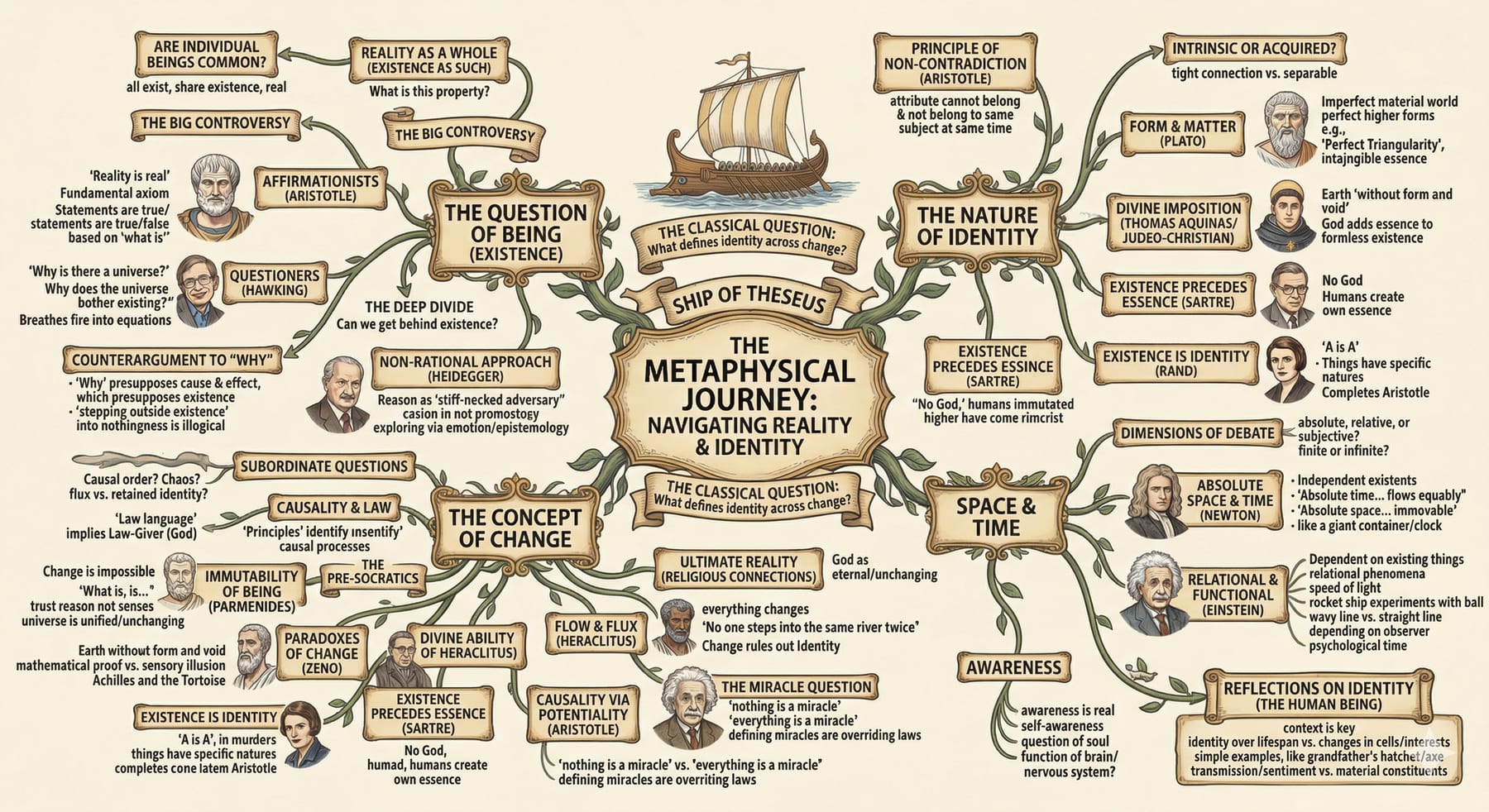
2. Essential Questions
Peterson Academy - Intro to Metaphysics Epistemology (Hicks) - Lecture 02.pdf (file not included in this release)
Overview
- This lecture moves from the Ship of Theseus puzzle into a broader survey of core metaphysical problems:
- being / existence
- identity / essence
- change / causation
- space and time
- self-awareness / consciousness
- The speaker’s goal is introductory and comparative:
- identify the basic metaphysical categories
- show the major philosophical controversies
- attach those controversies to major philosophers in the history of thought
- The lecture repeatedly stresses that metaphysics begins with very ordinary questions:
- What is this?
- Why did that happen?
- Is this still the same thing?
- What is real?
- The underlying pattern is:
- start from common experience
- abstract upward into metaphysical categories
- then map the historical philosophical positions
1. The Ship of Theseus as the opening problem of identity
The example
- Theseus’s ship is gradually repaired over time:
- the sail is replaced
- oars are replaced
- planks are replaced
- parts of the keel are replaced
- Eventually, perhaps 80%, 90%, or 99% of the original material has been replaced.
The core question
- Is it still the same ship?
- If yes:
- what preserves its identity?
- If no:
- at what point did it become a different ship?
Main philosophical issue introduced
- The problem is not just about ships.
- It is about:
- identity through change
- what makes a thing the thing it is
- what can change without destroying identity
- whether material continuity is enough, necessary, or insufficient
Why this matters
- The Ship of Theseus becomes a model for later questions about:
- persons over time
- living things that grow and change
- artifacts repaired across generations
- persistence of identity despite material replacement
2. Philosophy begins in wonder and in childhood questioning
Main point
- The speaker says philosophy begins with wonder.
- He illustrates this through children repeatedly asking:
- “What is this?”
- “Why did that happen?”
- “What’s under that?”
- He presents metaphysics as the developed form of this natural questioning.
Core insight
- Human beings begin by noticing:
- there are things
- things have names and kinds
- things change
- changes seem to demand explanation
- This leads naturally into abstract metaphysical inquiry.
3. The basic metaphysical categories the lecture introduces
The speaker moves from ordinary observation to what he treats as basic candidates for metaphysical analysis.
A. Being / existence
- We first notice that things are
- Individual things exist.
- Then we generalize:
- all beings share existence
- there is “being as such”
- there is “reality as a whole”
B. Identity / nature / attributes
- Things do not merely exist.
- They are particular things.
- They have:
- attributes
- identity
- nature
- essence
C. Change
- Things are not static.
- They change.
- So we must ask:
- what is change?
- how is change possible?
- does change alter identity?
D. Space
- Some changes seem to be changes of position.
- The speaker introduces space as a real feature of our experience:
- here versus there
- movement from one location to another
E. Time
- Even when the same spatial movement occurs, something differs:
- one movement happens earlier
- another later
- So time appears as another basic category.
F. Self / consciousness / awareness
- The speaker adds another candidate:
- an I
- a self
- an awareness that tracks beings, space, time, and change
- He also mentions self-awareness:
- I am aware that I am aware
Overall significance
- The lecture frames metaphysics as the study of these most basic features of reality.
4. The problem of being: do we simply affirm existence, or ask why existence exists?
This is one of the lecture’s first major controversies.
The affirmationist position
- Some philosophers say metaphysics must begin with:
- reality is real
- existence exists
- what is, is
- This is presented as the Aristotelian starting point.
- The idea is that all further thought depends on first affirming reality.
The explanatory position
- Other philosophers want to ask:
- Why does existence exist?
- Why is there something rather than nothing?
- What explains being as such?
Aristotle’s side
- Aristotle is presented as holding that:
- reality is the fundamental axiom
- truth and falsehood depend on what is or is not the case
- one cannot get “behind” reality to explain it
Stephen Hawking as a modern representative of the other impulse
- Hawking is quoted asking:
- what breathes fire into the equations?
- why does the universe go to the bother of existing?
- This is used to show that modern scientific thinkers also pose ultimate existence questions.
Counterargument against the “why existence?” question
- The speaker develops a strong objection:
- “why” presupposes cause and effect
- cause and effect already presuppose existence
- therefore, using “why” to explain existence itself is illegitimate
- Likewise:
- one cannot “step outside” existence to explain existence
- outside all existence would be “nothing”
- but nothing cannot explain anything
Heidegger’s role
- Heidegger is presented as rejecting rationalist dismissal of the question.
- He suggests reason itself may block deeper thought.
- The speaker treats Heidegger as opening the door to a more non-rational or extra-rational engagement with the question of Being.
Main issue
- The controversy is:
- Is existence self-evident and ultimate?
- or
- Must existence itself be explained?
5. Identity and essence: what makes a thing what it is?
The problem
- Things exist, but they also have determinate natures.
- The question becomes:
- what makes a thing the kind of thing it is?
- is identity intrinsic to existence?
- or is identity imposed from outside?
Aristotle’s position
- Aristotle tightly links existence and identity.
- A thing exists only as some definite thing.
- This is connected to the principle of non-contradiction:
- a thing cannot both have and not have the same attribute in the same respect at the same time
- This gives identity logical structure.
The central divide
The lecture presents three broad possibilities:
1. Existence and identity are intrinsically united
- To be is to be something.
- Identity is built into existence.
2. Existence comes first, identity later
- Something may exist without a definite identity at first.
- Identity is then imposed.
3. Essence comes first, existence later
- Essential natures are prior.
- Existing things derive from or participate in prior essences.
6. Aquinas, Plato, Sartre, and Rand on essence and existence
Thomas Aquinas
- Aquinas is presented as the major medieval thinker here.
- The lecture cites On Being and Essence, especially chapter 4.
- Aquinas is said to be broadly Aristotelian, but on this issue more Platonic.
- In the Christian creation framework:
- the world may begin as formless
- God imposes form or essence
- That suggests existence and identity are separable.
Plato
- Plato is presented as holding that:
- the material world is only lower-order reality
- true essences exist in a higher realm
- Example:
- imperfect drawn triangles are only approximations
- true triangularity exists as a perfect essence
- This introduces the idea that:
- the highest reality is not sensible but intelligible
Jean-Paul Sartre
- Sartre rejects God and thus rejects divine essence-imposition.
- His famous thesis is paraphrased as:
- existence comes first
- humans first exist, then create their own essence
- This is especially applied to human beings:
- no fixed human nature is given in advance
- self-creation becomes central
Ayn Rand
- Rand is presented as reviving the Aristotelian position.
- Her formula:
- Existence is identity
- A is A
- She rejects the idea that a thing can exist without being something definite.
- She also rejects a separate realm of essences.
Main philosophical takeaway
- The lecture contrasts:
- Plato / some religious and essentialist traditions
- Sartre’s existentialism
- Aristotle / Rand’s identity-centered realism
7. Change: is it real, impossible, or compatible with identity?
This is the lecture’s next major metaphysical battlefield.
Main questions
- Do things really change?
- If they change, do they remain the same things?
- Is change orderly and causal, or chaotic?
- Is the world structured by laws or principles?
Language note
- The speaker notes that speaking of “laws” can imply a divine lawgiver.
- “Principles” may be preferred by those who want to avoid theological assumptions.
8. Parmenides and Zeno: the argument against change
Parmenides’ position
- Parmenides argues:
- what is, is
- what is not, is not
- what is not cannot be thought or spoken of
- Therefore, change becomes paradoxical:
- if something changes, one property must cease to be
- another must come into being from non-being
- But non-being cannot produce being.
- So change is impossible.
Consequence
- Our senses tell us change is real.
- Reason tells us change is impossible.
- Therefore:
- trust reason
- distrust the senses
Significance
- The speaker presents Parmenides as an early rationalist:
- reason over sensory experience
- This is identified as an early anti-empiricist move.
Zeno’s paradoxes
- Zeno, following Parmenides, tries to show motion is impossible.
- The lecture uses the tortoise-and-rabbit style example:
- the faster runner must first reach where the slower runner was
- but by then the slower runner has moved ahead
- this repeats infinitely
- The conclusion is:
- mathematically, the faster runner never catches up
- The point is not practical common sense, but philosophical paradox:
- logic and mathematics undermine naive sensory belief in motion
Broader implication
- The Parmenidean side suggests:
- ultimate reality is one
- eternal
- unchanging
9. Heraclitus: change is fundamental, identity is unstable
Heraclitus’ position
- Heraclitus says change is obvious and basic.
- If logic cannot account for it, that is a problem for the logic, not for reality.
- His famous image:
- you cannot step into the same river twice
- The river changes moment by moment:
- the water differs
- the banks differ
- the boundaries differ
Main thesis
- If change is real, then strict identity is impossible.
- Concepts that freeze the world into fixed things are abstractions over a flowing reality.
Significance
- The world is flux.
- Stability is conceptual, not metaphysically ultimate.
10. Aristotle’s middle position on change
Aristotle’s solution
- Aristotle rejects both extremes:
- against Parmenides: change is real
- against Heraclitus: identity remains meaningful
- His solution involves:
- things having determinate identities
- those identities including potentials
- change being the actualization of potentials
Example used
- A caterpillar becoming a butterfly
- The butterfly is not a wholly unrelated new thing.
- The capacity for that transformation belongs to the caterpillar’s nature.
Main point
- Change is intelligible because:
- things are what they are
- their identities structure how they can change
- Causation is therefore rooted in identity.
11. Miracles and the order of causality
New issue introduced
- If reality has a stable causal structure, is there room for miracles?
The problem
- A miracle is typically understood as:
- an override of ordinary causality
- a suspension or breach of regular order
- So the metaphysical question becomes:
- are causal structures fixed and intrinsic to reality?
- or can an external being, such as God, intervene and alter them?
Main significance
- This section connects metaphysics to philosophy of religion.
- It shows that debates over change and causation affect how one understands:
- divine action
- natural law
- the possibility of supernatural events
12. Space and time: absolute, relative, or subjective?
The lecture then turns to space and time as major metaphysical categories.
Questions raised
- Are space and time:
- absolute?
- relative?
- subjective?
- Are they:
- finite or infinite?
- beginningless or with a beginning?
- endless or with an end?
13. Newton: absolute space and absolute time
Newton’s position
- Newton is presented as the classic defender of the absolute view.
- In Principia Mathematica, he argues:
- time flows uniformly in itself
- space remains fixed and immovable in itself
- Space and time are fundamental features of reality, independent of objects.
Core picture
- Reality can be imagined as:
- a giant container
- with events and objects occurring within it
- and governed by a universal clock
Main significance
- Objects exist in space and time.
- Space and time do not depend on objects.
14. Einstein: space and time as relational and relative
Einstein’s position
- Einstein reverses Newton’s order.
- Objects and their motions are primary.
- Space and time are relational structures dependent on those objective motions.
Key examples
- Light and spaceship thought experiments:
- time differs relative to motion and speed
- Ball bouncing on a moving spaceship:
- from inside the ship, the ball moves straight up and down
- from outside, it traces a wave-like path
- Both descriptions are objective.
- Therefore:
- objectivity remains
- but spatial and temporal descriptions are relative to frames of reference
Important clarification
- Einstein’s view is not presented as subjectivism.
- It is still objectivist:
- the underlying objects and motions are real
- but spatial-temporal measurement depends on relational standpoint
Psychological joke about time
- The “nice girl / red-hot cinder” line is used humorously to show that time also has a subjective experiential dimension.
15. Hume and Immanuel Kant: the subjective turn on space and time
David Hume
- Hume is presented as broadly skeptical about metaphysical concepts:
- being
- identity
- causation
- The lecture frames Hume as pushing toward the idea that much of metaphysics may be meaningless or at least deeply problematic.
Kant’s response
- Kant says Hume awakened him from his “dogmatic slumber.”
- In Critique of Pure Reason, Kant argues that:
- space and time are not features of things as they are in themselves
- they are forms of human intuition
- the mind structures experience spatially and temporally
Main thesis
- Space and time are:
- not objective features of reality-in-itself
- but forms imposed by the mind on appearances
Result
The lecture presents three broad views:
1. Newtonian
- space and time are absolute and objective
2. Einsteinian
- space and time are objective but relative to relations among real things
3. Kantian
- space and time are forms of subjectivity, not properties of ultimate reality
16. Consciousness / awareness as a final category
The issue
- The speaker notes that in all of this analysis there is still:
- an awareness
- a self
- a consciousness taking in these categories
- He does not yet fully develop it.
- He says this will be handled later when epistemology is treated more directly.
Importance
- Consciousness is acknowledged as real enough to require metaphysical and epistemological analysis.
- It stands alongside being, identity, change, space, and time as a basic problem.
17. Follow-up discussion: applying the Ship of Theseus to human beings
The questioner raises a human version of the Ship of Theseus issue.
The question
- Humans exist over time, but:
- their cells change
- their material makeup changes
- some think their soul does not change
- How do we explain identity under these conditions?
Speaker’s reply: bracket the soul issue
- He says the soul question belongs to a later lecture.
- The central issue here is identity through change.
Contextual identity
- His main reply is that identity questions are often contextual.
Example 1: the mother saying “there’s my little boy”
- In one sense:
- the adult is the same person as the child
- In another sense:
- the adult is not the same in interests, character, beliefs, or life stage
Example 2: grandfather’s axe
- The axe passes from grandfather to father to son.
- Parts are replaced along the way.
- Is it still grandfather’s axe?
His answer
- It depends on the context:
- sentimental / familial / legal / historical context:
- yes, it is grandfather’s axe
- strict material-constituent context:
- only part of it is grandfather’s axe
- sentimental / familial / legal / historical context:
- So the same object may receive different correct descriptions depending on what aspect of identity is under discussion.
Main takeaway
- Identity is not always answered by one universal formula.
- We often need to specify:
- material continuity
- functional continuity
- legal continuity
- personal or sentimental continuity
- psychological continuity
18. Key philosophical oppositions mapped in the lecture
Being
- Affirm existence as fundamental
- Aristotle
- Rand
- Seek explanation of existence itself
- Hawking
- Heidegger, in a different style
Identity / essence
- Existence and identity are inseparable
- Aristotle
- Rand
- Essence precedes existence
- Plato
- some theological traditions
- Existence precedes essence
- Sartre
Change
- Change is impossible
- Parmenides
- Zeno
- Change is fundamental, identity unstable
- Heraclitus
- Change is real and intelligible through identity/potentiality
- Aristotle
Space and time
- Absolute
- Newton
- Relative but objective
- Einstein
- Subjective forms of intuition
- Kant
19. Main ideas of the lecture
- Metaphysics starts from ordinary experience but quickly becomes abstract.
- The most basic philosophical questions are about:
- existence
- identity
- change
- causation
- space
- time
- self-awareness
- Many of the deepest controversies in philosophy can be framed as oppositions between major thinkers.
- The lecture repeatedly favors a comparative teaching method:
- introduce a concept
- present rival positions
- identify the major names
- The Ship of Theseus is used not as an isolated puzzle, but as an entry into:
- persistence through change
- material constitution
- contextual identity
- human identity over a lifespan
20. Historical figures and traditions mentioned
Ancient Greek philosophy
- Theseus
- Aristotle
- Plato
- Parmenides
- Zeno
- Heraclitus
- Socrates (mentioned as historical marker)
- Greek pre-Socratics generally
Medieval philosophy
- Thomas Aquinas
Early modern / modern philosophy and science
- Isaac Newton
- David Hume
- Immanuel Kant
- Albert Einstein
- Martin Heidegger
- Jean-Paul Sartre
- Ayn Rand
- Stephen Hawking
Religious/philosophical traditions referenced
- Christianity / Judeo-Christian creation tradition
- metaphysical implications of belief in God
- miracle language connected to theism
21. Books, texts, and sources mentioned in the transcript
Explicitly mentioned
- Aristotle, Metaphysics
- Thomas Aquinas, On Being and Essence
- especially chapter 4
- Isaac Newton, Principia Mathematica
- Immanuel Kant, Critique of Pure Reason
Quoted or referenced ideas from
- Plato (on higher reality / true essence)
- Stephen Hawking (why does the universe exist?)
- Martin Heidegger (reason as adversary of thought)
- Ayn Rand (“Existence is identity,” “A is A”)
- Albert Einstein (relativity and miracle quote)
- David Hume (as major skeptical influence)
22. Suggested related topics for further exploration
Identity and persistence
- Personal identity over time
- Psychological continuity vs bodily continuity
- Material constitution puzzles
- The relation between artifact identity and organism identity
Ancient metaphysics
- Plato’s theory of Forms
- Aristotle on substance, essence, and potentiality/actuality
- Parmenides and the denial of change
- Heraclitus and flux
Medieval metaphysics
- Aquinas on essence and existence
- Creation and form in Christian metaphysics
- Divine causality and participation
Existentialism and modern thought
- Sartre on existence preceding essence
- Heidegger on Being
- Rand’s neo-Aristotelian metaphysics
Causation and science
- Hume on causation
- Laws of nature vs principles of nature
- Miracles and violations of natural law
- Whether causation is discovered or imposed
Space and time
- Newtonian absolute space and time
- Einsteinian relativity
- Kant’s transcendental idealism
- The metaphysics of temporal passage
Philosophy of mind
- The self as substance vs process
- Consciousness and self-awareness
- Soul vs brain-based identity
- Whether personal identity survives bodily change
23. Concise takeaway
- This lecture is a broad introduction to metaphysics through the lens of one deceptively simple puzzle: what makes something the same thing over time?
- From that puzzle, it expands into the core categories of philosophy:
- being
- identity
- change
- causation
- space
- time
- consciousness
- The speaker’s main teaching strategy is to show that for each category there are major rival camps, and those camps often define the history of philosophy itself.
3. Nature & Super-Nature
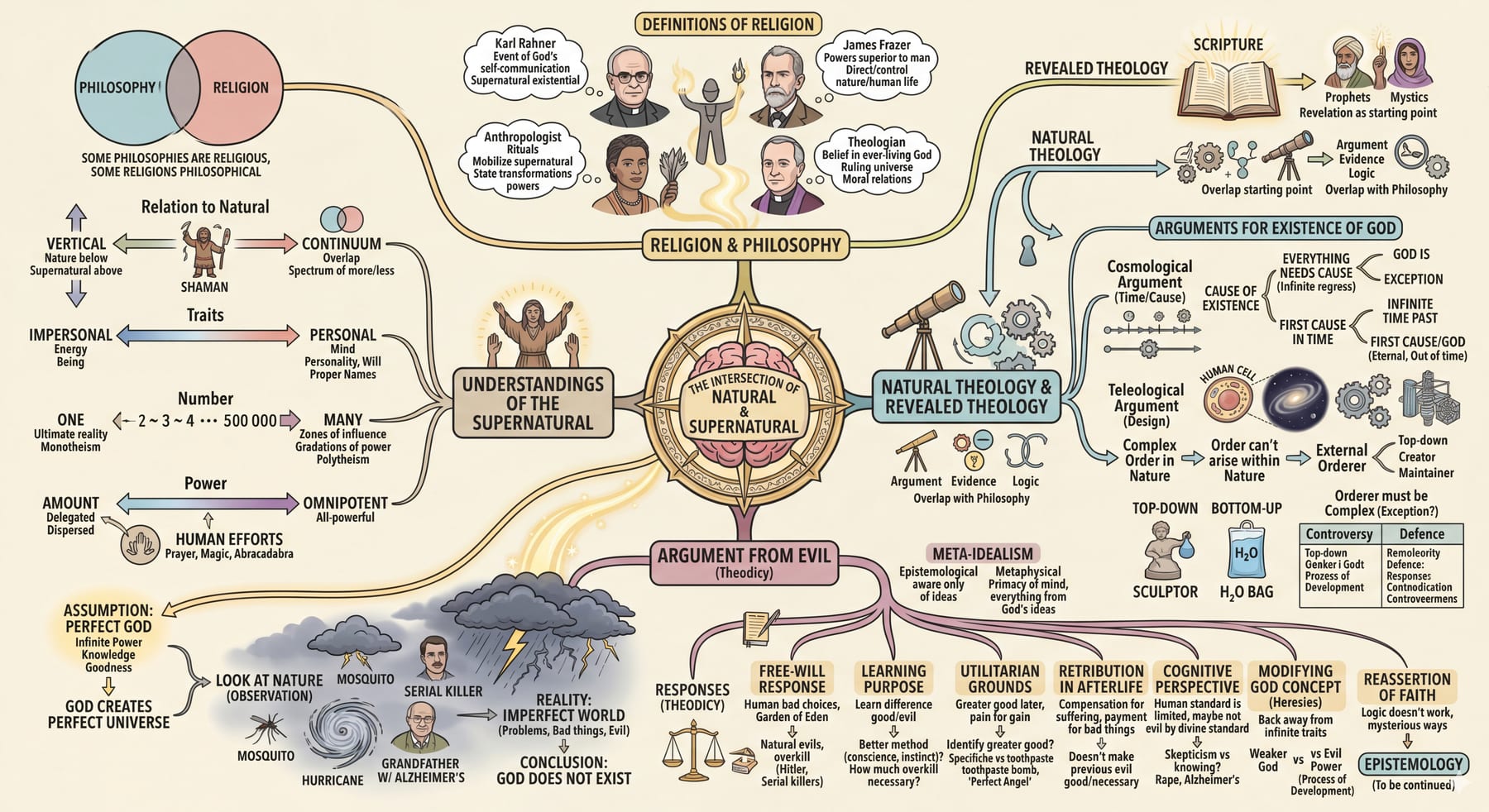
Peterson Academy - Intro to Metaphysics Epistemology (Hicks) - Lecture 03.pdf (file not included in this release)
Overview
- This lecture examines the concepts of the natural and the supernatural, especially where philosophy and religion overlap.
- It has three major aims:
- define religion in a way that brings out the idea of the supernatural
- analyze major philosophical arguments for God, especially from natural theology
- analyze the most important philosophical argument against God, the argument from evil
- The speaker also begins to transition from metaphysics into epistemology:
- Can these issues be settled by observation, logic, and argument?
- Or do they ultimately require faith, revelation, or some non-rational method?
1. Natural and supernatural as the framing concepts
Main starting point
- The lecture begins by distinguishing:
- the natural, historically associated with natural philosophy and later the sciences
- the supernatural, historically associated with religion
- The speaker cautions that the boundary between philosophy and religion is not neat:
- some philosophies are religious
- some religions are philosophical
- some are neither or only weakly so
Main idea
- The key issue is not a simple philosophy-versus-religion divide.
- The focus is on how both traditions conceptualize:
- nature
- the supernatural
- the relation between them
2. Four definitions of religion and the centrality of the supernatural
The speaker offers four definitions of religion, two from religious thinkers and two from anthropologists.
Karl Rahner
- Religion is described as:
- “the event of God’s absolute self-communication”
- involving a “capacity for the infinite”
- called the supernatural existential
Anthropological definition
- Religion is:
- a set of rituals
- rationalized by myth
- mobilizing supernatural powers
- to produce or prevent changes in human or natural states
James Frazer
- Religion is:
- propitiation or conciliation of powers superior to man
- which direct and control nature and human life
19th-century theological definition
- Religion is:
- belief in an ever-living God
- a divine mind and will
- ruling the universe
- standing in moral relation to humankind
Main conclusion from the definitions
- Across these definitions, the common thread is:
- the supernatural is above, beyond, or superior to nature
- Religion therefore carries a metaphysical commitment to:
- a natural realm
- and a supernatural realm
- with the latter having greater power or authority
3. Two models of the relation between natural and supernatural
A. Vertical / hierarchical model
- The supernatural is conceived as:
- above nature
- beyond it
- governing it
- This “above” language is metaphorical, not necessarily spatial in a literal sense.
- The supernatural is superior in power, causality, or governance.
B. Continuum / spectrum model
- Some traditions do not draw a strict boundary.
- Instead, the natural and supernatural blend into each other.
- Example:
- a shaman may be partly natural and partly supernatural
- some beings occupy an in-between zone
- This creates a graded scale:
- more natural
- less natural / more supernatural
- fully supernatural
Main point
- Religions differ not only on whether they affirm the supernatural, but on:
- how sharply or loosely they distinguish it from nature
4. Key dimensions along which religions differ
The speaker develops a kind of taxonomy of religion.
A. Personal vs impersonal supernatural
- Some religions portray the supernatural as:
- personal
- minded
- willing
- purposive
- named
- Others portray it as:
- impersonal
- energy-like
- spirit-like
- Being itself
- an ordering force without personality
B. One vs many supernatural beings
- Some traditions are strongly monotheistic
- Others are polytheistic
- Some allow:
- angels
- demons
- subordinate beings
- trinities or triads
- The question is:
- how many beings populate the supernatural realm?
C. Distribution of power
- Some views say:
- the supernatural being has all power
- Others allow:
- delegated power
- sacred intermediaries
- priests, prophets, shamans, magicians
- This opens discussion of:
- miracles
- ritual power
- magic
- whether humans can access or direct supernatural force
Main idea
- Before arguing for or against religion, one must first specify:
- what kind of supernatural being or system one is talking about
5. Natural theology vs revealed theology
This is one of the central conceptual distinctions of the lecture.
Natural theology
- Starts from:
- the natural world
- observation
- causation
- reason
- philosophical analysis
- It asks:
- does the best explanation of nature require appeal to God?
Revealed theology
- Starts from:
- revelation
- scripture
- prophecy
- mystical disclosure
- It presupposes:
- that God or the gods have already spoken
Main point
- Philosophers generally prefer natural theology
- because it operates through public reasoning
- rather than reliance on authority or revelation
- The lecture’s main arguments are taken from the natural theology tradition.
6. First argument for God: existence and the problem of ultimate explanation
The speaker first revisits an argument tied to existence itself.
The line of reasoning
- We ask:
- why does reality exist?
- why is there a universe?
- One move is:
- the universe cannot exist without a cause
- therefore it must be caused by God
Immediate objection
- If everything that exists needs a cause:
- then God, as an existing being, also needs a cause
- That leads to an infinite regress:
- God
- super-God
- super-duper God
- and so on
The religious response
- God is made an exception
- The universe requires explanation
- God does not
- God “just is”
Counter-response
- If exceptions are allowed:
- why not say the universe “just is”?
- Why add an extra explanatory layer?
Main philosophical issue
- The core issue is:
- whether explanation must terminate in God
- or whether one can stop at existence itself
7. Second argument for God: the first cause argument
The speaker then shifts from being-as-a-whole to particular beings.
The line of reasoning
- This being exists because of a prior cause
- That cause itself has a prior cause
- And so on backward in time
Two options emerge
- Either:
- the causal chain goes back forever
- Or:
- there is a first cause
The theistic inference
- If there must be a first cause:
- that cause must be uncaused
- and must be unlike ordinary beings
- therefore it is God-like
Main point
- The issue here is not just causation
- It is also about time
- can time extend infinitely into the past?
- or must there be a first beginning?
Main significance
- The argument for God becomes tightly linked to a theory of time and causation.
8. Third and most important argument for God: the teleological or design argument
This is the most detailed pro-God argument in the lecture.
Starting point
- We look at the world and observe:
- order
- complexity
- functional organization
- Example used:
- the human cell
Core intuition
- The world is not just orderly
- It is complexly ordered
- The question becomes:
- how can such complexity arise?
Structure of the argument
- The universe is orderly
- Complex order cannot arise within the universe itself
- Therefore, the order must come from outside the universe
- The external orderer must be highly intelligent and powerful
- Such a being exists
- We may call that being God
- Therefore, God exists
Why this matters
- This is the paradigm case of natural theology
- It does not begin from scripture
- It begins from publicly observable features of the world
9. Criticisms of the teleological argument
The speaker then breaks the design argument down step by step.
A. Is the universe orderly?
- This is generally not controversial.
- Both science-friendly and religion-friendly thinkers usually agree:
- there is extensive order in nature
B. Must complex order come from outside the universe?
- This is the most controversial premise.
- The major challenge is:
- why can’t complexity emerge from simpler natural processes?
- This is the central divide between:
- design theory
- and evolutionary / emergent explanations
Bottom-up vs top-down order
- Top-down:
- an external designer imposes form
- Bottom-up:
- simple interacting elements generate increasing complexity over time
Thought experiment used
- A bag containing hydrogen and oxygen is thrown down a mountain repeatedly.
- Through repeated interactions, more complex molecules such as H₂O might emerge.
- The point is to show how:
- simple ingredients plus time and interaction can generate complexity
Main issue
- Does complexity require an external designer?
- Or can it emerge naturally from the identities and interactions of things?
10. Additional problems within the design argument
A. Why one designer instead of many?
- Even if there must be an external orderer:
- why assume it is one being?
- Polytheistic response:
- nature shows not only order but conflict, competition, and disorder
- that may fit multiple divine agents better than a single divine plan
B. Does the designer still exist?
- Perhaps the universe was designed but no longer actively maintained
- This introduces the distinction between:
- theism: God continues to govern
- deism: God designed the universe and then withdrew
C. Are we smuggling in too much by calling the orderer “God”?
- The speaker warns against loading the argument with specifically religious assumptions.
- A designer proved by this argument is only:
- intelligent enough
- powerful enough
- external enough
- It does not yet prove:
- Yahweh
- Allah
- Christian Trinitarian theology
- any full revealed religion
D. The complexity problem turned back on God
- If complex order requires an external cause:
- and God is a highly complex being
- then who ordered God?
- If God is exempt and self-ordering:
- why not say the universe is self-ordering?
- This is one of the strongest internal objections to the design argument.
Main conclusion
- The teleological argument is powerful, but its weakest points are:
- the claim that complexity cannot emerge naturally
- and the claim that God can be an exception to the very principle used to infer him
11. Aquinas and philosophical method
Main point
- The speaker explicitly praises Thomas Aquinas as one of the greatest religious philosophers.
- The reason is methodological:
- lay out arguments clearly
- state objections fairly
- consider counter-objections systematically
- This is presented as the ideal style of natural theology:
- evidence
- reasoning
- logical structure
- fairness to opposing arguments
12. The major argument against God: the argument from evil
This is the second big pillar of the lecture.
Structure of the argument
The argument grants the traditional conception of God:
- all-powerful
- all-knowing
- all-good
- creator of the world
Then it argues:
- An all-powerful God could create any world
- An all-knowing God would know exactly what he was creating
- An all-good God would create the best possible world
- But the world is clearly not perfect
- Therefore, such a God does not exist
Main idea
- This is a reductio-style argument:
- grant the theist’s assumptions
- show they lead to contradiction or absurdity
13. Responses to the argument from evil
The speaker then surveys the main theistic replies.
A. Free will defense
- God created a good world
- Evil arises from human free choices
- So responsibility for evil lies with humans, not God
Strength of the reply
- It explains at least some moral evil:
- murder
- cruelty
- wicked human action
Main objection
- It does not explain:
- hurricanes
- disease
- natural suffering
- mosquitoes, as the speaker jokingly notes
- These evils are not obviously the result of human free will
Further objection
- Even if free will matters, a good God should still intervene in extreme cases
- Analogy:
- good parents allow some mistakes
- but they stop catastrophic harm
- Example used:
- Hitler and the Holocaust
- serial killers
- If human authorities should stop massive evil, why wouldn’t God?
14. Soul-making / moral education response
The response
- God allows evil because experiencing evil teaches human beings:
- the difference between good and evil
- moral maturity
- moral knowledge
Main criticism
- Couldn’t God teach that lesson another way?
- conscience
- instinct
- direct moral knowledge
- Also:
- how much evil is necessary?
- The speaker presses the point:
- a few instances may suffice to teach that murder is wrong
- six million murders are not needed
- So the scale of evil seems wildly excessive if its purpose is moral education
15. Greater-good / utilitarian response
The response
- Some bad things are permitted because they enable greater goods later.
- This follows a “no pain, no gain” logic.
Acceptable type of example
- Dental pain for long-term health
- Temporary suffering for a clearly identifiable good
Main objection
- In many cases, no plausible greater good can be identified
- If one cannot specify the good:
- the response becomes evasive rather than explanatory
Major example used
- A little girl picks up a toothpaste tube rigged with a bomb
- She is disfigured and blinded
- The mother asks:
- why would God allow this to happen?
Why this example matters
- It puts pressure on vague “greater good” explanations
- It forces the question:
- what concrete good justifies such horrific suffering?
16. Retribution and afterlife response
The response
- Evils in this life may be compensated in the afterlife
- Sufferers are rewarded
- wrongdoers are punished
- divine justice is ultimately fulfilled
Main objection
- Compensation later does not make the original evil acceptable
- Analogy:
- paying someone after unjustly harming them does not erase the wrongdoing
- So afterlife justice may address fairness eventually, but it does not explain:
- why the evil was permitted in the first place
17. Skeptical-theistic type response: maybe we misjudge good and evil
The response
- Perhaps human beings are using the wrong standard
- What appears evil from our perspective may not be evil from the divine perspective
Main criticism
- This undercuts ordinary moral confidence
- If we say we cannot really tell good from evil:
- then religion loses much of its moral guidance function
- Also, critics ask:
- what is the better perspective, concretely?
- The speaker presses with examples:
- Alzheimer’s
- rape
- He suggests it sounds evasive to say these only seem evil from a limited point of view
18. Revising God instead of rejecting God
Main idea
- Perhaps the argument from evil only refutes a maximally perfect God
- Instead of abandoning God altogether, one could weaken the concept of God
Possible revisions
- God is not fully omnipotent, only very powerful
- God is not fully omniscient, only very wise
- God may be in cosmic conflict with another powerful evil force
- God may be learning over time and improving creation
Examples of revised models
- Dualistic good-versus-evil cosmology
- A developing God who is not yet perfectly knowledgeable
Main significance
- These revisions avoid the strict logical contradiction
- But they no longer preserve the classical God of many major world religions
Religious response to these revisions
- Many orthodox believers reject these as:
- heresies
- Instead, they reaffirm:
- God is perfect
- human reason cannot fully understand his ways
- faith must take over where logic fails
19. Transition from metaphysics to epistemology
Main point
- The lecture has so far relied on:
- observation
- logic
- reasoning
- public argument
- But if these methods appear to fail in resolving religious questions, some may turn to:
- revelation
- faith
- mystery
- alternative epistemologies
Significance
- This sets up the next phase of the course:
- not just what exists
- but how we know what we claim to know
20. Follow-up discussion: Hume, Kant, skepticism, and idealism
Student’s question
- Is this where idealism first appears?
- Are Hume and Kant introducing the idea that reality is just perception?
Speaker’s response
- Hume is not an idealist
- he is better understood as a skeptic
- he refuses strong metaphysical commitments
- Kant is a kind of idealist
- but specifically in an epistemological sense
Important distinction introduced
The speaker distinguishes between:
A. Epistemological idealism
- We only know ideas or appearances
- We do not know things as they are in themselves
- This is associated with Kant
B. Metaphysical idealism
- Reality itself is fundamentally mind-like, spirit-like, or idea-like
- Many religions are metaphysically idealist in this sense
- Example:
- God is fundamentally a mind
- the world is created from divine ideas
- mind or consciousness is prior to matter
Main significance
- Idealism did not begin with Kant
- What is distinctive in Kant is the epistemological route
- But many older religious and philosophical systems already contain metaphysical idealism
21. Main themes of the lecture
- Religion is centrally tied to the idea of a supernatural reality beyond nature
- Religious systems differ along several important axes:
- personal vs impersonal
- one vs many
- concentrated vs distributed power
- sharp divide vs continuum with nature
- Natural theology attempts to reason from nature to God
- The two most important philosophical debates covered are:
- arguments for God from causation and design
- arguments against God from evil
- The lecture repeatedly shows that:
- every argument has vulnerable premises
- philosophy proceeds by isolating and testing each premise
- The lecture also bridges into epistemology:
- if reason does not settle these issues, should faith or revelation take over?
22. Historical figures, traditions, and examples mentioned
Thinkers
- Karl Rahner
- James Frazer
- Thomas Aquinas
- David Hume
- Immanuel Kant
Religious / mythological figures or traditions mentioned
- Zeus
- Brahma
- Allah
- Yahweh
- Gitchi Manitou
- prophets
- mystics
- shamans
- magicians
- witches
Historical events / examples used
- Hitler and the Holocaust
- serial killers
- natural disasters
- disease
- Alzheimer’s
- the bomb-in-toothpaste story involving a little girl
23. Books, articles, or sources mentioned in the transcript
Explicitly mentioned
- No article titles are emphasized beyond quoted definitions, but the following thinkers or works are directly referenced:
- Thomas Aquinas as a major model of philosophical theology
- David Hume
- Immanuel Kant
Concepts or traditions specifically referenced as sources/frameworks
- Natural theology
- Revealed theology
- anthropological definitions of religion
- classical philosophical theology
- the teleological argument
- the argument from evil
- discussions of heresy, faith, and mystery in later theology
24. Suggested related topics for further exploration
Philosophy of religion
- Cosmological arguments for God
- Teleological / design arguments in more detail
- The argument from evil and theodicy
- Classical theism vs deism
- Monotheism vs polytheism
- Divine attributes:
- omnipotence
- omniscience
- omnibenevolence
Metaphysics
- The natural vs the supernatural
- Causation and first-cause arguments
- Complexity, order, and emergence
- Bottom-up vs top-down explanations
- Metaphysical idealism vs materialism
Epistemology
- Faith vs reason
- Revelation vs public evidence
- Skepticism in Hume
- Kant’s idealism
- Whether religious belief needs rational justification
Comparative religion
- Shamanism and intermediary figures
- Magic and ritual efficacy
- Personal vs impersonal conceptions of divinity
- The place of angels, demons, spirits, and lesser divine beings
Ethics
- Free will and moral responsibility
- Soul-making theories of suffering
- Utilitarian justifications of suffering
- Retribution, compensation, and afterlife justice
25. Concise takeaway
- This lecture is a structured introduction to the philosophy of religion through the categories of natural and supernatural.
- It argues that religion usually involves belief in a reality above or beyond nature, and that philosophical reflection tries to determine whether belief in such a reality is rationally defensible.
- The strongest positive argument presented is the design argument, and the strongest negative argument is the argument from evil.
- The lecture’s deeper lesson is methodological:
- do not debate “religion” in the abstract
- clarify what kind of God or supernatural realm is being proposed
- then test each argument premise by premise
- It ends by showing that these debates eventually push us toward an epistemological question:
- What should count as a good reason to believe something about ultimate reality?
4. First Perceptions
Peterson Academy - Intro to Metaphysics Epistemology (Hicks) - Lecture 04.pdf (file not included in this release)
Overview
- This lecture shifts from metaphysics into epistemology, beginning with the remarkable powers of the human mind and asking how knowledge is possible.
- The speaker’s strategy is developmental:
- start with the cognitive growth of a child
- trace how humans move from sensation to perception, concepts, sentences, stories, and theories
- then ask whether these cognitive achievements actually connect us to reality
- The central focus of the lecture is sense perception, and the three main competing positions are:
- direct realism
- indirect realism / representationalism
- idealism
- The lecture ends by defending a more sophisticated form of direct realism, especially through an embodied, time-based, and environment-structured model of perception.
1. Opening theme: the power of the human mind
Main point
- The speaker begins by highlighting how extraordinary the human mind is:
- it can focus on details in the present
- reconstruct the past
- imagine the future
- understand humor
- appreciate metaphors, allegories, and poetry
- do mathematics and science
- This power is itself part of what epistemology studies:
- not just the world
- but our capacity to know the world
Examples of human cognitive excellence
- Albert Einstein
- symbol of the upper limits of human intellectual achievement
- Srinivasa Ramanujan
- largely self-taught Indian mathematical genius who later collaborated with major Western mathematicians
- Marilyn vos Savant
- associated with high IQ and public explanation of logical, mathematical, and statistical puzzles
Main significance
- Human cognition is both:
- a subject of admiration
- and an object of philosophical analysis
- Epistemology begins with wonder not just at the world, but at the mind’s ability to grasp it.
2. Why study cognitive development?
Main question
- If adults already think in highly developed ways, where should philosophy begin?
- The speaker proposes:
- go back to the beginning
- observe cognition as it develops in children
Main idea
- Human cognition is not fully formed at birth
- It develops gradually over a long period:
- physically
- cognitively
- emotionally
- Compared with many other animals:
- humans have an unusually long developmental period
- suggesting cognition is especially complex
Main significance
- By studying children, we can see the foundations of knowledge in a simpler and more observable form.
3. The developmental sequence of human cognition
The lecture lays out a hierarchy of cognitive development.
A. Sensation
- The newborn begins with:
- sight
- hearing
- touch
- taste
- smell
- The child initially receives what may be undifferentiated sensory inputs:
- blobs of color
- sounds
- tactile impressions
B. Perception
- These raw sensations become integrated into percepts
- Example:
- the child begins to recognize the mother’s face as a persistent object
- the face is distinguished from the background
- the child tracks it across time and movement
C. Concepts
- Children begin forming categories
- Example:
- “cat” applies not just to one household cat
- but to other cats as well
- The child distinguishes:
- cats from dogs
- cows from horses
- people from blankets, spoons, and other objects
D. Sentences
- Children move from isolated concepts to combinations:
- “cat eating”
- “cat walking to bowl”
- Then to more complex sentence structures that express:
- action
- relations
- sequence
- intention
E. Narratives
- Children can follow stories with:
- beginnings
- developments
- plot changes
- endings
- They integrate many sentences into a larger whole
F. Theories
- Children also begin to understand explanatory models of reality
- Example:
- a weather-cycle diagram
- sun, pond, evaporation, condensation, precipitation, runoff
- The child is no longer dealing merely with stories, but with a claim about how the world actually works
Main significance
- The lecture presents human cognition as an ascending hierarchy:
- sensation
- percept
- concept
- sentence
- narrative
- theory
4. Cognitive capacities and the skills built on them
The speaker distinguishes between having a capacity and exercising it well.
Observation
- A skill of noticing:
- similarities
- differences
- relevant features
- Can be refined through practice:
- music
- drawing
- taste training
Definition
- The skill of forming concepts clearly
- Distinguishing one category from another
Taxonomy
- Organizing concepts into larger relational structures
- Example:
- kittens, dogs, horses, calves
- then grouped into mammals
- then grouped into living things
Grammar
- Organizing concepts into meaningful sentence structures
- Important for:
- nouns
- verbs
- adjectives
- adverbs
- punctuation
- relations between clauses
Rhetoric and narrative structure
- Organizing larger discursive wholes:
- stories
- essays
- arguments
- long-form writing
Logic and mathematics
- Ensuring inferences are valid
- Maintaining connection between:
- observation
- abstract concepts
- theory
Main epistemological point
- Knowledge is not just having mental contents
- It requires the disciplined exercise of many interlocking cognitive skills
5. What epistemology is trying to do
Main question
- How do we distinguish:
- knowledge
- belief
- fantasy
- error
- fallacy
Main idea
- Epistemology is the “science” or philosophical account of:
- how knowledge is possible
- what counts as justified belief
- how cognitive processes succeed or fail
Errors that can occur
- mislabeling
- bad definitions
- grammatical confusion
- mathematical mistakes
- invalid inferences
- fantasy mistaken for reality
Main point
- Epistemology studies whether our capacities, properly used, really yield knowledge.
6. The first epistemological issue: sense perception
This is the main focus of the lecture.
Guiding questions
- Do the senses put us in direct contact with reality?
- If they do:
- is that contact accurate?
- If they do not:
- what are we aware of instead?
7. Direct realism
Basic thesis
- Our senses give us direct contact with reality
- Sensory awareness is not initially awareness of an internal image
- It is awareness of the world itself
How the view works
- There are real objects in the environment
- They emit or reflect different kinds of energy
- Our sense organs are responsive to those energies
- Sensation is a direct relational state between organism and world
Important features of the view
- There is no internal gap between perceiver and reality at the basic perceptual level
- Later processes such as:
- memory
- conceptualization
- imagination
- theory
are secondary developments built on this direct contact
Philosophers and thinkers associated with this view
Thomas Reid
- Presented as a philosopher of common sense
- Emphasizes that perception produces an immediate belief in the existence of what is perceived
- That belief is not inferred by reasoning but arises directly from perception
J. J. Gibson
- A 20th-century psychologist
- Emphasizes embodied perception
- We do not see with detached eyes alone, but with:
- eyes-in-the-head
- head-on-the-body
- body-on-the-ground
Ayn Rand
- Presented as a direct realist and foundationalist
- Sensory contact is the only direct cognitive contact with reality
- All higher cognition must ultimately be traceable back to sensory evidence
Main significance
- Direct realism makes sensory awareness the foundation of all later knowledge.
8. Challenges to direct realism: illusions and ambiguous perception
The lecture then turns to examples used against direct realism.
A. Railroad tracks
- Tracks are really parallel
- But visually they appear to converge in the distance
- This suggests a gap between:
- reality
- appearance
B. Pencil in water
- Pencil is really straight
- But appears bent or broken when partly submerged
- Again:
- what we seem directly aware of is not the object as it really is
C. Necker cube / ambiguous cube
- The same two-dimensional drawing can be seen in different orientations
- The cube itself does not change
- Our interpretation changes
D. Duck-rabbit image
- One image can be seen as:
- a duck
- or a rabbit
- The same visual stimulus supports different perceptual organizations
Main conclusion drawn by critics
- Since the same external object or stimulus can yield shifting appearances:
- what we are directly aware of cannot be reality itself
- we must instead be aware of some internal subjective state
9. Indirect realism / representationalism
Basic thesis
- We are not directly aware of external reality
- We are directly aware of mental representations, images, or appearances
- From those, we infer the existence of an external world
Model used by the speaker
- “Mr. Head” illustration:
- light reflects from trees and a dog
- enters the eyes
- produces internal representations
- The mind or self is then aware of those internal representations, not the outer things themselves
Core idea
- Perception is re-presentation, not direct presentation
- Awareness is mediated
Key analogy
- Person inside a submarine:
- the outside world is not directly encountered
- instruments produce signals and displays
- the observer infers what is outside from those signals
Main philosophical problem
- If all we are directly aware of are internal representations:
- how do we know they accurately represent external reality?
- We cannot step outside our own minds to compare:
- representation
- with reality itself
Main significance
- Indirect realism introduces a skeptical problem:
- we may be trapped inside our own subjective states
10. Einstein’s statement and the indirect realist problem
Quotation used
- Einstein is cited as saying that belief in an external world independent of the perceiving subject grounds science, but that sense perception gives information about that world only indirectly.
Significance
- Even a scientific realist can worry that:
- what is directly given is subjective experience
- external reality must be reached by inference
- This reinforces the representationalist challenge.
11. Idealism
Basic thesis
- If all we directly know are mental contents,
- and we cannot justify the inference to a mind-independent external world,
- then what we really know is only:
- mind
- ideas
- consciousness
- subjective contents
Main move
- Indirect realism opens the door to idealism
- Once external reality becomes inferential and uncertain, idealists say:
- stop pretending we know matter
- admit that all we know are ideas
12. Descartes and the road to idealism
Descartes’ role
- The speaker presents Descartes as a key origin point in modern philosophy
- Descartes is not himself an idealist
- But his arguments intensify skepticism about perception
Important arguments mentioned
A. Illusion argument
- Because perception sometimes deceives, it cannot be fully trusted
B. Dream argument
- In dreams, we take unreal things to be real
- How do we know we are not dreaming right now?
- We cannot inspect current experience and be certain it is waking reality
Main significance
- Descartes intended to overcome skepticism
- But the speaker says most later philosophers found his solutions inadequate
- As a result, Descartes unintentionally pushes philosophy toward:
- skepticism
- solipsism
- idealism
13. Solipsism and Berkeley
Solipsism
- The position that all I can know exists is:
- myself
- and the contents of my own mind
Berkeley’s idealism
- Berkeley fully embraces the idealist consequences
- The famous thesis:
- to be is to be perceived
- Things do not exist independently of perception
- Their existence consists in being present to a perceiver
Standard objection
- If things exist only when perceived:
- do they go out of existence when I stop looking at them?
Berkeley’s answer
- God is the ever-present perceiver
- God continuously perceives reality
- Therefore, things remain in existence even when finite human beings are not perceiving them
Main significance
- Berkeley offers a religious version of idealism:
- reality is sustained by divine perception
14. Kant and the retreat from objectivity
Kant’s position in the lecture
- Kant is presented as inheriting the skeptical and idealist pressures of modern philosophy
- He concludes that philosophers should stop aiming at knowledge of external reality as it is in itself
“Copernican revolution”
- Just as Copernicus shifted astronomy away from Earth-centeredness,
- Kant shifts philosophy away from object-centered knowledge
- The new center is the subject:
- our own cognitive structures
- not things as they are in themselves
Famous implication
- Kant is paraphrased as saying he had to deny knowledge in order to make room for faith
- The key point in this lecture is:
- objective knowledge of reality is abandoned
- we operate within subjectivity
Main significance
- Kant is presented as a culminating figure in the move away from direct realism and toward subject-centered philosophy
15. Reid’s objection: the absurdity of the skeptical turn
Reid’s reaction
- Reid argues that philosophers have reached absurd conclusions
- If a theory of perception ends with denying obvious reality, then something has gone wrong in the theory
Main point
- The challenge is not simply to reassert common sense
- It is to explain where the skeptical and idealist reasoning went wrong
16. The direct realist response: rejecting the homunculus model
This is one of the most important parts of the lecture.
Main target
- Direct realists reject the idea of a homunculus
- That is:
- a little inner observer
- a miniature self
- a “mind’s eye” watching internal images
Why this matters
- The indirect realist model assumes:
- the senses generate internal representations
- then a further inner subject observes them
- Direct realists say this is the wrong starting picture
Main alternative
- You are not a detached inner spectator
- You are an embodied organism directly responding to the world
Examples
Touch
- Wrong model:
- signals from the feet travel inward
- internal images of touch are then perceived by an inner self
- Better model:
- the whole bodily system is in a tactile relation to the world
- you are, in that moment, your embodied tactile response
Smell
- Wrong model:
- odor causes internal smell-images
- an inner “mind’s nose” then smells them
- Better model:
- your nose directly responds to chemical structures in the environment
- that response is the sensation
Guitar-string analogy
- A guitar string vibrates directly when plucked
- It does not contain a little guitar-self perceiving an internal image of vibration
- Similarly, sensory response is a direct state of the embodied organism
Main significance
- This response tries to block skepticism at its root by rejecting the whole “inner spectator watching mental images” model.
17. Gibson’s ecological and structured account of perception
Main thesis
- Reality already contains rich structure
- Perception is not the mind imposing order on raw chaos
- It is the organism registering structured information from the environment
Key ideas
- Light in the environment is not a featureless stream
- It is structured by:
- surfaces
- textures
- reflections
- refractions
- movement
- Our sense organs are also structured to respond to those structures
Major point
- Perception is a response to invariants in changing structure
- The environment provides the informational order
- The perceiver detects it
Time and movement
- Perception is not a frozen snapshot
- We:
- move
- shift our heads
- shift our eyes
- occupy time
- Real objects also exist and move in time
- Many “illusions” arise only because examples are artificially stripped of:
- depth
- motion
- lighting
- real environmental context
Example: cube illusion
- In real life:
- head movement
- light and shadow
- binocular depth
would clarify the cube’s orientation immediately
Example: cat vs raven photo
- A still image can be ambiguous
- But in real time, motion would immediately resolve the ambiguity
Main significance
- Gibson’s direct realism is more sophisticated than naive “the senses just photograph reality”
- It is:
- ecological
- embodied
- dynamic
- structured
- anti-homunculus
18. The student question: transhumanism, qualia, and sensory addition
Question raised
- What happens if humans gain new sensory capacities through technology?
- Example:
- devices or sensory additions that give a new sense of orientation or new forms of experience
- How would the three schools respond?
Speaker’s answer
- He is cautious and says much of this is speculative
- But he keeps an open mind
Main philosophical response
- Human beings currently have five senses tuned to certain kinds of energy
- There may be other forms of energy in the world that other organisms detect
- Birds are used as the main example:
- they may navigate by sensitivity to the Earth’s magnetic field
Main implication
- In principle, humans could perhaps:
- evolve
- or technologically augment
new sensory modalities
- The speaker does not fully resolve the issue, but suggests a direct realist could say:
- if new senses directly register real structures in the world,
- they would simply expand our contact with reality
19. Main philosophical positions compared
Direct realism
- We directly perceive reality
- Sense organs are part of an embodied relation to real structures in the world
- Illusions do not prove that perception is fundamentally indirect
Indirect realism / representationalism
- We directly perceive internal representations
- External reality is only inferred
- Illusions reveal the gap between appearance and reality
Idealism
- All we directly know are ideas or mental contents
- External matter cannot be securely established
- Therefore, reality is fundamentally mental or known only as mental
20. Main ideas of the lecture
- Human cognition develops hierarchically and gradually
- Epistemology studies not just what we believe, but how our cognitive capacities work
- Sense perception is the foundational epistemological issue
- A central philosophical divide concerns whether we perceive:
- reality itself
- internal representations
- or only ideas
- The modern skeptical tradition, especially through Descartes, creates pressure toward:
- indirect realism
- idealism
- solipsism
- The lecture pushes back by developing a more sophisticated direct realism grounded in:
- embodiment
- environmental structure
- temporality
- ecological perception
21. Historical figures and thinkers mentioned
Scientists / mathematicians / public intellectual examples
- Albert Einstein
- Srinivasa Ramanujan
- Marilyn vos Savant
- David Eagleman (in the question)
- Copernicus (via Kant’s “Copernican revolution”)
Philosophers and psychologists
- Thomas Reid
- J. J. Gibson
- Ayn Rand
- René Descartes
- George Berkeley
- Immanuel Kant
- Francis Bacon
- John Locke
- David Hume (mentioned indirectly in the student question and lecture context)
22. Books, articles, or sources mentioned in the transcript
Explicitly mentioned works
- Thomas Reid, An Inquiry into the Human Mind and the Principles of Common Sense
- Kant’s idea of a “Copernican revolution” is referenced, though no specific book title is quoted in the transcript here
- Descartes’ dream argument is discussed, though not tied to a title in the excerpt
- No article titles are given for David Eagleman, but his work on sensory addition is referenced in the question
Additional conceptual sources named
- the dream argument
- modern philosophy debates around:
- direct realism
- representationalism
- idealism
- solipsism
23. Suggested related topics for further exploration
Epistemology
- The problem of perception
- Appearance vs reality
- Skepticism and how to answer it
- Foundationalism in epistemology
- Direct realism vs representationalism
Philosophy of mind
- The homunculus problem
- Qualia and phenomenal consciousness
- Embodied cognition
- The mind’s eye and mental imagery
- Solipsism
History of philosophy
- Descartes’ Meditations and the dream argument
- Berkeley’s idealism
- Kant’s transcendental idealism
- Reid’s common-sense realism
- Humean skepticism
Psychology and cognitive science
- Child cognitive development
- Concept formation
- Ecological psychology
- Gibson’s theory of affordances
- Sensory substitution and sensory augmentation
Science and transhumanism
- Neural plasticity
- Sensory addition
- Magnetoreception in animals
- Human enhancement technologies
- Ethical questions in transhumanism
24. Concise takeaway
- This lecture introduces epistemology by starting with the growth of human cognition and then narrowing to the most basic question: What happens in perception?
- It presents the classic modern options:
- direct realism says we perceive reality directly
- indirect realism says we perceive internal representations
- idealism says all we truly know are ideas
- The lecture’s main push is toward a more sophisticated direct realism, one that rejects the “little observer inside the head” model and treats perception as an embodied, structured, real-time relation to the world.
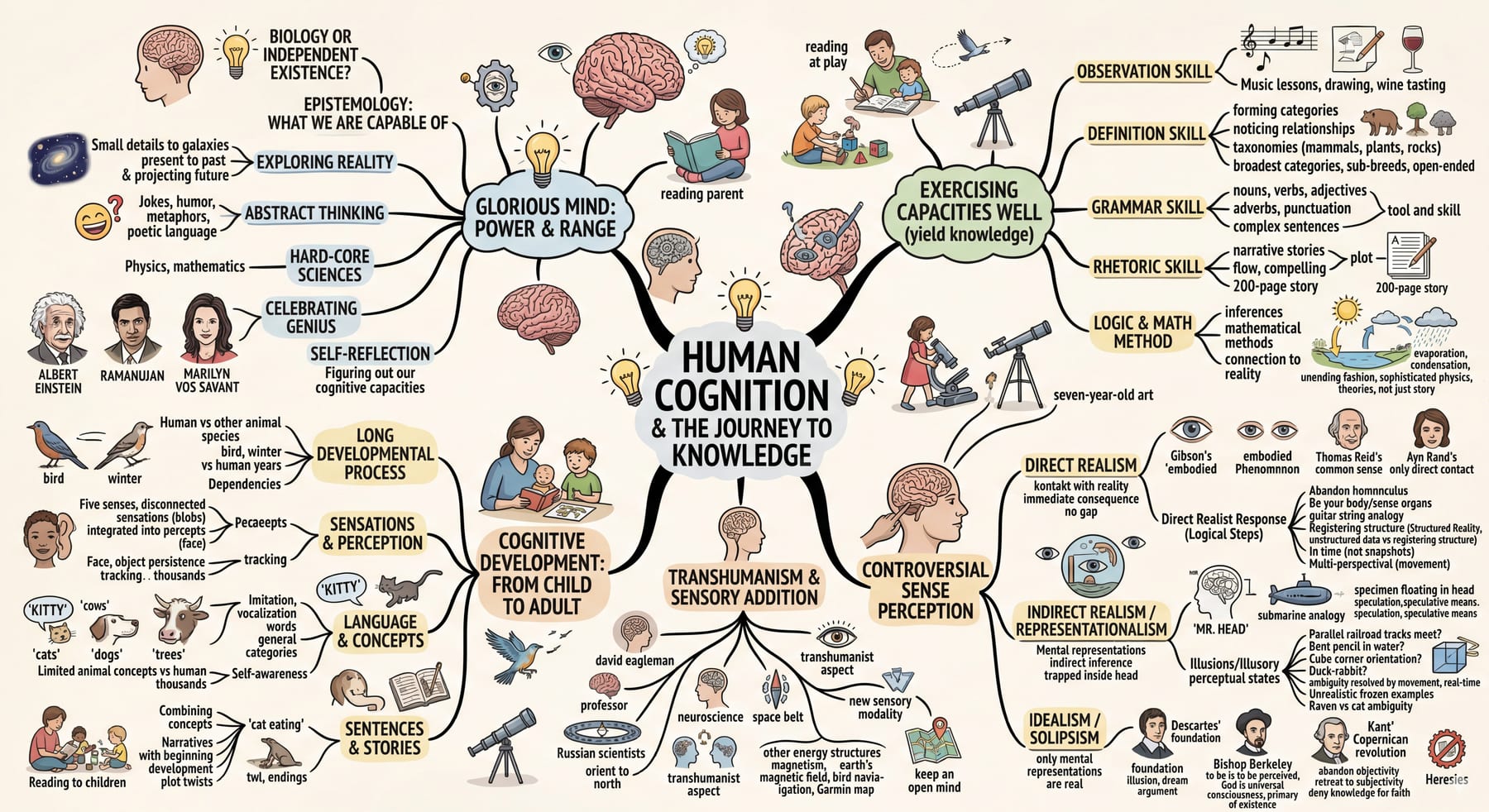
5. Then Conceptions
Peterson Academy - Intro to Metaphysics Epistemology (Hicks) - Lecture 05.pdf (file not included in this release)
Overview
- This lecture moves from sense perception up to the next major rung on the cognitive ladder: concept formation.
- Its central question is:
- how do human beings move from awareness of particulars to awareness of general categories?
- The lecture then connects concept formation to larger epistemological issues:
- whether concepts correspond to real universals
- whether concepts are mental constructions tied to reality
- whether concepts are merely names we impose
- The three major positions discussed are:
- realism
- conceptualism
- nominalism
- The lecture then broadens into:
- mathematics and measurement
- objectivity vs subjectivity
- intrinsicism, objectivism, and subjectivism
- intersubjectivity
- mysticism
- Kant, Nietzsche, Rorty, Heidegger, Husserl, and phenomenology
1. The move from perception to concepts
Main transition
- Perception gives us awareness of:
- particular objects
- particular actions
- particular sounds, smells, textures, shapes
- Concepts let us:
- generalize
- group
- abstract
- classify things as members of broader categories
Basic example
- The speaker looks at a room full of people:
- perceptually, each individual is different
- conceptually, all are grouped under human beings
- This raises the central philosophical problem:
- what is the humanity that all these individuals share?
- what exactly are we grasping when we use a general concept?
Main significance
- Concepts dramatically increase cognitive power:
- we no longer just notice individual things
- we organize reality into stable categories and relations
2. Why concepts matter: the “speckled hen” and zebra examples
Speckled hen example
- You can see a speckled hen clearly.
- But you cannot simply “see” how many speckles it has.
- To know the number, you must:
- count
- apply concepts
- use mathematical operations
Zebra example
- You can perceive a zebra as striped.
- But you cannot directly perceive:
- “this zebra has 31 stripes”
- That requires conceptual and mathematical activity.
Main point
- Perception alone is not enough for many forms of knowledge.
- Concepts allow us to go beyond immediate sensory awareness into:
- counting
- measurement
- categorization
- theory
3. Concepts are learned, not automatic
Main claim
- Sensory and perceptual processes are largely automatic.
- Concept use appears to be learned.
Developmental evidence
- Children first:
- point
- perceive
- react
- Later they:
- learn words
- form new mental units
- begin using abstractions
Anthropological examples
The speaker uses different cultures to show that concept systems can vary in sophistication.
Pirahã example
- The Pirahã are said to have arithmetic concepts only for:
- 1
- 2
- many
- They can perceive many individuals, but cannot conceptually distinguish:
- 12 from 13
- 48 goats from 52 goats
Base-16 tribe example
- Another group is described as using a 16-base system:
- fingers up to 10
- then elbows and shoulders up to 16
- beyond that: “many”
- The open-ended “keep adding one” procedure is not fully developed.
Main significance
- Human beings clearly form concepts.
- But concept systems are:
- developed
- extendable
- culturally variable
4. The three major theories of concepts
The lecture argues that on most philosophical issues there are often at least three serious positions, not just two.
A. Realism
- Concepts correspond to real universals or abstract features in reality.
- Humanity, circularity, squareness, and similar abstractions are genuinely real.
B. Conceptualism
- Only particulars exist in reality.
- But the mind performs a real cognitive operation on perceptual data:
- noticing similarities
- omitting differences
- forming a new abstract mental unit
C. Nominalism
- Only particulars exist:
- in reality
- and in the mind
- Concepts are just names applied to groups of similar particulars.
- No abstract entity exists either outside the mind or inside it.
Main significance
- This is the core framework for the lecture.
- Nearly all later examples are used to test these three views.
5. Realism: universals are real
Core thesis
- Abstract properties are part of reality.
- Individuals are not only particular things; they also participate in universal features.
Plato as chief representative
- Plato is the main historical figure here.
- Abstract essences are:
- real
- perfect
- grasped by the mind rather than the senses
Key implication
- When we recognize something as a triangle or circle,
- we are not just grouping similar things
- we are recognizing a real essence
The geometric argument
- The lecture uses imperfectly drawn:
- circle
- square
- triangle
Platonic move
- These visible drawings are only approximate
- A true circle is:
- a locus of points equidistant from a center
- A true square has:
- perfectly straight lines
- right angles
- Since our sensory examples are imperfect,
- there must be a higher and more exact reality of “circularity” or “squareness”
Main significance
- Realism explains abstract precision by appealing to real universals or essences.
6. Nominalism: concepts are just labels
Core thesis
- There are only particulars.
- Universals are not real entities.
- The mind does not grasp abstract essences.
- It merely:
- notices rough similarities
- groups things pragmatically
- applies a label
Response to Plato
- We do not need perfect circles or perfect squares in another realm.
- We simply classify things that are “circle-ish enough” or “square-ish enough.”
Color spectrum example
- The visible spectrum does not come pre-divided into:
- red
- orange
- yellow
- green
- blue
- purple
- We impose divisions.
“Orred / grello / bleen / blurple” example
- The speaker invents alternative color categories to show:
- boundaries are not announced by reality itself
- categorizations appear somewhat arbitrary
- A nominalist would say:
- no single division is metaphysically privileged
- these are naming conventions
Main representatives
William of Ockham
- Universals are not real
- They exist only as thought-objects
David Hume
- All ideas are copies of impressions
- Since impressions are particular, ideas are also particular
- Concepts are ultimately labels or regroupings of particular impressions
Main significance
- Nominalism rejects both:
- real universals in the world
- genuinely abstract mental units
7. Conceptualism: concepts are mental abstractions grounded in reality
Core thesis
- Reality contains particulars, not floating abstract essences.
- But concepts are not arbitrary names either.
- They are objective mental integrations of factual data.
Ayn Rand as representative
- Rand’s formulation:
- concepts are neither revealed nor invented
- they are produced by consciousness in accordance with reality
Main claim
- Concept formation is a cognitive process that involves both:
- the object side: real similarities and differences in the world
- the subject side: active mental work
The process
- We perceive particulars.
- We note similarities.
- We omit certain differences.
- We form a new mental unit.
Key point
- Concepts are abstract and mental,
- but they are still objectively constrained by reality.
8. Conceptualism illustrated through number concepts
Main issue
- How do we get the concept of “three”?
Example used
The speaker compares:
- three lines
- three dots
- three foot-taps
- three tosses
The cognitive operation
- The particulars are all very different:
- visual
- auditory
- tactile
- motor
- But the mind notices a common structure.
- It deliberately ignores irrelevant differences.
- It groups them together.
- It forms a new concept:
- three
Main significance
- “Three” is not visibly stamped on reality.
- But it is also not arbitrary.
- It is a mental abstraction from real relations among particulars.
9. Mathematics and measurement as objective abstractions
This is one of the most important applied sections.
The challenge
- Nominalists may say:
- numbers and units are made up
- reality does not come labeled “3418”
- the world is not carved into feet, yards, meters, or kilometers
Speaker’s response
- Measurement concepts are still objective, even if they are mentally formed.
Stick-and-foot example
- The speaker imagines finding a stick.
- He focuses not on its texture or color,
but on its length - He then compares it to a foot and says:
- this will count as “a foot”
What matters philosophically
- The label is chosen by humans.
- But it captures a real relation in the world.
- Measurement is not arbitrary fantasy.
- It is a cognitive device that objectively tracks spatial relations.
Main conclusion
- Mathematics and measurement are not:
- revelations of eternal essences
- nor arbitrary inventions
- They are objective abstractions from real structures and relations.
10. Logic as the next rung above concepts
Main transition
- Once we have concepts,
we can combine them into sentences,
arguments, and logical structures.
The lecture’s treatment
- The speaker does not go deeply into logic here.
- He says logic is continuous with the material on concepts
- and notes that there are parallel disputes:
- realism about logic
- nominalism about logic
- conceptualist/objectivist accounts of logic
Main point
- Logic, like concepts, raises the same question:
- are its structures discovered, invented, or abstracted?
11. Francis Bacon and objectivity
Main quotation
- “Nature, to be commanded, must be obeyed.”
Meaning
- We do not begin by imposing our preferences on the world.
- We begin by learning what reality is like.
- Then we act effectively within its constraints.
Main significance
- This becomes the model for objectivity:
- the subject must stay connected to the object
- knowledge must map onto reality
- successful action depends on respecting reality’s nature
12. Two senses of objective and subjective
The speaker emphasizes an important distinction.
A. Metaphysical use
- Objective:
- refers to objects, reality, what exists outside the subject
- Subjective:
- refers to the subject, the self, the “I”
B. Epistemological use
- Objective:
- a way of using one’s mind that stays connected to reality
- Subjective:
- a way of thinking detached from reality
- or the claim that such connection is impossible
Main point
- Much confusion comes from mixing these two contexts.
13. Intrinsicism, objectivism, and subjectivism
This is one of the lecture’s central analytic triads.
A. Intrinsicism
- Reality does most of the work.
- Truth is “out there.”
- The subject is passive.
- Knowledge is more like:
- revelation
- reception
- direct stamping by reality
B. Objectivism
- Reality is real and sets the terms.
- But the subject must actively work:
- observe
- define
- compare
- infer
- integrate
- Knowledge is relational:
- subject + object + correct method
C. Subjectivism
- Reality either does not constrain knowledge
or cannot be known as it is - The subject’s own will, framework, or group becomes primary
Main significance
- This threefold distinction helps interpret many later philosophers.
14. Exam-grading example: subjective, intrinsic, objective
The speaker uses a practical analogy.
Subjective grading
- The professor sees the student’s name,
remembers disliking the student,
and gives a C without reading - The grade reflects:
- private feeling
- not the paper’s real qualities
Intrinsic grading
- The professor claims to “intuit” the paper’s quality by revelation
- The object is assumed to radiate its truth passively to him
Objective grading
- The professor actively reads and evaluates:
- word use
- argument structure
- evidence
- logic
- organization
- The object has real qualities,
but the subject must do disciplined work to grasp them
Main point
- Objectivity is not passivity.
- It is active, reality-oriented cognition.
15. Nietzsche as radical subjectivist
Nietzsche’s target
- The idea that objectivity would require selflessness, mirror-like passivity, or pure receptivity
His sarcastic critique
- The “objective man” would have to be:
- a mirror
- a pot waiting for content
- a selfless being
Nietzsche’s conclusion
- That model is impossible.
- Therefore:
- abandon the pretense of objectivity
- embrace creativity, will, legislation, command
Key formulations
- Genuine philosophers are “commanders and legislators”
- Their knowing is creating
- “Will to truth” is really will to power
Main significance
- Nietzsche is presented as one endpoint of skepticism:
- if objective knowledge is impossible,
- truth becomes an expression of power and creation
16. Intersubjectivity: a social compromise after skepticism
Why it arises
- Some thinkers accept skeptical criticisms of objectivity
- but also reject pure individual subjectivism of the Nietzschean sort
Proposed solution
- Truth is not objective in the old sense
- It is what a group jointly agrees to treat as objective
Definition used in the lecture
- Inter-subjective norms become “objective”
because they are jointly accepted,
not because they correspond to independent reality
Main significance
- This is a socialized form of subjectivism:
- not my truth alone
- but our truth as a group
17. Richard Rorty and truth as social permission
Main point
- Rorty is presented as pushing intersubjectivity further
- There are no intrinsic facts constraining us
- Only the social constraints of the communities we belong to
Key line
- “Truth is whatever your contemporaries let you get away with saying.”
Meaning
- Truth is not discovered
- It is socially negotiated and tolerated
Main significance
- This is a late, strongly anti-objectivist position:
- truth becomes socially contingent
- group acceptance replaces correspondence to reality
18. Plato, mysticism, and purified knowledge
Another response to skepticism
- Instead of embracing subjectivism,
some philosophers revive a more Platonic route:- true knowledge requires escaping bodily and sensory contamination
Socrates/Plato line
- Pure knowledge requires:
- getting rid of bodily interference
- contemplating things with the soul alone
Mystical implications
- Shut down sensory and bodily distractions
- Seek:
- passivity
- purification
- meditation
- revelation
- True knowledge is hoped to come from:
- transcendence
- ascent
- divine disclosure
Main significance
- Mysticism is presented as an alternative to both:
- empirical objectivism
- skeptical subjectivism
19. Kant as transitional figure
Main point
- Kant tries to occupy a middle ground
- We cannot know things as they are in themselves
- But we can still think them
Central consequence
- Knowledge is denied in the strong, objective sense
- This makes room for:
- faith
- thought
- possibly morality or religion
Main significance
- Kant is presented as:
- preserving some structure against total subjectivism
- but conceding the failure of robust objectivist knowledge
20. Follow-up: pain as a philosophical example
Student question
- Pain seems deeply real
- How would the different schools analyze it?
Speaker’s answer
Direct realist reading
- Pain is a strong case for direct realism
- Example:
- hand on hot stove
- bodily transformation
- learning occurs directly
- The pain is:
- in the burned tissue
- in the nervous system
- in the whole embodied response
Idealist complication
- The firewalker example may be used to argue:
- pain is mentally mediated
- it may be controlled or overridden by consciousness
Main significance
- Pain is treated as a good test case because it combines:
- bodily reality
- subjective experience
- learning
- direct contact with the world
21. Follow-up: phenomenology, Husserl, Heidegger, and Kant
Clarification on phenomenology
- Husserl is identified as the founder of phenomenology
- Heidegger is its most famous later representative
Post-Kantian background
- Kant distinguishes:
- the phenomenal world: the world as it appears
- the noumenal world: things as they are in themselves
- There is an unbridgeable gap between the two
Phenomenology’s move
- Accept Kant’s point
- Stop chasing noumenal reality
- Focus on:
- describing phenomena
- lived experience
- appearance as such
Heidegger’s distinctive turn
- Heidegger is described as:
- a subjectivist who still wants objectivity
- He thinks words, logic, and conceptual schemes have veiled reality
- His strategy is to:
- deconstruct language
- rely more on poetic and emotional disclosure
- treat poets as guides closer to reality than rationalists
Main significance
- Heidegger is portrayed as:
- phenomenological
- anti-standard-rationalist
- searching for reality through a transformed relation to language and mood
22. Technology, epistemology, and transhumanism
Speaker’s main answer
- Technology is a product of good epistemology
- Examples:
- microscopes
- telescopes
- scientific instruments generally
- We study reality,
build tools,
then use those tools to know reality better
Further question
- Does technology enhance or weaken humanity?
Speaker’s position
- This opens into transhumanist issues
- Technology can:
- expand human capacities
- but may also weaken or distort them
- Sorting good from bad uses requires a separate discussion
Main significance
- Technology is treated as both:
- evidence of successful objectivity
- and a new frontier for questions about human nature
23. Main themes of the lecture
- Concepts are a major cognitive advance over perception
- The central problem is:
- what a concept is
- and how it relates to reality
- Three broad answers dominate:
- realism
- conceptualism
- nominalism
- Mathematics and measurement are used to argue that:
- abstraction can be objective without requiring Platonic universals
- Objectivity is not passive revelation
- It is an active process of keeping consciousness in contact with reality
- Subjectivism takes several forms:
- individual will-to-power
- intersubjective social consensus
- skepticism about correspondence
- Mysticism and phenomenology are presented as alternative responses to the failures of traditional objectivism
24. Historical figures and traditions mentioned
Major philosophers
- Plato
- Socrates
- William of Ockham
- David Hume
- Ayn Rand
- Francis Bacon
- Friedrich Nietzsche
- Immanuel Kant
- Richard Rorty
- Edmund Husserl
- Martin Heidegger
Other references
- Jordan Peterson
- postmodernism
- neo-pragmatism
- mysticism
- phenomenology
- transhumanism
25. Books, texts, and sources mentioned
Explicitly mentioned
- Francis Bacon, Novum Organum
- Plato quotation on the “truly existent essence” and higher reality
- Plato/Socrates quotation on pure knowledge requiring separation from the body
- Kant quotations:
- we cannot know things in themselves
- “I had, therefore, to deny knowledge, in order to make room for faith”
Figures used as representative sources
- William of Ockham on universals
- David Hume on ideas as copies of impressions
- Richard Rorty on truth as social acceptance
- Nietzsche on philosophers as commanders and legislators
26. Suggested related topics for further exploration
Epistemology
- The theory of concepts
- Universals and particulars
- Objectivity vs subjectivity
- Intersubjectivity and social construction of truth
- Faith vs knowledge
Metaphysics
- Realism about universals
- Nominalism and anti-realism
- Conceptualism as middle ground
- The metaphysics of mathematics
- Phenomena vs noumena
Logic and language
- The relation between concepts and logic
- Grammar as epistemic structure
- Linguistic mediation of thought
- Deconstruction and anti-rationalism
Philosophy of mathematics
- The ontology of numbers
- Counting and abstraction
- Measurement systems and convention
- Mathematical realism vs constructivism
History of philosophy
- Plato on Forms
- Ockham and medieval nominalism
- Hume on ideas and impressions
- Kant’s critical philosophy
- Nietzsche and perspectivism
- Husserl and Heidegger on phenomenology
- Rorty and postmodern pragmatism
Applied philosophy
- Pain and embodiment
- Technology and epistemology
- Transhumanism
- The role of scientific instruments in human knowledge
27. Concise takeaway
- This lecture argues that concept formation is one of the decisive steps in human cognition.
- It frames the debate over concepts as a three-way contest:
- realism says concepts grasp real universals
- nominalism says concepts are only names for particulars
- conceptualism says concepts are objective mental abstractions grounded in reality
- The speaker leans toward a conceptualist-objectivist position:
- the mind does real work
- but that work is constrained by and answerable to reality
- From there, the lecture expands into a broader epistemological map of:
- objectivity
- intrinsicism
- subjectivism
- intersubjectivity
- mysticism
- post-Kantian phenomenology.
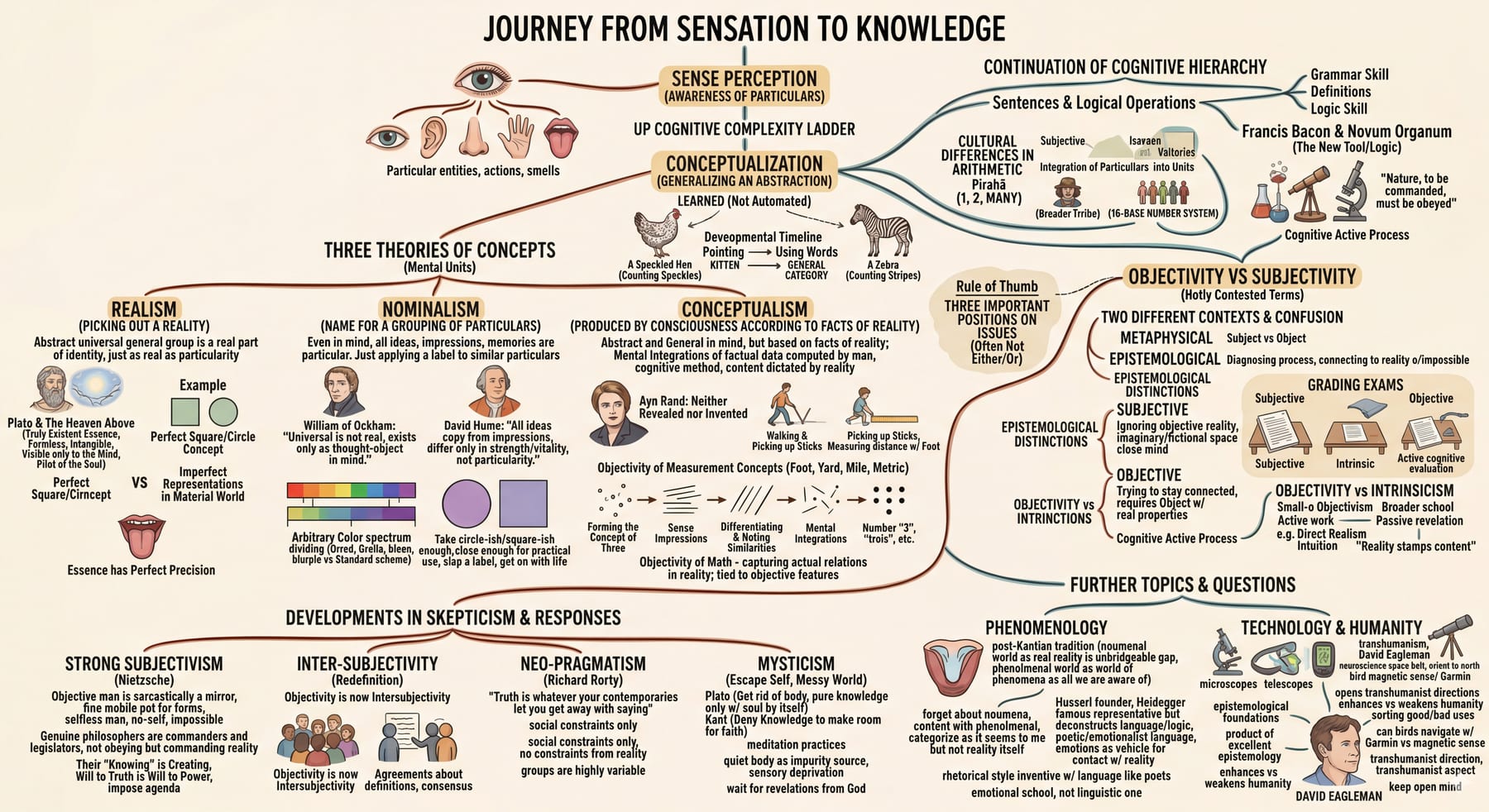
6. What is Faith?
Peterson Academy - Intro to Metaphysics Epistemology (Hicks) - Lecture 06.pdf (file not included in this release)
Overview
- This lecture asks a focused epistemological question: What is faith?
- The speaker distinguishes:
- faith as a noun: a body of beliefs
- faith as a verb: a way of forming, sustaining, or protecting belief
- The lecture is mainly about faith as a verb, especially when:
- evidence is weak
- proof is unavailable
- or reason appears to lead away from what one wants to believe
- The central theme is that “faith” is not one single thing. The speaker lays out multiple rival accounts of what faith is psychologically and epistemologically.
- He also contrasts faith with:
- observation
- logic
- scientific method
- rational inquiry
- agnosticism as an intellectual method
1. Initial clarification: faith as noun vs faith as verb
Faith as a noun
- Refers to a set of beliefs:
- “This is my faith”
- meaning: this is the package of doctrines I affirm
Faith as a verb
- Refers to a way of believing
- The lecture’s focus is on:
- how people come to believe on faith
- how they maintain beliefs on faith
- whether faith is supposed to yield:
- belief
- knowledge
- certainty
Main point
- The lecture is not mainly about comparing religious doctrines.
- It is about the psychology and epistemology of believing without standard evidential support.
2. Where faith enters the picture
Natural theology vs revealed theology
- The speaker revisits a distinction from earlier lectures:
- natural theology tries to justify belief in God through:
- observation
- causation
- design arguments
- logic
- science
- revealed theology begins from revelation, scripture, or faith
- natural theology tries to justify belief in God through:
Main claim
- If someone thinks God’s existence can be:
- proved
- reasonably established
- scientifically supported
then faith is not needed in any extra sense
- Faith becomes relevant when someone thinks:
- reason does not get you all the way there
- evidence is insufficient
- belief requires a “leap”
Meaning of “leap of faith”
- Suggests:
- going beyond available evidence
- moving past what reason strictly supports
- making a commitment that is not fully rationally grounded
3. Oxford conference framework: three famous accounts of faith
The speaker uses a mid-20th-century Oxford conference on faith as a framework. Three major philosophers of religion are presented through parables.
4. Antony Flew: faith as modifying the hypothesis to avoid disconfirmation
Parable of the two explorers and the gardener
- Two explorers find a beautiful clearing in the jungle
- One says:
- this must be a garden
- therefore there must be a gardener
- The other says:
- no, this is just nature
Initial argument
- The believer sees:
- plants arranged in ways that look purposeful
- sun-loving plants in sunny areas
- shade-loving plants in shaded areas
- He infers:
- intentional design
- a gardener
Testing the hypothesis
- They wait for the gardener
- No gardener appears
Believer’s response
- The believer revises:
- maybe the gardener is invisible
Further test
- They set traps and wires
- Nothing shows up
Believer’s next revision
- The gardener must be:
- invisible
- and immaterial
Flew’s interpretation
- Faith works like this:
- a person has a hypothesis
- contrary evidence appears
- instead of abandoning the hypothesis, they modify it to preserve belief
Main descriptive claim
- Faith is a disposition to protect belief by revising the hypothesis whenever evidence threatens it
Normative implication from Flew
- Flew is critical of this
- He sees it as epistemically illegitimate:
- the believer is not letting evidence rule the outcome
5. R. M. Hare: faith as reinterpreting evidence through a fixed controlling belief
Story of the paranoid student
- A student arrives at Oxford or Cambridge
- He believes:
- the dons (tutors/professors) are trying to kill him
- his parents sent him there to help this happen
Evidence against the belief
- The dons are polite at social gatherings
- They give him praise and good grades
Student’s response
- He does not change the core belief
- Instead, he reinterprets all contrary evidence:
- kindness is fake
- praise is a setup
- good grades are part of a larger trap
Hare’s point
- This differs from Flew’s model:
- the hypothesis is not modified
- the evidence is reinterpreted to fit the unchanged belief
Main descriptive claim
- Faith can mean:
- holding a fixed lens, framework, or interpretive posture
- through which all evidence is filtered
Significance
- This account treats faith less as changing beliefs to evade evidence,
and more as having a governing interpretive orientation.
6. Basil Mitchell: faith as personal trust, not hypothesis management
Story set in Nazi-occupied France
- You are in the French Resistance
- A stranger appears
- You feel a deep trust or connection with him
- Others are suspicious, but you let him in
The troubling event
- Later, the stranger appears wearing a Nazi officer’s uniform
- Others say:
- clearly you were wrong to trust him
Believer’s response
- You still trust him
- You think:
- maybe he is secretly working on our side
- maybe appearances are misleading
Mitchell’s interpretation
- Faith is not best understood as:
- scientific hypothesis
- evidence tracking
- logical revision strategy
- Faith is more like:
- personal trust
- commitment
- relationship
- a non-transferable experiential bond
Main descriptive claim
- Faith is a personal, feeling-based, trust relationship
- Evidence may challenge it, but does not fully define it
7. Theist/atheist and agnostic/gnostic distinctions
The speaker then pauses to introduce important terminology.
Theist vs atheist
- Theist:
- believes in God
- Atheist:
- does not believe in God
Gnostic vs agnostic
- Gnostic:
- claims to know
- Agnostic:
- does not claim to know
- or says one cannot know
Four possible combinations
- Gnostic theist
- believes in God and claims to know
- Agnostic theist
- believes in God but does not claim knowledge
- Gnostic atheist
- does not believe in God and claims to know that is correct
- Agnostic atheist
- does not believe, but also does not claim certainty/knowledge
Main corrective point
- The speaker emphasizes that many mainstream religious traditions are actually agnostic theisms
- They believe,
but do not claim full comprehension or demonstrable knowledge
8. Examples of agnostic theism in major religions
Christianity
- Early Christian source says:
- Christ’s divinity is too sublime and overwhelming to grasp
- Main point:
- belief is affirmed
- comprehension is denied
Judaism
- Rabbi writing on Shabbat says:
- “The sum total of what we know of You is that we do not know You”
- Also:
- being created in God’s image is a mystery
Islam
- Quranic formulation:
- God is beyond anything humans can define
- Again:
- belief is affirmed
- definitional knowledge is denied
Main significance
- Mainstream religious orthodoxy often says:
- we believe
- but do not know in a full rationally demonstrable sense
9. The normative issue: what should one do when belief and knowledge diverge?
The problem
- Ideally:
- belief and knowledge should align
- But often they do not
Two broad responses
Response 1
- If you do not know, do not believe
- Suspend judgment
- Keep an open mind
Response 2
- Even without knowledge, continue to believe
- This is where faith becomes an extra psychological/epistemic move
Main point
- The real controversy is not merely:
- “What is faith?”
- It is also:
- “Is faith legitimate when knowledge is absent?”
10. Huxley: agnosticism as an intellectual method
Huxley’s definition
- Agnosticism is not a creed but a method
Positive rule
- Follow reason as far as it can take you
Negative rule
- Do not pretend certainty where there is no demonstration
Main normative principle
- The strength of belief should scale with the strength of evidence
Significance for faith
- If a person has only partial evidence but acts with full certainty,
Huxley says that is illegitimate - That is the kind of move faith often names:
- commitment beyond what evidence warrants
11. William James: faith as willing belief when evidence is unavailable and the issue matters
James’s basic position
- Faith is sometimes legitimate
- Not always, but in special cases
When?
- When:
- evidence does not settle the issue
- the issue is existentially important
- it is a “live option”
- it matters deeply to the person
Main claim
- In such cases, it is permissible to:
- will oneself to believe
- let desire and commitment guide belief
Key quotation/theme
- Objective evidence and certainty are admirable ideals,
but in real life they are often unavailable
Main descriptive claim
- Faith can be:
- belief grounded in desire
- a willed commitment in the absence of decisive evidence
Importance
- James gives perhaps the strongest philosophical defense of faith as:
- psychologically necessary
- sometimes legitimate
- practically indispensable
12. Faith as anti-rational commitment: Kierkegaard and Luther
This is the most dramatic account in the lecture.
Main idea
- Faith is not just beyond proof
- It is opposed to reason
- Reason is not merely insufficient
- It is an enemy
13. Kierkegaard: faith as commitment to the absurd
Core claim
- Proof is not needed for faith
- In fact, proof is faith’s enemy
Main theme
- Christianity is absurd to reason
- But that absurdity is not a defect
- It is what faith must embrace
Key formulation
- Faith requires one to:
- relinquish understanding
- keep one’s soul fixed on the absurd
Main significance
- Faith is not evidence-sensitive belief
- It is a subjective, passionate commitment that survives despite absurdity
14. Luther: faith as sacrificing reason
Core claim
- Reason is faith’s greatest enemy
- Christianity’s core doctrines are unreasonable:
- virgin birth
- resurrection
- sacraments
- eternal life
Main point
- This is not a criticism, for Luther
- It is the very point:
- genuine faith means believing despite reason
Abraham as model
- God commands Abraham to sacrifice Isaac
- Rationally, this makes no sense:
- it violates justice
- it threatens the covenant
- it is morally horrifying
- Yet Abraham proceeds
Luther’s interpretation
- Abraham’s true sacrifice is not Isaac
- It is his reason
Key formulation
- Faith “wrings the neck of reason”
- Abraham “slays” his reason
Main significance
- Faith here is defined as:
- obedience against reason
- commitment in darkness
- willingness to act against moral and rational comprehension
15. Pascal: faith through habituation and social conditioning
Starting point
- Some people cannot believe because reason causes doubt
Pascal’s proposed cure
- Do not seek more proofs
- Instead:
- act as if you believe
- take holy water
- attend Mass
- participate in ritual life
Expected result
- Habit and social participation will:
- produce belief
- deaden excessive rational sharpness
- make faith natural
Main descriptive claim
- Faith can be created by:
- repeated practice
- ritual action
- social immersion
- reconditioning
Main significance
- This account shifts faith away from:
- reasoning
- inner feeling
- explicit hypothesis management
- It becomes a matter of formation by practice
16. The six distinct accounts of faith the speaker identifies
The speaker explicitly summarizes six models.
1. Faith as avoiding evidence by modifying the hypothesis
- Flew’s gardener case
2. Faith as reinterpreting evidence to fit a fixed hypothesis
- Hare’s paranoid student case
3. Faith as personal feeling, trust, or relationship
- Mitchell’s resistance fighter case
4. Faith as willing belief when evidence does not decide
- James’s “live option” account
5. Faith as anti-rational or irrational commitment
- Luther and Kierkegaard
6. Faith as habituation through practice and social ritual
- Pascal
Main point
- “Faith” is not a single unified concept
- It names several very different psychological and epistemic mechanisms
17. Critiques of the six accounts from a pro-reason perspective
The speaker then surveys standard criticisms.
Against Flew/Hare-type faith
- Do not:
- reinterpret evidence dishonestly
- protect hypotheses at all costs
- Instead:
- face evidence openly
- revise belief appropriately
Carl Sagan’s position
- Believe when there is evidence
- Without evidence:
- remain agnostic
Against feeling/desire-based faith
- Emotions and desires are not cognitive tools
- They may matter psychologically,
but they do not justify belief
Rand’s formulation
- Emotions are not tools of cognition
- One must separate:
- thoughts
- emotions
Against anti-rational faith
- Contradictions are signs of error
- Absurdity is not something to embrace
- It is a signal to go back and find the mistake
Aristotle’s role
- Principle of non-contradiction:
- the same attribute cannot both belong and not belong to the same thing in the same respect at the same time
Against faith by social deference
- Do not substitute others’ minds for your own
- Think for yourself
Locke’s position
- Men must think and know for themselves
- One cannot know by another’s understanding,
any more than one can see with another’s eyes
18. Galileo: reason and religion should be compatible
Galileo’s role in the lecture
- Presented as someone who believed:
- if God created us with senses and reason,
- then using those faculties cannot be wrong
Main implication
- A proper religion should be compatible with:
- reason
- evidence
- use of the intellect
- This stands against:
- anti-rational faith
- blind submission
- irrational commitment
19. Main themes of the lecture
- Faith is a deeply contested epistemic category
- It becomes important when:
- reason appears insufficient
- evidence runs out
- belief remains psychologically or socially important
- Faith may function as:
- hypothesis-protection
- reinterpretation of evidence
- trust
- willed belief
- anti-rational obedience
- ritual habituation
- The lecture strongly contrasts these with:
- agnosticism
- evidentialism
- rational inquiry
- self-directed judgment
20. Historical and philosophical figures mentioned
Major philosophers / thinkers
- Antony Flew
- R. M. Hare
- Basil Mitchell
- Thomas Huxley
- William James
- Søren Kierkegaard
- Martin Luther
- Blaise Pascal
- Carl Sagan
- Ayn Rand
- Aristotle
- John Locke
- Galileo Galilei
Religious / scriptural figures
- Abraham
- Sarah
- Isaac
- Hagar
- Angel of the Lord
Traditions explicitly referenced
- Christianity
- Judaism
- Islam
- Protestantism
- Catholicism
21. Historical events and settings mentioned
- Mid-20th-century Oxford conference on the nature of faith
- World War II
- Nazi occupation of France
- French Resistance
- Biblical story of Abraham and Isaac
- Mount Moriah
- University life at Oxford / Cambridge as setting for Hare’s anecdote
22. Books, articles, and sources mentioned
Explicitly or clearly referenced
- Collection of papers from the Oxford conference on faith by:
- Antony Flew
- R. M. Hare
- Basil Mitchell
- John Locke, Essay Concerning Human Understanding
- Aristotle, Metaphysics
Clearly referenced texts/passages
- Biblical / scriptural material:
- Abraham and Isaac narrative
- “You shall not put the Lord God to the test”
- Islamic Surah reference on God being beyond definition
Thinkers whose positions are central in the lecture
- William James on the will to believe
- Kierkegaard on faith and absurdity
- Martin Luther on faith versus reason
- Pascal on habituation into belief
- Huxley on agnosticism as method
23. Suggested related topics for further exploration
Philosophy of religion
- Evidentialism vs fideism
- Natural theology vs revealed theology
- Faith and reason in Christianity, Judaism, and Islam
- Mysticism as an alternative to faith/reason debates
Epistemology
- Belief vs knowledge
- Certainty vs justification
- Hypothesis testing and confirmation
- Rationality and irrationality
- The ethics of belief
History of ideas
- Protestant vs Catholic views of faith
- Kierkegaard’s reading of Abraham
- Luther on reason and revelation
- Pascal’s wager and Pascalian faith
- Huxley and the origin of modern agnosticism
Psychology of belief
- Trust and attachment in religious commitment
- Social conditioning and ritual formation
- Cognitive dissonance and reinterpretation of evidence
- Desire, fear, and identity in sustaining belief
Applied parallels
- Faith-like commitment in:
- romance
- entrepreneurship
- mentorship
- political movements
- ideological communities
24. Concise takeaway
- The lecture argues that faith is not one thing.
- It can mean at least six different epistemic or psychological moves, ranging from:
- protecting a belief from contrary evidence
- to trust-based commitment
- to willing belief
- to anti-rational obedience
- to ritual self-conditioning
- The lecture also shows that one of the deepest divides in philosophy is whether, when evidence is lacking, one should:
- suspend belief
- or
- believe anyway through faith.
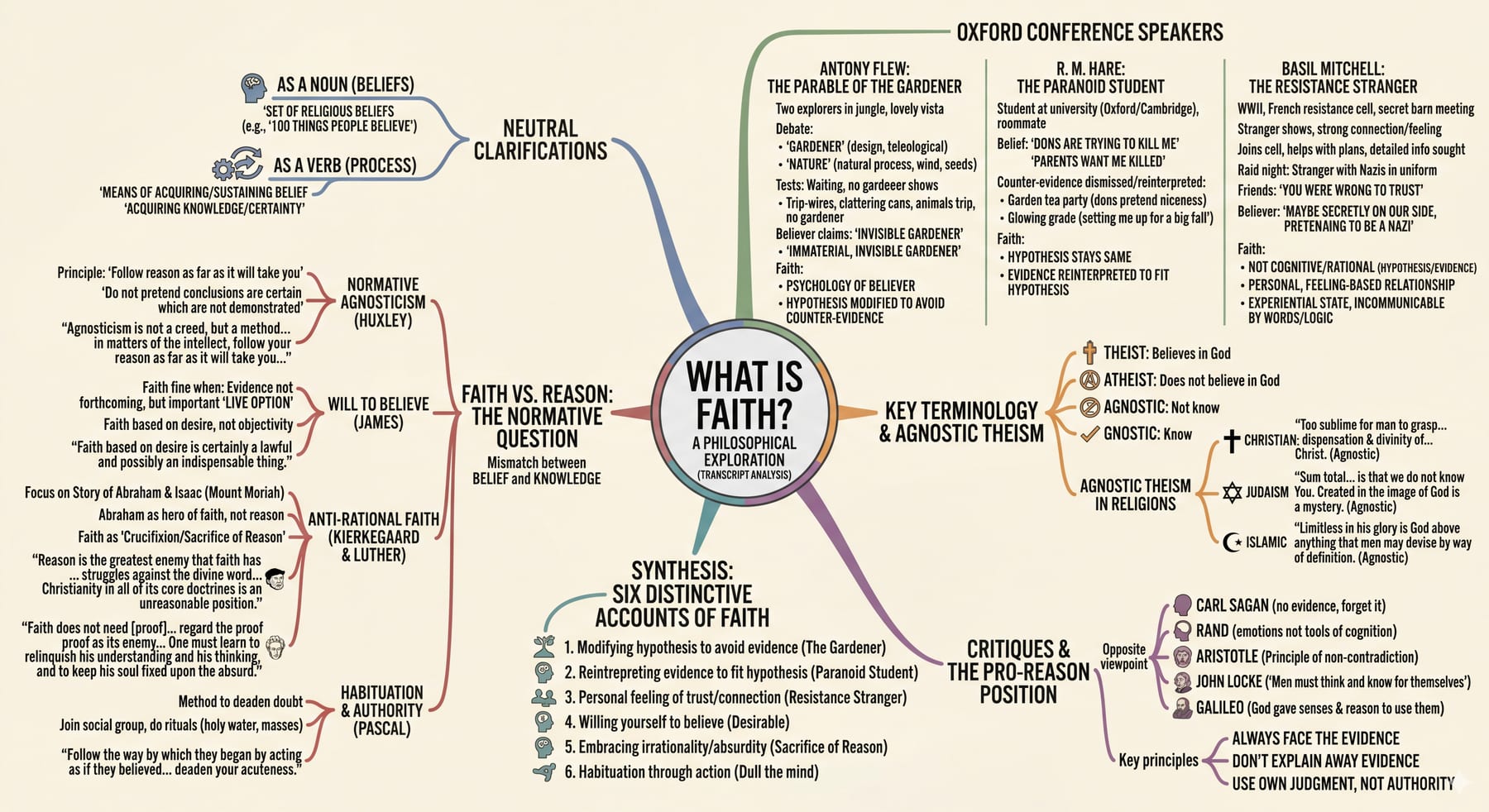
7. The Human Being
Peterson Academy - Intro to Metaphysics Epistemology (Hicks) - Lecture 07.pdf (file not included in this release)
Overview
- This lecture turns from large-scale metaphysical questions about the cosmos to the human being.
- Its central questions are:
- What are we?
- Where did we come from?
- How should we understand the relation between mind and body?
- The lecture frames the human being as a microcosm of the macrocosm:
- whatever one thinks the universe is like overall often shapes what one thinks a human being is like.
- Three broad theories of human nature are presented:
- dualism
- reductive/eliminative materialism
- integrationism / emergentism / functionalism
- The lecture also uses:
- Renaissance anatomy
- early modern science
- thought experiments about transplants, brains, and robots
- philosophical arguments about causation and emergence
1. Main framing: the human being as a microcosm of the universe
Core idea
- The speaker argues that theories of human nature usually reflect broader metaphysical commitments.
- If you think the universe is:
- divided into natural and supernatural realms,
then you may think humans are similarly divided.
- divided into natural and supernatural realms,
- If you think the universe is fully natural and material,
then you may think humans are also fully natural and material.
Main significance
- The philosophy of human nature is not isolated.
- It is tied to larger questions about:
- metaphysics
- cosmology
- religion
- science
2. The three broad approaches to the human being
A. Dualism
- Human beings are made of two fundamentally different kinds of reality
- Typically:
- body + soul
- matter + spirit
- physical + psychological/non-physical
B. Reductive / eliminative materialism
- Only the physical is fundamentally real
- The psychological is:
- reducible to physical processes
- or merely a byproduct / epiphenomenon
C. Integrationism
- Human beings are integrated unities
- The psychological is:
- not a separate supernatural substance
- but not a mere illusion either
- Instead, it is:
- an emergent, real, causally significant aspect of a complex physical being
3. Dualism: the human being as a two-part creature
Martin Luther as representative
- Luther is used as a clear expression of dualism.
- He says the human being has:
- a spiritual nature
- a bodily nature
Main features of Luther’s dualism
- The soul is:
- inner
- spiritual
- renewed
- The body/flesh is:
- outer
- bodily
- wasting away
- The two sides are not just different.
- They are also in conflict:
- flesh desires one thing
- spirit desires another
Main significance
- Dualism gives the human being an internal metaphysical conflict.
- It also often supports:
- immortality of the soul
- afterlife
- moral struggle
- spiritual destiny beyond bodily death
4. Renaissance humanism and the beginning of naturalistic views
The lecture then pivots historically to a more naturalistic understanding of the human being.
Leonardo da Vinci and the Vitruvian Man
- Leonardo is presented as part of Renaissance humanism.
- The human being is increasingly understood:
- as part of nature
- in terms of geometry
- proportion
- harmony
- The Vitruvian Man symbolizes a move away from purely scriptural anthropology toward:
- Greek/Roman models
- human-centered inquiry
- mathematical and anatomical study
Main point
- This is an early step toward understanding humans as continuous with nature, not radically separate from it.
5. Anatomy and early scientific challenges to dualism
Andreas Vesalius
- Vesalius is presented as a landmark figure in anatomy.
- His published anatomical studies, with detailed illustrations, were revolutionary.
- The speaker highlights the significance of dissection:
- human bodies can be studied scientifically
- bodily structures can be described naturalistically
William Harvey
- Harvey discovered the circulatory function of the heart
- This was philosophically significant because:
- the heart had often been seen as the seat of soul, feeling, and deeper identity
- Harvey’s science treated it instead as a pump
Main significance
- These discoveries helped “deflate” older symbolic and spiritual understandings of the body.
- They pushed thought toward:
- mechanism
- physiology
- natural explanation
6. Hobbes: the human being as mechanism
Thomas Hobbes as representative
- Hobbes explicitly argues for a mechanical conception of life.
- Human life is described as:
- motion of limbs
- driven by internal mechanisms
Key analogy
- Hobbes compares the human being to:
- automata
- watches
- machines with springs, strings, and wheels
Main claim
- The heart is like a spring
- Nerves are like strings
- Joints are like wheels
- Human life can be understood in material and mechanistic terms
Main significance
- Hobbes is one of the clearest early philosophical defenders of a strong naturalistic/materialist anthropology.
- This shifts the debate from:
- “Does the human have a soul?”
toward: - “Can all human activity be explained mechanically?”
- “Does the human have a soul?”
7. The fact/value warning: do not let moral preference decide ontology
Raymond Smullyan anecdote
- Smullyan recounts a philosopher asking whether man is a machine.
- The philosopher thought this was the most important question because he assumed:
- if man is a machine, that would be degrading
- Smullyan’s reply is striking:
- if we are machines, perhaps the right reaction is not despair but amazement that machines could be so marvelous
Main philosophical lesson
- The speaker stresses that we should not let our moral hopes or fears decide the metaphysical question.
- It may be:
- that humans are valuable because they have souls
- or
- that humans are valuable despite or because they are extraordinary material beings
- The ontological question must remain open.
8. The classic mind-body problem
Main framing
- The lecture introduces the standard distinction:
- physical / bodily / material
- psychological / mental / soul / spirit / consciousness
- These are initially kept broad.
Symbols introduced
- phi for the physical
- psi for the psychological
Main question
- What is the relationship between:
- physical reality
- psychological reality?
9. Dualism in more detail: the “ghost in the machine”
Dualist model
- The body and mind are:
- separate in kind
- temporarily aggregated
- At death, they may be:
- disaggregated
- The body decays
- The soul continues:
- to heaven
- Hades
- Valhalla
- reincarnation
- or another post-bodily destiny
Catchy metaphor
- The lecture labels dualism:
- ghost in the machine
- The “ghost” is:
- soul
- spirit
- non-material psyche
- The “machine” is:
- the body
Main significance
- This metaphor captures the dualist idea vividly:
- something non-physical lives within and animates a physical system
10. Reductive materialism: “smoke and fire”
Core thesis
- Everything real is fundamentally physical.
- Thoughts, feelings, memory, and awareness are:
- products of brain activity
- not independent substances
Epiphenomenalism
- The psychological may appear real,
but it is only a byproduct - It has no independent causal power
Catchy metaphor
- The lecture compares mind to:
- smoke
- And physical processes to:
- fire
- Fire is the real causal process
- Smoke is just along for the ride
Main significance
- This is a stronger view than ordinary materialism:
- not only is the brain physical
- but mental life may be causally inert or eliminable in explanation
11. Integrationism / emergentism / functionalism: “software and hardware”
Core thesis
- The human being is neither:
- a dual aggregate of body + soul
- nor merely matter with illusory mentality
- Instead, it is an integrated being
- The mental emerges from the physical,
but is still real and causally effective
Main claims
- Mind depends on body / brain
- But mind is not merely a useless byproduct
- It has:
- real identity
- real causal efficacy
- downward influence on physical processes
Functionalism
- Mental states can be understood in terms of:
- what they do
- how they function
- how they process information
- The focus shifts from substance to function
Catchy metaphor
- Mind is to body what:
- software is to hardware
Main significance
- This view aims to preserve:
- naturalism
- scientific respectability
- the reality of thought, agency, and consciousness
12. Arguments for dualism
A. Broader metaphysical support
- If the universe is dual:
- natural + supernatural
- Then human beings may also be dual:
- partly natural
- partly supernatural
B. Different vocabularies for physical and mental
- We use spatial terms for bodies:
- west
- east
- position
- motion
- color
- But such terms seem not to apply to thoughts:
- a thought is not “blue”
- a thought is not “moving west”
- This suggests:
- mental and physical are categorically different
Main significance
- Dualists argue that the irreducible difference in descriptive language reflects a real metaphysical difference.
13. The main criticism of dualism: the interaction problem
Core problem
- If mind and body are radically different substances,
how do they causally interact?
Two-way interaction seems obvious
Physical to mental
- Explosion occurs
- Ear registers it
- Fear, curiosity, and attention arise
Mental to physical
- I decide to move
- My body moves
Why this is a problem
- If the soul is like a ghost,
and the body is physical,
then:- physical things should not affect the ghost
- the ghost should not affect physical things
Horror-movie ghost analogy
- A ghost can pass through doors
- Physical objects cannot affect it
- It should not be able to wield a butcher knife either
- This is used humorously to show the inconsistency:
- ghosts are depicted as immune to physical barriers,
but somehow still able to manipulate matter
- ghosts are depicted as immune to physical barriers,
Alcohol example
- Wine is a chemical
- It affects the body
- But it also affects:
- mood
- judgment
- memory
- confidence
- If mind were wholly non-material,
why should chemicals affect it?
Main significance
- The interaction problem is one of the strongest arguments against strong dualism.
14. The main criticism of reductive materialism
Core issue
- Reductive materialism seems to explain away:
- thoughts
- emotions
- desires
- memory
- agency
- But these appear to be part of the data of experience
Main criticism
- It may be methodologically illegitimate to say:
- these things aren’t real
simply because they do not fit current physical models
- these things aren’t real
Main significance
- Reductive materialism risks refusing to explain what seems most obvious in lived experience:
- consciousness
- action
- inner life
15. The hidden shared premise of dualism and reductive materialism
This is one of the most important moves in the lecture.
Shared premise
Both dualists and reductive materialists assume:
- the psychological cannot be explained in physical terms
Divergence
Dualist conclusion
- The psychological is real
- Therefore it must be non-physical
Reductive materialist conclusion
- Only the physical is real
- Therefore the psychological must not really exist
Integrationist response
- Challenge the shared premise itself
- Maybe:
- the psychological has not yet been well explained physically
- but it is not impossible to do so
Main significance
- This opens space for emergence theory:
- a middle path between dualism and eliminativism
16. Embodiment and emergent mind
Starting point
- The lecture recalls earlier discussions of perception as embodied
- Sense perception is not a ghostly event
- It is an embodied interaction involving:
- eyes
- optic nerve
- body
- environment
Extension
- The same approach may apply to:
- memory
- concepts
- emotions
- thought
- These may be:
- real
- psychologically meaningful
- yet still dependent on bodily systems
17. Brain transplant thought experiment
Setup
- Two people are anesthetized
- Their brains are removed
- The brains are swapped
- Each brain is connected to the other person’s body
Key question
- When they wake up:
- who is who?
- Intuitively, we say:
- the person “goes with” the brain
Main point
- This suggests the brain is especially important to:
- identity
- memory
- thought
- selfhood
Philosophical significance
- If identity tracks the brain,
then perhaps the self is more closely tied to the brain than to the rest of the body
18. Artificial replacement and functionalism
Starting point
- We already accept many bodily replacements:
- kidney dialysis
- artificial hearts
- prosthetic limbs
- hearing aids
- corneal replacements
Main question
- If artificial organs can replace biological ones while preserving personal identity,
how far can this go?
Possible conclusion
- What matters may not be:
- biological material itself
- But rather:
- the performance of the relevant function
Main significance
- This is a major step toward functionalism:
- identity and mentality may depend more on organized function than on specific organic material
19. Brain in a vat and robot-body thought experiment
Setup
- A person’s brain is removed and kept alive in fluid
- Brain and body communicate via radio signals
- The body is then destroyed
- A robot body is built and connected to the brain
Main question
- Is the person still the same person?
Implied answer
- If:
- the memories
- thoughts
- continuity of control
remain,
then many would say:
- yes, it is still the same person
Extension
- Could one brain control multiple bodies?
- Could a robot body replace a biological body entirely?
Main significance
- These experiments push strongly toward:
- functionalism
- information-processing accounts of mind
- continuity-of-mind theories of identity
20. The computer analogy
Functions of the brain
The lecture breaks brain activity into functional roles:
- receiving sensory input
- storing memory
- processing information
- sending outputs for action
Computer comparison
- keyboard / camera / microphone = input devices
- memory storage = retention
- CPU = processing
- output devices / robotic movement = action
Main claim
- If a system can perform the same functions,
then perhaps mentality is:- not tied to biological tissue as such
- but to functional organization
Main significance
- This is the strongest route in the lecture toward:
- artificial intelligence
- artificial persons
- software/hardware models of human mentality
21. Emergence
This is the key concept anchoring the integrationist position.
Main idea
- When matter is organized in sufficiently complex ways,
genuinely new phenomena can emerge
Important claim
- Emergent properties are:
- real
- not reducible to mere byproducts
- causally significant
Contrast with reductive materialism
- Reductive materialism says:
- all apparent emergence is only superficial
- Emergentism says:
- something genuinely new comes into existence
22. Simple emergence example: square vs circle on a slope
Setup
- Same amount of material is shaped into:
- a square
- a circle
- Both are put on the same slope under the same gravity
Result
- The square shifts and stops
- The circle rolls
Main point
- The material is the same
- But the organization is different
- A new causal phenomenon appears:
- rolling
Significance
- Emergentists use examples like this to argue:
- higher-level phenomena can be real
- even though they arise from the same underlying material
Link to mind
- Similarly:
- complex neural organization may generate
- thought
- memory
- emotion
- agency
- complex neural organization may generate
23. Final summary of the three theories
1. Dualism
- Ghost in the machine
- Mind and body are different substances
- Mind may survive bodily death
2. Reductive materialism
- Smoke and fire
- Mind is only a byproduct of physical brain activity
- No independent mental causation
3. Integrationism / emergentism / functionalism
- Software and hardware
- Mind emerges from physical systems
- Mind is real and causally effective
- Human beings are integrated wholes
24. Main historical figures and developments mentioned
Major thinkers
- Martin Luther
- Leonardo da Vinci
- Andreas Vesalius
- William Harvey
- Thomas Hobbes
- Raymond Smullyan
- Daniel Dennett
Historical/intellectual developments
- Renaissance humanism
- revival of Greek and Roman models
- early modern anatomy
- dissection and anatomical publication
- mechanistic philosophy in the 17th century
- modern thought experiments involving brains, machines, and identity
25. Books, texts, and sources mentioned
Explicitly mentioned or clearly referenced
- Thomas Hobbes, Leviathan
- Daniel Dennett, “Where Am I?”
- biblical reference from II Corinthians 4
- Luther’s writings on flesh and spirit
Works/images referenced conceptually
- Vitruvian Man by Leonardo da Vinci
- Vesalius’s anatomical studies and published anatomical illustrations
26. Suggested related topics for further exploration
Philosophy of mind
- The mind-body problem
- Substance dualism
- Property dualism
- Functionalism
- Emergentism
- Epiphenomenalism
- Eliminative materialism
Personal identity
- Brain transplant arguments
- Psychological continuity
- Bodily continuity
- Identity through artificial replacement
- Teletransportation and duplication thought experiments
Philosophy of science
- Mechanism in early modern science
- Reduction vs emergence
- Models and metaphors in science
- Explanation in neuroscience
Philosophy of religion
- Soul and immortality
- Resurrection vs reincarnation
- Theological anthropology
- Spirit/flesh conflict in Christian thought
AI and transhumanism
- Artificial intelligence and personhood
- Machine consciousness
- Brain-computer interfaces
- Prosthetics and cybernetic enhancement
- Uploading the mind
27. Concise takeaway
- The lecture presents three major ways of understanding the human being:
- a dual creature of soul and body
- a purely material creature whose apparent mind is only a byproduct
- an integrated emergent being whose mental life arises from but is not reducible to the physical
- The speaker treats the third option as especially promising because it tries to preserve:
- scientific seriousness
- the reality of consciousness
- the reality of agency
- The lecture’s central question is not just whether humans are physical, but whether complex physical organization can generate genuinely new and causally real forms of life and mind.
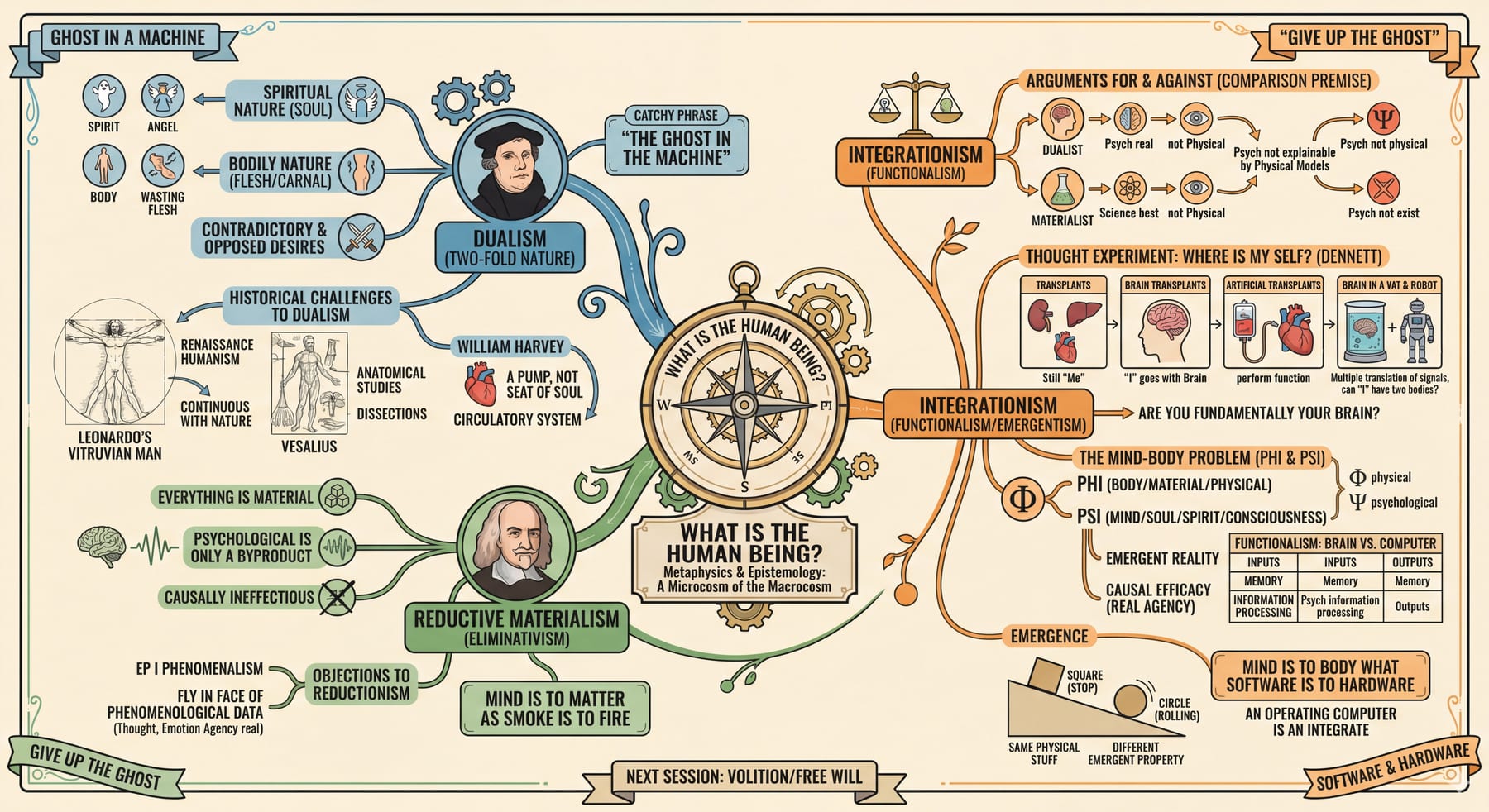
8. The Meaning of It All
Peterson Academy - Intro to Metaphysics Epistemology (Hicks) - Lecture 08.pdf (file not included in this release)
Overview
- This lecture centers on volition, free will, and determinism, and then closes the course by linking metaphysics and epistemology to the broader question of the meaning of life.
- It has two major halves:
- first, a philosophical analysis of whether human beings genuinely choose
- second, a survey of several large-scale answers to the question of life’s ultimate meaning
- The lecture’s method is consistent with the rest of the course:
- identify the competing positions
- clarify the assumptions behind them
- test their implications
- connect them to larger metaphysical and epistemological frameworks
1. Buridan’s Ass as the opening problem of choice
The thought experiment
- A donkey is placed exactly between two equally attractive bales of hay.
- The donkey is:
- hungry
- biologically driven to eat
- equally drawn to both options
- The question:
- does the donkey choose one bale?
- or is it paralyzed because the causal attractions are perfectly balanced?
Main philosophical point
- The donkey case is used to ask whether action is fully explained by:
- biological drives
- environmental stimuli
- causal laws
- If both sides are equal, and there is no extra power of choice, then the donkey should remain stuck.
Why this matters for human beings
- Humans seem like the donkey in many respects:
- we have biological needs
- we are influenced by the environment
- But we also think:
- we can choose
- we can decide between options even when competing influences are balanced
- The lecture asks:
- is that real?
- or are we just more complicated donkeys?
2. Determinism: the thesis that cause and effect rules everything
Core definition
- Determinism says:
- the universe is fully governed by cause and effect
- every state of affairs follows necessarily from prior states
- there is no genuine room for alternative possibilities
Main implication
- If determinism is true:
- there are no real choices
- only one future is possible from any present state
- The universe moves along a fixed path.
Important clarification
- The lecture says we should really speak of determinisms, plural:
- different theories emphasize different kinds of causal forces
3. Biological determinism
Core idea
- Human beings are fundamentally biological systems.
- All behavior can be explained through:
- physical laws
- chemical laws
- biological structures
- Humans are more complex than other animals, but not fundamentally different in causal kind.
Main implication
- Just as we do not think:
- worms
- robins
- chipmunks
are exercising free will,
- so too humans may simply be more complex organisms following biological causality.
4. Environmental determinism
Core idea
- Human beings may be highly plastic.
- What they become depends primarily on:
- environment
- culture
- upbringing
- conditioning
Main implication
- Take the same biological organism,
put it in different environments,
and you get different outcomes. - Therefore behavior is determined by environmental shaping rather than autonomous choice.
Relation to biological determinism
- The lecture notes an ongoing debate:
- biology-dominant views
- environment-dominant views
- These may also be mixed:
- 75/25
- 20/80
etc.
- But mixed versions are still deterministic if they leave no room for genuine agency.
5. Divine or supernatural determinism
Core idea
- If God is:
- omnipotent
- omniscient
- architect of the universe
then everything that happens follows God’s plan.
Two main routes to divine determinism
A. Omnipotence argument
- If God has all power,
then humans have no independent power. - Free will is a power.
- Therefore humans cannot have it.
B. Omniscience / foreknowledge argument
- If God already knows the future completely,
then the future must already be fixed. - Human choices cannot deviate from what God infallibly knows.
Less personalistic forms
- Even if one does not speak of a personal God,
similar determinism can arise through:- fate
- providence
- impersonal cosmic order
6. Fatalism and astrology
Fatalism
- The lecture uses a poetic image:
- the world is a chessboard
- fate moves human beings like chess pieces
- Main idea:
- human beings are pushed around by forces beyond their control
Astrology
- Astrology is presented as another deterministic system.
- The stars or heavens mediate the forces shaping human life.
- Famous formulation:
- the stars govern mankind
- God governs the stars
Main significance
- These are variants of determinism in which human agency is subordinated to larger cosmic powers.
7. Arguments for environmental determinism
Language acquisition
- A child does not choose its first language.
- It absorbs the dominant language of its environment.
- This suggests:
- cognitive structures are heavily shaped by external conditioning
Food preference example
- The speaker uses the example of culturally conditioned disgust and taste.
- Example:
- Mongolian delicacy of eating the yak’s eyeball
- Main point:
- what feels natural, desirable, or revolting may be environmentally produced
Religion and political views
- If infants were placed in:
- Hindu homes in India
- Baptist homes in the American South
- Muslim homes in Saudi Arabia
then decades later their religious identities would likely match those environments.
- This suggests:
- religious belief is often environmentally determined
Main implication
- What we call “our beliefs” may be the result of conditioning rather than autonomous judgment.
8. Arguments for biological determinism
Twin studies
- Identical twins separated at birth and raised in different environments are used as key evidence.
- If they still show strong similarities in:
- temperament
- personality
- interests
- even life choices
then that supports biology over environment.
Sex differences
- Crime patterns are discussed:
- violent crimes are overwhelmingly male
- other behavioral patterns differ by sex
- The implication:
- some behavior may be better explained by biological sex differences than by social conditioning alone
Main significance
- Biological determinists argue that inherited structure strongly predicts behavior, perhaps more than environment does.
9. A central criticism of determinism: can determinists claim knowledge?
This is one of the most important philosophical moves in the lecture.
The challenge
- Determinists say:
- “Our theory is true”
- “We know determinism is correct”
- But if determinism is true, then their own belief in determinism is itself determined by:
- biology
- environment
- divine forces
- or whatever causal system they endorse
The problem
- If their belief is simply caused,
then it is not obvious they can say:- they know it is true
- They can only say:
- they were caused to believe it
Contrast with knowledge
- Knowledge seems to require:
- awareness of alternatives
- evaluation of evidence
- capacity to sort, infer, judge
- If all of that is causally pre-fixed,
the claim to knowledge appears undermined.
Main significance
- Determinism may become self-undermining epistemologically
- It can explain belief,
but may struggle to justify knowledge
10. Indeterminism
Core idea
- Indeterminism denies that all events are governed by strict causality.
- Some randomness or chance is built into reality.
Quantum mechanics version
- Some interpretations of quantum theory say:
- causality breaks down at the subatomic level
- randomness is fundamental
- Some then try to use this to rescue human freedom.
Main criticism from free-will advocates
- Randomness is not enough.
- Free will is not just:
- weird, uncaused events bubbling upward
- It is:
- conscious choosing
- agency
- self-directed control
Main significance
- Indeterminism may defeat strict determinism,
but it does not by itself establish meaningful volition.
11. The case for volition or free will
Core thesis
- Human beings are not merely:
- biological mechanisms
- environmental products
- divine puppets
- or recipients of random quantum accidents
- They are also agents
Henley’s
Invictus
- The lecture uses the famous lines:
- “I am the master of my fate”
- “I am the captain of my soul”
- These lines capture the idea that:
- agency is a real power
Main implication
- Free will is being proposed as a genuine causal force in the world.
12. Free will in dualistic traditions
Main issue
- Some dualist traditions want to preserve:
- soul
- moral agency
- responsibility
- But if God has all power,
that leaves no room for human power.
Possible solutions
- God may be:
- very powerful, but not all-powerful
- Or:
- God may delegate some power to humans
- This allows:
- responsibility
- commandment-following
- moral praise and blame
Main significance
- Dualistic free-will theories often require modifying strong theological determinism.
13. The shared premise of determinists and supernatural free-will advocates
This is the most important conceptual move in the lecture’s free-will section.
Determinist argument
- If volition exists, it would be an exception to natural cause and effect
- There are no exceptions to natural cause and effect
- Therefore volition does not exist
Dualist argument
- If volition exists, it is an exception to natural cause and effect
- Volition does exist
- Therefore it must come from a supernatural soul/spirit
Shared premise
- Both sides assume:
- volition cannot be natural
- it must either be:
- rejected
- or placed outside nature
Integrationist challenge
- The lecturer challenges this shared premise.
- Maybe volition is:
- not an exception to causality
- but a new kind of causal process
- an emergent form of self-regulating natural activity
14. Free will as an emergent causal force
Core proposal
- Just as:
- life emerged from non-life
- sentience emerged from more primitive life
- conceptual consciousness emerged from more basic awareness
- So perhaps volition emerges from sufficiently complex self-conscious systems.
Main thesis
- Volition is not:
- magical
- supernatural
- outside nature
- It is:
- a real natural phenomenon
- a complex causal capacity
- rooted in self-regulation
Main significance
- This is the lecture’s most constructive suggestion:
- free will may be understood as natural but irreducible self-causal regulation
15. The phenomenology of volition
The lecture then turns inward and examines how volition seems to present itself in experience.
A. Attention control
- We seem able to:
- focus attention
- let it wander
- refocus deliberately
- Example:
- reading a book
- listening to a lecture
- catching oneself drifting
- commanding oneself to refocus
B. Direction of attention
- We can decide:
- look here
- look there
- attend to this object, not that one
C. Degree of focus
- We can:
- narrow attention sharply
- or keep attention diffused across a whole field
- Example:
- walking through a rough neighborhood at night
- scanning broadly rather than focusing on one detail
D. Selection among options
- We can entertain multiple possible words, actions, or responses
- Then:
- choose one
- reject another
- act on the selected one
Main implication
- These features of experience seem to form the basis of:
- agency
- responsibility
- will
16. Speculative physical analogies for volition
The speaker does not claim to solve the neuroscience of will, but suggests analogies.
Rheostat analogy
- Attention seems adjustable:
- high
- medium
- low
- This resembles a rheostat, which modulates intensity
Spotlight analogy
- Focus can be:
- narrow and concentrated
- or broad and diffuse
- This resembles a spotlight with adjustable spread
Clutch analogy
- Thoughts and possible actions can “spin” without execution
- A decision engages action
- This is compared to:
- a manual transmission clutch
- the motor runs, but the drivetrain is not engaged until the clutch is released
Main significance
- The lecture’s point is:
- volition may not be magical
- there may be natural physical-functional analogs for its operations
17. Transition to the meaning of life
The lecture then broadens out from human volition to the course’s culminating question:
The classical question
- What is the meaning of life?
Framing move
- Metaphysics and epistemology do not answer the whole question alone.
- Other philosophical fields matter too:
- ethics
- politics
- aesthetics
- But metaphysics and epistemology establish the broad possibilities within which answers must be sought.
18. The “Powers of Ten” perspective
Main image
- The lecture references the Powers of Ten video/book
- It illustrates scaling:
- down from the human hand to pores, cells, subcellular levels
- up from a human picnic in Chicago to Earth, solar system, galaxies
Philosophical point
- Human beings exist in the middle of vast scales:
- between the extremely small
- and the extremely large
- Metaphysics asks us to think across those scales.
Temporal version
- We can also scale:
- backward through time
- from humans to Earth to galaxies to early universe
- Or perhaps beyond that to:
- God
- gods
- supernatural dimensions
19. Four broad answers to the meaning of life
The speaker presents four broad metaphysical-epistemological options.
20. Option 1: God’s drama
Core idea
- If God created the universe with intention,
then the universe is a drama, script, or play - Human beings are actors within a divine story
Main implication
- The meaning of life is:
- to accept and play one’s role in God’s drama
Hindu version
- From the Bhagavata Purana:
- everything comes from Vishnu
- the world is divine play
- The Ramayana illustrates divine avatar and cosmic drama
Western version
- Christian framing:
- the universe is a moral drama
- God is scriptwriter and audience
- history has beginning, middle, and end
- final judgment completes the story
Shakespearean secularized form
- “All the world’s a stage”
- Human beings have:
- entrances
- exits
- assigned roles
Main significance
- Meaning is external, given, scripted, and teleological.
21. Option 2: Eternal recurrence
Core idea
- The universe may cycle endlessly:
- Big Bang
- expansion
- Big Crunch
- repeat
Main implication
- Everything may recur again and again
- If causality is strict, each cycle may repeat identically
Schopenhauer
- “What is born must die, and what dies must be born again”
Nietzsche
- Famous advocate of eternal recurrence
- If all things recur eternally,
then so do we - The task becomes:
- not merely to endure fate
- but to love it
Key Nietzschean idea
- amor fati
- love of fate
- One should affirm existence exactly as it is, eternally recurring
Main significance
- Meaning is not a unique destiny,
but a perpetual repetition to be embraced or rejected.
22. Option 3: Entropy / futility / pointlessness
Core idea
- The universe may continue expanding until:
- all energy differentials disappear
- nothing meaningful happens
- “heat death” or entropic flattening occurs
Main implication
- If the universe ends in total dissipation,
human striving may be ultimately pointless
Ecclesiastes
- “Vanity of vanities”
- Human labor appears futile
- Generations come and go
- Nothing remains new
- Memory fades
Bertrand Russell
- Human achievement is destined for extinction
- Everything will be buried beneath the ruins of the universe
Camus
- If life is truly pointless,
the serious question becomes:- why not commit suicide?
Freud
- Since truth is too hard for most people,
they require illusions:- religion
- art
- culture
- These illusions do not need to be true;
they need to make life bearable
Main significance
- Meaning may be illusory, constructed, or impossible in ultimate terms.
23. Option 4: The unknown / not-yet-known
Core idea
- We know a great deal,
but not enough to settle ultimate meaning - Therefore, the best stance may be:
- continued inquiry
- agnosticism
- disciplined openness
Darwin
- The mystery of beginnings is insoluble by us, at least for now
- Best response:
- remain contentedly agnostic
Carl Sagan
- Human beings are “star stuff”
- More than that:
- we are a way for the universe to know itself
- This gives a kind of grandeur and optimism to scientific self-understanding
Early scientific optimism about lifespan
- Human longevity may be radically extended through:
- medicine
- hygiene
- science
- The lecture notes the historical jump in life expectancy:
- roughly 40 to roughly 80 over a century
Stronger future-oriented optimism
- Humans may eventually renew themselves continuously
- Science may open the path toward effective immortality
Kurzweil-like future
- By the 2030s, nonbiological intelligence may dominate
- Humans may merge with technology
- Life may be extended indefinitely
Main significance
- Meaning, on this view, is not handed down.
- It lies in:
- continued exploration
- discovery
- self-transformation
- open-ended progress
24. Final pedagogical message
The speaker’s concluding stance
- The course has not settled everything.
- It has:
- mapped the territory
- named major positions
- introduced major thinkers
- opened the disputes
Main encouragement
- Philosophy is ultimately do-it-yourself
- The course is an invitation:
- read more
- think more
- test positions
- work out the meaning of life for yourself
25. Follow-up discussion: are we fundamentally our brains?
Student’s question
- Modern reports suggest transplant recipients sometimes display traits associated with donors
- If so, does this challenge the idea that the person is just the brain?
Speaker’s response
- He has seen journalistic accounts but does not claim expertise
- If such reports are accurate, then the simple “person = brain” model may be too crude
Possible implication
- Traits, memories, or dispositions may be distributed more broadly through:
- the nervous system
- organs
- bodily conditioning
- This would make the philosophy of personal identity:
- more complex
- but more interesting
Main significance
- The lecture leaves open the possibility that embodiment matters more deeply than a pure brain-centered account suggests.
26. Main themes of the lecture
- Buridan’s Ass frames the problem of whether action can occur without a genuine faculty of choice
- Determinism appears in multiple forms:
- biological
- environmental
- divine
- fatalistic
- A major challenge to determinism is whether it can consistently claim knowledge
- Indeterminism is not enough to rescue free will
- Volition may need to be understood as:
- a natural
- emergent
- self-regulative causal power
- The final question of meaning yields several broad metaphysical possibilities:
- divine drama
- eternal recurrence
- entropic futility
- open-ended inquiry and progress
27. Historical figures and traditions mentioned
Philosophers / writers / thinkers
- Jean Buridan
- W. E. Henley
- Arthur Schopenhauer
- Friedrich Nietzsche
- Bertrand Russell
- Albert Camus
- Sigmund Freud
- Charles Darwin
- Carl Sagan
- Ray Kurzweil (implicitly through the quoted future-tech view, though not named in the transcript excerpt)
- Daniel Dennett is not central in this lecture but connects with the prior one
Religious / traditional references
- God / divine omnipotence / omniscience
- fate
- providence
- astrology
- Vishnu
- Bhagavata Purana
- Ramayana
- Christian judgment imagery
- Ecclesiastes
Cultural/literary references
- Shakespeare
- Invictus
- Powers of Ten
28. Books, articles, and sources mentioned
Explicitly mentioned or clearly referenced
- The Powers of Ten (video series/book)
- Bhagavata Purana
- Ramayana
- Ecclesiastes
- Henley, “Invictus”
Clearly referenced quotations or texts
- Shakespeare: “All the world’s a stage”
- Nietzsche on eternal recurrence and amor fati
- Russell on the fate of human achievement
- Darwin on agnosticism
- Sagan: “We are made of star stuff”
29. Suggested related topics for further exploration
Free will and agency
- Compatibilism vs libertarian free will
- Determinism and moral responsibility
- Foreknowledge and freedom
- Neuroscience of decision-making
- Attention and executive control
Philosophy of mind
- Emergence and self-regulation
- Consciousness and agency
- Brain science and volition
- The relation between attention and will
Philosophy of religion
- Divine omniscience and free will
- Providence vs freedom
- Fate in Greek, Islamic, and Christian traditions
- Hindu conceptions of cosmic play (lila)
Meaning of life
- Religious teleology
- Existentialism and absurdism
- Eternal recurrence
- Entropy and cosmic pessimism
- Scientific humanism and progress narratives
Philosophy of science and futurism
- Quantum indeterminacy and freedom
- AI, transhumanism, and immortality
- Biotechnology and lifespan extension
- Human enhancement and technological self-transformation
30. Concise takeaway
- This lecture argues that the debate over free will turns on whether human action is fully captured by existing causal models or whether volition itself is a real kind of cause.
- It rejects both:
- strict determinism
- and the idea that freedom must be supernatural or magical
- It suggests instead that volition may be an emergent natural power of self-regulating consciousness.
- It then expands outward and shows that our answer to free will connects directly to broader answers about the meaning of life, which may be:
- divinely scripted
- eternally repeated
- ultimately futile
- or still not fully known.