Covered in the vault’s survey histories
These volumes’ chapter headings already link to this note; these are the return links.
Evans — A History of Western Philosophy
- A History of Western Philosophy - C Stephen Evans — Chapter 18 – Immanuel Kant (heading contains links, so it can’t be anchored; search the title inside the note)
Biography
Immanuel Kant (1724–1804) was a German philosopher from Königsberg, widely regarded as one of the most important figures in Western philosophy. Living his entire life in East Prussia, Kant worked first as a private tutor and later as a professor at the University of Königsberg. His Critique of Pure Reason(1781/1787) attempted to reconcile empiricism and rationalism by explaining the conditions of human knowledge. He went on to develop a comprehensive philosophical system encompassing epistemology, metaphysics, ethics, aesthetics, and political philosophy. Kant’s ideas — especially the categorical imperative and his theory of knowledge — shaped modern philosophy and continue to influence debates today.
Life
- Early Years (1724–1746): Born in Königsberg; educated in Pietist schools; studied philosophy, mathematics, and science.
- Tutor & Lecturer (1746–1770): Worked as private tutor; published early works on natural science; became a lecturer at the University of Königsberg.
- Critical Period (1770–1790s): Published the Critique of Pure Reason (1781, revised 1787), Critique of Practical Reason (1788), and Critique of Judgment (1790).
- Later Years (1790–1804): Wrote on politics and religion, including Perpetual Peace (1795); died in Königsberg in 1804.
Impact on Philosophy
- Epistemology: Transcendental idealism reshaped the debate between empiricism and rationalism.
- Ethics: Developed a deontological moral system centered on the categorical imperative.
- Political Philosophy: Advocated republican constitutions, cosmopolitanism, and peace.
- Aesthetics: Explored judgment, taste, and the sublime in the Critique of Judgment.
- Legacy: Influenced German Idealism (Fichte, Schelling, Hegel), modern ethics, analytic philosophy, and international law.
- Modern cognitive-science comparison: Hume vs. Kant on the Human Mind - What Modern Psychology and Neuroscience Support — Kant’s strongest domains are active perception, early-emerging cognitive structure, universalization, and the unity of experience.
Natural Theology and Proofs of God
Abstract
Kant does not claim to prove that God does not exist. He argues that speculative reason cannot demonstrate God as an object of theoretical knowledge. The three traditional proofs form a dependency chain: the physico-theological proof relies on the cosmological proof, which ultimately relies on the ontological proof.
- Kant's Critique of the Traditional Proofs of God — overview, dependency map, sources, and limits of Kant’s conclusion
- Kant on the Ontological Argument — why existence is not a real predicate and a concept cannot establish its own instantiation
- Kant on the Cosmological Argument — why contingent existence cannot establish a supersensible necessary being without reviving the ontological proof
- Kant on the Physico-Theological Argument — why natural order supports at most an architect, not a necessary creator
- Historical source: The Enlightenment - Ritchie Robertson
- Source PDF: Robertson, printed pp. 154–157 / PDF pp. 201–204 (file not included in this release)
Concepts
- Transcendental Idealism
- Definition: We can only know phenomena (things as they appear to us), not noumena (things in themselves). The mind actively structures experience using categories like space, time, and causality.
- Example: We perceive events in temporal sequence because time is a form imposed by our mind, not an objective property “out there.”
- Synthetic a priori Knowledge
- Definition: Judgments that extend knowledge (synthetic) but are known independent of experience (a priori).
- Example: “7 + 5 = 12” or “Every event has a cause.”
- Copernican Revolution in Philosophy
- Definition: Just as Copernicus explained celestial motion by shifting perspective, Kant argued that objects conform to our cognition, not the other way around.
- Example: Instead of assuming knowledge must conform to reality, Kant claimed reality (as we know it) conforms to the mind’s structures.
- Categorical Imperative
- Definition: The supreme moral law: act only on maxims that you could will as universal law.
- Example: Lying fails the test — if everyone lied, trust would collapse, so lying is morally impermissible.
- Autonomy & Duty
- Definition: Morality requires acting from duty and respecting rational beings as ends in themselves.
- Example: Donating to charity because it’s right (duty) has moral worth; doing so only for praise does not.
- Perpetual Peace
- Definition: Kant envisioned a world of republican states united in a federation to secure lasting peace.
- Example: His essay Perpetual Peace influenced later ideas of international law and organizations like the UN.
Pinker’s Chapter 4 supplement — Kant’s peace program was institutional, not merely pacifist
Pinker reconstructs Perpetual Peace as a design for making restraint stable under nonideal human motives. Kant’s preliminary rules opposed peace treaties that secretly preserved a path back to war, conquest of states, standing armies, war debt, forcible interference in another state’s government, and tactics such as assassination or treachery that poison confidence in a future settlement.
His three “definitive articles” were: republican government, so citizens who pay war’s costs have a voice; a federation of free states, so disputes can be adjudicated outside bilateral anarchy; and universal hospitality, so travel, communication, and commerce can create interests and sympathies across borders. Pinker presents democracy, international institutions, and interdependence as a delayed possible vindication of Kant, but Chapter 4 establishes the intellectual proposal—not the later empirical strength, exceptions, or causal independence of those variables. Chapter 4 synthesis · Gentle commerce and the antiwar turn, PDF pp. 242–243 (file not included in this release) · Kant’s preliminary and definitive articles, PDF pp. 243–245 (file not included in this release) · Hospitality and the limits of immediate influence, PDF pp. 245–246 (file not included in this release)
Pinker’s Chapter 5 supplement — the Kantian triangle gets an empirical test
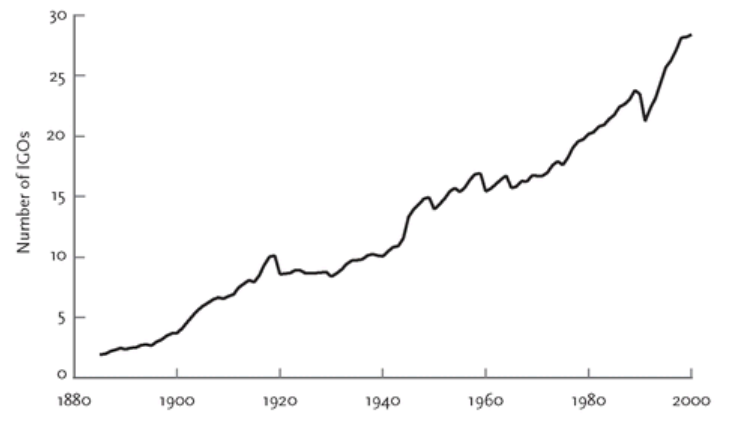
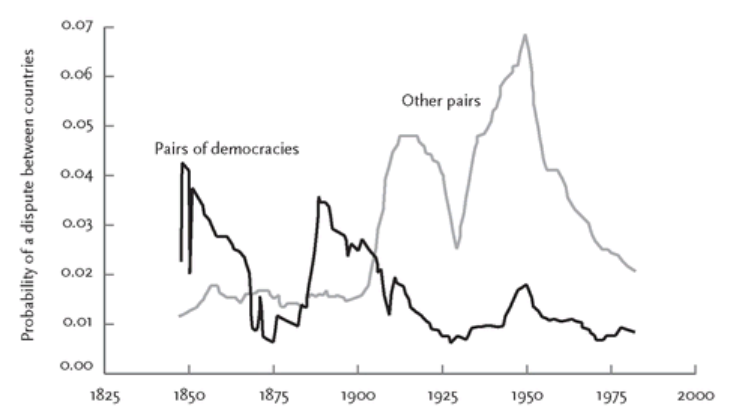
Pinker presents Russett and Oneal’s “Kantian triangle” as an interaction among democracy, trade, and shared intergovernmental organizations. The institutions need not form a world government or pursue utopian missions: even narrow organizations can regularize contact, share information, mediate disputes, establish cooperative expectations, and make defection costlier. In their regression model, a pair of countries in the top tenth on all three dimensions was reported as 83 percent less likely than an average at-risk pair to enter a militarized dispute in a given year.
Figures 5-25 and 5-26 — Shared IGO memberships, 1885–2000, and the probability of militarized disputes among democratic and other country-pairs, 1825–1992. Pinker reads the second as compatible with Kantian learning after catastrophe: democratic pairs suffer shocks but return toward lower dispute rates more quickly. The causal boundary is crucial. These are historical observational relationships; peace may help produce democracy, commerce, and institutional membership, while a deeper willingness to bargain could produce all four. The 83 percent estimate is model-dependent and the plotted datasets end well before the present. Chapter 5 synthesis · Federation rather than world government, PDF pp. 407–409 (file not included in this release) · The Kantian triangle and regression result, PDF pp. 409–411 (file not included in this release) · Causal limits and Figure 5-25, PDF pp. 410–411 (file not included in this release) · Learning after catastrophe and Figure 5-26, PDF pp. 413–415 (file not included in this release)
- Categorical Imperative
- Took morality seriously
- Religion would give people different moral answers
- Hypothetical Imperatives
Synthetic & Analytic Propositions
Think of Kant like a very picky teacher about sentences.
He asks: “Does this sentence add something new, or is it just explaining what was already hidden inside the words?”
He calls a synthetic proposition the kind that adds new information.
Picture it like Lego
- You have one Lego block: “dog.”
- You add another block: “is brown.”
Now you have: “The dog is brown.”
“Brown” is not already inside the idea of “dog.”
Some dogs are brown, some are not.
So when you say “The dog is brown,” you are adding a new piece of information.
That’s what Kant calls synthetic:
You put two ideas together to make something new.
Compare with the “obvious” kind
Now look at this:
“All squares have four sides.”
The idea “has four sides” is already inside the idea of “square.”
You are not really telling us anything new; you’re just unpacking what “square” means.
Kant calls that kind analytic (just taking apart the meaning).
So in kid-level terms
- Analytic: Just explaining what a word already means.
“A square has four sides” – nothing surprising. - Synthetic: Adding a new fact about something.
“The dog is brown” – you had to look at the dog to know that.
Kant’s synthetic proposition = A sentence where the second part adds new information that you can’t get just by thinking about the first word.
The basic grid
| A priori (independent of experience) | A posteriori (from experience) | |
|---|---|---|
| Analytic | Analytic a priori – true by meaning alone. Example: “All bachelors are unmarried.” | Analytic a posteriori – basically empty for Kant; no standard examples. |
| Synthetic | Synthetic a priori – adds new info but still knowable a priori. Examples: “7 + 5 = 12”; “Every event has a cause.” | Synthetic a posteriori – empirical facts. Examples: “The dog is brown.”; “Water boils at 100°C at standard pressure.” |
1. Analytic a priori
Meaning-based, definition-level truths, knowable just by thinking.
- Example: “All bachelors are unmarried.”
- Example: “All triangles have three sides.”
- Why analytic?
The predicate (“unmarried,” “three sides”) is already contained in the concept (“bachelor,” “triangle”). You’re just unpacking the meaning. - Why a priori?
You don’t have to survey bachelors or triangles; once you understand the words, you can see the truth by pure thought.
Kant is very happy with this category: this is logic and definition-land.
2. Analytic a posteriori
In practice, this is an empty box.
- In principle, this would mean:
“True by definition, but you only know it after experience.” - But if it’s really analytic (true by meaning alone), you don’t need experience to know it.
- So Kant basically treats this as a “theoretical possibility” that never actually gives us real examples.
You can mostly ignore this box.
3. Synthetic a priori (Kant’s big deal)
Adds new content, but still knowable independently of particular experiences.
These are Kant’s stars.
- Example (math): “7 + 5 = 12”
- Synthetic: “12” is not contained in “7,” “5,” and “+” as pure definitions; you have to actually carry out a construction in thought (add them).
- A priori: You don’t learn this by counting beans thousands of times. It holds necessarily and universally.
- Example (basic structure of experience): “Every event has a cause.”
- Synthetic: “has a cause” is not contained in the concept “event.”
- A priori: We don’t treat this as a mere habit (“so far, every event had a cause”), but as a necessary rule for any possible experience of events.
Kant’s claim:
Synthetic a priori truths are possible because our mind actively structures experience (with forms like space, time, causality). These propositions describe those structures.
4. Synthetic a posteriori
Adds new content, and you need experience to know it.
This is everyday empirical knowledge.
- Example: “The dog is brown.”
- Example: “Water boils at 100°C at standard pressure.”
- Example: “There are more than 8 billion humans on Earth.”
- Synthetic: The predicates (brown, 100°C, 8 billion) are not contained in the subject concepts (dog, water, humans).
- A posteriori: You only know these by observation, measurement, or experiment.
This is the domain of ordinary science and common sense.
One-sentence recap
- Analytic a priori: True by meaning alone; no experience needed.
(Definitions, logic.) - Synthetic a posteriori: Adds new info; learned from experience.
(Ordinary facts and science.) - Synthetic a priori: Adds new, necessary, universal truths we know independently of particular experiences, because they come from how our mind structures any possible experience.
(Math, basic principles like causality.)
That’s the full map Kant is playing on when he talks about synthetic a priori judgments.
Synthetic Proposition a priori
Good, this is the tricky (and important) Kant bit.
You already have:
- Synthetic = adds new information (like “The dog is brown”).
- A priori = knowable before experience, just by thinking (like “All triangles have three sides”).
Now:
Synthetic a priori = sentences that add new information (synthetic) but are knowable before experience (a priori).
That sounds weird at first, so let’s build it slowly.
Step 1: Two big contrasts
Kant is sorting propositions by two questions:
- Where does the knowledge come from?
- A priori: before experience; from pure thinking (reason, logic, concepts).
- A posteriori: after experience; from looking, touching, testing.
- What kind of connection is there between subject and predicate?
- Analytic: the predicate is already contained in the subject’s meaning.
“All bachelors are unmarried.” (Just unpacking “bachelor.”) - Synthetic: the predicate adds something not contained in the subject’s meaning.
“The cat is on the mat.”
So we get 3 main types:
- Analytic: the predicate is already contained in the subject’s meaning.
- Analytic a priori (definitions, logic)
- Synthetic a posteriori (ordinary science, “the cat is on the mat”)
- Synthetic a priori (Kant’s special category)
Step 2: What is synthetic a priori?
A synthetic a priori proposition is:
- Not just a definition (it adds new content = synthetic)
- But also not learned by experience (we know it prior to and for all experience = a priori)
So it’s:New, informative knowledge that we can know just by thinking, but which also tells us something necessarily true about the world as we experience it.
Step 3: Kant’s favorite examples
- Math
- “7 + 5 = 12”
- Kant says: it’s not analytic, because “12” is not already contained in the concepts “7,” “5,” and “+”.
You have to synthesize (add together) the two numbers in your mind. - But it’s also not empirical: you don’t discover “7 + 5 = 12” by counting apples over and over.
- So math is synthetic a priori.
- Basic structure of experience (causality, etc.)
- “Every event has a cause.”
- Kant says: this is not just a definition of “event.”
- We also don’t simply see “cause” glued onto everything in experience; rather, our mind brings the concept of cause to experience.
- Yet we take it as necessarily true for all possible experience.
- So again: synthetic (adds something) + a priori (known before/for all experience).
Step 4: Why does Kant care?
Kant’s big project in the Critique of Pure Reason is:
- How is knowledge that is both necessary and informative possible?
- Especially in math and basic physics, which feel more certain than just “today my dog seems brown.”
His answer: - Our mind doesn’t just passively receive the world.
- It has built-in ways of organizing experience (space, time, causality, etc.).
- Synthetic a priori propositions describe these built-in rules or forms that our mind uses to structure any possible experience.
So: - They’re a priori because they come from the mind’s own structure, not from this-or-that particular experience.
- They’re synthetic because they tell us new things about how any experience must be, not just about the meanings of words.
Super short version
- Synthetic: adds real content (not just unpacking definitions).
- A priori: known independently of particular experiences; necessary and universal.
- Synthetic a priori (Kant):
Sentences that give us new, necessary truths about how any possible experience must work (like math and “every event has a cause”), grounded in the structure of our own mind, not in any one observation.
Natural Rights differs from other philosophers in several key ways:
- Grounding in reason and human dignity: Kant derives natural rights from the inherent dignity of humans as rational, autonomous agents, rather than from divine authority or natural law[2][3]. This sets him apart from thinkers like Thomas Aquinas, who grounded natural rights in divine law and teleology.
- The Categorical Imperative: Kant’s moral philosophy is based on the Categorical Imperative, which states that one should act according to maxims that could be universally applied[2]. This principle leads to the idea that humans should always be treated as ends in themselves, not merely means. Other philosophers, such as John Locke, derived natural rights from a hypothetical state of nature and social contract[4].
- Emphasis on autonomy: Kant places great emphasis on individual autonomy and the capacity for self-determination. He argues that everyone has the right to seek happiness in their own way, as long as they respect the rights of others[4]. This focus on autonomy is less prominent in the work of earlier natural rights theorists like Hugo Grotius and Samuel Pufendorf.
- Systematic integration: In his later writings, Kant attempts to integrate natural rights into his overall critical philosophy, giving them a systematic place within his philosophical framework[1][2]. This sets him apart from thinkers who treated natural rights as a standalone topic.
- Universality and cosmopolitanism: Kant’s conception of natural rights is strongly universalist and cosmopolitan, envisioning a potentially global community of rational individuals[3][5]. This contrasts with the more particularist and nation-centered approaches of some other Enlightenment thinkers.
While Kant shares with other natural rights theorists the belief in inherent, inalienable rights, his grounding of these rights in human reason and dignity, his emphasis on autonomy and the Categorical Imperative, and his systematic, universalist approach distinguish his theory from those of his predecessors and contemporaries[1][2][3][4][5].
Citations: [1] https://plato.stanford.edu/entries/kant-social-political/ [2] https://brill.com/downloadpdf/view/journals/hobs/25/1/article-p66_5.pdf [3] https://iep.utm.edu/hum-rts/ [4] https://www.libertarianism.org/columns/immanuel-kant-natural-law-tradition [5] https://ciaotest.cc.columbia.edu/isa/ons01/
- Morality
- Kant considered morality was a constant, in an almost mathematical sense.
- Moral obligations are derived from pure reason
- “It doesn’t matter whether you want to be moral or not—The Moral Law is binding on all of us.”
- “You don’t need religion to determine what law is, because what’s right and wrong is totally knowable just by using your intellect.”
-
Moral rules apply to everyone equally
Human Dignity
According to Kant, human dignity refers to the inherent worth or value that all humans possess by virtue of their capacity for rational thought, autonomy, and moral agency[1][2][3].
Kant argues that human dignity is not something that is earned or can be forfeited. Rather, it is an innate status that belongs to all humans equally, regardless of their individual qualities or social rank[1][4]. As rational beings, humans are able to make moral choices and determine their own actions. This capacity for self-determination and moral reasoning sets humans apart from mere things or animals[2].
The basis for human dignity, in Kant’s view, is the human capacity to recognize and act according to the moral law, which he formulates as the Categorical Imperative[1][3]. This fundamental principle of reason and morality tells us to treat humanity in each person always as an end in itself, never merely as a means[1][2].
Respecting human dignity means acknowledging the autonomy and inherent worth of each individual. It requires us to act as if we were both lawmakers and subjects in an ideal “kingdom of ends,” a hypothetical moral community in which all rational beings have equal standing[1][3].
For Kant, human dignity is the source of moral rights and duties. It places constraints on how we may treat others and ourselves[4]. Legal and political institutions must respect the innate right to freedom of every person, and individuals have a duty to respect their own dignity and that of others[1][5].
In summary, Kantian human dignity is the inherent, inalienable worth that belongs to all humans by virtue of their rational nature and capacity for moral autonomy. It is the basis for moral rights and duties and demands respect for the humanity in each person[1][2][3][4].
Citations: [1] https://www.cambridge.org/core/books/abs/cambridge-handbook-of-human-dignity/kantian-perspectives-on-the-rational-basis-of-human-dignity/888A73505F167E52F149953CCFE74A20 [2] https://public.callutheran.edu/~chenxi/phil345_022.pdf [3] https://www.cambridge.org/core/books/cambridge-handbook-of-human-dignity/kantian-perspectives-on-the-rational-basis-of-human-dignity/888A73505F167E52F149953CCFE74A20 [4] https://philosophynow.org/issues/150/Kants_Theory_of_Human_Dignity [5] https://iep.utm.edu/hum-rts/
Critique of Pure Reason
Critique of Pure Reason - Wikipedia
Transcendental idealism - Wikipedia
Kant’s Account of Reason (Stanford Encyclopedia of Philosophy)
Separation of Reason from Reality
Kant’s “separation of reason from reality” is a critical concept in the history of philosophy, especially as interpreted (and sharply criticized) by Objectivist thinkers like Ayn Rand. Here’s a breakdown of what this means and why it’s seen as consequential for one’s outlook on life:
1. What does it mean that Kant “separated reason from reality”?
Immanuel Kant (1724–1804) attempted to solve the philosophical problem of knowledge raised by empiricists (like Hume) and rationalists (like Descartes). His solution was to divide reality into two distinct realms:
- The noumenal world: The world “as it is in itself” — objective reality, independent of our minds. According to Kant, we cannot access this world directly.
- The phenomenal world: The world “as it appears to us” — shaped by the innate structures of our mind (categories like space, time, causality). This is the only reality we can know, but it’s always filtered through our mental faculties.
Thus, reason is limited to appearances, not reality-in-itself. We never know things as they truly are, only as they appear to us.
2. Why do Objectivists see this as a denial of reason?
From an Objectivist perspective (e.g., Ayn Rand, Leonard Peikoff, Yaron Brook), Kant’s system is a betrayal of reason because:
- He declares that reality is unknowable, and that our mind actively distorts what we perceive.
- He denies the mind’s ability to grasp objective truth — reason is no longer a tool of knowledge, but merely a subjective filter.
- As a result, reason becomes impotent: it can’t connect us to the world as it actually is.
For Objectivists, this is devastating. They hold that reason is man’s basic means of survival — the faculty that allows us to understand, navigate, and thrive in reality. To say that reason can’t know reality is to say that man is cut off from existence.
3. If reason is impotent, there’s no basis for a positive sense of life
Rand argued that a “positive sense of life” — meaning a deep, rational joy in existence and confidence in one’s ability to live and flourish — requires the conviction that:
- The world is intelligible.
- You can know it through reason.
- You are capable of achieving values in it.
But if reason is crippled (as in Kant’s system), then: - You can’t trust your mind.
- You can’t know what’s true.
- You can’t pursue values confidently or justifiably.
This leads, in Objectivist terms, to a sense of helplessness, fear, and alienation — a fundamental nihilism. If your mind is not connected to reality, then neither are your goals, your values, or your happiness.
Summary
Kant’s philosophy is viewed by Objectivists as a disastrous separation between consciousness and existence — between mind and reality. By declaring that reason can only grasp appearances, not reality itself, Kant (in their view) undermines the human mind, leading to moral and psychological defeat. If reason is impotent, there is no rational basis for purpose, achievement, or joy — and thus, no basis for a positive sense of life.
Quotes
Quote
“Two things fill the mind with ever new and increasing admiration and awe… the starry heaven above me and the moral law within me.” from the Conclusion of the Critique of Practical Reason (1788)
- “Starry heaven above”: the ordered natural world grasped by theoretical reason—astronomy, the laws of nature, our smallness in a vast cosmos.
- “Moral law within”: the demand of practical reason—the categorical imperative, our capacity for self-legislation (autonomy), duty, and dignity.
He’s not endorsing “natural law” in the Thomistic-jurisprudential sense (i.e., moral norms derived from human nature or teleology). For Kant, the binding moral law does not come from nature or experience; it comes from pure practical reason. The contrast is thus: - Nature’s laws (determine what happens).
- Moral law (tells us what ought to happen and obligates free agents).
Where to find it (standard references) - Immanuel Kant, Critique of Practical Reason, Conclusion, Ak. 5:161–162.
Reliable English translation (Lewis White Beck):
https://archive.org/details/immanuelkantscri0000kant_p3z5 - Background on Kant’s moral philosophy (Stanford Encyclopedia of Philosophy):
https://plato.stanford.edu/entries/kant-moral/
Criticisms of Kant
- Thing-in-Itself Problem
- Critics argue Kant is inconsistent: he says noumena (things in themselves) are unknowable, yet still posits their existence.
- Critique: Schopenhauer and others claimed this undermines his system.
- Abstractness & Rigidity of Ethics
- Kant’s categorical imperative is criticized as overly formal and rigid, neglecting context and consequences.
- Critique: Utilitarians argue morality should consider outcomes, not just universalizability.
- Overconfidence in Reason
- Kant’s faith in reason and autonomy has been challenged by later thinkers (Nietzsche, Freud, postmodernists) who emphasize irrational drives, power, or social conditioning.
- Neglect of Emotion
- His ethics largely excludes emotion as a basis for morality, in contrast to Hume’s sentimentalism.
- Critique: Many argue emotions like empathy are crucial for moral life.
- Eurocentrism
- Kant’s writings on race and anthropology contain Eurocentric and racist elements, which have drawn strong criticism in modern scholarship.
- Political Ambiguities
- While advocating peace and republicanism, Kant also defended obedience to the state, creating tension in his political thought.
References
- Kant, Immanuel. Critique of Pure Reason (1781/1787).
- Kant, Immanuel. Critique of Practical Reason (1788).
- Kant, Immanuel. Critique of Judgment (1790).
- Kant, Immanuel. Groundwork of the Metaphysics of Morals (1785).
- Kant, Immanuel. Perpetual Peace (1795).
- Guyer, Paul. Kant (2006).
- Allison, Henry. Kant’s Transcendental Idealism (1983).