
Review route, about 10 minutes: Retention and central argument → Chapter index → Connections and tensions → Source checks.
Source: Open the complete supplied PDF (file not included in this release). Reading record: RP-022. Finished: 13 November 2026, confirmed by Anthony.
Edition, coverage, and how to use the citations
This note covers Douglas Murray’s introduction, Scruton’s preface, and all eleven numbered essays, read in full from the supplied PDF. The copyright page identifies the original publication as 2016, this edition as 2021, and Murray’s introduction as © 2021. Scruton’s preface is dated Christmas 2015. A revised-edition label must not turn the essays’ earlier political context into a report of conditions in 2021 or 2026. PDF p. 10 (file not included in this release) · PDF p. 129 (file not included in this release)
Pagination:
total: 129is the viewer-page count of this exact PDF. All citations use one-based PDF viewer pages; a range link opens its first page. They are navigation links, not highlights or annotations. The substantive endnotes are on PDF p. 124; pp. 126–127 advertise other books, p. 128 gives author biographies, and p. 129 supplies publication details.Evidence boundary: Chapter summaries reconstruct Scruton’s reasoning; they do not independently validate all his claims about countries, religions, welfare, architecture, animal cognition, or medicine. “Qualifications” supplies editorial analysis, not a personal judgment attributed to Anthony. The subsection headings inside each essay are analytical divisions added for study. Selected external checks are separately labeled and dated; the original PDF remains the authority for what Scruton actually wrote.
Whole-Book Review
What I Should Retain
Three core arguments
- Freedom develops through accountable relationships. We become responsible individuals by making promises, encountering other people’s claims, and accepting judgments we cannot control. Scruton carries this argument from friendship to government and citizenship; freedom is more than unobstructed choice. Chapters 3 and 7 are the central statements. PDF pp. 33–37 (file not included in this release) · PDF pp. 73–78 (file not included in this release)
- Attachment makes sacrifice possible, but affection needs discipline. Love of a pet, country, city, or landscape is valuable when it answers to the thing loved and to obligations beyond the self. It becomes sentimental when it primarily delivers reassurance, prestige, or moral innocence. Chapters 1–2 establish the distinction; Chapters 4–5 and 10 enlarge its scale.
- Beauty and cultural form can reconcile us to a finite life. Art, music, and humane places can make a world of suffering and loss intelligible as somewhere to belong. This does not amount to a scientific explanation of existence, a proof of God, or a promise that every loss is redeemed. Chapters 6 and 8 sharply limit easy consolation. PDF pp. 18–20 (file not included in this release) · PDF pp. 64–66, 79–84 (file not included in this release)
Three concrete anchors
- The roaming pet and the wildlife: affection for an individual dog or cat can displace concern for the animals it harms. Scruton also concedes a special obligation to a dependent dog, complicating his own complaint. This illustrates the conflict between particular love and wider care. PDF pp. 22–26, 29–30 (file not included in this release)
- Poundbury and Krier’s ten-minute rule: the proposed alternative to sprawl combines nearby work, shops, homes, and public space. Planning should supply constraints that let a shared place develop, rather than impose an entire way of life. This is Scruton’s principal concrete example of conservation as constructive repair. PDF pp. 58–60 (file not included in this release)
- Strauss’s twenty-three independent string parts: Scruton hears counterpoint as a model of freedom coordinated without uniformity. The musical reading illuminates his politics, but it remains an interpretation rather than evidence that a political system works. PDF pp. 82–84 (file not included in this release)
Two disagreements to remember
- With Rawls, as Scruton represents him: is government principally a fair allocator of a common product, or the guardian of prior relationships, rights, and obligations? Chapter 3 presents this dispute; it does not provide a full reconstruction or refutation of Rawls.
- With Marx, while borrowing from Hegel: Scruton accepts the danger of investing life in objects and substitutes, but rejects the inference that private property and market exchange necessarily produce alienation. Chapter 7 redirects that diagnosis toward screen-mediated life. PDF pp. 38–39 (file not included in this release) · PDF pp. 72–75 (file not included in this release)
One implication that could revise my understanding: if freedom relies on inherited relations of trust, how can I preserve those relations while correcting the exclusions and domination they may also contain? This is a question for judgment; no change of mind is assumed.
Five closed-book retrieval questions
- How can government and personal freedom arise from the same practice of accountability?
- What distinguishes love directed toward its object from sentimental self-approval? Reconstruct one example and its complication.
- How does Scruton distinguish territorial patriotism from ideological nationalism, and what remains unresolved about inclusion?
- Why can art communicate significance without supplying an explanation of the world’s first cause?
- What can local attachment contribute to environmental responsibility, and what does it leave unresolved about distant harms?
Next learning step
Reconstruct one argument and its limit — about 10 minutes, on paper or in Goodnotes. Close this note and draw three boxes: attachment → responsibility → public institution. Fill them using Chapter 3 or 10; add one concrete example and one case where attachment fails to protect an outsider. Reopen the source pages and correct the links in a different color. This tests the bridge from a motive to a justified institution, rather than only recall of Scruton’s conclusions.
The Book’s Argument in One Connected Account
This is an essay collection, not a single deductive treatise. Its coherence comes from recurring contrasts: love and sentimentality; freedom and mere choice; home and exile; reciprocal obligation and manipulation; cultural inheritance and ideological reconstruction. A claim made in one domain becomes a question in another. Is our affection directed toward another being, or toward an image that flatters us? Does a public institution express a shared responsibility, or merely exercise power? Does an artwork return us to the world, or give us a consumable substitute for feeling?
The first two essays locate the problem inside emotion. Fake art and badly ordered love both let the subject enjoy the appearance of depth without accepting its demands. Scruton’s positive answer is disciplined attention: learning a medium, acknowledging an animal’s actual nature, accepting the claims of people who can judge us. The aim is not emotional austerity. It is to make affection truthful.
Chapters 3–5 expand this account into public life. Persons acquire freedom inside relationships; government should sustain those relations and address coordination problems that exceed small associations. A nation supplies the shared identity through which strangers accept burdens together. A well-built town gives that association a visible home. Scruton therefore rejects both the idea that government is inherently the enemy of freedom and the idea that a market’s output is automatically a humane settlement.
The middle essays examine what such belonging cannot eliminate. Meaning can be experienced without being fully stated; a screen can simulate relationship while weakening accountability; music can express losses that no reassuring narrative resolves; medicine can extend biological life without settling the question of a worthwhile human life. The collection’s concern with limits is most demanding here. Reconciliation cannot simply mean extending comfort or removing every risk.
The last two essays return to collective responsibility. Environmental conservation should recruit love of home and bind present conduct to future inhabitants. Defending a political culture should mean preserving institutions of citizenship, revisable law, representation, and self-criticism. Yet the move from these ideals to claims about actual societies is often too quick. His hostility to administrative power, his generalizations about Islam and the left, and his confidence in local remedies require separate scrutiny. The most reusable philosophical argument is that freedom needs forms of attachment which also accept correction; the most persistent question is whether his own examples consistently meet that standard.
Notebook cards (full B5)
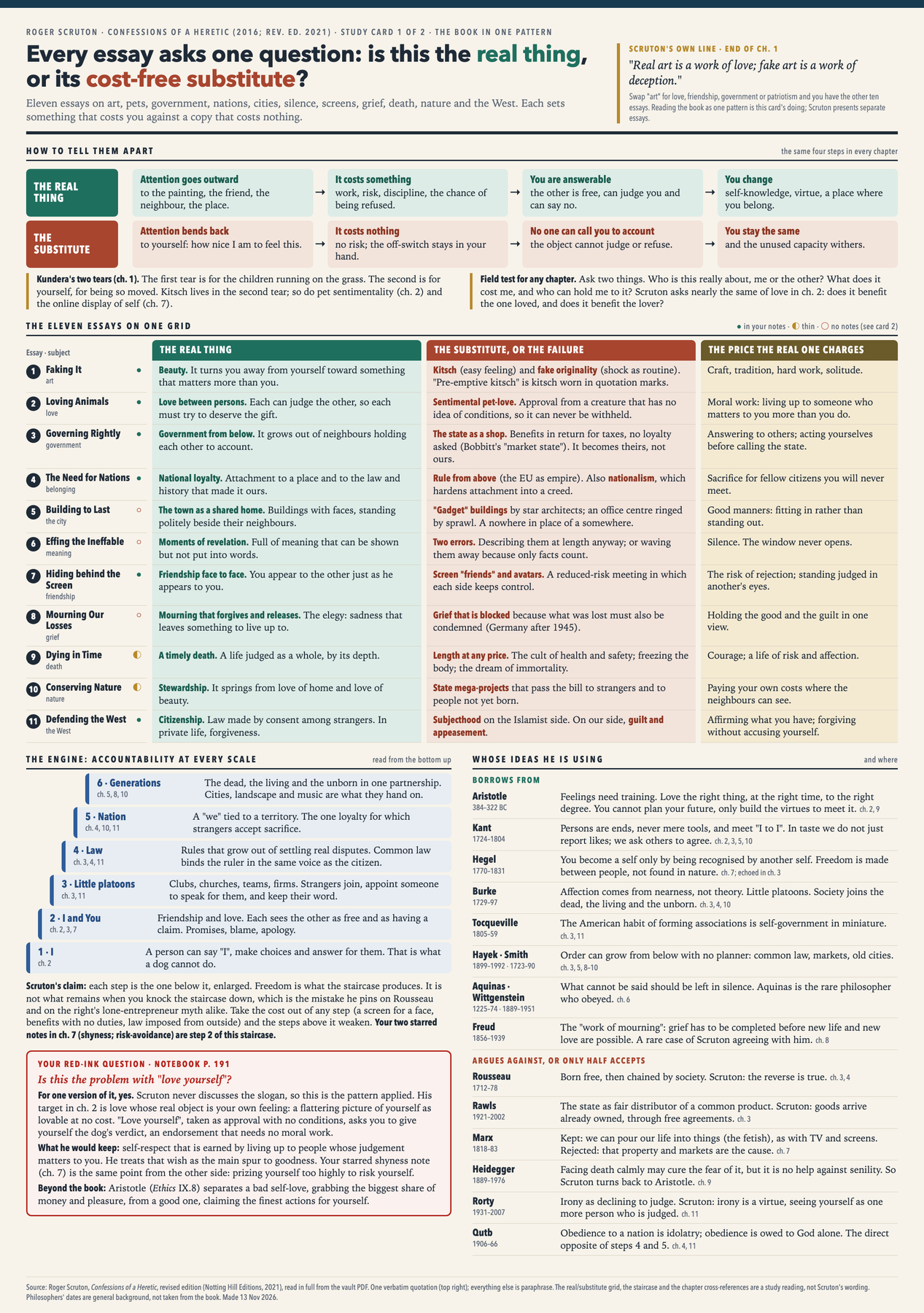
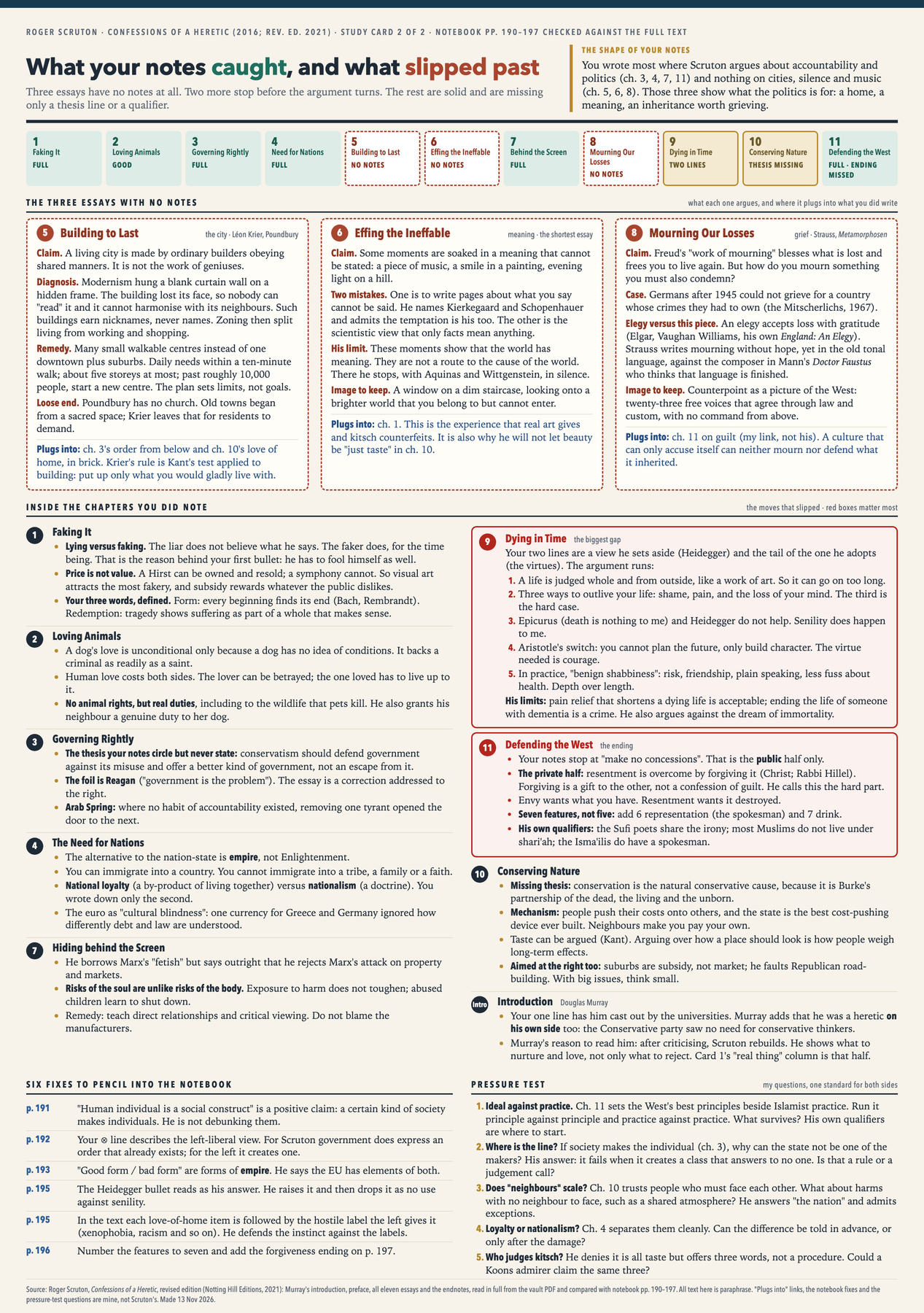
Two notebook cards (full B5), made 13 November 2026. They compare the handwritten notes on paper-notebook pp. 190–197 (four photographed spreads) with a full read of the PDF. The review above organises the book into three arguments; the cards take a different angle.
- Card 1, real thing or substitute: reads the eleven essays as one recurring question. It has a grid (essay, real thing, substitute, price), an accountability “staircase” from two people up to generations, and a key to the philosophers Scruton borrows from or argues against. It also answers the red-ink question on notebook p. 191 about “love yourself”.
- Card 2, what the notes missed: coverage by chapter; short summaries of the three essays with no notes (5, 6, 8); the moves missed in 9, 10 and 11; six corrections keyed to notebook pages; and five pressure-test questions.
Caveats:
- The single-pattern reading, the staircase, and the “plugs into” cross-links are a study synthesis. Scruton presents separate essays and states no such thesis.
- The “love yourself” answer applies his argument; he does not discuss the slogan.
- Philosophers’ dates and the Aristotle reference (Ethics IX.8) are general background, not taken from the book or checked against primary texts.
- Each card carries one verbatim line (the end of Chapter 1); everything else is paraphrase, so check wording against the PDF before quoting.
Card source files: card 1 HTML (file not included in this release) · card 2 HTML (file not included in this release).
Chapter Navigation
- Introduction by Douglas Murray — why a conservative can be a heretic within conservative politics.
- Preface — public essays and the collection’s original context.
- 1. Faking It — sincerity, kitsch, beauty, and redemption; PDF pp. 11–20.
- 2. Loving Animals — particular affection, species differences, and ecological duties; PDF pp. 21–30.
- 3. Governing Rightly — freedom, accountability, and a positive case for government; PDF pp. 31–40.
- 4. The Need for Nations — the pre-political “we,” sovereignty, and patriotism; PDF pp. 41–51.
- 5. Building to Last — Krier, mixed-use towns, and architecture as public responsibility; PDF pp. 52–63.
- 6. Effing the Ineffable — significance beyond paraphrase and the limits of explanation; PDF pp. 64–66.
- 7. Hiding behind the Screen — virtual relations, recognition, and avoidance of judgment; PDF pp. 67–78.
- 8. Mourning Our Losses — grief for a damaged civilization and musical form; PDF pp. 79–84.
- 9. Dying in Time — mortality, personhood, and the limits of longevity; PDF pp. 85–96.
- 10. Conserving Nature — environmental costs, beauty, and love of home; PDF pp. 97–109.
- 11. Defending the West — citizenship, cultural confidence, and forgiveness; PDF pp. 110–123.
Introduction by Douglas Murray
Source: PDF pp. 6–9 (file not included in this release)
Murray distinguishes holding office from supplying a culture’s dominant ideas. Conservative parties could win elections while a thinker defending their cultural inheritance remained marginal in universities and public intellectual life. In his account, Scruton was also inconvenient to his own political side: he sought a philosophical account of conservatism from politicians who often wanted little more than economic arguments and electoral tactics. This introduction is therefore both an appreciation and a defense of an outsider, written after Scruton’s death; its account of his reception should be read as Murray’s interpretation.
Murray’s more useful organizing claim is that Scruton goes beneath policy to needs such as belonging and reconciliation. National attachment matters because people need a home, not merely an adversary. Architecture matters because ordinary people inhabit its consequences, whether politicians treat it as a cultural question or leave it to the market. Music and beauty matter because a life can contain significance that is not exhausted by factual description.
He also emphasizes a constructive purpose. Scruton’s criticism is meant to identify things worth loving, maintaining, or rebuilding. The essays on Krier and Strauss are therefore central, not decorative departures from politics. Murray closes by reading “Dying in Time” in light of its author’s death: a life’s depth matters beyond its duration. This supplies an interpretive route through the collection, but does not settle the more troubling claims made in that essay.
Retain: distinguish party power from intellectual authority; look for the positive object of conservation; recognize that the introduction is sympathetic framing rather than independent adjudication of Scruton’s disputes.
Preface
Source: PDF p. 10 (file not included in this release)
Writing at Scrutopia at Christmas 2015, Scruton describes essays drawn from a decade of engagement with British and American public culture. Some had appeared before; others were new to the collection. He excludes primarily academic material and chooses questions intended for an intelligent general audience. “Confessions” signals thoughts that critics considered disreputable or better left unspoken.
Significance: the book offers interventions written in particular controversies, with different levels of evidence and development. Repeated material across the essays is part of the source, not a reason to collapse the separate arguments into one chapter. The 2021 edition’s introduction does not update every prediction or generalization in the original essays.
Chapter 1: Faking It
Source: PDF pp. 11–20 (file not included in this release)
What I Should Retain
- Three takeaways: faking can include self-deception; compulsory originality can become a formula; Scruton’s positive criteria are beauty, form, and redemption.
- Evidence anchors: Goneril and Regan perform love; Koons supplies his example of deliberate or “pre-emptive” kitsch; Bach and Rembrandt exemplify disciplined form that directs attention beyond the self.
- Connection to test: the chapter criticizes fashionable rejection of tradition while praising demanding modernists. Its target is not everything modern, although its verdicts on particular artists are polemical.
Chapter Objective and Through Line
Scruton asks how a culture loses the ability to distinguish serious art and emotion from performances of seriousness. A lie can be consciously deceptive; a fake may believe in the identity or feeling being performed. This makes exposure difficult. An institution can validate the performance, and the artist, critic, purchaser, and audience can sustain one another’s belief that it is authentic.
The chapter moves from the moral problem of sincerity to the artistic problem of originality, then to kitsch and the institutions rewarding it. Its constructive conclusion asks what genuine art offers: an encounter with something valuable beyond our own flattering emotions. PDF pp. 11–14, 18–20 (file not included in this release)
Chapter Structure at a Glance
- Separate deliberate lying from a fabricated self that participates in its own deception.
- Explain how the prestige of originality creates an incentive to imitate it.
- Trace modernism’s revolt against sentimentality into formulas of shock and irony.
- Identify market and patronage incentives that can confuse reputation with value.
- Offer beauty, achieved form, and reconciliation with suffering as positive tests.
Section-by-Section Argument
Faking reaches into the identity of the person
The examples from King Lear and Tartuffe show more than hypocrisy. Goneril and Regan occupy a world of performed affection from which truthful characters are displaced. Tartuffe becomes the pious identity through which he manipulates a household. For Scruton, the fake does not merely hide a belief; he constructs a social person whose convictions are adapted to the desired role. An audience’s trust helps keep that construction intact.
This explains why sincerity cannot be proved simply by the strength of someone’s conviction. A person can believe a sentiment while using it to evade what genuine feeling would require. The distinction anticipates the pet owner and virtual personality of later essays. PDF pp. 11–12 (file not included in this release)
Originality becomes a status that can be counterfeited
When art inherits some of religion’s cultural authority, the exceptional artist acquires exceptional prestige. Genuine originality, Scruton argues, demands skill, study, attention, and a costly openness to experience. But an audience cannot easily inspect those achievements. Artists and critics can therefore cooperate in presenting a gesture as a breakthrough.
Duchamp, Warhol, and Hirst supply his hostile examples. The logical point is that a gesture’s initial novelty does not make endlessly repeated versions equally original. If transgression becomes an institutional requirement, compliance with that requirement can imitate independence while remaining thoroughly conventional. This is an incentive argument; his examples do not themselves establish that every conceptual work is fraudulent. PDF pp. 12–14 (file not included in this release)
The escape from kitsch can return to kitsch
Scruton credits early modernists with serious achievements. Eliot, Schoenberg, and Matisse sought ways to express modern experience after inherited forms had become vulnerable to cliché. Their successors could imitate the appearance of rupture more easily than the discipline behind it. Requiring art to shock the bourgeois spectator eventually makes shock predictable.
Kitsch, on his account, offers an attractive image of the spectator’s own emotion. Kundera’s distinction between being moved by a scene and admiring oneself for being moved identifies the self-regarding turn. “Pre-emptive kitsch” then displays obvious sentimentality under the protection of irony: Koons’s Michael Jackson and Bubbles is his example. A work seems to evade criticism because acknowledging its cheapness is presented as proof of sophistication. The question becomes whether irony transforms its meaning or simply protects the same emotional commodity. PDF pp. 14–17 (file not included in this release)
Price and official recognition cannot settle artistic value
Visual objects can become scarce possessions and speculative assets. Scruton distinguishes that price from the intrinsic value of an encounter with art. He also argues that public patrons can reward incomprehensibility as evidence of importance: if popular approval discredits a work’s originality, bureaucrats acquire an incentive to subsidize what ordinary viewers dislike.
These mechanisms could insulate weak work from judgment. They do not demonstrate that difficulty, public support, or a high price is sufficient evidence of fakery. The positive account is therefore essential. Without criteria beyond dislike, the critique would reproduce the institutional arbitrariness it attacks. PDF pp. 17–18 (file not included in this release)
Beauty, form, and redemption redirect attention
Beauty asks us to attend to the object rather than admire our own sensitivity. Form connects fragments into an intelligible whole: a Bach fugue develops toward completion; a Rembrandt portrait finds a person’s coherence in an aging body. Both require knowledge and discipline rather than mere expressive release.
Redemption names the further possibility that suffering becomes intelligible without being denied. Tragedy can reveal dignity and compassion within destruction; works made under tyranny can sustain love in a devastated world. Scruton ends with an account of art as loving attention. It reconciles us to existence by showing that experience can possess significance beyond appetite and self-display. PDF pp. 18–20 (file not included in this release)
Key Concepts and Distinctions
- Lying versus faking: conscious deception differs from inhabiting a fabricated identity or conviction. The latter can recruit sincere belief.
- Kitsch versus beauty: self-congratulation at having feelings differs from attention to a valuable object. Pleasantness is not the decisive test.
- Originality versus novelty: a new gesture is not necessarily a substantial artistic achievement; originality can transform an inherited medium.
- Form versus formula: achieved unity makes parts meaningful; repeated shock can remain a recipe.
- Redemption: art can disclose significance in suffering; this is not a claim that suffering is harmless or always justified.
Essential Evidence and Examples
- King Lear and Tartuffe illustrate fabricated affection and piety; they are literary interpretations, not psychological experiments. PDF pp. 11–12 (file not included in this release)
- Koons’s Michael Jackson and Bubbles exemplifies the proposed immunity supplied by deliberate kitsch. Whether the interpretation is fair remains a judgment about the work. PDF pp. 16–17 (file not included in this release)
- Bach, Rembrandt, and works responding to totalitarian violence supply the positive contrast: disciplined form and attention directed beyond the artist’s persona. PDF pp. 19–20 (file not included in this release)
Chapter Conclusion and Significance
The chapter establishes the collection’s moral test: does an experience draw us into truthful attention and obligation, or let us consume an image of ourselves? Its strongest contribution is this question. Its judgments on whole institutions and individual artists require more evidence than the conceptual distinction alone supplies. It also leaves a productive tension for Chapter 8: can art offer truthful significance when consolation and formal resolution remain unavailable?
Qualifications and Questions for Reflection
Scruton’s theory must distinguish genuine ambiguity or experimentation from a pose. If he excludes disliked works merely by declaring their makers insincere, he risks claiming knowledge of motives that the work does not establish.
- What observable features could distinguish a difficult but serious artwork from an institutionally protected fake?
- Can irony expose sentimentality without merely insulating it from criticism?
- Why does Scruton praise early modernists, and how does that qualify his attack on modern art?
Chapter 2: Loving Animals
Source: PDF pp. 21–30; endnotes p. 124 (file not included in this release)
What I Should Retain
- Three takeaways: affection is not automatically a virtue; different relationships create different duties; rejecting animal personhood does not cancel human obligations toward animals.
- Evidence anchors: Scruton’s managed pasture farm; pets whose security is bought partly at the expense of wildlife; the dog whose dependence creates a special obligation even when it inconveniences neighbors.
- Connection to test: compare the emotional intensity of a love with its consequences for the object, its owner, and beings excluded from the relationship.
Chapter Objective and Through Line
Starting from life on his farm, Scruton asks when love for animals benefits them and when it serves the lover’s flattering self-image. His distinction is not simply between affection and cruelty. A cherished pet can flourish while the wider animal community suffers, and an owner can confuse dependence with moral endorsement.
The essay develops an ethics of differentiated care. Love of a species, kindness to an injured creature, affection for an individual horse, and responsibility for a devoted dog are not the same relation. Recognizing those differences should discipline sentiment, while making obligations toward less lovable wildlife more visible. PDF pp. 21–26, 29–30 (file not included in this release)
Chapter Structure at a Glance
- Describe animal husbandry as intervention in an ecological order, not simple noninterference.
- Examine the conflict between beloved pets and unprotected wildlife.
- Judge love by what it does to both its subject and its object.
- Differentiate general care, individual attachment, and reciprocal human love.
- Criticize sentimental personification while retaining duties to animals and habitats.
Section-by-Section Argument
The farm exposes the selectivity of every managed ecology
Scruton’s thin-soiled pasture supports grazing animals rather than ordinary cultivation. He presents husbandry, predation, and human intervention as components of a managed habitat. His own practices contain uncomfortable selections: favored birds and predators receive help; rats are controlled; some competing species are welcomed and others discouraged. He does not pretend that care for nature can avoid choices about death or population.
The farm is an illustrative case from his experience. Its claimed recovery of wildlife supports his sense that management can improve a place, but it is not a comparative ecological study demonstrating the superiority of all such practices. The philosophical issue is that even apparently benign love requires judgments whose costs fall on other creatures. PDF pp. 21–22 (file not included in this release)
Loving a pet can conceal the harm it exports
A neighbor’s dog disturbs animals already struggling through winter, then returns to warmth and reliable food. Cats range beyond the household and prey on wildlife. In both cases, the protected animal’s advantages can impose costs on animals outside the owner’s emotional circle. Scruton’s deliberately abrasive language about cats should not obscure this structural point: particular affection and ecological responsibility can conflict.
He asks two questions about a love: what does it do to the thing loved, and what does it do to the lover? Intensity settles neither. Drawing an analogy with Aristotle’s account of disciplined emotion, he argues that loving well involves the appropriate object, occasion, and degree. A love can exploit its object or corrupt its subject by supplying effortless self-approval. PDF pp. 22–24 (file not included in this release)
Different animals and relationships create different obligations
Delight in the presence of bullfinches is not usually love of a particular bullfinch. Helping an injured animal may be ordinary kindness. A horse can become individually important through a history of shared activity and reliance; treating it as a doll can disregard its actual needs. These examples show why care must attend to the creature, not merely to the owner’s desired experience.
Dogs complicate the initial complaint. Scruton takes a dog’s particular attachment to its owner to generate an individual duty of care. He explicitly concedes that the neighbor’s obligation to her dependent dog can take precedence over his more general duty toward wildlife. The essay thus resists a simple conclusion that his own preferred animals automatically deserve priority. Nevertheless, the concession does not eliminate the further question of how an owner should limit avoidable harm. PDF pp. 24–26 (file not included in this release)
Dependence is not the same as a person’s moral recognition
Scruton defines persons through self-consciousness, responsibility, rights, and the capacity to encounter another as a judging subject. A dog may be a highly individualized companion without taking this moral standpoint. Loving it as if it possessed human responsibility can impose demands it cannot understand.
His concern about the owner is sharper still. A dog’s devotion does not certify the owner’s virtue; even a bad person can receive it. Human love, by contrast, can ask us to deserve trust, revise our conduct, and accept another’s independent judgment. A person who substitutes unquestioning animal dependence for every difficult human relationship may escape one of the central disciplines of moral development. This is a possible misuse of pet affection, not a demonstrated diagnosis of every devoted owner. PDF pp. 26–29 (file not included in this release)
Duties can remain even where Scruton denies rights
The final movement rejects the inference that animals’ lack of human personhood licenses disregard. He thinks a rights vocabulary misdescribes their relation to moral reasoning and can reinforce favoritism toward household companions. Yet habitat destruction and the pressures of human expansion make obligations toward other animals more demanding, not less.
He also makes an important exception to his criticism of emotional retreat. Someone deprived of human affection through misfortune may preserve genuine care by looking after an animal; Flaubert’s A Simple Heart supplies his literary case. The vice is not consolation itself, but using it to evade obligations while imagining oneself morally superior. PDF pp. 28–30 (file not included in this release)
Key Concepts and Distinctions
- Love of an individual versus concern for a kind: an irreplaceable relationship differs from valuing the continued presence of a species.
- Kindness versus love: responding to suffering need not depend on a personal attachment.
- Dependency versus moral reciprocity: the need that binds a companion animal to an owner differs from the mutual judgment Scruton associates with persons.
- Duty versus right: Scruton argues that our obligations need not all be grounded in a right held by their beneficiary. His wider rejection of animal rights is referenced, not fully defended here.
- Sentimentality: affection becomes self-regarding when the owner’s desirable feeling displaces attention to the creature and its consequences.
Essential Evidence and Examples
- The winter dog-walk makes exported costs visible: the pet’s secure home changes the consequences of a chase for predator and quarry. PDF pp. 22–23 (file not included in this release)
- The dependent dog generates Scruton’s strongest qualification of his own position. Its owner’s particular responsibility cannot simply be replaced by his general preference for wildlife. PDF pp. 25–26 (file not included in this release)
- Flaubert’s solitary caretaker shows that attachment to an animal can preserve, rather than evade, moral feeling. PDF p. 29 (file not included in this release)
Chapter Conclusion and Significance
The conclusion asks for disciplined rather than diminished love. Particular relationships generate real obligations, but their emotional warmth must not make other creatures disappear from view. This becomes a template for the later arguments about nations and environments: belonging can motivate responsibility, yet it can also narrow the field of concern.
Qualifications and Questions for Reflection
The essay’s comparative claims about dogs, horses, birds, and other animals are not established here through a systematic account of animal cognition. Its predation estimate is traced to a 2003 source in the endnotes, not treated as a current wildlife census. A further philosophical issue remains: why should the inability to exercise moral judgment preclude possessing any rights? Distinguishing moral agents from possible beneficiaries of rights requires more argument than this essay gives.
- When should an owner’s special obligation yield to the harms a pet causes outside the household?
- Does unconditional affection necessarily weaken moral growth, or can it support relationships that do demand responsibility?
- Can someone defend duties toward animals while rejecting Scruton’s sharp account of human uniqueness?
Chapter 3: Governing Rightly
Source: PDF pp. 31–40; endnotes p. 124 (file not included in this release)
What I Should Retain
- Three takeaways: government can make freedom possible; accountable persons are formed socially; welfare has a legitimate place when it sustains reciprocal membership.
- Evidence anchors: habeas corpus requires institutions that can restrain government itself; American voluntary associations exercise forms of government; total war sharpens a society’s obligations toward citizens asked to sacrifice.
- Connection to test: a larger state and an unaccountable state are different problems. Scruton’s alternative cannot be reduced to a fixed instruction to minimize expenditure.
Chapter Objective and Through Line
Scruton begins with a familiar conservative complaint about expanding bureaucracy, regulation, and dependence. He shares much of the complaint but rejects the conclusion that government as such is the problem. An opposition defined only by resisting programs cannot explain what public authority is for or win consent to necessary collective action.
His positive answer is accountability. Government and freedom emerge from the same human practice: recognizing another person’s standing to make claims, expect reasons, and require performance of obligations. The chapter therefore argues for a conservative defense of government, including some welfare provision, while disputing what he regards as its administrative and redistributive excesses. PDF pp. 31–35, 37–40 (file not included in this release)
Chapter Structure at a Glance
- Reconstruct the complaint against intrusive government.
- Show why rights and free persons require a social and institutional setting.
- Develop accountability from friendship into public authority.
- Explain why large-scale coordination requires government beyond voluntary association.
- Defend a welfare obligation while arguing that provision must preserve responsibility.
Section-by-Section Argument
The anti-government slogan leaves the positive task unexplained
The opening surveys conservative anxieties about European institutions, American regulation, and welfare expansion. Those descriptions are Scruton’s political framing, not neutral comparative findings. His purpose is to turn the complaint back on its speakers: if conservatives oppose every extension of federal activity, they risk appearing incapable of governing at all.
Some public tasks cannot simply be wished away. Defense, law, infrastructure, and emergency coordination require institutions. More fundamentally, even rights against rulers become dependable possessions only through arrangements capable of enforcing them. Habeas corpus is his example of government made answerable through law. The relevant question is which government sustains liberty and how it can be held to its purpose. PDF pp. 31–33 (file not included in this release)
The individual develops within relations rather than before them
Scruton rejects the picture of an already complete, naturally independent person subsequently confined by society. He associates versions of that picture with Rousseau and with the American myth of the self-sufficient pioneer, intensified in Ayn Rand. His contrary claim is developmental: people become capable of acting freely through networks that teach responsibility, reciprocal recognition, and the distinction between a right and an appetite.
Friendship supplies the small-scale model. Promises, shared plans, apologies, praise, and blame make the participants answerable to one another. Without this mutuality, a relationship can become exploitation. Scruton connects the same structure to Kant’s requirement that persons be treated as ends. Individual sovereignty is compatible with obligations precisely because recognizing another person’s sovereignty gives that person a claim on us. PDF pp. 33–35 (file not included in this release)
Civil association is already a practice of government
Tocqueville’s Americans do not exemplify the absence of governance. Clubs, schools, committees, and rescue organizations coordinate people under rules and offices they acknowledge as their own. Such institutions express public spirit through voluntary initiative. Their authority is rooted in membership and consent rather than experienced as an occupation by strangers.
But spontaneous coordination has limits. As scale, territory, and complexity increase, the willingness of neighbors to accommodate one another may not settle every conflict. Public rules and a law-enforcing authority then become necessary. Scruton draws on Hayek’s spontaneous order and Weber’s account of the state to describe a transition from informal convention to institutions able to enforce common decisions. His own argument therefore rules out a simple opposition between legitimate bottom-up order and inherently illegitimate state power. PDF pp. 35–37 (file not included in this release)
Welfare expresses membership but can weaken its own foundations
The welfare state is not dismissed as an alien intrusion. Scruton argues that popular democracy and the sacrifices of total war make a public obligation to needy citizens intelligible: those asked to risk themselves for a society must have reason to regard membership as beneficial. Communal assistance extends, at national scale, a responsibility familiar in smaller groups.
He then contends that some forms of provision can sever support from reciprocal responsibility and create durable dependence. This is a causal and empirical claim, not something proved by defining accountability. Likewise, his depiction of left-liberalism as treating disadvantaged people as inherently blameless is a polemical generalization. The constructive standard is clearer than the policy prescription: assistance should maintain citizens’ standing as responsible participants rather than make them passive recipients. PDF pp. 37–38 (file not included in this release)
Public authority cannot be reduced to a distributive transaction
Scruton criticizes what he presents as Rawls’s picture of the state as allocator of an initially unowned social product. He thinks this loses sight of ownership, prior agreements, and the associations from which legitimate public power develops. Bobbitt’s “market state” supplies a second contrast: an authority that offers services for taxes may command only the loyalty of a useful supplier.
Against both images, he wants government to embody a shared undertaking. The state can legitimately contribute to healthcare, education, and welfare where older associations cannot meet modern needs. Its contribution should enable initiative to revive rather than displace it indefinitely. The chapter ends with an obligation for conservatives to specify boundaries and institutions. It offers a purpose and a criterion, but acknowledges their failure to produce a convincing blueprint. PDF pp. 38–40 (file not included in this release)
Key Concepts and Distinctions
- Accountability versus domination: a person or office can be required to answer to others; power alone does not supply that relationship.
- Freedom versus natural independence: freedom includes acquired capacities for judgment, obligation, and self-government.
- Civil society versus absence of government: voluntary organizations govern their own joint affairs, even without being state agencies.
- Welfare obligation versus administrative dependency: accepting responsibility for vulnerable members does not decide the best form of provision.
- Shared membership versus a service contract: a political association may ask for sacrifices beyond the immediate return to each participant.
Essential Evidence and Examples
- Habeas corpus: freedom from arbitrary imprisonment depends on enforceable institutions, including enforcement against rulers. PDF p. 33 (file not included in this release)
- Local clubs and emergency cooperation: examples of freedom expressing itself through rule-making and organized responsibility. PDF pp. 35–36 (file not included in this release)
- Wartime sacrifice and public welfare: a historical argument about mutual obligation, not a finding that every welfare design succeeds. PDF p. 37 (file not included in this release)
Chapter Conclusion and Significance
The chapter supplies the political center of the book. Freedom depends on a setting that cultivates responsibility and protects the conditions under which it can be exercised. Conservatives therefore owe an account of legitimate government, not only a catalogue of encroachments. The most consequential departure from a minimal-state position is his explicit recognition of welfare and other public needs.
Qualifications and Questions for Reflection
The Rawls passage is Scruton’s characterization, not an adequate statement of Rawls’s entire theory. His comparative claims about Europe, private charity, and the causes of poverty also require independent evidence. A separate institutional problem remains: an intimate association’s accountability cannot simply be assumed to scale into a state with unequal power and involuntary members.
- What procedures make an office accountable rather than merely familiar or patriotic?
- When does public provision expand citizens’ capacity for agency, and when might it weaken it?
- How would Scruton distinguish a legitimate national program from the intrusive administration he criticizes?
Chapter 4: The Need for Nations
Source: PDF pp. 41–51 (file not included in this release)
What I Should Retain
- Three takeaways: a contract presupposes people who already recognize a shared undertaking; territorial citizenship can unite people across faith and ancestry; Scruton distinguishes ordinary national attachment from ideological nationalism.
- Evidence anchors: the euro crisis tests cross-border obligations; secular jurisdiction makes a common legal order possible; the French Revolution’s appeal to the nation illustrates attachment returning after abstract reconstruction.
- Factual boundary: the predicted breakup of the eurozone is an earlier forecast, not an accomplished event. See the separately verified corrections.
Chapter Objective and Through Line
Scruton asks what makes strangers accept burdens for one another when immediate self-interest gives them reason to refuse. His answer is a national “we”: historically formed attachment to a country, its law, and its shared life. This is prior to any particular constitution or policy agreement, although it need not rest on common ancestry or a single faith.
The European integration dispute supplies the political occasion. Scruton argues that central institutions rely on loyalties they cannot readily replace, then develops a wider claim about citizenship, secular law, and sovereignty. The philosophical argument about the conditions of solidarity needs to be distinguished from his sweeping account of European institutions and his confident prediction of their failure. PDF pp. 41–46, 48–51 (file not included in this release)
Chapter Structure at a Glance
- Challenge the identification of national self-government with the causes of European war.
- Use monetary and sovereign-debt tensions to expose the need for sacrifice and trust.
- Define nationality through territory, historical association, and shared law.
- Argue that a common allegiance precedes the social contract.
- Separate ordinary patriotism from a doctrine that mobilizes national identity against outsiders.
Section-by-Section Argument
European integration raises a problem of consent and allegiance
Scruton portrays the integration project as driven by a historical diagnosis: nationhood caused Europe’s catastrophes, so political safety required authority to move upward. He replies that the alternative to a nation-state need not be enlightenment; it can be an empire. He even allows that an empire can protect local loyalties under a wider legal canopy. His complaint is therefore not simply that any authority above a nation is illegitimate. It is that centralization can weaken the attachments and accountability on which authority depends.
He interprets European resistance to integration and the treatment of national symbols through this lens. These passages strongly generalize the motives of elites and the wishes of populations. Their argumentative role is to identify a possible mismatch between institutional power and experienced membership; they do not establish that every instance of shared European authority is unwanted. PDF pp. 41–43 (file not included in this release)
The euro crisis is a test of costly solidarity
A shared currency links societies with different political habits, fiscal arrangements, and expectations. Scruton argues that borrowing can draw on the credibility of other members without creating an equally strong sense of obligation toward them. When costs arrive, politicians appeal to national sacrifice because the citizens’ deeper loyalties remain national.
The example expresses a genuine conceptual question: what motivates a person to accept another community’s burdens? Yet his explanation leans heavily on cultural stereotypes and treats institutional failure as inevitable. The essay predicts a eurozone breakup; that prediction must remain visible as a claim made in context, rather than silently converted into a confirmed causal conclusion. PDF pp. 43–46 (file not included in this release)
Territorial attachment can support plural citizenship
His positive conception makes a country, rather than a ruler, tribe, race, or religious group, the object of public allegiance. The country includes a territory and a history embodied in language, law, and custom. Because attachment has this political shape, newcomers can in principle enter the common life through citizenship and observance of its rules.
The central promise is coexistence. A legal community need not resolve every disagreement about ultimate truth before its members can respect one another’s rights. His claim that borders can enable an enlightened order follows from this: a determinate jurisdiction supplies a place where obligations can be recognized and enforced. It does not by itself establish which borders are just or whether national attachment is the only possible basis for solidarity. PDF pp. 46–47 (file not included in this release)
The Christian genealogy and secular law are different claims
Scruton interprets Christianity’s distinction between duties to God and duties to temporal authority as an important condition of Europe’s later secular jurisdiction. He moves from the tribute-money saying and Paul to Gelasius, then toward Reformation and Enlightenment developments. His conclusion is striking: religion should become one association under a common, revisable law rather than the source of an unalterable public jurisdiction.
This is a historical genealogy offered in compressed form. It is not a demonstration that every Christian establishment promoted freedom or that Islamic traditions lack relevant distinctions. The chronology and content of his Gelasius example require correction; see the primary-text check. The philosophical point worth preserving is the distinction between a religious contribution to an institution’s history and a present right to govern everyone through religious authority. PDF pp. 47–49 (file not included in this release)
The contract needs a “we,” but nationalism can distort it
People assemble to negotiate a social contract because some recognition of common life already exists. A conditional exchange cannot, Scruton thinks, explain all the obligations needed in a crisis. Territorial loyalties, language, customs, and inherited associations supply a background that public law formalizes rather than creates from nothing.
He ends by separating settlement from national ideology. Ordinary national feeling grows through ways of living together, resolving disagreements, celebrating, and remembering. Ideological nationalism turns that attachment into a demanding creed. The French Revolution illustrates his warning: destroying customary authority did not eliminate the need for allegiance; it returned in a more mobilized and dangerous form. In his view, an existing, moderate patriotism can restrain rather than unleash extremism. PDF pp. 48–51 (file not included in this release)
Key Concepts and Distinctions
- Pre-political allegiance: a sense of shared membership that makes constitutional bargaining possible; “pre-political” does not mean free of historical power.
- Territorial patriotism versus ideological nationalism: attachment to a common place and law differs from a doctrine demanding total commitment.
- State versus nation: effective offices and a shared identity are analytically different; Scruton argues that the former cannot flourish without enough of the latter.
- Civic membership versus descent: his intended model permits incorporation of newcomers; how equal incorporation works remains an institutional question.
- Secular jurisdiction versus religious genealogy: a law can have a history shaped by religion while deriving its present legitimacy from human institutions.
Essential Evidence and Examples
- The euro crisis tests whether a formal arrangement has sufficient underlying solidarity to sustain unequal burdens. It does not prove that larger solidarity cannot develop. PDF pp. 43–45 (file not included in this release)
- The social-contract thought experiment shows that agreement needs identifiable participants who already recognize one another as relevant parties. PDF pp. 48–49 (file not included in this release)
- The French Revolution exemplifies, in Scruton’s interpretation, the return of national allegiance after an effort to govern through abstract universal principles. PDF pp. 49–50 (file not included in this release)
Chapter Conclusion and Significance
The essay explains why a defense of limits on the state can coexist with a strong defense of national political membership. The nation supplies motives that cannot be purchased through a service contract. Its unresolved issue is whether those motives can be cultivated without allowing the dominant group to equate its inheritance with everyone’s obligations.
Qualifications and Questions for Reflection
Attachment is a possible source of solidarity, not sufficient proof of a boundary’s justice or an institution’s legitimacy. This distinction matters especially for minorities and would-be members. The essay also compresses different European institutions and makes historical and predictive claims corrected below.
- Must a political “we” be national, or can institutions help create a wider and still meaningful solidarity?
- How can a newcomer become an equal co-author of the country’s future rather than only a guest in its past?
- What evidence would distinguish moderate patriotism that restrains extremism from patriotism that protects inherited exclusion?
Chapter 5: Building to Last
Source: PDF pp. 52–63 (file not included in this release)
What I Should Retain
- Three takeaways: a building’s public effects exceed its owner’s preferences; humane urbanism concerns ordinary fabric as much as monuments; planning can set limits that enable varied choices within a shared place.
- Evidence anchors: Krier’s Poundbury; mixed uses and the ten-minute walking rule; railway stations whose architectural forms help people understand the space.
- Connection to test: separate the argument for walkable, adaptable, neighborly settlement from the further claim that only a classical architectural language can deliver it.
Chapter Objective and Through Line
The essay asks how a city becomes a place where strangers can feel at home together. Scruton treats architecture as part of civil association: buildings help constitute the public world in which neighbors encounter one another. A structure can provide shelter and remain rude to its surroundings; a collection of individually striking objects may fail to make a town.
Léon Krier supplies both a critique and a constructive alternative. The chapter moves from attacks on modernist redevelopment to a model of compact, mixed-use, polycentric settlement, constrained by a shared architectural vocabulary. Its governing distinction is between building to attract attention and building to contribute to a place. PDF pp. 52–55, 58–63 (file not included in this release)
Chapter Structure at a Glance
- Define the city as a shared institution and way of life.
- Diagnose the destruction of inherited street life through clearance, separation of uses, and architectural isolation.
- Present Krier’s critique of modernism and his alternative vocabulary.
- Develop the polycentric town, the ten-minute rule, and constraints on ordinary construction.
- Treat Poundbury as an example and confront the limits of design in creating community.
Section-by-Section Argument
The city is more than a collection of private objects
Scruton begins with the achievement of strangers living under a common law and sharing work, festivals, and public space. Streets, facades, monuments, and small details record this achievement. He contrasts it with the hollowing of centers and outward movement into suburbs, where separate places for work, home, and recreation weaken the integrated town.
His attack on postwar clearance interprets it as completion of wartime destruction. Older neighborhoods are described as mixed communities containing shops, workshops, schools, and worship. This framing identifies what clearance can destroy, but it must not erase the poor conditions or unequal power that redevelopment sometimes addressed. The claim that a viable street embodied social knowledge is distinct from the claim that every inherited neighborhood should have remained unchanged. PDF pp. 52–54 (file not included in this release)
Krier challenges an architectural monopoly
Krier objects to treating modernism as an unavoidable universal successor to traditional forms. On Scruton’s account, excluding older disciplines from training deprived builders of ways to make legible, durable, and mutually compatible places. Krier’s alternative is not simply to preserve isolated monuments. It is to make an ordinary vocabulary available for contemporary growth.
The moral test asks whether an architect would gladly have loved ones inhabit and grow old in the resulting environment. Scruton contrasts this with designers who, he says, impose unfamiliar public forms while choosing traditional domestic settings for themselves. The concern is a gap between imposing costs and bearing them. The biographical accusation is not itself a general assessment of building performance. PDF pp. 54–56 (file not included in this release)
Legibility, durability, and relation matter together
Scruton and Krier criticize curtain-wall buildings for concealing structure, losing a readable public face, and relating poorly to neighbors. They join this aesthetic case to claims about maintenance, adaptation, energy use, and eventual waste. A shared vocabulary is compared to harmony in music: independently meaningful elements can fit together without becoming identical.
The contrast between an airport covered in instructions and a classical railway station clarifies “readability.” A space can guide people through an intelligible arrangement rather than confront them with competing signs. Scruton also invokes the loss of the earlier Penn Station as a case in which private redevelopment damaged a civic inheritance. These are substantial questions about public experience; they do not establish that a structural material or architectural style is always ecologically or functionally inferior. PDF pp. 56–58 (file not included in this release)
The alternative is a network of towns with nearby purposes
Following Jane Jacobs’s critique of separated uses, Krier proposes new centers instead of an endlessly expanding residential edge. Work, shopping, leisure, and public institutions should remain close enough for ordinary pedestrian access. His ten-minute rule gives the proposal a practical test; his “polypolis” is a network of genuine somewheres rather than a single center surrounded by overspill.
Planning still matters. The chapter explicitly describes a master plan: layout, streets, plots, limits on floors, and building conventions. Scruton interprets these as constraints within which many people choose, not a comprehensive social goal imposed on them. Attention should fall on the ordinary buildings that set everyone’s daily surroundings, rather than merely the exceptional project designed to stand out. PDF pp. 58–59 (file not included in this release)
A settlement can invite community without manufacturing every attachment
Poundbury is offered as a mixed-use settlement where factories, offices, warehouses, shops, and homes contribute to a continuous public realm. Its absence of a church, at the time of the essay, reveals a limit. Krier refuses to impose one in advance of a community’s demand. Even a planner who values sacred space cannot produce belief by assigning a structure to it.
This is a crucial qualification of the anti-utopian argument. The built setting can make association possible and invite renewed belonging; it cannot dictate the entire spiritual or social life that follows. Scruton’s praise of Krier’s modest, consultative manner supports the same ideal of agreement. His final contrast is with architectural celebrity: a living city depends on many adjustments by craftsmen and inhabitants, including the ability to repair and adapt what earlier people made. PDF pp. 60–63 (file not included in this release)
Key Concepts and Distinctions
- Public face versus private property: a facade belongs visually to the shared street even when the building has a private owner.
- Polycentric settlement versus sprawl: several complete centers differ from ever more housing dependent on one distant center.
- Constraints versus a comprehensive goal: common rules can make separate decisions compatible without scripting every use or relationship.
- Ordinary fabric versus exceptional monument: daily experience is mostly formed by routine buildings, not a handful of masterpieces.
- Home versus shelter: inhabitable space is necessary but insufficient for a place experienced as a shared world.
Essential Evidence and Examples
- Poundbury: Scruton’s working model of mixed use, architectural constraint, and a shared public realm. His claims about success remain the assessment presented in the essay. PDF pp. 59–60 (file not included in this release)
- The ten-minute rule: a concrete measure of whether a settlement brings everyday purposes together. PDF p. 59 (file not included in this release)
- Poundbury’s missing church: community cannot simply be designed into existence, even when the planner wants conditions favorable to it. PDF p. 60 (file not included in this release)
Chapter Conclusion and Significance
Architecture gives visible form to the collection’s wider ethics. A building should acknowledge its neighbors just as a person acknowledges others’ claims. Conservation is constructive here: it concerns the ability to make good new places, not merely regret lost ones. The argument also shows why a conservative defense of property need not leave urban form entirely to each owner’s immediate preferences.
Qualifications and Questions for Reflection
The essay’s denunciations of modern materials and whole professional cultures outrun the evidence it presents. Its criteria of walkability, maintenance, and adaptability should be tested separately from stylistic preference. It also leaves affordability, land ownership, accessibility, and the representation of dissenting residents less developed than visual harmony.
- Which qualities of Krier’s urbanism require classical forms, and which could be achieved in another style?
- Who should decide a shared aesthetic when neighbors disagree, and how should excluded or future residents be represented?
- What would a fair comparison of Poundbury with another settlement measure besides appearance?
Chapter 6: Effing the Ineffable
Source: PDF pp. 64–66 (file not included in this release)
What I Should Retain
- Three takeaways: meaningful experience need not be a verbal proposition; recognizing that limit differs from describing what lies beyond it; a revelation of significance does not explain the cause of the universe.
- Evidence anchors: Aquinas’s reported silence; Jankélévitch’s lengthy discussion of music’s inexpressible meaning; the music, painting, and evening light through which Scruton describes an encounter with significance.
- Connection to test: distinguish this experience matters from this experience establishes a particular metaphysical theory.
Chapter Objective and Through Line
This short essay asks how to acknowledge experiences that seem saturated with meaning while resisting the temptation to turn them into descriptions of an otherwise inaccessible world. Scruton defends the significance of such experiences against a narrowly scientistic outlook. He also refuses to treat them as an explanation of first causes. These two commitments must be retained together.
Chapter Structure at a Glance
- Notice the paradox of writing extensively about what cannot be expressed.
- Distinguish acknowledging a limit from describing what supposedly lies beyond it.
- Accept aesthetic and personal revelation as an aspect of experience.
- Refuse to convert that experience into a causal explanation of existence.
Section-by-Section Argument
Philosophers can violate the silence they recommend
Aquinas is presented as an unusual example of a thinker whose reported experience led him to stop writing. Scruton contrasts this with Kierkegaard, Schopenhauer, and Jankélévitch, who write at length about truths they call inexpressible. His tone is comic, but the difficulty is substantive: once we describe the ineffable as though it were an ordinary object, we undo the distinction that made it ineffable.
The criticism is not that music has no meaning because it cannot be translated into words. Scruton agrees with Jankélévitch that it can be significant without carrying a paraphrasable message. Language can direct attention toward that experience without successfully replacing it. PDF pp. 64–65 (file not included in this release)
Revelation can show significance without becoming a scientific fact
Music, the Mona Lisa’s smile, and sunlight on a hill supply his examples. They resemble a momentary view through a window: something about the world appears meaningful beyond what our usual explanations capture. The metaphor signals belonging and distance at once. Scruton admits his own temptation to describe the world supposedly disclosed there, then notices that his descriptions risk bringing it falsely inside ordinary experience.
His target is the assumption that only factual statements can matter. But rejecting that assumption is weaker than establishing a further realm with determinate properties. The essay’s restraint is as important as its affirmation. PDF pp. 65–66 (file not included in this release)
Meaning does not answer the question of first cause
Scientific explanation eventually reaches starting assumptions or laws it does not explain in its own terms. Scruton asks whether a moment of revelation supplies what is missing. His concluding answer divides the questions: there may be more to the world’s significance than its causal description, but this does not give a route to the cause of the world. The experience cannot legitimately be made into the explanatory answer he wants. PDF p. 66 (file not included in this release)
Key Concepts and Distinctions
- Ineffable: significant in a way that resists adequate verbal expression; not automatically meaningless or unknowable in every respect.
- Pointing versus describing: a phrase or image can direct attention toward an experience without stating its supposed transcendent content.
- Meaning versus cause: an account of what experience discloses as valuable differs from an explanation of why the universe exists.
Essential Evidence and Examples
- Jankélévitch’s writing about music illustrates the problem of articulating the impossibility of paraphrase. PDF pp. 64–65 (file not included in this release)
- Scruton’s window metaphor both evokes revelation and warns against claiming access to a fully describable other world. PDF pp. 65–66 (file not included in this release)
Chapter Conclusion and Significance
The essay provides an evidence boundary for the book’s language of transcendence and redemption. Aesthetic experience can matter deeply without establishing a theological doctrine. Its method is reflective and phenomenological: it describes an experience and the temptation to overinterpret it, rather than offering an experimental finding or a proof.
Questions for Reflection
- Can criticism help someone hear a piece of music without translating what the music means?
- What would justify moving from a meaningful experience to a claim about a reality beyond experience?
- How does Scruton’s final refusal qualify the religious language used elsewhere in the collection?
Chapter 7: Hiding behind the Screen
Source: PDF pp. 67–78 (file not included in this release)
What I Should Retain
- Three takeaways: real relationships make claims we cannot wholly control; recognition helps form a free self; a medium can support friendship or substitute a controllable display for it.
- Evidence anchors: collecting online “friends”; an online acquaintance sending practical financial help; avatars and television as contrasting forms of vicarious life.
- Qualification to remember: Scruton distinguishes the risk of accountable relationship from damaging exposure to abuse. His argument is not that every risk builds character.
Chapter Objective and Through Line
Scruton examines whether screen-mediated relations can satisfy a desire for company while weakening the difficult practices that make friendship valuable. The central concern is control: if another person appears only on terms I can revise or terminate instantly, do I encounter an independent subject or an item in my chosen environment?
The essay moves from social networking to avatars, then develops its account of freedom through Hegelian recognition. Television supplies an earlier example of vicarious activity replacing participation. The conclusion is about accountability and education rather than a technical claim that communication through a screen is inherently unreal. His strongest formulations sometimes exceed that narrower argument. PDF pp. 67–70, 73–78 (file not included in this release)
Chapter Structure at a Glance
- Acknowledge the benefits of contact, wider networks, and reduced inhibition.
- Contrast enacted friendship with the display and accumulation of connections.
- Examine the control offered by screens and virtual identities.
- Explain self-development through recognition of another free subject.
- Distinguish formative accountability from harmful exposure and propose education in active relationship.
Section-by-Section Argument
A connection is not yet a practiced friendship
The opening grants that social networks can help shy people meet and maintain contact. Scruton even includes a counterexample to his own suspicion: an online acquaintance sends someone $1,500 in a difficulty. What matters is whether a relation becomes a practice of help, affection, and responsibility, not simply how it began.
His criticism targets a different possibility. A list of visible connections can become a possession that raises the owner’s status. Christine Rosen’s contrast between knowing and showing oneself supplies the diagnosis: the friendship exists primarily as a claim about the profile owner. Practical demands disappear behind the display of sociability. PDF pp. 67–69 (file not included in this release)
Control can protect the self from the encounter it appears to seek
Face-to-face association includes bodily cues, unexpected responses, and the experience of being seen by someone whose judgment is independent of ours. Scruton thinks this makes self-knowledge possible: by attending to another person, I encounter my own conduct from outside.
The screen changes the balance. I can close a window, switch activities, edit a presentation, or refuse the next demand. The other person can do the same. In Scruton’s model, both therefore approach an encounter while withholding themselves from its full consequences. Competing content also makes the friend appear among interchangeable amusements. These are potential affordances of a medium, not proof that every mediated relationship lacks commitment. Indeed, his practical-help example shows that someone can accept obligations across a screen. PDF pp. 69–71 (file not included in this release)
The avatar makes substitution especially visible
Virtual identities let a user design a more flattering embodiment and pursue an imagined social life through it. Scruton’s Second Life discussion and invented romance illustrate a limiting case: a person’s emotional investment flows into a proxy whose apparent achievements leave the person’s ordinary relationships untouched.
The crucial distinction is between a tool that extends life and a substitute that absorbs it. His caricatures assume that virtual attachments can be abandoned without heartbreak or consequence; that is part of the argument needing scrutiny, not a fact established by the illustration. The same platform could involve real time, money, vulnerability, and commitments. PDF pp. 71–73 (file not included in this release)
Hegel’s recognition explains why other people are indispensable
Scruton’s positive theory is that freedom develops through action in a world that resists us and through relationships with people who also act for reasons. We do not first acquire a fully formed self and then try it out socially. We discover ourselves as agents through commitments, conflict, and another subject’s recognition.
He accepts this Hegelian account while rejecting Marx’s broader attack on property and markets. The image of alienation nevertheless becomes useful: a person can invest life in a thing that returns only a controllable reflection. The criticism of screens therefore depends on what they displace. The loss is not mere physical proximity but the exercise of practical reason and mutual responsibility. PDF pp. 72–75 (file not included in this release)
Television shows that the problem predates social media
Watching fictional interactions can occupy the time once used for meals, stories, music, games, and conversation. Scruton argues that skills left unused may fail to develop. His descriptions of students from different households are personal observations pressed into a broad causal account; they are not a controlled comparison establishing what television alone causes.
The proposed educational response is to strengthen activities that demand participation and to cultivate critical taste. A person should be able to ask whether entertainment deepens perception or merely provides a substitute for acting. His target is passive dependence, not every occasion of enjoying a narrative or performance. PDF pp. 75–77 (file not included in this release)
Accountability is a particular kind of risk
Near the end, Scruton separates physical adventure from emotional exposure. Harmful sexual exposure does not train a child to love; it can damage the capacity for trust. The relevant risk is acknowledging another person’s free response, including the possibility of rejection, and accepting that the situation is no longer under one will’s exclusive command.
Justice then appears as a virtue of recognizing claims. Other people must be more than devices to negotiate for our own advantage. A relationship becomes morally serious when their reasons and consent can change what we do. PDF pp. 77–78 (file not included in this release)
Key Concepts and Distinctions
- Mediation versus substitution: technology can sustain a relationship or replace reciprocal activity with its appearance.
- Recognition versus display: another subject’s independent judgment differs from an audience’s confirmation of a curated image.
- Choice versus developed freedom: switching between options does not exhaust the capacity to act for reasons and accept obligations.
- Control versus accountability: another person’s legitimate claim limits my unilateral control without necessarily diminishing my freedom.
- Formative challenge versus damaging exposure: the development of courage cannot justify indiscriminate exposure to harm.
Essential Evidence and Examples
- The online friend’s financial help is evidence within the essay that mediated acquaintance can become real assistance. PDF p. 68 (file not included in this release)
- The curated profile and avatar illustrate different degrees of control over presentation; the imaginary cases are arguments by example, not population-level findings. PDF pp. 68–73 (file not included in this release)
- Shared meals, music, theater, sport, and conversation supply his positive alternatives: activities in which others can depend on what a person actually does. PDF pp. 75–76 (file not included in this release)
Chapter Conclusion and Significance
The essay extends Chapter 3’s account of accountability into private life. Its most useful test is whether a medium helps people answer to one another or helps them avoid doing so. That test can be applied without accepting the stronger claim that distance prevents serious friendship.
Qualifications and Questions for Reflection
An online community’s rate of participation in associated offline events does not establish the quality of all its members’ friendships. Scruton’s opening statistical inference should therefore be read cautiously. Likewise, he argues that virtual life is low-risk while describing predation, deception, and financial stakes that show real consequences. The defensible distinction concerns responsibility exercised or avoided, rather than a clean separation between “online” and “real.”
- Which online interactions make me more available for obligations, and which mainly let me manage an impression?
- Can the ability to leave a harmful interaction protect the conditions for genuine freedom rather than undermine them?
- What would count as evidence that a technology supplements active relationships instead of displacing them?
Chapter 8: Mourning Our Losses — Reflections on Strauss’s Metamorphosen
Source: PDF pp. 79–84 (file not included in this release)
What I Should Retain
- Three takeaways: some losses remove part of the world through which we understand ourselves; mourning a culture implicated in evil is morally difficult; truthful art need not promise recovery.
- Evidence anchors: Germany’s cultural inheritance after Nazism; Mann’s Doctor Faustus; the independent string lines and Beethoven reference in Metamorphosen.
- Connection to test: grief for what was valuable must remain distinguishable from exoneration of the crimes committed in its name.
Chapter Objective and Through Line
Scruton asks how someone can mourn a country or civilization that has become inseparable from moral catastrophe. Strauss’s Metamorphosen supplies a way into this problem. The essay moves from personal grief to damaged cultural inheritance, then interprets musical form as a witness to a lost order.
Its ending complicates Chapter 1’s language of redemption. Some art does not reconcile us through gratitude or promise a future renewal. It can remain great by giving truthful expression to devastation. PDF pp. 79–84 (file not included in this release)
Chapter Structure at a Glance
- Describe mourning as work required after an existential loss.
- Explain why guilt can obstruct mourning for a collective inheritance.
- Set aside speculative biography to interpret Strauss’s music.
- Read counterpoint as a figure for freedom and mutual accommodation.
- Contrast elegiac reconciliation with lament that supplies no promise of recovery.
Section-by-Section Argument
Some losses change the world rather than merely subtract an object
Scruton borrows Freud’s idea of the work of mourning while disclaiming general agreement with Freudian psychology. Losing a person on whom one’s life depended can make familiar surroundings feel uninhabitable. The task is not simply to stop feeling sad; it is to acquire a relation to the loss through which life can continue.
Rituals help people mourn individuals. Losing a country, place, or civilization is less easily contained. If the lost object is also condemned, ordinary gestures of blessing and reconciliation can appear morally false. This is the distinctive problem the essay carries into postwar Germany. PDF pp. 79–80 (file not included in this release)
A guilty inheritance cannot be mourned innocently
German music, literature, philosophy, and cities were not external to the culture Nazism claimed to embody. Scruton’s difficulty is that valuable things were lost within a society also responsible for catastrophic crimes. He invokes Alexander and Margarete Mitscherlich’s work on the inability to mourn and compares the conflict to Antigone: piety calls for burial while public judgment forbids an innocent commemoration.
The account is an interpretation of a collective moral predicament. It must not imply that all Germans had the same guilt, experience, or relationship to the regime. Its philosophical force is the demand to remember worth and wrongdoing together, without making the first cancel the second. PDF pp. 80–81 (file not included in this release)
The music is not reducible to a biographical key
Scruton acknowledges uncertainty about Strauss’s precise intentions. The familiar story connecting the work to the destruction of the Munich theater and the score’s reference to Beethoven are starting points, not a complete explanation. He turns toward the meaning a listener can find in the work.
Mann’s Doctor Faustus offers a comparison. Both works confront cultural ruin; both preserve the possibility that making its significance intelligible is itself something not yet lost. Mann’s fictional composer rejects the inherited tonal language. Strauss, in Scruton’s reading, mourns within that language and thereby demonstrates that it has not become incapable of serious expression. PDF pp. 81–82 (file not included in this release)
Counterpoint provides a political and spiritual analogy
Twenty-three solo strings give the work distinct voices that remain related within a whole. Scruton hears this as an image of a civilization coordinated through accommodation rather than imposed unanimity. It echoes the collection’s social ideal: independent participants produce order through their relations.
References to Beethoven’s funeral march and, in Scruton’s interpretation, King Marke’s lament in Tristan and Isolde deepen the theme of grief beyond easy forgiveness. His criticism of serialism as regimented and his association of tonal counterpoint with freedom are aesthetic interpretations; neither establishes a literal equivalence between a compositional method and political dictatorship. PDF pp. 82–83 (file not included in this release)
Lament need not become an elegy of reconciliation
Scruton contrasts Strauss with English works he hears as mourning a lost pastoral order. An elegy can acknowledge a gift, accept its passing, and offer something to live up to. He includes his own England: An Elegy in this category, admitting its emphasis on the good.
He hears Metamorphosen differently: it does not promise a surviving inheritance that can be rebuilt. Its artistic achievement lies in speaking from devastation without manufacturing hope. This leaves a tension rather than an easy answer. Art can preserve consciousness of meaning even when the remembered object cannot be recovered or cleanly blessed. PDF pp. 83–84 (file not included in this release)
Key Concepts and Distinctions
- Existential loss: losing something that partly formed the world in which one could act and understand oneself.
- Mourning versus exoneration: grieving a loss does not establish the innocence of what was lost.
- Elegy versus radical lament: gratitude and reconciliation differ from witness that offers no hopeful resolution.
- Counterpoint as analogy: musical independence-in-relation illuminates a political ideal without proving it.
Essential Evidence and Examples
- The problem of postwar German mourning supplies the question of worth entangled with guilt. PDF pp. 80–81 (file not included in this release)
- Doctor Faustus and Metamorphosen furnish contrasting artistic responses to inherited musical language. PDF pp. 81–82 (file not included in this release)
- Twenty-three string voices and the Beethoven allusion make Scruton’s interpretation concrete, while his admission about Strauss’s intentions marks its boundary. PDF pp. 81–83 (file not included in this release)
Chapter Conclusion and Significance
The essay prevents conservation from becoming uncomplicated nostalgia. Some inheritances cannot be restored innocently, and some losses cannot be made manageable. The possibility that art remains truthful without being reassuring is one of the collection’s most important qualifications of its own positive language.
Questions for Reflection
- What makes mourning a country legitimate without minimizing its victims or crimes?
- Does Scruton’s final description of hopeless lament qualify or contradict his earlier account of artistic redemption?
- How could a listener distinguish meaning heard in a musical work from a political story imposed on it?
Chapter 9: Dying in Time
Source: PDF pp. 85–96; endnotes p. 124 (file not included in this release)
What I Should Retain
- Three takeaways: extending biological duration does not settle the value of a life; a life can be understood as a whole shaped by relationships and projects; Scruton expressly retains a right to life when the capacities he associates with personhood are lost.
- Evidence anchors: Čapek and Janáček’s The Makropulos Case; ancient narratives of a life’s completion; the contrast between relief of terminal suffering and fears about future cognitive decline.
- Boundary to remember: the essay’s ideal of a “timely” death and its closing advocacy of bodily neglect are disputed philosophical claims. They are not medical guidance or a basis for judging another person’s life expendable.
Chapter Objective and Through Line
Scruton asks whether medicine’s success in prolonging life can leave unresolved the question of how to live and die well. His subject is not merely the allocation of healthcare resources, although scarcity opens the discussion. He turns instead to the meaning of a life considered as a completed human story rather than a quantity of surviving time.
The essay moves through immortality, shame, fulfillment, pain, and cognitive decline before proposing character and active commitment as responses to mortality. It is among the collection’s most contentious chapters. Its distinctions need to be preserved without turning speculative judgments about decline into a practical recommendation to shorten life. PDF pp. 85–94 (file not included in this release)
Chapter Structure at a Glance
- Show how medical changes create ethical questions that technical success cannot itself answer.
- Challenge the assumption that indefinitely longer life must be better.
- Distinguish a biological process from the moral unity of a human life.
- Separate several meanings of a “timely” ending, including cases that should not be conflated.
- Retain duties of care while considering how virtue might shape a response to uncertainty.
Section-by-Section Argument
Medicine changes the conditions of the question
Longer survival and prolonged decline place pressure on inherited moral intuitions. Public provision also makes some questions of charity into questions of justice and entitlement. Scruton raises the allocation problem but sets it aside; the essay does not develop a healthcare policy or a distributive formula.
His more basic target is the thought that defeating death would settle the human problem. The Makropulos Case, with Bernard Williams’s essay cited in the notes, supplies an imaginative challenge: endless duration might erode the projects, novelty, and relationships that make continued life attractive. This questions the equation of more time with more value; it does not establish that any particular person has already had enough time. PDF pp. 85–87; endnotes p. 124 (file not included in this release)
A human life is judged as a developing whole
From the first-person standpoint, death is always a future limit. Scruton thinks the judgment that a death was timely requires a viewpoint on the whole life that the person cannot straightforwardly occupy. He therefore shifts toward the perspective of another observer, from which achievements and affections form a drama whose significance is not reducible to the pleasantness of isolated moments.
Ancient narratives of shame and honorable death show that this conception is intelligible. Their role is philosophical and literary: later events can change how an earlier achievement is understood. The inference that actual misfortune makes continued existence an offense is much stronger and remains contestable. A narrative account of meaning does not automatically justify an observer’s authority to determine someone else’s ending. PDF pp. 87–90 (file not included in this release)
Shame, fulfillment, pain, and decline are not the same problem
Scruton distinguishes a desire to preserve honor, an intense moment of fulfillment, escape from severe suffering, and fear of losing the ability to participate in relationships. These motives cannot be grouped under a single valuation of death. Literary and historical examples help expose their different structures; they do not supply a clinical assessment of a contemporary patient.
Cognitive decline is hardest for his account because it may outlast the capacities through which someone planned and evaluated a life. He fears a gap between biological survival and active personal participation. Yet he also recognizes people who continue caring for a relative through memory, affection, and duty. When institutional care seems difficult to justify on a narrow utilitarian calculation, he treats that as a problem for utilitarianism, not an argument against providing care. PDF pp. 89–92 (file not included in this release)
The right to life survives the loss of the capacities he calls personal
Scruton separates relief of terminal suffering from decisions made because of prospective mental decline. His discussion of the former contains proposals and legal-sounding assertions that belong to the essay’s argument; they should not be read as descriptions of current law or standards of treatment.
On decline, he explicitly says that losing the capacities he associates with personhood does not remove the right to life or authorize another person to kill. Duties of respect and care remain. This qualification is essential because otherwise the rhetoric of burden and completion could be misread as a permission the text itself denies. He also notices a planning difficulty: the point at which a feared condition would supposedly justify an earlier plan may be the point at which planning capacity is absent. PDF pp. 92–93 (file not included in this release)
Virtue is offered as a response to an uncertain future
Arguments that death itself is not an experience, or that one can adopt an authentic orientation toward mortality, do not answer his particular fear of decline. He turns to an Aristotelian strategy: since future conditions cannot be fully known, cultivate dispositions that help one respond well when they arrive. Prudence, courage, justice, and temperance provide his framework.
The conclusion values active relationships, service, and commitment over obsessive security. It also takes a much less defensible step by recommending conduct intended to hasten bodily deterioration. That step is not supported by medical evidence in the essay and does not follow simply from valuing courage or rejecting immortality. The more durable philosophical question concerns how to live meaningfully under uncertainty while respecting the continued claims of vulnerable people. PDF pp. 93–96 (file not included in this release)
Key Concepts and Distinctions
- Biological duration versus a worthwhile life: the amount of surviving time differs from the quality and significance of how it is lived.
- First-person survival versus third-person interpretation: the wish to continue living differs from a retrospective judgment about the life as a whole.
- Human life versus Scruton’s account of personhood: his conceptual distinction concerns capacities; it does not cancel the right to protection.
- Virtue versus prediction: character may help meet uncertainty without making future outcomes controllable.
- An ethical argument versus care advice: a philosophical essay does not establish the safety, legality, or appropriateness of any medical decision.
Essential Evidence and Examples
- The Makropulos Case challenges the assumption that unlimited longevity preserves everything now valued in life. PDF p. 86 (file not included in this release)
- Ancient lives illustrate a narrative conception of completion but do not establish a general duty to die before adversity. PDF pp. 88–89 (file not included in this release)
- The explicit retention of the right to life limits the essay’s more provocative personhood language. PDF p. 93 (file not included in this release)
Chapter Conclusion and Significance
The chapter carries the collection’s concern with form and relationship into mortality. Its valuable challenge is that duration alone cannot answer every question about a good life. Its principal danger is the slide from that insight into certainty about whose future is worth living. The closing proposals require resistance wherever speculative ideals substitute for the person’s dignity, needs, and continuing rights.
Questions for Reflection
- Does viewing a life as a whole require believing that later suffering can cancel earlier worth?
- How can an account of personhood recognize changing capacities without weakening duties toward people with disabilities or dementia?
- Which conclusions actually follow from cultivating courage, and which require additional moral and empirical premises?
Chapter 10: Conserving Nature
Source: PDF pp. 97–109 (file not included in this release)
What I Should Retain
- Three takeaways: environmental conservation belongs within conservatism’s obligations across generations; harm often arises when actors pass their costs to others; love of home and aesthetic judgment can motivate care but cannot replace evidence about outcomes.
- Evidence anchors: subsidized suburban roads and separated land uses; light pollution and the lost night sky; Poundbury as his example of compact settlement.
- Connection to test: distinguish a motive for caring from a mechanism that actually reduces harm, especially when effects cross local and national boundaries.
Chapter Objective and Through Line
Scruton challenges conservatives who reject environmental concerns because they associate the movement with the political left. Safeguarding inherited resources for future people, he argues, is a central conservative responsibility. The question is how to recruit durable motives and arrange institutions so that people bear more of the costs they create.
The chapter develops a localist answer built around love of home, aesthetic deliberation, property, and accountable dealings. Its critique reaches conservative politicians as well as environmental activists: road subsidies, sprawling infrastructure, and the support of large industries can contradict a genuine commitment to markets and conservation. PDF pp. 97–100, 106–109 (file not included in this release)
Chapter Structure at a Glance
- Separate the environmental cause from the political identity of its advocates.
- Recast conservation as a partnership among generations.
- Diagnose incentives that let present actors export costs to distant people and the future.
- Develop aesthetic judgment and love of home as motives for restraint.
- Argue for local and national responsibility while criticizing conservative practice.
Section-by-Section Argument
Conservation is not an optional concession to the left
The opening caricatures the environmental movement as a secular political religion. Scruton then reverses the expected conclusion: opponents should not infer that environmental dangers are myths. Conservation concerns continuity, equilibrium, and resources that present people did not create and should not simply consume.
Burke’s partnership among the dead, living, and unborn gives the philosophical frame. Private ownership matters, in Scruton’s argument, when it creates responsibility and a stake in maintenance. It is not enough that someone can extract value now. The central test is whether an arrangement protects an inheritance over time. PDF pp. 97–98 (file not included in this release)
Sprawl is not a neutral expression of consumer choice
Scruton argues that suburban expansion depends on roads, utilities, schools, expropriation, and separated land uses that alter the apparent cost of moving outward. A person’s choice inside that arrangement cannot be treated as evidence of what an unsubsidized market would have produced. The same system places ordinary destinations beyond walking distance and then makes further road capacity appear necessary.
Jane Jacobs’s account of street life supports his criticism of clearance and zoning. Krier’s Poundbury supplies the proposed alternative: nearby mixed uses, limited infrastructure, and rules that make separate buildings contribute to a shared place. Chapter 5’s master plan remains important here. This is regulated coordination through constraints, even though Chapter 10 sometimes describes it as the absence of an overarching plan. It should not be mistaken for development without rules. PDF pp. 99–101 (file not included in this release)
Externalizing costs explains why apparently cheap conduct can be destructive
People can pass the consequences of their behavior to neighbors, remote populations, and future generations. Scruton regards a large impersonal state as particularly effective at spreading such costs until individual responsibility disappears. His examples include infrastructure, waste collection, and lighting supplied as though their consequences were someone else’s problem.
Light pollution makes his argument concrete: a convenience can consume energy, alter the experience of a place, and remove the stars from ordinary perception. Yet the claim that a small community will necessarily dispose of its waste responsibly is much stronger than the incentive argument establishes. Neighbors can cooperate in exporting costs beyond their own boundary. Accountability requires identifying who is affected, not simply reducing the number of decision-makers. PDF pp. 102–103 (file not included in this release)
Aesthetic judgment can be public reasoning
Scruton rejects the idea that taste is merely an inaccessible preference. When people argue about a street or landscape, they can give reasons concerning the kind of shared life a setting supports. Aesthetic disagreement can become a way to negotiate coexistence, exposing present desires to neighbors’ judgments and to a longer view of settlement.
This is why appearance matters to his environmentalism. Litter, an alienating building, or the disappearance of a familiar landscape can make a cost emotionally present before an abstract calculation does. But appearance and ecological performance are not identical. His suggestion that hiding waste can solve its environmental effects exposes the limit: what becomes invisible may remain harmful. Beauty can motivate attention; it cannot by itself determine where pollutants go. PDF pp. 103–105 (file not included in this release)
Love of home becomes political through sovereignty
Ordinary people may lack a strong motive for an abstract worldwide program while caring deeply about a place they know. Scruton wants environmental reasoning to build outward from that attachment. The nation is significant because a territorial community can translate feeling into collective decisions and enforceable rules.
He favors local and national controls over institutions he sees as dissolving responsibility into global commerce. He also criticizes the American right for subsidizing roads and airlines, ignoring walkable urbanism, and equating large industrial projects with free enterprise. His conclusion is a challenge to conservatives to apply their own claimed principles to environmental costs. It is also the point where the essay’s localism is least complete: damage transmitted through climate, water, trade, or ecosystems cannot always be contained within the community that wants to act. PDF pp. 105–109 (file not included in this release)
Key Concepts and Distinctions
- Intergenerational partnership: the present holds an inheritance in relation to predecessors and successors, not as an unrestricted consumable asset.
- External cost: an action’s burden falls partly on people or environments outside the actor’s own calculation.
- Aesthetic deliberation versus private whim: arguments about a shared environment can express reasons about how people should live together.
- Local motive versus adequate scale: caring intensely about a place does not ensure control over every cause of its damage.
- Markets versus subsidized arrangements: existing prices and choices can reflect public infrastructure and imposed rules rather than an independent market baseline.
Essential Evidence and Examples
- Sprawl and infrastructure: the chapter’s strongest example of why a market outcome cannot be identified simply by observing private purchases. PDF pp. 99–100 (file not included in this release)
- The night sky: an environmental loss with aesthetic, ecological, and experiential dimensions. PDF p. 102 (file not included in this release)
- Poundbury: a concrete alternative, but claims of negligible crime and low per-capita energy use are presented without a comparative dataset here. PDF pp. 100–101 (file not included in this release)
Chapter Conclusion and Significance
The chapter turns environmental care into an obligation internal to conservatism. Its most valuable contribution is to connect motivation, incentives, settlement, and responsibility. Its more sweeping conclusion—that state withdrawal and local attachment can generally solve the relevant problems—requires tests the essay does not provide. National institutions could either export costs or help make distant costs accountable; size alone does not decide which.
Qualifications and Questions for Reflection
The broad descriptions of the left’s motives are polemical. So are some empirical claims about modernist buildings and energy. His assertion that Danish wind could supply only a small contribution is particularly unsuitable for repetition as a current fact; see the independent 2025 generation check. The distinction between electricity generation, consumption, capacity, and total energy matters.
- When do neighbors internalize costs, and when can they cooperate to shift them elsewhere?
- Can aesthetic preferences protect familiar scenery while obstructing a change with demonstrable ecological benefits?
- Which environmental problems need authority wider than the nation, and how could that authority remain answerable?
Chapter 11: Defending the West
Source: PDF pp. 110–123; endnotes p. 124 (file not included in this release)
What I Should Retain
- Three takeaways: Scruton defines the inheritance he wants to defend through practices and institutions; public resistance and private forgiveness have different roles; his civilizational comparisons need to be separated from his institutional ideals.
- Seven features: citizenship and secular law; nationality; Christianity; irony; self-criticism; representation and corporate association; conviviality, represented provocatively by drink.
- Evidence anchors: common law as a restraint on rulers; the capacity to criticize a society from within it; offices that can speak for an association and be held responsible.
- Qualification to remember: the essay acknowledges Muslim exceptions but frequently slides from Islamism to claims about Islam generally. The latter are not established by the former.
Chapter Objective and Through Line
Scruton asks what Western societies should affirm when confronted by Islamist violence and demands to change their public order. His answer centers on a political and cultural inheritance rather than wealth or comfort. He identifies seven features he believes make cooperation among strangers possible, then combines a public defense of them with a private ethic of forgiveness.
The strongest institutional ideas are separable from the chapter’s binary civilizational picture. Its accounts of Islamic societies, European self-confidence, and the causes of terrorism are broad interpretations presented with much less evidence than their scope requires. A faithful summary must preserve both the positive account and that limitation. PDF pp. 110–113, 118–123 (file not included in this release)
Chapter Structure at a Glance
- Identify the political inheritance to be defended rather than presume that “the West” explains itself.
- Describe citizenship, national solidarity, and Christianity’s claimed historical role.
- Add irony, institutional self-criticism, and representative association.
- Offer convivial encounters among strangers as a cultural supporting practice.
- Distinguish public protection from private forgiveness and resentment from envy.
Section-by-Section Argument
Citizenship subjects rulers and citizens to a revisable common law
Citizenship means participation in a political order whose laws derive legitimacy from human consent and practices of justice. Scruton contrasts this with obedience to commands understood as unalterably divine. Common law provides his favored example of rules developed through the settlement of particular disputes and capable of addressing the sovereign as well as the subject.
This account also distinguishes moral wrong from legal offense. Disapproving of adultery does not, in his argument, require the state to punish it. The private sphere is possible when citizens with different beliefs can live under a shared public law. He acknowledges that most Muslims do not live under the complete legal arrangement he opposes, but then makes broader claims about the instability of secular authority within Islam. Those claims require independent historical and legal inquiry. PDF pp. 111–113 (file not included in this release)
Nationality and Christianity are assigned different explanatory roles
Nationality supplies the first-person plural that lets strangers share public obligations without kinship or religious uniformity. This restates Chapter 4: a common territory and legal inheritance can displace competing loyalties in matters of citizenship. Scruton interprets several Middle Eastern states as failing to produce that kind of allegiance, while acknowledging different histories in Turkey, Lebanon, Egypt, and Israel.
Christianity then supplies his proposed genealogy of secular jurisdiction. He argues that duties to temporal and spiritual authorities could be distinguished, making later political pluralism possible. This remains a claim about historical formation, not a sufficient argument for Christian legal privilege now. His compressed history minimizes contrary Christian experience and diversity within Islamic thought; the specific Gelasius and Sykes–Picot details also need correction. PDF pp. 113–116 (file not included in this release)
Irony recognizes that the judge is also judged
Irony, as Scruton defines it, is a virtue of seeing one’s own views and actions from outside. It does not eliminate judgment or reduce conviction to sarcasm. A person can affirm something while recognizing the fallibility and contingency of the person affirming it. He contrasts this account with the position he attributes to Rorty, in which irony withdraws from judgment toward consensus.
Religious examples matter to his argument: he hears this self-limiting spirit in Christ’s treatment of the accused adulteress, and explicitly acknowledges it in Sufi poets such as Rumi and Hafiz. These acknowledgments complicate the chapter’s division between civilizations. The relevant contrast is between forms of conviction that can recognize another standpoint and forms that cannot; it cannot simply be read off a person’s religious identity. PDF pp. 117–118 (file not included in this release)
Self-criticism and representation give disagreement a durable form
Scruton values law, education, and politics that allow an opponent to speak. His examples of Edward Said and Noam Chomsky argue that a society can support prominent critics of itself. He then criticizes what he sees as a slide from self-correction into wholesale repudiation. The distinction is important: acknowledging a real wrong need not imply that the whole political inheritance is worthless.
Representation answers a different problem. An association needs authorized offices that can make decisions on its members’ behalf, negotiate commitments, and answer for failures. Clubs, churches, businesses, trusts, and other corporate forms provide his examples. His account of Islamic association claims a comparative lack of such structures; the source’s own endnote names the Ismaili community under the Aga Khan as an important exception. A few contrasts cannot establish a universal absence of representative practices. PDF pp. 118–121; endnote p. 124 (file not included in this release)
Conviviality makes cooperation among strangers easier
The seventh feature is deliberately provocative: drink. Scruton sees alcohol-centered gatherings as occasions on which strangers relax inhibitions and move quickly toward agreement. He contrasts them with forms of sociability that, in his interpretation, withdraw from public business, while acknowledging coffee houses, baths, and other settings in Islamic societies.
The broader point is that political and commercial institutions rely on informal social practices that make unfamiliar people easier to approach. The specific inference that alcohol explains Western success is not established. Its acknowledged costs and the possibility of other forms of conviviality prevent the example from functioning as a necessary condition of citizenship. PDF pp. 121–122 (file not included in this release)
Public firmness and private forgiveness answer different tasks
Scruton distinguishes envy, the wish to possess another’s goods, from resentment, the wish to destroy what the other has. He thinks public contrition will not remove a hatred rooted in the second motive. The public task is therefore to maintain institutions, protect citizens, and resist violence rather than abandon the inheritance under attack.
The private task is forgiveness, which he distinguishes from accepting blame. Reaching toward an offender need not mean affirming the offender’s accusation or surrendering the right to protection. His concluding Christian ethic tries to combine defense of a public order with refusal to let injury dictate one’s entire moral response. The claim that a conflict is motivated wholly by resentment still requires evidence in each case; it cannot be assumed merely because the opponent is religious or foreign. PDF pp. 122–123 (file not included in this release)
Key Concepts and Distinctions
- Citizenship versus submission: the normative contrast concerns participation in and accountability under law; it is not a sufficient classification of every actual Muslim or Western society.
- Irony versus sarcasm: self-limiting judgment and recognition of another perspective differ from dismissive ridicule.
- Self-criticism versus repudiation: correcting an inheritance does not require denying that anything in it is worth preserving.
- Representation versus an unaccountable spokesman: authority to bind an association must come from a procedure or office, not mere assertion.
- Forgiveness versus self-accusation: a response to wrongdoing can relinquish personal vindictiveness without canceling public protection or assigning false blame.
Essential Evidence and Examples
- Common law: illustrates Scruton’s ideal that legal authority can constrain rulers as well as citizens. PDF pp. 111–113 (file not included in this release)
- Said and Chomsky: show critics receiving institutional platforms, but do not establish that only Western societies have self-critical traditions. PDF p. 118 (file not included in this release)
- Sufi poetry and Ismaili representation: qualifications within Scruton’s own source that limit a rigid civilizational binary. PDF pp. 117, 124 (file not included in this release)
Chapter Conclusion and Significance
The essay closes the book by naming practices Scruton thinks worth protecting: common law, citizenship, legitimate representation, and the ability to judge oneself. Its own method should be tested by those standards. A defense of equal citizenship must include Muslim citizens; a defense of self-criticism must remain willing to correct the defender’s history and generalizations. The institutional argument is strongest when made available as a standard for everyone rather than a possession inferred from ancestry or confession.
Questions for Reflection
- Which of the seven features are necessary conditions of free citizenship, and which are contingent historical supports?
- How can a society defend secular jurisdiction while protecting religious citizens as equal participants?
- Where does Scruton’s own text qualify its civilizational contrast, and what further evidence would a fair comparison require?
Whole-Book Synthesis
The Argument Spine
- Persons are formed through relations. Accountability, recognition, and commitment make a developed freedom possible; they do not merely restrict a pre-existing independence.
- Relations need truthful attention. Sentimentality and faking let us enjoy the appearance of seriousness while avoiding the object’s actual claims.
- Attachments need forms that endure. Law, civic association, national membership, architecture, and artistic traditions can carry responsibility beyond a passing feeling.
- Those forms are vulnerable to substitution. Administrative provision, commercial prestige, virtual display, and ideological reconstruction can detach appearances of value from the practices that sustain them. None is automatically a substitute in every case; that is what must be investigated.
- Preservation must face limits and loss. Art does not explain first causes; a community cannot be manufactured simply by designing buildings; mortality cannot be abolished as a moral problem by extending duration; a damaged inheritance may resist consoling commemoration.
- The institutions of preservation must themselves answer to others. This last step is the critical test running through the note: loving an inheritance does not establish that its authority is just, its history accurate, or its effects benign.
Connections Between the Essays
- Chapters 1, 2, and 7 — substitutes for moral work. Fake emotion, sentimental attachment, and curated relationship share a possible structure: the subject controls the satisfaction while evading another’s independent claims. The analogy is illuminating only where a real obligation is actually displaced.
- Chapters 3, 4, and 11 — freedom among strangers. Accountability needs institutions; institutions need enough solidarity for people to accept losses; solidarity must remain compatible with equal citizenship and criticism.
- Chapters 1, 5, 8, and 10 — form as public meaning. An artwork, street, musical texture, or landscape can coordinate perception and attachment. Their value cannot be reduced to price or immediate utility. Musical harmony and urban harmony remain analogies, not interchangeable evidence.
- Chapters 4 and 10 — the scale of responsibility. National belonging may support sacrifice across a population, but distant and future people do not become morally irrelevant at the border. The difficulty is finding institutions that preserve motivation while reaching the actual scale of harms.
- Chapters 6, 8, and 9 — reconciliation without complete control. Meaning, mourning, and mortality expose what a technical or ideological solution cannot guarantee. Scruton is most self-limiting when he resists claiming a final explanation or prescribing a consoling outcome.
Productive Tensions to Keep Open
Attachment and inclusion. The book explains why people care more effectively about concrete others and places. It does not fully explain when particular loyalty must yield to the rights of outsiders, minorities, or newcomers. Chapter 2’s concession to the dog owner makes this conflict explicit at a small scale; national and environmental politics enlarge it.
Spontaneous order and enabling rules. Krier’s settlement requires a plan and building constraints, while Chapter 3 accepts public coordination and welfare. The defensible contrast is between forms of authority that enable responsible cooperation and those that suppress it. A simple contrast between “the state” and “the spontaneous” obscures Scruton’s own constructive examples.
Aesthetic experience and empirical performance. A place can look harmonious while exporting pollution or excluding poorer residents. A wind turbine can look alien while generating substantial electricity. Scruton’s account of motivation is strongest when aesthetic judgment opens an inquiry; it is weakest when appearance is treated as proof of physical or social consequences.
Self-criticism and civilizational confidence. The final essay praises the ability to hear an opponent and judge oneself. Its generalizations must therefore be exposed to those same demands. Defending citizenship is compatible with revising a story about its origins and with recognizing citizens who do not share the majority’s religion.
Redemption and irreparable loss. Chapter 1 speaks confidently about art making suffering meaningful; Chapter 8 describes a work with no hopeful promise. One possible reconciliation is that truthful witness preserves a human relation to loss without making the loss good. That is an interpretation to test, not an answer explicitly settled across the collection.
Comparisons Already Grounded in the Vault
- How to Be a Conservative — the clearest companion for belonging, the first-person plural, civil association, and love of home. The existing note already distinguishes Scruton’s critique of Rawls from a full refutation of Rawls’s theory. Use the two books to identify continuity, rather than count the repeated themes as independent evidence.
- Inventing the Individual — Scruton explicitly cites Siedentop in the endnote to “Governing Rightly” when describing the historical formation of individuality. This is a documented source connection, not merely a resemblance. It opens a question about how Christianity, law, and institutions contributed to individuality; it does not settle the adequacy of either author’s genealogy. PDF p. 124, Governing Rightly n. 2 (file not included in this release)
- Art — Chapters 1, 5, 6, and 8 connect art judgment, architecture, ineffability, and mourning. Keep the distinction between explaining an interpretation and independently proving it.
Selected Source Checks
Checked 11 November 2026. These targeted checks prevent identifiable errors and dated predictions from becoming unqualified facts in the summary. They are not a comprehensive fact-check of the collection.
The Eurozone Prediction
In Chapter 4, Scruton predicts that the eurozone will break up. That prediction had not occurred by this note’s check date: the ECB records Bulgaria joining on 1 January 2026, bringing the currency area to 21 EU member states. This corrects the predicted outcome as of the check date; it does not by itself refute every argument about the currency’s design or democratic accountability. Scruton: PDF pp. 43–45 (file not included in this release) · ECB, “Bulgaria introduces the euro”.
Two Different European Courts
Chapter 4 places the European Court of Justice and European Court of Human Rights inside a common polemic about integration. They must be distinguished: the Court of Justice of the EU, in Luxembourg, is an EU institution; the European Court of Human Rights, in Strasbourg, belongs to the Council of Europe. The latter is not an EU court. Shared criticisms do not make their legal sources, memberships, and jurisdictions identical. Scruton: PDF p. 45 (file not included in this release) · CJEU, “About the Court of Justice of the EU”.
Sykes–Picot: 1916
Chapters 4 and 11 refer to the Sykes–Picot accords as 1917. The agreement text preserved by the United Nations is dated 16 May 1916. Correct the date when using the claim. The agreement’s actual provisions and the subsequent formation of state borders also require more historical detail than a single reference to lines drawn by Britain and France. Scruton: PDF pp. 47, 114 (file not included in this release) · Sykes–Picot agreement text, 16 May 1916, UN archive.
Gelasius: Fifth Century and Two Powers
Scruton places Gelasius’s formulation in the sixth century. The letter to Emperor Anastasius is dated 494, in the fifth century, and distinguishes priestly authority from royal power. It also assigns a higher spiritual responsibility to priests. Interpretive implication: this is evidence of differentiated authorities, not a straightforward statement of modern religious equality or non-establishment. The latter conclusion needs further argument. Scruton: PDF pp. 48, 116 (file not included in this release) · Gelasius I, letter on spiritual and temporal power, 494, translated in the Internet Medieval Sourcebook.
Danish Wind Power: A Later Outcome
Chapter 10 dismisses Danish and Dutch wind as a small contribution that cannot replace coal generation. Energinet’s Electricity Market Report 2025, p. 10, reports Danish wind production of 19 TWh, approximately 60% of domestic electricity production in 2025. This is a share of generation, not a claim about total energy use, round-the-clock self-sufficiency, or all electricity consumed. The report also documents imports and balancing needs. The later outcome prevents the essay’s technological dismissal from being repeated as current evidence; it does not remove every ecological or aesthetic trade-off. Scruton: PDF pp. 98–99 (file not included in this release) · Energinet, Electricity Market Report 2025, pp. 6, 8–12.
Source Dossier and Coverage
The Supplied Copy
- Author: Roger Scruton. Introduction: Douglas Murray.
- Publisher and edition: Notting Hill Editions, 2021; original collection 2016.
- Print ISBN: 978-1-912559-34-3. eISBN: 978-1-912559-35-0.
- Local source: Confessions of a Heretic, Revised Edition - Roger Scruton.pdf (file not included in this release). The supplied download is preserved; the vault source is an unchanged copy.
- PDF provenance: this copy’s metadata identifies Calibre 7.22.0 as the creator. Viewer pagination is specific to this generated PDF, not assumed to match a print edition or another conversion.
- SHA-256 of the summarized copy:
9abd36c0aac72072dbba0b7c12e9c8ace75a755c40cd42649bd6ea01da32b678.
Coverage Ledger
- Introduction by Douglas Murray: PDF pp. 6–9, summarized separately.
- Preface: PDF p. 10, summarized separately and used to date the collection’s original context.
- Essays 1–11: PDF pp. 11–123, each given its own retention, argument, concepts, examples, conclusion, and reflection sections.
- Endnotes: substantive notes on PDF p. 124, reviewed and incorporated where they clarify provenance or an exception. The outline’s Notes range extends through p. 127, but pp. 126–127 are publisher advertisements, not additional endnotes.
- Author biographies and copyright: PDF pp. 128–129, reviewed for attribution and edition details; not treated as extra chapters.
- No numbered essay is omitted. Publisher advertisements are not summarized as part of Scruton’s argument.
Sources Cited Through Scruton
The collection’s endnotes name the following research paths. Listing them records Scruton’s provenance; it does not imply that every underlying work has been independently read for this summary.
- Loving Animals: Woods and colleagues on domestic-cat predation, revision dated 1 March 2003; Aristotle’s Nicomachean Ethics IV.5, adapted from the discussion of anger; George Pitcher’s The Dogs Who Came to Stay; Stanley Cavell on King Lear; Scruton’s Animal Rights and Wrongs.
- Governing Rightly: European Dignity Watch’s presentation of parliamentary reports; Siedentop’s Inventing the Individual; Bobbitt’s The Shield of Achilles. The first is an advocacy-mediated source and should not substitute for the actual reports when checking a legislative claim.
- Dying in Time: Bernard Williams’s “The Makropulos Case” and Jankélévitch’s La mort.
- Defending the West: Rorty’s Contingency, Irony, and Solidarity; Malise Ruthven’s Islam in the World; the explicit Ismaili/Aga Khan exception to the representation claim.
Open the endnotes, PDF p. 124 (file not included in this release).
Editorial Decisions
- Kept a single substantial book note, following the recent source-based notes for The Radicalism of the American Revolution and The Future Is Faster Than You Think. The chapter index supplies direct access without creating eleven additional files.
- Preserved the distinction between Scruton’s essays, Murray’s sympathetic introduction, the source’s endnotes, and this note’s critical analysis.
- Kept representative literary, musical, political, and practical examples tied to their argumentative roles; did not reproduce every rhetorical flourish or list of names.
- Used analytical subsection titles because most essays do not provide the detailed internal headings used by the study format.
- Retained qualifications that complicate a simple reading: welfare’s legitimacy, the dog owner’s special duty, the limits of ineffable revelation, the right to life under cognitive decline, Sufi irony, and Ismaili representation.
- Kept five external checks separate from the reconstruction. No claim is made to have independently verified the entire collection.
- Made no personal change of mind, reading completion, review completion, or political endorsement on Anthony’s behalf.
Vault Connections
- Philosophy Books & Courses — the primary shelf; this collection crosses ethics, aesthetics, religion, and politics.
- Political Philosophy — accountability, authority, the social contract, citizenship, and national belonging in Chapters 3–4 and 11.
- The Right — Conservatism — a positive conservative case for institutions, limits, and environmental responsibility.
- Art — beauty, kitsch, humane urban form, musical interpretation, and the limits of consolation.
- How to Be a Conservative — the companion account of belonging, civil association, and love of home.
- Inventing the Individual — a source explicitly cited by Scruton, useful for investigating the historical formation of individuality.
- Reading record RP-022 — preserves the reading board’s state independently of summary completion.
- Reading and review workflow — the closed-book reconstruction method used by the suggested exercise.