Zibaldone 2024–2025 journal
Journal connection: Course material from Modern Philosophy at Peterson Academy.
Source boundary: These are captured journal materials; the integration does not independently verify every clipped claim, quotation, or figure.
PDF++ pages: p. 261 (file not included in this release)
Embedded preview:
Zibaldone 2024-2025.pdf (file not included in this release)
Open the complete Zibaldone page index
1: Birth of the Modern (Francis Bacon)
- 1500AD
- Globalization
- Printing press
- Literacy rates increasing dramatically.
- Humans as beautiful
- Anatomical studies 1543
- Look at human beings; more realistic; more human centric compared to religious
- Challenge we aren’t the center of the universe and God’s creation
- Protestant Reformation (1517)—transformed
- Europe’s religious landscape
- Martin Luther (1517)
- Individual has to look at God’s words and figure it out for themselves, not just bishops, pope etc..
- Raphael, The School of the Athenians
- What can we learn from the Greeks?
- Plato vs. Aristotle
- Aristotle: Naturalistic, science-friendly, worldly fellow
- Systemizer of Logic

- Two options confronting modern civilizations
- Thomas Aquinas (1225-1274)
- ”Let’s put the two together”
- Equal importance
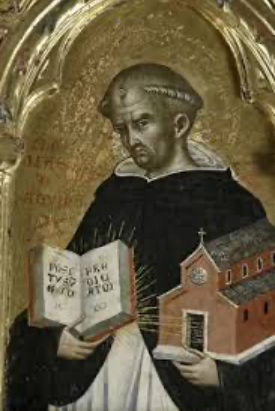
- Shun or incorporate Aristotle?
- Francis Bacon (1561-1626)
- Founder of Modern Philosophy
- Need an updated Aristotle and therefore updated understand of logic. And Bacon did that.
- Moderns are on a ship sailing out from between two pillars, Greco- Roman and Judeo- Christian traditions and going out into the world, what will we build? - Book: The Great Instauration proposes revolutionary method for scientific investigation.
- ”Being convinced that the human intellect makes its own difficulties.”
- Nature of things and mind of man. What is nature of that intercourse?
- Knowledge is most important thing on earth.
- Past is filled with mistakes.
- ”The entire fabric of human reason which we employ in the inquisition of nature is badly put together and built up, and life some magnificent structure without any foundation. There is but one course left, therefore try the whole thing anew upon a better plan.”
- Greco-Roman and Judeo-Christian—scrape both and start new
- Collecting natural facts and experimentation
- No one true book; turn away from books. Look at nature for yourself.
- ”Philosophy and the sciences may no longer float in air, but rest on the solid foundation of experience of every kind.”
- ”It seems to me that men do not rightly understand either their store or their strength. But overrate the one and underrate the other.”
- Bacon is saying that people overrate the knowledge in libraries and underrate their own abilities, thinking how could they be as smart as Plato, St. Augustine, or Cicero. Get that out of your mind.
- ”For let a man look carefully into all that variety of books with which the arts and sciences abound, he will find everywhere endless repetitions of the same thing.”
- People just passed on previous generations knowledge to the next generation.
- Philosophers vs. Mechanical arts
- Mechanical arts are focused on the natural words and naturally improve by experimentation. Philosophy stagnates, people stop thinking for themselves.
- Need more people that think for themself
- Intellectual liberty, not under the tutelage or bondage of some text.
- Observations must be tested.
- Empiricism
- Tools need to be invented that improve human senses
- Methodological principle: Need many examples and lots of facts and work the way up to principles
- Stick to the facts and work your way up
- Logic Fallacies
- People love to argue to argue, just win the argument
- Pleadings of Antiquity
- Assumptions of Authority
- Viel of Obscurity
- Open to being criticized
- ”I have established forever a true and lawful marriage between the empirical and the rational faculty. The unkind and ill-starred divorce and separation of which has thrown into confusion all the affairs of the human family.”
- Division in Philosophy: Knowledge based on senses (Empirical) vs. Logic is a function of our rational capacity (abstractions, universal principles, big picture, math) (rationalists).
- Bacon was correct and even prescient for the future
- Knowledge is not an end in itself. It’s to benefit life. Powerful tool
- Intellectual tools need to be created
- Logic
- Need to do things with it
- Not to win an argument
- Syllogism: Two premises and a conclusion
- 256 ways to do syllogistic logic, only 24 are valid.
- Syllogistic logic largely due to Aristotle.
- Syllogism = Deductive Argument
- Logic
- Inductive Reasoning (Bacon’s introduction)
- General principles can be manipulated and not well grounded
- Break things down in their variables
- Cautious in getting to generalizations
- All of knowledge must come through the senses
- We will obey and at the same time command nature
ChatGPT Summary
The Birth of the Modern: A Shift Around 1500
The lecture frames 1500 as the beginning of the modern world—a time of revolutions in exploration, science, art, politics, and religion. While no direct philosophical quotes are used to define “the modern,” the lecture sets the stage for Bacon’s contribution to this transformation.
Francis Bacon: The Father of Modern Philosophy
Bacon’s central project is a complete reconstruction of knowledge based on observation and experimentation, rejecting passive reverence for tradition.
“There is but one course left, therefore, to try the whole thing anew upon a better plan.”
“To commence a total reconstruction of sciences, arts, and all human knowledge, raised upon the proper foundations.”
The Flaws of Past Knowledge and Methods
Bacon argues that existing systems of thought—both religious and philosophical—are flawed because they rest on uncritical assumptions, repetition, and authority rather than experience.
“The entire fabric of human reason which we employ in the inquisition of nature is badly put together and built up like some magnificent structure without any foundation.”
“Let a man look carefully into all that variety of books with which the arts and sciences abound, he will find everywhere endless repetitions of the same thing.”
“For its value and utility, it must be plainly avowed that the wisdom which we have derived principally from the Greeks is but like the boyhood of knowledge… it can talk, but it cannot generate.”
“Philosophy and the intellectual sciences, on the contrary, stand like statues, worshipped and celebrated, but not moved or advanced.”
The Role of Experience and the Empirical Method
Bacon argues that knowledge must be built from careful observation of nature—not from abstract reasoning or books.
“Follow his example… in taking order for the collecting and perfecting of a natural and experimental history.”
“Unencumbered with literature and book-learning.”
“Philosophy and the sciences may no longer float in air but rest on the solid foundation of experience of every kind.”
“The state of knowledge is not prosperous nor greatly advancing… A way must be opened for the human understanding entirely different from any hitherto known.”
Skepticism Toward Authority and Reverence
Bacon warns against idolizing tradition or past thinkers:
“Men have once made over their judgments to others’ keeping.”
“They overrate the one [the store of past knowledge] and underrate the other [their own strength].”
The Need for New Tools and Logic (New Organon)
Bacon proposes a new kind of logic—inductive reasoning—as the true path to discovery.
“Mine differs from [traditional logic]… in the end aimed at, in the order of demonstration, and in the starting point.”
“We are not trying to just overcome an opponent in argument, but to command nature in action.”
“The ordinary logic, almost all the work is spent about the syllogism… I reject demonstrations by syllogism as acting too confusedly, and letting nature slip out of its hands.”
“In dealing with the nature of things, I use induction throughout.”
“Now my plan is to proceed regularly and gradually from one axiom to another, so that the most general are not reached till the last.”
“What the sciences stand in need of is a form of induction which shall analyze experience and take it to pieces.”
Empiricism, Human Limitations, and the Senses
Bacon acknowledges the limits of the human mind and the senses but insists they can be improved through tools and critical awareness.
“The logic which has been received is not nearly subtle enough to deal with nature.”
“Our steps must be guided by a clue, and the whole way from the very first perception of the senses must be laid out upon a sure plan.”
“But as in former ages, when men sailed only by the observation of the stars… before the ocean could be traversed and the new world discovered, the use of the mariner’s needle had to be found out.”
“Before we can reach the remoter and more hidden parts of nature, it is necessary that a more perfect use and application of the human mind and intellect be introduced.”
The ‘Idols of the Mind’
Bacon identifies internal psychological errors that distort perception and reasoning:
“The senses deceive; and at the same time, they supply the means of discovering their own errors.”
“The minds of men are strangely possessed and beset so that there is no true, even surface left to reflect the genuine rays of things.”
Humility and Openness in Philosophy
“If in anything I have been either too credulous, or too little awake and attentive… nevertheless, I so present things naked and open that my errors may be marked.”
The Marriage of Empiricism and Rationalism
“I have established forever a true and lawful marriage between the empirical and the rational faculty.”
“The unkind and ill-starred divorce and separation of which has thrown into confusion all the affairs of the human family.”
Purpose of Knowledge
“That they consider what are the true ends of knowledge… not for pleasure of the mind, nor for contention, nor for superiority to others… but for the benefit and use of life.”
“Knowledge is power.”
Key Aphorisms from the Novum Organum
“Man being the servant and interpreter of nature.”
“Neither the naked hand nor the understanding left to itself can effect much.”
“It is by instruments and helps that the work is done, which are as much wanted for the understanding as for the hand.”
“Nature to be commanded must be obeyed.”
“The sciences we now possess are merely systems for the nice ordering and setting forth of things already invented… not yet methods for inventions or directions for new works.”
2: Radical Doubt (Rene Descartes)
- Andreas Vesalius (1543)
- Fabric of the Human Body
- Heart is just a pump
- Controversy
- Demystification of the human being to a materialistic, physicalisitic, mechanical understanding
- Thomas Hobbes (1588-1679)
- ”For seeing life is but a motion of limbs, the beginning whereof is in some principle part within; why may we not say, that all automata (engines that move themselves by springs and wheels as doth a watch) have an artificial life? For what is the heart, but a spring; and the nerves, but so many strings; and the joints, but so many wheels, giving motion to the whole world?”
- Can explain entirety of the human being in, what it is to be alive, in materialistic terms.
- The Galileo Affair
- Claudius Ptolemy (C.100-C.170)
- Earth at Center of Universe, circle
- Nicolaus Copernicus (1473-1543)
- Decenter the earth, put it as a satellite off to the side
- Ellipse, world “less” perfect
- Galileo’s discovery of Jupiter’s moons in 1610 revolutionized our understanding of the cosmos.
- He’s in hot water now theologically, means in the system has more than 7 objects. “Seven stars” Revelation 3:1
- Codex of 1616: Censorship from the Church, proclaims Earth at the center of the Universe.
- At time Church is a religious authority and a political authority.
- Galileo is put on trial and recanted publicly. House arrest.
- Claudius Ptolemy (C.100-C.170)
- Rene Descartes (1596-1650)
- Father of modern philosophy
- Born into time of major intellectual thrust
- Friendly to science and some elements of traditional religion.
- Needs to get out of religious France to pursue his work freely. Went to Holland.
- Book: Meditations
- Founding Text of Modern Philosophy
- Rationalist (Descartes) vs. Empiricist (Bacon)
- Most influential text for Rationalist Philosophy
- First person form start
- Need foundation for sciences
- Senses sometimes mislead us
- “And it is the part of prudence not to place absolute confidence in that by which we have even once been deceived.
- Truth things but absolutely certain things
- Certainty might be impossible
- Book: Meditations II
- Can I find one thing that is absolutely certain to build upon?
- All things I see are false
- Fictions of the mind
- “There is absolutely nothing certain”
- What is this “I” I’m talking about?
- As long as the “I” is thinking that it exists
- We know we exist when we are thinking
- Certainty: I exist
- “I think therefore I exist”
- Foundation for knowledge is now, not God, it’s self.
- Can I get to existence to a God?
- Book: Meditations III
- Me first, then God, and see whats after that
- Empiricists
- Would start with Nature first, then myself, and argue way existence of God
- Proof: Existence of God
- You have to have actual something real to make something real
- Impossible to make up the idea of a perfect God because I’m an imperfect being
- The less can’t create the more
- I exist, and there is a perfect God.
- important stuff:
- Descartes’ method of doubt
- the establishment of his own existence
- the prior certainty of the self
- prior certainty of consciousness
- argument for the existence of God.
- Descartes is launching his philosophy in a modern way
- Ambitious
ChatGPT Summary
Absolutely — here’s a breakdown of the main ideas and arguments from the lecture, without just focusing on quotes, but still integrating the most important ones. The goal here is to lay out what Descartes is doing and why, and how this fits into the broader intellectual context of modern philosophy.
🔎 The Central Philosophical Question
“What do I really know?”
This is the foundational question of modern philosophy — one that Descartes places at the heart of his work. The goal is to find knowledge that is absolutely certain, not just probable or widely accepted.
🌍 Intellectual Context: 1500s–1600s
- Descartes was born into a time of upheaval—scientific, religious, and intellectual.
- The Scientific Revolution (e.g., Vesalius in anatomy, Copernicus and Galileo in astronomy) was undermining traditional views of the world and the human soul.
- New discoveries in anatomy suggested the body was just a machine, raising doubts about the soul, spirit, and divine purpose.
- The authority of the Church was under pressure; it tried to suppress scientific discoveries (e.g., Galileo was censored and placed under house arrest).
🧪 Descartes’ Dilemma
- Descartes supports both science and religion, but sees the tension between them.
- He wants to reconcile the mechanical worldview of science with the idea of a rational, benevolent God.
- He concludes that the best way to do this is to start from scratch—rebuild knowledge from the ground up, using reason alone.
🧠 Descartes’ Method: Radical Doubt
1. Doubt Everything That Can Be Doubted
- Descartes begins by systematically doubting all his beliefs to find those that are absolutely certain.
- The senses are unreliable: they can deceive (e.g., optical illusions, dreams).
- Even mathematical truths could be doubted if there’s a powerful being (an “evil demon”) deceiving us.
2. Why Doubt So Deeply?
- Descartes isn’t just being skeptical for its own sake.
- He wants certainty—a foundation that can’t be shaken.
- This is sometimes called the “hyperbolic doubt” approach.
🧍♂️ The First Certainty: The Self Exists
- In Meditation II, Descartes realizes that even if everything is a deception, he cannot doubt that he himself exists as a thinking being.
- The act of doubt is itself a form of thinking, and thinking requires a thinker.
- Hence: “Cogito, ergo sum” – I think, therefore I am.
- This is the first indubitable truth, the starting point of all further knowledge.
🧱 Foundational Move in Modern Philosophy
- Descartes inverts the old philosophical order:
- Instead of beginning with God → world → self (as in theology)
- Or with world → self → God (as in empiricism)
- He starts with the self → then argues for God → then rebuilds knowledge about the world
- This shift to starting with the subjective, conscious self is what makes Descartes a founder of modern philosophy.
✝️ The Proof of God
- Descartes argues that within his mind is the idea of a perfect being (God).
- Since he himself is imperfect, he could not have invented the idea of perfection.
- Therefore, a perfect being must exist to be the source of that idea.
- This move is crucial because:
- If a perfect, non-deceptive God exists…
- Then God would not allow Descartes to be systematically deceived.
- Therefore, his reasoning faculties are trustworthy, and he can begin to rebuild knowledge of the world.
🔧 God as the Guarantor of Truth
- Without a good God, even math and logic could be suspect (because the evil demon could be deceiving him).
- But with God established as perfect and non-deceptive:
- Descartes can now trust clear and distinct ideas.
- He can begin to trust the senses when used carefully.
- He can start to rebuild science and knowledge of the external world.
🧱 Rebuilding Knowledge
- From the certainty of the self and the existence of God, Descartes can eventually:
- Prove the existence of the body
- Establish the reality of the external world
- Validate the use of reason and the scientific method
🚨 Importance of Descartes’ Project
- Descartes believes existing traditions and authorities are unreliable.
- He seeks to rebuild all of human knowledge on solid ground.
- This mirrors Francis Bacon’s scientific ambition, but while Bacon emphasizes empiricism, Descartes takes the path of rationalism.
🔁 Summary of the Meditations So Far
- Meditation I: Everything can be doubted—senses, body, world, even math.
- Meditation II: One thing is certain—I think, therefore I am.
- Meditation III: From that foundation, Descartes proves the existence of a perfect, non-deceiving God, which restores the trustworthiness of reason.
🧭 Why This Is “Modern” Philosophy
- Starts from the individual mind (the “I”)
- Rejects inherited beliefs unless justified by reason
- Emphasizes self-critical thinking and systematic skepticism
- Lays the groundwork for rationalism, influencing later thinkers like Spinoza and Leibniz
- Sets the stage for empiricist responses (Locke, Hume, etc.), leading to a major division in modern philosophy
3: The Promise of Individual Empiricism (John Locke)
- Individual
- Baconian empiricism
- 1688: John Locke returning to England
- Intellectual independence in Holland
- Thinking for yourself gaining strength
- If you are dogmatic, you are not religious
- God wants us to use our cognitive tools, science, logic, reason
- John Milton
- Men need to be governed by reason
- Thinking citizens
- John Locke in Amsterdam
- Ran afoul of bad religion and bad politics
- Henry VIII
- Six marriages
- Needed male heir due to previous civil wars
- Splits church off from Rome due to Spanish king controlling Pope and tell him no for second marriage
- William Tyndale
- Translated Bible into English
- People need to read scripture for themselves
- Hunted and executed
- Elizabeth I
- Oliver Cromwell
- English Civil War
- King killed in England, Charles I in 1649
- Censorship of theaters
- Above was John Locke’s youth
- How to get past religious wars? Be more rational, reasonable
- Charles II
- Restoration of Monarchy
- 1688: Glorious Revolution
- No blood shed
- James II—told to go away
- Parliament ascendent
- Act of Toleration 1689
- Religious Freedom
- Isaac Newton just published Principia Mathematica in 1687
- John Locke returns from Amsterdam in 1688 to England and publishes
- Book: An Essay Concerning Human Understanding
- Knowledge
- 20 printings in 10 years: Grand best sellers
- “Men must think and know for themselves…not that I want a due respect to other men’s opinions; but, after all, the greatest reverence is due to truth. We should make greater progress in the discovery of rational and contemplative knowledge, if we sought it in the fountain, in the consideration of things themselves.”
- What do I really know?
- Use your own mind and eyes not other people’s.
- Parroting vs knowing
- “Aristotle was certainly a knowing man, but nobody ever thought him so because he blindly embraced or confidently vented the opinions of another.” “In the sciences every one has so much as he really knows and comprehends. What he believes only, and takes upon trust, are but shreds.”
- Strongly Cartesian on the confidence element and respect to the empirical basis, very Baconian.
- Metaphysical
- Materialism vs Dualism
- “I don’t know”
- Isaac Newton said the same
- Religious tolerance a new idea
- But the intellectual development of the arguments, the political theory and the religious theory and the philosophical underpinnings for both of them that are going to support a principled advocacy of toleration, that’s what John Locke is trying to support here.
- “if he be destitute of charity, meekness, and goodwill in general towards all mankind, even to those who are not Christians, he certainly is yet short of being a true Christian himself.”
- “Whoever will list himself under the banner of Christ must, in the first place, above all things, make war upon his own lusts and vices.”
- Get your own house in order before looking at others
- Force in religion should be abolished
- In politics, leave religion out
- If you go to a certain church because your parents went to a certain church, that is not religion. You must choose the light, voluntary.
- Free entry and free exit
- Individual self-responsibility on religious matters
- “No force is here to be made use of upon any occasion whatsoever. Force belongs wholly to the civil magistrate.”
- Toleration of other religions
- Politics with religious advisors just turns into politics using religion as a tool
- How far does toleration extend?
- But not for Catholics—their highest allegiance is to Rome, the Pope. Divided allegiance, another country.
- Not atheists—can’t trust them as they can’t swear on the Bible
- Right of Revolution
- Citizens have the right to rebel against unjust rulers
- Power comes from the bottom up
- Influenced Founding Fathers
- Influenced Voltaire
ChatGPT Summary
Here’s a breakdown of the main ideas and arguments in the lecture “The Promise of Individual Empiricism”, centered on John Locke, his historical context, and the philosophical foundations of modern liberal thought. This summary goes well beyond just quoting Locke or others—it’s organized to clearly present the core themes, concepts, and arguments from the lecture.
🧠 1. Individual Empiricism: The Core Concept
- The term “individual empiricism” emphasizes that each person must rely on their own experience, observation, and reason to form beliefs.
- Locke builds on Francis Bacon’s empiricism and responds to Descartes’ rationalism, blending empiricism with individual autonomy.
- The lecture positions Locke as a major figure carrying forward the early modern project of liberating the mind from authoritarian tradition, both in religion and politics.
🌍 2. Locke’s Life and Intellectual Context
- In 1688, Locke returns from exile in Amsterdam, a haven for intellectuals due to its tolerance.
- Amsterdam becomes a hub for free-thinking Europeans, where people like Locke, Descartes (earlier), and Spinoza found the space to think independently.
- Locke returns to England during the Glorious Revolution, a peaceful political transformation that aligns with his ideals of limited government and religious toleration.
🔥 3. Political and Religious Background
- The lecture traces English history to explain the context Locke was responding to:
- Henry VIII: Breaks with Catholic Church for political reasons (divorce), showing how religion is manipulated by power.
- Religious Civil Wars: Result in authoritarian religious regimes, theater closures, and censorship (e.g., during Cromwell’s rule).
- Locke’s world was one of religious chaos, violence, and competing claims of truth enforced by power.
💡 4. Foundations of Modern Individualism
Quotations and arguments from Locke (and others like Galileo, Milton, and Newton) show a shift from obedience to authority to self-responsibility in knowing:
- Galileo: God gave us reason and senses to use them; refusing to do so is a betrayal of faith.
- Milton: The “double tyranny” of external custom and internal passion must be resisted by reason.
- Descartes (quoted): Writes in French to promote accessible philosophy for thinking individuals—not just elites.
📚 5. Locke’s Essay Concerning Human Understanding (1690)
- The major philosophical work Locke was preparing in exile.
- Focuses on epistemology: What do we really know?
- Knowledge comes from experience: all ideas come from either sensation (external observation) or reflection (internal mental activity).
- Against reliance on authority or tradition:
“We may as rationally hope to see with other men’s eyes as to know by other men’s understandings.”
🧍 6. The Soul, the Body, and Materialism
- Locke responds to the mind-body debate:
“Whether matter may not be made by God to think is more than man can know.”
- He avoids metaphysical dogma—leaves room for possibilities rather than declaring materialism or dualism correct.
- Echoes Newton’s humility: “I frame no hypotheses.” The scientific and philosophical method should not go beyond what can be observed or inferred.
✝️ 7. A Letter Concerning Toleration (1689)
A powerful political-philosophical argument for religious toleration and the separation of church and state. Key ideas:
A. The Church and the State Must Be Separate
- The magistrate (political authority) is only responsible for this-worldly matters: life, liberty, property.
- The soul belongs only to the individual—it cannot be governed by others.
- Religion is inward, based on reason and conscience; force has no effect on true belief.
-
“Faith is not faith without believing.”
-
“No man can abandon the care of his own salvation.”
B. Why Force Is Ineffective and Wrong
- Force can compel words, but not belief.
- Even if beliefs could be forced, that wouldn’t save a soul.
- “Light and evidence” alone change minds.
- Torture or coercion in the name of religion is not charity—it’s benevolent cruelty, which Locke rejects.
🏛️ 8. Political Theory: Consent, Rights, and the Role of Government
- Locke reduces government to protecting civil interests: life, liberty, health, and property.
- Citizens have rights; government exists by their consent.
-
“All civil power… is bounded and confined only to the care of promoting these things.”
- The state should not meddle in religion; it is not capable of guiding souls.
⛪ 9. What Is a Church?
- A church is a voluntary society: people come together by free choice for public worship.
- People are not born into a church; they must freely consent to religious membership.
- Free entry and exit must be protected.
- Excommunication (removal from a church) is legitimate if someone disrupts the group’s worship.
⚠️ 10. Limits of Toleration?
Locke supports very broad toleration—but not unlimited:
Not to be tolerated:
- Catholics (at the time) – Not because of theology, but because they pledge loyalty to a foreign political power (the Pope).
- Atheists – Because, Locke argued, they cannot be trusted to make oaths or contracts (a view now seen as outdated, but important in context).
- Harmful or criminal acts done in the name of religion (e.g., infant sacrifice, violence): these are violations of civil law, not protected religion.
🗽 11. Implications: A Philosophy of Freedom
- Religious toleration is based on the nature of the soul and reason.
- The state should only use force to protect rights—not to control belief.
- The church should focus on voluntary belief and inward persuasion—not external power.
- The separation of church and state is a foundational modern principle, not just political compromise.
🧨 12. Legacy: From Locke to Revolutions
- Locke’s ideas underpin the American founding documents—especially the Declaration of Independence.
- He also influenced Voltaire and the French Enlightenment.
- His writings helped establish the foundations of:
- Liberal democracy
- Constitutional government
- Freedom of conscience
- The right of revolution
Citizens, according to Locke, always retain the right to overthrow unjust rulers.
4: The French Enlightenment (Voltaire)
- 1716: Two women burned for being witches: Last name, Hicks
- Last two.
- Sign of changing time
- Into modernity
- What the idea of Justice is is changing
- Modernizing Justice
- Premodern: God was the source of Justice
- Eye for an eye (Exodus)
- Harsher typically prevailed
- God will do the revenge, not humans (Romans)
- Trial by Ordeal
- Dangerous tests to see if their innocent: “If God allows this person to be harmed, their guilty”
- Ex: Burning, repeated dunking
- Dangerous tests to see if their innocent: “If God allows this person to be harmed, their guilty”
- Benevolent Torture
- St. Augustine
- Concept where inflicting pain or suffering is justified by the belief that it serves a greater good; dating back to the early days of Christianity as the Roman Empire was declining.
- Decenter’s treated harshly
- “It’s putting a very high price on one’s conjectures.” Your conjectures, you think, really are worth a lot, but notice he uses the word conjectures. These are not truths that we know for sure. They’re just your conjectures with respect to religion. “To have a man roasted alive because of them.” -Michel de Montaigne
- What is the logic? What is the rational way of administering justice?
- Presumption of Guilt? Original sin
- Understanding of Human Nature: If you believe people are born good or bad, or neutral at birth. So a philosophical view of human nature, combined with epistemological standards of evidence and proof, are reworking the justice system in the modern world.
- What is Law Based On?
- Revelation?
- Tradition?
- Power?
- Reason?
- Premodern: God was the source of Justice
- How do we even conceive of God himself?
- Personality? Strong ideas and actively engaging in the world?
- More rational being. Deism
- Scientific God, creating the world but doesn’t intervene.
- Agnosticism
- “Question with boldness, even the existence of God , because, if there be one, he must more approve of the homage of reason than that of blindfolded fear.” -Thomas Jefferson
- God doesn’t want fearful conformist believers
- Voltaire
- Gifted with words
- proto full Enlightenment thinker
- Time period
- Censorship in France
- Came under suspicion
- Attacked, with names, people directly
- Challenged aristocracy to a duel and was refused and sent to exile in England
- Book: Letters Concerning the English Nation
- Quakers
- Wants to push Locke’s Letters of Toleration
- Pushing rational Individual understanding of religion, toleration of religion
- Quakers were about equality, pacifism, commitment to social justice
- Opposite of high church Catholicism in France
- Letters were conversations, interviews
- Against Baptism, similar to Locke, that you have to reason yourself into religion instead of by family tradition
- Sounds like a good guy, so why would Catholics be prosecuting them?
- No Hierarchy
- Women are equal
- William Penn, went to America, established Pennsylvania
- Presbyterians
- Separates business from religion
- Religious diversity creates peace in England, much better than France at handling religion
- Learn from history as empiricists, take lessons from the past
- The Magna Carta: How England slowly became modern and created equality
- Everyone pays taxes in England and one body adjudicates those taxes
- Inoculation
- Smallpox
- English doing it and working
- English learned it from Circassians, who learned it from Chinese
- People can learn from other civilizations, be cosmopolitan
- Who was the greatest man in history?
- Sir Issac Newton
- “If true greatness consists in having received from heaven a mighty genius and in having employed it to enlighten our own mind and that of others.” He enlightened us in a most important way, opening the doors to understanding nature in a brilliant way and developing new mathematical tools, including the calculus, for us to do so.
- Bacon, Locke & Newton (Voltaire’s list)
- Sir Issac Newton
- Quakers
- Voltaire return to France for the French Enlightenment
- Denis Diderot & Jean Le Rond D’alembert
- Encyclopedia
- Baconian idea that knowledge should be used and practical
- Improving human condition; for all to read
- How to build things and do things as well
- Dedicated to Bacon, Locke and Newton
- Cosmopolitanism
- Learning from other cultures
- Montaigne
- On cannibals
- What we do seem bizarre to them as well
- Are we really the height of civilization?
- On cannibals
- Montesquieu
- Persian Letters
- Diderot
- Bougainville’s voyage
- Shakespeare
- Othello
- 1700s: Self consciousness that something great has happened
- Learning from the problems of the past
- Symptom: Mass Ignorance
- Cause: Intellectual authoritarianism
- Solutions: Individual reason, literacy, education
- Guarding knowledge
- Learning from the problems of the past
- Enlightenment says most people have the capacity to learn and reason
- Offensive against intellectual authoritarians
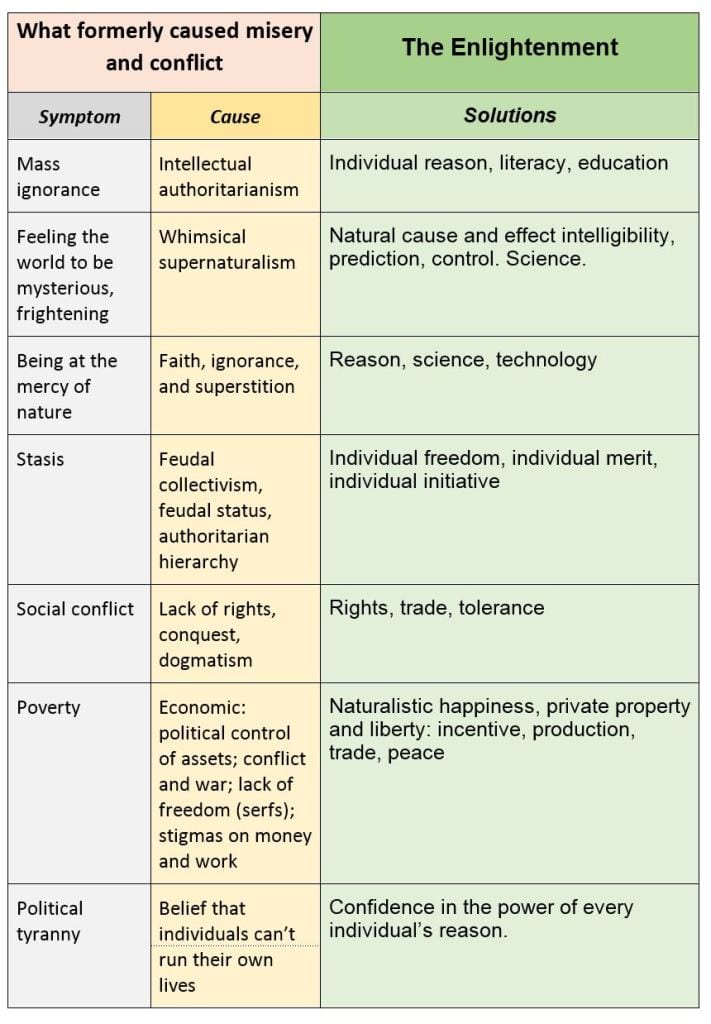
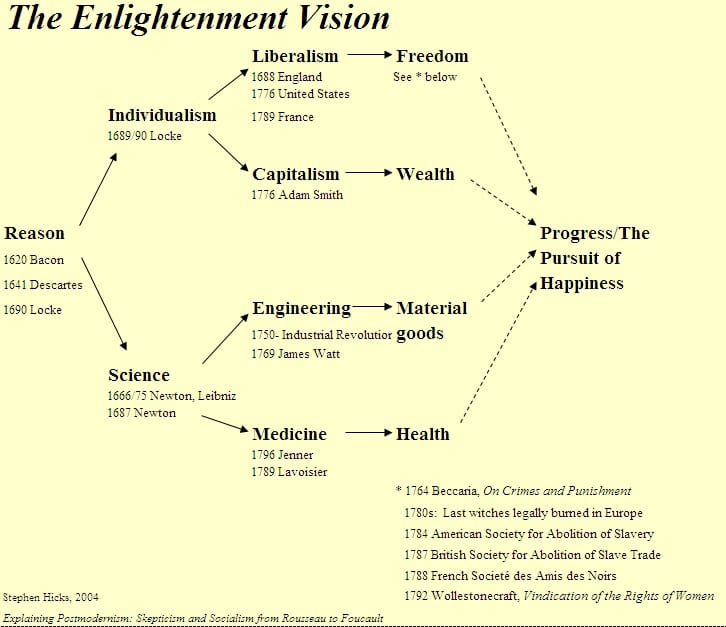
- Now, this is what I call the Enlightenment vision that came to be articulated as we get into the 1700s and the Age of Enlightenment. It’s not to mean that these are the only causal arrows at work. There’s lots of interplay here, but the basic notion is, first and foremost, in the modern world, there was an intellectual revolution. We know the names Bacon, Descartes, and Locke. They disagree with each other on some issues, of course, but all of them are opposed to any sort of intellectual authoritarianism or intellectual elitism. Every human being has the capacity of reason. How that reason works, they differ amongst themselves, of course. But to the extent that you win that debate, knowledge is not revelation, knowledge is not faith, knowledge is not tradition, knowledge is acquired by reason. That is a game-changer.
- If you emphasize that reason is able to successfully study the natural world, then the scientific project starts to become intellectually understood and put into practice. You then start to see, over the course of the 1600s, 1700s, physics, astronomy, chemistry, increasingly coming on board as real sciences. You take those sciences and you apply them to, that scientific mindset, to machinery, then you are generating an increasing age of invention. It’s then not accidental that, by the time we get to the 1750s, we have the Industrial Revolution starting to take off, again, first in England, where these ideas had first put into practice. If also you emphasize science and a scientific way of thinking about things, and you apply it to the human being, we are a natural being, then you are going to be much more observant, much more distrustful of old traditions, much more experimental, using various new technologies to apply to medicine, and you’re going to see the modernization of medicine. And that does come on board in the 1700s.
ChatGPT Summary
Here’s a thorough summary and analysis of the lecture you provided. It centers on the rise of Enlightenment thinking, especially in France, and the philosophical transformation in ideas about justice, religion, knowledge, and human nature—culminating in the work of Voltaire and the French philosophes.
🔥 Main Themes of the Lecture
1. Transition to Modernity and Enlightenment
- The story begins in 1716, with the last witch burnings in England—a symbolic marker of the end of medieval superstition and a move into modern rationality.
- Enlightenment is about moving from religious dogma and authority to reason, evidence, and individual responsibility.
- One key area of transformation: justice.
⚖️ Justice: From Divine to Rational
- Traditional Justice: Rooted in divine authority; examples include biblical laws (eye for an eye) and trials by ordeal (e.g., holding red-hot iron).
- Justice was historically brutal, arbitrary, and often administered through superstition or authoritarian power (e.g., torture justified as “benevolent” to save souls).
- Augustine’s Doctrine of Benevolent Torture: Rooted in religious exclusivism—torture was a way to bring people to salvation.
- Montaigne and others began questioning the morality and logic of such practices, planting seeds of modern doubt.
➤ Enlightenment Shift:
- Justice becomes secular, procedural, and grounded in reason and evidence.
- Key innovations:
- Presumption of innocence rather than guilt.
- Burden of proof on the accuser, not the accused.
- Standards like “reasonable doubt”.
- These principles reflect new views of human nature:
- If people are naturally evil → presumption of guilt.
- If people are naturally good or blank slates (Locke’s tabula rasa) → presumption of innocence.
🧠 Sources of Justice: Four Theories
- Divine Revelation (Traditional view).
- Tradition (Inherited wisdom).
- Might is Right (Justice is whatever the king says).
- Reason and Evidence (Modern Enlightenment view).
👁️🗨️ God: From Theism to Deism to Agnosticism
- Traditional Theism: God as emotional, intervening, and law-giving.
- Deism: Enlightenment thinkers began to imagine God as a rational designer, like a clockmaker—creates the universe, sets its laws, and steps back.
- Agnosticism: Some, like Jefferson, argue that belief must be based on reason—not blind faith or fear.
📚 Voltaire: French Enlightenment Begins
- Voltaire (pen name) is presented as the leading figure of the French Enlightenment.
- He opposed religious and political authoritarianism, favored reason, freedom of expression, and tolerance.
- Censored in France, he was exiled to England, where he absorbed the ideas of Locke, Newton, Bacon, and admired the English model of toleration and constitutionalism.
🇬🇧 Voltaire’s Letters from England
Religion: Focus on the Quakers
- Voltaire highlights the Quakers for their:
- Simplicity, egalitarianism, and personal religious experience.
- Rejection of rituals, hierarchy, and dogma.
- Tolerant, peaceful, pacifist way of life.
- Voltaire uses irony: posing as a shocked Frenchman to contrast rational Quaker beliefs with French Catholicism.
- The goal: To criticize authoritarian religion in France by holding up English religious diversity and tolerance as a model.
Commerce and Toleration:
- The London Stock Exchange symbolizes:
- Tolerance in action: people of different faiths trading peacefully.
- Practical cooperation across religious lines.
- Religion becomes private, separated from politics and commerce.
Politics:
- England succeeded in transitioning to a limited constitutional monarchy after civil war.
- Voltaire sees liberty, equality before the law, and tolerance as products of England’s successful political evolution.
💉 Science and Progress
- Letter on inoculation: Voltaire praises how the English adopted a method to reduce smallpox fatalities.
- Emphasizes learning from other cultures (Circassians, Chinese), a cosmopolitan mindset.
- Science and empirical observation improve human lives.
👑 Heroes of History
- Voltaire challenges traditional heroic models (conquerors, kings, saints).
- Proposes Newton, Locke, and Bacon as true heroes—for advancing knowledge and human understanding.
- This is a philosophical redefinition of greatness: from power to enlightenment.
📖 The Encyclopédie: Diderot & d’Alembert
- Inspired by Voltaire and Enlightenment ideals.
- A massive intellectual project (1750s–1770s) to compile all human knowledge.
- Goal: Democratize knowledge, empower ordinary citizens, and combat ignorance.
- Covers science, philosophy, religion, trades, etc., with diagrams and accessible writing.
- Dedicated to Bacon, Locke, and Newton—an acknowledgment of English influence on the French Enlightenment.
🌍 Cosmopolitanism
- Enlightenment thinkers began learning from other cultures:
- Montaigne on cannibals: even “savages” can reveal our own barbarism.
- Montesquieu’s Persian Letters and Diderot’s Supplement to Bougainville’s Voyage explore non-European ways of life.
- Key Idea: We must compare cultures scientifically, avoid ethnocentrism, and be willing to adopt better practices.
💡 What Makes the Enlightenment an Enlightenment?
- Commitment to reason over authority.
- Scientific method applied to society, politics, and morality.
- Belief in progress, education, and human perfectibility.
- Activism against oppression (religious, political, intellectual).
- Vision of a future where free individuals live under self-chosen laws, guided by reason, not fear or dogma.
🔥 Radical Enlightenment Slogans
- Voltaire: “Écrasez l’infâme!” (“Crush the infamous thing”—meaning authoritarian religion).
- Diderot: “Men will not be free until the last king is strangled with the entrails of the last priest.”
🌞 The Enlightenment Vision (as described in the lecture’s chart):
- Reason → Science → Technology → Industrial Revolution
- Reason → Individualism → Liberal Democracy & Capitalism
- Reason + Education → Mass literacy & empowerment
- Goal: Progress, happiness, liberty, and the end of superstition and tyranny
🧠 Summary in One Sentence
The French Enlightenment, led by thinkers like Voltaire, marked a radical shift from tradition, authority, and superstition toward reason, science, toleration, and individual liberty—laying the intellectual foundation for modern secular democracy and justice.
5: Counter-Enlightenment (Jean-Jacques Rousseau)
- 1789: French Revolution
- Voltaire vs. Rousseau
- hated each other
- Exchanges of letters over the years
- French History
- Centralized monarchy
- Power struggle
- Monarchy vs Aristocrats
- Monarchy starts to weaken 1750s
- Three Estates: Aristocracy, Church, Commoners
- Three Phases
- Aristocrats gathered to hold discussion with King Louis XVI
- Ideological movement, not class based movements. Aristocrats were Enlightenment followers
- Church and commoners were Enlightenment followers
- Liberal phase: Shift from Class Movement to broader Ideological Force
- Declaration of the Rights of Man and the Citizen
- Status of French citizens, universal rights for all citizens.
- Not a subject of the King
- Written byLafayette
- “Hero of Two Worlds”
- Worked with George Washington militarily
- Rights of Women
- Olympe de Gouges
- ‘Natural rights’
- Declaration of the Rights of Man and the Citizen
- Jacobins Dominate
- Advocating Republicanism and orchestrating the Right of Terror
- Guillotine
- Mass terror
- Disciples of Rousseau
- Aristocrats gathered to hold discussion with King Louis XVI
- Jean-Jacques Rousseau
- Opposed to every single concept of the Enlightenment
- Not a conservative, doesn’t want to go back to good old days
- Against Civilization
- “Princes always view with pleasure the spread among their subjects of a taste for the arts. The sciences, letters, and arts cover with garlands of flowers the iron chains that bind them, stifle in them the feeling of that original liberty for which they seem to have been born, make them love their slavery, and turn them into what is called a civilized people.”
- Against Freedom of the Press
- “Consider the awful disorders printing has already caused in Europe. And judging by the future, by the progress that this evil makes day by day, one can easily predict that sovereigns will not delay in taking as many pains to banish this terrible art from their states as they once took to establish it.”
- “Hasten to tear down these amphitheaters, break these marble statues, burn these paintings, chase out these slaves who subjugate you and whose fatal arts corrupt you.”
- Against Reason
- “Reason is what engenders egocentrism, and reflection strengthens it.”
- “Reason is what turns man in upon himself. Reason is what separates him from all that troubles him and afflicts him. Philosophy is what isolates him and moves him to say, in secret, at the sight of a suffering man, ‘Perish, if you will. I am safe and sound.’”
- Against Property Rights
- “The first person who, having enclosed a plot of land, took it into his head to say, ‘This is mine,’ and found people simple enough to believe him, was the true founder of civil society.” Now, that’s interesting. So he is agreeing that the foundation of civilization is respect for property rights. And that, of course, is what the liberals and the capitalists are arguing. And then, Rousseau rhetorically loves to turn that into its opposite. “What crimes, wars, murders, what miseries and horrors would the human race have been spared, had someone pulled up the stakes or filled in the ditch,” or whatever the property line marking was, “and cried out to his fellow men, ‘Do not listen to this impostor. You are lost if you forget’ —and now we start to get an indication of the positive replacement doctrine—‘the fruits of the earth belong to all, and the earth to no one.’”
- Advocate of Feeling and Faith
- “I have suffered too much in this life not to look forward to another. The subtleties of metaphysics may increase my sorrows, but they cannot shake my faith in the immortality of the soul.”
- Religion is a politically useful tool
- “behaves as if he does not believe them, let him be punished by death.” So, death penalty for disbelieving in the new state religion.
- Drafted Constitution for Corsica
- “I joined myself”—this is what it will be to join the Corsican nation—“body, goods, will, and all my powers to the Corsican nation, granting her ownership of me, of myself and all who depend upon me.” This again, politically, is the direct opposite of an Enlightenment Declaration of Independence notion of rights to life, individually, to life, liberty, and the pursuit of happiness. So what we’d find, of course, is Rousseau is advocating religion. He’s advocating a kind of authoritarianism, but it’s not a conservative, old-fashioned feudal authoritarianism. It’s going to be communalist, collectivist, small “S” socialist.
- David Hume
- 1765: Hume and Rousseau meet
- Metaphysical and epistemological contributions to Counter-Enlightenment
- Empiricist
- Sensationalism: Importance of sensory experiences and perceptions in forming knowledge and understanding
- Names are just collections of sensations
- Nominalism: Against general abstractions, conceptionalism
- Name: You must specify the sensation
- Strongly skeptical
- Cause and Effect
- Subjectively adding the impression
- Skeptical
- Identity
- Is-Ought Problem
- So we can’t know abstractions. We can’t know identity. We can’t know cause and effect. We can’t know the self. We can’t know, rationally, any moral principles.
- Driven by passion
- So, reason, it seems, can’t get rid of these clouds from these skeptical doubts and so forth. And so what we really ought to do, then, is not try to do philosophy, certainly not try to do rational philosophy. It’s just going to lead us into cold skepticism. Instead, just rely on, the way he puts it here is, natural feelings, and get back to natural life. Don’t be overly concerned with philosophical light. Be merry, hang out with your friends, and so forth.
ChatGPT Summary
Here’s a comprehensive summary of the course lecture on the Counter-Enlightenment, highlighting the main ideas, figures, and philosophical tensions:
🔦 Core Theme
The Counter-Enlightenment emerges as a reaction against the optimism, rationalism, individualism, and liberalism of the Enlightenment. It includes figures who challenge its core assumptions and propose radically different visions of human nature, society, and politics.
🏛️ Historical Anchor: The French Revolution (1789)
- A pivotal event embodying the Enlightenment’s triumph and collapse.
- Initially a power struggle between monarchy and aristocracy.
- Evolves from aristocratic reform ➝ liberal Enlightenment phase ➝ radical Jacobin terror.
Enlightenment Phase:
- Declaration of the Rights of Man and the Citizen: Liberty, equality, universal rights.
- Lafayette (inspired by the American Revolution) helps draft it.
- Early feminism emerges (e.g., Olympe de Gouges).
Jacobin Phase:
- Led by Robespierre, Danton, Marat, Saint-Just—disciples of Rousseau.
- Reign of Terror ensues, signaling a shift from Enlightenment ideals to authoritarian control.
👤 Jean-Jacques Rousseau: Father of the Counter-Enlightenment
Core Opposition: Against Locke, Descartes, Bacon, Voltaire, Enlightenment science and reason.
Rousseau’s Critiques:
- Reason – Isolates, breeds egoism. He favors emotion, sentiment, and faith.
- Civilization – A mask for slavery; modern comforts distract from freedom.
- Property – The origin of inequality; “the fruits of the earth belong to all.”
- Religion – Useful for social control, not truth; instrumental to state power.
- Freedom – True freedom lies in submission to the general will (collectivism).
Positive Vision:
- Radical Collectivism: Individuals are to be remade as part of a communal whole.
- State and Religion fused: Religious belief enforced politically; dissenters may be exiled or executed.
- Human Nature is plastic – shaped by institutions; not fixed or rationally autonomous.
👤 David Hume: Empirical Skepticism
Contributes the epistemological arm of the Counter-Enlightenment.
Hume’s Core Ideas:
-
Radical Empiricism:
- All ideas must trace to sensory impressions.
- Abstract concepts (like “cause,” “self,” “identity”) are not grounded in impressions → thus, meaningless or dubious.
-
Skepticism:
- Against cause and effect, induction, external world, persisting self.
- Even God cannot be known by reason.
- Result: Cold skepticism—reason leads to uncertainty, not certainty.
-
“Is–Ought” Problem:
- Cannot derive moral claims (“ought”) from factual ones (“is”) without smuggling in assumptions.
- Reason alone cannot ground ethics.
-
Passion over Reason:
- “Reason is, and ought only to be, the slave of the passions.”
- We act from emotion, custom, habit—not logic.
Philosophical Impact:
- Undermines both rationalism (Descartes) and empirical optimism (Locke, Bacon).
- Points toward moral subjectivism, epistemic nihilism, and emotional foundations for belief.
🔁 Summary: Three-Front Conflict in the Late 1700s
- Enlightenment Thinkers – Reason, science, liberty, individualism, secularism.
- Counter-Enlightenment – Rousseau (communal authoritarianism, faith), Hume (epistemological skepticism).
- Conservatives – Traditional religion, monarchy, moral order, anti-modernization.
🧭 Preview of What’s Next:
The lecture sets the stage for Immanuel Kant, who seeks to reconcile Enlightenment aspirations with critiques like Hume’s and Rousseau’s—creating a new synthesis in modern philosophy.
6: Awakening from the Dogmatic Slumber (Immanuel Kant)
- Immanuel Kant is either the height of Enlightenment thinking or the serious beginning of Counter-Enligthenment.
- Kant is the greatest philosophers in two centuries. Positive in statue.
- Influenced by Rousseau and Hume
- 1763-1781: Thinking, rethinking, rewriting
- Now, from David Hume, we have this shattered universe. If our project is to save the Enlightenment or to advance the Enlightenment, or see the Enlightenment as having secure foundations, so that science, on those foundations, can proceed more majestically than it already has even, by the 1700s, that’s under threat. If we don’t have these concepts of identity and causality and so forth, if we can’t form meaningful, inductive generalizations, it seems like that whole project is now philosophically unmoored.
- If we cannot rationally justify morality, if we cannot prove the existence of God and, perhaps, give a traditional religious justification for morality, then morality, again, is philosophically unmoored. So how are we going to be able to then rescue the world of science and the world of morality from what seems to be this virulent skepticism from David Hume?
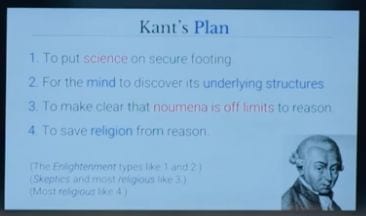
- Book: Critique of Pure Reason
- Wants a Copernican revolution in philosophy
- “I had therefore to deny knowledge in order to make room for faith.”
- “If after elaborate preparations frequently renewed, it is brought to a stop immediately, it nears its goal. If often it is compelled to retrace its step and strike out in some new line of approach, or again, if the various participants are unable to agree in any common plan or procedure, then we may rest assured that it is very far from having entered upon the secure path of a science and is indeed a merely random groping.”
- Philosophy is groping, besides logic by Aristotle and math, not needed to revise, physics
- Metaphysics is groping, pre-scientific
- “A priori” refers to knowledge or reasoning that is independent of experience or observation, derived from principles that are self-evident or inherently true without requiring empirical evidence.
- Take nature where reason wants to go, not the other way around
- Guiding principle of all philosophy? What is knowledge up until now
- “Hitherto, it has been assumed that all our knowledge must conform to objects,”
- Subject has to conform to the object
- Correspondence theory of truth
- They’ve all ended in failure in this objectivist perspective
- “We must therefore make trial, whether we may not have more success in the tasks of metaphysics, if we suppose that the objects must conform to our knowledge.”
- Replace objectivity with subjectivity
- Intuition
- “We can know a priori of things only what we ourselves put into them.”
- Shocking change, recognizes it
- Metaphyics can’t know whats out there ‘numental reality’, but only phenomenal reality which is constituted by our subjective faculties.
- “Our a priori knowledge of reason, namely, that such knowledge has to do only with appearances.”
- “Space and time are only forms of sensible intuition.”
- Thinks there is a real reality out there
- Religion and Morality
- Can’t argue in existence of God in a objectivist view
- And so the point is going to be that, on these three things, that we have an immortal soul, that we have free agency, really, that there really is a God. We can’t know them, but we can think of them as possibilities. They cannot be ruled out, because reasoning and the world of appearances is subject to these limitations. It can only know its own constitution. And therefore we get to the big conclusion. “I have found it necessary to deny knowledge, in order to make room for faith.” I can’t know the noumenal world. I can only know this subjectively constructed world of sensory intuition and reasoning based on the world as it appears to me.
- Opens the door to faith
- “But above all, there is the inestimable benefit, that all objections to morality and religion will be forever silenced. And this, in Socratic fashion,”
- Hugely influential and innovative
- Kant professor in Prussia, which is King William II who is deeply conservative and Enlightenment thinking is not allowed
- Strict regime of censorship
- Or if we think people are going to be rational, and reason is a function of the individual, that’s just going to turn people into themselves, thinking that they are their own gods or demigods or whatever. They can do whatever they want, and it’s going to generate a kind of rampant selfishness in society. And both of those together are going to self-destroy individuals, but also the fabric of society. And the Enlightenment can only lead to conflict, poverty, death, and all sorts of other really bad things. So we need to protect ourselves, our children, and society from the Enlightenment.
- Scared of what happened in French Revolution
- Kant complies with censorship
- Kant is a religious man
- Social and moral need for religion
- Human beings aren’t naturally good
- Eve’s great sin: Disobedience
- Obey independently of punishments and rewards
- ‘categorical imperative’
- Imperative is a command
- Wrong founded morality is hypothetical imperatives, avoiding something else
- Morality is categorical, do it or don’t do it.
- Isaac and Abraham, Bible Story, killing your own son
- Adhere to moral principles that you know the rational yourself; not what another told you.
- “The ground of this principle is rational nature exists as an end in itself.”
- Rousseau education on children influential
- Children
- Kids need to learn obedience, parents need to be strict
Summary
Here’s a comprehensive summary of the main ideas from the lecture on Kant’s Critique of Pure Reason, his philosophical revolution, and its significance:
1. Kant’s Awakening by Hume
- In 1763, Kant read David Hume, which shook him from his “dogmatic slumber.” Until then, he had been philosophizing within traditional frameworks.
- Hume’s radical skepticism—especially about causality and inductive reasoning—made Kant realize the Enlightenment project was philosophically unmoored. If concepts like causality or morality couldn’t be rationally grounded, the foundations of science and ethics were in crisis.
2. The Crisis of Rationalism and Empiricism
- Rationalism (e.g., Descartes) failed to deduce reliable knowledge from reason alone.
- Empiricism (e.g., Hume) led to skepticism: we can’t derive certain knowledge from sense experience.
- Both traditions had hit dead ends.
3. Kant’s Goal: Save Science and Morality
- Kant’s mission: to secure a new foundation for science and to salvage morality and religion from skepticism.
- This required a revolution in philosophy—what he called a Copernican Revolution.
4. The Copernican Revolution in Philosophy
- Traditionally, it was assumed that knowledge must conform to objects—i.e., reality dictates our knowledge.
- Kant reversed this: objects must conform to our knowledge—our mind shapes experience through its own internal structures.
- This shift means we never know things as they are in themselves (noumena), but only as they appear to us (phenomena).
5. Phenomena vs. Noumena
- Phenomenal world: The world as it appears to us, shaped by our mental faculties (space, time, causality).
- Noumenal world: Reality as it is in itself, independent of our experience—unknowable.
- Result: skepticism about ultimate reality, but a stable foundation for scientific knowledge within the phenomenal realm.
6. Science Saved, Metaphysics Recast
- Science, focused on regularities in space and time, is saved because the phenomenal world is structured by us and thus knowable.
- Traditional metaphysics fails because it seeks knowledge of the noumenal realm, which is off-limits.
- We must “deny knowledge to make room for faith.”
7. Room for Morality and Religion
- While we can’t know God, free will, or the soul, we can think them as necessary moral postulates.
- Morality requires freedom; thus, belief in free will (in the noumenal realm) is necessary.
- Kant provides a rational ground for faith—not based on evidence, but on moral necessity.
8. Kant’s Moral Philosophy
- Moral worth lies in acting from duty, not from consequences or self-interest.
- Moral laws must be categorical imperatives—unconditional, universal commands, e.g., “Act only on that maxim you can will to become a universal law.”
- Obedience to moral law is not driven by fear (of punishment) or desire (for heaven), but by reverence for the law itself.
9. Obedience, Authority, and Enlightenment
- Although Kant supported Enlightenment values (e.g., reason and moral autonomy), he believed in strict obedience to legitimate authority.
- Under King Frederick William II’s censorship, Kant complied, writing that citizens must obey even unjust rulers.
- He believed obedience is a moral principle rooted in respect for order and duty, not just religious fear.
10. Religious Modernization
- Religion remains necessary, but Kant reinterprets it through reason. He separates core ethical truths from traditional religious dogma.
- True religious morality isn’t about fear of hell or hope of heaven, but moral integrity: doing right because it is right.
11. Education and the Moral Formation of Children
- Kant strongly opposed the liberal educational views of John Locke.
- Children are not born good or neutral; they are naturally inclined to disobedience.
- Education must instill discipline, duty, and obedience through strict moral training.
12. Kant’s Legacy
- Kant’s Critique of Pure Reason marks a turning point in philosophy.
- His system closed the door on knowing ultimate reality but opened new paths for science, morality, and a modern, rational religion.
- Reactions to Kant vary:
- Moses Mendelssohn: Kant is “the all-destroyer” who shattered the dream of knowing truth.
- Hölderlin: Kant is “the Moses of our nation,” liberating us from bad philosophy.
- Hegel: Kant’s system is the beginning of a philosophical revolution that must be developed further.
7: Resurgent Collectivism (Georg Wilhelm Friedrich Hegel, Karl Marx)
- 1806
- Napoleon dissolved Roman Empire
- Napoleon thanks Rousseau
- Kant has asserted that reason cannot attain knowledge of reality
- No way for reason to know reality
- Just a world of appearances
- Hard choice
- Embrace Reason, yet abandon the pursuit of reality?
- Or, pursue reality through irrational methods?
- Fork in the road
- Kantian Later Schools of Philosophy: Analytic, Positivistic, Phenomenology
- With Kant, will turn into robots, take all the life out of us
- Goethe
- Embrace real life, feeling
- John Keats
- “Do not all charms fly at the mere touch of philosophy?”
- “Philosophy will clip an angel’s wings, conquer all mysteries by rule and line.”
- Post-Kantian Debate: What we think of the human being as an individual
- Rousseau hostility
- Hegel and Marx will extend Kant’s ideas from metaphysics and epistemology to include issues concerning human nature and values.
- Our true selves are not phenomenal individual selves. If we get past phenomenal reality with its individuality we will see in true reality we are all aspects of a collective self.
- Thesis, Antithesis, and Synthesis
- To get past older problems of philosophy, have to reject its metaphysical understanding of logic.
- Mono-thesis in the past
- Rationality should be unified, converging towards discovering one ultimate truth.
- Rules out possibility of contradiction
- This will be a contradiction friendly way of understanding the world
- Rousseau -> Jacobin -> Hegel -> Marx: Revolutionary Violence
Summary
This long lecture is a sweeping philosophical and historical narrative that traces the rise of resurgent collectivism in the wake of the Enlightenment, primarily through the figures of Hegel and Marx, and explains how their ideas mark a counter-Enlightenment turn. Here’s a structured summary of the core ideas:
🔥 Central Theme: Resurgent Collectivism
- The lecture explores the philosophical rejection of Enlightenment individualism and rationalism in favor of a collectivist and often irrational vision of human nature, history, and society.
- Hegel and Marx are central to this shift, transforming Kant’s limitations on reason into new philosophical and political directions.
🧠 Part I: The Crisis After Kant
- Kant’s radical claim: True reality (the noumenal) is unknowable; we only know phenomena shaped by our mental structures.
- This creates a fork in the road for philosophy:
- Option 1: Accept Kant, stay within rational, empirical bounds (leading to analytic philosophy, positivism).
- Option 2: Reject the supremacy of reason, embrace non-rational or emotional ways to access truth (Romanticism, early existentialism).
Romantic reaction:
- Poets like Goethe and Keats lament that reason makes life “gray,” “cold,” and “unfeeling.”
- They favor feeling over reason, suggesting that true life is passionate, intuitive, and mystical.
🧱 Part II: Hegel – History as God’s Self-Realization
- Hegel’s goal: Solve the theodicy problem—how a good God could create an evil world—through a philosophy of history.
- Key idea: God (or Spirit, or Reason) evolves over time, becoming self-aware through the unfolding of history.
- History is dialectical: driven by thesis-antithesis-synthesis.
- Contradiction is not a flaw but the engine of progress.
- Individuals don’t matter in themselves; history works through collectives (states) and select “world-historical individuals” like Napoleon, Caesar, and Alexander.
- These individuals are tools of Providence, who may commit atrocities but are justified by their role in advancing history.
Key concepts:
- The state is the highest moral reality: “All the worth which the human being possesses… he possesses only through the state.”
- The individual has no inherent dignity apart from their role in the collective.
🔄 Part III: Marx – Materialist Inversion of Hegel
- Marx flips Hegel: instead of Spirit realizing itself through history, it’s material forces that drive history.
- Dialectic becomes materialist:
- History is the unfolding of economic class conflict.
- There’s a deterministic historical process from tribalism → feudalism → capitalism → socialism → communism.
- Free will is an illusion; our ideas, religions, and values are shaped entirely by material conditions.
- Key slogan: “Life is not determined by consciousness, but consciousness by life.”
Human nature in Marx:
- There is no universal human nature; we are socially and economically constructed.
- “The human essence is… the ensemble of social relations.”
☠️ Revolutionary Violence and the Rejection of Reason
- For Marx, violence is necessary to break through historical contradictions.
- Peaceful reform or democratic dialogue is impossible, because:
- Different classes have incommensurable logics shaped by different material conditions.
- Reason is powerless across these divides.
- Only violent revolution can resolve contradictions between opposing social classes.
Quotes:
- “Only one means—the revolutionary terror.”
- “Entire reactionary peoples… will disappear. That, too, is a step forward.” — Engels
🧱 The Collapse of Enlightenment Ideals
-
The Enlightenment believed in:
- Individual autonomy and rights
- Rational discourse and progress
- Secular governance and tolerance
-
Hegel and Marx reject all of this:
- Individuals are insignificant compared to the collective.
- Reason is either divine and abstract (Hegel) or a byproduct of economic life (Marx).
- The state is sacred; politics and religion must be united.
- Moral progress is achieved through conflict, not reason.
🔄 Takeaway: The Enlightenment Overturned
- Kant cracks open the Enlightenment with skepticism about reason’s reach.
- Hegel and Marx walk through that door, offering grand collectivist alternatives.
- The result: a dramatic turn away from individualism, reason, and liberty, toward a vision of history, society, and morality rooted in collectivism, conflict, and force.
Here’s a summary of the lecture on “Resurgent Collectivism” in bullet points, organized into sections:
Introduction and Historical Context
- Theme: Resurgent collectivism in 19th-century philosophy.
- Key Date: 1806, when Napoleon’s French army sweeps through German states with little opposition.
- Napoleon’s Significance: Labeled a “world historical individual” by Hegel; self-aware of his roots, crediting Rousseau’s ideas for the French Revolution, which enabled his rise (“If there had been no Rousseau, there would have been no revolution, and without the revolution, I should have been impossible”).
Philosophical Landscape: Post-Kantian Dilemma
- Shift in Philosophy: By the 1800s, philosophical focus moves to Germany, post-Kant.
- Kant’s Copernican Shift: True (noumenal) reality is unknowable; we only access the phenomenal world shaped by subjective structures.
- Resulting Choice:
- Follow reason, limit inquiry to the phenomenal world (leads to analytic, positivistic philosophy).
- Reject reason’s limits, pursue true reality via non-rational means (inspires romanticism).
- Romantic Reaction: Poets like Goethe (“Gray is all theory, green is life’s golden tree”) and Keats (“Philosophy will clip an angel’s wings”) advocate feeling over cold rationality.
Hegel’s Collectivist Philosophy
- Context: Hegel finishes The Phenomenology of Spirit in 1806, witnesses Napoleon at Jena, calls him the “world soul.”
- Core Idea: History is the unfolding of divine Reason (capitalized), a collective spirit realizing itself.
- Dialectical Process: Thesis, antithesis, synthesis; contradictions drive progress, rejecting unified logic.
- Theodicy Solution: Evil exists as God evolves from unconscious to conscious through history; states, not individuals, are the agents.
- World Historical Individuals: Figures like Napoleon, Caesar, and Alexander advance God’s plan, sacrificing individuals for the collective.
- State Supremacy: “The state is the divine idea on earth”; individual worth derives from merging with the collective, inverting Enlightenment individualism.
Marx’s Materialist Collectivism
- Background: Marx, a philosophy PhD, builds on Hegel but “flips him on his head,” prioritizing material over spiritual forces.
- Materialism: Human nature is shaped by economic conditions, not inherent essence; individuals are products of social relations.
- Determinism: History progresses inevitably (tribal → feudal → capitalist → communist) via material laws, no free will.
- Violence Necessity: Contradictory logics between classes (e.g., capitalists vs. proletarians) can’t be resolved rationally, only through revolutionary terror.
- Socialism as Metaphysics: “Social-ism” reflects true communal identity; private property and individuality must be transcended.
- Religion: Epiphenomenal, a reflection of material conditions (e.g., feudal Catholicism, capitalist Protestantism).
Conclusion and Transition
- Shift from Enlightenment: From Locke and Voltaire’s individualism to Kant’s skepticism, then Hegel and Marx’s collectivism.
- Counter-Enlightenment: Rejects individual rights, separation of church and state, favoring collective and irrationalist trends.
- 19th-Century Complexity: Enlightenment persists alongside religious revivals (e.g., Great Awakenings).
- Next Questions: Can Enlightenment liberals respond? Has its rejection gone far enough? To be explored with Mill and Nietzsche.
8: Liberal or Anti-Liberal (John Stuart Mill & Friedrich Nietzsche)
The Enlightenment: Legacy and Tensions
The Enlightenment, despite criticisms and internal limitations (e.g., Kant), remained a powerful intellectual, cultural, scientific, and political movement. Its influence sparked revolutions in thought and society, from science and medicine to anti-slavery and women’s liberation. Even as thinkers like Hegel and Marx redirected some of its energy, Enlightenment ideals—liberty, individualism, rationality—continued to inspire reformers and scientists.
1859: A Watershed Year
The year 1859 marked a turning point in intellectual history, with influential works by Darwin, Mill, and others:
- Slavery: Anti-slavery movements were gaining momentum in the U.S. and Europe. John Brown’s raid at Harpers Ferry reflected rising tensions that would lead to the Civil War.
- Medicine & Science: Louis Pasteur’s germ theory advanced microbiology. Innovations in anesthesia and antiseptics revolutionized surgery and life expectancy. These were applications of Enlightenment reason and the scientific method.
- Darwin’s Origin of Species: Darwin’s theory introduced a new understanding of biology and human origins, displacing fixed, theistic conceptions with evolutionary change. Philosophers grappled with its implications for morality, society, politics, and religion.
Philosophical Responses to Darwin
Darwin’s ideas were interpreted variously:
- Should governments “breed” better citizens?
- Do biological differences justify social hierarchies?
- Or does evolution show the malleability and improvability of human nature?
- Some saw Social Darwinism as justification for capitalist or eugenicist policies; others sought more humane applications.
John Stuart Mill: Enlightenment Liberalism
Mill exemplified Enlightenment values in his defense of liberty, especially free speech, in his 1859 work On Liberty. His central argument: all ideas—true, false, or uncertain—must be freely discussed for truth to emerge. Silencing any opinion harms society’s ability to reason, learn, and progress.
- 1848, trade is creating peace in Western Europe
- Individualism matters
Key Points from Mill:
- Marketplace of Ideas: Truth arises from open debate. Even false ideas help clarify true ones.
- “when we turn to subjects that are infinitely more complicated, to morals, religion, politics, social relations, and the business of life. Three-fourths of the arguments for every disputed opinion consist in dispelling the appearances which favor some opinion different from it.”
- “The greatest orator, save one, of antiquity, has left it on record that he always studied his adversary’s case with as great, if not with still greater, intensity than even his own. What Cicero practiced as the means of forensic success “—this is a debate, and the earlier figure is Demosthenes, the famous Greek orator. But what he is saying, “I’m going into debate. I’m going to go into a law court. My preparation on any matter of complexity means, of course, I’m going to know what side I’m trying to argue for. I’m going to know what all of the arguments are, what all the evidence it’s going to be based on that I am going to marshal, and I’m going to put it in a nice, logical structure in order to make my case.”
- “He who knows only his own side of the case knows little of that. His reasons may be good, and no onemay have been able to refute them, but if he is equally unable to refute the reasons on the opposite side, if he does not so much know as what they are, he has no ground for preferring either opinion.”
- Dogma vs. Understanding: Unquestioned truths become dead dogmas. Active engagement is essential for meaningful belief.
- Education: True education involves exposure to opposing views, not just hearing them secondhand, but from sincere advocates.
- Free Speech as Utility: Mill defends liberty not as an abstract right, but as a practical necessity for human flourishing.
- Strengthen argument due to censorship from counter-enlightenment thinkers
- “If all mankind, minus one, were of one opinion, and only one person were of the contrary opinion, mankind would be no more justified in silencing that one person than if he, if he had the power, would be justified in silencing mankind.”
- “The peculiar evil of silencing the expression of an opinion is that it is robbing the human race, posterity as well as the existing generation. Those who dissent from the opinion, still more than those who hold. If the opinion is right, they are deprived of the opportunity of exchanging error for truth.” “they lose almost as great a benefit, the clearer perception and livelier impression of the truth, produced by its collision with error.”
- Categories: True, False or Unknown
- History has experience of truth being censored: Galileo, Jesus, Socrates
Mill’s Subtle Shift
Though deeply committed to individual liberty, Mill’s later Utilitarianism (1861) introduces a more collectivist moral logic: “the greatest happiness of the greatest number”, potentially subjugating the minority to the majority. This represents a softening of Enlightenment individualism and a move toward consequentialist ethics.
Friedrich Nietzsche: Counter-Enlightenment Radical
Nietzsche was deeply skeptical of Enlightenment moral ideals. Drawing from philology and evolutionary theory, he developed a genealogy of morals—arguing that morality is not eternal or universal, but historically and biologically conditioned.
- Counter Enlightenment tread in Germany
- Kant -> Hegel -> Marx -> Schopenhauer
- “They are no philosophical race, these Englishmen. Bacon signifies an attack on the philosophical spirit. Hobbes, Hume, and Locke, a debasement and a lowering of the value of the concept of philosophy for more than a century.”
- Marx, Hegel: Conflict, suppression, violence; different tradition compared to Mill and British Philosophers
- Re-introducing censorship
Master vs. Slave Morality (Morality)
Nietzsche’s most famous distinction:
- Master Morality: Originates with the strong, noble, and life-affirming. Values pride, strength, ambition, vitality.
- Rome vs. Judea
- Slave Morality: Originates with the weak. Values humility, pity, obedience, and self-denial—values created as a coping mechanism by the powerless (notably the Jews in Egyptian captivity).
- A culture of slavery is created under harsh rule.
- Socialism
- “The masters have been disposed of. The morality of the common man has won.” Right? Everything is becoming Judaized, Christianized, mob-ized. It’s mob rule. Lowest common denominator morality.
- Rome won by Christians and Jews
- Not getting morality from God
Book: The Genealogy of Morals
- Morals have a history; evolves
- Evolution of moral language
- “I learned to separate theological prejudice from moral prejudice and ceased to look for the origin of evil behind the world.”
- Morals as tools, naturalizing ethics
- “Have they hitherto hindered or furthered human prosperity?” That’s an interesting way. He wants to suggest some moral codes help human beings live better. Other moral codes don’t seem to do so. They seem to be signs of distress, signs of impoverishment, signs of the degeneration of life. “Or is there revealed in them, on the contrary, the plenitude, force, and will of life, its courage, certainty, and future?”
- Suppose we were trying to read the mind of a lion, for example, a little science fiction experiment here. There’s a lion, and we have a sense for what a lion should do if it’s going to succeed in life as a lion. But then we have a very philosophical lion, right? And it has been reading too much of, you know, some skeptical, nihilistic, other lion philosophers, and it is saying, “You know, I think there’s no good in the world, right? I’m a little bit ashamed of my sharp claws, right? I think I’m going to file down my teeth because, you know, that’s just bad, right, to be so aggressive and so on.” Nietzsche’s question is to say, there’s something wrong with that lion. It has a moral code, but that moral code is kind of anti-lion. It does not help that lion flourish as a lion in the world.
- “What was especially at stake was the value of the unegoistic, the instincts of pity, self-abnegation, self-sacrifice.”
- Judeo-Christian
- What do we think about a moral code that embraces poverty and obedience and chastity as values and says that those are good things? Is that healthy? Is that what it is to be a good human being? Is that going to make us be vigorous and improve us as individuals and as the species? Or is this not, perhaps, a moral code that’s taking us in the opposite direction from what full, vigorous, healthy living is, toward, well, what’s the ultimate of shrinking from life? Death. And death is the opposite, very unhealthy thing to embrace. So these are Nietzsche’s questions.
- “It was precisely here that I saw the great danger to mankind.”
- Enemy: Judeo-Christian Hinduism and Buddhism
- “The modern effeminacy of feeling.” We all are supposed to be nice and sweet and sensitive, rather than the opposite of that. Do nice, sweet, sensitive guys change the world? The answer is going to be no. “What if the reverse were true? What if precisely morality would be to blame if the highest power and splendor actually possible to the type man was in fact never attained? So that precisely morality was the danger of dangers?”
Nietzsche saw Judeo-Christian values (and their secular offshoots like socialism and democracy) as manifestations of slave morality, which elevates weakness, mediocrity, and resentment.
On Utilitarianism
- What is Nietzsche—what is Mill saying with a notion like that? Here I am as an individual. I want to be a good person. I have some ideas, some energy, some resources. What should I do with them? And Mill has said, well, I shouldn’t be thinking about myself, my own dreams. Instead, I should just look at everybody else and say, what will make you happy? What will make you really happy? I collect all this data about what’s going to make all of you happy, and then I do it in a kind of social survey way. And I say, well, if I put your happiness and your happiness together, you guys seem to be pretty close, and you guys seem to be the majority, that’s going to be the greatest happiness, doing what these people want. And then I dedicate myself to serving to bring about the great happiness of all you other people.
- And Nietzsche wants to say, that’s disgusting, literally disgusting. What kind of person thinks that way? The good is what other people want and what the majority of other people want. And then not only, have you looked at most other people? And what kind of people they are and what they want? And you want to just say, I am just a servant of what most of those other people want. That’s pathetic. But there are moral codes. And he wants to say, utilitarianism is the latest, somewhat secularized development of that kind of tradition, where you’re supposed to be selfless, you’re supposed to be self-effacing. It’s all about the other people, and you are just a servant of them. And that’s why they are old, cold, tedious frogs.
Critique of Modern Morality:
- Pity, humility, and equality undermine human flourishing.
- Morality must be revalued: “Good” should be based on what enhances life, strength, and creativity.
- Christianity (and its offshoots) promote nihilism—a denial of life’s vitality and potential.
- Modern liberalism (e.g., Mill’s utilitarianism) is just a softened version of this life-denying morality.
- Priestly vs Knightly moral code
Nietzsche’s Hope: A New Human Ideal
Nietzsche sought a new synthesis: a future ideal of a “Caesar with the soul of Christ”—combining strength, leadership, and vision with compassion and spiritual depth.
Book: Will to Power
- Died before publishing
- Second 983
- Evolution of new human beings
- Dialectical phrase
- But there is this fascinating section toward the end of it, section 983, where he talks about the evolution of human beings, and his hopeful evolution of human beings, toward a new and better type of man and mankind. But he adopts this somewhat dialectical phrase where he says, I have portrayed all of human history, at least in terms of its moral developments, as this great collision between slave moralities and master moralities, or more religious moralities and more naturalistic moralities, between nihilistic, sickly moralities and healthy, vital moralities, or between the Judeo-Christian tradition and the Greco-Roman tradition, and that Western civilization has been this great battle down to our time of that. And the great representative of the one tradition is, of course, Jesus Christ, and the great representative of the other tradition is, of course, Julius Caesar. And they are opposites, they are contradictions, they are thesis and antithesis. Maybe the future will involve a synthesis of the two types. What we need to strive for will be to create a “Caesar, but with the soul of Christ.”
Enlightenment vs. Counter-Enlightenment
This clash—Mill vs. Nietzsche, Britain vs. Germany, liberalism vs. aristocratic radicalism—reflects deeper philosophical tensions:
- Universalism vs. relativism
- Individual rights vs. collective good
- Secular humanism vs. spiritual or cultural rootedness
- Progressivism vs. cultural decadence
Conclusion
The Enlightenment’s legacy is neither fully triumphant nor entirely defeated. Mill advanced its liberal, tolerant ideals, while Nietzsche, drawing on evolutionary and historical analysis, launched a profound critique of its moral foundations. Their dialogue represents a central tension of modernity—between reason and vitality, equality and excellence, progress and decadence.