⬅️ Hub: Enlightenment · Source: Ritchie Robertson · Institutional companion: Institutions of Intellectual Openness
Working definition
Enlightenment as practical reform interprets critical reason, empirical inquiry, comparison, and public argument as tools for making earthly life more secure, humane, and capable of happiness. It shifts attention from an abstract “cult of reason” to attempts to reform toleration, law, punishment, education, health, poverty, commerce, government, and social relations.
Attribution boundary
The formulation principally distills Robertson’s interpretation. It is a description of a broad tendency, not a verdict that every reform was beneficial, voluntary, successful, or free of paternalism.
Pinker’s Chapter 4 supplement — the timing favors information before affluence
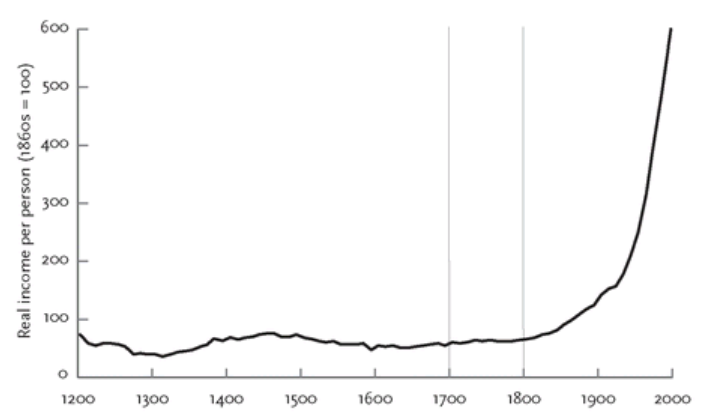
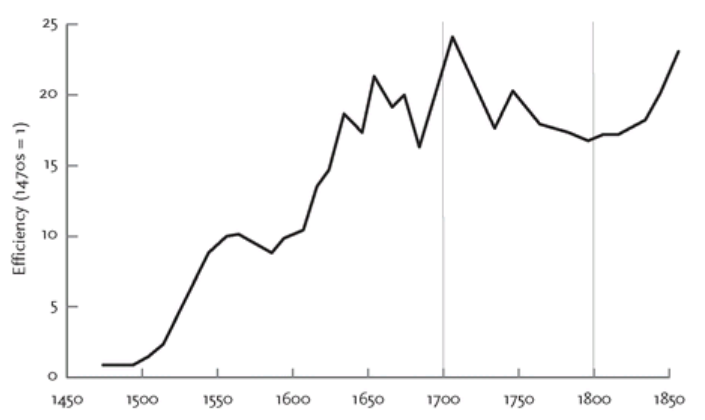
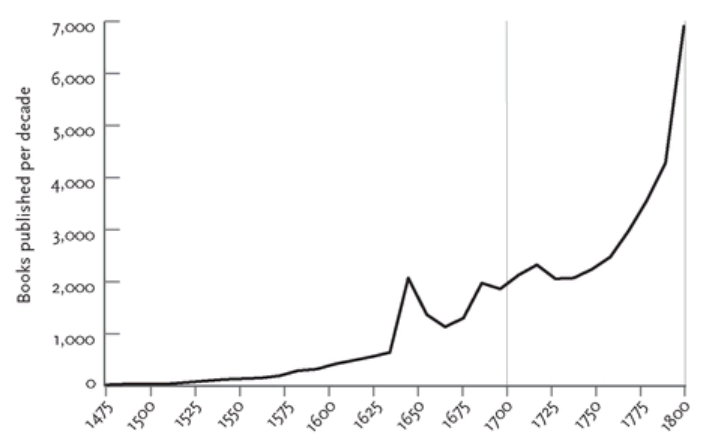
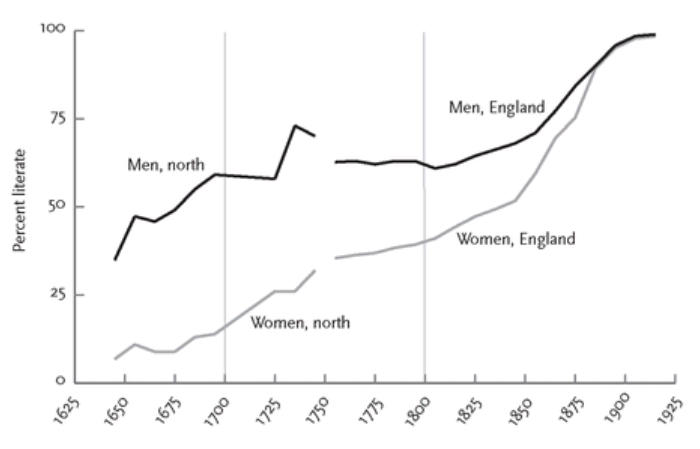
Pinker tests two candidate explanations for the eighteenth-century humanitarian turn. A simple prosperity story has a timing problem: his English income series remains broadly Malthusian until the nineteenth-century Industrial Revolution, after campaigns against religious persecution, torture, cruel punishment, and slavery were already under way. Print changed earlier. After Gutenberg, Pinker reports more than a twentyfold rise in English book-production efficiency over two centuries; publication surged, literacy rose, and readers increasingly encountered secular, topical, and first-person material.
Figures 4-7 to 4-10 — English real income, printing productivity, book output, and literacy. Pinker’s proposed mechanism is twofold: reading can train perspective-taking, while cheap print, correspondence, cities, and a “Republic of Letters” let arguments be criticized, recombined, and reach officials. The chronology makes this a plausible contributor, not a demonstrated single cause. The series use reconstructed income, publication counts, and literacy proxies such as signatures; they do not measure empathy or reform directly, and the argument should not erase religious, legal, commercial, popular, or state-building contributions. Chapter 4 synthesis · Civilizing-process and affluence alternatives, PDF pp. 248–251 (file not included in this release) · Figure 4-7, PDF p. 251 (file not included in this release) · Figure 4-8, PDF p. 252 (file not included in this release) · Figure 4-9 and publication growth, PDF pp. 253–254 (file not included in this release) · Figure 4-10 and literacy mechanism, PDF pp. 255–259 (file not included in this release)
Pinker’s Chapter 10 synthesis — reason becomes pacifying when it is institutionalized
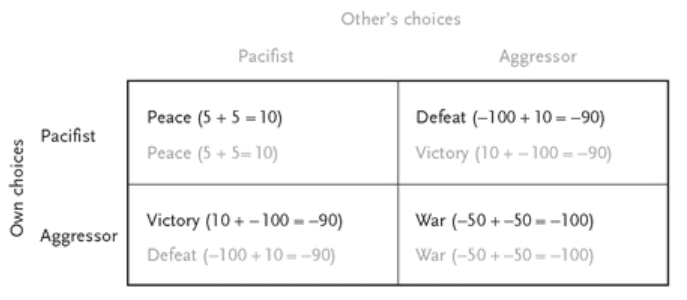
Figure 10-5 — How empathy and reason resolve the Pacifist’s Dilemma. Pinker distinguishes two routes that are often blurred together. The expanding circle imaginatively enters another person’s experience; impartial reason asks why one’s own interests should receive a privilege that cannot be justified from the other position. Sympathy can make a victim vivid, while public reasoning can generalize protection to people who evoke little spontaneous affection.
The practical consequence is not faith in unaided intellect. Pinker points to revisable institutional designs—democratic constraints, peacekeeping, reconciliation, nonviolent resistance, crime prevention, containment, sanctions, and engagement—that alter incentives and give actors alternatives to domination or capitulation. Knowledge institutions, free discussion, historical comparison, and empirical correction make those designs criticizable. He acknowledges that the directional “escalator” can sound Whiggish and that the evidence combines chronology, correlation, and only limited causal identification. This complements the practical-reform model: reason matters most when embodied in institutions that expose failure and can be revised. Chapter 10 synthesis · Expanding-circle evidence and limits, PDF p. 943 (file not included in this release) · Sympathy versus impartial reason, PDF p. 944 (file not included in this release) · Institutionalized reason, PDF pp. 945–946 (file not included in this release)
Henrich, Chapter 12 — Enlightenment argument worked on inherited psychological and institutional material
Henrich’s “dark matter” thesis relocates rather than erases Enlightenment agency. Locke, Hume, Montesquieu, Voltaire, Paine, Rousseau, and Smith reasoned within a society already shaped by individual property, charters, corporations, merchant contracts, representative practices, literacy, markets, and canon-law efforts to harmonize universal principles. Social-contract theories could imagine society as an agreement among individuals because individual standing and consent had become culturally available building blocks. Enlightenment writers articulated, criticized, generalized, and publicized those materials; they did not create them ex nihilo. Psychological dark matter and Enlightenment thinkers, PDF pp. 422–424 (file not included in this release)
Treat this as a genealogy, not proof that arguments and authors were causally unimportant. The claim rests on historical synthesis rather than a direct counterfactual test; similar ideas can have multiple lineages, and inheritance does not determine how a thinker transforms a concept or whether it is justified. The best integration with this note is reciprocal: inherited practices made some reforms thinkable, while explicit criticism and public argument helped expose contradictions, broaden standing, and redesign institutions. Enlightenment genealogy sources, Chapter 12 endnotes 47–48, PDF pp. 600–601 (file not included in this release) · Chapter 12 source audit
Happiness as the organizing end
Robertson’s central revision is that the Enlightenment was not organized by reason as a self-sufficient idol. Its governing purpose was happiness in this world: reducing avoidable misery and making human flourishing more attainable. Reason mattered because it could expose falsehood, compare institutions, test whether a practice achieved its stated purpose, and identify correctable causes of suffering. Empirical inquiry mattered because reform without knowledge easily becomes dogma.
This orientation challenged the view that earthly suffering should chiefly be endured as part of a divinely ordered “vale of tears.” It did not require atheism. Many Enlighteners retained belief in providence, natural religion, moral Christianity, or a creator. The crucial change was the insistence that human beings had both the capacity and some responsibility to improve worldly conditions. → Vale of Tears
A practical sequence
The reforming method can be represented as a recurring chain:
- Expose an inherited claim to scrutiny. Tradition, rank, revelation, custom, or administrative habit no longer settles the question by itself.
- Describe the actual condition. Collect observations, testimony, comparisons, statistics, travel accounts, histories, or experiments.
- Identify avoidable mechanisms of suffering. Ask how a law, punishment, monopoly, prejudice, disease environment, school, or church-state arrangement produces its effects.
- Propose a revisable intervention. Reform the institution rather than waiting for moral transformation or accepting misery as permanent.
- Judge consequences. The reform’s authority remains provisional; evidence of failure should change the policy.
- Make the argument public. Essays, novels, salons, learned societies, periodicals, correspondence, and political controversy widen participation in judgment.
This sequence is an ideal reconstruction. Historical actors frequently skipped steps, selected evidence strategically, or assumed that administrators knew other people’s interests better than the people themselves.
Where practical Enlightenment appeared
| Domain | Reforming question | Characteristic contribution | Characteristic danger |
|---|---|---|---|
| Toleration | Can coercion produce belief or civic peace? | Limits on persecution; plural coexistence | Toleration granted paternalistically rather than equal liberty |
| Criminal law | Does spectacular cruelty prevent crime? | Proportional punishment; criticism of torture and arbitrary procedure | People reduced to objects of deterrence or discipline |
| Education | Can ignorance be reduced institutionally? | Literacy, public instruction, wider circulation of knowledge | Standardization and ideological formation |
| Health and poverty | Which material causes of suffering are preventable? | Hospitals, sanitation, inoculation debates, relief, administrative attention | Surveillance, confinement, coercive welfare |
| Political economy | Which rules encourage prosperity and security? | Analysis of commerce, labor, taxation, monopoly, and incentives | Human welfare narrowed to calculable production or growth |
| Religion | Which beliefs support morality, and which claims evade evidence? | Rational religion, historical criticism, freedom of conscience | Reduction of religion to elite-approved utility |
| Government | Which institutions protect liberty and improve administration? | Constitutional comparison, separation of powers, codification | Enlightened absolutism and reform from above |
Reason was one faculty among others
The practical-reform model is inseparable from sensibility and sociability. Eighteenth-century novels, moral philosophy, theatre, and journalism trained attention on suffering and encouraged readers to imaginatively enter other lives. Adam Smith’s moral psychology preceded his political economy. Sympathy did not replace reasoning; it helped identify which conditions counted as morally urgent, while inquiry examined causes and remedies.
This corrects two symmetrical caricatures:
- The Enlightener is not necessarily a detached calculator who treats inherited life as raw material.
- Benevolent feeling is not sufficient. Compassion without evidence can produce ineffective or coercive interventions.
Practical enlightenment needs both moral attention and corrigible knowledge.
The paternalist shadow
Reform can become domination when its agents assume that knowledge gives them authority to reorganize others without consent. Bentham’s Panopticon is the clearest emblem: transparent, regular, welfare-oriented administration becomes continuous observation. Enlightened rulers could abolish abuses while retaining unaccountable power. Projects of education, poor relief, medicine, and urban order could classify, confine, normalize, or homogenize.
The relevant distinction is not reform versus no reform, but:
- Who defines the problem?
- Who supplies the evidence?
- Can those governed contest the account?
- Is the intervention reversible?
- Are rights constraints prior to aggregate benefit?
- Does the institution disclose failure and permit correction?
Without those safeguards, practical reason becomes technocracy. With them, it supports a politics of experimental improvement.
What the concept explains
- Why the Enlightenment cannot be understood only through epistemology or famous philosophical systems.
- Why religion and Enlightenment were sometimes collaborators rather than simple enemies.
- Why literature and feeling belong beside science and reason.
- Why apparently modest administrative reforms were intellectually central.
- Why the movement could produce both humanitarian change and intrusive social control.
- Why an open public sphere matters: practical reason improves through criticism rather than through the wisdom of a supposedly enlightened elite.
What it does not establish
- That the Enlightenment invented humanitarian concern.
- That reforms credited to it had no Christian, classical, legal, commercial, popular, or state-building antecedents.
- That an intention to promote happiness proves a beneficial result.
- That later progress was inevitable or flowed from a single intellectual cause.
- That every critic of rational reform prefers suffering, superstition, or passivity.
Debate-ready formulation
The Enlightenment’s strongest legacy is not faith in perfect reason. It is the practice of turning inherited suffering into a public, investigable, and potentially correctable problem. Its corresponding danger appears when the investigator becomes an unaccountable manager who defines other people’s happiness for them.
Practical test for modern policy
A modern proposal deserves the name “enlightened” only in the modest, defensible sense if it combines:
- a publicly stated human end;
- evidence about mechanisms rather than slogans;
- rights and consent constraints;
- openness to criticism from affected people;
- measurable but non-reductive evaluation;
- institutional capacity to reverse or revise failure.
That standard preserves the reforming aspiration while rejecting the fantasy of a final social design.